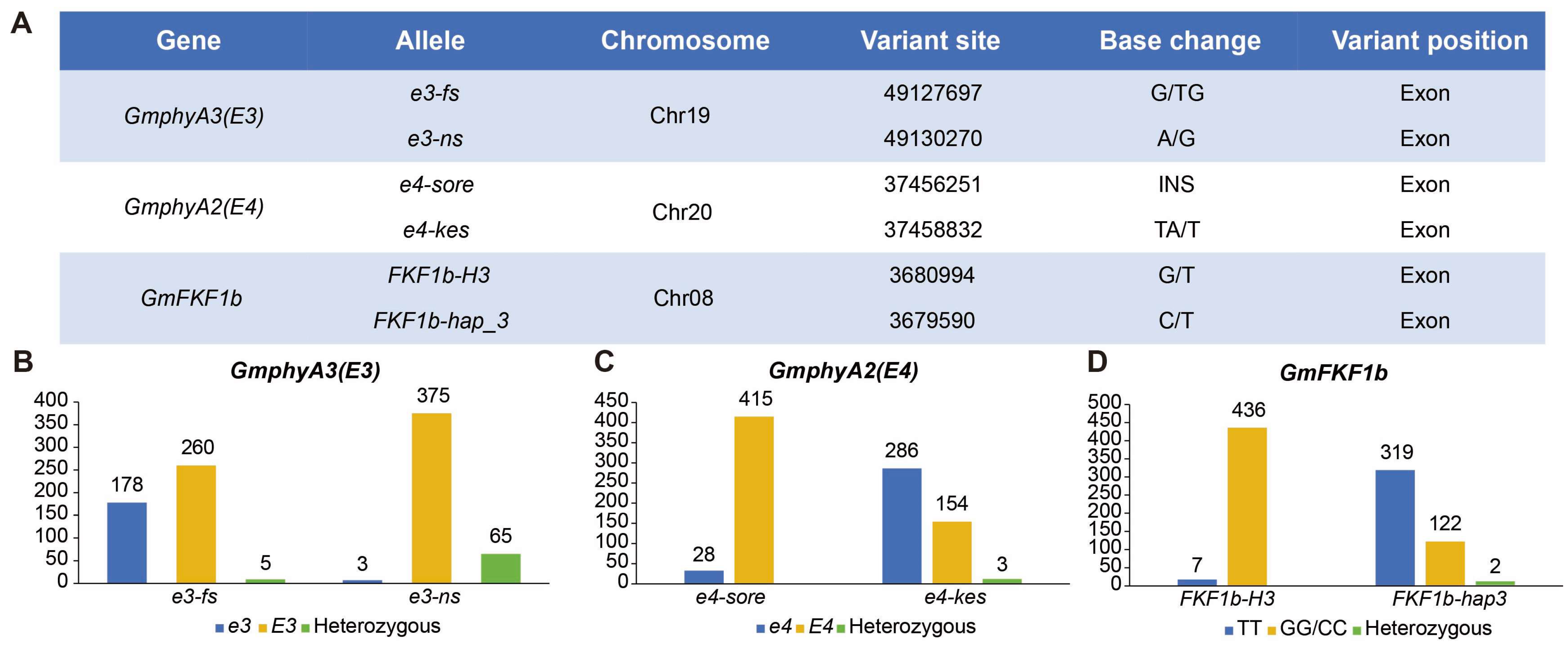
KASP-Based Genotyping Reveals Super-Early Maturity Allele Diversity in High-Latitude Soybean Germplasm from Mohe, Northeast China (>53° N)

 , , ,
, , ,
Abstract
1. Introduction
2. Materials and Methods
2.1. Plant Materials
2.2. Methods
2.2.1. DNA Extraction
2.2.2. KASP Primer DesignPreviously Developed KASP Markers for Early Maturity-Related Genes
Design of Novel KASP Markers for Additional Early Maturity-Related Genes
2.2.3. Genotyping and Data Analysis
3. Results
3.1. Upstream Photoreceptor Genes Display Divergent Selection Patterns
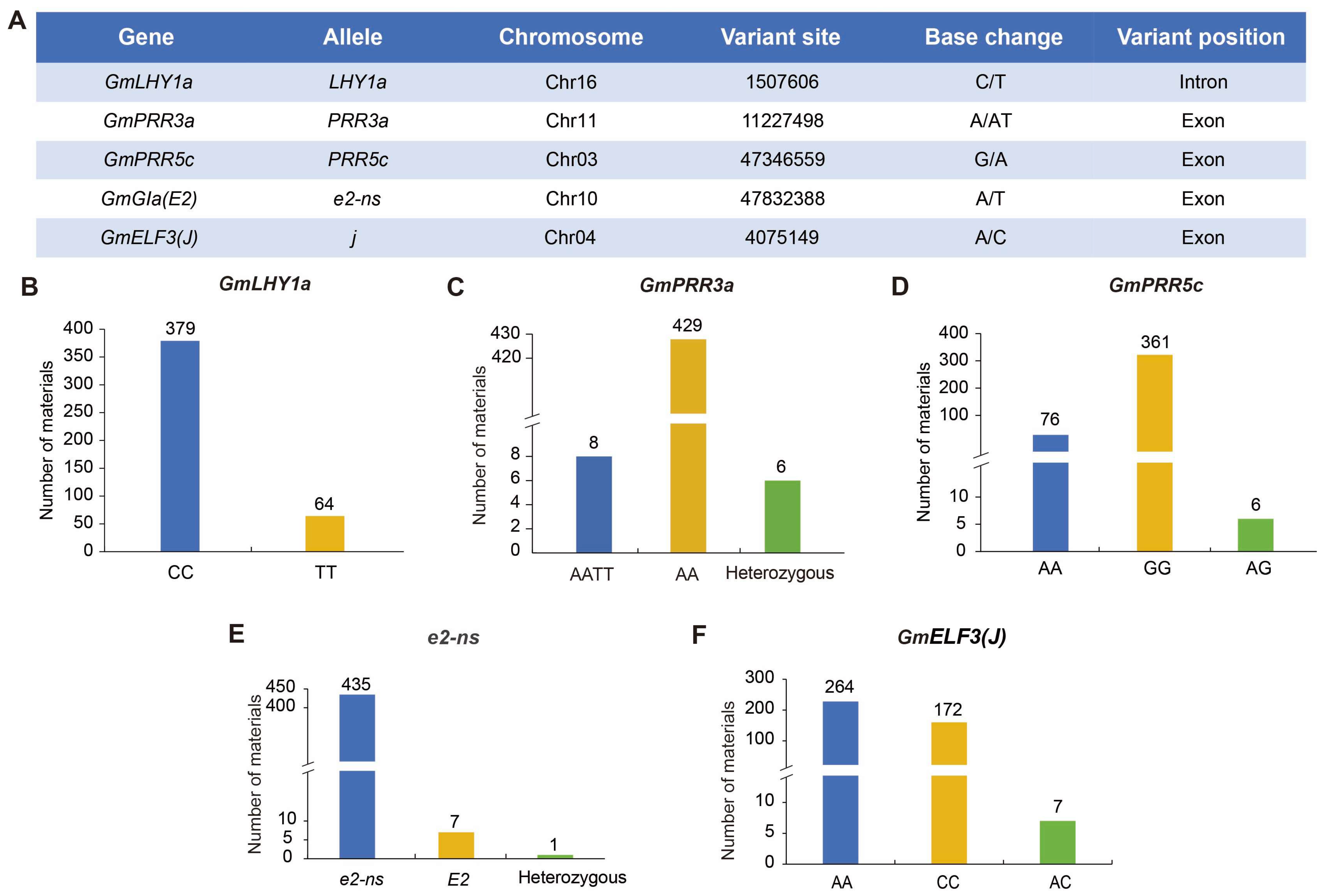
3.2. Core Circadian Clock Genes Exhibit Multi-Level Allele Frequency Distributions
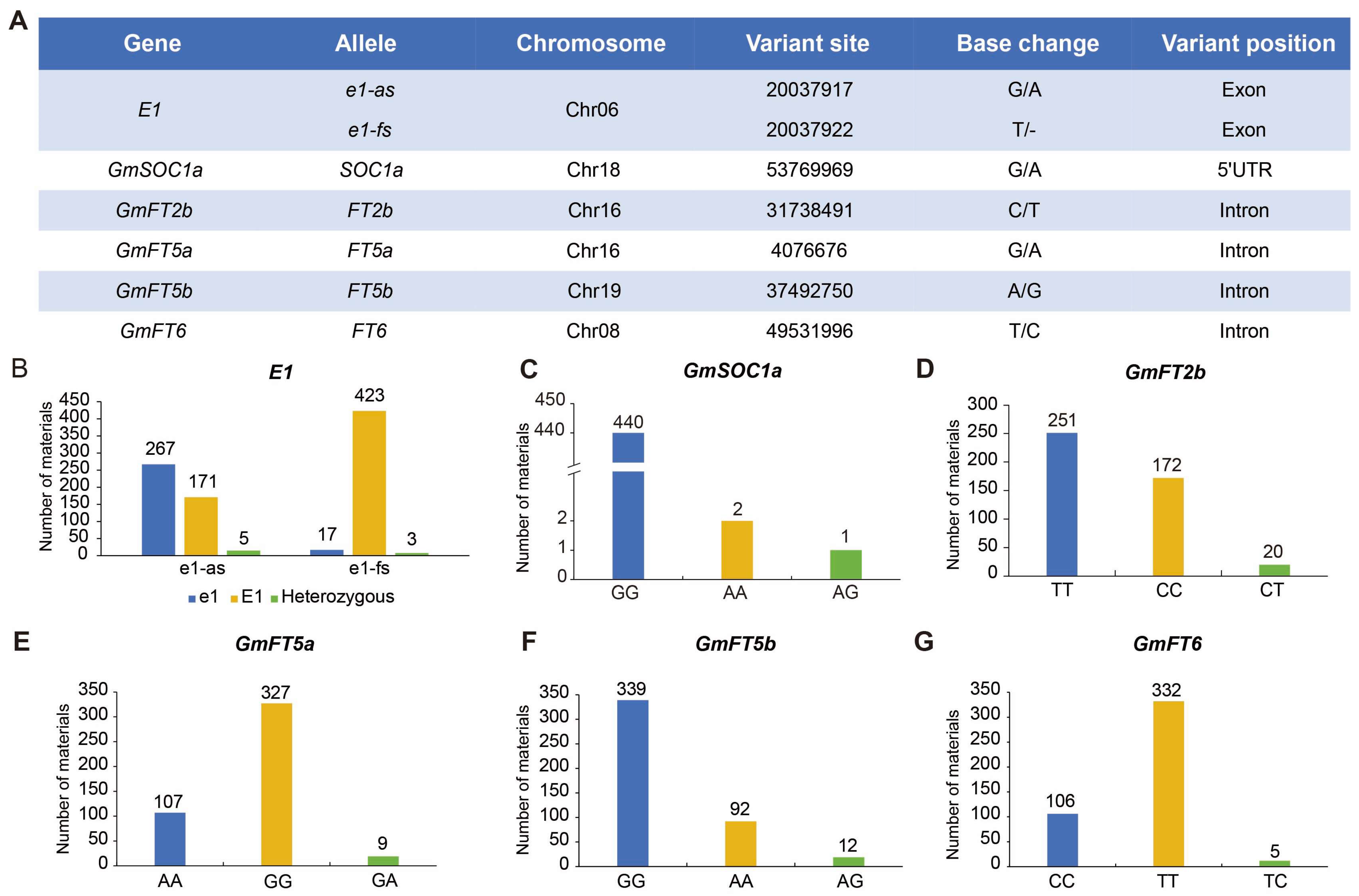
3.3. Downstream Signaling Genes Show Dynamic Selection Patterns in High-Latitude Soybean Populations
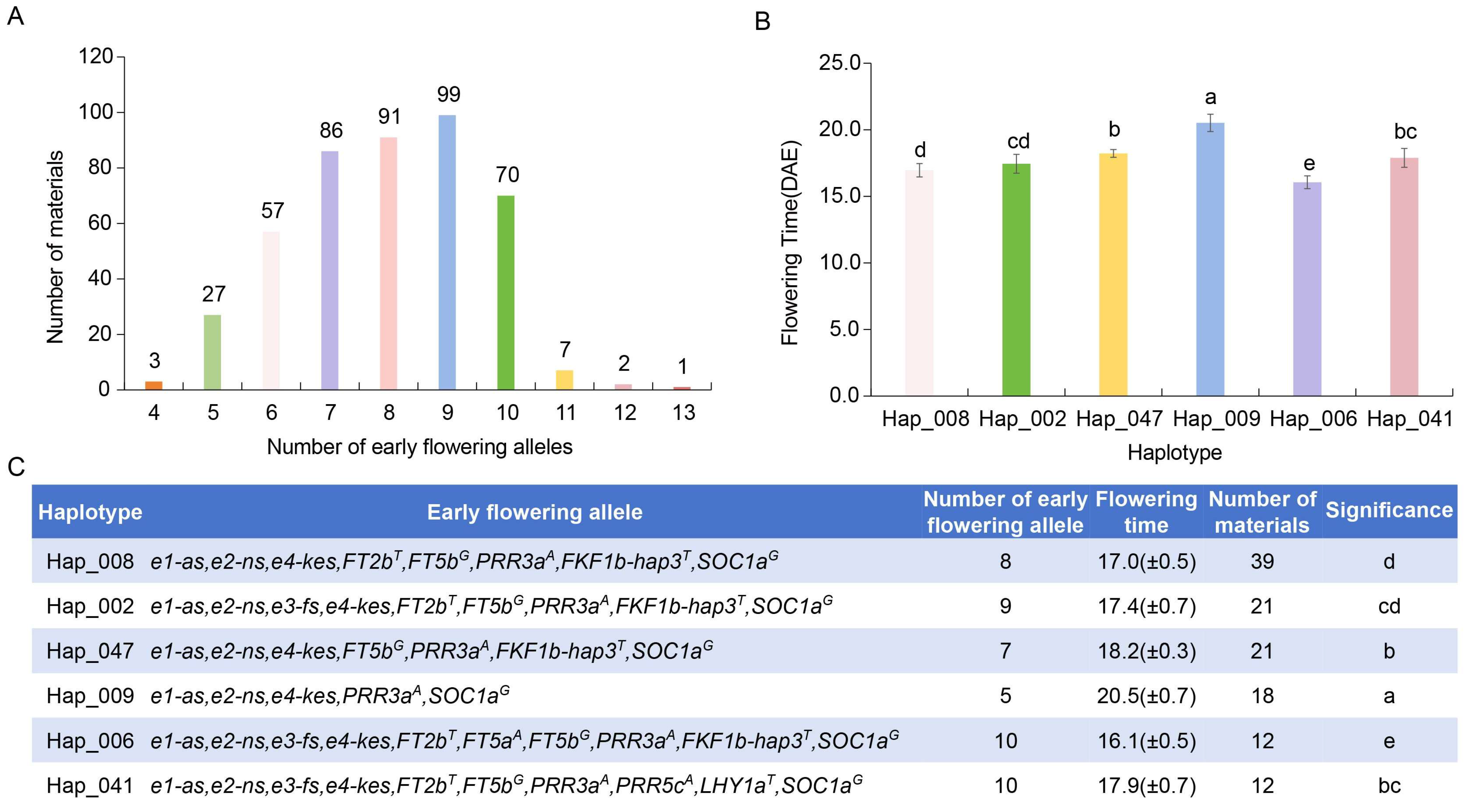
3.4. Allelic Variation Combinations Drive High-Latitude Super-Early Maturity in Soybean
4. Discussion
4.1. Differential Selection Frequency of Early Maturity-Related Genes at Arctic Village
4.2. Super-Early Maturity Results from the Accumulation of Multiple Early Maturity Alleles
4.3. KASP Marker Development and Superior Early Maturity Germplasm Are Core Supports for High-Latitude Breeding
5. Conclusions
Supplementary Materials
Author Contributions
Funding
Data Availability Statement
Acknowledgments
Conflicts of Interest
References
- Graham, P.H.; Vance, C.P. Legumes: Importance and constraints to greater use. Plant Physiol. 2003, 131, 872–877. [Google Scholar] [CrossRef] [PubMed]
- National Bureau of Statistics. China Statistical Yearbook 2024. Available online: https://www.stats.gov.cn/sj/ndsj/2024/indexch.htm (accessed on 1 March 2025).
- Heilongjiang Bureau of Statistics. Heilongjiang Statistical Yearbook 2024. Available online: https://tjj.hlj.gov.cn/tjjnianjian/2024/zk/indexch.htm (accessed on 1 March 2025).
- Food and Agriculture Organization of the United Nations (FAO). FAOSTAT: Crops and Livestock Products. 2025. Available online: https://www.fao.org/faostat/zh/#data/QCL (accessed on 1 March 2025).
- Watanabe, S.; Harada, K.; Abe, J. Genetic and molecular bases of photoperiod responses of flowering in soybean. Breed. Sci. 2012, 61, 531–543. [Google Scholar] [CrossRef] [PubMed]
- Xia, Z.; Watanabe, S.; Yamada, T.; Tsubokura, Y.; Nakashima, H.; Zhai, H.; Anai, T.; Sato, S.; Yamazaki, T.; Lü, S.; et al. Positional cloning and characterization reveal the molecular basis for soybean maturity locus E1 that regulates photoperiodic flowering. Proc. Natl. Acad. Sci. USA 2012, 109, E2155–E2164. [Google Scholar] [CrossRef] [PubMed]
- Watanabe, S.; Xia, Z.; Hideshima, R.; Tsubokura, Y.; Sato, S.; Yamanaka, N.; Takahashi, R.; Anai, T.; Tabata, S.; Kitamura, K.; et al. A map-based cloning strategy employing a residual heterozygous line reveals that the GIGANTEA gene is involved in soybean maturity and flowering. Genetics 2011, 188, 395–407. [Google Scholar] [CrossRef]
- Liu, B.; Kanazawa, A.; Matsumura, H.; Takahashi, R.; Harada, K.; Abe, J. Genetic redundancy in soybean photoresponses associated with duplication of the phytochrome A gene. Genetics 2008, 180, 995–1007. [Google Scholar] [CrossRef]
- Watanabe, S.; Hideshima, R.; Xia, Z.; Tsubokura, Y.; Sato, S.; Nakamoto, Y.; Yamanaka, N.; Takahashi, R.; Ishimoto, M.; Anai, T.; et al. Map-based cloning of the gene associated with the soybean maturity locus E3. Genetics 2009, 182, 1251–1262. [Google Scholar] [CrossRef]
- Liu, L.; Song, W.; Wang, L.; Sun, X.; Qi, Y.; Wu, T.; Sun, S.; Jiang, B.; Wu, C.; Hou, W.; et al. Allele combinations of maturity genes E1–E4 affect adaptation of soybean to diverse geographic regions and farming systems in China. PLoS ONE 2020, 15, e0235397. [Google Scholar] [CrossRef]
- Yue, Y.; Liu, N.; Jiang, B.; Li, M.; Wang, H.; Jiang, Z.; Pan, H.; Xia, Q.; Ma, Q.; Han, T.; et al. A single nucleotide deletion in J encoding GmELF3 confers long juvenility and is associated with adaption of tropic soybean. Mol. Plant 2017, 10, 656–658. [Google Scholar] [CrossRef]
- Jiang, B.; Zhang, S.; Song, W.; Khan, M.A.A.; Sun, S.; Zhang, C.; Wu, T.; Wu, C.; Han, T. Natural variations of FT family genes in soybean varieties covering a wide range of maturity groups. BMC Genom. 2019, 20, 230. [Google Scholar] [CrossRef]
- Kong, F.; Liu, B.; Xia, Z.; Sato, S.; Kim, B.M.; Watanabe, S.; Yamada, T.; Tabata, S.; Kanazawa, A.; Harada, K.; et al. Two coordinately regulated homologs of FLOWERING LOCUS T are involved in the control of photoperiodic flowering in soybean. Plant Physiol. 2010, 154, 1220–1231. [Google Scholar] [CrossRef]
- Zhao, C.; Takeshima, R.; Zhu, J.; Xu, M.; Sato, M.; Watanabe, S.; Kanazawa, A.; Liu, B.; Kong, F.; Yamada, T.; et al. A recessive allele for delayed flowering at the soybean maturity locus E9 is a leaky allele of FT2a, a FLOWERING LOCUS T ortholog. BMC Plant Biol. 2016, 16, 20. [Google Scholar] [CrossRef] [PubMed]
- Chen, L.; Cai, Y.; Qu, M.; Wang, L.; Sun, H.; Jiang, B.; Wu, T.; Liu, L.; Sun, S.; Wu, C.; et al. Soybean adaption to high-latitude regions is associated with natural variations of GmFT2b, an ortholog of FLOWERING LOCUS T. Plant Cell Environ. 2020, 43, 934–944. [Google Scholar] [CrossRef] [PubMed]
- Lee, S.H.; Choi, C.W.; Park, K.M.; Jung, W.H.; Chun, H.J.; Baek, D.; Cho, H.M.; Jin, B.J.; Park, M.S.; No, D.H.; et al. Diversification in functions and expressions of soybean FLOWERING LOCUS T genes fine-tunes seasonal flowering. Front. Plant Sci. 2021, 12, 613675. [Google Scholar] [CrossRef]
- Wang, J.; Xu, X.; Wang, P.; Zhang, L.; Liu, L.; Liu, L.; Wu, T.; Song, W.; Yuan, S.; Jiang, B.; et al. Floral-promoting GmFT homologs trigger photoperiodic after-effects: An important mechanism for early-maturing soybean varieties to regulate reproductive development and adapt to high latitudes. Plant Cell Environ. 2024, 47, 1656–1667. [Google Scholar] [CrossRef] [PubMed]
- Su, Q.; Chen, L.; Cai, Y.; Wang, L.; Chen, Y.; Zhang, J.; Liu, L.; Zhang, Y.; Yuan, S.; Gao, Y.; et al. The FLOWERING LOCUS T 5b positively regulates photoperiodic flowering and improves the geographical adaptation of soybean. Plant Cell Environ. 2024, 47, 246–258. [Google Scholar] [CrossRef]
- Dong, L.; Cheng, Q.; Fang, C.; Kong, L.; Yang, H.; Hou, Z.; Li, Y.; Nan, H.; Zhang, Y.; Chen, Q.; et al. Parallel selection of distinct Tof5 alleles drove the adaptation of cultivated and wild soybean to high latitudes. Mol. Plant 2022, 15, 308–321. [Google Scholar] [CrossRef]
- Lu, S.; Dong, L.; Fang, C.; Liu, S.; Kong, L.; Cheng, Q.; Chen, L.; Su, T.; Nan, H.; Zhang, D.; et al. Stepwise selection on homeologous PRR genes controlling flowering and maturity during soybean domestication. Nat. Genet. 2020, 52, 428–436. [Google Scholar] [CrossRef]
- Wang, L.; Sun, S.; Wu, T.; Liu, L.; Sun, X.; Cai, Y.; Li, J.; Jia, H.; Yuan, S.; Chen, L.; et al. Natural variation and CRISPR/Cas9-mediated mutation in GmPRR37 affect photoperiodic flowering and contribute to regional adaptation of soybean. Plant Biotechnol. J. 2020, 18, 1869–1881. [Google Scholar] [CrossRef]
- Wang, F.; Nan, H.; Chen, L.; Fang, C.; Zhang, H.; Su, T.; Li, S.; Cheng, Q.; Dong, L.; Liu, B.; et al. A new dominant locus, E11, controls early flowering time and maturity in soybean. Mol. Breed. 2019, 39, 70. [Google Scholar] [CrossRef]
- Qin, C.; Li, H.; Zhang, S.; Lin, X.; Jia, Z.; Zhao, F.; Wei, X.; Jiao, Y.; Li, Z.; Niu, Z.; et al. GmEID1 modulates light signaling through the Evening Complex to control flowering time and yield in soybean. Proc. Natl. Acad. Sci. USA 2023, 120, e2212468120. [Google Scholar] [CrossRef]
- Lin, X.; Liu, B.; Weller, J.L.; Abe, J.; Kong, F. Molecular mechanisms for the photoperiodic regulation of flowering in soybean. J. Integr. Plant Biol. 2021, 63, 981–994. [Google Scholar] [CrossRef]
- Dipta, B.; Sood, S.; Mangal, V.; Bhardwaj, V.; Thakur, A.K.; Kumar, V.; Singh, B. Single nucleotide polymorphism genotyping using Kompetitive Allele Specific PCR (KASP): Overview of the technology and its application in crop improvement. Mol. Breed. 2014, 33, 1–14. [Google Scholar] [CrossRef]
- Rasheed, A.; Wen, W.; Gao, F.; Zhai, S.; Jin, H.; Liu, J.; Guo, Q.; Zhang, Y.; Dreisigacker, S.; Xia, X.; et al. Development and validation of KASP assays for genes underpinning key economic traits in bread wheat. Theor. Appl. Genet. 2016, 129, 1843–1860. [Google Scholar] [CrossRef] [PubMed]
- Asea, G.; Vivek, B.S.; Bigirwa, G.; Lipps, P.E.; Pratt, R. Validation of consensus quantitative trait loci associated with resistance to multiple foliar pathogens of maize. Phytopathology 2009, 99, 540–547. [Google Scholar] [CrossRef] [PubMed]
- Tang, W.; Lin, J.; Wang, Y.; An, H.; Chen, H.; Pan, G.; Zhang, S.; Guo, B.; Yu, K.; Li, H.; et al. Selection and validation of 48 KASP markers for variety identification and breeding guidance in conventional and hybrid rice (Oryza sativa L.). Rice 2022, 15, 48. [Google Scholar] [CrossRef]
- Sim, S.C.; Robbins, M.D.; Van Deynze, A.; Michel, A.P.; Francis, D.M. Population structure and genetic differentiation associated with breeding history and selection in tomato (Solanum lycopersicum L.). Heredity 2011, 106, 927–935. [Google Scholar] [CrossRef]
- Raman, H.; Raman, R.; Kilian, A.; Detering, F.; Carling, J.; Coombes, N.; Diffey, S.; Kadkol, G.; Edwards, D.; McCully, M.; et al. Genome-wide delineation of natural variation for pod shatter resistance in Brassica napus. PLoS ONE 2014, 9, e101673. [Google Scholar] [CrossRef]
- Sharma, S.K.; Bolser, D.; de Boer, J.; Sønderkær, M.; Amoros, W.; Carboni, M.F.; D’Ambrosio, J.M.; de la Cruz, G.; Di Genova, A.; Douches, D.; et al. Construction of reference chromosome-scale pseudomolecules for potato: Integrating the potato genome with genetic and physical maps. G3 Genes Genomes Genet. 2013, 3, 2031–2047. [Google Scholar] [CrossRef]
- Patil, G.; Chaudhary, J.; Vuong, T.D.; Jenkins, B.; Qiu, D.; Kadam, S.; Shannon, G.J.; Nguyen, H.T. Development and validation of KASP markers for functional genes of important traits in soybean. Chin. J. Oil Crop Sci. 2024, 46, 1251–1267. [Google Scholar]
- Shen, Y.; Zhou, Z.; Wang, Z.; Li, W.; Fang, C.; Wu, M.; Ma, Y.; Liu, T.; Kong, L.A.; Peng, D.L.; et al. Global dissection of alternative splicing in paleopolyploid soybean. Plant Cell 2014, 26, 996–1008. [Google Scholar] [CrossRef]
- Shen, Y.; Du, H.; Liu, Y.; Ni, L.; Wang, Z.; Liang, C.; Tian, Z. Update soybean Zhonghuang 13 genome to a golden reference. Sci. China Life Sci. 2019, 62, 1257–1260. [Google Scholar] [CrossRef] [PubMed]
- Jia, H.; Sun, B.; Jiang, B.; Wang, P.; Naser, M.; Qian, S.; Wang, L.; Zhang, L.; Sinegovskii, M.; Sun, S.; et al. Natural variations in key maturity genes underpin soybean cultivars adaptation beyond 50° N in Northeast China. Int. J. Mol. Sci. 2025, 26, 3362. [Google Scholar] [CrossRef] [PubMed]
- Sineshchekov, V.A. Phytochrome A: Functional diversity and polymorphism. Photochem. Photobiol. Sci. 2004, 3, 596–607. [Google Scholar] [CrossRef] [PubMed]
- Xu, M.; Xu, Z.; Liu, B.; Kong, F.; Tsubokura, Y.; Watanabe, S.; Xia, Z.; Harada, K.; Kanazawa, A.; Yamada, T.; et al. Genetic variation in four maturity genes affects photoperiod insensitivity and PHYA-regulated post-flowering responses of soybean. BMC Plant Biol. 2013, 13, 91. [Google Scholar] [CrossRef]
- Nelson, D.C.; Lasswell, J.; Rogg, L.E.; Cohen, M.A.; Bartel, B. FKF1, a clock-controlled gene that regulates the transition to flowering in Arabidopsis. Cell 2000, 101, 331–340. [Google Scholar] [CrossRef]
- Li, H.; Du, H.; He, M.; Wang, J.; Wang, F.; Yuan, W.; Huang, Z.; Cheng, Q.; Gou, C.; Chen, Z.; et al. Natural variation of FKF1 controls flowering and adaptation during soybean domestication and improvement. New Phytol. 2023, 238, 1671–1684. [Google Scholar] [CrossRef]
- Dong, L.; Fang, C.; Cheng, Q.; Su, T.; Kou, K.; Kong, L.; Zhang, C.; Li, H.; Hou, Z.; Zhang, Y.; et al. Genetic basis and adaptation trajectory of soybean from its temperate origin to tropics. Nat. Commun. 2021, 12, 5445. [Google Scholar] [CrossRef]
- Yan, J.P.; Kim, Y.J.; Somers, D.E. Post-translational mechanisms of plant circadian regulation. Genes 2021, 12, 325. [Google Scholar] [CrossRef]
- Blümel, M.; Dally, N.; Jung, C. Flowering time regulation in crops what did we learn from Arabidopsis? Curr. Opin. Biotechnol. 2015, 32, 121–129. [Google Scholar] [CrossRef]



| Step | Temperature | Time | Cycles |
|---|---|---|---|
| 1 | 95 °C | 10 min | 1 cycle |
| 2 | 95 °C | 20 s | 10 cycles |
| 61–55 °C (drop 0.6 per cycle) | 40 s | ||
| 3 | 95 °C | 20 s | 30–45 cycles |
| 55 °C | 40 s | ||
| 4 | 25 °C | forever | 1 cycle |
Disclaimer/Publisher’s Note: The statements, opinions and data contained in all publications are solely those of the individual author(s) and contributor(s) and not of MDPI and/or the editor(s). MDPI and/or the editor(s) disclaim responsibility for any injury to people or property resulting from any ideas, methods, instructions or products referred to in the content. |
© 2026 by the authors. Licensee MDPI, Basel, Switzerland. This article is an open access article distributed under the terms and conditions of the Creative Commons Attribution (CC BY) license.
Share and Cite
Li, Q.; Sun, B.; Qian, S.; Zhang, B.; Wu, T.; Yuan, S.; Jiang, B.; Wang, S.; Sun, Y.; Wang, P.; et al. KASP-Based Genotyping Reveals Super-Early Maturity Allele Diversity in High-Latitude Soybean Germplasm from Mohe, Northeast China (>53° N). Agronomy 2026, 16, 725. https://doi.org/10.3390/agronomy16070725
Li Q, Sun B, Qian S, Zhang B, Wu T, Yuan S, Jiang B, Wang S, Sun Y, Wang P, et al. KASP-Based Genotyping Reveals Super-Early Maturity Allele Diversity in High-Latitude Soybean Germplasm from Mohe, Northeast China (>53° N). Agronomy. 2026; 16(7):725. https://doi.org/10.3390/agronomy16070725
Chicago/Turabian StyleLi, Qimeng, Baiquan Sun, Shuqing Qian, Bangbang Zhang, Tingting Wu, Shan Yuan, Bingjun Jiang, Shaodong Wang, Yanhui Sun, Peiguo Wang, and et al. 2026. "KASP-Based Genotyping Reveals Super-Early Maturity Allele Diversity in High-Latitude Soybean Germplasm from Mohe, Northeast China (>53° N)" Agronomy 16, no. 7: 725. https://doi.org/10.3390/agronomy16070725
APA StyleLi, Q., Sun, B., Qian, S., Zhang, B., Wu, T., Yuan, S., Jiang, B., Wang, S., Sun, Y., Wang, P., Sun, S., Han, T., Guo, C., & Qin, C. (2026). KASP-Based Genotyping Reveals Super-Early Maturity Allele Diversity in High-Latitude Soybean Germplasm from Mohe, Northeast China (>53° N). Agronomy, 16(7), 725. https://doi.org/10.3390/agronomy16070725