Retrieving Soil Water Content in Winter Wheat Fields Using UAV-Based Multi-Source Remote Sensing and Machine Learning
 , ,
, ,
Abstract
1. Introduction
2. Materials and Methods
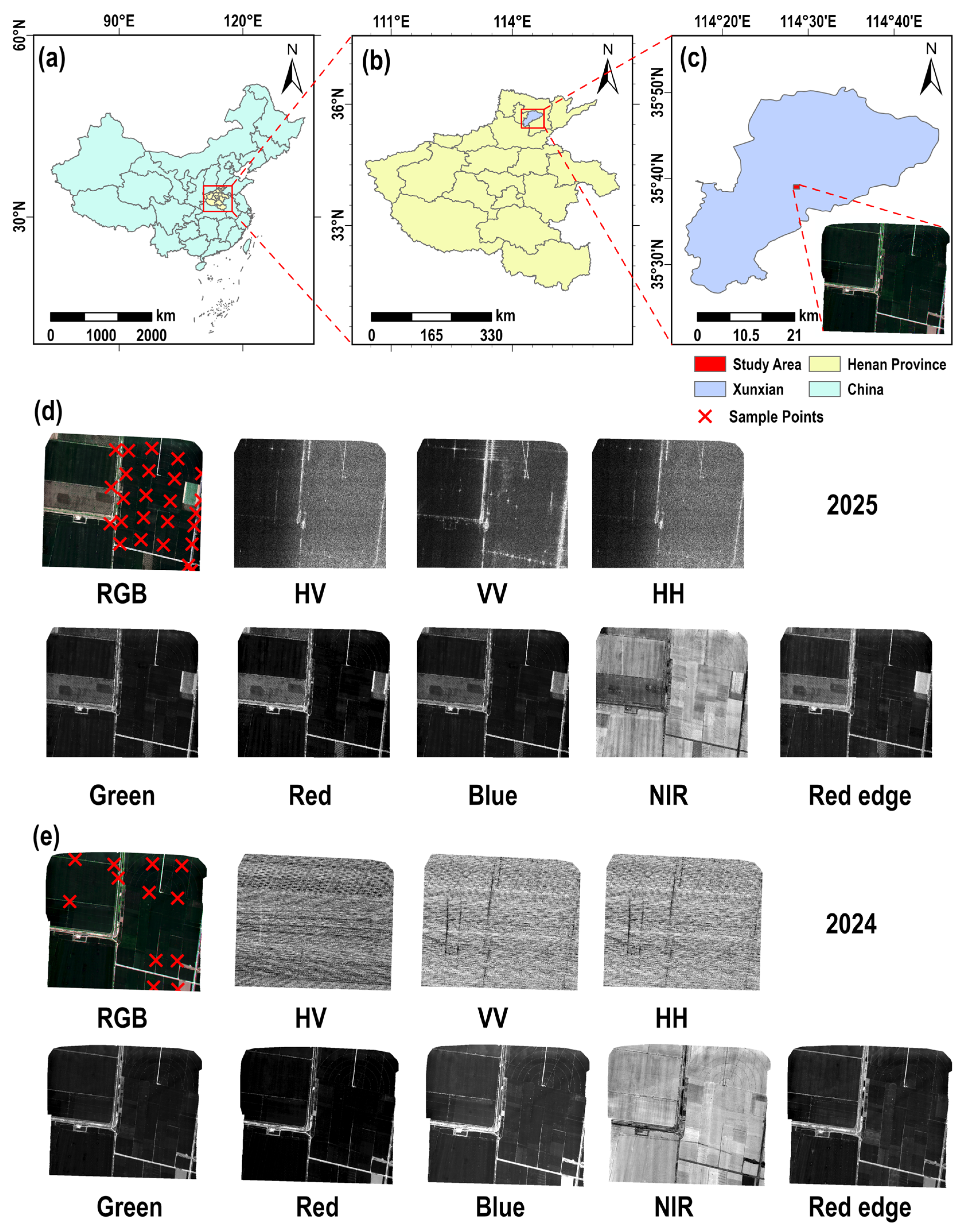
2.1. Study Area
2.2. Experimental Design
- (1)
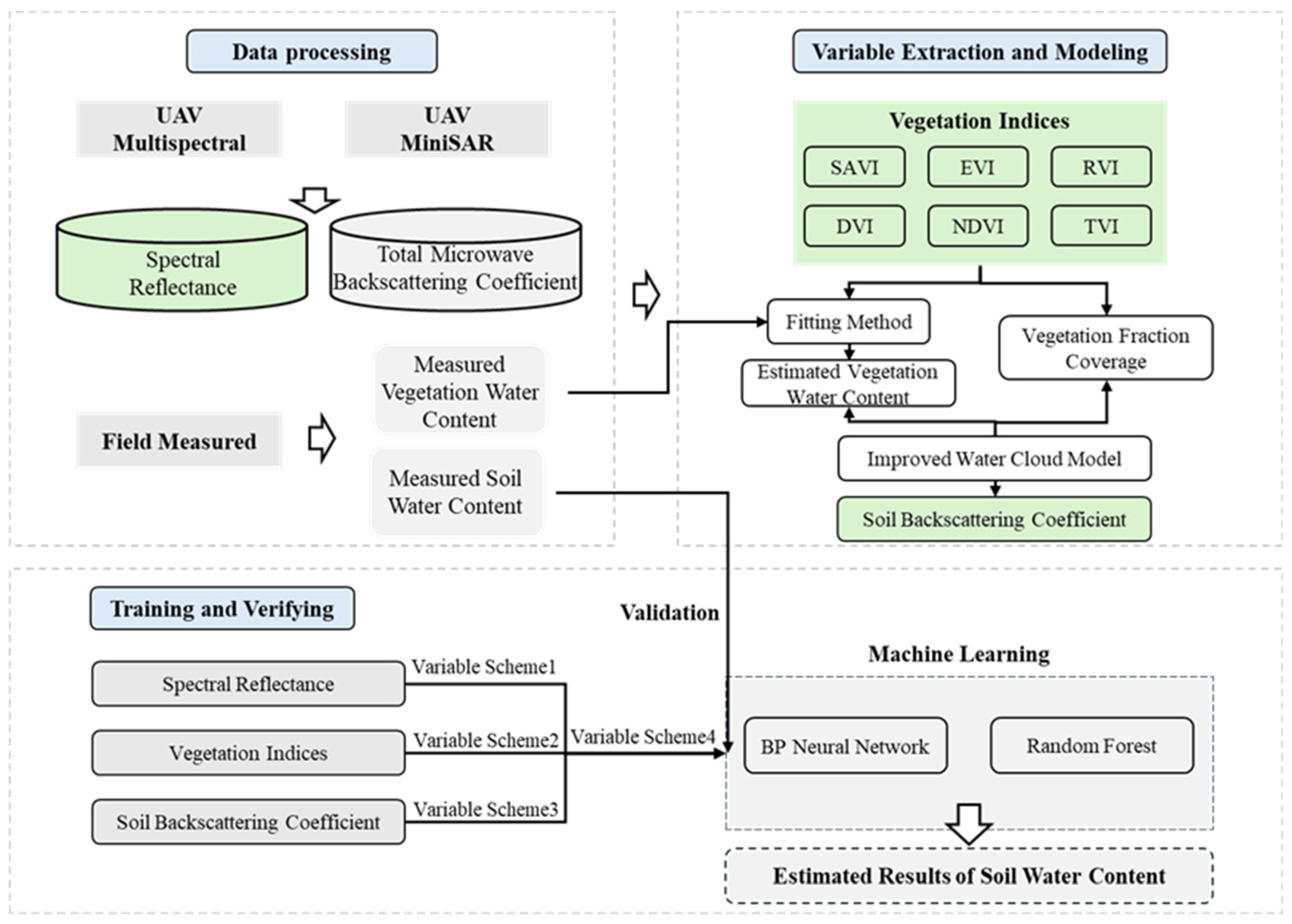
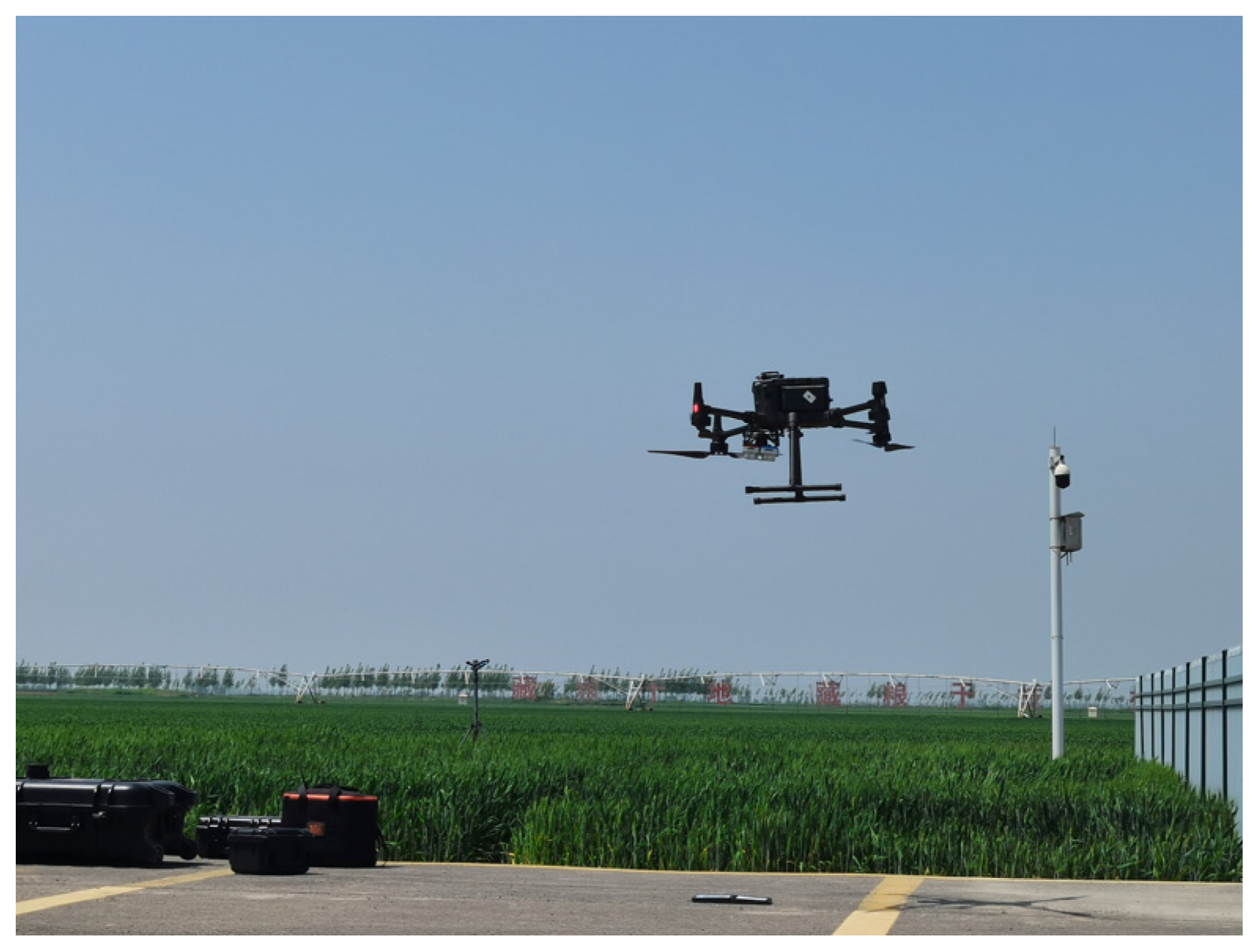
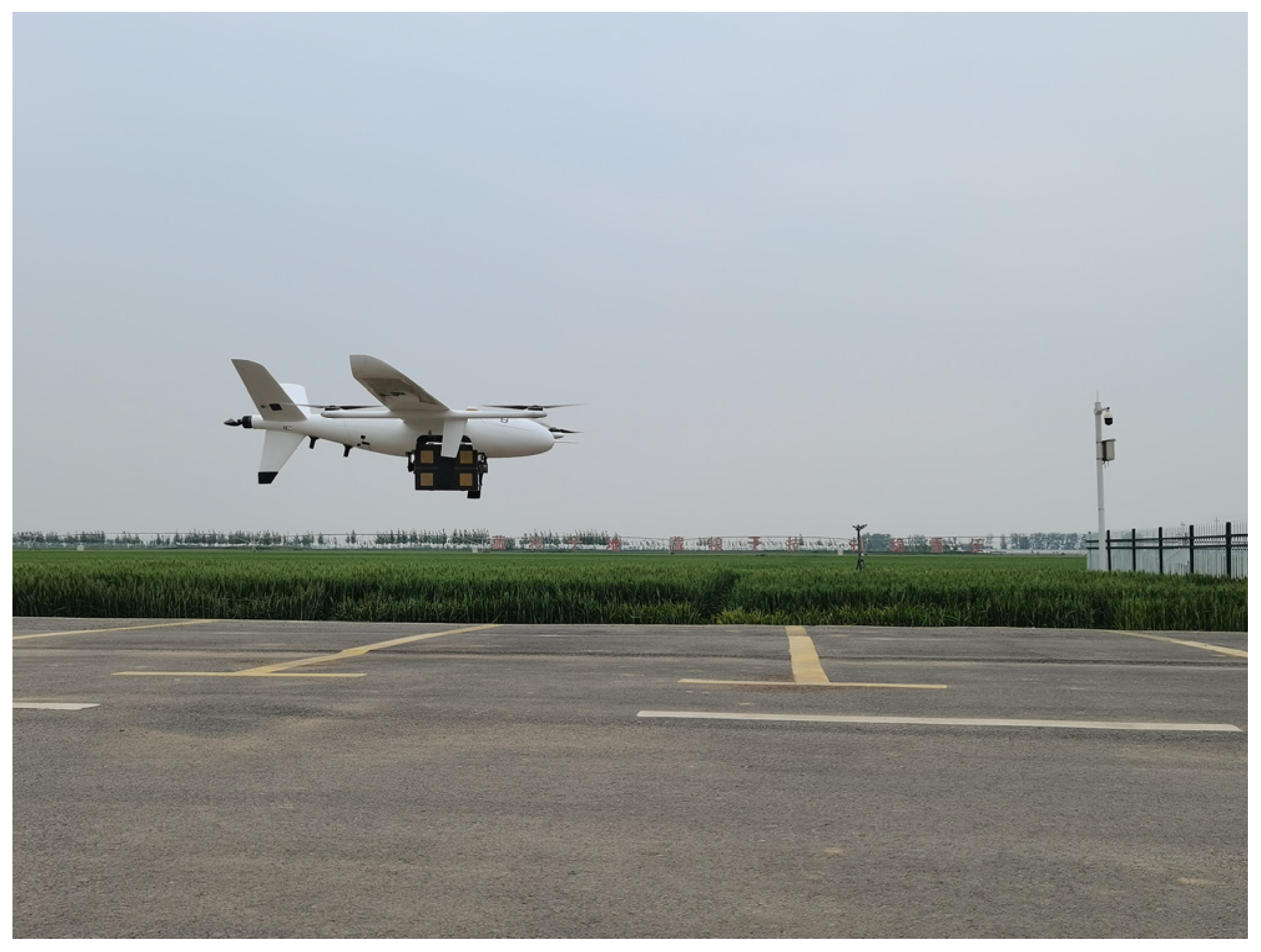
- Data acquisition: A UAV equipped with a multi-spectral sensor captured spectral data in five bands: blue, green, red, near-infrared, and red edge. At the same time, the MiniSAR system collected microwave backscatter data under four polarization modes: VV, VH, HV, and HH. Field measurements of soil water content and vegetation water content were conducted simultaneously.
- (2)
- Data preprocessing: Multi-spectral imagery underwent mosaicking, radiometric calibration, and geometric correction. MiniSAR data were processed through geometric correction and resampling. Based on the multi-spectral imagery, six vegetation indices (e.g., NDVI and EVI) were calculated, and vegetation cover was derived.
- (3)
- IWCM construction: Vegetation cover was incorporated into the classical water cloud model (WCM) to construct the improved water cloud model (IWCM). This model separates the scattering contributions of vegetation and soil to the microwave signal, enabling the retrieval of polarized soil backscattering coefficients with clear physical interpretation.
- (4)
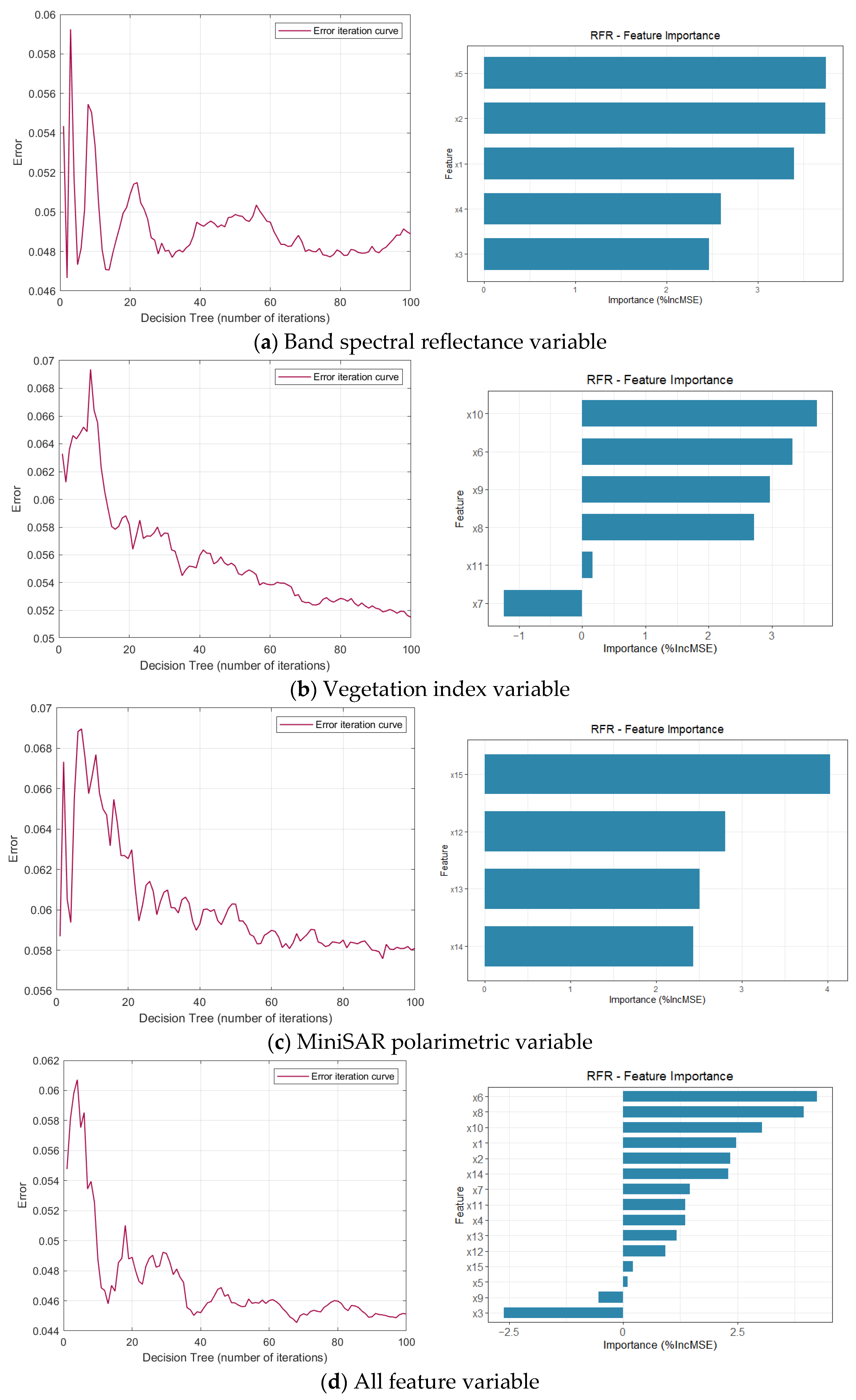
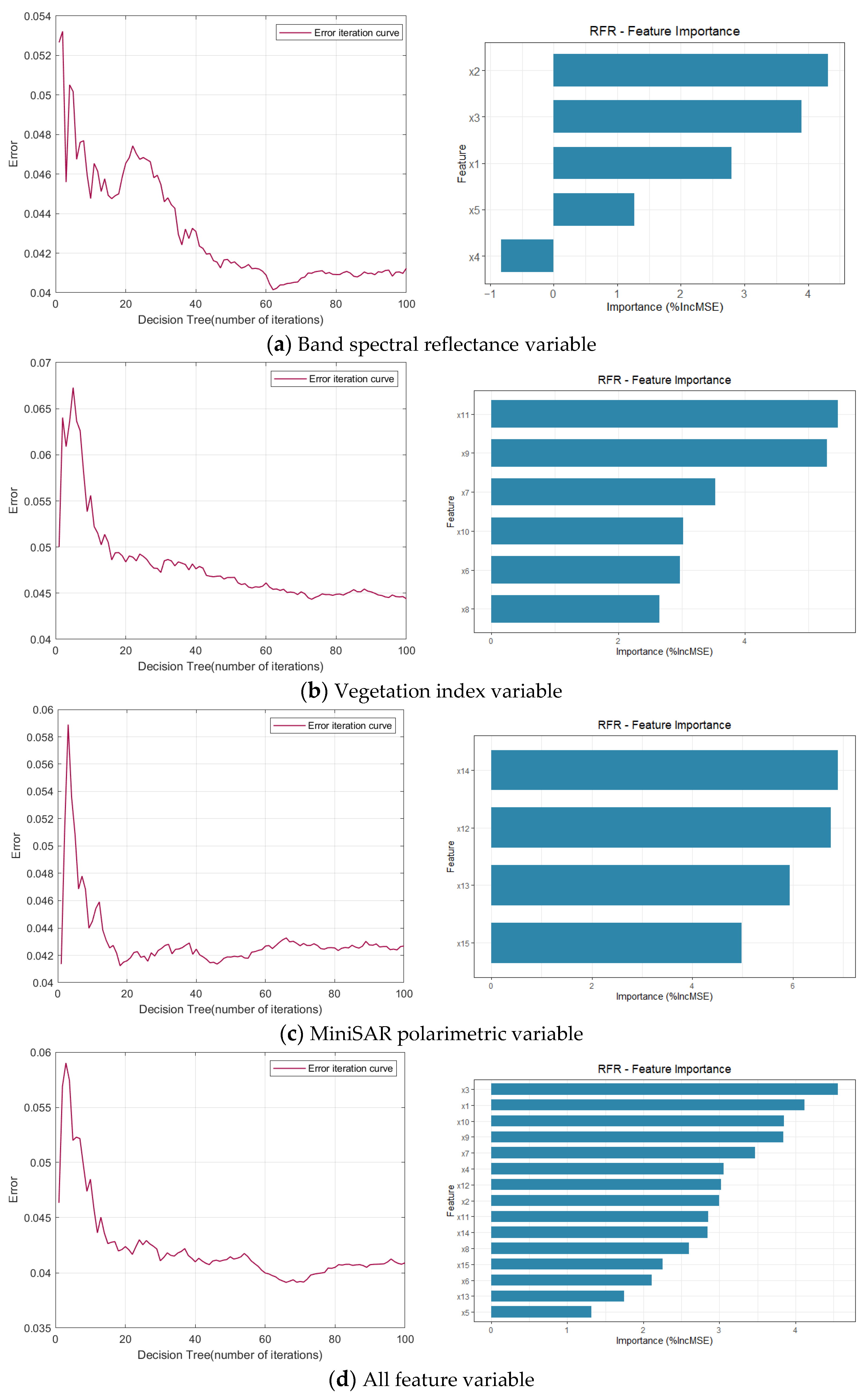
- Model development: Four feature input schemes were designed, including spectral band reflectance, vegetation indices, MiniSAR polarimetric parameters, and multi-source integrated variables. Two machine learning algorithms, back propagation neural network (BPNN) and random forest (RF), were employed to construct soil water content inversion models.
- (5)
- Model evaluation: Using field-measured soil water content data as a reference, the inversion accuracy of each model was compared and evaluated to identify the optimal model configuration.
2.3. Data Acquisition and Preprocessing
2.3.1. UAV Multi-Spectral Data
2.3.2. UAV MiniSAR Data
2.3.3. Field Measurement Data
2.4. WCM and Improved WCM
2.5. Machine Learning Model
2.6. Parameter Selection and Model Evaluation
2.6.1. Optimal Selection of Vegetation Indices
2.6.2. Feature Variable Input Settings
3. Results
3.1. Soil Water Content Inversion Using BPNN with Multi-Feature Variable Input Schemes
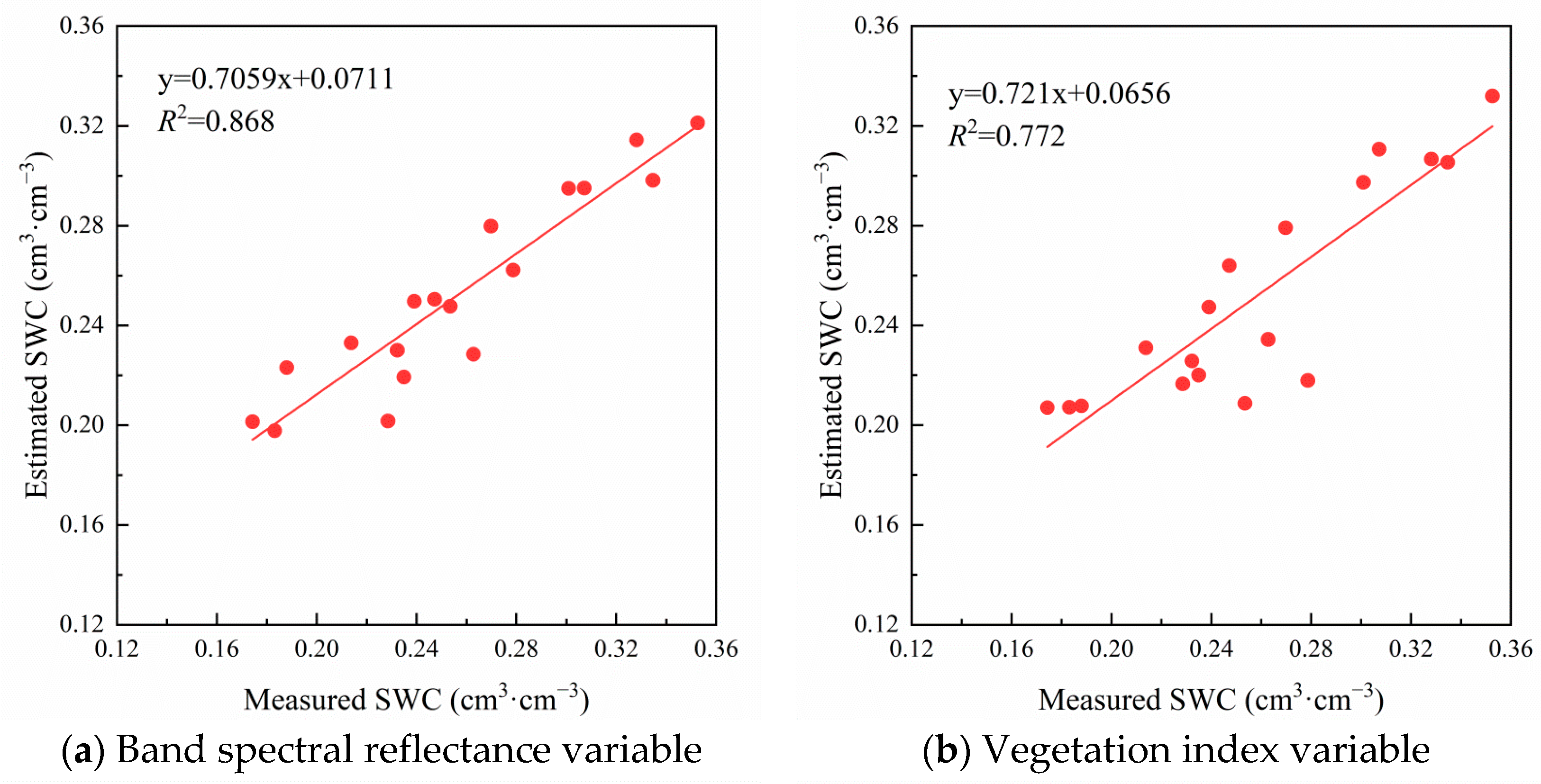
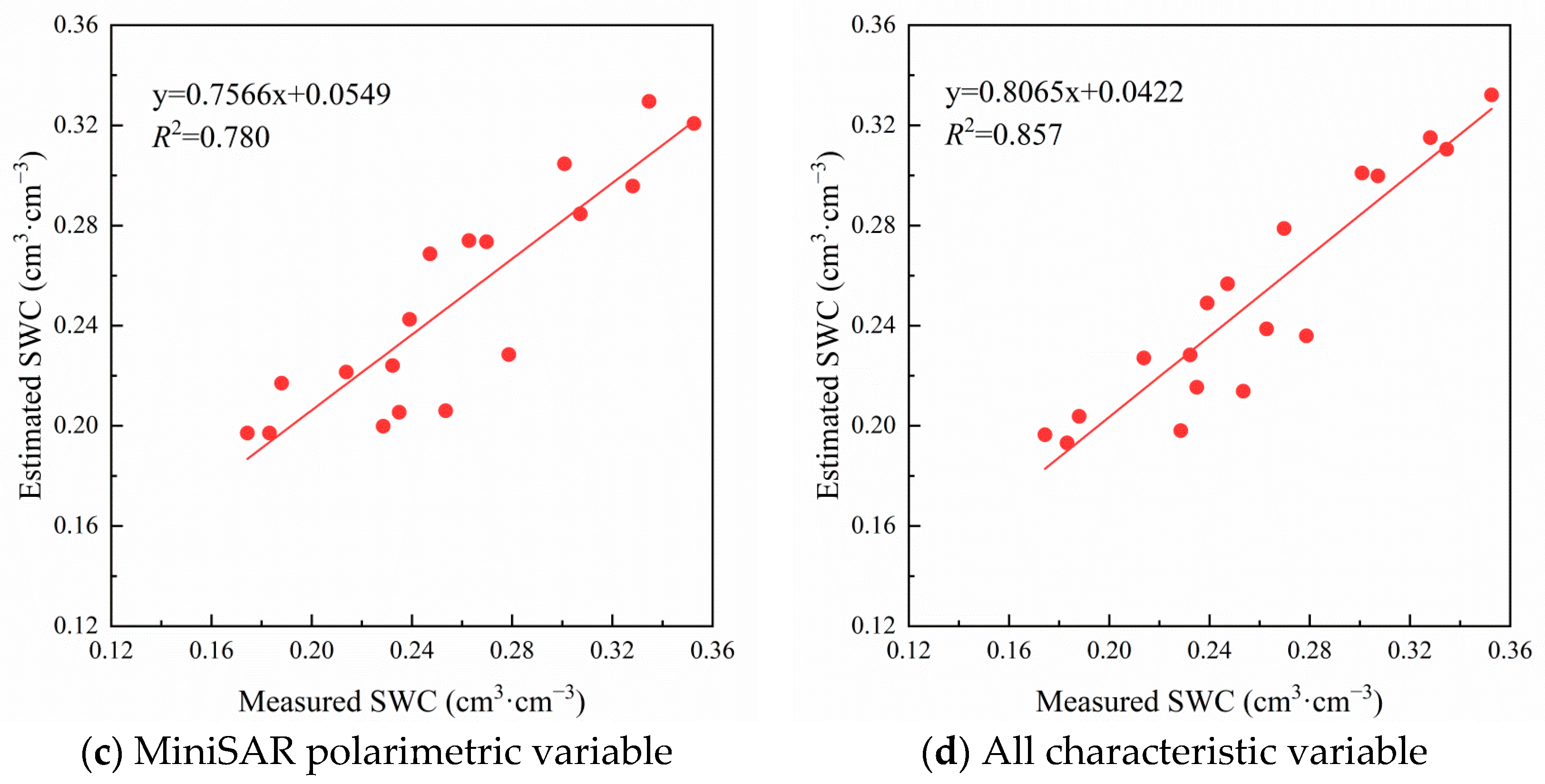
3.2. Soil Water Content Inversion Using RF with Multi-Feature Variable Input Schemes
3.3. Comprehensive Analysis of Soil Water Content Retrieval
4. Discussion
4.1. Discussion of Retrieval Results
4.2. Application Prospects in Precision Agriculture
5. Conclusions
- (1)
- Based on airborne MiniSAR data, the IWCM considering vegetation cover was employed to estimate soil water content beneath the winter wheat canopy during the same growth period over two consecutive years, deriving soil backscattering coefficients under four polarizations (VV, VH, HV, and HH). Simultaneously, six vegetation indices were extracted from multi-spectral data to characterize crop canopy conditions. Based on these variables, four feature input schemes were designed: spectral band reflectance, vegetation indices, MiniSAR polarimetric variables, and a combination of all variables. Soil water content inversion models were then constructed using BPNN and RF algorithms, respectively.
- (2)
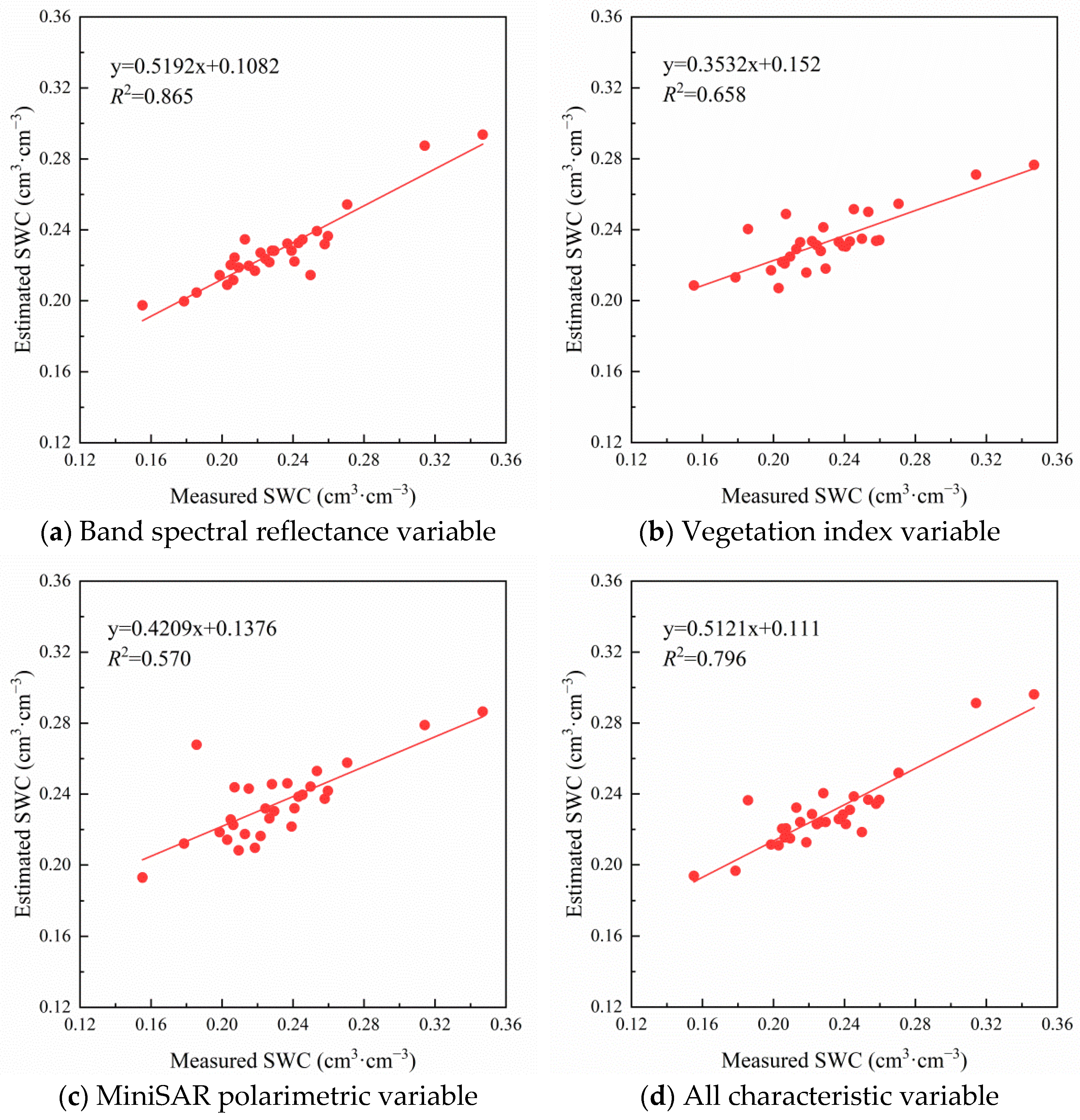
- The results indicate that both machine learning algorithms achieved satisfactory prediction performance under most input schemes, validating the effectiveness of the proposed parameter configurations and feature input strategies. Among all models, the random forest model using spectral band reflectance variables performed best, with an R2 of 0.865, MAE of 0.0152 cm3/cm3, and RMSE of 0.0197.
- (3)
- For each feature input scheme, the RF algorithm consistently outperformed the BPNN algorithm, demonstrating stronger robustness and generalization capability. This finding highlights the suitability of the RF algorithm for efficient soil water content estimation in winter wheat fields. Furthermore, the input scheme combining all feature variables achieved the best inversion performance, indicating that fusing multi-source features can better capture the variability of soil water content beneath the vegetation canopy.
Author Contributions
Funding
Data Availability Statement
Acknowledgments
Conflicts of Interest
References
- Tong, C.; Deng, X.; Shangguan, Y.; Dong, B.; Chen, Y.; Huang, C.; Zhu, L.; Li, S.; Ye, Y.; Wang, H. The Passive Microwave Remote Sensing in Soil Moisture Retrieval: Products, Models, Applications and Challenges. Int. Soil Water Conserv. Res. 2025, 13, 843–859. [Google Scholar] [CrossRef]
- Badaluddin, N.A.; Lion, M.; Razali, S.M.; Khalit, S.I. Bibliometric Analysis of Global Trends on Soil Moisture Assessment Using the Remote Sensing Research Study from 2000 to 2020. Water Air Soil Pollut. 2021, 232, 271. [Google Scholar] [CrossRef]
- Jia, S.; Sun, W.; Wei, S.; Sun, R. Efficient Soil Moisture Estimation on the Qinghai–Xizang Plateau via Machine Learning and Optimized Feature Selection. J. Arid. Land 2025, 17, 1147–1167. [Google Scholar] [CrossRef]
- Wu, Z.; Qiu, J.; Crow, W.T.; Wang, D.; Wang, Z.; Zhang, X. Investigating the Efficacy of the SMAP Downscaled Soil Moisture Product for Drought Monitoring Based on Information Theory. IEEE J. Sel. Top. Appl. Earth Obs. Remote Sens. 2022, 15, 1604–1616. [Google Scholar] [CrossRef]
- Sudhakara, B.; Bhattacharjee, S. High-Resolution Soil Moisture Estimation: A Case Study in Coastal India. J. Indian Soc. Remote Sens. 2025, 53, 2647–2665. [Google Scholar] [CrossRef]
- Yang, C.; Mao, K.; Guo, Z.; Shi, J.; Bateni, S.M.; Yuan, Z. Review of GNSS-R Technology for Soil Moisture Inversion. Remote Sens. 2024, 16, 1193. [Google Scholar] [CrossRef]
- Peng, Z.; Zhao, T.; Shi, J.; Hu, L.; Rodríguez-Fernández, N.J.; Wigneron, J.-P.; Jackson, T.J.; Walker, J.P.; Cosh, M.H.; Yang, K.; et al. First Mapping of Polarization-Dependent Vegetation Optical Depth and Soil Moisture from SMAP L-Band Radiometry. Remote Sens. Environ. 2024, 302, 113970. [Google Scholar] [CrossRef]
- Abbes, A.B.; Jarray, N.; Farah, I.R. Advances in Remote Sensing Based Soil Moisture Retrieval: Applications, Techniques, Scales and Challenges for Combining Machine Learning and Physical Models. Artif. Intell. Rev. 2024, 57, 224. [Google Scholar] [CrossRef]
- Khellouk, R.; Barakat, A.; Boudhar, A.; Hadria, R.; Lionboui, H.; El Jazouli, A.; Rais, J.; El Baghdadi, M.; Benabdelouahab, T. Spatiotemporal Monitoring of Surface Soil Moisture Using Optical Remote Sensing Data: A Case Study in a Semi-Arid Area. J. Spat. Sci. 2020, 65, 481–499. [Google Scholar] [CrossRef]
- Arab, S.; Easson, G.; Ghaffari, Z. Integration of Sentinel-1A Radar and SMAP Radiometer for Soil Moisture Retrieval over Vegetated Areas. Sensors 2024, 24, 2217. [Google Scholar] [CrossRef]
- Wang, J.; Xue, H.; Dong, G.; Yuan, Q.; Zhang, R.; Jing, R. Downscaling of Remote Sensing Soil Moisture Products That Integrate Microwave and Optical Data. Appl. Sci. 2024, 14, 11875. [Google Scholar] [CrossRef]
- Prakash Mohan, M.M.; Rajitha, K.; Varma, M.R.R. Integration of Soil Moisture as an Auxiliary Parameter for the Anchor Pixel Selection Process in SEBAL Using Landsat 8 and Sentinel—1A Images. Int. J. Remote Sens. 2020, 41, 1214–1231. [Google Scholar] [CrossRef]
- Liu, Q.; Wu, Z.; Cui, N.; Jin, X.; Zhu, S.; Jiang, S.; Zhao, L.; Gong, D. Estimation of Soil Moisture Using Multi-Source Remote Sensing and Machine Learning Algorithms in Farming Land of Northern China. Remote Sens. 2023, 15, 4214. [Google Scholar] [CrossRef]
- Shahriari, M.A.; Aghighi, H.; Azadbakht, M.; Ashourloo, D.; Matkan, A.A.; Brakhasi, F.; Walker, J.P. Soil Moisture Estimation Using Combined SAR and Optical Imagery: Application of Seasonal Machine Learning Algorithms. Adv. Space Res. 2025, 75, 6207–6221. [Google Scholar] [CrossRef]
- Lamichhane, M.; Mehan, S.; Mankin, K.R. Soil Moisture Prediction Using Remote Sensing and Machine Learning Algorithms: A Review on Progress, Challenges, and Opportunities. Remote Sens. 2025, 17, 2397. [Google Scholar] [CrossRef]
- Wang, Y.; Zhao, J.; Guo, Z.; Yang, H.; Li, N. Soil Moisture Inversion Based on Data Augmentation Method Using Multi-Source Remote Sensing Data. Remote Sens. 2023, 15, 1899. [Google Scholar] [CrossRef]
- Ramat, G.; Santi, E.; Paloscia, S.; Fontanelli, G.; Pettinato, S.; Santurri, L.; Souissi, N.; Da Ponte, E.; Abdel Wahab, M.M.; Khalil, A.A.; et al. Remote Sensing Techniques for Water Management and Climate Change Monitoring in Drought Areas: Case Studies in Egypt and Tunisia. Eur. J. Remote Sens. 2023, 56, 2157335. [Google Scholar] [CrossRef]
- Kaur, R.; Tiwari, R.K.; Maini, R. Detection of Soil Moisture Variations with Fusion-Based Change Detection Algorithm for MODIS and SCATSAT-1 Datasets. J. Indian Soc. Remote Sens. 2024, 52, 2575–2592. [Google Scholar] [CrossRef]
- Liu, H.; Chen, J.; Xiang, Y. Improving UAV Hyperspectral Monitoring Accuracy of Summer Maize Soil Moisture Content with an Ensemble Learning Model Fusing Crop Physiological Spectral Responses. Eur. J. Agron. 2024, 160, 127299. [Google Scholar] [CrossRef]
- Zhang, B.; Chen, Y.; Liu, H.; Wu, Y.; Ye, S.; Yang, N.; Bai, X.; Huang, J.; Xie, P.; Zhang, Z.; et al. Monitoring Soil Moisture Content in the Root Zone of Winter Wheat with Multi-Angle Multispectral Imagery. Int. J. Remote Sens. 2024, 45, 4692–4709. [Google Scholar] [CrossRef]
- Zhang, Y.; Yang, X.; Tian, F. Study on Soil Moisture Status of Soybean and Corn across the Whole Growth Period Based on UAV Multimodal Remote Sensing. Remote Sens. 2024, 16, 3166. [Google Scholar] [CrossRef]
- Shi, H.; Liu, Z.; Li, S.; Jin, M.; Tang, Z.; Sun, T.; Liu, X.; Li, Z.; Zhang, F.; Xiang, Y. Monitoring Soybean Soil Moisture Content Based on UAV Multispectral and Thermal-Infrared Remote-Sensing Information Fusion. Plants 2024, 13, 2417. [Google Scholar] [CrossRef] [PubMed]
- Li, W.; Liu, C.; Yang, Y.; Awais, M.; Li, W.; Ying, P.; Ru, W.; Cheema, M.J.M. A UAV-Aided Prediction System of Soil Moisture Content Relying on Thermal Infrared Remote Sensing. Int. J. Environ. Sci. Technol. 2022, 19, 9587–9600. [Google Scholar] [CrossRef]
- Sang, Y.; Yu, S.; Lu, F.; Sun, Y.; Wang, S.; Ade, L.; Hou, F. UAV Monitoring Topsoil Moisture in an Alpine Meadow on the Qinghai–Tibet Plateau. Agronomy 2023, 13, 2193. [Google Scholar] [CrossRef]
- Shokati, H.; Mashal, M.; Noroozi, A.; Abkar, A.A.; Mirzaei, S.; Mohammadi-Doqozloo, Z.; Taghizadeh-Mehrjardi, R.; Khosravani, P.; Nabiollahi, K.; Scholten, T. Random Forest-Based Soil Moisture Estimation Using Sentinel-2, Landsat-8/9, and UAV-Based Hyperspectral Data. Remote Sens. 2024, 16, 1962. [Google Scholar] [CrossRef]
- Wang, M.; He, L.; Liu, Q.; Li, Z.; Wang, R.; Jia, Z.; Wang, J.; Wu, G.; Shi, T. Estimating soil moisture contents of farmland using UAV hyperspectral images of wheat canopy. Trans. Chin. Soc. Agric. Eng. 2023, 39, 120–129. [Google Scholar]
- Zhang, R.; Aziz, I.; Houtz, D.A.; Zhao, Y.; Ford, T.W.; Watts, A.C.; Alipour, M. UAV-Based Remote Sensing of Soil Moisture Across Diverse Land Covers: Validation and Bayesian Uncertainty Characterization. IEEE Trans. Geosci. Remote Sens. 2025, 63, 4424018. [Google Scholar] [CrossRef]
- Yin, L.; Yan, S.; Li, M.; Liu, W.; Zhang, S.; Xie, X.; Wang, X.; Wang, W.; Chang, S.; Hou, F. Enhancing Soil Moisture Estimation in Alfalfa Root-Zone Using UAV-Based Multimodal Remote Sensing and Deep Learning. Eur. J. Agron. 2024, 161, 127366. [Google Scholar] [CrossRef]
- Abassi, M.; Ezzahar, J.; Kheddioui, E.M.; Boujoudi, B. Assessment of the Effects of Winter Wheat Scattering on SAR Backscatter for Soil Moisture Estimation Based on a Radiative Transfer Model. Eur. J. Remote Sens. 2024, 57, 2394780. [Google Scholar] [CrossRef]
- Singh, A.; Gaurav, K. Deep Learning and Data Fusion to Estimate Surface Soil Moisture from Multi-Sensor Satellite Images. Sci. Rep. 2023, 13, 2251. [Google Scholar] [CrossRef]
- Zhang, D.; Zhou, G. Estimation of Soil Moisture from Optical and Thermal Remote Sensing: A Review. Sensors 2016, 16, 1308. [Google Scholar] [CrossRef] [PubMed]
- Bai, X.; Zheng, D.; Liu, X.; Fan, L.; Zeng, J.; Li, X. Simulation of Sentinel-1A Observations and Constraint of Water Cloud Model at the Regional Scale Using a Discrete Scattering Model. Remote Sens. Environ. 2022, 283, 113308. [Google Scholar] [CrossRef]
- Xu, N.; Daccache, A.; Ahmadi, A.; Houtz, D.; Perez-Barquero, F.P. Soil Moisture Estimation with Microwave Remote Sensing: A Systematic Review and Meta-Analysis. Int. J. Digit. Earth 2025, 18, 1–27. [Google Scholar] [CrossRef]
- Li, Z.; Yuan, Q.; Yue, L.; Shen, H.; Zhang, L. Large-Scale Soil Moisture Retrieval under Limited In Situ Data Coupling Physical and Machine Learning Model. J. Remote Sens. 2025, 5, 0367. [Google Scholar] [CrossRef]
- Lakra, D.; Pipil, S.; Srivastava, P.K.; Singh, S.K.; Gupta, M.; Prasad, R. Soil Moisture Retrieval over Agricultural Region through Machine Learning and Sentinel 1 Observations. Front. Remote Sens. 2025, 5, 1513620. [Google Scholar] [CrossRef]
- Bindlish, R.; Barros, A.P. Parameterization of Vegetation Backscatter in Radar-Based, Soil Moisture Estimation. Remote Sens. Environ. 2001, 76, 130–137. [Google Scholar] [CrossRef]
- Breiman, L. Random Forests. Mach. Learn. 2001, 45, 5–32. [Google Scholar] [CrossRef]
- Verrelst, J.; Schaepman, M.E.; Koetz, B.; Kneubühler, M. Angular Sensitivity Analysis of Vegetation Indices Derived from CHRIS/PROBA Data. Remote Sens. Environ. 2008, 112, 2341–2353. [Google Scholar] [CrossRef]
- Huete, A.; Didan, K.; Miura, T.; Rodriguez, E.P.; Gao, X.; Ferreira, L.G. Overview of the Radiometric and Biophysical Performance of the MODIS Vegetation Indices. Remote Sens. Environ. 2002, 83, 195–213. [Google Scholar] [CrossRef]
- Mishra, S.; Mishra, D.R. Normalized Difference Chlorophyll Index: A Novel Model for Remote Estimation of Chlorophyll-a Concentration in Turbid Productive Waters. Remote Sens. Environ. 2012, 117, 394–406. [Google Scholar] [CrossRef]
- Tucker, C.J. Red and Photographic Infrared Linear Combinations for Monitoring Vegetation. Remote Sens. Environ. 1979, 8, 127–150. [Google Scholar] [CrossRef]
- Huete, A.R. A soil-adjusted vegetation index (SAVI). Remote Sens. Environ. 1988, 25, 295–309. [Google Scholar] [CrossRef]
- Broge, N.H.; Leblanc, E. Comparing Prediction Power and Stability of Broadband and Hyperspectral Vegetation Indices for Estimation of Green Leaf Area Index and Canopy Chlorophyll Density. Remote Sens. Environ. 2001, 76, 156–172. [Google Scholar] [CrossRef]
- Zebker, H.A.; van Zyl, J.J.; Held, D.N. Imaging radar polarimetry from wave synthesis. J. Geophys. Res. Solid Earth 1987, 92, 683–701. [Google Scholar] [CrossRef]
- Li, Y.; Zhang, C.; Heng, W. Retrieving Surface Soil Moisture over Wheat-Covered Areas Using Data from Sentinel-1 and Sentinel-2. Water 2021, 13, 1981. [Google Scholar] [CrossRef]
- Zhang, C.; Wang, R.; Hou, J.; Jiang, M.; Zhu, X. Inversion of soil water content for unmanned aerial vehicle multispectral remote sensing based on feature variable screening. China Rural Water Hydropower 2024, 5, 147–154. [Google Scholar]



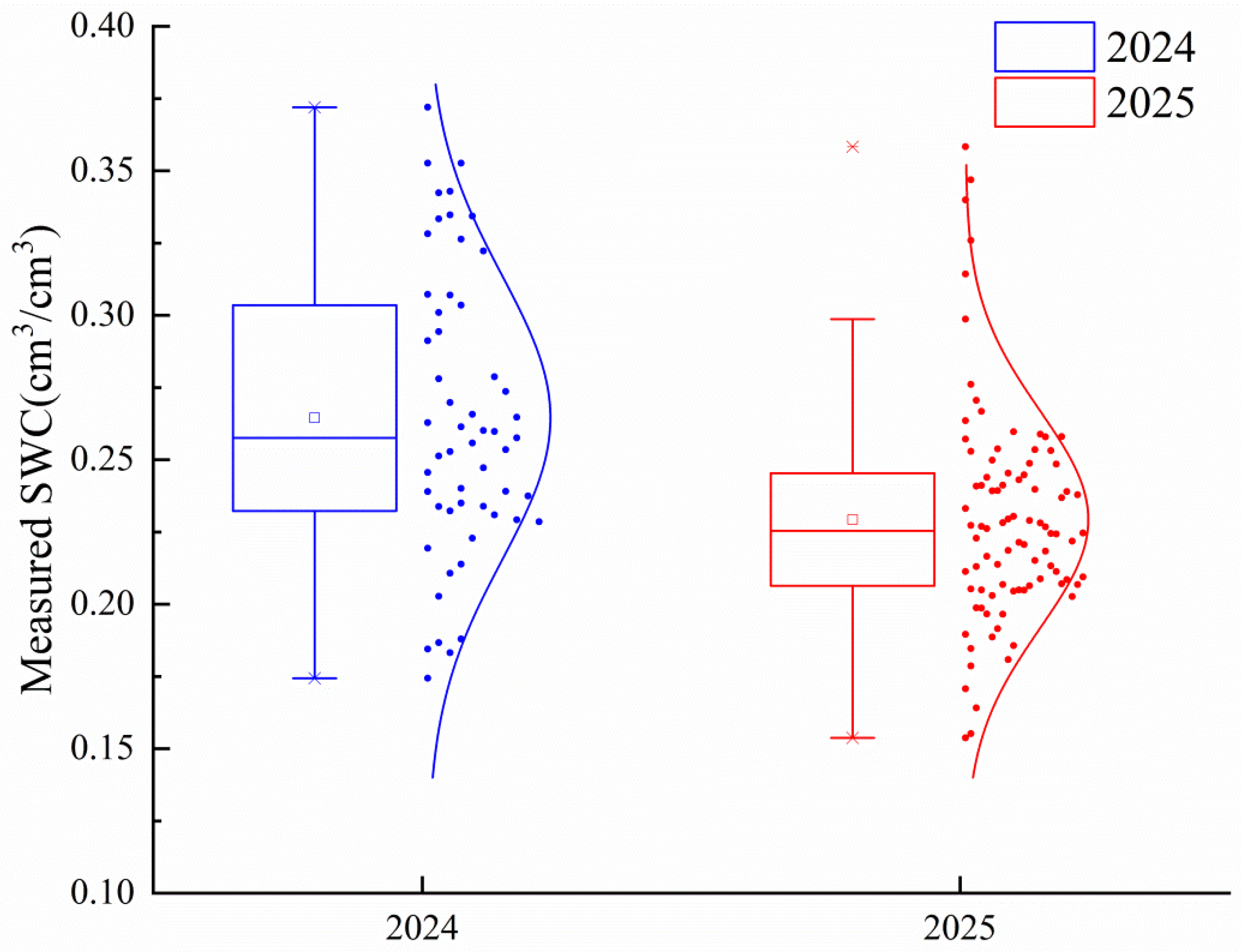
| Year | Sample Size | Min | Max | Mean | SD | 95% CI Lower | 95% CI Upper |
|---|---|---|---|---|---|---|---|
| 2024 | 55 | 0.1744 | 0.3720 | 0.2645 | 0.0493 | 0.2512 | 0.2778 |
| 2025 | 90 | 0.1537 | 0.3583 | 0.2293 | 0.0377 | 0.2214 | 0.2372 |
| Parameter | All Land Uses | Rangeland | Winter Wheat | Pasture |
|---|---|---|---|---|
| A | 0.0012 | 0.0009 | 0.0018 | 0.0014 |
| B | 0.0910 | 0.0320 | 0.1380 | 0.0840 |
| Parameter | Value Setting |
|---|---|
| Number of decision trees | 100 |
| Minimum number of leaves | 3 |
| Maximum depth per tree | 70 |
| Minimum number of observations per leaf | 3 |
| Method | Regression |
| Vegetation Indices | Formula |
|---|---|
| Normalized difference vegetation index (NDVI) | [38] |
| Enhanced vegetation index (EVI) | [39] |
| Ratio vegetation index (RVI) | [40] |
| Difference vegetation index (DVI) | [41] |
| Soil adjusted vegetation index (SAVI) | [42] |
| Triangular vegetation index (TVI) | [43] |
| Input Schemes | Input Variable | Output Parameters |
|---|---|---|
| Band spectral reflectance | Blue, Green, Red, NIR, Red Edge | SWC |
| Vegetation indices | NDVI [38], EVI [39], RVI [40], DVI [41], SAVI [42], TVI [43] | SWC |
| MiniSAR polarimetric variable | , , , [44] | SWC |
| All feature variables | All the variables mentioned above | SWC |
| Numbered Name | Feature Variable |
|---|---|
| x1 | Red |
| x2 | Green |
| x3 | Blue |
| x4 | NIR |
| x5 | Red Edge |
| x6 | NDVI |
| x7 | EVI |
| x8 | RVI |
| x9 | DVI |
| x10 | SAVI |
| x11 | TVI |
| x12 | |
| x13 | |
| x14 | |
| x15 |
| Input Schemes | Year | R2 | MAE/ (cm3/cm3) | RMSE/ (cm3/cm3) | 95% CI Lower | 95% CI Upper |
|---|---|---|---|---|---|---|
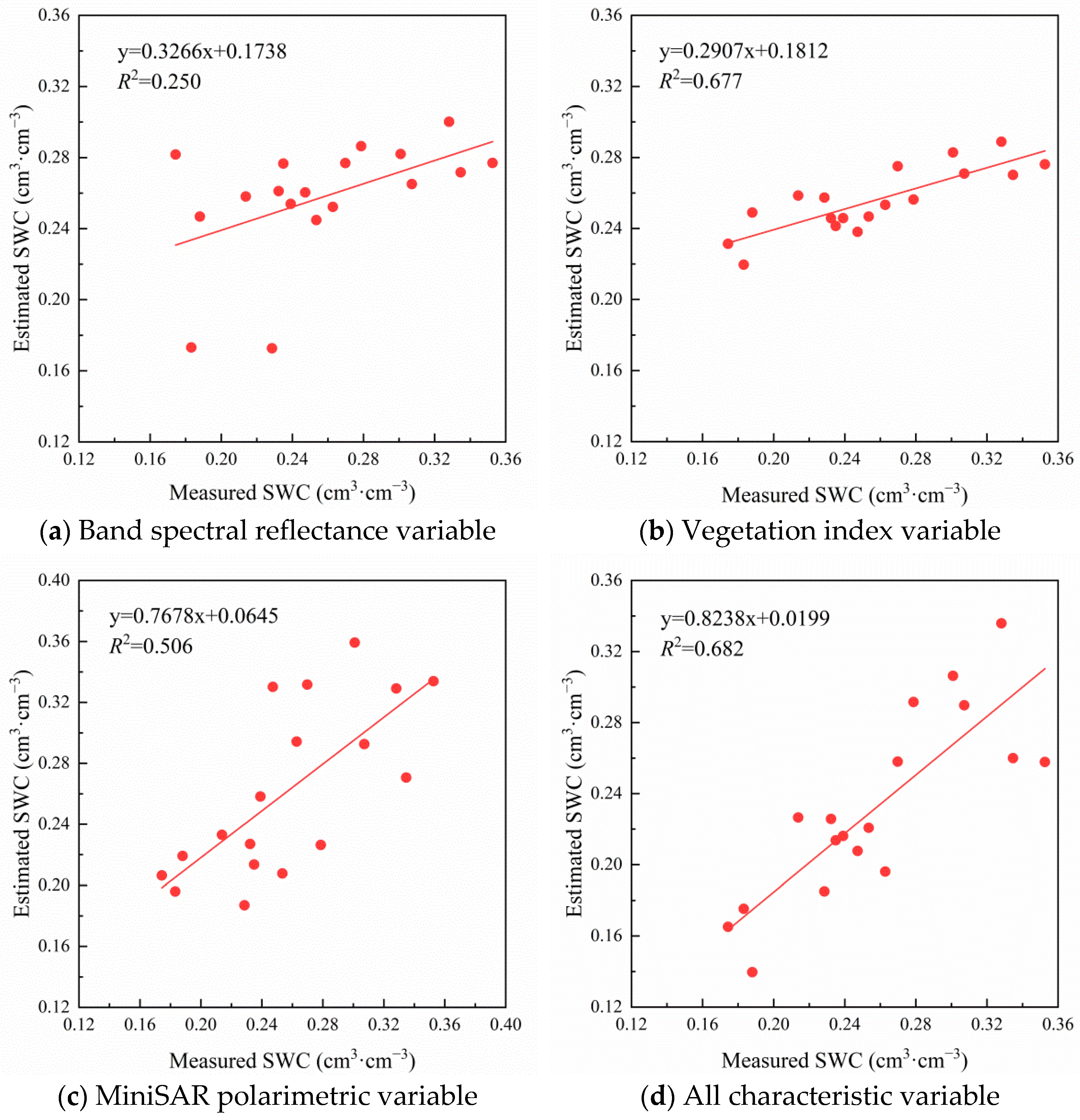
| Band spectral reflectance | 2024 | BP *: 0.250 | BP: 0.0354 | BP: 0.0447 | 0.2408 | 0.2748 |
| RF: 0.868 | RF: 0.0178 | RF: 0.0210 | 0.2330 | 0.2724 | ||
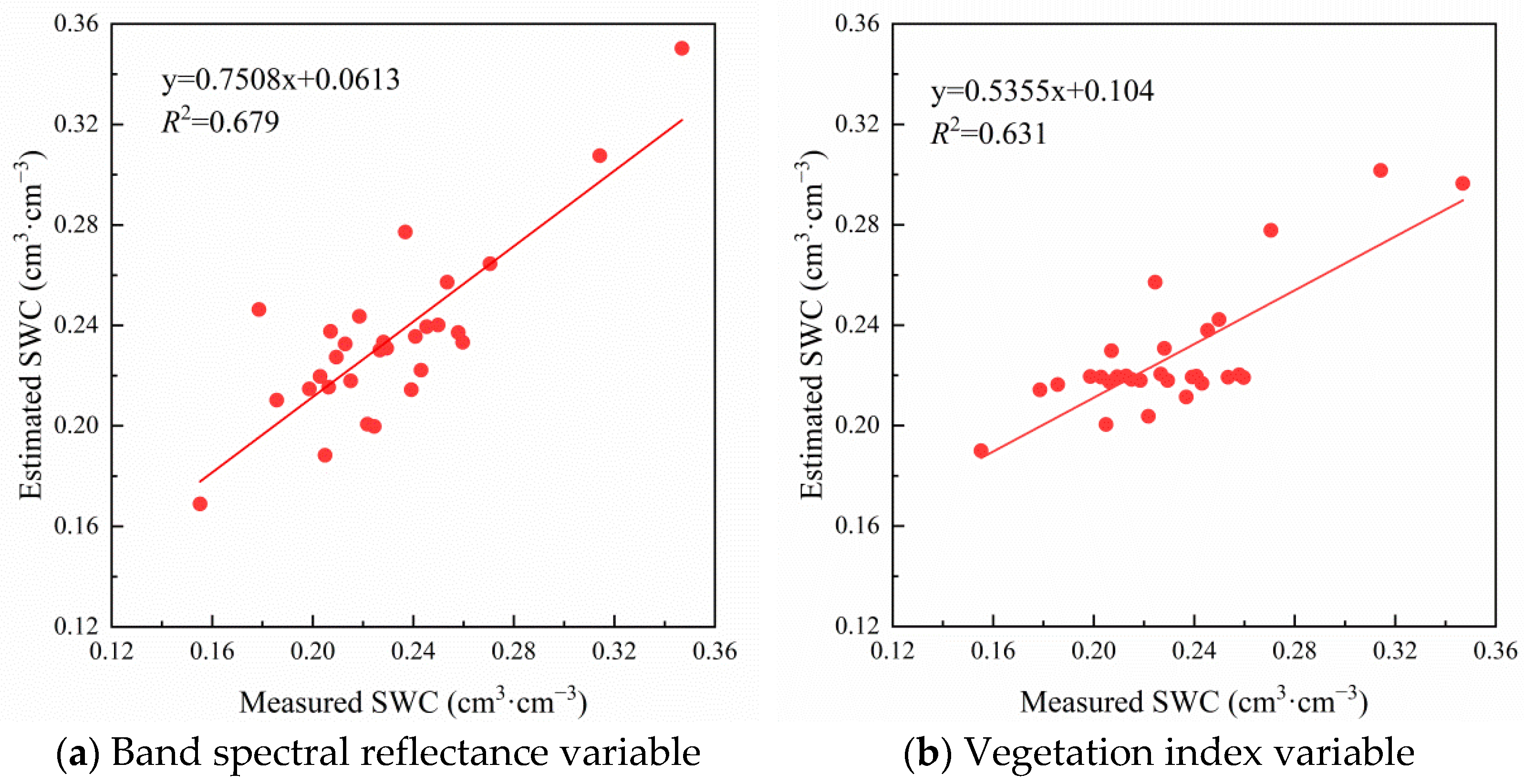
| 2025 | BP: 0.679 | BP: 0.0169 | BP: 0.0217 | 0.2212 | 0.2475 | |
| RF: 0.865 | RF: 0.0152 | RF: 0.0197 | 0.2198 | 0.2359 | ||
| Vegetation indices | 2024 | BP: 0.677 | BP: 0.0301 | BP: 0.0375 | 0.2468 | 0.2652 |
| RF: 0.772 | RF: 0.0208 | RF: 0.0252 | 0.2297 | 0.2724 | ||
| 2025 | BP: 0.631 | BP: 0.0193 | BP: 0.0233 | 0.2177 | 0.2371 | |
| RF: 0.678 | RF: 0.0197 | RF: 0.0261 | 0.2271 | 0.2397 | ||
| MiniSAR polarization variable | 2024 | BP: 0.506 | BP: 0.0341 | BP: 0.0406 | 0.2339 | 0.2901 |
| RF: 0.780 | RF: 0.0207 | RF: 0.0251 | 0.2272 | 0.2718 | ||
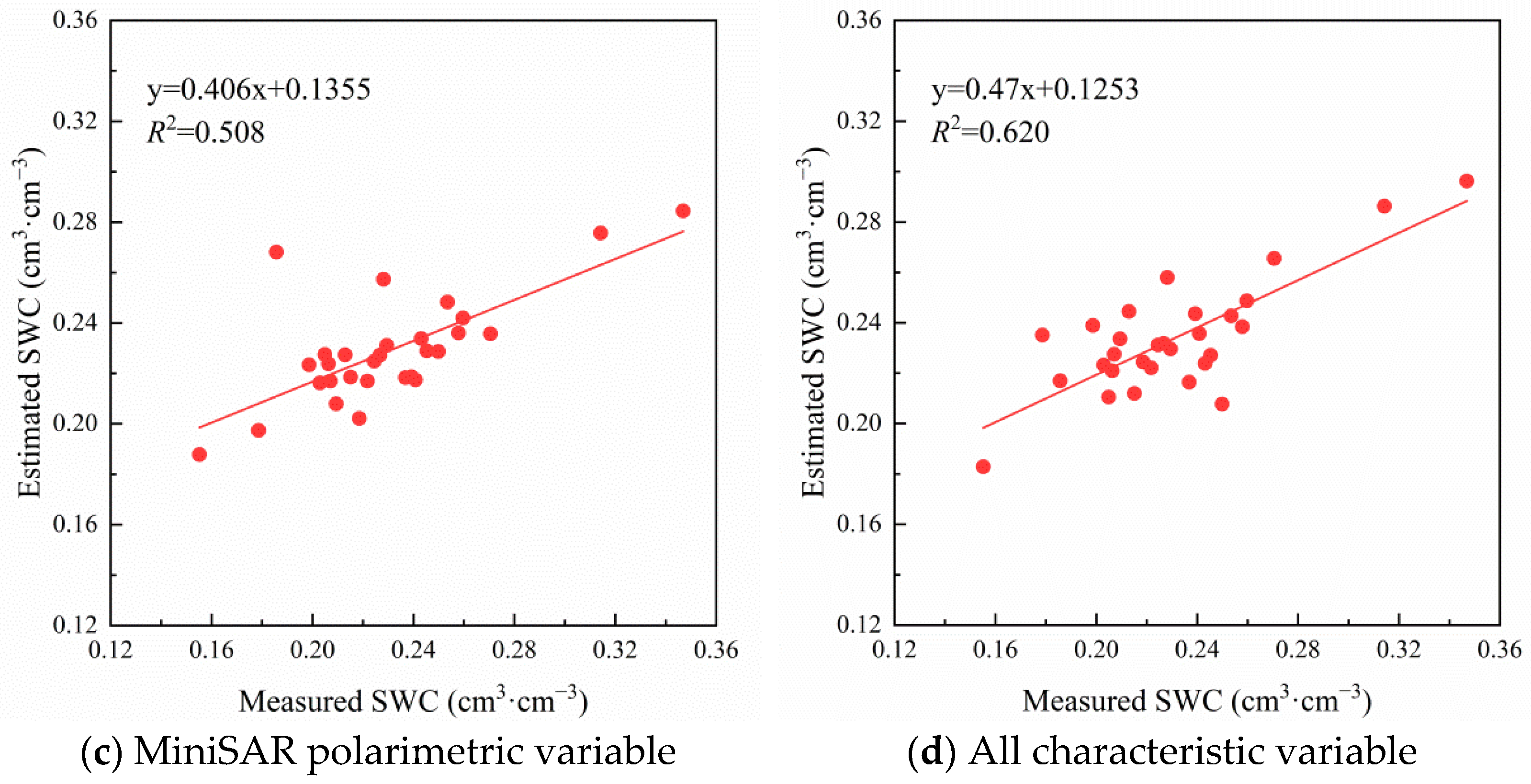
| 2025 | BP: 0.508 | BP: 0.0201 | BP: 0.0268 | 0.2208 | 0.2373 | |
| RF: 0.570 | RF: 0.0183 | RF: 0.0259 | 0.2266 | 0.2427 | ||
| All characteristic variables | 2024 | BP: 0.682 | BP: 0.0298 | BP: 0.0394 | 0.2058 | 0.2577 |
| RF: 0.857 | RF: 0.0175 | RF: 0.0208 | 0.2270 | 0.2723 | ||
| 2025 | BP: 0.620 | BP: 0.0192 | BP: 0.0243 | 0.2250 | 0.2423 | |
| RF: 0.796 | RF: 0.0165 | RF: 0.0207 | 0.2207 | 0.2373 |
Disclaimer/Publisher’s Note: The statements, opinions and data contained in all publications are solely those of the individual author(s) and contributor(s) and not of MDPI and/or the editor(s). MDPI and/or the editor(s) disclaim responsibility for any injury to people or property resulting from any ideas, methods, instructions or products referred to in the content. |
© 2026 by the authors. Licensee MDPI, Basel, Switzerland. This article is an open access article distributed under the terms and conditions of the Creative Commons Attribution (CC BY) license.
Share and Cite
Que, Y.; Wu, D.; Jiang, M.; Deng, J.; Liu, C.; Wu, S.; Li, F.; Li, Y. Retrieving Soil Water Content in Winter Wheat Fields Using UAV-Based Multi-Source Remote Sensing and Machine Learning. Agronomy 2026, 16, 717. https://doi.org/10.3390/agronomy16070717
Que Y, Wu D, Jiang M, Deng J, Liu C, Wu S, Li F, Li Y. Retrieving Soil Water Content in Winter Wheat Fields Using UAV-Based Multi-Source Remote Sensing and Machine Learning. Agronomy. 2026; 16(7):717. https://doi.org/10.3390/agronomy16070717
Chicago/Turabian StyleQue, Yanhong, Dongli Wu, Mingliang Jiang, Jie Deng, Cong Liu, Su Wu, Fengbo Li, and Yanpeng Li. 2026. "Retrieving Soil Water Content in Winter Wheat Fields Using UAV-Based Multi-Source Remote Sensing and Machine Learning" Agronomy 16, no. 7: 717. https://doi.org/10.3390/agronomy16070717
APA StyleQue, Y., Wu, D., Jiang, M., Deng, J., Liu, C., Wu, S., Li, F., & Li, Y. (2026). Retrieving Soil Water Content in Winter Wheat Fields Using UAV-Based Multi-Source Remote Sensing and Machine Learning. Agronomy, 16(7), 717. https://doi.org/10.3390/agronomy16070717