Article

Effect of Green Compost Application on the Soil Characteristics and the Dissipation of Iodosulfuron-Methyl-Sodium Under Pea–Wheat Field Crop Rotation


by
Jesús M. Marín-Benito
1,
Jesús Gómez-Ciudad
2,
María Ángeles Gómez-Sánchez
2,
María Remedios Morales-Corts
2 and
María Sonia Rodríguez-Cruz
1,*
1
Institute of Natural Resources and Agrobiology of Salamanca-Spanish National Research Council, IRNASA-CSIC, 37008 Salamanca, Spain
2
Faculty of Agricultural and Environmental Sciences, University of Salamanca, 37007 Salamanca, Spain
*
Author to whom correspondence should be addressed.
Agronomy 2026, 16(7), 710; https://doi.org/10.3390/agronomy16070710
Submission received: 26 February 2026 / Revised: 24 March 2026 / Accepted: 26 March 2026 / Published: 28 March 2026
(This article belongs to the Special Issue Effects of Agronomic Practices on Soil Properties and Health)

Abstract

The application of organic residues in agriculture helps to replenish soil organic carbon (OC), improve soil fertility and biodiversity, reinforce aggregate stability, and favour water infiltration. Moreover, its application as a soil amendment alters the fate of herbicides applied to the soil. The objective here was (i) to evaluate soil quality by determining the physicochemical and biological parameters of an agricultural soil (Soil) amended with green compost (Soil + GC) over an arable pea–wheat crop rotation in a short-term experiment; and (ii) to study the dissipation and persistence of iodosulfuron-methyl-sodium applied in field plots sown with winter wheat under real field conditions. The experimental field design consisted of 24 plots (10 m2) involving 12 with control and 12 with GC-amended soils. The plots were sown with pea after GC application (~11 t ha−1) in February 2023, and with winter wheat in October 2023. Iodosulfuron-methyl-sodium (Hussar® Plus, Bayer CropScience S.L., Barcelona, Spain) was applied in post-emergence at the agronomic dose (D1 = 176 mL ha−1) and double dose (D2 = 352 mL ha−1). Soil samples were taken from the plots to assess the soil physicochemical and biological parameters at six sampling times after GC application, with extraction and determination of residual herbicide and metabolite (metsulfuron-methyl) concentrations. In addition, the yield and characteristics of the pea and wheat grain crops were determined. The application of GC to the soil significantly increased pH (0.5 units by July 2024) and electrical conductivity (up to 5.2 times) compared to control soil, which remained constant throughout the experiment. The OC in Soil + GC increased by 40% in July 2024 compared to control soil. Total nitrogen content increased up to 2.0 and 1.3 times during the pea–wheat growing seasons in Soil + GC compared to unamended soil. Soil dehydrogenase activity, respiration, and biomass increased by up to 1.4, 2.2 and 1.4 times, respectively, in Soil + GC compared to unamended soil over the growing seasons. The soil microbial structure, determined by phospholipid fatty acid (PLFA) analysis, recorded no significant differences between the microbial groups in both soil treatments. A non-significant increase in pea and wheat yield was observed in Soil + GC compared to unamended soil. The results revealed an increase in the residual amounts of herbicide and metabolite, being slightly more persistent, with DT50 and DT90 values up to 1.6 times higher, in the Soil + GC plots over time. Much higher amounts of metabolite (DT50 = 24.8–29.7 days) than iodosulfuron-methyl (DT50 = 5.2–8.8 days) were found in all the treatments. This may be due to wheat plants intercepting the herbicide initially at the time of application in post-emergence, the rapid dissipation of the herbicide reaching the soil, and/or the higher persistence of the metabolite compared to that of the herbicide. Overall, the soil’s physicochemical and biological properties were improved in GC-amended soil, and organic amendment increased slightly the persistence of iodosulfuron-methyl-sodium and its metabolite in the soil.

1. Introduction

According to the EU’s Soil Strategy for 2030, there is a need to promote sustainable soil management practices to restore soil health, as around 60–70% of soils in the EU have been degraded by erosion, compaction, a decline in organic matter (OM), pollution, loss of biodiversity, salinisation, and sealing [1]. The sustainability of agricultural production requires the application of eco-friendly agronomical practices allowing for climate change mitigation and adaptation, embracing the circular economy, maintaining crop performance, yield, profitability and food quality and security, and ensuring soil biodiversity for human, animal, and plant health, as well as clean water resources [2,3].
A sustainable soil management practice involves the application of organic residues as soil amendments, which help to maintain or even enhance soil health and the sustainability and resilience of the food system. Organic waste from agriculture, forestry, livestock farming, agro-industry, and urban activities, such as manure, crop residues, biowaste, sewage sludge, green compost, kitchen waste and spent mushroom substrate, are frequently applied as soil amendments [4]. The valorisation of OM from residues contributes to the circular economy, climate change mitigation, and improves soil health and environmental sustainability. The application of organic residues in agriculture increases soil organic carbon (OC) content, improves soil fertility and biodiversity, reinforces aggregate stability, and favours water infiltration [4,5,6].
The excessive use of herbicides and their persistence in agricultural soils have been detected across Europe [7]. Due to their toxicity, the EU’s new policy initiatives, such as the Soil Monitoring Law, promote innovative cropping strategies for optimising the use of these compounds [8]. This strategy depends upon numerous factors related to cropping systems, climate conditions, and the response to herbicides [9].
Certain common agricultural practices, such as the simultaneous application of organic amendments and herbicides to the soil, have altered the behaviour of these compounds and the persistence of residues in the soil [10,11,12]. Therefore, herbicide adsorption–desorption, dissipation, degradation, and mobility in the soil may be significantly impacted accordingly [13].
Iodosulfuron-methyl-sodium (sodium ({[5-iodo-2-(methoxycarbonyl)phenyl] sulfonyl}carbamoyl)(4-methoxy-6-methyl-1,3,5-triazin-2-yl)azanide) is a sulfonylurea herbicide with high solubility in water (25,000 mg L−1), a low octanol–water partition coefficient (log Kow = −0.70), and low volatility [14]. It is used in post-emergence to control grass and dicot weeds in cereals and other crops, such as wheat, barley, corn, turf, and soybean. According to the EFSA report [15], under field degradation conditions, it has a mean half-life (DT50) value of 3.2 days, being non-persistent in unamended soils. However, its degradation in the water phase is slow. Iodosulfuron-methyl-sodium is degraded mainly to the metabolite metsulfuron-methyl (methyl 2-(4-methoxy-6-methyl-1,3,5-triazin-2-ylcarbamoylsulfamoyl)benzoate), which is also used to control broadleaf weeds and certain annual grasses, particularly in cereal crops. Like its parent compound, metsulfuron-methyl is highly soluble in water (2790 mg L−1), and has low hydrophobicity (log Kow = −1.87) and volatility [14]. It degrades rapidly (DT50 = 13.3 days) in agricultural soils under field conditions [16].
The dissipation of iodosulfuron-methyl-sodium and metsulfuron-methyl under field conditions has scarcely been addressed, and the few studies have been conducted under conventional agricultural practices [17,18,19,20]. In a field study where iodosulfuron-methyl-sodium was applied to sandy loam and clay soils sown with winter wheat, DT50 values ranged from 30 to 60 days and no leaching of the herbicide to deeper soil layers was observed [17]. The field dissipation of metsulfuron-methyl in a sandy loam soil amended with fly ash (40 t ha−1) and sown with wheat increased from 4.1 days to 6.7–6.9 days, indicating that fly ash increased the herbicide persistence in the surface soil [18]. The field dissipation of metsulfuron-methyl was studied in two Alaskan silk loam soils, finding that DT50 values were lower (4–5 days) than those found in the literature [14,16] due to the extreme summer photoperiod, which could increase the herbicide degradation rate [19]. Residues of metsulfuron-methyl applied at different doses to a clay soil sown with wheat at harvest time were below the detection limit due to the rapid dissipation and low adsorption of the herbicide in a soil with almost neutral pH [20].
There are no studies on the dissipation of iodosulfuron-methyl-sodium under sustainable management practices (e.g., application of organic residues as soil amendment and crop rotation for improving soil quality). This study provides a holistic understanding of the effect of organic amendments on soil quality and health in a short-term experiment and explores whether sustainable practices can avoid the persistence of herbicides and thus their potential harm to successive crops, soil, and water. This could lead to the efficient use of organic residues in agriculture, optimising the production of rotational crops, with a positive impact on yields, and ensuring food security and safety according to the demands posed by the EU’ Zero Pollution Action Plan [21].
Several studies have already indicated that the long persistence of herbicide residues in the soil under specific conditions poses a serious hazard to the succeeding crop and to the surrounding environment through soil and water contamination [22]. Prior research has described the phytotoxic response of different rotational crops to herbicide residues from the sulfonylurea group applied to cereals [23,24,25]. Environmental factors (precipitation and temperature), soil characteristics (texture, pH, OM content, moisture), agricultural management practices, and herbicide characteristics and rate influence the persistence of sulfonylurea herbicides and consequent damage to rotational crops, compromising both the soil and surface and ground water [26,27,28].
Our hypothesis is that GC-driven changes in soil properties are related to the shifts in the dissipation of idosulfuron-methyl-sodium and the formation and degradation of metsulfuron-methyl. The objective here was (i) to evaluate soil quality by determining the physicochemical and biological (DHA, respiration, biomass, and microbial structure) parameters of an agricultural soil (control soil) amended with green compost (Soil + GC) over an arable pea–wheat crop rotation in a short-term experiment; and (ii) to study the dissipation and persistence of iodosulfuron-methyl-sodium applied in field plots sown with winter wheat under real field conditions.

2. Materials and Methods

2.1. Herbicide, Metabolite and Solvent

Analytical standards (PESTANALTM, Sigma-Aldrich®, Merck Life Science S.L.U., Madrid, Spain) of the herbicide iodosulfuron-methyl-sodium (>99.5% purity) and its metabolite, metsulfuron-methyl (>98.0% purity), were supplied by Merck Life Science S.L.U. (Madrid, Spain). A commercial formulation Hussar® Plus (Bayer CropScience S.L., Barcelona, Spain), including 5% w/v of iodosulfuron-methyl-sodium (99% purity), was supplied by Herbiagro S.A. (Salamanca, Spain). The characteristics of both compounds are shown in Table 1 [14,15]. HPLC-grade methanol was supplied by VWR International Eurolab, S.L.U. (Barcelona, Spain).

2.2. Organic Amendment

The GC (Table 2), produced locally by the aerobic composting of plant pruning waste from urban parks and gardens, was provided by Viveros El Arca S.L. (Salamanca, Spain). Its physicochemical characteristics were determined by the usual methods of soil analysis described below [29].

2.3. Field Trial Setup

The field experiment was set up on a sandy loam soil (60.8% sand, 11.1% clay, and 28.1% silt), Eutric-Chromic Cambisol, at the Muñovela farm (IRNASA-CSIC, Salamanca, Spain) where a random distribution of 12 control soil (Soil) plots and 12 GC-amended soil (Soil + GC) ones was designed, with each one measuring 2 m × 5 m (Supplementary Material, Figure S1). The organic amendment (GC) was applied (2.5% w/w, ~11 t C ha−1) to 12 plots (Soil + GC) in February 2023. A rototiller was used to incorporate the GC into the top 20 cm of the soil. The dose of GC applied to the soil was the agronomic rate used in a similar study [5].
Pea (R2-Furious certified seed) was sown at 200 kg ha−1 six days after GC application, with three soil samplings (0–10 cm) being taken at six days (February 2023, pea sowing), 76 days (April 2023), and 143 days (July 2023, pea harvesting) after GC application.
In October 2023, the plots were cropped with winter wheat (R1-Chambo, certified seed) at 200 kg ha−1. Inorganic fertilisation was applied at the same time (NPK 8:15:15, 100 kg ha−1) and in March 2024 (NAC27, 350 kg ha−1). Three further soil samplings (0–10 cm) were conducted at 292 days (November 2023), 431 days (April 2024), and 510 days (July 2024, wheat harvesting) after GC application.
Precipitation and temperature were recorded throughout the experiment (510 days) by Spain’s meteorological office (AEMET) at the weather station located at the Muñovela farm (Figure 1). The average air temperature ranged from 0.0 °C to 24.8 °C (mean air temperature 13.1 °C) and from −0.2 °C to 23.6 °C (mean air temperature 10.2 °C) during the crop campaigns for pea (0–143 days) and winter wheat (245–510 days), respectively. The aggregate precipitation was 121.8 mm during the pea crop and 472.2 mm during the winter wheat crop. The total aggregate precipitation throughout the experiment was 640.0 mm.

2.4. Determination of Soil Physicochemical and Biological Parameters and Crop Grain Composition

Table 3 presents the following parameters for the two crop campaigns (2023–2024) in air-dried and sieved (<2 mm) samples evaluated by standard analytical methods [29]: soil physicochemical properties (pH, electrical conductivity, CaCO3, OM, OC, total N, extractable ammonia NH4+-N, nitrates NO3-N, available cations (P, Ca, K, Mg), CEC (total NH4+), and water content), and biological properties (soil microbial DHA, respiration, biomass and structure by PLFA analysis).
Soil texture was characterised using a Malvern Mastersizer 3000-Hydro LV laser diffractometer (Malvern Panalytical Ltd., Malvern, UK). Clay minerals (montmorillonite, illite and kaolinite) were qualitatively identified in the soil fraction using an X-ray Philips PW1710 diffractometer (Philips, Eindhoven, The Netherlands). Soil pH was measured with a 1:2.5 (w/v) suspension in ultrapure water and EC (1:5 w/v) was determined using a WTW LF91 conductivity metre (WTW, Weilheim, Germany). Inorganic carbon was determined as CaCO3, with a Bernard calcimeter. OC and total N content were measured with a LECO CHN628 elemental analyser (LECO Corporation, St. Joseph, MI, USA). OM was calculated from the OC content multiplied by 1.724. Total soluble N (NH4+-N and NO3-N) was determined via colorimetry using a segmented flow autoanalyzer AA3 (Bran + Luebbe GmbH, Norderstedt, Germany). Available P was measured by the Olsen method, while available cations (Ca, K, and Mg) were extracted using ammonium acetate, at pH 7, and quantified by inductively coupled plasma optical emission spectroscopy (ICP-OES), using a Varian 720-ES instrument (Varian Inc., Palo Alto, CA, USA). Soil cation exchange capacity (CEC) was determined using a Cary 60 UV-Vis spectrophotometer (Agilent, Santa Clara, CA, USA). Soil water content was determined by weight difference, drying the soil in an oven at 120 °C for 24 h.
DHA was determined by the Tabatabai method [30]. Briefly, 6 g of fresh soil was mixed with 60 mg of calcium carbonate and 1 mL 3% 2,3,5-triphenyltetrazolium chloride and 2.5 mL of ultrapure water. The reaction mixture was incubated at 37 °C for 24 h in the dark, and then 1,3,5-triphenylformazan (TPF) was extracted. The absorbance of the supernatant was measured in a spectrophotometer at 485 nm. The results were expressed as mg TPF kg−1 dry soil.
Soil respiration was determined by measuring the pressure drop caused by the O2 consumed by microorganisms in 50 g of fresh soil over four days using OxiTop Control BM6 containers fitted with an OxiTop Control OC 110 measurement system (WTW, Weilheim, Germany). The CO2 released by the metabolism of soil microorganisms was captured in 10 mL of NaOH 1 M. The metabolic activity of microorganisms was measured based on O2 consumption. The results are expressed as mg O2 kg−1 dry soil.
The microbial biomass and community structure of the soil samples were determined in lyophilised soil samples (2 g) using PLFA analysis, as described by Frostegård et al. (1993) [31]. Total microbial biomass was estimated based on the total sum of PLFAs, and expressed as nmol g−1, being determined as indicated in Herrero-Hernández et al. [6]. Specific PLFAs were used as biomarkers to quantify the relative abundance of both Gram-negative and Gram-positive bacteria, as well as of Actinomycetes and fungi [32].
The pea and wheat yield and crop grain composition from the first and second campaigns were also measured. The OC and N contents of pea grain were determined by combustion with a LECO CHN628 elemental analyzer (LECO Corporation, St. Joseph, MI, USA). The macro- and micro-elements of pea grain were extracted by digestion with an Ethos EASY microwave (Milestone S.r.l., Sorisole, Italy) and determined by elemental analysis with a Varian 720-ES ICP-OES (Varian Inc., Palo Alto, CA, USA). The protein, gluten, and starch content of wheat grain were measured with an Inframatic grain analyzer (Perten Instruments-PerkinElmer, Shelton, CT, USA).

2.5. Herbicide Application and Dissipation

Iodosulfuron-methyl-sodium (Hussar® Plus) was applied in February 2024 at the agronomic dose (D1, 176 mL ha−1) and double this dose (D2, 352 mL ha−1) of the commercial formulation. Soil plots had not been treated with this herbicide in previous campaigns. A backpack sprayer with four fan nozzles was used at a height of 25 cm on 16 of the 24 plots (four replicates per soil treatment). The remaining eight plots (four replicates per soil treatment) were not treated with herbicides (Figure S1). Surface soil samples (0–10 cm) were collected from the plots to determine and quantify residual concentrations at different times (0–126 days) after this application. The samples were placed in LDPE zipper bags and stored at −20 °C until analysis.

2.6. Herbicide and Metabolite Extraction and Analysis

For herbicide extraction, 40 g of previously sieved (<2 mm) soil was weighed in duplicate, mixed with 70 mL of methanol–water (50:50), sonicated for 1 h in an ultrasonic bath at 20 °C, and kept under intermittent mechanical shaking in a thermostatic chamber at 20 °C for 24 h. The suspension was subsequently centrifuged at 10,000 rpm for 20 min, and the extract was filtered through nylon filters (0.45 µm) and pre-concentrated by the SPE method using the Oasis HLB cartridge (3 cc, 60 mg, 30 µm, Waters, Wexford, Ireland). The unconcentrated extract (50 mL) was diluted with 450 mL Milli-Q ultrapure water and passed through the cartridge using a peristaltic pump at a pre-conditioned flow rate of 1 mL min−1. After screening the sample, the cartridge was dried under vacuum for 5 min. The herbicide retained on the cartridge was subsequently eluted with 5 mL acetone and 5 mL methanol. The pre-concentrated extract was evaporated to dryness at 37 °C under a nitrogen stream in an EVA-EC2-L evaporator (VLM GmbH, Bielefeld, Germany). The resulting residue was re-dissolved in 0.5 mL methanol and transferred to a glass vial for analysis.
Iodosulfuron-methyl-sodium and metsulfuron-methyl were analysed using Ultra-High-Performance Liquid Chromatography–Quadrupole Time-Of-Flight–Mass Spectrometry (UHPLC-QTOF-MS, Agilent Technologies, Avondale, AZ, USA), equipped with an HPLC Infinity II, a 6546A QTOF mass spectrometer, and Mass Hunter Qualitative and Quantitative Analysis Software version 10.1, as the data acquisition and processing system, using the method described by Marín-Benito et al. [27]. Briefly, a Zorbax® Eclipse Plus C18 (50 mm × 2.1 mm i.d., 1.8 μm particle size) column was used (Agilent Technologies, Avondale, AZ, USA) at 30 °C. The gradient profile was as follows: 0–0.25 min, 95% water with 0.1% formic acid (A) and 5% acetonitrile (B); 0.25–2.5 min, 55% A and 45% B; 2.5–3.5 min, 100% B; and 3.5–4 min, 95% A and 5% B. The flow rate was 0.4 mL min−1, and the sample injection volume was 4 μL.
Quantification involved monitoring the positive molecular ion [m/z] [M + H]+ 507.98 (iodosulfuron-methyl-sodium), and 382.08 (metsulfuron-methyl). The limit of detection (LOD) was 0.001 µg g−1, while the limit of quantification (LOQ) was 0.005 µg g−1 for iodosulfuron-methyl-sodium and metsulfuron-methyl. Calibration curves were obtained by plotting peak areas versus concentration using standards prepared in blank soil extracts to avoid any under/overestimation of herbicide/metabolite concentrations in the soil extracts. When performing the extraction and analysis for each analytical grade herbicide and metabolite spiked at 0.25 and 0.50 mg kg−1 in five blank soil samples (Soil and Soil + GC), the mean recovery values were between 76% and 92% for iodosulfuron-methyl-sodium, and 91% and 98% for metsulfuron-methyl [27]. Validation parameters for the determination of iodosulfuron-methyl-sodium and metsulfuron-methyl from blank soil (control soil) and soil amended with green compost (Soil + GC) using the UHPLC-QTOF-MS analytical method are included in Table S1 (Supplementary Material).

2.7. Data Analysis

The herbicide dissipation data were fitted to a single first-order (SFO) kinetic model to calculate the kinetic parameters (k, DT50, DT90) and goodness-of-fit (GoF; χ2, r2) for the different soil treatments using the Excel Solver add-in tool [33], with k (days−1) being the dissipation rate; DT50 (days), the time elapsed for the dissipation of 50% of the herbicide; DT90 (days), the time elapsed for the dissipation of 90% of the herbicide rates; χ2, the chi-square test; and r2, the coefficient of determination. Since the data fit better to the SFO kinetic model, as indicated by lower χ2 and higher r2 values, the SFO model was preferred over other models suggested by the FOCUS Work Group on Degradation Kinetics [33].
Standard deviation (SD) was used to indicate the variability between replicates of the same treatment. Analysis of variance (ANOVA) using a linear mixed-effects model (plot as random effect; soil treatment, time, and soil treatment × time as fixed effects) approach was performed to determine significant differences in soil physicochemical and biological parameters, and crop grain parameters. Furthermore, ANOVA was performed to determine significant differences in herbicide and metabolite dissipation parameters (DT50 and DT90) using a linear mixed-effect model (plot as random effect; soil treatment, herbicide/metabolite dose, and soil treatment × herbicide/metabolite dose as fixed effects). Means were compared by the Tukey post hoc test (p < 0.05). The software used was IBM SPSS Statistics v. 29.0 (IBM Inc., Chicago, IL, USA).

3. Results and Discussion

3.1. Soil Physicochemical, Biological and Microbial PLFAs Analysis

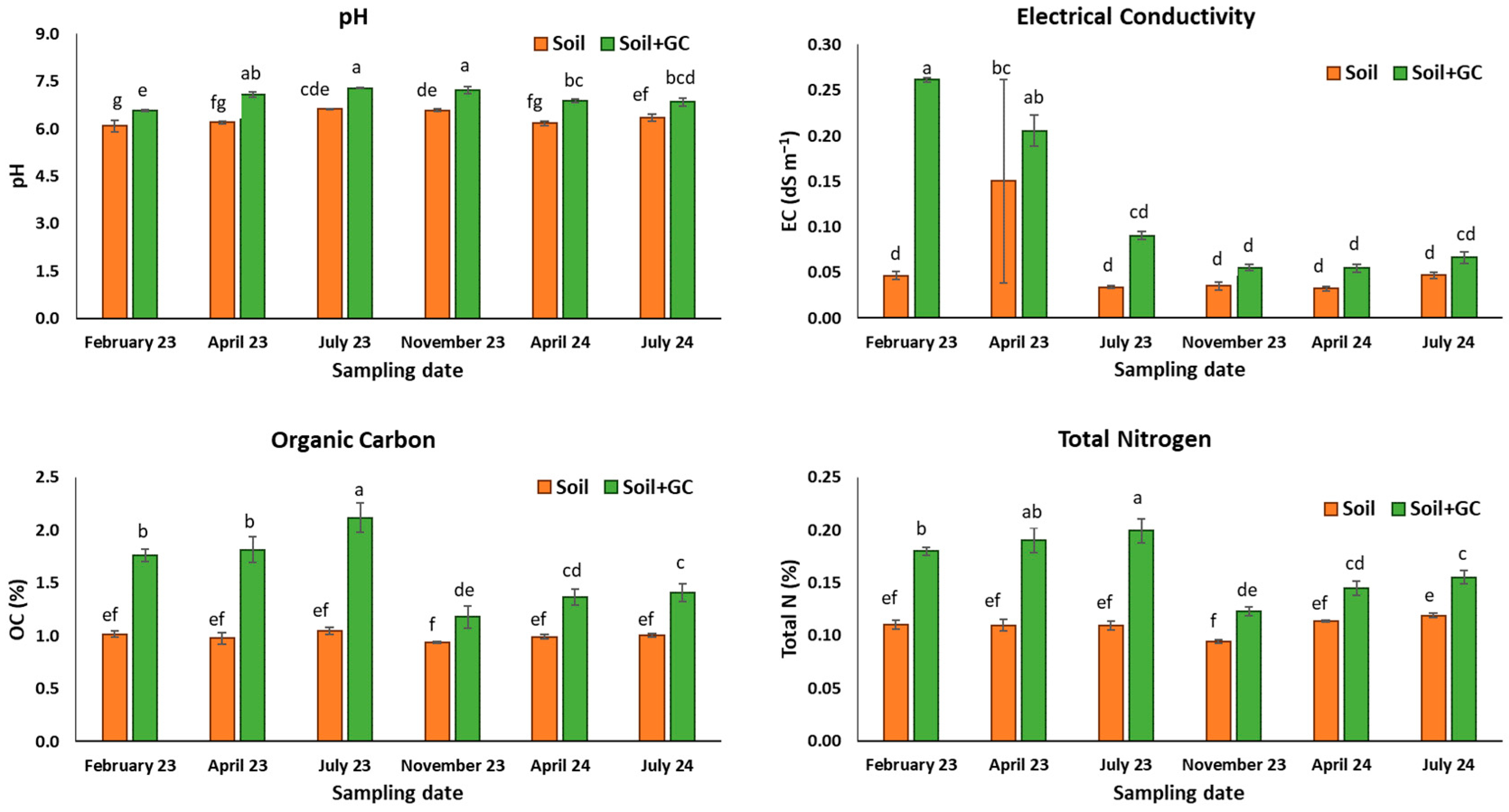
The application of GC to soil also prompted a significant increase (p < 0.05) (0.49 units by February 2023 and July 2024) in its pH compared to control soil (Table 3, Figure 2), which remained constant over the experimental period. The pH values of the control soil and Soil + GC ranged from 6.09 to 7.28 throughout the experiment, which are appropriate for nutrients to be more available to crops since they are into the pH range of 5.5 to 7.5 [34]. The application of GC also increased EC over the experimental period. This increase in EC was significantly (p < 0.05) greater (up to five times) during the first pea growing season and decreased during the second wheat growing season (Table 3, Figure 2). EC indirectly indicates the concentration of soluble salts and increases in the presence of organic amendments [6,34].
A single application of GC caused a high and significant (p < 0.05) increase in soil OC content compared to control soil due to the amendment’s high OC content, even ~18 months after GC application (Table 3, Figure 2). The OC in Soil + GC increased by 74% by February 2023 and 40% by July 2024 compared to control soil. The decrease in OC content over the second crop campaign may be due to the tillage conducted before wheat sowing. The transport of compost to the subsoil increased the persistence of OM in the soil due to unfavourable conditions for decomposition at a lower soil depth [5]. Marín-Benito et al. [10] have reported a significant increase in the OC content in the 0–10 cm and 10–20 cm layers in Soil + GC compared to unamended soils seven months after application, indicating that GC application improves soil properties at least over the short term.
Regarding total N content, this increased up to 2.0 times over the pea crop campaign and 1.3 times over the wheat crop campaign in Soil + GC compared to control soil (Table 3, Figure 2). Other nutrients, such as NO3-N and available P, Ca, K and Mg increased significantly in Soil + GC compared to Soil, with the increase being higher over the first crop campaign (Table 3). The increases in soil macronutrients, including N, P, K, Ca, S, Mg, C, O and H, after compost application to soil has an impact on plant health and metabolism [35]. Green waste and biowastes amendments have been used as a slow-release source of N in a study carried out by Sánchez-Monedero et al. [5]. NH4+-N concentrations were lower than those of NO3-N, as reported in other amended soils by Herrero-Hernández et al. [6], indicating that the soluble mineral N pool is dominated by NO3-N. A low risk of NO3-N leaching from compost-amended soils was reported, as only up to 15% of nitrogen is available after amendment application [36]. CEC increased in Soil + GC compared to Soil, which may be due to the exchangeable base cations resulting from the accumulation of compounds with negative charges from the compost in the soil [35].
The soil moisture content was higher for Soil + GC than control soil over the experimental period, indicating that GC increased water retention and soil water-holding capacity and infiltration as compost added to soil can increase porosity, and reduce bulk density [35].
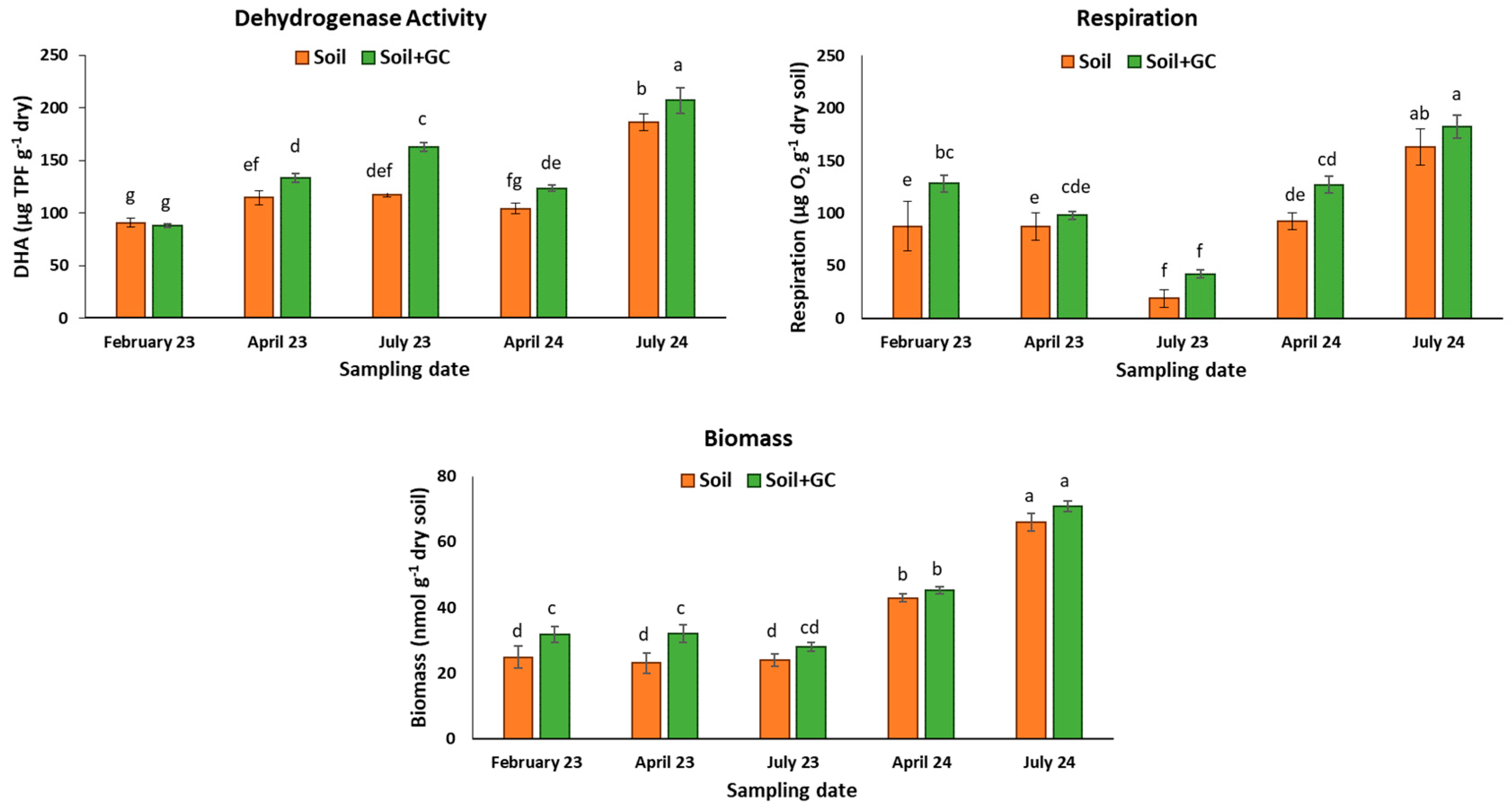
Biochemical parameters, soil microbial DHA, respiration, and biomass, increased in Soil + GC compared to control soil over the two crop campaigns (Table 3, Figure 3). The increase in soil respiration depends on the labile carbon pool and soil humidity, while the increase in DHA is due to the stimulation of soil microbial organisms following the input of OC, moisture and nutrients. Soil biomass is affected by temperature, nutrient sources, soil water content, and the type of organic amendment applied [6,37]. Microbial DHA, respiration and biomass in soil amended with GC increased particularly during the wheat growing season. This could be due to the slow and continuous release of nutrients as the OM in the compost decomposes in the soil, resulting in the microbial biomass in the soil remaining high for long periods of time [35]. Previous works have reported an increase in soil microbial DHA, respiration and biomass in soils amended with different composted organic wastes [35,38].
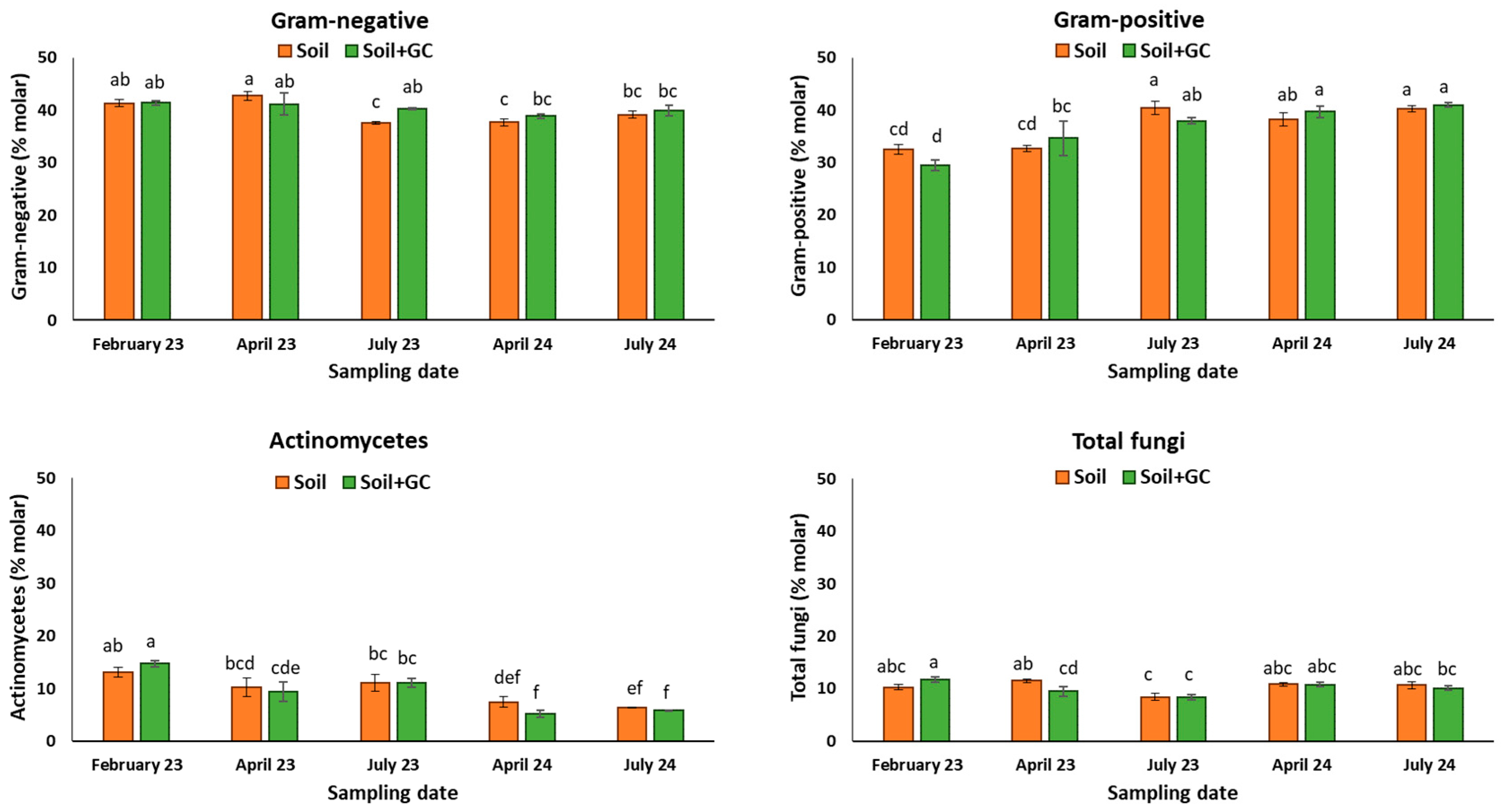
The soil microbial structure, determined by PLFA analysis, did not record any significant differences between the microbial groups in Soil and Soil + GC (Figure 4). Similar results were reported in a previous study where the soil microbial structure and biomass determined by PLFA analysis was not changed after the application of biochar, biowaste and green waste, or a combination of organic amendments in a crop rotation over three years [5]. The results indicate that Gram-negative bacteria and Actinomycetes decreased over time, while Gram-positive bacteria increased during the second growing season for both soil treatments. However, total fungi remained unchanged throughout the experiment (Figure 4). Similar results were found in previous studies, where the application of compost or vermicompost to soils produced increases in the bacterial community [11,39], but did not influence the fungal community [40].

3.2. Crop Yield and Quality

Pea and wheat yield in Soil + GC increased slightly compared to control soil, although differences were not significant (Table 4 and Table 5). Similarly, Lillo et al. [41] reported an increase in wheat and barley yield in an organically amended soil in a two-year wheat-barley rotation. The GC provided extra doses of N, P, and K, but this had no effect on pea or wheat yield. Organic amendments help to increase nutrient availability for plants, as well as plant growth, and crop yield [6,35,38]. In a previous study, an increase in plant biomass, yield, chlorophyll content and foliar area was reported for ryegrass sown in an agricultural soil amended with sewage sludge or two different composted amendments over two years [42]. No mineral fertiliser was applied during the first cropping season, whereas it was applied during the second season at wheat sowing, with a second application to all the treatments. No significant differences in macronutrients and micronutrients were observed for the pea grown in Soil and Soil + GC (Table 4). Protein, gluten, and starch content were similar for the wheat grown in both soils (Table 5).

3.3. Dissipation of Idosulfuron-Methyl-Sodium and Formation and Degradation of Metsulfuron-Methyl

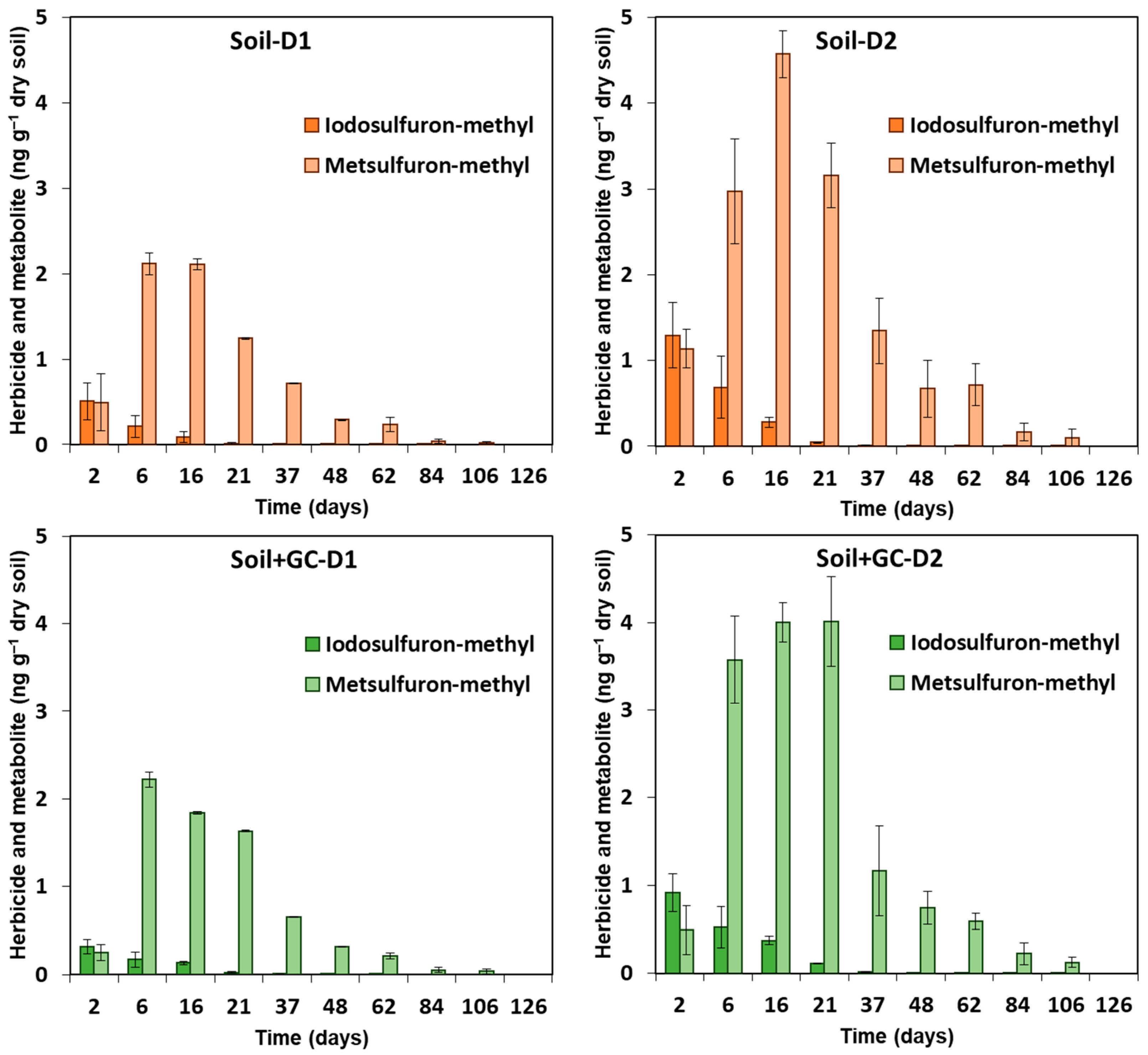
Figure 5 shows the residual concentrations of iodosulfuron-methyl-sodium, and its metabolite, metsulfuron-methyl, in Soil and Soil + GC over 126 days after herbicide application at the agronomic dose (D1) and double dose (D2). Table 6 includes the dissipation parameters and GoF of iodosulfuron-methyl-sodium and metsulfuron-methyl in both these soils. Dissipation data for both compounds were fitted to the single first-order (SFO) kinetic model, obtaining GoF parameters of χ2 < 17.4 and r2 > 0.91. Previous EFSA reports indicate that the field dissipation data of iodosulfuron-methyl-sodium and metsulfuron-methyl best fit the SFO kinetic model [15,16].
The results indicate that the herbicide dissipation rate in the Soil plots was 3.6 times higher for iodosulfuron-methyl-sodium applied at D1 than for metsulfuron-methyl. This means that metsulfuron-methyl dissipated much more slowly and the DT50 value was 4.8 times higher than for iodosulfuron-methyl-sodium, which dissipated more rapidly in Soil plots (Table 6). This may be because a high amount of herbicide is initially intercepted by the wheat plants at the time of application in post-emergence according to the high soil surface (≈80%) covered by the crop (Supplementary Material, Figure S2), where can be rapidly dissipated (residual level on and in the specified plant matrix, RL50 = 4.8 days) [14], the rapid dissipation of the herbicide (DT50 = 5–9 days) reaching the soil, and/or the higher persistence of the metabolite (DT50 = 25–30 days) compared to that of the herbicide (Table 6). The DT50 dissipation values ranged from 0.8 to 10.3 days (iodosulfuron-methyl-sodium) and from 11.1 to 39.3 days (metsulfuron-methyl) for unamended soils, with pH values between 5.8 and 7.8, across Europe [15,16].
The DT50 values for iodosulfuron-methyl-sodium and metsulfuron-methyl increased up to 1.2 times when the herbicide was applied at D2 compared to the values recorded when D1 was applied (Table 6). This might be because microorganisms need more time to degrade a larger amount of the compound or because of the herbicide’s toxic effect on microorganisms when applied at twice the agronomic dose. Similarly, other studies reported that the DT50 values for metsulfuron-methyl applied at different doses to field agricultural soils increased with the herbicide rate applied [43,44]. This toxic effect when applied on soil microbial communities at higher than recommended doses has been observed in previous dissipation studies of these compounds under field conditions [45]. In addition, when herbicides are applied at a higher than recommended dose, they take longer to dissipate, increasing the risk of phytotoxic effects on subsequent rotational crops [46]. However, Maznah et al. [47] observed that the degradation of metsulfuron-methyl applied at the agronomic dose and twice the agronomic dose to a clay loam soil was rapid, with DT50 values of 6.3 to 7.9 days, so the risk of persistence in the topsoil is low.
The rapid dissipation of iodosulfuron-methyl-sodium in the soil could be related to the precipitation recorded during the first 16 days after herbicide application, which was 43.2 mm (Figure 1). The first six days recorded a precipitation of 16.8 mm, which could have degraded the herbicide and prompted the rapid formation of its metabolite metsulfuron-methyl in the soil. Previous studies have indicated that iodosulfuron-methyl-sodium and other sulfonylurea herbicides degrade more rapidly when soil moisture content increases, due to higher soil microbial activity [17,25,27].
The residual amounts of herbicide and metabolite detected in the Soil + GC plots were higher than in the Soil plots, indicating its higher persistence (Figure 5). The DT50 values of iodosulfuron-methyl-sodium applied at doses D1 and D2 increased in Soil + GC by 1.6 and 1.4 times, respectively. The greater persistence of the herbicide in Soil + GC was corroborated by DT90 values that were up to 1.6 times higher in GC-amended soil than in the unamended soil, although differences were non-significant. However, the dissipation rates of metsulfuron-methyl in Soil + GC were similar to those recorded in Soil, and the DT50 and DT90 values were similar in both cases (Table 6). Singh et al. [18] have observed that metsulfuron-methyl persistence in soil amended with fly ash increases from 15 days in the control soil to 20 days in amended soil. However, other studies have reported a decrease in the persistence of metsulfuron-methyl in soil amended with compost [48], or decomposed pig manure, Chinese clover, or rice straw [49].
The DT50 values calculated in this study are in the same range as those obtained in a greenhouse trial and are lower than those obtained under a laboratory conditions, in which the dissipation of iodosulfuron-methyl-sodium was evaluated using the same agricultural soil and this soil amended with GC at the same doses, and under two irrigation regimes, or two soil moisture contents, respectively [27,28]. These studies also reported greater persistence of the herbicide in GC-amended soil due to its increased adsorption by soil with a higher OC content [50]. This is consistent with the DT50 values reported by EFSA, which are higher for the degradation of iodosulfuron-methyl-sodium in soil under laboratory conditions than for its dissipation under field conditions [15].
There is a slight positive relationship, but non-significant (p < 0.10), between the DT50 values of iodosulfuron-methyl-sodium and soil pH, EC, OC and N contents. No significant correlations between the DT50 values of iodosulfuron-methyl-sodium and soil biological parameters were found. There is no relationship between the DT50 values of metsulfuron-methyl and soil characteristics.

4. Conclusions

This short-term field study has found that the application of green compost (GC) as organic amendment to an agricultural soil has positive effects on the physicochemical and biological parameters of the soil measured over pea–wheat crop rotation, resulting in overall improved soil quality. The yield of pea and winter wheat crops is not affected by the GC application, although it will be necessary to evaluate the long-term effect on crop parameters after repeated application of the organic amendment to the soil over several crop rotation cycles. Much higher amounts of metsulfuron-methyl than iodosulfuron-methyl were found in all the soil treatments probably due to the rapid degradation of the herbicide reaching the soil. The herbicide and its metabolite were slightly more persistent in the GC-amended plots over time due to its increased adsorption by soil with a higher OC content. These results reveal the benefits that applying GC as an organic amendment have on soil properties, while also noting that this organic residue could impede herbicide degradation and increase its persistence in the soil, increasing the risk of phytotoxic effects on the succeeding rotational crop. As the practical implications of this short-term field study carried out in a single-site with one compost source/rate and one crop rotation are limited, further research that investigates soils with different textures and different climatic conditions, amended with different types of organic matter applied at several rates and with other crop rotation species, should be carried out in order to gain a more comprehensive understanding of changes in soil properties, crop development and yield, and herbicide/metabolite dissipation and persistence under sustainable management practices.

Supplementary Materials

The following supporting information can be downloaded at: https://www.mdpi.com/article/10.3390/agronomy16070710/s1, Figure S1: Experimental plots and soil treatments; Figure S2: Application of iodosulfuron-methyl-sodium (Hussar® Plus) in post-emergence at the agronomic dose (D1, 176 mL ha−1) and double this dose (D2, 352 mL ha−1) of the commercial formulation in the experimental plots sown with winter wheat in February 2024; Table S1: Validation parameters for the determination of iodosulfuron-methyl-sodium and metsulfuron-methyl from blank soil (Soil), and soil amended with green compost (Soil + GC) by UHPLC-QTOF-MS analytical method.

Author Contributions

Conceptualization, M.S.R.-C. and M.Á.G.-S.; methodology, M.S.R.-C., J.M.M.-B. and M.Á.G.-S.; software, M.S.R.-C. and J.G.-C.; validation, M.S.R.-C., J.M.M.-B. and M.Á.G.-S.; formal analysis, M.S.R.-C., J.M.M.-B. and J.G.-C.; investigation, M.S.R.-C., J.M.M.-B., M.Á.G.-S., M.R.M.-C. and J.G.-C.; resources, M.S.R.-C., J.M.M.-B. and M.Á.G.-S.; data curation, M.S.R.-C. and J.G.-C.; writing—original draft preparation, M.S.R.-C.; writing—review and editing, M.S.R.-C., J.M.M.-B., M.Á.G.-S., M.R.M.-C. and J.G.-C.; visualisation, M.S.R.-C., J.M.M.-B., M.Á.G.-S., M.R.M.-C. and J.G.-C.; supervision, M.S.R.-C. and M.Á.G.-S.; project administration, M.S.R.-C.; funding acquisition, M.S.R.-C. All authors have read and agreed to the published version of the manuscript.

Funding

This research was funded by the Spanish Ministry of Science, Innovation and Universities/State Investigation Agency (MICIU/AEI), Reference No. PID2020-113379RB-I00, and EU Horizon 2020 (EJP SOIL-EOM4SOIL), Grant Agreement No. 862695.

Data Availability Statement

The original data regarding soil physicochemical and biological characteristics, and crop yield and quality presented in the study are openly available in Zenodo, Excel file, at https://doi.org/10.5281/zenodo.14070572. The original contributions presented in this study are included in the article. Dataset is available upon request. Further inquiries can be directed to the corresponding author.

Acknowledgments

Authors thank J.M. Ordax and staff from Muñovela farm (Salamanca, Spain) for their technical assistance, and Project “CLU-2025-2-02—Unit of Excellence IRNASA_CSIC”, funded by the Junta Castilla y León and co-funded by the European Union (FEDER “Europe boosts our growth”), and Project “DEEP-MaX-2024_IRNASA” funded by the Spanish National Research Council (CSIC).

Conflicts of Interest

The authors declare no conflicts of interest. The funders had no role in the design of the study; in the collection, analyses, or interpretation of data; in the writing of the manuscript; or in the decision to publish the results.

References

  1. European Commission. EU Soil Strategy for 2030, COM (2021) 699 Final. 2021. Available online: https://ec.europa.eu/environment/publications/eu-soil-strategy-2030_en (accessed on 9 February 2026).
  2. European Commission; Directorate-General for Research and Innovation; Veerman, C.; Pinto Correia, T.; Bastioli, C.; Biro, B.; Bouma, J.; Cienciala, E.; Emmett, B.; Frison, E.A.; et al. Caring for Soil is Caring for Life: Ensure 75% of Soils are Healthy by 2030 for Healthy Food, People, Nature and Climate: Interim Report of the Mission Board for Soil Health and Food; Publications Office: Luxembourg, 2020. [Google Scholar] [CrossRef]
  3. Panagos, P.; Montanarella, L.; Barbero, M.; Schneegans, A.; Aguglia, L.; Jones, A. Soil priorities in the European Union. Geoderma Reg. 2022, 29, e00510. [Google Scholar] [CrossRef]
  4. Nerger, R.; Bandel, T. Compost application. In Recarbonizing Global Soils: A Technical Manual of Recommended Management Practices, Volume 3: Cropland, Grassland, Integrated Systems and Farming Approaches—Practices Overview; FAO, ITPS, Eds.; FAO: Rome, Italy, 2021; pp. 128–137. [Google Scholar] [CrossRef]
  5. Sánchez-Monedero, M.A.; Cayuela, M.L.; Sánchez-García, M.; Vandecasteele, B.; D’Hose, T.; López, G.; Martínez-Gaitán, C.; Kuikman, P.J.; Sinicco, T.; Mondini, C. Agronomic Evaluation of Biochar, Compost and Biochar-Blended Compost across Different Cropping Systems: Perspective from the European Project FERTIPLUS. Agronomy 2019, 9, 225. [Google Scholar] [CrossRef]
  6. Herrero-Hernández, E.; Andrades, M.S.; Villalba Eguren, G.; Sánchez-Martín, M.J.; Rodríguez-Cruz, M.S.; Marín-Benito, J.M. Organic Amendment for the Recovery of Vineyard Soils: Effects of a Single Application on Soil Properties over Two Years. Processes 2022, 10, 317. [Google Scholar] [CrossRef]
  7. European Parliament and of the Council. Directive (EU) 2025/2360 on Soil Monitoring and Resilience (Soil Monitoring Law). OJ L, 26.11.2025. 2025. Available online: https://eur-lex.europa.eu/eli/dir/2025/2360/oj/eng (accessed on 9 February 2026).
  8. Rodríguez-Seijo, A.; Pérez-Rodríguez, P.; Arias-Estévez, M.; Gómez-Armesto, A.; Conde-Cid, M.; Santás-Miguel, V.; Campillo-Cora, C.; Ollio, I.; Lloret, E.; Martínez-Martínez, S.; et al. Occurrence, persistence and risk assessment of pesticide residues in European wheat fields: A continental scale approach. J. Hazard. Mat. 2025, 494, 138291. [Google Scholar] [CrossRef]
  9. Lamichhane, J.R.; Dachbrodt-Saaydesh, S.; Kudsk, P.; Messéan, A. Towards a reduced reliance on conventional pesticides in European agriculture. Plant Dis. 2016, 100, 10–24. [Google Scholar] [CrossRef]
  10. Marín-Benito, J.M.; Barba, V.; Ordax, J.M.; Sánchez-Martín, M.J.; Rodríguez-Cruz, M.S. Recycling organic residues in soils as amendments: Effect on the mobility of two herbicides under different management practices. J. Environ. Manag. 2018, 224, 172–181. [Google Scholar] [CrossRef]
  11. Romero, E.; Castillo, J.M.; Nogales, R. Field-scale assessment of vermicompost amendments for diuron-contaminated soil: Implications for soil quality and pesticide fate. Appl. Soil Ecol. 2024, 201, 105516. [Google Scholar] [CrossRef]
  12. Vicente, L.A.; Peña, D.; Fernández-Rodríguez, D.; Albarrán, A.; Rato Nunes, J.M.; López-Piñeiro, A. Sorption, persistence and leaching of clomazone in rice environments under varying severity of alternate wetting and drying irrigation management with and without biochar amendment. J. Environ. Manag. 2025, 386, 125761. [Google Scholar] [CrossRef]
  13. Carpio, M.J.; Rodríguez-Cruz, M.S.; Sánchez-Martín, M.J.; Marín-Benito, J.M. Pesticide fate in soils under different agricultural management practices. In Pesticides in Soils: Ocurrence, Fate, Control and Remediation. The Handbook of Environmental Chemistry; Rodríguez-Cruz, M.S., Sánchez-Martín, M.J., Eds.; Springer: Cham, Switzerland, 2022; Volume 113, pp. 251–286. [Google Scholar]
  14. Lewis, K.A.; Tzilivakis, J.; Warner, D.; Green, A. An international database for pesticide risk assessments and management. Hum. Ecol. Risk Assess. 2016, 22, 1050–1064. [Google Scholar] [CrossRef]
  15. European Food Safety Authority. Conclusion on the peer review of the pesticide risk assessment of the active substance iodosulfuron-methyl-sodium (approved as iodosulfuron). EFSA J. 2016, 14, 4453. [Google Scholar]
  16. European Food Safety Authority. Conclusion on the peer review of the pesticide risk assessment of the active substance metsulfuron-methyl. EFSA J. 2015, 13, 3936. [Google Scholar] [CrossRef]
  17. Rouchaud, J.; Moulard, C.; Eelen, H.; Bulcke, R. Persistence of the sulfonylurea herbicide iodosulfuron-methyl in the soil of winter wheat crops. Toxicol. Environ. Chem. 2003, 85, 103–120. [Google Scholar] [CrossRef]
  18. Singh, N.; Singh, S.B.; Raunaq; Das, T.K. Effect of fly ash on persistence, mobility and bio-efficacy of metribuzin and metsulfuron-methyl in crop fields. Ecotoxicol. Environ. Saf. 2013, 97, 236–241. [Google Scholar] [CrossRef] [PubMed]
  19. Tomco, P.L.; Seefeldt, S.S.; Rodriguez-Baisi, K.; Hatton, J.J.; Duddleston, K.N. Sub-Arctic Field Degradation of Metsulfuron-Methyl in Two Alaskan Soils and Microbial Community Composition Effects. Water Air Soil Pollut. 2020, 231, 157. [Google Scholar] [CrossRef]
  20. Sondhia, S. Persistence of metsulfuron in wheat crop and soil. Environ. Monit. Assess. 2008, 147, 463–469. [Google Scholar] [CrossRef]
  21. European Commission. Mid-Term Review of the Zero Pollution Action Plan ‘Delivering Clean Air, Ocean, Freshwaters and soil’. COM(2026) 42 final, 29.1.2026. Available online: https://environment.ec.europa.eu/publications/mid-term-review-zero-pollution-action-plan_en (accessed on 12 February 2026).
  22. Das, T.K.; Behera, B.; Nath, C.P.; Ghosh, S.; Sen, S.; Raj, R.; Ghosh, S.; Sharma, A.R.; Yaduraju, N.T.; Nalia, A.; et al. Herbicides use in crop production: An analysis of cost-benefit, non-target toxicities and environmental risks. Crop Prot. 2024, 181, 106691. [Google Scholar] [CrossRef]
  23. Serim, A.T.; Maden, S. Effects of soil residues of sulfosulfuron and mesosulfuron methyl + iodosulfuron methyl sodium on sunflower varieties. J. Agric. Sci. 2014, 20, 1–9. [Google Scholar] [CrossRef]
  24. Mehdizadeh, M.; Alebrahim, M.T.; Roushani, M.; Streibig, J.G. Evaluation of four different crops’ sensitivity to sulfosulfuron and tribenuron methyl soil residues. Acta Agric. Scand. Sect. B Soil Plant Sci. 2016, 66, 706–713. [Google Scholar] [CrossRef]
  25. Kaur, H.; Kaur, P. Assessing soil ecosystem disruption by mesosulfuron methyl and iodosulfuron methyl using an Integrated Biomarker approach. J. Environ. Sci. Health B 2025, 60, 516–535. [Google Scholar] [CrossRef]
  26. Peña, D.; Albarrán, A.; Gómez, S.; Fernández-Rodríguez, D.; Rato-Nunes, J.M.; López-Piñeiro, A. Effects of olive mill wastes with different degrees of maturity on behaviour of S-metolachlor in three soils. Geoderma 2019, 348, 86–96. [Google Scholar] [CrossRef]
  27. Marín-Benito, J.M.; Andrades, M.S.; Sánchez-Martín, M.J.; Rodríguez-Cruz, M.S. Dissipation of Two Acidic Herbicides in Agricultural Soil: Impact of Green Compost Application, Herbicide Rate, and Soil Moisture. Agriculture 2025, 15, 552. [Google Scholar] [CrossRef]
  28. Carpio, M.J.; Bárcena, S.; Sánchez-Martín, M.J.; Marín-Benito, J.M.; Rodríguez-Cruz, M.S. Effect of different treatments on the dissipation and persistence of iodosulfuron-methyl applied in soils with wheat crop under greenhouse conditions. Ecotoxicol. Environ. Saf. 2025, 300, 118454. [Google Scholar] [CrossRef] [PubMed]
  29. Sparks, D.L. Methods of Soil Analysis. Part 3: Chemical Methods; SSSA Series; Wiley: Hoboken, NJ, USA, 1996. [Google Scholar]
  30. Tabatabai, M.A. Soil enzymes. In Methods of Soil Analysis. Part 2-Microbiological and Biochemical Properties, 3rd ed.; Weaver, R.W., Angle, J.S., Bottomley, P.S., Eds.; Soil Science Society of America Inc.: Madison, WI, USA, 1994; pp. 903–947. [Google Scholar]
  31. Frostegård, Å.; Bååth, E.; Tunlid, A. Shifts in the structure of soil microbial communities in limed forests as revealed by phospholipid fatty acid analysis. Soil Biol. Biochem. 1993, 25, 723–730. [Google Scholar] [CrossRef]
  32. Zelles, L. Fatty acid patterns of phospholipids and lipopolysaccharides in the characterisation of microbial communities in soil: A review. Biol. Fertil. Soils 1999, 29, 111–129. [Google Scholar] [CrossRef]
  33. FOCUS, Forum for the Co-Ordination of Pesticide Fate Models and Their Use. Guidance Document on Estimating Persistence and Degradation Kinetics from Environmental Fate Studies on Pesticides in EU Registration; Report of the FOCUS Work Group on Degradation Kinetics. EC Document Reference SANCO/10058/2005-v. 2.0; FOCUS, Forum for the Co-Ordination of Pesticide Fate Models and Their Use: 2006. Available online: https://esdac.jrc.ec.europa.eu/public_path/projects_data/focus/dk/docs/finalreportFOCDegKinetics.pdf (accessed on 1 July 2025).
  34. FAO. Soil Testing Methods—Global Soil Doctors Programme—A Farmer-to-Farmer Training Programme; FAO: Rome, Italy, 2020. [Google Scholar] [CrossRef]
  35. Sayara, T.; Basheer-Salimia, R.; Hawamde, F.; Sánchez, A. Recycling of Organic Wastes through Composting: Process Performance and Compost Application in Agriculture. Agronomy 2020, 10, 1838. [Google Scholar] [CrossRef]
  36. Diacono, M.; Montemurro, F. Long-term effects of organic amendments on soil fertility. In Sustainable Agriculture; Lichtfouse, E., Hamelin, M., Navarrete, M., Debaeke, P., Eds.; Springer: Dordrecht, The Netherlands, 2011; Volume 2, pp. 761–786. [Google Scholar]
  37. Bhupenchandra, I.; Sharma, L.D.; Salam, M.D.; Kumar, S.; Chongtham, S.K.; Choudhary, A.K.; Devi, H.L.; Sinyorita, S.; Dutta, P.; Bouket, A.C.; et al. Unravelling the role of soil enzymatic activity as a vital bioindicator of soil health and fertility in agricultural systems. Appl. Soil Ecol. 2026, 219, 106816. [Google Scholar] [CrossRef]
  38. Caldara, M.; Di Gregorio, L.; Sarvi, M.; Graziano, S.; Bindo, A.; Salo, T.; Nolfi, L.; Costanzo, M.; Lamanna, G.; Scanferla, V.; et al. Impacts on soil health of soil improvers derived from agri-food processing residues: A systematic review with a focus on European field studies. J. Soil Sci. Plant Nutr. 2026, 1–26. [Google Scholar] [CrossRef]
  39. Sanz, C.; Casado, M.; Navarro-Martin, L.; Cañameras, N.; Carazo, N.; Matamoros, V.; Bayona, J.M.; Piña, B. Implications of the use of organic fertilizers for antibiotic resistance gene distribution in agricultural soils and fresh food products. A plot-scale study. Sci. Total Environ. 2022, 815, 151973. [Google Scholar] [CrossRef]
  40. Viketoft, M.; Riggi, L.G.A.; Bommarco, R.; Hallin, S.; Taylor, A.R. Type of organic fertilizer rather than organic amendment per se increases abundance of soil biota. PeerJ 2021, 9, e11204. [Google Scholar] [CrossRef]
  41. Lillo, P.; Delgado, M.M.; Porcel, M.A.; Sánchez-Moreno, S. Organic amendments drive agroecosystem multifunctionality and soil micro-food web short-term dynamics. Agric. Ecosys. Environ. 2025, 388, 109657. [Google Scholar] [CrossRef]
  42. Alvarenga, P.; Palma, P.; Mourinha, C.; Farto, M.; Dôres, J.; Patanita, M.; Cunha-Queda, C.; Natal-da-Luz, T.; Renaud, M.; Sousa, J.P. Recycling organic wastes to agricultural land as a way to improve its quality: A field study to evaluate benefits and risks. Waste Manag. 2017, 61, 582–592. [Google Scholar] [CrossRef] [PubMed]
  43. Paul, R.; Rajvir, S.; Gita, K.; Singh, S.B. Analysis of metsulfuron-methyl residues in wheat field soil: A comparison of HPLC and bioassay techniques. Pest Manag. Sci. 2009, 65, 963–968. [Google Scholar] [CrossRef] [PubMed]
  44. Ismail, B.S.; Tet-Vun, C. A field study on persistence and mobility of metsulfuron-methyl in three tropical agricultural soils. Aus. J. Soil Res. 2003, 41, 27–35. [Google Scholar] [CrossRef]
  45. Conte, E.D.; da Rosa, E.J.; Silvestrini, G.R.; Motta, D.D.S.; de Oliveira, C.F.; Cocco, C.; Pauletti, G.F.; Silvestre, W.P.; Dal Magro, T.; Schwambach, J. Can Trichoderma Spp. Contribute to the Bioremediation and Biostimulation of Plants in Soil Contaminated with Herbicides? ACS Omega 2025, 10, 2243–2252. [Google Scholar] [CrossRef]
  46. Guerra, N.; Nogatz, B.; Schmitt, J.; Radzinski, A.S.; Jochem, W.; De Oliveira Neto, A.M. Metsulfuron-methyl soil persistence influence in corn grown in succession. Rev. Bras. Cienc. Agrar. 2022, 17, e1367. [Google Scholar] [CrossRef]
  47. Maznah, Z.; Ismail, B.S.; Ooi, K.E. Evaluation on persistence and mobility of metsulfuron-methyl at oil palm plantation: Residue field trial experiment versus VARLEACH model. Environ. Sci. Pollut. Res. 2022, 29, 19731–19740. [Google Scholar] [CrossRef]
  48. Sumekar, Y.; Kurniadie, D.; Widayat, D.; Yuniarti, A. Effectiveness and persistence of metsulfuron-methyl herbicide in rice fields with compost organic materials. Asian J. Plant Sci. 2021, 20, 609–619. [Google Scholar] [CrossRef]
  49. Zhang, C.L.; Yao, B.; Zhang, P.; Wang, T.T. Effect of organic amendments on metsulfuron-methyl dissipation in Chinese paddy soils. J. Residuals Sci. Technol. 2011, 8, 181–188. [Google Scholar]
  50. Garcia-Miro, A.; Ordax, J.M.; Sanchez-Martin, M.J.; Marin-Benito, J.M.; Rodriguez-Cruz, M.S. Adsorption of ionizable herbicides by agricultural soils without amendment and green compost-amended soils. Rev. Cienc. Agrar. 2022, 45, 614–617. [Google Scholar]
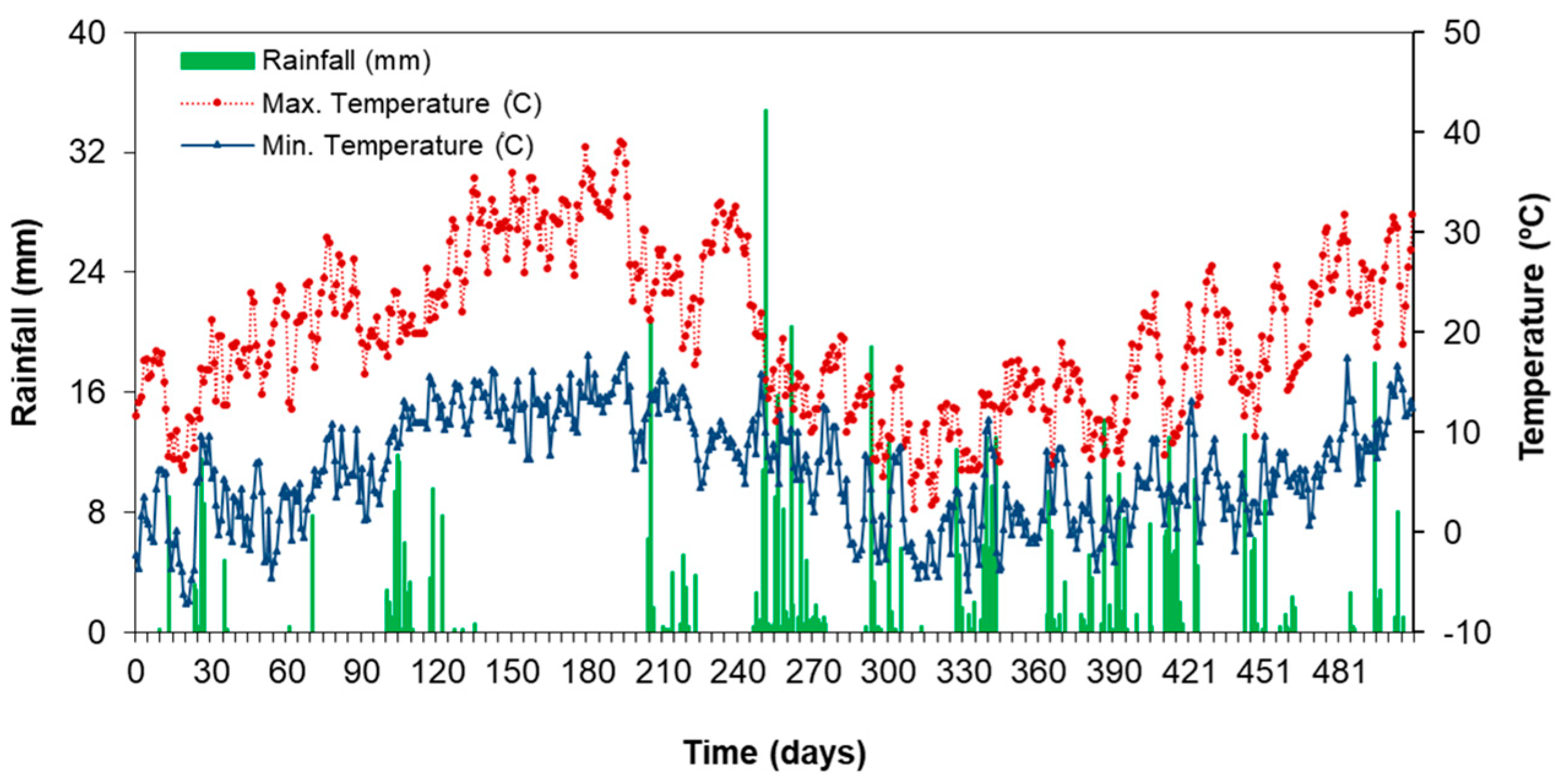
Figure 1. Precipitation (mm) and maximum and minimum temperatures recorded throughout the experiment (from February 2023 to July 2024, 510 days) at the Muñovela farm (Salamanca, Spain).
Agronomy 16 00710 g001
Figure 2. Changes in soil pH, EC, OC, and total N contents for the two soil treatments (Soil and Soil + GC) at six sampling times (February 2023–July 2024) after GC application. Error bars represent the standard deviation of the mean (n = 12). Different letters indicate significant differences among samples over the experiment according to the Tukey post hoc test (p < 0.05).
Agronomy 16 00710 g002
Figure 3. Changes in soil microbial DHA, respiration, and biomass for the two soil treatments (Soil and Soil + GC) at five sampling times (February 2023–July 2024) after GC application. Error bars represent the standard deviation of the mean (n = 12). Different letters indicate significant differences among samples over the experiment according to the Tukey post hoc test (p < 0.05).
Agronomy 16 00710 g003
Figure 4. Microbial groups for the two soil treatments (Soil and Soil + GC) at five sampling times (February 2023–July 2024) after GC application. Error bars represent the standard deviation of the mean (n = 12). Different letters indicate significant differences among samples over the experiment according to the Tukey post hoc test (p < 0.05).
Agronomy 16 00710 g004
Figure 5. Residual concentrations (ng g−1 dry soil) of iodosulfuron-methyl-sodium, and its metabolite, metsulfuron methyl, in Soil and Soil + GC over 126 days after herbicide application at the agronomic dose (D1) and double dose (D2). Error bars represent the standard deviation of the mean (n = 4).
Agronomy 16 00710 g005
Table 1. Characteristics of iodosulfuron-methyl-sodium and metsulfuron-methyl (metabolite).
Iodosulfuron-Methyl-SodiumMetsulfuron-Methyl
Chemical structureAgronomy 16 00710 i001Agronomy 16 00710 i002
Molecular mass529.24381.36
Dissociation constant (pKa), 25 °C3.223.75
Solubility—In water, pH 7, 20 °C (mg L−1)25,0002800
Octanol–water partition coefficient (log Kow), pH 7, 20 °C−0.7−1.9
Vapour pressure, 20 °C (mPa)2.6 × 10−61.0 × 10−6
DT50 in lab, 20 °C (days)2.7 (0.6–20.8 days, Soils = 15)23.2 (6.4–48.8 days, Soils = 8)
DT50 in field (days)3.2 (0.8–10.3 days, Soils = 5)13.3 (7.3–37.1 days, Soils = 4)
Kf (mL g−1)0.82 (0.12–2.47 mL g−1, Soils = 10)0.77 (0.1–4.9 mL g−1, Soils = 16)
GUS leaching potential index 11.19 (Low leachability)3.28 (High leachability)
1 The GUS leaching potential index, Groundwater Ubiquity Score [14].
Table 2. Characteristics of the GC applied to the soil.
pHCaCO3 (%)Ash
(%)
OC 1 (%)N (%)C/NAvailable P
(g kg−1)
Available Ca
(g kg−1)
Available K
(g kg−1)
Available Mg
(g kg−1)
CEC 2
Total NH4+ (cmol(+) kg−1)
GC7.152.5757.619.31.8810.21.1015.67.952.1142.0
1 OC, Organic Carbon; 2 CEC, Cation Exchange Capacity.
Table 3. Characteristics of control soil and Soil + GC over the experimental period (February 2023–July 2024).
SampleSoil (control)Soil + GC
Sampling TimeFeb
2023
April
2023
July
2023
Nov
2023
April
2024
July
2024
Feb
2023
April
2023
July
2023
Nov
2023
April
2024
July
2024
pH6.09 g6.19 fg6.62 cde6.58 de6.17 fg6.36 ef6.58 e7.09 ab7.28 a7.22 a6.88 bc6.85 bcd
EC 1 (dS m−1)0.05 d0.15 bc0.03 d0.04 d0.03 d0.050.26 a0.21 ab0.09 cd0.06 d0.05 d0.07 d
CaCO3 (%)<LD 6<LD<LD<LD<LD<LD<LD0.210.200.130.150.18
OC 2 (%)1.02 ef0.98 ef1.05 ef0.94 f0.99 ef1.00 ef1.76 b1.82 b2.12 a1.18 de1.36 cd1.41 c
OM 3 (%)1.75 ef1.68 ef1.81 ef1.62 f1.71 ef1.73 ef3.04 b3.13 b3.65 a2.03 de2.35 cd2.43 c
Total N (%)0.11 ef0.11 ef0.11 ef0.09 f0.11 ef0.12 e0.18 b0.19 ab0.20 a0.12 de0.14 cd0.16 c
NH4+-N
(mg kg−1)
8.48 bcd8.73 bcd8.87 bcd5.34 d13.1 a8.59 bcd8.56 bcd9.97 ab8.80 bcd6.76 cd13.1 a11.3 ab
NO3-N
(mg kg−1)
69.7 cd98.5 c5.80 e7.27 e18.0 e29.4 e494 a225 b10.6 e9.44 e22.6 e34.3 de
C/N9.238.909.5710.08.738.449.749.5310.69.629.429.05
Available P (mg kg−1)32.0 cd32.2 cd25.1 d28.8 cd22.0 d28.1 cd74.9 a82.2 a69.5 a45.9 b39.4 bc50.9 b
Available Ca (g kg−1)1.08 c1.10 c1.09 c1.11 c1.02 c1.05 c1.90 bc3.47 a2.07 b1.54 bc1.46 bc1.46 bc
Available K (g kg−1)0.10 d0.14 cd0.14 cd0.09 d0.06 d0.13 cd0.31 bc0.68 a0.36 b0.14 cd0.10 d0.19 bcd
Available Mg (g kg−1)0.15 b0.17 b0.16 b0.18 b0.15 b0.15 b0.24 b0.44 a0.24 b0.23 b0.19 b0.17 b
CEC 4
(cmol(+) Kg−1)
4.58 d6.09 bc5.78 c6.58 b6.51 bc6.30 bc6.09 bc7.77 a8.19 a7.69 a7.88 a7.53 a
Water
content (%)
7.81 d7.76 d1.25 en.d. 78.45 cd9.87 ab9.57 abc9.20 abc1.82 en.d.8.85 bcd10.38 a
DHA 5
(µg TPF g−1 dry soil)
90.8 g115 ef117 defn.d.104 fg186 b87.8 g134 d163 cn.d.123 de207 a
Respiration
(µg O2 g−1 dry soil)
87.5 e87.5 e18.9 fn.d.92.6 de163 ab128 bc97.8 cde42.1 fn.d.127 cd182 a
Biomass
(nmol g−1 dry soil)
24.9 d23.1 d24.0 dn.d.43.0 b66.0 a31.9 c32.1 c28.0 cdn.d.45.3 b70.8 a
1 EC, Electrical conductivity; 2 OC, Organic carbon; 3 OM, Organic matter; 4 CEC, Cation exchange capacity; 5 DHA, Dehydrogenase activity; 6 LD, Limit of detection; 7 n.d., no determined. Data are expressed as mean values (n = 12). Different letters shown as superscripts within a row indicate significant differences among samples over the experiment according to the Tukey post hoc test (p < 0.05).
Table 4. Pea yield, carbon and nitrogen content, and macronutrients and micronutrients in Soil and Soil + GC in July 2023.
SoilSoil + GC
Yield (kg ha−1)3089 ± 433 a3323 ± 397 a
C (%)44.8 ± 0.30 a44.7 ± 0.34 a
N (%)3.64 ± 0.10 a3.61 ± 0.19 a
Ca (g kg−1)0.78 ± 0.06 a0.72 ± 0.05 a
K (g kg−1)10.8 ± 0.51 b12.0 ± 0.51 a
Mg (g kg−1)1.34 ± 0.07 a1.30 ± 0.06 a
P (g kg−1)4.30 ± 0.19 a4.12 ± 0.21 a
S (g kg−1)2.38 ± 0.10 a2.51 ± 0.11 a
B (mg kg−1)11.4 ± 1.64 a10.2 ± 1.43 a
Cu (mg kg−1)8.93 ± 0.82 a7.35 ± 0.71 b
Fe (mg kg−1)79.1 ± 5.25 a69.8 ± 5.24 a
Mn (mg kg−1)16.4 ± 1.20 a14.1 ± 1.01 b
Mo (mg kg−1)<LD 11.49 ± 0.59
Na (mg kg−1)204 ± 74.2 a62.8 ± 15.4 b
Zn (mg kg−1)36.9 ± 2.88 a37.0 ± 2.88 a
1 LD, limit of detection. Data are expressed as mean ± standard deviation (n = 12). Different letters shown as superscripts within a row indicate significant differences among samples according to the Tukey post hoc test (p < 0.05).
Table 5. Wheat yield, protein, gluten and starch content in Soil and Soil + GC in July 2024.
SoilSoil + GC
Yield (kg ha−1)2745 ± 463 a2999 ± 483 a
Protein (%)11.7 ± 0.69 a12.0 ± 0.58 a
Gluten (%)22.1 ± 1.85 a23.0 ± 1.65 a
Starch (%)64.4 ± 0.97 a64.1 ± 1.03 a
Data are expressed as mean ± standard deviation (n = 12). Different letters shown as superscripts within a row indicate significant differences among soil treatments according to the Tukey post hoc test (p < 0.05).
Table 6. Dissipation parameters and GoF of iodosulfuron-methyl-sodium, applied at the agronomic dose (D1) and double dose (D2), and its metabolite, metsulfuron methyl, in Soil and Soil + GC.
k (Days−1)DT50 (Days)DT90 (Days)χ2r2
Iodosulfuron-methyl-sodium
Soil-D10.1345.2 ± 1.6 ab17.1 ± 5.2 a11.40.99
Soil-D20.1096.3 ± 1.0 a21.1 ± 3.4 a11.20.99
Soil + GC-D10.0828.4 ± 1.9 a27.9 ± 6.4 a17.40.94
Soil + GC-D20.0798.8 ± 2.0 a29.3 ± 6.8 ab14.70.97
Metsulfuron-methyl
Soil-D10.03724.8 ± 2.6 b68.5 ± 8.4 a17.20.91
Soil-D20.05528.5 ± 3.4 a57.6 ± 11.2 a8.40.99
Soil + GC-D10.03724.8 ± 2.3 b68.3 ± 7.5 a12.20.95
Soil + GC-D20.05129.7 ± 1.5 a61.6 ± 5.0 a15.00.96
Data are expressed as mean ± standard deviation (n = 4). Different letters shown as superscripts within a column indicate significant differences among samples for herbicide or metabolite according to the Tukey post hoc test (p < 0.05).
Disclaimer/Publisher’s Note: The statements, opinions and data contained in all publications are solely those of the individual author(s) and contributor(s) and not of MDPI and/or the editor(s). MDPI and/or the editor(s) disclaim responsibility for any injury to people or property resulting from any ideas, methods, instructions or products referred to in the content.