Next Article in Journal
A Comparative Analysis of the Codon Usage Bias of HSP90 Genes in Six Poaceae Forages
Previous Article in Journal
Microtubule Dynamics Modulate Cold-Responsive Gene Expression in Brassica rapa
 
 
Due to scheduled maintenance work on our servers, there may be short service disruptions on this website between 11:00 and 12:00 CEST on March 28th.
Article

Responses of Soil Water Conservation Capacity to Artificial Grassland Establishment Along a Restoration Chronosequence in Alpine Meadows

1
Key Laboratory of Degraded and Unused Land Consolidation Engineering, The Ministry of Natural Resources, Shaanxi Agricultural Development Group Co., Ltd., Xi’an 710075, China
2
Technology Innovation Center for Land Engineering and Human Settlements, Shaanxi Land Engineering Construction Group Co., Ltd. and Xi’an Jiaotong University, Xi’an 710075, China
3
Xi’an Agricultural Technology Extension Center, Xi’an 710007, China
4
School of Life Science and Technology, Northwestern Polytechnical University, Xi’an 710129, China
5
School of Ecology and Environment, Northwestern Polytechnical University, Xi’an 710129, China
*
Author to whom correspondence should be addressed.
Agronomy 2026, 16(7), 697; https://doi.org/10.3390/agronomy16070697
Submission received: 2 February 2026 / Revised: 18 March 2026 / Accepted: 21 March 2026 / Published: 26 March 2026
(This article belongs to the Section Grassland and Pasture Science)

Abstract

The alpine meadows on the Qinghai-Tibetan Plateau function as critical reservoirs for regional water resources, yet face severe degradation driven by climate warming and overgrazing. Although establishing Poa pratensis artificial grasslands is a common restoration strategy, their effectiveness in recovering hydrological functions along restoration chronosequence remains poorly quantified. This study evaluated the changes in water conservation capacity and its drivers across a degradation–restoration sequence in the Qilian Mountains comprising alpine meadow (AM), degraded meadow (DM), and 2-, 3-, and 13-year artificial grasslands (AG2, AG3, AG13). Vegetation characteristics, soil structural properties, and water-holding indices were measured to assess restoration outcomes. The results showed that compared to AM, water-holding capacity at 0–30 cm in DM declined by 75.3–85.8%, primarily due to fragmentation of the mattic epipedon and deterioration of soil aggregates. While artificial restoration improved vegetation traits and some soil properties, hydrological recovery exhibited a distinct lag. Specifically, soil water-holding capacity in artificial grasslands showed no statistically significant improvement compared to DM. Even in AG13, soil water storage remained significantly lower than that in AM. Mantel tests and regression analyses identified root mass density and mean weight diameter as the primary drivers governing water conservation capacity. These findings reveal that artificial grasslands cannot serve as functional hydrological reservoirs in a timely manner, highlighting the importance of conserving intact alpine ecosystems.

1. Introduction

Alpine meadows, as crucial ecosystems on the Qinghai-Tibetan Plateau (QTP), maintain regional ecological balance [1]. Dense mattic epipedons, developing within the upper 30 cm soil layer, contain densest roots and abundant organic matter, thereby maintaining high biological activity [2]. Meanwhile, these mattic epipedons exhibit high runoff generation and low infiltration capacity, playing a key role in hydrological regulation [3].
Over recent decades, alpine meadows have experienced severe degradation driven by the combined effects of climate warming and sustained intensive grazing [4,5]. Dominant species (e.g., Kobresia pygmaea) have been replaced by disturbance-tolerant plants, resulting in fragmentation of the meadow landscape and expansion of black-soil patches [6]. The mattic epipedons have progressively thinned, or even vanished locally, weakening resistance to water and wind erosion [5,7]. Degradation has reduced vegetation coverage by up to 60%, and depleted soil organic carbon stocks by 1.01 Pg, thereby accelerating aggregate breakdown and compaction, increasing bulk density and reducing porosity [7,8,9]. These coupled changes alter the spatial redistribution of soil water (e.g., infiltration, storage, and recharge) across the QTP, thereby reducing regional water conservation capacity and impacting downstream river flow [10,11].
To combat ongoing meadow degradation, enclosure, grazing reduction, and rotational grazing have been implemented progressively, aiming to restore ecological functions by reestablishing vegetation and improving soil conditions [6,12]. Artificial grasslands can rapidly increase coverage within the first 2–3 years after establishment through sowing and management, and re-accumulate soil organic matter by increasing above- and below-ground biomass [13,14]. As soil aggregate stability increases, the erosion resistance of surface soils strengthens, thereby suppressing wind and water erosion and reducing sediment export in slope runoff [15]. Additionally, plant roots modulate the development of soil pore networks through their morphological traits (e.g., root biomass and length), thereby regulating water infiltration and runoff processes [16,17]. Soil nutrient availability and microbial activity gradually recover, leading to higher productivity and enhanced ecosystem functioning in alpine meadows [18]. Despite these efforts, under high-altitude and low-temperature conditions, natural recovery is constrained by short growing seasons (4–5 months) and may not fully reverse degradation trends [19]. Indeed, management activities (sowing/fieldwork) may locally intensify soil compaction. However, these effects can be mitigated through controlled traffic and periodic soil loosening, and the benefits, such as enhanced vegetation growth and water retention, generally outweigh these temporary drawbacks [20]. Overall, artificial restoration is a vital strategy for addressing meadow degradation and restoring ecological and hydrological processes.
Among the various ecological grass species, Poa pratensis, a cold- and drought-tolerant forage with high nutritional value, has been widely adopted for ecosystem restoration on the QTP. Poa pratensis exhibits vigorous tillering and a dense root system that rapidly covers exposed ground and forms a stable root-soil matrix, thereby mitigating raindrop impact and runoff erosion [21,22]. Meanwhile, its root system continuously contributes organic residues, enhancing soil structure and gradually transforming loose, dispersed soil into a more stable aggregate framework [23]. Following vegetation restoration, surface roughness increases and the near-surface microclimate is moderated, favoring soil water storage and plant water uptake [24,25]. Prior studies on Poa pratensis artificial grasslands have primarily focused on vegetation productivity, soil nutrient status, and erosion mitigation [26]. Some studies have also documented above- and below-ground biomass dynamics and shifts in community structure [27,28]. However, the impact of meadow degradation and the establishment of artificial grasslands on soil water conservation capacity remains poorly understood. In particular, changes in vegetation traits and soil properties during restoration, and their effects on water conservation capacity along a restoration chronosequence, have yet to be quantified.
Therefore, this study selected alpine meadow (AM), degraded meadow (DM), and Poa pratensis artificial grasslands established for two (AG2), three (AG3), and thirteen years (AG13) to assess water conservation capacity across a degradation–restoration sequence on the QTP. This study aims to: (1) quantify changes in soil water-holding indices along the degradation–restoration; (2) identify key vegetation and soil factors governing water conservation capacity; and (3) evaluate the recovery extent of soil water conservation relative to the undegraded state, along with associated ecological implications and restoration strategies.

2. Methods

2.1. Study Description

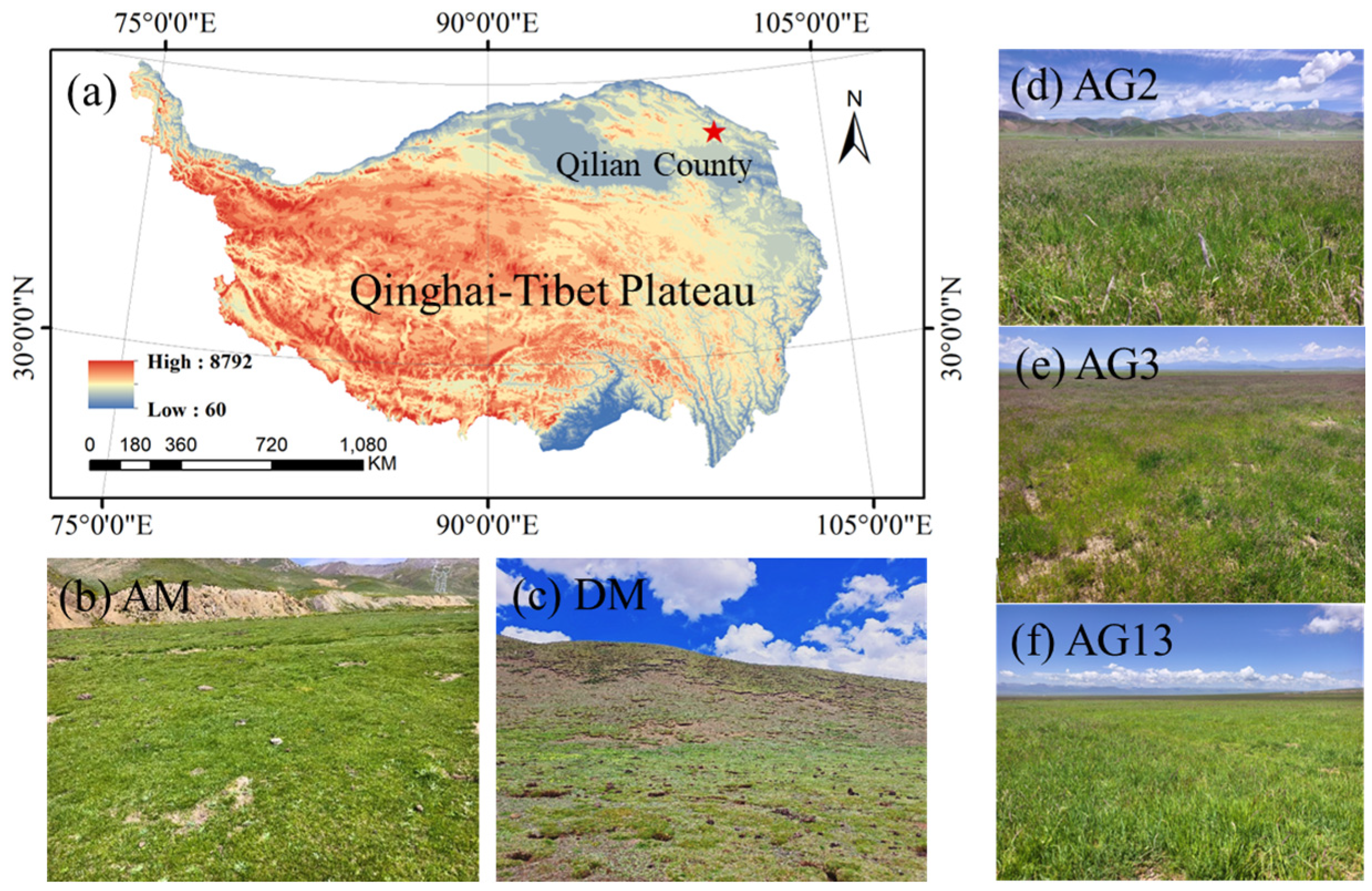
This study area is located in the Qilian Mountains (94°10′~103°04′ E, 35°50′~39°19′ N), a critical ecological barrier and water source at the eastern margin of the QTP (Figure 1). The Qilian Mountains are representative of typical alpine meadow degradation and restoration on the QTP. The region features rugged terrain, with elevations ranging from 3400 to 3800 m. The area exhibits a cold continental climate, with mean annual precipitation of about 400–500 mm, concentrated between June and September. The region has a mean annual temperature of roughly 1 °C, with significant diurnal temperature fluctuations that modulate surface water conditions and influence soil structure. Natural vegetation is dominated by alpine meadows, typified by Kobresia pygmaea, Kobresia humilis, Lancea tibetica and Veronica eriogyne. Dense root systems form shallow mattic epipedons that stabilize surface soil and promote aggregate formation. The soils at sampling regions are classified as Gelic/Cryi-gelic Cambisols, featuring relatively high organic matter and favorable near-surface water-holding capacity [29]. To restore degraded meadows, local governments have implemented restoration practices, including fenced grazing and the establishment of artificial grasslands. Practice has proved that grassland restoration significantly enhances soil structural stability, evidenced by a ~161% increase in soil cohesion and a ~53% gain in aggregate mean weight diameter [30].

2.2. Field Sampling

Field sampling was conducted in July 2025 within a representative alpine meadow zone of the Qilian Mountains. A degradation–restoration sequence was employed, comprising AM, DM, AG2, AG3, and AG13. Restoration age was verified via documented establishment years (local land-use records), with AG2, AG3, and AG13 established in 2023, 2022, and 2012, respectively. Artificial grasslands were established as monocultures of Poa pratensis. Following local restoration protocols, seeds were sown at a density of 7.5 kg ha−1 after ploughing degraded meadows. All artificial grasslands were established on historically degraded meadows that share the same soil parent material, topography, and climatic conditions with the current degraded meadows. Therefore, the degraded meadows serve as the baseline control to represent the pre-restoration state of the artificial grasslands. For each grassland type, sampling sites were selected based on consistent topographic settings, gentle slopes, and uniform vegetation conditions. Three independent plots were established per grassland type, with inter-plot distances maintained at 150–300 m to minimize spatial autocorrelation. Each plot measured 5 m × 5 m and was used for concurrent vegetation surveys and soil sampling. Preliminary observations indicated an effective soil depth of ~30 cm, overlying a gravel-dominated layer at a deeper depth. Accordingly, soil samples were collected from 0–10 cm, 10–20 cm, and 20–30 cm depths. Soil cores were collected using cutting rings (volume: 100 cm3; height: 50 mm) to determine bulk density, soil moisture content, and soil water-holding characteristics. Composite samples were obtained via a five-point sampling method to analyze soil organic carbon (SOC). In addition, undisturbed samples were harvested to determine mean weight diameter of soil aggregates (MWD). For cutting ring and undisturbed soil samples, 6 replicates were obtained for each grassland type at each soil depth. Concurrently, vegetation traits were assessed using a quadrat survey (1 m × 1 m), recording coordinates and species composition (Table 1). Poa pratensis has always been the absolute dominant species in all restoration ages, accounting for ≥90% of the coverage area. In AG13, minor colonization by native forbs (e.g., Kobresia pygmaea, Potentilla saundersiana) was observed, but their contribution to biomass was negligible. Standing vegetation within the quadrat was harvested, and an intact soil block (10 cm × 10 cm × 10 cm) was excavated to determine above-ground biomass (AGB) and root mass density (RMD) (Figure 2). For AGB and RMD, six replicates were obtained at each soil depth. All soil samples were transported to the laboratory and air-dried in the shade, excluding cutting ring cores. Subsequently, physical and chemical analyses were performed following standard procedures.

2.3. Parameter Testing

In the lab, the standing vegetation samples were oven-dried at 65 °C for 48 h to a constant weight, recording dry weight as AGB. The soil blocks were carefully washed to collect roots, which were oven-dried at 65 °C for at least 72 h to determine RMD. Soil physical properties, including bulk density, water-holding capacities, and soil moisture content, were determined using the cutting ring method [32]. Specifically, upper caps of cutting rings containing soil cores were removed for weighing (M1). These rings were then placed in a container with water filled to the upper edge, allowing saturation for 48 h. After saturation, the cutting rings were taken out and surface water was gently wiped off for the second weighing (M2). Subsequently, bottom caps were removed and cutting rings were placed horizontally on dry sand to drain gravitational water. After about 2 h of drainage, the bottom was recapped and the sample was weighed (M3). Caps were then removed, and cutting rings were returned to the sand. After draining for an additional 6 h, the sample was weighed (M4). The drainage duration was determined according to the shallow, coarse-textured soil layer in the study area. After the above work was completed, the uncapped cutting rings were placed in the oven (105 °C) to dry for more than 48 h. Final weight was recorded upon cooling (M5). Saturated (SWC), capillary (CWC), and field water-holding capacity (FWC), soil moisture content (SMC), and bulk density (BD) were calculated according to the weight differences and the ring volume. The relevant formulas are as follows:
S M C = M 1 M 5 / M 5 M 0 × 100
S W C = M 2 M 5 / M 5 M 0 × 100 %
C W C = M 3 M 5 / M 5 M 0 × 100 %
F W C = M 4 M 5 / M 5 M 0 × 100 %
B D = M 5 M 0 / V
where M 0 and V indicate weight (g) and volume (100 cm3) of cutting rings, respectively.
As described by Leamer and Shaw [33] and Baver [34], soil total porosity (TP), capillary porosity (CP) and non-capillary porosity (NCP) were measured based on BD and CWC. The relevant formulas are as follows:
T P = 1 B D / d s × 100 %
C P = B D × C W C
N C P = T P C P
where d s represents the soil particle density, typically assumed to be 2.65 g cm−3.
Furthermore, soil water storage of five grassland types was calculated. The calculation formula is as follows:
S W S = i = 1 n S M C i × H i × B D i × 10
where S W S represents the soil water storage, mm; S M C i represents the soil moisture content of the ith layer, %; B D i represents the bulk density of the ith layer, g cm−3; and H i represents soil thickness of the ith layer, cm.
After carefully removing visible roots and residues from undisturbed soils, dry sieving was carried out using a sieve series (5 mm, 2 mm, 1 mm, 0.5 mm, 0.25 mm). The soil mass fraction retained on each sieve was recorded, and 50 g composite subsamples were reconstituted according to these proportions. These subsamples were wet-sieved to determine MWD [35]. Air-dried soil samples were oxidized with acidic potassium dichromate under external heating, and SOC was quantified from dichromate consumption using an oxidation correction factor (f = 1.1) [36]. The relevant formulas are as follows:
M W D = i = 1 n X i W i  
where X i is the mean diameter of the ith aggregate size class, mm; and W i is the weight percentage (%) of aggregates in that size fraction.

2.4. Statistical Analysis

After averaging the subsample data within the plot (n = 3), the Shapiro–Wilk and Levene tests were used to check data normality and homogeneity of variances. Two-way ANOVA was first performed to evaluate the main effects of grassland type and soil depth, as well as their interaction effects on soil physicochemical properties. Given the significant effects of grassland type and soil depth on most soil properties, one-way ANOVA and least significant difference (LSD) post–hoc tests were used to compare differences among AM, DM, AG2, AG3, and AG13, and among 0–10, 10–20, and 20–30 cm soil depths (p < 0.05). These analyses were performed through the “agricolae” package (v. 1.3–9) in R (v. 4.5.1, R Core Team). The associations of soil moisture content and soil water storage (0–30 cm) with vegetation and soil variables were evaluated using Mantel tests in the “linkET” package (v. 0.0.7.4). The test was based on Euclidean distance matrices with 999 permutations. Multivariate linear regression analysis (MLRA) was performed to explore the contributions of soil properties and vegetation traits to SWS. Additionally, principal component analysis (PCA) was conducted using the “princomp” function to examine relationships among soil parameters. For PCA, data were standardized (Z–score scaling) to eliminate unit differences, and PC1 and PC2 were retained for interpretation. Based on the method described by Andrews et al. [37], soil parameter scores were calculated as follows:
Y = 81.51 × Y P C 1 + 12.53 × Y P C 2 94.04
where Y is soil parameter score; Y P C 1 and Y P C 2 are scores of PC1 and PC2, respectively.

3. Results

3.1. Changes in Vegetation Characteristics and Soil Properties

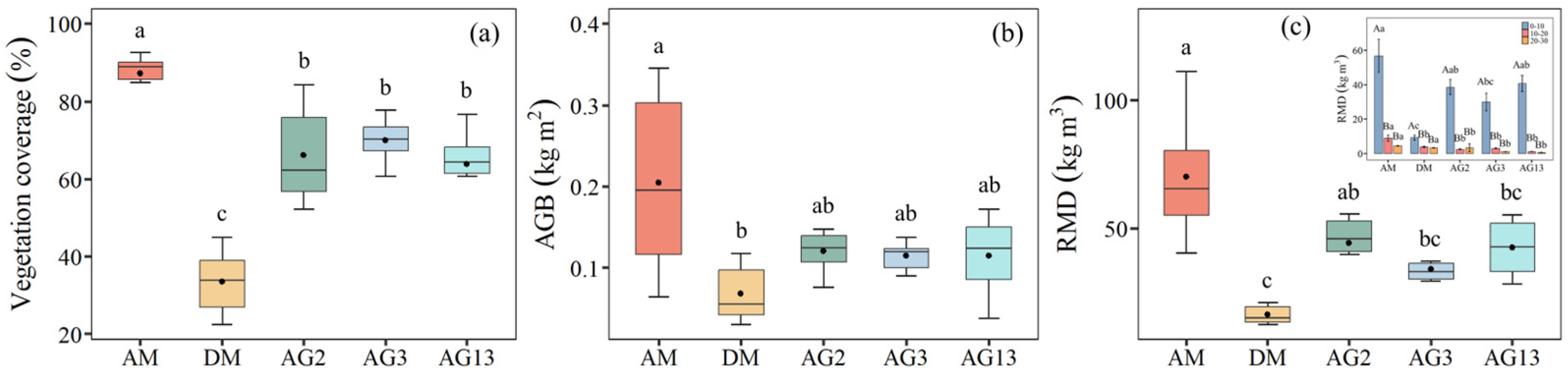
Vegetation coverage in degraded meadow (DM, 33.3%) was significantly lower than in alpine meadow (AM, 87.3%) (p < 0.05; Figure 2a). Above-ground biomass (AGB) and root mass density (RMD) showed similar trends, with mean values of only 0.07 kg m−2 and 16 kg m−3 in DM, respectively (Figure 2b,c). Roots were mainly concentrated at the 0–10 cm depth, where RMD was significantly higher in AM than in DM (Figure 2c). Following artificial restoration, vegetation coverage in the 2-, 3-, and 13-year artificial grasslands was 2.0-, 2.1- and 1.9-fold that in DM, respectively. AGB and RMD were higher in artificial grasslands than in DM, while differences among AG2, AG3 and AG13 were not statistically significant (p > 0.05; Figure 2b,c).
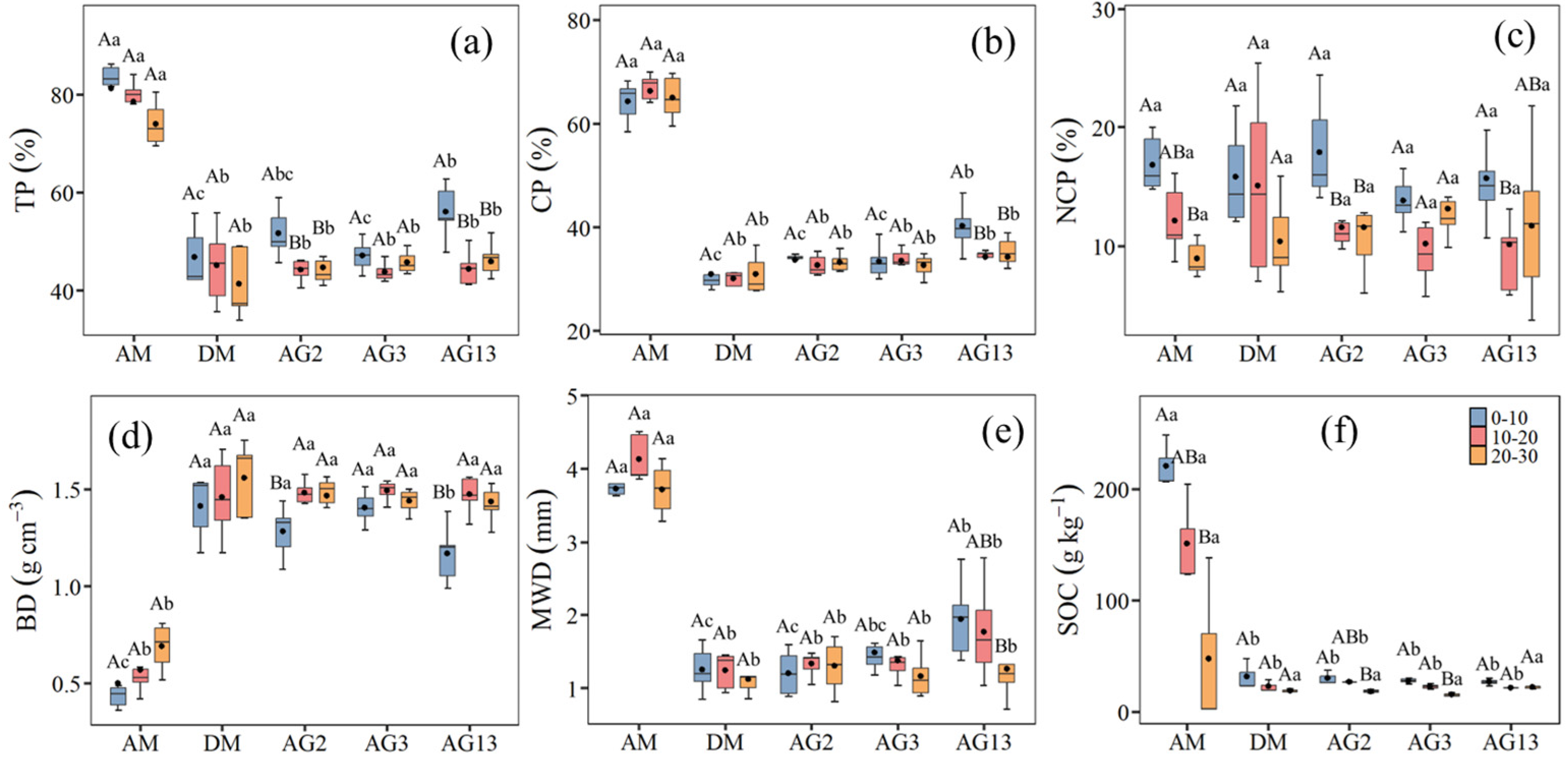
Two-way ANOVA results showed that grassland type and soil depth significantly affected most soil properties (p < 0.05), except for the effect of grassland type on total porosity (NCP) and that of soil depth on capillary porosity (CP). Their interaction also significantly affected soil organic carbon (SOC) (p < 0.05; Table 2). Furthermore, TP and CP in AM (64.4–81.2%) were significantly higher than those in DM across soil depths (p < 0.05; Figure 3a,b). In contrast, there was no significant difference in NCP at each depth between DM and AM (Figure 3c). From AM to DM, bulk density (BD) increased significantly, whereas mean weight diameter (MWD) decreased across 0–30 cm (p < 0.05; Figure 3d,e). Compared to AM, DM decreased SOC by 85.7% and 82.3% at 0–10 and 10–20 cm, respectively (Figure 3f). At 0–10 cm, TP and CP displayed a U-shaped response to restoration age, peaking in AG13 at 56.0% and 40.3%, respectively. Meanwhile, at 0–10 cm, BD in AG13 decreased by 17.0% compared to DM, while MWD increased by 54.0%. SOC showed no significant changes following the vegetation restoration (p > 0.05). Across soil depths, TP in AG2 and both TP and CP in AG13 were higher at 0–10 cm than at 10–20 and 20–30 cm (Figure 3a,b). In AM, NCP did not differ significantly between 0–10 and 10–20 cm, but both were significantly greater than that at 20–30 cm (p < 0.05). Moreover, the NCP in AG13 was markedly higher at 0–10 cm and 20–30 cm than at 10–20 cm (p < 0.05; Figure 3c). For BD, values in AG2 and AG13 at 10–20 and 20–30 cm exceeded those at 0–10 cm (Figure 3d). MWD in AG13 did not differ significantly between 0–10 and 10–20 cm, but both were higher than that at 20–30 cm (Figure 3e). Regarding SOC under AM, AG2, and AG3, no significant differences were observed between 0–10 cm and 10–20 cm; however, SOC at 0–10 cm was significantly higher than that at 20–30 cm (Figure 3f).

3.2. Changes in Water Conservation Characteristics

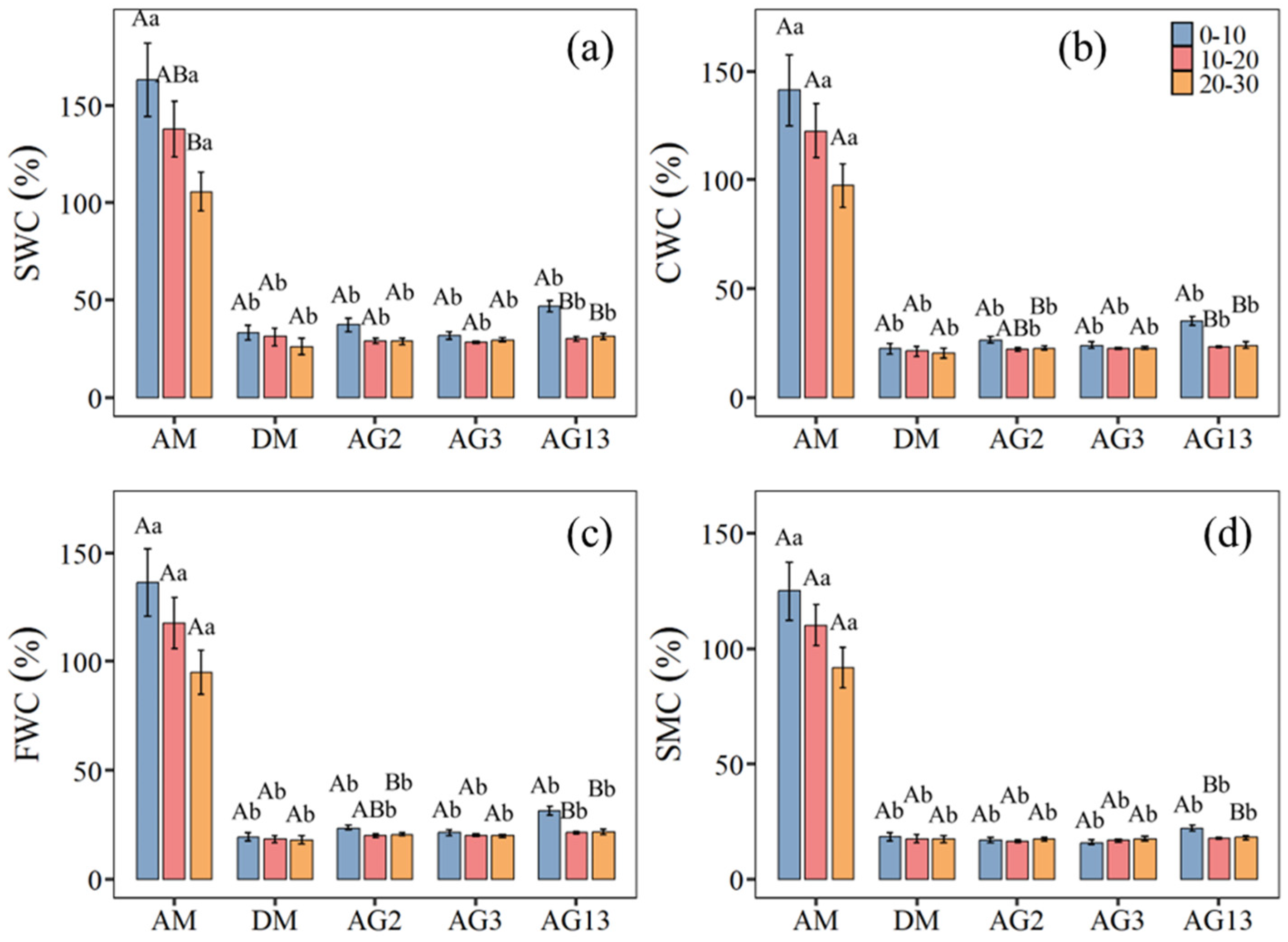
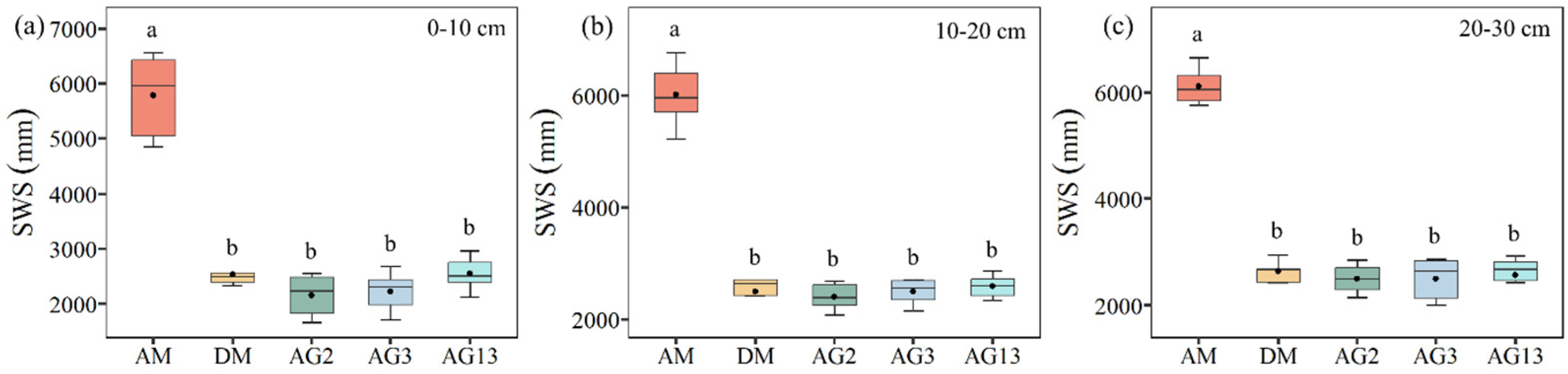
Across the 0–30 cm soil depth, AM exhibited a high water-holding capacity (Figure 4). In DM, saturated (SWC) declined by 75.3–79.8%, capillary (CWC) by 79.2–84.2%, and field water-holding capacity (FWC) by 81.0–85.8% relative to AM at 0–30 cm (p < 0.05; Figure 4a–c). Soil moisture content (SMC) was significantly lower in DM than AM (p < 0.05). Compared to DM, SWC, CWC, and FWC in AG2, AG3, and AG13 showed no significant differences (p > 0.05). Similarly, SMC remained comparable to DM throughout the restoration chronosequence, with no distinct increasing trend (Figure 4d). Notably, at the 0–10 cm depth, SWC, CWC, and FWC in AG13 were slightly higher than those in DM. At soil depth level, soil water storage (SWS) was significantly lower in DM than that in AM at 0–30 cm (p < 0.05; Figure 5). After restoration, SWS in AG2, AG3, and AG13 showed no significant difference compared to DM, but was 55.9–62.7%, 56.9–59.9%, and 58.0–59.0% lower than AM at 0–10, 10–20, and 20–30 cm, respectively (p < 0.05). Moreover, in AM and AG13, SWC, CWC and FWC at 0–10 cm were significantly higher than those at 10–20 cm and 20–30 cm. For SMC, no significant depth-related differences were observed in AM, DM, AG2 and AG3; however, in AG13, SMC at 0–10 cm was significantly higher than that at 10–20 cm and 20–30 cm.

3.3. Drivers of Soil Water Conservation Characteristics

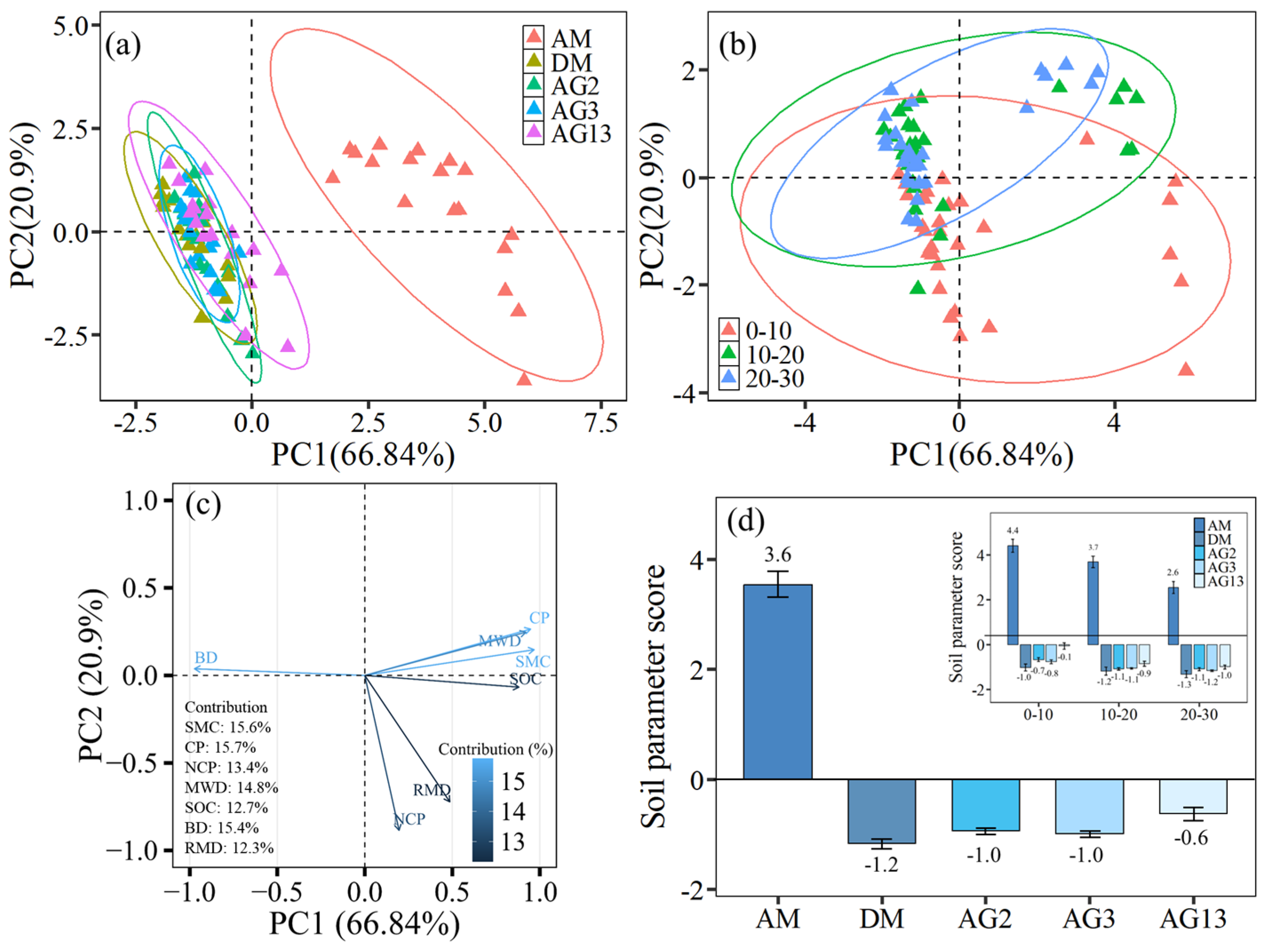
Principal component analysis (PCA) showed that PC1 (66.84%) was primarily associated with CP, SMC, MWD, and BD, while PC2 (20.9%) was mainly associated with NCP and RMD. AM clustered in the positive PC1 and negative PC2 region, reflecting its association with higher CP, SMC, MWD, and RMD, and lower BD (Figure 6a,c). Across soil depths, sample separation was mainly related to RMD, NCP and BD, with the 0–30 cm depth showing considerable variability (Figure 6b). Soil parameter scores decreased significantly (from 3.6 to −1.2) following meadow degradation (Figure 6d). Vegetation restoration increased soil parameter score (compared with DM, the score of AG13 rose by 50.0%), primarily reflecting the contributions of SMC (15.6%) and CP (15.8%) (Figure 6c). Although AG scores increased with restoration chronosequence, they remained negative and significantly lower than that of AM.
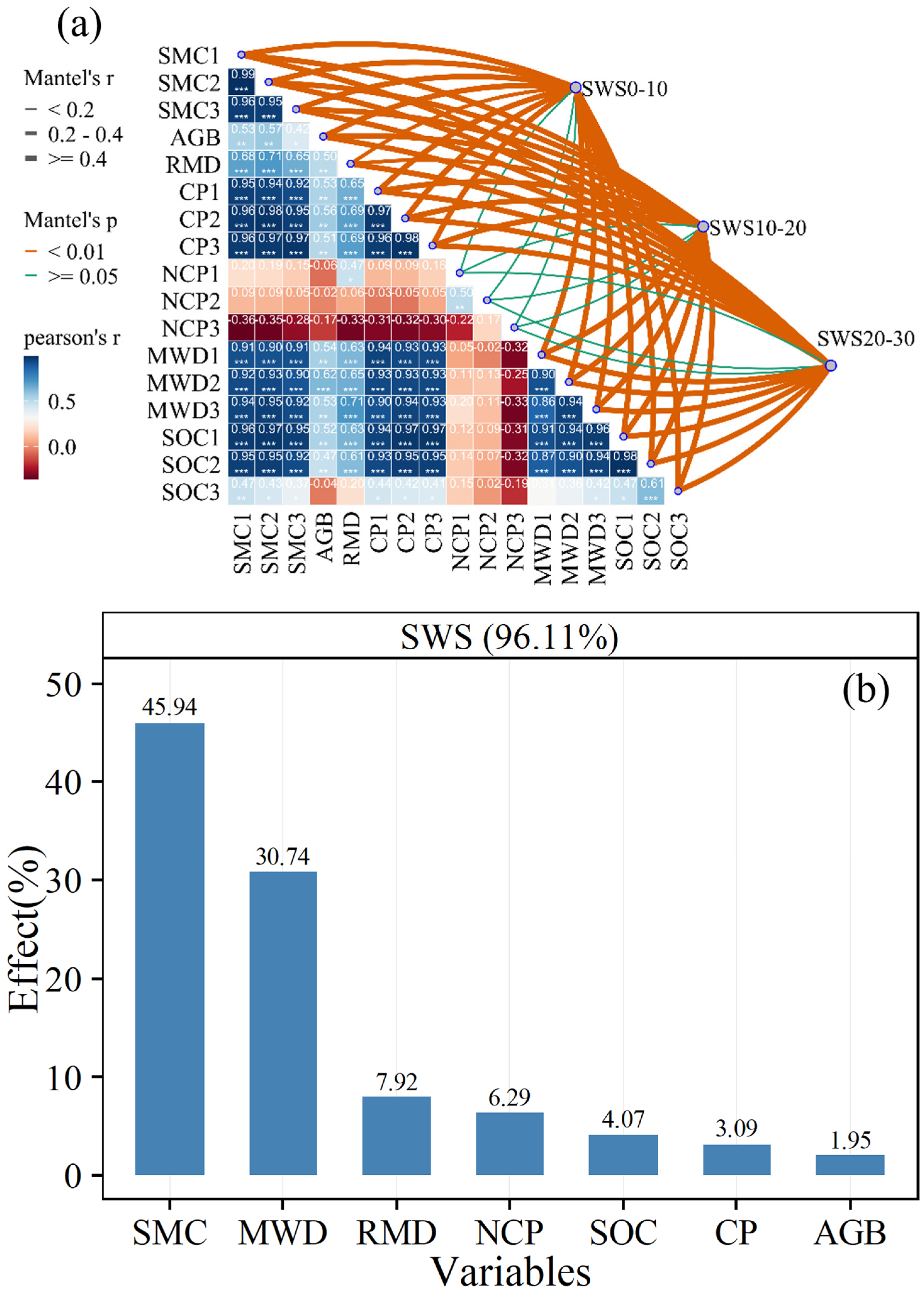
Mantel tests revealed significant positive correlations between SMC and AGB (0.53, 0.57, 0.42), RMD (0.68, 0.71, 0.65), CP (0.95, 0.98, 0.97), MWD (0.91, 0.93, 0.92), and SOC (0.96, 0.95, 0.37) across the 0–30 cm depth (p < 0.05), whereas correlations with NCP were negative and not significant (p > 0.05; Figure 7a). Except for NCP, the soil water storage at 0–10, 10–20, and 20–30 cm showed significant positive correlations with other parameters (p < 0.01, r = 0.308–0.958). Multiple linear regression analysis (MLRA) further quantified the relative contribution of soil parameters to SWS (Figure 7b). The model explained 96.11% of the variation in SWS. Excluding SMC (a direct storage component), MWD emerged as the dominant factor (30.74%), followed by RMD (7.92%), highlighting the primary role of soil structure and root traits in regulating SWS.

4. Discussion

Alpine meadow ecosystems on the Qinghai-Tibetan Plateau have undergone varying degrees of degradation in recent decades due to climate and grazing pressure [4,5]. Degradation not only weakens ecosystem stability but also reduces the water conservation capacity of alpine meadows [10]. Establishing artificial grasslands is an effective ecological restoration strategy for supplying high-quality forage, mitigating soil erosion and promoting water conservation [13].

4.1. Meadow Degradation Weakens Soil Water-Holding Capacities

The mattic epipedon, a unique root–soil complex in alpine meadows supported by high root density and organic matter, retains substantial water within the root zone, thereby sustaining plant water availability and hydrological regulation [2,38]. Under overgrazing and climate warming, fragmentation of the mattic epipedon significantly impacts soil hydrological functions and ecosystem stability [39]. Our findings illustrate that vegetation and soil structural changes during degradation were accompanied by a marked decline in soil water-holding capacity across 0–30 cm depths (Figure 4 and Figure 5). As widely reported in alpine ecosystems, the transition from healthy grassland to degraded grassland involves the combined influence of biological and non-biological factors [38,40]. Vegetation loss and soil structural degradation reflect deterioration of the mattic epipedon, together with reductions in root density and soil organic carbon, thereby diminishing aggregate stability and capillary porosity. Notably, a significant interaction between grassland type and soil depth was observed for soil organic carbon (p < 0.001), whereas bulk density showed a near-significant interaction (p = 0.08; Table 2). The depth-specific data indicate that bulk density increased following degradation across 0–30 cm, although was lower in the 0–10 cm layer than in the deeper layers (Figure 3d). This pattern implies that depletion of organic binding agents is primarily a surface-confined process driven by fragmentation of the mattic epipedon, whereas physical compaction persists throughout the 0–30 cm depth. This further indicates that structural change was most pronounced in the surface layer, where partial recovery was observed in AG13. Concurrently, reduced vegetation coverage accelerates the loss of fine soil particles, thereby increasing the proportion of non-capillary porosity [7,8]. Therefore, the soil transitions from a finely structured, retentive medium to a coarse, porous matrix with diminished capillary water-holding capacity in the root zone [7,41]. The pronounced declines in saturated, capillary, and field water-holding capacities, which approached 80% compared with alpine meadows, further reflect the high sensitivity of surface layers to structural damage (Figure 4). This decline indicates a strong dependence of near-surface water storage potential on the structural integrity of the mattic epipedon [7].
Although fragmentation of the mattic epipedon may enhance local infiltration into deeper horizons or even groundwater systems, it also diminishes water storage within the biologically active root zone [7,42]. The significant decrease in soil moisture content (0–30 cm) implies that degraded meadows have lost their “sponge effect”, making plant water availability increasingly dependent on recent rainfall and reducing buffering capacity against seasonal dry periods [43,44]. Mantel tests revealed that soil water storage and moisture content were positively associated with above-ground biomass, root mass density, capillary porosity, mean weight diameter, and soil organic carbon (Figure 7a). Multiple linear regression analysis identified MWD as the primary factor influencing soil water storage, accounting for 30.74%, followed by root mass density (7.92%). Therefore, degradation impairs water conservation not only through vegetation removal, but also by disrupting the soil structural framework [45,46]. The dominant contribution of MWD confirms that soil aggregate stability is fundamental for maintaining the reservoir function of the mattic epipedon. Root architectural traits regulate this process by controlling the vertical distribution of biopores, root-derived carbon inputs, and aggregate binding. Dense and deeper roots favor the formation of a connected pore network and stable aggregates, thereby improving the balance between hydraulic conductivity and water retention in the root zone [47]. Despite the inherent multicollinearity among predictors, particularly the coupling among SOC, root biomass, and aggregate formation (Figure 7a), MWD still serves as a robust integrated indicator of the soil structural framework. In intact alpine meadows, this configuration allows the upper 30 cm soil layer to function as a shallow reservoir that stores precipitation and sustains plant uptake and lateral flow [7,24]. Degradation diminishes both the capacity and efficiency of this reservoir, compromising the meadow’s ability to buffer vegetation and downstream runoff against precipitation variability [48].

4.2. Poa pratensis Grasslands Promote Vegetation and Soil Structure Recovery but Lag in Hydrological Restoration

Establishing artificial grasslands is an effective way to increase vegetation coverage and productivity in degraded grasslands. However, our findings suggest that the restoration of alpine meadows on the QTP does not follow a simple linear path. Instead, it aligns with the state and transition model (STM), in which ecosystems can cross critical thresholds into alternative stable states [49]. Fragmentation of the mattic epipedon represents a biophysical threshold; once breached, the system shifts from a highly retentive state to a degraded, leakage-prone matrix. The 13-year functional lag observed here indicates that, although structural attributes (e.g., biomass and coverage) may recover within a decade, restoration of complex biogeochemical functions, especially soil carbon sequestration and hydrological regulation, may require multiple decades to approach reference conditions [50]. Previous studies indicate that reseeding and replanting slightly degraded grasslands can restore aboveground productivity to pre-degradation levels [46]. P. pratensis artificial grasslands increased vegetation coverage and root mass density compared with degraded meadows (Figure 2). After restoration, total and capillary porosity increased, bulk density declined, and aggregate stability improved, especially in the 13-year grasslands (Figure 3). The observed improvements reflect the combined effects of root development and reduced trampling [51,52]. While grazing exclusion alone can alleviate soil compaction, our results show that the dense P. pratensis root mat also reinforces surface soil structure. The root-mediated process accelerates surface porosity reconstruction, surpassing natural recovery or simple enclosure rates [52]. However, our results also suggest a clear disconnect between hydrological recovery and the restoration of vegetation and soil structure. While vegetation and topsoil structure recovered, the restoration of water conservation capacity is less pronounced. Although the saturated, capillary, and field water-holding capacities in AG13 are numerically higher than those in degraded meadows (especially at 0–10 cm), these differences were not statistically significant (p > 0.05; Figure 4). This suggests that artificial restoration can initiate recovery of the soil physical structure, but has not yet re-established the “sponge effect” characteristic of native alpine meadows. Unlike the deep-penetrating roots of native Kobresia species, the roots of P. pratensis are concentrated in the topsoil and lack the depth to penetrate the deep-seated compaction (10–30 cm). This shallow root architecture likely restricts the development of vertically continuous macropores and limits carbon input to deeper soil layers. Consequently, although the surface layer begins to retain more water, the subsoil remains compacted and hydrologically constrained, preventing recovery of total soil water storage (Figure 5).
A key finding of this study is that the slow accumulation of soil organic carbon acts as a persistent bottleneck. Even after 13 years, SOC showed no significant increase compared to degraded meadows, revealing a functional lag of at least 13 years in soil organic pool recovery. Without the cementing action of stable organic matter, the newly formed aggregates in artificial grasslands may lack the long-term stability required to hold water effectively against gravity. Soil organic carbon accumulation is constrained not only by the cold and dry climate of the QTP [53], but also by root penetration, litter input, and decomposition rates [54,55]. These conditions hinder root growth and pore development, further restricting water storage recovery [56]. Thus, artificial grasslands currently function as a stabilizing surface layer, defined here by rapid structural recovery, including vegetation coverage >60% and a >50% increase in surface (0–10 cm) MWD, which is effective for reducing erosion and producing forage. However, they have not yet evolved into a hydrological reservoir, defined here as a state characterized by restored 10–30 cm water storage and positive integrated soil parameter scores (>0), as observed in intact alpine ecosystems. In summary, planting P. pratensis rapidly restored vegetation/soil characteristics of degraded meadows, yet remained insufficient to reconstruct the thick, multi-layered mattic epipedon characteristic of intact alpine meadows [52]. This reinforces the premise that reconstructing plant biomass and the soil structural framework is the first step in restoring soil water-holding capacity [57,58]. Therefore, artificial grasslands act as a transitional hydrological bridge between degraded and intact states, mitigating degradation-induced soil water storage deficits without fully closing the gap within the observed timeframe.

4.3. Implications for Alpine Meadow Conservation and Restoration on the QTP

The decline in water conservation capacity from alpine to degraded meadows, coupled with incomplete recovery in artificial grasslands, underscores the importance of preventing meadow degradation. By employing a restoration chronosequence, this study reveals the long-term ecological trajectory of hydrological recovery. Once the mattic epipedons are substantially damaged, decades of restoration may still fail to recreate the original water conservation function [38,42]. Thus, alpine meadows remain irreplaceable water reservoirs and should be prioritized for strict protection.
Where degradation has already occurred, planting P. pratensis can stabilize soils, reduce erosion, and slightly restore near-surface water storage [59]. The recovery trajectory observed over the 13-year chronosequence demonstrates that hydrological recovery lags behind soil structure recovery, suggesting that expectations for rapid and complete hydrological recovery need to be tempered. Restoration targets should explicitly incorporate water conservation metrics, such as field water-holding capacity or soil water storage, rather than relying solely on vegetation coverage or biomass. Practically, restoration outcomes should be evaluated not only by early-stage vegetation cover or productivity, but also by the extent to which the soil can actually retain and regulate water within the root zone as the grassland matures [60]. Additionally, restoration designs may benefit from combining P. pratensis with deep-rooted bunchgrasses (e.g., Elymus nutans or Festuca sinensis). Although P. pratensis is widespread across the QTP, the high-density monocultures often established during restoration can competitively exclude other native species, potentially homogenizing community structure and reducing long-term ecosystem resilience [51,59]. Introducing complementary species during the transition from short- (AG3) to long-term (AG13) restoration not only mitigates competitive exclusion, but also improves subsoil conditions and accelerates the restoration of hydrological functions [61,62]. Beyond species selection, the demonstrated role of soil structure in controlling water conservation implies that supportive management measures could enhance the effectiveness of sowing-based restoration [63,64]. Given that soil compaction and limited pore space were identified as primary constraints on water storage throughout the 13-year chronosequence (Figure 3), interventions targeting physical soil amelioration, such as pre-sowing decompaction or minimized soil disturbance, may enhance water-holding capacity [65].
The long-term effectiveness of artificial restoration will increasingly depend on the trajectory of regional climate warming. Projected warming on the QTP is likely to intensify evapotranspiration and accelerate permafrost degradation, potentially counteracting the hydrological gains achieved through grassland establishment [66]. Beyond climatic drivers, the spatial heterogeneity of high-altitude landscapes also shapes restoration outcomes through topographic controls. Variations in slope and aspect generate distinct hygrothermal microclimates, and south-facing or steeper slopes may experience greater moisture deficits and erosion risks, thereby limiting P. pratensis persistence [3]. Moreover, differences in soil type across the landscape influence the potential for organic matter accumulation and structural stabilization. Consequently, restoration strategies should be adopted to local climatic, topographic, and soil conditions to sustain eco-hydrological functions over the long-term.
Moreover, sampling was conducted during the warm season, which may overestimate soil moisture content because of frequent rainfall and permafrost thaw. Soil moisture is highly sensitive to interannual climate variability, particularly precipitation fluctuations. Thus, although this study captures relative differences among degradation and restoration stages under comparable conditions, absolute values of soil water storage may vary among years. Long-term monitoring along the degradation–restoration trajectory is needed to track changes in soil water storage over time. In addition, the focus on static water-holding indices leaves dynamic processes, such as infiltration and evapotranspiration partitioning, poorly understood. Future work combining continuous fixed-site observation with broader spatial sampling would provide a more integrated understanding of how artificial restoration reshapes the regional water balance.

5. Conclusions

This study demonstrates that meadow degradation on the Qinghai-Tibetan Plateau significantly reduced soil water-holding capacity in the 0–30 cm soil layer in alpine meadows, impacting the soil water conservation function. The establishment of Poa pratensis artificial grasslands effectively reverses degradation, resulting in improved vegetation characteristics and some soil properties in the 0–30 cm layer. However, the restoration of hydrological functions, particularly water retention capacity, is confined to the 0–10 cm topsoil and exhibits a significant lag compared to soil structural improvements. Even after 13 years, the overall water storage remained lower than that of native alpine meadows, constrained by low soil organic carbon and soil compaction. Improving soil structural stability (MWD) and root density is crucial for restoring water conservation capacity. Overall, artificial grasslands serve as a vital strategy for stabilizing degraded soils rather than a functional hydrological reservoir and should be viewed as a hydrological bridge that mitigates erosion but fails to fully reconstruct the sponge effect inherent in intact meadows. The study emphasizes that maintaining the complete alpine meadow is crucial to maintaining a superior water conservation capacity.

Author Contributions

L.Z. (Lirong Zhao), Writing—original draft, Data curation, Visualization, Software, Investigation; B.W., Writing—review and editing, Writing—original draft, Supervision, Methodology, Investigation; S.Z., Writing—original draft, Validation, Methodology, Investigation; Y.C., Writing—review and editing, Writing—original draft, Investigation; L.Z. (Laiting Zhang), Writing—original draft, Data curation, Visualization, Software, Investigation; A.L., Writing—original draft, Data curation, Visualization, Software, Investigation; Y.L., Writing—review and editing, Writing—original draft, Supervision, Methodology, Investigation, Funding acquisition, Conceptualization. All authors have read and agreed to the published version of the manuscript.

Funding

This study was supported by Key Laboratory of Degraded and Unused Land Consolidation Engineering, the Ministry of Natural Resources (SXDJ2024-21), Technology Innovation Center for Land Engineering and Human Settlements, Shaanxi Land Engineering Construction Group Co., Ltd. and Xi’an Jiao tong University (2024WHZ2045) and Shaanxi Province Agricultural Science and Technology Innovation-Driven Project (NYKJ-2025-(XA)07).

Data Availability Statement

The original data presented in the study are openly available in zenodo at https://doi.org/10.5281/zenodo.18026972.

Acknowledgments

During the preparation of this manuscript, the authors used Deepseek-V3 for the purposes of checking and correcting grammatical errors, spelling mistakes, and optimizing sentence structures. The authors have reviewed and edited the output and take full responsibility for the content of this publication.

Conflicts of Interest

Authors Lirong Zhao and Bimeng Wei were employed by the company Key Laboratory of Degraded and Unused Land Consolidation Engineering, the Ministry of Natural Resources, Technology Innovation Center for Land Engineering and Human Settlements, Shaanxi Land Engineering Construction Group Co., Ltd. and Xi’an Jiaotong University, Shaanxi Agricultural Development Group Co., Ltd. The authors declare that this study received funding from Key Laboratory of Degraded and Unused Land Consolidation Engineering, the Ministry of Natural Resources and Technology Innovation Center for Land Engineering and Human Settlements, Shaanxi Land Engineering Construction Group Co., Ltd. and Xi’an Jiaotong University. The funder was not involved in the study design, collection, analysis, interpretation of data, the writing of this article or the decision to submit it for publication. The remaining authors (Siqi Zhao, Yanlong Chen, Laiting Zhang, Anhua Liu, Yu Liu) declare that the research was conducted in the absence of any commercial or financial relationships that could be construed as a potential conflict of interest.

References

  1. Immerzeel, W.W.; van Beek, L.P.; Bierkens, M.F. Climate change will affect the Asian water towers. Science 2010, 328, 1382–1385. [Google Scholar] [CrossRef] [PubMed]
  2. Zhang, G.; Yang, F.; Long, H. Save the life-sustaining mattic layer on the Qinghai-Tibetan Plateau. Innovation 2023, 4, 100418. [Google Scholar] [CrossRef]
  3. Dai, L.; Fu, R.; Guo, X.; Du, Y.; Zhang, F.; Cao, G. Variations in and factors controlling soil hydrological properties across different slope aspects in alpine meadows. J. Hydrol. 2023, 616, 128756. [Google Scholar] [CrossRef]
  4. Harris, R.B. Rangeland degradation on the Qinghai-Tibetan plateau: A review of the evidence of its magnitude and causes. J. Arid. Environ. 2010, 74, 1–12. [Google Scholar] [CrossRef]
  5. Cao, J.; Adamowski, J.F.; Deo, R.C.; Xu, X.; Gong, Y.; Feng, Q. Grassland Degradation on the Qinghai-Tibetan Plateau: Reevaluation of Causative Factors. Rangel. Ecol. Manag. 2019, 72, 988–995. [Google Scholar] [CrossRef]
  6. Dong, S.; Shang, Z.; Gao, J.; Boone, R.B. Enhancing sustainability of grassland ecosystems through ecological restoration and grazing management in an era of climate change on Qinghai-Tibetan Plateau. Agric. Ecosyst Environ. 2020, 287, 106684. [Google Scholar] [CrossRef]
  7. Dai, L.C.; Yuan, Y.M.; Guo, X.W.; Du, Y.G.; Ke, X.; Zhang, F.W.; Li, Y.K.; Li, Q.; Lin, L.; Zhou, H.K.; et al. Soil water retention in alpine meadows under different degradation stages on the northeastern Qinghai-Tibet Plateau. J. Hydrol. 2020, 590, 125397. [Google Scholar] [CrossRef]
  8. Peng, F.; Xue, X.; You, Q.; Huang, C.; Dong, S.; Liao, J.; Duan, H.; Tsunekawa, A.; Wang, T. Changes of soil properties regulate the soil organic carbon loss with grassland degradation on the Qinghai-Tibet Plateau. Ecol. Indic. 2018, 93, 572–580. [Google Scholar] [CrossRef]
  9. Li, C.; de Jong, R.; Schmid, B.; Wulf, H.; Schaepman, M.E. Changes in grassland cover and in its spatial heterogeneity indicate degradation on the Qinghai-Tibetan Plateau. Ecol. Indic. 2020, 119, 106641. [Google Scholar] [CrossRef]
  10. He, Y.; Li, Z.; Xia, J.; Deng, S.; Zhou, Y. Channel Morphological Characteristics and Morphodynamic Processes of Large Braided Rivers in Response to Climate-Driven Water and Sediment Flux Change in the Qinghai-Tibet Plateau. Water Resour. Res. 2024, 60, e2023WR036126. [Google Scholar] [CrossRef]
  11. Xue, J.; Li, Z.; Feng, Q.; Gui, J.; Zhang, B. Spatiotemporal variations of water conservation and its influencing factors in ecological barrier region, Qinghai-Tibet Plateau. J. Hydrol. Reg. Stud. 2022, 42, 101164. [Google Scholar] [CrossRef]
  12. Wu, G.-L.; Liu, Z.-H.; Zhang, L.; Chen, J.-M.; Hu, T.-M. Long-term fencing improved soil properties and soil organic carbon storage in an alpine swamp meadow of western China. Plant Soil 2010, 332, 331–337. [Google Scholar] [CrossRef]
  13. Wen, L.; Jinlan, W.; Xiaojiao, Z.; Shangli, S.; Wenxia, C. Effect of degradation and rebuilding of artificial grasslands on soil respiration and carbon and nitrogen pools on an alpine meadow of the Qinghai-Tibetan Plateau. Ecol. Eng. 2018, 111, 134–142. [Google Scholar] [CrossRef]
  14. Li, Y.; Dong, S.; Wen, L.; Wang, X.; Wu, Y. The effects of fencing on carbon stocks in the degraded alpine grasslands of the Qinghai-Tibetan Plateau. J. Environ. Manag. 2013, 128, 393–399. [Google Scholar] [CrossRef] [PubMed]
  15. Liu, Y.; Wang, D.; Cui, Z.; Li, S.X.; Li, R.J.; Rodrigo-Comino, J.; López-Vicente, M.; Wu, G.L. Alpine meadow patches unevenly regulate runoff and sediment yield generation on the Qinghai-Tibetan Plateau. J. Hydrol. 2023, 623, 129848. [Google Scholar] [CrossRef]
  16. Lucas, M.; Schluter, S.; Vogel, H.J.; Vetterlein, D. Roots compact the surrounding soil depending on the structures they encounter. Sci. Rep. 2019, 9, 16236. [Google Scholar] [CrossRef]
  17. Qu, Y.; Wu, Q.; Khan, F.U.; Wang, J.; Ren, X.; Chai, X.; Xu, X.; Du, F. The impact of root systems on soil macropore abundance and soil infiltration capacity. Plant Soil 2025, 513, 1197–1214. [Google Scholar] [CrossRef]
  18. Song, L.; Liao, J.; Ma, F.; Wang, S.; Yan, Y.; Chen, C.; Zhou, Q.; Niu, S. Nitrogen additions increase soil microbial nitrate- rather than ammonium- immobilization. Biol. Fert. Soils 2025, 61, 831–840. [Google Scholar] [CrossRef]
  19. Shang, Z.H.; Gibb, M.J.; Leiber, F.; Ismail, M.; Ding, L.M.; Guo, X.S.; Long, R.J. The sustainable development of grassland-livestock systems on the Tibetan plateau: Problems, strategies and prospects. Rangel. J. 2014, 36, 267–296. [Google Scholar] [CrossRef]
  20. Hu, X.; Pan, P.-Y. Effect of organic amendments on soil structure, microbial community and water transport in the Qinghai Lake watershed, North-Eastern Qinghai–Tibet Plateau. Arch. Agron. Soil Sci. 2023, 70, 1–17. [Google Scholar] [CrossRef]
  21. Ha, X.; Zhang, J.; Chen, F.; Wang, Y.; Ma, T.; Ma, H. Molecular mechanisms of high tiller development based on transcriptome and proteome correlation analysis in Poa pratensis. Plant Physiol. Biochem. 2025, 221, 109655. [Google Scholar] [CrossRef]
  22. Kupriyanov, A.; Zagurskaya, Y.V.; Makeeva, N.; Andreyev, B.; Sheremetova, S.; Ufimtsev, V.; Egorov, A.; Vronskaya, O. Development of the root system of Poa pratensis L. influenced by phytomass of competitive plants. BIO Web Conf. 2024, 128, 00009. [Google Scholar] [CrossRef]
  23. Witzgall, K.; Steiner, F.A.; Hesse, B.D.; Riveras-Muñoz, N.; Rodríguez, V.; Teixeira, P.P.C.; Li, M.; Oses, R.; Seguel, O.; Seitz, S.; et al. Living and decaying roots as regulators of soil aggregation and organic matter formation—From the rhizosphere to the detritusphere. Soil Biol. Biochem. 2024, 197, 109503. [Google Scholar] [CrossRef]
  24. Cerda, A.; Keesstra, S.D.; Rodrigo-Comino, J.; Novara, A.; Pereira, P.; Brevik, E.; Gimenez-Morera, A.; Fernandez-Raga, M.; Pulido, M.; di Prima, S.; et al. Runoff initiation, soil detachment and connectivity are enhanced as a consequence of vineyards plantations. J. Environ. Manag. 2017, 202, 268–275. [Google Scholar] [CrossRef]
  25. Shi, X.-M.; Li, X.G.; Li, C.T.; Zhao, Y.; Shang, Z.H.; Ma, Q. Grazing exclusion decreases soil organic C storage at an alpine grassland of the Qinghai–Tibetan Plateau. Ecol. Eng. 2013, 57, 183–187. [Google Scholar] [CrossRef]
  26. Shi, Q.; Matthew, C.; Liu, W.; Nan, Z. Alkaloid Contents in Epichloë Endophyte-Infected Elymus tangutorum Sampled along an Elevation Gradient on the Qinghai-Tibetan Plateau. Agronomy 2020, 10, 1812. [Google Scholar] [CrossRef]
  27. Ma, H.; Mo, L.; Crowther, T.W.; Maynard, D.S.; van den Hoogen, J.; Stocker, B.D.; Terrer, C.; Zohner, C.M. The global distribution and environmental drivers of aboveground versus belowground plant biomass. Nat. Ecol. Evol. 2021, 5, 1110–1122. [Google Scholar] [CrossRef]
  28. Pan, Y.; Liu, J.; Zhang, M.; Huang, P.; Hipesy, M.; Dai, L.; Ma, Z.; Zhang, F.; Zhang, Z.; Ning, Z. The below-ground biomass contributes more to wetland soil carbon pools than the above-ground biomass—A survey based on global wetlands. J. Plant Ecol. 2024, 17, rtae017. [Google Scholar] [CrossRef]
  29. IUSS Working Group WRB. World Reference Base for Soil Resources, 4th ed.; International soil classification system for naming soils and creating legends for soil maps; International Union of Soil Sciences (IUSS): Vienna, Austria, 2022. [Google Scholar]
  30. Ma, Y.; Liu, Y.; Rodrigo-Comino, J.; López-Vicente, M.; Shi, Z.; Wu, G.-L. Artificially cultivated grasslands decrease the activation of soil detachment and soil erodibility on the alpine degraded hillslopes. Soil Tillage Res. 2024, 243, 106176. [Google Scholar] [CrossRef]
  31. Li, Y.; Dong, S.; Gao, Q.; Fan, C.; Fayiah, M.; Ganjurjav, H.; Hu, G.; Wang, X.; Yan, Y.; Gao, X.; et al. Grazing Changed Plant Community Composition and Reduced Stochasticity of Soil Microbial Community Assembly of Alpine Grasslands on the Qinghai-Tibetan Plateau. Front Plant Sci. 2022, 13, 864085. [Google Scholar] [CrossRef] [PubMed]
  32. Huang, C.Y. Agrology; China Agriculture Press: Beijing, China, 2000; Volume 69. (In Chinese) [Google Scholar]
  33. Leamer, R.W.; Shaw, B. A Simple Apparatus for Measuring Noncapillary Porosity on an Extensive Scale. J. Am. Soc. Agron. 1941, 33, 1003–1008. [Google Scholar] [CrossRef]
  34. Baver, L.D. Soil Physics; John Wiley & Sons, Inc.: New York, NY, USA, 1940. [Google Scholar]
  35. Yoder, R.E. A Direct Method of Aggregate Analysis of Soils and a Study of the Physical Nature of Erosion Losses. J. Am. Soc. Agron. 1936, 28, 337–351. [Google Scholar] [CrossRef]
  36. Walkley, A.; Black, I.A. An Examination of the Degtjareff Method for Determining Organic Carbon in Soils: Effect of Variations in Digestion Conditions and of Inorganic Soil Constituents. Soil Sci. 1934, 63, 251–263. [Google Scholar] [CrossRef]
  37. Andrews, S.S.; Karlen, D.L.; Mitchell, J.P. A comparison of soil quality indexing methods for vegetable production systems in Northern California. Agric. Ecosyst Environ. 2002, 90, 25–45. [Google Scholar] [CrossRef]
  38. Cui, Z.; Liu, Y.F.; Liu, Y.; Leite, P.A.M.; Shi, J.J.; Shi, Z.H.; Wu, G.L. Fragmentation alters the soil water conservation capacity of hillside alpine meadows on the Qinghai-Tibetan Plateau. Geoderma 2022, 428, 116133. [Google Scholar] [CrossRef]
  39. Shang, Z.H.; Ma, Y.S.; Long, R.J.; Ding, L.M. Effect of fencing, artificial seeding and abandonment on vegetation composition and dynamics of ‘black soil land’ in the headwaters of the Yangtze and the Yellow Rivers of the Qinghai-Tibetan Plateau. Land Degrad. Dev. 2008, 19, 554–563. [Google Scholar] [CrossRef]
  40. Pan, T.; Hou, S.; Wu, S.; Liu, Y.; Liu, Y.; Zou, X.; Herzberger, A.; Liu, J. Variation of soil hydraulic properties with alpine grassland degradation in the eastern Tibetan Plateau. Hydrol. Earth Syst. Sci. 2017, 21, 2249–2261. [Google Scholar] [CrossRef]
  41. Ma, Y.; Liu, Y.; López-Vicente, M.; Wu, G.-L. Divergent shift of normal alpine meadow towards shrub and degraded meadows reduces soil water retention and storage capacity. J. Hydrol. 2023, 625, 130109. [Google Scholar] [CrossRef]
  42. Liu, Y.F.; Fang, H.; Leite, P.A.M.; Liu, Y.; Zhao, J.; Wu, G.L. Mattic epipedon fragmentation strengthened the soil infiltration capacity of a hillside alpine meadow on the Qinghai-Tibetan Plateau. Ecohydrology 2023, 16, e2552. [Google Scholar] [CrossRef]
  43. Wang, G.; Cheng, G.; Shen, Y.; Qian, J. Influence of land cover changes on the physical and chemical properties of alpine meadow soil. Chin. Sci. Bull. 2003, 48, 118–124. [Google Scholar] [CrossRef]
  44. Dai, L.; Fu, R.; Guo, X.; Du, Y.; Zhang, F.; Cao, G. Soil Moisture Variations in Response to Precipitation Across Different Vegetation Types on the Northeastern Qinghai-Tibet Plateau. Front Plant Sci. 2022, 13, 854152. [Google Scholar] [CrossRef]
  45. Qiao, L.; Zhou, H.; Wang, Z.; Li, Y.; Chen, W.; Wu, Y.; Liu, G.; Xue, S. Variations in soil aggregate stability and organic carbon stability of alpine meadow and shrubland under long-term warming. Catena 2023, 222, 106848. [Google Scholar] [CrossRef]
  46. Zhou, H.; Yang, X.; Zhou, C.; Shao, X.; Shi, Z.; Li, H.; Su, H.; Qin, R.; Chang, T.; Hu, X.; et al. Alpine Grassland Degradation and Its Restoration in the Qinghai–Tibet Plateau. Grasses 2023, 2, 31–46. [Google Scholar] [CrossRef]
  47. Wang, J.; Zhao, C.; Zhao, L.; Wen, J.; Li, Q. Effects of grazing on the allocation of mass of soil aggregates and aggregate-associated organic carbon in an alpine meadow. PLoS ONE 2020, 15, e0234477. [Google Scholar] [CrossRef]
  48. Pan, T.; Hou, S.; Liu, Y.; Tan, Q.; Liu, Y.; Gao, X. Influence of degradation on soil water availability in an alpine swamp meadow on the eastern edge of the Tibetan Plateau. Sci. Total Environ. 2020, 722, 137677. [Google Scholar] [CrossRef] [PubMed]
  49. Bestelmeyer, B.T.; Tugel, A.J.; Peacock, G.L.; Robinett, D.G.; Shaver, P.L.; Brown, J.R.; Herrick, J.E.; Sanchez, H.; Havstad, K.M. State-and-Transition Models for Heterogeneous Landscapes: A Strategy for Development and Application. Rangel. Ecol. Manag. 2009, 62, 1–15. [Google Scholar] [CrossRef]
  50. Rosenzweig, S.T.; Carson, M.A.; Baer, S.G.; Blair, J.M. Changes in soil properties, microbial biomass, and fluxes of C and N in soil following post-agricultural grassland restoration. Appl. Soil Ecol. 2016, 100, 186–194. [Google Scholar] [CrossRef]
  51. Ma, Y.; Liu, Y.; Rodrigo-Comino, J.; López-Vicente, M.; Wu, G.-L. Mixed-cultivation grasslands enhance runoff generation and reduce soil loss in the restoration of degraded alpine hillsides. Hydrol. Earth Syst. Sci. 2024, 28, 3947–3961. [Google Scholar] [CrossRef]
  52. Li, S.; Shi, Z.; Liu, W.H.; Li, W.; Liang, G.; Liu, K. Long-term Kentucky bluegrass cultivation enhances soil quality and microbial communities on the Qinghai-Tibet Plateau. Front Plant Sci. 2025, 16, 1510676. [Google Scholar] [CrossRef] [PubMed]
  53. Du, J.; Tan, T.; Jiang, S. Divergent responses of plant and soil microbial community to short-term nutrient addition in alpine grassland on the Qinghai-Tibetan Plateau. Front. Ecol. Evol. 2022, 10, 1056111. [Google Scholar] [CrossRef]
  54. Pan, Y.; Wang, D.; Tan, T.; An, J.; Jin, X.; Zou, H.; Zhang, Y.; Yu, N.; Siddique, K.H.M. Effect of organic amendments on soil organic carbon fractions, water retention, and mechanical properties in a Chinese Alfisol. Soil Tillage Res. 2025, 254, 106723. [Google Scholar] [CrossRef]
  55. Yang, J.; Li, A.; Yang, Y.; Li, G.; Zhang, F. Soil organic carbon stability under natural and anthropogenic-induced perturbations. Earth Sci. Rev. 2020, 205, 103199. [Google Scholar] [CrossRef]
  56. Ni, S.; Shi, B.; Zhao, J.; Wang, D.; Zhu, L.; Wang, J.; Cai, C. A review of impacts of soil rock fragments on slope erosion: Mechanism and processes. Land Degrad. Dev. 2024, 35, 3226–3243. [Google Scholar] [CrossRef]
  57. Yang, R.; Yang, S.; Chen, L.-l.; Yang, Z.; Xu, L.; Zhang, X.; Liu, G.; Zhang, X.; Jiao, C.; Bai, R.; et al. Effect of vegetation restoration on soil erosion control and soil carbon and nitrogen dynamics: A meta-analysis. Soil Tillage Res. 2023, 230, 105705. [Google Scholar] [CrossRef]
  58. Yang, X.; Feng, Q.; Zhu, M.; Zhang, J.; Yang, L.; Zhang, C.; Wang, Z.; Feng, Y. Vegetation communities and soil properties along the restoration process of the Jinqianghe mine site in the Qilian Mountains, China. Front Plant Sci. 2024, 15, 1358309. [Google Scholar] [CrossRef] [PubMed]
  59. Zhao, W.; Yin, Y.; Song, J.; Li, S. Mixed sowing improves plant and soil bacterial community restoration in the degraded alpine meadow. Plant Soil 2024, 499, 379–392. [Google Scholar] [CrossRef]
  60. Feng, L.; Guo, M.; Wang, W.; Shi, Q.; Guo, W.; Lou, Y.; Zhu, Y.; Yang, H.; Xu, Y. Evaluation of the effects of long-term natural and artificial restoration on vegetation characteristics, soil properties and their coupling coordinations. Sci. Total Environ. 2023, 884, 163828. [Google Scholar] [CrossRef]
  61. Cai, Z.; Shi, J.; Fu, S.; Lv, L.; Li, F.; Liu, Q.; Zhang, H.; Bao, S. Ecological Effects and Microbial Regulatory Mechanisms of Functional Grass Species Assembly in the Restoration of “Heitutan” Degraded Alpine Grasslands. Microorganisms 2025, 13, 2341. [Google Scholar] [CrossRef] [PubMed]
  62. Luo, F.; Liu, W.; Mi, W.; Ma, X.; Liu, K.; Ju, Z.; Li, W. Legume-grass mixtures increase forage yield by improving soil quality in different ecological regions of the Qinghai-Tibet Plateau. Front Plant Sci. 2023, 14, 1280771. [Google Scholar] [CrossRef]
  63. Robinson, J.M.; Liddicoat, C.; Munoz-Rojas, M.; Breed, M.F. Restoring soil biodiversity. Curr. Biol. 2024, 34, R393–R398. [Google Scholar] [CrossRef]
  64. Raupp, P.; Carrillo, Y.; Nielsen, U.N. Soil Health to Enhance Ecological Restoration and Conservation. J. Sustain. Agric. Environ. 2024, 3, e70022. [Google Scholar] [CrossRef]
  65. Al-Shammary, A.A.G.; Al-Shihmani, L.S.S.; Fernandez-Galvez, J.; Caballero-Calvo, A. Optimizing sustainable agriculture: A comprehensive review of agronomic practices and their impacts on soil attributes. J. Environ. Manag. 2024, 364, 121487. [Google Scholar] [CrossRef] [PubMed]
  66. Li, W.; Yan, D.; Weng, B.; Zhu, L. Research progress on hydrological effects of permafrost degradation in the Northern Hemisphere. Geoderma 2023, 438, 116629. [Google Scholar] [CrossRef]
Figure 1. The location of the study area (a) and the pictures for alpine meadow ((b); AM), degraded meadow ((c); DM), 2-year artificial grassland ((d); AG2), 3-year artificial grassland ((e); AG3) and 13-year artificial grassland ((f); AG13). All photos were captured during sampling in July 2025 (growth season).
Agronomy 16 00697 g001
Figure 2. Changes (mean ± standard error) in vegetation coverage (a), above-ground biomass ((b); AGB), and root mass density ((c); RMD) in alpine meadow (AM), degraded meadow (DM), 2-year (AG2), 3-year (AG3), and 13-year artificial grasslands (AG13). Capital and lowercase letters indicate significant differences among different soil depth, and among grassland types (p < 0.05).
Agronomy 16 00697 g002
Figure 3. Changes (mean ± standard error) in total porosity ((a); TP), capillary porosity ((b); CP), non-capillary porosity ((c); NCP), bulk density ((d); BD), mean weight diameter of soil aggregates ((e); MWD), and soil organic carbon ((f); SOC) with soil depth. AM, DM, AG2, AG3, and AG13 represent alpine meadows, degraded meadows, 2-year, 3-year, and 13-year artificial grasslands, respectively. Capital and lowercase letters indicate significant differences among 0–10, 10–20, and 20–30 cm within the same grassland type and among AM, DM, AG2, AG3, and AG13 within the same soil depth, respectively (p < 0.05).
Agronomy 16 00697 g003
Figure 4. Changes (mean ± standard error) in saturated water-holding capacity ((a); SWC), capillary water-holding capacity ((b); CWC), field water-holding capacity ((c); FWC), and soil moisture content ((d); SMC).AM, DM, AG2, AG3, and AG13 represent alpine meadows, degraded meadows, 2-year, 3-year, and 13-year artificial grasslands, respectively. Capital and lowercase letters indicate the significant differences among 0–10, 10–20, and 20–30 cm within the same grassland type and among AM, DM, AG2, AG3, and AG13 within the same soil depth, respectively (p < 0.05).
Agronomy 16 00697 g004
Figure 5. Changes (mean ± standard error) in soil water storage (SWS) at depths of 0–10 cm (a), 10–20 cm (b), and 20–30 cm (c) in alpine meadows (AM), degraded meadows (DM), 2-year (AG2), 3-year (AG3), and 13-year artificial grasslands (AG13). Different lowercase letters indicate significant differences among AM, DM, AG2, AG3, and AG13 within the same soil depth (p < 0.05).
Agronomy 16 00697 g005
Figure 6. The load of the principal component calculated across different grassland types (a) and different soil depths (b) as well as soil parameter contribution (c) and score (mean ± standard error) (d) by principal component analysis. AM, DM, AG2, AG3, and AG13 represent alpine meadow, degraded meadow, 2-year, 3-year, 13-year artificial grasslands, respectively. CP, capillary porosity; NCP, non-capillary porosity; BD, soil bulk density; MWD, mean weight diameter of soil aggregates; SOC, soil organic carbon; SMC, soil moisture content; RMD, root mass density.
Agronomy 16 00697 g006
Figure 7. Mantel test showing the relationship between soil water storage (SWS) and vegetation characteristics and soil parameters (a), and multivariate linear regression analysis (MLRA) showing the contribution of these variables to SWS (b). AGB, above-ground biomass; RMD, root mass density; SMC, soil moisture content; CP, capillary porosity; NCP, non-capillary porosity; MWD, mean weight diameter of soil aggregates; SOC, soil organic carbon. * p < 0.05; ** p < 0.01; *** p < 0.001. The suffixes 1, 2, 3 indicate the 0–10, 10–20, and 20–30 cm soil layers, respectively.
Agronomy 16 00697 g007
Table 1. Location and dominant plants of different grassland types in the study area [31].
Grassland TypeLongitude and LatitudeElevation (m)Dominant Species
AM100°13′45″ E, 37°58′49″ N3747.4Kobresia pygmaea; Kobresia humilis; Carex spp.
DM100°14′14″ E, 37°59′7″ N3690.7Potentilla anserina L.; Astragalus membranaceus (Fisch.) Bunge; Kobresia pygmaea
AG2100°13′42″ E, 37°58′25″ N3633.5Poa pratensis
AG3100°13′40″ E, 37°58′19″ N3675.1Poa pratensis
AG13100°13′46″ E, 37°58′47″ N3699.8Poa pratensis
Note: AM, alpine meadow, DM, degraded meadow; AG2, 2-year artificial grasslands; AG3, 3-year artificial grasslands; AG13, 13-year artificial grasslands.
Table 2. Two-way ANOVA results showing the effects of grassland type, soil depth, as well as their interactions effects on soil properties.
dfTPCPNCPBDMWDSOC
FPFPFPFPFPFP
Grassland type4157.25***325.00***0.470.76157.25***163.79***39.85***
Soil depth218.73***2.850.0613.04***18.773***6.08**11.39***
Grassland type × Depth81.830.081.940.061.280.271.830.081.750.106.64***
Note: TP, total porosity; CP, capillary porosity; NCP, non-capillary porosity; BD, bulk density; MWD, mean weight diameter of soil aggregates; SOC, soil organic carbon. ** p < 0.01; *** p < 0.001.
Disclaimer/Publisher’s Note: The statements, opinions and data contained in all publications are solely those of the individual author(s) and contributor(s) and not of MDPI and/or the editor(s). MDPI and/or the editor(s) disclaim responsibility for any injury to people or property resulting from any ideas, methods, instructions or products referred to in the content.