Article

Clogging Evolution and Structural Optimization of Drip Emitters Under Sediment-Laden Water

1
Institute of Farmland Irrigation, Chinese Academy of Agricultural Sciences, Key Lab of Water-Saving Irrigation Engineering, Ministry of Agriculture & Rural Affairs, Xinxiang 453002, China
2
Graduate School of Chinese Academy of Agricultural Sciences, Beijing 100081, China
*
Authors to whom correspondence should be addressed.
These authors contributed equally to this work.
Agronomy 2026, 16(7), 682; https://doi.org/10.3390/agronomy16070682
Submission received: 10 February 2026 / Revised: 10 March 2026 / Accepted: 19 March 2026 / Published: 24 March 2026

Abstract

Long-term operation of drip emitters under sediment-laden water conditions readily induces particle deposition and clogging, leading to discharge reduction and deterioration of irrigation uniformity. To clarify the temporal evolution and spatial distribution of clogging and to support structure-oriented anti-clogging improvement, three integrated drip tape emitters with different labyrinth-channel geometries were tested at sediment concentrations of 1, 2, and 3 g·L−1 under a constant pressure of 100 kPa. The average relative discharge ratio (Dra) and Christiansen’s uniformity coefficient (CU) were continuously monitored, and cross-sectional observation and numerical simulation were combined to identify dominant deposition hotspot regions within the labyrinth channel. The results showed that increasing sediment concentration significantly accelerated clogging development and shortened operating lifetime. At 1 g·L−1, the times required for the three emitter types to reach the clogging criterion of Dra < 75% were 120, 81, and 107 h, respectively, whereas at 3 g·L−1 these values decreased to 39, 42, and 39 h. CU continuously declined with operating time and, in some treatments, responded earlier than Dra to system deterioration. Sediment deposition was mainly concentrated in the inlet section and bend regions, indicating that these locations were the dominant hotspots for clogging initiation and propagation. These findings demonstrate that clogging in drip emitters is jointly regulated by sediment load and labyrinth-channel geometry, and that hotspot-based structural optimization provides an effective basis for improving anti-clogging performance under sediment-laden water conditions.

1. Introduction

Drip irrigation is widely recognized as an effective technology for improving water-use efficiency, stabilizing crop yield, and supporting precision irrigation management, especially in regions where water resources are limited and irrigation water often contains suspended particles [1,2,3]. However, under long-term operation with sediment-laden water, the narrow and tortuous labyrinth channels inside emitters readily promote particle retention and deposition, making clogging one of the major constraints on the stable operation of drip irrigation systems [4,5]. Once clogging occurs, the discharge of individual emitters declines continuously, hydraulic nonuniformity along drip laterals intensifies, and irrigation uniformity at the field scale is gradually deteriorated, thereby affecting water distribution and crop growth [6,7]. This problem is particularly prominent in the Yellow River Basin and adjacent arid regions, where sediment-laden water is commonly used for irrigation. Therefore, understanding how clogging evolves over time, how it is distributed in space, and how emitter structure influences this process is of substantial importance for the stable application of drip irrigation under sediment-laden water conditions [8].
Previous studies have shown that operational regulation methods, such as periodic or intermittent pressure variation, can enhance particle resuspension and flushing within drip laterals and thereby alleviate sediment deposition [9,10]. In addition, ultrasonic methods have been reported to facilitate the detachment of mineral deposits, suspended particles, and biofilms from emitter surfaces through high-frequency acoustic fields and cavitation effects, thus improving system performance [11,12]. Although these studies provide useful technical support for mitigating clogging, they mainly focus on external regulation or auxiliary devices. Under the more common constant-pressure operating condition, several key issues remain insufficiently resolved. Existing studies have not fully clarified when emitter clogging shifts from slow accumulation to rapid deterioration under different sediment concentrations, where clogging preferentially develops before system uniformity declines sharply, or how differences in labyrinth-channel geometry regulate clogging evolution and sediment deposition behavior. More importantly, the way in which these mechanistic insights can be translated into targeted structural optimization for improving anti-clogging performance remains unclear.
Recent advances in cross-sectional observation and numerical simulation provide useful approaches for addressing these unresolved questions [13,14]. Cross-sectional observations can directly reveal concentrated sediment accumulation in regions with abrupt geometric changes, such as inlet sections and channel bends, and therefore offer direct evidence for identifying deposition-prone regions [15,16]. Numerical simulation further enables quantitative analysis of local hydraulic characteristics and particle behavior through indicators such as residence time, retention probability, and flow-field distribution [17,18]. However, previous studies have often focused either on qualitative identification of deposition locations or on local hydraulic analysis alone, while the linkage among local deposition hotspots, spatial clogging evolution at the system scale, hydraulic performance deterioration, and structure-oriented optimization has not yet been sufficiently established. We therefore hypothesized that clogging under sediment-laden water is governed not only by sediment load but also by labyrinth-channel geometry, and that inlet- and bend-dominated deposition hotspots can serve as effective targets for structural optimization to delay hydraulic deterioration and improve anti-clogging performance.
Accordingly, this study aimed to clarify the temporal evolution and spatial distribution characteristics of clogging in drip irrigation systems under sediment-laden water conditions. Three sediment concentrations and three integrated labyrinth emitters with different channel geometries were tested under a constant pressure of 100 kPa. The specific objectives were to determine how sediment concentration and labyrinth-channel geometry affect clogging timescales, to analyze the spatial distribution of different clogging grades along drip laterals and the sensitivity of Christiansen’s uniformity coefficient to the relative discharge ratio, and to identify dominant sediment deposition hotspot regions within the labyrinth channel. On this basis, structural optimization was carried out to provide a scientific basis for improving emitter anti-clogging performance. Compared with previous studies that mainly focused on clogging mitigation measures or local deposition phenomena, this study integrates clogging evolution, spatial distribution, hotspot identification, and structure-oriented optimization within a unified framework.

2. Materials and Methods

2.1. Experimental Materials

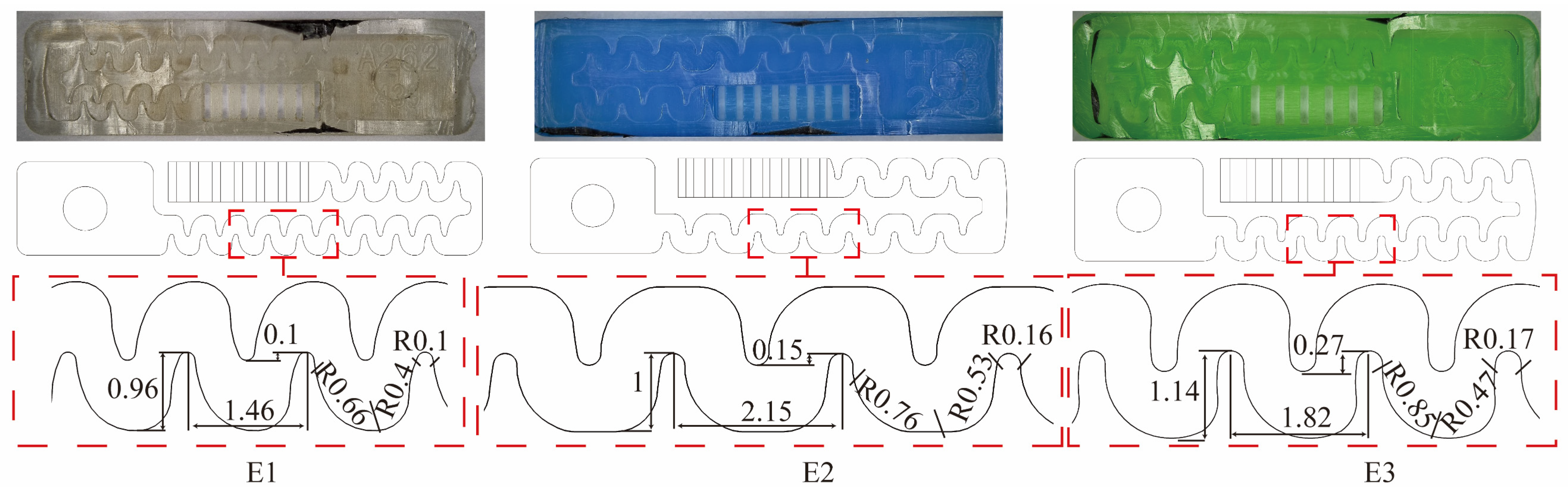
Three types of integrated inline labyrinth emitters were selected for the anti-clogging experiments and were designated E1, E2, and E3, respectively. The three emitters differed in labyrinth-channel geometry. The schematic diagrams of the flow-path structure and parameter definitions are shown in Figure 1, and the key structural parameters of the labyrinth channels are summarized in Table 1. These parameters characterize the tooth pitch, tooth height, upper–lower tooth spacing, and local transition curvature of the labyrinth channel, which are key geometric factors affecting local flow-velocity distribution, shear action, and particle-retention behavior.
Before the experiments, the basic physical and hydraulic parameters of the three drip tapes were measured, including inner diameter, emitter spacing, wall thickness, nominal discharge, discharge exponent, flow coefficient, and discharge coefficient of variation, as shown in Table 2.
Artificially prepared sediment-laden water was used as the clogging medium. The sediment was collected from the Qiliying Experimental Base in Xinxiang, Henan Province, China. After natural air-drying and crushing, the sediment was sieved through a 120-mesh screen with an aperture of 0.125 mm to remove coarse particles, and then mixed with clean water to prepare three sediment mass concentrations of 1, 2, and 3 g·L−1 [4]. The particle-size distribution of the initial sediment sample was measured using a laser particle-size analyzer (Bettersize Instruments Ltd., Dandong, China). The cumulative particle-size distribution is presented in Table 3, and the characteristic particle sizes D10, D50, and D90 were 0.00277 mm, 0.02609 mm, and 0.07094 mm, respectively, as shown in Table 4.

2.2. Experimental Platform and Operating Procedure

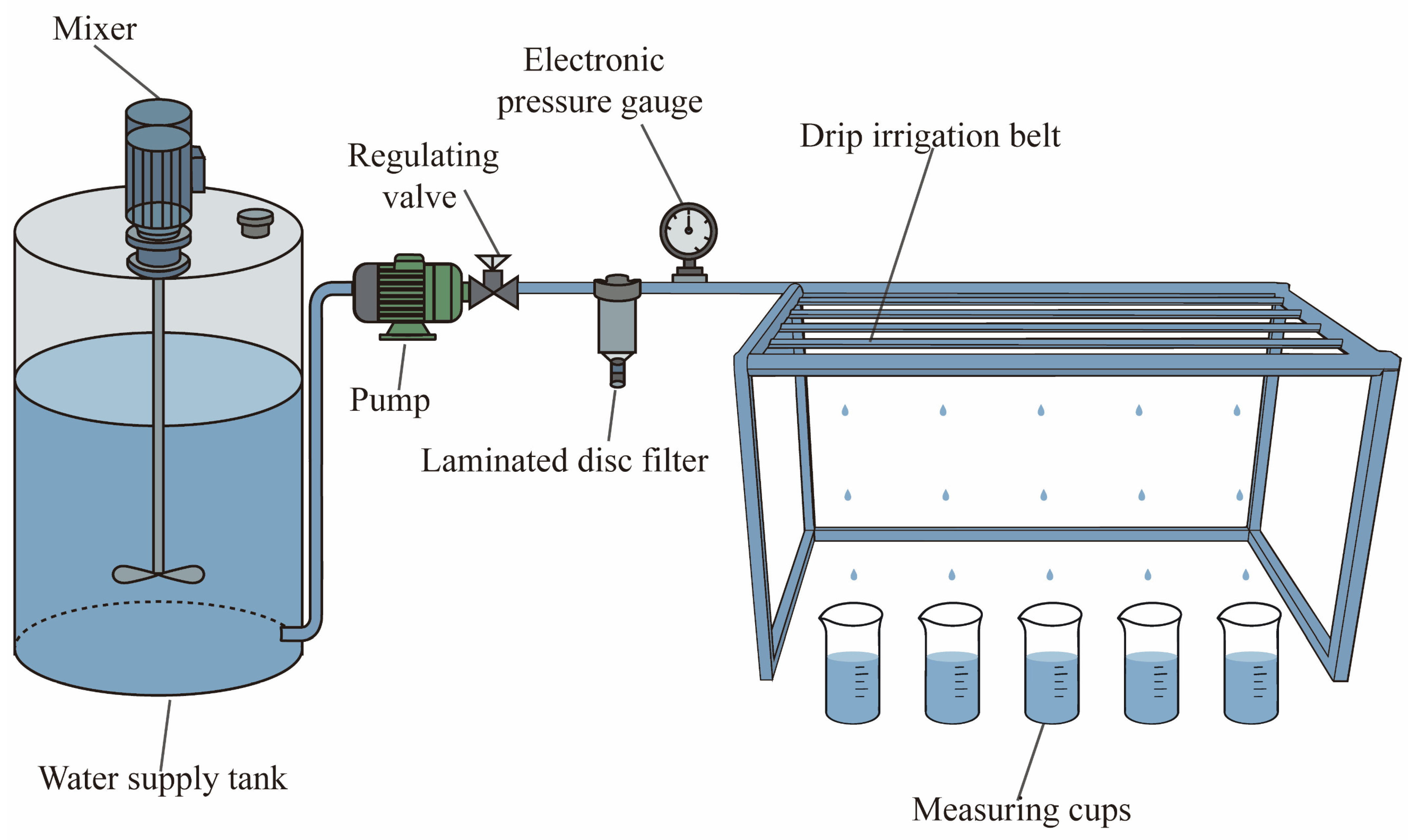
The clogging experiments were conducted in the experimental hall of the Irrigation Equipment Testing Center, Institute of Farmland Irrigation, Chinese Academy of Agricultural Sciences (Figure 2). The water supply system consisted of a 100 L tank equipped with a gear-reduction motor (750 W, 130 r·min−1) driving a stirrer, a 400 W pump with a flow rate of 2.5 m3·h−1 and a head of 35 m, a pressure-regulating valve, a disc filter, and an electronic pressure gauge with an accuracy grade of 0.4 and a measurement range of 0–0.25 MPa. The conveyance network was arranged in a recirculating-loop configuration within a rectangular frame of 80 cm × 250 cm. Five drip tapes were installed in parallel with a spacing of 20 cm.
Each drip tape contained seven emitters. To avoid possible boundary effects at the inlet and outlet ends, the first and last emitters on each tape were excluded, and the five emitters in the middle section were selected as monitoring points. Therefore, a total of 25 emitters were monitored for each treatment. Before the sediment-laden water tests, the initial discharge of each monitoring emitter was measured under clean-water conditions at 0.1 MPa. Each measurement lasted 5 min and was repeated three times, and the mean value was taken as the initial discharge [19].
During the indoor anti-clogging experiments, the system pressure was maintained at 0.1 MPa, monitored in real time by the electronic pressure gauge, and adjusted using the pressure-regulating valve. A short-cycle intermittent operating mode was adopted, consisting of 1 h of operation followed by 0.5 h of shutdown. Discharge was measured at 1 h intervals throughout the experiment. Before each discharge measurement, the pressure was re-stabilized, and the discharge at each monitoring point was then determined.
To maintain a uniform sediment suspension, the stirring device operated continuously throughout the experiment, including the 0.5 h shutdown period. Water replenishment was conducted during the shutdown period while stirring was maintained. Because the experiment was carried out indoors in the experimental hall, evaporation loss was considered negligible and was not separately corrected.
After each treatment, the platform and pipelines were thoroughly flushed and cleaned to minimize interference from residual sediment. For each treatment group, the experiment was terminated when the mean relative discharge ratio decreased to 75% or below. After the experiment, the emitters on the drip tapes were removed, numbered from 1 to 25, and dried in an oven at 60 °C. The labyrinth channels were then opened manually by mechanical sectioning to expose the dry sediment deposits inside the flow path.
Images of the deposit distribution were obtained using an electronic microscope (OVIS, Shenzhen, China; AO-HK830-0318). The sectioned flow channels were placed on the microscope stage and observed under a fixed magnification and uniform lighting conditions. Images were captured and stored as digital files using the microscope imaging system for subsequent identification and recording of sediment deposition locations.

2.3. Measurement Methods and Evaluation Indices

To evaluate the effects of sediment concentration and emitter type on clogging, Dra and CU were used as evaluation indices and calculated using Equations (1) and (3), respectively. Dra indicates the extent of discharge reduction, with a lower Dra corresponding to a larger decrease in discharge and more severe clogging. In accordance with ISO 9261:2004 [20] and ASAE EP405.1 (FEB03) [21], the treatments reached the clogging failure threshold when Dra decreased to 75% or lower.
Dra is calculated as follows:
D r a = i = 1 n q i , t q i , 0 n × 100 %
where q i , t is the measured discharge of the emitter at monitoring point i at time t (L·h−1); q i , 0 is the initial discharge of the emitter at monitoring point i ; and n is the number of monitoring points (in this study, n = 25 ).
To characterize the spatial distribution of clogging within the drip irrigation system, the clogging severity of individual emitters was further classified into five grades based on the relative discharge of each emitter with respect to its initial discharge: Grade 1, normal ( D r a i , t > 95 % ); Grade 2, slight clogging ( 75 % < D r a i , t 95 % ); Grade 3, moderate clogging ( 50 % < D r a i , t 75 % ); Grade 4, severe clogging ( 20 % < D r a i , t 50 % ); and Grade 5, complete clogging ( D r a i , t 20 % ) [22].
D r a i , t = q i , t q i , 0 × 100 %
In drip irrigation systems, CU is commonly used to evaluate irrigation uniformity along the drip lateral [23] and primarily reflects the consistency of discharge among monitoring points. CU is calculated as follows:
C U = 1 i = 1 n | q i , t q t ¯ | n q t ¯ × 100 %
where q t ¯ is the mean discharge of all monitoring points at time t (L·h−1).

2.4. Numerical Simulation Method and Model Validation

To obtain the three-dimensional flow-field characteristics within the emitter labyrinth channel and to support the analysis of the effects of structural parameters on hydraulic performance and clogging behavior, three-dimensional steady-state numerical simulations were performed using ANSYS Fluent (2024 R1), and discrete element modeling of solid particles was conducted using ANSYS Rocky (2024 R1) to achieve coupled analysis of sediment–water two-phase flow. The continuous-phase flow field was first solved in Fluent, and the resulting flow field was then imported into Rocky for particle transport and deposition simulation. The simulation domain was the complete three-dimensional geometry of a single emitter labyrinth channel, and the geometric model was established according to the actual structural parameters of the tested emitters.
In the Fluent simulations, the inlet boundary was defined as a pressure inlet with an inlet pressure of 100 kPa, and the outlet boundary was defined as a pressure outlet with a gauge pressure of 0 Pa. The inlet turbulence parameters were set as a turbulence intensity of 5% and a turbulence viscosity ratio of 10. No-slip boundary conditions were applied to the walls, and gravity was included according to the geometric coordinate system. A steady-state solver was employed, the pressure–velocity coupling algorithm was SIMPLEC, and second-order upwind discretization was used for the spatial terms. The residual convergence criterion was set to 1 × 10⁻⁵, while mass conservation between the inlet and outlet was also monitored to assist in determining convergence.
Considering the complex geometry and narrow regions of the labyrinth channel, the computational domain was discretized using an unstructured mesh dominated by tetrahedral cells, with local refinement applied near the channel and tooth-tip regions. The minimum mesh size was set to 0.01 mm. To verify the sensitivity of the numerical results to mesh density, a grid-independence test was conducted under the SST k–ω turbulence model using the measured clean-water discharge of emitter E1 at 100 kPa, 2.0 L·h−1, as the reference value. The results are shown in Table 5. As the number of cells increased from 5.09 × 10⁵ to 2.55 × 10⁶, the simulated discharge converged from 2.14 L·h−1 to approximately 2.01 L·h−1, and the relative error decreased to 1.52%. When the mesh was further refined to 4.19 × 10⁶ cells, the simulated discharge remained approximately 2.01 L·h−1, indicating that the result was no longer sensitive to mesh density. Therefore, a mesh size of approximately 2.55 × 10⁶ cells was selected in subsequent simulations as a compromise between computational accuracy and efficiency.
To reduce the uncertainty associated with turbulence-model selection, the simulated discharge rates under the Standard k–ε, RNG k–ε, Realizable k–ε, BSL k–ω, Standard k–ω, and SST k–ω turbulence models were further compared, and the results are presented in Table 6. The relative errors of all models were calculated using the measured clean-water discharge of emitter E1 at 100 kPa and 2.0 L·h−1 as the reference values. Among these models, the SST k–ω model yielded a relative error of 0.85% and is also more suitable for representing near-wall flow and flow separation. Therefore, the SST k–ω model was selected for the subsequent simulations.
In the sediment–water two-phase simulations, solid particles were modeled as the discrete phase in ANSYS Rocky. Particle injection was controlled by mass flow rate to maintain consistency with the sediment conditions, expressed as mass concentration in the physical experiments. The particle mass flow rate was determined from the sediment mass concentration C m and the inlet volumetric flow rate Q , according to
m ˙ s = C m Q
Taking the case of 1 g·L−1 sediment concentration and a reference discharge of 2.0 L·h−1 for emitter E1 at 100 kPa as an example, the solid-phase mass flow rate was 2.0 g·h−1, that is, 5.56 × 10⁻⁷ kg·s−1. Particle sizes were sampled according to the initial sediment particle-size distribution measured in the physical experiments. The particles were assumed to be spherical in the Rocky simulations. The total simulation time was set to 10 s to identify particle-retention-sensitive regions and compare short-term particle residence characteristics under different structures. Under the prescribed mass-flow-rate condition, the total number of injected particles was 33,587. The particle parameters used in Rocky are listed in Table 7.
Because the sediment concentrations used in this study ranged from 1 to 3 g·L−1, corresponding to a solid volume fraction in the order of 10−7, the momentum feedback of the particles on the continuous-phase flow field was considered negligible. Therefore, a one-way coupling strategy was adopted, in which the continuous-phase flow field drove particle motion and deposition behavior, while the feedback of the particles on the water flow field was ignored.

2.5. Structural Optimization Procedure

Structural optimization of the emitter was carried out based on the identification of deposition-sensitive regions within the flow path, combined with physical experimental observations and numerical simulation analysis. The optimization objective was to improve particle-passing conditions within the labyrinth channel, reduce the risk of local retention and deposition, delay clogging development, and maintain the basic hydraulic performance of the emitter.
The optimization mainly focused on local regions within the labyrinth channel where particle retention and deposition were likely to occur. Under the premise of maintaining the basic flow-path configuration of the emitter, local adjustments were made to key structural parameters. The main adjusted parameters included the upper–lower tooth spacing, upstream face radius, downstream face radius, and tooth tip radius. By modifying the local geometric transition characteristics, the flow-velocity distribution and particle-transport conditions within the channel were regulated to weaken the adverse effects of low-velocity retention zones and local recirculation regions on particle deposition.
The optimization effect was comprehensively evaluated using indicators including particle residence characteristics, deposition hotspot distribution, and hydraulic performance variation. Specifically, the evaluation considered particle accumulation in hotspot regions, particle residence time, the extent of local retention zones, and discharge variation.

2.6. Statistical Analysis

In this study, Dra, the relative discharge ratio of individual emitters, and CU were calculated based on the measured discharge data, and the data were organized in Excel. Linear fitting between Dra and CU was performed using SPSS Statistics 25. Post-processing and visualization of the numerical simulation results were carried out using Tecplot 2024 R1.

3. Results

3.1. Variation in Dra Under Different Sediment Concentrations and Emitter Types

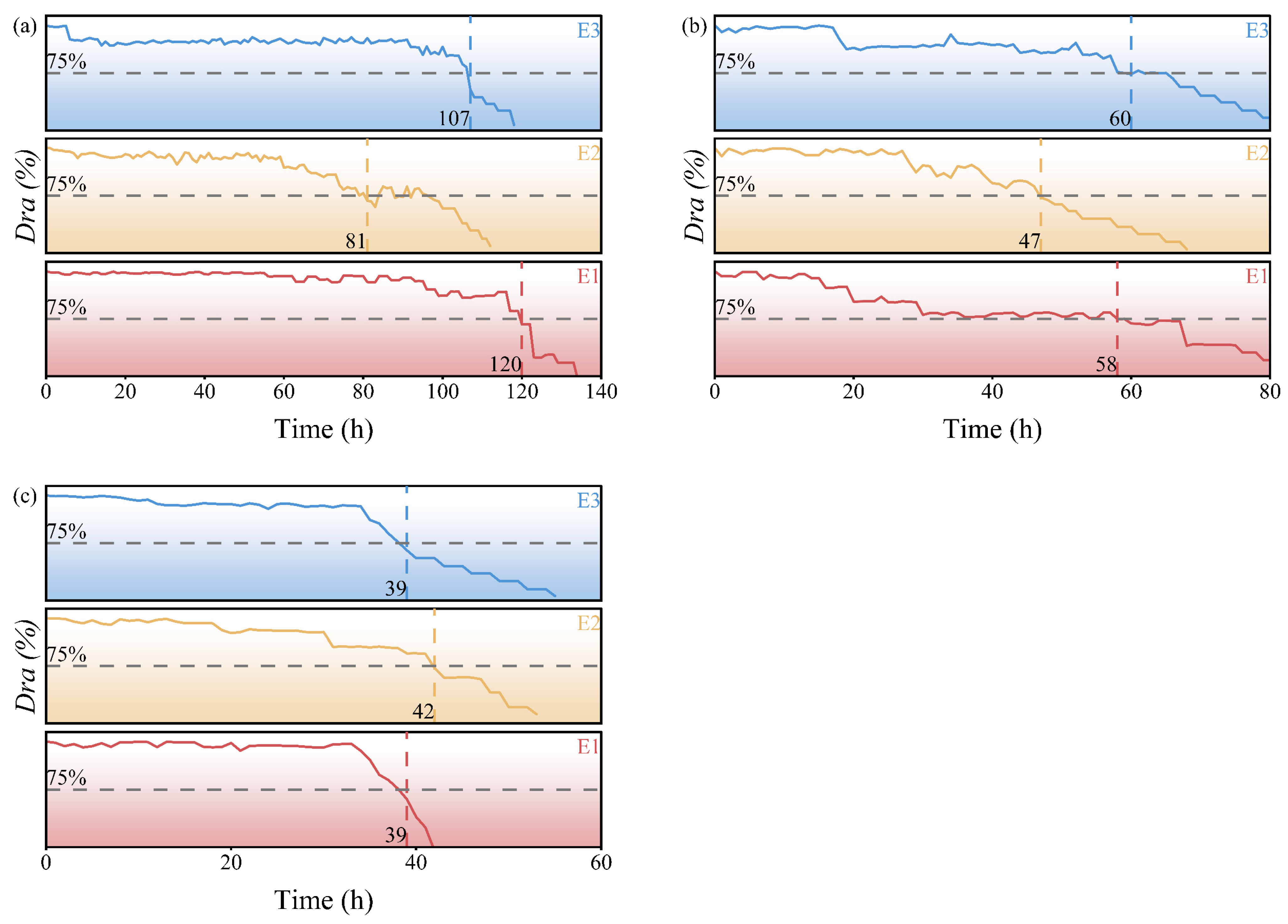
Figure 3 shows the variation in Dra with operating time under the three sediment concentrations. For all treatments, Dra gradually decreased with operating time, but the time required to reach the clogging criterion differed among emitter types under the same sediment concentration. At 1 g·L−1 (Figure 3a), the times for E1, E2, and E3 to reach Dra < 75% were 120, 81, and 107 h, respectively. E1 showed the longest operating time, which was 48.15% longer than that of E2 and 12.15% longer than that of E3. At 2 g·L−1 (Figure 3b), the times for E1, E2, and E3 to reach Dra < 75% were 58, 47, and 60 h, respectively. E3 showed the longest operating time, which was 27.66% longer than that of E2 and 3.45% longer than that of E1. At 3 g·L−1 (Figure 3c), the times for E1, E2, and E3 to reach Dra < 75% were 39, 42, and 39 h, respectively. E2 showed the longest operating time, which was 7.69% longer than those of both E1 and E3.
Across the three sediment concentration levels, the operating times of all three emitter types decreased as sediment concentration increased, but the magnitudes of reduction differed among structures. From 1 to 3 g·L−1, the operating times of E1, E2, and E3 decreased from 120 to 39 h, from 81 to 42 h, and from 107 to 39 h, corresponding to reductions of 67.50%, 48.15%, and 63.55%, respectively.

3.2. Spatial Distribution Characteristics of Emitter Clogging Grades

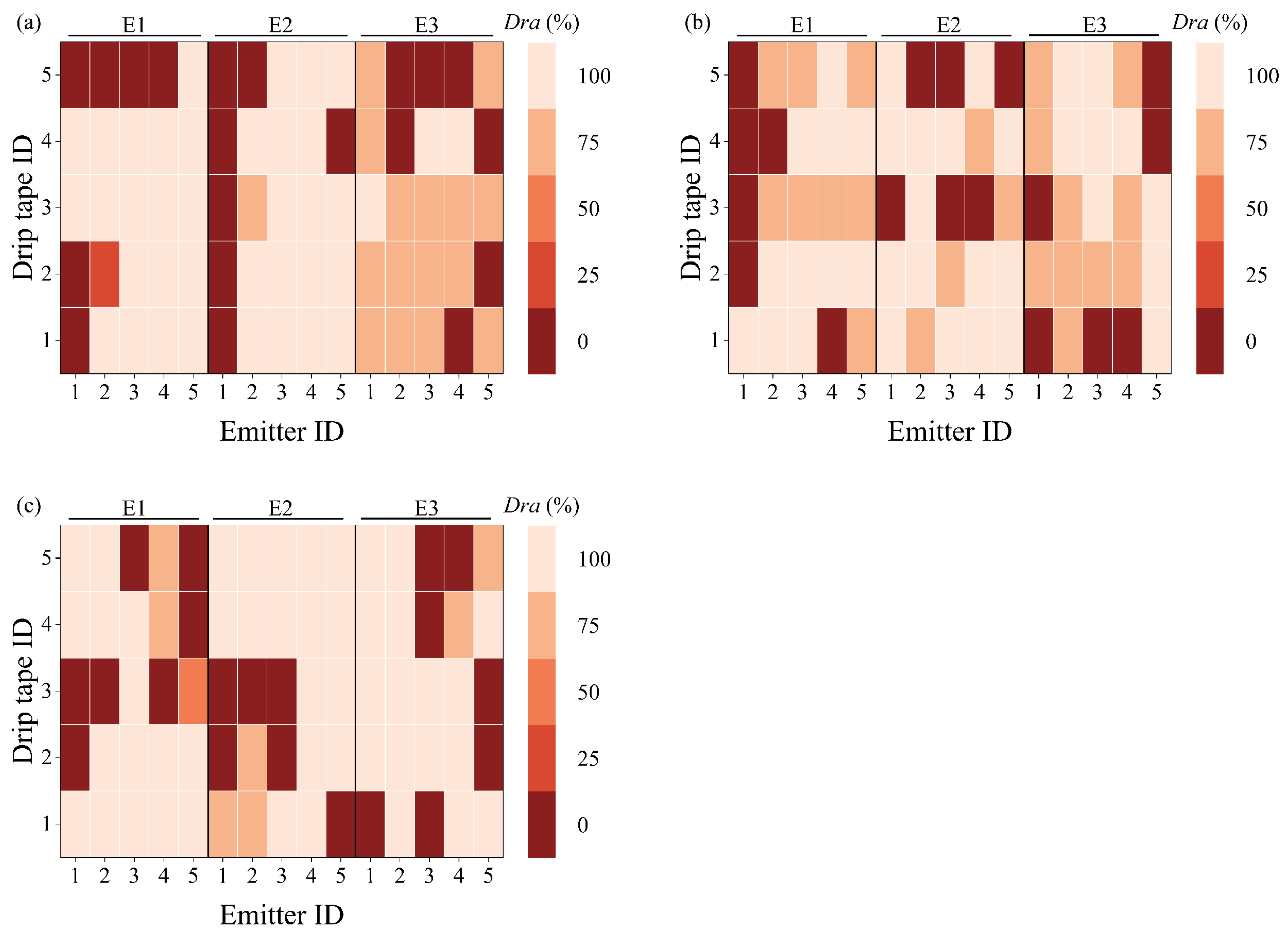
Figure 4 shows that the spatial distribution of clogging grades differed among emitter types under the three sediment concentration levels. At 1 g·L−1 (Figure 4a), Grade 5 clogging in E1 was mainly concentrated in the fifth drip tape, where four of the five emitters were classified as Grade 5. In E2, Grade 5 clogging was also mainly distributed in the fifth drip tape, with one additional Grade 5 point appearing in the first drip tape. In contrast, Grade 2 clogging in E3 was distributed across all five drip tapes, and Grade 5 clogging also appeared in multiple drip tapes, showing a more dispersed spatial pattern than that in E1 and E2. At 2 g·L−1 (Figure 4b), Grade 5 clogging in E1 was mainly observed in the second to fifth drip tapes and was relatively concentrated in the upper positions. In E2, Grade 5 clogging mainly occurred in the third and fifth drip tapes, whereas Grade 2 clogging was limited. In E3, Grade 2 clogging appeared in all five drip tapes, and Grade 5 clogging was also distributed across multiple drip tapes, indicating greater spatial variability among drip tapes.
At 3 g·L−1 (Figure 4c), the differences in spatial distribution among emitter types remained evident. In E1, Grade 5 clogging mainly occurred in the third and fifth drip tapes, and one Grade 3 point also appeared in the third drip tape. In E2, Grade 5 clogging was mainly concentrated in the second and third drip tapes, whereas the fourth and fifth drip tapes were dominated by the normal state or Grade 2. In E3, Grade 5 clogging appeared in the first, fourth, and fifth drip tapes, showing a distribution across multiple drip tapes rather than concentration in a single drip tape.

3.3. Changes in CU Under Different Sediment Concentrations and Emitter Types

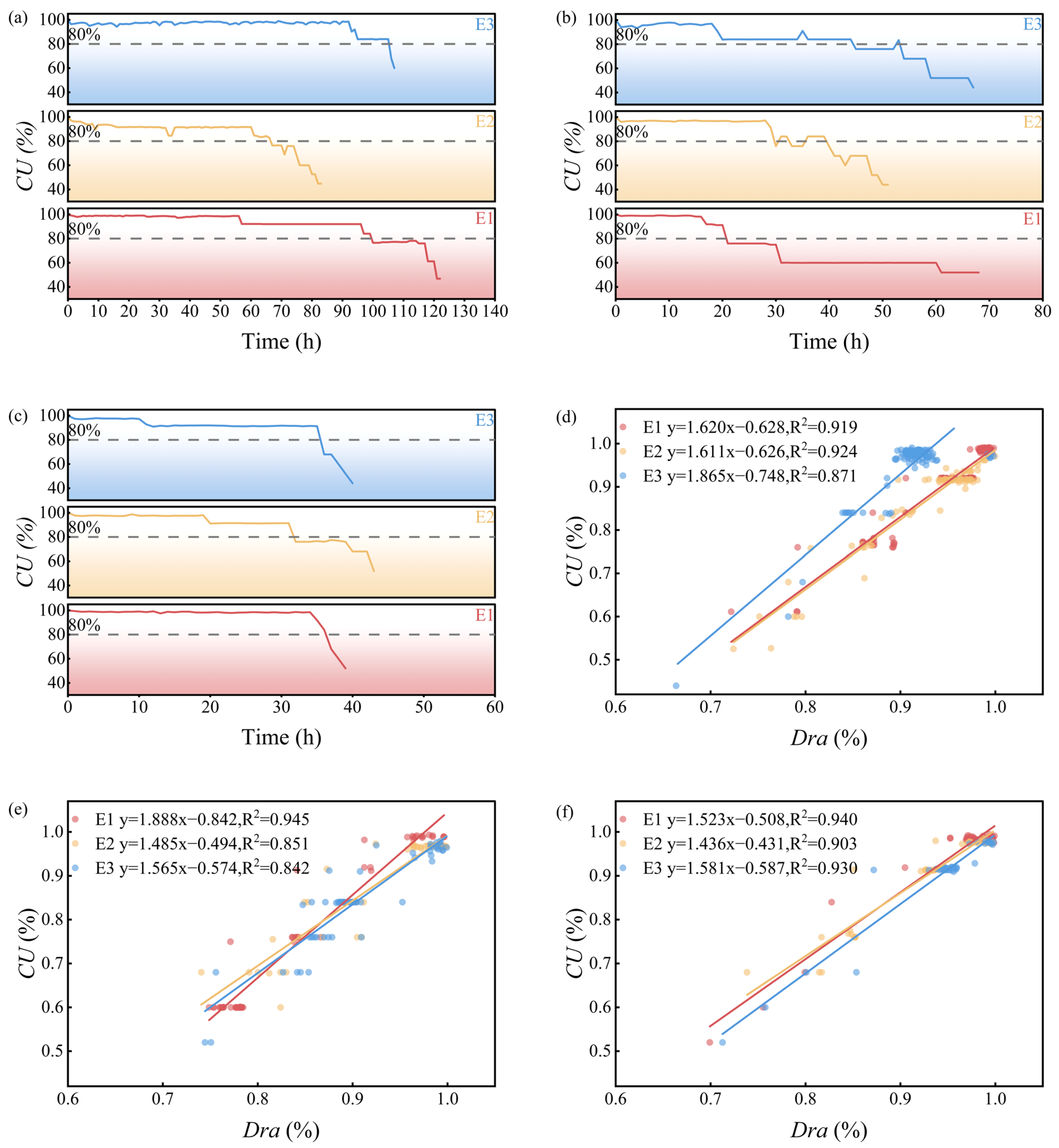
In all treatments, CU decreased with operating time (Figure 5a–c). At 1 g·L−1, CU remained above 80% before 95 h for both E1 and E3, whereas it dropped below 80% at approximately 70 h for E2. With increasing sediment concentration, CU declined earlier. In particular, E1 showed a rapid decrease, with CU falling to 60% by 31 h. At 3 g·L−1, the CU values of the three emitter types dropped below 80% at similar times. The proportions of the CU decline period within the total operating time differed among treatments. At 1 g·L−1, the corresponding proportions for E1, E2, and E3 were 18.03%, 19.28%, and 0.93%, respectively; at 2 g·L−1, they were 69.12%, 41.18%, and 32.84%, respectively; and at 3 g·L−1, they were 5.13%, 23.26%, and 10.00%, respectively.
Linear fitting under the different sediment concentration scenarios showed strong relationships between CU and Dra for all drip tape types (Figure 5d–f). When Dra decreased to 95%, CU remained relatively high across the treatments (91.7–98.2%). At 2 g·L−1, the CU values of E1, E2, and E3 increased by 6.63%, 6.27%, and 2.04%, respectively, relative to those at 1 g·L−1, whereas at 3 g·L−1, the corresponding changes were −0.24%, 7.04%, and −3.48%, respectively. When Dra further decreased to 75%, the CU range across treatments was 44.0–68.0%. At 2 g·L−1, the CU values of E1, E2, and E3 changed by −1.86%, 29.43%, and 18.18%, respectively, relative to those at 1 g·L−1, whereas at 3 g·L−1, the corresponding changes were −14.95%, 29.43%, and 18.18%, respectively.

3.4. Identification of Particle Deposition Hotspots and Labyrinth Channel Structural Optimization

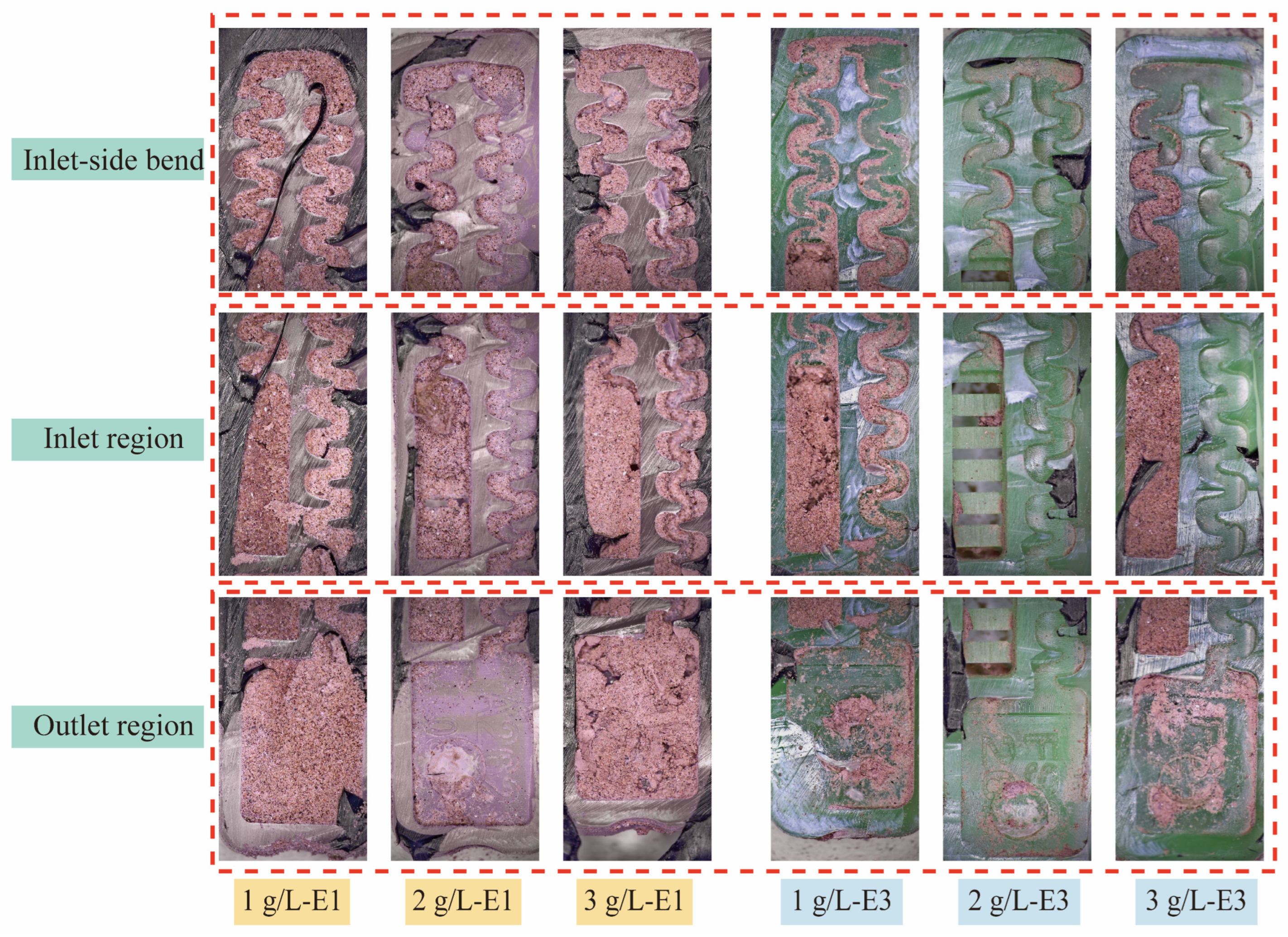
Figure 6 presents the cross-sectional deposition patterns within the labyrinth channels of E1 and E3. As shown in Figure 6, sediment deposition exhibited clear spatial clustering and mainly occurred near the inlet and at channel bends, whereas deposition along the straight sections of the main channel was relatively weak. The deposition morphologies differed between the two emitter types. In E1, noticeable accumulation occurred in the inlet region, and continuous deposit coverage was observed along the main channel and in the outlet chamber. In E3, deposition was distributed along the serrated labyrinth channel and showed a segmented along-path accumulation pattern.
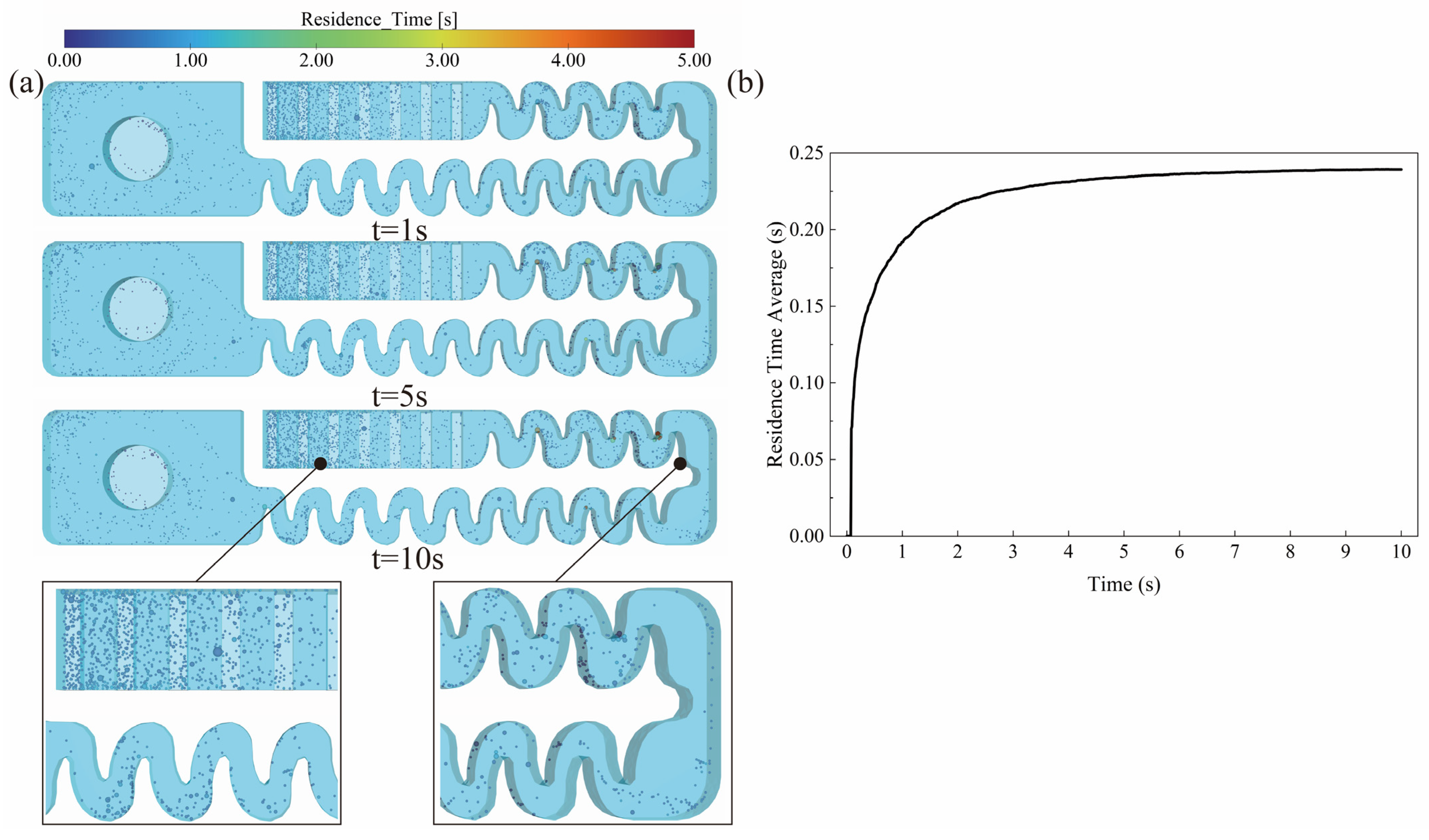
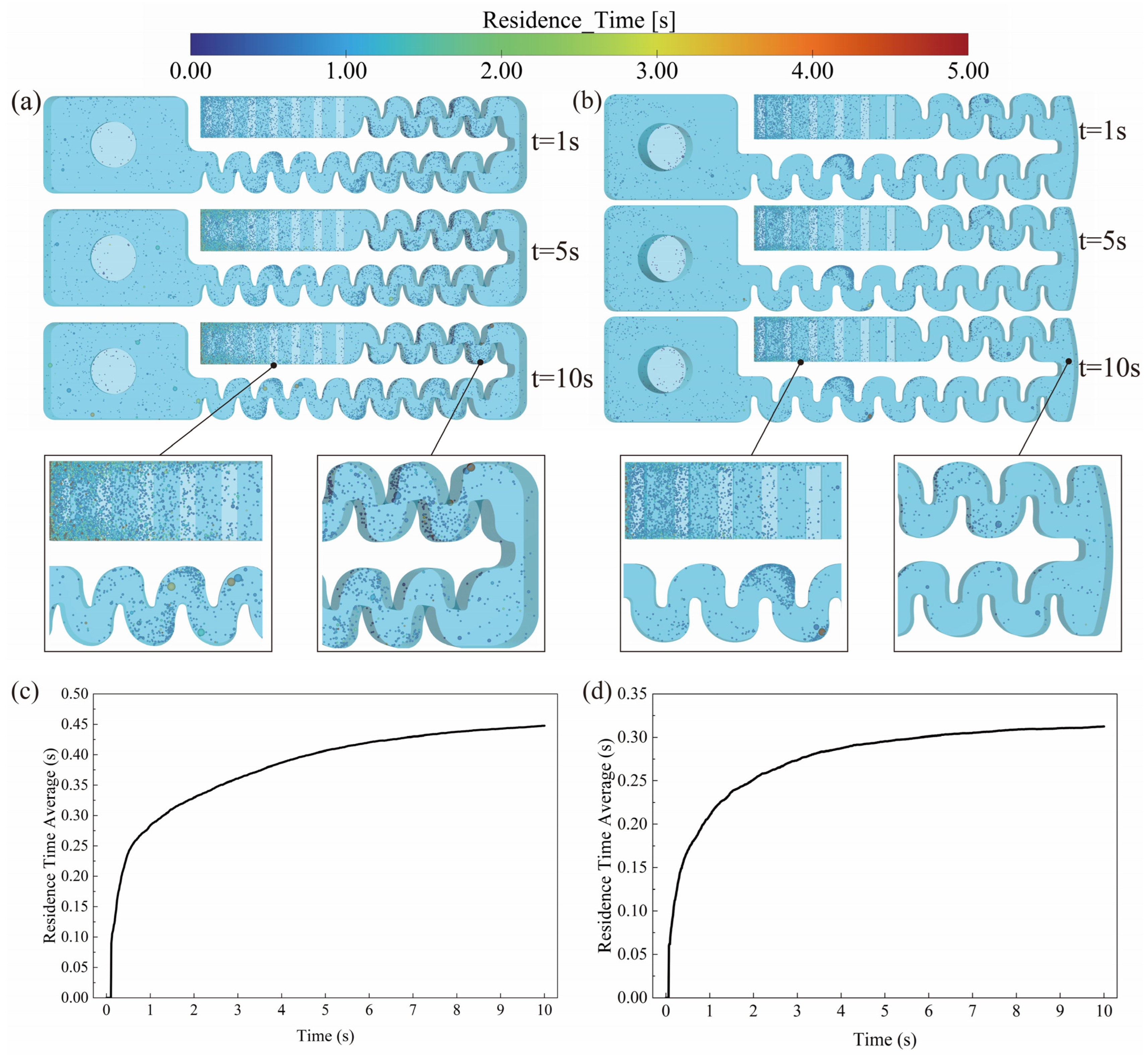
Numerical simulations were conducted to compare particle trajectories in the two emitter types under 1 g·L−1 (Figure 7). Within the simulated time window of 1–10 s (Figure 7a,b), particles were mainly retained in the inlet and bend regions, whereas they passed rapidly through other regions. At t = 10 s, the peak mean particle residence times of E1 and E3 were 0.45 and 0.31 s, respectively (Figure 7c,d). The numerical results of the optimized structure are shown in Figure 8. Compared with the original E1 and E3 structures, particle accumulation near the inlet was reduced in the optimized structure (Figure 8a). In addition, the mean particle residence time decreased to 0.24 s (Figure 8b), corresponding to reductions of 46.7% and 22.6% relative to those of the original E1 and E3 structures, respectively.

4. Discussion

4.1. Effects of Sediment Concentration and Labyrinth Channel Geometry on Emitter Clogging

The variation in Dra under different sediment concentrations and emitter types indicated that as sediment concentration increased, emitter clogging accelerated markedly and the effective operating time was significantly shortened, suggesting that increased sediment load was a direct driver of clogging development. This is consistent with the findings of Niu et al. [24]. In addition, the Dra curves in this study further suggested that clogging did not occur instantaneously, but rather developed progressively from initial particle retention to continuous accumulation and finally to rapid deterioration. Liu and Huang also reported that once slight deposition formed in the early stage, the subsequent decline in flow rate accelerated further [25]. Previous studies have shown that optimizing labyrinth-channel geometry can improve anti-clogging performance by improving local high-velocity zones and disturbance regions [26,27]. However, the present study further found that this structural regulation effect was not equally stable under different sediment conditions, but was more evident under low sediment concentration.
Different labyrinth-channel geometries altered local flow-velocity distribution, wall shear intensity, and the extent of recirculation zones, thereby affecting particle collision, retention, and deposition behavior. Therefore, under low and moderate sediment concentrations, structural differences were more fully expressed. Under high sediment concentration, however, the particle input intensity increased rapidly, which substantially weakened the regulatory effect of geometry, and the operating lifetimes of all emitter types were generally shortened. These findings deepen the understanding of the physical clogging mechanism of emitters and further suggest that structural optimization should place greater emphasis on delaying the transition from initial deposition to rapid clogging, thereby improving the adaptability of emitters to sediment-laden water sources.

4.2. Effects of Sediment Concentration and Labyrinth-Channel Geometry on the Spatial Distribution of Emitter Clogging

The spatial distribution characteristics of clogging grades indicated that emitter clogging did not occur uniformly either along the drip tape or within the labyrinth channel, but instead showed clear spatial heterogeneity. Different labyrinth-channel geometries produced distinct clogging distribution patterns and failure modes under the same sediment condition, which is consistent with the findings of Li et al. [28]. In addition, this study found that although each treatment contained 25 emitters, the clogging grades were dominated by Grades 1, 2, and 5, whereas Grades 3 and 4 were rarely observed. This suggests that emitter clogging had a certain abruptness. Once sediment deposition within the channel reached a certain level, clogging developed rapidly, with almost no obvious buffering stage corresponding to Grades 3 and 4.

4.3. Effects of Sediment Concentration and Labyrinth-Channel Geometry on Irrigation Uniformity

The variation in CU under different sediment concentrations and emitter types showed that CU continuously declined with operating time, and that its deterioration generally appeared earlier as sediment concentration increased. This is consistent with the findings of Solé-Torres et al. [29]. In addition, the present study found that under sediment-laden water conditions, CU was not merely an accompanying indicator of Dra decline, but rather a more sensitive indicator that could reflect system-scale risk at an earlier stage. In some treatments, even before some emitters fully reached the terminal clogging criterion, CU had already declined significantly. This indicates that once local clogging spread spatially, system operational risk could be triggered earlier than would be suggested by the flow-rate decline of individual emitters alone. Similar phenomena were also reported by Li et al. and Zhou et al. [30,31]. These results indicate that in drip irrigation system management and anti-clogging evaluation, it is insufficient to judge system acceptability solely on the basis of the terminal Dra threshold. Changes in CU should also be incorporated into the evaluation framework so that system-level operational risk can be identified earlier.

4.4. Observation of Deposition Hotspots and Labyrinth-Channel Structural Optimization

This study found that particle deposition and retention were mainly concentrated in the inlet section and bend regions, which were the key sensitive areas for clogging initiation and propagation. This is consistent with the conclusions of Petit et al. [32], and Ait-Mouheb et al. also reported that particle deposition tends to first occur in the inlet and initial vortex regions [33]. Therefore, structural optimization in this study was carried out on the basis of sediment-deposition hotspot identification and particle residence characteristics. The results showed that this method could effectively reduce local particle accumulation and shorten the mean residence time. Studies by Li et al., Qin et al., and Wang et al. also demonstrated that structural geometry is a key factor affecting particle retention and escape behavior [34,35,36]. Zhang et al. further pointed out that local channel structural parameters can significantly affect particle deposition and anti-clogging capacity [37]. These findings suggest that the key to structural optimization is not simply to enlarge the channel size, but rather to improve the flow organization in hotspot regions, weaken stable low-velocity retention and recirculation conditions, and allow particles to pass through more easily instead of remaining trapped. Once the residence time in sensitive regions such as the inlet and bends is shortened and particle accumulation is alleviated, the probability that local deposition will evolve into functional clogging is reduced, thereby improving the overall anti-clogging performance.
These results provide a more operational direction for emitter optimization design, indicating that future structural improvement should prioritize key sensitive regions such as the inlet section and bends rather than simply enlarging the overall channel size. However, this study still has certain limitations. The present work mainly focused on the physical clogging process of emitters under sediment-laden water conditions, with emphasis on revealing the mechanisms of initial particle retention, local deposition, and hydraulic performance decline within the labyrinth channel. Under actual long-term operating conditions, however, emitter clogging is often not caused solely by sediment deposition [38,39], but may also be accompanied by chemical precipitation, biofilm attachment, and particle flocculation, resulting in more complex mixed-clogging characteristics. In addition, the numerical simulations in this study covered only 10 s and were mainly intended to identify particle-retention-sensitive regions and compare particle residence characteristics under different structures, thereby revealing the hydraulic basis of deposition hotspot formation. However, they still lacked the ability to directly characterize continuous deposition growth, resuspension, reattachment, and clogging morphology evolution during long-term emitter operation [40,41]. Therefore, future work should further combine multiple clogging-material conditions, longer-timescale simulations, long-term physical experiments, and validation of optimized prototypes to systematically evaluate the anti-clogging stability of different structures under complex operating environments.

5. Conclusions

This study clarified how sediment concentration and labyrinth-channel geometry jointly regulate clogging development and hydraulic uniformity in drip irrigation systems under sediment-laden water conditions. The results showed that sediment concentration primarily controls the clogging timescale, whereas labyrinth-channel geometry determines the extent to which anti-clogging performance can be maintained under the same sediment condition. As sediment concentration increased, the effective operating time of all emitter types decreased substantially, and the structural advantages of different channel geometries became progressively less pronounced.
At the system scale, clogging exhibited clear spatiotemporal heterogeneity. Severe clogging preferentially developed in the upstream section of the drip tape, and CU declined progressively with operating time. Compared with the average relative discharge ratio, CU more directly reflected the deterioration of system-level hydraulic uniformity during clogging development. At the flow-path scale, cross-sectional observation and numerical simulation consistently indicated that the inlet section and bend regions were the principal deposition-sensitive zones. These findings establish a linkage between local particle retention and deposition hotspots and system-level hydraulic deterioration.
The main scientific contribution of this study is that it integrates temporal clogging evolution, spatial clogging distribution, hotspot identification, and structure-oriented optimization within a unified analytical framework. Based on this framework, the results indicate that emitter optimization should focus on local sensitive regions rather than simply enlarging the overall channel size. Local geometric adjustment guided by reducing hotspot deposition risk and improving particle-passing conditions provides a practical pathway for enhancing anti-clogging performance under sediment-laden water conditions.
This study also has several limitations. It mainly addressed physical clogging caused by sediment particles and did not include biological or chemical clogging processes that may occur during long-term field operation. In addition, the structural optimization was primarily evaluated through short-term numerical simulation and has not yet been verified by long-term physical experiments using optimized emitter prototypes. Future research should therefore combine multi-source clogging materials, longer-timescale simulation, and long-term experimental validation to further assess the anti-clogging stability and engineering applicability of optimized emitter structures.

Author Contributions

Conceptualization, Q.H.; methodology, G.W. and Q.H.; investigation, G.W., M.W., Y.F. and S.F.; resources, M.Z. and Q.H.; data curation, G.W., M.W. and S.F.; formal analysis, R.L. and Q.H.; validation, R.L.; visualization, G.W. and M.X.; supervision, M.Z. and M.X.; project administration, Y.F.; funding acquisition, M.Z.; writing—original draft preparation, G.W. and M.W.; writing—review and editing, G.W., Y.F., M.Z. and Q.H. All authors have read and agreed to the published version of the manuscript.

Funding

This research was funded by the Inner Mongolia Autonomous Region Water Conservancy Science and Technology Program, grant number 202501010102A; Henan Provincial Natural Science Foundation, grant number 252300420511; Henan Provincial Science and Technology Tackling Key Problems Program, grant number 252102110236; Key Promotion Program of Science and Technology Achievements of the Jiangxi Provincial Department of Water Resources, grant number 202526TGKT04; and Open Project of Research on Typical Aquatic Plant Remediation Techniques for Rural Water Pollution, grant number FIRI20210301. The APC was funded by the Inner Mongolia Autonomous Region Water Conservancy Science and Technology Program, grant number 202501010102A.

Data Availability Statement

The data that support the findings of this study are available from the corresponding author upon reasonable request.

Acknowledgments

We would like to thank the anonymous reviewers for their long-term guidance and constructive comments.

Conflicts of Interest

The authors declare no conflicts of interest.

Abbreviations

The following abbreviations are used in this manuscript:
Draaverage relative discharge ratio
CUChristiansen’s uniformity coefficient

References

  1. Li, H.; Junejo, A.R.; Midmore, D.J.; Soomro, S.A. Significance of Aerated Drip Irrigation: A Comprehensive Review. Agric. Water Manag. 2025, 321, 109886. [Google Scholar] [CrossRef]
  2. Ma, C.; Jiang, C.; Li, Y.; Shi, N.; Liu, S.; Hu, X.; Liu, Z.; Sun, Z.; Muhammad, T. Effect of Lateral Flushing on Emitter Clogging in Drip Irrigation Using High-Sediment Water. Agric. Water Manag. 2024, 293, 108702. [Google Scholar] [CrossRef]
  3. Feng, J.; Liu, H.; Liu, Y.; Sun, H.; Ma, C.; Shi, P.; Wang, W.; Xue, S.; Wen, J. Optimal Structure Selection of Emitter Flow Path in Drip Irrigation System with Inferior Water Resources. Rev. Bras. Eng. Agrícola Ambient. 2025, 29, e281773. [Google Scholar] [CrossRef]
  4. Muniz, G.L.; de Camargo, A.P.; Ait-Mouheb, N.; Cano, N.D. Geometric Characteristics of Dripper Labyrinths and Accumulation of Solid Particles: Simulation and Experimentation. AgriEngineering 2025, 7, 217. [Google Scholar] [CrossRef]
  5. Wang, H.; Ling, G.; Hu, M.; Wang, W.; Hu, X. Physical Clogging Characteristics of Labyrinth Emitters Under Low-Quality (Sand-Laden Water) Irrigation. Agronomy 2022, 12, 1615. [Google Scholar] [CrossRef]
  6. Lv, C.; Niu, W.; Du, Y.; Sun, J.; Dong, A.; Wu, M.; Mu, F.; Zhu, J.; Siddique, K.H.M. A Meta-Analysis of Labyrinth Channel Emitter Clogging Characteristics Under Yellow River Water Drip Tape Irrigation. Agric. Water Manag. 2024, 291, 108634. [Google Scholar] [CrossRef]
  7. Hou, P.; Puig-Bargués, J.; Liu, L.; Xiao, Y.; Zhou, B.; Li, Y. New Anti-Clogging Perspective by Discharging Sediment from Drip Irrigation Emitters with High-Sediment Loaded Water. Irrig. Sci. 2024, 42, 645–656. [Google Scholar] [CrossRef]
  8. Zhang, Y.; Yang, P.; Liu, J.; Zhang, X.; Zhao, Y.; Zhang, Q.; Li, L. Sustainable Agricultural Water Management in the Yellow River Basin, China. Agric. Water Manag. 2023, 288, 108473. [Google Scholar] [CrossRef]
  9. Zhu, X.; Yang, C.; Yu, L.; Wang, D.; Wang, C. Effect of Fluctuated Water Pressure Flushing Treatment on the Anticlogging Performance of Pressure Compensated Emitter. J. Irrig. Drain. Eng. 2024, 150, 04024026. [Google Scholar] [CrossRef]
  10. Xing, S.; Du, K.; Liu, N.; Li, M.; Wen, Y.; Juana, L.; Sánchez, R.; Zhang, J.; Wang, Z. Effect of Dynamic Pressure on Emitter Clogging in Drip Irrigation System: The Perspective of Multiple Fouling. Agric. Water Manag. 2025, 320, 109837. [Google Scholar] [CrossRef]
  11. Dehghanisanij, H.; Mirlatifi, S.M.; Emami, S.; Rajabzadeh, T. Reducing the Clogging of Emitters in Drip Irrigation Systems Using Acid Washing and Ultrasonic Technology. Sci. Rep. 2025, 15, 12499. [Google Scholar] [CrossRef]
  12. Cruz, N.L.R.; Morais, L.P.L.; Silva, D.V.; de Medeiros, J.F.; Carmo, F.R.D.; Souto, A.G.d.L.; Antunes, L.F.d.S.; da Silva, E.F.; de Carvalho, S.C.F.; de Oliveira, P.V.C.; et al. Innovative Use of Ultra-Low-Frequency Dynamic Electronic Impulses for Sustainable Performance of Drippers Applying Produced Water. AgriEngineering 2025, 7, 371. [Google Scholar] [CrossRef]
  13. Yang, B.; Wang, F.; Wang, J.; Wang, C.; Qiu, X. Numerical Simulation and Optimisation of the Inlet Structure of Dentiform Emitters in Drip-Irrigation Systems. Biosyst. Eng. 2024, 246, 183–190. [Google Scholar] [CrossRef]
  14. Orhan, N.; Kalem, B. Clogging Analysis in Drip Irrigation Systems: CFD and DEM Approaches. Irrig. Drain. 2025, 74, 1395–1409. [Google Scholar] [CrossRef]
  15. Yao, Y.; Shen, Y.; Ma, C.; Zhang, K.; Li, J.; Xiao, Y.; Li, Y. Spatial Distribution of Clogging Substances in Drip Irrigation Emitters Fed with Reclaimed Water. Irrig. Sci. 2025, 43, 239–251. [Google Scholar] [CrossRef]
  16. Ma, C.; Li, M.; Hou, P.; Wang, X.; Sun, Z.; Li, Y.; Xiao, Y.; Li, Y. Biofilm Dynamic Changes in Drip Irrigation Emitter Flow Channels Using Reclaimed Water. Agric. Water Manag. 2024, 291, 108624. [Google Scholar] [CrossRef]
  17. Feng, Q.; Li, Q.; Li, Y.; Qiu, X.; Wang, J.; Huang, X. Assessment of RANS Models for Milli-Channel Turbulent Flow in Drip Irrigation Emitter. Agronomy 2025, 15, 81. [Google Scholar] [CrossRef]
  18. Marchis, M.D.; Bruno, F.; Saccone, D.; Napoli, E. Performance of Emitters in Drip Irrigation Systems Using Computational Fluid Dynamic Analysis. Water 2025, 17, 689. [Google Scholar] [CrossRef]
  19. Li, J.; Meng, Y.; Li, B. Field Evaluation of Fertigation Uniformity as Affected by Injector Type and Manufacturing Variability of Emitters. Irrig. Sci. 2007, 25, 117–125. [Google Scholar] [CrossRef]
  20. ISO 9261:2004(E); Agricultural Irrigation Equipment—Emitters and Emitting Pipe—Specification and Test Methods. ISO: Geneva, Switzerland, 2004.
  21. ASAE EP405.1 FEB03; Design and Installation of Microirrigation Systems. ASAE: St. Joseph, MI, USA, 2003.
  22. Muhammad, T.; Zhou, B.; Puig-Bargués, J.; Ding, C.; Li, S.; Manan, I.; Zhou, Y.; Liu, Z.; Li, Y. Assessment of Emitter Clogging with Multiple Fouling and Root Intrusion in Sub-Surface Drip Irrigation during 5-Year Sugarcane Growth. Agric. Water Manag. 2022, 274, 107981. [Google Scholar] [CrossRef]
  23. Christiansen, J.E. Irrigation by Sprinkling; California Agricultural Experiment Station Bulletin; University of California: Oakland, CA, USA, 1972. [Google Scholar]
  24. Niu, W.; Liu, L.; Chen, X. Influence of Fine Particle Size and Concentration on the Clogging of Labyrinth Emitters. Irrig. Sci. 2013, 31, 545–555. [Google Scholar] [CrossRef]
  25. Liu, H.; Huang, G. Laboratory Experiment on Drip Emitter Clogging with Fresh Water and Treated Sewage Effluent. Agric. Water Manag. 2009, 96, 745–756. [Google Scholar] [CrossRef]
  26. Qiu, X.; Chen, G.; Wang, H.; Wang, C.; Wang, J. Vertical Optimisation of Tooth Shape to Improve the Anti-Clogging Performance of Emitters in Drip Irrigation Systems. Biosyst. Eng. 2023, 233, 193–203. [Google Scholar] [CrossRef]
  27. Zhao, Z.; Xu, T.; Su, Y.; Bao, S.; Yu, Q. Structural Optimization of Pit Bionic Drip Irrigation Emitter to Improve Hydraulic Performance and Anti-Clogging Performance. PLoS ONE 2025, 20, e0334698. [Google Scholar] [CrossRef]
  28. Li, J.; Chen, L.; Li, Y. Comparison of Clogging in Drip Emitters during Application of Sewage Effluent and Groundwater. Trans. ASABE 2009, 52, 1203–1211. [Google Scholar] [CrossRef]
  29. Solé-Torres, C.; Lamm, F.R.; Duran-Ros, M.; Arbat, G.; Ramírez de Cartagena, F.; Puig-Bargués, J. Assessment of Microirrigation Field Distribution Uniformity Procedures for Pressure-Compensating Emitters under Potential Clogging Conditions. Trans. ASABE 2021, 64, 1063–1071. [Google Scholar] [CrossRef]
  30. Li, J.; Chen, L.; Li, Y.; Yin, J.; Zhang, H. Effects of Chlorination Schemes on Clogging in Drip Emitters During Application of Sewage Effluent. Appl. Eng. Agric. 2010, 26, 565–578. [Google Scholar] [CrossRef]
  31. Zhou, B.; Wang, D.; Wang, T.; Li, Y. Chemical Clogging Behavior in Drip Irrigation Systems Using Reclaimed Water. Trans. ASABE 2018, 61, 1667–1675. [Google Scholar] [CrossRef]
  32. Petit, J.; García, S.M.; Molle, B.; Bendoula, R.; Ait-Mouheb, N. Methods for Drip Irrigation Clogging Detection, Analysis and Understanding: State of the Art and Perspectives. Agric. Water Manag. 2022, 272, 107873. [Google Scholar] [CrossRef]
  33. Ait-Mouheb, N.; Schillings, J.; Al-Muhammad, J.; Bendoula, R.; Tomas, S.; Amielh, M.; Anselmet, F. Impact of Hydrodynamics on Clay Particle Deposition and Biofilm Development in a Labyrinth-Channel Dripper. Irrig. Sci. 2019, 37, 1–10. [Google Scholar] [CrossRef]
  34. Li, Q.; Song, P.; Zhou, B.; Xiao, Y.; Muhammad, T.; Liu, Z.; Zhou, H.; Li, Y. Mechanism of Intermittent Fluctuated Water Pressure on Emitter Clogging Substances Formation in Drip Irrigation System Utilizing High Sediment Water. Agric. Water Manag. 2019, 215, 16–24. [Google Scholar] [CrossRef]
  35. Qin, C.; Zhang, J.; Wang, Z.; Lyu, D.; Liu, N.; Xing, S.; Wang, F. Anti-Clogging Performance Optimization for Shunt-Hedging Drip Irrigation Emitters Based on Water–Sand Motion Characteristics. Water 2022, 14, 3901. [Google Scholar] [CrossRef]
  36. Wang, H.; Wang, S.; Wang, W.; Hu, X. Evaluation of the Influence of Labyrinth Channels on Sand Particles from the Perspective of Emitter Clogging. Irrig. Drain. 2025, 74, 1384–1394. [Google Scholar] [CrossRef]
  37. Zhang, J.; Zhao, W.; Tang, Y.; Lu, B. Anti-Clogging Performance Evaluation and Parameterized Design of Emitters with Labyrinth Channels. Comput. Electron. Agric. 2010, 74, 59–65. [Google Scholar] [CrossRef]
  38. Yao, Y.; Shen, Y.; Ma, C.; Zhang, K.; Li, J.; Xiao, Y.; Li, Y. Using Industrial Computed Tomography to Determine the Spatial Distribution of Clogging Substances in Drip Irrigation Emitter Flow Channels. Irrig. Drain. 2025, 74, 71–85. [Google Scholar] [CrossRef]
  39. Ramachandrula, V.R.; Kasa, R.R. Application of Micro-Computed Tomography to Decipher Deposition and Flocking Patterns of Clogging Material on Cylindrical Drip Emitters. Curr. Sci. 2023, 124, 738–747. [Google Scholar] [CrossRef]
  40. Qingsong, W.; Gang, L.; Jie, L.; Yusheng, S.; Wenchu, D.; Shuhuai, H. Evaluations of Emitter Clogging in Drip Irrigation by Two-Phase Flow Simulations and Laboratory Experiments. Comput. Electron. Agric. 2008, 63, 294–303. [Google Scholar] [CrossRef]
  41. Li, Y.; Yang, P.; Xu, T.; Ren, S.; Lin, X.; Wei, R.; Xu, H. CFD and Digital Particle Tracking to Assess Flow Characteristics in the Labyrinth Flow Path of a Drip Irrigation Emitter. Irrig. Sci. 2008, 26, 427–438. [Google Scholar] [CrossRef]
Figure 1. Physical appearance, flow-path structure, and parameter definitions of the three emitters.
Agronomy 16 00682 g001
Figure 2. Indoor drip irrigation clogging test platform.
Agronomy 16 00682 g002
Figure 3. Temporal evolution of Dra under different sediment concentrations and emitter types: (a) 1 g·L−1, (b) 2 g·L−1, and (c) 3 g·L−1. E1, E2, and E3 denote the three emitter types, respectively, and are shown in red, yellow, and blue.
Agronomy 16 00682 g003
Figure 4. Spatial distribution of emitter clogging grades under different sediment concentrations: (a) 1 g·L−1, (b) 2 g·L−1, and (c) 3 g·L−1. The clogging grades were defined as follows: Grade 1, normal ( D r a i , t > 95 % ); Grade 2, slight clogging ( 75 % < D r a i , t 95 % ); Grade 3, moderate clogging ( 50 % < D r a i , t 75 % ); Grade 4, severe clogging ( 20 % < D r a i , t 50 % ); and Grade 5, complete clogging ( D r a i , t 20 % ).
Agronomy 16 00682 g004
Figure 5. Temporal evolution of CU and its linear relationship with Dra under different sediment concentrations and emitter types. (ac) Temporal changes in CU at 1, 2, and 3 g·L−1, respectively; (df) linear relationships between CU and Dra at 1, 2, and 3 g·L−1, respectively. E1, E2, and E3 denote the three emitter types, respectively, and are shown in red, yellow, and blue.
Agronomy 16 00682 g005
Figure 6. Microscopic observations of sediment deposition distributions on the cross-sections of emitter flow paths.
Agronomy 16 00682 g006
Figure 7. Particle transport and residence characteristics within the flow path under sediment-laden conditions. (a,b) Numerical simulation results for emitters E1 and E3 during 1–10 s, respectively; (c,d) mean particle residence-time curves for emitters E1 and E3 over 1–10 s, respectively.
Agronomy 16 00682 g007
Figure 8. Numerical simulation of the optimized flow-path structure and mean particle residence time. (a) Simulated particle transport in the optimized emitter during 1–10 s; (b) mean particle residence-time curve of the optimized emitter over 1–10 s.
Agronomy 16 00682 g008
Table 1. Key structural parameters of the emitter labyrinth channels.
EmitterTooth Pitch (mm)Tooth Height (mm)Upper–Lower Tooth Spacing (mm)Upstream Face
Radius (mm)
Downstream Face Radius (mm)Tooth Tip
Radius (mm)
E11.460.960.100.660.400.10
E22.151.000.150.760.530.16
E31.821.140.270.850.470.17
Table 2. Basic physical and hydraulic parameters of the tested drip tapes.
Drip Tape TypeInner
Diameter (mm)
Emitter
Spacing (cm)
Wall
Thickness (mm)
Nominal
Discharge (L·h−1)
Discharge ExponentFlow
Coefficient
Discharge Coefficient of Variation (%)
E116300.182.00.460.2381.20
E216300.162.70.460.3244.06
E316300.162.30.580.1415.51
Table 3. Cumulative particle-size distribution of the initial sediment.
Particle Size (mm)0.00050.00100.00200.00500.01000.02000.04500.07500.10000.2000
Cumulative ratio (%)0.182.556.8717.0827.2941.5072.9291.4897.36100.00
Table 4. Characteristic particle sizes of the initial sediment.
ParameterD10D50D90
Value (mm)0.002770.026090.07094
Table 5. Results of the grid-independence test under the SST k–ω model.
Number of CellsSimulated Discharge (L·h−1)Relative Error (%)
509,2762.148.08
849,2492.064.04
1,010,4412.043.03
1,721,3982.022.02
2,547,1962.011.52
4,192,7932.011.52
Table 6. Comparison of simulated discharge under different turbulence models.
Turbulence ModelSimulated Discharge (L·h−1)Relative Error (%)
Standard k–ε2.0974.85
RNG k–ε2.0070.35
Realizable k–ε2.1185.90
BSL k–ω2.1276.35
Standard k–ω2.0402.00
SST k–ω2.0170.85
Table 7. Parameter settings of sediment particles in Rocky DEM.
ParameterUnitValue
Sand particle densitykg·m−32500
Particle size distributionmmD10 = 0.00277, D50 = 0.02609, D90 = 0.07094
Poisson’s ratio0.4
Shear modulusPa7.14 × 106
Young’s modulusPa2 × 107
Coefficient of restitution0.5
Rolling friction coefficient0.3
Sliding friction coefficient0.01
Disclaimer/Publisher’s Note: The statements, opinions and data contained in all publications are solely those of the individual author(s) and contributor(s) and not of MDPI and/or the editor(s). MDPI and/or the editor(s) disclaim responsibility for any injury to people or property resulting from any ideas, methods, instructions or products referred to in the content.