


Abstract
Soil organic carbon (SOC) and total nitrogen (TN) are key indicators of soil fertility; however, the dynamics of carbon (C) and nitrogen (N) fractions during winter wheat growth under different tillage systems remain poorly understood. This study examined the effects of three tillage practices: no tillage (NT), subsoiling tillage (SS), and deep tillage (DT) on four soil organic carbon fractions (SOC, soil organic carbon; EOC, easily oxidized organic carbon; DOC, dissolved organic carbon; POC, particulate organic carbon) and four nitrogen fractions (TN, total nitrogen; NO3−-N, nitrate nitrogen; NH4+-N, ammonium nitrogen; DON, dissolved organic nitrogen) across five winter wheat growth stages (sowing, overwintering, jointing, filling and harvest) in the 0–50 cm soil profile. The results showed that SOC, its labile fractions, and TN all decreased with increasing soil depth, with tillage effects mainly confined to the 0–20 cm layer. SS achieved the highest SOC and TN contents in the topsoil, while NT and SS significantly enhanced the surface enrichment of C and N. In contrast, DT promoted more uniform nutrient distribution into the 30–50 cm subsoil. DON continuously accumulated throughout the growing season with faster accumulation rates under SS and NT; DOC peaked at the jointing stage, while EOC and NH4+-N followed a consistent “decline–recovery–decline” seasonal pattern. SS yielded the highest total SOC stock (166.20 t ha−1) in the 0–50 cm profile, particularly in the 0–30 cm layer. Correlation analysis showed that the coupling relationships among C and N indicators varied with soil depth, with the strongest positive correlation between SOC and EOC in the topsoil. Both SS and DT maintained higher soil water content (SWC) than NT in the 20–50 cm layers throughout the experimental period. In conclusion, SS emerges as the optimal balanced tillage strategy for dryland wheat fields on the Loess Plateau, simultaneously improving topsoil fertility, water retention, and C sequestration; meanwhile, DT is more effective for enhancing subsoil water and nutrient conditions. These findings provide a scientific basis for targeted tillage management to sustain soil fertility and productivity in rainfed dryland farming systems.
1. Introduction
Soil carbon (C) and nitrogen (N) are fundamental elements sustaining soil functions and environmental quality [1,2]. Among them, soil organic carbon (SOC) is widely regarded as a key attribute of soil fertility and productivity, as it influences soil physical, chemical, and biological properties [3]. Meanwhile, total nitrogen (TN) plays a central role in driving microbial activity [4], regulating crop productivity [2], and maintaining agroecosystem stability [5], and is considered a key component of soil fertility [6]. More importantly, the coupling between SOC and TN not only directly determines crop productivity and soil health [7], but also profoundly affects regional carbon sequestration and climate regulation processes [8]. In arid and semi-arid regions like the Loess Plateau of China, optimizing tillage management is critical for enhancing soil fertility and water availability, which are the primary limiting factors for crop production [9,10]. Conservation tillage, particularly no tillage (NT) with straw retention, has been widely promoted as a sustainable practice to reduce soil disturbance and enhance surface soil structure [11]. However, the sequestration potential and distribution mechanisms of SOC and N under different tillage systems remain a subject of intense debate [12].
NT is often credited with increasing SOC stocks [13], and its benefits in dryland agroecosystems extend beyond the mere absence of tillage. Long-term NT with continuous straw retention on the surface can mitigate wind and water erosion, reduce evaporative water loss through mulching, preserve aggregate structure by minimizing mechanical disruption, and slow the mineralization of native organic matter by maintaining a more stable soil microenvironment. However, several studies have pointed out that the apparent increase in SOC under NT may be partly an artifact of shallow sampling. When the entire profile (0–60 cm) is considered, NT often shows no net gain compared with tilled systems, suggesting that it primarily redistributes carbon and nutrients toward the surface rather than increasing total profile stocks [14,15]. In contrast, deep tillage (DT) and subsoiling (SS) mechanically loosen deeper soil layers, creating a different set of physical conditions. Previous research showed that deep tillage was generally regarded as an effective selection to reduce subsoil compaction [16,17]. The mechanical modification of the soil from deep tillage disrupts the root-restricting soil layers, enhances water storage and improves soil fertility, thus creating a more favorable soil environment for root growth and crop production [18,19,20]. Consequently, understanding the trade-offs between surface stratification under NT and deep-profile homogenization under DT/SS is essential for accurate carbon accounting.
Despite the extensive literature on tillage effects, a critical knowledge gap remains regarding the seasonal dynamics of soil C and N fractions during the whole winter wheat growth period in the Loess Plateau dryland region. Previous studies in this area have mostly focused on SOC and TN fractions at the single harvest stage of winter wheat, while ignoring the seasonal fluctuations of labile C and N fractions with crop growth progress from sowing to harvest. Soil C and N turnover is a dynamic process strongly influenced by root exudates, microbial activity, and plant nutrient uptake, all of which vary significantly from sowing to harvest [21]. For instance, labile fractions such as dissolved organic carbon (DOC) and ammonium nitrogen (NH4+-N) are highly sensitive to seasonal changes and management practices, yet their spatiotemporal patterns during the wheat growing season are less understood [22].
Despite extensive research on tillage effects, most studies in this region have focused on single harvest-stage measurements, leaving the seasonal dynamics of labile C and N fractions throughout the entire wheat growth cycle largely unexplored. Such dynamics are critical because they reflect real-time nutrient availability and turnover processes driven by root activity, microbial metabolism, and environmental factors. Ignoring these temporal variations may lead to incomplete understanding of how tillage practices regulate nutrient cycling and crop-soil interactions. Therefore, additional research is needed to understand the complex mechanisms and dynamics of SOC, N and its fractions under tillage systems. To address these gaps, a five-year experiment was conducted on the Loess Plateau including three tillage practices: no tillage (NT), subsoiling (SS), and deep tillage (DT). This study monitored SOC, total nitrogen (TN), and their labile fractions (EOC, DOC, POC, NO3−-N, NH4+-N, DON) across five growth stages (sowing, overwintering, jointing, filling, and harvest) within the 0–50 cm soil profile. The specific objectives of this study were as follows: (1) to characterize the spatial and seasonal dynamics of SOC and N fractions during the winter wheat growing season; (2) to quantify the contribution rates of different soil layers to total C and N stocks under different tillage systems; (3) to evaluate the effects of tillage on soil water storage and its relationship with nutrient distribution. This comprehensive dataset aims to provide a theoretical basis for selecting optimal tillage strategies that balance surface fertility improvement with deep soil carbon sequestration and water conservation in dryland farming systems.
2. Materials and Methods
2.1. Site Description
The field experiment was conducted over five years from June 2017 at Hongbu National Experimental Station (36°19′ N, 111°49′ E, and elevation of 481 m) of the Shanxi Agricultural University, located in Shanxi Province on the Loess Plateau. The mean annual precipitation is 481 mm of which 65.5% occurs from July to September, while the remaining 34.5% occurs in winter wheat growing season, and the mean annual air temperature is 12.2 °C. During the 2021–2022 winter wheat growing season (October–June), total precipitation was 258.2 mm, which was higher than the average of the first four years (2017–2021), which was 199.2 mm for the same period at the study site; this was a rainy year for winter wheat production. The soil texture of the experimental field is loess silt loam (18.3% sand, 68.1% silt, and 13.6% clay in the 0–20 cm depth) according to the USDA classification system. The dominant cropping system in this region is single cropping of winter wheat (from October to mid-June), and fallow period (from July to September). The previous tillage systems were no tillage with residue retained on the soil surface or burned residue incorporation for winter wheat.
2.2. Experimental Design and Management
Three tillage treatments were established in 2017 during wheat fallow period, including no-till with wheat residues retained on the soil surface (NT), subsoiling tillage with wheat residues retained on the soil surface mostly and less residues incorporated (SS), and deep tillage with wheat residues incorporated (DT). All tillage treatments were arranged in a randomized complete block design with 3 replicates, and each plot had an area of 400 m2 (5 m × 80 m). The rates of wheat residues (dry weight) returned to the soil were 4286, 5130, and 5678 kg hm−2 for NT, SS and DT, respectively. Glyphosate (41% aqueous solution, Syngenta China Co., Ltd., Shanghai, China) and triazolone (20% wettable powder, Jiangsu Sword Agrochemical Co., Ltd., Yancheng, Jiangsu, China) were applied in late fallow period (from late August to September) to control weeds and diseases.
A conventional planter with a disc opener (Shandong Dupont Agricultural Machinery Co., Ltd., Linyi, Shandong, China) was used for wheat seeding. Winter wheat (Triticum aestivum L. cv. Jinmai 92, bred by the Wheat Research Institute of Shanxi Agricultural University, Jinzhong, Shanxi, China) was sown with a row spacing of 20 cm at a seeding rate of 150 kg hm−2 in early October for all experimental years. A dose of 750 kg hm−2 of compound fertilizer (N:P2O5:K2O = 25:14:6, Shanxi Fengxi Fertilizer Industry (Group) Co., Ltd., Yuncheng, Shanxi, China) was applied for all plots at the sowing stage as basal fertilizer. Tribenuron-methyl (75% water dispersible granule, DuPont China Agricultural Chemicals Co., Ltd., Shanghai, China) were applied in the regrowth stage, and lambda-cyhalothrin (2.5% emulsifiable concentrate, Syngenta China Co., Ltd., Shanghai, China) was applied at the filling stage to control weeds and pests during the growing season. No irrigation was applied during the entire growth period.
2.3. Soil Sampling and Analysis
During the 2021–2022 winter wheat growing season (the fifth year of the long-term experiment), soil samples were collected at five key growth stages: sowing, overwintering, jointing, filling, and harvest. At each stage, three random soil cores were taken from each plot using a soil auger (5.0 cm diameter) at five depth intervals: 0–10, 10–20, 20–30, 30–40, and 40–50 cm. This sampling design included a total of 225 soil samples (3 tillage treatments × 3 replicate plots × 5 growth stages × 5 soil depths), A subset of fresh soil samples was oven-dried at 105 °C for 48 h to constant dry weight for measuring soil water content, and the remaining soil samples were air-dried for several days and passed through a 2 mm sieve to determine the concentrations of SOC, TN and their fractions.
Three intact soil cores were collected from the same 5 soil layers in each plot using a stainless-steel ring (5 cm height × 5 cm inner diameter, Nanjing Soil Instrument Factory Co., Ltd., Nanjing, Jiangsu, China) after winter wheat harvest in June 2022. A subset of fresh soil samples was oven-dried at 105 °C for 48 h to obtain the dry weight for measuring soil bulk density (BD).
The SOC concentration was measured by K2Cr2O7 oxidation method and titration with standardized FeSO4 solution [23]. The easily oxidized organic carbon (EOC) content was measured using the 333 mmol L−1 KMnO4 oxidation method. The dissolved organic carbon (DOC) content was measured using the K2SO4 solution extraction method. The particulate organic carbon (POC) content was measured using the sodium hexametaphosphate dispersion method [24].
Soil TN concentration was determined by the Kjeldahl method using a Kjeltec 8400 Kjeldahl Nitrogen Analyzer (FOSS Analytical A/S, Hillerød, Denmark) followed by titration with standardized H2SO4 solution. Nitrate nitrogen (NO3−-N) and ammonium nitrogen (NH4+-N) were measured using a Skalar San++ Continuous Flow Analyzer (Skalar Analytical B.V., Breda, The Netherlands). Soluble organic nitrogen (DON) was measured using K2SO4 extraction and analyzed with a Total Organic Carbon Analyzer (Analytik Jena AG, Jena, Germany).
2.4. Statistical Analysis
All statistical analyses were performed using SPSS software (version 13.0, SPSS Inc., Chicago, IL, USA). A one-way analysis of variance (ANOVA) for a randomized complete block design was conducted separately for each soil layer and, where applicable, for each growth stage to test the effects of tillage practices on soil properties. When ANOVA indicated a significant treatment effect, post hoc pairwise comparisons were performed using the least significant difference (LSD) test at the 95% confidence level (p < 0.05). Pearson correlation analysis was used to explore pairwise relationships among C and N fractions in different soil layers. Principal component analysis (PCA) was applied to identify key variables explaining the variance of soil C and N fractions under different tillage practices. All figures were plotted using OriginPro 2021 (OriginLab Corporation, Northampton, MA, USA).
The contribution rate of SOC and TN in a specific soil layer was calculated to reflect the vertical distribution and surface enrichment characteristics of the fraction in the 0–50 cm soil profile, with the following formula:
where Stocki is the stock of SOC and TN in the i-th soil layer, and Stocktotal is the total stock of SOC and TN in the 0–50 cm soil profile. The stock of SOC and TN was calculated according to Schneider et al. [20]:
where C is the concentration of SOC and TN, BD is the soil bulk density, H is the thickness of the soil layer (cm).
Contribution rate (%) = Stocki/Stocktotal × 100
Stock = C × BD × H × 0.1
The total stock of SOC and TN in the 0–50 cm profile was calculated as the sum of stocks in all five layers.
3. Results
3.1. Soil Organic Carbon (SOC) and Its Labile Fractions
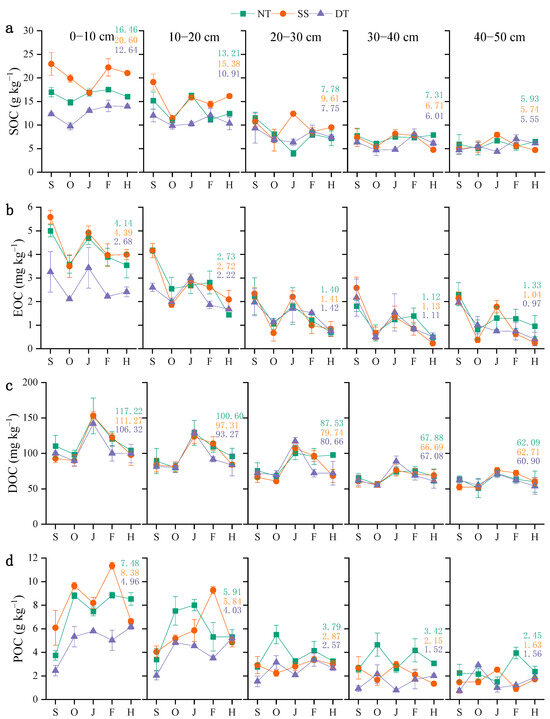
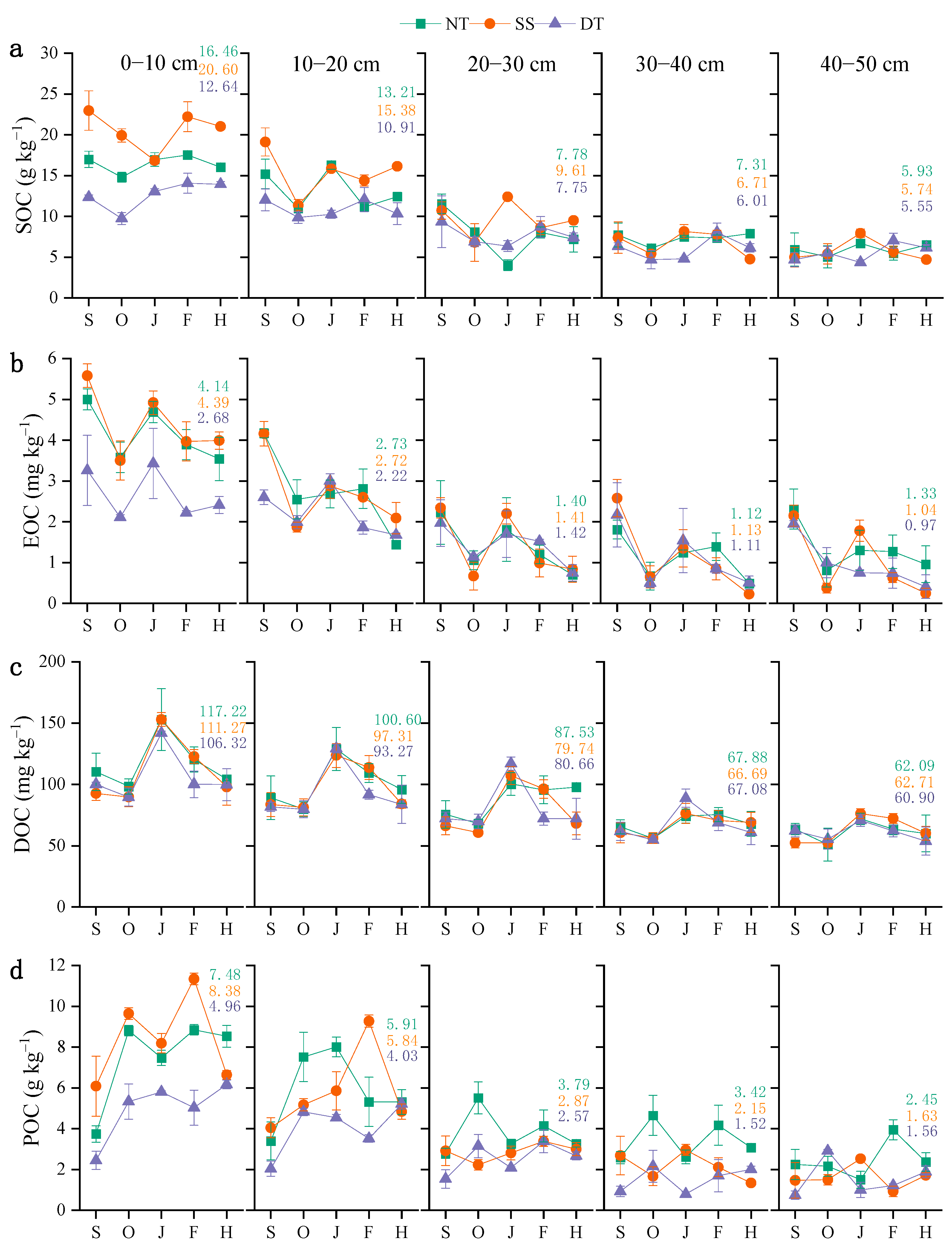
SOC content generally decreased with increasing soil depth across all tillage treatments and growth stages (Figure 1a). The differences among treatments were primarily observed in the 0–20 cm soil layer. In the 0–10 cm layer, SS consistently maintained the highest SOC content throughout the growth stages, followed by NT, while DT showed the lowest values. In the 10–20 cm layer, both SS and NT treatments exhibited higher SOC contents compared with DT, particularly during the sowing and filling stages. In contrast, in the deeper soil layers (20–50 cm), the SOC content dropped to a lower level and the variation among treatments diminished.
Figure 1.
Soil organic carbon (SOC, (a)), easily oxidizable organic carbon (EOC, (b)), dissolved organic carbon (DOC, (c)) and particulate organic carbon (POC, (d)) after different tillage treatments at growth stages of sowing (S), overwintering (O), jointing (J), filling (F) and harvest (H). NT, no tillage; SS, subsoiling tillage; DT, deep tillage. The numbers represent the average values of the five growth periods for each tillage treatment.
EOC content generally decreased with increasing soil depth (Figure 1b). A consistent seasonal variation was observed across all soil profiles. EOC content declined from the sowing to the overwintering stage, followed by a recovery during the jointing or filling stages. However, the impact of tillage practices was primarily concentrated in the 0–20 cm soil layer, where SS and NT significantly enhanced EOC content compared with DT.
DOC content generally decreased with soil depth (Figure 1c). The dynamics of DOC content presented a distinct “single-peak” seasonal pattern across the entire soil profile and reached a maximum at the jointing stage. Slight differences were observed among NT, SS, and DT treatments across all soil layers.
POC content exhibited greater fluctuation during the growth stages compared with other fractions and increased throughout the experimental period (Figure 1d). In the 0–10 cm layer, the SS treatment showed a substantial increase in POC at the filling stage, reaching its maximum value, whereas DT remained relatively low. The NT treatment generally maintained intermediate values. Conversely, the POC content decreased and fluctuated irregularly in the deeper soil profile (20–50 cm).
3.2. Total Nitrogen (TN) and Its Labile Fractions
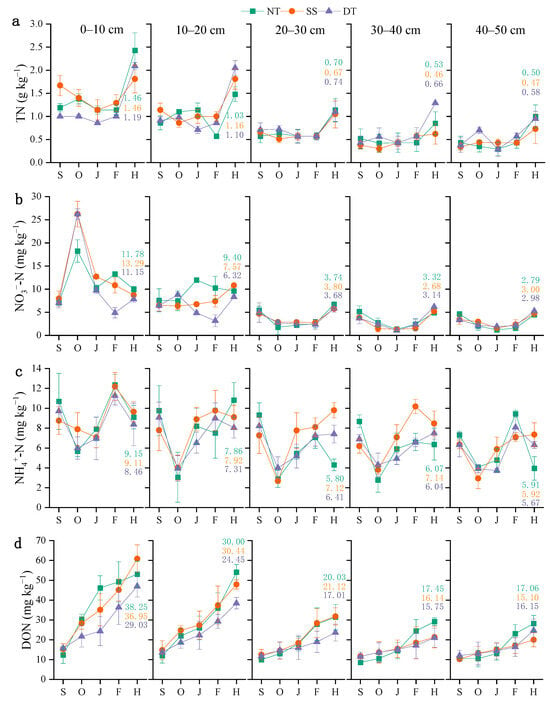
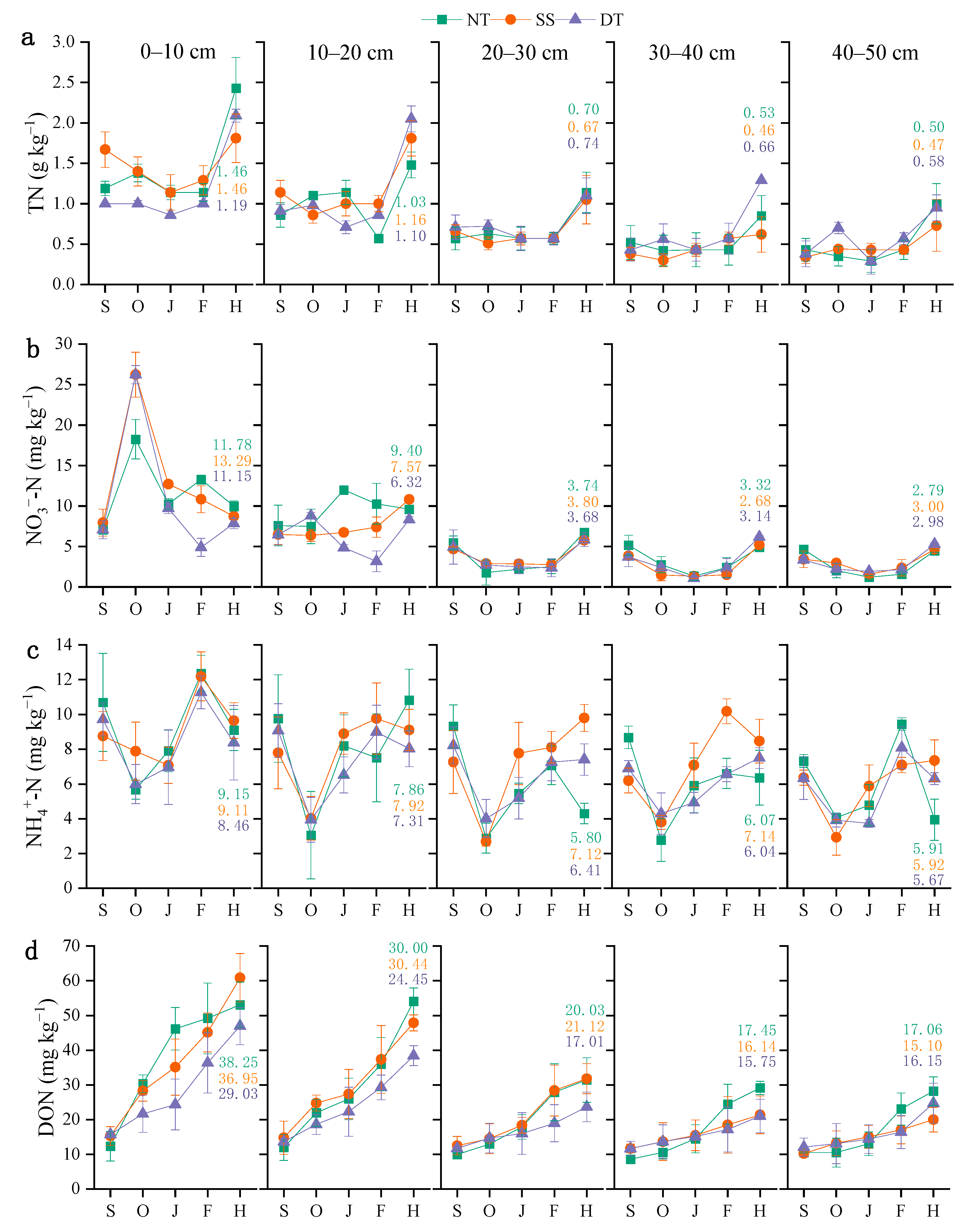
The variation of TN among tillage treatments was primarily confined to the 0–20 cm soil layer (Figure 2a). SS and NT treatments generally maintained higher TN levels compared with DT in the 0–10 cm layer during early stages. In contrast, in the deeper soil layers (20–50 cm), the TN content under DT was relatively higher than that under SS and NT.
Figure 2.
Soil total nitrogen (TN, (a)), nitrate nitrogen (NO3−-N, (b)), ammonium nitrogen (NH4+-N, (c)) and dissolved organic nitrogen (DON, (d)) after different tillage treatments at growth stages of sowing (S), overwintering (O), jointing (J), filling (F) and harvest (H). NT, no tillage; SS, subsoiling tillage; DT, deep tillage. The numbers represent the average values of the five growth periods for each tillage treatment.
The dynamics of NO3−-N showed distinct spatial and temporal patterns (Figure 2b). In the 0–10 cm layer, a dramatic peak was observed at the overwintering stage, followed by a sharp decline. Notably, at this specific peak (overwintering stage), the NO3−-N contents under DT and SS treatments were comparable and reached the highest values, whereas the NT treatment was noticeably lower. In the 10–20 cm layer, the trends fluctuated, with NT generally showing higher values in the later growth stages. Conversely, in the deeper profiles (20–50 cm), the NO3−-N content remained at a low level and exhibited less difference among tillage treatments.
The content of NH4+-N exhibited a consistent temporal variation trend across the entire soil profile (from 0–10 cm to 40–50 cm) (Figure 2c). Temporally, the NH4+-N content generally decreased from the sowing stage to the overwintering stage, subsequently increased to reach a peak at the filling stage, and finally declined again at the harvest stage. This “drop–rise–drop” seasonal pattern was observed in all soil layers.
Unlike other N fractions, DON content increased continuously from sowing to harvest across the entire soil profile (Figure 2d). The impact of tillage was primarily observed in the 0–20 cm layers. In the 0–10 cm layer, the SS and NT treatments exhibited a faster accumulation rate of DON, resulting in noticeably higher values than DT at the late growth stages (filling and harvest). While the increasing temporal trend persisted in the deeper soil layers (20–50 cm), the magnitude of the increase was reduced. In the 30–40 cm and 40–50 cm layers, the differences among treatments narrowed, and the DON values for NT, SS, and DT were largely comparable throughout the growth period.
3.3. C/N
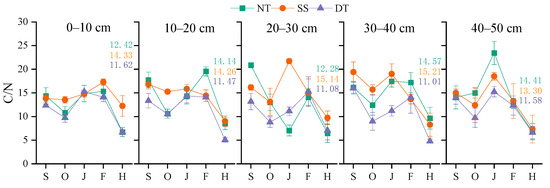
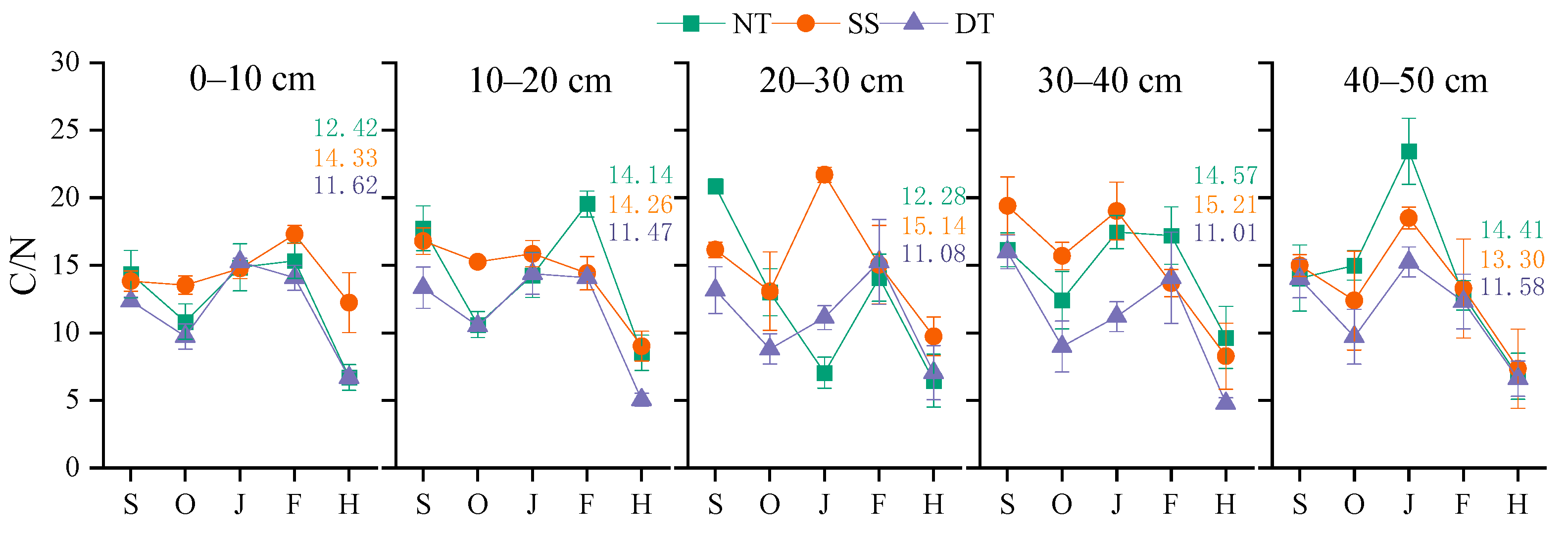
The soil C/N ratio exhibited distinct seasonal variations across soil depths (Figure 3). The C/N ratio decreased from the sowing stage to the overwintering stage and subsequently increased at the jointing stage. Following the peak at the jointing stage, the dynamics varied by soil depth and tillage treatment. NT and SS maintained a relatively high C/N ratio overall, which was higher than that of DT.
Figure 3.
C/N ratio after different tillage treatments at growth stages of sowing (S), overwintering (O), jointing (J), filling (F) and harvest (H). NT, no tillage; SS, subsoiling tillage; DT, deep tillage. The numbers represent the average values of the five growth periods for each tillage treatment.
3.4. Stocks and Contribution Rates of C and N Fractions
The SOC stocks in the 0–50 cm soil layer under NT, SS and DT were 149.82, 166.20 and 122.04 t ha−1, respectively. The TN stocks in the 0–50 cm soil layer under NT, SS and DT were 12.38, 12.11 and 12.18 t ha−1, respectively. Generally, the stocks and contribution rates of all measured SOC and TN decreased with increasing soil depth, indicating a clear phenomenon of surface accumulation (Table 1). The contribution rate of SOC and TN in the 0–10 cm soil layer was the highest. Additionally, conservation tillage (SS and NT) generally exhibited higher contribution rates compared with DT, suggesting a stronger stratification effect. As shown in the deeper layers (e.g., 30–50 cm), the contribution rates of SOC and TN under DT were generally higher than those under SS and NT.
Table 1.
Stocks and contribution rates of SOC and TN between soil depths (mean of the five growth stages).
3.5. Correlation Between C and N Fractions
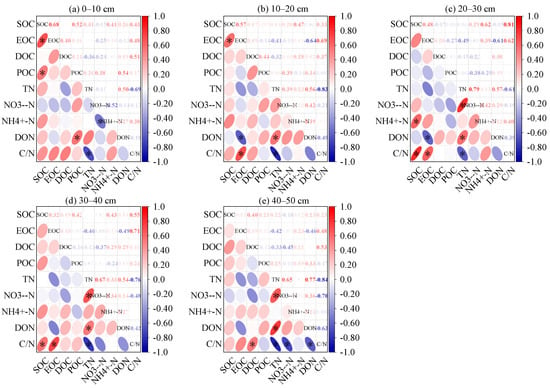
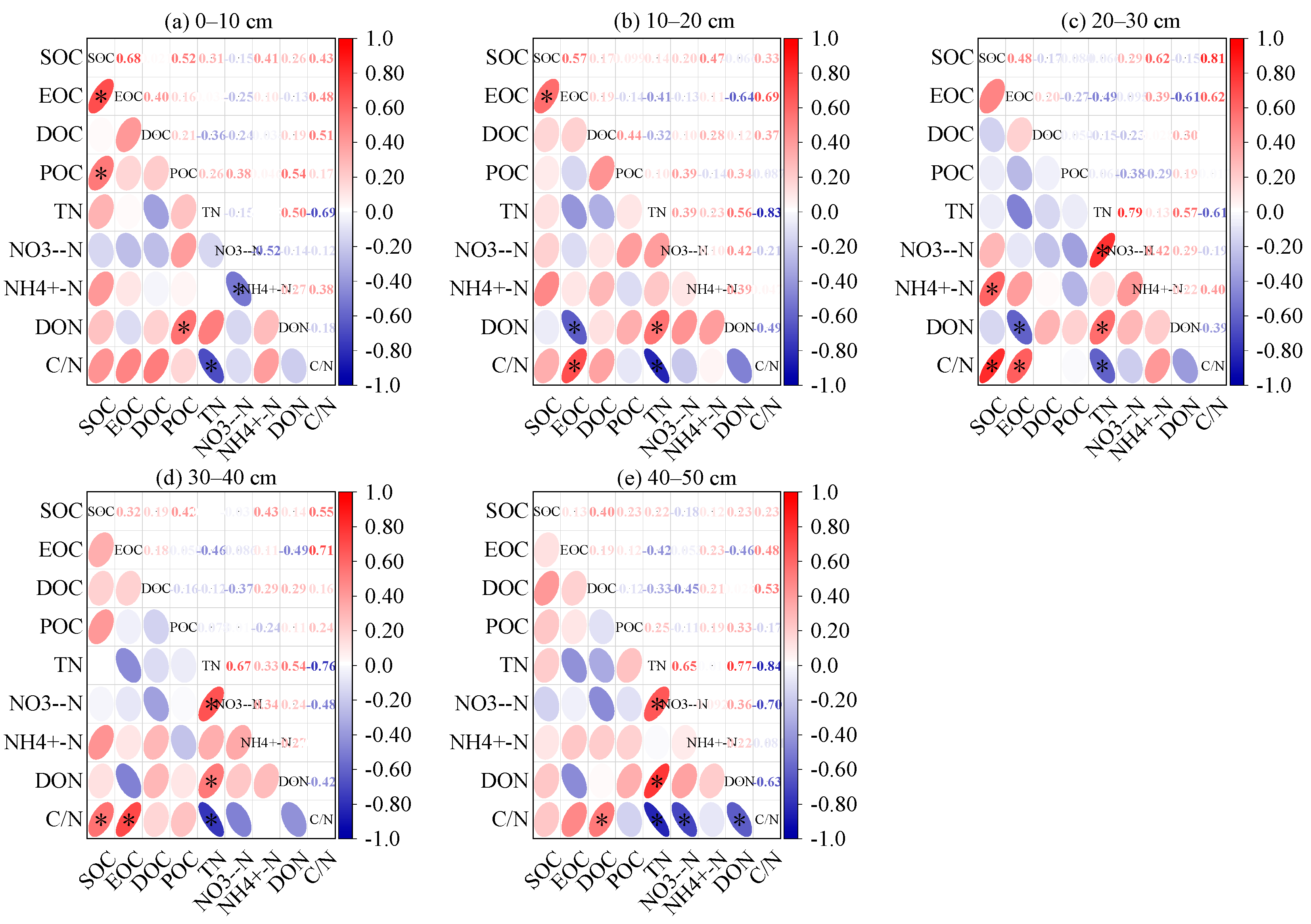
Pearson correlation analysis was used to explore the pairwise relationships among SOC, TN and their fractions in different soil layers, and the correlation heatmap was shown in Figure 4. The relationships among SOC, TN, and their fractions exhibited distinct patterns across different soil depths. SOC and EOC showed a positive correlation across all soil layers, and this correlation weakened with increasing soil depth. TN and DON maintained a significantly positive correlation across all soil layers. As the soil depth increases, the relationship between TN and NO3−-N changed from negative to significantly positive, while the relationship between TN and NH4+-N shifted from significantly negative to no significant positive correlation. The C/N ratio exhibited a positive correlation with SOC, EOC and DOC, but was negatively correlated with POC. In addition, the C/N ratio was negatively correlated with most N fractions (Figure 4).
Figure 4.
Correlation between C and N fractions under different soil layers of 0–10 cm (a), 10–20 cm (b), 20–30 cm (c), 30–40 cm (d), 40–50 cm (e). * indicate significant correlation at p < 0.05.
3.6. Soil Bulk Density
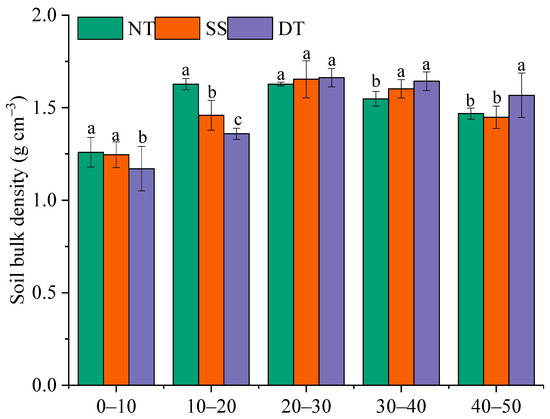
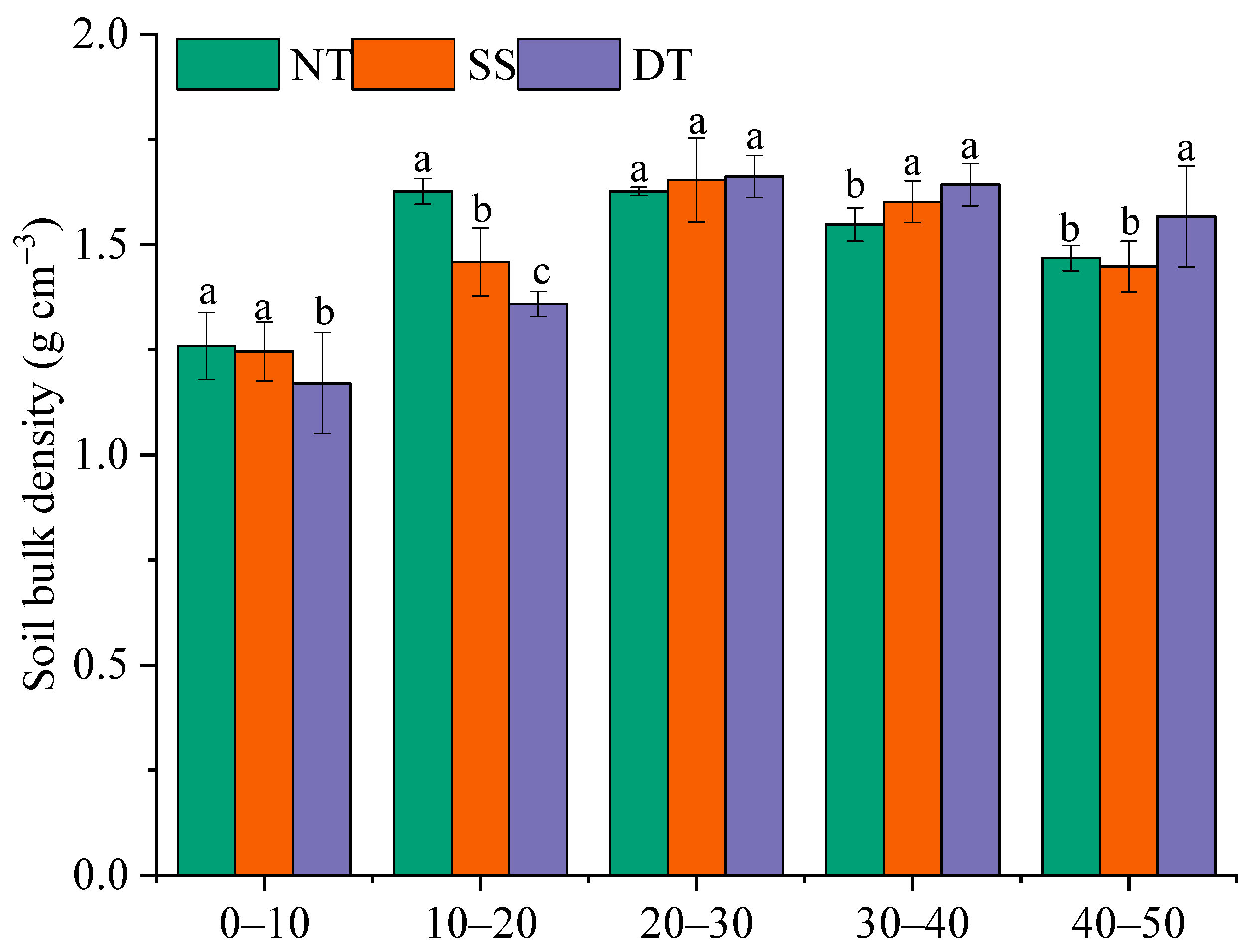
Soil bulk density varied with depth across all tillage systems, generally increasing to a maximum in the 20–30 cm layer and then decreasing (Figure 5). In the 30–50 cm deep soil layer, BD under DT was significantly higher than that under NT and SS (p < 0.05). The maximum soil bulk density was observed in the 20–30 cm soil layer with no significant difference among tillage treatments. In the 0–10 and 10–20 cm depths, soil bulk density showed a sequence of NT > SS > DT. In contrast, soil bulk density under DT was significantly higher than those under NT and SS in the 30–40 cm and 40–50 cm depth.
Figure 5.
Soil bulk density under different tillage systems after harvest in 2022. Error bars represent standard error. Means followed by the different letters in the same depth across different tillage systems are significantly different at p < 0.05.
3.7. Soil Water Content
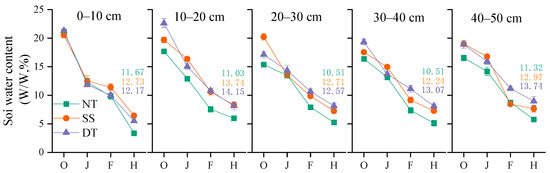
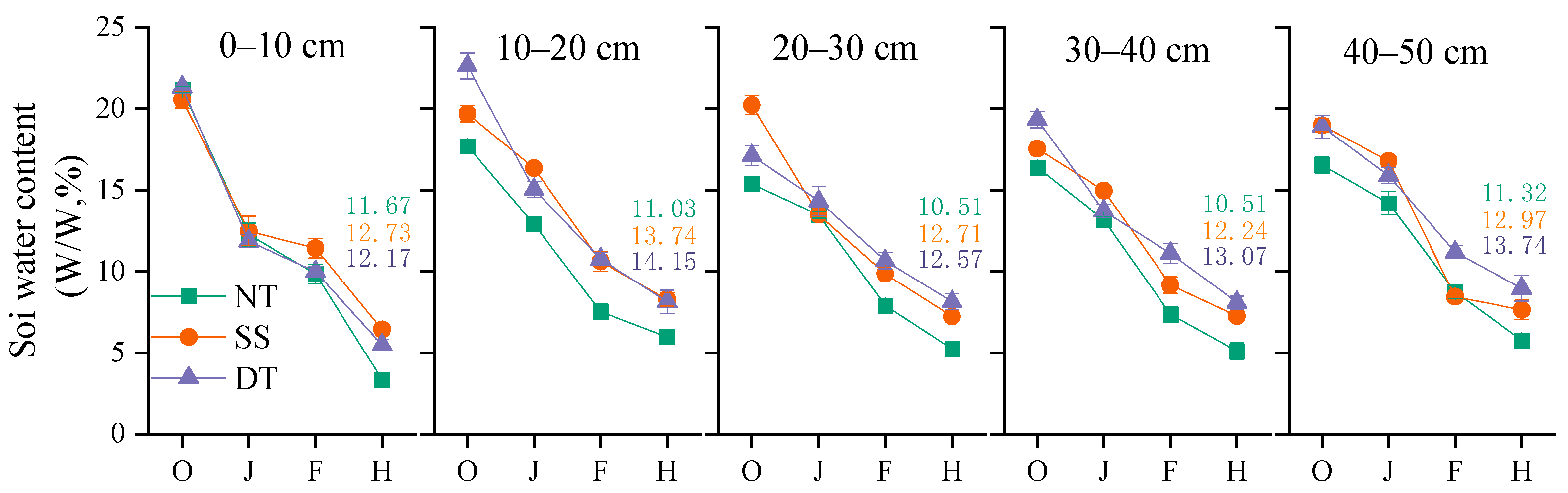
The spatial and seasonal dynamics of SWC were illustrated in Figure 6. SWC exhibited a downward trend from the overwintering stage to the harvest stage across all soil depths. The SS and DT treatments showed higher SWC compared with NT in 20–50 cm soil layers throughout the experimental period.
Figure 6.
Soil water content under different tillage systems at four growth stages (overwintering, O; jointing, J; filling, F; harvest, H) in the 2021–2022 growing season (the 5th year of the long-term tillage experiment). NT: no tillage; SS: subsoiling tillage; DT: deep tillage.
4. Discussion
This study provides comprehensive insights into the spatial and seasonal dynamics of soil physical properties, organic carbon, and nitrogen fractions under three distinct tillage systems in a dryland winter wheat cropping system. The results highlight a clear trade-off: conservation tillage practices (NT and SS) promote the stratification and accumulation of nutrients in the surface soil, whereas deep tillage (DT) facilitates a more uniform distribution and improves conditions in the subsoil. This discussion interprets these core findings within the context of the existing literature and the specific knowledge gaps addressed in the introduction.
4.1. Vertical Redistribution of Soil C and N Fractions Under Different Tillage Practices
A central debate in tillage research is whether practices like NT genuinely sequester additional carbon or merely redistribute it upward [16]. Our contribution rate analysis offers strong evidence for redistribution. The significantly higher contribution of the 0–10 cm layer to SOC, TN, EOC, and DON stocks under NT and SS confirms a pronounced stratification effect. Our results align with several long-term tillage studies from similar dryland systems. In the Loess Plateau, five years of NT and SS increased SOC in the 0–10 cm layer relative to DT [22], a pattern consistent with the 27.7% and 31.0% higher SOC we observed under NT and SS at the same depth. The 27.7% contribution of the 0–10 cm layer to total SOC under NT in our study also mirrors earlier findings that NT promotes surface enrichment of organic carbon [14]. For nitrogen, the greater TN stratification under NT and SS. The more uniform distribution of SOC and TN in the 30–50 cm layer under DT is likewise consistent with reports that deep tillage increases subsoil C and N compared with NT [17]. Together, these comparisons reinforce the view that tillage primarily redistributes organic matter within the profile rather than fundamentally altering total stocks. This surface accumulation is driven by the concentration of crop residues, reduced microbial decomposition due to less disturbance, and limited downward movement of particulate organic matter [25]. This stratification effect results in a pronounced vertical heterogeneity of nutrients within the soil profile. Such heterogeneity is fundamentally driven by several well-established mechanisms: Long-term nutrient inputs have promoted nutrient accumulation within the soil profile [26]. Because fertilizers are mostly applied to the surface layer, nutrients tend to gradually accumulate in the topsoil, whereas the subsoil receives limited external inputs and thus contains relatively lower nutrient contents. In addition, the surface retention of crop residues further enhances nutrient accumulation in the upper soil layers.
Conversely, DT led to a more uniform vertical distribution, with relatively higher contribution rates in the 30–50 cm layer compared with NT/SS. This homogenization is a direct result of residue incorporation and soil mixing, which transports organic materials deeper into the profile. Therefore, our study supports the view that a primary effect of tillage is to redistribute soil C and N within the soil profile, rather than significantly increasing the total C stock in the 0–50 cm profile. Although DT promoted the redistribution of SOC into the deep soil layer, it did not increase the total SOC stock in the 0–50 cm profile compared with SS and NT. In contrast, SS and NT significantly increased SOC content in the 0–10 cm surface layer, where soil microbial activity, root density and extracellular enzyme activity are the highest. The enhancement of surface SOC pool is more critical for maintaining soil fertility, nutrient supply capacity and microbial function in dryland wheat fields, as the surface layer is the core area of soil biochemical processes and crop nutrient uptake. This suggests that SS can balance the improvement of surface soil fertility and the maintenance of subsoil structure, which is a more suitable tillage practice for enhancing soil C sequestration and fertility sustainability in the study area.
This conclusion, however, is based on an aggregate assessment of soil fertility. When examined separately for long-term carbon storage and crop nutrient availability, the contrasting distribution patterns under different tillage systems have distinct ecological and agronomic implications.
For long-term carbon storage, surface stratification under NT and SS has both distinct advantages and inherent limitations. The SOC accumulated in the 0–10 cm layer under these practices consists largely of particulate organic carbon (POC) and other labile fractions, consistent with our finding that SS significantly increased POC content in the 0–10 cm layer at the filling stage (Figure 1d, Table 1), materials that turn over rapidly and remain susceptible to environmental disturbance. Whether this surface-enriched labile carbon can transition into more stable, mineral-associated forms depends on long-term sustained organic inputs and soil mineral interactions, which cannot be fully confirmed in our 5-year experiment. Conservation tillage does provide continuous straw and root-derived carbon at the surface, which may eventually contribute to mineral-associated organic carbon (MAOC) formation. However, MAOC was not measured in this study, and its formation in these systems remains to be confirmed.
DT offers a different pathway. By placing crop residues and organic matter into the 30–50 cm layer, DT moves carbon into an environment where decomposition is typically slower—cooler, less oxygenated, and microbiologically less active. Organic carbon reaching this depth may therefore persist longer than surface-accumulated carbon. Yet the subsoil’s inherent limitations including low organic matter content and limited microbial biomass, also constrain the formation of stable carbon pools. This likely explains why DT, despite moving carbon downward, did not increase total profile SOC stocks relative to SS and NT.
For crop nutrient availability, this trade-off has both spatial and temporal dimensions. The surface enrichment under SS and NT supports early wheat growth, when roots explore the 0–20 cm layer. But in the Loess Plateau, surface soil drought during grain filling can render this nutrient capital less accessible. Deep tillage, by distributing nutrients and water more evenly through the 30–50 cm soil layer, aligns better with the deeper root system that wheat develops by late season. Under dry conditions, this alignment may sustain grain filling when surface resources are depleted.
These contrasting effects between surface and deep soil, early and late growth stages, and labile and persistent C pools do not yield a universally optimal tillage practice for all scenarios. Instead, they point to a set of trade-offs that should inform site-specific recommendations. In the context of this study, SS emerges as the most balanced strategy for most scenarios in the study area, simultaneously improving surface fertility, crop yield, and overall C sequestration. DT, by contrast, may be better suited to fields with severe subsoil compaction or frequent late-season drought, where long-term C storage and drought resilience take priority.
4.2. Seasonal Dynamics of Labile C and N Fractions
This study addresses a key knowledge gap by tracking labile C and N fractions across five critical wheat growth stages, revealing the distinct temporal patterns of each biologically active pool. DOC showed a consistent single-peak seasonal pattern across all tillage treatments and soil depths, with the highest values recorded at the jointing stage. The jointing stage is the period of the most vigorous vegetative growth of winter wheat, with rapid root elongation and massive root exudation of low-molecular-weight organic compounds (e.g., sugars, organic acids), which is the dominant source of DOC in the rhizosphere soil [21]. This DOC pulse provides a highly available carbon substrate for the soil microbiome, stimulating rapid microbial turnover and extracellular enzyme activity, which in turn accelerates the mineralization of soil organic matter and the release of available nutrients to match the high nutrient demand of wheat during the rapid growth period. The lack of significant tillage effect on DOC underscores that its dynamics are dominated by crop root growth and seasonal biological drivers rather than soil management in this system.
Similarly, the seasonal patterns of EOC (decline then recovery) and NH4+-N (drop–rise–drop) were consistent across treatments. EOC, as a labile C pool sensitive to management practices, decreased during the overwintering stage due to the continuous microbial utilization of available C under low-temperature conditions, and recovered during the jointing and filling stages with the supplement of root exudates and crop residue decomposition. However, tillage did modulate the magnitude of these pools in the surface layer for EOC and DON. The faster accumulation of DON under SS and NT towards harvest suggests that conservation tillage promotes the retention and slow release of organic nitrogen forms in the biologically active surface layer. DON, as the major component of dissolved organic nitrogen in dryland soils, not only acts as a temporary nitrogen pool to avoid leaching loss, but also can be directly utilized by specific microbial communities and crop roots through mineralization, which enhances the synchrony between nitrogen availability and crop demand during the late growth stage, thereby improving nitrogen use efficiency.
Importantly, while total TN stocks in the 0–50 cm profile showed no significant differences among tillage systems, the surface accumulation of N fractions under SS and NT is agronomically significant. It concentrates nitrogen where it is most accessible to crops and soil biota. It concentrates nutrients where they are most accessible to crops and soil biota, thereby sustaining soil fertility and ecosystem functions in dryland wheat fields [27]. The dramatic but transient peak of NO3−-N in the surface layer at the overwintering stage under DT and SS was likely attributed to accelerated mineralization of incorporated residues, coupled with limited plant N uptake. This pattern poses a potential risk of N leaching prior to the rapid spring crop growth [28]. These findings affirm that single-time sampling (e.g., at harvest) can misrepresent the nutrient availability and turnover dynamics induced by different tillage practices [29].
4.3. Coupling Relationships Between Soil C and N Fractions Across Soil Depths
The depth-dependent changes in correlations between key variables provide mechanistic insights into nutrient coupling. The weakening positive correlation between SOC and EOC with increasing soil depth suggests that the intimate, biologically driven relationship between total and labile carbon pools is strongest in the biologically active topsoil and decouples in the more stable, mineral-associated C pool in the subsoil [30].
More intriguing are the shifts in TN’s relationship with inorganic N. The change from negative to positive correlations between TN and NO3−-N/NH4+-N as depth increases is profound. In the surface layer, high TN (often associated with organic matter) is inversely related to inorganic N, likely because active microbial immobilization and plant uptake quickly scavenge mineralized N [31]. In deeper layers, where organic matter and microbial activity are low, the presence of TN (likely in more stable forms) and mineral N may be co-regulated by slower, abiotic processes like leaching and adsorption, leading to a positive association [32]. This highlights that the mechanisms governing N cycling and storage are fundamentally different across the soil profile, and tillage practices that alter vertical distribution can therefore influence these mechanisms.
4.4. Driving Effects of Soil Physical Properties on Soil C and N Dynamics
Our observed pattern of soil bulk density was highest under NT in the 0–20 cm layer and under DT in the 30–50 cm layer, directly reflects the mechanical action of each tillage practice. The increase in surface bulk density under NT observed in this study reflects a well-documented trade-off of long-term no-tillage systems. Without periodic loosening, the surface layer gradually consolidates under the combined effects of raindrop impact, machinery traffic, and natural settling [33]. Whether this compaction becomes agronomically significant, however, depends on soil texture and organic matter status. In coarse-textured soils with limited clay content, such as the loess silt loam at our site (13.6% clay in the 0–20 cm layer; see Section 2.1), the inherent structural stability is low, and natural alleviation of compaction over time is minimal. Soil organic carbon can partly counteract this process by promoting aggregation and porosity [3]. However, in this study, soil organic carbon (SOC) accumulation under no-tillage (NT), although higher than under deep tillage (DT), remained lower than under straw incorporation (SS), thus offering only limited protection against soil compaction. The relatively wet growing season of 2021–2022 (258.2 mm precipitation) may have further exacerbated the surface compaction under NT, as repeated raindrop impact on the inter-row soil, which is not mitigated by tillage, enhances particle rearrangement and settling. This pattern is consistent with observations from other semi-arid rainfed systems [34]. In contrast, the significant reduction in surface BD under DT and SS is attributed to the intense loosening and inversion of the plow layer, which temporarily increases porosity [35]. However, the notably higher BD in the 30–50 cm layer under DT is a critical finding. It suggests that, while DT disrupts the plow pan in the 20–30 cm layer, the weight of heavier machinery used for deep tillage operations and the subsequent settling of disrupted soil layers may lead to re-compaction at the bottom of the tillage zone, creating a new dense plow pan after long-term repeated DT treatments at the same depth [36]. This aligns with previous long-term tillage studies on the Loess Plateau, which have reported that repeated deep tillage at a fixed depth induces subsoil compaction at the tillage layer bottom. This underscores that the benefits of deep tillage on soil structure are depth-specific and potentially transient, necessitating periodic adjustment of the tillage depth.
The dynamics of soil water content (SWC) further elucidate the functional consequences of these physical changes. As expected, SWC exhibited a consistent downward trend from the overwintering stage to the harvest stage across all soil depths, which was consistent with the seasonal drying trend of the climate in the study area, with precipitation mainly concentrated in the fallow period (July–September) and less precipitation during the wheat growth period. The superior water retention of DT and SS in the 0–20 cm layer during the overwintering stage aligns with their lower bulk density, which enhances infiltration and water-holding capacity [37]. The subsequent shift, where SS became most effective in maintaining surface moisture (0–10 cm) during the late growing season while DT excelled in the subsoil (20–50 cm), is particularly significant. This can be explained by the combined effects of tillage-induced soil structure alteration, straw management and crop root growth observed in this study.
On the one hand, DT broke the original plow pan in the 20–30 cm layer measured in this experiment, increased soil pore connectivity, and thus promoted precipitation infiltration into the deep soil layer, enhancing deep soil water storage. Although bulk density in the 30–50 cm layer was increased under DT due to mechanical re-compaction, the improved pore structure in the tilled layer still enhanced deep water percolation and storage, which was consistent with previous studies in the Loess Plateau dryland region [38]. On the other hand, DT incorporated crop straw into the deep soil layer, which promoted root elongation to the subsoil, and the water uptake of deep roots further drove the redistribution of soil water to the deep layer. Meanwhile, SS, with partial surface residue retention, created a more stable porous structure in the surface layer that reduced evaporation [34], and the higher SOC content in the surface layer under SS measured in this study improved soil aggregate stability and water-holding capacity, which further enhanced surface soil water retention in the late growth stage. In addition, the deep soil water stored under DT was less susceptible to direct evaporation, which could be used by crops in the late growth stage with high water demand. This demonstrates that optimal tillage for water conservation is not universal but rather depends on the target soil depth and crop growth stage.
4.5. Tillage Management Implications, Regional Applicability and Research Prospects
For farmers in arid and semi-arid regions like the Loess Plateau, the choice of tillage involves balancing immediate agronomic benefits with long-term sustainability. Our soil water content measurements throughout the growing season provide direct evidence for the differential effects of tillage practices on soil moisture regulation under the specific soil and climatic conditions of this study (loess silt loam; growing season precipitation 258.2 mm, representing a hydrologically typical year for winter wheat production in this region). SS consistently maintained higher water content in the 0–10 cm surface layer during the late growth stages (jointing–harvest), effectively improving surface water retention during the critical grain-filling period when water stress is most detrimental to yield. In contrast, DT showed consistently higher water content in the 20–50 cm subsoil layers throughout the experimental period, demonstrating its advantage in deep water storage that can be accessed by roots during drought.
Therefore, within the context of this study, SS appears to be the most balanced strategy, effectively enhancing surface soil fertility (SOC, TN) and surface water retention simultaneously, while maintaining favorable soil structure without causing excessive subsoil compaction. DT remains a powerful tool for breaking deep compaction and improving deep water storage, which could be particularly advantageous in drier years or on soils with inherent subsoil compaction problems. However, DT may not benefit surface fertility in the short term and could increase nitrification risks due to enhanced aeration.
It should be noted that the effects of tillage practices on soil C and N fractions are closely related to the soil type and climatic conditions of the study area. This study was conducted in the loess silt loam soil of the semi-arid Loess Plateau, where soil water is the primary limiting factor for winter wheat production. Therefore, the regulatory effect of tillage on soil water content is the core driver of the vertical distribution and seasonal dynamics of C and N fractions in this study. The conclusions of this study are mainly applicable to the dryland winter wheat fields with similar loess soil and semi-arid climatic conditions in the Loess Plateau of China, and the applicability in other soil types and climatic regions needs to be further verified by long-term in situ experiments.
Future research should extend monitoring beyond 50 cm to fully account for deep C sequestration potential and leaching losses. Long-term studies (>10 years) are also needed to assess whether the tillage-related patterns documented here are sustainable over time. Furthermore, integrating measurements of microbial community structure and enzyme activity with the nutrient fraction data would provide a more complete picture of the biological mechanisms underlying the observed spatiotemporal dynamics.
5. Conclusions
In conclusion, this study demonstrates that no tillage (NT), subsoiling (SS), and deep tillage (DT) create distinct soil physical and biochemical environments that differentially regulate the vertical distribution and seasonal dynamics of carbon and nitrogen. SS emerged as the optimal balanced strategy, optimizing surface soil quality and water retention while avoiding the subsoil compaction associated with DT. DT is more effective at enhancing deep soil water storage. The observed seasonal dynamics of labile fractions confirm that nutrient availability is highly stage-dependent, and the shifting correlations with depth reveal changing nutrient coupling mechanisms across the soil profile.
Based on these findings, the choice of tillage practice can be further refined according to local conditions. SS balances surface enrichment and deep distribution of nutrients, achieving both high total C and N sequestration and efficient crop nutrient supply, making it the optimal tillage strategy for most fields in the study area. DT serves as a valuable alternative for fields with severe subsoil compaction or frequent late-season drought, improving deep soil water and nutrient supply capacity. NT remains suitable for fields with high surface fertility, helping to maintain long-term soil health with minimal disturbance. Together, these findings emphasize that optimal tillage management should be tailored to specific soil depth goals, crop water needs, and long-term soil health objectives in dryland agriculture.
Author Contributions
Conceptualization, L.W.; methodology, L.W. and H.L.; software, L.W. and F.D.; validation, L.W., T.X. and H.L.; formal analysis, H.L.; investigation, L.W., T.X. and S.Y.; resources, F.D., S.Y. and Q.Y.; data curation, L.W., F.D. and T.X.; writing—original draft preparation, L.W.; writing—review and editing, X.Y. and S.Y.; visualization, L.W. and X.Y.; supervision, Q.Y.; project administration, Q.Y.; funding acquisition, Q.Y. All authors have read and agreed to the published version of the manuscript.
Funding
This work was financially supported by the Key Research and Development Project of Linfen (Research and Application on Key Technologies for Root-Type Construction to Enhance Yield of Dryland Wheat under Water Storage and Soil Moisture Conservation Mode) and the Joint Funds of the National Natural Science Foundation of China (No. U22A20609) and the Open Fund from the State Key Laboratory of Soil Environment and Nutrient Resources of Shanxi Province (No. 2020002).
Data Availability Statement
The original contributions presented in this study are included in the article. Further inquiries can be directed to the corresponding authors.
Acknowledgments
The authors gratefully acknowledge the Wheat Research Institute of Shanxi Agricultural University and the Linfen Comprehensive Scientific Observation and Experiment Station of the Ministry of Agriculture and Rural Affairs for experimental site and field management support. We also thank the College of Resources and Environment at Shanxi Agricultural University for access to instrumental facilities and technical assistance. During the preparation of this manuscript, the authors used GenAI tools for minor writing assistance including grammar correction, sentence structure optimization, and formatting standardization of the text. All content generated by the tools has been carefully reviewed, revised and verified by the authors, who take full responsibility for the originality, accuracy and integrity of the entire manuscript. No translation tools were used in the preparation of this manuscript.
Conflicts of Interest
The authors declare no conflicts of interest.
Abbreviations
The following abbreviations are used in this manuscript:
| NT | no tillage |
| SS | subsoiling tillage |
| DT | deep tillage |
| SOC | soil organic carbon |
| EOC | easily oxidizable organic carbon |
| DOC | dissolved organic carbon |
| POC | particulate organic carbon |
| TN | soil total nitrogen |
| NO3−-N | nitrate nitrogen |
| NH4+-N | ammonium nitrogen |
| DON | dissolved organic nitrogen |
| BD | soil bulk density |
| SWC | soil water content |
| ANOVA | analysis of variance |
| LSD | least significant difference |
| PCA | principal component analysis |
References
- Abbott, L.K.; Murphy, D.V. Soil Biological Fertility—A Key to Sustainable Land Use in Agriculture; Springer: Dordrecht, The Netherlands, 2003. [Google Scholar]
- Sainju, U.M.; Lenssen, A.W.; Caesar-TonThat, T.; Jabro, J.D.; Lartey, R.T.; Evans, R.G.; Allen, B.L. Dryland residue and soil organic matter as influenced by tillage, crop rotation, and cultural practice. Plant Soil 2011, 338, 27–41. [Google Scholar] [CrossRef] [Scilit]
- Page, K.L.; Dang, Y.P.; Dalal, R.C. The ability of conservation agriculture to conserve soil organic carbon and the subsequent impact on soil physical, chemical, and biological properties and yield. Front. Sustain. Food Syst. 2020, 4, 31. [Google Scholar] [CrossRef] [Scilit]
- Stavi, I.; Bel, G.; Zaady, E. Soil functions and ecosystem services in conventional, conservation, and integrated agricultural systems: A review. Agron. Sustain. Dev. 2016, 36, 32. [Google Scholar] [CrossRef] [Scilit]
- Ghaly, A.E.; Ramakrishnan, V.V. Nitrogen sources and cycling in the ecosystem and its role in air, water and soil pollution: A critical review. J. Pollut. Eff. Control 2015, 3, 136. [Google Scholar]
- Lehmann, J.; Bossio, D.A.; Kögel-Knabner, I.; Rillig, M.C. The concept and future prospects of soil health. Nat. Rev. Earth Environ. 2020, 1, 544–557. [Google Scholar] [CrossRef] [Scilit] [PubMed]
- Lal, R. Soil health and carbon management. Food Energy Secur. 2016, 5, 212–222. [Google Scholar] [CrossRef] [Scilit]
- Kopittke, P.M.; Menzies, N.W.; Wang, P.; McKenna, B.A.; Lombi, E. Soil and the intensification of agriculture for global food security. Environ. Int. 2019, 132, 105078. [Google Scholar] [CrossRef] [Scilit]
- Xu, T.; Yang, X.; Li, H.; Wang, L.; Dong, F.; Yan, S.; Yan, Q.; Zhang, J. Evaluating tillage optimization, soil thresholds, and drivers for maize yield and WUE in China’s semiarid loess Plateau: A meta-analysis. J. Agric. Food Res. 2026, 25, 102608. [Google Scholar] [CrossRef] [Scilit]
- Wang, X.; Yang, Q.; Ji, Z.; Li, W.; Feng, W.; Zhang, P.; Zhao, X.; Liu, T.; Liu, E.; Siddique, K.H.; et al. Biennial subsoiling with ridge-furrow planting enhances soil quality, ecosystem multifunctionality and maize yield on the Loess Plateau. Soil Tillage Res. 2026, 256, 106871. [Google Scholar] [CrossRef] [Scilit]
- Jiang, R.; Liu, S.; Jiang, F.; Guo, Z.; Adingo, S.; Chen, Z.; Gao, L.; Peng, X. Soil organic carbon trade-offs under conservation tillage: Carbon stock versus stability mediated by particulate and mineral-associated fractions. Soil Tillage Res. 2025, 254, 106704. [Google Scholar] [CrossRef] [Scilit]
- Gautam, A.; Anuo, C.O.; Kladivko, E.; Vyn, T.J.; Armstrong, S. Does 46 years of conservation tillage and crop rotations change soil carbon and nitrogen distribution and storage? Soil Tillage Res. 2025, 254, 106702. [Google Scholar] [CrossRef] [Scilit]
- Blanco-Canqui, H. No-till technology has limited potential to store carbon: How can we enhance such potential? Agric. Ecosyst. Environ. 2021, 313, 107352. [Google Scholar] [CrossRef] [Scilit]
- Gal, A.; Vyn, T.J.; Micheli, E.; Kladivko, E.J.; McFee, W.W. Soil carbon and nitrogen accumulation with long-term no-till versus moldboard plowing overestimated with tilled-zone sampling depths. Soil Tillage Res. 2007, 96, 42–51. [Google Scholar] [CrossRef] [Scilit]
- Olson, K.R.; Al-Kaisi, M.M. The importance of soil sampling depth for accurate account of soil organic carbon sequestration, storage, retention and loss. Catena 2015, 125, 33–37. [Google Scholar] [CrossRef] [Scilit]
- Blanco-Canqui, H.; Shapiro, C.; Jasa, P.; Iqbal, J. No-till and carbon stocks: Is deep soil sampling necessary? Insights from long-term experiments. Soil Tillage Res. 2021, 206, 104840. [Google Scholar] [CrossRef] [Scilit]
- Li, J.W.; Chen, L.; Zhang, C.Z.; Ma, D.H.; Zhou, G.X.; Ning, Q.; Zhang, J.B. Combining rotary and deep tillage increases crop yields by improving the soil physical structure and accumulating organic carbon of subsoil. Soil Tillage Res. 2024, 244, 106–252. [Google Scholar] [CrossRef] [Scilit]
- Li, H.; Zhang, Y.; Zhang, Q.; Ahmad, N.; Liu, P.; Wang, R.; Li, J.; Wang, X. Converting continuous cropping to rotation including subsoiling improves crop yield and prevents soil water deficit: A 12-yr in-situ study in the Loess Plateau, China. Agric. Water Manag. 2021, 256, 107062. [Google Scholar] [CrossRef] [Scilit]
- Wang, X.Y.; Xu, X.P.; Qiu, S.J.; Zhao, S.C.; He, P. Deep tillage enhanced soil organic carbon sequestration in China: A meta-analysis. J. Clean. Prod. 2023, 399, 136686. [Google Scholar] [CrossRef] [Scilit]
- Meng, X.C.; Meng, F.X.; Chen, P.; Hou, D.M.; Zheng, E.N.; Xu, T.Y. A meta-analysis of conservation tillage management effects on soil organic carbon sequestration and soil greenhouse gas flux. Sci. Total Environ. 2024, 954, 176315. [Google Scholar] [CrossRef] [Scilit]
- Kravchenko, Y.; Yarosh, A.; Chen, Y. Profile soil carbon and nitrogen dynamics in typical chernozem under long-term tillage use. Land 2022, 11, 1165. [Google Scholar] [CrossRef] [Scilit]
- He, L.; Lu, S.; Wang, C.; Mu, J.; Zhang, Y.; Wang, X. Changes in soil organic carbon fractions and enzyme activities in response to tillage practices in the Loess Plateau of China. Soil Tillage Res. 2021, 209, 104940. [Google Scholar] [CrossRef] [Scilit]
- Bao, S.D. Soil Agro-Chemical Analysis, 3rd ed.; China Agricultural Press: Beijing, China, 2000. (In Chinese) [Google Scholar]
- Zhao, H.; Jiang, Y.; Ning, P.; Liu, J.; Zheng, W.; Tian, X.; Shi, J.; Xu, M.; Liang, Z.; Shar, A. Effect of different straw return modes on soil bacterial community, enzyme activities and organic carbon fractions. Soil Sci. Soc. Am. J. 2019, 83, 638–648. [Google Scholar] [CrossRef] [Scilit]
- Pu, C.; Kan, Z.R.; Liu, P.; Ma, S.T.; Qi, J.Y.; Zhao, X.; Zhang, H.L. Residue management induced changes in soil organic carbon and total nitrogen under different tillage practices in the North China Plain. J. Integr. Agric. 2019, 18, 1337–1347. [Google Scholar] [CrossRef] [Scilit]
- Zulu, S.G.; Motsa, N.M.; Magwaza, L.S.; Ncama, K.; Sithole, N.J. Effects of Different tillage Practices and Nitrogen Fertiliser Application Rates on Soil-Available Nitrogen. Agronomy 2023, 13, 785. [Google Scholar] [CrossRef] [Scilit]
- Liu, C.; He, C.H.; Chang, S.X.; Chen, X.L.; An, S.S.; Wang, D.; Yan, J.; Zhang, Y.C.; Li, P. Fertilization and tillage influence on soil organic carbon fractions: A global meta-analysis. Catena 2024, 246, 108404. [Google Scholar] [CrossRef] [Scilit]
- Utzig, D.L.; Minella, J.P.G.; Schneider, F.J.A.; Londero, A.L.; Dambroz, A.B.P.; Barros, C.A.P.; Tiecher, T.; Kaiser, D.R. Nutrient transport in surface runoff and sediment yield on macroplots and zero-order catchments under no-tillage. Catena 2023, 231, 107333. [Google Scholar] [CrossRef] [Scilit]
- Gonzalez-Maldonado, N.; Deiss, L.; Ali, F.; Culman, S.W. In-season temporal variability of soil carbon and nitrogen pools after half a century of a tillage and crop rotation gradient. Soil Tillage Res. 2025, 252, 106566. [Google Scholar] [CrossRef] [Scilit]
- Liu, W.S.; Wei, Y.X.; Chen, J.H.; Han, S.W.; Liu, W.X.; Lal, R.; Zhao, X. Coupling effects of soil carbon and nitrogen mineralization on crop growth in response to tillage practices. Land Degrad. Dev. 2025, 36, 5341–5352. [Google Scholar] [CrossRef] [Scilit]
- Hao, X.; Xie, J.H.; Ouyang, W.; Tang, J.; Tang, W.Y.; Zhang, H. Seasonal rainfall variation disrupted the balance of carbon and nitrogen coupling loss in subtropical acidified watershed. Agric. For. Meteorol. 2025, 375, 110861. [Google Scholar] [CrossRef] [Scilit]
- Di Gerónimo, P.F.; Wyngaard, N.; Videla, C.D.C. Do residue quality and tillage systems modify nitrogen partitioning into different soil organic matter fractions? Soil Tillage Res. 2026, 257, 106944. [Google Scholar] [CrossRef] [Scilit]
- Mühlbachová, G.; Růžek, P.; Kusá, H.; Vavera, R.; Kaš, M. Nutrient distribution in the soil profile under different tillage practices during a long-term field trial. Agronomy 2024, 14, 3017. [Google Scholar] [CrossRef] [Scilit]
- Yan, Q.Y.; Wu, L.J.; Dong, F.; Zhang, Q.; Yang, F.; Yan, S.D.; Dong, J.L. Continuous tillage practices improve soil water storage and yields of dryland winter wheat grown for three consecutive years in North China. Arch. Agron. Soil Sci. 2023, 69, 446–460. [Google Scholar] [CrossRef] [Scilit]
- Dikgwatlhe, S.B.; Chen, Z.D.; Lal, R.; Zhang, H.L.; Chen, F. Changes in soil organic carbon and nitrogen as affected by tillage and residue management under wheat–maize cropping system in the North China Plain. Soil Tillage Res. 2014, 144, 110–118. [Google Scholar] [CrossRef] [Scilit]
- Ramadhan, M.N. Significance of tillage techniques of SOCe soil properties and maize production: A review. Int. J. Agric. Stat. Sci. 2023, 19, 1251–1265. [Google Scholar]
- Yan, Q.Y.; Wu, L.J.; Dong, F.; Yan, S.D.; Li, F.; Jia, Y.Q.; Zhang, J.C.; Zhang, R.F.; Huang, X. Subsoil tillage enhances wheat productivity, soil organic carbon and available nutrient status in dryland fields. J. Integr. Agric. 2024, 23, 251–266. [Google Scholar] [CrossRef] [Scilit]
- Dimassi, B.; Mary, B.; Fontaine, S.; Perveen, N.; Revaillot, S.; Cohan, J.P. Effect of nutrients availability and long-term tillage on priming effect and soil C mineralization. Soil Biol. Biochem. 2014, 78, 332–339. [Google Scholar] [CrossRef] [Scilit]

Disclaimer/Publisher’s Note: The statements, opinions and data contained in all publications are solely those of the individual author(s) and contributor(s) and not of MDPI and/or the editor(s). MDPI and/or the editor(s) disclaim responsibility for any injury to people or property resulting from any ideas, methods, instructions or products referred to in the content. |
© 2026 by the authors. Licensee MDPI, Basel, Switzerland. This article is an open access article distributed under the terms and conditions of the Creative Commons Attribution (CC BY) license.