Article

New Insight into the Influence of Biochar Particle Size and Aging in Soil Sorption of Fluometuron

1
Instituto de Recursos Naturales y Agrobiología de Sevilla (IRNAS), Consejo Superior de Investigaciones Científicas (CSIC), Avenida Reina Mercedes 10, 41012 Sevilla, Spain
2
U.S. Department of Agriculture, Agricultural Research Service, 439 Borlaug Hall, 1991 Upper Buford Circle, St. Paul, MN 55108, USA
*
Author to whom correspondence should be addressed.
Agronomy 2026, 16(6), 656; https://doi.org/10.3390/agronomy16060656
Submission received: 11 February 2026 / Revised: 13 March 2026 / Accepted: 16 March 2026 / Published: 20 March 2026
(This article belongs to the Section Soil and Plant Nutrition)

Abstract

Application of biochar to soil is considered a sustainable strategy to mitigate pesticide contamination due to its high sorption capacity. This ability depends on several physicochemical properties, including particle size. Thus, this study evaluated the influence of two particle size ranges (0.063–1 mm and 1–2 mm) on the sorption of the herbicide fluometuron (FM) by a commercial biochar (BC) and how this sorption was affected by biochar aging in soil for 12 and 30 months. In a soil with low FM sorption capacity, the addition of fresh BC (2% and 4%) increased the herbicide sorption similarly for both particle sizes. However, this sorption decreased with BC aging, with a greater reduction observed in the soil amended with the smaller BC particles (90% reduction) compared with the larger ones (48% reduction) at the 4% BC rate. The FM sorption on unamended soil was highly reversible, whereas desorption was strongly reduced in soil with fresh BC. In soil amended with smaller-sized BC, the desorption increased with aging, while no FM desorption occurred in soil amended with fresh or aged larger-sized BC. This different sorption–desorption behavior of FM in BC-amended soil depending on particle size and aging emphasizes the importance of considering these parameters, as the effectiveness of BC applied to soil may be compromised.

1. Introduction

Although pesticides play an important role in producing food to meet the global demand for preventing and controlling crop pests, they can also cause environmental contamination [1]. Consequently, more attention has being paid in recent years to reduce their residual risks in the environment, in agreement with the Sustainable Development Goals of the UN 2030 Agenda [2]. Many of these goals cannot be reached without healthy soils and sustainable land use [3]. In this context, the development of strategies such as adsorbents that can minimize the risk of pesticide contamination or help with remediation can contribute to these achievements. Biochar, the solid carbon-rich material created by heating biomass in a low-oxygen environment and originally intended for carbon sequestration and soil enrichment, has been shown to have a high capacity to sorb organic compounds such as pesticides and antibiotics [4]. This sorptive behavior suggests that biochar may enhance the effectiveness of pesticides since its application to soil can retain these agrochemicals and increase their bioavailability and efficacy against target pests. This contribution aligns with Sustainable Development Goal (SDG) 2: Zero Hunger. Furthermore, the adsorption of pesticides in soils amended with biochar may limit the mobility and subsequent dispersion of these contaminants into aquatic systems, thereby reducing the risk of contamination. Such effects support the progress toward SDG 6: Clean Water and Sanitation and SDG 14: Life Below Water. Additionally, reducing the dispersion of pesticides into the environment can help prevent soil degradation and protect biodiversity, thus contributing to the achievement of SDG 15: Life on Land.
The ability of biochar to sorb pesticides and other organic compounds depends on several physicochemical properties, such as its chemical structure and composition, porosity, surface area, pH, elemental ratios, and surface functional groups [5,6,7,8]. However, most of the research has examined the effect of factors such as pyrolysis conditions and feedstock [9], paying little attention to biochar particle sizes. According to He et al. [10], the need for a definition of the physical characteristics of biochar required for a specific environmental application should be emphasized since there are no guidelines concerning the selection of suitable particle sizes. Biochar particle size has been shown to affect soil physicochemical properties, such as gas permeability and water retention [11,12], crop yield [13], and microbial activity [14]. Regarding pesticide behavior, physicochemical properties of biochar, such as the specific surface area and pore volumes, are particle-size dependent, and both are important factors affecting the sorption capacity of agrochemicals in soil. Studies have demonstrated that small-sized biochar not only has a greater specific surface area and microporosity but also more graphitic domains and surface redox-active functional groups than larger particle sizes [15]. For example, sorption of the herbicide simazine on biochar with different particle sizes (0.03–0.13 mm) was higher in the smallest particle size biochar (0.03 mm), decreasing from 0.03 to 0.05 mm and then remaining constant as the size increased from 0.05 to 0.125 mm [16].
Once applied to soil, biochars undergo physical and biochemical reactions that affect their stability [17] and result in more heterogeneous particles covered by a layer of mineral and organic compounds [18,19,20]. The aging of biochar in the soil facilitates the development of new functional groups on its surface promoting the formation of biochar–mineral complexes [21,22], and increases the surface area, porosity [23,24], and hydrophilicity [24,25]. Consequently, the interaction between biochar and soil components affects its sorption capacity for pesticides [23,26,27,28,29]. The aging effect has been shown to be highly dependent on the type of soil in which the biochar is aged [26] and some studies have also reported a particle size effect on aggregate formation with mineral soil particles [30].
Fluometuron (FM) is a preplant, preemergence, and/or postemergence phenylurea herbicide for the selective control of broadleaf weeds and annual grasses in cotton. According to PPDB (Pesticide Properties Database), this herbicide is moderately water soluble (111 mg L−1), moderately hydrophobic (pKOW = 2.28), moderately persistent in soil (half-life of 90 d) and chemically stable [31,32], thus rendering it prone to leaching and surface runoff [33].
The aim of this study was to investigate the effect of a biochar with different particle sizes on the sorption of the herbicide fluometuron and how this sorption was affected by biochar aging in the soil.

2. Materials and Methods

2.1. Herbicide and Soil

The analytical standard of fluometuron (C10H11F3N2O, CAS: 2164-17-2) was purchased from Merck (Madrid, Spain). Aqueous solutions of 1 mg L−1 of FM prepared from a stock solution of 200 mg L−1 in methanol were used.
The soil in which the biochar was aged was a Mediterranean agricultural soil located in Seville (Spain). This soil had a sandy texture with 82% sand, 3% silt and 15% clay, with 0.65% organic C, 2.8% CaCO3 and a pH of 7.9 (DI water). In order to compare the sorption of FM in a soil amended with the fresh and aged biochar, a portion of the aforementioned soil was collected from a 0–20 cm depth, air-dried, sieved to pass a 2 mm mesh, and stored at 4 °C.

2.2. Biochar and Its Aging

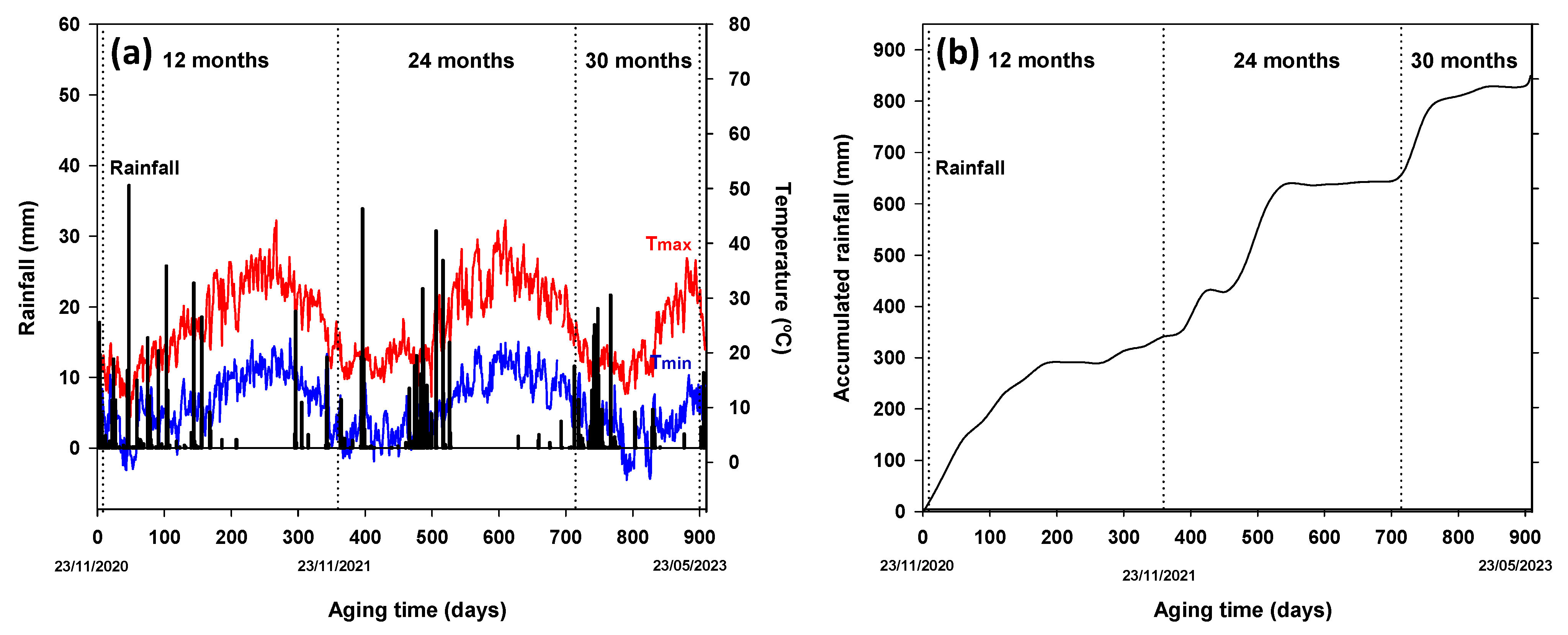
A commercial biochar (BC) prepared from holm oak wood (Quercus ilex) at a pyrolysis temperature of 500 °C was used (Vermichar Lombricompost S.L., La Rioja, Spain). The organic matter content determined by calcination at 540 °C was 88.5% and the pH measured at a ratio of 1:5 (w/v) in water was 7.95. Fresh biochar was washed three times with 100 mL of distilled water, dried in an oven at 105 °C, and then manually sieved. First, the dried biochar sample was passed through a 2 mm mesh and collected on a 1 mm mesh to obtain the 1–2 mm fraction (L). Subsequently, the fraction that passed though the 1 mm mesh was collected on a 0.063 mm mesh, yielding the 0.063–1 mm fraction (S). For the aging treatment, a 200 g portion of unsieved fresh BC samples were place into rectangular mesh bags with a contact surface of c.a. 285 cm2 (19 cm length × 15 cm width) and 2 mm pore size and buried in the soil (11 November 2020) for 12 and 30 months. These aging periods were selected based on the weather conditions (rainfall and air temperature), which were recorded daily over 30 months (Figure 1a). Initially, aging periods of 12 and 24 months were selected; however, due to the low rainfall at the end of the second year, the aging was extended by an additional 6 months. The total rainfall during the first 12 months of aging was 350 mm, and during the 30 months of aging, it was 850 mm (Figure 1b). After these aging periods, BC samples were washed with distilled water, oven-dried and then manually sieved into the two particle-size fractions, following the same procedure described above for the fresh biochar. The biochar bags removed from the soil showed several perforations and had been penetrated by small roots, which, together with the weather conditions, may have also contributed to the biochar aging process. The samples were labeled as BC_S and BC_L for the fresh biochar, and the aged samples were 12BC_X or 30BC_X, where 12 or 30 are the months aged in soil and X is the size range of the sieved samples (S or L). Accordingly, the samples used were labeled as follows: 12BC_S, 12BC_L, 30BC_S and 30BC_L.

2.3. Biochar Characterization

The elemental analysis of the fresh and aged BC samples with 0.063–1 mm and 1–2 mm particle sizes was obtained by combustion using an elemental analyzer LECO, Model CHN 932 (LECO Corporation, Saint Joseph, MI, USA). The specific surface area (SSA) was determined by physisorption of N2 at 77 K using an ASAP Micromeritics Model 2010 analyzer (Micromeritics Instrument Corporation, Norcross, GA, USA). The functional groups were analyzed by Fourier-transform infrared (FTIR) with Bruker Invenio-X (Bruker corporation, Billerica, MA, USA) recording spectra in the region between 4000 and 400 cm−1, with the samples prepared at 1% (w/w) in KBr. The surface morphology of the BC was analyzed using a FEI Teneo scanning electron microscope (SEM) with energy dispersive spectrometer (EDS) (Thermo Fisher Scientific Inc., Eindhoven, The Netherland) at the facilities of the Research, Technology, and Innovation Center of the University of Seville (CITIUS), Seville, Spain.

2.4. Sorption–Desorption Experiments

Sorption of FM at a single initial concentration on BC that was fresh or soil-aged for 12- or 30-months at two particle sizes was determined by the laboratory batch technique. Triplicate BC samples (80 mg) and 8 mL of an aqueous solution of FM (1 mg L−1) were shaken in Pyrex tubes in an end-over-end shaker at 20 ± 2 °C for 24 h. Samples were then centrifuged and supernatants filtered (0.45 µm) and analyzed by HPLC (conditions given below in Section 2.5). The sorption of FM on unamended and BC-amended soil was also performed by the batch method technique at the single initial concentration of 1 mg L−1. In triplicate, 4 g of soil was amended with the biochar samples, either fresh or aged with particle sizes of 0.063–1 mm and 1–2 mm, at different rates of 0, 2 and 4% (w/w), and 8 mL of an aqueous solution of FM was added to the tubes for their equilibration by shaking at 20 ± 2 °C for 24 h. Then, the tubes were centrifuged and 4 mL of supernatants were filtered and analyzed by HPLC in order to quantify the concentration of FM in equilibrium (Ce). Tubes with 8 mL of 1 mg L−1 FM solution were also shaken for 24 h and used as controls. No matrix effect was observed when comparing the FM peak obtained from the analysis of this control solution by HPLC with the peak resulting from the analysis of a 1 mg L−1 solution of FM in soil extract.
In both BC samples and the soil samples (unamended or amended with BC), the distribution coefficient, Kd (L kg−1), was calculated using the following expression:
K d = C s C e
where Cs (mg kg−1) is the amount of FM adsorbed to the BC or soil samples (both unamended or amended with BC) and Ce (mg L−1) is the FM concentration in equilibrium.
In the case of the soil samples (unamended and amended with BC), the distribution coefficient normalized to the organic carbon content, Koc (L kg−1), was determined using the expression
K o c = K d f o c
where Kd (L kg−1) is the distribution coefficient calculated from Equation (1) and foc is the organic carbon content.
Desorption was measured immediately after sorption in unamended and BC-amended soil samples by adding 4 mL of distilled water. The tubes were again shaken at 20 ± 2 °C for 24 h; centrifuged; and then 4 mL of supernatant was removed, filtered, and analyzed by HPLC. This desorption procedure was repeated three times consecutively. The desorbed amounts of FM were calculated from the amounts in solution before and after each desorption cycle.
The organic carbon (OC) content in both the unamended soil and soil amended with fresh and aged BC (at rates of 2 and 4%) was determined directly using a PRIMACSTM SNC-100 C elemental analyzer (Skalar Analytical B.V., Breda, The Netherlands) to detect potential changes in the % of OC after the soil amendment.

2.5. Herbicide Analysis

The aqueous concentration of FM was calculated by HPLC using a Waters 600E chromatograph (Water Corporation, Milford, MA, USA). The analysis conditions were as follows: C18 Kinetex Phenomenex column reverse phase (Phenomenex, Torrance, CA, USA) with acetonitrile:water as the mobile phase (40:60), flow of 1 mL min−1 and wavelength detection at 223 nm. The retention time under these conditions was 5 min and the limit of quantification (LOQ), calculated as the concentration resulting in a signal to noise ratio of 10:1, was 0.02 mg L−1.

2.6. Data Treatment

All the results were expressed as the mean ± standard error to indicate the variability between triplicate measurements. Before the statistical analysis, the normality of BC properties and Kd values was assessed using the Shapiro–Wilk test. After verifying the normality, the data were analyzed using one-way ANOVA, followed by post hoc Tukey’s (HSD) test to determine if there were significant differences (p < 0.05) with aging time. Significant differences in sorption (Kd) between the two particle sizes of BC were determined by the unpaired t-test. All statistical analyses were carried out using SigmaPlot 14.5 for Windows.

3. Results and Discussion

3.1. Biochar Characterization

3.1.1. Elemental Composition, Ash Content, and Specific Surface Area of Fresh and Aged BC

The physicochemical properties of the fresh and aged BC of 0.063–1 mm and 1–2 mm particle sizes are compiled in Table 1. A higher %C was found in the larger particle sizes BC_L when compared with the smaller ones (BC_S). When BC was aged in the soil for 12 and 30 months, in both cases (small and large particle sizes), the amount of C significantly decreased and the amount of O increased. The decrease in the %C could be attributed to the leaching of dissolvable organic compounds sorbed to the biochar [34,35] or reduced by mass addition of soil mineral phases within the BC pores (Table 1). An increase in the amount of O observed could be due to the increase in O-containing groups due to oxidation during aging [34,35], sorbed organics from the soil environment, or carbonate precipitation on the biochar [36]. Consequently, the O/C molar ratio increased with aging (Table 1), which is indicative of an enhancement in polarity [37,38] if the additional oxygen was solely affiliated with the biochar C. A significant increase in the H/C molar ratio with aging was found, indicating that the aging process reduced the aromaticity of the BC [38], introduced aliphatic C by adsorption, or incorporated H or O through functional groups on the biochar surface, resulting in a relative decrease in total C [19].
The ash contents of biochar increased during aging for both particle sizes. This phenomenon is common in natural aging in the field due to the adsorption/precipitation of soil minerals on the surface, as well as entrapment of soil particles into BC pores [34].
The SSA increased from 7.99 m2/g for fresh BC_S to 12.3 m2/g for 12-month aged BC (12BC_S). And then, the SSA declined to 5.86 m2/g after 30 months of aging (30BC_S). The increase in the SSA could have been due to the removal of the organic film from the BC_S surface, exposing the underlying micropores [39]. Then, these micropores could be filled with organic and mineral soil components over time that would lead to a decrease in the SSA in the 30BC_S [39,40]. In the case of BC_L, the SSA was higher after 30 months of aging (18.58 m2/g) compared with the fresh BC (6.12 m2/g), probably due to the exposure of larger pores after removing the organic film or labile components of BC surface during aging. This suggests that the rate of weathering was a function of the surface area, and therefore, occurred faster with smaller particle sizes.

3.1.2. FT-IR and SEM Studies of Fresh and Aged BC

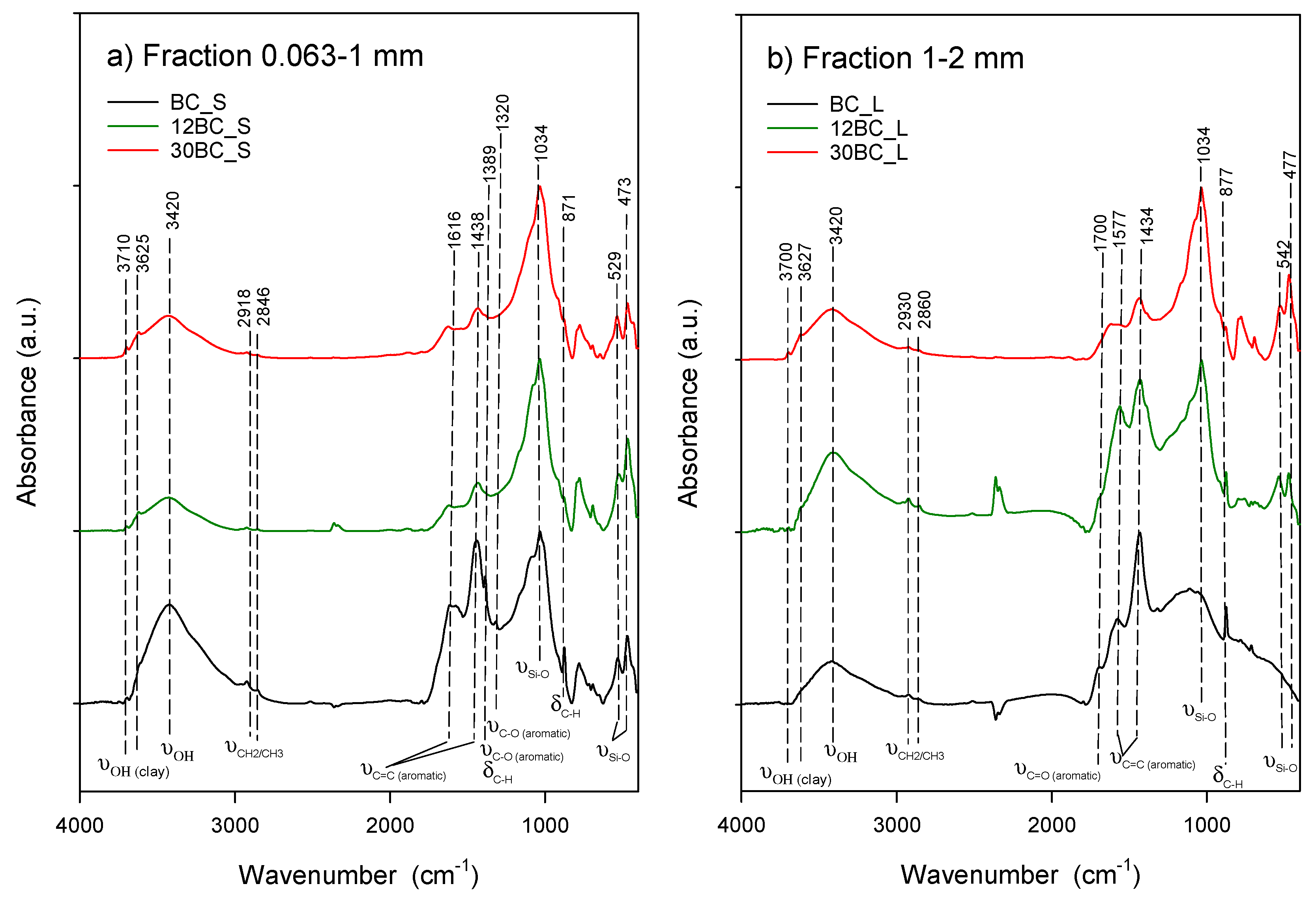
Generally, the aging of biochar leads to changes in the chemistry and structure of its surface, mainly because of bonding of mineral and organic components from the soil to the BC surface [39]. The infrared spectra of the fresh and aged BC samples with particle size less than 1 mm (Figure 2a) showed similar peaks, with only slight differences between them. Thus, the three spectra presented a peak at 3420 cm−1, which was assigned to the OH bond stretching of alcoholic and phenolic hydroxyl groups [37,41] and was more intense for fresh BC. At 2918 and 2846 cm−1, two peaks corresponding to the stretching vibration of -CH2- or -CH3 in aliphatic or alicyclic compounds were recorded [42,43]. The intensity of these peaks was slightly lower in the spectra of aged BC, which would be a result of oxidation during aging [43]. Differences in several peaks between fresh BC and aged BC reveal how aging could reduce the amount of aromatic structures that increased the polarity of BC (Table 1). Thus, the peaks at ≈ 1616 and 1438 cm−1 were attributed to the stretching vibration of the aromatic C=C [42], which were more intense in the case of fresh BC. In addition, in the fresh BC spectrum, three peaks were recorded at 1389, 1320 and 871 cm−1, which did not appear in the aged BC spectra. The peak at 1389 cm−1 was assigned to aromatic C-O vibration [42,43], the peak at 1320 cm−1 was attributed to aromatic CO- and phenolic –OH groups [44], and the peak at 871 cm−1 corresponded to aromatic C-H stretching out of plane deformation [37,42,44]. The presence of the peaks at 3625 and 3710 cm−1 should be noted in the aged BC spectra; they can be attributed to the -OH tension vibration of expandable 2:1 clay mineral (phyllosilicates), probably from soil minerals [41,45], which also agrees with the significantly higher ash contents in the aged BC samples (Table 1).
The spectra recorded for fresh and aged BC samples with a particle size of 1–2 mm (Figure 2b) were similar to those for particles < 1 mm discussed above. However, some differences were observed between the spectra of the fresh and aged 1–2 mm BC fractions. A peak at 1700 cm−1 corresponding to stretching of aromatic carbonyl/carboxyl C=O [42] appeared exclusively in the spectrum of fresh BC. Furthermore, a significant increase in the intensity of the peak at 1034 cm−1, which was assigned to the clay Si-O-Si stretching vibration [41,44,45], and of the peaks at 542 and 477 cm−1, also corresponding to Si-O-Si bending vibration [37,45], was detected in the spectra of the aged 1–2 mm BC fraction. Likewise, the spectrum of BC after 30 months of aging recorded the two peaks attributed to OH bond stretching from clays at 3700 and 3627 cm−1 [41]. All of these peaks are indicative that the longer the residence time of BC in the soil, the greater the amount of soil mineral particles that were associated with BC particles with a size of 1–2 mm.
It is worth noting that, as mentioned above, the spectra of BC_S and BC_L showed practically the same peaks with only two important differences between them: an aromatic C-O vibration peak in the BC_S spectrum (at 1389 and 1320 cm−1) and an aromatic carbonyl/carboxyl C=O vibration peak in the case of the BC_L spectrum (1700 cm−1).
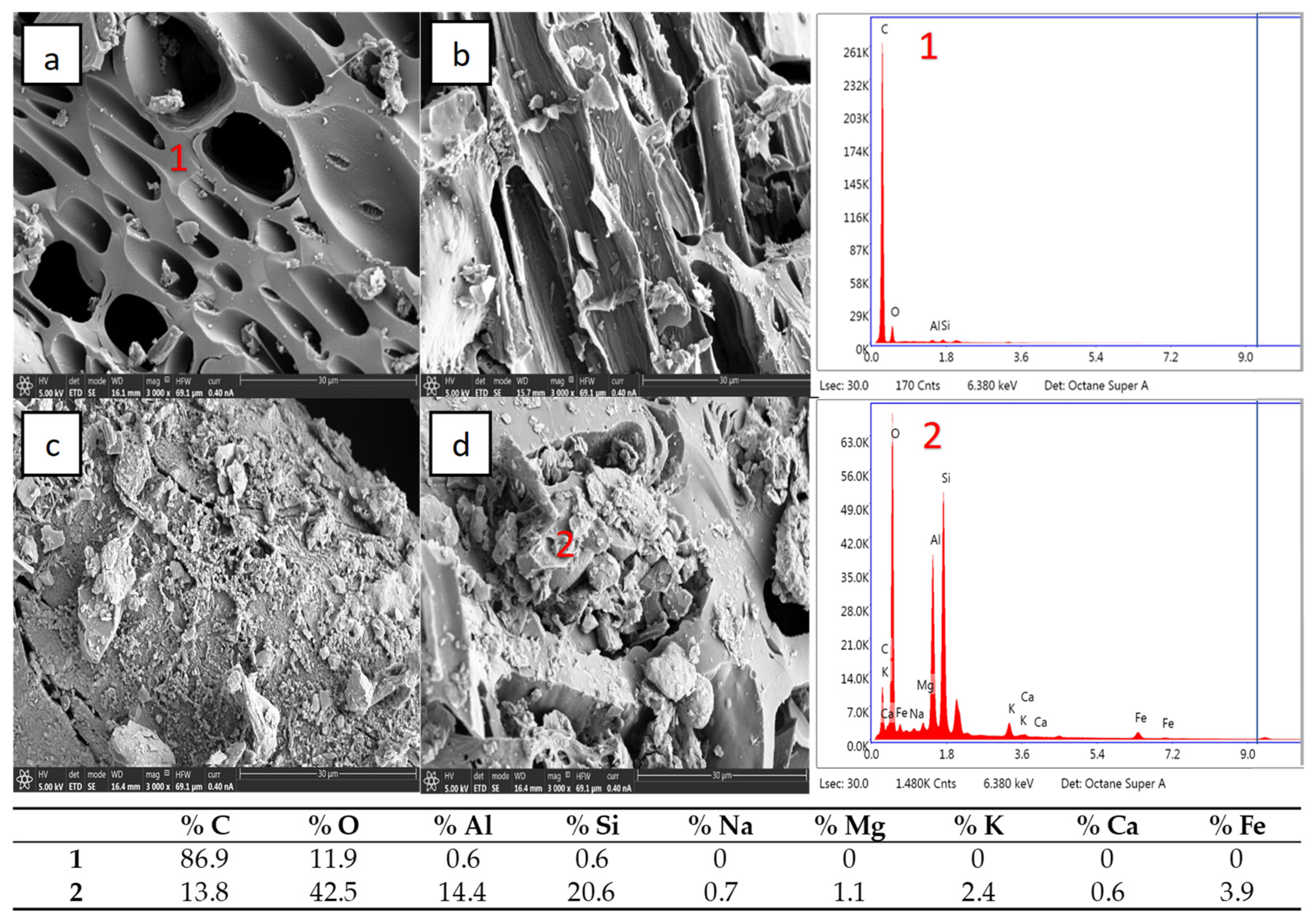
Figure 3 presents scanning electron microscopy (SEM) images from fresh and 30-month-aged 0.063–1 mm and 1–2 mm BC fractions, together with energy-dispersive X-ray spectra (EDS) obtained from selected regions (indicated with numbers) within the SEM micrograph (3000× magnification). SEM images from fresh 0.063–1 mm and 1–2 mm BC fractions show a cellulosic porous structure typical of wood biochar (Figure 3a,b). In the aged BC samples of both particle sizes, most of the pores become filled after soil exposure (Figure 3c,d), which is consistent with the higher ash content observed in the BC aged for 30 months compared with the fresh BC (Table 1), and with the results obtained from FT-IR analyses (Figure 2). The interaction between BC and soil components is confirmed in EDS spectra (Figure 3). The mineral matter blocking BC pore structure in BC aged samples (region 2 in Figure 3d) include elements such as O (42.5%), Al (14.4%) and Si (20.6%), whereas in fresh BC samples (region 1 Figure 3a), C (86.9%) is the main element, with only trace amounts of Al (0.6%) and Si (0.6%). The presence of Al and Si was also confirmed by FT-IR, where peaks corresponding to Si-O and -OH from clays were observed (Figure 2). This explains the compositional alteration in C and O as potentially biased by this soil addition to the pores of the aged biochar particles (Table 1).

3.2. Fluometuron Sorption on Fresh and Aged BC

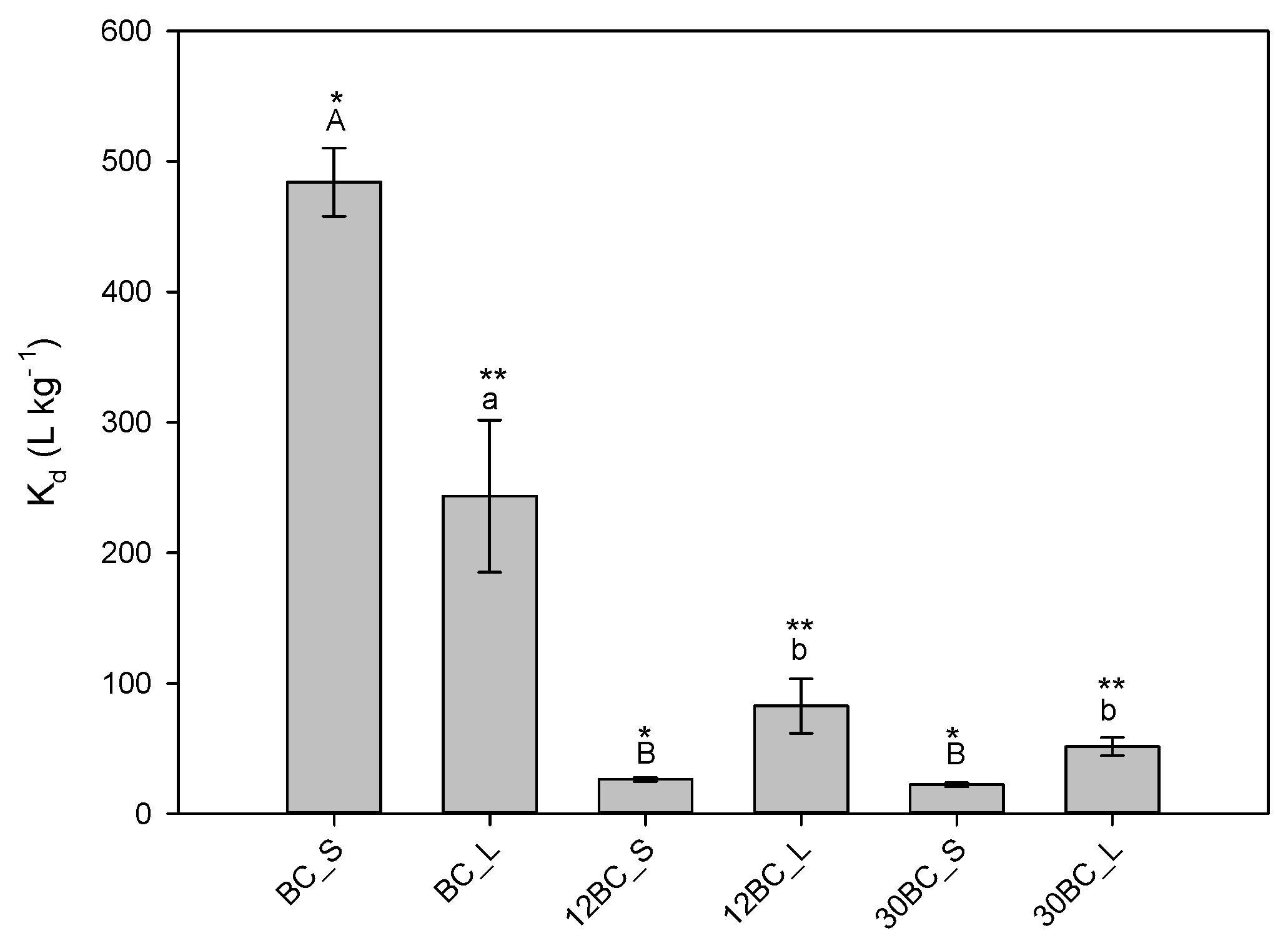
The sorption coefficients of FM (Kd) on fresh and aged BC of different particle sizes are shown in Figure 4. In fresh BC, greater sorption was observed for the smaller particles (BC_S) than for the larger ones (BC_L), despite the higher C content of the latter (Table 1). Although they have similar surface areas (Table 1), smaller BC particles have a higher amount of micropores (Figure 3) and, according to Jin et al. [15], rich graphitic domains and redox-active surface functional groups, thus resulting in an enhanced sorption capacity and sorption rate than the larger-particle-size BC. The preferential sorption of organic compounds onto smaller biochar particles has been reported previously in several studies [46,47]. For instance, Stephan et al. [47] studied the effect of particle size of a Sargassum BC on the availability of chlordecone in soils. The authors reported that the availability of chlordecone in the soils was lower (higher adsorption) when amended with smaller-sized BC particles, which they attributed to a lower specific surface area of these particles.
After aging for 12 months, the sorption decreased in both particle sizes compared with the fresh BC, although this decrease was significantly higher in the case of the smaller particle sizes (12BC_S) than in the larger ones (12_BC_L), where the latter had slightly higher C content and a slightly lower SSA (Table 1). Similar results were observed in the case of BC aged for 30 months, that is, a higher FM sorption on BC with a particle size of 1–2 mm (30BC_L) than on the BC with a particle size of 0.063–1 mm (30BC_S). However, in this case, the differences in C content and SSA between particle sizes were greater: the percentage of C was higher by a factor of 2 and the SSA by a factor of >3 in 30BC_L compared with 30BC_S. These results suggest that changes in the quality of the organic C with aging can be partially responsible for the differences in sorption between different BC particle sizes. Changes in the C nature of aged BC due to sorption of dissolved organic matter, and even large-molecular-weight natural organic matter (e.g., humic substances) that can block pores and also compete for sorption sites, may be responsible for the differences between the particle sizes of BC regarding attenuation in the sorption of FM with BC residence time in the soil [35,48]. Interaction of BC with mineral soil constituents during aging in the soil, as clearly evidenced in both in the SEM images in Figure 3 and the FTIR spectra in Figure 2, has been shown to affect not only BC stability but also its remediation performance [35]. On the one hand, functional groups of the BC can be changed after the interaction with soil minerals resulting in a decrease in the reactivity of the BC [49], which can contribute to the decrease in sorption of FM. On the other hand, mineral particles could also block adsorption sites in the BC surface, reducing the adsorption capacity of the adsorbent.
The observed changes in the H/C ratio (Table 1) and in the peaks of the FTIR spectra (Figure 2) of BC with aging have been associated with a reduction in the aromaticity of BC (Section 3.1 and Section 3.2), which may result in the inhibition of π–π interactions between BC and FM [38]. This fact would also contribute to the reduced adsorption of FM in aged BC.
In summary, these results indicate that the aging of BC in the soil altered its physicochemical properties, leading to a reduction in the sorption of FM on BC. The extent to which aging impacted the sorption capacity was particle-size-dependent. Thus, despite the initially higher FM sorption on the smaller BC particles compared with the larger ones, their sorption capacity decreased more markedly upon aging, ultimately resulting in lower sorption when compared with the larger particles.
It is noteworthy that for the same particle size, the increase in the residence time of the BC in the soil did not affect the sorption of FM since the sorption, measured as Kd, at 12 months was not significantly different to that at 30 months.

3.3. Fluometuron Sorption–Desorption in BC-Amended Soils

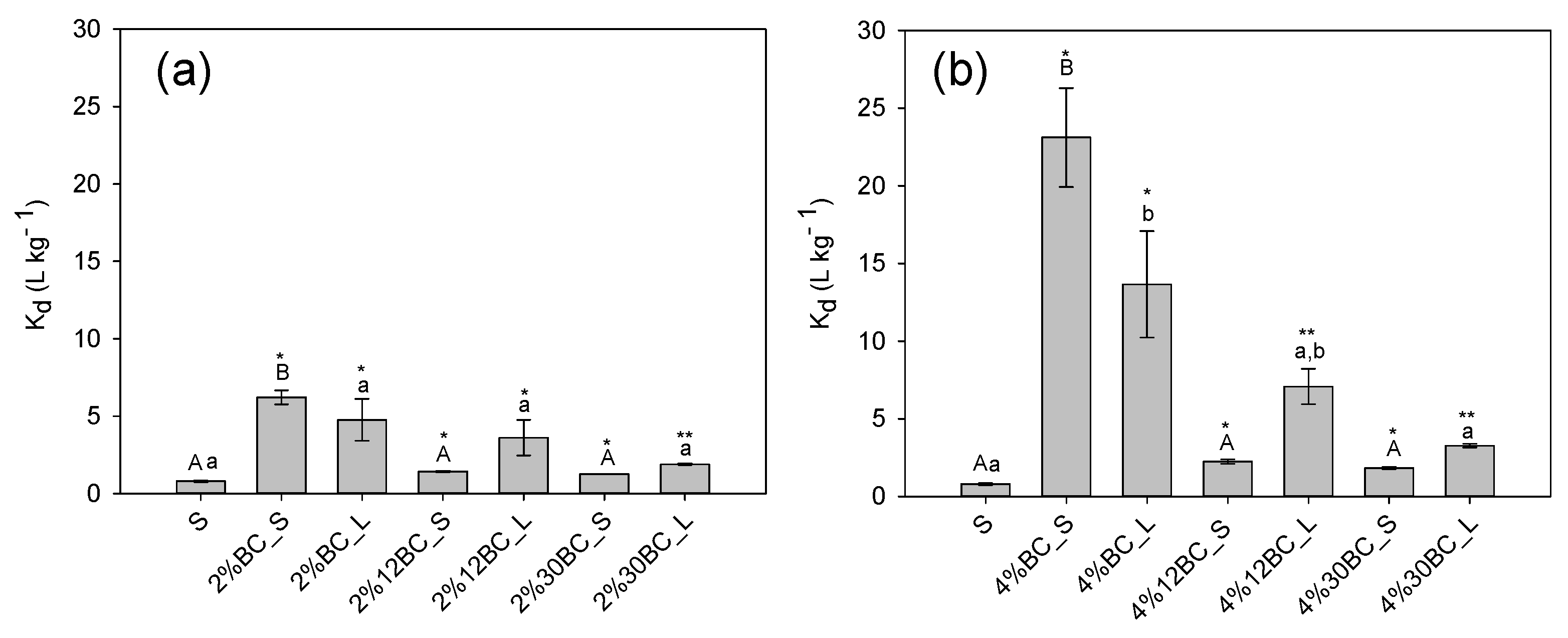
Figure 5 shows the sorption of FM in soil amended with BCs of varying particle sizes and applied at two amendment rates (2% and 4%). When the soil was amended with 4% fresh BC, the sorption of FM increased for both particle sizes. However, in the soil amended with 2% fresh BC, the sorption of FM was significantly higher than that of the unamended soil only for the small biochar particles (BC_S). Unexpectedly, the sorption of the herbicide was not significantly different in the soil amended with BC_S compared with BC_L, despite the lower sorption capacity observed for the latter (Figure 4). Amendment with BC aged for 12 and 30 months decreased the FM soil sorption compared with the fresh BC. The decrease in sorption upon BC aging has been previously reported for other compounds [50], but other studies have indicated an increase in pesticide sorption in soil amended with aged BC samples [26,39]. The decline in FM sorption over the residence time in the soil was more gradual in the case of larger-size particles (1–2 mm) than smaller ones. When the soil was amended with aged BC at a rate of 2%, significant differences in FM sorption between the particle sizes were only detected in the 30-month aged BC, with a higher sorption in 30BC_L particles. However, when the soil was amended with 4% BC, the FM sorption was significantly different between particles of different sizes in both cases of BC aged for 12 months and 30 months. Thus, when the soil was amended with 4% aged BC for 12 and 30 months, the FM sorption remained similar in the 0.063–1 mm particle sizes of BC, with similar OC content (Table 2), while significant differences between 12 months and 30 months aging in the soil were observed for the 1–2 mm particle sizes, which can be attributed to a decrease in OC from 3.3% to 1.97%. As observed for the BC samples, the most interesting finding in this sorption study was that field aging of BC affected FM soil sorption differently depending on the particle size. Thus, although no differences were observed regarding herbicide sorption in soil amended with fresh biochar of both particle sizes, after aging, the FM sorption on soil amended with aged biochar (both for 12 and 30 months) was lower in the smaller-sized particles. The greater sorption on soil amended with larger-sized aged BC particles may be attributed to their higher SSA, lower ash content (Table 1) and higher organic C content (Table 1 and Table 2).
FM sorption on unamended soil was highly reversible (Table 3), with 80% of the initially sorbed herbicide recovered after three desorption cycles. When the soil was amended at a rate of 2% or 4% with fresh BC, the desorption decreased drastically, particularly in the case of soil amended with the 1–2 mm fraction of BC, where FM was not released back into the solution. This effect was also observed when the soil was amended with the BC with a 1–2 mm particle size after 12 and 30 months of aging (12BC_L and 30BC_L, respectively) at both amendment rates (2% and 4%). In contrast, in the soil amended with the smaller BC particle size (0.063–1 mm), desorption of FM occurred, and it increased with aging time. Thus, for an amendment rate of 2% with 12BC_S and 30BC_S, 24% and 45% of the initially sorbed FM, respectively, were recovered after three desorption cycles. The lower reversibility of pesticides sorption after biochar addition to soil has been previously reported and attributed to partitioning into condensed structures or entrapment in micropores of biochar [51,52]. This would explain the observed decrease in FM desorption when the amendment rate was increased to 4%, as a greater proportion of the compound would likely remain more irreversibly sorbed onto the biochar. According to Khorram et al. [53], the increase in sorption reversibility detected with the aging effect may be attributable to the significantly greater micro-pore volume/total pore volume ratios observed in the aged BC, as can be observed in Figure 3. However, the properties of the pesticide molecule itself seem to affect sorption reversibility, as pointed out by Martin et al. [54], who found that soil amended with aged BC showed reversible sorption of atrazine but not in the case of diuron, where desorption was hysteretic in soils amended with fresh and aged BC. This differential sorption–desorption behavior depending on BC particle size is of great relevance since it affects pesticide bioavailability and corresponding efficacy.

4. Conclusions

The sorption of FM on fresh biochar depended on the particle size, with a higher herbicide sorption on the smaller particle size biochar. After aging, herbicide sorption on the biochar in both particle-size fractions decreased compared with the fresh BC. However, the effect of aging on the FM sorption varied with the particle size: the smaller aged BC particles showed lower herbicide sorption than the larger ones. These results reveal that soil aging could differently influence the physicochemical properties of biochar depending on the particle size, which could entail variation in the sorption capacity for pesticides such as fluometuron. In our study, the reduction in sorption capacity of BC after aging was primarily attributed to the loss of aromaticity and the blockage of pores by organic matter and mineral constituents from the soil.
The amendment with 4% fresh BC increased the FM sorption in a soil with low sorption capacity for this herbicide; however, in this case, no differences in sorption were observed with the particle size of BC. When the soil was amended with aged biochar (4%), the FM sorption followed the same behavior previously observed for the pure sorbent: decreased sorption for both particle sizes compared with the fresh BC, with it being lower for the amendment with the smaller particles of BC. Desorption was only observed in unamended soil and soil amended with smaller BC particles, with the desorption percentage increasing with aging time. This particle-size-dependent sorption–desorption of FM in BC-amended soil is of significant importance since it would directly affect the bioavailability of pesticides and, consequently, its functional efficacy within the soil–plant system. Thus, the application of biochar with a particle size of 0.063–1 mm resulted in a high initial sorption but lower sorption capacity over time, as well as higher desorption, which, in turn, led to greater pesticide bioavailability in soil. In contrast, the application of particle BC of 1–2 mm led to higher FM retention over time and no detectable desorption, resulting in a higher amount of herbicide sorbed in the BC-amended soil compared with unamended soil after 30 months of residence time. In conclusion, this study highlights the influence of BC particle size on pesticide retention in soil over time, which is essential for predicting long-term pesticide immobilization in soil amended with BC, and would allow the selection of BC with properties that best suit the agronomic needs. From an environmental perspective, understanding how the sorption capacity of biochar evolves over time is also essential when using this material for the remediation of contaminant soils since in this application, the sorbent must retain the pesticide for as long as possible to prevent its dispersion into the environment.
The next step after this study would be to evaluate the relationship between fluometuron sorption on the tested biochar and the herbicide concentration using adsorption-desorption isotherm modeling. This study would help to elucidate the herbicide sorption mechanisms in the different biochar fractions, as well as in the soil amended with them. This information could contribute to a better understanding of FM behavior in BC-amended soil, and as a result, optimize its use as a pesticide adsorbent in soil.

Author Contributions

Conceptualization, L.C.; methodology, L.C.; validation, R.L.-C., P.V., K.A.S. and L.C.; formal analysis, R.L.-C. and P.V.; investigation, P.V.; resources, K.A.S.; data curation, R.L.-C.; writing—original draft preparation, R.L.-C. and L.C.; writing—review and editing, R.L.-C., K.A.S. and L.C.; visualization, R.L.-C., P.V. and L.C.; supervision, L.C.; project administration, L.C.; funding acquisition, L.C. All authors have read and agreed to the published version of the manuscript.

Funding

This research was funded by the Spanish Ministry of Science and Innovation, grant number PID2022-137187OB-I00 with contribution of EU (FEDER) funds.

Data Availability Statement

The original contributions presented in this study are included in the article. Further inquiries can be directed to the corresponding author.

Acknowledgments

The authors thank B. Gámiz for her valuable contribution to the experiments conducted.

Conflicts of Interest

The authors declare no conflicts of interest.

References

  1. Pathak, V.M.; Verma, V.K.; Rawat, B.S.; Kaur, B.; Babu, N.; Sharma, A.; Dewali, S.; Yadav, M.; Kumari, R.; Singh, S.; et al. Current status of pesticide effects on environment, human health and it’s eco-friendly management as bioremediation: A comprehensive review. Front. Microbiol. 2022, 13, 962619. [Google Scholar] [CrossRef] [PubMed]
  2. Sustainable Development Goals of the United Nations 2030 Agenda. Available online: https://www.un.org/sustainabledevelopment/sustainable-development-goals (accessed on 8 March 2026).
  3. McGinley, J.; Healy, M.G.; Ryan, P.C.; O’Driscoll, J.H.; Mellander, P.E.; Morrison, L.; Siggins, A. Impact of historical legacy pesticides on achieving legislative goals in Europe. Sci. Total Environ. 2023, 873, 162312. [Google Scholar] [CrossRef] [PubMed]
  4. Murtaza, G.; Ahmed, Z.; Eldin, S.M.; Ali, I.; Usman, M.; Iqbal, R.; Rizwan, M.; Abdel-Hameed, U.K.; Haider, A.A.; Tariq, A. Biochar as a green sorbent for remediation of polluted soils and associated toxicity risks: A critical review. Separations 2023, 10, 197. [Google Scholar] [CrossRef]
  5. Jones, D.I.; Edwards-Jones, G.; Murphy, D.V. Biochar mediated alterations in herbicide breakdown and leaching in soil. Soil Biol. Biochem. 2011, 43, 804–813. [Google Scholar] [CrossRef]
  6. Li, P.; Liu, Y.; Sun, Y.; Zhang, C. Biochar innovation for organic pollutant remediation in contaminated soils. Molecules 2026, 31, 342. [Google Scholar] [CrossRef]
  7. Khalid, S.; Shahid, M.; Murtaza, B.; Bibi, I.; Natasha; Naeem, M.A.; Niazi, N.K. A critical review of different factors governing the fate of pesticides in soil under biochar application. Sci. Total Environ. 2020, 711, 134645. [Google Scholar] [CrossRef]
  8. Twagirayezu, G.; Cheng, H.; Wu, Y.; Lu, H.; Huang, S.; Fang, X.; Irumva, O. Insight into the influences of biochar on the fate and transport of pesticides in the soil environment: A critical review. Biochar 2024, 6, 9. [Google Scholar] [CrossRef]
  9. Guo, M.; Song, W.; Tian, J. Biochar-facilitated soil remediation: Mechanisms and efficacy variations. Front. Environ. Sci. 2020, 8, 183. [Google Scholar] [CrossRef]
  10. He, P.; Liu, Y.; Shao, L.; Zhang, H.; Lü, F. Particle size dependence of the physicochemical properties of biochar. Chemosphere 2018, 212, 385–392. [Google Scholar] [CrossRef]
  11. Edeh, G.I.; Mašek, O.; Buss, W. A meta-analysis on biochar’s effects on soil water properties–new insights and future research challenges. Sci. Total Environ. 2020, 714, 136817. [Google Scholar] [CrossRef]
  12. Chen, Z.; Chen, C.; Kamchoom, V.; Chen, R. Gas permeability and water retention of a repacked silty sand amended with different particle sizes of peanut shell biochar. Soil Sci. Soc. Am. J. 2020, 84, 1630–1641. [Google Scholar] [CrossRef]
  13. Zeeshan, M.; Ahmad, W.; Hussain, F.; Ahamd, W.; Numan, M.; Shah, M.; Ahmad, I. Phytostabalization of the heavy metals in the soil with biochar applications, the impact on chlorophyll, carotene, soil fertility and tomato crop yield. J. Clean. Prod. 2020, 255, 120318. [Google Scholar] [CrossRef]
  14. Sarfraz, R.; Yang, W.; Wang, S.; Zhou, B.; Xing, S. Short term effects of biochar with different particle sizes on phosphorous availability and microbial communities. Chemosphere 2020, 256, 126862. [Google Scholar] [CrossRef] [PubMed]
  15. Jin, Z.; Xiao, S.; Dong, H.; Xiao, J.; Tian, R.; Chen, J.; Li, Y.; Li, L. Adsorption and catalytic degradation of organic contaminants by biochar: Overlooked role of biochar’s particle size. J. Hazard. Mater. 2022, 422, 126928. [Google Scholar] [CrossRef] [PubMed]
  16. Harika, G.; Jagrithi, K.D.; Kumari, A.; Aniya, V.; Satyavathi, B.; Naidu, M.R. A non-edible waste as a potential sorptive media for removal of herbicide from the watershed. J. Hazard. Mater. 2020, 390, 121671. [Google Scholar] [CrossRef]
  17. de la Rosa, J.M.; Rosado, M.; Paneque, M.; Miller, A.Z.; Knicker, H. Effects of aging under field conditions on biochar structure and composition: Implications for biochar stability in soils. Sci. Total Environ. 2018, 613–614, 969–976. [Google Scholar]
  18. Hagemann, N.; Joseph, S.; Schmidt, H.P.; Kammann, C.I.; Harter, J.; Borch, T.; Young, R.B.; Varga, K.; Taherymoosavi, S.; Elliott, K.W.; et al. Organic coating on biochar explains its nutrient retention and stimulation of soil fertility. Nat. Commun. 2017, 8, 1089. [Google Scholar] [CrossRef]
  19. Mia, S.; Dijkstra, F.A.; Singh, B. Long-Term aging of biochar: A molecular understanding with agricultural and environmental implications. Adv. Agron. 2017, 141, 1–51. [Google Scholar]
  20. Jiang, X.; Tan, X.; Cheng, J.; Haddix, M.L.; Cotrufo, M.F. Interactions between aged biochar, fresh low molecular weight carbon and soil organic carbon after 3.5 years soil-biochar incubations. Geoderma 2019, 333, 99–107. [Google Scholar] [CrossRef]
  21. Qian, L.; Chen, B. Interactions of aluminum with biochars and oxidized biochars: Implications for the biochar aging process. J. Agric. Food Chem. 2014, 62, 373–380. [Google Scholar]
  22. Lin, Y.; Munroe, P.; Joseph, S.; Kimber, S.; Van Zwieten, L. Nano scale organo-mineral reactions of biochars in ferrosol: An investigation using microscopy. Plant Soil 2012, 357, 369–380. [Google Scholar] [CrossRef]
  23. Li, J.; Li, S.; Dong, H.; Yang, S.; Li, Y.; Zhong, J. Role of alumina and montmorillonite in changing the sorption of herbicides to biochar. J. Agric. Food Chem. 2015, 63, 5740–5746. [Google Scholar] [CrossRef] [PubMed]
  24. Ren, X.; Wang, F.; Zhang, P.; Guo, J.; Sun, H. Aging effect of minerals on biochar properties and sorption capacities for atrazine and phenanthrene. Chemosphere 2018, 206, 51–58. [Google Scholar] [CrossRef]
  25. Yang, F.; Xu, Z.; Huang, Y.; Tsang, D.C.W.; Ok, Y.S.; Zhao, L.; Qiu, H.; Xu, X.; Cao, X. Stabilization of dissolvable biochar by soil minerals: Release reduction and organo-mineral complexes formation. J. Hazard. Mater. 2021, 412, 125213. [Google Scholar] [CrossRef] [PubMed]
  26. Gámiz, B.; Velarde, P.; Spokas, K.A.; Cox, L. Dynamic effect of fresh and aged biochar on the behavior of the herbicide mesotrione in soils. J. Agric. Food Chem. 2019, 67, 9450–9459. [Google Scholar] [CrossRef] [PubMed]
  27. Lian, F.; Xing, B. Black carbon (Biochar) in water/soil environments: Molecular structure, sorption, stability, and potential risk. Environ. Sci. Technol. 2017, 51, 13517–13532. [Google Scholar] [CrossRef]
  28. Zhao, Z.; Zhou, W. Insight into interaction between biochar and soil minerals in changing biochar properties and adsorption capacities for sulfamethoxazole. Environ. Pollut. 2019, 245, 208–217. [Google Scholar] [CrossRef]
  29. Chen, H.; Xing, D.; Twagirayezu, G.; Lin, S.; Gu, S.; Tu, C.; Hill, P.W.; Chadwick, D.R.; Jones, D.L. Effects of field-aging on the impact of biochar on herbicide fate and microbial community structure in the soil environment. Chemosphere 2024, 348, 140682. [Google Scholar] [CrossRef]
  30. Liu, G.; Zheng, H.; Jiang, Z.; Wang, Z. Effects of biochar input on the properties of soil nanoparticles and dispersion/sedimentation of natural mineral nanoparticles in aqueous phase. Sci. Total Environ. 2018, 634, 595–605. [Google Scholar]
  31. PPDB: Pesticide Properties Database. Available online: https://sitem.herts.ac.uk/aeru/ppdb/en/Reports/336.htm (accessed on 8 March 2026).
  32. Lewis, K.A.; Tzilivakis, J.T.; Warner, D.J.; Green, A. An international database for pesticide risk assessments and management. Hum. Ecol. Risk Assess. 2016, 22, 1050–1064. [Google Scholar]
  33. Papadakis, E.-N.; Tsaboula, A.; Vryzas, Z.; Kotopoulou, A.; Kintzikoglou, K.; Papadopoulou-Morkidou, E. Pesticides in the rivers and streams of two river basins in northern Greece. Sci. Total Environ. 2018, 627, 732–743. [Google Scholar] [CrossRef] [PubMed]
  34. Wang, L.; O’Connor, D.; Rinklebe, J.; Ok, Y.S.; Tsang, D.C.W.; Shen, Z.; Hou, D. Biochar aging: Mechanisms, physicochemical changes, assessment, and implications for field applications. Environ. Sci. Technol. 2020, 54, 14797–14814. [Google Scholar] [CrossRef] [PubMed]
  35. Liu, Y.; Chen, J. Effect of ageing on biochar properties and pollutant management. Chemosphere 2022, 292, 133427. [Google Scholar] [CrossRef] [PubMed]
  36. Rees, F.; Watteau, F.; Mathieu, S.; Turpault, M.-P.; Le Brech, Y.; Qiu, R.; Morel, J.L. Metal immobilization on wood-derived biochars: Distribution and reactivity of carbonate phases. J. Environ. Qual. 2017, 46, 845–854. [Google Scholar] [CrossRef]
  37. Tan, L.; Sun, C.; Wang, Y.; Wang, T.; Wu, G.-L.; He, H.; Zheng, J. Changes in biochar properties in typical loess soil under a 5-year field experiment. J. Soil Sediments 2020, 20, 340–351. [Google Scholar] [CrossRef]
  38. Liu, L.; Yuan, M.; Wang, X.; Li, X.; Fang, W.; Shan, D.; Dai, Y. Biochar aging: Properties, mechanism, and environmental benefits for adsorption of metolachlor in soil. Environ. Technol. Innov. 2021, 24, 101841. [Google Scholar] [CrossRef]
  39. Trigo, C.; Spokas, K.A.; Hall, K.E.; Cox, L.; Koskinen, W.C. Metolachlor sorption and degradation in soil amended with fresh and aged biochar. J. Agric. Food Chem. 2016, 64, 3141–3149. [Google Scholar] [CrossRef]
  40. Ren, X.; Sun, H.; Wang, F.; Zhang, P.; Zhu, H. Effect of aging in field soil on biochar’s properties and its sorption capacity. Environ. Pollut. 2018, 242, 1880–1886. [Google Scholar] [CrossRef]
  41. Singh, B.; Fang, Y.; Johnston, C.T. A Fourier-Transform Infrared Study of Biochar Aging in Soils. Soil Sci. Soc. Am. J. 2016, 80, 613–622. [Google Scholar] [CrossRef]
  42. Mukome, F.N.D.; Zhang, X.; Silva, L.C.R.; Six, J.; Parikh, S.J. Use of chemical and physical characteristics to investigate trends in biochar feedstocks. J. Agric. Food Chem. 2013, 61, 2196–2204. [Google Scholar] [CrossRef]
  43. Fan, Q.; Sun, J.; Chu, L.; Cui, L.; Quan, G.; Yan, J.; Hussain, Q.; Iqbal, M. Effects of chemical oxidation on surface oxygen-containing functional groups and adsorption behavior of biochar. Chemosphere 2018, 207, 33–40. [Google Scholar] [CrossRef] [PubMed]
  44. Gámiz, B.; Hall, K.; Spokas, K.A.; Cox, L. Understanding activation effects on low-temperature biochar for optimization of herbicide sorption. Agronomy 2019, 9, 588. [Google Scholar] [CrossRef]
  45. Wang, H.; Garg, A.; Huang, S.; Mei, G. Mechanism of compacted biochar-amended expansive clay subjected to drying-wetting cycles: Simultaneous investigation of hydraulic and mechanical properties. Acta Geophys. 2020, 68, 737. [Google Scholar] [CrossRef]
  46. Zheng, W.; Mingxin, G.; Chow, T.; Bennett, D.N.; Rajagopalan, N. Sorption properties of greenwaste biochar for two triazine pesticide. J. Hazard. Mater. 2010, 181, 121–126. [Google Scholar] [CrossRef]
  47. Stephan, P.; Le Roux, Y.; Gaspard, S.; Michaux, F.; Feidt, C.; Soligot, C.G.; Rychen, C.; Delannoy, M. Effects of particles size and amendment rates of Sargassum biochar on chlordecone sequestration in West Indian soils. Environ. Sci. Pollut. Res. 2023, 30, 5873–5880. [Google Scholar]
  48. Koelmans, A.A.; Meulman, B.; Meijer, T.; Jonker, M.T.O. Attenuation of polychlorinated biphenyl sorption to charcoal by humid acids. Environ. Sci. Technol. 2009, 43, 736–742. [Google Scholar] [CrossRef]
  49. Yang, F.; Zhao, L.; Gao, B.; Xu, X.; Cao, X. The interfacial behavior between biochar and soil minerals and its effect on biochar stability. Environ. Sci. Technol. 2016, 50, 2264–2271. [Google Scholar] [CrossRef]
  50. Luo, L.; Lv, J.; Chen, Z.; Huang, R.; Zhang, S. Insights into the attenuated sorption of organic compounds on black carbon aged in soil. Environ. Pollut. 2017, 231, 1469–1476. [Google Scholar] [CrossRef]
  51. Khorram, M.S.; Zhang, Q.; Lin, D.; Zheng, Y.; Fang, H.; Yu, Y. Biochar: A review of its impact on pesticide behavior in soil environments and its potential applications. J. Environ. Sci. 2016, 44, 269–279. [Google Scholar] [CrossRef]
  52. López-Piñeiro, A.; Sánchez-Terrón, J.; Martín-Franco, C.; Peña, D.; Vicente, L.A.; Gómez, S.; Fernández-Rodríguez, D.; Albarrán, A. Impacts of fresh and aged holm-oak biochar on clomazone behaviour in rice cropping soils after transition to sprinkler irrigation. Geoderma 2022, 413, 115768. [Google Scholar] [CrossRef]
  53. Khorram, M.S.; Sarmah, A.K.; Yu, Y. The effects of biochar properties on fomesafen adsorption-desorption capacity of biochar-amended soil. Water Air Soil Pollut. 2017, 229, 60. [Google Scholar] [CrossRef]
  54. Martin, S.M.; Kookana, R.S.; Van Zwieten, L.; Krull, E. Marked changes in herbicide sorption-desorption upon ageing of biochars in soil. J. Hazard. Mater. 2012, 231–232, 70–78. [Google Scholar] [CrossRef]
Figure 1. Weather condition recorded during the biochar aging periods. (a) Rainfall (bars) and temperature profile (lines) and (b) accumulated rainfall.
Agronomy 16 00656 g001
Figure 2. FT-IR spectra of 0.063–1 mm (a) and 1–2 mm (b) fractions of biochar that was fresh (BC_S, BC_L), aged for 12 months (12BC_S, 12BC_L) and aged 30 months (30BC_S, 30BC_L), respectively.
Agronomy 16 00656 g002
Figure 3. SEM images from fresh BC samples with 0.063–1 mm (a) and 1–2 mm (b) particle sizes and from BC samples with 0.063–1 mm (c) and 1–2 mm (d) particle sizes aged in soil for 30 months (3000× magnification). EDS spectra were recorded from the biochar regions marked with red numbers 1 (BC_S sample) and 2 (30BC_L sample). The percentages of each element detected in each spectrum are summarized in the table.
Agronomy 16 00656 g003
Figure 4. Fluometuron distribution coefficients, Kd, on BC that was fresh (BC_S and BC_L) and aged for 12 months (12BC_S and 12BC_L) and 30 months (30BC_S and 30BC_L). Different uppercase or lowercase letters above the bar indicate statistically significant differences in Kd over time for BC with particle sizes of 0.063–1 mm and 1–2 mm, respectively (p < 0.05). For the aging time, a different number of asterisks above the bar indicate a statistically significant difference in Kd between BCs of different particle sizes (p < 0.05); an identical number indicates non-significant differences.
Agronomy 16 00656 g004
Figure 5. Fluometuron distribution coefficients, Kd, on unamended soil (S) and soil amended with (a) 2% of fresh biochar (2%BC_S and 2%BC_L) and 2% of 12 and 30 months aged biochar (2%12BC_S and 2%12BC_L; 2%30BC_S and 2%30BC_L) and (b) 4% of fresh biochar (4%BC_S and 4%BC_L) and 4% of 12 and 30 months aged biochar (4%12BC_S and 4%12BC_L; 4%30BC_S and 4%30BC_L). Different uppercase or lowercase letters above the bar indicate statistically significant differences in Kd over time for BCs with a particle sizes of 0.063–1 mm and 1–2 mm, respectively (p < 0.05). For a given aging time, different number of asterisks above the bars indicate statistically significant differences in Kd between BCs of different particle sizes (p < 0.05); an identical number indicates non-significant differences.
Agronomy 16 00656 g005
Table 1. Physicochemical properties of 0.063–1 mm biochar that was fresh (BC_S), aged for 12 months (12BC_S), and aged for 30 months (30BC_S), and of 1–2 mm biochar that was fresh (BC_L), aged for 12 months (12BCL), and aged for 30 months (30BC_L).
PropertiesBC_S12BC_S30BC_SBC_L12BC_L30BC_L
C (%)39.1 ± 2.7 a a23.0 ± 1.7 b14.5 ± 0.6 b60.8 ± 1.1 a29.9 ± 1.1 b33.6 ± 1.8 b
H (%)1.2 ± 0.1 a0.9 ± 0.1 a,b0.6 ± 0.1 b1.8 ± 0.1 a1.3 ± 0.0 b1.1 ± 0.1 b
N (%)0.6 ± 0.1 a0.3 ± 0.0 b0.4 ± 0.1 b0.7 ± 0.0 a0.3 ± 0.0 b0.5 ± 0.0 c
O (%) 59.1 ± 2.8 a75.8 ± 1.8 b84.6 ± 0.7 c36.7 ± 1.2 a68.5 ± 1.1 b64.8 ± 1.9 b
Ash (%) 46.3 ± 1.7 a78.1 ± 2.4 b83.3 ± 1.2 b23.9 ± 2.1 a19.9 ± 1.2 a60.1 ± 1.9 b
H/C0.36 ± 0.01 a 0.49 ± 0.03 b0.50 ± 0.03 b0.35 ± 0.03 a0.52 ± 0.02 b0.38 ± 0.01 a
O/C1.15 ± 0.14 a2.51 ± 0.24 b 4.41 ± 0.23 c0.45 ± 0.02 a1.73 ± 0.10 b1.46 ± 0.12 b
SSA (m2/g)7.9912.35.866.128.1818.58
a The results are expressed as the mean ± standard error of triplicate measurements. For each particle size, different letters indicate significant differences between treatment (p < 0.05).
Table 2. Organic C (OC) and KOC of unamended soil and soil amended at 2% and 4% with 0.063–1 mm or 1–2 mm of fresh BC (BC_S and BC_L) and BC aged for 12 months (12BC_S and 12BC_L) and 30 months (30BC_S and 30BC_L).
Soil TreatmentOC (%)Koc (L kg−1)
Unamended Soil0.65123
2% BC_S2.41258
2% BC_L2.10227
2% 12BC_S1.6984
2% 12BC_L2.24161
2% 30BC_S1.3494
2% 30BC_L2.1986
4% BC_S2.80825
4% BC_L3.47394
4% 12BC_S1.68135
4% 12BC_L3.30214
4% 30BC_S1.39132
4% 30BC_L1.97166
Table 3. Fluometuron desorption percentages after 3 desorption cycles (D1, D2, D3) from unamended soil and soil amended with different particle sizes of fresh BC and BC aged for 12 months (12BC) and 30 months (30BC).
Soil Treatment% D1% D2% D3
Unamended Soil42.0 ± 0.967.9 ± 0.080.3 ± 0.5
2% BC_S0.0 ± 0.02.6 ± 1.64.9 ± 1.8
2% 12BC_S9.3 ± 6.518.3 ± 7.023.9 ± 7.9
2% 30BC_S20.7 ± 1.636.8 ± 2.744.6 ± 2.7
2% BC_L0.0 ± 0.00.0 ± 0.00.0 ± 0.0
2% 12BC_L0.0 ± 0.00.0 ± 0.00.0 ± 0.0
2% 30BC_L0.0 ± 0.00.0 ± 0.00.0 ± 0.0
4% BC_S0.0 ± 0.00.1 ± 0.01.3 ± 0.2
4% 12BC_S4.2 ± 0.811.3 ± 0.914.9 ± 0.8
4% 30BC_S13.8 ± 0.023.1 ± 0.028.5 ± 5.4
4% BC_L0.0 ± 0.00.0 ± 0.00.0 ± 0.0
4% 12BC_L0.0 ± 0.00.0 ± 0.00.0 ± 0.0
4% 30BC_L0.0 ± 0.00.0 ± 0.00.0 ± 0.0
Disclaimer/Publisher’s Note: The statements, opinions and data contained in all publications are solely those of the individual author(s) and contributor(s) and not of MDPI and/or the editor(s). MDPI and/or the editor(s) disclaim responsibility for any injury to people or property resulting from any ideas, methods, instructions or products referred to in the content.