Integrating GLASS LAI into the SWAT Model for Improved Hydrological Simulation in Semi-Arid Regions

Abstract
1. Introduction
2. Materials and Method
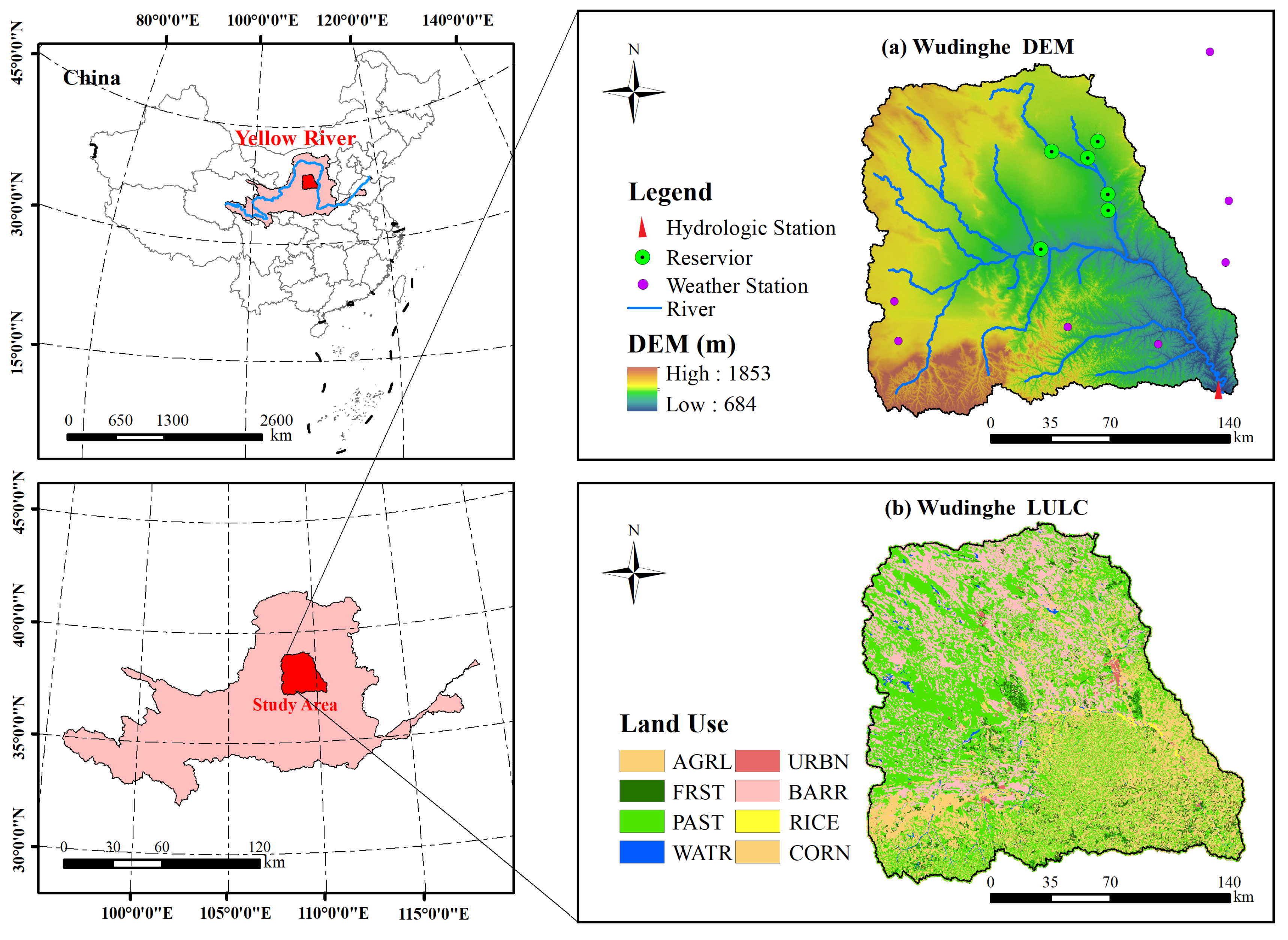
2.1. Study Area
2.2. Data Description
2.2.1. Digital Elevation Model (DEM), Land Use, and Soil Data
2.2.2. Meteorological, Runoff, and Leaf Area Index Data
2.3. SWAT Model
2.3.1. Overview of the SWAT Model
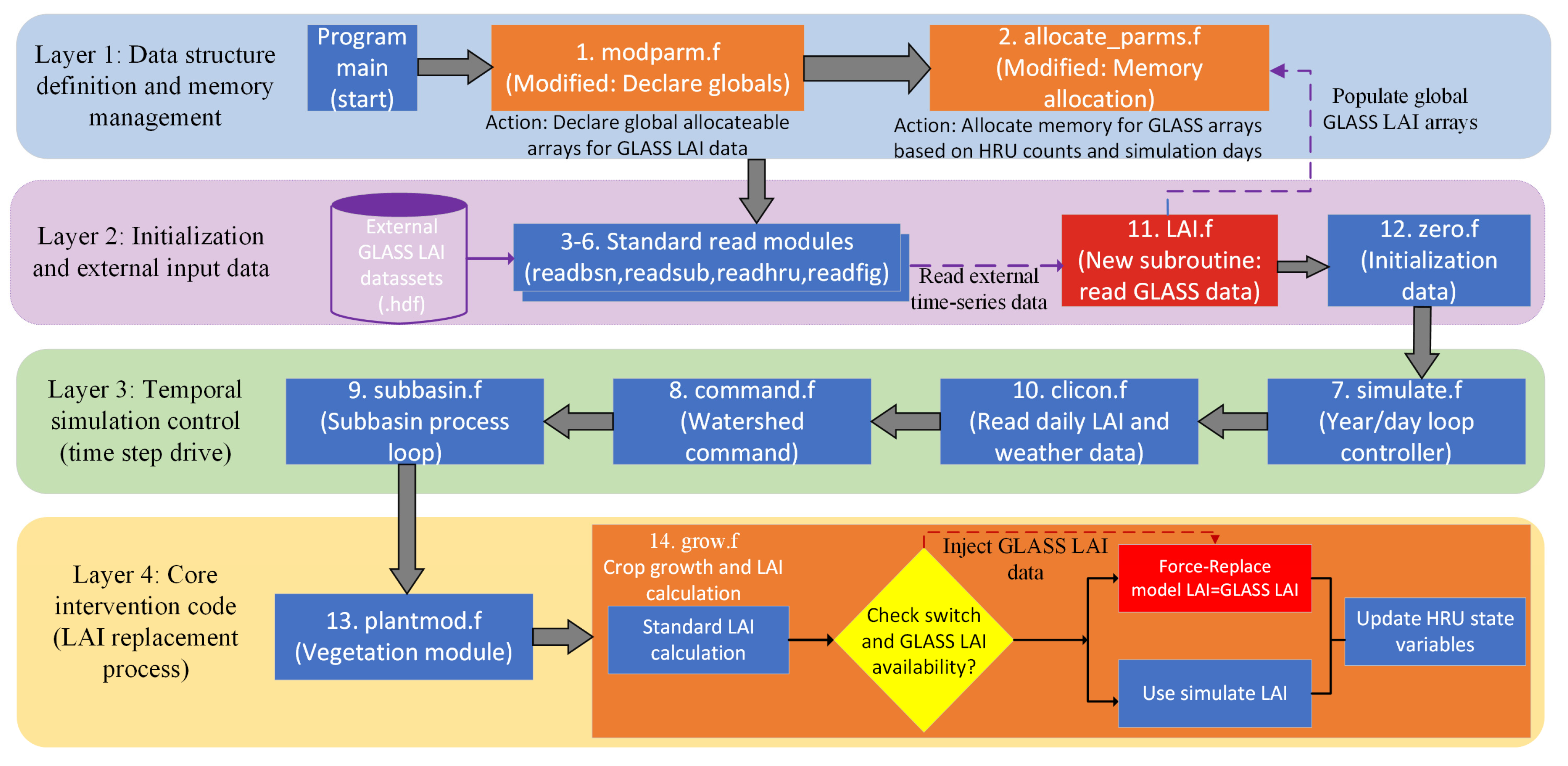
2.3.2. Plant Growth Module in SWAT
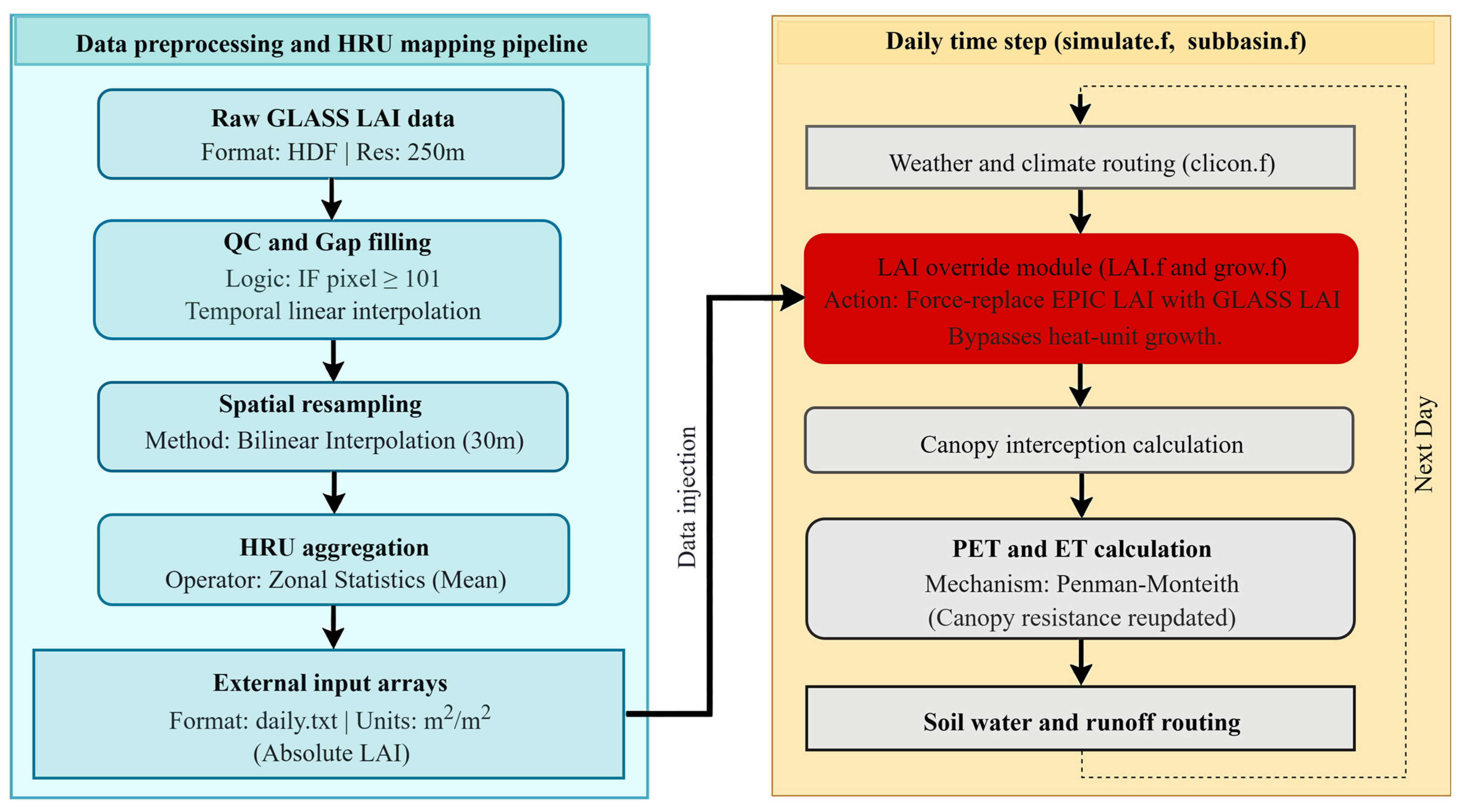
2.3.3. Mapping Remote Sensing LAI Data to HRUs
2.3.4. Implementation of the Improved Fortran-DDS Algorithm
3. Results
3.1. Model Calibration and Validation
3.1.1. Sensitivity Analysis and Parameter
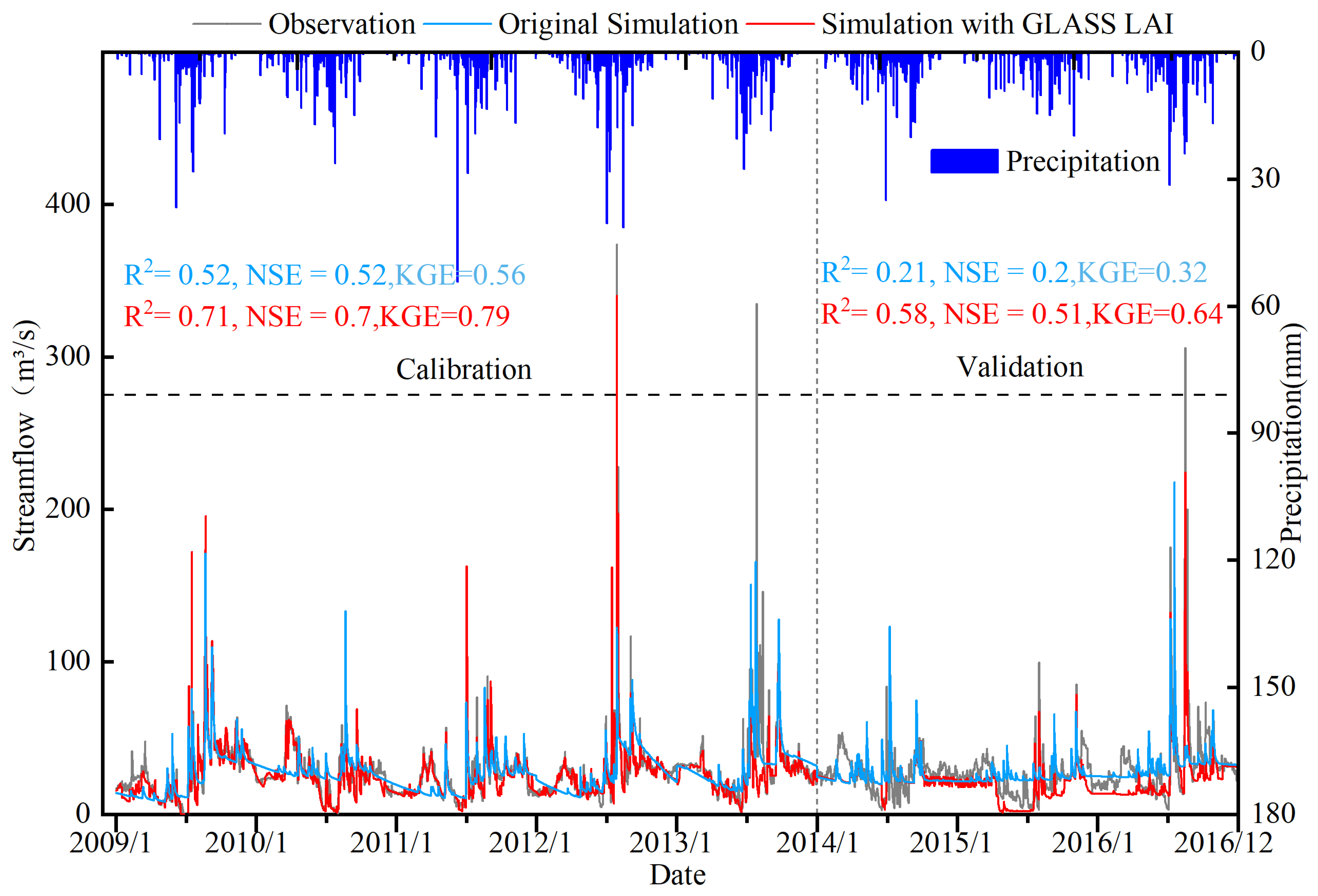
3.1.2. Streamflow
3.2. Comparison of SWAT Model Simulation Results Before and After Improvement
3.3. Analysis of Spatial and Temporal Dynamic Differences Between Simulated and Remotely Sensed LAI
3.3.1. Fundamental Differences in Climatic Characteristics
3.3.2. Differences in Response of Different Land Use Types
3.4. Spatial Distribution Characteristics of Vegetation Phenology Indicators
3.4.1. Spatial Gradient of Phenology
3.4.2. Interannual Trends in Phenology
3.5. Changes in Ecohydrological Processes After Improved Modeling
3.5.1. ET
3.5.2. LAI
4. Discussion
4.1. Physical Mechanisms for Improving the Model to Enhance the Accuracy of Hydrological Simulations
4.2. Uncertainties and Model Limitations
5. Conclusions
Author Contributions
Funding
Data Availability Statement
Conflicts of Interest
References
- Xiao, J.L.; Terrer, C.; Gentine, P.; Tateno, R.; Fan, L.; Ma, M.G.; Yue, Y.M.; Yuan, W.P.; Penuelas, J.; Shi, W.Y. Temporal and Phenological Modulation of the Impact of Increasing Drought Conditions on Vegetation Growth in a Humid Big River Basin: Insights From Global Comparisons. Earths Future 2025, 13, 17. [Google Scholar] [CrossRef]
- Kim, D.; Park, T.J. Analysis, evaluation and implications of Rhode Island’s “2021 Act on Climate” for response to climate change. Clim. Change 2024, 177, 19. [Google Scholar] [CrossRef]
- Li, Y.; Piao, S.L.; Li, L.Z.X.; Chen, A.P.; Wang, X.H.; Ciais, P.; Huang, L.; Lian, X.; Peng, S.S.; Zeng, Z.Z.; et al. Divergent hydrological response to large-scale afforestation and vegetation greening in China. Sci. Adv. 2018, 4, 9. [Google Scholar] [CrossRef]
- Zhao, F.B.; Ma, S.; Wu, Y.P.; Qiu, L.J.; Wang, W.K.; Lian, Y.Q.; Chen, J.; Sivakumar, B. The role of climate change and vegetation greening on evapotranspiration variation in the Yellow River Basin, China. Agric. For. Meteorol. 2022, 316, 14. [Google Scholar] [CrossRef]
- Zhan, C.; Liang, C.; Zhao, L.; Jiang, S.Z.; Niu, K.J.; Zhang, Y.L.; Cheng, L. Vegetation Dynamics and its Response to Climate Change in the Yellow River Basin, China. Front. Environ. Sci. 2022, 10, 18. [Google Scholar] [CrossRef]
- Tang, Z.X.; Zhou, Z.X.; Wang, D.; Luo, F.B.; Bai, J.Z.; Fu, Y. Impact of vegetation restoration on ecosystem services in the Loess plateau, a case study in the Jinghe Watershed, China. Ecol. Indic. 2022, 142, 14. [Google Scholar] [CrossRef]
- Deng, Y.H.; Wang, S.J.; Bai, X.Y.; Luo, G.J.; Wu, L.H.; Chen, F.; Wang, J.F.; Li, C.J.; Yang, Y.J.; Hu, Z.Y.; et al. Vegetation greening intensified soil drying in some semi-arid and arid areas of the world. Agric. For. Meteorol. 2020, 292, 12. [Google Scholar] [CrossRef]
- Guo, W.; He, H.; Li, X.T.; Zeng, W.G. Greater Greening Trend in the Loess Plateau of China Inferred from Long-Term Remote Sensing Data: Patterns, Causes and Implications. Forests 2022, 13, 1630. [Google Scholar] [CrossRef]
- Zhang, Q.Y.; Jia, X.X.; Zhao, C.L.; Shao, M.A. Revegetation with artificial plants improves topsoil hydrological properties but intensifies deep-soil drying in northern Loess Plateau, China. J. Arid Land 2018, 10, 335–346. [Google Scholar] [CrossRef]
- Zhang, L.H.; Deng, C.; Wei, J.; Zou, J.C. Assessing the impacts of climate change and land use/land cover data characteristics on streamflow using the SWAT model in the Upper Han River Basin. J. Hydrol. -Reg. Stud. 2025, 61, 18. [Google Scholar] [CrossRef]
- Xu, C.; Zhang, Z.J.; Fu, Z.H.; Xiong, S.Q.; Chen, H.; Zhang, W.C.; Wang, S.H.; Zhang, D.H.; Lu, H.; Jiang, X. Impacts of Climatic Fluctuations and Vegetation Greening on Regional Hydrological Processes: A Case Study in the Xiaoxinganling Mountains-Sanjiang Plain Region, Northeastern China. Remote Sens. 2024, 16, 2709. [Google Scholar] [CrossRef]
- Arnold, J.G.; Srinivasan, R.; Muttiah, R.S.; Williams, J.R. Large area hydrologic modeling and assessment part I: Model development 1. JAWRA J. Am. Water Resour. Assoc. 1998, 34, 73–89. [Google Scholar] [CrossRef]
- Gassman, P.W.; Sadeghi, A.M.; Srinivasan, R. Applications of the SWAT Model Special Section: Overview and Insights. J. Environ. Qual. 2014, 43, 1–8. [Google Scholar] [CrossRef]
- Zhang, H.; Wang, B.; Liu, D.L.; Zhang, M.X.; Leslie, L.M.; Yu, Q. Using an improved SWAT model to simulate hydrological responses to land use change: A case study of a catchment in tropical Australia. J. Hydrol. 2020, 585, 124822. [Google Scholar] [CrossRef]
- Zhang, Q.Y.; Wu, J.H.; Liu, W.B.; Wang, T.L.; Wang, Y.C. SWAT plus Model Enhanced with Dynamic Phenology Remote Sensing and High-Precision Precipitation Data for Water Resource Vulnerability Assessment in Semi-Arid Regions. Water Resour. Manag. 2025, 39, 4947–4969. [Google Scholar] [CrossRef]
- Hakeem, S.A.; Hu, T.S.; Yasir, M. Unravelling the Role of Vegetation Dynamics in the Execution of ArcSWAT Hydrological Modeling for Cumulative Streamflow of a Tibetan Watershed. Atmosphere 2023, 14, 1530. [Google Scholar] [CrossRef]
- Liu, T.X.; Zhang, Q.; Li, T.T.; Zhang, K.W.; Numata, I. Dynamic Vegetation Responses to Climate and Land Use Changes over the Inner Mongolia Reach of the Yellow River Basin, China. Remote Sens. 2023, 15, 3531. [Google Scholar] [CrossRef]
- Chen, S.Z.; Fu, Y.H.; Wu, Z.F.; Hao, F.H.; Hao, Z.C.; Guo, Y.H.; Geng, X.J.; Li, X.Y.; Zhang, X.; Tang, J.; et al. Informing the SWAT model with remote sensing detected vegetation phenology for improved modeling of ecohydrological processes. J. Hydrol. 2023, 616, 13. [Google Scholar] [CrossRef]
- Muhury, N.; Apan, A.; Maraseni, T. Modelling Floodplain Vegetation Response to Climate Change, Using the Soil and Water Assessment Tool (SWAT) Model Simulated LAI, Applying Different GCM’s Future Climate Data and MODIS LAI Data. Remote Sens. 2024, 16, 1204. [Google Scholar] [CrossRef]
- Jin, X.; Jin, Y.X.; Fu, D.; Mao, X.F. Modifying the SWAT Model to Simulate Eco-Hydrological Processes in an Arid Grassland Dominated Watershed. Front. Environ. Sci. 2022, 10, 11. [Google Scholar] [CrossRef]
- An, S.T.; Wu, Y.P.; Liang, W.; Zhang, G.C.; Chen, J.; Liu, S.G.; Zhao, F.B.; Qiu, L.J.; Yin, X.W. Enhancing ecohydrological simulation with improved dynamic vegetation growth module in SWAT. J. Hydrol. 2024, 644, 12. [Google Scholar] [CrossRef]
- Zhu, Z.C.; Bi, J.; Pan, Y.Z.; Ganguly, S.; Anav, A.; Xu, L.; Samanta, A.; Piao, S.L.; Nemani, R.R.; Myneni, R.B. Global Data Sets of Vegetation Leaf Area Index (LAI)3g and Fraction of Photosynthetically Active Radiation (FPAR)3g Derived from Global Inventory Modeling and Mapping Studies (GIMMS) Normalized Difference Vegetation Index (NDVI3g) for the Period 1981 to 2011. Remote Sens. 2013, 5, 927–948. [Google Scholar] [CrossRef]
- Zhang, Y.T.; Xiao, Z.Q. A Method to Downscale MODIS Surface Reflectance Using Convolutional Neural Networks. Remote Sens. 2023, 15, 2102. [Google Scholar] [CrossRef]
- Yan, K.; Wang, J.R.; Peng, R.; Yang, K.; Chen, X.Z.; Yin, G.F.; Dong, J.W.; Weiss, M.; Pu, J.B.; Myneni, R.B. HiQ-LAI: A high-quality reprocessed MODIS leaf area index dataset with better spatiotemporal consistency from 2000 to 2022. Earth Syst. Sci. Data 2024, 16, 1601–1622. [Google Scholar] [CrossRef]
- Mikaeili, O.; Shourian, M. Improving Evapotranspiration Estimation in SWAT-Based Hydrologic Simulation through Data Assimilation in the SEBAL Algorithm. Water Resour. Manag. 2024, 38, 4101–4122. [Google Scholar] [CrossRef]
- Lee, S.; Kim, D.; McCarty, G.W.; Anderson, M.; Gao, F.; Lei, F.N.; Moglen, G.E.; Zhang, X.S.; Yen, H.W.; Qi, J.Y.; et al. Spatial calibration and uncertainty reduction of the SWAT model using multiple remotely sensed data. Heliyon 2024, 10, e30923. [Google Scholar] [CrossRef] [PubMed]
- Rajib, A.; Merwade, V.; Yu, Z.Q. Rationale and Efficacy of Assimilating Remotely Sensed Potential Evapotranspiration for Reduced Uncertainty of Hydrologic Models. Water Resour. Res. 2018, 54, 4615–4637. [Google Scholar] [CrossRef]
- Tang, J.X.; Wang, P.J.; Feng, R.; Li, Y.; Li, Q. An Approach to Refining MODIS LAI Data Using a Fitting Scale Factor Time Series. Remote Sens. 2025, 17, 293. [Google Scholar] [CrossRef]
- Zhang, Y.; Hou, J.L.; Gu, J.; Huang, C.L.; Li, X. SWAT-Based Hydrological Data Assimilation System (SWAT-HDAS): Description and Case Application to River Basin-Scale Hydrological Predictions. J. Adv. Model. Earth Syst. 2017, 9, 2863–2882. [Google Scholar] [CrossRef]
- Zhang, J.; Yang, G.J.; Kang, J.H.; Wu, D.L.; Li, Z.H.; Chen, W.N.; Gao, M.L.; Yang, Y.; Tang, A.H.; Meng, Y.; et al. Estimation of winter wheat yield by assimilating MODIS LAI and VIC optimized soil moisture into the WOFOST model. Eur. J. Agron. 2025, 164, 16. [Google Scholar] [CrossRef]
- Wang, W.S.; Rong, Y.; Zhang, C.L.; Wang, C.Z.; Huo, Z.L. Data assimilation of soil moisture and leaf area index effectively improves the simulation accuracy of water and carbon fluxes in coupled farmland hydrological model. Agric. Water Manag. 2024, 291, 16. [Google Scholar] [CrossRef]
- Wang, J.; Wang, Y.L.; Qi, Z.Y. Remote Sensing Data Assimilation in Crop Growth Modeling from an Agricultural Perspective: New Insights on Challenges and Prospects. Agronomy 2024, 14, 1920. [Google Scholar] [CrossRef]
- Strauch, M.; Volk, M. SWAT plant growth modification for improved modeling of perennial vegetation in the tropics. Ecol. Model. 2013, 269, 98–112. [Google Scholar] [CrossRef]
- Rane, N.L.; Jayaraj, G.K. Enhancing SWAT model predictivity using multi-objective calibration: Effects of integrating remotely sensed evapotranspiration and leaf area index. Int. J. Environ. Sci. Technol. 2023, 20, 6449–6468. [Google Scholar] [CrossRef]
- Lai, G.Y.; Luo, J.J.; Li, Q.Y.; Qiu, L.; Pan, R.X.; Zeng, X.G.; Zhang, L.L.; Yi, F.Z. Modification and validation of the SWAT model based on multi-plant growth mode, a case study of the Meijiang River Basin, China. J. Hydrol. 2020, 585, 13. [Google Scholar] [CrossRef]
- Alemayehu, T.; van Griensven, A.; Woldegiorgis, B.T.; Bauwens, W. An improved SWAT vegetation growth module and its evaluation for four tropical ecosystems. Hydrol. Earth Syst. Sci. 2017, 21, 4449–4467. [Google Scholar] [CrossRef]
- Jian, S.Q.; Shi, S.J.; Cui, J.K.; Zhu, T.S.; Hu, C.H. Study on fractional vegetation cover dynamic in the Yellow River Basin, China from 1901 to 2100. Front. For. Glob. Change 2023, 6, 16. [Google Scholar] [CrossRef]
- Ghahramani, A.; Freebairn, D.M.; Sena, D.R.; Cutajar, J.L.; Silburn, D.M. A pragmatic parameterisation and calibration approach to model hydrology and water quality of agricultural landscapes and catchments. Environ. Model. Softw. 2020, 130, 104733. [Google Scholar] [CrossRef]
- Ma, T.X.; Duan, Z.; Li, R.K.; Song, X.F. Enhancing SWAT with remotely sensed LAI for improved modelling of ecohydrological process in subtropics. J. Hydrol. 2019, 570, 802–815. [Google Scholar] [CrossRef]
- Yang, J.; Huang, X. The 30 m annual land cover dataset and its dynamics in China from 1990 to 2019. Earth Syst. Sci. Data 2021, 13, 3907–3925. [Google Scholar] [CrossRef]
- Xiao, Z.Q.; Liang, S.L.; Wang, J.D.; Xiang, Y.; Zhao, X.; Song, J.L. Long-Time-Series Global Land Surface Satellite Leaf Area Index Product Derived From MODIS and AVHRR Surface Reflectance. IEEE Trans. Geosci. Remote Sens. 2016, 54, 5301–5318. [Google Scholar] [CrossRef]
- Arnold, J.G.; Moriasi, D.N.; Gassman, P.W.; Abbaspour, K.C.; White, M.J.; Srinivasan, R.; Santhi, C.; Harmel, R.D.; van Griensven, A.; Van Liew, M.W.; et al. SWAT: Model use, calibration, and validation. Trans. Asabe 2012, 55, 1491–1508. [Google Scholar] [CrossRef]
- Bailey, R.T.; Wible, T.C.; Arabi, M.; Records, R.M.; Ditty, J. Assessing regional-scale spatio-temporal patterns of groundwater-surface water interactions using a coupled SWAT-MODFLOW model. Hydrol. Process. 2016, 30, 4420–4433. [Google Scholar] [CrossRef]
- Wang, Z.Q.; Ye, L.; Jiang, J.Y.; Fan, Y.D.; Zhang, X.R. Review of application of EPIC crop growth model. Ecol. Model. 2022, 467, 109952. [Google Scholar] [CrossRef]
- Gao, F.; Anderson, M.C.; Kustas, W.P.; Houborg, R. Retrieving Leaf Area Index From Landsat Using MODIS LAI Products and Field Measurements. IEEE Geosci. Remote Sens. Lett. 2014, 11, 773–777. [Google Scholar] [CrossRef]
- Mastylo, M. Bilinear interpolation theorems. Rev. Real Acad. Cienc. Exactas Fis. Nat. Ser. A-Mat. 2025, 119, 56. [Google Scholar] [CrossRef]
- Tolson, B.A.; Shoemaker, C.A. Dynamically dimensioned search algorithm for computationally efficient watershed model calibration. Water Resour. Res. 2007, 43, W01413. [Google Scholar] [CrossRef]
- Jin, Y.; Lee, S.; Kang, T.; Kim, Y. A Dynamically Dimensioned Search Allowing a Flexible Search Range and Its Application to Optimize Discrete Hedging Rule Curves. Water 2022, 14, 3633. [Google Scholar] [CrossRef]
- Huot, P.L.; Poulin, A.; Audet, C.; Alarie, S. A hybrid optimization approach for efficient calibration of computationally intensive hydrological models. Hydrol. Sci. J. 2019, 64, 1204–1222. [Google Scholar] [CrossRef]
- Huang, X.M.; Liao, W.H.; Lei, X.H.; Jia, Y.W.; Wang, Y.H.; Wang, X.; Jiang, Y.Z.; Wang, H. Parameter optimization of distributed hydrological model with a modified dynamically dimensioned search algorithm. Environ. Model. Softw. 2014, 52, 98–110. [Google Scholar] [CrossRef]
- Moriasi, D.N.; Arnold, J.G.; Van Liew, M.W.; Bingner, R.L.; Harmel, R.D.; Veith, T.L. Model evaluation guidelines for systematic quantification of accuracy in watershed simulations. Trans. ASABE 2007, 50, 885–900. [Google Scholar] [CrossRef]
- Wu, T.; Xu, X.Q.; Chen, X.S.; Lyu, S.; Zhang, G.T.; Kong, D.D.; Zhang, Y.Q.; Tang, Y.J.; Chen, Y.; Zhang, J.L. Characterizing Vegetation Phenology Shifts on the Loess Plateau over Past Two Decades. Remote Sens. 2024, 16, 2583. [Google Scholar] [CrossRef]
- Zhu, H.F.; Chen, Z.M.; Gao, X.; Chen, X.; Yu, W.; Sepehrnoori, K. A Physics-Informed Adaptive-Wavelet Neural Network (PIAWNN) for reservoir simulation with two-phase flow. Adv. Water Resour. 2026, 207, 105174. [Google Scholar] [CrossRef]


| Data | Source | Description |
|---|---|---|
| DEM | ASTER GDEM (http://www.gscloud.cn (accessed on 30 October 2025)) | 30 m spatial resolution |
| Land use/cover | CLCD (https://zenodo.org/records/8176941 (accessed on 1 November 2025)) | 30 m spatial resolution |
| Soil | HWSD (https://iiasa.ac.at/models-tools-data/hwsd (accessed on 1 November 2025)) | 1 km spatial resolution |
| Observed streamflow | The Hydrological Bureau of the Ministry of Water Resources of China (HBMWRC) | Day (2009–2016, Baijiachuan Station) |
| Meteorological data | National Meteorological Information Center (https://data.cma.cn/ (accessed on 16 December 2025)) | Maximum and minimum daily temperature, rainfall, relative humidity, wind, and solar radiation (2004–2018) |
| LAI | GLASS (https://glass-product.bnu.edu.cn (accessed on 16 December 2025)) [41] | Day/250 m (2009–2016) |
| Subroutine (.f) | Type | Function Description |
|---|---|---|
| Modparm.f | Modified | Declared global allocateable arrays to store external GLASS LAI data. |
| allocate_parms.f | Modified | Allocated memory for GLASS arrays based on the number of HRUs and simulation days. |
| LAI.f | New | Developed to read external time-series GLASS LAI data (.txt). |
| readbsn.f/readhru.f | Modified | Adjust initialization operation. |
| zero.f | Modified | Initialized state variables related to the external LAI data. |
| clicon.f | Modified | Modified to read and pass daily external LAI values along with weather data. |
| simulate.f | Modified | Updated the year/day loop controller to synchronize external data injection. |
| command.f/subbasin.f | Modified | Updated the watershed and subbasin processing loops to support data transfer to HRUs. |
| plantmod.f | Modified | Modified the operation of the vegetation module. |
| grow.f | Modified | Injected logic to force-replace the EPIC-calculated LAI with GLASS LAI data. |
| Parameter | Definition | Initial Range | Fitted Values |
|---|---|---|---|
| CN2 | SCS runoff curve number for moisture condition II | 35–98 | 54.78 |
| SURLAG | Surface runoff lag coefficient | 0.05–24 | 1.05 |
| CANMAX | Maximum canopy storage | 0–100 | 24.4 |
| OV_N | Slope Manning’s coefficient | 0.01–1 | 0.24 |
| SLSUBBSN | Average slope length (m) | −0.25–0.25 | |
| HRU_SLP | Average slope steepness | 0 | 1 |
| ESCO | Soil evaporation compensation factor | 0–1 | 0.98 |
| EPCO | Plant uptake compensation factor | 0–1 | 0.10 |
| EVRCH | Reach evaporation coefficient | 0–1 | 0.68 |
| SOL_AWC | Available water capacity | 0–1 | 0.75 |
| SOL_K | Saturated hydraulic conductivity | −0.5–0.5 | −0.39 |
| ALPHA_BF | Threshold depth for revaporization from the shallow aquifer | 0–1 | 0.43 |
| GW_REVAP | Effective hydraulic conductivity of channel | 0.02–0.2 | 0.16 |
| GWQMN | Denitrification exponential rate coefficient | 0–5000 | 4145 |
| RCHRG_DP | Denitrification threshold water content | 0–1 | 0.49 |
| CH_N2 | Nitrate percolation coefficient | −0.01–0.3 | 0.007 |
| CH_K2 | Phosphorus percolation coefficient | −0.01–100 | 67.37 |
| CH_K1 | Phosphorus soil partitioning coefficient | 0–300 | 107 |
| ALPHA_BNK | First-order rate constant for denitrification | 0–1 | 0.018 |
| TRNSRCH | Monod half-saturation term for denitrification | 0–1 | 0.05 |
| USLE_K | USLE equation soil erodibility factor | 0–0.65 | 0.25 |
| USLE_P | USLE support practice factor | 0–1 | 0.17 |
| Period | Plant Growth Module | R2 | NSE | KGE |
|---|---|---|---|---|
| Calibration | Original | 0.52 | 0.52 | 0.56 |
| GLASS-modified | 0.71 | 0.7 | 0.79 | |
| Validation | Original | 0.21 | 0.2 | 0.32 |
| GLASS-modified | 0.58 | 0.51 | 0.64 |
Disclaimer/Publisher’s Note: The statements, opinions and data contained in all publications are solely those of the individual author(s) and contributor(s) and not of MDPI and/or the editor(s). MDPI and/or the editor(s) disclaim responsibility for any injury to people or property resulting from any ideas, methods, instructions or products referred to in the content. |
© 2026 by the authors. Licensee MDPI, Basel, Switzerland. This article is an open access article distributed under the terms and conditions of the Creative Commons Attribution (CC BY) license.
Share and Cite
Zhang, X.; Jiang, Y.; Yan, T.; Xie, K.; Li, P.; Niu, J.; Li, K.; Wang, X. Integrating GLASS LAI into the SWAT Model for Improved Hydrological Simulation in Semi-Arid Regions. Agronomy 2026, 16, 639. https://doi.org/10.3390/agronomy16060639
Zhang X, Jiang Y, Yan T, Xie K, Li P, Niu J, Li K, Wang X. Integrating GLASS LAI into the SWAT Model for Improved Hydrological Simulation in Semi-Arid Regions. Agronomy. 2026; 16(6):639. https://doi.org/10.3390/agronomy16060639
Chicago/Turabian StyleZhang, Xun, Yanan Jiang, Ting Yan, Kun Xie, Ping Li, Jiping Niu, Kexin Li, and Xiaojun Wang. 2026. "Integrating GLASS LAI into the SWAT Model for Improved Hydrological Simulation in Semi-Arid Regions" Agronomy 16, no. 6: 639. https://doi.org/10.3390/agronomy16060639
APA StyleZhang, X., Jiang, Y., Yan, T., Xie, K., Li, P., Niu, J., Li, K., & Wang, X. (2026). Integrating GLASS LAI into the SWAT Model for Improved Hydrological Simulation in Semi-Arid Regions. Agronomy, 16(6), 639. https://doi.org/10.3390/agronomy16060639