Article

Potential Invasion Risk of Empoasca fabae in China Under CMIP6 Scenarios: Integrating Climatic Suitability and Host Plant Distribution

College of Biological Science and Engineering, Shaanxi University of Technology, South Campus, Hanzhong 723000, China
*
Author to whom correspondence should be addressed.
Agronomy 2026, 16(6), 601; https://doi.org/10.3390/agronomy16060601
Submission received: 30 January 2026 / Revised: 6 March 2026 / Accepted: 9 March 2026 / Published: 11 March 2026
(This article belongs to the Section Pest and Disease Management)

Abstract

Empoasca fabae (Harris) is a destructive migratory pest threatening potato cultivation globally. As climate change may facilitate its invasion into China, the world’s largest potato producer, projecting its potential range is critical for early warning. To account for its migratory biology, this study utilized an optimized MaxEnt model tuned via ENMeval to approximate climatic suitability for potential establishment (year-round persistence) under current and future scenarios (CMIP6: BCC-CSM2-MR; SSP1-2.6, SSP2-4.5, SSP5-8.5). The main model achieved high accuracy (AUC = 0.912), identifying Precipitation Seasonality (Bio15) and Annual Precipitation (Bio12) as critical drivers. While current suitable habitats for permanent establishment are concentrated in East, Central, and Southwest China, future warming is projected to cause a sharp contraction (73.65–80.42%) and a northwestward centroid shift due to thermal stress. However, a sensitivity analysis excluding the winter temperature constraint (Bio6) revealed a critical spatiotemporal decoupling: while year-round establishment contracts, potential seasonal exposure during the growing season is projected to expand into higher latitudes. These findings provide a hierarchical scientific basis for targeting monitoring and quarantine measures against both permanent establishment and seasonal summer invasions in shifting high-exposure zones.

1. Introduction

Global food security relies on stable agricultural ecosystems but faces escalating threats from insect pests [1]. While insects are integral to biodiversity, recent long-term monitoring reveals a concerning trend: although the overall population of high-flying migratory insects has remained regionally stable over the past nine decades, the abundance of agricultural migratory pests has significantly increased [2]. Global climate change increasingly drives this divergence, as rising temperatures and altered precipitation patterns directly govern the physiological rates and thus their geographic ranges [3]. Consequently, warming climates facilitate the demographic explosion and poleward expansion of these pests, posing unprecedented challenges to crop production [4].
Species distribution models (SDMs) provide a practical framework for translating species occurrence records into spatially explicit estimates of climate-based suitability, and they have become a standard tool for early-warning assessments under climate change [5]. Among SDMs, the maximum entropy (MaxEnt) algorithm is particularly suitable for invasion-risk screening because it can leverage presence-only records and performs well even when distribution data are incomplete [6,7]. Its regularization framework helps reduce overfitting, and transparent model tuning and evaluation procedures (e.g., AICc-based selection, spatial blocking, and multiple performance metrics) support reproducible projections [8,9,10]. Nevertheless, MaxEnt outputs should be interpreted as correlative abiotic suitability rather than direct evidence of causal mechanisms or realized impacts, especially when biotic interactions and dispersal constraints are not explicitly modeled [5,11]. Empoasca fabae (Hemiptera: Cicadellidae), commonly known as the potato leafhopper, is a destructive migratory pest widely distributed in North America. This highly polyphagous species feeds on more than 200 plant species, yet it poses the most significant economic threat to potatoes and alfalfa [12]. Unlike chewing insects, E. fabae damages plants by utilizing piercing-sucking mouthparts to penetrate vascular tissues. During feeding, the pest injects saliva that disrupts plant physiological functions, causing a specific symptom complex known as hopperburn [13]. Yellowing and necrosis of leaf margins characterize this disorder, leading to reduced photosynthesis and stunted growth. Consequently, E. fabae infestations can result in substantial yield losses and quality degradation in potato production, necessitating intensive management.
China, the world’s largest potato producer, serves as a critical region for this risk assessment [14]. Although E. fabae is currently a major pest primarily in North America, the risk of its introduction and establishment in China is significant given accelerating global trade and atmospheric circulation patterns [1,15]. Biological invasions are often facilitated by climate change, which can transform previously unsuitable regions into habitable niches for non-native species [16]. Crucially, climate warming is projected to enhance the invasive potential of E. fabae [15]. This is particularly concerning as China’s major potato cultivation areas overlap with climatic zones predicted to become susceptible to infestation. However, uncertainty remains regarding whether future climatic conditions in China will align with the ecological niche of E. fabae, and more importantly, whether these suitable areas will geographically overlap with the country’s major potato production regions. This uncertainty presents a significant gap in China’s national biosecurity and integrated pest management (IPM) preparedness.
Currently, E. fabae monitoring relies on labor-intensive field surveys, which are spatially limited and cannot anticipate distribution shifts on a macro scale [12]. In response to this challenge, the application of Species Distribution Models (SDMs), specifically MaxEnt, has become a standard method for delimiting suitable environmental niches [5,6]. However, previous risk assessments for leafhoppers often suffered from methodological limitations, such as reliance on outdated climate scenarios (e.g., CMIP5), lack of parameter optimization, or insufficient validation strategies. Furthermore, most studies focused solely on climatic suitability and did not quantitatively assess the spatial overlap between predicted suitability and crop cultivation or production areas, which may lead to an inaccurate estimation of potential agricultural exposure and economic impacts [17,18].This study applied the MaxEnt model to assess the risk of E. fabae in China using the latest Coupled Model Intercomparison Project Phase 6 (CMIP6) climate data. To ensure robust predictions, we optimized model parameters and employed a 10-fold cross-validation approach. Specifically, the objectives were: (1) to model the current potential distribution of E. fabae using rigorous threshold selection (MTSPS); (2) to predict habitat shifts and calculate continuous centroid migration trajectories under three Shared Socioeconomic Pathways (SSP1-2.6, SSP2-4.5, SSP5-8.5) during the 2050s and 2090s; and (3) to quantify the specific risk to the potato industry by calculating the proportion of potato production located within projected suitable areas. These results offer a theoretical basis that supports early monitoring and precision control of E. fabae under climate change.

2. Materials and Methods

2.1. Occurrence Records

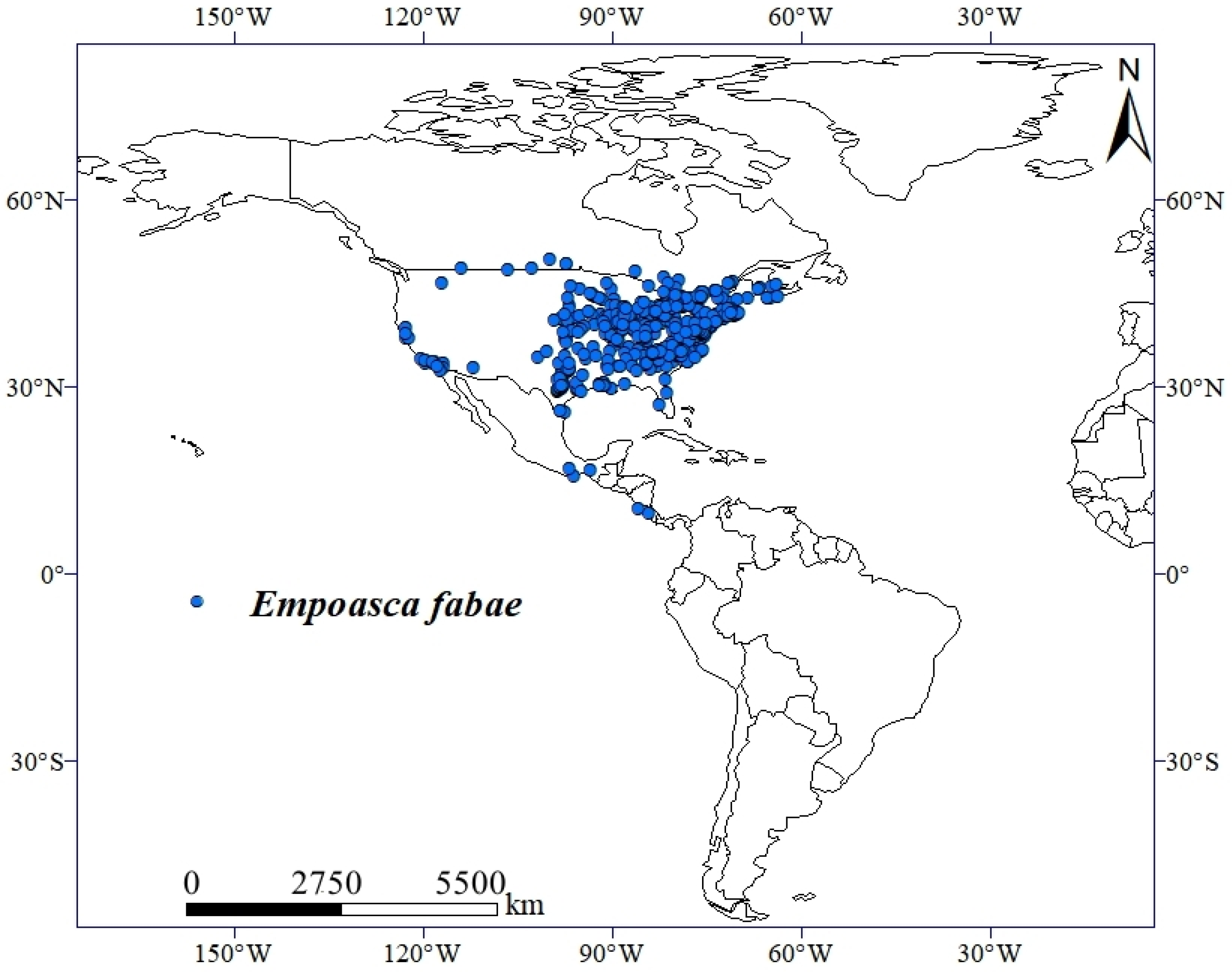
Initially, a dataset comprising 4339 distribution points for E. fabae was retrieved from the Global Biodiversity Information Facility (GBIF, https://www.gbif.org/ (accessed on 27 November 2025)); the corresponding occurrence download DOI is https://doi.org/10.15468/dl.32g65k). To guarantee dataset reliability, we performed data cleaning to eliminate entries with missing georeferenced data, coordinate errors, or duplications. Recognizing that uneven sampling intensity can negatively affect the accuracy of species distribution models [19,20], we applied a spatial rarefaction procedure. This was executed using the ‘spThin’ R package (v0.2.0) with a 10 km filtering threshold to minimize spatial clustering [21]. Consequently, 566 unique records were preserved for the final modeling process (Figure 1).

2.2. Environmental Variables

To accurately simulate the potential geographic distribution of E. fabae, we acquired 19 bioclimatic indicators for the baseline period (1970–2000) from the WorldClim v2.1 dataset (https://www.worldclim.org/ (accessed on 27 November 2025)), with a grid size of 2.5 arc-minutes [22]. Regarding future scenarios, the BCC-CSM2-MR model (Beijing Climate Center Climate System Model) was utilized, given its proven reliability in reproducing East Asian climate dynamics [23]. We incorporated three distinct Shared Socioeconomic Pathways (SSPs) from the CMIP6 framework-specifically SSP1-2.6, SSP2-4.5, and SSP5-8.5- for two future time horizons: the 2050s (2041–2060) and the 2090s (2081–2100).
To address issues of multicollinearity and overfitting, a two-stage variable filtration method was employed, utilizing Pearson’s correlation coefficients (|r|) and the Variance Inflation Factor (VIF). First, we calculated pairwise correlations among the 19 bioclimatic variables. When two variables were highly correlated (|r| > 0.8), we eliminated the one with lower hypothesized ecological importance and retained the variable with greater biological relevance to the survival of E. fabae. Second, we calculated VIF values using the R package ‘usdm’ (v2.1.7) [24] to verify statistical independence, ensuring that all retained variables satisfied the threshold of VIF < 5.
As a result, four key environmental variables were retained for the final model: Bio5 (Max Temperature of Warmest Month), Bio6 (Min Temperature of Coldest Month), Bio12 (Annual Precipitation), and Bio15 (Precipitation Seasonality, Coefficient of Variation in monthly precipitation). All retained variables exhibited low multicollinearity, with a maximum VIF value of 4.11.

2.3. Model Construction and Evaluation Method

Modeling protocols were executed in the R computing environment (version 4.5.2) using the ‘dismo’ package [25] to run the MaxEnt algorithm (v3.4.3). To define the calibration landscape, we restricted the sampling area to known species occurrences, within which 10,000 background points were randomly generated (Random Seed set to 2025 for reproducibility).
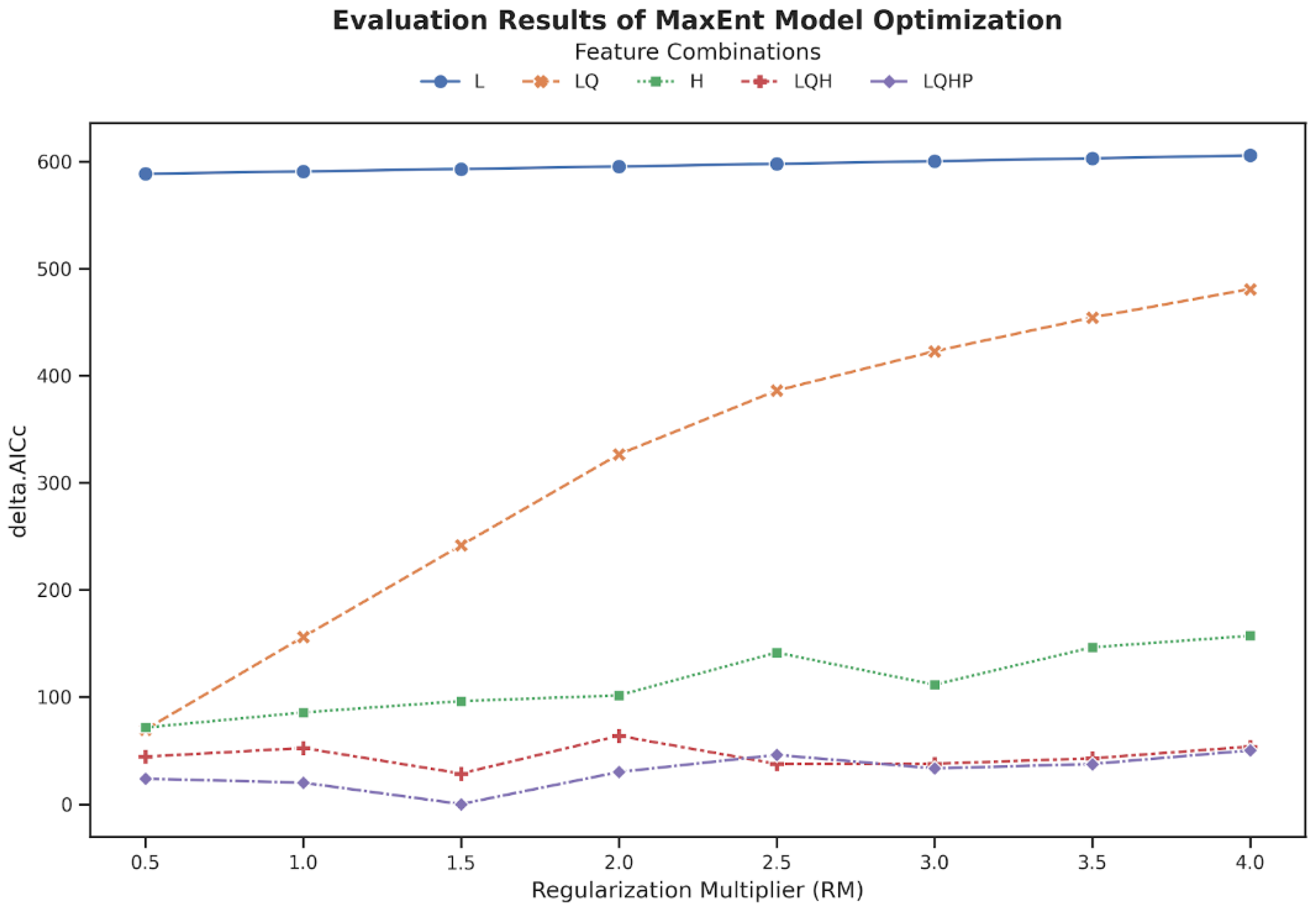
To optimize model complexity and minimize overfitting, we utilized the ‘ENMeval’ package (v2.0.4) [26] to test a matrix of parameter combinations. Specifically, we evaluated Regularization Multipliers (RM) from 0.5 to 4.0 (step size 0.5) across five Feature Class (FC) combinations: L, LQ, H, LQH, and LQHP. L = linear, Q = quadratic, H = hinge, and P = product feature classes; thus, LQH and LQHP denote models allowing the corresponding combinations of feature types. Spatial autocorrelation was managed using a 4-fold spatial block partitioning strategy [8]. Model selection was prioritized based on the standardized Akaike Information Criterion corrected for small sample sizes (AICc), identifying the most parsimonious models as those with a delta AICc value < 2 [9,27].
The optimal parameter set was then applied to train the final model using a 10-fold cross-validation procedure, where 90% of the data was used for training and 10% for testing in each iteration. We assessed the contribution of environmental variables via Jackknife analysis and evaluated predictive power using the Area Under the Curve (AUC) of the Receiver Operating Characteristic (ROC) [10]. AUC values were graded as follows: failing (0.5–0.6), poor (0.6–0.7), fair (0.7–0.8), excellent (0.8–0.9), and superior (>0.9) [28,29]. To further validate model robustness, we calculated the True Skill Statistic (TSS) and Omission Rate (OR) based on random 4-fold cross-validation [30,31]. Finally, continuous probability outputs were binarized into suitable/unsuitable habitat maps using the Maximum Training Sensitivity Plus Specificity (MTSPS) threshold [32].
Notably, percent contribution is a heuristic that can be influenced by predictor correlations and the specific fitting path, whereas permutation importance more directly reflects prediction sensitivity; therefore, variables with lower percent contribution may still be biologically influential when model predictions are highly sensitive to their values.
To assess extrapolation risk when transferring the model from North America to China, we conducted a Multivariate Environmental Similarity Surface (MESS) analysis using the ‘dismo’ package (v1.3.16) [25], which identifies areas of novel climates (MESS < 0) versus analogous environments (MESS ≥ 0). Because a biologically explicit accessible area (M) is difficult to reconstruct for this migratory pest from presence-only data, we used the spatial extent of the cleaned occurrences as a pragmatic approximation for background characterization, acknowledging that alternative definitions of M may influence transferability. In addition, biotic regulation (e.g., natural enemies) was not explicitly parameterized at the national scale due to the lack of spatially continuous data; therefore, our projections represent climate-based abiotic suitability or exposure rather than realized population dynamics. As a sensitivity analysis motivated by the migratory biology of E. fabae in North America, we also fitted an alternative MaxEnt model excluding Bio6 [33]. This “noBio6” model was used to evaluate how projections change when a cold-month constraint is removed from model fitting; results are provided in the Supplementary Materials (Table S1; Figure S4).

2.4. Spatiotemporal Dynamics Analysis

To quantitatively track the migration of core habitats across present and future climatic landscapes (SSP1-2.6, SSP2-4.5, and SSP5-8.5), we computed suitability-weighted centroids. Initially, the MTSPS threshold was applied to transform continuous probability outputs into binary presence/absence layers, thereby defining the boundaries of potentially suitable zones. Within these delimited ranges, centroids were calculated using the ‘geosphere’ R package (v1.5.20) [34], with pixel-level suitability values serving as weighting factors. Unlike simple geometric centers, this weighted methodology ensures that the resulting coordinates accurately represent shifts in high-quality core habitats [35]. Finally, we determined the magnitude and azimuth of the shifts to reconstruct stepwise migration trajectories, which were subsequently visualized using ArcGIS 10.8.
Furthermore, to evaluate the robustness of the projected habitat contractions across future scenarios, a sensitivity analysis was conducted using two alternative widely applied binarization thresholds: the 10th percentile training presence and the equal training sensitivity and specificity threshold. Additionally, to determine whether future habitat suitability differed significantly among the three SSP scenarios, a Kruskal–Wallis non-parametric test was performed on the projected continuous suitability scores extracted from 50,000 random background pixels across the projection area.

2.5. Assessment of Climatic Exposure Risk to Potato Production

To assess the potential threat to the potato industry, we obtained potato distribution data from the SPAM 2020 v2.0 database [36] (Spatial Production Allocation Model; https://www.mapspam.info/ (accessed on 30 December 2025)). To ensure spatial consistency, potato data were resampled to match the resolution of the pest suitability maps (2.5 arc-min). We performed a spatial overlay analysis by superimposing the predicted binary suitable habitats of E. fabae onto the potato distribution layer using the ‘terra’ package (v1.8.86) in R [37]. This process extracted potato cultivation areas located within the pest’s suitable range. Finally, the resulting risk maps were visualized in ArcGIS 10.8 to identify the spatial overlap between high-density potato production zones and potential infestation areas under current and future climate scenarios.

3. Results

3.1. Model Accuracy Evaluation

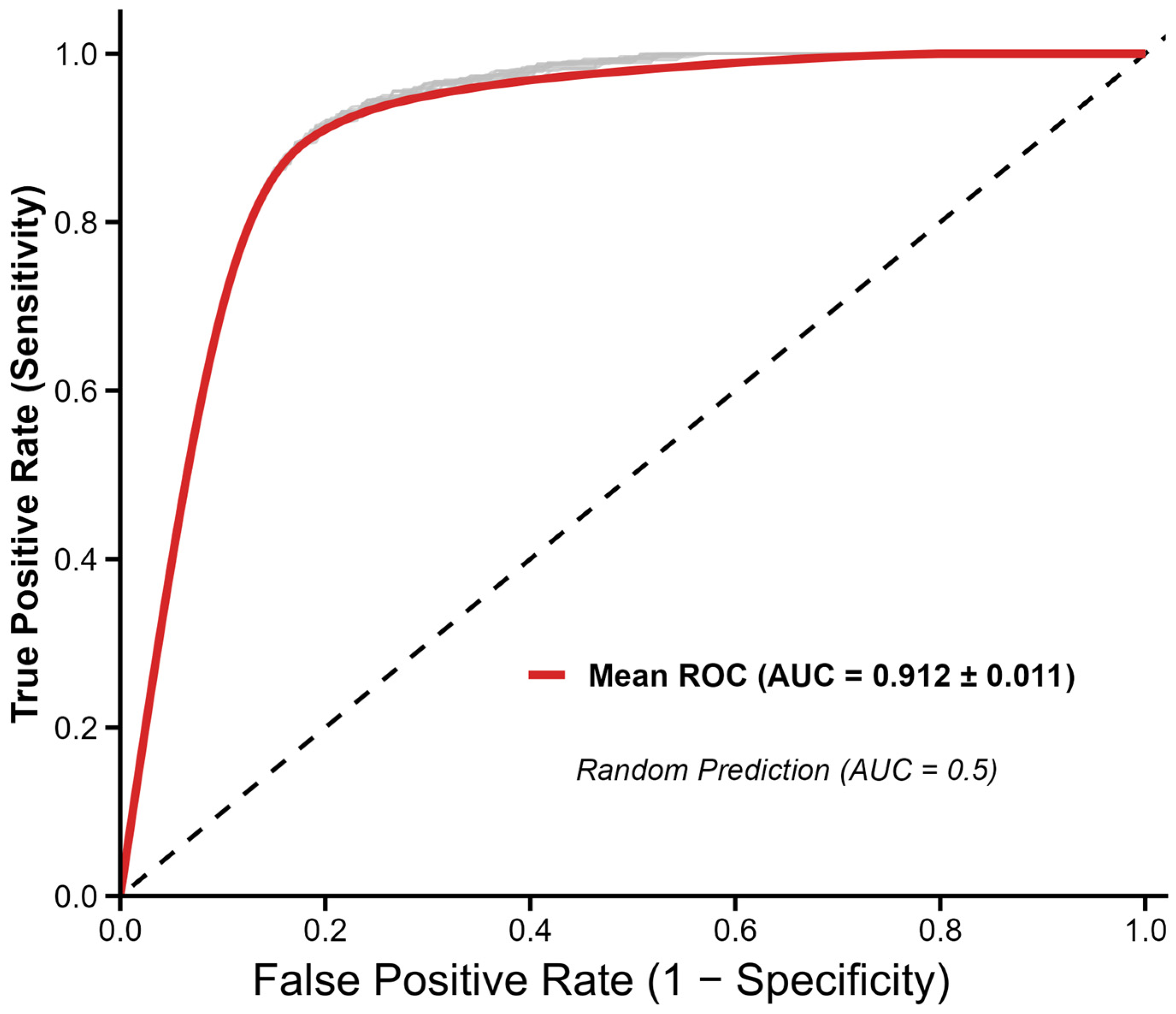
Through the evaluation of 40 distinct parameter sets using ‘ENMeval’ (Figure 2), we identified that the configuration combining a Regularization Multiplier (RM) of 1.5 with the Linear-Quadratic-Hinge-Product (LQHP) feature class produced the lowest delta AICc score (0). This performance significantly surpassed the default settings (RM = 1, FC = LQHPT), which resulted in a much higher delta AICc of 20.00. Accordingly, the RM = 1.5/FC = LQHP model was chosen for subsequent analyses, as it offered the most effective balance between statistical fit and explanatory parsimony. Under 10-fold cross-validation, the optimized MaxEnt model exhibited high predictive power, achieving a mean Area Under the Curve (AUC) of 0.912 (Figure 3). Furthermore, model robustness was substantiated through independent random 4-fold cross-validation, which yielded a mean True Skill Statistic (TSS) of 0.747 and a low Omission Rate (OR) of 0.073. Collectively, these indices suggest that the model provides a reliable framework for delimiting the potential range of E. fabae across China.
Furthermore, to evaluate the reliability of cross-continental transfer, we performed a Multivariate Environmental Similarity Surface (MESS) analysis using the full predictor set (Bio5, Bio6, Bio12, Bio15) (Supplementary Figure S1). Across China, 4.43% of pixels were characterized by novel climatic conditions relative to the North American calibration background (MESS < 0). Importantly, when focusing on predicted suitable habitats defined by the MTSPS threshold (0.2315), 100% of suitable pixels occurred within analogous climatic space (MESS ≥ 0), indicating that the core suitability projection is dominated by environmental interpolation rather than extrapolation into novel climate space.

3.2. Importance of Environmental Variables

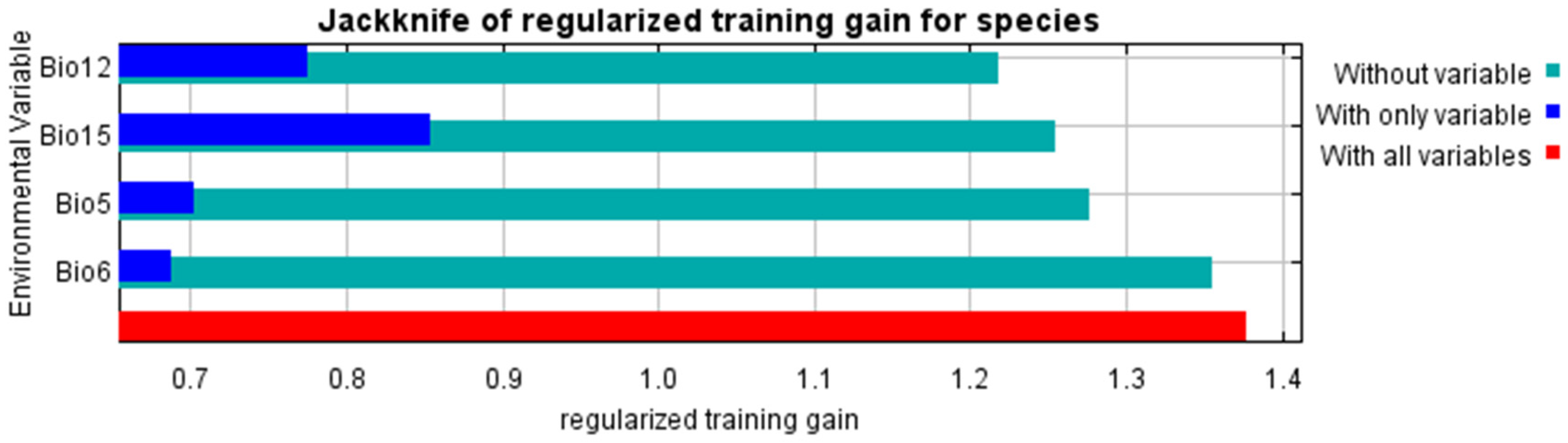
Table 1 summarizes the percent contribution and permutation importance of predictors in the final MaxEnt model (the full predictor set). Precipitation-related variables (Bio15 and Bio12) dominated percent contribution (39.5% and 28.7%, respectively), whereas Bio5 ranked highest in permutation importance (43.9%), indicating that model predictions were most sensitive to variation in the maximum temperature of the warmest month. Bio6 showed comparatively low permutation importance (9.9%). The jackknife test further corroborated the relative importance of these predictors (Figure 4).
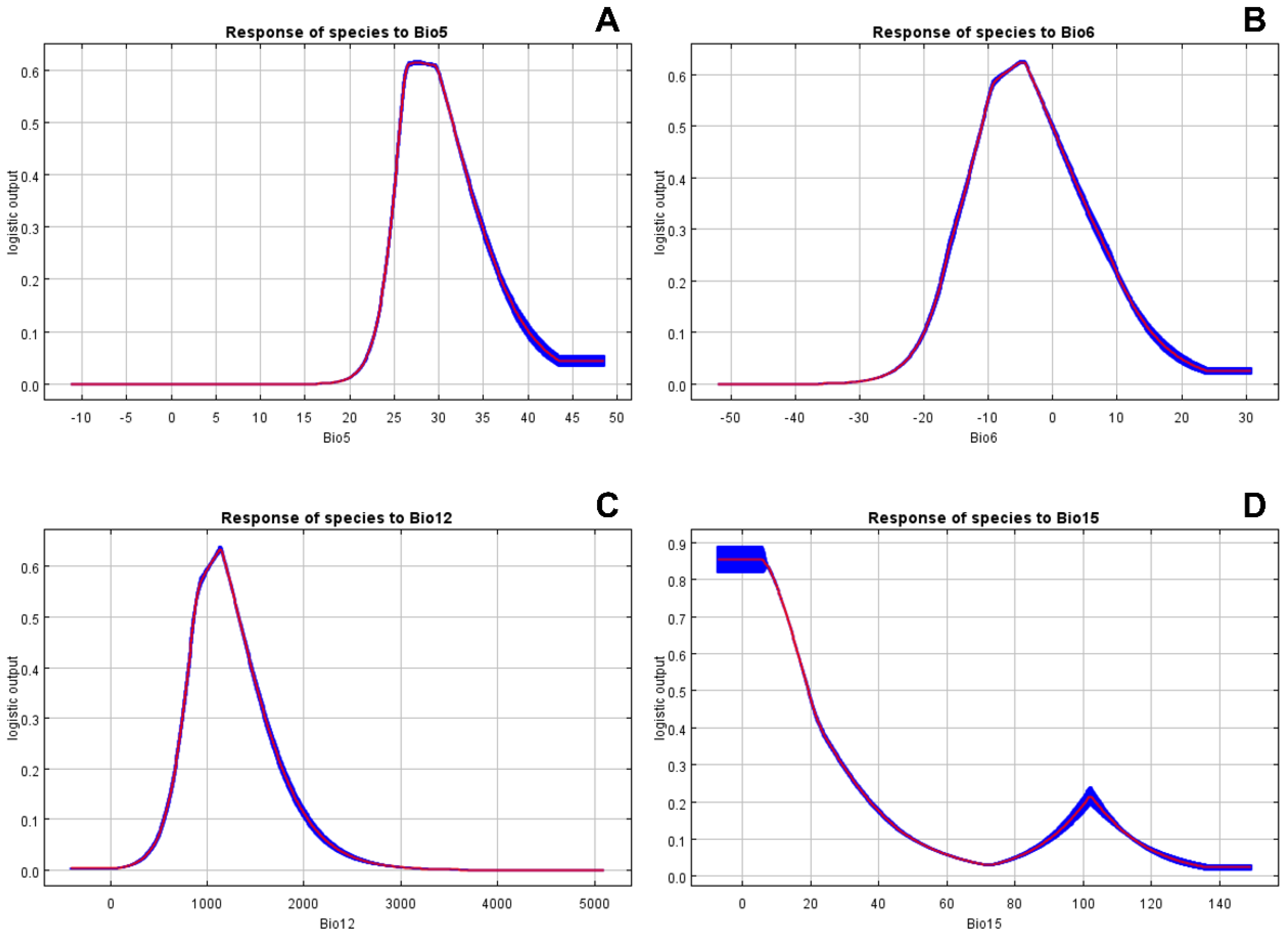
The response curves depict how predicted suitability varies along key environmental gradients (Figure 5). For Precipitation Seasonality (Bio15), a non-linear trend was observed: suitability reached its maximum (probability ≈ 0.9) at near-zero seasonality, but declined precipitously to ~0.2 as values rose to 40, hitting a nadir around 80. A minor secondary peak (probability ≈ 0.2) occurred at Bio15 ≈ 100, before tapering off to zero beyond 140. Annual Precipitation (Bio12) followed a distinct single-peak trajectory, where suitability began to rise at 200 mm, culminated at approximately 1200 mm, and subsequently diminished to 0.1 once precipitation levels surpassed 2000 mm.
Regarding thermal constraints, Bio5 indicated that the likelihood of E. fabae occurrence was negligible below 18 °C. The probability curve ascended to a peak (≈ 0.62) at 27 °C but fell markedly when temperatures exceeded 30 °C. Similarly, Bio6 showed an optimal range around 0 °C, with suitability dropping sharply if temperatures deviated toward extremes (either < −30 °C or >0 °C).

3.3. Potential Distribution of E. fabae in the Current Period

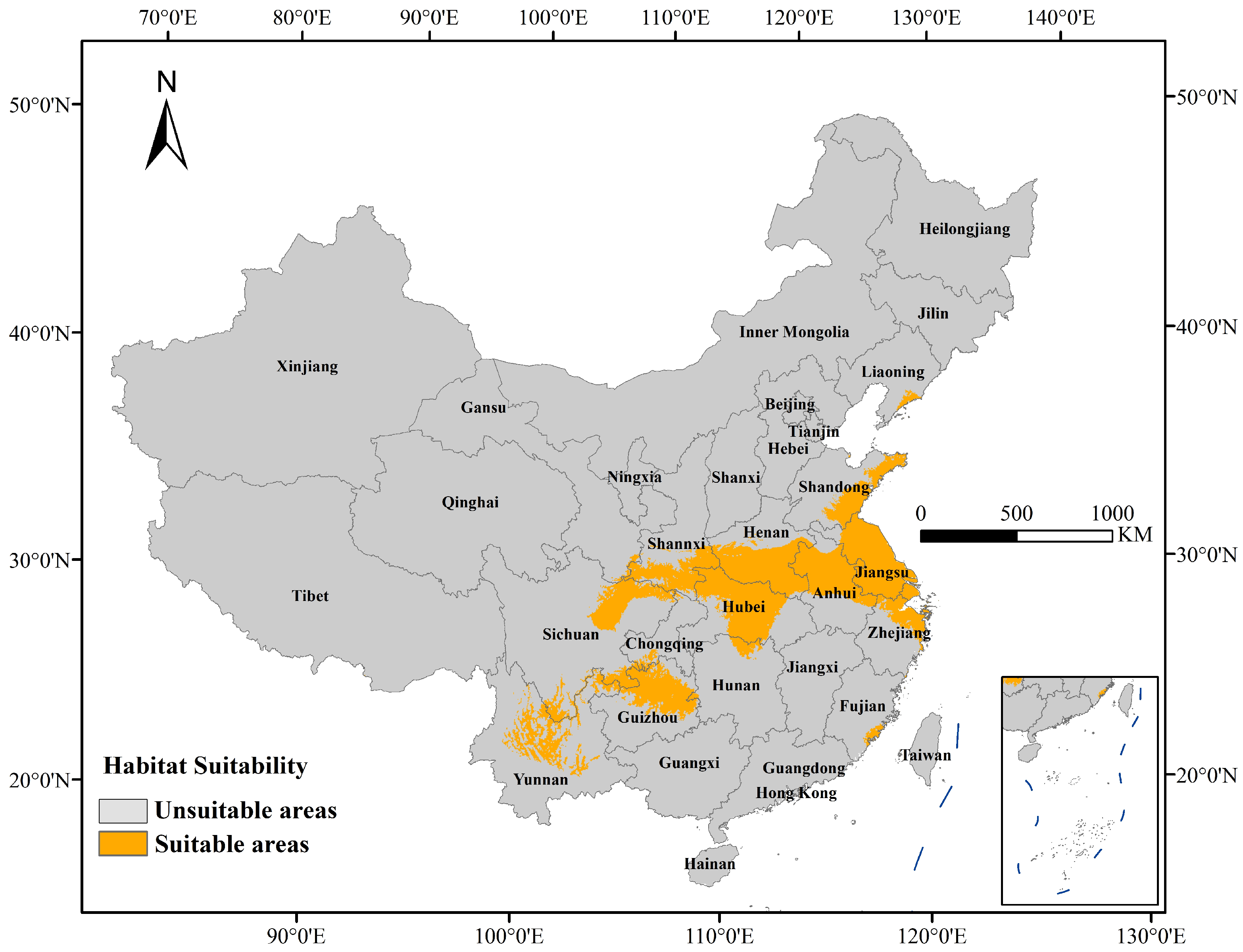
Figure 6 illustrates the potential distribution of E. fabae under current climatic conditions. The total suitable area was estimated at 7.125 × 10⁵ km2, accounting for approximately 7.42% of the total land area of China. Spatially, suitable habitats were mainly distributed between 95.0° E–125.0° E and 20.0° N–35.0° N, encompassing large portions of East China, Central China, Southwest China, and smaller areas in Northwest, North, and Northeast China.
High-suitability regions were predominantly concentrated in East China, including nearly all of Jiangsu Province, southern Shandong, central Anhui, Shanghai, and northern Zhejiang. Additional suitable areas were identified in Central China, such as Hubei, northern Hunan, and southern Henan, as well as in Southwest China, including the eastern Sichuan Basin, Chongqing, northern Guizhou, and parts of central Yunnan. Smaller, fragmented suitable habitats were also observed in southern Shaanxi (Northwest China) and the southern tip of the Liaodong Peninsula in Liaoning Province (Northeast China).

3.4. Potential Distribution and Habitat Suitability Changes of E. fabae in Future Periods

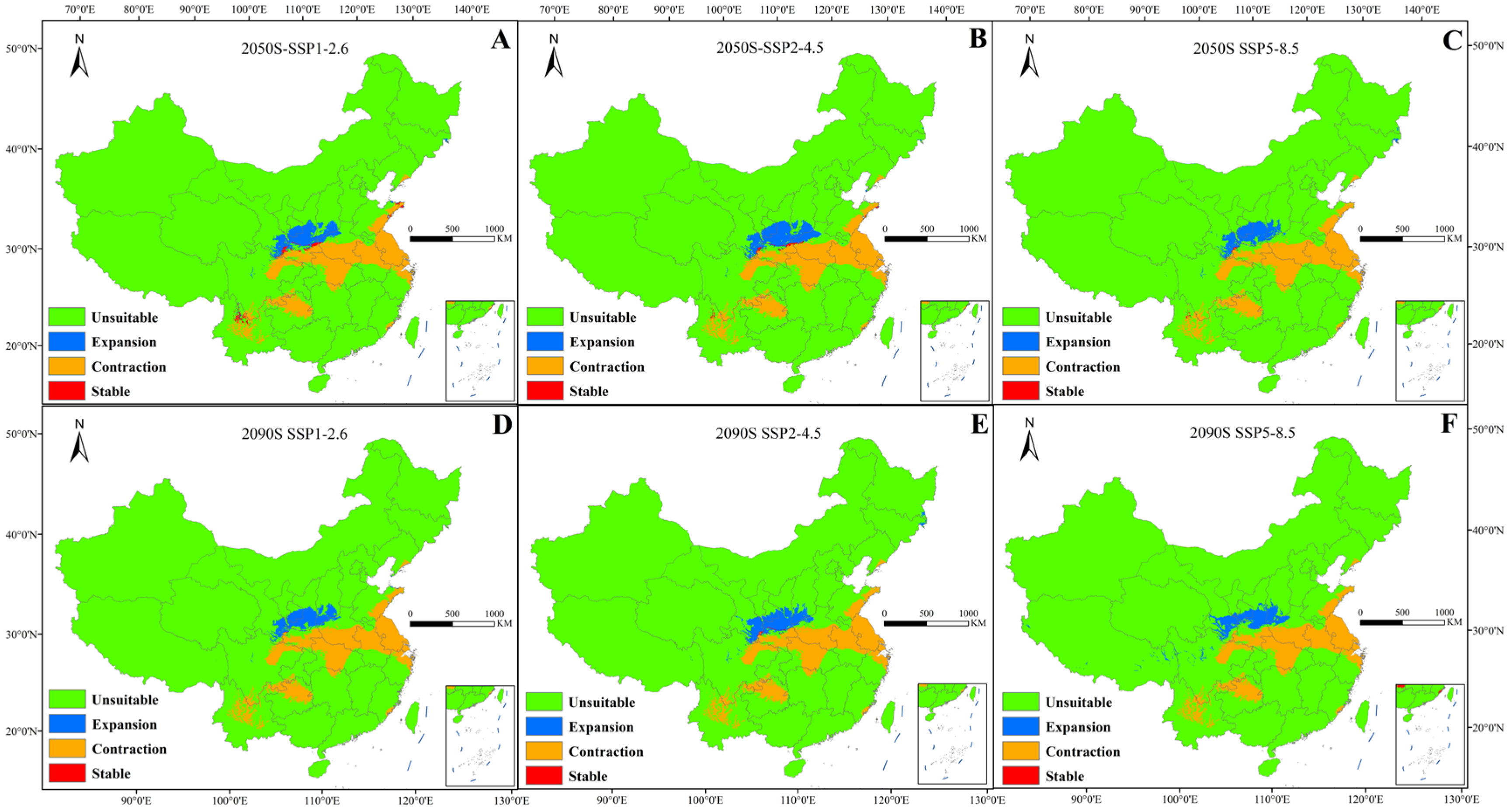
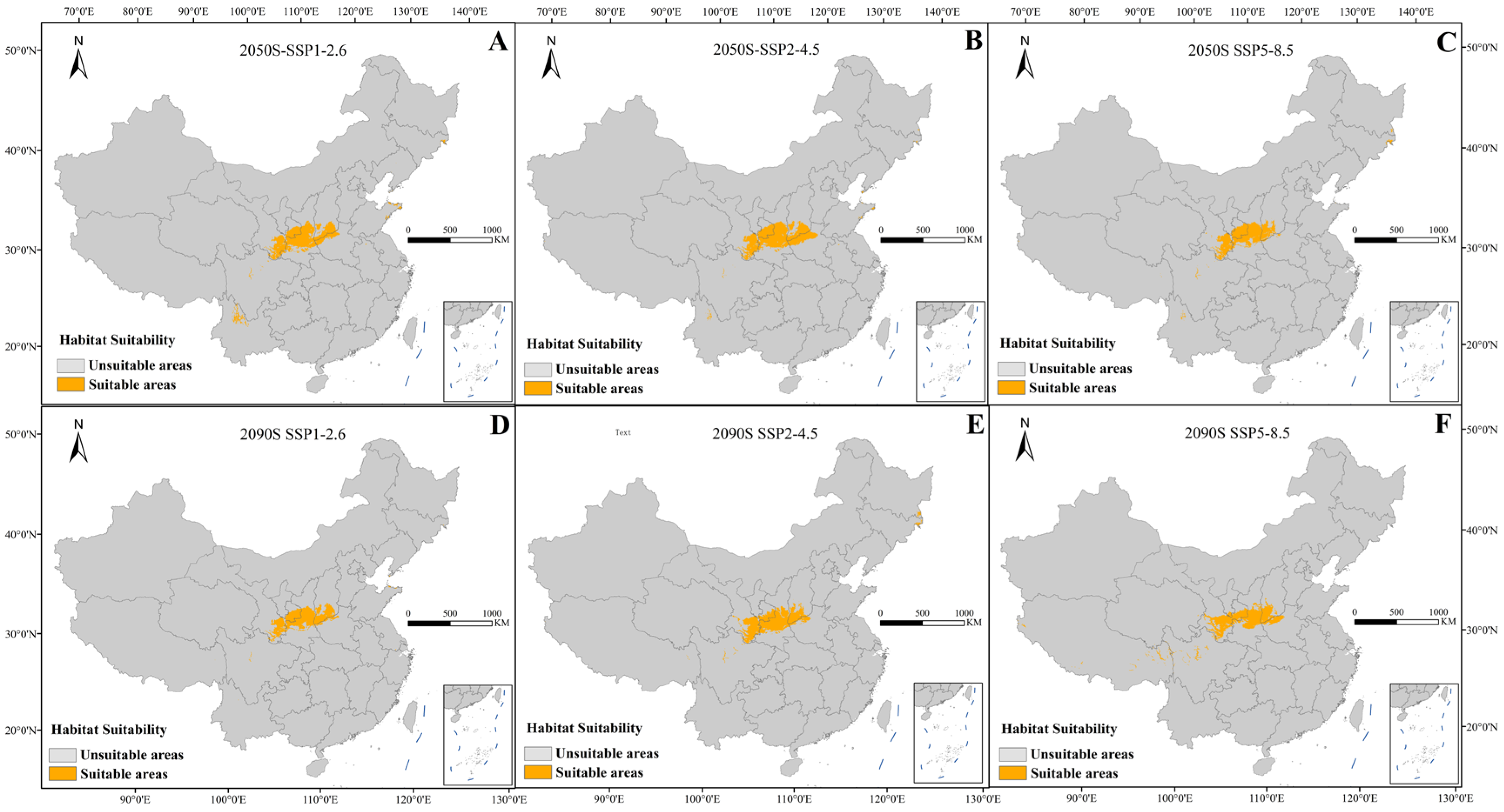
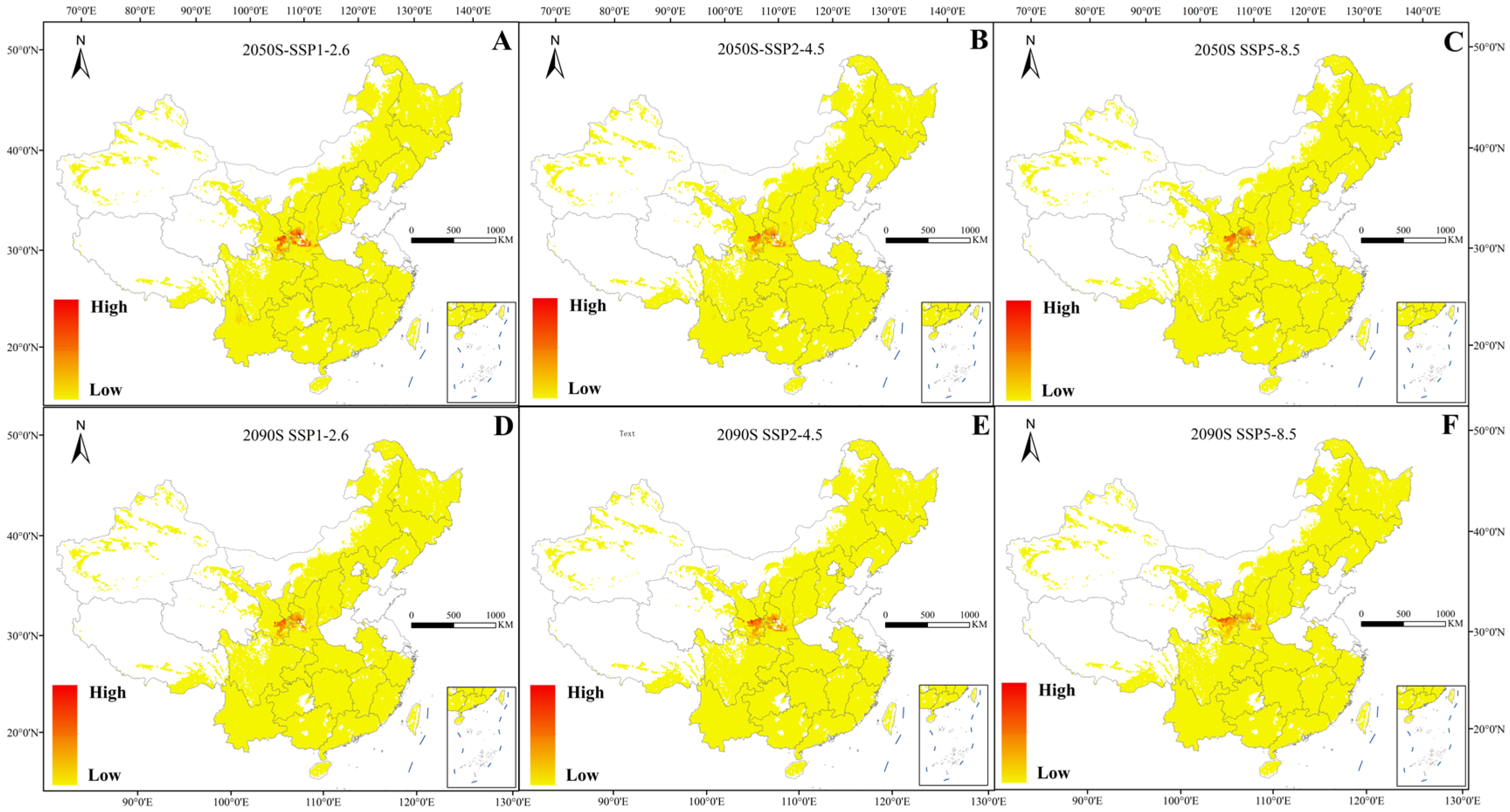
Predicted changes in the potential distribution of E. fabae under future climate scenarios are presented in Figure 7 and Figure 8. Compared with the current period, the total suitable area is projected to decrease substantially under all future scenarios. Overall, the longitudinal extent of suitable habitats contracts westward, while the latitudinal range shifts northward.
Relative to the current distribution, the total suitable area of E. fabae is expected to decline by approximately 73.65–80.42% across future scenarios. The sensitivity analysis indicated that projected contraction remained consistently high across three commonly used thresholds (MTSPS, 10th percentile, and equal sensitivity/specificity), with contraction rates ranging from 73.79% to 90.33% (Supplementary Figure S2). Furthermore, a Kruskal–Wallis non-parametric test revealed statistically significant differences among the continuous suitability scores of the three SSP scenarios (X2 = 47.20, df = 2, p = 5.63 × 10⁻¹¹). As illustrated in the suitability distribution boxplot (Supplementary Figure S3), the median suitability scores across all future pathways remained below 0.1. This pronounced reduction results in a corresponding expansion of unsuitable areas, primarily due to the loss of suitable habitats at lower latitudes. Regions that are currently suitable, including Jiangsu, Anhui, Hubei, southern Henan, and the Guanzhong Plain, are projected to become unsuitable under future climatic conditions.
Stable suitable habitats are mainly retained in transitional regions at the junction of Shanxi, Henan, and Shaanxi provinces, as well as in parts of Gansu and Ningxia. With increasing time horizons, suitable areas continue to retreat northward. This trend is reflected by a northward shift within Shaanxi Province, from the Qinling Mountains toward the Yan’an region, as well as by the emergence of isolated suitable patches in previously unsuitable areas.
Under the SSP5-8.5 scenario in the 2090s, although the total suitable area is minimal, newly suitable habitats appear sporadically in high-latitude and high-altitude regions, including parts of Northeast China (e.g., Heilongjiang and Jilin) and areas along the eastern Tibetan Plateau bordering Sichuan. These changes indicate a redistribution of suitable habitats from low-latitude regions toward higher latitudes and elevations.

3.5. Centroid Migration Trajectories

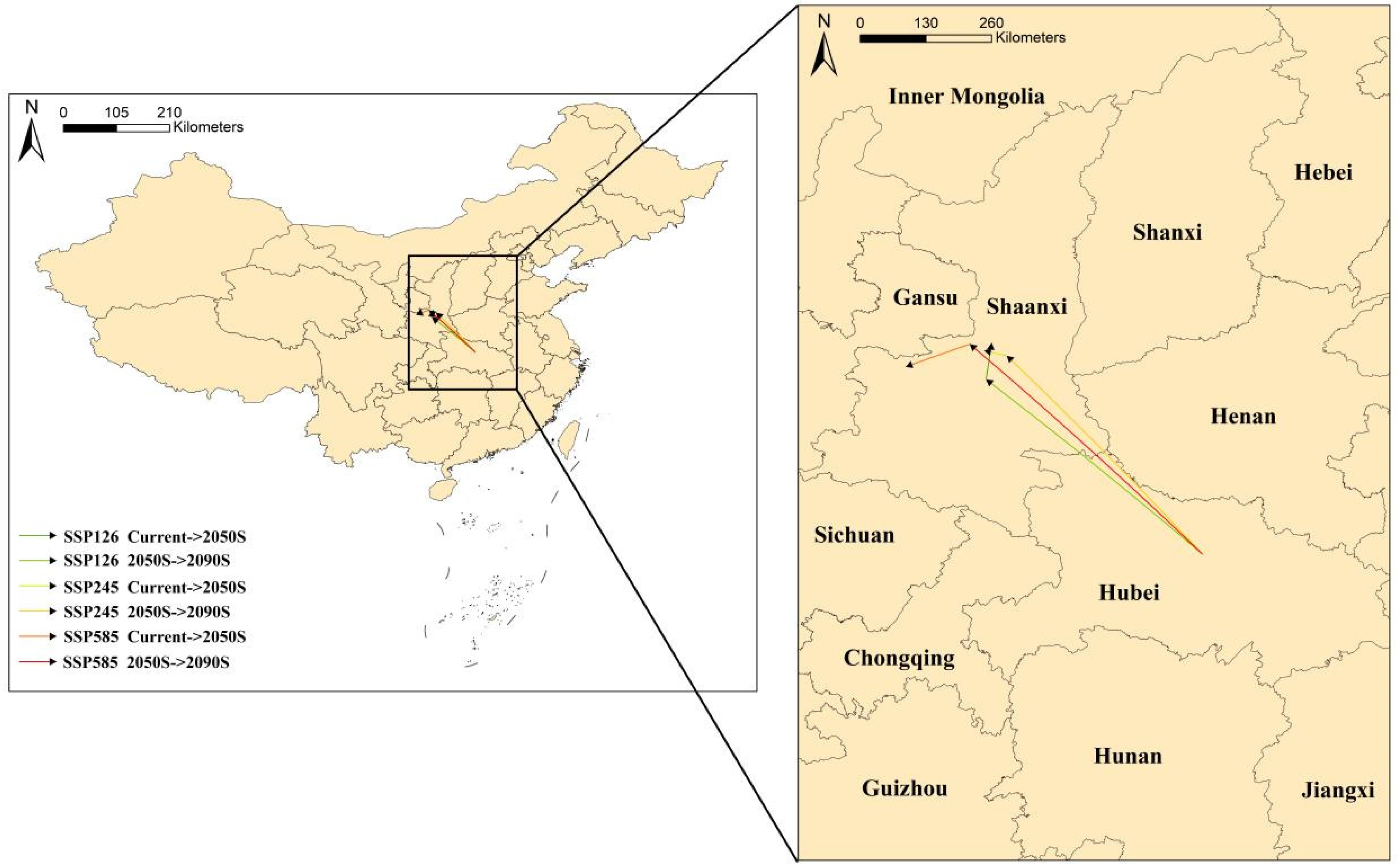
Centroid migration trajectories of the potential distribution of E. fabae under different climate scenarios are illustrated in Figure 9, with detailed coordinates and distances summarized in Table 2. Under current climatic conditions, the centroid of suitable habitats is located in Hubei Province (112.68° E, 31.40° N).
Across all three future scenarios, centroid positions exhibit a general northwestward migration trend. Under SSP1-2.6, the centroid shifts approximately 498.55 km northwestward to 108.83° E, 34.51° N in the 2050s, and subsequently moves slightly northeastward by the 2090s, reaching 108.93° E and 35.16° N, with a total migration distance of 544.55 km from the current centroid. Under SSP2-4.5, the centroid migrates 509.35 km northwestward in the 2050s (109.19° E, 34.93° N) and continues moving northwestward to 108.79° E, 35.03° N in the 2090s, resulting in a total migration distance of 541.41 km.
The largest migration magnitude occurs under SSP5-8.5. In the 2050s, the centroid shifts 566.57 km northwestward to 108.54° E, 35.14° N. From the 2050s to the 2090s, the centroid moves slightly southwestward to 107.40° E and 34.74° N, producing a maximum total migration distance of 616.13 km. Overall, centroid trajectories consistently indicate a shift away from central China toward northwestern inland regions, reflecting a pronounced tendency for E. fabae to migrate toward higher latitudes in response to climate change.

3.6. Assessment of Climatic Exposure for Potato Production

The potential climatic exposure of potato production to E. fabae in China was quantified by spatially overlaying projected suitable habitats onto potato cultivation areas (Figure 10). Under current climatic conditions, the area of spatial overlap accounted for 13.53% of the total potato planting area.
Under future climate scenarios, the overall climatic exposure for potato production decreased markedly due to the contraction of climatically suitable habitats for E. fabae. Across all scenarios, the proportion of potato planting areas exposed to potential infestation declined to 4.35–6.74%. This reduction in exposure was consistent across different emission pathways and time periods.
Spatially, projected exposure patterns exhibited a clear northwestward shift. Highly exposed areas were mainly concentrated in the Guanzhong Plain of Shaanxi Province and along the border regions between Gansu and Shaanxi. Areas of moderate exposure extended from Yan’an toward southern Yulin. In contrast, exposure levels in traditionally affected southern regions, such as Yunnan and southern Shanxi, declined substantially and were largely absent by the 2090s.
Meanwhile, exposed areas in Gansu expanded westward under future scenarios, transitioning from fragmented patches into more continuous zones of potential exposure. Under the SSP5-8.5 scenario in the 2090s, although overall exposure levels were low across most regions, isolated highly exposed patches were projected to emerge in northwestern Sichuan.

3.7. Sensitivity Analysis

The alternative model excluding Bio6 yielded a binary suitability map with an MTSPS threshold of 0.2493. Under current climatic conditions, the total predicted area using this model was 198,397 km2. Across future scenarios, this area is projected to increase, reaching a maximum of 316,447 km2 under the SSP2-4.5 scenario in the 2050s (Supplementary Table S1). When these areas were subsequently filtered using three cold-month temperature thresholds (Bio6 ≥ −10 °C, −5 °C, and 0 °C), the projected suitable areas contracted. For example, applying the −5 °C threshold under current conditions reduced the area to 124,054 km2 (62.53% of the unfiltered area). Under future scenarios, the areas meeting the ≥ 0 °C threshold decreased to near zero across most pathways by the 2090s (Supplementary Table S1; Supplementary Figure S4).

4. Discussion

From a comparative pest-ecology perspective, E. fabae shares key traits with other mobile, sap-feeding Hemiptera such as aphids, psyllids (e.g., Bactericera/Paratrioza spp.), and other leafhoppers, including wind-assisted dispersal, rapid population increase on host plants, and strong sensitivity to hydrothermal conditions. However, the dominant damage paradigm differs among these groups: aphids and psyllids are often emphasized for pathogen-associated impacts in crops, whereas the best-documented impact of E. fabae is direct plant injury via ‘hopperburn’ caused by toxic salivary effects that disrupt plant physiology and reduce photosynthetic capacity [13]. This distinction implies that, if establishment occurs in newly suitable regions, E. fabae could impose immediate direct damage even in the absence of pathogen-mediated effects, reinforcing the value of early surveillance in high-exposure potato areas.
As observed in its native North American range, E. fabae populations in high-latitude regions are primarily sustained by spring windborne migration rather than local overwintering survival, since extreme winter temperatures fall below their physiological survival thresholds [38]. Consequently, evaluating the true invasion risk of such migratory species requires a conceptual decoupling of temporary seasonal occurrence from permanent establishment. To explicitly address this biological reality, our primary MaxEnt model (which incorporates the Bio6 constraint) is strictly formulated to predict the geographic baseline for a non-migratory, year-round established population that might be introduced into China. Furthermore, executing targeted sensitivity analyses by removing specific winter constraints is an established methodological approach in species distribution modeling to isolate the seasonal exposure limits of highly mobile insects, thereby preventing the underestimation of summer invasion potential [33]. By excluding the cold-month variable, our sensitivity analysis revealed a profound spatiotemporal decoupling under climate warming: although the potential seasonal exposure area during the growing season is projected to expand into higher latitudes (e.g., Northeast China), the core suitable habitats for permanent, non-migratory establishment are projected to contract significantly consistent with limitations imposed by low cold-month temperatures (Bio6).
In this study, Precipitation Seasonality (Bio15) and Annual Precipitation (Bio12) were identified as the dominant environmental factors limiting the potential distribution of E. fabae. The response curves suggest associations between predicted suitability and moisture- and temperature-related gradients, which may be consistent with physiological constraints. First, the response curve for Bio15 shows that habitat suitability is highest when precipitation seasonality is near 0, but drops sharply as seasonality increases. This potentially indicates that E. fabae is highly sensitive to seasonal moisture fluctuations and requires stable hydrothermal conditions for reproduction. Similarly, Bio12 exhibits a unimodal curve peaking at approximately 1200 mm; however, suitability declines rapidly when precipitation exceeds 2000 mm. These results are consistent with previous findings that while moisture is essential for survival [39], excessive rainfall can be detrimental. Flanders and Radcliffe [40] reported that heavy rainfall can physically wash nymphs off host plants, thereby limiting their distribution in hyper-humid regions.
Regarding temperature, although Bio5 showed a lower percent contribution than precipitation-related variables, permutation importance ranked Bio5 as the most influential predictor (43.9%), indicating that permuting Bio5 values led to the largest reduction in model performance. In the jackknife tests, Bio15 produced the highest gain when used alone, whereas omitting Bio12 caused the largest decrease, suggesting that Bio12 contains unique information not fully captured by other predictors. Collectively, these results indicate that temperature- and precipitation-related variables jointly shape predicted suitability, but their relative importance varies with the metric used and interactions among predictors. The response curve for Bio5 (maximum temperature of the warmest month) shows a rapid decline in suitability when temperatures exceed ~30 °C, a pattern consistent with potential heat stress sensitivity in E. fabae. Physiologically, temperatures exceeding the upper developmental threshold (approx. 30–32 °C) retard development and increase mortality [41]. Consequently, the projected warming in southern China will likely exceed the pest’s thermal tolerance. Therefore, unlike many other pests that are expanding due to warming [4], the potential distribution of E. fabae is predicted to contract significantly, retreating from the warming Yangtze River basin to higher latitudes and inland regions (such as Northwest China) to colonize suitable climatic refugia.
There have been limited studies on the potential distribution of E. fabae in China using the MaxEnt model. In accordance with the present results, the suitable areas are currently located in the transition zone between northern and southern China. However, there may be differences between our simulation results and the actual distribution due to data limitations. The medium- and high-suitability areas in this study are concentrated in the Yangtze River basin and Southwest China. This distribution pattern aligns with the climatic characteristics of its primary host plants. In this study, our cross-continental projections inherently rely on the assumption of ecological niche conservatism. According to the BAM (Biotic-Abiotic-Movement) framework [18], the potential distribution of an invasive species is defined by the intersection of favorable abiotic conditions (A), suitable biotic interactions (B), and its capacity to reach these areas (M). Transferring a model calibrated in North America to East Asia introduces theoretical uncertainties regarding potential niche shifts due to the release from native biotic constraints. However, our quantitative MESS analysis (Supplementary Figure S1) demonstrates that the predicted core suitable areas in China share largely analogous climatic spaces with the native range (MESS ≥ 0). This effectively mitigates the risks of mathematical extrapolation, ensuring that the abiotic suitability identified herein is grounded in robust environmental interpolation. Nevertheless, future comprehensive models should further integrate non-climatic dimensions, such as soil types, specific crop distribution, natural enemies, and airflow dynamics, to refine prediction accuracy. Nevertheless, ecological niche shifts during invasion cannot be ruled out, particularly through changes in biotic interactions (B) and dispersal dynamics (M); therefore, our projections should be interpreted as climate-based abiotic suitability/exposure rather than guaranteed establishment outcomes.
Finally, we acknowledge the uncertainties arising from relying on a single General Circulation Model (BCC-CSM2-MR). This specific selection was driven by its widely recognized superior performance in simulating the East Asian monsoon and regional precipitation patterns [23,42], which our results identified as the primary limiting factors for this species. However, quantitative contraction magnitudes may exhibit variability under alternative models, and future studies employing Multi-Model Ensembles (MME) are recommended to further narrow climate-driven uncertainty intervals. Accordingly, the reported contraction percentages should be interpreted as estimates conditional on the BCC-CSM2-MR model and may vary under other CMIP6 GCMs, although the qualitative spatial shift is expected to be robust.
The reliability of future species distribution projections is fundamentally dependent on the quality of the underlying climate datasets. Currently, the Coupled Model Intercomparison Project Phase 6 (CMIP6) represents the state-of-the-art in climate modeling. Compared to its predecessor (CMIP5), CMIP6 features a more comprehensive scientific framework, incorporating 23 endorsed Model Intercomparison Projects (MIPs) designed to address pressing global scientific questions [43]. Technically, these models demonstrate significant improvements in the spatial resolution of atmospheric and oceanic component, alongside higher climate sensitivity [44]. Crucially for this study, comparative assessments indicate that CMIP6 models outperform CMIP5 in reproducing historical climate patterns specifically within China [23]. Consequently, employing CMIP6 data ensures a higher degree of accuracy and credibility for simulating the future suitability of E. fabae.
Under future climate scenarios, the potential distribution of E. fabae in China is projected to contract significantly, primarily retreating from its current core habitats in East and Central China. Our results indicate a massive reduction in total suitable area (decreasing by 73.65% ~ 80.42%), with the centroid of the distribution shifting noticeably towards the Northwest. This distribution shift appears to be driven by a trade-off between thermal tolerance and moisture requirements. Although E. fabae prefers humid environments, the projected warming in southern China likely exceeds the pest’s upper thermal limits (Bio5 > 30 °C), triggering heat stress and forcing a retreat from these historically suitable regions [41]. Consequently, the species’ distributions contract toward higher latitudes and altitudes (such as the junction of Gansu and Shaanxi) which serve as (thermal refugia) due to their cooler summer temperatures [45]. However, the drastic reduction in total suitable area implies that while these northwestern regions offer suitable temperatures, their relatively limiting precipitation regimes (Bio12 and Bio15) prevent widespread colonization. Thus, the shift to the Northwest does not indicate a preference for aridity, but rather may represent a survival strategy to escape lethal heat, restricted by the moisture limitations of the new habitat. This pattern is consistent with the (warm-wet) climate trend observed in Northwest China, where increasing precipitation may provide just enough moisture to support these refugee populations in specific microclimates [46].
The findings of this study offer a theoretical reference for the monitoring and management of E. fabae in China. Based on the projected distribution shifts, future control strategies are advised to pay closer attention to the emerging suitable habitats across Northwest China, represented by regions such as Gansu, Shaanxi, Ningxia, and Hebei. Given the pest’s polyphagous nature, this geographical shift toward the northwest may present new challenges not only to the potato industry but also to other economically important hosts cultivated in China (e.g., alfalfa and beans, and potentially other horticultural hosts such as apple orchards). Here we focus on potato as the key crop host for exposure quantification. While these projected shifts provide a critical baseline for monitoring, this macro-scale assessment inherently reflects climatic exposure—the spatial intersection of pest suitability and host availability—rather than realized agronomic impact. To accurately quantify actual agricultural risk, future localized studies should integrate fine-scale variables such as crop density weighting, yield intensity, economic valuation, and phenological synchrony between the pest and potato crops. Nonetheless, although the total suitable area is projected to decrease, the exposure zones are clearly shifting towards the northwestern potato cultivation belts. Therefore, agricultural and quarantine departments should proactively adjust their monitoring focus to detect potential expansions into these newly suitable ecological zones. Specifically, strict quarantine inspections must target potential invasion pathways, such as the accidental transport of infested host plant materials (e.g., potato seedlings/tubers, alfalfa/bean planting material, and associated packaging) through international trade [1,15], as well as passive long-distance dispersal by prevailing winds during seasonal migration. After arrival, even transient summer populations can still cause economically relevant “hopperburn” injury via sap-feeding and salivary effects, leading to leaf margin chlorosis/necrosis, reduced photosynthesis, and yield/quality losses in susceptible cultivars [13]. Therefore, surveillance and phytosanitary inspections should prioritize high-exposure potato belts identified by our projections, and should be seasonally timed to match likely immigration windows, rather than assuming year-round establishment.
Finally, as the pest has not yet been reported in China, strengthening these targeted phytosanitary regulations and data-driven surveillance will be essential to prevent its initial introduction and mitigate potential agronomic losses.


5. Conclusions

This study assessed the current and future potential distribution of E. fabae in China under climate change using an optimized MaxEnt modeling framework. The results indicate that suitable habitats for E. fabae are currently concentrated in eastern, central, and southwestern China, but are projected to contract markedly under future climate scenarios. In particular, highly suitable areas in the Yangtze River basin are expected to decline, accompanied by a consistent northwestward shift in the distribution centroid. Overall, climate warming is likely to restrict the spatial extent of suitable habitats for a non-migratory, year-round established population of E. fabae rather than promote its range expansion. However, our sensitivity analysis indicates a critical spatial decoupling: while permanent overwintering establishment remains strictly confined by cold-month thresholds, potential seasonal exposure during the growing season may actually expand into additional high-latitude regions. It should be emphasized that these macro-scale projections represent climate-based abiotic suitability, rather than confirmed localized establishment.

Supplementary Materials

The following supporting information can be downloaded at: https://www.mdpi.com/article/10.3390/agronomy16060601/s1, Figure S1. Multivariate Environmental Similarity Surfaces (MESS) analysis for E. fabae in China. Figure S2. Sensitivity analysis of future habitat contraction rates across alternative binarization thresholds. Figure S3. Statistical comparison of predicted habitat suitability scores across future climate scenarios. Figure S4. Sensitivity map from the noBio6 model with an overwintering temperature filter (Bio6 ≥ −5 °C). Table S1. Sensitivity analysis of seasonal exposure and cold-threshold–screened areas for E. fabae across current and future scenarios.

Author Contributions

Conceptualization, Z.G., Z.Z. and H.L.; software, Z.G. and Z.Z.; formal analysis, Z.G. and Z.Z.; writing—original draft preparation, Z.G.; writing—review and editing, Z.G. and H.L.; visualization, Z.G. and Z.Z.; supervision, H.L.; funding acquisition, H.L. All authors have read and agreed to the published version of the manuscript.

Funding

This research was funded by the “City-University Co-construction” Scientific Research Project for State Key Laboratory of Biological Resources and Ecological Environment of Qinling-Bashan, grant number SXJ-2102.

Data Availability Statement

The cleaned occurrence records of Empoasca fabae (n = 566) and the R scripts used for spatial thinning, parameter optimization (ENMeval), and model projection are openly available in the Mendeley Data repository at https://doi.org/10.17632/43w5t58gxy.1. Publicly available datasets were also analyzed in this study. Climatic data can be found at WorldClim (https://www.worldclim.org/ (accessed on 27 November 2025)) and potato distribution data at MAPSPAM (https://www.mapspam.info/ (accessed on 30 December 2025)).

Acknowledgments

We express our gratitude to the anonymous reviewers and editors for their constructive comments that improved the quality of this manuscript. During the preparation of this manuscript, the authors used Gemini for English language editing and polishing. The authors have reviewed and edited the output and take full responsibility for the content of this publication.

Conflicts of Interest

The authors declare no conflicts of interest.

Abbreviations

The following abbreviations are used in this manuscript:
SDMSpecies Distribution Model
MaxEntMaximum Entropy
CMIP6Coupled Model Intercomparison Project Phase 6
SSPShared Socioeconomic Pathways
GBIFGlobal Biodiversity Information Facility
IPMIntegrated Pest Management
AUCArea Under the Receiver Operating Characteristic Curve
TSSTrue Skill Statistic
ROCReceiver Operating Characteristic
AICcAkaike Information Criterion (corrected)
VIFVariance Inflation Factor
RMRegularization Multiplier
FCFeature Class
MTSPSMaximum Training Sensitivity Plus Specificity
OROmission Rate
SPAMSpatial Production Allocation Model
Llinear
Qquadratic
Hhinge
Pproduct

References

  1. Paini, D.R.; Sheppard, A.W.; Cook, D.C.; De Barro, P.J.; Worner, S.P.; Thomas, M.B. Global threat to agriculture from invasive species. Proc. Natl. Acad. Sci. USA 2016, 113, 7575–7579. [Google Scholar] [CrossRef]
  2. Gao, B.; Gould, P.J.; Feng, H.; Huang, J.; Xiao, X.; Reynolds, D.R.; Hu, G.; Chapman, J.W. Regional stability and pest increase in high-flying insect migrants over nine decades. Insect Sci. 2025. ahead of print. [Google Scholar] [CrossRef] [PubMed]
  3. Deutsch, C.A.; Tewksbury, J.J.; Huey, R.B.; Sheldon, K.S.; Ghalambor, C.K.; Haak, D.C.; Martin, P.R. Impacts of climate warming on terrestrial ectotherms across latitude. Proc. Natl. Acad. Sci. USA 2008, 105, 6668–6672. [Google Scholar] [CrossRef] [PubMed]
  4. Bebber, D.P.; Ramotowski, M.A.; Gurr, S.J. Crop pests and pathogens move polewards in a warming world. Nat. Clim. Change 2013, 3, 985–988. [Google Scholar] [CrossRef]
  5. Elith, J.; Leathwick, J.R. Species distribution models: Ecological explanation and prediction across space and time. Annu. Rev. Ecol. Evol. Syst. 2009, 40, 677–697. [Google Scholar] [CrossRef]
  6. Phillips, S.J.; Anderson, R.P.; Schapire, R.E. Maximum entropy modeling of species geographic distributions. Ecol. Model. 2006, 190, 231–259. [Google Scholar] [CrossRef]
  7. Merow, C.; Smith, M.J.; Silander, J.A., Jr. A practical guide to MaxEnt for modeling species’ distributions: What it does, and why inputs and settings matter. Ecography 2013, 36, 1058–1069. [Google Scholar] [CrossRef]
  8. Radosavljevic, A.; Anderson, R.P. Making better Maxent models of species distributions: Complexity, overfitting and evaluation. J. Biogeogr. 2014, 41, 629–643. [Google Scholar] [CrossRef]
  9. Warren, D.L.; Seifert, S.N. Ecological niche modeling in Maxent: The importance of model complexity and the performance of model selection criteria. Ecol. Appl. 2011, 21, 335–342. [Google Scholar] [CrossRef]
  10. Zhao, Y.; Deng, X.; Xiang, W.; Chen, L.; Ouyang, S. Predicting potential suitable habitats of Chinese fir under current and future climatic scenarios based on Maxent model. Ecol. Inform. 2021, 64, 101393. [Google Scholar] [CrossRef]
  11. Elith, J.; Kearney, M.; Phillips, S. The art of modelling range-shifting species. Methods Ecol. Evol. 2010, 1, 330–342. [Google Scholar] [CrossRef]
  12. Chasen, E.M.; Dietrich, C.; Backus, E.A.; Cullen, E.M. Potato leafhopper (Hemiptera: Cicadellidae) ecology and integrated pest management focused on alfalfa. J. Integr. Pest Manag. 2014, 5, A1–A8. [Google Scholar] [CrossRef]
  13. Backus, E.A.; Serrano, M.S.; Ranger, C.M. Mechanisms of hopperburn: An overview of insect taxonomy, behavior, and physiology. Annu. Rev. Entomol. 2005, 50, 125–151. [Google Scholar] [CrossRef] [PubMed]
  14. FAO. Crops and Livestock Products. Available online: https://www.fao.org/faostat/en/#data/QCL (accessed on 20 December 2025).
  15. Baker, M.B.; Venugopal, P.D.; Lamp, W.O. Climate change and phenology: Empoasca fabae (Hemiptera: Cicadellidae) migration and severity of impact. PLoS ONE 2015, 10, e0124915. [Google Scholar] [CrossRef]
  16. Bellard, C.; Bertelsmeier, C.; Leadley, P.; Thuiller, W.; Courchamp, F. Impacts of climate change on the future of biodiversity. Ecol. Lett. 2012, 15, 365–377. [Google Scholar] [CrossRef]
  17. Kumar, S.; Yee, W.L.; Neven, L.G. Mapping global potential risk of establishment of Rhagoletis pomonella (Diptera: Tephritidae) using MaxEnt and CLIMEX niche models. J. Econ. Entomol. 2016, 109, 2043–2053. [Google Scholar] [CrossRef]
  18. Soberón, J.; Peterson, A.T. Interpretation of models of fundamental ecological niches and species’ distributional areas. Biodivers. Inform. 2005, 2, 1–10. [Google Scholar] [CrossRef]
  19. Kramer-Schadt, S.; Niedballa, J.; Pilgrim, J.D.; Schröder, B.; Lindenborn, J.; Reinfelder, V.; Stillfried, M.; Heckmann, I.; Scharf, A.K.; Augeri, D.M.; et al. The importance of correcting for sampling bias in MaxEnt species distribution models. Divers. Distrib. 2013, 19, 1366–1379. [Google Scholar] [CrossRef]
  20. Boria, R.A.; Olson, L.E.; Goodman, S.M.; Anderson, R.P. Spatial filtering to reduce sampling bias can improve the performance of ecological niche models. Ecol. Model. 2014, 275, 73–77. [Google Scholar] [CrossRef]
  21. Aiello-Lammens, M.E.; Boria, R.A.; Radosavljevic, A.; Vilela, B.; Anderson, R.P. spThin: An R package for spatial thinning of species occurrence records for use in ecological niche models. Ecography 2015, 38, 541–545. [Google Scholar] [CrossRef]
  22. Fick, S.E.; Hijmans, R.J. WorldClim 2: New 1-km spatial resolution climate surfaces for global land areas. Int. J. Climatol. 2017, 37, 4302–4315. [Google Scholar] [CrossRef]
  23. Xin, X.; Wu, T.; Zhang, J.; Yao, J.; Fang, Y. Comparison of CMIP6 and CMIP5 simulations of precipitation in China and the East Asian summer monsoon. Int. J. Climatol. 2020, 40, 6423–6440. [Google Scholar] [CrossRef]
  24. Naimi, B.; Hamm, N.A.; Groen, T.A.; Skidmore, A.K.; Toxopeus, A.G. Where is positional uncertainty a problem for species distribution modelling? Ecography 2014, 37, 191–203. [Google Scholar] [CrossRef]
  25. Hijmans, R.J.; Phillips, S.; Leathwick, J.; Elith, J. R Package, version 1.3.16. dismo: Species Distribution Modeling. R Foundation for Statistical Computing/CRAN: Vienna, Austria, 2017.
  26. Kass, J.M.; Muscarella, R.; Galante, P.J.; Bohl, C.L.; Pinilla-Buitrago, G.E.; Boria, R.A.; Anderson, R.P. ENMeval 2.0: Redesigned for customizable and reproducible modeling of species’ niches and distributions. Methods Ecol. Evol. 2021, 12, 1602–1608. [Google Scholar] [CrossRef]
  27. Burnham, K.P.; Anderson, D.R. Multimodel inference: Understanding AIC and BIC in model selection. Sociol. Methods Res. 2004, 33, 261–304. [Google Scholar] [CrossRef]
  28. Zhang, K.; Yao, L.; Meng, J.; Tao, J. Maxent modeling for predicting the potential geographical distribution of two peony species under climate change. Sci. Total Environ. 2018, 634, 1326–1334. [Google Scholar] [CrossRef]
  29. Duan, J.Q.; Zhou, G.S. Potential distribution of rice in China and its climate characteristics. Acta Ecol. Sin. 2011, 31, 6659–6668. [Google Scholar]
  30. Allouche, O.; Tsoar, A.; Kadmon, R. Assessing the accuracy of species distribution models: Prevalence, kappa and the true skill statistic (TSS). J. Appl. Ecol. 2006, 43, 1223–1232. [Google Scholar] [CrossRef]
  31. Peterson, A.T.; Papeş, M.; Soberón, J. Rethinking receiver operating characteristic analysis applications in ecological niche modeling. Ecol. Model. 2008, 213, 63–72. [Google Scholar] [CrossRef]
  32. Liu, C.; White, M.; Newell, G. Selecting thresholds for the prediction of species occurrence with presence-only data. J. Biogeogr. 2013, 40, 778–789. [Google Scholar] [CrossRef]
  33. Liu, T.; Wang, J.; Hu, X.; Feng, J. Land-use change drives present and future distributions of Fall armyworm, Spodoptera frugiperda (J.E. Smith) (Lepidoptera: Noctuidae). Sci. Total Environ. 2020, 706, 135872. [Google Scholar] [CrossRef] [PubMed]
  34. Hijmans, R.; Karney, C.; Williams, E.; Vennes, C. R Package, version 1.5.20. geosphere: Spherical Trigonometry. R Foundation for Statistical Computing/CRAN: Vienna, Austria, 2023. [CrossRef]
  35. Chen, I.C.; Hill, J.K.; Ohlemüller, R.; Roy, D.B.; Thomas, C.D. Rapid range shifts of species associated with high levels of climate warming. Science 2011, 333, 1024–1026. [Google Scholar] [CrossRef]
  36. IFPRI (International Food Policy Research Institute). Global Spatially-Disaggregated Crop Production Statistics Data for 2020 Version 2.0; Harvard Dataverse: Cambridge, MA, USA, 2020. [Google Scholar] [CrossRef]
  37. Hijmans, R.J. R Package, version 1.8.86. terra: Spatial Data Analysis. R Foundation for Statistical Computing/CRAN: Vienna, Austria, 2023. [CrossRef]
  38. Sidumo, A.J.; Shields, E.J.; Lembo, A., Jr. Estimating the potato leafhopper Empoasca fabae (Homoptera: Cicadellidae) overwintering range and spring premigrant development by using geographic information system. J. Econ. Entomol. 2005, 98, 757–764. [Google Scholar] [CrossRef]
  39. DeLong, D.M. Biological studies on the leafhopper Empoasca fabae as a bean pest. In Department of Agriculture Technical Bulletin No. 618; U.S. Department of Agriculture: Washington, DC, USA, 1938. [Google Scholar]
  40. Flanders, K.L.; Radcliffe, E.B. Origins of Potato leafhoppers (Homoptera: Cicadellidae) invading potato and snap bean in Minnesota. Environ. Entomol. 1989, 18, 1015–1024. [Google Scholar] [CrossRef]
  41. Simonet, D.E.; Pienkowski, R.L. Temperature effect on development and morphometrics of the potato leafhopper. Environ. Entomol. 1980, 9, 798–800. [Google Scholar] [CrossRef]
  42. Wu, T.; Lu, Y.; Fang, Y.; Xin, X.; Li, L.; Li, W.; Jie, W.; Zhang, J.; Liu, Y.; Zhang, L.; et al. The Beijing climate center climate system model (BCC-CSM): The main progress from CMIP5 to CMIP6. Geosci. Model Dev. 2019, 12, 1573–1600. [Google Scholar] [CrossRef]
  43. Eyring, V.; Bony, S.; Meehl, G.A.; Senior, C.A.; Stevens, B.; Stouffer, R.J.; Taylor, K.E. Overview of the Coupled Model Intercomparison Project Phase 6 (CMIP6) experimental design and organization. Geosci. Model Dev. 2016, 9, 1937–1958. [Google Scholar] [CrossRef]
  44. Tokarska, K.B.; Stolpe, M.B.; Sippel, S.; Fischer, E.M.; Smith, C.J.; Lehner, F.; Knutti, R. Past warming trend constrains future warming in CMIP6 models. Sci. Adv. 2020, 6, eaaz9549. [Google Scholar] [CrossRef] [PubMed]
  45. Parmesan, C. Ecological and evolutionary responses to recent climate change. Annu. Rev. Ecol. Evol. Syst. 2006, 37, 637–669. [Google Scholar] [CrossRef]
  46. Shi, Y.; Shen, Y.; Li, D.; Zhang, G.; Ding, Y.; Hu, R.; Kang, E. Discussion on the present climate change from warm-dry to warm wet in northwest China. Quat. Sci. 2003, 23, 152–164. [Google Scholar]
Figure 1. Geographical distribution of occurrence records for E. fabae used for model construction. Note: The map displays the locations of the 566 distinct occurrence records retained after data cleaning and spatial thinning (10 km filtering) using the spThin package.
Agronomy 16 00601 g001
Figure 2. Evaluation results of MaxEnt model optimization for E. fabae using the ENMeval package. Note: The figure displays the delta AICc values for 40 different combinations of regularization multipliers (RM) and feature combinations (FC). The parameter combination with the lowest delta AICc value (delta AICc = 0) represents the optimal model setting (RM = 1.5, FC = LQHP), which was selected for the final predictions. FC feature classes include L (linear), Q (quadratic), H (hinge), and P (product); thus, LQHP denotes the corresponding feature combination.
Agronomy 16 00601 g002
Figure 3. Receiver Operating Characteristic (ROC) curve for the optimized MaxEnt model of E. fabae. Note: The red line indicates the mean ROC curve, and the gray lines represent the individual replicate runs from the 10-fold cross-validation. The Area Under the Curve (AUC) is a metric of the model’s predictive accuracy; the reported AUC (0.912±0.015) represents the mean performance across the 10-fold cross-validation. The dashed black line represents a random prediction (AUC = 0.5).
Agronomy 16 00601 g003
Figure 4. Variable importance, as determined via the folding jackknife test, for E. fabae.
Agronomy 16 00601 g004
Figure 5. Response curves of the key environmental variables affecting the potential distribution of E. fabae in China. Note: (A): Max Temperature of Warmest Month (Bio5); (B): Min Temperature of Coldest Month (Bio6); (C): Annual Precipitation (Bio12); (D): Precipitation Seasonality (Bio15). The red curves represent the mean response of 10 replicate MaxEnt runs, while the blue shaded areas indicate the standard deviation (±SD). The x-axis represents the environmental variable values, and the y-axis represents the logistic probability of presence (0–1).
Agronomy 16 00601 g005
Figure 6. Current potential geographical distribution of E. fabae in China predicted by the MaxEnt model. Note: The map displays the binary suitability, where orange represents suitable areas and gray represents unsuitable areas. The dashed line indicates the ten-dash line of the South China Sea.
Agronomy 16 00601 g006
Figure 7. Predicted potential geographical distribution of E. fabae in China under different future climate scenarios for the 2050s and 2090s. Note: The map displays the binary suitability, where orange represents suitable areas and gray represents unsuitable areas. The subplots correspond to the following scenarios: (A) 2050s SSP1-2.6; (B) 2050s SSP2-4.5; (C) 2050s SSP5-8.5; (D) 2090s SSP1-2.6; (E) 2090s SSP2-4.5; and (F) 2090s SSP5-8.5.
Agronomy 16 00601 g007
Figure 8. Spatial changes in the potential suitable habitat of E. fabae in China under future climate scenarios compared to the current distribution. Note: The colors indicate different change dynamics: Red represents stable suitable habitats; Blue represents range expansion; Orange represents range contraction; and Green represents unsuitable habitats. The subplots correspond to the following scenarios: (A) 2050s SSP1-2.6; (B) 2050s SSP2-4.5; (C) 2050s SSP5-8.5; (D) 2090s SSP1-2.6; (E) 2090s SSP2-4.5; and (F) 2090s SSP5-8.5.
Agronomy 16 00601 g008
Figure 9. Centroid migration trajectories of potential suitable habitats for E. fabae in China under current and future climate scenarios.
Agronomy 16 00601 g009
Figure 10. Predicted risk assessment of E. fabae on potato production in China under future climate scenarios. Note: The map illustrates the spatial overlap between the pest’s suitable habitat and potato planting distribution. The color gradient from yellow to red represents increasing climatic exposure, where yellow indicates potato planting areas with low or no predicted suitability, and red indicates high-exposure areas with high predicted suitability. White areas indicate regions with no potato planting. The subplots correspond to: (A) 2050s SSP1-2.6; (B) 2050s SSP2-4.5; (C) 2050s SSP5-8.5; (D) 2090s SSP1-2.6; (E) 2090s SSP2-4.5; and (F) 2090s SSP5-8.5.
Agronomy 16 00601 g010
Table 1. Percent contribution and permutation importance of environmental predictors in the final MaxEnt model.
VariableDescriptionPercent
Contribution (%)
Permutation Importance (%)
Bio15Precipitation Seasonality39.516.2
Bio12Annual Precipitation28.730
Bio5Max Temperature of Warmest Month16.943.9
Bio6Min Temperature of Coldest Month15.09.9
Table 2. Projected geometric centroid coordinates and migration distances of potential suitable habitats for E. fabae in China under different future climate scenarios.
Climate ScenarioTime PeriodLongitude
(°E)
Latitude
(°N)
Migration Distance
(km)
Migration Direction
CurrentPresent112.6831.4--
SSP1-2.62050s108.8334.51498.55Northwest
2090s108.9335.16544.55Northwest
SSP2-4.52050s109.1934.93509.35Northwest
2090s108.7935.03541.41Northwest
SSP5-8.52050s108.5435.14566.57Northwest
2090s107.434.74616.13Northwest
Disclaimer/Publisher’s Note: The statements, opinions and data contained in all publications are solely those of the individual author(s) and contributor(s) and not of MDPI and/or the editor(s). MDPI and/or the editor(s) disclaim responsibility for any injury to people or property resulting from any ideas, methods, instructions or products referred to in the content.