Systematic Review

Bridging the Lab-Field Gap: Towards Scalable Biocontrol Applications for Sustainable Maize Protection


by
Rut Mara Arteaga-Ojeda
1,
Claudia Patricia Larralde-Corona
1,
Silvia Cometta
2 and
José Alberto Narváez-Zapata
1,*
1
Instituto Politécnico Nacional, Centro de Biotecnología Genómica, Blvd. del Maestro s/n esq. Elías Piña Col. Narciso Mendoza, Reynosa C.P. 88700, Tamaulipas, Mexico
2
Max Planck Queensland Centre, Queensland University of Technology, Brisbane 4000, Australia
*
Author to whom correspondence should be addressed.
Agronomy 2026, 16(6), 598; https://doi.org/10.3390/agronomy16060598
Submission received: 30 January 2026 / Revised: 2 March 2026 / Accepted: 7 March 2026 / Published: 11 March 2026
(This article belongs to the Section Pest and Disease Management)

Abstract

Biological control agents (BCAs) have emerged as a key strategy to mitigate maize diseases while reducing dependence on synthetic agrochemicals, which pose risks to human health, ecosystems, and microbial diversity. This review synthesizes advances from 63 research articles published between 2020 and 2025, selected through a Preferred Reporting Items for Systematic Reviews and Meta-Analyses (PRISMA) approach to capture studies with in vitro, greenhouse, or field validation. The analysis highlights major fungal and bacterial threats to maize production and evaluates BCAs, including Bacillus, Trichoderma, Streptomyces, and entomopathogenic or endophytic microorganisms, tested across multiple experimental levels. Results show that many agents demonstrate strong antagonism under controlled conditions, promoting plant growth, reducing pathogen incidence, and lowering mycotoxin contamination. Field trials, however, reveal inconsistent performance due to environmental variability, formulation instability, and incomplete understanding of strain-specific mechanisms. Emerging approaches such as microbial consortia, metabolite-based biocontrol, biochar–microbe combinations, and evaluations under dual-stress conditions offer promising avenues to improve reliability and expand applicability. Overall, the review underscores that although microbial biocontrol holds substantial potential for sustainable maize protection, progress toward scalable implementation requires integrating omics-based characterization, optimized formulations, genotype-specific evaluations, and multi-season field trials to bridge the gap between laboratory efficacy and field performance.

1. Introduction

1.1. Global Relevance of Maize Cultivation

Maize (Zea mays L.) is one of the most important cereal crops worldwide, owing to its dominance in global production, broad versatility, and central role in the economy as well as in human nutrition. Between 2017 and 2019, global maize production surpassed one billion tons [1]. Production, however, is unevenly distributed across continents: the Americas account for nearly 50% of global output, followed by Asia (32%), Europe (10.9%), and Africa (7.4%). At the national level, the United States leads with 361 million tons, followed by China with 259 million tons; together, these countries contribute approximately 54.5% of the global supply [2]. Despite its relevance, maize cultivation faces multiple challenges, including increased heat and drought stress associated with climate change [3]. Moreover, maize grain is highly susceptible to contamination by mycotoxins such as fumonisins and aflatoxins, primarily produced by Fusarium and Aspergillus flavus, respectively [4], which pose significant risks to both human and animal health. Given its agronomic and economic significance, maize has become a focal crop for the development and evaluation of BCAs strategies.

1.2. Phytosanitary Challenges in Maize Cultivation

Maize cultivation is threatened by plant pathogens constraints that compromise both yield and grain quality. These include fungal and bacterial diseases as well as aflatoxins produced by A. flavus [5], ear rot caused by F. verticillioides [6,7], common smut caused by Ustilago maydis [8], and northern corn leaf blight caused by Exserohilum turcicum [9]. Traditionally, the management of these pathogens has relied on agrochemical products. However, their use raises increasing concerns regarding human and environmental health. In humans, exposure has been associated with hematological and hepatic alterations, while in the environment, agrochemicals can contaminate groundwater sources used for drinking water [10]. Moreover, compounds such as glyphosate negatively affect pollinating insects and disrupt soil microbial communities [11]. These limitations have prompted growing interest in sustainable disease management strategies, particularly the use of BCAs as promising, environmentally friendly alternatives to chemical inputs.

1.3. Prospects and Challenges of Biocontrol in Maize

In the context of the limitations associated with agrochemical use, deploying BCAs presents an ecological, effective, and sustainable alternative for managing maize pests and diseases [12]. BCAs involve the use of microorganisms to suppress phytopathogens through mechanisms such as competition for space and nutrients, antibiosis, and induction of plant defenses, benefits that are achieved without generating toxic residues, fostering microbial resistance, or harming non-target organisms [13]. However, despite their considerable promise, several critical challenges hinder their practical evaluation and widespread implementation. First, environmental variability and unpredictable field performance, especially under climate variability and extreme weather events and management regimes, often result in inconsistent outcomes in maize cultivation systems [14]. Second, formulation and delivery remain major bottlenecks: ensuring microbial survival during storage (e.g., seed inoculation), compatibility with other inputs, and effective colonization are complex tasks requiring tailored protective matrices like trehalose-polyvinylpyrrolidone coatings [15,16]. Third, methodological issues persist in screening and selecting effective BCAs: existing assays, often adapted from synthetic pesticide testing, may not accurately reflect ecological performance because biocontrol efficacy varies widely under fluctuating biotic and abiotic conditions, and introduced microbes often fail to colonize and persist in competitive environments such as those of the phyllosphere and rhizosphere. As a result, these assays may lead to false negatives during candidate evaluation [17]. These constraints have so far limited the broader adoption of BCAs in maize production, highlighting the need for integrative, multidisciplinary research frameworks that couple microbiome engineering, precision agronomy, formulation science, and rigorous field validation to realize the scalable potential of biocontrol strategies.

2. Materials and Methods

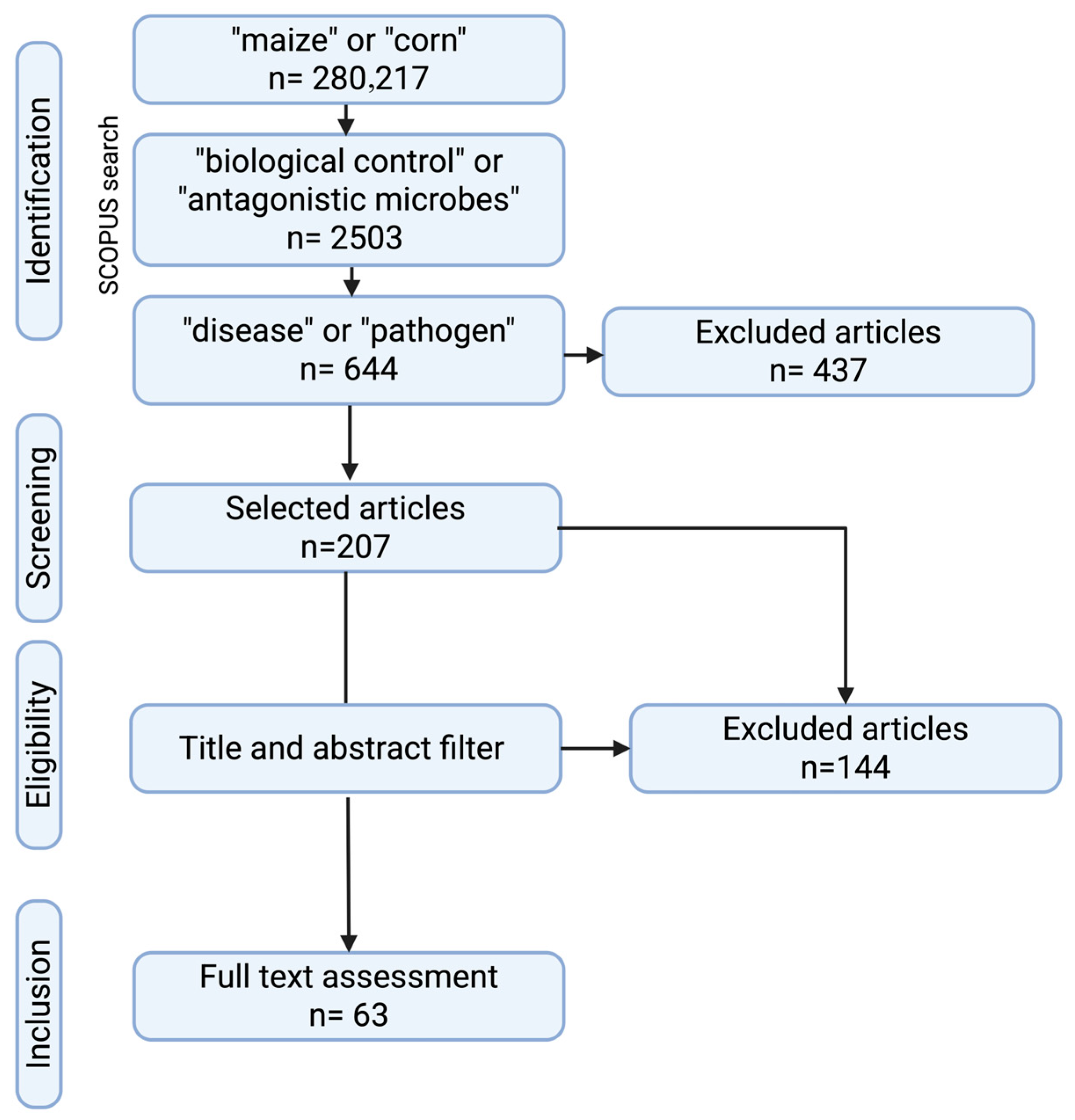
This systematic review was conducted and reported in accordance with the PRISMA 2020 guidelines for systematic reviews [18]. A structured literature search was performed to identify relevant studies addressing biological control strategies for maize diseases. An initial exploratory search was conducted to determine the global extent of maize-related research, retrieving 280,217 publications using the keywords (“maize” OR “corn”). To refine the dataset toward biocontrol-related studies, the terms (“biological control” OR “antagonistic microbes”) were added, yielding 2503 records. A subsequent filtering step incorporating (“disease” OR “pathogen”) resulted in 644 articles published since 1969. To focus on recent advances with greater agronomic relevance, a final systematic search was conducted in the Scopus database using the combined query (“maize” OR “corn”) AND (“biological control” OR “antagonistic microbes”) AND (“disease” OR “pathogen”), restricted to original research articles published in English between 2020 and 2025 (Figure S1). This search yielded 207 records. All retrieved articles were screened based on titles and abstracts following predefined inclusion criteria. Studies were included only if they evaluated biological control agents at least at one experimental level (in vitro, in planta/greenhouse, and/or field conditions). As a result, 63 articles met the full eligibility criteria and were included in the structured qualitative synthesis with quantitative aggregation of experimental scales and efficacy trends when reported. During the final revision stage, two references were excluded after re-evaluation due to scope refinement and reference inconsistencies, ensuring full alignment with the predefined inclusion criteria. The study selection process, including identification, screening, eligibility assessment, and inclusion, is summarized in the PRISMA 2020 flow diagram (Figure 1), and the PRISMA 2020 checklist and the review protocol are given in the Open Science Framework and are publicly available at https://doi.org/10.17605/OSF.IO/TVYRD.
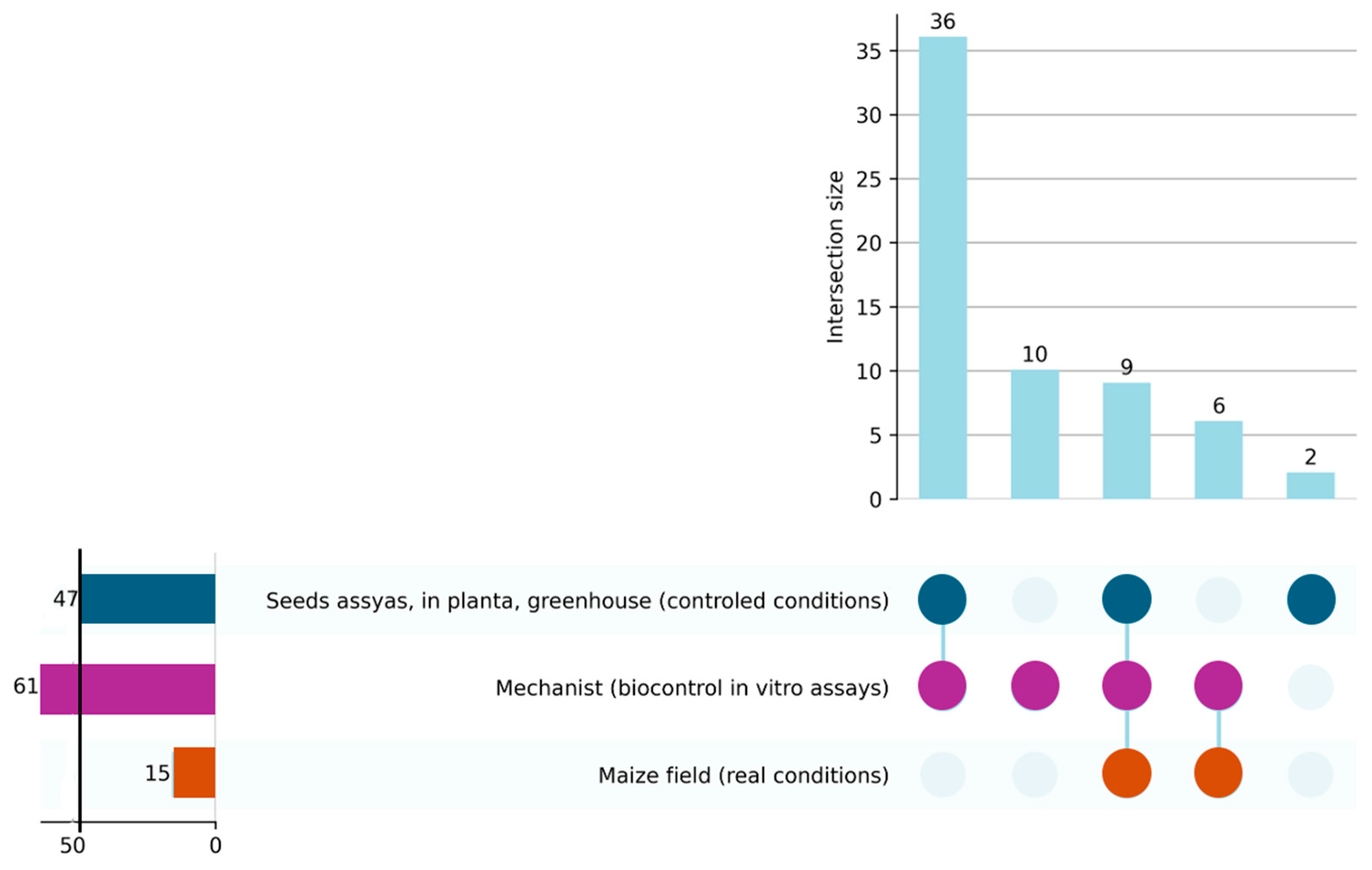
The methodological distribution of the selected studies is presented in Figure 2. Of the 63 included articles, 61 (97%) reported in vitro assays, 47 (75%) included greenhouse or in planta evaluations, and 15 (24%) conducted field trials. This distribution illustrates the predominance of laboratory-based screening approaches compared to real-field validation. The overlap among experimental levels further highlights the translational gap between mechanistic investigation and agronomic application in maize systems.
Based on the reviewed literature, the following sections present a synthesis of the key findings, beginning with the major diseases affecting maize, followed by current biocontrol strategies, their limitations, and future perspectives for improving maize cultivation.

3. Results and Discussion

3.1. Fungal Pathogens Affecting Maize

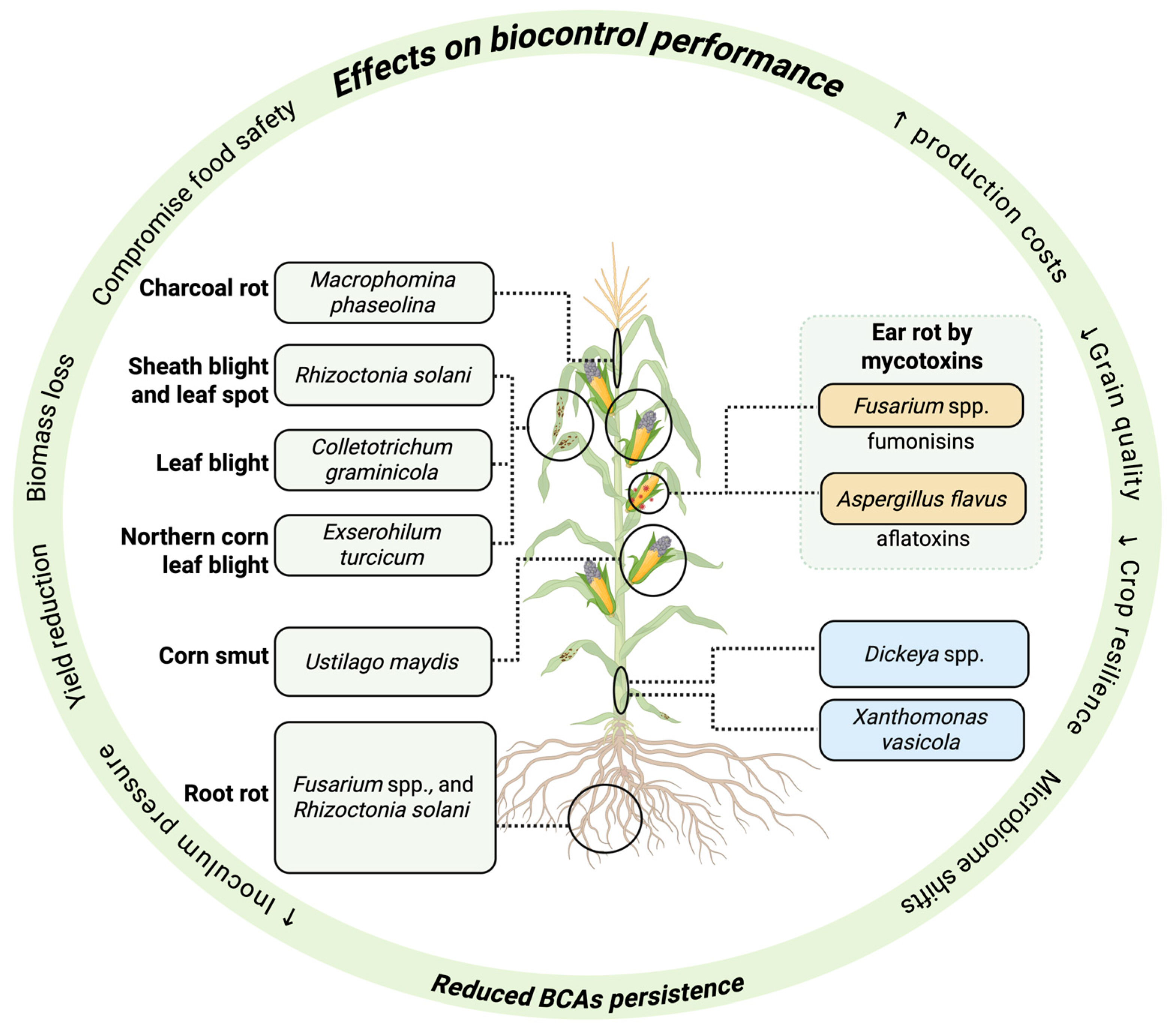
Understanding the ecological behavior of fungal pathogens is essential for interpreting why BCAs that perform well under laboratory conditions often fail to achieve consistent results in the field. Among these, fungal pathogens account for an estimated 20% of maize yield losses in susceptible production regions [19]. Fusarium and Aspergillus (Figure 3) are widely reported pathogens affecting maize production systems. In addition, the species F. verticillioides and A. flavus are responsible for infections in roots, stems, and grains, with critical economic and health consequences due to the production of fumonisins and aflatoxins, respectively. These mycotoxins have been associated with severe health effects in humans and animals, including carcinogenic [20] outcomes and neurological disorders in cases of chronic exposure [21]. Multiple Fusarium spp. contributes to maize root and stalk rot, with considerable variability in pathogenicity among isolates [22,23]. In addition to direct tissue damage, certain Fusarium infections can alter rhizosphere microbial communities, reducing diversity and modifying functional profiles, which may further influence the ecological context in which BCAs operate [24,25]. Moreover, even taxa traditionally regarded as beneficial, such as some Trichoderma species, have been reported as opportunistic pathogens, underscoring the functional plasticity of fungal communities [26]. Soilborne pathogens such as Rhizoctonia solani persist for extended periods through durable melanized sclerotia, increasing long-term disease pressure and challenging BCAs [27,28]. Collectively, the ecological diversity, adaptability, and persistence of fungal pathogens help explain why strong antagonistic activity observed in vitro does not always translate into stable field-level disease suppression.

3.2. Bacterial Pathogens Affecting Maize

In certain environments, bacterial diseases have been reported to reduce maize yield by up to 99%, particularly under warm and humid conditions that favor rapid pathogen proliferation [29]. With global temperatures and atmospheric humidity on the rise, bacterial diseases pose an increasingly serious threat to maize production and long-term food security [30]. Soft rot and stalk rot are commonly associated with members of the Pectobacteriaceae family, including Dickeya (Figure 3) and Pectobacterium spp., whose similar symptomatology complicates accurate diagnosis and targeted management [31]. Additionally, certain species, such as Pantoea ananatis, exhibit dual lifestyles as both endophytes and pathogens, highlighting the ecological plasticity of maize-associated bacteria [32]. Such ecological plasticity and environmental responsiveness complicate the establishment, persistence, and competitive performance of BCAs, whose efficacy depends on successful niche colonization and stable interactions within the resident microbial community [33].

3.3. Bacterial Biocontrol Agents

Bacillus spp. are extensively studied bacterial BCAs in maize systems [34]. These bacteria are well known for controlling fusariosis [35]. Its success is largely attributed to key biological traits, including the ability to form stress-resistant endospores, to produce a broad spectrum of antimicrobial lipopeptides [36], to colonize roots efficiently, and to activate plant immune responses [37]. Diverse studies indicated that Bacillus strains frequently showed strong in vitro inhibition (>70%) and a measurable greenhouse-level disease reduction [37] compared with in vitro outcomes. For instance, Dong et al. [22] evaluated the potential of B. velezensis CX-H3 inhibiting F. graminearum mycelial in vitro growth by approximately 93%. A study conducted by Ben Gharsa et al. [38] evaluated B. velezensis MBY2 against the crown gall pathogen Agrobacterium fabrum C58Gmr in the maize rhizosphere. After 30 days, B. velezensis MBY2 reduced pathogen population by 68% in maize, while other crops like tomato had a 51% reduction, attributing this difference to the selective influence of the host plant. However, despite robust activity, the extent to which these mechanisms [39] operate under variable field conditions remains a central challenge for scalable application.

3.4. Fungal Biocontrol Agents

Fungal microorganisms have been employed as BCAs due to their ability to parasitize other organisms, such as insects or weeds. In addition, some fungi establish symbiotic associations with maize, providing protection against phytopathogenic microorganisms. Their ability to compete for nutrient acquisition often reduces populations of pathogenic fungi, bacteria, and other microorganisms through antagonism, thereby playing important roles in the balance and dynamics of natural ecosystems [40]. Among them, atoxigenic strains of Aspergillus have been widely studied and applied due to their ability to competitively displace toxigenic strains of the same genus [41]. Across studies, reductions in aflatoxin production commonly range between 50% and 80% in kernel-based assays through niche displacement of toxigenic strains [42,43,44,45]. These findings support the use of atoxigenic strains as a targeted strategy for mycotoxin management.
In addition, numerous Trichoderma strains have demonstrated plant health benefits by suppressing phytopathogens through mechanisms such as mycoparasitism, antibiotic production, and secretion of hydrolytic enzymes [46]. Moreover, their interaction with plant roots triggers defense priming, enabling plants to respond more rapidly and robustly to subsequent pathogen attacks, such as by Helminthosporium carbonum and Penicillium sp. [47]. In a study conducted in maize fields in Mexico, six strains identified as T. harzianum and T. tomentosum were evaluated [48]. All strains produced cellulase and chitinase and exhibited significant in vitro inhibition of F. oxysporum f. sp. cubense. Additionally, endophytic Trichoderma strains associated with maize demonstrated their ability to inhibit pathogens such as D. erectus and Burkholderia spp. [49]. Although many microbial BCAs exhibit strong antagonistic performance in controlled settings, their effective transition to field application depends on ecological fitness traits such as colonization ability, environmental tolerance, and persistence. Thus, the ecological provenance of a strain becomes a key criterion in the selection of potential BCAs [50].

3.5. Selection of Potential Biological Control Agents (BCAs): First Steps

The implementation of BCAs strategies against maize phytopathogens begins with the isolation and identification of candidate microorganisms from relevant ecological niches. Several studies indicate that the rhizospheric soil of healthy maize plants, the maize phyllosphere, and roots from either healthy or diseased plants are the main sources for those microorganisms [51]. Notably, many of these isolates correspond to endophytic microorganisms naturally residing within maize tissues. The use of host-adapted endophytes is particularly promising, as these microorganisms are already adapted to the plant microenvironment, which may enhance colonization efficiency, persistence, and functional stability under field conditions [52]. After isolation and taxonomic identification, microbial candidates are subjected to evaluation of their antagonistic potential against target phytopathogens [53].
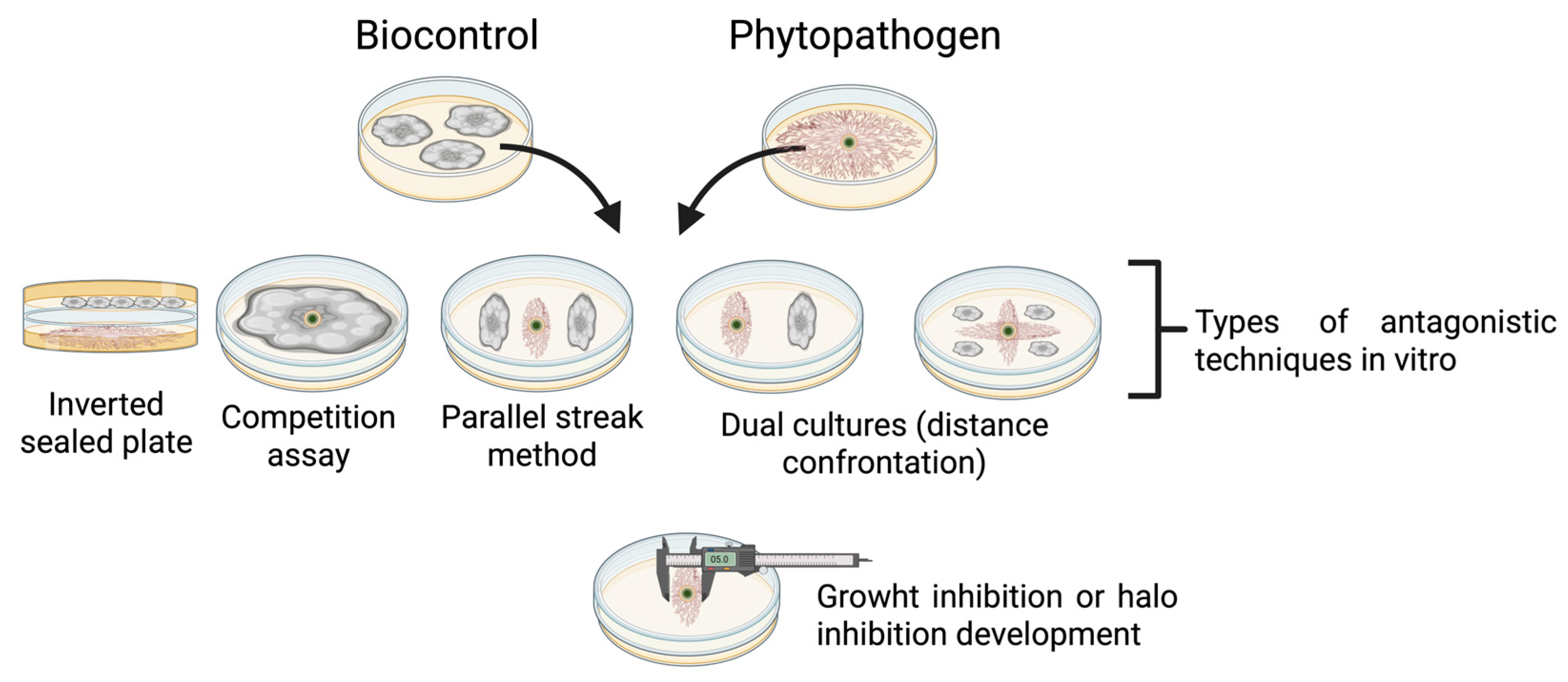
In vitro confrontation assays, including direct and indirect dual culture tests (Figure 4), remain the most widely used tools for initial screening due to their simplicity, reproducibility, and low cost [54,55,56,57]. These assays provide rapid and quantifiable estimates of pathogen growth inhibition and allow comparison among strains under standardized conditions. Reported inhibition levels vary widely across studies, often exceeding 50% under laboratory conditions [39,58,59]. However, these assays capture only simplified interactions and therefore represent one of the primary sources of the gap between laboratory predictions and field outcomes. To address this limitation, some studies have incorporated simulated environmental stress into in vitro evaluations. For example, antagonistic strains such as A. giganteus have been assessed under varying stress conditions to better approximate field environments, showing remarkable inhibition of A. flavus even under simulated extremes [59]. Such approaches represent an important refinement in early-stage screening, as they allow the identification of stress-tolerant candidates with potentially greater ecological resilience.

3.6. Mechanisms of Biocontrol Activity

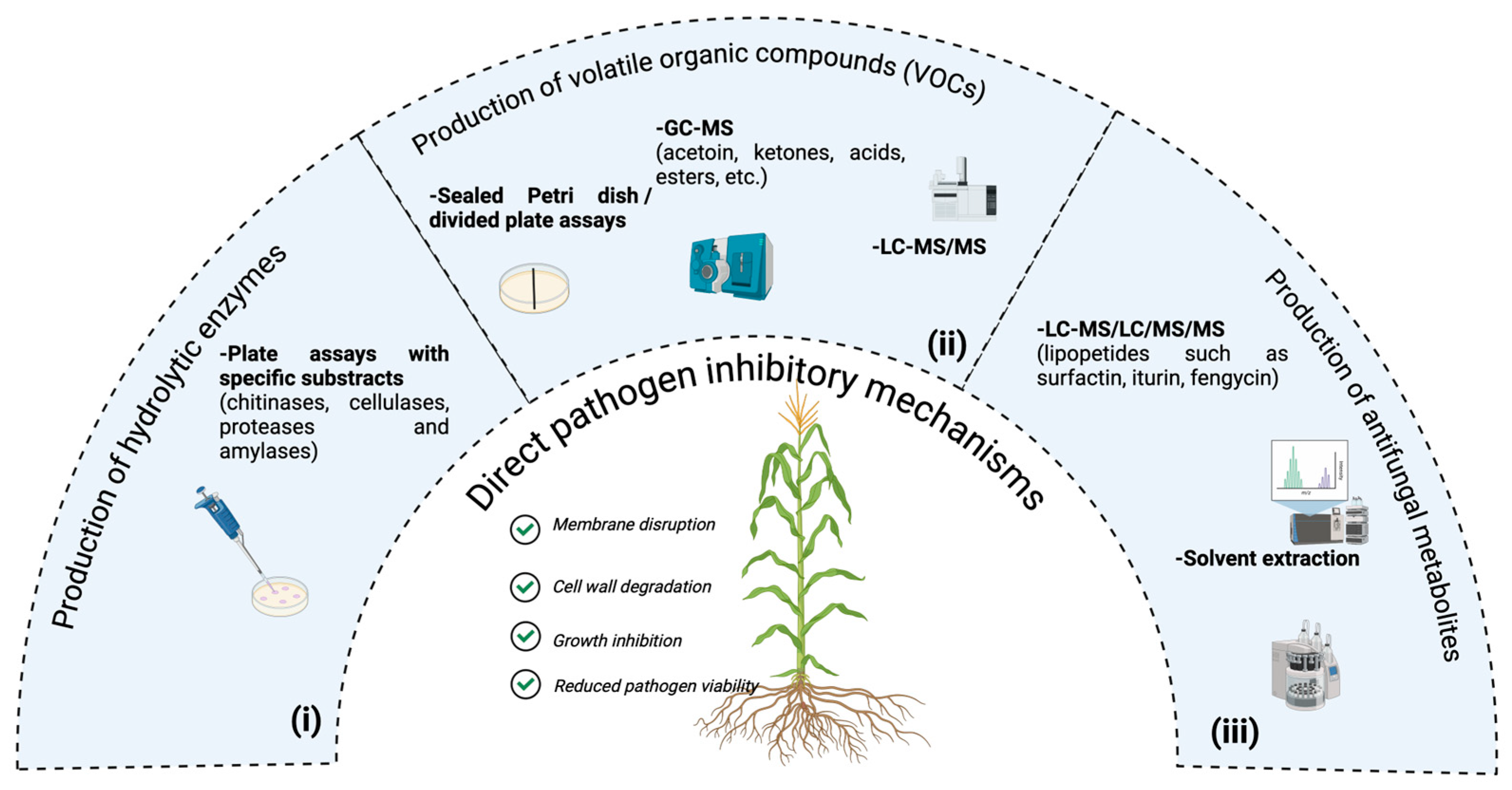
Once promising isolates are identified, studies often focus on understanding the biochemical and physiological mechanisms underlying their antagonistic activity. These include the production of secondary metabolites, volatile organic compounds (VOCs), and lytic enzymes (Figure 5).
Lytic enzymes such as chitinases, β-1,3-glucanases, and proteases degrade fungal cell walls, providing a direct mechanism of pathogen suppression (Table 1). These enzymes are commonly produced by genera such as Streptomyces [60,61], Bacillus, and Trichoderma spp. On the other hand, VOCs act as airborne antifungal agents capable of inhibiting pathogen growth without direct contact. Their gaseous nature allows them to efficiently disperse through porous environments like soil and travel considerable distances to reach target pathogens. They primarily combat fungi by permeating and disrupting fungal cell walls and membranes, which leads to the leakage of intracellular contents, the induction of oxidative stress, and the accumulation of reactive oxygen species (ROS) that ultimately halt fungal development. It has been reported that VOCs such as 1-heptoxydecane and tridecan-2-one produced by Pseudomonas spp., can suppress up to ~50% of A. flavus mycelial growth [62]. In addition, many BCAs produce antimicrobial secondary metabolites such as lipopeptides and polyketides that disrupt fungal membranes and interfere with cell wall integrity. For example, metabolites produced by B. velezensis, such as fengycins and surfactins have been associated with structural damage in Fusarium hyphae, as observed through microscopic analysis [63], causing pore formation, cytoplasmic leakage, and irreversible cell damage, ultimately leading to cell death [64]. Moreover, Bacillus spp. synthesize a diverse set of polyketides via polyketide synthases, including macrolactin, bacillaene, and difficidin, compounds with documented antibacterial, antifungal, and immunomodulatory properties [65]. Similarly, Streptomyces spp. can inhibit protein synthesis by interacting with ribosomal subunits [60]. These compounds contribute significantly to pathogen suppression in vitro; however, their stability, diffusion, and effective concentration in soil or phyllosphere environments may vary considerably under field conditions.

3.7. Molecular Approaches for Biocontrol Assessment

More recently, molecular and omics-based approaches have been increasingly applied to unravel the complexity of biocontrol–pathogen–plant interactions. Whole genome sequencing enables precise taxonomic identification and the prediction of biosynthetic gene clusters underlying antimicrobial activity. For instance, genomic analysis of B. velezensis 160 [74] has revealed diverse metabolite-encoding clusters, supporting earlier field experimental evidence of B. velezensis 160 antagonistic potential against Sporisorium reilianum [75,76].
Moreover, transcriptomic analysis has a functional view of tripartite interactions. For example, in a recent transcriptomic analysis, dual and triple inoculation assays revealed that F. verticillioides strongly suppresses core plant processes related to growth, ribosome biogenesis, and primary metabolism, whereas the presence of B. cereus B25 partially restored these functions and activated defense-related pathways, including jasmonic acid (JA), signaling, lignification, and pattern-recognition receptor responses [25]. This case exemplifies the added value of combining mechanistic and in silico approaches with ecologically relevant experimental systems, providing an example of integration across experimental levels. Similarly, genome-resolved approaches have enabled high-resolution characterization of metabolite-based biocontrol systems. For instance, the endophytic bacterium Burkholderia sp. MS455 was subjected to multilocus sequence analysis, whole-genome sequencing, and transcriptomic profiling to elucidate the biosynthesis and regulation of occidiofungin. Functional mutagenesis of an ambR1 homolog confirmed its regulatory role in antifungal activity, while RNA-seq analysis revealed broader transcriptional reprogramming associated with secondary metabolism and iron acquisition pathways [77]. This example highlights how omics-driven approaches can provide mechanistic clarity and strengthen causal inference in biocontrol research. However, despite this depth of molecular validation and kernel-based efficacy assays, performance under open-field conditions remains to be demonstrated, underscoring the persistent challenge of translating mechanistic promise into agronomic reliability.

3.8. Biocontrol in Maize (Biocontrol–Phytopathogen–Maize Interaction)

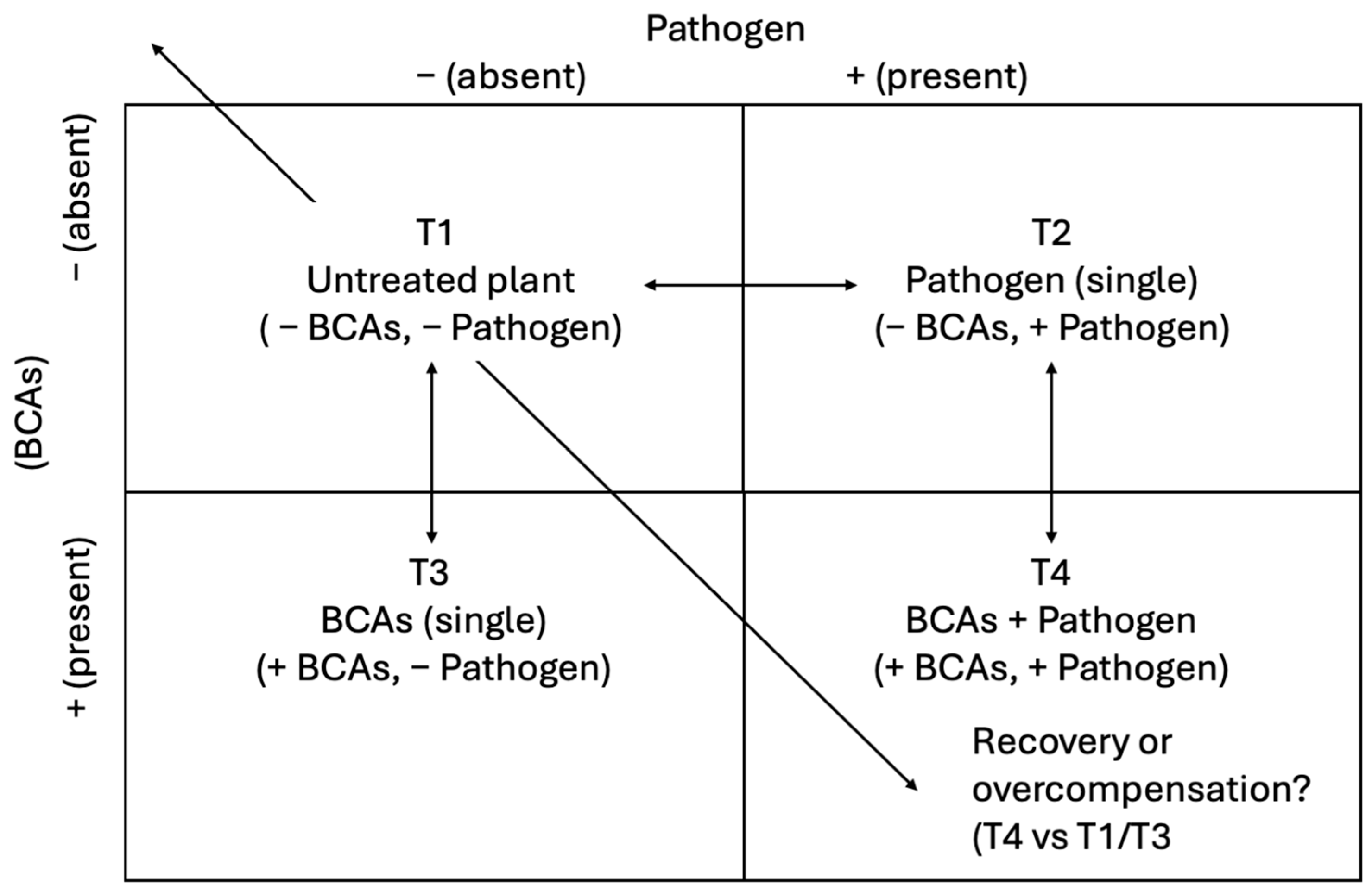
Tripartite studies focused on BCAs–phytopathogen–maize interactions aim to evaluate the effectiveness of BCAs at various plant stages under realistic agricultural conditions [25]. By incorporating the host plant into the evaluation, such studies typically address three main aspects: (i) seed germination and vigor [78], (ii) seedling growth and biomass accumulation [23], and (iii) disease incidence/severity [79]. Among the reviewed studies, in planta validation of biocontrol agents in maize is commonly structured around a minimal 2 × 2 factorial design, in which the presence or absence of the biocontrol agent and the pathogen are combined to generate four fundamental treatments.
The general logic of this design is depicted in Figure 6. Biocontrol studies in maize are particularly important because results obtained under in vitro conditions can be limited in their predictive value. In some cases, a strain identified as a promising BCAs in vitro may display reduced efficacy when tested in planta. Conversely, isolates that appear ineffective in vitro may demonstrate strong biocontrol potential under plant-based assays. For instance, Pfeiffer et al. [80] showed that many bacterial isolates can inhibit mycelial growth of F. culmorum. Some strains, such as P. aurantiaca and strains of B. cenocepacia (7353 and 7354), have shown high antifungal activity. Conversely, other strains like P. chlororaphis MA 342, P. corrugata 7437, and P. putida 7438 exhibit low activity against F. culmorum in these dual cultures. In parallel, in in planta tests, many bacterial strains provided significant protection; however, the strains that showed low activity in vitro (P. chlororaphis MA 342, P. corrugata 7437, P. putida 7438) were highly effective in the in vivo pot tests. The weak correlation between in vitro and in vivo results underscores how poorly laboratory conditions replicate real agricultural environments, highlighting the limitations of relying solely on laboratory assays to screen biocontrol agents.

3.8.1. Biocontrol Application Ex Planta

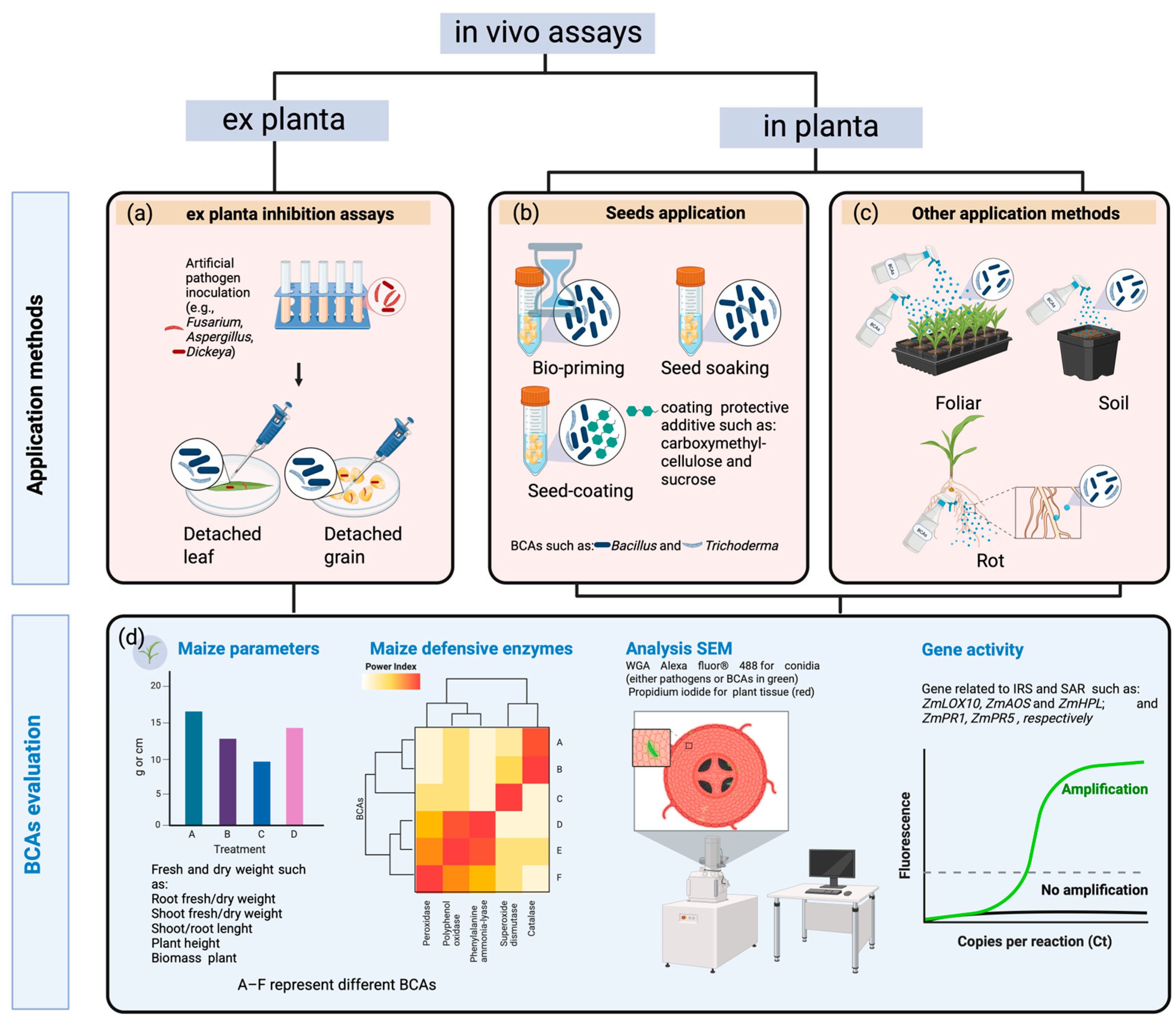
The ex planta evaluations provide a controlled framework to evaluate the antagonistic capacity of candidate BCAs before moving into more complex plant systems. These assays, typically performed on detached plant organs (e.g., kernels, seeds, leaves, silks, or stems) or sterilized substrates to assess pathogen suppression (Figure 7a) [81]. Unlike dual-culture tests, ex planta studies integrate the plant tissue environment, including host metabolites and physical barriers, which can modulate microbial interactions and BCAs efficacy. Several studies have demonstrated that BCAs can substantially reduce fungal colonization and aflatoxin or ochratoxin accumulation in maize kernels [82,83,84,85]. Both viable cultures and metabolite-based treatments have shown efficacy under storage-like conditions, including VOCs-mediated suppression without direct microbial contact [83]. However, dose-dependent responses and, in some cases, toxin stimulation under sub-inhibitory conditions highlight the importance of careful formulation and concentration optimization [85].

3.8.2. Biocontrol Application in Planta

Among the studies reviewed, the seed stage represents a critical safety checkpoint for BCAs application. For example, although 19 fungal isolates have exhibited strong antagonistic activity against F. verticillioides (inhibition > 50% in dual culture assays), 10 were classified as pathogenic or potentially pathogenic, as they induced necrotic symptoms in corn seedlings and reduced normal seedling emergence to below 80% [73,86]. Furthermore, maintaining high seed viability ensures that any observed effects the whole plant, either positive or negative, are due to BCAs activity rather than compromised seed physiology. Once seed viability and compatibility with the BCAs have been established, various application methods can be employed to enhance colonization and efficacy. For instance, seed coating (Figure 7b) involves the physical application of a thin layer containing BCAs, often combined with binders, nutrients, or protective additives. The coating provides a carrier matrix that enhances the adherence, viability, and shelf-life of the BCAs on the seed surface. Compounds such as carboxymethylcellulose (CMC) have been used successfully against Sporisorium reilianum infection [87]. Similarly, De Fátima Dias Diniz et al. [71] employed sucrose as an adhesive agent to facilitate B. velezensis adherence to maize seeds. Although seed coating formulations are increasingly used to improve inoculant adherence, stability, and field performance, relatively few studies have examined how formulation components influence microbial colonization or biocontrol activity after application. A notable exception is the recent optimization of heat-stable antifungal factor (HSAF) derived from Lysobacter enzymogenes, representing a significant advance in metabolite-based biocontrol for seed treatment. Ren et al. [88] enhanced HSAF production through genetic engineering and fermentation optimization, achieving a more than 200-fold increase in yield. The improved metabolite was subsequently formulated into a seed-coating product to control Pythium gramineacola, demonstrating strong antifungal efficacy. The study showed how combining strain engineering, fermentation optimization, and formulation design can eliminate production barriers and yield effective biocontrol products.
Furthermore, bio-priming (Figure 7b) provides a more interactive process by combining BCAs inoculation with controlled seed hydration. This allows early biochemical and structural interactions between seeds and beneficial microbes before germination, effectively preparing seedlings for greater stress tolerance and pathogen resistance. As a result, bio-priming is considered one of the most reliable seed-stage approaches for inducing systemic resistance [89] and enhancing crop vigor under biotic and abiotic stresses [90]. Studies in maize have demonstrated that bio-priming with T. harzianum strains can reduce mycotoxin contamination under Fusarium spp. in greenhouse and field conditions, while enhancing defense-related responses [91]. Finally, soil inoculation (Figure 7c) represents another major route for the delivery of BCAs in maize. enabling sustained microbial establishment in the rhizosphere and subsequent translocation or signaling throughout the plant [92]. For instance, soil treatment with Beauveria bassiana has been shown to reduce northern corn leaf blight by reshaping the plant’s endophytic microbial community rather than through direct antagonism of E. tucicum [93]. These findings suggest that disease suppression may result from microbiome restructuring and enhanced host resilience.

3.9. Resource and Fitness Mediated Suppression

Disease suppression frequently depends on host-mediated reinforcement strategies. These strategies often enhance structural resilience [94], metabolic robustness, and immune priming, thereby reducing pathogen success in maize [72]. Although growth-promotion traits are often discussed separately from induced systemic resistance (ISR) [6,95], both processes frequently share overlapping hormonal and metabolic pathways. Enhanced nutrient uptake, modulation of phytohormone balance, and improved redox homeostasis may increase host fitness while simultaneously priming defense responses, thereby reinforcing ISR under pathogen pressure [96].
Genetic determinants provide early predictors of biocontrol performance. Greenhouse studies identify MUP1 as a key regulator of morphogenesis, stress tolerance, and SA (salicylic acid)-mediated defense responses [97]. In T. asperellum, overexpressing MUP1 significantly increased plant height and root/shoot biomass under both healthy and pathogen-challenged conditions, while MUP1 deletion strains displayed reduced growth-promotion capacity relative to the wild type. Moreover, MUP1 was essential for T. asperellum to enhance its biocontrol efficacy against maize root rot, as plants treated with MUP1-overexpression strains exhibited a markedly lower disease index when challenged with F. graminearum [98]. These results empirically support the notion that genetic determinants governing stress resilience and host interaction are predictive of field success, reinforcing the need to prioritize such genes during the development of scalable biocontrol strategies.

Induced Systemic Resistance (ISR) and Defense Priming in Maize

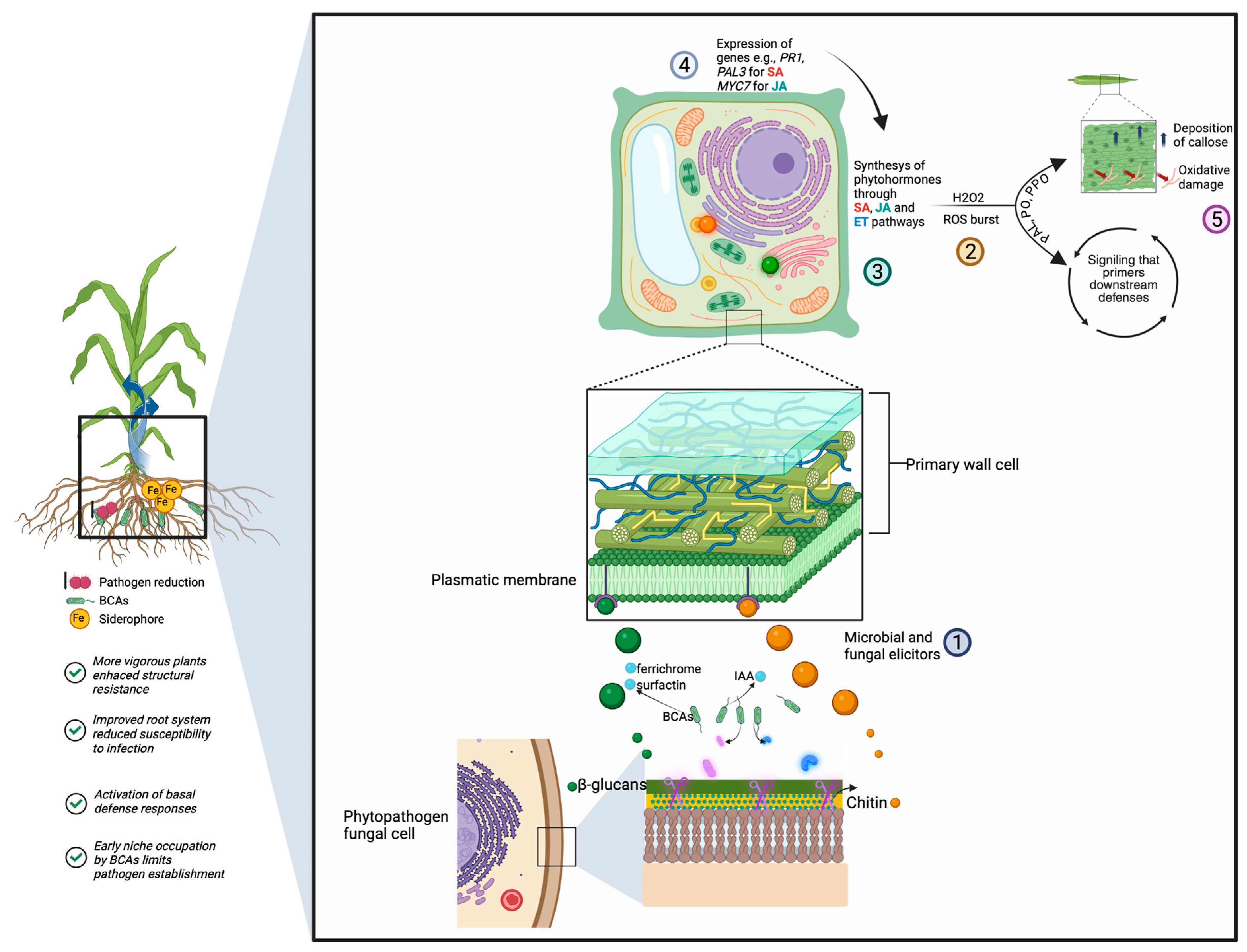
Beyond physiological reinforcement, many BCAs activate ISR, a priming-based defense strategy triggered by beneficial BCAs that allows plants to mount faster and stronger JA responses against pathogen attack [99] (Figure 8). Following root colonization, BCAs trigger systemic signaling cascades involving JA, SA, and ethylene (ET), thereby enhancing downstream defense responses in distal tissues [100]. Validation of ISR is essential because it identifies strains that reduce disease indices before advancing to field testing.
One of the earliest hallmarks of ISR is the oxidative burst, a rapid production of ROS such as H2O2, which serves both as antimicrobial compounds and as signaling cues [101]. In maize, inoculation with B. velezensis SQR9 has been associated with increased H2O2 accumulation and enhanced structural defenses following F. graminearum challenge [102]. Complementing ROS production, ISR also reinforces the cell wall through callose deposition. Histological analyses in maize leaves have confirmed strong callose accumulation following B. velezensis treatment, particularly after pathogen challenge, illustrating how ISR mobilizes structural defenses beyond the local site of microbial interaction [102]. However, excess ROS causes lipid peroxidation and wall loosening by degrading pectins/hemicelluloses. Importantly, ISR-mediated regulation of oxidative balance is not limited to pathogen defense but may also enhance tolerance to concurrent abiotic stresses. Recent research evaluating BCAs under combined stress conditions has demonstrated that defense priming can operate across multiple stress dimensions. For example, the endophytic fungus Serendipita indica mitigated the combined effects of drought stress and F. proliferatum infection in maize by improving water-use efficiency, enhancing growth parameters, and modulating ROS accumulation [103]. This dual protective effect illustrates how certain BCAs can simultaneously reinforce stress tolerance and immune signaling pathways, potentially improving resilience under multifactorial field environments. Thus, balanced regulation of ROS production and scavenging represents a key determinant of field-relevant performance.
Therefore, confirmation or induction of enzymatic ROS scavenging mechanisms in plants should be monitored to successfully perform field studies since they contribute to the defense against ROS by reducing superoxide to H2O [104]. In recent studies, such as [105] in maize, pre-treatment with Pseudomonas spp. (AS19, AS21) led to a strong induction of enzymatic ROS scavenging such as PAL (pectate lyase), POD (peroxidase), and PPO (polyphenol oxidase) activities, with PAL activity increasing up to fourfold compared to diseased controls, while simultaneous or post-infection application was ineffective. This demonstrates that ISR requires a priming phase to reprogram host metabolism. Similarly, T. asperellum AC.3 increased phenolic accumulation and the activity of PPO, POD, and TAL enzymes in maize, with significant correlations between enzymatic induction and reduced downy mildew severity [106].
Downstream, ISR relies strongly on the activation of phytohormonal pathways, primarily JA and SA. For instance, T. gamsii IMO5 has been found to not only significantly reduce F. verticillioides colonization but also promote maize growth by activating JA-mediated ISR [107]. Transcriptomic analysis showed priming-dependent induction of ISR genes, including ZmLOX10, ZmHPL, and ZmAOS, involved in jasmonate and green leaf volatile biosynthesis, thereby restricting pathogen spread through JA-derived defense signals [107]. In contrast, T. gamsii B21 primarily activated SAR (systemic acquired resistance), which is classically mediated by SA and characterized by the expression of pathogenesis-related proteins. This strain significantly decreased fungal DNA in maize stems by 59%. Molecular analyses revealed strong induction of ZmPR1 and ZmPR5 48 h after pathogen inoculation, suggesting a robust activation of SA-dependent defenses.
In addition to hormone-mediated signaling, certain BCAs activate plant immunity through secreted elicitors. Hydrolytic enzymes and proteinaceous molecules derived from Trichoderma spp., such as cellulases, chitinases, and other cell wall–degrading enzymes, can function as microbe-associated molecular patterns (MAMP) -like signals capable of triggering ROS bursts and downstream JA-dependent defense responses, thereby contributing to ISR [108].
Moreover, ISR and SAR in some cases represent two complementary strategies by which plants enhance their immunity. For example, B. velezensis SQR9 induced both SA- and JA-related pathways in maize, upregulating PR1 and PAL3 (SA) along with MYC7 (JA), reflecting synergistic interactions between hormone networks [102]. Similarly, secreted thaumatin-like proteins from the necrotrophic fungus R. solani acted as potent elicitors that simultaneously triggered ZmPR1 (SA) and ZmACO/ZmERF1 (ET/JA) [27]. These results suggest that the combined activation of SA and JA/ET-mediated defenses produced even a more comprehensive immune response, and it can be highly strain-specific. Although this latter example derives from a pathogenic interaction, it illustrates the broader capacity of maize to integrate multiple hormonal signals upon perception of microbial elicitors.
Because JA, SA, and ET-mediated defenses shape complementary arms of maize immunity, strains capable of activating multiple hormonal pathways may exhibit greater robustness and reproducibility under variable field conditions, enhancing their likelihood of successful deployment beyond greenhouse settings.

3.10. Field Application

Field-scale evaluations of BCAs in maize consistently demonstrate that efficacy under in planta or in vitro conditions does not always translate into stable performance across agricultural environments. Multi-season and multi-location trials reveal that biocontrol success depends on ecological establishment, environmental stability, formulation strategy, host genotype, and application timing [109] (Figure 9).

3.10.1. Bacillus

Among bacterial BCAs, several Bacillus strains have shown reproducible field performance. The use of B. subtilis A3 showed strong field efficacy against Fusarium stalk rot (FSR) and improved maize performance. Disease control reached 45.75%, and visual assessments confirmed markedly less basal stem rot in treated plants [110]. Similarly, B. velezensis CNPMS-22 showed field efficacy comparable to the fungicide Fludioxonil + Metalaxyl-M in controlling F. verticillioides. Treated plants exhibited no fusariosis symptoms under natural infection [111]. Moreover, foliar application of B. subtilis BIOUFLA2 increased the abundance of antagonistic microorganisms in the maize phyllosphere. These findings suggest that successful field-level suppression may depend not only on direct antagonism but also on microbiome restructuring [112]. Field trials also demonstrate that application timing critically determines biocontrol success; late or sequential applications were significantly more effective than early-stage treatments, indicating that synchronization with pathogen pressure and crop phenology is essential. These findings suggest that BCAs efficacy is not solely strain-dependent but temporally regulated, and suboptimal timing may partly explain inconsistent field outcomes [113].
Despite promising results under controlled greenhouse conditions, field-level validation frequently reveals substantial variability in BCAs performance. For instance, B. thuringiensis strain GBAC46 demonstrated notable biocontrol potential against maize seedling blight [35]. GBAC46 significantly reduced the disease index; fumonisin B1 levels likewise declined, confirming the link between reduced disease severity and lower mycotoxin accumulation. Greenhouse and in vitro assays showed a dual mode of action: direct antifungal activity and ISR. GBAC46 displayed broad antagonism against F. verticillioides, F. oxysporum, S. sclerotiorum, and R. solani, with ROS-mediated fungal disruption as a key mechanism. Gene expression analyses revealed strong activation of the SA and ET pathways. Moreover, greenhouse conditions, treated seedlings showed enhanced growth and resistance. However, ISR-triggering metabolites remain unidentified, limiting mechanistic insight, and the moderate field efficacy (37.4%) indicates that environmental variability may constrain performance relative to greenhouse results.

3.10.2. Trichoderma

Ahmed et al. [114] recently reported that T. asperellum and T. harzianum consistently showed strong disease suppression and yield enhancement under greenhouse and field conditions. Coating based on plant extract produced the greatest benefits, increasing grain yield by up to 67.3% in comparison to the chemical fungicide Premis Ultra. However, despite these promising outcomes, key knowledge gaps persist, including a deeper analysis of microbial modes of action under coating. Broader multi-season and multi-location trials remain necessary to validate performance.
Field studies targeting mitigation further illustrate the context dependency of BCAs strategies. Application of atoxigenic F. verticillioides for fumonisin and aflatoxin mitigation in maize showed promising but inconsistent outcomes [115]. Direct silk-channel inoculation produced the strongest effect, reducing natural mycotoxin contamination by 50%, while ears pre-inoculated before the challenge with the toxigenic strain decreased by an additional 36%, supporting competitive exclusion in situ. In contrast, pre-planting seed treatments were ineffective, yielding no significant reductions in fumonisin or aflatoxin, likely due to weak systemic colonization or lack of induced resistance. Moreover, toxin suppression observed in controlled settings was not consistently reproduced under field conditions. Similarly, field trials using T. harzianum K179 under contrasting climatic conditions reported consistent reductions in fumonisins and aflatoxin levels across two seasons [116]. The greatest reductions were observed where the addition of adhesive or immersion ensured improved adhesion and probable rhizosphere colonization, aligning with previous findings on Trichoderma-mediated suppression of fumonisin biosynthesis. Notably, fumonisins were detected in all samples across both years but were markedly lower in biological treatments, while aflatoxins and zearalenone were completely absent in Trichoderma-treated plots. However, the study’s limited replication, single hybrid and site, low initial infection pressure, and lack of colonization quantification restrict broader interpretation.
Residue-based BCAs strategies further illustrate the ecological complexity of field application. In a maize-wheat rotation system, Clonostachys rosea and T. atrobrunneum consistently reduced F. graminearum infection and mycotoxin contamination under no-tillage conditions [117]. The treatments were applied to infected maize residues, simulating a system of high disease pressure. Across both years, C. rosea demonstrated consistent and robust suppression of F. graminearum. In contrast, T. atrobrunneum exhibited year-dependent performance, showing negligible control under low-pressure conditions (2017) but achieving significant suppression under warmer, wetter conditions in 2018. These results suggest that T. atrobrunneum activity is optimized by high humidity and moderate-to-high temperature, aligning with previous reports on T. harzianum complex members. Despite demonstrating potential for residue-based disease management, the study highlighted several limitations related to experimental scope and field applicability. The experiment employed semi-artificial inoculation rather than natural infection, meaning the system, though realistic in simulating residue-mediated inoculum pressure, did not represent full-scale on-farm conditions. Accordingly, the authors emphasize the need for on-farm validation of C. rosea applications during maize residue mulching. Additionally, the study noted uncertainty regarding optimal application timing and conditions. Incorporating climate-based simulation models that integrate temperature and moisture on biocontrol performance across autumn and spring applications may improve the prediction of BCAs performance under future agroclimatic scenarios [117].
Additional field trials evaluating native Trichoderma strains for post-flowering stalk rot management further highlight the importance of strain selection and delivery strategy. The biocontrol agents were applied via seed treatment, soil application with Trichoderma-enriched farmyard manure, and furrow/drenching application. Analysis of variance indicated that strains and delivery methods significantly affect disease severity, lodging, and yield improvement across both seasons. Despite these results, the study acknowledged several limitations. Although lodging incidence was numerically reduced by 42–71% across all Trichoderma, the reduction was not statistically significant in either year, suggesting that environmental variability or sample size may have influenced the outcome. Furthermore, the authors highlighted a broader research gap, the absence of prior field validation for Trichoderma delivery methods against post-flowering stalk rot (PFSR) in winter maize under artificial F. verticillioides inoculation. Thus, while Trichoderma demonstrated consistent field efficacy and practical compatibility with diverse application techniques, future multi-location and multi-season trials are required to confirm its reproducibility and optimize application strategies for integrated PFSR management in subtropical maize systems [118].
Moreover, field evaluation of multiple Trichoderma isolates for managing late wilt disease (LWD) [119] was performed. These isolates were applied as enriched wheat grains at sowing; the isolates were evaluated under natural infection pressure. T. longibrachiatum consistently performed best, improving plant growth and suppressing LWD, particularly under moderate disease levels. Several limitations constrained broader inference. High field variability reduced statistical power, requiring one-tailed t-tests rather than ANOVA to detect treatment effects. Additionally, cool, rainy conditions in 2020 weakened disease pressure, reducing treatment–control contrasts. The artificial toothpick inoculation also bypassed root-colonized barriers, diminishing observable biocontrol effects [119].
Multi-site field validation of T. atroviride BC0584 revealed strong context dependency, with significant improvements in seedling emergence only in specific locations and in the susceptible maize genotypes, whereas other sites showed no benefits over controls. [120]. Dry yield analyses further highlighted genotype-dependent responses: the BCAs treatment and the reference fungicide (thiram) both enhanced yield for the susceptible Torres variety in Saint-Symphorien, whereas no significant yield benefit was detected for Troizi, which exhibited moderate natural resistance to damping-off. Despite localized improvements in emergence, the study revealed significant variability and limitations in the bioactivity of BC0584 under field conditions. The inconsistent results underscore the influence of multiple biotic and abiotic factors on Trichoderma-based biocontrol efficacy. Key challenges include competition with native rhizosphere microorganisms, fluctuating disease pressure, and non-optimal environmental conditions, particularly drought at the emergence stage, which likely suppressed the release or activity of antifungal metabolites. The trials also highlighted intrinsic constraints of microbial inoculants compared with chemical fungicides, given their dependence on specific temperature, moisture, and soil parameters for colonization and metabolite production. Furthermore, the inoculum density used (~105 viable spores per seed) may have been insufficient, as prior studies indicate that concentrations near 106 CFU per seed are typically required to achieve fungicide-level efficacy [120].
A full-season open-air pot experiment was conducted to assess the biocontrol efficacy of T. asperelloides (T203) and T. longibrachiatum (T7407) against M. maydis, the causal agent of maize LWD, under simulated field conditions [33]. By the end of the growing season (82 d), both isolates provided substantial protection against LWD. The T203 treatment promoted overall plant growth, significantly improving root and shoot biomass, height, and yield, while reducing M. maydis DNA in plant tissues by 40%. In contrast, T7407 conferred even stronger protection, with 60% of plants remaining healthy versus 20% in the infected control and a 96% reduction in pathogen DNA levels. Despite these promising outcomes, several limitations restrict the extrapolation of results to field-scale applications. The experiment relied on open-air pots rather than direct field sowing, limiting soil microbial diversity and potentially influencing pathogen–host–antagonist interactions. Moreover, non-uniform pathogen distribution in naturally infested soil led to variable disease incidence, complicating statistical analyses and contributing to high standard error values in molecular quantifications of pathogen DNA [33].
Collectively, the field evidence suggests distinct ecological strategies underlying biocontrol systems. Bacillus spp., particularly when applied as seed treatments or integrated with optimized timing, tend to provide moderate but relatively stable disease suppression across environments, likely due to endospore formation and metabolite-driven antibiosis that confer environmental resilience. In contrast, Trichoderma spp. frequently achieves stronger disease reductions under favorable conditions but exhibits greater variability across sites, genotypes [84], and climatic scenarios [121], reflecting their dependence on active root colonization, environmental humidity, and strain-specific ecological compatibility. These differences help explain why certain BCAs display reproducible but moderate field performance, whereas others demonstrate high efficacy under optimal conditions but reduced consistency when environmental variables fluctuate.

3.11. Novel Applications of Biocontrol in Maize

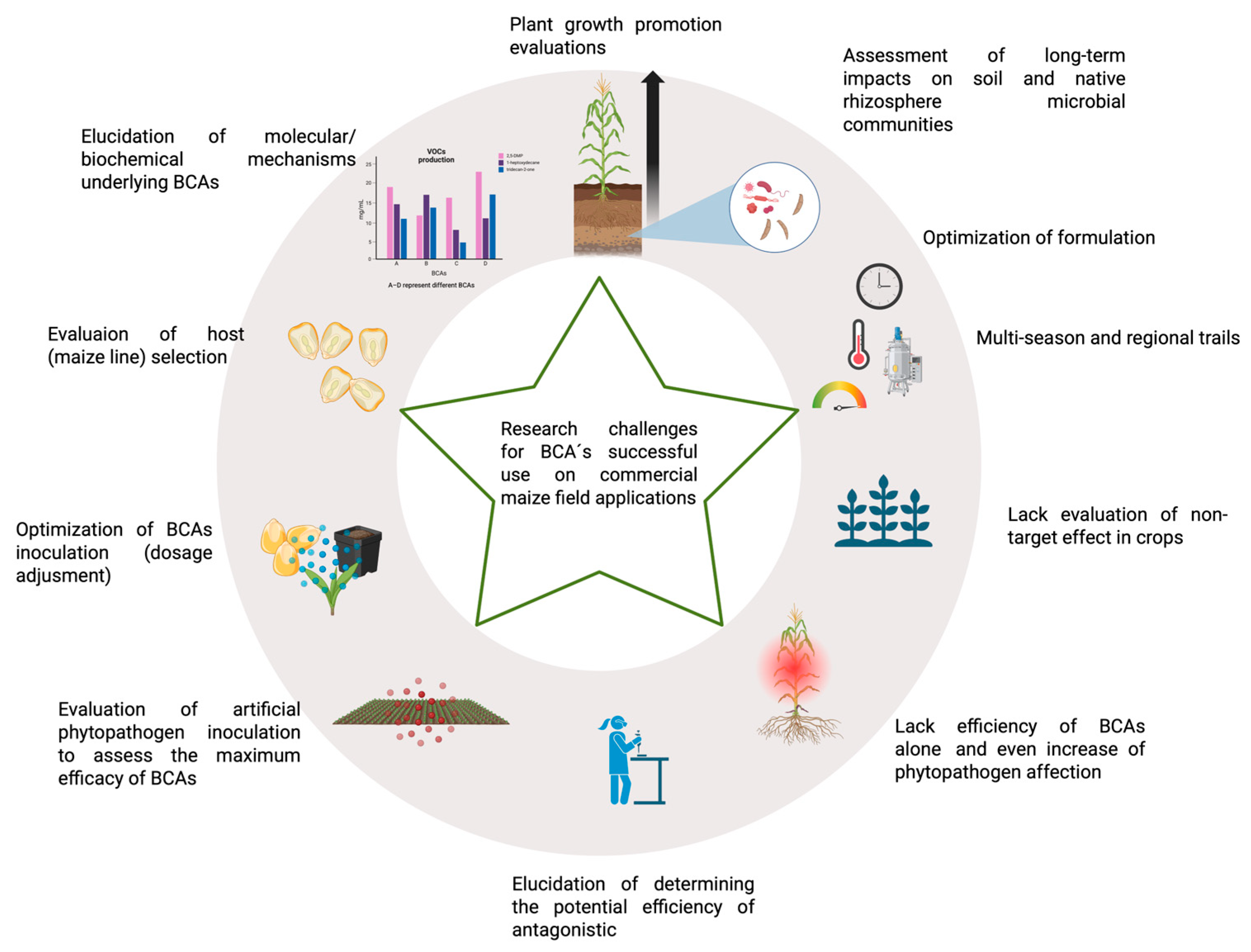
Despite substantial progress in biological control research, field-level implementation in maize systems remains constrained by inconsistent efficacy, formulation instability, and limited host-microbe compatibility. Critical gaps persist across multiple fronts, including the optimization of inoculation dosage, improvement of bioformulation stability, evaluation of host–genotype interactions [84], and long-term monitoring of rhizosphere microbiomes under varying environmental conditions. Recent studies, however, reveal a clear shift toward addressing these limitations through innovative approaches. Advances such as multi-strain microbial consortia, the exploration of extremophilic and insect-associated microbial sources have begun to enhance the robustness and adaptability of biocontrol systems. Complementary developments in fluorescence imaging, molecular engineering, and seed-coating technologies are further improving the precision and reproducibility of in planta evaluations. Collectively, these innovations outline a new generation of strategies aimed at translating laboratory success into reliable field performance by strengthening mechanistic understanding, ecological stability, and scalability. The present section synthesizes these emerging directions, highlighting how de novo biocontrol applications are reshaping the future of sustainable maize disease management.

3.11.1. Multi-Agent and Consortium-Based Strategies

Microbial consortia represent another promising avenue, particularly considering studies showing that single-strain inoculants may be vulnerable to environmental filtering or competitive exclusion by native microbiota. Recent studies have therefore emphasized the synergistic potential of combining functionally complementary microorganisms to enhance disease suppression, plant vigor, and ecological resilience. A representative example is the indigenous microbial consortium composed of B. cereus, T. asperellum, and Penicillium raperi, which achieved effective control of F. verticillioides in maize by integrating antifungal activity, competitive root colonization, and nutrient mobilization capacities [122]. Similar synergistic outcomes have been demonstrated through bacterial mixtures such as B. amyloliquefaciens, B. subtilis, and P. putida against maize downy mildew, where increased phenolic accumulation indicated the induction of systemic resistance [123]. Nonetheless, current evidence remains insufficient to rank consortia as universally superior to single-strain formulations.
Moreover, the combined application of Ochrobactrum ciceri and zinc illustrates how integrating microbial and micronutrient interactions can simultaneously suppress fungal proliferation and reduce mycotoxin biosynthesis [124]. Similarly, soil amendment strategies such as the co-application of maize-derived biochar and T. viride have demonstrated enhanced antagonistic performance compared to microbial inoculation alone. Moderate biochar incorporation improved nutrient availability (N, P, K), optimized soil physical structure, and was associated with reduced charcoal rot severity, collectively enhancing the suppressive capacity of T. viride [125]. These findings reinforce the concept that optimizing the soil microenvironment may be as critical as strain selection for achieving scalable and field-consistent biocontrol performance.

3.11.2. Novel Sources of Biocontrol Agents

Beyond consortium development, another major innovation in maize biocontrol arises from exploring unconventional and ecologically specialized microbial niches. This represents a strategic response to the instability frequently observed in field applications. Many inconsistencies reported under agricultural conditions are linked to environmental stress, competition with native microbiota, and limited persistence. Exploring microorganisms from unconventional or extreme environments may therefore provide strains inherently adapted to fluctuating abiotic conditions. For instance, extremophilic bacteria such as B. halotolerans, Massilia alkalitolerans, and B. aryabhattai, isolated from arid Egyptian desert soils, demonstrated remarkable tolerance to salinity, temperature, and pH fluctuations while exhibiting strong antagonism against P. ultimum and R. solani [126]. Similarly, B. siamensis M54, derived from the intestinal tract of Allomyrina dichotoma larvae, displayed exceptional antifungal efficacy linked to the presence of a unique macrolactin biosynthetic gene cluster typically absent in other B. siamensis strains [127]. Collectively, these findings indicate that broadening the ecological scope of microbial discovery may enhance the probability of identifying strains with improved environmental robustness and metabolic versatility. However, while these novel sources offer promising traits, their field-level reproducibility, ecological safety, and compatibility with existing cropping systems remain insufficiently evaluated.

3.11.3. Technological and Methodological Innovations

Recent technology advances have begun to address several of the methodological and ecological constraints limiting field reproducibility in maize biocontrol. Beyond identifying new microbial agents, progress has been achieved through current innovations to improve mechanistic resolution, colonization monitoring, and formulation efficiency-factors repeatedly identified as barriers in field validation. A notable example is the establishment of contained protocols for fluorescence confocal microscopy, which, for the first time, enable real-time visualization of microbial interactions on living maize silks under biologically relevant and biosafe conditions [128]. These methodological advance bridges the gap between laboratory-based assays and field relevance, allowing researchers to monitor colonization dynamics and pathogen suppression directly on host tissues. Complementing this, molecular engineering approaches, such as the targeted knockout of diguanylate cyclase genes in L. enzymogenes, have been employed to manipulate intracellular signaling pathways and dramatically enhance the production of antifungal metabolites like the HSAF. The resulting >200-fold increase in HSAF yield has also supported the creation of seed-coating formulations capable of suppressing seed-borne pathogens such as P. gramineacola [88]. This strategy directly addresses two recurrent limitations: low natural metabolite production and poor scalability. Similarly, innovative metabolite-based strategies have emerged, exemplified by the targeted evaluation of 6-pentyl-α-pyrone, a purified secondary metabolite secreted by T. asperellum. Such metabolite-centered approaches broaden the functional scope of biocontrol, bridging the gap between microbial ecology and practical formulation chemistry [129], however, evidence remains limited regarding their persistence, field stability, and cost-effectiveness relative to metabolites.

4. Conclusions

While BCAs have shown remarkable promise under controlled conditions, several limitations highlight the need for more integrative research approaches. One important issue is the unintended production of toxic or chemically similar metabolites to synthetic fungicides, raising concerns about potential health and environmental risks [53]. Likewise, the strong antagonistic effects observed in vitro often fail to translate consistently into field performance, where factors such as light, humidity, nutrient availability, and microbial diversity constrain metabolite expression, as demonstrated in phyllosphere studies. The limited in planta validation of purified metabolites and enzymes also restricts our understanding of their true ecological relevance; for example, lipopeptides from B. velezensis B105-8 have been tested in vitro but not yet evaluated under natural plant conditions [130]. Moreover, strain-level variability represents an additional challenge, since isolates of the same species may differ substantially in their plant growth-promoting potential, as seen with Streptomyces DEF147AK and DEF1AK [131]. To overcome these constraints, future efforts should emphasize the integration of whole-genome sequencing with metabolomics, transcriptomics, and predictive frameworks that integrate environmental variables, pathogen dynamics, and microbial traits. Simulation-based approaches could improve the anticipation of BCAs performance under variable field conditions, enabling the identification of strain-specific traits and their functional expression in planta. Such approaches will not only enhance reproducibility from laboratory to field but also ensure the safe and targeted use of BCAs in sustainable agriculture.

Supplementary Materials

The following supporting information can be downloaded at: https://www.mdpi.com/article/10.3390/agronomy16060598/s1. Figure S1: Trends in maize-related publications: from broad research to emerging focus on BCAs (1969–2025). The number of publications retrieved from Scopus using different keyword combinations between 1969 and 2025. While the overall research on maize (“maize” OR “corn”) shows exponential growth, studies specifically addressing biological control (“biological control” OR “antagonistic microbes”) and their relation to maize diseases and pathogens remain comparatively scarce. This pattern illustrates how maize has been extensively studied in a broad context for decades, whereas the more specific focus on sustainable disease management through biocontrol is a relatively recent and still emerging field. PRISMA 2020 checklist and the review protocol are given in the Open Science Framework (https://doi.org/10.17605/OSF.IO/TVYRD).

Author Contributions

For research Conceptualization, R.M.A.-O. and J.A.N.-Z.; Data curation, C.P.L.-C., R.M.A.-O. and J.A.N.-Z.; Formal analysis, R.M.A.-O., S.C. and J.A.N.-Z.; Investigation, R.M.A.-O., and S.C.; Methodology, R.M.A.-O.; Resources, J.A.N.-Z.; Supervision, J.A.N.-Z. and C.P.L.-C.; Writing—original draft, R.M.A.-O.; Writing—review and editing, J.A.N.-Z., S.C., C.P.L.-C. and R.M.A.-O. All authors have read and agreed to the published version of the manuscript.

Funding

This research was supported by the Instituto Politécnico Nacional (SIP-IPN), projects 20250878 and 20250804.

Data Availability Statement

All data are available in the manuscript.

Acknowledgments

The authors thank Alfredo Juárez-Saldivar for their support in reviewing the article. Figure 1, Figure 3, Figure 4, Figure 5, Figure 7, Figure 8 and Figure 9 were built with BioRender (https://biorender.com/).

Conflicts of Interest

The authors declare no conflicts of interest.

Abbreviations

The following abbreviations are used in this manuscript:
BCAsBiological control agents
ETEthylene
ISRInduced systemic resistance
JAJasmonic acid
LWDLate wilt disease
PODPeroxidase
PALPectate lyase
PPOPolyphenol oxidase
ROSReactive oxygen species
SASalicylic acid
SARSystemic acquired resistance
HSAFHeat-stable antifungal factor
VOCsVolatile organic compounds
PFSRPost-flowering stalk rot

References

  1. García-Lara, S.; Serna-Saldivar, S.O. Corn History and Culture. In Corn; Elsevier: Amsterdam, The Netherlands, 2019; pp. 1–18. [Google Scholar]
  2. Erenstein, O.; Jaleta, M.; Sonder, K.; Mottaleb, K.; Prasanna, B.M. Global Maize Production, Consumption and Trade: Trends and R&D Implications. Food Secur. 2022, 14, 1295–1319. [Google Scholar] [CrossRef]
  3. Wang, C.; Wang, Y.; Cao, X.; Wu, C.; Wei, X.; Jiao, P.; Liu, S.; Ma, Y.; Guan, S. Unraveling Saline-Alkali Stress Tolerance: Contrasting Morpho-Physiological, Biochemical, and Ionic Responses in Maize (Zea mays L.) Genotypes. Plant Physiol. Biochem. 2025, 229, 110349. [Google Scholar] [CrossRef]
  4. Khan, R.; Anwar, F.; Ghazali, F.M. A Comprehensive Review of Mycotoxins: Toxicology, Detection, and Effective Mitigation Approaches. Heliyon 2024, 10, e28361. [Google Scholar] [CrossRef]
  5. Kader, M.; Xu, L.; Fang, L.; Wufuer, R.; Zhang, M.; Wei, N.; Wang, D.; Zhang, Z. The Antimicrobial Extract Derived from Pseudomonas sp. HP-1 for Inhibition of Aspergillus flavus Growth and Prolongation of Maize Seed Storage. Foods 2025, 14, 1774. [Google Scholar] [CrossRef] [PubMed]
  6. Krishnan, S.V.; Anaswara, P.A.; Nampoothiri, K.M.; Kovács, S.; Adácsi, C.; Szarvas, P.; Király, S.; Pócsi, I.; Pusztahelyi, T. Biocontrol Activity of New Lactic Acid Bacteria Isolates Against Fusaria and Fusarium Mycotoxins. Toxins 2025, 17, 68. [Google Scholar] [CrossRef] [PubMed]
  7. Ren, C.; Li, S.; Li, P.; Wang, Y.; Yuan, H.; Zhao, Q.; Li, H.; Li, F.; Han, Y. Pathogen-Activated Chaetomium globosum G3 Enhances Iron Competition and Other Antagonistic Mechanisms to Suppress Maize Seedling Blight Causal Agent Fusarium verticillioides. Microbiol. Res. 2025, 298, 128237. [Google Scholar] [CrossRef] [PubMed]
  8. Mondal, S.; Acharya, U.; Mukherjee, T.; Bhattacharya, D.; Ghosh, A.; Ghosh, A. Exploring the Dynamics of ISR Signaling in Maize upon Seed Priming with Plant Growth Promoting Actinobacteria Isolated from Tea Rhizosphere of Darjeeling. Arch. Microbiol. 2024, 206, 282. [Google Scholar] [CrossRef] [PubMed]
  9. Ma, Y.; Li, Y.; Yang, S.; Li, Y.; Zhu, Z. Biocontrol Potential of Trichoderma asperellum Strain 576 against Exserohilum turcicum in Zea mays. J. Fungi 2023, 9, 936. [Google Scholar] [CrossRef]
  10. Kaur, R.; Choudhary, D.; Bali, S.; Bandral, S.S.; Singh, V.; Ahmad, M.A.; Rani, N.; Singh, T.G.; Chandrasekaran, B. Pesticides: An Alarming Detrimental to Health and Environment. Sci. Total Environ. 2024, 915, 170113. [Google Scholar] [CrossRef]
  11. Orozco-Mosqueda, M.D.C.; Morales-Cedeño, L.R.; Babalola, O.O.; Puopolo, G.; Santoyo, G. The Role of Yersiniaceae Bacteria in Plant Disease Suppression: Emerging Biocontrol Agents. Physiol. Mol. Plant Pathol. 2025, 138, 102720. [Google Scholar] [CrossRef]
  12. Matos, D.; Cardoso, P.; Almeida, S.; Figueira, E. Challenges in Maize Production: A Review on Late Wilt Disease Control Strategies. Fungal Biol. Rev. 2024, 50, 100396. [Google Scholar] [CrossRef]
  13. Faiq, M.; Ali, A.; Shafique, S.; Shafique, S.; Yaseen, A.R.; Fatima, R.; Altaf, M.T.; Baloch, F.S. Endophytic Fungi as Biocontrol Agents: A Metabolite-Driven Approach to Crop Protection and Sustainable Agriculture. Physiol. Mol. Plant Pathol. 2025, 140, 102857. [Google Scholar] [CrossRef]
  14. Gordani, A.; Hijazi, B.; Dimant, E.; Degani, O. Integrated Biological and Chemical Control against the Maize Late Wilt Agent Magnaporthiopsis maydis. Soil Syst. 2023, 7, 1. [Google Scholar] [CrossRef]
  15. Lorch, M.G.; Valverde, C.; Agaras, B.C. Variability in Maize Seed Bacterization and Survival Correlating with Root Colonization by Pseudomonas Isolates with Plant-Probiotic Traits. Plants 2024, 13, 2130. [Google Scholar] [CrossRef]
  16. Teixidó, N.; Usall, J.; Torres, R. Insight into a Successful Development of Biocontrol Agents: Production, Formulation, Packaging, and Shelf Life as Key Aspects. Horticulturae 2022, 8, 305. [Google Scholar] [CrossRef]
  17. Bonaterra, A.; Badosa, E.; Cabrefiga, J.; Francés, J.; Montesinos, E. Prospects and Limitations of Microbial Pesticides for Control of Bacterial and Fungal Pomefruit Tree Diseases. Trees 2012, 26, 215–226. [Google Scholar] [CrossRef] [PubMed]
  18. Page, M.J.; McKenzie, J.E.; Bossuyt, P.M.; Boutron, I.; Hoffmann, T.C.; Mulrow, C.D.; Shamseer, L.; Tetzlaff, J.M.; Akl, E.A.; Brennan, S.E.; et al. The PRISMA 2020 Statement: An Updated Guideline for Reporting Systematic Reviews. BMJ 2021, 372, n71. [Google Scholar] [CrossRef]
  19. Godfray, H.C.J.; Mason-D’Croz, D.; Robinson, S. Food System Consequences of a Fungal Disease Epidemic in a Major Crop. Philos. Trans. R. Soc. London. Ser. B Biol. Sci. 2016, 371, 20150467. [Google Scholar] [CrossRef]
  20. Stockmann-Juvala, H.; Savolainen, K. A Review of the Toxic Effects and Mechanisms of Action of Fumonisin B1. Hum. Exp. Toxicol. 2008, 27, 799–809. [Google Scholar] [CrossRef]
  21. Paczosa, D.B.; Chevalier, T.B.; Adedokun, S.A.; Zheng, L.; Lindemann, M.D. Evaluation of Increasing Levels of Mycotoxin-Containing Corn Fines and Mitigants on Nursery Pig Growth Performance. Transl. Anim. Sci. 2025, 9, txaf025. [Google Scholar] [CrossRef] [PubMed]
  22. Dong, W.; Shi, Y.; Li, X.; Qu, S.; Wang, F.; Sheng, C.; Ren, Y.; Zhou, L.; Hu, W. Genomic and Antifungal Analysis of Bacillus velezensis CX-H3: A Promising Biocontrol Agent for Maize Fusarium Root Rot. Physiol. Mol. Plant Pathol. 2025, 138, 102708. [Google Scholar] [CrossRef]
  23. Chavéz-Díaz, I.F.; Cruz-Cárdenas, C.I.; Sandoval-Cancino, G.; Calvillo-Aguilar, F.F.; Ruíz-Ramírez, S.; Blanco-Camarillo, M.; Rojas-Anaya, E.; Ramírez-Vega, H.; Arteaga-Garibay, R.I.; Zelaya-Molina, L.X. Seedling Growth Promotion and Potential Biocontrol against Phytopathogenic Fusarium by Native Rhizospheric Pseudomonas spp. Strains from Amarillo Zamorano Maize Landrace. Rhizosphere 2022, 24, 100601. [Google Scholar] [CrossRef]
  24. Zhang, K.; Wang, L.; Si, H.; Guo, H.; Liu, J.; Jia, J.; Su, Q.; Wang, Y.; Zang, J.; Xing, J.; et al. Maize Stalk Rot Caused by Fusarium graminearum Alters Soil Microbial Composition and Is Directly Inhibited by Bacillus siamensis Isolated from Rhizosphere Soil. Front. Microbiol. 2022, 13, 986401. [Google Scholar] [CrossRef] [PubMed]
  25. Báez-Astorga, P.A.; Cruz-Mendívil, A.; Figueroa-Castro, J.L.; López-Soto, I.G.; Cazares-Álvarez, J.E.; Gregorio-Jorge, J.; Calderón-Vázquez, C.L.; Maldonado-Mendoza, I.E. Transcriptional Analysis of a Tripartite Interaction Between Maize (Zea mays, L.) Roots Inoculated with the Pathogenic Fungus Fusarium verticillioides and Its Bacterial Control Agent Bacillus cereus sensu lato Strain B25. Plants 2025, 14, 3661. [Google Scholar] [CrossRef]
  26. Pfordt, A.; Douanla-Meli, C.; Schäfer, B.C.; Schrader, G.; Tannen, E.; Chandarana, M.J.; Von Tiedemann, A. Phylogenetic Analysis of Plant-Pathogenic and Non-Pathogenic Trichoderma Isolates on Maize from Plants, Soil, and Commercial Bio-Products. Appl. Environ. Microbiol. 2025, 91, e01931-24. [Google Scholar] [CrossRef] [PubMed]
  27. Liu, J.; Feng, S.; Liu, T.; Mao, Y.; Shen, S.; Liu, Y.; Hao, Z.; Li, Z. Molecular Characterization Revealed the Role of Thaumatin-like Proteins of Rhizoctonia solani AG4-JY in Inducing Maize Disease Resistance. Front. Microbiol. 2024, 15, 1377726. [Google Scholar] [CrossRef]
  28. Wolińska, A.; Podlewski, J.; Słomczewski, A.; Grządziel, J.; Gałązka, A.; Kuźniar, A. Fungal Indicators of Sensitivity and Resistance to Long-Term Maize Monoculture: A Culture-Independent Approach. Front. Microbiol. 2022, 12, 799378. [Google Scholar] [CrossRef]
  29. Jha, S.; Prajapati, S.K. Bacterial Stalk Rot (Dickeya zeae) and Its Impact on Maize: The Emerging Silent Invader. J. Exp. Agric. Int. 2024, 46, 822–832. [Google Scholar] [CrossRef]
  30. Xing, E.; Fan, X.; Jiang, F.; Zhang, Y. Advancements in Research on Prevention and Control Strategies for Maize White Spot Disease. Genes 2023, 14, 2061. [Google Scholar] [CrossRef]
  31. Budilarto, J.M.; Bimantara, Y.M.; Supriadi, D. A Review—Pathogenicity, Identification, Adaptation, and Control of Dickeya in Maize in Indonesia: Insights into Host Interactions and Evolutionary Mechanisms. Arch. Phytopathol. Plant Prot. 2025, 58, 645–665. [Google Scholar] [CrossRef]
  32. Bragard, C.; Baptista, P.; Chatzivassiliou, E.; Di Serio, F.; Gonthier, P.; Jaques Miret, J.A.; Justesen, A.F.; MacLeod, A.; Magnusson, C.S.; Milonas, P.; et al. Pest Categorisation of Pantoea ananatis. EFSA J. 2023, 21, e07849. [Google Scholar] [CrossRef]
  33. Degani, O.; Dor, S. Trichoderma Biological Control to Protect Sensitive Maize Hybrids against Late Wilt Disease in the Field. J. Fungi 2021, 7, 315. [Google Scholar] [CrossRef] [PubMed]
  34. Etesami, H.; Jeong, B.R.; Glick, B.R. Biocontrol of Plant Diseases by Bacillus spp. Physiol. Mol. Plant Pathol. 2023, 126, 102048. [Google Scholar] [CrossRef]
  35. Liang, Z.; Ali, Q.; Wu, H.; Gu, Q.; Liu, X.; Sun, H.; Gao, X. Biocontrol Mechanism of Bacillus thuringiensis GBAC46 Against Diseases and Pests Caused by Fusarium verticillioides and Spodoptera frugiperda. Biomolecules 2025, 15, 519. [Google Scholar] [CrossRef] [PubMed]
  36. Almeida, L.S.; Inoue, S.K.G.; Marques, J.M.; Da Silva, J.K.R. A Review of Antifungal Activity of Bacterial Strains and Their Secondary Metabolites against Fusarium Species. Rev. Environ. Sci. Bio/Technol. 2025, 24, 695–732. [Google Scholar] [CrossRef]
  37. Kulkova, I.; Dobrzyński, J.; Kowalczyk, P.; Bełżecki, G.; Kramkowski, K. Plant Growth Promotion Using Bacillus cereus. Int. J. Mol. Sci. 2023, 24, 9759. [Google Scholar] [CrossRef]
  38. Ben Gharsa, H.; Bouri, M.; Mougou Hamdane, A.; Schuster, C.; Leclerque, A.; Rhouma, A. Bacillus velezensis Strain MBY2, a Potential Agent for the Management of Crown Gall Disease. PLoS ONE 2021, 16, e0252823. [Google Scholar] [CrossRef]
  39. Dangsawat, O.; Permpoonpattana, P.; Maitong, S.; Piwdee, P.; Sueamak, W.; Sowanpreecha, R. Isolation and Optimization of Bacillus sp. from Corn Planting Soil to Inhibit Fusarium moniliforme Causing Stalk Rot Disease in Corn. J. Appl. Biol. Biotechnol. 2025, 13, 45–52. [Google Scholar] [CrossRef]
  40. Spadola, G.; Giannelli, G.; Magagnoli, S.; Lanzoni, A.; Albertini, M.; Nicoli, R.; Ferrari, R.; Burgio, G.; Restivo, F.M.; Degola, F. Validation and Ecological Niche Investigation of a New Fungal Intraspecific Competitor as a Biocontrol Agent for the Sustainable Containment of Aflatoxins on Maize Fields. J. Fungi 2022, 8, 425. [Google Scholar] [CrossRef]
  41. Mvogo Nyebe, R.A.; Kumar, A.; Ngonkeu Mangaptche, E.L.; Kumar, S.; Velmurugan, S.; Krishnappa, C.; Kundu, A.; Djuikwo, V.; Joshi, D.; Gogoi, R.; et al. Multi-Omics Characterization of Aflatoxigenic Aspergillus from Grains and Rhizosphere of Maize across Agroecological Zones of Cameroon. Sci. Rep. 2025, 15, 18407. [Google Scholar] [CrossRef]
  42. Camiletti, B.X.; Moral, J.; Asensio, C.M.; Torrico, A.K.; Lucini, E.I.; Giménez-Pecci, M.D.L.P.; Michailides, T.J. Characterization of Argentinian Endemic Aspergillus flavus Isolates and Their Potential Use as Biocontrol Agents for Mycotoxins in Maize. Phytopathology 2018, 108, 818–828. [Google Scholar] [CrossRef]
  43. Chao, W.H.; Chen, R.; Ali, J.; Abbas, S.; Alam, A.; Ge, C.; Chen, G.M.; Liang, J.Y.; Abbas, A.; Xiao, F.; et al. Efficacy of Steinernema carpocapsae as a Biological Control Agent for Ostrinia furnacalis Pupae: Effects of Distance, Developmental Stage, and Soil Depth. Bull. Entomol. Res. 2025, 115, 463–471. [Google Scholar] [CrossRef]
  44. Adhikari, B.N.; Bandyopadhyay, R.; Cotty, P.J. Degeneration of Aflatoxin Gene Clusters in Aspergillus flavus from Africa and North America. AMB Express 2016, 6, 62. [Google Scholar] [CrossRef]
  45. Xu, J.; Zhang, Y.; Ren, J.; Kong, Q. An Atoxigenic Aspergillus flavus PA67 from Shandong Province Exhibits Potential in Biocontrol against Toxigenic Aspergillus flavus, Sclerotium rolfsii, and Fusarium proliferatum. Int. J. Food Microbiol. 2025, 426, 110918. [Google Scholar] [CrossRef]
  46. Cripps-Guazzone, N.; Ridgway, H.J.; Condron, L.M.; McLean, K.L.; Stewart, A.; Jones, E.E. Isolate and Plant Host Specificity of Rhizosphere Competence in Trichoderma Species. Fungal Biol. 2025, 129, 101554. [Google Scholar] [CrossRef]
  47. Mitrovic, I.; Tancic-Zivanov, S.; Mitrovic, B.; Trivunovic, Z.; Purar, B. Influence of the Medium on Production of Trichoderma Agent for Biocontrol of Maize Fungal Diseases. Acta Period. Technol. 2022, 53, 253–261. [Google Scholar] [CrossRef]
  48. Hernández-Melchor, D.J.; Guerrero-Chávez, A.C.; Ferrera-Rodríguez, M.R.; Ferrera-Cerrato, R.; Larsen, J.; Alarcón, A. Cellulase and Chitinase Activities and Antagonism against Fusarium oxysporum f. sp. cubense Race 1 of Six Trichoderma Strains Isolated from Mexican Maize Cropping. Biotechnol. Lett. 2023, 45, 387–400. [Google Scholar] [CrossRef] [PubMed]
  49. Orole, O.O.; Adejumo, T.O.; Link, T.; Voegele, R.T. Molecular Identification of Endophytes from Maize Roots and Their Biocontrol Potential against Toxigenic Fungi of Nigerian Maize. Sci. Prog. 2023, 106, 00368504231186514. [Google Scholar] [CrossRef]
  50. Villavicencio-Vásquez, M.; Espinoza-Lozano, F.; Espinoza-Lozano, L.; Coronel-León, J. Biological Control Agents: Mechanisms of Action, Selection, Formulation and Challenges in Agriculture. Front. Agron. 2025, 7, 1578915. [Google Scholar] [CrossRef]
  51. Figueroa-López, A.M.; Cordero-Ramírez, J.D.; Martínez-Álvarez, J.C.; López-Meyer, M.; Lizárraga-Sánchez, G.J.; Félix-Gastélum, R.; Castro-Martínez, C.; Maldonado-Mendoza, I.E. Rhizospheric Bacteria of Maize with Potential for Biocontrol of Fusarium verticillioides. Springerplus 2016, 5, 330. [Google Scholar] [CrossRef]
  52. Diniz, G.F.D.; Figueiredo, J.E.F.; Lana, U.G.P.; Marins, M.S.; da Silva, D.D.; Cota, L.V.; Marriel, I.E.; Oliveira-Paiva, C.A. Microorganisms from Corn Stigma with Biocontrol Potential of Fusarium verticillioides. Braz. J. Biol. 2022, 82, e262567. [Google Scholar] [CrossRef]
  53. Fernando Devasahayam, B.R.; Uthe, H.; Poeschl, Y.; Deising, H.B. Confrontations of the Pathogenic Fungus Colletotrichum graminicola with a Biocontrol Bacterium or a Ubiquitous Fungus Trigger Synthesis of Secondary Metabolites With Lead Structures of Synthetic Fungicides. Environ. Microbiol. 2025, 27, e70145. [Google Scholar] [CrossRef]
  54. Anith, K.N.; Nysanth, N.S.; Natarajan, C. Novel and Rapid Agar Plate Methods for in vitro Assessment of Bacterial Biocontrol Isolates’ Antagonism against Multiple Fungal Phytopathogens. Lett. Appl. Microbiol. 2021, 73, 229–236. [Google Scholar] [CrossRef]
  55. Okoro, C.A.; El-Hasan, A.; Voegele, R.T. Integrating Biological Control Agents for Enhanced Management of Apple Scab (Venturia inaequalis): Insights, Risks, Challenges, and Prospects. Agrochemicals 2024, 3, 118–146. [Google Scholar] [CrossRef]
  56. Kjeldgaard, B.; Neves, A.R.; Fonseca, C.; Kovács, Á.T.; Domínguez-Cuevas, P. Quantitative High-Throughput Screening Methods Designed for Identification of Bacterial Biocontrol Strains with Antifungal Properties. Microbiol. Spectr. 2022, 10, e01433-21. [Google Scholar] [CrossRef]
  57. Álvarez-García, S.; Mayo-Prieto, S.; Carro-Huerga, G.; Rodríguez-González, Á.; González-López, Ó.; Gutiérrez, S.; Casquero, P.A. Volatile Organic Compound Chamber: A Novel Technology for Microbiological Volatile Interaction Assays. J. Fungi 2021, 7, 248. [Google Scholar] [CrossRef]
  58. Johnson, E.T.; Dowd, P.F.; Ramirez, J.L.; Behle, R.W. Potential Biocontrol Agents of Corn Tar Spot Disease Isolated from Overwintered Phyllachora Maydis stromata. Microorganisms 2023, 11, 1550. [Google Scholar] [CrossRef] [PubMed]
  59. Krishnamurthy, R.; Padma, P.R.; Dhandapani, K. Antagonistic Efficiency of Aspergillus giganteus as a Biocontrol Agent Against Aflatoxigenic Aspergillus flavus Infecting Maize. J. Pure Appl. Microbiol. 2020, 14, 527–539. [Google Scholar] [CrossRef]
  60. Dornelas, J.C.M.; Carmo, P.H.F.; Lana, U.G.P.; Lana, M.A.G.; Paiva, C.A.O.; Marriel, I.E. Biocontrol Potential of Actinobacteria against Pantoea ananatis, the Causal Agent of Maize White Spot Disease. Braz. J. Biol. 2023, 83, e268015. [Google Scholar] [CrossRef]
  61. Anis Mufida, D.R.; Putra, I.P.; Nawangsih, A.A.; Ratna Ayu Krishanti, N.P.; Wahyudi, A.T. Glucanase Enzyme Activity from Rhizospheric Streptomyces spp. Inhibit Growth and Damage the Cell Wall of Fusarium oxysporum. Rhizosphere 2024, 32, 100991. [Google Scholar] [CrossRef]
  62. Rabiço, F.; Borelli, T.C.; Alnoch, R.C.; Polizeli, M.D.L.T.D.M.; Da Silva, R.R.; Silva-Rocha, R.; Guazzaroni, M.-E. Novel pseudomonas Species Prevent the Growth of the Phytopathogenic Fungus Aspergillus flavus. BioTech 2024, 13, 8. [Google Scholar] [CrossRef] [PubMed]
  63. Diniz, G.D.F.D.; Figueiredo, J.E.F.; Canuto, K.M.; Cota, L.V.; Souza, A.S.D.Q.; Simeone, M.L.F.; Tinoco, S.M.D.S.; Ribeiro, P.R.V.; Ferreira, L.V.S.; Marins, M.S.; et al. Chemical and Genetic Characterization of Lipopeptides from Bacillus velezensis and Paenibacillus ottowii with Activity against Fusarium verticillioides. Front. Microbiol. 2024, 15, 1443327. [Google Scholar] [CrossRef] [PubMed]
  64. Zihalirwa Kulimushi, P.; Argüelles Arias, A.; Franzil, L.; Steels, S.; Ongena, M. Stimulation of Fengycin-Type Antifungal Lipopeptides in Bacillus amyloliquefaciens in the Presence of the Maize Fungal Pathogen Rhizomucor variabilis. Front. Microbiol. 2017, 8, 850. [Google Scholar] [CrossRef]
  65. Yuan, J.; Zhao, M.; Li, R.; Huang, Q.; Rensing, C.; Raza, W.; Shen, Q. Antibacterial Compounds-Macrolactin Alters the Soil Bacterial Community and Abundance of the Gene Encoding PKS. Front. Microbiol. 2016, 7, 1904. [Google Scholar] [CrossRef] [PubMed]
  66. Ullah, G.; Nisar, M.; Rehman, F.U.; Paree Paker, N.; Hussain Munis, M.F.; Chaudhary, H.J. Mitigating Maize Stalk Rot Disease: Harnessing Bacillus subtilis PM57 and Bacillus cereus PM38 as Biocontrol Allies against Erwinia carotovora. Microb. Pathog. 2025, 205, 107556. [Google Scholar] [CrossRef]
  67. Liang, X.; Ishfaq, S.; Liu, Y.; Jijakli, M.H.; Zhou, X.; Yang, X.; Guo, W. Identification and Genomic Insights into a Strain of Bacillus velezensis with Phytopathogen-Inhibiting and Plant Growth-Promoting Properties. Microbiol. Res. 2024, 285, 127745. [Google Scholar] [CrossRef]
  68. Medison, R.G.; Jiang, J.; Medison, M.B.; Tan, L.-T.; Kayange, C.D.M.; Sun, Z.; Zhou, Y. Evaluating the Potential of Bacillus licheniformis YZCUO202005 Isolated from Lichens in Maize Growth Promotion and Biocontrol. Heliyon 2023, 9, e20204. [Google Scholar] [CrossRef]
  69. Smith, E.; Daniel, A.I.; Smith, C.; Fisher, S.; Nkomo, M.; Keyster, M.; Klein, A. Exploring Paenibacillus terrae B6a as a Sustainable Biocontrol Agent for Fusarium proliferatum. Front. Microbiol. 2025, 16, 1547571. [Google Scholar] [CrossRef]
  70. Nimbeshaho, F.; Nihorimbere, G.; Arias, A.A.; Liénard, C.; Steels, S.; Nibasumba, A.; Nihorimbere, V.; Legrève, A.; Ongena, M. Unravelling the Secondary Metabolome and Biocontrol Potential of the Recently Described Species Bacillus nakamurai. Microbiol. Res. 2024, 288, 127841. [Google Scholar] [CrossRef]
  71. De Fátima Dias Diniz, G.; Cota, L.V.; Figueiredo, J.E.F.; Aguiar, F.M.; Da Silva, D.D.; De Paula Lana, U.G.; Dos Santos, V.L.; Marriel, I.E.; De Oliveira-Paiva, C.A. Antifungal Activity of Bacterial Strains from Maize Silks against Fusarium verticillioides. Arch. Microbiol. 2022, 204, 89. [Google Scholar] [CrossRef]
  72. Li, X.; He, P.; He, P.; Li, Y.; Wu, Y.; Mu, C.; Munir, S.; He, Y. Native Endophytes from Maize as Potential Biocontrol Agents against Bacterial Top Rot Caused by Cross-Kingdom Pathogen Klebsiella pneumoniae. Biol. Control. 2023, 178, 105131. [Google Scholar] [CrossRef]
  73. Mirsam, H.; Kalqutny, S.H.; Suriani; Aqil, M.; Azrai, M.; Pakki, S.; Muis, A.; Djaenuddin, N.; Rauf, A.W.; Muslimin. Indigenous Fungi from Corn as a Potential Plant Growth Promoter and Its Role in Fusarium verticillioides Suppression on Corn. Heliyon 2021, 7, e07926. [Google Scholar] [CrossRef]
  74. González-León, Y.; De La Vega-Camarillo, E.; Ramírez-Vargas, R.; Anducho-Reyes, M.A.; Mercado-Flores, Y. Whole Genome Analysis of Bacillus velezensis 160, Biological Control Agent of Corn Head Smut. Microbiol. Spectr. 2024, 12, e03264-23. [Google Scholar] [CrossRef] [PubMed]
  75. Mercado-Flores, Y.; Cárdenas-Álvarez, I.O.; Rojas-Olvera, A.V.; Pérez-Camarillo, J.P.; Leyva-Mir, S.G.; Anducho-Reyes, M.A. Application of Bacillus subtilis in the Biological Control of the Phytopathogenic Fungus Sporisorium reilianum. Biol. Control. 2014, 76, 36–40. [Google Scholar] [CrossRef]
  76. Petatán-Sagahón, I.; Anducho-Reyes, M.A.; Silva-Rojas, H.V.; Arana-Cuenca, A.; Tellez-Jurado, A.; Cárdenas-Álvarez, I.O.; Mercado-Flores, Y. Isolation of Bacteria with Antifungal Activity against the Phytopathogenic Fungi Stenocarpella maydis and Stenocarpella macrospora. Int. J. Mol. Sci. 2011, 12, 5522–5537. [Google Scholar] [CrossRef]
  77. Jia, J.; Ford, E.; Hobbs, S.M.; Baird, S.M.; Lu, S.-E. Occidiofungin Is the Key Metabolite for Antifungal Activity of the Endophytic Bacterium Burkholderia sp. MS455 Against Aspergillus flavus. Phytopathology 2022, 112, 481–491. [Google Scholar] [CrossRef] [PubMed]
  78. Rétif, F.; Kunz, C.; Calabro, K.; Duval, C.; Prado, S.; Bailly, C.; Baudouin, E. Seed Fungal Endophytes as Biostimulants and Biocontrol Agents to Improve Seed Performance. Front. Plant Sci. 2023, 14, 1260292. [Google Scholar] [CrossRef]
  79. Limdolthamand, S.; Songkumarn, P.; Suwannarat, S.; Jantasorn, A.; Dethoup, T. Biocontrol Efficacy of Endophytic Trichoderma spp. in Fresh and Dry Powder Formulations in Controlling Northern Corn Leaf Blight in Sweet Corn. Biol. Control. 2023, 181, 105217. [Google Scholar] [CrossRef]
  80. Pfeiffer, T.; Von Galen, A.; Zink, P.; Hübner, S.; Linkies, A.; Felgentreu, D.; Drechsel, J.; Birr, T.; Röder, O.; Kotte, M.; et al. Selection of Bacteria and Fungi for Control of Soilborne Seedling Diseases of Maize. J. Plant Dis. Prot. 2021, 128, 1227–1241. [Google Scholar] [CrossRef]
  81. Pliego, C.; Ramos, C.; De Vicente, A.; Cazorla, F.M. Screening for Candidate Bacterial Biocontrol Agents against Soilborne Fungal Plant Pathogens. Plant Soil 2011, 340, 505–520. [Google Scholar] [CrossRef]
  82. Liu, Y.; Teng, K.; Wang, T.; Dong, E.; Zhang, M.; Tao, Y.; Zhong, J. Antimicrobial Bacillus velezensis HC6: Production of Three Kinds of Lipopeptides and Biocontrol Potential in Maize. J. Appl. Microbiol. 2020, 128, 242–254. [Google Scholar] [CrossRef]
  83. Gong, A.D.; Sun, G.J.; Zhao, Z.Y.; Liao, Y.C.; Zhang, J.B. Staphylococcus saprophyticus L-38 Produces Volatile 3,3-Dimethyl-1,2-Epoxybutane with Strong Inhibitory Activity against Aspergillus flavus Germination and Aflatoxin Production. World Med. J. 2020, 13, 247–258. [Google Scholar] [CrossRef]
  84. Hadi, Z.F.N.; Nurcahyanti, S.D.; Masnilah, R.; Pradana, A.P.; Prastowo, S.; Addy, H.S.; Khoiri, S.; Wafa, A. Utilizing Trichoderma harzianum and Semi In-Planta for Management Damping-off Fusarium solani in Corn Varieties. Baghdad Sci. J. 2025, 22, 2273–2289. [Google Scholar] [CrossRef]
  85. Stracquadanio, C.; Luz, C.; La Spada, F.; Meca, G.; Cacciola, S.O. Inhibition of Mycotoxigenic Fungi in Different Vegetable Matrices by Extracts of Trichoderma Species. J. Fungi 2021, 7, 445. [Google Scholar] [CrossRef]
  86. Pradhan, N.; Fan, X.; Martini, F.; Chen, H.; Liu, H.; Gao, J.; Goodale, U.M. Seed Viability Testing for Research and Conservation of Epiphytic and Terrestrial Orchids. Bot. Stud. 2022, 63, 3. [Google Scholar] [CrossRef]
  87. López-Calva, V.L.; De Jesús Huerta-García, A.; Téllez-Jurado, A.; Mercado-Flores, Y.; Anducho-Reyes, M.A. Isolation and Selection of Autochthonous Strains of spp. with Inhibitory Activity against Sporisorium reilianum. Braz. J. Microbiol. 2023, 54, 3173–3185. [Google Scholar] [CrossRef] [PubMed]
  88. Ren, X.; Ren, S.; Xu, G.; Dou, W.; Chou, S.-H.; Chen, Y.; Qian, G. Knockout of Diguanylate Cyclase Genes in Lysobacter Enzymogenes to Improve Production of Antifungal Factor and Increase Its Application in Seed Coating. Curr. Microbiol. 2020, 77, 1006–1015. [Google Scholar] [CrossRef]
  89. Yaqoob, H.S.; Shoaib, A.; Anwar, A.; Perveen, S.; Javed, S.; Mehnaz, S. Seed Biopriming with Ochrobactrum ciceri Mediated Defense Responses in Zea mays (L.) against Fusarium Rot. Physiol. Mol. Biol. Plants 2024, 30, 49–66. [Google Scholar] [CrossRef] [PubMed]
  90. Aydinoglu, F.; Kahriman, T.Y.; Balci, H. Seed Bio-Priming Enhanced Salt Stress Tolerance of Maize (Zea mays L.) Seedlings by Regulating the Antioxidant System and miRNA Expression. 3 Biotech 2023, 13, 378. [Google Scholar] [CrossRef]
  91. Ferrigo, D.; Mondin, M.; Ladurner, E.; Fiorentini, F.; Causin, R.; Raiola, A. Effect of Seed Biopriming with Trichoderma harzianum Strain INAT11 on Fusarium Ear Rot and Gibberella Ear Rot Diseases. Biol. Control. 2020, 147, 104286. [Google Scholar] [CrossRef]
  92. Woodward, L.P.; Sible, C.N.; Seebauer, J.R.; Below, F.E. Soil Inoculation with Nitrogen-fixing Bacteria to Supplement Maize Fertilizer Need. Agron. J. 2025, 117, e21729. [Google Scholar] [CrossRef]
  93. Chang, Y.; Xia, X.; Sui, L.; Kang, Q.; Lu, Y.; Li, L.; Liu, W.; Li, Q.; Zhang, Z. Endophytic Colonization of Entomopathogenic Fungi Increases Plant Disease Resistance by Changing the Endophytic Bacterial Community. J. Basic Microbiol. 2021, 61, 1098–1112. [Google Scholar] [CrossRef]
  94. Iswati, R.; Aini, L.Q.; Soemarno, S.; Abadi, A.L. Exploration and Characterization of Indigenous Trichoderma spp. as Antagonist of Rhizoctonia solani and Plant Growth Promoter of Maize. Biodiversitas 2024, 25, 1375–1385. [Google Scholar] [CrossRef]
  95. Xue, Y.; Zhang, Y.; Huang, K.; Wang, X.; Xing, M.; Xu, Q.; Guo, Y. A Novel Biocontrol Agent Bacillus velezensis K01 for Management of Gray Mold Caused by Botrytis cinerea. AMB Express 2023, 13, 91. [Google Scholar] [CrossRef]
  96. Jaffar, N.S.; Jawan, R.; Chong, K.P. The Potential of Lactic Acid Bacteria in Mediating the Control of Plant Diseases and Plant Growth Stimulation in Crop Production—A Mini Review. Front. Plant Sci. 2022, 13, 1047945. [Google Scholar] [CrossRef]
  97. Karuppiah, V.; Zhang, X.; Lu, Z.; Hao, D.; Chen, J. Role of the Global Fitness Regulator Genes on the Osmotic Tolerance Ability and Salinity Hazard Alleviation of Trichoderma asperellum GDFS 1009 for Sustainable Agriculture. J. Fungi 2022, 8, 1176. [Google Scholar] [CrossRef]
  98. Karuppiah, V.; Zhang, C.; Liu, T.; Li, Y.; Chen, J. Transcriptome Analysis of T. Asperellum GDFS 1009 Revealed the Role of MUP1 Gene on the Methionine-Based Induction of Morphogenesis and Biological Control Activity. J. Fungi 2023, 9, 215. [Google Scholar] [CrossRef] [PubMed]
  99. Jung, J.; Ahn, S.; Kim, D.-H.; Riu, M. Triple Interactions for Induced Systemic Resistance in Plants. Front. Plant Sci. 2024, 15, 1464710. [Google Scholar] [CrossRef] [PubMed]
  100. Bathke, K.J.; Jochum, C.C.; Yuen, G.Y. Biological Control of Bacterial Leaf Streak of Corn Using Systemic Resistance-Inducing Bacillus Strains. Crop Prot. 2022, 155, 105932. [Google Scholar] [CrossRef]
  101. Haghpanah, M.; Namdari, A.; Kaleji, M.K.; Nikbakht-Dehkordi, A.; Arzani, A.; Araniti, F. Interplay Between ROS and Hormones in Plant Defense Against Pathogens. Plants 2025, 14, 1297. [Google Scholar] [CrossRef] [PubMed]
  102. Cao, Y.; Wang, Y.; Gui, C.; Nguvo, K.J.; Ma, L.; Wang, Q.; Shen, Q.; Zhang, R.; Gao, X. Beneficial Rhizobacterium Triggers Induced Systemic Resistance of Maize to Gibberella Stalk Rot via Calcium Signaling. Mol. Plant-Microbe Interact. 2023, 36, 516–528. [Google Scholar] [CrossRef]
  103. Noori, F.; Rahnama, K.; Mashayekhi, K.; Akbari Oghaz, N.; Movahedi Naeini, S.A.; Hatamzadeh, S. Investigation of the Symbiotic Relationship between Serendipita indica and ZP684 Hybrid Cultivar of Maize Plant under a Combined Condition of Root Rot Disease (Fusarium proliferatum) and Drought Stress. Biol. Control. 2023, 184, 105282. [Google Scholar] [CrossRef]
  104. Yu, Y.; Gui, Y.; Li, Z.; Jiang, C.; Guo, J.; Niu, D. Induced Systemic Resistance for Improving Plant Immunity by Beneficial Microbes. Plants 2022, 11, 386. [Google Scholar] [CrossRef]
  105. Sahgal, M.; Saini, N.; Jaggi, V.; Brindhaa, N.T.; Kabdwal, M.; Singh, R.P.; Prakash, A. Antagonistic Potential and Biological Control Mechanisms of Pseudomonas Strains against Banded Leaf and Sheath Blight Disease of Maize. Sci. Rep. 2024, 14, 13580. [Google Scholar] [CrossRef] [PubMed]
  106. Djaenuddin, N.; Mirsam, H.; Yusnawan, E.; Nasruddin, A.; Patandjengi, B.; Kuswinanti, T. Biological Control Activities of Trichoderma asperellum AC.3 in Inducing Maize Resistance against Downy Mildew Disease. Physiol. Mol. Plant Pathol. 2025, 136, 102564. [Google Scholar] [CrossRef]
  107. Galletti, S.; Paris, R.; Cianchetta, S. Selected Isolates of Trichoderma gamsii Induce Different Pathways of Systemic Resistance in Maize upon Fusarium verticillioides Challenge. Microbiol. Res. 2020, 233, 126406. [Google Scholar] [CrossRef] [PubMed]
  108. Lang, B.; Liu, H.; Si, G.; Zhang, X.; Zhang, C.; Wang, J.; Chen, J. Trichoderma harzianum Cellobiohydrolase Thph2 Induces Reactive Oxygen Species-Mediated Resistance Against Southern Corn Leaf Blight in Maize. J. Fungi 2025, 11, 629. [Google Scholar] [CrossRef]
  109. Kashyap, N.; Singh, S.K.; Yadav, N.; Singh, V.K.; Kumari, M.; Kumar, D.; Shukla, L.; Kaushalendra; Bhardwaj, N.; Kumar, A. Biocontrol Screening of Endophytes: Applications and Limitations. Plants 2023, 12, 2480. [Google Scholar] [CrossRef] [PubMed]
  110. Wang, L.; Jia, S.; Du, Y.; Cao, H.; Zhang, K.; Xing, J.; Dong, J. Biocontrol Potential of Bacillus subtilis A3 Against Corn Stalk Rot and Its Impact on Root-Associated Microbial Communities. Agronomy 2025, 15, 706. [Google Scholar] [CrossRef]
  111. Figueiredo, J.E.F.; Diniz, G.D.F.D.; Marins, M.S.; Silva, F.C.; Ribeiro, V.P.; Lanza, F.E.; Oliveira-Paiva, C.A.D.; Cruz-Magalhães, V. Bacillus velezensis CNPMS-22 as Biocontrol Agent of Pathogenic Fungi and Plant Growth Promoter. Front. Microbiol. 2025, 16, 1522136. [Google Scholar] [CrossRef]
  112. Perrony, P.E.P.; Guimarães, R.A.; Reis, L.O.; Gomes, L.B.; Da Silva, L.J.; De Albuquerque Correa, C.M.; Da Silva, J.C.P.; De Medeiros, F.H.V. Selectivity of Chemical and Biological Foliar Treatments on the Phyllosphere Communities of Bacteria and Fungi Antagonistic to Fusarium verticillioides in Maize. J. Phytopathol. 2023, 171, 656–672. [Google Scholar] [CrossRef]
  113. Guimarães, R.A.; Zanotto, E.; Perrony, P.E.P.; Zanotto, L.A.S.; Da Silva, L.J.; Machado, J.D.C.; Pinto, F.A.M.F.; Medeiros, H.N.; Von Pinho, R.G.; De Melo, I.S.; et al. Integrating a Chemical Fungicide and Bacillus subtilis BIOUFLA2 Ensures Leaf Protection and Reduces Ear Rot (Fusarium verticillioides) and Fumonisin Content in Maize. J. Phytopathol. 2021, 169, 139–148. [Google Scholar] [CrossRef]
  114. Ahmed, A.A.; Eid, H.T.; Fatouh, H.M.; Saleh, R.A.; Ibrahim, H.M.S. Evaluation of Trichoderma Bio-Control Agents and Pre-Cultivation Seed Treatments for the Control of Cephalosporium maydis Causing Late Wilt in Maize (Zea mays L.). BMC Plant Biol. 2025, 25, 801. [Google Scholar] [CrossRef]
  115. Bennett, J.S.; Isakeit, T.; Borrego, E.J.; Odvody, G.; Murray, S.; Kolomiets, M.V. Identification of Naturally Occurring Atoxigenic Strains of Fusarium verticillioides and Their Potential as Biocontrol Agents of Mycotoxins and Ear Rot Pathogens of Maize. Crop Prot. 2023, 167, 106197. [Google Scholar] [CrossRef]
  116. Mitrović, I.; Čanak, P.; Tančić Živanov, S.; Farkaš, H.; Vasiljević, M.; Ćujić, S.; Zorić, M.; Mitrović, B. Trichoderma harzianum in Biocontrol of Maize Fungal Diseases and Relevant Mycotoxins: From the Laboratory to the Field. J. Fungi 2025, 11, 416. [Google Scholar] [CrossRef]
  117. Gimeno, A.; Kägi, A.; Drakopoulos, D.; Bänziger, I.; Lehmann, E.; Forrer, H.-R.; Keller, B.; Vogelgsang, S. From Laboratory to the Field: Biological Control of Fusarium graminearum on Infected Maize Crop Residues. J. Appl. Microbiol. 2020, 129, 680–694. [Google Scholar] [CrossRef]
  118. Jambhulkar, P.P.; Raja, M.; Singh, B.; Katoch, S.; Kumar, S.; Sharma, P. Potential Native Trichoderma Strains against Fusarium verticillioides Causing Post Flowering Stalk Rot in Winter Maize. Crop Prot. 2022, 152, 105838. [Google Scholar] [CrossRef]
  119. Degani, O.; Rabinovitz, O.; Becher, P.; Gordani, A.; Chen, A. Trichoderma Longibrachiatum and Trichoderma asperellum Confer Growth Promotion and Protection against Late Wilt Disease in the Field. J. Fungi 2021, 7, 444. [Google Scholar] [CrossRef]
  120. Coninck, E.; Scauflaire, J.; Gollier, M.; Liénard, C.; Foucart, G.; Manssens, G.; Munaut, F.; Legrève, A. Trichoderma atroviride as a Promising Biocontrol Agent in Seed Coating for Reducing Fusarium Damping-off on Maize. J. Appl. Microbiol. 2020, 129, 637–651. [Google Scholar] [CrossRef] [PubMed]
  121. Xie, X.; Hu, Y.; Li, X.; Li, S.; Li, X.; Li, Y. Measuring and Enhancing Food Security Resilience in China Under Climate Change. Systems 2025, 13, 1054. [Google Scholar] [CrossRef]
  122. Mirsam, H.; Suriani; Aqil, M.; Azrai, M.; Efendi, R.; Muliadi, A.; Sembiring, H.; Azis, A.I. Molecular Characterization of Indigenous Microbes and Its Potential as a Biological Control Agent of Fusarium Stem Rot Disease (Fusarium verticillioides) on Maize. Heliyon 2022, 8, e11960. [Google Scholar] [CrossRef]
  123. Mugiastuti, E.; Manan, A.; Soesanto, L. Biological Control of Maize Downy Mildew with the Antagonistic Bacterial Consortium. Biodiversitas 2023, 24, 4644–4650. [Google Scholar] [CrossRef]
  124. Perveen, S.; Shoaib, A.; Yaqoob, H.S.; Riaz, G.; Rafiq, M. Ochrobactrum ciceri and Zinc Synergy Combatting Fusarium verticillioides. Physiol. Mol. Plant Pathol. 2025, 136, 102536. [Google Scholar] [CrossRef]
  125. Waheed, Z.; Anwar, W.; Anjum, T.; Abbas, M.T.; Akhter, A.; Hashem, A.; Kumar, A.; Abd-Allah, E.F. Pyrolysed Maize Feedstock Utilization in Combination with Trichoderma viride against Macrophomina phaseolina. Sci. Rep. 2024, 14, 19762. [Google Scholar] [CrossRef]
  126. Abdelaziz, S.; Belal, E.E.; Al-Quwaie, D.A.; Ashkan, M.F.; Alqahtani, F.S.; El-Tarabily, K.A.; El-Mageed, T.A.A.; Shami, A.; Nader, M.M.; Hemeda, N.F. Extremophilic Bacterial Strains as Plant Growth Promoters and Biocontrol Agents against Pythium ultimum and Rhizocotnia solani. J. Plant Pathol. 2023, 105, 1347–1369. [Google Scholar] [CrossRef]
  127. Yuan, Y.; Zhang, S.; Tan, X.; Deng, J.; Gong, S.; Zhai, X.; Xu, X.; Ruan, C.; Hu, Y.; Zhang, J.; et al. Intestinal Bacterium Bacillus siamensis M54 from Allomyrina dichotoma Is a Potential Biocontrol Agent against Maize Stalk Rot. Biol. Control. 2024, 199, 105660. [Google Scholar] [CrossRef]
  128. Thompson, M.E.H.; Raizada, M.N. Protocols to Enable Fluorescence Microscopy of Microbial Interactions on Living Maize Silks (Style Tissue). J. Microbiol. Methods 2024, 225, 107027. [Google Scholar] [CrossRef] [PubMed]
  129. Degani, O.; Gordani, A. New Antifungal Compound, 6-Pentyl-α-Pyrone, against the Maize Late Wilt Pathogen, Magnaporthiopsis maydis. Agronomy 2022, 12, 2339. [Google Scholar] [CrossRef]
  130. Wang, S.; Jin, P.; Zheng, Y.; Kangkang, W.; Chen, J.; Liu, J.; Li, Y. Bacillus velezensis B105-8, a Potential and Efficient Biocontrol Agent in Control of Maize Stalk Rot Caused by Fusarium graminearum. Front. Microbiol. 2024, 15, 1462992. [Google Scholar] [CrossRef] [PubMed]
  131. Liu, H.L.; Qi, Y.Q.; Wang, J.H.; Jiang, Y.; Geng, M.X.; Liu, Y.X. The Effect of Immobilized Bacillus amyloliquefaciens JF-1 Modulate Dynamics on Soil Microbial Communities and Disease Suppression Caused by Fusarium graminearum. Appl. Ecol. Environ. Res. 2022, 20, 2285–2302. [Google Scholar] [CrossRef]
Figure 1. PRISMA 2020 flow diagram of the study selection process. Flow diagram illustrating the identification, screening, eligibility assessment, and inclusion of studies in this systematic review.
Agronomy 16 00598 g001
Figure 2. Methodological distribution of experimental approaches used in maize biocontrol studies. Distribution of experimental approaches reported in the selected literature, including in vitro antagonism assays, in planta/greenhouse evaluations, and field trials. These approaches are typically applied sequentially, where in vitro tests serve as an initial screening step, followed by greenhouse and, less frequently, field validation, highlighting current gaps in field-scale assessment of biological control agents in maize.
Agronomy 16 00598 g002
Figure 3. Major fungal and bacterial diseases are grouped by plant organs and causal agents. Blue boxes indicate bacterial disease; green represents fungal diseases; and orange denotes mycotoxin contamination associated with fungal pathogens. Arrows indicate the direction of change in agronomic, or food safety parameters associated with pathogen infection (↑ increase; ↓ decrease).
Agronomy 16 00598 g003
Figure 4. In vitro antagonism assays: Direct and indirect dual culture tests.
Agronomy 16 00598 g004
Figure 5. Workflow and experimental approaches for evaluating biocontrol mechanisms in maize-associated microorganisms. The figure summarizes the experimental pipeline commonly employed in studies of biological control. BCAs antagonistic potential against phytopathogens is first evaluated using in vitro confrontation assays. Mechanistic characterization involves three main categories: (i) production of hydrolytic enzymes; (ii) production of VOCs, and (iii) production of antifungal metabolites.
Agronomy 16 00598 g005
Figure 6. Conceptual 2 × 2 factorial designs used in in planta assays of maize biocontrol. The diagram illustrates the minimal factorial design typically adopted in in planta validation experiments, where the presence (+) or absence (–) of both the BCAs (biological control agent) and the pathogen generates four treatments: T1 (untreated plant), T2 (pathogen alone), T3 (BCAs single), and T4 (BCAs + pathogen). This structure allows researchers to quantify the effect of the pathogen (T2 vs. T1), the growth-promoting potential of the BCAs (T3 vs. T1), the protective effect of the BCAs against disease (T4 vs. T2), and potential recovery or overcompensation effects (T4 vs. T1/T3).
Agronomy 16 00598 g006
Figure 7. Schematic representation of in vivo assays for evaluating BCAs in maize. The diagram illustrates common in planta and ex planta approaches used to test BCAs. The upper panel illustrates, (a) ex planta assays (detached leaves and grains) are used to assess pathogen inhibition under controlled conditions; (b) in planta applications, including seed treatments (bio-priming, soaking, and coating), and (c) post-emergence methods (foliar, soil, and root applications) using BCAs such as Bacillus and Trichoderma. The lower panel (d) summarizes evaluation parameters, including plant growth traits, maize defense-related enzyme activity, structural interactions, and defense gene expression assessed by qPCR.
Agronomy 16 00598 g007
Figure 8. Induced systemic resistance in maize. (1) Microbial and fungal elicitors. (2) This triggers a rapid oxidative burst with production of ROS, leading to antimicrobial effects, cell wall reinforcement, and signaling. (3) Hormonal pathways are subsequently activated, involving SA, JA, and ET. (4) These signals induce transcriptional reprogramming, activating defense-related genes such as PR1, PAL, and MYC2. (5) As a result, defense responses are established locally and systemically, priming distal tissues and conferring broad-spectrum resistance.
Agronomy 16 00598 g008
Figure 9. Key research priorities and knowledge gaps for advancing biological control of maize diseases. The figure illustrates key research priorities and challenges for advancing the field application of BCAs against maize diseases. The diagram outlines critical steps for improving BCAs efficacy and reliability.
Agronomy 16 00598 g009
Table 1. Representative examples of biocontrol studies along with antimicrobial compounds detected.
Biocontrol AgentPhytopathogenAntagonistic Activity Under In Vitro AssaysAntimicrobial CompoundsReference
B. subtilis B. cereusE. carotovoraLow growth inhibition (MIC reported)Secondary metabolites (aldehydes, benzoquinones, and tert-butyl phenols)[66]
B. velezensisFusarium spp., Botrytis cinerea, Phytophthora nicotianae, Verticillium dahliaeHigh inhibition Secondary metabolites (surfactin, fengycin, bacillibactin, macrolactin H, difficidin, and bacillaene)[67]
B. licheniformisFusarium spp., Nigrospora sphaerica, R. solani, S. rolfsiiModerate to high inhibition Lytic enzymes (celluloses, proteases, amylases. β-1,3-glucanases)[68]
Paenibacillus terraeF. proliferatumHight inhibitionLytic enzymes (glucanases, lipases)[69]
B. nakamuraiMultiple pathogensModerate inhibition Genomic prediction of secondary metabolites (surfactin, iturin A, bacillaene/dihydrobacillaene, bacillibactin, bacilysin)[70]
Achromobacter xylosoxidans,
P. aeruginosa,
B. velezensis
F. verticillioidesHigh inhibition Lytic enzymes (cellulases, pectinases, proteases, lipases, and chitinases)[71]
B. velezensisKlebsiella pneumoniaeModerate inhibition [72]
Indigenous fungi isolatesF. verticillioidesModerate to high inhibitionLytic enzymes (proteases)[73]
Disclaimer/Publisher’s Note: The statements, opinions and data contained in all publications are solely those of the individual author(s) and contributor(s) and not of MDPI and/or the editor(s). MDPI and/or the editor(s) disclaim responsibility for any injury to people or property resulting from any ideas, methods, instructions or products referred to in the content.