Article

Identification and Functional Analysis of Key Factors Determining the Different Pathogenicity of Two Tomato Leaf Curl New Delhi Virus Isolates in Cucurbitaceous Plants


1
Liaoning Key Laboratory of Plant Pathology, College of Plant Protection, Shenyang Agricultural University, Shenyang 110866, China
2
State Key Laboratory for Biology of Plant Diseases and Insect Pests, Institute of Plant Protection, Chinese Academy of Agricultural Sciences, Beijing 100193, China
3
State Key Laboratory of Rice Biology, Institute of Biotechnology, Zhejiang University, Hangzhou 310058, China
*
Authors to whom correspondence should be addressed.
Agronomy 2026, 16(5), 568; https://doi.org/10.3390/agronomy16050568
Submission received: 6 February 2026 / Revised: 3 March 2026 / Accepted: 3 March 2026 / Published: 5 March 2026
(This article belongs to the Section Pest and Disease Management)

Abstract

Tomato leaf curl New Delhi virus (ToLCNDV) is a bipartite begomovirus (family Geminiviridae) originally isolated from tomatoes and later evolved to cross-infect cucurbit crops, causing severe economic damage in Asia and Europe. In this study, we sequenced and characterized complete genomes of two ToLCNDV isolates collected from Hebei (ToLCNDV-HB) and Jiangsu (ToLCNDV-JS) provinces of China infecting melon. We constructed infectious clones for ToLCNDV-HB and ToLCNDV-JS, which could systemically infect Nicotiana benthamiana, tomato, and four species of cucurbitaceous plants. Notably, ToLCNDV-HB induced more severe symptoms and accumulated higher viral DNA and protein accumulation than ToLCNDV-JS in N. benthamiana, melon, and bottle gourd. Sequence analysis showed that sequence variations are present only in AV2, AC1, and AC4. However, only the AV2 ORF from ToLCNDV-HB was more efficient than that from that ToLCNDV-JS in enhancing potato X virus’s pathogenicity and suppressing post-transcriptional gene silencing (PTGS). An AV2-swapping experiment between ToLCNDV-HB and ToLCNDV-JS confirmed its vital role in determining the differential pathogenicity. Further evidence shows that virions from both clones are mechanically transmissible. This is the first report comparing the differential pathogenicity of two Chinese ToLCNDV isolates in cucurbits. The AV2 protein, a key pathogenicity determinant, represents a potential target for breeding ToLCNDV-resistant cucurbit varieties.

1. Introduction

Cucurbit crops, including melon, bottle gourd, cucumber, and pumpkin, constitute a vital group of global economic importance. Serving as both vegetables and fruits, they play a crucial role in human nutrition and health [1]. The production of these crops, however, is constantly challenged by various pathogens, adversely affecting both yield and quality. Among these, tomato leaf curl New Delhi virus (ToLCNDV) has emerged as a significant threat to the cucurbit production [2]. This virus is a member of the genus Begomovirus in the family Geminiviridae. Based on genomic characteristics, host range, and insect vectors, the family Geminiviridae is currently divided into fifteen genera containing 548 species, with Begomovirus being the largest (ICTV: https://ictv.global/taxonomy, accessed on 14 January 2026) [3]. Begomoviruses can be classified into two categories: monopartite (containing a single genomic component) and bipartite (containing two components, designated DNA-A and DNA-B) [4]. ToLCNDV genome is bipartite, consisting of two circular single-stranded DNA components, each approximately 2.7 kb in size [5]. The DNA-A component encodes six open reading frames (ORFs). On the viral strand, the AV1 gene encodes a coat protein, a multifunctional protein essential for encapsidating the viral genome and mediating its transmission by Bemisia tabaci [6]; the AV2 gene encodes a pre-coat protein and plays a vital role as a suppressor of RNA silencing for host defense mechanism [7]. On the complementary strand, the AC1 gene encodes a replication-associated protein, which is essential to initiate viral DNA replication and alter the host cell cycle [8]; the AC2 gene encodes a transcriptional activator protein, responsible for trans-activating late viral genes and also functioning as a suppressor of RNA silencing [9,10]; the AC3 gene encodes a replication enhancer protein, which enhances viral replication efficiency [11]; the AC4 gene encodes a protein contributing to symptom development and also exhibits silencing suppression activity [12]. The DNA-B component encodes two proteins that are essential for systemic viral infection, facilitating the long-distance movement within host plant. The BV1 gene, on the viral strand, encodes a nuclear shuttle protein, which facilitates the intracellular movement of viral DNA between the nucleus and cytoplasm [13]; the BC1 gene, on the complementary strand, encodes a movement protein, responsible for cell-to-cell trafficking through plasmodesmata [14].
Since its initial identification on tomato in India in 1995, ToLCNDV has progressively spread geographically and expanded its host range, extending from Asian countries like India and Pakistan to European countries such as Italy and Spain, and evolving from primarily infecting tomato to successfully colonizing various cucurbit species [15,16,17,18]. Based on geographical distribution and phylogenetic relationships, ToLCNDV can be divided into two major clades: the Asian clade and the European clade. Compared to the European clade, the Asian clade exhibits greater genetic diversity, which is attributed to extensive genetic exchange and frequent recombination events [19]. Driven by these genetic variations, the European clade has evolved to adapt with high infectivity to cucurbit plants while exhibiting reduced virulence to tomato [20]. In contrast to other begomoviruses, which are exclusively transmitted by B. tabaci, several ToLCNDV strains are capable of mechanical transmission [21]. Although initially thought to be a trait exclusive to the European clade, recent evidence confirms that some Asian isolates also possess this transmission modality. For example, Mei et al. experimentally demonstrated that an infectious clone derived from a ToLCNDV isolate collected in Nantong, Jiangsu Province, China, could be transmitted to N. benthamiana plants via mechanical inoculation using sap from infected leaves [22]. These findings elaborate the adaptive evolution of ToLCNDV in host range and transmission.
In this study, ToLCNDV was detected in melon samples from Hebei and Jiangsu provinces of China. Two different infectious clones from Hebei (ToLCNDV-HB) and Jiangsu (ToLCNDV-JS), both belonging to Asian clade, were constructed, and systemically infected N. benthamiana and selected cultivars of tomato, melon, bottle gourd, zucchini, and sponge gourd, but not the tested cultivars of watermelon and pumpkin. Notably, ToLCNDV-HB exhibited stronger virulence than ToLCNDV-JS in N. benthamiana, melon, and bottle gourd. Functional studies identified the viral protein AV2 as a key determinant of this pathogenicity difference. Additionally, the two isolates were confirmed to be mechanically transmissible.

2. Materials and Methods

2.1. Plant Materials and Growth Conditions

Melon samples showing leaf curling and stunting symptoms were collected from Hebei and Jiangsu provinces of China in September 2024. Nicotiana benthamiana, tomato (Solanum lycopersicum), melon (Cucumis melon), bottle gourd (Lagenaria siceraria), zucchini (Cucurbita pepo), sponge gourd (Luffa cylindrica), watermelon (Citrullus lanatus) and pumpkin (Cucumis sativus) plants were grown in an insect-free growth room at 25 °C under a 16 h light/8 h dark cycle. All cucurbit species were purchased as commercial cultivars, whose details are listed in Table 1.

2.2. DNA Extraction, PCR Amplification, Cloning, and Sequencing

Total DNA was extracted from plant leaves using a cetyltrimethyl ammonium bromide (CTAB)-based extraction procedure [23]. The presence of ToLCNDV was detected by PCR amplification using virus-specific primers (ToLCNDV-JC-F/ToLCNDV-JC-R) with 2× Rapid Taq Master Mix (Vazyme, Nanjing, China). For the amplification of the full-length genomes of ToLCNDV DNA-A and DNA-B components, genomic DNA was performed using PrimeSTAR Max DNA Polymerase (Takara, Tokyo, Japan). The purified PCR fragments were cloned into the T-A Blunt Vector (Vazyme, Nanjing, China) then sequenced by Sanger sequencing (Sangon Biotech Co., Ltd., Shanghai, China). Sequences were edited and assembled using the Snap Gene Software v3.2.1. Primers are listed in Table S1.

2.3. Sequence Analysis

The sequencing results of the complete genome of ToLCNDV DNA-A and DNA-B was individually compared by BLASTn on the GenBank (https://www.ncbi.nlm.nih.gov/genbank/, access on 12 January 2025) and phylogenetic analysis was performed. The representative complete genome sequences of the family Geminiviridae were retrieved from GenBank database. Nucleotide and amino acid sequences were aligned with Clustal W, followed by the construction of neighbor-joining phylogenetic trees with 1000 bootstrap replicates in MEGA 11.

2.4. Construction of Plasmids

The construction of the infectious clones for ToLCNDV-HB and ToLCNDV-JS used identical strategy. To construct the infectious clone of ToLCNDV DNA-A, a 0.4-fold segment of the full length of DNA-A was amplified by PCR and digested with Sal I and Sac I, then introduced into pBinplus to yield pBinplus-0.4A. The full length of DNA-A was digested with Sac I and inserted into the unique Sac I site of pBinplus-0.4A to yield the infectious clone of ToLCNDV DNA-A pBinplus-1.4A. To construct the infectious clone of ToLCNDV DNA-B, a 0.6-fold segment of the full length of DNA-B was amplified by PCR and digested with Sal I and Kpn I, then introduced into pBinplus to yield pBinplus-0.6B. The full length of DNA-B was digested with Kpn I and inserted into the unique Kpn I site of pBinplus-0.6B to yield the infectious clone of ToLCNDV DNA-B pBinplus-1.6B. In addition, AV2-HB, AV2-JS, AC1-HB, AC1-JS, AC4-HB and AC4-JS were inserted into Kpn I/Sal I-digested pCambia1300-3×Flag(N) vector for transient expression, and inserted into a potato virus X (PVX)-based vector using Cla I and Sal I sites for heterologous expression, respectively. Primers are listed in Table S2.

2.5. Agroinfiltration and Virus Inoculation

Binary plant expression and transient expression constructs were introduced into Agrobacterium tumefaciens strains EHA105 and PVX-mediated heterologous expression constructs were introduced into A. tumefaciens strains GV3101(pSoup). Agro-inoculation of all plants was carried out as previously described [24]. For virus inoculation, the agrobacteria cells harboring the pBinplus-1.4A or pBinplus-1.6B construct were resuspended with infiltration buffer (10 mM MgCl2, 10 mM MES (pH 5.8) and 100 µM acetosyringone), and kept at room temperature for 3 h. The suspensions were adjusted to OD600 = 2.0 before agroinfiltration. Equal volume of agrobacteria culture harboring pBinplus-1.4A and pBinplus-1.6B were mixed and infiltrated into leaves of N. benthamiana, S. lycopersicum, C. melon, L. siceraria, C. pepo, L. cylindrica, C. lanatus and C. sativus plants using a 1 mL needleless syringe. For functional analysis of viral proteins, recombinant pCambia-3×Flag(N) vectors or PVX vectors expressing AV2-HB, AV2-JS, AC1-HB, AC1-JS, AC4-HB and AC4-JS were harbored in agrobacteria cells and inoculated into 4-5-leaf-stage N. benthamiana.

2.6. Mechanical Transmission of ToLCNDV

The systemic leaves (0.3 g) at 20 days post infiltration (dpi) from melon plants agro-inoculated with the ToLCNDV infectious clones were homogenized in 1 mL of 0.01 M PBS buffer as Mei et al. performed [22]. The crude sap was gently rubbed onto the celite-dusted surface of N. benthamiana or C. melon plant leaves. A mock control was included by mechanically inoculating plants with crude sap extracted from healthy melon leaves. Inoculated plants were grown in an insect-free growth room at 25 °C under a 16 h light/8 h dark cycle. Samples used for PCR analysis was collected at 15 dpi.

2.7. RNA Extraction, RT-qPCR and qPCR

Total RNA was extracted from plants leaves using Trizol reagent (Invitrogen/Thermo Fisher Scientific, Waltham, MA, USA) and reverse-transcribed into cDNA using the Evo M-MLV RT Kit with gDNA Clean for qPCR (Accurate Biology, Changsha, China) following the manufacturer’s protocol. PVX mRNA and GFP mRNA were measured using a Roche Light Cycler 96 system (Roche Applied Science, Basel, Switzerland) with Taq Pro Universal SYBR qPCR Master Mix (Vazyme, Nanjing, China). The NbActin2 was used as an internal standard. The method for qPCR was similar to RT-qPCR as described above. The 25S RNA was selected as an internal standard. Primers are listed in Table S3.

2.8. Protein Extraction and Western Blot

Total protein was extracted with protein extraction buffer [50 mM Tris-HCl (pH 6.8), 9 M urea, 4.5% SDS and 7.5% β-mercaptoethanol] as previously reported [25]. Sample proteins were detected by immunoblotting with the following primary mouse polyclonal antibodies: anti-ToLCNDV-CP (1:5000), anti-GFP (1:5000) and anti-PVX CP (1:5000), and then probed with anti-mouse IgG HRP secondary antibodies (EASYBIO, Beijing, China). Chemiluminescent detection was performed using a high-sig ECL Western blot substrate (Tanon, Shanghai, China).

3. Results

3.1. Detection of ToLCNDV from Two Different Regions in Melon

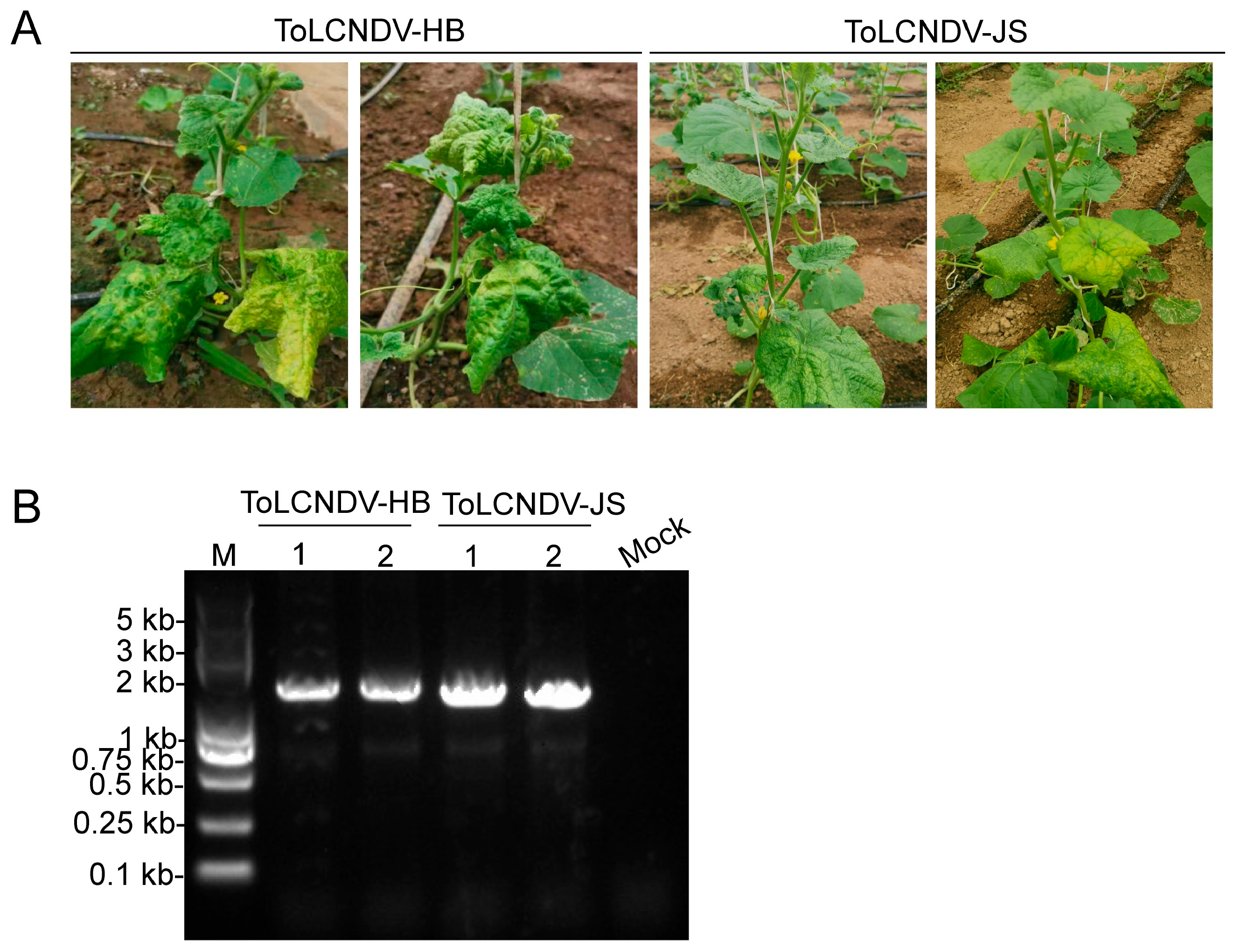
During field surveys for viral diseases in major cucurbit-producing regions of China, melon plants showing symptoms, including leaf curling, yellowing, and fruit malformation likely caused by ToLCNDV infection, were observed in Hebei and Jiangsu provinces in September 2024 (Figure 1A). To confirm whether the melon plants were infected by ToLCNDV, we collected two symptomatic leave samples from Hebei and Jiangsu, respectively. Total DNA was extracted from these samples, and the ToLCNDV-specific primers were designed for PCR amplification. PCR results showed that target fragments of approximately 1000 bp was successfully amplified from all leaf samples (Figure 1B). The PCR products were then cloned into a T-A Blunt Vector and verified by Sanger sequencing. A 1086 bp sequence (5′-3′: 128-1143 nt) was obtained and submitted to the NCBI database for analysis. BLASTn analysis revealed that these four sequences share 100% similarity with the corresponding region of ToLCNDV isolate YJSiG DNA-A (GenBank accession numbers PV259271.1), suggesting that the symptomatic melons from Hebei and Jiangsu might be infected by ToLCNDV.

3.2. Characterization and Phylogenetic Analysis of Two ToLCNDV Isolates Among Begomoviruses

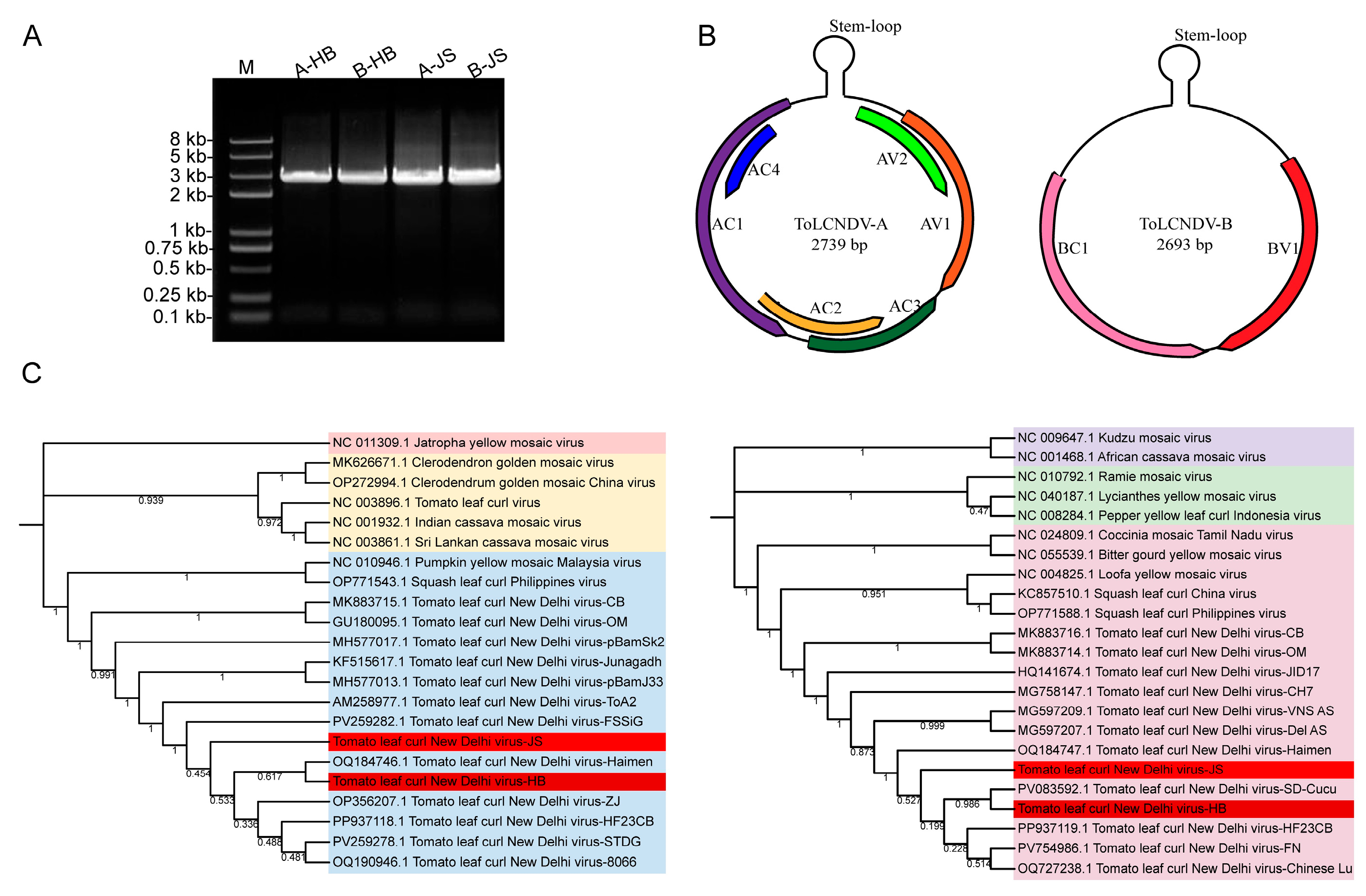
Based on reference sequences of ToLCNDV-YJSiG isolate, the adjacent primers were designed for full-length amplification of DNA-A and DNA-B components of ToLCNDV and target fragments of approximately 3000 bp were successfully amplified from the Hebei and Jiangsu samples (Figure 2A). The complete nucleotide sequences of DNA-A of Hebei isolate (ToLCNDV-HB) and Jiangsu isolate (ToLCNDV-JS) were determined to be 2739 bp (Genebank accession numbers PX962465 and PX962466). The DNA-B components of ToLCNDV-HB and ToLCNDV-JS were 2693 bp (Genebank accession numbers PX962467 and PX962468). The two isolates share identical genomic organization as shown in Figure 2B, and encode eight open reading frames (ORFs): AC1 (2584-1499 nt), AC2 (1596-1177 nt), AC3 (1457-1047 nt), AC4 (2427-2251 nt), AV1 (280-1050 nt), AV2 (120-458 nt), BC1 (2151-1306 nt), and BV1 (443-1249 nt). To elucidate the evolutionary relationship of ToLCNDV-HB and ToLCNDV-JS with other begomoviruses, phylogenetic trees were constructed based on their full-length genome sequences. The DNA-A of ToLCNDV-HB and ToLCNDV-JS were clustered within a clade containing other ToLCNDV isolates and were most closely related to ToLCNDV Haimen isolated DNA-A. Similarly, the DNA-B of the two isolates were also grouped into the same clade with other ToLCNDV isolates and showed the closest relationship to ToLCNDV SD-Cucu isolate (Figure 2C).

3.3. Differences in Infectivity and Pathogenicity Between the Infectious Clones of ToLCNDV-HB and ToLCNDV-JS

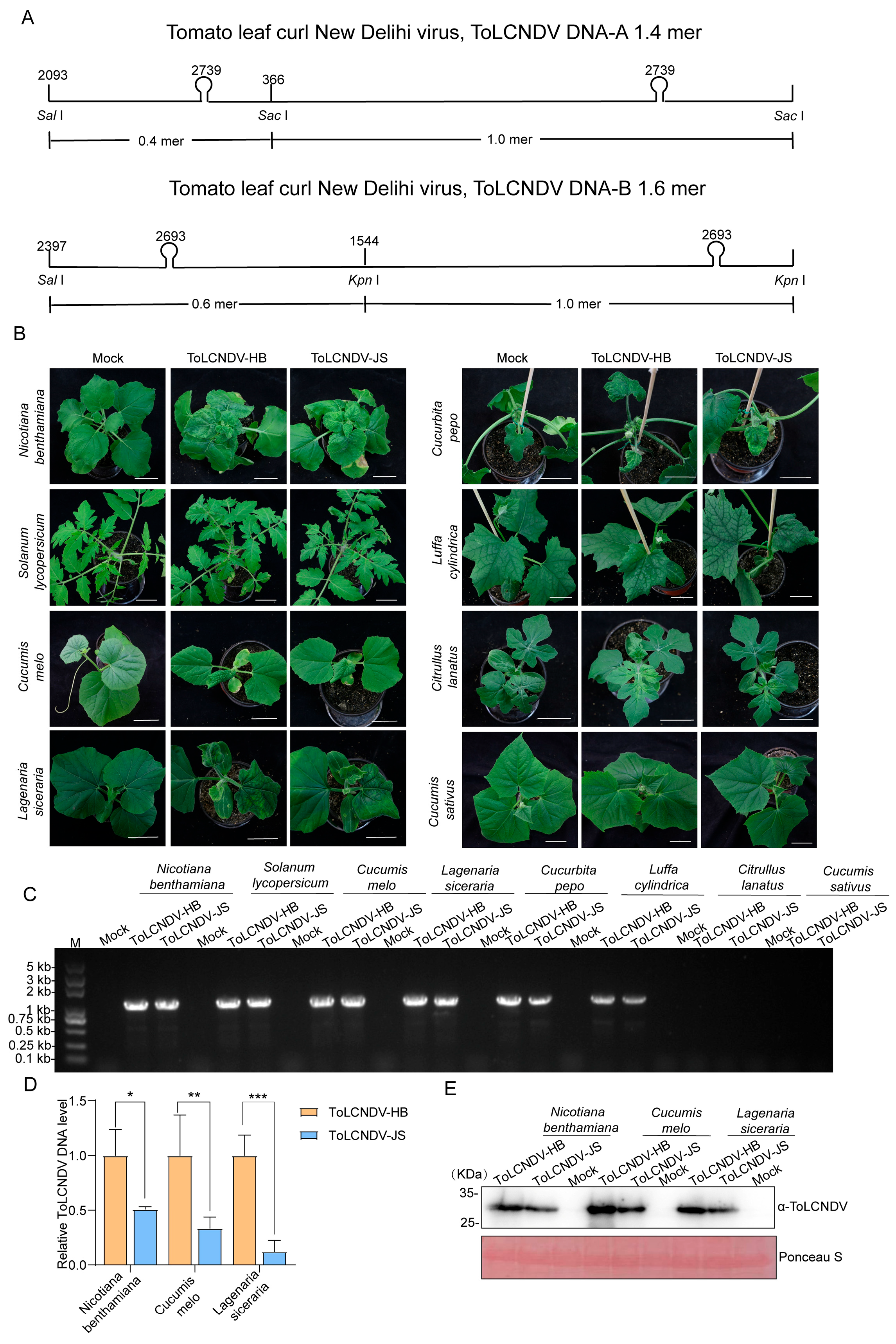
To identify the pathogenicity of ToLCNDV-HB and ToLCNDV-JS, the infectious clones of ToLCNDV-HB and ToLCNDV-JS were constructed. The 1.4 mer clone of DNA-A and the 1.6 mer clone of DNA-B were constructed into vector pBinplus, respectively (Figure 3A). The infectivity and pathogenicity of the infectious clones of ToLCNDV-HB or ToLCNDV-JS was tested in N. benthamiana, S. lycopersicum, C. melon, L. siceraria, C. pepo, L. cylindrica, C. lanatus, and C. sativus, respectively. Plants agro-inoculated with the pBinplus were used as Mock plants. The plant cultivars used in the test, the infection rates, and the symptoms induced by the two infectious clones on each cultivar are summarized in Table 1. Different typical symptoms were visible in the systematic leaves of tested plants agroinfiltrated with the infectious clone of ToLCNDV-HB or ToLCNDV-JS (Figure 3B). Leaf curling downward symptoms were observed in the systemic leaves of N. benthamiana inoculated with the infectious clones of ToLCNDV-HB or ToLCNDV-JS at 15 days post-inoculation (dpi). At 15 dpi, leaf curling downward and chlorosis symptoms were observed in C. melon and L. siceraria plants. Furthermore, C. pepo plants exhibited symptoms of leaf curling downward and mottling, and L. cylindrica plants showed symptoms of leaf curling downward and surface shrinking at 18 dpi. No symptoms were observed on the selected cultivars of S. lycopersicum, C.lanatus, and C. sativus plants at 25 dpi. Total DNA from all test plants with viral symptoms was amplified by PCR using ToLCNDV-specific primers, and the target band was successfully amplified in all plant species, except for C. lanatus and C. sativus plants (Figure 3C). Notably, despite the absence of observable symptoms on tomato plants, PCR analysis results showed that the inoculated tomato plants could be systemically infected by the infectious clones of ToLCNDV-HB and ToLCNDV-JS.
Additionally, we found that ToLCNDV-HB exhibited a higher infection efficiency and induced more severe symptoms than ToLCNDV-JS across all infected host plants tested. To substantiate the differential pathogenicity between ToLCNDV-HB and JS, total DNA was extracted from N. benthamiana, C.melon, L. siceraria plants, all of which exhibited infection rates exceeding 50%, for further qPCR analysis. The results revealed a significantly higher accumulation of viral DNA in plants infected with ToLCNDV-HB compared to those infected with ToLCNDV-JS (Figure 3D). Consistent with this, Western blot analysis showed a greater accumulation of viral proteins in plants infected with ToLCNDV-HB (Figure 3E). These results indicate that the ToLCNDV-HB isolate possesses stronger pathogenicity than the ToLCNDV-JS isolate in N. benthamiana, C.melon and L. siceraria.

3.4. Screening for the Virulence Factor of Differential Pathogenicity Between ToLCNDV-HB and ToLCNDV-JS

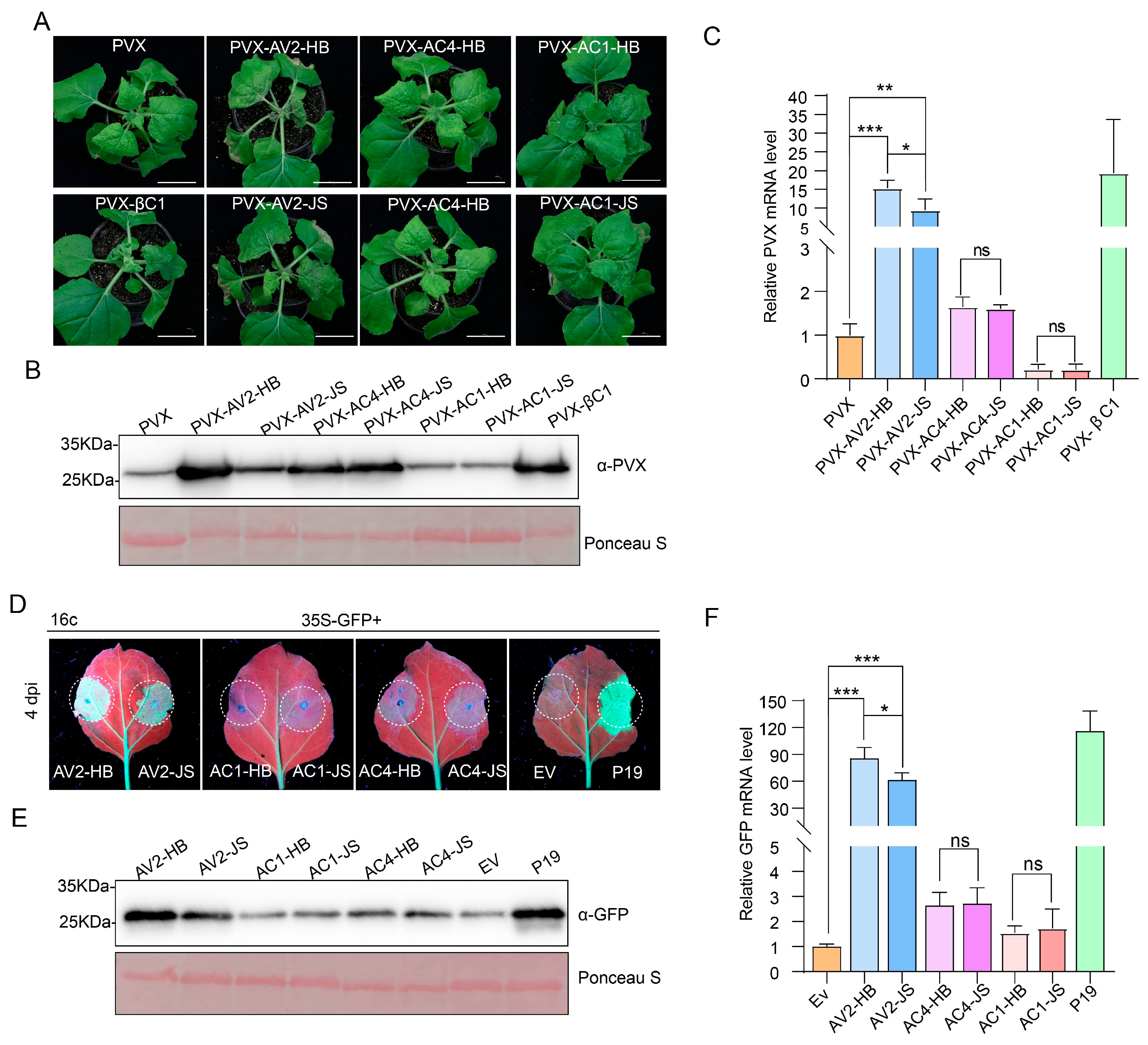
To identify which viral protein is responsible for the pathogenicity difference between ToLCNDV-HB and ToLCNDV-JS, sequences of eight proteins encoded by ToLCNDV-HB and ToLCNDV-JS were aligned using MUSCLE in MEGA 11, and the results showed that sequence variations were present only in AV2, AC1, and AC4 (Figure S1). Then we investigated their functions to test which protein is able to determine pathogenicity difference. In order to test whether AV2, AC1 and AC4 encoded by the two isolates are involved in the differences in symptom development, the three proteins encoded by two isolates were ectopically expressed in N. benthamiana plants, respectively, using a potato virus X (PVX)-based vector to produce PVX-AV2-HB, PVX-AV2-JS, PVX-AC1-HB, PVX-AC1-JS, PVX-AC4-HB and PVX-AC4-JS. The PVX infectious clone were inoculated as negative controls, and the PVX vector carrying the tomato yellow leaf curl China betasatellite (TYLCCNB)-encoding βC1 gene (PVX-βC1) was inoculated as a positive control. At 10 dpi, N. benthamiana plants inoculated with PVX-AV2-HB or PVX-AV2-JS showed more serve leaf curling and mosaic symptoms than those PVX-inoculated plants and even led to the necrosis of the leaves, and PVX-AV2-HB induced significantly stronger symptoms than PVX-AV2-JS. Plants expressing PVX-AC4-HB or PVX-AC4-JS developed more severe symptoms than the PVX control, but no difference was observed between PVX-AC4-HB and PVX-AC4-JS (Figure 4A). The expression of AC1 did not enhance and even slightly attenuated PVX-induced symptoms. Furthermore, Western blot analysis and RT-qPCR assays were conducted to confirm PVX-CP’s protein and mRNA accumulation, which were consistent with these phenotypic observations (Figure 4B,C). These results indicate that AV2 and AC4 function as pathogenicity determinants for ToLCNDV, and that AV2 specifically determines the differential contribution of Hebei and Jiangsu isolates to the promotion of viral infection.
Plant viruses encode post-transcriptional gene silencing suppressors (PTGSs), which are crucial for overcoming host RNA silencing-mediated defenses to establish successful infection [26]. To further determine whether the three proteins encoded by ToLCNDV-HB and ToLCNDV-JS had differences in PTGS activity, we co-infiltrated 35S-GFP with A. tumefaciens expressing either pCambia1300-3×Flag(N) EV vector (negative control), Flag-AV2-HB, Flag-AV2-JS, Flag-AC1-HB, Flag-AC1-JS, Flag-AC4-HB, Flag-AC4-JS, or P19 in N. benthamiana. The P19 protein from tomato bushy stunt virus (TBSV), a well-characterized viral suppressor of RNA silencing (VSR), served as the positive control. At 4 dpi, the leaves inoculated with Flag-AV2-HB +35S-GFP or Flag-AV2-JS+35S-GFP showed markedly stronger green fluorescence than the leaves expressing Flag-GUS in the UV light. Notably, the fluorescence intensity was stronger in leaves expressing Flag-AV2-HB than in those expressing Flag-AV2-JS. In contrast, leaves expressing Flag-AC4 or Flag-AC1 showed GFP fluorescence intensity comparable to that of the EV control under UV light. Furthermore, no discernible difference in GFP fluorescence was observed between the two isolates of either AC4 or AC1 (Figure 4D). Western blot analyses demonstrated that the GFP protein accumulation was significantly higher in leaves expressing Flag-AV2-HB than in those expressing Flag-AV2-JS, both of which were significantly greater than in the EV control (Figure 4E). RT-qPCR analyses showed that the GFP mRNA levels were consistent with protein levels (Figure 4F). These results demonstrate that AV2 functions as a silencing suppressor for ToLCNDV. Taken together, the AV2 was a key virulence factor responsible for the differential pathogenicity between ToLCNDV-HB and ToLCNDV-JS.

3.5. AV2 Is a Determinant of Pathogenicity Difference Between ToLCNDV-HB and ToLCNDV-JS

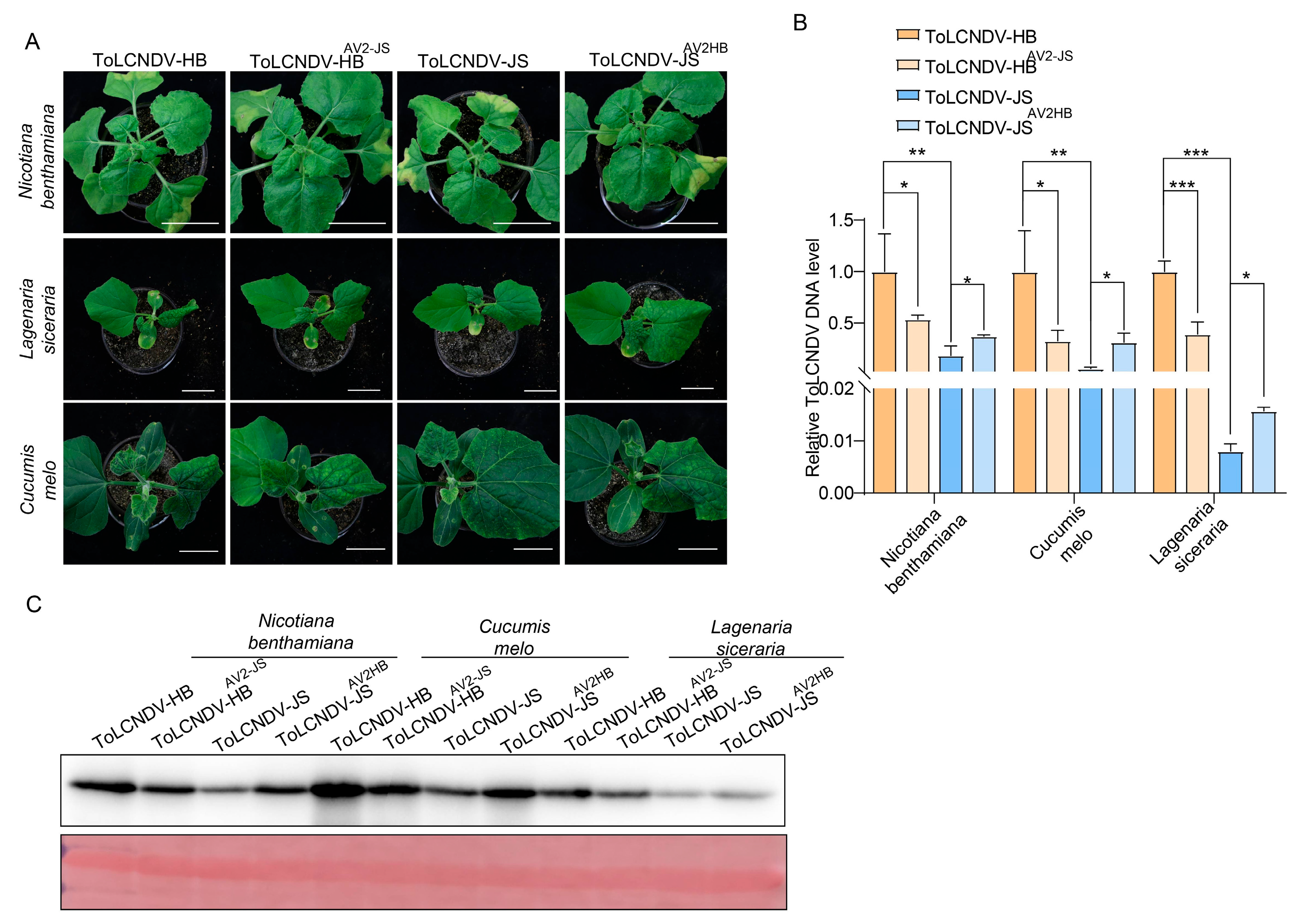
To further confirm that the virulence factor AV2 was responsible for ToLCNDV pathogenicity difference between ToLCNDV-HB and ToLCNDV-JS, we synthesized two reciprocal chimeric constructs (ToLCNDV-HBAV2-JS and ToLCNDV-JSAV2-HB) by swapping the entire AV2 gene (from start to stop codon) between the ToLCNDV-HB and ToLCNDV-JS backbones, resulting in ToLCNDV-HB encoding the V2 protein of ToLCNDV-JS and ToLCNDV-JS encoding the V2 protein of ToLCNDV-HB during virus infection. The infectious clones of ToLCNDV-HB, ToLCNDV-HBAV2-JS, ToLCNDV-JS, and ToLCNDV-JSAV2-HB were agro-inoculated into N. benthamiana, C. melon and L. siceraria plants. At 15 dpi, ToLCNDV-HBAV2-JS caused attenuated symptoms compared to the ToLCNDV-HB, though not as mild as those induced by ToLCNDV-JS. Conversely, ToLCNDV-JSAV2-HB induced exacerbated symptoms compared to ToLCNDV-JS, though not as severe as those caused by ToLCNDV-HB (Figure 5A). By qPCR assays, the viral DNA accumulation level in plants infected by ToLCNDV-HBAV2-JS was lower than those of infected by ToLCNDV-HB, and ToLCNDV-JSAV2-HB accumulated a higher level of viral DNA than ToLCNDV-JS (Figure 5B). Western blot assays further confirmed the differential of ToLCNDV-CP accumulation among these plants, which is consistent with the viral DNA quantitation detected by qPCR (Figure 5C). These data together demonstrated that although AV2 partially determines viral symptom severity, this reciprocal change in pathogenicity definitively establishes AV2 as the key determinant responsible for the differential virulence between ToLCNDV-HB and ToLCNDV-JS.

3.6. Sap Transmission of the Infectious Clone of ToLCNDV-HB and ToLCNDV-JS

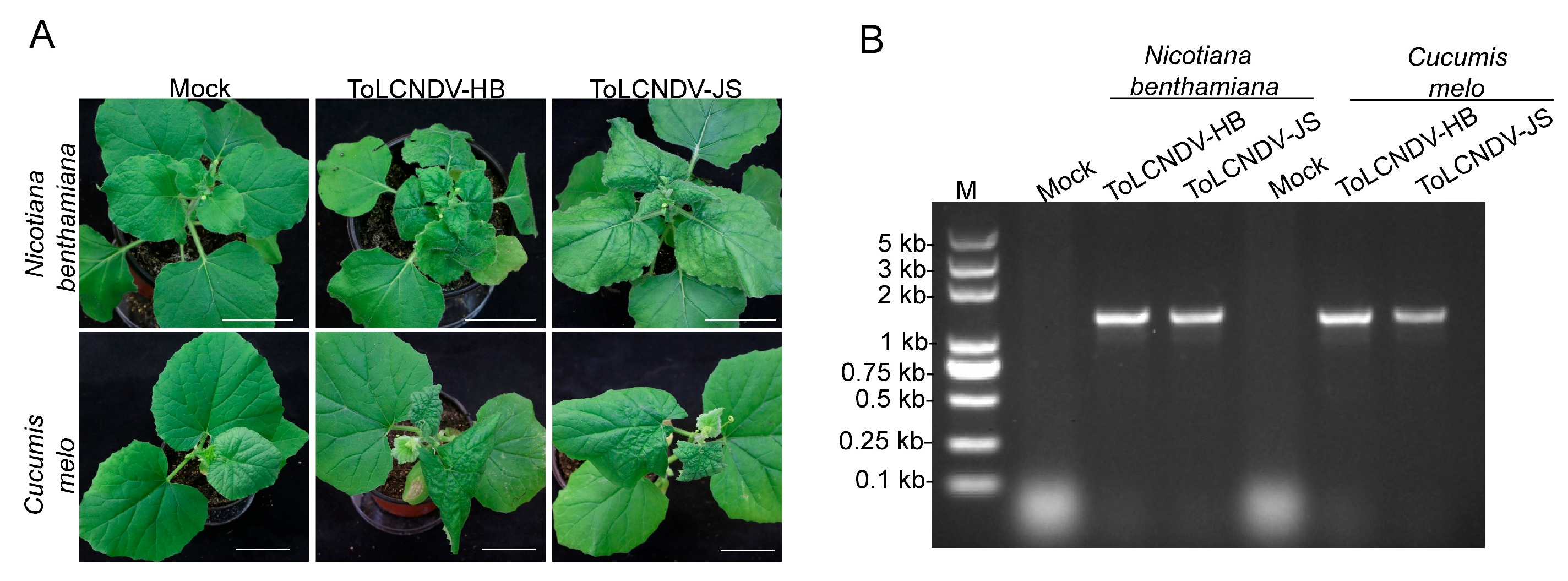
Since mechanical inoculation is uncommon among most geminiviruses and has been reported only for certain ToLCNDV strains, we tested this ability for ToLCNDV-HB and ToLCNDV-JS. The crude sap extracted from melon leaves that had been systemically infected via agroinfiltration with two ToLCNDV infectious clones, respectively, was then mechanically rubbed onto the leaves of healthy N. benthamiana and C. melon plants. The crude sap extracted from leaves of healthy melon plants was used as the mock inoculum. Compared with the mock-inoculated controls, the systemic leaves of N. benthamiana and C.melon plants sap-inoculated with ToLCNDV developed leaf curling symptoms that were observed in plants agro-inoculated with the infectious clones (Figure 6A). As expected, PCR amplification confirmed the presence of ToLCNDV in the systemic leaves of N. benthamiana and C. melon plants that had been mechanically following mechanical ToLCNDV sap inoculation (Figure 6B). These results demonstrate that both ToLCNDV-HB and ToLCNDV-JS possess the capacity for mechanical transmission and these findings expand our understanding of the geographic distribution and pathogenic mechanisms of ToLCNDV.

4. Discussion

ToLCNDV, first identified on tomato in India in 1995 and subsequently reported on bitter gourd in Pakistan by 2005, has undergone significant geographical and host range expansion [15,16]. Since 2012, its distribution has extended beyond Asia to numerous countries in the Mediterranean Basin and Europe, including Algeria, Spain, Italy, Greece, and Iran [2]. Concurrently, its host range has broadened remarkably, according to the European and Mediterranean Plant Protection Organization (EPPO) global database (https://gd.eppo.int/taxon/TOLCND/hosts, accessed on 30 January 2026); ToLCNDV is now documented to infect at least 74 plant species across 17 families, including Solanaceae, Cucurbitaceae, and Fabaceae. Cucurbit crops are vital for global nutrition and economy [1]. ToLCNDV infection in cucurbit crops induces symptoms such as leaf yellowing, curling, fruit size reduction, and malformation, which severely compromise yield and cause significant economic losses [27]. In China, ToLCNDV was first detected on greenhouse tomato in Zhejiang Province in 2021 [28]. Subsequent reports and sequence submissions to NCBI have confirmed its presence in cucurbit crops across multiple provinces, including Shaanxi, Jiangsu, and Anhui provinces (https://www.ncbi.nlm.nih.gov/nuccore/?term=Tomato+leaf+curl+New+Delhi+virus+AND+China, accessed on 26 December 2025), suggesting that the virus may now pose a greater threat to cucurbits than to its original host tomato within China. In this study, we isolated and characterized ToLCNDV from symptomatic melon plants in Hebei and Jiangsu provinces of China. We also identified that AV2 is a key factor determining the pathogenicity of ToLCNDV isolates. Our results provide a potential target for future resistance breeding programs in cucurbit crops.
Host range tests using our constructed infectious clones from isolates in the two regions revealed that both ToLCNDV-HB and ToLCNDV-JS systemically infected N. benthamiana, melon, bottle gourd, zucchini, and sponge gourd, but failed to induce symptoms in the tested cultivars of watermelon and pumpkin. Intriguingly, while tomato plants remained asymptomatic, PCR analysis confirmed systemic infection, indicating that ToLCNDV can establish a latent infection in tomato. This differential symptomatology in cucurbit and tomato aligns with field observations where ToLCNDV is more frequently identified in cucurbits and may explain why asymptomatic infected tomatoes are often overlooked during surveys. Future epidemiological studies should consider testing both symptomatic cucurbits and adjacent asymptomatic solanaceous hosts to better understand the occurrence and epidemic of ToLCNDV. The absence of infection in certain cucurbit species may be unique to some cultivars; further investigation with a broader range of germplasm resources should be conducted.
A key finding was the consistently higher infectivity and virulence of ToLCNDV-HB compared to the ToLCNDV-JS across all susceptible hosts. Comparative sequence analysis of all viral proteins identified variations specifically in AV2, AC1, and AC4. Subsequent functional analysis demonstrated that only AV2 exhibited a difference between ToLCNDV-HB and ToLCNDV-JS. The AV2 protein encoded by ToLCNDV-HB displayed stronger pathogenicity in a heterologous PVX system and more potent PTGS activity compared to its ToLCNDV-JS. This enhanced PTGS activity likely constitutes a primary mechanism for the increased virulence of ToLCNDV-HB, as more efficient suppression of RNA silencing-mediated defense plants would facilitate viral earlier and higher accumulation, correlating with the observed severe symptoms, which correspond to the established role of AV2 as a multifunctional pathogenicity factor in begomoviruses [25,29,30]. The definitive evidence was from a reciprocal AV2-swapping experiment between the two infectious clones, which resulted in a corresponding shift in virulence, directly establishing AV2 as the determinant of the phenotypic difference. Although no functional difference was detected between the two AC4 variants, both demonstrated an ability to enhance PVX pathogenicity and exhibited weak PTGS activity. This finding further confirmed the repertoire of pathogenicity factors encoded by ToLCNDV.
To our knowledge, this is the first report identifying the AV2 protein as the determinant responsible for the differential pathogenicity between two Chinese ToLCNDV isolates. This finding provides a molecular explanation for the observed variation in field isolates and deepens our understanding of the evolution of ToLCNDV. The reverse genetics system established provides a crucial tool for dissecting the roles of other viral proteins. Most significantly, the identification of AV2 as a key virulence determinant pinpoints it as a promising target for developing broad-spectrum resistance through molecular breeding strategies in cucurbit crops. Additionally, recent studies indicated that DNA and RNA viruses could encode multiple small proteins to maximize their coding capacity within compact genomes. Future identification and functional validation of small proteins encoded by ToLCNDV would expand the repertoire of potential targets for innovative control strategies [31,32]. Furthermore, our findings confirmed that ToLCNDV-HB and ToLCNDV-JS produce mechanically transmissible virions, which is relatively uncommon among begomoviruses. Begomoviruses are typically phloem-limited, replicating exclusively within phloem sieve elements and establishing systemic infection through long-distance movement via the vascular system, with minimal capacity to replicate in other cell types [33,34]. Mechanical inoculation, however, introduces viral particles directly into mesophyll cells [35]. The observation that both ToLCNDV isolates examined in this study are mechanically transmissible suggests that they may have evolved the capacity to survive and replicate in mesophyll cells. This trait is likely associated with the nuclear shuttle protein (NSP) encoded by DNA-B. Previous studies have revealed differential expression profiles of NSP encoded by mechanically transmissible and non-mechanically transmissible ToLCNDV isolates in melon plants [36], supporting the hypothesis that NSP plays a critical role in determining the efficiency of viral replication and intercellular movement in mesophyll cells, thereby influencing the mechanical transmissibility of ToLCNDV. This mechanical transmissibility highlights an additional risk factor for viral spread and epidemics. Hence, accelerating research on its infection strategies and breeding-resistant varieties is crucial for effective control of this virus.
Cultivating resistant varieties is widely regarded as the most effective and sustainable strategy for virus control. This strategy can be informed by the plant’s RNA-based defense system, which primarily encompasses RNA silencing, RNA quality control, RNA decay, and RNA modifications [37]. Of these, the molecular mechanisms of RNA silencing are the most well-characterized, and it has long been leveraged as a powerful tool in resistance breeding [38]. The other three pathways have only recently gained significant research attention; they are now recognized to also impede viral infection by targeting and degrading viral RNAs [39,40]. Furthermore, these RNA-based mechanisms exhibit significant crosstalk with protein degradation pathways. For instance, they can intersect with SUMOylation modifications and autophagic degradation routes, thereby enabling a more integrated defense system [41,42]. The host genes involved in all these interactive processes offer valuable insights and potential targets for breeding cucurbit crops resistant to ToLCNDV. Furthermore, engineering the plant’s innate immune gene, nucleotide-binding leucine-rich repeat immune receptors, to achieve broad-spectrum disease resistance is a novel and promising frontier [43].

5. Conclusions

In this study, we isolated and sequenced the complete genomes of ToLCNDV from melon plants in Hebei and Jiangsu provinces of China, constructing the corresponding infectious clones (ToLCNDV-HB and ToLCNDV-JS). Pathogenicity assays revealed that both clones infected N. benthamiana, tomato, melon, bottle gourd, zucchini, and sponge gourd, but not the tested cultivars of watermelon and pumpkin. Importantly, ToLCNDV-HB consistently exhibited stronger virulence than ToLCNDV-JS. Through functional protein analysis and a gene-swapping experiment, we identified AV2 as the key determinant responsible for this pathogenicity difference. Furthermore, we confirmed that both isolates are mechanically transmissible. This work provides foundational insights for developing resistance strategies against this globally destructive ToLCNDV in cucurbit crops.

Supplementary Materials

The following supporting information can be downloaded at https://www.mdpi.com/article/10.3390/agronomy16050568/s1, Table S1. Primers for ToLCNDV detection and full-length amplification. Table S2. Primers for vector construction. Table S3. qPCR primers used in this study. Figure S1: Alignment of the proteins encoded by DNA-A and DNA-B of ToLCNDV-HB and ToLCNDV-JS.

Author Contributions

Conceptualization, F.L. and X.Z.; methodology, Y.C.; software, Y.C.; validation, Y.C.; formal analysis, Y.C. and F.L.; investigation, Y.C. and F.L.; resources, F.L.; data curation, Y.C.; writing—original draft preparation, Y.C. and F.L.; writing—review and editing, Y.C., Z.X., Y.W. and X.Z.; visualization, Y.C.; supervision, F.L. and X.Z.; project administration, F.L. and X.Z.; funding acquisition, X.Z. and F.L. All authors have read and agreed to the published version of the manuscript.

Funding

This research was supported by grants from the National Natural Science Foundation of China (W2411024), the Basic Research Center, The Agricultural Science and Technology Innovation Program (CAAS-BRC-CB-2025-02), and Open Funds of the State Key Laboratory of Plant Environmental Resilience (SKLPERKF2602).

Data Availability Statement

The original contributions presented in this study are included in the article/Supplementary Material. Further inquiries can be directed to the corresponding authors.

Acknowledgments

We thank David C. Baulcombe for the provision of the transgenic GFP 16c line and the PVX vector.

Conflicts of Interest

The authors declare no conflicts of interest.

Abbreviations

The following abbreviations are used in this manuscript:
ToLCNDVtomato leaf curl New Delhi virus
ORFOpen reading frame
PTGSPost-transcriptional gene silencing
CPCoat protein
RepReplication-associated protein
TrAPTranscription activator protein
REnReplication enhancer protein
NSPNuclear shuttle protein
MPMovement protein
CTABcetyltrimethyl ammonium bromide
PVXpotato virus X
GFPGreen fluorescent protein
TYLCCNBtomato yellow leaf curl China betasatellite
TBSVtomato bushy stunt virus
EPPOEuropean and Mediterranean Plant Protection Organization
VSRViral suppressor of RNA silencing
dpiDays post-inoculation
qPCRQuantitative polymerase chain reaction

References

  1. McCreight, J.D. Cultivation and uses of cucurbits. In Genetics and Genomics of Cucurbitaceae; Springer: Cham, Switzerland, 2016; pp. 1–12. [Google Scholar]
  2. Cai, L.; Mei, Y.; Ye, R.; Deng, Y.; Zhang, X.; Hu, Z.; Zhou, X.; Zhang, M.; Yang, J. Tomato leaf curl New Delhi virus: An emerging plant begomovirus threatening cucurbit production. Abiotech 2023, 4, 257–266. [Google Scholar] [CrossRef] [PubMed]
  3. Fiallo-Olivé, E.; Lett, J.; Martin, D.; Roumagnac, P.; Varsani, A.; Zerbini, F.; Navas-Castillo, J. ICTV Virus Taxonomy Profile: Geminiviridae 2021. J. Virol. 2021, 102, 001696. [Google Scholar] [CrossRef]
  4. Roshan, P.; Kulshreshtha, A.; Hallan, V. Genome organization of Begomoviruses. In Begomoviruses: Occurrence and Management in Asia and Africa; Springer: Singapore, 2017; pp. 11–32. [Google Scholar]
  5. Tamilnayagan, T.; Suganthy, M.; Renukadevi, P.; Malathi, V.G. Molecular Characterization and Virus-Vector Relationship of Tomato Leaf Curl New Delhi Virus (ToLCNDV) Infecting Ash Gourd in India. SSRN 2022. [Google Scholar] [CrossRef]
  6. Kamal, H.; Zafar, M.M.; Razzaq, A.; Parvaiz, A.; Ercisli, S.; Qiao, F.; Jiang, X. Functional role of geminivirus encoded proteins in the host: Past and present. Biotechnol. J. 2024, 19, 2300736. [Google Scholar] [CrossRef] [PubMed]
  7. Sarkar, M.; Mondal, F.; Majumdar, A.; Valli, N.S.; Roy, B.; Verma, N.; Mohanbabu, Y.; Kumar, R.; Roy, A. Molecular Arsenal of Tomato Leaf Curl New Delhi Virus: Viral Suppressors of RNA Silencing and Their Roles in Pathogenicity. In Tomato Leaf Curl New Delhi Virus (ToLCNDV) Insights Into Virome Dynamics and Management; Springer: Singapore, 2025; pp. 325–337. [Google Scholar]
  8. Rizvi, I.; Choudhury, N.R.; Tuteja, N. Insights into the functional characteristics of geminivirus rolling-circle replication initiator protein and its interaction with host factors affecting viral DNA replication. Arch. Virol. 2015, 160, 375–387. [Google Scholar] [CrossRef] [PubMed]
  9. Williams, J.C. Hijacking of the Plant Transcription Factor TCP24 by Geminiviruses for the Regulation of Late Gene Expression. Ph.D. Thesis, The University of Texas at San Antonio, San Antonio, TX, USA, 2022. [Google Scholar]
  10. Trinks, D.; Rajeswaran, R.; Shivaprasad, P.; Akbergenov, R.; Oakeley, E.J.; Veluthambi, K.; Hohn, T.; Pooggin, M.M. Suppression of RNA silencing by a geminivirus nuclear protein, AC2, correlates with transactivation of host genes. J. Virol. 2005, 79, 2517–2527. [Google Scholar] [CrossRef]
  11. Pasumarthy, K.K.; Choudhury, N.R.; Mukherjee, S.K. Tomato leaf curl Kerala virus (ToLCKeV) AC3 protein forms a higher order oligomer and enhances ATPase activity of replication initiator protein (Rep/AC1). Virol. J. 2010, 7, 128. [Google Scholar] [CrossRef]
  12. Kulshreshtha, A.; Kumar, Y.; Roshan, P.; Bhattacharjee, B.; Mukherjee, S.K.; Hallan, V. AC4 protein of tomato leaf curl Palampur virus is an RNA silencing suppressor and a pathogenicity determinant. Microb. Pathog. 2019, 135, 103636. [Google Scholar] [CrossRef]
  13. Martins, L.G.; Raimundo, G.A.; Ribeiro, N.G.; Silva, J.C.F.; Euclydes, N.C.; Loriato, V.A.; Duarte, C.E.; Fontes, E.P. A begomovirus nuclear shuttle protein-interacting immune hub: Hijacking host transport activities and suppressing incompatible functions. Front. Plant Sci. 2020, 11, 398. [Google Scholar] [CrossRef]
  14. Rojas, M.R.; Maliano, M.R.; de Souza, J.O.; Vasquez-Mayorga, M.; de Macedo, M.A.; Ham, B.-K.; Gilbertson, R.L. Cell-to-cell movement of plant viruses: A diversity of mechanisms and strategies. In Current Research Topics in Plant Virology; Springer: Cham, Switzerland, 2016; pp. 113–152. [Google Scholar]
  15. Chowda Reddy, R.; Colvin, J.; Muniyappa, V.; Seal, S. Diversity and distribution of begomoviruses infecting tomato in India. Arch. Virol. 2005, 150, 845–867. [Google Scholar] [CrossRef]
  16. Haider, M.; Tahir, M.; Latif, S.; Briddon, R. First report of Tomato leaf curl New Delhi virus infecting Eclipta prostrata in Pakistan. Plant Pathol. 2006, 55, 285. [Google Scholar] [CrossRef]
  17. Juárez, M.; Tovar, R.; Fiallo-Olivé, E.; Aranda, M.; Gosálvez, B.; Castillo, P.; Moriones, E.; Navas-Castillo, J. First detection of Tomato leaf curl New Delhi virus infecting zucchini in Spain. Plant Dis. 2014, 98, 857. [Google Scholar] [CrossRef]
  18. Panno, S.; Iacono, G.; Davino, M.; Marchione, S.; Zappardo, V.; Bella, P.; Tomassoli, L.; Accotto, G.; Davino, S. First report of Tomato leaf curl New Delhi virus affecting zucchini squash in an important horticultural area of southern Italy. New Dis. Rep. 2016, 33, 6. [Google Scholar] [CrossRef]
  19. Moriones, E.; Praveen, S.; Chakraborty, S. Tomato leaf curl New Delhi virus: An emerging virus complex threatening vegetable and fiber crops. Viruses 2017, 9, 264. [Google Scholar] [CrossRef]
  20. Siskos, L.; Cui, L.; Wang, C.; Visser, R.G.; Bai, Y.; Schouten, H.J. A new challenge in melon resistance breeding: The ToLCNDV case. Euphytica 2022, 218, 129. [Google Scholar] [CrossRef]
  21. Vo, T.T.; Kil, E.-J.; Tabassum, M.; Nattanong, B.; Qureshi, M.A.; Im, H.-J.; Parrella, G.; Lee, T.-K.; Lee, S. Molecular Dissection of Symptom Determinants in Tomato Leaf Curl New Delhi Virus in Zucchini Through Mechanical Transmission. Viruses 2025, 17, 294. [Google Scholar] [CrossRef] [PubMed]
  22. Mei, Y.; Cai, L.; Wang, Y.; Li, F.; Yang, X.; Yang, J.; Zhou, X. Molecular characterization and pathogenicity of an infectious clone of tomato leaf curl New Delhi virus isolate infecting Cucumis melo. Stress Biol. 2023, 3, 51. [Google Scholar]
  23. Murray, M.; Thompson, W. Rapid isolation of high molecular weight plant DNA. Nucleic Acids Res. 1980, 8, 4321–4326. [Google Scholar] [CrossRef]
  24. Du, M.; Wang, Y.; Chen, C.; Li, X.; Feng, R.; Zhou, X.; Yang, X. Molecular characterization and pathogenicity of a novel soybean-infecting monopartite geminivirus in China. Viruses 2022, 14, 341. [Google Scholar] [CrossRef]
  25. Wang, Z.; Gong, P.; Zhao, S.; Li, F.; Zhou, X. Functional characterization of dual-initiation codon-derived V2 proteins in tomato yellow leaf curl virus. Agronomy 2025, 15, 1726. [Google Scholar]
  26. Gong, Q.; Wang, Y.; Jin, Z.; Hong, Y.; Liu, Y. Transcriptional and post-transcriptional regulation of RNAi-related gene expression during plant-virus interactions. Stress Biol. 2022, 2, 33. [Google Scholar] [CrossRef]
  27. Kumar, R.; Tiwari, R.K.; Lal, M.K.; Majumdar, S.G.; Swaraj, K.; Mall, A.K.; Tripathi, M.K.; Singh, D.; Singh, G. Contemporary Status of Occurrence, Spread, and Yield Loss Due to Tomato Leaf Curl New Delhi Virus in Global Crop Cultivation. In Tomato Leaf Curl New Delhi Virus (ToLCNDV) Insights into Virome Dynamics and Management; Springer: Singapore, 2025; pp. 1–12. [Google Scholar]
  28. Li, R.; Liu, Y.; Yin, C.; Sun, K.; Zhang, P. Occurrence of tomato leaf curl New Delhi virus in tomato (Lycopersicon esculentum) in China. Plant Dis. 2023, 107, 1639. [Google Scholar] [CrossRef]
  29. Li, Q.; Zhang, Y.; Lu, W.; Han, X.; Yang, L.; Shi, Y.; Li, H.; Chen, L.; Liu, Y.; Yang, X. Identification and characterization of a new geminivirus from soybean plants and determination of V2 as a pathogenicity factor and silencing suppressor. BMC Plant Biol. 2022, 22, 362. [Google Scholar] [CrossRef]
  30. Li, F.; Wang, Y.; Zhou, X. SGS3 cooperates with RDR6 in triggering geminivirus-induced gene silencing and in suppressing geminivirus infection in Nicotiana benthamiana. Viruses 2017, 9, 247. [Google Scholar] [CrossRef]
  31. Gong, P.; Shen, Q.; Zhang, M.; Qiao, R.; Jiang, J.; Su, L.; Zhao, S.; Fu, S.; Ma, Y.; Ge, L. Plant and animal positive-sense single-stranded RNA viruses encode small proteins important for viral infection in their negative-sense strand. Mol. Plant 2023, 16, 1794–1810. [Google Scholar]
  32. Gong, P.; Tan, H.; Zhao, S.; Li, H.; Liu, H.; Ma, Y.; Zhang, X.; Rong, J.; Fu, X.; Lozano-Durán, R. Geminiviruses encode additional small proteins with specific subcellular localizations and virulence function. Nat. Commun. 2021, 12, 4278. [Google Scholar] [CrossRef] [PubMed]
  33. Mei, Y.; Wang, Y.; Li, F.; Lozano-Durán, R.; Zhou, X. Defence-mediated phloem restriction of a plant virus facilitates insec transmission. Nat. Commun. 2025, 17, 152. [Google Scholar] [PubMed]
  34. Wang, H.; Gilbertson, R.L.; Lucas, W.J. Spatial and temporal distribution of bean dwarf mosaic geminivirus in Phaseolus vulgaris and Nicotiana benthamiana. Phytopathology 1996, 86, 1204–1214. [Google Scholar]
  35. Ryabov, E.; Fraser, G.; Mayo, M.; Barker, H.; Taliansky, M. Umbravirus gene expression helps Potato leafroll virus to invade mesophyll tissues and to be transmitted mechanically between plants. Virology 2001, 86, 363–372. [Google Scholar] [CrossRef]
  36. Lee, C.; Zheng, Y.; Chan, C.; Ku, H.; Chang, C.; Jan, F. A single amino acid substitution in the movement protein enables the mechanical transmission of a geminivirus. Mol. Plant Pathol. 2020, 21, 571–588. [Google Scholar] [CrossRef]
  37. Ge, L.; Jia, M.; Shan, H.; Gao, W.; Jiang, L.; Cui, H.; Cheng, X.; Uzest, M.; Zhou, X.; Wang, A. Viral RNA polymerase as a SUMOylation decoy inhibits RNA quality control to promote potyvirus infection. Nat. Commun. 2025, 16, 157. [Google Scholar] [CrossRef]
  38. Wang, M.-B.; Masuta, C.; Smith, N.A.; Shimura, H. RNA silencing and plant viral diseases. Mol. Plant-Microbe Interact. 2012, 25, 1275–1285. [Google Scholar] [CrossRef]
  39. He, H.; Ge, L.; Chen, Y.; Zhao, S.; Li, Z.; Zhou, X.; Li, F. m6A modification of plant virus enables host recognition by NMD factors in plants. Sci. China Life Sci. 2024, 67, 161–174. [Google Scholar] [CrossRef] [PubMed]
  40. Chen, Y.; Ge, L.; Li, Z.; Wang, A.; Zhou, X.; Li, F. Targeting of viral RNAs by nonsense-mediated decay is compromised by virus–plant interactions. New Plant Prot. 2024, 1, e8. [Google Scholar] [CrossRef]
  41. Chen, Y.; Jia, M.; Ge, L.; Li, Z.; He, H.; Zhou, X.; Li, F. A negative feedback loop compromises NMD-mediated virus restriction by the autophagy pathway in plants. Adv. Sci. 2024, 11, 2400978. [Google Scholar] [CrossRef] [PubMed]
  42. Ge, L.; Cao, B.; Qiao, R.; Cui, H.; Li, S.; Shan, H.; Gong, P.; Zhang, M.; Li, H.; Wang, A. SUMOylation-modified Pelota-Hbs1 RNA surveillance complex restricts the infection of potyvirids in plants. Mol. Plant 2023, 16, 632–642. [Google Scholar] [CrossRef]
  43. Wang, Y.; Mei, Y.; Li, F. Engineering nucleotide-binding leucine-rich repeat immune receptors to achieve broad-spectrum disease resistance in plants. New Plant Prot. 2025, e70023. [Google Scholar] [CrossRef]
Figure 1. Detection of ToLCNDV from symptomatic melon leaves in Hebei and Jiangsu provinces of China. (A) Down leaf curling and yellow symptoms on the leaves of melon in Hebei and Jiangsu province, respectively. (B) Detection of ToLCNDV by PCR with the special primer pair ToLCNDV-JC-F/ToLCNDV-JC-R. M: DNA Marker, GeneStar Marker D2000 Plus.
Agronomy 16 00568 g001
Figure 2. Amplification and characteristic diagram of the ToLCNDV genome sequence as well as evolutionary analysis. (A) PCR detection of the full-length genome of ToLCNDV DNA-A and DNA-B in the melon samples from Hebei and Jiangsu using primer pair ToLCNDVA-Sac I-1.0F/ToLCNDVA-Sac I-1.0R and ToLCNDVB-Kpn I-1.0F/ToLCNDVB-Kpn I-1.0R. M: DNA Marker, GeneStar Marker D8000. (B) Schematic representation of ToLCNDV DNA-A and DNA-B genomic organization. Open reading frames encoded on the virion-sense and complementary-sense strand are denoted with different colors. (C) The phylogenetic trees that reflected the phylogenetic relationships of the DNA-A and DNA-B component of ToLCNDV-HB and ToLCNDV-JS were constructed by the neighbor-joining method with a bootstrap of 1000 replicates using MEGA 11. Different colored backgrounds indicate distinct evolutionary branches, with ToLCNDV-HB and ToLCNDV-JS highlighted in red.
Agronomy 16 00568 g002
Figure 3. Systemic infection of the infectious clone of ToLCNDV-HB and ToLCNDV-JS. (A) Strategies for construction of the infectious clones of ToLCNDV-HB and ToLCNDV-JS were the same. In the plant binary vector pBinplus, 1.4-mer tandem repeats of ToLCNDV DNA-A and 1.6-mer tandem repeats of DNA-B were constructed, respectively. The restriction enzymes used for the construction of the infectious clones of ToLCNDV-HB and ToLCNDV-JS were shown as indicated. (B) Analysis of the infectivity and pathogenicity of ToLCNDV infectious clone. Symptoms induced by ToLCNDV-HB and ToLCNDV-JS in Nicotiana benthamiana, Cucumis melon, Lagenaria siceraria, Cucurbita pepo and Luffa cylindrica at 15 dpi, and no symptoms were observed in Solanum lycopersicum, Citrullus lanatus and Cucumis sativus at 25 dpi. Scale bars, 5 cm. (C) PCR detection of ToLCNDV DNA extracted from Mock or ToLCDNV-infected plants as indicated. M: DNA Marker, GeneStar Marker D2000 Plus. (D) qPCR analysis of the viral DNA accumulation in N. benthamiana, C. melon and L. siceraria systemic leaves from (B). Statistical significance was assessed by Two-Way ANOVA with Sidak’s multiple comparisons test. Columns labeled with different numbers of “*” (* p < 0.05, ** p < 0.01, *** p < 0.001) indicate significant differences. Error bars represent ± SD (n = 3) and 25S RNA was used as the internal reference. (E) Western blot analysis of ToLCNDV CP accumulation with specific anti-ToLCNDV-CP antibodies in N. benthamiana, C. melon and L. siceraria systemic leaves from (B). Ponceau S stained RuBisCO large subunit was used as an equal loading control.
Agronomy 16 00568 g003
Figure 4. Functional comparison of the AV2, AC4, and AC1 proteins encoded by ToLCNDV-HB and ToLCNDV-JS. (A) Symptoms of N. benthamiana plants inoculated with PVX, PVX-AV2-HB, PVX-AV2-JS, PVX-AC4-HB, PVX-AC4-JS, PVX-AC1-HB, PVX-AC1-JS, were photographed at 10 dpi. Scale bars, 5 cm. (B) Western blot analysis of ToLCNDV CP accumulation with specific anti-PVX-CP antibodies in leaves from (A). Ponceau S stained RuBisCO large subunit was used as an equal loading control. (C) RT-qPCR analysis of PVX mRNA accumulation from (A). Statistical significance was assessed by One-Way ANOVA with Tukey’s multiple comparisons test. Columns labeled with different numbers of “*” (* p < 0.05, ** p < 0.01, *** p < 0.001) indicate significant differences, and ‘ns’ represents ‘no significant difference’. Error bars represent ± SD (n = 3) and NbActin2 was used as the internal reference. (D) N. benthamiana plants co-infiltrated with A. tumefaciens cultures expressing GFP (35S-GFP) and EV vector control, Flag-AV2-HB, Flag-AV2-JS, Flag-AC4-HB, Flag-AC4-JS, Flag-AC1-HB, Flag-AC1-JS, or P19 (positive control) were photographed under UV light at 4 dpi. (E) GFP protein accumulations in inoculated leaves from (A) were detected by Western blot using anti-GFP antibodies at 4 dpi. Ponceau S stained RuBisCO large subunit was used as an equal loading control. (F) Relative accumulations of GFP mRNA in leaves from (A) were analyzed by RT-qPCR. Statistical significance was assessed by One-Way ANOVA with Tukey’s multiple comparisons test. Columns labeled with different numbers of “*” (* p < 0.05, *** p < 0.001) indicate significant differences, and ‘ns’ represents ‘no significant difference’. Error bars represent ± SD (n = 3) and NbActin2 was used as the internal reference.
Agronomy 16 00568 g004
Figure 5. AV2 is a key determinant underlying the differential pathogenicity between ToLCNDV-HB and ToLCNDV-JS. (A) Phenotype of infected plants, N. benthamiana, C. melo and L. siceraria under infectious clones of ToLCNDV-HB, ToLCNDV-JS, ToLCNDV-HBAV2-JS, ToLCNDV-JSAV2-HB. Scale Bars, 5 cm. (B) qPCR analysis of the viral DNA accumulation in leaves from (A). Statistical significance was assessed by Two-Way ANOVA with Tukey’s multiple comparisons test. Columns labeled with different numbers of “*” (* p < 0.05, ** p < 0.01, *** p < 0.001) indicate significant differences. Error bars represent ± SD (n = 3) and 25S RNA was used as the internal reference. (C) Western blot analysis of ToLCNDV CP accumulation with specific anti-ToLCNDV-CP antibodies in systemic leaves from (A). Ponceau S stained RuBisCO large subunit was used as an equal loading control.
Agronomy 16 00568 g005
Figure 6. Sap transmission of the ToLCNDV-HB and ToLCNDV-JS isolates. (A) Downward leaf curing symptoms in N. benthamiana and C. melons plants mechanically inoculated with the crude sap extracted from systemic leaves of melon plants infected with the infectious clone of ToLCNDV-HB or ToLCNDV-JS. Plants mechanically inoculated with the crude sap extracted from healthy melon leaves were used as Mock. Photographs were taken at 15 dpi. (B) PCR amplification of ToLCNDV using specific primers in systemic leaves of mechanically inoculated plants from (A). M: DNA Marker, GeneStar Marker D2000 Plus.
Agronomy 16 00568 g006
Table 1. The infectivity and symptoms induced by infectious clones of ToLCNDV-HB and ToLCNDV-JS.
Plant SpeciesVarietiesNo. of Plants InoculatedNo. of Plants Infected
(HB/JS)
Infection
Efficiency (%)
(HB/JS)
Symptoms
Nicotiana benthamianaLaboratory Strain2020/20100/100Leaf curling downward
Solanum lycopersicum‘Money Maker’2010/250/10NA
Cucumis melon‘Mao hua tian fei’2016/1480/70Leaf curling downward and chlorosis
Lagenaria siceraria‘Li nong’2020/18100/90Leaf curling downward and chlorosis
Cucurbita pepo‘Cui jing’2010/850/40Leaf curling downward and mottling
Luffa cylindrica‘Shou he duo bao rou’206/430/20Leaf curling downward and surface shrinking
Citrullus lanatus‘ZZJM’200/00/0NA
Cucumis sativus‘Lv rang xiu chun’200/00/0NA
Disclaimer/Publisher’s Note: The statements, opinions and data contained in all publications are solely those of the individual author(s) and contributor(s) and not of MDPI and/or the editor(s). MDPI and/or the editor(s) disclaim responsibility for any injury to people or property resulting from any ideas, methods, instructions or products referred to in the content.