Article

Maize//Soybean Intercropping Enhances Enzyme Activity and Promotes Carbon, Nitrogen, and Phosphorus Stoichiometric Stability in Red Soil

1
College of Resources and Environmental Science, Yunnan Agricultural University, Kunming 650201, China
2
Scientific Observation and Experimental Station of Arable Land Conservation (Yunnan), Ministry of Agriculture and Rural Affairs, Kunming 650201, China
*
Author to whom correspondence should be addressed.
Agronomy 2026, 16(5), 556; https://doi.org/10.3390/agronomy16050556
Submission received: 31 December 2025 / Revised: 22 January 2026 / Accepted: 26 January 2026 / Published: 2 March 2026
(This article belongs to the Section Innovative Cropping Systems)

Abstract

Red soils suffer from nutrient imbalances and low-phosphorus availability. Rational intercropping plays an important role for increasing crop yield and improving nutrient use efficiency, while its long-term effects on biogeochemical cycles and ecological stoichiometric stability are poorly understood. Based on a 7-year continuous field experiment in low-phosphorus red soil, the soil enzyme activity, soil carbon (C), nitrogen (N), phosphorus (P) and C:N:P content, soil microbial biomass (MBC, MBN, MBP), and their ecological stoichiometric characteristics in maize monoculture (MM) and maize//soybean intercropping (MI) under four phosphate fertilization gradients (0, 60, 90, 120 kg P2O5 hm−2) were investigated. The impacts of continuous MI on soil CNP ecological stoichiometric stability in red soil were studied. The results showed that intercropping significantly elevated the content of soil organic carbon (SOC), total nitrogen (TN), total phosphorus (TP), and microbial biomass (MBC, MBN, MBP). Compared to maize monoculture, the contents of SOC, TN, and TP in intercropping soils increased by an average of 26.01%, 12.08%, and 7.58%, respectively, and soil MBC, MBN, and MBP increased by an average of 40.87%, 29.50%, and 38.34%, respectively, across different phosphate application gradients. Intercropping also significantly enhanced the activities of key C-, N-, and P-cycling enzymes (β-glucosidase, urease, acid phosphatase), increased by an average of 33.47%, 14.69%, and 60.15%, respectively. Most importantly, intercropping substantially improved the stoichiometric homeostasis of the microbial biomass and decreased the homeostasis index 1/H of MBC, MBN, MBP. Continuous intercropping shifted MBN from a sensitive to a strongly homeostatic state, MBP to homeostatic and the MBC/MBP ratio from weakly to strongly homeostatic in red soil. In conclusion, continuous MI in low-P red soil demonstrably increases soil nutrient content, enhances soil enzyme activity, and promotes ecological stoichiometric stability. This system represents one of the optimized cropping models for the synergistic enhancing of soil ecological stability in red soil regions.

1. Introduction

Red soils, predominantly distributed in the tropical and subtropical regions of China, constitute a vital agricultural production and national food supply [1]. This region is characterized by a fragile ecosystem and confronts severe soil nutrient imbalances [2]. Red soils typically exhibit low pH, deficient organic matter content [3], and strong phosphorus (P) fixation capabilities [4]. These limitations result in poor nutrient availability and low fertilizer utilization efficiency, with the seasonal recovery rate for P fertilizer often falling below 15% [5]. Furthermore, sloped red soil farmlands are prone to severe soil and water erosion, leading to substantial losses of nitrogen (N), phosphorus (P), and potassium (K) [6]. Consequently, mitigating nutrient loss, alleviating nutrient imbalances, enhancing soil nutrient availability, and promoting the stability of soil microbial biomass are critical requirements for the sustainable agricultural development of red soils.
Carbon (C), nitrogen (N), and phosphorus (P) are essential elements for plant growth and key indicators of soil nutritional status [7], with soil microbial biomass C, N, and P playing a pivotal role in maintaining soil ecosystem equilibrium [8]. In recent years, ecological stoichiometry has been widely applied to study the balance and regulatory mechanisms of key elements (C, N, P) in ecosystems, revealing the intrinsic laws of energy flow and material cycling [9], and offering new perspectives for analyzing soil nutrient imbalances. In soil ecosystems, the C:N:P stoichiometric ratio is a core metric for assessing nutrient limitation, microbial metabolic activity, and system stability [10]. Biological homeostasis, a central concept in ecological stoichiometry, reflects a species’ adaptability to environmental changes. Soil microbial biomass homeostasis varies across different ecosystems and is influenced by factors such as fertilization [11,12] and planting models [12]. When soil elemental ratios deviate from optimal microbial requirements, microorganisms adjust their extracellular enzyme secretion strategies. These enzymes are directly involved in critical processes such as organic matter decomposition and nutrient transformation and cycling [13]. However, recognition regarding how the homeostatic regulation of microbial C:N:P stoichiometry responds to the continuous organic inputs from intercropping in P-deficient red soils is currently lacking.
A [14] global meta-analysis indicated significant variations in ecosystem service indicators across different crop diversification systems (e.g., agroforestry, intercropping, cover crops, rotation, or variety mixtures) [15]. Intercropping, in particular, can significantly enhance soil enzyme activity by modulating the soil microbial community, thereby improving nutrient availability and cycling [16]. Maize//potato intercropping in red soil increased rhizospheric urease, protease, and catalase activities and enhanced soil nitrification potential [17]. Maize//wheat intercropping in sandy loam soil boosted sucrase and urease activities, increasing the soil’s total N and P contents. Maize//soybean intercropping in fluvo-aquic soil elevated urease and acid phosphatase activities, supplementing microbial C and N sources. In red soils, maize//soybean intercropping has been shown to increase soil acid and alkaline phosphatase activities and rhizosphere organic carbon [18], promoting P activation [18]. These studies collectively demonstrate that rational intercropping can stimulate soil enzyme activity, which is driving key C, N, and P-cycling processes. However, existing research predominantly focuses on short-term effects (typically <3 years). Knowledge regarding the C:N:P stoichiometric characteristics and its ecological homeostasis in red soil under continuous, long-term intercropping remains scarce.
Graminaceous//leguminous intercropping is a typical and widespread diversification model that achieves high nutrient use efficiency through resource-niche complementarity, improved soil microbial community structure, enhanced microbial diversity, promoted rhizosphere interactions, and augmented nitrogen fixation capabilities [19,20]. MI, a common practice in China, has demonstrated significant yield advantages and ecological benefits in red soil regions [5,18,21,22,23]. While the continuous effects of this system on maize yield and P fertilizer use efficiency in red soils are relatively well-established [21,22,23], its long-term impacts on soil enzyme activity and C:N:P dynamics are less understood. Research on the ecological stoichiometric characteristics and homeostasis of C:N:P in red soil under continuous intercropping is notably rare. Therefore, this study, centered on typical upland red soil in Southwest China and based on a 7-year continuous field experiment, systematically investigates how continuous intercropping modulates the C:N:P ecological stoichiometry of red soil, with a particular focus on the synergistic changes among soil, microbial, and enzyme activity stoichiometry in the rhizosphere microdomain. The findings aim to provide a scientific basis for agriculture’s sustainable development in acid soil regions.

2. Materials and Methods

2.1. Study Site Description

The long-term field experiment was initiated in 2017 and conducted in the Upland Red Soil Experimental station in Xiaoshao (24°54′ N and 102°41′ E) Kunming, Yunnan, China. The altitude is 1820 m, the mean annual temperature is 15.0 °C, and mean annual precipitation of 850 mm. The soil is a typical plateau red soil (Ferralsol). At the experiment’s initiation in 2017, the baseline soil physicochemical properties at 0–20 cm depth were pH 4.53, organic matter 4.69 g∙kg−1, alkali-hydrolyzable N 22.07 mg∙kg−1, available P (determined by Olsen method) 4.64 mg∙kg−1, total P 0.19 g∙kg−1, available K (extracted by 1 mol·L−1 NH4OAc) 134.77 mg∙kg−1, and bulk density 1.35 g∙cm−3. The field trial data presented herein were collected from May to October 2024, representing the 7th year of the continuous experiment.

2.2. Experimental Design

The field experiment was carried out using a randomized block design. The main treatment consisted of two planting models: maize monoculture (MM) and maize//soybean intercropping (MI). The sub-treatment involved four P fertilizer application rates: 0, 60, 90, and 120 kg P2O5∙hm−2 (denoted as P0, P60, P90, and P120, respectively). The sub-treatment involved four P fertilizer application rates: 0, 26, 39, and 52 kg P hm−2. This resulted in 8 treatments in total, with 3 replicates for each, yielding 24 plots arranged in randomized blocks. Each plot area was 26 m2 (4 m × 6.5 m).
The intercropping (MI) model was a 2-row maize/2-row soybean strip planting configuration. Planting specifications were identical for both monoculture (MM) and intercropping (MI) systems. Row spacing for both maize and soybean was 50 cm, with an inter-plant distance of 25 cm, with a 25 cm plot edge, respectively.
The application rates for nitrogen (N) and potassium (K) fertilizers for maize were based on local conventional fertilization practices, set at 225 kg N∙hm−2 and 75 kg K2O∙hm−2 (62.3 kg K hm−2), respectively. Phosphorus (calcium superphosphate) and potassium (potassium sulfate) fertilizers were applied once as basal fertilizers. Nitrogen (urea) was applied in three splits: 40% as basal, 25% at the small-bell stage (V6–V8), and 35% at the large-bell stage (V12-VT). All other field management practices were consistent across all plots. The maize (Zea mays L.) variety used was ‘Longdan 1604′, and the soybean (Glycine max L.) variety was ‘Liaodou 21′.

2.3. Sample Collection and Measurement

Maize Yield: At maturity, after excluding border effects and sampling areas, yield was determined from the designated harvest area. Maize cobs were harvested, threshed, and grain yield was measured.
Soil Sample Collection: At maize maturity, avoiding plot edges, representative root-zone soil was collected from randomly selected plants using the root-shaking method. Root residues were removed, and the soil was grounded passing through a 2 mm sieve. The soil was divided into two parts. One portion was stored at 4 °C for enzyme activity analysis. The other portion was thoroughly mixed, brought back to the laboratory, air-dried, ground, sieved, and sampled using quartering, then stored in labeled, dry, sealed bags for soil property analysis.
Soil Property Analysis: Soil organic carbon (SOC) was determined using the solid-phase module of a TOC analyzer (LiquiTOC, Elementar, Hanau, Germany). Soil total nitrogen (TN) was measured by H2SO4 digestion followed by the Kjeldahl method. Soil total phosphorus (TP) was measured by NaOH fusion followed by the molybdenum–antimony colorimetric method. Soil microbial biomass carbon (MBC) was determined by the chloroform fumigation-K2SO4 extraction method using the liquid-phase module of a TOC analyzer. Soil microbial biomass nitrogen (MBN) was measured by chloroform fumigation-K2SO4 extraction followed by the Kjeldahl method. Soil microbial biomass phosphorus (MBP) was measured by chloroform fumigation-0.5 mol L−1 NaHCO3 extraction.
Soil Enzyme Activity: Urease (URE) activity was determined by the indophenol blue colorimetric method. Soil acid phosphatase (ACP) activity was measured using the disodium phenyl phosphate method. β-glucosidase (BG) activity was determined using the p-nitrophenyl-β-D-glucopyranoside (pNPG) substrate colorimetric method.

2.4. Data Analysis and Calculations

Data statistics and analysis were performed using Excel 2016 and SPSS 24.0 (IBM Corp., Armonk, NY, USA), and graphs were generated with Origin 2019 (OriginLab Corp., Northampton, MA, USA).
Homeostasis Index (H): The homeostasis model y = cx1/H, as derived by Elser et al. [23], was used. In this equation, y represents the microbial biomass C, N, P content or their ratios; x represents the soil C, N, P content or their ratios; c is a constant; and H is the homeostasis index. A larger H value indicates stronger homeostasis [23]. For statistical convenience, the reciprocal of the index (1/H) is often used, where a larger 1/H value signifies weaker homeostasis [24]. The degree of homeostasis was classified into five categories: (1) 1/H ≤ 0: Strongly homeostatic; (2) 0 < 1/H ≤ 0.25: Homeostatic; (3) 0.25 < 1/H ≤ 0.5: Weakly homeostatic; (4) 0.5 < 1/H ≤ 0.75: Weakly sensitive; (5) 1/H > 0.75: Sensitive.
Soil Enzyme Stoichiometry: Following Sinsabaugh [25], enzyme stoichiometry was expressed as the ratio of the natural logarithms of BG, URE, and ACP activities. The soil C:N acquisition enzyme ratio (EC/N) was ln(BG)/ln(URE). The C:P acquisition enzyme ratio (EC/P) was ln(BG)/ln(ACP). The N:P acquisition enzyme ratio (EN/P) was ln(URE)/ln(ACP).

3. Results

3.1. Effect of Maize//Soybean Intercropping on Red Soil C, N, P Contents and Stoichiometry

3.1.1. Red Soil C, N, P Contents

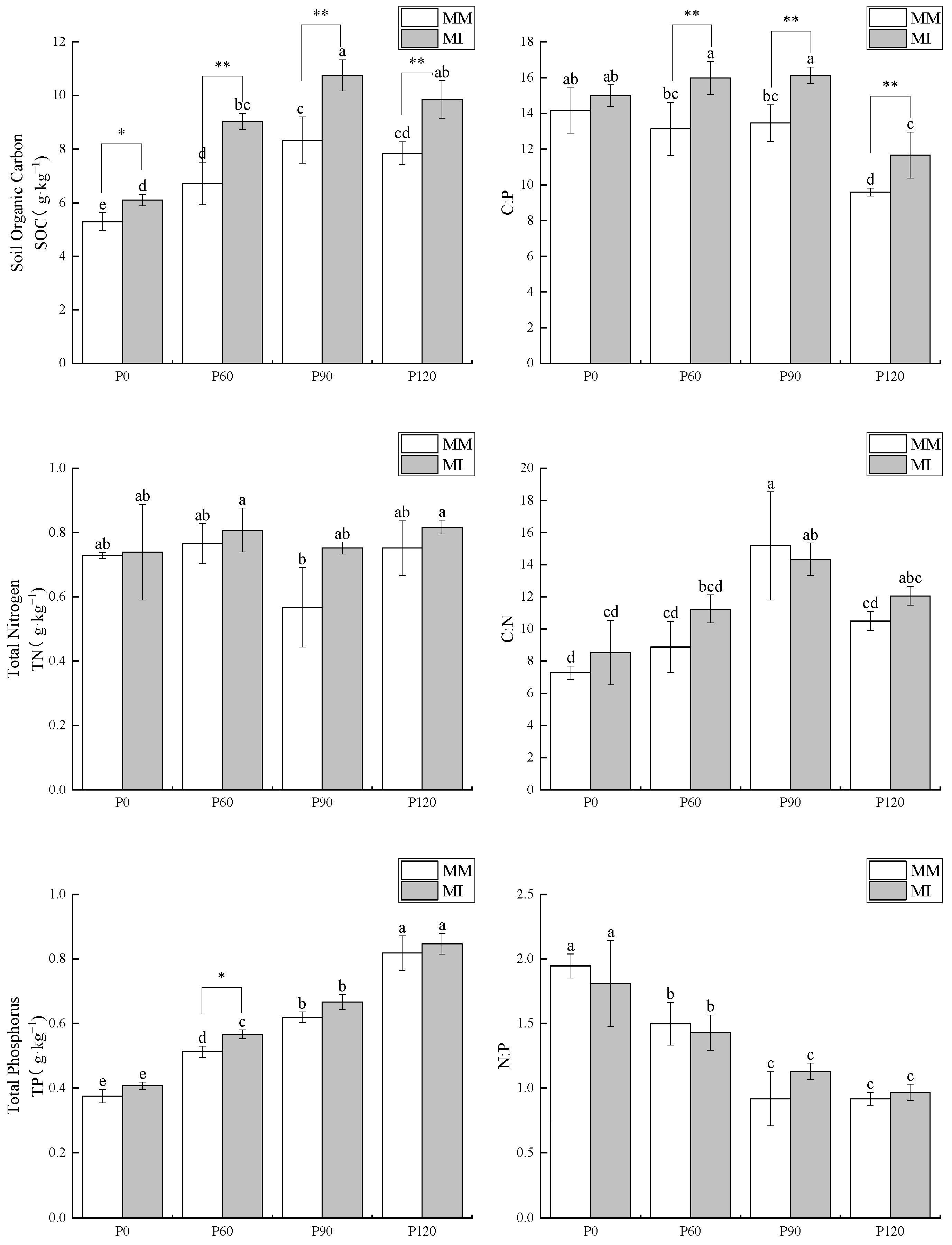
As shown in Figure 1, maize//soybean intercropping (MI) effectively increased the contents of soil organic carbon (SOC), total nitrogen (TN), and total phosphorus (TP) in red soil. Under the P0, P60, P90, and P120 gradients, compared to the corresponding maize monoculture (MM), the MI model increased soil SOC content by 15.3%, 34.4%, 28.9%, and 25.5%, respectively. Soil TN content in the MI plots increased by 1.48%, 5.57%, 32.54%, and 8.73%, while soil TP content increased by 8.63%, 10.5%, 7.64%, and 3.53%, respectively. Across all phosphate fertilization levels, MI increased the average SOC, TN, and TP contents by 26.01%, 12.08%, and 7.58%, respectively, compared to MM in red soil.

3.1.2. Red Soil C:N:P Stoichiometry

Under the P0, P60, P90, and P120 gradients, the soil’s C:P, C:N, and N:P ratios in MM (MM) ranged from 9.60 to 14.15, 7.27 to 15.16, and 0.92 to 1.95, respectively. In the intercropping (MI) system, these ratios ranged from 11.66 to 16.13, 8.53 to 14.32, and 0.97 to 1.81. Compared to the corresponding MM treatment at each P level (P0, P60, P90, P120), MI increased the C:N ratio in all cases except P90, but no significant differences were observed. Under phosphate application (P60, P90, P120), intercropping significantly increased the soil’s C:P ratio by 21.4%, 20.1%, and 17.7%, respectively, and an average increase by 17.24%, compared to MM. The N:P ratio in MI plots increased by 23.10% and 5.37% at P90 and P120, respectively, compared to the MM.

3.2. Effect of Maize//Soybean Intercropping on Red Soil Microbial Biomass C, N, P Content and Stoichiometry

3.2.1. Red Soil Microbial Biomass C, N, P Content

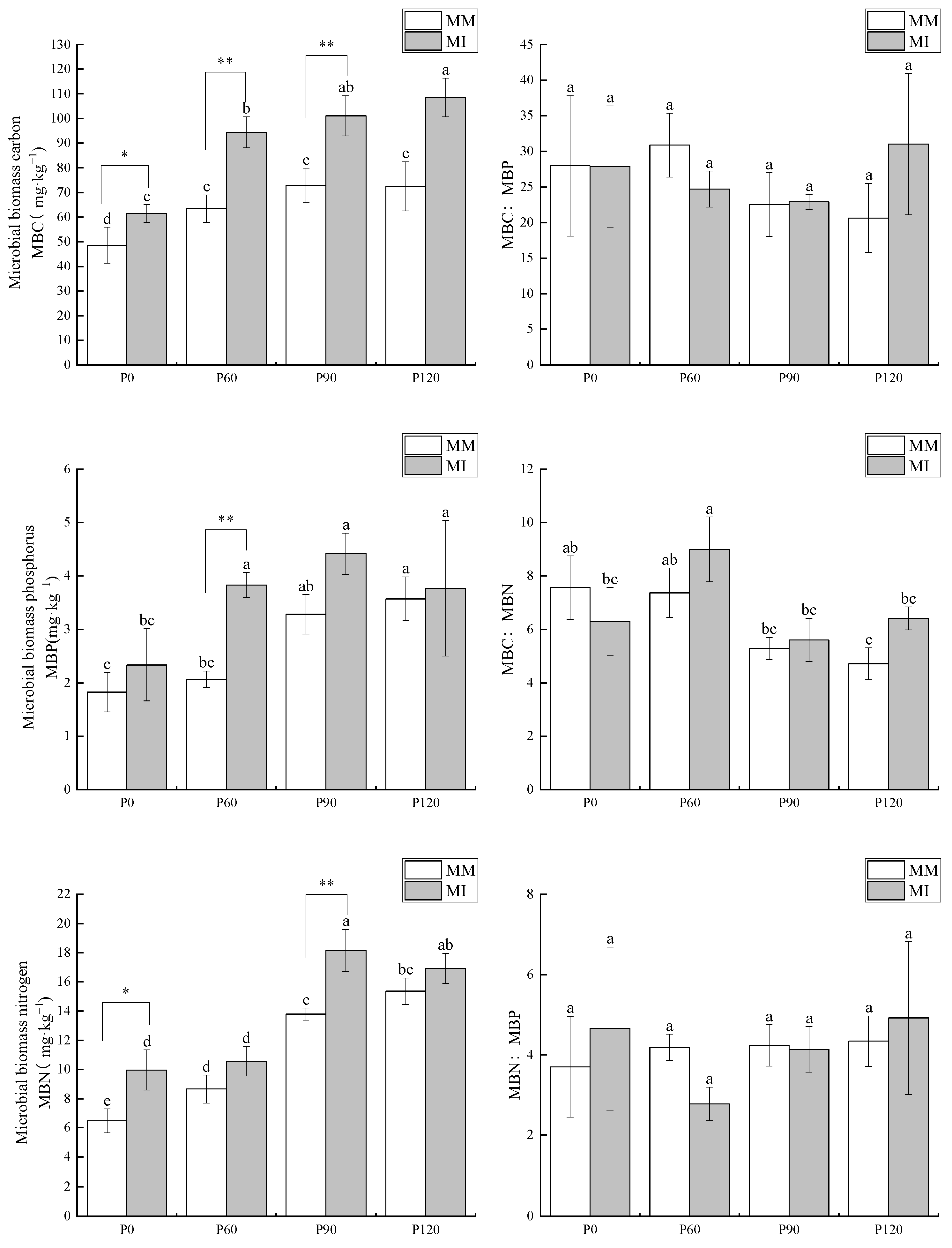
Figure 2 illustrates that MI effectively enhanced the contents of microbial biomass carbon (MBC), nitrogen (MBN), and phosphorus (MBP). Compared to the corresponding monoculture at P0, P60, P90, and P120 levels, intercropping increased MBC content by 26.51%, 48.81%, 38.49%, and 49.68%, respectively. Intercropping increased MBP content by 28.12%, 85.33%, 34.42%, and 5.49%. Intercropping increased MBN content by 54.14%, 22.06%, 31.58%, and 10.22%. Across all P gradients, the intercropping system increased average soil MBC, MBN, and MBP by 40.87%, 29.50%, and 38.34%, respectively, over the monoculture system.

3.2.2. Red Soil Microbial Biomass C:N:P Stoichiometry

In the monoculture (MM) plots, the MBC/MBP, MBC/MBN, and MBN/MBP ratios ranged from 20.66 to 30.88, 4.72 to 7.57, and 3.70 to 4.34, respectively. In the MI plots, these ratios ranged from 22.91 to 31.02, 5.61 to 9.00, and 2.78 to 4.92. Compared to the corresponding monoculture at each P level (P90, P120), intercropping altered the soil MBC/MBP ratio by 1.62% and 50.09%; under phosphate application (P60, P90, P120), the MBC/MBN ratio by 22.06%, 6.09%, and 35.95%; and under phosphate application (P0, P120), the MBN/MBP ratio by 25.69% and 13.23%. However, no significant differences were found in MBC/MBP, MBC/MBN, or MBN/MBP ratios between the planting systems at any phosphorus level.

3.3. Effect of Maize//Soybean Intercropping on Red Soil Enzyme Activity and Stoichiometry

3.3.1. Red Soil Enzyme Activity

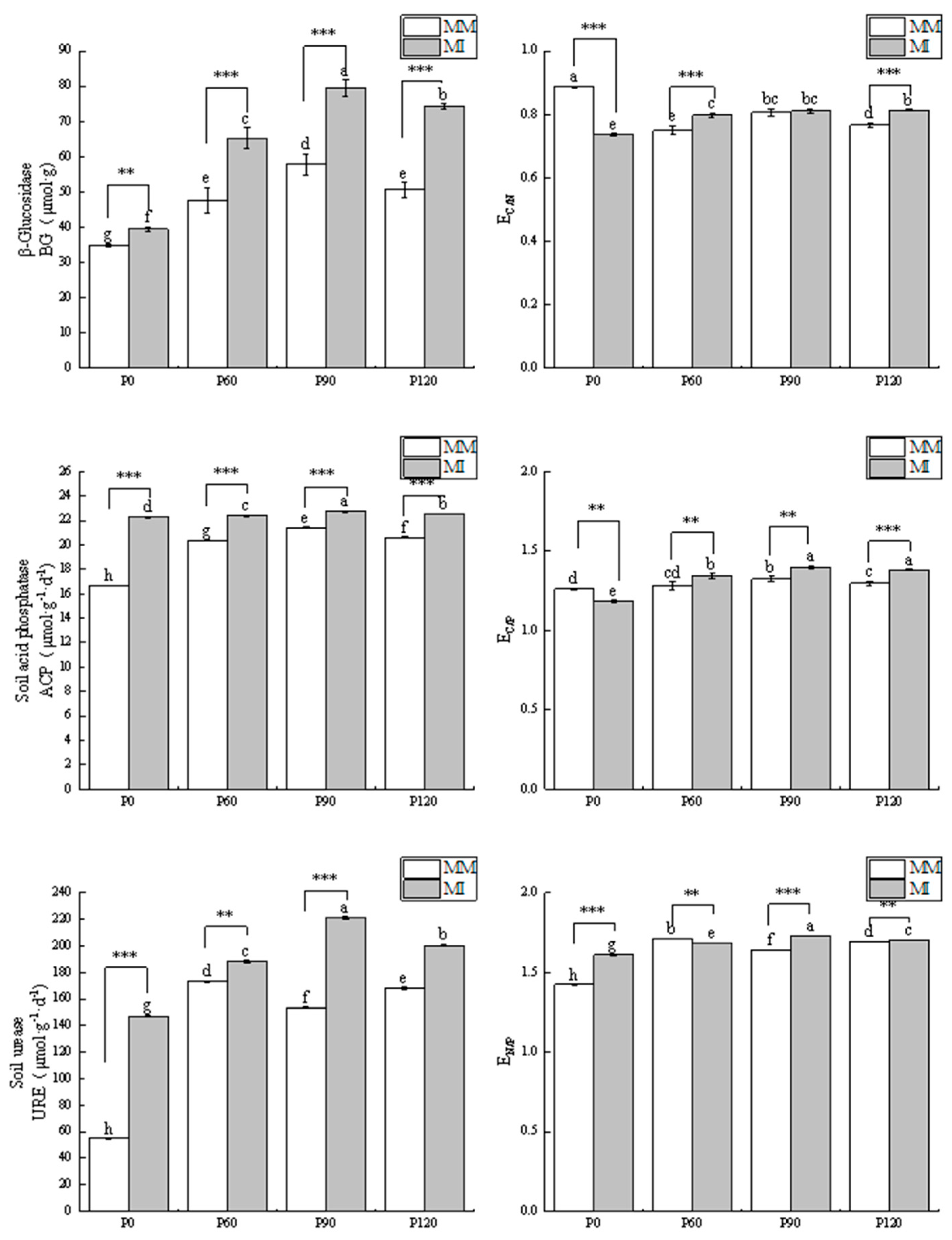
As indicated in Figure 3, MI effectively increased the activities of β-glucosidase (BG), acid phosphatase (ACP), and urease (URE). Compared to the monoculture at P0, P60, P90, and P120 levels, intercropping enhanced BG activity by 13.09%, 36.85%, 37.10%, and 46.84%, respectively. ACP activity was increased by 33.52%, 9.89%, 6.03%, and 9.34%. URE activity was markedly elevated by 168.50%, 8.68%, 43.83%, and 19.19%. Averaged across all P gradients, intercropping increased BG, ACP, and URE activities by 33.47%, 14.69%, and 60.15% over MM.

3.3.2. Red Soil Enzyme C:N:P Stoichiometry

In MM plots, the soil enzyme stoichiometry EC/N, EC/P, and EN/P ratios ranged from 0.75 to 0.89, 1.26 to 1.32, and 1.42 to 1.71, respectively. In intercropping (MI) plots, these ratios ranged from 0.74 to 0.81, 1.18 to 1.40, and 1.61 to 1.73. Compared to MM, intercropping altered the EN/P ratio by +13.05% (P0), −1.47% (P60), +5.21% (P90), and +0.46% (P120). Under P application (P60, P90, P120), intercropping increased the soil EC/P ratio by 34.88%, 5.77%, and 6.66%, and the EC/N ratio by 6.44%, 0.53%, and 6.17%. On average across all P levels, intercropping increased the EC/N, EC/P, and EN/P ratios by 5.76%, 4.38%, and 4.32%, respectively. Overall, the EC/N ratio was <1.0, while EC/P and EN/P ratios were > 1.0 in both systems. Except for the P0 treatment, the EC/N and EC/P ratios were significantly higher in MI plots than in MM plots. Similarly, the EN/P ratio was higher in MI plots at all levels except P60.

3.4. Effect of Maize//Soybean Intercropping on Homeostatic Characteristics of Microbial Biomass C:N:P Stoichiometry

As shown in Table 1, the homeostatic stability of microbial biomass stoichiometry in the intercropped red soil was generally stronger than in the MM. In the MM soil, the average 1/H values for MBC, MBP, and MBN were 0.9265, 0.9488, and 0.9757, respectively. All values were >0.75, classifying them as ‘sensitive’. In the maize intercropping (MI) soil, the average 1/H for MBC was 0.9851 (>0.75), also indicating a ‘sensitive’ state. However, the average 1/H for MBP was 0.7088, which was classified as ‘homeostatic’. The average 1/H for MBN was −1.132, classified as ‘strongly homeostatic’.
For the stoichiometric ratios in MM soil, the average 1/H for MBC/MBP was 0.7212 (0.5 < 1/H ≤ 0.75), indicating a ‘weakly homeostatic’ state. In contrast, the 1/H values for MBC/MBN and MBN/MBP were −0.56 and −0.165, respectively (both ≤ 0), indicating ‘strongly homeostatic’ states. In the MI soil, the average 1/H values for MBC/MBP, MBC/MBN, and MBN/MBP were −0.791, −0.207, and −0.222, respectively (all ≤ 0), all demonstrating ‘strongly homeostatic’ characteristics.
In summary, MI enhanced the homeostatic features of microbial biomass C:N:P compared to MM, reducing the reciprocal of the homeostasis index (1/H). With the exception of MBC, the 7-year continuous intercropping system elevated red soil MBP and MBN from ‘sensitive’ to ‘homeostatic’ and ‘strongly homeostatic’, respectively. It also shifted the MBC/MBP ratio from ‘weakly homeostatic’ to ‘strongly homeostatic’. Both MBC/MBN and MBN/MBP maintained their ‘strongly homeostatic’ status, with their 1/H values decreasing further.

3.5. Correlation Analysis of Red Soil Enzyme Activity and C:N:P Ecostoichiometry

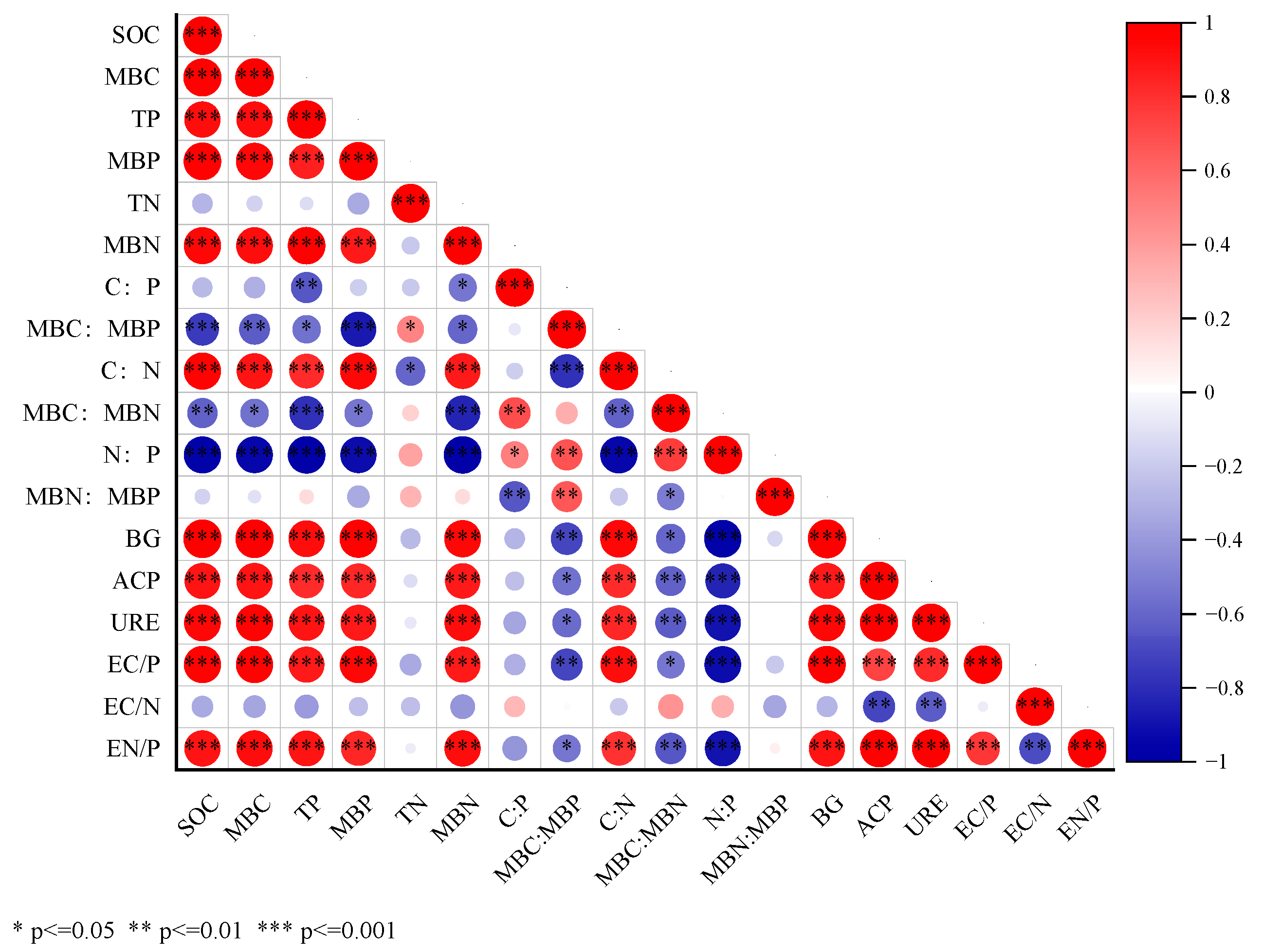
Correlation network analysis of soil nutrients, microbial biomass, enzyme activities, and stoichiometric ratios revealed complex interactions within the system (Figure 4). The analysis identified that the soil C:N ratio was significantly positively correlated with microbial biomass (MBC, MBP) and key enzyme activities (URE, BG). The soil N:P ratio was also tightly coupled with the microbial MBN/MBP ratio. These relationships indicate that soil C:N:P stoichiometry serves as a core indicator reflecting soil microbial biomass and soil C, N, and P enzyme activities.
The C:P ratio showed weak or negative correlations with total nitrogen (TN) and microbial biomass nitrogen (MBN), potentially because N input was primarily driven by soybean nitrogen fixation, whereas P availability was more heavily influenced by soil adsorption.
The C:N ratio was highly significantly positively correlated (p < 0.001) with SOC, MBC, and MBP, suggesting that the C:N balance in the intercropping system is closely coupled through microbial metabolism. It was negatively correlated with TN but positively correlated with MBN. Furthermore, it showed positive correlations with urease (URE) and β-glucosidase (BG) activities, implying that N sufficiency may enhance the activity of soil decomposition enzymes, thereby promoting organic matter decomposition and nutrient cycling. The strong positive correlations of C:N indicate that intercropping improves soil microbial activity by optimizing the C:N balance, which has ecological significance for ameliorating the low organic matter and high N loss issues in red soils, although attention must be paid to potential C:N imbalances from excessive N.
The N:P ratio was significantly positively correlated with the microbial N:P ratio (MBN/MBP), demonstrating that the intercropping system optimizes the N:P balance through N inputs and microbial regulation. The positive correlation between MBC/MBN and the C:N ratio reflects the microbial response to C:N ratios under intercropping, enhancing the stability of soil nutrient cycling.
The EC/P ratio was significantly positively correlated (p < 0.001) with SOC, MBC, and MBP, indicating that the ratio of C-cycling enzymes (like BG) to P-cycling enzymes (like ACP) is driven by organic carbon and microbial activity. The EC/P ratio’s lower or negative correlation with TN, MBN, and URE might be because N inputs predominantly affect N-cycling enzymes (like URE) rather than the relative proportions of C- and P-cycling enzymes. Collectively, these relationships support the conclusion that intercropping improves the stoichiometric characteristics of red soil through microbially mediated nutrient regulation.

4. Discussion

4.1. Regulation of Intercropping on Soil Nutrients Availability

This study revealed that maize//soybean intercropping significantly enhanced nutrient accumulation in red soil, while simultaneously improving soil stoichiometric ratios. This demonstrates the potent soil-improving potential of rational intercropping systems in acidic red soils. A global meta-analysis reported that intercropping can increase topsoil (0–20 cm) SOC and TN by 4% and 11%, respectively [26]. Similarly, Yang et al. [27] found that maize–soybean intercropping in upland red soil significantly increased SOC and TN. Conversely, some studies, such as one on mulberry//alfalfa intercropping, did not find significant increases in total soil C and N [20], indicating that not all intercropping combinations produce nutrient accumulation effects of the same magnitude as observed in our experiment.
Furthermore, the level of P fertilization is a crucial regulatory factor. This study found that the benefits of MI were present across all P gradients (P0, P60, P90, P120). This aligns with other research suggesting that intercropping can more significantly reduce crop demand for P fertilizer under low-P stress, achieving stable and high yields [21]. While standard N rates were used in this study to prevent N limitation, we acknowledge that the biological N-fixation by soybeans offers potential for reducing synthetic N input in future applications to maximize environmental benefits.
Deeper analysis suggests that the graminaceous//leguminous combination effectively enhances soil fertility through interspecific complementarity and facilitation [27]. The intercropping model increases the sources of soil organic carbon via diversified plant residue inputs and root exudates, while also optimizing the activity of the soil microbial community, thereby significantly boosting SOC storage [28]. In the maize//soybean system, biological nitrogen fixation by soybean alleviates N limitation for maize, promoting its growth and root development [29]. A more robust maize root system can, in turn, secrete more organic acids, activating a greater amount of fixed soil phosphorus [18]. MI facilitates the transformation of stable P pools into active P pools by increasing maize acid phosphatase activity and overall rhizosphere biological activity, thus enhancing P availability in red soil [9,21,30]. This newly released P not only meets the maize’s own demand but also promotes the P-demanding nitrogen fixation process in soybeans, creating a positive feedback loop: ‘N-fixation → growth promotion → P activation → further N-fixation promotion’ [21,22]. Therefore, in the N and P co-limited, low-to-medium fertility red soils, the soil improvement efficacy of the MI system far exceeds that of either monoculture.

4.2. Impact of Intercropping on Soil Microbial Biomass C, N, P and Stoichiometric Homeostasis

Our study found that MI significantly increased red soil MBC, MBN, and MBP, with average increases of 40.87%, 29.50%, and 38.34%, respectively. This suggests that in the intercropping system, amino acids and sugars from soybean root exudates [31] provide abundant C and N sources for microorganisms, while the extension of maize roots improves soil aeration and moisture conditions, jointly promoting microbial biomass accumulation [16,19]. Rhizosphere interactions in intercropping alter soil carbon content and microbial carbon source utilization activity [9], which may, in turn, modify microbial homeostasis.
Concurrently, the homeostasis of MBC, MBN, and MBP in monoculture soil was predominantly ‘sensitive’ (1/H > 0.75). In contrast, under intercropping, MBN, MBC/MBP, MBC/MBN, and MBN/MBP all exhibited ‘strong homeostasis’ (1/H ≤ 0). This indicates that MI significantly enhances the stoichiometric homeostasis of the soil microbial biomass [32], shifting its functional state from ‘sensitive’ (highly responsive to environmental nutrient fluctuations) to ‘strongly homeostatic’. This shift signifies a notable improvement in ecosystem resilience and stability.
However, a noteworthy phenomenon in this study was that the 1/H for MBC remained high (0.9851) and in a ‘sensitive’ state even after intercropping. This implies that despite increased soil carbon inputs, microbial carbon metabolism remains tightly coupled to external C supply, lacking buffering capacity. This may be attributable to two factors: First, inherent non-biological stressors in red soil, such as low pH and high active aluminum, may constrain microbial carbon use efficiency and metabolic activity [33], making it difficult for them to efficiently store excess carbon or convert it into stable biomass. Second, in the generally oligotrophic environment of red soils, the microbial community may exist in a state of chronic carbon limitation [1,27]. Consequently, the new C sources introduced by intercropping are likely rapidly utilized by microorganisms to fuel other energy-demanding life activities rather than for building internal reserves or adjusting stoichiometric ratios [34]. This results in the dynamics of their biomass carbon remaining sensitive to external inputs.

4.3. Driving Effect of Intercropping on Soil Enzyme Activity and Stoichiometry

In this study, MI significantly elevated the activities of β-glucosidase (BG), acid phosphatase (ACP), and urease (URE) at maize maturity, with average increases of 33.47%, 14.69%, and 60.15%, respectively, and altered the enzyme stoichiometric ratios (EC/N, EC/P, EN/P). Soil enzymes are the ‘engines’ driving ecosystem biogeochemical cycles, and changes in their activity directly reflect microbial demand for specific nutrients and metabolic intensity [25].
The general enhancement of enzyme activity in the intercropping system, particularly the substantial increase in BG activity, reflects an accelerated carbon cycle, likely stemming from the abundant substrates provided by plant residues and root exudates. The dramatic increase in URE activity (especially the 168.50% increase in the P0 treatment) is closely linked to soybean’s N-fixation, which increases soil ammonium content and stimulates urease secretion. The elevation in ACP activity indicates that intercropping directly or indirectly alleviated the P-fixation problem in the red soil, possibly because organic acids secreted by maize roots desorbed fixed P, increasing its availability [35].
Analysis of enzyme stoichiometry revealed that EC/N and EC/P ratios were generally higher in the intercropping system than in monoculture. This may be related to increased organic matter inputs and higher microbial C demand in the intercropping system [36]. The rise in EN/P reflects enhanced activity of N-cycling enzymes relative to P-cycling enzymes, potentially a result of surplus N supply from soybean N-fixation. Correlation analysis further confirmed that EC/P was significantly positively correlated (p < 0.001) with SOC, MBC, and MBP, demonstrating that enzyme stoichiometry is driven by organic carbon and microbial activity [37]. Notably, both EC/P and EN/P ratios were greater than 1, suggesting that P remains a limiting factor in this red soil system.
Taken together, the shifts in enzyme stoichiometry serve as a functional bridge connecting changes in the soil nutrient pool with the state of the microbial biomass. The increases in soil TN and TP pools altered the resource environment for microorganisms; the microorganisms, in turn, responded to this change by adjusting their enzyme secretion strategies (i.e., altering enzyme stoichiometry) to balance their elemental demands. This functional adjustment ultimately manifested as an enhancement of the microbial community’s homeostasis. Concurrently, the persistent ‘P-limitation’ signal from the enzyme stoichiometry provides a clear insight: while intercropping is an effective pathway for improving red soil, it must be combined with rational P fertilizer management to overcome the soil’s inherent chemical limitations and maximize productivity. This is also corroborated by the documented advantages of intercropping in enhancing maize yield and P fertilizer use efficiency in red soils [21].

4.4. Ecological Significance of Maize//Soybean Intercropping for Ecosystem Stability in Red Soil

Synthesizing the findings of this study, MI systematically enhances the stability of the red soil sloped-farmland ecosystem by elevating the soil nutrient pool, augmenting microbial biomass and its functional stability, and optimizing key enzyme activities. This enhancement of stability holds profound ecological and practical significance for red soil regions, which face the dual pressures of severe soil erosion and nutrient depletion. The intercropping system leverages interspecific niche complementarity and facilitation to construct a more efficient and resilient nutrient cycling network. This not only improves nutrient use efficiency but also reduces the risk of nutrient loss via surface runoff. Concurrently, SOC accumulation and enhanced microbial activity contribute to improving soil aggregate structure and increasing soil carbon sequestration.
Nevertheless, this study also illuminates the limitations and areas for optimization of this technology in its current application. First, although 7 years of continuous intercropping significantly increased SOC storage, the homeostasis of MBC remained in a ‘sensitive’ state. This implies that the physicochemical properties of the red soil, such as low pH, may still be fundamentally constraining microbial C metabolism efficiency and the system’s C sequestration potential. This suggests that relying solely on intercropping to increase C input may be insufficient to build a completely stable soil carbon pool; complementary measures, such as those that ameliorate soil acidity and provide stable organic matter, are required. The stability of the soil carbon pool in intercropping systems warrants further investigation.
Second, the enzyme stoichiometric analysis clearly identified P availability as the primary factor limiting the function of this red soil ecosystem. Although intercropping significantly alleviates P-fixation through mechanisms like organic acid secretion, its effect is not yet sufficient to fully meet crop and microbial demands. The high P-fixation capacity of red soil remains the ‘ceiling’ for improving system productivity.
Finally, this study found that the ecological benefits of intercropping are closely related to P fertilizer management. The P60 and P90 treatments were the most effective not only in enhancing available nutrient content and enzyme activity but also in sustainably increasing maize yield and promoting P activation in the red soil. Therefore, intercropping does not imply the complete abandonment of chemical fertilizers. Rather, this ecological planting model must be integrated with precise and appropriate nutrient management to achieve a synergistic effect where 1 + 1 > 2 [38]. MI is not merely a yield-enhancing technique but also an effective ecological restoration strategy. Through interspecific synergy, it drives soil nutrient accumulation, accelerates microbially mediated biogeochemical cycling, and ultimately constructs a healthier, more homeostatic soil ecosystem. Therefore, the promotion of the MI model in the red soil regions of Southwest China holds significant theoretical and practical value for ensuring food security, improving soil health, and advancing a green, low-carbon agricultural transition.

5. Conclusions

In low-phosphorus red soil, maize//soybean intercropping enhances soil enzyme activity and promotes ecological stoichiometric stability, showing a profound influence on the ecosystem, representing an effective biological pathway to mitigate the degradation of sloped farmland:
(1) Maize//soybean intercropping promotes nutrient enrichment and stoichiometric optimization in red soil. Compared to maize monoculture, maize intercropped with soybean significantly increased the contents of soil organic carbon (SOC), total nitrogen (TN), total phosphorus (TP), and microbial biomass C, N, and P (MBC, MBN, MBP). This effect optimized the C:N:P stoichiometric ratios of both the soil and the microbial biomass.
(2) Maize//soybean intercropping enhances soil enzyme activities related to C, N, and P turnover in red soil. Maize intercropped with soybean significantly enhanced the activities of β-glucosidase (BG), urease (URE), and acid phosphatase (ACP) in red soil, which enzymes intimately involved in carbon, nitrogen, and phosphorus cycling.
(3) Maize//soybean intercropping promotes/strengthens the ecosystem stability in red soil. Maize intercropped with soybean significantly improved the homeostatic characteristics of the microbial biomass C:N:P compared to monoculture, as evidenced by a lower reciprocal of the homeostasis index (1/H). With the exception of MBC, which remained ‘sensitive’, intercropping shifted MBP from ‘sensitive’ to ‘homeostatic’ and MBN from ‘sensitive’ to ‘strongly homeostatic’. Furthermore, the MBC/MBP ratio was elevated from ‘weakly homeostatic’ to ‘strongly homeostatic’, while MBC/MBN and MBN/MBP maintained their ‘strongly homeostatic’ status. This demonstrates that the maize//soybean intercropping builds a much more functionally stable microbial community capable of resisting environmental fluctuations, thereby enhancing the resilience of the entire agricultural ecosystem.
Future research should explore which key functional microorganisms enhance organic carbon sequestration through intercropping and how they exert their effects.

Author Contributions

Conceptualization, R.T. and L.T.; methodology, R.T., Y.Z. and L.T.; formal analysis, R.T., K.Z., F.G., T.Z. and L.T.; writing—original draft preparation, R.T. and L.T.; writing—review and editing, L.T. and Y.Z.; visualization, K.Z. and F.G.; supervision and funding acquisition, L.T. All authors have read and agreed to the published version of the manuscript.

Funding

This study was supported by the National Natural Science Foundation of China (NSFC) (32260805) and the National Key Research and Development Program of China (2022YFD1901503).

Data Availability Statement

The original contributions presented in the study are included in the article, further inquiries can be directed to the corresponding authors.

Conflicts of Interest

The authors declare no conflicts of interest.

References

  1. Sun, B.; Zhu, A.N.; Yao, R.J.; Shen, R.F.; Zhang, J.B. Research progress on barrier mitigation technologies and productivity improvement models for fluvo-aquic soils, red soils, and saline-alkali lands. Acta Pedol. Sin. 2023, 60, 1231–1247. (In Chinese) [Google Scholar]
  2. Zhou, L.; Su, L.; Zhao, H.; Zhao, T.; Zheng, Y.; Tang, L. Maize//Soybean Intercropping Improves Yield Stability and Sustainability in Red Soil under Different Phosphate Application Rates in Southwest China. Agronomy 2024, 14, 1222. [Google Scholar] [CrossRef]
  3. Han, Z.; Wu, X.; Gao, H.; Jia, A.; Gao, Q. Long-Term Conservation Tillage Increases Soil Organic Carbon Stability by Modulating Microbial Nutrient Limitations and Aggregate Protection. Agronomy 2025, 15, 1571. [Google Scholar] [CrossRef]
  4. Zhou, L.; Zhao, T.; Thu, N.; Zhao, H.; Zheng, Y.; Tang, L. The Synergistic Effects of Different Phosphorus Sources: Ferralsols Promoted Soil Phosphorus Transformation and Accumulation. Agronomy 2024, 14, 2372. [Google Scholar] [CrossRef]
  5. Su, L.Z.; Zhao, H.M.; Hou, X.F.; Chen, Y.; Xiao, J.X.; Zheng, Y.; Tang, L. Activation effect of maize-soybean intercropping on red soil phosphorus pools and its response to phosphorus fertilizer. Chin. J. Eco-Agric. 2023, 31, 558–566. (In Chinese) [Google Scholar]
  6. Li, J.R.; Li, L.; Hao, Z.Z.; Gao, B.T.; Ye, T.Y.; Sun, B.; Chen, L.; Pei, N.C. Spatiotemporal pattern evolution and attribution analysis of rainfall erosivity in the red soil region of Southern China from 1982 to 2022. Acta Ecol. Sin. 2025, 45, 4248–4262. (In Chinese) [Google Scholar]
  7. Liu, H.; Lin, Z.; Huang, W.; Liao, D.; Duan, X.; Deng, Y. Spatial patterns of soil carbon and nutrient distribution during vegetation restoration in red soil regions. Plant Soil 2025, 22, 517–538. [Google Scholar] [CrossRef]
  8. Zan, Z.; Ma, R.; Wang, J.; Liu, L.; Ning, T.; Jiao, N. Co-Ridge Planting Enhances Yield Advantages of Maize Intercropping with Peanut by Improving Soil Aggregate Stability and the Ecological Stoichiometric Characteristics of Carbon, Nitrogen, and Phosphorus. Agronomy 2025, 15, 2227. [Google Scholar] [CrossRef]
  9. Wang, M.; Chen, H.; Zhang, W.; Wang, K. Soil nutrients and stoichiometric ratios as affected by land use and lithology at county scale in a karst area, southwest China. Sci. Total Environ. 2018, 619–620, 1299–1307. [Google Scholar] [CrossRef]
  10. Jiang, W.; Lin, Z.; Qin, Z.; Lu, X.; Zhang, W.; Zhang, Q.; Ye, S.; Li, H.; Ge, H.; Wang, G. Climate-management interactions drive soil organic carbon sequestration potential in China’s croplands during 2020–2060. Soil Environ. Health 2025, 3, 100159. [Google Scholar] [CrossRef]
  11. Yu, S.P.; Xiong, Y.B.; Yang, Y.; Yu, H.B.; Hu, L.S.; Huang, L.; Tang, L. Ecological stoichiometric characteristics of C, N, and P in tobacco-planting soil and microbial biomass under reduced chemical fertilizer combined with different organic fertilizers. Chin. J. Ecol. 2024, 43, 2150–2157. (In Chinese) [Google Scholar]
  12. Yu, N.; Ma, R.T.; Kou, T.J.; Jiao, N.Y.; Gao, J.K. Effects of phosphorus application on soil C, N, P stoichiometry and yield in maize/peanut intercropping systems. J. Plant Nutr. Fertil. 2024, 30, 2013–2023. (In Chinese) [Google Scholar]
  13. Xiao, Q.; Huang, Y.; Chen, G.; Liu, K.; Jiang, Y.; Zhou, B.; Zhu, P.; Han, X.; Ma, J.; Liu, S.; et al. Soil and enzymatic C:N:P stoichiometry response to carbon and nutrient input: Evidence from long-term fertilization experiments. Plant Soil 2025, 17, 1–17. [Google Scholar] [CrossRef]
  14. Zhang, Y.; Liu, M.; Han, L.; Yang, J.; Zhao, X.; Qu, J.; Li, L.; Bai, Y.; Yan, D.; Hou, G. Spatial Distribution Characteristics of Soil C:N:P:K Eco-Stoichiometry of Farmland and Grassland in the Agro-Pastoral Ecotone in Inner Mongolia, China. Agronomy 2024, 14, 346. [Google Scholar] [CrossRef]
  15. Beillouin, D.; Ari, T.B.; Malézieux, E.; Seufert, V.; Makowski, D. Positive but variable effects of crop diversification on biodiversity and ecosystem services. Glob. Change Biol. 2021, 27, 4697–4710. [Google Scholar] [CrossRef]
  16. Zhou, Y.; Li, Y.; Pan, L.; Lambers, H.; Wang, X. Intercropping promotes maize growth by enhancing accumulation of specific metabolites in the rhizosphere and synergistic interaction between arbuscular mycorrhizal fungi and Bacillus. Plant Soil 2025, 514, 2511–2529. [Google Scholar] [CrossRef]
  17. Qin, X.M.; Zheng, Y.; Tang, L.; Long, G.Q. Effects of nitrogen application on rhizosphere soil enzyme activities and nitrification potential in maize//potato intercropping. J. Yunnan Agric. Univ. (Nat. Sci.) 2015, 30, 886–894. (In Chinese) [Google Scholar]
  18. Zhu, S.-G.; Tao, H.-Y.; Li, W.-B.; Zhou, R.; Gui, Y.-W.; Zhu, L.; Zhang, X.-L.; Wang, W.; Wang, B.-Z.; Mei, F.-J.; et al. Phosphorus availability mediates plant–plant interaction and field productivity in maize-grass pea intercropping system: Field experiment and its global validation. Agric. Syst. 2023, 205, 103584. [Google Scholar] [CrossRef]
  19. Wang, D.; Yi, W.B.; Li, H.; Chen, L.K.; Zhao, P.; Long, G.Q. Effects of maize intercropping and nitrogen application on the metabolic functional diversity of soil microorganisms. Chin. J. Appl. Ecol. 2022, 33, 793–800. (In Chinese) [Google Scholar]
  20. Li, M.; Wei, Y.; Yin, Y.; Zhu, W.; Bai, X.; Zhou, Y. Characteristics of Soil Physicochemical Properties and Microbial Community of Mulberry (Morus alba L.) and Alfalfa (Medicago sativa L.) Intercropping System in Northwest Liaoning. Microorganisms 2023, 11, 114. [Google Scholar] [CrossRef]
  21. Zhou, L.; Su, L.; Zhao, H.; Wang, S.; Zheng, Y.; Tang, L. Maize/soybean intercropping promoted activation of soil organic phosphorus fractions by enhancing more phosphatase activity in red soil under different phosphorus application rates. Plant Soil 2023, 506, 421–440. [Google Scholar] [CrossRef]
  22. Wang, R.; Su, L.; Li, D.; Yang, Z.; Feng, R.; Zheng, Y.; Tang, L. Rhizosphere microbial carbon utilization stimulates soil phosphorus fraction transformation in response to maize (Zea mays L.) and soybean (Glycine max.) interspecific interactions. Plant Soil 2024, 20, 1–20. [Google Scholar] [CrossRef]
  23. Yu, Q.; Chen, Q.; Elser, J.J.; He, N.; Wu, H.; Zhang, G.; Wu, J.; Bai, Y.; Han, X. Linking stoichiometric homoeostasis with ecosystem structure, functioning and stability. Ecol. Lett. 2010, 13, 1390–1399. [Google Scholar] [CrossRef] [PubMed]
  24. Wang, Y.; Shan, H.; Chou, Q.; Pang, W.; Sun, S.; Lv, C.; Tian, Y.; Rao, Q.; Cao, T.; Su, H.; et al. Macrophyte species diversity and community stoichiometric homeostasis are correlated with different dimensions of stability following disturbance. J. Ecol. 2025, 113, 2682–2697. [Google Scholar] [CrossRef]
  25. DeForest, J.L.; Moorhead, D.L. Effects of elevated pH and phosphorus fertilizer on soil C, N and P enzyme stoichiometry in an acidic mixed mesophytic deciduous forest. Soil Biol. Biochem. 2020, 150, 107996. [Google Scholar] [CrossRef]
  26. Cong, W.-F.; Hoffland, E.; Li, L.; Six, J.; Sun, J.-H.; Bao, X.-G.; Zhang, F.-S.; Van Der Werf, W. Intercropping enhances soil carbon and nitrogen. Glob Chang. Biol 2015, 21, 1715–1726. [Google Scholar] [CrossRef]
  27. Yang, W.; Miao, J.; Wang, X.; Xu, J.; Lu, M.; Li, Z. Corn-soybean intercropping and nitrogen rates affected crop nitrogen and carbon uptake and C:N ratio in upland red soil. J. Plant Nutr. 2018, 41, 1890–1902. [Google Scholar] [CrossRef]
  28. Huang, J.; Liu, W.; Yang, S.; Yang, L.; Peng, Z.; Deng, M.; Xu, S.; Zhang, B.; Ahirwal, J.; Liu, L. Plant carbon inputs through shoot, root, and mycorrhizal pathways affect soil organic carbon turnover differently. SOIL Biol. Biochem. 2021, 160, 8. [Google Scholar] [CrossRef]
  29. Liao, D.P.; Yong, T.W.; Liu, X.M.; Yang, F.; Su, B.Y.; Yang, W.Y. Effects of maize-soybean and maize-sweet potato relay intercropping on maize growth and nitrogen uptake. J. Plant Nutr. Fertil. 2014, 20, 1395–1402. (In Chinese) [Google Scholar]
  30. Wang, R.X.; Li, J.; Yang, Z.K.; Feng, R.; Su, L.Z.; Zheng, Y.; Tang, L. Effects of root separation methods on rhizosphere soil carbon content and phosphorus availability in maize/soybean intercropping. Chin. J. Soil Sci. 2023, 54, 77–88. (In Chinese) [Google Scholar]
  31. Ahmad, M.; Zhao, T.; Gitari, H.; Zhao, H.; Tang, L. Long-Term Year-Interval Effect of Continuous Maize/Soybean Intercropping on Maize Yield and Phosphorus Use Efficiency. Plants 2025, 14, 1060. [Google Scholar] [CrossRef]
  32. Spohn, M. Element cycling as driven by stoichiometric homeostasis of soil microorganisms. Basic Appl. Ecol. 2016, 17, 471–478. [Google Scholar] [CrossRef]
  33. Guan, P.; Wang, R.H.; Shi, R.Y.; Li, J.Y.; Xu, R.K. Mechanism of organic carbon sources with different microbial availability in inhibiting urea-induced acidification of red soil. Acta Pedol. Sin. 2025, 62, 81–91. (In Chinese) [Google Scholar]
  34. Li, J.; Liu, Y.; Hai, X.; Shangguan, Z.; Deng, L. Dynamics of soil microbial C:N:P stoichiometry and its driving mechanisms following natural vegetation restoration after farmland abandonment. Sci. Total Environ. 2019, 693, 133613. [Google Scholar] [CrossRef]
  35. Wang, R.X.; Su, L.Z.; Zhang, L.Y.; Wang, S.R.; Wang, J.; Xiao, J.X.; Zheng, Y.; Tang, L. Quantitative analysis of the effect of soil biological activity on phosphorus availability in maize and soybean intercropping. Chin. J. Eco-Agric. 2022, 30, 1155–1163. (In Chinese) [Google Scholar]
  36. Xue, S.; Jiashalaiti, A.; Lu, Y.; Zhang, D.; Zhang, B.; Zhang, Z.; Li, L.; Zeng, F. Effects of nitrogen and phosphorus additions in shaping C:N:P stoichiometry of plants, soil and microbes in a semi-shrub desert ecosystem. Plant Soil 2025, 20, 2013–2032. [Google Scholar] [CrossRef]
  37. Gao, Y.Q.; Dai, X.Q.; Wang, J.L.; Fu, X.L.; Kou, L.; Wang, H.M. Rhizosphere soil enzyme stoichiometry characteristics of understory vegetation in subtropical plantations. Chin. J. Plant Ecol. 2019, 43, 258–272. (In Chinese) [Google Scholar] [CrossRef]
  38. Li, H.Y.; Huang, S.X.; Zhu, D.Y.; Wang, R.X.; Tang, L.; Zheng, Y.; Xiao, J.X. Study on the optimal phosphorus application rate for maize in soils with medium and low phosphorus supply capacity in Yunnan. J. Plant Nutr. Fertil. 2022, 28, 1039–1046. (In Chinese) [Google Scholar]
Figure 1. Soil total organic carbon, total nitrogen, and total phosphorus contents and stoichiometric ratios under different fertilization treatments. MM and MI represent maize monoculture and maize//soybean intercropping, respectively. Different lowercase letters indicate significant differences among all treatments (p < 0.05). * indicate the significant difference between monoculture and intercropping treatment at the same p rate, where * indicates p < 0.05, ** indicates p < 0.01.
Agronomy 16 00556 g001
Figure 2. Soil microbial biomass carbon (MBC), microbial biomass nitrogen (MBN), and microbial biomass phosphorus (MBP) content and stoichiometric ratio characteristics under different fertilization treatments. MM and MI represent maize monoculture and maize//soybean intercropping, respectively. Different lowercase letters indicate significant differences among treatments (p < 0.05). * indicate the significant difference between monoculture and intercropping treatment at the same p rate, where * indicates p < 0.05, ** indicates p < 0.01.
Agronomy 16 00556 g002
Figure 3. β-Glucosidase (BG), acid phosphatase (ACP), and urease (URE) activities in soils under different phosphorus application gradients. MM and MI represent maize monoculture and maize//soybean intercropping, respectively. Different lowercase letters indicate significant differences among treatments (p < 0.05). * indicate the significant difference between monoculture and intercropping treatment at the same p rate, where ** indicates p < 0.01, and *** indicates p ≤ 0.001.
Agronomy 16 00556 g003
Figure 4. Correlation network analysis of nutrient content, enzyme activity, and ecostoichiometric ratios in red soil. (* p < 0.05, ** p < 0.01, *** p < 0.001).
Agronomy 16 00556 g004
Table 1. Homeostatic characteristics of microbial biomass carbon, nitrogen, and phosphorus stoichiometry in maize–soybean intercropping red soil.
VariableMMMIMMMI
xy1/HGrade1/HGradeR2pR2p
SOCMBC0.9265Sensitive state0.9851Sensitive state0.9779<0.0010.9318<0.001
TPMBP0.9488Sensitive state0.7088homeostasis0.8722<0.0010.6181<0.001
TNMBN0.9757Sensitive state−1.132Strong internal homeostasis0.0252<0.0010.1533<0.001
C:PMBC/MBP0.7212Weak internal homeostasis−0.791Strong internal homeostasis0.465<0.0010.8134<0.001
C:NMBC/MBN−0.56Strong internal homeostasis−0.207Strong internal homeostasis0.5422<0.0010.0482<0.001
N:PMBN/MBP−0.165Strong internal homeostasis−0.222Strong internal homeostasis0.7517<0.0010.0556<0.001
Disclaimer/Publisher’s Note: The statements, opinions and data contained in all publications are solely those of the individual author(s) and contributor(s) and not of MDPI and/or the editor(s). MDPI and/or the editor(s) disclaim responsibility for any injury to people or property resulting from any ideas, methods, instructions or products referred to in the content.