Article

Survival, Development, and Reproduction of Aphis glycines (Hemiptera: Aphididae) Under a Diurnal Temperature of 33 °C over Three Generations


1
College of Plant Protection, Northeast Agricultural University, Changjiang Road 600, Harbin 150030, China
2
Department of Smart Agriculture, Heilongjiang Agricultural Economy Vocational College, Xi’an District, Mudanjiang 157041, China
*
Author to whom correspondence should be addressed.
These authors contributed equally to this work.
Agronomy 2026, 16(5), 555; https://doi.org/10.3390/agronomy16050555
Submission received: 13 January 2026 / Revised: 25 February 2026 / Accepted: 26 February 2026 / Published: 2 March 2026
(This article belongs to the Section Pest and Disease Management)

Abstract

The soybean aphid, Aphis glycines Matsumura, is an important pest in soybean, Glycine max (L.) Merrill. To investigate the adaptability of various A. glycines generations to high temperatures, this study assessed various life parameters of A. glycines exposed to a diurnal temperature of 33 °C and a nocturnal temperature of 20 °C (33 °C/20 °C) over three generations, compared to a diurnal temperature of 25 °C and a nocturnal temperature of 20 °C (25 °C/20 °C), by life table approach. The adult survival rates of A. glycines in the first (G1), second (G2), and third generations (G3) at 33 °C/20 °C were found to be lower than those at 25 °C/20 °C. Additionally, exposure to 33 °C/20 °C reduced aphid total longevity, oviposition day, and fecundity for G1, G2, and G3 compared to 25 °C/20 °C. These findings indicate that A. glycines can develop and reproduce at a diurnal temperature of 33 °C across the three tested generations, albeit with variations in certain life parameters compared to 25 °C. The results are important for understanding the adaptability of A. glycines to temperature fluctuations and for predicting the population dynamics of this pest in soybeans in Heilongjiang, China, which is currently experiencing rising environmental temperatures.

1. Introduction

The soybean aphid, Aphis glycines Matsumura, represents a significant pest of soybean, Glycine max (L.) Merrill, one of the most extensively cultivated oil and food crops. Aphis glycines primarily colonizes and feeds on the young leaves and stems of soybean plants. Heavy infestations of A. glycines can substantially impair plant development [1]. Additionally, these aphids are capable of transmitting various species of plant viruses [2,3,4]. The honeydew secreted by A. glycines can lead to the formation of sooty mold. When a considerable amount of honeydew and sooty mold accumulates on soybean leaves, it can adversely affect the plant’s photosynthesis processes [1]. In years characterized by severe infestations of A. glycines, the damage inflicted by these aphids can result in significant yield losses for soybean plants. For instance, in 2004, a substantial outbreak of A. glycines occurred in Heilongjiang Province, China, leading to yield losses of soybean reaching as high as 30 to 50 percent in areas with particularly severe infestation [5]. When accounting for cost control and other factors, the accumulative losses incurred by soybean producers due to A. glycines damage in the United States over a decade were estimated to be approximately 3.6–4.9 billion [6].
The life cycle of A. glycines is characterized as holocyclic, with virginoparae observed in soybean crops during the summer months [1]. To date, several studies have been conducted on the virginoparae of A. glycines. In northeastern China, A. glycines is present in soybean fields from early June, flourishes in July and August, and experiences a gradual decline in population numbers throughout September until it ultimately disappears [7]. The virginoparae of A. glycines exhibit a preference for feeding on the upper leaves and stems of soybeans during the vegetative growth stage, subsequently migrating and moving to the lower leaves to feed during the reproductive stage [8]. Several natural enemies of A. glycines have been identified, including Aphelinus albipodus Hayat and Fatima [9], Orius insidiosus (Say) [10], and Chrysopa sinica Tjeder [11]. In China, the population density of A. glycines can be partially mitigated by the existing communities of natural enemies in the field [11,12]. Intercropping soybeans with maize (Zea mays L.) [13], garlic (Allium sativum L.), and Chinese onion (Allium cepa L.) [14] has been shown to enhance soybean yield while effectively controlling A. glycines. A variety of pesticides have been employed to manage A. glycines, including pyrethroids [15], matrine [16], and imidacloprid [17]. It is recommended that imidacloprid be utilized as a seed coating when planting soybeans, providing an alternative to foliar-applied pesticides [18].
Temperature significantly influences the development and reproduction of A. glycines. Studies indicated that A. glycines could survive and develop within a constant temperature range of 10 to 30 °C. The population growth rates of A. glycines were maximized at 25 °C [19,20,21]. Although A. glycines could develop and reproduce under diurnal 35 °C for seven days [22,23], nymphs exposed to a constant 35 °C failed to complete development, with all dying within eleven days [20]. When A. glycines were exposed to diurnal temperatures of 33 °C for one generation, they successfully completed their development and reproduction [24]. In recent years, global warming has intensified. Heilongjiang Province, China, is one of the regions experiencing an increase in temperature [25], with local temperatures rising at a rate of 0.35 °C per decade [26]. If the environmental temperature continues to rise in this region, it is likely that the diurnal summer temperatures could reach as high as 33 °C. In Heilongjiang Province, summer days are often hot, while nights are cool. Whether A. glycines can survive and thrive through repeated cycles of high daytime (33 °C) and low nighttime temperatures over multiple generations, aided by nocturnal low-temperature shelter, remains unknown.
This study examined whether the development and reproduction of A. glycines decline after multiple generations of exposure to the specified temperature cycle. Specifically, A. glycines were exposed to a thermoperiod characterized by a diurnal temperature of 33 °C and a nocturnal temperature of 20 °C (33 °C/20 °C) over three generations. Various life parameters were assessed, and the data were subsequently compared to those of control A. glycines reared under a thermoperiod of 25 °C during day and 20 °C at night (25 °C/20 °C). The findings of this study were important for understanding the adaptability of A. glycines to temperature variations and for predicting the population dynamics of A. glycines in Heilongjiang, China, which is currently experiencing an increase in environmental temperatures.

2. Materials and Methods

2.1. Aphids and Hosts

The A. glycines specimens were collected from a soybean field (126.72° E, 45.74° N) located at Northeast Agricultural University in Harbin, Heilongjiang Province, China. In the laboratory setting, the aphids were reared on soybean seedlings under controlled thermoperiod conditions, 25 °C/20 °C. The relative humidity was maintained at 70 ± 5%, and a photoperiod of 16:8 h (light:darkness) was implemented. To sustain the populations, every two weeks, twenty to thirty aphids were retained and subsequently transferred to young, non-infested plants. After three months of continuous rearing across about twelve generations, the aphids were used for experiments.
Seeds of the soybean variety Heinong 51 were procured from Fangyuan Agriculture Corporation located in Wuchang, Heilongjiang Province, China. The soybeans were cultivated in plastic pots 10 cm in diameter and 10 cm in height, with eight seeds sown per pot. These pots were placed in a growth chamber under conditions identical to those used for rearing A. glycines. When the seedlings reached the V2–V3 growth stage (2–3 trifoliate leaves), as defined by Fehr (1971) [27], and attained a height of 15 to 20 cm after about twenty days, they were utilized for experimental trials.

2.2. Survival, Development, and Reproduction of A. glycines Exposed to a High Temperature over Three Generations

Virginoparae of A. glycines from the stock colony were used in this experiment. To obtain nymphs that were consistent in developmental stages for the trial, forty adult specimens were initially reared individually on detached soybean leaves within a growth chamber. The environmental conditions were maintained at 25 °C/20 °C, with 70 ± 5% relative humidity, and a light/dark photoperiod of 16 h and 8 h. After a period of 24 h, the adults were removed using a small brush, and one hundred of the newly deposited nymphs were retained randomly. Fifty nymphs from the initial group (designated as generation one, G1) were subsequently reared under 33 °C/20 °C, while maintaining the same relative humidity and light/dark photperiod as previously described. Upon maturation into adults, fifty newly deposited nymphs from day one of generation two (denoted as G2) were selected randomly and reared individually. This process was repeated for generation three (G3), where fifty newly deposited nymphs from day one of generation three were also reared individually. Additionally, another fifty newly deposited nymphs from G1, as well as those from day one of G2 and G3, were used as controls, reared under the initial thermoperiod conditions of 25 °C/20 °C, with 70 ± 5% relative humidity and a light/dark photoperiod of 16 h and 8 h (S1). All nymphs and adults were individually maintained on detached soybean leaves (square 1.5 cm2 pieces) placed on 4.2 cm diam filter paper over moisturized cotton inside glass beakers (diam × height = 4 × 4.5 cm). The beakers were inverted on 5 cm Petri dishes, with one nymph per beaker, using the moisturized cotton method [24,28]. Individual nymphs from G1, G2, and G3 were monitored daily for exuviation and survival rates. Upon reaching adulthood (after molting four times), the nymphs deposited by each female were counted and removed on a daily basis. Adult longevity and mortality rates were recorded daily until the death of each individual. The soybean leaves in beakers were replaced every 5 to 7 days or when they were yellowish. Water was applied to the filter paper every 7–10 days or when they become too dry using a pipette.

2.3. Data Analysis

Age–stage-specific survival rates (sxj) were calculated using the equation s x j = n x j / n 01 (x for age, j for stage, and n01 for the number of newly deposited first-instar nymphs). The age–stage-specific survival rate (%), nymph longevity, adult longevity, aphid total longevity (nymph longevity + adult longevity), oviposition day (days with fecundity > 0), and fecundity (offspring per individual) of A. glycines were assessed using the TWOSEX -MSChart software (Version 2/18/2025) [29,30,31]. The intrinsic rate of increase (r), finite rate of increase (λ), net reproductive rate (R0), mean generation time (T), life expectancy (the expected remaining lifespan at a specific age and stage) (exj), and reproductive value (an aphid’s contribution to future populations at a specific age and stage) (vxj) [32] were calculated using bootstrap technology with TWOSEX-MSChart as follows: R 0 = x = 0 l x m x , x = 0 e r ( x + 1 ) l x m x = 1 , λ = e r , T = ln R 0 / r , e x j = i = x y = j k s j y (k is total number of stadia), and v x j = e r ( x + 1 ) s x j i = x e r ( i + 1 ) y = j k s i y f i y (fxj is age–stage-specific fecundity). A bootstrap technique with 100,000 resamplings estimated the variances and standard errors [33]. Differences in parameters of A. glycines across three generations and between diurnal temperatures of 33 °C and 25 °C in each generation were analyzed using a paired bootstrap test with TWOSEX-MSChart [34].

3. Results

3.1. Survival of A. glycines Exposed to a High Temperature over Three Generations

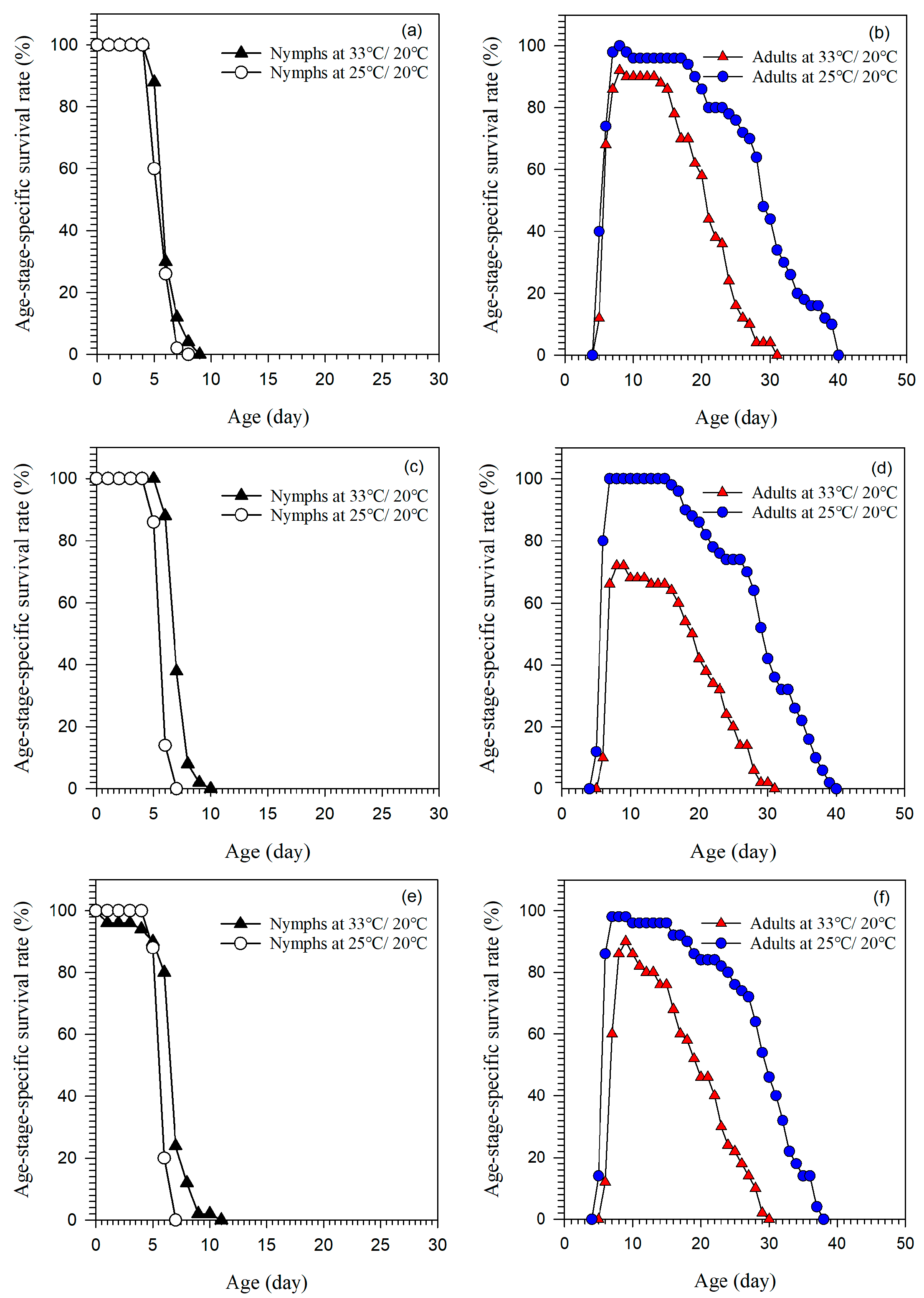
Aphis glycines exposed to 33 °C/20 °C survived across the three tested generations. The age–stage-specific nymph survival rates for G1 (Figure 1a), G2 (Figure 1c), and G3 (Figure 1e) at 33 °C/20 °C were similar to those at 25 °C/20 °C, but the age–stage-specific adult survival rates were lower (Figure 1b,d,f).

3.2. Development of A. glycines Exposed to a High Temperature over Three Generations

At 33 °C/20 °C and 25 °C/20 °C, nymph, adult, and aphid total longevity of A. glycines showed no significant differences across generations. At 33 °C/20 °C, the nymph longevity of A. glycines in G1, G2, and G3 was 6.35, 7.28, and 7.17 days, respectively—longer than at 25 °C. However, adult longevity (14.41, 13.15, and 12.96 days) and total aphid longevity (20.76, 20.32, and 20.23 days) were shorter than at 25 °C/20 °C (paired bootstrap test, p < 0.05) (Table 1).
There were no significant differences in nymph longevity, adult longevity, or aphid total longevity across generations. The sample size, n1 and n2, are the number of nymphs that could develop into adults at different temperatures. The aphid total longevity refers to the sum of nymph longevity and adult longevity. The difference in parameters between temperatures in each generation is marked by an asterisk (paired bootstrap test, p < 0.05).

3.3. Reproduction of A. glycines Exposed to a High Temperature over Three Generations

There was no significant difference in the oviposition day and fecundity of A. glycines at 33 °C/20 °C and 25 °C/20 °C across generations. However, exposure to 33 °C/20 °C resulted in shorter oviposition day and lower fecundity of A. glycines in each generation compared to 25 °C/20 °C (paired bootstrap test, p < 0.05) (Table 2).
There were no significant differences in oviposition day and fecundity across generations. The sample size, n1 and n2, are the number of nymphs that could develop into adults at different temperatures. The difference in parameters between temperatures in each generation is marked by an asterisk (paired bootstrap test, p < 0.05).

3.4. Population Parameters of A. glycines Exposed to a High Temperature over Three Generations

Exposure of A. glycins to 33 °C/20 °C revealed significant differences in the intrinsic and finite rate of increase across generations, but no significant difference in net reproductive rate and mean generation time. Exposure of A. glycins to 25 °C/20 °C revealed significant differences in the intrinsic rate of increase, finite rate of increase, and net reproductive rate across generations, but no significant difference in mean generation time. The intrinsic rate of increase, finite rate of increase, and net reproductive rate of A. glycines at 33 °C/20 °C were lower than at 25 °C/20 °C in all generations. The mean generation time of G1 at 33 °C/20 °C was similar to that at 25 °C/20 °C, but G2 and G3 had longer mean generation times (paired bootstrap test, p < 0.05) (Table 3).
The initial number of aphids was 50 at each treatment. The difference in parameters among generations is marked by lowercase letters and those between temperatures in each generation are marked by an asterisk (paired bootstrap test, p < 0.05).
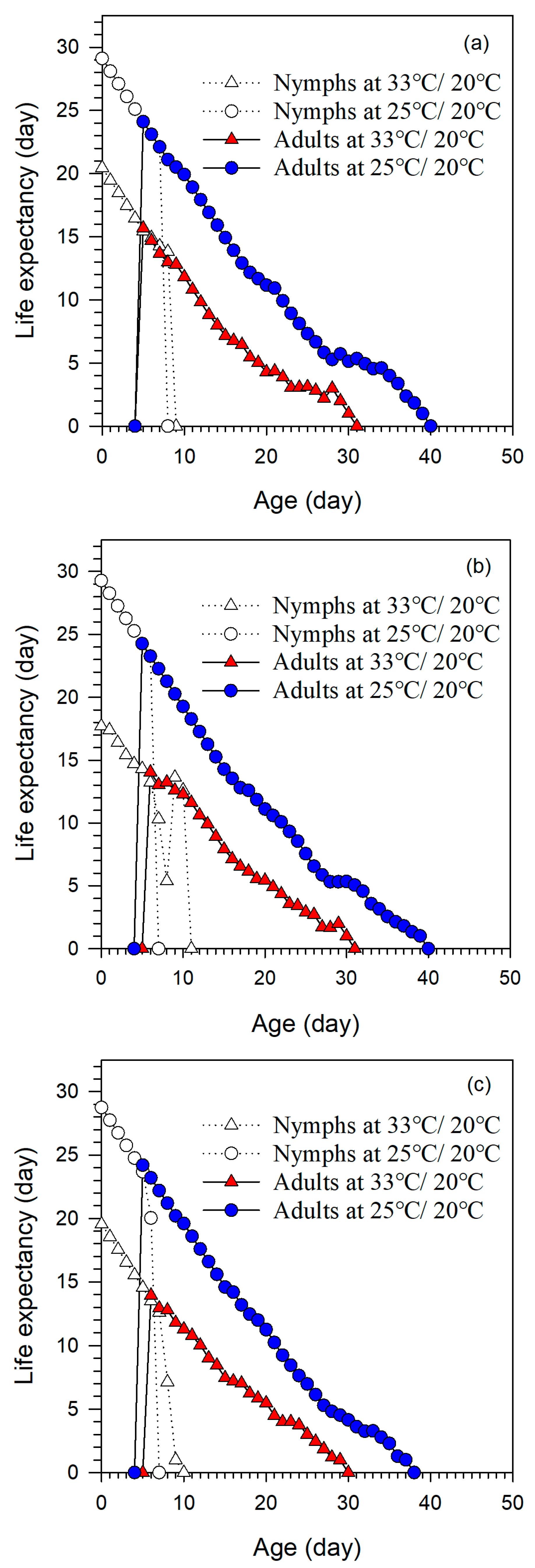
The life expectancy of A. glycines at 33 °C/20 °C was shorter than at 25 °C/20 °C across the three tested generations. When A. glycines were exposed to 33 °C/20 °C in G1, the life expectancies of newly deposited nymphs and one-day-old adults were 20.46 and 15.68 days, respectively, while those exposed to 25 °C/20 °C had life expectancies of 29.10 and 24.10 days. In G2, exposure to 33 °C/20 °C resulted in life expectancies of 19.54 and 13.93 days for newly deposited nymphs and one-day-old adults, respectively, while exposure to 25 °C/20 °C yielded life expectancies of 28.74 and 24.18 days. In G3, after exposure to 33 °C/20 °C, the life expectancies of newly deposited nymphs and one-day-old adults were 17.70 and 14.04 days, respectively, compared to 29.26 and 24.26 days for those exposed to 25 °C/20 °C (Figure 2).
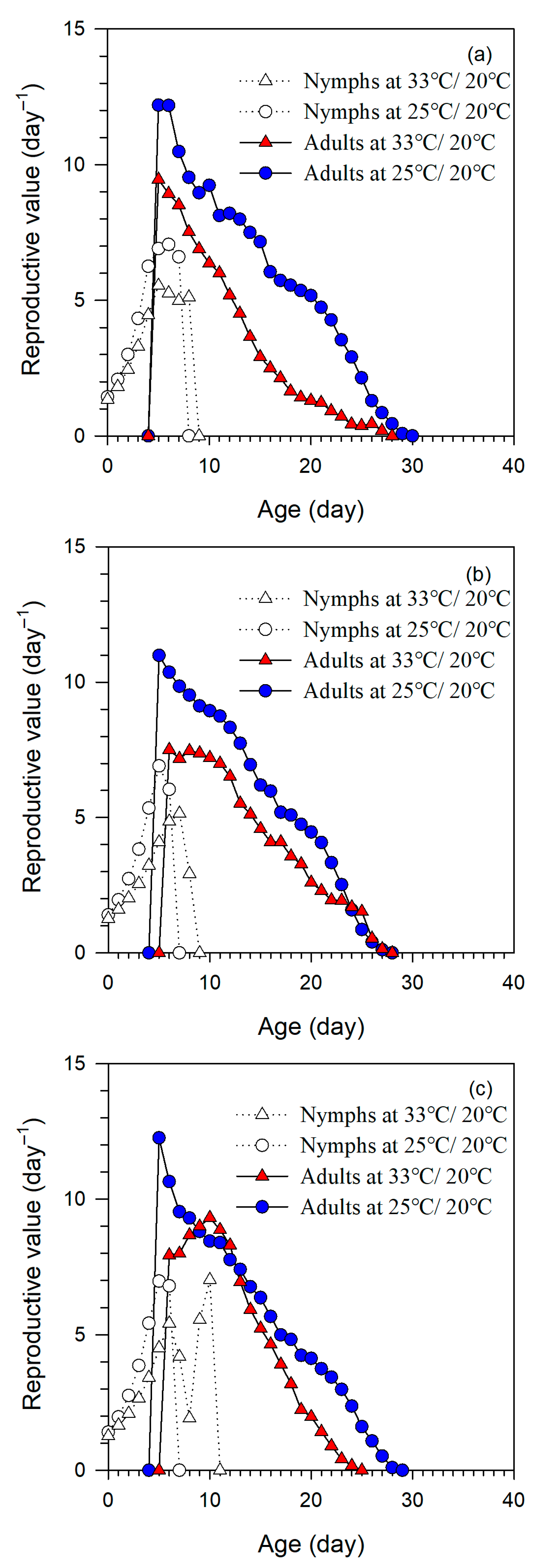
The reproductive value of A. glycines at 33 °C/20 °C was lower than at 25 °C/20 °C across three generations. When A. glycines were exposed to 33 °C/20 °C in G1, the highest reproductive value for adults was 9.46 day−1, while those exposed to 25 °C/20 °C exhibited a value of 12.19 day−1. In G2, adults’ exposure to 33 °C/20 °C had the highest reproductive value of 7.51 day−1, while those exposed to 25 °C/20 °C showed a value of 10.99 day−1. In G3, the maximum reproductive value for adults was 9.31 day−1 after exposure to 33 °C/20 °C, compared to 12.26 day−1 for those exposed to 25 °C/20 °C (Figure 3).

4. Discussion

Global warming is increasingly serious, with Heilongjiang Province, China, experiencing rapid temperature rises [25,26]. Aphis glycines in soybeans is likely to face high-temperature stress if the temperatures continue to rise. This study examined the survival, development, and reproduction of A. glycines at 33 °C/20 °C over three tested generations. Results showed that A. glycines could complete development and reproduction at 33 °C/20 °C (Table 1, Table 2 and Table 3). We predict that A. glycines could maintain populations in soybeans in Heilongjiang, even with future diurnal temperatures reaching 33 °C.
The grain aphid, Rhopalosiphum padi (L.), and cotton aphid, Aphis gossypii Glover, move from the upper to lower parts of their host plants to avoid heat under high-temperature stress [35,36]. In Heilongjiang, when field temperatures reach 33 °C, monitoring soybean canopy temperature is essential. A hypothesis suggests that canopy temperatures below 33 °C may enhance adult longevity and fecundity of A. glycines, if they move to lower plant parts. However, our study could not confirm this. While A. glycines can reproduce across the three tested generations at 33 °C/20 °C, it is unclear if they can exceed this or develop greater adaptability to high temperature.
This report is the first to examine the development and reproduction of A. glycines exposed to 33 °C/20 °C over three generations, with no prior comparative data available. Previous studies on A. glycines at various temperatures for one generation provide some context. In Huo et al. (2022), the nymph longevity, adult longevity, and fecundity of A. glycines at 33 °C were reported as 6.71 days, 11.77 days, and 21.27 offspring per individual [24], which compares to our results of 6.35 days, 14.41 days, and 22.53 offspring per individual (Table 1 and Table 2). At 25 °C, the aphid total longevity, oviposition day, and mean generation time of A. glycines were similar to the reported 27.41, 15.84, and 9.92 days, respectively [21]. The virginoparae of A. glycines adapt well to 33 °C but perform worse in development and reproduction compared to the optimal 25 °C (Table 1, Table 2 and Table 3, Figure 1), aligning with earlier findings of shorter longevity and lower fecundity at higher temperatures [19,24].
This study assessed population reproductive parameters, including the intrinsic rate of increase, finite rate of increase, and net reproductive rate. At 33 °C/20 °C, these parameters across generations were lower than at 25 °C/20 °C (Table 3). This explains, based on internal population parameter effects, why fecundity at 33 °C/20 °C was lower than at 25 °C/20 °C (Table 2). This study also evaluated the life expectancy of A. glycines, defined as the expected remaining lifespan at a specific age and stage. The curve’s intersection with the vertical axis indicates the expected lifespan of newly deposited nymphs, equivalent to the aphid total longevity. At 33 °C/20 °C, the life expectancy of newly deposited nymphs across generations was shorter than at 25 °C/20 °C (Figure 2), consistent with the aphid total longevity (Table 1). Reproductive value measures an aphid’s contribution to future populations at a specific age and stage. At 25 °C/20 °C and 33 °C/20 °C, adults contribute more across generations than nymphs, as adult data exceed nymph data (Figure 3).
High temperatures impact soluble sugar content in soybean leaves [37], which is crucial for aphid development [38]. Analyzing soluble sugar levels in soybeans and A. glycines at 33 °C could probably clarify why A. glycines develops and reproduces less effectively than at 25 °C/20 °C.
This study has limitations. To clarify the adaptability of A. glycines to 33 °C/20 °C, it should be exposed to these temperatures for over three generations. To address constant temperature issues, daily temperatures were set high during the day and low at night, but significant differences remain compared to natural temperatures, which fluctuate throughout the day. Noteworthily, the adaptability of A. glycines to high temperatures is influenced by both diurnal temperature fluctuations and the interactions of multiple environmental factors, which were inadequately taken into account in this study. In Heilongjiang Province, China, summer daytime temperatures often exceed 30 °C, while nighttime temperatures typically hover around 20 °C. Thus, the nighttime temperature was empirically set at 20 °C in this study. Subsequent experiments should specify trial temperatures. Additionally, A. glycines were reared on detached soybean leaves; using living soybean plants would better reflect the aphids’ responses to high temperatures. Based on results from living soybeans, it may be possible to more accurately predict whether A. glycines can sustain populations in Heilongjiang soybeans, even with future diurnal temperatures reaching 33 °C. A. glycines is common across all soybean-producing regions in China. Therefore, extensive sampling across these areas is needed to study the adaptability of A. glycines populations from different regions to high temperatures.

5. Conclusions

Based on the age–stage, two-sex life table approach, this study examined the survival, development, and reproduction of A. glycines exposed to a diurnal temperature of 33 °C and a nocturnal temperature of 20 °C (33 °C/20 °C) over three generations, compared to a diurnal temperature of 25 °C and a nocturnal temperature of 20 °C (25 °C/20 °C). The adult survival rates of A. glycines in the first (G1), second (G2), and third generation (G3) at 33 °C/20 °C were lower than those at 25 °C/20 °C. Furthermore, exposure to 33 °C/20 °C reduced aphid total longevity and oviposition day for G1, G2, and G3 compared to 25 °C/20 °C. Population parameters—fecundity, intrinsic and finite rates of increase, net reproductive rate, life expectancy, and reproductive value—were all reduced at 33 °C/20 °C relative to 25 °C/20 °C. These findings indicate that A. glycines can develop into adults and reproduce successfully after exposure to 33 °C/20 °C across three tested generations. The results are important for understanding the adaptability of A. glycines to temperature fluctuations and for predicting the population dynamics of this pest in soybeans in Heilongjiang, China.

Author Contributions

Q.W.: Investigation, Writing—original draft, Data curation, Software, Visualization, Writing—review and editing; Y.T.: Methodology, Data curation, Software; W.Z.: Methodology, Data curation, Software; Y.L.: Methodology, Data curation, Software; C.W.: Investigation, Writing—original draft, Data curation, Software, Visualization, Writing—review and editing; Z.T.: Formal analysis, Methodology, Conceptualization; J.L.: Conceptualization, Writing—original draft, Data curation, Funding acquisition, Project administration, Resources, Supervision, Writing—review and editing. All authors have read and agreed to the published version of the manuscript.

Funding

This research was funded by [2024 Science and Technology Support Project of the Inner Mongolia Innovation Center of Biological Breeding Technology Biotechnology-Based Breeding of High-Quality Soybeans and Application Demonstration] grant number [2024NSZC04-2-3].

Data Availability Statement

The original contributions presented in this study are included in the article. Further inquiries can be directed to the corresponding author(s).

Conflicts of Interest

The authors declare no conflicts of interest.

References

  1. Wu, Z.S.; Schenk-Hamlin, D.; Zhan, W.Y.; Ragsdale, D.W.; Heimpel, G.E. The soybean aphid in China: A historical review. Ann. Entomol. Soc. Am. 2004, 97, 209–218. [Google Scholar] [CrossRef]
  2. Davis, J.A.; Radcliffe, E.B.; Ragsdale, D.W. Soybean aphid, Aphis glycines Matsumura, a new vector of potato virus Y in potato. Am. J. Potato Res. 2005, 82, 197–201. [Google Scholar] [CrossRef]
  3. Domier, L.L.; Steinlage, T.A.; Hobbs, H.A.; Wang, Y.; Herrera-Rodriguez, G.; Haudenshield, J.S.; McCoppin, N.K.; Hartman, G.L. Similarities in seed and aphid transmission among soybean mosaic virus isolates. Plant Dis. 2007, 91, 546–550. [Google Scholar] [CrossRef] [PubMed]
  4. Li, H.; Liu, X.; Liu, X.; Michaud, J.P.; Zhi, H.; Li, K.; Li, X.; Li, Z. Host plant infection by soybean mosaic virus reduces the fitness of its vector, Aphis glycines (Hemiptera: Aphididae). J. Econ. Entol. 2018, 111, 2017–2023. [Google Scholar] [CrossRef] [PubMed]
  5. Wang, C.R.; Deng, X.C.; Yin, L.J.; Song, Y.; Zhang, D.; Shen, H. Analysis of factors causing soybean aphid outbreak in Heilongjiang Province in 2004. Soy. Bull. 2005, 19–20. [Google Scholar] [CrossRef]
  6. Kim, C.S.; Schaible, G.; Garrett, L.; Lubowski, R.; Lee, D. Economic impacts of the US soybean aphid infestation: A multi-regional competitive dynamic analysis. Agric. Resour. Econ. Rev. 2008, 37, 227–242. [Google Scholar] [CrossRef]
  7. Fan, D.; Dong, S.; Yao, L.; Yang, H.; Dai, C.; Tang, Y. Occurrence and Control of Aphis glycines. J. Jilin Agric. Univ. 2025, 47, 772–779. [Google Scholar] [CrossRef]
  8. Shi, S.S.; Yi, B.R.; Li, D.S.; Yu, Y.J. Study on space tendency of natural population of Aphis glycines Matsumura. J. JiLin. Agric. Univ. 1994, 16, 75–79. [Google Scholar]
  9. Wu, Z.S.; Hopper, K.R.; O’Neil, R.J.; Voegtlin, D.J.; Prokrym, D.R.; Heimpel, G.E. Reproductive compatibility and genetic variation between two strains of Aphelinus albipodus (Hymenoptera: Aphelinidae), a parasitoid of the soybean aphid, Aphis glycines (Homoptera: Aphididae). Biol. Control 2004, 31, 311–319. [Google Scholar] [CrossRef]
  10. Rutledge, C.E.; O’Neil, R.J. Orius insidiosus (Say) as a predator of the soybean aphid, Aphis glycines Matsumura. Biol. Control 2005, 33, 56–64. [Google Scholar] [CrossRef]
  11. Dai, C.C.; Zhao, K.J.; Fan, D.; Sun, W. Analysis of Predominant Natural Enemies Controlling Soybean Aphid, Aphis glycines in Different Periods in Northeast China. Chin. J. Biol. Control 2015, 31, 487–494. [Google Scholar] [CrossRef]
  12. Liu, X.L.; Wang, K.Q.; Liu, C.L.; Shao, T.; Wang, S.; Xia, J.; Yang, F.; Liu, Y.; Li, X.; Xu, W. Effect of planting date on the population dynamics of the soybean aphid its natural enemies. Chin. J. Appl. Entomol. 2014, 51, 375–384. [Google Scholar]
  13. Wang, Y.Z.; Yue, Y.H. Efficacy of interplant and mixture sowing of maize and soybean on pest and disease management in soybean. Plant Prot. 1998, 24, 13–15. [Google Scholar]
  14. Yang, X.H. Preliminary report on the study of the control on soybean aphid with intercropping of soybean and garlic or Chinese onion. J. Agric. 2014, 4, 26–28. [Google Scholar]
  15. Gao, X.J.; Liang, P.; Song, D.L.; Gao, X. Effects of sublethal concentration of beta-cypermethrin on laboratory population of soybean aphid Aphis glycines Matsumura. Acta Phytophylacica Sin. 2008, 35, 379–380. [Google Scholar] [CrossRef]
  16. Zhao, Y.T.; Shi, X.R.; Meng, X.H.; Xie, G.Q.; Fan, S.H.; Wang, Y.; Dong, Q.S. Biological control effect of matrine and nicotine + saponin on Aphis glycines in Mudanjiang Hilly Midlevels. Soy. Sci. 2014, 33, 287–289. [Google Scholar]
  17. Zhang, A.N.; Han, L.L.; Zhao, K.J.; Zhang, W.L.; Xiao, J.F.; Chen, J.; Gao, L.T. Effects of semilethal and sublethal doses of imidacloprid on Aphis glycines (Hemiptera: Aphididae). Chin. J. Appl. Entomol. 2020, 57, 676–681. [Google Scholar] [CrossRef]
  18. Xu, L.; Zhao, T.H.; Zhong, T.; Xu, G. A safer method of controlling soybean aphids. Chin. J. Appl. Entomol. 2016, 53, 759–771. [Google Scholar] [CrossRef]
  19. Hirano, K.; Honda, K.; Miyai, S. Effects of temperature on development, longevity, and reproduction of the soybean aphid, Aphis glycines (Homoptera: Aphididae). Appl. Entomol. Zool. 1996, 31, 178–180. [Google Scholar] [CrossRef]
  20. McCornack, B.P.; Ragsdale, D.W.; Venette, R.C. Demography of soybean aphid (Homoptera: Aphididae) at summer temperatures. J. Econ. Entomol. 2004, 97, 854–861. [Google Scholar] [CrossRef]
  21. Xu, L.; Xu, G.Q.; Liu, P.B.; Chen, Y.; Wang, X.; Zhao, T. Effects of temperature on development and reproduction of Aphis glyicines Matsumura. Chin. J. Oil Crop Sci. 2011, 33, 189–192. [Google Scholar]
  22. Liu, D.; Wu, C.; Wang, Q.; Liu, D.; Tian, Z.; Liu, J. Effects of heat wave on development, reproduction, and morph differentiation of Aphis glycines. Environ. Entomol. 2023, 52, 939–948. [Google Scholar] [CrossRef] [PubMed]
  23. Wu, C.; Liu, D.; Gu, C.; Tian, Z.; Zhang, X.; Liu, J. Control effects of short-term heatwaves on a holocyclic aphid. Insects 2024, 15, 100. [Google Scholar] [CrossRef]
  24. Huo, D.; Tian, Z.; Liu, D.; Wu, C.; Wang, L.; Liu, J. Adaptability of two soybean aphid species to high diurnal temperatures. Environ. Entomol. 2022, 51, 1241–1248. [Google Scholar] [CrossRef]
  25. Pan, H.S.; Zhang, G.H.; Xu, N.P. A preliminary analysis of climate warming in Heilongjiang province since the 1980s. Clim. Environ. Res. 2003, 8, 348–355. [Google Scholar] [CrossRef]
  26. Zhou, X.J.; Wang, F.L.; Wu, Y.Y.; Na, J.H.; Pan, H.S.; Wang, Y. Analysis of the temperature change characteristics of Heilongjiang Province, northeast China and whole country in recent 60 years. J. Nat. Disasters 2013, 22, 124–129. [Google Scholar]
  27. Fehr, W.R.; Caviness, C.E.; Burmood, D.T.; Pennington, J.S. Stage of develpoment descriptions for soybeans, Glycine max (L.) Merrill. Crop Sci. 1971, 11, 929–931. [Google Scholar] [CrossRef]
  28. Bai, B.; Tian, Z.; Gao, B.; Liu, Z.; Wang, L.; Liu, J. Performance of Aphis glycines Matsumura reared under different methods. Fla. Entomol. 2022, 105, 211–218. [Google Scholar] [CrossRef]
  29. Chi, H.; Liu, H. Two new methods for the study of insect population ecology. Bull. Inst. Zool. Acad. Sin. 1985, 24, 225–240. [Google Scholar]
  30. Chi, H. Life-table analysis incorporating both sexes and variable development rates among individuals. Environ. Entomol. 1988, 17, 26–34. [Google Scholar] [CrossRef]
  31. Chi, H. TWOSEX-MSChart: A Computer Program for the Age-Stage, Two-Sex Life Table Analysis. Fujian Academy of Agricultural Sciences, China. 2025. Available online: https://www.faas.cn/cms/sitemanage/index.shtml?siteId=810640925913080000 (accessed on 1 August 2025).
  32. Chi, H.; Güncan, A.; Kavousi, A.; Gharakhani, G.; Atlihan, R.; Özgökçe, M.S.; Shirazi, J.; Amir-Maafi, M.; Maroufpoor, M.; Roya, T. TWOSEX-MSChart: The key tool for life table research and education. Entomol. Gen. 2022, 42, 845–849. [Google Scholar] [CrossRef]
  33. Tibshirani, R.J.; Efron, B. An Introduction to the Bootstrap. Monographs on Statistics and Applied Probability; Springer: Berlin/Heidelberg, Germany, 1993; Volume 57, pp. 1–436. [Google Scholar] [CrossRef]
  34. Wei, M.; Chi, H.; Guo, Y.; Li, X.; Zhao, L.; Ma, R. Demography of Cacopsylla chinensis (Hemiptera: Psyllidae) reared on four cultivars of Pyrus bretschneideri (Rosales: Rosaceae) and P. communis pears with estimations of confidence intervals of specific life table statistics. J. Econ. Entomol. 2020, 113, 2343–2353. [Google Scholar] [CrossRef] [PubMed]
  35. Ma, G.; Ma, C.S. Upper critical temperatures for behaviors of three species of cereal aphids in leaf temperature gradients. Acta Ecol. Sin. 2007, 27, 624–630. [Google Scholar]
  36. Liu, X.D.; Zhang, X.X.; Zhao, N.S.; Yang, X.W.; Chen, X.F.; Zhang, G.X. Ecological adaptation of Aphis gossypii (Homoptera: Aphididae) to cotton developmental stage and temperature. J. Nanjing Agric. Univ. 2000, 23, 29–32. [Google Scholar]
  37. Jin, L.Z.; Wang, Y.; Zhang, W.; Xu, J.Y.; Shen, Z.S.; Xie, P.D. Effects of high temperature stress on physiological and biochemical traits of soybeans with different heat tolerance. Soy. Sci. 2019, 38, 63–71. [Google Scholar] [CrossRef]
  38. Jiu, M.; Liu, S.S. Aphid rearing with artificial diets. Entomol. J. East China 2004, 13, 102–109. [Google Scholar]
Figure 1. Age–stage-specific survival rates (sxj) of A. glycines exposed to different diurnal temperatures over three generations. (a) G1 nymph sxj, (b) G1 adult sxj, (c) G2 nymph sxj, (d) G2 adult sxj, (e) G3 nymph sxj, (f) G3 adult sxj
Agronomy 16 00555 g001
Figure 2. Life expectancy (exj) of A. glycines exposed to different diurnal temperatures over three generations. (a) G1, (b) G2, (c) G3.
Agronomy 16 00555 g002
Figure 3. Reproductive value (vxj) of A. glycines exposed to different diurnal temperatures over three generations. (a) G1, (b) G2, (c) G3.
Agronomy 16 00555 g003
Table 1. Developmental duration (mean ± SE) of A. glycines exposed to different diurnal temperatures for three generations.
GenerationA. glycines Exposed to 33 °C/20 °CA. glycines Exposed to 25 °C/20 °C
n1Nymph Longevity
(d)
Adult Longevity
(d)
Aphid Total Longevity
(d)
n2Nymph Longevity
(d)
Adult Longevity
(d)
Aphid Total Longevity
(d)
G1496.35 ± 0.14 *14.41 ± 0.78 *20.76 ± 0.78 *505.88 ± 0.1223.22 ± 1.0029.10 ± 1.03
G2477.28 ± 0.11 *13.15 ± 1.09 *20.32 ± 1.02 *495.98 ± 0.0723.20 ± 0.9029.18 ± 0.91
G3417.17 ± 0.14 *12.96 ± 0.88 *20.23 ± 0.90 *506.08 ± 0.0823.18 ± 0.9329.26 ± 0.94
Table 2. Reproductive capacity (mean ± SE) of A. glycines exposed to different diurnal temperatures for three generations.
GenerationA. glycines Exposed to 33 °C/20 °CA. glycines Exposed to 25 °C/20 °C
n1Oviposition Day
(d)
Fecundity
(Offspring/Individual)
n2Oviposition Day
(d)
Fecundity
(Offspring/Individual)
G14910.62 ± 0.68 *22.53 ± 1.50 *5017.80 ± 0.7048.14 ± 2.26
G24710.12 ± 0.60 *19.30 ± 1.76 *4917.53 ± 0.6141.35 ± 1.59
G3419.64 ± 0.79 *21.37 ± 1.98 *5017.32 ± 0.6041.10 ± 1.69
Table 3. Population parameters (mean ± SE) of A. glycines exposed to different diurnal temperatures for three generations.
GenerationA. glycines Exposed to 33 °C/20 °CA. glycines Exposed to 25 °C/20 °C
Intrinsic Rate of Increase
(r, d−1)
Finite Rate of Increase
(λ, d−1)
Net Reproductive Rate (R0, Offspring/Female)Mean Generation Time (T, d)Intrinsic Rate of Increase
(r, d−1)
Finite Rate of Increase
(λ, d−1)
Net Reproductive Rate (R0, Offspring/Female)Mean Generation Time (T, d)
G10.2989 ± 0.0075
a *
1.3484 ± 0.0101
a *
22.08 ± 1.52
a *
10.35 ± 0.18
a
0.3664 ± 0.0075
a
1.4428 ± 0.0107
a
48.13 ± 2.23
a
10.57 ± 0.21
a
G20.2344 ± 0.0073
b *
1.2642 ± 0.0092
b *
18.13 ± 1.76
a *
12.31 ± 0.26
a *
0.3353 ± 0.0060
b
1.3983 ± 0.0083
b
40.52 ± 1.74
b
11.04 ± 0.14
a
G30.2332 ± 0.0099
b *
1.2627 ± 0.0125
b *
17.52 ± 1.97
a *
12.25 ± 0.23
a *
0.3380 ± 0.0060
b
1.4022 ± 0.0083
b
41.10 ± 1.67
b
10.99 ± 0.19
a
Disclaimer/Publisher’s Note: The statements, opinions and data contained in all publications are solely those of the individual author(s) and contributor(s) and not of MDPI and/or the editor(s). MDPI and/or the editor(s) disclaim responsibility for any injury to people or property resulting from any ideas, methods, instructions or products referred to in the content.