Article

Effect of Soil Tillage Practises on Soil Properties and Water Infiltration in Maize (Zea mays L.) Monoculture

Department of Agricultural Machines, Faculty of Engineering, Czech University of Life Sciences Prague, Kamýcká 129, 165 21 Prague, Czech Republic
*
Author to whom correspondence should be addressed.
Agronomy 2026, 16(5), 551; https://doi.org/10.3390/agronomy16050551
Submission received: 27 January 2026 / Revised: 20 February 2026 / Accepted: 26 February 2026 / Published: 28 February 2026

Abstract

Soil tillage practices play a key role in controlling soil’s physical properties, water infiltration, and runoff generation, particularly in erosion-prone cropping systems such as maize monocultures. The cultivation of wide-row crops is restricted on erosion-prone land; however, these crops constitute a fundamental basis for livestock feed and represent a key input raw material for biogas plants. This 4-year study evaluated the effects of three tillage practices—conventional ploughing, shallow tillage, and no tillage—on selected soil’s physical and chemical properties and on water infiltration processes in a maize (Zea mays L.) monoculture. Experimental maize stands were established in a field with a silty clay Luvic Chernozem. Field measurements were performed over multiple years and included soil bulk density, macroporosity, cone index, soil organic carbon, soil pH, soil aggregate stability, and water infiltration. Infiltration processes were assessed using a combination of double-ring infiltrometers, rainfall simulation, and dye tracer experiments to characterize water flow patterns under controlled conditions. The results demonstrated that soil tillage significantly influenced the vertical distribution of soil organic carbon and pH, soil aggregate stability, soil compaction, and pore characteristics, with the most pronounced differences observed in the upper soil layers. Soil aggregate stability in the 0–0.10 m layer showed a clear numerical trend, with the highest mean value under ST (0.42) compared with PL (0.28) and no tillage (NT) (0.26). Topsoil Cox was the highest under ST (3.591%) compared with PL (2.838%) and NT (2.634%). Differences among tillage practices were particularly evident during simulated rainfall events, affecting infiltration rates, runoff initiation, and preferential flow patterns. Ring infiltrometer measurements indicated higher infiltration in PL (e.g., 21.1 mm min−1 at minute 1 in PL vs. 11.1/11.9 mm min−1 in ST/NT; 10.9 mm min−1 at minute 10 in PL vs. 5.3/7.6 mm min−1 in ST/NT). However, rainfall simulation showed the highest runoff in PL, including the earliest runoff onset (4.5 min). Despite the soil’s high infiltration capacity due to low bulk density and higher porosity, the decisive factor promoting water infiltration into the soil is the condition of the soil surface, which is influenced by the stability of soil aggregates; this stability was enhanced by the input of organic matter from plant residues. The findings confirm that long-term soil tillage management substantially modifies soil hydraulic behaviour and highlight the importance of tillage system selection for improving soil water infiltration and reducing runoff risk in maize monoculture systems.

1. Introduction

Maintaining soil fertility and preserving its ecological functions has long been regarded as one of the fundamental objectives of agricultural management [1,2]. A key influence on the processes occurring within the soil environment is the selected tillage technology [3,4]. Water erosion of agricultural soil represents a major environmental and economic problem, which is closely associated with the intensity of tillage technologies [5,6].
Under the temperate climatic conditions of the central Europe, the occurrence of intense, erosion-prone rainfall is spatially and temporally variable, with the highest probability of occurrence from May to August, which coincides with the maize growing period [7]. Maize has consistently been among the crops with the greatest frequency of erosion events, given the characteristics of wide-row crop cultivation, which has also been confirmed under the conditions of the Czech Republic in the period 2020–2024 [8,9]. During intensive rainfall events, the soil’s infiltration capacity becomes the decisive factor of surface runoff. These factors are subsequently influenced by soil properties determined by tillage practices [10,11].
Tillage technology affects the physical properties of soil, in particular the structure of the soil profile, bulk density, porosity, and the stability of soil aggregates, which are key determinants of water movement in soil [12,13,14]. Conventional intensive tillage is generally associated with more pronounced and deeper disruption of the natural structure of soil aggregates and a temporary increase in macroporosity in the surface layer; however, it can also lead to subsoil compaction and the formation of compacted layers under multi-year tillage at the same depth. These changes can subsequently restrict vertical infiltration of water and increase surface runoff, as well as susceptibility to water erosion [15,16]. Conservation tillage technologies, characterized by reduced intensity of operations and retention of plant residues on the soil surface, contribute to longer-term stability of soil structure and a higher proportion of stable macroaggregates [17,18]. An increased content of organic residue in the surface soil layer promotes biological activity, the development of macropores, and improved soil infiltration capacity [19,20]. Differences in soil properties induced by different tillage practices therefore become particularly pronounced during intensive rainfall events, when the decisive factor is the soil’s ability to accept and store water and to limit the formation of surface runoff [20]. These conditions are then perceived by society and addressed within the framework of agricultural sustainability.
Soil protection against water erosion and degradation is currently also emphasized within the framework of the European Union’s Common Agricultural Policy, which aims to support sustainable soil management and long-term preservation of its productive and non-productive functions. In the practical implementation by member states, this framework is reflected in an increased emphasis on the application of conservation technologies, the effectiveness of which must, however, be evaluated on the basis of quantifiable changes in soil properties and hydrological processes [21]. General requirements to reduce the intensity of soil tillage stem from a broad societal interest in supporting environmental and climate protection. Direct drilling was included in view of the anticipated taxonomic classification of tillage practices.
Studies of runoff and water infiltration into soil are substantially constrained by their dependence on natural rainfall and by variability in rainfall intensity, drop size, and impact energy [22,23]. In contrast, rainfall simulation enables rapid and reproducible data collection, approaching the characteristics of natural rainfall, under controlled conditions, both in laboratory and field environments [24,25]. Investigating the causes of soil erosion under natural conditions is difficult due to the presence of numerous factors. Without the simplification of certain factors—such as intensity or droplet size—by using a simulator compared with natural rainfall, monitoring soil behaviour when assessing multiple factors is difficult and, in most cases, impossible. Simulation approaches are therefore often required. Rainfall simulators are thus widely used in research on rainfall–runoff relationships and water infiltration into soil [26,27]. Although the influence of tillage technologies on infiltration processes is generally known, there is a limited number of studies that quantify these relationships under controlled rainfall conditions in maize stands; in this study, a combination of infiltration methods was compared, highlighting the impacts of tillage intensity while differing in the interpretability of results and thus in the resulting assessment of the technology’s influence on erosion. The aim of this study was to present different infiltration methods in order to provide a more realistic description of soil condition and its resilience to external influences and to evaluate the multi-year effects of different tillage technologies on soil organic carbon (Cox), pH, soil aggregate stability (SAS), soil bulk density, macroporosity, and cone index in maize (Zea mays L.) stands grown in monoculture.

2. Materials and Methods

2.1. Site Characteristics and Tillage Techniques

The comparison of tillage practices was carried out in the same field for 4 consecutive years, on a silty clay soil in Agroservis; 1st Agricultural, plc; Višňové, Czech Republic (coordinates: 16°10′17.6″ E/48°58′25.3″ N). This region was selected because it has a traditionally high proportion of maize stands and is simultaneously affected by frequent erosion events. The sampling scheme for physical and chemical soil properties was designed to minimize the influence of confounding factors; sampling points were randomized diagonally across the plot, with particular emphasis on excluding the effects of machinery traffic. The trial was established on Luvic Chernozem, which classification and texture are in Table 1. Each measuring and soil sample collection were done within a short time window during autumn period, before maize harvest.
The experimental practices representing three different tillage intensities and depths based on conventional technological practices commonly used in the Central European region for grain maize were grown for 4 years repeatedly as a monoculture:
-
Conventional tillage with ploughing (PL) to the depth of 0.20 m, spring harrowing in March, cultivation with Horsch Phantom tiller (HORSCH Maschinen GmbH, Schwandorf, Germany) before seeding, and seeding Kinze 3600 (Kinze Manufacturing, Inc., Williamsburg, IA, USA).
-
Shallow tillage (ST) with a disc tiller to the depth of 0.10–0.12 m, cultivation with Horsch Phantom tiller before seeding, and seeding (Kinze 3600).
-
No tillage (NT) and seeding (Kinze 3600).
All tested plots were fertilized uniformly: ammonium phosphate (Lovochemie a.s., Lovosice, Czech Republic) (100 kg·ha−1) was applied shortly before seedbed preparation, and urea (Lovochemie a.s., Lovosice, Czech Republic) (250 kg·ha−1) was applied shortly before sowing.

2.2. Soil Properties

2.2.1. Cox

Cox was determined by dichromate oxidation using K2Cr2O7 (Penta s.r.o., Prague, Czech Republic), with the remaining oxidant quantified by potentiometric titration to the equivalence point. From each composite sample, which comprised 10 soil cores, four replicate subsamples were collected. The quantity of Cox in the soil was determined for 0–0.10, 0.10–0.20, and 0.20–0.30 m [28].

2.2.2. pH

pH in the soil was determined for 0–0.10, 0.10–0.20, and 0.20–0.30 m. From each composite sample, which comprised 10 soil cores, four replicate subsamples were collected. Determination of pH values using potassium chloride (Penta s.r.o., Prague, Czech Republic). pH metre Schott—CG 842 + Schott BlueLine 14 electrodes were used for measuring [29].

2.2.3. SAS

SAS was measured with the Wet Sieving Apparatus (produced by Eijkelkamp Soil & Water, Giesbeek, The Netherlands), and a wet sieving method was used for determination of the soil aggregate stability for particles measuring 0.001–0.002 m. The method recommended by the producer was used. For the analysis, 4 g of air-dried soil (particle size 0.001–0.002 m) was used from the soil samples. The soil samples were taken from the soil layer 0–0.1 m deep. From each composite sample, which comprised 20 soil cores, eight replicate subsamples were collected.
Soil bulk density, macroporosity and cone index were measured for every year of the experiment, near the points where the infiltration was measured.
A PN 10 (CULS, Prague, Czech Republic) recording penetrometer was used to measure the values of cone index with cone according to ASABE standards [30]. Soil moisture content was measured concurrently with penetration resistance at each measuring point in order to account for its influence on the recorded penetration resistance values. The sample is taken as the average value from 10 punctures in the surrounding area of the measuring station. The samples were taken at depths each 0.04 m to maximum depth 0.4 m. Soil bulk density and macroporosity samples were taken at depths each 0.05 m to maximum depth 0.4 m. For the undisturbed samples, Kopecky cylinders and Eijkelkamp sampling sets were used. A total of 4 samples were taken in the surrounding area of the measuring station.

2.3. Water Infiltration

2.3.1. Double-Ring Infiltration Method

A double-ring infiltrometer (Eijkelkamp Soil & Water, Giesbeek, The Netherlands) was used for determining water infiltration. The rings were driven into the ground and filled with water. The water layer fall was measured with a telemetric ultrasonic sensor. The output signal from the sensor was recorded by the measuring unit. The recording time interval of 10 s was chosen. The time of measuring was 10 min. The measurement of the infiltration was taken every year of the experiment.

2.3.2. Rainfall Simulator Method

Rainfall simulator with measured surface of 0.7 m × 0.7 m (0.5 m2) was used for the measurement of the infiltration. The nozzle Lechler L460788 (Lechler GmbH, Metzingen, Germany) with a conic dissipation is the basis of the sprinkling plant. Rainfall intensity was set to 1.463 mm·m−2·min−1. A mean drop diameter of 2 mm was measured; the mean drop velocity was 2.225 m.s−1, and the kinetic energy associated with 1 mm of rainfall corresponded to 24.75 J·m−2. It was placed at a height of 1 m above the middle of the measured surface. The measured surface was bound by iron plates flush in a soil. The infiltration was measured on a slightly sloping ground. There was a water collector on the bottom edge of the measured surface, which accumulates the runoff water into a tube. The water from the surface runoff drained out of the jet reach into the collecting vessel placed on a digital weight.

2.3.3. Blue Dye Tracer Method

For the visualization and quantification of water motion in the soil, the method of water infiltration coloured with a blue food colouring agent was used, followed by image analysis of photographic records. On the soil surface, a 0.3% water solution of the colouring agent E133 “brilliant blue” was applied at a rate of 40 dm3·m−2 for individual variants. The infiltration time was 24 h. Then, parts of soil profile were uncovered (0.60 m width, 0.40 m deep) and subsequently photographed. Within each practise, three profiles were excavated. Each profile was oriented perpendicular to the crop row direction and covered the inter-row area. The digital photograph picture was processed by the programme “BMPtool” (Future Agricultural Technologies AG, Zürich, Switzerland). The analyzed picture was stored in a tabular form, where the blue colour representation in percentual amount for the respective depth is presented for individual layers (0.05 m). The assessment method was described in [31].

2.4. Statistical Evaluation

Statistical analyses were performed using STATISTICA 14 (TIBCO Software Inc., Palo Alto, CA, USA). The data were analyzed through analysis of variance (ANOVA), and significant differences among means were identified using Tukey’s HSD post hoc test at a significance level of p < 0.05.
For dataset analysis, the CANOCO 5 package (Microcomputer Power, Ithaca, NY, USA) was used. Soil tillage (ploughing, shallow tillage, and no tillage) and measurement depth were used as explanatory variables. Blue dye infiltration, soil bulk density, pH, oxidizable carbon, macroporosity, and cone index were included as dependent variables. Data from all experimental years were pooled into a single dataset, and year was not included as an explanatory variable. Consequently, interannual variability is incorporated into the residual variation, and the RDA results represent overall average treatment effects across the four-year experimental period. Detrended correspondence analysis (DCA) indicated short gradient lengths (0.6 SD units), suggesting the use of linear ordination methods. Therefore, redundancy analysis (RDA), a linear constrained method was selected rather than a unimodal method to examine variability in the dataset. RDA allows direct assessment of relationships between multiple response variables and explanatory factors while partitioning explained variation. Variation partitioning analysis (VPA) was applied to quantify the unique and shared contributions of soil tillage and measurement depth, thereby disentangling their relative influence on soil’s physical and hydrological properties. The variables were log-transformed and subsequently centred and standardized to ensure equal weighting across variables with differing ranges and units. This procedure was followed by a Monte Carlo permutation test utilizing 999 permutations to assess the effect of each variable. Tests for the first canonical axis were conducted when evaluating a single explanatory variable, while tests for all canonical axes were performed when both explanatory variables were considered.

3. Results

3.1. Soil Parameters

3.1.1. Soil Organic Carbon, pH

From Table 2 and Table 3, we can observe the effect of tillage technology on the distribution of Cox within the soil profile under different tillage practices. When comparing differences in Cox values among the individual tillage practises and sampling depths, it is evident that the highest Cox values were always observed in the topsoil layer (Table 3). In particular, shallow tillage (ST) showed a statistically significant difference in the proportion of Cox in the topsoil layer compared with the lower soil layers. For ploughing (PL), no statistically significant differences in Cox values among depths were found. The no-tillage (NT) treatment showed a statistically significant difference in Cox between the topsoil layer and the deepest layer, which reached the lowest values. When comparing technologies with each other within individual soil layers (Table 2), statistically different values were observed for ST in the topsoil layer compared with PL and NT. Additional differences were apparent in the 0.20–0.30 m layer, where significantly lower values were observed for NT compared with PL. Significant differences in Cox values for the topsoil layer were recorded between ST and NT, as well as between ST and PL.
Table 2 and Table 3 present soil’s pH values for individual tillage variants and sampling depths. Tillage technology significantly affected pH values (Table 2). In particular, pH values for the shallow tillage (ST) treatment were consistently and significantly lower than those under the other tillage variants. No significant differences were observed between ploughing (PL) and no-tillage (NT) treatment. When comparing pH values among the individual tillage variants and their sampling depths (Table 3), it is evident that NT and PL did not show significant differences among depths. In contrast, the ST variant showed a significantly lower pH in the topsoil layer compared with the other depths.
The effect of tillage technology on the stratification of Cox and pH in the soil is also demonstrated in Table 4. The values in the table represent the ratio between the values in the topsoil layer and the 0.10–0.20 m layer. The increase in the ratio values for the ST variant compared with PL and NT is obvious.

3.1.2. Soil Aggregate Stability

Table 5 shows the differences in soil aggregate stability in the topsoil layer. The highest proportion of stable aggregates was observed in shallow tillage (ST) and was statistically significant compared with ploughing (PL) and no-till (NT) treatment.

3.1.3. Macroporosity and Soil Bulk Density

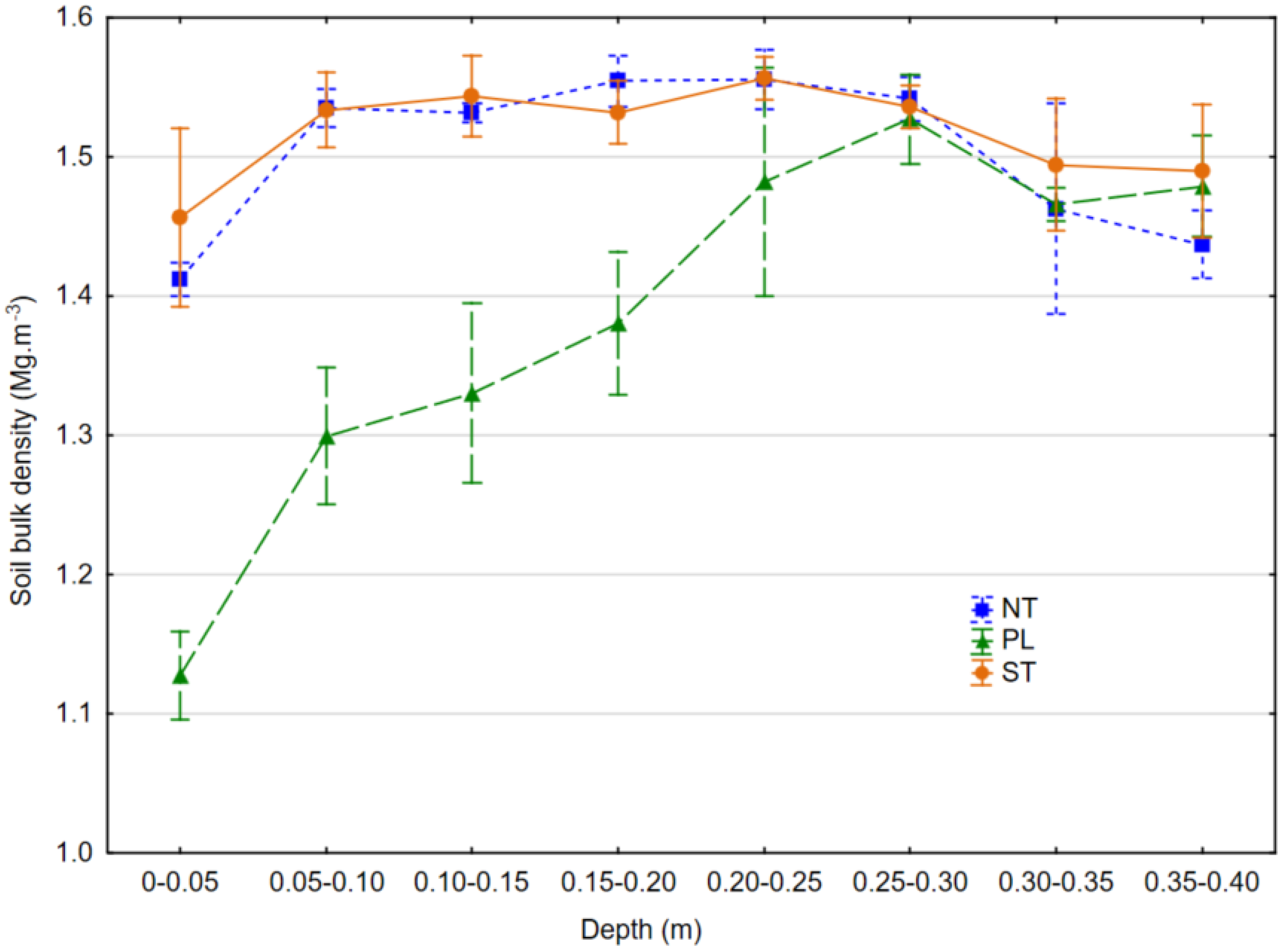
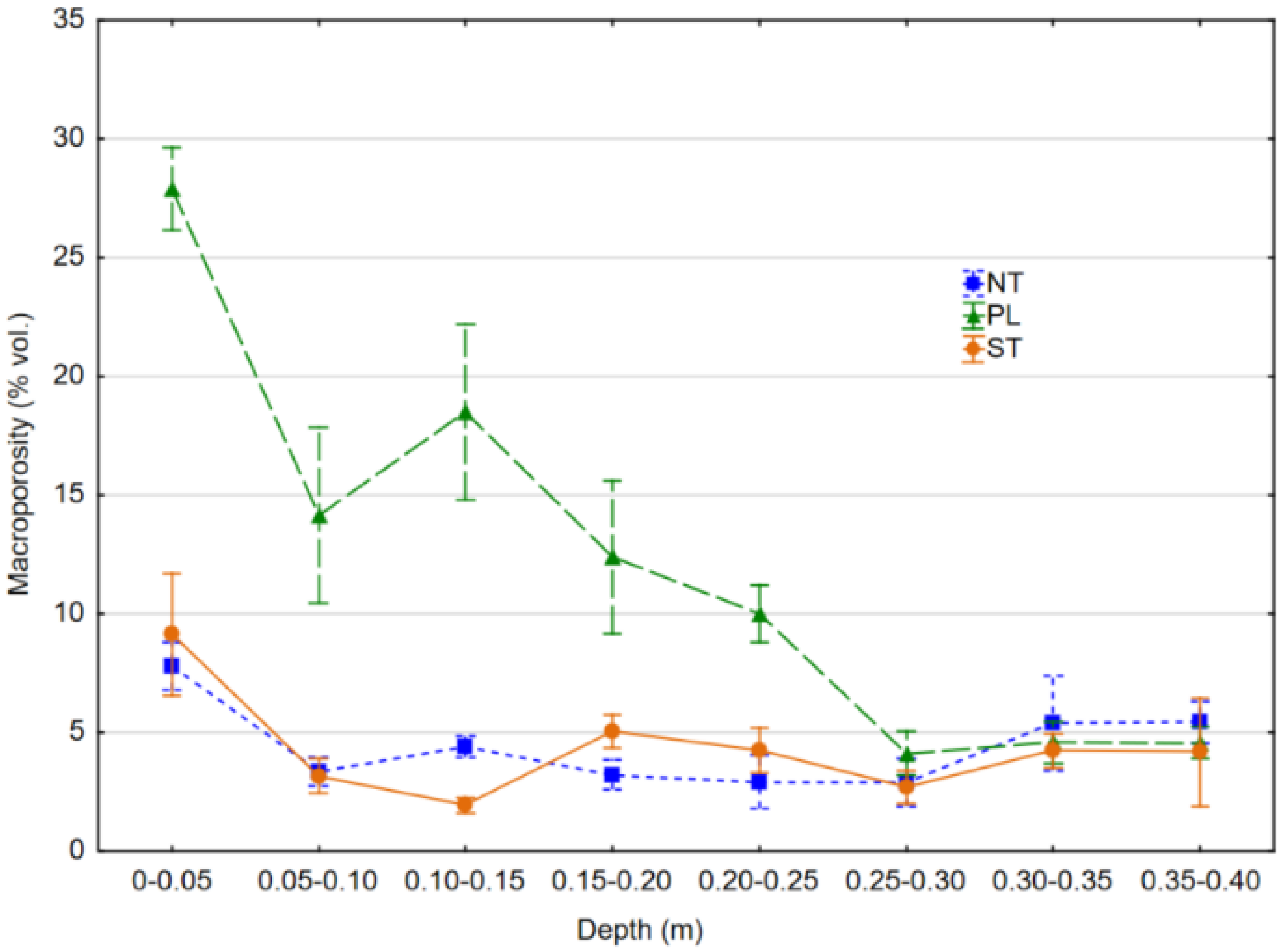
Bulk density values (Table 6) showed significant differences for the ploughed practice compared with shallow tillage and no tillage. These differences applied only to layers down to a depth of 0.20 m; in deeper layers, no significant differences were observed. With increasing depth, the values for ploughing (PL) became comparable to those of other practices (Figure 1). The macroporosity results (Table 6) showed significantly higher values in the ploughed practice. The values again became comparable at a depth of 0.25 m (Figure 2).

3.1.4. Cone Index

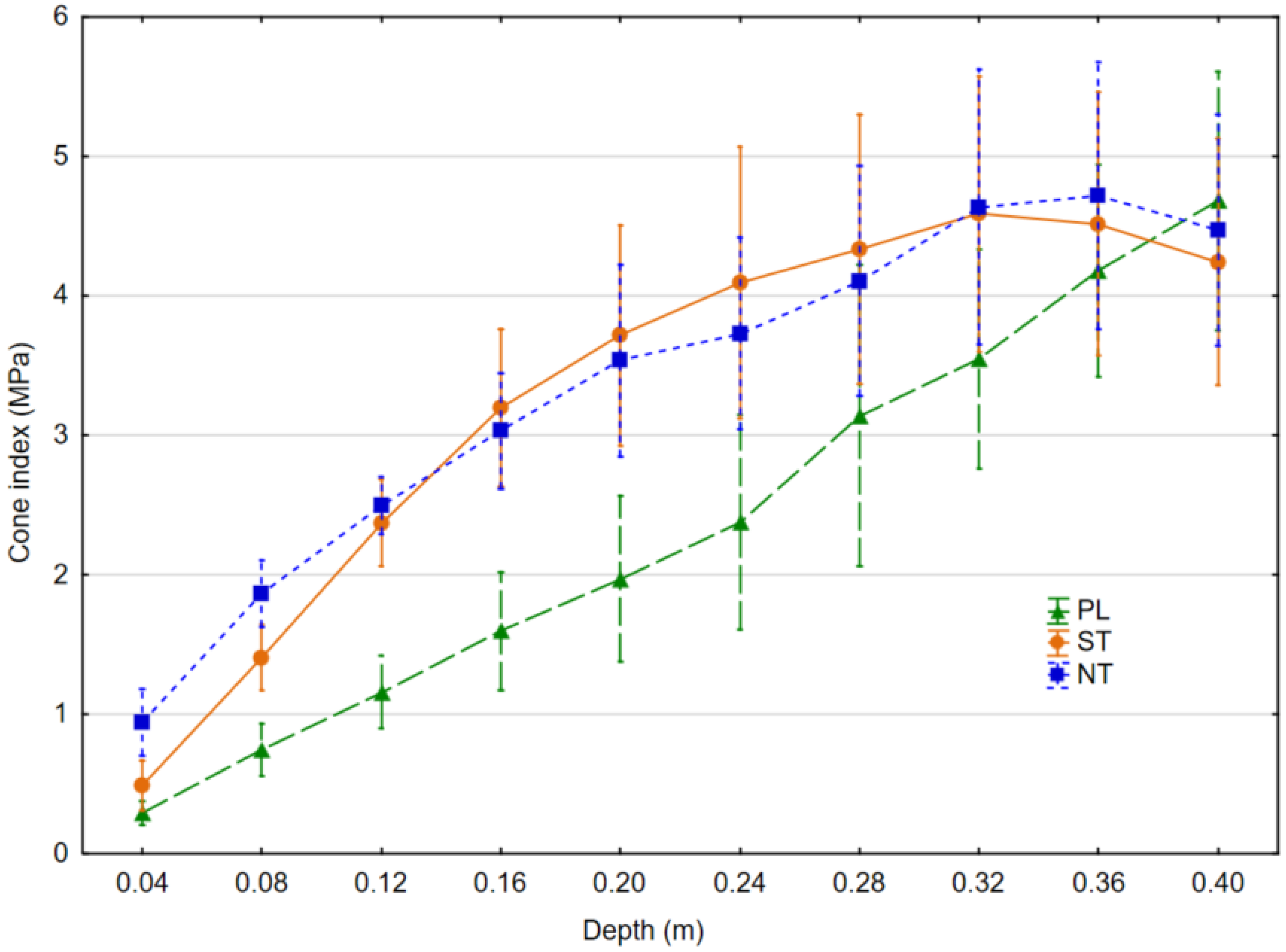
Cone index values (Table 7) did not show significant differences among the tillage variants, with the exception of ploughing (PL) at depths of 0.08 and 0.12 m, where the values were significantly lower than under other tillage methods. For ploughing (PL), lower values were generally observed within the tilled soil profile (Figure 3).

3.2. Water Infiltration

3.2.1. Ring Infiltration Method

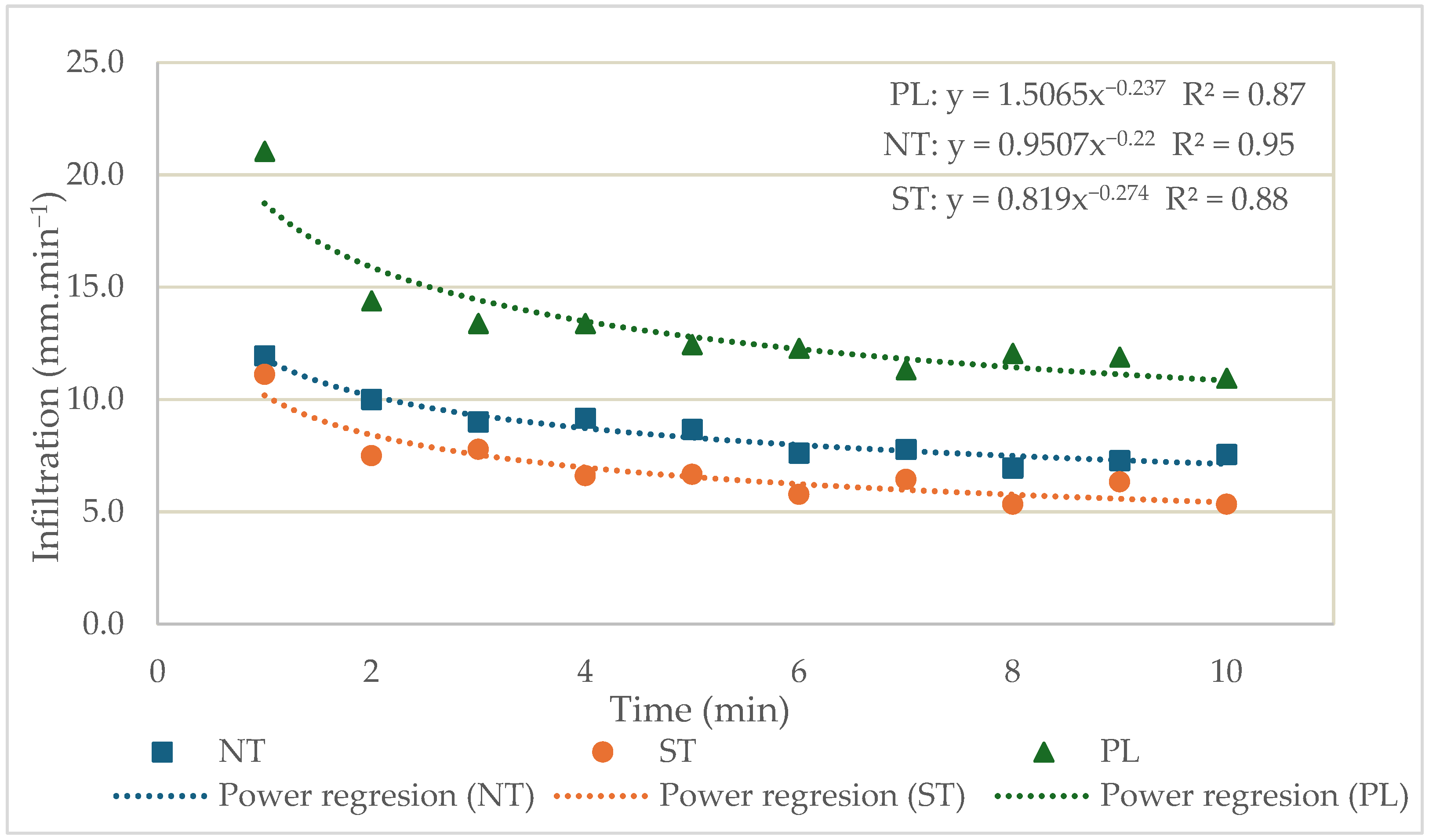
The results of infiltration measurements using ring infiltrometers are presented in Table 8. Among the evaluated variants, ploughing (PL) showed the highest infiltration capacity. The shallow tillage (ST) and no-tillage (NT) variants exhibited a similar course of infiltration rate. No significantly higher infiltration values were found.
Figure 4 shows the infiltration curves for individual variants. For all evaluated tillage methods, the infiltration of water into soil showed a typical decreasing trend over time, corresponding to the gradual saturation of the soil profile. The infiltration curves of all variants strongly correlated with a fitted power regression curve.
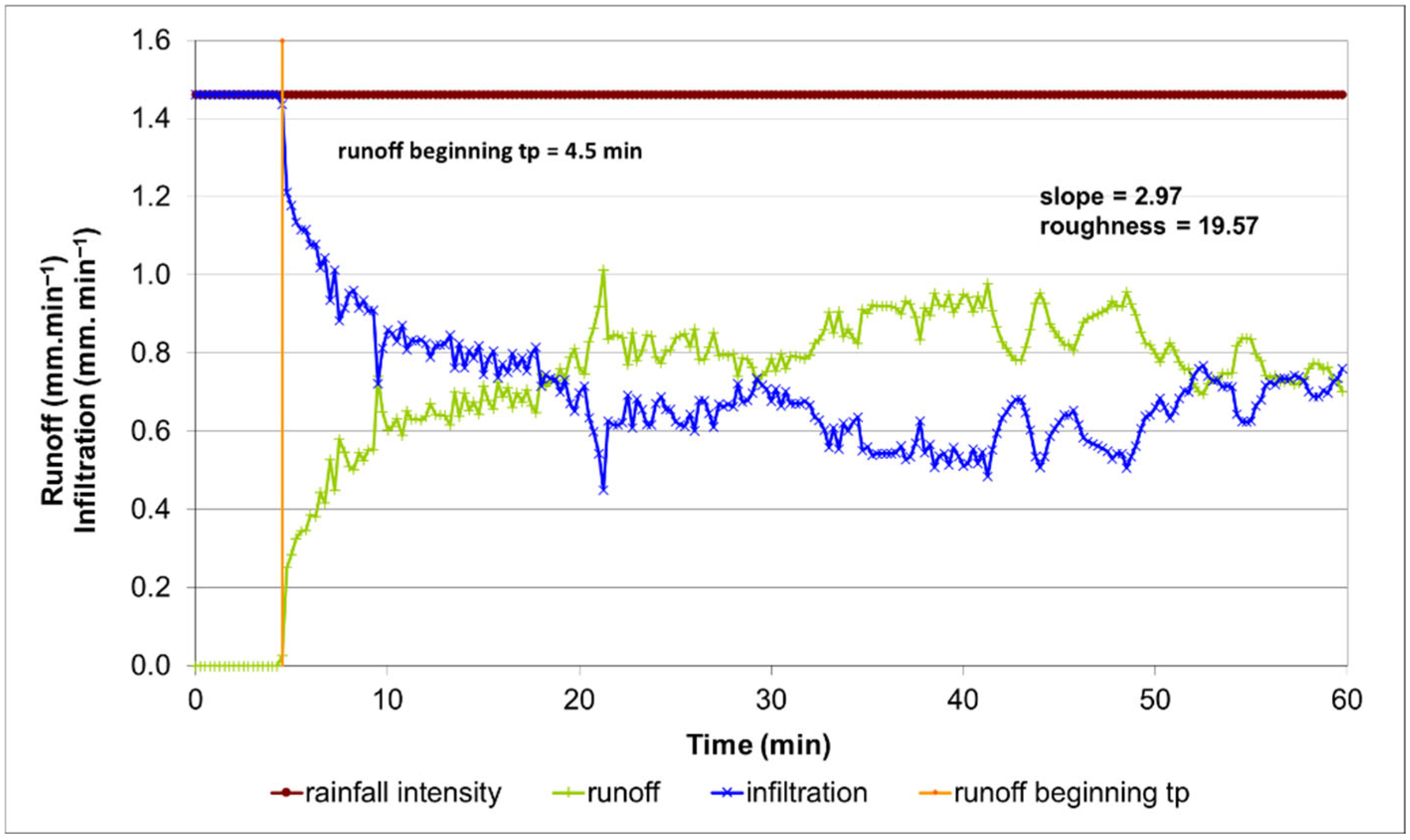
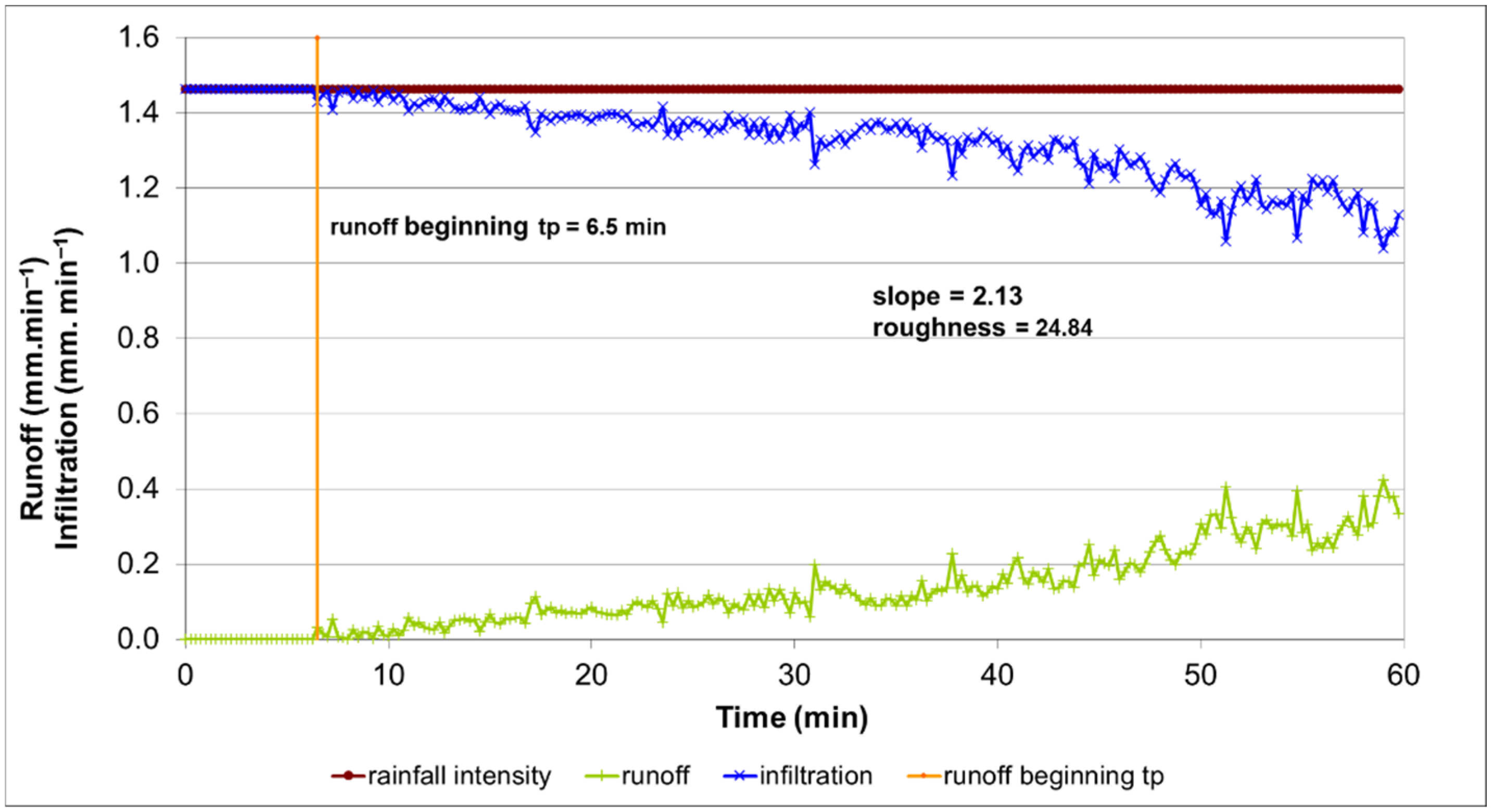
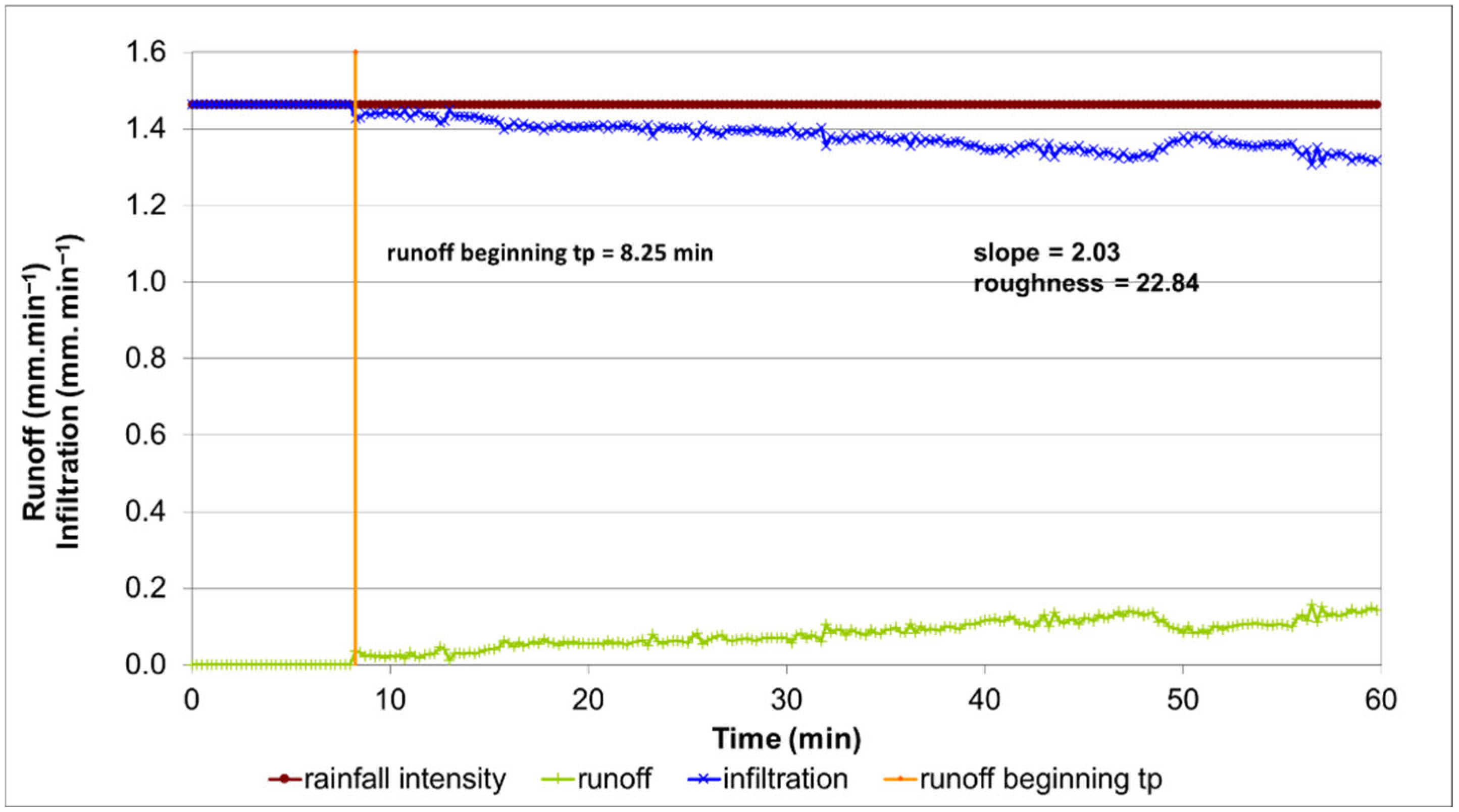
Figure 5, Figure 6 and Figure 7 provide an overview of the temporal course of infiltration, runoff, and runoff onset for individual tillage variants. From these curves, runoff onset times, as well as infiltration and runoff values after 60 min of rainfall simulation, were gradually derived. The graphs indicate differences in the timing of runoff onset from the monitored plot and also differences in the course of infiltration rate. The highest runoff was recorded on the rainfall-simulated plot after ploughing (PL), which also showed the earliest runoff onset at 4.5 min.

3.2.2. Blue Dye Tracer Method

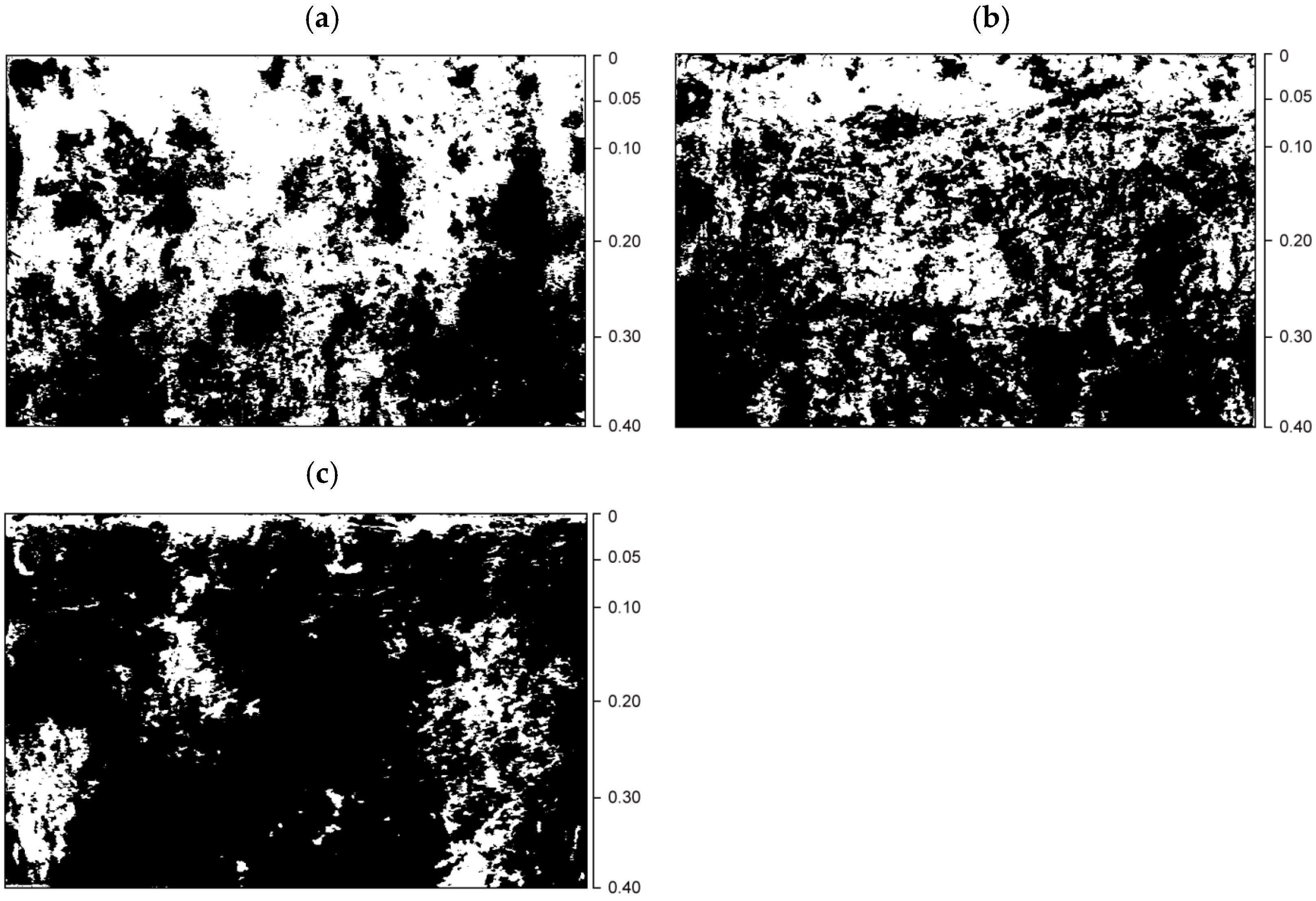
Figure 8 visualizes the percentage share of blue dye in the soil, and the corresponding values are reported in Table 9. The proportion of blue dye decreased with increasing depth. The highest values were observed under ploughing, where the intensively tilled profile exhibited a higher blue dye concentration than other tillage practices down to 0.2 m. At this depth, concentrations converged, and higher values were subsequently observed under shallow tillage and no-tillage.
Figure 8a illustrates the effect of a compacted subsoil layer that limited further, more intensive infiltration. Under the less intensive and shallower tillage practices, the distribution of blue dye was strongly influenced by the tillage depth. Figure 8b indicates a persistent influence of the compacted subsoil on the infiltration pattern and, additionally, the presence of a more compact soil layer at the depth corresponding to shallow tillage. In the no-tillage practice, cracks and macropores were characteristic and formed continuous preferential flow pathways (Figure 8c).

3.3. Statistical Evaluation

RDA indicated that 72.2% of the adjusted variation in the different soil variables measured could be explained by the explanatory factors (p = 0.001). To further dissect the effects of soil tillage and measurement depths on soil variables, VPA was employed. The VPA results revealed that different soil tillage practises accounted for the majority of the variation at 49.7%, while 25.7% of the variation was attributable to the differing measurement depths. The shared effects of both factors were observed to be 3.2% (Table 10).
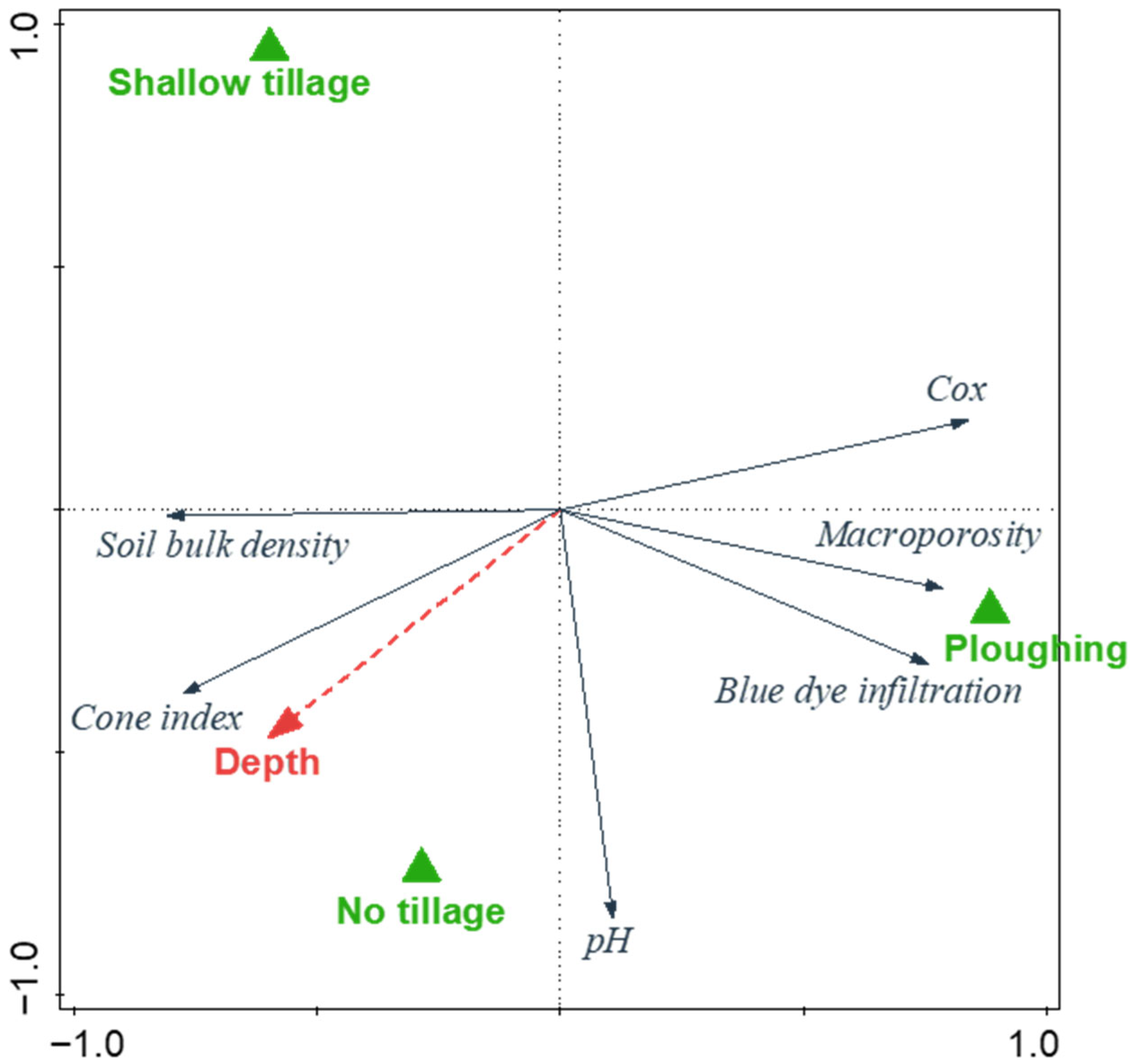
The first canonical axis (Figure 9) primarily separates infiltration-related and structural variables from compaction-related parameters. Cox, macroporosity, and blue dye infiltration are closely aligned and oriented in the same direction, indicating strong positive correlations among soil organic carbon, pore connectivity, and preferential water flow. In contrast, bulk density and cone index are positioned in the opposite direction and are positively associated with each other, reflecting the influence of soil compaction on limiting pore space and infiltration processes. The pH vector is oriented largely independently of the structural–hydrological gradient, suggesting a weaker contribution to the main pattern of variation explained by tillage and depth. Regarding management effects, ploughing is clearly associated with higher values of macroporosity, Cox, and blue dye infiltration, as indicated by its position along the positive side of the primary ordination axis. No-tillage practise is located opposite these variables and is more strongly associated with higher cone index and, partly, bulk density, reflecting greater soil resistance and compaction. Shallow tillage occupies an intermediate position between ploughing and no-tillage practise. The depth gradient is strongly aligned with cone index and partially with bulk density, indicating increasing soil resistance with depth. Conversely, depth is negatively associated with Cox, macroporosity, and blue dye infiltration, suggesting a decline in structural porosity and preferential flow capacity in deeper soil layers.

4. Discussion

4.1. Effect of Soil Tillage Practice on Soil Properties

Tillage practice and the associated distribution of post-harvest residues affect a wide range of physical, chemical, and biological soil properties. As reported by [12], different tillage practices and residue distribution can lead to substantial differences in soil properties, particularly under long-term use and when maize is grown as a monoculture. The results of soil’s physical analyses showed that soil’s physical properties are interrelated [32]. With increasing tillage intensity, bulk density and cone index decrease, whereas macroporosity increases within the tilled layer specific to the given technology.
Both ST and NT exhibited a denser and mechanically stronger near-surface profile relative to PL. These results match the commonly reported compaction increase after conversion to conservational tillage, particularly in the upper soil, where traffic and limited loosening can occur [33,34,35]. At the same time, several studies highlight that compaction diagnosis and remediation in NT-based practices should be evidence-driven because yield and water infiltration impacts depend on pore continuity, moisture regime, and biological structuring (roots/earthworms) [36,37].
Topsoil Cox was highest under ST (3.59% at 0–0.10 m) compared with PL (2.84%) and NT (2.63%); ST also showed the strongest stratification ratio for Cox. This is in line with evidence that reduced disturbance and surface residue inputs can promote organic C accumulation in surface layers and increase Cox stratification for conservational tillage [16,38]. In contrast, soil pH in ST was substantially lower (4.10 at 0–0.10 m) than in PL and NT (6.5–6.7). Such a strong pH divergence is not a universal feature of conservation tillage, but it is compatible with chemical stratification processes under surface fertilization and limited mixing and/or localized acidification in the fertilized zone under long-term management mentioned in [39,40]. The lower pH observed under ST treatment may reflect a combination of management-related factors, including surface straw incorporation and fertilization regime. Residue decomposition in the topsoil can increase organic acid production and microbial activity, while localized nitrogen fertilization may intensify nitrification-induced proton release, collectively contributing to soil acidification [41]. Recent global syntheses report that conservation tillage can induce nutrient and pH stratification but that pH responses may be inconsistent across studies and contexts [42].
In the present study, SAS measured by wet sieving in the 0–0.10 m layer showed a clear numerical trend, with the highest mean value under shallow tillage (ST = 0.42) compared with ploughing (PL = 0.28) and no-tillage method (NT = 0.26). The higher SAS under ST is consistent with the concurrently higher topsoil oxidizable carbon (Cox) observed in ST (3.59% at 0–0.10 m), given that SOC is widely recognized as an important binding agent contributing to aggregate stabilization, which can lead to delayed sealing and slower initiation of runoff [43,44]. From a process perspective, even a non-significant increase in SAS may still be relevant under rainfall simulation, because sealing dynamics can respond nonlinearly to surface structural vulnerability [45]; therefore, SAS should be interpreted jointly with rainfall simulator runoff and infiltration patterns rather than as a standalone indicator.
The multivariate ordination confirms that soil’s structural and hydrological parameters responded as an interconnected system. The strong alignment of Cox, macroporosity, and blue dye infiltration suggests that increases in soil organic carbon were associated with improved pore connectivity and preferential flow pathways. Conversely, the opposite positioning of bulk density and cone index demonstrates the constraining effect of compaction on infiltration processes. Thus, the RDA supports the mechanistic interpretation that tillage-induced structural modifications directly regulate soil water movement through changes in pore architecture.

4.2. Effect of Soil Tillage Practice on Water Infiltration

Ring infiltrometer measurements indicated higher infiltration in PL throughout the 10 min observation window (e.g., 21.1 mm min−1 at minute 1 in PL vs. 11.1/11.9 mm min−1 in ST/NT; 10.9 mm min−1 at minute 10 in PL vs. 5.3/7.6 mm min−1 in ST/NT). Using the rainfall simulator, runoff can also be quantified; it represents the inverse of water infiltration during the rainfall simulation. Based on the assessment of the physical properties, higher porosity and a lower degree of soil compaction were observed. This was also reflected in the values of ponded infiltration. However, when the kinetic energy of raindrops was introduced, the pattern was reversed. Rainfall simulation showed the highest runoff in PL, including the earliest runoff onset (4.5 min). Such divergence is plausible because ring infiltrometers primarily quantify infiltration under ponded conditions at a small scale, while rainfall simulators integrate additional processes [46]: raindrop impact, surface sealing/roughness decay [47], spatial flow convergence, and the connectivity of flow paths into deeper layers [48]. At the broader scale, meta-analysis [49] evidence indicates that NT can reduce runoff relative to conventional ploughing, but the magnitude and even direction of the effect depend on rainfall type, slope, clay content, and residue retention. In our case, the high runoff observed under PL despite high ring infiltration suggests that rainfall-driven processes (e.g., surface structural breakdown/sealing during the event and/or limited vertical continuity below the tilled layer) may have constrained infiltration at the plot scale, leading to earlier runoff generation.
Blue dye staining revealed that PL had substantially higher stained area at 0.05–0.10 m (58.1%) than ST (27.2%) and NT (33.0%), consistent with a highly conductive tilled layer that is not connected through compacted soil layer deeper into the soil [50]. At deeper layers, differences were statistically non-significant, yet NT tended to show larger stained areas in the subsoil (e.g., 15.4% at 0.30–0.35 m and 13.1% at 0.35–0.40 m) than PL (7.3% and 6.2%) [51]. This pattern supports the interpretation that conservation practices may rely more strongly on vertically connected preferential flow features (biopores/cracks) [52], whereas PL concentrates flow capacity in the disturbed topsoil with potentially weaker continuity into deeper horizons [53].
Water management will be one of the key sustainability domains in the context of changing climatic conditions, increasing weather extremes, and the associated risk of erosion events. The choice of appropriate technology plays a crucial role in this regard; moreover, reducing the intensity of tillage is one of the prerequisites for mitigating adverse impacts of agricultural activity. In view of securing feedstock for energy purposes, areas planted with maize are currently coming into conflict with mandated anti-erosion measures.

5. Conclusions

The study demonstrates the effect of tillage technology on changes in the distribution of Cox and the associated stability of soil aggregates, which appears to be a significant factor in enhancing soil resistance to erosion risks related to intense rainfall events. In addition to post-harvest crop residues, auxiliary (companion) crops grown simultaneously with the main crop are increasingly being implemented. This approach promotes the input of organic matter into the surface soil layer and may contribute to the improvement in stability of the topsoil in a manner similar to that of shallow tillage. Even over a relatively short period, changes in biological and physical properties were observed, with implications for the ecological functions of the soil. Shallow tillage (ST) exhibited the highest topsoil oxidizable carbon (Cox) in 0–0.10 m and the strongest Cox stratification, indicating pronounced accumulation of organic carbon in the surface layer. This elevated Cox was accompanied by a higher mean soil aggregate stability (SAS) in ST; soil aggregate stability under ST (0.42) was significantly higher than under PL (0.28) and NT (0.26), which is consistent with the stabilizing role of organic carbon in aggregate formation and resistance to slaking under wetting; however, SAS-related conclusions should be interpreted cautiously until the significance reporting for this variable becomes fully consistent. In contrast, ST showed markedly lower pH across 0–0.30 m compared with ploughing (PL) and no tillage (NT), pointing to strong chemical stratification/acidification under this management and highlighting the need to consider soil acidity as a key agronomic constraint in such practices.
Ploughing substantially modified the near-surface physical state within the disturbed layer, resulting in markedly higher macroporosity and lower bulk density in the upper profile (approximately the upper 0.20 m) compared with ST and NT. Cone index increased strongly with depth across all practices; significant practice differences were mainly restricted to the upper layer (around 0.08–0.12 m), where PL showed statistically lower penetration resistance than ST and NT.
Hydraulic responses were method-dependent. Ring infiltrometer measurements indicated the highest infiltration rates under PL throughout the short observation period, consistent with its high near-surface macroporosity. However, rainfall simulation produced the highest runoff and the earliest runoff initiation under PL, indicating that plot scale event response under intense rainfall can be governed by surface processes and vertical continuity constraints rather than by localized intake capacity alone. Dye tracer results further supported a strong practice imprint in the upper profile: PL exhibited significantly greater stained area at 0.05–0.10 m than ST and NT, whereas differences at greater depths were smaller and more variable, with ST/NT tending to show relatively higher staining in deeper layers.
Although the measured infiltration capacity and more favourable soil’s physical properties (particularly lower bulk density and higher macroporosity) indicate a potential for increased water intake, the results suggest that the actual infiltration response and erosion control effectiveness are largely governed by soil structural stability. This stability is influenced by the redistribution of organic matter within the soil profile and by soil aggregate stability, which affects the resistance of the surface layer to structural disturbance during intense rainfall, surface crust formation, and the continuity of infiltration pathways. Overall, the findings indicate that high infiltration capacity alone may be insufficient to consistently limit surface runoff and erosion without the support of a long-term stable soil structure.
The selection of tillage technology depends on local site-specific conditions; nevertheless, the overall trend is toward reduced tillage intensity, up to and including direct drilling, which is not currently practiced in the region. The findings of this study will contribute to the adoption and adaptation of conservation tillage technologies, including direct drilling. Within the framework of European agricultural policy, crop establishment practices are being critically reassessed, with an emphasis on reducing the intensity and depth of tillage, while also promoting biodiversity. Management recommendations require a more comprehensive approach, including the optimization of machinery traffic routes and consideration of site-specific soil conditions. These requirements are beyond the scope of the results presented here. Future research will focus on combined sowings to support biodiversity and to enhance the beneficial effects of auxiliary crops.

Supplementary Materials

The following supporting information can be downloaded at: https://www.mdpi.com/article/10.3390/agronomy16050551/s1.

Author Contributions

Conceptualization, M.K. and J.H.; methodology, F.H.; software, M.C.; validation, F.H., M.K., and J.H.; formal analysis, M.C.; investigation, F.H.; resources, M.K.; data curation, J.H.; writing—original draft preparation, F.H.; writing—review and editing, F.H.; visualization, F.H.; supervision, M.K.; project administration, M.K.; funding acquisition, M.K. All authors have read and agreed to the published version of the manuscript.

Funding

This research was funded by the Ministry of Agriculture of the Czech Republic, research project NAZV QK21010130.

Data Availability Statement

The original contributions presented in this study are included in the article/Supplementary Materials. Further inquiries can be directed to the corresponding author.

Conflicts of Interest

The authors declare no conflicts of interest. The funders had no role in the design of the study; in the collection, analyses, or interpretation of data; in the writing of the manuscript; or in the decision to publish the results.

Abbreviations

The following abbreviations are used in this manuscript:
PLploughing
STshallow tillage
NTno tillage
SASsoil aggregate stability
SOCCox–soil organic carbon
RDAredundancy analysis
VPAvariation partitioning analysis

References

  1. Tsiafouli, M.A.; Thébault, E.; Sgardelis, S.P.; de Ruiter, P.C.; van der Putten, W.H.; Birkhofer, K.; Hemerik, L.; de Vries, F.T.; Bardgett, R.D.; Brady, M.V.; et al. Intensive Agriculture Reduces Soil Biodiversity across Europe. Glob. Change Biol. 2015, 21, 973–985. [Google Scholar] [CrossRef] [PubMed]
  2. Jin, V.L.; Wienhold, B.J.; Mikha, M.M.; Schmer, M.R. Cropping System Partially Offsets Tillage-Related Degradation of Soil Organic Carbon and Aggregate Properties in a 30-Yr Rainfed Agroecosystem. Soil Tillage Res. 2021, 209, 104968. [Google Scholar] [CrossRef]
  3. Six, J.; Elliott, E.T.; Paustian, K. Soil Structure and Soil Organic Matter II. A Normalized Stability Index and the Effect of Mineralogy. Soil Sci. Soc. Am. J. 2000, 64, 1042–1049. [Google Scholar] [CrossRef]
  4. Katsvairo, T.; Cox, W.J.; van Es, H. Tillage and Rotation Effects on Soil Physical Characteristics. Agron. J. 2002, 94, 299–304. [Google Scholar] [CrossRef]
  5. Panagos, P.; Standardi, G.; Borrelli, P.; Lugato, E.; Montanarella, L.; Bosello, F. Cost of Agricultural Productivity Loss Due to Soil Erosion in the European Union: From Direct Cost Evaluation Approaches to the Use of Macroeconomic Models. Land Degrad. Dev. 2018, 29, 471–484. [Google Scholar] [CrossRef]
  6. Mhazo, N.; Chivenge, P.; Chaplot, V. Tillage Impact on Soil Erosion by Water: Discrepancies Due to Climate and Soil Characteristics. Agric. Ecosyst. Environ. 2016, 230, 231–241. [Google Scholar] [CrossRef]
  7. Hanel, M.; Máca, P.; Bašta, P.; Vlnas, R.; Pech, P. The Rainfall Erosivity Factor in the Czech Republic and Its Uncertainty. Hydrol. Earth Syst. Sci. 2016, 20, 4307–4322. [Google Scholar] [CrossRef]
  8. Kapička, J.; Kolbabová, V.; Bauer, M.; Dostál, T.; Kavka, P.; Krása, J.; Achasova, A. Determination of Soil Loss on Agricultural Land Based on Field Measurements in the Czech Republic. Soil Water Res. 2025, 20, 253–264. [Google Scholar] [CrossRef]
  9. Gebhart, M.; Dumbrovský, M.; Šarapatka, B.; Drbal, K.; Bednář, M.; Kapička, J.; Pavlík, F.; Kottová, B.; Zástěra, V.; Muchová, Z. Evaluation of Monitored Erosion Events in the Context of Characteristics of Source Areas in Czech Conditions. Agronomy 2023, 13, 256. [Google Scholar] [CrossRef]
  10. Lipiec, J.; Kuś, J.; Słowińska-Jurkiewicz, A.; Nosalewicz, A. Soil Porosity and Water Infiltration as Influenced by Tillage Methods. Soil Tillage Res. 2006, 89, 210–220. [Google Scholar] [CrossRef]
  11. Mpelasoka, F.S.; Chiew, F.H.S. Influence of Rainfall Scenario Construction Methods on Runoff Projections. J. Hydrometeorol. 2009, 10, 1168–1183. [Google Scholar] [CrossRef]
  12. Dam, R.F.; Mehdi, B.B.; Burgess, M.S.E.; Madramootoo, C.A.; Mehuys, G.R.; Callum, I.R. Soil Bulk Density and Crop Yield under Eleven Consecutive Years of Corn with Different Tillage and Residue Practices in a Sandy Loam Soil in Central Canada. Soil Tillage Res. 2005, 84, 41–53. [Google Scholar] [CrossRef]
  13. Pachepsky, Y.A.; Rawls, W.J. Soil Structure and Pedotransfer Functions. Eur. J. Soil Sci. 2003, 54, 443–452. [Google Scholar] [CrossRef]
  14. Bronick, C.J.; Lal, R. Soil Structure and Management: A Review. Geoderma 2005, 124, 3–22. [Google Scholar] [CrossRef]
  15. Toth, M.; Davies, J.; Quinton, J.; Davies, J.; Stumpp, C.; Klik, A.; Mehdi-Schulz, B.; Strauss, P.; Liebhard, G.; Bartmann, J.; et al. Long-Term Effects of Tillage Practices and Future Climate Scenarios on Topsoil Organic Carbon Stocks in Lower Austria—A Modelling and Long-Term Experiment Study. Int. Soil Water Conserv. Res. 2025, 13, 486–499. [Google Scholar] [CrossRef]
  16. Franzluebbers, A.J. Water Infiltration and Soil Structure Related to Organic Matter and Its Stratification with Depth. Soil Tillage Res. 2002, 66, 197–205. [Google Scholar] [CrossRef]
  17. Kovács, G.P.; Simon, B.; Balla, I.; Bozóki, B.; Dekemati, I.; Gyuricza, C.; Percze, A.; Birkás, M. Conservation Tillage Improves Soil Quality and Crop Yield in Hungary. Agronomy 2023, 13, 894. [Google Scholar] [CrossRef]
  18. Pittelkow, C.M.; Linquist, B.A.; Lundy, M.E.; Liang, X.; van Groenigen, K.J.; Lee, J.; van Gestel, N.; Six, J.; Venterea, R.T.; van Kessel, C. When Does No-till Yield More? A Global Meta-Analysis. Field Crops Res. 2015, 183, 156–168. [Google Scholar] [CrossRef]
  19. Strudley, M.W.; Green, T.R.; Ascough, J.C. Tillage Effects on Soil Hydraulic Properties in Space and Time: State of the Science. Soil Tillage Res. 2008, 99, 4–48. [Google Scholar] [CrossRef]
  20. DeLaune, P.B.; Sij, J.W. Impact of Tillage on Runoff in Long Term No-till Wheat Systems. Soil Tillage Res. 2012, 124, 32–35. [Google Scholar] [CrossRef]
  21. European Parliament and the Council of the European Union. Regulation (EU) 2021/2115 of the European Parliament and of the Council of 2 December 2021 establishing rules on support for strategic plans to be drawn up by Member States under the common agricultural policy (CAP Strategic Plans) and financed by the European Agricultural Guarantee Fund (EAGF) and by the European Agricultural Fund for Rural Development (EAFRD) and repealing Regulations (EU) No 1305/2013 and (EU) No 1307/2013. Off. J. Eur. Union 2021, L 435, 1–186. Available online: http://data.europa.eu/eli/reg/2021/2115/oj (accessed on 13 February 2026).
  22. Kathiravelu, G.; Lucke, T.; Nichols, P. Rain Drop Measurement Techniques: A Review. Water 2016, 8, 29. [Google Scholar] [CrossRef]
  23. Assouline, S.; El Idrissi, A.; Persoons, E. Modelling the Physical Characteristics of Simulated Rainfall: A Comparison with Natural Rainfall. J. Hydrol. 1997, 196, 336–347. [Google Scholar] [CrossRef]
  24. Abudi, I.; Carmi, G.; Berliner, P. Rainfall Simulator for Field Runoff Studies. J. Hydrol. 2012, 454–455, 76–81. [Google Scholar] [CrossRef]
  25. Esteves, M.; Planchon, O.; Lapetite, J.M.; Silvera, N.; Cadet, P. The “EMIRE” Large Rainfall Simulator: Design and Field Testing. In Earth Surface Processes and Landforms; John Wiley & Sons Ltd.: Hoboken, NJ, USA, 2000; Volume 25, pp. 681–690. [Google Scholar] [CrossRef]
  26. Pérez-Latorre, F.J.; de Castro, L.; Delgado, A. A Comparison of Two Variable Intensity Rainfall Simulators for Runoff Studies. Soil Tillage Res. 2010, 107, 11–16. [Google Scholar] [CrossRef]
  27. Guidry, A.R.; Schindler, F.V.; German, D.R.; Gelderman, R.H.; Gerwing, J.R. Using Simulated Rainfall to Evaluate Field and Indoor Surface Runoff Phosphorus Relationships. J. Environ. Qual. 2006, 35, 2236–2243. [Google Scholar] [CrossRef]
  28. Nelson, D.W.; Sommers, L.E. Total Carbon, Organic Carbon, and Organic Matter. In Methods of Soil Analysis: Part 3 Chemical Methods; Wiley: Hoboken, NJ, USA, 1996; pp. 961–1010. [Google Scholar] [CrossRef]
  29. Thomas, G.W. Soil PH and Soil Acidity. In Methods of Soil Analysis: Part 3 Chemical Methods; Wiley: Hoboken, NJ, USA, 1996; pp. 475–490. [Google Scholar] [CrossRef]
  30. ASAE S313.3 FEB1999 (R2023); Soil Cone Penetrometer. American Society of Agricultural and Biological Engineers (ASABE): St. Joseph, MI, USA, 1999.
  31. Anken, T.; Weisskopf, P.; Zihlmann, U.; Forrer, H.; Jansa, J.; Perhacova, K. Long-Term Tillage System Effects under Moist Cool Conditions in Switzerland. Soil Tillage Res. 2004, 78, 171–183. [Google Scholar] [CrossRef]
  32. Schlüter, S.; Großmann, C.; Diel, J.; Wu, G.M.; Tischer, S.; Deubel, A.; Rücknagel, J. Long-Term Effects of Conventional and Reduced Tillage on Soil Structure, Soil Ecological and Soil Hydraulic Properties. Geoderma 2018, 332, 10–19. [Google Scholar] [CrossRef]
  33. Qian, Y.; Zhang, Z.; Jiang, F.; Wang, J.; Dong, F.; Liu, J.; Peng, X. Impacts of Tillage Treatments on Soil Physical Properties and Maize Growth at Two Sites under Different Climatic Conditions in Black Soil Region of Northeast China. Soil Tillage Res. 2025, 248, 106471. [Google Scholar] [CrossRef]
  34. Çelika, I. Effects of Tillage Methods on Penetration Resistance, Bulk Density and Saturated Hydraulic Conductivity in a Clayey Soil Conditions. Tarim Bilim. Derg. 2011, 17, 143–156. [Google Scholar] [CrossRef]
  35. Salem, H.M.; Valero, C.; Muñoz, M.Á.; Rodríguez, M.G.; Silva, L.L. Short-Term Effects of Four Tillage Practices on Soil Physical Properties, Soil Water Potential, and Maize Yield. Geoderma 2015, 237–238, 60–70. [Google Scholar] [CrossRef]
  36. Mele, G.; Buscemi, G.; Gargiulo, L.; Terribile, F. Soil Burrow Characterization by 3D Image Analysis: Prediction of Macroinvertebrate Groups from Biopore Size Distribution Parameters. Geoderma 2021, 404, 115292. [Google Scholar] [CrossRef]
  37. Achankeng, E.; Cornelis, W. Conservation Tillage Effects on European Crop Yields: A Meta-Analysis. Field Crops Res. 2023, 298, 108967. [Google Scholar] [CrossRef]
  38. Hermle, S.; Anken, T.; Leifeld, J.; Weisskopf, P. The Effect of the Tillage System on Soil Organic Carbon Content under Moist, Cold-Temperate Conditions. Soil Tillage Res. 2008, 98, 94–105. [Google Scholar] [CrossRef]
  39. Limousin, G.; Tessier, D. Effects of No-Tillage on Chemical Gradients and Topsoil Acidification. Soil Tillage Res. 2007, 92, 167–174. [Google Scholar] [CrossRef]
  40. Alves, L.A.; Fontoura, S.M.V.; Ambrosini, V.G.; Pesini, G.; Flores, J.P.M.; Bayer, C.; Tiecher, T. Impacts of Tillage and Liming on Crop Yields and Soil Acidity Correction: Insights from a 32-Year Experiment in Southern Brazil. Plant Soil 2025, 511, 1621–1640. [Google Scholar] [CrossRef]
  41. Spiegel, H.; Dersch, G.; Hösch, J.; Baumgarten, A. Tillage Effects on Soil Organic Carbon and Nutrient Availability in a Long-Term Field Experiment in Austria. Bodenkultur 2007, 58, 47–58. [Google Scholar]
  42. Peixoto, D.S.; da Silva, L.D.C.M.; de Melo, L.B.B.; Azevedo, R.P.; Araújo, B.C.L.; de Carvalho, T.S.; Moreira, S.G.; Curi, N.; Silva, B.M. Occasional Tillage in No-Tillage Systems: A Global Meta-Analysis. Sci. Total Environ. 2020, 745, 140887. [Google Scholar] [CrossRef]
  43. Samson, M.E.; Chantigny, M.H.; Vanasse, A.; Menasseri-Aubry, S.; Royer, I.; Angers, D.A. Management Practices Differently Affect Particulate and Mineral-Associated Organic Matter and Their Precursors in Arable Soils. Soil Biol. Biochem. 2020, 148, 107867. [Google Scholar] [CrossRef]
  44. Jacobs, A.; Rauber, R.; Ludwig, B. Impact of Reduced Tillage on Carbon and Nitrogen Storage of Two Haplic Luvisols after 40 Years. Soil Tillage Res. 2009, 102, 158–164. [Google Scholar] [CrossRef]
  45. Basset, C.; Abou Najm, M.; Ghezzehei, T.; Hao, X.; Daccache, A. How Does Soil Structure Affect Water Infiltration? A Meta-Data Systematic Review. Soil Tillage Res. 2023, 226, 105577. [Google Scholar] [CrossRef]
  46. Vahabi, J.; Nikkami, D. Assessing Dominant Factors Affecting Soil Erosion Using a Portable Rainfall Simulator. Int. J. Sediment Res. 2008, 23, 376–386. [Google Scholar] [CrossRef]
  47. Bahddou, S.; Otten, W.; Whalley, W.R.; Shin, H.C.; El Gharous, M.; Rickson, R.J. Changes in Soil Surface Properties Under Simulated Rainfall and the Effect of Surface Roughness on Runoff, Infiltration and Soil Loss. Geoderma 2023, 431, 116341. [Google Scholar] [CrossRef]
  48. Huang, J.; Wu, P.; Zhao, X. Effects of Rainfall Intensity, Underlying Surface and Slope Gradient on Soil Infiltration Under Simulated Rainfall Experiments. Catena 2013, 104, 93–102. [Google Scholar] [CrossRef]
  49. Sun, Y.; Zeng, Y.; Shi, Q.; Pan, X.; Huang, S. No-Tillage Controls on Runoff: A Meta-Analysis. Soil Tillage Res. 2015, 153, 1–6. [Google Scholar] [CrossRef]
  50. Kasteel, R.; Garnier, P.; Vachier, P.; Coquet, Y. Dye Tracer Infiltration in the Plough Layer after Straw Incorporation. Geoderma 2007, 137, 360–369. [Google Scholar] [CrossRef]
  51. Hangen, E.; Buczko, U.; Bens, O.; Brunotte, J.; Hüttl, R.F. Infiltration Patterns into Two Soils under Conventional and Conservation Tillage: Influence of the Spatial Distribution of Plant Root Structures and Soil Animal Activity. Soil Tillage Res. 2002, 63, 181–186. [Google Scholar] [CrossRef]
  52. Shipitalo, M.J.; Dick, W.A.; Edwards, W.M. Conservation Tillage and Macropore Factors That Affect Water Movement and the Fate of Chemicals. Soil Tillage Res. 2000, 53, 167–183. [Google Scholar] [CrossRef]
  53. Turpin, K.M.; Lapen, D.R.; Topp, E.; Robin, M.J.L.; Edwards, M.; Curnoe, W.E.; Ball Coelho, B.; McLaughlin, N.B.; Payne, M. Tine-Influenced Infiltration Patterns and Informing Timing of Liquid Amendment Applications Using Brilliant Blue Dye Tracers. Biosyst. Eng. 2007, 98, 235–247. [Google Scholar] [CrossRef]
Figure 1. Mean soil bulk density affected by tillage practices and soil depth. Error bars indicate ± 1 S.E. NT—no tillage, PL—ploughing, ST—shallow tillage.
Agronomy 16 00551 g001
Figure 2. Mean macroporosity of soil affected by tillage practices and soil depth. Error bars indicate ± 1 S.E. NT—no-tillage, PL—ploughing, ST—shallow tillage.
Agronomy 16 00551 g002
Figure 3. Mean cone index for three different tillage methods. Error bars indicate ± 1 S.E. NT—no tillage, PL—ploughing, ST—shallow tillage.
Agronomy 16 00551 g003
Figure 4. Infiltration values for all evaluated tillage practices. The infiltrations are fitted with power regression curves. NT—no tillage, PL—ploughing, ST—shallow tillage.
Agronomy 16 00551 g004
Figure 5. Runoff and water infiltration under 87.8 mm·h−1 simulated rainfall for ploughing tillage practice.
Agronomy 16 00551 g005
Figure 6. Runoff and water infiltration under 87.8 mm·h−1 simulated rainfall for shallow tillage practice.
Agronomy 16 00551 g006
Figure 7. Runoff and water infiltration under 87.8 mm·h−1 simulated rainfall for no-till practice.
Agronomy 16 00551 g007
Figure 8. Vertical soil profiles where coloured water infiltration was monitored. White colour represents blue dyed water; black colour is soil: (a) ploughing (PL); (b) shallow tillage (ST); (c) no tillage (NT).
Agronomy 16 00551 g008
Figure 9. Ordination diagram of redundancy analysis (RDA), showing relationships between measured soil variables and explanatory variables (soil tillage and measurement depth).
Agronomy 16 00551 g009
Table 1. Surface (0–0.20 m) characteristic of the experimental site where the multi-year effects of three tillage practices were evaluated.
FAO ClassificationLuvic Chernozem
TextureSilty clay
Clay (%)45.7
Silt (%)42.7
Sand (%)11.6
Slope (°)2.2–2.9
Mean elevation (m a.s.l.)280
Mean annual precipitation (mm)480
Mean year temperature (°C)9.8
Table 2. Effects of the tillage practices on Cox (%) and pH (-) at different depths. Significant differences at α = 0.05 in terms of evaluated technology are indicated by the different letters (a, b). NT—no tillage, PL—ploughing, ST—shallow tillage.
Depth (m)Tillage PracticeAverage Cox Value (%)Average pH Value (-)
0–0.1NT2.63 a6.64 a
PL2.84 a6.51 a
ST3.59 b4.10 b
0.1–0.2NT2.31 a6.69 a
PL2.72 a6.61 a
ST2.36 a5.51 b
0.2–0.3NT1.97 a6.74 a
PL2.67 b6.62 a
ST2.15 ab5.74 b
F-ratio 4.1568.92
p-value <0.05<0.05
Table 3. Effects of tillage practices on Cox (%) and pH (-) at different depths. Significant differences at α = 0.05 in terms of evaluated depth are indicated by different letters (a, b). NT—no tillage, PL—ploughing, ST—shallow tillage.
Tillage PracticeDepth (m)Average Cox Value (%)Average pH Value (-)
PL0–0.12.84 a6.51 a
0.1–0.22.72 a6.61 a
0.2–0.32.67 a6.62 a
NT0–0.12.63 a6.64 a
0.1–0.22.31 ab6.69 a
0.2–0.31.97 b6.74 a
ST0–0.13.59 a4.10 a
0.1–0.22.36 b5.51 b
0.2–0.32.15 b5.74 b
F-ratio 4.1568.92
p-value <0.05<0.05
Table 4. Effects of tillage practices on Cox and pH ratio between values from 0 to 0.10 m and 0.10–0.20 m. NT—no tillage, PL—ploughing, ST—shallow tillage.
Tillage PracticeRatio CoxRatio pH
NT1.141.01
PL1.051.02
ST1.531.34
Table 5. Effects of the tillage practices on soil aggregates stability (SAS) at depth of 0–0.10 m. Significant differences at α = 0.05 in terms of evaluated technology are indicated by different letters (a, b). NT—No-tillage, PL—Ploughing, ST—Shallow tillage.
Tillage PracticeAverage Value
NT0.26a
PL0.28a
ST0.42b
F-ratio 23.94
p-value <0.05
Table 6. Effects of tillage practices on macroporosity (% vol.) and soil bulk density (Mg·m−3) at different depths. Significant differences at α = 0.05 in terms of evaluated depth of soil profile are indicated by different letters (a, b). NT—no tillage, PL—ploughing, ST—shallow tillage.
Macroporosity (% vol.)Soil Bulk Density (Mg·m−3)
Tillage PracticeTillage Practice
Depth (m)PL ST NT PL ST NT
0–0.0527.90a9.13b7.82b1.13b1.46a1.41a
0.05–0.1014.13a3.16b3.35b1.3b1.53a1.54a
0.10–0.1518.50a1.95b4.42b1.33b1.54a1.53a
0.15–0.2012.39a5.06ab3.23b1.38b1.53ab1.56a
0.20–0.2510.01a4.25a2.91a1.48a1.56a1.56a
0.25–0.304.13a2.70a2.90a1.53a1.54a1.54a
0.30–0.354.58a4.23a5.40a1.47a1.49a1.46a
0.35–0.404.56a4.19a5.44a1.48a1.49a1.44a
F-ratio 6.69 6.69 6.69 3.86 3.86 3.86
p-value <0.05 <0.05 <0.05 <0.05 <0.05 <0.05
Table 7. Effects of tillage practices on cone index (MPa) at different depths of soil profile. Significant differences at α = 0.05 in terms of evaluated depth of soil profile are indicated by different letters (a, b). NT—no tillage, PL—ploughing, ST—shallow tillage.
Cone Index (MPa)
Tillage Practice
Depth (m)NT ST PL
0.040.94a0.49a0.30a
0.081.86a1.41a0.74b
0.122.50a2.37a1.16b
0.162.78a3.00a1.91a
0.203.29a3.46a2.44a
0.244.26a4.59a2.88a
0.284.11a4.33a3.14a
0.324.64a4.59a3.55a
0.364.72a4.52a4.18a
0.404.47a4.24a4.68a
F-ratio 3.90 3.90 3.90
p-value <0.05 <0.05 <0.05
Table 8. Effects of tillage practices on water infiltration (mm·min−1) for three different tillage practices. Significant differences at α = 0.05 in terms of evaluated time of water infiltration are non-significant (ns). NT—no tillage, PL—ploughing, ST—shallow tillage.
Infiltration (mm·min−1)
Tillage Practice
Time (min)PL ST NT
121.1ns11.1ns11.9ns
214.4ns7.5ns10.0ns
313.4ns7.8ns9.0ns
413.4ns6.6ns9.2ns
512.4ns6.7ns8.7ns
612.3ns5.8ns7.6ns
711.3ns6.4ns7.8ns
812.1ns5.3ns6.9ns
911.9ns6.3ns7.3ns
1010.9ns5.3ns7.6ns
F-ratio 1.80 1.80 1.80
p-value 0.99 0.99 0.99
Table 9. Effects of tillage practices on infiltration patterns (%). Significant differences at α = 0.05 in terms of evaluated depth of soil profile are indicated by different letters (a, b). NT—no tillage, PL—ploughing, ST—shallow tillage.
Coloured Surface (%)
Tillage Practice
Depth (m)PL ST NT
0–0.0576.2a69.2a63.4a
0.05–0.1058.1a27.2b33.0b
0.10–0.1531.1a18.3a22.4a
0.15–0.2021.7a21.7a19.6a
0.20–0.2516.3a21.4a18.3a
0.25–0.3010.0a18.5a17.2a
0.30–0.357.3a8.9a15.4a
0.35–0.406.2a8.3a13.1a
F-ratio 5.73 5.73 5.73
p-value <0.05 <0.05 <0.05
Table 10. Redundancy analysis (RDA) and variation partitioning analysis (VPA) of the effects of explanatory variables on measured variables. F-ratio for the test of significance of all (first) canonical axes; p-value—corresponding probability value obtained by the Monte Carlo permutation test (999 permutations); %—the percentage of adjusted explained variation accounted for by explanatory variables.
Explanatory VariablesF-Ratiop-Value% of Explained Variation
Soil tillage + depth28.70.00172.2
Soil tillage14.90.00149.7
Depth10.30.00125.7
(Combined effects) (−3.2)
Disclaimer/Publisher’s Note: The statements, opinions and data contained in all publications are solely those of the individual author(s) and contributor(s) and not of MDPI and/or the editor(s). MDPI and/or the editor(s) disclaim responsibility for any injury to people or property resulting from any ideas, methods, instructions or products referred to in the content.