1. Introduction
As a staple food crop in China, rice is closely linked to daily human life. For decades, rice production in China has focused on cultivating varieties with traits such as lodging resistance, short stature, and high fertilizer tolerance, while continuously increasing fertilizer application [
1,
2,
3]. This approach has contributed to higher yields and enhanced food security. However, it has also led to a series of challenges, including rising input costs, aggravated environmental pollution, and relatively low overall economic benefits, which increasingly impact public health. While yield, quality, or nitrogen use efficiency (NUE) are common targets in rice variety screening, reliance on any single parameter may provide an incomplete assessment of overall performance. Recently, some scholars have begun to explore the relationship between rice quality and yield [
4]. Nevertheless, the application of UAV-based spectral technology specifically for classifying rice varieties based on comprehensive nitrogen use efficiency (NUE) types remains relatively limited. Hyperspectral remote sensing, meanwhile, has advanced rapidly and is now widely applied across multiple fields. With the increasing demand for efficiency and sustainability, this technology shows particularly promising prospects in intelligent agriculture [
5,
6]. Against the backdrop of a growing global population and diminishing arable land, improving rice yield and NUE has become an urgent issue that must be addressed to ensure food security. When selecting nitrogen-efficient rice varieties, an integrated assessment that simultaneously considers yield, quality, and nitrogen response is highly desirable to avoid trade-offs and achieve balanced improvement. Nevertheless, some varieties have demonstrated the ability to achieve high yields through efficient nitrogen utilization [
7,
8,
9].
NUE is a complex trait influenced by numerous factors, including nitrogen uptake efficiency, nitrogen utilization efficiency, nitrogen remobilization, and their interactions with environmental conditions and agronomic management, leading researchers to employ different indicators for screening. Bashir [
10] proposed relative tiller number and relative dry matter weight as suitable criteria for identifying nitrogen-efficient rice germplasm. Chen et al. [
11] found that nitrogen-efficient varieties exhibited a significantly higher leaf area index at both the heading and maturity stages compared to inefficient varieties, suggesting this parameter as a useful indicator. Wang et al. [
12] recommended using tiller number at the early growth stage, along with yield per plant, biomass, and the number of effective panicles throughout the growth cycle, as screening criteria. Furthermore, Chu et al. [
13] demonstrated that high-yielding and nitrogen-efficient varieties are characterized by greater aboveground biomass, more grains per panicle, and higher total nitrogen uptake. Collectively, these studies provide valuable selection criteria and research directions for identifying high-yielding, nitrogen-efficient rice varieties. Mi [
14] argued that high yield should not be the sole criterion in maize variety screening. They observed that high-yield and high-efficiency varieties exhibited superior performance in terms of ear leaf area at the filling stage, as well as Soil and Plant Analyzer Development (SPAD) values at flowering and physiological maturity, suggesting these traits as viable screening indicators. Similarly, Chen et al. [
15] proposed tiller number at the early growth stage as an indicator for nitrogen-efficient rice varieties, while recommending yield per plant, biomass, and number of effective panicles across the entire growth cycle as additional criteria. Aspelund et al. [
16] identified SPAD values as a useful parameter for screening nitrogen-efficient wheat. Gao et al. [
17] emphasized the importance of key growth stages—heading and filling—for dry matter formation, NUE, and yield in wheat, suggesting these stages serve as critical indicators for evaluating NUE. Furthermore, their study indicated that net photosynthetic rate and intercellular CO
2 concentration during the grain-filling stage can objectively reflect characteristics of nitrogen-efficient varieties, thereby providing additional metrics for NUE assessment.
The findings summarized above collectively indicate that no universal standard exists for selecting nitrogen-efficient crop varieties, and that appropriate criteria should be established according to specific crops and cultivation practices. Given the multiplicity of evaluation factors, the use of principal component analysis (PCA) is well justified, as it effectively addresses multicollinearity and information redundancy among multiple indicators. By linearly transforming a set of interrelated agronomic parameters—such as yield, biomass, and nitrogen content—into a few independent principal components, PCA objectively weights these components based on the inherent variance structure of the data. This process minimizes subjective bias and yields a composite score that comprehensively reflects the overall nitrogen efficiency performance of each variety, thereby providing a scientific and reliable quantitative basis for the accurate screening and classification of nitrogen-efficient rice. Building on previous research, this study selected seven agronomic traits of rice—tiller number [
18], plant height [
19,
20], leaf area [
21], SPAD value [
22,
23], biomass [
24], nitrogen content [
25], and yield [
26]—to construct such a comprehensive evaluation index, thus establishing a robust foundation for identifying nitrogen-efficient rice varieties.
Real-time and accurate monitoring of crop nitrogen status is crucial for effective field management and precision breeding [
27]. Traditional methods for determining nitrogen levels involve destructive sampling of plant tissues followed by chemical analysis, which are difficult to scale for large-area field monitoring. With the advancement of agricultural remote sensing technology, numerous studies have demonstrated its capability to provide real-time monitoring data and facilitate nitrogen diagnostics in agricultural production.
The primary objective of research on NUE is to identify crop varieties characterized by high nitrogen uptake and utilization efficiency, thereby reducing nitrogen fertilizer input, lowering production costs, and promoting environmentally sustainable agricultural practices. Varieties with high nitrogen uptake efficiency are typically screened under field conditions by controlling nitrogen application; these varieties are identified by their ability to achieve high yield under limited nitrogen input. In contrast, varieties exhibiting high nitrogen utilization efficiency accumulate substantial dry matter biomass under low nitrogen input. However, accurately quantifying the total nitrogen available to crops remains challenging due to the combined contributions of soil nitrogen and externally applied fertilizer. To address this complexity, a common assumption in field studies is that the soil nitrogen supply is relatively uniform across plots receiving the same fertilizer treatment, thereby standardizing experimental conditions. Under this framework, grain yield at harvest is widely adopted as a key indicator for evaluating NUE in rice [
28]. Using yield as a key indicator to identify and promote suitable nitrogen-efficient varieties has served as a fundamental approach for researchers worldwide. Han [
29] conducted phenotypic characterization and yield analysis of sugar beet genotypes with varying nitrogen efficiency, demonstrating that dry matter production efficiency per unit of nitrogen uptake could serve as a reliable screening criterion for nitrogen-efficient varieties. Similarly, Li et al. [
30] compared maize yields under nitrogen-applied and nitrogen-free conditions, classifying 16 varieties into four efficiency types based on mean yield values, thereby identifying high-yielding nitrogen-efficient genotypes.
Traditional screening methods are often time-consuming, labor-intensive, and destructive to crops. In contrast, modern approaches leveraging information technology enable rapid, large-scale, and non-destructive variety screening [
31].
To identify fast-growing Chinese fir varieties, Zou et al. [
32] acquired hyperspectral images to measure biomass, tree height, and diameter at breast height across different genotypes. After categorizing the varieties into three groups, they extracted vegetation indices and employed Decision Tree, Random Forest, Support Vector Machine, and XGBoost algorithms in Python (v3.8) to process the spectral data and construct classification models. In a study on screening wheat varieties adapted to late sowing, Wang et al. [
33] collected multispectral images using a UAV during the overwintering stage of winter wheat. They extracted single-band reflectance and vegetation indices, applied three variable selection methods and four machine learning algorithms (including random forest, support vector machine, artificial neural network, and k-nearest neighbors), and selected the optimal model for estimating canopy SPAD values with high accuracy. This approach provided an effective UAV and machine learning-based method for real-time monitoring of chlorophyll content and screening of late-sown wheat varieties during the overwintering period. However, while their research focused on estimating a single physiological trait for a specific agronomic scenario, the present study aims to classify rice varieties directly into multi-trait-based nitrogen efficiency categories using an integrated suite of vegetation indices, with the goal of developing a more generalizable screening tool. Zhao [
34] acquired both visible and multispectral images to investigate the relationship between spectral data and early senescence characteristics in wheat. Their analysis revealed a strong correlation between vegetation indices derived from spectral data and early senescence traits, with the NDVI index exhibiting particularly high inversion accuracy, supporting its use as a characteristic indicator for screening early senescence resistance. In a study on drought stress classification in potatoes, Zhang [
35] collected leaf spectral data under different drought treatments and evaluated multiple classification models. By comparing their performance, the study identified the model with the highest accuracy as the optimal approach for grading drought severity in potato crops. However, UAV-based spectral screening for nitrogen-efficient variety selection remains limited.
Based on traditional methods for screening nitrogen-efficient rice varieties, this study explores an innovative approach that utilizes drone-acquired hyperspectral imagery. The methodology involves selecting characteristic wavelengths to calculate vegetation indices, which are then incorporated into four classification models alongside clustering labels derived from a comprehensive nitrogen efficiency evaluation index. By comparing the performance of these machine learning models, the optimal classifier was identified to output variety classification results and screen nitrogen-efficient rice varieties. Furthermore, the relationship between vegetation indices and NUE was analyzed based on screening outcomes, enabling the characterization of nitrogen-efficient varieties and identification of their representative spectral features. This research establishes a foundational framework for subsequent studies on nitrogen management and variety selection.
3. Results and Analysis
3.1. Analysis of Agronomic Parameter Variations Across Varieties
To explore the relationships among different varieties in terms of agronomic traits, this study analyzed the average values of six traits (number of tillers, plant height, SPAD value, leaf area, biomass, and plant nitrogen content) at four key growth stages, as well as the yield data at the maturity stage.
As shown in
Table 4, significant differences in agronomic parameters were observed among the 60 rice varieties. Based on the screening criteria for nitrogen-efficient rice varieties outlined in
Section 1, seven previously validated agronomic indicators were selected: tiller number, plant height, SPAD, leaf area, biomass, yield, and plant nitrogen content. The coefficients of variation (CV) for these parameters ranged from 7.39% to 20.98%. Yield exhibited the highest CV (20.98%), indicating its importance as a key distinguishing indicator for screening nitrogen-efficient varieties. Leaf area showed the second highest CV (17.42%), while SPAD had the smallest CV (7.39%), suggesting minimal variation in SPAD values among different varieties. Based on the CV values, the degree of phenotypic variation across varieties was highest for yield, followed by leaf area, tiller number, biomass, plant height, plant nitrogen content, and SPAD. This suggests substantial genotypic diversity in these traits within the tested panel, particularly for yield, which provides a rationale for using multi-trait integration in screening.
3.2. Correlation Analysis of Agronomic Parameters Across Varieties
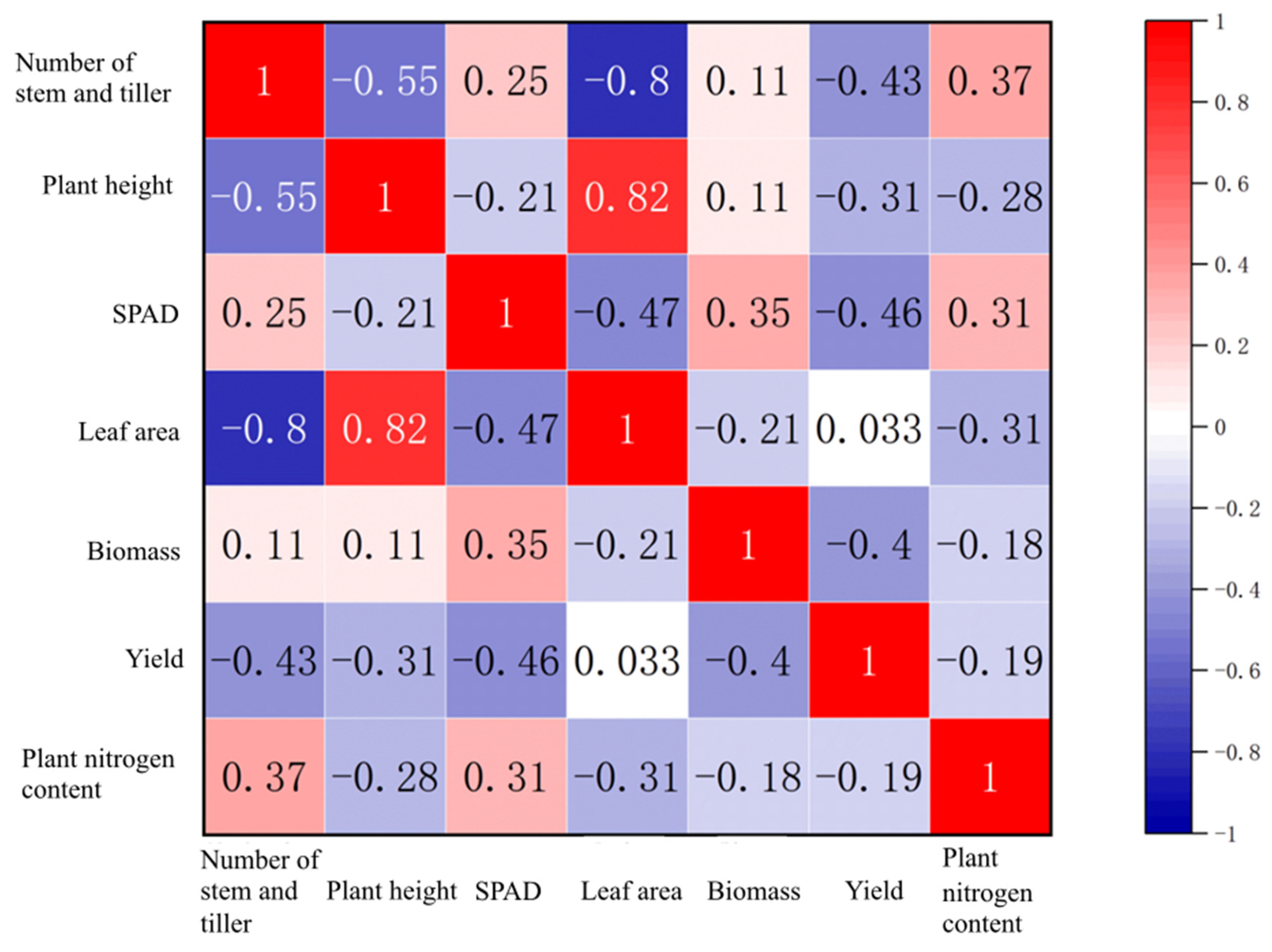
A correlation analysis of seven agronomic parameters across different rice varieties revealed complex interrelationships (
Figure 1). Tiller number showed significant positive correlations with nitrogen content and SPAD value, but significant negative correlations with leaf area and yield, along with a highly significant negative correlation with plant height. Plant height demonstrated a highly significant positive correlation with leaf area but a significant negative correlation with yield. SPAD value was significantly positively correlated with biomass and nitrogen content, yet significantly negatively correlated with leaf area and yield. Leaf area exhibited significant negative correlations with both biomass and nitrogen content, while biomass was significantly negatively correlated with yield. These intricate correlations indicate substantial information overlap among parameters, demonstrating that no single or limited set of indicators can adequately assess NUE. Consequently, PCA was employed to integrate all seven parameters, providing a comprehensive approach for screening nitrogen-efficient rice varieties while overcoming the limitations of single-parameter evaluation.
The significance of the correlation coefficients was assessed using a two-tailed t-test (* p < 0.05, ** p < 0.01). It is noteworthy that with a sample size of n = 60, even moderate correlation coefficients (e.g., |r| > ~0.25) can reach statistical significance at the p < 0.05 level.
The color intensity and the numerical values in each cell represent Pearson’s correlation coefficient (“r”) between the row and column traits. Red shades indicate positive correlations, while blue shades indicate negative correlations. Asterisks denote statistical significance levels (*: p < 0.05, **: p < 0.01). The traits include tiller number (TN), plant height (PH), SPAD value (SPAD), leaf area (LA), aboveground biomass (BM), grain yield (YLD), and plant nitrogen content (PNC).
3.3. PCA of Agronomic Parameters Across Varieties
3.3.1. Extraction of Principal Components
As shown in
Table 5, the Kaiser–Meyer–Olkin (KMO) measure was 0.504, and Bartlett’s test of sphericity yielded a significance level of
p = 0.000 (<0.05). According to the standard criteria for PCA suitability (KMO > 0.5 and
p < 0.05), the dataset was deemed appropriate for PCA.
Table 6 presents the communalities after principal component extraction, indicating the proportion of variance explained for each variable. A communality value represents the amount of information retained from the original variable, with higher values (closer to 1) indicating better information preservation. As shown in the table, all communalities exceeded 0.4. Plant height (0.79) and leaf area (0.80) demonstrated the highest communalities, suggesting these variables contribute substantial information to the principal components. In contrast, SPAD (0.49) and biomass (0.49) showed the lowest communalities, indicating relatively weaker information contribution among the analyzed parameters.
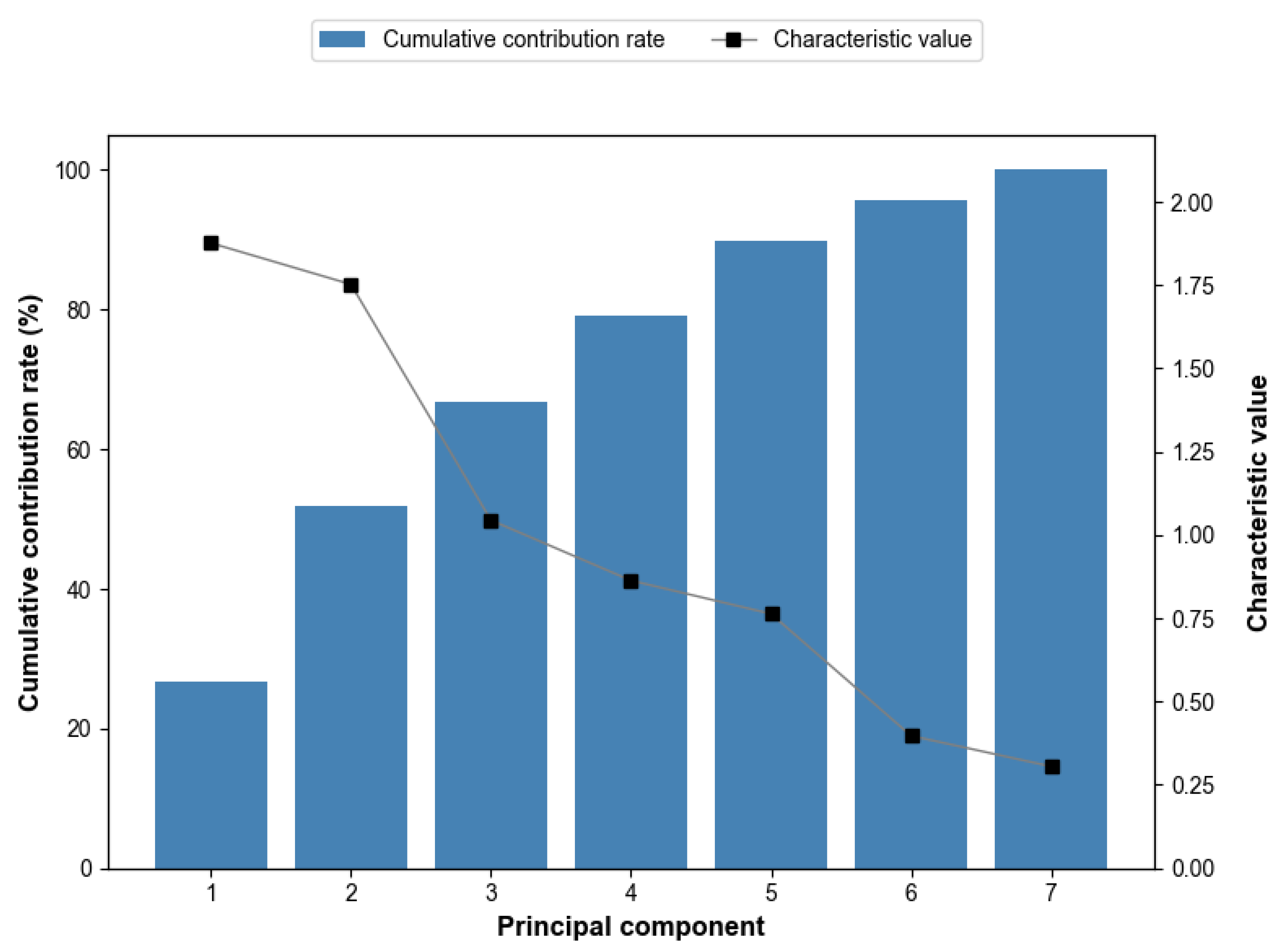
As shown in
Figure 2, three principal components were retained based on the eigenvalue-greater-than-one criterion, and the varimax rotation method was applied to enhance the interpretability of the factor structure. The eigenvalues for Component 1, Component 2, and Component 3 were 1.876, 1.752, and 1.044, respectively. The variance contribution rates were 26.80% for Component 1, 25.02% for Component 2, and 14.92% for Component 3, resulting in a cumulative contribution rate of 66.74% for the three components. This indicates that nearly two-thirds of the total variance in the original seven agronomic parameters is effectively captured by these three composite dimensions, achieving a meaningful reduction in data complexity while retaining most of the critical information.
Figure 2 shows the cumulative contribution rates of different components and the corresponding eigenvalues. The scatter plot in the figure further supports the conclusion of selecting three components. It can be clearly seen in the figure that the cumulative contribution rates of the first three components account for the majority of the total contribution rate and are dominant. The curve shows a significant turning point after the third component—usually referred to as the “elbow”—after which the eigenvalues gradually decrease and stabilize. This intuitive criterion reinforces the statistical basis provided by the eigenvalue-greater-than-one criterion, confirming that the first three components account for the majority of the explanatory power, while the contributions of subsequent components are negligible and can be disregarded, and will not cause significant loss of information. Therefore, extracting three principal components is statistically reasonable and conceptually suitable for subsequent clustering and classification analyses.
3.3.2. Calculation of Principal Component Scores
Based on the component score coefficient matrix obtained through principal component analysis (
Table 7), this study further revealed the contribution intensity and direction of various agronomic parameters to the principal components. Specifically, in the first principal component, the plant nitrogen content showed the highest positive score coefficient (0.488), indicating that it contributed the most to the formation of the first principal component, while leaf area showed a slight negative contribution (−0.04). In the second principal component, leaf area showed the strongest positive influence (0.50), while the number of tillers showed a significant negative contribution (−0.36). In the third principal component, yield showed the highest positive coefficient (0.79), highlighting its dominant role, while biomass showed a significant negative contribution (−0.34).
These score coefficients not only quantified the driving direction of each variable in the principal component scores but also revealed the relative importance of different agronomic parameters in the comprehensive evaluation system. By analyzing the coefficient patterns, it can be observed that plant nitrogen content and leaf area respectively occupied the dominant positions in the first and second principal components, indicating that nitrogen accumulation and canopy development are two relatively independent physiological dimensions. The prominent performance of yield in the third principal component confirmed its special status as the final output indicator. This hierarchical contribution pattern provided a theoretical basis for the subsequent construction of comprehensive evaluation indicators and explained why a single agronomic parameter cannot comprehensively assess the nitrogen use efficiency of rice: because different parameters represent different aspects of the nitrogen utilization process. It should be noted that, although the availability of nitrogen is physiologically associated with canopy growth, the PCA analysis in this study indicates that, under our experimental conditions, the variation patterns of these trait complexes are statistically separable.
As shown in
Table 8, rice varieties with different nitrogen use efficiencies exhibited distinct values across the comprehensive indicators. For the first composite indicator, S51 showed the highest value (1.22), indicating the best performance, while S19 had the lowest value (−1.66), reflecting the poorest performance. For the second composite indicator, S36 achieved the maximum value (1.94), representing the optimal performance, whereas S60 displayed the minimum value (−1.60), indicating the least favorable performance. For the third composite indicator, S52 recorded the highest value (2.57), demonstrating the best performance, while S01 showed the lowest value (−0.25), representing the weakest performance.
3.4. Cluster Analysis of Comprehensive Evaluation Indicators for NUE in Rice
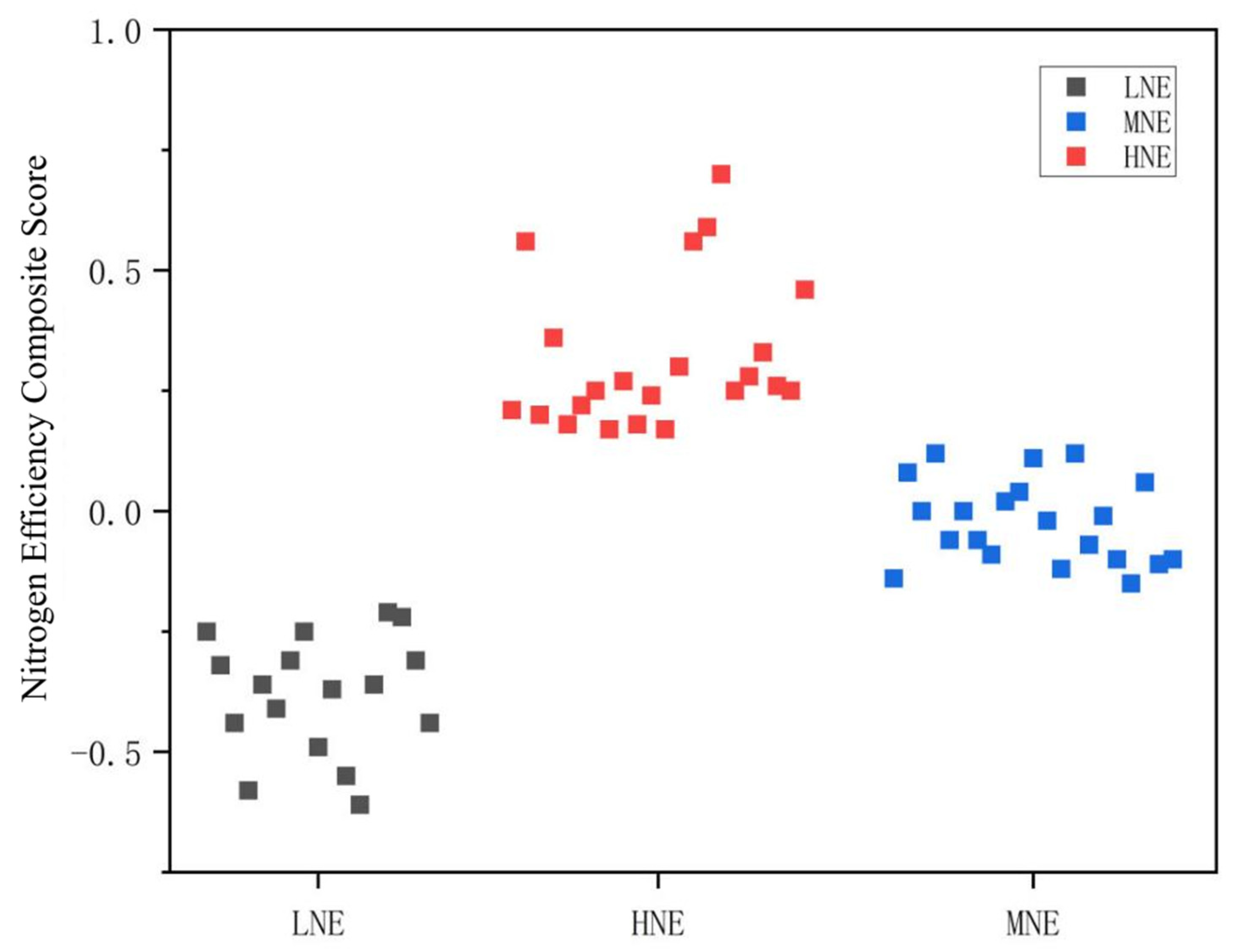
In order to classify the varieties based on the overall agronomic performance of crops under experimental nitrogen fertilizer conditions, we used the K-means algorithm to conduct a cluster analysis on the comprehensive scores (F) obtained through principal component analysis. These scores (
Figure 3, labeled as “Comprehensive Evaluation Index of Nitrogen Utilization Efficiency”) represent the data-driven comprehensive results of seven measurement traits and can be used as practical multi-trait indicators for screening. The varieties were classified into three distinct groups: high-nitrogen-efficient (HNE), medium-nitrogen-efficient (MNE), and low-nitrogen-efficient (LNE) varieties. The clustering results identified 22 HNE, 21 MNE, and 17 LNE varieties.
3.5. Construction and Validation of the Variety Screening Model
The screening of nitrogen-efficient rice varieties was conducted using 20 vegetation indices calculated from high-spectrum images obtained by unmanned aerial vehicles as independent variables, and the nitrogen efficiency grades clustered based on the comprehensive nitrogen efficiency scores as the dependent variable.
Independence between predictive features and target labels: it is necessary to clearly identify the source of the data used for model training to avoid concerns about circular reasoning. The target label (i.e., nitrogen efficiency grade) is entirely derived from agronomic traits measured in the field through principal component analysis (PCA) and K-means clustering. On the other hand, the predictive features (i.e., vegetation index) are calculated solely from hyperspectral images obtained by drones, representing a completely independent data pattern. Therefore, the machine learning model does not learn to reconstruct the clustering based on PCA; its goal is to discover the relationship between canopy remote sensing spectral phenotypes and the comprehensive performance categories defined by ground truth data. The successful verification of this mapping validates the effectiveness of spectral indices as non-destructive alternative indicators based on ground benchmarks.
Four machine learning methods were employed to construct the variety screening model: namely, Support Vector Machine, K-Nearest Neighbor, Classification Decision Tree, and Naive Bayes. For each model, the training set and validation set were randomly divided in a 8:2 ratio for training, and the validation set was used to evaluate the training situation of the trained model. Five indicators, namely, accuracy rate, precision rate, F1 value, Kappa coefficient, and Hamming distance (ham_distance), were selected to evaluate the performance of the rice nitrogen-efficient variety screening model.
Based on the 20 vegetation indices calculated, a nitrogen-efficient variety screening model for rice was constructed using machine learning methods.
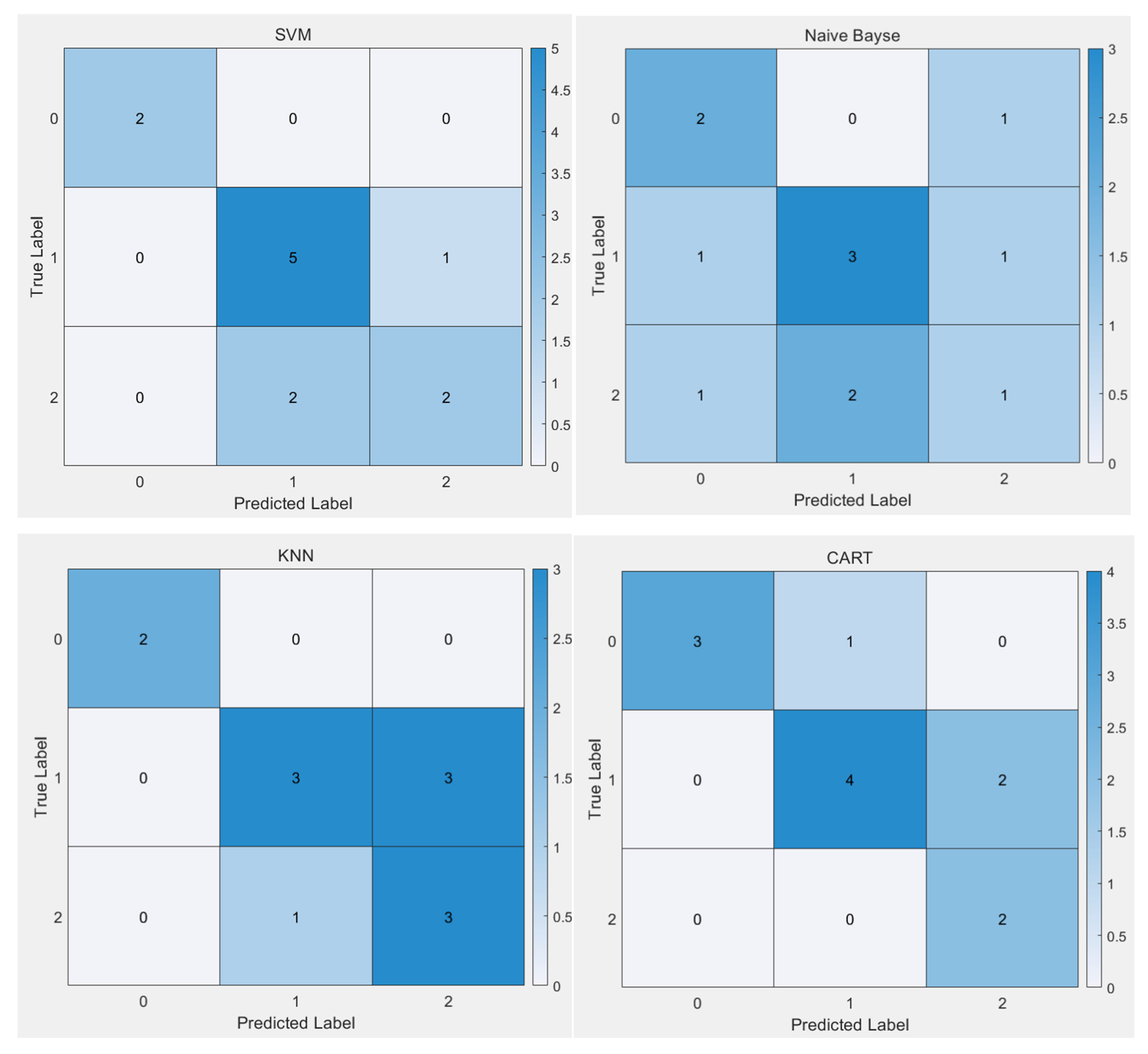
Figure 4 shows the validation results of these four classification models on the test dataset. The confusion matrix diagrams of the four models clearly demonstrate the differences among the various models. We can observe that the performance of the SVM and CART models is relatively better.
As shown in
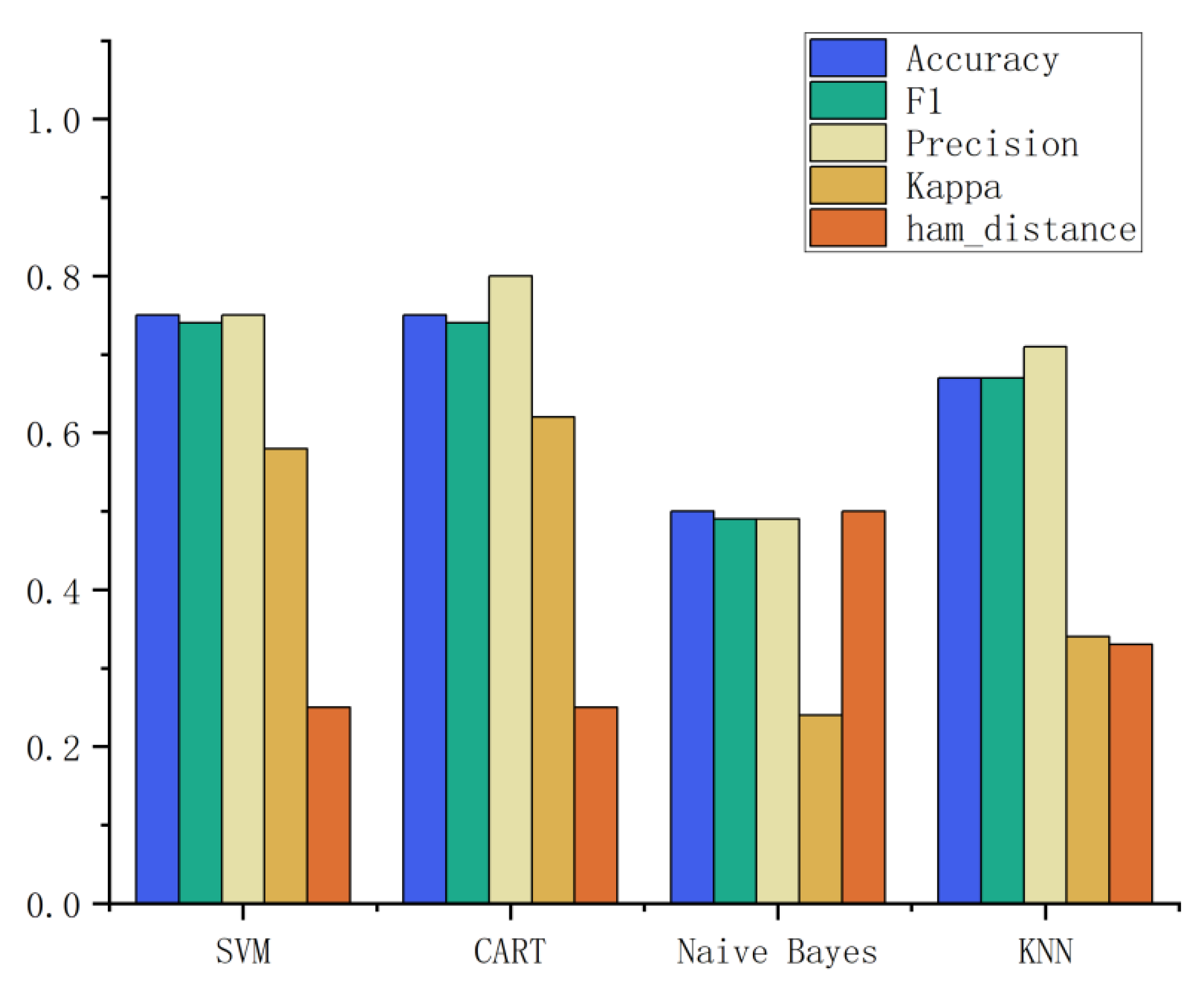
Figure 5, the four classification models were validated and subsequently evaluated using the calculated performance metrics. Among the five selected evaluation indicators—Accuracy, Precision, F1-score, and Kappa coefficient are positive indicators, while Hamming distance is a negative indicator. To facilitate comprehensive model comparison, the negative indicator (Hamming distance) was inversely normalized, and a composite score was calculated by applying weighted integration to all five metrics.
As shown in
Table 9, the Decision Tree and Support Vector Machine models achieved the highest accuracy (0.75), while Naive Bayes showed the lowest (0.50), indicating the superior classification accuracy of the former two models. Similarly, the Decision Tree and SVM attained the highest F1-scores (0.74), with Naive Bayes again performing the poorest, reflecting better alignment between predicted and expected results for these models. In terms of precision, the Decision Tree led (0.80), significantly outperforming Naive Bayes (0.24), demonstrating its higher reliability in positive class prediction. The Kappa coefficient was highest for the Decision Tree (0.62) and lowest for Naive Bayes (0.24), confirming stronger agreement between actual and predicted classifications for the Decision Tree. After inverse normalization, both SVM and Decision Tree achieved the maximum Hamming distance score (0.75), whereas Naive Bayes scored the minimum (0.5), indicating smaller discrepancies between actual and validated data for SVM and Decision Tree. Based on comprehensive evaluation, the Decision Tree demonstrated the best overall classification performance, followed by SVM, with K-NN showing moderate results and Naive Bayes performing the weakest. Therefore, the Decision Tree was selected as the final classification model.
3.6. Screening Results for Nitrogen-Efficient Rice Varieties
Based on the comprehensive performance evaluation of the four classification models (including accuracy rate, precision rate, F1 score, Kappa value, and Hamming distance and other multi-dimensional indicators), the decision tree classification model was finally selected as the optimal classification model for this study and the final classification results were output. The optimal partition attribute was selected through the Gini index minimization criterion: that is, the vegetation index with the highest discrimination ability for the classification results and the one that can minimize the uncertainty of the categories was chosen as the branch node. Then, a binary tree classification structure was constructed. The model first used EVI as the first-level branch feature (with the lowest Gini index), EVI is the core index representing “chlorophyll content in leaves” (chlorophyll nitrogen content accounts for approximately 50% to 70% of the total nitrogen in leaves), so EVI can directly reflect the nitrogen base reserve level of the crops. That is, when EVI > 0.001 (corresponding to 18 samples): high chlorophyll content and sufficient leaf nitrogen reserve, it belongs to HNE; when EVI ≤ 0.001 (corresponding to 30 samples): insufficient chlorophyll synthesis and insufficient leaf nitrogen reserve, at this time, the variety is the sum of MNE and LNE types. Other branches are based on MTVI2, EXG, TVI/NDVI, etc. The complete classification results of the model (training set) are detailed in
Figure S1.
Table 10 summarizes the final classification results of this model for all the tested samples (60 crop varieties). From an agronomy perspective, the rationality of this classification result can be verified through the following correlations: the HNEs classified by the model all correspond to higher vegetation indices such as EVI, NDVI, TVI, etc., which represent the excellent agronomic traits of these varieties in the field, such as “high chlorophyll content, strong photosynthetic efficiency, and sufficient nitrogen reserves”; meanwhile, the LNE group generally shows lower NDVI and NLI, which are consistent with the agronomic characteristics of “slow growth, weak body, and insufficient nitrogen reserves” in actual cultivation. The application of this model provides quantitative basis for subsequent crop variety selection and optimization of field management (such as increasing nitrogen fertilizer application for nitrogen-low efficient varieties and reducing nitrogen fertilizer application for nitrogen-efficient varieties).
4. Discussion
Previous studies of the relationship between the nitrogen use efficiency (NUE) of rice and agronomic parameters have shown that nitrogen fertilizer management has a significant impact on the growth characteristics and yield of rice. These studies typically indicate that appropriate nitrogen fertilizer management can significantly increase the biomass, SPAD value, number of tillers, and yield of rice [
73,
74,
75,
76]. We found that the statement “SPAD is negatively correlated with yield” in the results section contradicts common sense. This might be due to the following reasons: Some varieties absorb excessive nitrogen and store it in the leaves (manifested as high SPAD values), resulting in “luxurious absorption”. However, they failed to effectively assimilate and transport this nitrogen to the grains for yield formation, leading to high nitrogen content and low harvest index simultaneously. At the same time, in the later growth stage, the rice panicles gradually mature, shading the lower and middle leaves, which are the main areas where we measure SPAD values. Therefore, the actual SPAD readings of the lower leaves in high-yielding varieties might be underestimated, while low-yielding varieties can measure higher SPAD values due to fewer leaves and a less sparse canopy, with the leaves receiving light more evenly. Thus, a high SPAD value does not directly guarantee high yield output. These might be the reasons for the counterintuitive result. This finding highlights the limitations of using SPAD values alone to assess the overall nitrogen efficiency of varieties, thereby reinforcing the necessity of adopting multi-parameter comprehensive evaluation indicators.
These observed trade-off relationships also extend to other key indicators. Under our experimental conditions, biomass and plant height are also negatively correlated with yield. This pattern is likely to reflect the differentiated strategies among varieties: some varieties invest excessively in vegetative growth at the expense of grain filling, while taller plants may face greater risk of lodging or a less efficient canopy structure. Overall, these complex and sometimes counter-intuitive interactions indicate that screening based solely on a single trait is unreliable. They directly confirm the rationality of our use of the principal component analysis composite index (F) for screening, which can comprehensively reflect the overall performance of varieties by balancing multiple trade-off relationships.
Moreover, it has been noted that excessive use of nitrogen fertilizer may not further increase yield and may even have adverse effects on the environment [
77,
78,
79,
80,
81]. Consistently with existing literature, this study confirmed positive associations between NUE and key agronomic parameters including biomass, nitrogen content, and tiller number. The relationship with SPAD, however, was more nuanced, as discussed earlier. However, root-related traits were excluded due to practical difficulties in direct soil measurement, and photosynthetic parameters were omitted given the unclear relationship with NUE, making their inclusion in a composite evaluation index currently unsuitable.
The use of vegetation indices derived from UAV remote sensing imagery for assessing NUE in rice represents a non-destructive and efficient agricultural monitoring approach. Previous studies have demonstrated significant correlations between vegetation indices and rice NUE, confirming the feasibility of retrieving nitrogen utilization efficiency from spectral data [
82,
83]. Nitrogen-efficient rice varieties typically exhibit higher values in key vegetation indices, reflecting their enhanced capacity to absorb and utilize soil nitrogen.
The application of vegetation indices for screening nitrogen-efficient varieties offers several advantages [
84,
85]: (1) enabling large-scale, non-invasive monitoring without disrupting crop growth; (2) significantly reduced costs compared to traditional methods involving field sampling and laboratory analysis; (3) comprehensive crop assessment beyond nitrogen status, as vegetation indices can reflect multiple agronomic parameters and overall growth conditions. However, limitations exist, including susceptibility to environmental factors and weather conditions. Therefore, integrating multiple vegetation indices with ground-truth data is essential for improving assessment accuracy. Meanwhile, this experiment also has some shortcomings. For instance, only the data above the rice canopy were used. If the growth conditions of the rice were different, it would affect the accuracy of data acquisition. Due to the shortage of land resources, we cannot strictly ensure that the nitrogen content of all soils is uniform. There will always be certain differences, which is also one of the important errors of this experiment.
Future research based on this study should focus on: (1) investigating the accuracy and applicability of vegetation indices across different climatic conditions and soil types to enhance methodological robustness; (2) developing more precise and comprehensive rice NUE evaluation models by integrating UAV remote sensing, empirical measurements, and crop growth theory. (3) Attempt to apply the screening model to the cultivation of superior varieties, such as screening rice varieties with drought resistance and flood tolerance characteristics.