Article

Precision-Based Assessment of Environmental Water and Thermal Balance in Basin-Mulched Date Palm Orchards Under Arid Conditions


by
Abdulaziz Alharbi
1,* and
Mohamed Ghonimy
2
1
Department of Environment and Natural Resources, College of Agriculture and Food, Qassim University, Buraydah 51452, Saudi Arabia
2
Department of Agricultural and Biosystems Engineering, College of Agriculture and Food, Qassim University, Buraydah 51452, Saudi Arabia
*
Author to whom correspondence should be addressed.
Agronomy 2026, 16(5), 539; https://doi.org/10.3390/agronomy16050539
Submission received: 30 January 2026 / Revised: 20 February 2026 / Accepted: 27 February 2026 / Published: 28 February 2026
(This article belongs to the Special Issue Precision Agriculture and Crop Models for Climate Change Adaptation)

Abstract

Precision field measurements were conducted to evaluate the mechanism of organic basin mulching on water and thermal dynamics in arid date palm orchards in central Saudi Arabia. Partly mulched zones (20 m radius) and fully mulched basins were compared with adjacent bare soil using micrometeorological sensors and microlysimeters. In partly mulched areas, soil heat flux (G) decreased by 68.3% while sensible heat flux (H) increased up to 86.9% during late spring, indicating enhanced energy redistribution. Bare soil exhibited slightly negative latent heat flux (λE) in early spring, reflecting vapor adsorption, whereas fully mulched basins substantially reduced evaporation, with Water Conservation Efficiency Index (WCEĪ) values of 0.33 in spring and 0.27 in summer, corresponding to 33% and 27% water savings, respectively. Root-zone thermal moderation, quantified by the Root-Zone Thermal Moderation Index (RTMI), confirmed effective buffering of subsurface temperatures by 6–7 °C across 2–10 cm depths, despite slightly elevated surface temperatures. These results demonstrate that basin mulching stabilizes soil moisture, moderates diurnal thermal fluctuations, and optimizes soil–atmosphere energy partitioning under arid conditions. By integrating direct lysimeter measurements with continuous energy flux observations and index-based analysis, this study provides novel, field-based insights into the dual role of organic mulching in enhancing water conservation and thermal regulation in arid date palm orchards.

1. Introduction

Precision in agricultural management increasingly requires a detailed understanding of soil–atmosphere interactions, particularly under water-limited and high-temperature conditions typical of arid environments. Mulching has emerged as a widely adopted strategy to regulate soil surface properties, reduce erosion, moderate temperature, and limit evaporation, thereby enhancing water-use efficiency. Organic mulches including straw, agricultural residues, sawdust, and leaves exert pronounced effects on soil moisture and energy dynamics due to their ability to impede upward water transport, reduce surface hydraulic conductivity, and disrupt capillary rise, particularly during the early stages of soil drying [1]. By promoting dew deposition, increasing infiltration, and reducing direct surface water loss, mulching consistently improves soil moisture retention across both humid and arid climates [2].
Beyond water conservation, organic mulches substantially modify soil–atmosphere energy exchanges. They alter radiative characteristics, including albedo and emissivity, which in turn regulate the partitioning of net radiation (Rn) into soil heat flux (G), sensible heat flux (H), and latent heat flux (λE) [3,4]. Light-colored organic residues, such as straw, increase surface reflectance, reducing net radiation and the energy available for soil evaporation [5]. Empirical studies demonstrate that straw mulch can reduce Rn by up to 15%, primarily through its high albedo and insulating capacity, which limits early-stage latent heat flux [2,6]. Dense residues like olive mill waste can maintain reduced water loss even during later drying stages due to their compact structure and chemical composition [7]. Seasonal and climatic conditions further modulate this effect; straw mulch, for instance, can cut evaporation by up to 50% during initial drying phases, although cumulative long-term losses may approximate those of bare soil [8]. In all cases, mulching effectively shields the soil from direct solar radiation and wind, enhancing moisture conservation [1,2]. The efficacy of organic mulches extends to subsurface soil layers. Different mulch types, including compost, wood chips, and straw, have been shown to increase volumetric water content in the upper 60 cm of soil [9]. Compared with mineral mulches such as sand or gravel, organic residues additionally support soil structure, microbial activity, and nutrient cycling [10,11,12]. Mulching also provides thermal benefits: low thermal conductivity and high reflectivity help maintain cooler soil during nighttime and warmer conditions during the day. Applications of 5–6 t ha−1 of straw mulch have been reported to reduce daytime soil temperatures by 2.5–6.5 °C relative to bare soil, mitigating root heat stress and sustaining microbial activity [13,14]. Thermal regulation is context-dependent; under clear skies, straw mulch slows the morning rise in soil temperature and sustains cooler afternoon soil conditions, whereas under cloudy conditions, differences between mulched and bare soils are less pronounced and occur later in the day [15]. These diurnal temperature dynamics are closely linked to water-use efficiency and plant stress mitigation [16,17].
Despite extensive research on individual processes such as soil evaporation or temperature regulation, most studies remain limited in scope, focusing on a single variable over short periods or under narrow climatic conditions. Mulching has been widely recognized as an effective agronomic practice for reducing soil evaporation, modifying soil temperature, and improving water use efficiency in water-scarce environments, but its impacts on integrated soil–atmosphere energy partitioning under representative arid field conditions remain poorly documented [18]. Studies in arid agroecosystems have shown that plastic film and gravel-sand mulching can significantly alter soil moisture regimes and micro-environment, reducing evaporative losses and enhancing water retention even under high evaporative demand common in dryland systems [19]. Similarly, film-mulching in arid northwest China reduced soil evaporation and total field evapotranspiration while strengthening the link between soil thermal and moisture dynamics [20]. These findings highlight the importance of investigating mulching influences on the full soil surface energy balance, particularly in arid sandy loam soils that dominate dryland agriculture in central Saudi Arabia. To address this gap, the present study was conducted under arid climatic conditions in central Saudi Arabia using homogeneous sandy loam soil representative of regional dryland systems. The study integrates field-based measurements to evaluate soil evaporation and surface energy fluxes in arid sandy loam soil under organic basin mulching. Organic mulching has been shown to enhance soil moisture retention, improve efficiency of evapotranspiration, and reduce soil temperature fluctuations by moderating energy fluxes at the soil surface [21,22]. In arid and semi-arid agricultural systems, such as the central region of Saudi Arabia where date palm (Phoenix dactylifera L.) is a strategic, economically important, and dominant perennial crop, mulching has been recognized as an effective practice for regulating soil surface energy and stabilizing microclimatic conditions [17,23]. These findings highlight that organic mulching can significantly influence soil thermal and radiative properties, promoting environmental sustainability and efficient resource use in water-limited perennial orchard systems. Sandy soils and high evaporative demand pose challenges for soil water conservation and root-zone thermal stability [24]. Organic basin mulching, using locally available agricultural residues, has been proposed as a sustainable practice to mitigate soil moisture depletion and moderate extreme soil temperatures in date palm orchards. Therefore, the aim of this study is to evaluate the effects of organic basin mulching on soil water conservation, root-zone thermal moderation, and soil–atmosphere energy balance in arid date palm orchards.

2. Materials and Methods

2.1. Site Description and Experimental Setup

The study was conducted at the Agricultural Research Farm of Qassim University, Al-Qassim, Saudi Arabia (26°17′41″ N, 43°47′22″ E), located at an elevation of approximately 644 m above sea level. It lasted from February to September 2023. The region’s dry climate, which has a lot of sunlight, little rain, and big swings in temperature from day to night, makes it hard for soil-atmosphere energy exchanges to happen. This makes it a great place to study how basin mulching affects the soil microclimate.
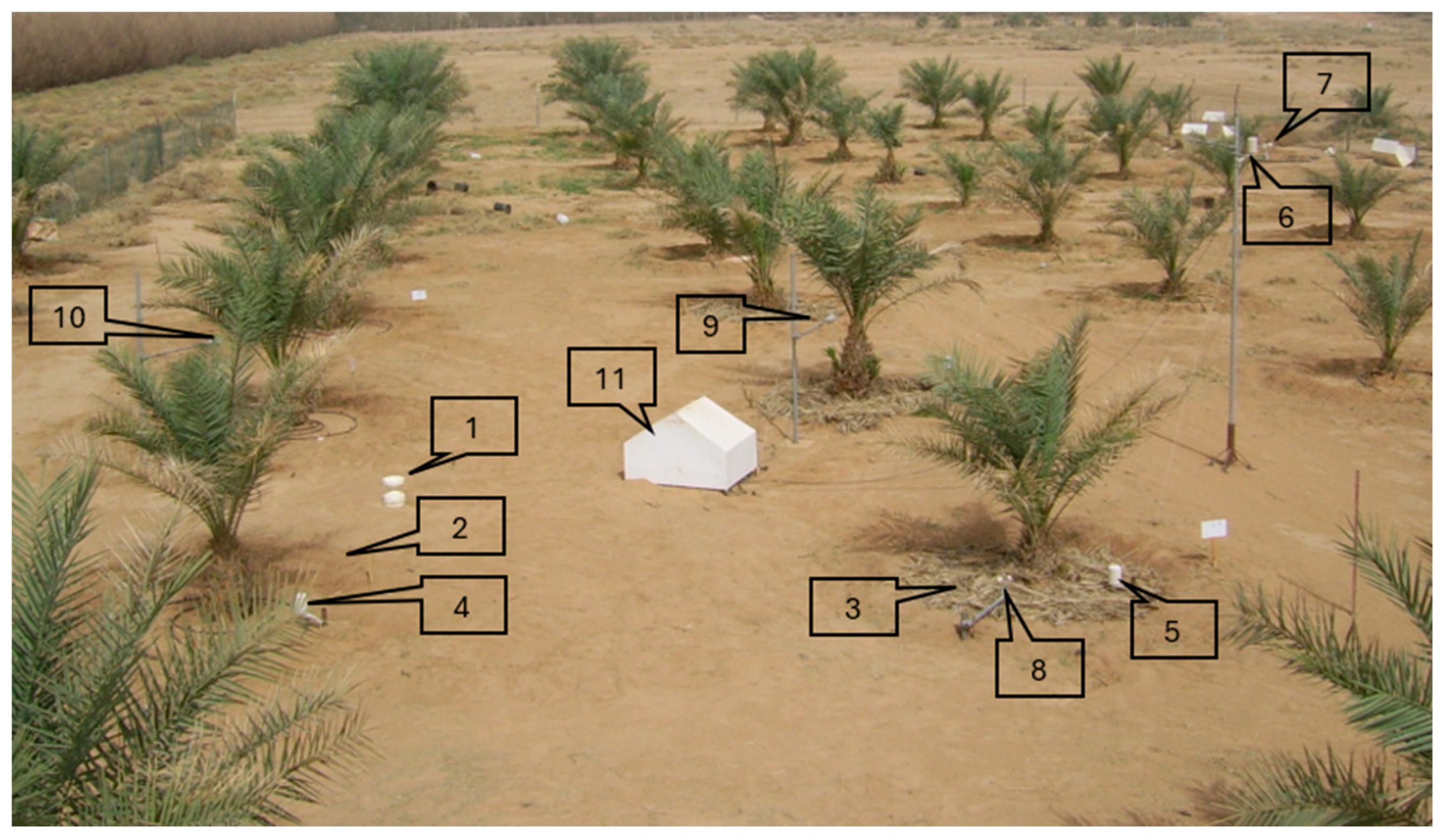
The experiment (Figure 1) was conducted in a drip-irrigated date palm plantation. Six mature trees of similar size and age were selected, with three assigned to the organic mulch treatment and three serving as bare soil controls. Organic mulch consisting of three layers of chopped palm leaves (15–20 cm strips) was applied around the treated trees at a thickness of 6–7 cm, corresponding to 16.9 Mg ha−1. Drip irrigation lines were installed directly on the soil surface beneath the mulch, supplying 329 L per palm every six days, based on the estimated crop water demand.
Maintaining this fixed irrigation schedule allowed controlled comparison between mulched and bare soil conditions, ensuring that differences in soil moisture dynamics, latent heat flux, and root-zone thermal behavior were directly attributable to the presence of mulch rather than fluctuations in water supply. This approach reflects common management practices in local date palm orchards and provides a reliable basis for evaluating the environmental and agronomic effects of basin mulching.
The bare soil treatment received no mulch but was monitored using identical instrumentation to enable direct comparison of energy fluxes and soil conditions. Sensor depths and a measurement radius of approximately 20 m around each palm were selected to represent the effective root zone and associated soil water exchange. Within this area, mulch was confined to the tree basins, while the remaining soil surface was left uncovered, reflecting typical management practices in drip-irrigated date palm orchards.

2.2. Micrometeorological Instrumentation

To quantify soil evaporation, eighteen microlysimeters were installed in both mulched and bare soil plots. Each microlysimeter consisted of an inner PVC cylinder (10.3 cm diameter, 15 cm depth) nested within a slightly larger outer cylinder to ensure a snug fit. The inner tubes were prepared by gently inserting field-collected soil cores in a way that preserved the soil’s original structure and natural condition. After this, the bottoms were carefully sealed to maintain integrity. To ensure that the measurements continued to reflect real field conditions, the undisturbed soil cores in all microlysimeters were renewed every three days throughout the experiment. In the plots where mulch was applied, the palm leaf cover was consistently placed back over the microlysimeter surface following each replacement, ensuring that the soil environment remained comparable to that of the surrounding area. By weighing the microlysimeter cores daily, evaporation was monitored with high accuracy, as the recorded mass changes directly represented water loss from the root zone. This approach provided valuable insight into the ongoing exchange of water between the soil and the atmosphere under natural conditions. Additional micrometeorological measurements were obtained using precision sensors. Two four-component radiometers (CNR1, Kipp & Zonen, Delft, The Netherlands) were mounted at 2 m height, one per treatment, to measure incoming and outgoing shortwave and longwave radiation, enabling computation of net radiation (Rn). Each radiometer observed a circular footprint with a radius of 20 m, allowing it to capture the combined signal from both mulched basins and the surrounding bare soil. This configuration realistically represented the partial mulch coverage commonly encountered under field management practices and offered practical insight into surface energy behavior in arid environments. Rainfall was monitored using a tipping bucket rain gauge (ARG100, Campbell Scientific, Loughborough, UK). Wind speed was measured at a height of 2 m with an anemometer (AN1, Delta-T Devices Ltd., Cambridge, UK), while air temperature and relative humidity were recorded at the same height using RHT2 sensors (Delta-T Devices Ltd., Cambridge, UK). Volumetric soil moisture (θ) was continuously measured with Theta probes (Delta-T Devices Ltd., Cambridge, UK) installed at depths of 3.5 and 7.5 cm. Soil temperature was monitored using negative temperature coefficient thermistors (10 kΩ at 25 °C) placed alongside the moisture probes at depths of 2, 5, and 10 cm. Temperatures within the mulch layer were recorded at both the midpoint and the base of the layer. Surface temperatures of soil and mulch were measured using fine-wire T-type thermocouples (Omega Engineering Inc., Norwalk, CT, USA), with three sensors per treatment. All instruments were connected to DL2e data loggers (Delta-T Devices Ltd., Cambridge, UK), recording data every 10 s and averaging values over 30-min intervals to ensure high temporal resolution for analyzing soil conditions and energy fluxes.

2.3. Surface Energy Balance Fluxes

Understanding the partitioning of surface energy is essential for interpreting soil–atmosphere interactions under mulched and bare conditions. At the soil surface, energy distribution is controlled by net radiation (Rn), atmospheric conditions (air temperature, wind, humidity), and surface characteristics including mulch cover [25]. The surface energy budget separates net radiation into latent heat flux (λE), sensible heat flux (H), and soil or mulch heat flux (G), expressed in Equation (1) [11].
λ E = R n H G
where λE is latent heat flux (W·m−2), Rn is net radiation (W·m−2), H is sensible heat flux (W·m−2), and G is soil or mulch heat flux (W·m−2). Sensible heat flux H, representing energy transfer between the soil surface and overlying atmosphere, was estimated using the bulk aerodynamic method [26] (Equation (2)).
H = ρ a c p T 0 T a r a
where T0 is surface temperature (°C), Ta is air temperature (°C), ρa is air density (kg·m−3), cp is specific heat of air (1004 J·kg−1·K−1), and ra is aerodynamic resistance (s·m−1). Aerodynamic resistance ra was calculated using the logarithmic wind profile under neutral stability conditions [26] (Equation (3)).
r a = ln Z m d Z 0 m ln Z h d Z 0 h K 2 u z
where Zm is wind measurement height (m), Zh is humidity/temperature measurement height (m), d is zero-plane displacement (m; assumed 0 for bare soil), Z0m is roughness length for momentum (m), Z0h is roughness length for vapor and heat transfer (m), k is von Karman constant (0.41), and uz is wind speed (m·s−1). Roughness parameters were determined using the Raupach model [27], with Z0m = 0.016 m for bare soil and 0.031 m for mulched soil; Z0h was assumed as Z0m/10.
Soil or mulch heat flux G was calculated using Fourier’s law of heat conduction [11] (Equation (4)).
G = k h Δ T Δ z
where kh is thermal conductivity (W·m−1·K−1), ΔT is the temperature difference between surface and subsurface layer, and Δz is vertical distance. The gradient for bare soil was measured at a depth of 5 cm, while for mulch, it was measured at a depth of 7 cm (Δz = 0.07 m and 0.05 m). Utilizing the Long et al. model [28], which included relative saturation (θ/θs, where θ is the volumetric soil moisture content and θs is the soil’s saturated moisture content) and soil composition (porosity 0.41 m3·m−3, 60% quartz), the thermal conductivity of the soil was determined. Ferhat et al. [29] state that kh = 0.165 W·m−1·K−1 for the mulch layer.
After deducting H and G from Rn, latent heat flow (λE) was determined as a residual from Equation (1).

2.4. Relative Percentage Differences (RPD)

To assess the impact of mulch on the surface energy components, the relative percentage differences (RPD) of radiation and energy fluxes between partly mulched and bare soil conditions were calculated for each measured variable of radiation and energy fluxes. The relative difference (%) was determined using Equation (5).
R P D = X m u l c h X b a r e X b a r e
where Xmulch and Xbare represent the observed values of radiation and energy fluxes under mulched and bare soil conditions, respectively. Positive values indicate an increase attributable to the presence of mulch, while negative values indicate a reduction.
To enhance the applied relevance of the present study and to quantify the effectiveness of organic basin mulching in reducing soil water losses, a water conservation efficiency index (WCEI) was derived using measured evaporation and latent heat flux data, without introducing additional field measurements. The index expresses the relative reduction in soil evaporation achieved by mulching compared with bare soil conditions and provides an integrative indicator linking water dynamics to surface energy partitioning.

2.5. Water Conservation Efficiency Index (WCEI)

The WCEI was calculated based on daily evaporation measured by microlysimeters according to Equation (6) [20].
W C E I = E b a r e E m u l c h E b a r e
where Ebare and Emulch represent cumulative soil evaporation (mm·day−1) from bare soil and mulched soil, respectively. Values of WCEI range from 0 to 1, with higher values indicating greater effectiveness of mulching in conserving soil water.

2.6. Root-Zone Thermal Moderation Index (RTMI)

To quantify the effect of basin mulching on subsurface thermal conditions, a Root-Zone Thermal Moderation Index (RTMI) was derived using soil temperature measurements within the active root zone (0–30 cm depth, where a high proportion of date palm fine roots responsible for water uptake and thermal exchange are typically concentrated under drip irrigation systems) as supported by recent root distribution studies in date palm orchards [30]. This approach builds on the concept that mulching alters temperature regimes at multiple soil depths and buffers thermal fluctuations, as previously reported in studies of soil thermal moderation under mulching treatments [31].
RTMI was calculated based on temperature differences between bare and mulched soil at depths of 2, 5, and 10 cm, representing the upper portion of the active root zone where thermal variations are most pronounced. The temperature difference (ΔTi) at each depth was defined as (Equation (7)).
Δ T i = T i , b a r e T i , m u l c h
Here Ti,bare and Ti,mulch are soil temperatures (°C) measured at depth i under bare and mulched conditions, respectively.
The overall RTMI was then computed as the depth-averaged cumulative temperature difference across depths and over the measurement period (Equation (8)).
R T M I = 1 n i = 1 n Δ T ¯ i
where n is the number of monitored depths (n = 3), and Δ T ¯ i represents the mean temperature difference between mulch and bare soils at depth i during the study period. Positive RTMI values indicate effective thermal buffering under mulched conditions relative to bare soil. This index emphasizes the environmental role of mulching in moderating subsurface thermal dynamics, stabilizing the root-zone microclimate, and supporting soil biological processes under arid field conditions [32,33,34].

2.7. Statistical Analysis

All data were analyzed using SPSS version 28 (IBM Corp., Armonk, NY, USA). One-way analysis of variance (ANOVA) was used to evaluate the effects of basin mulching and measurement periods on soil and mulch temperature, soil moisture content, and surface energy flux components. Significant differences between treatment means were further assessed using Tukey’s HSD post-hoc test at p < 0.05. Results are reported as mean ± standard deviation (SD).

3. Results

3.1. Effect of Mulch on Energy Balance

3.1.1. Shortwave Radiation

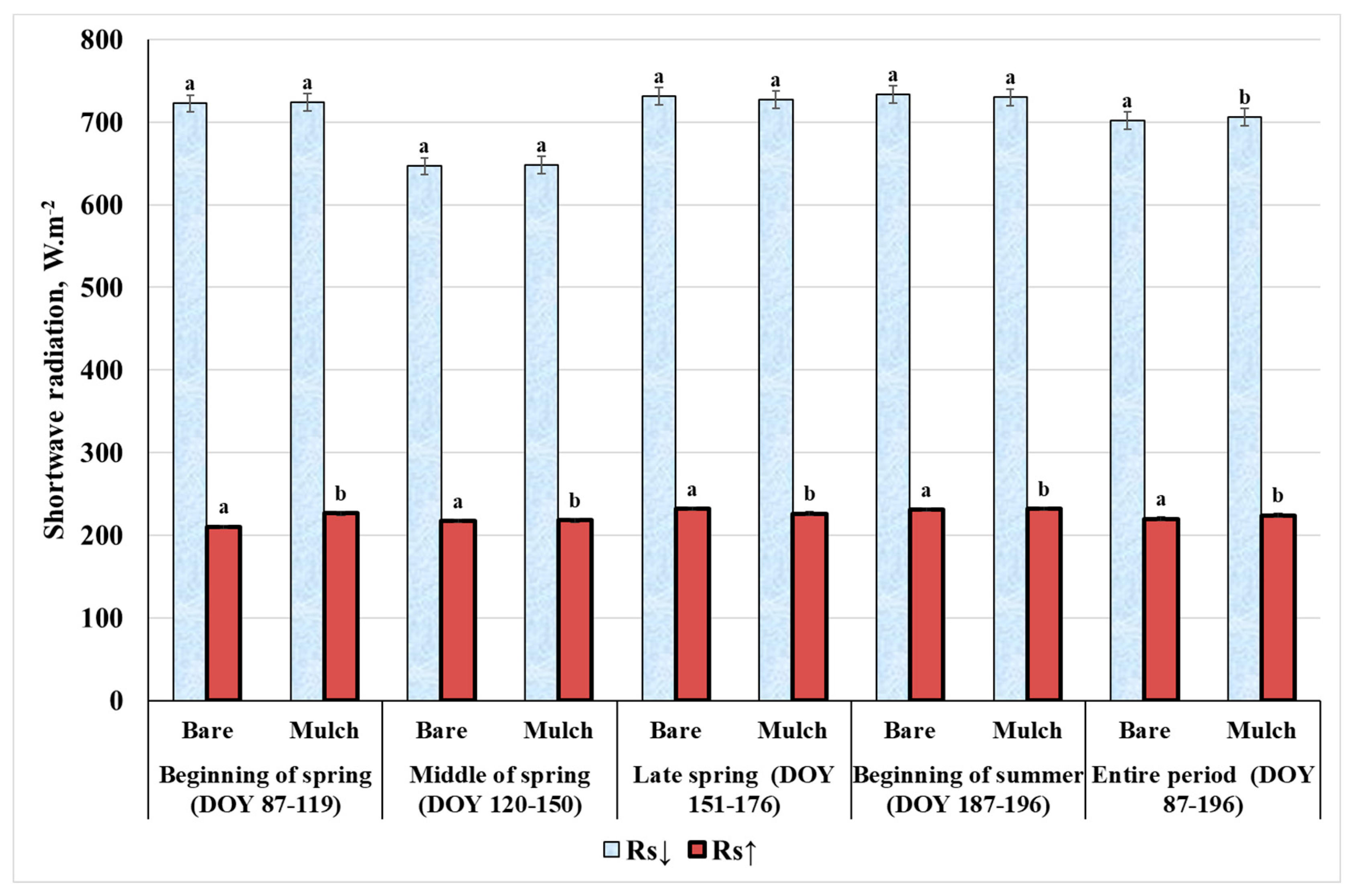
Figure 2 illustrates the variation in incoming and reflected shortwave radiation under bare soil and partly mulched soil (only around the irrigated basins within a 20 m radius of each palm) conditions across different periods of the growing season. The incoming shortwave radiation (Rs↓) showed differences between treatments, indicating that the presence of mulch in the basins had no substantial impact on the amount of solar radiation received over the measured area. During the beginning of spring (Day of Year, DOY 87–119), Rs↓ was 722.4 ± 112.2 W·m−2 for bare soil and 724.2 ± 112.4 W·m−2 for partly mulched soil. Similar values were observed during the middle and late spring as well as the beginning of summer, with the average Rs↓ for the entire period being 702.2 ± 106.7 W·m−2 under bare soil and 705.6 ± 106.9 W·m−2 under mulched conditions.
The reflected shortwave radiation (Rs↑) was significantly affected by the surface condition, depending on the measurement period. At the beginning of spring, Rs↑ was significantly higher under partly mulched soil (226.4 ± 29.9 W·m−2) compared to bare soil (209.9 ± 29.5 W·m−2) (p < 0.05). In contrast, during late spring, Rs↑ was significantly higher under bare soil than under mulch (p < 0.05). Over the entire monitoring period, the average Rs↑ was significantly higher under partly mulched soil (224.2 ± 29.3 W·m−2) compared with bare soil (219.9 ± 31.7 W·m−2) (p < 0.05).

3.1.2. Longwave Radiation

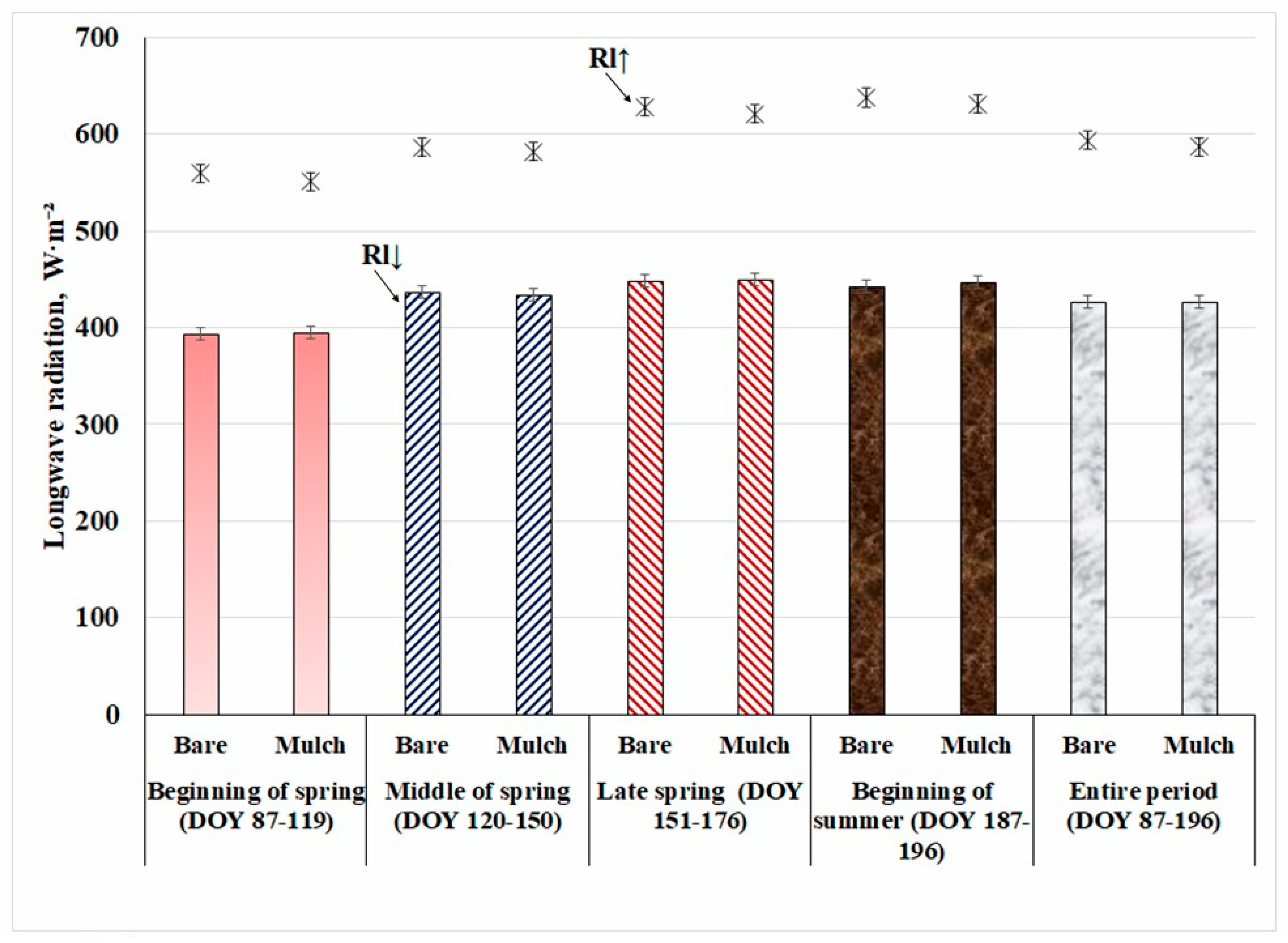
Figure 3 illustrates the variation in incoming (Rl↓) and outgoing (Rl↑) longwave radiation under bare and partly mulched soil conditions during the observation period. Incoming longwave radiation (Rl↓), primarily originating from atmospheric emissions, showed minimal differences between treatments throughout monitoring. At the beginning of spring (DOY 87–119), Rl↓ averaged 394.1 ± 24.9 W·m−2 for bare soil and 394.6 ± 24.9 W·m−2 for mulched soil. Similar values were recorded during subsequent periods, and when averaged over the entire period, Rl↓ reached 426.3 ± 30.5 W·m−2 under bare soil and 427.3 ± 31.6 W·m−2 under mulch. One-way ANOVA indicated no significant differences between treatments in any period (p > 0.05), confirming that mulch application had no measurable influence on incoming longwave radiation.
The outgoing longwave radiation (Rl↑) was higher under bare soil than mulched soil across seasonal phases. At the beginning of spring, Rl↑ averaged 559.6 ± 39.9 W·m−2 for bare soil and 551.2 ± 39.6 W·m−2 under mulch. During late spring, values were 628.3 ± 23.4 W·m−2 and 621.4 ± 20.9 W·m−2 for bare and mulched soils respectively. At the beginning of summer, Rl↑ reached 638.1 ± 19.5 W·m−2 under bare soil and 631.2 ± 17.8 W·m−2 under mulch. Over the monitoring period, mean Rl↑ was 593.7 ± 45.8 W·m−2 for bare soil and 587.0 ± 45.2 W·m−2 under mulch. One-way ANOVA within each period confirmed significant differences between treatments (p < 0.05), indicating that surface condition influenced outgoing longwave radiation.

3.1.3. Net Radiation, Soil Heat Flux, Sensible and Latent Heat Fluxes

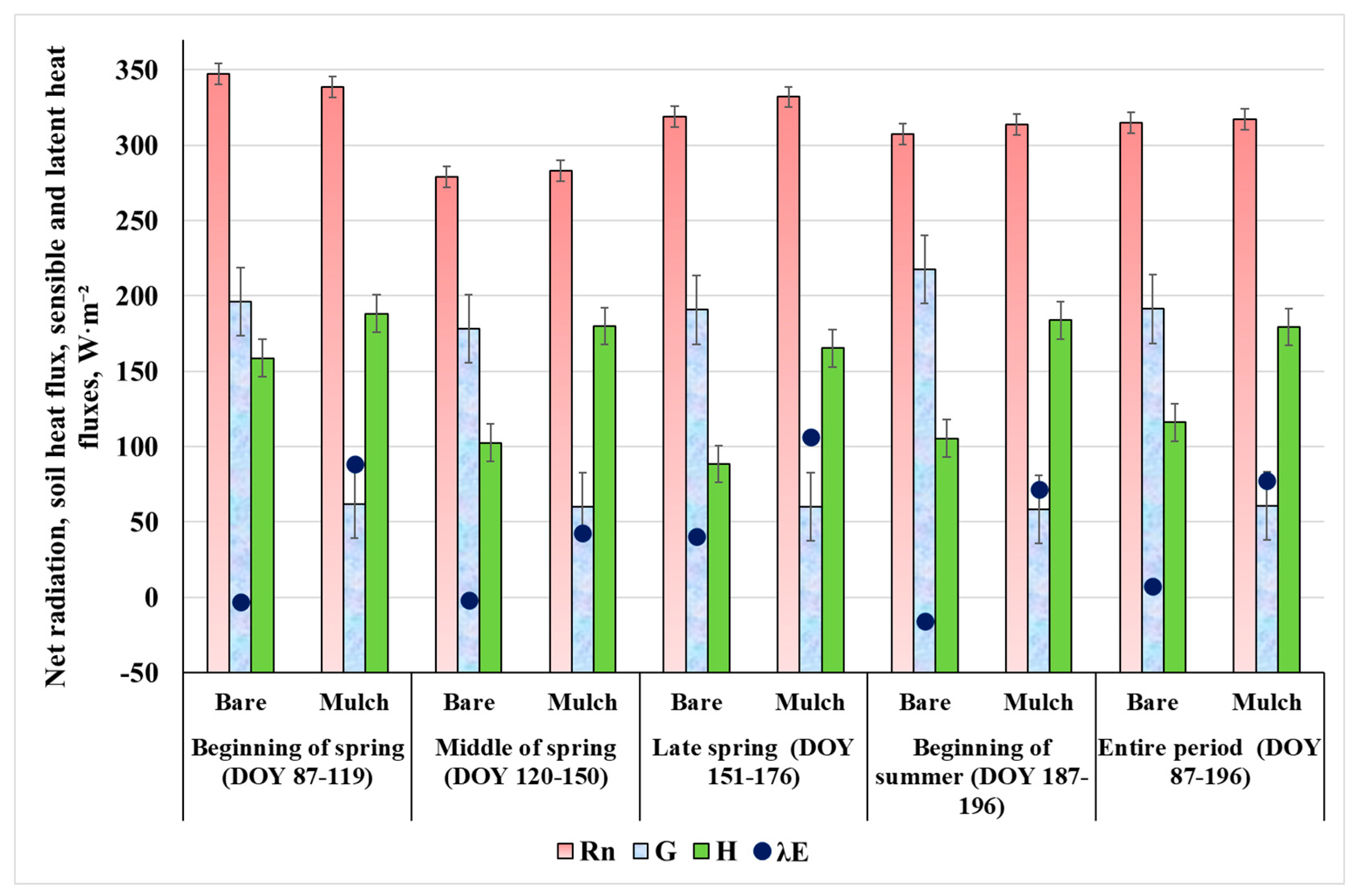
Figure 4 illustrates the variation in Rn, soil or mulch heat flux (G), sensible heat flux (H), and latent heat flux (λE) under bare and partly mulched soil conditions during the observation period. Net radiation showed comparable magnitudes between treatments throughout the monitoring period, with overall mean values of approximately 315 W·m−2 under bare soil and 317 W·m−2 under mulch. In contrast, soil heat flux (G) was significantly higher under bare soil, averaging about 191 W·m−2 compared with approximately 61 W·m−2 under mulched soil over the entire period. Sensible heat flux (H) tended to be greater under mulched soil, with mean values of roughly 179 W·m−2 compared with 116 W·m−2 under bare soil. While λE fluctuated around near-zero values under bare soil (mean ≈ 8 W·m−2), it remained substantially higher under mulch, averaging about 77 W·m−2 over the full monitoring period.

3.1.4. Atmospheric Conditions During the Observation Periods

Table 1 presents the measured air temperature (Ta), relative humidity (RH), and wind speed (U) at 2 m above ground level throughout the monitoring period. Air temperature showed a progressive increase from early to late spring and remained elevated into early summer (Table 1). Relative humidity reached its lowest levels during late spring and early summer. Wind speed exhibited moderate variability throughout the spring period.

3.1.5. Relative Impact of Mulch on Energy Components

Table 2 summarizes the relative percentage differences between partly mulched and bare soils for key radiation and energy flux components during the measurement period. Negative values indicate a reduction in the corresponding variable due to the presence of mulch, while positive values indicate enhancement. As presented in Table 2, the most consistent and pronounced effect of mulch was observed on G, which was reduced by more than 66% across all periods, confirming the strong insulating capacity of the mulch layer. Net radiation (Rn) exhibited only minor variations, with a slight reduction in early spring and modest increases in subsequent periods. Reflected shortwave radiation (Rs↑) generally increased under mulched conditions, reflecting the higher surface albedo, while Rs↓ and downward longwave radiation (Rl↓) remained largely unchanged. Outgoing longwave radiation (Rl↑) consistently decreased, indicating moderate soil surface temperatures under mulch. Sensible heat flux (H) was substantially enhanced in the presence of mulch, particularly during mid- and late spring. Latent heat flux (λE) showed variable trends with considerable variability, highlighting a context-dependent influence of mulch on evaporative processes.

3.2. Evaporation from Bare and Mulched Soil

Table 3 and Table 4 summarize the statistical analysis of soil evaporation under bare and mulched soil conditions during the spring period. The results revealed significant differences (p ≤ 0.05) in soil evaporation between treatments (bare vs. mulched), between daytime and nighttime measurements, and across the irrigation cycle. During the initial days following irrigation, daytime evaporation from bare soil reached its maximum value (7.03 mm) and was significantly higher (p ≤ 0.05) than that observed under mulched soil. As the irrigation cycle progressed and soil moisture declined, evaporation from bare soil decreased significantly, reaching 0.74 mm by DOY 108. In contrast, mulched soil exhibited more stable evaporation rates throughout the cycle. Although evaporation under mulch also declined with decreasing soil moisture, the reduction was less pronounced, and values ranged between 0.92 and 3.37 mm, with the maximum recorded on DOY 105. Statistical comparisons further indicated significant treatment × period interactions (p ≤ 0.05), demonstrating that the effect of mulch on evaporation varied depending on the stage of the irrigation cycle and time of day. These findings confirm that mulching significantly modifies the temporal pattern of soil evaporation relative to bare soil conditions.
On average, daytime evaporation from mulch-covered soil was approximately 43.7% lower than from bare soil, demonstrating the effectiveness of mulch in reducing evaporative losses during daylight hours, particularly under conditions of high atmospheric demand. Nighttime evaporation was considerably lower in both treatments. Bare soil evaporation ranged from 0.12 mm to 4.18 mm, while mulched soil ranged from 0.38 mm to 3.97 mm. Overall, nighttime evaporation from mulched soil was on average 20.7% lower than from bare soil. When comparing diurnal dynamics, daytime evaporation was substantially higher than nighttime for both treatments. In bare soil, daytime evaporation was roughly 2.4 times greater than nighttime rates, whereas in mulched soil the difference was smaller, about 1.7 times, indicating that mulch not only reduced total evaporation but also moderated the amplitude of diurnal fluctuations.
During the summer season (Table 4), evaporation rates increased markedly because of elevated air temperatures and stronger solar radiation. Under bare soil conditions, daytime evaporation reached a maximum of 8.85 mm on DOY 205, with several days recording values above 7.0 mm. In contrast, soil covered with organic mulch exhibited consistently lower evaporation, with daily values remaining below 3.99 mm throughout the monitoring period. On average, the presence of mulch reduced daytime evaporation by about 57.8%, indicating that its capacity to limit evaporative water losses was even more pronounced during summer than in the spring period.
Nighttime evaporation during summer showed a pattern similar to daytime trends. Bare soil evaporation ranged from 0.16 to 4.00 mm, while mulch-covered soil varied between 0.86 and 2.54 mm. On average, mulching reduced nighttime evaporation by about 32.4%, slightly exceeding the reduction observed in spring. Diurnal comparisons confirmed that evaporation was substantially greater during the day. Bare soil exhibited approximately 2.9 times higher evaporation during the daytime compared to nighttime, whereas under mulched soil this ratio was reduced to about 2.2. This indicates that mulch reduced the contrast between daytime and nighttime evaporation, thereby moderating daytime evaporation peaks while maintaining lower overall losses.
Seasonal comparisons revealed that although absolute evaporation increased in summer for both treatments due to higher atmospheric demand, the relative efficiency of mulching improved, as indicated by a greater percentage reduction in evaporation under mulch compared with bare soil during summer than during spring. Daytime evaporation under mulched soil was reduced by nearly 58% compared with bare soil during the summer period (DOY 199–210), whereas the corresponding reduction in spring (DOY 103–113) was approximately 44%. Similarly, nighttime evaporation reductions increased from about 21% in spring to 32% in summer, as shown in Table 3 and Table 4.

3.3. Moisture from Bare and Mulched Soil

The results presented in Table 5 demonstrate a clear effect of mulch application on soil moisture content at both 3.5 cm and 7.5 cm depths throughout the experimental period (DOY 87–196). At a soil depth of 3.5 cm, soil moisture under mulch was numerically lower than under bare soil during all experimental periods. However, statistically significant differences were observed only during late spring (p < 0.05), while differences during the other periods were not significant (p > 0.05). At the beginning of spring, moisture content declined from 0.199 ± 0.040 m3·m−3 in bare soil to 0.144 ± 0.006 m3·m−3 under mulch, corresponding to a reduction of 27.6%. A similar pattern persisted during mid-spring (DOY 120–150), when bare soil retained 0.196 ± 0.035 m3·m−3 compared with 0.139 ± 0.008 m3·m−3 in mulched soil, representing a 29.1% decrease. This contrast became more pronounced toward late spring, reaching a reduction of 33.2%, and remained substantial at the beginning of summer (31.4%).
When averaged over the entire monitoring period, soil moisture at this depth under mulch was 0.138 ± 0.006 m3·m−3, approximately 29.6% lower than that measured in bare soil. At the 7.5 cm depth, soil moisture content remained significantly higher under bare soil than under mulch across all measurement periods (p < 0.05), although the magnitude of the difference was smaller compared with the 3.5 cm depth, while maintaining the same overall trend. During the beginning of spring, soil moisture declined from 0.220 ± 0.024 m3·m−3 in bare soil to 0.151 ± 0.025 m3·m−3 under mulch, corresponding to a 31.4% reduction. Reductions during mid- and late spring ranged between 30% and 34%, while early summer exhibited a comparable decrease of 33.3%. Over the full experimental period, mulched plots averaged 0.146 ± 0.025 m3·m−3, whereas bare soil maintained a higher mean moisture content of 0.215 ± 0.028 m3·m−3, reflecting an overall reduction of 32.1%. One-way ANOVA followed by Tukey’s HSD test confirmed significant differences between bare and mulched treatments at 7.5 cm depth across all periods (p < 0.05).

3.4. Effect of Mulching on Soil and Mulch Temperatures at Surface and 2–10 cm Depth

The average temperatures for the soil surface (Ts) and three subsurface depths (2, 5, and 10 cm) under both bare and mulched conditions for various experimental periods are presented in Table 6. Additionally, temperatures under the mulch layer (middle and bottom) are included for the same periods, measured between 10:00 a.m. and 2:00 p.m. One-way ANOVA indicated that soil and mulch temperatures differed significantly between bare and mulched treatments at all measured depths and periods (p < 0.05). Over the course of the study, the average surface temperature of the mulch (Ts) was 3.0 °C warmer than that of the bare soil; the biggest variations, up to 4.2 °C, occurred in late spring and early summer. The low thermal conductivity of the mulch, which retains heat at the surface, is the reason for this statistically significant increase.
Conversely, soil temperatures at 2, 5, and 10 cm depths were consistently lower under mulch across all periods. At 2 cm depth, mulched soil was 6.8 °C cooler than bare soil during early spring, with similar reductions (~5–6 °C) observed throughout the remaining stages. The observed differences in soil temperature were statistically significant (p < 0.05), confirming the insulating effect of mulch. Temperature measurements within the mulch layers revealed clear thermal stratification: the middle layer reached the highest temperatures, rising from 33.8 °C in early spring to 41.9 °C in late spring, while the bottom layer remained substantially cooler (25.9 °C to 34.6 °C), demonstrating the mulch’s capacity to buffer and moderate vertical heat flux. Smaller variations were found in late afternoon and overnight measurements, which are not included here but indicate the tempered heat flux following peak solar radiation.

3.5. Water Conservation Efficiency Index (WCEĪ)

The results are presented in Table 7, which summarizes the seasonal averages together with the minimum and maximum recorded values of the Water Conservation Efficiency Index during the spring and summer irrigation periods. The table also reports cumulative evaporation under bare and mulched soil conditions and the corresponding percentage of water saving. Clear differences between treatments were observed within each season, as reflected by the distinct statistical letters assigned to Ēbare and Ēmulch. In both spring and summer, cumulative evaporation under mulched soil was significantly lower than that under bare soil (p < 0.05).
During the spring period, WCEĪ showed consistent positive values throughout the monitored irrigation cycles, indicating a measurable reduction in soil evaporation under mulching conditions. The seasonal mean value was significantly higher than that observed in summer (p < 0.05), as indicated by the different statistical letters presented in Table 7. The variability of WCEĪ within the season is represented by the minimum and maximum recorded values, demonstrating fluctuations in efficiency across measurement days.
The lowest water conservation efficiency (WCEĪ = 0.12) occurred immediately after irrigation under low atmospheric demand, while the highest efficiency (WCEĪ = 0.51) was observed during periods of higher evaporative demand, as recorded in Table 7.
In summer, WCEĪ values also remained positive across the irrigation period, confirming the continued effectiveness of basin mulching in reducing soil evaporation relative to bare soil conditions. However, the seasonal mean WCEĪ was significantly lower than that recorded in spring (p < 0.05), as shown by the statistical grouping in Table 7. The minimum and maximum values indicate the range of efficiency observed during the summer irrigation cycles, reflecting intra-seasonal variability without altering the overall seasonal trend.
One-way analysis of variance confirmed a significant seasonal effect on WCEĪ (p < 0.05), indicating that the magnitude of the evaporation reduction differed between spring and summer. The statistical distinction between seasons is explicitly presented in Table 7 using letter notation, confirming that WCEĪ in spring was significantly greater than in summer. No additional interpretations are provided here, as this section reports the measured and statistically verified results only.

3.6. Root-Zone Thermal Moderation Index (RTMI) Under Basin Mulching

Across all monitored periods, soil temperature in the root zone remained consistently lower under basin mulching compared with bare soil at the evaluated subsurface depths, as summarized in Table 8. The reported Δ T ¯ values represent the mean temperature differences calculated directly between bare and mulched soil at each individual depth, namely 2 cm, 5 cm, and 10 cm. Thus, for every depth, Δ T ¯ expresses the magnitude of thermal contrast attributable to surface condition, with positive values indicating higher temperatures in bare soil relative to mulched soil. This comparison was performed independently for each depth to ensure that the thermal response of the shallow, intermediate, and deeper layers was quantified without aggregation bias.
During the spring period, clear separation between treatments was observed at all three depths, with the largest contrast occurring in the uppermost layer and progressively smaller contrasts recorded with increasing depth. The calculated seasonal RTMI corresponded to the cumulative thermal moderation across the three depths. In summer, despite the general increase in soil temperature under both treatments, the same pattern of lower temperatures under mulching persisted at each measured depth. The Δ T ¯ values presented in the table therefore reflect consistent treatment-based contrasts rather than isolated events, confirming that thermal differences were maintained throughout the monitoring intervals.
For the entire experimental period, mean Δ T ¯ values were again derived by comparing bare and mulched soil temperatures depth by depth, using the same calculation procedure applied for the seasonal assessments. The resulting RTMĪ represents the integrated thermal moderation index based on these depth-specific differences. Importantly, although numerical variations in Δ T ¯ were observed between spring and summer, the statistical analysis indicated that these differences were not significant among seasons. The identical letter notation assigned to the seasonal means confirms the absence of statistically significant variation in Δ T ¯ across the different measurement periods at each depth.
Similarly, when considering the entire monitoring duration as a unified dataset, the statistical comparison showed no significant differences in Δ T ¯ values relative to the individual seasonal periods. This outcome demonstrates that the magnitude of thermal moderation between bare and mulched soil remained statistically consistent over time. In other words, while minor numerical fluctuations occurred between spring and summer, these variations did not exceed the threshold required to establish significant seasonal effects.
It is also important to emphasize that statistical testing was conducted separately for each depth to determine whether the treatment-based temperature differences varied across periods. The analysis confirmed that, for 2 cm, 5 cm, and 10 cm depths alike, the seasonal Δ T ¯ values shared the same statistical grouping. Therefore, the thermal moderation effect induced by basin mulching was temporally stable within the experimental timeframe. The RTMĪ values reported in Table 8 are thus descriptive indicators of cumulative thermal moderation rather than statistically distinct seasonal responses.
Overall, the results demonstrate that Δ T ¯ consistently quantifies the temperature difference between bare and mulched soil at each depth, and that these differences, although numerically variable between periods, did not differ significantly across seasons or when evaluated over the entire study duration. The statistical evidence therefore supports the conclusion that root-zone thermal moderation under basin mulching was sustained and statistically uniform throughout the monitored periods.

4. Discussion

Precision in quantifying soil–atmosphere interactions is crucial for evaluating the effects of organic basin mulching in arid, drip-irrigated date palm orchards. The aim of this study is to assess how organic basin mulching influences soil water conservation, root-zone thermal moderation, and soil–atmosphere energy balance. Soil moisture, temperature, and micro-evaporation were monitored at multiple depths (2, 5, 10 cm) using high-resolution sensors and microlysimeters, ensuring that observed differences reflect treatment effects rather than atmospheric variability. Consequently, variations in soil energy and moisture dynamics are primarily due to mulch-induced modifications of the soil surface. These results align with previous research showing that organic mulches enhance soil moisture retention, improve evapotranspiration efficiency, reduce soil temperature fluctuations, and limit energy loss into the soil [35,36,37]. In arid and semi-arid systems, mulch is widely recognized for controlling surface energy and stabilizing microclimatic conditions [38], thereby increasing environmental sustainability and water-use efficiency.

4.1. Effect of Mulch on Energy Balance

Net radiation under mulched basins showed only minor differences compared to bare soil, while reflected shortwave radiation increased modestly, reflecting slightly higher surface albedo. Outgoing longwave radiation consistently decreased, demonstrating the thermal buffering capacity of the mulch layer, whereas incoming longwave radiation remained largely unaffected. These observations confirm that mulch primarily modifies energy partitioning rather than net radiation input [39,40]. During midday, when surface–atmosphere interactions are strongest, mulched basins consistently moderated soil surface temperatures, highlighting the role of mulch in regulating local energy dynamics beneath date palms. These site-specific effects emphasize how targeted mulch management can provide precision-based thermal regulation, supporting climate adaptation strategies in arid orchards [21,22]. The most notable impact of mulch was observed on soil heat flux (G), which remained considerably lower under mulched soil throughout all measurement periods. This reduction reflects the strong insulating properties of the mulch layer that limit conductive heat penetration into the soil. The decrease in soil heat flux was accompanied by increased sensible heat flux, indicating a redistribution of energy toward air exchange.
Latent heat flux exhibited more complex dynamics. Partially mulched treatments promoted consistently higher λE values, peaking around 107 W·m−2 during late spring and averaging 77 W·m−2 over the full period. These results indicate that mulch supports enhanced evaporative processes, likely due to improved soil moisture retention and moderated surface temperatures [41,42,43]. The differences in surface energy dynamics were mainly driven by mulch-induced modifications of the soil surface rather than meteorological variations, which were mostly consistent among treatments. Therefore, mulch altered the partitioning of energy rather than net energy input: suppressing soil heat conduction while promoting turbulent exchanges at the soil–atmosphere interface. Increased surface albedo and moderated soil temperatures further demonstrate the mulch layer’s role as an efficient thermal insulator, enhancing both sensible and latent heat fluxes [21,39,40].

4.2. Evaporation from Bare and Mulched Soil

Mulch application has been widely recognized as an effective practice for conserving soil water in arid and drip-irrigated orchards. By providing a protective layer on the soil surface, mulches reduce evaporative losses during both daytime and nighttime, particularly when atmospheric demand is high and soil surfaces are energy-limited [18,44,45]. While occasional instances of slightly higher nighttime evaporation from mulched soil may occur, these are likely related to delayed heat release from the mulch layer, which sustains residual evaporation after surface cooling. Such observations align with global evidence showing that surface mulches enhance soil moisture retention by shielding the soil and modifying boundary layer conditions, thereby mitigating the intensity and variability of soil water losses [21]. Moreover, mulches appear to moderate the contrast between daytime and nighttime evaporation, effectively buffering diurnal fluctuations in soil water availability. This buffering effect is especially important under the extreme thermal and evaporative stress typical of arid climates, as it contributes to more stable soil moisture throughout irrigation cycles [44]. Seasonal differences in mulch performance, with more pronounced suppression of evaporation during hotter periods, further highlight the role of mulch in tempering surface energy gradients and reducing diurnal peaks in evaporation.
The benefits of mulching are also evident when considering broader water management perspectives. Indices such as the Water Conservation Efficiency Index (WCEĪ) demonstrate that mulching can substantially enhance water savings, reflecting the interaction between mulch, soil moisture status, irrigation timing, and atmospheric demand. These patterns are consistent with findings from other semiarid orchard systems [46] and reviews emphasizing that mulching not only reduces evaporation but also stabilizes soil temperature and moisture dynamics, thereby improving water use efficiency in water-limited agricultural environments [21,46].
Overall, these discussion points underscore that basin mulching fundamentally alters the temporal patterns of soil evaporation compared with bare soil, enhancing moisture retention and supporting sustainable irrigation practices in arid and semi-arid regions. By moderating evaporation dynamics and stabilizing soil water availability, mulch serves as a key component of precision-based irrigation management strategies aimed at optimizing water resources under conditions of high evaporative demand.

4.3. Moisture from Bare and Mulched Soil

Volumetric soil moisture measurements indicate that nonconforming organic mulching substantially modifies root-zone water availability. Under mulched basins, near-surface soil moisture at 3.5 cm depth was consistently lower than in bare soil, a pattern that persisted at 7.5 cm depth, reflecting the ability of mulch to limit surface evaporation while redistributing water vertically and laterally within the root zone. Such reductions agree with previous studies showing that organic mulches can alter near-surface infiltration and lateral water redistribution in sandy-textured soils, improving water retention below the mulch layer [47,48,49,50].
The use of drip irrigation beneath the tree canopy rather than directly on the mulch surface introduces additional complexity. Water movement under mulch is influenced by both vertical percolation and horizontal redistribution, coupled with root water uptake by date palms. Despite this, averaged measurements across monitored trees revealed consistent trends of lower moisture under mulched soil, which strengthens the robustness of statistical interpretations and supports broader generalization of the results [47,48,49]. These moisture dynamics are particularly relevant when considering surface energy balance and latent heat flux. By reducing near-surface soil moisture, mulch decreases direct evaporation while maintaining sufficient moisture at depth to sustain root activity and support latent heat flux. This redistribution leads to a more efficient energy partitioning at the soil–atmosphere interface, as previously discussed in Section 4.1, contributing to reduced sensible heat dominance and enhanced thermal regulation [19,51]. Furthermore, the overall reduction in soil moisture under mulch highlights its role in moderating diurnal soil water fluctuations, buffering extreme drying periods, and enhancing irrigation efficiency. By retaining water in the root zone, mulch promotes sustainable water management in arid orchards, aligning with precision-based irrigation strategies and climate adaptation measures [18,50]. In summary, organic mulching substantially influences both shallow and deeper soil moisture content, modifies water distribution patterns, and improves root-zone water availability, thereby enhancing environmental resource efficiency and supporting resilient orchard management under arid conditions.

4.4. Effect of Mulching on Soil Temperature

Soil temperature measurements illustrate the pronounced insulating effect of organic mulch on both surface and subsurface thermal regimes. Under mulched conditions, surface soil temperatures were generally higher than those in bare soil, reflecting heat retention at the mulch–soil interface due to the low thermal conductivity of organic residues. In contrast, subsurface soil temperatures at depths of 2, 5, and 10 cm were consistently cooler under mulch, highlighting the mulch’s capacity to buffer heat penetration into the root zone and moderate thermal stress on soil biophysical processes.
These observations are consistent with the findings of Lu et al. [52], who emphasized the ability of organic mulch to reduce heat conduction into the soil profile. Temperature gradients within the mulch layer revealed clear thermal stratification, with the middle mulch layer reaching substantially higher temperatures than the bottom, confirming distinct thermal zones within the mulch. This vertical gradient aligns with reports by Yan et al. [53], who documented that mulch layers limit downward heat flow toward deeper soil strata, effectively protecting the root environment.
The implications of this thermal moderation extend to overall soil hydrodynamics and energy balance. By reducing heat penetration, mulch diminishes soil evaporation and associated latent energy fluxes, thereby supporting more stable moisture availability—a pattern that complements the soil moisture dynamics discussed in Section 4.3. Such moderation of soil temperature has also been observed in other contexts, confirming that organic mulch can regulate subsurface heat flux and improve thermal stability under intense solar radiation [54].
Moreover, organic mulch’s usefulness as a heat regulator is particularly advantageous in arid orchards where excessive heat can exacerbate water stress. Mulch not only lowers soil evaporation but also protects the root zone by maintaining cooler subsurface temperatures, while the warmer surface layer absorbs and dissipates heat. This thermal partitioning reduces the upward movement of heat energy into deeper layers, preserving favorable conditions for root growth and microbial activity [5]. The close relationship between mulch-induced thermal regulation and the study’s surface energy balance is further supported by the fact that these temperature patterns correspond with soil moisture dynamics and evaporative control described earlier [19].
These precision-targeted thermal measurements illustrate how basin-specific mulching regulates root-zone thermal conditions, providing environmental control that supports sustainable water and energy management in high evaporative demand environments.

4.5. Water Conservation Efficiency Index (WCEĪ)

The Water Conservation Efficiency Index (WCEĪ) provides a meaningful, quantitative measure of how effectively basin mulching reduces soil evaporation relative to bare soil. In this study, WCEĪ values consistently indicated that mulching improved water use efficiency, with higher average values occurring under conditions of elevated evaporative demand. This pattern reflects the mulch layer’s capacity to alter surface energy balance and reduce direct evaporative losses, thereby conserving soil moisture more effectively when atmospheric demand is greatest [55].
The variability in WCEĪ from relatively low values under mild evaporative conditions to higher values under stronger demand underscores that water conservation performance is context dependent. Lower WCEĪ values often correspond to periods immediately following irrigation or when atmospheric demand is low, whereas higher values align with peak evaporation periods, highlighting the ability of mulch to sustain its protective role under stressful thermal and vapor pressure deficit conditions. This aligns with findings from orchard and field studies showing that surface mulches achieve greater water savings under higher evaporative forcing, as mulch reduces energy available for soil evaporation and promotes moisture retention near the root zone [56].
From an irrigation management perspective, evaluating WCEĪ at the scale of individual irrigation cycles—rather than relying solely on seasonal means—reveals nuances in mulch performance that may guide timing and scheduling decisions. Since WCEĪ responds to interactions among soil moisture status, atmospheric demand, and mulch properties, cycle-resolved analysis can help practitioners identify periods when mulch contributes most to water conservation and when supplemental irrigation might be most beneficial [57]. This dynamic perspective is especially valuable in arid date palm orchards, where optimizing irrigation efficiency is critical for both water sustainability and crop productivity.
Overall, the consistent reduction in soil evaporation, as reflected by WCEĪ, demonstrates that basin mulching can achieve substantial water conservation benefits, particularly under high evaporative conditions. By providing a statistically supported, quantitative index, WCEĪ offers a practical tool for assessing mulch effectiveness at the micro-scale and for informing precision irrigation strategies designed to maximize water savings while maintaining favorable root-zone conditions.

4.6. Root-Zone Thermal Moderation Index (RTMI) Under Basin Mulching

The root-zone thermal data reveal that basin mulching consistently reduced subsurface soil temperatures compared with bare soil across all monitored periods, emphasizing its role in moderating thermal stress in arid date palm orchards [47,48,49]. Temperature differences (ΔT) between mulched and bare soil were highest at shallow depths, with mean ΔT values of 6.8 ± 2.3 °C at 2 cm, 5.4 ± 2.0 °C at 5 cm, and 3.6 ± 1.7 °C at 10 cm, resulting in an integrated RTMI of 15.8 °C over the entire period. This vertical attenuation pattern highlights the insulating effect of organic mulch, which limits heat penetration into the soil profile while stabilizing temperatures in deeper layers, thereby protecting the root zone from short-term thermal extremes and diurnal temperature fluctuations.
During the spring season, the thermal contrast between mulched and bare soil was most pronounced at the uppermost 2 cm layer, gradually decreasing with depth. These ΔT values indicate substantial thermal buffering within the upper root zone during periods of increasing solar radiation and diurnal temperature variability. Compared with spring, the slightly lower RTMI during summer (13.5 °C) reflects sustained high atmospheric demand and reduced nocturnal cooling, yet mulch continued to maintain significant subsurface thermal moderation. The observed reduction in temperature gradients with depth further demonstrates enhanced stability of the soil microclimate, which is critical for maintaining root function, microbial activity, and nutrient cycling under arid field conditions [37].
Statistical analysis confirmed that mulch effects were significant across all depths and periods (p < 0.05), with the strongest impact at shallow depths and progressive attenuation with depth. Seasonal comparisons also indicated significant differences in RTMI between spring and summer (p < 0.05), emphasizing the modulation of subsurface thermal buffering by atmospheric conditions, although the direction and magnitude of the mulching effect remained consistent across seasons. These results suggest that precision-targeted basin mulching not only enhances water retention but also stabilizes root-zone thermal environments, providing a dual environmental benefit in arid orchard management.
The RTMI results demonstrate that basin mulching offers a measurable and statistically significant reduction in subsurface thermal stress, reinforcing its environmental role in stabilizing root-zone microclimate. This thermal moderation complements the water conservation benefits of mulch, illustrating its capacity to optimize soil–plant–atmosphere interactions and support sustainable irrigation practices in arid date palm orchards [47,48,49].
In a broader context, the observed effects of organic basin mulching on soil moisture retention and thermal moderation in date palm orchards are consistent with findings from other arid orchard systems. For example, in rain-fed jujube (Ziziphus jujuba) orchards, straw and branch mulching significantly increased soil moisture content and reduced soil temperature fluctuations in the upper soil profile compared to uncovered soil [58,59]. These observations support the general applicability of organic mulching as an effective water-conserving and temperature-moderating practice in arid fruit tree systems, highlighting its potential as a broadly sustainable soil management strategy.
Overall, the combined assessment of energy fluxes, WCEĪ, and RTMI demonstrates that basin mulching simultaneously enhances water-use efficiency and stabilizes subsurface thermal regimes. Partly mulched interrow zones primarily influence energy partitioning by reducing soil heat flux and increasing sensible heat exchange, whereas fully mulched basins conserve soil moisture and buffer root-zone temperatures. The integrated quantitative approach employed in this study, leveraging high-resolution measurements and robust indices, highlights organic basin mulching as a practical, environmentally sustainable management strategy for improving soil–atmosphere interactions, irrigation efficiency, and microclimatic stability in water-limited date palm orchards.

5. Conclusions

Organic basin mulching demonstrated clear benefits for water conservation and subsurface thermal regulation in arid date palm orchards. Mulch significantly reduced soil evaporation, as quantified by the Water Conservation Efficiency Index (WCEĪ), and maintained more stable root-zone temperatures, as indicated by the Root-Zone Thermal Moderation Index (RTMI). Partly mulched areas primarily influenced surface energy partitioning by reducing soil heat flux and increasing sensible heat exchange, whereas fully mulched basins improved soil moisture retention, moderated diurnal temperature fluctuations, and buffered extreme thermal conditions. Collectively, these effects provide a dual advantage: enhanced water-use efficiency and mitigation of thermal stress, resulting in a more resilient soil microclimate and promoting sustainable crop production under arid conditions.
Future research should examine varying organic mulch thickness, laying ratios, alternative mulch materials, irrigation design, emitter placement, and root-zone moisture distribution, using high-resolution measurements of soil evaporation, temperature, and heat flux. In addition, economic assessments should be included to evaluate costs and potential benefits, clarifying the overall feasibility of mulching practices in date palm orchards.

Author Contributions

A.A., methodology, investigation, resources, data curation, writing—original draft preparation, writing—review and editing, visualization. M.G., methodology, investigation, data curation, writing—original draft preparation, writing—review and editing, visualization. The manuscript was written through the contributions of all authors. All authors have read and agreed to the published version of the manuscript.

Funding

This research received no external funding.

Data Availability Statement

The original contributions presented in the study are included in the article; further inquiries can be directed to the corresponding author.

Acknowledgments

The researchers would like to thank the Deanship of Graduate Studies and Scientific Research at Qassim University for financial support (QU-APC-2026).

Conflicts of Interest

The author declares no conflicts of interest.

References

  1. Abdoli, S.; Farrokhian Firouzi, A.; Abbasi, F.; Naseri, A.A. Heat, moisture, and salt transport in the soil profile under surface and subsurface drip irrigation methods in the presence of shallow saline groundwater. Arab. J. Geosci. 2022, 15, 1666. [Google Scholar] [CrossRef]
  2. Demo, A.H.; Asefa Bogale, G. Enhancing crop yield and conserving soil moisture through mulching practices in dryland agriculture. Front. Agron. 2024, 6, 1361697. [Google Scholar] [CrossRef]
  3. Yin, W.; Fan, Z.; Hu, F.; Fan, H.; He, W.; Zhao, C.; Yu, A.; Chai, Q. No-tillage with straw mulching promotes wheat production via regulating soil drying-wetting status and reducing soil-air temperature variation at arid regions. Eur. J. Agron. 2023, 145, 126778. [Google Scholar] [CrossRef]
  4. Ahmad, S.; Tariq, H.; Abbas, S.; Arshad, M.; Mumtaz, A.; Ahmed, I. Organic and synthetic mulching: Effects on soil-plant productivity and environment. In Mulching in Agroecosystems: Plants, Soil & Environment; Springer Nature: Singapore, 2022; pp. 329–351. [Google Scholar]
  5. Zhao, Y.; Mao, X.; Li, S.; Huang, X.; Che, J.; Ma, C. A review of plastic film mulching on water, heat, nitrogen balance, and crop growth in farmland in China. Agronomy 2023, 13, 2515. [Google Scholar] [CrossRef]
  6. Wen, Y.; Wu, X.; Liu, J.; Zhang, J.; Song, L.; Zhu, Y.; Li, W.; Wang, Z. Effects of drip irrigation timing and water temperature on soil conditions, cotton phenological period, and fiber quality under plastic film mulching. Agric. Water Manag. 2023, 287, 108435. [Google Scholar] [CrossRef]
  7. Albalasmeh, A.A.; Mohawesh, O.E. Effects of olive mill wastewater on soil physical and hydraulic properties: A review. Water Air Soil Pollut. 2023, 234, 42. [Google Scholar] [CrossRef]
  8. Souza, R.; Jha, A.; Calabrese, S. Quantifying the hydrological impact of soil mulching across rainfall regimes and mulching layer thickness. J. Hydrol. 2022, 607, 127523. [Google Scholar] [CrossRef]
  9. Du, C.; Li, L.; Effah, Z. Effects of straw mulching and reduced tillage on crop production and environment: A review. Water 2022, 14, 2471. [Google Scholar] [CrossRef]
  10. Wang, X.; Zhang, K.; Li, J.; Li, Q.; Na, W.; Gao, Y.; Gao, Z. Response of soil water in deep dry soil layers to monthly precipitation, plant species, and surface mulch in a semi-arid hilly loess region of China. Agric. Water Manag. 2024, 291, 108612. [Google Scholar] [CrossRef]
  11. Alharbi, A.; Ghonimy, M. Modeling Soil–Atmosphere Interactions to Support Sustainable Soil Management and Agricultural Resilience in Temperate Europe Using the SiSPAT Model. Sustainability 2025, 17, 8114. [Google Scholar] [CrossRef]
  12. Qi, Z.; Zhang, T.; Zhou, L.; Feng, H.; Zhao, Y.; Si, B. Combined effects of mulch and tillage on soil hydrothermal conditions under drip irrigation in Hetao Irrigation District, China. Water 2016, 8, 504. [Google Scholar] [CrossRef]
  13. Cheng, D.; Wang, Z.; Yang, L.; Zhang, L.; Zhang, Q. Combined effects of mulching and crop density on soil evaporation, temperature, and water use efficiency of winter wheat. Exp. Agric. 2021, 57, 163–174. [Google Scholar] [CrossRef]
  14. Santos, Y.N.; da Silva, C.M.; dos Santos Viana, J.; da Silva, W.A. Influence of organic mulching on soil thermoregulation in the tocantina region of maranhão. Rev. Gestão Soc. Ambient. 2025, 19, e010693. [Google Scholar] [CrossRef]
  15. Ding, R.; Wang, W.; Zhang, Q. Effect of straw mulching on soil respiration and its’ temperature sensitivity under different crop rotation systems. Chin. J. Eco-Agric. 2017, 25, 1106–1118. [Google Scholar]
  16. Prem, M.; Ranjan, P.; Seth, N.; Patle, G.T. Mulching techniques to conserve the soil water and advance the crop production—A Review. Curr. World Environ. 2020, 15, 10–30. [Google Scholar] [CrossRef]
  17. Wang, Y.; Hou, M.; Zhao, Z.; Zhang, K.; Huang, J.; Zhang, L.; Zhang, F. Estimation of Maize Yield in Plastic Film Mulched Field Using UAV Multispectral Imagery. Agronomy 2025, 15, 1269. [Google Scholar] [CrossRef]
  18. Ramos, T.B.; Darouich, H.; Pereira, L.S. Mulching effects on soil evaporation, crop evapotranspiration and crop coefficients: A review aimed at improved irrigation management. Irrig. Sci. 2024, 42, 525–539. [Google Scholar] [CrossRef]
  19. Ma, X.; Wang, Z.; Ma, B.; Zhang, L.; Tian, J.; He, J. Effects of Plastic Film and Gravel-Sand Mulching on Soil Moisture and Yield of Wolfberry Under Ridge-Furrow Planting in an Arid Desert Region of China’s Loess Plateau. Agronomy 2025, 15, 2312. [Google Scholar] [CrossRef]
  20. Yang, D.; Wang, C.; Guo, Z.; Li, S.; Sun, Y.; Hou, X.; Wang, Z. Effect of film-mulching on soil evaporation and plant transpiration in a soybean field in arid northwest China. Agronomy 2025, 15, 1089. [Google Scholar] [CrossRef]
  21. Zhang, W.; Dong, A.; Liu, F.; Niu, W.; Siddique, K.H. Effect of film mulching on crop yield and water use efficiency in drip irrigation systems: A meta-analysis. Soil Tillage Res. 2022, 221, 105392. [Google Scholar] [CrossRef]
  22. Verhoef, A.; Allen, S.J.; Lloyd, C.R. Seasonal variation of surface energy balance over two Sahelian surfaces. Int. J. Climatol. 2007, 19, 1267–1277. [Google Scholar] [CrossRef]
  23. Zerssa, G.W. Soil Nutrient Management Practices Towards Climate-Smart Agriculture: Mitigation, Adaptation and Sustainable Yield Intensification in a Nitisol in Southwestern Ethiopia. Doctoral Dissertation, Universität Rostock, Rostock, Germany, 2023. [Google Scholar]
  24. Mohammed, M.; Sallam, A.; Munir, M.; Ali-Dinar, H. Effects of deficit irrigation scheduling on water use, gas exchange, yield, and fruit quality of date palm. Agronomy 2021, 11, 2256. [Google Scholar] [CrossRef]
  25. Hrisko, J.E. Toward Closing the Urban Surface Energy Balance Using Satellite Remote Sensing. Ph.D. Thesis, The City College of New York, New York, NY, USA, 2020. [Google Scholar]
  26. Castellví, F.; Agam, N. A New Approach to Estimating the Sensible Heat Flux in Bare Soils. Atmosphere 2025, 16, 458. [Google Scholar] [CrossRef]
  27. Verhoef, A.; McNaughton, K.G.; Jacobs, A.F.G. A parameterization of momentum roughness length and displacement height for a wide range of canopy densities. Hydrol. Earth Syst. Sci. 1997, 1, 81–91. [Google Scholar] [CrossRef]
  28. Long, Y.; Chen, J.; Liu, Y.G.; Nie, F.D.; Sun, J.S. A direct method to calculate thermal conductivity and its application in solidHMX. J. Phys. Condens. Matter 2010, 22, 185404. [Google Scholar] [CrossRef]
  29. Ferhat, M. Contribution to the Development and Characterization of Bio-Composites Based on Date Palm Waste; Application to Thermal Insulation. Doctoral Dissertation, Faculté des Sciences et Technologie, University of Biskra Theses, Biskra, Algeria, 2025. [Google Scholar]
  30. Robin-Soriano, A.; Vincent, B.; Maurice, K.; Battesti, V.; Boukcim, H.; Ducousso, M.; Gros-Balthazard, M. Digging deeper into the impacts of different soil water systems on the date palm root architecture and associated fungal communities. Symbiosis 2025, 95, 81–98. [Google Scholar] [CrossRef]
  31. Watson, G.W. Effects of a Deep Layer of Mulch on the Soil Environment and Tree Growth. J. Arboric. 1991, 17, 242–244. [Google Scholar] [CrossRef]
  32. Dhaliwal, L.K.; Buttar, G.S.; Kingra, P.K.; Singh, S.; Kaur, S. Effect of mulching, row direction and spacing on microclimate and wheat yield at Ludhiana. J. Agrometeorol. 2019, 21, 42–45. [Google Scholar] [CrossRef]
  33. Han, F.; Zhang, Y.; Chang, L.; Chai, Y.; Bao, Z.; Cheng, H.; Yang, R. Mulching Practice Regulates the Soil Hydrothermal Regime to Improve Crop Productivity in the Rainfed Agroecosystem of the Loess Plateau in China. Agriculture 2024, 15, 76. [Google Scholar] [CrossRef]
  34. Al-Shammary, A.A.G.; Al-Shihmani, L.S.S.; Fernández-Gálvez, J.; Caballero-Calvo, A. A comprehensive review of impacts of soil management practices and climate adaptation strategies on soil thermal conductivity in agricultural soils. Rev. Environ. Sci. Bio/Technol. 2025, 24, 513–543. [Google Scholar]
  35. Jaćimović, G.; Aćin, V.; Mirosavljević, M.; Brbaklić, L.; Vujić, S.; Dunđerski, D.; Šeremešić, S. Effects of combined long-term straw return and nitrogen fertilization on wheat productivity and soil properties in the wheat-maize-soybean rotation system in the Pannonian Plain. Agronomy 2023, 13, 1529. [Google Scholar] [CrossRef]
  36. Bonachela, S.; López, J.C.; Granados, M.R.; Magán, J.J.; Hernández, J.; Baille, A. Effects of gravel mulch on surface energy balance and soil thermal regime in an unheated plastic greenhouse. Biosyst. Eng. 2020, 192, 1–13. [Google Scholar] [CrossRef]
  37. Wang, B.; Niu, J.; Berndtsson, R.; Zhang, L.; Chen, X.; Li, X.; Zhu, Z. Efficient organic mulch thickness for soil and water conservation in urban areas. Sci. Rep. 2021, 11, 6259. [Google Scholar] [CrossRef]
  38. Stigter, K.; Ramesh, K.; Upadhyay, P.K. Mulching for microclimate modifications in farming-An overview. Indian J. Agron. 2018, 63, 255–263. [Google Scholar] [CrossRef]
  39. Novak, M.D.; Chen, W.; Orchansky, A.L.; Ketler, R. Turbulent exchange processes within and above a straw mulch.: Part II: Thermal and moisture regimes. Agric. For. Meteorol. 2000, 102, 155–171. [Google Scholar] [CrossRef]
  40. Pramanik, P.; Bandyopadhyay, K.K.; Bhaduri, D.; Bhattacharyya, R.; Aggarwal, P. Effect of mulch on soil thermal regimes-a review. Int. J. Agric. Environ. Biotechnol. 2015, 8, 645–658. [Google Scholar] [CrossRef]
  41. Yuan, C.; Lei, T.; Mao, L.; Liu, H.; Wu, Y. Soil surface evaporation processes under mulches of different sized gravel. Catena 2009, 78, 117–121. [Google Scholar] [CrossRef]
  42. Han, X.N.; Dong, Y.; Geng, Y.Q.; Li, N.; Zhang, C.Y. Influence of coal gangue mulching with various thicknesses and particle sizes on soil water characteristics. Sci. Rep. 2021, 11, 15368. [Google Scholar] [CrossRef]
  43. Mahdavi, S.M.; Neyshabouri, M.R.; Fujimaki, H.; Heris, A.M. Coupled heat and moisture transfer and evaporation in mulched soils. Catena 2017, 151, 34–48. [Google Scholar] [CrossRef]
  44. Wang, P.; Deng, Y.; Li, X.Y.; Wei, Z.; Hu, X.; Tian, F.; Wu, X.; Huang, Y.; Ma, Y.; Zhang, C.; et al. Dynamical effects of plastic mulch on evapotranspiration partitioning in a mulched agriculture ecosystem: Measurement with numerical modeling. Agric. For. Meteorol. 2019, 268, 98–108. [Google Scholar] [CrossRef]
  45. Ramakrishna, A.; Tam, H.M.; Wani, S.P.; Long, T.D. Effect of mulch on soil temperature, moisture, weed infestation and yield of groundnut in northern Vietnam. Field Crops Res. 2006, 95, 115–125. [Google Scholar] [CrossRef]
  46. Man, X.; Gong, D.; Mei, X.; Chen, B.; Li, H.; Hao, W. Enhancing soil water stability and retention through plastic mulching under atypical climatic conditions on the Chinese loess plateau. Agric. Water Manag. 2024, 305, 109137. [Google Scholar] [CrossRef]
  47. Nagaraju, V.K.; Nagarajan, K.; Kannan, B.; Ramanathan, S.; Duraisamy, R. Numerical simulation of soil water dynamics in automated drip irrigated Okra field under plastic mulch. Agric. Eng. 2023, 27, 11–32. [Google Scholar] [CrossRef]
  48. Re, A.; Azab, A.; Km, R. Effect of pulse drip irrigation and organic mulching by rice straw on yield, water productivity and quality of orange under sandy soils conditions. Plant Arch. 2019, 19, 09725210. [Google Scholar]
  49. Zhang, Z.; Li, X.; Liu, L.; Wang, Y.; Li, Y. Influence of mulched drip irrigation on landscape scale evapotranspiration from farmland in an arid area. Agric. Water Manag. 2020, 230, 105953. [Google Scholar] [CrossRef]
  50. Singh, D.; Chamroy, T. Impact of Organic Mulching on Weed Suppression, Soil Moisture Conservation and Yield in Vegetable Crops: A Comprehensive Review. J. Adv. Biol. Biotechnol. 2025, 28, 681–697. [Google Scholar] [CrossRef]
  51. Rossi, G.; Beni, C.; Neri, U. Organic mulching: A sustainable technique to improve soil quality. Sustainability 2024, 16, 10261. [Google Scholar] [CrossRef]
  52. Lu, H.; Xia, Z.; Fu, Y.; Wang, Q.; Xue, J.; Chu, J. Response of soil temperature, moisture, and spring maize (Zea mays L.) root/shoot growth to different mulching materials in semi-arid areas of Northwest China. Agronomy 2020, 10, 453. [Google Scholar] [CrossRef]
  53. Yan, Q.Y.; Dong, F.; Lou, G.; Yang, F.; Lu, J.X.; Li, F.; Zhang, J.; Li, J.; Duan, Z.Q. Alternate row mulching optimizes soil temperature and water conditions and improves wheat yield in dryland farming. J. Integr. Agric. 2018, 17, 2558–2569. [Google Scholar] [CrossRef]
  54. Fatima, H.; Park, M.; Ameen, M.; Aslam, I.; Athar, T.; Shah, S.S.H.; Abbasi, G.H.; Ali, M.; Waris, A.A.; Arshad, M.N.; et al. Soil security to address potential global issues. In Environmental Nexus for Resource Management; CRC Press: Boca Raton, FL, USA, 2024; pp. 81–113. [Google Scholar]
  55. Ren, A.T.; Zhou, R.; Mo, F.; Liu, S.T.; Li, J.Y.; Chen, Y.; Zhao, L.; Xiong, Y.C. Soil water balance dynamics under plastic mulching in dryland rainfed agroecosystem across the Loess Plateau. Agric. Ecosyst. Environ. 2021, 312, 107354. [Google Scholar] [CrossRef]
  56. Wang, J.; Wang, H.; Deng, X.; Yang, C.; Liao, Z.; Sui, Q.; Li, Z.; Fan, J. Effects of Mulching Cultivation Practices on Nitrogen Use Efficiency, Soil Carbon Sequestration and Net Ecosystem Economic Budget of Rainfed Summer Maize in Sub-Humid but Drought-Prone Regions of Northwest China. Land Degrad. Dev. 2025, 37, 473–488. [Google Scholar] [CrossRef]
  57. Unger, P.W.; Payne, W.A.; Peterson, G.A. Water conservation and efficient use. Dryland Agric. 2006, 23, 39–85. [Google Scholar]
  58. Tang, M.; Liu, R.; Li, H.; Gao, X.; Wu, P.; Zhang, C. Optimizing soil moisture conservation and temperature regulation in rainfed jujube orchards of China’s Loess hilly areas using straw and branch mulching. Agronomy 2023, 13, 2121. [Google Scholar] [CrossRef]
  59. Tang, M.; Gao, X.; Wu, P.; Li, H.; Zhang, C. Effects of living mulch and branches mulching on soil moisture, temperature and growth of rain-fed jujube trees. Plants 2022, 11, 2654. [Google Scholar] [CrossRef]
Figure 1. Experimental setup and sensor layout at the bare soil field plot: (1) rain gauge; (2) bare soil around palm; (3) mulched soil around palm; (4, 5, and 6) RH and air temperature sensors; (7 and 8) anemometers; (9 and 10) four-component radiometers; (11) data loggers under metal white box.
Agronomy 16 00539 g001
Figure 2. Incoming shortwave radiation and reflected shortwave radiation (Rs↑) under bare and partly mulched soil conditions during different periods. Error bars represent standard error. Different letters indicate significant differences between treatments within the same period according to Tukey’s test at p ≤ 0.05. Values followed by the same letter are not significantly different. The letter “a” represents the highest mean value, followed by “b” and subsequent letters in decreasing order.
Agronomy 16 00539 g002
Figure 3. Incoming (Rl↓) and outgoing (Rl↑) longwave radiation under bare and partly mulched soil conditions during the observation periods.
Agronomy 16 00539 g003
Figure 4. Net radiation (Rn), soil heat flux (G), sensible heat flux (H), and latent heat flux (λE) under bare and partly mulched soil conditions.
Agronomy 16 00539 g004
Table 1. Air temperature (Ta), relative humidity (RH), and wind speed (U) at 2 m height under bare and partly mulched soil conditions during various monitoring periods.
VariablesEarly Spring
(DOY 87–119)
Mid-Spring
(DOY 120–150)
Late Spring
(DOY 151–176)
Beginning of Summer (DOY 187–196)Entire Period
(DOY 87–196)
Ta, °C24.4 ± 17.133.8 ± 3.438.6 ± 1.938.2 ± 1.833.4 ± 13.4
RH, %24.4 ± 17.119.2 ± 12.610.1 ± 1.911.1 ± 2.417.7 ± 13.4
U, m·s−13.1 ± 1.142.88 ± 0.842.85 ± 0.872.71 ± 0.932.93 ± 0.96
DOY = day of year.
Table 2. Relative percentage differences (%) of radiation and energy fluxes between partly mulched and bare soils during various monitoring periods.
VariablesEarly Spring
(DOY 87–119)
Mid-Spring
(DOY 120–150)
Late Spring
(DOY 151–176)
Late Spring
(DOY 151–176)
Late Spring
(DOY 151–176)
Rs0.30.3−0.5−0.50.5
Rs7.90.4−2.40.42
Rl0.1−0.60.310.2
Rl−1.5−0.8−1.1−1.1−1.1
Rn−2.41.442.10.8
G−68.4−66.2−68.5−73.1−68.3
H18.675.686.974.4n/a
λE−32−2768163.9−558.9n/a
Rs = Incoming shortwave radiation, Rs = Reflected shortwave radiation, Rl = Incoming longwave radiation, Rl = Outgoing longwave radiation, Rn = Net radiation, G = Soil heat flux, H = Sensible heat flux, λE = Latent heat flux and DOY = day of year.
Table 3. Daytime and nighttime soil evaporation (mm) measured using microlysimeters under bare (B) and mulched (M) soil treatments during DOY, day of year 103–113 (spring irrigation cycle) with two irrigation cycles.
PeriodTreatmentsIrrigation Cycle IIrrigation Cycle II
103104105106107108109110111112113
DaytimeB7.037.012.831.30.90.746.495.452.911.421.04
M2.973.063.373.111.780.922.992.943.252.281.62
NightB1.642.601.180.700.540.122.304.180.580.400.46
M1.322.102.002.021.160.381.643.971.461.120.91
Table 4. Daytime and nighttime evaporation (mm) measured using microlysimeters for bare soil (B) and mulch-covered soil (M) treatments during the summer period (DOY, day of year 199–210).
PeriodTreatmentsIrrigation Cycle Irrigation Cycle
199200201202203204205206207208209210
DaytimeB7.897.973.481.761.561.008.857.014.572.321.361.56
M3.973.763.572.762.681.483.993.413.722.642.041.12
NightB2.102.621.220.660.300.164.001.781.100.280.420.16
M1.602.301.981.841.020.902.321.482.541.681.540.86
Table 5. Soil moisture content (m3·m−3) at 3.5 and 7.5 cm depths during different Periods.
Soil Depth, cmBeginning of
Spring
Middle of
Spring
Late
Spring
Beginning of
Summer
Entire Period
87–119 (DOY)120–150 (DOY)151–176 (DOY)187–196 (DOY)87–196 (DOY)
BareMulchBareMulchBareMulchBareMulchBareMulch
3.50.199 a
± 0.040 *
0.144 a
± 0.006
0.196 a
± 0.035
0.139 a
± 0.008
0.196 a
± 0.037
0.131 b
± 0.007
0.185 a
± 0.036
0.127 a
± 0.006
0.196 a
± 0.037
0.138 a
± 0.006
7.50.220 a
± 0.024
0.151 b
± 0.025
0.215 a
± 0.027
0.150 b
± 0.023
0.212 a
± 0.032
0.140 b
± 0.029
0.201 a
± 0.035
0.134 b
± 0.023
0.215 a
± 0.028
0.46 b
± 0.025
* Standard deviation. Different letters within the same row indicate significant differences between treatments according to Tukey’s test at p ≤ 0.05. Values followed by the same letter are not significantly different.
Table 6. Soil and mulch temperatures (°C) at different depths and periods during 10:00–14:00 h.
Temperature Measurement PointBeginning of SpringMiddle of SpringLate of SpringBeginning of SummerEntire Period
87–119
(DOY)
120–150
(DOY)
151–176
(DOY)
187–196
(DOY)
87–196
(DOY)
BareMulchBareMulchBareMulchBareMulchBareMulch
Ts38.8 a ± 4.9 *39.8 b ± 7.842.4 a ± 4.146.3 b ± 4.145.7 a ± 3.849.9 b ± 2.847.7 a ± 2.651.7 b ± 3.742.6 a ± 5.245.6 b ± 6.9
Soil T at 2 cm30.1 a ± 3.522.3 b ± 3.133.9 a ± 3.127.1 b ± 2.636.6 a ± 4.531.0 b ± 2.436.9 a ± 2.231.3 b ± 1.533.7 a ± 4.326.9 b ± 4.5
Soil T at 5 cm28.2 a ± 3.222.1 b ± 2.932.4 a ± 2.826.9 b ± 2.335.3 a ± 2.830.6 b ± 1.935.5 a ± 1.730.9 b ± 1.232.0 a ± 4.126.6 b ± 4.3
Soil T at 10 cm26.1 a ± 2.921.9 b ± 2.730.4 a ± 2.326.8 b ± 2.133.5 a ± 2.130.5 b ± 1.633.9 a ± 1.130.6 b ± 1.130.1 a ± 4.026.5 b ± 4.2
Mulch T at middle 33.8 a ± 4.7 38.2 a ± 4.1 41.9 a ± 2.1 41.0 a ± 1.2 38.1 a ± 4.9
Mulch T at bottom 25.9 a ± 3.7 30.7 a ± 3.2 34.4 a ± 2.9 34.6 a ± 1.9 30.4 a ± 4.8
* Standard deviation, Ts = soil surface temprature, T = soil or mulch temperature. Different letters within the same row indicate significant differences between treatments according to Tukey’s test at p ≤ 0.05. Values followed by the same letter are not significantly different.
Table 7. Water conservation efficiency index (WCEI) under bare and mulched soil during spring and summer irrigation periods.
PeriodĒbare,
mm day−1
Ēmulch,
mm day−1
WCEĪWCEIminWCEImaxWater Saving, %
Spring4.71 a ± 0.113.16 b ± 0.080.33 a ± 0.030.120.5133
Summer5.34 a ± 0.133.90 b ± 0.100.27 b ± 0.020.090.5127
Ēbare = cumulative bare soil evaporation; Ēmulch = cumulative mulch soil evaporation; WCEImin = minimum WCEĪ; WCEImax = maximum WCEĪ. Different letters within the same row indicate significant differences between treatments according to Tukey’s test at p ≤ 0.05. Values followed by the same letter are not significantly different.
Table 8. Root-zone thermal moderation under bare and mulched soil during different periods.
Period Δ T ¯ 2 cm (°C) Δ T ¯ 5 cm (°C) Δ T ¯ 10 cm (°C)RTMĪ (°C)
Spring6.8 ± 2.1 a5.4 ± 1.8 a3.6 ± 1.5 a15.8
Summer5.6 ± 1.9 a4.6 ± 1.6 a3.3 ± 1.3 a13.5
Entire period6.8 ± 2.3 a5.4 ± 2.0 a3.6 ± 1.7 a15.8
Δ T ¯ 2  cm = mean temperature differences at depth 2 cm;  Δ T ¯ 5  cm = mean temperature differences at depth 5 cm; and  Δ T ¯ 10  cm = mean temperature differences at depth 10 cm; and RTMĪ = Root-Zone Thermal Moderation Index. Different letters within the same row indicate significant differences between treatments according to Tukey’s test at p ≤ 0.05. Values followed by the same letter are not significantly different.
Disclaimer/Publisher’s Note: The statements, opinions and data contained in all publications are solely those of the individual author(s) and contributor(s) and not of MDPI and/or the editor(s). MDPI and/or the editor(s) disclaim responsibility for any injury to people or property resulting from any ideas, methods, instructions or products referred to in the content.