Article

Ca-Mg Soil Immobilization Combined with Foliar Spraying Si(OH)4 Reduced Cadmium Accumulation in Rice: A Field Study


1
College of Environmental Science and Engineering, Guilin University of Technology, Guilin 541004, China
2
Collaborative Innovation Center for Water Pollution Control and Water Safety in Karst Area, Guilin University of Technology, Guilin 541004, China
*
Author to whom correspondence should be addressed.
Agronomy 2026, 16(5), 538; https://doi.org/10.3390/agronomy16050538
Submission received: 9 January 2026 / Revised: 9 February 2026 / Accepted: 13 February 2026 / Published: 28 February 2026

Abstract

Minimizing cadmium (Cd) contamination in rice grains is crucial for ensuring food security and promoting sustainable agriculture. Recent studies have investigated soil immobilization and foliar spraying for reduced cadmium accumulation in rice, yielding positive results. This study aimed to confirm the synergistic effects of the co-application of Ca-Mg soil immobilization and foliar spraying Si(OH)4 on Cd uptake and transport in rice through field trials. The results indicated that Ca-Mg decreased the transfer of Cd from soil to root by 33.9% to 55.7%, Si(OH)4 reduced the transfer of Cd from leaf to rachis by 43.8% to 69.7%, and the transfer of Cd from husk to brown rice was lowered by 33.4% to 61.2%. Compared with single application, co-application significantly decreased the bioconcentration factor (BCF)soil-brown rice (p < 0.05), leading to brown rice Cd accumulation conforming to the National Food Safety Standard (<0.20 mg kg−1),with an input–output ratio of 1.47–1.60. Furthermore, Ca-Mg + Si increased rice grain production. Comprehensive analyses using PLS-PM revealed that Ca-Mg and Si(OH)4 directly or indirectly inhibited the translocation of Cd from stems to brown rice, with foliar-sprayed Si(OH)4 significantly contributing to the reduction in Cd content in brown rice. Considering the economic cost and safety of production, Ca-Mg + Si(OH)4 serves as a viable solution that promotes substantial rice growth and enhances yield while additionally inhibiting the accumulation and translocation of Cd in rice.

1. Introduction

Cd is a non-essential heavy metal that poses a significant threat to both the environment and human health [1]. According to the Report of China Soil Contamination Survey in 2014, up to 19.4% of arable land soil sites in China exceeded the environmental quality standard set by the Ministry of Environmental Protection (MEP), with Cd identified as the predominant contaminant in 7.0% of sites [2]. In other parts of the world, a considerable amount of agricultural soil also demonstrated Cd contamination [3]. In addition, rice (Oryza sativa L.) is a fundamental staple crop for more than half of global population [4]. Moreover, compared to other grains, rice has a greater capacity to accumulate toxic Cd, posing a threat to human health throughout the food chain [5,6]. Chen et al. discovered that 10% of rice samples had Cd content exceeding the National Food Safety Standard [7]. Therefore, exploring methods to reduce Cd content in rice and guarantee its safe production is of great significance.
In situ remediation is considered an efficient and simple technology. The process involves incorporating amendments into Cd-contaminated soil to modify its physicochemical characteristics and rhizosphere microbial communities, thereby immobilizing and stabilizing Cd, diminishing its mobility and bioavailability, preventing migration and accumulation in crops, and ultimately reducing Cd content in crops [8,9]. In recent years, several phosphorus-based passivating materials—such as Ca-Mg phosphate fertilizers—have been increasingly employed as cost-effective and environmentally benign agents for the immobilization of heavy metals in contaminated soils. These amendments can elevate soil pH, thereby promoting the precipitation of heavy-metal hydroxides, and simultaneously releasing phosphate anions that react with metal cations to form sparingly soluble phosphate minerals, effectively reducing their mobility and bioavailability [10]. Furthermore, the application of lime, a Ca-Mg-Si soil conditioner, can effectively reduce Cd accumulation in plants by either fixing Cd in the soil or inhibiting its translocation to edible parts [11,12]. However, certain changes usually require high dosages. Hamid et al. showed that an application of 8892 kg·hm−2 of lime is required to decrease the cadmium concentration in brown rice by 48.9% [13]. Silicon (Si) is an essential element for rice growth, enhancing its stem strength and resistance to lodging [14]. And foliar application of Si can reduce Cd content in rice stems, enhance leaf photosynthesis, and impede the translocation of Cd from the stem to the brown rice [15,16]. The foliar application of Si is also considered an efficient measure to control Cd uptake and translocation in rice [15].
In moderately and seriously Cd-contaminated soils, using either soil immobilization or foliar application of Si alone may be inadequate to control rice Cd uptake and translocation [17]. On the one hand, the application of high doses of soil conditioners entails potential constraints in terms of cost, soil–chemical perturbation, and long-term sustainability [18]. On the other hand, although foliar spraying of silicon can impede Cd translocation to the grain during the terminal stages of rice growth, its contribution to Cd immobilization within the rhizosphere remains limited [19]. To date, there is still a paucity of systematic investigations on the synergistic Cd-reduction effect arising from the combined application of Ca-Mg and Si, the mechanistic pathways governing Cd partitioning among different rice tissues, and the overall economic feasibility of such integrated approaches. Moreover, although controlled laboratory conditions may produce optimal and effective results, replicating these outcomes in experimental fields might prove challenging [20]. Given this, we hypothesize that in moderately Cd-contaminated paddy soils, the combined application of Ca-Mg soil amendments and foliar spraying of Si(OH)4 may exert a synergistic effect through dual mechanisms of soil passivation and leaf-level barrier formation, thereby more effectively mitigating Cd accumulation in rice grains. To test this hypothesis, field experiments were conducted using two rice cultivars, with Ca-Mg and Si(OH)4 employed as treatment materials to systematically evaluate their individual and interactive effects on Cd accumulation within rice tissues and Cd bioavailability in soils. The findings of this study provide robust scientific evidence and practical foundations for the field-scale implementation of integrated Ca-Mg + Si(OH)4 remediation techniques in moderately Cd-contaminated paddy soils.

2. Materials and Methods

2.1. Experimental Location and Materials

A field experiment was conducted in situ from July to October 2021 in a Cd-contaminated paddy field located near Lingui City (110°7′ E, 25°9′ N), Guangxi Province, China. The region has an annual average temperature of 20 °C and an average annual precipitation of 1893 mm. The soil parent material consists of pluvium and quaternary red clay, and the soil type is hydromorphic paddy soil. The initial soil characteristics were as follows: pH, 5.47 (H2O, w/v, 2.5:1); total Cd, 0.56 mg·kg−1; DTPA-Cd, 0.180 mg·kg−1. The physical–chemical properties of the examined soil are shown in (Table 1). According to Soil environmental quality Risk control standard for soil contamination of agricultural land in China (GB 15618-2018, pH ≤ 5.5, 0.3 mg·kg−1), Cd contamination levels were identified as moderately contaminated paddy fields.
Si Xiang1 (SX) and Wu You1179 (WY) were used for this experiment, both purchased from the seed market of Guilin City. Ca-Mg soil immobilization was purchased from Henan Noseide Biotechnology Co., Ltd.; Location: Zhengzhou City, Henan Province, China. It was a composite material with an MgO: CaO: SiO2 ratio of 3: 3: 1, pH: 10.2, and total Cd content of 0.02 mg·kg−1. Silicon-based foliar barrier was purchased from Shandong Lvlong Crop Nutrition Co., Ltd.; Location: Weifang City, Shandong Province, China. Its main component is Si(OH)4. The concentrations of restricted elements in the product (expressed as elemental content) were controlled within the following limits: Hg ≤ 5 mg·kg−1, As ≤ 10 mg·kg−1, S ≤ 5.0 g·L−1, Cl ≤ 5.0 g·L−1, Cd ≤ 10 mg·kg−1, Pb ≤ 50 mg·kg−1, and Cr ≤ 50 mg·kg−1.

2.2. Experimental Design

The field experiment included eight treatments (Table 2), organized in a randomized block design with four replications per treatment. Each treatment covered an area of approximately 50 m2. Rice seeds were sown on 4 July 2021, using the moist-seeding method. Soil immobilization amendments were manually applied to the soil at a rate of 2250 kg·hm−2 from 4 to 7 July. Base fertilizer was applied on 13 July, with all treatments receiving compound fertilizer (N-P2O5-K2O = 15:15:15) at 375 kg·hm−2. Seedlings were transplanted on 17 July, and urea was top-dressed at 100 kg· hm−2, 10 days after transplanting. Foliar barrier agents were applied once during the rice booting stage and once during the grain filling stage, at a dosage of 15 L·hm−2. Rice grains and associated soil samples were collected on 10 October. Field management practices such as top dressing, irrigation, and pest control were carried out in accordance with local production habits, with consistent water drainage used across all plots.

2.3. Sample Analysis and Quality Control

Sampling was conducted using the “S” sampling method. Three replicate samples of rhizosphere soil and rice plants were collected from each treatment plot. In the laboratory, grains were separated, initially washed with clean water to remove debris from the roots, and then rinsed 3–5 times with 18.2 MΩ water (Milli-Q® Integral system). After air-drying the grains, brown rice and husks were separated according to Determination of rice quality (NY/T 83-2017, Agricultural Industry Standard of the People’s Republic of China). The plants were divided into five components: roots, stems, leaves, rachises, husks, and brown rice. Each part was killed at a temperature of 105 °C for 20 min and subsequently dried at 70 °C until a constant weight was achieved. The samples were then milled, sieved, and bottled for analysis. Additionally, rhizosphere soil samples were naturally air-dried, and any debris was removed. The samples were ground in an agate mortar and passed through 0.841 mm and 0.149 mm nylon mesh sieves for preservation.
The soil pH was assessed in situ using a pHs-3C model pH meter equipped with an E-201-Z conical composite electrode at 0, 10, 40, 70, and 101 days after the application of soil immobilizations. The basic physical–chemical properties of the soil were determined according to [21]. DTPA-Cd in the soil was determined by soil—determination of bioavailable form of eight elements—extraction with buffered DTPA solution / inductively coupled plasma optical emission spectrometry in China (HJ 804-2016) and analyzed using an inductively coupled plasma optical emission spectrometer (ICP-OES: Optima 8000, PerkinElmer, Waltham, MA, USA). The total Cd in the soil was determined by the United States Environmental Protection Agency (USEPA) Method 3052 and measured with an inductively coupled plasma mass spectrometer (ICP-MS: NexION350X, PerkinElmer, Waltham, MA, USA), with quality control standards GBW 07404 (GSS-4) and GBW 07460 (ASA-9), achieving a total Cd recovery rate of 99.4% to 113%. Plant samples were analyzed according to National food safety standard—Determination of multi-elements in foods in China (GB 5009.268-2016) using ICP-MS (Agilent 7500cx, Agilent, Santa Clara, CA, USA). GBW 10020 (GSB-11) served as the quality control sample for roots, stems, and leaves, while GBW 10045a (GSB-23a) was utilized for brown rice, resulting in a total Cd recovery rate of 86.4% to 106%. Standards and blank samples were added for quality control during the analysis, with analytical sample repeats ranging from 10% to 15%, and the determination bias maintained within 10%.

2.4. Data and Statistical Analysis

The bioconcentration factor (BCF) and the translocation factor (TF) of Cd in rice were calculated as follows [22]:
BCFsoil-brown rice = Cd concentration in brown rice/soil Cd concentration
BCFsoil-shoot = Cd concentration in shoot/soil Cd concentration
TFleaf-rachis = Cd concentration in rachis/Cd concentration in leaf
TFhusk-brown rice = Cd concentration in brown rice/Cd concentration in husk
All experimental data were presented as the mean ± standard deviation (Mean ± SD). Statistical analysis was performed using SPSS 22.0 software, with one-way analysis of variance (One-way ANOVA) for significance testing (p < 0.05), and the least significant difference (LSD) method for multiple comparisons. Furthermore, to improve the explanatory power and ensure the reproducibility of the statistical analyses, effect sizes (η2) together with their 95% confidence intervals were computed for all treatments, providing a more robust quantification of the observed effects. A partial least squares path modeling (PLS-PM) approach was used to analyze the relationships between soil immobilizations, foliar barriers, and Cd content in brown rice. Path coefficients and their corresponding 95% confidence intervals were derived through the plspm module in R 4.4.1 by means of bootstrap resampling (1000 iterations), thereby enhancing the statistical reliability and precision of the structural model estimates. Data visualization was conducted using the R packages ggplot2 and ggcor, while some data were generated using Origin 2024.

3. Results

3.1. Effects of Soil Immobilization, Foliar Si Application, and Co-Application on Rice Growth and Grain Production

As shown in (Figure 1a), both Ca-Mg, Si, and Ca-Mg + Si treatments increased rice yield. Compared to the single cultivar, Ca-Mg significantly enhanced grain yield (p < 0.05), with treatment SX + Ca-Mg achieving the highest yield at 6430 kg·hm−2. According to (Figure 1b), Ca-Mg, Si, and Ca-Mg + Si did not produce significant differences in plant height for variety WY, which ranged between 112 and 116 cm. However, compared to the single cultivar SX, the height of SX + Si did not exhibit a significant difference, while SX + Ca-Mg and SX + Ca-Mg + Si significantly increased plant height (p < 0.05), indicating that the Ca-Mg amendment positively influenced the growth of variety SX.

3.2. Cd and pH in Soil Under Soil Immobilization, Foliar Si Application, and Co-Application

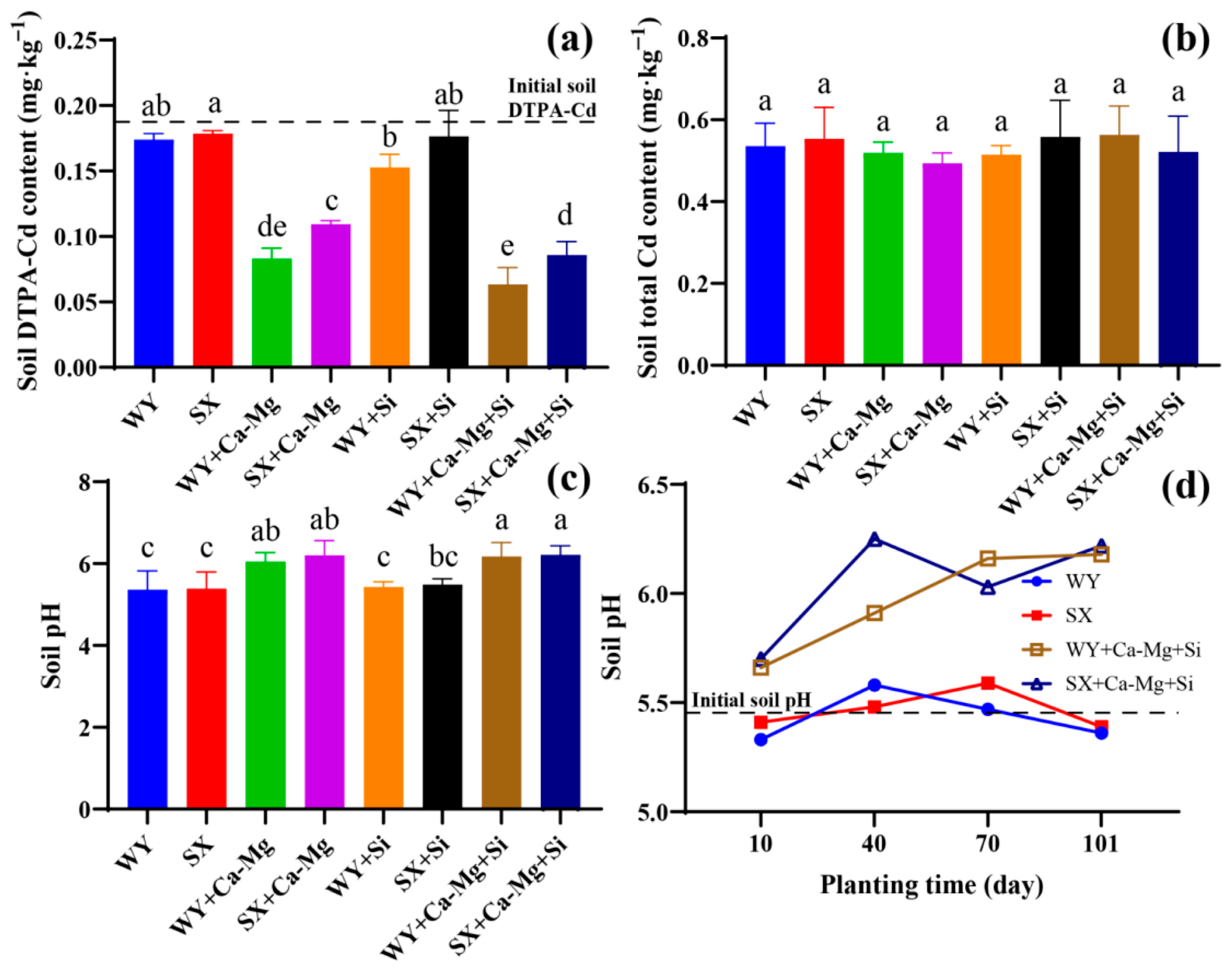
As illustrated in (Figure 2a,b), compared to WY and SX, none of the treatments had a significant effect on total Cd content in the soil (p > 0.05). However, for DTPA-Cd, the application of Ca-Mg significantly reduced the DTPA-Cd content (p < 0.05). Ca-Mg decreased the DTPA-Cd content in WY by 51.6% to 63.0%, but in SX, it reduced the DTPA-Cd content by 38.6% to 51.9%. Figure 2c shows the changes in soil pH values 101 d after the application of Ca-Mg immobilizations. Compared to the single cultivars WY and SX, the application of Ca-Mg significantly increased the soil pH value by 0.69 to 0.83 units. Additionally, Figure 2d indicates that the effect of Ca-Mg on increasing soil pH values persisted over time. However, the soil pH values for the SX + Ca-Mg treatment did not show a consistent increasing trend, which might be related to the flooding conditions in the SX + Ca-Mg plots at 70 d. Research has shown that during flooding, both soil pH and Eh tend to decrease [23].

3.3. Effects of Soil Immobilization, Foliar Si Application, and Co-Application on Cd Uptake in Rice

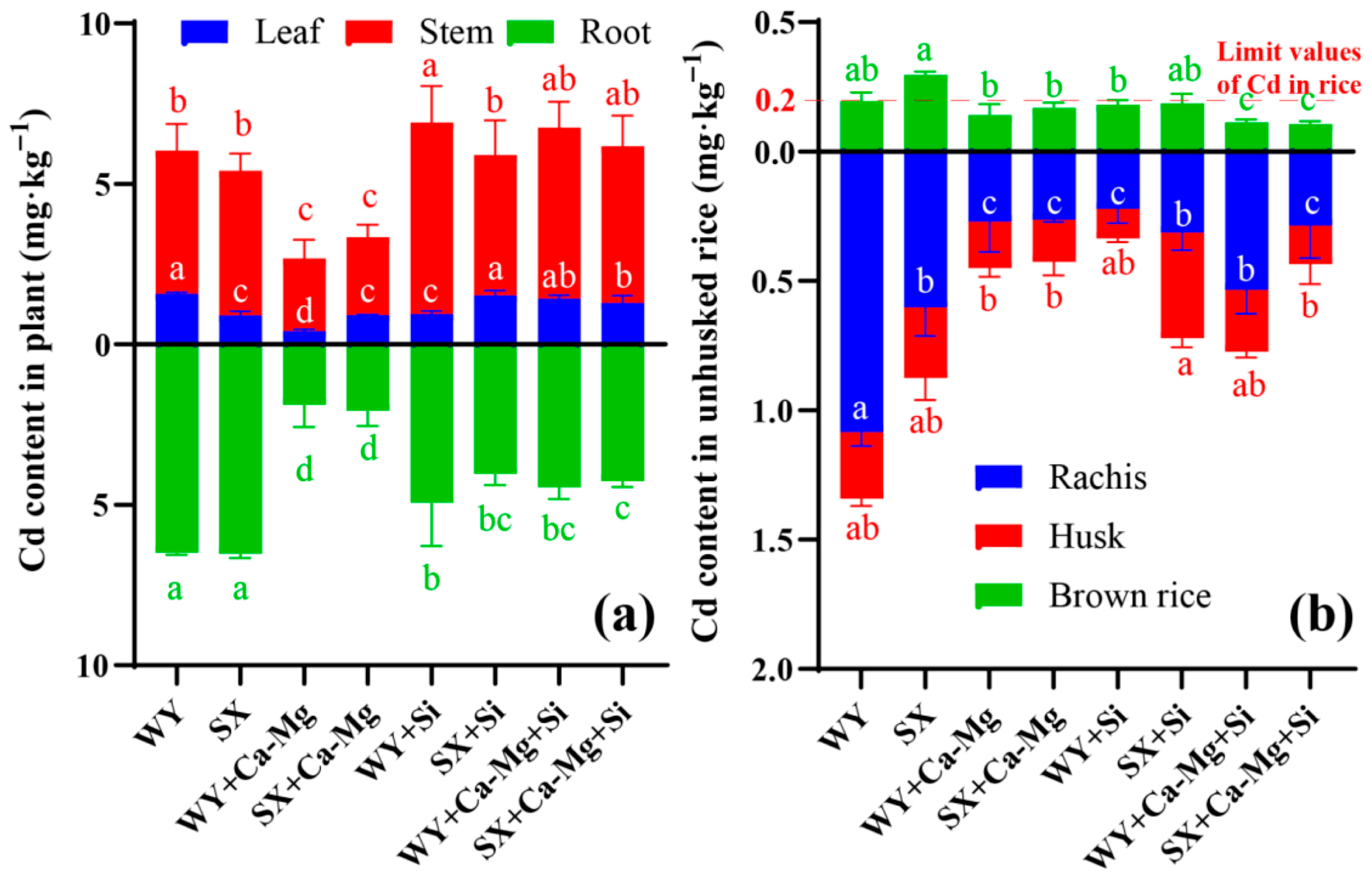
Figure 3a shows that Ca-Mg, Si, and Ca-Mg + Si all significantly reduced Cd content in the roots by 24.0% to 70.9% (p < 0.05), with Ca-Mg demonstrating the highest efficacy. Notably, Si also significantly reduced Cd content in the roots, indicating that the applied Si(OH)4 could be transported to the roots from leaves and other parts of the plant [24]. Si promotes the formation of an iron plaque on the root surface, increasing the density of carbonyl groups on the iron plaque surface [25], inhibiting the transformation of amorphous iron minerals in the iron plaque to crystalline forms [26], thereby enhancing the adsorption or co-precipitation of Cd on the iron plaque. Additionally, Si increases the concentration of monosilicic acid in the plant’s symplast and apoplast, leading to the accumulation of Cd in the apoplast of the roots, reducing Cd transport in the apoplast and symplast, and consequently lowering the Cd content in the plant [27]. The effects of Ca-Mg, Si, and Ca-Mg + Si on Cd content in the stems were opposite; compared to WY and SX, Ca-Mg significantly reduced stem Cd content (p < 0.05) by 46.4% to 49.3%, while Si and Ca-Mg + Si treatments increased stem Cd content to varying degrees. This is because Ca-Mg promotes the conversion of soluble Cd in the soil to insoluble forms, reducing soil Cd availability, and thus, the Cd absorbed by the roots and transported to the stems is relatively low; Si(OH)4 forms ordered SiO2 colloids within the plant, which can form Cd-Si complexes with Cd2+, reducing the mobility of Cd in the plant [28]. Ca-Mg, Si, and Ca-Mg + Si all reduced Cd content in the leaves of WY by 9.78% to 73.9%, while they increased Cd content in the leaves of SX by 1.83% to 69.4%. Furthermore, the Cd content in the rachis of WY was significantly greater than that of SX, ultimately leading to WY having a compliant Cd content in brown rice (0.195 mg·kg−1).
Figure 3b shows that Si significantly reduced the Cd content in the rachis of both WY and SX (p < 0.05), with reductions of 50.7% to 79.6% for WY and 48.1% to 52.5% for SX. Additionally, Si significantly promoted the accumulation of Cd in the husk. In summary, Ca-Mg, Si, and Ca-Mg + Si all significantly reduced Cd content in brown rice, with levels below 0.2 mg·kg−1 (GB 2762-2022), among which Ca-Mg + Si demonstrated the greatest efficacy. The Cd content in the brown rice of WY and SX decreased from 0.195 mg·kg−1 and 0.296 mg·kg−1 to 0.113 mg·kg−1 and 0.106 mg·kg−1, respectively.

3.4. BCF and TF Values for Cd in Rice Under Soil Immobilization, Foliar Si Application, and Co-Application

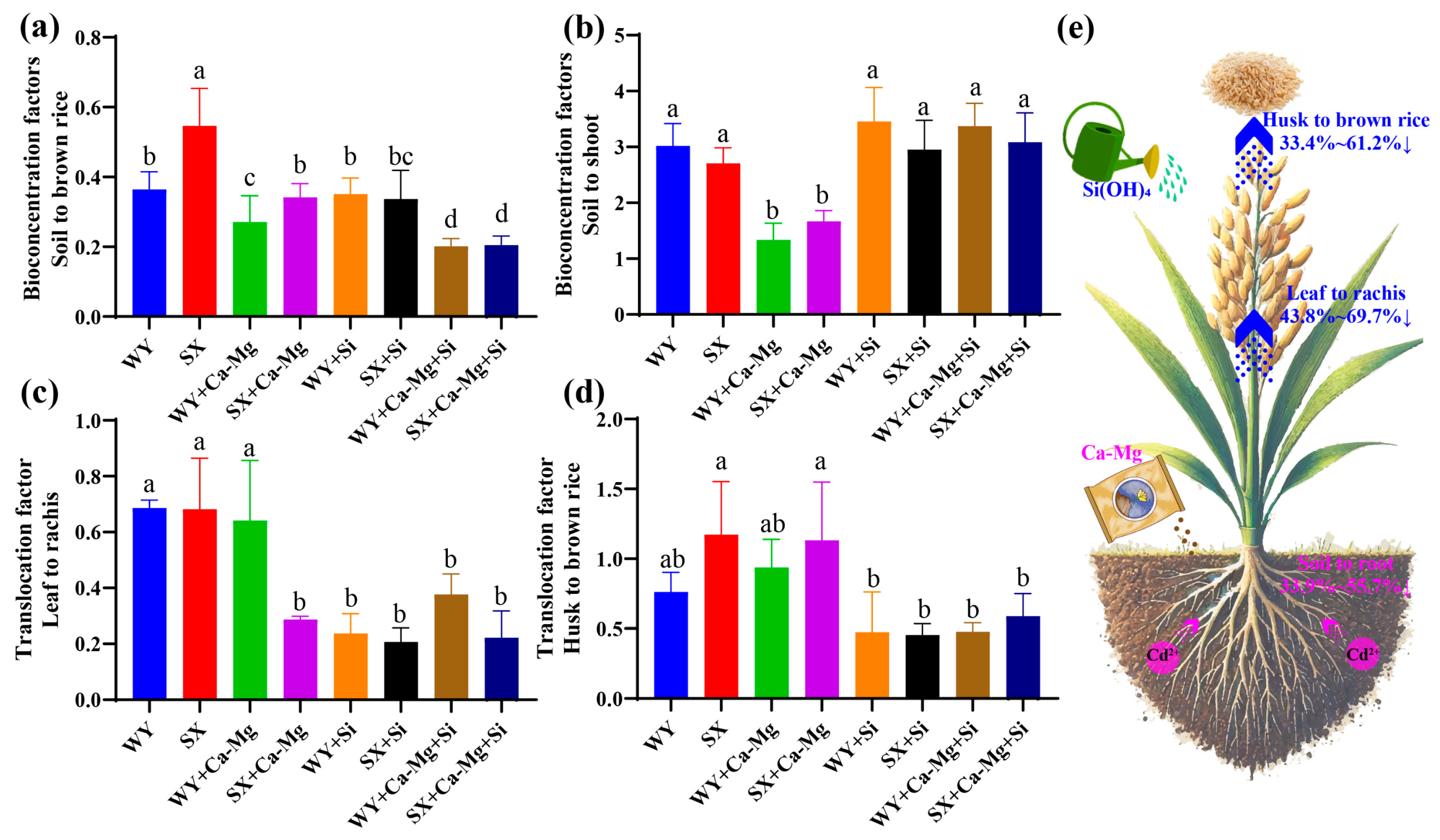
Figure 4a shows that Ca-Mg, Si, and Ca-Mg + Si all significantly reduced BCFsoi-brown rice, with reductions of 25.1% to 37.5%, 3.77% to 38.2%, and 50.0% to 66.6%, respectively, with Ca-Mg + Si being the most effective treatment. Additionally, Ca-Mg significantly reduced the BCFsoil-shoot, while Si and Ca-Mg + Si significantly reduced TFleaf-rachis and TFhusk-brown rice. (Figure 4b–d). Overall, after applying Ca-Mg to the soil, the BCFsoil-root decreased by 33.9% to 55.7%. Subsequent to the application of Si(OH)4, the TFleaf-rachis and TFhusk-brown rice decreased by 43.8% to 69.7% and 33.4% to 61.2%, respectively (Figure 4e).

3.5. Influencing Factors of Cd Content in Rice Tissues

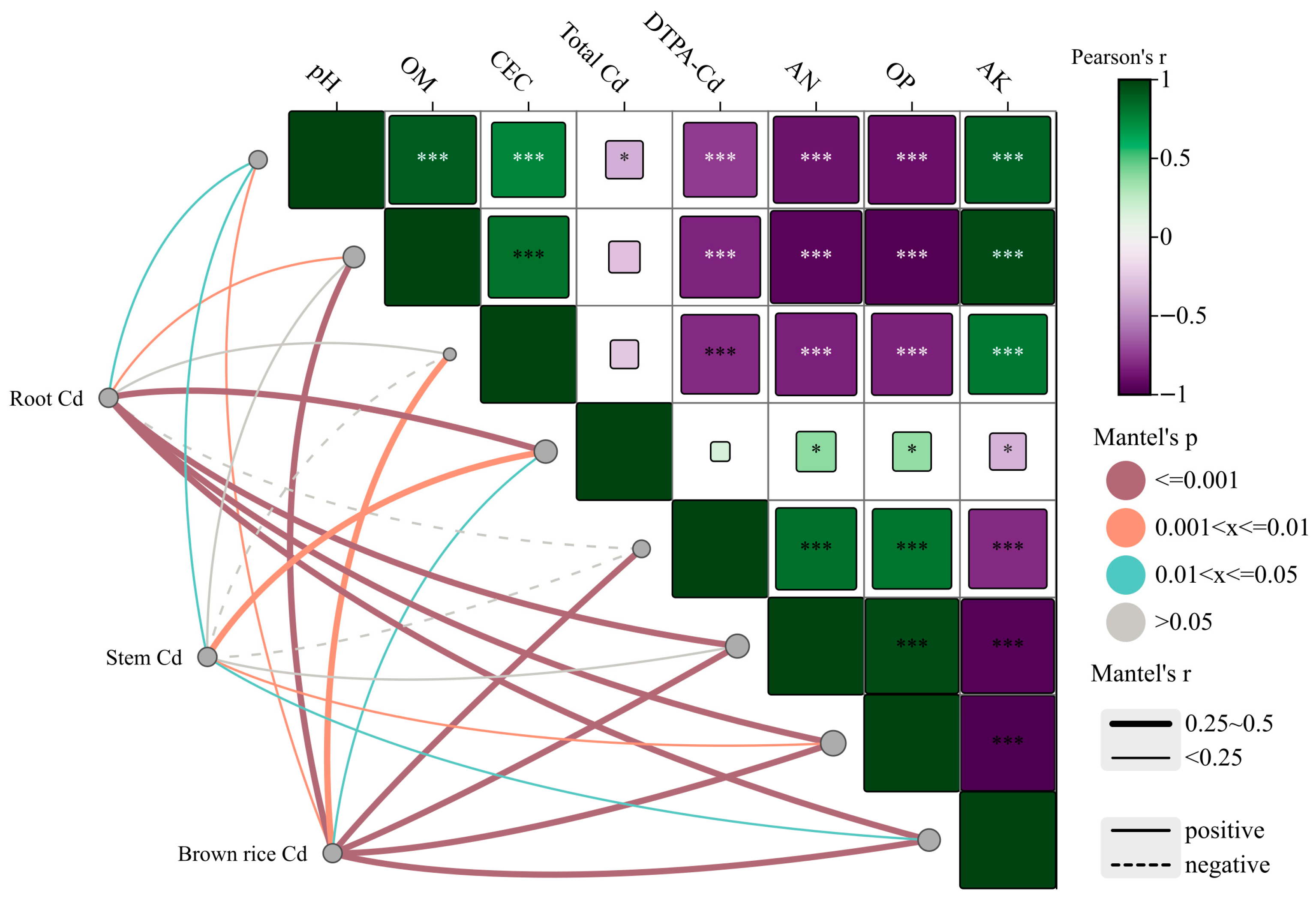
Figure 5 shows the Mantel analysis of environmental factors on Cd content in different parts of rice. Mantel analysis, in conjunction with correlation analysis (Figure S1), reveals that both root Cd and brown rice Cd are significantly and positively correlated with DTPA-Cd, alkali-hydrolyzed nitrogen (AN), and available phosphorus (OP) (p < 0.001). Root Cd and stem Cd also exhibit significant positive correlations with CEC (p < 0.01). Additionally, pH shows a strong negative correlation with DTPA-Cd, AN, and OP (p < 0.001), but a pronounced positive correlation with OM, CEC, and AK (p < 0.001). The correlation between total Cd and DTPA-Cd is not significant (p > 0.05), but both are significantly positively correlated with AN and OP, and negatively correlated with AK (p < 0.05).
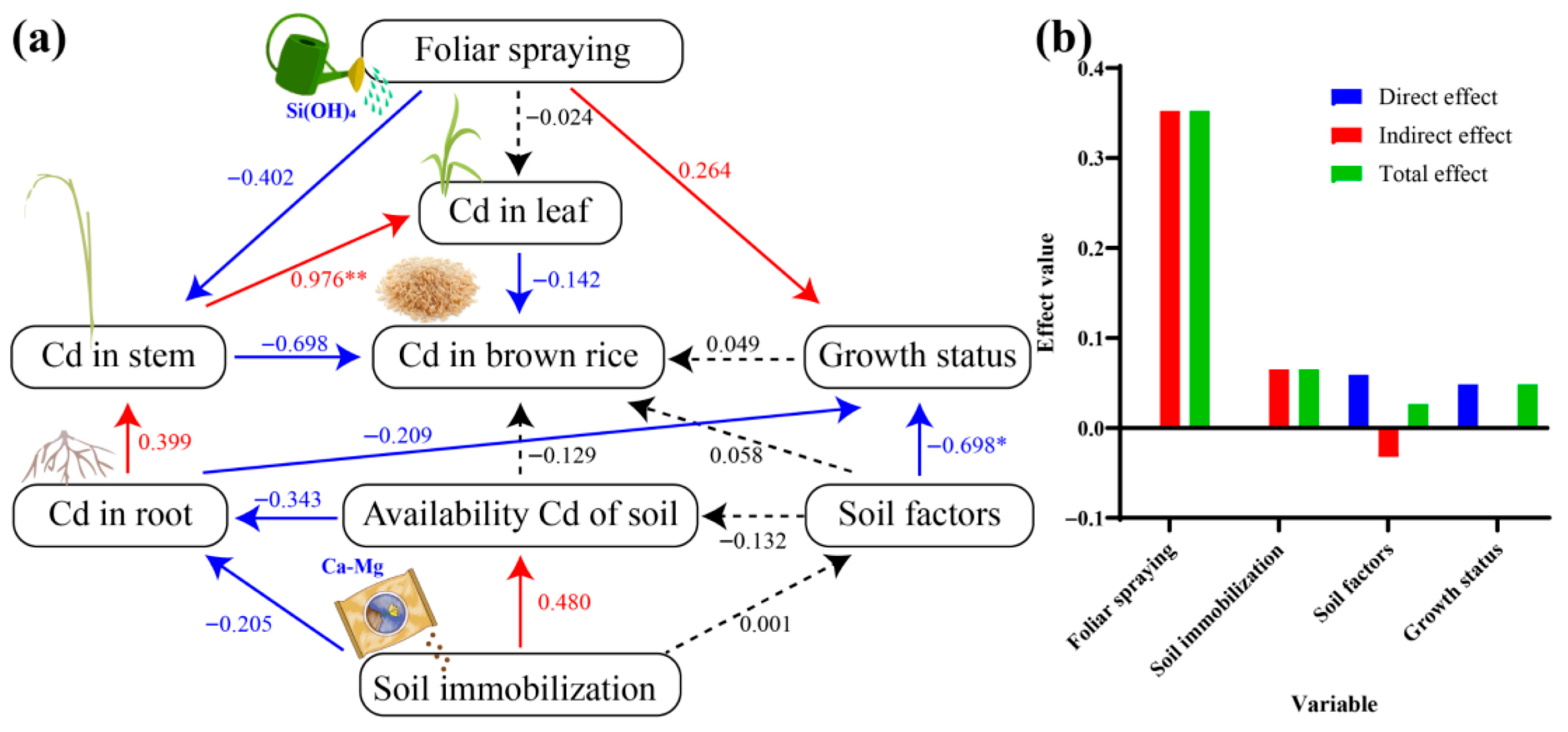
Figure 6a shows the partial least squares path modeling (PLS-PM) analysis, which further investigates the relationships between soil immobilization, foliar spray application, and Cd content in brown rice. The results indicate that Ca-Mg has a direct positive effect on soil Cd availability (0.480) and a direct negative impact on root Cd content (−0.205), without affecting soil chemical properties. Soil chemical properties have a significant negative effect on rice growth (−0.698). Root Cd content has a direct positive effect on stem Cd content (0.399) and a direct negative impact on rice growth (−0.209). Si(OH)4 has a direct negative impact on stem Cd content (−0.402) and a direct positive effect on rice growth (0.264). Stem Cd content has a direct negative impact on brown rice Cd content (−0.698) and a significant positive effect on leaf Cd content (0.976), while leaf Cd content has a negative impact on brown rice Cd content (−0.142). In summary, Ca-Mg and Si(OH)4 cause the fixation and retention of Cd in rice stems, which, in turn, directly or indirectly inhibits the migration or transport of Cd from stems to brown rice. Considering both direct and indirect effects, the standardized total effects of various factors on Cd accumulation in brown rice are shown in (Figure 6b), with foliar spray application of Si(OH)4 identified as a more important factor affecting Cd content in brown rice.

4. Discussion

Food security is crucial for national stability, which is particularly evident in China. China has achieved providing the food supply for 18% of the global population using only 9% of the world’s arable land and 6% of its water resources [29]. Rice is the main source of Cd in the Chinese diet, accounting for 55% of Cd intake by the Chinese population [30]. Previous studies have utilized Cd remediation techniques, including water management, phytoremediation, and electro-kinetics; however, these methods often present challenges and incur substantial operational expenses [31,32,33]. It is still unclear if Ca-Mg + Si(OH)4 could synergistically inhibit Cd accumulation in rice.
The results of this study indicate that the BCFsoil-brown rice significantly decreased under all treatments (p < 0.05). However, the effect of Ca-Mg + Si was more significant. The BCFsoil-brown rice under the Ca-Mg + Si treatment showed a significant difference compared to Ca-Mg and Si alone (p < 0.05), indicating that Ca-Mg and Si(OH)4 can have a synergistic effect to further achieve safe production in Cd-contaminated farmland. Figure 3b also confirms this point. Additionally, the Cd content in brown rice decreased to below 0.2 mg·kg−1 under all treatments, with the effect of Ca-Mg + Si being more effective. Compared to Ca-Mg and Si treatments alone, the Ca-Mg + Si treatment reduced the Cd content in brown rice by 19.5% to 45.8%. The stem is a major organ limiting Cd entry into rice [34]. The stem of graminaceous plants serves as a central hub for the distribution of mineral elements to different organs, and the upward transport of Cd in the stem is significantly limited [35,36]. Figure 6a also indicates that the stem is a crucial location for intercepting and preventing the upward migration of Cd. Ca-Mg + Si can directly or indirectly inhibit the translocation of Cd from the stem to brown rice, thereby further reducing the accumulation of Cd in brown rice grown in Cd-contaminated soils. 109Cd tracing experiments have confirmed that 91–100% of Cd in the grains comes from the upward transport of Cd in the phloem of the first internode [37].
It is noteworthy that the BCFsoil-shoot, TFleaf-rachis, and TFhusk-brown rice under Si and Ca-Mg + Si treatments had similar effects, indicating that foliar spraying of Si(OH)4 plays a crucial role in the migration process of Cd from soil to the aboveground part and then to brown rice. Figure 6b also demonstrates this point. Following foliar application of Si(OH)4, Cd concentrations in the stems of both WY and SX cultivars increased, accompanied by elevated BCFsoil–shoot values and decreased TFleaf–rachis and TFhusk–brown rice. These patterns indicate that foliar Si(OH)4 treatment promotes Cd retention within the stem tissues, thereby significantly reducing Cd accumulation in the rachis (p < 0.05), facilitating Cd sequestration in the husk, and ultimately diminishing Cd translocation from the husk to brown rice grains. This observation is consistent with previous findings that foliar silicon application induces the deposition of Cd2+ ions within the cell walls of stem tissues, forming stable Si–Cd complexes that effectively constrain Cd movement toward the panicle and mitigate its accumulation in reproductive organs [38]. Previous studies have indicated that the exogenous addition of Si can regulate the transport and accumulation of Cd in plants through several mechanisms. These include enhancing the adsorption capacity of cell walls for Cd, promoting the synthesis of phytochelatins within cells, strengthening the chelation of free Cd, and modulating the expression of four membrane transporter proteins: OsNramp1, OsHMA2, OsZIP6, and OsZIP7 [39,40,41,42]. However, after foliar application of Si(OH)4, the trends in Cd accumulation within the leaves of WY and SX cultivars diverged. Compared with the control, SX exhibited a significant increase in leaf Cd concentration following Si(OH)4 spraying (p < 0.05), which may be attributed to the greater Cd-retention capacity of SX leaf cell walls [43]. In addition, factors such as spraying technique, light intensity, soil moisture status, and the composition of soil microbial communities can collectively exert considerable influence on Cd accumulation within rice plants [44].
Correlation studies have shown that pH has a significant negative correlation with DTPA-Cd (p < 0.001), suggesting that the main mechanism for reducing the bioavailability of soil Cd is to increase soil pH. Soil pH is the paramount factor affecting the speciation and mobility of Cd in soil, directly influencing its migration [45]. The maximum absorption rate of Cd usually occurs during the maturity stage [46], and Ca-Mg has a greater impact on soil pH value (Figure 2d), which can significantly reduce the migration of Cd in soil. This study demonstrates that, in contrast to the monoculture of WY and SX, Ca-Mg + Si can increase soil pH by 0.82~0.83 units (Figure 2d). Compared with the monoculture of WY and SX, the application of Ca-Mg significantly reduced soil DTPA-Cd content (p < 0.05, Figure 2a). However, Ca-Mg + Si further reduced DTPA-Cd content by 21.7%~23.6% compared to the Ca-Mg treatment. Ca-Mg’s pH (10.2) can increase the number of negative charges in the soil [47], transforming more Cd in paddy fields into forms that are difficult for rice roots to absorb, such as CdOH+, Cd2(OH)3+, and Cd(OH)2 [48,49], thereby reducing Cd accumulation in brown rice. Additionally, the immobilization contains a large amount of CaO, which can protect the integrity of the cell wall and plasma membrane, blocking Cd entry into rice roots and inhibiting its absorption. Ca also regulates Cd translocation in rice by modulating the expression of transporter genes OsNramp5 and OsHMA2 [50,51]. Ca2+ can exchange with Cd2+ in root cell walls and compete with Cd2+ for binding sites on root transporters, thus reducing the concentration of Cd2+ in roots [52,53]. Additionally, the abundant MgO in the conditioner can suppress Cd absorption and accumulation in contaminated paddy fields by regulating soil pH and promoting plant metabolism and growth [54]. It is worth noting that the high alkalinity of Ca-Mg (pH 10.2) may, under conditions of long-term and continuous application, induce abrupt local pH fluctuations that potentially alter the bioavailability of essential nutrients such as Fe, Mn, and P. Therefore, future studies should establish multi-season field-monitoring frameworks to assess the long-term impacts of Ca-Mg amendments on soil physicochemical properties and the potential risk of heavy-metal remobilization.
In addition, in this field study, Ca-Mg + Si had a positive effect on the yield of both rice varieties (Figure 1a). Research has shown that Cd negatively impacts biomass output [55], while application of Si can reduce the incidence of plant diseases, thereby contributing to the increase in the crop yield [56]. Lu et al. also showed that spraying Si had no significant effect on the yield of four rice varieties, but all exhibited varying degrees of yield increase [57]. Additionally, the great growth and grain yield achieved by SX was stimulated by the nutrients such as Ca and Mg provided by Ca-Mg, including Si. The role of applying Ca and Mg fertilizers in improving biomass cannot be ignored. Due to the large areas of paddy fields contaminated with Cd in China and around the world, there is an urgent need to adopt cost-effective measures to mitigate the transfer of Cd to edible parts of plants. Economic profitability directly affects farmers’ willingness to adopt safe-utilization practices. The procurement costs of Ca-Mg and Si(OH)4 were 2925 ¥·hm−2 and 975 ¥·hm−2, respectively. Additional expenditures primarily included agricultural inputs such as rice seeds, fertilizers, and pesticides, as well as costs for mechanical tillage, harvesting, irrigation, field management, and labor, amounting to 7342 ¥·hm−2. Consequently, the total investment reached 11,242 ¥·hm−2. Under the Ca–Mg + Si treatment, the Cd concentration in brown rice met national food safety standards, allowing the crop to be marketed at a local transaction price of 3.2 ¥·kg−1. The total output value ranged between 16,544 and 18,025 ¥·hm−2, yielding an input–output ratio of 1.47–1.60. These findings indicate that the combined Ca-Mg + Si strategy not only ensures safe and sustainable rice production in Cd-impacted soils but also provides substantial economic returns to farmers, achieving the dual goals of agricultural productivity and in situ soil rehabilitation. Moreover, with their high operational efficiency and uniform spraying performance, agricultural drones have been increasingly adopted for pesticide and fertilizer application as well as pollution-control operations [58], which could further reduce the cost and enhance the economic feasibility of this safety-utilization technology.
In summary, the combination of Ca-Mg + Si significantly decreased root Cd content, promoted the immobilization and retention of Cd in stems and leaves, and reduced Cd accumulation in rachises and husks, thereby reducing the brown rice Cd content of WY and SX to under 0.2 mg·kg−1. Correlation and PLS-PM comprehensive analyses indicated strong negative correlations between brown rice Cd and pH, OM, CEC, and AK (p < 0.01), and strong positive correlations between brown rice Cd and DTPA-Cd, AN, and OP (p < 0.01). Ca-Mg and Si(OH)4 directly or indirectly inhibited the migration or transport of Cd from stems to brown rice, with foliar-sprayed Si(OH)4 being an important factor in reducing brown rice Cd content. The combined application of Ca-Mg + Si is recommended as an economically efficient and practicable strategy for promoting safe rice production in moderately Cd-contaminated acidic soils. Nevertheless, the performance of the Ca-Mg + Si approach remains subject to multiple constraints, including soil type, climatic conditions, rice genotype, and the degree of heavy-metal contamination. Future research should therefore focus on validating its long-term stability and economic viability under diverse ecological contexts to ensure its broad applicability and sustainability in real-world agricultural systems.

Supplementary Materials

The following supporting information can be downloaded at: https://www.mdpi.com/article/10.3390/agronomy16050538/s1, Figure S1: Correlation analysis between Cd content in brown rice and soil properties.

Author Contributions

Conceptualization, L.T. and B.S.; methodology, L.T., L.L., F.H. and B.S.; formal analysis, L.T.; investigation, L.T., L.L., Z.Z., L.M. and F.H.; data curation, L.T., Z.Z. and L.M.; writing—original draft preparation, L.T.; writing—review and editing, L.L., Z.Z., L.M., F.H. and B.S.; final revision of this manuscript, L.T.; supervision, L.T., X.Z. and B.S.; project administration, L.T. and B.S.; resources, L.L. and B.S.; funding acquisition, X.Z. and B.S. All authors have read and agreed to the published version of the manuscript.

Funding

This research was funded by the National Natural Science Foundation of China (52230006) and the Guangxi Science and Technology Major Project (CN) (AA17204047-2).

Data Availability Statement

The original contributions presented in the study are included in the article/Supplementary Materials; further inquiries can be directed to the corresponding author.

Acknowledgments

We extend our gratitude to the teachers and students who supported this research. We also appreciate the valuable feedback and comments from the editors and reviewers.

Conflicts of Interest

The authors declare that they have no known competing financial interests or personal relationships that could have appeared to influence the work reported in this paper.

References

  1. El Rasafi, T.; Oukarroum, A.; Haddioui, A.; Song, H.; Kwon, E.E.; Bolan, N.; Tack, F.M.G.; Sebastian, A.; Prasad, M.N.V.; Rinklebe, J. Cadmium stress in plants: A critical review of the effects, mechanisms, and tolerance strategies. Crit. Rev. Environ. Sci. Technol. 2022, 52, 675–726. [Google Scholar] [CrossRef]
  2. Zhao, F.J.; Ma, Y.B.; Zhu, Y.G.; Tang, Z.; McGrath, S.P. Soil contamination in China: Current status and mitigation strategies. Environ. Sci. Technol. 2014, 49, 750–759. [Google Scholar] [CrossRef]
  3. Reimann, C.; Caritat, P.D. New soil composition data for Europe and Australia: Demonstrating comparability, identifying continental-scale processes and learning lessons for global geochemical mapping. Sci. Total Environ. 2012, 416, 239–252. [Google Scholar] [CrossRef] [PubMed]
  4. Huang, J.H.; Hsu, S.H.; Wang, S.L. Effects of rice straw ash amendment on Cu solubility and distribution in flooded rice paddy soils. J. Hazard. Mater. 2011, 186, 1801–1807. [Google Scholar] [CrossRef] [PubMed]
  5. Khanam, R.; Kumar, A.; Nayak, A.K.; Shahid, M.; Tripathi, R.; Vijayakumar, S.; Chatterjee, D. Metal(loid)s (As, Hg, Se, Pb and Cd) in paddy soil: Bioavailability and potential risk to human health. Sci. Total Environ. 2020, 699, 134330. [Google Scholar] [CrossRef]
  6. Du, B.Y.; Zhou, J.; Lu, B.X.; Zhang, C.; Li, D.M.; Zhou, J.; Jiao, S.J.; Zhao, K.; Zhang, H.H. Environmental and human health risks from cadmium exposure near an active lead-zinc mine and a copper smelter, China. Sci. Total Environ. 2020, 720, 137585. [Google Scholar] [CrossRef]
  7. Chen, H.P.; Tang, Z.; Wang, P.; Zhao, F.J. Geographical variations of cadmium and arsenic concentrations and arsenic speciation in Chinese rice. Environ. Pollut. 2018, 238, 482–490. [Google Scholar] [CrossRef] [PubMed]
  8. He, L.Z.; Zhong, H.; Liu, G.X.; Dai, Z.M.; Brookes, P.C.; Xu, J.M. Remediation of heavy metal contaminated soils by biochar: Mechanisms, potential risks and applications in China. Environ. Pollut. 2019, 252, 846–855. [Google Scholar] [CrossRef]
  9. Zhang, M.; Jiang, J.W.; Yin, Q.J.; Ding, L.; Yuan, X.L.; Chen, Y.G.; Liu, W.B.; Guo, B.; Shan, S.D. Soil bacterial and fungal communities respond differently to the biochar amendment in a cadmium-contaminated paddy field. Sci. Rep. 2025, 15, 35764–35774. [Google Scholar] [CrossRef]
  10. Tong, F.; Huang, Q.; Liu, L.Z.; Fan, G.P.; Shi, G.L.; Lu, X.; Gao, Y. Interactive effects of inorganic–organic compounds on passivation of ccadmium in weakly alkaline soil. Agronomy 2023, 13, 2647. [Google Scholar] [CrossRef]
  11. Chen, H.P.; Zhang, W.W.; Yang, X.P.; Wang, P.; McGrath, S.P.; Zhao, F.J. Effective methods to reduce cadmium accumulation in rice grain. Chemosphere 2018, 207, 699–707. [Google Scholar] [CrossRef] [PubMed]
  12. Jin, Y.; Cheng, Z.Y.; He, Y.; Xu, J.M.; Shi, J.C. Dynamic response of cadmium immobilization to a Ca-Mg-Si soil conditioner in the contaminated paddy soil. Sci. Total Environ. 2024, 908, 168394. [Google Scholar] [CrossRef]
  13. Hamid, Y.; Tang, L.; Hussain, B.; Usman, M.; Gurajala, H.K.; Rashid, M.S.; He, Z.L.; Yang, X.E. Efficiency of lime, biochar, Fe containing biochar and composite amendments for Cd and Pb immobilization in a co-contaminated alluvial soil. Environ. Pollut. 2020, 257, 113609. [Google Scholar] [CrossRef]
  14. Wu, J.Z.; Huang, D.; Liu, X.M.; Meng, J.; Tang, C.X.; Xu, J.M. Remediation of As(III) and Cd(II) co-contamination and its mechanism in aqueous systems by a novel calcium-based magnetic biochar. J. Hazard. Mater. 2018, 348, 10–19. [Google Scholar] [CrossRef] [PubMed]
  15. Gao, M.; Zhou, J.; Liu, H.L.; Zhang, W.T.; Hu, Y.M.; Liang, J.N.; Zhou, J. Foliar spraying with silicon and selenium reduces cadmium uptake and mitigates cadmium toxicity in rice. Sci. Total Environ. 2018, 631–632, 1100–1108. [Google Scholar] [CrossRef] [PubMed]
  16. Adrees, M.; Ali, S.; Rizwan, M.; Zia ur Rehman, M.; Ibrahim, M.; Abbas, F.; Farid, M.; Qayyum, M.F.; Irshad, M.K. Mechanisms of silicon-mediated alleviation of heavy metal toxicity in plants: A review. Ecotoxicol. Environ. Saf. 2015, 119, 186–197. [Google Scholar] [CrossRef]
  17. Sohail, M.I.; Rehman, M.Z.U.; Rizwan, M.; Yousaf, B.; Ali, S.; ul Haq, M.A.; Anayat, A.; Waris, A.A. Efficiency of various silicon rich amendments on growth and cadmium accumulation in field grown cereals and health risk assessment. Chemosphere 2020, 244, 125481. [Google Scholar] [CrossRef]
  18. Fu, Z.P.; Zhang, K.; Zhang, J.Y.; Zhang, Y.; Cao, Q.; Tian, Y.C.; Zhu, Y.; Cao, W.X.; Liu, X.J. Optimizing nitrogen application and sowing date can improve environmental sustainability and economic benefit in wheat–rice rotation. Agric. Syst. 2023, 204, 103536–103550. [Google Scholar] [CrossRef]
  19. Zhou, J.; Gao, M.; Cui, H.; Li, D.; Xia, R.; Wang, T.; Zhou, J. Influence of silicon and selenium and contribution of the node to cadmium allocation and toxicity in rice. ACS Agric. Sci. Technol. 2021, 1, 550–557. [Google Scholar] [CrossRef]
  20. Sha, Z.P.; Ma, X.; Loick, N.; Lv, T.T.; Cardenas, L.M.; Ma, Y.; Liu, X.J.; Misselbrook, T. Nitrogen stabilizers mitigate reactive N and greenhouse gas emissions from an arable soil in North China Plain: Field and laboratory investigation. J. Clean. Prod. 2020, 258, 121025. [Google Scholar] [CrossRef]
  21. Lu, R.K. Soil and Agro-Chemistry Analytical Methods; Chinese Agricultural Science and Technology Press: Beijing, China, 1999. [Google Scholar]
  22. Tian, T.; Zhou, H.; Gu, J.F.; Jia, R.Y.; Li, H.C.; Wang, Q.Q.; Zeng, M.; Liao, B.H. Cadmium accumulation and bioavailability in paddy soil under different water regimes for different growth stages of rice (Oryza sativa L.). Plant Soil 2019, 440, 327–339. [Google Scholar] [CrossRef]
  23. Haque, K.M.S.; Howitt, J.A.; Weston, L.A.; Dyall-Smith, M.; Eberbach, P.L. Pore Mn2+ dynamics of the rhizosphere of flooded and non-flooded rice during a long wet and drying phase in two rice growing soils. Chemosphere 2015, 134, 16–24. [Google Scholar] [CrossRef]
  24. Liu, C.P.; Li, F.B.; Luo, C.L.; Liu, X.M.; Wang, S.H.; Liu, T.X.; Li, X.D. Foliar application of two silica sols reduced cadmium accumulation in rice grains. J. Hazard. Mater. 2009, 161, 1466–1472. [Google Scholar] [CrossRef]
  25. Liu, S.H.; Ji, X.H.; Chen, Z.L.; Xie, Y.H.; Ji, S.Y.; Wang, X.; Pan, S.F. Silicon facilitated the physical barrier and adsorption of cadmium of iron plaque by changing the biochemical composition to reduce cadmium absorption of rice roots. Ecotoxicol. Environ. Saf. 2023, 256, 114879. [Google Scholar] [CrossRef] [PubMed]
  26. Seyfferth, A.; Limmer, M.; Wu, W.D. Si and water management drives changes in Fe and Mn pools that affect as cycling and uptake in rice. Soil Syst. 2019, 3, 58. [Google Scholar] [CrossRef]
  27. Wu, Z.C.; Wang, F.H.; Liu, S.; Du, Y.Q.; Li, F.R.; Du, R.Y.; Wen, D.; Zhao, J. Comparative responses to silicon and selenium in relation to cadmium uptake, compartmentation in roots, and xylem transport in flowering Chinese cabbage (Brassica campestris L. ssp. chinensis var. utilis) under cadmium stress. Environ. Exp. Bot. 2016, 131, 173–180. [Google Scholar] [CrossRef]
  28. Wu, Z.C.; Xu, S.J.; Shi, H.Z.; Zhao, P.H.; Liu, X.X.; Li, F.R.; Deng, T.H.B.; Du, R.Y.; Wang, X.; Wang, F.H. Comparison of foliar silicon and selenium on cadmium absorption, compartmentation, translocation and the antioxidant system in Chinese flowering cabbage. Ecotoxicol. Environ. Saf. 2018, 166, 157–164. [Google Scholar] [CrossRef]
  29. Wang, Y.D.; Yang, J.; Liang, J.P.; Qiang, Y.F.; Fang, S.Q.; Gao, M.X.; Fan, X.Y.; Yang, G.H.; Zhang, B.W.; Feng, Y.Z. Analysis of the environmental behavior of farmers for non-point source pollution control and management in a water source protection area in China. Sci. Total Environ. 2018, 633, 1126–1135. [Google Scholar] [CrossRef] [PubMed]
  30. Song, Y.; Wang, Y.B.N.; Mao, W.F.; Sui, H.X.; Yong, L.; Yang, D.J.; Jiang, D.G.; Zhang, L.; Gong, Y.Y. Dietary cadmium exposure assessment among the Chinese population. PLoS ONE 2017, 12, e0177978. [Google Scholar] [CrossRef]
  31. Huang, Q.Q.; Liu, Y.Y.; Qin, X.; Zhao, L.J.; Liang, X.F.; Xu, Y.M. Selenite mitigates cadmium-induced oxidative stress and affects Cd uptake in rice seedlings under different water management systems. Ecotoxicol. Environ. Saf. 2019, 168, 486–494. [Google Scholar] [CrossRef]
  32. Qiao, Y.B.; Lin, Z.; Li, L.X.; Jiang, W.; Ge, J.; Chen, J.Z.; Lu, L.L.; Tian, S.K. Serendipita indica drives sulfur-related microbiota in enhancing growth of hyperaccumulator Sedum alfredii and facilitating soil cadmium remediation. Environ. Sci. Technol. 2024, 58, 14726–14739. [Google Scholar] [CrossRef]
  33. Gul, I.; Manzoor, M.; Silvestre, J.; Rizwan, M.; Hina, K.; Kallerhoff, J.; Arshad, M. EDTA-assisted phytoextraction of lead and cadmium by Pelargonium cultivars grown on spiked soil. Int. J. Phytoremediation 2019, 21, 101–110. [Google Scholar] [CrossRef] [PubMed]
  34. Luo, Q.H.; Bai, B.; Xie, Y.H.; Yao, D.P.; Zhang, D.M.; Chen, Z.; Zhuang, W.; Deng, Q.Y.; Xiao, Y.H.; Wu, J. Effects of Cd uptake, translocation and redistribution in different hybrid rice varieties on grain Cd concentration. Ecotoxicol. Environ. Saf. 2022, 240, 113683. [Google Scholar] [CrossRef]
  35. Huang, G.X.; Ding, C.F.; Guo, F.Y.; Li, X.G.; Zhou, Z.G.; Zhang, T.L.; Wang, X.X. The role of node restriction on cadmium accumulation in the brown rice of 12 Chinese rice (Oryza sativa L.) cultivars. J. Agric. Food Chem. 2017, 65, 10157–10164. [Google Scholar] [CrossRef]
  36. Yamaji, N.; Ma, J.F. The node, a hub for mineral nutrient distribution in graminaceous plants. Trends Plant Sci. 2014, 19, 556–563. [Google Scholar] [CrossRef] [PubMed]
  37. Tanaka, K.; Fujimaki, S.; Fujiwara, T.; Yoneyama, T.; Hayashi, H. Quantitative estimation of the contribution of the phloem in cadmium transport to grains in rice plants (Oryza sativa L.). Soil Sci. Plant Nutr. 2007, 53, 72–77. [Google Scholar] [CrossRef]
  38. Li, H.; Luo, N.; Li, Y.W.; Cai, Q.Y.; Li, H.Y.; Mo, C.H.; Wong, M.H. Cadmium in rice: Transport mechanisms, influencing factors, and minimizing measures. Environ. Pollut. 2017, 224, 622–630. [Google Scholar] [CrossRef]
  39. Ali, S.; Rizwan, M.; Hussain, A.; Zia ur Rehman, M.; Ali, B.; Yousaf, B.; Wijaya, L.; Alyemeni, M.N.; Ahmad, P. Silicon nanoparticles enhanced the growth and reduced the cadmium accumulation in grains of wheat (Triticum aestivum L.). Plant Physiol. Biochem. 2019, 140, 1–8. [Google Scholar] [CrossRef] [PubMed]
  40. Chang, J.D.; Huang, S.; Yamaji, N.; Zhang, W.W.; Ma, J.F.; Zhao, F.J. OsNRAMP1 contributes to cadmium and manganese uptake in rice. Plant Cell Environ. 2020, 43, 2476–2491. [Google Scholar] [CrossRef]
  41. Zhang, J.L.; Zhu, Y.C.; Yu, L.J.; Yang, M.; Zou, X.; Yin, C.X.; Lin, Y.J. Research advances in cadmium uptake, transport and resistance in rice (Oryza sativa L.). Cells 2022, 11, 569. [Google Scholar] [CrossRef]
  42. Pan, D.D.; Yi, J.C.; Li, F.B.; Li, X.M.; Liu, C.P.; Wu, W.J.; Tao, T.T. Dynamics of gene expression associated with arsenic uptake and transport in rice during the whole growth period. BMC Plant Biol. 2020, 20, 133. [Google Scholar] [CrossRef]
  43. Hussain, B.; Lin, Q.; Hamid, Y.; Sanaullah, M.; Di, L.; Khan, M.B.; He, Z.; Yang, X. Foliage application of selenium and silicon nanoparticles alleviates Cd and Pb toxicity in rice (Oryza sativa L.). Sci. Total Environ. 2020, 712, 136497. [Google Scholar] [CrossRef]
  44. Xu, Y.G.; Feng, J.Y.; Li, H.S. Water management increased rhizosphere redox potential and decreased Cd uptake in a low-Cd rice cultivar but decreased redox potential and increased Cd uptake in a high-Cd rice cultivar under intercropping. Sci Total Environ. 2021, 751, 141701. [Google Scholar] [CrossRef]
  45. Haider, F.U.; Cai, L.Q.; Coulter, J.A.; Cheema, S.A.; Wu, J.; Zhang, R.Z.; Wen-jun, M.; Farooq, M. Cadmium toxicity in plants: Impacts and remediation strategies. Ecotoxicol. Environ. Saf. 2021, 211, 111887. [Google Scholar] [CrossRef]
  46. Zhou, H.; Zhu, W.; Yang, W.T.; Gu, J.F.; Gao, Z.W.; Chen, L.W.; Du, W.Q.; Zhang, P.; Peng, P.Q.; Liao, B.H. Cadmium uptake, accumulation, and remobilization in iron plaque and rice tissues at different growth stages. Ecotox. Environ. Saf. 2018, 152, 91–97. [Google Scholar] [CrossRef]
  47. Xu, Y.; Liang, X.F.; Xu, Y.M.; Qin, X.; Huang, Q.Q.; Wang, L.; Sun, Y.B. Remediation of heavy metal-polluted agricultural soils using clay minerals: A review. Pedosphere 2017, 27, 193–204. [Google Scholar] [CrossRef]
  48. Li, X.W.; Zhang, Q.W.; Yang, B. Co-precipitation with CaCO3 to remove heavy metals and significantly reduce the moisture content of filter residue. Chemosphere 2020, 239, 124660. [Google Scholar] [CrossRef]
  49. Xie, X.J.; Yan, L.; Li, J.X.; Guan, L.R.; Chi, Z.Y. Cadmium isotope fractionation during Cd-calcite coprecipitation: Insight from batch experiment. Sci. Total Environ. 2021, 760, 143330. [Google Scholar] [CrossRef] [PubMed]
  50. Ye, W.L.; Wu, F.; Zhang, G.Y.; Fang, Q.; Lu, H.J.; Hu, H.X. Calcium decreases cadmium concentration in root but facilitates cadmium translocation from root to shoot in rice. J. Plant Growth Regul. 2019, 39, 422–429. [Google Scholar] [CrossRef]
  51. Huang, D.L.; Gong, X.M.; Liu, Y.G.; Zeng, G.M.; Lai, C.; Bashir, H.; Zhou, L.; Wang, D.F.; Xu, P.; Cheng, M.; et al. Effects of calcium at toxic concentrations of cadmium in plants. Planta 2017, 245, 863–873. [Google Scholar] [CrossRef] [PubMed]
  52. Yin, Z.R.; Sheng, H.; Xiao, H.C.; Xue, Y.; Man, Z.Y.; Huang, D.Z.; Zhou, Q. Inter-annual reduction in rice Cd and its eco-environmental controls in 6-year biannual mineral amendment in subtropical double-rice cropping ecosystems. Environ. Pollut. 2022, 293, 118566. [Google Scholar] [CrossRef] [PubMed]
  53. Zhang, H.Y.; Yuan, X.Z.; Xiong, T.; Wang, H.; Jiang, L.B. Bioremediation of co-contaminated soil with heavy metals and pesticides: Influence factors, mechanisms and evaluation methods. Chem. Eng. J. 2020, 398, 125657. [Google Scholar] [CrossRef]
  54. Kikuchi, T.; Okazaki, M.; Kimura, S.D.; Motobayashi, T.; Baasansuren, J.; Hattori, T.; Abe, T. Suppressive effects of magnesium oxide materials on cadmium uptake and accumulation into rice grains II: Suppression of cadmium uptake and accumulation into rice grains due to application of magnesium oxide materials. J. Hazard. Mater. 2008, 154, 294–299. [Google Scholar] [CrossRef]
  55. Hou, L.L.; Tong, T.; Tian, B.; Xue, D.W. Crop yield and quality under cadmium stress. In Agronomic, Molecular, Signaling, and Omic Approaches; Prasad, M.N.V., Nahar, K., Eds.; Academic Press: Amsterdam, The Netherlands, 2019; pp. 1–18. [Google Scholar]
  56. Babu, T.; Nagabovanalli, P. Effect of silicon amendment on soil-cadmium availability and uptake in rice grown in different moisture regimes. J. Plant Nutr. 2017, 40, 2440–2457. [Google Scholar] [CrossRef]
  57. Lu, H.M.; Qin, S.T.; Zhao, J.Y.; Pan, P.; Wang, F.L.; Tang, S.D.; Chen, L.H.; Akhtar, K.; He, B. Silicon inhibits the upward transport of Cd in the first internode of different rice varieties in a Cd stressed farm land. J. Hazard. Mater. 2023, 458, 131860. [Google Scholar] [CrossRef]
  58. Puri, V.; Anand, N.; Linesh, R. Agriculture drones: A modern breakthrough in precision agriculture. J. Stat. Manag. Syst. 2017, 20, 507–518. [Google Scholar] [CrossRef]
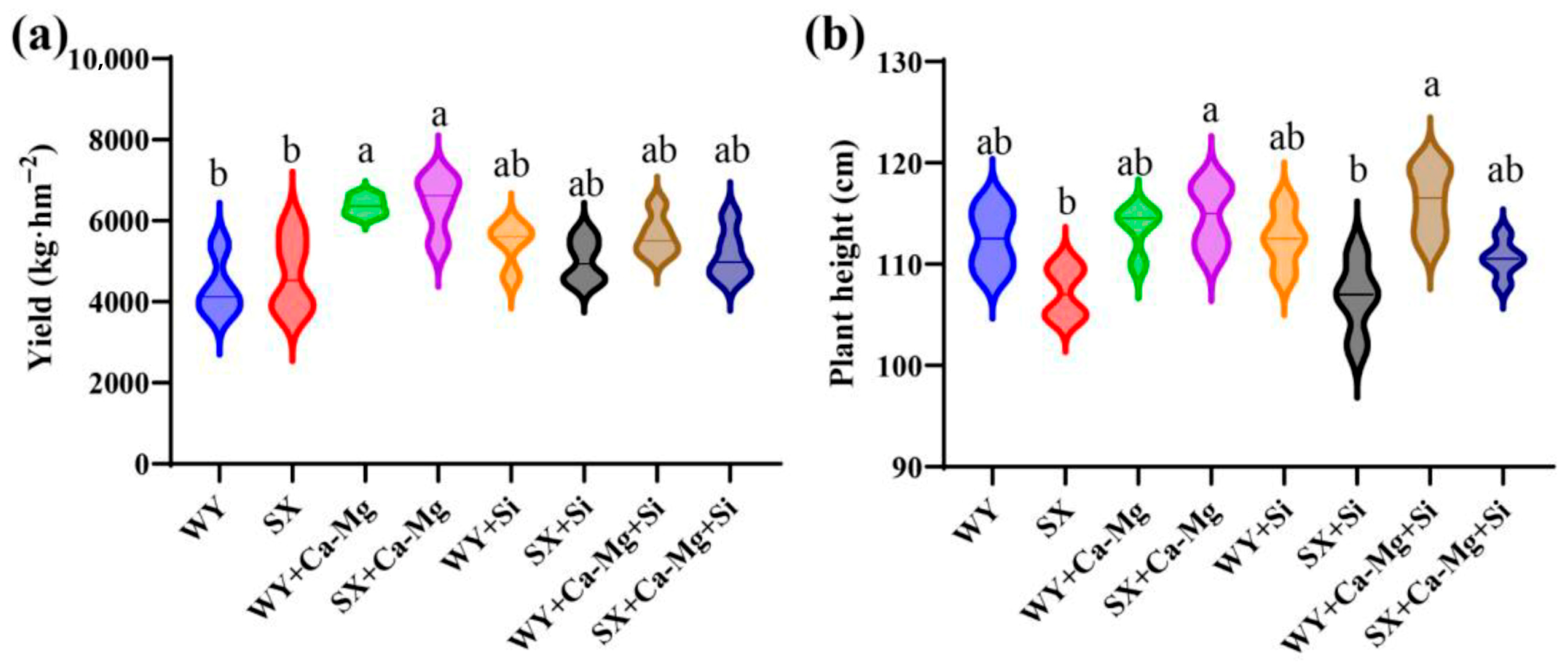
Figure 1. Effects of soil immobilization, foliar Si application and their combinations on yield (a) and plant growth (b). Different letters represent significant differences between averages of different treatment groups (LSD, p < 0.05).
Agronomy 16 00538 g001
Figure 2. Effects of soil immobilization, foliar Si application and their combinations on soil DTPA-Cd content (a), soil total Cd content (b) and soil pH (c,d). The error bars represent the standard deviation (SD). Different letters represent significant differences between averages of different treatment groups (LSD, p < 0.05).
Agronomy 16 00538 g002
Figure 3. Effects of different treatments on the Cd content in different rice tissues. (a) Effects of different treatments on the Cd content in root, stem and leaf; (b) Effects of different treatments on the Cd content in rachis, husk and brown rice. The error bars represent the standard deviation (SD). Different letters represent significant differences between averages of different treatment groups (LSD, p < 0.05). The red, green, and white letters correspond to the indicators of the red, green, and blue columns respectively. The Cd limit values are from national food safety standard—limits of contaminants in food in China (GB 2762-2022).
Agronomy 16 00538 g003
Figure 4. Effects of different treatments on bioconcentration factor and translocation factor in different parts of rice. (a) Bioconcentration factors of Cd from soil to brown rice; (b) Bioconcentration factors of Cd from soil to shoot; (c) Translocation factor of Cd from leaf to rachis; (d) Translocation factor of Cd from husk to brown rice; (e) Changes in the bioconcentration factor and translocation factor under different treatments. Blue indicates foliar application of Si(OH)4, and red indicates application of Ca-Mg The error bars represent the standard deviation (SD). Different letters represent significant differences between averages of different treatment groups (LSD, p < 0.05).
Agronomy 16 00538 g004
Figure 5. Correlations between Cd content in rice tissues and soil indexes. The upper-right triangular portion depicts the pairwise relationships among eight soil physicochemical indicators. The color gradient represents the Pearson correlation coefficients, where deeper tones (or larger rectangle areas) correspond to higher absolute values. Asterisks mark levels of statistical significance, with * p < 0.05, *** p < 0.001.
Agronomy 16 00538 g005
Figure 6. Partial least squares path modeling (PLS-PM) analysis of soil immobilization and foliar spraying on Cd content of brown rice (a). Standardized total effects derived from the PLS-PM depicted above (b). Significant paths are shown in blue if negative or in red if positive. Dotted lines indicate insignificant relationships. Numbers near the pathway arrow indicate the standard path coefficients. * p < 0.05, ** p < 0.01.
Agronomy 16 00538 g006
Table 1. Basic physical–chemical properties of the experimental soil.
IndexesUnitValues
pH5.47
Akali-hydro N (AN)mg·kg−1176
Available P (OP)mg·kg−117.4
Available K (AK)mg·kg−123.6
Total Cdmg·kg−10.557
DTPA-Cdmg·kg−10.180
Cation exchange capacity (CEC)cmol·kg−19.08
Organic matter (OM)g·kg−124.7
Table 2. Design for the soil immobilization and foliar application in the field experiments of this study.
TreatmentSoil Immobilization/kg·hm−2Foliar Application/L·hm−2
WYNoNo
SXNoNo
WY + Ca-Mg2250No
SX + Ca-Mg2250No
WY + SiNo15
SX + SiNo15
WY + Ca-Mg + Si225015
SX + Ca-Mg + Si225015
Disclaimer/Publisher’s Note: The statements, opinions and data contained in all publications are solely those of the individual author(s) and contributor(s) and not of MDPI and/or the editor(s). MDPI and/or the editor(s) disclaim responsibility for any injury to people or property resulting from any ideas, methods, instructions or products referred to in the content.