Article

Multi-Species Microbial Inoculants Enhance Turfgrass Quality, Nutrient Uptake, and Stress Resilience Under Temperate Polish Conditions

by
Adam Radkowski
1,
Magdalena Szpytma
2,
Monika Sitarek-Andrzejczyk
2,*,
Iwona Radkowska
3 and
Henryk Bujak
4,5
1
Department of Agroecology and Plant Production, University of Agriculture in Krakow, Mickiewicza 21, 31-120 Krakow, Poland
2
Department of Agricultural and Environmental Microbiology, Institute of Technology and Life Sciences—National Research Institute, Hrabska Avenue 3, Falenty, 05-090 Raszyn, Poland
3
Department of Cattle Breeding, National Research Institute of Animal Production, Krakowska 1, 32-083 Balice, Poland
4
Department of Genetics, Wroclaw University of Environmental and Life Sciences, Grunwaldzki 24A, 50-363 Wroclaw, Poland
5
Research Centre for Cultivar Testing, Slupia Wielka 34, 63-022 Slupia Wielka, Poland
*
Author to whom correspondence should be addressed.
Agronomy 2026, 16(5), 502; https://doi.org/10.3390/agronomy16050502
Submission received: 15 January 2026 / Revised: 19 February 2026 / Accepted: 22 February 2026 / Published: 24 February 2026

Abstract

Sustainable care of urban lawns requires methods that maintain high turf quality while reducing the use of chemical fertilizers. The objective of this three-year field study was to evaluate whether microbial inoculants can complement or partially substitute conventional fertilization (65–190 kg N·ha−1, 33–35.2 kg P·ha−1, and 124.5 kg K·ha−1) required to maintain high turf quality in an intensively managed lawn system. The experiment was conducted in Poland on a degraded chernozem, classified as Haplic Phaeozem. A standard mixture of perennial ryegrass and fescue was evaluated under four treatments: (1) untreated control; three commercial microbial formulations: (2) StymGrass P+K, containing nutrient-solubilizing Bacillus spp.; (3) BioVitaGrass, combining Bacillus spp. with arbuscular mycorrhizal fungi (AMF); and (4) NitroGrass, containing nitrogen-fixing Azotobacter spp. with Bacillus spp. All microbial treatments improved lawn quality compared with the untreated control. Lawns receiving BioVitaGrass or NitroGrass showed the strongest responses, including denser plant cover, greener and finer leaves, reduced disease symptoms, and increased concentrations of nutrients in the plant tissue. StymGrass P+K produced smaller but still positive effects. Measurements of plant conditions, such as leaf greenness and canopy development, also indicated improved photosynthetic activity in inoculated plots. These results support the role of plant growth-promoting bacteria (PGPB) and arbuscular mycorrhizal fungi in nutrient mobilization, root stimulation, and stress resilience. Although most evidence comes from crops, this study provides novel field-based confirmation of multi-functional microbial inoculant efficacy in turfgrass under this study’s conditions.

1. Introduction

Lawns represent a crucial component of urban landscapes, serving esthetic, recreational, and environmental functions that enhance residents’ quality of life and urban biodiversity [1]. The quality of turfgrass depends primarily on field conditions and maintenance intensity, particularly fertilization practices and the sustainable management of soil resources. However, excessive application of mineral fertilizers, especially nitrogen, can lead to soil acidification, reduced fertility, and a decline in beneficial soil microorganisms [2]. Therefore, there is a growing interest in strategies that maintain high turf quality while reducing or complementing conventional chemical inputs [3].
Recent advances in research on biostimulants and microbial soil inoculants suggest that microorganisms can positively influence plant metabolism, nutrient availability, and resistance to abiotic stress and pathogens [4,5,6]. Preparations containing bacteria from the genera Bacillus and Azotobacter, as well as arbuscular mycorrhizal fungi from the genus Glomus, may enhance atmospheric nitrogen fixation, mobilize phosphorus and potassium from insoluble mineral compounds, and stimulate root system development, ultimately improving turf condition [7,8,9,10]. Furthermore, these microorganisms can increase plant tolerance to environmental stresses such as periodic water deficits and disease incidences [11,12,13]. Nevertheless, the effectiveness of microbial preparations in turfgrass cultivation is variable and influenced by numerous factors, including soil and climatic conditions, maintenance intensity, and the specific composition of the bioformulation. Under Central European temperate conditions, intensively managed turfgrass systems are exposed to pronounced seasonal fluctuations in temperature and precipitation, including periodic summer droughts that may limit nutrient availability, root activity, and overall turf resilience. In high-maintenance lawns established on anthropogenically modified or previously degraded soils with moderate fertility and variable water-holding capacity, sustaining dense canopy structure and consistent visual quality often requires elevated nutrient inputs. These site-specific constraints underscore the importance of management strategies that enhance nutrient use efficiency and plant stress tolerance, particularly in turfgrass systems maintained under conventional high-input regimes. Comprehensive studies on the effects of various microbial soil inoculants on turf quality under the temperate climatic conditions of Poland are still lacking [14].
Previous research on the use of biostimulants and organic preparations in turf maintenance has confirmed their potential benefits; however, there remains a shortage of publications simultaneously assessing both visual and functional parameters of turfgrass under Poland’s temperate climate [15]. Recent studies have demonstrated that the application of amino acids and humic acids can improve leaf color and structure, increase the normalized difference vegetation Index (NDVI), and reduce the occurrence of fungal diseases in turfgrass [16]. Similar findings have been reported regarding improvements in turf quality ratings under the influence of organic biostimulants [17,18].
Given the growing need to develop sustainable management technologies for urban green space, it is justified to conduct experiments evaluating the effects of microbial soil inoculants on turf quality. The present study aimed to assess the impact of selected microbial fertilizers on the turf quality index, including both esthetic and functional traits, according to the COBORU (Research Centre for Cultivar Testing) methodology [19].

2. Materials and Methods

2.1. Study Site

The experiment was conducted from 2023 to 2025 at the Experimental Station of the University of Agriculture in Kraków, Poland (50°07′ N, 20°05′ E). The soil at the study site was a degraded chernozem, classified as Haplic Phaeozem (Siltic), developed from loess containing 2.12% organic matter, with a texture ranging from silt loam to silty clay loam, composed of 13% sand, 71% silt, and 16% clay, and a cation exchange capacity of 20–30 cmol(+)·kg−1. The chemical properties of the soil are presented in Table 1. All analyses were performed in accordance with standardized and approved methodologies [20].

2.2. Experiment Design and Pratotechnical Description

The experiment was established in accordance with agrotechnical recommendations for turfgrass mixtures [19]. Sowing was carried out on 22 March 2023 on plots, using the “Super Trawnik” mixture (Planta Sp. z o.o., Tarnów, Poland) at a seeding rate of 26.0 g·m−2. The field experiment was established as a randomized complete block design (RCBD) with three replicates. Four treatments (control and three microbial inoculants) were randomly assigned to plots within each block. Each treatment occurred once per block. Individual plot size was 10 m2. The randomized block layout was used to minimize the effects of spatial heterogeneity of soil and microclimatic conditions across the experimental area.

2.2.1. Microbial Treatments

Microbiological preparations were sprayed once annually during the early growth stage of turfgrass: on 18 April 2023, 15 April 2024, and 11 April 2025. Four treatments were included:
  • Control—no microbiological preparations applied; standard agrotechnical practices were used.
  • StymGrass P+K—preparation containing Bacillus spp. strains capable of solubilizing phosphorus and potassium.
    -
    Form: suspension in an organic carrier (≥1 × 10⁹ CFU·mL−1);
    -
    Dose: 5 mL of preparation in 300 mL of water per 10 m2.
  • BioVitaGrass—preparation containing Bacillus spp. and arbuscular mycorrhizal fungi of the genus Glomus.
    -
    Form: liquid (≥1 × 10⁹ CFU·mL−1);
    -
    Dose: 5 mL of preparation in 300 mL of water per 10 m2.
  • NitroGrass—preparation containing Azotobacter spp. and Bacillus spp., capable of fixing atmospheric nitrogen.
    -
    Form: liquid (≥1 × 10⁹ CFU·mL−1);
    -
    Dose: 5 mL of preparation in 300 mL of water per 10 m2.

2.2.2. Mineral Fertilization

For all treatments in the first year of cultivation, mineral fertilization was applied at the following rates: 65 kg N·ha−1, 33 kg P·ha−1, and 124.5 kg K·ha−1. In subsequent years, the fertilization rates were: 190 kg N·ha−1, 35.2 kg P·ha−1, and 124.5 kg K·ha−1. The fertilizers used included ammonium nitrate (34% N), triple superphosphate (20.2% P), and potassium chloride (49.8% K). According to standard recommendations for intensively managed turfgrass, nitrogen application rates of up to 190 kg N ha−1 are appropriate, while extensively managed turfgrass requires lower N inputs. In our study, we focused specifically on intensively managed turfgrass areas, which demand higher fertilization to maintain high turf quality [19].

2.2.3. Management Practices

Mowing was performed 11–12 times per growing season at a cutting height of 4 cm, in accordance with COBORU [19].
Table 2 presents the composition of the grass mixture used in this study. The mixture consisted of three species of turfgrass species. Perennial ryegrass (Lolium perenne L.) constituted the majority of the mix, reflecting its role as a fast-establishing and wear-tolerant species. Red fescue (Festuca rubra L.) formed a substantial part of the mixture, providing fine-leaved texture and improved tolerance to lower nutrient availability. Tall fescue (Festuca arundinacea Schreb.) accounted for the remaining proportion and provided enhanced drought and heat tolerance. Within each species, different cultivars were included to improve the overall stability and adaptability of the turf under intensive management conditions; however, for tall fescue, only a single cultivar (‘Escalante’) was used.

2.3. Weather Conditions

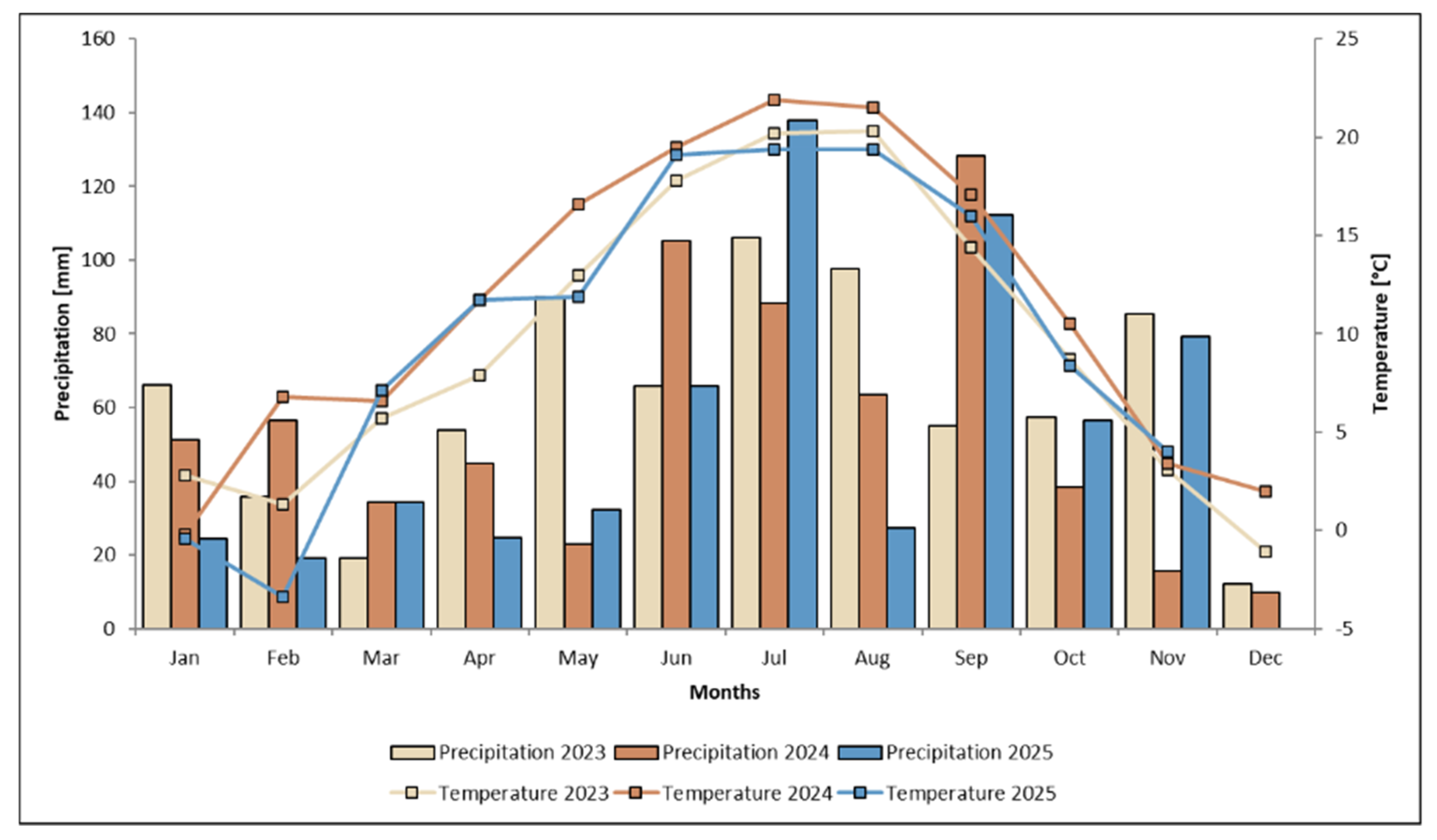
The study was conducted in Poland, which has a temperate climate. Long-term meteorological data (1990–2021) indicate an average annual temperature of 9.1 °C and mean annual precipitation of 651 mm. Monthly average temperatures ranged from −1.7 °C in January to 18.9 °C in August, while monthly precipitation ranged from 25.7 mm in February to 86.0 mm in July. Meteorological conditions recorded during the study period (2023–2025) showed noticeable variability between years, which influenced both the thermal and moisture regimes at the Experimental Station in Prusy, University of Agriculture in Kraków (Figure 1). Annual precipitation amounted to 744.3 mm in 2023, 659.2 mm in 2024, and 613.3 mm in 2025. Rainfall during the growing season (April–September) reached 468.2 mm in 2023, 453.1 mm in 2024, and 399.8 mm in 2025, indicating a consistent decrease over the analyzed period. Mean annual air temperature was 9.5 °C in 2023, increased to 11.5 °C in 2024, and then decreased to 10.3 °C in 2025. During the growing season, average temperatures were 15.6 °C in 2023, 18.1 °C in 2024, and 16.3 °C in 2025, confirming that 2024 was the warmest year in the dataset. Overall, the weather conditions from 2023 to 2025 can be described as moderately favorable, though marked by a downward trend in precipitation and clear inter-annual temperature fluctuations.
During periods of drought—defined as soil volumetric water content falling below approximately 12% at 3 cm depth, when turfgrass leaves exhibited visible water-stress symptoms (wilting, loss of turgor, pale or bluish-green coloration) and the canopy did not recover after being pressed by hand—irrigation was applied every three days at a rate of 10 dm3·m−2 for the turfgrass plots under study to maintain soil moisture above the defined drought levels.

2.4. Methods for the Assessment of Plant Quality

The functional and esthetic quality of the turf was evaluated three times during each growing season (in spring, summer, and autumn, specifically during the first ten days of April, July, and October, respectively) in accordance with the COBORU methodology [21,22]. The assessment was conducted visually and included qualitative traits rated on a nine-point scale (1 = undesirable trait, 9 = excellent trait). The evaluated parameters included overall appearance, turf density, color, leaf structure, and disease tolerance. During each assessment date, evaluators inspected the entire plot and assigned a score representing the degree of sward compactness, tiller density, and ground cover completeness. The score reflected the overall visual impression of turf closure and uniformity. Disease identification was based on visual diagnosis following the COBORU methodology, using characteristic symptom patterns of pink snow mold, leaf spot, and stem rust. All assessments were performed by trained personnel with experience in turfgrass pathology, ensuring consistent and accurate disease identification. Disease pressure was generally consistent across years due to uniform management practices, standard fertilization, and comparable environmental conditions. These clarifications have now been incorporated into the revised manuscript. Numbers from 1 to 9 for plant disease correspond to the following assessment: 1—very high (disease killed all the plants); 2—very high to high; 3—high (most plants killed); 4—high to moderate; 5—moderate (numerous patches of dead grass); 6—moderate to low; 7—low (some plants affected by disease); 8—low to very low; and 9—very low (no disease symptoms). The color is specified on a scale of 1–9, where 1—yellow-green; 2—olive green; 3—bright green; 4—green-gray; 5—juicy green; 6—green; 7—grass green; 8—dirty green; and 9—emerald [23]. Chlorophyll content was determined using a Minolta SPAD 502DL chlorophyll meter (Konica Minolta, Inc.,Tokyo, Japan). The leaf area index (LAI) was measured with the SunScan system ( Delta-T Devices Ltd.,Cambridge, UK), and the normalized difference vegetation index (NDVI) was assessed using a GreenSeeker device. The mineral nutrient content was determined using the Weende analytical method [20]. To contextualize quality ratings, species composition within the turfgrass mixture was visually checked at each seasonal assessment. No significant changes in species dominance were observed over the study period, and therefore species turnover did not influence the interpretation of turf quality results.

2.5. Statistical Analysis

The collected data were subjected to statistical analysis using the R software environment (V.4.5.2). To determine statistical significance, two-way ANOVA and one-way ANOVA tests were performed, followed by the Tukey–Kramer HSD test at a significance level of p = 0.05. In the two-way ANOVA, the type of fertilization treatment was treated as the primary factor, and the year as the secondary factor. Additionally, one-way ANOVA was conducted separately for each fertilization treatment and year of application. Homogeneity of variance was evaluated using Levene’s test. Seasonal turf quality measurements were averaged because seasonal effects were not the study objective.

3. Results

3.1. Visual Assessment

To assess the impact of fertilization on the visual condition and esthetic value of the turf, the COBORU methodology was applied. The results obtained over the three-year study period, together with the statistical analysis (one-way ANOVA), are presented in Table 3. The overall appearance, reflecting the general attractiveness of the turf, ranged from 6.29 to 8.58 depending on the fertilization treatment and the year of study (Supplementary Materials, Table S1). The application of fertilizer treatments resulted in a significant differentiation in the overall aspect. The mean value for the three-year study period was 6.65 for the control site, 7.45 for the StymGrass P+K treatment, 8.45 for the BioVitaGrass treatment, and 8.23 for the NitroGrass treatment. Another evaluated parameter was turf density, defined as the degree of ground coverage by the lawn canopy during the growing season. Higher scores were assigned when a greater proportion of the soil surface was covered by grass leaves and ranged from 6.4 to 8.64 (Supplementary Materials, Table S1). The highest mean score over the study period was recorded for the BioVitaGrass treatment (8.53), followed by NitroGrass (8.12), StymGrass P+K (7.88), and the control (6.49). Similarly, the highest mean for leaf color scores were observed for the BioVitaGrass (8.49) and NitroGrass (8.23), while the lowest value was assigned to the control site (6.96). The next evaluated parameter was leaf structure, with mean scores ranging from 5.75 to 8.36 (Supplementary Materials, Table S1). The highest mean scores for the study period were recorded for BioVitaGrass (7.99) and NitroGrass (7.98). The next evaluated traits included susceptibility to diseases, such as pink snow mold, leaf spot, and stem rust, caused by common turfgrass pathogens. On the applied rating scale, a score of 9 indicated the complete absence of disease symptoms, while a score of 1 represented plants that were fully infested. Mean values for susceptibility to snow mold ranged from 8.29 to 9.00 (Supplementary Materials, Table S1), with the highest mean for the study period recorded for BioVitaGrass (8.91). In the case of leaf spot, mean values ranged from 6.52 to 9.00 (Supplementary Materials, Table S1), with the BioVitaGrass treatment again showing the best result (8.95). A comparable pattern was observed for susceptibility to stem rust, with mean values ranging from 6.73 to 8.59 (Supplementary Materials, Table S1). The highest mean for the study period was again recorded for BioVitaGrass treatment (8.63). Across the three seasons in each year, routine visual checks did not indicate any meaningful shifts in species dominance within the mixture; thus, changes in botanical composition did not confound turf quality assessments reported herein.
All microbial treatments significantly improved visual quality scores compared to the control, with BioVitaGrass showing the highest efficacy, followed by NitroGrass (p < 0.01).

3.2. NDVI, LAI and SPAD Indices

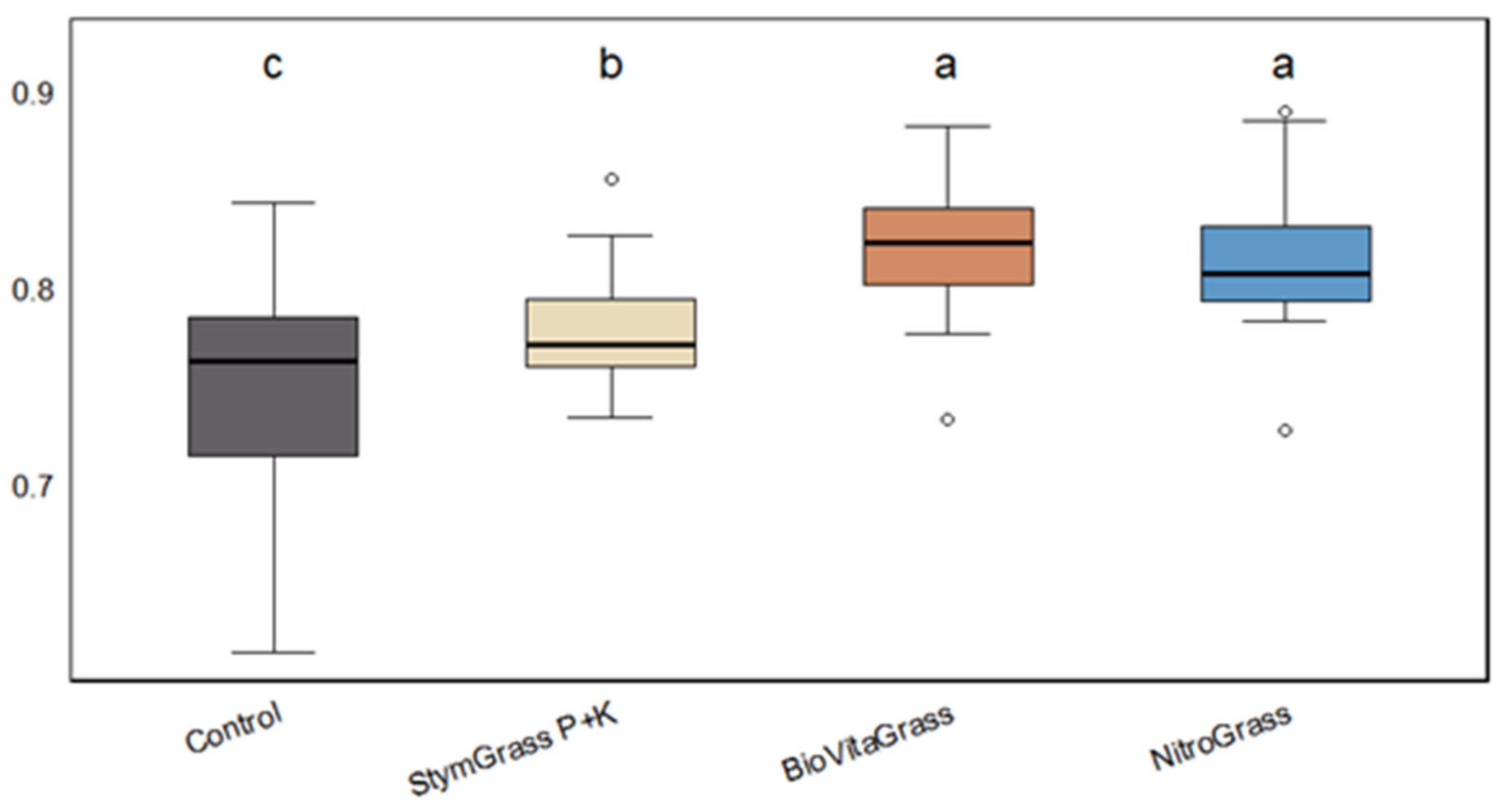
The greenness index (NDVI) exhibited significant differences between the control (0.75) and all tested treatments (p < 0.001). The StymGrass P+K treatment (0.78) showed an improvement compared to the control; however, it was significantly lower than the other tested treatments: BioVitaGrass (0.82) and NitroGrass (0.82) (Figure 2).
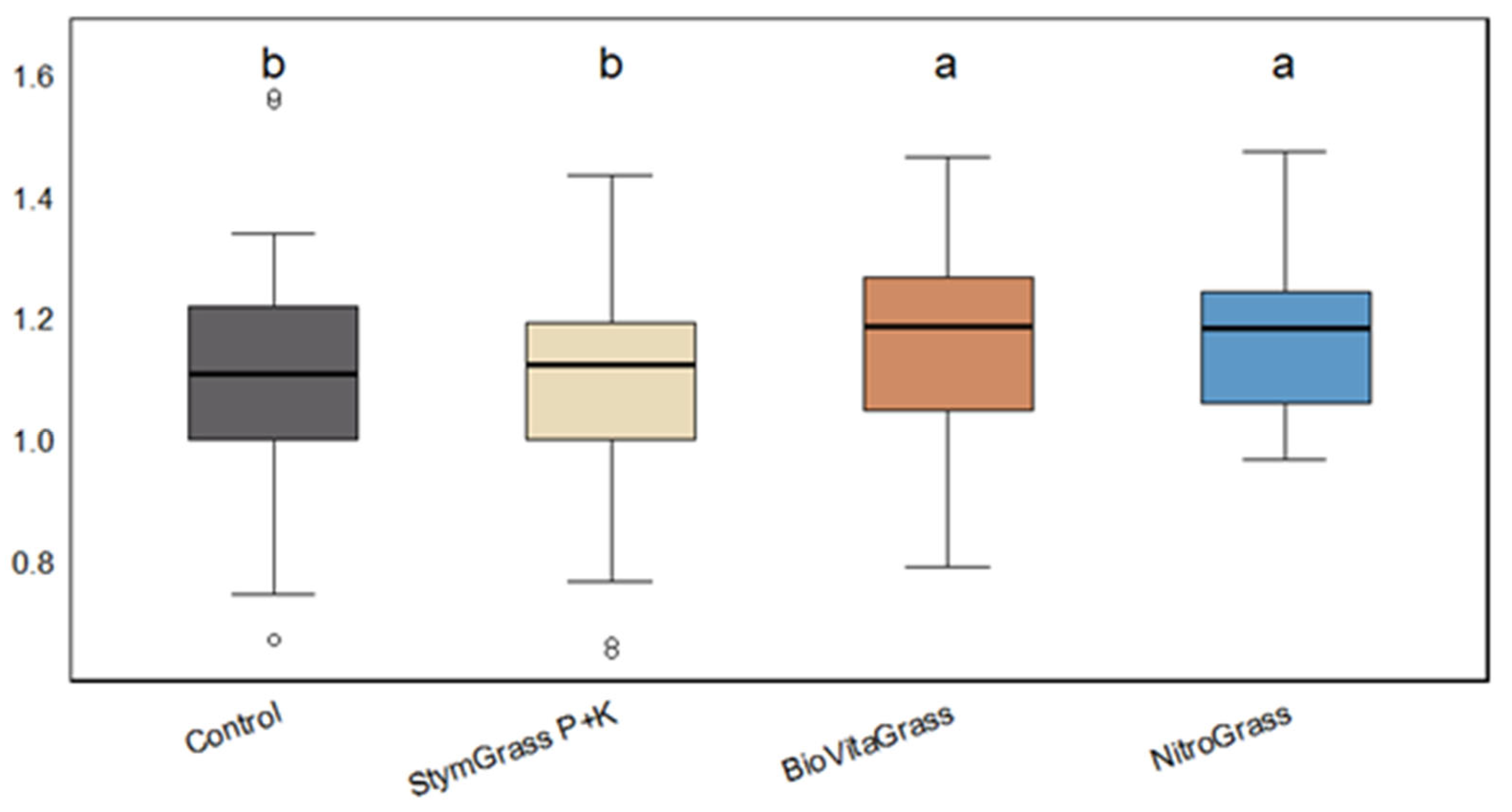
For the leaf area index (LAI), mean values ranged from 1.09 for the control to 1.17 for the NitroGrass treatment. The StymGrass P+K treatment showed no significant difference compared to the control samples, whereas both BioVitaGrass and NitroGrass again demonstrated significantly higher values (p < 0.001) (Figure 3).
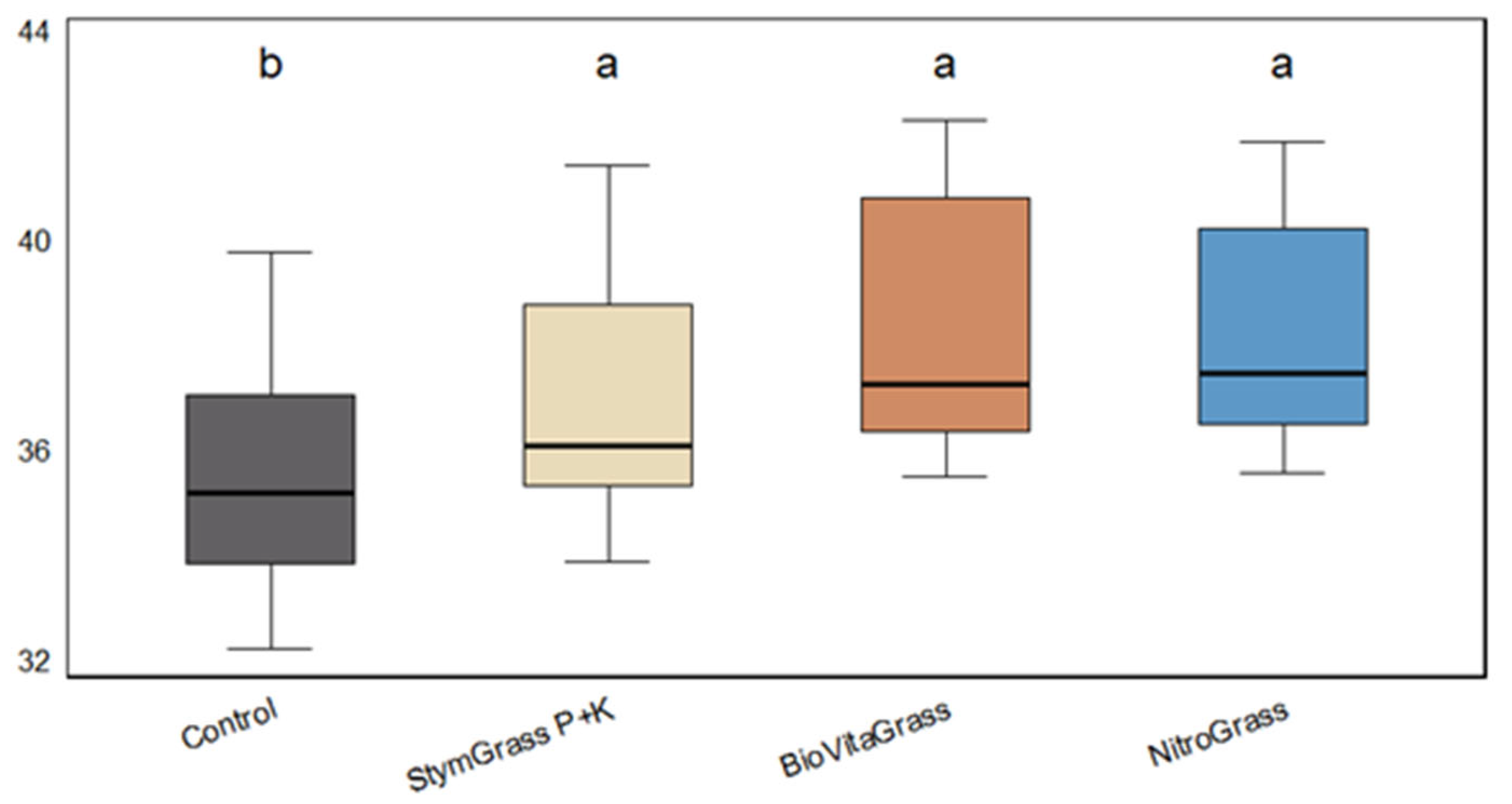
The leaf greenness index (SPAD) showed a significant difference between the control samples (35.42) and all treated samples (p < 0.001). However, no significant differences were observed among the tested treatments. The highest mean value was recorded for the BioVitaGrass treatment (38.13) (Figure 4).
All tested treatments improved the condition of the turfgrass compared to the control. However, the StymGrass P+K treatment showed lower effectiveness than BioVitaGrass and NitroGrass, which exhibited a comparable positive impact on turf quality.

3.3. Mineral Components

Table 4 presents the effects of different treatments on the concentration of macro- and microelements in turfgrass. The BioVitaGrass (2.33 g·kg−1 DM, p < 0.001) and NitroGrass (2.25 g·kg−1 DM, p < 0.001) treatments significantly increased the phosphorus content in plants compared to the control (1.98 g·kg−1 DM), while the StymGrass P+K treatment (2.06 g·kg−1 DM) showed no significant difference from the control. For potassium, only the BioVitaGrass treatment (37.91 g·kg−1 DM, p < 0.01) showed a significant difference compared to the control group (35.82 g·kg−1 DM). A similar trend was observed for calcium (3.02 to 2.72 g·kg−1 DM, p < 0.01), magnesium (2.05 to 1.67 g·kg−1 DM, p < 0.001), and sodium (0.12 to 0.09 g·kg−1 DM, p < 0.001), where the BioVitaGrass treated plots demonstrated higher nutrient contents than the control. The manganese concentration was significantly higher in the BioVitaGrass (142.20 mg·kg−1 DM, p < 0.01) and NitroGrass (140.52 mg·kg−1 DM, p < 0.01) treatments compared to the control (133.47 mg·kg−1 DM). Similarly, the iron content differed significantly from the control (301.90 mg·kg−1 DM) only in the BioVitaGrass (327.54 mg·kg−1 DM, p < 0.01) and NitroGrass (322.82 mg·kg−1 DM, p < 0.01) treatments. A corresponding pattern was observed for zinc, with mean values of 61.56 mg·kg−1 DM for the control, compared to 68.64 mg·kg−1 DM for BioVitaGrass and 66.14 mg·kg−1 DM for NitroGrass (p < 0.001). As for copper, significant differences were again found only for BioVitaGrass (11.38 mg·kg−1 DM, p < 0.001) and NitroGrass (11.13 mg·kg−1 DM, p < 0.001) treatments.
The BioVitaGrass treatment significantly increased the content of all measured macro- and micronutrients. The NitroGrass treatment also enhanced most of the analyzed nutrient levels, whereas StymGrass P+K generally did not produce significant effects on nutrient content.

3.4. Influence of the Year of Application on the Values of the Indicators Studied

To assess whether the years of treatment application had an effect on the evaluated indicators, a two-way ANOVA was performed (Table 5). In the analysis of variance, the p-values for the year factor indicated that, for several parameters, the year of application could have a significant effect on the results. However, no significant interaction was observed between the type of treatment and the year of application, allowing the effects of each factor to be analyzed independently.
To evaluate the effect of the year factor on the studied indicators, a one-way ANOVA was performed for those parameters where the p-value was lower than 0.05 (Table 6). The analysis of variance revealed that the year of treatment application had a significant effect on most of the evaluated indicators. However, no consistent trend was observed. Samples collected in 2025 exhibited improved visual parameters, such as leaf color and leaf structure, while showing lower values for the measured indices (NDVI, LAI, and SPAD). The potassium content was highest in the first year and decreased in the following years, whereas the concentrations of manganese and iron increased over the period of study.

4. Discussion

Across all three years of study, the microbial inoculants consistently improved turfgrass quality compared with the untreated control. The greatest benefits occurred with BioVitaGrass and NitroGrass, which enhanced the overall visual quality of the turf, increased canopy density, and improved leaf color and fineness. These treatments also reduced the severity of common turf diseases (pink snow mold, leaf spot, and stem rust), with BioVitaGrass exhibiting the best disease resistance performance (mean score >8.8). Such improvements are consistent with well-documented mechanisms of plant growth-promoting microorganisms. In particular, Bacillus spp., Azotobacter spp., and arbuscular mycorrhizal fungi are known to support photosynthetic activity, increase chlorophyll content, and improve the availability and uptake of key nutrients. They also stimulate the production of plant hormones that regulate growth and help activate plant defense pathways. The strong responses observed in this study therefore reflect the combined effects of nutrient mobilization, root stimulation, and enhanced resilience provided by multi-species microbial consortia [24,25,26].
The role of phosphate- and potassium-solubilizing microorganisms in improving nutrient uptake and plant performance has been documented previously. These species improve plant nutrition by converting forms of phosphorus and potassium in the soil that are normally unavailable into soluble forms that roots can absorb. They achieve this mainly by releasing organic acids and enzymes that break down mineral-bound phosphorus and potassium [27,28]. In our trials, StymGrass P+K, which contains only Bacillus strains with this function, improved turf performance but to a lesser extent than the multi-species formulations, highlighting the advantage of functional consortia which is consistent with previous reports [29,30,31,32]. These observations suggest that combining nitrogen-fixing bacteria, Bacillus spp., and arbuscular mycorrhizal fungi can confer broader benefits than single inoculants by enhancing nutrient acquisition, root development, and observed short-term drought stress resilience, corresponding with prior studies [33,34,35].
The superior effects of BioVitaGrass and NitroGrass were reflected in physiological indices. Higher NDVI (0.82 compared to 0.75, p < 0.001) values indicated improved canopy greenness and photosynthetic activity, while increased LAI (1.16 and 1.17 compared to 1.09, p < 0.001) reflected the greater leaf surface area available for light capture. The higher SPAD (38.13 and 38.11 compared to 35.42, p < 0.001) readings measured increased the chlorophyll content in the leaves. These functional enhancements are consistent with the visual assessments and reflect improved structural and physiological turfgrass traits.
While most empirical evidence for Bacillus + AMF consortia benefits comes from crop species such as maize and wheat [36,37], the observed improvements in root architecture, nutrient uptake, and drought tolerance provide a mechanistic basis for expecting similar effects in turfgrass.
Some studies have confirmed positive effects of bacterial consortia on cool- and warm-season turfgrasses: weekly application of root-colonizing bacterial blends increased the shoot biomass of ‘Tifway’ Hybrid Bermudagrass by 2.3–3.5 times in growth chamber trials [38], and inoculation with Bacillus strains significantly improved turf color and clipping yield in perennial ryegrass and tall fescue in a two-year field experiment [39]. These results show that root-associated bacteria can improve aboveground traits that are important for turf quality, such as root growth and the visual and functional appearance of the grass.
Mahdavi et al. also reported positive effects on tall fescue physiological traits following application of Pseudomonas fluorescens, showing that inoculation enhanced the plant’s ability to maintain essential metabolic processes under drought stress [40]. Corresponding findings were reported by Sullins et al. in bermudagrass, where treatments with Bacillus and Paenibacillus strains increased forage biomass and improved overall forage quality [41]. However, prior work on warm-season turfgrass, including bermudagrass, reported inconsistent responses to single-strain microbial inoculants, with limited improvements in turf quality, NDVI, or root/shoot growth, likely due to competition with endemic microbial communities [42]. In contrast, our results with NitroGrass, a multi-species inoculant containing Azotobacter spp. and Bacillus spp., consistently enhanced turfgrass visual quality, canopy density, nutrient uptake, and disease resistance. This indicates that multi-functional consortia may overcome the limitations of single-strain inoculants and offer a more reliable strategy for perennial turfgrass improvement.
Mineral analyses confirmed that multi-species microbial consortia substantially enhanced macro- and micronutrient uptake compared with the single-function inoculant. BioVitaGrass, containing Bacillus spp. and arbuscular mycorrhizal fungi, significantly increased P, K, Ca and micronutrient (Mn, Fe, Zn) contents in plant biomass (p < 0.01), which aligns with well-documented AMF-mediated nutrient mobilization via extensive extraradical hyphal networks that expand the soil volume explored by roots and improve the acquisition of poorly mobile nutrients such as P, Zn, and Cu [43,44]. The presence of Bacillus spp. likely amplified these effects through the solubilization of mineral phosphates and metal ions via organic acid secretion, proton extrusion, and phosphatase activity [45,46]. Similarly, NitroGrass combining Azotobacter spp. and Bacillus spp. enhanced most nutrients, particularly Mn, Fe, Zn, and Cu, reflecting the contribution of biological nitrogen fixation by Azotobacter spp.—which promotes root growth and thus expands the root absorption area—alongside siderophore production [47]. By contrast, StymGrass P+K induced only modest improvements, consistent with the notion that single-mechanism inoculants offer narrower functional benefits compared with multi-species consortia, which provide synergistic combinations of nutrient solubilization, chelation, hyphal transport, and root system enhancement.
Because field experiments are subject to substantial variability in environmental and soil conditions that can differ across study years, the influence of the ‘year’ factor was evaluated. The analyses indicated that the year of study had little effect on the measured indicators and no consistent trend emerged across the three seasons. Importantly, no significant interaction between year and treatment was detected, indicating that the plant growth-promoting effects were stable across years. These results suggest that the observed treatment responses were not confounded by inter-annual variability and can therefore be considered significant.
Overall, the integration of visual, physiological, and mineral data confirms that multi-species microbial inoculants provide a robust and reliable strategy for improving turfgrass growth, canopy development, nutrient status, and disease resistance under temperate Polish conditions, surpassing the efficacy of single-function microbial preparations. From a practical management perspective, the consistent improvements achieved with BioVitaGrass and NitroGrass, particularly in turf quality, physiological condition, and nutrient uptake, suggest that multi-species microbial inoculants may offer a favorable cost–benefit balance for turf maintenance. Although a detailed economic analysis was not performed in this study, the observed enhancements imply that such products can support high turf performance under standard fertilization regimes, potentially reducing the need for additional corrective treatments and contributing to more sustainable long-term turf management. However, the present study did not assess whether microbial inoculants could reduce mineral fertilizer inputs, and such claims require further targeted research.


5. Conclusions

  • Multi-species microbial inoculants (BioVitaGrass and NitroGrass) consistently produced the strongest improvements in turfgrass quality, enhancing overall appearance, canopy density, leaf color, leaf fineness, and disease resistance across all three study years.
  • These inoculants also significantly improved physiological performance, as shown by higher NDVI, LAI, and SPAD values, indicating enhanced photosynthetic activity, chlorophyll content, and canopy development.
  • Multi-species formulations markedly increased turfgrass macro- and micronutrient uptake including P, K, Ca, Mg, Mn, Fe, Zn, and Cu, confirming their superior capacity for nutrient mobilization compared with the single-function Bacillus preparation (StymGrass P+K).
  • Treatment effects were stable across years, with no significant treatment × year interactions, demonstrating that microbial inoculants, especially multi-species consortia, provide a reliable, sustainable tool for improving turfgrass performance under temperate Polish conditions.
  • In practical terms, the strong and stable responses to multi-species microbial inoculants indicate that these products may provide an efficient management tool offering favorable cost–benefit potential under typical turf maintenance conditions. This study did not evaluate reductions in fertilizer inputs, and therefore no conclusions can be drawn about fertilizer replacement.

Supplementary Materials

The following supporting information can be downloaded at https://www.mdpi.com/article/10.3390/agronomy16050502/s1, Table S1: Visual assessment mean values for each year of the study.

Author Contributions

Conceptualization, A.R. and I.R.; methodology, I.R. and H.B.; validation, A.R.; formal analysis, A.R., I.R. and M.S.; investigation, A.R., I.R. and H.B.; resources, A.R.; data curation, A.R.; writing—original draft preparation, A.R., I.R. and H.B.; writing—review and editing, M.S. and M.S.-A.; visualization, M.S. and M.S.-A.; supervision, A.R.; project administration, A.R.; All authors have read and agreed to the published version of the manuscript.

Funding

This research was funded by a subsidy from the Ministry of Science and Higher Education for the University of Agriculture in Krakow.

Data Availability Statement

The data presented in this study are available on request from the corresponding author. The data are not publicly available, due to their volume and organizational constraints.

Conflicts of Interest

The authors declare no conflicts of interest.

Abbreviations

The following abbreviations are used in this manuscript:
PGPBPlant Growth-Promoting Bacteria
AMFArbuscular Mycorrhizal Fungi
NDVINormalized Difference Vegetation Index
LAILeaf Area Index

References

  1. Wolski, K.; Markowska, J.; Radkowski, A.; Brennensthul, M.; Sobol, Ł.; Pęczkowski, G.; Bujak, H.; Grzebieniarz, W.; Radkowska, I.; Khachatryan, K. The influence of the grass mixture composition on the quality and suitability for football pitches. Sci. Rep. 2021, 11, 20592. [Google Scholar] [CrossRef]
  2. Ghabbour, E.A.; Davies, G.; Daggett, J.L.; Worgul, C.A.; Wyant, G.A.; Sayedbagheri, M.-M. Measuring the Humic Acids Content of Commercial Lignites and Agricultural Top Soils in the National Soil Project. Ann. Environ. Sci. 2012, 6, 1–12. [Google Scholar]
  3. Bulgari, R.; Cocetta, G.; Trivellini, A.; Vernieri, P.A.O.L.O.; Ferrante, A. Biostimulants and crop responses: A review. Biol. Agric. Hortic. 2015, 31, 1–17. [Google Scholar] [CrossRef]
  4. El-Sayed, B.A.; Abdel-Fattah, G.H.; El-Shal, S.A. Improvement of growth and quality of Tifway sod by actosol and biofertilizers. J. Biol. Chem. Environ. Sci. 2008, 3, 91–102. [Google Scholar] [CrossRef]
  5. Dobrzyński, J.; Jakubowska, Z. Pseudomonas protegens as a biocontrol agent against phytopathogenic fungi-mini review. World J. Microbiol. Biotechnol. 2025, 41, 428. [Google Scholar] [CrossRef] [PubMed]
  6. Naziębło, A.; Dobrzyński, J. Biotransformation of As, Cr, Hg, and Mn by Pseudomonadota: Chances and risks. Biodegradation 2025, 36, 60. [Google Scholar] [CrossRef]
  7. Etesami, H.; Jeong, B.R.; Glick, B.R. Contribution of Arbuscular Mycorrhizal Fungi, Phosphate-Solubilizing Bacteria, and Silicon to P Uptake by Plant. Front. Plant Sci. 2021, 12, 699618. [Google Scholar] [CrossRef]
  8. Beslemes, D.; Tigka, E.; Roussis, I.; Kakabouki, I.; Mavroeidis, A.; Vlachostergios, D. Effect of Arbuscular Mycorrhizal Fungi on Nitrogen and Phosphorus Uptake Efficiency and Crop Productivity of Two-Rowed Barley under Different Crop Production Systems. Plants 2023, 12, 1908. [Google Scholar] [CrossRef]
  9. Zhang, Q.; Rue, K. Effects of Plant Growth-promoting Microorganisms on Kentucky Bluegrass Field Establishment. HortTechnology 2025, 35, 73–80. [Google Scholar] [CrossRef]
  10. Dobrzyński, J.; Kulkova, I. Paenibacillus peoriae: Current knowledge and agricultural biotechnology potential of a close relative of P. polymyxa. Antonie van Leeuwenhoek 2025, 118, 120. [Google Scholar] [CrossRef]
  11. Lee, G.; Choi, H.; Liu, H.; Han, Y.H.; Paul, N.C.; Han, G.H.; Kim, H.; Kim, P.I.; Seo, S.I.; Song, J.; et al. Biocontrol of the causal brown patch pathogen Rhizoctonia solani by Bacillus velezensis GH1-13 and development of a bacterial strain specific detection method. Front. Plant Sci. 2023, 13, 1091030. [Google Scholar] [CrossRef]
  12. Zhang, Q.; Rue, K. Effects of Plant Growth-promoting Microorganisms on the Early Growth of Kentucky Bluegrass under Drought and Salinity. HortTechnology 2024, 34, 405–411. [Google Scholar] [CrossRef]
  13. Jakubowska, Z.; Gradowski, M.; Dobrzyński, J. Role of plant growth-promoting bacteria (PGPB) in enhancing phenolic compounds biosynthesis and its relevance to abiotic stress tolerance in plants: A review. Antonie van Leeuwenhoek 2025, 118, 123. [Google Scholar] [CrossRef]
  14. Azarbad, H.; Junker, R.R. Biological and experimental factors that define the effectiveness of microbial inoculation on plant traits: A meta-analysis. ISME Commun. 2024, 4, ycae122. [Google Scholar] [CrossRef]
  15. Radkowski, A.; Radkowska, I.; Bocianowski, J.; Sladkovska, T.; Wolski, K. The effect of foliar application of an amino acid-based biostimulant on lawn functional value. Agronomy 2020, 10, 1656. [Google Scholar] [CrossRef]
  16. Radkowski, A.; Radkowska, I.; Khachatryan, K.; Kozdęba, M.; Bujak, H.; Wolski, K. The impact of an amino acid-humus preparation on lawn boning value. Sci. Rep. 2025, 15, 6607. [Google Scholar] [CrossRef]
  17. Bosi, S.; Negri, L.; Accorsi, M.; Baffoni, L.; Gaggia, F.; Gioia, D.D.; Dinelli, G.; Marotti, I. Biostimulants for Sustainable Management of Sport Turfgrass. Plants 2023, 12, 539. [Google Scholar] [CrossRef]
  18. Fidanza, M.; Bigelow, C.; Kostka, S.; Ervin, E.; Gaussoin, R.; Rossi, F.; Cisar, J.; Dinelli, F.D.; Pope, J.; Steffel, J. Advances in Biostimulants in Turfgrass; Burleigh Dodds Science Publishing: Cambridge, UK, 2023; pp. 469–502. ISBN 978-1-80146-019-4. [Google Scholar]
  19. Domański, P. Metodyka Badania Wartości Gospodarczej Odmian (WGO) Roślin Uprawnych; COBORU: Słupia Wielka, Poland, 1998; pp. 1–33. [Google Scholar]
  20. Latimer, G.W.; Horwitz, W. Official Methods of Analysis of AOAC International; AOAC International: Rockville, MD, USA, 2006. [Google Scholar]
  21. Domański, P.J. Charakterystyka odmian Trawnikowych Zarejestrowanych w Polsce. Kostrzewa Czerwona, Kostrzewa Owcza, Kostrzewa Różnolistna, Kostrzewa Trzcinowa; ProDruk: Poznań, Poland, 2003. [Google Scholar]
  22. Prończuk, M.; Pronczuk, S. Problemy w ocenie podatności traw gazonowych na choroby w warunkach trawnikowych. Zesz. Probl. Postępów Nauk Rol. 1997, 451, 135–146. [Google Scholar]
  23. Domański, P. System of research and evaluation of varieties of lawn grasses in Poland. Biul. IHAR 1992, 183, 251–263. [Google Scholar]
  24. Yang, P.; Condrich, A.; Scranton, S.; Hebner, C.; Lu, L.; Ali, M.A. Utilizing Plant Growth-Promoting Rhizobacteria (PGPR) to Advance Sustainable Agriculture. Bacteria 2024, 3, 434–451. [Google Scholar] [CrossRef]
  25. Chandran, H.; Meena, M.; Swapnil, P. Plant Growth-Promoting Rhizobacteria as a Green Alternative for Sustainable Agriculture. Sustainability 2021, 13, 10986. [Google Scholar] [CrossRef]
  26. Efthimiadou, A.; Katsenios, N.; Chanioti, S.; Giannoglou, M.; Djordjevic, N.; Katsaros, G. Effect of foliar and soil application of plant growth promoting bacteria on growth, physiology, yield and seed quality of maize under Mediterranean conditions. Sci. Rep. 2020, 10, 21060. [Google Scholar] [CrossRef]
  27. Han, H.S.; Supanjani; Lee, K.D. Effect of co-inoculation with phosphate and potassium solubilizing bacteria on mineral uptáme and growth of pepper and cucumber. Plant Soil Environ. 2006, 52, 130–137. [Google Scholar] [CrossRef]
  28. Ali, A.M.; Awad, M.Y.M.; Hegab, S.A.; Gawad, A.M.A.E.; Eissa, M.A. Effect of potassium solubilizing bacteria (Bacillus cereus) on growth and yield of potato. J. Plant Nutr. 2021, 44, 411–420. [Google Scholar] [CrossRef]
  29. Wang, D.; Zeng, N.; Pang, J.; Li, C.; Zhang, D.; Ge, J.; Zhao, D.; Li, J.; Ran, R.; Gao, X.; et al. Synergistic interaction in mixed plant growth promoting rhizobacteria consortium enhances biofilm formation and rhizosphere colonization to promote tomato (Solanum lycopersicum) growth. Sci. Hortic. 2025, 351, 114383. [Google Scholar] [CrossRef]
  30. Santoyo, G.; Guzmán-Guzmán, P.; Parra-Cota, F.I.; Santos-Villalobos, S.d.l.; Orozco-Mosqueda, M.d.C.; Glick, B.R. Plant Growth Stimulation by Microbial Consortia. Agronomy 2021, 11, 219. [Google Scholar] [CrossRef]
  31. Amogou, O.N.; Adoukè Agbodjato, N.A.; Dagbénonbakin, G.D.; Noumavo, P.A.; Sina, H.; Assogba, A.S.; Adoko, M.Y.; Nounagnon, M.; Glèlè Kakaï, R.; Adjanohoun, A.; et al. Improved Maize Growth in Condition Controlled by PGPR Inoculation on Ferruginous Soil in Central Benin. Food Nutr. Sci. 2019, 10, 1433–1451. [Google Scholar] [CrossRef]
  32. Desai, S.; Bagyaraj, D.J.; Ashwin, R. Inoculation with Microbial Consortium Promotes Growth of Tomato and Capsicum Seedlings Raised in Pro Trays. Proc. Natl. Acad. Sci. India Sect. B Biol. Sci. 2019, 90, 21–28. [Google Scholar] [CrossRef]
  33. da Costa, S.D.A.; Cardoso, A.F.; de Castro, G.L.S.; da Silva, D.D., Jr.; da Silva, T.C.; da Silva, G.B. Co-Inoculation of Trichoderma asperellum with Bacillus subtilis to Promote Growth and Nutrient Absorption in Marandu Grass. Appl. Environ. Soil Sci. 2022, 2022, 228594. [Google Scholar] [CrossRef]
  34. Li, D.; Duan, W.; Guo, H.; Zong, J.; Chen, J.; Wang, J. High-nitrogen organic fertilizer promotes the growth of bermudagrass (Cynodon dactylon), zoysiagrass (Zoysia japonica) and paspalum grass (Paspalum vaginatum) by enhancing nitrogen use efficiency associated with Bacillus-stimulated bacterial community. Sci. Hortic. 2024, 329, 113027. [Google Scholar] [CrossRef]
  35. Rotoni, C.; Leite, M.F.A.; Pijl, A.; Kowalchuk, G.A.; Kuramae, E.E. Synergy between AMF and accompanying microbiome enriched with PGPB enhances root development and microbiome dynamics. Npj Sustain. Agric. 2025, 3, 37. [Google Scholar] [CrossRef]
  36. Chen, D.; Saeed, M.; Ali, M.N.H.A.; Raheel, M.; Ashraf, W.; Hassan, Z.; Hassan, M.Z.; Farooq, U.; Hakim, M.F.; Rao, M.J.; et al. Plant Growth Promoting Rhizobacteria (PGPR) and Arbuscular Mycorrhizal Fungi Combined Application Reveals Enhanced Soil Fertility and Rice Production. Agronomy 2023, 13, 550. [Google Scholar] [CrossRef]
  37. Yadav, R.; Ror, P.; Beniwal, R.; Kumar, S.; Ramakrishna, W. Bacillus sp. and arbuscular mycorrhizal fungi consortia enhance wheat nutrient and yield in the second-year field trial: Superior performance in comparison with chemical fertilizers. J. Appl. Microbiol. 2022, 132, 2203–2219. [Google Scholar] [CrossRef]
  38. Coy, R.M.; Held, D.W.; Kloepper, J.W. Rhizobacterial Inoculants Increase Root and Shoot Growth in ‘Tifway’ Hybrid Bermudagrass. J. Environ. Hortic. 2014, 32, 149–154. [Google Scholar] [CrossRef]
  39. Açıkgöz, E.; Bilgili, U.; Şahin, F.; Guillard, K. Effect of plant growthpromoting Bacillus sp. on color and clipping yield of three turfgrass species. J. Plant Nutr. 2016, 39, 1404–1411. [Google Scholar] [CrossRef]
  40. Mahdavi, S.; Salehi, H.; Zarei, M. Morpho-Physiological and Biochemical Attributes of Tall Fescue (Festuca arundinacea Schreb.) Inoculated with Pseudomonas fluorescens under Deficit Irrigation. J. Soil Sci. Plant Nutr. 2020, 20, 1457–1471. [Google Scholar] [CrossRef]
  41. Sullins, K.N.; Dillard, S.L.; Held, D.W.; Carroll, E.P. Utility of Plant Growth-Promoting Rhizobacteria for Sustainable Production of Bermudagrass Forage. Microorganisms 2023, 11, 863. [Google Scholar] [CrossRef]
  42. Bolton, C.; Cabrera, M.L.; Habteselassie, M.; Poston, D.; Henry, G.M. The impact of commercially available microbial inoculants on bermudagrass establishment, aesthetics, and function. Crop Forage Turfgrass Manag. 2022, 8, e20190. [Google Scholar] [CrossRef]
  43. Smith, S.E.; Read, D.J. Mycorrhizal Symbiosis, 3rd ed.; Academic Press: Cambridge, MA, USA, 2008. [Google Scholar]
  44. van der Heijden, M.G.A.; Martin, F.M.; Selosse, M.A.; Sanders, I.R. Mycorrhizal ecology and evolution: The past, the present, and the future. New Phytol. 2015, 205, 1406–1423. [Google Scholar] [CrossRef]
  45. Richardson, A.E.; Simpson, R.J. Soil microorganisms mediating phosphorus availability. Plant Physiol. 2011, 156, 989–996. [Google Scholar] [CrossRef]
  46. Sharma, S.B.; Sayyed, R.Z.; Trivedi, M.H.; Gobi, T.A. Phosphate-solubilizing microbes: Sustainable approach for managing phosphorus deficiency in agricultural soils. SpringerPlus 2013, 2, 587. [Google Scholar] [CrossRef]
  47. Maciel-Rodríguez, M.; Moreno-Valencia, F.D.; Plascencia-Espinosa, M. The role of plant growth-promoting bacteria in soil restoration: A strategy to promote agricultural sustainability. Microorganisms 2025, 13, 1799. [Google Scholar] [CrossRef]
Figure 1. Monthly mean air temperature and monthly precipitation during the study period (2023–2025) at the Experimental Station in Prusy, University of Agriculture in Kraków.
Agronomy 16 00502 g001
Figure 2. Boxplot of NDVI values for the different treatments: Control, StymGrass P+K, BioVitaGrass, and NitroGrass. Different letters indicate significant differences between means at p < 0.05 according to Tukey’s HSD.
Agronomy 16 00502 g002
Figure 3. Boxplot of LAI values for the different treatments: Control, StymGrass P+K, BioVitaGrass, and NitroGrass. Different letters indicate significant differences between means at p < 0.05 according to Tukey’s HSD.
Agronomy 16 00502 g003
Figure 4. Boxplot of SPAD values for the different treatments: Control, StymGrass P+K, BioVitaGrass, and NitroGrass. Different letters indicate significant differences between means at p < 0.05 according to Tukey’s HSD.
Agronomy 16 00502 g004
Table 1. Chemical properties of soil in the study site.
Parameter/ElementAmountLevel/Range
pHKCl6.7neutral
N (total nitrogen)1.64 g∙kg−1 soilmedium
P (available phosphorus)83.24 mg∙kg−1 soilhigh
K (available potassium)127.24 mg∙kg−1 soilmedium
Mg (magnesium)68.62 mg∙kg−1 soilmedium
Table 2. Composition of evaluated grass mixture.
Grass SpeciesVarietyShare in Grass Mixture
Perennial Ryegrass (Lolium perenne L.)Stadion10%
Perennial Ryegrass (Lolium perenne L.)Bokser55%
Tall Fescue (Festuca arundinacea Shreb.)Escalante10%
Red Fescue (Festuca rubra L.)Gross6%
Red Fescue (Festuca rubra L.)Adio19%
Table 3. Visual assessment mean values ± SD for the whole study period. Different letters in the same column indicate significant differences between means at p < 0.05 according to Tukey’s HSD.
Treatment Overall Aspect Density Leaf Color Leaf Structure (Fineness)Pink Snow Mold Leaf SpotStem Rust
Control 6.65 c ± 0.876.49 c ± 1.08 6.96 c ± 1.196.17 c ± 0.988.51 b ± 0.87.2 c ± 1.547.06 c ± 1.95
StymGrass P+K 7.4 b ± 0.927.88 b ± 0.817.58 b ± 0.997.13 b ± 0.658.64 ab ± 0.547.83 b ± 1.097.55 bc ± 1.61
BioVitaGrass 8.45 a ± 0.378.53 a ± 0.438.49 a ± 0.597.99 a ± 0.88.91 a ± 0.238.95 a ± 0.148.63 a ± 0.55
NitroGrass 8.23 a ± 0.368.12 ab ± 0.628.23 a ± 0.917.98 a ± 0.878.89 a ± 0.278.69 a ± 0.628.24 ab ± 1.01
Table 4. The mineral content in plant biomass mean values ± standard deviations for the whole study period. Different letters in the same row indicate significant differences between means at p < 0.05 according to Tukey’s HSD.
ElementsUnitsControlStymGrass P+KBioVitaGrassNitroGrass
P(g·kg−1 DM)1.98 b ± 0.242.06 b ± 0.312.33 a ± 0.322.25 a ± 0.3
K35.82 b ± 2.8836.42 ab ± 2.537.91 a ± 2.2637.26 ab ± 2.58
Ca2.72 b ± 0.282.82 ab ± 0.373.02 a ± 0.382.87 ab ± 0.3
Mg1.67 b ± 0.371.75 b ± 0.32.05 a ± 0.391.87 ab ± 0.33
Na(mg·kg−1 DM)0.09 b ± 0.020.09 b ± 0.020.12 a ± 0.030.1 b ± 0.03
Mn133.47 c ± 6.6134.46 bc ± 16.81142.2 a ± 9.56140.52 ab ± 9.76
Fe301.9 c ± 30.69305.93 bc ± 40.1327.54 a ± 30.61322.82 ab ± 30.89
Zn61.56 c ± 7.7663.43 bc ± 8.6868.64 a ± 5.3666.14 ab ± 5.98
Cu10.24 c ± 0.7910.64 bc ± 1.3211.38 a ± 1.111.13 ab ± 0.93
Table 5. p-values for treatment, year, and their interaction in the two-way ANOVA for parameters evaluated in this study. A value of 0 indicates that the p-value is less than 0.001.
ParameterTreatmentYearTreatment: Year
Overall aspect00.0180.1965
Density00.14590.9759
Leaf color000.3667
Leaf structure (fineness)00.00130.1755
Pink snow mold0.00260.22560.662
Leaf spot000.2791
Stem rust00.51150.9092
NDVI000.9961
LAI00.0050.9818
SPAD00.00160.9998
P00.03650.7047
K0.00380.01920.9823
Ca0.00270.16260.989
Mg00.42720.9929
Na00.74740.9079
Mn0.00120.00180.8575
Fe0.00220.02180.9896
Zn00.05180.7682
Cu00.88440.9582
Table 6. Impact of year of application on indicators where the year factor could be statistically significant. Different letters in the same row indicate significant differences between means at p < 0.05 according to Tukey’s HSD.
ParameterYear
202320242025
Overall aspect7.54 a ± 1.067.61 a ± 1.177.90 a ± 0.61
Leaf color7.32 b ± 1.047.73 b ± 1.308.40 a ± 0.60
Leaf structure (fineness)7.03 b ± 1.117.29 ab ± 1.327.63 a ± 0.79
Leaf spot7.71 b ± 1.478.53 a ± 0.858.25 ab ± 1.09
NDVI0.81 a ± 0.050.79 ab ± 0.050.78 b ± 0.04
LAI1.15 a ± 0.151.14 a ± 0.161.10 b ± 0.13
SPAD37.07 ab ± 2.2937.98 a ± 2.3136.41 b ± 2.39
P2.07 a ± 0.202.19 a ± 0.362.21 a ± 0.37
K37.55 a ± 2.6536.93 ab ± 2.6536.07 b ± 2.51
Mn132.64 b ± 9.33137.89 ab ± 13.09142.46 a ± 10.85
Disclaimer/Publisher’s Note: The statements, opinions and data contained in all publications are solely those of the individual author(s) and contributor(s) and not of MDPI and/or the editor(s). MDPI and/or the editor(s) disclaim responsibility for any injury to people or property resulting from any ideas, methods, instructions or products referred to in the content.