



Effects of Bacillus halotolerans as a Plant Growth-Promoting Rhizobacterium and Root Phytopathogen Biocontrol Agent in Solanum lycopersicum Under Field Conditions

 , and
, and
Abstract
1. Introduction
2. Materials and Methods
2.1. Location of the Experimental Field
2.2. Preparation of the Plant Material
2.3. Soil Sampling for Physicochemical Analysis
2.4. Bacillus halotolerans IcBac2.1 Strain and Bacterial Growth Conditions
2.5. Production of the Bacillus halotolerans IcBac2.1 Bioinoculant
2.6. Final Field Establishment
2.7. Timing of Bioinoculant Application
2.8. Experimental Design
2.9. Effectiveness of a Bacillus halotolerans IcBac2.1 Bioinoculant in the Biocontrol of Root Diseases
- Incidence of root pathogens in plants
- Area under the disease progress curve
- Identification of the causal agent of plant wilt
- PGPR Activity of the Bacillus spp. Bioinoculant in Tomato Plants
- Plant height (cm)
- Stem diameter (mm)
- Chlorophyll index (SPAD)
- Morphological and physicochemical characteristics of the fruits
- Yield (t/ha)
3. Results
3.1. Effect of Biocontrol Inoculation Under Field Conditions
3.1.1. Disease Incidence
3.1.2. Area Under the Disease Progress Curve (AUDPC)
3.2. PGPR Activity of Bacillus spp. Bioinoculant in Tomato Plants
3.2.1. Morphometric Characteristics
3.2.2. Biochemical Characteristics
4. Discussion
5. Conclusions
Author Contributions
Funding
Data Availability Statement
Conflicts of Interest
References
- Panno, S.; Davino, S.; Caruso, A.G.; Bertacca, S.; Crnogorac, A.; Mandić, A.; Noris, E.; Matić, S. A review of the most common and economically important diseases undermining tomato cultivation in the Mediterranean Basin. Agronomy 2021, 11, 2188. [Google Scholar] [CrossRef]
- Wang, R.; Lammers, M.; Tikunov, Y.; Bovy, A.G.; Angenent, G.C.; de Maagd, R.A. The spontaneous rin, nor, and Cnr mutations inhibit tomato fruit ripening in an additive and epistatic manner. Plant Sci. 2020, 294, 110436–110447. [Google Scholar] [CrossRef]
- Bhowmik, D.; Kumar, K.S.; Paswan, S.; Srivastava, S. Tomato: A natural medicine and its health benefits. J. Pharmacogn. Phytochem. 2012, 1, 33–43. [Google Scholar]
- Toor, R.K.; Lister, C.E.; Savage, G.P. Antioxidant activities of tomatoes grown in New Zealand. Int. J. Food Sci. Nutr. 2005, 56, 597–605. [Google Scholar] [CrossRef]
- Collins, E.J.; Bowyer, C.; Tsouza, A.; Chopra, M. Tomatoes: An extensive review of the associated health impacts of tomatoes and factors that can affect their cultivation. Biology 2022, 11, 239. [Google Scholar] [CrossRef]
- FAOSTAT. Tomato Production Statistics 2023; Food and Agriculture Organization of the United Nations: Rome, Italy, 2024; Available online: https://www.fao.org/faostat/ (accessed on 5 January 2025).
- Agraria.pe. Perú Exportó 4.037 Toneladas de Tomates por US$7.3 Millones Entre Enero y Marzo de 2024. 2024. Available online: https://agraria.pe/noticias/peru-exporto-4-037-toneladas-de-tomates-por-us-7-3-millones--35883 (accessed on 10 January 2025).
- Singh, V.K.; Singh, A.; Kumar, A. Management of tomato diseases through PGPB: Current trends and future perspectives. 3 Biotech. 2017, 7, 255. [Google Scholar] [CrossRef]
- Brahimi, M.; Boukhalfa, K.; Moussaoui, A. Deep learning for tomato diseases: Classification and symptoms visualization. Appl. Artif. Intell. 2017, 31, 299–315. [Google Scholar] [CrossRef]
- Arora, H.; Sharma, A.; Poczai, P.; Sharma, S.; Haron, F.F.; Gafur, A.; Sayyed, R.Z. Plant-derived protectants in combating soil-borne fungal infections in tomato and chilli. J. Fungi 2022, 8, 213. [Google Scholar] [CrossRef]
- Bajpai, R.; Teli, B.; Rashid, M.; Nanda, S.; Yadav, S.; Kumar, G. Biocontrol of Fusarium wilt in tomato: An Eco-friendly and cost effective approach. Biol. Forum 2021, 13, 62–69. [Google Scholar]
- Ongena, M.; Jacques, P. Bacillus lipopeptides: Versatile weapons for plant disease biocontrol. Trends Microbiol. 2008, 16, 115–125. [Google Scholar] [CrossRef]
- Pedraza, L.A.; López, C.E.; Uribe-Vélez, D. Mechanisms of action of Bacillus spp. (Bacillaceae) against phytopathogenic microorganisms during their interaction with plants. Acta Biológica Colomb. 2020, 25, 112–125. [Google Scholar]
- Zhang, Z.; Li, J.; Zhang, Z.; Liu, Y.; Wei, Y. Composition of endophytic bacteria in tomato and mechanism of disease suppression against wilt (Fusarium oxysporum). Front. Microbiol. 2021, 12, 731764. [Google Scholar] [CrossRef]
- Schisler, D.A.; Slininger, P.J.; Behle, R.W.; Jackson, M.A. Formulation of Bacillus spp. for biological control of plant diseases. Phytopathology 2004, 94, 1267–1271. [Google Scholar] [CrossRef]
- Kamilova, F.; Okon, Y.; De Weert, S.; Hora, K. Commercialization of microbes: Manufacturing, inoculation, best practice for objective field testing, and registration. In Principles of Plant Microbe Interactions; Lugtenberg, B., Ed.; Springer: Berlin, Germany, 2015; pp. 319–327. [Google Scholar]
- Slama, H.B.; Cherif-Silini, H.; Bouket, A.C.; Qader, M.; Silini, A.; Yahiaoui, B.; Alenezi, F.N.; Luptakova, L.; Triki, M.A.; Vallat, A.; et al. Screening for Fusarium antagonistic bacteria from contrasting niches designated the endophyte Bacillus halotolerans as plant warden against Fusarium. Front. Microbiol. 2019, 9, 3236. [Google Scholar] [CrossRef]
- Zhang, Z.; Yin, L.; Li, X.; Zhang, C.; Liu, C.; Wu, Z. The complete genome sequence of Bacillus halotolerans ZB201702 isolated from a drought- and salt-stressed rhizosphere soil. Microb. Pathog. 2018, 123, 246–249. [Google Scholar] [CrossRef]
- Mazuecos-Aguilera, I.; Anta-Fernández, F.; Crespo-Barreiro, A.; Martínez-Quesada, A.; Lombana-Larrea, L.; González-Andrés, F. Plant growth-promoting rhizobacteria enhanced induced systemic resistance of tomato against Botrytis cinerea phytopathogen. Front. Plant Sci. 2025, 16, 1570986. [Google Scholar] [CrossRef]
- Arcos, J.; Zúñiga, D. Efecto de rizobacterias en el control de Rhizoctonia solani en el cultivo de papa. Ecol. Apl. 2015, 14, 95–101. [Google Scholar] [CrossRef]
- Kanazawa, S. Aplicaciones de los metabolitos secundarios generados por Bacillus subtilis en el periodo 2002–2022. Cienc. Lat. Rev. Científica Multidiscip. 2024, 8, 529–541. [Google Scholar] [CrossRef]
- Abbas, A.; Ullah, S.; Ullah, W.; Saleh, T.A.; Hafeez, M.; Khan, U.; Ullah, S.; Ali, A.; Ikram, M. Comptes Rendus Biologies Antagonist effects of strains of Bacillus spp. against Rhizoctonia solani for their protection against several plant diseases: Alternatives to chemical pesticides. Comptes Rendus. Biologies 2019, 342, 124–135. [Google Scholar] [CrossRef] [PubMed]
- Memenza-Zegarra, M.; Zúñiga-Dávila, D. Bioprospection of native antagonistic rhizobacteria from the Peruvian coastal ecosystems associated with Phaseolus vulgaris. Curr. Microbiol. 2021, 78, 1418–1431. [Google Scholar] [CrossRef] [PubMed]
- Memenza, M.; Ormeño, E.; Zúñiga, D. Draft genome sequence of Bacillus halotolerans IcBac2.1, a strain with potential as a phytopathogen control agent. Microbiol. Resour. Announc. 2022, 11, 21–23. [Google Scholar] [CrossRef]
- Di Rienzo, J.A.; Casanoves, F.; Balzarini, M.G.; González, L.; Tablada, M.; Robledo, C.W. InfoStat, version 2020; Grupo InfoStat, FCA, Universidad Nacional de Córdoba: Córdoba, Argentina, 2020. Available online: http://www.infostat.com.ar (accessed on 5 March 2025).
- Vanderplank, J.E. Plant Diseases: Epidemics and Control; Academic Press: Cambridge, MA, USA, 1963. [Google Scholar]
- Madden, L.V.; Hughes, G.; van den Bosch, F. The Study of Plant Disease Epidemics; APS Press: Philadelphia, PA, USA, 2007. [Google Scholar]
- Simko, I.; Piepho, H.P. The area under the disease progress stairs: Calculation, advantage, and application. Phytopathology 2012, 102, 381–389. [Google Scholar] [CrossRef]
- Konica Minolta. Chlorophyll Meter SPAD-502 Plus [Technical Manual]; Konica Minolta, Inc.: Tokyo, Japan, 2025; Available online: https://www.konicaminolta.com/instruments/download/catalog/color/pdf/spad502plus_catalog_eng.pdf (accessed on 15 January 2025).
- Vargas-Canales, J.M.; Castillo-González, A.M.; Pineda-Pineda, J.; Ramírez-Arias, J.A.; Avitia-García, E. Extracción nutrimental de jitomate (Solanum lycopersicum L.) en mezclas de tezontle con aserrín nuevo y reciclado. Rev. Chapingo. Ser. Hortic. 2014, 20, 71–88. [Google Scholar] [CrossRef]
- Andryei, B.; Németh, A.; Horváth, K.Z.; Duah, S.A.D.; Takács, S.; Égei, M. Use of plant growth promoting rhizobacteria (PGPRs) in the mitigation of water deficiency of tomato plants (Solanum lycopersicum L.). J. Cent. Eur. Agric. 2021, 22, 167–177. [Google Scholar] [CrossRef]
- Tsalgatidou, P.C.; Thomloudi, E.; Baira, E.; Papadimitriou, K.; Skagia, A.; Venieraki, A.; Katinakis, P. Integrated genomic and metabolomic analysis illuminates key secreted metabolites produced by the novel endophyte Bacillus halotolerans Cal. l. 30 involved in diverse biological control activities. Microorganisms 2022, 10, 399. [Google Scholar] [CrossRef]
- Shafi, J.; Tian, H.; Ji, M. Bacillus species as versatile weapons for plant pathogens: A review. Biotechnol. Biotechnol. Equip. 2017, 31, 446–459. [Google Scholar] [CrossRef]
- Acurio Vásconez, R.D.; Mamarandi Mossot, J.E.; Ojeda Shagñay, A.G.; Tenorio Moya, E.M.; Chiluisa Utreras, V.P.; Vaca Suquillo, I.D.A. Evaluación de Bacillus spp. como rizobacterias promotoras del crecimiento vegetal (RPCV) en brócoli (Brassica oleracea var. italica) y lechuga (Lactuca sativa). Cienc. Tecnol. Agropecu. 2020, 21, e1465. [Google Scholar] [CrossRef]
- Calero, A.; Quintero, E.; Pérez, Y.; Olivera, D.; Peña, K.; Castro, I.; Jiménez, J. Evaluación de microorganismos eficientes en la producción de plántulas de tomate (Solanum lycopersicum L.). Rev. Cienc. Agrícolas 2019, 36, 67–78. [Google Scholar] [CrossRef]
- Walia, A.; Metha, P.; Chauhan, A.; Shirkot, C.K. Effect of Bacillus subtilis strain CKT1 as inoculum on growth of tomato seedlings under net house conditions. Biol. Sci. 2014, 84, 145–155. [Google Scholar] [CrossRef]
- Gupta, R.; Gupta, N.; Rathi, P. Bacterial lipases: An overview of production, purification and biochemical properties. Appl. Microbiol. Biotechnol. 2004, 64, 763–781. [Google Scholar] [CrossRef] [PubMed]
- Molina-Romero, D.; Bustillos, M.; Rodríguez-Andrade, O.; Morales-García, Y.; Santiago Saenz, Y.; Castañeda, M.; Muñoz-Rojas, J. Phytostimulation mechanisms by rhizobacteria, isolations in America, and biotechnological potential. Biológicas 2015, 17, 24–34. [Google Scholar]
- Ge, X.-Y.; He, C.-E.; Li, T.; Ouyang, Z. Effect of Bacillus subtilis and Pseudomonas fluorescens on growth of greenhouse tomato and rhizosphere microbial community. J. Northeast. Agric. Univ. 2015, 22, 32–42. (In English) [Google Scholar] [CrossRef]
- Szilagyi-Zecchin, V.J.; Mógor, A.F.; Ruaro, L.; Rõder, C. Growth of tomato seedlings (Solanum lycopersicum) stimulated by the bacterium Bacillus amyloliquefaciens subsp. plantarum FZB42 in organic cultivation. Rev. Ciências Agrárias 2015, 38, 26–33. [Google Scholar]
- Tsegaye, Z.; Alemu, T.; Desta, F.A.; Assefa, F. Plant growth-promoting rhizobacterial inoculation to improve growth, yield, and grain nutrient uptake of teff varieties. Front. Microbiol. 2022, 13, 896770. [Google Scholar] [CrossRef]
- Rodríguez Mendoza, M.d.l.N.; Alcántar González, G.; Aguilar Santelises, A.; Etchevers Barra, J.D.; Santizó Rincón, J.A. Estimación de la concentración de nitrógeno y clorofila en tomate mediante un medidor portátil de clorofila. Terra Latinoam. 1998, 16, 135–141. Available online: http://www.redalyc.org/articulo.oa?id=57316204 (accessed on 16 February 2025).
- Calvo, P.; Nelson, L.; Kloepper, J.W. Agricultural uses of plant biostimulants. Plant Soil 2014, 383, 3–41. [Google Scholar] [CrossRef]
- Yaghoubian, I.; Modarres-Sanavy, S.A.M.; Smith, D.L. Plant growth promoting microorganisms (PGPM) as an eco-friendly option to mitigate water deficit in soybean (Glycine max L.): Growth, physio-biochemical properties and oil content. Plant Physiol. Biochem. 2022, 191, 55–66. [Google Scholar] [CrossRef]
- Beleño-Carrillo, J.; Gómez-Gómez, L.; Valero-Valero, N.O. Bacillus mycoides y ácidos húmicos como bioestimulantes de fríjol caupí bajo estrés por salinidad. Rev. U.D.C.A Actual. Divulg. Científica 2022, 25, e1974. [Google Scholar] [CrossRef]
- Chandrasekaran, M.; Chun, S.C.; Oh, J.W.; Paramasivan, M.; Saini, R.K.; Sahayarayan, J.J. Bacillus subtilis CBR05 for Tomato (Solanum lycopersicum) Fruits in South Korea as a Novel Plant Probiotic Bacterium (PPB): Implications from total phenolics, flavonoids, and carotenoids content for fruit quality. Agronomy 2019, 9, 838. [Google Scholar] [CrossRef]
- Kang, S.M.; Ramalingam, R.; You, Y.H.; Joo, G.J.; Lee, I.J.; Lee, K.E.; Kim, J.H. Phosphate solubilizing Bacillus megaterium mj1212 regulates endogenous plant carbohydrates and amino acids contents to promote mustard. Indian J. Microbiol. 2014, 54, 427–433. [Google Scholar] [CrossRef] [PubMed]
- Vani Obrzut, V.; Mógor, Á.F.; Mazaro, S.M.; Mógor, G. Initial growth, production in consecutive years and biochemical changes on tomato cultivars in organic system with application of Bacillus subtilis. Idesia 2021, 39, 47–55. [Google Scholar] [CrossRef]
- Hernández-Suárez, M.H.; Rodríguez, E.R.; Romero, C.D. Mineral and trace element concentrations in cultivars of tomatoes. Food Chem. 2007, 104, 489–499. [Google Scholar] [CrossRef]
- Mazaro, S.M.; Wagner, A.J.; Santos, I.; Citadin, I.; Possenti, J.C.; Gouvêa, A. Controle do tombamento de plântulas de beterraba e tomate pelo tratamento de sementes com quitosana. Pesqui. Agropecuária Bras. 2009, 44, 1424–1430. [Google Scholar] [CrossRef]
- Monroy-Guerrero, M.; Memenza-Zegarra, M.; Taco, N.; Mostacero, E.; Ogata-Gutiérrez, K.; Huaringa-Joaquín, A.; Zúñiga-Dávila, D. Co-inoculation of Bradyrhizobium spp. and Bacillus sp. on Tarwi (Lupinus mutabilis Sweet) in the high Andean region of Peru. Agronomy 2022, 12, 2132. [Google Scholar] [CrossRef]
- Ruiz-Cisneros, M.F.; Olivas-Orozco, G.I.; Acosta-Muñiz, C.H.; Sepúlveda-Ahumada, D.R.; Zamudio-Flores, P.B.; Berlanga-Reyes, D.I.; Salas-Marina, M.A.; Cambero-Campos, O.J.; Rios-Velasco, C. Effect of Bacillus strains alone and in interaction with phytopathogenic fungi on plant growth and fruit quality of tomato. Rev. Biocienc. 2019, 6, 1–17. [Google Scholar] [CrossRef]

| Treatment | Key | Formulation Concentration (%) | Dose Applied (L/ha) | Number of Applications |
|---|---|---|---|---|
| Control | C-T1 | 0 | 0 | 0 |
| Dose 1 | BIO1 T2 | 10 | 6 | 4 |
| Dose 2 | BIO2 T3 | 20 | 6 | 4 |
| Dose 3 | BIO3 T4 | 30 | 6 | 4 |
| Commercial P. (B. subtilis) | BC T5 | 7 | 6 | 4 |
| Treatments | Incidence (%) | Sig. | Percent Effectiveness | AUDPC | Sig. |
|---|---|---|---|---|---|
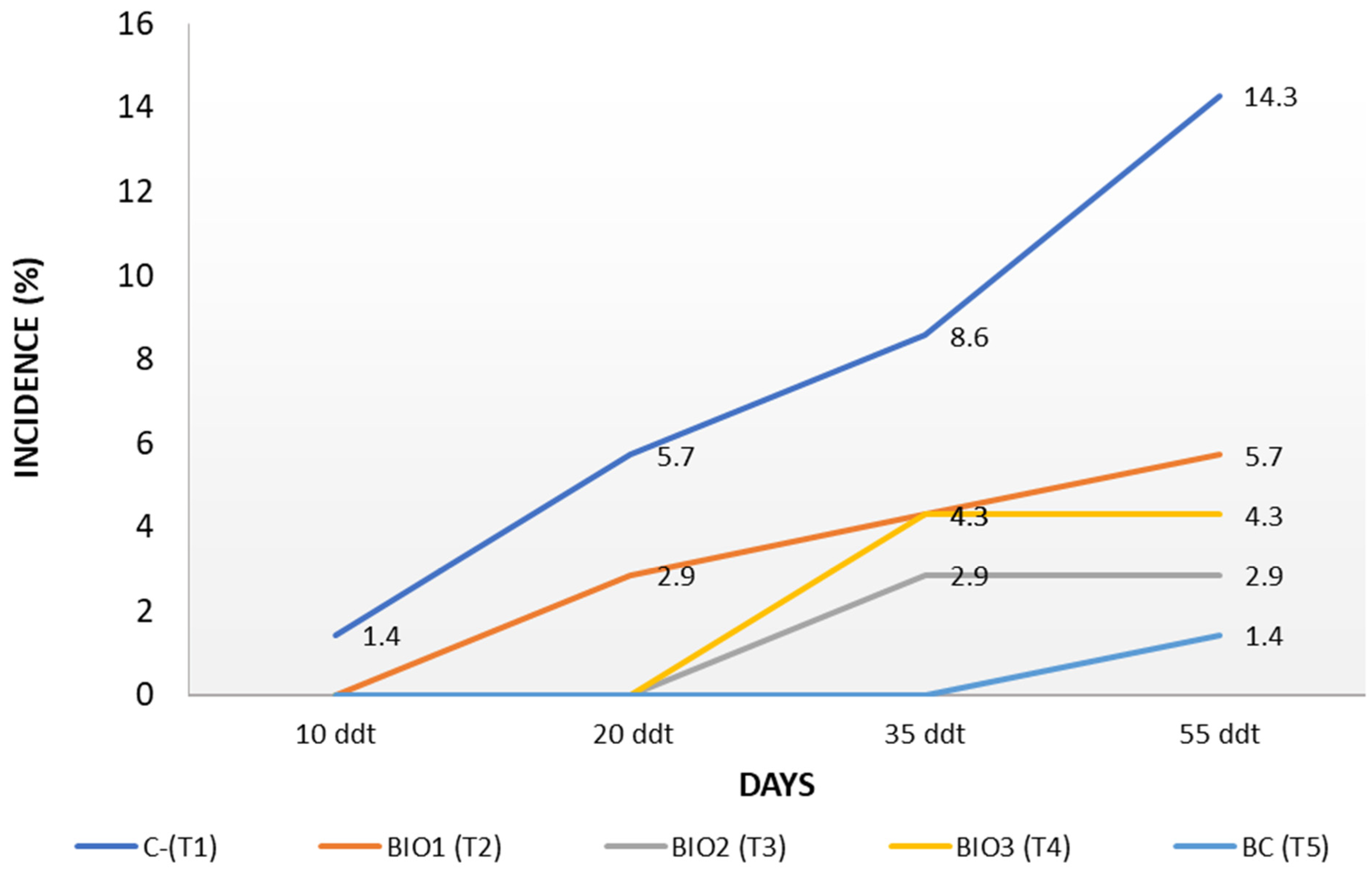
| T1: Control | 14.29 | a | 0.00 | 414.29 | a |
| T2: 10% concentration | 5.71 | abc | 60.00 | 171.43 | bc |
| T3: 20% concentration | 2.86 | bc | 80.00 | 85.71 | c |
| T4: 30% concentration | 4.29 | abc | 70.00 | 128.57 | c |
| T5: Commercial P. (B. subtilis) | 1.43 | c | 90.00 | 14.29 | c |
| Treatments | Height (cm) | Sig. | Diameter (mm) | Sig. |
|---|---|---|---|---|
| T1: Control | 65.76 | b | 11.96 | b |
| T2: 10% concentration | 72.86 | ab | 15.82 | a |
| T3: 20% concentration | 73.96 | ab | 17.03 | a |
| T4: 30% concentration | 71.90 | a | 16.42 | a |
| T5: Commercial P. (B. subtilis) | 73.08 | a | 17.12 | a |
| Treatments | Chlorophyll 1 55 DAT | Sig. | Chlorophyll 2 70 DAT | Sig. |
|---|---|---|---|---|
| T1: Control | 46.36 | c | 49.37 | b |
| T2: 10% concentration | 56.01 | ab | 54.91 | ab |
| T3: 20% concentration | 57.01 | ab | 56.44 | a |
| T4: 30% concentration | 56.25 | ab | 53.60 | ab |
| T5: Commercial P. (B. subtilis) | 59.65 | a | 56.71 | a |
| Treatments | °Brix | pH | Vitamin C (mg/100 g) | Total Protein (g/100 g) | ||||
|---|---|---|---|---|---|---|---|---|
| T1 | 5.15 | a | 4.27 | a | 11.14 | A | 1.57 | a |
| T2 | 5.73 | b | 4.07 | bc | 17.04 | B | 1.87 | b |
| T3 | 6.5 | c | 4.01 | c | 16.86 | B | 2.16 | c |
| T4 | 5.8 | b | 4.11 | bc | 16.56 | B | 1.85 | b |
| T5 | 5.9 | b | 4.13 | b | * | * | * | * |
| Treatments | Length (cm) | Sig. | Diameter (cm) | Sig. | Weight (g) | Sig. | Yield (t/ha) | Sig. |
|---|---|---|---|---|---|---|---|---|
| T1 | 5.95 | d | 4.80 | b | 71.48 | C | 14.50 | c |
| T2 | 6.32 | bc | 5.42 | a | 89.46 | Ab | 22.02 | ab |
| T3 | 6.71 | a | 5.43 | a | 102.83 | A | 29.92 | a |
| T4 | 6.27 | c | 5.10 | ab | 95.28 | Ab | 21.54 | ab |
| T5 | 6.53 | ab | 5.23 | ab | 92.88 | Ab | 25.24 | a |
Disclaimer/Publisher’s Note: The statements, opinions and data contained in all publications are solely those of the individual author(s) and contributor(s) and not of MDPI and/or the editor(s). MDPI and/or the editor(s) disclaim responsibility for any injury to people or property resulting from any ideas, methods, instructions or products referred to in the content. |
© 2026 by the authors. Licensee MDPI, Basel, Switzerland. This article is an open access article distributed under the terms and conditions of the Creative Commons Attribution (CC BY) license.
Share and Cite
Gonzáles-Miranda, M.D.C.; Verastegui, P.; Ogata-Gutiérrez, K.; Zúñiga-Dávila, D. Effects of Bacillus halotolerans as a Plant Growth-Promoting Rhizobacterium and Root Phytopathogen Biocontrol Agent in Solanum lycopersicum Under Field Conditions. Agronomy 2026, 16, 484. https://doi.org/10.3390/agronomy16040484
Gonzáles-Miranda MDC, Verastegui P, Ogata-Gutiérrez K, Zúñiga-Dávila D. Effects of Bacillus halotolerans as a Plant Growth-Promoting Rhizobacterium and Root Phytopathogen Biocontrol Agent in Solanum lycopersicum Under Field Conditions. Agronomy. 2026; 16(4):484. https://doi.org/10.3390/agronomy16040484
Chicago/Turabian StyleGonzáles-Miranda, María Del Carmen, Patricia Verastegui, Katty Ogata-Gutiérrez, and Doris Zúñiga-Dávila. 2026. "Effects of Bacillus halotolerans as a Plant Growth-Promoting Rhizobacterium and Root Phytopathogen Biocontrol Agent in Solanum lycopersicum Under Field Conditions" Agronomy 16, no. 4: 484. https://doi.org/10.3390/agronomy16040484
APA StyleGonzáles-Miranda, M. D. C., Verastegui, P., Ogata-Gutiérrez, K., & Zúñiga-Dávila, D. (2026). Effects of Bacillus halotolerans as a Plant Growth-Promoting Rhizobacterium and Root Phytopathogen Biocontrol Agent in Solanum lycopersicum Under Field Conditions. Agronomy, 16(4), 484. https://doi.org/10.3390/agronomy16040484

