Article

Combined Effect of Sterile Insect Technique and Augmentative Biological Control Use for Ceratitis capitata Control Under Field Cage Conditions


by
Lorena del Carmen Suárez
1,2,
Guillermo Sánchez
1,
Mariano Ordano
3,4,
Fernando Murúa
1,
Segundo Ricardo Núñez-Campero
5,6,
Flávio Roberto Mello Garcia
7 and
Sergio Marcelo Ovruski
8,*
1
Dirección de Sanidad Vegetal, Animal y Alimentos de San Juan (DSVAA)-Gobierno de la Provincia de San Juan, Nazario Benavides 8000 Oeste, Rivadavia 5413, Argentina
2
CCT CONICET San Juan, Av. Libertador Gral. San Martín 1109, San Juan J5400AR, Argentina
3
Fundación Miguel Lillo, Miguel Lillo 251, San Miguel de Tucumán 4000, Argentina
4
Instituto de Ecología Regional, Universidad Nacional de Tucumán—Consejo Nacional de Investigaciones Científicas y Técnicas (CONICET), Las Cúpulas s/n, Horco Molle, Yerba Buena 4107, Argentina
5
Centro Regional de Investigaciones Científicas y Transferencia Tecnológica de La Rioja (CRILAR-CONICET), Entre Ríos y Mendoza s/n, Anillaco, La Rioja 5301, Argentina
6
Departamento de Ciencias Exactas, Físicas y Naturales, Instituto de Biología de la Conservación y Paleobiología, Universidad Nacional de La Rioja (UNLaR), Avenida Luis de la Fuente s/n, Ciudad de La Rioja, La Rioja 5300, Argentina
7
Departamento de Ecologia, Zoologia e Genética, Instituto de Biologia, Universidade Federal de Pelotas, Pelotas 96000, Rio Grande do Sul, Brazil
8
Planta Piloto de Procesos Industriales Microbiológicos y Biotecnología (PROIMI-CONICET), Departamento de Control Biológico, Avda. Belgrano y Pje. Caseros, San Miguel de Tucumán 4000, Argentina
*
Author to whom correspondence should be addressed.
Agronomy 2026, 16(6), 631; https://doi.org/10.3390/agronomy16060631
Submission received: 11 February 2026 / Revised: 11 March 2026 / Accepted: 14 March 2026 / Published: 16 March 2026

Abstract

Biological control using parasitoid wasps and the sterile insect technique (SIT) are environmentally sustainable strategies that can be integrated into fruit fly management programs. Both eco-friendly techniques have been applied independently against the invasive pest Ceratitis capitata (Wiedemann), commonly known as the Mediterranean fruit fly or medfly, in irrigated fruit-growing areas of San Juan Province, central-western Argentina. At the San Juan Biofactory, both sterile medfly males and the exotic larval parasitoid Diachasmimorpha longicaudata (Ashmead) are mass-reared using the Vienna-8 temperature-sensitive lethal (tsl) genetic sexing strain. The aim of this study was to assess the effectiveness of controlling the medfly by combining releases of D. longicaudata and sterile male flies under field cage (semi-field) conditions. Trials were conducted during the summer, from 31 January to 26 April 2019, at a fruit farm in the Rawson district of San Juan. Each mesh-covered cylindrical iron field cage enclosed five exposure devices, each holding three semi-ripe figs used as oviposition substrates. The experimental treatments were as follows: (1) control (no parasitoid or sterile fly releases), (2) parasitoid release alone (fertile flies from a biparental medfly strain which were released first, followed by parasitoids), (3) sterile medfly release alone (fertile flies and sterile males released simultaneously), and (4) combined techniques (fertile and sterile medflies released first, followed by parasitoids). The resulting dataset includes the number of recovered puparia and non-hatching puparia, adult flies and parasitoids, as well as the benefit proportion and Abbott’s effectiveness for each experimental condition. Combining both methods produced an additive suppression of the pest population, achieving 96% suppression of the medfly population, a value close to a near-eradication effect. These results support the use of both control techniques in an area-wide integrated medfly management approach.

1. Introduction

The use of radiation/nuclear technology in the integrated insect pest management as a non-chemical alternative has turned out to be a very useful tool for achieving eco-sustainable agriculture, safeguarding human and animal health and ecosystems, and enhancing food security [1,2,3,4]. Radiation-based pest control methods include the sterile insect technique (SIT) [5], inherited sterility [6], and augmentative biological control (ABC) [7,8]. The SIT is a procedure that uses ionizing radiation or X-rays to sterilize individuals of a particular pest species, which are then released into infested areas to mate with wild individuals [9,10]. Over time, the pest population declines because there are no offspring [11]. The ABC involves releasing large numbers of mass-reared natural enemies, such as parasitoids, to achieve faster pest control [12]. Such mass production can be substantially improved by using irradiated hosts, because the emergence of adult hosts is suppressed by radiation, which simplifies the handling of biocontrol agents for their rearing, packaging, shipping, and releasing [7,13,14]. Both SIT and ABC, which involve ionizing radiation for insect mass production, are currently used by the National Fruit Fly Control and Eradication Program (ProCEM-Argentina, acronyms in Spanish) to suppress/eradicate medfly populations, particularly in the central-western fruit-growing region of Argentina [15,16,17]. Both control strategies are individually applied under an area-wide integrated fruit fly management (AW-IFFM) approach [1,17,18].
The Mediterranean fruit fly or medfly, Ceratitis capitata (Wiedemann, 1824) (Diptera: Tephritidae), native to sub-Saharan Africa, is one of the most important insect pests of fruit and vegetables worldwide [19]. This harmful invasive agricultural pest is widely distributed throughout Argentina, causing substantial damage to most commercial fruit crops and harming the regional and national economy by limiting fresh fruit exports due to quarantine restrictions [17,18]. Against this backdrop, combined medfly mitigation tactics currently used in the irrigated fruit-growing valleys of San Juan, a leading fruit-producing province in central-western Argentina, involve phytosanitary barriers, mass trapping, SIT, cultural and biological control methods, and the application of new-generation bait sprays [17]. Biological control was more recently incorporated into the fruit fly control program of San Juan, and augmentative releases of the Southeast Asian-native parasitoid Diachasmimorpha longicaudata (Ashmead, 1905) (Hymenoptera: Braconidae) have already been carried out in irrigated fruit orchards [20]. This parasitoid species has been used in numerous fruit fly biological control programs in several countries [21]. However, SIT and ABC have been separately used in Argentina against medfly [20,22,23]. However, both fruit fly control strategies can complement each other for a big boost in pest management [24]. This has been first hypothesized [25,26,27,28] and then empirically confirmed under both enclosed [29,30,31] and open-field conditions [32,33]. Combining eco-friendly strategies such as SIT and ABC provides three important advantages when used to suppress or eradicate the target pest through an AW-IFFM strategy: no environmental contamination, human health protection, and highly selective pest control [30,34,35]. In addition, parasitoids and sterile insects are self-dispersing, providing broad coverage in areas where chemical spraying is not easy or advisable to apply [24]. Interestingly, 47% of the control strategies carried out between 1952 and 2017 against fruit fly pests worldwide involved SIT and biological control [36]. Over the last four decades, SIT and ABC have been highly feasible control alternatives for the integrated management of the most important tephritid fruit fly pest species [37,38,39,40,41,42]. The SIT has mainly been used in various programs to control, eradicate, or prevent fruit fly populations worldwide, with significant achievements in some countries [16,43]. Examples of this include the eradication of C. capitata on the border between Mexico and Guatemala [44], as well as in the fruit-growing areas of the Patagonian Region of southern Argentina and in the Central and Southern Oases of Mendoza, central-western Argentina, which are currently medfly-free areas [17,45,46].
Given this context, the present study aimed to compare the effect on medfly control by releasing sterile males of the temperature-sensitive lethal (=tsl) genetic sexing Vienna-8 C. capitata strain and the fruit fly parasitoid D. longicaudata, alone and together, under field cage (semi-field) conditions. Based on information compiled from the above-stated publications, which involve different fruit fly and parasitoid species, this study hypothesizes that the simultaneous use of both techniques is substantially more effective at suppressing medfly than the isolated use of each control method. Thus, this study discusses the use of both D. longicaudata and sterile males of the tsl medfly strain as eco-friendly strategies to suppress medfly populations in the irrigated fruit-growing valleys of San Juan. The study falls within the scope of the initiative to promote the use of parasitoid wasps within an AW-IFFM strategy in all of Argentina’s fruit-growing regions.

2. Materials and Methods

2.1. Source of Insect and Rearing Procedures

Parasitoids and flies came from colonies kept in the San Juan Insect Mass Production biofactory (known as San Juan biofactory), which belongs to the Plant, Animal, and Food Health Bureau of the government of the San Juan province, located in the central-western fruit-growing region of Argentina. Two C. capitata strains and one D. longicaudata population line were used in the trials. The colony of tsl genetic sexing Vienna-8 C. capitata strain without inversion (hereafter named Cctsl strain) has been reared for 20 years at the San Juan biofactory for use in SIT [17]. The C. capitata San Juan biparental strain (hereafter named Ccbip strain) stemmed from wild medfly larvae recovered from figs (Ficus carica L., Brown Turkey cultivar; Moraceae) and peaches (Prunus persica (L.) Batsch, Hesse cultivar; Rosaceae) harvested from fruit orchards in the Tulum Valley, San Juan, during early summer (December) 2018. The Ccbip strain has been reared for one year at the San Juan biofactory prior to this study. Larvae of the two C. capitata strains were reared on a nutritional diet based on wheat bran (17%), sugar (10%), yeast (8%), hydrochloric acid (0.8%), water (54.9%), food preservatives, such as sodium benzoate (0.3%) and methylparaben (0.2%), and poplarwood chips (8.8%) (Populus alba L., Saliaceae) as support substrate. Fly adults were fed with cane sugar and hydrolyzed protein at a 3:1 ratio. The D. longicaudata colony was mass-reared inside a 60 × 60 × 30-cm iron-framed, mesh-covered cage with a capacity to hold about 8000 pairs. The female of this koinobiont, solitary endoparasitoid species lays its eggs inside the host larva, from which the wasp larva internally feeds as it develops, and finally a single adult parasitoid emerges from the puparium of the fly [47]. Thus, D. longicaudata females were reared on medfly third-instar larvae of the Cctsl strain. Medfly larvae exposed to parasitoids were previously irradiated at 90 Gy to avoid the emergence of adult medflies from non-parasitized puparia. Host larval radiation was carried out in an IMO-1 mobile Gamacell irradiator with a Co-60 source of γ irradiation belonging to the National Atomic Energy Commission from Argentina, but located at the San Juan biofactory. Adult parasitoids were kept at 25 ± 1 °C, 65 ± 5% RH, and a 12:12 h L:D condition, and provided with honey and water ad libitum. Cohorts from the D. longicaudata colony at their 60th–61st generations under mass rearing conditions were used in trials.

2.2. Test Site and Environmental Conditions

This study was conducted in a farm located in the Villa Bolaños neighborhood, Rawson District, at 31°63′62.46″ S, 68°47′81.67″ W, 560 m.a.s.l., in the south-central region of the Tulum irrigated fruit-growing valley, province of San Juan, central-western Argentina. The trial was performed between late January and late March 2019 (summer). The climate in the San Juan lowlands, in which the Tulum Valley is located, is dry and arid, with evaporation exceeding average annual precipitation. The latter averages 90 mm and is concentrated in the summer (December–February). The average annual temperature is below 18 °C, but it ranges between 12 °C and 45 °C. Frosts occur during the winter when temperatures can reach −8 °C [48]. The mean (±SD) temperature and relative humidity recorded during the study were 25.6 ± 4.2 °C and 43.7 ± 6.3%. The average daily temperature and relative humidity are shown in File S1. This information was recorded by a digital weather station (LUFT®, model WS80, Shenzhen, China) located on the farm.

2.3. Field Cage Setup

A 10.5 m × 3.2 m × 2.7 m (length × width × height) wooden- and iron-framed cage was built under poplar trees. A 100-mm-thick black nylon plastic cover was placed over the roof to protect the inside of the structure from direct sunlight and rainfall. Sixteen 1 × 2-m (diameter × height) voile mesh-covered, iron-framed tube-shaped field cages, with a 1.5-m durable Velcro brand zipper to enter/exit the cage, were placed inside the structure described above (File S2). In the center of each field cage, a 1-m-high potted ornamental tree (Fraxinus americana L., American ash, Oleaceae) was placed to simulate a natural environment and also to provide shelter for insects. A wooden platform was placed 10 cm above the floor to hold cages. The platform supports were covered with sticky, non-toxic, outdoor-durable insect trapping tape. This trapping tape was used to protect the cages from attacks by ants or other predatory insects. Each cage was equipped with five fruit exposure devices (=FED) and four 125-mL plastic cups (6.5 × 5 cm, diameter × height). Two of these cups had no lids and were filled with food soaked in absorbent tissue paper, one with bee honey for parasitoids and the other with a protein and sugar diet for flies. The other two plastic cups served as drinking troughs, had lids, and were filled with water; the lid had an opening in the middle from which an absorbent, yellow, moistened cellulose/cotton cloth protruded. Each FED consisted of a 2000-mL plastic bottle with a 20 × 8-cm (length × width) opening in the upper middle portion, on which a 20 × 10-cm (length × width) rectangular plastic grid was placed (File S3). Wheat bran was placed inside this bottle as a pupation substrate. Both the right and left ends of the bottle were wrapped in galvanized wire from which a 15-cm vertical arm extended with a hook at its distal end. Using these hooks, the FED was attached to the iron frame of the cage. FEDs were hung 1.2 m above the floor and arranged in a circle at equal distances from each other. Food and drinking cups were hung between FEDs. Three figs were placed next to each other on the plastic grid of each FED; that is, a total of fifteen figs were used per field cage and testing date. Figs of the Kadota cultivar, which had not been sprayed or infested, were used for the trials. Figs were harvested from plants located on the same farm where the study was conducted. Plants were covered with a 1-mm polypropylene guard netting to prevent infestation of the non-ripe fruit by wild medflies. Once the fruit reached an initial stage of ripeness, such as dark green color with black hues and 100% firmness, it was harvested and used in the trials. Only figs of 35–37 g and 4.1–4.5 cm (weight and diameter) were used to ensure consistency in fruit size before starting trials. The fig was used in the FEDs because it is one of the most important medfly hosts throughout Argentina [23]. The fig is a medfly host fruit with advantageous qualities for the oviposition by larval parasitoids, such as small size, thin skin, and shallow pulp [23]. These fig traits allow the D. longicaudata female to easily drill through to the pulp while the medfly larvae feed [20].

2.4. Experimental Procedure

The experimental design considered a cage as the application unit of one of the following treatment levels: (1) treatment BC, involved only the Biological Control through the release of the parasitoid D. longicaudata; (2) treatment SIT, involved only the SIT through the release of radiation-sterilized males from Cctsl strain; (3) treatment SITBC, involved both previous techniques; and (4) Control, in which neither parasitoids or sterile male flies were released (File S4). Each experimental level was randomly applied to a cage. Six trials (dates) were run, and in each trial, four cages were used to apply each treatment level. In summary, five FEDs were used as sampling units within each cage, four cages per treatment level were run within each trial, and each trial was repeated six times. Therefore, 24 repetitions were performed for both treatment and control levels. On the first day of each trial, 100 pairs of 2-day-old non-mated fertile females and males from the Ccbip strain were released into all cages (N = 16). Except in the Control, in both SIT and SITBC, sterile males of the Cctsl strain were released simultaneously with fertile adults. The number of medfly sterile males released was 10,000 per cage, and per release date, i.e., 100 sterile males were used per 1 fertile male. In the BC and SITBC, D. longicaudata individuals were released five days after the previous fertile fly release. Four hundred pairs of 3-day-old adult parasitoids were released per cage. Parasitoid-to-fly ratio was 4 D. longicaudata females per 1 fertile female medfly. Parasitoids foraged for 7 days. All adult insects (flies and parasitoids) were released into the cages using 17 × 49-cm sulphite paper bags (width × height) with a narrow strip of tissue filled with icing sugar as food. The bags were closed at the top with six staples. The insects were released at 9 a.m. by opening the top of the bag 1 m above the cage floor and close to the potted tree. In this study, only fruits located high up in the field cage and not located on the ground were used. This was done because D. longicaudata females have shown a similar ability for foraging on fallen infested fruit or fruit still located in the tree canopy [49]. Each sampling unit lasted 12 days. After that time, the figs and pupation substrate were removed from each device and replaced with new non-infected fruits and wheat bran. Removed figs were transferred to the San Juan Biofactory for sample processing. Once in the laboratory, infested figs were placed individually in 500-mL plastic containers with wheat bran at the bottom for over 1 week to facilitate pupation. Once the week was over, the figs were then dissected to recover live larvae and record dead larvae per fruit. In addition, the wheat bran from the FED was sifted to recover medfly puparia from those larvae derived from the figs. Medfly larvae and/or puparia were placed in 250-mL plastic cups with fresh, moist, sterilized wheat bran at the bottom. Each cup was covered with a piece of voile cloth and secured with a thick rubber band. Puparia were moistened weekly to prevent desiccation and kept in cups until the emergence of flies and/or parasitoids. The samples were kept in a room at 25 ± 1 °C, 65 ± 5% relative humidity, and a 12:12 h (L:D) photoperiod. The number of emerged flies and parasitoids, and non-hatching puparia, was recorded from each FED.

2.5. Data Analysis

A statistical summary was performed for each of the following parameters: number of medfly puparia recovered, number of non-hatching puparia, and number of emerged flies and parasitoids recovered from the fruit. The minimal calculation unit was each of five FEDs within each cage. For practical reasons, the data analysis was focused on two response parameters of the fruit-fly management portfolio: (1) the proportion of benefit, and (2) the effectiveness of Abbott. The following formula calculates the proportion of benefit for each FED = (number of non-hatched puparia + number of emerged parasitoids)/(total number of puparia recovered). The proportion of benefit estimates the expected utilities of each applied technique in terms of pest suppression. In addition, considering the calculus at the FED level allows accounting for the variation in the response variables within each field cage (variance components). For Abbott’s effectiveness, we used the corrected mortality formula = C − T/C × 100% = (1 − T/C) × 100%, in which C is the observed number of surviving insects in the control level, and T is the observed number of surviving insects in the treatment level. The correction is justified because C − T is the observed number of insects killed due to treatment (=T), and this can be stated as a proportion of the natural population survival (=C) [50]. Given that Abbott’s effectiveness is a measure of the effect size of a given treatment level with respect to the control one, we used each cage as the minimal sampling unit of effectiveness. Thus, in this case, it is not possible to account for the variation within cages, as the experimental procedure allowed for the proportion of benefit, but only for the variation between treatments. Untransformed data for statistical analyses were used. To analyze the variation in the proportion of benefit, we ran a general linear mixed model with normal error fitted by REML [51]. In the model, FED sampling units were nested within each cage, and each cage was nested within each treatment within each trial. To analyze the variation in effectiveness, we ran a general linear mixed model with normal error. In the model, cages were nested within each treatment within each trial. Tukey’s HSD test was used for post hoc comparisons once each global model was performed. Data analysis was performed using R-software version 4.5.1 [52] via RStudio 2025.09.2 + 418. RMarkdown scripts are available at https://github.com/maordano/Ceratitis-field-experiment (accessed on 11 March 2026).

3. Results

3.1. Descriptive Data

The mean number of medfly puparia recovered from the control cages was 1.4-, 3.1-, and 5.3-fold higher than that recorded from the BC, SIT, and SITBC treatments, respectively (Table 1). The mean number of non-hatching host puparia coming from the control cages was 1.5-fold lower than that recorded in the BC treatment, but 1.7- and 3.1-fold higher than that recorded in both SIT and SITBC treatments, respectively (Table 1). In the BC treatment, the overall profile related to the number of non-hatching puparia was 2.5- and 4.6-fold higher than in the SIT and SITBC treatments, respectively (Table 1). Adult medfly emergence in the SITBC treatment was 23.3-fold lower compared to the Control, followed by BC and SIT, which were 4.8- and 3.6-fold lower than the Control, respectively (Table 1). The mean number of emerged parasitoids was 2.8-fold higher in the BC treatment than in the combined treatment (Table 1).

3.2. Treatment Effects

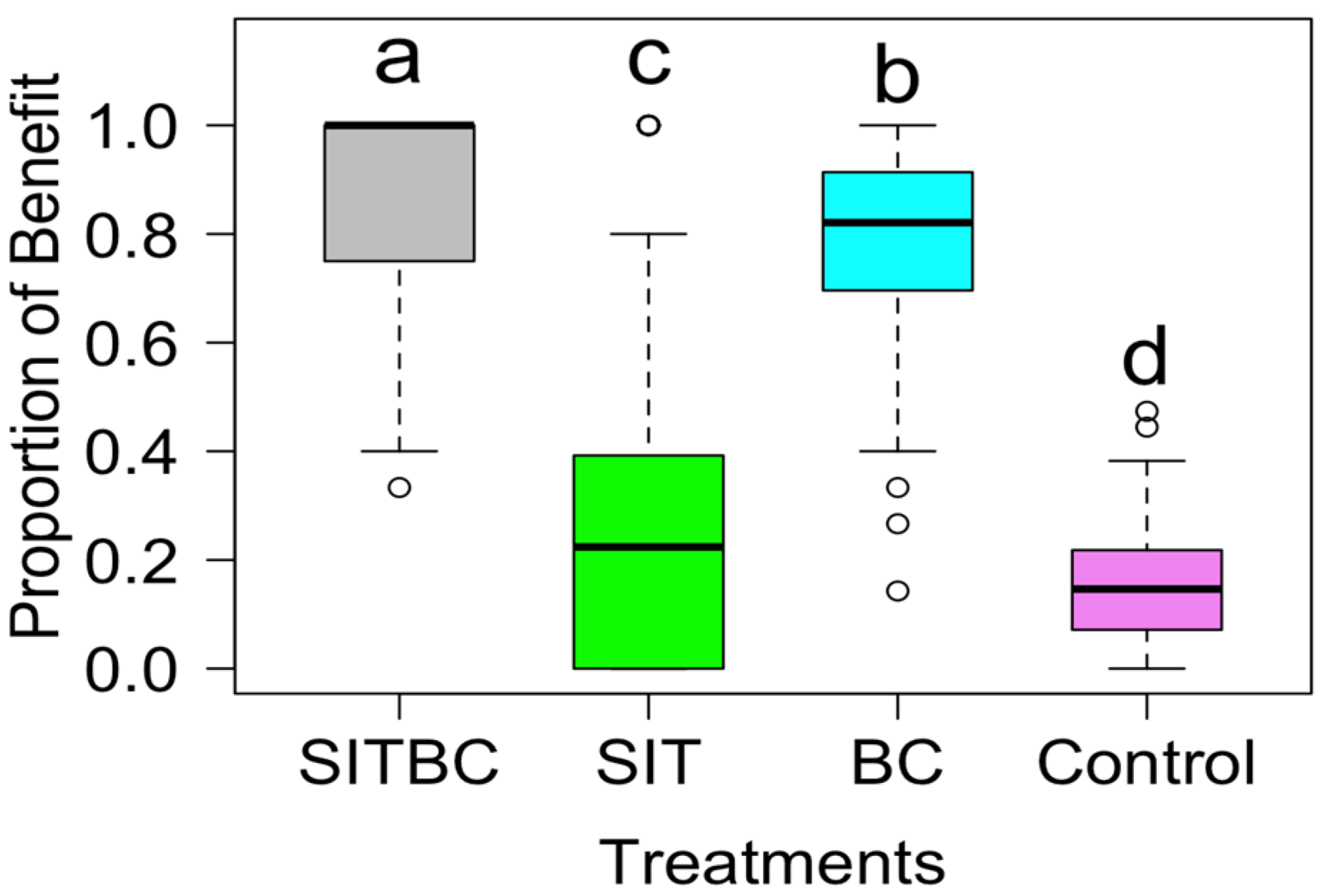
The mixed-effects model showed a significant main effect of treatment on the proportion of benefit (F(3, 87) = 252.46, p < 0.00001). The conditional R2 was 0.756, suggesting that fixed and random effects together accounted for 76% of the variance in benefit. The intraclass correlation coefficient (ICC) was 0.15, indicating that 15% of the variance was attributable to differences between FEDs within cages. The variance of the random intercept was estimated at 0.03, reflecting low variability across groups (File S5). The highest benefit was recorded for the combined treatment, which was significantly higher than the BC and SIT treatments evaluated individually and 5-fold higher than the Control (Figure 1). The post-hoc analysis showed that all groups significantly differed from each other (Tukey’s HSD test, p < 0.01) (Table 2). The benefit ratio ranged from lowest to highest values as follows: Control < SIT < BC < SITBC (Figure 1).
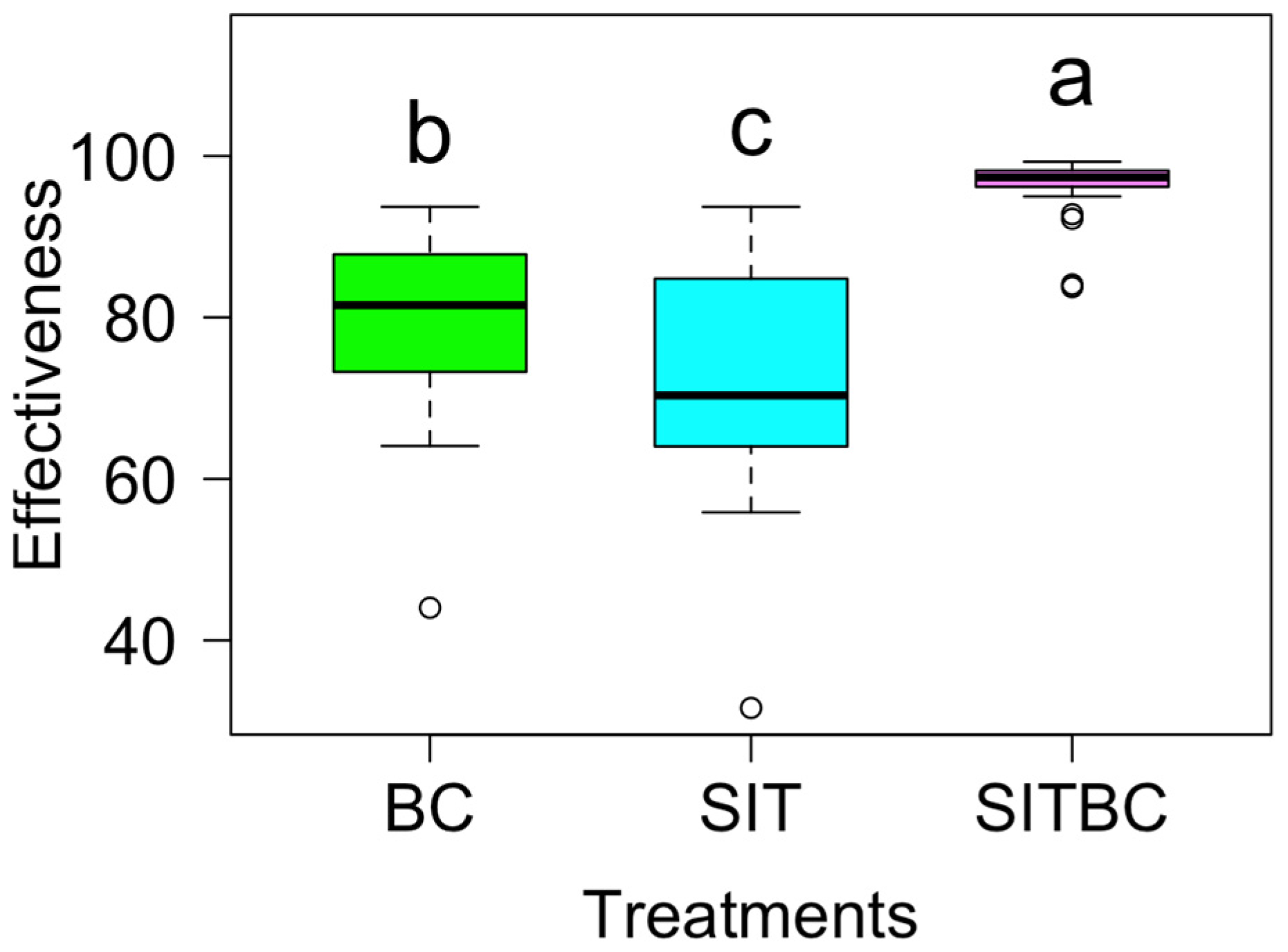
For Abbott’s effectiveness, the mixed-effects model revealed significant variation between experimental levels (F(2, 64) = 49.671, p < 0.00001) (File S5). The conditional R2 was 0.676, suggesting that fixed and random effects together accounted for 68% of the variance in effectiveness. The intraclass correlation coefficient (ICC) was 0.41, indicating that 41% of the variance was attributable to differences between cages. The variance of the random intercept was estimated at 71.44, depicting high variability across groups (File S5). The highest effectiveness on the pest was found in the combined treatment, which was significantly higher than the released parasitoids and sterile medflies alone (Figure 2). Post-hoc analysis showed that all groups significantly differed from each other (Tukey’s HSD test, p < 0.05) (Table 3). The effectiveness ranged from lowest to highest values as follows: SIT < BC < SITBC (Figure 2).

4. Discussion

Results of this research showed that simultaneous releases of D. longicaudata and sterile males of the tsl Vienna-8 C. capitata strain under field-cage confined conditions were substantially more effective in controlling medfly than the individual use of each control method. The combined use of both techniques, biological control and SIT, as a single eco-friendly strategy, exerted a strong suppression of the pest, as medfly mortality was close to 100%. This suggested a near-eradication effect, i.e., close to complete elimination of the pest population [53]. Parasitoids and sterile medfly releases focused on different processes in the biological cycle of the pest, namely parasitism in the fly larval stage and reproductive interference in adult medflies, respectively. This simultaneous combination of different modes of action apparently had an additive effect in suppressing the medfly population exposed in the trials. Similarly, previous outdoor cage trials carried out in Chiapas, southern Mexico, showed a direct additive effect on the regulation of an Anastrepha ludens (Loew, 1873) (Diptera: Tephritidae) population infesting Psidium guajava L. (Myrtaceae) when parasitoids, either D. longicaudata or the pupal parasitoid Coptera haywardi (Ogloblin, 1944) (Hymenoptera: Diapriidae), were simultaneously released with sterile flies [31]. However, the aforementioned study [31] did not only reveal an additive effect on pest control, but also an additional synergistic negative effect on the population reproduction parameters of A. ludens, as postulated by different theoretical models associated with the use of combined releases of natural enemies and sterilized pest insects [25,26,27,28,54,55]. In the current study, no additional synergistic effect on the medfly was found, likely because the impact on pest population dynamics parameters throughout the periodic releases of both parasitoids and sterile flies was not explored in depth. In the field cage trials performed in Mexico [31], data on survival, fertility, and egg hatch percentage were recorded to develop a life table, which was used to calculate the reproductive parameters of the A. ludens population in each treatment. Therefore, future field cage trials in the province of San Juan should assess the effect on medfly demographic parameters through combined and continuous releases of D. longicaudata and sterile flies. In contrast to the results of the current study, previous field cage trials in Hawaii, involving combined releases of sterile flies and the parasitoid Psyttalia fletcheri (Silvestri, 1916) (Hymenoptera: Braconidae), did not produce a significantly higher reduction in the emergence of the melon fruit fly Bactrocera cucurbitae (Coquillett, 1899) (Diptera: Tephritidae) infesting Cucurbita pepo L. (field pumpkin) (Cucurbitaceae) than the release of sterile flies or parasitoids alone [29]. Similarly, only one of the four field cage trials carried out in Guatemala’s coffee-growing areas provided significant suppression of caged medfly populations when two parasitoids, Fopius arisanus (Sonan, 1932) and Diachasmimorpha kraussii (Fullaway, 1951) (Hymenoptera: Braconidae), and sterile flies were concurrently released [30]. Several factors may account for the difference between the results recorded from the Hawaii and Guatemala trials and those of the current study, in addition to the experimental design and the different species involved in the host plant-tephritid fly-parasitoid trophic system. Among the factors affecting the effectiveness of mass-reared parasitoids and flies once released are poorly-quality insects [56,57], flaws during storage, shipment, and release [58], genetic decline [59,60], and their ability to perform in the different environments in which releases are targeted [30,61].
In addition to the scarce field cage studies previously described, some open-field release trials were also undertaken. In this regard, simultaneous releases of the larval parasitoid Diachasmimopha tryoni (Cameron, 1911) (Hymenoptera: Braconidae) and sterile flies in coffee crops in Hawaii during the early 1990s [32] and in Guatemala during the mid-1990s [62] showed higher suppression levels of wild C. capitata populations than the individual use of each technique. Likewise, between 2012 and 2014, combined releases of D. longicaudata and sterile flies in natural areas adjacent to mango crops in Chiapas achieved up to 98% suppression of A. ludens populations [33]. While the experimental designs and environmental conditions of the aforementioned open-field studies are substantially different from the current study, the shared outcome was an additive rather than synergistic effect in suppressing the target pest when combining SIT with parasitoid releases. However, the open-field test results can be difficult to compare due to the methodological limitations of the current research. The trophic interaction system tested in the present study mainly involved a controlled density of the fertile adult medfly population, no other natural enemies, no migration of individuals, constant food and water, a single host fruit species susceptible to parasitism, and a comparatively less variable microclimate. This set of factors may provide slightly limited insights into the assessment of the effectiveness of released agents, in terms of host-finding and parasitism, risks to non-target species, optimal release rates [63], weather conditions, and landscape structure of the release area [64]. These two environmental factors are relevant because the fruit-growing areas in the San Juan province comprise isolated irrigated valleys under a temperate-cold dry climate. Although mass-reared sterile flies and parasitoids were individually released in certain fruit-growing valleys of San Juan with high medfly population levels [17], concerns remain over the performance of these agents relative to their bioclimatic requirements.
The findings of the current field cage study are particularly valuable, as they provide a preliminary basis for assessing the potential impact of combined releases of D. longicaudata and sterile flies, like every tactic alone, for medfly control. Thus, the current study provided important practical implications for designing a new medfly suppression strategy aimed at strengthening the ongoing AW-IFFM program in San Juan. Firstly, results may help to determine the optimal ratio of parasitoid to host required for a release. Based on the high effectiveness recorded by D. longicaudata alone, the female parasitoid/fertile female fly ratio (4:1) used in the experimental cages was apparently suitable to achieve successful 80% medfly control. However, higher parasitoid release rates may still be evaluated. The ability of D. longicaudata to kill medfly larvae can significantly increase up to 87%, as the release density of parasitoids increases [65]. Secondly, the results provide relevant information on behavioral aspects of D. longicaudata, mainly parasitoid-induced host mortality not resulting in visible evidence of parasitism (i.e., non-reproductive effects). This is an important issue because open-field releases may skew the estimation of the effectiveness of parasitoid releases [66]. Thirdly, results may also provide information on the optimal sterile-to-wild (=S:W) male ratio, or indicate any quality shortcomings in the released flies. The SIT alone was the least effective control tactic, reducing 72% of the pest population. As previously mentioned, various factors related to production, packaging, and release processes can affect the performance of mass-reared insects. Although the S:W male ratio has been regarded as an essential factor, even more crucial is the mating competitiveness of mass-reared sterile males relative to that of fertile males [67,68]. The S:W male ratio used in this study was an average value between 50:1 and 150:1 from the standardized release rates for medfly suppression through open field releases of sterile males [69]. Therefore, a suitable release rate of sterile males appears to have been used in the current field cage tests. Consequently, both the flight ability and the capacity to induce greater sterility in fertile females [70] should be consistently tested on sterile medfly males mass-reared at the San Juan Biofactory. Fourth, the data can be used to determine whether the parasitoid and fly release rates are economically viable, in order to avoid excessive rates above the optimum, which may not be effective in controlling the target pest. In this regard, an optimal combination of release rates between the natural enemy and the sterile insect must be achieved to ensure that both methods can interact synergistically and provide a more cost-effective strategy for pest control [55].
Finally, future studies manipulating different release densities of parasitoid and sterile flies, taking into account local environmental conditions, may provide a deeper insight into the performance of both combined control techniques as a suppression strategy against medfly populations in San Juan, as in other fruit-growing regions of Argentina.

5. Conclusions

Findings from this study encourage the simultaneous use of the SIT and biological control through augmentative releases of D. longicaudata as a sound and reliable strategy for suppressing medfly populations within an AW-IFFM framework in irrigated fruit-producing valleys of central-western Argentina. The combination of both methods is essential to reinforce the implementation of medfly suppression/eradication practices that mitigate environmental impact and maximize sustainability, minimizing chemical dependence. However, future open field tests are needed to assess the outcome of the concurrent use of both techniques under the influence of biotic and abiotic ecological factors unaccounted for in the field cage trials of this study.

Supplementary Materials

The following supporting information can be downloaded at: https://www.mdpi.com/article/10.3390/agronomy16060631/s1, File S1: Daily temperature and relative humidity; File S2: Wooden and iron frame with tube-shaped field cages placed inside; File S3: Inside view of the tube cage with a fruit exposure device (=FED); File S4: Schematic representation of the three treatments related to pest control strategies and the control test; File S5: Summary of the general linear mixed models for proportion of benefit and Abbott’s effectiveness.

Author Contributions

Conceptualization, L.d.C.S., G.S., M.O., F.M., S.R.N.-C., F.R.M.G. and S.M.O.; methodology, L.d.C.S., G.S., M.O., F.M., S.R.N.-C., F.R.M.G. and S.M.O.; software, M.O.; validation, L.d.C.S., G.S., M.O., F.M., S.R.N.-C., F.R.M.G. and S.M.O.; formal analysis, M.O.; investigation, L.d.C.S., G.S., M.O., F.M., S.R.N.-C., F.R.M.G. and S.M.O.; resources, L.d.C.S., G.S., M.O., F.M., S.R.N.-C., F.R.M.G. and S.M.O.; data curation, L.d.C.S., G.S., M.O., F.M., S.R.N.-C., F.R.M.G. and S.M.O.; writing—original draft preparation; L.d.C.S., G.S., M.O., F.M., S.R.N.-C., F.R.M.G. and S.M.O.; writing—review and editing, L.d.C.S., G.S., M.O., F.M., S.R.N.-C., F.R.M.G. and S.M.O.; visualization, L.d.C.S., G.S., M.O., F.M., S.R.N.-C., F.R.M.G. and S.M.O.; supervision, L.d.C.S., G.S., M.O., F.M., S.R.N.-C., F.R.M.G. and S.M.O.; project administration, L.d.C.S., F.M., S.R.N.-C. and S.M.O.; funding acquisition, L.d.C.S., F.M., S.R.N.-C. and S.M.O. All authors have read and agreed to the published version of the manuscript.

Funding

This research was supported by the Agencia Nacional de Promoción de la Investigación, el Desarrollo Tecnológico y la Innovación (Argentina), grant n° PICT2020-01050.

Data Availability Statement

The data presented in this study are available in the CONICET (Argentina) website link: https://ri.conicet.gov.ar/handle/11336/281024 (accessed on 11 March 2026).

Acknowledgments

We give thanks to the authorities of the Plant, Animal, and Food Health Bureau of the government of San Juan province for providing us with biological material and the technical staff to perform the trials. We would like to express our special thanks to the Sanchez family, owners of the farm where the field cage trials were conducted. Special thanks to the National Scientific and Technical Research Council of Argentina (CONICET, Spanish acronym) for awarding a PhD scholarship to Guillermo Sanchez.

Conflicts of Interest

The authors declare no conflicts of interest.

References

  1. Hendrichs, J.; Kenmore, P.; Robinson, A.S.; Vreysen, M.J.B. Area-wide integrated management (AW-IPM): Principles, practice and prospects. In Area-Wide Control of Insect Pests: From Research to Field Implementation; Vreysen, M.J.B., Robinson, A.S., Hendrischs, J., Eds.; Springer: Dordrecht, The Netherlands, 2007; pp. 3–33. [Google Scholar]
  2. Vreysen, M.J.B.; Robinson, A.S. Ionising radiation and area-wide management of insect pests to promote sustainable agriculture. A review. Agron. Sustain. Dev. 2011, 31, 233–250. [Google Scholar] [CrossRef]
  3. Mastrangelo, T.; Walder, J.M.M. Use of isotopes in insects. In Radioisotpes Applications in Bio-Medical Science; Singh, N., Ed.; Tech-Open Acces Company: Manhattan, NY, USA, 2011; pp. 67–92. [Google Scholar]
  4. Singh, M. Nuclear and irradiation technology for agriculture sustainability and global food security. Radiat. Prot. Environ. 2025, 48, 63–71. [Google Scholar] [CrossRef]
  5. Hendrichs, J.; Vreysen, M.J.B.; Enkerlin, W.R.; Cayol, J.P. Strategic options in using sterile insects for area-wide integrated pest management. In Sterile Insect Technique. Principles and Practice in Area-Wide Integrated Pest Management, 2nd ed.; Dyck, V.A., Hendrichs, J., Robinson, A.S., Eds.; CRC Press: Boca Raton, FL, USA, 2021; pp. 841–884. [Google Scholar]
  6. Marec, F.; Bloem, K.; Carpenter, J.E. Inherited sterility in insects. In Sterile Insect Technique. Principles and Practice in Area-Wide Integrated Pest Management, 2nd ed.; Dyck, V.A., Hendrichs, J., Robinson, A.S., Eds.; CRC Press: Boca Raton, FL, USA, 2021; pp. 163–200. [Google Scholar]
  7. Hendrichs, J.; Bloem, K.; Hoch, G.; Carpenter, J.E.; Greany, P.; Robinson, A.S. Improving the cost-effectiveness, trade and safety of biological control for agricultural insect pests using nuclear techniques. Biocontrol Sci. Technol. 2009, 19, 3–22. [Google Scholar] [CrossRef]
  8. Cancino, J.; Ruiz, L.; Viscarret, M.; Sivinski, J.; Hendrichs, J. Application of nuclear techniques to improve the mass production and management of fruit fly parasitoids. Insects 2012, 3, 1105–1125. [Google Scholar] [CrossRef]
  9. Hendrichs, J.; Robinson, A.S. Prospects for the future development and application of the Sterile Insect Technique. In Sterile Insect Technique. Principles and Practice in Area-Wide Integrated Pest Management, 2nd ed.; Dyck, V.A., Hendrichs, J., Robinson, A.S., Eds.; CRC Press: Boca Raton, FL, USA, 2021; pp. 1119–1160. [Google Scholar]
  10. Kapranas, A.; Collatz, J.; Michaelakis, A.; Milonas, P. Review of the role of sterile insect technique within biologically-based pest control—An appraisal of existing regulatory frameworks. Entomol. Exp. Appl. 2022, 170, 385–393. [Google Scholar] [CrossRef]
  11. Zhao, R. Sterile Insect Technique and Biological Control: How Radiation Helps Fight Pests. 2023. Available online: https://www.iaea.org/newscenter/news/sterile-insect-technique-and-biological-control-how-radiation-helps-fight-pests (accessed on 14 December 2025).
  12. Sivinski, J. Augmentative biological control: Research and methods to help make it work. CAB Rev. 2013, 8, 1–11. [Google Scholar] [CrossRef]
  13. Mehta, K. Radiation sources supporting the use of natural enemies for biological control of agricultural pests. Biocontrol Sci. Technol. 2009, 19, 335–362. [Google Scholar] [CrossRef]
  14. Montoya, P.; Cancino, J.; Ruiz, L. Packing of fruit fly parasitoids for augmentative releases. Insects 2012, 3, 889–899. [Google Scholar] [CrossRef] [PubMed]
  15. Rendon, P.; Enkerlin, W. Area-wide fruit fly programmes in Latin America. In Area-Wide Integrated Pest Management: Development and Field Application; Hendrichs, J., Pereira, R., Vreysen, M.J.B., Eds.; CRC Press: Boca Raton, FL, USA, 2021; pp. 161–195. [Google Scholar]
  16. Aluja, M.; Ovruski, S.M.; Garcia, F.R.M.; Hurtado, M.; Enkerlin, W. Fruit fly (Tephritidae) management in the Neotropical region: History, state of the art, and perspectives. In Management of Fruit Flies in the Americas; Garcia, F.R.M., Ed.; Springer Nature: Cham, Switzerland, 2024; pp. 11–66. [Google Scholar]
  17. Suárez, L.; Buonocore-Biancheri, M.J.; Murúa, A.F.; Beltrachini, S.; Kulichevsky, L.E.; Ovruski, S.M. Management of tephritid fruit flies in Argentina. In Management of Fruit Flies in the Americas; Garcia, F.R.M., Ed.; Springer Nature: Cham, Switzerland, 2024; pp. 169–195. [Google Scholar]
  18. Guillén, D.; Sánchez, R. Expansion of the National Fruit Fly Control Programme in Argentina. In Area-Wide Control of Insect Pests: From Research to Field Implementation; Vreysen, M.J.B., Robinson, A.S., Hendrischs, J., Eds.; Springer: Dordrecht, The Netherlands, 2007; pp. 653–660. [Google Scholar]
  19. Hallouti, A.; El Caid, B.; Boubaker, H. Mediterranean fruit fly Ceratitis capitata (Wiedemann) management strategies and recent advances: A review. Int. J. Pest Manag. 2024, 1–13. [Google Scholar] [CrossRef]
  20. Suárez, L.; Buonocore-Biancheri, M.J.; Murúa, F.; Ordano, M.; Wang, X.; Cancino, J.; Garcia, F.R.M.; Sánchez, G.; Beltrachini, S.; Kulichevsky, L.E.; et al. Medfly population suppression through augmentative release of an introduced parasitoid in an irrigated multi-fruit orchard of Central–Western Argentina. Insects 2023, 14, 387. [Google Scholar] [CrossRef]
  21. Garcia, F.R.M.; Ovruski, S.M.; Suárez, L.; Cancino, J.; Liburd, O.E. Biological control of tephritid fruit flies in the Americas and Hawaii: A review of the use of parasitoids and predators. Insects 2020, 11, 662. [Google Scholar] [CrossRef]
  22. Díaz-Nieto, L.M.; Murúa, A.F.; Acosta, J.C.; Escobar, J.M. Dispersal behavior of Ceratitis capitata (Diptera: Tephritidae) among agricultural valleys in San Juan, Argentina. Rev. Soc. Entomol. Argent. 2008, 67, 155–161. [Google Scholar]
  23. Cancino, J.; Suárez, L.; Ayala, A.; Buonocore-Biancheri, M.J.; Murúa, A.F.; Ovruski, S.M. Augmentative biological control as a workable strategy within an area-wide integrated fruit fly management approach: Case studies from Mexico and Argentina. In Management of Fruit Flies in the Americas; Garcia, F.R.M., Ed.; Springer Nature: Cham, Switzerland, 2024; pp. 197–219. [Google Scholar]
  24. Gurr, G.M.; Kvedaras, O.L. Synergizing biological control: Scope for sterile insect technique, induced plant defences and cultural techniques to enhance natural enemy impact. Biol. Control 2010, 52, 198–207. [Google Scholar] [CrossRef]
  25. Barclay, H.J. Models for pest control: Complementary effects of periodic releases of sterile pest and parasitoids. Theor. Popul. Biol. 1987, 32, 76–89. [Google Scholar] [CrossRef]
  26. Barclay, H.J. Mathematical models for using sterile insects. In Sterile Insect Technique. Principles and Practice in Area-Wide Integrated Pest Management, 2nd ed.; Dyck, V.A., Hendrichs, J., Robinson, A.S., Eds.; CRC Press: Boca Raton, FL, USA, 2021; pp. 201–242. [Google Scholar]
  27. Knipling, E.F. Sterile insect and parasite augmentation techniques unexploited solutions for many insect pest problems. Fla. Entomol. 1998, 81, 34–160. [Google Scholar]
  28. Knipling, E.F. Principles of insect parasitism analysed from new perspectives: Practical implications for regulating insect populations by biological means. In Agriculture Handbook USDA; Department of Agriculture Agricultural Research Service: Beltsville, MA, USA, 1992; Volume 963, pp. 1–337. [Google Scholar]
  29. Vargas, R.I.; Long, J.; Miller, N.W.; Delate, K.; Jackson, C.G.; Uchida, G.K.; Bautista, R.C.; Harris, E.J. Releases of Psyttalia fletcheri (Hymenoptera: Braconidae) and sterile flies to suppress Melon Fly (Diptera: Tephritidae) in Hawaii. J. Econ. Entomol. 2004, 97, 1531–1539. [Google Scholar] [CrossRef] [PubMed]
  30. Rendón, P.; Sivinski, J.; Holler, T.; Bloem, K.; López, M.; Martínez, A.; Aluja, M. The effects of sterile males and two braconid parasitoids, Fopius arisanus (Sonan) and Diachasmimorpha krausii (Fullaway) (Hymenoptera), on caged populations of Mediterranean fruit flies, Ceratitis capitata (Wiedemann) (Diptera: Tephritidae) at various sites in Guatemala. Biol. Control 2006, 36, 224–231. [Google Scholar] [CrossRef]
  31. Montoya, P.; Flores-Sarmiento, E.; López, P.; Ayala, A.; Cancino, J. Additive effect of releasing sterile insects plus biocontrol agents against fruit fly pests (Diptera: Tephritidae) under confined conditions. Insects 2023, 14, 337. [Google Scholar] [CrossRef]
  32. Wong, T.T.; Ramadan, M.M.; Herr, J.C.; McInnis, D.O. Suppression of a Mediterranean fruit fly (Diptera: Tephritidae) population with concurrent parasitoid and sterile fly releases in Kula, Maui, Hawaii. J. Econ. Entomol. 1992, 85, 1671–1681. [Google Scholar] [CrossRef]
  33. Cancino, J.; Montoya, P.; Gálvez, F.O.; Gálvez, C.; Liedo, P. Effect of the Sterile Insect Technique and augmentative parasitoid releases in a fruit fly suppression program in mango-producing areas of Southeast Mexico. Insects 2023, 14, 719. [Google Scholar] [CrossRef]
  34. Nagel, P.; Peveling, R. Environment and the Sterile Insect Technique. In Sterile Insect Technique; Dyck, V.A., Hendrichs, J., Robinson, A., Eds.; Springer: Dordrecht, The Netherlands, 2005; pp. 499–524. [Google Scholar] [CrossRef]
  35. Liedo, P.; Montoya, P.; Toledo, J. Area-wide management of fruit flies in a tropical mango growing area integrating the sterile insect technique and biological control: From a research to an operational programme. In Area-Wide Integrated Pest Management: Development and Field Application; Hendrichs, J., Pereira, R., Vreysen, M.J.B., Eds.; CRC Press: Boca Raton, FL, USA, 2021; pp. 197–214. [Google Scholar]
  36. Dias, N.P.; Zotti, M.J.; Montoya, P.; Carvalho, I.R.; Nava, D.E. Fruit fly management research: A systematic review of monitoring and control tactics in the world. Crop Prot. 2018, 112, 187–200. [Google Scholar] [CrossRef]
  37. Orozco, D.; Dominguez, J.; Reyes, J.; Villaseñor, A.; Gutierrez, J.M.; Barnes, B. SIT and biological control of Anastrepha fruit flies in Mexico. In Proceedings of 6th International Fruit Fly Symposium; International Energy Atomic Agency, Ed.; IAEA: Stellenbosch, South Africa, 2002; pp. 245–249. [Google Scholar]
  38. Vargas, R.I.; Leblanc, L.; Harris, E.J.; Manoukis, N.C. Regional suppression of Bactrocera fruit flies (Diptera: Tephritidae) in the Pacific through biological control and prospects for future introductions into other areas of the world. Insects 2012, 3, 727–742. [Google Scholar] [CrossRef] [PubMed]
  39. Barnes, B.N. Sterile Insect Technique (SIT) for fruit fly control—The South African experience. In Fruit Fly Research and Development in Africa—Towards a Sustainable Management Strategy to Improve Horticulture; Ekesi, S., Mohamed, A.A., De Meyer, M., Eds.; Springer International Publishing: Cham, Switzerland, 2016; pp. 435–464. [Google Scholar] [CrossRef]
  40. Orozco-Dávila, D.; Quintero, L.; Hernández, E.; Solís, E.; Artiaga, T.; Hernández, R.; Ortega, C.; Montoya, P. Mass rearing and sterile insect releases for the control of Anastrepha spp. pests in Mexico—A review. Entomol. Exp. Appl. 2017, 164, 176–187. [Google Scholar] [CrossRef]
  41. Pérez-Staples, D.; Díaz-Fleischer, F.; Montoya, P. The Sterile Insect Technique: Success and perspectives in the Neotropics. Neotrop. Entomol. 2020, 50, 172–185. [Google Scholar] [CrossRef]
  42. Dias, N.P.; Montoya, P.; Nava, D.E. A 30-year systematic review reveals success in tephritid fruit fly biological control research. Entomol. Exp. Appl. 2022, 170, 370–384. [Google Scholar] [CrossRef]
  43. Enkerlin, W. Impact of fruit fly control programmes using the Sterile Insect Technique. In Sterile Insect Technique. Principles and Practice in Area-Wide Integrated Pest Management, 2nd ed.; Dyck, V.A., Hendrichs, J., Robinson, A.S., Eds.; CRC Press: Boca Raton, FL, USA, 2021; pp. 979–1005. [Google Scholar]
  44. Enkerlin, W.R.; Gutiérrez, J.M.; Pantaleon, R.; Soto, C.; Villaseñor, A.; Zavala, J.L.; Orozco, D.; Montoya, P.; Silva, L.; Cotoc, E.; et al. The Moscamed regional programme: A success story of area-wide Sterile Insect Technique application. Entomol. Exp. Appl. 2017, 164, 188–203. [Google Scholar] [CrossRef]
  45. Quiroga, D.; Ramirez, W.; Ruiz, C. National Fruit Fly Control and Eradication Program (PROCEM) Argentina. In Proceedings of the 8th International Symposium on Fruit Flies of Economic Importance; Sabater-Muñóz, B., Navarro-Llopis, V., Urbaneja, A., Eds.; Editorial Universitat Politécnica de Valéncia: Valencia, Spain, 2010; p. 100. Available online: http://hdl.handle.net/10251/11200 (accessed on 14 December 2025).
  46. Villarreal, P.; Mongabure, A.; Borges, C.A.; Gómez-Segade, C. Evaluación del Impacto Económico del Programa Nacional de Control y Erradicación de Mosca de los Frutos: PROCEM Patagonia; FunBaPa Ediciones: Viedma, Río Negro, Argentina, 2023; p. 88. Available online: https://repositorio.inta.gob.ar/bitstream/handle/20.500.12123/5708/INTA_CRPatagoniaNorte_EEAAltoValle_Villarreal_PL_Evaluar%20el%20impacto.%20Programas%20de%20intervenci%c3%b3n%20sanitarios.pdf?sequence=1&isAllowed=y (accessed on 14 December 2025).
  47. Montoya, P.; Liedo, L.; Benrey, B.; Barrera, J.F.; Cancino, J.; Aluja, M. Functional response and superparasitism by Diachasmimorpha longicaudata (Hymenoptera: Braconidae), a parasitoid of fruit flies (Diptera: Tephritidae). Ann. Entomol. Soc. Am. 2000, 93, 47–54. [Google Scholar] [CrossRef]
  48. Perucca, L.; Paredes, D. Peligro de aluviones en el departamento de pocito provincia de San Juan. Rev. Asoc. Geol. Argent. 2005, 60, 48–55. [Google Scholar]
  49. García-Medel, D.; Sivinski, J.; Dáz-Fleischer, F.; Ramirez-Romero, R.; Aluja, M. Foraging behavior by six fruit fly parasitoids (Hymenoptera: Braconidae) released as single- or multiple-species cohorts in field cages: Influence of fruit location and host density. Biol. Control 2007, 43, 12–22. [Google Scholar] [CrossRef]
  50. Piepho, H.P.; Malik, W.A.; Bischoff, R.; El-Hasan, A.; Scheer, C.; Sedlmeier, J.E.; Gerhards, R.; Petschenka, G.; Voegele, R.T. Evaluación de la eficacia en la protección de cultivos: Un tutorial sobre el uso de la fórmula de Abbott. J. Plant Dis. Prot. 2024, 131, 2139–2160. [Google Scholar] [CrossRef]
  51. Zuur, A.F.; Ieno, E.N.; Walker, N.J.; Saveliev, A.A.; Smith, G. Mixed Effects Models and Extensions in Ecology with R; Springer: New York, NY, USA, 2009; p. 574. [Google Scholar]
  52. R Core Team. R: A Language and Environment for Statistical Computing; R Foundation for Statistical Computing: Vienna, Austria, 2025; p. 2630. Available online: https://www.R-project.org/ (accessed on 2 December 2025).
  53. Suckling, D.M.; Kean, J.M.; Stringer, L.D.; Cáceres-Barrios, C.; Hendrichs, J.; Reyes-Flores, J.; Dominiak, B.C. Eradication of tephritid fruit fly pest populations: Outcomes and prospects. Pest Manag. Sci. 2016, 72, 456–465. [Google Scholar] [CrossRef]
  54. Knipling, E.F. The Potential Role of the Sterility Method for Insect Population Control with Special Reference to Combining This Method with Conventional Methods; USDA/ARS Series 33-98; Department of Agriculture, Agricultural Research Service: Washington, DC, USA, 1964; p. 66.
  55. Bakhtiar, T.; Fitri, I.R.; Hanum, F.; Kusnanto, A. Mathematical model of pest control using different release rates of sterile insects and natural enemies. Mathematics 2022, 10, 883. [Google Scholar] [CrossRef]
  56. van Lenteren, J.C. Need for quality control of mass produced biological control agents. In Quality Control and Production of Biological Control Agents: Theory and Testing Procedures; van Lenteren, J.C., Ed.; CABI Publishing: Wageningen, The Netherlands, 2003; pp. 1–18. [Google Scholar] [CrossRef]
  57. Parker, A.G.; Vreysen, M.J.B.; Bouyer, J.; Calkins, C.O. Sterile insect quality control/assurance. In Sterile Insect Technique. Principles and Practice in Area-Wide Integrated Pest Management; Dyck, V.A., Hendrichs, J., Robinson, A.S., Eds.; CRC Press: Boca Raton, FL, USA, 2021; pp. 399–449. [Google Scholar]
  58. van Lenteren, J.C.; Tommasini, M.G. Mass production, storage, shipment and release of natural enemies. In Quality Control and Production of Biological Control Agents: Theory and Testing Procedures; van Lenteren, J.C., Ed.; CABI Publishing: Wageningen, The Netherlands, 2003; pp. 181–189. [Google Scholar] [CrossRef]
  59. Postic, E.; Outreman, Y.; Derocles, S.; Granado, C.; Le Ralec, A. Genetics of wild and mass-reared populations of a generalist aphid parasitoid and improvement of biological control. PLoS ONE 2021, 16, e0249893. [Google Scholar] [CrossRef]
  60. Istas, O.; Szűcs, M. Biological control potential of a laboratory selected generalist parasitoid versus a co-evolved specialist parasitoid against the invasive Drosophila suzukii. Evol. Appl. 2023, 16, 1819–1829. [Google Scholar] [CrossRef]
  61. Sivinski, J.; Piñero, J.; Aluja, M. The distributions of parasitoids (Hymenoptera) of Anastrepha fruit flies (Diptera: Tephritidae) along an altitudinal gradient in Veracruz, Mexico. Biol. Control 2000, 18, 258–269. [Google Scholar] [CrossRef]
  62. Sivinski, J.; Jeronimo, F.; Holler, T. Development of aerial releases of Diachasmimorpha tryoni (Cameron) (Hymenoptera: Braconidae), a parasitoid that attacks the Mediterranean fruit fly, Ceratitis capitata (Weidemann) (Diptera: Tephritidae), in the Guatemalan highlands. Biocontrol Sci. Technol. 2000, 10, 15–25. [Google Scholar] [CrossRef]
  63. Seehausen, M.L.; Valenti, R.; Fontes, J.; Meier, M.; Marazzi, C.; Mazzi, D.; Kenis, M. Large-arena field cage releases of a candidate classical biological control agent for spotted wing drosophila suggest low risk to non-target species. J. Pest Sci. 2022, 95, 1057–1065. [Google Scholar] [CrossRef]
  64. Gómez-Llano, J.H.; Galvão-Silva, F.L.; Acevedo, F.E.; Castro-Llanos, F.; Gottschalk, M.S.; Nava, D.E. Biological control under climate change: Distribution patterns of the South American fruit fly, Anastrepha fraterculus and two of its parasitoids in the Americas. PLoS ONE 2025, 20, e0325761. [Google Scholar] [CrossRef]
  65. Suárez, L.d.C.; Núñez-Campero, S.R.; Murúa, F.; Garcia, F.R.M.; Ovruski, S.M. Effectiveness of Diachasmimorpha longicaudata in killing Ceratitis capitata larvae infesting commercial fruits in dryland agroecosystems of western Argentina. Agronomy 2024, 14, 2418. [Google Scholar] [CrossRef]
  66. Hepler, J.R.; Athey, K.; Enicks, D.; Abram, P.K.; Gariepy, T.D.; Talamas, E.J.; Beers, E. Hidden host mortality from an introduced parasitoid: Conventional and molecular evaluation of non-target risk. Insects 2020, 11, 822. [Google Scholar] [CrossRef] [PubMed]
  67. Shelly, T.; McInnis, D. Sterile Insect Technique and control of tephritid fruit flies: Do species with complex courtship require higher overflooding ratios? Ann. Entomol. Soc. Am. 2016, 109, 1–11. [Google Scholar] [CrossRef]
  68. Plá, I.; García de Oteyza, J.; Tur, C.; Martínez, M.Á.; Laurín, M.C.; Alonso, E.; Martínez, M.; Martín, Á.; Sanchis, R.; Navarro, M.C.; et al. Sterile Insect Technique programme against Mediterranean fruit fly in the Valencian community (Spain). Insects 2021, 12, 415. [Google Scholar] [CrossRef] [PubMed]
  69. Rendon, P.A.; Enkerlin, W.R.; Cáceres, C. Sterile Insect Release Density Calculations Spreadsheet; FAO/IAEA, Programme of Nuclear Techniques: Vienna, Austria, 2019; p. 30. [Google Scholar]
  70. Abraham, S.; Díaz, V.; Moyano, A.; Castillo, G.; Rull, J.; Suárez, L.; Murúa, A.F.; Pantano, V.; Molina, D.; Ovruski, S.M. Irradiation dose does not affect male reproductive organ size, sperm storage, and female remating propensity in Ceratitis capitata. Bull. Entomol. Res. 2021, 111, 82–90. [Google Scholar] [CrossRef] [PubMed]
Figure 1. Variation in the proportion of benefit recorded from experimental field cage conditions in Tulum fruit-growing valley, San Juan, central-western Argentina. BC: Biological Control alone, SIT: sterile insect technique alone, SITBC: both methods combined, and Control (any previous treatment applied). Box-plots depict the median (horizontal line inside the box), interquartile range Q1–Q3 (bottom and top ends of the box), dispersion (whiskers depicting 1.5 times the IQ range), and extreme values (points). Different letters depict significant differences between experimental groups (Tukey post-hoc comparisons, p < 0.05, N = 120 per group) after fitting a mixed-effects model conditional on fruit-bearing device variation within cage, within treatment, within trial (F(3, 87) = 252.46, p < 0.00001, conditional R2 = 0.756).
Agronomy 16 00631 g001
Figure 2. Variation in Abbott’s effectiveness from experimental field cage conditions in Tulum fruit-growing valley, San Juan, central-western Argentina. BC: Biological Control alone, SIT: sterile insect technique alone, SITBC: both methods combined, and Control (any previous treatment applied). Box-plots depict the median (horizontal line inside the box), interquartile range Q1–Q3 (bottom and top ends of the box), dispersion (whiskers depicting 1.5 times the IQ range), and extreme values (points). Different letters depict significant differences between experimental groups (Tukey post-hoc comparisons, p < 0.05, N = 24 per group) after fitting a mixed-effects model conditional on field cage variation, within treatment, within trial (F(2, 64) = 49.671, p < 0.00001, conditional R2 = 0.676).
Agronomy 16 00631 g002
Table 1. Summary of descriptive statistics (mean ± SD, median, and maximum value) of the number of medfly puparia, non-hatching puparia, emerged flies and parasitoids from the fruit-bearing sentinel devices (FED, N = 480 = 5 FEDs × 4 cages × 4 treatment levels × 6 trials) used in the following treatments: Biological Control alone (BC), sterile insect technique alone (SIT), both methods combined (SITBC), and Control (N = 120 per treatment level). N/A, not available (parasitoids were released only in BC treatments).
ParametersControlTreatments
BCSITSITBC
Number of medfly puparia24.7 ± 9.4, 24, 5318.0 ± 9.9, 16.5, 528.2 ± 7.3, 7, 354.7 ± 3.9, 4, 20
Number of non-hatching puparia4.0 ± 3.1, 3, 136.0 ± 6.4, 3, 292.4 ± 3.0, 1, 151.1 ± 1.6, 1, 7
Number of emerged flies20.7 ± 7.8, 21, 414.2 ± 4.5, 3, 255.8 ± 5.1, 4.5, 260.9 ± 1.5, 0, 9
Number of emerged parasitoidsN/A7.7 ± 5.5, 6, 23N/A2.8 ± 2.1, 2, 8
Table 2. Tukey’s HSD post-hoc test comparisons of the benefit proportion between experimental and control groups. Post-hoc comparisons were applied after fitting the mixed-effects model by REML. Adjusted p-values considered spurious probabilities N = 120 FEDs per experimental group (N = 5 FEDs × 4 cages × 6 trials).
Treatment
Comparison
DifferenceLower
Limit (95%)
Upper
Limit (95%)
Adjusted p-Value
BC-Control0.6310.5660.697<0.0000001
SIT-Control0.1310.0650.1980.0000022
SITBC-Control0.7210.6550.786<0.0000001
SIT-BC−0.501−0.566−0.436<0.0000001
SITBC-BC0.0900.0240.1550.0025199
SITBC-SIT0.5900.52450.656<0.0000001
Table 3. Tukey’s HSD post-hoc test comparisons of Abbott’s effectiveness between experimental and control groups. Post-hoc comparisons were applied after fitting the mixed-effects model by REML. Adjusted p-values considered spurious probabilities N = 120 FEDs per experimental group (N = 5 FEDs × 4 cages × 6 trials).
Treatment
Comparison
DifferenceLower
Limit (95%)
Upper
Limit (95%)
Adjusted p-Value
SIT-BC−7.792−15.181−0.40340.0363930
SITBC-BC16.0558.66723.4440.0000056
SITBC-SIT23.84716.45931.236<0.0000001
Disclaimer/Publisher’s Note: The statements, opinions and data contained in all publications are solely those of the individual author(s) and contributor(s) and not of MDPI and/or the editor(s). MDPI and/or the editor(s) disclaim responsibility for any injury to people or property resulting from any ideas, methods, instructions or products referred to in the content.