Article

Comparative Study on Plant Water-Use Efficiency Under Different Forest-Medicinal Plant Intercropping Systems in Karst Regions

1
Guangxi Key Laboratory of Plant Functional Substances and Resources Sustainable Utilization, Guangxi Institute of Botany, Guilin 541006, China
2
School of Tourism and Landscape Architecture, Guilin University of Technology, Guilin 541006, China
3
Key Laboratory of Rare and Endangered Species Ecology and Environmental Protection, Ministry of Education, Guangxi Normal University, Guilin 541006, China
4
Hechi Branch of the Guangxi Academy of Sciences, Hechi 547000, China
*
Authors to whom correspondence should be addressed.
These authors contributed equally to this work.
Agronomy 2026, 16(4), 476; https://doi.org/10.3390/agronomy16040476
Submission received: 23 December 2025 / Revised: 16 February 2026 / Accepted: 18 February 2026 / Published: 19 February 2026
(This article belongs to the Section Water Use and Irrigation)

Abstract

To investigate the rationality of water-use efficiency in agroforestry systems within this region, this study utilised the medicinal and edible plant Sophora japonica cv.jinhuai as a foundation. Five mixed planting models were established, incorporating Ardisia gigantifolia, Melicope pteleifolia, Camellia limonia, Belamcanda chinensis, Isatidis radix, and Pilea basicordata. Water-use efficiency (WUE) was analysed by measuring the carbon-stable isotope composition (δ13C) of plant leaves. Compared to previous studies that primarily focused on δ13C in single species or simple composite systems, this research innovatively evaluates the water-use efficiency (WUE) performance of different composite patterns and their impact on system stability at both the species and system levels, integrating the theory of fitness differentiation. Results indicate that the ranges of δ13C and WUE for the five mixed cropping systems were −27.0633‰ to 31.2188‰ and 27.7191 to 50.0365 μmol/mol, respectively. WUE ranking was: Sophora japonica cv.jinhuaiCamellia limoniaPilea basicordata (SCP) > Sophora japonica cv.jinhuaiCamellia limonia (SC) > Sophora japonica cv.jinhuaiBelamcanda chinensis + Isatidis radix (SBI) > Sophora japonica cv.jinhuaiMelicope pteleifolia (SM) > Sophora japonica cv.jinhuaiArdisia gigantifolia (SA). At the species level, the Sophora japonica cv.jinhuaiCamellia limoniaPilea basicordata (SCP) composite planting model is better suited to karst arid environments, while the Sophora japonica cv.jinhuaiArdisia gigantifolia (SA) composite planting model exhibits lower overall plant water-use efficiency (WUE) and weaker drought resistance. At the system level, Sophora japonica cv. jinhuai exhibited significantly higher water-use efficiency (WUE) than understory medicinal plants in most composite patterns, with pronounced differences in species fitness and poor system stability. The Sophora japonica cv.jinhuaiCamellia limoniaPilea basicordata (SCP) model exhibited the highest WUE. Furthermore, no significant difference in WUE was observed between Sophora japonica cv.jinhuai and Pilea basicordata, indicating relatively high fitness matching and good coordination in water use. These species can coexist stably, suggesting promising application potential in karst arid environments. Therefore, this study not only evaluated the water-use performance of each species within the composite model but also identified SCP as the most suitable agroforestry configuration for karst regions from a system stability perspective. This provides a scientifically grounded basis for optimising agroforestry practices in these areas, integrating both species-level and system-level perspectives. It should be clarified that the WUE calculated based on δ13C in this study is a relative indicator rather than an absolute physiological measurement. Its reliability depends on the core assumptions and parameter settings of the isotope model.

1. Introduction

Karst regions possess fragile ecosystems characterised by severe surface water seepage and shallow soil layers [1]. Although some karst areas receive ample precipitation, frequent droughts occur due to unique geological conditions and the impact of global warming [2], rendering water a critical factor limiting plant growth and ecosystem stability [3]. As a primary economic medicinal forest tree species in karst regions, Sophora japonica cv.jinhuai holds significant importance for local agroforestry economies and ecological restoration. In recent years, monoculture planting schemes centred on Sophora japonica cv.jinhuai have, to some extent, stimulated regional economic development. However, they have also led to issues such as species uniformity, simplified landscape structure, and degraded ecosystem functions. Particularly during the hot summer months, severe soil exposure and erosion beneath the canopy occur [4], undermining the sustainable land use of karst regions.
Agroforestry systems, as an efficient and sustainable land-use approach, achieve synergistic ecological and economic benefits by establishing multi-species communities, enhancing soil and water conservation capabilities, and increasing carbon storage capacity [5,6]. Promoting agroforestry models integrating timber and medicinal plants in karst regions helps optimise land-use structures, mitigate rock desertification trends, and enhance ecosystem resilience [7]. However, resource competition may arise between different plant components within agroforestry systems, particularly under water- and nutrient-limited conditions [8]. Interspecies water relationships thus become pivotal in determining system stability and species coexistence. According to contemporary coexistence theory [9], species exhibit niche and fitness differences: the former promotes coexistence, while the latter may lead to competitive exclusion. Therefore, when constructing composite systems, scientifically assessing the matching degree of water-use strategies and fitness between species is crucial for optimising model configuration and enhancing system sustainability [10].
Vegetation water-use efficiency (WUE) serves as a key indicator for assessing the efficiency with which plants convert water into biomass [11], typically evaluated indirectly through measurements of leaf stable carbon isotopes (δ13C) [12,13]. Currently, research on interspecific WUE variations within agroforestry systems and their implications for ecosystem stability remains limited in karst regions. Existing research has primarily focused on assessing plant water-use efficiency within single-species or simple composite systems. For instance, Huang et al. [14] and Tao et al. [15] revealed species-level water adaptation traits by analysing δ13C values in specific plant leaves. However, these studies did not examine the coordination of water-use strategies among different species within composite cropping systems or their impact on system stability at the systemic level. Therefore, this study introduces the theory of fitness divergence, focusing on system-level adaptive matching among species within composite systems. It aims to uncover the intrinsic link between species coexistence mechanisms and system stability, providing a novel theoretical perspective for optimising forest-medicinal plant composite cropping systems in karst regions. Consequently, this study employs Sophora japonica cv.jinhuai as the primary tree species, integrated with understory medicinal plants, including Ardisia gigantifolia, Melicope pteleifolia, Camellia limonia, Belamcanda chinensis, Isatidis radix, and Pilea basicordata. Multiple forest-medicinal plant co-cultivation models were established. By measuring the δ13C values of plant leaves, the water-use efficiency of different species and co-cultivation models was analysed. The rationality and sustainability of various models were evaluated from the perspective of fitness differences, providing a scientific basis for the optimisation of forest-medicinal plant co-cultivation models and ecological functions in karst regions.

2. Materials and Methods

2.1. Research Area Overview

The study area is situated in Lingxiao Village, Liuxu Town, Jinchengjiang District, Hechi City, Guangxi Zhuang Autonomous Region, at 107.9451799° E longitude and 24.663469° N latitude. It lies within the transitional zone between the hilly terrain and karst topography of northwestern Guangxi, with a topography sloping from west to east. The region exhibits a subtropical monsoon climate with moderate sunlight exposure. Characterised by warm, humid conditions where rainfall coincides with the hot season, it experiences neither severe cold nor extreme heat, rendering it suitable for subtropical crop cultivation. Addressing issues such as limited diversity and low utilisation rates of medicinal plants under forest canopies in karst areas, we have identified species suitable for understory cultivation. These include Sophora japonica cv. jinhuai (tree), Melicope pteleifolia (shrub), Camellia limonia (shrub), Ardisia gigantifolia (shrub), Isatidis radix (herb), Belamcanda chinensis (herb), and Pilea basicordata (herb). We established suitable mixed-cultivation models and conducted experimental plantings. The selected mixed-cultivation models were: Sophora japonica cv. jinhuaiArdisia gigantifolia, Sophora japonica cv. jinhuaiMelicope pteleifolia, Sophora japonica cv.jinhuaiCamellia limonia, Sophora japonica cv.jinhuaiBelamcanda chinensis+Isatidis radix, and Sophora japonica cv.jinhuaiCamellia limoniaPilea basicordata. Each planting system featured three 5 m × 5 m replicate plots. Both the mixed cropping systems and the pure stand of Sophora japonica cv. Jinhuai were established on the same gently sloping terrain to ensure comparable topography, soil conditions, and moisture regimes, thereby facilitating comparative analysis.

2.2. Sample Collection and Analysis

In April 2024, three specimens each of Sophora japonica and intercropped medicinal plants with similar stem diameters and growth rates were selected from the plot. Healthy, sun-exposed leaves free from pests and diseases were collected from the canopy. Leaves from each plant were individually placed in sealed bags, labelled, and transported to the laboratory. Surface impurities were removed using pure water, after which the leaves were dried in a 60 °C oven. The δ13C values of the leaves were determined by the Institute of Botany, Chinese Academy of Sciences, using a stable isotope mass spectrometer (Delta V Advantage).

2.3. Data Processing

The determination of δ13C values in plant leaves is based on PDB standards, calculated according to the formula:
δ 13 C = R P R P D B R P D B
In the equation, δ13C denotes the carbon isotope value of plant leaves; R p represents the 13C/12C ratio of the plant leaves under analysis; R P D B denotes the 13C/12C ratio of the standard material PDB.
The method for calculating the stable carbon isotope ratio (Δ13C) in plant leaves is as follows [14]:
13 C = ( δ 13 C a δ 13 C ) ( 1 + δ 13 C / 1000 )
In the equation, δ 13 C and δ 13 C a denote the carbon isotope values of plant leaves and atmospheric carbon dioxide (CO2), respectively.
The concentration (Ca) and carbon isotope value ( δ 13 C a ) of CO2 are calculated according to formula [14]:
C a = 277.28 + 1.350 e x p ( 0.01572 t 27.3528 )
δ 13 C a = 6.429 0.006 e x p ( 0.01572 t 37.758 )
In the formula, t denotes the sampling year (2025).
Estimation of long-term water-use efficiency (WUE) in plants employs a carbon isotope resolution-based model, whose core lies in deriving the calculation formula for chloroplast carbon dioxide concentration (Cc) [15]:
C c = C a × b 13 C f   × Γ *     / P C a b a + g s c / g m × b a m C a
In the equation, C a denotes CO2 concentration (μmol/mol); b(29‰) represents carboxylation by Rubisco enzyme; ∆13C indicates the stable carbon isotope resolution of plant leaves; f   [(12 ± 4)‰] signifies the fractionation coefficient during photorespiration; Γ * denotes the CO2 compensation point in the absence of dark respiration; P C a denotes atmospheric CO2 partial pressure; a(4.4‰) represents CO2 flux through stomata; g s c / g m (0.79 ± 0.07) indicates the ratio of stomatal to mesophyll conductance for CO2; a m (1.8‰) denotes diffusion across mesophyll cells.
The formula for calculating Γ * is given by [15]:
Γ * = Γ 25 * × P a t m P 0 × e H a × T 298 R × T × 298
In the equation, Γ 25 *     (4.332 Pa) denotes the CO2 compensation point at 25 °C; P a t m represents atmospheric pressure, calculated based on the sampling point’s altitude (278 m) and ambient temperature (22 °C) during sampling; P0 (101,325 Pa) denotes atmospheric pressure at sea level; H a (37,830 J/mol) represents the activation energy; R (8.314 J/mol) is the gas constant; and T (22 °C) is the temperature at the time of sample collection.

2.4. WUE Calculation and Model Assumptions

Calculating long-term water-use efficiency (WUE) based on leaf Δ13C has a solid theoretical foundation. This study employs the isotope-based modelling package “isocalcR” for computations. It is important to emphasise that the resulting WUE values represent relative comparative metrics derived from model parameters and assumptions, rather than direct physiological measurements of instantaneous or absolute water-use efficiency in plants [16]. Certain model parameters (e.g., the ratio of stomatal conductance to mesophyll conductance g s c / g m ) employed typical ranges applicable to δ13C-labelled plants. Although potential physiological differences exist between life forms (trees, shrubs, and herbaceous plants) in leaf anatomy, stomatal behaviour, and mesophyll conductance—potentially leading to differing actual g s c / g m values—existing research indicates that the correlation between long-term plant WUE and δ13C is broadly applicable across different functional groups over extended time scales [17]. Therefore, employing a unified parameter set for model estimation effectively reflects relative WUE differences across species and cropping systems, a practice widely adopted in comparative ecology studies [18]. The WUE values obtained through this method in this study are primarily used for interspecific and inter-system comparative analyses to assess adaptive differences to karst arid environments.

2.5. Data Analysis Methods

Data statistical analysis and plotting were performed using Excel 2016, SPSS 27 [19], R software, and Origin respectively. Data are presented as mean ± standard error (SE). Plant water-use efficiency (WUE) was calculated based on leaf Δ13C values. This was performed using the ‘mesophyll’ function within the ‘isocalcR’ package in R software [20]. Long-term water-use efficiency (WUE) of plants was calculated based on leaf δ13C values, sampling year, sampling site elevation, and average growing season temperature. Levene’s test was applied to all data to ensure compliance with assumptions of normality and homogeneity of variance. For datasets meeting parametric testing criteria, one-way analysis of variance (ANOVA) was employed to compare differences between species and patterns, followed by post hoc multiple comparisons. The interaction effects of species and pattern on δ13C and WUE were analysed using two-way ANOVA.

3. Results

3.1. Leaf δ13C and Water-Use Efficiency (WUE) in Different Plant Species

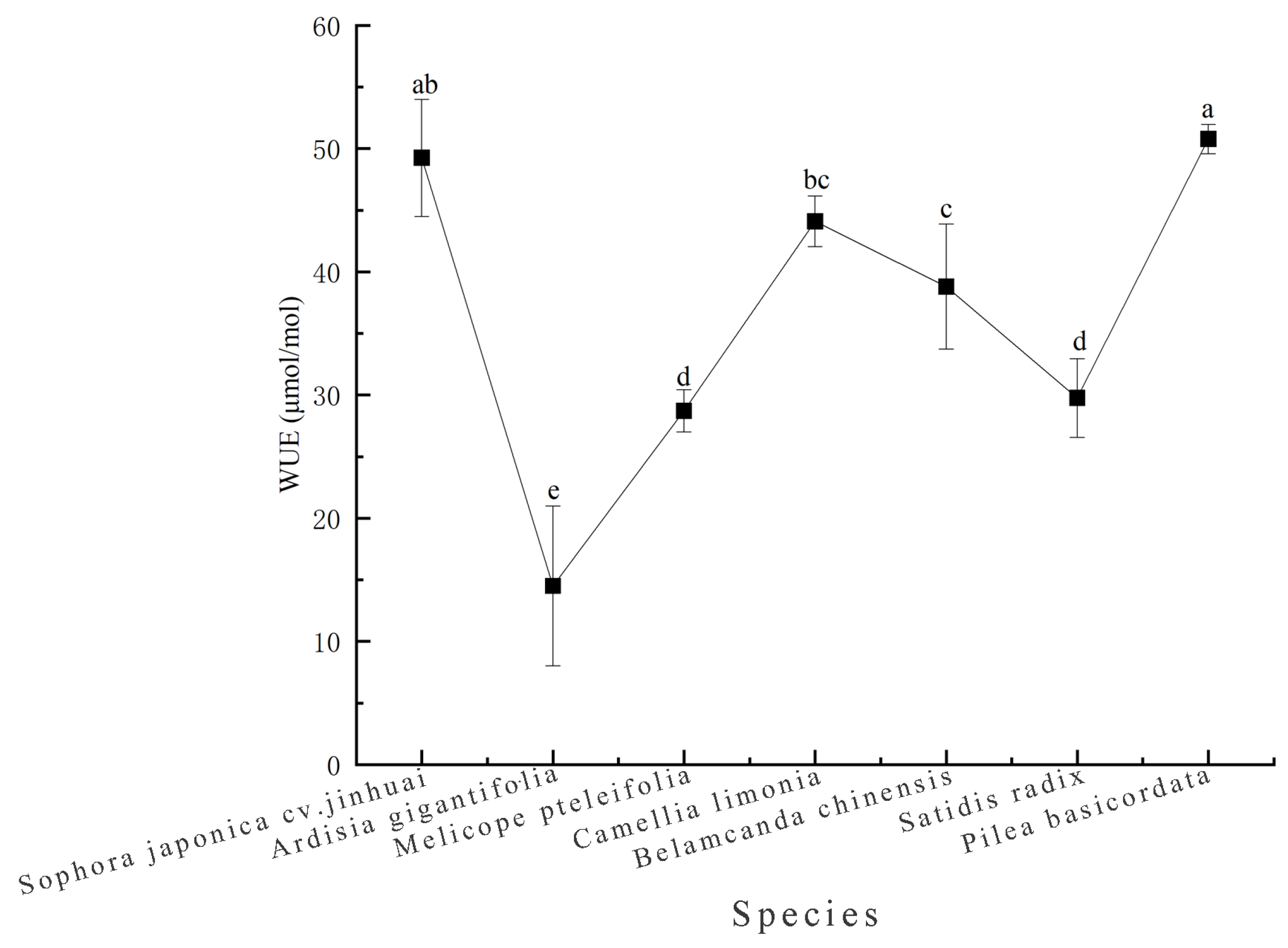
As depicted in Figure 1, the water-use efficiency (WUE) of each tree species varied between 14.5035 and 50.7774 μmol/mol, with an average of 37.4024 μmol/mol. Sophora japonica cv.jinhuai, Camellia limonia, and Pilea basicordata exhibited significantly higher WUE than other species. Melicope pteleifolia, Belamcanda chinensis, and Isatidis radix showed intermediate WUE values, yet remained significantly higher than Ardisia gigantifolia. The WUE ranking among tree species was: Pilea basicordata > Sophora japonica cv.jinhuai > Camellia limonia > Belamcanda chinensis > Isatidis radix > Melicope pteleifolia > Ardisia gigantifolia.
The δ13C values of leaves from the seven medicinal plant species selected for this study ranged from −27.4225‰ to 33.3994‰, with an average of −29.8566‰. The δ13C values for each tree species are shown in Table 1.

3.2. Variation in Water-Use Efficiency Among Species Within the Same Composite Pattern

Analysis of variance for both δ13C and WUE in plant leaves within the same mixed cropping system (Table 2) revealed that species and the mixed cropping system significantly influenced δ13C and WUE (p < 0.05). Notably, species and the mixed cropping system exerted an extremely significant effect on δ13C, while the mixed cropping system also exerted an extremely significant effect on WUE (p < 0.01).
Analysis of δ13C and WUE in leaves of different plant species within the same mixed cropping system (Table 3) indicates that the mixed system (Sophora japonica cv.jinhuaiArdisia gigantifolia, Sophora japonica cv.jinhuaiMelicope pteleifolia, Sophora japonica cv.jinhuaiCamellia limonia, Sophora japonica cv.jinhuaiBelamcanda chinensis+Isatidis radix, and Sophora japonica cv.jinhuaiCamellia limoniaPilea basicordata) exhibited significantly higher δ13C values and WUE in Sophora japonica cv.jinhuai leaves compared to the medicinal plants grown beneath the canopy. This indicates significant differences in species fitness within the Sophora japonica cv.jinhuaiArdisia gigantifolia, Sophora japonica cv.jinhuaiMelicope pteleifolia, Sophora japonica cv.jinhuaiCamellia limonia, Sophora japonica cv.jinhuaiBelamcanda chinensis+Isatidis radix, and Sophora japonica cv.jinhuaiCamellia limoniaPilea basicordata composite planting systems.

3.3. δ13C and Water-Use Efficiency of Sophora japonica cv.jinhuai Leaves Under Different Intercropping Systems

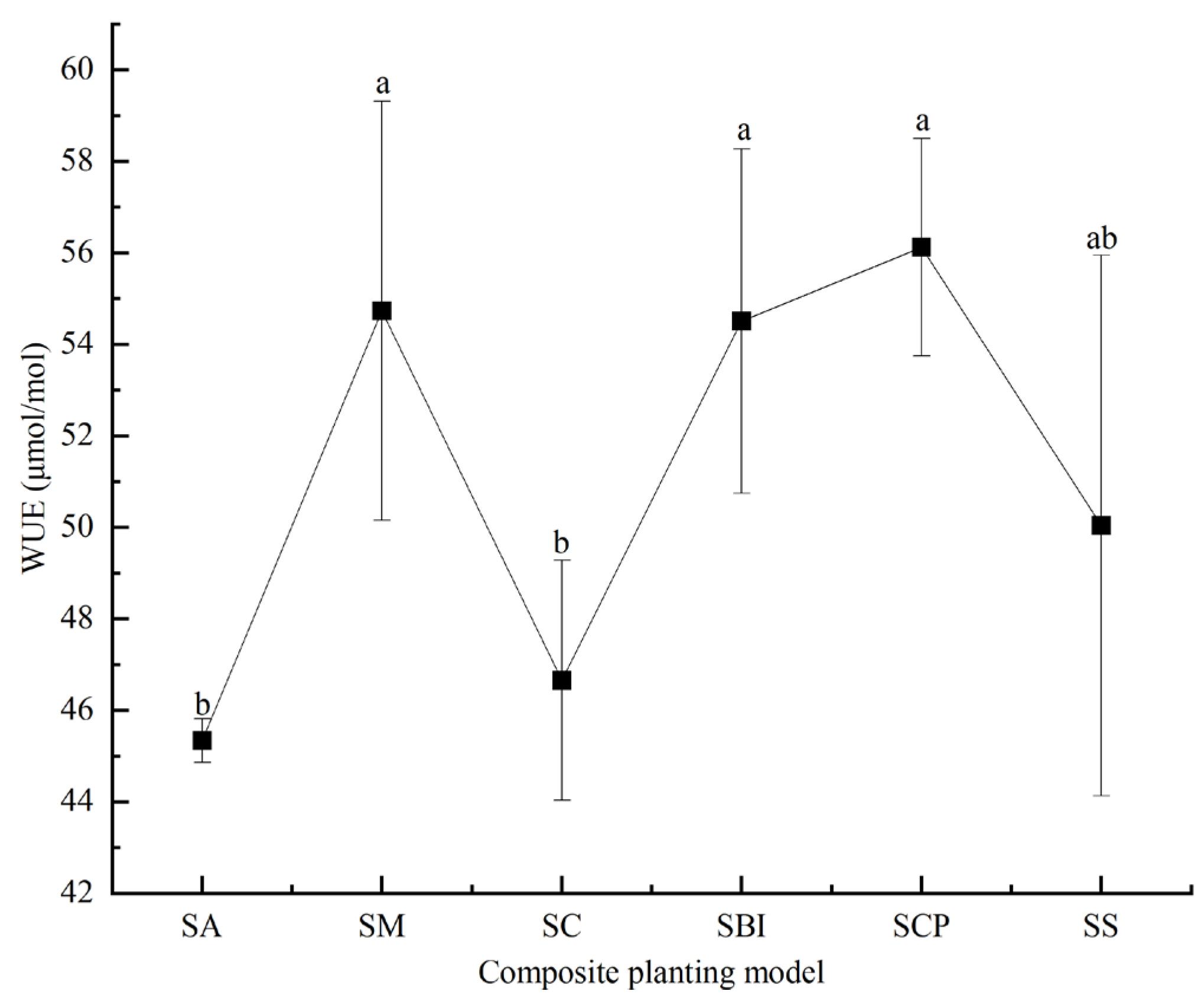
Analysis of Sophora japonica cv.jinhuai’s water-use efficiency (WUE) across different mixed cropping systems (Figure 2) indicates that Sophora japonica cv.jinhuai’s WUE ranged from 45.34 to 56.1187 μmol/mol. Within the Sophora japonica cv.jinhuaiArdisia gigantifolia mixed cropping system, Sophora japonica cv.jinhuai exhibited the lowest WUE, whereas the highest WUE was recorded for Sophora japonica cv.jinhuai within the Sophora japonica cv.jinhuaiCamellia limoniaPilea basicordata system. Except for within the Sophora japonica cv.jinhuaiArdisia gigantifolia composite planting model, where Sophora japonica cv.jinhuai’s WUE was significantly lower than that in Sophora japonica cv.jinhuaiMelicope pteleifolia (54.7331 ± 4.5803 μmol/mol), Sophora japonica cv.jinhuaiBelamcanda chinensis+Isatidis radix (54.5032 ± 3.7679 μmol/mol), and Sophora japonica cv.jinhuaiCamellia limoniaPilea basicordata (56.1187 ± 2.3743 μmol/mol), no significant differences in Sophora japonica cv.jinhuai’s WUE were observed compared to other composite planting patterns.
Sophora japonica cv.jinhuai stands as one of the principal economic medicinal forests within karst regions. Single-factor analysis of variance indicates (Table 4) that composite planting schemes exert a negligible influence upon δ13C values in Sophora japonica cv.jinhuai foliage. Multiple comparisons reveal (Table 4) that the δ13C values of Sophora japonica cv.jinhuai leaves in the Sophora japonica cv.jinhuaiCamellia limoniaPilea basicordata composite planting system, the Sophora japonica cv.jinhuaiBelamcanda chinensis+Isatidis radix composite planting system, and the Sophora japonica cv.jinhuaiMelicope pteleifolia composite planting system were significantly higher than those in the Sophora japonica cv.jinhuaiArdisia gigantifolia composite planting system and the Sophora japonica cv.jinhuaiCamellia limonia composite planting system.

3.4. δ13C and WUE of Plant Leaves Under Different Intercropping Systems

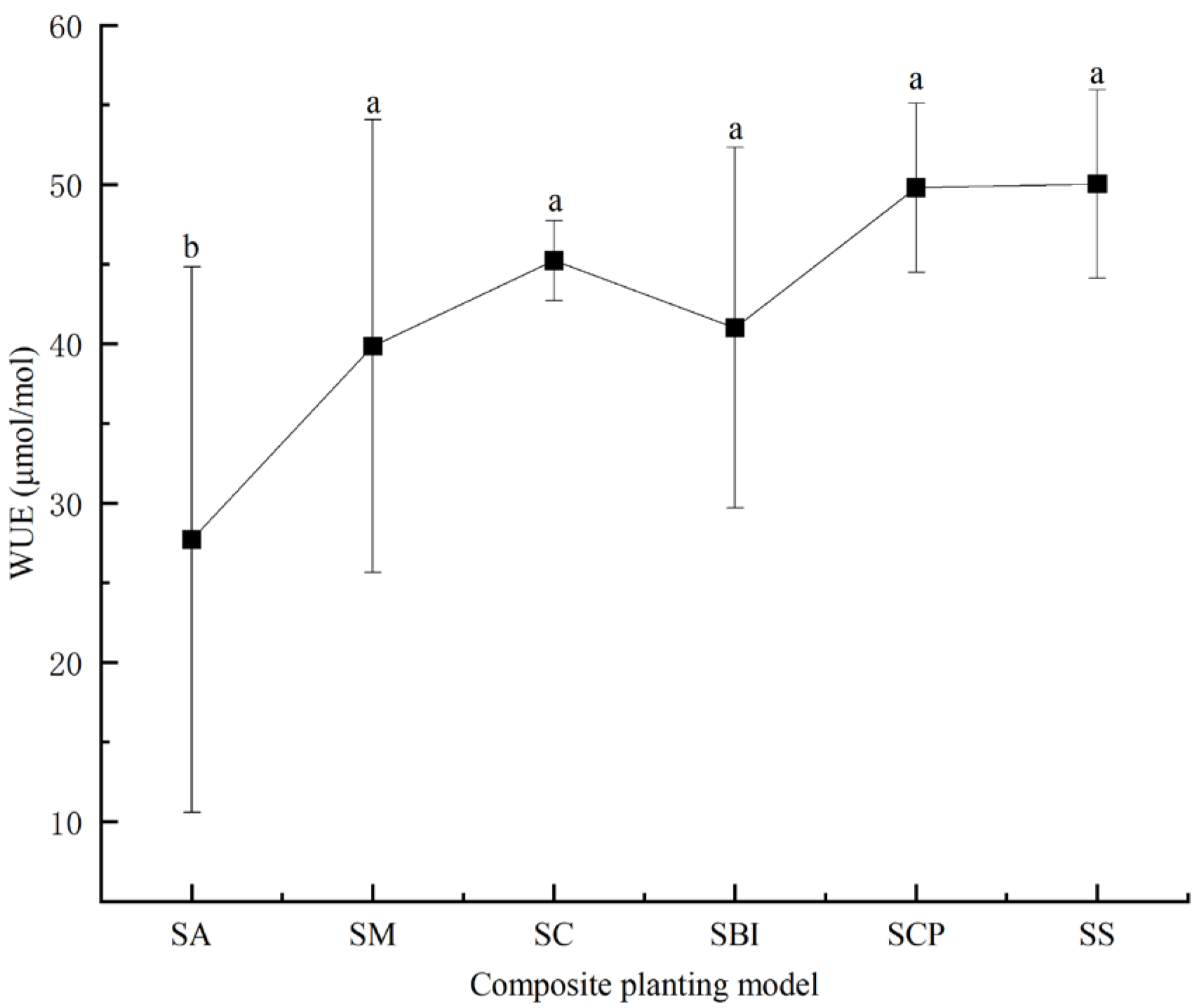
The δ13C and WUE of plant leaves under different mixed cropping systems were characterised by the mean δ13C and WUE values across all plant leaves within each system. Analysis of variance revealed (Table 5, Figure 3) significant differences in leaf δ13C and WUE between the mixed cropping systems. Further multiple comparisons revealed that the δ13C and WUE of plant leaves in the Sophora japonica cv.jinhuai + Sophora japonica cv.jinhuai (SS) and Sophora japonica cv.jinhuaiCamellia limoniaPilea basicordata (SCP) composite planting patterns were significantly higher than those in the Sophora japonica cv.jinhuaiArdisia gigantifolia (SA), Sophora japonica cv.jinhuaiMelicope pteleifolia (SM), Sophora japonica cv.jinhuaiCamellia limonia (SC), and Sophora japonica cv.jinhuaiBelamcanda chinensis + Isatidis radix (SBI). However, Sophora japonica cv.jinhuai —Melicope pteleifolia (SM), Sophora japonica cv.jinhuaiCamellia limonia (SC), Sophora japonica cv.jinhuaiBelamcanda chinensis + Isatidis radix (SBI), Sophora japonica cv.jinhuai— Sophora japonica cv.jinhuai (SS), and Sophora japonica cv.jinhuaiCamellia limoniaPilea basicordata (SCP) showed no significant differences. There are differences between Sophora japonica cv.jinhuai— Ardisia gigantifolia (SA) and Sophora japonica cv.jinhuaiMelicope pteleifolia (SM), Sophora japonica cv.jinhuaiCamellia limonia (SC), Sophora japonica cv.jinhuaiBelamcanda chinensis + Isatidis radix (SBI), Sophora japonica cv.jinhuaiSophora japonica cv.jinhuai (SS), and Sophora japonica cv.jinhuaiCamellia limoniaPilea basicordata (SCP).

4. Discussion

Plant water-use efficiency serves as a crucial physiological indicator reflecting a plant’s adaptability to arid environments [21]. This study determined the δ13C values of leaves from seven forest-medicinal plant composite systems to estimate their long-term water-use efficiency, thereby revealing the adaptability and stability of different species-based composite patterns within karst arid habitats. The WUE values calculated using the δ13C model in this study serve as relative metrics for interspecific and inter-model comparisons. Their numerical values are influenced by the assumption of model-unified parameters and do not constitute absolute measurements of physiological WUE in plants. Differences in leaf structure and physiological processes among plants of varying life forms may introduce certain computational biases. However, this does not alter the core comparative conclusion that ‘species such as Sophora japonica cv. jinhuai and Pilea basicordata exhibit higher drought adaptability, whereas Ardisia gigantifolia demonstrates weaker adaptability’.
The water-use efficiency (WUE) of Sophora japonica cv.jinhuai, Camellia limonia, and Pilea basicordata in this study was significantly higher than that of Ardisia gigantifolia, Melicope pteleifolia, Belamcanda chinensis, and Isatidis radix. Ardisia gigantifolia exhibited significantly lower δ13C values and WUE compared to other species, which correlates with the species’ native population distribution and the mixed planting pattern. As a tree species, Sophora japonica cv.jinhuai possesses a tall canopy structure with substantial water transport resistance. To counteract water limitations, it enhances WUE by reducing stomatal conductance and minimising transpiration losses [22]. Although Camellia limonia is a shrub, its leaf structure may possess a strong water retention capacity, exhibiting high water-use efficiency. As a herbaceous plant, Pilea basicordata’s elevated WUE may relate to its native distribution in karst limestone regions, where such plants typically develop robust drought adaptation mechanisms [23]—such as extensive root systems or high tissue water-holding capacity—to withstand seasonal aridity. In contrast, Ardisia gigantifolia exhibited significantly lower δ13C values and WUE than other species, indicating weaker drought adaptation. This likely stems from its native distribution in moist, shaded habitats, where its leaf structure and other mechanisms prove less efficient under arid conditions, resulting in suboptimal water use. Melicope pteleifolia, Belamcanda chinensis, and Isatidis radix exhibited intermediate WUE values, suggesting moderate drought tolerance. However, these species may remain at a disadvantage within water-competitive mixed systems, particularly under intensified drought conditions.
Regarding the stability of the mixed planting patterns, all composite configurations examined in this study (e.g., Sophora japonica cv.jinhuaiArdisia gigantifolia, Sophora japonica cv.jinhuaiMelicope pteleifolia) demonstrated significantly higher water-use efficiency (WUE) for Sophora japonica cv.jinhuai compared to understory plants. This indicates pronounced disparities within these patterns. According to contemporary species coexistence theory, greater differences in fitness make stable coexistence between species increasingly difficult [24]. As a canopy tree species, Sophora japonica cv.jinhuai holds an advantage in water competition, potentially limiting the growth of understory plants such as Ardisia gigantifolia and Melicope pteleifolia under drought conditions, thereby affecting the long-term stability of the system. However, within the Sophora japonica cv.jinhuaiCamellia limoniaPilea basicordata pattern, although WUE differences persist between Sophora japonica cv.jinhuai and Camellia limonia, the WUE disparity between Sophora japonica cv.jinhuai and Pilea basicordata is insignificant. This indicates a high degree of suitability and compatibility between the two species in water-use efficiency, with the overall WUE of this pattern being the highest. Among the patterns studied, it demonstrates excellent ecological coordination. Water competition among species within this pattern is relatively low, facilitating complementary water use within the system. It represents an ideal agroforestry configuration for karst regions.
The cultivation of medicinal plants under forest canopies did not significantly impair Sophora japonica cv.jinhuai’s own water-use efficiency (WUE), indicating its robust competitive advantage in resource acquisition. However, variations in Sophora japonica cv.jinhuai’s WUE across different intercropping systems (e.g., the lowest WUE observed in the Sophora japonica cv.jinhuaiArdisia gigantifolia system) suggests that understory plant species and their arrangement may indirectly influence canopy tree species’ water-use strategies through microenvironmental regulation [25]. For instance, Ardisia gigantifolia’s low WUE may reflect its weaker competition for soil moisture, failing to establish effective ecological niche complementarity.
In karst regions characterised by environmental fragility and scarce water resources, establishing a rational agroforestry model for medicinal plants requires consideration not only of species’ economic value but also of their water niche differentiation and fitness matching. This study demonstrates that the Sophora japonica cv.jinhuaiCamellia limoniaPolygonum cuspidatum hybrid combination constitutes a composite model with high water-use efficiency, low interspecific competition, and strong stability, presenting considerable potential for wider adoption. Future optimisation of such systems may further integrate ecological niche characteristics such as species-specific water source preferences and root distribution patterns to develop more resilient polyculture models. Conduct long-term positioning observations to assess ecological and economic sustainability. Simultaneously, to precisely quantify absolute WUE values, optimise isotope model parameters—such as calibrating the g s c / g m ratio for different plant life forms—based on their anatomical and physiological characteristics to minimise computational errors arising from interspecific variations.
This study also has certain limitations. Although the δ13C-based isotope model provides an effective means for assessing long-term water-use efficiency in plants, the results rely on physiological parameter assumptions and may not fully reflect the actual water acquisition and competitive dynamics of species within complex systems. Future research should integrate systematic observations of direct physiological and ecological indicators—such as root architecture, water source depth, and soil water potential fluctuations—to validate the isotope-based inferences from this study. This approach will further elucidate complementary mechanisms and competitive relationships in water use among species, providing a more robust theoretical foundation for optimising forest-medicinal plant composite models in karst regions.

5. Conclusions

This study analysed leaf composition and water-use efficiency (WUE) differences among species and mixed planting patterns in Sophora japonica cv.jinhuai under various forest-medicinal plant co-cultivation systems. Results indicate: (1) In this study, Sophora japonica cv. jinhuai, Camellia limonia, and Pilea basicordata exhibited relatively high water-use efficiency (WUE), demonstrating good adaptability to karst arid habitats. Furthermore, these species possess significant medicinal value, making them the most optimal and suitable for promotion and cultivation in karst regions. Conversely, Ardisia gigantifolia showed relatively low WUE and weaker drought tolerance under the study conditions. (2) Interplanting Ardisia gigantifolia, Belamcanda chinensis, Isatidis radix, Melicope pteleifolia, Camellia limonia, or Pilea basicordata under Sophora japonica cv.jinhuai did not significantly affect Sophora japonica cv.jinhuai’s WUE. However, in the five composite patterns—Sophora japonica cv.jinhuaiArdisia gigantifolia, Sophora japonica cv.jinhuaiMelicope pteleifolia, Sophora japonica cv.jinhuaiCamellia limonia, Sophora japonica cv.jinhuaiBelamcanda chinensis+Isatidis radix, and Sophora japonica cv.jinhuaiCamellia limoniaPilea basicaordataSophora japonica cv.jinhuai’s WUE was significantly higher than that of the understory-planted Ardisia gigantifolia, Melicope pteleifolia, Camellia limonia, Isatidis radix, Belamcanda chinensis, and Pilea basicordata. Without appropriate human intervention, the growth of Ardisia gigantifolia, Melicope pteleifolia, Camellia limonia, Isatidis radix, Belamcanda chinensis, and Pilea basicordata may be compromised, potentially destabilising the composite planting pattern. (3) The Sophora japonica cv.jinhuaiCamellia limoniaPilea basicordata model exhibited the highest WUE among the intensive mixed cropping systems. Moreover, the WUE difference between Sophora japonica cv. jinhuai and Pilea basicordata was not significant, indicating good water-use compatibility between the species. Under the conditions of this study, they demonstrated higher system stability and could serve as one of the reference configurations for optimising agroforestry-medicinal plant composite planting patterns in karst regions. This study provides a preliminary comparative analysis of agroforestry-medicinal plant systems in specific karst regions from a WUE perspective. While the results carry certain geographical and contextual limitations, they offer scientific reference for evaluating the configuration and functionality of local vegetation composite cropping systems. Future research should integrate comprehensive studies on water sources, root distribution, nutrient utilisation, and long-term ecological benefits across different species to more fully evaluate the rationality and sustainability of composite planting models, thereby providing a more robust foundation for regional ecological agriculture practices.


Author Contributions

Conceptualization: J.Y. and R.Z.; methodology: J.Y. and R.Z.; validation: J.Y., Y.J., R.Z. and Y.W.; formal analysis: J.Y., G.W. and R.Z.; investigation: R.Z., Y.J., L.W. and F.H.; data curation: Y.W., G.W., L.W. and F.H.; writing—original draft: J.Y.; visualisation: J.Y. and R.Z.; writing—review and editing: J.T. and X.W.; funding acquisition: X.W. and J.T.; project administration: X.W., J.T., L.W. and F.H. All authors have read and agreed to the published version of the manuscript.

Funding

The National Natural Science Foundation of China (No. 32560330); Guangxi Natural Science Foundation (No. 2024GXNSFAA010452); Autonomous Projects of the Guangxi Key Laboratory of Functional Phytochemicals Research and Sustainable Utilisation (No. ZRJJ2024-3 and ZRJJ2024-11); Hechi Municipal Science and Technology Base and Talent Programme (HeKe AC231113); the 2022 Guilin Municipal Technology Application and Promotion Programme (No. 20220134-3 and 20230102-3).

Data Availability Statement

The original contributions presented in this study are included in the article. Further inquiries can be directed to the corresponding authors.

Acknowledgments

The successful completion of this research would not have been possible without the invaluable support and assistance of my supervisor, senior colleagues, and fellow students. First and foremost, I extend my heartfelt gratitude to He Guohua, Feng Shuo, and Li Xi for their invaluable assistance in sample collection and processing. I am also deeply appreciative of Zou Rou, Wu Yingying, Jiang Yunsheng, Wei Guowang, Wei Liangju, and Huang Fuke for their meticulous support during the data processing and analysis stages. Their rigorous approach laid a solid foundation for the accuracy of the research conclusions. I am equally grateful to Tang Jianmin and Wei Xiao for their professional guidance during the drafting and revision stages of this thesis. Their invaluable suggestions, from refining the research framework to enhancing the logical coherence of the content, enabled continuous optimisation of this study. My most sincere thanks are extended to all colleagues who supported this research endeavour.

Conflicts of Interest

The authors declare that no conflicts of interest exist.

References

  1. Chen, H.S.; Wang, K.L. Soil Water Research in Karst Mountain Areas of Southwest China. Res. Agric. Mod. 2008, 29, 734–738. [Google Scholar]
  2. Huang, F.Z.; Li, J.X.; Li, D.X.; Chen, T.; Wang, B.; Lu, S.H.; Li, X.K. Physiological and ecological adaptation of karst woody plants to drought. Guangxi Flora 2021, 41, 1644–1653. [Google Scholar]
  3. Cui, Y.Q.; Ma, J.Y.; Sun, W.; Sun, J.H.; Duan, Z.H. A preliminary study of water use strategy of desert plants in Dunhuang, China. J. Arid Land 2015, 7, 73–81. [Google Scholar] [CrossRef]
  4. Wang, H.S.; Xiong, K.N.; Zhang, F.M.; Luo, D.; Liao, Z.F. Evolution Mechanism of Dolomite Karst Peak Cluster-Canyon Landform: A Genesis View on Huanjiang, Guangxi. Trop. Geogr. 2014, 34, 672–680. [Google Scholar] [CrossRef]
  5. Zou, X.; Zhu, X.A.; Chen, C.F.; Liu, W.J. Soil and Water Conservation Benefits of Agroforestry Systems. J. Yunnan Univ. Nat. Sci. Ed. 2020, 42, 382–392. [Google Scholar]
  6. Cheng, P.; Cao, F.L.; Wang, G.B. The progress of study on agroforestry. J. Nanjing For. Univ. (Nat. Sci. Ed.) 2010, 34, 151–156. [Google Scholar]
  7. Zeng, X.L.; Jiang, S.; Huang, F.Z.; Li, J.X.; Chen, Y.Y.; Wang, Q.W.; Jin, Y.Q.; Liu, C.G. Stability and Erodibility of Aggregate Affected by Typical Tree-herb Ecosystems in Karst Area. Chin. J. Soil Sci. 2024, 55, 1565–1573. [Google Scholar] [CrossRef]
  8. Yun, L.; Bi, H.X.; Ren, Y.; Wu, J.; Chen, P.P.; Ma, W.J. Research on Soil Moisture Relations Among Types of Agroforestry System in the Loess Region. Bull. Soil Water Conserv. 2008, 28, 110–114. [Google Scholar] [CrossRef]
  9. Chu, J.C.; Wang, Y.S.; Liu, Y.; Jiang, L.; He, F.L. Advances in species coexistence theory. Biodivers. Sci. 2017, 25, 345–354. [Google Scholar] [CrossRef]
  10. Wang, L.; Gao, P.X.; Zhong, C.G.; Liu, B.; Hou, L.; Zhao, Y.J.; Zhang, S.X.; Zhang, Y.Y. Growth dynamics and competitive strategies of fine roots in a walnut-wheat agroforestry system. Acta Ecol. Sin. 2018, 38, 7762–7771. [Google Scholar]
  11. Wu, J.N.; Liu, W.J.; Zhu, C.J. Application of Stable Isotope Techniques in the Study of Plant Water Sources and Use Efficiency. J. Southwest For. Univ. 2014, 34, 103–110. [Google Scholar]
  12. Ren, S.J.; Yu, G.R. Carbon isotope composition (δ13C) of C3 plants and water use efficiency in China. Chin. J. Plant Ecol. 2011, 35, 119–124. [Google Scholar] [CrossRef]
  13. Zhao, F.J.; Shen, Y.B.; Gao, R.F.; Su, X.H.; Zhang, B.Y. Relationship between foliar carbon isotope composition (δ13 C) and long-term water use efficiency (WUEL). J. Beijing For. Univ. 2006, 28, 40–45. [Google Scholar] [CrossRef]
  14. Huang, F.Z.; Li, D.X.; Wang, B.; Xiang, W.S.; Guo, Y.L.; Wen, S.J.; Chen, T.; Li, X.K. Foliar stable carbon isotope composition and water use efficiency of plant in the Karst sea-sonal rain forest. Chin. J. Appl. Ecol. 2019, 30, 1833–1839. [Google Scholar] [CrossRef]
  15. Tao, W.L.; Huang, F.Z.; Li, J.X.; Wang, Z.Y.; Luo, T.; Lu, F.; Li, X.K. Plant Water Use Efficiency of Different Intercropping Patterns in the Karst Area of the Lijing River Watershed. For. Grassl. Resour. Res. 2024, 2, 34–42. [Google Scholar] [CrossRef]
  16. Munjonji, L. Drought Tolerant Traits of Triticale and Cowpea Genotypes Under Semi-Arid Conditions. Ph.D. Thesis, Ghent University, Ghent, Belgium, 2017. [Google Scholar]
  17. Hubick, K.; Farquhar, G. Carbon isotope discrimination and photosynthesis. Annu. Rev. Plant Physiol. Plant Mol. Biol. 1989, 40, 503–537. [Google Scholar]
  18. Gan, R. Plant Physiological and Biophysical Regulations of Ecohydrological Processes in Response to Strong Climate Variability. Ph.D. Thesis, University of Technology Sydney (Australia), Ultimo, Australia, 2019. [Google Scholar]
  19. Li, H.H.; Li, X.; Li, W.T.; Wang, T.; Li, C.P.; Wang, X.Y.; Zhao, J.X. Effects of Low MolecularWeightOrganicAcidExtractionontheReleaseofMetalCationsandChemicalAlterationinPurpleSoil. J. Soil Water Conserv. 2024, 38, 343–352. [Google Scholar] [CrossRef]
  20. Mathias, J.M.; Hudiburg, T.W. isocalcR: An R package to streamline and standardize stable isotope calculations in ecological research. Glob. Change Biol. 2022, 28, 7428–7436. [Google Scholar] [CrossRef]
  21. Zhao, Y.H.; Sun, H.Y.; Chen, H.; Yang, F. Water use efficiency of desert shrub in Qaidam basin and its influencing factors. Acta Ecol. Sin. 2025, 45, 2605–2620. [Google Scholar] [CrossRef]
  22. Guo, H.N. Effects of Rainfall Exclusion on Transpiration, Photosynthesis and Chlorophyll Fluorescence of Black Locust in the Sub-Humid Region. Ph.D. Thesis, Northwest A&F University, Xianyang, China, 2024. [Google Scholar] [CrossRef]
  23. Tian, L.; Jin, Z.L.; Mou, F.J. Advances in Ecological Adaptation of Plants to Drought Stress in Karst Regions. Resour. Environ. Sci. 2023, 1, 94. [Google Scholar]
  24. Yu, W.B.; Li, S.P. Modern coexistence theory as a framework for invasion ecology. Biodivers. Sci. 2020, 28, 1362–1375. [Google Scholar] [CrossRef]
  25. Sun, P.; Wei, X.; Ye, W.H.; Shen, J. The differences in leaf functional trait responses to heterogeneous habitats between dominant canopy and understory tree species in a lower subtropical evergreen broad-leaved forest. Guangxi Flora 2022, 42, 510–519. [Google Scholar]
Figure 1. Water-use efficiency (WUE) of different plant leaves. Note: Different letters denote significant differences (p < 0.05).
Agronomy 16 00476 g001
Figure 2. Water-use efficiency of Sophora japonica cv.jinhuai within different intercropping systems. Note: Different letters denote significant differences (p < 0.05).
Agronomy 16 00476 g002
Figure 3. Water-use efficiency under different intercropping systems. Note: Different letters denote significant differences (p < 0.05).
Agronomy 16 00476 g003
Table 1. The δ13C of leaves from different plants.
Speciesδ13C
Sophora japonica cv.jinhuai−27.7349 ± 0.7180 ab
Ardisia gigantifolia−33.3994 ± 1.0644 e
Melicope pteleifolia−31.0611 ± 0.2838 d
Camellia limonia−28.5177 ± 0.3423 bc
Belamcanda chinensis−29.3943 ± 0.8412 c
Isatidisradix−30.8899 ± 0.5270 d
Pilea basicordata−27.4225 ± 0.2088 a
Note: Different letters within the same column indicate significant differences (p < 0.05).
Table 2. Effects of Species and mixed cropping systems on leaf δ13C and water-use efficiency in plants.
Factordfδ13CWUE
FPFP
Species64.776<0.0014.670<0.002
Composite planting model556.340<0.00153.390<0.001
Table 3. Leaf δ13C and WUE of different plants within the same mixed cropping system.
Composite Planting ModelSpecies Nameδ13C/‰WUE(μmol/mol)
SA (Sophora japonica cv.jinhuai—Ardisia gigantifolia)Sophora japonica cv.jinhuai−28.3113 ± 0.0794 a45.34 ± 0.4786 a
Ardisia gigantifolia−33.3994 ± 1.0644 e14.5035 ± 6.4769 e
SM (Sophora japonica cv.jinhuai—Melicope pteleifolia)Sophora japonica cv.jinhuai−26.8953 ± 0.7619 a54.7331 ± 4.5803 a
Melicope pteleifolia−31.0611 ± 0.2838 d28.7174 ± 1.7201 d
SC (Sophora japonica cv.jinhuai—Camellia limonia)Sophora japonica cv.jinhuai−28.1294 ± 0.3461 a46.7265 ± 2.5788 a
Camellia limonia−28.5177 ± 0.3423 b44.0952 ± 2.0646 b
SBI (Sophora japonica cv.jinhuai—Belamcanda chinensis+ Isatidis radix)Sophora japonica cv.jinhuai−26.9336 ± 0.6268 a54.5032 ± 3.7679 a
Belamcanda chinensis−29.3943 ± 0.8412 c38.8014 ± 5.0836 c
Isatidis radix−30.8899 ± 0.5270 d29.7542 ± 3.1922 d
SCP (Sophora japonica cv.jinhuai—Camellia limoniaPilea basicordata)Sophora japonica cv.jinhuai−26.665 ± 0.3952 a56.1187 ± 2.3743 a
Camellia limonia−28.5177 ± 0.3423 b44.0952 ± 2.0646 b
Pilea basicordata−27.4225 ± 0.2088 a50.7774 ± 1.18204 a
Note: Different letters within the same column indicate significant differences (p < 0.05).
Table 4. Leaf δ13C in Sophora japonica Cv.Jinhuai under different intercropping systems.
Composite Planting Modelδ13C
SA (Sophora japonica cv.jinhuai—Ardisia gigantifolia)−28.3113 ± 0.0794 b
SM (Sophora japonica cv.jinhuai—Melicope pteleifolia)−26.8953 ± 0.7619 a
SC (Sophora japonica cv.jinhuai—Camellia limonia)−28.1418 ± 0.3531 b
SBI (Sophora japonica cv.jinhuai—Belamcanda chinensis+ Isatidis radix)−26.9336 ± 0.6268 a
SCP (Sophora japonica cv.jinhuai—Camellia limonia—Pilea basicordata)−26.665 ± 0.3952 a
SS (Sophora japonica cv.jinhuai Pure Forest)−27.6033 ± 0.9145 ab
Note: Different letters denote significant differences (p < 0.05).
Table 5. Leaf δ13C in different intercropping patterns.
Composite Planting Modelδ13C
SA (Sophora japonica cv.jinhuai—Ardisia gigantifolia)−31.2188 ± 2.8223 b
SM (Sophora japonica cv.jinhuaiMelicope pteleifolia)−29.2758 ± 2.2786 a
SC (Sophora japonica cv.jinhuai—Camellia limonia)−28.3513 ± 0.3763 a
SBI (Sophora japonica cv.jinhuai—Belamcanda chinensis+ Isatidis radix)−29.0726 ± 1.8106 a
SCP (Sophora japonica cv.jinhuai—Camellia limoniaPilea basicordata)−27.6142 ± 0.8313 a
SS (Sophora japonica cv.jinhuai Pure Forest)−27.6033 ± 0.9145 a
SANote: Different letters denote differences reaching statistical significance (p < 0.05).
Disclaimer/Publisher’s Note: The statements, opinions and data contained in all publications are solely those of the individual author(s) and contributor(s) and not of MDPI and/or the editor(s). MDPI and/or the editor(s) disclaim responsibility for any injury to people or property resulting from any ideas, methods, instructions or products referred to in the content.