Article

Thymol Detoxifies and Reduces Cadmium Accumulation in Vegetables by Activating Multiple Antioxidative Systems and Regulating Cadmium Transport

1
College of Food Science and Engineering, Anhui Science and Technology University, Chuzhou 239000, China
2
Laboratory for Food Quality and Safety—State Key Laboratory Cultivation Base of Ministry of Science and Technology, Institute of Food Safety and Nutrition, Jiangsu Academy of Agricultural Sciences, Nanjing 210014, China
*
Authors to whom correspondence should be addressed.
These authors contribute equally to this work.
Agronomy 2026, 16(4), 475; https://doi.org/10.3390/agronomy16040475
Submission received: 27 December 2025 / Revised: 14 February 2026 / Accepted: 18 February 2026 / Published: 19 February 2026
(This article belongs to the Section Plant-Crop Biology and Biochemistry)

Abstract

Toxic Cd (cadmium) pollution in agricultural soil has been drawing global attention. Using exogenous regulators to detoxify Cd in crops is a promising approach to alleviate Cd stress and prevent Cd accumulation in human bodies through the food chain. Natural compounds show great potential due to their environmentally friendly properties. We have found that thymol (a plant-derived natural compound) protects plants from Cd stress. To extend the application of thymol in agriculture, further studies are needed to understand the detailed mechanism by which thymol induces Cd tolerance and limits Cd accumulation in crops. In this study, hydroponic experiments using the roots of Brassica rapa L. exposed to a nutrient solution containing Cd (3 µM) and thymol (15 µM) were conducted to investigate the mechanism of thymol-induced Cd tolerance. Pot experiments with different vegetables (B. rapa, water spinach, and pepper) growing in Cd-polluted soil (0.5 µM Cd) were carried out to investigate the role of foliar spraying of thymol (15 µM) in decreasing the Cd content in vegetables. In the hydroponic study, thymol enhanced the shoot fresh weight and root fresh weight of B. rapa by 313% and 125%, respectively, upon Cd exposure. Thymol detoxifies Cd-induced ROS accumulation by increasing the activity of superoxide dismutase (SOD), peroxidase (POD), and catalase (CAT) in B. rapa by 8.9–33.6%, 12.9–31.6%, and 57.8–135%, respectively. The thymol-activated AsA-GSH (ascorbic acid-glutathione) cycle also contributed to the decrease in ROS level. Thymol also reduced the Cd content in the shoots and roots of B. rapa by 55.7% and 46.6%, respectively, which was associated with the modulation of the expression of a set of genes accounting for Cd accumulation and transport. In the pot study, foliar spraying of thymol significantly decreased the Cd content in various vegetables, including leafy vegetables (B. rapa and two water spinach varieties, with leaf Cd decreasing by 40.5–45.9%) and solanaceous fruits and vegetables (three pepper varieties, with fruit Cd decreasing by 26.9–35.8%), which was accompanied by a growth-promoting effect. The results from this study elucidate the multifaceted function of thymol in helping vegetables detoxify Cd and decrease Cd bioaccumulation, shedding new light on developing thymol as a potential plant regulator to safeguard agroproduct security in Cd-polluted environments.

1. Introduction

Heavy metal pollution is a major global environmental challenge. Cd (Cadmium), a primary contaminant in agricultural soils, poses a threat to crop safety due to its high toxicity, high mobility, and significant bioaccumulation potential [1]. The bioaccumulation of Cd in plants is controlled by a set of functional proteins related to metal binding and transport. For example, intracellular Cd can be chelated by phytochelatins (synthesized by PCS (phytochelatin synthase)) and MT (metallothioneins), which may restrict the translocation of Cd across different plant organs [2,3]. Intercellular and intracellular Cd transport is facilitated by several kinds of transporters, such as ZIP (ZRT-like protein), Nramp (natural resistance-associated macrophage protein), ABCC (ATP binding cassette C), and CAL1 (Cd accumulation in leaf 1) [4].
The potential risk of Cd in crops and soil ecology depends on the Cd concentration in agricultural soil. In China, the minimum-risk screening values for Cd in arable land (except paddy fields) are defined as 0.3 mg/kg for acidic soils (pH < 6.5) and 0.6 mg/kg for neutral to alkaline soils (pH > 6.5) [5]. Cd bioaccumulation from polluted soil not only affects crop growth and development but also accumulates in the human body through the food chain [6]. Vegetables are a major dietary source of Cd intake, accounting for approximately 70% of the total Cd intake. And leafy vegetables exhibit a significantly higher Cd accumulation capacity than fruit vegetables [7]. Cd accumulation in the human body may induce adverse health effects, including renal dysfunction, skeletal diseases, cardiovascular diseases, and even an increased risk of certain cancers [8].
In some regions, the scarcity of arable land has led to the continued cultivation of metal-polluted soils. This is particularly evident in China, which supports nearly 20% of the global population with only about 7% of the world’s farmland [9]. Therefore, it is crucial to develop efficient strategies to minimize Cd accumulation in vegetables cultivated in Cd-polluted soils for safeguarding food security. To date, various techniques have been investigated to reduce Cd content in crops, such as soil modification, targeted genetic breeding, and cultivation practices [10,11]. Exogenous regulation of plant intrinsic physiology offers a user-friendly and cost-effective approach to restricting Cd uptake and bioaccumulation in plants, without requiring difficult and extensive modification of complex soil environments. Identifying environmentally friendly regulators constitutes a key component of this strategy.
Plant-derived secondary metabolites with good environmental compatibility show great potential in protecting plants against abiotic stresses [12]. Thymol (5-methyl-2-isopropylphenol), a natural phenolic compound from plants of the Thymus genus, is widely used in food and medical industries due to its safety and biological properties such as antibacterial, anti-inflammatory, and antioxidant activity [13,14]. It has been demonstrated that thymol can elicit plant defense responses against salt stress, showing the potential of thymol in regulating resistance in plant physiology [15]. In the roots of rice and tobacco seedlings, we have found that thymol attenuates Cd-induced phytotoxicity by decreasing the ROS (reactive oxygen species) level and reducing Cd accumulation [16,17]. These findings provide a new perspective for the possibility of using thymol to minimize Cd bioaccumulation in vegetables.
However, we still need to understand more about the detailed mechanism by which thymol induces Cd tolerance in plants, especially for thymol-induced ROS detoxification and Cd bioaccumulation in different plant organs. This limitation hinders our understanding of the function of thymol in minimizing Cd accumulation in the edible tissues of crops. In this work, we studied the role of thymol in ameliorating Cd-induced oxidative damage by focusing on the modulation of multiple antioxidative systems in Brassica rapa L., which is a widely cultivated leafy vegetable worldwide. Then, the effect of the thymol-reduced Cd content in B. rapa was linked to the regulation of a set of Cd transporters. Finally, we tested the effect of thymol on limiting Cd accumulation in different vegetables, including leafy vegetables and solanaceous fruit vegetables.

2. Materials and Methods

2.1. Plant Materials

Leafy vegetables (B. rapa and water spinach) and a fruit vegetable (pepper) were selected to test the effect of thymol on Cd accumulation in the edible parts of different vegetables. The seeds of B. rapa (cv. Shanghai Qing) were obtained from Nanjing Lvling Seed Industry Co., Ltd., Nanjing, China. The seeds of two water spinach (Ipomoea aquatica) varieties, TLWS (thin leaf water spinach) and WLWS (wide leaf water spinach), were obtained from Guangzhou Qixiang Vegetable Seed Co., Ltd. (Guangzhou, China) and Hebei Qingfeng Agricultural Technological Co., Ltd. (Cangzhou, China), respectively. The seeds of three pepper (Capsicum annuum) varieties, HJP (Hangjiao pepper), NJP (Niujiao pepper), and CTP (Chaotian pepper), were obtained from Hanzhou Sanjiang Seed Industry Co., Ltd. (Hangzhou, China), Shouguang Xinxinran Horticulture Co., Ltd. (Shouguang, China), and Hebei Qingfeng Agricultural Technological Co., Ltd. (Cangzhou, China), respectively. After surface sterilization with 1% NaClO for 10 min, seeds were rinsed with distilled water to remove residual disinfectant. The seeds were germinated in the dark on moist filter paper for 24 h. Then, the germinated seeds were transferred to a hydroponic system or pots for plant growth.

2.2. Experimental Design and Treatments

For the hydroponic experiment, B. rapa was cultivated in Hoagland nutrient solution under controlled environmental conditions (in a growth chamber with a 16/8 h light/dark photoperiod, 25/22 °C day/night temperature, a photosynthetic photon flux density of 250 μmol/m2/s, 70% relative humidity). After growing for one week, CdCl2 and thymol were added to the nutrient solution. In our previous test, CdCl2 at 3 μM caused moderate stress in B. rapa and thymol at 15 μM showed the greatest effect on the alleviation of growth inhibition induced by CdCl2 at 3 μM. Therefore, we set up three treatment groups based on the concentration of Cd and Thymol, which were a blank group with only nutrient solution (Control), a 3 μM CdCl2 treatment group (Cd), and a combined treatment group of 3 μM CdCl2 + 15 μM thymol (Cd+Thymol). The nutrient solution containing Cd and/or thymol was replaced every two days. After growing for another week, shoots and roots were harvested separately for physiological analyses and Cd content determination. There were three replications (three containers) for each treatment, with full randomization for all three treatments. All the samples (leaves or roots) in each pot were harvested and mixed as one replicate.
For the pot experiment, vegetables (B. rapa, water spinach, and pepper) were cultivated in soil (0.5 mg/kg Cd, pH 6.4) collected from a Cd-polluted farmland located in Hushu, Nanjing, China. The vegetables grew in a greenhouse with controlled temperature at about 25 °C. After growing for one week, thymol (15 μM) was sprayed on the shoots once a week a total of four times. The control group was sprayed with distilled water at the same time. The shoots of B. rapa and the leaves and stems of water spinach were harvested after four weeks of growth. The leaves, stems, and fruits of pepper were harvested after seven weeks of growth. For each type of vegetable, there were three replications (three pots) for each treatment. All the samples (leaves, stems, or fruits) in each pot were harvested and mixed as one replicate. The harvested plant samples were washed for physiological analysis and Cd content determination.
All the chemicals, of analytical grade, used in this study were obtained from Sinopharm Chemical Reagent Co., Ltd., Shanghai, China. The fluorescent probe DCFH-DA (2′,7′-dichlorodihydrofluorescein diacetate) was obtained from Beyotime Biotechnology Institute, Shanghai, China. CdCl2 was prepared into a stock solution (100 mM) with distilled water for only the hydroponic study. Thymol was prepared into a stock solution (100 mM) using dimethyl sulfoxide for both the hydroponic and pot study. In the hydroponic experiment, the stock solution of CdCl2 and thymol was diluted directly into the nutrient solution. In the pot study, the stock solution of thymol was diluted with distilled water for foliar spraying.

2.3. Determination of Cd Content in Plant Samples

In the hydroponic study, Cd content was determined in the shoots and roots of B. rapa. In the pot study, Cd content was determined in the shoots of B. rapa; the leaves and stems of water spinach; and the leaves, stems, and fruits of pepper. Plant samples were stored at 105 °C for 40 min and then dried to constant weight in an oven for up to 48 h at 65 °C. Then, the dried samples were ground into powder, followed by digestion with a mixture of HNO3:H2O2 (5:1, v/v). The Cd concentration was determined using Inductively Coupled Plasma Mass Spectrometry (iCAP Q, Thermo Scientific, Waltham, MA, USA). The standard solution of Cd [GBW(E)080119] was obtained from National Sharing Platform for Reference Materials (National Institute of Metrology, China). The digestion solution without any plant samples was processed with the same procedure, which was used as the blank. The TF (translocation factor) of Cd from roots to shoots was calculated based on the ratio of (Cd in shoots)/(Cd in roots).

2.4. Determination of ROS in B. rapa

Total ROS in the root tip of B. rapa in the hydroponic experiment was detected with a specific fluorescent probe DCFH-DA (2′,7′-dichlorodihydrofluorescein diacetate). Roots were immersed in 10 μM DCFH-DA and incubated for 15 min, then rinsed three times with distilled water to remove residual probe attached to the root surface. Subsequently, green DCF (dichlorofluorescein) fluorescence signals (indicating total ROS levels) in root tips were observed and photographed under a fluorescent microscope (Eclipse, TE2000-S, Nikon, Melville, NY, USA).
For the determination of H2O2 (hydrogen peroxide) and O2•− (superoxide anion) content in the shoots and roots of B. rapa in the hydroponic experiment, fresh plant samples (0.1 g) were washed with distilled water and homogenized in an ice-water bath with 0.1 mol/L phosphate buffer (pH 7.4). The homogenate was centrifuged at 4 °C and 12,000 rpm for 10 min. The supernatant was collected for the determination of H2O2 and O2•− content by using the commercial kits A064-1-1 and A052-1-1 (Nanjing Jiancheng Bioengineering Institute, Nanjing, China), and absorbance was measured at wavelengths of 405 nm and 550 nm with a microplate reader (Spark, Tecan Group Ltd., Männedorf, Switzerland), respectively.
H2O2 and O2•− in the leaves of B. rapa in the hydroponic experiment were also evaluated using qualitatively histochemical staining. For H2O2 detection, fresh leaves were incubated in 0.1% (w/v) DAB (3,3′-diaminobenzidine) solution and stained for 6 h. DAB reacts with H2O2 to form a brown precipitate in leaves. For O2•− detection, fresh leaves were incubated in 10 mM NBT (nitroblue tetrazolium) solution 6 h. NBT reacts with O2•− to form a dark blue formazan precipitate in leaves. The leaves stained with DAB or NBT were boiled in 95% (v/v) ethanol to remove chlorophyll background for clear imaging [18]. The images of leaves were then acquired using a digital camera (SONY Alpha a6400, Sony Corporation, Tokyo, Japan).

2.5. Determination of Enzyme Activity in B. rapa

The shoots and roots of B. rapa in hydroponic experiment were collected for the assay of enzyme activity. Fresh plant tissue (0.1 g) was homogenized in ice-cold phosphate buffer (0.1 mol/L, pH 7.4). The homogenate was centrifuged at 4 °C and 10,000 rpm for 20 min. The supernatant was collected for enzyme activity assay.
The activities of SOD (superoxide dismutase, EC 1.15.1.1), POD (peroxidase, EC 1.11.1.7), CAT (catalase, EC 1.11.1.6), and APX (ascorbate peroxidase, EC 1.11.1.11) were determined using the A001-1-2 (absorbance at 450 nm), A084-3-1 (absorbance at 420 nm), A007-1-1 (absorbance at 405 nm), and A123-1-1 (absorbance at 290 nm) kits, respectively, according to the manufacturers’ instructions (Nanjing Jiancheng Bioengineering Institute, Nanjing, China). The activity of GR (glutathione reductase, EC 1.8.1.7), DHAR (dehydroascorbate reductase, EC 1.8.5.1), and MDHAR (monodehydroascorbate reductase, EC 1.6.5.4) was determined using the ADS-W-FM029-48 (absorbance at 412 nm), ADS-W-VC007 (absorbance at 265 nm), and ADS-W-FM013 (absorbance at 340 nm) kits (Jiangsu Addson Biotechnology Co., Ltd., Yancheng, China), respectively.

2.6. Measurement of Metabolites, Protein, and Nitrite in B. rapa

The shoots and roots of B. rapa in the hydroponic experiment were collected for the determination of GSH (reduced glutathione), GSSG (oxidized glutathione), ASA (ascorbic acid), and DHA (dehydroascorbic acid) content. The shoots of B. rapa in the pot experiment were collected for the determination of soluble protein, phenols, total amino acids, flavonoids, and nitrite (NO2) content. Plant samples were prepared with the same method mentioned in Section 2.5. The content of GSH, GSSG, ASA, soluble protein, phenols, total amino acids, flavonoids, and NO2 were determined using commercial kits A006-1 (absorbance at 420 nm), A061-1 (absorbance at 405 nm), A009-1-1 (absorbance at 536 nm), A045-4 (absorbance at 562 nm), A143-1-1 (absorbance at 760 nm), A026-1 (absorbance at 650 nm), A142-1-1 (absorbance at 502 nm), and A038-1-1 (absorbance at 530 nm), respectively, according to the manufacturers’ instructions (Nanjing Jiancheng Bioengineering Institute, Nanjing, China). DHA content was determined using the commercial kit ADS-F-QT010 (absorbance at 450 nm) obtained from Jiangsu Addson Biotechnology Co., Ltd., Yancheng, China.

2.7. Determination of Chlorophyll in B. rapa

The leaves of B. rapa from the pot experiment were collected for chlorophyll determination using a portable handheld chlorophyll meter (TYS-4N, Beijing Jinkelida Electronic Technology Co., Ltd., Beijing, China). Young, fully expanded leaves were selected from the plants for the measurement. The measurements were conducted between 9:00 am and 9:30 am. The sensor head of the meter was gently clamped onto the leaf blade, avoiding the midrib, and the recorded SPAD value was obtained from the average of three readings taken at different positions on the same leaf.

2.8. Gene Expression Analysis in B. rapa

The roots of B. rapa from the hydroponic experiment were collected for gene expression analysis. These genes contribute to the chelation and transport of Cd in plants. Total RNA was extracted from roots using the SteadyPure Plant RNA Quick Extraction Kit (AG21040, Hunan Accura Biology Co., Ltd., Changsha, China). Then, the cDNA was synthesized using the RT Kit with gDNA Clean (AG11705, Hunan Accura Biology Co., Ltd., Changsha, China). The obtained cDNA was used as template to perform quantitative real-time polymerase chain reaction (qPCR) with ChamQ Universal SYBR qPCR Master Mix (Q711-02, Nanjing Vazyme Biotech Co., Ltd., Nanjing, China). The qPCR program was set as follows: initial denaturation at 95 °C for 60 s, followed by 40 cycles of 95 °C for 10 s and 60 °C for 30 s. The abundance of qPCR product was calculated using the 2−ΔΔCt method [19]. The relative expression level of the target gene was evaluated based on the normalization of internal reference Actin. All the sequences were retrieved from NCBI (accession numbers shown in Table 1). The primers used for qPCR of the genes were designed using NCBI online primer designing tool Primer-BLAST 2.5.0 (Available online: https://www.ncbi.nlm.nih.gov/tools/primer-blast/ (accessed on 18 June 2012)).

2.9. Statistical Analysis

Data are presented as the means of three replicates with standard deviation (SD). One-way analysis of variance (ANOVA) of three replicates was calculated followed by F-test to compare significant differences (p < 0.05) between two designated treatments. Multiple comparisons were conducted using the least significant difference (LSD) test (p < 0.05).

3. Results

3.1. Hydroponic Study

3.1.1. Thymol Promotes the Growth of B. rapa Under Cd Stress

Cd stress significantly inhibited the growth of B. rapa (Figure 1A,B). Compared to the control group without any treatments, Cd stress led to a decrease in the plant height, root length, shoot fresh weight, and root fresh weight by 52.0%, 55.5%, 81.2%, and 67.8%, respectively (Figure 1C–F). Exogenous application of thymol effectively alleviated the inhibitory effect of Cd stress on plant growth. Compared to the Cd treatment alone, the Cd+Thymol treatment significantly restored plant height, root length, shoot fresh weight, and root fresh weight by 65.6%, 59.3%, 313%, and 125%, respectively (Figure 1C–F). These results demonstrated that thymol effectively alleviates Cd stress-induced growth inhibition of B. rapa, indicated by increased plant biomass.

3.1.2. Thymol Effectively Alleviates Cd Stress-Induced ROS Accumulation in B. rapa

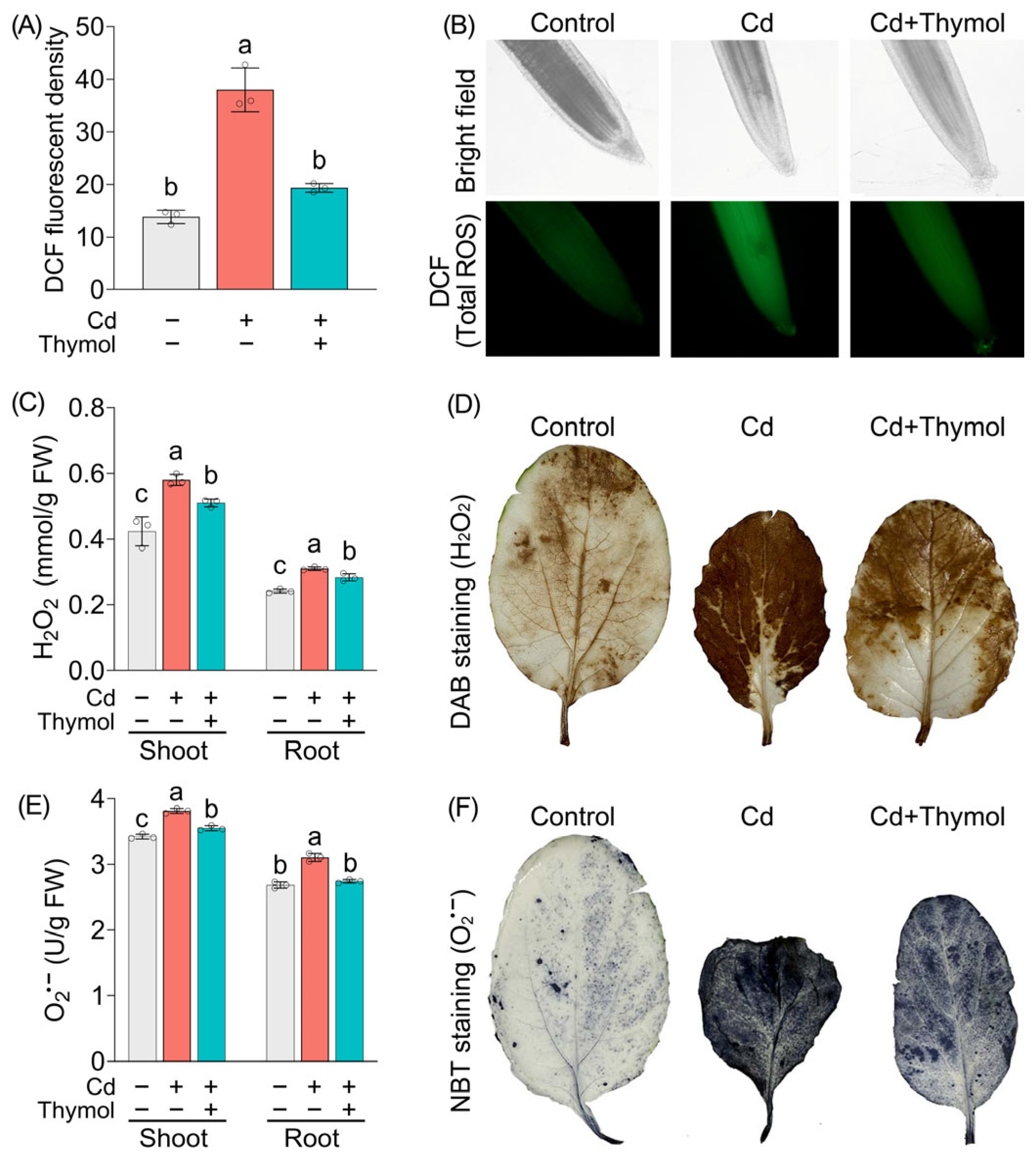
The root tip represents the primary center for root longitudinal growth and environmental perception. The total ROS in the root tip was labeled and quantified with specific DCF fluorescence in vivo (Figure 2A,B). The Cd-treated root tip showed 1.75 times higher total ROS than that of the control group. However, the Cd+Thymol treatment resulted in a significant decrease in the total ROS level by 49.05% compared to Cd exposure alone (Figure 1A). Then, two typical ROS (H2O2 and O2•−) were examined. Cd stress significantly increased the H2O2 content in both the shoots and roots by 32.7% and 29.5%, respectively, compared to the control group. In the Cd+Thymol group, the H2O2 content in the shoot and root decreased by 10.3% and 8.7%, respectively, compared to the Cd group (Figure 2C). In vivo DAB staining of H2O2 in leaves indicated extensive staining in the Cd group but relatively lighter staining in the Cd+Thymol group (Figure 2D). Similarly, compared to the control group, Cd induced a significant increase in O2•− in the shoots and roots by 11.2% and 15.3%, respectively (Figure 2E). The application of thymol significantly reduced the O2•− level in the leaves of the Cd group, as indicated by both O2•− quantification and NBT staining (Figure 2E,F). These results confirm that Cd stress causes remarkable ROS accumulation in both the shoots and roots of B. rapa, a process that can be reversed by adding thymol.

3.1.3. Thymol Activates the Antioxidative System in B. rapa Under Cd Stress

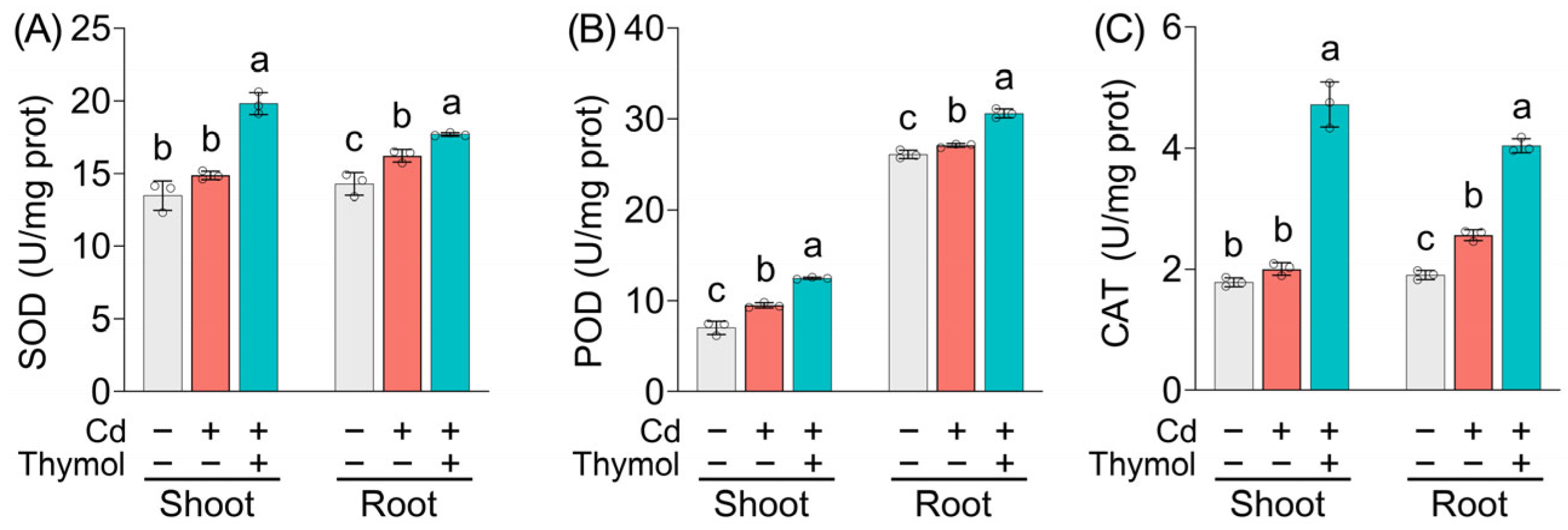
Plants have specific antioxidant systems to scavenge over-accumulated ROS. Firstly, we detected the antioxidant enzymes in B. rapa. In the shoot, the activity of SOD, POD, and CAT in the Cd+Thymol group increased significantly by 33.6%, 31.6%, and 135%, respectively, compared to the Cd-only group. In the root, the activity of SOD, POD, and CAT in the Cd+Thymol group increased significantly by 8.9%, 12.9%, and 57.8%, respectively, compared to the Cd-only group. The enhancement of CAT activity was particularly notable among all three antioxidant enzymes (Figure 3). These results indicate that thymol has a strong ability to activate the antioxidant system to help remove excess ROS in B. rapa upon Cd exposure.
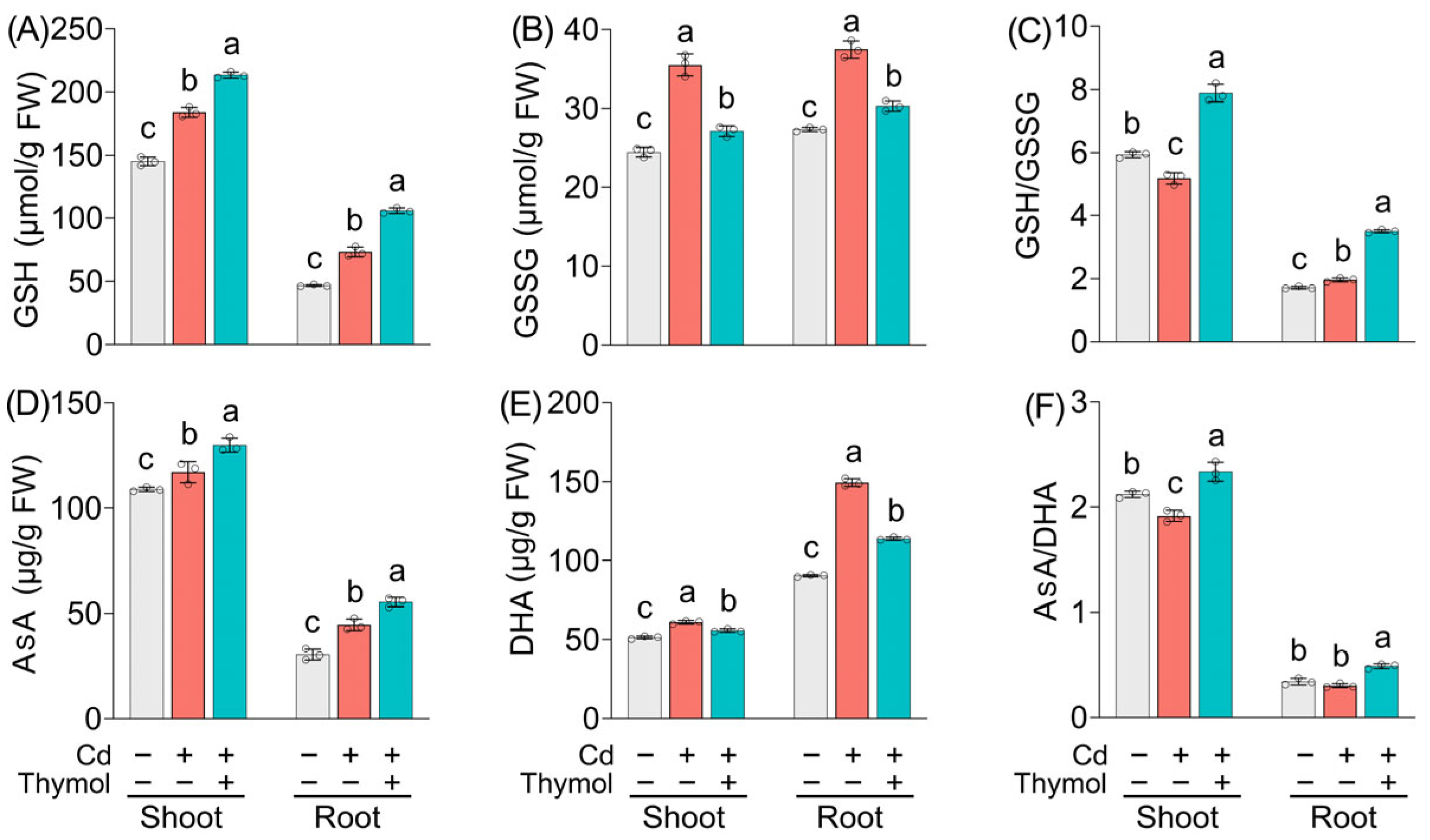
Then, we investigated the response of the AsA-GSH cycle, which can consume ROS to avoid an oxidized cellular environment. Applying thymol significantly increased the GSH content and decreased the GSSG (the oxidized form of GSSG) content in both the shoots and roots (Figure 4A,B). This yielded the enhancement of the GSH/GSSG ratio. Compared to the Cd group, the GSH/GSSG ratio in the shoots and roots increased substantially by 47.2% and 78.3% upon Cd+Thymol treatment, respectively (Figure 4C). Similar changes in AsA and DHA were also observed. Applying thymol significantly increased the AsA content and decreased the DHA (the oxidized form of AsA) content in both the shoots and roots (Figure 4D,E). Compared to the Cd group, the AsA/DHA ratio in the shoots and roots increased remarkably by 21.92% and 62.63% upon Cd+Thymol treatment, respectively (Figure 4F).
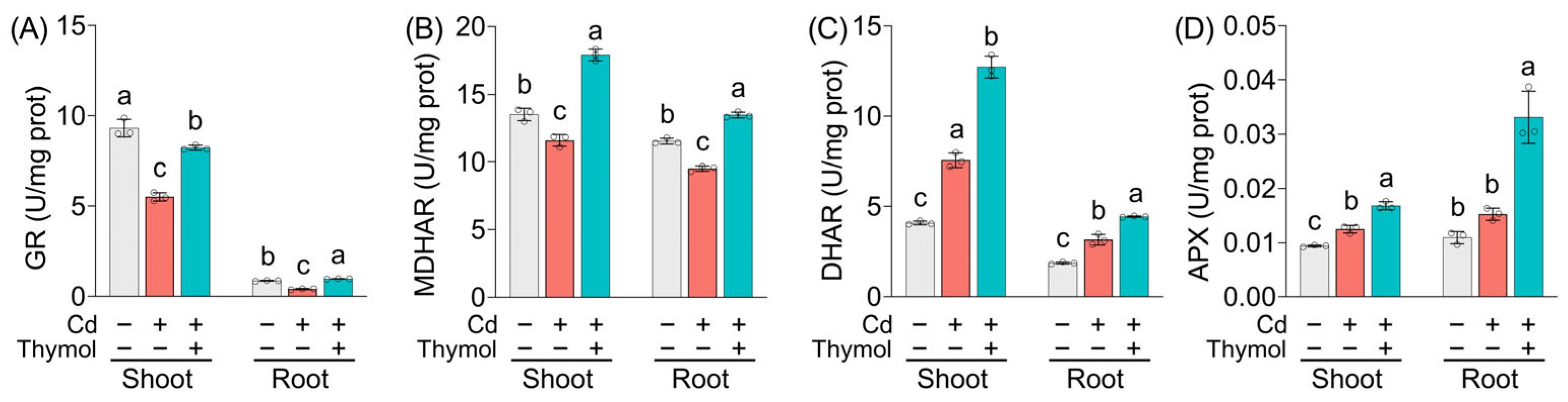
As thymol stimulated the AsA-GSH cycle under Cd stress, we further examined the specific enzymes (GR, MDHAR, DHAR, and APX) driving this cycle. In the shoots of the Cd+Thymol group, the activity of GR, MDHAR, DHAR, and APX increased remarkably by 48.8%, 55.8%, 68.9%, and 33.4%, respectively, compared to the Cd-only group. Similarly, the activity of GR, MDHAR, DHAR, and APX in the roots of the Cd+Thymol group increased remarkably by 128.8%, 39.4%, 40.7%, and 103.2%, respectively, compared to the Cd-only group (Figure 5). Among all four of these enzymes, the increases in the activity of three of them (GR, MDHAR, and DHAR) in the shoots and two of them (GR and APX) in the roots were found to be more pronounced. These results suggest that thymol effectively optimizes cellular redox homeostasis by restoring the AsA-GSH cycle, thereby detoxifying ROS-induced oxidation of the cellular environment in B. rapa under Cd stress.

3.1.4. Thymol Decreases Cd Accumulation in B. rapa

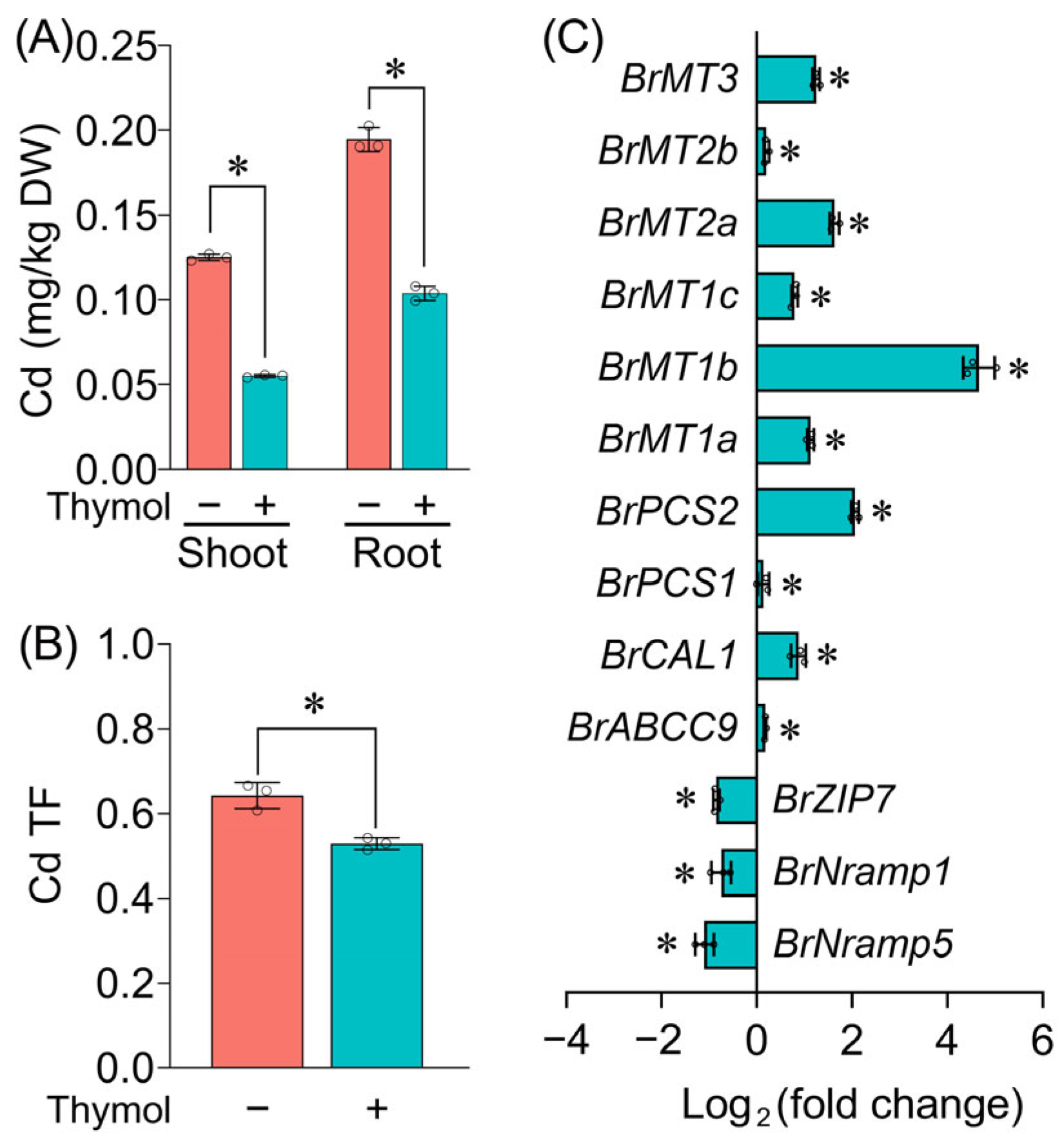
Cd quantification in plant tissues was performed to study the effect of thymol treatment on Cd accumulation in B. rapa. In B. rapa with root exposure to CdCl2, the Cd concentrations in the roots and shoots were 0.195 mg/kg and 0.125 mg/kg, respectively. After adding thymol to the nutrient solution, the Cd concentrations in the roots and shoots were 0.104 mg/kg and 0.055 mg/kg, respectively. Thymol decreased the Cd content in the roots and shoots by 46.6% and 55.7%, respectively (Figure 6A). The TF of Cd (from root to shoot) was also reduced significantly by thymol. The TF in the Cd group was 0.643, which was reduced to 0.53 in the presence of thymol (Figure 6B).

3.1.5. Thymol Regulates the Expression of Genes Related to Cd Chelation and Transport in B. rapa

To further explore the potential mechanisms of thymol in regulating Cd accumulation, we analyzed the expression patterns of the key genes involved in Cd absorption, transport, and chelation in roots (Figure 6C). The expression of genes involved in Cd uptake and intracellular transport, such as BrNramp5, BrZIP7, and BrNramp1, was significantly down-regulated by thymol. The down-regulation of BrNramp5, a key gene for root Cd uptake, was particularly evident, which was closely related to the remarkable decline in Cd content in the plants. The expression of the vacuolar Cd sequestration-related gene BrABCC9 and the cell wall binding-related gene BrCAL1 was significantly up-regulated by thymol. Furthermore, the expression of phytochelatin synthase genes (BrPCS1 and BrPCS2) and metallothionein genes (BrMT1a, BrMT1b, BrMT1c, BrMT2a, BrMT2b, BrMT3) was up-regulated by thymol. Combining the results for the Cd content and gene expression, it could be concluded that thymol not only effectively reduces Cd uptake by roots but also limits Cd translocation from root to shoot, thereby decreasing Cd content in B. rapa.

3.2. Pot Study

3.2.1. Foliar Spraying of Thymol Decreases Cd Content and Enhances the Growth and Quality of B. rapa

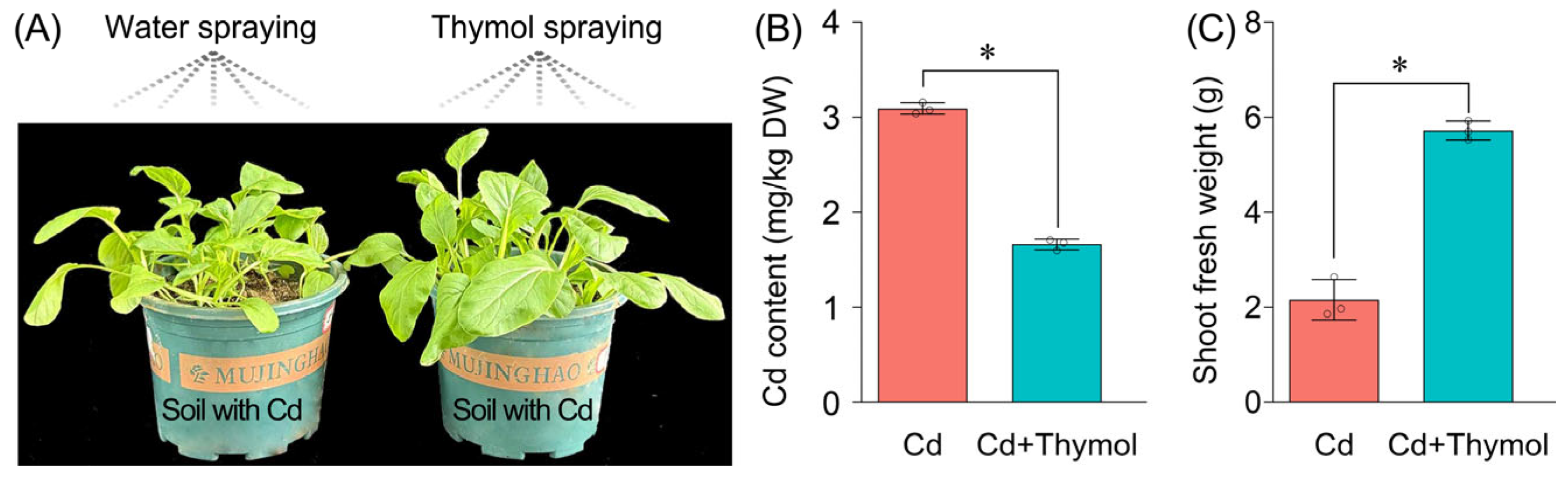
As thymol showed the ability to reduce Cd accumulation in B. rapa in the hydroponic study, we further tested its potential in a pot study by spraying thymol on the shoot of B. rapa cultivated in Cd-polluted soil (Figure 7A). In the group with foliar spraying of water, the average Cd content in the shoots was 3.09 mg/kg. In the group with foliar spraying of thymol, the average Cd content in the shoots was 1.67 mg/kg, a reduction of 45.9% compared to the water-sprayed group (Figure 7B). We also found that spraying thymol significantly enhanced the shoot fresh weight by 164.8% more than that of the water-sprayed group (Figure 7C).
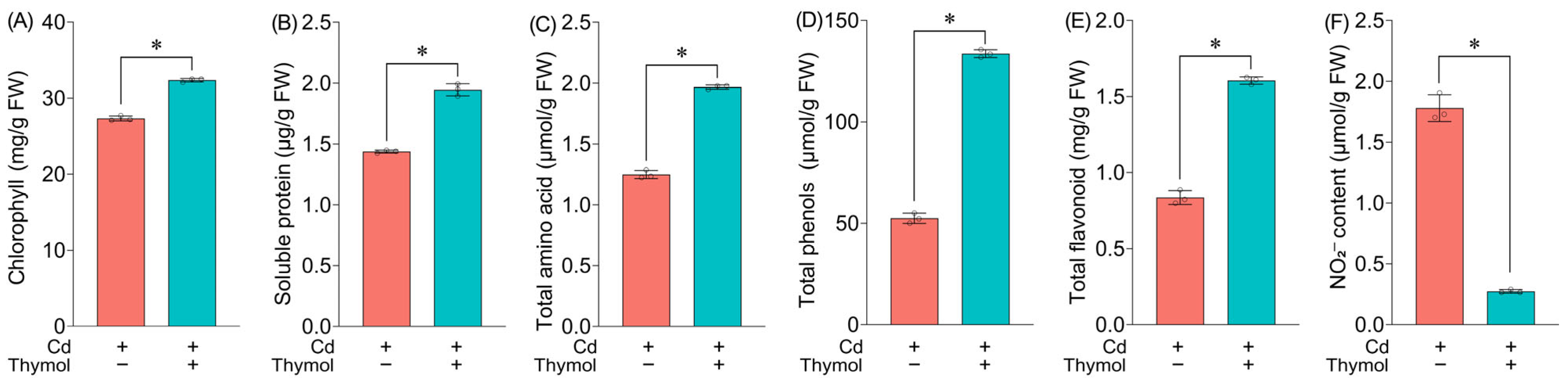
Since spraying thymol promoted the growth of B. rapa cultivated in Cd-polluted soil, we further detected several quality-related indices in the shoots of B. rapa. Compared to the water-sprayed group, spraying thymol pronouncedly enhanced the content of chlorophyll, soluble protein, total amino acids, total phenols, and flavonoids by 18.4%, 34.7%, 57.6%, 154.8%, and 90.5%, respectively (Figure 8A–E). However, the shoot NO2 content in the thymol-sprayed group decreased by 84.8% compared to the water-sprayed group (Figure 8F). These results indicate that foliar spraying of thymol shows a positive effect on Cd reduction, growth promotion, and quality improvement in the edible tissues (shoots) of B. rapa.

3.2.2. Foliar Spraying of Thymol Decreases Cd Content in Different Varieties of Water Spinach and Pepper

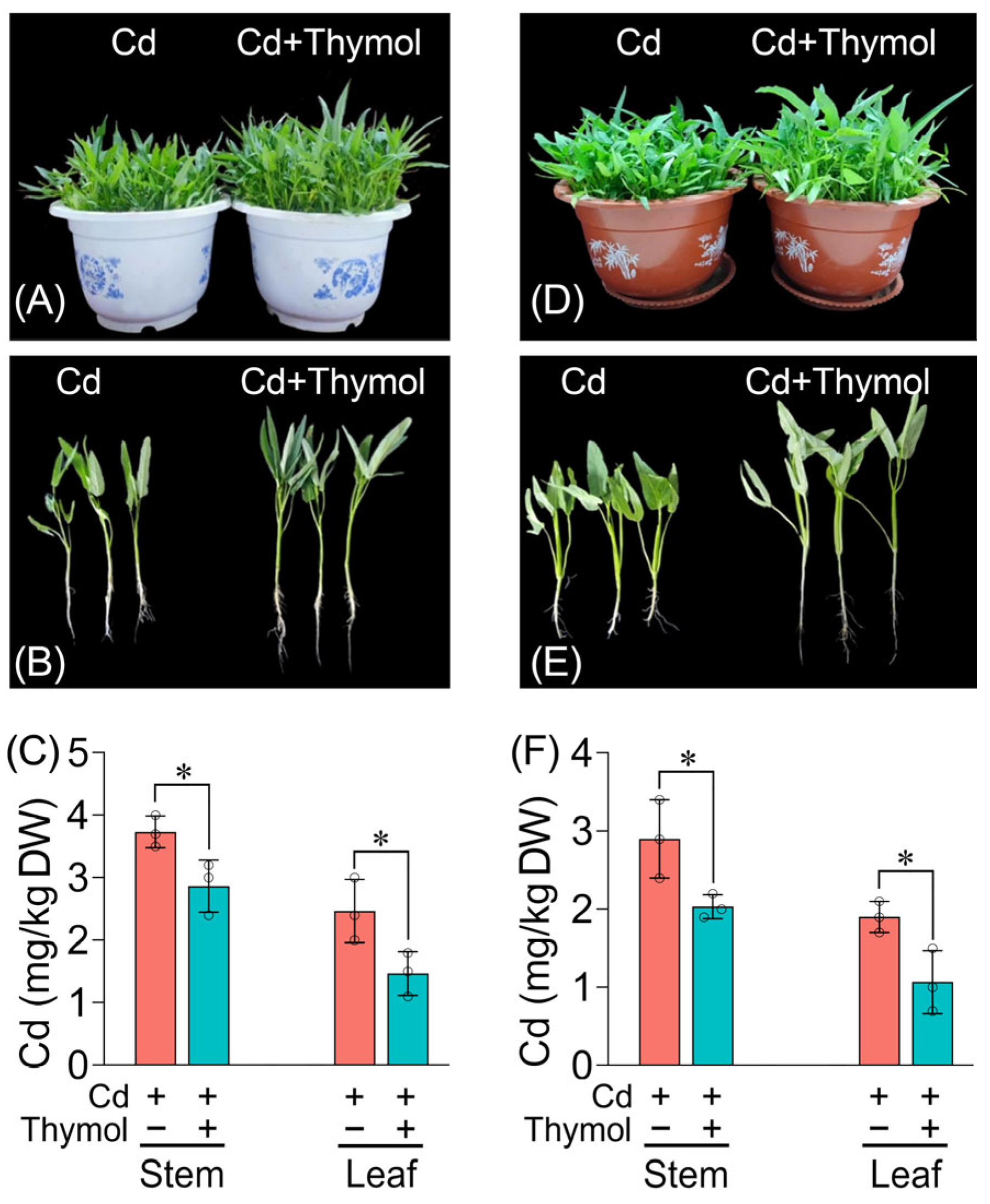
To evaluate the broad role of thymol on the limitation Cd accumulation in other vegetables, we further tested two water spinach varieties and three pepper varieties. Two varieties of water spinach (leafy vegetable), TLWS and WLWS, were cultivated in Cd-polluted soil and were sprayed with thymol. Compared to the water-sprayed group, foliar spraying of thymol significantly decreased the Cd content in the stems and leaves of TLWS by 23.1% and 40.5%, respectively, which was accompanied by promoted shoot growth (Figure 9A–C). For WLWS, spraying thymol remarkably decreased the Cd content in the stems and leaves by 30.0% and 43.7%, respectively, which was also accompanied by promoted shoot growth (Figure 9D–F).
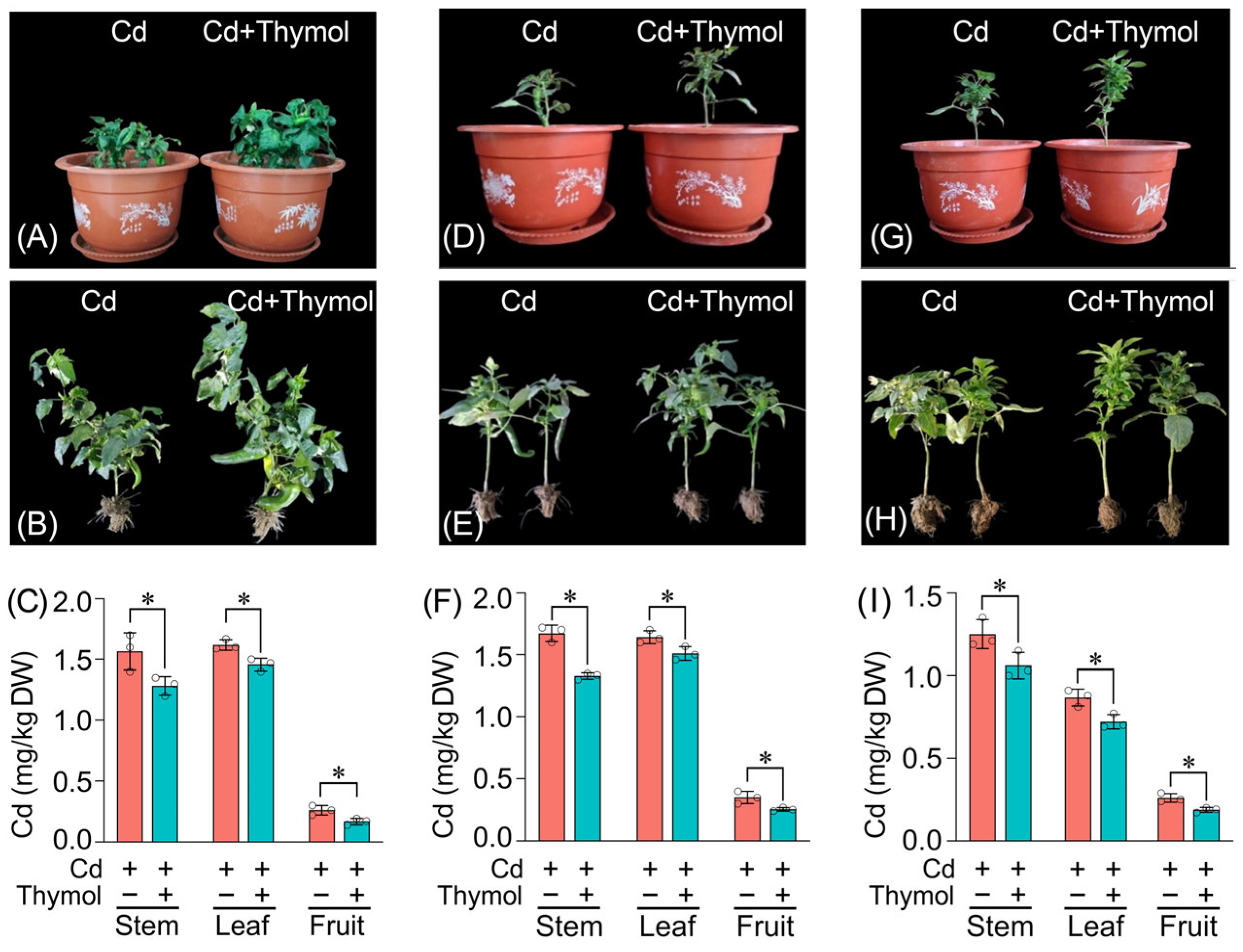
Three pepper varieties (NJP, HJP, and CTP) were cultivated in Cd-polluted soil to test the effect of thymol on Cd reduction. Foliar spraying of thymol significantly decreased the Cd content in the shoots of all of the tested pepper varieties. For NJP, spraying thymol resulted in a significant decrease in the Cd content in the stems, leaves, and fruits by 18.1%, 10.0%, and 35.8%, respectively, leading to the growth of bigger plants than those in the water-sprayed group (Figure 10A–C). For HJP, spraying thymol remarkably decreased the Cd content in the stems, leaves, and fruits by 20.5%, 11.2%, and 28.6%, respectively, with a small growth-promoting effect observed (Figure 10D–F). For CTP, spraying thymol significantly decreased the Cd content in the stems, leaves, and fruits by 13.9%, 18.8%, and 26.9%, respectively (Figure 10G–I). These results suggest that foliar spraying of thymol can decrease the Cd content in the edible parts of various vegetables, such as the vegetative organs (leaves) and reproductive organs (fruits).

4. Discussion

Exploring the role of natural agrochemicals in regulating plant responses to heavy metal stress is of great significance for developing safe crop production technologies [20]. Here, we found that thymol played a multifaceted role in detoxifying Cd in vegetables. Thymol not only activated two kinds of antioxidative systems to limit Cd-induced ROS accumulation in B. rapa, but also reduced Cd accumulation in various vegetables.
Heavy metal-induced overaccumulation of ROS causes oxidative injury and cell death in plants [21]. Thymol inhibited ROS accumulation by effectively activating both enzymatic and non-enzymatic antioxidative systems upon Cd exposure. Under normal physiological conditions, a dynamic balance exists between ROS production and scavenging in plants [22]. However, this balance is disrupted upon Cd stress, accompanied by ROS accumulation in plants [23]. To cope with ROS accumulation, a set of key antioxidant enzymes (e.g., SOD, POD, and CAT) can be activated [24]. SOD is the first line of defense against ROS, responsible for transforming O2•− to H2O2. Subsequently, POD and CAT are activated to decompose H2O2, preventing its conversion into the more toxic hydroxyl radical via the Fenton reaction. This enzymatic cascade is an effective pathway for ROS scavenging [25]. Cd-induced ROS accumulation triggers an increase in the activity of these enzymes, but it may be not enough to combat the large amount of ROS accumulated. Adding thymol further activated this enzymatic cascade, which could help enhance the efficiency of ROS scavenging in B. rapa.
Adding thymol reduced Cd accumulation in plants, but did not block Cd uptake completely. Certain amounts of Cd remained in the plants, which could induce continuous production of ROS. Thymol may sense these ROS and activate antioxidant enzymes. We have found that treatment with thymol alone fails to alter antioxidant enzymes in plants. Therefore, it is possible that thymol cannot sense low ROS levels in plants under normal growth conditions. But thymol may sense excessive ROS in plants under stress conditions, which needs further studies. In mammalian cells, the antioxidant function of thymol is closely related to the activation of antioxidative enzymes. Essentially, thymol frequently regulates the MAPK and Nrf2 pathways to activate antioxidative enzymes [26]. The role of MAPK cascades in the regulation of Cd tolerance in plants has been documented [27]. Further studies are needed to explore the possible role of MAPK signaling in mediating thymol-activated antioxidant enzymes in plants under Cd stress.
In plants, the AsA-GSH redox cycle constitutes a key defense network for scavenging ROS effectively. This cycle relies on the synergistic action of core enzyme components (APX, GR, MDHAR, DHAR) and redox metabolites (AsA and GSH) to prevent oxidative damage through sequential electron transfer reactions [28,29]. Specifically, APX catalyzes the reduction of H2O2 to H2O using AsA as a substrate, generating monodehydroascorbate (MDHA). MDHA can be directly reduced back to AsA by MDHAR or further oxidized to DHA, which is regenerated as AsA by DHAR using GSH. Meanwhile, GSH is oxidized to GSSG in the DHAR reaction, and GR re-reduces GSSG to GSH using NADPH [29,30]. Here, we found that thymol increased the activity of these four key enzymes in the AsA-GSH cycle in B. rapa under Cd stress. And thymol enhanced the ratio of AsA/DHA and GSH/GSSG by increasing the content of the reduced form of metabolites (AsA and GSH) and decreasing the oxidized form of metabolites (DHA and GSSG) in B. rapa under Cd stress. Thymol-regulated AsA and GSH have been found to delay pepper senescence [31,32]. As thymol itself has the potential to scavenge ROS by directly interacting with radicals [33], it may target the electrical transfer within the AsA-GSH cycle to promote the transition from oxidation to reduction. All of these results suggested that the thymol-activated AsA-GSH cycle could facilitate the transition of plant cells from an oxidized state back to a reduced state. This multilayered and synergistic antioxidant response induced by thymol, comprising both enzymatic and non-enzymatic systems in both the roots and shoots, explains why thymol effectively maintains the cellular redox balance, thereby protecting B. rapa from oxidative injury upon Cd stress.
Thymol-induced Cd detoxification accompanied quality improvement in B. rapa. The enhancement of chlorophyll content may improve photosynthesis to provide an energy source for plant growth. The reduction of nitrite and the enhancement of total proteins and amino acids indicated the elevation of foliar physiological status. Notably, the nitrite reduction in the leaves of B. rapa was remarkable upon thymol treatment. In plants, the signaling molecule nitric oxide is mainly produced by the NR (nitrate reductase)-catalyzed conversion of nitrate to nitrite. We have found that thymol-conferred Cd tolerance in rice seedlings is related to a remarkable decrease in NR-mediated endogenous NO production [17]. The mechanism of the modulation of all aspects of nitrogen metabolism by thymol is largely unknown, but thymol-inhibited NR activity may help explain the decreased level of nitrite in plants.
Another strategy for thymol-facilitated Cd detoxification is to stimulate the capture of cellular free Cd2+. Cd2+ exhibits a direct phytotoxic effect, through which it can replace the ionic cofactors of functional proteins, leading to protein dysfunction by altering protein structure. MTs are cysteine-rich small molecular proteins that can directly detoxify Cd2+ by binding with high affinity via their thiol groups and are also effective ROS scavengers [34]. Thymol up-regulated the expression of a set of BrMT genes, implying that the proteins yielded from these genes were enriched in order to bind free Cd2+. PCS is the key enzyme for synthesizing PCs, a process that directly uses GSH as a substrate. PCs can efficiently chelate Cd2+ to form PC-Cd complexes with low toxicity [35]. The thymol treatment not only significantly up-regulated the expression of BrPCSs but also increased the intracellular GSH content, indicating the possible activation of PC-mediated detoxification of Cd2+. The role of BrMTs and BrPCSs tested in this study in conferring Cd tolerance have been identified in B. rapa [36]. As thymol up-regulated the expression of BrMTs and BrPCSs, both MT and PCs may be stimulated to capture free Cd2+ to alleviate Cd2+-induced dysfunction of other important proteins involved in the regulation of plant growth and development.
Thymol decreased the accumulation and translocation of Cd in B. rapa, which may be related to the regulation of the expression of several genes encoding Cd transporters. BrNramp1 and BrNramp5 are two homologs of rice OsNramp1 and OsNramp5, respectively [37]. The overexpression of BrNramp1 contributes to Cd uptake in B. rapa [38]. OsNramp1 and OsNramp5 are Cd transporters localized to the plasma membrane. Loss of their function can effectively block Cd entry into root cells [39,40,41,42]. The thymol treatment down-regulated the expression of BrNramp1 and BrNramp5 in the roots, which may have limited Cd uptake via the roots. OsZIP7 (homolog of BrZIP7) is one of the key proteins mediating Cd transport from root to shoot, and its mutation leads to Cd retention in the roots [43]. The thymol-inhibited Cd translocation from root to shoot, indicated by TF, may result from the down-regulation of BrZIP7. ABCC9 belongs to a subfamily of ABC transporters, whose primary function is to transport Cd-PCs complexes into the vacuoles of root cells for sequestration [44]. Thymol up-regulated the expression of BrABCC9, which may serve as an important mechanism for isolating toxic Cd2+ from cytoplasmic metabolic activity. In addition, thymol up-regulated BrCAL1. Its homolog OsCAL1, specifically expressed in rice root exodermis and xylem parenchyma cells, can chelate and efflux cytosolic Cd to the apoplast to detoxify cytosolic Cd [45]. Based on the gene expression analysis, thymol likely reduces the Cd load in plants through a dual-barrier effect, reducing Cd input and upward transport. Firstly, thymol reduces the root uptake of Cd by down-regulating BrNramp1 and BrNramp5. Secondly, regarding the Cd that successfully enters the root, thymol may limit its transport from root to shoot by sequestrating it in the roots through capture (BrMTs and BrPCSs), vacuolar compartmentalization (BrABCC9), or retention (BrCAL1). These genes in B. rapa may need further study, but the identified function of their homologs in rice may support the action of thymol. Thus, thymol probably created an absorption barrier and a retention barrier, restricting Cd to the roots and preventing its translocation to the shoots. Besides their association with Cd uptake, both Nramp1 and Nramp5 can mediate the uptake of Mn, a nutrient element, as well [38,39]. The possible side effect of the limitation of Mn uptake during thymol-restricted Cd accumulation should be investigated in the future. This would help evaluate the effect of thymol in field application scenarios.
The pot experiments showed that the Cd concentration in the shoots differed across the different vegetable types. The shoots of water spinach accumulated more Cd than those of the pepper plant. This may be attributed to the fact that pepper plants have longer stems than water spinach. The longer stem with more lignin may limit Cd transport from the roots to shoots in pepper plants, as compared with leafy vegetables. However, foliar spraying of thymol exhibited a broad role in decreasing Cd levels in the edible tissues of all vegetable types examined in the present study. Some compounds, such as DMSA (2,3-dimercaptosuccinic acid) and anthocyanin, have the ability to reduce Cd accumulation in rice grains (the reproductive organ) through foliar spraying. These compounds tend to restrict the translocation of Cd from leaves to grains by improving Cd accumulation in leaves [46,47]. However, thymol has a different mode of action in lowering the Cd content in plants. Foliar spraying of thymol reduced the Cd content in all of the above-ground organs, such as the stems, leaves, and fruits. We don’t know exactly how thymol works on these organs. Besides root-to-shoot transport, Cd can also be redistributed from shoot to root through phloem transport [48]. Ca2+ is a typical systemic long-distance signaler involved in plants’ perception of environmental stimuli [49]. Thymol can directly activate the cationic channel TRPM8 to induce Ca2+ influx and the subsequent anti-inflammatory response in Imiquimod-induced mice [50]. Further studies are needed to illustrate the possible role of thymol in eliciting long-distance systemic signaling (e.g., Ca2+) from shoots to roots, thereby regulating the shoot-to-root transport of Cd.
In the present study, the Cd content in plant tissues was measured based on their dry weight. Using fresh weight to quantify the Cd content may enable a better comparison with other plant physiological parameters, but Cd stress may have a negligible effect on plant water loss compared with the large change in Cd content seen in the laboratory study. In the future, it would be better to analyze the fresh weight-based Cd content in a field trial to achieve a more precise evaluation for its feasible application in a field scenario.

5. Conclusions

In summary, this study elucidated the multifaceted function of thymol in detoxifying Cd in vegetables. In B. rapa, thymol effectively maintained cellular redox homeostasis by activating the antioxidant system and optimizing the ASA-GSH cycle. Thymol led to a decrease in Cd accumulation through restricting Cd uptake and translocation in B. rapa. The practice of foliar spraying of thymol revealed its broad-spectrum efficacy in decreasing shoot Cd accumulation across different vegetable types. These findings provide a crucial basis for developing thymol as a novel regulator to safeguard vegetable production in Cd-polluted soil. Compared to traditional soil remediation techniques, foliar thymol application would be practically feasible and cost-effective in large-scale vegetable production. Future studies should be focused on formulation development for field experiments to test the possibility of implementing thymol application for sustainable agriculture. However, thymol’s antimicrobial properties may pose a potential influence on the soil microbiome, a factor that needs further careful consideration and evaluation in field-scale applications.

Author Contributions

Conceptualization, J.C. and X.Y.; methodology, Y.H., W.Z., and L.Y.; investigation and data analysis, Y.H., W.Z., L.Y., Y.C., and H.S.; writing—original draft preparation, Y.H. and W.Z.; writing—review and editing, J.C. and X.Y. All authors have read and agreed to the published version of the manuscript.

Funding

This research was funded by the National Natural Science Foundation of China, with grant number 32272208.

Data Availability Statement

The original contributions presented in this study are included in the article. Further inquiries can be directed to the corresponding authors.

Conflicts of Interest

The authors declare no conflicts of interest.

References

  1. Zulfiqar, U.; Jiang, W.; Xiukang, W.; Hussain, S.; Ahmad, M.; Maqsood, M.F.; Ali, N.; Ishfaq, M.; Kaleem, M.; Haider, F.U.; et al. Cadmium Phytotoxicity, Tolerance, and Advanced Remediation Approaches in Agricultural Soils; A Comprehensive Review. Front. Plant Sci. 2022, 13, 773815. [Google Scholar] [CrossRef] [PubMed]
  2. Saeed-ur-rahman; Khalid, M.; Hui, N.; Kayani, S.-I.; Tang, K. Diversity and Versatile Functions of Metallothioneins Produced by Plants: A Review. Pedosphere 2020, 30, 577–588. [Google Scholar] [CrossRef]
  3. Faizan, M.; Alam, P.; Hussain, A.; Karabulut, F.; Tonny, S.H.; Cheng, S.H.; Yusuf, M.; Adil, M.F.; Sehar, S.; Alomrani, S.O.; et al. Phytochelatins: Key Regulator against Heavy Metal Toxicity in Plants. Plant Stress 2024, 11, 100355. [Google Scholar] [CrossRef]
  4. Li, Y.; Ding, L.; Zhou, M.; Chen, Z.; Ding, Y.; Zhu, C. Transcriptional Regulatory Network of Plant Cadmium Stress Response. Int. J. Mol. Sci. 2023, 24, 4378. [Google Scholar] [CrossRef]
  5. GB 1516-2018; Soil Environment Quality-Risk Control Standard for Soil Contamination of Agricultural Land. Ministry of Ecology and Environment of the People’s Republic of China: Beijing, China, 2018. Available online: https://www.mee.gov.cn/ywgz/fgbz/bz/bzwb/trhj/201807/t20180703_446029.shtml (accessed on 11 February 2026).
  6. Zhao, D.; Wang, P.; Zhao, F.-J. Toxic Metals and Metalloids in Food: Current Status, Health Risks, and Mitigation Strategies. Curr. Environ. Health Rep. 2024, 11, 468–483. [Google Scholar] [CrossRef]
  7. Pan, S.-F.; Ji, X.-H.; Xie, Y.-H.; Liu, S.-H.; Tian, F.-X.; Liu, X.-L. Influence of Soil Properties on Cadmium Accumulation in Vegetables: Thresholds, Prediction and Pathway Models Based on Big Data. Environ. Pollut. 2022, 304, 119225. [Google Scholar] [CrossRef]
  8. Peana, M.; Pelucelli, A.; Chasapis, C.T.; Perlepes, S.P.; Bekiari, V.; Medici, S.; Zoroddu, M.A. Biological Effects of Human Exposure to Environmental Cadmium. Biomolecules 2022, 13, 36. [Google Scholar] [CrossRef]
  9. Huang, Y.; Wang, L.; Wang, W.; Li, T.; He, Z.; Yang, X. Current Status of Agricultural Soil Pollution by Heavy Metals in China: A Meta-Analysis. Sci. Total Environ. 2019, 651, 3034–3042. [Google Scholar] [CrossRef]
  10. Yang, J.; Hu, R.; Zhao, C.; Wang, L.; Lei, M.; Guo, G.; Shi, H.; Liao, X.; Chen, T. Challenges and Opportunities for Improving the Environmental Quality of Cadmium-Contaminated Soil in China. J. Hazard. Mater. 2023, 445, 130560. [Google Scholar] [CrossRef]
  11. Mushtaq, G.; Agrawal, S.; Kushwah, A.; Kumar, A.; Lone, R. Cadmium Toxicity in Plants and Its Remediation Management: A Review. Plant Stress 2025, 16, 100894. [Google Scholar] [CrossRef]
  12. Di Sario, L.; Boeri, P.; Matus, J.T.; Pizzio, G.A. Plant Biostimulants to Enhance Abiotic Stress Resilience in Crops. Int. J. Mol. Sci. 2025, 26, 1129. [Google Scholar] [CrossRef]
  13. Ali, K.; Jiang, B.; Ashraf, W.; Tahir, A.B.; Hussain, A. Quality, Bioactivity and Cytotoxicity of Thymol Nanofiber-Fortified Bread: Insight into Molecular Interaction Mechanism. Food Res. Int. 2025, 206, 116095. [Google Scholar] [CrossRef]
  14. Movaffagh, J.; Hosseini Farash, B.R.; Mashayekhi Goyonlo, V.; Moghaddas, E.; Zarean, M.; Shamsian, S.A.; Riabi, S.Y.A.; Ahmadi, O.; Sharifi, Y.; Shahroodi, A.; et al. Pilot Evaluation of Thymol-Loaded Chitosan Gel as a Complementary Topical Therapy for Cutaneous Leishmaniasis. Carbohydr. Polym. Technol. Appl. 2025, 9, 100641. [Google Scholar] [CrossRef]
  15. Xu, L.; Song, J.-Q.; Wang, Y.-L.; Liu, X.-H.; Li, X.-L.; Zhang, B.; Li, A.-J.; Ye, X.-F.; Wang, J.; Wang, P. Thymol Improves Salinity Tolerance of Tobacco by Increasing the Sodium Ion Efflux and Enhancing the Content of Nitric Oxide and Glutathione. BMC Plant Biol. 2022, 22, 31. [Google Scholar] [CrossRef] [PubMed]
  16. Ye, X.; Ling, T.; Xue, Y.; Xu, C.; Zhou, W.; Hu, L.; Chen, J.; Shi, Z. Thymol Mitigates Cadmium Stress by Regulating Glutathione Levels and Reactive Oxygen Species Homeostasis in Tobacco Seedlings. Molecules 2016, 21, 1339. [Google Scholar] [CrossRef] [PubMed]
  17. Wang, T.-T.; Shi, Z.Q.; Hu, L.-B.; Xu, X.-F.; Han, F.X.; Zhou, L.-G.; Chen, J. Thymol Ameliorates Cadmium-Induced Phytotoxicity in the Root of Rice (Oryza sativa) Seedling by Decreasing Endogenous Nitric Oxide Generation. J. Agric. Food Chem. 2017, 65, 7396–7405. [Google Scholar] [CrossRef] [PubMed]
  18. Ye, X.; Lu, H.; Xin, A.; Liu, R.; Shi, Z.; Chen, J.; Yang, L. Hydrogen Sulfide Activates Calcium Signaling to Confer Tolerance against Selenium Stress in Brassica rapa. Food Prod. Process Nutr. 2024, 6, 13. [Google Scholar] [CrossRef]
  19. Livak, K.J.; Schmittgen, T.D. Analysis of Relative Gene Expression Data Using Real-Time Quantitative PCR and the 2−ΔΔCT Method. Methods 2001, 25, 402–408. [Google Scholar] [CrossRef]
  20. Feng, D.; Wang, R.; Sun, X.; Liu, L.; Liu, P.; Tang, J.; Zhang, C.; Liu, H. Heavy Metal Stress in Plants: Ways to Alleviate with Exogenous Substances. Sci. Total Environ. 2023, 897, 165397. [Google Scholar] [CrossRef]
  21. Mansoor, S.; Ali, A.; Kour, N.; Bornhorst, J.; AlHarbi, K.; Rinklebe, J.; Abd El Moneim, D.; Ahmad, P.; Chung, Y.S. Heavy Metal Induced Oxidative Stress Mitigation and ROS Scavenging in Plants. Plants 2023, 12, 3003. [Google Scholar] [CrossRef]
  22. Xu, Z.; Ye, L.; Shen, Q.; Zhang, G. Advances in the Study of Waterlogging Tolerance in Plants. J. Integr. Agric. 2024, 23, 2877–2897. [Google Scholar] [CrossRef]
  23. Khan, E.A.; Ahmed, H.M.I.; Misra, M.; Sharma, P.; Misra, A.; Hasanuzzaman, M. Nitric Oxide Alleviates Cadmium-Impeded Growth by Limiting ROS Accumulation in Pea Seedlings. BIOCELL 2022, 46, 2583–2593. [Google Scholar] [CrossRef]
  24. Marques, D.N.; Mason, C.; Stolze, S.C.; Harzen, A.; Nakagami, H.; Skirycz, A.; Piotto, F.A.; Azevedo, R.A. Grafting Systems for Plant Cadmium Research: Insights for Basic Plant Physiology and Applied Mitigation. Sci. Total Environ. 2023, 892, 164610. [Google Scholar] [CrossRef] [PubMed]
  25. Yadav, S.; Gill, S.S.; Passricha, N.; Gill, R.; Badhwar, P.; Anjum, N.A.; Francisco, J.-B.J.; Tuteja, N. Genome-Wide Analysis and Transcriptional Expression Pattern-Assessment of Superoxide Dismutase (SOD) in Rice and Arabidopsis under Abiotic Stresses. Plant Gene 2019, 17, 100165. [Google Scholar] [CrossRef]
  26. Peng, X.; Zhang, X.; Sharma, G.; Dai, C. Thymol as a Potential Neuroprotective Agent: Mechanisms, Efficacy, and Future Prospects. J. Agric. Food Chem. 2024, 72, 6803–6814. [Google Scholar] [CrossRef] [PubMed]
  27. Li, S.; Han, X.; Lu, Z.; Qiu, W.; Yu, M.; Li, H.; He, Z.; Zhuo, R. MAPK Cascades and Transcriptional Factors: Regulation of Heavy Metal Tolerance in Plants. Int. J. Mol. Sci. 2022, 23, 4463. [Google Scholar] [CrossRef]
  28. Cao, S.; Zhang, Y.; Wang, X.; Ba, L.; Zhao, Z.; Dong, G.; Ren, Y. Carvacrol Treatment Enhances the Quality of Peach Fruit by Regulating the Metabolism of Reactive Oxygen Species and the Phenylpropanoid Pathway. LWT 2025, 231, 118329. [Google Scholar] [CrossRef]
  29. Hasanuzzaman, M.; Bhuyan, M.H.M.B.; Anee, T.I.; Parvin, K.; Nahar, K.; Mahmud, J.A.; Fujita, M. Regulation of Ascorbate-Glutathione Pathway in Mitigating Oxidative Damage in Plants under Abiotic Stress. Antioxidants 2019, 8, 384. [Google Scholar] [CrossRef]
  30. Wang, X.; Liu, H.; Yu, F.; Hu, B.; Jia, Y.; Sha, H.; Zhao, H. Differential Activity of the Antioxidant Defence System and Alterations in the Accumulation of Osmolyte and Reactive Oxygen Species under Drought Stress and Recovery in Rice (Oryza sativa L.) Tillering. Sci. Rep. 2019, 9, 8543. [Google Scholar] [CrossRef]
  31. Li, X.; Du, X.; Chen, J.; Cao, S.; Luo, D.; Ba, L. Thymol Treatment Delays the Senescence of Pepper by Regulating Energy Levels, Activating GABA Shunting and Phenylpropanoid Metabolism, and Reducing ROS Accumulation. Postharvest Biol. Technol. 2025, 230, 113761. [Google Scholar] [CrossRef]
  32. Li, X.; Wang, X.; Chen, J.; Luo, D.; Cao, S.; Ba, L. Thymol Maintains Peppers Quality by Regulating Antioxidant Capacity, Cell Wall Metabolism and Membrane Lipid Metabolism. Food Chem. X 2025, 25, 102138. [Google Scholar] [CrossRef] [PubMed]
  33. Javan, A.J.; Javan, M.J. Electronic Structure of Some Thymol Derivatives Correlated with the Radical Scavenging Activity: Theoretical Study. Food Chem. 2014, 165, 451–459. [Google Scholar] [CrossRef] [PubMed]
  34. Hassinen, V.H.; Tervahauta, A.I.; Schat, H.; Kärenlampi, S.O. Plant Metallothioneins--Metal Chelators with ROS Scavenging Activity? Plant Biol. 2011, 13, 225–232. [Google Scholar] [CrossRef] [PubMed]
  35. Li, L.; Li, J.R.; He, Q.L.; Zhu, S.J.; Chen, J.H. Nutrients, Ultrastructures, and Cd Subcellular Localization in the Cottonseeds of Three Upland Cotton Cultivars under Cd Stress. J. Soil Sci. Plant Nutr. 2014, 14, 278–291. [Google Scholar] [CrossRef]
  36. Liu, J.; Zhang, J.; Kim, S.H.; Lee, H.-S.; Marinoia, E.; Song, W.-Y. Characterization of Brassica rapa Metallothionein and Phytochelatin Synthase Genes Potentially Involved in Heavy Metal Detoxification. PLoS ONE 2021, 16, e0252899. [Google Scholar] [CrossRef]
  37. Zhao, Y.; Xie, Q.; Yang, Q.; Cui, J.; Tan, W.; Zhang, D.; Xiang, J.; Deng, L.; Guo, Y.; Li, M.; et al. Genome-Wide Identification and Evolutionary Analysis of the NRAMP Gene Family in the AC Genomes of Brassica Species. BMC Plant Biol. 2024, 24, 311. [Google Scholar] [CrossRef]
  38. Zhang, L.; Gao, P.-P.; Sun, X.; Liu, X.; Wang, S.; Zhang, K.; Han, X.; Duan, Y.; Zhang, Y.; Liu, W.-J. BrNramp1 Contributes to Cadmium and Manganese Uptake in Brassica rapa. Plant Soil 2025, 513, 1159–1173. [Google Scholar] [CrossRef]
  39. Sasaki, A.; Yamaji, N.; Yokosho, K.; Ma, J.F. Nramp5 Is a Major Transporter Responsible for Manganese and Cadmium Uptake in Rice. Plant Cell 2012, 24, 2155–2167. [Google Scholar] [CrossRef]
  40. Chang, J.-D.; Huang, S.; Konishi, N.; Wang, P.; Chen, J.; Huang, X.-Y.; Ma, J.F.; Zhao, F.-J. Overexpression of the Manganese/Cadmium Transporter OsNRAMP5 Reduces Cadmium Accumulation in Rice Grain. J. Exp. Bot. 2020, 71, 5705–5715. [Google Scholar] [CrossRef]
  41. Qian, M.; Li, X.; Tang, L.; Peng, Y.; Huang, X.; Wu, T.; Liu, Y.; Liu, X.; Xia, Y.; Peng, K.; et al. VrNramp5 Is Responsible for Cadmium and Manganese Uptake in Vigna radiata Roots. Environ. Exp. Bot. 2022, 199, 104867. [Google Scholar] [CrossRef]
  42. Chang, J.-D.; Huang, S.; Yamaji, N.; Zhang, W.; Ma, J.F.; Zhao, F.-J. OsNRAMP1 Transporter Contributes to Cadmium and Manganese Uptake in Rice. Plant Cell Environ. 2020, 43, 2476–2491. [Google Scholar] [CrossRef] [PubMed]
  43. Tan, L.; Zhu, Y.; Fan, T.; Peng, C.; Wang, J.; Sun, L.; Chen, C. OsZIP7 Functions in Xylem Loading in Roots and Inter-Vascular Transfer in Nodes to Deliver Zn/Cd to Grain in Rice. Biochem. Biophys. Res. Commun. 2019, 512, 112–118. [Google Scholar] [CrossRef] [PubMed]
  44. Sun, N.; Xie, Y.-F.; Wu, Y.; Guo, N.; Li, D.-H.; Gao, J.-S. Genome-Wide Identification of ABCC Gene Family and Their Expression Analysis in Pigment Deposition of Fiber in Brown Cotton (Gossypium hirsutum). PLoS ONE 2021, 16, e0246649. [Google Scholar] [CrossRef] [PubMed]
  45. Gu, T.; Qi, Z.; Wang, Y.; Chen, S.; Yan, J.; Qiu, H.; Yu, Y.; Fang, Z.; Wang, J.; Gong, J. An Endophytic Fungus Interacts with the Defensin-like Protein OsCAL1 to Regulate Cadmium Allocation in Rice. Mol. Plant 2024, 17, 312–324. [Google Scholar] [CrossRef]
  46. Mi, Y.; Cheng, M.; Yu, Q.; Si, Y. Foliar Application of Anthocyanin Extract Regulates Cadmium Accumulation and Distribution in Rice (Oryza sativa L.) at Tillering and Booting Stages. Ecotoxicol. Environ. Saf. 2021, 224, 112647. [Google Scholar] [CrossRef]
  47. Yang, X.; Wang, C.; Huang, Y.; Liu, B.; Liu, Z.; Huang, Y.; Cheng, L.; Huang, Y.; Zhang, C. Foliar Application of the Sulfhydryl Compound 2,3-Dimercaptosuccinic Acid Inhibits Cadmium, Lead, and Arsenic Accumulation in Rice Grains by Promoting Heavy Metal Immobilization in Flag Leaves. Environ. Pollut. 2021, 285, 117355. [Google Scholar] [CrossRef]
  48. Mendoza-Cózatl, D.G.; Jobe, T.O.; Hauser, F.; Schroeder, J.I. Long-Distance Transport, Vacuolar Sequestration, Tolerance, and Transcriptional Responses Induced by Cadmium and Arsenic. Curr. Opin. Plant Biol. 2011, 14, 554–562. [Google Scholar] [CrossRef]
  49. Li, R.; Yang, Y.; Lou, H.; Wang, W.; Yan, J.; Xie, D.; Shan, X. Electrical and Calcium Signaling in Plant Systemic Defense: From Local Wounds to Global Responses. New Phytol. 2025, 247, 1633–1642. [Google Scholar] [CrossRef]
  50. Wang, W.; Wang, H.; Zhao, Z.; Huang, X.; Xiong, H.; Mei, Z. Thymol Activates TRPM8-Mediated Ca2+ Influx for Its Antipruritic Effects and Alleviates Inflammatory Response in Imiquimod-Induced Mice. Toxicol. Appl. Pharmacol. 2020, 407, 115247. [Google Scholar] [CrossRef]
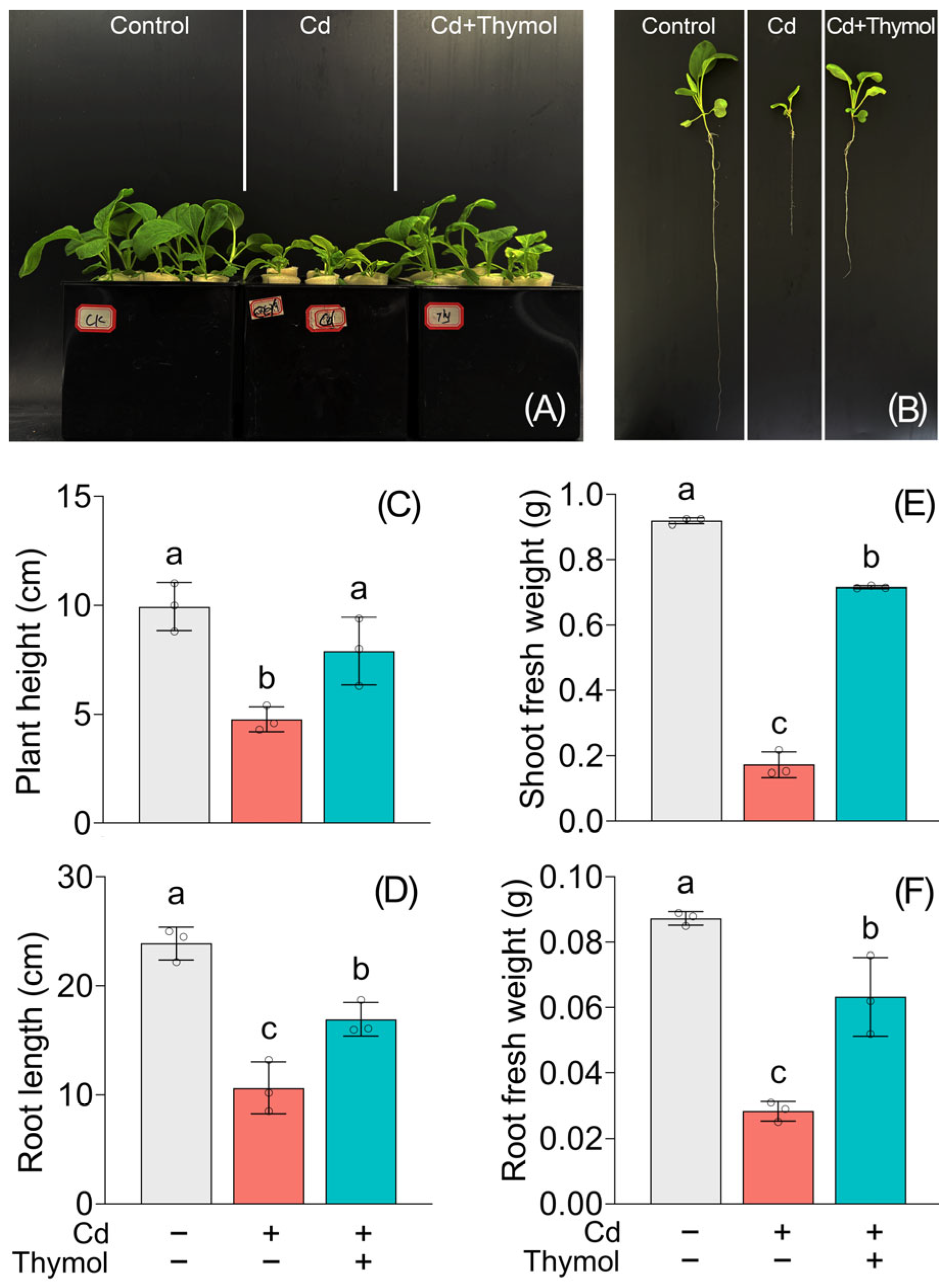
Figure 1. Effect of thymol on the growth of B. rapa under Cd exposure. (A,B) Plant phenotype. (C) Plant height. (D) Root length. (E) Shoot fresh weight. (F) Root fresh weight. Different lowercase letters in (CF) indicate significant difference among different treatments (n = 3, ANOVA, p < 0.05).
Agronomy 16 00475 g001
Figure 2. Effect of thymol on the ROS accumulation in B. rapa under Cd exposure. (A) DCF fluorescent density, indicating total ROS level in root tips. (B) Total ROS in root tips labeled with DCF fluorescence. (C) H2O2 content in shoots and roots. (D) H2O2 in leaves stained with DAB. (E) O2•− content in shoots and roots. (F) O2•− in leaves stained with DAB. Different lowercase letters in (A,C,E) indicate significant differences among different treatments (n = 3, ANOVA, p < 0.05).
Agronomy 16 00475 g002
Figure 3. Effect of thymol on the activity of antioxidative enzymes in B. rapa under Cd exposure. (A) SOD activity. (B) POD activity. (C) CAT activity. Different lowercase letters indicate significant differences among different treatments (n = 3, ANOVA, p < 0.05).
Agronomy 16 00475 g003
Figure 4. Effect of thymol on the content of metabolites in AsA-GSH cycle in B. rapa under Cd exposure. (A) GSH content. (B) GSSG content. (C) The ratio of GSH/GSSG. (D) AsA content. (E) DHA content. (F) The ratio of AsA/DHA. Different lowercase letters indicate significant differences among different treatments (n = 3, ANOVA, p < 0.05).
Agronomy 16 00475 g004
Figure 5. Effect of thymol on the activity of enzymes driving AsA-GSH cycle in B. rapa under Cd exposure. (A) GR activity. (B) MDHAR activity. (C) DHAR activity. (D) APX activity. Different lowercase letters indicate significant differences among different treatments (n = 3, ANOVA, p < 0.05).
Agronomy 16 00475 g005
Figure 6. Effect of thymol on Cd accumulation and transport in B. rapa under Cd exposure. (A) Cd content in shoots and roots. (B) Cd TF from root to shoot. (C) Relative expression level of genes involved in Cd uptake, transport, and chelation in roots. Relative expression levels were determined by calculating the log2-transformed fold change in Cd+Thymol group compared to Cd group. Asterisks indicate significant differences between two treatments (Cd+Thymol vs. Cd) (n = 3, ANOVA, p < 0.05).
Agronomy 16 00475 g006
Figure 7. Effect of foliar spraying of thymol on the growth and Cd content in the shoots of B. rapa in a pot experiment. (A) Plant phenotype. (B) Cd content in shoots. (C) Shoot fresh weight. Asterisks in (B,C) indicate significant differences between two treatments (n = 3, ANOVA, p < 0.05).
Agronomy 16 00475 g007
Figure 8. Effect of foliar spraying of thymol on the quality indices in B. rapa in pot experiment. (A) Chlorophyll. (B) Soluble protein. (C) Total amino acids. (D) Total phenols. (E) Total flavonoids. (F) NO2. Asterisks indicate significant differences between two treatments (n = 3, ANOVA, p < 0.05).
Agronomy 16 00475 g008
Figure 9. Effect of foliar spraying of thymol on the Cd content in water spinach in pot experiment. (A,B) Phenotype of TLWS. (C) Cd content in TLWS. (D,E) Phenotype of WLWS. (F) Cd content in WLWS. Asterisks indicate significant differences between two treatments (n = 3, ANOVA, p < 0.05).
Agronomy 16 00475 g009
Figure 10. Effect of foliar spraying of thymol on Cd content in pepper in pot experiment. (A,B) Phenotype of NJP. (C) Cd content in the stems, leaves, and fruits of NJP. (D,E) Phenotype of HJP. (F) Cd content in the stems, leaves, and fruits of HJP. (G,H) Phenotype of CTP. (I) Cd content in the stems, leaves, and fruits of CTP. Asterisks indicate significant differences between two treatments (n = 3, ANOVA, p < 0.05).
Agronomy 16 00475 g010
Table 1. Primer sequences used for qPCR analysis.
Gene NameAccession No.Forward Primer (5′→3′)Reverse Primer (5′→3′)
BrABCC9XM_009118682.3TCTTGTCCACTCACCAGTTCAACTTCGTTAAACCGATAACCGTGGTCAC
BrCAL1XM_009103025.3CTTCCGACTCTCTCTCTCCCTGAAATTTACCTCCGCCAAAACCTTCG
BrNramp1XM_033274409.1TGTCACGGTGCTATGTATAGTCAAGCCATGTAGGACTTCTCCTGCGTCT
BrNramp5XM_009130142.3ATGGCTTCATTAGTAGCACCTTCCTACCATGTAACTGCATGTCAACAATGTC
BrZIP7XM_009105962.3AGGTGCTGATCCGTCTGATGAACATGAGCGTGAATGCCAACAATG
BrPCS1MT361642AACCTGCTTATTGTGGCTTGGCTATAGGTGAAAAGTGACCAGACC
BrPCS2MT361643TGAGGATAAAGTGAAGGCTTACCCATCAAATAGATCTCACAAGAGACC
BrMT1aMT361644ACAAAGTACAACTTTAAATCAAAGAGCAATCACACAATCAACACATAGAAGC
BrMT1bMT361645GCAAAAATTACAACTATTTTAAATCACACCACACATATAAAGATATAAAGC
BrMT1cMT361646CAAGTTTTAAACCAAAGAGAAGTAAGTACACAATAAACACCAAATACAGAG
BrMT2aMT361647GAATAATGAAACCTTTCTAAGGAGGAATCATTCACGTTCATTCCATAG
BrMT2bMT361648CAACCCCAATAAACCCAAACCTCATATATAGTCACACAGATAVAAC
BrMT3MT361649GTCTTCGTGCGGAAACTGCGACTGTATGAGCTCCATAGATGAACTCAC
ActinXM_009127096.3CTATCCTCCGTCTCGATCTCGCCTTAGCCGTCTCCAGCTCTTGC
Disclaimer/Publisher’s Note: The statements, opinions and data contained in all publications are solely those of the individual author(s) and contributor(s) and not of MDPI and/or the editor(s). MDPI and/or the editor(s) disclaim responsibility for any injury to people or property resulting from any ideas, methods, instructions or products referred to in the content.