Article

Sources, Bioconcentration, and Translocation of Heavy Metals in Haloxylon Ammodendron in the Eastern Junggar Coalfield, Xinjiang, China

1
College of Ecology and Environment, Xinjiang University, Urumqi 830017, China
2
Key Laboratory of Oasis Ecology of Education Ministry, Xinjiang University, Urumqi 830017, China
3
Xinjiang Jinghe Observation and Research Station of Temperate Desert Ecosystem, Ministry of Education, Bortala 833400, China
4
Geological Survey of Qinghai, Xining 810000, China
5
Technology Innovation Center for Exploration and Exploitation of Strategic Mineral Resources in Plateau Desert Region, Ministry of Natural Resources, Xining 810000, China
6
College of Life Science and Technology, Xinjiang University, Urumqi 830017, China
*
Author to whom correspondence should be addressed.
Agronomy 2026, 16(4), 460; https://doi.org/10.3390/agronomy16040460
Submission received: 7 January 2026 / Revised: 8 February 2026 / Accepted: 10 February 2026 / Published: 15 February 2026

Abstract

A study on the sources, bioconcentration, and translocation of heavy metals in Haloxylon ammodendron in the Eastern Junggar Coalfield, Xinjiang, China, was conducted and evaluated. The quantities of Pb, Cd, and Cr were 1.2, 22.5, and 1.9 times higher than the baseline values of Xinjiang soils, respectively. The mean concentrations of these heavy metals in the rhizosphere soil of Haloxylon ammodendron were 48.81, 17.74, 93.25, 3.32, 29.05, and 26.95 mg/kg. The exceedance rates for Cd, Cr, and Pb in bare soil were 100%, 99.03%, and 75.73%, respectively, indicating significant accumulation of heavy metals, with Cd demonstrating the highest enrichment degree. Most sampling sites showed moderate pollution according to the Pollution Load Index (PLI). Meanwhile, the Pollution Index (PN) indicated elevated pollution levels at all the sampling sites, with Cr identified as the first contaminant. The absolute principal component score–multiple linear regression (APCS-MLR) model revealed three principal sources of heavy metal pollutants in soil: 44.2% from natural processes and mining activities, 22.7% from industrial coal combustion and sewage, and 33.1% of undetermined origins. The bioconcentration factors (BCFs) and translocation factors (TFs) revealed Haloxylon ammodendron to have clear accumulation and translocation abilities with respect to these heavy metals. The fuzzy membership function showed that the overall assessment score for Haloxylon ammodendron was 9.1325, indicating the substantial remediation potential of Haloxylon ammodendron for heavy metal pollutants, especially for Cd. Furthermore, Haloxylon ammodendron demonstrated substantial Pb and Cr accumulation and remediation ability. Haloxylon ammodendron exhibited remarkable heavy metal accumulation and translocation abilities, making it a suitable tool for phytoremediation in the study area. The findings of this study will prove useful in promoting and implementing sustainable mining practices and safeguarding regional ecological security and may contribute to advancing local ecological conservation and social economic development.

1. Introduction

Since the Industrial Revolution, global demand for energy has continued to grow, and coal mining intensity continues to rise [1,2]. This has caused a significant increase in the amount of contaminants released into the environment, especially heavy metals [3,4,5]. Increased soil heavy metals levels have become a severe environmental problem, particularly in regions surrounding mining sites [6,7,8]. Soil heavy metal contamination presents a substantial risk to the adjacent environment and human health [9,10,11], and its limited degradability results in the gradual accumulation of metals over time, making it a subject of significant scholarly interest [12,13,14]. Furthermore, whereas organic pollutants can decompose naturally, heavy metals can persist in soil for centuries or even millennia. Thus, heavy metal contamination can lead to toxins remaining in the environment for centuries, causing harm to plants, animals, and humans [15,16].
The causes of heavy metal pollution in mining areas are complex and diverse, with waste materials and exhaust emissions from coal mining operations being the primary sources of contamination [17,18,19]. Coal extraction, processing, and transportation release substantial amounts of dust and particulate matter into the atmosphere, water bodies, and soil. These pollutants subsequently disperse over vast regions through wind, water, and animal migration [20,21,22]. Then, the minute particles with heavy metals are released into the air, water, and soil [23,24,25], spreading over large areas through wind, runoff, and wildlife activity [26,27]. The contaminated dust has been observed to settle readily on vegetation and accumulate in water and soil systems, resulting in polluted soil that is unsuitable for agricultural and forestry purposes [28]. Polluted soils can stop plants from growing, which can lead to lower agricultural productivity and, potentially, the extinction of local plant species. On the other hand, the bioconcentration of heavy metals in animals through food chains could ultimately be threatening to human health [29,30,31]. It has also been discovered that various diseases, including cancer, neurological disorders, and kidney problems, are closely linked to long-term exposure to heavy metal pollution [32], especially for high-risk groups like adolescents and pregnant women who are more susceptible to the harmful effects of these pollutants [33].
Xinjiang has vast coal resources, which significantly fueled the economic growth of this area. Between 2015 and 2022, China’s raw coal production was 3.695, 3.360, 3.520, 3.680, 3.970, 3.900, 4.070, and 4.560 billion tonnes, respectively. The corresponding output in Xinjiang was 146, 158, 167, 190, 238, 266, 320, and 413 million tonnes, with year-on-year growth rates of 4.50%, 1.20%, 5.60%, 6.40%, 14.20%, 9.30%, 18.30%, and 28.60%, representing 3.95%, 4.70%, 4.74%, 5.16%, 5.99%, 6.82%, 7.86%, and 9.05% of the national total, respectively. During this period, Xinjiang’s raw coal production increased at an average annual rate of 11.01% (more than threefold), and its national share escalated from 3.95% to 9.05%, thereby establishing itself as China’s fourth-largest coal-producing provincial-level province [34]. However, these coal resources have also caused serious environmental problems. The Eastern Junggar Coalfield has produced vast quantities of exhaust gases, wastewater, and solid waste because of coal-related industries. For instance, in terms of the changes in the annual average concentrations of six standard pollutants in the urban agglomeration on the northern slope of the Tianshan Mountains from 2015 to 2023, SO2, NO2, PM2.5, PM10, and CO showed a generally decreasing trend. During the study period, there were years when the concentrations of SO2, NO2, PM2.5, and PM10 exceeded the national standard limits (GB 3095-2012) [35]. Yu et al. observed that the annual average PM2.5 mass concentration in Xinjiang exhibited a general fall from 2000 to 2022, decreasing from 50 μg/m3 to 37 μg/m3, representing a reduction of nearly 26%, which accelerated post-2016. The high-value regions of PM2.5 mass concentration are located in the Urumqi–Changji–Shihezi urban agglomeration in northern Xinjiang and the Tarim Basin in southern Xinjiang [36]. These contaminants have a significantly negative effect on the surrounding ecological environment. The ecology of the study area has become increasingly vulnerable as coal extraction has increased. In order to solve this problem, the phytoremediation technique has been proposed as a potential solution [37]. Phytoremediation involves the use of plants to absorb and immobilize pollutants in contaminated soil. This technology is widely regarded as environmentally friendly. However, there is a possibility of secondary pollution due to a number of potential factors, including the decomposition of plant litter, the volatility of certain metals, or the improper handling of contaminated biomass. Moreover, current phytoremediation technology has been challenged by issues such as slow remediation rates and incomplete pollutant removal, making this technology a subject of considerable attention in both domestic and international research [38,39]. In arid mining areas such as the Eastern Junggar Coalfield, it has remained unclear as to how different plant species absorb and transport specific heavy metals (e.g., Pb, Cd, and Cr). Variations in metal accumulation in different plant organs and whether a metal concentration threshold regulates these processes at spatial scales also require further study.
Given the fragile ecosystem of the Eastern Junggar Coalfield and the unique desert ecological environment, there is an urgent need for comprehensive research and remediation efforts to solve soil heavy metal contamination. Such efforts are crucial not only for ensuring the long-term ecological health of the region but also for restoring the local environment. This study focused on the Eastern Junggar Coalfield, collected surface soil samples, and selected Haloxylon ammodendron—a native plant adapted to mining environment—as the subject of investigation. The study included the following: an analysis of the distribution and contamination levels of heavy metals in soil; an assessment of the ecological risks from heavy metals in soil; and an analysis of heavy metal accumulation characteristics in surface and subsoil. Additionally, the uptake capacity of heavy metals across different organs in Haloxylon ammodendron were studied, as well as the mechanism of heavy metal uptake and transport in this plant. Despite increasing research on heavy metal remediation in coalfields, critical scientific gaps have persisted: there is a noted lack of systematic assessments of heavy metal bioconcentration factors and translocation factors in native drought-tolerant plants (e.g., the Haloxylon ammodendron) within arid mining areas, which has hindered regional tailored phytoremediation strategies. To address this research gap, three hypotheses were advanced: (1) the Haloxylon ammodendron has strong accumulation and translocation capacities for major heavy metals (Pb, Cd, Cr) in the study area; (2) heavy metal accumulation within the Haloxylon ammodendron shows significant variation in different organs and soil layers; and (3) the Haloxylon ammodendron can be identified as a potential candidate for phytoremediation purposes in relation to the remediation of contaminated soil in arid mining areas. This study aimed to address the above scientific gaps, offering technical guidance for heavy metal contamination in arid mining soils, providing a scientific basis for mining area environmental restoration, and improving the existing mine restoration system.

2. Materials and Methods

2.1. Research Area and Samples

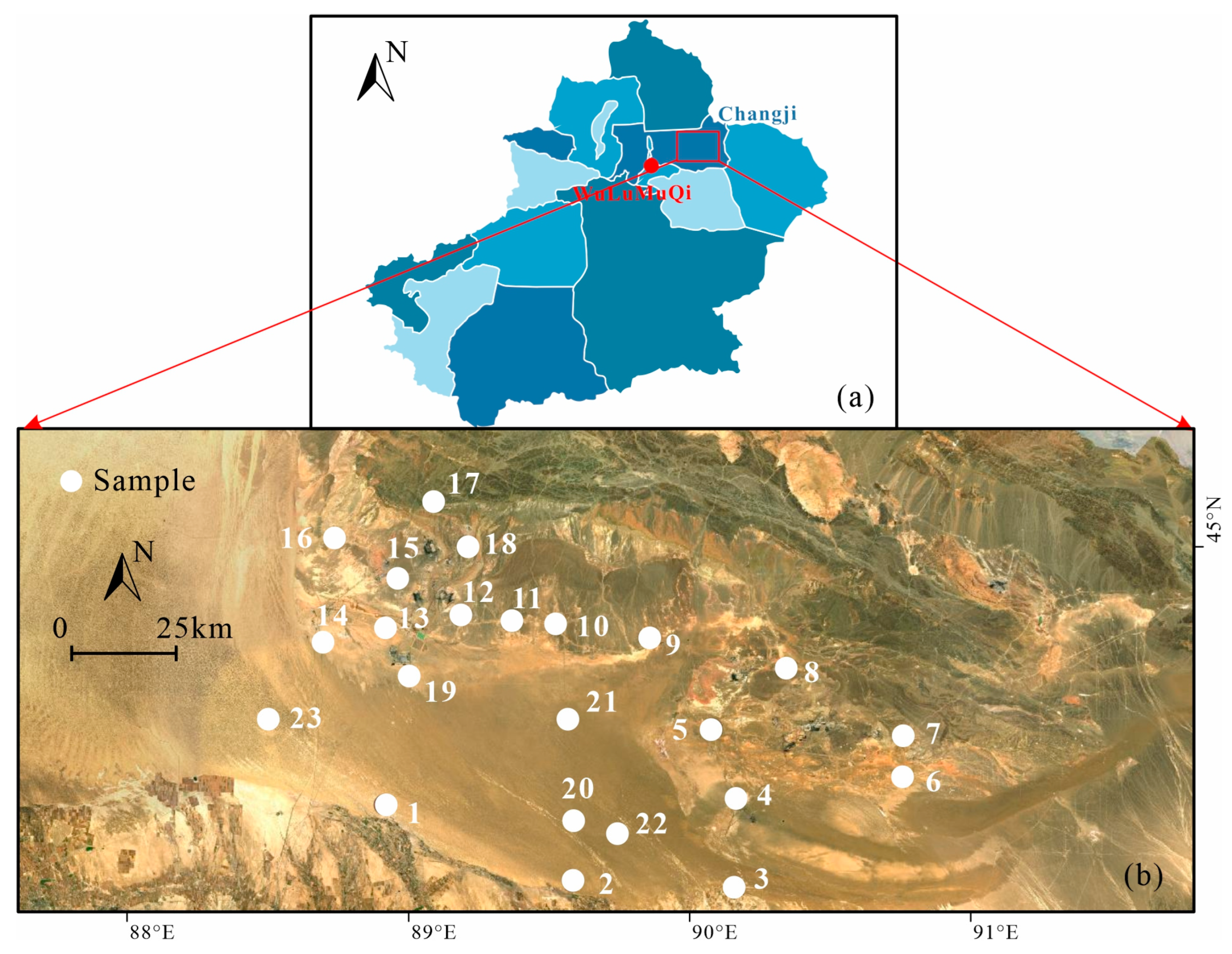
The Eastern Junggar Coalfield is located within 87°30′–90°45′ E and 43°20′–45°15′ N (datum: China Geodetic Coordinate System 2000, CGCS2000), encompassing an area of over 28,000 square kilometers. The graphical elements in Figure 1 were generated and processed with OvitalMap (V10.1.3.32683X64) and CorelDRAW (2021; 64-Bit). The topography of the region is complex: the northern and southern regions are dominated by rugged elevations, while the central area is a low-lying plain. The climate is that of an extreme continental desert, characterized by the prevalence of northwesterly winds, which are particularly frequent during spring and autumn.
The Eastern Junggar Coalfield is characterized by high insolation and abundant heat availability, with a mean annual precipitation of 183.5 mm and a mean annual evaporation of 2042.3 mm. The region has a distinct seasonal climate with long, frigid winters and short, scorching summers, while spring and autumn are mild, with minor fluctuations in temperature and climate conditions. The average temperature in this area is 7.37 °C, and the frost-free season usually lasts between 160 and 190 days. The highest temperature recorded was 39.72 °C, and the lowest was −24.58 °C, indicating a pronounced diurnal temperature variation. Temperatures in the arid zones of the study area peak in July, while those in the northern and southern mountainous regions reach their lowest point in January. Due to topographical and geological conditions, the primary soil types within the mining area comprise mountainous brown calcareous soils, gray desert soils, and aeolian sandy soils. Concurrently, under the combined influence of climatic factors and human activities, the vegetation coverage within the mining area exhibits significant variations [40].
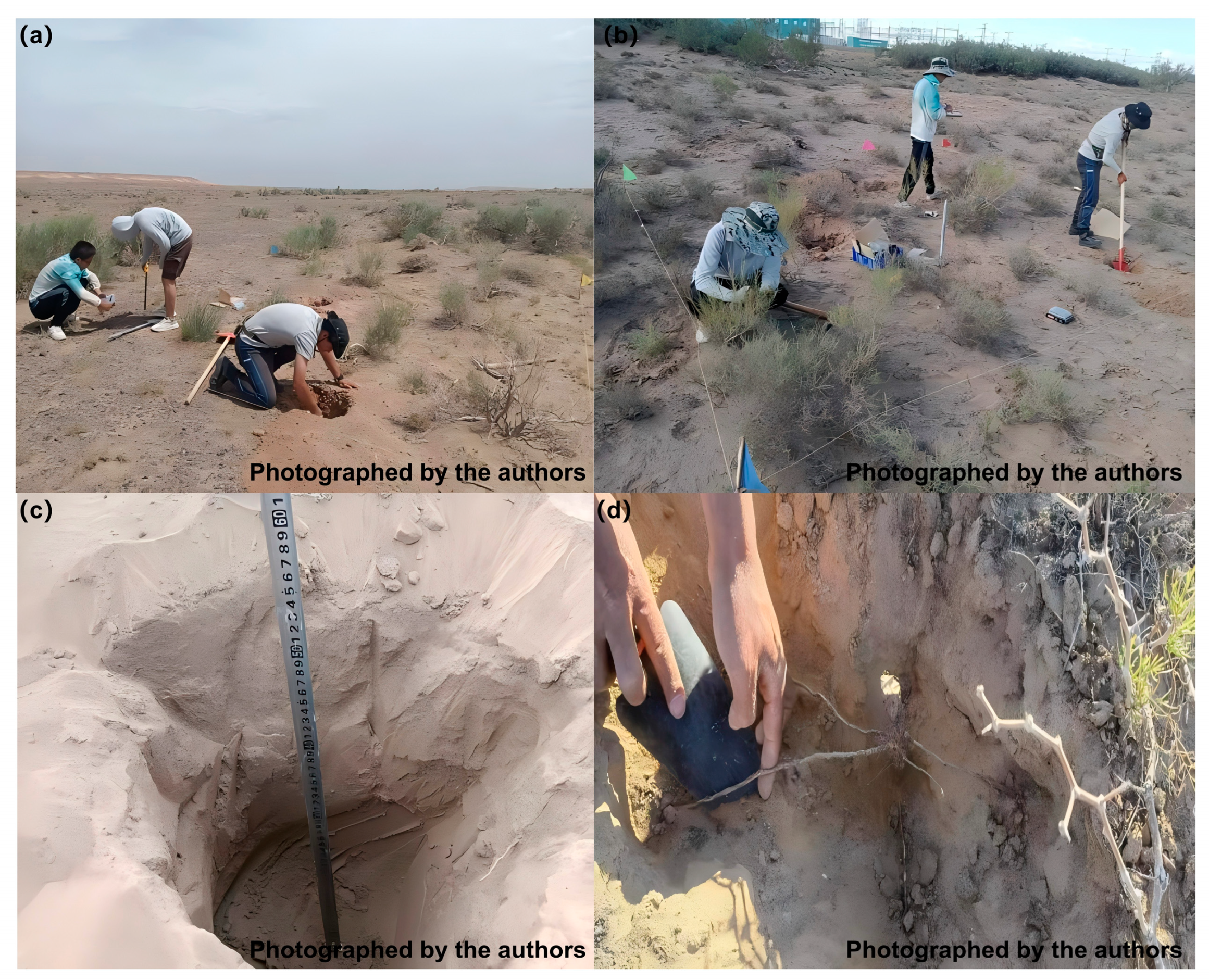
The determination of plot locations was thus achieved through the implementation of stratified systematic sampling, with the objective of ensuring equilibrium between the representation, spatial coverage, and field practicality. Sample collection was undertaken from June to July 2023 in the Eastern Junggar Coalfield and nearby areas where plants were present. A total of 23 quadrats of 5 × 5 m were put up, and soil samples were gathered from each quadrat at 0–10 cm, 10–30 cm, and 30–60 cm depths (Figure 1 and Figure 2). In the study, healthy Haloxylon ammodendron seedlings with comparable growth characteristics were selected to minimize individual variation (height: 0.4 ± 0.05 m; basal diameter: 0.5 ± 0.08 cm). Haloxylon ammodendron is an arid-adapted shrub/small tree endemic to Xinjiang, with distinctive features such as scalelike leaves, extensive root systems, strong drought and salt tolerance, evergreen branches, and vigorous photosynthesis. It is regarded as a crucial sand-fixing plant in Xinjiang. Field research indicated that all 23 quadrats had the prevalent plants, Haloxylon ammodendron. Representative plants were chosen from each quadrat to represent the growth conditions, and Haloxylon ammodendron was gathered from all 23 quadrats, with various organs, including leaves, lateral branches, main stems, main roots, and lateral roots, each packaged in kraft paper. Following collection, there were 69 bare soil samples and 23 Haloxylon ammodendron rhizosphere soil samples in total. The plant samples were categorized into 115 tissue samples of Haloxylon ammodendron based on several organs.

2.2. Sample Analysis

In this study, soil samples were first air-dried, ground, and sieved through a 100-mesh sieve (pore size 0.15 mm) to remove impurities. A total of 0.25 ± 0.0005 g of sieved soil samples and 0.5 ± 0.0005 g of ground plant tissue were precisely weighed then subjected to wet digestion according to established protocols [41,42]. The PerkinElmer PinAAcle 900H atomic absorption spectrometer (Waltham, MA, USA) equipped with an air–acetylene flame system was used to determine the concentrations of heavy metals (Cu, Zn, Pb, Cd, Cr, Ni) in the clarified solutions following digestion. Throughout the analytical process, quality control was ensured through blank digestion and certified reference materials (GBW(E)081531) to validate accuracy and precision.

2.3. Geostatistical Analysis

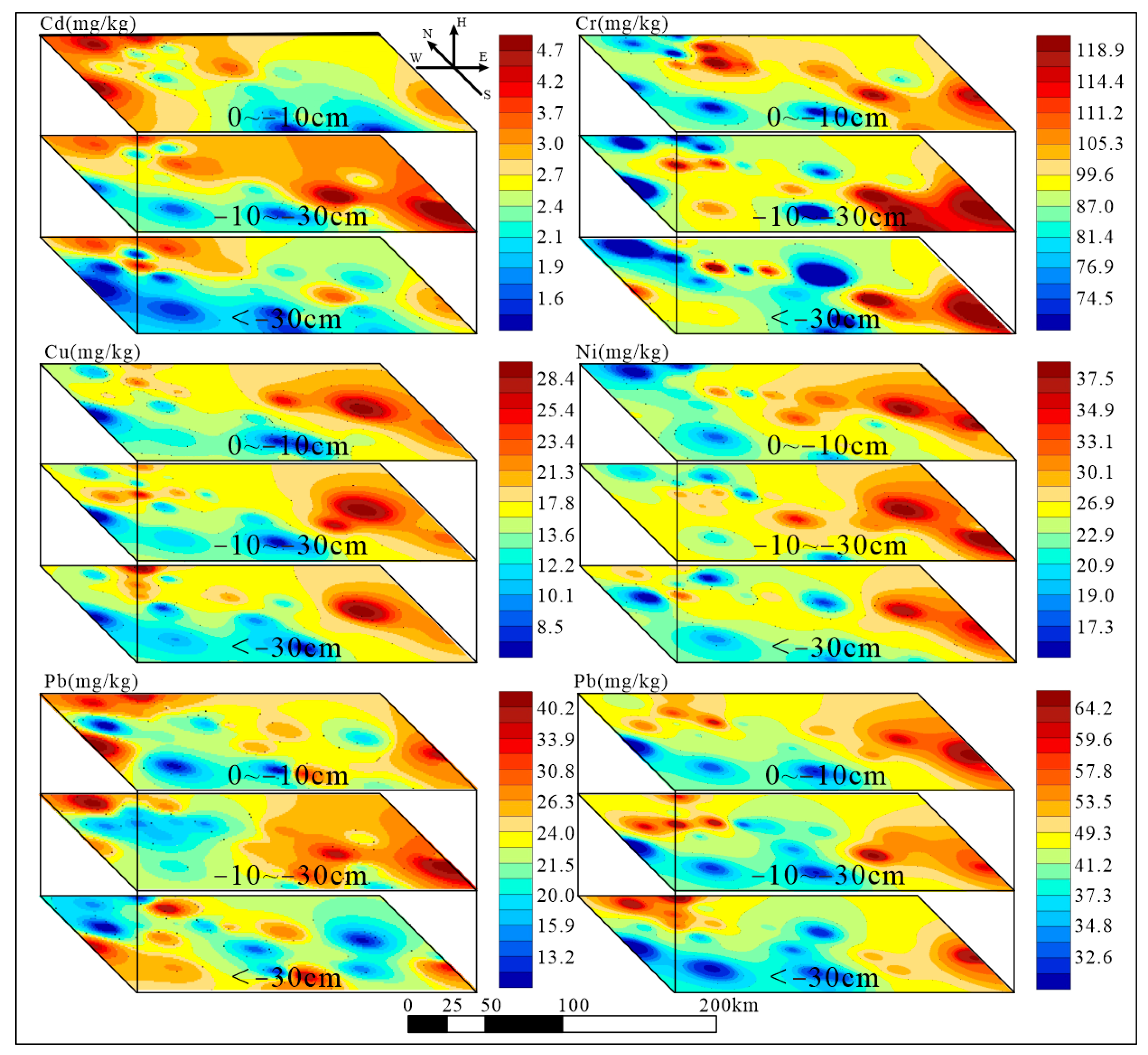
Kriging interpolation enables the estimation of heavy metal concentrations in soil without sampling and has been extensively applied to analyze the spatial characteristics and variation patterns of geochemical elements [43]. This study employed Geochem Studio 4.0 (Institute of Geophysical and Geochemical Exploration, Chinese Academy of Geological Sciences, Langfang, Hebei, China) to interpolate data from surface and vertical profile soil samples, thereby analyzing the spatial distribution characteristics of heavy metals in soil [44]. Depth geochemical cross-section diagrams were subsequently generated by Adobe Illustrator 2020 (version 24.3) (Adobe Inc., San Jose, CA, USA), providing a visual representation of the vertical distribution patterns of heavy metals.

2.4. Comprehensive Pollution Index

Two techniques, specifically the Pollution Load Index (PLI) and the Nemerow Pollution Index (PN), were utilized to evaluate heavy metal pollution in the topsoils of the Eastern Junggar Coalfield. The detailed information concerning the computation of PLI and PN relates to already published studies [9,45]. The baseline concentrations of trace elements in soils used for calculating PLI and PN were derived from background values of soil components in China [46].
P L I = ( C x 1 C b 1 × C x 2 C b 2 × C x n C b n ) 1 n
P N = ( C x i C b i ) m e a n 2 + ( C x i C b i ) m a x 2 2
where C b i refers to the background concentration of the target heavy metal in soil, and C x i refers to the measured concentration of the target heavy metal in soil. Where n is the total number of pollutants. The Pollution Level Index (PLI) results were categorized as low (≤1), medium (1–2), high (2–5), and extremely high (>5). The PN assessment results were categorized as safe (≤0.7), precautionary (0.7–1.0), mildly contaminated (1.0–2.0), moderately contaminated (2.0–3.0), and severely contaminated (>3.0).

2.5. Source Analysis

The absolute principal component scores–multiple linear regression (APCS-MLR) model was employed in SPSS 26.0 software (IBM Corp., Armonk, NY, USA) to quantify the source contributions of heavy metals, including Cu, Zn, Pb, Cd, Cr, and Ni, in the study area. As the implementation condition was straightforward, and as source analysis results were accurate and reliable, this method was deemed suitable for detecting heavy metal contamination in surface soils in the target areas [11].

2.6. The Ability of Phytoextraction

Phytoextraction capability evaluation was conducted by analyzing the biomass of the plants in both their shoots and roots alongside the heavy metal concentrations. The bioconcentration factor (BCF) is used to assess the ability of a plant to accumulate one or more heavy metals [32,47,48]. The translocation factor (TF) refers to the ability of the plant to transfer heavy metals from the soil [13,47,49]. The calculation equations are outlined as follows (Equations (3) and (4)):
B C F = C s h o o t / C s o i l
T F = C s h o o t / C r o o t
where C s h o o t and C r o o t denote the heavy metal content in the shoots and roots, respectively, and C s o i l denotes the heavy metal content in the soil.
The root retention rate indicates the capacity of plant roots to sequester heavy metals [12,50]. This indicator reveals the tolerance of a plant to heavy metal toxicity. A high rate indicates that the roots predominantly sequester heavy metals, leading to diminished concentrations in the aerial parts of the plant and reduced upward migration [51]. On the contrary, a low rate indicates increased migration of heavy metals to the aerial parts of the plant, while the roots indicate sufficient capacity to accumulate high heavy metal concentrations from the soil [52]. The formula is as follows:
R = ( C u n d e r g r o u n d   p a r t C a b o v e g r o u n d   p a r t ) × 100 % / ( C u n d e r g r o u n d   p a r t )
where R is the root retention rate of heavy metals; C u n d e r g r o u n d   p a r t is the heavy metal content in the underground parts of the plant; and C a b o v e g r o u n d   p a r t is the heavy metal content in the above-ground parts.
The membership function approach in fuzzy mathematics is employed to evaluate the heavy metal accumulation capability of plants holistically [53]. The membership function method addresses the limitations of the BCF/TF values, namely, their one-dimensionality and the absence of a standardized benchmark, facilitating a comprehensive assessment of multiple indicators, which aligns with the present research context. The calculation formula is as follows:
X ( μ ) = ( X X m i n ) / ( X m a x X m i n )
where X is the measured value of a certain indicator (Cu, Zn, Pb, Cd, Cr, Ni) for the plant; X m a x is the maximum measured value of that indicator; and X m i n is the minimum measured value of that indicator. The average value of the membership function is then calculated, and the comprehensive evaluation value for each plant is finally computed.

2.7. Statistical Analysis

In this study, Microsoft Excel 2019 and SPSS 26.0 were used to complete the statistical analysis. To clearly reflect the dispersion degree and reliability of the measured data, the 95% confidence interval (95% CI) was calculated for all quantitative data. The sample size (n) corresponding to each data group is clearly marked in the text and tables to ensure data traceability and verifiability. For data conforming to normal distribution, one-way analysis of variance (ANOVA) was used to identify significant differences in heavy metal concentrations between different soil layers and the rhizosphere soil of Haloxylon ammodendron. For non-normal data, the non-parametric Kruskal–Wallis test was employed for inter-group difference analysis. A unified significance level (p < 0.05) was set for all statistical tests, and all test results were included in the manuscript to provide rigorous statistical support for data interpretation and the derivation of research conclusions.

3. Results

3.1. Heavy Metals in Bare and Root Soil

This study evaluated heavy metal contents in 92 bare soil and rhizosphere soil samples obtained from the East Junggar Coalfield (Table 1 and Figure 3). Table 1 shows that the average amounts of Pb, Cd, and Cr in the soils were higher than the background levels for soils in the Xinjiang region [53]. This means that there is some heavy metal enrichment in the research area. Cd had the highest enrichment factor of all the heavy metals, which shows that it can build up quickly in dry mining areas. This could be because mining disturbs the area and the dirt is quite easy to move around in. In contrast, the average concentrations of Zn, Cu, and Ni were close to or below their respective background values, suggesting a comparatively low pollution risk. Specifically, within the block-like soil, the average concentrations of Zn, Cu, Cr, Cd, Pb, and Ni were, respectively, 46.91, 16.48, 95.60, 2.74, 24.33, and 25.35 mg/kg in the 0–10 cm layer; 46.03, 16.56, 95.42, 2.91, 24.36, and 26.56 mg/kg in the 10–30 cm layer; and 45.37, 16.19, 91.50, 2.45, 22.45, and 25.00 mg/kg in the deeper soil layer (>30 cm). Despite slight variations with depth, one-way ANOVA and Kruskal–Wallis tests indicated no significant differences in all metallic elements between the three soil layers (p > 0.05), suggesting that the observed downward trend did not constitute a statistically supported vertical stratification phenomenon. Furthermore, metal concentrations in the rhizosphere soil of Haloxylon ammodendron consistently exceeded those in the corresponding bulk soil (Table 1), indicating that the plant influenced the local redistribution of metals at the soil–plant interface. In these three separate soil depth zones (0–10 cm, 10–30 cm, and >30 cm), the average contents of Zn and Cr demonstrated a declining trend with increasing depth, supported by a 95% confidence interval. Cu, Pb, Cd, and Ni exhibited a vertical, unimodal distribution pattern. Their mean concentrations were greatest in the 10–30 cm layer, whereas the surface and deeper layers exhibited lower concentrations (95% confidence interval). The concentrations of heavy metals in various soil strata remained largely stable. The average concentration levels of Ni, Pb, and Zn were somewhat elevated in the 10–30 cm layer compared to the topsoil but subsequently decreased in the >30 cm layer.
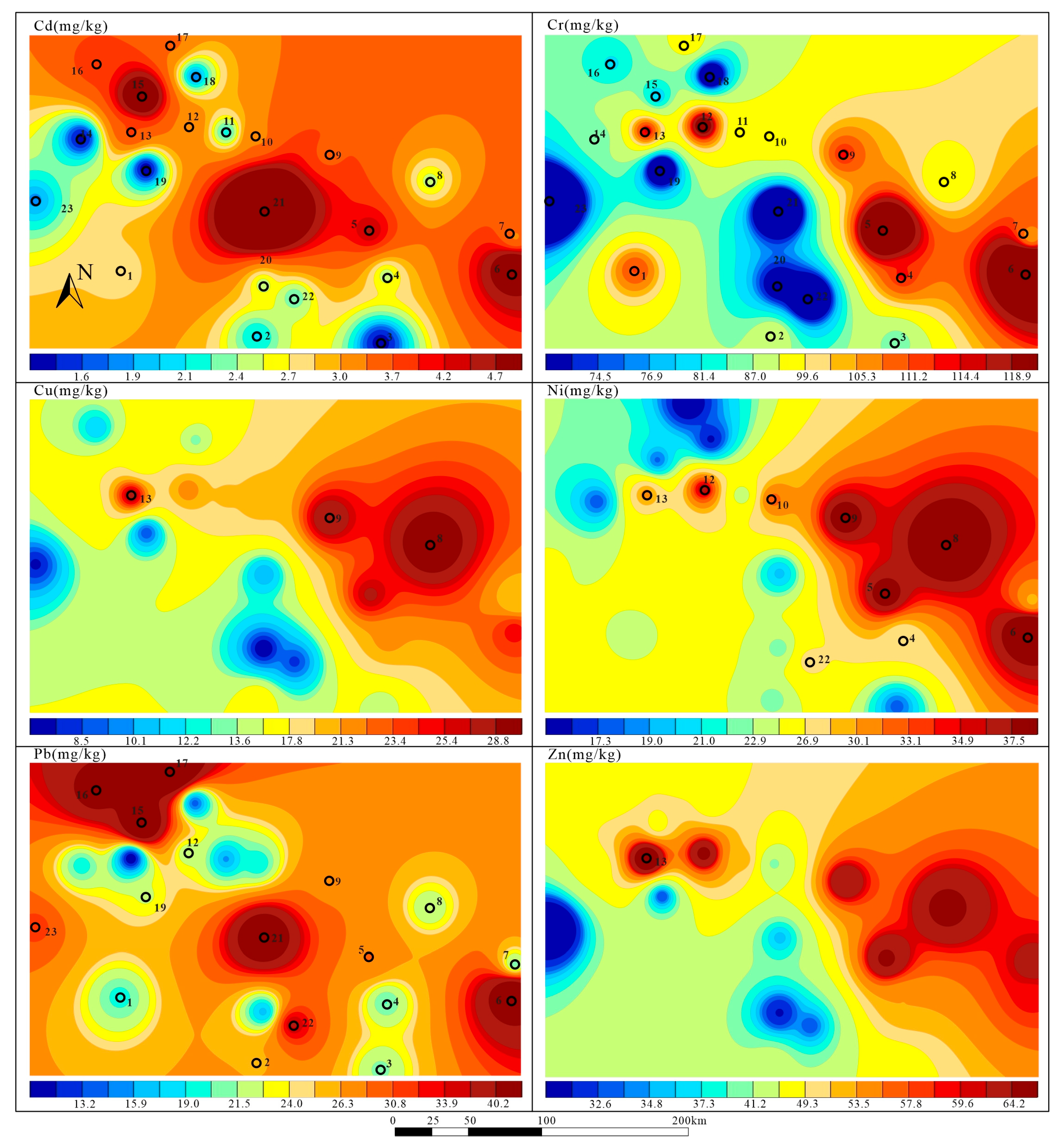
In the rhizosphere soil of Haloxylon ammodendron within the mining area, the average concentrations of the six heavy metals were 48.81, 17.74, 93.25, 3.32, 29.05, and 26.95 mg/kg, respectively (Figure 4). With the exception of Cr, which exhibits lower concentrations in the affiliation function values of heavy metal accumulation indices for Haloxylon ammodendron rhizosphere soil compared to bare soil, the heavy metal concentrations—i.e., Cu, Zn, Pb, Cd, and Ni—are elevated in Haloxylon ammodendron rhizosphere soil. Specifically, these concentrations are 1.08, 1.06, 1.23, 1.23, and 1.05 times greater than those found in bare soil, respectively. Soil heavy metal concentrations exhibited distinct distribution patterns across different soil zones and depth layers. For Zn, the highest concentration was found in the rhizosphere soil of Haloxylon ammodendron (Zn: 48.81 mg/kg), followed by the 0–10 cm bare soil layer (Zn: 46.91 mg/kg), the 10–30 cm bare soil layer (Zn: 46.03 mg/kg), and the >30 cm bare soil layer (Zn: 45.37 mg/kg). For Cu, Cd, Pb, and Ni, the order of concentration was identical: Haloxylon ammodendron rhizosphere soil—Cu: 17.74 mg/kg, Cd: 3.32 mg/kg, Pb: 29.01 mg/kg, and Ni: 26.95 mg/kg; >10–30 cm bare soil layer—Cu: 16.56 mg/kg, Cd: 2.91 mg/kg, Pb: 24.36 mg/kg, and Ni: 26.56 mg/kg; >0–10 cm bare soil layer—Cu: 16.48 mg/kg, Cd: 2.74 mg/kg, Pb: 24.32 mg/kg, and Ni: 25.35 mg/kg; and >30 cm bare soil layer—Cu: 16.19 mg/kg, Cd: 2.45 mg/kg, Pb: 22.45 mg/kg, and Ni: 25.00 mg/kg. In contrast, Cr concentration peaked in the 0–10 cm bare soil layer (Cr: 95.60 mg/kg), followed by the 10–30 cm layer (Cr: 95.42 mg/kg), Haloxylon ammodendron rhizosphere soil (Cr: 93.25 mg/kg), and the >30 cm layer (Cr: 91.50 mg/kg).
Compared with Xinjiang’s soil background values, all six heavy metals in the study area’s bare soil exceeded standards to varying degrees. The exceedance rates were Cd (100%) > Cr (99.03%) > Pb (75.73%) > Ni (43.69%) > Cu (9.71%) > Zn (1.94%). As illustrated in Figure 4, the spatial distribution map clearly revealed pollution patterns: Cd exhibited widespread and severe enrichment throughout the study area, with maximum concentrations reaching 6.93 mg/kg (approximately 57.75 times the background value) and minimum levels at 1.03 mg/kg (approximately 8.58 times the background value), highlighting its most severe contamination status. Cr exhibited widespread enrichment, consistent with its 100% exceedance rate in the rhizosphere soil of Haloxylon ammodendron. The defining characteristic of Pb concentrations was isolated high-concentration patches, whereas Zn contamination was minimal, with only occasional higher levels detected. This spatial analysis further confirmed the occurrence of significant heavy metal enrichment within the study area.

3.2. Topsoil Pollution

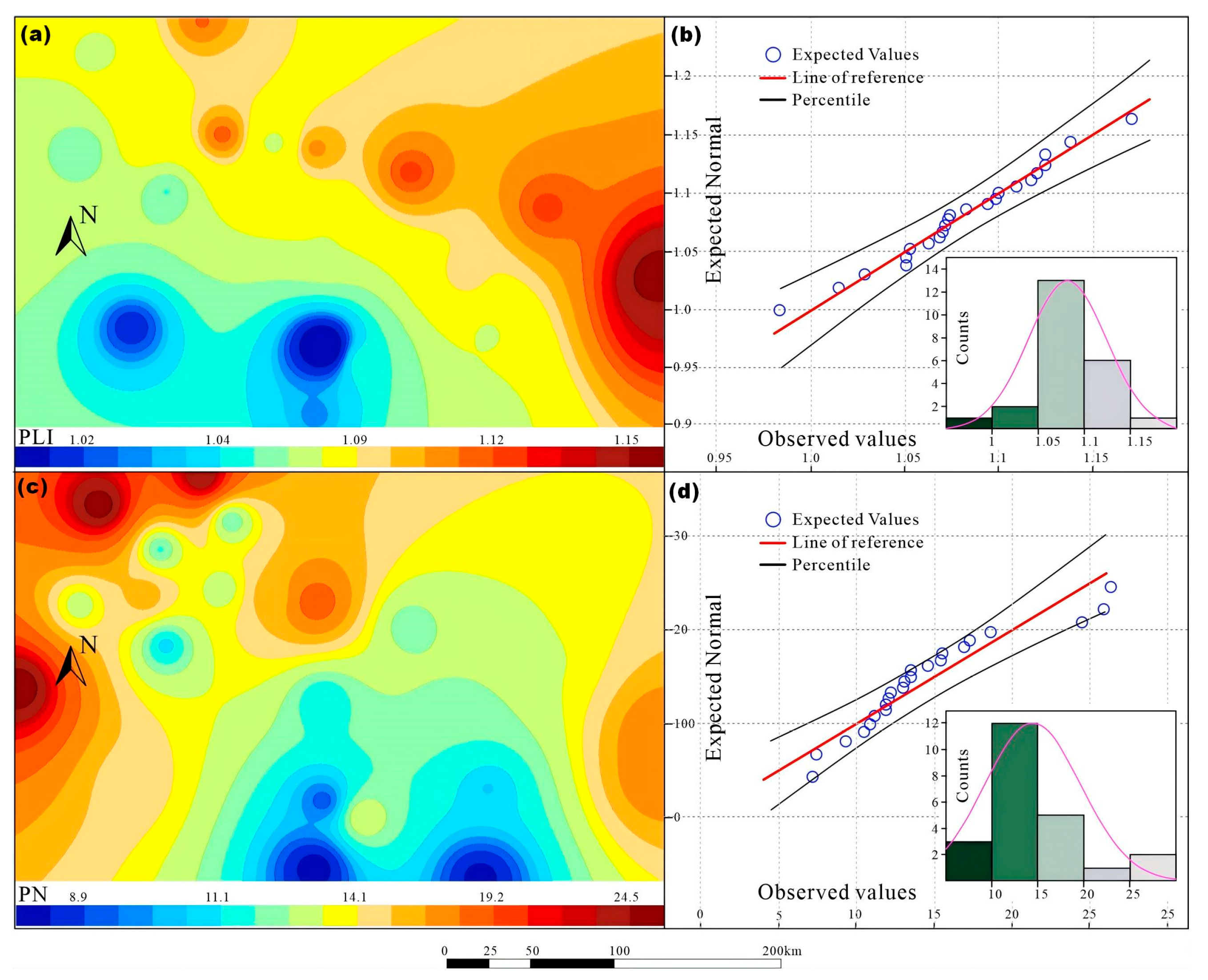
The pollution caused by heavy metals in the topsoils of the Eastern Junggar Coalfield was comprehensively analyzed using the Pollution Load Index (PLI) and the Pollution Index (PN), as shown in Figure 5. In order to evaluate the heavy metal contamination level, PLI offered comparable data. As shown in Figure 5a, the PLI values in the Eastern Junggar Coalfield range from 0.98 to 1.17 across all of the sampling sites. According to the PLI ranking criterion [9], about one out of twenty-three sample sites demonstrated low pollution levels, while approximately twenty-two of the sampling sites exhibited moderate pollution levels. When compared to PLI, PN provided a more precise evaluation of the pollution levels. As shown in Figure 5c, the PN values of heavy metals in topsoils were much higher than average, with a range that extended from 7.11 to 26.29, with an average of 14.42. After applying the PN ranking criterion [9], it was determined that every single sampling site had considerable levels of pollution. According to the PN, Cr is predominantly responsible for the contamination evaluated. There are no obvious outliers in the data, which indicates that the data follow a normal distribution (Figure 5b,d). The Q–Q plot and histogram show the Pollution Load Index (PLI) and the Potential Ecological Risk Index (PN). The blue dots in the Q–Q plots indicate the actual values of each index compared to the expected values from a normal distribution. The black diagonal line is a reference point. Data that fit a normal distribution should correspond with this line. The red percentile lines show the 95% confidence interval for the expected values. The inset histogram shows the frequency distribution of observed index values, with the hypothesized normal distribution curve (pink) on top. These plots show that PLI values are close to a normal distribution, but PN values show a moderate departure in the top tail. This gives statistical support for the next steps in spatial analysis and risk assessment.

3.3. Heavy Metal Pollution Sources in Topsoil

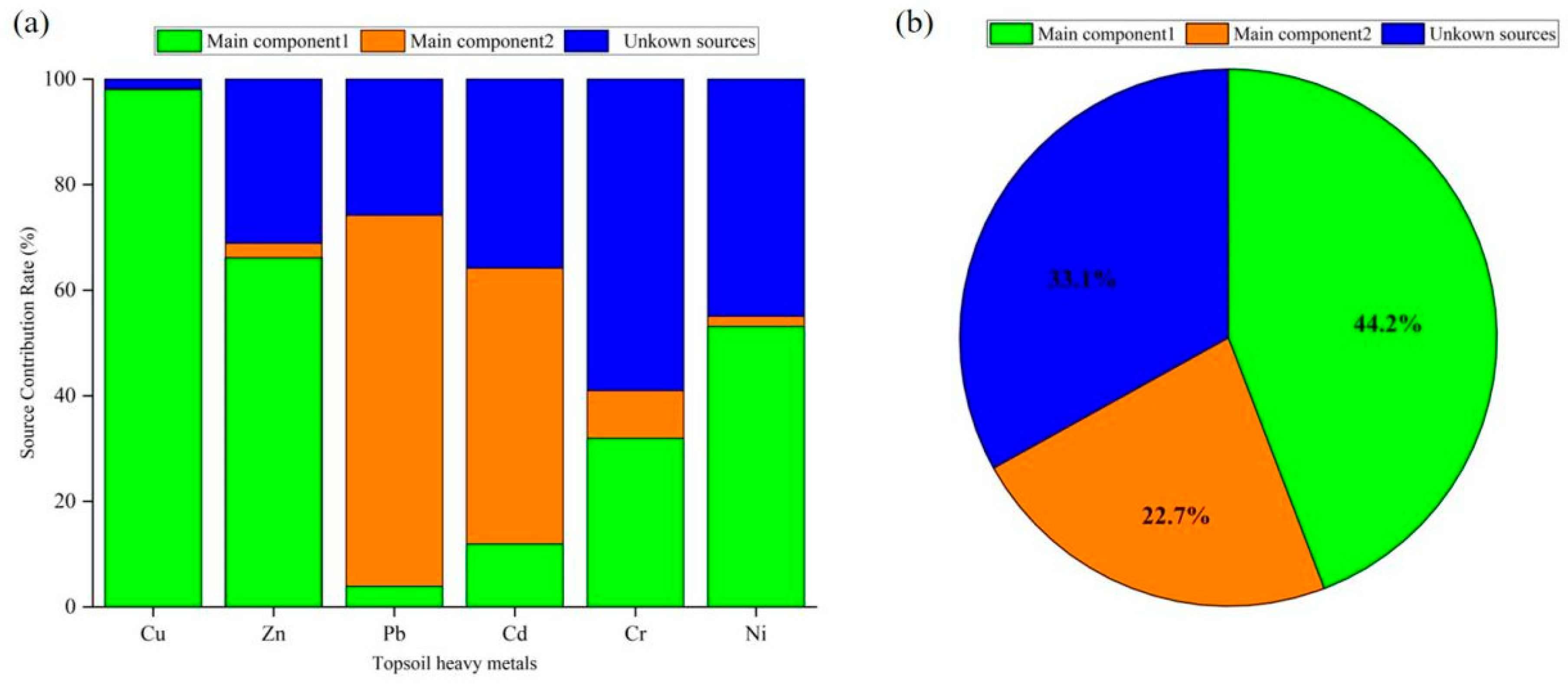
Based on the PCA, the absolute principal component scores–multiple linear regression model (APCS-MLR) was applied to research the source contributions for heavy metals Cu, Zn, Pb, Cd, Cr, and Ni. To ensure the topsoil heavy metal datasets were suitable for PCA, the KMO and Bartlett’s sphere tests were performed. As a result, the KMO value was 0.543, p < 0.001, meeting the prerequisites for using this analysis method (KMO > 0.5 and p < 0.05). As shown in Table 2, the two main components cumulatively explained 71.151% of the total variance, indicating the presence of other unknown sources. This may be due to the model’s inability to account for all parameter differences, resulting in either high or low results [3]. By calculating the regression model, it was found that values of R2 for Cu, Zn, Pb, Cd, Cr, and Ni were 0.775, 0.842, 0.802, 0.83, 0.42, and 0.426. Only Cr and Ni had relatively low values. Figure 6 intuitively reflects the results of each heavy metal in the topsoil according to the APCS-MLR model. Figure 6a shows the specific contributions of two main components and unknown sources to each heavy metal source, while Figure 6b shows the overall average contribution rate. For Cu, main component 1 contributed 98.01% of the total, with negligible contributions from other sources. Moreover, the contributions of main component 1 to Zn and Ni both accounted for over half of the total (66.19% and 53.14%, respectively). The mean Cr/Ni ratios in soil profiles were 3.77 (0–10 cm), 3.59 (10–30 cm), and 3.66 (>30 cm), which were stable among soil layers and generally consistent with the geochemical characteristics of natural soil parent materials, despite being slightly higher than the background ratio (1.85). The Cu/Pb ratios ranged from 0.68 to 0.72, obviously lower than the background ratio of 1.38. Main component 2 showed the highest contribution to Pb (70.31%), followed by Cd (52.27%). This main component contributed less than 10% to other heavy metals. Strikingly, the Pb/Cd ratios were only 8.37–9.16, which deviated extremely from the background ratio (161.67), indicating significant anthropogenic enrichment of Cd induced by coal mining activities. On the other hand, the unknown sources contributed to all heavy metals except Cu (only 1.84%), with Cr contributing nearly 60%. The Cu/Zn ratios (0.35–0.36) were close to the background value (0.39), showing a weak mixed source signal.
In summary, the research region had three main sources of soil heavy metal pollution (Figure 6): natural geological background and mining activities (44.2%); industrial coal combustion and wastewater discharge (22.7%); and unexplained sources (33.1%). The source allocation study showed that the first principal component is mostly linked to Cu, Zn, and Ni, and the second principal component is mostly linked to Pb and Cd. Cr had the strongest link to unknown sources, making up about 60% of the overall contribution.

3.4. Heavy Metals in Native Plants and Different Parts

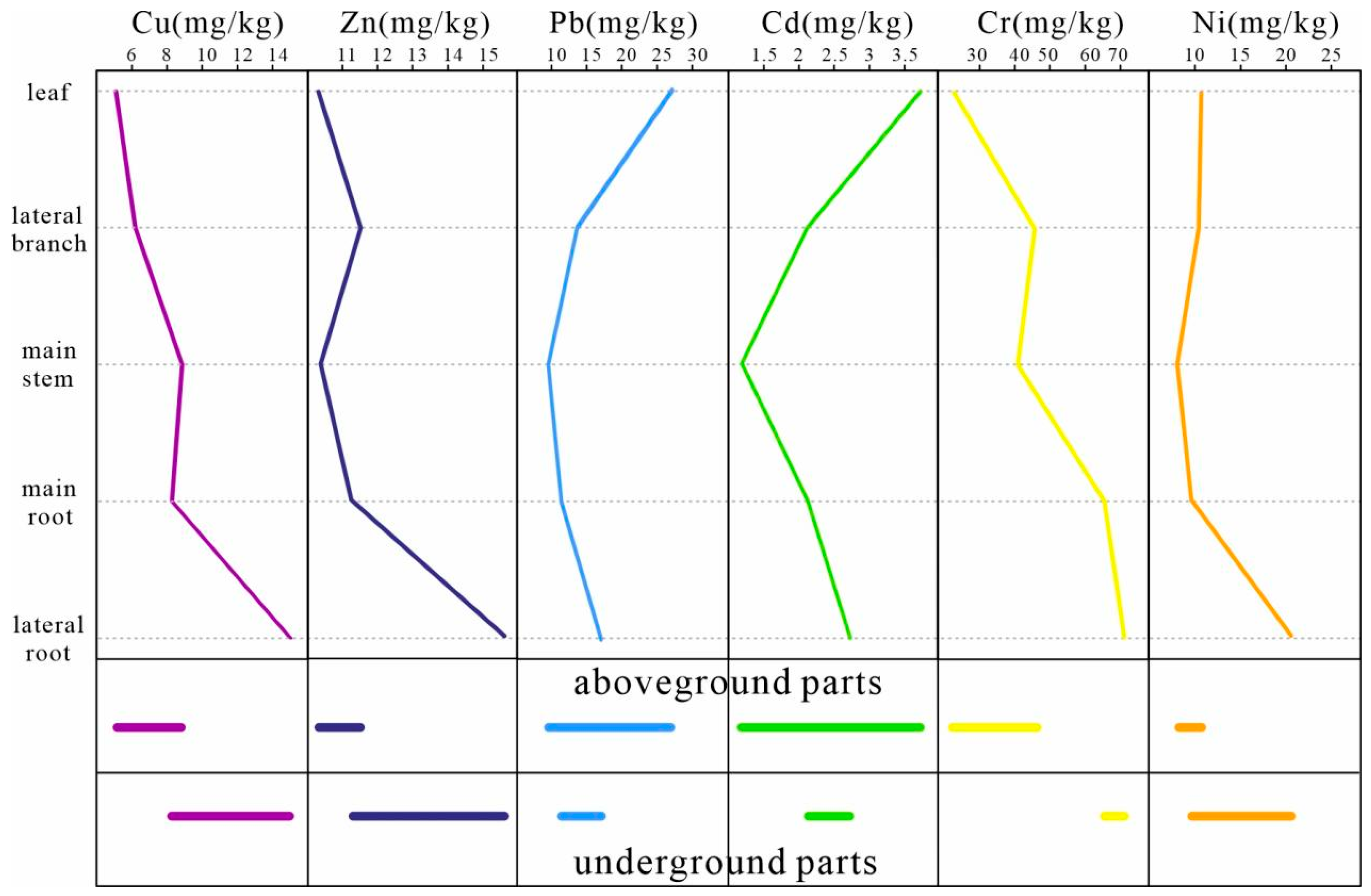
Heavy metals are found at diverse degrees of enrichment in plants that have been taken from various locations. Furthermore, the plant under study exhibited significant heavy metal bioconcentration and transport capabilities under comparable levels of soil contamination (Figure 7). The mean heavy metal concentrations in the Haloxylon ammodendron plant for Cu, Zn, Pb, Cd, Cr, and Ni are 43.4, 59.1, 62.7, 11.9, 230.9, and 59.4 mg/kg, respectively. Different plants in different mining areas have varying heavy metal accumulation capabilities. For example, a study of eight plants and rhizosphere soil heavy metal content in a certain mining area in Yunnan showed that the above-ground parts of Cynanchum anthonyanum Hand.-Mazz. had higher mass fractions of Pb, Zn, and Cd, all exceeding the standard values for hyperaccumulator plants. The average contents of Pb, Zn, and Cd were 1546, 11043, and 391 mg/kg, respectively. Cynanchum anthonyanum exhibits strong tolerance to these three heavy metals and can be promoted as a superior plant for soil remediation in mining areas [54]. The Haloxylon ammodendron contains six different heavy metals, and the order of their contents is as follows: Cr > Pb > Ni > Zn > Cu > Cd. With an average of 230.91 mg/kg, the Haloxylon ammodendron has the highest concentration of the Cr, while Cd has the lowest concentration, with an average of 11.95 mg/kg. The general pattern for the other heavy metals, with the exception of Cr, is that the concentration of the Haloxylon ammodendron increases in proportion to the distance from the mining location. It has been observed that the concentration of Cr in Haloxylon ammodendron in the desert nature reserve is greater than that of Cr in Haloxylon ammodendron in other habitats. For example, a study taking place in a dry region of central Iran found that the average potential for Cr element accumulation in the Haloxylon ammodendron is 0.1 mg/kg, which is higher than the average for most non-desert species [55].
Figure 7 illustrates the disparities in the accumulation of six heavy metals across the different tissues and organs of six Haloxylon ammodendron. This study categorized the Haloxylon ammodendron plant into five distinct organs: leaves, lateral branches, main stem, primary root, and lateral roots. The mean concentrations of Cu, Zn, Pb, Cd, Cr, and Ni in the leaves were 5.1, 10.3, 11.5, 3.7, 23.9, and 10.6 mg/kg, respectively. The content of Cu, Zn, Pb, Cd, Cr, and Ni in the lateral branches was 6.2, 11.5, 13.5, 2.1, 43.2, and 10.4 mg/kg, respectively. The content of Cu, Zn, Pb, Cd, Cr, and Ni in the main stem was 39.2, 8.9, 10.4, 9.4, 1.2, and 8.1 mg/kg, respectively. The content of Cu, Zn, Pb, Cd, Cr, and Ni in the main root was 8.3, 11.2, 11.3, 2.1, 59.9, and 9.6 mg/kg, respectively. The content of Cu, Zn, Pb, Cd, Cr, and Ni in the lateral roots was 15.0, 15.6, 17.0, 2.7, 64.7, and 20.6 mg/kg, respectively. The hierarchy of Cu accumulation in various organs of Haloxylon ammodendron is as follows: lateral roots > main stem > primary root > lateral branches > leaves. The order of Zn accumulation in Haloxylon ammodendron organs is as follows: lateral roots > lateral branches > taproot > main stem > leaves; that of Pb is lateral roots > lateral branches > leaves > taproot > main stem; that of Cd is leaves > lateral roots > lateral branches = taproot > main stem; that of Cr is lateral roots > taproot > lateral branches > main stem > leaves; and that of Ni is lateral roots > leaves > lateral branches > taproot > main stem. Haloxylon ammodendron’s lateral roots exhibited the highest accumulation level for all five heavy metals except Cd. The lowest concentrations of Cu, Zn, and Cr were found in the leaves, while the lowest concentrations of Pb, Cd, and Ni were concentrated in the main stem. The proximity to the mining area correlates positively with the accumulation capability of Haloxylon ammodendron, likely attributable to mining operations, industrial effluents, gas emissions, coal transport, and other influences.
Figure 7 demonstrates the differences in the accumulation of six heavy metals between the above-ground and underground parts of Haloxylon ammodendron. At 23 sampling sites, the overall average concentrations of Cu, Zn, Pb, Cd, Cr, and Ni in the surface parts were, respectively, 20.1, 32.2, 34.5, 7.0, 106.3, and 29.1 mg/kg. In contrast, the average concentrations in the underground parts were 23.3, 26.9, 28.2, 4.9, 124.7, and 30.3 mg/kg, respectively. A comparative analysis of heavy metal contents in the surface and underground parts revealed that Cu, Cr, and Ni were more concentrated in the underground parts than the surface.

3.5. Bio-Concentration of Heavy Metals in Native Plants

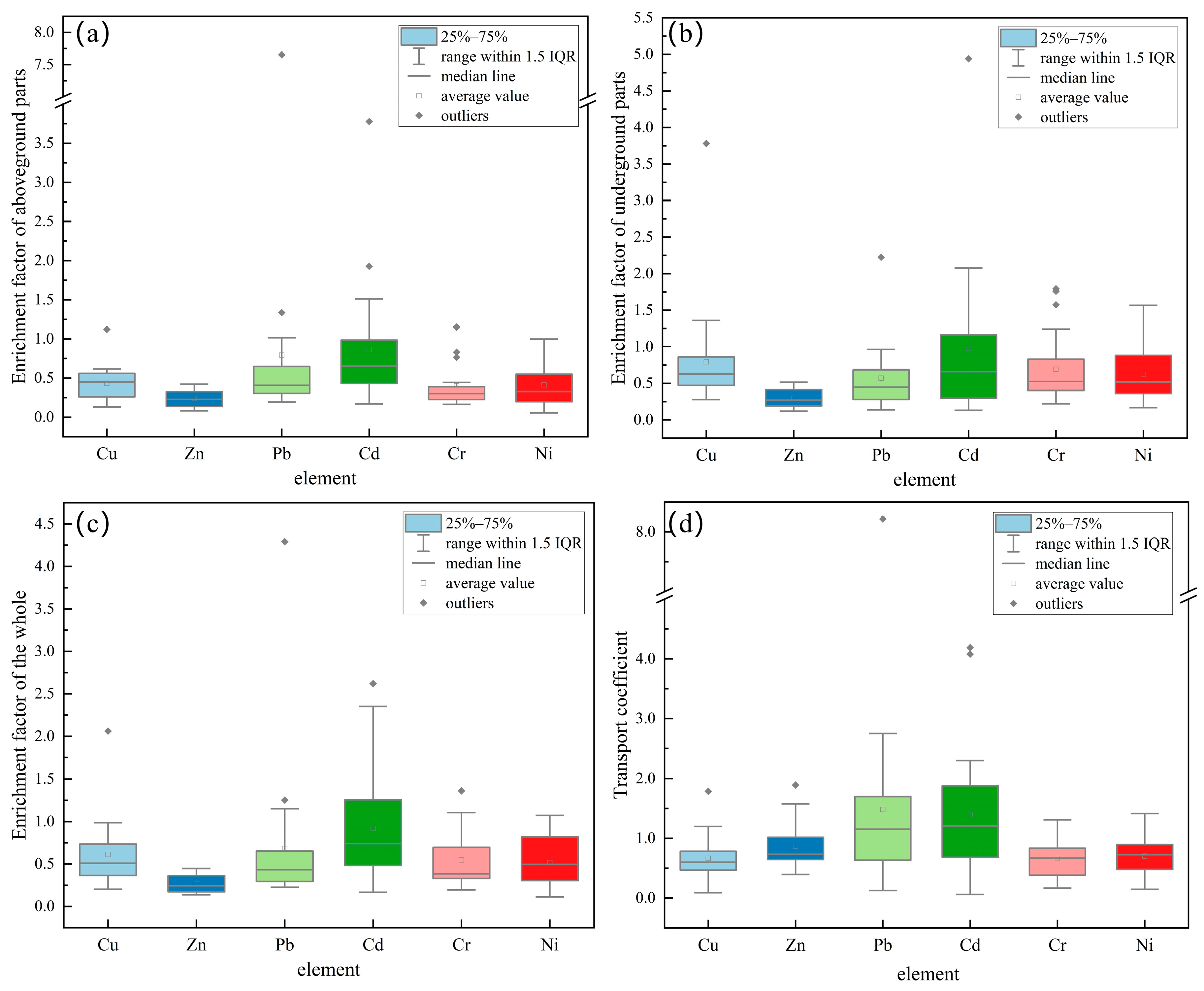
By measuring the concentrations of six heavy metals in Haloxylon ammodendron, we calculated the surface accumulation factor, below-ground accumulation factor, and whole-plant accumulation factor (Figure 8a–c). These accumulation factors reflected the plant’s capacity to absorb heavy metals into its tissues. The data indicated that Haloxylon ammodendron exhibits varying accumulation capacities for different heavy metals. More specifically, on the one hand, the surface accumulation factors were as follows: Cu: 0.28–3.75; Zn: 0.18–1.57; Pb: 0.44–3.90; Cd: 0.43–10.34; Cr: 0.45–5.00, Ni: 0.12–3.37. The overall ranking of surface enrichment factors was Cd > Pb > Ni > Cr > Cu > Zn. On the other hand, the variation ranges for subsurface enrichment factors were as follows: Cu 0.41–7.23; Zn 0.19–0.93; Pb 0.24–4.34; Cd 0.24–7.47; Cr 0.44–3.85; and Ni 0.24–2.90. Overall, the comprehensive ranking of subsurface enrichment factors was Cd > Cu > Cr > Ni > Pb > Zn.
Through comparative analysis of surface and subsurface enrichment components, it was found that Cu, Pb, and Cr exhibited higher enrichment coefficients in the subsurface, whereas Zn, Cd, and Ni were more prominent at the surface. This indicated that the above-ground parts of Haloxylon ammodendron demonstrated superior enrichment capacity for Zn, Cd, and Ni, while the subsurface parts were better at accumulating Cu, Pb, and Cr. The 0.4 enrichment coefficient for xylem plants indicated a significant remediation effect against heavy metal contamination. Within the study region, Haloxylon ammodendron exhibited varying whole-plant enrichment coefficients for Cu, Zn, Pb, Cd, Cr, and Ni, with average values of 2.83, 1.30, 2.55, 4.45, 2.76, and 2.59, respectively. And the order of average enrichment coefficients was Cd > Cu > Cr > Ni > Pb > Zn.

3.6. Translocation of Heavy Metals in Native Plants

Based on variations in heavy metal concentrations within both above-ground and below-ground components of Haloxylon ammodendron (Figure 8d), the translocation factor (TF) of heavy metals was assessed. The TF reflects a plant’s capacity to transport heavy metals from its roots to above-ground parts, and higher values indicate greater heavy metal transfer capability. The TF values for soil heavy metals in Haloxylon ammodendron, ranked from highest to lowest, are Cd(2.0957) > Pb(1.7229) > Zn (1.3024) > Ni(1.0562) > Cu(0.9995) > Cr (0.9989). Data indicate that the TF of Cd significantly outperforms that of other heavy metals. Moreover, the TF for Pb, Zn, and Ni all exceeded 1, indicating that Haloxylon ammodendron can transfer these heavy metals from its roots to its above-ground parts, and demonstrating significant potential for heavy metal translocation. Therefore, during the growth, Haloxylon ammodendron can transport heavy metals from its roots to vacuoles, leaf veins, and xylem through physiological processes, thereby mitigating heavy metal toxicity and enabling its normal growth. Conversely, the TF values for both Cu and Cr were below 1, with Cr having the lowest value (0.9989), indicating the limited capacity of these two heavy metals to be transferred from the roots to the above-ground parts.

3.7. Retention Rates in Native Plants

The retention rate of plants not only reflects their tolerance to heavy metals but also demonstrates the protective role of root systems against heavy metal contamination in soil. To evaluate the retention rate of root systems, quantitative analysis was conducted on heavy metal concentrations in plant tissues, with results presented in Table 3. Table 3 illustrates that various plants have differing retention effects for six distinct heavy metals. The retention sequence for Haloxylon ammodendron is Zn > Ni > Cr > Cu > Pb > Cd. The translocation factor exhibits an inversely proportionate association with the retention rate. The majority of plants have a retention effect for heavy metals in their roots. Plants can safeguard their photosynthetic and metabolic functions by generating harmful ions in their roots and depositing them there. For example, studies have shown that, in the suburbs of Urumqi, the roots of the Haloxylon ammodendron absorb and accumulate higher levels of Ni, Hg, Pb, As, and Cu compared to the above-ground parts.

3.8. Comprehensive Evaluation of Accumulation Indexes

Employing the membership function approach in fuzzy mathematics, the heavy metal concentrations in the above-ground and subterranean components of Haloxylon ammodendron, along with the enrichment coefficients for six heavy metals and the translocation coefficients, were utilized as empirical data to compute the membership function values and comprehensive evaluation metrics for each indicator of Haloxylon ammodendron. The investigation indicates that the study area is contaminated to differing extents by Pb, Cd, and Cr, with Cd being the primary pollutant. Table 4 illustrates that the total enrichment capacity of Haloxylon ammodendron for Pb, Cd, and Cr is 3.8776, whereas its specific enrichment capacity for Cd is 1.8326. The comprehensive assessment value of Haloxylon ammodendron for six heavy metals is 9.1325, indicating its overall efficacy in heavy metal accumulation. The study demonstrated that Haloxylon ammodendron had significant enrichment and transfer capacity for Cd, Pb, and Cr, despite its relatively low retention rate.

4. Discussions

4.1. Rhizosphere Enrichment and Vertical Distribution of Heavy Metals

The present study revealed pronounced enrichment of heavy metals in the soil rhizosphere. This enrichment phenomenon may be associated with root-mediated processes, such as secretion and alterations in the rhizosphere microenvironment, rather than being solely determined by soil depth. These observations provided a basis for evaluating the bioconcentration and translocation characteristics of Haloxylon ammodendron in arid mining area soils. This suggests that heavy metals in soil profiles predominantly display localized enrichment and variable distribution patterns instead of consistent downward accumulation. The distribution pattern may be affected by the cumulative impacts of coal mining disturbances, topsoil material input, and alterations in soil physicochemical parameters. Most heavy metals (Zn, Cu, Cd, Pb, Ni) in the rhizosphere soil of Haloxylon ammodendron exhibited higher concentrations than in bare soil layers at all depths, indicating the plant’s capacity to accumulate heavy metals in its rhizosphere. In general, all six heavy metals were found at their lowest concentrations in the >30 cm bare soil layer, suggesting that heavy metals in this study area are primarily concentrated in the shallow soil layer (0–30 cm) and the rhizosphere zone of Haloxylon ammodendron. Similar rhizosphere enrichment phenomena have been reported in desert and mining-area plants, where biological activity alters metal mobility and availability in the root zone. For instance, the study “Heavy Metal Contamination in the Rhizosphere of Plants at a Decommissioned Gold Mine Tailings Dam” reported moderate-to-significant enrichment of Cd (1.72–8.28) and Mn (1.70–8.32) in the rhizosphere [56]. Root activity and rhizosphere microorganisms increased the proportion of macro-aggregates by 12.3–24.3%, and the heavy metal loading in macro-aggregates increased by 5.6–21.4% compared with non-rhizosphere soil [57]. Another also found that plant root exudates and rhizosphere processes significantly influence the speciation, distribution, and bioavailability of heavy metals in rhizosphere soils, further supporting the regulatory role of rhizosphere-mediated processes in heavy metal enrichment [58].

4.2. Evaluation of Pollution Indices and Chromium Anomaly

Soil pollution levels were evaluated in this study. A conflict appears to emerge, however, when PLI and PN are compared to one another. The contour map makes it abundantly clear that the regions with the highest and lowest values are, for the most part, congruent with one another. The difference can be attributed to the fact that the PN algorithm assigns an abnormally high maximum weight, which, in turn, causes divergent responses to the quantities of pollution observed. Furthermore, compared to the PLI contour map, the PN exhibits a more effective response for determining the heavy metal pollution level that is present inside the research area. Similar inconsistencies between PLI and PN have been documented in previous studies, particularly in areas characterized by heterogeneous pollution sources [9].
This discovery showed that Cr was the main pollutant in the research area. A hypothesis has been proposed that may explain this discrepancy: The comparatively high level of unexplained Cr contribution may result from the superimposition effect of aeolian dust in arid locations. Long-term aeolian dust will transport Cr particles from far-off geological formations and deposit them on the surface if the study area has an arid or semi-arid climate [59,60]. These diffuse natural sources have an extraordinarily wide geographical distribution, making it challenging to record their signals with discrete sampling. Consequently, their contributions are classed as unexplained sources, further increasing the amount of unexplained Cr contribution. The analysis revealed the complexity of Cr pollution dynamics in the target region. Whilst the PN index effectively identified Cr as a priority pollutant, the attribution of pollution sources has remained partially ambiguous. Further investigation through higher-resolution sampling and multi-method combined analysis was required.

4.3. Organ-Specific Accumulation Patterns in Haloxylon ammodendron

From the study of heavy metal accumulation in native plants and their different tissues, we found that Zn, Pb, and Cd were more concentrated in the surface. This indicated that Haloxylon ammodendron exhibited a higher accumulation of Zn, Pb, and Cd in the surface parts, while it showed a greater accumulation of Cu, Cr, and Ni in the underground parts. These findings suggest that different plant organs exhibit varying capacities for heavy metal accumulation, highlighting the specificity of heavy metal enrichment among different plant organs [61,62].

4.4. Phytoremediation Potential of Haloxylon ammodendron

Based on analytical results indicating enrichment coefficients exceeding 1 for all six target heavy metals, Haloxylon ammodendron demonstrated significant heavy metal accumulation capacity. This study revealed that Cd pollution was most severe in the region, with Haloxylon ammodendron exhibiting the strongest Cd accumulation capacity among the tested heavy metals. Haloxylon ammodendron exhibited a significant soil enrichment factor for Cd, a remarkable whole-plant enrichment factor, and an effective transfer capacity. Its characteristic rendered it suitable for phytoremediation technology, enabling greater Cd accumulation in its above-ground parts and thereby facilitating the recovery and reuse of Cd from soils. The heavy metals are stabilized in the roots, and their transfer to the above-ground parts is restricted, resulting in lower heavy metal content in the above-ground parts and thereby ameliorating the toxic effects on the above-ground portions of the plant [63].
The roots of Haloxylon ammodendron serve as the principal repositories for heavy metals such as Zn, Ni, and Cr, whereas the leaves and stems predominantly accumulate Cu, Pb, and Cd. This enables the roots to possess sufficient surface area to sequester heavy metals, thus aiding the plant in managing elevated soil contamination, especially Cd pollution. Plants that grow in highly polluted areas can accumulate large quantities of heavy metals in their roots while restricting their transport to the above-ground parts, thereby protecting the above-ground parts from damage [64,65]. Thus, this plant may be an ideal candidate species for the phytoremediation of Cd-contaminated soils. As a deep-rooted plant, Haloxylon ammodendron can thrive even in arid environments with low soil moisture content. Consequently, it might be regarded as a predominant species for mitigating Cd contamination in the research region. Indigenous florae are less influenced by climatic and regional constraints; thus, the cultivation of Haloxylon ammodendron can mitigate soil contamination by Cd, Pb, and Cr in the Eastern Junggar Coalfield.

4.5. Ecological Risks and Management Implications

However, as the primary forage plant in local arid pastures, Haloxylon ammodendron’s potent metal accumulation capacity may transfer heavy metals into grazing food chains, posing potential ecological risks. Specifically, Cd highly enriched in its above-ground tissues (the primary forage source for local livestock such as sheep and goats) may undergo bioconcentration and biomagnification through the food chain: livestock consuming Haloxylon ammodendron may accumulate heavy metals (particularly Cd), which could subsequently be transferred to humans via animal products, as well as other heavy metals (Cu, Zn, Cr, Ni, Pb) [66]. Consequently, when utilizing Haloxylon ammodendron for phytoremediation in dry mining regions, its dual function as both a phytoremediation agent and livestock fodder must be thoroughly evaluated. To reduce the risk of metal transmission in grazing environments, specific actions should be taken.

4.6. Future Research Perspectives

Future research should emphasize the utilization of more exact and sophisticated analytical techniques to improve the source apportionment of heavy metals in soils affected by mining, as shown by the findings of this study. The amalgamation of high-resolution spatial sampling with diverse analytical methodologies, such as isotopic fingerprinting and receptor modeling, may facilitate more dependable differentiation between natural and anthropogenic contamination sources. Furthermore, comprehensive studies are necessary to evaluate the possible ecological and human health hazards linked to heavy metal deposition and transmission within the soil–plant–animal–human food chain, especially in grazing-centric mining areas. Subsequent research should concentrate on the advancement and refinement of targeted remediation and management solutions to mitigate elevated heavy metal concentrations in coal mining regions and to minimize the dangers of heavy metal dissemination within terrestrial ecosystems.

5. Conclusions

Soil heavy metal contamination has emerged as a global environmental issue, necessitating the repair of affected soils. Phytoremediation, an innocuous and eco-friendly technique for soil pollution management, has been thoroughly researched and implemented. This research examines the soils and Haloxylon ammodendron in the Eastern Junggar Coalfield of Xinjiang. Field investigations constructed 23 sampling plots, from which 115 soil and plant samples were gathered. The Pb, Cd, and Cr quantities were 1.2, 22.5, and 1.9 times the background levels of Xinjiang soils, respectively. The average values of six heavy metals in the rhizosphere soil of Haloxylon ammodendron were 48.81, 17.74, 93.25, 3.32, 29.05, and 26.95 mg/kg, respectively. The exceedance rates for Cd, Cr, and Pb in the soil of the research area were 100%, 99.03%, and 75.73%, respectively, signifying substantial heavy metal accumulation, with Cd exhibiting the greatest enrichment level. The PLI values showed that most sampling sites exhibited moderate pollution degrees; meanwhile, the PN values indicated elevated pollution degrees across all sampling sites. The principal pollutant was the Cr. According to the APCS-MLR analysis, 44.2% of contaminants were determined to result from natural and mining activities, 22.7% from industrial coal combustion and sewage, and 33.1% from unidentified sources. The BCF values for Cu, Zn, Pb, Cd, Cr, and Ni in Haloxylon ammodendron were all greater than 1, showing strong accumulation capacity. The TF values of Cd, Pb, Zn, and Ni were all greater than 1, indicating the strong translocation capability of these metals. The analysis showed that Zn, Ni, and Cr were primarily enriched in the roots, and the elements of Cu, Pb, and Cd were predominantly accumulated in the stems and leaves. The retention sequence for Haloxylon ammodendron is Zn > Ni > Cr > Cu > Pb > Cd. The fuzzy membership function analysis showed that the overall evaluation score for Haloxylon ammodendron was 9.1325, indicating that Haloxylon ammodendron has significant potential in remediating heavy metals. Haloxylon ammodendron also showed strong accumulation and remediation potential for Cr and Pb.

Author Contributions

Z.W.: Conceptualization, methodology, data processing, writing—original draft; X.H.: Conceptualization, supervision and access to funding; Z.A.: software, data processing; drawing. X.G.: Project administration, methodology and supervision; G.W.: Data processing, writing—original draft and methodology; M.C.: Data processing, writing—original draft and drawing. All authors have read and agreed to the published version of the manuscript.

Funding

This research was supported by the Key research and development special Project Sub-topic of Autonomous Region (2022B03030-2), and the Central government guides local science and technology development special project (ZYYD2023A03).

Data Availability Statement

The data sets are available from the corresponding author on reasonable request.

Acknowledgments

The authors would like to express sincere thanks to Qirong Hu for his substantial efforts in field sample collection, data processing and analysis, as well as constructive suggestions and assistance in revising the manuscript and addressing the reviewers’ comments. His help has greatly improved this work.

Conflicts of Interest

The authors declare no conflicts of interest.

References

  1. Bhuiyan, M.A.H.; Parvez, L.; Islam, M.A.; Dampare, S.B.; Suzuki, S. Heavy metal pollution of coal mine-affected agricultural soils in the northern part of Bangladesh. J. Hazard Mater. 2010, 173, 384–392. [Google Scholar] [CrossRef]
  2. Dai, S.F.; Ren, D.Y.; Chou, C.L.; Finkelman, R.B.; Seredin, V.V.; Zhou, Y.P. Geochemistry of trace elements in Chinese coals: A review of abundances, genetic types, impacts on human health, and industrial utilization. Int. J. Coal Geol. 2012, 94, 3–21. [Google Scholar] [CrossRef]
  3. Han, Y.; Kou, J.; Jiang, B.; Li, J.; Liu, C.; Lei, S.; Xiao, H.; Feng, C. Bryophytes adapt to open-pit coal mine environments by changing their functional traits in response to heavy metal-induced soil environmental changes. J. Hazard Mater. 2025, 482, 136613. [Google Scholar] [CrossRef]
  4. Liang, J.; Feng, C.T.; Zeng, G.M.; Gao, X.; Zhong, M.Z.; Li, X.D.; Li, X.; He, X.Y.; Fang, Y.L. Spatial distribution and source identification of heavy metals in surface soils in a typical coal mine city, Lianyuan, China. Environ. Pollut. 2017, 225, 681–690. [Google Scholar] [CrossRef]
  5. Liu, H.B.; Liu, Z.L. Recycling utilization patterns of coal mining waste in China. Resour. Conserv. Recycl. 2010, 54, 1331–1340. [Google Scholar] [CrossRef]
  6. Sarpong, L.; Boadi, N.O.; Nimako, C.; Bortey-Sam, N.; Akoto, O. Contamination, health risk assessment, and spatial distribution of heavy metals in soils from gold mining district, Ghana. Int. J. Environ. Sci. Technol. 2024, 22, 10195–10218. [Google Scholar] [CrossRef]
  7. Tu, J.; Chen, X.; Guo, X.; Guo, S.; Xu, L.; Lin, Z. Environmental risk and source analysis of heavy metals in tailings sand and surrounding soils in Huangshaping mining area. Environ. Pollut. Bioavailab. 2024, 36, 2395559. [Google Scholar] [CrossRef]
  8. Xu, P.; Gao, L.; Zhao, Q. Distribution characteristics, sources and risk assessment of heavy metal(oid)s in road dust from a typical lead-zinc mining area in South China. Environ. Geochem. Health 2025, 47, 9. [Google Scholar] [CrossRef]
  9. Li, L.; Wu, J.; Lu, J.; Min, X.; Xu, J.; Yang, L. Distribution, pollution, bioaccumulation, and ecological risks of trace elements in soils of the northeastern Qinghai-Tibet Plateau. Ecotoxicol. Environ. Saf. 2018, 166, 345–353. [Google Scholar] [CrossRef] [PubMed]
  10. Lu, J.; Gao, L.; Wang, H. Contamination characteristics of heavy metals and enrichment capacity of native plants in soils around typical coal mining areas in Gansu, China. Sci. Rep. 2024, 14, 29983. [Google Scholar] [CrossRef] [PubMed]
  11. Wen, X.; Li, L.; Wu, J.; Lu, J.; Sheng, D. Multiple assessments, source determination, and health risk apportionment of heavy metal(loid)s in the groundwater of the Shule River Basin in northwestern China. J. Arid Land 2023, 15, 1355–1375. [Google Scholar] [CrossRef]
  12. Chen, Y.; Ding, Z.; Yu, T.; Cao, L.; Duan, Y.; Zu, Y.; Li, Z. Accumulation characteristics of heavy metals in three wild rice species and adaptation of root morphology and anatomical structure to native soil heavy metals in Yunnan. Ecol. Indic. 2024, 167, 112601. [Google Scholar] [CrossRef]
  13. Liu, N.; Li, X.; Chen, P.; Yuan, W.; Wang, D.; Wang, X. Climate and vegetation controlling accumulation and translocation of heavy metals in water tower regions of Qinghai-Tibet Plateau. J. Hazard Mater. 2024, 484, 136752. [Google Scholar] [CrossRef]
  14. Guo, M.; Xiao, Y.; Zhang, J.; Wei, L.; Wei, W.; Xiao, L.; Fan, R.; Zhang, T.; Zhang, G. Insights into the Pattern of the Persistent Heavy Metal Pollution in Soil from a Six-Decade Historical Small-Scale Lead-Zinc Mine in Guangxi, China. Processes 2024, 12, 1745. [Google Scholar] [CrossRef]
  15. Dippong, T.; Resz, M.-A.; Tanaselia, C.; Cadar, O. Assessing microbiological and heavy metal pollution in surface waters associated with potential human health risk assessment at fish ingestion exposure. J. Hazard. Mater. 2024, 476, 135187. [Google Scholar] [CrossRef] [PubMed]
  16. Ekperusi, A.O.; Michael, A.; Chukwurah, C.H.; Sunday, N.M. Evaluation of heavy metals and their potential risk to human health from seafood in Escravos Estuary, Southern Nigeria. Mar. Pollut. Bull. 2024, 208, 117014. [Google Scholar] [CrossRef] [PubMed]
  17. Sun, L.; Guo, D.; Liu, K.; Meng, H.; Zheng, Y.; Yuan, F.; Zhu, G. Levels, sources, and spatial distribution of heavy metals in soils from a typical coal industrial city of Tangshan, China. Catena 2019, 175, 101–109. [Google Scholar] [CrossRef]
  18. Tang, Z.; Chai, M.; Cheng, J.; Jin, J.; Yang, Y.; Nie, Z.; Huang, Q.; Li, Y. Contamination and health risks of heavy metals in street dust from a coal mining city in eastern China. Ecotoxicol. Environ. Saf. 2017, 138, 83–91. [Google Scholar] [CrossRef]
  19. Zhang, H.; Zhang, F.; Song, J.; Tan, M.L.; Kung, H.-t.; Johnson, V.C. Pollutant source, ecological and human health risks assessment of heavy metals in soils from coal mining areas in Xinjiang, China. Environ. Res. 2021, 202, 111702. [Google Scholar] [CrossRef] [PubMed]
  20. Leung, A.O.W.; Duzgoren-Aydin, N.S.; Cheung, K.C.; Wong, M.H. Heavy metals concentrations of surface dust from e-waste recycling and its human health implications in southeast China. Environ. Sci. Technol. 2008, 42, 2674–2680. [Google Scholar] [CrossRef]
  21. Ren, M.; Deng, Y.; Ni, W.; Su, J.; Tong, Y.; Han, X.; Li, F.; Wang, H.; Zhao, F.; Huang, X.; et al. Sources Analysis and Health Risk Assessment of Heavy Metals in Street Dust from Urban Core of Zhengzhou, China. Sustainability 2024, 16, 7604. [Google Scholar] [CrossRef]
  22. Wei, B.; Yang, L. A review of heavy metal contaminations in urban soils, urban road dusts and agricultural soils from China. Microchem. J. 2010, 94, 99–107. [Google Scholar] [CrossRef]
  23. Ma, X.; Xia, D.; Zhang, G.; Chen, P.; Liu, X.; Liu, H.; Wang, W.; Zhan, H.; Zhang, Y.; Yu, Q. Water-Soluble Ions and Heavy Metal Levels, Source Apportionment, and Health Risk of Indoor Dust in the Mogao Grottoes of Dunhuang, China. Indoor Air 2023, 2023, 4818195. [Google Scholar] [CrossRef]
  24. Rahimi, M.; Rouzbahani, M.M.; Payandeh, K.; Nazarpour, A.; Panahpour, E. Potential risk assessment of respiratory exposure to heavy metals in the air dust for the metropolitans of Khuzestan Province, Iran. Global Nest J. 2024, 26, 05208. [Google Scholar]
  25. Zheng, J.; Chen, K.-h.; Yan, X.; Chen, S.-J.; Hu, G.-C.; Peng, X.-W.; Yuan, J.-g.; Mai, B.-X.; Yang, Z.-Y. Heavy metals in food, house dust, and water from an e-waste recycling area in South China and the potential risk to human health. Ecotoxicol. Environ. Saf. 2013, 96, 205–212. [Google Scholar] [CrossRef] [PubMed]
  26. Basta, N.T.; McGowen, S.L. Evaluation of chemical immobilization treatments for reducing heavy metal transport in a smelter-contaminated soil. Environ. Pollut. 2004, 127, 73–82. [Google Scholar] [CrossRef]
  27. Liao, K.; Li, W.; Huang, Z.; Lin, S.; Fu, L.; Liu, W.; Fang, H.; Deng, H. Comprehensive evaluation of the distribution, transport and ecological risk of heavy metals in intra-urban river sediments using high-resolution techniques. Environ. Pollut. 2024, 361, 124808. [Google Scholar] [CrossRef] [PubMed]
  28. Kaintura, S.S.; Thakur, S.; Kaur, S.; Devi, S.; Tiwari, K.; Priyanka, A.; Sharma, A.; Singh, P.P. Investigation of radioactivity and heavy metal levels in soil samples from neutral and vegetation land of Punjab, India. Environ. Monit. Assess. 2024, 196, 940. [Google Scholar] [CrossRef]
  29. He, X.; Zhang, F.; Zhou, T.; Wang, B.; Zhang, X.; Liu, X.; Ahmed, Z.; Tan, M.L.; Feng, Z.; Li, Z.; et al. Risk assessment, source apportionment and driving mechanism of soil heavy metals in coal mining areas of Xinjiang, China. Gondwana Res. 2026, 154, 64–81. [Google Scholar] [CrossRef]
  30. Rai, P.K.; Lee, S.S.; Zhang, M.; Tsang, Y.F.; Kim, K.-H. Heavy metals in food crops: Health risks, fate, mechanisms, and management. Environ. Int. 2019, 125, 365–385. [Google Scholar] [CrossRef]
  31. Zhou, M.; Liu, H.; Liu, B.; Zhang, M.; Tang, Z.; Zong, L.; Wang, S.; Niu, X.; Tian, F. Geochemical characterization of heavy metals in the soil rice system and risk assessment for human health. Environ. Pollut. Bioavailab. 2024, 36, 2368592. [Google Scholar] [CrossRef]
  32. Gade, M.; Comfort, N.; Re, D.B. Sex-specific neurotoxic effects of heavy metal pollutants: Epidemiological, experimental evidence and candidate mechanisms. Environ. Res. 2021, 201, 111558. [Google Scholar] [CrossRef] [PubMed]
  33. Song, J.; Wang, X.; Huang, Q.; Wei, C.; Yang, D.; Wang, C.; Fan, K.; Cheng, S.; Guo, X.; Wang, J. Predictors of urinary heavy metal concentrations among pregnant women in Jinan, China. J. Trace Elem. Med. Biol. 2024, 84, 127444. [Google Scholar] [CrossRef]
  34. Sun, B.; Ni, W.; Hao, X.; Li, H.; Zhang, B. Status quo of Xinjiang coal industry development and economic analysis of Xinjiang coal outbound transportation. Coal Eng. 2024, 56, 1–6. [Google Scholar]
  35. Pan, G.; Xi, Y.; Luo, Y.; Xu, L.; Cui, L.; Ran, J. Characteristics of air pollution and spatial source changes in urban agglomeration on the northern slope of Tianshan Mountain. Acta Sci. Circumst. 2025, 45, 38–48. [Google Scholar]
  36. Yu, Z.; Yu, X.; Li, X.; Mei, Z.; Chen, S. Spatiotemporal variations of PM2.5 in Xinjiang during 2000-2022 revealed by the China High air pollutants(CHAP) reanalysis dataset. J. Arid Land Res. Environ. 2025, 39, 132–144. [Google Scholar]
  37. Mahar, A.; Wang, P.; Ali, A.; Awasthi, M.K.; Lahori, A.H.; Wang, Q.; Li, R.; Zhang, Z. Challenges and opportunities in the phytoremediation of heavy metals contaminated soils: A review. Ecotoxicol. Environ. Saf. 2016, 126, 111–121. [Google Scholar] [CrossRef] [PubMed]
  38. Luo, Z.-B.; He, J.; Polle, A.; Rennenberg, H. Heavy metal accumulation and signal transduction in herbaceous and woody plants: Paving the way for enhancing phytoremediation efficiency. Biotechnol. Adv. 2016, 34, 1131–1148. [Google Scholar] [CrossRef]
  39. Rao, M.C.S.; Rahul, V.D.; Uppar, P.; Madhuri, M.L.; Tripathy, B.; Vyas, R.D.V.; Swami, D.V.; Raju, S.S. Enhancing the Phytoremediation of Heavy Metals by Plant Growth Promoting Rhizobacteria (PGPR) Consortium: A Narrative Review. J. Basic Microbiol. 2024, 65, e2400529. [Google Scholar] [CrossRef]
  40. Liu, W.; Yang, J.-j.; Wang, J.; Wang, G.; Cao, Y.-e. Contamination Assessment and Sources Analysis of Soil Heavy Metals in Opencast Mine of East Junggar Basin in Xinjiang. Huanjing Kexue 2016, 37, 1938–1945. [Google Scholar]
  41. Li, L.; Wu, J.; Lu, J.; Xu, J. Trace elements in Gobi soils of the northeastern Qinghai-Tibet Plateau. Chem. Ecol. 2020, 36, 967–981. [Google Scholar] [CrossRef]
  42. Shen, M.; Chen, L.; Han, W.; Ma, A. Methods for the determination of heavy metals in indocalamus leaves after different preservation treatment using inductively-coupled plasma mass spectrometry. Microchem. J. 2018, 139, 295–300. [Google Scholar] [CrossRef]
  43. Zhao, M.; Chen, Z.; Qian, C.; Zhao, Y.; Xu, Y.; Liu, Y. Correcting correlation quality of portable X-ray fluorescence to better map heavy metal contamination by spatial co-kriging interpolation. Ecotoxicol. Environ. Saf. 2024, 271, 115962. [Google Scholar] [CrossRef] [PubMed]
  44. Kurniawan, T.A.; Lo, W.; Othman, M.H.D.; Goh, H.H.; Chong, K.-K. Biosorption of heavy metals from aqueous solutions using activated sludge, Aeromasss hydrophyla, and Branhamella spp based on modeling with GEOCHEM. Environ. Res. 2022, 214, 114070. [Google Scholar] [CrossRef]
  45. Li, L.; Wu, J.; Lu, J.; Xu, J. Speciation, risks and isotope-based source apportionment of trace elements in soils of the northeastern Qinghai-Tibet Plateau. Geochem. Explor. Environ. Anal. 2020, 20, 315–322. [Google Scholar] [CrossRef]
  46. MEPC. Background Values of Soil Elements in China; Environment Science Press: Beijing, China, 1990. [Google Scholar]
  47. Galal, T.M.; Shehata, H.S. Bioaccumulation and translocation of heavy metals by Plantago major L. grown in contaminated soils under the effect of traffic pollution. Ecol. Indic. 2015, 48, 244–251. [Google Scholar] [CrossRef]
  48. Hu, B.; Xue, J.; Zhou, Y.; Shao, S.; Fu, Z.; Li, Y.; Chen, S.; Qi, L.; Shi, Z. Modelling bioaccumulation of heavy metals in soil-crop ecosystems and identifying its controlling factors using machine learning. Environ. Pollut. 2020, 262, 114308. [Google Scholar] [CrossRef]
  49. Zhong, X.; Chen, Z.; Li, Y.; Ding, K.; Liu, W.; Liu, Y.; Yuan, Y.; Zhang, M.; Baker, A.J.M.; Yang, W.; et al. Factors influencing heavy metal availability and risk assessment of soils at typical metal mines in Eastern China. J. Hazard. Mater. 2020, 400, 123289. [Google Scholar] [CrossRef]
  50. Zhan, F.; Li, B.; Jiang, M.; Yue, X.; He, Y.; Xia, Y.; Wang, Y. Arbuscular mycorrhizal fungi enhance antioxidant defense in the leaves and the retention of heavy metals in the roots of maize. Environ. Sci. Pollut. Res. Int. 2018, 25, 24338–24347. [Google Scholar] [CrossRef]
  51. Nocito, F.F.; Lancilli, C.; Dendena, B.; Lucchini, G.; Sacchi, G.A. Cadmium retention in rice roots is influenced by cadmium availability, chelation and translocation. Plant Cell Environ. 2011, 34, 994–1008. [Google Scholar] [CrossRef]
  52. Zhou, P.F.; Zhang, S.W.; Luo, M.; Wei, H.B.; Song, Q.; Fang, B.; Zhuang, H.J.; Chen, H.Y. Characteristics of Plant Diversity and Heavy Metal Enrichment and Migration Under Different Ecological Restoration Modes in Abandoned Mining Areas. Huanjing Kexue 2022, 43, 985–994. [Google Scholar] [PubMed]
  53. Li, C.; Zhu, G.; Peng, K. Study on soil pollution characteristics by heavy metals and the plant concentration in green belts. J. Cent. South Univ. For. Technol. 2016, 36, 101–107. [Google Scholar]
  54. Xiao, Q.; Wang, H.; Wang, H.; Ye, Z. Co-hyperaccumulative characteristics of lead, zinc and cadmium by Silene viscidula Franch. Ecol. Environ. Sci. 2009, 18, 1299–1306. [Google Scholar]
  55. Sakizadeh, M.; Rodriguez Martin, J.A.; Zhang, C.; Sharafabadi, F.M.; Ghorbani, H. Trace elements concentrations in soil, desert-adapted and non-desert plants in central Iran: Spatial patterns and uncertainty analysis. Environ. Pollut. 2018, 243, 270–281. [Google Scholar] [CrossRef]
  56. Doku, E.T.; Belford, E.J.D. Heavy Metal Contamination in Rhizosphere of Plants at a Decommissioned Gold Mine Tailings Dam. Water Air Soil Pollut. 2024, 235, 630. [Google Scholar] [CrossRef]
  57. Lin, S.; Wu, B.; Li, X.; Yang, X.; Lin, Q.; Qiu, R. Pioneer plants enhance heavy metal immobilization in mining soils: Decoding rhizosphere-driven mechanisms. Plant Soil 2025, 516, 2259–2275. [Google Scholar] [CrossRef]
  58. Yu, X.; Li, T.; Wu, X.; Liu, C.; Li, S.; Peng, S.; Wang, S.; Zhao, L.; Duan, C. Exudates of dominant plants regulate rhizospheric soil total and available heavy metals and facilitates natural restoration succession in an abandoned metal mining area. Front. Environ. Sci. 2025, 13, 1698742. [Google Scholar] [CrossRef]
  59. Guo, L.; Lyu, Y.; Yang, Y. Concentrations and chemical forms of heavy metals in the bulk atmospheric deposition of Beijing, China. Environ. Sci. Pollut. Res. 2017, 24, 27356–27365. [Google Scholar] [CrossRef] [PubMed]
  60. Jiang, S.; Dong, X.; Han, Z.; Zhao, J.; Zhang, Y. Emissions and Atmospheric Dry and Wet Deposition of Trace Metals from Natural and Anthropogenic Sources in Mainland China. Atmosphere 2024, 15, 402. [Google Scholar] [CrossRef]
  61. Zahid, B.; Deep, R.; Rangabhashiyam, S. Variation in heavy metal accumulation and translocation patterns in plant species utilized for reclamation of coal mine spoils in the southern Godavari Valley coalfield, India. J. Environ. Chem. Engin. 2025, 13, 119824. [Google Scholar]
  62. Zhang, C.; Liu, Q.; He, H.; Guo, X.; Yang, S.; Zhang, L.; Wang, L. Metal removal from heavy metal-enriched plants by deep eutectic solvents and its mechanism investigation. Sep. Purif. Technol. 2025, 357, 130189. [Google Scholar] [CrossRef]
  63. Dong, Z.; Aliya, B.; Song, M.; Maierdan, A.; Ruoshanguli, M.; Ma, S. Remediation Potential of Haloxylon ammodendron Plantation on Soil Heavy Metal Pollution in Suburbs. J. Northwest For. Univ. 2023, 38, 58–65. [Google Scholar]
  64. Aksoy, A.; Duman, F.; Sezen, G. Heavy metal accumulation and distribution in narrow-leaved cattail (Typha angustifolia) and common reed (Phragmites australis). J. Freshwater Ecol. 2005, 20, 783–785. [Google Scholar] [CrossRef]
  65. Zhou, S.; Wang, C.; Yang, H.; Bi, D.; Li, J.; Wang, Y. Stress responses and bioaccumulation of heavy metals by Zizania latifolia and Acorus calamus. Acta Ecol. Sin. 2007, 27, 281–287. [Google Scholar]
  66. Fechete, F.-I.; Popescu, M.; Mârza, S.-M.; Olar, L.-E.; Papuc, I.; Beteg, F.-I.; Purdoiu, R.-C.; Codea, A.R.; Lăcătuș, C.-M.; Matei, I.-R.; et al. Spatial and Bioaccumulation of Heavy Metals in a Sheep-Based Food System: Implications for Human Health. Toxics 2024, 12, 752. [Google Scholar] [CrossRef] [PubMed]
Figure 1. Research area and sampling points; (a) Map of the study area showing the location of sampling sites in Xinjiang Uygur Autonomous Region; (b) Sampling area and sampling sites (marked in white).
Agronomy 16 00460 g001
Figure 2. Photographs of the field survey and sampling work; (a,b) soil profile sampling; (c) measurement of soil profile depth; (d) root and rhizosphere soil sampling.
Agronomy 16 00460 g002
Figure 3. Vertical spatial geochemistry maps of heavy metals.
Agronomy 16 00460 g003
Figure 4. The heavy metal content in the rhizosphere soil of plants in the study area; Sampling points marked as exceeding the background value.
Agronomy 16 00460 g004
Figure 5. The PLI contour map of topsoil (a), Q-Q diagram and cumulative frequency distribution diagram of PLI (b), PN contour map of topsoil (c), Q-Q diagram and cumulative frequency distribution diagram of PN (d).
Agronomy 16 00460 g005
Figure 6. Contribution (a) and average contribution (b) of heavy metal sources in topsoil as per the APCS-MLR model.
Agronomy 16 00460 g006
Figure 7. Heavy metal content in different parts of plants in the study area.
Agronomy 16 00460 g007
Figure 8. Enrichment factors and transport coefficients for different heavy metals by Haloxylon ammodendron. (a) Enrichment factor of aboveground parts; (b) Enrichment factor of underground parts; (c) Enrichment factor of the whole; (d) Transport coefficient.
Agronomy 16 00460 g008
Table 1. Heavy metal content in the study area.
Soil Depth
(cm)
ElementsMin-Max
(mg/kg)
Mean
(mg/kg)
p-Value (One-Way ANOVA)p-Value (Kruskal-Wallis)SD
(mg/kg)
95% CI (mg/kg)a BV
(mg/kg)
0–10
(n = 23)
Cu6.29–31.0016.480.9810.9266.2213.79–19.1726.70
Zn25.74–68.3946.910.9110.85211.1242.10–51.7268.80
Pb8.67–46.1324.330.71690.7389.1520.37–28.2919.40
Cd1.34–5.012.740.3680.4781.002.30–3.170.12
Cr67.17–127.8095.600.7970.80419.4187.21–104.0049.30
Ni13.58–38.8925.350.7080.8036.7122.45–28.2526.60
10–30
(n = 23)
Cu6.13–31.9216.560.9810.9266.8113.61–19.5026.70
Zn24.69–65.6946.030.9110.85212.5740.60–51.4768.80
Pb14.67–47.9624.360.71690.7388.9820.48–28.2519.40
Cd1.50–6.932.910.3680.4781.312.34–3.470.12
Cr51.11–130.0095.420.7970.80423.9385.07–105.7749.30
Ni17.37–44.2226.560.7080.8036.7523.64–29.4826.60
>30
(n = 23)
Cu6.38–31.8316.190.9810.9266.9913.17–19.2226.70
Zn25.61–67.4545.370.9110.85212.5039.97–50.7868.80
Pb8.14–40.0022.450.71690.7389.0818.52–26.3819.40
Cd1.03–4.262.450.3680.4780.982.02–2.870.12
Cr37.95–143.9091.500.7970.80426.0180.25–102.7549.30
Ni13.18–37.2325.000.7080.8036.5022.19–27.8126.60
a BV: background values of Xinjiang Uygur Autonomous Region soils [40]; CI: Confidence Interval; SD: Standard Deviation; n: Sampling sites for each soil layer; n: number of sample sites.
Table 2. The results of topsoil heavy metal in the principal component analysis.
Master
Score
Eigen-
Value
Contribution RateCumulative Contribution RateElementFactor 1Factor 2Common Factor Variance
12.61443.56443.564Cu0.8610.2310.795
21.65527.58871.151Zn0.8790.2910.856
30.68411.40582.556Pb−0.1990.8840.82
40.68211.3793.926Cd−0.370.8420.845
50.2694.49198.417Cr0.682−0.0920.473
60.0951.583100Ni0.6770.1420.479
Table 3. Retention rates of different heavy metals by Haloxylon ammodendron.
PlantElememtRetention Rate(%)
Haloxylon ammodendronCu0.508
Zn0.756
Pb0.444
Cd0.211
Cr0.522
Ni0.548
Table 4. Affiliation function values of heavy metal accumulation indexes for Haloxylon ammodendron.
ElementIndex
Aboveground ContentUnderground ContentAboveground Enrichment CoefficientUnderground Enrichment CoefficientTranslocation Coefficient
Cu0.26570.19840.29020.16580.3392
Zn0.41800.46950.38550.53350.3157
Pb0.22790.19670.28120.22110.3896
Cd0.13100.14820.21390.23010.3239
Cr0.30720.28520.18690.29910.4356
Ni0.42980.24620.36390.39390.4395
Comprehensive value9.1325
Disclaimer/Publisher’s Note: The statements, opinions and data contained in all publications are solely those of the individual author(s) and contributor(s) and not of MDPI and/or the editor(s). MDPI and/or the editor(s) disclaim responsibility for any injury to people or property resulting from any ideas, methods, instructions or products referred to in the content.