Article

Effect of NaCl Stress on Proline Metabolism in Two Varieties of Habanero Pepper

by
Camilo Escalante-Magaña
1,
Marta Lizama-Gasca
2,
Fatima Medina-Lara
1,
Isaac Zepeda-Jazo
3,
Ileana Echevarria-Machado
1 and
Manuel Martinez-Estevez
1,*
1
Integrative Biology Unit, Yucatan Scientific Research Center, Calle 43 No. 130, Col. Chuburná de Hidalgo, Mérida 97200, Yucatán, Mexico
2
Biotechnology Unit, Yucatan Scientific Research Center, Calle 43 No. 130, Col. Chuburná de Hidalgo, Mérida 97200, Yucatán, Mexico
3
Department of Food Genomics, University of La Ciénega of the State of Michoacán de Ocampo, Sahuayo 59103, Michoacán de Ocampo, Mexico
*
Author to whom correspondence should be addressed.
Agronomy 2026, 16(4), 409; https://doi.org/10.3390/agronomy16040409
Submission received: 10 November 2025 / Revised: 31 January 2026 / Accepted: 6 February 2026 / Published: 8 February 2026
(This article belongs to the Section Horticultural and Floricultural Crops)

Abstract

Although the role of proline (Pro) as an important osmolyte has been extensively studied, there are few comprehensive studies on their metabolism under salinity conditions. We investigated Pro metabolism in two habanero pepper varieties with contrasting salinity responses: Mayan Chan (tolerant) and Mayan Ba’alche (sensitive). First, a phylogenetic analysis of enzymes participating in their biosynthesis, P5CS and P5CR, and in its degradation, PDH, was performed. Additionally, the levels of their transcripts, the enzymatic activity, and Pro content were determined in plants subjected to 150 mM NaCl by short (0, 24, 48 and 72 h) and long (seven days) periods. Potassium flux in roots exposed to NaCl, in the absence or presence of Pro, was also measured. Phylogenetic analysis showed that the sequences were grouped according to their taxonomic family and not by salt tolerance of the species. Molecular and biochemical analyses showed significant differences between organs and varieties; the tolerant variety showed highest levels of transcripts, biosynthesis enzymes activities and accumulation of Pro. The results suggested that Pro metabolism in habanero pepper is a complex process, that is regulated at different levels and differentially between organs and varieties. Exogenous Pro only reduced potassium efflux in the sensitive variety exposed to NaCl, suggesting that a precise threshold of this amino acid is required to perform this function.

1. Introduction

Currently, the increase in salinity of irrigation water and agricultural soils has resulted in a severe decline in the productivity of most economically important crops worldwide. Globally, more than 1 billion hectares of arable land are affected by different degrees of salinity [1,2], and it has been estimated that, if this trend continues, approximately 50% of all arable land could be lost by 2050, posing a serious threat to global food security [3,4]. Salinity profoundly alters the physical and chemical properties of soils, leading to their degradation and the loss of their buffering capacity. It is often referred to as the “silent killer” or “white death” because plants exposed to salt concentrations exceeding their homeostatic capacity can suffer permanent wilting or death [5,6]. Unlike other sudden stresses, such as drought or flooding, the detrimental effects of salinity develop gradually and are therefore less visually apparent, although often more persistent and damaging [7].
At the physiological level, salt stress reduces plant growth and development, primarily due to the excessive accumulation of Na+ in the cytosol. This accumulation disrupts essential biochemical and physiological processes, such as photosynthesis, antioxidant metabolism, mineral nutrient homeostasis, osmolyte accumulation, and hormonal signaling [8,9,10]. Salinity initially induces osmotic and ionic stress and subsequently leads to oxidative stress, which further compromises cellular integrity and metabolic function [9,11,12,13,14,15].
To counteract these adverse effects, plants have evolved complex physiological and molecular mechanisms that enhance tolerance to saline environments. One of the most important adaptive strategies involves the synthesis and accumulation of compatible solutes or osmolytes, such as mannitol, inositol, trehalose, polyamines, glycine betaine, and proline (Pro), which contribute to osmotic adjustment, redox balance, and cellular protection [10,15,16,17]. Among these osmolytes, Pro is the one that accumulates most abundantly under stress conditions and has attracted considerable attention due to its multifunctional role. Pro functions as an osmoprotectant, energy and nitrogen reservoir, protein and membrane stabilizer, and scavenger of reactive oxygen species, thereby protecting cellular structures and metabolic processes under stress [18,19,20].
In higher plants, Pro biosynthesis occurs primarily via two pathways: the glutamate (Glu) pathway and the ornithine (Orn) pathway. The Glu pathway occurs mainly in the cytosol and chloroplasts and involves the sequential action of the enzymes Δ1-pyrroline-5-carboxylate synthase (P5CS) and Δ1-pyrroline-5-carboxylate reductase (P5CR). The Orn pathway occurs in the mitochondria, where this amino acid is transaminated by ornithine-δ-aminotransferase (δ-OAT) to give rise to P5C; P5C is transported to the cytosol and converted to Pro by P5CR [21,22,23,24]. Although plants possess the machinery to synthesize Pro via both pathways, the contribution of each to Pro content depends on the environmental conditions under which they can be activated or deactivated [25]. It has been suggested that under saline stress, the ornithine pathway is not the predominant one, with Glu being the main precursor [26]. However, either pathway could be activated depending on the salt concentrations [27]. Pro degradation occurs in the mitochondria through the action of Pro dehydrogenase (PDH) and Δ1-pyrroline-5-carboxylate dehydrogenase (P5CDH). Therefore, stress-induced Pro accumulation generally reflects increased biosynthesis and/or reduced degradation [23,28,29].
The habanero pepper (Capsicum chinense) is recognized as one of Mexico’s most emblematic crops, valued for its intense spiciness, cultural significance, and growing global demand. This species stands out for its broad genetic diversity, which lays the foundation for conservation and genetic improvement initiatives, essential for maintaining agricultural productivity and resilience [30]. Research on genetic parameters has demonstrated substantial variability and heritability in traits such as capsaicin content and fruit yield, underscoring its relevance in food production, as well as in pharmaceutical and industrial applications [31]. Taken together, these findings highlight the importance of the habanero as a crop of regional identity and international agricultural value [32].
Previous studies have demonstrated the relevance of Pro in stress tolerance in Capsicum species. Escalante-Magaña et al. [33] reported that Pro is the predominant osmolyte accumulated in Capsicum chinense under water deficit conditions and that its accumulation is positively correlated with relative water content. Furthermore, Bojórquez-Quintal et al. [34] demonstrated that habanero pepper varieties differ markedly in their salinity tolerance; the Mayan Chan variety exhibited greater salt tolerance and greater Pro accumulation compared to the salt-sensitive Chichen Itzá variety.
Subsequently, the genotype-dependent nature of Pro accumulation in habanero peppers under salinity stress was confirmed. Escalante-Magaña et al. [20] demonstrated that, although Pro accumulation was induced by NaCl stress in all C. chinense varieties evaluated, its magnitude did not depend strictly on the salt concentration. This result suggests that Pro plays an active role in salinity tolerance in this species, rather than functioning solely as a passive osmotic response. The authors reported contrasting patterns of Pro accumulation between the Mayan Chan and Ba’alché varieties under increasing NaCl concentrations. The salt-tolerant Mayan Chan variety exhibited greater Pro accumulation, particularly at moderate salinity levels, while Ba’alche consistently showed lower Pro content. Also, Mayan Chan compartmentalize Na in vacuolar structures and small subcellular compartments, and in general neutralize the effects of Na in the cytosol [34]. Overall, these results indicate that salt tolerance in habanero peppers is more closely associated with the ability to finely regulate Pro metabolism than with the absolute level of salt stress.
Despite prior knowledge of how these varieties behave under salt stress and its effect on endogenous Pro concentrations, the expression and activity of genes encoding some of the enzymes involved in their metabolism have not yet been studied. Taken together, these findings highlight C. chinense as an excellent model for investigating the contribution of Pro metabolism to salinity tolerance and strongly support comparative analysis of varieties with contrasting sensitivities to NaCl. It is important to note that both varieties stand out for their high pungency values, although they are cultivated in Yucatán for different purposes: Mayan Chan is used for sale as fresh vegetable, while Mayan Ba’alche is popularly used to produce sauces [35].
Therefore, the objective of this work was to evaluate the effect of NaCl stress on Pro metabolism at the transcriptional and enzymatic levels in these two habanero pepper varieties with different salt tolerances. We focused on the Glu pathway because it has been recognized as predominant under stress conditions. Similarly, we evaluated the possible contribution of exogenous Pro to the regulation of K+ flux in the roots of these varieties. Furthermore, a phylogenetic analysis was performed to elucidate the evolutionary conservation of the enzymes involved in Pro metabolism and their relationship with stress tolerance. We hypothesized that the Chan variety would exhibit higher levels of transcripts and enzymatic activity of the enzymes in the Glu synthesis pathway, or lower values in the degradative pathway involving PDH, than the Ba’alche variety when exposed to NaCl. We also considered that the exogenous application of Pro may contribute to K retention in the root under this stress condition. Phylogenetic divergences in Pro metabolism proteins could have led to functional divergences in plants with contrasting salinity tolerance. The results of this approach could contribute in the future to understanding the precise mechanisms of salinity tolerance in this species, leading to the design of genetic improvement programs aimed at tolerance to this stress.

2. Materials and Methods

2.1. Identification and Cloning of the P5CS, P5CR, and PDH Genes

To obtain the sequences of the genes involved in the metabolism of Pro (P5CS, P5CR and PDH), a search for these genes was carried out in the databases Solgenomics “https://solgenomics.net/ (accessed on 3 March 2025)”, NCBI “http://www.ncbi.nlm.nih.gov/ (accessed on 3 March 2025)” and the Pepper genome “http://peppergenome.snu.ac.kr/ (accessed on 3 March 2025)”. As a selection criterion, only sequences reported for these genes in the Solanaceae family were used. For this purpose, the BLAST+ 2.17.0 online tool “http://www.ncbi.nlm.nih.gov/BLAST/ (accessed on 3 March 2025) was used.
The sequences corresponding to these genes from Capsicum annuum were used as references for P5CS (CA06g06110), P5CR (Capana02g001203) and PDH (FJ911549).
To clone the cDNA of the sequences of the genes involved in the metabolism of Pro, primers were designed, with sizes of 517 bp, 323 bp and 874 bp for P5CS, P5CR and PDH, respectively.
The design was carried out using the Oligo 4 program (Molecular Biology Insights, Inc. http://oligo.net/), the fixed size was 20 nucleotides, and the three sequences of Capsicum annum P5CS (CA06g06110), P5CR (Capana02g001203) and PDH (FJ911549) were used as a basis. Before starting with the design of the primers for Capsicum chinense, an alignment between Solanaceae was carried out to analyze and take the conserved sites in the sequences and, from there, start with the design of the primers, which are shown in Table 1.
The reaction mixtures for P5CS, P5CR and PDH contained 2.5 µL of 10X reaction buffer, 1 µL of dNTPs (10 mM), 2 µL of MgCl2 (50 mM), 2 µL of the sense primer (10 mM), 2 µL of the antisense primer (10 mM), 0.2 µL of the enzyme Taq Platinum (5 U/µL) (Invitrogen), and 1 µL of cDNA, obtained from tRNA of Capsicum chinense roots. The PCR program was as follows: for P5CS, 95 °C/1 min, followed by 32 cycles of 94 °C/30 s, 54 °C/45 s and 72 °C/1 min, and, at the end of PCR 72 °C/10 min; for P5CR, 95 °C/1 min, followed by 32 cycles of 94 °C/1 min, 53 °C/1 min and 72 °C/1 min, and, at the end of PCR 72 °C/10 min; and for PDH, 95 °C/2 min, followed by 32 cycles of 95 °C/45 s, 53.5 °C/1 min and 72 °C/30 s, and, at the end of PCR 72 °C/5 min. PCR products were amplified in a My Cycler thermocycler (BIO-RAD). To visualize the amplified fragments, the samples were separated on a 1% (w/v) agarose gel prepared in 30 mL of 1X TAE buffer and stained with ethidium bromide.
Once the bands corresponding to the expected fragments were identified in the gel, they were extracted and purified according to the protocol provided by the supplier of the QIAEX II Agarose Gel Extraction Protocol (QIAGEN N.V, 19300 Germantown Rd. Germantown, MD 20874, USA) kit. To verify the purity of the fragments, an aliquot of each fragment was added to a 1% (w/v) agarose gel and stained with ethidium bromide.
These fragments were subsequently ligated to the pGEM-T Easy plasmid (Promega) following the protocol provided by the supplier. The reaction mixtures for the three genes were as follows: 1 µL of the pGEM-T Easy vector; 3 µL of the purified CcP5CS, CcP5CR and CcPDH cDNA products; 1 µL of the enzyme T4 ligand (3 U/µL) (Promega); and 5 µL of 2X buffer.
To verify the ligation, PCR was performed for P5CS, P5CR and PDH. The mixtures and conditions of the PCR were the same as those used previously.
Once it was verified that only the desired bands of approximately 517 bp, 323 bp and 874 bp were obtained for CcP5CS, CcP5CR and CcPDH, respectively, they were purified using the QIAprep Spin kit (QIAGEN). To confirm their identities, the cDNAs inserted into the pGEM-T Easy plasmid were sequenced at both ends by Macrogen In, 238 Teheran-ro, Gangnam-gu, Seul, Korean Republic, using the universal primers SP6 and T7, as well as the specific primers for P5CS, P5CR and PDH.

2.2. Phylogenetic Analysis of Amino Acid Sequences of Metabolic Enzymes

To select the sequences that were used in the phylogenetic reconstruction, the amino acid sequences of Capsicum chinense corresponding to each of the enzymes of the Pro biosynthesis pathway, namely, CcP5CS, CcP5CR and CcPDH, were used as reference sequences. carried out using the BLASTp program in the NCBI database “http://www.ncbi.nlm.nih.gov/blast/ (accessed on 12 July 2025)”, using the default parameters.
Phylogenetic reconstruction was performed on the basis of the amino acid sequence, taking into account only the open reading frames of all the sequences included in the analysis. Three separate phylogenetic trees were constructed for the P5CR, P5CS, and PDH enzymes, using 45, 59, and 61 protein sequences, respectively, from various species of green algae and higher plants, including the sequence from habanero pepper. Multiple sequence alignment of the P5CR, P5CS and PDH enzymes was performed using MUSCLE (Multiple Sequence Comparison by Log-Expectation) with predetermined parameters, and the resulting alignment was used to construct the corresponding phylogenetic trees. The evolutionary history was inferred using the maximum likelihood method with defined parameters; the model used was that of Jones–Taylor–Thornton (JTT), and the type of substitution used was that of amino acids, with a complete deletion of gaps. The analysis involved phylogenetic reconstruction, and the evolutionary distances (expressed as the number of different amino acids per site) were calculated using the Poisson correction method. The evolutionary analysis was carried out in the bioinformatics program MEGA 12.1 [36] “http://www.megasoftware.net/ (accessed on 15 July 2025)”, and the bootstrap values for the trees were calculated using a percentage of 1000 trials with a defined number of 1000 for the random number generator [37]. The design of the trees was carried out using the iTOL program “https://itol.embl.de/ (accessed on 15 July 2025)”.
The species, accession numbers and nomenclatures for the enzymes P5CS, P5CR and PDH used in this phylogenetic reconstruction are indicated in Supplementary Table S1.

2.3. Plant Material, Seed Germination and Growth Conditions

Habanero pepper (Capsicum chinense Jacq.) seedlings of the Mayan Chan and Mayan Ba’alche varieties, which were obtained from the Yucatan Scientific Research Center, were used. These varieties have a designation of origin as habanero peppers from the Yucatan peninsula, and their general characteristics are present in Table 2.
The seeds of the two different varieties were disinfected with 80% ethanol (v/v) for 5 min and washed at least four times with sterile water. They were subsequently incubated with sodium hypochlorite from a commercial brand (Cloralex, 5% NaOCl) diluted at 30% (v/v) for 15 min. The seeds were rinsed again four times with sterile distilled water and left to imbibe for 48 h in water at 4 °C in the dark [38].
The seeds were incubated in the dark in Petri dishes with filter paper moistened with sterile water, after which the radicle appeared. Once the seeds germinated, they were transferred to plastic containers with vermiculite moistened with Hoagland solution to fifth of its ionic strength (H1/5) (pH 6.8). For their growth, the seedlings were kept in these containers for 45 days, receiving Hoagland nutrient solution (H1/5), pH 6.8, every seven days. To maintain adequate humidity in the container during this time, sterile distilled water was added. At the end of this period, the vermiculite was removed, and the seedlings were transferred to hydroponic conditions, containing Hoagland nutrient solution (H1/5), pH 6.8. Before applying the salt treatments, the seedlings were kept in these conditions for seven days to recover from the mechanical stress. The growth conditions of the seedlings, as well as the NaCl treatments, were carried out in a culture room at 25 °C and a photoperiod of 16/8 h light/dark. The same nutrient solution mentioned previously was used for all the experiments conducted.

2.4. Evaluation of the Two Varieties at Short Times (0, 24, 36 and 72 h) and at Seven Days in the Presence of NaCl

For the stress treatments, the seedlings of the two varieties were transferred to plastic containers, and 400 mL of H1/5 solution [39] containing 150 mM NaCl (pH 6.8), was added for short times (0, 24, 36 and 72 h) and long times (seven days). The NaCl dose was selected from previously conducted dose–response experiments [20,34]. At 150 mM, the stress effect was clearly observed. Control plants were maintained only in H1/5 solution (pH 6.8). Total roots and leaves from plants exposed to salt at different times were harvested, frozen in liquid nitrogen, and maintained at −80 degrees until used for biochemical and molecular analyses.

2.5. Total RNA Extraction and cDNA Synthesis

Root and leaf tissues (0.1 g) of two different varieties of habanero pepper (C. chinense), which were under the conditions mentioned above, were used.
To extract total RNA from the different treatments, the TRIZOL methodology was used according to that reported by Lizama-Gasca et al. [40]. Total RNA was resuspended in 30–50 µL of water with sterile DEPc (diethylpyrocarbonate). To avoid possible contamination with genomic DNA, the total RNA was treated with Turbo DNAse (2 U/µL) (Invitrogen) at 37 °C for 1 h, and the reaction was stopped at 65 °C for 30 min.
For quantification, the RNA samples from each treatment were read at 260 nm with a NanoDrop 2000 instrument (Thermo Fisher Scientific, 168 Third Avenue, Waltham, MA 02451, USA) The integrity of the RNA was evaluated by electrophoresis on a 1% agarose gel and staining with ethidium bromide.
The first-strand cDNA was subsequently synthesized by reverse transcription. Each reverse transcription reaction was carried out in a final volume of 20 µL, which contained 1 µg/µL of RNA, 1 µL of oligo dT (25 µM) and 1 µL of dNTP’S (10 mM). The mixture was homogenized and incubated at 65 °C for 5 min and then placed at 4 °C for 3 min. For the reaction, 4 µL of Superscrip III enzyme buffer (Invitrogen, 168 Third Avenue, Waltham, MA 02451, USA), 2 µL of DTT (0.1 M) and 1 µL of RNase-OUT (400 U/µL) (Invitrogen) were added; then, the mixture was homogenized and incubated at 42 °C for 5 min. Finally, 1 µL of Superscrip III enzyme (Invitrogen) was added to the mixture, and the mixture was left to react at 42 °C for 50 min. To stop the reaction, the mixture was incubated at 70 °C for 15 min.

2.6. Analysis of the Transcript Levels of CcP5CS, CcP5CR and CcPDH in the Two Varieties in Response to NaCl Stress

Once the first-strand cDNA was obtained, the transcript levels of the CcP5CS, CcP5CR and CcPDH after treatment with 150 mM NaCl were evaluated by polymerase chain reaction (PCR) using specific primers, which had been synthesized previously based on the cDNA sequences of CcP5CS, CcP5CR and CcPDH. To visualize the amplified fragments, the respective samples were separated on a 1% agarose gel prepared in 50 mL of 1X TAE and supplemented with 1.3 µL of ethidium bromide. As a loading control, the tubulin gene was amplified using primers designed from the sequence reported for Capsicum annuum (EF495257.1). The amplification conditions were as follows: 95 °C/1.5 min, followed by 35 cycles of 94 °C/30 s, 50 °C/30 s and 75 °C/30 s, and, at the end of PCR, 72 °C/10 min. The PCR were developed in a thermocycler My Cycler (BIO-RAD Laboratories Inc., Hercules, CA, USA).

2.7. Total Protein Extraction and Quantification

Total protein was extracted from previously collected total root and leave tissues following the protocols described by Parida et al. [41] and Wang et al. [42]. The harvested tissue was macerated until a fine powder was obtained, to which 1% (w/v) PVPP was added to prevent tissue phenolization.
The powder was transferred to a glass vial placed on ice, and extraction buffer (2.5 mL/g fresh tissue) supplemented with 50 mM Tris-HCl (pH 7.4), 1 mM EDTA, 5 mM MgCl2, 0.6 M KCl, and 10 mM β-mercaptoethanol was added. The homogenate was subsequently centrifuged at 12,000× g (10,700 rpm) for 20 min at 4 °C to remove cellular debris. Finally, the supernatant containing the total protein was collected and stored at −80 °C until use.
Protein quantification was performed using the Bio-Rad Protein Assay Kit, following the methodology reported by Bradford [43], with a standard curve of bovine serum albumin (BSA) as a reference.

2.8. Activity of Enzymes of Metabolism Pro

The activities of the enzymes involved in Pro metabolism were determined by measuring their specific activity spectrophotometrically, following the methodologies reported by Wang et al. [42] and Stines et al. [44]. The enzymes evaluated were P5CS and PDH. The composition of the buffers used in the enzymatic reactions is described below.
P5CS activity was determined by monitoring NADPH consumption and measuring the increase in absorbance at a wavelength of 340 nm [44]. The reaction was carried out in a final volume of 2 mL, and the reaction mixture contained 75 mM Glu, 100 mM Tris-HCl (pH 7.2), 20 mM MgCl2, 5 mM ATP, 0.4 mM NADPH, and 500 µL of the protein extract. The mixture was incubated for 20 min at 37 °C in a water bath, after which absorbance was measured. P5CS activity was expressed as units per mg of protein (one unit was defined as a increase of 0.001 to A340 per min).
PDH activity was determined by monitoring NAD+ reduction at 340 nm. The reaction was carried out in a final volume of 2 mL, and the reaction mixture contained 100 mM sodium carbonate-bicarbonate buffer (pH 10.3), 20 mM L-Pro, 10 mM NAD+, and 500 µL of the protein extract. Kinetics were measured for 5 min at 25 °C, with readings taken every 30 s. PDH activity was expressed as units per mg of protein (one unit is defined as the decrease in 0.001 to A340 per min).

2.9. Determination of Pro Content in Roots and Leaves

To determine the Pro content, the methodology described by Bates et al. [45] and Abrahám et al. [46] was used with modifications. The plant material (fresh weight) of the roots and leaves (0.1 g) was macerated and homogenized with 1 mL of 3% (w/v) sulfosalicylic acid, after which the extract was collected and centrifuged at 14,600× g (13,000 rpm) for 10 min. In a new tube, 200 µL of glacial acetic acid, 200 µL of acidic ninhydrin, and 200 µL of plant extract (reaction mixture) were added, and the samples were incubated at 96–100 °C for 60 min. Incubation tubes were then placed on ice to stop the reaction. The extraction of the sample was carried out by adding 1 mL of toluene to the reaction mixture, which was vigorously stirred for 20 s until the organic and aqueous phases were separated. The organic phase containing the chromophore was collected in a quartz cuvette, and absorbance was measured at 520 nm, using toluene as a blank. The Pro concentration was determined from a standard curve and calculated on the basis of the fresh weight (usually expressed as micrograms per gram or micromoles per gram of fresh weight).

2.10. Measurement of K+ Flux in Roots by the MIFE Technique

The net flux of K+ was measured on the surface of the roots of the chili varieties in a noninvasive way using the microelectrode ion flux estimation (MIFE technique, University of Tasmania Innovation Ltd., Hobart, Australia) [47]. The seedlings were cultivated under in vitro conditions, roots that presented a primary root of between 8 and 10 cm were used; briefly, the roots were removed and fixed to a horizontal chamber for measurement, 30 mL of the bath or measurement solutions were added, and for K+ measurements (0.5 mM KCl, 0.1 mM CaCl2, 5 mM MES, and 2 mM Tris (pH 6.0)), 30 min was allowed for their stabilization. Two previously calibrated selective microelectrodes were used in each experiment, one for K+.
Then, for the measurements, different treatments were applied, namely, 150 mM NaCl, 10 mM Pro, and 150 mM NaCl + 10 mM Pro, followed by an incubation of 1 h with 10 mM Pro and 150 mM NaCl; all the previous treatments were applied to the measurement chamber (30 mL). In addition, before the experiments were performed, the microelectrodes were made with a special piece of equipment called a puller; then, they were pretreated in an oven, and this whole process was called silanization to confer hydrophobicity to the electrodes. Next, the electrodes were filled with a backfilling solution, which contained 0.5 mM KCl for K+; then, the tip of the electrode was loaded with an ion-selective resin (ion exchanger-liquid, LIX; Fluka, sold via Sigma-Aldrich Cat. No. 99311-L 1ML F, Buchs, Switzerland) specific for each ion of interest.
Finally, the electrodes were mounted in the holder that was coupled to a micromanipulator, and these were positioned perpendicular to the axis 20–40 µM from the mature zone, 1–2 cm from the root apex. This root zone has been previously used to study of K+ flux and other ions using the MIFE technique, which coincides with the zone of greatest net ion absorption in the previously characterized habanero pepper roots [34,40,48].
The measurements started with an oscillatory movement of the electrodes in steps of 50 µM back and forth for a time of 8 s. To complete a total measurement time of 40 min, the equipment was manipulated through a software called CHART software (v 1.0; University of Tasmania, Hobart, Australia); this program records the potential differences between the two measurement points (50 and 100 µM), which were converted into electrochemical potential differences using the Nernst slope by MIFEFLUX software (University of Tasmania, Hobart, Australia) assuming cylindrical diffusion geometry [47]. The K+ fluxes were measured 40 min after the application of NaCl, Pro or both.

2.11. Statistical Analysis

The data were evaluated using one-way analysis of variance (ANOVA) (Sigma stat, version 3.1). The means of the treatments were compared with Tukey’s multiple range test.

3. Results

3.1. Phylogenetic Analysis of the P5CS, P5CR and PDH Proteins

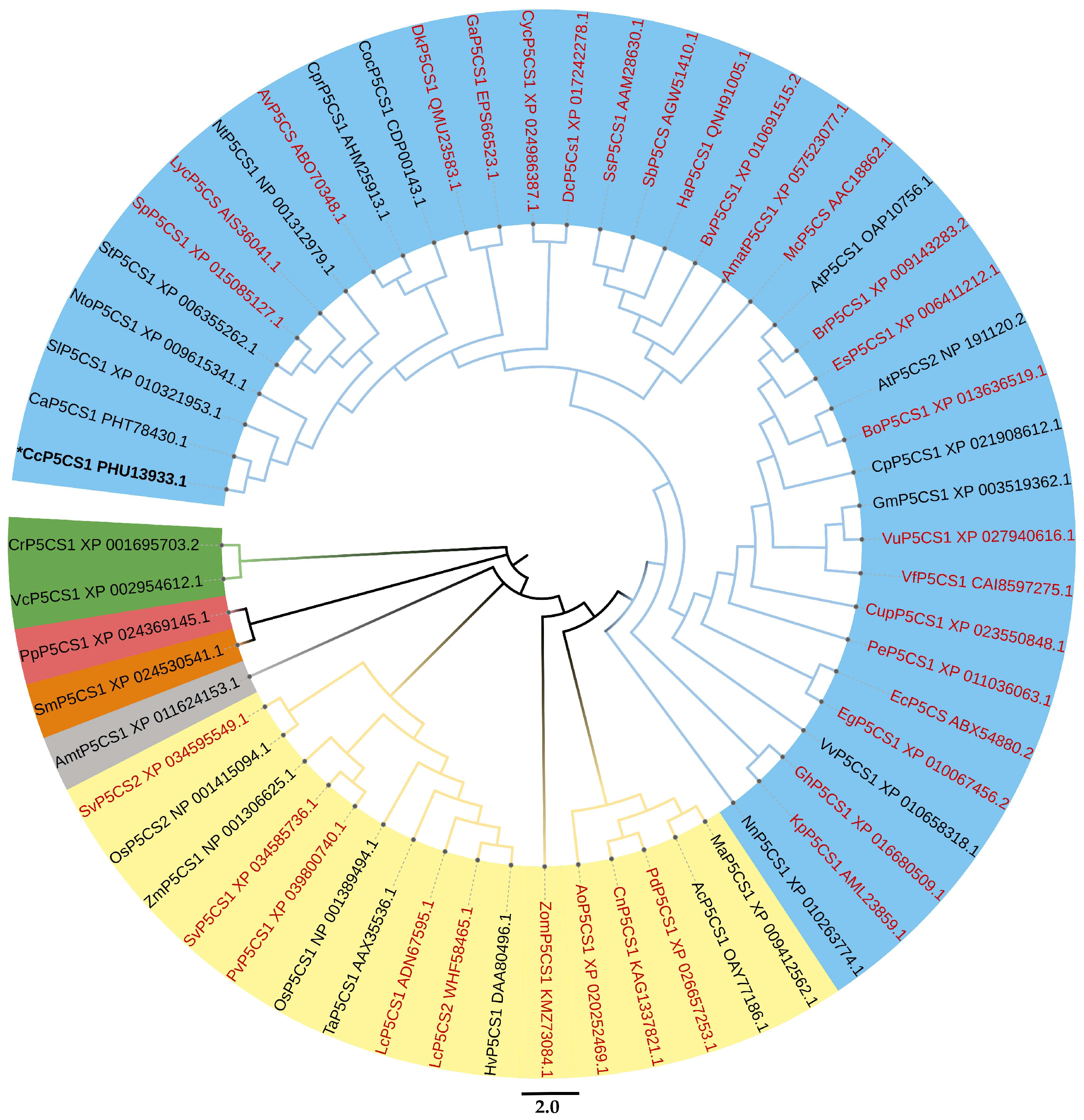
Phylogenetic analysis of the protein sequences of the P5CS enzymes revealed orthologous P5CS genes in diverse organisms, including green algae, monocotyledonous and eudicotyledonous plants. In the phylogenetic tree of P5CS enzymes (Figure 1), the evolutionary relationships between the different species analyzed are appreciated. The results suggest a canonical evolutionary pattern, with green algae as the ancestral lineage from which higher plants originated.
From the most ancient common ancestor, three bifurcations were identified, each representing a distinct speciation event. The first event resulted in a clade containing the chlorophytes Chalamydomonas reinhardtii and Volvox carteri. The second event produced a clade that further divided into two branches: one comprising the non-vascular plant Physcomitrella patens; that is, it does not have specialized tissues such as xylem and phloem and does not present roots, stems or true leaves; and the second branch is formed by the ancestral vascular plant Selaginella moellendorffii.
The third speciation event generated three bifurcations: the first of which was formed by a branch that contained only Amborella trichopada (an ancestral angiosperm). The length of its branch indicates that it has undergone significant diversification with respect to its common ancestor, which suggests that over time, it has undergone significant changes in its primary sequence (Figure 1).
The second bifurcation is made up of the clade formed by monocotyledonous plants of the Poaceae family, which is made up of both halophyte species (SvP5CS1 and 2, PvP5CS1 and LcP5CS1 and 2) and glycophytes (OsP5CS1 and 2, TaP5CS1 and HvP5CS1). The third branch is subdivided into two branches. The first branch consists solely of ZomP5CS1 from Zostera marina, a halophytic aquatic grass that lives in oceans and belongs to the family Zosteraceaes, and the second branch, which in turn bifurcates, forming two internal clades, the first of which is composed of monocots belonging to the Asparagacea family, such as AoP5CS1; Arecaceaes, such as CnP5CS1; and Bromeliaceaees, such as AcP5CS1; and Musacea, such as MaP5CS1. The second and last clade is formed by eudicotyledonous plants. This clade, in turn, forms dozens of clades, which are organized in a highly organized manner according to the order and the family to which they belong, such as the Caryophyllales (McP5CS, AmatP5CS1, BvP5CS1, HaP5CS1, SbP5CS and SsP5CS1), Solanales (NtP5CS1, LycP5CS, SpP5CS1, StP5CS1, NtoP5CS1, SlP5CS1, CaP5CS1 and CcP5CS1), etc.
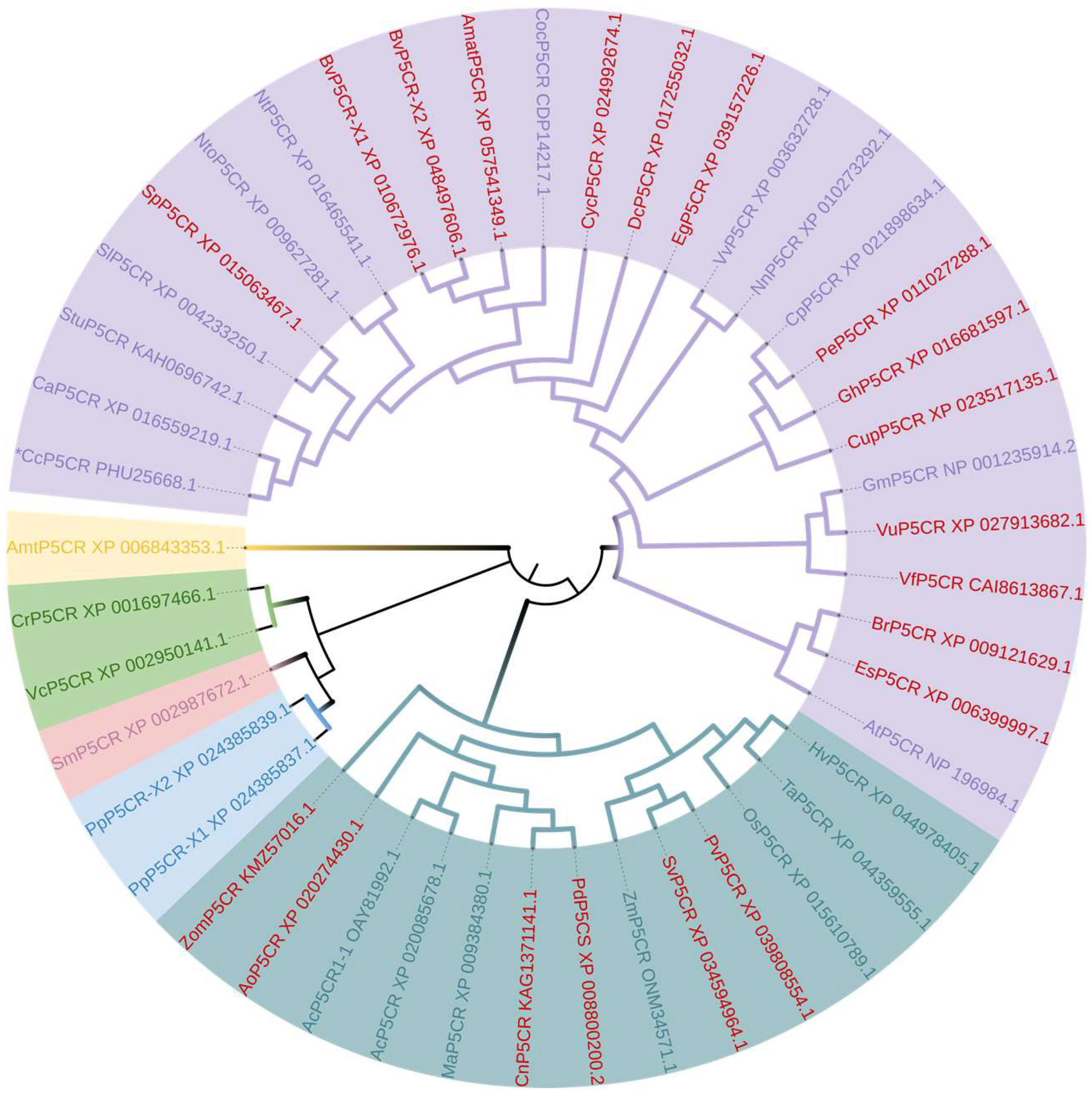
A similar phylogenetic distribution was observed for P5CR (Figure 2), orthologous sequences were identified in green algae, monocots, and eudicots. The results obtained suggest that, like P5CR enzymes, their evolution is canonical; that is, these proteins have evolved in a predictable and orderly way over time and originate from green algae.
Two major bifurcations were detected, where each bifurcation represents a speciation event. The first speciation event resulted in a clade formed by the chlorophytes Chlamydomonas reinhardtii and Volvox carteri and a second clade, which in turn bifurcated, forming two internal clades. The first is formed by Physcomitrella patens and the second is formed by Selaginella moellendorffii.
The second speciation event resulted in three forks. The first bifurcation results in a branch whose only member is Amborella trichopada, an ancestral angiosperm plant. The length of its branch, as with the P5CR proteins, indicates that it has undergone important diversification with respect to its most ancestral common ancestor, which suggests that over time, it has undergone significant changes in its primary sequence.
The second bifurcation results in the formation of a group of monocots. The third bifurcation results in the formation of a group consisting exclusively of eudicotyledons.
In the monocot clade, we can see that it is composed of two major branches; the first branch includes only Zostera marina, and the second branch consists of the rest of the monocots. These genes in turn form clades according to the family to which they belong, such as Arecales (CnP5CR and PdP5CR) and Poales (ZmP5CR, SvP5CR, PvP5CR, OsP5CR, TaP5CR and HvP5CR), which in turn make up the clade with the greatest number of members, with six species.
This same behavior occurs with the clade formed by the eudicotyledons. They form very ordered clades according to the family to which they belong. As is the case with the Brassicales (AtP5CR, EsP5CR and BrP5CR), the Fabales (VfP5CR, VuP5CR and GmP5CR), the caryophyllales (AmatP5CR and BvP5CR) and the Solanales (NtP5CR, NtoP5CR, SpP5CR, and SlP5CR). These in turn form clades according to the species to which they belong, as is the case for Nicotiana tabacum (NtP5CR) and Nicotiana tomentosiformis (NtoP5CR); Solanum penelli (SpP5CR) and Solanum lycopersicum (SlP5CR); and Capsicum annuum (CaP5CR) and Capsicum chinense (CcP5CR).
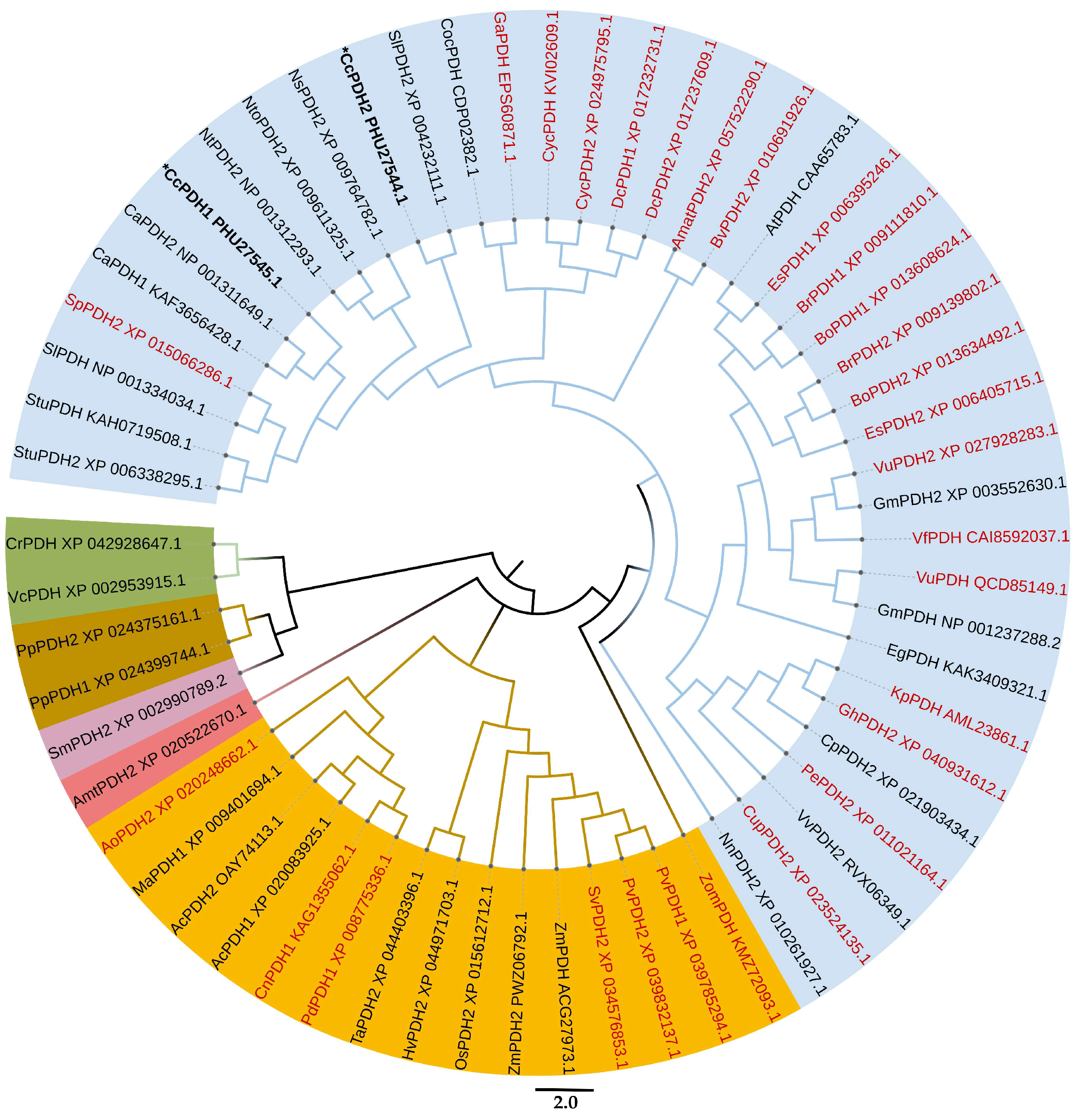
Finally, as a result of the phylogenetic analysis carried out on the protein sequences of the PDH enzymes, orthologous PDH genes were found in organisms such as green algae, monocotyledonous and eudicotyledonous plants. The phylogenetic tree for the PDH enzymes (Figure 3), show the evolutionary relationships among the different species of these organisms analyzed. The results indicate that their ancestor is green algae, which are known to be the photosynthetic organisms from which higher plants originated.
It is observed that from the oldest common ancestor, this bifurcates into two clades, where each bifurcation represents a different speciation event. The first speciation event forks into two internal clades, the first of which is made up of the microalgae Chalamydomonas reinhardtii and Volvox carteri. The second clade is divided into two branches: one formed by Physcomitrella patens and the second formed by the ancestral vascular plant Selaginella moellendorffii.
The second clade from the oldest common ancestor branches into three clades. The first of these branches is formed solely by the species Amborella trichopada (flowering plants). Notably, AmtPDH2 from Amborella trichopada, together with ZomPDH from Zostera marina, are the species with the greatest distance from the oldest common ancestor. The length of its branch indicates that the relationship with respect to the common ancestor is very distant, since the farther the branches are from a node, the more distant the relationship is between the groups. This means that the primary protein sequences of Amborella trichopada and Zostera marina are very different with respect to that of the oldest common ancestor, which could indicate many changes in their sequences throughout evolution. The second branch results in the clade formed by monocotyledonous plants, which are grouped according to the order and family to which they belong, as is the case for Poales (AcPDH1 and 2, TaPDH2, HvPDH2, OsPDH2, ZmPDH, ZmPDH2, PvPDH1 and 2 and SvPDH2). In the same way, it can be observed that this clade is also made up of halophyte plants that are grouped according to the order to which they belong. The third branch results in the formation of the clade formed by the eudicots. It can also be seen that there is at least one halophyte member in most of the families that make up the tree.

3.2. Analysis of the Deduced Amino Acid Sequences of P5CS, P5CR and PDH from Capsicum chinense Jacq.

As a result of the cloning, ten positive clones were obtained for each gene, and five were randomly selected for sequencing. For P5CS, clones 1, 3, 4, 6 and 9 were analyzed; for P5CR, clones 2, 3, 4, 6 and 7; for PDH, clones 3, 5, 6, 7. The CcP5CS clones were identical, comprising 517 bp and encoding a deduced protein sequence of 172 amino acids (Figure S1; Table 3, Table 4 and Table 5).
Comparative analysis of the deduced amino acid sequence revealed that the CcP5CS (Figure S1A) of habanero pepper is highly similar to that of pyrroline-5-carboxylate synthetases of the Solanaceae family, including Capsicum annuum, Capsicum baccatum, Capsicum chinense, Nicotiana sylvestris, Nicotiana attenuata, Nicotiana tomentosiformis, Solanum lycopersicum, Solanum pennellii and Solanum tuberosum. This identity analysis revealed that the cloned sequence for CcP5CS showed 100% identity with those sequences reported for C. chinense and C. annuum. A high percentage of identity, ranging between 96 and 98%, was also obtained between the cloned CcP5CS sequence and other sequences from some of the Solanaceae members analyzed (Table 3).
Similarly, the five CcP5CR clones (Figure S1B) were identical (323 bp; 108 aa). The results of the analysis of the deduced amino acid sequences indicated that the CcP5CR of habanero pepper is highly similar to that of the pyrroline-5-carboxylate reductases of the Solanaceae family, including C. annuum, C. chinense, N. sylvestris, N. attenuata, N. tabacum, N. tomentosiformis, S. lycopersicum, S. pennellii and S. tuberosum. CcP5CS showed 99.07% identical with C. chinense and C. annuum and 90–94% identity with other Solanaceae species (Table 4).
Finally, all five PDH (Figure S1C) clones were also identical (874bp; 292 aa). CcPDH is highly similar to the Pro dehydrogenase of the Solanaceae family, including C. annuum, C. chinense, C. baccatum, N. tabacum, S. lycopersicum, S. pennellii and S. tuberosum. CcPDH exhibited 98.97% identity with Capsicum chinense, 99.63% with C. annuum, 97.94% with C. baccatum, and 89–93% with other Solanaceae species (Table 5). These identities are consistent with the close phylogenetic relationships within Capsicum (Figure 3).

3.3. Expression Profiles of CcP5CS, CcP5CR and CcPDH Transcripts in Roots and Leaves of the Habanero Pepper Variety

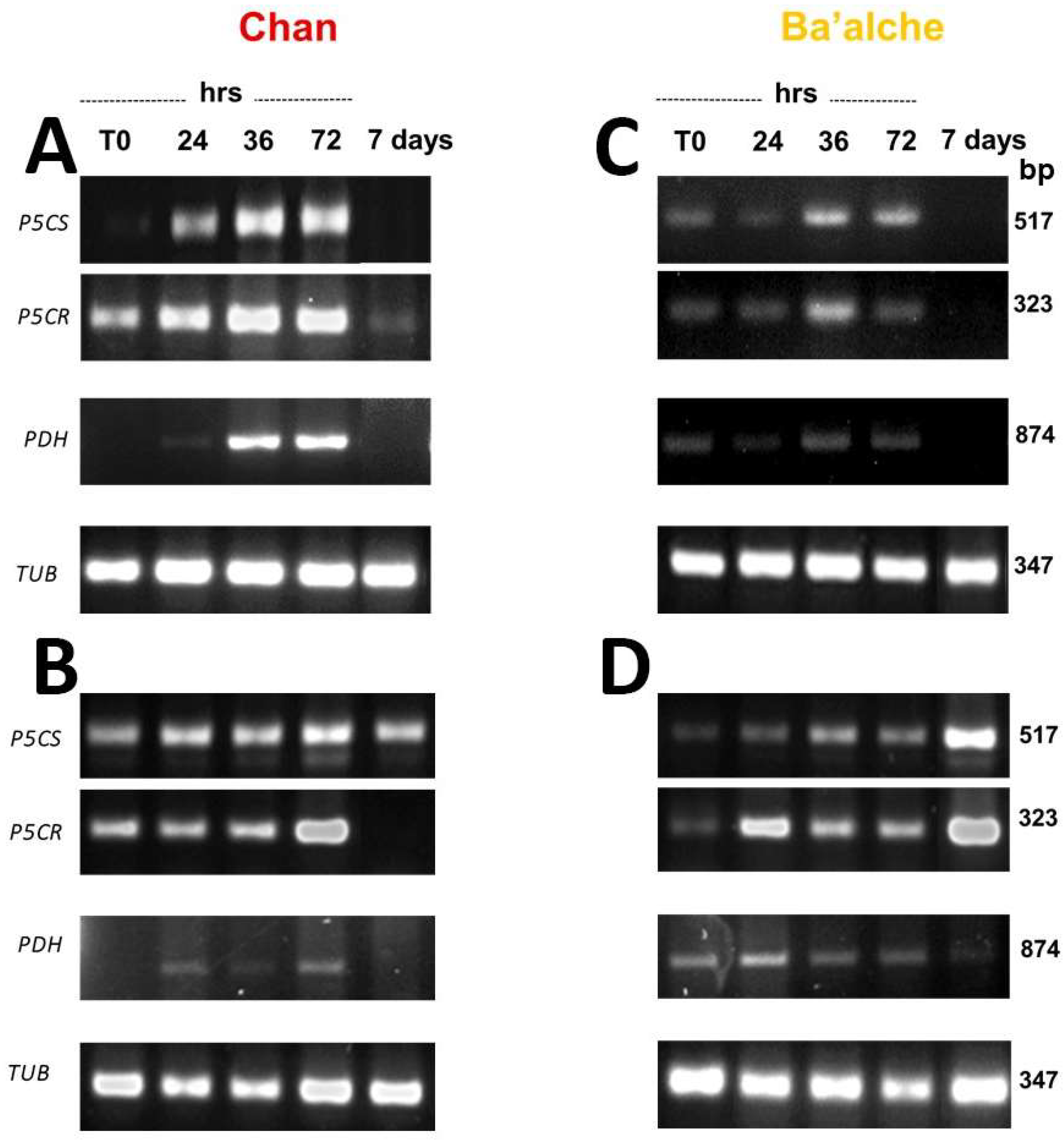
To determine the transcript levels of genes involved in Pro metabolism, semi-quantitative PCR assays were performed. Seedlings of the two varieties of habanero pepper were exposed to 150 mM NaCl for short durations (24, 36, and 72 h) and up to a period of seven days, and the expression profiles of these transcripts from the roots and leaves were analyzed (Figure 4).
P5CS transcripts in roots from Chan variety were induced during short periods of salt treatment, reaching a maximum at 72 h of exposure. However, this induction disappeared after 7 days of treatment. P5CR transcripts increase from 24 h to salt exposition in this tissue, peaking between 36 y 72 h of treatment. Like P5CS, transcripts of P5CR were not observed to 7 days. PDH transcripts were induced up to 36 h after NaCl treatment, maintaining their levels for up to 72 h, before disappearing after 7 days, as occurred with the transcripts of the two previous enzymes (Figure 4A).
In contrast, the P5CS transcript profiles remained very similar in the leaves of the Chan variety exposed to salt, with only a slight increase observed at 72 h of exposure and, unlike what occurred in root tissue, these remained at similar levels to the initial time at 7 days. For P5CR transcripts, a significant increase was observed at 72 h of treatment, and these were no longer observed at 7 days, like what occurred in the root sample. PDH transcript profiles were only observed at 72 h of exposure and at lower intensities than those found in the root sample (Figure 4B).
In the roots of the Ba’alche variety, significant differences were observed in the transcript profiles of all enzymes, compared to the Chan variety. For example, P5CS transcripts were observed only at 36 and 72 h of salt exposure, but at a lower level than those found in the other variety, while P5CR transcripts were observed only at 36 h and PDH transcripts were not detected in this tissue (Figure 4C).
In leaf tissue, P5CS transcripts for this variety increased from 36 h of salt exposure, reaching a maximum at 7 days, while for P5CR transcripts, two peak induction levels were observed at 24 h and 7 days, respectively. For PDH, a slight increase was observed at 24 h compared to time 0, and from this point on, transcripts of this gene were not detected (Figure 4D).

3.4. Effect of NaCl Stress on the Activity of Enzymes Involved in Pro Metabolism in Habanero Pepper Varieties

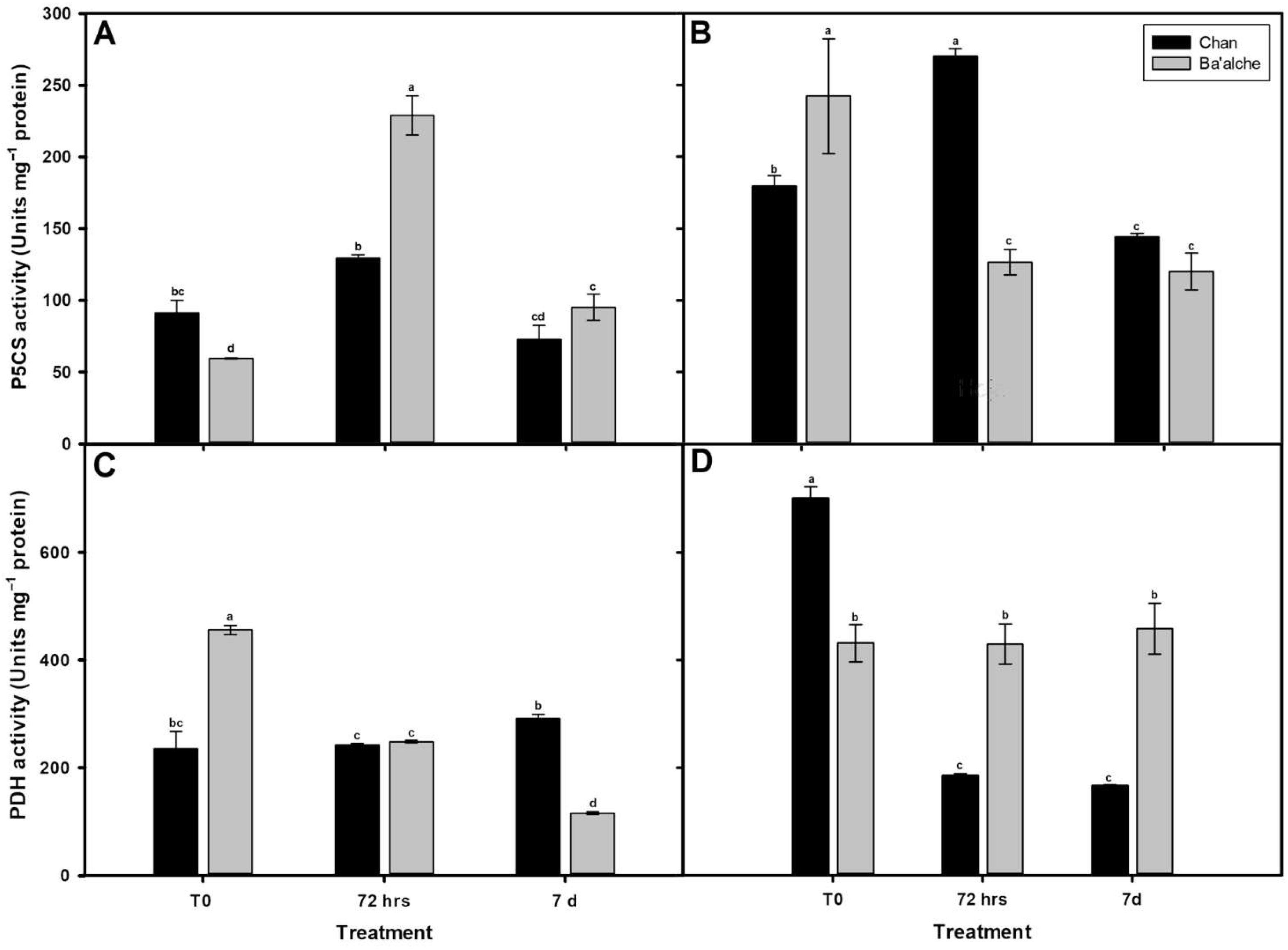
Under stress conditions, Pro accumulation is correlated with P5CS activity, which plays a key role in Pro biosynthesis. P5CS catalyzes the first step in the conversion of Glu to Pro [42]. The specific activity of P5CS are shown in Figure 5A,B.
As shown in Figure 5A, the activity in roots of the CcP5CS enzyme at time zero was 92 U/mg of protein for the Chan variety and 60 U/mg of protein for Ba’alche. The highest enzymatic activity was observed at 72 h. Notably, Ba’alche exhibited a significantly higher activity of 229 U/mg of protein, compared to Chan, which exhibited activity of 130 U/mg of protein at this time point. These findings suggest that Pro biosynthesis in roots is upregulated during the early stages (within 72 h) of NaCl-induced stress specifically in Ba’alche variety. However, after seven days of salt exposure, P5CS activity in both varieties declined to levels comparable to those at the initial time point.
In the leaves (Figure 5B), initial CcP5CS activity was higher in Ba’alche than in Chan. However, upon treatment with 150 mM NaCl, P5CS activity in Chan increased substantially, reaching nearly twice the activity observed in Ba’alche (127 U/mg of protein at 72 h of salt treatment). After seven days, enzymatic activity in both varieties converged to similar levels.
The activity of Pro dehydrogenase (PDH)—an enzyme that catalyzes the conversion of Pro to P5C—was evaluated to determine whether Pro metabolism favors biosynthesis (anabolism) or degradation (catabolism) under stress conditions in habanero pepper.
The results of CcPDH activity, roots and leaves are shown in Figure 5C,D. In the roots, Ba’alche exhibited significantly higher PDH activity than Chan at time zero, reaching approximately 456 U/mg of protein. At 72 h, both varieties displayed similar PDH activities levels. After seven days, PDH activity slightly increased in Chan compared to 72 h, while in Ba’alche, activity markedly decreased to approximately 116 U/mg of protein.
In leaves (Figure 5D), CcPDH activity in Chan at time zero was approximately 701 U/mg of protein and decreased significantly further under saline conditions. In contrast, PDH activity in Ba’alche remained uncharged across all time points. These results indicate that PDH activity is more dynamically regulated in Chan, potentially contributing to the modulation of Pro levels as part of its stress response mechanism.

3.5. Effects of NaCl Stress on Pro Accumulation in Roots and Leaves of the Capsicum chinense Varieties

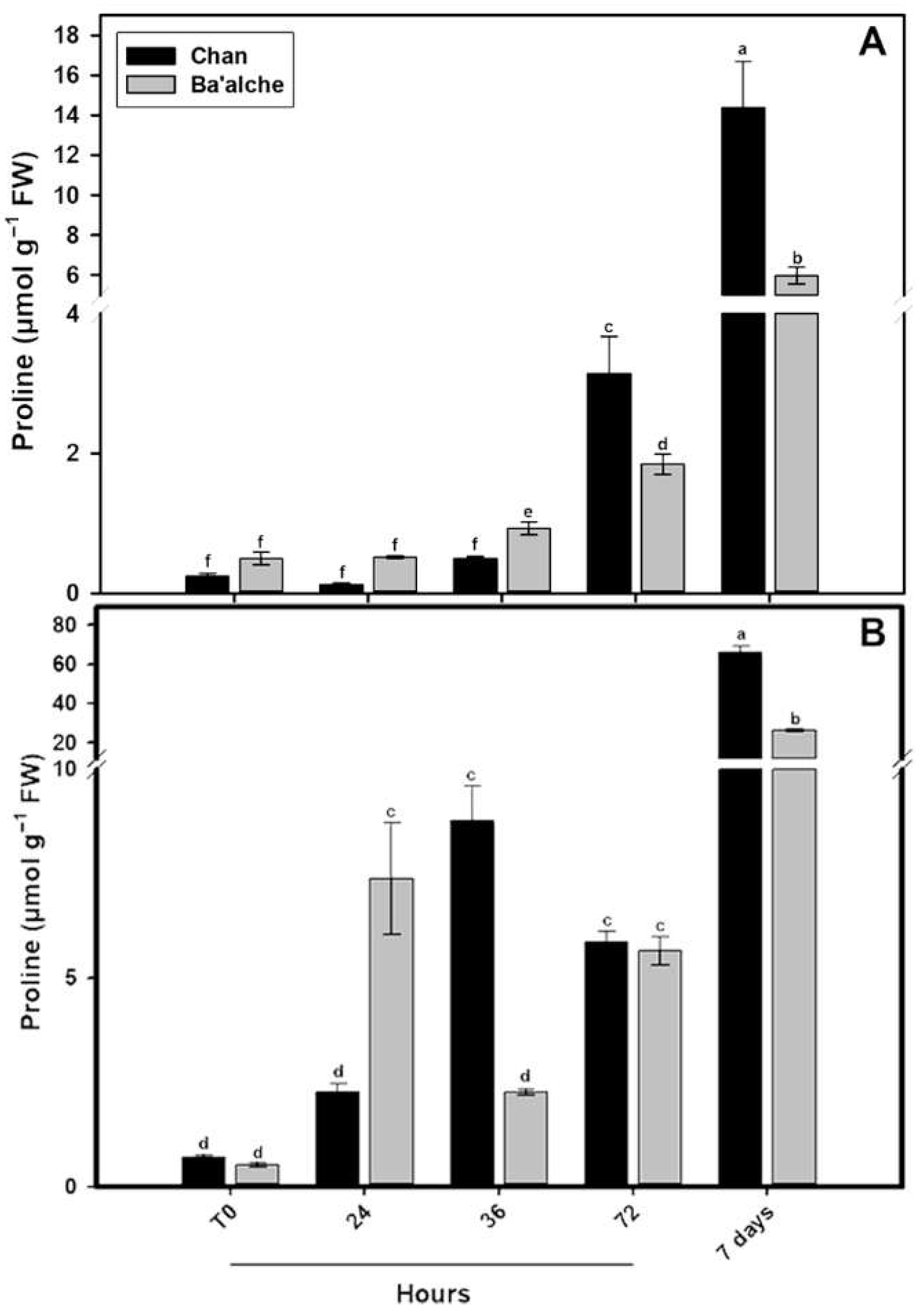
Pro content in the roots of both habanero pepper varieties was quantified and the results are shown in Figure 6. In general, Pro levels in roots (Figure 6A) did not differ significantly between the Chan and Ba’alche varieties at 0 and 24 h. However, at 36 h, Ba’alche exhibited a higher Pro accumulation compared to Chan. After seven days of NaCl exposure, Pro accumulation was notably higher in Chan, reaching approximately 20 µmol. g−1 FW at seven days. In contrast, Ba’alche recorded lower levels of Pro, approximately 8 µmol. g−1 of FW after seven days.
Pro content in leaves (Figure 6B). Statistical analysis showed that control plants had the lowest Pro levels, with no significant differences between varieties. At 24 h, Ba’alche exhibited a sharp increase in Pro content (7 µmol. g−1 FW), whereas Chan accumulated only about 2.3 µmol. g−1 of FW. By 36 h, Pro content in Chan increased to levels comparable to those previously observed in Ba’alche, while Ba’alche experienced a decrease to approximately 2.3 µmol. g−1 of FW. At 72 h, both varieties showed similar Pro levels (≈5.6 µmol. g−1 FW). Notably, after seven days, Chan again exhibited significantly higher Pro accumulation (66 µmol. g−1 of FW), nearly double the amount observed in Ba’alche (26 µmol. g−1 of FW).
It is import to note that one of the primary roles of Pro under stress conditions is to protect photosynthetic machinery and serve as an energy upon degradation. These findings suggest that in the Chan variety, Pro may play a critical role as part of the physiological and biochemical mechanisms that confer tolerance to salinity stress, specifically under 150 mM NaCl conditions.

3.6. Effects of NaCl and Exogenous Pro on K+ Ion Flux in Habanero Pepper Roots

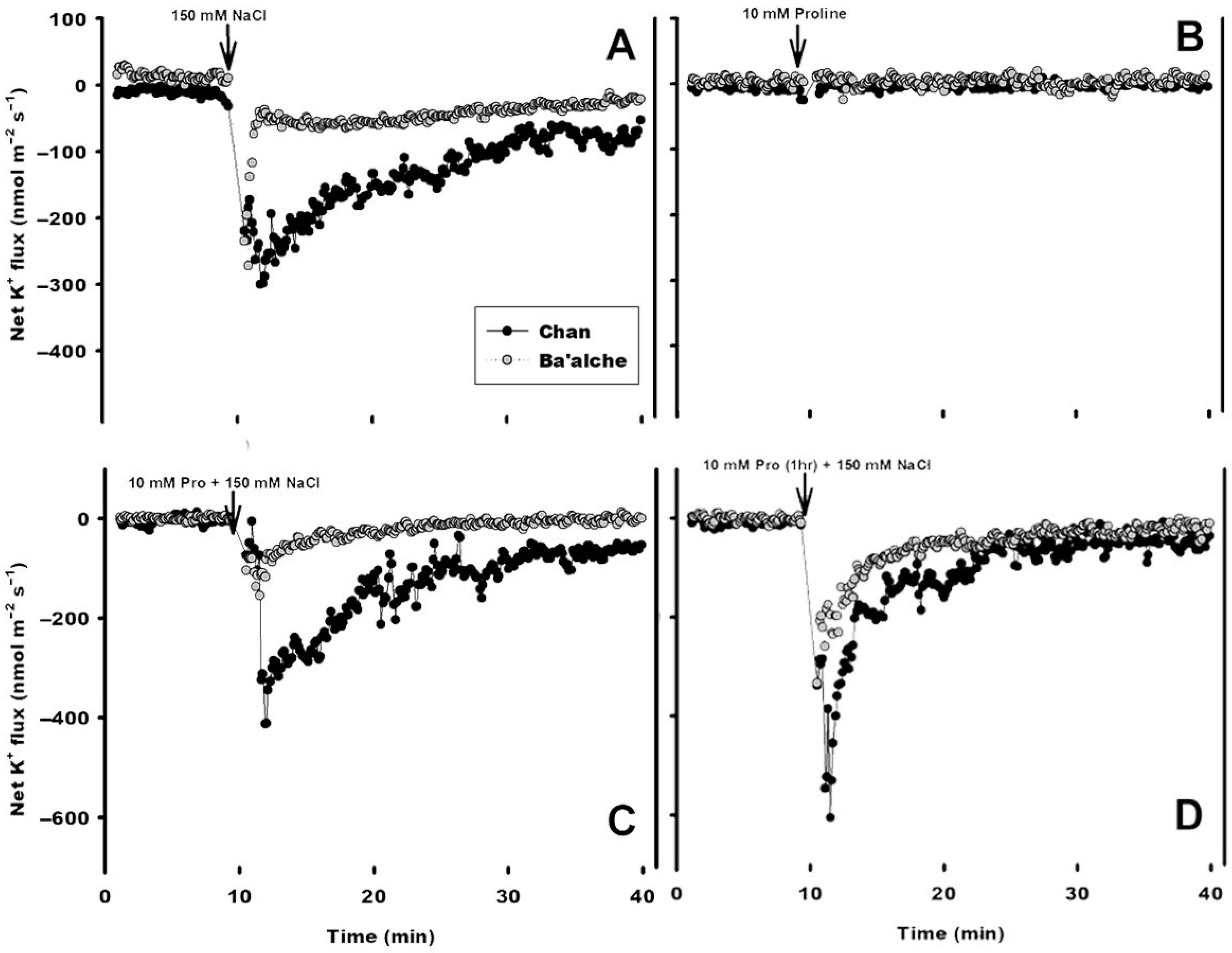
In this study, the MIFE (Microelectrode Ion Flux Estimation) technique was employed to evaluate K+ fluxes in the roots of Capsicum chinense that differ in their tolerance and sensitivity to salinity. The objective of this experiment was to determine which variety was more capable of retaining K+ and to assess whether the application of exogenous Pro could contribute to K+ retention, potentially aiding in osmotic adjustment. Previous studies have reported that K+ retention in roots is a key selection criterion distinguishing salt-tolerant from salt-sensitive barley varieties [49]. The results of K+ net fluxes under various treatment conditions are presented in Figure 7.
As shown in Figure 7A, exposure to NaCl induced K+ efflux from the epidermal cells in the mature root zone of both habanero pepper varieties. Notably, the Ba’alche variety exhibited K+ efflux, but its electrochemical potential recovered more rapidly than that of the Chan variety, which showed a higher initial K+ loss. Over the 40 min measurement period, both varieties gradually stabilized their membrane potential; with net fluxes approaching −300 mmol m−2 s−1 initially, and eventually tending toward baseline values close to zero.
Figure 7B shows the results of K+ flux in roots treated with 10 mM exogenous Pro. The data indicate that, at this concentration, Pro did not significantly affect K+ flux in either variety. In Figure 7C, the simultaneous application of 10 mM Pro and 150 mM NaCl was evaluated. Under these conditions, the Ba’alche variety exhibited reduced K+ flux compared to NaCl treatment alone (Figure 7A), with a net flux of approximately—150 mmol m−2 s−1. in contrast, the Chan variety showed a similar efflux to that observed under NaCl treatment alone (≈−300 mmol m−2 s−1), indicating no significant change.
Figure 7D presents the results of a pretreatment in which roots were incubated with 10 mM Pro for 1 h prior to NaCl exposure. This pretreatment did not enhance K+ retention, as both varieties displayed effluxes comparable to those observed under NaCl treatment alone (Figure 7A). These results suggest that neither concurrent application nor pretreatment with Pro at the tested concentration has a significant effect on K+ retention under salinity stress in the root tissues of these C. chinense varieties.

4. Discussion

4.1. Phylogenetic Implications of Pro Metabolism Enzymes

Numerous studies have investigated Pro accumulation under different types of abiotic stress, including drought [33,41,50], salinity [26,51], and temperature [52]. The accumulation and levels of Pro depend on the balance between its biosynthesis and degradation rates [19,53]. The enzymes responsible for its biosynthesis catalyze reactions in the chloroplasts and cytosol, while Pro oxidation or degradation occurs in the mitochondria [19]. Under salt stress, plant metabolism becomes disorganized; thus, the entire metabolic network must be reconfigured to adapt to the prevailing stress conditions [54].
Phylogenetic analysis of proteins with unknown evolutionary origins and functions are essential for understanding evolution and biological diversity. The phylogenetic trees (Figure 1, Figure 2 and Figure 3) constructed for the proteins P5CS, P5CR, and PDH reveal their evolutionary history, degree of conservation among species, and potential association with functionally related groups. This provides valuable insights into their biological roles and helps identity conserved functional domains, suggesting known or novel functions. Such analysis is key to advancing our understanding of cellular processes, evolutionary adaptations, and the biology of less-studied organisms, such as those of the genus Capsicum, particularly Capsicum chinense Jacq.
Genes encoding enzymes involved in Pro metabolism have been extensively studied, and metabolic engineering experiments aimed at Pro overproduction are common [25]. Although many of these genes have been characterized at the molecular and functional levels, their evolutionary trajectories in plants remain poorly understood–especially regarding factors driving the functional divergence of Pro during development and as an osmoprotective molecule [55]. Based on this, we evaluated the evolutionary relationships of P5CS, P5CR, and PDH.
According to our results of the analysis of the phylogenetic trees, the evolutionary order of these proteins was determined among the different species of these organisms analyzed, and the results obtained suggest that their evolution occurred in a canonical way, since they present as an ancestor the green algae, which are known to be the photosynthetic organisms, from which the higher plants originated until reaching the Solanaceae where Capsicum chinense is found. Our results provide valuable information and contribute to what was reported by Rai and Penna [55], who reported a clear separation between monocotyledonous and dicotyledonous (eudicotyledonous) plants for P5CS. The authors suggest that the duplication event of this gene occurred after the divergence of the monocotyledonous and dicotyledonous lines (eudicotyledonous) (Figure 1).
Another report regarding phylogenetic analysis is that of Wang et al. [56]. Although they did not analyze many sequences, well-defined clades can be seen between monocots and eudicots, and this was for P5CS as well as for PDH (Figure 3). Similar results were obtained with respect to P5CS and P5CR (Figure 2), where the evolution between species was analyzed. However, in a study conducted by Primo-Capella et al. [57] on a standard plant named Carrizo citrange, they reported that both P5CS and PDH behaved similarly and that the results of the phylogenetic analysis revealed that the evolutionary analysis coincided with that of Citrus clementina, a species close to their evaluated plants. These findings suggest that families of metabolic enzymes are considered highly conserved and have been used to reconstruct the branching patterns more deeply in the tree of life.
In certain organisms, the aforementioned pathways may contribute to, or be solely responsible for, Pro synthesis. Conservation of Pro biosynthetic enzymes and key residues for catalytic activity and allosteric regulation has been analyzed using structural data, multiple sequence alignments and studies with mutants, providing new insights into Pro biosynthesis across taxa [58].
The results obtained from the phylogenetic trees indicate that the P5CS, P5CR, and PDH enzymes in halophytes originate from higher plants and are grouped according to the family to which they belong, rather than by their ability to withstand high salinity concentrations. This suggests that the capacity to survive under high salinity conditions is due to significant genetic variations in these plants, driven by selection pressure resulting from survival in these saline environments. This has facilitated the adaptation of these species. However, considering the conserved role of Pro under these conditions, the functional differentiation of its metabolism between species could be occurring at another level of regulation, such as transcriptional or post-translational. Similarly, specific changes in amino acid residues within specific domains of these proteins could be explored in future research, with the aim of correlating them between species with different behaviors in response to saline stress and Pro accumulation.

4.2. Differential Gene Expression and Enzymatic Activities Between Habanero Pepper Varieties with Contrasting Behavior to Salinity

The effect of NaCl treatment on enzyme transcript levels was dependent on the variety and organ. In general, both varieties increased P5CS, P5CR, and PDH transcript levels in the root during short exposure periods, but the Chan variety did so at shorter times and with greater intensity (Figure 4A). In leaf tissues, higher levels of biosynthesis enzyme transcripts were observed at longer exposure periods in the Ba’alche variety, although at short exposure periods, the Chan variety showed higher levels (Figure 4B). These results suggest that NaCl stress may induce a differential readjustment in Pro metabolism among varieties to cope with this stress, which could be related to their responsiveness to it. These results agree with those of Rivero et al. [59], who reported increased P5CS and P5CR transcripts levels and minimal PDH levels in tomato seedlings exposed to 120 mM NaCl for 24 h. Likewise, Tiika et al. [51] reported that at short times (6 and 12 h), the expression of P5CS, P5CR and PDH increased from 50 to 250 mM NaCl in both roots and leaves from Lycium ruthenicum. The authors concluded that the expression profiles increased in response to NaCl, which indicates its role in the metabolism of Pro and that, in general, the results confirmed that the glutamate pathway is involved in the accumulation of Pro under these conditions.
Pro metabolism is activated under various stresses. For example, Adamipour et al. [60] reported that anabolism and catabolism were modified under conditions of drought stress in two species of rose (Rosa canina L. and Rosa damascena Mill). They reported that from day one, at 25% and 50% field capacity, Pro increased, and simultaneously, the expression of both P5CS and P5CR tended to increase. However, this expression was affected at 12 days of evaluation; similar to our results in the root. In addition, the PDH decreased with the passage of days to field capacities of 25% and 50%, similar to those reported in Chan and Ba’alche, respectively, after seven days in the presence of salt.
The activity of biosynthetic (P5CS and P5CR) and catabolic (PDH) enzymes plays a crucial role in Pro accumulation in roots and leaves. Rivero et al. [59] observed that when tomato plants were put in the presence of NaCl for 48 h, the activity of the biosynthesis enzymes was much greater than that at zero hours, while the activity of the degradation enzymes remained close to zero or did not increase. In this study, the activity of both P5CS and PDH was evaluated, and differences were observed between both varieties. The Ba’alche variety presented the highest activity of P5CS in root at 72 h (Figure 5A) of treatment, while in leave it was the Chan variety that presented the highest values. The behavior was opposite for both varieties: Chan did not modify the activity of this enzyme in the root in response to salt, while it decreased in the leaves; in contrast, Ba’alche decreased it in the root and it was unaffected in the leaves. These results may indicate that each variety performs a specific Pro metabolism balance for organ.
This suggested that Chan favors Pro biosynthesis, and accumulation, whereas for Ba’alche, it is suggested that anabolic activity is less than its catabolism since it could be degrading the Pro to use it as energy to counteract the stress caused by the salt. Naliwajski and Skłodowska [61] studied the effects of saline stress at concentrations of 100 and 150 mM on the antioxidant system and the metabolism of Pro the leaves of cucumber plants (Cucumis sativus L. cv. “Cezar”). They reported that both P5CS and PDH activities decreased from 24 to 72 h. In the presence of salt stress, similar activity was detected at both times at 150 mM NaCl. This behavior is similar to that of the Chan variety in our results, but in the Ba’alche variety, there was higher PDH activity than P5CS activity in this same organ. Similarly, Tiika et al. [51] reported that the highest activity of P5CS occurred in leaves, whereas the activity of PDH was lower than that of Pro, similar to what was observed in the Chan variety at 72 h evaluation with NaCl.

4.3. Accumulation of Pro and Salt Tolerance

Pro accumulation plays a key role in stress tolerance. In our study, Pro content was evaluated at short (0, 24, 36 and 72 h) and long time (seven days) durations in both roots and leaves (Figure 6A,B). The results revealed that the content of Pro in roots was nearly four times greater in the leaves, whereas the Chan variety maintained the highest levels this amino acid in both, roots and leaves. These results agree with those reported by Bojórquez-Quintal et al. [34,48]. In the presence of salinity, the organ that presented the highest content was the leaves, and the variety that most accumulated this amino acid was Chan, whereas Chichen-Itza (sensitive) had very low levels; likewise, Rivero et al. [59] demonstrated that at 48 hrs, after treatment with 120 mM NaCl, the osmolyte that accumulates is mainly Pro. The authors suggest that osmotic adjustment is necessary to counteract the effects caused by salinity, and that the accumulation of Pro occurs in the vacuole as well as in the cytosol, thereby increasing the turgor potential of the cell. However, Romero-Aranda et al. [62] concluded that salinity reduces cell expansion in tomato plants and that a reduction in osmotic and water potential could be favored by the accumulation of osmolytes, as is the case for Pro, thus increasing cell turgor.
Our results suggest that the greater accumulation of Pro in the Chan variety may be related to its greater tolerance to NaCl stress and that the regulation of Pro metabolism appears to be a complex process occurring at different levels and between organs. For example, in the roots, while there is stimulation of biosynthesis enzyme transcripts in response to salinity, which may correlate with the Pro levels found, this correlation was not observed at the enzyme activity level. In contrast, a correlation was observed in the leaves between transcript levels, enzyme activity, and Pro accumulation.

4.4. Role of Pro on K+ Efflux in Roots Under NaCl Conditions

K+ is an essential nutrient throughout plant development, and K+ homeostasis is crucial for abiotic and biotic stress tolerance in plants [63,64]. K+ efflux from root occurs commonly under various stress conditions [64]. K+ retention in roots has been linked to salt tolerance in barley, wheat, alfalfa and poplar [65,66,67,68,69]. In our study, 150 mM NaCl (Figure 7A) significantly decreased K+ content in the roots of both varieties evaluated (Chan and Ba’alche), resulting in increased K+ efflux. These results are consistent with Bojórquez-Quintal et al. [34], who reported that treatment with 150 mM NaCl had a much greater effect on K+ efflux in the sensitive variety Chichen-Itzá and not in the tolerant variety Mayan Chan. Thus, the retention of K+ in the roots could play an important role in the tolerance mechanism against salt stress. However, in our results, K+ retention did noy correlate with tolerance, as Chan exhibited greater K+ efflux than Ba’alche, wich stabilized its flux more rapidly.
We hypothesized that exogenous Pro might influence K+ retention under NaCl stress, potentially improving tolerance in the sensitive Ba’alche variety. Application of exogenous Pro alone (Figure 7B) did not affect K+ fluxes in either variety. However, simultaneous application of Pro and NaCl reduced K+ efflux in Ba’alche compared with NaCl alone (Figure 7A). Finally, when the roots of both varieties were incubated in the presence of 10 mM Pro for 1 h and subsequently when NaCl was applied, our results were similar to those found when only NaCl was applied to the Ba’alche. However, for the Chan, Pro appeared to increase K+ efflux. These results were similar to those reported by Bojórquez-Quintal et al. [48], who reported that when they evaluated two varieties of habanero pepper in the presence of salinity and in the application of exogenous Pro at 1 mM, the sensitive variety was favorable for a lower K+ efflux. Instead, when 150 mM NaCl was applied, to the tolerant variety, Pro had the opposite effect, resulting in greater K+ efflux when this amino acid was applied. The authors suggest that Pro may play a role in reducing K+ efflux under salt stress. The specific mechanism through which compatible solutes can regulate the transport activity of proteins, such as KOR-type channels and the reduction in K+ leakage, is unknown. However, Shabala and Shabala [70] suggest that low concentrations of compatible solutes (0.1 to 1 mM) could act as possible osmoprotectors of membranes and proteins involved in the transport or as scavengers of ROS, thereby avoiding ionic imbalance under salt stress. The authors conclude that studies are needed in mutants lacking Pro biosynthesis.
NaCl caused immediate K+ efflux, which was greater in the less sensitive variety Chan. Some studies suggest that K+ loss serves as a signaling mechanism redirecting energy toward stress responses [64,71,72,73]. Pro alone did not affect K+ transport, indicating that it is not perceived as a stress signal. However, preincubation with 10 mM Pro increased K+ efflux and accelerated recovery in both varieties. Unlike barley [74,75], the inhibitory effect of Pro on K+ efflux in barley seedlings has been previously demonstrated. The results presented here suggest that, at least in the habanero pepper varieties studied and under the experimental conditions applied, Pro may contribute to osmotic adjustment through signaling pathways that remain to be elucidated. Pro mediated osmotic adjustment helps to maintain turgor and water uptake, facilitating K+ redistribution between roots and shoots [59,62]. Its catabolism can supply energy and reducing power for ATP-dependent ion transport, supporting long-term ionic homeostasis [18,19,20]. As far as the available evidence indicates, no direct physical interaction between Pro and outward rectifying K+ channel proteins has been demonstrated in plants. Nevertheless, several studies show that low concentrations of exogenous Pro rapidly reduce NaCl or ROS induced K+ efflux in barley and Arabidopsis roots [74,75,76,77], affecting a transport component mediated by outward rectifying channels and NSCCs. This pattern suggests that Pro acts as a functional modulator of K+ fluxes, most likely through ROS attenuation, membrane stabilization and/or regulation of H+-ATPase activity, rather than as a classical pore blocker of K+ channels, which could be tested with patch-clamp recordings, combined with simultaneous measurements of ROS, membrane potential and K+ fluxes.

5. Conclusions

The results obtained in our study describe the differences in Pro metabolism and its relationship with K+ flux in two habanero pepper varieties that contrast in their response to salinity. The phylogenetic study of two proteins involved in Pro biosynthesis, P5CS and P5CR, and the degradation enzyme PDH, demonstrated that members of the analyzed species clustered according to their taxonomic family and not their salinity tolerance. Clustering was not associated with halophyte or glycophyte plants. These results suggest that functional differences in Pro metabolism may lie at another level of regulation, such as transcriptional or translational, although the importance of changes in specific amino acid residues within the proteins, which could represent significant evolutionary changes related to stress tolerance, cannot be ruled out. Molecular analysis demonstrated that the effect of salinity on the levels of P5CS, P5CR, and PDH transcripts was dependent on the duration of salt exposure, the variety, and the organ. Significantly, the tolerant Chan variety tended to exhibit the highest levels of P5CS and P5CR transcripts in response to shorter periods of salt exposure, with the root being the organ that responded most strongly during this period. These results suggest the existence of NaCl stress-specific signaling mechanisms that lead to differential changes in Pro metabolism among varieties at the transcriptional level. At the biochemical level, differences in the activity of the P5CS and PDH enzymes were also observed among the varieties, and these differences were organ dependent. The tolerant variety Chan did not modify the activity of the biosynthetic enzyme in the root but increased its activity in the leaves of plants exposed to salinity. The sensitive variety Ba’alche behaved in the opposite way. However, the activity of the PDH degradation enzyme in this variety remained higher than that of the tolerant variety Chan in the leaves of plants exposed to salt. The tolerant variety showed the highest Pro levels in roots and leaves, compared to the sensitive variety. These levels may be directly related to stress tolerance. Taking together the data on gene expression, enzyme activity, and Pro content, it is shown that Pro metabolism in habanero pepper is a complex process, that is regulated at different levels and differentially between organs and varieties. Also, the study of the contribution of the Orn pathway to the biosynthesis of this amino acid in habanero pepper subjected to salinity conditions should not be omitted in subsequent studies. NaCl induced potassium efflux in both varieties, and the concomitant application of Pro with salt only reduced potassium efflux in the sensitive variety. This result could suggest that the effect of Pro on this physiological parameter requires a precise threshold of this amino acid to perform this function. The results suggest the possibility of using the exogenous application of Pro in the Ba’alche variety, a variety widely used for making sauces, as a way to increase its tolerance to salinity.

Supplementary Materials

The following supporting information can be downloaded at: https://www.mdpi.com/article/10.3390/agronomy16040409/s1, Table S1: Enzymes and sequences involved in Pro metabolism in different species; Figure S1: Alignment of clones obtained from Capsicum chinense Jacq.: (A) P5CS, (B) P5CR, and (C) PDH.

Author Contributions

Conceptualization, I.E.-M. and M.M.-E.; methodology, F.M.-L.; validation, C.E.-M., M.L.-G. and I.Z.-J.; formal analysis, I.E.-M. and C.E.-M.; investigation, I.E.-M. and C.E.-M.; writing—original draft preparation, C.E.-M. and M.L.-G.; writing—review and editing, I.E.-M.; visualization, M.M.-E.; supervision, I.E.-M.; project administration, M.M.-E.; funding acquisition, M.M.-E. All authors have read and agreed to the published version of the manuscript.

Funding

This research was funded by Secretaría de Ciencia, Humanidades, Tecnología e Innovación (SECIHTI), grant number CF-2023-I-620. Posdoctoral scholarships to C.E.-M. (CVU 374677), and M.L.-G (CVU 374685).

Informed Consent Statement

Informed consent was obtained from all subjects involved in the study.

Data Availability Statement

The original contributions presented in this study are included in the article/Supplementary Materials. Further inquiries can be directed to the corresponding author.

Acknowledgments

This work was supported by Secretaría de Ciencia, Humanidades, Tecnología e Innovación (SECIHTI).

Conflicts of Interest

The authors declare no conflicts of interest.

Abbreviations

The following abbreviations are used in this manuscript:
ProProline
GluGlutamate
OrnOrnithine
P5CSΔ1-pyrroline-5-carboxylate synthase
P5CRΔ1-pyrroline-5-carboxylate reductase
PDHProline dehydrogenase
δ-OATOrnithine-δ-aminotransferase
P5CΔ1-pyrroline-5-carboxylate
P5CDHΔ1-pyrroline-5-carboxylate dehydrogenase
ROSReactive oxygen species
MIFEMicroelectrode Ion Flux Estimation
LIXIon exchanger-liquid
NCBINational Center for Biotechnology Information
JTTJones–Taylor–Thornton
FWFresh Weight

References

  1. Ivushkin, K.; Bartholomeus, H.; Bregt, A.K.; Pulatov, A.; Kempen, B.; de Sousa, L. Global Mapping of Soil Salinity Change. Remote Sens. Environ. 2019, 231, 111260. [Google Scholar] [CrossRef]
  2. Hassani, A.; Azapagic, A.; Shokri, N. Global Predictions of Primary Soil Salinization under Changing Climate in the 21st Century. Nat. Commun. 2021, 12, 6663. [Google Scholar] [CrossRef] [PubMed]
  3. Wang, W.; Vinocur, B.; Altman, A. Plant Responses to Drought, Salinity and Extreme Temperatures: Towards Genetic Engineering for Stress Tolerance. Planta 2003, 218, 1–14. [Google Scholar] [CrossRef] [PubMed]
  4. Negrão, S.; Schmöckel, S.M.; Tester, M. Evaluating Physiological Responses of Plants to Salinity Stress. Ann. Bot. 2016, 119, 1–11. [Google Scholar] [CrossRef]
  5. Kamran, M.; Parveen, A.; Ahmar, S.; Malik, Z.; Hussain, S.; Chattha, M.S.; Saleem, M.H.; Adil, M.; Heidari, P.; Chen, J.-T. An Overview of Hazardous Impacts of Soil Salinity in Crops, Tolerance Mechanisms, and Amelioration through Selenium Supplementation. Int. J. Mol. Sci. 2020, 21, 148. [Google Scholar] [CrossRef]
  6. FAO. Global Map of Salt-Affected Soils; Food and Agriculture Organization of the United Nations: Rome, Italy, 2021. [Google Scholar]
  7. Hassan, M.U.; Mahmood, A.; Awan, M.I.; Maqbool, R.; Aamer, M.; Alhaithloul, H.A.S.; Huang, G.; Skalicky, M.; Brestic, M.; Pandey, S.; et al. Melatonin-Induced Protection Against Plant Abiotic Stress: Mechanisms and Prospects. Front. Plant Sci. 2022, 13, 902694. [Google Scholar] [CrossRef]
  8. Misra, N.; Gupta, A.K. Effect of Salt Stress on Proline Metabolism in Two High Yielding Genotypes of Green Gram. Plant Sci. 2005, 169, 331–339. [Google Scholar] [CrossRef]
  9. Munns, R.; Tester, M. Mechanisms of Salinity Tolerance. Annu. Rev. Plant Biol. 2008, 59, 651–681. [Google Scholar] [CrossRef] [PubMed]
  10. Khan, M.I.R.; Iqbal, N.; Masood, A.; Khan, N.A. Variation in Salt Tolerance of Wheat Cultivars: Role of Glycinebetaine and Ethylene. Pedosphere 2012, 22, 746–754. [Google Scholar] [CrossRef]
  11. Flowers, T.J. Improving Crop Salt Tolerance. J. Exp. Bot. 2004, 55, 307–319. [Google Scholar] [CrossRef]
  12. Farooq, M.; Hussain, M.; Wakeel, A.; Siddique, K.H.M. Salt Stress in Maize: Effects, Resistance Mechanisms, and Management. A Review. Agron. Sustain. Dev. 2015, 35, 461–481. [Google Scholar] [CrossRef]
  13. Arif, Y.; Singh, P.; Siddiqui, H.; Bajguz, A.; Hayat, S. Salinity Induced Physiological and Biochemical Changes in Plants: An Omic Approach towards Salt Stress Tolerance. Plant Physiol. Biochem. 2020, 156, 64–77. [Google Scholar] [CrossRef]
  14. Ma, L.; Zhang, H.; Sun, L.; Jiao, Y.; Zhang, G.; Miao, C.; Hao, F. NADPH Oxidase AtrbohD and AtrbohF Function in ROS-Dependent Regulation of Na+/K+ Homeostasis in Arabidopsis under Salt Stress. J. Exp. Bot. 2011, 63, 305–317. [Google Scholar] [CrossRef]
  15. van Zelm, E.; Zhang, Y.; Testerink, C. Salt Tolerance Mechanisms of Plants. Annu. Rev. Plant Biol. 2020, 71, 403–433. [Google Scholar] [CrossRef]
  16. Aiymbay, M.Z.; Zhanassova, K.Y.; Akbassova, A.Z.; Zhangazin, S.B.; Auganova, D.N.; Beissekova, M.K.; Kurmanbayeva, A.B. Mechanisms of Plant Responses to Salinity Stress. Bull. L.N. Gumilyov Eurasian Natl. Univ. Biosci. Ser. 2023, 142, 17–30. [Google Scholar] [CrossRef]
  17. Zulfiqar, F.; Ashraf, M. Proline Alleviates Abiotic Stress Induced Oxidative Stress in Plants. J. Plant Growth Regul. 2023, 42, 4629–4651. [Google Scholar] [CrossRef]
  18. Kishor, P.B.K.; Sangam, S.; Amrutha, R.N.; Laxmi, P.S.; Naidu, K.R.; Rao, K.R.S.S.; Rao, S.; Reddy, K.J.; Theriappan, P.; Sreenivasulu, N. Regulation of Proline Biosynthesis, Degradation, Uptake and Transport in Higher Plants: Its Implications in Plant Growth and Abiotic Stress Tolerance. Curr. Sci. 2005, 88, 424–438. [Google Scholar]
  19. Szabados, L.; Savouré, A. Proline: A Multifunctional Amino Acid. Trends Plant Sci. 2010, 15, 89–97. [Google Scholar] [CrossRef] [PubMed]
  20. Escalante-Magaña, C.; Lizama-Gasca, M.; Bojorquez-Quintal, E.; Medina-Lara, M.d.F.; Echevarria-Machado, I.; Martínez-Estevez, M. Proline: A Versatile Amino Acid in the Presence of Salinity and Drought in the Capsicum Genus. Isr. J. Plant Sci. 2024, 71, 77–91. [Google Scholar] [CrossRef]
  21. Hu, C.A.; Delauney, A.J.; Verma, D.P. A Bifunctional Enzyme (Delta 1-Pyrroline-5-Carboxylate Synthetase) Catalyzes the First Two Steps in Proline Biosynthesis in Plants. Proc. Natl. Acad. Sci. USA 1992, 89, 9354–9358. [Google Scholar] [CrossRef]
  22. Roosens, N.H.; Thu, T.T.; Iskandar, H.M.; Jacobs, M. Isolation of the Ornithine-Delta-Aminotransferase cDNA and Effect of Salt Stress on Its Expression in Arabidopsis Thaliana. Plant Physiol. 1998, 117, 263–271. [Google Scholar] [CrossRef]
  23. Kijowska-Oberc, J.; Wawrzyniak, M.K.; Ciszewska, L.; Ratajczak, E. Evaluation of P5CS and ProDH Activity in Paulownia Tomentosa (Steud.) as an Indicator of Oxidative Changes Induced by Drought Stress. PeerJ 2024, 12, e16697. [Google Scholar] [CrossRef]
  24. Armengaud, P.; Thiery, L.; Buhot, N.; Grenier-de March, G.; Savouré, A. Transcriptional Regulation of Proline Biosynthesis in Medicago Truncatula Reveals Developmental and Environmental Specific Features. Physiol. Plant. 2004, 120, 442–450. [Google Scholar] [CrossRef]
  25. Mushtaq, N.U.; Saleem, S.; Rasool, A.; Shah, W.H.; Tahir, I.; Seth, C.S.; Rehman, R.U. Proline Tagging for Stress Tolerance in Plants. Int. J. Genom. 2025, 2025, 9348557. [Google Scholar] [CrossRef] [PubMed]
  26. Huang, Z.; Zhao, L.; Chen, D.; Liang, M.; Liu, Z.; Shao, H.; Long, X. Salt Stress Encourages Proline Accumulation by Regulating Proline Biosynthesis and Degradation in Jerusalem Artichoke Plantlets. PLoS ONE 2013, 8, e62085. [Google Scholar] [CrossRef]
  27. Ghosh, U.K.; Islam, M.N.; Siddiqui, M.N.; Cao, X.; Khan, M.A.R. Proline, a Multifaceted Signalling Molecule in Plant Responses to Abiotic Stress: Understanding the Physiological Mechanisms. Plant Biol. 2022, 24, 227–239. [Google Scholar] [CrossRef] [PubMed]
  28. Chaitanya, K.V.; Rasineni, G.K.; Reddy, A.R. Biochemical Responses to Drought Stress in Mulberry (Morus alba L.): Evaluation of Proline, Glycine Betaine and Abscisic Acid Accumulation in Five Cultivars. Acta Physiol. Plant. 2009, 31, 437–443. [Google Scholar] [CrossRef]
  29. Sharma, S.; Villamor, J.G.; Verslues, P.E. Essential Role of Tissue-Specific Proline Synthesis and Catabolism in Growth and Redox Balance at Low Water Potential. Plant Physiol. 2011, 157, 292–304. [Google Scholar] [CrossRef]
  30. López-Espinosa, S.T.; Latournerie-Moreno, L.; Castañón-Nájera, G.; Ruiz-Sánchez, E.; Gómez-Leyva, J.F.; Andueza-Noh, R.H.; Mijangos-Cortés, J.O. Diversidad Genética de Chile Habanero (Capsicum chinense Jacq.) Mediante Issr. Rev. Fitotec. Mex. 2018, 41, 227–236. [Google Scholar] [CrossRef][Green Version]
  31. Peña-Yam, L.P.; Muñoz-Ramírez, L.S.; Avilés-Viñas, S.A.; Canto-Flick, A.; Pérez-Pastrana, J.; Guzmán-Antonio, A.; Santana-Buzzy, N.; Aguilera-Cauich, E.A.; Mijangos-Cortés, J.O. Analysis of Genetic Parameters of Habanero Pepper (Capsicum chinense Jacq.) in the Yucatan, Mexico. HortScience 2019, 54, 429–433. [Google Scholar] [CrossRef]
  32. Muñoz-Ramírez, L.S.; Peña-Yam, L.P.; Álvarez-Gil, M.A.; Iglesias-Andreu, L.G.; Avilés-Viñas, S.A.; Canto-Flick, A.; Guzmán-Antonio, A.; Santana-Buzzy, N. Selection of Habanero Pepper F1 Hybrids (Capsicum chinense Jacq.) at the Yucatan Peninsula, Mexico with a High Potential for Different Markets. Agriculture 2020, 10, 478. [Google Scholar] [CrossRef]
  33. Escalante-Magaña, C.; Aguilar-Caamal, L.F.; Echevarría-Machado, I.; Medina-Lara, F.; Cach, L.S.; Martínez-Estévez, M. Contribution of Glycine Betaine and Proline to Water Deficit Tolerance in Pepper Plants. HortScience Horts 2019, 54, 1044–1054. [Google Scholar] [CrossRef]
  34. Bojórquez-Quintal, E.; Velarde-Buendía, A.; Ku-González, Á.; Carillo-Pech, M.; Ortega-Camacho, D.; Echevarría-Machado, I.; Pottosin, I.; Martínez-Estévez, M. Mechanisms of Salt Tolerance in Habanero Pepper Plants (Capsicum chinense Jacq.): Proline Accumulation, Ions Dynamics and Sodium Root-Shoot Partition and Compartmentation. Front. Plant Sci. 2014, 5, 605. [Google Scholar] [CrossRef] [PubMed]
  35. Centro de Investigación Científica de Yucatán. Ficha Informativa Unidad Productora de Semillas de Chile Habanero. Available online: https://www.cicy.mx/Documentos/CICY/quienes-somos/2016/Ficha-UPS-Habanero.pdf (accessed on 29 January 2026).
  36. Tamura, K.; Stecher, G.; Peterson, D.; Filipski, A.; Kumar, S. MEGA6: Molecular Evolutionary Genetics Analysis Version 6.0. Mol. Biol. Evol. 2013, 30, 2725–2729. [Google Scholar] [CrossRef] [PubMed]
  37. Felsenstein, J. Confidence Limits on Phylogenies: An Approach Using the Bootstrap. Evolution 1985, 39, 783–791. [Google Scholar] [CrossRef] [PubMed]
  38. Celis-Arámburo, T.d.J.; Carrillo-Pech, M.; Castro-Concha, L.A.; Miranda-Ham, M.d.L.; Martínez-Estévez, M.; Echevarría-Machado, I. Exogenous Nitrate Induces Root Branching and Inhibits Primary Root Growth in Capsicum chinense Jacq. Plant Physiol. Biochem. 2011, 49, 1456–1464. [Google Scholar] [CrossRef]
  39. Richard-Molard, C.; Krapp, A.; Brun, F.; Ney, B.; Daniel-Vedele, F.; Chaillou, S. Plant Response to Nitrate Starvation Is Determined by N Storage Capacity Matched by Nitrate Uptake Capacity in Two Arabidopsis Genotypes. J. Exp. Bot. 2008, 59, 779–791. [Google Scholar] [CrossRef]
  40. Lizama-Gasca, M.G.; Estrada-Tapia, G.; Escalante-Magaña, C.A.; Martínez-Estévez, M.; Zepeda-Jazo, I.; Medina-Lara, F.; Echevarría-Machado, I. Cloning and Molecular Characterization of CcNRT2.1/CcNAR2, a Putative Inducible High Affinity Nitrate Transport System in Capsicum chinense Jacq. Roots. Trop. Plant Biol. 2020, 13, 73–90. [Google Scholar] [CrossRef]
  41. Parida, A.K.; Dagaonkar, V.S.; Phalak, M.S.; Aurangabadkar, L.P. Differential Responses of the Enzymes Involved in Proline Biosynthesis and Degradation in Drought Tolerant and Sensitive Cotton Genotypes during Drought Stress and Recovery. Acta Physiol. Plant. 2008, 30, 619–627. [Google Scholar] [CrossRef]
  42. Wang, K.; Liu, Y.; Dong, K.; Dong, J.; Kang, J.; Yang, Q.; Zhou, H.S. The Effect of NaCl on Proline Metabolism in Saussurea Amara Seedlings. Afr. J. Biotechnol. 2011, 10, 2886–2893. [Google Scholar] [CrossRef]
  43. Bradford, M.M. A Rapid and Sensitive Method for the Quantitation of Microgram Quantities of Protein Utilizing the Principle of Protein-Dye Binding. Anal. Biochem. 1976, 72, 248–254. [Google Scholar] [CrossRef]
  44. Stines, A.P.; Naylor, D.J.; Høj, P.B.; van Heeswijck, R. Proline Accumulation in Developing Grapevine Fruit Occurs Independently of Changes in the Levels of Delta1-Pyrroline-5-Carboxylate Synthetase mRNA or Protein. Plant Physiol. 1999, 120, 923. [Google Scholar] [CrossRef]
  45. Bates, L.S.; Waldren, R.P.; Teare, I.D. Rapid Determination of Free Proline for Water-Stress Studies. Plant Soil 1973, 39, 205–207. [Google Scholar] [CrossRef]
  46. Abrahám, E.; Hourton-Cabassa, C.; Erdei, L.; Szabados, L. Methods for Determination of Proline in Plants. Methods Mol. Biol. 2010, 639, 317–331. [Google Scholar] [CrossRef]
  47. Newman, I.A. Ion Transport in Roots: Measurement of Fluxes Using Ion-Selective Microelectrodes to Characterize Transporter Function. Plant Cell Environ. 2001, 24, 1–14. [Google Scholar] [CrossRef]
  48. Bojórquez-Quintal, E.; Ruiz-Lau, N.; Velarde-Buendía, A.; Echevarría-Machado, I.; Pottosin, I.; Martínez-Estévez, M. Natural Variation in Primary Root Growth and K(+) Retention in Roots of Habanero Pepper (Capsicum chinense) under Salt Stress. Funct. Plant Biol. 2016, 43, 1114–1125. [Google Scholar] [CrossRef]
  49. Chen, Z.; Newman, I.; Zhou, M.; Medham, N.; Zhang, G.; Shabala, S. Screening Plants for Salt Tolerance by Measuring K+ Flux: A Case Study for Barley. Plant Cell Environ. 2005, 28, 1230–1246. [Google Scholar] [CrossRef]
  50. Kiyosue, T.; Yoshiba, Y.; Yamaguchi-Shinozaki, K.; Shinozaki, K. A Nuclear Gene Encoding Mitochondrial Proline Dehydrogenase, an Enzyme Involved in Proline Metabolism, Is Upregulated by Proline but Downregulated by Dehydration in Arabidopsis. Plant Cell 1996, 8, 1323–1335. [Google Scholar] [CrossRef] [PubMed]
  51. Tiika, R.J.; Duan, H.; Yang, H.; Cui, G.; Tian, F.; He, Y.; Ma, Y.; Li, Y. Proline Metabolism Process and Antioxidant Potential of Lycium Ruthenicum Murr. in Response to NaCl Treatments. Int. J. Mol. Sci. 2023, 24, 13794. [Google Scholar] [CrossRef]
  52. Raza, A.; Charagh, S.; Abbas, S.; Hassan, M.U.; Saeed, F.; Haider, S.; Sharif, R.; Anand, A.; Corpas, F.J.; Jin, W.; et al. Assessment of Proline Function in Higher Plants under Extreme Temperatures. Plant Biol. 2023, 25, 379–395. [Google Scholar] [CrossRef] [PubMed]
  53. Hayat, S.; Hayat, Q.; Alyemeni, M.N.; Wani, A.S.; Pichtel, J.; Ahmad, A. Role of Proline under Changing Environments: A Review. Plant Signal. Behav. 2012, 7, 1456–1466. [Google Scholar] [CrossRef]
  54. Aswani, V.; Rajsheel, P.; Bapatla, R.B.; Sunil, B.; Raghavendra, A.S. Oxidative Stress Induced in Chloroplasts or Mitochondria Promotes Proline Accumulation in Leaves of Pea (Pisum sativum): Another Example of Chloroplast-Mitochondria Interactions. Protoplasma 2019, 256, 449–457. [Google Scholar] [CrossRef]
  55. Rai, A.N.; Penna, S. Molecular Evolution of Plant P5CS Gene Involved in Proline Biosynthesis. Mol. Biol. Rep. 2013, 40, 6429–6435. [Google Scholar] [CrossRef]
  56. Wang, H.; Tang, X.; Wang, H.; Shao, H.-B. Proline Accumulation and Metabolism-Related Genes Expression Profiles in Kosteletzkya Virginica Seedlings under Salt Stress. Front. Plant Sci. 2015, 6, 792. [Google Scholar] [CrossRef]
  57. Primo-Capella, A.; Martínez-Cuenca, M.-R.; Gil-Muñoz, F.; Forner-Giner, M.A. Physiological Characterization and Proline Route Genes Quantification under Long-Term Cold Stress in Carrizo Citrange. Sci. Hortic. 2021, 276, 109744. [Google Scholar] [CrossRef]
  58. Fichman, Y.; Gerdes, S.Y.; Kovács, H.; Szabados, L.; Zilberstein, A.; Csonka, L.N. Evolution of Proline Biosynthesis: Enzymology, Bioinformatics, Genetics, and Transcriptional Regulation. Biol. Rev. 2015, 90, 1065–1099. [Google Scholar] [CrossRef]
  59. Rivero, R.M.; Mestre, T.C.; Mittler, R.; Rubio, F.; Garcia-Sanchez, F.; Martinez, V. The Combined Effect of Salinity and Heat Reveals a Specific Physiological, Biochemical and Molecular Response in Tomato Plants. Plant Cell Environ. 2014, 37, 1059–1073. [Google Scholar] [CrossRef]
  60. Adamipour, N.; Khosh-Khui, M.; Salehi, H.; Razi, H.; Karami, A.; Moghadam, A. Metabolic and Genes Expression Analyses Involved in Proline Metabolism of Two Rose Species under Drought Stress. Plant Physiol. Biochem. 2020, 155, 105–113. [Google Scholar] [CrossRef] [PubMed]
  61. Naliwajski, M.; Skłodowska, M. The Relationship between the Antioxidant System and Proline Metabolism in the Leaves of Cucumber Plants Acclimated to Salt Stress. Cells 2021, 10, 609. [Google Scholar] [CrossRef]
  62. Romero-Aranda, R.; Soria, T.; Cuartero, J. Tomato Plant-Water Uptake and Plant-Water Relationships under Saline Growth Conditions. Plant Sci. 2001, 160, 265–272. [Google Scholar] [CrossRef] [PubMed]
  63. Anschütz, U.; Becker, D.; Shabala, S. Going beyond Nutrition: Regulation of Potassium Homoeostasis as a Common Denominator of Plant Adaptive Responses to Environment. J. Plant Physiol. 2014, 171, 670–687. [Google Scholar] [CrossRef] [PubMed]
  64. Demidchik, V. Mechanisms and Physiological Roles of K+ Efflux from Root Cells. J. Plant Physiol. 2014, 171, 696–707. [Google Scholar] [CrossRef] [PubMed]
  65. Chen, Z.; Pottosin, I.I.; Cuin, T.A.; Fuglsang, A.T.; Tester, M.; Jha, D.; Zepeda-Jazo, I.; Zhou, M.; Palmgren, M.G.; Newman, I.A.; et al. Root Plasma Membrane Transporters Controlling K+/Na+ Homeostasis in Salt-Stressed Barley. Plant Physiol. 2007, 145, 1714–1725. [Google Scholar] [CrossRef]
  66. Chen, Z.; Zhou, M.; Newman, I.A.; Mendham, N.J.; Zhang, G.; Shabala, S. Potassium and Sodium Relations in Salinised Barley Tissues as a Basis of Differential Salt Tolerance. Funct. Plant Biol. 2007, 34, 150–162. [Google Scholar] [CrossRef]
  67. Cuin, T.A.; Betts, S.A.; Chalmandrier, R.; Shabala, S. A Root’s Ability to Retain K+ Correlates with Salt Tolerance in Wheat. J. Exp. Bot. 2008, 59, 2697–2706. [Google Scholar] [CrossRef]
  68. Smethurst, C.F.; Rix, K.; Garnett, T.; Auricht, G.; Bayart, A.; Lane, P.; Wilson, S.J.; Shabala, S. Multiple Traits Associated with Salt Tolerance in Lucerne: Revealing the Underlying Cellular Mechanisms. Funct. Plant Biol. 2008, 35, 640–650. [Google Scholar] [CrossRef]
  69. Sun, J.; Dai, S.; Wang, R.; Chen, S.; Li, N.; Zhou, X.; Lu, C.; Shen, X.; Zheng, X.; Hu, Z.; et al. Calcium Mediates Root K+/Na+ Homeostasis in Poplar Species Differing in Salt Tolerance. Tree Physiol. 2009, 29, 1175–1186. [Google Scholar] [CrossRef]
  70. Shabala, S.; Shabala, L. Ion Transport and Osmotic Adjustment in Plants and Bacteria. Biomol. Concepts 2011, 2, 407–419. [Google Scholar] [CrossRef]
  71. Wu, H.; Zhang, X.; Giraldo, J.P.; Shabala, S. It Is Not All about Sodium: Revealing Tissue Specificity and Signalling Roles of Potassium in Plant Responses to Salt Stress. Plant Soil 2018, 431, 1–17. [Google Scholar] [CrossRef]
  72. Nestrerenko, E.O.; Krasnoperova, O.E.; Isayenkov, S.V. Potassium Transport Systems and Their Role in Stress Response, Plant Growth, and Development. Cytol. Genet. 2021, 55, 63–79. [Google Scholar] [CrossRef]
  73. Magallon-Alcazar, J.; Villar-Luna, E.; Zepeda-Jazo, I. K+ Efflux as an Ionic Response to Phytophthora capsici in Seedlings of Capsicum annuum. Plant Stress 2024, 11, 100317. [Google Scholar] [CrossRef]
  74. Cuin, T.A.; Shabala, S. Exogenously Supplied Compatible Solutes Rapidly Ameliorate NaCl-Induced Potassium Efflux from Barley Roots. Plant Cell Physiol. 2005, 46, 1924–1933. [Google Scholar] [CrossRef] [PubMed]
  75. Cuin, T.A.; Shabala, S. Amino Acids Regulate Salinity-Induced Potassium Efflux in Barley Root Epidermis. Planta 2007, 225, 753–761. [Google Scholar] [CrossRef] [PubMed]
  76. Chen, Z.; Cuin, T.A.; Zhou, M.; Twomey, A.; Naidu, B.P.; Shabala, S. Compatible Solute Accumulation and Stress-Mitigating Effects in Barley Genotypes Contrasting in Their Salt Tolerance. J. Exp. Bot. 2007, 58, 4245–4255. [Google Scholar] [CrossRef] [PubMed]
  77. Wang, H.; Shabala, L.; Zhou, M.; Shabala, S. Hydrogen Peroxide-Induced Root Ca2+ and K+ Fluxes Correlate with Salt Tolerance in Cereals: Towards the Cell-Based Phenotyping. Int. J. Mol. Sci. 2018, 19, 702. [Google Scholar] [CrossRef]
Figure 1. Neighbor-Joining phylogenetic tree of P5CS proteins. In addition to the CcP5CS protein, those of green algae, mosses and other higher plants were included in the analysis, with 59 sequences taken into account. Sequences from chlorophyte species are high-lighted in green. The bryophyte Physcomitrella patens is shown in red. The lycophyte Selaginella moellendorffii is highlighted in orange. The ancestral angiosperm Amborella trichopoda is highlighted in gray. Monocotyledonous species are indicated in yellow, and eudicotyledonous species in blue. Halophytic plant species are indicated in red font within the phylogenetic tree. The accession numbers and the meaning of the nomenclature are presented in Supplementary Table S1. The sequence of the chlorophyte Chlamydomonas reinhardtii were used as external member. The amino acid sequences were aligned using the MUSCLE program; the phylogenetic trees were constructed using the MEGA12.1 program “http://www.megasoftware.net/ (accessed on 15 July 2025)” and edited in the iTOL v.7 program “https://itol.embl.de/ (accessed on 15 July 2025)”. * It corresponds to the sequence of C. chinense.
Agronomy 16 00409 g001
Figure 2. Neighbor-Joining phylogenetic tree of P5CR proteins. In addition to the CcP5CR protein, those of green algae, mosses and other higher plants were included in the analysis, with 45 sequences taken into account. Sequences from chlorophyte species are highlighted in green. The bryophyte Physcomitrella patens is shown in blue. The lycophyte Selaginella moellendorffii is highlighted in pink. The ancestral angiosperm Amborella trichopoda is highlighted in yellow. Monocotyledonous species are indicated in cyan, and eudicotyledonous species in purple. Halophytic plant species are indicated in red font within the phylogenetic tree. The accession numbers and the meaning of the nomenclature are presented in Supplementary Table S1. The sequence of the chlorophyte Chlamydomonas reinhardtii were used as external member. The amino acid sequences were aligned using the MUSCLE program; the phylogenetic trees were constructed using the MEGA 12.1 program “http://www.megasoftware.net/ (accessed on 15 July 2025)” and edited in the iTOL program “https://itol.embl.de/ (accessed on 15 July 2025)”. * It corresponds to the sequence of C. chinense.
Agronomy 16 00409 g002
Figure 3. Neighbor-Joining phylogenetic tree of PDH proteins. In the analysis, in addition to the CcPDH protein, those of green algae, mosses and other higher plants were included in the analysis, with 61 sequences taken into account. Sequences from chlorophyte species are high-lighted in green. The bryophyte Physcomitrella patens is shown in brown. The lycophyte Selaginella moellendorffii is highlighted in purple. The ancestral angiosperm Amborella trichopoda is highlighted in pink. Monocotyledonous species are indicated in yellow, and eudicotyledonous species in blue. Halophytic plant species are indicated in red font within the phylogenetic tree. The accession numbers and the meaning of the nomenclature are presented in Supplementary Table S1. The sequence of the chlorophyte Chlamydomonas reinhardtii were used as external member. The amino acid sequences were aligned using the MUSCLE program; the phylogenetic trees were constructed using the MEGA12.1 program “http://www.megasoftware.net/ (accessed on 15 July 2025)” and edited in the iTOL program “https://itol.embl.de/ (accessed on 15 July 2025)”. * It corresponds to the sequence of C. chinense.
Agronomy 16 00409 g003
Figure 4. Effects of NaCl on the expression levels of the CcP5CS, CcP5CR and CcPDH transcripts in roots (A,C) and leaves (B,D) in the two varieties od habanero pepper. Seedlings of the Chan and Ba’alche varieties of habanero pepper growing for 45 days under hydroponic conditions were treated with 150 mM NaCl for a period of seven days. RNA was extracted from roots at 0, 24, 36, and 72 h. and after seven days. The numbers of cycles for the PCR were 35 and 40, respectively. The housekeeping gene for Tubulin (TUB) was used as a loading control.
Agronomy 16 00409 g004
Figure 5. Specific activity of P5CS and PDH in the roots (A,C) and leaves (B,D) of two varieties of Capsicum chinense subjected to NaCl stress. Different letters indicate significant differences (p < 0.050; Tukey’s test).
Agronomy 16 00409 g005
Figure 6. Pro content in the roots (A) and leaves (B) of control plants and plants subjected to 150 mM NaCl in the Chan and Ba’alche varieties. Different letters indicate significant differences (p < 0.050; Tukey’s test).
Agronomy 16 00409 g006
Figure 7. Estimation of the net K+ flux in the roots of the two varieties of habanero pepper (Chan and Ba’alche) under different treatments. (A) Treatment with 150 mM NaCl. (B) Treatment with 10 mM Pro. (C) Treatment with both compounds (10 mM Pro and 150 mM NaCl). (D) were incubated for 1 h with 10 mM Pro and subsequently treated with 150 mM NaCl.
Agronomy 16 00409 g007
Table 1. Position of the PCR primers, were synthesized for CcP5CS, CcP5CR and CcPDH.
GenePosition of the PrimerTm (°C)%GC
P5CSF_3596255
R_8566255
P5CRF_3125845
R_6155845
PDHF_5016050
R_13555640
Table 2. Some morphological and phenotypic characteristics of the studied varieties [35].
VarietiesBa’alchéChan
Ripe fruit colorOrangeRed
Unripe fruit colorGreenLigth green
Fruit weigth (g)1111
Number of lobes3 or 43 or 4
Yield per plant (kg)5.214.66
Pungency (SHU)528,270580,329
Salinity ToleranceLowModerate
Table 3. Identity analysis of P5CS clones from habanero chili with their homologs in Solanaceae. As shown in the table, the clones exhibited a high degree of identity with other members of the Solanaceae family, especially with members of the Capsicum genus.
AbbreviationSpeciesIdentity (%)Accession Number
CcP5CSCapsicum chinense100PHU09006.1
CaP5CSCapsicum annuum100PHT74311.1
CbP5CSCapsicum baccatum98.83PHT40300.1
StP5CSSolanum tuberosum97.66XP_006355263.1
NtoP5CSNicotiana tomentosiformis97.08XP_009588946.1
NaP5CSNicotiana attenuata97.08XP_019254615.1
SpP5CSSolanum pennellii97.08XP_015085127.1
NsP5CSNicotiana sylvestris96.49XP_009772171.1
SlP5CSSolanum lycopersicum96.49XP_010324853.1
Table 4. Identity analysis of P5CR clones from habanero chili with their homologs in Solanaceae. As shown in the table, the clones exhibited a high degree of identity with other members of the Solanaceae family, primarily with members of the Capsicum genus.
AbbreviationSpeciesIdentity (%)Accession Number
CcP5CRCapsicum chinense99.07PHU25668.1
CaP5CRCapsicum annuum99.07XP_016559219.1
NtoP5CRNicotiana tomentosiformis94.39XP_009627281.1
NsP5CRNicotiana sylvestris94.39XP_009773755.1
NaP5CRNicotiana attenuata94.39XP_019228572.1
NtP5CRNicotiana tabacum94.39XP_016495016.1
StP5CRSolanum tuberosum93.46XP_006365049.1
SlP5CRSolanum lycopersicum90.65XP_004233250.1
SpP5CRSolanum pennellii90.65XP_015063467.1
Table 5. Alignment of PDH clones from habanero chili with their homologs in Solanaceae. The clones exhibited a high degree of identity with other members of the Solanaceae family, especially with members of the Capsicum genus.
AbbreviationSpeciesIdentity (%)Accession Number
CaPDHCapsicum annuum99.31PHT91687.1
CcPDHCapsicum chinense98.97PHU27545.1
CaPDHCapsicum annuum98.63NP_001311649.1
CbPDHCapsicum baccatum97.94PHT57386.1
SlPDHSolanum lycopersicum93.47NP_001334034.1
SpPDHSolanum pennellii93.47XP_015066286.1
StPDHSolanum tuberosum92.78XP_006338295.1
CaPDHCapsicum annuum99.27XP_016555992.1
NtPDHNicotiana tabacum89.69NP_001312293.1
Disclaimer/Publisher’s Note: The statements, opinions and data contained in all publications are solely those of the individual author(s) and contributor(s) and not of MDPI and/or the editor(s). MDPI and/or the editor(s) disclaim responsibility for any injury to people or property resulting from any ideas, methods, instructions or products referred to in the content.