


Abstract
Soil salinization has become a major threat affecting global arable productivity. Rice cultivation with amendment application is considered an important approach for saline–sodic soil reclamation. Saline–sodic soil without vegetation was selected as the study subject to investigate the effects of amendments in rice cultivation on salinity and sodicity through a pot experiment. The results revealed that the application of desulfurization gypsum combined with aluminum sulfate to saline–sodic soil significantly contributed to decreases in soil salinity and sodicity. The soil pH in the 0–10 cm, 10–20 cm and 20–30 cm soil layers decreased from 9.41–9.84 to 8.06–9.24, whereas the exchangeable sodium percentage (ESP) decreased from 28.98–33.24% to 19.76–30.82%, respectively. The increase in soil exchangeable Ca2+ was accompanied by a decrease in soil exchangeable Na+. Additionally, the application of desulfurization gypsum combined with aluminum sulfate to saline–sodic soil resulted in significant decreases in total alkalinity (TA) and the sodium adsorption ratio (SAR) and an increase in soluble Ca2+. The analysis indicated that soluble Ca2+ derived from desulfurization gypsum is the predominant factor affecting the variation in the soil pH, ESP, SAR, and exchangeable Na+ and Ca2+. The reductions in salinity and sodicity are attributed to the replacement of Ca2+ derived from desulfurization gypsum with Na+ on soil collides. Simultaneously, H+ formed by the hydrolysis of aluminum sulfate neutralizes HCO3− and CO32− in the water layer.
1. Introduction
Soil salinization is one of the most serious forms of soil degradation worldwide, with approximately 1 billion hectares of saline–sodic soil, which significantly affects global agricultural production [1]. With the intensification of the conflict between population growth and arable land, food security has become a significant global challenge. Therefore, it is necessary to take appropriate approaches to reclaim these infertile soils by improving national food security [2,3]. The western Songnen Plain, one of the three largest areas of saline–sodic soil worldwide, has approximately 3.42 × 10⁶ ha of saline–sodic soil [4]. Because most of the negative charges on the colloid surface of saline–sodic soil are neutralized by sodium ions, the thickness of the diffuse double layer increases, further hindering water infiltration and flocculation of clay particles [5,6]. Moreover, Rengasamy [7] reported that the evaporation of water is accompanied by the accumulation of Na+, HCO3−, and CO32− in the topsoil, which is an important reason for the strong alkaline properties of saline–sodic soils. Thus, these poor physical and chemical properties can have many adverse effects on agricultural production and grain growth [8,9]. Given the typical characteristics of saline–sodic soil, high Na+, HCO3−, and CO32− concentrations result in osmotic stress and ionic stress to crops at different stages, and vegetation is influenced by high salt contents and strong alkaline properties [10,11]. Rice cultivation is considered an effective approach for saline–sodic soil reclamation [12,13]. Li [14] and Zhou [15] reported that rice cultivation effectively increased the soil nutrients, organic matter content, average pore size, and soil porosity and significantly decreased the soil pH and EC.
However, under single rice cultivation without any chemical amendments, the approach requires many years to soil substantial improvements [16]. Therefore, the application of chemical amendments to accelerate soil reclamation is necessary. Desulfurization gypsum and aluminum sulfate are the most common chemical amendments applied to saline–sodic soils reclamation [17,18]. The application of desulfurization gypsum and aluminum sulfate followed by water leaching ameliorates saline–sodic soils and boosts the crop growth [19,20]. Desulfurization gypsum and aluminum sulfate dissolved in soil solution can achieve rapidly flocculation and sedimentation of soil colloidal particles. The mechanisms of action of the two chemicals are typically explained by two reasons: exchangeable Na+ on soil colloids was replaced with soluble Ca2+ and Al3+ derived from desulfurization gypsum and aluminum sulfate. And, Ca2+ and Al3+ can overcome the high dispersion caused by Na+ in saline–sodic soils and improve soil structure [21,22,23]. Furthermore, Al3+ derived from aluminum sulfate can produce H+ by hydrolysis [24], which reacts with CO32− and HCO3− in the soil solution, reducing soil alkalinity. These variations contributed to increases in the soil infiltration capacity and leaching of soil salts and decreases in soil salinity and sodicity. In addition, Wang [25] and Guo [26] reported that the soil pH and ESP decreased by 9.81–6.42% and 47.01–27.81%, respectively, and that the stability of the soil structure and colloid flocculation increased after desulfurization gypsum was applied to paddy fields. Li [18] reported that the combined application of desulfurization gypsum/aluminum sulfate exhibited significantly greater improvements in soil and crop growth than single applications of desulfurization gypsum and aluminum sulfate.
Currently, reclamation for saline–sodic soil is predominantly focused on light and moderate soils with vegetation; however, there is limited study on reclamation for soil without vegetation. Therefore, it is necessary and valuable to explore an amelioration approach for saline–sodic soil without vegetation, and to decrease soil salinity and sodicity by applying desulfurization gypsum and aluminum sulfate in the short term. In our study, the effect of desulfurization gypsum and aluminum sulfate on decreasing soil saline-alkali properties were assessed through a pot experiment to (1) elucidate the effects on salinity and sodicity and (2) elucidate reclamation mechanisms on saline–sodic soil without vegetation.
2. Materials and Methods
2.1. Study Area
The study area in the experiments was located in Yongle Village of Zhaozhou County, Heilongjiang Province, China (125.06° E, 45.04° N). The area is in a temperate zone with a continental monsoon climate. The average annual precipitation and evaporation in the area are 436 mm and 1800 mm, respectively. According to the World Reference Base for Soil Resources [27], the soil texture is clay (26.2% sand, 21.5% silt, and 52.3% clay), and the soil in the area is defined as solonetz. There is a natric horizon in the upper part of the soil profile of the area. Before saline–sodic soil amelioration, alkaline spots were distributed unevenly in the area without vegetation. The basic soil properties at the alkaline locations are shown in Table 1.
Table 1.
Soil basic properties prior to the experiments.
2.2. Experimental Design
The soil collected from the alkaline spot was evenly packed into 18 plastic buckets with a height of 40 cm and an inner diameter of 22 cm. According to the dosage of desulfurization gypsum and aluminum sulfate, six experimental treatments with three replications were performed (Table 2). Firstly washing the soil (On June 13; FWS1), chemical fertilizer (N:P:K = 25:10:13) was applied at a rate of 6.84 g·pot−1 (1.8 t ha−1) onto the soil surface, and the rice seedlings were subsequently transplanted.
Table 2.
Treatments with desulfurization gypsum and aluminum sulfate application.
2.3. Agronomic Management
Before transplanting rice seedlings, the soil undergoes a three-day flooding and draining cycle to remove excessive salts. The process is repeated two times. Each cycle left the soil flooded, maintaining a shallow water layer of approximately 5 cm. On 10 June, desulfurization gypsum and sulfate aluminum were uniformly incorporated into the 0–30 cm soil layer by soil mixer to simulate standard field practices of soil incorporation. Washing the soil a second time (On 16 June; SWS2), the rice seedlings (2 hills × 2 seedlings pot−1) were transplanted into the soil after the soil and water samples were taken, and the chemical fertilizer was spread uniformly onto the soil surface.
2.4. Soil and Water Sampling and Analysis
Analyzing FWS1, SWS2, and harvest phase (HP; October 5), soil samples were collected from the 0–10 cm, 10–20 cm, and 20–30 cm soil layers, and water samples were collected from the 0–5 cm water layer. All the soil samples were air-dried and passed through a 1 and 2 mm sieve to analyze their chemical properties. The soil pH and electrical conductivity (EC1:5) values were determined by a pH meter (PHS-3E, Shanghai Leici, Shanghai, China) and a conductivity meter (DDS-307, Shanghai Leici, China), with a soil-to-water ratio of 1:5. Exchangeable K+ and Na+ were determined by a flame photometer (Shanghai Precision & Scientific Instrument Co. Ltd., Shanghai, China) after extraction with 1 mol L−1 NH4OAc; exchangeable Ca2+ and Mg2+ were measured by the atomic absorption method ([AAS]; 680A, Shimadzu Co., Ltd., Japan) after extraction with 1 mol L−1 NH4OAc; and the cation exchange capacity (CEC) was determined via extraction with 1 mol L−1 NaOAc followed by a flame photometer. The exchangeable sodium percentage (ESP) was calculated via Formula (1):
where ESP is the exchangeable sodium percentage (%); Ex.Na+ is exchangeable Na+ adsorbed onto soil colloids (cmol kg−1); and CEC is the cation exchange capacity (cmol kg−1).
The soluble Na+ concentration was determined via a flame photometer. The soluble Ca2+ and Mg2+ concentrations were determined by the atomic absorption method. The sodium adsorption ratio (SAR) was calculated using Formula (2).
where SAR is the sodium adsorption ratio, and Na+, Ca2+, and Mg2+ are the sodium, calcium, and magnesium ion concentrations, respectively, in the water layer (mmol L−1).
HCO3− and CO32− in the water layer were measured by the double indicator titration method, and the total alkalinity was calculated via Formula (3).
where TA represents the total alkalinity in the 0–5 cm water layer (mmol L−1), and HCO3− and CO32− represent carbonate and bicarbonate, respectively, in the water layer (mmol L−1).
2.5. Statistical Analysis
All the statistical analyses were performed via one-way analysis of variance (ANOVA) via SPSS 26.0 software (IBM Co., Armonk, NY, USA), and Duncan’s test was used to compare significant differences between the treatments. Partial least squares-path modeling (PLS-PM) in R (version 4.1.3) was used to conduct PLS–PM analysis to discuss the influence path of the main driving factors of changes in the soil parameters.
3. Results
3.1. Soil pH and EC
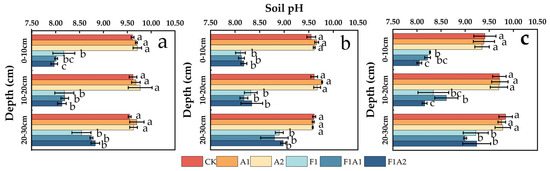
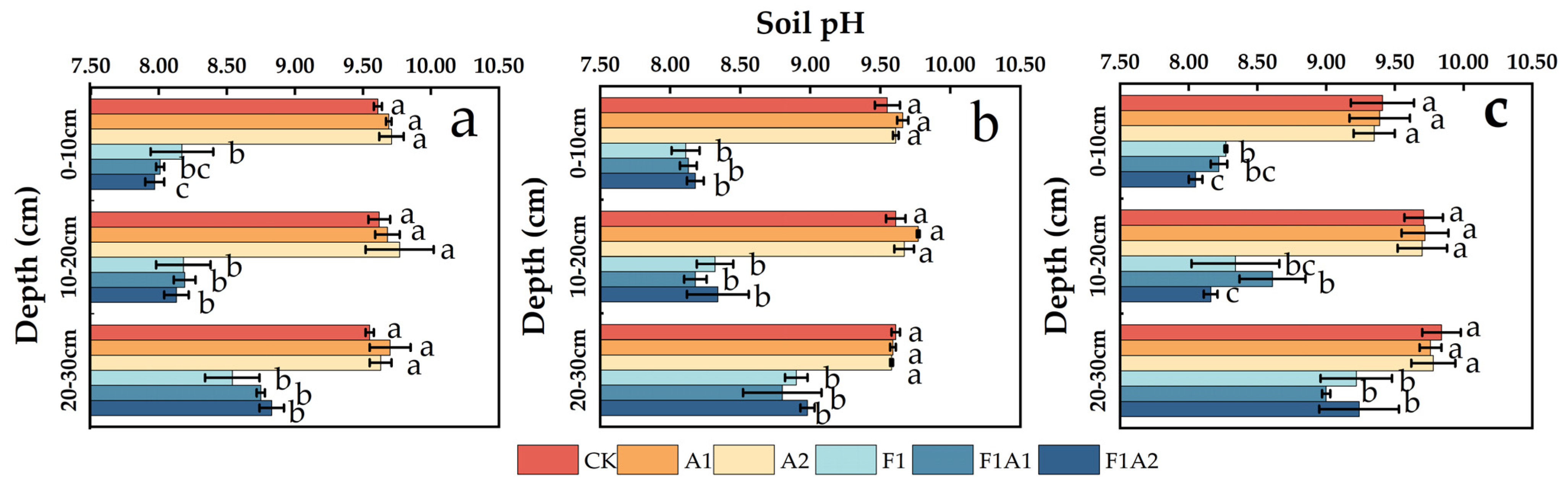
FWS1 sampling (Figure 1a): At the 0–10 cm soil layer, the soil pH ranged from 9.71 in the A2 treatment to 7.97 in the F1A2 treatment and was significantly lower in the F1A2 treatment than in the other treatments (p < 0.05), except for the F1A1 treatment. The soil pH in the F1, F1A1, and F1A2 treatments was lower than that in the CK treatment. In the 10–20 cm soil layer, no significant difference in soil pH was detected between the CK, A1, and A2 treatments or between the F1, F1A1, and F1A2 treatments. Similar results were observed for the soil pH in the 20–30 cm soil layer.
Figure 1.
Variation in soil pH on FWS1 (a), SWS2 (b), and HP (c) in the 0–10 cm, 10–20 cm, and 20–30 cm soil layers, error bars indicate standard deviation (n = 3) and different letters indicate significant differences by the Duncan’s test (p < 0.05).
SWS2 sampling (Figure 1b): The application of desulfurization gypsum promoted a significant decrease in the soil pH in the 0–10 cm soil layer (p < 0.05), with values decreasing by 15.07%, 14.87% and 14.35% in the F1, F1A1, and F1A2 treatments, respectively, compared with those in the CK treatment. However, no significant difference in soil pH was detected among the CK, A1, and A2 treatments. Similar results were also observed for the soil pH in the 10–20 cm and 20–30 cm soil layers.
HP sampling (Figure 1c): The lowest pH appeared in the soil layer of 0~10 cm in the F1A2 treatment, then in the F1A1, F1, A2, A1 and CK treatments, and was significantly lower than the other treatments (p < 0.05). Also, in 10–20 cm soil depth layer, the soil pH was lowest in the F1A2 treatment, followed by F1 and F1A1 treatments, and highest in A1 treatment, with no significant difference in soil pH in A1, A2 and CK treatments. Similar observations were also made for soil pH in the 20–30 cm soil layer.
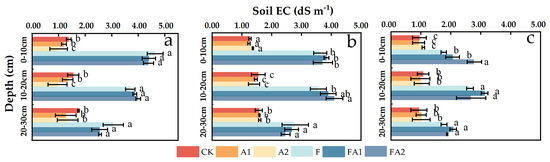
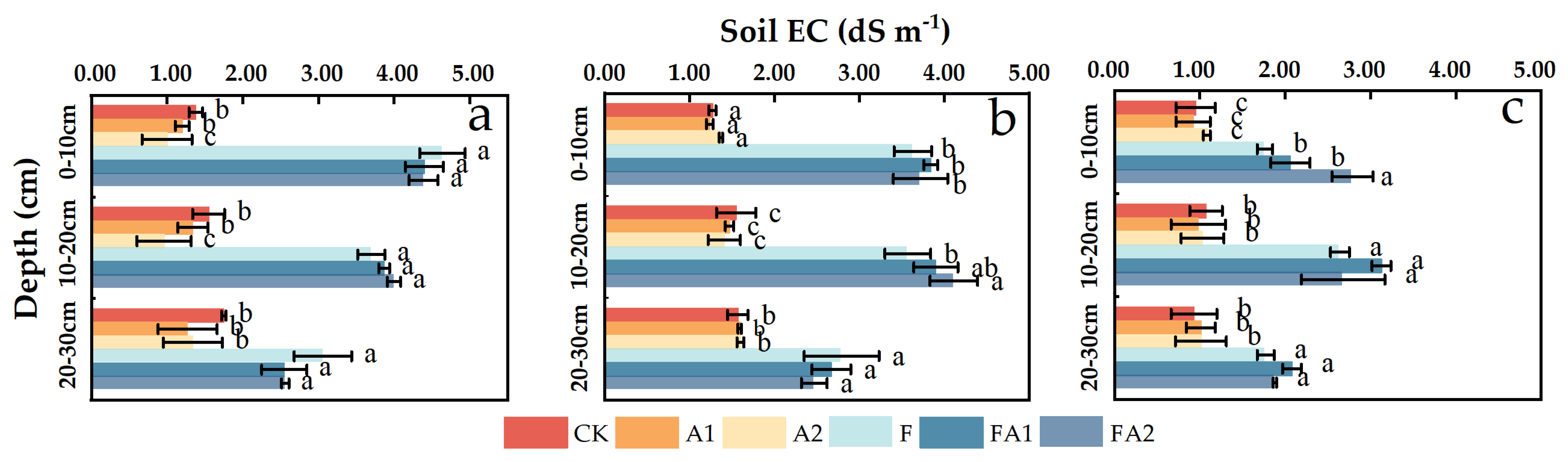
FWS1 sampling (Figure 2a): The soil EC is notably higher in the soil treated by desulfurization gypsum than in the untreated soil in the 0–10 cm soil layer (p < 0.05). No significant difference of the soil EC occurred in A1, A2 and CK treatments. Results in the 10–20 cm soil layer: soil EC in the F1A2 treatment was the largest, followed by that of soils in the F1A1 and F1 treatments, and soil EC in the A2 treatment was the smallest. This was similar to the trend of soil EC in the 20–30 cm soil layer.
Figure 2.
Variation in soil EC on FWS1 (a), SWS2 (b), and HP (c) in the 0–10 cm, 10–20 cm and 20–30 cm soil layers, error bars indicate standard deviation (n = 3) and different letters indicate significant differences by the Duncan’s test (p < 0.05).
SWS2 sampling (Figure 2b): At the 0–10 cm soil layer, the soil EC was significantly higher in all the treatments with the application of desulfurization gypsum (F1, F1A1 and F1A2) than in the CK treatment (p < 0.05), although there was no significant difference among the F1, F1A1 and F1A2 treatments. In the 10–20 cm soil layer, the application of desulfurization gypsum caused a significant increase in the soil EC compared with that in the CK treatment, with F1A2 exhibiting the highest value (p < 0.05). However, no significant difference was found in the soil EC among the A1, A2, and CK treatments. This trend was similar to that found for the soil EC in the 20–30 cm soil layer.
HP sampling (Figure 2c) in the 0–10 cm soil layer: The soil EC of the treatment with desulfurization gypsum was higher than that of CK treatment (p < 0.05), but was the highest treatment of F1A2. Also, in the 10–20 cm soil layer, although the soil EC was significantly higher than that in the CK treatment in the F1, F1A1 and F1A2 treatments (p < 0.05), the soil EC between the F1, F1A1 and F1A2 treatments were not significant. Similar results have been found for soil EC in the 20–30 cm soil layer.
3.2. Soil Exchangeable Cations
FWS1 sampling: In the 0–10 cm soil layer, the exchangeable Ca2+ and Mg2+ contents in the F1A1 and F1A2 treatments were significantly greater than those in the CK treatment (p < 0.05), with increases of 25.35–34.14% and 11.91–15.01%, respectively. The exchangeable Na+ in the F1A1 and F1A2 treatments was significantly lower than that in the CK treatment (p < 0.05), decreasing by 6.32–6.78%. There was no significant difference across all the treatments in terms of exchangeable K+. However, no significant differences were found for exchangeable K+, Na+, Ca2+, or Mg2+ among the A1, A2, and CK treatments. Similar results were observed for exchangeable K+, Na+, Ca2+, and Mg2+ in the 10–20 cm and 20–30 cm soil layers.
SWS2 sampling: In the 0–10 cm soil layer, exchangeable Ca2+ and Mg2+ in the F1, F1A1, and F1A2 treatments increased by 1.69–2.40 and 0.08–1.19 cmol kg−1, respectively, in comparison with those in the CK treatment. The highest exchangeable Ca2+ and Mg2+ contents and the lowest exchangeable Na+ content were observed in the F1A2 treatment. Compared with the CK treatment, the application of desulfurization gypsum combined with aluminum sulfate to saline–sodic soil resulted in a significant decrease in exchangeable Na+ (p < 0.05). Additionally, no significant difference was found for exchangeable K+ across all the treatments. The trends in exchangeable K+, Na+, Ca2+, and Mg2+ in the 10–20 cm and 20–30 cm soil layer were similar to those in the 0–10 cm layer. There were significant increases in exchangeable Ca2+ and Mg2+ and significant decreases in exchangeable Na+ in the F1, F1A1 and F1A2 treatments compared with the CK treatment (p < 0.05).
HP sampling: In the 0–10 cm soil layer, the application of desulfurization gypsum significantly increased the exchangeable Ca2+ and Mg2+ contents by 10.57–18.23% and 12.11–15.10%, respectively. The exchangeable Na+ content was significantly lower in the treatments in which desulfurization gypsum was applied than in the CK treatment (p < 0.05). Similarly, exchangeable Ca2+ and Mg2+ in the 10–20 cm soil layer increased by 10.61–13.87% and 4.06–12.89%, respectively, and exchangeable Na+ was reduced by 16.60–19.69% compared with those in the CK treatment. A similar trend was found for exchangeable Na+, Ca2+, and Mg2+ in the 20–30 cm soil layer (Table 3).
Table 3.
Changes in soil exchangeable cations with depth were measured over time (cmol kg−1).
3.3. Soil ESP
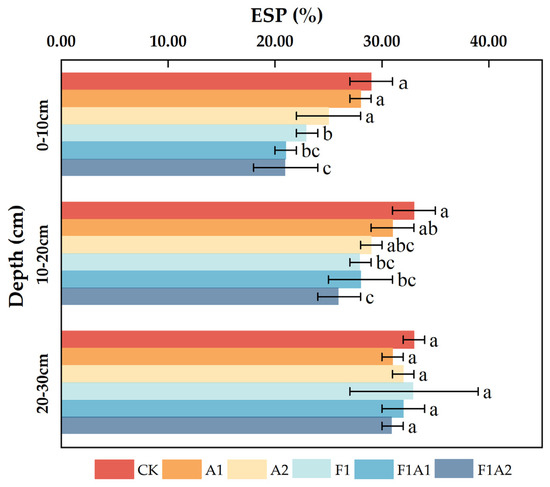
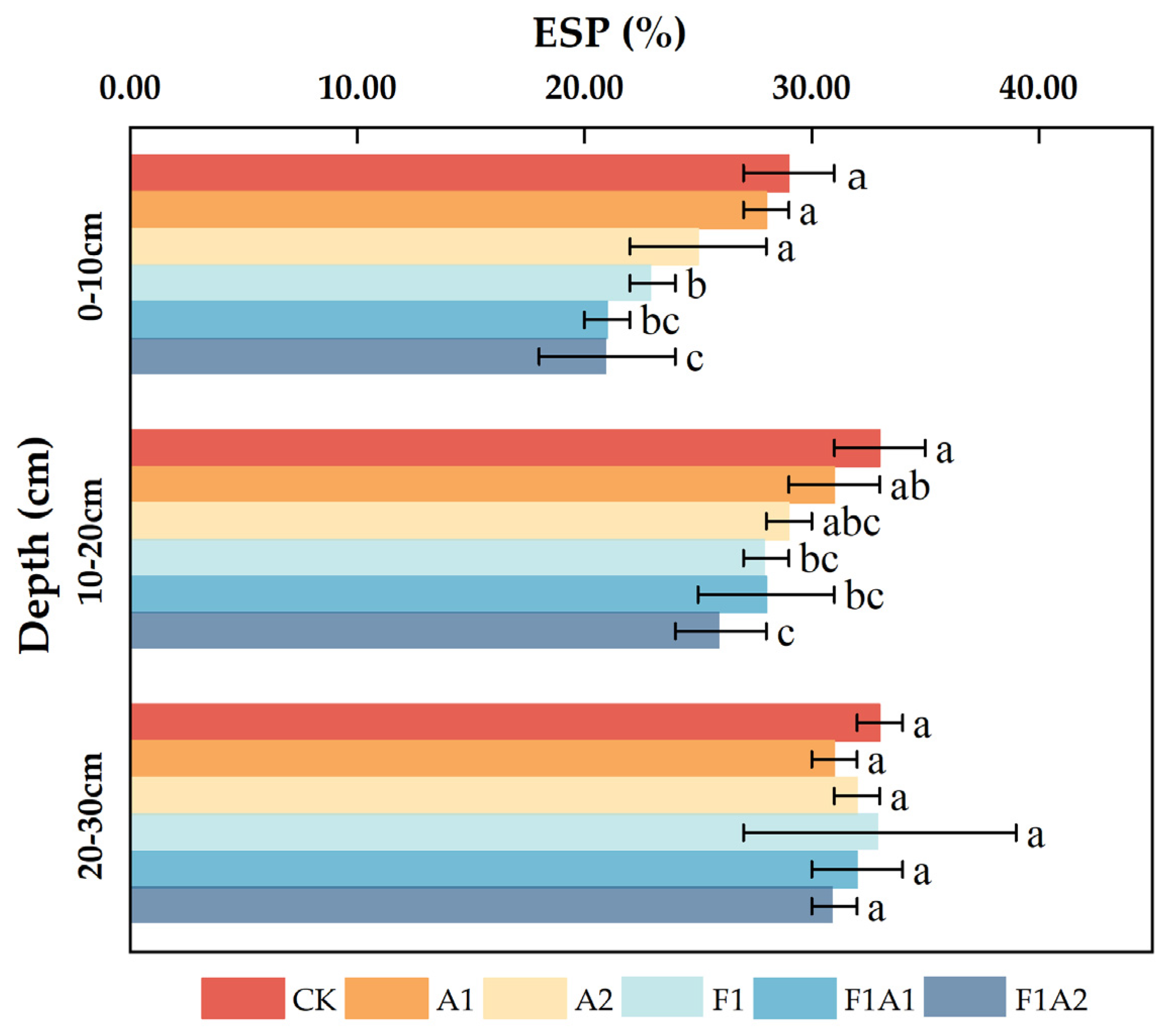
The soil ESP in the 0–10 cm, 10–20 cm, and 20–30 cm soil layers across all the treatments are shown in Figure 3.
Figure 3.
Variations in soil ESP on October 5 at the 0–10 cm, 10–20 cm, and 20–30 cm soil layers, error bars indicate standard deviation (n = 3) and different letters indicate significant differences by the Duncan’s test (p < 0.05).
Compared with the CK treatment, the soil ESP in the 0–10 cm soil layer under the F1A1 and F1A2 treatments was significantly lower (p < 0.05), whereas there was no significant difference of the soil ESP between the A1, A2 and CK treatments. In addition, in the 10–20 cm soil layer, the soil ESP was as low as 26.20% to 32.58% in all the treatments, and the lowest soil ESP occurs in the F1A2 treatment. A significant difference in soil ESP was observed between the F1A1, F1A2, and CK treatments (p < 0.05). However, no significant difference was detected in the soil ESP across all the treatments in the 20–30 cm soil layer.
3.4. EC and pH in the Water Layer
FWS1 sampling (Table 4): The treatments with desulfurization gypsum application presented 0.61–0.76 units lower pH values and 2.64–3.01 times higher EC values than did the CK treatment in the water layer (p < 0.05). In particular, the F1A2 treatment resulted in the highest EC (3.38 dS m−1) and the lowest pH (7.98) in the water layer. However, no significant differences in pH or EC were detected among the A1, A2, and CK treatments.
Table 4.
The values of pH and EC in the water layer across all treatments.
SWS2 sampling (Table 4): There was no significant difference in pH between the desulfurization gypsum and aluminum sulfate treatments and the CK treatment, except for the F1A2 treatment. Compared with the untreated soil, the soils treated with desulfurization gypsum presented a significant increase in EC (p < 0.05) in the following order: F1A2 > F1A1 > F1, with increases of 3.93, 3.93, and 2.63 times, respectively. However, with the application of aluminum sulfate alone, there was a gradual reduction in the difference in EC, with no significant differences among the A1, A2, and CK treatments.
3.5. Soluble Salt and SAR in the Water Layer
FWS1 sampling (Table 5): The soluble Ca2+ concentration ranged from 0.29 mmol L−1 in the CK treatment to 6.99 in the F1A2 treatment, and the soluble Mg2+ concentration ranged from 0.17 mmol L−1 in the CK treatment to 2.19 mmol L−1 in the F1A2 treatment. The soluble Ca2+ and Mg2+ contents were significantly higher in the F1, F1A1, and F1A2 treatments than in the CK treatment (p < 0.05). However, no significant difference in soluble Ca2+ or Mg2+ was detected between the A1, A2, and CK treatments. Compared with that in the CK treatment, soluble Na+ in the F1, F1A1, and F1A2 treatments significantly increased by 20.68–41.49% (p < 0.05), whereas there was no significant difference in soluble Na+ among the A1, A2, and CK treatments. A significant decrease in SAR was detected between the F1, F1A1, F1A2, and CK treatments (p < 0.05). However, there was no significant difference in the SAR among the A1, A2, and CK treatments.
Table 5.
Contents of soluble cations and sodium absorption ratio across all treatments (mmol L−1).
Similar results were also observed for soluble cations (Na+, Ca2+, and Mg2+) and SAR on SWS2 sampling. The highest values of soluble Ca2+ and Mg2+ were found in the F1A2 treatment and were significantly higher than those in the CK treatment (p < 0.05).
3.6. Changes in Total Alkalinity in the Water Layer
FWS1 sampling (Table 6): The TA under the amendment treatments was lower than that under the CK treatment (p < 0.05) and decreased with increasing aluminum sulfate dosage, in the order of decreasing TA: CK > A1 > A2 > F1 > F1A1 > F1A2.
Table 6.
TA in the water layer across all treatments (mmol L−1).
TA followed a similar trend on FWS1 and SWS2 sampling, no significant difference in TA was detected among the A1, A2, and CK treatments or among the F1, F1A1, and F1A2 treatments.
3.7. Relationships Among the Soil Parameters
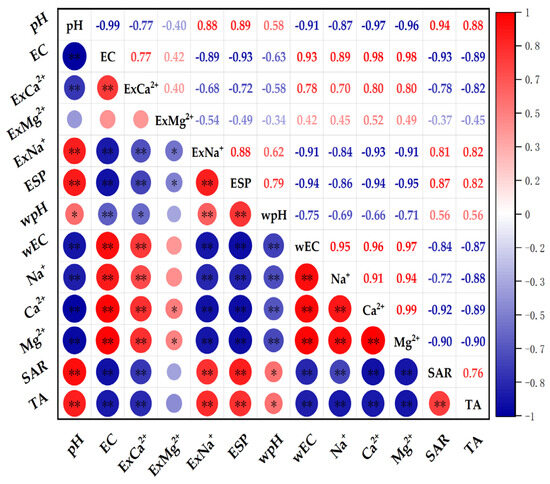
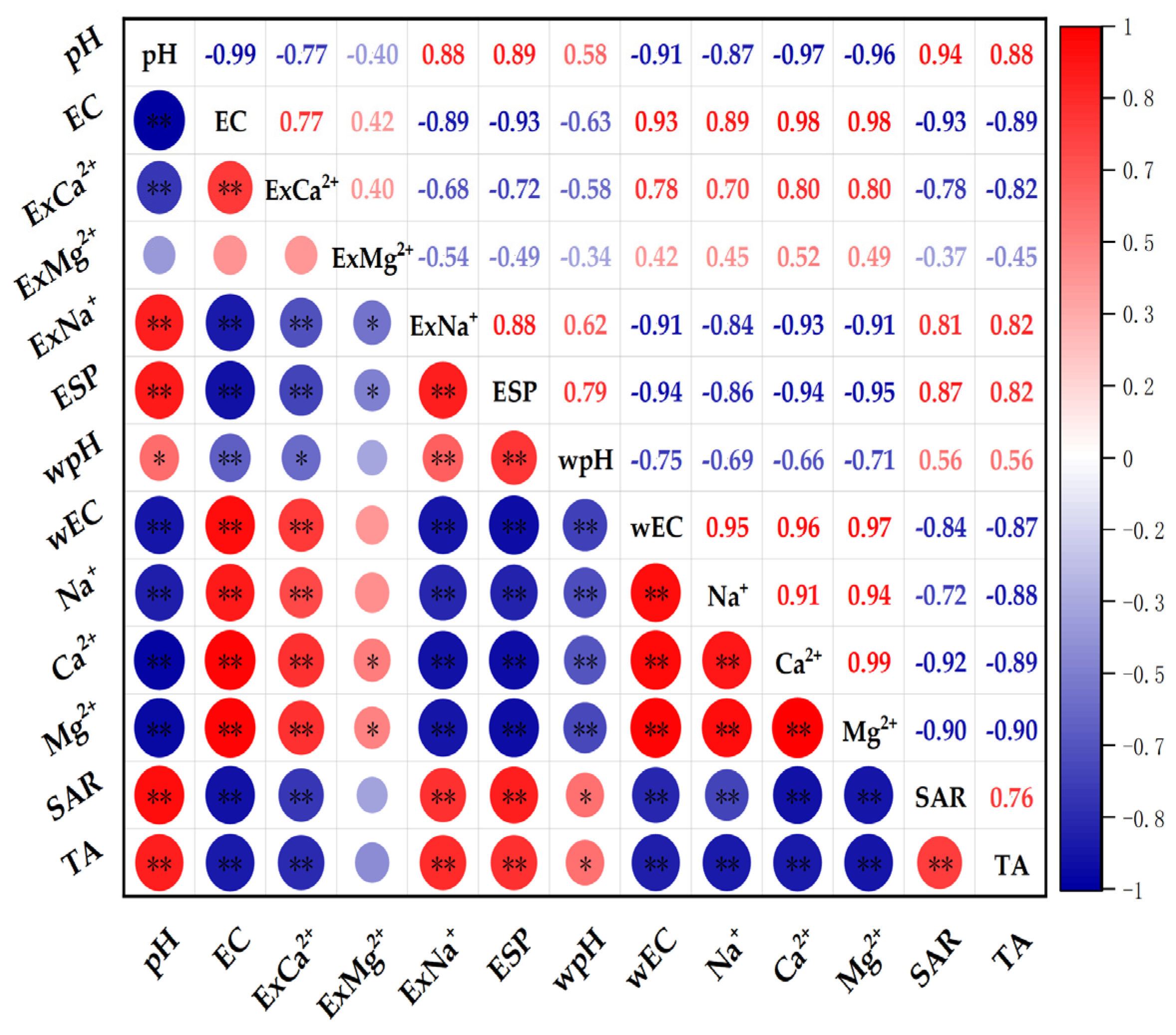
A correlation heatmap was used to interpret the relationships among the chemical properties of the saline–sodic soil. In our study, SAR was significantly and positively correlated with soil pH, ESP, exchangeable Na+, and TA, with correlation coefficients of 0.94, 0.87, 0.81, and 0.76, respectively (p < 0.01), and negatively correlated with soil EC and exchangeable Ca2+ with correlation coefficients of −0.93 and −0.78, respectively (p < 0.01). TA and exchangeable Na+ were negatively correlated with soluble Na+, Ca2+, and Mg2+ (p < 0.01) and positively correlated with soil pH (p < 0.01). ESP had a significant positive correlation with exchangeable Na+, soil pH, TA, and pH in the water layer and a significant negative correlation with soil EC, soluble Mg2+, Ca2+, and Na+, and EC in the water layer at the p < 0.01 level. Exchangeable Mg2+ was significantly and negatively correlated with ESP at the p < 0.05 level.
3.8. PLS–PM of the Soil Parameters
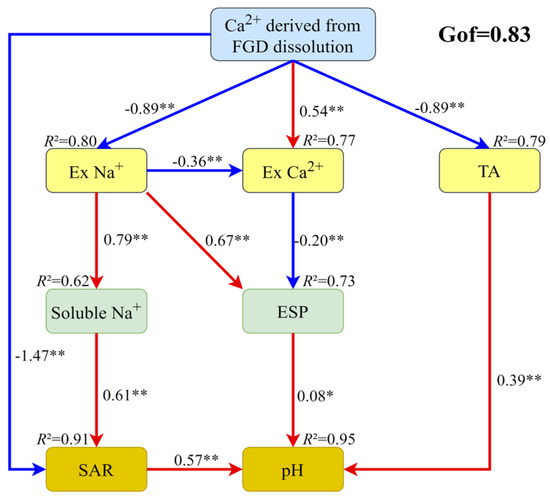
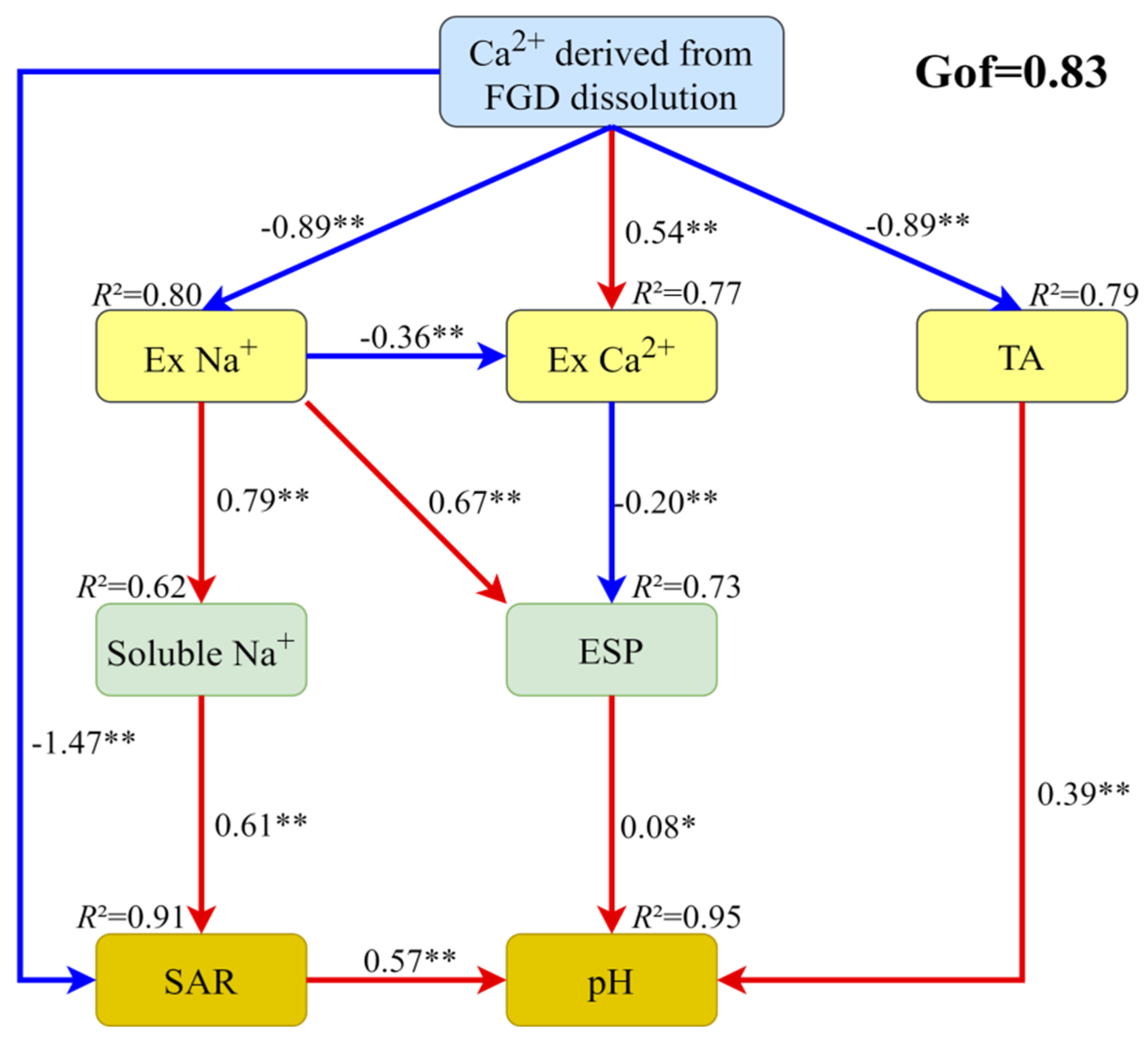
PLS–PM was used to depict the influence of SAR, TA, and ESP on soil pH. The soil pH was directly affected by ESP, TA, and SAR, with coefficients of 0.08 (p < 0.05), 0.39, and 0.57 (p < 0.01), respectively. The soil ESP was significantly affected by exchangeable Na+, with a coefficient of 0.68 (p < 0.01). Additionally, exchangeable Na+, TA, and exchangeable Ca2+ were significantly influenced by Ca2+ derived from desulfurization gypsum, with coefficients of −0.65, −0.79, and 0.86, respectively (p < 0.01).
The results revealed that SAR was the primary explanatory indicator of soil pH, followed by TA and ESP.
4. Discussion
4.1. Effects of Variation in Exchangeable Cations Induced by the Application of Desulfurization Gypsum Combined with Aluminum Sulfate on Soil Salinity and Sodicity
High soil pH is a typical characteristic of saline–sodic soils and is affected mainly by the ratio of exchangeable Na+ on soil colloids and CO32− and HCO3− in the soil solution [28,29]. The reductions in soil salinity and sodicity were closely related to the variation in soil exchangeable cations. In our study, the application of desulfurization gypsum led to increases in soil exchangeable Ca2+ and Mg2+ and a decrease in soil exchangeable Na+, further affecting the soil pH and ESP (Figure 4). This is consistent with the results of studies of Mao, Green and Zhou [30,31,32] in saline–sodic soil with desulfurization gypsum and aluminum sulfate, which indicated that the application of desulfurization gypsum and aluminum sulfate significantly increased the amount of exchangeable Ca2+ and significantly decreased the soil ESP, pH, and exchangeable Na+, especially in the topsoil. Notably, Koralegedara [33] and Wang [34] reported that exchangeable Na+ on soil colloids was replaced by Ca2+ derived from desulfurization gypsum dissolution, forming neutral salts (Na2SO4), which resulted in an increase in exchangeable Ca2+ and decreases in soil pH and exchangeable Na+. Additionally, in our study, the reductions in pH and ESP were more significant in the combined treatments than in the treatments with desulfurization gypsum alone or aluminum sulfate alone (Figure 3; Table 4). This result is likely attributed to the fact that H+ derived from Al3+ hydrolysis is beneficial for regulating soil pH and promoting soil carbonate dissolution. Additionally, the reduction in carbonate can also prevent Ca2+ from forming insoluble CaCO3 again and provide more calcium sources for the soil [35]. The cation exchange process is continuous, and the soil structure and permeability are improved by Ca2+ and Al3+ for soil colloid aggregation [36,37], which further increases the area and opportunity for sufficient cation replacement.
Figure 4.
The path model illustrates the direct and indirect effects of soil parameters on soil salinity and sodicity. The goodness-of-fit (Gof) measure for model fitting is 0.81 (>0.6). Partial least squares-path modeling (PLS-PM) of the direct and indirect effects of soil parameters on soil salinity and sodicity. *: p < 0.05; **: p < 0.01. Red arrows indicate significant positive correlations, and blue arrows indicate significant negative correlations.
4.2. The Major Soluble Salts Affecting Soil Salinity and Sodicity and Their Interactive Relationships in Saline–Sodic Soil
The reductions in soil salinity and sodicity were closely associated with variations in soluble salt composition (Figure 4). In our study, EC in the water and soil layers was significantly and positively affected by soluble Ca2+ and Mg2+, respectively (Figure 5; p < 0.01), and EC was significantly higher in the treatments with the application of desulfurization gypsum than in the CK treatment (Figure 2; p < 0.05). This finding is consistent with the results of Zhang [38], who reported that the EC in soil treated with a one-time application of desulfurization gypsum for four years was higher than that in soil without the application of desulfurization gypsum. This occurs because of the large and continuous input of Ca2+ supplied from desulfurization gypsum dissolution [39,40], which contributes to the variations in soluble salt compositions and the reduction in soil pH (Figure 4). No significant differences in EC in the soil and water layers were detected with different dosages of aluminum sulfate for identical dosages of desulfurization gypsum or with different dosages of aluminum sulfate alone (Figure 2; Table 4). Therefore, the results indicate that aluminum sulfate alone has no significant effect on the salt content in the soil or water layers. In our study, SAR was significantly and positively correlated with soil pH, which is consistent with the results of Liu [41] (Figure 4 and Figure 5; p < 0.01). SAR was significantly lower in the treatments with desulfurization gypsum application than in the CK treatment (Table 5; p < 0.05). Calcium sulfate (CaSO4), a mid-soluble substance, can continuously release soluble Ca2+ [42]. The increase in soluble Ca2+ derived from desulfurization gypsum dissolution is the predominant factor affecting the lower SAR (Table 5; p < 0.05), further leading to a decrease in soil pH (Figure 4). In addition, the decrease in the SAR is associated with the greater magnitude of the increase in soluble Ca2+ than in soluble Na+ caused by the dissolution of desulfurization gypsum (Table 5). Simultaneously, soil pH was significantly and positively correlated with TA (Figure 5). The reduction in soil pH was attributed to a decrease in TA in the water layer because HCO3− and CO32− are neutralized by H+ derived from aluminum sulfate (Table 6; Figure 5). These findings are consistent with those of Zhou [32] and Xiao [43], who reported that the application of aluminum sulfate to saline–sodic soil improved soil quality by decreasing TA and soil pH.
Figure 5.
Pearson correlation analysis of soil parameters. ** indicates significant correlation at 0.01 standard; * indicates significant correlation at 0.05 standard; wpH and wEC, pH and electrical conductivity in the water layer; pH and EC, pH and electrical conductivity in the soil layer.
5. Conclusions
Rice cultivation with the application of desulfurization gypsum combined with aluminum sulfate is a feasible approach for reclaiming saline–sodic soil without vegetation. The application of desulfurization gypsum combined with aluminum sulfate to saline–sodic soil significantly decreased TA, SAR, exchangeable Na+, and soil ESP and resulted in significant increases in soil exchangeable Ca2+, soluble Ca2+ and EC. The results revealed that the soil pH and soil ESP were significantly and positively correlated with the SAR, TA, and exchangeable Na+, respectively. The soil pH, ESP, exchangeable Ca2+, exchangeable Na+, SAR, and soluble salts were closely related to the soluble Ca2+ derived from desulfurization gypsum. The reduction in soil sodicity is attributed to the replacement of soluble Ca2+ derived from desulfurization gypsum with Na+ in the soil. Simultaneously, H+ formed by the hydrolysis of aluminum sulfate neutralized CO32− and HCO3− in the water layer. Notably, in the study, the application of desulfurization gypsum combined with aluminum sulfate resulted in the replacement of exchangeable Na+ on soil colloids by Ca2+ and Al3+, resulting in soluble Na+ enrichment and EC increase in the water layer. Therefore, during the agronomic management for paddy field, drainage of it should be implemented to avoid soil salinization periodically.
Author Contributions
Conceptualization, Q.M., J.Z. (Juan Zhang). and Y.L.; methodology, Y.L., Q.M. and J.Z. (Junhua Zhang).; software, Y.L. and J.X.; validation, Y.L., J.X. and J.F.; formal analysis, L.F. and J.F.; investigation, Y.L., J.X. and J.Z. (Juan Zhang).; resources, Q.M.; data curation, Y.L.; writing—original draft preparation, Y.L.; writing—review and editing, Q.M.; visualization, Y.L.; supervision, Q.M.; project administration, Y.L.; funding acquisition, Q.M. All authors have read and agreed to the published version of the manuscript.
Funding
This research is financially supported by the Chinese Academy of Sciences.
Data Availability Statement
The original contributions presented in this study are included in the article. Further inquiries can be directed to the corresponding author.
Acknowledgments
We would like to thank the Chinese Academy of Sciences for funding the project.
Conflicts of Interest
The authors declare no conflicts of interest.
References
- Hopmans, J.W.; Qureshi, A.S.; Kisekka, I.; Munns, R.; Grattan, S.R.; Rengasamy, P.; Ben-Gal, A.; Assouline, S.; Javaux, M.; Minhas, P.S. Chapter One—Critical knowledge gaps and research priorities in global soil salinity. Adv. Agron. 2021, 169, 1–191. [Google Scholar] [CrossRef] [Scilit]
- Stille, L.; Smeets, E.; Wicke, B.; Singh, R.; Singh, G. The economic performance of four (agro-) forestry systems on alkaline soils in the state of Haryana in India. Energy Sustain. Dev. 2011, 15, 388–397. [Google Scholar] [CrossRef] [Scilit]
- Kopittke, P.M.; Menzies, N.W.; Wang, P.; McKenna, B.A.; Lombi, E. Soil and the intensification of agriculture for global food security. Environ. Int. 2019, 132, 105078. [Google Scholar] [CrossRef] [Scilit]
- Wang, L.; Seki, K.; Miyazaki, T.; Ishihama, Y. The causes of soil alkalinization in the Songnen Plain of Northeast China. Paddy Water Environ. 2009, 7, 259–270. [Google Scholar] [CrossRef] [Scilit]
- Marchuk, A.; Rengasamy, P. Clay behaviour in suspension is related to the ionicity of clay-cation bonds. Appl. Clay Sci. 2011, 53, 754–759. [Google Scholar] [CrossRef] [Scilit]
- Chen, Y.Q.; Zhang, G.X.; Xu, Y.J.; Wu, L.L.; Huang, Z.G. Changes in root zone salt content and rice yield on saline-sodic soils across a salinity gradient under different irrigation schedules. J. Food Agric. Environ. 2013, 11, 1499–1505. Available online: https://repository.lsu.edu/agrnr_pubs/1555 (accessed on 4 February 2026).
- Rengasamy, P. World salinization with emphasis on Australia. J. Exp. Bot. 2006, 57, 1017–1023. [Google Scholar] [CrossRef] [Scilit] [PubMed]
- Farooq, M.; Hussain, M.; Wakeel, A.; Siddique, K.H.M. Salt stress in maize: Effects, resistance mechanisms, and management. A review. Agron. Sustain. Dev. 2015, 35, 461–481. [Google Scholar] [CrossRef] [Scilit]
- Yang, J.S.; Yao, R.J.; Wang, X.P.; Xie, W.P.; Zhang, X.; Zhu, W.; Zhang, L.; Sun, R.J. Research on Salt-affected Soils in China: History, Status Quo and Prospect. Acta Pedol. Sinica 2022, 59, 10–27. [Google Scholar] [CrossRef]
- Ueda, A.; Kanechi, M.; Uno, Y.C.; Inagaki, N. Photosynthetic limitations of a halophyte sea aster (Aster tripolium L.) under water stress and NaCl stress. J. Plant Res. 2003, 116, 63–68. [Google Scholar] [CrossRef] [Scilit]
- Cao, Y.N.; Gao, Y.M.; Li, J.S.; Tian, Y.Q. Straw composts, gypsum and their mixtures enhance tomato yields under continuous saline water irrigation. Agric. Water Manag. 2019, 223, 105721. [Google Scholar] [CrossRef] [Scilit]
- Liu, J.H.; Zhao, L.P.; Wang, H.B.; Gao, Q.; Feng, J.; Wang, Y.; Huang, X.; Zhao, X.M. Reduction of Obstacle Factors in Soda Alkali-Saline Soil by Rice Cultivation. J. Jilin Agric. Univ. 2022, 44, 699–705. [Google Scholar] [CrossRef]
- Wang, J.; Lin, C.Y.; Han, Z.M.; Fu, C.B.; Huang, D.; Cheng, H.G. Dissolved nitrogen in salt-affected soils reclaimed by planting rice: How is it influenced by soil physicochemical properties? Sci. Total Environ. 2022, 824, 153863. [Google Scholar] [CrossRef] [Scilit]
- Li, M.; Ma, F.; Zhang, J.H. Effects of rice planting years on physicochemical properties and bacterial community structure in saline-alkali soil. Agric. Res. 2021, 39, 194–202. [Google Scholar] [CrossRef]
- Zhou, B.; Hu, S.W. Effect of different rice planting years on pore and infiltration properties of soda saline-alkali soil. Acta Pedol. Sinica 2023, 60, 99–105. [Google Scholar] [CrossRef]
- Zhang, H.; Huang, L.H.; Li, Y.Y.; Wang, H.B.; Liang, Z.W. Research and experience of rice planting in saline-sodic soil in Northeast China. Soils Crops. 2016, 5, 191–197. Available online: http://sc.iga.ac.cn/cn/article/id/6dc71fad-8dd5-4904-ae77-8baec729cfa9 (accessed on 4 February 2026).
- Amezketa, E.; Aragüés, R.; Gazol, R. Efficiency of sulfuric acid, mined gypsum, and two gypsum by-products in soil crusting prevention and sodic soil reclamation. Agron. J. 2005, 97, 983–989. [Google Scholar] [CrossRef] [Scilit]
- Li, M.Z.; Tian, R.R.; Li, R.; Wang, S.J.; Wang, W.N.; Wang, Q.; Liu, J.M.; Liu, J.; Li, Y.Y.; Xu, L.Z.; et al. Effects of calcium/aluminum-based amendments on saline-alkali soil quality and sunflower yield in the Hetao Irrigation District. Sci. Agric. Sinica 2025, 58, 4231–4245. [Google Scholar] [CrossRef]
- Qadir, M.; Qureshi, R.H.; Ahmad, N. Horizontal flushing: A promising ameliorative technology for hard saline-sodic and sodic soils. Soil Tillage Res. 1998, 45, 119–131. [Google Scholar] [CrossRef] [Scilit]
- Chen, X.; Yang, S.Q.; Wen, X.Y.; Guo, F.Q.; Lou, S. Decision of straw deep burial and aluminum sulfate drip irrigation in soda saline soil based on Grey Relation Analysis and TOPSIS Coupling. Agronomy 2024, 14, 3. [Google Scholar] [CrossRef] [Scilit]
- Wang, P.J.; Liu, Q.; Fan, S.L.; Wang, J.; Mu, S.G.; Zhu, C.B. Combined application of desulfurization gypsum and biochar for improving saline-alkali soils: A strategy to improve newly reclaimed cropland in Coastal Mudflats. Land 2023, 12, 1717. [Google Scholar] [CrossRef] [Scilit]
- Blasco, M.L.; Cornfield, A.H. Nitrification in saline sodic soils acidified with aluminium sulphate. Geoderma 1971, 5, 161–164. [Google Scholar] [CrossRef] [Scilit]
- Tian, R.R.; Zhang, W.C.; Li, Y.; Xu, L.Z.; Sun, Z.T.; Li, Y.; Zhao, C.G.; Zhao, Y.G.; Wang, S.J. Progress in research and engineering application of flue gas desulfurization gypsum to reclaim saline-alkali land. J. Combust. Sci. Technol. 2022, 28, 736–748. Available online: https://tjurs.tju.edu.cn/#/digest?ArticleID=2501 (accessed on 4 February 2026).
- Miao, Y.; Yang, F.; Wang, Z.C.; Shao, X.W.; Geng, Y.Q. Progress of research on the improvement of saline-sodic soil using acidic substances. Chin. J. Eco-Agric. 2023, 31, 373–384. [Google Scholar] [CrossRef]
- Wang, Y.G.; Wang, Z.F.; Liang, F.; Jing, X.; Feng, W.T. Application of flue gas desulfurization gypsum improves multiple functions of saline-sodic soils across China. Chemosphere 2021, 277, 130345. [Google Scholar] [CrossRef] [Scilit] [PubMed]
- Guo, J.Z.; Liu, B.Y.; Zhang, K.P.; Sun, Z.T.; Mo, E.B.; Wang, S.J.; Liu, J.; Li, Y.; Xu, L.Z.; Zhao, Y.G. Long-term effects of a one-time application of flue gas desulfurization gypsum on the soil pore structure in sodic paddy fields. Agric. Water Manag. 2025, 309, 109346. [Google Scholar] [CrossRef] [Scilit]
- IUSS Working Group WRB. World reference base for soil resources 2006. In World Soil Resources Report No. 103, 2nd ed.; FAO: Rome, Italy, 2006; Available online: https://www.fao.org/fileadmin/templates/nr/images/resources/pdf_documents/wsrr103e.pdf (accessed on 4 February 2026).
- Mashhady, A.S.; Rowell, D. Soil alkalinity. I. Equilibria and alkalinity development. J. Soil Sci. 1978, 29, 65–75. [Google Scholar] [CrossRef] [Scilit]
- Cao, Y.B.; Song, H.F.; Zhang, L.Y. New insight into plant saline-alkali tolerance mechanisms and application to breeding. Int. J. Mol. Sci. 2022, 23, 16048. [Google Scholar] [CrossRef] [Scilit]
- Mao, Y.M.; Li, X.P.; Dick, W.A.; Chen, L.M. Remediation of saline-sodic soil with flue gas desulfurization gypsum in a reclaimed tidal flat of southeast China. J. Environ. Sci. 2016, 45, 224–232. [Google Scholar] [CrossRef] [Scilit]
- Green, H.; Larsen, P.; Koci, J.; Edwards, W.; Nelson, P.N. Long-term effects of gypsum on the chemistry of sodic soils. Soil Tillage Res. 2023, 233, 105780. [Google Scholar] [CrossRef] [Scilit]
- Zhou, M.; Liu, X.B.; Meng, Q.F.; Zeng, X.N.; Zhang, J.Z.; Li, D.W.; Wang, J.; Du, W.L.; Ma, X.F. Additional application of aluminum sulfate with different fertilizers ameliorates saline-sodic soil of Songnen Plain in Northeast China. J. Soils Sediments 2019, 19, 3521–3533. [Google Scholar] [CrossRef] [Scilit]
- Koralegedara, N.H.; Pinto, P.X.; Dionysiou, D.D.; Al-Abed, S.R. Recent advances in flue gas desulfurization gypsum processes and applications—A review. J. Environ. Manag. 2019, 251, 109572. [Google Scholar] [CrossRef] [Scilit]
- Wang, P.J.; Lin, X.L.; Liu, Q.; Lin, Z.Q.; Yang, Y.L.; Chen, H.; Fan, S.L. Interactions between flue gas desulfurization gypsum and biochar on water infiltration characteristics and physicochemical properties of saline-alkaline soil. Environ. Monit. Assess. 2023, 195, 1273. [Google Scholar] [CrossRef] [Scilit]
- Luo, J.Q.; Wang, L.L.; Li, Q.S.; Zhang, Q.K.; He, B.Y.; Wang, Y.; Qin, L.P.; Li, S.S. Improvement of hard saline-sodic soils using polymeric aluminum ferric sulfate (PAFS). Soil Tillage Res. 2015, 149, 12–20. [Google Scholar] [CrossRef] [Scilit]
- David, R.; Dimitrios, P. Diffusion and cation exchange during the reclamation of saline-structured soils. Geoderma 2002, 107, 271–279. [Google Scholar] [CrossRef] [Scilit]
- Wang, B.S.; Yu, W.S.; Wu, X.P.; Gao, L.L.; Li, J.; Li, S.P.; Song, X.J.; Liu, C.C.; Li, Q.; Liang, G.P.; et al. Effect of straw addition on the formation of aggregates and accumulation of organic carbon in dryland soil. Sci. Agric. Sinica 2019, 52, 1553–1563. [Google Scholar] [CrossRef]
- Zhang, W.C.; Zhao, Y.G.; Wang, S.J.; Li, Y.; Zhuo, Y.Q.; Liu, J. Soil salinity and sodicity changes after a one-time application of flue gas desulphurization gypsum to paddy fields. Land Degrad. Dev. 2021, 32, 4193–4202. [Google Scholar] [CrossRef] [Scilit]
- Nan, J.K.; Chen, X.M.; Wang, X.Y.; Lashari, M.S.; Wang, Y.M.; Guo, Z.C.; Du, Z.J. Effects of applying flue gas desulfurization gypsum and humic acid on soil physicochemical properties and rapeseed yield of a saline-sodic cropland in the eastern coastal area of China. J. Soils Sediments 2016, 16, 38–50. [Google Scholar] [CrossRef] [Scilit]
- Mao, Y.M.; Li, X.P. Desalting effect of flue gas desulfurization gypsum (FGDG) on coastal saline sodic soil with different textures. J. Soils Sediments 2023, 23, 765–776. [Google Scholar] [CrossRef] [Scilit]
- Liu, B.S.; Huang, L.H.; Jiang, X.T.; Liu, Y.; Huang, G.Z.; Yang, C.; Liang, Y.P.; Cai, J.H.; Zhu, G.; Kong, Q.Q. Quantitative evaluation and mechanism analysis of soil chemical factors affecting rice yield in saline-sodic paddy fields. Sci. Total Environ. 2024, 929, 172584. [Google Scholar] [CrossRef] [Scilit] [PubMed]
- Loos, D.; Pasel, C.; Luckas, M.; Schmidt, K.G.; Herbell, J.D. Experimental investigation and modelling of the solubility of calcite and gypsum in aqueous systems at higher ionic strength. Fluid Phase Equilib. 2004, 219, 219–229. [Google Scholar] [CrossRef] [Scilit]
- Xiao, F.; Wang, Y.Y.; Wang, H.B.; Zhao, L.P.; Zhao, X.M.; Sui, B. Improvement Effect of Different Amendments and Combinations on Soda Saline-alkali Soil. J. Jilin Agric. Univ. 2020, 45, 340–345. [Google Scholar] [CrossRef]

Disclaimer/Publisher’s Note: The statements, opinions and data contained in all publications are solely those of the individual author(s) and contributor(s) and not of MDPI and/or the editor(s). MDPI and/or the editor(s) disclaim responsibility for any injury to people or property resulting from any ideas, methods, instructions or products referred to in the content. |
© 2026 by the authors. Licensee MDPI, Basel, Switzerland. This article is an open access article distributed under the terms and conditions of the Creative Commons Attribution (CC BY) license.