Article

Oxalic Acid Enhances Soil Microbial Phosphorus Mobilization Under Phosphorus Deficiency: Evidence from a Soil Microcosm Experiment


1
College of Resources and Environment, Zhongkai University of Agriculture and Engineering, Guangzhou 510225, China
2
Engineering and Technology Research Center for Agricultural Land Pollution Prevention and Control of Guangdong Higher Education Institutes, Guangzhou 510225, China
*
Author to whom correspondence should be addressed.
Agronomy 2026, 16(4), 405; https://doi.org/10.3390/agronomy16040405
Submission received: 27 November 2025 / Revised: 30 January 2026 / Accepted: 4 February 2026 / Published: 7 February 2026
(This article belongs to the Section Soil and Plant Nutrition)

Abstract

Oxalic acid is a key root exudate released by plants under phosphorus (P) deficiency and plays a direct role in solubilizing fixed soil P. However, its specific effects on soil microbial community assembly and ecological functions remain less clear. In this study, based on an ex planta soil microcosm incubation experiment, the impacts of oxalic acid input on soil bacterial and fungal community assemblage and functional profiles involved in P mobilization were explored. The results showed that oxalic acid input significantly changed soil bacterial and fungal community composition, decreased their diversity, and enriched bacterial taxa involved in P mobilization and fungal taxa associated with plants, showing the selective effects of oxalic acid on soil microorganisms. Further community assembly analyses (βNTI and NST) showed that oxalic acid input promoted a shift in bacterial community from a stochastic-process-dominated community to a deterministic-process-dominated community, while the fungal community exhibited a converse pattern. These findings reveal the important role of oxalic acid in shaping soil microbial community assembly and ecological functions under P deficiency, broadening our understanding of the role of oxalic acid in plant responses to low-P stress.

1. Introduction

Phosphorus (P) is an essential yet poorly available macronutrient in soil [1]. In intensive agricultural systems, large amounts of P fertilizers are applied to the soil to meet the demands of agricultural production [2]. However, the fixation of soluble P into insoluble forms substantially diminishes the use efficiency of phosphate fertilizers [3]. Furthermore, the low mobility of P in soil, due to its slow diffusion, restricts its movement to plant roots, creating a depletion zone around the rhizosphere [4]. To overcome this limitation, plants employ physiological adaptations such as altering their root architecture and secreting compounds into the rhizosphere [5,6,7]. The release of root exudates, particularly low-molecular-weight organic acids, is a key strategy for mobilizing fixed soil P [8]. These acids chelate metal ions and solubilize phosphate minerals, thereby enhancing P bioavailability [9,10].
Oxalic acid, a dicarboxylic acid, stands out as one of the most prominent and effective root exudates in this context, serving as a key agent for mobilizing fixed soil P [11]. The efficacy of OA in enhancing P availability operates through two primary and often synergistic mechanisms [12]. Firstly, it functions as a potent chelator. The carboxyl groups of oxalic acid have a high affinity for polyvalent cations, enabling it to effectively chelate Al3+, Fe3+, and Ca2+ ions. This chelation process disrupts the crystalline structure of P-fixing minerals (e.g., dissolving Al/Fe oxides) and directly liberates bound phosphate anions into the soil solution. This ligand-exchange reaction is particularly crucial in acidic soils where P fixation by aluminum and iron dominates. Secondly, oxalic acid contributes to rhizosphere acidification. The dissociation of its protons lowers the pH in the immediate vicinity of the root. This localized acidity promotes the dissolution of P-bearing mineral phases and can further desorb phosphate from anion exchange sites that are pH-sensitive. The combined action of chelation and acidification makes oxalic acid a highly efficient molecule for accessing the otherwise recalcitrant soil P pools.
The mobilization of soil P in the rhizosphere is not solely a plant-driven process but is profoundly mediated by a complex interplay between plant roots and the associated microbiome. Under P-deficient conditions, plants can also improve P availability by regulating the rhizosphere microbial community and its functions [13]. Root exudates, serving as both signals and carbon substrates, play a pivotal role in this process [14]. They function as selective filters, enriching for specific microbial taxa capable of utilizing these compounds, and in return, facilitating P mobilization. Key exudates such as organic acids, flavonoids, and strigolactones have been shown to selectively stimulate the proliferation of phosphate-solubilizing bacteria (PSB) and mycorrhizal fungi [15]. These beneficial microbes enhance P availability through multiple mechanisms: PSB produce organic acids and phosphatases that solubilize inorganic P (Pi) and mineralize organic P (Po), respectively, while mycorrhizal hyphae extensively explore soil volumes beyond the P-depletion zone surrounding the root [16].
Recent advances, particularly with the application of high-throughput sequencing and metagenomics, have begun to decipher the specific linkages between root exudation profiles and the recruitment of a “P-mobilizing” microbiome. Studies demonstrate that genotypes with distinct exudate signatures, such as high malate or citrate exudation, harbor distinct and more functionally active microbial communities that contribute significantly to plant P nutrition [17,18]. This suggests that the regulatory function of root exudates extends beyond chemistry to biological engineering of the rhizosphere. However, despite this progress, a comprehensive understanding of the causal relationships and the relative contribution of specific exudate compounds in shaping a functionally beneficial microbiome remains elusive. The synergy between direct exudate-mediated P solubilization and the microbially mediated pathways is also not fully quantified. Therefore, this study aims to elucidate the role of a specific organic acid, oxalic acid, in shaping soil microbial community structure and functional profiles involved in P mobilization. While the direct role of oxalic acid in chelating metal ions and solubilizing Po is well-established, its effects on soil microbial community assembly and ecological functions are little known. The results from this study would enhance our understanding of the dual role of specific root exudates in responding to low P stress.

2. Materials and Methods

2.1. Soil Source and Properties

The soil used in this study was a red soil collected from the Yingtan Red Soil Ecological Experiment Station (28°12′ N, 116°55′ E) of the Chinese Academy of Sciences. The soil had been under long-term rice cultivation without P fertilizer application. After rice harvest, surface soil (0–20 cm) was collected, sieved (2 mm mesh), and homogenized, and impurities (such as stones and roots) were removed for subsequent use. The fundamental physicochemical properties of the soil were as follows: pH 5.14, total P (TP) 0.34 g/kg, available P (AP) 3.12 mg/kg, inorganic phosphorus (Pi) 0.06 g/kg, Po 0.28 g/kg, and soil organic matter 20.80 g/kg.

2.2. Experimental Design

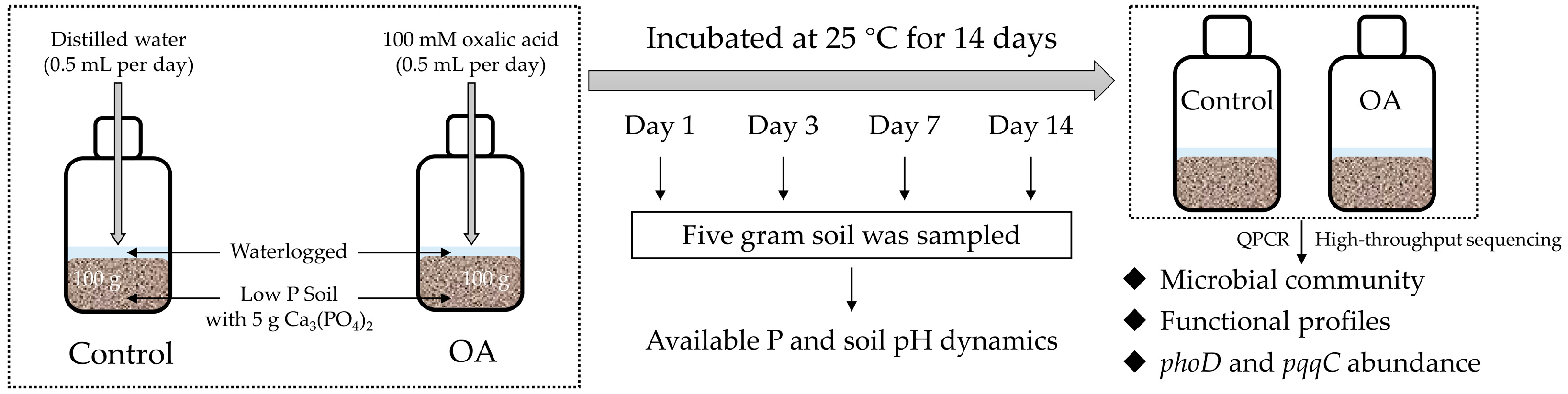
To exclude interference from other factors, such as plant roots, this study employed a microcosm incubation. The experiment comprised two conditions: a control (no oxalic acid addition, denoted as Control) and an oxalic acid amendment (denoted as OA). Each treatment contained five replicate incubations. The soil was pre-incubated for two days before the incubation experiment. The incubation was performed in a serum bottle with 100 g of soil. Five grams of tricalcium phosphate (Shanghai Aladdin Biochemical Technology Co., Ltd., Shanghai, China) was uniformly added to the soil to supplement P resources. The experimental group received a daily addition of 0.5 mL (100 mM) of oxalic acid, while the control group received the same amount of sterile water. During the 14 days of incubation, 5 g of soil was collected at days 1, 3, 7, and 14 to measure soil AP content (Figure 1). After the incubation, samples were taken to determine the bacterial and fungal communities.

2.3. Measurement of Soil Available P and Acid Phosphatase Activity

Soil available P (AP) was extracted from 0.25 g of soil by HCl-H2SO4 solution. The AP content was then determined using the molybdenum blue method. Soil acid phosphatase activity was measured using pNpp-Na2 as the substrate in pH 5.0 HOAc-NaOAc buffer. The reaction at 37 °C was stopped with NaOH, and product formation was quantified by absorbance at 405 nm. One unit (U) of activity was defined as releasing 1 µmol p-nitrophenol per minute [19].

2.4. Soil DNA Extraction and High-Throughput Sequencing

Soil total DNA was extracted from 0.5 g of soil using a FastDNA Spin Kit for Soil (MP Biomedicals, Santa Ana, CA, USA).
Primer sets 515F/806R (5′-GTGYCAGCMGCCGCGGTAA-3′ and 5′-GGACTACNVGGGTWTCTAAT-3′) and ITS3/ITS4 (5′-GCATCGATGAAGAACGCAGC-3′ and 5′-GCATATCAATAAGCGGAGGA-3′) were used to amplify the conserved region of bacterial 16S rRNA gene and region 2 of the fungal internal transcribed spacer [20,21]. After checking the specificity and concentration, PCR products were sequenced using the Illumina Hiseq 2500 platform (Illumina, Inc., San Diego, CA, USA).

2.5. Bioinformatic Analysis

Bioinformatic analysis was performed as described in previous studies [22,23,24]. The adapter and primer sequences were removed using Cutadapt (version 5.2) [25]. Then, the bioinformatic analysis of the high-throughput sequencing data was performed using VSEARCH (version 2.30.4) [26]. The paired-end sequences were first merged based on the principle of complementary base pairing. Then the low-quality sequences were removed (with an average base error rate not exceeding 0.001, fastq_maxee_rate = 0.001). The resulting high-quality sequences were subjected to chimera removal using the UCHIME algorithm (version 4.2.40) [27]. Denoising was subsequently carried out using the UNOISE algorithm to generate zero-radius operational taxonomic units (zOTUs). Taxonomic annotation of the zOTUs was performed using the SINTAX method based on the Silva (for bacteria, version 138.1) and UNITE (for fungi, version 9.0) database [28]. Non-target zOTUs were filtered out. Rarefaction curves were drawn to evaluate the coverage of the sequencing (Figure S1). The zOTU tables were subsequently rarefied to 65,000 and 71,000 reads per sample for bacterial and fungal data before downstream statistical analysis.
Functional prediction of bacterial community was performed using PICRUSt2 (Phylogenetic Investigation of Communities by Reconstruction of Unobserved States) (version 2.6.2) [29]. The ecological guild of the fungal community was parsed using FUNGuild (version 1.1) [30].

2.6. Quantification of phoD and pqqC Gene Abundance

The abundance of phoD and pqqC genes was quantified using real-time fluorescent quantitative PCR (qPCR) [31]. Primer sets phoD-ALPS-F730 (5′-CAGTGGGACGACCACGAGGT-3′) and phoD-ALPS-R1101 (5′-GAGGCCGATCGGCATGTCG-3′) and pqqC-Fw (5′-AACCGCTTCTACTACCAG-3′) and pqqC-Rv (5′-GCGAACAGCTCGGTCAG-3′) were used to amplify the phoD and pqqC genes, respectively. The PCRs were conducted in 20 µL systems containing 10 µL of 2 × SYBR qPCR Master Mix (Vazyme Biotech Co. Ltd., Nanjing, China), 0.4 µL of each primer (10 µM), 1 µL of template DNA (20 ng/µL), and 7.2 µL of nuclease-free water. The reactions were performed on a CFX96 Real-Time System (Bio-Rad Laboratories, Inc., Hercules, CA, USA) with the following cycling protocol: initial denaturation at 95 °C for 30 s; followed by 40 cycles of denaturation at 95 °C for 10 s, annealing at 56 °C for 30 s, and extension at 72 °C for 30 s. A melt curve analysis was conducted from 65 °C to 95 °C (increment 0.5 °C for 5 s) to confirm amplification specificity. Amplification efficiencies ranged from 90.6% to 95.7%. The coefficient of determination (R2) of the standard curves was 0.997 for phoD and 0.998 for pqqC.

2.7. Statistical Analysis

Statistical analysis was performed using R software (https://www.r-project.org/) following the procedures in previous studies [32,33,34]. The Kruskal–Wallis rank sum test was used to check the significance of the difference in the variables between treatments using the “dplyr” library. Principal coordinate analysis (PCoA) based on Bray–Curtis distance was performed using the “vegan” library. Permutational multivariate analysis of variance (PERMANOVA) was performed to evaluate whether the treatment has a significant effect on soil microbial composition using the “vegan” library. Beta NTI (nearest taxon index) values were calculated to determine the role of deterministic and stochastic processes in shaping microbial communities [35]. The normalized stochasticity ratio (NST) was calculated to quantify the contribution of stochastic processes to microbial community assembly [36].

3. Results

3.1. Impact of OA Addition on Soil P Availability

During the incubation period, the soil AP content in the Control treatment remained largely stable, whereas in the OA treatment, the AP content gradually increased with incubation time (Table 1). After 3 days of incubation, the AP content in the OA treatment was significantly higher than that in the Control treatment. At the end of the incubation, the AP content in the OA treatment showed a significant increase of 86.29% compared to in the Control treatment (Table 1). Soil pH in the Control treatment varied little during the incubation, while it decreased in the OA treatment. After 3 d, the soil pH in the OA treatment was significantly lower than in the Control treatment (Table 1).

3.2. Impacts of OA Addition on Soil Bacterial and Fungal Community

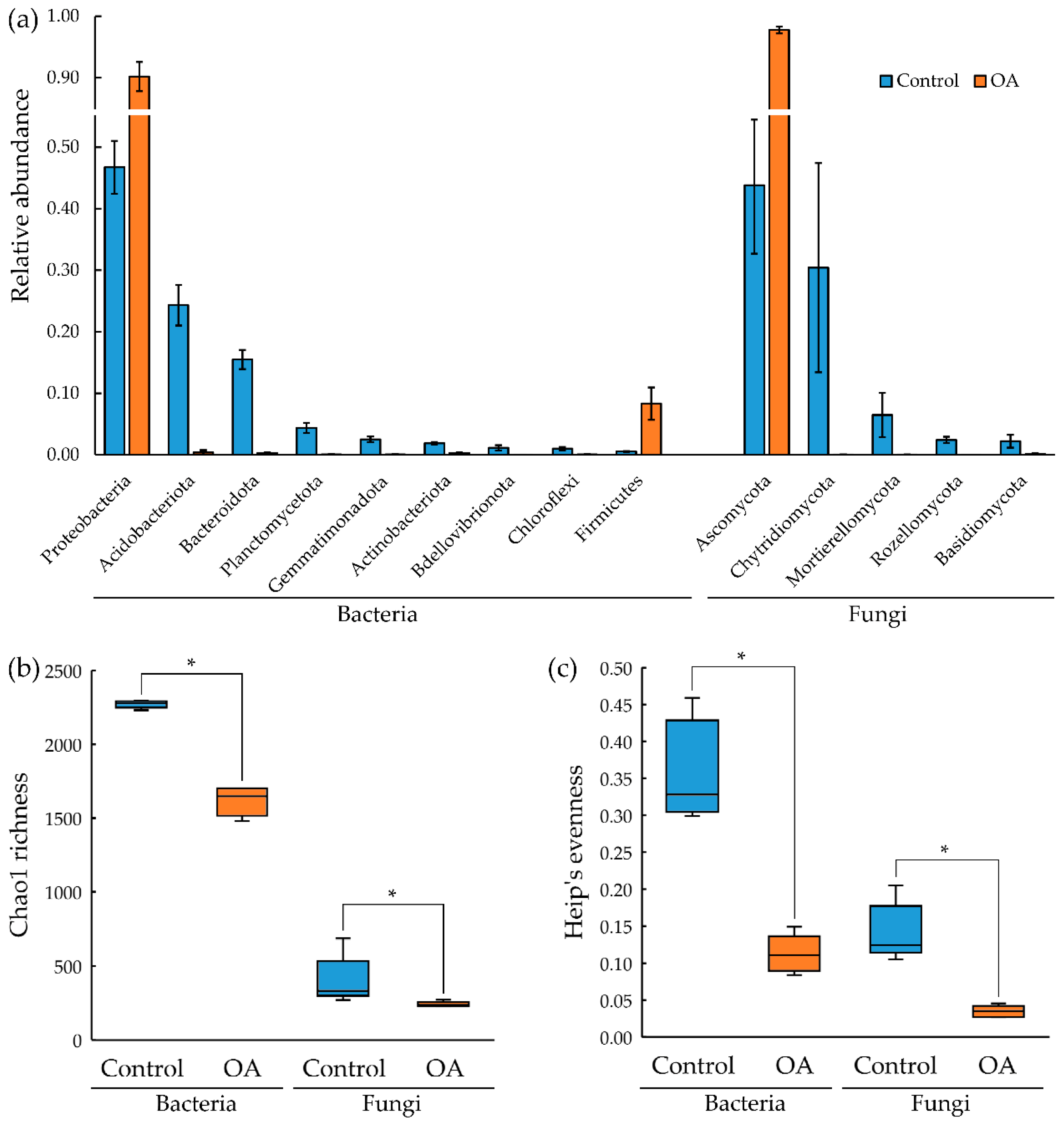
The bacterial community in the Control soil was dominated by Proteobacteria (46.73%), Acidobacteriota (24.32%), Bacteroidota (15.49%), Planctomycetota (4.38%), Gemmatimonadota (2.52%), Actinobacteriota (1.89%), Bdellovibrionota (1.14%), and Chloroflexi (1.02%). These eight phyla accounted for 97.50% of the bacterial community in relative abundance. However, the bacterial community in the OA treatment was dominated by two phyla, Proteobacteria and Firmicutes, accounting for 90.18% and 8.32% of the total community in relative abundance (Figure 2a). A similar pattern was also observed for the fungal community, Ascomycota (43.79%), Chytridiomycota (30.42%), Mortierellomycota (6.48%), Rozellomycota (2.43%), and Basidiomycota (2.22%) were the dominate phyla in the Control soil; however, Ascomycota was the single dominate phylum of fungal community in the OA soil, which accounted for 97.75% of the total community in relative abundance (Figure 2a).
The OA treatment significantly decreased both bacterial and fungal richness (Figure 2b). However, this effect on the fungal community was larger than on the bacterial community. Due to the addition of oxalic acid, the fungal Chao1 index decreased by 39.68%, while the bacterial Chao1 index decreased by only 28.85%. The OA treatment also resulted in 68.67% and 75.37% decreases in bacterial and fungal evenness, respectively (Figure 2c).
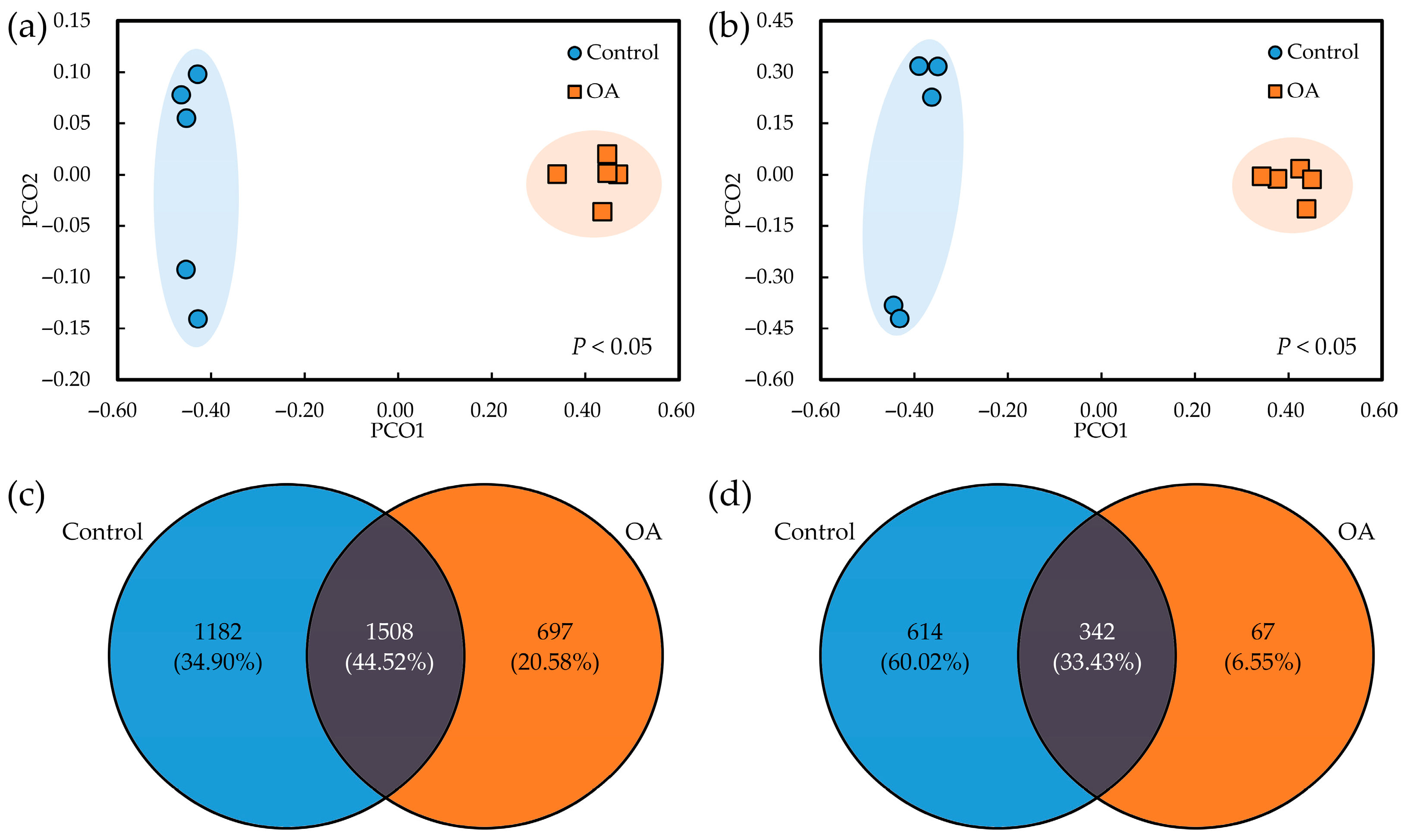
The PCoA plots further illustrated the variations in the bacterial and fungal communities across treatments (Figure 3a,b). The samples from the Control and OA treatments were clearly separated, showing that the OA treatment shaped distinct bacterial and fungal communities. This was supported by the results of the PERMANOVA, which revealed statistically significant differences in both the bacterial (R2 = 0.946, p < 0.05) and fungal (R2 = 0.524, p < 0.05) communities between the Control and OA treatments.
A Venn diagram shows the distribution of bacterial and fungal zOTUs across the two treatments (Figure 3c,d). A total of 44.52% of bacterial zOTUs were detected in both the control and OA treatments, while the proportions of zOTUs unique to the control and OA treatments accounted for 34.90% and 20.58%, respectively. The proportion of shared fungal zOTUs was 33.43%, while most (60.02%) of the fungal zOTUs were unique to the Control treatment, and the unique fungal zOTUs to the OA treatment only accounted for 6.55% of the total fungal zOTUs.

3.3. Impacts of OA Addition on the Functional Profiles of Soil Bacterial and Fungal Communities

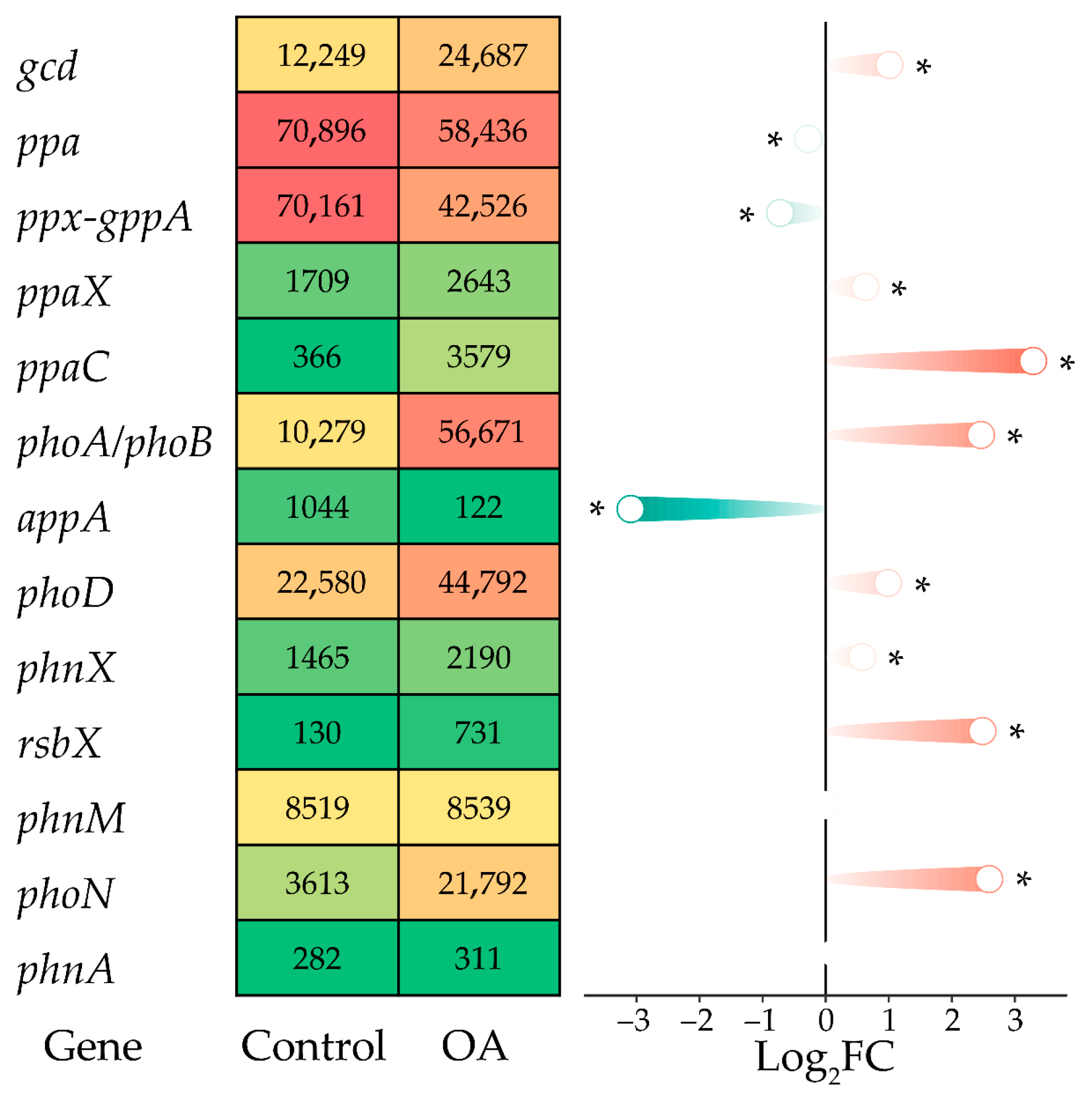
Based on the results of functional prediction (PICTUSt2), the key functional genes involved in Pi dissolution and Po mineralization were extracted, and the changes in such genes across different treatments are shown in Figure 4. Among the 13 genes, ppa, ppx-gppA, and appA were diluted by the OA treatment; gcd, ppaX, ppaC, phoA/phoB, phoD, phnX, rsbX, and phoN were increased; and phnM and phnA exhibited no significant change.
The results from FUNGuild showed that most of the taxa in the Control soil were identified as Algal Parasite–Plant Saprotroph–Undefined Saprotroph, which accounted for more than 30% of the relative abundance (Table 2). However, this type of fungus was largely diluted in the OA treatment, accounting for only 0.05% of the fungal community in OA-amended soil. The taxa identified as Plant Pathogen–Plant Saprotroph, Animal Pathogen–Fungal Parasite–Undefined Saprotroph, and Ectomycorrhizal–Fungal Parasite–Plant Pathogen–Wood Saprotroph were largely increased by OA treatment. These three types of fungi accounted for 61.88% of the fungal community in OA treatment.

3.4. Impacts of OA Addition on phoD and pqqC Gene Abundance and Acid Phosphatase Activity

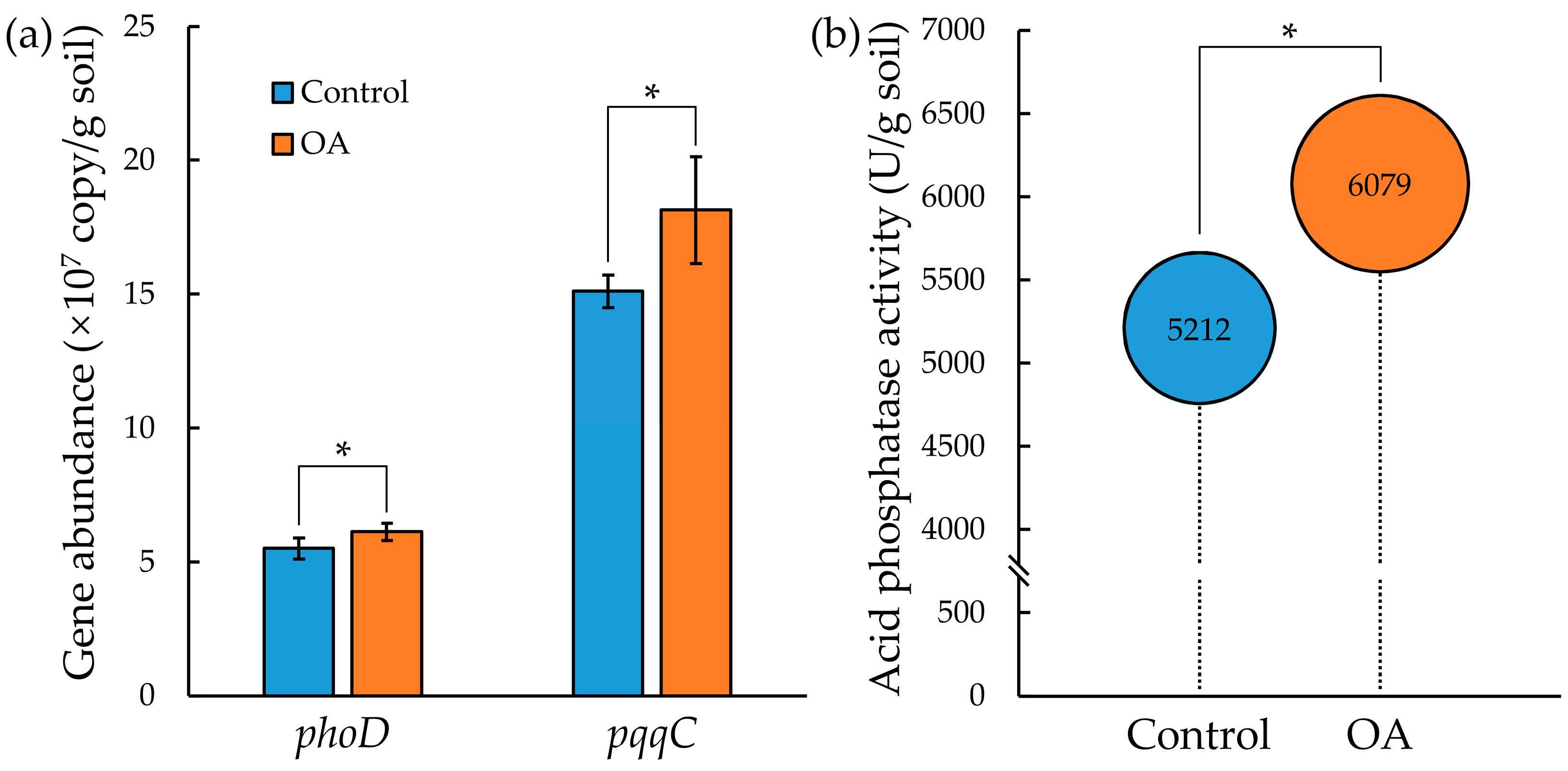
Results of qPCR showed that OA treatment significantly increased the abundance of both phoD and pqqC genes (Figure 5a). Following OA addition, a 11.36% increase in phoD gene abundance and a 20.15% increase in pqqC gene abundance were observed. OA treatment also significantly enhanced acid phosphatase activity, increasing it from 5212 to 6079 U/g soil (Figure 5b).

3.5. Impacts of OA Addition on Bacterial and Fungal Community Assembly

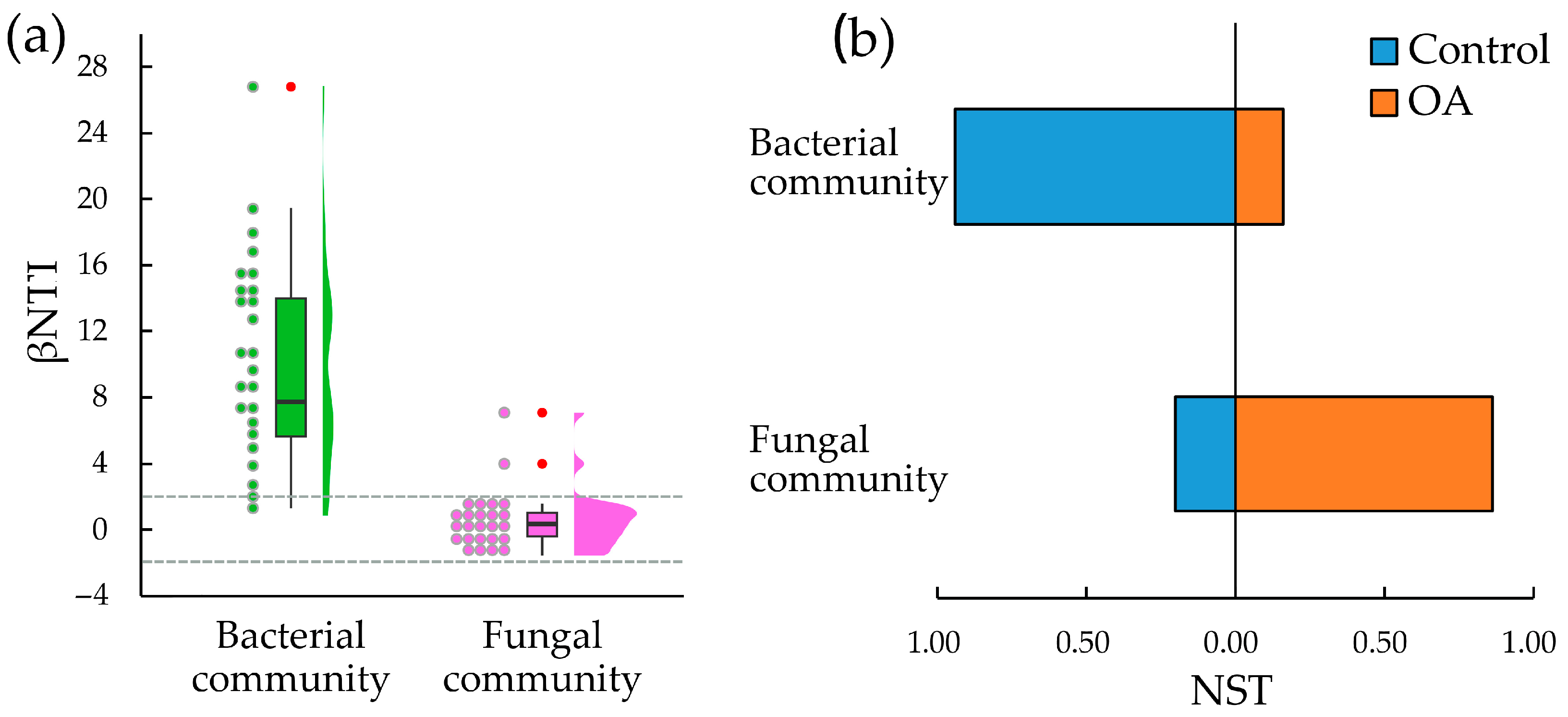
To evaluate community assembly processes between the Control and OA treatments, βNTI values were determined across all pairwise community comparisons between the Control and OA treatments. The results showed that most of the βNTI values for the bacterial community were larger than +2 (Figure 6a), showing that the shift in bacterial community was dominated by deterministic procedures. Contrastingly, the majority of the βNTI values for the fungal community fell within the range of −2 to +2 (Figure 6a), indicating that stochastic procedures dominated the shift in fungal community between treatments.
To further quantify the contributions of deterministic and stochastic processes in microbial community assembly, the NST was calculated (Figure 6b). The results showed that stochastic processes dominated the bacterial community assembly in the Control soil, as the value of NST was larger than 50% [37]. However, in the OA treatment, the contribution of stochastic processes to bacterial community assembly decreased to 16.22%. Fungal community assembly exhibited a trend converse to that of bacterial communities. The contribution of stochastic processes to the fungal community was 20.08% in the control soil, while the ratio was increased to 86.19% in the OA treatment soil.

4. Discussion

Root exudate-mediated rhizosphere P mobilization is a crucial pathway for plants to cope with P deficiency. Oxalic acid is one of the primary root exudates of types of plants, including rice, Arabidopsis thaliana, ryegrass, and so on. Numerous studies have found that oxalic acid can enhance soil P availability through competition for adsorption sites, alterations in the surface charge of adsorbents, and mineral dissolution [38,39]. However, as a low-molecular-weight organic carbon compound, oxalic acid can also be utilized by microorganisms and can consequently influence soil microbial communities as a nutrient source, thus indirectly impacting soil element dynamics [40,41,42]. The present study further revealed that oxalic acid modified soil microbial community assembly and enriched taxa involved in P mobilization, highlighting the dual role of oxalic acid in enhancing soil P availability.
Our findings, demonstrating a significant increase in available P and a concomitant shift in microbial community structure with oxalic acid addition, strongly suggest that oxalic acid plays a crucial role in enriching phosphate-solubilizing bacteria (PSB), including taxa involved in organic P mineralization and inorganic P dissolution (Figure 4 and Figure 5). This enrichment is not a random effect but is likely driven by a combination of direct and indirect mechanisms that confer a competitive advantage to PSB in the oxalic acid-amended soil. Firstly, oxalic acid likely acts as a selective carbon source, which is associated with the enrichment of bacterial taxa predicted to be involved in phosphate solubilization and with an enhanced genetic potential for this function. Many PSBs, particularly those from genera such as Pseudomonas, Burkholderia, and Bacillus, possess efficient transport and metabolic pathways for utilizing low-molecular-weight organic acids like oxalic acid as a preferred carbon and energy source [43]. The regular input of oxalic acid in our experiment created a consistent carbon subsidy, selectively promoting the proliferation of these oxalic acid-utilizing bacteria. The high selectivity always resulted in a decrease in microbial diversity, which was also observed in the present study (Figure 2b,c). This mechanism represents a form of carbon source-mediated selection, where the microbial community is shaped to be dominated by taxa capable of exploiting this specific resource niche. Secondly, the modification of the soil environment by oxalic acid imposes an additional selective pressure. The introduction of oxalic acid leads to a decrease in soil pH [44]. In the present study, oxalic acid caused significant acidification in soil (Table 1). Many well-known PSB, particularly from the genus Pseudomonas, are acid-tolerant and can maintain metabolic activity under mildly acidic conditions. This acid tolerance allows them to not only survive but also outcompete pH-sensitive microorganisms in the oxalic acid-amended soil [45]. This environmental filtering strengthens the deterministic assembly of the bacterial community, leading to the observed enrichment of PSBs.
The OA treatment also exerted a significant selective effect on fungi, enriching for certain taxa closely associated with plants, especially ectomycorrhizal fungi (Table 2 and Table S1). These results suggest that oxalic acid may serve as an important mediator in plant–fungus interactions under P deficiency. Studies have found that ectomycorrhizal mycelia can secrete high amounts of oxalic acid to acquire nutrients by weathering minerals [46,47,48,49]. The exogenous oxalic acid may enhance this effect, thereby promoting the growth of ectomycorrhizal fungi. In addition, oxalic acid would create an acidic soil environment, which also facilitates the colonization of mycorrhizal fungi [46]. In natural systems, plants also produce substantial amounts of oxalic acid under low-P conditions [50,51]. Apart from solubilizing P, this exogenous oxalic acid may potentially promote the colonization and growth of ectomycorrhizal fungi [52], thus forming a synergistic plant–ectomycorrhizal fungi complex that enhances P acquisition. Interestingly, the observed enrichment of plant-associated fungi alongside a general decrease in fungal diversity suggests that oxalic acid exudation can be viewed as a plant strategy to “recruit” a more beneficial fungal consortium by chemically engineering its rhizosphere. While our findings strongly suggest that oxalic acid creates favorable conditions for plant-associated fungi, direct experimental validation—such as measuring oxalic acid secretion by the enriched taxa, quantifying their in situ contribution to plant P uptake, or confirming functional synergy in a plant–fungus co-culture system—was not within the scope of this microcosm study. Therefore, the proposed mechanism of oxalic acid-mediated “recruitment” of a beneficial fungal consortium remains a plausible hypothesis derived from community profiling and warrants further functional verification in more complex, plant-inclusive systems.
Although oxalic acid can enhance soil P availability by simultaneously influencing both bacterial and fungal communities, the impacts of oxalic acid on the community assembly of bacteria and fungi exhibit distinct differences, as evidenced by the different contributions of deterministic and stochastic processes to community shift (Figure 4). This divergence can be attributed to their inherent physiological differences and subsequent ecological strategies in nutrient utilization. Fundamentally, bacteria, with their larger surface-to-volume ratio and simpler cell walls, are generally more efficient in uptaking and metabolizing low-molecular-weight organic acids like oxalic acid for rapid growth [53]. However, different bacteria have distinct life history strategies, known as K- and r-strategists [54]. Typically, the addition of low-molecular-weight organic compounds promotes the rapid proliferation of r-strategist bacteria, enabling them to become the dominant taxa in the community. The addition of oxalic acid as a readily available carbon source likely created a pulse of resource availability, favoring fast-growing, copiotrophic bacteria (r-strategist) that could quickly capitalize on this labile carbon input. This was confirmed by the changes in bacterial composition (Figure 2a). OA treatment significantly increased the relative abundance of Gammaproteobacteria and Firmicutes, which are r-strategists [55]. In contrast, the dominance of K-strategists, such as Alphaproteobacteria, Actinobacteria, Chloroflexi, and Gemmatimonadetes [56], was greatly decreased by oxalic acid addition (Figure 2a). This is also consistent with our βNTI and NST results (Figure 4), which showed a dramatic decrease in stochastic processes for bacterial assembly under OA treatment, indicating a stronger selective pressure (deterministic process) imposed by the sudden carbon enrichment, which filtered out bacteria unable to efficiently utilize or tolerate oxalic acid.
Contrary to the strong deterministic selection observed in the bacterial community, our βNTI and NST analyses revealed that the assembly of the fungal community under OA treatment was governed to a larger extent by stochastic processes. Different from bacteria, fungi are often more adapted to the exploration of heterogeneous solid environments and the decomposition of complex organic polymers [56], although they can also utilize labile carbon, such as oxalic acid. In the untreated soil, fungal community composition is largely shaped by deterministic factors such as resource competition (e.g., for complex carbon sources) and niche preemption by dominant taxa [57]. The input of oxalic acid supplied exogenous substrates available to fungi, which mitigated resource limitations in the low-fertility soil. This perturbation potentially releases weaker competitors from the competitive pressure and establishes more niches, thereby opening opportunities for the establishment of previously suppressed taxa through random dispersal and ecological drift [58].

5. Conclusions

The present microcosm study found that oxalic acid input significantly increased soil P availability and phosphatase activity, confirming its crucial role in improving plant P acquisition. More importantly, our results reveal the substantial impact of oxalic acid in regulating the assembly of soil microbial communities and their P-mobilizing functions. Oxalic acid input significantly changed soil bacterial and fungal community composition and decreased their diversity. Oxalic acid input increased bacterial P mobilization potential, as indicated by the enrichment of taxa involved in P mobilization and the elevated abundance of the functional genes phoD and pqqC. Some fungal taxa associated with plants, such as ectomycorrhizal fungi, were also enriched by oxalic acid input. Results from βNTI and NST analyses demonstrated that oxalic acid addition shaped a deterministically assembled bacterial community but a stochastically assembled fungal community. These findings reveal the effects of oxalic acid on modulating soil microbial community assembly and ecological functions, and suggest that oxalic acid is a critical mediator for plants to regulate rhizosphere microbes under P deficiency. However, this plant-free microcosm experiment limits direct extrapolation to field conditions where plants, diverse root exudates, and natural soil P dynamics interact. Future research should therefore validate these findings in soil–plant systems, examine dose–response relationships and interactions between oxalic acid and other organic acids, and apply techniques such as metatranscriptomics, isotope tracing, or targeted isolation to confirm the in situ activity and contribution of the enriched microbial taxa to soil P cycling and plant P acquisition.

Supplementary Materials

The following supporting information can be downloaded at: https://www.mdpi.com/article/10.3390/agronomy16040405/s1, Figure S1. Rarefaction curves based on the bacterial (a) and fungal (b) ASV richness and sequence depth. Table S1. The impact of OA on the relative abundance (%) of taxa identified as ectomycorrhizal fungi.

Author Contributions

Conceptualization, H.C. and L.L.; methodology, H.C.; software, L.L.; validation, H.C., L.L. and H.L.; formal analysis, H.C.; investigation, H.C.; resources, B.H.; data curation, R.F.; writing—original draft preparation, H.C.; writing—review and editing, H.C. and P.C.; visualization, P.C.; supervision, J.D.; project administration, J.D.; funding acquisition, P.C. and J.D. All authors have read and agreed to the published version of the manuscript.

Funding

This research was funded by the Key Technologies R&D Program of Guangdong Province (2023B0202080002) and the National Natural Science Foundation of China (42207166).

Data Availability Statement

The data presented in this study are available on request from the corresponding author.

Conflicts of Interest

The authors declare no conflicts of interest.

References

  1. Richardson, A.E.; Hocking, P.J.; Simpson, R.J.; George, T.S. Plant mechanisms to optimise access to soil phosphorus. Crop Pasture Sci. 2009, 60, 124–143. [Google Scholar] [CrossRef]
  2. Yu, X.; Keitel, C.; Dijkstra, F.A. Global analysis of phosphorus fertilizer use efficiency in cereal crops. Glob. Food Secur. 2021, 29, 100545. [Google Scholar] [CrossRef]
  3. Hemwall, J.B. The Fixation of Phosphorus by Soils. In Advances in Agronomy; Norman, A.G., Ed.; Academic Press: Cambridge, MA, USA, 1957; Volume 9, pp. 95–112. [Google Scholar]
  4. do Nascimento, C.A.C.; Pagliari, P.H.; Faria, L.d.A.; Vitti, G.C. Phosphorus Mobility and Behavior in Soils Treated with Calcium, Ammonium, and Magnesium Phosphates. Soil Sci. Soc. Am. J. 2018, 82, 622–631. [Google Scholar] [CrossRef]
  5. Paz-Ares, J.; Puga, M.I.; Rojas-Triana, M.; Martinez-Hevia, I.; Diaz, S.; Poza-Carrión, C.; Miñambres, M.; Leyva, A. Plant adaptation to low phosphorus availability: Core signaling, crosstalks, and applied implications. Mol. Plant 2022, 15, 104–124. [Google Scholar] [CrossRef]
  6. Ramaekers, L.; Remans, R.; Rao, I.M.; Blair, M.W.; Vanderleyden, J. Strategies for improving phosphorus acquisition efficiency of crop plants. Field Crops Res. 2010, 117, 169–176. [Google Scholar] [CrossRef]
  7. Viveros, A.; Centeno, C.; Brenes, A.; Canales, R.; Lozano, A. Phytase and Acid Phosphatase Activities in Plant Feedstuffs. J. Agric. Food Chem. 2000, 48, 4009–4013. [Google Scholar] [CrossRef]
  8. Luo, B.; Yang, K.; Lyu, X.; Deng, X.; Yun, W.; Li, S.; Ye, X.; Sun, R. Fulvic acid increases rice resistance to phosphorus deficiency by increasing plant P uptake and rhizosphere P mobilization. Crop J. 2025, 13, 1619–1630. [Google Scholar] [CrossRef]
  9. Bucio, J.S.L.; González, J.R.; Bucio, J.L. Review: Adaptation of plants to phosphorus scarcity: From nutritional crosstalk to organellar function. Plant Sci. 2025, 359, 112685. [Google Scholar] [CrossRef] [PubMed]
  10. Zhang, F.S.; Ma, J.; Cao, Y.P. Phosphorus deficiency enhances root exudation of low-molecular weight organic acids and utilization of sparingly soluble inorganic phosphates by radish (Raghanus satiuvs L.) and rape (Brassica napus L.) plants. Plant Soil 1997, 196, 261–264. [Google Scholar] [CrossRef]
  11. Teng, Z.; Zhu, J.; Shao, W.; Zhang, K.; Li, M.; Whelan, M.J. Increasing plant availability of legacy phosphorus in calcareous soils using some phosphorus activators. J. Environ. Manag. 2020, 256, 109952. [Google Scholar] [CrossRef] [PubMed]
  12. Kpomblekou-A, K.; Tabatabai, M.A. Effect of low-molecular weight organic acids on phosphorus release and phytoavailabilty of phosphorus in phosphate rocks added to soils. Agric. Ecosyst. Environ. 2003, 100, 275–284. [Google Scholar] [CrossRef]
  13. Sun, R.; Zhang, W.; Liu, Y.; Yun, W.; Luo, B.; Chai, R.; Zhang, C.; Xiang, X.; Su, X. Changes in phosphorus mobilization and community assembly of bacterial and fungal communities in rice rhizosphere under phosphate deficiency. Front. Microbiol. 2022, 13, 953340. [Google Scholar] [CrossRef] [PubMed]
  14. Seitz, V.A.; McGivern, B.B.; Daly, R.A.; Chaparro, J.M.; Borton, M.A.; Sheflin, A.M.; Kresovich, S.; Shields, L.; Schipanski, M.E.; Wrighton, K.C.; et al. Variation in Root Exudate Composition Influences Soil Microbiome Membership and Function. Appl. Environ. Microbiol. 2022, 88, e0022622. [Google Scholar] [CrossRef] [PubMed]
  15. Richardson, A.E.; Simpson, R.J. Soil Microorganisms Mediating Phosphorus Availability. Plant Physiol. 2011, 156, 989–996. [Google Scholar] [CrossRef]
  16. Wang, G.; Jin, Z.; George, T.S.; Feng, G.; Zhang, L. Arbuscular mycorrhizal fungi enhance plant phosphorus uptake through stimulating hyphosphere soil microbiome functional profiles for phosphorus turnover. New Phytol. 2023, 238, 2578–2593. [Google Scholar] [CrossRef]
  17. Zhalnina, K.; Louie, K.B.; Hao, Z.; Mansoori, N.; da Rocha, U.N.; Shi, S.J.; Cho, H.J.; Karaoz, U.; Loqué, D.; Bowen, B.P.; et al. Dynamic root exudate chemistry and microbial substrate preferences drive patterns in rhizosphere microbial community assembly. Nat. Microbiol. 2018, 3, 470–480. [Google Scholar] [CrossRef] [PubMed]
  18. Yuan, J.; Chaparro, J.M.; Manter, D.K.; Zhang, R.F.; Vivanco, J.M.; Shen, Q.R. Roots from distinct plant developmental stages are capable of rapidly selecting their own microbiome without the influence of environmental and soil edaphic factors. Soil Biol. Biochem. 2015, 89, 206–209. [Google Scholar] [CrossRef]
  19. Liu, Y.; Shuai, W.; Xu, Z.; Yu, X.; Yao, Z.; Wei, P.; Ni, F.; Sun, Y. Enhanced Production of Acid Phosphatase in Bacillus subtilis: From Heterologous Expression to Optimized Fermentation Strategy. Fermentation 2024, 10, 594. [Google Scholar] [CrossRef]
  20. Sun, R.B.; Wang, X.G.; Tian, Y.P.; Guo, K.; Feng, X.H.; Sun, H.Y.; Liu, X.J.; Liu, B.B. Long-Term Amelioration Practices Reshape the Soil Microbiome in a Coastal Saline Soil and Alter the Richness and Vertical Distribution Differently Among Bacterial, Archaeal, and Fungal Communities. Front. Microbiol. 2022, 12, 768203. [Google Scholar] [CrossRef]
  21. Li, W.Y.; Xiao, Q.; Hu, C.S.; Liu, B.B.; Sun, R.B. A comparison of the efficiency of different urease inhibitors and their effects on soil prokaryotic community in a short-term incubation experiment. Geoderma 2019, 354, 113877. [Google Scholar] [CrossRef]
  22. Sun, R.; Niu, J.; Luo, B.; Wang, X.; Li, W.; Zhang, W.; Wang, F.; Zhang, C.; Ye, X. Substitution of manure for mineral P fertilizers increases P availability by enhancing microbial potential for organic P mineralization in greenhouse soil. Front. Bioeng. Biotechnol. 2022, 10, 1078626. [Google Scholar] [CrossRef] [PubMed]
  23. Xiang, X.; Wu, Y.; Zhang, F.; Kuang, Y.; Li, C.; Sun, R.; Hui, C. Evidence for cross transmission of pathogens between wild hooded cranes and domestic geese. J. Avian Biol. 2023, 2023, e03083. [Google Scholar] [CrossRef]
  24. Zhang, L.; Niu, J.; Lu, X.; Zhao, Z.; Li, K.; Wang, F.; Zhang, C.; Sun, R. Dosage effects of organic manure on bacterial community assemblage and phosphorus transformation profiles in greenhouse soil. Front. Microbiol. 2023, 14, 1188167. [Google Scholar] [CrossRef] [PubMed]
  25. Martin, M. Cutadapt removes adapter sequences from high-throughput sequencing reads. Embnet J. 2011, 17, 10–12. [Google Scholar] [CrossRef]
  26. Rognes, T.; Flouri, T.; Nichols, B.; Quince, C.; Mahe, F. VSEARCH: A versatile open source tool for metagenomics. PeerJ 2016, 4, e2584. [Google Scholar] [CrossRef]
  27. Edgar, R.C.; Haas, B.J.; Clemente, J.C.; Quince, C.; Knight, R. UCHIME improves sensitivity and speed of chimera detection. Bioinformatics 2011, 27, 2194–2200. [Google Scholar] [CrossRef]
  28. Edgar, R.C. SINTAX: A simple non-Bayesian taxonomy classifier for 16S and ITS sequences. bioRxiv 2016, 074161. [Google Scholar] [CrossRef]
  29. Douglas, G.M.; Maffei, V.J.; Zaneveld, J.R.; Yurgel, S.N.; Brown, J.R.; Taylor, C.M.; Huttenhower, C.; Langille, M.G.I. PICRUSt2 for prediction of metagenome functions. Nat. Biotechnol. 2020, 38, 685–688. [Google Scholar] [CrossRef]
  30. Nguyen, N.H.; Song, Z.; Bates, S.T.; Branco, S.; Tedersoo, L.; Menke, J.; Schilling, J.S.; Kennedy, P.G. FUNGuild: An open annotation tool for parsing fungal community datasets by ecological guild. Fungal Ecol. 2016, 20, 241–248. [Google Scholar] [CrossRef]
  31. Ji, H.; Chen, Y.; Wang, Y.; Wang, R.; Guo, S. Patterns of phoD- and pqqC- containing bacterial communities and their potential linkages with soil P cycle multifunctionality under long-term crop rotations. Plant Soil 2025. [Google Scholar] [CrossRef]
  32. Sun, R.; Wang, D.; Guo, Z.; Hua, K.; Guo, X.; Chen, Y.; Liu, B.; Chu, H. Combined application of organic manure and chemical fertilizers stabilizes soil N-cycling microflora. Soil Ecol. Lett. 2023, 5, 220165. [Google Scholar] [CrossRef]
  33. Sun, R.; Ding, J.; Li, H.; Wang, X.; Li, W.; Li, K.; Ye, X.; Sun, S. Mitigating nitrate leaching in cropland by enhancing microbial nitrate transformation through the addition of liquid biogas slurry. Agric. Ecosyst. Environ. 2023, 345, 108324. [Google Scholar] [CrossRef]
  34. Sun, R.; Myrold, D.D.; Wang, D.; Guo, X.; Chu, H. AOA and AOB communities respond differently to changes of soil pH under long-term fertilization. Soil Ecol. Lett. 2019, 1, 126–135. [Google Scholar] [CrossRef]
  35. Dini-Andreote, F.; Stegen, J.C.; van Elsas, J.D.; Salles, J.F. Disentangling mechanisms that mediate the balance between stochastic and deterministic processes in microbial succession. Proc. Natl. Acad. Sci. USA 2015, 112, E1326–E1332. [Google Scholar] [CrossRef]
  36. Ning, D.; Deng, Y.; Tiedje, J.M.; Zhou, J. A general framework for quantitatively assessing ecological stochasticity. Proc. Natl. Acad. Sci. USA 2019, 116, 16892–16898. [Google Scholar] [CrossRef] [PubMed]
  37. Ning, D.; Yuan, M.; Wu, L.; Zhang, Y.; Guo, X.; Zhou, X.; Yang, Y.; Arkin, A.P.; Firestone, M.K.; Zhou, J. A quantitative framework reveals ecological drivers of grassland microbial community assembly in response to warming. Nat. Commun. 2020, 11, 12. [Google Scholar] [CrossRef]
  38. Ma, W.; Tang, S.; Dengzeng, Z.; Zhang, D.; Zhang, T.; Ma, X. Root exudates contribute to belowground ecosystem hotspots: A review. Front. Microbiol. 2022, 13, 937940. [Google Scholar] [CrossRef]
  39. Grąz, M. Role of oxalic acid in fungal and bacterial metabolism and its biotechnological potential. World J. Microbiol. Biotechnol. 2024, 40, 178. [Google Scholar] [CrossRef] [PubMed]
  40. Yang, J.; Liu, X.; Fei, C.; Lu, H.; Ma, Y.; Ma, Z.; Ye, W. Chemical-microbial effects of acetic acid, oxalic acid and citric acid on arsenic transformation and migration in the rhizosphere of paddy soil. Ecotoxicol. Environ. Saf. 2023, 259, 115046. [Google Scholar] [CrossRef] [PubMed]
  41. Liu, W.; Xu, G.; Bai, J.; Duan, B. Effects of warming and oxalic acid addition on plant–microbial competition in Picea brachytyla. Can. J. For. Res. 2021, 51, 357–364. [Google Scholar] [CrossRef]
  42. Deng, Y.; Zhao, H.; Zhang, X.; Li, X.; Chi, G. The dissipation of organophosphate esters mediated by ryegrass root exudate oxalic acid in soil: Analysis of enzymes activities, microorganism. Chemosphere 2024, 356, 141896. [Google Scholar] [CrossRef]
  43. Jones, D.L. Organic acids in the rhizosphere—A critical review. Plant Soil 1998, 205, 25–44. [Google Scholar] [CrossRef]
  44. Wang, Y.; He, Y.; Zhang, H.; Schroder, J.; Li, C.; Zhou, D. Phosphate Mobilization by Citric, Tartaric, and Oxalic Acids in a Clay Loam Ultisol. Soil Sci. Soc. Am. J. 2008, 72, 1263–1268. [Google Scholar] [CrossRef]
  45. Shi, S.; Richardson, A.E.; O’Callaghan, M.; DeAngelis, K.M.; Jones, E.E.; Stewart, A.; Firestone, M.K.; Condron, L.M. Effects of selected root exudate components on soil bacterial communities. FEMS Microbiol. Ecol. 2011, 77, 600–610. [Google Scholar] [CrossRef]
  46. Rosling, A.; Lindahl, B.D.; Taylor, A.F.S.; Finlay, R.D. Mycelial growth and substrate acidification of ectomycorrhizal fungi in response to different minerals. FEMS Microbiol. Ecol. 2004, 47, 31–37. [Google Scholar] [CrossRef]
  47. Schmalenberger, A.; Duran, A.L.; Bray, A.W.; Bridge, J.; Bonneville, S.; Benning, L.G.; Romero-Gonzalez, M.E.; Leake, J.R.; Banwart, S.A. Oxalate secretion by ectomycorrhizal Paxillus involutus is mineral-specific and controls calcium weathering from minerals. Sci. Rep. 2015, 5, 12187. [Google Scholar] [CrossRef]
  48. Yan, X.; Zhou, L.; Chen, Y.; Liu, R.; Guo, L.; Li, N.; Kang, A.; Zhai, K.; Zhou, G.; Zhou, X. Ectomycorrhizal fungi explain more variation in rhizosphere nutrient availability than root traits in temperate forests. Appl. Soil Ecol. 2025, 207, 105923. [Google Scholar] [CrossRef]
  49. Van Schöll, L.; Hoffland, E.; Van Breemen, N. Organic anion exudation by ectomycorrhizal fungi and Pinus sylvestris in response to nutrient deficiencies. New Phytol. 2006, 170, 153–163. [Google Scholar] [CrossRef]
  50. Yu, Y.; Yu, J.; Shan, Q.; Fang, L.; Jiang, D. Organic acid exudation from the roots of Cunninghamia lanceolata and Pinus massoniana seedlings under low phosphorus stress. Front. For. China 2008, 3, 117–120. [Google Scholar] [CrossRef]
  51. Sakib, T.U.; Nelson, N.O.; Hettiarachchi, G.M.; Moorberg, C.J.; Nippert, J.B.; Whitaker, S. Soil phosphorus availability as affected by root exudates of cover crop species. Sci. Rep. 2025, 15, 33443. [Google Scholar] [CrossRef] [PubMed]
  52. Dutton, M.V.; Evans, C.S. Oxalate production by fungi: Its role in pathogenicity and ecology in the soil environment. Can. J. Microbiol. 1996, 42, 881–895. [Google Scholar] [CrossRef]
  53. Sokolova, T.A. Low-Molecular-Weight Organic Acids in Soils: Sources, Composition, Concentrations, and Functions: A Review. Eurasian Soil Sci. 2020, 53, 580–594. [Google Scholar] [CrossRef]
  54. Couso, L.L.; Soler-Bistué, A.; Aptekmann, A.A.; Sánchez, I.E. Ecology theory disentangles microbial dichotomies. Environ. Microbiol. 2023, 25, 3052–3063. [Google Scholar] [CrossRef]
  55. Wang, Y.; Qu, M.; Wang, J.; Zhu, W.; Li, J. Recovery of bacterial network complexity and stability after simulated extreme rainfall is mediated by K−/r-strategy dominance. Appl. Soil Ecol. 2024, 203, 105657. [Google Scholar] [CrossRef]
  56. Boer, W.d.; Folman, L.B.; Summerbell, R.C.; Boddy, L. Living in a fungal world: Impact of fungi on soil bacterial niche development. FEMS Microbiol. Rev. 2005, 29, 795–811. [Google Scholar] [CrossRef] [PubMed]
  57. Zhao, J.; Gao, Q.; Zhou, J.; Wang, M.; Liang, Y.; Sun, B.; Chu, H.; Yang, Y. The scale dependence of fungal community distribution in paddy soil driven by stochastic and deterministic processes. Fungal Ecol. 2019, 42, 100856. [Google Scholar] [CrossRef]
  58. Zhou, J.; Ning, D. Stochastic Community Assembly: Does It Matter in Microbial Ecology? Microbiol. Mol. Biol. Rev. 2017, 81, e00002-17. [Google Scholar] [CrossRef]
Figure 1. Flow chart of the experiment. Control: treatment without oxalic acid addition; OA: treatment with added oxalic acid.
Agronomy 16 00405 g001
Figure 2. Effect of OA treatment on the taxonomic composition (a), Chao1 richness (b), and Heip’s evenness (c) of bacterial and fungal communities. Control: Treatment without oxalic acid addition; OA: treatment added with oxalic acid. * indicates significant difference between OA and control treatment (checked by Kruskal–Wallis test, p < 0.05).
Agronomy 16 00405 g002
Figure 3. PCoA plots showing the changes in the bacterial (a) and fungal (b) communities under different treatments. Venn diagrams showing the distribution of bacterial (c) and fungal (d) ASVs across the two treatments. Control: Treatment without oxalic acid addition; OA: treatment added with oxalic acid.
Agronomy 16 00405 g003
Figure 4. Effects of the OA treatment on the abundance of functional genes involved in P mobilization determined by PICRUSt2 prediction. The left heatmap shows the abundance of the genes under different treatments. The right plot shows the changes (log2FC values) of the genes in the OA treatment compared with the Control treatment. Control: Treatment without oxalic acid addition; OA: treatment added with oxalic acid. FC indicates fold changes. * indicates significant difference between OA and Control treatment (checked by Kruskal–Wallis test, p < 0.05).
Agronomy 16 00405 g004
Figure 5. Effects of OA treatment on the abundance of phoD and pqqC genes (a) and soil acid phosphatase activity (b). Control: Treatment without oxalic acid addition; OA: treatment added with oxalic acid. * indicate significant difference between treatments (checked by Kruskal–Wallis test, p < 0.05).
Agronomy 16 00405 g005
Figure 6. Beta NTI values of bacterial and fungal communities between OA and control treatment (a). NST in bacterial and fungal community assembly under different treatments (b). Control: Treatment without oxalic acid addition; OA: treatment added with oxalic acid.
Agronomy 16 00405 g006
Table 1. The dynamics of soil AP and pH during the incubation.
PropertyTreatment0 h1 d3 d7 d14 d
AP (mg/kg)Control3.15 ± 0.02 a3.24 ± 0.03 a3.44 ± 0.11 b3.39 ± 0.02 b3.21 ± 0.12 b
OA3.15 ± 0.02 a3.56 ± 0.05 a4.78 ± 0.04 a5.77 ± 0.07 a5.98 ± 0.09 a
pHControl5.14 ± 0.01 a5.12 ± 0.02 a5.15 ± 0.03 b5.14 ± 0.04 b5.13 ± 0.05 b
OA5.14 ± 0.01 a5.13 ± 0.03 a5.10 ± 0.02 a5.04 ± 0.03 a4.97 ± 0.02 a
The data in the table is mean ± SD (n = 5). Control: Treatment without oxalic acid addition; OA: treatment added with oxalic acid. Different letters after the entries indicate significant difference between treatments (checked by Kruskal–Wallis test, p < 0.05).
Table 2. Changes in the ecological guilds of the fungal communities with different treatments.
GuildControlOAp Value
Algal Parasite-Plant Saprotroph–Undefined Saprotroph30.240.05<0.001
Endophyte-Plant Saprotroph–Undefined Saprotroph6.400.04<0.001
Plant Pathogen–Plant Saprotroph4.2812.170.001
Animal Pathogen–Endophyte–Fungal Parasite–Undefined Saprotroph2.740.520.002
Endophyte–Lichen Parasite–Plant Pathogen–Undefined Saprotroph2.630.04<0.001
Plant Pathogen–Wood Saprotroph1.000.01<0.001
Animal Pathogen–Endophyte–Plant Saprotroph–Undefined Saprotroph–Wood Saprotroph0.520.010.003
Plant Saprotroph–Undefined Saprotroph0.460.010.007
Algal Parasite–Bryophyte Parasite–Fungal Parasite–Undefined Saprotroph0.290.010.013
Animal Pathogen–Fungal Parasite–Undefined Saprotroph0.2629.53<0.001
Plant Pathogen–Plant Saprotroph–Undefined Saprotroph–Wood Saprotroph0.190.000.041
Ectomycorrhizal–Fungal Parasite–Plant Pathogen–Wood Saprotroph0.1620.18<0.001
Undefined Saprotroph0.120.080.827
Animal Parasite–Animal Pathogen–Plant Saprotroph–Undefined Saprotroph0.020.620.037
Endophyte–Plant Saprotroph–Wood Saprotroph0.011.620.009
Plant Saprotroph–Wood Saprotroph0.000.200.048
Endophyte–Undefined Saprotroph0.000.220.037
Algal Parasite–Plant Saprotroph–Undefined Saprotroph30.240.05<0.001
Endophyte–Plant Saprotroph–Undefined Saprotroph6.400.04<0.001
Plant Pathogen–Plant Saprotroph4.2812.170.025
Animal Pathogen–Endophyte–Fungal Parasite–Undefined Saprotroph2.740.520.019
Endophyte–Lichen Parasite–Plant Pathogen–Undefined Saprotroph2.630.040.008
Plant Pathogen–Wood Saprotroph1.000.010.047
Endophyte–Undefined Saprotroph0.520.010.031
Data is the average relative abundance (%) of the guild in the total community (n = 5). Control: Treatment without oxalic acid addition; OA: treatment added with oxalic acid.
Disclaimer/Publisher’s Note: The statements, opinions and data contained in all publications are solely those of the individual author(s) and contributor(s) and not of MDPI and/or the editor(s). MDPI and/or the editor(s) disclaim responsibility for any injury to people or property resulting from any ideas, methods, instructions or products referred to in the content.