Review

Mycofumigation with Beneficial Yeasts: An Eco-Friendly Approach Against Postharvest Pathogens

by
Rochelle C. Olana
1,2,
Dulanjalee Lakmali Harishchandra
1,3,*,
Sukanya Haituk
1,3,
Christian Joseph R. Cumagun
4 and
Ratchadawan Cheewangkoon
1,*
1
Department of Entomology and Plant Pathology, Faculty of Agriculture, Chiang Mai University, Chiang Mai 50200, Thailand
2
Faculty of Agriculture and Food Science, Visayas State University, Baybay City 6521, Philippines
3
The Office of Research Administration, Chiang Mai University, Chiang Mai 50200, Thailand
4
Parma Research and Extension Center, University of Idaho, Parma, ID 83660, USA
*
Authors to whom correspondence should be addressed.
Agronomy 2026, 16(3), 392; https://doi.org/10.3390/agronomy16030392
Submission received: 10 January 2026 / Revised: 1 February 2026 / Accepted: 3 February 2026 / Published: 6 February 2026

Abstract

Postharvest fungal diseases result in substantial crop losses, with disease severity often exacerbated by inadequate handling practices and unfavorable environmental conditions. Conventional fungicides have been widely employed; however, the frequent use has led to serious challenges, including the emergence of fungicide resistance and ecological concerns. Mycofumigation is a biocontrol approach that utilizes antimicrobial volatile organic compounds (VOCs) produced by beneficial fungi, including yeasts, offering a promising, eco-friendly alternative. Fungal pathogens can be controlled even without direct contact between the biocontrol agent and the crop, making it suitable and feasible for postharvest applications. The review examines how yeast VOCs exert their antifungal effects at structural and genetic levels, categorizes the major classes of VOCs with demonstrated efficacy, and evaluates their application strategies, including both single-compound and composite formulations. Additionally, practical implementation of yeast-based mycofumigants was discussed, highlighting successful applications against important postharvest pathogens under controlled conditions.

1. Introduction

Ensuring food security for a growing global population requires not only increased crop productivity but also significant reductions in postharvest losses [1]. However, postharvest fungal diseases represent a major cause of crop losses, with their severity often aggravated by inadequate handling practices and unfavorable environmental conditions such as high humidity and temperature fluctuations [2]. Fungal pathogens are responsible for substantial postharvest losses in fruits and vegetables, with estimates ranging from 20% to over 40% depending on the crop and region [3]. Fungicides are commonly used to combat fungal diseases and minimize pest outbreaks. However, indiscriminate fungicide application leads to various negative consequences, including environmental pollution through residue accumulation, and serious health hazards to farmers and consumers [4,5]. In recent years, many phytopathogenic fungi exhibiting cross-resistance to fungicides have been widely observed in agricultural fields. Botrytis cinerea has developed resistance to multiple classes of fungicides, including benzimidazoles, N-phenylcarbamates, carboxamides [6], phenylpyrrole [7,8], and succinate dehydrogenase inhibitors (SDHIs) [9]. Moreover, it has been reported to exhibit multiple drug resistance (MDR) [10] through diverse genetic and biochemical mechanisms, making disease management increasingly challenging. Aspergillus spp. are reported to exhibit pan-azole resistance, indicating reduced susceptibility to multiple azole antifungal drugs [11]. Alternaria spp. have developed resistance to multiple fungicide classes, especially SDHIs, quinone outside inhibitors (QoIs), dicarboximides, and triazoles, with resistance mechanisms varying by region and crop [12,13]. The continuous use of fungicides has led to the development of fungicide-resistant pathogen strains and phytotoxicity, causing plant damage [14,15]. Due to the negative impacts of fungicides, alternative approaches such as biological controls are considered essential for sustainable agriculture.
Microbial fumigation is one of the biocontrol strategies that exploits volatile organic compounds (VOCs) from beneficial microorganisms, offering a promising alternative for controlling phytopathogenic fungi responsible for postharvest diseases in fruits and vegetables [16]. Unlike traditional microbial antagonism, which relies on direct contact, it exploits antimicrobial VOCs that diffuse through the environment to inhibit pathogens remotely [17]. VOCs are low-molecular-weight compounds (<300 Da) with low polarity and high vapor pressure, generated during both primary and secondary metabolism [18]. Microorganisms such as yeasts, filamentous fungi, and bacteria produce VOCs through both primary and secondary metabolism via multiple pathways, including glucose oxidation, aerobic biosynthesis, heterotrophic carbon metabolism, fermentation, amino acid catabolism, terpenoid biosynthesis, fatty acid degradation, and sulfur reduction [19]. Microbial VOC production is designed by diverse microorganism interactions, including mutualistic, commensal, and competitive. These VOCs perform ecological functions (attraction, defense, stress response, and communication) and signaling functions (regulating cellular and microbial interactions, carbon release, and growth promotion or inhibition) [16,20]. Mycofumigation is the use of volatile antimicrobial compounds produced by living fungi to mainly control plant pathogens [21]. The mycofumigation for the biocontrol of fungal phytopathogens has recently been rigorously explored because the control strategy involves no direct contact between the treating fungi, especially in enclosed conditions [22,23,24]. Moreover, the VOCs are easily diffused throughout specific areas, reaching cracks, wounds, and surfaces that sprays or coatings cannot, and thus offer more thorough protection against pathogens during storage and transportation [24,25,26,27]. The main fungi known to emit antimicrobial VOCs are Muscodor, Trichoderma, and yeasts [28].
Yeasts have emerged as promising biocontrol agents due to their widespread occurrence, rapid colonization and persistence on produce surfaces under varying environmental conditions, quick proliferation that limits nutrient availability to pathogens, simple nutrition, easy large-scale production on inexpensive media, and negligible biohazards [29,30,31]. Remarkably, VOCs released by antagonistic yeasts offer a safer approach to disease control, as these yeasts are classified as Generally Recognized As Safe (GRAS) by the U.S. Food and Drug Administration (FDA) and designated as Biosafety Level 1 organisms by the U.S. Centers for Disease Control and Prevention (CDC) due to their non-pathogenic nature [32]. VOCs can inhibit mycotoxin production by certain fungi, including Ochratoxin A by Aspergillus carbonarius [33], A. ochraceus [34], and aflatoxin by A. flavus [35]. The exploitation of mycofumigant yeasts as biocontrol agents against postharvest fungal diseases to minimize postharvest losses provides a sustainable solution for increasing food availability and directly supports the Sustainable Development Goal 2 (SDG 2): Zero Hunger.
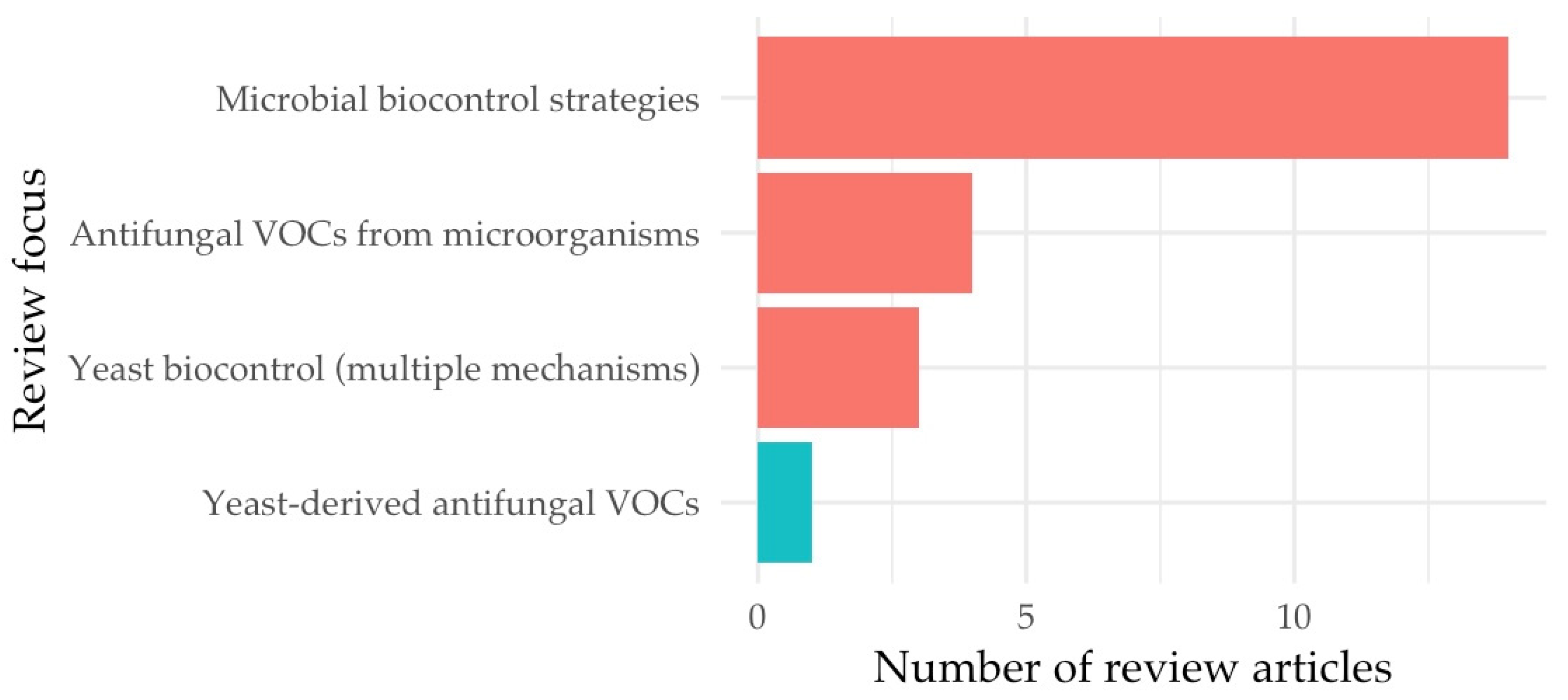
Despite the promise of mycofumigation, the literature reviews on yeast-derived volatile compounds as biocontrol agents remain limited. Few studies have investigated the antifungal mechanisms of mycofumigant yeasts at the structural and molecular levels, and recent comprehensive optimization strategies for their practical application are lacking. Out of 22 review papers assessed, from 2012 to 2026, four papers [16,18,36,37] reviewed on the antifungal VOCs from microorganisms and only one paper [24] was related to the application of solely VOCs from yeast antagonists against fungal pathogens, with emphasis on mycotoxigenic fungi (Figure 1). Microbial biocontrol strategies have been extensively reviewed; however, reviews that focus specifically on yeast-derived antifungal volatile organic compounds (VOCs) as key mechanisms of action and their practical application remain underexplored, highlighting a notable gap in the literature.
The review addresses these gaps by examining various yeast genera with demonstrated mycofumigant activity, their effectiveness against economically important fungal pathogens, and current optimization approaches for commercial implementation. The limitations of this review are that the scope is confined to laboratory-based studies and does not encompass field-level applications, as only a limited number of investigations have progressed to the formulation of yeast-based products [38,39]. This technology remains in its infant stage, though it has demonstrated notable advancements in recent years. The main question addressed in this article is: How do mycofumigant yeasts suppress postharvest fungal phytopathogens? Understanding the control mechanisms of yeast antagonists is fundamental to advancing biopesticide development, optimizing formulation and commercialization. The article is organized as follows: Section 2 describes the methodological approach adopted in this article, including the criteria and process for paper selection. Section 3 presents the bioefficacy of mycofumigant yeasts in vitro and in vivo, while Section 4 elaborates on the specific mechanisms underlying their activity. Section 5 examines the potency of major chemical classes produced by mycofumigant yeasts. Section 6 discusses the factors affecting the yeast VOC emission and bioefficacy. Section 7 presents the practical applications of yeast-derived VOC products. Section 8 examines the challenges of implementation of yeast-derived VOCs. Finally, Section 9 concludes the article by summarizing key insights and the future direction of yeast-based mycofumigants.

2. Methodology

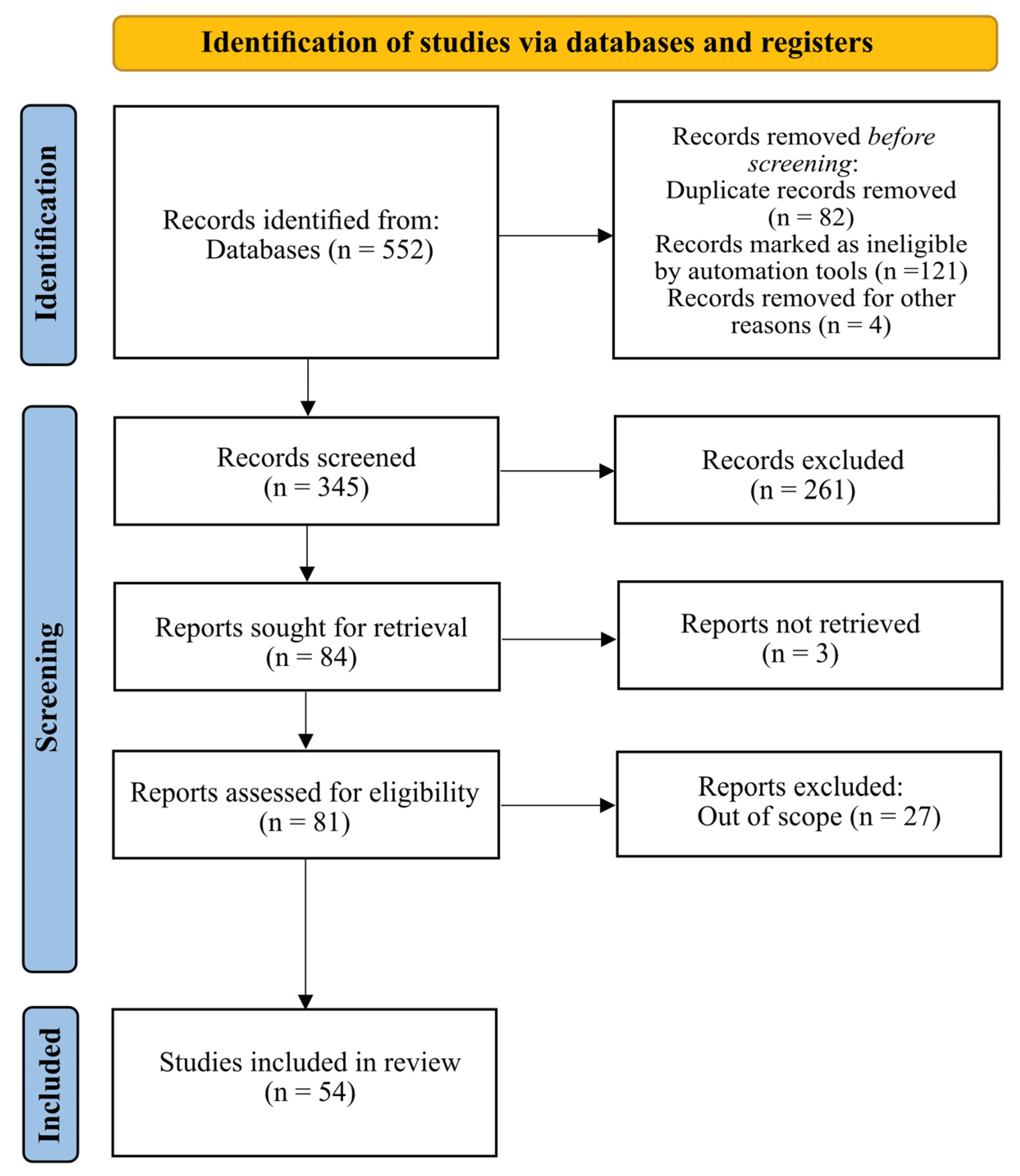
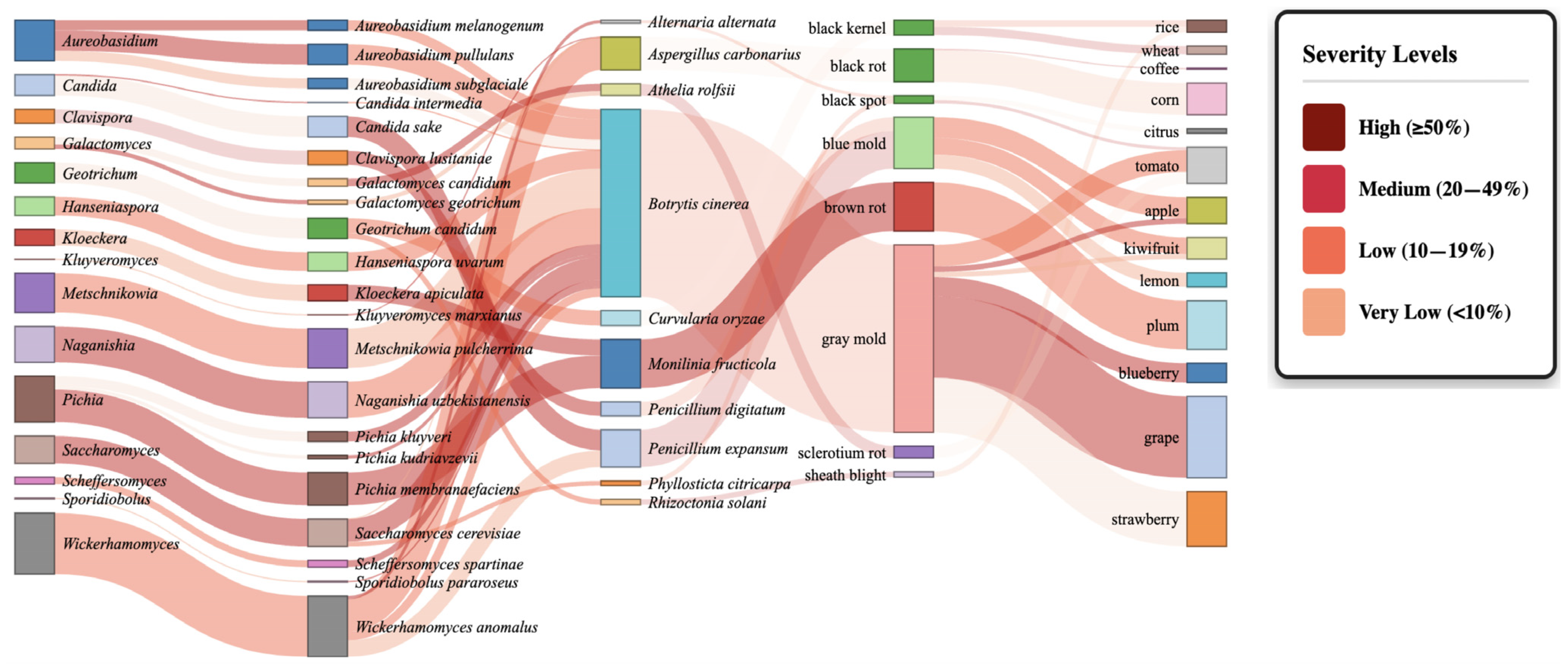
A comprehensive literature search was conducted using Google Scholar, ProQuest, ScienceDirect, and Scopus to identify relevant studies on mycofumigant yeasts and their commercial potential. ProQuest was included to complement Scopus and ScienceDirect due to its broad multidisciplinary coverage and partial overlap with journals indexed in Web of Science. Web of Science was not searched due to institutional access limitations. PubMed was excluded because its indexing primarily emphasizes public health research, which fell outside the scope of this review. The search strategy combined specific keywords: “volatile organic compounds” AND “yeast” AND “postharvest” AND “fungal disease”. The screening process included only peer-reviewed, English-language publications that provided significant information on VOC-producing yeasts with potential antifungal activity against phytopathogenic fungi affecting postharvest crops. To reduce bias, a quality assessment framework, including study designs and relevance of research, was applied, evaluating experimental design and reproducibility. This approach ensured the inclusion of high-quality studies and strengthened the reliability of the review. A total of 552 papers were initially retrieved during the selection phase. EndNote 21 (Clarivate Analytics, Philadelphia, PA, USA) was used to support automation-assisted reference management and preliminary screening. Following database import, 82 records were automatically identified and removed as duplicate entries using EndNote’s tools based on matching titles, authors, and publication years. Subsequently, rule-based Smart Groups were used to facilitate semi-automated screening according to predefined exclusion criteria. These Smart Groups were used to automatically identify records classified as conference proceedings, as well as records published before 2012 or with missing publication year information. Keyword-based filtering (e.g., presence of the term “conference” in relevant reference fields) and reference type classification were applied to flag non-eligible records. Using this automation-assisted approach, 121 records were excluded during the screening stage because they did not meet the inclusion criteria, and 4 records were published in different languages. The excluded works that were done manually were direct yeast interactions, VOCs produced by filamentous fungi, conference abstracts, review articles, and handbook sources. Following this screening, 89 papers were retained for the extraction stage. In this phase, an additional 27 articles were excluded because they did not meet the criteria of being full-length articles in English. Study quality was mainly assessed through the identification of yeast-derived VOCs, adequate methodological description of in vitro and in vivo mycofumigation assays, and reliability and reproducibility of findings. Ultimately, 54 papers were selected, focusing primarily on experiments related to mycofumigation conducted under both in vitro and in vivo conditions. This approach enabled the collection of peer-reviewed literature examining yeast mycofumigants against economically significant phytopathogens, with particular emphasis on their mechanisms of action and biocontrol efficacy. Finally, the results of the systematic review are summarized in accordance with the PRISMA 2020 guidelines [40]. The flow diagram (Figure 2) was illustrated to ensure transparency and a thorough reporting process. To visualize the overview and relationships between yeast mycofumigants and their target postharvest fungal pathogens, a Sankey diagram was generated using R software version 4.3.2 [41].
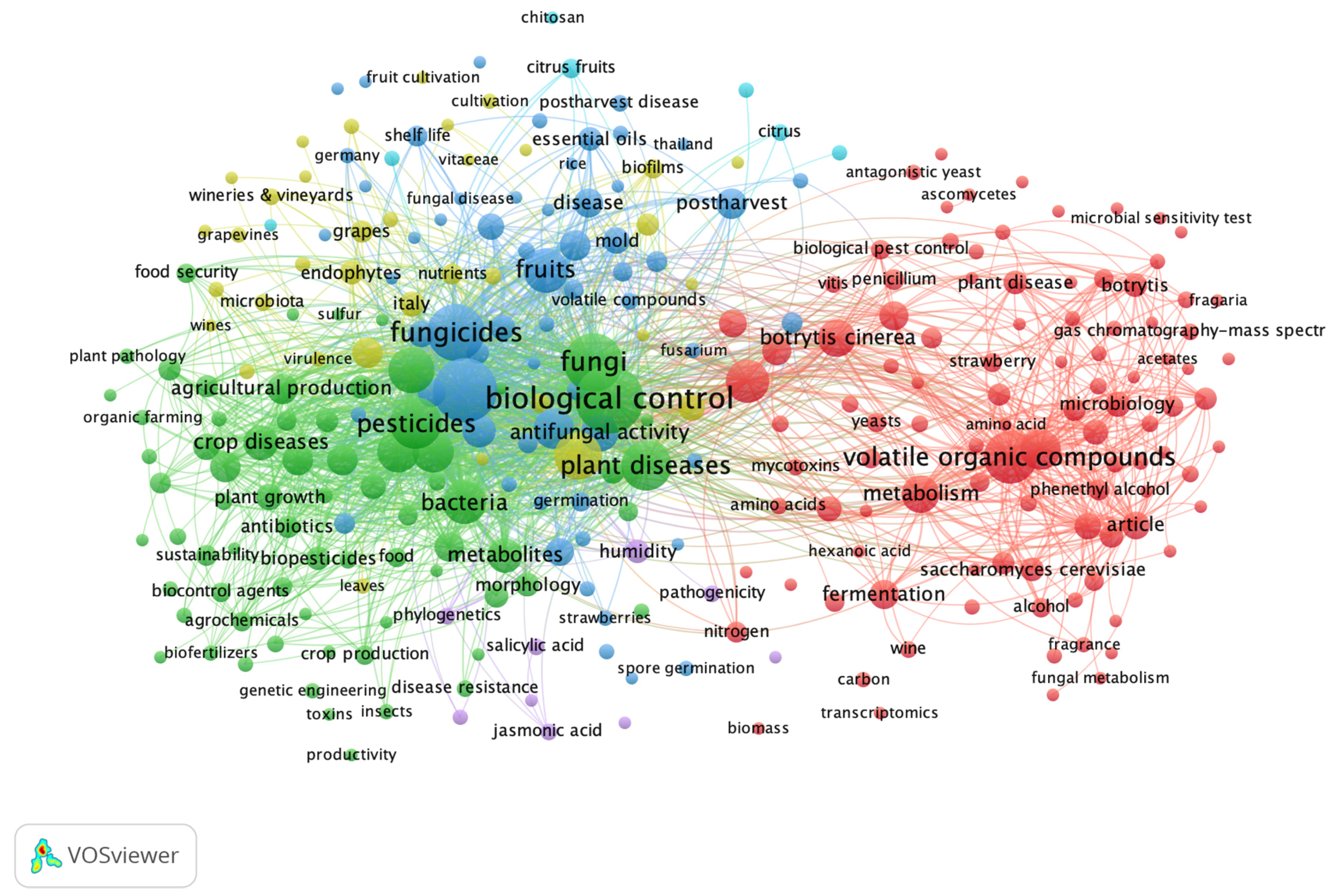
The term clustering (Figure 3) through VOSviewer (version 1.6.20) provides a comprehensive overview of the biocontrol agents, including yeast antagonists that control various phytopathogens. The map illustrates the relative relevance of keywords across the analyzed literature, where larger terms indicate higher frequency and smaller terms represent less frequent occurrences. It was automatically divided into six clusters, each representing keywords that frequently appear across the analyzed literature, represented by different colors, which exhibit interactive relationships. Cluster 1 (Red) included terms such as antagonistic yeasts, fungal pathogens, and volatile organic compounds. This cluster represents studies focused on the identification of yeast biocontrol agents and the elucidation of their control mechanisms against fungal pathogens. Cluster 2 (Green) predominantly comprises terms such as biocontrol and agricultural practices, reflecting studies that address broad outcomes and strategies for achieving sustainable agricultural systems. Cluster 3 (Blue) includes terms related to fungal diseases, postharvest diseases, metabolite detection methods, and the geographic distribution of research activity across different countries. Clusters 4 (Yellow), 5 (Purple), and 6 (Cyan) showed additional disease control strategies against fungal pathogens, including induced resistance and the use of edible coatings derived from diverse microorganisms such as endophytes.
The most frequently occurring terms were biological control (67 occurrences), pathogens (58 occurrences), fungi (49), fungicides (47), and volatile organic compounds (41). The volatile organic compounds were mainly associated with biological control, fungal diseases, and yeasts. Notably, yeasts were primarily linked to biological control, volatile organic compounds, fungal diseases, and fungicides, indicating that yeast biocontrol agents are widely recognized as producers of secondary metabolites that suppress fungal diseases and minimize the reliance on chemical fungicides.

3. Mycofumigation of Yeast Against Fungal Diseases

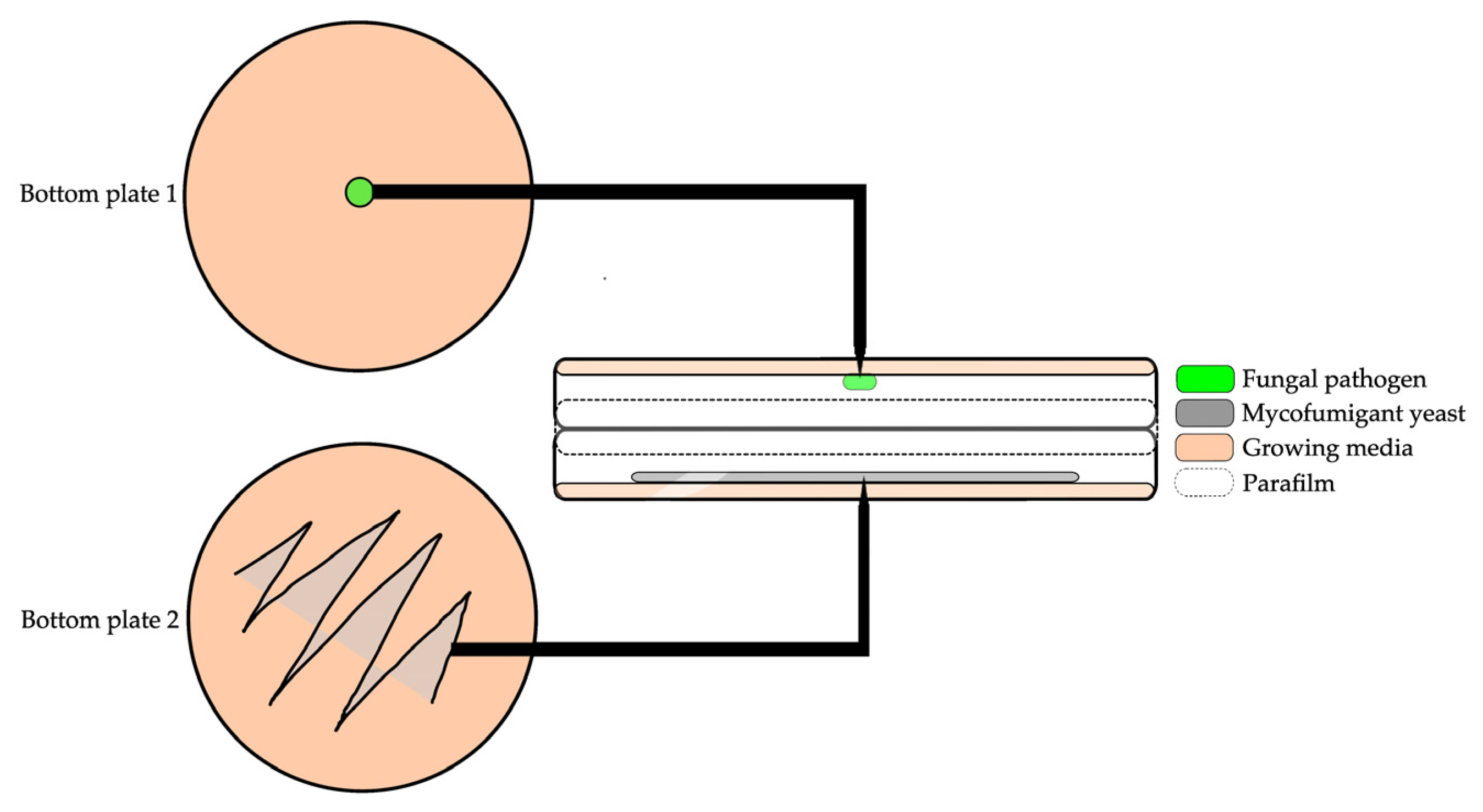
Yeasts offer distinct advantages as biocontrol agents against plant diseases through various mechanisms, including the production of inhibitory VOCs. However, conventional confrontation methods widely used for screening of yeast antagonists limit the consistent demonstration of yeast VOCs’ inhibitory effects on pathogenic fungi, and the underlying mechanisms remain poorly understood [43]. The in vitro mycofumigation, using a double plate mycofumigation assay, can fill the gap of specific control mechanisms by assessing the inhibitory property of the fungi through the production of VOCs [44,45]. In the yeast mycofumigation assay setup, two separate bottom Petri dishes are used: one containing the yeast culture and the other containing the fungal pathogen (Figure 4). First, a yeast colony is streaked onto the first bottom plate containing freshly prepared growth medium to allow active VOC production. After 1–2 days of incubation, an agar block containing the fungal pathogen is placed onto fresh medium on a separate bottom plate. Finally, the two bottom plates are then positioned face-to-face and sealed with parafilm together, enabling the pathogen to be exposed solely to yeast-emitted VOCs without any direct physical contact between the microorganisms. Growth inhibition by yeast VOCs is determined by comparing pathogen colony diameters in treated plates to controls [46,47]. Additionally, the technique has also been adopted in assessing the antifungal VOCs from beneficial bacteria [48] and filamentous fungi [44,45].

3.1. Mycelial Growth Inhibition by Mycofumigant Yeasts

Yeast species produce diverse antifungal VOCs that inhibit mycelial growth and conidial germination of important plant pathogens, with bioefficacy varying considerably (11–98%) depending on the yeast and pathogen combination. Among postharvest pathogens, B. cinerea, causing gray mold disease, has been the most extensively studied target for mycofumigant yeasts due to its status as a highly destructive pathogen with a broad host range [2,49,50]. In vitro mycofumigation studies have demonstrated variable efficacy across yeast species against B. cinerea. VOCs from Sporidiobolus pararoseus reduced B. cinerea mycelial growth by 67% in addition to suppressing conidial germination [50]. Hanseniaspora uvarum achieved near-complete mycelial suppression with only 20.11% spore germination [51], though another H. uvarum strain showed a lower mycelial inhibition rate of approximately 39% [52]. High antifungal activity was observed on Wickerhamomyces anomalus, which exhibited 87% growth inhibition against B. cinerea, while Metschnikowia pulcherrima and Saccharomyces cerevisiae achieved 56% and 63% inhibition, respectively [53]. Scheffersomyces spartinae VOCs inhibited B. cinerea mycelial growth by 78% [54], and Galactomyces candidum demonstrated higher inhibition rates (69.6%) compared to Aureobasidium pullulans (33.7%) [55]. However, not all yeasts exhibited strong antifungal activity; Meyerozyma guilliermondii/M. caribbica, Pichia occidentalis, and Pichia kudriavzevii/Issatchenkia orientalis showed minimal inhibition against B. cinerea (~11%) [56], while Naganishia uzbekistanensis VOCs achieved moderate inhibition of B. cinerea conidial germination (32.8%) but substantially reduced sporulation by 71% [57].
Beyond B. cinerea, several yeast species have shown broad-spectrum activity against multiple pathogens. A. pullulans inhibited conidial germination of B. cinerea by 65% and Colletotrichum acutatum by 55%, while completely suppressing germination of Penicillium digitatum and P. italicum, with corresponding mycelial growth reductions of 31% and 47%, respectively [47]. VOCs emitted from Wickerhamomyces subpelliculosus inhibited mycelial growth of Penicillium citrinum (~63%) and P. chrysogenum (77%), with strong suppression of spore formation (>81% and >95%, respectively), demonstrating a correlation between mycelial growth inhibition and reduced sporulation [23]. Pichia membranaefaciens and Kloeckera apiculata showed strong mycelial growth inhibition (42% and 77%), although the effectiveness declined by day 3, especially for P. membranaefaciens. Also, the spore germination was reduced to 69% and 58%, respectively [58]. The VOCs produced by W. anomalus demonstrated pathogen-specific efficacy, which inhibited Monilinia fructicola by 98% and Monilinia fructigena by 47%. These different effects may be attributed to the higher inherent pathogenicity of M. fructicola than M. fructigena. In addition, M. fructigena showed greater sensitivity to acidic conditions, as the pathogen exhibits limited growth on PDA medium adjusted to pH 4.5 [59]. Additionally, the antifungal activity of W. anomalus was lower than that observed against B. cinerea (87%), which may be attributed to differences in growth media, as W. anomalus was cultured on yeast peptone dextrose (YPD) plates known to enhance yeast antifungal activity and biomass more than PDA [53,60]. W. anomalus, M. pulcherrima, and S. cerevisiae also inhibited M. fructicola development by 55%, 42%, and 57%, respectively. W. anomalus further inhibited A. alternata and A. carbonarius growth by 47% and 44%, respectively, while S. cerevisiae showed 35% growth inhibition against A. alternata [53]. On the other hand, the pigmentation and mycelial growth of A. alternata were significantly inhibited by the VOCs of W. anomalus, with a mycelial inhibition rate of up to 86% [61]. The VOCS from yeasts can reduce the occurrence of mycotoxins in stored crops. Wickerhamomyces anomalus, S. cerevisiae, and Kluyveromyces marxianus produced VOCs that effectively inhibited fungal growth and ochratoxin production of Aspergillus carbonarius in vitro [62].
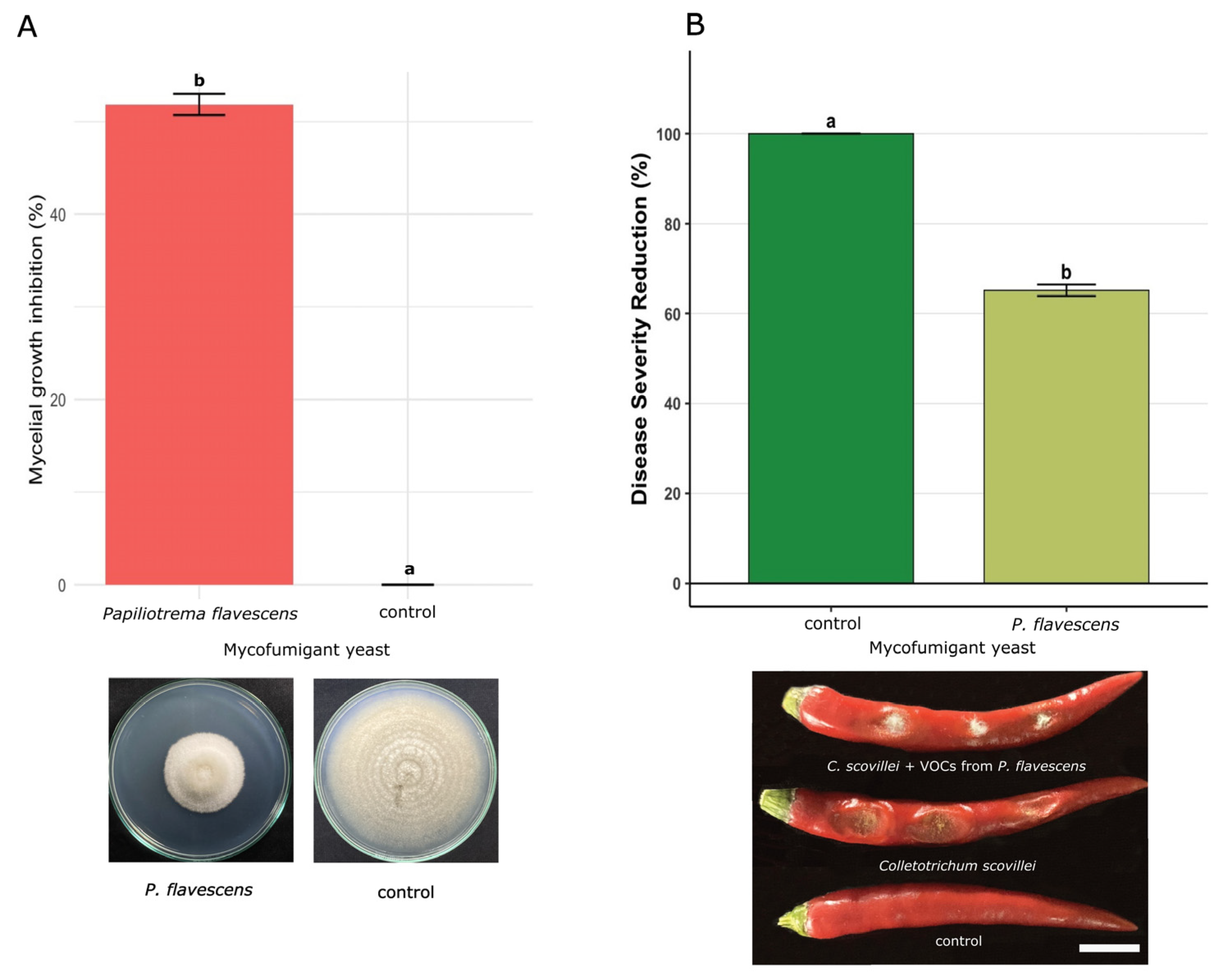
Mycofumigant yeasts demonstrated a pronounced and broad-spectrum antifungal activity, with mold inhibition varying according to the pathogen and the yeast antagonist involved. The VOCs produced by Geotrichum candidum exhibited strong inhibitory effects against several phytopathogens, with Rhizoctonia solani being the most sensitive (~54% inhibition). Moderate antimicrobial activity was also observed against Fusarium oxysporum (11%), Pseudocercospora sp. (23%), and Cercospora sp. (12%) [39]. The VOCs emitted from Meyerozyma guilliermondii/M. caribbica, Pichia occidentalis, and P. kudriavzevii/I. orientalis strongly inhibited mold growth (over 60%) against Penicillium chrysogenum, Fusarium poae, Aspergillus fumigatus, and Mucor sp. [56]. Fungal pathogens showed different sensitivities to VOCs from Clavispora lusitaniae, with P. digitatum being the most susceptible (48.9% mycelial growth inhibition). In contrast, P. italicum and Geotrichum citri-aurantii exhibited lower inhibition rates of 25.7% and 23.3%, respectively [46]. Other mycofumigant yeasts also reported to reduce the hyphal growth of important fungi under controlled conditions. P. aspenensis against C. gloeosporiodes (50%) [63], M. guilliermondii against A. alternata (39%) [30]. Pichia spp. against Monascus purpureus (39%) [64]. Additionally, VOCs from G. candidum and G. geotrichum significantly reduced the spore germination of Athelia rolfsii to approximately 38–42% [65]. Exposure to G. candidum volatiles inhibited fungal development by reducing sclerotia formation and germination in R. solani, limiting aerial mycelial growth, and causing sparse, less pigmented sporulation in Curvularia oryzae, resulting in lesser pathogenicity and colonization [38]. Papiliotrema flavescens suppressed the mycelial growth of Colletorichum scovillei, the causal agent of chilli anthracnose, by 52% with a disease reduction of 65% (Figure 5).

3.2. Reduction in Postharvest Disease by Mycofumigant Yeast Application

Yeast VOCs inhibit a broad range of fungal pathogens in postharvest application. The bioefficacy of mycofumigant yeasts generally exhibits a “static” effect rather than “cidal” when applied to postharvest crops [38], and the efficacy varies across different pathosystems [66,67]. For example, B. cinerea exposed to VOCs from N. uzbekistanensis resumed normal growth after VOC removal, confirming growth suppression rather than eradication [57].
In Figure 6, the Sankey diagram shows a schematic overview of yeast genera reported to produce VOCs that control fungal pathogens under postharvest conditions. Among the mycofumigant yeasts, W. anomalus was the most frequently reported VOC-producing yeast that controlled various postharvest fungal pathogens. It was effective in suppressing the disease progression of A. alternata, B. cinerea, P. expansum, and A. carbonarius in postharvest commodities such as tomato, strawberry, kiwifruit, coffee, and corn. In particular, W. anomalus showed exceptional efficacy against tomato black spot disease caused by A. alternata, dramatically reducing rot rates to 9.3% [61]. Also, VOCs from W. anomalus, S. cerevisiae, and K. marxianus suppressed the growth of A. carbonarius on coffee beans and corn kernels, achieving 60–100% growth inhibition and over 99% reduction in OTA production [62].
In contrast, B. cinerea, as the causal pathogen of gray mold of various fruits, was the most reported target pathogen, reflecting its economic importance and level of susceptibility to VOCs. For instance, the VOCs from A. pullulans reduced apple gray mold lesion diameter by more than 88% [47] and tomato gray mold incidence by 67%, while A. melanogenum and A. subglaciale suppressed tomato gray mold incidence by 38% and 49%, respectively [68]. On table grapes, VOCs from A. pullulans, A. melanogenum, and A. subglaciale did not lower gray mold incidence (up to 90%); however, they decreased symptom severity by 44%, 31%, and 31%, respectively [68], while VOCs produced by H. uvarum suppressed gray mold severity by 55.75% in the non-injured fruits and 60.48% in the injured fruits [51]. VOCs from N. uzbekistanensis decreased gray mold severity by 64.7% in tomatoes, while in grapes it decreased by 43.1% [57]. On strawberries, VOCs from W. anomalus, M. pulcherrima, and S. cerevisiae reduced gray mold severity by 89%, 40%, and 32% [53], while VOCs from S. pararoseus reduced disease incidence by 39–50% and limited severity to 1.1–1.9 [50], S. spartinae VOCs reduced incidence by 20.7% [54], and C. intermedia VOCs delayed disease progression by 18% [69]. On blueberries, M. pulcherrima reduced the gray mold severity by approximately 25% [49].
Candida sake showed temperature-dependent effectiveness against P. expansum on apples: at 25° C, disease incidence remained at 100% (though severity decreased by 62%); at 0 °C, both incidence and severity were reduced considerably to 53% and 20%, respectively [22]. C. lusitaniae reduced lemon green mold caused by P. digitatum to 42.1%, although the disease incidence was 100% [46]. VOCs from Pichia membranaefaciens and Kloeckera apiculata effectively controlled plum brown rot caused by Monilinia fructicola, with K. apiculata showing greater efficacy than P. membranaefaciens [58]. The Sankey diagram illustrates a research bias toward extensively studied yeast genera and major postharvest pathogens, highlighting gaps in the research of less explored mycofumigant yeasts and target fungal pathogens.
In most studies, the bioefficacy of yeast-derived volatile organic compounds (VOCs) is evaluated in comparison with negative controls only, without the inclusion of synthetic fungicides or commercial mycofumigants as positive controls. Only one study presented the comparison of bioefficacy of mycofumigant yeasts to synthetic fungicides. For instance, the study of Hernández-Fernández et al. [70] demonstrated that VOCs produced by P. kluyveri and P. kudriavzevii, particularly 2-phenylethanol and 2-phenylethyl acetate, exhibited comparable bioefficacy to a commercial fungicide, Folicur® 25 EW, by decreased disease severity on grapes and grapevine leaves by 81–99%, showing efficacy levels approaching that of the fungicide control (~100%). Additionally, unlike fungicide treatment, which caused berry browning and shriveling, P. kudriavzevii treatment resulted in minimal browning, indicating reduced oxidative stress and better preservation of postharvest fruit quality. Nevertheless, comparison between VOC-based and chemical approaches remains insufficiently addressed, highlighting a gap in the practical and economic evaluation of yeast-derived VOCs as alternatives to synthetic fungicides.

4. Control Mechanisms of VOCs from Yeasts

4.1. Structural Damage

Constant exposure of filamentous fungi to the VOCs from mycofumigant yeasts caused structural damage, and the degree of damage varies with the type of yeast and pathogen involved [34]. VOCs primarily disrupt the fungal plasma membrane, with higher aliphatic alcohols destabilizing the lipid bilayer and inhibiting growth [32]. Additionally, the structural damage to the cell wall membrane prevents the spore germination and germ tube extension of the fungal pathogens [61]. Yeast VOCs induce significant morphological changes in pathogens, including abnormal hyphal growth, plasmolysis, and mitochondrial damage [30,51,52,54]. For instance, the hyphae of A. carbonarius and A. ochraceus displayed coagulated cytoplasm, swelling at the tips, and frequent lysis events were observed when exposed to the VOC released by Lachancea thermotolerans, resulting in reduced growth [34]. Also, A. carbonarius hyphae exposed to VOCs from W. anomalus, K. marxianus, and S. cerevisiae (primarily ethanol, ethyl acetate, and 3-methylbutan-1-ol) exhibited flattened and damaged mycelia with reduced density as observed by scanning electron microscopy (SEM) [62], while H. uvarum VOCs caused curved mycelial growth with larger tips, fewer nuclei, and shorter septum spacing [51]. A. pullulans VOCs altered B. cinerea and A. alternata cell wall structures, producing deformed spores and germ tubes with cell content release, suggesting membrane damage [71], and VOCs from N. uzbekistanensis inhibited mycelial growth, conidiophore formation, and conidia production in B. cinerea while promoting infection cushion formation [57]. VOCs from S. cerevisiae inhibited F. graminearum growth and development in a dose-dependent manner, with 5 × 10⁶ cfu reducing conidiogenesis and spore release, while 5 × 10⁷ cfu caused severe hyphal deformation (swelling, shrinking, and collapse) with spores rarely observed, also limiting agar colonization and suppressing pigment formation [43]. SEM could view morphological alterations of fungal hyphae, suggesting compromised membranes, but direct integrity measurements are lacking. Future studies should incorporate quantitative membrane integrity assays to better substantiate yeast VOC-induced cellular damage. For instance, the study of Liu et al. [72] revealed that 2-phenylethanol (PEA) derived from K. apiculata induced growth inhibition and hyphal deformation in P. italicum at a concentration of 1.5 μL/mL for 2 h. However, the absence of propidium iodide (PI) uptake and changes in membrane electrical conductivity with leakage data of ~28% at 8 h indicated that its antifungal activity was not associated with direct disruption of the fungal plasma membrane; instead, PEA primarily targets intracellular organelles (mitochondria and vacuoles) rather than causing an immediate plasma membrane disruption of quantitative ions. In contrast, previous studies have demonstrated that the VOC composite can induce oxidative stress and compromise membrane integrity in fungal pathogens. Following fumigation, pathogen spores exhibited strong green fluorescence after 2,7-dichlorodihydro fluorescein diacetate (DCFH-DA) staining, indicating ROS accumulation, as well as red fluorescence associated with membrane rupture, suggesting loss of membrane integrity. These cellular damages are closely associated with fungal growth inhibition [73].
VOCs can penetrate cell membranes due to their hydrophobicity, causing changes in membrane potential and permeability that alter hyphal integrity [74]. K. apiculata caused mitochondrial abnormalities in P. italicum, including degraded cristae, outer membrane leakage, and extensive vacuolation [72]. Increased vacuole formation is commonly observed in fungi under stress conditions and may indicate autophagy [38]. During coculture, P. kudriavzevii enhances its antifungal action against M. purpureus by increasing cell wall permeability and promoting extracellular release of esterifying enzymes, facilitating acid–alcohol esterification [64].

4.2. Accumulation of Reactive Oxygen Species (ROS)

Yeast VOCs exert their antifungal effects through multiple mechanisms at the cellular level. Yeast VOCs induce the accumulation of reactive oxygen species (ROS) and electrolyte leakage in fungal pathogens, leading to oxidative stress and antifungal effects [71]. The ROS generated include superoxide radicals and hydrogen peroxide, which cause lipid peroxidation, electrolyte leakage, and altered fungal cell wall structures, ultimately inhibiting fungal growth [75]. The negative cellular stress is compounded with a reduction in protein biosynthesis, proliferative activity, and mitochondrial metabolism [76].
Lipid peroxidation is assessed by measuring malondialdehyde (MDA), a key end-product of oxidative degradation of lipids. Elevated MDA levels indicate increased lipid peroxidation and oxidative stress, indicating stress-induced cellular damage in the pathogens [38]. VOCs from N. uzbekistanensis induced oxidative stress and membrane lipid peroxidation in B. cinerea after 16 and 24 h of exposure, as evidenced by increased MDA levels, though no significant differences were observed after 48 h, indicating lipid peroxidation occurs primarily during short incubation periods [57]. Similarly, A. pullulans VOCs triggered intracellular ROS production, lipid peroxidation, and electrolyte leakage in B. cinerea and A. alternata [71]. This VOC-induced lipid peroxidation further increases membrane permeability to ions and promotes mitochondrial membrane potential loss, exacerbating cellular stress, which was observed in P. citricarpa by S. cerevisiae VOCs [66]. However, the treated fungal pathogens have mechanisms to counteract the VOCs from yeasts and continue to grow normally. For instance, VOCs emitted by N. uzbekistanensis did not cause cell death in B. cinerea but exhibited a fungistatic effect. When B. cinerea was exposed to VOCs for three days and subsequently re-inoculated on fresh PDA without VOCs, the previously treated mycelium resumed growth comparable to untreated controls [57]. Similarly, partial inhibition of enzymes of the mitochondrial respiratory chain complex I of B. cinerea and A. alternata by pre-treatment with rotenone reduced ROS accumulation in hyphae exposed to A. pullulans VOCs and reversed the VOCs inhibition of fungal growth [71]. Chitin in R. solani and C. oryzae exposed to volatiles showed higher fluorescence with diffused and non-uniform distribution, likely due to VOCs modifying chitin synthesis pathways through ROS-induced oxidative stress, with growth inhibition resulting from induced stress rather than cell death [38]. Accordingly, fungi attempt to counteract this stress by upregulating antioxidant defenses (e.g., superoxide dismutase, catalase [75].

4.3. Alteration of Gene Expression of Fungi Due to VOCs

Specific bioactive yeast VOCs can impair phytopathogens by inducing genetic and metabolic alterations [64,76]. The changes lead to significant phenotypic abnormalities, including inhibited growth, abnormal development, and reduced toxin production. The primary VOCs produced by W. anomalus, S. cerevisiae, and K. marxianus were ethanol, ethyl acetate, and 3-methylbutan-1-ol, which downregulated ochratoxin biosynthesis genes in A. carbonarius at the transcriptional level, particularly suppressing AcOTAnrps and Acpks expression [62]. Similarly, yeast-derived VOCs, including PEA, significantly suppressed key ochratoxin A (OTA) biosynthesis genes in A. carbonarius and A. ochraceus, including biosynthetic genes (AcOTApks, AcOTAnrps, Acpks) and regulatory genes (veA and laeA), which were almost completely downregulated upon exposure [34]. Proteomic analysis revealed that exposure to yeast-derived VOCs of Aspergillus carbonarius induces membrane stress (increased H+-ATPases and ion transporters), oxidative stress (increased oxidative detoxification enzymes), and chromatin-level changes (reduced histone H4 abundance), indicating that VOCs trigger chromatin reorganization leading to the suppressed transcription [76]. RNA-seq analysis demonstrated that PEA inhibited RNA polymerase, DNA replication, and ribosome function while upregulating stress response pathways (peroxisomes, autophagy, ER protein processing) in P. italicum, with the nucleus and mitochondria identified as particularly sensitive targets. RNA-seq analysis suggested competitive inhibition of phenylalanyl-tRNA synthetase as a mechanism for protein synthesis disruption [72]. Additionally, PEA derived from P. anomala altered the transcription of histone acetyltransferase and deacetylase genes (gcn5, MYST1–3, hdaA, and rpdA) in A. flavus, concomitant with repression of aflatoxin biosynthetic genes, suggesting VOC-induced epigenetic regulation of secondary metabolism [77].
All three yeasts significantly downregulated AcOTAnrps, Acpks, and AcOTApks, which encode polyketide synthase enzymes and non-ribosomal peptide synthetase crucial for ochratoxin biosynthesis, though the extent of inhibition varied by strain and exposure time [34,62]. Artificially reconstituted S. cerevisiae VOC profile (alcohols and esters) influences multiple cellular processes and metabolic pathways in P. citricarpa, particularly glycolysis and the tricarboxylic acid (TCA), and prevents fungal growth [66]. PEA suppresses protein synthesis of fungal pathogens as a key inhibitory mechanism [72,76]. The ribosome, endoplasmic reticulum, and nucleus of P. italicum are the primary organelles affected by PEA, by which the genes involved in ribosome function, aminoacyl-tRNA synthetase, and amino acid biosynthesis were downregulated [72]. Also, PEA causes DNA damage, which triggers widespread expression of serine/threonine phosphatase activity (PPP1C), negatively regulating cell growth and division and negatively affecting fungal physiology [64]. Conversely, genes linked to cell death processes, such as phagosome, proteasome, peroxisome, and autophagy, were upregulated, indicating that PEA induces autophagy or programmed cell death in fungal cells [72]. PEA significantly inhibits spore germination, growth, and aflatoxin production, likely contributing to its biocontrol capacity. For instance, production of PEA by Pichia anomala significantly reduced aflatoxin B1 levels in A. flavus by up to 96% at higher concentrations. This reduction was associated with strong downregulation of key aflatoxin biosynthesis genes, including aflR (pathway regulator), pksA (early gene), nor1 (middle gene), and omtB (late gene), by more than 10,000-fold, along with changes in chromatin-modifying gene expression [77]. High concentrations of PEA lead to disruptions in protein biosynthesis and cause significant alterations in biochemical processes at both mitochondrial and nuclear levels of A. carbonarius [76].

4.4. Induce Defense Response and Plant Growth Promotion

Mycofumigant yeasts can induce plant immune responses, enabling the host to survive fungal pathogen infections. Fumigation with VOC composites from W. anomalus effectively controlled blue and gray mold in kiwifruit, preventing lesions at a dose of 50 units and reducing decay to 27%, while enhancing antioxidant enzyme activity and promoting accumulation of disease-resistant metabolites such as phenols and flavonoids, boosting systemic resistance [73]. Grapes exposed to VOCs from P. kudriavzevii showed minimal browning, indicating reduced oxidative stress and improved postharvest quality, with lower disease severity in leaves compared to berries, reflecting their greater natural resistance to B. cinerea [70]. M. pulcherrima effectively inhibited gray mold on blueberries during storage, and prevented fruit weight loss while increasing the total soluble solids (TSS), titratable acidity (TA), and vitamin C levels [49]. H. uvarum significantly inhibited mycelial growth and spore germination of B. cinerea via VOCs production, reducing infection in strawberries while maintaining fruit appearance, firmness, and total soluble solids [52]. The VOC composite based on the emission profile of W. anomalus containing 2-methyl-1-butanol acetate, 2-methyl-1-butanol, and butyl acetate significantly inhibited P. expansum and B. cinerea growth at low concentrations (0.25 mmol), while also inducing plant defense responses by activating salicylic acid (SA) and jasmonic acid (JA) pathways [73].

5. Antifungal Potency of Major Chemical Classes from Mycofumigant Yeast

VOCs play a key role in shaping microbial communities through both antagonism and spatial competition [64]. Microbial VOCs are predominantly secondary products derived from primary and secondary metabolism, with alcohols being particularly predominant as they are naturally produced through the oxidation of various intermediates generated during glucose catabolism, explaining their dominance among compound classes [78]. VOCs produced by mycofumigant yeasts were classified into six families, esters, alcohols, terpenes, ketones, aldehydes, and aromatic hydrocarbons, and mainly of alcohols, ketones, aldehydes, phenols, and acids [31,56]. The rapid, low-dose inhibition of yeast VOCs to target fungi is likely due to high volatility that quickly saturates the environment and ensures continuous contact with mycelia [76]. Solid-phase microextraction–gas chromatography–mass spectrometry (SPME-GC-MS) is effective for identifying specific VOCs from fungi, including yeasts [70].
Studies across multiple yeast species have identified several antifungal VOCs, with alcohols and esters emerging as effective fungistatic and fungicidal agents [56]. The Ehrlich pathway is the primary route for the synthesis of important VOCs with biocontrol significance [64]. The Ehrlich pathway is widely utilized by yeasts during fermentation and stress conditions [72,77]. Acetate esters like isoamyl acetate, phenylethyl acetate, and isobutyl acetate are formed from amino acid precursors through the Ehrlich pathway, which involves amino group removal, decarboxylation of the resulting keto acid, reduction to the corresponding alcohol, and finally acetate ester synthesis [79]. The consistent presence of specific alcohols, including ethanol, 2-methyl-1-butanol, 2-methyl-1-propanol, PEA, and 3-methyl-1-butanol across cultures was anticipated, as these compounds are commonly produced as integral components of yeast and fungal metabolism [78,80]. Additionally, PEA, a major antifungal volatile, is primarily synthesized via the Ehrlich pathway, which involves the catabolism of aromatic amino acids such as L-phenylalanine [64]. The synthesis includes three key steps: transamination of the amino acid to form the corresponding α-keto acid, decarboxylation to produce phenylacetaldehyde, and subsequent reduction to yield PEA [81]. Yeasts typically produce PEA and 3-methyl-1-butanol during their exponential growth phase, with significant amounts of these compounds also observed during G. candidum exponential growth [39]. Alcohols and esters were the most abundant VOCs, with ethanol, 2-methyl-1-butanol, 2-methyl-1-propanol, PEA, and 3-methyl-1-butanol consistently detected across treatments [82], while S. cerevisiae produced five major compounds: ethyl acetate, ethanol, 1-butanol-3-methyl-acetate, 1-butanol-3-methyl, and PEA [53]. The most abundant VOCs from K. apiculata and P. membranaefaciens were 1,3,5,7-cyclooctatetraene, 3-methyl-1-butanol, 2-nonanone, and phenethyl alcohol [58].
Gene overexpression studies have identified critical pathways regulating antifungal VOC production in yeasts. Overexpression of AAD10, AAD14, and BAT1 significantly increased levels of bioactive compounds, including isoamyl alcohol, ethyl acetate, butanol, and various esters, while ACS1 and BAT2 showed minimal effects [83]. Ethyl acetate, a major S. cerevisiae volatile, is synthesized through esterification of acetyl-CoA and ethanol by alcohol acyl transferase (AATase), encoded by ATF1 and ATF2, which produce acetate esters under nitrogen-repressed and oxygen-limited conditions [84,85]. Deletion of ATF1 and ATF2 decreased ethyl acetate production, while ATF1 overexpression increased multiple VOCs, including ethyl acetate, 1-butanol, and phenethyl acetate, with phenethyl acetate exhibiting stronger antifungal activity against F. graminearum than ethyl acetate [43]. Additionally, EEB1 and EHT1 genes regulate ethyl ester formation, demonstrating the complex genetic control of antifungal VOC biosynthesis [84]. The GcAAT gene from G. candidum, encoding alcohol acetyltransferase, produces antifungal volatiles, particularly isoamyl acetate; when heterologously expressed in an AAT knockout strain of S. cerevisiae with precursor metabolites L-leucine (Leu) or α-ketoisocaproate (α-KIC), it caused a 32% reduction in R. solani dry biomass and a 78% decrease in growth, compared to only 20% growth reduction without precursors [86].
Volatile compound profiles are primarily determined by yeast species (Table 1). The diversity of volatile organic compounds reported for individual yeast species reflects the strong influence of strain-level variation, growth substrate, environmental conditions, and biotic interactions with competing pathogens. Yeast VOC profiles are known to be highly plastic and may change in response to nutrient availability, host substrate, and competitive pressure, leading to the production of different antifungal volatiles across studies [18]. For instance, esters and alcohols were the most abundant VOC groups produced by S. paradoxus and S. cerevisiae, H. uvarum, and M. pulcherrima. Less common VOC classes, including aldehydes, pyrazines, imines, amides, sulfides, and nitriles, were observed exclusively in certain yeast species [87]. Secondary VOCs, including specific phenols, sulfur-containing compounds, and distinctive esters, can suppress competing organisms or function as chemical messengers in ecological interactions [88]. The synthesis of these secondary VOCs typically increases during the stationary growth phase or in response to stress, illustrating an adaptive strategy for competing with other microbes or coping with challenging environmental conditions [24,36]. Ethanol, 2-methyl-1-butanol, 2-methyl-1-propanol, PEA, and 3-methyl-1-butanol are commonly generated during yeast and fungal metabolism [82]. W. anomalus and M. pulcherrima produced mainly ethyl acetate and isoamyl acetate [53], W. subpelliculosus produced ethyl, ethanol, and 1-butanol, 3-methyl acetate, along with PEA and ethyl esters of octanoic and decanoic acids [23], and N. uzbekistanensis emitted six VOCs, with 2-phenylethyl acetate (2-PEA) as the dominant compound [57]. PEA and ethanol were present at similar concentrations in H. uvarum, M. pulcherrima, and S. cerevisiae, while ethyl acetate, ethyl propionate, and 3-methylbutanoic acid were dominant in H. uvarum and M. pulcherrima but less prominent in Saccharomyces spp. H. uvarum produced high levels of 3-methylbutyl propionate, acetic acid, and 2-PEA. M. pulcherrima notably produced propyl acetate, while 3-methyl-1-butanol and 2-methyl-1-propanol were more abundant in S. cerevisiae and S. paradoxus [87].
Accumulating evidence indicates that complex volatile organic compound (VOC) blends exhibit stronger antifungal activity than individual compounds, largely due to synergistic effects targeting multiple fungal cellular processes. For example, VOCs emitted by H. uvarum synergistically inhibit B. cinerea, reducing mycelial growth by approximately 39% after 4 days of incubation and completely suppressing spore germination after 3 days. In the presence of B. cinerea, the relative peak areas of ethyl acetate and 1,3,5,7-cyclooctatetraene increased by about 1.6-fold and 17.4-fold, respectively, compared with H. uvarum cultured alone, demonstrating pathogen-induced enhancement of yeast VOC production [52]. Similarly, fumigation with composite VOC mixtures effectively controlled blue and gray mold in kiwifruit, completely preventing lesion formation at a dose of 50 units and reducing decay incidence to 26.67%, supporting the concept that VOC mixtures exert stronger and more stable antifungal pressure than individual compounds [73]. Additionally, during competitive interactions, R. mucilaginosa modulated the VOC emission profile when cocultured with Aspergillus carbonarius and A. ochraceus, indicating interaction-induced metabolic reprogramming. Notably, several nitrogen-containing VOCs, including 2-amino-1-propanol (alaninol), isopropylamine, dimethylamine (DMA), and ethyl-2-aminopropanoate, were detected exclusively under coculture conditions. The emergence of these compounds suggests that microbial competition can activate alternative nitrogen metabolic pathways that potentially enhance antifungal activity. Among these metabolites, alaninol belongs to a class of compounds commonly used as precursors in antimicrobial synthesis, implying a possible contribution to antifungal activity when released as a volatile. Similarly, DMA, a stress-associated nitrogenous metabolite, has been linked to altered nitrogen metabolism in coculture systems and may act as a supporting component in the synergistic VOC effects also observed in S. cerevisiae [82].
At the cellular level, proteomic analyses provide mechanistic insight into these synergistic effects. Exposure of P. citricarpa to VOCs emitted by S. cerevisiae resulted in significant alterations in protein expression associated with central metabolic pathways, genetic information processing, cellular functions, and transport mechanisms. Enzymes involved in energy production, particularly those participating in glycolysis and the tricarboxylic acid cycle, were among the most strongly downregulated, indicating that VOCs disrupt fungal energy metabolism [66].

5.1. Alcohols

Branched-chain alcohols demonstrated significant antifungal effects; S. cerevisiae-derived 3-methyl-1-butanol and 2-methyl-1-butanol completely inhibited mycelial growth, germination, and appressorium formation of P. citricarpa, with 2-methyl-1-butanol reducing the black spot of oranges by 70% and 3-methyl-1-butanol fumigation preventing new lesion development by nearly 90% even after removing fruits from VOC treatment [32]. These compounds were also identified in S. spartinae, though with lower efficacy than PEA against B. cinerea [54], while M. pulcherrima and S. bacillaris produced high levels of isoamyl and phenylethyl alcohols effective against grapevine postharvest pathogens [89]. Isoamyl acetate from W. anomalus significantly inhibited A. alternata growth and reduced tomato black spot incidence to 66.5% [61], 2-ethyl-1-hexanol from S. pararoseus was most effective against B. cinerea with IC50 values of 1.5 μL L−1 for conidial germination and 5.4 μL L−1 for mycelial growth [50], and synthetic VOC analogs of C. intermedia, such as 1,3,5,7-cyclooctatetraene, 3-methyl-1-butanol, 2-nonanone, and various esters, strongly inhibited conidial germination and mycelial growth of B. cinerea [69].
The main metabolites produced by A. pullulans were alcohols, primarily 1-butanol-2-methyl, 1-butanol-3-methyl, 1-propanol-2-methyl, and phenethyl alcohol, which inhibited conidial germination of B. cinerea, C. acutatum, P. expansum, P. italicum, and P. digitatum. EC50 values ranged from 0.48 µL mL−1 for 1-butanol-2-methyl against P. digitatum to 1.97 µL mL−1 for 2-phenylethyl alcohol against C. acutatum, with 1-propanol-2-methyl showing the weakest antifungal activity (EC50 > 0.8 μL mL−1) and PEA being most effective overall (EC50 < 0.8 μL mL−1). C. acutatum was the most resistant pathogen (EC50 values above 1.25 µL mL−1 for all VOCs), while B. cinerea was the most sensitive (EC50 values generally below 1 µL mL−1) [47]. C. pseudolambica emitted VOCs that inhibited B. cinerea mycelial growth and conidial germination, causing severe morphological and ultrastructural damage, with fourteen VOCs identified, including 3-methyl-1-butanol and PEA, accounting for 85.9%. C. pseudolambica lacked hydrolytic enzyme activity and showed weak biofilm formation, indicating that rapid growth and VOC production are its main antifungal mechanisms against gray mold on peach fruit [90].
P. kudriavzevii produced isoamyl acetate, 3-methyl-1-butanol, PEA, and 2-PEA as the most abundant VOCs. Both yeast-derived VOCs and commercial 2-PE/2-PEA inhibited B. cinerea growth, spore germination, and viability in a dose-dependent manner, causing spore alterations, with 2-PEA showing complete inhibition at 0.33 g L−1 [70]. Ethanol, 2-methyl-1-propanol, 3-methyl-1-butanol, and PEA acted synergistically to inhibit B. cinerea and A. alternata [74].
PEA targets mitochondria and nuclei, disrupts cellular pathways, and induces programmed cell death [72]. C. lusitaniae produced PEA that strongly inhibited P. digitatum by 99%, acting as a fungicide [46], while S. bacillaris VOCs, particularly benzyl alcohol, effectively controlled gray mold in apples [91], and S. spartinae PEA achieved complete inhibition of fungal growth in two days [54]. P. kudriavzevii PEA achieved a 31.24% suppression ratio against M. purpureus, disrupting protein synthesis and causing DNA damage by increasing cell wall permeability and promoting extracellular release of esterifying enzymes [64], while P. anomala PEA inhibited spore germination, mycelial development, and A. flavus toxin synthesis [52]. Exposure to PEA significantly inhibited A. carbonarius mycelial growth in a dose-dependent manner, with higher concentrations causing earlier and stronger suppression, accompanied by up to 99.99% reduction in OTA production [76]. Both fermenting and non-fermenting yeast strains exhibited inhibitory effects against OTA-producing A. carbonarius, with PEA identified as the major component of the VOCs composition [34], while G. candidum emitted antifungal VOCs, with PEA, isopentyl acetate, and naphthalene identified as key contributors [39].

5.2. Esters

Volatile esters constitute a major class of yeast-produced antifungal compounds that effectively inhibit pathogenic fungal growth. For instance, C. lusitaniae produced ethyl acetate and isoamyl acetate, with isoamyl acetate exhibiting fungistatic effects and strongly inhibiting P. digitatum by 98.9% after 4 days, while ethyl acetate showed only 5% inhibition [46]. H. uvarum production of VOCs, particularly ethyl acetate, was significantly enhanced when B. cinerea was present and maintained fruit quality [52]. Ethyl acetate, the dominant VOC from S. cerevisiae, suppressed growth and pigment formation of B. cinerea and F. graminearum in a dose-dependent manner. However, genetic modification showed that phenylethyl acetate demonstrated stronger activity against F. graminearum when tested individually [43]. Ethyl acetate was also dominant in W. anomalus and M. pulcherrima cultures, with synthetic ethyl acetate (8.97–17.94 mg/cm3) showing complete inhibition of B. cinerea, while 0.718 mg/cm3 significantly reduced disease incidence (36%), severity (52%), and McKinney’s Index (52%) without phytotoxicity [53]. The main volatile compounds in W. anomalus were isoamyl acetate, 2-butanol, 2-methyl-, acetate, and PEA, with isoamyl acetate as the primary antifungal component inhibiting A. alternata mycelial growth and pigmentation, reducing tomato rot to 33.5% [61]. Similarly, G. candidum produced ethyl isovalerate, isoamyl acetate, and PEA, with isoamyl acetate as the primary antifungal agent responsible for inhibiting R. solani and C. lunata growth [38]. Ethyl acetate produced by S. cerevisiae, W. anomalus, M. pulcherrima, and A. pullulans is hypothesized to play a key role in inhibiting postharvest diseases, including gray mold of grapes [92].

6. Factors Affecting the Production of Yeast VOCs

Microbial VOCs are important for facilitating antagonistic, commensal, or mutualistic relationships among microorganisms sharing the same environment [93]. These interactions can also trigger the production of particular volatile compounds, with strain differences affecting VOC production; some compounds appeared only in cocultures [82]. The composition and concentration of microbial VOCs are strongly influenced by environmental and physiological factors, including nutrient availability, pH of the growth medium, the microorganism’s physiological state, oxygen levels, moisture content, and temperature [18]. VOCs are generated through various metabolic pathways, including the breakdown of glucose, the catabolism of amino acids, fermentation processes, the degradation of fatty acids, and the reduction of sulfur compounds [36,94]. The production of VOCs varies dynamically based on microbial species, growth conditions, and the developmental phase, which serve multiple functions, including cellular communication, carbon release, and modulation of microbial growth [18,95]. Many VOCs act as primary metabolic byproducts when decomposing substrates for nutrients, while VOC production in secondary metabolism is often linked to competition for resources in nutrient-poor environments [96,97]. Various yeast species produce antifungal VOCs against important plant pathogens, and the bioefficacy varies considerably among yeast species and target pathogens. The types of volatile compounds produced by yeast are strongly influenced by its growth conditions. Variations in carbon and nitrogen sources in the culture medium can significantly change the composition of these volatile substances [98].
Carbon, nitrogen, and temperature are key factors influencing microbial growth and VOC biosynthesis [18]. Substrate composition (carbohydrates, proteins, lipids) strongly influences the type and yield of VOCs produced during fermentation. For instance, starch primarily leads to butyrate and ethanol production, whereas lipids and proteins promote valerate and propionate formation, though various substrates can be transformed into acetate by acidogenic microorganisms, making acetate accumulation predominant in acidogenic fermentation under alkaline conditions regardless of substrate composition [99]. Additionally, amino acids such as glycine, tyrosine, leucine, and lysine are directly associated with fusel alcohol and acetate ester synthesis, playing important roles in yeast growth as unavoidable byproducts during energy generation and biomass accumulation [94,97]. In A. pullulans, VOC production is strongly correlated with carbon availability, which increases headspace complexity and enhances antifungal volatiles such as ethanol, 2-methyl-1-propanol, 3-methyl-1-butanol, and PEA [100], an effect consistent across yeast strains and associated with enhanced sugar metabolism and de novo amino acid biosynthesis, fueling the Ehrlich pathway for higher alcohol production [74]. Saccharomyces. cerevisiae exhibited peak antifungal efficacy at around 4% glucose, while higher glucose concentrations reduced G. candidum antifungal activity, possibly due to osmotic stress inhibiting growth and lowering VOC production [39]. Carbon source type critically shapes VOC production pathways; using lactose resulted in markedly lower levels of PEA, isoamyl acetate, and ethyl acetate compared to glucose or fructose, with ethyl acetate synthesis originating from carbon metabolism rather than nitrogen-derived pathways [101]. Geotrichumcandidum VOC antifungal activity against R. solani varied with carbon source, showing maximum mean growth inhibition of about 62% with glucose, while maltose-grown G. candidum had merely 12% inhibition capacity, with fructose, galactose, xylose, sucrose, and soluble starch showing 44%, 24%, 55%, 39%, and 21% mean growth inhibition, respectively [39].
Nitrogen concentration affects aroma profiles, with amino acids like valine, leucine, and phenylalanine contributing to higher alcohol synthesis via the Ehrlich pathway [100]. Yeast species utilize the pathway to obtain nitrogen from amino acids when their preferred nitrogen source, ammonium, is unavailable [101]. When glucose is the carbon source, fusel alcohols (e.g., PEA and isoamyl alcohol) were highest with yeast extract, likely due to its amino acid richness, while ammonium strongly repressed 2-PEA synthesis but did not affect isoamyl or ethyl acetate, suggesting multiple alcohol acetylation enzymes, one ammonium-repressible for PEA and another non-repressible for isoamyl and ethyl alcohols [101].
The effect of temperature on VOC production varies across chemical classes, with higher growth temperatures upregulating the BAP2 gene in S. cerevisiae, which encodes a broad-substrate permease facilitating branched-chain amino acid transport [102], though temperature influence is inconsistent, sometimes stimulating and other times inhibiting VOC output [100].

7. Practical Application

Fumigating fruits and vegetables with volatile metabolites from antagonistic microorganisms is an eco-friendly and sustainable approach. This method offers a theoretical foundation for future strategies in controlling postharvest diseases in fruits and vegetables [38,70]. Notably, both 2-PE and 2-PEA are classified as Generally Recognized As Safe (GRAS), making them suitable candidates for biological control [80]. Mycofumigation of yeasts in closed environments, such as storage rooms and individual transport containers, controls pathogenic fungi on fruits and vegetables without direct contact [103]. The potential mycofumigants can be cultured in a separate compartment, and the VOCs produced are released into the storage room via a pump [104]. In addition, incorporating VOCs into edible films, edible coatings, or active packaging also helps prevent microbial spoilage while maintaining the quality of the commodities, especially in systems like modified atmosphere packaging (MAP) [104,105]. For instance, G. candidum in calcium alginate beads with rice straw and neem oilseed cake provided slow, steady volatile release and synergistic enhancement of antifungal activity. The formulation exhibited the highest growth inhibition with 86% for R. solani and 92% for C. oryzae, due to maximum volatile production, with ethyl isovalerate identified as the major compound [38]. Also, the strongest inhibition of G. candidum against R. solani growth occurred when combined with 1.0 mg of naphthalene. Naphthalene alone at the same concentration or even higher had a negligible effect on R. solani growth [39]. Chitosan (1%) and W. anomalus acted synergistically to boost VOC production, improve biocontrol against P. expansum, reduce natural rot, and maintain fruit quality, while enhancing disease-resistance enzymes and ROS scavenging in table grapes [106]. Currently, VOC evaporation technology remains at the laboratory stage, but advances in methods like microencapsulation could promote industrial use [28]. VOC accumulation over time suggests potential for storage or field use [70].

8. Challenges

Omics tools provide system-wide insights into complex cellular functions, yet secondary metabolites, especially on VOCs from yeasts, remain poorly understood in terms of physiological roles and regulation [83]. Further research should explore the broad-spectrum antimicrobial potential of mycofumigant yeasts, integrate omics approaches like metabolomics for deeper biological insights, and assess VOC impacts on non-target systems to ensure safety [37,107]. The inhibitory effects of yeast VOCs on pathogens depend on compound composition and interactions, which remain underexplored, particularly synergistic or antagonistic effects [82]. Additionally, regulatory frameworks lag behind scientific progress, necessitating harmonized, risk-based guidelines for safe implementation [108].

9. Conclusions and Perspectives

Mycofumigation offers distinct advantages as VOCs can readily diffuse throughout storage facilities and penetrate enclosed spaces, reaching all surfaces of postharvest commodities without requiring direct contact. Yeasts represent promising mycofumigants for controlling important fungal pathogens under postharvest conditions. Yeast-derived VOCs are generally recognized as safe (GRAS) and demonstrate efficacy even against notorious phytopathogens that have developed fungicide resistance. These VOCs exert their antifungal effects through multiple mechanisms, including structural damage to fungal cells, alteration of pathogen gene expression, and induction of defense responses in crops. Despite these advantages, successful commercialization requires continued research focused on formulation optimization, standardization of application protocols, shelf-life stability, and cost-effective production methods. Future studies should prioritize the development of practical delivery systems and comprehensive efficacy trials under commercial storage conditions to facilitate the transition of yeast mycofumigants from laboratory to market scenarios.

Author Contributions

Conceptualization, R.C.O., D.L.H. and R.C.; methodology, R.C.O.; formal analysis, R.C.O. and D.L.H.; writing—original draft preparation, R.C.O.; writing—review and editing, R.C.O., S.H., C.J.R.C., R.C. and D.L.H.; supervision, D.L.H. and R.C. All authors have read and agreed to the published version of the manuscript.

Funding

This research was funded by N21A670869 National Research Council of Thailand.

Data Availability Statement

The original contributions presented in this study are included in the article. Further inquiries can be directed to the corresponding author(s).

Acknowledgments

The study was supported by the Department of Science and Technology (DOST-SEI) through the Foreign Graduate Scholarship Program (FGS), which was awarded to Rochelle C. Olana at Chiang Mai University, Thailand. Dulanjalee Lakmali Harishchandra (EX010075) and Sukanya Haituk (EX010024) would like to thank the CMU proactive researcher postdoctoral program, Chiang Mai University, Thailand, for the support.

Conflicts of Interest

The authors declare no conflicts of interest.

References

  1. Lalpekhlua, K.; Tirkey, A.; Saranya, S.; Babu, P.J. Post-harvest management strategies for quality preservation in crops. Int. J. Veg. Sci. 2024, 30, 587–635. [Google Scholar] [CrossRef]
  2. Dean, R.; Van Kan, J.A.; Pretorius, Z.A.; Hammond-Kosack, K.E.; Di Pietro, A.; Spanu, P.D.; Rudd, J.J.; Dickman, M.; Kahmann, R.; Ellis, J. The Top 10 fungal pathogens in molecular plant pathology. Mol. Plant Pathol. 2012, 13, 414–430. [Google Scholar] [CrossRef] [PubMed]
  3. Kumar, V.; Iqbal, N. Post-harvest pathogens and disease management of horticultural crop: A brief review. Plant Arch 2020, 20, 972–5210. [Google Scholar]
  4. Uppuluri, L.; Repalle, S.; Kasim, K.; Motukuri, S.K. Anthracnose, a prevalent disease in Capsicum. Int. J. Biol. Chem. Sci. 2014, 5, 158–1604. [Google Scholar]
  5. Dubey, N.; Srivastava, B.; Kumar, A. Current status of plant products as botanical pesticides in storage pest management. J. Biopestic. 2008, 1, 182–186. [Google Scholar] [CrossRef]
  6. Fan, F.; Hamada, M.S.; Li, N.; Li, G.Q.; Luo, C.X. Multiple fungicide resistance in Botrytis cinerea from greenhouse strawberries in Hubei Province, China. Plant Dis. 2017, 101, 601–606. [Google Scholar] [CrossRef]
  7. Liu, M.; Peng, J.; Wang, X.; Zhang, W.; Zhou, Y.; Wang, H.; Li, X.; Yan, J.; Duan, L. Transcriptomic analysis of resistant and wild-type Botrytis cinerea isolates revealed Fludioxonil-resistance mechanisms. Int. J. Mol. Sci. 2023, 24, 988. [Google Scholar] [CrossRef]
  8. Acosta, M.C.B.; Lukasko, N.T.; Hausbeck, M.K.; Miles, T.D.; Naegele, R.P. Transcriptomic analysis of Fludioxonil resistance mechanisms in Botrytis cinerea. PhytoFrontiers™ 2024, 4, 533–543. [Google Scholar] [CrossRef]
  9. Liu, H.; Lee, G.; Sang, H. Exploring SDHI fungicide resistance in Botrytis cinerea through genetic transformation system and AlphaFold model-based molecular docking. Pest Manag. Sci. 2024, 80, 5954–5964. [Google Scholar] [CrossRef]
  10. Wu, Z.; Bi, Y.; Zhang, J.; Gao, T.; Li, X.; Hao, J.; Li, G.; Liu, P.; Liu, X. Multidrug resistance of Botrytis cinerea associated with its adaptation to plant secondary metabolites. MBio 2024, 15, e0223723. [Google Scholar] [CrossRef]
  11. Celia-Sanchez, B.N.; Mangum, B.; Londoño, L.F.G.; Wang, C.; Shuman, B.; Brewer, M.T.; Momany, M. Pan-azole- and multi-fungicide-resistant Aspergillus fumigatus is widespread in the United States. Appl. Environ. Microbiol. 2024, 90, e01782-23. [Google Scholar] [CrossRef]
  12. Wang, F.; Saito, S.; Michailides, T.J.; Xiao, C.-L. Fungicide resistance in Alternaria alternata from blueberry in California and its impact on control of Alternaria rot. Plant Dis. 2022, 106, 1446–1453. [Google Scholar] [CrossRef] [PubMed]
  13. Beg, M.A.; Aktaruzzaman, M.; Lewis, K.J.; Oliver, J.E. Fungicide resistance profiles of Alternaria spp. associated with fruit rot of blueberry in Georgia, USA. Front. Plant Sci. 2025, 16, 1524586. [Google Scholar] [CrossRef] [PubMed]
  14. Janssen, D.; Sobhy, Y.; Nehela, A.; Islam, T.; Tamanna, N.T.; Matin, M.N.; Barai, H.R.; Haque, M.A. Resistance mechanisms of plant pathogenic fungi to fungicide, environmental impacts of fungicides, and sustainable solutions. Plants 2024, 13, 2737. [Google Scholar] [CrossRef] [PubMed]
  15. Zubrod, J.; Bundschuh, M.; Arts, G.; Brühl, C.; Imfeld, G.; Knäbel, A.; Payraudeau, S.; Rasmussen, J.; Rohr, J.; Scharmüller, A.; et al. Fungicides: An overlooked pesticide class? Environ. Sci. Technol. 2019, 53, 3347–3365. [Google Scholar] [CrossRef]
  16. Weisskopf, L.; Schulz, S.; Garbeva, P. Microbial volatile organic compounds in intra-kingdom and inter-kingdom interactions. Nat. Rev. Microbiol. 2021, 19, 391–404. [Google Scholar] [CrossRef]
  17. Olana, R.C.; Haituk, S.; Karunarathna, A.; Cumagun, C.J.R.; Cheewangkoon, R.; Harishchandra, D.L. Exploring the biocontrol potential of epiphytic yeasts from fabaceae against Colletotrichum scovillei causing chilli anthracnose. Physiol. Mol. Plant Pathol. 2026, 142, 103114. [Google Scholar] [CrossRef]
  18. Morath, S.U.; Hung, R.; Bennett, J.W. Fungal volatile organic compounds: A review with emphasis on their biotechnological potential. Fungal Biol. Rev. 2012, 26, 73–83. [Google Scholar] [CrossRef]
  19. Peñuelas, J.; Asensio, D.; Tholl, D.; Wenke, K.; Rosenkranz, M.; Piechulla, B.; Schnitzler, J.P. Biogenic volatile emissions from the soil. Plant Cell Environ. 2014, 37, 1866–1891. [Google Scholar] [CrossRef]
  20. Russo, A.; Pollastri, S.; Ruocco, M.; Monti, M.M.; Loreto, F. Volatile organic compounds in the interaction between plants and beneficial microorganisms. J. Plant Interact. 2022, 17, 840–852. [Google Scholar] [CrossRef]
  21. Strobel, G.A.; Dirkse, E.; Sears, J.; Markworth, C. Volatile antimicrobials from Muscodor albus, a novel endophytic fungus. Microbiology 2001, 147, 2943–2950. [Google Scholar] [CrossRef]
  22. Arrarte, E.; Garmendia, G.; Rossini, C.; Wisniewski, M.; Vero, S. Volatile organic compounds produced by Antarctic strains of Candida sake play a role in the control of postharvest pathogens of apples. Biol. Control 2017, 109, 14–20. [Google Scholar] [CrossRef]
  23. Dammak, I.; Abdelkefi, N.; Atitallah, I.B.; Brysch-Herzberg, M.; Alessa, A.H.; Lasram, S.; Zouari-Mechichi, H.; Mechichi, T. Characterization and biocontrol potential of Wickerhamomyces subpelliculosus yeasts isolated from dates: Volatile compounds-mediated antifungal activity against mycotoxigenic Penicillium strains. Heliyon 2024, 10, e39504. [Google Scholar] [CrossRef] [PubMed]
  24. Oufensou, S.; Ul Hassan, Z.; Balmas, V.; Jaoua, S.; Migheli, Q. Perfume guns: Potential of yeast volatile organic compounds in the biological control of mycotoxin-producing fungi. Toxins 2023, 15, 45. [Google Scholar] [CrossRef] [PubMed]
  25. Boukaew, S.; Petlamul, W.; Yossan, S.; Srinuanpan, S.; Nooprom, K.; Zhang, Z. Biofumigant potential and inhibition mechanism of Trichoderma asperelloides SKRU-01 volatile organic compounds for controlling aflatoxigenic Aspergillus parasiticus and Aspergillus flavus in stored peanuts. Food Control 2024, 157, 110194. [Google Scholar] [CrossRef]
  26. Olana, R.C.; Haituk, S.; Karunarathna, A.; Cumagun, C.J.R. Review: Elucidating the efficacy of antagonistic yeasts by using multiple mechanisms in controlling fungal phytopathogens. J. Phytopathol. 2025, 173, e70097. [Google Scholar] [CrossRef]
  27. Zhao, X.; Zhou, J.; Tian, R.; Liu, Y. Microbial volatile organic compounds: Antifungal mechanisms, applications, and challenges. Front. Microbiol. 2022, 13, 922450. [Google Scholar] [CrossRef]
  28. Ling, L.; Feng, L.; Li, Y.; Yue, R.; Wang, Y.; Zhou, Y. Endophytic fungi volatile organic compounds as crucial biocontrol agents used for controlling fruit and vegetable postharvest diseases. J. Fungi 2024, 10, 332. [Google Scholar] [CrossRef]
  29. Freimoser, F.M.; Rueda-Mejia, M.P.; Tilocca, B.; Migheli, Q. Biocontrol yeasts: Mechanisms and applications. World J. Microbiol. Biotechnol. 2019, 35, 154. [Google Scholar] [CrossRef]
  30. Al-Maawali, S.; Al-Sadi, A.; Alsheriqi, S.; Al-Sabahi, J.; Velazhahan, R. The potential of antagonistic yeasts and bacteria from tomato phyllosphere and fructoplane in the control of Alternaria fruit rot of tomato. All Life 2020, 14, 34–48. [Google Scholar] [CrossRef]
  31. Spadaro, D.; Droby, S. Development of biocontrol products for postharvest diseases of fruit: The importance of elucidating the mechanisms of action of yeast antagonists. Trends Food Sci. Technol. 2016, 47, 39–49. [Google Scholar] [CrossRef]
  32. Toffano, L.; Fialho, M.B.; Pascholati, S.F. Potential of fumigation of orange fruits with volatile organic compounds produced by Saccharomyces cerevisiae to control citrus black spot disease at postharvest. Biol. Control 2017, 108, 77–82. [Google Scholar] [CrossRef]
  33. Lino de Souza, M.; Silva Ribeiro, L.; Gabriela da Cruz Pedrozo Miguel, M.; Roberto Batista, L.; Freitas Schwan, R.; Henrique Medeiros, F.; Ferreira Silva, C. Yeasts prevent ochratoxin A contamination in coffee by displacing Aspergillus carbonarius. Biol. Control 2021, 155, 104512. [Google Scholar] [CrossRef]
  34. Farbo, M.G.; Urgeghe, P.P.; Fiori, S.; Marcello, A.; Oggiano, S.; Balmas, V.; Hassan, Z.U.; Jaoua, S.; Migheli, Q. Effect of yeast volatile organic compounds on ochratoxin A-producing Aspergillus carbonarius and A. ochraceus. Int. J. Food Microbiol. 2018, 284, 1–10. [Google Scholar] [CrossRef]
  35. Bleve, G.; Grieco, F.; Cozzi, G.; Logrieco, A.; Visconti, A. Isolation of epiphytic yeasts with potential for biocontrol of Aspergillus carbonarius and A. niger on grape. Int. J. Food Microbiol. 2006, 108, 204–209. [Google Scholar] [CrossRef]
  36. Schmidt, R.; Cordovez, V.; de Boer, W.; Raaijmakers, J.; Garbeva, P. Volatile affairs in microbial interactions. ISME J. 2015, 9, 2329–2335. [Google Scholar] [CrossRef]
  37. Gabriel, K.T.; Joseph Sexton, D.; Cornelison, C.T. Biomimicry of volatile-based microbial control for managing emerging fungal pathogens. J. Appl. Microbiol. 2018, 124, 1024–1031. [Google Scholar] [CrossRef]
  38. Mitra, M.; Venkatesh, P.; Ghissing, U.; Biswas, A.; Mitra, A.; Mandal, M.; Mishra, H.N.; Maiti, M.K. Fruity-scented antifungal volatiles from endophytic Geotrichum candidum PF005: Broad-spectrum bioactivity against stored grain pathogens, mode of action and suitable formulation for mycofumigation. Biol. Control 2023, 177, 105129. [Google Scholar] [CrossRef]
  39. Mookherjee, A.; Bera, P.; Mitra, A.; Maiti, M.K. Characterization and synergistic effect of antifungal volatile organic compounds emitted by the Geotrichum candidum PF005, an endophytic fungus from the eggplant. Microb. Ecol. 2018, 75, 647–661. [Google Scholar] [CrossRef]
  40. Page, M.J.; McKenzie, J.E.; Bossuyt, P.M.; Boutron, I.; Hoffmann, T.C.; Mulrow, C.D.; Shamseer, L.; Tetzlaff, J.M.; Akl, E.A.; Brennan, S.E. The PRISMA 2020 statement: An updated guideline for reporting systematic reviews. BMJ 2021, 372, n71. [Google Scholar] [CrossRef]
  41. R Core Team. R: A Language and Environment for Statistical Computing. In R Foundation for Statistical Computing; R Core Team: Vienna, Austria, 2024. [Google Scholar]
  42. Van Eck, N.J.; Waltman, L. Text mining and visualization using VOSviewer. arXiv 2011, arXiv:1109.2058. [Google Scholar] [CrossRef]
  43. Meng, Y.; Wang, J.; Xu, H.; Yu, Y.; Liang, Y. A novel plate compartment–confrontation method discovered that volatile organic compounds produced by Saccharomyces cerevisiae inhibit Botrytis cinerea and Fusarium graminearum. J. Fungi 2025, 11, 418. [Google Scholar] [CrossRef] [PubMed]
  44. Cumagun, C.J.R.; Adiova, J.M.; Jakobs, R.; Rathgeb, A.; Karlovsky, P.; Müller, C. Metabolic profiling of endophytic fungi acting as antagonists of the banana pathogen Colletotrichum musae. PLoS ONE 2025, 20, e0310442. [Google Scholar] [CrossRef] [PubMed]
  45. Cagadas, R.B.; Ceballo, F.A.; Cumagun, C.J.R.; Pangga, I.B. Mycofumigation with the endophytic fungi Fusarium proliferatum (Matsushima) Nirenberg and Diaporthe sp. for the control of banana and mango anthracnose. Ann. Trop. Res. 2021, 43, 13–24. [Google Scholar] [CrossRef]
  46. Pereyra, M.M.; Garmendia, G.; Rossini, C.; Meinhardt, F.; Vero, S.; Dib, J.R. Volatile organic compounds of Clavispora lusitaniae AgL21 restrain citrus postharvest pathogens. Biol. Control 2022, 174, 105025. [Google Scholar] [CrossRef]
  47. Di Francesco, A.; Ugolini, L.; Lazzeri, L.; Mari, M. Production of volatile organic compounds by Aureobasidium pullulans as a potential mechanism of action against postharvest fruit pathogens. Biol. Control 2015, 81, 8–14. [Google Scholar] [CrossRef]
  48. Kashyap, A.S.; Manzar, N.; Nebapure, S.M.; Rajawat, M.V.S.; Deo, M.M.; Singh, J.P.; Kesharwani, A.K.; Singh, R.P.; Dubey, S.C.; Singh, D. Unraveling microbial volatile elicitors using a transparent methodology for induction of systemic resistance and regulation of antioxidant genes at expression levels in chili against bacterial wilt disease. Antioxidants 2022, 11, 404. [Google Scholar] [CrossRef]
  49. Li, Z.; Liu, Q.; Wu, C.; Yuan, Y.; Ni, X.; Wu, T.; Chang, R.; Wang, Y. Volatile organic compounds produced by Metschnikowia pulcherrima yeast T-2 inhibited the growth of Botrytis cinerea in postharvest blueberry fruits. Hortic. Plant J. 2025, 11, 1529–1540. [Google Scholar] [CrossRef]
  50. Huang, R.; Che, H.J.; Zhang, J.; Yang, L.; Jiang, D.H.; Li, G.Q. Evaluation of Sporidiobolus pararoseus strain YCXT3 as biocontrol agent of Botrytis cinerea on post-harvest strawberry fruits. Biol. Control 2012, 62, 53–63. [Google Scholar] [CrossRef]
  51. Ning, L.; Wang, B.; Cui, X.; Hou, J.; Zhang, N. Biocontrol activities of gray mold of grapes with the volatile organic compounds generated by yeast HXMG-1 isolated from grapes. J. Plant Dis. Prot. 2023, 131, 1387–1397. [Google Scholar] [CrossRef]
  52. Qin, X.; Xiao, H.; Cheng, X.; Zhou, H.; Si, L. Hanseniaspora uvarum prolongs shelf life of strawberry via volatile production. Food Microbiol. 2017, 63, 205–212. [Google Scholar] [CrossRef] [PubMed]
  53. Oro, L.; Feliziani, E.; Ciani, M.; Romanazzi, G.; Comitini, F. Volatile organic compounds from Wickerhamomyces anomalus, Metschnikowia pulcherrima and Saccharomyces cerevisiae inhibit growth of decay causing fungi and control postharvest diseases of strawberries. Int. J. Food Microbiol. 2018, 265, 18–22. [Google Scholar] [CrossRef] [PubMed]
  54. Zou, X.; Wei, Y.; Zhu, J.; Sun, J.; Shao, X. Volatile organic compounds of Scheffersomyces spartinae W9 have antifungal effect against Botrytis cinerea on strawberry fruit. Foods 2023, 12, 3619. [Google Scholar] [CrossRef] [PubMed]
  55. Chen, P.-H.; Chen, R.-Y.; Chou, J.-Y. Screening and evaluation of yeast antagonists for biological control of Botrytis cinerea on strawberry fruits. Mycobiology 2018, 46, 33–46. [Google Scholar] [CrossRef]
  56. Choińska, R.; Piasecka-Jóźwiak, K.; Chabłowska, B.; Dumka, J.; Łukaszewicz, A. Biocontrol ability and volatile organic compounds production as a putative mode of action of yeast strains isolated from organic grapes and rye grains. Antonie Van Leeuwenhoek 2020, 113, 1135–1146. [Google Scholar] [CrossRef]
  57. Vidal, A.; Castro, P.; Navarro, F.; Parada, R.; Mendoza, L.; Cotoras, M. Effect of volatile compounds emitted by an endophytic yeast isolated from the endemic plant Echinopsis chiloensis against Botrytis cinerea. Horticulturae 2024, 10, 1005. [Google Scholar] [CrossRef]
  58. Zhang, J.; Xie, J.; Zhou, Y.; Deng, L.; Yao, S.; Zeng, K. Inhibitory effect of Pichia membranaefaciens and Kloeckera apiculata against Monilinia fructicola and their biocontrol ability of brown rot in postharvest plum. Biol. Control 2017, 114, 51–58. [Google Scholar] [CrossRef]
  59. Grzegorczyk, M.; Żarowska, B.; Restuccia, C.; Cirvilleri, G. Postharvest biocontrol ability of killer yeasts against Monilinia fructigena and Monilinia fructicola on stone fruit. Food Microbiol. 2017, 61, 93–101. [Google Scholar] [CrossRef]
  60. Wang, W.; Zhao, J.; Zhang, K.; Wang, Z.; Ma, J.; Yang, Q.; Lin, C. Transcriptome analysis of Aureobasidium pullulans YQ65 grown on yeast extract peptone glucose and potato dextrose agar media and quantification of their effects on pullulan production. Foods 2024, 13, 3619. [Google Scholar] [CrossRef]
  61. Zhang, X.; Yang, Q.; Solairaj, D.; Sallam, N.M.A.; Zhu, M.; You, S.; Zhang, H. Volatile organic compounds of Wickerhamomyces anomalus prevent postharvest black spot disease in tomato. Foods 2024, 13, 1949. [Google Scholar] [CrossRef]
  62. Eamlaor, P.; Kortheerakul, C.; Plaimas, K.; Chareonpornwattana, S.; Rerngsamran, P.; Sirisomboon, C.D. Biocontrol potential of yeast-produced volatile organic compounds against Aspergillus carbonarius: Affecting fungal growth, ochratoxin production and gene expression. BioControl 2025, 70, 697–709. [Google Scholar] [CrossRef]
  63. Konsue, W.; Dethoup, T.; Limtong, S. Biological control of fruit rot and anthracnose of postharvest mango by antagonistic yeasts from economic crops leaves. Microorganisms 2020, 8, 317. [Google Scholar] [CrossRef] [PubMed]
  64. Zhang, H.; Du, H.; Xu, Y. Volatile organic compound-mediated antifungal activity of Pichia spp. and its effect on the metabolic profiles of fermentation communities. Appl. Environ. Microbiol. 2021, 87, e02992–02920. [Google Scholar] [CrossRef] [PubMed]
  65. Cai, S.-T.; Chiu, M.-C.; Chou, J.-Y. Broad-spectrum activity of volatile organic compounds from three yeast-like fungi of the Galactomyces Genus against diverse plant pathogens. Mycobiology 2021, 49, 69–77. [Google Scholar] [CrossRef]
  66. Fialho, M.B.; de Andrade, A.; Bonatto, J.M.C.; Salvato, F.; Labate, C.A.; Pascholati, S.F. Proteomic response of the phytopathogen Phyllosticta citricarpa to antimicrobial volatile organic compounds from Saccharomyces cerevisiae. Microbiol. Res. 2016, 183, 1–7. [Google Scholar] [CrossRef]
  67. Jaibangyang, S.; Nasanit, R.; Limtong, S. Biological control of aflatoxin-producing Aspergillus flavus by volatile organic compound-producing antagonistic yeasts. BioControl 2020, 65, 377–386. [Google Scholar] [CrossRef]
  68. Di Francesco, A.; Zajc, J.; Gunde-Cimerman, N.; Aprea, E.; Gasperi, F.; Placì, N.; Caruso, F.; Baraldi, E. Bioactivity of volatile organic compounds by Aureobasidium species against gray mold of tomato and table grape. World J. Microbiol. Biotechnol. 2020, 36, 171. [Google Scholar] [CrossRef]
  69. Huang, R.; Li, G.Q.; Zhang, J.; Yang, L.; Che, H.J.; Jiang, D.H.; Huang, H.C. Control of postharvest Botrytis fruit rot of strawberry by volatile organic compounds of Candida intermedia. Phytopathology 2011, 101, 859–869. [Google Scholar] [CrossRef]
  70. Hernández-Fernández, M.; Izquierdo-Bueno, I.; Bueso, G.C.; Cantoral, J.M. Key VOCs from Pichia kluyveri and Pichia kudriavzevii: 2-phenylethyl acetate and 2-phenylethanol against Botrytis cinerea. LWT 2025, 227, 118015. [Google Scholar] [CrossRef]
  71. Yalage Don, S.M.; Schmidtke, L.M.; Gambetta, J.M.; Steel, C.C. Volatile organic compounds produced by Aureobasidium pullulans induce electrolyte loss and oxidative stress in Botrytis cinerea and Alternaria alternata. Res. Microbiol. 2021, 172, 103788. [Google Scholar] [CrossRef]
  72. Liu, P.; Cheng, Y.; Yang, M.; Liu, Y.; Chen, K.; Long, C.-A.; Deng, X. Mechanisms of action for 2-phenylethanol isolated from Kloeckera apiculata in control of Penicillium molds of citrus fruits. BMC Microbiol. 2014, 14, 242. [Google Scholar] [CrossRef] [PubMed]
  73. Zhao, Q.; Zhang, Y.; Solairaj, D.; Zhang, X.; Lu, Y.; Zhang, X.; Yang, Q.; Sui, Y.; Zhang, H. A novel volatile organic compound composite from Wickerhamomyces anomalus controls blue and gray mold of kiwifruit through direct inhibition and host resistance activation. Food Control 2025, 175, 111309. [Google Scholar] [CrossRef]
  74. Yalage Don, S.; Schmidtke, L.; Gambetta, J.; Steel, C. Aureobasidium pullulans volatilome identified by a novel, quantitative approach employing SPME-GC-MS, suppressed Botrytis cinerea and Alternaria alternata in vitro. Sci. Rep. 2020, 10, 4498. [Google Scholar] [CrossRef] [PubMed]
  75. Fialho, M.B.; Carvalho, G.; Martins, P.F.; Azevedo, R.A.; Pascholati, S.F. Antioxidative response of the fungal plant pathogen Guignardia citricarpa to antimicrobial volatile organic compounds. Afr. J. Microbiol. Res. 2014, 8, 2077–2084. [Google Scholar] [CrossRef]
  76. Tilocca, B.; Balmas, V.; Hassan, Z.U.; Jaoua, S.; Migheli, Q. A proteomic investigation of Aspergillus carbonarius exposed to yeast volatilome or to its major component 2-phenylethanol reveals major shifts in fungal metabolism. Int. J. Food Microbiol. 2019, 306, 108265. [Google Scholar] [CrossRef]
  77. Hua, S.S.; Beck, J.J.; Sarreal, S.B.; Gee, W. The major volatile compound 2-phenylethanol from the biocontrol yeast, Pichia anomala, inhibits growth and expression of aflatoxin biosynthetic genes of Aspergillus flavus. Mycotoxin Res. 2014, 30, 71–78. [Google Scholar] [CrossRef]
  78. Mattanovich, D.; Sauer, M.; Gasser, B. Yeast biotechnology: Teaching the old dog new tricks. Microb. Cell Fact. 2014, 13, 34. [Google Scholar] [CrossRef]
  79. Jabłoński, S.J.; Mielko-Niziałek, K.A.; Leszczyński, P.; Gasiński, A.; Kawa-Rygielska, J.; Młynarz, P.; Łukaszewicz, M. Examination of internal metabolome and VOCs profile of brewery yeast and their mutants producing beer with improved aroma. Sci. Rep. 2024, 14, 14582. [Google Scholar] [CrossRef]
  80. Mitri, S.; Koubaa, M.; Maroun, R.G.; Rossignol, T.; Nicaud, J.-M.; Louka, N. Bioproduction of 2-phenylethanol through yeast fermentation on synthetic media and on agro-industrial waste and by-products: A review. Foods 2022, 11, 109. [Google Scholar] [CrossRef]
  81. Gu, Y.; Ma, J.; Zhu, Y.; Xu, P. Refactoring Ehrlich pathway for high-yield 2-phenylethanol production in Yarrowia lipolytica. ACS Synth. Biol. 2020, 9, 623–633. [Google Scholar] [CrossRef]
  82. Ribeiro, L.S.; de Souza, M.L.; Lira, J.M.S.; Schwan, R.F.; Batista, L.R.; Silva, C.F. Volatile compounds for biotechnological applications produced during competitive interactions between yeasts and fungi. J. Basic Microbiol. 2023, 63, 658–667. [Google Scholar] [CrossRef] [PubMed]
  83. Rossouw, D.; Næs, T.; Bauer, F.F. Linking gene regulation and the exo-metabolome: A comparative transcriptomics approach to identify genes that impact on the production of volatile aroma compounds in yeast. BMC Genom. 2008, 9, 530. [Google Scholar] [CrossRef] [PubMed]
  84. Pires, E.J.; Teixeira, J.A.; Brányik, T.; Vicente, A.A. Yeast: The soul of beer’s aroma—A review of flavour-active esters and higher alcohols produced by the brewing yeast. Appl. Microbiol. Biotechnol. 2014, 98, 1937–1949. [Google Scholar] [CrossRef] [PubMed]
  85. Holt, S.; Trindade de Carvalho, B.; Foulquié-Moreno, M.R.; Thevelein, J.M. Polygenic analysis in absence of major effector ATF1 unveils novel components in yeast flavor ester biosynthesis. mBio 2018, 9, e01279-18. [Google Scholar] [CrossRef]
  86. Mitra, M.; Singh, R.; Ghissing, U.; Das, A.K.; Mitra, A.; Maiti, M.K. Characterization of an alcohol acetyltransferase GcAAT responsible for the production of antifungal volatile esters in endophytic Geotrichum candidum PF005. Microbiol. Res. 2022, 260, 127021. [Google Scholar] [CrossRef]
  87. Vepštaitė-Monstavičė, I.; Lukša-Žebelovič, J.; Apšegaitė, V.; Mozūraitis, R.; Lisicinas, R.; Stanevičienė, R.; Blažytė-Čereškienė, L.; Serva, S.; Servienė, E. Profiles of killer systems and volatile organic compounds of rowanberry and rosehip-inhabiting yeasts substantiate implications for biocontrol. Foods 2025, 14, 288. [Google Scholar] [CrossRef]
  88. Dzialo, M.C.; Park, R.; Steensels, J.; Lievens, B.; Verstrepen, K.J. Physiology, ecology and industrial applications of aroma formation in yeast. FEMS Microbiol. Rev. 2017, 41, S95–S128. [Google Scholar] [CrossRef]
  89. Sabaghian, S.; Braschi, G.; Vannini, L.; Patrignani, F.; Samsulrizal, N.H.; Lanciotti, R. Isolation and identification of wild yeast from Malaysian grapevine and evaluation of their potential antimicrobial activity against grapevine fungal pathogens. Microorganisms 2021, 9, 2582. [Google Scholar] [CrossRef]
  90. Zou, X.; Wei, Y.; Jiang, S.; Cao, Z.; Xu, F.; Wang, H.; Zhan, P.; Shao, X. Volatile organic compounds and rapid proliferation of Candida pseudolambica W16 are modes of action against gray mold in peach fruit. Postharvest Biol. Technol. 2022, 183, 111751. [Google Scholar] [CrossRef]
  91. Junior, W.J.L.; Binati, R.L.; Felis, G.E.; Slaghenaufi, D.; Ugliano, M.; Torriani, S. Volatile organic compounds from Starmerella bacillaris to control gray mold on apples and modulate cider aroma profile. Food Microbiol. 2020, 89, 103446. [Google Scholar] [CrossRef]
  92. Contarino, R.; Brighina, S.; Fallico, B.; Cirvilleri, G.; Parafati, L.; Restuccia, C. Volatile organic compounds (VOCs) produced by biocontrol yeasts. Food Microbiol. 2019, 82, 70–74. [Google Scholar] [CrossRef]
  93. Bitas, V.; Kim, H.S.; Bennett, J.W.; Kang, S. Sniffing on microbes: Diverse roles of microbial volatile organic compounds in plant health. Mol. Plant Microbe Interact. 2013, 26, 835–843. [Google Scholar] [CrossRef] [PubMed]
  94. Eder, M.; Sanchez, I.; Brice, C.; Camarasa, C.; Legras, J.-L.; Dequin, S. QTL mapping of volatile compound production in Saccharomyces cerevisiae during alcoholic fermentation. BMC Genom. 2018, 19, 166. [Google Scholar] [CrossRef] [PubMed]
  95. Kai, M.; Haustein, M.; Molina, F.; Petri, A.; Scholz, B.; Piechulla, B. Bacterial volatiles and their action potential. Appl. Microbiol. Biotechnol. 2009, 81, 1001–1012. [Google Scholar] [CrossRef] [PubMed]
  96. Gomes, A.; Queiroz, M.; Pereira, O. Mycofumigation for the biological control of postharvest diseases in fruits and vegetables: A review. Austin J. Biotechnol. Bioeng. 2015, 2, 1051. [Google Scholar]
  97. Scott, W.T.; Mastrigt, O.; Block, D.E.; Notebaart, R.A.; Smid, E.J. Nitrogenous compound utilization and production of volatile organic compounds among commercial wine yeasts highlight strain-specific metabolic diversity. Microbiol. Spectr. 2021, 9, e0048521. [Google Scholar] [CrossRef]
  98. Gonzalez, M.; Celis, A.M.; Guevara-Suarez, M.I.; Molina, J.; Carazzone, C. Yeast smell like what they eat: Analysis of volatile organic compounds of Malassezia furfur in growth media supplemented with different lipids. Molecules 2019, 24, 419. [Google Scholar] [CrossRef]
  99. Ma, H.; Liu, H.; Zhang, L.; Yang, M.; Fu, B.; Liu, H. Novel insight into the relationship between organic substrate composition and volatile fatty acids distribution in acidogenic co-fermentation. Biotechnol. Biofuels 2017, 10, 137. [Google Scholar] [CrossRef]
  100. Yalage Don, S.M.; Gambetta, J.M.; Steel, C.C.; Schmidtke, L.M. Elucidating the interaction of carbon, nitrogen, and temperature on the biosynthesis of Aureobasidium pullulans antifungal volatiles. Environ. Microbiol. Rep. 2021, 13, 482–494. [Google Scholar] [CrossRef]
  101. Gethins, L.; Guneser, O.; Demirkol, A.; Rea, M.C.; Stanton, C.; Ross, R.P.; Yuceer, Y.; Morrissey, J.P. Influence of carbon and nitrogen source on production of volatile fragrance and flavour metabolites by the yeast Kluyveromyces marxianus. Yeast 2015, 32, 67–76. [Google Scholar] [CrossRef]
  102. Didion, T.; Grauslund, M.; Kielland-Brandt, M.C.; Andersen, H.A. Amino acids induce expression of BAP2, a branched-chain amino acid permease gene in Saccharomyces cerevisiae. J. Bacteriol. 1996, 178, 2025–2029. [Google Scholar] [CrossRef]
  103. Kumari, M.; Qureshi, K.A.; Jaremko, M.; White, J.; Singh, S.K.; Sharma, V.K.; Singh, K.K.; Santoyo, G.; Puopolo, G.; Kumar, A. Deciphering the role of endophytic microbiome in postharvest diseases management of fruits: Opportunity areas in commercial up-scale production. Front. Plant Sci. 2022, 13, 1026575. [Google Scholar] [CrossRef]
  104. Mari, M.; Bautista-Banos, S.; Sivakumar, D. Decay control in the postharvest system: Role of microbial and plant volatile organic compounds. Postharvest Biol. Technol. 2016, 122, 70–81. [Google Scholar] [CrossRef]
  105. Valverde, J.M.; Guillén, F.; Martínez-Romero, D.; Castillo, S.; Serrano, M.; Valero, D. Improvement of table grapes quality and safety by the combination of modified atmosphere packaging (MAP) and eugenol, menthol, or thymol. J. Agric. Food Chem. 2005, 53, 7458–7464. [Google Scholar] [CrossRef]
  106. Guo, S.; Godana, E.A.; Wang, K.; Zyton, M.A.-E.; Chen, J.; Liang, L.; Zhang, H. Effect of volatile compounds produced by Wickerhamomyces anomalus induced with chitosan against blue mold disease in table grapes. Int. J. Biol. Macromol. 2025, 307, 142334. [Google Scholar] [CrossRef]
  107. Fialho, M.B.; Ferreira, L.F.R.; Monteiro, R.T.R.; Pascholati, S.F. Antimicrobial volatile organic compounds affect morphogenesis-related enzymes in Guignardia citricarpa, causal agent of citrus black spot. Biocontrol Sci. Technol. 2011, 21, 797–807. [Google Scholar] [CrossRef]
  108. Bale, J. Harmonization of regulations for invertebrate biocontrol agents in Europe: Progress, problems and solutions. J. Appl. Entomol. 2011, 135, 503–513. [Google Scholar] [CrossRef]
Figure 1. Quantitative assessment of the review articles following relevance screening and thematic classification. Each review was assigned to a single category based on its primary focus. Red bars indicate extensively reviewed topics, while blue highlights the underexplored area.
Agronomy 16 00392 g001
Figure 2. PRISMA flow diagram showing the information on the selection process.
Agronomy 16 00392 g002
Figure 3. Term clustering map based on the first reference data of the systematic review before screening (552 references), generated using VOSviewer. The node size of the term is based on the number of occurrences; connecting lines indicate the 286 strongest co-occurrence links between terms. Colors represent distinct thematic clusters: Red (Cluster 1)—antagonistic yeasts, fungal pathogens, and volatile organic compounds; Green (Cluster 2)—agricultural practices and biocontrol; Blue (Cluster 3)—mainly fungal diseases and postharvest diseases; Yellow (Cluster 4)—plant diseases and antifungal activity; Purple (Cluster 5)—fermentation and resistance mechanisms; Cyan (Cluster 6)—emerging control strategies for postharvest disease. Unlabeled nodes represent terms from human or animal studies that are not directly relevant to the main focus of the review [42].
Agronomy 16 00392 g003
Figure 4. Set-up for mycofumigation assay using the double-plate technique.
Agronomy 16 00392 g004
Figure 5. In vitro and in vivo mycofumigation activity of Papiliotrema flavescens against Colletotrichum scovillei. (A) Exposure of C. scovillei to volatile organic compounds (VOCs) emitted by P. flavescens in a double-dish assay at 8 days incubation (Red bar: P. flavescens treatment; black bar: control treatment). (B) Reduction in disease severity of chilli anthracnose following VOC treatment by P. flavescens, 7 days post-inoculation (Green bar: control treatment; yellow-green bar: P. flavescens treatment). Different letters above each bar indicate significant differences according to Tukey’s HSD test (p ≤ 0.05). Error bars represent the standard deviation (SD) per treatment. Scale bar (white) = 1 cm.
Agronomy 16 00392 g005
Figure 6. Sankey diagram illustrating the bioefficacy of potential mycofumigant yeasts against important fungal phytopathogens infecting postharvest crops. Flow widths indicate percent severity values of antifungal volatile organic compounds (VOCs) emitted from yeasts against postharvest fungal diseases across different crops, based on reported studies. Dark red flows (≥50%) represent high severity, while lighter shades indicate medium (20–49%) to low (<20%) severity.
Agronomy 16 00392 g006
Table 1. Volatile organic compounds (VOCs) produced by antagonistic yeast species to inhibit fungal phytopathogens under postharvest conditions.
Mycofumigant YeastAntifungal CompoundYeast-Derived VOC ConcentrationFungal PathogenDisease NameAntifungal EffectReference
Aureobasidium pullulans1-Butanol, 2-methyl


1-Butanol, 3-methyl


1-Propanol, 2-methyl


Phenethyl alcohol
1.38 EC50 μL mL−1
1.27 EC50 μL mL−1
0.89 EC50 μL mL−1
0.48 EC50 μL mL−12
0.85 EC50 μL mL−1
0.78 EC50 μL mL−1
1.35 EC50 μL mL−1
1.01 EC50 μL mL−1
0.73 EC50 μL mL−1
1.13 EC50 μL mL−1
0.82 EC50 μL mL−1
1.54 EC50 μL mL−1
1.28 EC50 μL mL−1
1.71 EC50 μL mL−1
1.65 EC50 μL mL−1
0.57 EC50 μL mL−1
1.97 EC50 μL mL−1
0.79 EC50 μL mL−1
0.61 EC50 μL mL−1
0.62 EC50 μL mL−1
Botrytis cinerea
C. acutatum
P. expansum
P. digitatum
P. italicum
B. cinerea
C. acutatum
P. expansum
P. digitatum
P. italicum
B. cinerea
C. acutatum
P. expansum
P. digitatum
P. italicum
B. cinerea
C. acutatum
P. expansum
P. digitatum
P. italicum
Conidial germination suppression[47]
Aureobasidium subglaciale, A. melanogenum3-methyl-1-butanol
2-methyl-1-propanol
ethanol
0.09 EC50 mL L−1
0.20 EC50 mL L−1
0.51 EC50 mL L−1
B. cinereaGray moldMycelial growth suppression[68]
Candida intermedia

1,3,5,7-cyclooctatetraene
1-Butanol, 3-methyl
2-nonanone
phenylethyl alcohol
Mycelial growth and conidial germination
16.5 IC50 value/28.8 IC50 value
70.2 IC50 value/90.8 IC50 value
6.5 IC50 value/2.5 IC50 value
29.9 IC50 value/>500.0 IC50 value
B. cinereaGray moldMycelial growth and conidial germination suppression[69]
Candida sakeMost abundant VOCs
3-methylbutyl hexanoate
3-methylbutylpentanoate
2-methylpropyl hexanoate
pentylhexanoate
Headspace exposureP. expansumBlue mold-[22]
Clavispora lusitaniae
ethyl acetate
isoamyl acetate
3-methyl butanol
phenethyl alcohol
Mycelial growth inhibition
5%
98.9%
100%
99%
Penicillium digitatumBlue moldMycelial growth suppression[46]
Geotrichum candidumMost abundant VOCs
ester ethyl isovalerate
isoamyl acetate
ethyl dimethylacrylate
isopentyl isovalerate
ethyl isobutyrate
Headspace exposureC. oryzae
R. solani
Black kernel
Sheath blight
-[38]
Hanseniaspora uvarumMost abundant VOCs
ethanol
propanoic acid
ethyl ester
1,3,5,7-cyclooctatetraene
phenyl-ethyl alcohol
Headspace exposureB. cinereaGray mold-[52]
Wickerhamomyces anomalus
Saccharomyces cerevisiae
Kluyveromyces marxianus
Most abundant VOCs
Ethyl acetate
3-methylbutan–1-ol
3-methyl butyl acetate
2-methylpropan–1-ol
Headspace exposureAspergillus carbonariusBlack rot-[62]
Metschnikowia pulcherrima
W. anomalus
S. cerevisiae
ethyl acetateTotal mycelial growth inhibition
8.97 mg/cm3 to 17.94 mg/cm3
Strawberry postharvest decay
0.718 mg/cm3 (lowest concentration)
B. cinereaGray moldMycelial growth and lesion size suppression[53]
M. pulcherrima
benzyl alcohol
phenylethyl alcohol
benzaldehyde
2-ethyl-1-hexanol
acetic acid
octanoic acid
3-hydroxy-2-butanone
2,5-dimethyl-pyrazine
isoamyl acetate
lowest effective amounts
1 nmol cm−3
0.5 nmol cm−3
0.5 nmol cm−3
1 nmol cm−3
0.5 nmol cm−3
1 nmol cm−3
0.5 nmol cm−3
10 nmol cm−3
10 nmol cm−3
B. cinereaGray moldMycelial growth suppression[49]
Naganishia uzbekistanensis2-phenylethanol (PEA)IC50 value 0.21 μL mL−1B. cinereaGray moldMycelial growth suppression[57]
Pichia kluyveri
P. kudriavzevii
2-phenylethanol
2-phenylethyl acetate
IC50 = 0.61 g L−1
IC50 = 0.10 g L−1
B. cinereaGray moldConidial germination suppression[70]
S. cerevisiae3-methyl-1-butanol


2-methyl-1-butanol
1 μL mL−1 (in vitro)
0.33 μL mL−1 controlled the new lesion development close to 90% (in vivo)
1 μL mL−1 (in vitro)
Phyllosticta citricarpaBlack spotComplete inhibition of mycelial growth and conidial germination/appressorium formation[32]
Scheffersomyces spartinae
3-methyl-1-butanol
2-methyl-1-butanol
PEA
isoamyl acetate
Mycelial inhibition (%)
21.4 at 150 μL/L
27.4 at 150 μL/L
92.9 at 150 μL/L
25.5 at 150 μL/L
B. cinereaGray moldMycelial growth inhibition[54]
Sporidiobolus pararoseus2-ethyl-1-hexanolIC50 values of 1.5 and 5.4 μ for conidial germination and mycelial growthB. cinereaGray moldMycelial growth inhibition[50]
Wickerhamomyces anomalusisoamyl acetate10 μL in filter paper had 28.6% mycelial inhibition
2000 μL per box had 33.5% disease reduction
Alternaria alternataBlack spotMycelial growth and lesion size suppression size[61]
W. anomalus2-Methyl-1-butanol acetate

2-Methyl-1-butanol

Butyl acetate

VOC composite (esters and alcohols)
0.25 mmol 100% inhibition
(8 compounds totaling ~12.2 mg per 24 μL unit):
100% inhibition at 3 units minimum inhibitory amount (MIA)
100% inhibition at 3 units MIA
Composite VOCs prevent lesions at a dose of 50 units, and reducing the decay rate to 26.67% for gray and blue mold
B. cinerea
P. expansum
B. cinerea
P. expansum
B. cinerea
P. expansum

B. cinerea

P. expansum
Gray mold, blue moldMycelial growth and lesion size suppression[73]
Disclaimer/Publisher’s Note: The statements, opinions and data contained in all publications are solely those of the individual author(s) and contributor(s) and not of MDPI and/or the editor(s). MDPI and/or the editor(s) disclaim responsibility for any injury to people or property resulting from any ideas, methods, instructions or products referred to in the content.