Author Contributions
Conceptualization, Z.M., Z.Z., B.L., H.T. and S.H.; methodology, Z.M., Z.Z., B.L., W.H., X.S., Z.P., N.R., X.T., J.W., H.T. and S.H.; software, Z.M., W.H., X.S., Z.P., N.R., X.T. and J.W.; validation, Z.M., Z.Z., B.L., W.H., X.S., Z.P., N.R., X.T. and J.W.; formal analysis, Z.M.; investigation, H.T. and S.H.; resources, H.T. and S.H.; data curation, Z.M., Z.Z., B.L., W.H., X.S., Z.P., N.R., X.T. and J.W.; writing—original draft, Z.M.; writing—review and editing, H.T. and S.H.; visualization, Z.M., W.H., X.S. and Z.P.; supervision, Z.M., N.R., X.T., J.W., H.T. and S.H.; project administration, H.T.; funding acquisition, H.T. All authors have read and agreed to the published version of the manuscript.
Figure 1.
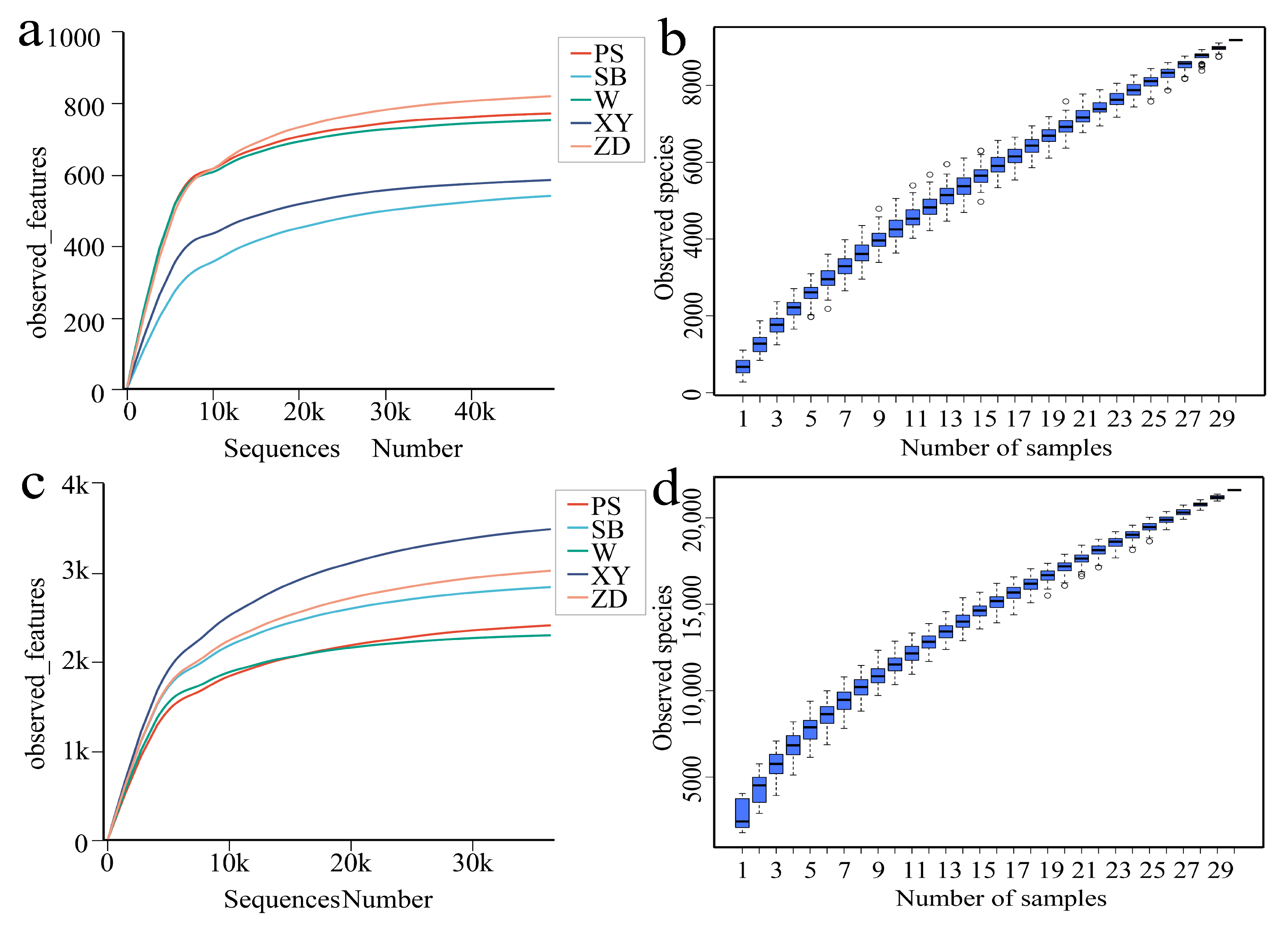
(a) Fungal observed_features rarefaction curve; (b) fungal species accumulation boxplot; (c) bacterial observed_features rarefaction curve; (d) bacterial species accumulation boxplot. In (a,c), the legend entries PS, ZD, XY, W, and SB represent different treatment groups: control soil, ZD958 rhizosphere soil, XY335 rhizosphere soil, W998 rhizosphere soil, and SB13 rhizosphere soil, respectively; the same conventions apply throughout. In (b,d), the horizontal axis represents the number of sequencing samples, and the vertical axis represents the count of feature sequences after sampling.
Figure 1.
(a) Fungal observed_features rarefaction curve; (b) fungal species accumulation boxplot; (c) bacterial observed_features rarefaction curve; (d) bacterial species accumulation boxplot. In (a,c), the legend entries PS, ZD, XY, W, and SB represent different treatment groups: control soil, ZD958 rhizosphere soil, XY335 rhizosphere soil, W998 rhizosphere soil, and SB13 rhizosphere soil, respectively; the same conventions apply throughout. In (b,d), the horizontal axis represents the number of sequencing samples, and the vertical axis represents the count of feature sequences after sampling.
Figure 2.
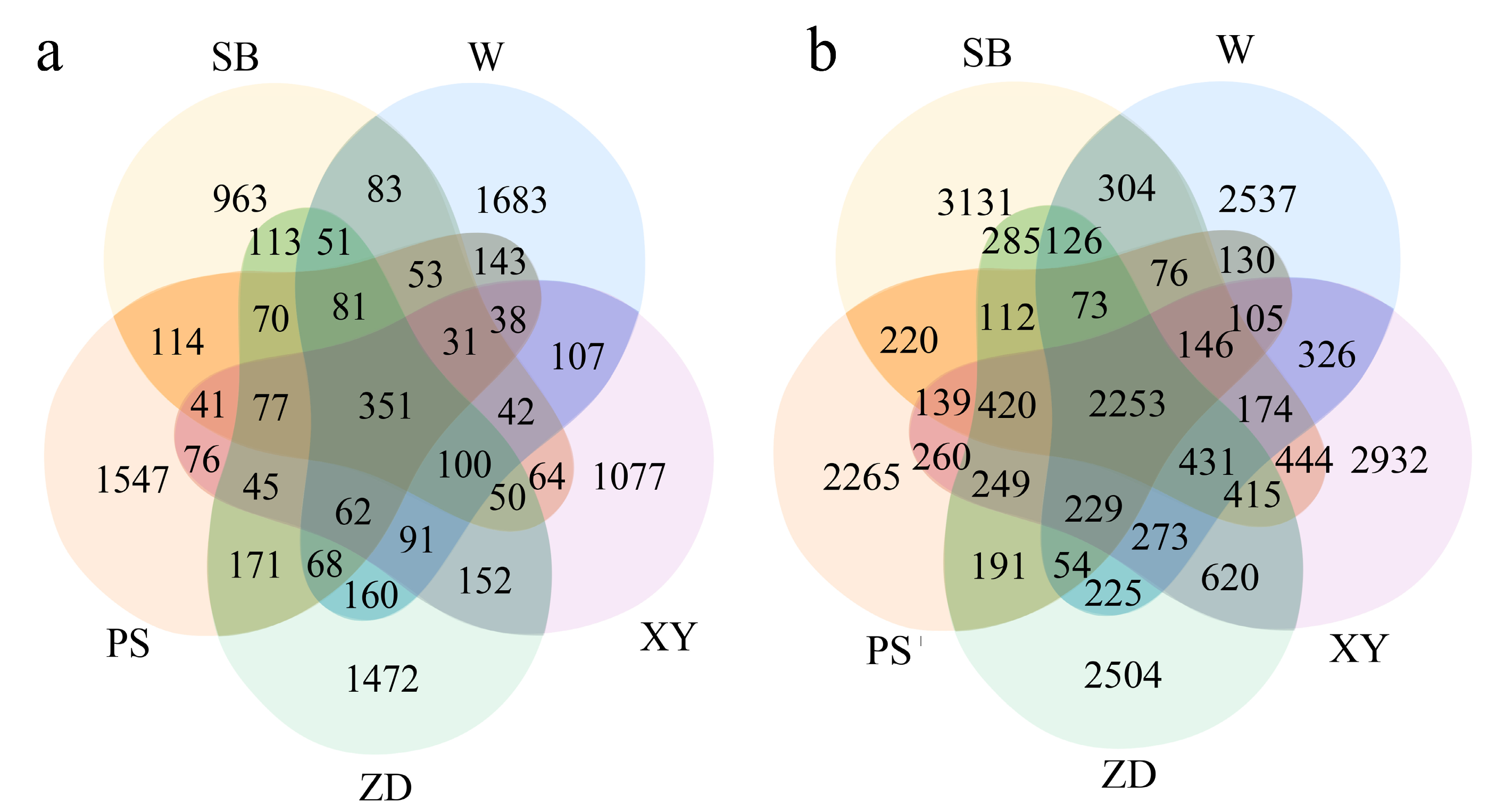
Distribution of soil microbial ASVs: (a) fungal ASVs; (b) bacterial ASVs. In the Venn diagram, each pear-shaped circle represents a treatment group. The number in the central overlapping region indicates the count of feature sequences shared among the treatment groups, while the numbers in the non-overlapping regions indicate the count of feature sequences unique to each respective treatment group. Orange represents the PS group, green represents the ZD group, purple represents the XY group, blue represents the W group, and yellow represents the SB group.
Figure 2.
Distribution of soil microbial ASVs: (a) fungal ASVs; (b) bacterial ASVs. In the Venn diagram, each pear-shaped circle represents a treatment group. The number in the central overlapping region indicates the count of feature sequences shared among the treatment groups, while the numbers in the non-overlapping regions indicate the count of feature sequences unique to each respective treatment group. Orange represents the PS group, green represents the ZD group, purple represents the XY group, blue represents the W group, and yellow represents the SB group.
Figure 3.
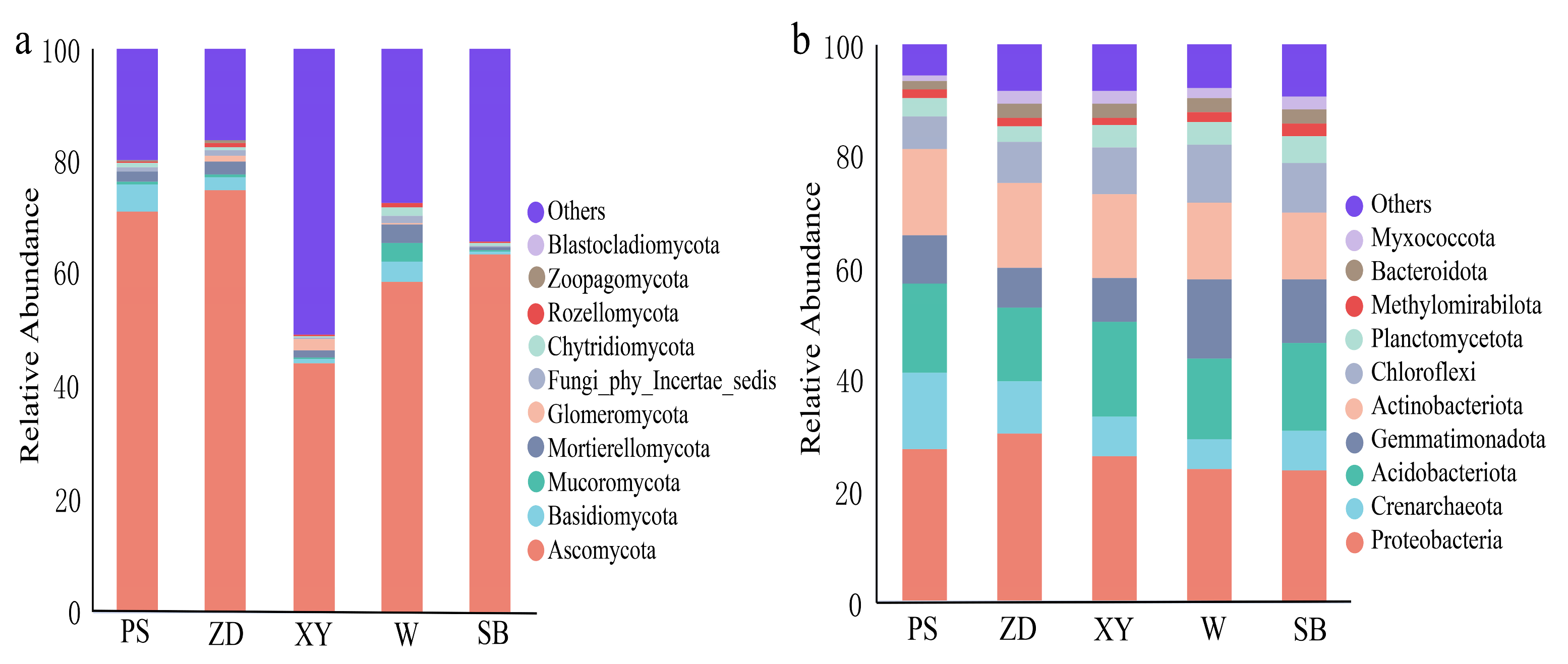
Relative abundance of soil (a) fungal communities and (b) bacterial communities at the phylum level. The horizontal axis represents different treatment groups, and the vertical axis represents relative abundance. The legend displays the 10 most abundant phyla across the treatment groups at the phylum level, where “Others” denotes the sum of relative abundances of all phyla except the ten shown in the figure.
Figure 3.
Relative abundance of soil (a) fungal communities and (b) bacterial communities at the phylum level. The horizontal axis represents different treatment groups, and the vertical axis represents relative abundance. The legend displays the 10 most abundant phyla across the treatment groups at the phylum level, where “Others” denotes the sum of relative abundances of all phyla except the ten shown in the figure.
Figure 4.
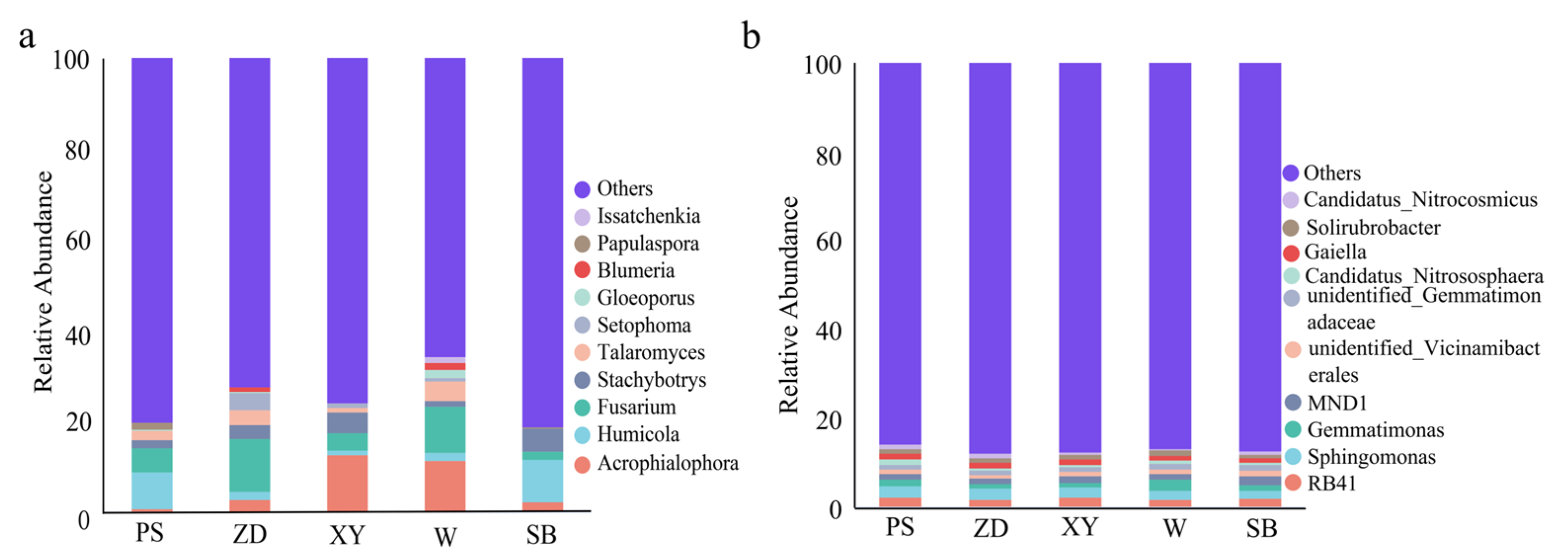
Relative abundance of (a) fungal communities at the genus level in crop rhizosphere soil; relative abundance of (b) bacterial communities at the genus level in crop rhizosphere soil. The x-axis represents different treatment groups, while the y-axis indicates relative abundance. The legend displays the top 10 species at the genus level with the highest relative abundance across the treatment groups. Here, “Others” denotes the sum of relative abundances for all genera other than the 10 illustrated in the figure.
Figure 4.
Relative abundance of (a) fungal communities at the genus level in crop rhizosphere soil; relative abundance of (b) bacterial communities at the genus level in crop rhizosphere soil. The x-axis represents different treatment groups, while the y-axis indicates relative abundance. The legend displays the top 10 species at the genus level with the highest relative abundance across the treatment groups. Here, “Others” denotes the sum of relative abundances for all genera other than the 10 illustrated in the figure.
Figure 5.
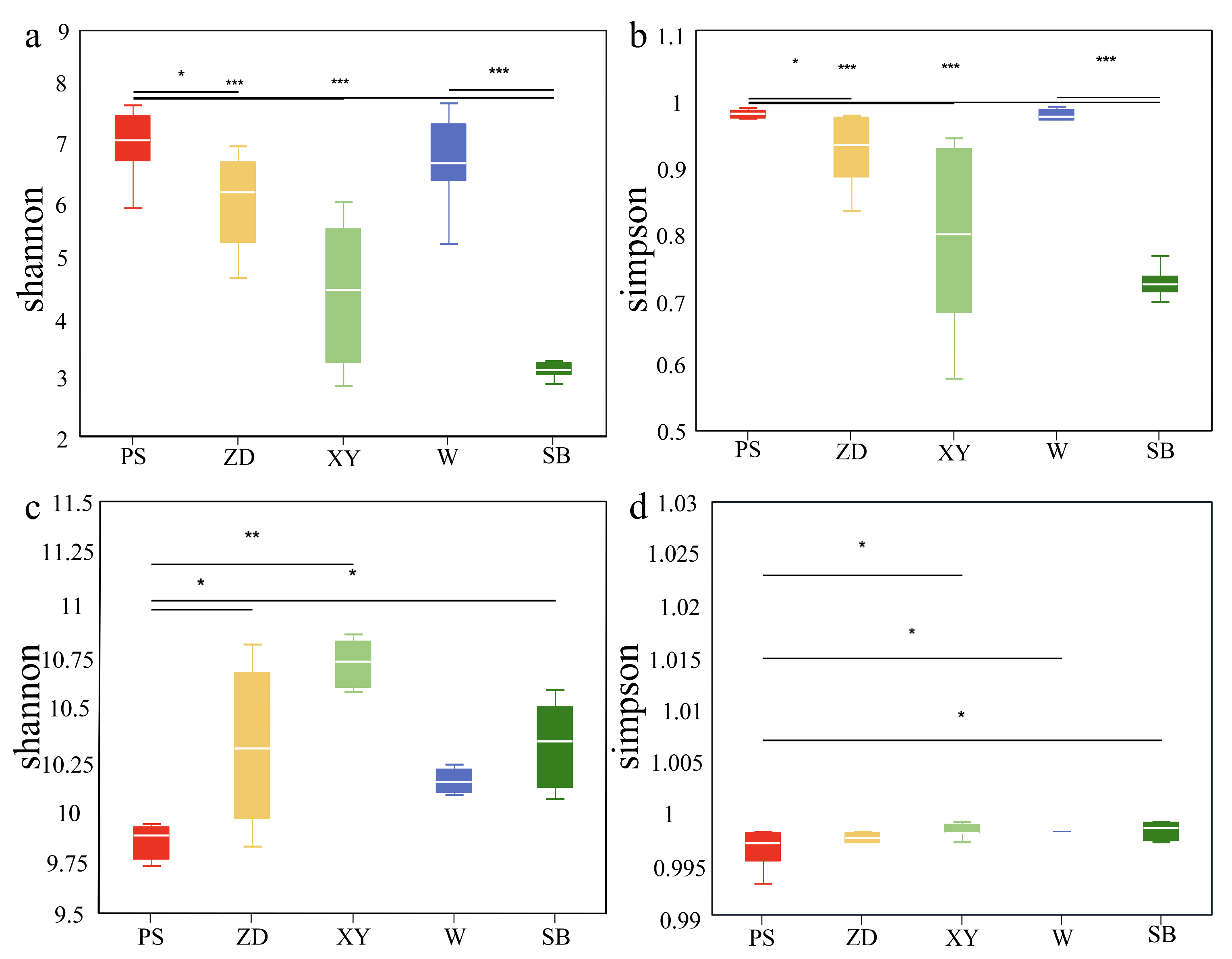
Soil (a,b) fungal alpha diversity indices and (c,d) bacterial alpha diversity indices. The horizontal axis denotes different treatment groups, while the vertical axis represents the alpha diversity index values. The horizontal line at the center of each box indicates the median. The symbols *, **, and *** denote statistical significance levels of p < 0.05, p < 0.01, and p < 0.001, respectively.
Figure 5.
Soil (a,b) fungal alpha diversity indices and (c,d) bacterial alpha diversity indices. The horizontal axis denotes different treatment groups, while the vertical axis represents the alpha diversity index values. The horizontal line at the center of each box indicates the median. The symbols *, **, and *** denote statistical significance levels of p < 0.05, p < 0.01, and p < 0.001, respectively.
Figure 6.
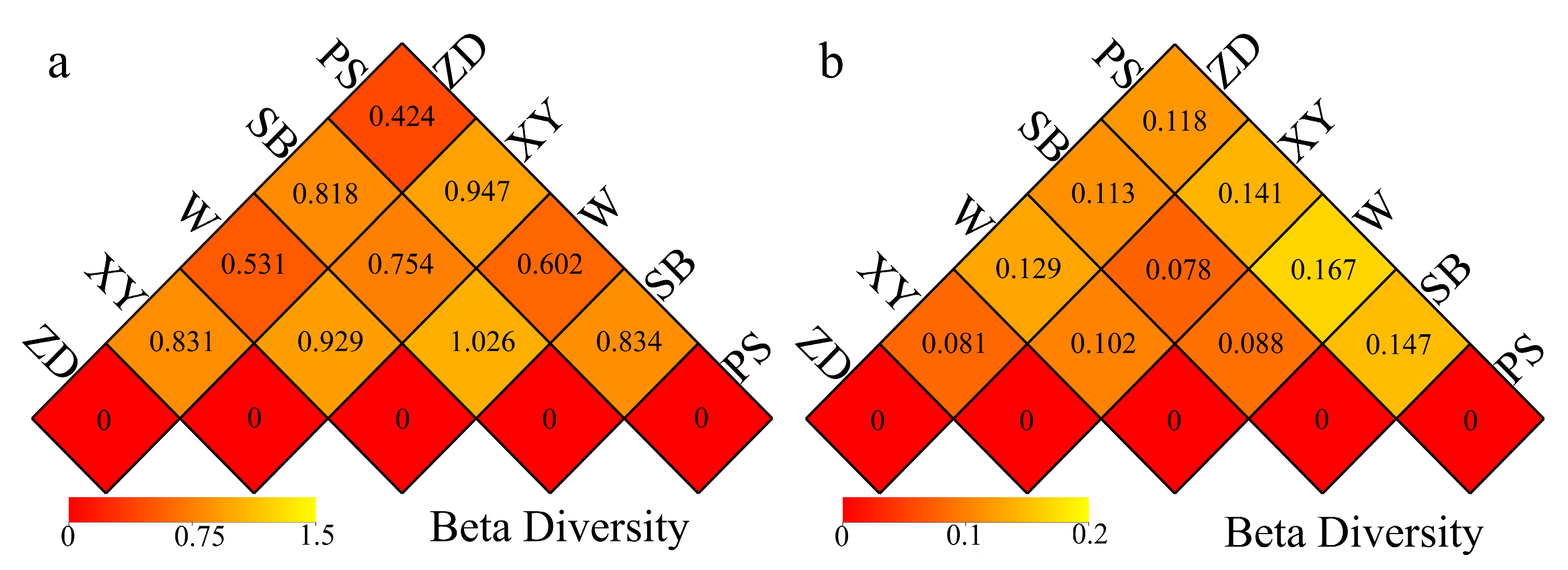
Heatmap of soil (a) fungal β-diversity indices; heatmap of soil (b) bacterial β-diversity indices. Smaller dissimilarity coefficient values between different treatment groups in the figure indicate smaller differences in species diversity.
Figure 6.
Heatmap of soil (a) fungal β-diversity indices; heatmap of soil (b) bacterial β-diversity indices. Smaller dissimilarity coefficient values between different treatment groups in the figure indicate smaller differences in species diversity.
Figure 7.
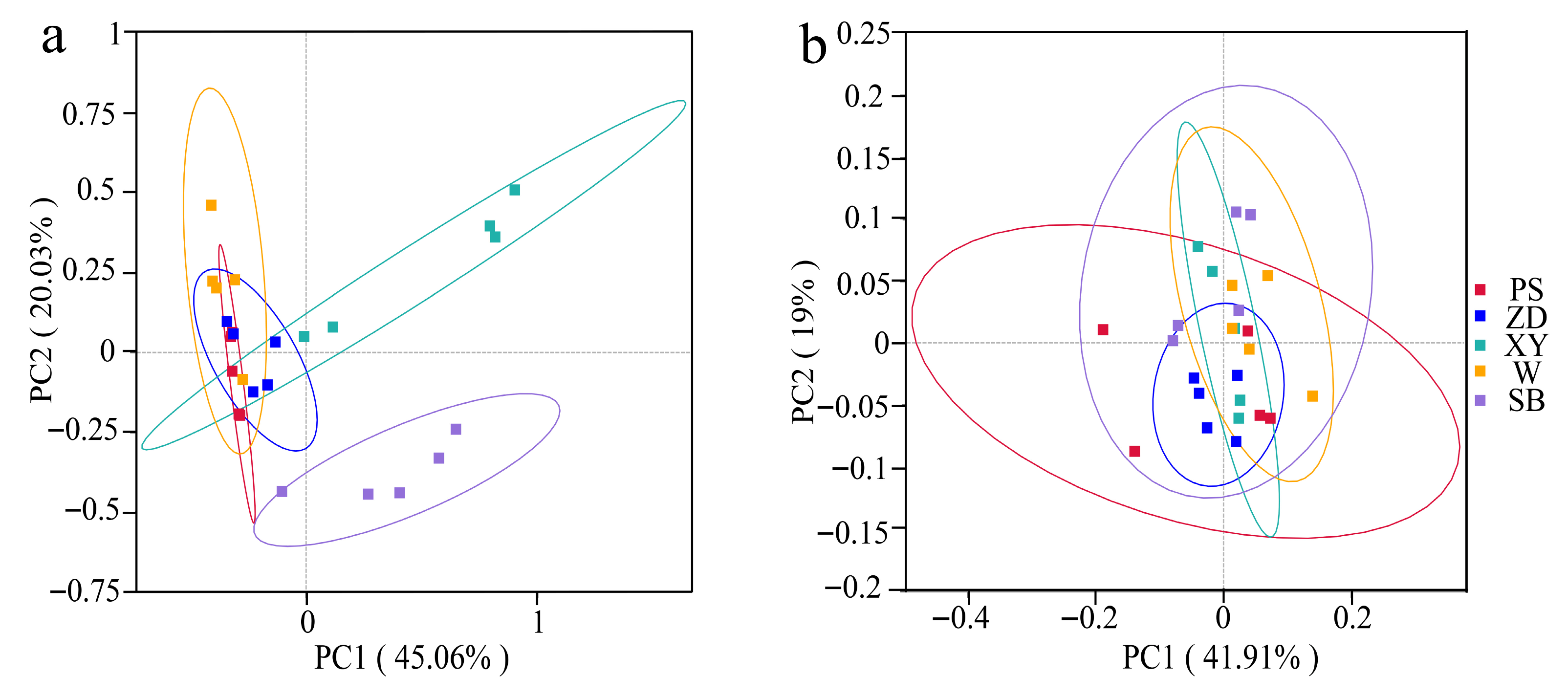
Principal coordinate analysis (PCoA) of soil microbial communities: (a) fungal community; (b) bacterial community. Closer distances between samples indicate greater similarity in species composition. The horizontal axis represents one principal coordinate, and the vertical axis represents another principal coordinate, where the percentage values denote the contribution of each principal coordinate to sample variation. Each point in the figure corresponds to one sample, and samples belonging to the same treatment group are represented by the same color.
Figure 7.
Principal coordinate analysis (PCoA) of soil microbial communities: (a) fungal community; (b) bacterial community. Closer distances between samples indicate greater similarity in species composition. The horizontal axis represents one principal coordinate, and the vertical axis represents another principal coordinate, where the percentage values denote the contribution of each principal coordinate to sample variation. Each point in the figure corresponds to one sample, and samples belonging to the same treatment group are represented by the same color.
Figure 8.
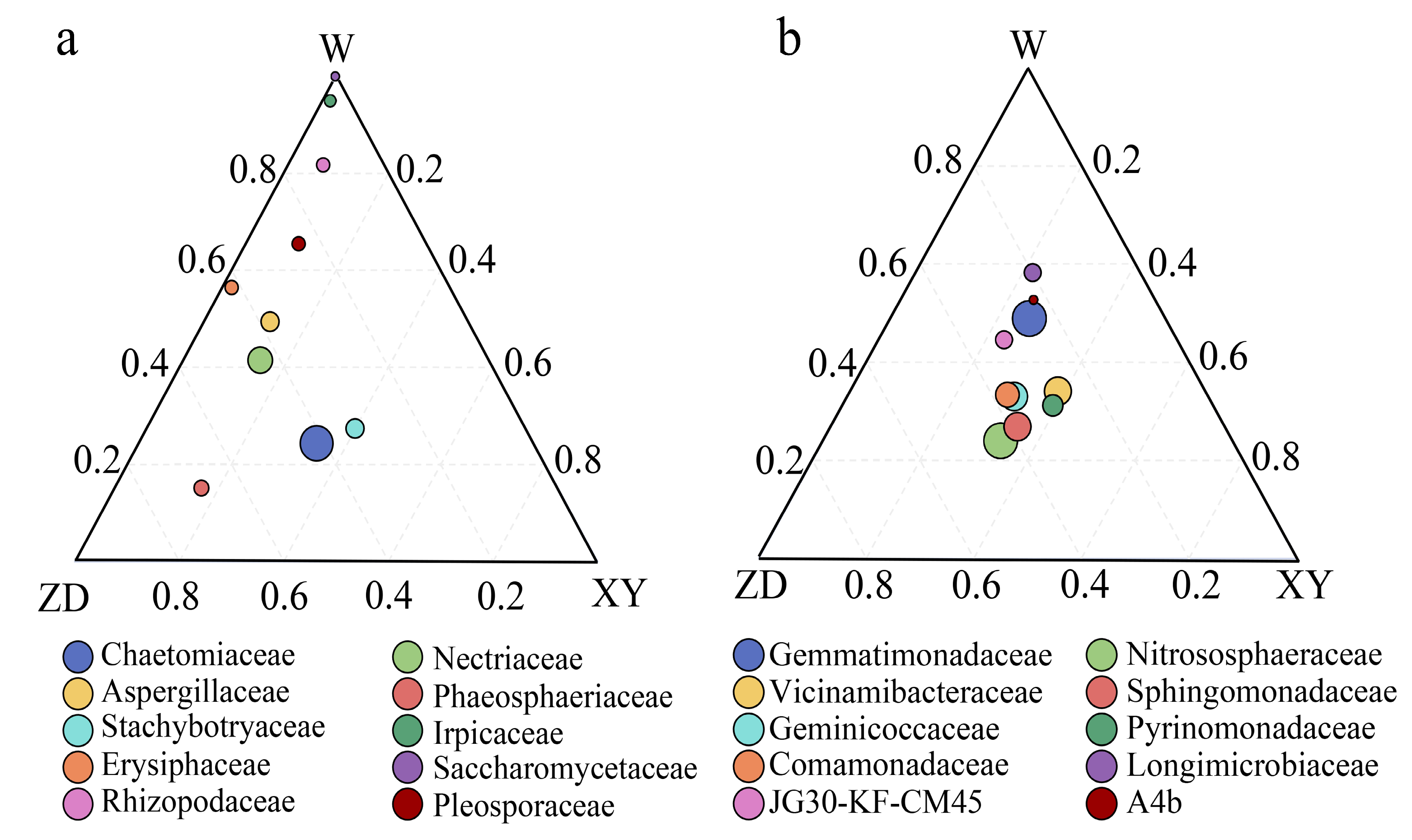
Family-level abundance distribution of soil (a) fungal communities; family-level abundance distribution of soil (b) bacterial communities. The three vertices of the triangle represent the three treatment groups. Different colored circles indicate different species—the closer a circle is to a vertex, the higher the abundance of that species in the corresponding group. The size of each circle corresponds to the relative abundance of the species.
Figure 8.
Family-level abundance distribution of soil (a) fungal communities; family-level abundance distribution of soil (b) bacterial communities. The three vertices of the triangle represent the three treatment groups. Different colored circles indicate different species—the closer a circle is to a vertex, the higher the abundance of that species in the corresponding group. The size of each circle corresponds to the relative abundance of the species.
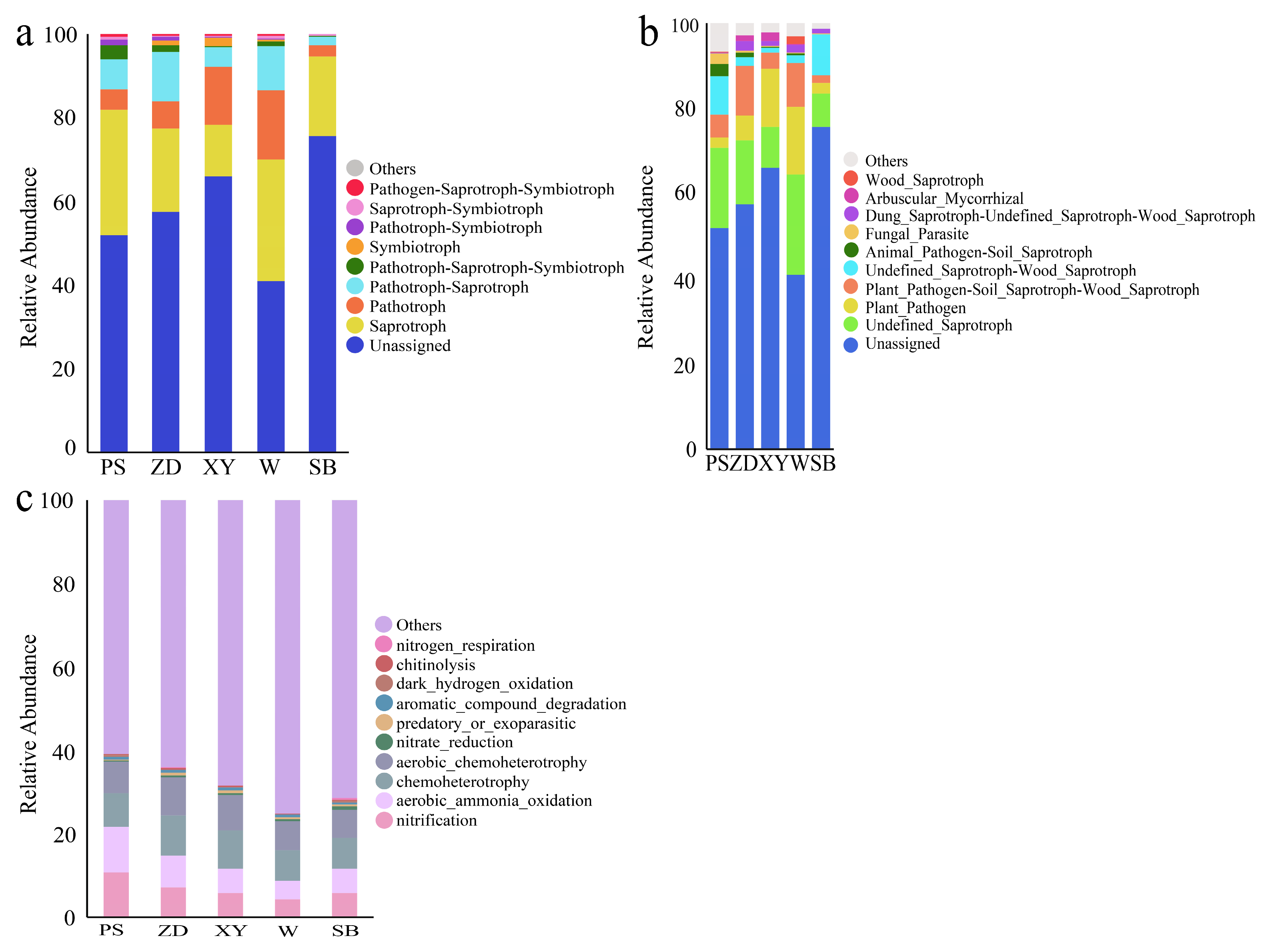
Figure 9.
Predicted (a) fungal trophic modes, (b) fungal functional groups, and (c) bacterial functions. The horizontal axis represents the treatment groups, while the vertical axis indicates the relative abundance. In the legend, “Others” denotes the sum of the relative abundances for all functional information not displayed in the figure.
Figure 9.
Predicted (a) fungal trophic modes, (b) fungal functional groups, and (c) bacterial functions. The horizontal axis represents the treatment groups, while the vertical axis indicates the relative abundance. In the legend, “Others” denotes the sum of the relative abundances for all functional information not displayed in the figure.
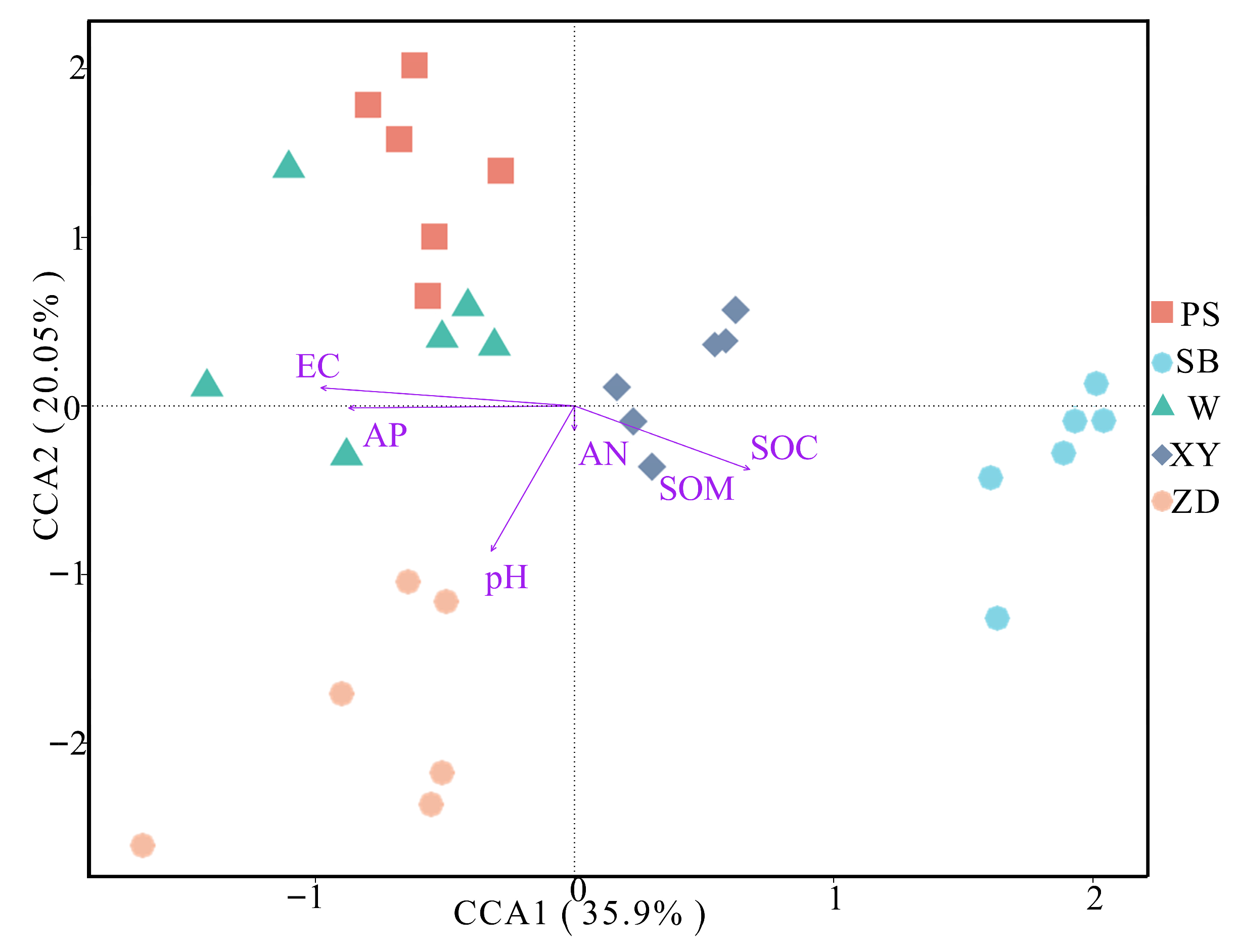
Figure 10.
Relationship between soil factors and fungal community structure. The horizontal and vertical axes represent the CCA axes, with the percentages indicating the proportion of variance explained by each axis. pH: soil pH, EC: soil electrical conductivity, AP: available phosphorus, AN: alkali-hydrolyzable nitrogen, SOC: soil organic carbon, SOM: soil organic matter. The legend denotes different treatment groups, and samples belonging to the same treatment group are represented by icons of the same color. In the diagram, purple arrows represent different environmental factors, with arrow length indicating the magnitude of their influence.
Figure 10.
Relationship between soil factors and fungal community structure. The horizontal and vertical axes represent the CCA axes, with the percentages indicating the proportion of variance explained by each axis. pH: soil pH, EC: soil electrical conductivity, AP: available phosphorus, AN: alkali-hydrolyzable nitrogen, SOC: soil organic carbon, SOM: soil organic matter. The legend denotes different treatment groups, and samples belonging to the same treatment group are represented by icons of the same color. In the diagram, purple arrows represent different environmental factors, with arrow length indicating the magnitude of their influence.
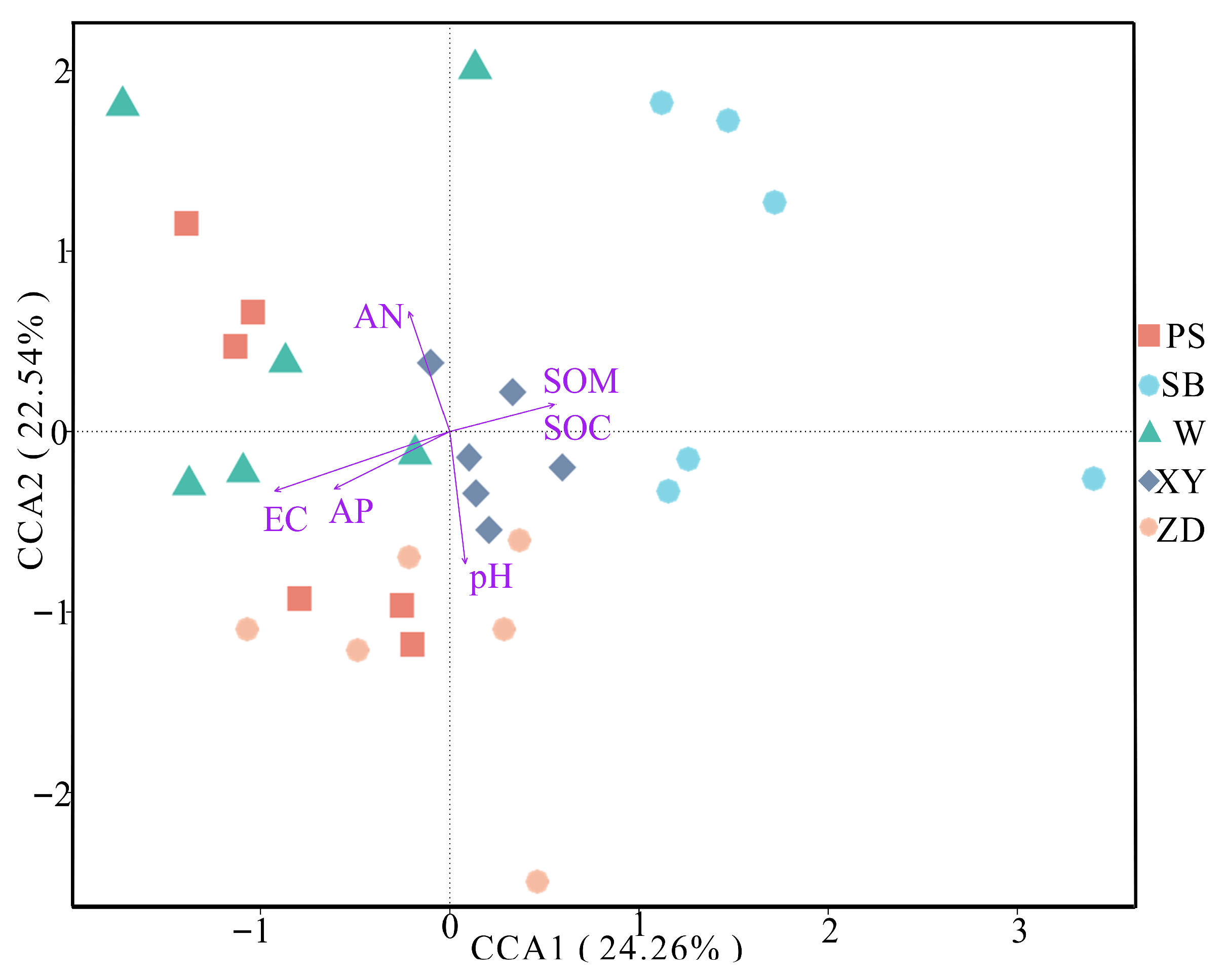
Figure 11.
Soil factors and bacterial community structure. The horizontal and vertical axes represent the CCA axes, with the percentages indicating the proportion of variance explained by each axis. pH: soil pH, EC: soil electrical conductivity, AP: available phosphorus, AN: alkali-hydrolyzable nitrogen, SOC: soil organic carbon, SOM: soil organic matter. The legend denotes different treatment groups, and samples belonging to the same treatment group are represented by icons of the same color. In the diagram, purple arrows represent different environmental factors, with arrow length indicating the magnitude of their influence.
Figure 11.
Soil factors and bacterial community structure. The horizontal and vertical axes represent the CCA axes, with the percentages indicating the proportion of variance explained by each axis. pH: soil pH, EC: soil electrical conductivity, AP: available phosphorus, AN: alkali-hydrolyzable nitrogen, SOC: soil organic carbon, SOM: soil organic matter. The legend denotes different treatment groups, and samples belonging to the same treatment group are represented by icons of the same color. In the diagram, purple arrows represent different environmental factors, with arrow length indicating the magnitude of their influence.
Table 1.
Effects of different crop types on soil physicochemical properties and nutrient content.
Table 1.
Effects of different crop types on soil physicochemical properties and nutrient content.
| Treatment | pH | EC (μs/cm) | AN (mg/kg) | AP (mg/kg) | SOC (mg/g) | SOM (mg/g) |
|---|
| PS | 6.62 ± 0.06 b | 193.02 ± 4.47 a | 77.96 ± 2.78 a | 40.94 ± 0.80 a | 17.80 ± 0.42 b | 30.69 ± 0.72 b |
| ZD | 6.97 ± 0.05 a | 189.82 ± 13.07 a | 81.22 ± 2.29 a | 41.61 ± 0.88 a | 19.05 ± 0.59 b | 32.84 ± 1.01 b |
| XY | 6.66 ± 0.04 b | 162.50 ± 4.99 b | 81.49 ± 1.42 a | 37.42 ± 0.80 b | 19.62 ± 0.54 b | 33.82 ± 0.93 b |
| W | 6.63 ± 0.03 b | 190.92 ± 7.16 a | 83.57 ± 3.78 a | 41.34 ± 1.33 a | 18.96 ± 0.57 b | 32.68 ± 0.98 b |
| SB | 6.65 ± 0.07 b | 121.68 ± 2.70 c | 82.40 ± 2.37 a | 34.74 ± 1.02 b | 21.14 ± 0.41 a | 36.45 ± 0.71 a |
Table 2.
Correlations between soil physicochemical properties and α-diversity indices across different treatment groups. pH: soil pH, EC: soil electrical conductivity, AP: available phosphorus, AN: alkali-hydrolyzable nitrogen, SOC: soil organic carbon, SOM: soil organic matter.
Table 2.
Correlations between soil physicochemical properties and α-diversity indices across different treatment groups. pH: soil pH, EC: soil electrical conductivity, AP: available phosphorus, AN: alkali-hydrolyzable nitrogen, SOC: soil organic carbon, SOM: soil organic matter.
| Soil Factors | Chao1 | Dominance | Pielou’s Evenness | Shannon | Simpson |
|---|
| PCC | p | PCC | p | PCC | p | PCC | p | PCC | p |
|---|
| pH | 0.226 | 0.230 | −0.201 | 0.288 | 0.110 | 0.562 | 0.128 | 0.501 | 0.201 | 0.288 |
| EC | 0.373 | 0.042 * | −0.698 | 0.000 *** | 0.724 | 0.000 *** | 0.721 | 0.000 *** | 0.698 | 0.000 *** |
| AP | 0.342 | 0.065 | −0.591 | 0.001 *** | 0.658 | 0.000 *** | 0.658 | 0.000 *** | 0.591 | 0.001 *** |
| AN | 0.057 | 0.764 | 0.044 | 0.817 | −0.011 | 0.952 | 0.006 | 0.975 | −0.044 | 0.817 |
| SOC | −0.235 | 0.211 | 0.587 | 0.001 *** | −0.663 | 0.000 *** | −0.654 | 0.000 *** | −0.587 | 0.001 *** |
| SOM | −0.235 | 0.211 | 0.587 | 0.001 *** | −0.663 | 0.000 *** | −0.654 | 0.000 *** | −0.587 | 0.001 *** |
Table 3.
Mantel’s test results of correlations between fungal community structure (based on ASVs) and soil factors.
Table 3.
Mantel’s test results of correlations between fungal community structure (based on ASVs) and soil factors.
| Soil Factors | r | p |
|---|
| pH | 0.07 | 0.83 |
| EC | 0.44 | 0.00 |
| AP | 0.28 | 0.00 |
| AN | 0.04 | 0.69 |
| SOC | 0.26 | 0.00 |
| SOM | 0.26 | 0.00 |
Table 4.
Relationship between soil physicochemical properties and α-diversity in different treatment groups. pH: soil pH; EC: soil electrical conductivity; AP: available phosphorus; AN: alkali-hydrolyzable nitrogen; SOC: soil organic carbon; SOM: soil organic matter.
Table 4.
Relationship between soil physicochemical properties and α-diversity in different treatment groups. pH: soil pH; EC: soil electrical conductivity; AP: available phosphorus; AN: alkali-hydrolyzable nitrogen; SOC: soil organic carbon; SOM: soil organic matter.
| Soil Factors | Chao1 | Dominance | Pielou’s Evenness | Shannon | Simpson |
|---|
| PCC | p | PCC | p | PCC | p | PCC | p | PCC | p |
|---|
| pH | 0.173 | 0.360 | 0.203 | 0.281 | −0.143 | 0.453 | 0.050 | 0.791 | −0.203 | 0.281 |
| EC | −0.180 | 0.342 | 0.206 | 0.275 | −0.145 | 0.445 | −0.273 | 0.144 | −0.206 | 0.275 |
| AP | −0.219 | 0.246 | 0.168 | 0.374 | −0.031 | 0.869 | −0.237 | 0.208 | −0.168 | 0.374 |
| AN | 0.088 | 0.644 | −0.440 | 0.015 * | 0.418 | 0.022 * | 0.326 | 0.079 | 0.440 | 0.015 * |
| SOC | 0.057 | 0.766 | −0.149 | 0.431 | 0.207 | 0.271 | 0.173 | 0.360 | 0.149 | 0.431 |
| SOM | 0.057 | 0.766 | −0.149 | 0.431 | 0.207 | 0.271 | 0.173 | 0.360 | 0.149 | 0.431 |
Table 5.
Mantel’s test results of correlation between ASV-based bacterial community structure and soil factors.
Table 5.
Mantel’s test results of correlation between ASV-based bacterial community structure and soil factors.
| Soil Factors | r | p |
|---|
| pH | 0.07 | 0.76 |
| EC | 0.08 | 0.20 |
| AP | 0.03 | 0.35 |
| AN | 0.18 | 0.05 |
| SOC | 0.06 | 0.25 |
| SOM | 0.06 | 0.26 |




 and
and