Article

Effects of Irrigation Lower Limit and Nitrogen Rate on Productivity, Resource Use Efficiency, and Economic Benefits of Winter Rapeseed in Semi-Arid Conditions

1
Key Laboratory of Agricultural Soil and Water Engineering in Arid and Semiarid Areas of the Ministry of Education, Northwest A&F University, Yangling 712100, China
2
Department of agronomy, Agriculture Faculty, Ghazni University, Ghazni 2301, Afghanistan
*
Author to whom correspondence should be addressed.
Agronomy 2026, 16(3), 302; https://doi.org/10.3390/agronomy16030302
Submission received: 22 December 2025 / Revised: 14 January 2026 / Accepted: 20 January 2026 / Published: 25 January 2026
(This article belongs to the Section Water Use and Irrigation)

Abstract

Integrated water and nitrogen management plays a crucial role in the sustainable intensification of rapeseed production, particularly in water-limited regions. This two-year field study (2022–2024) evaluated the interactive effects of three irrigation lower limits—W1 (90% of field capacity, [FC]), W2 (70% FC), and W3 (50% FC)—and four nitrogen rates (0, 80, 160, and 240 kg N ha−1; representing N0, N1, N2, N3, and N4) on winter rapeseed growth, yield, resource use efficiency, and economic performance under semi-arid conditions. Both irrigation and nitrogen significantly influenced plant growth, photosynthetic performance, biomass accumulation, and yield formation, with pronounced interactive effects observed across most measured parameters. The W1N2 treatment achieved optimal performance, producing seed yields of 5131 and 3220 kg ha−1 with superior nitrogen use efficiency. Overall, N1, N2, and N3 increased yield by 38.12%, 79.26%, and 84.85%, respectively, relative to N0. Compared with W3N0, W1N2 improved yield by 178%, water use efficiency by 131%, and irrigation water use efficiency by 110%. Relative to W1N3, W1N2 increased nitrogen agronomic efficiency, physiological efficiency, recovery efficiency, and partial factor productivity by 40.5%, 7.4%, 30.4%, and 45.2%, respectively, while reducing nitrate nitrogen residue by 12%. Entropy-TOPSIS analysis identified W1N2 as the top-ranked treatment, indicating that optimized irrigation and nitrogen management offer a sustainable strategy to maximize rapeseed productivity, enhance resource-use efficiency, and improve economic returns under water-limited conditions. For practical application in semi-arid environments, the W1N2 treatment is recommended as the optimal management strategy for sustainable winter rapeseed intensification.

1. Introduction

Rapeseed (Brassica napus L.) is the world’s second-largest oilseed crop after soybean and contributes approximately 20% of worldwide oil output [1,2]. Cultivated under diverse climatic conditions across all continents, this economically vital crop serves multiple functions, including premium edible oil for human nutrition, sustainable biodiesel feedstock, and environmental management applications [3,4]. Its oil content ranges from 35 to 50% of dry weight and is particularly valued for its abundance of essential fatty acids and vitamins [5,6,7]. In China, rapeseed is the primary edible oil and ornamental crop [8], with production reaching an average of 13 million tons from 690,000 ha of cultivated area over the past two decades [9,10]. Despite substantial yield improvements, domestic supply continues to fall short of demand, necessitating considerable foreign imports. Abiotic factors such as irrigation and nitrogen are essential for improving rapeseed growth and yield [11,12]. However, external environmental pressures can disrupt the biosynthetic mechanisms in plants [13], making it difficult to achieve optimal oil concentration levels in rapeseed under field production scenarios.
Water stress fundamentally disrupts crop physiology and productivity by inducing significant decreases in chlorophyll content and leaf area index (LAI) in rapeseed plants [11]. Chlorophyll reductions can reach 38% compared to adequately watered plants [14]. Beyond photosynthetic capacity, water deficit significantly impedes nitrogen translocation from soil and adversely affects nitrogen redistribution from various vegetative organs to grain, ultimately impacting nitrogen accumulation and soil nutrient dynamics [15,16,17]. Irrigation remains the principal growth-limiting factor for global agricultural production, particularly in farming systems established in arid and semi-arid zones [17,18]. Recent research indicates that 28–38% of current cropland faces water scarcity, lacking sufficient soil moisture and irrigation options to overcome these deficits [19].
The economic yield of rapeseed is fundamentally determined by cumulative biomass production, assimilate partitioning to pods, and the effective duration of pod filling [20]. During seasons with insufficient or absent rainfall, crops require irrigation support to maintain productive capacity. However, water availability for agricultural irrigation is increasingly constrained due to declining precipitation patterns and escalating demand from industrial, domestic, municipal, and other competing sectors [16]. Determining irrigation lower limits is crucial for crop productivity in water-scarce semi-arid regions. Strategic deficit irrigation, which maintains soil moisture above critical thresholds, enhances seed yield and water use efficiency while minimizing environmental impacts [11,21]. Previous studies have demonstrated that regulated deficit irrigation (60–80%, FC) sustains yield and improves water use efficiency while decreasing nitrate leaching [11,22]. Water-saving strategies, particularly drip fertigation, have been shown to increase yield and enhance both water and nitrogen use efficiency [23,24,25,26]. Therefore, adequate nutrient and water management can improve crop drought resistance [27]. However, fertility adjustments can either enhance or reduce this resistance depending on water–nutrient interactions and fertilizer effects on soil health [28,29].
Nitrogen (N) is a critical macronutrient that fundamentally governs plant growth and yield development, with strategic fertilizer management representing a vital approach for enhancing rapeseed productivity [30,31,32]. In rapeseed cultivation, N application can enhance yields by 1.1–2.4 t ha−1 while simultaneously increasing the protein content and reducing oil concentrations [33,34,35]. However, despite global N fertilizer consumption exceeding 110 million tons annually, widespread excessive application has created a paradox of diminished use efficiency and environmental degradation [36]. In China, the N use efficiency for major field crops averages merely 25%, with substantial losses occurring through leaching, volatilization, and surface runoff, thereby compromising air and water quality [36,37,38]. This inefficiency is compounded by escalating fertilizer costs due to increased natural gas prices and supply chain disruptions, reducing rapeseed producer profitability while exacerbating environmental challenges [37,39]. These dual environmental and economic pressures have positioned N management at the forefront of global ecosystem research, with agronomic practices such as optimized application timing offering promising solutions [40,41,42]. Research demonstrates that synchronizing N availability with plant demand through strategic timing and application rates of 150–180 kg N ha−1 can significantly increase both rapeseed yield and oil production while maintaining high use efficiency [43,44,45]. However, optimal application strategies remain highly site-specific and difficult to predict, depending on complex interactions between local environmental conditions and plant physiological demands [46].
Optimizing integrated water and nitrogen management is essential for sustainable rapeseed intensification under increasing water scarcity in semi-arid regions. While previous studies have demonstrated that optimal nitrogen fertilization enhances yield and resource use efficiency [47], and balanced nitrogen management reduces lodging risk while sustaining productivity [12], the interactive effects of irrigation regimes and nitrogen rates on rapeseed physiological performance, root morphology, yield components, and resource use efficiency remain poorly understood, as comprehensive investigations integrating both factors are limited. This two-year field study evaluated the interaction effects of irrigation and nitrogen management with the following objectives: (1) quantify interactive effects on plant growth, root development, and photosynthetic performance; (2) determine optimal combinations for maximizing seed yield and resource use efficiency; and (3) assess economic viability and environmental sustainability. Understanding these synergistic effects is vital for developing evidence-based strategies that enhance productivity while minimizing environmental impacts in water-limited production systems.

2. Materials and Methods

2.1. Experimental Site

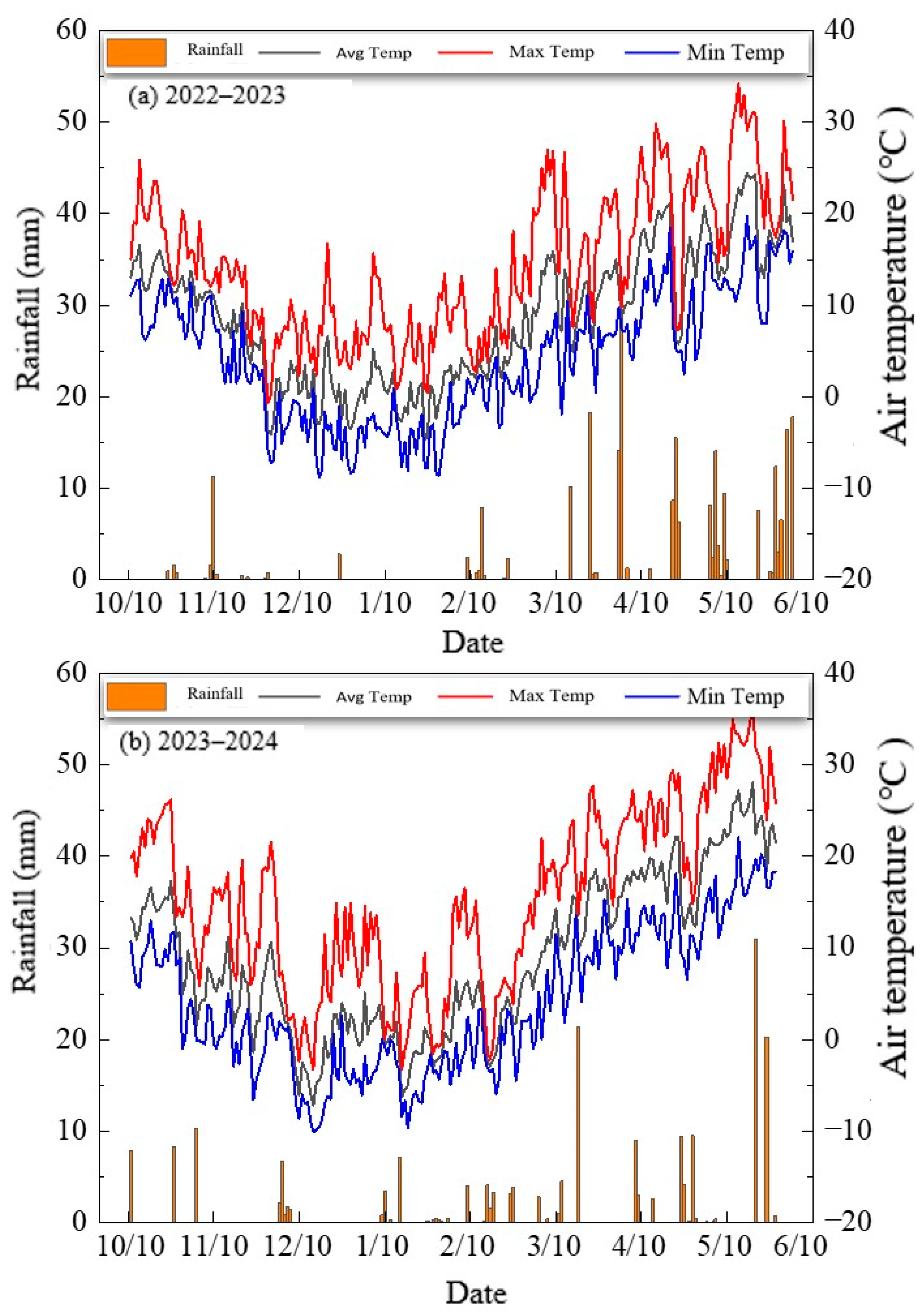
A two-year field experiment was conducted during the consecutive winter rapeseed growing seasons from October 2022 to June 2023 and October 2023 to June 2024 at the irrigation experimental station of the Key Laboratory of Agricultural Water and Soil Engineering, Northwest A&F University. The experimental site, situated under a rain shelter in Yangling, Shaanxi Province, China (108°24′ E, 34°18′ N, 521 m a.s.l.), experiences a semi-humid, drought-prone climate. The mean annual temperature is 12.9 °C, with an annual precipitation of 635 mm, and an annual evaporation of 1500 mm. Rainfall is predominantly concentrated between July and September, with average annual sunshine hours of 2163.8 h. During the experimental periods, total precipitation was 249.3 mm (2022–2023) and 193.7 mm (2023–2024). Detailed rainfall and temperature patterns are presented in Figure 1. The experimental field consists of silty clay loam soil with a bulk density of 1.35 g cm−3 (0–60 cm depth) and a field capacity of 0.267 cm3 cm−3. Initial soil properties (0–20 cm depth) were as follows: electrical conductivity 1.17 dS m−1, pH 8.17, organic matter 12.02 g kg−1, total nitrogen 0.77 g kg−1, nitrate-N 20.94 mg kg−1, ammonium-N 7.01 mg kg−1, available phosphorus 13.5 mg kg−1, and available potassium 102.3 mg kg−1. The groundwater table was below 50 m, thereby excluding any capillary rise contribution to the root zone water supply.

2.2. Experimental Design and Crop Management

The experiment employed a two-factor randomized complete block design with three replications (36 plots total) using the winter rapeseed cultivar ‘Qin You 1618’. The factors consisted of irrigation regime and nitrogen (N) fertilization rate. Three irrigation treatments were established based on soil moisture depletion thresholds relative to field capacity (θf): W1 (irrigation triggered at 90% θf), W2 (irrigation triggered at 70% θf), and W3 (irrigation triggered at 50% θf). In all treatments, soil moisture was restored to 100% θf at each irrigation event. Four N rates were applied: N0 (0 kg N ha−1, control), N1 (80 kg N ha−1), N2 (160 kg N ha−1), and N3 (240 kg N ha−1). Each experimental plot measured 4.0 m × 4.0 m, with 1.0 m buffer zones surrounding the experimental area and 0.5 m isolation strips between adjacent plots. Rapeseed was planted at row and plant spacings of 50 cm and 14 cm, respectively, following local practices. Plant density was standardized at 140,000 plants ha−1 through post-emergence thinning after true leaves developed.

2.2.1. Fertilization Management

Nutrient management was implemented through an integrated drip fertigation system. Fertilizer sources included urea (46.4% N), superphosphate (16% P2O5), and potassium chloride (60% K2O). Phosphorus (120 kg P2O5 ha−1) and potassium (90 kg K2O ha−1) were applied as basal fertilizers before sowing. Nitrogen was applied through fertigation in four split applications: 30% at the seedling stage, 30% at the bud stage, 20% at the flowering stage, and 20% during pod development. For the N0 treatment, only phosphorus and potassium were applied.

2.2.2. Irrigation System and Scheduling

A surface drip irrigation (SDI) system was installed with emitters spaced at 10 cm intervals along lateral lines spaced 50 cm apart. The system operated at 0.1 MPa working pressure with an emitter discharge rate of 2.3 L h−1. Polyethylene (PE) pipelines served as the main water carriers adjacent to the experimental area, with individual outlets and water-tight valves controlling irrigation for each subplot. Irrigation volume was measured using flow meters installed at each subplot outlet. Crop irrigation requirement (CIR, mm) was calculated using the soil water balance approach [48,49].
CIR = 10 × γbd × Dh × (θt − θn)
where γbd is soil bulk density (g cm−3), Dh is the measurement depth for soil water content (cm), θt is the target gravimetric soil water content after irrigation (%), and θn is the gravimetric soil water content before irrigation (%). The measurement depth (Dh) varied by growth stage: 30 cm at the bud stage, 40 cm at the flowering stage, and 50 cm from pod formation to maturity. Target soil water content was calculated as
θt = θmax × (θtr/100)
where θmax is field capacity (%) and θtr is the target relative soil water content (set at the respective treatment thresholds of 90%, 70%, or 50% for W1, W2, and W3, respectively). After irrigation, soil moisture was restored to field capacity (100% θf) for all treatments.

2.3. Measurements and Calculations

2.3.1. Growth and Physiological Parameters

Plant height (from ground to apex) and stem diameter were measured at six growth stages: budding stage (BS), early flowering stage (EFS), full flowering stage (FFS), last flowering stage (LFS), pod development stage (PDS), and maturity (MT). Data were collected from five representative plants per plot. LAI was measured using an LAI-2200C plant canopy analyzer (Li-Cor, Lincoln, NE, USA) at BS, EFS, FFS, PDS, and MT.
At each growth stage, three representative plants were randomly selected from each plot for destructive sampling to measure aboveground dry matter accumulation (ADMA). Each plant was carefully separated into roots, stems, leaves, and reproductive organs (when present). The samples were initially oven-dried at 105 °C for 30 min to halt metabolic processes, then dried at 75 °C until reaching constant weight. Dry weights were recorded and subsequently converted to kg ha−1 based on the established plant density within each plot. For root morphology analysis at the harvest stage, root samples were collected using a soil corer with a 10 cm inner diameter at two distances from the drip line (10 cm and 20 cm) within the 0–30 cm soil depth. Two soil cores were extracted per plot, and roots were carefully removed from the cores and thoroughly washed to eliminate adhering soil particles. The cleaned root samples were then scanned using a flatbed scanner (Epson Perfection V700, Suwa, Nagano, Japan), and the resulting digital images were analyzed with WinRHIZO Pro version 5.0 software (Regent Instruments Inc., Quebec City, QC, Canada) to quantify key root morphological parameters, including total root length (cm), surface area (cm2), average diameter (mm), and root volume (cm3).
Photosynthetic parameters were measured on the first fully expanded leaf of the upper canopy using a portable photosynthetic system (Li-6800, Li-Cor, USA) between 10:00 and 12:00 a.m. The parameters included net photosynthetic rate (Pn), stomatal conductance (gs), and transpiration rate (Tr). Chlorophyll fluorescence was measured at the bolting, flowering, and maturity stages using a portable chlorophyll fluorometer (PSI, Drasov, Czech Republic). Leaves were dark-adapted for 20 min before measurement, with three replicates per plot. Measurements avoided leaf veins and retained leaf boundaries. The following fluorescence parameters were derived: maximum photochemical efficiency of PSII (Fv/Fm), effective quantum efficiency of PSII (ΦPSII), photochemical quenching coefficient (qP), and non-photochemical quenching coefficient (NPQ). The calculation formulas are as follows:
Fv/Fm = (Fm − Fo)/Fm
ΦPSII = (Fm′ − Ft)/Fm′
qP = (Fm′ − Ft)/(Fm′ − Fo′)
NPQ = (Fm − Fm′)/Fm′
where Fm and Fo are the dark-adapted maximum and minimum fluorescence; Fm′ is the light-adapted maximum fluorescence; Fo′ is the light-adapted minimum fluorescence (estimated with far-red light); Ft is the steady-state fluorescence under actinic light; Fv is variable fluorescence (Fm − Fo).

2.3.2. Seed Yield, Quality, and Economic Analysis

At physiological maturity, 20 plants were randomly selected from each plot to determine pods per plant and seeds per pod. The 1000-seed weight was measured by weighing four replicates of 500 seeds per plot and then converting the value. Seeds were harvested from a 2 m2 area in the center of each plot to avoid edge effects. After four days of field drying, seeds were threshed, cleaned, and yields were calculated based on 12% moisture content and expressed as kg ha−1. Oil and protein content were determined using Near-Infrared spectroscopy (NYDL-3000; Oil Crops Research Institute, Chinese Academy of Agricultural Sciences, Wuhan, China) according to standard protocols.
The economic benefit (EB, CNY ha−1) is calculated as
GP = P × Y
EB = GP − TC
where GP is gross profit (CNY ha−1), P is rapeseed unit price (CNY kg−1), Y is grain yield (kg ha−1), EB is economic benefit or net profit (CNY ha−1), and TC is total cost (CNY ha−1).
Total cost included the drip irrigation system (6313 CNY ha−1 with a two-year service life, equivalent to 3156 CNY ha−1 per season), seeds, fertilizers, irrigation water, and miscellaneous expenses (labor, machinery, weeding, and pest control). Input prices during the experimental period were rapeseed 6.51 CNY kg−1, urea 1.85 CNY kg−1, superphosphate 0.90 CNY kg−1, potassium chloride 3.6 CNY kg−1, and irrigation water 0.4 CNY m−3.

2.3.3. Soil Nitrate Residual

After crop harvest, soil samples were collected from each plot at the same locations used for soil moisture monitoring. Sampling was conducted at 10 cm intervals to 100 cm depth. Samples were air-dried, ground, and sieved through a 1 mm mesh. For nitrate-N extraction, 5 g of soil was mixed with 50 mL of 2 mol L−1 KCl solution and shaken for 30 min. The filtrate was analyzed for NO3-N concentration using a continuous flow analyzer (SEAL AA550, SEAL Analytical GmbH, Norderstedt, Germany).
Total soil nitrate-N accumulation (kg N ha−1) in the 0–100 cm profile was calculated as
SNR = Σ(CNO3-N × hi × γi × 0.1)
where CNO3-N is nitrate-N concentration (mg kg−1), hi is soil layer thickness (cm), γi is soil bulk density (g cm−3), and 0.1 is the conversion factor.

2.3.4. Evapotranspiration and Water Use Efficiency

Crop evapotranspiration (ET, mm) during the growing season was calculated using the water balance equation
ET = I + P − R − D ± ΔSWS
where I is irrigation (mm), P is precipitation (mm), R is the surface runoff (mm), D is deep drainage (mm), and ∆SWS is the change in soil water storage within the 0–100 cm soil layer from sowing to harvesting (mm). The groundwater table is approximately 50 m below the surface, resulting in negligible upward flow into the root zone. The field was flat and no runoff was observed; therefore, R and D were disregarded.
Water use efficiency (WUE, kg m−3) and irrigation water use efficiency (IWUE, kg m−3) are calculated as follows:
WUE = GY/ET
IWUE = GY/I
where GY is grain yield (kg ha−1), ET is crop evapotranspiration (mm), and I is total irrigation (mm).

2.3.5. Nitrogen Uptake and Use Efficiency

At maturity, plant samples were separated into different organs (roots, stems, leaves, pods, seeds), dried at 75 °C to constant weight, and ground to pass through a 1 mm sieve. Samples were digested with concentrated H2SO4 and H2O2, and total N concentration was determined using a continuous flow analyzer (AA5, SEAL Analytical GmbH, Germany).
Crop nitrogen uptake (kg N ha−1) was calculated as:
NU = ΣCN × DMi/1000
where NU is crop nitrogen uptake, CN is N concentration in each organ (g kg−1), DM is dry matter weight of corresponding organs (kg ha−1), and 1000 is the conversion factor.
The N use efficiency indicators N partial factor productivity (NPFP, kg kg−1), N agronomic efficiency (NAE, kg kg−1), N recovery efficiency (NRE, %), and N physiological efficiency (NPE, kg kg−1) were measured using the equations below [50,51].
NPFP = GY/FN
NAE = (GYN − GY0)/FN
NRE= [(UN − U0)/FN] × 100
NPE= NPE = (GYN − GY0)/(UN − U0)
where GY is grain yield (kg ha−1), FN is N application rate (kg ha−1), GYN and GY0 are seed yields with and without N fertilizer (kg ha−1), and UN and U0 are total aboveground N uptake at harvest with and without N fertilizer (kg ha−1), respectively.

2.4. Data Statistical Analysis

Data were organized using Microsoft Excel 2019 and analyzed using SPSS 27.0 (IBM Corp., Armonk, NY, USA). Two-way analysis of variance (ANOVA) based on a randomized complete black design was conducted to evaluate the main effects of irrigation regime and nitrogen rate, as well as their interaction, with blocks treated as a random factor. When significant effects were detected (p < 0.05), mean comparisons were performed using the least significant difference (LSD) test. To determine indicator weights and obtain a comprehensive performance ranking of the twelve combined treatments, the entropy-based TOPSIS multi-criteria decision-making method was employed [52]. Figures were created using OriginPro 2024 (OriginLab Corporation, Northampton, MA, USA).

3. Results

3.1. Integrated Effects of Iirrigation and Nitrogen on Rapeseed Growth and Physiological Traits

3.1.1. Plant Height and Stem Diameter

Plant height and stem diameter, key indicators of growth and yield potential, were significantly influenced by irrigation and nitrogen (p < 0.01), with significant interactions for stem diameter at most growth stages. Both parameters increased during vegetative and early reproductive stages, reaching maximum values at pod development (plant height: 148.1 cm in 2022–2023; 122.7 cm in 2023–2024) and early flowering (stem diameter: 6.48–18.80 mm in 2022–2023; 6.15–13.37 mm in 2023–2024), then plateauing or declining toward maturity.
Both traits responded positively to increased irrigation and nitrogen, with W1N3 consistently producing maximum values comparable to W1N2 (Figure S1 and S2). Nitrogen fertilization increased plant height and stem diameter by 12.0–26.4% and 10.3–27.6%, respectively, compared to the control, though N2 and N3 showed no significant difference for stem diameter, indicating diminishing returns. Higher irrigation (W1 and W2) enhanced plant height by 18.4% and 11.0% and stem diameter by 18.6–21.3% and 9.8–11.5%, respectively, compared to deficit irrigation (W3). Both parameters were 14.2–30.5% lower in the second season, likely reflecting differing environmental conditions.

3.1.2. Integrated Effects of Irrigation and Nitrogen on Dry Matter Accumulation and Root Characteristics

Aboveground dry matter accumulation (ADMA), a key growth indicator and yield determinant, was significantly influenced by irrigation, nitrogen, and their interaction across both seasons (p < 0.01). ADMA increased gradually to peak at maturity, with the highest accumulation rate occurring between the early and late flowering stages before slowing during pod development. Nitrogen fertilization substantially increased ADMA at maturity by 26.8–80.7% (2022–2023) and 29.3–76.1% (2023–2024) compared to the control, with maximum values at N3 that were not significantly different from N2. Similarly, higher irrigation levels (W1 and W2) increased ADMA by 50.4–59.4% and 24.7–33.5%, respectively, compared to deficit irrigation (W3). The W1N3 treatment consistently produced the maximum ADMA across both seasons, with no difference compared to W1N2 (Figure S3).
Irrigation and nitrogen significantly affected rapeseed root characteristics in the 0–30 cm soil layer at maturity (p < 0.01), with their interaction significantly influencing only root surface area (Table 1). Nitrogen fertilization enhanced all root parameters, with maximum values generally observed at N2 that were not significantly different from N3. Across both seasons, nitrogen increased root length by 8.0–29.9%, surface area by 10.6–66.2%, volume by 2.5–15.4%, and diameter by 9.4–47.2% compared to the control. Irrigation showed contrasting effects on root morphology: higher irrigation levels (W1 and W2) increased root length (41.1–142.7%), surface area (24.9–142.7%), volume (15.8–39.7%), and diameter (19.8–62.7%) compared to deficit irrigation (W3). The substantial increases in root development under adequate water and nitrogen supply corresponded with enhanced aboveground growth and yield performance.

3.1.3. Integrated Effects of Irrigation and Nitrogen on Leaf Photosynthesis, Chlorophyll Fluorescence, and Leaf Area Index

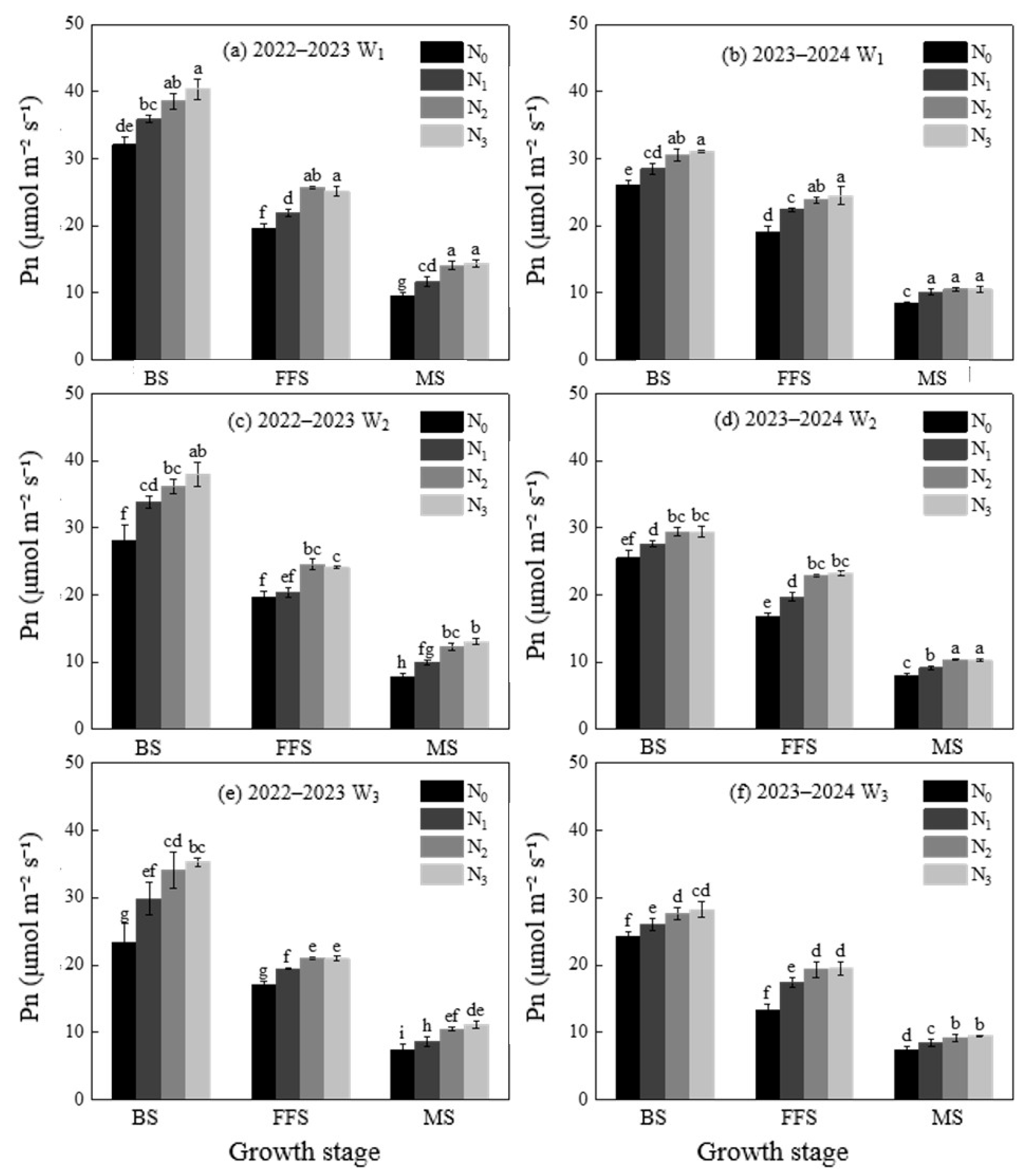
Irrigation and nitrogen significantly affected the photosynthetic parameters (Pn, gs, and Tr) of winter rapeseed across all growth stages (p < 0.01; Figure 2 and Figures S4 and S5). Throughout the budding, full flowering, and maturity stages, all three parameters consistently increased with nitrogen application (N0 < N1 < N2 ≤ N3), with no significant differences between N2 and N3. At maturity, nitrogen fertilization increased Pn by 16.7–55.9%, gs by 11.5–46.9%, and Tr by 32.6–93.7% compared to the control. Similarly, higher irrigation levels enhanced photosynthetic capacity (W1 > W2 > W3), with W1 and W2 increasing Pn by 15.2–31.9% and 9.6–14.4%, gs by 17.6–32.5% and 11.5–11.7%, and Tr by 37.1–44.3% and 15.4–21.9%, respectively, compared to deficit irrigation (W3). Among combined treatments, the highest value was observed with W1N3, with no difference compared to W1N2. These enhanced photosynthetic parameters under optimal water and nitrogen conditions contributed to greater biomass accumulation and yield.
Irrigation and nitrogen application significantly affected (p < 0.01) chlorophyll fluorescence parameters across all developmental stages in both growing seasons (Table 2 and Table 3), with parameters consistently declining from budding to maturity. Nitrogen application enhanced photosynthetic efficiency indicators (Fv/Fm, ΦPSII, and qP) while reducing non-photochemical quenching (NPQ), with maximum responses observed at N2 and diminishing returns at N3. At the budding stage, N2 and N3 increased Fv/Fm by 2.8–4.0%, ΦPSII by 8.9–20.1%, and qP by 7.2–8.9%, while decreasing NPQ by 13.5–24.4% compared to N0, with similar trends at the flowering and maturity stages. Likewise, adequate irrigation (W1 and W2) improved photosynthetic performance relative to deficit irrigation (W3). Averaged across both years, W1 and W2 increased Fv/Fm by 2.45% and 1.3%, ΦPSII by 7.45% and 4.1%, and qP by 6.45% and 3.6%, while decreasing NPQ by 9.35% and 17.35%, respectively. These results demonstrate that both water and nitrogen availability optimize photosystem II efficiency and photochemical energy conversion in winter rapeseed.
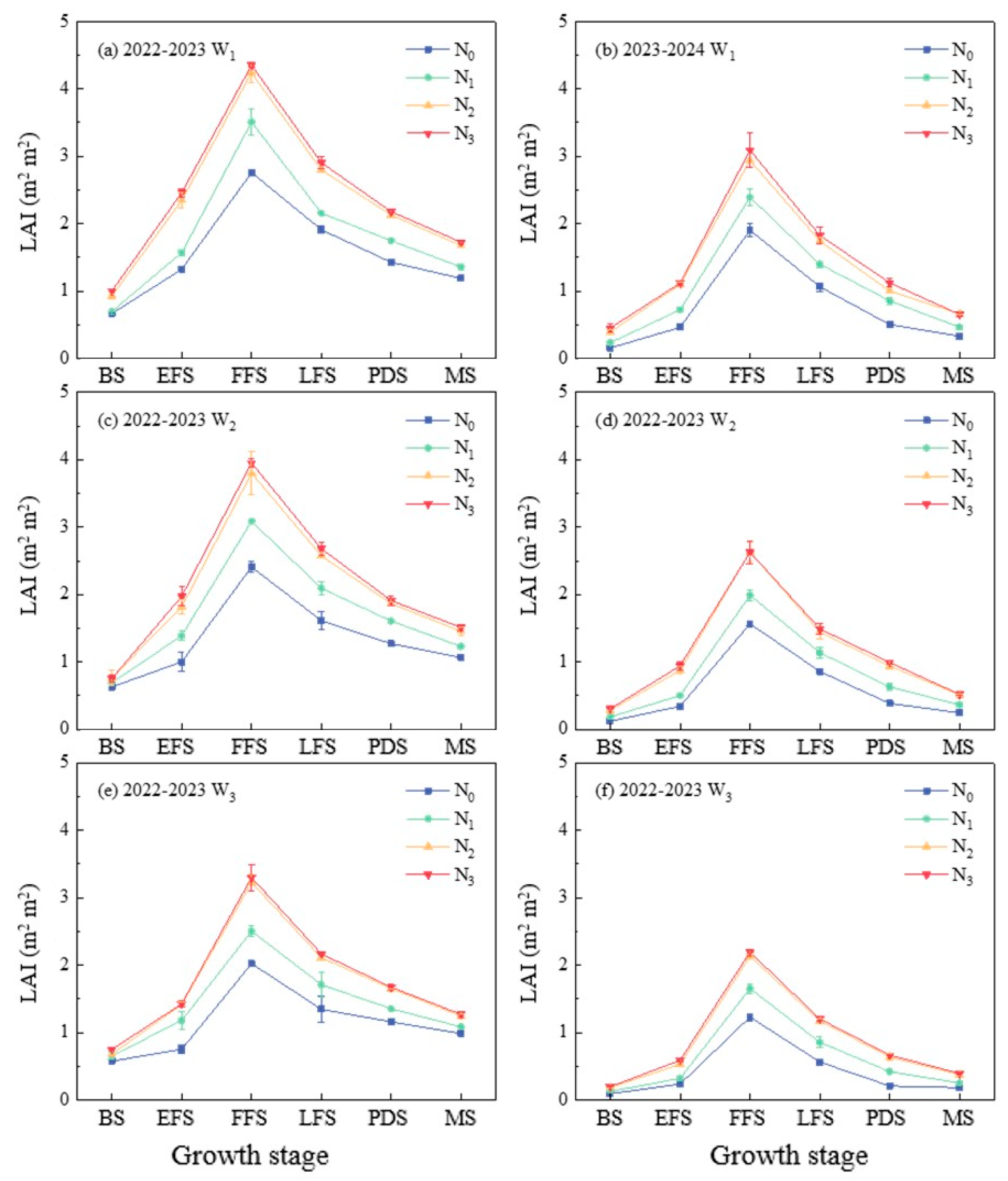
Leaf area index (LAI), which reflects crop canopy size and photosynthetic capacity, was significantly influenced by irrigation, nitrogen, and their interaction at most growth stages (p < 0.01). LAI increased from budding to full flowering stage, where it peaked before declining sharply toward maturity (Figure 3). At full flowering, nitrogen fertilization increased the two-year average LAI by 27.3–64.1% compared to the control, with no significant difference between N2 and N3. Higher irrigation levels (W1 and W2) increased LAI by 38.0% and 20.8%, respectively, compared to deficit irrigation (W3). The W1N3 and W1N2 treatments produced the highest LAI values, with no significant difference between them.

3.2. Integrated Effects of Irrigation and Nitrogen on Seed Yield and Economic Benefits

Nitrogen, irrigation, and their interaction significantly affected seed yield and its components (p < 0.01; Table 4). Seed yield peaked at N3, with no significant difference from N2, representing increases of 44.6–46.8% and 29.8–30.1% over N0 and N1, respectively, across both seasons. Higher irrigation levels substantially enhanced yield, with W2 and W3 reducing yields by 22.5–24.7% and 36.7–40.8%, respectively, compared to W1. Branch numbers (6.7–11.3 in 2022–2023; 4.4–8.5 in 2023–2024) and pod numbers per plant followed similar response patterns, maximizing under W1N3 or W1N2. In contrast, seeds per pod and 1000-seed weight peaked at N2, showing diminishing or negative returns at N3, which decreased these parameters by 0.6% and 1.0%, respectively. Across irrigation levels, W2 and W3 reduced seeds per pod by 5.2% and 12.3%, and 1000-seed weight by 3.6% and 7.8%, respectively, compared to W1.
Economic analysis revealed that net income ranged from −1845 to 23,119 CNY ha−1 across both seasons, peaking under W1N3 with no significant difference from W1N2 (Table 5). Water stress and inadequate nitrogen (W2N0, W3N0, W3N1) resulted in negative net benefits in 2023–2024. Optimal irrigation and nitrogen management (W1N2) increased net income by 220% and 314% compared to suboptimal irrigation and nitrogen combinations W3N3 and W1N0, respectively. Net income in 2022–2023 was 216% higher than in 2023–2024, reflecting more favorable growing conditions in the first season.

3.3. Integrated Effects of Irrigation and Nitrogen on Nitrogen Absorption and Nitrogen Use Efficiency

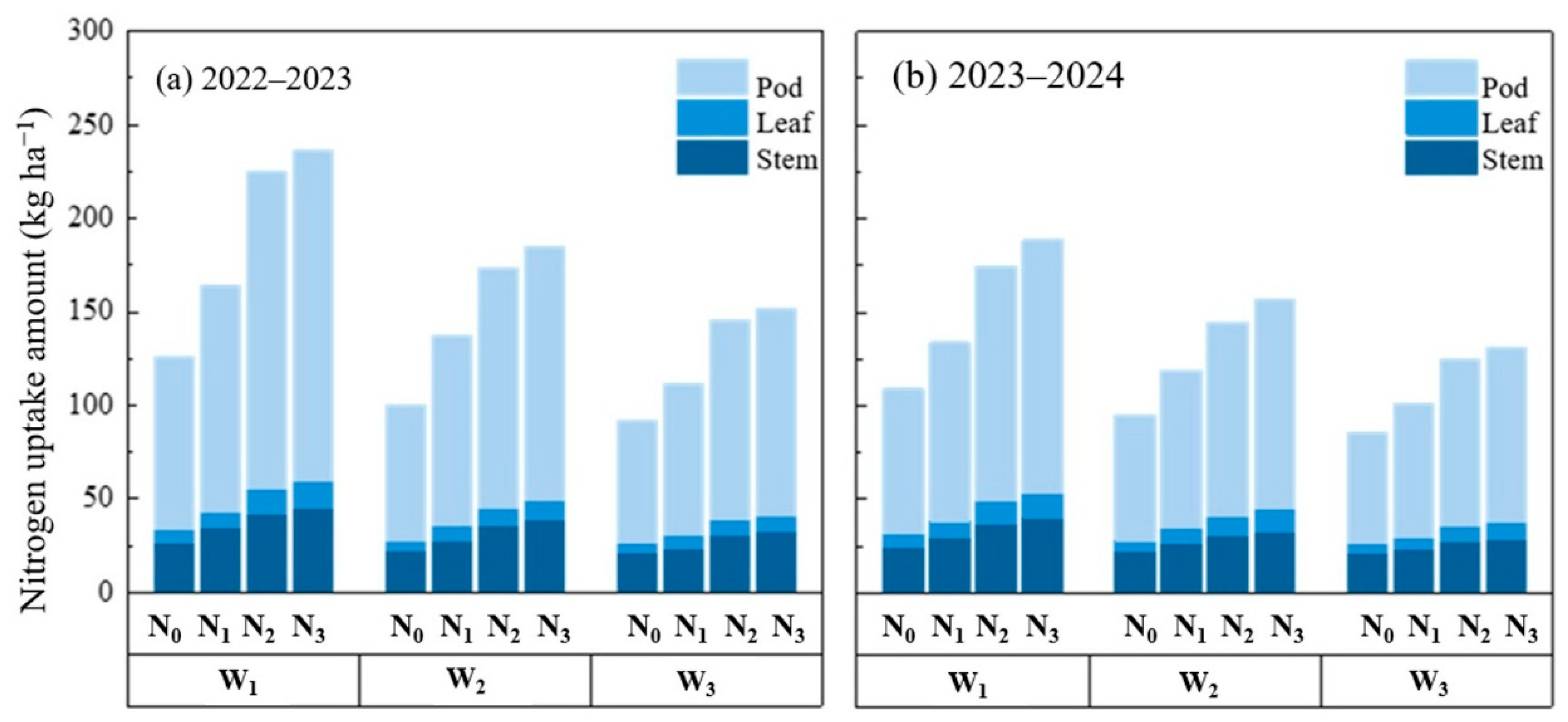
Nitrogen, irrigation, and their interaction significantly influenced nitrogen uptake and use efficiency at harvest (p < 0.05; Figure 4, Table 6). Plant nitrogen uptake increased proportionally with nitrogen application, with N1, N2, and N3 increasing the two-year average by 26.1%, 62.7%, and 72.5%, respectively, compared to the control. Higher irrigation levels (W1 and W2) further enhanced uptake by 44.3% and 18.0%, respectively, compared to deficit irrigation (W3). Nitrogen partitioning among organs followed the pattern pod (69.0–75.4%) > stem (18.7–23.0%) > leaf (5.5–7.4%), with pods dominating total nitrogen accumulation.
Nitrogen use efficiency indicators (NAE, NPE, NRE, and NPFP) exhibited distinct response patterns. NAE, NPE, and NRE showed quadratic responses to nitrogen application, with maximum values at N2. The N3 treatment reduced the two-year average NPE by 7.1% and NRE by 22.9% compared to N2, indicating diminishing returns at higher nitrogen rates. In contrast, NPFP peaked at N1, declining by 32.0–52.4% under N2 and N3. Higher irrigation levels consistently enhanced all nitrogen efficiency parameters, with W1 and W2 increasing NAE by 62.9% and 121.8%, NPE by 21.0% and 10.4%, and NRE by 46.7% and 81.4%, respectively, compared to W3. Notably, the W1N2 treatment optimized nitrogen use efficiency, increasing NAE, NPE, NRE, and NPFP by 40.5%, 7.4%, 30.4%, and 45.2%, respectively, compared to W1N3, demonstrating that moderate nitrogen application under adequate irrigation achieves the best balance between productivity and nitrogen efficiency.

3.4. Integrated Effect of Nitrogen and Irrigation on Water Consumption and Water Use Efficiency

Winter rapeseed evapotranspiration (ET), water use efficiency (WUE), and irrigation water use efficiency (IWUE) were significantly influenced by irrigation, nitrogen, and their interaction (p < 0.01; Table 7). ET ranged from 337.1 to 420.8 mm (2022–2023) and 333.5 to 397.4 mm (2023–2024), increasing progressively with higher irrigation and nitrogen levels, though no differences existed between N2 and N3. WUE (5.3–12.5 kg m−3 in 2022–2023; 3.7–8.5 kg m−3 in 2023–2024) and IWUE (maximum 18.2 and 11.3 kg m−3, respectively) responded positively to both irrigation and nitrogen management. Nitrogen fertilization increased WUE by 23.3–72.3% and IWUE by 29.0–83.2% compared to the control, with maximum values at N2 and N3. Higher irrigation levels (W1 and W2) further enhanced WUE by 41.7–47.8% and 19.0–20.1%, and IWUE by 24.7% and 6.6%, respectively, compared to deficit irrigation (W3). Notably, under zero nitrogen conditions, W2 and W3 showed no significant IWUE differences, indicating that irrigation benefits require adequate nitrogen availability. The W1N2 treatment optimized water productivity, improving WUE by 131% and IWUE by 110% compared to W3N0, underscoring the importance of synchronized water–nitrogen management for maximizing water use efficiency in rapeseed production.

3.5. Integrated Effect of Irrigation and Nitrogen on Soil Nitrate Nitrogen Residue

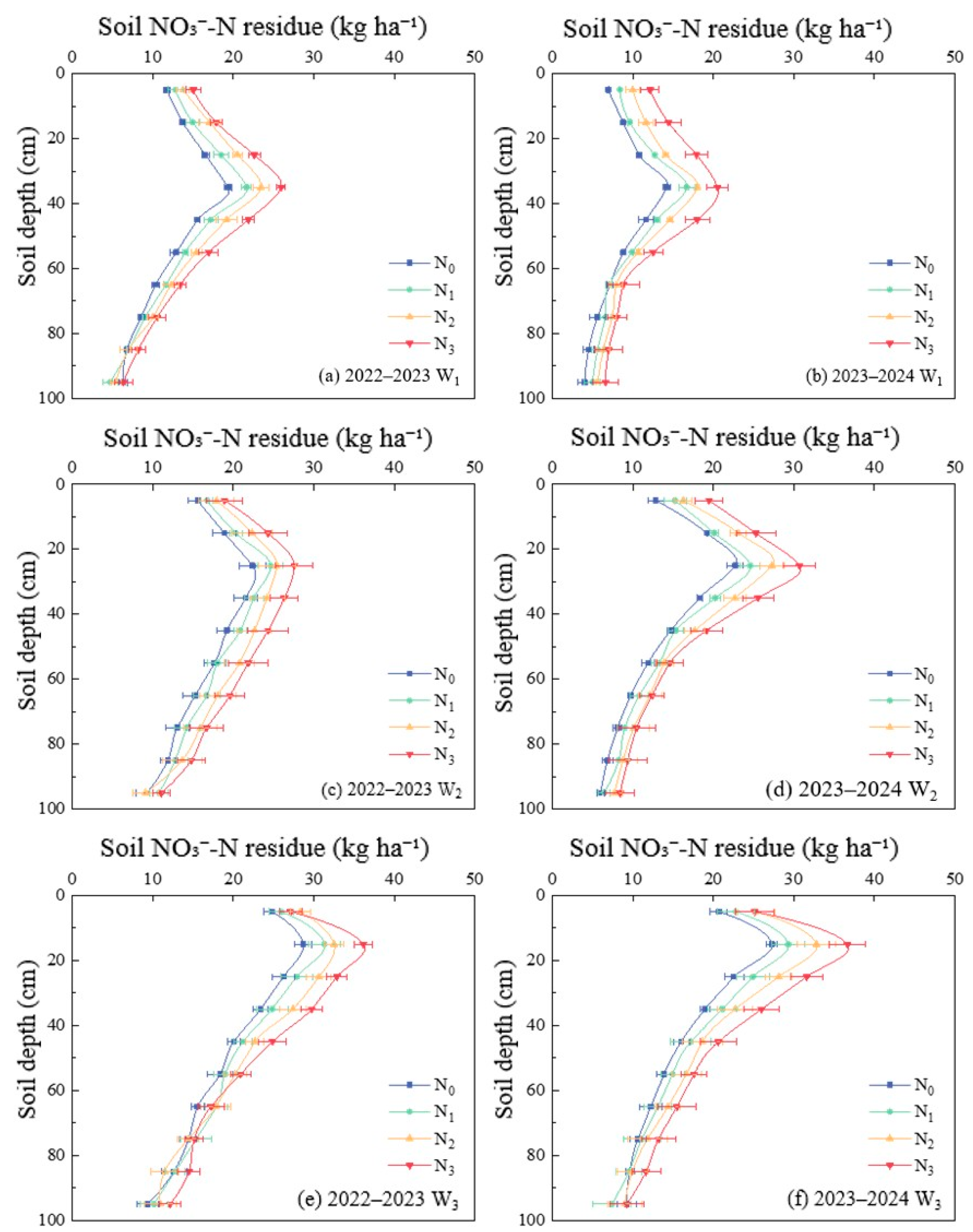
Soil nitrate nitrogen residual (SNR) at harvest was significantly affected by irrigation and nitrogen management, with 72.9–74.5% concentrated in the upper 0–60 cm soil layer across both seasons (Figure 5). SNR increased with higher nitrogen rates and lower irrigation levels, exhibiting a unimodal distribution with depth. Peak nitrate concentrations shifted to shallower layers under reduced irrigation, occurring at approximately 20, 30, and 40 cm depths under W1, W2, and W3, respectively. The N3 treatment increased SNR by 9.69–29.2% compared to lower nitrogen rates, while higher irrigation (W1) reduced SNR by 28.3–38.7% compared to W2 and W3, indicating enhanced nitrogen uptake and leaching under adequate water supply. The W1N2 treatment achieved optimal nitrogen utilization, reducing SNR by 12% compared to W1N3 while maintaining high yield and nitrogen efficiency.

3.6. Integrated Effects of Nitrogen and Irrigation on Seed Protein and Oil Contents

Irrigation and nitrogen significantly influenced seed protein and oil contents (p < 0.01), with significant interactions for oil content in both years and protein content in 2022–2023 (Table 8). Seed oil content (39.71–43.98% in 2022–2023; 40.95–46.64% in 2023–2024) decreased with increasing nitrogen (1.8–6.9% reduction vs. control) and irrigation (W1 and W2 reduced oil by 5.1% and 2.0–2.2%, respectively, vs. W3). Conversely, protein content (26.80–29.84% in 2022–2023; 27.00–29.94% in 2023–2024) increased with nitrogen fertilization (2.7–6.1%) and irrigation (W1 and W2 by 3.3–3.5% and 2.0%, respectively). These inverse responses reflect the oil–protein biosynthesis trade-off, where high nitrogen and water availability favor protein synthesis over oil accumulation.

3.7. Comprehensive Evaluation Using TOPSIS Model

The TOPSIS-based comprehensive evaluation, integrating soil nitrate residual (SNR), water use efficiency (WUE), and nitrogen use efficiency (NUE), revealed consistent treatment rankings across both seasons (Table 9). W1N2 (90% FC with moderate nitrogen) achieved the highest comprehensive evaluation index (CEI: 0.740 in 2022–2023; 0.721 in 2023–2024) and ranked first in both years, indicating an optimal balance between minimizing soil nitrate residual and maximizing water and nitrogen use efficiencies. W1N3 ranked second (CEI: 0.661 and 0.653) and W1N1 ranked third (CEI: 0.559 and 0.537), demonstrating that adequate irrigation (90% FC) consistently produced superior performance across different nitrogen levels. In contrast, deficit irrigation treatments (W3) ranked lowest, with W3N3 (CEI: 0.259) and W3N1 (CEI: 0.271) showing the poorest performance in 2022–2023 and 2023–2024, respectively. These results demonstrate that adequate irrigation combined with moderate nitrogen input (W1N2) optimizes the trade-offs among environmental sustainability (low SNR) and resource use efficiency (high WUE and NUE), whereas severe water deficit negates nitrogen fertilization effectiveness.

4. Discussion

Winter rapeseed production is highly sensitive to both water and nitrogen availability, making optimization of their interactive effects essential for maximizing seed yield, seed quality, and economic returns in sustainable production systems. This study provides comprehensive evidence of water–nitrogen synergies affecting crop growth, physiological processes, yield formation, resource use efficiency, and environmental sustainability.

4.1. Crop Growth, Physical Performance, and Resource Allocating

4.1.1. Crop Growth and Root Morphology

Plant height and stem diameter serve as readily measurable indicators of crop vigor and developmental status. Our results demonstrated that both parameters increased progressively with nitrogen application up to 160 kg N ha−1, with no significant additional benefits at 240 kg N ha−1, particularly under adequate irrigation conditions (W1). Similarly, higher irrigation frequency consistently enhanced vegetative growth across all nitrogen rates. These findings align with previous research demonstrating that increasing nitrogen application and irrigation enhance plant stature and stem thickness, though responses plateau beyond certain thresholds [53,54]. The lack of a significant difference between 160 and 240 kg N ha−1 suggests that nitrogen requirements for vegetative growth are satisfied at moderate application rates, with diminishing marginal returns at higher rates, which is an important consideration for both economic efficiency and environmental stewardship.
Root system development is fundamental to crop performance, serving as the primary organ for water and nutrient acquisition. Previous studies demonstrate that nitrogen fertilization (up to 240 kg N ha−1) significantly enhances root length, surface area, volume, and dry weight [12], while irrigation similarly promotes root growth and biomass [55]. In the present study, nitrogen application increased root length, surface area, volume, and diameter, with optimal responses at 160 kg N ha−1, reflecting nitrogen’s essential role in protein synthesis, cell division, and the metabolic processes driving root development [56,57]. Interestingly, reduced irrigation (W3) increased root length, surface area, and volume compared to W1. Previous research showed that root length density at 20–40 cm depths increased under water-limited conditions [58], as intensified water competition stimulated deeper root growth to access subsoil moisture [59]. This adaptive strategy demonstrates how plants invest more resources in root proliferation under water stress to enhance water and nutrient foraging capacity, particularly in drought-prone environments.

4.1.2. Biomass Accumulation and Canopy Development

Aboveground dry matter accumulation responded positively to increasing nitrogen levels and higher irrigation frequencies, though no significant difference was observed between 160 and 240 kg N ha−1 treatments. This finding is consistent with previous studies reporting that irrigation and nitrogen fertilization significantly enhance aboveground biomass production [60,61,62]. The underlying mechanisms are well-established: adequate water availability optimizes photosynthetic and cellular processes by maintaining favorable leaf water status and stomatal conductance, while nitrogen is essential for chlorophyll synthesis, protein production, and enzyme activity, all contributing to enhanced vegetative growth and tissue development.
Leaf area index exhibited similar responses, increasing progressively with both nitrogen application (up to 160 kg N ha−1) and irrigation frequency. The W1N2 treatment achieved LAI values comparable to W1N3, indicating that moderate nitrogen application combined with adequate irrigation supports optimal canopy development [63]. Enhanced LAI directly translates to greater light interception capacity and photosynthetic productivity, establishing the foundation for superior yield potential [64]. The significant water × nitrogen interactions observed for LAI at multiple growth stages (Figure 3) underscore the synergistic nature of these inputs in driving canopy expansion.

4.1.3. Photosynthetic Performance and Chlorophyll Fluorescence

Enhanced photosynthetic capacity is crucial for increasing agricultural productivity [65], though photosynthetic efficiency depends on multiple environmental factors, including soil moisture, temperature, nutrient availability, and stomatal regulation [66,67,68]. In this study, Pn, gs, and Tr increased significantly with nitrogen application up to 160 kg N ha−1 and with higher irrigation frequency (W1). These responses reflect the fundamental roles of water and nitrogen in photosynthesis: nitrogen is essential for chlorophyll, Rubisco, and electron transport proteins [69], while adequate water maintains stomatal opening and mesophyll conductance for CO2 diffusion.
Beyond 160 kg N ha−1, nitrogen availability likely exceeded the crop’s physiological capacity, resulting in saturation, i.e., additional inputs no longer enhanced leaf development or photosynthetic efficiency. This aligns with previous research showing that optimal water and nitrogen application substantially enhances crop leaf area and photosynthetic rate through improved carbon-nitrogen metabolism [70,71]. However, excessive nitrogen may induce osmotic stress or luxury consumption without corresponding photosynthetic gains, explaining the plateau in Pn, gs, and Tr observed between N2 and N3 treatments.
Chlorophyll fluorescence parameters provide sensitive indicators of photosynthetic function and stress responses. Fv/Fm, ΦPSII, and qP increased with nitrogen application up to 160 kg N ha−1 and higher irrigation frequency, while NPQ decreased, indicating reduced heat dissipation and enhanced photochemical efficiency. These findings support previous research showing that supplementary irrigation improved Fv/Fm by 6.57% and qP by 9.14% compared to rainfed conditions [72]. The decline in NPQ under adequate water and nitrogen supply reflects reduced photoinhibition and improved utilization of absorbed light energy for photochemistry rather than thermal dissipation. The interactive effects of irrigation and nitrogen on fluorescence parameters (Table 2 and Table 3) demonstrate that optimal photosynthetic function requires coordinated management of both resources.

4.2. Yield Formation, Seed Quality, and Economic Performance

Nitrogen and irrigation significantly influenced all yield components, with yields ranging from 1771 kg ha−1 (W3N0) to 5234 kg ha−1 (W1N3) in 2022–2023. Notably, yields at 160 and 240 kg N ha−1 under W1 irrigation did not differ significantly, suggesting 160 kg N ha−1 represents an economically and environmentally optimal rate with adequate irrigation. These findings align with previous studies showing rapeseed yield increases with higher irrigation while reduced nitrogen decreases yield through reductions in pod number, seeds per pod, and seed weight [11]. The synergistic interaction between irrigation and nitrogen maximizes photosynthetic capacity and final yield [73]. The 27.6% reduction in branch number during 2023–2024 compared to 2022–2023 reflects inter-seasonal climatic variation, particularly 22% lower precipitation, emphasizing the importance of supplementary irrigation for stabilizing production.
Seed quality parameters showed contrasting responses, reflecting the inverse relationship between oil and protein accumulation. Nitrogen application progressively reduced oil content (by up to 5.1%) while increasing protein content (by up to 6.1%), consistent with previous research [47,74]. Higher irrigation similarly decreased oil concentration but enhanced protein accumulation. Conversely, drought stress reduced photosynthetic carbon assimilation through stomatal closure, limiting substrate availability for oil biosynthesis [75]. This irrigation effect contrasts with some reports showing increased oil content under well-watered conditions [76,77], possibly because consistently high soil moisture (W1) favored vegetative growth and protein synthesis over lipid biosynthesis, while moderate water stress (W3) prioritized carbon allocation to oil as an energy storage strategy.
Economic analysis revealed net benefits ranging from −1845 to 23,199 CNY ha−1, with several low-input treatments yielding negative returns in 2023–2024, demonstrating that minimum input thresholds are essential for viability. The W1N2 treatment achieved net benefits of 22,770 and 10,270 CNY ha−1, only 1.5% and 7.2% lower than W1N3 despite reducing nitrogen input by 33%, reflecting diminishing marginal returns beyond 160 kg N ha−1. The 216% higher net income in 2022–2023 versus 2023–2024 underscores the critical role of seasonal rainfall in profitability and the value of flexible irrigation management adjusted to the in-season conditions. These findings align with previous studies showing that optimized nitrogen and irrigation rates maximize crop economic benefits [78,79].

4.3. Resource Use Efficiency and Environmental Sustainability

Water stress limits nitrogen uptake by reducing root activity, transpiration-driven mass flow, and active transport. In this experiment, the W1 and W2 treatments increased nitrogen uptake by 44.3% and 18.0% compared to W3, confirming that an adequate water supply is essential for nitrogen acquisition [80]. Increasing nitrogen application further enhanced uptake by 26.1%, 62.7%, and 72.5% relative to N0. The highest NPFP values occurred at 80 kg N ha−1 under W1, while NAE, NPE, and NRE declined beyond 160 kg N ha−1 (Table 6). Consistent with our results, previous studies have shown that excessive nitrogen reduces nitrogen use efficiency [81,82], whereas optimal irrigation–nitrogen management improves overall efficiency [83]. High nitrogen rates can lower uptake efficiency through luxury consumption and potential toxicity, while adequate irrigation increases nitrogen solubility and root absorption and reduces losses via leaching and volatilization. In this study, water use efficiency increased with nitrogen application up to 160 kg ha−1 but declined under water-limited conditions (W3). Overall, balanced water and nitrogen inputs improved nutrient use and photosynthesis, enhancing root-zone infiltration and crop water productivity [60,84].
Soil nitrate residual distribution and magnitude are governed by the interactive effects of irrigation and nitrogen fertilization, with important implications for environmental sustainability. Consistent with previous studies, soil nitrate residual increased with higher N application rates [85,86]; however, its interaction with irrigation revealed a more complex response. Under deficit irrigation (W3) and contrary to Amare et al. [87], nitrate residual was unexpectedly higher than under W1 and W2, likely due to reduced nutrient uptake efficiency. Adequate irrigation (W1) improved water availability and enhanced plant nitrogen uptake, thereby reducing soil nitrate accumulation [11,22]. In contrast, the water-limited conditions in W3 constrained plant growth and nitrogen acquisition, resulting in greater residual nitrate despite lower productivity, raising concerns about long-term accumulation and off-season leaching. Most soil nitrate (72.9–74.5%) was concentrated in the 0–60 cm soil layer, indicating limited downward movement under the applied irrigation regimes. Nevertheless, elevated surface-layer nitrate—particularly under high nitrogen inputs—poses environmental risks, including groundwater contamination during rainfall events and increased greenhouse gas emissions via denitrification [88,89,90]. Therefore, coordinated optimization of irrigation and nitrogen management is essential to enhance crop nitrogen uptake, reduce environmental risks, and improve nitrogen use efficiency and agroecosystem sustainability [83,91].

4.4. Trade-Offs and Recommendations

The entropy-TOPSIS comprehensive evaluation identified W1N2 (90% FC with 160 kg N ha−1) as the optimal irrigation-nitrogen management strategy for winter rapeseed in semi-arid regions. While W1N3 (90% FC with 240 kg N ha−1) achieved maximum yield (5234 and 3391 kg ha−1) and net income (23,119 and 11,062 CNY ha−1) in 2022–2023 and 2023–2024, respectively, this yield-maximizing approach imposed substantial agronomic and environmental costs. W1N2 demonstrated markedly superior nitrogen use efficiency (28.6% higher) and substantially reduced residual soil nitrate (12% lower), critical indicators of long-term soil health and groundwater protection. The agronomic trade-off was minimal: only 3.3% yield reduction and 3.4% income loss compared to W1N3, while achieving 96.7% of maximum yield with 33.3% less nitrogen input. This strategy proved particularly advantageous given current regulatory pressures on nitrogen pollution and the growing recognition that sustainable intensification requires balancing productivity with environmental stewardship in semi-arid systems.
W1N2 represents the most pragmatic management approach by optimizing the balance among yield maximization, nitrogen use efficiency, and economic return. The modest sacrifice in profitability (3.4%) yields substantial environmental gains through improved resource use efficiency and reduced nitrogen loss, positioning this strategy as both economically defensible and environmentally responsible for winter rapeseed cultivation in semi-arid regions.

5. Conclusions

This study demonstrates that synchronized irrigation and nitrogen management are fundamental for optimizing winter rapeseed production under semi-arid conditions. The W1N2 treatment achieved optimal seed yield while maximizing nitrogen use efficiency compared to higher nitrogen rates (N3), representing a superior balance between productivity and resource efficiency. Consistent with the entropy-TOPSIS evaluation, W1N2 achieved the highest overall performance among all treatment combinations. This treatment combination enhanced nitrogen uptake and utilization while substantially reducing soil nitrate residual, thereby mitigating potential environmental risks. The findings indicate that maintaining adequate soil moisture (90% FC) enables reduced nitrogen inputs without a yield penalty, as improved water availability enhances nitrogen acquisition efficiency. From a practical perspective, the W1N2 strategy offers a sustainable approach for winter rapeseed cultivation in semi-arid regions by achieving the dual objectives of high productivity and environmental stewardship through optimized resource management.

Supplementary Materials

The following supporting information can be downloaded at: https://www.mdpi.com/article/10.3390/agronomy16030302/s1, Figure S1: Interactive effects of irrigation regimes and nitrogen application rates on plant height (cm) of winter rapeseed during 2022–2023 and 2023–2024. Figure S2. Interactive effects of irrigation regimes and nitrogen application rates on stem diameter (mm) of winter rape-seed during 2022–2023 and 2023–2024; Figure S3. Interactive effects of irrigation regimes and nitrogen application. Figure S4. Interactive effects of irrigation regimes and nitrogen application rates on stomatal conductance (Gs) of winter rapeseed during 2022–2023 and 2023–2024. Figure S5. Interactive effects of irrigation regimes and nitrogen application rates on transpiration rate (Tr) of winter rapeseed during 2022–2023 and 2023–2024.

Author Contributions

Conceptualization, X.D. and J.F.; Methodology, M.H. and X.D.; Validation, M.H.; Formal analysis, M.H.; Investigation, X.D., Q.S., B.D., and Z.B.; Resources, J.F.; Data curation, M.H., X.D., Q.S., B.D., and Z.B.; Writing—original draft, M.H.; Writing—review and editing, Z.B.; Visualization, M.H., X.D., and J.F.; Supervision, J.F.; Funding acquisition, J.F. All authors have read and agreed to the published version of the manuscript.

Funding

This study was funded by the National Natural Science Foundation of China (51879226) and the Chinese Universities Scientific Fund (2452020018).

Data Availability Statement

The datasets generated and analyzed during this study can be obtained from the corresponding author upon reasonable request.

Conflicts of Interest

The authors declare no conflicts of interest.

References

  1. Megha, S.; Wang, Z.; Kav, N.N.; Rahman, H. Genome-wide identification of biotin carboxyl carrier subunits of acetyl-CoA carboxylase in Brassica and their role in stress tolerance in oilseed Brassica napus. BMC Genom. 2022, 23, 707. [Google Scholar] [CrossRef] [PubMed]
  2. Siles, L.; Hassall, K.L.; Sanchis Gritsch, C.; Eastmond, P.J.; Kurup, S. Uncovering trait associations resulting in maximal seed yield in winter and spring oilseed rape. Front. Plant Sci. 2021, 12, 697576. [Google Scholar] [CrossRef] [PubMed]
  3. Zhang, S.; Liao, X.; Zhang, C.; Xu, H. Influences of plant density on the seed yield and oil content of winter oilseed rape (Brassica napus L.). Ind. Crops Prod. 2012, 40, 27–32. [Google Scholar] [CrossRef]
  4. Mohamed, I.A.; Shalby, N.; El-Badri, A.M.; Awad-Allah, E.F.; Batool, M.; Saleem, M.H.; Wang, Z.; Wen, J.; Ge, X.; Xu, Z. Multipurpose uses of rapeseed (Brassica napus L.) crop (food, feed, industrial, medicinal, and environmental conservation uses) and improvement strategies in China. J. Agric. Food Res. 2025, 20, 101794. [Google Scholar] [CrossRef]
  5. Shen, J.; Liu, Y.; Wang, X.; Bai, J.; Lin, L.; Luo, F.; Zhong, H. A comprehensive review of health-benefiting components in rapeseed oil. Nutrients 2023, 15, 999. [Google Scholar] [CrossRef]
  6. Wang, C.; Li, Z.; Wu, W. Understanding fatty acid composition and lipid profile of rapeseed oil in response to nitrogen management strategies. Food Res. Int. 2023, 165, 112565. [Google Scholar] [CrossRef] [PubMed]
  7. Khodabin, G.; Lightburn, K.; Hashemi, S.M.; Moghada, M.S.K.; Jalilian, A. Evaluation of nitrate leaching, fatty acids, physiological traits and yield of rapeseed (Brassica napus) in response to tillage, irrigation and fertilizer management. Plant Soil 2022, 473, 423–440. [Google Scholar] [CrossRef]
  8. Yang, X.; Liu, Y.; Bezama, A.; Thrän, D. Two birds with one stone: A combined environmental and economic performance assessment of rapeseed-based biodiesel production. GCB Bioenergy 2022, 14, 215–241. [Google Scholar] [CrossRef]
  9. Yang, X.; Dong, X.; Bezama, A.; Liu, Y. Improving rapeseed carbon footprint evaluation via the integration of remote sensing technology into an LCA approach. Sci. Total Environ. 2024, 946, 174262. [Google Scholar] [CrossRef]
  10. Liu, W.; Li, S.; Tao, J.; Liu, X.; Yin, G.; Xia, Y.; Wang, T.; Zhang, H. CARM30: China annual rapeseed maps at 30 m spatial resolution from 2000 to 2022 using multi-source data. Sci. Data 2024, 11, 356. [Google Scholar] [CrossRef]
  11. Hamzei, J.; Soltani, J. Deficit irrigation of rapeseed for water-saving: Effects on biomass accumulation, light interception and radiation use efficiency under different N rates. Agric. Ecosyst. Environ. 2012, 155, 153–160. [Google Scholar] [CrossRef]
  12. Li, Z.; Liu, F.; Wu, W. Optimising nitrogen management strategies to minimise lodging risk while sustaining high seed yield in rapeseed. Eur. J. Agron. 2023, 142, 126671. [Google Scholar] [CrossRef]
  13. Moradi, S.; Sajedi, N.A.; Madani, H.; Gomarian, M.; Chavoshi, S. Integrated effects of nitrogen fertilizer, biochar, and salicylic acid on yield and fatty acid profile of six rapeseed cultivars. J. Soil Sci. Plant Nutr. 2023, 23, 380–397. [Google Scholar] [CrossRef]
  14. Din, J.; Khan, S.; Ali, I.; Gurmani, A. Physiological and agronomic response of canola varieties to drought stress. J. Anim. Plant Sci. 2011, 21, 78–82. [Google Scholar]
  15. Xu, Z.-Z.; Yu, Z.-W.; Wang, D. Nitrogen translocation in wheat plants under soil water deficit. Plant Soil 2006, 280, 291–303. [Google Scholar] [CrossRef]
  16. Hamzei, J. Seed, oil, and protein yields of canola under combinations of irrigation and nitrogen application. Agron. J. 2011, 103, 1152–1158. [Google Scholar] [CrossRef]
  17. Ullah, H.; Santiago-Arenas, R.; Ferdous, Z.; Attia, A.; Datta, A. Improving water use efficiency, nitrogen use efficiency, and radiation use efficiency in field crops under drought stress: A review. Adv. Agron. 2019, 156, 109–157. [Google Scholar]
  18. Sun, X.; Yan, H.; Kang, X.; Ma, F. Growth, gas exchange, and water-use efficiency response of two young apple cultivars to drought stress in two scion-one rootstock grafting system. Photosynthetica 2013, 51, 404–410. [Google Scholar] [CrossRef]
  19. Rosa, L.; Chiarelli, D.D.; Rulli, M.C.; Dell’Angelo, J.; D’Odorico, P. Global agricultural economic water scarcity. Sci. Adv. 2020, 6, eaaz6031. [Google Scholar] [CrossRef] [PubMed]
  20. Collino, D.; Dardanelli, J.; Sereno, R.; Racca, R. Physiological responses of argentine peanut varieties to water stress: Light interception, radiation use efficiency and partitioning of assimilates. Field Crops Res. 2001, 70, 177–184. [Google Scholar] [CrossRef]
  21. Morales-Santos, A.; García-Vila, M.; Nolz, R. Assessment of the impact of irrigation management on soybean yield and water productivity in a subhumid environment. Agric. Water Manag. 2023, 284, 108356. [Google Scholar] [CrossRef]
  22. Khan, A.G.; Niaz, A.; Mahpara, S.; Ullah, R.; Tahir, M.; Qazi, M.A.; Ahmed, A.; Koçyiğit, N.; Shah, S.A.H.; Rauf, A. Impact of various irrigation levels and nitrogen rates on wheat (Triticum aestivum L.) yield and nitrate leaching. J. King Saud Univ. Sci. 2023, 35, 102940. [Google Scholar] [CrossRef]
  23. Belder, P.; Bouman, B.; Cabangon, R.; Guoan, L.; Quilang, E.; Yuanhua, L.; Spiertz, J.; Tuong, T. Effect of water-saving irrigation on rice yield and water use in typical lowland conditions in Asia. Agric. Water Manag. 2004, 65, 193–210. [Google Scholar] [CrossRef]
  24. Bouman, B.M.; Humphreys, E.; Tuong, T.P.; Barker, R. Rice and water. Adv. Agron. 2006, 92, 187–237. [Google Scholar]
  25. Wang, W.; Zhuo, L.; Li, M.; Liu, Y.; Wu, P. The effect of development in water-saving irrigation techniques on spatial-temporal variations in crop water footprint and benchmarking. J. Hydrol. 2019, 577, 123916. [Google Scholar] [CrossRef]
  26. Wang, Y.; Kang, S.; Li, F.; Zhang, X. Modified water-nitrogen productivity function based on response of water sensitive index to nitrogen for hybrid maize under drip fertigation. Agric. Water Manag. 2021, 245, 106566. [Google Scholar] [CrossRef]
  27. Li, S.-X.; Wang, Z.-H.; Malhi, S.; Li, S.-Q.; Gao, Y.-J.; Tian, X.-H. Nutrient and water management effects on crop production, and nutrient and water use efficiency in dryland areas of China. Adv. Agron. 2009, 102, 223–265. [Google Scholar]
  28. Wang, H.; Guo, Z.; Shi, Y.; Zhang, Y.; Yu, Z. Impact of tillage practices on nitrogen accumulation and translocation in wheat and soil nitrate-nitrogen leaching in drylands. Soil Tillage Res. 2015, 153, 20–27. [Google Scholar] [CrossRef]
  29. Dimkpa, C.O.; Andrews, J.; Sanabria, J.; Bindraban, P.S.; Singh, U.; Elmer, W.H.; Gardea-Torresdey, J.L.; White, J.C. Interactive effects of drought, organic fertilizer, and zinc oxide nanoscale and bulk particles on wheat performance and grain nutrient accumulation. Sci. Total Environ. 2020, 722, 137808. [Google Scholar] [CrossRef] [PubMed]
  30. Fageria, N.K.; Baligar, V.C. Enhancing nitrogen use efficiency in crop plants. Adv. Agron. 2005, 88, 97–185. [Google Scholar]
  31. Wang, Y.; Liu, B.; Ren, T.; Li, X.; Cong, R.; Zhang, M.; Yousaf, M.; Lu, J. Establishment method affects oilseed rape yield and the response to nitrogen fertilizer. Agron. J. 2014, 106, 131–142. [Google Scholar] [CrossRef]
  32. Gu, H.; Li, J.; Lu, Z.; Li, X.; Cong, R.; Ren, T.; Lu, J. Effects of combined application of nitrogen and potassium on oil concentration and fatty acid component of oilseed rape (Brassica napus L.). Field Crops Res. 2024, 306, 109229. [Google Scholar] [CrossRef]
  33. Rathke, G.-W.; Christen, O.; Diepenbrock, W. Effects of nitrogen source and rate on productivity and quality of winter oilseed rape (Brassica napus L.) grown in different crop rotations. Field Crops Res. 2005, 94, 103–113. [Google Scholar] [CrossRef]
  34. Zou, J.; Lu, J.; Chen, C.F.; Li, Y.; Li, X. Study on yield increasing and nutrient uptake effect by nitrogen application and nitrogen use efficiency for winter rapeseed. Sci. Agric. Sin. 2011, 44, 745–752. [Google Scholar]
  35. Zhu, J.; Dai, W.; Chen, B.; Cai, G.; Wu, X.; Yan, G. Research progress on the effect of nitrogen on rapeseed between seed yield and oil content and its regulation mechanism. Int. J. Mol. Sci. 2023, 24, 14504. [Google Scholar] [CrossRef] [PubMed]
  36. Griffis, T.J.; Baker, J.M. Nitrogen management and air quality in China. Nat. Food 2020, 1, 597–598. [Google Scholar] [CrossRef] [PubMed]
  37. Huang, S.; Lv, W.; Bloszies, S.; Shi, Q.; Pan, X.; Zeng, Y. Effects of fertilizer management practices on yield-scaled ammonia emissions from croplands in China: A meta-analysis. Field Crops Res. 2016, 192, 118–125. [Google Scholar] [CrossRef]
  38. Zhu, Z.; Chen, D. Nitrogen fertilizer use in China–Contributions to food production, impacts on the environment and best management strategies. Nutr. Cycl. Agroecosyst. 2002, 63, 117–127. [Google Scholar] [CrossRef]
  39. Elleby, C.; Domínguez, I.P.; Adenauer, M.; Genovese, G. Impacts of the COVID-19 pandemic on the global agricultural markets. Environ. Resour. Econ. 2020, 76, 1067–1079. [Google Scholar] [CrossRef]
  40. Omara, P.; Aula, L.; Oyebiyi, F.; Raun, W.R. World cereal nitrogen use efficiency trends: Review and current knowledge. Agrosyst. Geosci. Environ. 2019, 2, 1–8. [Google Scholar] [CrossRef]
  41. Mahmud, K.; Panday, D.; Mergoum, A.; Missaoui, A. Nitrogen losses and potential mitigation strategies for a sustainable agroecosystem. Sustainability 2021, 13, 2400. [Google Scholar] [CrossRef]
  42. Drury, C.; Reynolds, W.; Yang, X.; McLaughlin, N.; Welacky, T.; Calder, W.; Grant, C. Nitrogen source, application time, and tillage effects on soil nitrous oxide emissions and corn grain yields. Soil Sci. Soc. Am. J. 2012, 76, 1268–1279. [Google Scholar] [CrossRef]
  43. Barłóg, P.; Grzebisz, W. Effect of timing and nitrogen fertilizer application on winter oilseed rape (Brassica napus L.). II. Nitrogen uptake dynamics and fertilizer efficiency. J. Agron. Crop Sci. 2004, 190, 314–323. [Google Scholar] [CrossRef]
  44. Yin-shui, L.; Jian-wei, L.; Xing, L.; Juan, Z.; Xiao-kun, L.; Chang-bing, Y.; Chang-bao, M.; Xiang-zhao, G. Effect of nitrogen application rate on yield and nitrogen fertilization efficiency in rapeseed. Chin. J. Oil Crop Sci. 2011, 33, 379. [Google Scholar]
  45. Ma, B.L.; Biswas, D.K.; Herath, A.W.; Whalen, J.K.; Ruan, S.Q.; Caldwell, C.; Earl, H.; Vanasse, A.; Scott, P.; Smith, D.L. Growth, yield, and yield components of canola as affected by nitrogen, sulfur, and boron application. J. Plant Nutr. Soil Sci. 2015, 178, 658–670. [Google Scholar] [CrossRef]
  46. Wu, W.; Ma, B. Integrated nutrient management (INM) for sustaining crop productivity and reducing environmental impact: A review. Sci. Total Environ. 2015, 512, 415–427. [Google Scholar] [CrossRef]
  47. Gu, X.-B.; Li, Y.-N.; Du, Y.-D. Optimized nitrogen fertilizer application improves yield, water and nitrogen use efficiencies of winter rapeseed cultivated under continuous ridges with film mulching. Ind. Crops Prod. 2017, 109, 233–240. [Google Scholar] [CrossRef]
  48. Jalilian, J.; Modarres-Sanavy, S.A.M.; Saberali, S.F.; Sadat-Asilan, K. Effects of the combination of beneficial microbes and nitrogen on sunflower seed yields and seed quality traits under different irrigation regimes. Field Crops Res. 2012, 127, 26–34. [Google Scholar] [CrossRef]
  49. Man, J.; Shi, Y.; Yu, Z.; Zhang, Y. Root growth, soil water variation, and grain yield response of winter wheat to supplemental irrigation. Plant Prod. Sci. 2016, 19, 193–205. [Google Scholar] [CrossRef]
  50. Zhang, P.; Wang, M.; Yu, L.; Xu, J.; Cai, H. Optimization of water and nitrogen management in wheat cultivation affected by biochar application−Insights into resource utilization and economic benefits. Agric. Water Manag. 2024, 304, 109093. [Google Scholar] [CrossRef]
  51. Mahmood, H.; Cai, J.; Zhou, Q.; Wang, X.; Samo, A.; Huang, M.; Dai, T.; Jahan, M.S.; Jiang, D. Optimizing nitrogen and seed rate combination for improving grain yield and nitrogen uptake efficiency in winter wheat. Plants 2022, 11, 1745. [Google Scholar] [CrossRef] [PubMed]
  52. Wang, S.; Xiong, J.; Yang, B.; Yang, X.; Du, T.; Steenhuis, T.S.; Siddique, K.H.; Kang, S. Diversified crop rotations reduce groundwater use and enhance system resilience. Agric. Water Manag. 2023, 276, 108067. [Google Scholar] [CrossRef]
  53. Dogan, E.; Copur, O.; Kahraman, A.; Kirnak, H.; Guldur, M. Supplemental irrigation effect on canola yield components under semiarid climatic conditions. Agric. Water Manag. 2011, 98, 1403–1408. [Google Scholar] [CrossRef]
  54. Lu, Y.; Cui, J.; Bao, S.; Liu, W.; Geng, Y.; Liang, X.; Li, S.; Guo, L.; Shao, X. Effects of nitrogen fertilizer application rate on lodging resistance for rice (Oryza sativa L.) stem. Sci. Rep. 2025, 15, 2149. [Google Scholar] [CrossRef] [PubMed]
  55. Chen, R.; Xiong, X.-P.; Cheng, W.-H. Root characteristics of spring wheat under drip irrigation and their relationship with aboveground biomass and yield. Sci. Rep. 2021, 11, 4913. [Google Scholar] [CrossRef] [PubMed]
  56. Shah, I.H.; Jinhui, W.; Li, X.; Hameed, M.K.; Manzoor, M.A.; Li, P.; Zhang, Y.; Niu, Q.; Chang, L. Exploring the role of nitrogen and potassium in photosynthesis implications for sugar: Accumulation and translocation in horticultural crops. Sci. Hortic. 2024, 327, 112832. [Google Scholar] [CrossRef]
  57. Farhan, M.; Sathish, M.; Kiran, R.; Mushtaq, A.; Baazeem, A.; Hasnain, A.; Hakim, F.; Hasan Naqvi, S.A.; Mubeen, M.; Iftikhar, Y. Plant Nitrogen Metabolism: Balancing Resilience to Nutritional Stress and Abiotic Challenges. Phyton 2024, 93, 581–609. [Google Scholar] [CrossRef]
  58. Wang, L.; Liu, S.; Lu, S.; Lv, T.; Ma, D.; Kang, G.; Xie, Y.; Sun, J.; Wang, C. Irrigation and nitrogen fertilizer increase wheat productivity by improving root-shoot population coordination. Agric. Water Manag. 2025, 316, 109589. [Google Scholar] [CrossRef]
  59. Xu, C.; Tao, H.; Tian, B.; Gao, Y.; Ren, J.; Wang, P. Limited-irrigation improves water use efficiency and soil reservoir capacity through regulating root and canopy growth of winter wheat. Field Crops Res. 2016, 196, 268–275. [Google Scholar] [CrossRef]
  60. Liao, Z.; Zeng, H.; Fan, J.; Lai, Z.; Zhang, C.; Zhang, F.; Wang, H.; Cheng, M.; Guo, J.; Li, Z. Effects of plant density, nitrogen rate and supplemental irrigation on photosynthesis, root growth, seed yield and water-nitrogen use efficiency of soybean under ridge-furrow plastic mulching. Agric. Water Manag. 2022, 268, 107688. [Google Scholar] [CrossRef]
  61. Hu, Y.; Zeeshan, M.; Wang, G.; Pan, Y.; Liu, Y.; Zhou, X. Supplementary irrigation and varying nitrogen fertilizer rate mediate grain yield, soil-maize nitrogen accumulation and metabolism. Agric. Water Manag. 2023, 276, 108066. [Google Scholar] [CrossRef]
  62. Mohtashami, R.; Dehnavi, M.M.; Balouchi, H.; Faraji, H. Improving yield, oil content and water productivity of dryland canola by supplementary irrigation and selenium spraying. Agric. Water Manag. 2020, 232, 106046. [Google Scholar] [CrossRef]
  63. Xue, S. Effects of nitrogen application rates and irrigation regimes on grain yield and water use efficiency of maize under alternate partial root-zone irrigation. J. Integr. Agric. 2020, 19, 2792–2806. [Google Scholar] [CrossRef]
  64. Shen, H.; Gao, Y.; Sun, K.; Gu, Y.; Ma, X. Effects of differential irrigation and nitrogen reduction replacement on winter wheat yield and water productivity and nitrogen-use efficiency. Agric. Water Manag. 2023, 282, 108289. [Google Scholar] [CrossRef]
  65. Kromdijk, J.; Głowacka, K.; Leonelli, L.; Gabilly, S.T.; Iwai, M.; Niyogi, K.K.; Long, S.P. Improving photosynthesis and crop productivity by accelerating recovery from photoprotection. Science 2016, 354, 857–861. [Google Scholar] [CrossRef]
  66. Li, J.; Qu, Z.; Chen, J.; Yang, B.; Huang, Y. Effect of planting density on the growth and yield of sunflower under mulched drip irrigation. Water 2019, 11, 752. [Google Scholar] [CrossRef]
  67. Shafiq, I.; Hussain, S.; Raza, M.A.; Iqbal, N.; Asghar, M.A.; Raza, A.; Mumtaz, M.; Shoaib, M.; Ansar, M.; Manaf, A. Crop photosynthetic response to light quality and light intensity. J. Integr. Agric. 2021, 20, 4–23. [Google Scholar] [CrossRef]
  68. Shimono, H.; Hasegawa, T.; Fujimura, S.; Iwama, K. Responses of leaf photosynthesis and plant water status in rice to low water temperature at different growth stages. Field Crops Res. 2004, 89, 71–83. [Google Scholar] [CrossRef]
  69. Sigua, G.; Stone, K.; Bauer, P.; Szogi, A. Biomass and nitrogen use efficiency of grain sorghum with nitrogen and supplemental irrigation. Agron. J. 2018, 110, 1119–1127. [Google Scholar] [CrossRef]
  70. Cossani, C.M.; Slafer, G.A.; Savin, R. Co-limitation of nitrogen and water, and yield and resource-use efficiencies of wheat and barley. Crop Pasture Sci. 2010, 61, 844–851. [Google Scholar] [CrossRef]
  71. Errecart, P.M.; Agnusdei, M.G.; Lattanzi, F.A.; Marino, M.A.; Berone, G.D. Critical nitrogen concentration declines with soil water availability in tall fescue. Crop Sci. 2014, 54, 318–330. [Google Scholar] [CrossRef]
  72. Gao, F.; Wang, G.Y.; Muhammad, I.; Tung, S.A.; Zhou, X.B. Interactive effect of water and nitrogen fertilization improve chlorophyll fluorescence and yield of maize. Agron. J. 2023, 115, 325–339. [Google Scholar] [CrossRef]
  73. Chauhdary, J.N.; Li, H.; Ragab, R.; Hussain, Z.; Anjum, S.A. Modeling wheat growth to determine economic feasibility under deficit irrigation and nitrogen management strategies. Agric. Water Manag. 2025, 319, 109740. [Google Scholar] [CrossRef]
  74. Zhao, J.-X.; Cheng, G.-P.; Ren, T.-B.; Gao, Z.-H. Effect of different nitrogen rates on yield and quality parameters of high grade yellow seed hybrid rape. J. Plant Nutr. Fertil. 2007, 13, 882–889. [Google Scholar]
  75. Bohnert, H.J.; Jensen, R.G. Strategies for engineering water-stress tolerance in plants. Trends Biotechnol. 1996, 14, 89–97. [Google Scholar] [CrossRef]
  76. Gültaş, H.T.; Ahi, Y. Supplemental irrigation impact on yield and yield quality parameters of rapeseed. Agron. J. 2020, 112, 4207–4218. [Google Scholar] [CrossRef]
  77. Istanbulluoglu, A.; Arslan, B.; Gocmen, E.; Gezer, E.; Pasa, C. Effects of deficit irrigation regimes on the yield and growth of oilseed rape (Brassica napus L.). Biosyst. Eng. 2010, 105, 388–394. [Google Scholar] [CrossRef]
  78. Lai, Z.; Fan, J.; Yang, R.; Xu, X.; Liu, L.; Li, S.; Zhang, F.; Li, Z. Interactive effects of plant density and nitrogen rate on grain yield, economic benefit, water productivity and nitrogen use efficiency of drip-fertigated maize in northwest China. Agric. Water Manag. 2022, 263, 107453. [Google Scholar] [CrossRef]
  79. Dai, Y.; Liao, Z.; Lai, Z.; Bai, Z.; Zhang, F.; Li, Z.; Fan, J. Interactive effects of planting pattern, supplementary irrigation and planting density on grain yield, water-nitrogen use efficiency and economic benefit of winter wheat in a semi-humid but drought-prone region of northwest China. Agric. Water Manag. 2023, 287, 108438. [Google Scholar] [CrossRef]
  80. Wang, X.; Xiang, Y.; Guo, J.; Tang, Z.; Zhao, S.; Wang, H.; Li, Z.; Zhang, F. Coupling effect analysis of drip irrigation and mixed slow-release nitrogen fertilizer on yield and physiological characteristics of winter wheat in Guanzhong area. Field Crops Res. 2023, 302, 109103. [Google Scholar] [CrossRef]
  81. Zhang, X.; Davidson, E.A.; Mauzerall, D.L.; Searchinger, T.D.; Dumas, P.; Shen, Y. Managing nitrogen for sustainable development. Nature 2015, 528, 51–59. [Google Scholar] [CrossRef]
  82. Guo, Y.; Chen, Y.; Searchinger, T.D.; Zhou, M.; Pan, D.; Yang, J.; Wu, L.; Cui, Z.; Zhang, W.; Zhang, F. Air quality, nitrogen use efficiency and food security in China are improved by cost-effective agricultural nitrogen management. Nat. Food 2020, 1, 648–658. [Google Scholar] [CrossRef] [PubMed]
  83. Ten Damme, L.; Jing, S.; Montcalm, A.M.; Jepson, M.; Andersen, M.N.; Hansen, E.M. Proper management of irrigation and nitrogen-application increases crop N-uptake efficiency and reduces nitrate leaching. Acta Agric. Scand. Sect. B—Soil Plant Sci. 2022, 72, 913–922. [Google Scholar] [CrossRef]
  84. Sun, M.; Ren, A.-X.; Gao, Z.-Q.; Wang, P.-R.; Mo, F.; Xue, L.-Z.; Lei, M.-M. Long-term evaluation of tillage methods in fallow season for soil water storage, wheat yield and water use efficiency in semiarid southeast of the Loess Plateau. Field Crops Res. 2018, 218, 24–32. [Google Scholar] [CrossRef]
  85. Li, H.; Wang, H.; Fang, Q.; Jia, B.; Li, D.; He, J.; Li, R. Effects of irrigation and nitrogen application on NO3--N distribution in soil, nitrogen absorption, utilization and translocation by winter wheat. Agric. Water Manag. 2023, 276, 108058. [Google Scholar] [CrossRef]
  86. Hemat, M.; Ghafari, S.R.; Feng, H.; Ullah, I.; Zhou, Q.; Wang, X.; Cai, J.; Fahad, S.; Fan, J.; Jiang, D. Optimizing seed rate improves soft wheat quality, economic returns, and apparent nitrogen recovery with lower nitrogen inputs. J. Cereal Sci. 2025, 123, 104151. [Google Scholar] [CrossRef]
  87. Amare, D.G.; Zimale, F.A.; Sulla, G.G. Effect of irrigation regimes on nutrient uptake and nitrate leaching in maize (Zea mays L.) production at Birr-Farm, Upper Blue Nile, Ethiopia. Heliyon 2024, 10, e38005. [Google Scholar] [CrossRef]
  88. Henke, J.; Breustedt, G.; Sieling, K.; Kage, H. Impact of uncertainty on the optimum nitrogen fertilization rate and agronomic, ecological and economic factors in an oilseed rape based crop rotation. J. Agric. Sci. 2007, 145, 455–468. [Google Scholar] [CrossRef]
  89. Sieling, K.; Kage, H. N balance as an indicator of N leaching in an oilseed rape–winter wheat–winter barley rotation. Agric. Ecosyst. Environ. 2006, 115, 261–269. [Google Scholar] [CrossRef]
  90. Li, C.; Wang, W.; Wang, K.; Wang, Y.; Zhang, M. Responses of greenhouse gas emissions to increased precipitation events in different ecosystems: A meta-analysis. Catena 2024, 246, 108400. [Google Scholar] [CrossRef]
  91. Li, Z.; Hu, K.; Li, B.; He, M.; Zhang, J. Evaluation of water and nitrogen use efficiencies in a double cropping system under different integrated management practices based on a model approach. Agric. Water Manag. 2015, 159, 19–34. [Google Scholar] [CrossRef]
Figure 1. Distribution of rainfall and temperature during the winter rapeseed growing seasons.
Agronomy 16 00302 g001
Figure 2. Interactive effects of irrigation regimes and nitrogen application rates on photosynthesis rate (Pn) of winter rapeseed during 2022–2023 and 2023–2024. BS, FFS, and MS denote budding, full flowering, and maturity stages, respectively. W1, W2, and W3 represent irrigation regimes, while N0, N1, N2, and N3 denote nitrogen application rates. Data are presented as means ± standard errors; different lowercase letters indicate significant differences at p < 0.05 (LSD test following ANOVA).
Agronomy 16 00302 g002
Figure 3. Interactive effects of irrigation regimes and nitrogen application rates on leaf area index (LAI) of winter rapeseed during 2022–2023 and 2023–2024. BS, EFS, FFS, LFS, PDS, and MS denote budding, early flowering, full flowering, late flowering, pod development, and maturity stages, respectively.
Agronomy 16 00302 g003
Figure 4. Interactive effects of irrigation regimes and nitrogen application rates on nitrogen uptake amounts of winter rapeseed during 2022–2023 and 2023–2024.
Agronomy 16 00302 g004
Figure 5. Interactive effects of irrigation regimes and nitrogen application rates on soil nitrate nitrogen residue of winter rapeseed during 2022–2023 and 2023–2024.
Agronomy 16 00302 g005
Table 1. Interactive effects of irrigation regimes and nitrogen application rates on rapeseed root morphological indicators during 2022–2024.
2022–2023 2023–2024
TreatmentTRL
(cm)
RSA
(cm2)
ARD
(mm)
RV
(cm3)
TRL
(cm)
RSA
(cm2)
ARD
(mm)
RV (cm3)
W1N02184.0 g233.2 h0.67 c12.55 g1610.1 h162.9 h0.82 bcd11.84 h
W1N12526.8 fg267.0 gh0.77 b13.93 f1712.0 h181.4 gh0.89 bc12.18 h
W1N23083.5 ef352.0 ef0.96 a15.35 e2237.8 g252.5 ef1.02 a13.53 fg
W1N32941.8 f312.3 fg0.93 a15.00 e2234.5 g219.9 fg1.03 a13.38 g
W2N03550.4 de282.0 g0.50 de15.24 e2982.6 f211.1 g0.59 f14.52 fg
W2N13741.7 d361.5 de0.55 d16.03 d3328.0 ef291.7 de0.78 cde14.94 ef
W2N23947.8 d411.6 c0.81 b17.40 c3825.7 cd362.2 c0.84 bc15.88 d
W2N33910.7 d399.3 cd0.80 b17.15 c3637.8 de322.1 d0.91 b15.34 e
W3N04933.2 c335.6 ef0.45 e17.51 c4126.3 c282.4 de0.49 g17.18 cd
W3N15257.2 bc417.9 c0.47 e18.62 b4600.4 b365.5 c0.68 ef17.51 bc
W3N25996.8 a650.7 a0.66 c19.53 a5263.4 a566.1 a0.72 de18.65 a
W3N35528.1 ab594.5 b0.47 e19.32 a4928.1 ab480.3 b0.72 de17.82 ab
Significance test
W****************
N****************
W × Nns*nsnsns**nsns
Note: TRL, RSA, RAD, and RV denote total root length, root surface area, root average diameter, and root volume, respectively. Different letters within columns indicate significant differences among treatments (LSD test, p < 0.05). ns indicates not significant (p > 0.05); * and ** denote significance at p < 0.05 and p < 0.01, respectively.
Table 2. Interactive effects of irrigation regimes and nitrogen application rates on chlorophyll fluorescence indicators of winter rapeseed during 2022–2023.
TreatmentBudding Stage Flowering StageMaturity Stage
Fv/FmφPSIINPQ qPFv/FmφPSIINPQ qPFv/FmφPSIINPQ qP
W1N00.813 de0.382 f0.858 c0.639 e0.786 e0.377 e0.974 cd0.585 de0.770 e0.368 e1.070 d0.522 e
W1N10.821 bc0.432 c0.800 e0.656 cd0.797 c0.415 c0.911 e0.599 c0.785 c0.390 c0.983 ef0.544 c
W1N20.831 a0.467 a0.746 g0.677 ab0.816 a0.435 a0.802 g0.628 a0.798 a0.412 a0.891 g0.566 ab
W1N30.831 a0.467 a0.710 h0.678 a0.816 a0.438 a0.792 g0.630 a0.801 a0.413 a0.876 g0.570 a
W2N00.800 f0.368 gh0.919 b0.617 f0.778 f0.365 f1.025 b0.573 f0.758 f0.356 f1.208 b0.505 f
W2N10.817 cd0.396 d0.833 d0.647 de0.789 de0.398 d0.957 cde0.590 cd0.777 d0.377 d1.049 d0.531 de
W2N20.824 b0.447 b0.779 f0.666 bc0.804 b0.423 bc0.865 f0.613 b0.791 b0.400 b0.960 ef0.557 b
W2N30.824 b0.450 b0.760 fg0.667 b0.806 b0.426 bc0.859 f0.614 b0.792 b0.400 b0.939 f0.557 b
W3N00.792 g0.360 h0.946 a0.604 g0.772 g0.355 g1.110 a0.561 g0.740 g0.340 g1.345 a0.492 g
W3N10.807 e0.374 fg0.909 b0.627 f0.781 f0.369 ef1.002 bc0.575 ef0.763 f0.360 f1.135 c0.511 f
W3N20.817 cd0.409 d0.831 d0.649 de0.790 de0.405 d0.933 de0.590 cd0.779 d0.380 d1.000 e0.532 de
W3N30.818 bcd0.416 c0.830 d0.650 de0.791 d0.405 d0.924 e0.590 cd0.781 cd0.382 d0.997 e0.535 cd
Significance test
W************************
N************************
W × Nns***ns***nsnsnsns**ns
Note: Fv/Fm, φPSII, NPQ, and qP represent maximum photochemical efficiency of PSII, effective quantum efficiency of PSII, non-photochemical quenching coefficient, and photochemical quenching coefficient, respectively. Different letters within columns indicate significant differences among treatments (LSD test, p < 0.05). ns indicates not significant (p > 0.05); * and ** denote significance at p < 0.05 and p < 0.01, respectively.
Table 3. Interactive effects of irrigation regimes and nitrogen application rates on chlorophyll fluorescence indicators of winter rapeseed during 2023–2024.
TreatmentBudding StageFlowering StageMaturity Stage
Fv/FmφPSIINPQqPFv/FmφPSIINPQq qPFv/FmφPSIINPQqP
W1N00.796 e0.373 de1.305 c0.562 de0.781 ef0.363 ef1.400 d0.543 ef0.763 de0.286 ef1.898 c0.513 de
W1N10.810 c0.388 c1.078 ef0.573 c0.795 c0.377 c1.257 e0.571 cd0.775 c0.313 c1.778 ef0.530 bc
W1N20.824 a0.410 a0.999 gh0.632 a0.810 a0.401 a1.088 f0.592 ab0.792 a0.353 a1.648 gh0.558 a
W1N30.827 a0.414 a0.954 h0.636 a0.810 a0.402 a0.971 g0.605 a0.792 a0.355 a1.624 h0.563 a
W2N00.783 fg0.364 fg1.388 ab0.556 e0.771 g0.352 gh1.698 b0.526 g0.755 fg0.277 g2.049 b0.494 f
W2N10.804 d0.378 cd1.230 d0.567 cd0.786 de0.369 de1.387 d0.551 e0.769 cd0.294 de1.867 cd0.521 cd
W2N20.816 b0.399 b1.064 ef0.600 b0.801 b0.386 b1.147 f0.577 bc0.782 b0.327 b1.736 ef0.540 b
W2N30.818 b0.400 b1.039 fg0.604 b0.803 b0.388 b1.109 f0.583 bc0.783 b0.330 b1.703 fg0.539 b
W3N00.779 g0.358 g1.406 a0.545 f0.765 h0.345 h1.784 a0.493 h0.749 g0.262 h2.134 a0.455 g
W3N10.788 f0.368 ef1.350 bc0.559 e0.776 fg0.357 fg1.591 c0.532 fg0.759 ef0.280 fg1.921 c0.502 ef
W3N20.805 cd0.382 c1.202 d0.569 c0.791 cd0.373 cd1.379 d0.558 de0.771 c0.296 d1.859 cd0.525 c
W3N30.806 cd0.385 c1.109 e0.570 cd0.792 cd0.375 cd1.322 de0.567 cd0.772 c0.296 d1.801 de0.527 c
Significance test
W************************
N************************
W × Nnsns****nsns*nsns**ns**
Note: Fv/Fm, φPSII, NPQ, and qP represent maximum photochemical efficiency of PSII, effective quantum efficiency of PSII, non-photochemical quenching coefficient, and photochemical quenching coefficient, respectively. Different letters within columns indicate significant differences among treatments (LSD test, p < 0.05). ns indicates not significant (p > 0.05); * and ** denote significance at p < 0.05 and p < 0.01, respectively.
Table 4. Interactive effects of irrigation regimes and nitrogen application rates on chlorophyll fluorescence indicators of winter rapeseed during 2022–2023 and 2023–2024.
2022–2023 2023–2024
TreatmentBNPNSNTSW (g)SY (kg ha−1)BNPNSNTSWSY (kg ha−1)
W1N08.2 c347 e22.3 e3.70 ef2576 e5.5 d232 e21.3 e3.46 de1726 e
W1N18.3 bc413 c24.5 c3.98 c3427 c6.2 c284 c23.5 c3.62 bc2194 c
W1N211.3 a486 a26.6 a4.19 ab5131 a8.1 a358 a25.3 a3.83 a3220 a
W1N311.3 a503 a26.7 a4.23 a5234 a8.5 a364 a25.1 ab3.90 a3391 a
W2N07.3 d312 f20.8 f3.55 gh2012 f4.7 ef189 f20.0 f3.36 fg1417 f
W2N18.0 c371 d23.0 de3.80 de2790 d5.6 d248 de21.9 de3.52 cd1856 de
W2N28.5 bc441 b25.3 b4.05 c3703 b7.1 b307 b24.0 c3.69 b2387 b
W2N38.7 b447 b25.8 b4.10 bc3813 b7.3 b313 b24.3 bc3.72 b2506 b
W3N06.7 e289 g19.6 g3.45 h1771 g4.4 f166 g19.0 g3.27 g1236 g
W3N16.9 de324 f21.4 f3.60 fg2138 f4.9 ef196 f20.1 f3.40 e1492 f
W3N28.0 c374 d23.3 d3.80 d2873 d5.6 d257 d22.2 d3.56 cd1935 d
W3N38.5 bc383 d23.6 d3.85 d2905 d5.8 cd263 d22.2 d3.56 cd2000 d
Significance test
W********************
N********************
W × N****nsns****nsnsns**
Note: BN, PN, SN, TSW, and SY represent branch number, pod number, seed number, thousand-seed weight, and seed yield, respectively. Different letters within columns indicate significant differences among treatments (LSD test, p < 0.05). ns indicates not significant (p > 0.05) and ** denote significance at p < 0.01, respectively.
Table 5. Interactive effects of irrigation regimes and nitrogen application rates on the economic benefits (CNY ha−1) of winter rapeseed during the 1st (2022–2023) and 2nd (2023–2024) years.
TreatmentsOutputIrrigationSeedlingDrip Irrigation TubesFertilizerOthersNet Income
1st Year2nd Year1st Year2nd YearOver Two YearsOver Two YearsOver Two YearsOver Two Years1st Year2nd Year
W1N016,763 e11,232 e778.00845.003828.003156.001215.001000.006787 e1188 d
W1N122,305 c14,280 c778.00845.003828.003156.001537.001000.0012,007 c3913 c
W1N233,390 a20,958 a778.00845.003828.003156.001858.001000.0022,770 a10,270 a
W1N334,062 a22,071 a778.00845.003828.003156.002180.001000.0023,119 a11,062 a
W2N013,092 f9223 f699.00778.003828.003156.001215.001000.003194 f−754 f
W2N118,156 d12,081 de699.00778.003828.003156.001537.001000.007936 d1783 d
W2N224,099 b15,533 b699.00778.003828.003156.001858.001000.0013,558 b4912 bc
W2N324,817 b16,310 b699.00778.003828.003156.002180.001000.0013,954 b5368 b
W3N011,526 g8042 g600.00688.003828.003156.001215.001000.001726 g−1845 g
W3N113916 f9712 f600.00688.003828.003156.001537.001000.003795 f−497 e
W3N218,696 d12,592 d600.00688.003828.003156.001858.001000.008253 d2062 d
W3N318,903 d13,018 d600.00688.003828.003156.002180.001000.008139 d2166 d
Note: Data are expressed as mean ± standard deviation of treatments (n = 3), with different letters representing significant differences (p < 0.05).
Table 6. Interactive effects of irrigation regimes and nitrogen application rates on nitrogen use efficiency indicators of winter rapeseed during 2022–2023 and 2023–2024.
TreatmentNAE (kg/kg)NPE (kg/kg)NRE%NPFP (kg/kg)
2022–20232023–20242022–20232023–20242022–20232023–20242022–20232023–2024
W1N0————————————————
W1N110.65 b5.86 bc21.83 cd18.80 cd49.35 b31.29 b42.84 a27.43 a
W1N215.97 a9.34 a25.83 a22.54 a61.96 a41.27 a32.07 c20.13 c
W1N311.07 b6.94 b24.11 ab20.93 ab45.92 b33.22 b21.81 f14.13 e
W2N0————————————————
W2N19.73 c5.49 cd21.73 cd18.36 cd45.14 b29.81 bcd34.87 b23.21 b
W2N210.57 b6.06 bc23.36 bc19.52 bc45.69 c90.92 bc23.14 e14.92 e
W2N37.51 d4.58 d21.42 cde17.88 cd35.19 b25.55 cd15.89 h10.48 g
W3N0————————————————
W3N14.59 e3.21 e19.55 de16.85 d23.44 d19.41 e26.72 d18.66 d
W3N26.89 d4.37 de20.70 de17.60 cd33.44 c24.83 d17.95 g12.09 f
W3N34.72 e3.19 e19.16 e16.91 d24.70 d18.91 e12.10 i8.34 h
Significant test
W****************
N****************
W × N**************
Note: NAE, NPE, NRE, and NPFP represent nitrogen agronomic efficiency, nitrogen physiological use efficiency, nitrogen recovery efficiency, and nitrogen partial factor productivities, respectively. Different letters within columns indicate significant differences among treatments (LSD test, p < 0.05). * and ** denote significance at p < 0.05 and p < 0.01, respectively. “——” indicates the treatment was not applicable.
Table 7. Interactive effects of irrigation regimes and nitrogen application rates on water consumption (ET), water use efficiency (WUE), and irrigation water use efficiency (IWUE) of winter rapeseed during 2022–2024.
TreatmentET (mm)WUE (kg m−3)IWUE (kg m−3)
2022–20232023–20242022–20232023–20242022–20232023–2024
W1N0370.5 d363.8 c7.0 f4.7 d9.0 g5.8 fg
W1N1381.0 c375.7 b9.0 c5.8 c11.9 d7.3 d
W1N2408.9 b388.5 a12.5 a8.3 a17.8 a10.7 a
W1N3420.8 a397.4 a12.4 a8.5 a18.2 a11.3 a
W2N0357.3 fg339.9 ef5.6 h4.2 de7.9 h5.3 g
W2N1366.7 de348.4 de7.6 e5.3 c11.0 e6.9 de
W2N2370.0 d356.5 cd10.0 b6.7 b14.5 b8.8 bc
W2N3381.5 c367.0 bc10.0 b6.8 b15.0 b9.3 b
W3N0337.1 i333.5 f5.3 i3.7 e8.3 h5.3 g
W3N1346.2 h339.9 ef6.2 g4.4 d10.0 f6.4 ef
W3N2351.2 gh348.7 de8.2 d5.6 c13.5 c8.3 c
W3N3359.7 ef351.0 de8.1 d5.7 c13.6 c8.5 c
Significance test
W************
N************
W × N**ns********
Note: Data are expressed as mean deviation of treatments (n = 3), with different letters representing significant differences (p < 0.05). ** indicates p < 0.01, and ns indicates not significant.
Table 8. Interactive effects of irrigation regimes and nitrogen application rates on seed quality of winter rapeseed during 2022–2023 and 2023–2024.
Treatment2022–20232023–2024
Oil Content %Protein %Oil Content %Protein %
W1N041.32 cd28.11 de45.41 bc28.84 cde
W1N140.79 de28.65 bc44.76 cd28.97 cd
W1N240.23 ef29.09 b42.34 f29.72 ab
W1N339.71 f29.84 a40.95 g29.94 a
W2N042.19 b27.65 e46.62 a28.35 e
W2N141.18 cd28.42 cd45.38 bc28.93 cd
W2N240.58 de28.94 b43.7 de29.33 bc
W2N340.35 ef29.01 b43.07 ef29.37 bc
W3N043.98 a26.80 f46.64 a27.00 f
W3N141.79 bc27.81 e46.00 ab28.59 de
W3N241.00 de28.44 cd45.10 bc29.10 cd
W3N340.90 de28.71 bc45.06 bc29.04 cd
Significance test
W********
N********
W × N**ns***
Note: Data are expressed as mean ± standard deviation of treatments (n = 3), with different letters representing significant differences (p < 0.05). ** indicates p < 0.01, * indicates p < 0.05, and ns indicates not significant.
Table 9. Euclidean distances and comprehensive evaluation index (CEI) of irrigation-nitrogen treatments determined by entropy-TOPSIS model.
2022–20232023–2024
TreatmentsD+DCEIRankTreatmentsD+DCEIRank
W1N00.1810.1750.4924W1N00.1750.1740.4984
W1N10.1300.1650.5593W1N10.1340.1560.5373
W1N20.0860.2440.7401W1N20.0870.2260.7211
W1N30.1230.2390.6612W1N30.1230.2300.6532
W2N00.2230.1340.3768W2N00.2090.1350.3927
W2N10.1830.1120.3797W2N10.1780.1100.3828
W2N20.1550.1450.4835W2N20.1560.1340.4635
W2N30.1820.1420.4396W2N30.1800.1360.4306
W3N00.2400.1230.3389W3N00.2310.1230.3479
W3N10.2290.0800.26011W3N10.2180.0810.27112
W3N20.2030.0870.30010W3N20.1980.0850.30110
W3N30.2280.0800.25912W3N30.2200.0830.27411
Disclaimer/Publisher’s Note: The statements, opinions and data contained in all publications are solely those of the individual author(s) and contributor(s) and not of MDPI and/or the editor(s). MDPI and/or the editor(s) disclaim responsibility for any injury to people or property resulting from any ideas, methods, instructions or products referred to in the content.