Research Progress on Machine Vision Detection Technology for Foreign Fibers in Cotton

 ,
,  and
and
Abstract
1. Introduction
2. Review Methodology
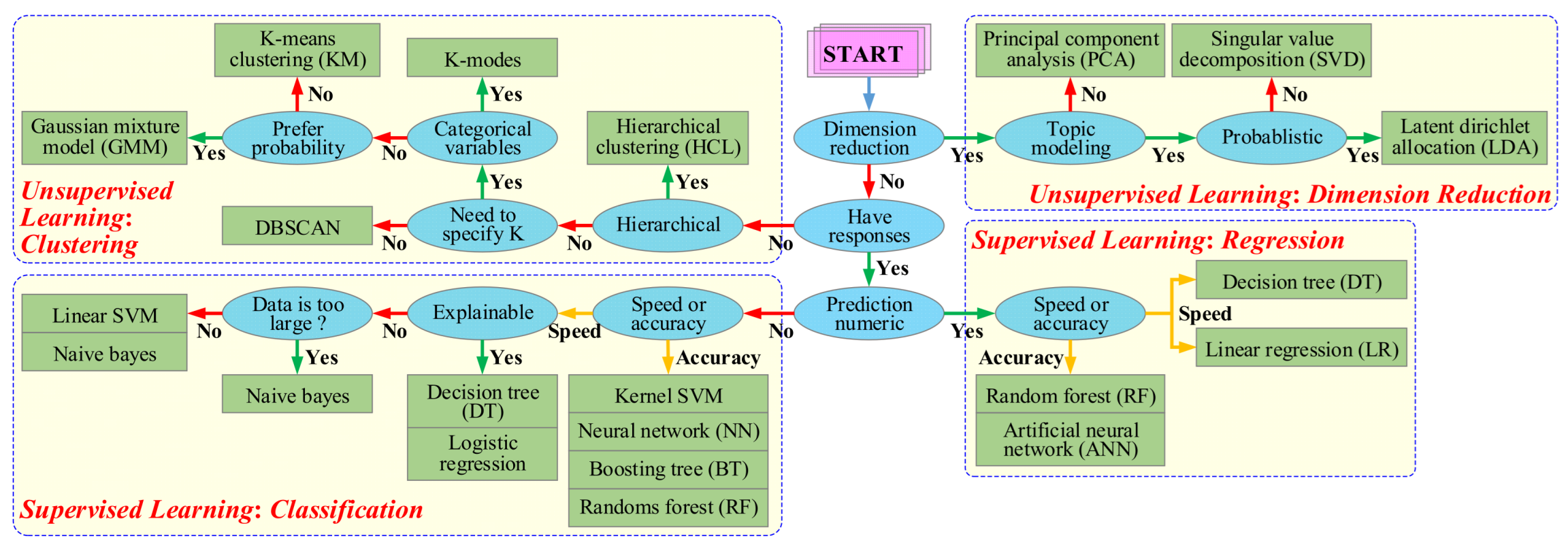
- The imaging modality employed (e.g., X-ray, hyperspectral, etc.);
- The detection algorithm or model utilized (e.g., traditional image processing methods, data-driven intelligent detection models);
- The primary performance metrics reported (e.g., detection accuracy (Acc), mean average precision (mAP), and frames per second (FPS));
- The type of cotton studied (e.g., seed cotton, raw cotton, etc.) and the corresponding categories of FFs targeted, given the significant impact of these factors on detection difficulty and methodological approach.
3. Cotton Foreign Fiber and Its Imaging Technology
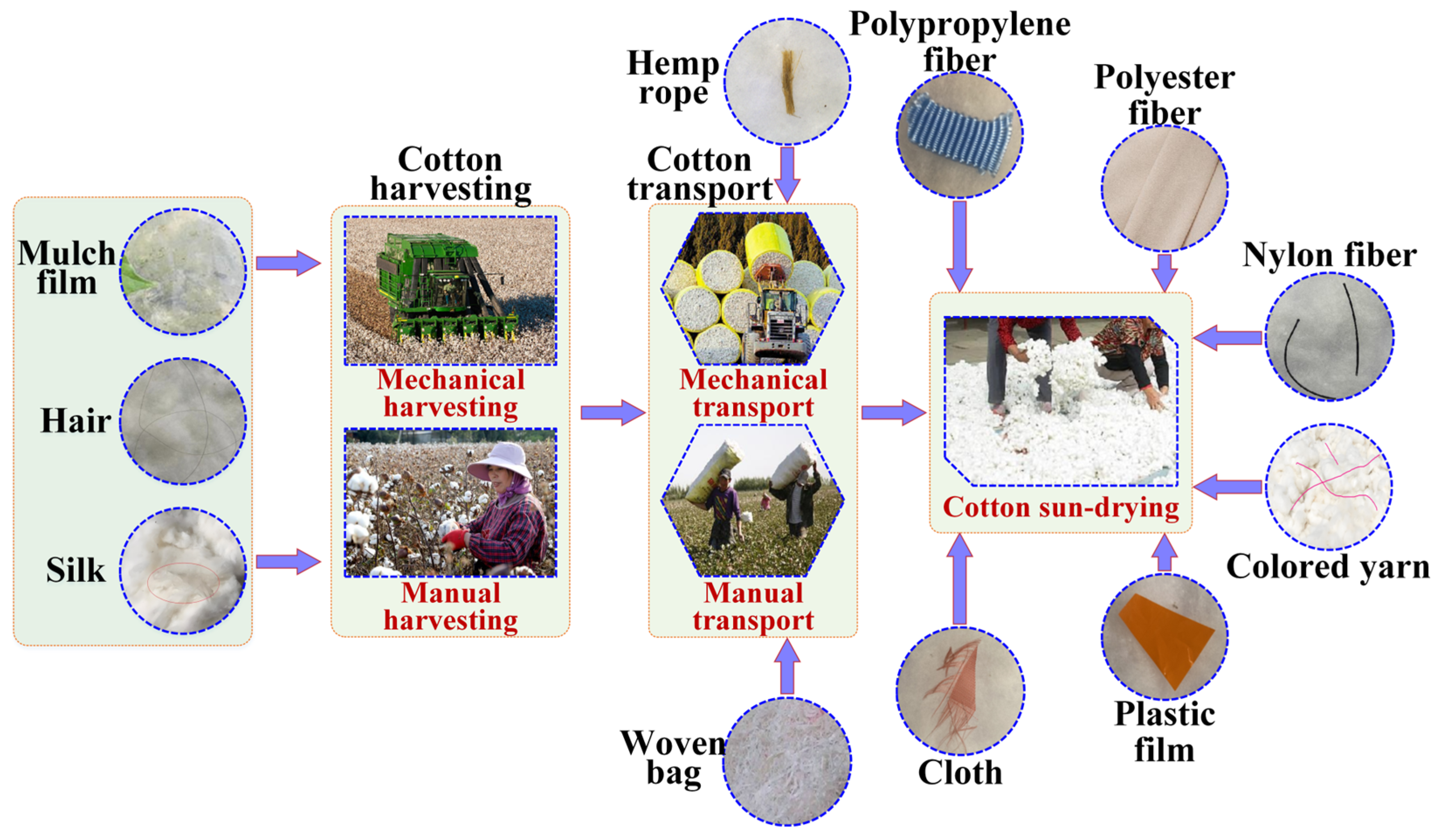
3.1. Definition and Mixing Path of Foreign Fiber
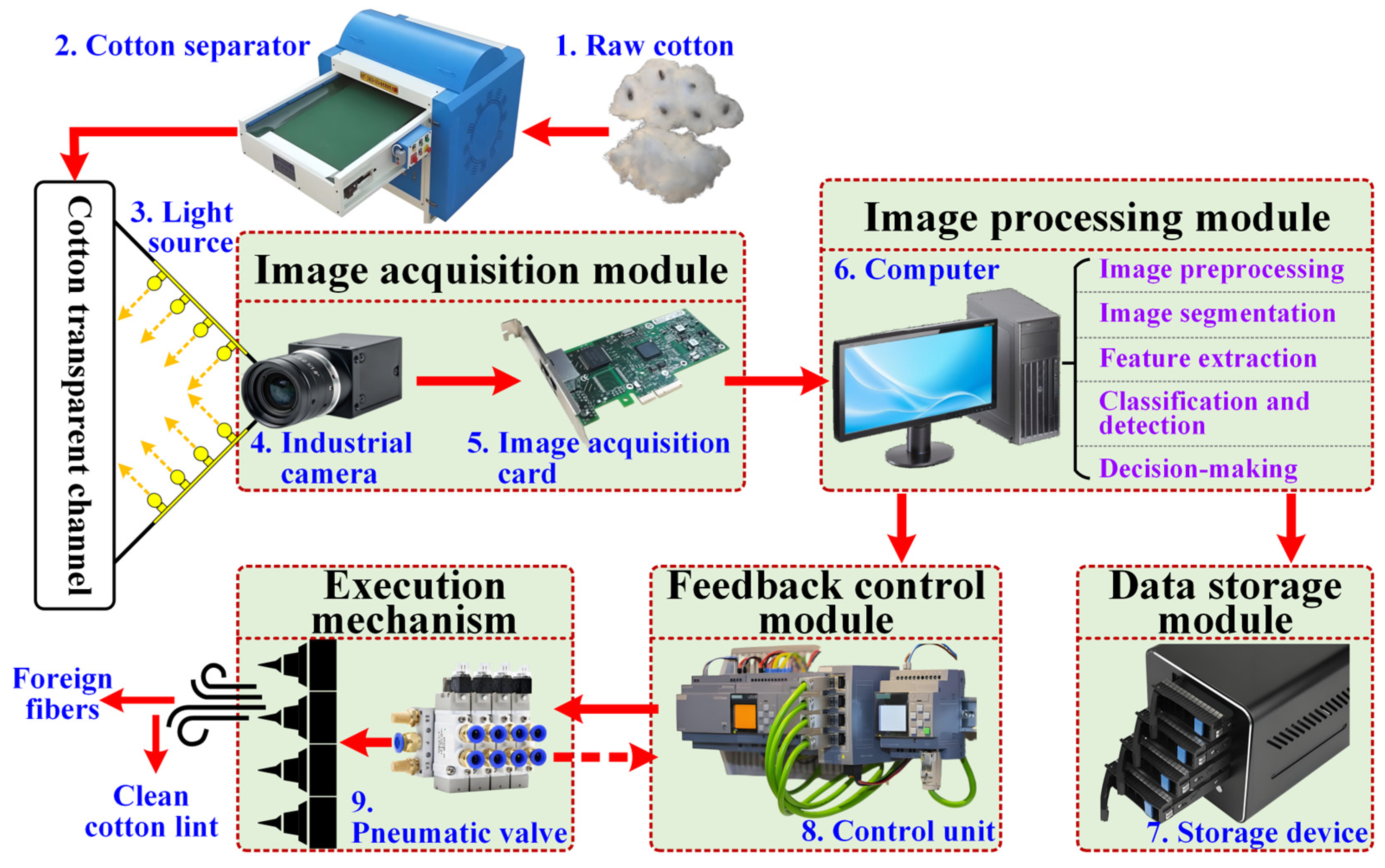
3.2. Foreign Fiber Detection Imaging Technology
3.2.1. X-Ray Imaging Detection
3.2.2. Ultraviolet Fluorescence Imaging Detection
3.2.3. Line Laser Imaging Detection
3.2.4. Polarized Light Imaging Detection
3.2.5. IR Imaging Detection
3.2.6. Hyperspectral Imaging Detection
4. Evolution and Innovation of Cotton Foreign Fiber Detection Algorithms
4.1. Traditional Image Detection Methods and Their Applications
4.1.1. Threshold Segmentation-Based Detection Methods
4.1.2. Edge Feature Segmentation-Based Detection Methods
4.1.3. Region Feature Extraction-Based Detection Methods
4.1.4. Limitations of Traditional Image Detection Methods
4.2. The Application and Challenges of Machine Learning Algorithms
4.3. The Evolution and Innovation of Deep Learning Models
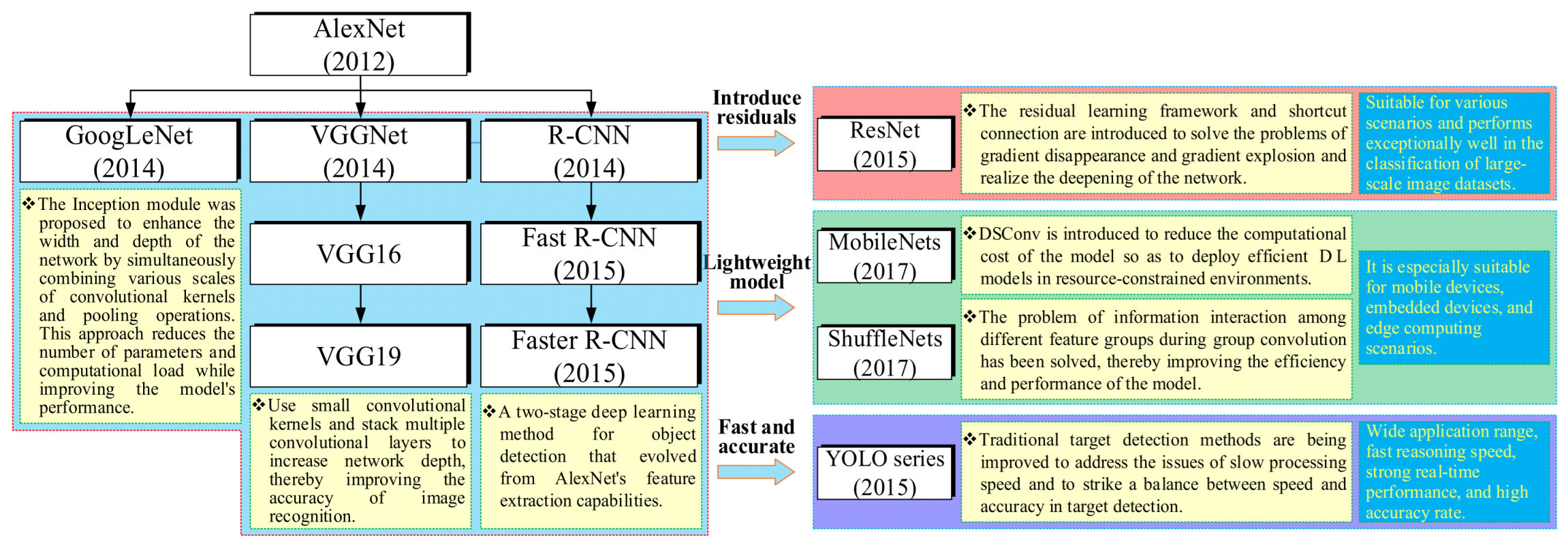
4.3.1. Breakthroughs in Feature Extraction with VGG and GoogLeNet
4.3.2. Residual Network: Optimization of FF Detection in Complex Environments
4.3.3. Lightweight Model
4.3.4. Two-Stage Model and One-Stage Model
4.3.5. Model Performance Evaluation Metrics
5. Conclusions and Outlook
5.1. Summary of Research Status
5.2. Key Technical Bottlenecks: Linking Challenges to Reviewed Technologies
5.3. Directions for Future Research
Author Contributions
Funding
Data Availability Statement
Conflicts of Interest
References
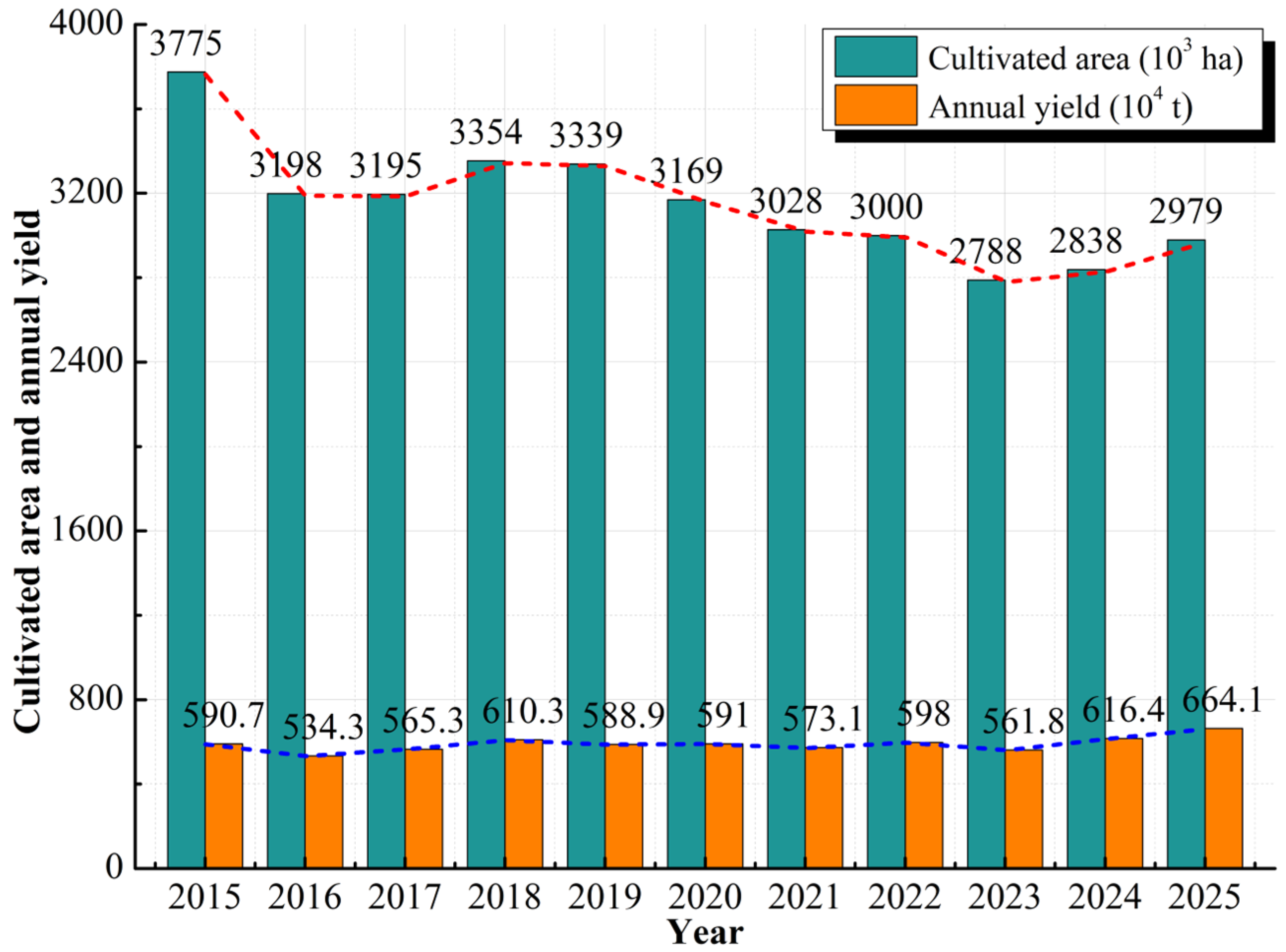
- National Bureau of Statistics of China. China Statistical Yearbook 2025; Statistics Press: Beijing, China, 2025; pp. 379–383. [Google Scholar]
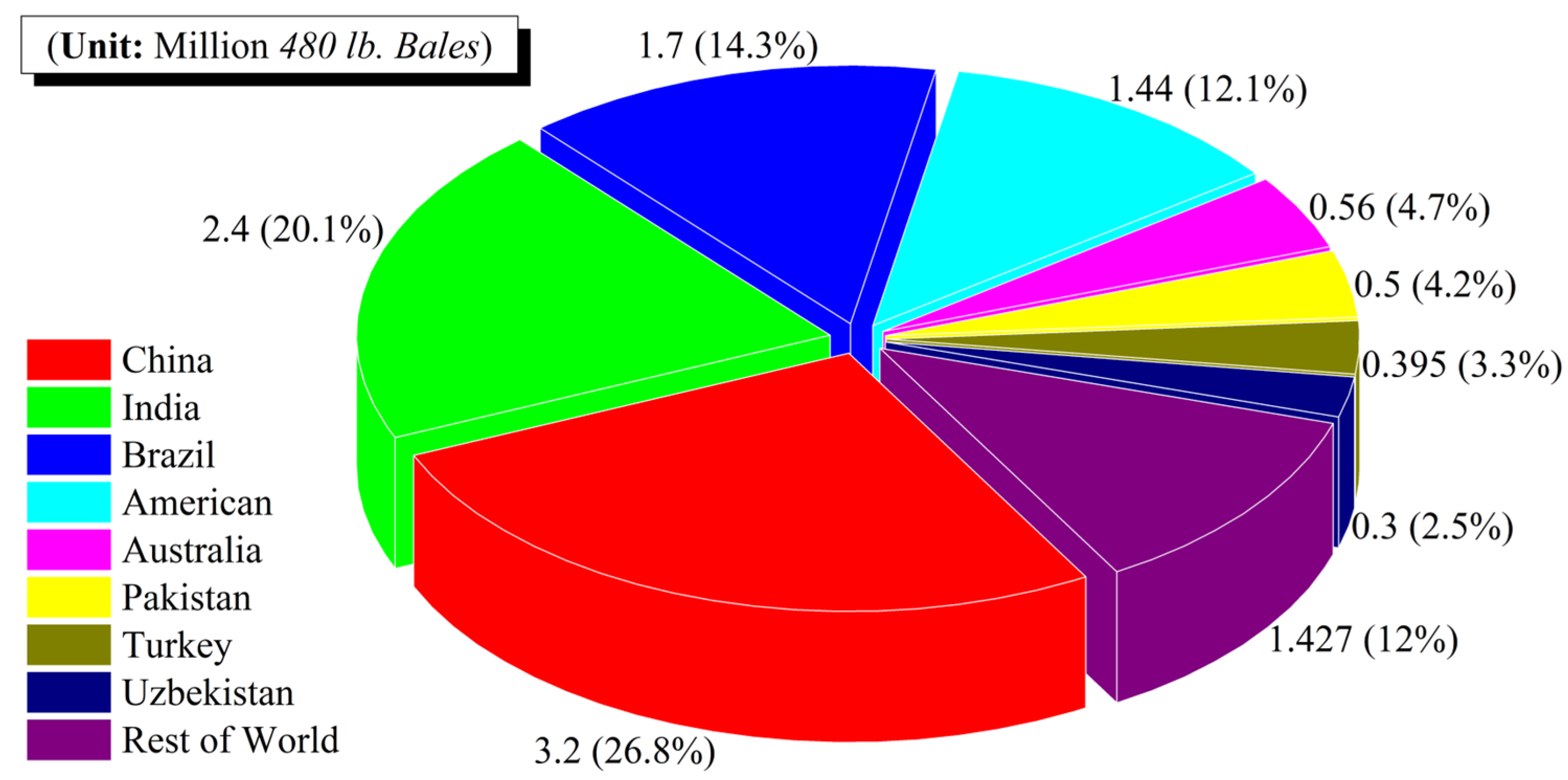
- USDA Foreign Agricultural Service. Available online: https://www.fas.usda.gov/data/production/commodity/2631000 (accessed on 16 January 2025).
- Khan, M.A.; Wahid, A.; Ahmad, M.; Tahir, M.T.; Ahmed, M.; Ahmad, S.; Hasanuzzaman, M. World cotton production and consumption: An overview. In Cotton Production and Uses; Ahmad, S., Hasanuzzaman, M., Eds.; Springer: Singapore, 2020; pp. 1–7. [Google Scholar]
- Zhang, J.; Zhu, Y.; Kole, C. World cotton production, genetic diversity, genetic grain, and genomics. In The Cotton Genome; Zhang, J., Kole, C., Zhu, Y., Eds.; Springer: Cham, Switzerland, 2025; pp. 1–20. [Google Scholar]
- Mishra, P.K.; Sharma, A.; Prakash, A. Current research and development in cotton harvesters: A review with application to Indian cotton production systems. Heliyon 2023, 9, e16124. [Google Scholar] [CrossRef] [Scilit]
- Sun, S.; Gao, G.; Tan, J.; Xu, L.; Huang, L. Segmentation method for foreign fibers in cotton based on improved simple linear iterative clustering algorithm and SVM. Text. Res. J. 2025, 1–14. [Google Scholar] [CrossRef] [Scilit]
- Mei, S.; Li, K.; Wu, X.; Chen, J. Analysis of progress in research on technology for the detection and removal of foreign fibers. Text. Res. J. 2025, 95, 175–193. [Google Scholar]
- GB1103.1-2023; Cotton-Part 1: Saw Ginned Upland Cotton. National Standardization Administration of the People’s Republic of China: Beijing, China, 2012; pp. 1–13.
- Chen, Y.; Wu, T.; Shi, S.; Zhao, B.; Yang, S. Review of cotton foreign fiber detection method using optical imaging. Laser Optoelectronics. Prog. 2021, 58, 138–154. [Google Scholar]
- Shu, Y.; Zhao, L.; Jiang, J.; Yan, Z.; Luo, J.; Liu, X. Research progress of X-ray luminescence optical tomography. Chin. Sci. Bull. 2017, 62, 3838–3850. [Google Scholar] [CrossRef] [Scilit]
- Pai, A.; Sari-Sarraf, H.; Hequet, E.F. Recognition of cotton contaminants via X-Ray microtomographic image analysis. IEEE Trans. Ind. Appl. 2004, 40, 77–85. [Google Scholar] [CrossRef] [Scilit]
- Pavani, S.K.; Dogan, M.S.; Sari-Sarraf, H.; Hequet, E.F. Segmentation and classification of four common cotton contaminants in X-ray microtomographic images. In Proceedings of the Machine Vision Applications in Industrial Inspection XII, San Jose, CA, USA, 18–22 January 2004. [Google Scholar]
- Dogan, M.S. Assessment of Trash Content of Cotton Using 2D X-Ray Imagery. Master’s Thesis, Texas Tech University, Lubbock, TX, USA, 2004. [Google Scholar]
- Dogan, M.S.; Sari-Sarraf, H.; Hequet, E.F. Cotton trash assessment in radiographic X-ray images with scale-space filtering and stereo analysis. In Proceedings of the Machine Vision Applications in Industrial Inspection XIII, San Jose, CA, USA, 17–20 January 2005. [Google Scholar]
- Luo, D.; Zhu, B.; Li, X. Fluorescence effect of ultraviolet and its application in detection of foreign fibers in cotton. J. Henan Univ. Sci. Technol. (Nat. Sci.) 2007, 28, 63–66. [Google Scholar]
- Song, X.; Qi, Q.; Zhou, X.; Zeng, Z.; Wu, Q.; Xu, W.; Wang, K.; Zhou, B. Detection of foreign fibers in cotton based on ultraviolet fluorography and image processing. Shanghai Text. Sci. Technol. 2019, 47, 86–88, 92. [Google Scholar]
- Zhou, F.; Ding, T. White trash detection of cotton lint with ultraviolet-induced fluorescence imaging method. In Proceedings of the Sixth International Symposium on Precision Engineering Measurements and Instrumentation, Hangzhou, China, 8–11 August 2010. [Google Scholar]
- Zhou, F.; Ding, T. Detection of cotton lint trash within the ultraviolet-visible spectral range. Appl. Spectrosc. 2010, 64, 936–941. [Google Scholar] [CrossRef] [Scilit] [PubMed]
- Mustafic, A.; Li, C.; Haidekker, M. Blue and UV LED-induced fluorescence in cotton foreign matter. J. Biol. Eng. 2014, 8, 29. [Google Scholar] [CrossRef] [Scilit]
- Zheng, P. The Design and Implementation of Automatic Detection System of Foreign Fiber in Cotton Based on Multi Pattern Classification Algorithm. Master’s Thesis, Henan University of Science and Technology, Luoyang, China, 2017. [Google Scholar]
- Du, Y.; Yang, C.; Jiang, X.; Liu, R.; Cai, W. Optimization design of multi-light source for foreign fiber detection based on clustering neural network. J. Text. Res. 2017, 38, 104–112. [Google Scholar]
- Hua, C.; Su, Z.; Qiao, L.; Shi, J. White foreign fibers detection in cotton using line laser. Trans. Chin. Soc. Agric. Mach. 2012, 43, 181–185. [Google Scholar]
- Liu, F.; Su, Z.; Qiao, L. Linear laser detecting method of white foreign fibers in cotton based on sample cross-section imaging. Trans. Chin. Soc. Agric. Mach. 2013, 44, 215–218+256. [Google Scholar]
- Liu, X.; He, X.; Su, Z.; Liu, F.; Wang, D.; Gu, Q. Laser imaging method for fast detecting white foreign fibers in cotton. Trans. Chin. Soc. Agric. Eng. 2014, 30, 190–196. [Google Scholar]
- Zhang, L.; Wei, P.; Wu, J.; Liu, X.; Su, Z. Detection method of foreign fibers in cotton based on illumination of line-laser and LED. Trans. Chin. Soc. Agric. Eng. 2016, 32, 289–293. [Google Scholar]
- Wei, P.; Zhang, L.; Liu, X.; Wang, D.; Su, Z. Detecting method of foreign fibers in seed cotton using double illumination imaging. J. Text. Res. 2017, 38, 32–38. [Google Scholar]
- He, X.; Wei, P.; Zhang, L.; Deng, B.; Pan, Y.; Su, Z. Detection method of foreign fibers in seed cotton based on deep-learning. J. Text. Res. 2018, 39, 131–135. [Google Scholar]
- Ren, L.; Liang, J.; Qu, E.; Zhang, W.; Du, B.; Ma, F.; Guo, S.; Zhang, J. Polarimetric optical imaging: Devices, technologies and applications (Invited). Acta Photonica Sin. 2022, 51, 0851505. [Google Scholar]
- Peng, B.; Huang, S.; Li, D. Detection of colorless plastic contaminants hidden in cotton layer using chromatic polarization imaging. Chin. Opt. Lett. 2015, 13, 81–85. [Google Scholar] [CrossRef] [Scilit]
- Jia, X. Application of Chaoyue M foreign fiber cleaner. Cotton Text. Technol. 2016, 44, 48–51. [Google Scholar]
- Zhang, C.; Sun, S.; Shi, W.; Zeng, L.; Deng, D. Design and test of foreign fiber removal machine based on embedded system. Trans. Chin. Soc. Agric. Mach. 2017, 48, 43–52. [Google Scholar]
- Wang, T. Research on Anisotropy of Collagen Fibers Based on Polarized Photoacoustic Imaging. Ph.D. Thesis, Beijing Union Medical College, Beijing, China, 2021. [Google Scholar]
- Tang, F.; Yao, Y.; Shao, Y.; Cai, J.; Shen, X.; Liao, W. Wavelength selection method for cotton fibers based on theoretical absorption spectra. Jiangsu Agric Sci. 2019, 47, 207–209+219. [Google Scholar]
- Cintrón, M.S.; Rodgers, J.E. Identification of common cotton contaminants using an FTIR microscope with a focal plane array detector. AATCC J. Res. 2017, 4, 12–17. [Google Scholar] [CrossRef] [Scilit]
- Cai, X.; Wu, L.; Liang, H.; Chen, J. Cotton foreign fiber detection based on near-infrared imaging technology. Cotton Text. Technol. 2021, 49, 6–10. [Google Scholar]
- Du, Y.; Li, X.; Ren, W.; Zuo, H. Application of near-infrared spectroscopy and CNN-TCN for the identification of foreign fibers in cotton layers. J. Nat. Fibers. 2023, 20, 2172638. [Google Scholar] [CrossRef] [Scilit]
- Han, J.; Guo, J.; Zhang, Z.; Yang, X.; Shi, Y.; Zhou, J. The rapid detection of trash content in seed cotton using near-infrared spectroscopy combined with characteristic wavelength selection. Agriculture 2023, 13, 1928. [Google Scholar] [CrossRef] [Scilit]
- Li, Q.; Zhou, W.; Zhang, X.; Li, H.; Li, M.; Liang, H. Cotton-Net: Efficient and accurate rapid detection of impurity content in machine-picked seed cotton using near-infrared spectroscopy. Front. Plant Sci. 2024, 15, 1334961. [Google Scholar] [CrossRef] [Scilit]
- Liang, H.; Zhang, H.; Cong, M.; Chen, Z.; Sun, C. Research progress of hyperspectral imaging technology in textile testing. Adv. Text. Technol. 2022, 30, 211–218+260. [Google Scholar]
- Wu, Y.; Jin, X.; Feng, J.; Zhang, H.; Qiu, Y.; Yang, J.; Cong, M.; Zhu, C. Cotton impurity detection based on hyperspectral imaging technology. Adv. Text. Technol. 2024, 32, 46–54. [Google Scholar]
- Liu, W.; Shi, Y.; Tian, H.; Guo, J.; Li, X.; Huang, H.; Shi, Z. Detection method for ginned cotton impurities based on hyperspectral reflection, transmission and reflection-transmission imaging mode. Adv. Text. Technol. 2019, 27, 44–49. [Google Scholar]
- Chang, J.; Zhang, R.; Pang, Y.; Zhang, M.; Zha, Y. Classification of impurities in machine-harvested seed cotton using hyperspectral imaging. Spectrosc. Spectr. Anal. 2021, 41, 3552–3558. [Google Scholar]
- Liu, Z.; Zhao, L.; Yu, X.; Zhang, Y.; Cui, J.; Ni, C.; Zhang, L. Intelligent identification of film on cotton based on hyperspectral imaging and convolutional neural network. Sci. Prog. 2022, 105, 1–21. [Google Scholar] [CrossRef] [Scilit]
- Wei, Z.; Wang, J.; Zhang, R.; Zhang, M. Classification of foreign matter in cotton using line scan hyperspectral transmittance imaging. Spectrosc. Spectr. Anal. 2023, 43, 3230–3238. [Google Scholar]
- Xiao, L. Research on Improvement and Application of Otsu Image Segmentation Method. Ph.D. Thesis, Hunan University, Changsha, China, 2022. [Google Scholar]
- Yang, L. A Review of Threshold-based Image Segmentation Algorithms: Principles, Classification and Typical Algorithms. J. Shenyang Norm. Univ. Nat. Sci. 2023, 41, 526–529. [Google Scholar]
- Yuan, X.; Huang, Z.; Ma, Y.; Liu, B. Analysis of characteristics and application of Otsu threshold method. J. Nanchang Inst Technol. 2019, 38, 85–90. [Google Scholar]
- Liu, G.; Wang, S.; Cao, Y.; Zhao, E.; Zhang, L.; Su, L.; Xing, C. Application of several classical threshold segmentation methods in image processing. J. Huanggang Polytech. 2022, 24, 99–103. [Google Scholar]
- Liu, J. Research on Key Techniques of Cotton Foreign Fiber Recognition Based on Image Vision. Ph.D. Thesis, Shandong University, Jinan, China, 2020. [Google Scholar]
- Qi, Y. Rapid detection of raw cotton seed-breaking impurities using improved OTSU method. Wool Text. J. 2022, 50, 90–94. [Google Scholar]
- Wang, Z.; Xia, B. Design of cleaning system for large size seed cotton foreign fiber incorporating image processing. Electron. Des. Eng. 2023, 31, 173–176. [Google Scholar]
- Du, L.; Li, L.; Wang, J.; Wan, X.; Chen, X.; Li, G. Comparison of several fabric defect detection methods based on image self-adaptive threshold segmentation. J. Text. Res. 2014, 35, 56–61. [Google Scholar]
- Wan, L.; Pang, Y.; Zhang, R.; Jiang, Y.; Zhang, M.; Song, F.; Chang, J.; Xia, B. Rapid measurement system for the impurity rate of machine-picked seed cotton in acquisition. Trans. Chin. Soc. Agric. Eng. 2021, 37, 182–189. [Google Scholar]
- Ren, W.; Du, Y.; Zuo, H.; Yuan, R. Research progress in image segmentation and edge detection methods for alien fibers detection in cotton. J. Text. Res. 2021, 42, 196–204. [Google Scholar]
- Xia, B.; Wang, Z.; Gao, H. Applicability analysis of image segmentation methods in cotton fiber visual inspection. China Cotton Process. 2019, 3, 7–10. [Google Scholar]
- Wang, F.; Jin, X. Applicability analysis of raw cotton impurity image recognition based on edge detection algorithm. Adv. Text. Technol. 2019, 27, 39–43. [Google Scholar]
- Yu, H.; Xia, B.; Wang, Z. Automatic identification of cotton surface impurities based on image processing. Shanghai Text. Sci. Technol. 2020, 48, 17–19. [Google Scholar]
- Zhang, C.; Li, T.; Li, J. Detection of impurity rate of machine-picked cotton based on improved canny operator. Electronics 2022, 11, 974–997. [Google Scholar] [CrossRef] [Scilit]
- Li, T. Research on Classification, Identification and Detection Technology of Impurities in Machine-Picked Seed Cotton. Master’s Thesis, University of Jinan, Jinan, China, 2022. [Google Scholar]
- Du, Y.; Wang, J.; Jiang, X.; Zhou, G.; Luo, Y. Algorithm for pattern detection of cotton foreign fibers based on cluster statistic analysis. J. Text. Res. 2015, 36, 135–139. [Google Scholar]
- Zhang, C.; Li, L.; Dong, Q.; Ge, R. Detection method for machine-harvested cotton impurities based on region color segmentation. J. Text. Res. 2017, 38, 135–141. [Google Scholar]
- Dai, Y.; Jiao, Z. Research and implementation of cotton foreign fiber real-time sorting algorithm based on DSP. Bull. Sci. Technol. 2017, 33, 203–207. [Google Scholar]
- Wang, F.; Xu, Z.; Wang, Z.; Wang, S.; Tao, W. Identification technology of cotton flax fiber based on textural feature. Cotton Text. Technol. 2016, 44, 1–5. [Google Scholar]
- Zhang, Y.; Xu, J.; Wang, Z.; Shi, P. Optimization of cotton heterosexual detection technology based on machine vision. J. Chin. Agric. Mech. 2018, 39, 61–65. [Google Scholar]
- Fisher, O.J.; Rady, A.; El-Banna, A.A.; Watson, N.J.; Emaish, H.H. An image processing and machine learning solution to automate Egyptian cotton lint grading. Text. Res. J. 2023, 93, 2558–2575. [Google Scholar] [CrossRef] [Scilit]
- Dhanapal, R.; Selvapandian, D. Optimized fuzzy C-means clustering algorithm for cotton fibre quality analysis. Mater. Today Proc. 2021, 45, 2082–2086. [Google Scholar] [CrossRef] [Scilit]
- Yan, Y.; Li, C.; Chen, Y.; Ji, X.; Tan, X. Application of real-time machine vision technology in intelligent textile production. J. Donghua Univ. (Nat. Sci.) 2025, 12, 5–24. [Google Scholar]
- Cai, Y.; Wu, J.; Zhang, C. Classification of trash types in cotton based on deep learning. In Proceedings of the 38th Chinese Control Conference (CCC), Guangzhou, China, 27–30 July 2019. [Google Scholar]
- Cai, Y. Research on Classification of Foreign Fibers in Cotton Based on Deep Learning. Master’s Thesis, Wuhan University of Science and Technology, Wuhan, China, 2019. [Google Scholar]
- Shafiq, M.; Gu, Z. Deep residual learning for image recognition: A survey. Appl. Sci. 2022, 12, 8972. [Google Scholar] [CrossRef] [Scilit]
- Shi, H.; Wei, Y.; Guan, S.; Li, Y. Cotton foreign fibers detection algorithm based on residual structure. J. Text. Res. 2023, 44, 35–42. [Google Scholar]
- Li, X.; Du, Y.; Ren, W.; Zuo, H. Classification and identification of foreign fibers based on near-infrared spectroscopy and ResNet. J. Text. Res. 2023, 44, 84–92. [Google Scholar]
- Wei, W. Research and Implementation on Defect Detection Model for Foreign Fibers and Fabrics. Ph.D. Thesis, Wuhan University, Wuhan, China, 2021. [Google Scholar]
- Wu, Z.; Shi, H. Recognition of foreign fiber in cotton based on DSConv and CBAM. Cotton Text. Technol. 2022, 50, 19–23. [Google Scholar]
- Pan, Y.; Zhang, S.; Yang, W. Detection method of foreign fiber in cotton based on improved YOLOv5. Cotton Text. Technol. 2022, 50, 37–43. [Google Scholar]
- Wu, M.; Wu, J.; Zhang, C.; Zhu, L. Detection of foreign fiber in cotton based on improved YOLOv3. Chin. J. Liq. Cryst. Disp. 2020, 35, 1195–1203. [Google Scholar] [CrossRef] [Scilit]
- Guo, D.; Li, J.; Hu, L.; Nie, J.; Yang, S.; Yang, H.; Zhang, L.; Zhou, J.; Feng, Y. Research on defective cotton foreign fiber detection algorithm based on lightweight YOLOv8. J. Shihezi Univ. (Nat. Sci.) 2024, 42, 765–774. [Google Scholar]
- Hu, S.; Wang, Z.; Zhang, S.; Li, B.; Zhao, X.; Liu, W. Improved SSD foreign fiber detection method based on convolutional neural network lightweighting. Comput. Integr. Manuf. Syst. 2025, 31, 171–181. [Google Scholar]
- Du, Y.; Dong, C.; Zhao, D.; Ren, W.; Cai, W. Application of improved Faster RCNN model for foreign fiber identification in cotton. Laser Optoelectron. Prog. 2020, 57, 132–141. [Google Scholar] [CrossRef] [Scilit]
- Zhang, Y.; Zhang, S.; Feng, Z. Improved Faster RCNN target detection method for foreign fiber in cotton. Cotton Text. Technol. 2022, 50, 37–41. [Google Scholar]
- Zuo, H. Research on Foreign Fibers Recognition Based on Deep Learning. Master’s Thesis, Tiangong University, Tianjin, China, 2022. [Google Scholar]
- Feng, J. Southern Xinjiang Cotton Based on YOLOv5 and U-Net++ Research on Abnormal Fiber Image Detection Technology. Master’s Thesis, Tarim University, Alar, China, 2023. [Google Scholar]
- Wang, R.; Zhang, Z.; Yang, B.; Xi, H.; Zhai, Y.; Zhang, R.; Geng, L.; Chen, Z.; Yang, K. Detection and classification of cotton foreign fibers based on polarization imaging and improved YOLOv5. Sensors 2023, 23, 4415. [Google Scholar] [CrossRef] [Scilit]
- Zhang, C.; Li, T.; Zhang, W. The detection of impurity content in machine-picked seed cotton based on image processing and improved YOLO V4. Agronomy 2021, 12, 66–86. [Google Scholar] [CrossRef] [Scilit]
- Li, Q.; Ma, W.; Li, H.; Zhang, X.; Zhang, R.; Zhou, W. Cotton-YOLO: Improved YOLOV7 for rapid detection of foreign fibers in seed cotton. Comput. Electron. Agric. 2024, 219, 108752. [Google Scholar] [CrossRef] [Scilit]



| Imaging Method | Range of Application | Advantages | Limitations | Ref. * |
|---|---|---|---|---|
| X-ray | This method effectively identifies FFs in raw cotton that exhibit distinct morphological differences compared to cotton fibers. | Its superior penetrability facilitates precise imaging of FFs through different thicknesses of cotton, yielding high classification accuracy. | The high hardware cost, slow imaging speed, and radiation safety constraints present challenges for widespread adoption. | [9,10,11,12,13,14] |
| Ultraviolet fluorescence | This method is suitable for detecting natural-color FFs with fluorescence properties, such as polypropylene. | Different fibers can be distinguished based on their fluorescence characteristics, offering low cost and easy operation. | It requires high-intensity light sources, which typically need to be combined with other illumination. Improper adjustment can lead to spectral interference. | [15,16,17,18,19,20,21] |
| Line laser | This method is suitable for detecting white FFs, especially those that are optically dense. | Its high brightness, contrast, and directionality enable the rapid detection of large cotton samples. | Maintaining optimal wavelength and camera exposure requires continuous adjustment of the line light source’s parameters, such as wavelength and power. | [22,23,24,25,26,27] |
| Polarized light | This method detects transparent or semi-transparent film-like FFs. | It enables accurate identification of transparent films and is effective for detecting embedded FFs within cotton. | Precise alignment of the polarizer angle is challenging when dealing with diverse FF types, affecting consistent detection. | [28,29,30,31,32] |
| Infrared-ray | This method detects wood chips, non-fluorescent white fibers, feather-like fibers, and other impurities with significant differences in infrared characteristics. | It enables effective analysis of small samples and individual fibers with a high detection rate, achieved by combining image and spectral information. | It suffers from high hardware costs and slow imaging speed. | [33,34,35,36,37] |
| Hyperspectral | This method is effective for detecting most types of FF contaminants and is suitable for impurity classification and quantitative assessment. | It provides both target image information and full-band spectral data, facilitating “image-spectrum integration” and leading to higher detection rates. | It involves complex data processing and high experimental costs. | [39,40,41,42,43,44] |
| Operator | Order | Characteristic Analysis | Ref. 1 |
|---|---|---|---|
| Prewitt | First-order differential operator | This operator is easy to implement and computationally efficient. It generally provides more accurate edge detection than the Roberts operator and offers modest noise suppression. However, its edge continuity and smoothness are inferior to those of the Sobel and Canny operators, which can lead to false edges. It is suitable for general edge detection tasks where processing speed is prioritized over high precision. | [54,59] |
| Roberts | This algorithm employs local differential operators for edge detection and provides high localization accuracy for edges. It is particularly effective for image segmentation tasks in high signal-to-noise ratio scenarios. However, it lacks inherent noise suppression, which can lead to substantial loss of edge information under low signal-to-noise conditions. | [54,55,56,59] | |
| Sobel | This operator effectively suppresses noise and is particularly adept at detecting horizontal and vertical edges. However, its performance on diagonal edges is poor, resulting in inaccurate edge positioning and a tendency to miss fine edges. | ||
| Canny | This operator achieves precise edge detection with superior detection accuracy and continuity. It uses a Gaussian filter for robust noise reduction, and its performance surpasses that of the LoG operator. However, it has high computational complexity, limiting its real-time applicability. Additionally, parameter configuration requires expertise and is not easily adaptable to different application scenarios. | ||
| LoG 2 | Second-order differential operator | This operator uses Gaussian filtering, followed by the Laplacian operator, to extract edges. It provides excellent noise suppression and precise edge positioning. However, it is computationally intensive, requires empirical parameter tuning, and often requires extensive tuning in practice. Therefore, it is not suitable for scenarios that require high real-time performance. | |
| Laplacian | This operator detects edges in all directions. However, it is highly sensitive to noise and exhibits a strong response. It is ineffective at detecting the edges of irregular or entangled cotton fibers in complex imaging environments. In practice, it is typically combined with others, such as the LoG operator, to create complementary systems. | [59] | |
| Improvement of Canny | First-order differential operator | An improved Canny operator incorporates adaptive selection of high and low thresholds, effectively suppressing false edges in images of cotton FFs. | [57] |
| Improvement of Canny | This improved Canny operator uses mean filtering and non-local mean denoising instead of Gaussian filtering. Compared to the old Canny operator, it does a better job of deminihing noise and processing faster. This makes it especially useful for tasks that need to be able to handle a lot of noise and work in real time, like finding impurities in machine-harvested seed cotton. | [58,59] |
| Limitations | Specific Manifestations and Relevant Literature Descriptions |
|---|---|
| Restricted capacity to adapt to complex environments. | (1) Light sensitivity and low-contrast interference: Threshold segmentation relies on the difference in grayscale between the target and the background. However, uneven lighting or overlapping grayscales of impurities and cotton fibers can lead to missed detections or over-segmentation [47,48]. Enhanced algorithms, such as particle swarm optimization for thresholding [50] and non-local mean denoising [58], can mitigate some of these challenges. Nevertheless, manual compensation strategies are still necessary to address environmental interference, which limits their ability to generalize. (2) Fiber entanglement and noise interference: Edge detection has limited sensitivity to weak edges. In areas where cotton fibers intertwine with FFs, fractures or false contours are likely to occur. These conditions can result in cotton knots being misidentified as FF [57]. Region segmentation uses multi-feature fusion to improve positioning accuracy. However, the merging process relies on manually defined similarity criteria, making it difficult to adapt to the diverse morphologies of FF [61]. |
| The ability to distinguish pseudo-fibers is weak. | (1) Conventional methods that use rigid criteria to differentiate FFs often misjudge color and texture similarity. However, these methods struggle to distinguish visually similar pseudo-FF from cotton fibers. Examples include yellow cotton, cotton stalks, and fragmented cotton leaves. The RGB color domain judgment [62] lacks the specificity necessary to effectively identify FF within the same color. Additionally, GLCM texture analysis [63,64] often misclassifies variations in fiber texture as extraneous fibers, especially when evaluating cotton-linen blends. (2) Feature representation and decision-making bottleneck: Traditional methods rely on manually crafted features, such as thresholds, filtering parameters, and GLCM parameters, as well as linear classifiers like SVM. These approaches lack the capability to model high-dimensional nonlinear relationships. When heterogeneous fibers and background features exhibit nonlinear distributions, ambiguity in the classification boundary increases, resulting in a higher false detection rate [52,64]. |
| Model | Types of FFs | Research Subject | Dataset Source | mAP 1 (%) | FPS 2 | Primary Contribution | Ref. 3 |
|---|---|---|---|---|---|---|---|
| Improved MobileNet-YOLOv3 | Block-shaped FF; Bock-shaped pseudo-FF; Strip-shaped FF; Strip-shaped pseudo-FF. | Cotton flow | Created a dataset from FF remover images | 84.82 | 66.67 | A lightweight MobileNet architecture serves as the feature extraction network. The original MobileNet structure is modified by removing its final pooling and fully connected layers. This modified backbone is then integrated with YOLOv3’s multi-scale feature fusion network. Furthermore, a segmented learning rate strategy is employed to optimize training, mitigate overfitting, and enhance model learning. | [76] |
| Improved YOLOv4 | Broken leaves; Cotton stalks; Cotton shells, Weeds. | Seed cotton | Lab-built dataset | 92.38 | - | This work suggests an algorithm for multi-channel fusion segmentation that uses saturated channels (S-channels) and blue-yellow component channels (B-channels). The algorithm works with the YOLOv4 model to make a better network for finding impurities in machine-harvested seed cotton. | [84] |
| Improved YOLOv5 | Waste paper; Plastic; Mulch film; Cotton stalk; Cotton thread; Feathers. | Raw cotton | Created a dataset from FF remover images | 98.10 | 4.3 | An improved YOLOv5 model is created by adding the CBAM and DSConv, which is specifically for finding small cotton FFs. | [75] |
| DSCE-YOLOv5s 5 | Polypropylene fiber; Feathers; Plastic film; Hemp rope; Cloth; Hair Chemical fiber. | Raw cotton | Lab-built dataset | 91.60 | 83 | The YOLOv5s model is improved by adding DSConv to make it lighter, using the K-means algorithm to find the best anchor box sizes, and adding an attention mechanism to make FF features more discriminative. | [81] |
| YOLOv5-U-Net++ | Leaves; Cotton stalks; Dead cotton; Iron wire; Hair; Woven bags; Waste paper; Cotton thread. | Raw cotton | Lab-built dataset | 97.70 | 26.4 | The YOLOv5 network is improved by adding the CBAM, using K-means clustering to find the best anchor box sizes, and using GIoU 4 loss. Furthermore, a U-Net model with improved convolutional attention is created specifically to find FFs that are shaped like strips. | [82] |
| YOLOv5-CFD 6 | 20 types of FFs. | Raw cotton | Lab-built dataset | 96.90 | 385 | An improved YOLOv5 model is proposed, which uses ShuffleNetv2 as the backbone network and incorporates Hard-Swish activation functions. The PANet 7 connections are changed to make fine-grained feature maps, and the coordinate attention module is added to enhance detection accuracy. | [83] |
| Cotton-YOLO | Fabric; Film; Feathers; Chemical fibers, Hair. | Seed cotton | Lab-built dataset | 88.57 | 132.2 | The Cotton-YOLO algorithm is developed by optimizing the YOLOv7 model with ConvNext and SwinTransformer modules. It achieves high detection speed and accuracy even in complex environments. | [85] |
| YOLOv8-MMW | Dark-colored FF, Fluorescent FF | Defective cotton | Lab-built dataset | 95.80 | 367.8 | This paper presents MobileNetv3, a multi-dimensional collaborative attention mechanism, and the dynamic non-monotonic focusing mechanism WIoUv3. This combination makes it possible to build a lightweight detection model that can find small objects like defective cotton or small FFs. | [77] |
| Model | Category | P (%) | R (%) | AP50 (%) | Acc (%) | mAP50 * (%) | FPS | Detection Speed (ms/per Image) |
|---|---|---|---|---|---|---|---|---|
| YOLOv4 | Fabric; | 94.84 | 97.35 | 93.16 | 97.06 | 94.58 | 68.70 | 14.60 |
| Film; | 98.17 | 94.85 | 93.82 | |||||
| Feathers; | 96.09 | 97.19 | 94.79 | |||||
| Chemical fibers; | 98.59 | 97.38 | 95.83 | |||||
| Hair | 98.03 | 98.44 | 95.77 | |||||
| YOLOv5s | Fabric; | 95.24 | 97.77 | 93.67 | 97.40 | 94.86 | 97.80 | 10.20 |
| Film; | 98.93 | 95.29 | 94.15 | |||||
| Feathers; | 96.35 | 97.83 | 95.27 | |||||
| Chemical fibers; | 98.60 | 97.69 | 95.37 | |||||
| Hair | 98.30 | 98.30 | 95.86 | |||||
| YOLOv7 | Fabric; | 95.92 | 98.33 | 94.88 | 97.99 | 95.75 | 101.20 | 9.90 |
| Film; | 99.10 | 96.32 | 95.12 | |||||
| Feathers; | 97.46 | 97.83 | 95.87 | |||||
| Chemical fibers; | 99.07 | 98.61 | 96.17 | |||||
| Hair | 98.87 | 98.87 | 96.73 | |||||
| YOLOv7-Swin | Fabric; | 97.39 | 99.02 | 95.36 | 98.61 | 95.97 | 113.60 | 8.80 |
| Film; | 98.95 | 97.50 | 95.05 | |||||
| Feathers; | 98.72 | 98.47 | 96.11 | |||||
| Chemical fibers; | 99.53 | 98.77 | 96.45 | |||||
| Hair | 98.87 | 99.29 | 96.88 | |||||
| YOLOv7-ConvNext | Fabric; | 96.05 | 98.47 | 95.12 | 98.05 | 95.77 | 150.30 | 6.70 |
| Film; | 99.10 | 96.32 | 94.86 | |||||
| Feathers; | 97.34 | 97.96 | 95.88 | |||||
| Chemical fibers; | 99.22 | 98.46 | 96.17 | |||||
| Hair | 98.87 | 99.01 | 96.83 | |||||
| Cotton-YOLO | Fabric; | 98.21 | 99.44 | 96.45 | 99.12 | 96.92 | 132.20 | 7.60 |
| Film; | 99.55 | 98.23 | 96.13 | |||||
| Feathers; | 99.11 | 99.11 | 97.21 | |||||
| Chemical fibers; | 99.54 | 99.23 | 97.43 | |||||
| Hair | 99.29 | 99.56 | 97.36 |
Disclaimer/Publisher’s Note: The statements, opinions and data contained in all publications are solely those of the individual author(s) and contributor(s) and not of MDPI and/or the editor(s). MDPI and/or the editor(s) disclaim responsibility for any injury to people or property resulting from any ideas, methods, instructions or products referred to in the content. |
© 2026 by the authors. Licensee MDPI, Basel, Switzerland. This article is an open access article distributed under the terms and conditions of the Creative Commons Attribution (CC BY) license.
Share and Cite
Gao, G.; Zhang, F.; Huang, L.; Wang, Y.; Zhang, X.; Wang, Y. Research Progress on Machine Vision Detection Technology for Foreign Fibers in Cotton. Agronomy 2026, 16, 295. https://doi.org/10.3390/agronomy16030295
Gao G, Zhang F, Huang L, Wang Y, Zhang X, Wang Y. Research Progress on Machine Vision Detection Technology for Foreign Fibers in Cotton. Agronomy. 2026; 16(3):295. https://doi.org/10.3390/agronomy16030295
Chicago/Turabian StyleGao, Guogang, Fangshen Zhang, Lihua Huang, Yasong Wang, Xin Zhang, and Yiping Wang. 2026. "Research Progress on Machine Vision Detection Technology for Foreign Fibers in Cotton" Agronomy 16, no. 3: 295. https://doi.org/10.3390/agronomy16030295
APA StyleGao, G., Zhang, F., Huang, L., Wang, Y., Zhang, X., & Wang, Y. (2026). Research Progress on Machine Vision Detection Technology for Foreign Fibers in Cotton. Agronomy, 16(3), 295. https://doi.org/10.3390/agronomy16030295