Article

Valorizing Pruning Residues into Biochar for Remediating Acidified Cropland Soil: Effects on Fertility, Enzymes, and Bacterial Communities

1
College of Natural Resources and Environment, South China Agricultural University, Guangzhou 510642, China
2
Guangzhou Institute of Forestry and Landscape Architecture, Guangzhou 510405, China
3
Guangzhou Collaborative Innovation Center on Science-Tech of Ecology and Landscape, Guangzhou 510405, China
*
Author to whom correspondence should be addressed.
Agronomy 2026, 16(3), 296; https://doi.org/10.3390/agronomy16030296

Submission received: 15 December 2025 / Revised: 13 January 2026 / Accepted: 19 January 2026 / Published: 24 January 2026
(This article belongs to the Section Soil and Plant Nutrition)

Abstract

Intensive agriculture has intensified soil acidification in southern China, threatening crop productivity and ecosystem sustainability. Biochar can neutralize acidity, improve pH buffering, and enhance nutrient retention and microbial habitat in acidic soils. Accordingly, we produced biochars from pruned eucalyptus (ABC), camphora (ZBC), and guava (FBC) branches via pyrolysis at 500 °C. The three biochars were characterized by elemental analysis, Fourier Transform Infrared Spectroscopy (FTIR), and SEM (Scanning Electron Microscopy), and their effects on soil properties, enzyme activities, and bacterial communities were evaluated through a 56-day incubation experiment in an acidified, continuously cropped soil. Physicochemical characterization revealed that ZBC and FBC possessed more oxygen-containing functional groups and greater potential for pH buffering and nutrient release, whereas ABC exhibited higher aromaticity and structural stability. Biochar significantly increased soil pH by 0.62–1.42 units and improved nutrient availability and carbon pools (p < 0.05). Additionally, 4% ZBC increased urease and sucrase activities by 21.54% and 79.34%, respectively, while 2% FBC increased cellulase activity by 25.99%. High-throughput sequencing identified Acidobacteria and Proteobacteria as the dominant phyla; ZBC and FBC at 0.5% and 2% significantly increased Shannon and Chao1 indices. Redundancy analysis indicated that available potassium, pH, soil organic carbon, urease, sucrase, and cellulase were the primary drivers of bacterial community variation and positively associated with carbon-cycling phyla. These findings demonstrate that feedstock-specific biochar properties critically regulate soil biogeochemical processes, offering a sustainable strategy to remediate acidified soils and valorize agroforestry residues.

1. Introduction

Intensive agriculture practices, particularly the overuse of ammonium-based fertilizers, have accelerated soil acidification across vast croplands in China, emerging as a critical threat to agricultural sustainability and ecosystem health [1,2]. Nationwide evaluations indicate that nearly half of China’s cropland is affected by acidification to varying degrees, with acidification-dominant zones alone comprising roughly 40.5%. The problem is particularly pronounced in humid southern and central regions, where sustained high nitrogen inputs and carbonate loss have progressively undermined soil buffering [3]. This acidification process mobilizes toxic aluminum ions (Al3+), depletes base cations (e.g., Ca2+, Mg2+, K+), and diminishes phosphorus availability, thereby impairing crop growth and yield [4]. Concurrently, acidic stress disrupts soil microbial communities, suppressing the activity of key functional groups involved in nutrient cycling and further exacerbating soil degradation [5,6,7]. Given the widespread acidification of agricultural soils, biochar has been increasingly explored as a soil amendment to alleviate acidity and improve nutrient retention. Biochar is a solid carbonaceous material produced by high-temperature pyrolysis of organic biomass, including crop straw, plant residues, and sawdust, under oxygen-limited conditions [8]. From a resource perspective, China generates about 200 million tonnes of agricultural residues and over 30 million tonnes of forestry residues each year. These feedstocks are abundant and relatively low-cost, offering substantial potential for valorization and serving as ideal precursors for biochar production [9,10,11,12]. Importantly, the pruned branches used in this study are generated annually from perennial systems. Eucalyptus plantations cover about 5.5 to 5.6 million ha in China and are mainly distributed in southern provinces, while orchards cover about 12.65 to 13.0 million ha [13]. Reported pruning biomass yields for fruit orchards are commonly on the order of 1 to 5 t dry matter per ha per year, suggesting that woody pruning represents a substantial and locally available feedstock that is often underutilized [14]. Accordingly, elucidating the mechanisms and application pathways by which biochar and related biomass-derived products mitigate soil acidification and improve nutrient management is of both theoretical and practical significance.
Biochar is a multifunctional soil amendment. Its inherent alkalinity, high porosity, and recalcitrance help mitigate soil acidification, support contaminant remediation, and promote carbon sequestration [15,16]. These benefits arise from the combined effects of its key properties, including (i) its alkaline nature and substantial acid-buffering capacity derived from carbonates and alkaline minerals in the ash, which directly neutralize exchangeable acidity [17]; (ii) its high porosity and extensive specific surface area, which improve soil structure, water retention, and provide habitats for microorganisms [18]; and (iii) its abundant oxygen-containing functional groups (e.g., carboxyl, hydroxyl), which enhance cation exchange capacity (CEC), thereby improving nutrient retention and reducing leaching [19]. Furthermore, as a stable carbon source, biochar contributes to long-term soil organic carbon sequestration [20]. The performance of biochar in soil is not universal but is co-determined by feedstock and pyrolysis conditions. Higher pyrolysis temperatures typically produce biochars with higher pH, often due to the loss of acidic functional groups and enrichment of ash-derived alkaline minerals [21]. Critically, feedstock imparts distinct characteristics: wood-derived biochars generally possess higher fixed carbon, while manure-derived biochars are richer in ash [22,23]. Most previous studies have focused on biochars from agricultural residues (e.g., rice straw) or fast-growing trees like Eucalyptus and Populus [24,25]. In contrast, the potential of biochars derived from slow-growing timber species (e.g., Cinnamomum camphora) and fruit tree pruning wastes (e.g., Psidium guajava) remains largely unexplored. Given their potentially higher lignin and extractives content, such feedstocks may produce biochars with superior stability, distinct porosity, and enhanced pH-buffering capabilities, offering a promising yet underutilized resource for soil amelioration.
Importantly, biochar stability and pore structure can also reshape soil microhabitats and resource availability, leading to distinct biological effects. Soil microbial communities are among the most sensitive indicators of changes in soil quality and a key basis for evaluating soil ecological functions [26]. Biochar improves pore architecture and surface sorption, thereby optimizing aeration, water, and nutrient supply and altering microbial community composition, abundance, and activity [27,28]. Its hierarchical porosity provides microrefugia that reduce predation pressure, buffer wet-dry fluctuations, and increase microbial biomass and diversity [29]. Notably, shifts in microbial diversity can, via feedbacks, alter the decomposition rate of native organic carbon (priming) and promote the formation of stable soil aggregates [30]. Microbial responses to biochar are context dependent and jointly regulated by feedstock type, pyrolysis temperature, and environmental conditions. For example, soil pH is a key driver of microbial abundance and diversity, and biochar can differentially affect communities by modulating pH [31]. Evidence indicates that biochar produced at 500 °C, relative to 300 °C, more effectively enhances microbial diversity [32]. Effects observed under laboratory and greenhouse conditions are often stronger than in the field, underscoring the influence of experimental context [33]. In sum, clarifying the coupled interactions among biochar, soil, and microbes is prerequisite to using biochar to steer communities and enhance soil functions, and is essential for evaluating its efficacy and environmental impacts in acidic soils. Therefore, a systematic understanding of the interconnections between biochar properties, soil chemistry, and microbial responses is essential for harnessing biochar to steer soil ecological functions, particularly in acidic soils.
Accordingly, this study systematically evaluates how biochars derived from pruned branches of Cinnamomum camphora, Eucalyptus robusta, and Psidium guajava influence the physicochemical properties, enzyme activities, and bacterial communities of an acidified, continuously cropped agricultural soil. These three woody feedstocks were selected for both practical relevance and mechanistic contrast: they are common pruning residues in subtropical southern China, yet their valorization is limited, and their differences in wood anatomy and biochemical composition are expected to yield biochars with contrasting alkalinity, oxygen containing functional groups, and labile carbon release. To isolate feedstock effects, all biochars were produced under an identical pyrolysis regime (500 °C).
We hypothesize that (i) biochars from different feedstocks will differentially ameliorate soil acidity and enhance nutrient availability due to variation in alkalinity, surface functional groups, and ion exchange capacity; (ii) biochar addition will stimulate carbon and nitrogen cycling enzyme activities in a dose dependent manner; and (iii) biochar amendment will increase bacterial alpha diversity, shift beta diversity, and favor copiotrophic taxa associated with carbon metabolism by improving overall soil conditions. To test these hypotheses under a representative “problem soil” scenario, we conducted a 56-day aerobic incubation, which captures both the early rapid phase driven by alkalinity and soluble component release and the subsequent microbial acclimation and stabilization phase. Biochars were characterized by FTIR and SEM, and incubation measurements were integrated to identify key drivers linking biochar properties, soil conditions, and bacterial community shifts.

2. Materials and Methods

2.1. Soil Collection and Prepartion

Topsoil (0–20 cm depth) were collected from agricultural fields around Gaozhou, Guangdong Province, China (21°86′ N, 110°78′ E). The region has a subtropical monsoon climate, with a mean annual temperature of approximately 22 °C and annual precipitation from 1530 to 1770 mm. The soils were classified as Hydragric Anthrosols according to the World Reference Base for Soil Resources [34]. The soil texture is loam. Composite topsoil (0–20 cm) was collected along S-shaped transects at equal intervals using a stainless-steel auger; visible stones and root fragments were removed before thorough homogenization. The composite soils were air-dried in the dark at room temperature and sieved through a 2 mm mesh for subsequent analyses. The physical and chemical properties of the test soils are shown in Table 1. Under intensive management in a warm, rainy subtropical monsoon climate, long-term monocropping and suboptimal fertilization have progressively acidified the soil and depleted nutrient availability. Therefore, we deliberately selected this acidified cropland soil as a representative scenario in southern China to evaluate biochar-mediated pH buffering and nutrient recovery.

2.2. Biochar Production and Characterization

Biochar was produced from branch feedstocks of guava, eucalyptus, and camphor. The branches were rinsed thoroughly with deionized water, oven-dried at 80 °C to constant weight, and cut into segments less than 2 cm in length. The dried materials were packed in layers into pre-fired lidded crucibles and gently compacted between layers. Under an inert nitrogen atmosphere, the crucibles were heated in a furnace at 10 °C min−1 to 500 °C and held for 2 h to complete pyrolysis. After cooling naturally to room temperature, the resulting biochars were ground, homogenized, and sieved to pass through a 2 mm mesh, sealed in aluminum-foil-laminated self-sealing bags, and stored in a desiccator. The final products, denoted as guava branch biochar (FBC), eucalyptus biochar (ABC), and camphor biochar (ZBC).
Elemental composition (C, H, N, and S) of biochar was determined using an elemental analyzer (Vario EL cube, Elementar, Langenselbold, Germany). Oxygen (O) content was calculated by difference [35]. Morphology features were examined by scanning electron microscopy (SEM, Hitachi Regulus 8100, Tokyo, Japan). Surface functional groups were characterized by Fourier transform infrared spectroscopy (FTIR, Thermo Nicolet iS50, Waltham, MA, USA) across the range of 4000–400 cm−1. In addition, the pH was measured with a pH meter (Seven Compact S220, Mettler-Toledo, Greifensee, Switzerland), and electrical conductivity (EC) was determined with a conductivity meter (INESA DDS-307A, Shanghai, China). The basic physicochemical properties of the biochars are summarized in Table S1.

2.3. Experimental Incubation Design

A laboratory incubation experiment was conducted to assess the effects of biochar amendment. Air-dried soil (sieved to 2 mm) was adjusted with deionized water to 40% of field water-holding capacity (WHC; dry-soil basis) and pre-incubated at 25 °C for 7 d to stimulate microbial activity. Subsequently, approximately 150 g fresh soil was placed in 500 mL containers with vented caps (one container per replicate) and thoroughly mixed with biochar at the specified rates on a dry-soil basis. Biochars (ABC, ZBC, and FBC) were thoroughly mixed into the soil at application rates of 0% (Control, CK; no biochar), 0.5%, 2%, and 4% (w/w, dry weight basis). This resulted in ten treatments: CK, ABC1, ABC2, ABC3, ZBC1, ZBC2, ZBC3, FBC1, FBC2, and FBC3 (where 1, 2, 3 correspond to 0.5%, 2%, 4% application rates, respectively). Three replications were performed for each treatment. All containers were sealed with gas-permeable film to maintain aerobic conditions while minimizing moisture loss, and incubated in the dark at 25 °C. The soil moisture content was maintained at 40% WHC by weighing the containers every 3 days and replenishing water loss with deionized water.
Destructive sampling was performed on days 0, 14, 28, and 56 days. Samples were transferred to 50 mL centrifuge tubes and centrifuged at 8000 rpm for 10 min to remove supernatant, and soil pellets were collected. Soils were partitioned into three subsamples: one was air-dried for physicochemical analyses; one was stored at 4 °C for enzyme assays; and one was flash-frozen in liquid nitrogen and stored at −80 °C for microbial community analysis.

2.4. Soil Physicochemical and Biochemical Analyses

Soil pH and EC were measured in soil–deionized water suspensions at ratios of 1:2.5 and 1:5 (w/v), respectively. The suspensions were shaken for 30 min, allowed to settle, and then measured at 25 °C using calibrated meters. Soil organic carbon (SOC) was quantified by external-heating dichromate oxidation using 0.8 M K2Cr2O7 Alkaline-hydrolyzable nitrogen (AN) was measured by alkaline hydrolysis-diffusion with 1 M NaOH. Available phosphorus (AP) was extracted with 0.5 M NaHCO3 (Olsen method) and determined by molybdenum-antimony colorimetry. Available potassium (AK) was extracted with 1 M NH4OAc and measured by flame photometry [36,37,38]. Dissolved organic carbon (DOC) was extracted with 1 M KCl (1:5, soil: solution ratio) clarified by centrifugation at 8000 rpm, filtered through 0.45 μm membranes, and analyzed with a total organic carbon analyzer (Shimadzu, Kyoto, Japan). Soil Ammonium (NH4+-N) and Nitrate (NO3-N) were measured using commercial assay kits (Beijing Solarbio Science & Technology Co., Ltd., Beijing, China; BC1515 and BC0045), following the manufacturer’s protocols. Soil Nitrite reductase (NR), urease (UA), sucrase (SC), and cellulase (CL) activities were determined with Solarbio kits (BC3105, BC0125, BC0245, and BC0155) based on colorimetric quantification of reaction products: urease by indophenol-blue colorimetry of NH3-N released from urea, sucrase and cellulase by DNS-based colorimetry of reducing sugars released from sucrose or cellulose (510 nm for sucrase), and nitrate reductase by azo-dye formation from nitrite produced during nitrate reduction (540 nm). Activities were expressed as U g−1 dry soil, where 1 U corresponds to 1 μg NH3-N (urease), 1 mg reducing sugar at 37 °C (sucrase), 1 mg glucose (cellulase), or 1 μmol NO2 (nitrate reductase) produced per g soil per day.

2.5. Soil DNA Extraction, 16S rRNA Gene Amplification, and High-Throughput Sequencing

Soil microbial DNA was extracted with the FastDNA™ Spin for Soil kit (MP Biomedicals, Irvine, CA, USA) according to the manufacturer’s protocol, and DNA quality and concentration were assessed by 1% agarose gel electrophoresis. The hypervariable V3-V4 region of the bacterial 16S rRNA gene was amplified with primers 338F (5′-ACTCCTACGGGAGGCAGCAG-3′) and 806R (5′-GGACTACHVGGGTWTCTAAT-3′) [39]. Amplicons were sequenced on an Illumina NovaSeq 6000 platform (Biomarker Technologies Corporation, Beijing, China). Raw sequencing reads were stored in FASTQ format. Primer sequences were trimmed with Cutadapt v1.9.1, and reads were quality filtered and denoised with the DADA2 plugin in QIIME 2. Quality-controlled sequences were clustered into operational taxonomic units (OTU) at 97% similarity. Taxonomic assignment was performed with the RDP Classifier against the SILVA 16S rRNA database. α-diversity (Shannon, Simpson, Chao1, and Coverage) was calculated in QIIME 2, and β-diversity was evaluated by principal component analysis (PCA) based on the binary Jaccard distance.

2.6. Statistical Analysis

Data entry and preliminary processing were performed in Excel 2016. Bacterial community α- and β-diversity metrics were computed in QIIME 2. Diversity heatmaps, redundancy analysis (RDA), and principal coordinates analysis (PCA) were performed in (R Studio Version 4.4.2): heatmaps with Complex Heatmap, RDA and distance calculations with vegan, and visualization with factoextra and ggplot2 (Version 4.4.2, R Studio, Boston, MA, USA). PCA was based on the binary Jaccard distance, and significance of community differences was assessed by PERMANOVA (vegan: adonis2) with 999 permutations. One-way ANOVA for physicochemical indices and enzyme activities was conducted in SPSS Statistics 27.0, with Duncan’s multiple range test (p < 0.05) for post hoc comparisons. Figures were produced with Origin 2018 and GraphPad Prism 9.5.

3. Results

3.1. Elemental Composition and Characterization of Biochar

Carbon (C) was the predominant element, accounting for 66.1–76.9% of the total content (Table 2). ABC and ZBC exhibited significantly higher carbon content than FBC (p < 0.05), by approximately 12.7–16.4%. Oxygen was the second most abundant element (13.2–15.9%); ZBC showed the highest oxygen content, followed by FBC and ABC. Elemental ratios derived from composition further showed that O/C and (O+N)/C in ZBC and FBC were significantly higher than in ABC (by 29.8–36.0% and 37.9–40.3%, respectively), whereas FBC exhibited a significantly higher H/C than ABC and ZBC (by 16.3% and 70.2%, respectively).
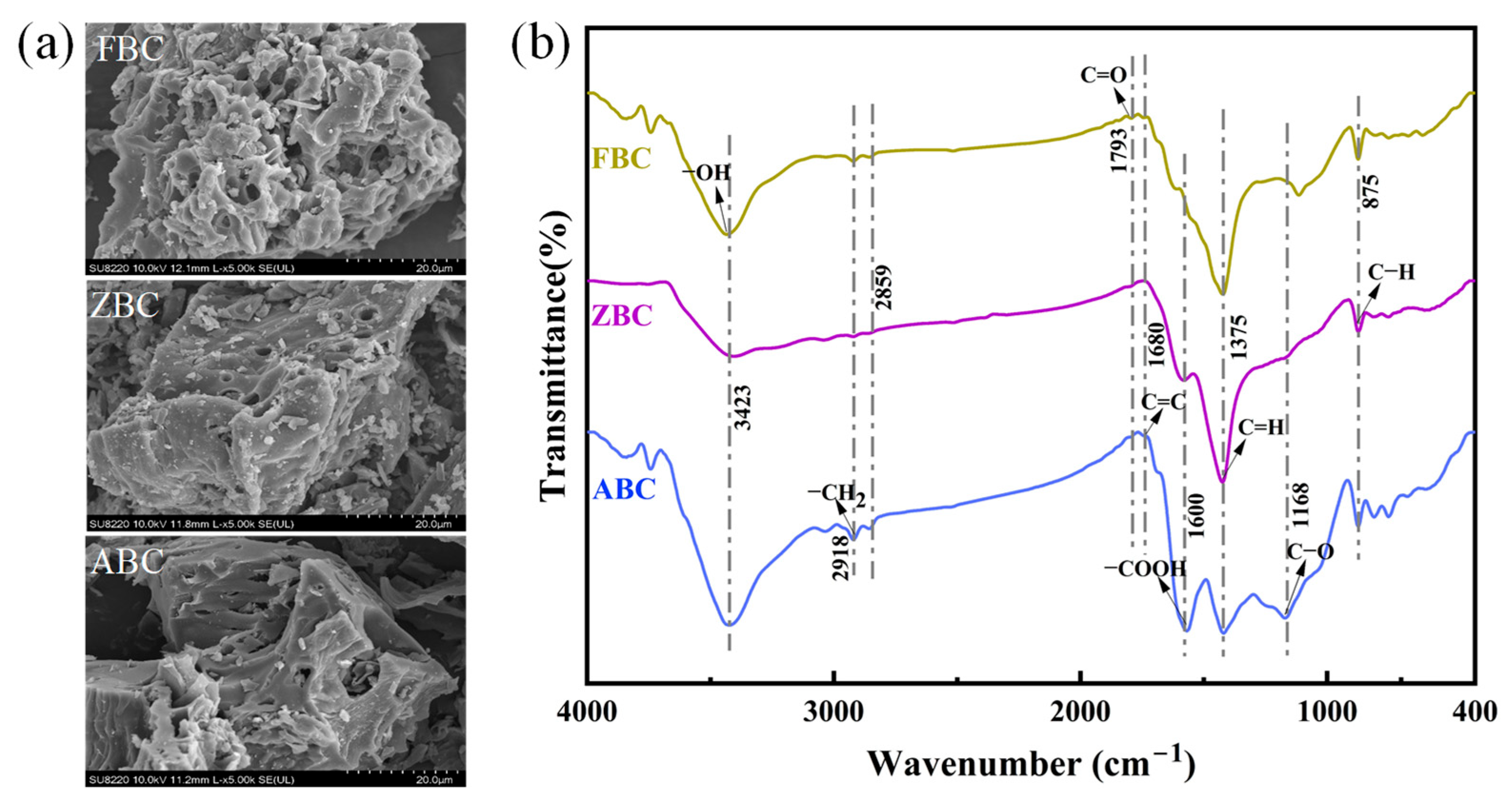
As shown in Figure 1a, all three biochars exhibit a porous architecture, yet their pore morphologies differ markedly. ABC displays a more ordered pore network with both small and medium–sized pores and a relatively open surface. ZBC likewise presents an ordered pore structure; however, compared with ABC, its surface bears more fine flocculent aggregates. In contrast, FBC exhibits an irregular scaly surface with abundant large pores, providing more pronounced pathways for mass transfer (additional views in Figure S1).
As shown in Figure 1b, the FTIR spectra of all three biochars are dominated by aromatic skeletal vibrations. A broad, intense band at 3500–3400 cm−1 corresponds to O-H stretching of phenolic and alcoholic groups. Bands near 2920 and 2860 cm−1 indicate aliphatic -CH2 stretching, evidencing the presence of saturated methylene groups. Compared with ABC, ZBC and FBC show stronger absorptions at 3420–3400 cm−1 (O-H) and ~2920/2860 cm−1 (-CH2), suggesting a greater retention of polar oxygenated functionalities and some aliphatic segments, hence higher overall surface polarity and potential hydrophilicity. Around 1600 cm−1, ABC and ZBC display stronger aromatic C=C skeletal bands, indicating higher degrees of aromaticity and condensation. A shoulder at 1700–1650 cm−1 and composite bands at 1500–1600 cm−1 reflect contributions from carbonyl (C=O) and alkene C=C groups. The band at 1375 cm−1 is assigned to CH3 bending. In the fingerprint region (1350–650 cm−1), the 1168 cm−1 band relates to C-O stretching of phenolic ethers or esters and is more pronounced in FBC and ZBC, implying richer surface oxygenated functionalities.

3.2. The Impact of Biochar Application on Soil Physical and Chemical Properties

3.2.1. Soil pH and Available Nutrients

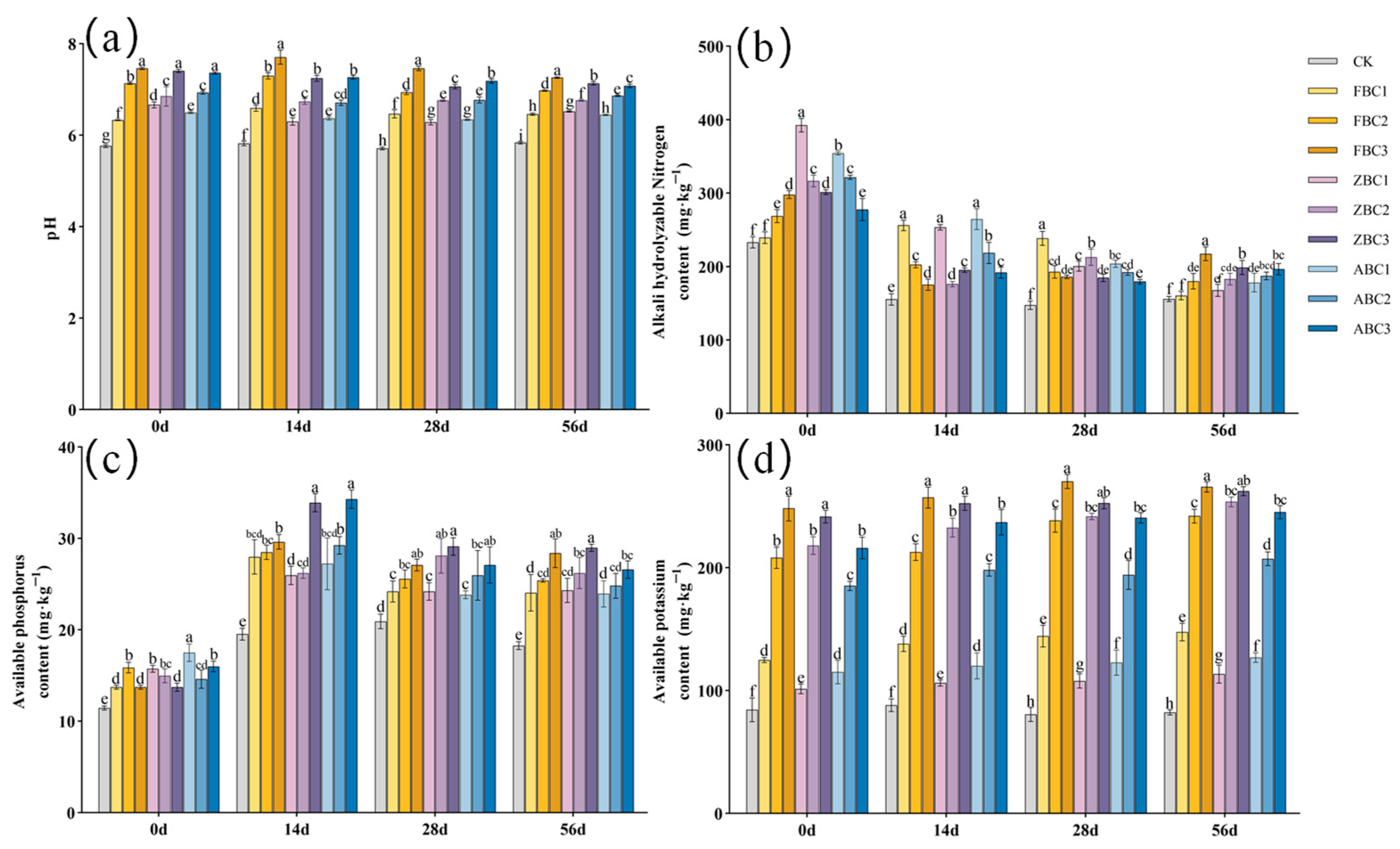
As shown in Figure 2a, soil pH showed a consistent time-course response across treatments and increased significantly after biochar addition. CK had an initial pH of 5.77 at 0 d. Relative to CK, pH increased by 9.77–29.42% under biochar treatments (p < 0.05). From 14 to 28 d, pH remained significantly higher than CK in all biochar treatments. At the end of incubation (56 d), pH ranged from 6.43 to 7.26 with biochar, representing an increase of 0.62–1.42 units relative to CK. Specifically, FBC3, ZBC3, and ABC3 reached 7.26, 7.13, and 7.08.
AN decreased in all treatments over the incubation period (Figure 2b). At 0 d, AN concentration in the biochar-amended treatments ranged from 239.40 to 392.62 mg kg−1, and, except for FBC1, were 15.35–68.49% higher than in CK (p < 0.05). From 14 to 56 d, AN generally declined relative to the initial levels; however, at 56 d it remained significantly higher than in CK by 7.63–39.52% (p < 0.05). AP peaked at 14 d and then declined thereafter (Figure 2c). At 0 d, AP in the biochar treatments ranged from 13.73 to 17.52 mg kg−1, exceeding CK by 19.82–52.86% (p < 0.05). By 14 d, the increase relative to CK expanded to 32.89–73.57% (p < 0.05). At the end of incubation, AP remained significantly higher than in CK by 31.01–58.57% (p < 0.05). At the 4% application rate, the treatments ranked as ZBC3 > FBC3 > ABC3, consistent with a generally dose-dependent increase. AK exhibited broadly similar temporal patterns among treatments, and biochar significantly increased AK (Figure 2d). At 0 d, AK in the biochar treatments ranged from 101.46 to 248.35 mg kg−1, representing a 36.43–194.12% increase over CK (p < 0.05). Between 14 and 28 d, AK was highest in FBC3, exceeding CK by 235.05% and significantly exceeding ZBC3 and ABC3. At 56 d, AK under the biochar treatments ranged from 113.47 to 265.82 mg kg−1, 54.27–222.93% higher than CK (p < 0.05).

3.2.2. Soil Organic Carbon and Inorganic Nitrogen

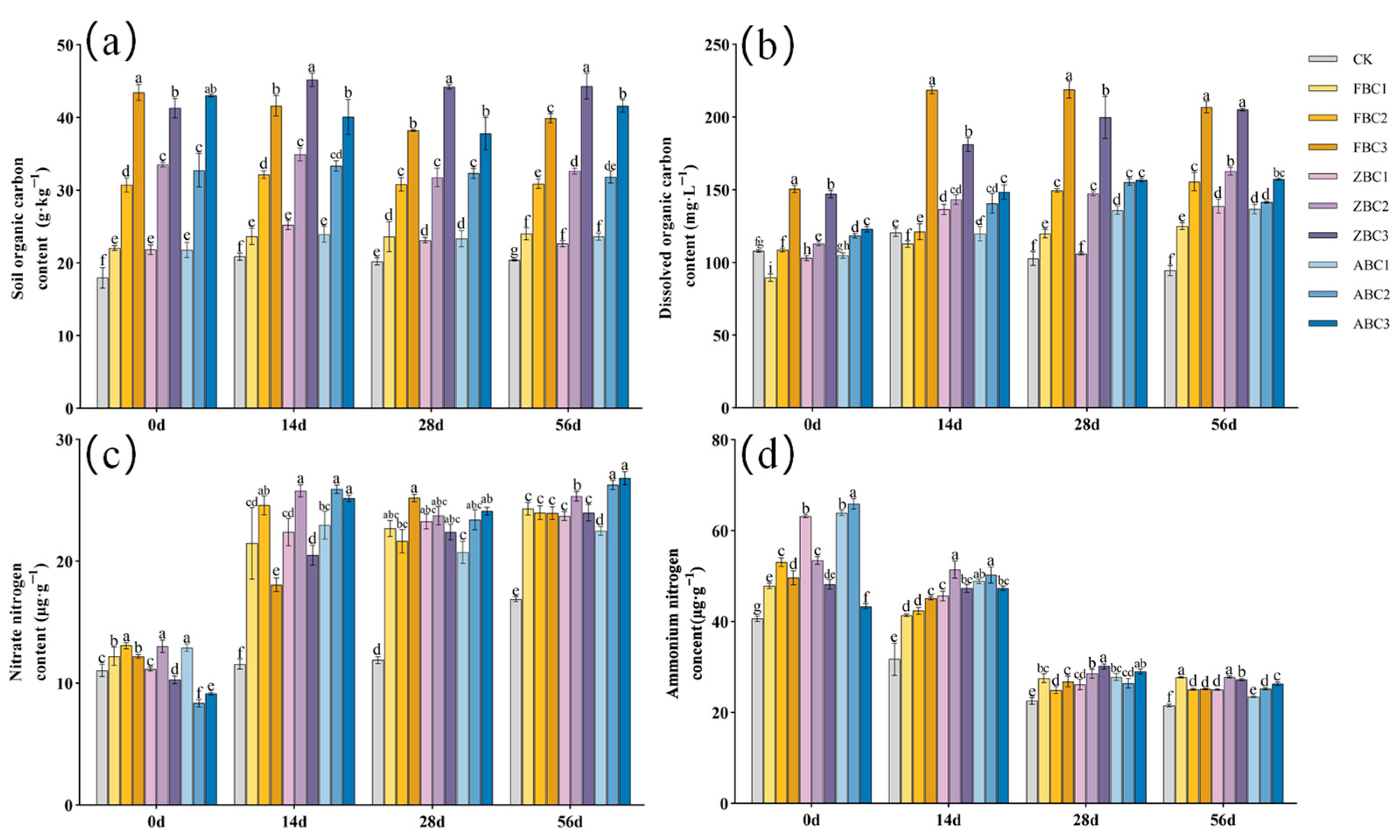
Figure 3a shows that SOC in biochar-amended soils generally increased over the incubation period. At the beginning of incubation, SOC in the biochar treatments was 21.76–43.47 g kg−1, representing a 21.09–139.55% increase relative to CK (p < 0.05). SOC continued to increase up to 14 d and remained elevated until the end of incubation. At the end of incubation, SOC in the biochar treatments ranged from 17.29 to 61.43 g kg−1, 19.2–323.5% higher than CK (p < 0.05), with ZBC3 > ABC3 > FBC3. DOC in the biochar treatments showed an overall increasing trend during incubation, whereas CK began to decline after 14 d (Figure 3b). At the beginning of incubation, DOC in ZBC1 and FBC1 at the 0.5% application rate was 4.54–17.01% lower than in CK, whereas DOC in ABC1 and FBC2 did not differ significantly from CK (p > 0.05). From 28 d until the end of incubation, DOC in all biochar treatments was significantly higher than in CK. At the end of incubation, DOC in the biochar treatments ranged from 125.01 to 206.95 mg L−1, representing a 32.41–119.19% increase relative to CK (p < 0.05). Figure 3c shows that, at the beginning of incubation, NO3-N in the biochar treatments ranged from 8.37 to 13.09 μg g−1, with values in ABC2 and ABC3 lower than CK. From 14 d until the end of incubation, NO3-N in the biochar treatments was significantly higher than in CK. At the end of incubation, NO3-N in the biochar treatments peaked at 22.50–26.82 μg g−1, 33.13–58.68% higher than CK (p < 0.05). At this time, NO3-N in ABC2 and ABC3 was significantly higher than in the other treatments. As incubation progressed, NH4+-N showed an overall decreasing trend (Figure 3d). At the beginning of incubation, NH4+-N in the biochar treatments reached its maximum, being 6.66–62.14% higher than CK (p < 0.05). From 14 d until the end of incubation, NH4+-N decreased continuously. At the end of incubation, NH4+-N in the biochar treatments was 23.47–27.83 μg g−1, 8.86–29.09% higher than CK (p < 0.05).

3.3. The Impact of Biochar Application on Soil Enzyme Activities in Cropland Soil

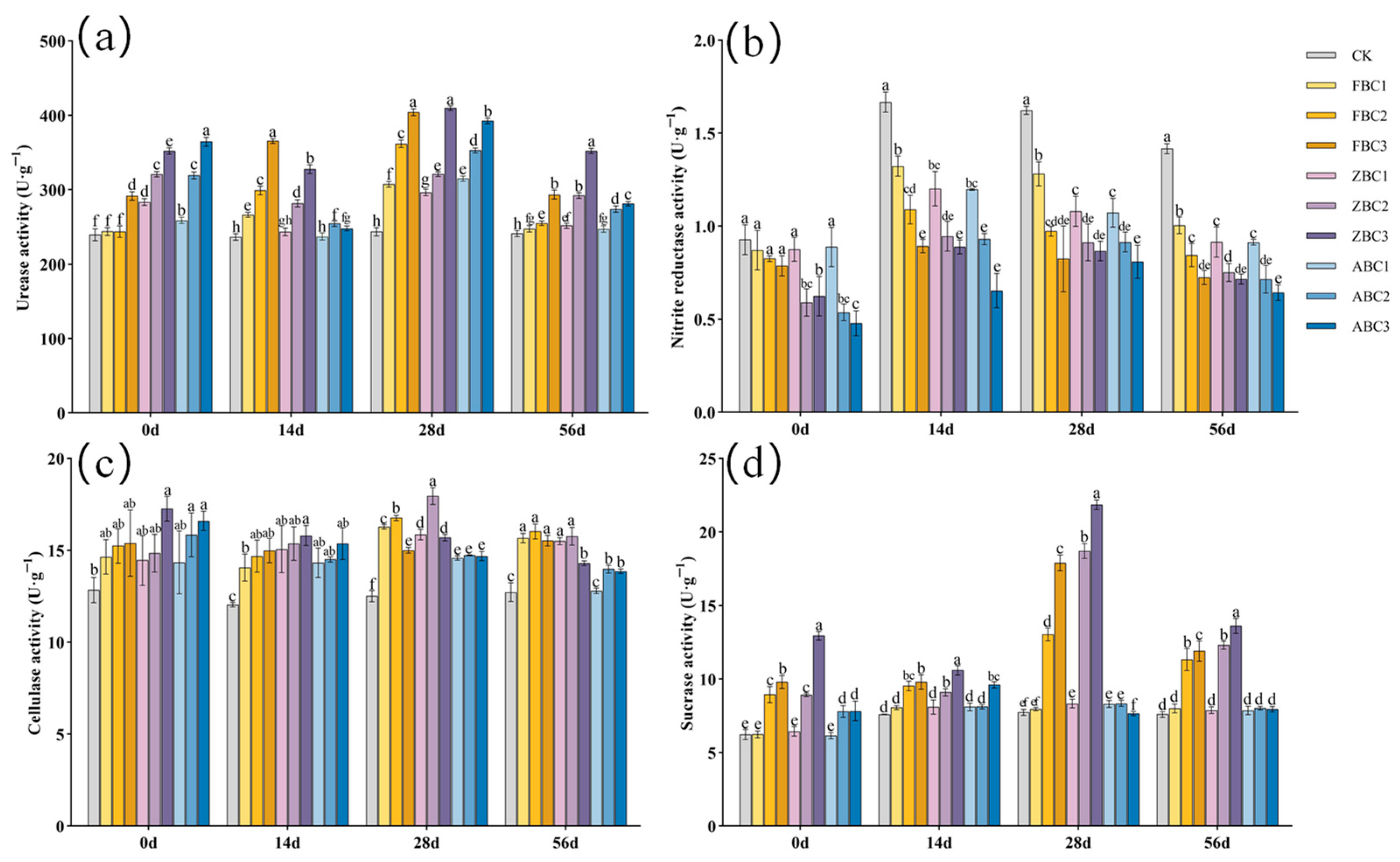
Figure 4a shows that UA generally increased in the biochar treatments during incubation. At 0 d, UA in the biochar treatments was 243.97–364.59 U g−1; except for FBC1 and FBC2, all other treatments were 8.02–52.15% higher than CK (p < 0.05). UA peaked at 28 d; within each application rate, the treatments ranked ZBC > FBC > ABC. At 56 d, UA in the biochar treatments was 247.57–352.12 U g−1, 2.52–21.64% higher than CK (p < 0.05). ZBC3 eshowed the highest UA, exceeding FBC3 and ABC3 by 20.02% and 25.09%, respectively (p < 0.05). NR in the biochar treatments was generally lower than in CK and declined over time (Figure 4b). At 0 d, NR in the biochar treatments was 0.48–0.89 U g−1, 4.45–93.96% lower than CK (p < 0.05). NR declined further after 14 d. At 56 d, NR in the biochar treatments was 0.41–0.77 U g−1, corresponding to a 41.05–120.24% reduction relative to CK (p < 0.05). CL showed broadly similar temporal patterns across treatments, with biochar causing an overall increase (Figure 4c). At 0 d, CL in the biochar treatments was 11.70–29.26% higher than in CK (p < 0.05). At 28 d, CL was highest in ZBC2, at 43.18% above CK (p < 0.05), followed by FBC2 and FBC1. At 56 d, all biochar treatments except ABC1 were 8.98–25.99% higher than CK (p < 0.05). At the 2% application rate, CL was highest in FBC2, with the order FBC2 > ZBC2 > ABC2. SC decreased after 28 d in all treatments as incubation progressed (Figure 4d). At 0 d, SC was highest in ZBC3, at 107.92% above CK, whereas FBC3 and ABC3 were 25.64–57.57% above CK (p < 0.05). At 28 d, SC peaked in the biochar treatments: FBC2 and ZBC2 were 68.57% and 141.82% above CK, respectively, whereas FBC3 and ZBC3 were 131.41% and 182.49% above CK (p < 0.05). At 56 d, SC in the biochar treatments was 7.86–16.63 U g−1; at the 2% and 4% application rates, FBC and ZBC were 49.07–79.34% above CK (p < 0.05).

3.4. Effects of Biochar Amendment on Bacterial Community Diversity in Cropland Soil

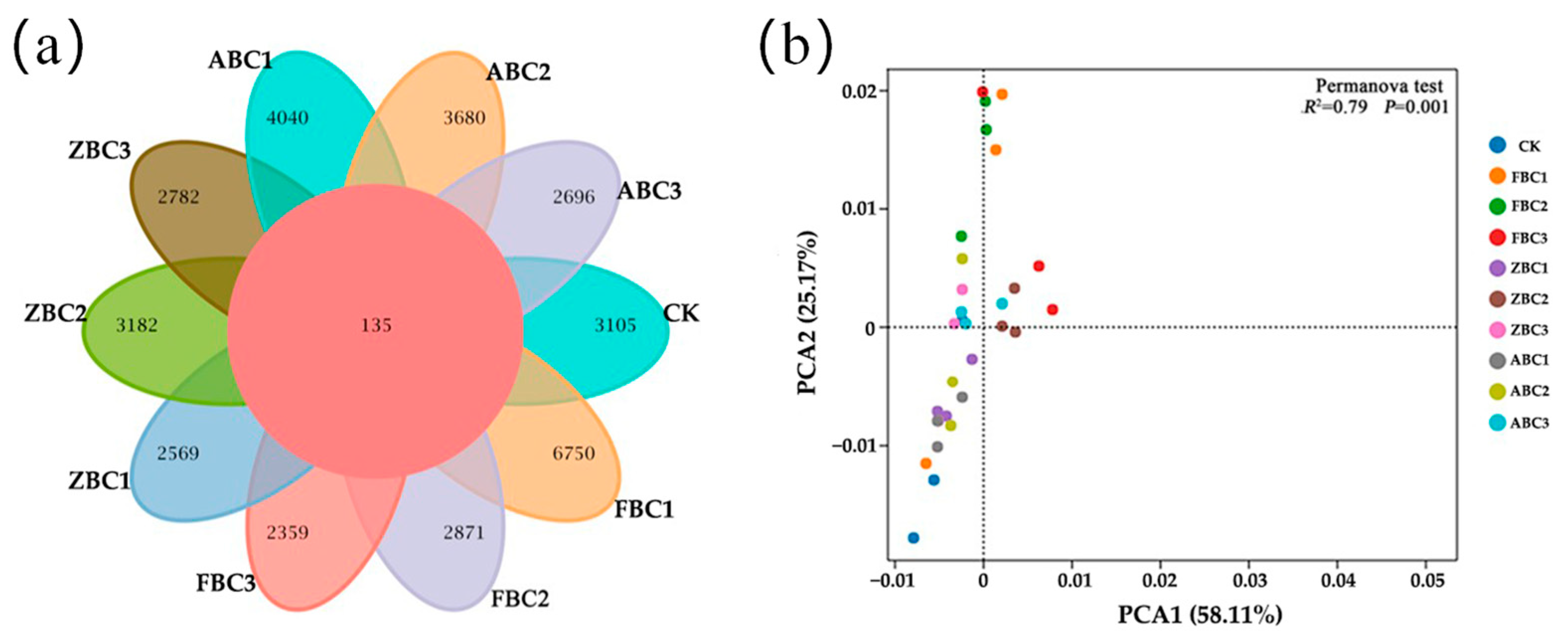
OTU were clustered at 97% sequence similarity across all samples, yielding a total of 34,034 OTU, of which 135 were shared among all treatments (core OTU). Compared with CK, the largest share of OTU occurred in FBC1 (19.83%), followed by ZBC2 (9.35%), ABC1 (11.87%), and ABC2 (10.81%) (Figure 5a). As shown in Table 3, coverage indices exceeded 99% for all treatments, indicating that sequencing depth adequately captured the soil bacterial communities. Chao1 richness in FBC1, ZBC2, ABC1, and ABC2 increased by 42.06%, 19.78%, 25.19%, and 22.89% relative to CK, respectively (p < 0.05). Relative to CK, Simpson index showed no significant change across biochar treatments, whereas Shannon index increased by 2.69–7.04% in FBC1, ZBC2, ABC1, and ABC2 (p < 0.05). These results indicate that biochars derived from different biomass sources effectively enhance bacterial α-diversity. β-Diversity was evaluated by PCA (Figure 5b), with PCA1 and PCA2 jointly explaining 83.28% of the variance. ABC3, ZBC3, FBC1, FBC2, and ZBC2 were clearly separated from CK along the ordination axes, further demonstrating that biochar addition markedly altered bacterial β-diversity.

3.5. Effects of Biochar Amendment on Bacterial Community Structure in Cropland Soil

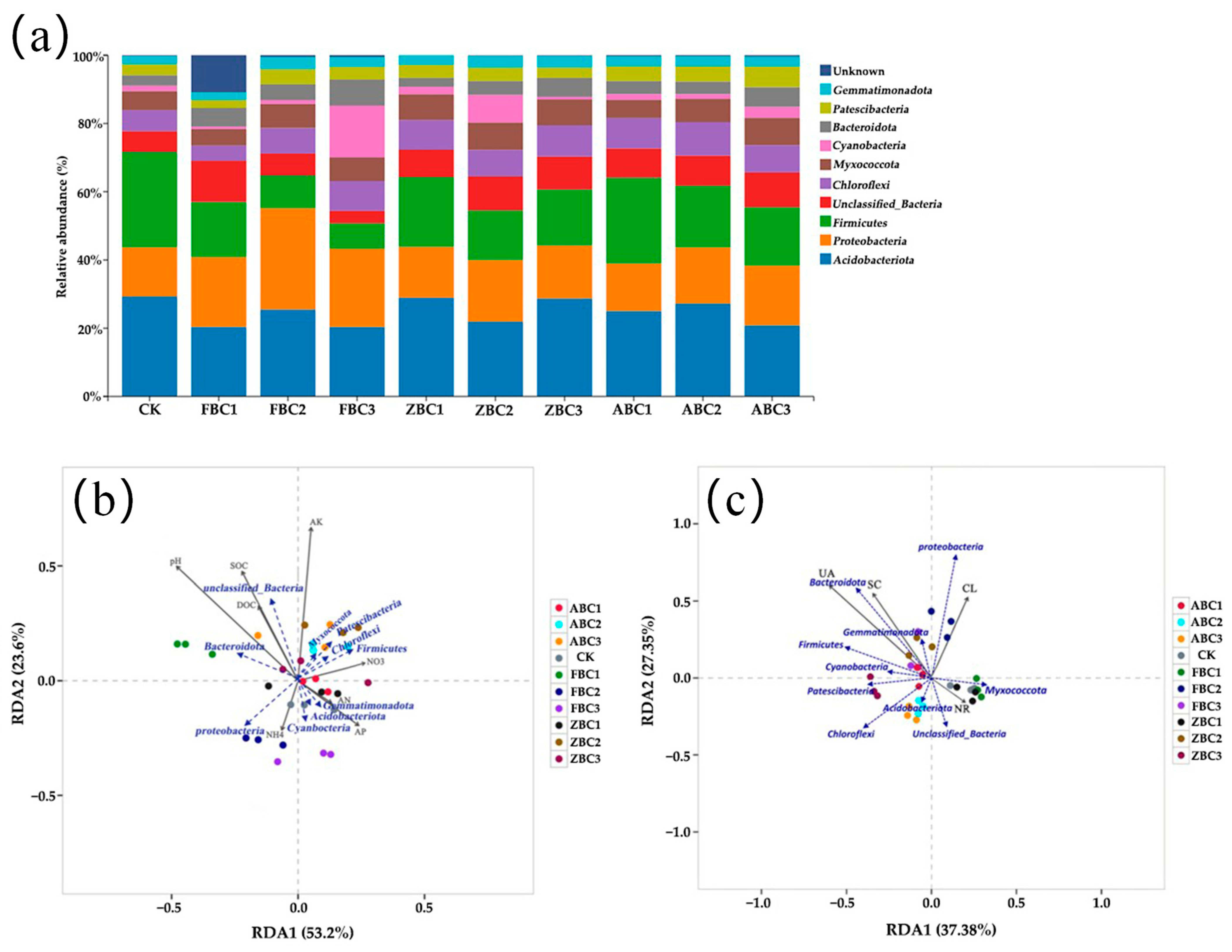
At the phylum level, the relative abundances of the top 10 dominant phyla shifted markedly (Figure 6a). Acidobacteriota and Proteobacteria were the most abundant phyla, with relative abundances of 17.74–26.26% and 12.26–26.39%, respectively. Relative to CK, biochar treatments consistently decreased Acidobacteriota by 2.54–32.44%, with ABC3 exhibiting the lowest values. Firmicutes were also lower than CK under biochar, with reductions of 11.97–72.27%. Additionally, except for a decrease in Proteobacteria under ABC1, other biochar treatments increased Proteobacteria by 1.42–103.18%. Chloroflexi and Myxococcota decreased in FBC1 and FBC3 (Chloroflexi decreased by 25.25–29.52%; Myxococcota decreased by 16.88% and 27.94%) but increased in the other biochar treatments (Chloroflexi increased by 20.95–53.95%; Myxococcota increased by 17.67% and 39.05%). Bacteroidota increased across all biochar treatments, with the largest rise in ABC3 (78.96%), followed by ZBC3 and FBC1. Except for FBC1, biochar generally elevated the relative abundances of Patescibacteria and Gemmatimonadota. Overall, biochar shifted community composition from Acidobacteriota and Firmicutes dominated profiles toward Bacteroidota and other phyla associated with carbon-substrate utilization, suggesting that biochar-driven changes in soil conditions promoted community reassembly.

3.6. Effects of Soil Environmental Factors on Bacterial Community Structure

RDA relating soil physicochemical factors and enzyme activities to the top 10 dominant bacterial phyla showed that the first two axes (RDA1, RDA2) explained 76.80% of the variation for physicochemical factors (Figure 6b) and 64.73% for enzyme activities (Figure 6c). These results indicate that the first two axes effectively captured the major gradients linking the soil environment to bacterial community structure. Among physicochemical factors, AK, pH, and SOC were the primary drivers of bacterial community structure (p < 0.05), whereas AN and NH4+-N contributed little (p > 0.05). Specifically, AK and NO3-N were positively associated with Firmicutes, Chloroflexi, Myxococcota, and Patescibacteria, but negatively associated with NH4+-N and Proteobacteria. pH, SOC, and DOC were positively associated with Bacteroidota, but negatively associated with AN, AP, Acidobacteriota, Gemmatimonadota, and Cyanobacteria. Among enzyme variables, UA, SC, and CL were the main drivers (p < 0.05), whereas NR contributed little (p > 0.05). UA and SC were positively correlated with Bacteroidota, Firmicutes, Cyanobacteria, and Gemmatimonadota, but negatively correlated with NR and Myxococcota. CL was positively correlated with Proteobacteria and negatively correlated with Acidobacteriota, Patescibacteria, and Chloroflexi.

4. Discussion

4.1. Feedstock-Driven Variations in Biochar Properties Govern Their Soil Amendment Potential

The elemental composition and structural characteristics of biochar are jointly governed by both feedstock properties and pyrolysis conditions [40]. In this study, biochars derived from eucalyptus (ABC) and camphor (ZBC) exhibited higher carbon contents than guava-derived biochar (FBC), consistent with the typically higher fixed-carbon content of woody biomass [41]. By contrast, FBC contained relatively higher proportions of H, O, N, and S. Atomic ratios such as H/C, O/C, and (O+N)/C are indicative of aromaticity, hydrophilicity, and polarity, with lower values suggesting greater structural stability and lower hydrophilicity [42]. The O/C ratio is also positively correlated with cation exchange capacity (CEC) [43]. All biochars showed H/C rations below 0.1, confirming highly aromatic and stable structures typical of high-temperature pyrolysis [44]. Notably, ABC showed the lowest H/C ratio than FBC and ZBC, indicating greater aromaticity and stability, whereas FBC and ZBC displayed higher O/C and (O+N)/C, implying stronger hydrophilicity and CEC, which may enhance nutrient retention and water-holding capacity in soils. Regarding pore architecture, ZBC exhibited smaller pores, plausibly because the higher lignin content of camphor wood softens/melts during pyrolysis, leading to pore-mouth collapse or blockage [45]. By contrast, FBC displayed more macropores, offering additional sorption sites and space for nutrients and creating a more favorable habitat for soil microbes [46,47]. FTIR further showed stronger aromatic skeletal bands for ABC, whereas FBC and ZBC were richer in O-containing groups (O-H, C=O, C-O) and thus exhibited higher surface polarity. All three biochars showed a distinct band at 875 cm−1. Together with XRD reflections of CaCO3 and SiO2 (Figure S2), this band is more plausibly assigned to carbonate C-O out-of-plane bending rather than aromatic C-H, helping avoid misattributing carbonate features to aromatic structures [48].

4.2. Biochar Amendment Improves Soil Physicochemical Properties and Nutrient Availability

In fertilizer-acidified agricultural soils, exchangeable Al3+ is a primary contributor to soil acidity and phytotoxicity [49]. In this study, all three biochars significantly increased soil pH, with the greatest improvement observed at the 4% application rate, consistent with previous findings [50]. This response is mainly attributable to alkaline ash and base cations in biochar: upon addition to acidic soils, abundant Ca2+ displaces exchangeable Al3+, alleviating Al toxicity, raising pH, and increasing base saturation [17,51]. Accordingly, all three biochars effectively ameliorated acidity in continuously cropped acidic soils.
With respect to nutrients, prior studies showed that biochar application enhances soil nutrient availability [52,53]. In this study, AN declined progressively from the outset across the biochar treatments. This likely reflects ongoing mineralization of organic N and its nitrification to NO3-N under elevated pH and improved aeration, producing a time-dependent decrease in AN [54]. Biochar also supplies trace elements and, through its high specific surface area and pore network, enhances cation exchange and sorption, thereby improving nutrient availability [55]. Consistent with these mechanisms, AP and AK increased significantly under all three biochars, in agreement with Chen et al. [56]. Notably, at the 4% rate, ZBC and FBC produced the largest gains, likely reflecting feedstock-dependent properties. Our characterization indicated that ZBC and FBC had greater sorption potential and cation-exchange capacity, which enhanced the availability of soil P and K and further improved nutrient status in these acidic, continuously cropped soils.
SOC is a key indicator of soil fertility and ecosystem function, whereas dissolved organic carbon represents a highly labile carbon fraction [57,58]. In this study, SOC and DOC in agricultural soils increased significantly with incubation time and biochar application rate, consistent with previous reports [59]. These responses likely reflect two processes: biochar supplies soluble constituents that elevate DOC upon incorporation, and it reduces mineralization of native organic carbon, thereby increasing SOC [60,61]. Notably, SOC was generally higher under ZBC and ABC than under FBC, likely owing to a greater proportion of aromatic carbon and higher structural stability that favor carbon accumulation. We also observed that biochar markedly enhanced soil nitrification, with NO3-N under ABC exceeding that under ZBC and FBC. This effect is plausibly driven by greater surface carboxyl and phenolic groups that increase negative surface charge, together with improved pore structure that enhances water retention and aeration, shifts soil pH toward alkalinity, and creates conditions favorable for nitrifiers, thereby promoting the conversion of NH4+-N to NO3-N [51,54].

4.3. Biochar Modulates Soil Enzyme Activities Involved in C and N Cycling

Urease and nitrate reductase are key enzymes mediating the conversion of organic N to inorganic forms: UA catalyzes urea hydrolysis, whereas NR reduces nitrate to nitrite and is linked to nitrification-denitrification and assimilatory pathways; shifts in their activities indicate the intensity of N supply and transformation [62]. In this study, UA activity exhibited a clear dose–response to biochar, peaking at the 4% application rate, consistent with observations by Huang et al. [63]. Temporally, UA increased initially and then declined. This pattern likely reflects early increases in pH, improved porosity, water status, and aeration, together with oxygen-containing functional groups and porous surfaces that provide microbial attachment sites and partially stabilize enzyme proteins [64]. However, the subsequent decline in UA over time suggests possible pore occlusion or enzyme immobilization that limited substrate accessibility [65]. In contrast, nitrate reductase (NR) activity was consistently suppressed in biochar-amended soils, possibly due to reduced anaerobic microsites and altered DOC quality, which limited electron donors for denitrification [66,67]. These interpretations require further validation via potential nitrification and denitrification rates, as well as functional gene abundances and transcript levels.
Key extracellular hydrolases involved in carbon turnover include cellulase, sucrase, and β-glucosidase; these accelerate the breakdown of macromolecular organic matter, release bioavailable carbon, and drive the carbon cycle [68]. Here, all three biochars significantly increased SC and CL activities, consistent with Haddad et al. [69]. The porous structure and oxygen-rich surfaces of biochar likely facilitated the co-adsorption of enzymes and soluble carbon substrates, creating enzyme-enriched microenvironments that accelerated the hydrolysis of organic compounds [65,70]. These findings highlight the role of biochar in modulating extracellular enzyme activities through both physical and chemical mechanisms.

4.4. Biochar Shapes Bacterial Community Structure and Diversity via Altering Soil Environmental Conditions

Biochar’s distinctive physicochemical properties create favorable habitats for soil microorganisms, thereby promoting microbial proliferation and enhancing bacterial community structure and diversity [31]. Biochar amendment significantly altered soil bacterial community composition and diversity, as revealed by high-throughput sequencing. The dominance of Acidobacteriota and Proteobacteria across treatments is consistent with previous studies in acidic agricultural soils [71,72]. Notably, the relative abundance of Acidobacteriota decreased significantly under biochar treatments, consistent with Ma et al. [73]. As an acidophilic and often oligotrophic clade, Acidobacteriota are associated with low resource availability and slow-growing, oligotrophic lifestyles [74]; by elevating pH and increasing available C and N, biochar shifts soils from nutrient-poor, acidic conditions toward mesotrophic conditions approaching neutrality, thereby suppressing Acidobacteriota [32,75]. In contrast, Proteobacteria and Bacteroidota are copiotrophic, typically more abundant in nutrient-rich environments, where they contribute to nutrient cycling by processing labile carbon [76]. Here, biochar increased the relative abundances of Proteobacteria and Bacteroidota, indicating that substrate supply, pH buffering, and microhabitat optimization favored the expansion of carbohydrate-degrading, fast-growing taxa. Conversely, the relative abundance of Firmicutes declined under biochar, a pattern also reported in studies of acidic-soil amelioration. This trend is commonly attributed to higher pH and improved aeration that shift niches away from anaerobic or acid-tolerant taxa, together with changes in soluble-carbon quality and competition from Bacteroidota for easily degradable C, which jointly reshape their relative abundance [77,78].
RDA identified AK, pH, SOC, UA, SC, and CL as the key environmental drivers of bacterial community structure, consistent with prior reports [79,80]. These factors collectively explain the observed shifts in microbial composition, underscoring the integrated effects of biochar on soil biogeochemical cycling. SOC is a major energy source for microbes; biochar can elevate SOC via exogenous carbon inputs and physicochemical protection of native organic matter, thereby enhancing microbial activity and optimizing community structure [81]. SC reflects the utilization of soluble substrates and the accumulation and transformation of organic matter [82]. In this study, the positive correlation between SOC, SC, and Bacteroidota suggests that biochar enhances the coupling between carbon availability and microbial activity, potentially through the creation of “microreactor” environments on its porous surfaces.

5. Conclusions

In summary, our findings demonstrate that feedstock type critically governs the physicochemical and structural properties of biochar, which in turn determine its efficacy in improving acidic soil quality. ZBC and FBC, with higher oxygen-containing functional groups and porosity, were more effective in enhancing nutrient availability and enzyme activities, whereas ABC contributed more to soil carbon sequestration due to its higher aromaticity. Short-term incubation showed that biochar substantially improved the quality of the acidic soil, with feedstock dependent effects. At 4% application, FBC and ZBC delivered the strongest overall improvements in soil fertility and enzyme activity, whereas ABC most strongly altered inorganic N dynamics in a manner consistent with enhanced nitrification. Biochar also reshaped bacterial community structure by modulating key environmental factors such as pH, AK, and sucrase activity, with FBC and ZBC significantly increasing α-diversity and enriching key carbon-cycling taxa. These findings highlight the potential of tailored biochar applications to ameliorate soil acidity, enhance nutrient cycling, and support sustainable agricultural management. However, given the short-term and controlled conditions of this incubation study, long-term field trials are necessary to validate these findings and assess the agronomic and environmental trade-offs of large-scale biochar application.

Supplementary Materials

The following supporting information can be downloaded at: https://www.mdpi.com/article/10.3390/agronomy16030296/s1, Figure S1: Scanning electron microscopy (SEM) of biochar; Figure S2: X-ray diffraction (XRD); Table S1: Physical and chemical properties of biochar.

Author Contributions

Conceptualization, H.L. and Y.H.; methodology, Y.H.; software, Y.L.; validation, H.L., Y.L. and J.W.; formal analysis, J.Z. and K.L.; investigation, H.L.; resources, J.Z. and K.L.; data curation, H.L. and Y.H.; writing—original draft preparation, H.L.; writing—review and editing, H.L. and Y.H.; visualization, Y.L. and J.W.; supervision, J.Z. and K.L.; project administration, Y.H.; funding acquisition, J.Z. and K.L. All authors have read and agreed to the published version of the manuscript.

Funding

This work was supported by the Budget Project of Guangzhou Forestry and Landscape Bureau Department: Guangzhou Finance Compilation [2025] No. 2; Social Development Project of Guangzhou Municipal Science and Technology Bureau (202206010058).

Data Availability Statement

The original contributions presented in the study are included in the article/Supplementary Materials, further inquiries can be directed to the corresponding author.

Acknowledgments

During the preparation of this manuscript, the author used GenAI tools (GPT 5.2) for the purposes of improving language only. The authors have reviewed and edited the output and take full responsibility for the content of this publication. All authors have confirmed their agreement.

Conflicts of Interest

The authors declare that they have no known competing finacial interests or personal relationships that could have appeared to influence the work reported in this paper.

References

  1. Hao, T.; Liu, X.; Zhu, Q.; Zeng, M.; Chen, X.; Yang, L.; Shen, J.; Shi, X.; Zhang, F.; de Vries, W. Quantifying drivers of soil acidification in three Chinese cropping systems. Soil Tillage Res. 2022, 215, 105230. [Google Scholar] [CrossRef]
  2. Zhang, Y.J.; Ye, C.; Su, Y.W.; Peng, W.C.; Lu, R.; Liu, Y.X.; Huang, H.C.; He, X.H.; Yang, M.; Zhu, S.S. Soil acidification caused by excessive application of nitrogen fertilizer aggravates soil-borne diseases: Evidence from literature review and field trials. Agric. Ecosyst. Environ. 2022, 340, 108176. [Google Scholar] [CrossRef]
  3. Chen, Z.; Yin, Y.; Gong, H.; Wang, H.; Ying, H.; Zhang, H.; Cui, Z. National-Scale Assessment of Soil pH Change in Chinese Croplands from 1980 to 2018. Agronomy 2025, 15, 2775. [Google Scholar] [CrossRef]
  4. Rahman, S.U.; Han, J.-C.; Ahmad, M.; Ashraf, M.N.; Khaliq, M.A.; Yousaf, M.; Wang, Y.; Yasin, G.; Nawaz, M.F.; Khan, K.A.; et al. Aluminum phytotoxicity in acidic environments: A comprehensive review of plant tolerance and adaptation strategies. Ecotoxicol. Environ. Saf. 2024, 269, 115791. [Google Scholar] [CrossRef]
  5. Song, B.; Li, Y.; Yang, L.Y.; Shi, H.Q.; Li, L.H.; Bai, W.M.; Zhao, Y. Soil Acidification Under Long-Term N Addition Decreases the Diversity of Soil Bacteria and Fungi and Changes Their Community Composition in a Semiarid Grassland. Microb. Ecol. 2023, 85, 221–231. [Google Scholar] [CrossRef]
  6. Hu, Z.; Delgado-Baquerizo, M.; Fanin, N.; Chen, X.; Zhou, Y.; Du, G.; Hu, F.; Jiang, L.; Hu, S.; Liu, M. Nutrient-induced acidification modulates soil biodiversity-function relationships. Nat. Commun. 2024, 15, 2858. [Google Scholar] [CrossRef]
  7. Shao, J.; Li, X.; Zhang, X.; Wang, Y.; Cotta, S.R.; Cherubin, M.R.; Canisares, L.P.; Shangguan, Z.; Yan, W.; Deng, L.; et al. Long-term N fertilization decreases soil multifunctionality and decouples its relationships with the microbial community. Appl. Soil Ecol. 2025, 214, 106371. [Google Scholar] [CrossRef]
  8. Xue, Q.; He, M.X.; Meng, Z.R.; Lu, X.Q.; Wang, Z.Y.; Liang, L.M.; Mo, X.Q. Modulated use of high-concentration invasive biochar in waste-to-energy strategies: Impact analysis on microbial communities. J. Environ. Manag. 2025, 377, 124547. [Google Scholar] [CrossRef]
  9. Cheng, J.; Yang, C.-Z.; Zhang, L.; Lin, Z.-J.; Dang, Y.P.; Zhao, X.; Zhang, H.-L. The competitive effects of crop straw return and nitrogen fertilization on soil acidification. Agric. Ecosyst. Environ. 2025, 388, 109638. [Google Scholar] [CrossRef]
  10. Yao, X.; Wang, X.; Zheng, S.Y.; Zhao, H.T.; Ju, J.; Wang, C.Z. Research on Composting of Garden Waste and Its Application in Cultivation Substrates. Sustainability 2024, 16, 8216. [Google Scholar] [CrossRef]
  11. Zhang, B.; Xu, J.; Lin, Z.; Lin, T.; Faaij, A.P.C. Spatially explicit analyses of sustainable agricultural residue potential for bioenergy in China under various soil and land management scenarios. Renew. Sustain. Energy Rev. 2021, 137, 110614. [Google Scholar] [CrossRef]
  12. Wang, R.; Cai, W.; Yu, L.; Li, W.; Zhu, L.; Cao, B.; Li, J.; Shen, J.; Zhang, S.; Nie, Y.; et al. A high spatial resolution dataset of China’s biomass resource potential. Sci. Data 2023, 10, 384. [Google Scholar] [CrossRef]
  13. Tang, C.; Jiang, X.; Li, G.; Lu, D. Developing a New Method to Rapidly Map Eucalyptus Distribution in Subtropical Regions Using Sentinel-2 Imagery. Forests 2024, 15, 1799. [Google Scholar] [CrossRef]
  14. Velázquez-Martí, B.; Fernández-González, E.; López-Cortés, I.; Salazar-Hernández, D.M. Quantification of the residual biomass obtained from pruning of trees in Mediterranean almond groves. Renew. Energy 2011, 36, 621–626. [Google Scholar] [CrossRef]
  15. Chen, T.; Zhou, Z.Y.; Han, R.; Meng, R.H.; Wang, H.T.; Lu, W.J. Adsorption of cadmium by biochar derived from municipal sewage sludge: Impact factors and adsorption mechanism. Chemosphere 2015, 134, 286–293. [Google Scholar] [CrossRef]
  16. Yao, H.; Lu, J.; Wu, J.; Lu, Z.Y.; Wilson, P.C.; Shen, Y. Adsorption of Fluoroquinolone Antibiotics by Wastewater Sludge Biochar: Role of the Sludge Source. Water Air Soil Pollut. 2013, 224, 1370. [Google Scholar] [CrossRef]
  17. Shi, R.Y.; Li, J.Y.; Ni, N.; Xu, R.K. Understanding the biochar’s role in ameliorating soil acidity. J. Integr. Agric. 2019, 18, 1508–1517. [Google Scholar] [CrossRef]
  18. Xiang, L.; Harindintwali, J.D.; Wang, F.; Redmile-Gordon, M.; Chang, S.X.; Fu, Y.; He, C.; Muhoza, B.; Brahushi, F.; Bolan, N.; et al. Integrating biochar, bacteria, and plants for sustainable remediation of soils contaminated with organic pollutants. Environ. Sci. Technol. 2022, 56, 16546–16566. [Google Scholar] [CrossRef]
  19. Adhikari, S.; Moon, E.; Timms, W. Identifying biochar production variables to maximise exchangeable cations and increase nutrient availability in soils. J. Clean. Prod. 2024, 446, 141454. [Google Scholar] [CrossRef]
  20. Wang, J.; Xiong, Z.; Kuzyakov, Y. Biochar stability in soil: Meta-analysis of decomposition and priming effects. GCB Bioenergy 2016, 8, 512–523. [Google Scholar] [CrossRef]
  21. Enders, A.; Hanley, K.; Whitman, T.; Joseph, S.; Lehmann, J. Characterization of biochars to evaluate recalcitrance and agronomic performance. Bioresour. Technol. 2012, 114, 644–653. [Google Scholar] [CrossRef]
  22. Merzari, F.; Langone, M.; Andreottola, G.; Fiori, L. Methane production from process water of sewage sludge hydrothermal carbonization. A review. Valorising sludge through hydrothermal carbonization. Crit. Rev. Environ. Sci. Technol. 2019, 49, 947–988. [Google Scholar] [CrossRef]
  23. Gui, X.Y.; Liu, C.; Li, F.Y.; Wang, J.F. Effect of pyrolysis temperature on the composition of DOM in manure-derived biochar. Ecotoxicol. Environ. Saf. 2020, 197, 110597. [Google Scholar] [CrossRef]
  24. Zhao, R.; Page-Dumroese, D.S.; Liu, Y.; Wang, K.; Dumroese, R.K. Biochar and manure additions increased above- and belowground wood decomposition, and soil enzyme activities in a sandy loam soil. GCB Bioenergy 2024, 16, e13110. [Google Scholar] [CrossRef]
  25. Lopes, É.M.G.; Reis, M.M.; Frazão, L.A.; da Mata Terra, L.E.; Lopes, E.F.; dos Santos, M.M.; Fernandes, L.A. Biochar increases enzyme activity and total microbial quality of soil grown with sugarcane. Environ. Technol. Innov. 2021, 21, 101270. [Google Scholar] [CrossRef]
  26. Kaschuk, G.; Alberton, O.; Hungria, M. Three decades of soil microbial biomass studies in Brazilian ecosystems: Lessons learned about soil quality and indications for improving sustainability. Soil Biol. Biochem. 2010, 42, 1–13. [Google Scholar] [CrossRef]
  27. Lehmann, J.; Rillig, M.C.; Thies, J.; Masiello, C.A.; Hockaday, W.C.; Crowley, D. Biochar effects on soil biota—A review. Soil Biol. Biochem. 2011, 43, 1812–1836. [Google Scholar] [CrossRef]
  28. Rajapaksha, A.U.; Chen, S.S.; Tsang, D.C.W.; Zhang, M.; Vithanage, M.; Mandal, S.; Gao, B.; Bolan, N.S.; Ok, Y.S. Engineered/designer biochar for contaminant removal/immobilization from soil and water: Potential and implication of biochar modification. Chemosphere 2016, 148, 276–291. [Google Scholar] [CrossRef]
  29. Ighalo, J.O.; Ohoro, C.R.; Ojukwu, V.E.; Oniye, M.; Shaikh, W.A.; Biswas, J.K.; Seth, C.S.; Mohan, G.B.M.; Chandran, S.A.; Rangabhashiyam, S. Biochar for ameliorating soil fertility and microbial diversity: From production to action of the black gold. iScience 2025, 28, 111524. [Google Scholar] [CrossRef]
  30. Chen, L.J.; Jiang, Y.J.; Liang, C.; Luo, Y.; Xu, Q.S.; Han, C.; Zhao, Q.G.; Sun, B. Competitive interaction with keystone taxa induced negative priming under biochar amendments. Microbiome 2019, 7, 77. [Google Scholar] [CrossRef]
  31. Kracmarova-Farren, M.; Alexova, E.; Kodatova, A.; Mercl, F.; Szakova, J.; Tlustos, P.; Demnerova, K.; Stiborova, H. Biochar-induced changes in soil microbial communities: A comparison of two feedstocks and pyrolysis temperatures. Environ. Microbiome 2024, 19, 87. [Google Scholar] [CrossRef]
  32. Dai, Z.; Barberán, A.; Li, Y.; Brookes, P.C.; Xu, J. Bacterial Community Composition Associated with Pyrogenic Organic Matter (Biochar) Varies with Pyrolysis Temperature and Colonization Environment. mSphere 2017, 2, e00085-17. [Google Scholar] [CrossRef] [PubMed]
  33. Singh, H.; Northup, B.K.; Rice, C.W.; Prasad, P.V.V. Biochar applications influence soil physical and chemical properties, microbial diversity, and crop productivity: A meta-analysis. Biochar 2022, 4, 8. [Google Scholar] [CrossRef]
  34. IUSS Working Group WRB. World Reference Base for Soil Resources 2014, Update 2015: International Soil Classification System for Naming Soils and Creating Legends for Soil Maps; World Soil Resources Reports No. 106; FAO: Rome, Italy, 2015. [Google Scholar]
  35. Liu, C.S.; Zhao, D.F.; Ma, W.J.; Guo, Y.D.; Wang, A.J.; Wang, Q.L.; Lee, D.J. Denitrifying sulfide removal process on high-salinity wastewaters in the presence of Halomonas sp. Appl. Microbiol. Biotechnol. 2016, 100, 1421–1426. [Google Scholar] [CrossRef] [PubMed]
  36. Tao, W.; Zhang, Y.; Gu, J.; Zhu, K.; Wang, Z.; Yang, J. The Synergistic Optimization of Rice Yield, Quality, and Profit by the Combined Application of Organic and Inorganic Nitrogen Fertilizers. Agronomy 2024, 14, 2665. [Google Scholar] [CrossRef]
  37. Olsen, S.R.; Cole, C.V.; Watanabe, F.S.; Dean, L.A. Estimation of Available Phosphorus in Soils by Extraction with Sodium Bicarbonate; United States Department of Agriculture Circulation: Washington, DC, USA, 1954; Volume 939, pp. 1–19.
  38. Alam, S.M.M.; Moslehuddin, A.Z.M.; Islam, M.R.; Shamsuzzoha, M.; Egashira, K. Some chemical properties of soils from two agroecological regions of Bangladesh: Region 5: Lower Atrai Basin and Region 6: Lower Purnabhaba Floodplain. J. Fac. Agric. Kyushu Univ. 2007, 52, 195–202. [Google Scholar] [CrossRef]
  39. Guo, J.; Wu, Y.; Wu, X.; Ren, Z.; Wang, G. Soil bacterial community composition and diversity response to land conversion is depth-dependent. Glob. Ecol. Conserv. 2021, 32, e01923. [Google Scholar] [CrossRef]
  40. Katyal, S.; Thambimuthu, K.; Valix, M. Carbonisation of bagasse in a fixed bed reactor: Influence of process variables on char yield and characteristics. Renew. Energy 2003, 28, 713–725. [Google Scholar] [CrossRef]
  41. González-Prieto, O.; Torres, L.O.; Torres, A.V. Comparison of Waste Biomass from Pine, Eucalyptus, and Acacia and the Biochar Elaborated Using Pyrolysis in a Simple Double Chamber Biomass Reactor. Appl. Sci. 2024, 14, 1851. [Google Scholar] [CrossRef]
  42. Bakshi, S.; Banik, C.; Laird, D.A. Estimating the organic oxygen content of biochar. Sci. Rep. 2020, 10, 13082. [Google Scholar] [CrossRef]
  43. Yang, Q.; Li, M.H.; Lei, K.X.; Li, S.Y.; Liu, Z.; Chu, S.X.; Zhang, Y.Y.; Jiang, K.Z.; Gu, M.; Li, F.J.; et al. High-donor electrolyte endows graphite with anion-derived interphase to achieve stable K-storage. Sci. China Mater. 2023, 66, 932–943. [Google Scholar] [CrossRef]
  44. Sahoo, S.S.; Vijay, V.K.; Chandra, R.; Kumar, H. Production and characterization of biochar produced from slow pyrolysis of pigeon pea stalk and bamboo. Clean. Eng. Technol. 2021, 3, 100101. [Google Scholar] [CrossRef]
  45. Hao, B.X.; Yang, H.; Han, Z.; Jin, L.J.; Li, Y.; Hu, H.Q. Correlation between pores and chemical structures for lignin pyrolysis char. Fuel 2024, 376, 132700. [Google Scholar] [CrossRef]
  46. Ruan, R.; Zhang, P.; Lambers, H.; Xie, W.; Zhang, Z.; Xie, S.; Wang, Y.; Wang, Y. Biochar application improves maize yield on the Loess Plateau of China by changing soil pore structure and enhancing root growth. Sci. Total Environ. 2024, 956, 177379. [Google Scholar] [CrossRef]
  47. Yu, H.W.; Zou, W.X.; Chen, J.J.; Chen, H.; Yu, Z.B.; Huang, J.; Tang, H.R.; Wei, X.Y.; Gao, B. Biochar amendment improves crop production in problem soils: A review. J. Environ. Manag. 2019, 232, 8–21. [Google Scholar] [CrossRef] [PubMed]
  48. Nicholas, H.L.; Mabbett, I.; Apsey, H.; Robertson, I. Physico-chemical properties of waste derived biochar from community scale faecal sludge treatment plants. Gates Open Res. 2022, 6, 96. [Google Scholar] [CrossRef]
  49. Ji, J.; Lv, Z.; Liu, S.; Hou, H.; Liu, Y.; Liu, X.; Li, X.; Lan, X. Long-term application of chemical fertilizers induces soil acidification and soil exchangeable base cation loss on paddy in southern China. Sci. Agric. Sin. 2024, 57, 2599–2611. [Google Scholar] [CrossRef]
  50. Zhao, Y.; Zhai, P.F.; Li, B.; Jin, X.; Liang, Z.H.; Yang, S.Y.; Li, C.Z.; Li, C.J. Banana, pineapple, cassava and sugarcane residue biochars cannot mitigate ammonia volatilization from latosols in tropical farmland. Sci. Total Environ. 2022, 821, 153427. [Google Scholar] [CrossRef]
  51. Zhao, R.D.; Coles, N.; Kong, Z.; Wu, J.P. Effects of aged and fresh biochars on soil acidity under different incubation conditions. Soil Tillage Res. 2015, 146, 133–138. [Google Scholar] [CrossRef]
  52. Hartley, W.; Riby, P.; Waterson, J. Effects of three different biochars on aggregate stability, organic carbon mobility and micronutrient bioavailability. J. Environ. Manag. 2016, 181, 770–778. [Google Scholar] [CrossRef]
  53. Ippolito, J.A.; Ducey, T.F.; Cantrell, K.B.; Novak, J.M.; Lentz, R.D. Designer, acidic biochar influences calcareous soil characteristics. Chemosphere 2016, 142, 184–191. [Google Scholar] [CrossRef] [PubMed]
  54. Cordovil, C.; Pinto, R.; Silva, B.; Sas-Paszt, L.; Sakrabani, R.; Skiba, U.M. The Impact of Woody Biochar on Microbial Processes in Conventionally and Organically Managed Arable soils. Commun. Soil Sci. Plant Anal. 2019, 50, 1387–1402. [Google Scholar] [CrossRef]
  55. Mukherjee, S.; Sarkar, B.; Aralappanavar, V.K.; Mukhopadhyay, R.; Basak, B.B.; Srivastava, P.; Marchut-Mikolajczyk, O.; Bhatnagar, A.; Semple, K.T.; Bolan, N. Biochar-microorganism interactions for organic pollutant remediation: Challenges and perspectives. Environ. Pollut. 2022, 308, 119609. [Google Scholar] [CrossRef]
  56. Chen, Y.; Xu, M.; Yang, L.; Jing, H.; Mao, W.; Liu, J.; Zou, Y.; Wu, Y.; Zhou, H.; Yang, W. A critical review of biochar application for the remediation of greenhouse gas emissions and nutrient loss in rice paddies: Characteristics, mechanisms, and future recommendations. Agronomy 2023, 13, 893. [Google Scholar] [CrossRef]
  57. Liang, B.Q.; Lehmann, J.; Sohi, S.P.; Thies, J.E.; O’Neill, B.; Trujillo, L.; Gaunt, J.; Solomon, D.; Grossman, J.; Neves, E.G.; et al. Black carbon affects the cycling of non-black carbon in soil. Org. Geochem 2010, 41, 206–213. [Google Scholar] [CrossRef]
  58. Gao, S.J.; Gao, J.S.; Cao, W.D.; Zou, C.Q.; Huang, J.; Bai, J.S.; Dou, F.G. Effects of long-term green manure application on the content and structure of dissolved organic matter in red paddy soil. J. Integr. Agric. 2018, 17, 1852–1860. [Google Scholar] [CrossRef]
  59. Li, Q.; Zhang, J.C.; Ye, J.; Liu, Y.; Lin, Y.; Yi, Z.G.; Wang, Y.X. Biochar affects organic carbon composition and stability in highly acidic tea plantation soil. J. Environ. Manag. 2024, 370, 122803. [Google Scholar] [CrossRef]
  60. Zhang, L.; Jing, Y.; Chen, C.; Xiang, Y.; Rezaei Rashti, M.; Li, Y.; Deng, Q.; Zhang, R. Effects of biochar application on soil nitrogen transformation, microbial functional genes, enzyme activity, and plant nitrogen uptake: A meta-analysis of field studies. GCB Bioenergy 2021, 13, 1859–1873. [Google Scholar] [CrossRef]
  61. Chen, M.; Liu, D.; Shao, X.; Li, S.; Jin, X.; Qi, J.; Liu, H.; Li, C.; Li, C.; Li, C. Effect of Biochar Types and Rates on SOC and Its Active Fractions in Tropical Farmlands of China. Agronomy 2024, 14, 676. [Google Scholar] [CrossRef]
  62. Du, E.Z.; Terrer, C.; Pellegrini, A.F.A.; Ahlström, A.; van Lissa, C.J.; Zhao, X.; Xia, N.; Wu, X.H.; Jackson, R.B. Global patterns of terrestrial nitrogen and phosphorus limitation. Nat. Geosci. 2020, 13, 221–226. [Google Scholar] [CrossRef]
  63. Huang, D.L.; Liu, L.S.; Zeng, G.M.; Xu, P.; Huang, C.; Deng, L.J.; Wang, R.Z.; Wan, J. The effects of rice straw biochar on indigenous microbial community and enzymes activity in heavy metal-contaminated sediment. Chemosphere 2017, 174, 545–553. [Google Scholar] [CrossRef]
  64. Mukherjee, A.; Zimmerman, A.R. Organic carbon and nutrient release from a range of laboratory-produced biochars and biochar–soil mixtures. Geoderma 2013, 193–194, 122–130. [Google Scholar] [CrossRef]
  65. Zeng, L.Q.; Zimmerman, A.R.; Huang, R.X. Adsorption of extracellular enzymes by biochar: Impacts of enzyme and biochar properties. Geoderma 2024, 451, 117082. [Google Scholar] [CrossRef]
  66. Cayuela, M.L.; Spott, O.; Pascual, M.B.; Sánchez-García, M.; Sánchez-Monedero, M.A. Key biochar properties linked to denitrification products in a calcareous soil. Biochar 2024, 6, 90. [Google Scholar] [CrossRef]
  67. Yang, Z.; Yu, Y.; Hu, R.; Xu, X.; Xian, J.; Yang, Y.; Liu, L.; Cheng, Z. Effect of rice straw and swine manure biochar on N2O emission from paddy soil. Sci. Rep. 2020, 10, 10843. [Google Scholar] [CrossRef]
  68. Burns, R.G.; DeForest, J.L.; Marxsen, J.; Sinsabaugh, R.L.; Stromberger, M.E.; Wallenstein, M.D.; Weintraub, M.N.; Zoppini, A. Soil enzymes in a changing environment: Current knowledge and future directions. Soil Biol. Biochem. 2013, 58, 216–234. [Google Scholar] [CrossRef]
  69. Haddad, S.A.; Abdelmageed, H.; Saleh, A.; Ahmed, S.; Abd El-Azeim, M.M.; Lemanowicz, J.; Eldesoky, G.E.; Saad, O. Response of Cellulose Decomposition and Nodulation in Soils Amended with Biochar for Peri-Urban Agriculture. Sustainability 2023, 15, 10003. [Google Scholar] [CrossRef]
  70. Zhao, Y.M.; Wang, X.J.; Yao, G.W.; Lin, Z.Z.; Xu, L.Y.; Jiang, Y.L.; Jin, Z.W.; Shan, S.D.; Ping, L.F. Advances in the Effects of Biochar on Microbial Ecological Function in Soil and Crop Quality. Sustainability 2022, 14, 10411. [Google Scholar] [CrossRef]
  71. Wu, Y.C.; Zeng, J.; Zhu, Q.H.; Zhang, Z.F.; Lin, X.G. pH is the primary determinant of the bacterial community structure in agricultural soils impacted by polycyclic aromatic hydrocarbon pollution. Sci. Rep. 2017, 7, 40093. [Google Scholar] [CrossRef]
  72. Arunrat, N.; Uttarotai, T.; Mhuantong, W.; Kongsurakan, P.; Sereenonchai, S.; Hatano, R. Soil bacterial communities in a 10-year fallow rotational shifting cultivation field and an 85-year-old terraced paddy field in Northern Thailand. Environ. Sci. Eur. 2025, 37, 95. [Google Scholar] [CrossRef]
  73. Ma, M.; Jiang, X.; Wang, Q.; Ongena, M.; Wei, D.; Ding, J.; Guan, D.; Cao, F.; Zhao, B.; Li, J. Responses of fungal community composition to long-term chemical and organic fertilization strategies in Chinese Mollisols. MicrobiologyOpen 2018, 7, e00597. [Google Scholar] [CrossRef]
  74. Kielak, A.M.; Barreto, C.C.; Kowalchuk, G.A.; van Veen, J.A.; Kuramae, E.E. The ecology of Acidobacteria: Moving beyond genes and genomes. Front. Microbiol. 2016, 7, 744. [Google Scholar] [CrossRef] [PubMed]
  75. Dai, Z.M.; Xiong, X.Q.; Zhu, H.; Xu, H.J.; Leng, P.; Li, J.H.; Tang, C.; Xu, J.M. Association of biochar properties with changes in soil bacterial, fungal and fauna communities and nutrient cycling processes. Biochar 2021, 3, 239–254. [Google Scholar] [CrossRef]
  76. Xu, W.H.; Xu, H.M.; Delgado-Baquerizo, M.; Gundale, M.J.; Zou, X.M.; Ruan, H.H. Global meta-analysis reveals positive effects of biochar on soil microbial diversity. Geoderma 2023, 436, 116528. [Google Scholar] [CrossRef]
  77. Yue, X.S.; Liu, X.; Wang, F.; Shen, C.W.; Zhang, Y. Contrasting effects of organic materials versus their derived biochars on maize growth, soil properties and bacterial community in two type soils. Front. Microbiol. 2023, 14, 1174921. [Google Scholar] [CrossRef]
  78. Sarfraz, R.; Nadeem, F.; Yang, W.; Tayyab, M.; Khan, M.I.; Mahmood, R.; Guo, X.; Xing, S.; Kim, G.W. Evaluation of Biochar and Inorganic Fertilizer on Soil Available Phosphorus and Bacterial Community Dynamics in Acidic Paddy Soils for Different Incubation Temperatures. Agronomy 2024, 14, 26. [Google Scholar] [CrossRef]
  79. Song, Q.; He, Y.; Wu, Y.; Chen, S.; Zhang, T.; Chen, H. Biochar Impacts on Acidic Soil from Camellia Oleifera Plantation: A Short-Term Soil Incubation Study. Agronomy 2020, 10, 1446. [Google Scholar] [CrossRef]
  80. Wu, M.; Wang, M.; Shi, W.; Zhang, Q.; Guo, T.; Li, P.; Han, Y.; Li, H. Biochar-Mediated Effects on Changes in Soil Quality and Microbial Communities. Agronomy 2025, 15, 1861. [Google Scholar] [CrossRef]
  81. Chagas, J.K.M.; de Figueiredo, C.C.; Ramos, M.L.G. Biochar increases soil carbon pools: Evidence from a global meta-analysis. J. Environ. Manag. 2022, 305, 114403. [Google Scholar] [CrossRef]
  82. Wu, Y.; Zhang, H.; Li, J.; Wang, Z.; Jiang, Y. Adsorption of soil invertase to goethite, gibbsite and their organic complexes and the effects on enzyme catalytic performance. Colloids Surf. B Biointerfaces 2023, 222, 113073. [Google Scholar] [CrossRef]
Figure 1. Scanning electron microscopy (SEM) and FTIR images of biochar. ABC: eucalyptus biochar, FBC: guava branch biochar, and ZBC: camphor biochar. SEM and FTIR Spectrograms of Three Types of Biochar. (a) Scanning electron microscopy (SEM); (b) Transform Infrared Spectroscopy (FTIR). FBC: guava branch biochar, ZBC: camphor biochar and ABC: eucalyptus biochar.
Agronomy 16 00296 g001
Figure 2. Changes in soil pH and available nutrient content in different treatments. (a) pH; (b) Alkali hydrolyzed nitrogen content (AN); (c) Available phosphorus content (AP); (d) Available potassium content (AK). The symbols 1, 2, and 3 in the legend denoted biochar addition rates of 0.5%, 2%, and 4% (w/w), respectively. Different lowercase letters meant significant difference among treatments at 0.05 level. Values are means ± SD (n = 3).
Agronomy 16 00296 g002
Figure 3. Changes in soil organic carbon and inorganic nitrogen contents in different treatments. (a) Soil organic carbon content (SOC); (b) Disolved organic carbon content (DOC); (c) Nitrate nitrogen content (NO3-N); (d) Ammonium nitrogen (NH4+-N). Values are means ± SD (n = 3). Different lowercase letters meant significant difference among treatments at 0.05 level.
Agronomy 16 00296 g003
Figure 4. Changes in soil enzyme activities in different treatments. (a) Urease activity (UA); (b) Nitrite reductase activity (NR); (c) Cellulase activity (CL); (d) Sucrase activity (SC). Values are means ± SD (n = 3). Different lowercase letters meant significant difference among treatments at 0.05 level.
Agronomy 16 00296 g004
Figure 5. Diversity of soil bacterial communities under different treatments. (a) Venn diagram (OTU classification level); (b) Principal component analysis plot (OTU classification level).
Agronomy 16 00296 g005
Figure 6. Bacterial community composition and environmental drivers. (a) Relative abundance of soil bacteria at the phylum level under different treatments (Top 10 Phyla); (b) Redundancy analysis of soil physicochemical factors and bacterial communities; (c) Redundancy analysis of soil enzyme activities and bacterial community. SOC: Soil organic carbon; DOC: Dissolved organic carbon; AN: Alkali-hydrolyzable nitrogen; AP: Available phosphorous; AK: Available potassium; UA: Urease activity; NR: Nitrate reductase activity; CL: Cellulase activity; SC: Sucrase activity.
Agronomy 16 00296 g006
Table 1. Physical and chemical properties of the test soil.
pHEC
(dS m−1)
CEC
(cmol kg−1)
SOC
(g kg−1)
AN
(mg kg−1)
AP
(mg kg−1)
AK
(mg kg−1)
BD
(g cm−3)
TP
(%)
5.56 ± 0.030.86 ± 0.0423.07 ± 0.7620.76 ± 1.3243.10 ± 2.6413.07 ± 0.76130.76 ± 1.751.25 ± 0.0852.3 ± 0.14
Note: EC, electrical conductivity; CEC, cation exchange capacity; SOC, soil organic carbon; AN, alkali-hydrolyzable N; AP, available phosphorus; AK, available potassium; BD, soil bulk density; TP, total porosity. Values are means ± SD (n = 3).
Table 2. Elemental composition of three types of biochar.
BiocharElement Content/%Atomic Ratio/%
CHONSH/CO/C(O + N)/C
ABC76.92 ± 0.01 a2.45 ± 0.01 a13.24 ± 0.05 c0.55 ± 0.01 c0.09 ± 0.01 b0.03 ± 0.01 c0.17 ± 0.02 c0.18 ± 0.04 c
FBC66.06 ± 0.05 c2.45 ± 0.03 a14.76 ± 0.01 b1.86 ± 0.01 a0.44 ± 0.01 a0.04 ± 0.02 a0.22 ± 0.01 b0.25 ± 0.02 a
ZBC68.28 ± 0.12 b2.36 ± 0.01 b15.98 ± 0.01 a0.90 ± 0.01 b0.07 ± 0.02 b0.03 ± 0.04 b0.23 ± 0.04 a0.25 ± 0.05 b
Different letters in the same column meant significant difference at 0.05 level. Values are means ± SD (n = 3).
Table 3. Effects of biochar addition on α diversity indices of soil bacterial communities.
TreatmentShannonSimpsonChao1Coverage %
CK9.19 ± 0.48 a0.99 ± 0.99 a1774 ± 52 cd99.98 ± 0.01 a
FBC19.44 ± 0.27 a0.98 ± 0.98 a2520 ± 97 a99.96 ± 0.01 a
FBC29.54 ± 0.15 a0.99 ± 0.99 a1797 ± 94 cd99.98 ± 0.01 a
FBC37.64 ± 2.57 b0.99 ± 0.89 a1385 ± 87 e99.98 ± 0.01 a
ZBC19.48 ± 0.52 a0.99 ± 0.99 a1885 ± 93 c99.97 ± 0.01 a
ZBC29.68 ± 0.15 a0.99 ± 0.99 a2125 ± 75 b99.96 ± 0.02 a
ZBC39.79 ± 0.32 a0.99 ± 0.98 a1889 ± 75 c99.97 ± 0.01 a
ABC19.70 ± 0.12 a0.99 ± 0.93 a2221 ± 65 b99.97 ± 0.01 a
ABC29.84 ± 0.32 a0.99 ± 0.97 a2180 ± 66 b99.95 ± 0.03 a
ABC39.65 ± 0.16 a0.99 ± 0.97 a1720 ± 35 d99.96 ± 0.01 a
Different letters in the same column meant significant difference at 0.05 level. Values are means ± SD (n = 3).
Disclaimer/Publisher’s Note: The statements, opinions and data contained in all publications are solely those of the individual author(s) and contributor(s) and not of MDPI and/or the editor(s). MDPI and/or the editor(s) disclaim responsibility for any injury to people or property resulting from any ideas, methods, instructions or products referred to in the content.