Article

On-Farm Assessment of No-Till Onion Production and Cover Crop Effects on Soil Physical and Chemical Properties and Greenhouse Gas Emissions


by
Paulo Henrique da Silva Câmara
1,
Bruna da Rosa Dutra
1,
Guilherme Wilbert Ferreira
1,
Lucas Dupont Giumbelli
1,
Lucas Raimundo Rauber
2,
Denílson Dortzbach
3,
Júlio César Ramos
4,
Marisa de Cássia Piccolo
5,
José Luiz Rodrigues Torres
6,
Daniel Pena Pereira
6,
Claudinei Kurtz
7,
Cimélio Bayer
8,
Jucinei José Comin
1 and
Arcângelo Loss
1,*
1
Department of Rural Engineering, Federal University of Santa Catarina (UFSC), Florianópolis 88034-000, SC, Brazil
2
Experimental Station, Santa Catarina Agricultural Research and Rural Extension Company, Lages 88502-970, SC, Brazil
3
Center for Environmental Resources and Hydrometeorology Information, Santa Catarina Agricultural Research and Rural Extension Company, Florianopolis 88034-901, SC, Brazil
4
Research Center for Family Farming, Santa Catarina Agricultural Research and Rural Extension Company, Chapecó 89803-904, SC, Brazil
5
Center for Nuclear Energy in Agriculture, University of São Paulo, Piracicaba 13416-970, SP, Brazil
6
Federal Institute of Education, Science, and Technology of Triângulo Mineiro, Uberaba 38064-790, MG, Brazil
7
Experimental Station, Santa Catarina Agricultural Research and Rural Extension Company, Ituporanga 88400-000, SC, Brazil
8
Soil Department, Federal University of Rio Grande do Sul, Porto Alegre 91540-000, RS, Brazil
*
Author to whom correspondence should be addressed.
Agronomy 2026, 16(3), 278; https://doi.org/10.3390/agronomy16030278
Submission received: 22 December 2025 / Revised: 15 January 2026 / Accepted: 21 January 2026 / Published: 23 January 2026

Abstract

The adoption of conservation systems in agriculture has been increasingly explored as a strategy to improve soil quality and potentially influence greenhouse gas (GHG) emissions. This study reports the first assessment of GHG emissions within a long-term (14 years) agroecological field experiment evaluating soil management systems for onion (Allium cepa L.) production in a Humic Dystrudept (Cambissolo Húmico Distrófico, Brazilian Soil Classification System) in Southern Brazil. Three management systems based on permanent soil cover and crop diversification were evaluated in an onion–maize rotation: conventional tillage (CT) without cover crops, no-till (NT) without cover crops, and a no-till vegetable system (NTV) with a summer cover crop mixture of pearl millet (Pennisetum americanum), velvet bean (Mucuna aterrima), and sunflower (Helianthus annuus). Short-term GHG emissions were monitored during one onion growing season (106 days), while soil chemical and physical properties reflect long-term management effects. Evaluations included (i) daily and cumulative GHG (N2O, CH4, and CO2) emissions, (ii) soil carbon (C) and nitrogen (N) stocks, (iii) soil aggregation, porosity, and bulk density in different soil layers (0.00–0.05, 0.05–0.10, and 0.10–0.30 m), and (iv) onion yield and cover crop dry matter production. The NTV system improved soil physical and chemical quality and increased onion yield compared to NT and CT. However, higher cumulative N2O emissions were observed in NTV, highlighting a short-term trade-off between increased N2O emissions and long-term improvements in soil quality and crop productivity. All systems acted as methane sinks, with greater CH4 uptake under NTV. Despite higher short-term emissions, the NTV system maintained a positive C balance due to long-term C accumulation in soil. Short-term greenhouse gas emissions were assessed during a single onion growing season, whereas soil carbon stocks reflect long-term management effects; CO2 fluxes measured using static chambers represent ecosystem respiration rather than net ecosystem carbon balance. These results provide an initial baseline of GHG dynamics within a long-term agroecological system and support future multi-year assessments aimed at refining mitigation strategies in diversified vegetable production systems.

1. Introduction

The sustainability of agricultural systems is critical for global food security. Consequently, contemporary farmers and researchers face the challenge of balancing high agricultural productivity with climate change mitigation. Over the past decade, the increased frequency of extreme weather events, such as droughts, floods, and heatwaves, has led to significant agricultural production losses, raising production costs, reducing food availability, and increasing food insecurity globally [1,2]. In this context, conservation-oriented soil management systems have been increasingly explored as a means to improve soil quality and influence greenhouse gas (GHG) dynamics in agricultural systems. The southern region of Brazil is particularly vulnerable to the impacts of ongoing climate change [3].
According to the Sixth Assessment Report (AR6) of the Intergovernmental Panel on Climate Change (IPCC), human activities have significantly intensified the warming of the atmosphere and oceans globally [4]. This warming is mainly driven by greenhouse gas (GHG) emissions, predominantly from fossil fuel combustion and land-use change. In this context, carbon dioxide (CO2), methane (CH4), and nitrous oxide (N2O) are the most important GHGs. These gases persist in the atmosphere for decades to centuries due to their chemical stability, resulting in cumulative atmospheric impacts over time [5,6].
GHG emissions are inherent components of agricultural systems, being absorbed in certain processes and released in others. CO2 is fixed during photosynthesis and subsequently released into the atmosphere through the decomposition of crop residues and the oxidation of soil organic matter (SOM) after the conversion of forests to agricultural land [7,8,9]. CH4 fluxes in agroecosystems are primarily attributed to livestock production and flooded soils [10,11]. CH4 has a global warming potential (GWP) 27 to 30 times greater than that of CO2 over a 100-year time horizon [12].
Although N2O represents a smaller fraction of total GHG emissions, it has the highest GWP, approximately 273 times that of CO2, and an atmospheric lifetime exceeding 120 years [12]. The agricultural sector is the main source of anthropogenic N2O emissions, largely due to the use of nitrogen-based fertilizers and organic residues [11,13,14]. Importantly, GHG emissions from agricultural soils are highly variable across seasons and years, particularly for N2O, which makes short-term measurements valuable as baseline information but insufficient to fully characterize long-term emission patterns.
Onion (Allium cepa L.) is a widely cultivated crop with significant economic importance in global agriculture [15]. In Brazil, onion cultivation is primarily conducted under conventional tillage (CT), characterized by intensive soil disturbance. These practices reduce soil aggregate stability and soil organic matter (SOM) content, compromising soil health and fertility [16,17]. In Santa Catarina, Brazil’s largest onion-producing state, cultivation often occurs on steep slopes, where soil degradation under CT leads to severe erosion [18].
No-till (NT) systems are increasingly adopted as an alternative to mitigate the negative effects of CT. In southern Brazil, researchers and farmers developed the no-till vegetable (NTV) system to support the transition from simplified to more diversified and conservation-oriented cropping systems [19,20]. In the NTV system, soil disturbance is limited to the planting row, while cover crops form a surface mulch layer (minimum 10 Mg ha−1 of dry matter) for subsequent vegetable planting on the residue. This cover crop residue reduces erosion, enhances water infiltration and retention, suppresses weeds, and progressively increases SOM content [19,21]. Although these systems were developed under specific regional conditions, their core principles—reduced soil disturbance, permanent soil cover, and crop diversification—are broadly applicable to vegetable production systems worldwide.
The increasing adoption of NT and NTV systems has been associated with improvements in soil quality and crop productivity in vegetable production systems [16,19,22,23]. The NTV system has been incorporated into Brazil’s 2020–2030 Sectoral Plan for Climate Change Adaptation and Low-Carbon Agriculture (ABC+), highlighting its potential environmental benefits [24]. While numerous studies have evaluated the effects of conservation practices on soil properties and crop yield, fewer studies have explicitly linked short-term GHG dynamics with long-term soil management effects in diversified vegetable systems.
Therefore, the objective of this study was to provide an initial assessment of greenhouse gas emissions during one onion growing season within a long-term (14-year) agroecological field experiment, while simultaneously evaluating the long-term effects of soil management systems on soil physical and chemical properties and onion yield. We hypothesized that the no-till vegetable system would improve soil physical and chemical quality and onion yield due to long-term residue inputs and reduced soil disturbance, but could enhance short-term N2O emissions during the evaluated growing season.
An integrated assessment of soil parameters, GHG emissions, and onion production is expected to provide insights into the effects an NTV system and to support initiatives promoting sustainable agriculture, addressing current challenges in agricultural practices and environmental sustainability. By linking soil carbon (C) and nitrogen (N) dynamics with GHG emissions, this study contributes to advancing several Sustainable Development Goals (SDGs), specifically SDG 2 (Zero Hunger), SDG 12 (Responsible Consumption and Production), SDG 13 (Climate Action), and SDG 15 (Life on Land).

2. Materials and Methods

2.1. Characterization of the Experimental Site

This study was conducted within a long-term agroecological field experiment established in 2007, in which the same soil management systems and crop rotations have been continuously maintained for 14 years. This long-term design allows the evaluation of cumulative management effects on soil physical and chemical properties, while GHG measurements represent an initial, short-term assessment conducted within this long-term framework.
The experiment is located at the Experimental Station of the Santa Catarina Agricultural Research and Rural Extension Company (EPAGRI), in Ituporanga, Santa Catarina, southern Brazil (27°25′02.0″ S, 49°38′51.9″ W). The regional climate is classified as humid subtropical mesothermal (Cfa) according to the Köppen classification, with hot summers and mild winters. The long-term mean annual rainfall is approximately 1400 mm, and the mean annual temperature is 17.6 °C [25,26].
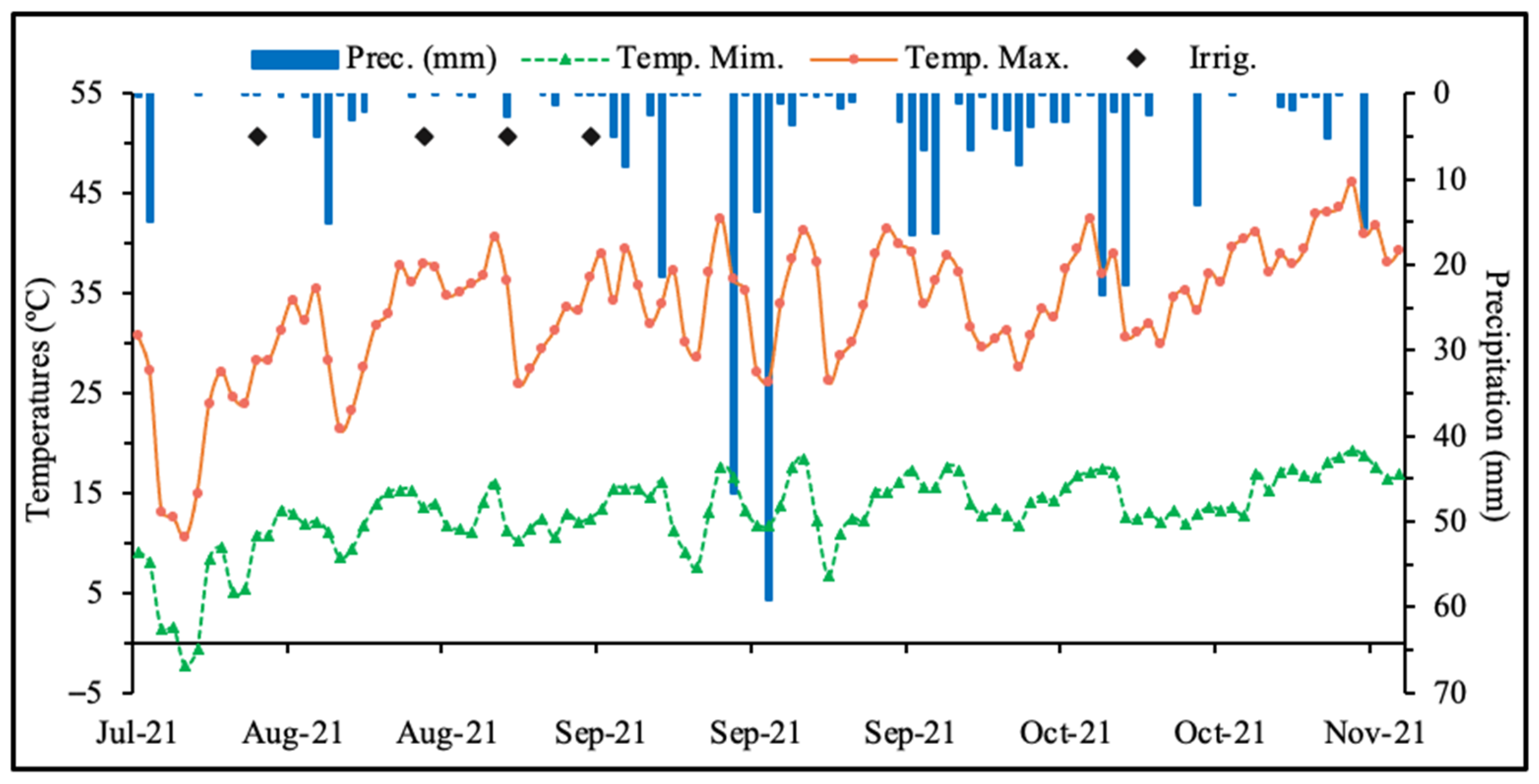
During the evaluated onion growing season (July to November 2021), daily precipitation, minimum and maximum air temperatures, and irrigation events were recorded at the experimental site (Figure 1). These climatic data are presented to provide environmental context for the interpretation of short-term greenhouse gas fluxes measured during the study period.
The soil is classified as a Humic Dystrudept according to the USDA Soil Taxonomy [27] and as Cambissolo Húmico Distrófico according to the Brazilian Soil Classification System [28]. At the beginning of the long-term experiment, the soil (0.00–0.10 m layer) presented the following properties, determined according to Teixeira et al. [29]: sand, silt, and clay contents of 410, 264, and 326 g kg−1, respectively; pH (H2O) of 6.1; exchangeable Ca, Mg, and Al contents of 6.4, 2.7, and 0.0 cmolc dm−3; available P and K contents of 42 and 208 mg dm−3; total organic carbon (TOC) of 23.08 g kg−1; and total nitrogen (TN) of 1.97 g kg−1.

2.2. Management of Treatments and Onion Crop

A randomized block experimental design was used, with three treatments: onion–maize rotation under no-till without cover crops (NT), onion–maize rotation under conventional tillage (CT) without cover crops, and onion–maize rotation under a no-till vegetable (NTV) system with a summer cover crop mixture of pearl millet (Pennisetum americanum), velvet bean (Mucuna aterrima), and sunflower (Helianthus annuus). The treatments were established in 2007 as part of a long-term experiment, initially with a seed mixture of black oat (Avena strigosa Schreb.), hairy vetch (Vicia villosa Roth), and oilseed radish (Raphanus sativus L.) sown across the entire experimental area. Subsequently, crop rotation treatments were implemented. From 2011 onward, the experiment was modified to focus on crop rotation, with adjustments to the cover crop sequence, and one no-till (NT) treatment was converted to conventional tillage (CT) for comparison with the other treatments.
The experimental area has been managed under a conservation agriculture system since 1995, when the last soil pH correction was performed, raising the pH to 6.0. Fertilizers applied during the experimental period for onion and maize cultivation were based on recommendations from the Soil Chemistry and Fertility Commission [30]. The fertilizers were applied for an estimated onion yield of 45 Mg ha−1, using 125 kg ha−1 of P2O5 (triple superphosphate) at transplanting; 105 kg ha−1 of K2O (potassium sulfate), with 60 kg ha−1 at transplanting and 45 kg ha−1 at 57 days after transplanting (DAT); and 160 kg ha−1 of nitrogen (N) (ammonium nitrate), with 25 kg ha−1 broadcast after the first gas collection on 27 July 2021, and the remainder in three applications: 35 kg ha−1 at 36 DAT, 65 kg ha−1 at 57 DAT, and 35 kg ha−1 at 85 DAT. In the NTV system, which included velvet bean, a nitrogen-fixing legume, nitrogen applications were reduced by 25%, totaling 120 kg ha−1 of N. Details regarding the cropping sequence and management history of the long-term experiment are provided in Appendix A (Table A1).

2.3. Plant Biomass on the Soil Surface

Dry matter production of maize crop residues in NT and CT systems, as well as cover crops in the NTV system, was quantified immediately before planting using a 0.25 m2 wooden quadrat, with two subsamples per plot. In the NTV system, dry matter consisted of a mixture of velvet bean, sunflower, and pearl millet; in NT, it consisted of maize crop residues; and in CT, it consisted of maize crop residues after soil preparation. The collected material was oven-dried at 65 °C until constant mass to determine dry matter. A 2 g subsample of dry matter was ground in a porcelain mortar to pass through a 100-mesh (0.149 mm) sieve. Carbon (C) and nitrogen (N) contents in the subsamples were determined using a dry combustion elemental analyzer (FlashEA 1112, Thermo Finnigan, Piracicaba, SP, Brazil).

2.4. Onion Yield

Onion yield was determined using 26 plants from each of the three central rows of each plot harvested in November 2021. After harvest, bulbs were left on the soil surface for approximately 10 days to undergo curing, a process involving drying and water loss from tops to prepare for storage. Subsequently, the bulbs were weighed to determine yield, expressed as Mg ha−1.

2.5. Physical and Chemical Soil Assessments

Soil physical and chemical properties were evaluated to reflect long-term management effects accumulated over 14 years of continuous soil management. Soil samples were collected in March 2021 from a mini-trench (0.40 × 0.40 × 0.40 m) in each experimental unit from three depth intervals: 0.00–0.05, 0.05–0.10, and 0.10–0.30 m.

2.5.1. Soil Bulk Density and Pore Size Distribution

Soil bulk density was determined using the volumetric ring method. Samples of known volume (50 cm3) were collected, dried in a forced air-circulation oven at 110 °C for 72 h, and weighed to calculate the dry soil mass. Bulk density was calculated as the ratio of dry soil mass to the ring volume [29].
Total porosity was calculated as the difference between the mass of saturated soil and the mass of soil oven-dried at 105 °C [29]. Micropore volume was determined by measuring water retention after saturating the soil sample and applying a suction pressure of 6 kPa on a sand tension table [29]. Macropore volume was calculated as the difference between total porosity and the micropore volume [29].

2.5.2. Aggregate Stability

Soil samples for aggregate stability analysis were air-dried and gently fragmented along natural fracture points. Aggregates between 4 and 8 mm were selected by sieving [29]. Approximately 25 g of aggregates retained in the 4.00 mm sieve was transferred to a set of sieves with decreasing mesh sizes (2.00, 1.00, 0.50, 0.25, 0.105, and 0.053 mm). The aggregates were moistened and then wet-sieved for 15 min using a Yoder apparatus [31]. Material retained in each sieve was transferred to pre-weighed, labeled aluminum crucibles and oven-dried until constant mass. The geometric mean diameter (GMD) of aggregates was calculated based on aggregate mass, as described by Teixeira et al. [29].

2.5.3. Total Organic Carbon (TOC) and Total Nitrogen (TN) Contents and Stocks

Disturbed soil samples were air-dried and passed through a 2 mm sieve. A 2 g subsample was ground in a porcelain mortar to pass through a 100-mesh (0.149 mm) sieve for TOC and TN analysis. TOC and TN contents were determined using a dry combustion elemental analyzer (FlashEA 1112, Thermo Finnigan). TOC and TN stocks were calculated using the equivalent mass method, based on the C and N contents and soil bulk density, using Equation (1) [32].
CS   or   NS   = i = 1 n 1 CTi + MTn     i = 1 n MTi i = 1 n MSi CTn
where:
CS or NS: total stock of carbon (C) or nitrogen (N) in Mg ha−1;
i = 1 n 1 CTi : Sum of C or N from the first (surface) to the last (deepest) soil layer in the evaluated treatment, in Mg ha−1;
i = 1 n MTi : Sum of soil mass from the first to the last soil layer in the evaluated treatment, in Mg ha−1;
i = 1 n MSi : Sum of soil mass from the first to the last soil layer in the reference treatment (NTV), in Mg ha−1
MTn : Soil mass in the last layer of the soil profile in the evaluated treatment, in Mg ha−1;
CTn: Concentration of C or N in the last layer of the evaluated treatment, in Mg C or N Mg−1 of soil.

2.5.4. Soil Moisture During the Onion Crop Cycle

Gravimetric soil moisture was assessed by collecting weekly soil samples from the 0.00–0.10 m layer during the onion crop cycle and GHG sampling periods across all treatments. Samples were immediately placed in airtight containers to prevent moisture exchange with the atmosphere. Samples were stored away from sunlight, then transferred to pre-weighed crucibles and dried in a forced-air circulation oven at 105 °C for 24 h to determine dry mass. Gravimetric moisture was calculated [33].
Water-filled pore space (WFPS, %) was calculated using gravimetric moisture, soil bulk density, and total porosity data, using Equation (2) [34,35].
WFPS   ( % ) = ( Ug   ×   Ds ) TP   ×   100
where:
WFPS (%): water-filled pore space (%);
Ug: Gravimetric moisture (g g−1);
Ds: Soil bulk density (g cm−3);
TP: Total soil porosity (m3 m−3).

2.6. Collection and Analysis of GHG Samples

Greenhouse gas fluxes were measured during one onion growing season (106 days), representing a short-term assessment of GHG dynamics within a long-term (14-year) agroecological field experiment.
Fluxes of N2O, CH4, and CO2 were measured from 27 July to 9 November 2021, over 106 days during the onion crop cycle. Gas samples were collected between 09:00 and 11:00 using the static closed chamber method [35,36,37]. Gas sampling was conducted within this time window because it is commonly used in field studies to approximate mean daily fluxes and minimize diurnal variability, following established protocols in the literature. Twenty-eight samplings were conducted during the monitoring period, at 1, 2, 4, 8, 11, 14, 22, 29, 36, 37, 39, 42, 46, 49, 57, 64, 65, 67, 71, 74, 79, 85, 86, 88, 91, 94, 100, and 106 days after the first nitrogen fertilizer application to the onion crop. The first sampling was conducted before nitrogen application, with subsequent samplings at approximately 3-day intervals during the first two weeks, followed by 7-day intervals, corresponding to 0, 1, 3, 7, 10, 13, 21, and 28 days after nitrogen application. More frequent sampling was conducted during this period due to greater emission rates immediately after fertilizer application.
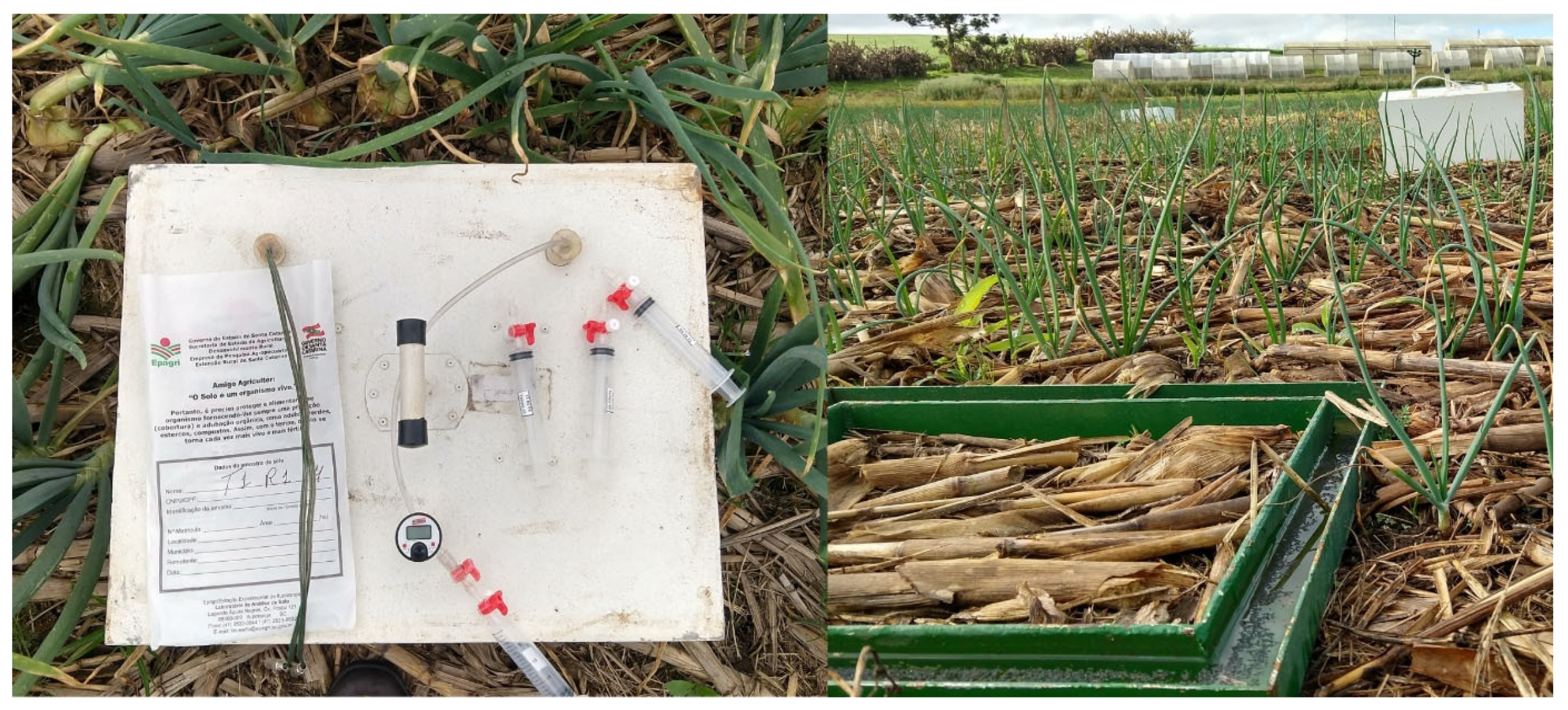
Sampling chambers consisted of two main parts: a base, constructed from 5 mm thick carbon steel plates, welded to form a 0.04 m wide and 0.03 m high channel with a centralized 0.05 m platform for soil fixation before the experiment; and a rectangular box (0.40 m width, 0.50 m length, 0.25 m height) constructed from 2 mm galvanized steel sheets. Chambers were equipped with two 12 V fans and a small electrical circuit connected to an external battery during field sampling (Figure 2).
Each chamber had three openings on its top: one for a thermometer with a sealing stopper to measure internal air temperature; another for a catheter with a luer-lock valve for gas collection; and a third for the electrical circuit connection to an external battery to power the fans. A probe thermometer was used to measure soil temperature at 0.05 m depth. The sampling apparatus included a 12-V battery to power the fans, 20-mL polypropylene syringes with luer-lock valves for gas collection, and a thermal box for sample transport to the laboratory.
The gas sampling procedure began by activating the fans via the external battery for 30 s to homogenize the air inside the chamber, followed by three syringe plunger movements to flush the catheter. The syringe plunger was then withdrawn to the 20 mL mark, the catheter and syringe valves were closed, and the syringe was removed and placed in an insulated box. Samples were transferred to pre-evacuated 12-mL exetainer vials and refrigerated until analysis. This procedure was repeated four times at 0, 15, 30, and 45-min intervals to derive the GHG emission curve for each sampling event.
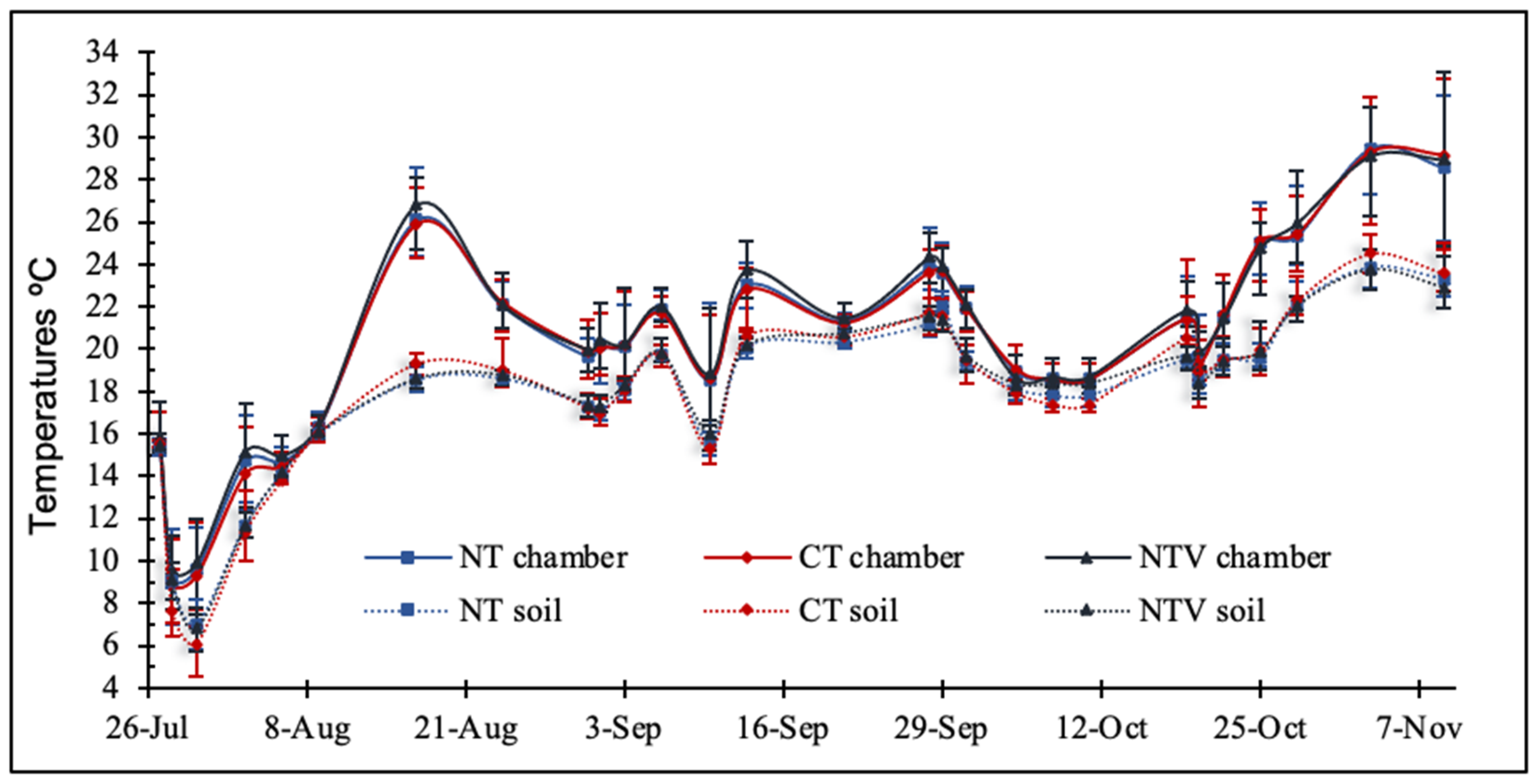
During each gas sampling event, internal chamber air temperature and soil temperature were recorded. These auxiliary data were essential for interpreting emissions; variations during the onion crop cycle are presented in Figure 3.
Concentrations of N2O, CH4, and CO2 were quantified using a gas chromatography (Shimadzu GC-2014, Greenhouse Model, Kyoto, Japan) equipped with an electron capture detector for N2O and a flame ionization detector for CH4 and CO2. Daily fluxes of N2O, CH4, and CO2 were calculated using Equation (3), adapted from Schirmann et al. [38], based on the linear relationship between gas concentration in the chamber and time between chamber closure and sample collection.
DGF =   ( Gas ) t   ×   PV RT   ×   M A   ×   Element Gas
where:
DGF: Daily gas flux of N2O (g ha−1 day−1), CH4 (g ha−1 day−1), or CO2 (kg ha−1 day−1);
Δ(Gas): Change in gas concentration (N2O: nmol mol−1; CH4: µmol mol−1; CO2 µmol mol−1) inside the chamber;
Δt: Incubation time (minutes);
P: Atmospheric pressure inside the chamber (1 atm);
V: Chamber volume (L);
R: Universal gas constant (0.082 L atm·mol−1·K−1);
T: Chamber internal temperature (K);
M: Molecular mass of the gas (g mol−1);
A: Soil area covered by the chamber (m2);
Element/Gas: Ratio of the element’s atomic mass to the gas molecular mass (N2O: 28/44; CH4: 12/16; CO2: 12/44).
Climatic conditions during the monitoring period, including precipitation, air temperature, and irrigation events (Figure 1), were considered to provide environmental context for the interpretation of short-term variations in greenhouse gas fluxes, particularly following fertilization and rainfall events.

2.7. Global Warming Potential (GWP)

Average daily fluxes were determined as the mean of four replicates. The mean flux between two consecutive sampling events was calculated by multiplying the mean flux by the time interval (days) between samplings. Cumulative emissions of N-N2O, C-CH4, and C-CO2 were estimated by trapezoidal integration of their respective daily fluxes. These calculations assumed that fluxes measured between 09:00 and 11:00 represent the mean daily emission [36]. Carbon equivalent emissions were derived from cumulative emission values using Equations (4)–(6), adapted from Siqueira Neto et al. [35].
Carbon equivalent (Ceq) emissions were derived from cumulative emission values using Equations (4)–(6), adapted from Siqueira Neto et al. [35]. Ceq emissions derived from N2O and CH4 were used to estimate the greenhouse gas warming potential of the evaluated systems. In contrast, Ceq emissions derived from CO2 fluxes were not interpreted as an indicator of climate change mitigation.
CO2 fluxes measured using static chambers represent ecosystem respiration, including microbial and root respiration, and do not account for photosynthetic CO2 uptake by crops. Therefore, C-CO2 values do not represent net ecosystem C balance and were used exclusively to characterize short-term soil respiratory activity under different soil management systems.
The assessment of greenhouse gas impacts was interpreted in conjunction with long-term changes in soil carbon stocks (ΔSOC), which provide a more robust indicator of cumulative C sequestration associated with sustained soil management practices.
C _ eq   ( N 2 O ) = N - N 2 O   ×   44 / 28   ×   273   ×   12 / 44
C _ eq   ( CH 4 ) = C - CH 4   ×   16 / 12   ×   27   ×   12 / 44
C _ eq   ( CO 2 ) = C - CO 2   ×   12 / 44   ×   1   ×   12 / 44
where:
C_eq: Carbon equivalent emissions (Mg C ha−1);
N-N2O, C-CH4 and C-CO2: Cumulative gas emissions (Mg ha−1);
44/28: Ratio of N2O molecular mass to N atomic mass;
273: 100-year global warming potential (GWP-100) of N2O [12];
16/12: Ratio of CH4 molecular mass to C atomic mass;
27: 100-year global warming potential (GWP-100) of CH4 [12];
12/44: Ratio of C atomic mass to CO2 molecular mass;
1: 100-year global warming potential (GWP-100) of CO2 [12].

2.8. Statistical Analyses

Daily flux variations for N-N2O, C-CH4, and C-CO2 were expressed as the standard error of the mean (n = 5). Data on cumulative emissions of N-N2O, C-CH4, and C-CO2, soil chemical and physical properties, onion yield, and cover crop dry matter were evaluated for statistical assumptions. Residual normality was assessed using the Shapiro-Wilk test, and variance homogeneity was evaluated with Levene’s test. When assumptions were met, analysis of variance (ANOVA) was performed. Means showing significant differences in the F-test were compared using Tukey’s test at a 5% significance level. Statistical analyses were performed using Sisvar® version 5.8 [39].

3. Results and Discussion

3.1. Biomass Production and Onion Yield

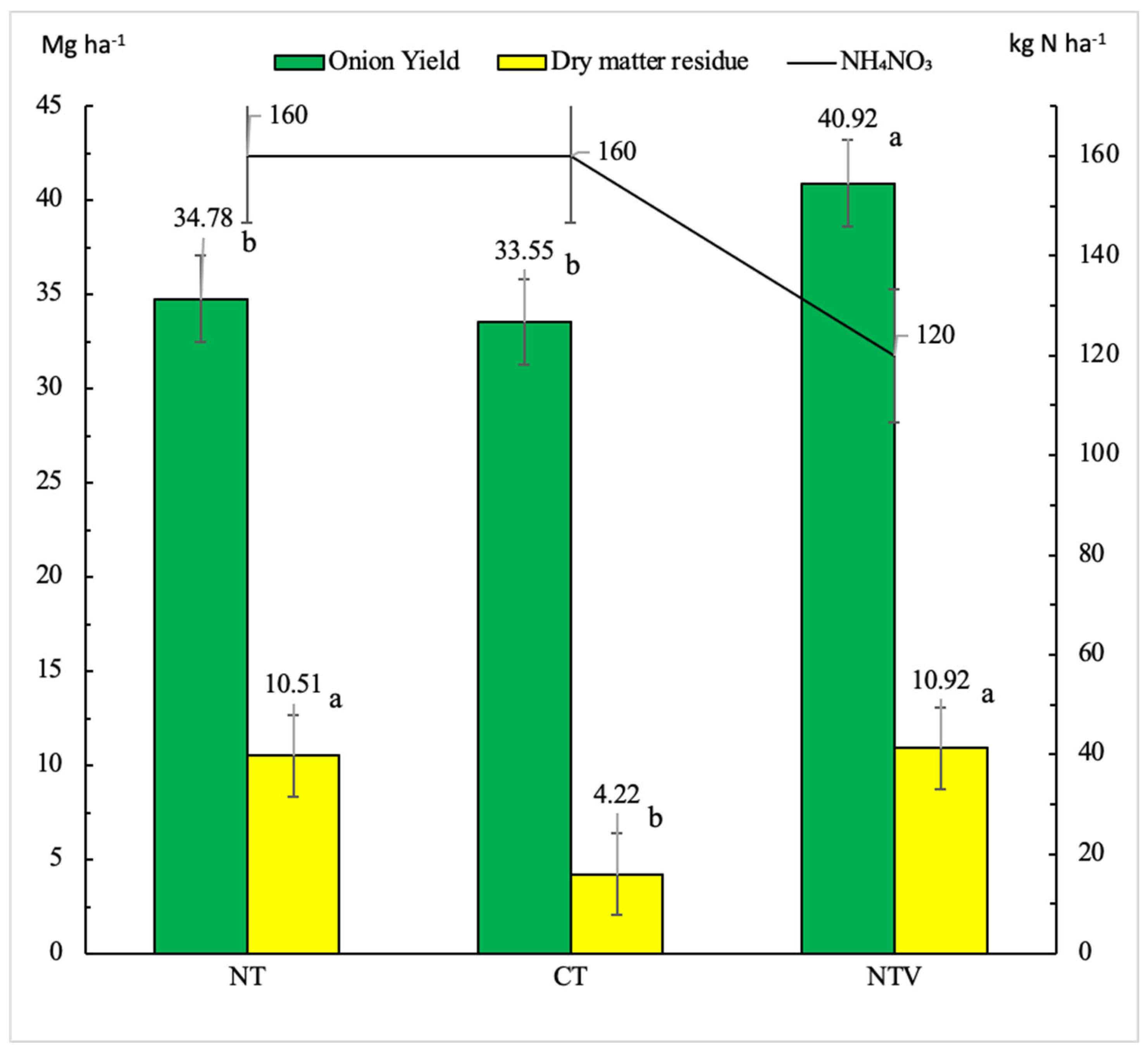
Biomass accumulation in the NT and NTV treatments exceeded 10 Mg ha−1 (Figure 4), a threshold considered optimal for maintaining ΔSOC and production system sustainability in the NTV system (20). In contrast, the CT treatment maintained 4.22 Mg ha−1 of residues on the soil surface, despite substantial biomass incorporation during tillage operations (plowing and harrowing). The high biomass levels in the NT and CT treatments reflect the substantial dry matter production of maize, the previous crop. Its high C:N ratio contributed to residue persistence in the soil after harvesting (Table 1).
The NTV treatment exhibited higher N content in surface residues, attributed to the presence of velvet bean, while C content showed no differences, resulting in a lower C/N ratio for the NTV biomass (Table 1). The NTV treatment achieved a mean onion yield of 40.92 Mg ha−1, 18% higher than NT (34.78 Mg ha−1) and 22% higher than CT (33.55 Mg ha−1), with no significant differences between NT and CT (p < 0.05, Figure 4). The higher onion yield in NTV was associated with the dry matter production of the cover crop mixture of pearl millet (Pennisetum americanum), velvet bean (Mucuna aterrima), and sunflower (Helianthus annuus) and increased N availability due to velvet bean (Figure 4, Table 2).
Despite receiving 25% less N fertilizer than NT and CT (Figure 4), the NTV system achieved, on average, a 20% higher onion yield, highlighting the importance of including legumes (velvet bean) in cover crop mixtures for enhancing dry matter production. N, the most required nutrient for onions [40], typically results in lower onion yields when reduced from 160 to 120 kg ha−1, but the higher yield in NTV suggests that the N fixation capacity of velvet bean and the crop residues compensated for this reduction [41].
The higher onion yield in NTV was also linked to improved soil conditions compared to NT and CT, including higher N content in the 0.00–0.05 m soil layer, increased ΔSOC, greater soil aggregation (geometric mean diameter, GMD), and reduced soil bulk density (Table 3 and Table 4). These soil properties created a favorable environment for increased onion yield, consistent with findings from other studies under NTV and CT systems [42].
The use of a cover crop mixture (velvet bean, pearl millet, and sunflower) in the NTV system promotes nutrient accumulation in plant biomass and its subsequent release during decomposition, thereby contributing to soil fertility maintenance and improvement [43]. The combination of species from different botanical families—velvet bean (Fabaceae), pearl millet (Poaceae), and sunflower (Asteraceae)—enhances nutrient cycling. Velvet bean has an average C:N ratio of 16.5:1, an average dry matter production of 7.5 Mg ha−1, and an average biological N fixation capacity of 185 kg ha−1 year−1 [44,45,46]. Pearl millet has an average C:N ratio of 36.5:1 and an average dry matter production of 11.5 Mg ha−1 [44,47]. Sunflower has an average C/N ratio of 24:1 and an average dry matter production of 10.5 Mg ha−1 [48,49].
Pearl millet and sunflower have extensive root systems that create biopores, facilitating root growth and nutrient acquisition across a larger soil volume [43,44]. This process contributes to nutrient translocation from deeper to surface soil layers, benefiting onion plants, which have fibrous roots that primarily exploit the surface layers [50].

3.2. Soil Chemical and Physical Properties

3.2.1. Carbon and Nitrogen Contents and Stocks

The NTV treatment exhibited the highest total organic carbon (TOC) contents and stocks, particularly in the 0.00–0.05 m soil layer, with a TOC stock of 21.62 Mg ha−1, significantly higher than NT (17.75 Mg ha−1) and CT (16.98 Mg ha−1). In contrast, NT and CT treatments, with maize crop residues, presented lower total nitrogen (TN) contents and stocks, particularly in the 0.00–0.05 m soil layer (Table 2). This result is attributed to the presence of cover crops in the NTV system, notably velvet bean, which has a high biological N fixation capacity (approximately 185 kg ha−1 year−1) [46,51].
Decomposition and mineralization of the velvet bean, pearl millet, and sunflower cover crop mixture increased TOC and TN contents and stocks in the 0.00–0.05 m soil layer. The high C/N ratio of maize residues (Table 1) resulted in slower decomposition and greater N immobilization, delaying nutrient availability in the soil [52,53,54]. Periodic soil tillage in the CT treatment reduced C and N retention by disrupting soil structure and accelerating plant residue mineralization, leading to C losses as CO2 (Table 2).
In the 0.00–0.30 m soil layer, the NTV treatment showed the highest TOC stocks, with no significant differences between NT and CT. The lowest TN stocks were recorded in CT, with no significant differences between NT and NTV systems. These findings indicate the long-term effectiveness of NTV (and NT for TN) in increasing TOC and TN stocks, attributed to the maintenance of crop residues on the soil surface and the absence of periodic soil tillage.
Similar results in the same experimental area, with larger amounts of light organic matter, C, and N in soils under CT and NT compared to NTV was reported by other authors [55]. Likewise, the inclusion of legumes in cover crop mixtures can substantially increase soil ΔNS and enhance soil structure, thereby promoting organic C retention [35]. These findings demonstrate that the diversity and appropriate selection of cover crops are essential for improving nutrient management and the sustainability of agricultural systems.
Comparable results were also reported by other authors [21,23], who evaluated C and N contents and stocks in different management systems under CT and NTV at the 0.00–0.30 m layer, using single and mixed cover crops in onion and cauliflower cultivation, and found higher values for areas managed under NTV under similar soil and climate conditions.

3.2.2. Soil Aggregation and Bulk Density

The NTV treatment showed the highest geometric mean diameter (GMD) of soil aggregates compared to CT (Table 3). The NT treatment had lower aggregate stability than NTV in the 0.00–0.05 m soil layer but was similar in deeper layers. NTV also presented lower soil bulk density than NT and CT in the 0.00–0.05 and 0.05–0.10 m soil layers, while NT and CT had similar values (Table 3).
These results confirm the adverse effects of conventional tillage on soil aggregate stability [21,23,55]. Moreover, aggregate disruption exposes previously protected organic matter, accelerating its decomposition. Therefore, these findings emphasize the importance of species diversification for improving soil structure, as NT and NTV avoid plowing and harrowing, while the greater plant diversity in NTV further enhances aggregate stability (Table 3), consistent with other studies [56,57].
The lower soil bulk density in the NTV treatment is attributed to higher ΔSOC (Table 2) and greater soil aggregate stability (Table 3). Furthermore, the diverse root architectures in NTV, present throughout the year, improve soil aeration, water retention, and infiltration [58].
Soil compaction in surface layers can limit onion crop development, since its root system explores a relatively small soil volume compared to other crops [20,26]. However, soil bulk density in all treatments remained below the critical threshold of 1.4 Mg m−3 for this soil textural class [59]. This underscores the importance of using cover crops in soil management to improve physical structure and support onion development, making periodic soil tillage unnecessary for enhancing crop performance, as evidenced by the observed yields (Figure 4).
These findings are consistent with those from other authors [55], who, in the same area in 2016, observed lower GMD values in all soil layers under CT compared to NTV. However, the NT treatment showed no significant difference in GMD compared to CT in the 0.05–0.10 and 0.10–0.20 m soil layers. In the present study, conducted in 2021, clear differences among the treatments demonstrated that an additional five years of management amplified the benefits of NTV on soil structure, highlighting the positive long-term effects of continuous NTV adoption and plant diversity.
In contrast, the greater biomass of maize crop residues in NT likely contributes to maintaining larger aggregates. Although significant differences in GMD values between NT and NTV across all soil layers were reported, the present study found no significant difference in the 0.05–0.10 and 0.10–0.20 m soil layers [55]. This suggests that NT, over time, promotes the formation of stable macroaggregates, potentially due to greater biomass accumulation on the soil surface (Figure 4), which enhances organic matter content and microbial activity.

3.2.3. Porosity and Water-Filled Pore Space (WFPS)

No significant differences were observed in total porosity, macroporosity, and microporosity among the NT, CT, and NTV treatments across the evaluated soil layers (Table 4). Macroporosity tended to decrease with increasing soil depth, while microporosity remained relatively stable, indicating consistent soil structure across depths, as also reflected in the GMD values for NTV (Table 4).
Plowing and harrowing disrupt soil aggregates and create macropores by loosening the soil matrix [60,61]. However, the similar macroporosity among treatments suggests that the greater plant diversity in NTV and the greater biomass in NT (Figure 4) offset the effects of mechanical soil disturbance. Additionally, diverse cover crop root systems stabilize soil structure through exudates and promote the formation of continuous, stable biopores [62]. Across all treatments, macroporosity in the surface layers (0.00–0.05 and 0.05–0.10 m) exceeded the critical threshold of 10%, below which soil aeration is impaired [59]. In the deeper subsurface layer (0.10–0.30 m), only CT exhibited macroporosity above 10%, although no significant differences were observed among treatments (Table 4).
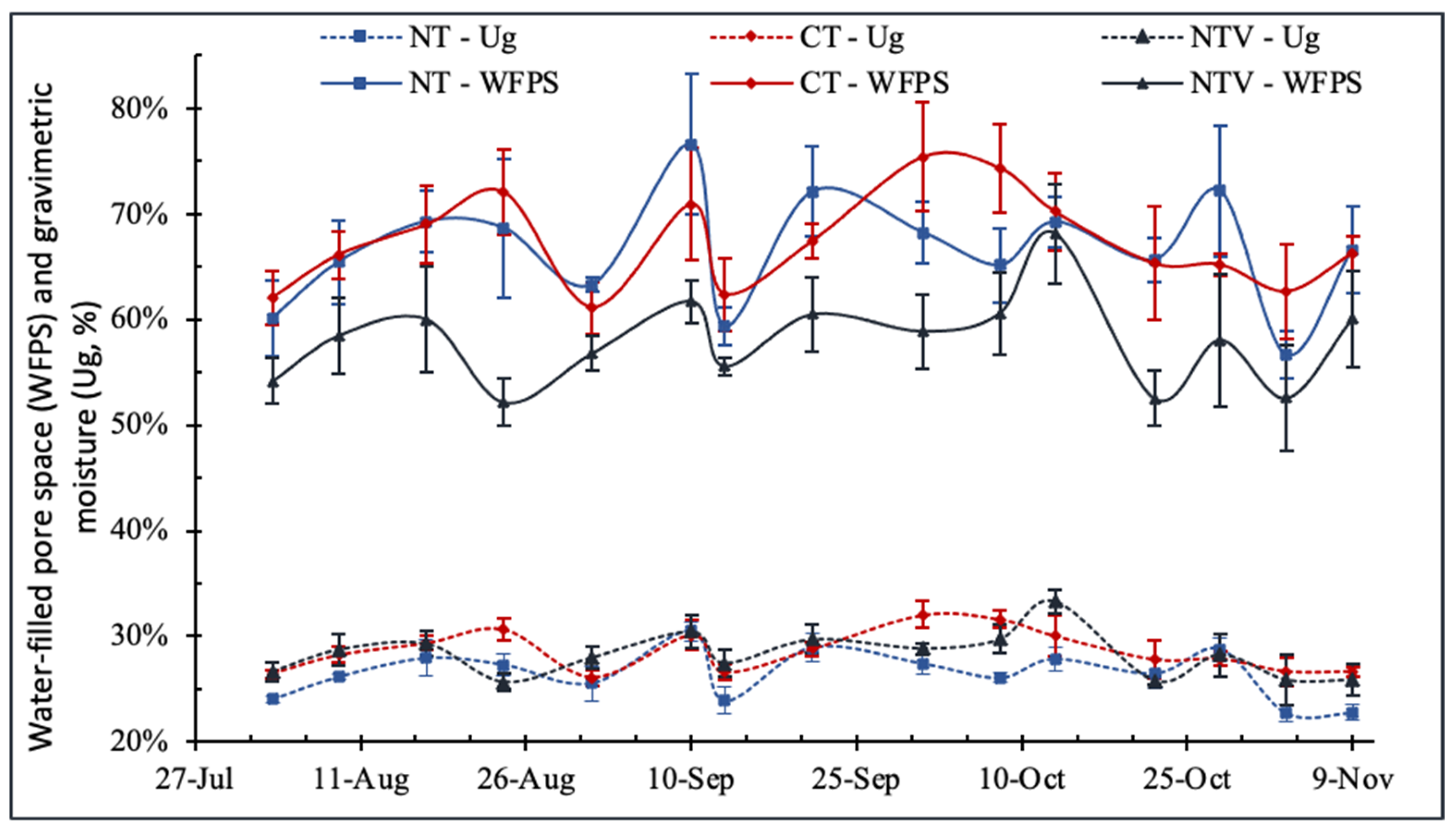
The NTV treatment had the lowest water-filled pore space (WFPS) values, ranging from 44% to 57% during the monitoring period (Figure 5). Plant diversity in NTV improved aggregation (Table 3), reduced soil bulk density (Table 3), and increased ΔSOC (Table 2) over the 14-year experiment, resulting in favorable soil structural conditions that enhanced soil aeration, despite similar gravimetric soil moisture among treatments.
The highest WFPS values were observed in CT and NT, particularly in the early weeks of the monitoring period, when soil moisture and structure were strongly influenced by soil preparation. CT exhibited higher soil bulk density (Table 3), which, at the same volumetric moisture content, increases water-filled pore space and decreases air-filled pore space [63]. WFPS values in NT were generally intermediate, peaking at 77% on 1 September and 67% on 28 October, surpassing those of CT on both dates.
Aeration porosity, the fraction of total soil volume occupied by air, remained consistently above the critical threshold of 20% in NTV, supporting aerobic processes. In contrast, NT and CT experienced periods of restricted aeration when high WFPS values reduced aeration porosity below 20%.
N dynamics involve different critical WFPS thresholds: nitrification is the dominant process for N2O emissions below 60% WFPS, whereas denitrification predominates above 70% WFPS [64,65]. However, both processes may occur simultaneously due to soil heterogeneity [66,67]. Thus, N2O emissions in NTV, with WFPS values ranging from 44% to 57%, are primarily driven by nitrification.

3.3. Daily and Cumulative GHG Emissions

Greenhouse gas emissions reported in this study were measured during a single onion growing season and therefore represent short-term dynamics within a long-term agroecological experiment. It is well recognized that GHG fluxes, particularly N2O, exhibit strong seasonal and interannual variability. Consequently, the results presented here should be interpreted as an initial baseline rather than as representative long-term emission estimates.
Within this temporal framework, the increases in ΔSOC and improvements in soil physical properties observed under the NTV system can be interpreted based on well-established soil biogeochemical mechanisms. Reduced soil disturbance combined with continuous residue inputs promotes the formation and stabilization of soil aggregates, which physically protect TOC from microbial decomposition. Permanent soil cover and diversified biomass inputs enhance aggregate stability and reduce the exposure of SOM to oxidative processes, contributing to the accumulation of C over time. These mechanisms are consistent with the long-term increases in ΔSOC and improved structural attributes observed under the NTV system.
Higher short-term N2O emissions observed under the NTV system are likely associated with increased substrate availability and soil moisture conditions created by permanent soil cover and residue retention. Greater organic matter inputs provide C sources that stimulate microbial activity, while reduced soil disturbance and higher water-filled pore space may favor nitrification and denitrification processes. In addition, the inclusion of leguminous species in the cover crop mixture may increase mineral N availability during residue decomposition, further enhancing conditions conducive to N2O production during periods of elevated soil moisture. These findings highlight a short-term trade-off between improved soil quality and increased N2O emissions under intensified agroecological management.
Elevated CO2 fluxes under systems with greater residue inputs likely reflect enhanced soil biological activity associated with increased C inputs and improved soil structure. As CO2 fluxes measured using static chambers represent ecosystem respiration, including microbial and root respiration, and do not account for photosynthetic carbon uptake, these fluxes should not be interpreted as indicators of net carbon loss or greenhouse gas mitigation. Instead, higher CO2 emissions under the no-till vegetable system are indicative of more active carbon cycling and biological functioning in soils exhibiting long-term increases in carbon stocks. These mechanisms are further discussed in the following sections in light of the observed emission patterns and available literature

3.3.1. N2O Emissions

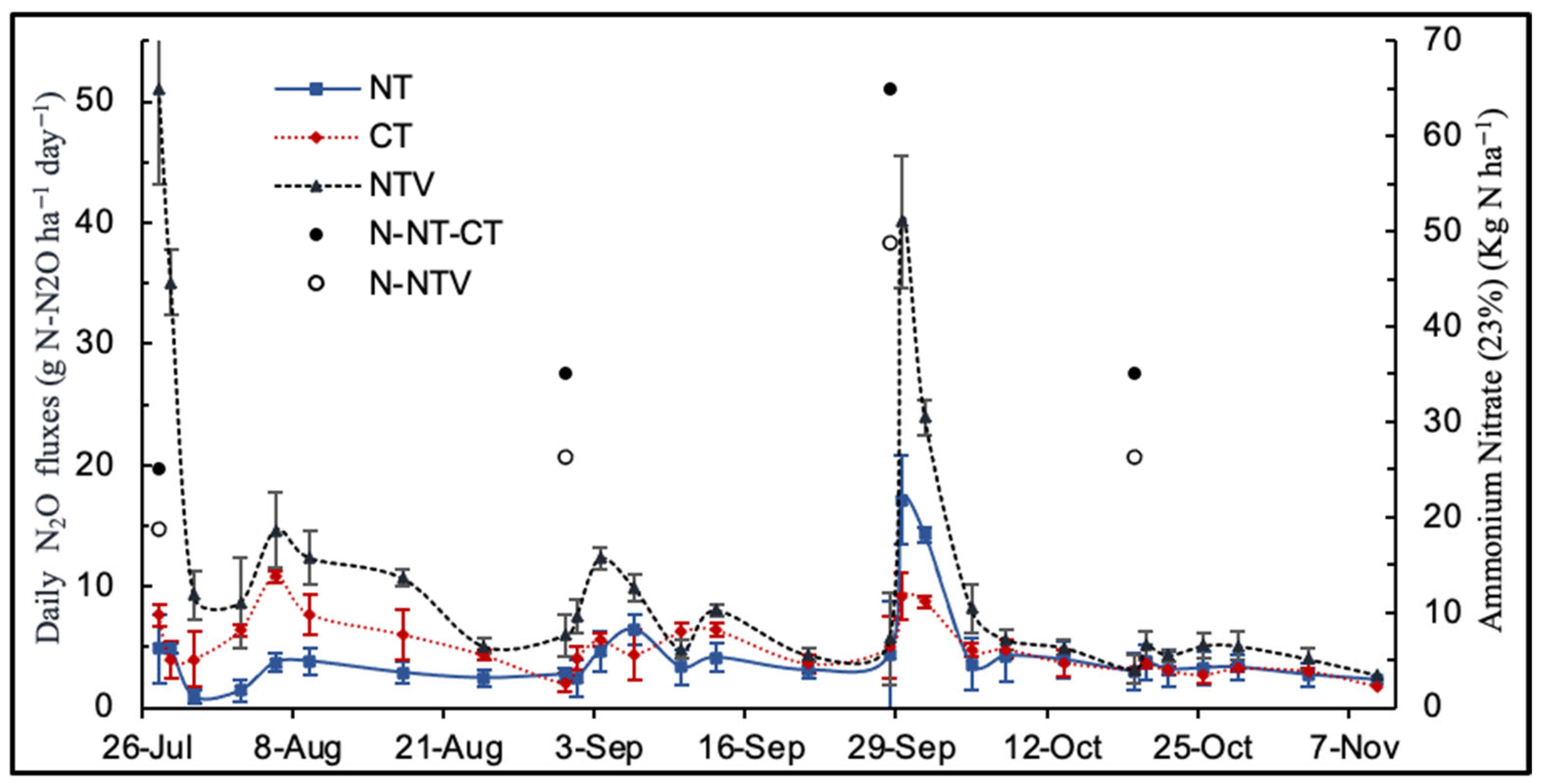
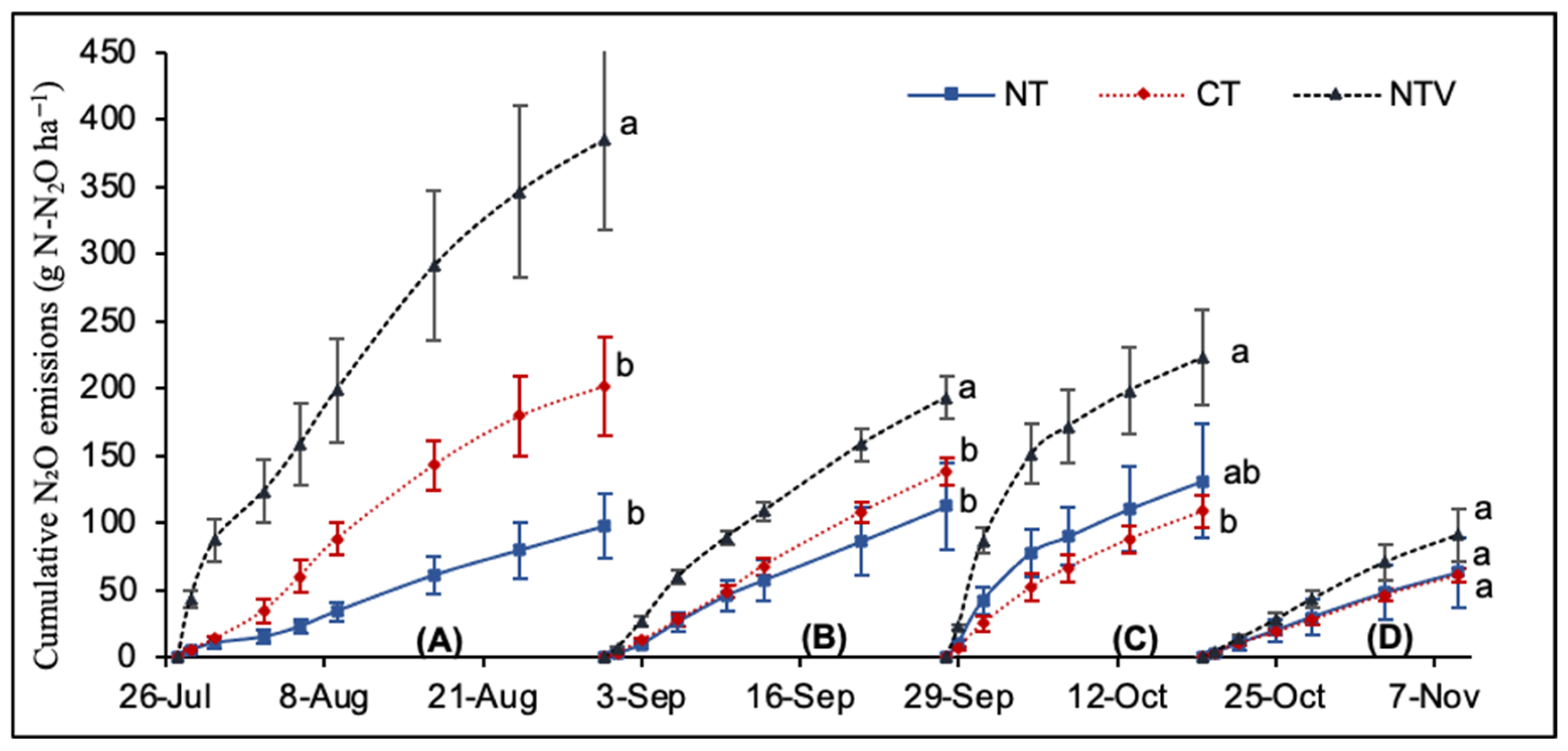
The highest N2O fluxes (51.02 g N-N2O ha−1 day−1) were recorded in the NTV treatment from the first day of evaluation onward, even before ammonium nitrate application. In the first three days, all treatments exhibited a reduction in N2O emissions, followed by a minor peak approximately 10 days after onion transplanting, reflecting the rapid response of soil microbiota to soil moisture and nutrient availability (Figure 6).
The initial N2O emission peak in NTV is attributed to greater soil N availability from biological fixation and the rapid biomass decomposition of cover crops (pearl millet, Pennisetum americanum; velvet bean, Mucuna aterrima; sunflower, Helianthus annuus). The low C:N ratio of the cover crop mixture (13:1, Table 1), combined with higher ΔNS (Table 2), accelerates mineralization in NTV [41,53,66,68]. These findings align with those from other authors [69], who evaluated an adjacent NTV system with different cover crop mixtures under similar conditions and observed a similar initial N2O emission peak attributed to the rapid decomposition of cover crops, particularly in treatments with oilseed radish and poultry manure, and enhanced availability of N and C for denitrifying microbes.
Each ammonium nitrate application was followed by N2O emission peaks, with the highest fluxes observed 3–10 days after the second and fourth fertilizer applications. N2O emissions from different N fertilizer sources in no-till maize and soybean crops in the Brazilian Cerrado were quantified, with similar peaks reported following ammonium nitrate application [45].
After the third topdressing, which applied the highest N rates (49 kg N ha−1 for NTV and 65 kg N ha−1 for NT and CT), the highest N2O fluxes were recorded in NT (17.13 g N-N2O ha−1 day−1) and CT (9.20 g N-N2O ha−1 day−1), while NTV exhibited the second-highest emission peak (40.10 g N-N2O ha−1 day−1). High N rates combined with residual biomass in NTV enhanced mineralization, nitrification, and denitrification, resulting in increased N2O fluxes. Recent studies confirm that the combination of N fertilizer with high soil biomass significantly increases N2O emissions, particularly in no-till systems [70,71,72], and in NTV with cauliflower crops [23].
Cumulative N2O emissions exhibited a progressive reduction in the differences between NTV and other treatments, reaching statistical similarity from the third ammonium nitrate application onward (Figure 7). Furthermore, cumulative N2O emissions declined throughout the onion crop cycle (Figure 7).
The ‘Bola Precoce’ onion cultivar exhibits peak N absorption (70% of total N uptake) between 56 and 84 days after transplanting, coinciding with the bulb formation phase [72]. During this period, the third ammonium nitrate topdressing was applied (49 kg N ha−1 for NTV and 65 kg N ha−1 for NT and CT). The second N2O emission peak in NT and NTV (29 September; Figure 6) was insufficient to cause significant differences in cumulative emissions during the third fertilization cycle (Figure 7C).
In the first two fertilization cycles, NT emitted less N2O than NTV but did not differ significantly from CT (p ≤ 0.05). The convergence of cumulative N2O emissions in NTV with NT and CT in the fourth cycle (Figure 7D) is attributed to the slow nutrient release from maize residues, due to their high C:N ratio [52] and reduced N demand by onions in their final physiological phase [26,40]. This likely made mineral fertilization the primary driver of emissions in all treatments, thereby reducing initial differences.
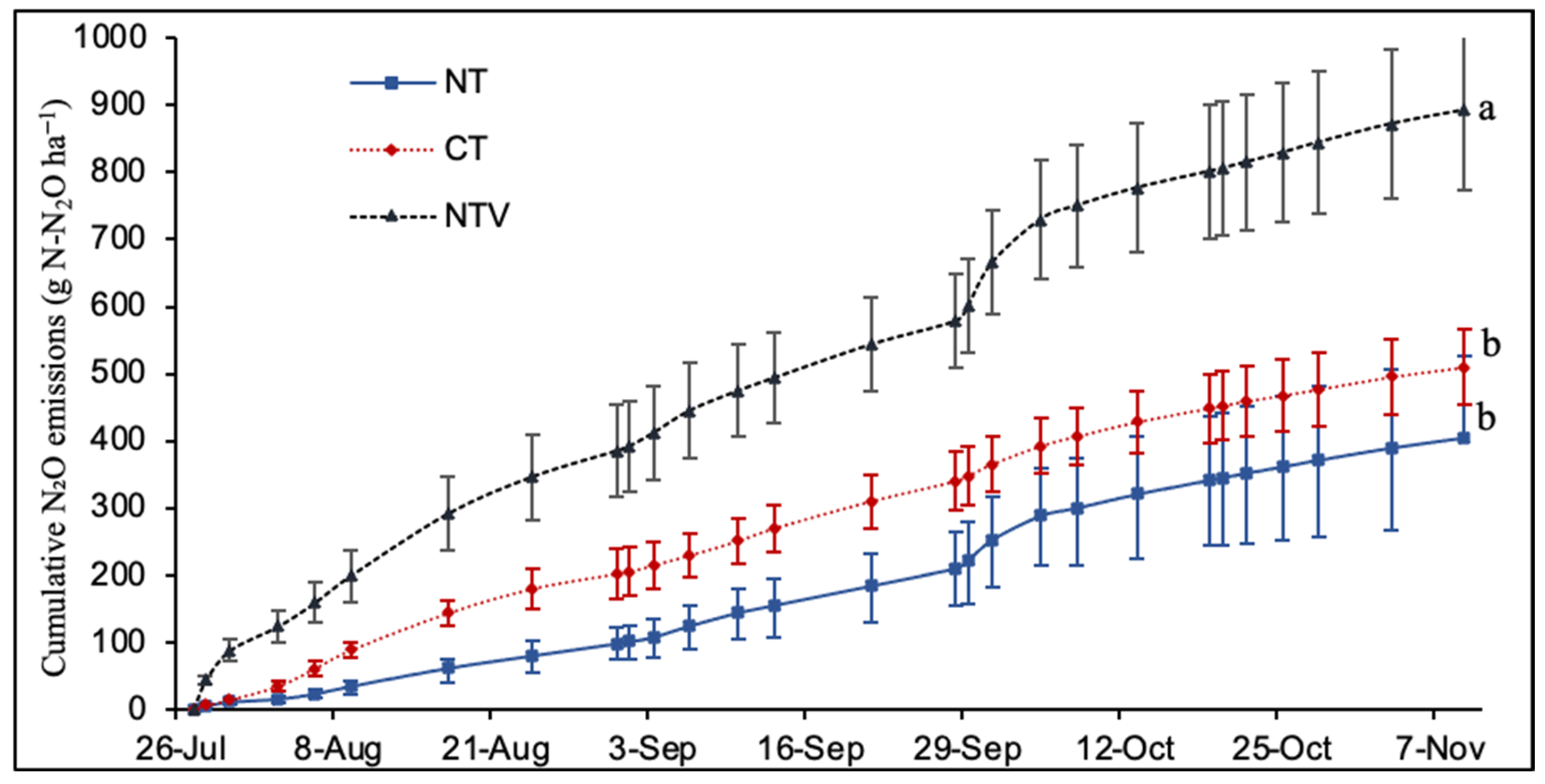
Over the 106-day monitoring period, NTV exhibited cumulative emissions of 892.42 g N-N2O ha−1, 75% higher than CT (509.60 g N-N2O ha−1) and 120% higher than NT (404.71 g N-N2O ha−1), with no significant difference between NT and CT (Figure 8).
NT and CT treatments underwent similar management practices, differing only in tillage system, with both receiving the same ammonium nitrate rates. NT has greater potential to enhance soil chemical and physical properties [55]. Fertile soils with high organic matter content, combined with moisture conditions that limit O2 diffusion and promote anaerobic environments, create optimal conditions for denitrification, thereby increasing N2O emissions [5]. However, the lack of significant differences in cumulative N2O emissions between NT and CT may be attributed to their similar WFPS values (Figure 5).
The NTV treatment, with the highest N2O emissions, represents a more diversified and sustainable production system due to its use of a cover crop mixture rather than a commercial crop in rotation with onions. This mixture increases dry matter production through crop rotation and has a low C/N ratio (Table 1), which promotes residue mineralization and higher N2O emissions. Similarly, cumulative N2O emissions in an 11-year NTV system and a 40-year CT system with cauliflower cultivation were evaluated, reporting values of 1708 g N-N2O ha−1 for NTV and 1235 g N-N2O ha−1 for CT [30]. These authors attributed these differences to N fertilization applied as topdressing and to the cover crop mixture used in NTV, which consisted of black oat, ryegrass, vetch, and barley in winter, and pearl millet, velvet bean, and signal grass in summer.
Despite higher N2O emissions, NTV maintained significantly higher TOC and TN stocks than NT and CT, particularly in the 0.00–0.05 m soil layer (Table 2), indicating improved soil quality. Moreover, onion yield in NTV, averaging 6.7 Mg ha−1 higher than NT and CT, reflects improved soil chemical and physical quality, despite a 25% reduction in ammonium nitrate application (Figure 4).
From a practical perspective, the observed short-term increase in N2O emissions under the NTV system should be interpreted in the context of the substantial agronomic and environmental benefits achieved. The NTV system increased onion yield, improved soil physical quality, and enhanced long-term soil carbon stocks while reducing mineral nitrogen inputs. These results suggest that, although short-term N2O emissions may increase, the overall system performance and resource-use efficiency are improved, indicating that management optimization rather than system replacement is the appropriate pathway to mitigate this trade-off.

3.3.2. CH4 Emissions

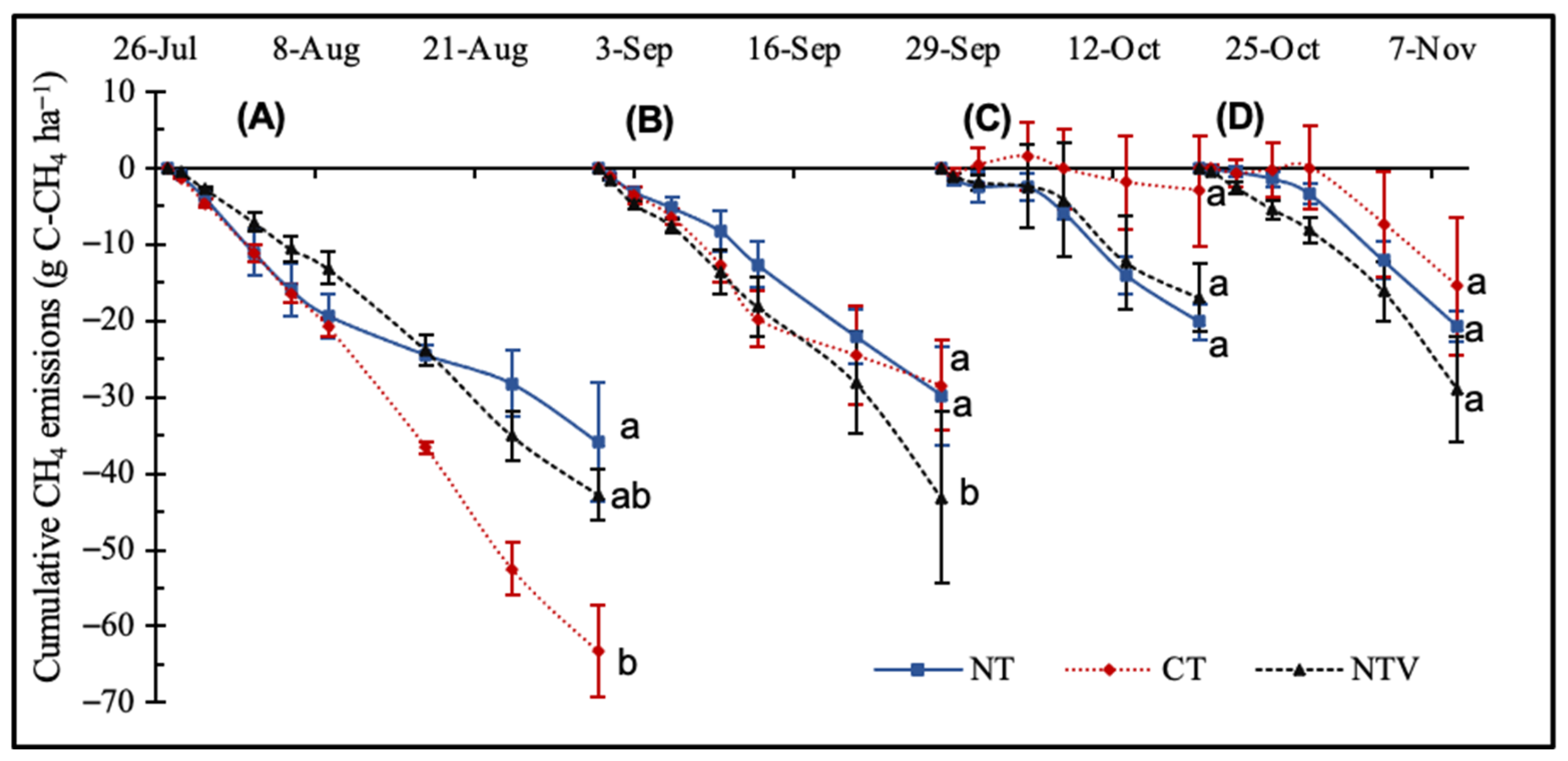
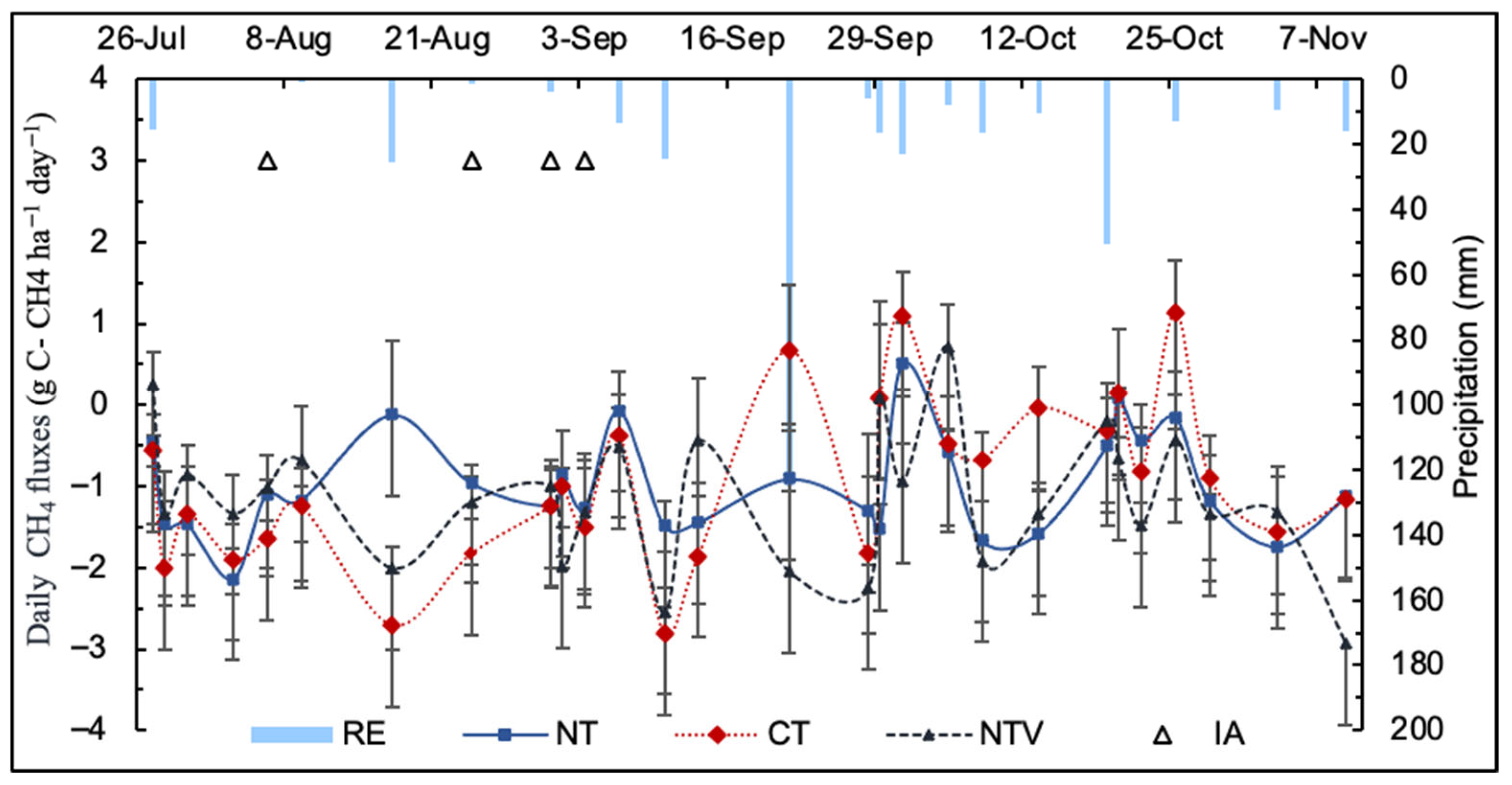
CH4 fluxes were associated with rainfall and irrigation events, with emissions occurring during the period of highest rainfall (21 September to 25 October 2021). The highest emission peak (1.13 g C-CH4 ha−1 day−1) was observed in CT on 25 October 2021, whereas the greatest uptake (−2.93 g C-CH4 ha−1 day−1) was observed in NTV at the end of the crop cycle (Figure 9).
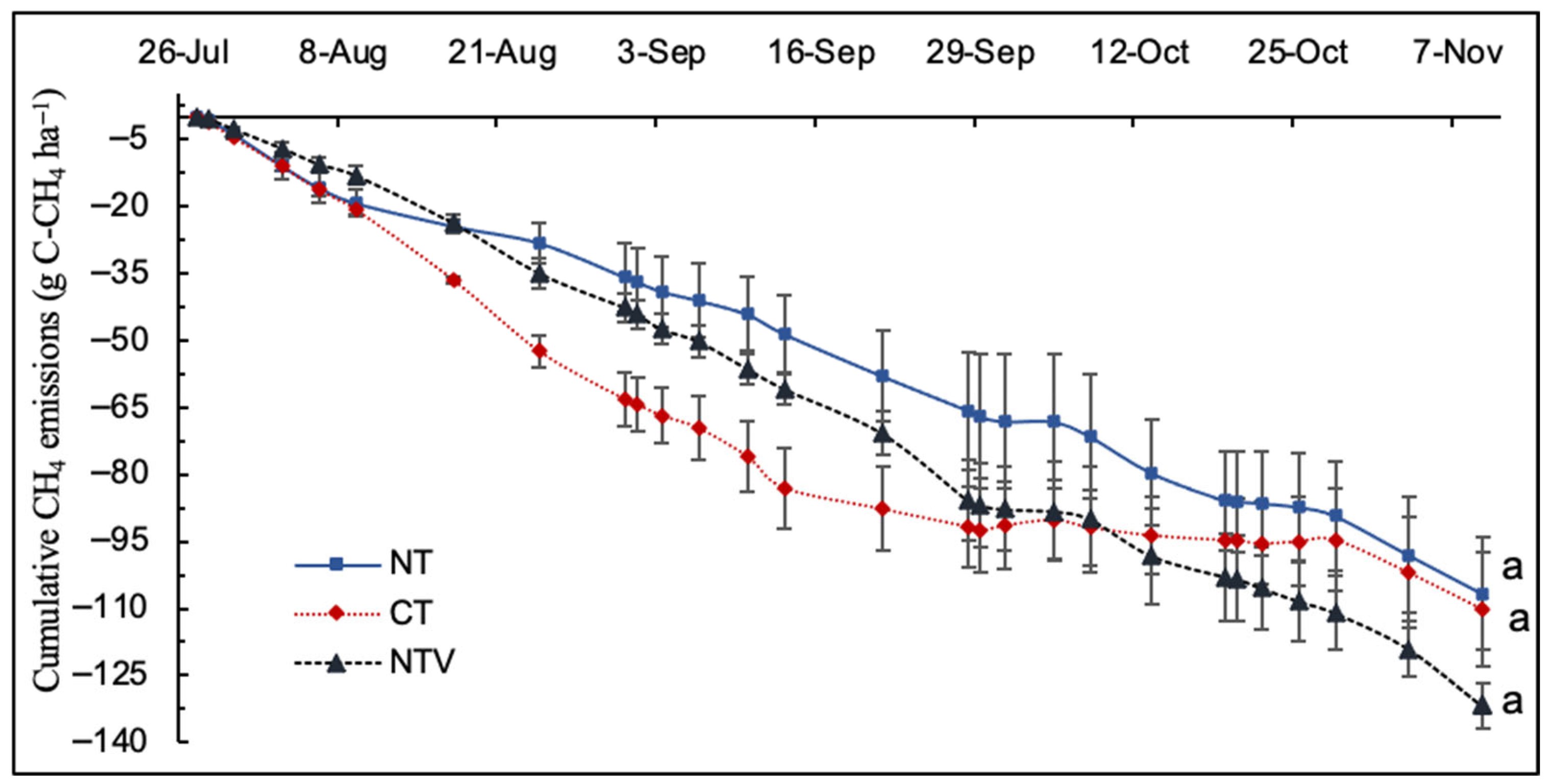
Throughout the 106-day monitoring period, all treatments functioned as CH4 sinks, with cumulative uptake of 131.79 g C-CH4 ha−1 in NTV, 110.22 g C-CH4 ha−1 in CT, and 106.66 g C-CH4 ha−1 in NT (Figure 10). The absence of net CH4 emissions indicates adequate soil drainage, which limits anaerobic microsites [73,74]. This suggests that soil moisture and structure maintained sufficient aeration. Recent studies suggest that CH4 oxidation in aerated soils is mediated by methanotrophic bacteria, whose activity is stimulated by organic matter inputs in conservation systems [75,76].
Despite the lack of significant differences in cumulative CH4 emissions among treatments after 106 days, the high coefficient of variation (CV > 40%) reflects substantial spatial and temporal variability of CH4 fluxes, common in field-based greenhouse gas studies. Nevertheless, NTV exhibited higher CH4 uptake (oxidation) than CT at specific time points, particularly from 13 October onward, as shown in Figure 10 and corroborated by Figure 11. This trend is consistent with other study [30], which reported higher CH4 uptake in NTV than CT in cauliflower cultivation. Similarly, a 40% increase in CH4 oxidation was observed in sugarcane fields with residue retention compared to areas where residues were removed [76]. The lack of significant differences among treatments in this study may be attributed to similar drainage conditions, soil structure, and oxygen availability, which regulate methanotrophic activity [77,78]. Additionally, no difference in CH4 oxidation was found across management systems, with the observation that CH4 oxidation in conservation systems varies with soil depth, showing higher microbial activity in surface layers, which may explain the pattern observed in this study [79].
CT exhibited greater variability in CH4 fluxes throughout the onion crop cycle (Figure 11), indicating less temporal uniformity in the controlling factors. Soil disturbance and reduced plant cover in CT decreased aggregate stability (Table 3), promoting higher WFPS values (Figure 5). These conditions facilitated shifts between aerobic and anaerobic conditions, influencing CH4 production and uptake [80].
In the first fertilization cycle (Figure 11A), CT showed the highest CH4 uptake (63.24 g C-CH4 ha−1), while NT had the lowest (35.94 g C-CH4 ha−1). However, trends among treatments shifted over the monitoring period. Higher WFPS values in CT (Figure 5) reduced oxygen diffusion, creating conditions that favored methanotrophy in subsurface layers, particularly during significant rainfall events (Figure 9). This explains the variability in CH4 emissions in CT (Figure 11C,D) and the higher daily emission peaks (Figure 9), since methane production intensifies in soils with anaerobic microsites [81,82].
Higher CH4 uptake under the NTV system can be attributed to improved soil structure and aeration associated with long-term no-till management and continuous residue inputs. Enhanced aggregate stability and porosity favor aerobic conditions that stimulate methanotrophic activity, thereby increasing methane oxidation in the soil. These mechanisms are consistent with the higher methane sink strength observed under the NTV system, despite the high spatial variability of CH4 fluxes.

3.3.3. CO2 Emissions

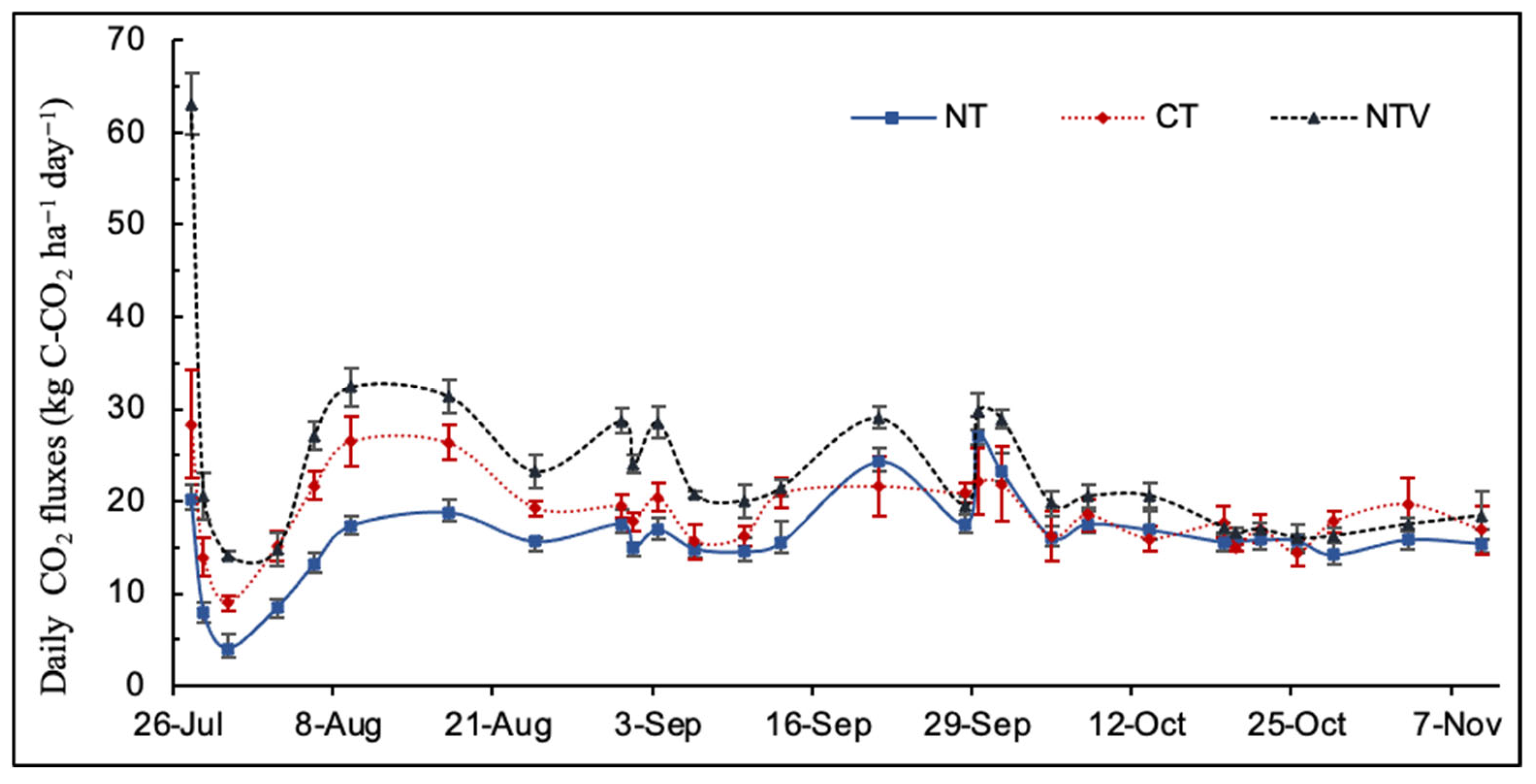
Daily CO2 emission peaks (Figure 12) were observed in the first collection for NTV (63.12 kg C-CO2 ha−1 day−1) and CT (28.37 kg C-CO2 ha−1 day−1). In contrast, NT peaked later (27.05 kg C-CO2 ha−1 day−1), 65 days after transplanting on 29 September 2021.
The initial CO2 emission peak in NTV is attributed to rapid decomposition of cover crop biomass, whose low C:N ratio promotes accelerated C mineralization [44,46]. In CT, the initial CO2 peak resulted from soil disturbance, which fragments and incorporates maize residues, reduces aggregate stability, and exposes soil organic matter (SOM) to microbial activity [83].
The delayed CO2 emission peak in NT is due to slower, more uniform decomposition of maize residues, whose high C:N ratio limits N availability for microbial activity [52]. In systems with high C:N ratios, N limits microbial growth, reducing microbial efficiency and delaying significant CO2 emissions [66]. The application of ammonium nitrate (65 kg N ha−1) one day prior to the NT peak increased soil N levels, temporarily lowered the C/N ratio, and stimulated mineralization [84].
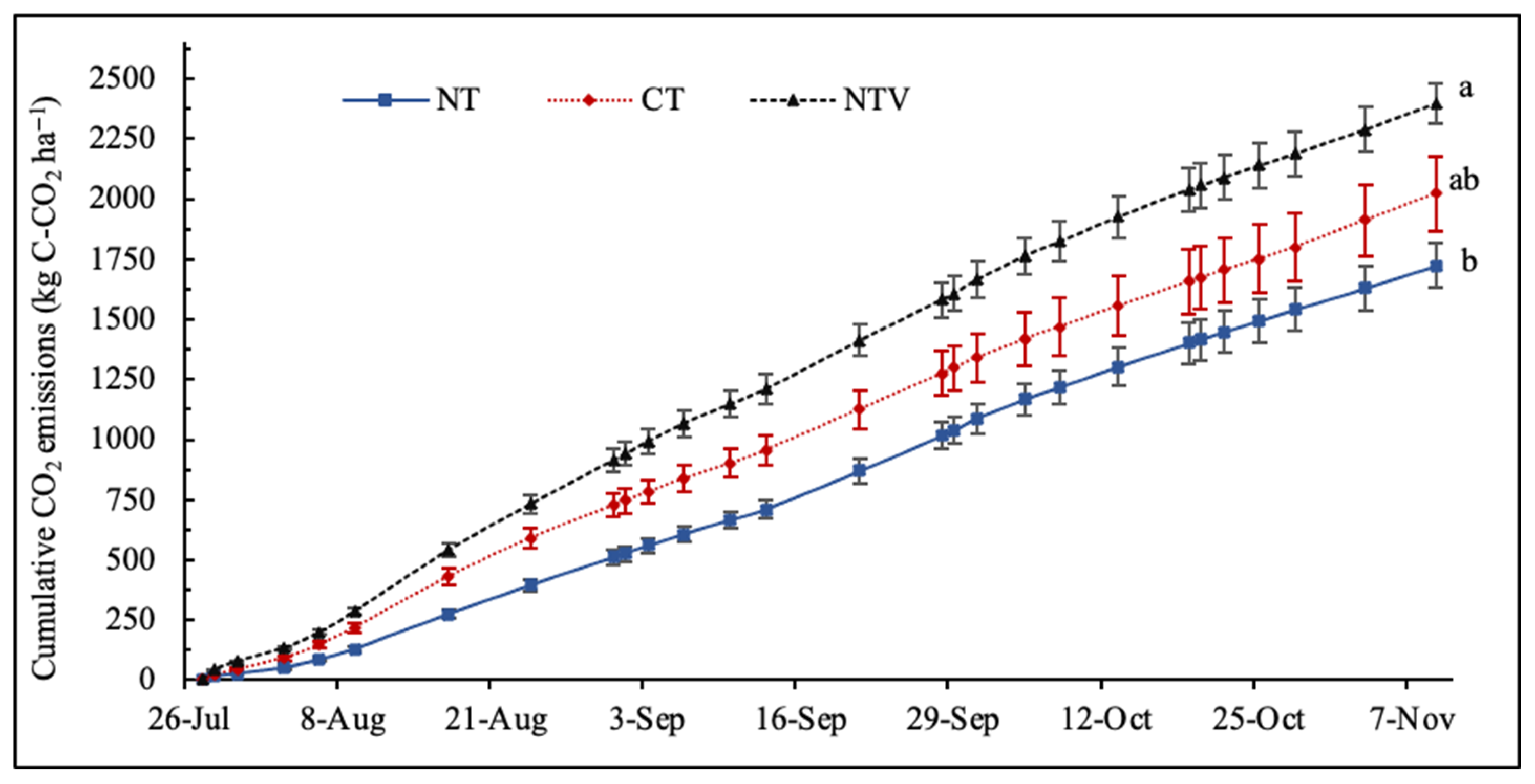
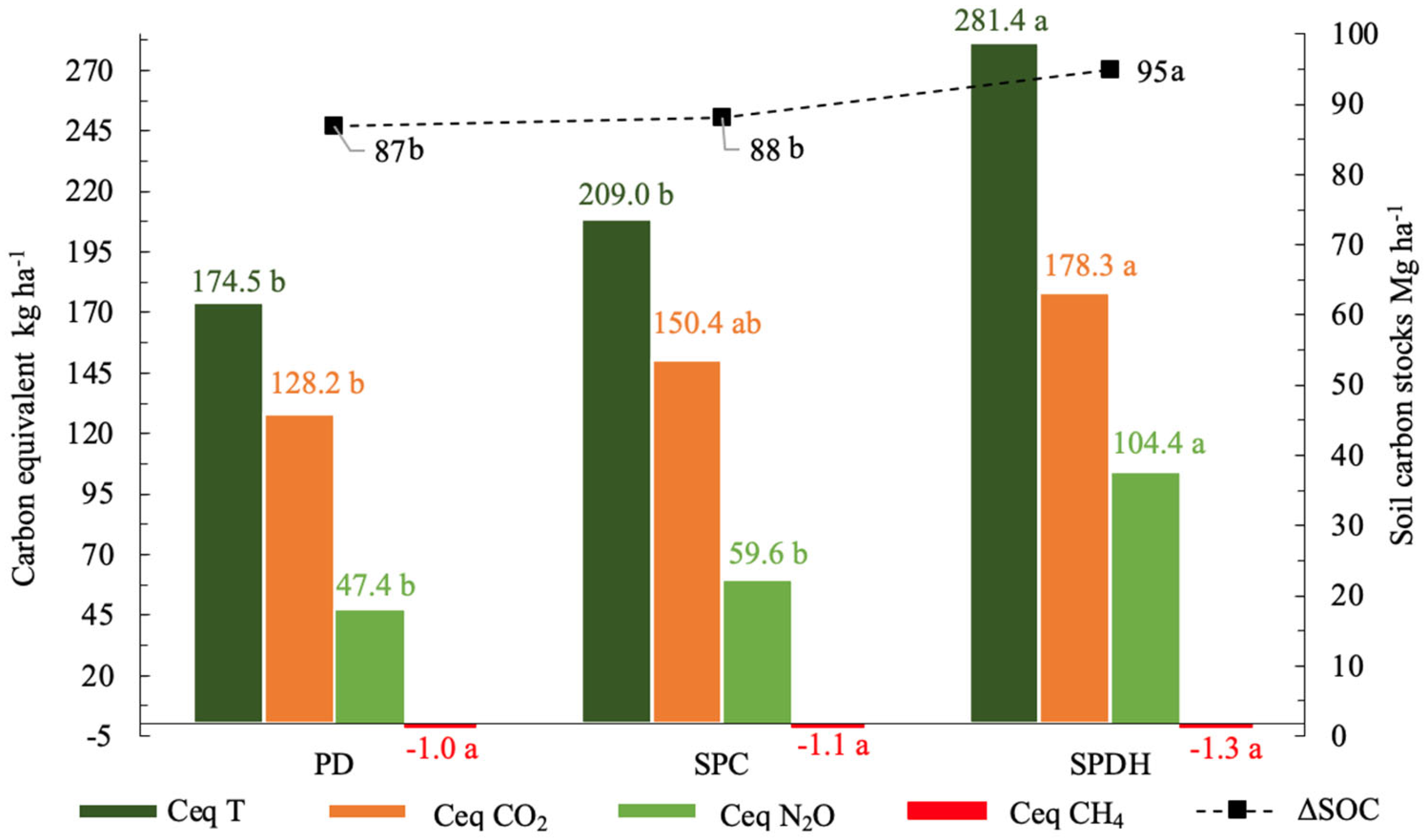
NTV exhibited higher cumulative CO2 emissions (2397.41 kg C-CO2 ha−1) than NT (1723.52 kg C-CO2 ha−1), but did not differ significantly from CT (2022.24 kg C-CO2 ha−1) (Figure 13). Despite higher emissions, the ΔSOC in NTV (94.89 Mg ha−1 in the 0.0–0.30 m layer; Table 2) was 339 times greater than the Ceq emitted, indicating a positive long-term balance (Figure 14).
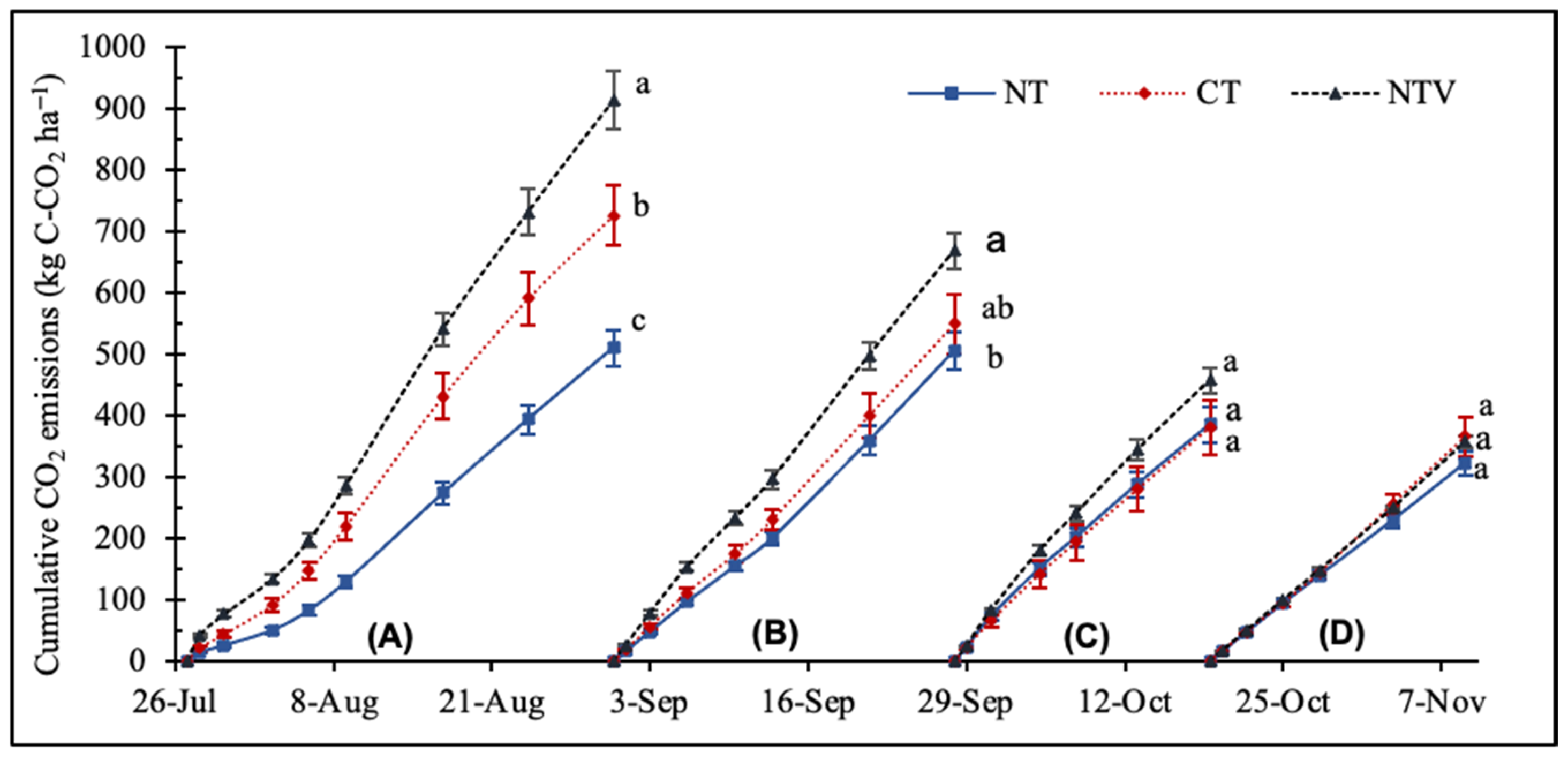
Significant differences in cumulative CO2 emissions among treatments were observed only in the first fertilization cycle (Figure 15A: 27 July to 31 August 2021), with NTV showing the highest emission (913.74 kg C-CO2 ha−1), followed by CT (726.51 kg C-CO2 ha−1) and NT (510.39 kg C-CO2 ha−1). This initial disparity is attributed to rapid nutrient release from NTV cover crop biomass, driven by decomposition of labile compounds, and to biomass fragmentation in CT caused by soil disturbance. These differences diminished over the onion crop cycle, as successive ammonium nitrate applications reduced the C/N ratio and stimulated microbial activity [84]. In the subsequent cycles (Figure 15C,D), no significant differences in cumulative CO2 emissions were observed among treatments.
NT exhibited lower cumulative CO2 emissions than NTV (Figure 13), which was attributed to the lower C/N ratio in the NTV cover crop biomass, which enhanced microbial activity [85,86]. NTV also showed higher TOC and TN contents and stocks in the 0.00–0.05 m soil layer compared to NT (Table 2), consistent with studies linking diversified cover crops to increased labile C fractions, such as particulate organic matter [55].
Cumulative CO2 emissions in CT were intermediate between NTV and NT, 375.17 kg C-CO2 ha−1, lower than NTV but not significantly different (Figure 13 and Figure 15B–D). This difference is attributed to lower C availability in the plant biomass and the reduced TOC and TN contents in the 0.00–0.50 m layer under CT. Additionally, the high C:N ratio of maize residues incorporated into the soil in CT constrains soil organic matter (SOM) mineralization, consistent with prior studies [52].
NT reduced CO2 emissions by 288.22 kg C-CO2 ha−1 compared to CT (Figure 13), which was partly due to the absence of soil disturbance and improved soil physical conditions. In CT, mechanical fragmentation of maize residues during soil preparation increases their contact area with microorganisms, accelerating decomposition and CO2 emissions [11,57]. This is supported by the higher initial emissions in CT compared to NT (Figure 15A). Higher CO2 emissions in NTV compared to NT are attributed to the lower C/N ratio of biomass in NTV (Table 1), which promotes rapid decomposition and C mineralization [87].

3.4. Carbon Equivalent to Neutralize N2O, CH4, and CO2 Emissions

The carbon equivalent (Ceq) required to neutralize greenhouse gas (GHG) emissions for each treatment is shown in Figure 15. NTV required the highest Ceq due to greater cumulative N2O and CO2 emissions. Despite greater CH4 uptake in NTV compared to NT and CT, this had little effect on total Ceq (Figure 15).
The ΔSOC in NTV (94.9 Mg ha−1 in the 0.00–0.30 m layer) was 339 times greater than its total Ceq (281.4 kg ha−1), indicating that NTV offsets emissions from onion cultivation and contributes to a positive long-term carbon balance, even within the surface layer (0.00–0.30 m). However, carbon stock differences developed over the 14-year experiment, whereas gas emissions differences were measured over the 106-day monitoring period, highlighting the long-term benefits of conservation management systems for climate change mitigation. ΔSOC in NTV was 7.45 Mg ha−1 higher compared to NT and CT, equivalent to an additional sequestration of 1.457 kg ha−1 day−1 over 14 years. In contrast, total Ceq emissions in NTV were 89.65 kg ha−1 higher over the 106-day period (0.845 kg ha−1 day−1), a value lower than the sequestration rate. These data indicate that C sequestration in NTV exceeds its total emissions despite simplified calculations and the non-linear nature of these processes.
Long-term measurement of ΔSOC across a deeper soil profile could reveal greater contrasts in ΔSOC among treatments [88]. This study reinforces the role of diversified cover crop systems in enhancing ΔSOC.
NT and CT also maintained sufficient ΔSOC to offset their GHG emissions, though less effectively than NTV. However, soil ΔSOC accumulation is a slow process, and the positive balance between emissions and carbon stocks in this study reflects the 14-year duration of the experiment.
A study in the Brazilian Cerrado comparing NT systems after 12 and 22 years of implementation following CT found no differences in Ceq for N2O emissions but reported a 41% increase in ΔSOC for maize–wheat rotation and a 29% increase for soybean–wheat rotation in the 22-year NT system [36]. These increases suggest that NTV systems can progressively accumulate C over time, and that, combined with the lack of increase in N2O emissions due to the tillage system, enhances C sequestration.
Similar findings were reported in cauliflower cultivation under NTV (11 years) and CT (40 years) under identical soil and climate conditions, with NTV requiring higher total Ceq (906.98 kg ha−1) compared to CT (611.78 kg ha−1) [23]. In the 0.00–0.30 m layer, TOC stocks were higher in NTV (103.50 Mg ha−1) than in CT (81.44 Mg ha−1), demonstrating NTV’s effectiveness in mitigating GHG emissions.

4. Conclusions

This study provides an initial assessment of greenhouse gas emissions within a long-term (14-year) agroecological onion production system. By integrating short-term measurements of GHG fluxes with long-term evaluations of soil physical and chemical properties and crop productivity, the study addresses the objective of establishing a baseline for understanding greenhouse gas dynamics in diversified vegetable systems.
The no-till vegetable system improved soil physical and chemical quality and enhanced onion productivity as a result of sustained residue inputs and reduced soil disturbance. At the same time, short-term measurements revealed higher N2O emissions during the evaluated growing season, highlighting a trade-off between improvements in soil quality and short-term GHG emissions. CO2 fluxes reflected ecosystem respiration and were therefore interpreted as indicators of soil biological activity rather than net C balance.
The GHG results reported herein are limited to a single growing season and should be interpreted as short-term dynamics within a long-term experiment. While the magnitude of emissions is influenced by site-specific conditions, the underlying processes associated with reduced soil disturbance, permanent soil cover, and crop diversification are broadly applicable to vegetable production systems beyond the study region. Continued multi-year monitoring will be essential to capture interannual variability and to refine assessments of greenhouse gas mitigation potential in agroecological cropping systems. By enhancing soil quality, reducing mineral nitrogen inputs, and sustaining high vegetable yields, the no-till vegetable system contributes to key Sustainable Development Goals related to climate action, sustainable food production, and soil conservation.

Author Contributions

Conceptualization, P.H.d.S.C., B.d.R.D.; G.W.F., L.D.G., L.R.R. and D.D.; Resources, P.H.d.S.C., B.d.R.D., L.D.G., L.R.R., D.D., J.C.R., M.d.C.P., J.L.R.T. and D.P.P.; Methodology, P.H.d.S.C., L.D.G., L.R.R., J.C.R., M.d.C.P., J.L.R.T. and D.P.P.; Investigation, P.H.d.S.C., G.W.F., L.D.G., L.R.R., J.C.R., M.d.C.P., J.L.R.T. and D.P.P.; Writing—original draft preparation, P.H.d.S.C.; Writing—review and editing, P.H.d.S.C., G.W.F., L.D.G. and L.R.R.; Supervision, D.D., C.K., C.B., J.J.C. and A.L.; Project administration, C.K., C.B., J.J.C. and A.L.; Funding acquisition, C.K., C.B., J.J.C. and A.L. All authors have read and agreed to the published version of the manuscript.

Funding

The authors gratefully acknowledge the financial support from the Brazilian Coordination for the Improvement of Higher Education Personnel (CAPES) through a master’s scholarship granted to the first author and a postdoctoral scholarship to the fourth author (88881.691714/2022-01 and 88887.999208/2024-00), and from the Brazilian National Council for Scientific and Technological Development (CNPq) for granting research productivity scholarships to the last author (311474/2021-7) and the eighth author (306305/2019-4), as well as postdoctoral scholarships for the third (150956/2024-0) and fifth (151015/2024-4) authors. The authors thank the institutional collaboration of the Santa Catarina Agricultural Research and Rural Extension Company (EPAGRI) and the Federal University of Rio Grande do Sul (UFRGS) in conducting the project, as well as the support from the by National Institute of Science and Technology in Low Carbon Emission Agriculture (INCT-ABC) sponsored by CNPq, grant no. 406635/2022-6, and the Foundation for Research and Innovation Support of the State of Santa Catarina (FAPESC 48/2021-TR002191).

Data Availability Statement

The datasets generated during and/or analysed during the current study are available from the corresponding author upon reasonable request.

Conflicts of Interest

Authors Lucas Raimundo Rauber, Denílson Dortzbach, Júlio Cesar Ramos, and Claudinei Kurtz are employed by the company Santa Catarina Agricultural Research and Rural Extension Company (EPAGRI). The remaining authors declare that the research was conducted in the absence of any commercial or financial relationships that could be construed as a potential conflict of interest.

Appendix A

Table A1. Treatments in onion crop rotation under conservation soil management, from 2007 to 2021, Ituporanga, Santa Catarina, Brazil.
Crop YearNTCTNTV
2007Winter Black oat + Hairy vetch + Oilseed radish → Onion
Summer Maize
Winter Black oat + Hairy vetch + Oilseed radish → Onion
Summer Jack bean + Pearl millet
Winter Black oat + Hairy vetch
+ Oilseed radish → Onion
Summer Sunflower
2008Winter Fallow → Onion
Summer Maize
Winter Black oat → Onion
Summer Rattlepod
Winter Black oat + Rye → Onion
Summer Pearl millet + Velvet bean + Sunflower
2009Winter Onion
Summer Maize
Winter Rye → Onion
Summer Maize
Winter Hairy vetch → Onion
Summer Maize
2010Winter Fallow → Onion
Summer Maize
Winter Black oat → Onion
Summer Rattlepod
Winter Black oat + Rye
+ Oilseed radish → Onion
Summer Pearl millet + Velvet bean + Sunflower
2011–2021Winter Fallow → Onion
Summer Maize
Winter Fallow → Onion
Summer Maize
Winter Fallow → Onion
Summer Pearl millet + Velvet bean + Sunflower
Plant species: black oat (Avena strigosa Schreb.), onion (Allium cepa L.), rye (Secale cereale L.), hairy vetch (Vicia villosa Roth), jack bean (Canavalia ensiformis (L.) DC.), sunflower (Helianthus annuus L.), maize (Zea mays L.), pearl millet (Pennisetum americanum L.), velvet bean (Mucuna aterrima L.), rattlepod (Crotalaria spp.), and oilseed radish (Raphanus sativus). NT: no-till system; CT: conventional system; NTV: no-till vegetable system.
The NT and CT treatments were selected to represent the predominant systems for onion production in southern Brazil, while the NTV treatment was included to evaluate the effects of cover crop species diversification.
Onion was cultivated from July to November. Prior to planting, cover crops were desiccated with herbicide. Subsequently, soil furrowing was conducted solely in the planting row using equipment adapted for no-tillage, followed by manual transplanting of seedlings of the cultivar ‘Empasc 352’ (Bola Precoce). The planting configuration used a spacing of 0.40 m between rows and 0.08 m between plants, with seven rows per plot. Machinery traffic in the experimental area was minimal, limited to tractors and walk-behind tractors used during onion planting and harvesting operations.
Weed, pest, and disease management during the onion cycle was conducted using agricultural pesticides approved by the Brazilian Ministry of Agriculture. Three herbicides were applied for weed control (ioxynil, pendimethalin, and fenoxaprop-p-ethyl + clethodim), supplemented by one manual weeding to remove species not controlled chemically. Pest control, primarily targeting thrips (Thrips tabaci Lind.), involved three applications of insecticides containing lambda-cyhalothrin and imidacloprid. Fungal disease management, particularly for downy mildew (Peronospora destructor (Berk.) Casp. ex Berk.) and early blight (Alternaria solani Sorauer), involved five fungicide applications, including combinations of metalaxyl + chlorothalonil, metalaxyl + mancozeb, as well as iprodione and tebuconazole + trifloxystrobin.
In the treatments without cover crops (NT and CT), the fallow period was dominated by the following botanical families: Amaranthaceae (10%), Asteraceae, Caryophyllaceae, Compositae (10%), Convolvulaceae, Brassicaceae, Cyperaceae (25%), Euphorbiaceae, Fabaceae, Lamiaceae (10%), Leguminosae, Liliaceae, Malvaceae, Oxalidaceae (10%), Plantaginaceae, Poaceae, Polygonaceae (20%).
In the no-till (NT) system, planting furrows were created over maize crop residues. In the conventional tillage (CT) system, soil preparation involved one plowing and two harrowing operations to incorporate maize crop residues, followed by furrowing for onion transplanting. After plot preparation and before onion seedling transplanting, plant residue samples were collected to quantify the dry matter of the soil-covering residue at the time of onion transplanting. Onion seedling transplanting was carried out on 26 July 2021, with harvesting in November 2021. More information about the history of use and management of the areas can be found in Giumbelli et al. [21].

References

  1. Burney, J.; McIntosh, C.; Lopez-Videla, B.; Samphantharak, K.; Gori Maia, A. Empirical Modeling of Agricultural Climate Risk. Proc. Natl. Acad. Sci. USA 2024, 121, e2215677121. [Google Scholar] [CrossRef]
  2. Hasegawa, T.; Sakurai, G.; Fujimori, S.; Takahashi, K.; Hijioka, Y.; Masui, T. Extreme Climate Events Increase Risk of Global Food Insecurity and Adaptation Needs. Nat. Food 2021, 2, 587–595. [Google Scholar] [CrossRef]
  3. Borrelli, P.; Robinson, D.A.; Panagos, P.; Lugato, E.; Yang, J.E.; Alewell, C.; Wuepper, D.; Montanarella, L.; Ballabio, C. Land Use and Climate Change Impacts on Global Soil Erosion by Water (2015–2070). Proc. Natl. Acad. Sci. USA 2020, 117, 21994–22001. [Google Scholar] [CrossRef]
  4. IPCC. Climate Change 2022—Impacts, Adaptation and Vulnerability; Pörtner, H.-O., Roberts, D.C., Tignor, M., Poloczanska, E.S., Mintenbeck, K., Alegría, A., Craig, M., Langsdorf, S., Löschke, S., Möller, V., et al., Eds.; Cambridge University Press: Cambridge, UK; New York, NY, USA, 2023; ISBN 978-1-009-32584-4. [Google Scholar]
  5. Escobar, L.F.; Amado, T.J.C.; Bayer, C.; Chavez, L.F.; Zanatta, J.A.; Fiorin, J.E. Postharvest Nitrous Oxide Emissions from a Subtropical Oxisol as Influenced by Summer Crop Residues and Their Management. Rev. Bras. Ciênc. Solo 2010, 34, 507–516. [Google Scholar] [CrossRef]
  6. Goldemberg, J.; Lucon, O. Energia e Meio Ambiente No Brasil. Estud. Av. 2007, 21, 7–20. [Google Scholar] [CrossRef]
  7. Althoff, T.D.; Menezes, R.S.C.; De Carvalho, A.L.; De Siqueira Pinto, A.; Santiago, G.A.C.F.; Ometto, J.P.H.B.; Von Randow, C.; De Sá Barretto Sampaio, E.V. Climate Change Impacts on the Sustainability of the Firewood Harvest and Vegetation and Soil Carbon Stocks in a Tropical Dry Forest in Santa Teresinha Municipality, Northeast Brazil. For. Ecol. Manag. 2016, 360, 367–375. [Google Scholar] [CrossRef]
  8. Kamyab, H.; SaberiKamarposhti, M.; Hashim, H.; Yusuf, M. Carbon Dynamics in Agricultural Greenhouse Gas Emissions and Removals: A Comprehensive Review. Carbon Lett. 2024, 34, 265–289. [Google Scholar] [CrossRef]
  9. Ribeiro, K.; Sousa-Neto, E.R.D.; Carvalho, J.A.D.; Sousa Lima, J.R.D.; Menezes, R.S.C.; Duarte-Neto, P.J.; Da Silva Guerra, G.; Ometto, J.P.H.B. Land Cover Changes and Greenhouse Gas Emissions in Two Different Soil Covers in the Brazilian Caatinga. Sci. Total Environ. 2016, 571, 1048–1057. [Google Scholar] [CrossRef]
  10. Snyder, C.S.; Bruulsema, T.W.; Jensen, T.L.; Fixen, P.E. Review of Greenhouse Gas Emissions from Crop Production Systems and Fertilizer Management Effects. Agric. Ecosyst. Environ. 2009, 133, 247–266. [Google Scholar] [CrossRef]
  11. Besen, M.; Ribeiro, R.; Rigo, A.; Iwasaki, G.; Piva, J. Soil Conservation Practices and Greenhouse Gases Emissions in Brazil. Sci. Agropecu. 2018, 9, 429–439. [Google Scholar] [CrossRef]
  12. IPCC. Climate Change 2021—The Physical Science Basis; Cambridge University Press: Cambridge, UK, 2021; ISBN 978-1-009-15789-6. [Google Scholar]
  13. Almeida, J. A Sociologia e as Mudanças Climáticas. Sociologias 2019, 21, 9–17. [Google Scholar] [CrossRef]
  14. Shang, Z.; Cui, X.; Van Groenigen, K.J.; Kuhnert, M.; Abdalla, M.; Luo, J.; Zhang, W.; Song, Z.; Jiang, Y.; Smith, P.; et al. Global Cropland Nitrous Oxide Emissions in Fallow Period Are Comparable to Growing-season Emissions. Glob. Change Biol. 2024, 30, e17165. [Google Scholar] [CrossRef]
  15. Landau, E.C. Evolução da Produção de Cebola (Allium cepa, Amaryllidaceae). In Dinâmica da Produção Agropecuária e da Paisagem Natural no Brasil nas Últimas Décadas; Embrapa: Brasília, Brazil, 2020; Volume 2, ISBN 978-65-87380-03-2. [Google Scholar]
  16. Loss, A.; dos Santos Júnior, E.; Schmitz, D.; da Veiga, M.; Kurtz, C.; Comin, J.J. Atributos Físicos Do Solo Em Cultivo de Cebola Sob Sistemas de Plantio Direto e Preparo Convencional. Rev. Colomb. Cienc. Hortícolas 2017, 11, 105–113. [Google Scholar] [CrossRef]
  17. Giumbelli, L.D.; Loss, A.; Ventura, B.d.S.; dos Santos Júnior, E.; Almeida, J.; Piccolo, M.d.C.; Mafra, Á.L.; Kurtz, C.; Brunetto, G.; Comin, J.J. Aggregation Index, Carbon, Nitrogen, and Natural Abundance of 13C and 15N in Soil Aggregates and Bulk Soil Cultivated with Onion under Crop Successions and Rotations. Soil Res. 2020, 58, 622. [Google Scholar] [CrossRef]
  18. Engel, F.L.; Bertol, I.; Mafra, A.L.; Cogo, N.P. Water erosion under simulated rainfall in different soil management systems during soybean growth. Sci. Agric. 2007, 64, 187–193. [Google Scholar] [CrossRef]
  19. Mantovani, G.G.; Pellini, T.; Bordin, I.; Telles, T.S. No-tillage and conservation agriculture adoption by farmers in Southern Brazil. Braz. Arch. Biol. Technol. 2024, 67, e24230806. [Google Scholar] [CrossRef]
  20. Fayad, J.A.; Arl, V.; Comin, J.J.; Mafra, Á.L.; Marchesi, D.R. Sistema de Plantio Direto de Hortaliças: Método de Transição Para Um Novo Modo de Produção, 1st ed.; Expressão Popular: São Paulo, Brazil, 2019. [Google Scholar]
  21. Comin, J.J.; Ferreira, L.B.; Dos Santos, L.H.; De Paula Koucher, L.; Machado, L.N.; Dos Santos, E., Jr.; Mafra, Á.L.; Kurtz, C.; Souza, M.; Brunetto, G.; et al. Carbon and Nitrogen Contents and Aggregation Index of Soil Cultivated with Onion for Seven Years Using Crop Successions and Rotations. Soil Tillage Res. 2018, 184, 195–202. [Google Scholar] [CrossRef]
  22. Bellé, D.; Schenatto, F.J.A.; Guadagnin, C.A. Adoção de Inovações Tecnológicas No Cultivo de Hortaliças Em Sistema de Plantio Direto: Uma Revisão Integrativa Da Literatura. Rev. Econ. E Sociol. Rural 2023, 61, e258684. [Google Scholar] [CrossRef]
  23. Dutra, B.D.R.; Da Silva Câmara, P.H.; Dortzbach, D.; Rauber, L.R.; Giumbelli, L.D.; Bayer, C.; Zanella, M.; Ramos, J.C.; Torres, J.L.R.; Lovato, P.E.; et al. On-Farm Evaluation of Direct Seeding of Cover Crop Effects on Soil C and N Reserves and Greenhouse Gas Emissions in a Cauliflower Production System. Horticulturae 2025, 11, 396. [Google Scholar] [CrossRef]
  24. Ministério da Agricultura, Pecuária e Abastecimento. Plano Setorial Para Adaptação à Mudança do Clima e Baixa Emissão de Carbono na Agropecuária 2020–2030: Plano Operacional; MAPA/DEPROS: Brasilia, Brazil, 2021; ISBN 978-65-86803-63-1.
  25. Alvares, C.A.; Stape, J.L.; Sentelhas, P.C.; De Moraes Gonçalves, J.L.; Sparovek, G. Köppen’s Climate Classification Map for Brazil. Meteorol. Z. 2013, 22, 711–728. [Google Scholar] [CrossRef]
  26. Kurtz, C.; de Menezes, F.O.G., Jr.; Higashikawa, F.S. Fertilidade Do Solo, Adubação e Nutrição Da Cultura Da Cebola; Epagri: Florianópolis, Brazil, 2018.
  27. Soil Survey Staff. Keys to Soil Taxonomy; USDA Natural Resources Conservation Service: Washington, DC, USA, 2022.
  28. Santos, H.G.; Jacomine, P.K.T.; dos Anjos, L.H.C.; de Oliveira, V.Á.; Lumbreras, J.F.; Coelho, M.R.; de Almeida, J.A.; de Araujo Filho, J.C.; de Oliveira, J.B.; Cunha, T.J.F. Sistema Brasileiro de Classificacao de Solos; Embrapa: Brasília, Brazil, 2018. [Google Scholar]
  29. Teixeira, P.C.; Donagemma, G.K.; Fontana, A.; Teixeira, W.G. Manual de Métodos de Análise de Solo, 3rd ed.; Embrapa: Brasília, Brazil, 2017. [Google Scholar]
  30. CQFS-RS/SC. Manual de Calagem e Adubação Para Os Estados Do Rio Grande Do Sul e Santa Catarina; Sociedade Brasileira de Ciência do Solo—Núcleo Regional Sul, Ed.; Comissão de Química e Fertilidade do Solo—RS/SC: Porto Alegre, Brazil, 2016. [Google Scholar]
  31. Yoder, R.E. A Direct Method of Aggregate Analysis of Soils and a Study of the Physical Nature of Erosion Losses. Agron. J. 1936, 28, 337–351. [Google Scholar] [CrossRef]
  32. Sisti, C.P.J.; dos Santos, H.P.; Kohhann, R.; Alves, B.J.R.; Urquiaga, S.; Boddey, R.M. Change in Carbon and Nitrogen Stocks in Soil under 13 Years of Conventional or Zero Tillage in Southern Brazil. Soil Tillage Res. 2004, 76, 39–58. [Google Scholar] [CrossRef]
  33. Tedesco, M.J.; Gianello, C.; Bissani, C.A.; Bohnen, H.; Volkweiss, S.J. (Eds.) Análises de Solo, Plantas e Outros Materiais; Departamento de Solos, Universidade Federal do Rio Grande do Sul: Porto Alegre, Brasil, 1995. [Google Scholar]
  34. Muller, V., Jr. Sistema de Plantio Direto Agroecológico de Cebola e Emissão de Gases de Efeito Estufa. Ph.D. Thesis, Universidade Federal de Santa Catarina, Florianópolis, Brasil, 2017. [Google Scholar]
  35. Siqueira Neto, M.; Venzke Filho, S.d.P.; Piccolo, M.d.C.; Cerri, C.E.P.; Cerri, C.C. Rotação de Culturas No Sistema Plantio Direto Em Tibagi (PR): I—Sequestro de Carbono No Solo. Rev. Bras. Ciênc. Solo 2009, 33, 1013–1022. [Google Scholar] [CrossRef]
  36. Jantalia, C.P.; dos Santos, H.P.; Urquiaga, S.; Boddey, R.M.; Alves, B.J.R. Fluxes of Nitrous Oxide from Soil under Different Crop Rotations and Tillage Systems in the South of Brazil. Nutr. Cycl. Agroecosyst. 2008, 82, 161–173. [Google Scholar] [CrossRef]
  37. Mosier, A.R. Chamber and Isotope Techniques. In Exchange of Traces Gases Between Terrestrial Ecosystems and the Atmosphere: Report of the Dahlem Workshop; Andreae, M.O., Schimel, D.S., Eds.; Wiley: Berlin, Germany, 1989; pp. 175–187. [Google Scholar]
  38. Schirmann, J.; de Bastos, D.F.; Weiler, D.A.; Veloso, M.G.; Dieckow, J.; Carvalho, P.C.d.F.; Bayer, C. Nitrous Oxide Emission Factor from Cattle Urine and Dung in Native Grassland of the Pampa Biome, South Brazil. Soil Res. 2020, 58, 198. [Google Scholar] [CrossRef]
  39. Ferreira, D.F. Sisvar: A computer analysis system to fixed effects split plot type designs: Sisvar. Rev. Bras. Biom. 2019, 37, 529–535. [Google Scholar] [CrossRef]
  40. Kurtz, C.; Ernani, P.R.; Coimbra, J.L.M.; Petry, E. Rendimento e Conservação de Cebola Alterados Pela Dose e Parcelamento de Nitrogênio Em Cobertura. Rev. Bras. Ciênc. Solo 2012, 36, 865–876. [Google Scholar] [CrossRef]
  41. Mello, F.d.A.F. De Fixação de Nitrogênio Por Algumas Leguminosas. Braz. J. Agric.-Rev. Agric. 1978, 53, 59–63. [Google Scholar]
  42. Souza, M.; Müller Júnior, V.; Kurtz, C.; Ventura, B.d.S.; Lourenzi, C.R.; Lazzari, C.J.R.; Ferreira, G.W.; Brunetto, G.; Loss, A.; Comin, J.J. Soil Chemical Properties and Yield of Onion Crops Grown for Eight Years under No-Tillage System with Cover Crops. Soil Tillage Res. 2021, 208, 104897. [Google Scholar] [CrossRef]
  43. Wolschick, N.H.; Tondello Barbosa, F.; Bertol, I.; Fiorentin Dos Santos, K.; De Souza Werner, R.; Bagio, B. Cobertura Do Solo, Produção de Biomassa e Acúmulo de Nutrientes Por Plantas de Cobertura. Rev. Ciênc. Agroveterinárias 2016, 15, 134–143. [Google Scholar] [CrossRef]
  44. Lima Filho, O.F.D.; Ambrosano, E.J.; Rossi, F.; Carlos, J.A.D. Adubação Verde e Plantas de Cobertura No Brasil: Fundamentos e Prática; Embrapa Agropecuária Oeste: Brasília, Brazil, 2014. [Google Scholar]
  45. Cherubin, M.R.; Escola Superior de Agricultura “Luiz de Queiroz” da Universidade de São Paulo. Guia Prático de Plantas de Cobertura: Aspectos Fitotécnicos e Impactos Sobre a Saúde do Solo; Universidade de São Paulo—USP: São Paulo, Brazil, 2022; ISBN 978-65-89722-15-1. [Google Scholar]
  46. Silva, R.D. Potencial Da Mucuna Preta Como Adubo Verde Para o Arroz-de-Sequeiro Em Latossolo Amarelo Da Amazônia. Ph.D. Thesis, Universidade de São Paulo, Piracicaba, Brazil, 2020. [Google Scholar]
  47. Brück, H.; Piro, B.; Sattelmacher, B.; Payne, W.A. Spatial Distribution of Roots of Pearl Millet on Sandy Soils of Niger. Plant Soil 2003, 256, 149–159. [Google Scholar] [CrossRef]
  48. Carvalho, A.M.D.; Bustamante, M.M.D.C.; Sousa, J.G.D.A., Jr.; Vivaldi, L.J. Decomposição de Resíduos Vegetais Em Latossolo Sob Cultivo de Milho e Plantas de Cobertura. Rev. Bras. Ciênc. Solo 2008, 32, 2831–2838. [Google Scholar] [CrossRef]
  49. de Castro, C.; Castiglioni, V.B.R.; Balla, A.; Leite, R.M.V.B.d.C.; Karam, D.; Mello, C.H.; Guedes, L.C.A.; Farias, J.R.B. A Cultura Do Girassol; EMBRAPA-CNPSO (Circular Técnica. 13): Londrina, Brazil, 1996. [Google Scholar]
  50. Manfron, P.A.; Garcia, D.C.; Andriolo, J.L. Aspectos Morfo-Fisiológicos da Cebola. Ciênc. Rural 1992, 22, 101–108. [Google Scholar] [CrossRef]
  51. Alvarenga, R.C.; Cabezas, W.A.L.; Cruz, J.C.; Santana, D.P. Plantas de Cobertura de Solo Para Sistema Plantio Direto; Informe Agropecuário: Belo Horizonte, Brazil, 2001; Volume 22. [Google Scholar]
  52. dos Santos, F.C.; de Albuquerque Filho, M.R.; Vilela, L.; Ferreira, G.B.; Carvalho, M.d.C.S.; Viana, J.H.M. Decomposição e Liberação de Macronutrientes Da Palhada de Milho e Braquiária, Sob Integração Lavoura-Pecuária No Cerrado Baiano. Rev. Bras. Ciênc. Solo 2014, 38, 1855–1861. [Google Scholar] [CrossRef]
  53. Siqueira Neto, M.; Piccolo, M.d.C.; Venzke Filho, S.d.P.; Feigl, B.J.; Cerri, C.C. Mineralização e Desnitrificação Do Nitrogênio No Solo Sob Sistema Plantio Direto. Bragantia 2010, 69, 923–936. [Google Scholar] [CrossRef]
  54. Wisniewski, C.; Holtz, G.P. Decomposição da palmada e liberação de nitrogênio e fósforo numa rotação aveia-soja sob plantio direto’. Pesqui. Agropecuária Bras. 1997, 32, 1191–1197. [Google Scholar]
  55. Giumbelli, L.D.; Loss, A.; Kurtz, C.; Mafra, Á.L.; Piccolo, M.d.C.; Torres, J.L.R.; Lourenzi, C.R.; Brunetto, G.; Comin, J.J. Combinations of Plant Species for Rotation With Onion Crops: Effects on the Light Fraction, Carbon, and Nitrogen Contents in Granulometric Fractions of the Soil Organic Matter. J. Agric. Stud. 2021, 9, 202. [Google Scholar] [CrossRef]
  56. Lange, M.; Eisenhauer, N.; Sierra, C.A.; Bessler, H.; Engels, C.; Griffiths, R.I.; Mellado-Vázquez, P.G.; Malik, A.A.; Roy, J.; Scheu, S.; et al. Plant Diversity Increases Soil Microbial Activity and Soil Carbon Storage. Nat. Commun. 2015, 6, 6707. [Google Scholar] [CrossRef]
  57. Puglisi, E.; Fragoulis, G.; Ricciuti, P.; Cappa, F.; Spaccini, R.; Piccolo, A.; Trevisan, M.; Crecchio, C. Effects of a Humic Acid and Its Size-Fractions on the Bacterial Community of Soil Rhizosphere under Maize (Zea mays L.). Chemosphere 2009, 77, 829–837. [Google Scholar] [CrossRef]
  58. Guedes Filho, O.; Da Silva, A.P.; Giarola, N.F.B.; Tormena, C.A. Structural Properties of the Soil Seedbed Submitted to Mechanical and Biological Chiseling under No-Tillage. Geoderma 2013, 204–205, 94–101. [Google Scholar] [CrossRef]
  59. Reichert, J.M.; Reinert, D.J.; Braida, J.A. Qualidade dos solos e sustentabilidade de sistemas agrícolas. Ciênc. Ambiente 2003, 27, 29–48. [Google Scholar]
  60. Wang, S.; Gan, L.; Zhang, S.; Li, J.; Chang, C.; Zhang, Y.; Zhang, H.; Wei, B. Soil Biopores and Non-Biopores Responses to Different Tillage Treatments in Sugarcane Fields in Guangxi, China. Agronomy 2024, 14, 1378. [Google Scholar] [CrossRef]
  61. Ren, Z.; Han, X.; Han, Z.; Tian, W.; Li, J.; Lv, J.; Shen, Y.; Xie, Y.; Ma, G.; Li, G.; et al. Long-Term Minimum Tillage and Straw Retention Promote Macroaggregate Formation, Carbon and Nitrogen Sequestration under Wheat-Maize Rotation in Northern China. Agriculture 2024, 14, 1659. [Google Scholar] [CrossRef]
  62. Pisarčik, M.; Hakl, J.; Toleikiene, M.; Fuksa, P.; Rasmussen, J.; Hood-Nowotny, R. Role of Cover Crop Roots in Soil Organic Carbon Accrual—A Review. Eur. J. Soil Sci. 2024, 75, e13532. [Google Scholar] [CrossRef]
  63. Silva, F.G.D.; Assis, R.N.D., Jr.; Toma, R.S.; Oliveira, L.D.S.; Marques, E.D.S.; Mota, J.C.A. Physical-hydraulic attributes as indicators of functionality of soil pores under different compaction levels. Rev. Caatinga 2022, 35, 884–893. [Google Scholar] [CrossRef]
  64. Friedl, J.; Scheer, C.; De Rosa, D.; Müller, C.; Grace, P.R.; Rowlings, D.W. Sources of Nitrous Oxide from Intensively Managed Pasture Soils: The Hole in the Pipe. Environ. Res. Lett. 2021, 16, 065004. [Google Scholar] [CrossRef]
  65. Bracken, C.J.; Lanigan, G.J.; Richards, K.G.; Müller, C.; Tracy, S.R.; Grant, J.; Krol, D.J.; Sheridan, H.; Lynch, M.B.; Grace, C.; et al. Source Partitioning Using N2O Isotopomers and Soil WFPS to Establish Dominant N2O Production Pathways from Different Pasture Sward Compositions. Sci. Total Environ. 2021, 781, 146515. [Google Scholar] [CrossRef]
  66. Gou, X.; Reich, P.B.; Qiu, L.; Shao, M.; Wei, G.; Wang, J.; Wei, X. Leguminous Plants Significantly Increase Soil Nitrogen Cycling across Global Climates and Ecosystem Types. Glob. Change Biol. 2023, 29, 4028–4043. [Google Scholar] [CrossRef]
  67. Bateman, E.J.; Baggs, E.M. Contributions of Nitrification and Denitrification to N2O Emissions from Soils at Different Water-Filled Pore Space. Biol. Fertil. Soils 2005, 41, 379–388. [Google Scholar] [CrossRef]
  68. Favero, C.; Jucksch, I.; Costa, L.M.; Alvarenga, R.C.; Neves, J.C.L. Crescimento e Acúmulo de Nutrientes Por Plantas Espontâneas e Por Leguminosas Utilizadas Para Adubação Verde. Rev. Bras. Ciênc. Solo 2000, 24, 171–177. [Google Scholar] [CrossRef]
  69. Müller Júnior, V.; Koucher, L.D.P.; Souza, M.; Lima, A.P.; Kurtz, C.; Couto, R.D.R.; Lovato, P.E.; Giacomini, S.J.; Brunetto, G.; Comin, J.J. Nitrous Oxide Emissions in No-Tillage Onion (Allium cepa L.) Crops Are Increased by Oilseed Radish Cover Crop and Poultry Manure Application. Rev. Bras. Ciênc. Solo 2019, 43, e0180116. [Google Scholar] [CrossRef]
  70. Fudjoe, S.K.; Li, L.; Anwar, S.; Shi, S.; Xie, J.; Wang, L.; Xie, L.; Zhou, Y. Nitrogen Fertilization Promoted Microbial Growth and N2O Emissions by Increasing the Abundance of nirS and nosZ Denitrifiers in Semiarid Maize Field. Front. Microbiol. 2023, 14, 1265562. [Google Scholar] [CrossRef] [PubMed]
  71. Monteiro, R.C.; Franchini, J.C.; Jantalia, C.P.; Urquiaga, S.; Alves, B.J.R.; Boddey, R.M. Soil Nitrous Oxide Emissions from a Soybean-Wheat Succession under Different Tillage Systems in Southern Brazil. Rev. Bras. Ciênc. Solo 2023, 47, e0220135. [Google Scholar] [CrossRef]
  72. Takeda, N.; Friedl, J.; Kirkby, R.; Rowlings, D.; De Rosa, D.; Scheer, C.; Grace, P. Interaction between Soil and Fertiliser Nitrogen Drives Plant Nitrogen Uptake and Nitrous Oxide (N2O) Emissions in Tropical Sugarcane Systems. Plant Soil 2022, 477, 647–663. [Google Scholar] [CrossRef]
  73. Costa, F.d.S.; Bayer, C.; Zanatta, J.A.; Mielniczuk, J. Estoque de Carbono Orgânico No Solo e Emissões de Dióxido de Carbono Influenciadas Por Sistemas de Manejo No Sul Do Brasil. Rev. Bras. Ciênc. Solo 2008, 32, 323–332. [Google Scholar] [CrossRef]
  74. Teixeira, C.E.; Torves, J.C.; Finotti, A.R.; Fedrizzi, F.; Marinho, F.A.M.; Teixeira, P.F. Estudos Sobre a Oxidação Aeróbia Do Metano Na Cobertura de Três Aterros Sanitários No Brasil. Eng. Sanit. E Ambient. 2009, 14, 99–108. [Google Scholar] [CrossRef]
  75. Leamdum, C.; Phruksaphithak, N.; Chanthong, S.; Niyasom, C. Methane Oxidation Rates and Efficiencies Across Four Distinct Soil Environments: Implications for Greenhouse Gas Mitigation. ASEAN J. Sci. Technol. Rep. 2024, 28, e255939. [Google Scholar] [CrossRef]
  76. Vasconcelos, A.L.S.; Cherubin, M.R.; Feigl, B.J.; Cerri, C.E.P.; Gmach, M.R.; Siqueira-Neto, M. Greenhouse Gas Emission Responses to Sugarcane Straw Removal. Biomass Bioenergy 2018, 113, 15–21. [Google Scholar] [CrossRef]
  77. Cerri, C.C.; Bernoux, M.; Maia, S.M.F.; Cerri, C.E.P.; Costa, C., Jr.; Feigl, B.J.; Frazão, L.A.; Mello, F.F.d.C.; Galdos, M.V.; Moreira, C.S.; et al. Greenhouse Gas Mitigation Options in Brazil for Land-Use Change, Livestock and Agriculture. Sci. Agric. 2010, 67, 102–116. [Google Scholar] [CrossRef]
  78. Smith, K.A.; Ball, T.; Conen, F.; Dobbie, K.E.; Massheder, J.; Rey, A. Exchange of Greenhouse Gases between Soil and Atmosphere: Interactions of Soil Physical Factors and Biological Processes. Eur. J. Soil Sci. 2018, 69, 10–20. [Google Scholar] [CrossRef]
  79. Bayer, C.; Gomes, J.; Vieira, F.C.B.; Zanatta, J.A.; Piccolo, M.d.C.; Dieckow, J. Soil Methane Oxidation in a Long-Term No-Tillage System in Southern Brazil. Semin. Ciênc. Agrár. 2013, 34, 1695–1706. [Google Scholar] [CrossRef]
  80. Zhang, W.; Zhang, J.; Yu, D.; Zhu, Z.; Miao, Y. Increasing Carbon to Nitrogen Ratio Promoted Anaerobic Ammonia-Oxidizing Bacterial Enrichment and Advanced Nitrogen Removal in Mainstream Anammox System. Bioresour. Technol. 2024, 393, 130169. [Google Scholar] [CrossRef] [PubMed]
  81. Glatzel, S.; Stahr, K. Methane and Nitrous Oxide Exchange in Differently Fertilised Grassland in Southern Germany. Plant Soil 2001, 231, 21–35. [Google Scholar] [CrossRef]
  82. Milde, G.A.; Dedecek, R.A.; Gava, J.L. Unidades de Colheita: Estratégia Para Evitar a Compactação Dos Solos Florestais. Rev. Árvore 2010, 34, 1075–1083. [Google Scholar] [CrossRef]
  83. Sheehy, J.; Regina, K.; Alakukku, L.; Six, J. Impact of no-till and reduced tillage on aggregation and aggregate-associated carbon in Northern European agroecosystems. Soil Tillage Res. 2015, 150, 107–113. [Google Scholar] [CrossRef]
  84. Wolschick, N.H.; Barbosa, F.T.; Bertol, I.; Bagio, B.; Kaufmann, D.S. Long-Term Effect of Soil Use and Management on Organic Carbon and Aggregate Stability. Rev. Bras. Ciênc. Solo 2018, 42, e0170393. [Google Scholar] [CrossRef]
  85. Sposito, G. The Chemestry of Soils; Oxford University Press: New York, NY, USA, 1989. [Google Scholar]
  86. Giacomini, S.J.; Aita, C.; Vendruscolo, E.R.O.; Cubilla, M.; Nicoloso, R.S.; Fries, M.R. Matéria Seca, Relação C/N e Acúmulo de Nitrogênio, Fósforo e Potássio Em Misturas de Plantas de Cobertura de Solo. Rev. Bras. Ciênc. Solo 2003, 27, 325–334. [Google Scholar] [CrossRef]
  87. Acosta, J.A.d.A.; Amado, T.J.C.; da Silva, L.S.; Santi, A.; Weber, M.A. Decomposição Da Fitomassa de Plantas de Cobertura e Liberação de Nitrogênio Em Função Da Quantidade de Resíduos Aportada Ao Solo Sob Sistema Plantio Direto. Ciênc. Rural 2014, 44, 801–809. [Google Scholar] [CrossRef]
  88. de Carvalho, A.M.; Alves, B.J.R.; Pereira, L.L. Emissão de Óxido Nitroso Do Solo Com Aplicação de Fertilizantes Nitrogenados Em Sistema de Plantio Direto No Cerrado; Boletim de Pesquisa e Desenvolvimento 281; Embrapa Cerrados: Planaltina, Brazil, 2010. [Google Scholar]
Figure 1. Daily precipitation, minimum and maximum air temperature, and irrigation events during the 2021 onion growing season (July–November) at the experimental site. The figure provides climatic context for the interpretation of short-term greenhouse gas fluxes measured during the evaluated season. Irrigation events were applied uniformly across treatments.
Agronomy 16 00278 g001
Figure 2. Static chambers used for greenhouse gas (GHG) sampling and their components, with detail of maize residues in the no-till treatment.
Agronomy 16 00278 g002
Figure 3. Daily variation of air (chamber) and soil temperatures (°C) in the NT, CT, and NTV treatments during the 2021 onion crop cycle. NT: no-till onion–maize rotation without cover crops; CT: conventional tillage onion–maize rotation without cover crops; NTV: onion–maize rotation under a no-till vegetable system with a summer cover crop mixture of pearl millet (Pennisetum americanum), velvet bean (Mucuna aterrima), and sunflower (Helianthus annuus). Error bars represent the maximum and minimum temperatures recorded on the sampling day.
Agronomy 16 00278 g003
Figure 4. Onion yield and dry matter residue (Mg ha−1) under NT, CT, and NTV treatments in the 2021 onion crop cycle. NT: no-till onion–maize rotation without cover crops; CT: conventional tillage onion–maize rotation without cover crops; NTV: onion–maize rotation under a no-till vegetable system with a summer cover crop mixture of pearl millet (Pennisetum americanum), velvet bean (Mucuna aterrima), and sunflower (Helianthus annuus). The line represents the N fertilizer (NH4NO3) application rate for each treatment. Means followed by the same letter do not differ significantly according to the Tukey test at the 5% significance level.
Agronomy 16 00278 g004
Figure 5. Water-filled pore space (WFPS) and gravimetric moisture (Ug, %) in soils under NT, CT, and NTV treatments in the 2021 onion crop cycle. NT: no-till onion–maize rotation without cover crops; CT: conventional tillage onion–maize rotation without cover crops; NTV: onion–maize rotation under a no-till vegetable system with a summer cover crop mixture of pearl millet (Pennisetum americanum), velvet bean (Mucuna aterrima), and sunflower (Helianthus annuus). Error bars represent the standard error of the mean (n = 5).
Agronomy 16 00278 g005
Figure 6. Daily N2O fluxes (g N-N2O ha−1 day−1) and ammonium nitrate applications in soils under NT, CT, and NTV treatments in the 2021 onion crop cycle. Fluxes represent short-term measurements obtained during a single growing season within a long-term (14-year) agroecological experiment. Values correspond to measurements obtained during one onion growing season and should be interpreted as short-term greenhouse gas dynamics. NT: no-till onion–maize rotation without cover crops; CT: conventional tillage onion–maize rotation without cover crops; NTV: onion–maize rotation under a no-till vegetable system with a summer cover crop mixture of pearl millet (Pennisetum americanum), velvet bean (Mucuna aterrima), and sunflower (Helianthus annuus). N-NT-CT and N-NTV: ammonium nitrate applications in NT/CT and NTV treatments, respectively. Error bars represent the standard error of the mean (n = 5).
Agronomy 16 00278 g006
Figure 7. Cumulative N2O emissions during four fertilization cycles under NT, CT, and NTV treatments during the 2021 onion crop cycle. Cumulative values represent short-term emissions associated with one cropping season. Values correspond to measurements obtained during one onion growing season and should be interpreted as short-term greenhouse gas dynamics. NT: no-till onion–maize rotation without cover crops; CT: conventional tillage onion–maize rotation without cover crops; NTV: onion–maize rotation under a no-till vegetable system with a summer cover crop mixture of pearl millet (Pennisetum americanum), velvet bean (Mucuna aterrima), and sunflower (Helianthus annuus). Periods: (A) 35 days, from transplanting to the first topdressing (27 July to 31 August 2021); (B) 28 days, from the second to third topdressing (31 August to 28 September 2021); (C) 21 days, from the third to fourth topdressing (28 September to 19 October 2021); (D) 21 days, from the fourth topdressing to the final gas collection (19 October to 9 November 2021). Error bars represent the standard error of the mean (n = 5). Means followed by the same letter do not differ significantly according to the Tukey test at the 5% significance level.
Agronomy 16 00278 g007
Figure 8. Cumulative N2O emissions (g N-N2O ha−1) from soils under NT, CT, and NTV treatments during the 2021 onion crop cycle. Cumulative values represent short-term emissions associated with one cropping season. Values correspond to measurements obtained during one onion growing season and should be interpreted as short-term greenhouse gas dynamics. NT: no-till onion–maize rotation without cover crops; CT: conventional tillage onion–maize rotation without cover crops; NTV: onion–maize rotation under a no-till vegetable system with a summer cover crop mixture of pearl millet (Pennisetum americanum), velvet bean (Mucuna aterrima), and sunflower (Helianthus annuus). Error bars represent the standard error of the mean (n = 5). Means followed by the same letter do not differ significantly according to the Tukey test at the 5% significance level.
Agronomy 16 00278 g008
Figure 9. CH4 fluxes (g C-CH4 ha−1 day−1) from soils under NT, CT, and NTV treatments during the 2021 onion crop cycle. CH4 fluxes represent short-term measurements obtained during a single growing season within a long-term (14-year) agroecological experiment. Values correspond to measurements obtained during one onion growing season and should be interpreted as short-term greenhouse gas dynamics. NT: no-till onion–maize rotation without cover crops; CT: conventional tillage onion–maize rotation without cover crops; NTV: onion–maize rotation under a no-till vegetable system with a summer cover crop mixture of pearl millet (Pennisetum americanum), velvet bean (Mucuna aterrima), and sunflower (Helianthus annuus). RE: rainfall events (mm); IA: irrigation application dates. Error bars represent the standard error of the mean (n = 5).
Agronomy 16 00278 g009
Figure 10. Cumulative CH4 emissions (g C-CH4 ha−1) from soils under NT, CT, and NTV treatments during the 2021 onion crop cycle. Cumulative values represent short-term emissions associated with one cropping season. Values correspond to measurements obtained during one onion growing season and should be interpreted as short-term greenhouse gas dynamics. NT: no-till onion–maize rotation without cover crops; CT: conventional tillage onion–maize rotation without cover crops; NTV: onion–maize rotation under a no-till vegetable system with a summer cover crop mixture of pearl millet (Pennisetum americanum), velvet bean (Mucuna aterrima), and sunflower (Helianthus annuus). Error bars represent the standard error of the mean (n = 5). Means followed by the same letter do not differ significantly according to the Tukey test at the 5% significance level.
Agronomy 16 00278 g010
Figure 11. Cumulative CH4 emissions in each cycle between ammonium nitrate applications in soils under NT, CT, and NTV treatments during the 2021 onion crop cycle. Cumulative values represent short-term emissions associated with one cropping season. Values correspond to measurements obtained during one onion growing season and should be interpreted as short-term greenhouse gas dynamics. NT: no-till onion–maize rotation without cover crops; CT: conventional tillage onion–maize rotation without cover crops; NTV: onion–maize rotation under a no-till vegetable system with a summer cover crop mixture of pearl millet (Pennisetum americanum), velvet bean (Mucuna aterrima), and sunflower (Helianthus annuus). Periods: (A) 35 days, from transplanting to the first topdressing (27 July to 31 August 2021); (B) 28 days, from the second to third topdressing (31 August to 28 September 2021); (C) 21 days, from the third to fourth topdressing (28 September to 19 October 2021); (D) 21 days, from the fourth topdressing to the final gas collection (19 October to 9 November 2021). Error bars represent the standard error of the mean (n = 5). Means followed by the same letter do not differ significantly according to the Tukey test at the 5% significance level.
Agronomy 16 00278 g011
Figure 12. CO2 fluxes (kg C-CO2 ha−1 day−1) from soils under NT, CT, and NTV treatments during the 2021 onion crop cycle. CO2 fluxes represent ecosystem respiration measured during a single growing season and are presented as short-term indicators of soil respiratory activity. Values correspond to measurements obtained during one onion growing season and should be interpreted as short-term greenhouse gas dynamics. NT: no-till onion–maize rotation without cover crops; CT: conventional tillage onion–maize rotation without cover crops; NTV: onion–maize rotation under a no-till vegetable system with a summer cover crop mixture of pearl millet (Pennisetum americanum), velvet bean (Mucuna aterrima), and sunflower (Helianthus annuus). Error bars represent the standard error of the mean (n = 5).
Agronomy 16 00278 g012
Figure 13. Cumulative CO2 emissions (kg C-CO2 ha−1) from soils under NT, CT, and NTV treatments during the 2021 onion crop cycle. Cumulative values represent short-term emissions associated with one cropping season. Values correspond to measurements obtained during one onion growing season and should be interpreted as short-term greenhouse gas dynamics. NT: no-till onion–maize rotation without cover crops; CT: conventional tillage onion–maize rotation without cover crops; NTV: onion–maize rotation under a no-till vegetable system with a summer cover crop mixture of pearl millet (Pennisetum americanum), velvet bean (Mucuna aterrima), and sunflower (Helianthus annuus). Error bars represent the standard error of the mean (n = 5). Means followed by the same letter do not differ significantly according to the Tukey test at the 5% significance level.
Agronomy 16 00278 g013
Figure 14. Carbon equivalent (Ceq) to neutralize cumulative N2O, CH4, and CO2 emissions and soil carbon stocks (0.00–0.30 m) in soils under NT, CT, and NTV treatments during the 2021 onion crop cycle. Results reflect short-term measurements and do not represent long-term emission estimates. Values correspond to measurements obtained during one onion growing season and should be interpreted as short-term greenhouse gas dynamics. NT: no-till onion–maize rotation without cover crops; CT: conventional tillage onion–maize rotation without cover crops; NTV: onion–maize rotation under a no-till vegetable system with a summer cover crop mixture of pearl millet (Pennisetum americanum), velvet bean (Mucuna aterrima), and sunflower (Helianthus annuus). Variables include: carbon stocks (CS; Mg ha−1), Ceq for N2O, CH4, CO2, and total Ceq (Ceq T). Means followed by the same letter do not differ significantly according to the Tukey test at the 5% significance level.
Agronomy 16 00278 g014
Figure 15. Cumulative CO2 emissions in each cycle between ammonium nitrate applications in soils under NT, CT, and NTV treatments during the 2021 onion crop cycle. Cumulative values represent short-term emissions associated with one cropping season. Values correspond to measurements obtained during one onion growing season and should be interpreted as short-term greenhouse gas dynamics. NT: no-till onion–maize rotation without cover crops; CT: conventional tillage onion–maize rotation without cover crops; NTV: onion–maize rotation under a no-till vegetable system with a summer cover crop mixture of pearl millet (Pennisetum americanum), velvet bean (Mucuna aterrima), and sunflower (Helianthus annuus). Periods: (A) 35 days, from transplanting to the first topdressing (27 July to 31 August 2021); (B) 28 days, from the second to third topdressing (31 August to 28 September 2021); (C) 21 days, from the third to fourth topdressing (28 September to 19 October 2021); (D) 21 days, from the fourth topdressing to the final gas collection (19 October to 9 November 2021). Error bars represent the standard error of the mean (n = 5). Means followed by the same letter do not differ significantly according to the Tukey test at the 5% significance level.
Agronomy 16 00278 g015
Table 1. Carbon (C) and nitrogen (N) contents (%) and C/N ratio of residues on the soil surface under NT, CT, and NTV treatments in the 2021 onion crop cycle.
TreatmentCNC:N Ratio
NT29.34 a1.08 b27.58 a
CT25.62 a1.09 b24.34 a
NTV28.01 a2.08 a13.38 b
CV (%)20.6918.0524.96
NT: no-till onion–maize rotation without cover crops; CT: conventional tillage onion–maize rotation without cover crops; NTV: onion–maize rotation under a no-till vegetable system with a summer cover crop mixture of pearl millet (Pennisetum americanum), velvet bean (Mucuna aterrima), and sunflower (Helianthus annuus). CV: coefficient of variation. Means followed by the same letter do not differ significantly according to the Tukey test at the 5% significance level.
Table 2. Carbon and nitrogen contents and stocks in different soil layers under NT, CT, and NTV treatments in the 2021 onion crop cycle.
TreatmentsTOC (g kg−1)ΔSOC (Mg ha−1)
Soil Layer (m)
0.00–0.050.05–0.0100.10–0.300.00–0.050.05–0.100.10–0.300.00–0.30
NT28.43 b27.57 ab21.34 b17.75 b15.49 a53.62 b86.85 b
CT27.45 b25.63 b21.23 b16.98 b16.36 a54.79 ab88.13 b
NTV42.63 a30.42 a23.23 a21.62 a16.23 a57.03 a94.89 a
CV%2.976.64.474.786.682.632.6
TreatmentsTN (g kg−1)ΔNS (Mg ha−1)
Soil Layer (m)
0.00–0.050.05–0.0100.10–0.300.00–0.050.05–0.100.10–0.300.00–0.30
NT3.03 b2.85 a1.91 a1.89 b1.59 a4.79 a8.28 a
CT2.25 c2.13 b1.70 b1.44 c1.39 b4.31 b7.14 b
NTV4.12 a2.81 a1.87 ab2.09 a1.55 ab4.61 ab8.26 a
CV%2.006.936.894.597.195.163.28
TOC: total organic carbon; ΔSOC: carbon stocks; TN: total nitrogen; ΔNS: nitrogen stocks; NT: no-till onion–maize rotation without cover crops; CT: conventional tillage onion–maize rotation without cover crops; NTV: onion–maize rotation under a no-till vegetable system with a summer cover crop mixture of pearl millet (Pennisetum americanum), velvet bean (Mucuna aterrima), and sunflower (Helianthus annuus). CV: coefficient of variation. Means followed by the same letter do not differ significantly according to the Tukey test at the 5% significance level.
Table 3. Geometric mean diameter (GMD) and soil bulk density (Ds) in different soil layers under NT, CT, and NTV treatments in the 2021 onion crop cycle.
TreatmentsGMD (mm)Ds (g cm3)
Soil Layer (m)
0.00–0.050.05–0.100.10–0.300.00–0.050.05–0.100.10–0.30
NT3.97 b4.09 a3.96 a1.25 a1.25 a1.26 a
CT3.27 c3.38 b2.40 b1.28 a1.28 a1.28 a
NTV4.45 a4.32 a4.15 a1.01 b1.08 b1.23 a
CV%6.955.668.794.014.305.72
GMD: geometric mean diameter; Ds: soil bulk density; NT: no-till onion–maize rotation without cover crops; CT: conventional tillage onion–maize rotation without cover crops; NTV: onion–maize rotation under a no-till vegetable system with a summer cover crop mixture of pearl millet (Pennisetum americanum), velvet bean (Mucuna aterrima), and sunflower (Helianthus annuus). CV: coefficient of variation. Means followed by the same letter do not differ significantly according to the Tukey test at the 5% significance level.
Table 4. Macroporosity, microporosity, and total porosity in different soil layers under NT, CT, and NTV treatments in the 2021 onion crop cycle.
TreatmentMacroporosity (%)Microporosity (%)Total Porosity (%)
Soil Layers (m)Soil Layers (m)Soil Layers (m)
0.00–0.050.05–0.100.10–0.300.00–0.050.05–0.100.10–0.300.00–0.050.05–0.100.10–0.30
NT16.60 a10.81 a8.37 a38.61 a38.96 a41.13 a55.22 a49.78 a49.50 a
CT16.69 a13.64 a10.41 a37.85 a39.38 a41.63 a54.55 a53.03 a52.03 a
NTV17.34 a12.82 a8.68 a41.86 a41.45 a41.43 a59.20 a54.29 a50.11 a
CV%24.3420.4916.756.173.662.775.785.23.16
NT: no-till onion–maize rotation without cover crops; CT: conventional tillage onion–maize rotation without cover crops; NTV: onion–maize rotation under a no-till vegetable system with a summer cover crop mixture of pearl millet (Pennisetum americanum), velvet bean (Mucuna aterrima), and sunflower (Helianthus annuus). CV: coefficient of variation. Means followed by the same letter do not differ significantly according to the Tukey test at the 5% significance level.
Disclaimer/Publisher’s Note: The statements, opinions and data contained in all publications are solely those of the individual author(s) and contributor(s) and not of MDPI and/or the editor(s). MDPI and/or the editor(s) disclaim responsibility for any injury to people or property resulting from any ideas, methods, instructions or products referred to in the content.