Article

Identification Pathogenicity Distribution and Chemical Control of Rhizoctonia solani Causing Soybean Root Rot in Northeast China


1
Heilongjiang Academy of Agricultural Sciences, Harbin 150086, China
2
College of Plant Protection, Northeast Agricultural University, Harbin 150030, China
*
Authors to whom correspondence should be addressed.
Agronomy 2026, 16(3), 281; https://doi.org/10.3390/agronomy16030281
Submission received: 7 December 2025 / Revised: 30 December 2025 / Accepted: 19 January 2026 / Published: 23 January 2026
(This article belongs to the Special Issue Recent Advances in Legume Crop Protection—2nd Edition)

Abstract

Soybean root rot caused by Rhizoctonia solani is a yield-limiting disease in Northeast China, particularly under continuous monoculture and cool climatic conditions. Despite its agronomic impact, the epidemiology and fungicide resistance profile of the pathogen remain inadequately characterized. In this study, a comprehensive survey conducted in Heilongjiang Province yielded 990 pathogenic isolates belonging to 11 fungal species. Among them, 55 strains were identified as R. solani based on combined morphological and molecular analyses. These isolates induced typical symptoms of root and stem browning with constriction. Pathogenicity tests on 30 R. solani isolates indicated that 83.3% were highly pathogenic. The pathogen exhibited a distinct geographic distribution, with the highest percentage of pathogen isolation recorded in Jiamusi (26.6%), which accounted for 61.8% of all R. solani isolates. In vitro fungicide sensitivity assays demonstrated that fludioxonil and prochloraz were highly effective (EC50 < 0.0050 µg·mL−1), whereas resistance was observed to tebuconazole, difenoconazole, pyraclostrobin, and carbendazim. Pot experiments confirmed that fludioxonil seed treatment (15 g a.i./100 kg seeds) provided superior control efficacy (63.07%) compared to prochloraz (46.85%). These findings establish R. solani as a dominant causal agent of soybean root rot in the region and support the prioritized use of fludioxonil for sustainable disease management. By elucidating the pathogenicity, distribution, and resistance patterns of R. solani, this study provides critical insights for controlling soybean root rot in cold-climate production systems and facilitates the development of targeted management strategies.

1. Introduction

Soybean (Glycine max [L.] Merr.) is a globally critical agronomic crop, serving as a vital source of vegetable protein and edible oil for both human consumption and animal feed [1]. Its production security is thus integral to national food security strategies. As the world’s largest soybean consumer, China faces a strategic imperative to strengthen domestic production capacity, reducing import dependence and enhancing supply chain resilience [2]. In this context, Northeast China (NEC) stands as one of the country’s most essential grain-producing zones, containing roughly one-third of China’s arable land and contributing approximately 50% of its total soybean output [3]. Within this region, Heilongjiang Province—located in one of the world’s three major black soil belts, known for its high fertility—represents the cornerstone of Chinese soybean cultivation. With an annual planting area of about 7 million hectares, Heilongjiang accounts for over 45% of the nation’s soybean acreage and nearly half of its total production, solidifying its status as the undisputed core of China’s soybean industry [4].
However, the intensive cultivation model, driven by limited land resources, has become the prevailing agricultural system in the region. Continuous soybean cropping, or monoculture, is widely practiced, with consecutive or alternating soybean fields comprising up to 80% of the acreage in certain key production zones. In parts of Heilongjiang, some fields have been maintained under continuous soybean cultivation for over a decade [5]. This long-term monoculture, combined with the region’s characteristically cool and humid climate, has fostered conditions highly favorable to soil-borne pathogens [6]. As a result, soybean root rot has emerged as a major limiting factor for yield enhancement [7].
Soybean root rot, a major soil-borne disease complex, leads to substantial economic losses in soybean-producing regions worldwide [8]. The disease can be caused by a diverse range of pathogens, which vary considerably across geographic regions. Notable causal agents include Fusarium proliferatum in Korea [9], Pratylenchus coffeae and Fusarium brachygibbosum in China [10,11], Fusarium fujikuroi in the United States (Indiana) [12], Phytophthora sojae in Canada [13], and Rhizoctonia solani also reported in the U.S. [14]. Among these, Fusarium spp., Phytophthora sojae, and Pythium spp. are most frequently documented. In contrast, there are relatively few studies focusing on Rhizoctonia solani as a causal agent of soybean root rot [15]. Consequently, key aspects such as its damage potential, pathogenicity, and fungicide resistance remain poorly characterized, leading to inadequate disease assessment and a lack of targeted control strategies.
Among these pathogens, R. solani Kühn (teleomorph: Thanatephorus cucumeris) is a globally distributed, destructive soil-borne fungus with a wide host range. As a key component of the soybean root rot complex, it causes pre- and post-emergence damping-off, root and stem rot, and can lead to significant stand reduction and yield loss [14,16]. Although the overall threat of the root rot complex in Heilongjiang is recognized, updated and systematic studies specifically addressing the current role of R. solani within this diverse pathogen community remain limited. Critical knowledge gaps exist in the accurate identification and genetic diversity of prevalent R. solani anastomosis groups (AGs) in the region, their pathogenicity and aggressiveness on contemporary soybean cultivars, spatial distribution patterns across Northeast China’s major soybean production zones, and the performance of targeted chemical control under local agronomic and environmental conditions.
Therefore, this study was conducted to address these critical knowledge gaps. The specific objectives were to: (1) isolate and molecularly characterize R. solani isolates obtained from soybean root rot in Heilongjiang Province; (2) assess the pathogenicity and pathogenicity of the identified isolates on a susceptible soybean cultivar; (3) analyze the geographical distribution of distinct R. solani populations across the region; and (4) evaluate the efficacy of selected fungicides against the pathogen both in vitro and in pot trials. The results of this comprehensive investigation are expected to deliver a scientific basis for formulating integrated management strategies specifically against R. solani, ultimately supporting sustainable soybean production in Northeast China and contributing to national food security.

2. Materials and Methods

2.1. Isolation and Pathogenicity Assessment of the Pathogenic Fungi

Between May 2022 and October 2023, soybean plants displaying typical root rot symptoms were collected from nine major soybean-producing cities in Heilongjiang Province, including Harbin, Qiqihar, Mudanjiang, Jiamusi, Heihe, Jixi, Shuangyashan, Hegang, and Suihua. All samples were stored at 4 °C before processing.
Pathogen isolation was performed using the tissue isolation method [17]. In pathogen tissue isolation, the sterile rinsing steps are as follows: rinse a typical lesion tissue block of 0.025 cm3 with sterile water three times to remove surface contaminants, disinfect with 75% ethanol for 30 s, disinfect with 1.5% sodium hypochlorite for 5 min, disinfect with 1.5% sodium hypochlorite for 15–30 s, and finally rinse with sterile water 2–3 times to eliminate residual ethanol and sodium hypochlorite, and dry on sterile filter paper. Then placed on potato dextrose agar (PDA), and incubated at 25 °C for 2–3 days. Hyphal tips from colony margins were subcultured onto fresh PDA for purification. Pure cultures were obtained via single-spore isolation and maintained on PDA slants at 4 °C [18]. Sodium hypochlorite, ethanol, PDA (Beijing Bioss Biotechnology Co., Ltd., Beijing, China)
Pathogenicity of all geographically representative fungal isolates was evaluated using the soil-embedding method with sorghum grain inoculum [19]. Purified strains were cultured on sorghum grain medium at 25 °C for 7 days, and inoculated grains (5 g per pot) were applied to potted soybean plants (10 seeds per pot), with uninoculated plants serving as controls. Inoculated plants developed symptoms consistent with field observations. The original pathogen was successfully re-isolated from the newly formed lesions, and the re-isolated strains showed morphological identity to the original field isolates in both colony and microscopic characteristics, thereby fulfilling Koch’s postulates and confirming their role in soybean root rot [20].

2.2. Morpho-Molecular Identification of Pathogenic Fungi

Fungal isolates were cultured on potato dextrose agar (PDA) at 25 °C for 3–5 days. Colony characteristics, including morphology, color, texture, zonation, hyphal color and septation, branching pattern and mycelial growth rate, were noted for identification purposes. Hyphal and spore structures were examined microscopically. Conidial morphology and hyphal features were also evaluated microscopically. Preliminary identification was performed with reference to Sylloge Fungorum Sinicorum [21] and the Handbook of Fungal Identification [22].
Genomic DNA was extracted and amplified via PCR using fungus-specific primers: ITS1/ITS4, NL1/NL4, and NS1/NS8 [23,24]. The 50 µL PCR mixture contained 2 µL of each primer (10 µM), 2 µL DNA template (1–10 ng/µL), 25 µL of 2× Taq Master Mix, and 19 µL ddH2O. Amplification conditions included initial denaturation at 95 °C for 5 min; 30 cycles of denaturation at 94 °C for 30 s, annealing for 30 s (ITS: 56 °C, NL: 54.5 °C, NS: 54 °C), and extension at 72 °C for 30 s; followed by a final extension at 72 °C for 10 min. PCR products were stored at 4 °C before analysis.
A 5 µL aliquot of each product was visualized by 1% agarose gel electrophoresis. Amplicons with clear bands of expected size were purified and subjected to bidirectional sequencing (Shanghai Bioengineering Co., Ltd., Shanghai, China). The resulting sequences were compared to GenBank references using BLAST (https://blast.ncbi.nlm.nih.gov/Blast.cgi). Multiple gene alignments were concatenated in TBtools (v2.056), and a multi-locus phylogenetic tree was constructed using Bayesian inference in MrBayes (v3.12) via Phylosuite v1.2.2 for species-level identification [25,26].

2.3. Pathogenicity Assay

Thirty geographically representative isolates were selected to evaluate their pathogenicity using the soil-embedding method with sorghum grain inoculum, following the previously described procedure. Disease severity was rated on a 0–9 scale for soybean root rot, where 0 = healthy plants with no symptoms; 1 = minor lesions on stem base and taproot; 3 = distinct lesions covering <½ of stem base and taproot area; 5 = multiple lesions covering ½–¾ of stem base and taproot; 7 = stem base and taproot fully girdled by lesions, plant still alive; and 9 = root necrosis, severe wilting, and plant death [27,28].
Based on the resulting severity index, isolates were categorized into three pathogenicity classes: weak (W) for indices <30, moderate (M) for 30–59, and highly pathogenic (H) for indices ≥60 [27].

2.4. Evaluation of Fungicide Sensitivity

The sensitivity of 30 representative Rhizoctonia solani strains, selected based on pathogenicity assays, was evaluated against six fungicides using the mycelial growth rate method. Technical-grade active ingredients included: fludioxonil (98%, Deante Chemical Co., Ltd., Shanghai, China), prochloraz (98%, Jiahui Xingcheng Biotechnology Co., Ltd., Wuhan, China), tebuconazole (97%, Jiahui Xingcheng Biotechnology Co., Ltd.), difenoconazole (96%, Dongtai Nonghua Co., Ltd., Liaocheng, China), pyraclostrobin (98%, Jiahui Xingcheng Biotechnology Co., Ltd.), and carbendazim (96%, Deante Chemical Co., Ltd.).
Each fungicide was dissolved in dimethyl sulfoxide (DMSO) and incorporated into PDA medium to establish concentration gradients. For tebuconazole, difenoconazole, pyraclostrobin, and carbendazim, tested concentrations were 0.05, 0.02, 0.01, 0.005, and 0.002 μg/mL; for fludioxonil and prochloraz, concentrations were 0.002, 0.001, 0.0005, 0.0002, and 0.0001 μg/mL. After autoclaving (121 °C, 20 min), media were poured into plates. Mycelial discs (0.7 mm diameter) from actively growing colonies were placed centrally on amended plates and incubated at 25 °C in darkness for 5–7 days. Control plates contained an equivalent volume of DMSO. Each treatment consisted of three replicates, and the experiment was conducted twice [29,30,31,32,33].
When control mycelial diameter reached 5–6 cm, colony diameters in all treatments were measured [34]. The mycelial growth inhibition rate was calculated as:
Inhibition rate (%) = [(Dc − Dt)/Dc] × 100
where Dc = average growth diameter in control, Dt = average growth diameter in treatment [35].
Dose–response data were analyzed using GraphPad Prism 9.5. Inhibition rates were plotted against the logarithm (log10) of fungicide concentrations, and regression analysis was performed to derive correlation coefficients and toxicity regression equations [36]. The median effective concentration (EC50) for each fungicide against each strain was subsequently determined. Isolates were categorized into three sensitivity classes based on EC50 values: sensitive (S, EC50 < 0.005 μg·mL−1), moderately resistant (MR, 0.005 ≤ EC50 ≤ 0.01 μg·mL−1), and resistant (R, EC50 > 0.01 μg·mL−1) [37].

2.5. Pot Assay for Control Efficacy of Soybean Root Rot

Two fungicides demonstrating strong inhibitory efficacy against the dominant fungal strains were selected for indoor pot experiments. The susceptible soybean cultivar ‘Dongsheng 22’ was used. The tested fungicide formulations included 62.5 g/L mefenoxam·fludioxonil FS (Syngenta) and 3% thiamethoxam·prochloraz FS (Henan Pioneer, Zhengzhou, China). Inoculum was prepared by culturing pathogenic strains with strong virulence. Representative mycelial plugs were transferred to sorghum grain medium and incubated at 25 °C for 7 days. The colonized sorghum grains were thoroughly mixed with potting substrate at a 1:1 (w/w) ratio.
Pots (20 cm diameter) were sown with 10 seeds each and maintained in a greenhouse at 25 ± 3 °C under a 12 h light/dark cycle, with watering every other day. After 20 days, emergence rate was recorded. Roots were gently washed, and disease incidence and severity were assessed according to the pathogenicity rating criteria.
The disease index (DI) and control efficacy (CE) were calculated as follows [38]:
Disease Index = [(Number of diseased seedlings in each grade × Corresponding grade value)/(Total seedlings investigated × Highest grade value)] × 100
Control Efficacy (%) = [(DI of inoculated control − DI of treatment)/DI of inoculated control] × 100%

3. Results

3.1. Isolation and Characterization of Soybean Root Rot Pathogens

Pathogens were isolated from soybean root rot samples collected in Heilongjiang Province and verified through Koch’s postulates, yielding a total of 990 pathogenic isolates. Preliminary morphological identification classified these into approximately 11 fungal species. Among them, 55 isolates showed high consistency with Rhizoctonia solani. These strains induced distinct and progressive symptoms on soybean plants (Figure 1A,B). At the seed stage, infection caused seed rot and browning of cotyledons, significantly reducing germination. During the seedling stage, small brown spots developed on the taproot, expanding into sunken brown lesions that girdled the stem base or main root, with further vertical spread along root and stem tissues. At advanced stages, severe constriction occurred at the stem base or taproot, accompanied by complete root decay, leading to growth suppression and plant stunting.
Fifty-five strains, including QQ19, JM24, and HG14, were cultured on PDA for morphological observation. Mycelial samples were picked and examined under a 40× microscope, and the results showed that the morphological characteristics of all tested strains were not significantly different. Based on the typical colony morphology observed, the isolates were initially identified as R. solani. (Figure 1C,D). During early growth, aerial hyphae developed rapidly, appearing initially colorless and later turning white, forming dense, nearly circular colonies with irregular margins. With prolonged incubation, the mycelia gradually turned yellow to brown and produced abundant white sclerotia, which were arranged concentrically and developed into irregular, yellow to dark-brown structures. The hyphae were septate and exhibited noticeable constriction at branching points. No spores were observed under the conditions tested. Collectively, the detailed morphological characteristics of the isolates were consistent with those of R. solani as described in previous studies [39], confirming their preliminary identification.
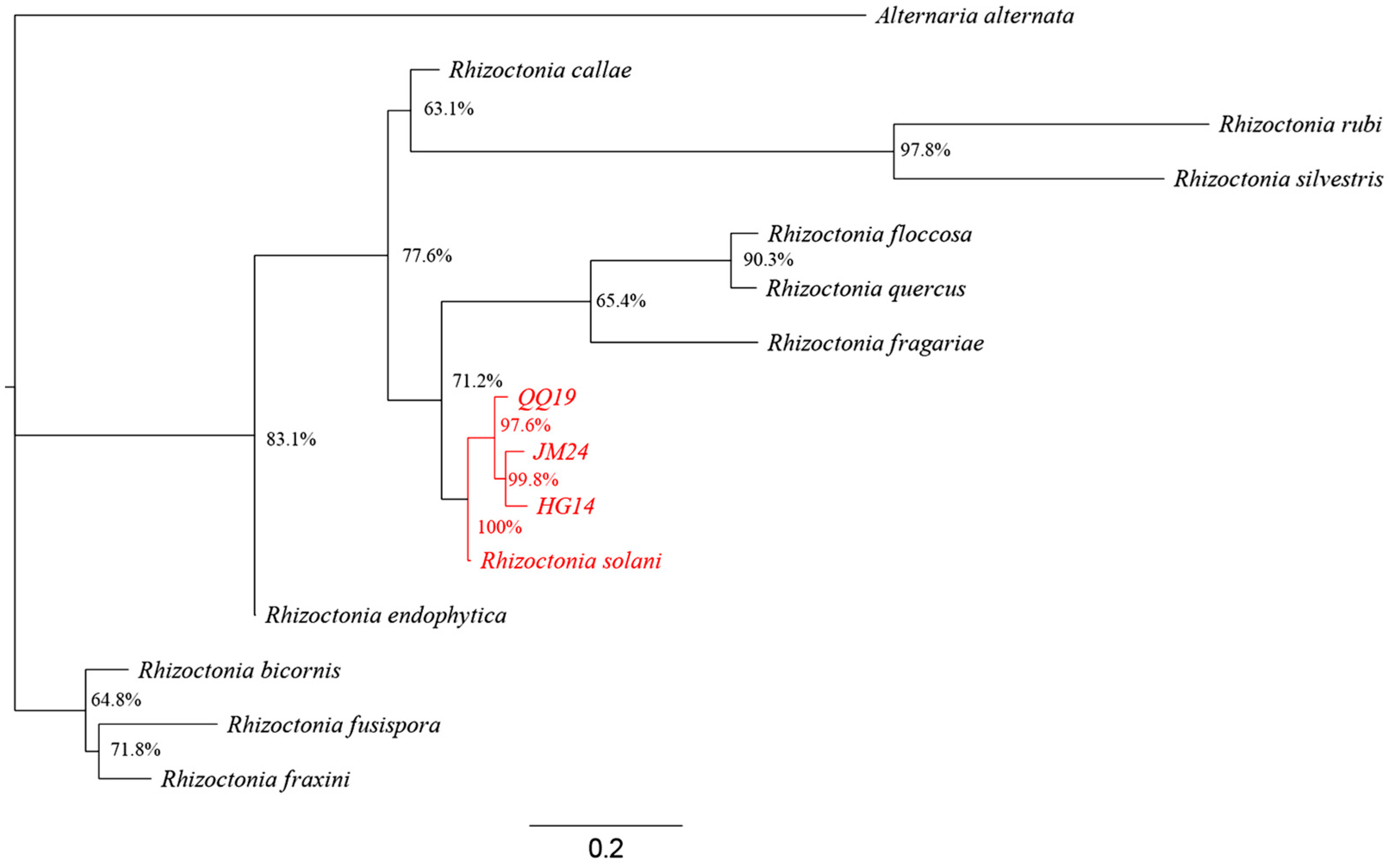
Representative strains QQ19, JM24, and HG14, which are typical strains with strong virulence, preliminarily identified as R. solani based on morphology, were further characterized molecularly. Genomic DNA was extracted from each isolate and amplified by PCR using the primer pairs ITS1/ITS4, NL1/NL4, and NS1/NS8. Resulting sequences were subjected to BLAST analysis against the NCBI database, revealing >95% identity with reference sequences of R. solani (accessions EU591769.1 for ITS, MH874361.1 for NL, and D85633.1 for NS). To clarify phylogenetic relationships, a multi-locus phylogenetic tree was constructed using concatenated sequences from various Rhizoctonia species, with Alternaria alternata as the outgroup. The tree was visualized using FigTree v1.4.4. Phylogenetic analysis confirmed that QQ19, JM24, and HG14 clustered within a well-supported clade containing reference R. solani strains (Figure 2). The sequences generated in this study were deposited in GenBank under accession numbers PX735937–PV735939 (ITS), PV366567–PV366569 (NL1/NL4) and PV361227–PV361229 (NS1/NS8).
In summary, through integrated morphological and molecular characterization, all fifty-five isolates—including the representative strains QQ19, JM24, and HG14—were conclusively identified as the soybean root rot pathogen R. solani.

3.2. Pathogenicity Assay Results

According to the classification criteria where a pathogenicity index ≥ 60 indicates high disease severity (H), 25 out of the 30 isolates (83.3%) were found to induce highly severe symptoms on the host crop, with their pathogenicity indices ranging notably from 61.8 to 93.2. In contrast, only two isolates (6.7%) resulted in weak disease severity (W, pathogenicity index < 30), and three isolates (10%) caused moderate disease severity (M, 30 ≤ pathogenicity index < 60). The overwhelming dominance of isolates that triggered highly severe symptoms underscores a significant disease pressure from R. solani in the region (Table 1).

3.3. Distribution and Pathogen Isolation Percentage of Rhizoctonia solani from Soybean Root Rot in Heilongjiang Province

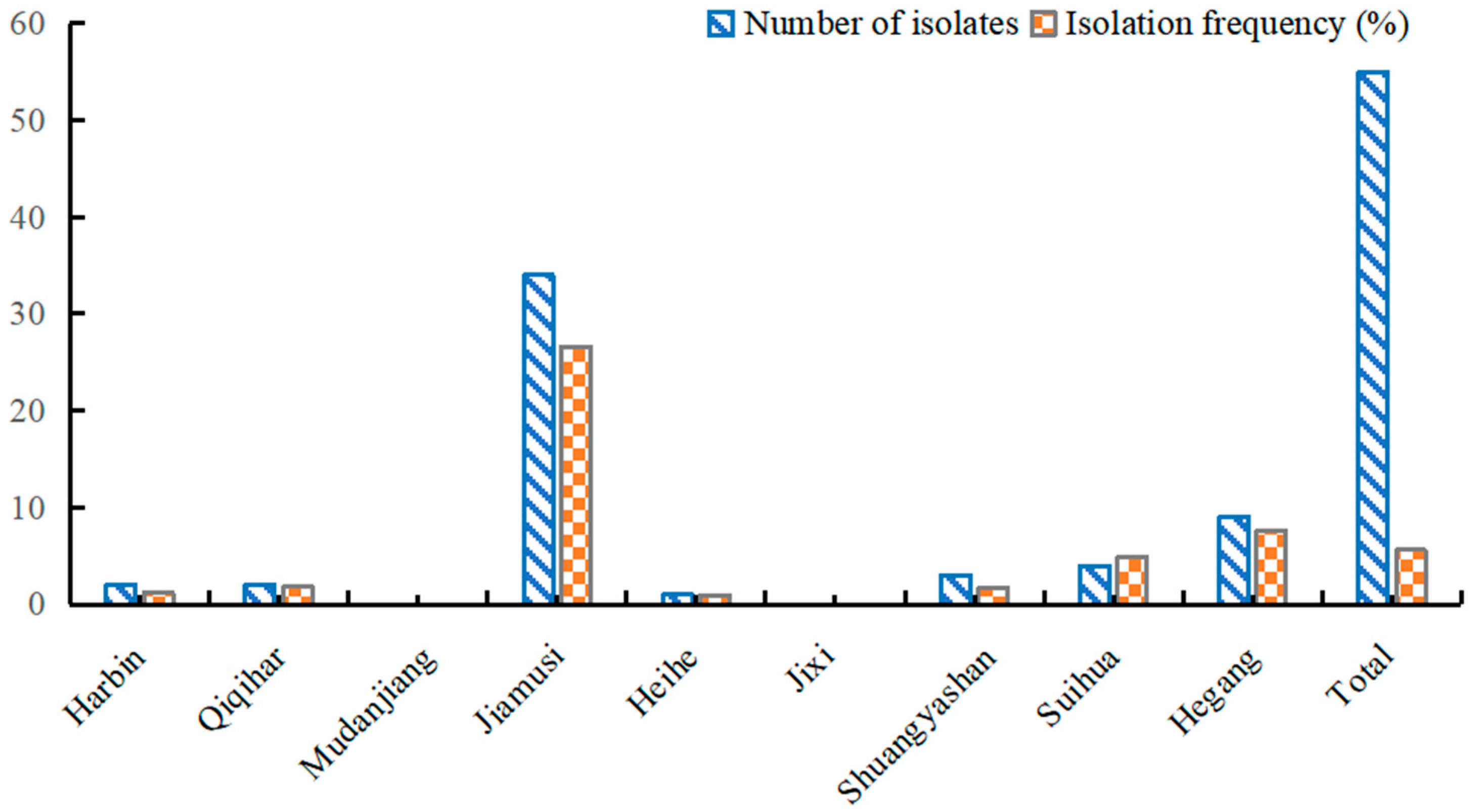
From soybean root rot samples collected across Heilongjiang Province, a total of 990 pathogenic isolates representing 11 species were obtained. Among these, 55 isolates were identified as Rhizoctonia solani, accounting for 5.6% of all pathogens recovered. The distribution of R. solani varied geographically, with the highest pathogen isolation percentage occurring in Jiamusi (26.6%; 34 isolates), which represented 61.8% of all R. solani isolates. Moderate frequencies were recorded in Hegang (7.6%; 9 isolates) and Suihua (4.9%; 4 isolates). Lower frequencies were observed in Shuangyashan (1.7%; 3 isolates), Harbin (1.2%; 2 isolates), Qiqihar (1.8%; 2 isolates), and Heihe (0.9%; 1 isolate) (Figure 3) No R. solani was detected in samples from Mudanjiang or Jixi. And conducted an investigation and recorded the isolation quantity and characteristics of R. solani in soybean root rot samples from nine cities in Heilongjiang Province in 2022-2023 (Table S1).

3.4. Sensitivity of Rhizoctonia solani Isolates to Fungicides

Selected 30 representative isolates of R. solani to assess their sensitivity to 6 different chemical fungicides (Table S2). Fungicide sensitivity was evaluated according to the median effective concentration (EC50), with isolates classified as sensitive (S; EC50 < 0.0050 µg·mL−1) or resistant (R; EC50 > 0.01 µg·mL−1). Fludioxonil (EC50 range: 0.000107–0.000571 µg·mL−1; mean: 0.00039 µg·mL−1; max/min ratio: 6.6) and prochloraz (EC50 range: 0.000151–0.002607 µg·mL−1; mean: 0.000729 µg·mL−1; ratio: 17.2) were highly effective and categorized as S. In contrast, tebuconazole (mean EC50: 0.019172 µg·mL−1; ratio: 10.2), difenoconazole (mean EC50: 0.051595 µg·mL−1; ratio: 41.4), pyraclostrobin (mean EC50: 0.015113 µg·mL−1; ratio: 26.1), and carbendazim (ratio: 203.1) were classified as R (Table 2). These results support prioritizing fludioxonil and prochloraz in chemical control strategies, while recommending restricted use of R-class fungicides to mitigate further resistance development.

3.5. Control Efficacy of Seed-Coating Fungicides

Seeds were treated with the fungicide formulations at dosages of 300 mL/100 kg and 900 mL/100 kg seeds, respectively. The experiment included four treatments, each replicated three times per group, with the entire trial repeated twice:
Treatment 1: Disease control (inoculated, non-treated seeds);
Treatment 2: Disease control assay (inoculated, fludioxonil fungicide-treated seeds);
Treatment 2: Disease control assay (inoculated, prochloraz fungicide-treated seeds).
The protective efficacy of two seed-coating fungicides, fludioxonil and prochloraz, was evaluated against Rhizoctonia solani-caused soybean root rot (Table 3). In the untreated control, disease incidence and severity index reached 91.67% (±0.04) and 49.33 (±6.65), respectively, confirming severe infection. Fludioxonil applied at 15 g a.i. per 100 kg seeds significantly reduced disease incidence to 53.33% (±0.10) and severity index to 18.22 (±2.18), achieving a control efficacy of 63.07%. In contrast, prochloraz (18 g a.i. per 100 kg seeds) reduced incidence to 61.67% (±0.10) and severity index to 26.22 (±4.53), corresponding to 46.85% efficacy. Both fungicides demonstrated significant disease suppression, though fludioxonil provided statistically superior control under the tested conditions.

4. Discussion

As a cornerstone of China’s food and oilseed security, soybean (Glycine max (L.) Merr.) finds a critical production base in the cold regions of Heilongjiang Province. However, the yield potential of this vital area is significantly constrained by soybean root rot, a pervasive soil-borne disease that causes substantial losses throughout the crop’s growth cycle [40]. Therefore, clarifying the composition and dominant pathogens of the soybean root rot pathogen population in Heilongjiang Province has become a prerequisite for achieving green and safe production in this area. The unique cold climate and soil microenvironment of this northern region may have shaped a pathogen community structure distinct from that in warmer zones [41]. This regional disparity directly determines the severity, epidemic patterns, and effectiveness of control strategies. For instance, diseases primarily caused by Fusarium spp. differ significantly from those dominated by Phytophthora spp. in terms of pathogenic mechanisms and chemical control options [42,43]. Thus, only through systematic analysis of the population structure can we move beyond a one-size-fits-all approach to management. This knowledge is crucial for breeding resistant varieties, screening targeted chemical agents, and developing precise ecological management strategies, thereby ensuring the stability and sustainable development of the soybean industry in this cold region.
Rhizoctonia solani, the most important species within the genus Rhizoctonia, is a soilborne plant pathogen with considerable diversity in cultural morphology, host range and aggressiveness [44]. R. solani, a notorious soil-borne fungus, causes soybean damping-off and root rot, with symptoms emerging in early summer: scattered/dead seedlings, seed/root rot, and hypocotyl lesions. Germinating seedlings infected pre-emergence suffer damping-off; young seedlings develop sunken reddish-brown hypocotyl cankers that kill them. Survivors show stem cankers, stunted growth, chlorosis, and nitrogen deficiency-like signs [45]. That aligns perfectly with the symptom characteristics demonstrated in this study, further validating the consistency of Rhizoctonia solani-induced soybean root rot symptoms across different regions. It provides strong support for the universality of the pathogen’s pathogenic manifestations. Our study established R. solani as a key causative agent of soybean root rot in Northeast China through integrated morphological and molecular identification. We collected symptomatic soybean plant samples from 9 major soybean-producing regions across Heilongjiang Province during 2022–2023, with sampling carried out from May to October each year. Following the isolation and identification of pathogens from samples obtained from these nine cities, we obtained 990 isolates, which were classified into 11 pathogenic species: Fusarium oxysporum, F. equiseti, Diaporthe longicola, F. acutatum, Rhizoctonia solani, F. tricinctum, F. solani, F. sporotrichioides, F. graminearum, F. proliferatum, and F. Brachygibbosum. Although it accounted for a limited proportion (55 out of 990) of the isolated pathogenic fungi, its ecological and pathogenic significance is substantial. Pathogenicity assessment revealed that 83.3% of the R. solani isolates were highly aggressive, with disease indices ranging from 61.8 to 93.2. This high pathogenicity profile was accompanied by a heterogeneous geographic distribution, with over 60% of isolates concentrated in Jiamusi, suggesting that localized factors such as soil conditions and cropping practices strongly influence its prevalence.
The dominance of highly aggressive pathotypes underscores a significant and specific threat to soybean production. This substantial variability in pathogenicity, a hallmark of R. solani populations, likely explains the severe root rot outbreaks observed in the region. The intensive soybean monoculture in Heilongjiang may be exerting strong selection pressure, favoring the evolution of these pathogenic genotypes [40]. Consequently, disease management strategies must be tailored, incorporating resistance breeding against these prevalent strains and ensuring that fungicide screening includes a representative panel of aggressive isolates to develop durable and effective control measures.
Soybean seedling diseases by R. solani matter greatly in North American soybean regions; lacking resistant genotypes and molecular pathogenicity data, management relies on cultural and chemical measures [46]. Our in vitro fungicide sensitivity screening provides crucial and timely data for formulating effective chemical control strategies. The high efficacy of fludioxonil and prochloraz (EC50 < 0.0050 µg·mL−1) is consistent with their known modes of action and recent reports of their activity against other soil-borne pathogens [47,48]. However, the confirmed resistance to tebuconazole, difenoconazole, pyraclostrobin, and carbendazim is a major concern. The high max/min ratio for carbendazim (203.1) indicates a population with advanced resistance development, likely due to its extensive historical use. Resistance to the QoI fungicide pyraclostrobin and the DMI fungicides tebuconazole and difenoconazole suggests the emergence of multi-drug resistant phenotypes, which severely limits control options [49,50]. This resistance profile is likely a direct consequence of the reliance on a limited arsenal of fungicides in seed treatment and soil drenching practices [35,51]. Our results serve as an urgent warning against the continued prophylactic use of these ineffective chemicals, which not only fail to control the disease but also accelerate the selection of resistant populations, thereby jeopardizing the long-term efficacy of chemical control.

5. Conclusions

The pot trial results, which demonstrated the superior control efficacy of fludioxonil seed treatment (63.07%) over prochloraz (46.85%), provide a practical and immediate recommendation for farmers. Fludioxonil, with its multi-site activity and low resistance risk, represents an excellent candidate for inclusion in integrated pest management (IPM) programs. However, overreliance on a single effective fungicide is a short-sighted strategy. The confirmed resistance to multiple chemical classes necessitates an immediate shift towards an integrated approach. This should include: (1) the rotation of fludioxonil with other effective, non-cross-resistant chemistries [52]; (2) the incorporation of biological control agents to reduce chemical selection pressure [53]; and (3) the adoption of cultural practices such as longer crop rotations with non-hosts (e.g., corn or small grains) to reduce inoculum build-up in the soil [54]. Future research must focus on mapping the specific anastomosis groups (AGs) of R. solani present in the region, understanding the molecular mechanisms of the observed fungicide resistance, and evaluating the field efficacy of integrated management strategies that combine resistant soybean varieties, biological control measures, and the judicious application of effective fungicides such as fludioxonil.

Supplementary Materials

The following supporting information can be downloaded at: https://www.mdpi.com/article/10.3390/agronomy16030281/s1, Table S1: Isolation Quantity and Characteristics of Rhizoctonia solani from Soybean Root Rot Samples in Nine Cities of Heilongjiang Province (2022–2023); Table S2: Sensitivity of 30 representative isolates of R. solani to 6 different chemical fungicides.

Author Contributions

Conceptualisation, Y.L. and S.W.; methodology, Y.L.; software, S.W. and J.L.; validation, S.W.; formal analysis, C.W. and J.W.; investigation, S.W.; resources, Y.L.; writing—original draft preparation, S.W.; writing—review and editing, Y.L. and S.W.; visualization, C.W.; supervision, J.L. and J.W.; project administration, Z.S.; funding acquisition, Y.L. and Z.S. All authors have read and agreed to the published version of the manuscript.

Funding

This work was supported by the Key Project of Heilongjiang Provincial Natural Science Foundation [grant number ZD2023C001], the Central Government Special Fund for Guiding Local Science and Technology Development of Heilongjiang Province (Grant No. ZY04JD05), Heilongjiang Province Seed Industry Innovation and Development Project (Project Number: 2024HZYCXNK01), National Natural Science Foundation of China [grant numbers 32271767], and Heilongjiang Collaborative Innovation and Extension System of Modern Agricultural Industry Technology of Forage and Feed.

Data Availability Statement

The original contributions presented in this study are included in the article/Supplementary Materials. Further inquiries can be directed to the corresponding authors.

Conflicts of Interest

The authors declare no conflicts of interest.

References

  1. Hartman, G.L.; West, E.D.; Herman, T.K. Crops that feed the World 2. Soybean—Worldwide production, use, and constraints caused by pathogens and pests. Food Secur. 2011, 3, 5–17. [Google Scholar] [CrossRef]
  2. Kong, W.; Wei, M.; Khan, N.; Liang, J.; Han, D.; Zhang, H. Assessing sustainable future of import-independent domestic soybean production in China: Policy implications and projections for 2030. Front. Sustain. Food Syst. 2024, 8, 1387609. [Google Scholar] [CrossRef]
  3. Liang, W.Y.; Gao, M.; Zhang, N.W.; Chen, X.; Lu, X.C.; Yan, J.; Han, X.Z.; Zhu, Y.C.; Zou, W.X. Effects of soil management strategies on maize and soybean yields in northeast China: A meta-analysis. Field Crops Res. 2025, 333, 110116. [Google Scholar] [CrossRef]
  4. Zhou, C.J.; Wu, Y.K.; Yu, J.D.; Ma, L.; Li, J.Y.; Liu, B.; Zhang, B.X.; Ren, H.L. Current Situation and Technical Requirements of Soybean Production in Saline-Alkali Areas in Western Heilongjiang Province. Heilongjiang Agric. Sci. 2023, 10, 72–77. [Google Scholar]
  5. Tang, H.; Xiao, C.H.; Ma, J.Z.; Yu, M.; Li, Y.M.; Wang, G.L.; Zhang, L.P. Prokaryotic diversity in continuous cropping and rotational cropping soybean soil. FEMS Microbiol. Lett. 2009, 298, 267–273. [Google Scholar] [CrossRef]
  6. He, D.X.; Yao, X.D.; Zhang, P.Y.; Liu, W.B.; Huang, J.X.; Sun, H.X.; Wang, N.; Zhang, X.J.; Wang, H.Y.; Zhang, H.J.; et al. Effects of Continuous Cropping on Fungal Community Diversity and Soil Metabolites in Soybean Roots. Microbiol. Spectr. 2023, 11, e01786-23. [Google Scholar] [CrossRef]
  7. Roth, M.G.; Webster, R.W.; Mueller, D.S.; Chilvers, M.I.; Faske, T.R.; Mathew, F.M.; Bradley, C.A.; Damicone, J.P.; Kabbage, M.; Smith, D.L. Integrated management of important soybean pathogens of the United States in changing climate. J. Integr. Pest Manag. 2020, 11, 17. [Google Scholar] [CrossRef]
  8. Chen, Y.X.; Huang, X.W.; Yang, X.L.; Ye, W.W.; Wang, S.C.; Liu, M.; Su, X.; Shi, J.C.; Wang, Y.C.; Xu, J.M.; et al. Neglected contributions of residual herbicides at various levels on soybean root rot: Link with herbicide non-targeted soil microbial communities and functions. J. Environ. Manag. 2025, 393, 127–137. [Google Scholar] [CrossRef]
  9. Kang, I.J.; Lee, M.R.; Han, S.Y.; Kim, Y.H.; Lee, S.W. First Report of Soybean Root Rot Caused by Fusarium proliferatum in the Republic of Korea. Plant Dis. 2024, 108, 1883. [Google Scholar] [CrossRef]
  10. Li, Y.; Wang, S.; Liu, Y.K.; Lu, Q.S.; Wang, K.; Li, H.L. Occurrence of soybean root rot caused by Pratylenchus coffeae in Henan Province, China. Plant Dis. 2019, 103, 1435. [Google Scholar] [CrossRef]
  11. Wang, S.; Li, X.; Liu, C.; Liu, L.; Yang, F.; Guo, Y.; Li, Y. First Report of Fusarium brachygibbosum Causing Root Rot on Soybean in Northeastern China. Plant Dis. 2021, 105, 1560. [Google Scholar] [CrossRef]
  12. Detranaltes, C.; Jones, C.R.; Cai, G. First Report of Fusarium fujikuroi Causing Root Rot and Seedling Elongation of Soybean in Indiana. Plant Dis. 2021, 105, 3762. [Google Scholar] [CrossRef]
  13. Ranathunge, K.; Thomas, R.H.; Fang, X.; Peterson, C.A.; Gijzen, M.; Bernards, M.A. Soybean root suberin and partial resistance to root rot caused by Phytophthora sojae. Phytopathology 2008, 98, 1179–1189. [Google Scholar] [CrossRef]
  14. Dorrance, A.E.; Kleinhenz, M.D.; McClure, S.A.; Tuttle, N.T. Temperature, Moisture, and Seed Treatment Effects on Rhizoctonia solani Root Rot of Soybean. Plant Dis. 2003, 87, 533–538. [Google Scholar] [CrossRef]
  15. Zhu, Z.J.; Yuan, M.; Han, D.W.; Zhang, D.; Wang, Z.; Sun, H.Y.; Wang, S.R.; Wang, L.X.; Zhuang, X.; Zhang, C.J. Analysis on the current research status of soybean root rot in Heilongjiang Province. Soybean Sci. Technol. 2024, 02, 29–34. [Google Scholar]
  16. Hartman, G.L.; Sinclair, J.B.; Rupe, J.C. (Eds.) Compendium of Soybean Diseases, 4th ed.; American Phytopathological Society: St. Paul, MN, USA, 1999. [Google Scholar]
  17. Li, Y.G.; Zhao, T.X.; Khuong Gia, H.H.; Xu, L.K.; Liu, J.X.; Li, S.X.; Huang, H.W.; Ji, P.S. Pathogenicity and genetic diversity of Fusarium oxysporum causing soybean root rot in northeast China. J. Agric. Sci. 2018, 10, 13–24. [Google Scholar] [CrossRef][Green Version]
  18. Choi, Y.W.; Hyde, K.D.; Ho, W.H. Single spore isolation of fungi. Fungal Divers. 1999, 3, 29–38. [Google Scholar]
  19. Shi, J.L.; Li, Y.Q.; Hu, K.M.; Ren, J.G.; Liu, H.M. Isolation and identification of pathogens from rotted root of Pinellia ternata in Guizhou Province. J. Microbiol. Chin. 2015, 42, 289–299. [Google Scholar]
  20. Chang, X.L.; Dai, H.; Wang, D.P.; Zhou, H.H.; He, W.Q.; Fu, Y.; Ibrahim, F.; Zhou, Y.; Gong, G.S.; Shang, J.; et al. Identification of Fusarium species associated with soybean root rot in Sichuan Province, China. Eur. J. Plant Pathol. 2018, 151, 563–577. [Google Scholar] [CrossRef]
  21. Tai, F.L. Sylloge Fungorum Sinicorum; Science Press: Beijing, China, 1979. (In Chinese) [Google Scholar]
  22. Wei, J.C. Handbook of Fungal Identification; Shanghai Scientific & Technical Publishers: Shanghai, China, 1979. (In Chinese) [Google Scholar]
  23. White, T.J.; Bruns, T.D.; Lee, S.B.; Taylor, J.W. Amplification and direct sequencing of fungal ribosomal RNA genes for phylogenetics. In PCR Protocols: A Guide to Methods and Applications; Innis, M.A., Gelfand, D.H., Sninsky, J.J., White, T.J., Eds.; Academic Press: San Diego, CA, USA, 1990; pp. 315–322. [Google Scholar]
  24. O’Donnell, K. Fusarium and its near relatives. In The Fungal Holomorph: Mitotic, Meiotic and Pleomorphic Speciation in Fungal Systematics; Reynolds, D.R., Taylor, J.W., Eds.; CAB International: Wallingford, UK, 1993; pp. 225–233. [Google Scholar]
  25. Luo, X.P.; Sun, L.; Li, Z.; Liu, J.; Liu, N.X.; Yi, Z.G.; Dong, Z.M.; Li, Y.Q.; Fan, Y.J. Research progress on pathogen classification and resistance QTL of soybean root rot. Guangdong Agric. Sci. 2025, 52, 34–46. [Google Scholar]
  26. Zhou, Z.C.; Tang, X.Y.; Hu, S.; Zhu, W.Y.; Wu, X.P.; Sang, W.J.; Ding, H.X.; Peng, L.J. First Report of Grey Spot on Tobacco caused by Alternaria alstroemeriae in China. Plant Dis. 2023, 107, 2546. [Google Scholar] [CrossRef]
  27. Yuan, X.; Li, Z.M.; Wen, L.; Huo, G.; Cui, C. First report of postharvest fruit rot on Gannan navel orange caused by Diaporthe unshiuensis in Jiangxi Province, China. Plant Dis. 2023, 107, 2869. [Google Scholar] [CrossRef]
  28. Du, Y.X.; Shi, N.N.; Ruan, H.C.; Lian, J.F.; Gan, L.; Chen, F.R. Study on Pathogenic Fungi Causing Soybean Root Rot in Yinchuan and Field Disease Control Efficiency of Seed Coating. Chin. J. Agric. Bull. 2021, 37, 103–109. [Google Scholar]
  29. Akber, M.A.; Mubeen, M.; Sohail, M.A.; Khan, S.W.; Solanki, M.K.; Khalid, R.; Abbas, A.; Divvela, P.K.; Zhou, L. Global distribution, traditional and modern detection, diagnostic, and management approaches of Rhizoctonia solani associated with legume crops. Front. Microbiol. 2023, 13, 1091288. [Google Scholar] [CrossRef]
  30. Zhou, J.M.; Zhang, L.S.; Tian, X.H.; Jin, Z.T. Field Control Effect of Different Types of Pesticides on Soybean Root Rot. Agric. Eng. 2024, 14, 56–60. [Google Scholar]
  31. Yang, Z.D.; Li, Y.Y.; Geng, S.; Zhou, L.X.; Cao, L.D.; Huang, Q.L.; Zhao, P.Y.; Zhao, B. Preparation of core-shell fludioxoni·lmetalaxyl-M delivery system and its control efficacy against soybean root rot. Chin. J. Pestic. Sci. 2025, 27, 1113–1122. [Google Scholar]
  32. He, H.T.; Tang, Y.N.; Gu, X.H.; Zhai, Q.H.; Wang, S.L.; Xu, X.W.; Pan, H.Y.; Zhang, H. Fungicide screening and field application for controlling soybean root rot. Agrochemicals 2023, 62, 55–58. [Google Scholar]
  33. Jiang, X.; Huang, Q.F.; Yang, X.Y. Identification of the soybean root rot pathogen in Liaoning Province and its biological characteristics, sensitivity to common fungicides. J. Plant Prot. 2023, 50, 240–248. [Google Scholar]
  34. Hegde, N.P. Evaluating Chemical Seed Treatments for Fusarium Root Rot Control in Dry Beans and Field Peas. Master’s Thesis, North Dakota State University, Fargo, ND, USA, 2014. [Google Scholar]
  35. Lamichhane, J.R.; You, M.P.; Laudinot, V.; Barbetti, M.J.; Aubertot, J.N. Revisiting sustainability of fungicide seed treatments for field crops. Plant Dis. 2020, 104, 610–623. [Google Scholar] [CrossRef]
  36. Ji, X.X.; Li, J.J.; Meng, Z.; Zhang, S.; Dong, B.; Qiao, K. Synergistic effect of combined application of a new fungicide fluopimomide with a biocontrol agent Bacillus methylotrophicus TA-1 for management of gray mold in tomato. Plant Dis. 2019, 103, 1991–1997. [Google Scholar] [CrossRef]
  37. Liu, Z.L.; Luo, Y.J.; Lin, R.X.; Li, C.M.; Zhao, H.J.; Aman, H.M.; Wisal, M.A.; Dong, H.F.; Liu, D.K.; Yu, X.N.; et al. C15-bacillomycin D produced by Bacillus amyloliquefaciens 4-9-2 suppress Fusarium graminearum infection and mycotoxin biosynthesis. Front. Microbiol. 2025, 16, 1599452. [Google Scholar] [CrossRef] [PubMed]
  38. Xiao, J.L.; Wang, G.J.; Ming, Z.; Jing, Y.; Wen, L.; Bi, Y.; Wang, L.; Lai, Y.C.; Shu, X.T.; Wang, Z. Effect of cultivation pattern on the light radiation of group canopy and yield of spring soybean (Glycine Max L. Merrill). Am. J. Plant Sci. 2013, 4, 1204–1211. [Google Scholar] [CrossRef][Green Version]
  39. Liu, J.X.; Cui, W.Q.; Zhao, Q.Y.; Ren, Z.P.; Li, L.; Li, Y.G.; Sun, L.; Ding, J.J. Identification, characterization, and chemical management of Fusarium asiaticum causing soybean root rot in Northeast China. Agronomy 2025, 15, 388. [Google Scholar] [CrossRef]
  40. Özer, G.; İmren, M.; Bozoğlu, T.; Dababat, A.A. First Report of Rhizoctonia solani AG2-1 on Roots of Wheat in Kazakhstan. Plant Dis. 2021, 105, 3744. [Google Scholar] [CrossRef]
  41. Yang, X.B.; Ruff, R.; Meng, X.Q. Race of Phytophthora sojae in Iowa sobean fields. Plant Dis. 1996, 80, 1418–1420. [Google Scholar] [CrossRef]
  42. Ortiz, V.; Chang, H.X.; Sang, H.; Jacobs, J.; Malvick, D.K.; Baird, R.; Mathew, F.M.; de Jensen, C.E.; Wise, K.A.; Mosquera, G.M.; et al. Population genomic analysis reveals geographic structure and climatic diversification for Macrophomina phaseolina isolated from soybean and dry bean across the United States, Puerto Rico, and Colombia. Front. Genet. 2023, 14, 1103969. [Google Scholar] [CrossRef] [PubMed]
  43. Rahman, M.T.; Rubayet, M.T.; Khan, A.A.; Bhuiyan, M.K.A. Integrated management of fusarium root rot and wilt disease of soybean caused by Fusarium oxysporum. Int. J. Biosci. 2020, 17, 83–96. [Google Scholar]
  44. Giachero, M.L.; Declerck, S.; Marquez, N. Phytophthora root rot: Importance of the disease, current and novel methods of control. Agronomy 2022, 12, 610. [Google Scholar] [CrossRef]
  45. Ajayi-Oyetunde, O.O.; Bradley, C.A. Rhizoctonia solani: Taxonomy, population biology and management of rhizoctonia seedling disease of soybean. Plant Pathol. 2018, 67, 3–17. [Google Scholar] [CrossRef]
  46. Rahman, M.T.; Rubayet, M.T.; Bhuiyan, M.K.A. Integrated management of rhizoctonia root rot disease of soybean caused by Rhizoctonia solani. Nippon J. Environ. Sci. 2021, 1, 1018. [Google Scholar]
  47. Li, C.; Li, X.; Kong, W.; Wu, Y.; Wang, J. Effect of monoculture soybean on soil microbial community in the Northeast China. Plant Soil 2010, 330, 423–433. [Google Scholar] [CrossRef]
  48. Sun, Y.; Jin, B.B.; Yang, J.W.; Liu, B.; Li, T.T.; Zhang, X.; Chen, X.; Chen, Y. Risk assessment of resistance to prochloraz in Phoma arachidicola causing peanut web blotch. Pestic. Biochem. Phys. 2024, 203, 106025. [Google Scholar] [CrossRef] [PubMed]
  49. Schruefer, S.; Pschibul, A.; Wong, S.S.W.; Sae-Ong, T.; Wolf, T.; Schäuble, S.; Panagiotou, G.; Brakhage, A.A.; Aimanianda, V.; Kniemeyer, O.; et al. Distinct transcriptional responses to fludioxonil in Aspergillus fumigatus and its ΔtcsC and Δskn7 mutants reveal a crucial role for Skn7 in the cell wall reorganizations triggered by this antifungal. BMC Genom. 2023, 24, 684. [Google Scholar] [CrossRef]
  50. Juliatti, F.C.; Azevedo, L.A.S.D.; Juliatti, B.C.M. Strategies of chemical protection for controlling soybean rust. In Soybean: The Basis of Yield, Biomass and Productivity; Kasai, M., Ed.; InTech: Rijeka, Croatia, 2017; pp. 35–62. [Google Scholar]
  51. Álvarez, G.; Enciso Maldonado, G.A.; Sanabria Velázquez, A.; Lopez Nicora, H.D.; Cazal Martínez, C.C.; Fernández Ríos, D.; Ortiz-Moreno, M.L.; Benítez Samaniega, A.; Ramírez, R.; Álvarez, G.; et al. Impact of fungicides on Asian soybean rust management in South American producing countries: A systematic study. Agriscientia 2024, 42, 1–21. [Google Scholar]
  52. Malandrakis, A.A.; Lafka, E.; Flouri, F. Impact of fludioxonil resistance on fitness and cross-resistance profiles of Alternaria solani laboratory mutants. Eur. J. Plant Pathol. 2021, 161, 665–676. [Google Scholar] [CrossRef]
  53. McLaughlin, M.S.; Roy, M.; Abbasi, P.A.; Carisse, O.; Yurgel, S.N.; Ali, S. Why do we need alternative methods for fungal disease management in plants? Plants 2023, 12, 3822. [Google Scholar] [CrossRef] [PubMed]
  54. Zang, M.; Guo, C.; Li, H.; Chen, S.; Ma, C.Q. Using Russian dandelion allelochemicals to elevate disease resistance and improve sugar beet growth. Ecotoxicol. Environ. Saf. 2025, 303, 118889. [Google Scholar] [CrossRef] [PubMed]
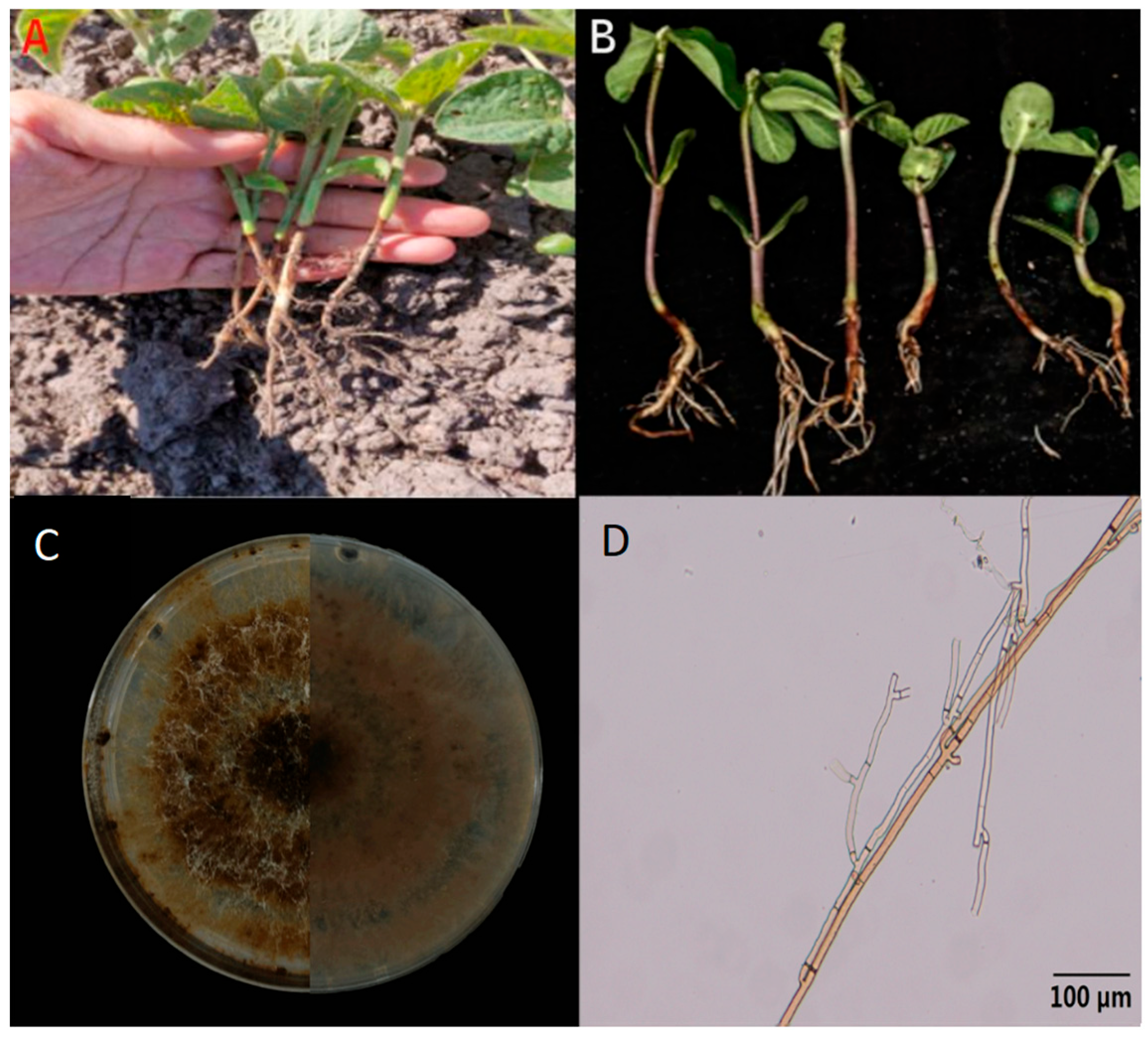
Figure 1. Morphological characteristics of Rhizoctonia solani, the causative agent of soybean root rot; (A) Typical symptoms of field occurrence; (B) Symptoms of inoculation identification in indoor potted plants; (C) obverse and reverse of the colony; (D) Mycelium.
Agronomy 16 00281 g001
Figure 2. Phylogenetic analysis of Rhizoctonia solani strains QQ19, JM24, and HG14 associated with soybean root rot. The tree was constructed using the Neighbor-Joining method based on concatenated sequences of the ITS, 28S LSU, and 18S SSU rRNA gene regions (amplified with primer pairs ITS1/ITS4, NL1/NL4, and NS1/NS8, respectively). The isolates characterized in this study (QQ19, JM24, HG14) are highlighted in red. Bootstrap support values from 1000 replicates are shown at the nodes; only values greater than 50% are indicated.
Agronomy 16 00281 g002
Figure 3. Population structure and distribution of soybean root rot caused by Rhizoctonia solani in Heilongjiang Province.
Agronomy 16 00281 g003
Table 1. Pathogenicity and disease severity of thirty Rhizoctonia solani isolates causing root rot on soybean.
Isolate Disease Severity
(Mean ± SE)
Pathogenicity ClassificationIsolate Disease Severity
(Mean ± SE)
Pathogenicity
Classification
HB2173.2 ± 1.7HJM3277.2 ± 2.9 H
HB2268.1 ± 1.2 HJM3474.6 ± 2.6 H
QQ1986.3 ± 2.6 HJM3587.4 ± 2.6 H
QQ2574.5 ± 1.4 HJM3784.8 ± 1.9 H
JM826.5 ± 1.2 WHH1468.7 ± 2.1 H
JM1375.6 ± 2.5 HSY2023.3 ± 1.1 W
JM1762.1 ± 1.7 HSY2171.4 ± 1.4 H
JM1846.5 ± 1.1 MSH1565.5 ± 1.7 H
JM1968.0 ± 1.7 HSH1635.2 ± 1.9 M
JM2074.1 ± 1.8 HSH1876.5 ± 1.2 H
JM2366.1 ± 1.7 HHG1461.8 ± 1.3 H
JM2448.5 ± 3.5 MHG1786.0 ± 2.9 H
JM2770.6 ± 1.6 HHG1872.5 ± 1.4 H
JM2964.6 ± 1.9 HHG1986.8 ± 3.0 H
JM3074.7 ± 2.1 HHG2093.2 ± 0.9 H
W = weak pathogenicity (disease severity < 30); M = moderate pathogenicity (30 ≤ disease severity < 60); H = high pathogenicity (disease severity ≥ 60).
Table 2. Sensitivity of the thirty tested Rhizoctonia solani isolates to frequently used fungicides for the control of soybean root rot in northeast China.
FungicidesEC50 (μg·mL−1)Maximum/Minimum EC50Mean EC50 Value (µg·mL−1)Fungal Sensitivity to Fungicides 1
Fludioxonitrile0.000107–0.00057146.60.00039S
Prochloraz0.000151–0.00260717.20.000729S
Tebuconazole0.008526–0.868610.20.019172R
Difenoconazole0.008731–0.361441.40.051595R
Pyraclostrobin0.004188–0.109126.10.015113R
Carbendazim0.002503–0.5083203.10.031918R
1 S = sensitive, EC50 < 0.005 μg·mL−1; R = resistant, EC50 > 0.01 μg·mL−1.
Table 3. Determination of the Control Efficacy of Two Kinds of Seed Coatings against soybean Root Rot caused by Rhizoctonia solani.
FungicidesActive Ingredient Content (g/100 kg)Incidence (%)Disease Index 1Control Efficacy (%)
————91.67 ± 0.0449.33 ± 6.65 a——
Fludioxonil1553.33 ± 0.1018.22 ± 2.18 c63.07
Prochloraz1861.67 ± 0.1026.22 ± 4.53 b46.85
1 Mean ± SE of three replicates; values followed by different letters are significantly different (LSD test, p = 0.05).
Disclaimer/Publisher’s Note: The statements, opinions and data contained in all publications are solely those of the individual author(s) and contributor(s) and not of MDPI and/or the editor(s). MDPI and/or the editor(s) disclaim responsibility for any injury to people or property resulting from any ideas, methods, instructions or products referred to in the content.