Article

Online Monitoring of Aerodynamic Characteristics of Fruit Tree Leaves Based on Strain-Gage Sensors


1
Intelligent Equipment Research Center, Beijing Academy of Agriculture and Forestry Sciences, Beijing 100097, China
2
School of Mechanical and Electrical Engineering, North China University of Aeronautics and Astronautics, Langfang 065000, China
3
Nongxin Technology (Beijing) Co., Ltd., Beijing 100097, China
*
Authors to whom correspondence should be addressed.
These authors contributed equally to this work.
Agronomy 2026, 16(3), 279; https://doi.org/10.3390/agronomy16030279
Submission received: 23 December 2025 / Revised: 13 January 2026 / Accepted: 21 January 2026 / Published: 23 January 2026
(This article belongs to the Special Issue Advances in Precision Pesticide Spraying Technology and Equipment)

Abstract

Orchard wind-assisted spraying technology relies on auxiliary airflow to disturb the canopy and improve droplet deposition uniformity. However, there are few effective means of quantitatively assessing the dynamic response of fruit tree leaves to airflow or the changes in airflow patterns within the canopy in real time. To address this, this study proposed an online monitoring method for the aerodynamic characteristics of fruit tree leaves using strain gauge sensors. The flexible strain gauge was affixed to the midribs of leaves from peach, pear and apple trees. Leaf deformations were captured with high-speed video recording (100 fps) alongside electrical signals in controlled wind fields. Bartlett low-pass filtering and Fourier transform were used to extract frequency-domain features spanning between 0 and 50 Hz. The AdaBoost decision tree model was used to evaluate classification performance across frequency bands. The results demonstrated high accuracy in identifying wind exposure (98%) for pear leaf and classifying the three leaf types (κ = 0.98) within the 4–6 Hz band. A comparison with the frame analysis of high-speed video recordings revealed a time error of 2 s in model predictions. This study confirms that strain gauge sensors combined with machine learning could efficiently monitor fruit tree leaf responses to external airflow in real time. It provides novel insights for optimizing wind-assisted spray parameters, reconstructing internal canopy wind field distributions and achieving precise pesticide application.

1. Introduction

During the application of pesticides for crop protection, excessive use not only reduces the efficacy of controlling pests and diseases but also increases the risk of environmental pollution. The core objective of precision application is to ensure that the spray solution is applied uniformly and rationally, both within and outside the crop canopy [1]. The characteristics of the crop canopy, such as leaf density, porosity, volume and morphological structure, directly influence the selection of application methods and the deposition efficiency of spray droplets [2,3]. During the later stages of fruit tree growth in particular, mutual shading among branches and foliage leads to poor ventilation and light penetration within the canopy. This hinders the effective penetration of spray droplets, significantly reducing the deposition rate on inner and lower leaves and further diminishing the overall control efficacy [4,5,6].
To enhance spray penetration, orchards widely adopt air-assisted spraying technology. This technique utilizes external fans to generate high-speed airflow, disturbing canopy foliage and inducing dynamic deformation. This temporarily alters the canopy’s pore structure, increasing the number of pathways for droplets to enter the canopy interior, thereby improving the overall uniformity of pesticide distribution throughout the canopy [7]. Existing research indicates complex interactions between airflow volume, spray flow rate, droplet size distribution, and crop characteristics. Jiang et al. discovered, through single-leaf video flow monitoring combined with wind source experiments, that leaves undergo reconfiguration behaviours (e.g., curling, twisting) under airflow [8]. Leaves in tilted postures struggle to dissipate vibration energy effectively through deformation, with their aerodynamic stability significantly influenced by initial posture. Another study examined the effects of leaf inclination angle, airflow velocity, leaf surface roughness, and spray solution surface tension on maximum droplet retention (RPAL max) using an orthogonal wind tunnel spray test system. Results indicated that lower airflow velocity, smaller leaf surface roughness (e.g., lychee leaves), appropriate inclination angles, and lower surface tension enhance droplet deposition, while excessively high wind speeds actually reduce retention efficiency [9]. Gao et al. [10], combining midrib curvature fitting, high-speed imaging, and contact angle measurements on chilli pepper leaves, found that leaf curvature significantly governs droplet adhesion and migration behaviour: greater curvature facilitates droplet sliding along the midrib. The critical slip angle is jointly determined by surface tension, contact angle hysteresis, local curvature, and gravity. Song et al. [11] developed a normalized deposition prediction model through orthogonal wind-spray experiments, revealing the significant influence of wind speed, distance, and their interaction on droplet distribution, which also varies with canopy height: lower layers are primarily distance-dominated and middle layers show weaker response, while upper layers exhibit sensitivity to both factors. The model demonstrates high accuracy in low canopies but exhibits substantial errors in high canopies or under natural wind interference.
Overall, structural traits such as leaf size, canopy porosity, and volume decisively influence total deposition. Droplet deposition fundamentally results from the dynamic coupling between canopy structure and airflow fields. However, current research on the dynamic interaction process of “auxiliary air-flow–leaf movement–droplet deposition” remains markedly inadequate [12]. On the one hand, most studies rely on static canopy models or simplified geometries for numerical simulations, neglecting the continuous, nonlinear dynamic responses of leaves during actual spraying [13,14]. Zhang et al. [15] developed an airflow attenuation model for fruit tree canopies based on jet dynamics and momentum conservation principles. This model provides theoretical support for intelligent wind speed regulation to optimize pesticide application efficacy and reduce drift losses. Zhang et al. [16] observed dynamic leaf deformation in wind tunnels using stereoscopic high-speed photography. They found that leaves sequentially undergo static deformation, low-frequency vibration, and steady-state aerodynamic reconfiguration as wind speed increases, with state transitions corresponding to two critical wind speeds. Beyond the second critical wind speed, the windward area stabilizes, consistent with theoretical predictions. Although Yan et al. [17] did not directly employ strain gauges in their CFD validation experiments of wind-induced deformation in grape leaves, their high-precision tracking of tip and mid-vein displacements underscored the necessity of contact sensors for dynamic monitoring. On the other hand, despite various wind speed measurement methods (e.g., mechanical [18], Pitot tube [19], hot-wire [20], thermosensitive [21], and ultrasonic [22]), they generally suffer from issues such as bulky size, strong interference, high cost, or difficulty in deployment within dense canopies, making it challenging to capture real-time aerodynamic responses at the leaf scale [23].
In fact, the motion behaviour of leaves under wind loads is highly complex, influenced by multiple factors including wind speed, turbulence intensity, leaf morphology (such as size, shape, and flexibility), petiole mechanical properties, and overall plant structure. Li et al. investigated the impact of leaf movement on droplet coverage at different airflow velocities [24].
In recent years, advances in flexible electronics and micro-sensing technologies have opened new avenues for in situ monitoring of plant wind-induced responses. Among these, resistive strain gauges—noted for their high sensitivity, good linearity, and miniaturization potential—have been adapted to mimic leaf shapes for capturing minute deformations in leaves or branches. Flexible leaf sensors based on capacitive or resistive principles have also demonstrated feasibility in pesticide deposition monitoring. However, applying strain gauges to living leaves remains challenging. On one hand, the strain transfer efficiency of metal adhesive strain gauges is significantly affected by adhesive layer thickness, elastic modulus, and attachment techniques. The presence of strain transition zones at both ends of the sensitive grid leads to measured values lower than actual strain [25,26]. Additionally, strain sensors have a limited perception of multi-degree-of-freedom deformations. On the other hand, most existing studies focus on structural health monitoring under static or quasi-static loads [27], and their ability to distinguish between high-frequency flutter and low-frequency oscillations under dynamic wind loads remains insufficiently validated. Nevertheless, given their low cost, ease of integration, and ability to provide continuous signal output, strain gauges retain unique advantages in dense canopy interiors where traditional anemometers are difficult to deploy. Combining effective signal processing with machine-learning methods holds promise for extracting characteristic frequency bands related to wind field intensity and turbulence characteristics from strain time-series data, thereby enabling indirect perception of local aerodynamic conditions.
In summary, there is currently a lack of effective methods suitable for real leaves that can monitor their dynamic responses online and reconstruct local wind field conditions. To address this, this paper proposes a novel approach for online monitoring of the bending and deformation behaviour of fruit tree leaves under auxiliary airflow, based on the physical characteristics of strain gauge sensors. Flexible strain gauges were attached to fresh leaves from peach, pear, and apple trees. Electrical signals were simultaneously recorded in a controlled wind field, while high-speed photography captured actual movement states. The frequency-domain characteristics of leaf responses under windy and windless conditions were systematically analyzed. Building upon this, a multi-species joint classification model was developed using machine learning to achieve high-precision discrimination of whether leaves were subjected to wind action. This study aims to reveal the quantitative relationships between auxiliary airflow and leaf dynamic responses, providing theoretical foundations and technical support for optimizing air-assisted spraying technology, enhancing pesticide deposition efficiency, and reducing environmental risks.

2. Materials and Methods

2.1. Test Bench Configuration

The test bench shown in Figure 1 includes an adjustable leaf orientation clamping device, a wind speed control system, a strain gauge signal acquisition system, and an image capture system. The adjustable leaf orientation clamping device consists of an aluminum profile, sliding rail, and petiole clamp. This device allows flexible adjustment of the relative positions between the leaf and high-speed camera to achieve optimal shooting positions and angles. The wind speed control system utilizes Arduino IDE 2.0 software and an STM32 microcontroller(STMicroelectronics, Geneva, Switzerland) to regulate the controlling voltage of the variable-speed fan (Model: 130FLJ5173220V, Hongke, Hong Kong), with a maximum outlet wind speed of 16 m/s.
The strain gauge signal acquisition system includes strain gauge sensors, a signal processing circuit, an ESP32 (ESP32-S2, Espressif Systems Inc., Shanghai, China) data acquisition circuit, and a synchronization control circuit. Strain gauges connect to the signal processing circuit via a 0.2 mm2 enamelled wire. The signal processing circuit employs a half-bridge differential amplifier circuit with a TP-102 amplifier (Suzhou 3PEAK Microelectronics Technology Co., Ltd., Suzhou, Jiangsu Province, China) to convert strain gauge resistance changes into 0–5 V signals. The ESP32 data acquisition circuit employs a series resistor to convert the 0–5 V signal to 0–2.5 V. The voltage signal is then acquired through the ADC pins. A voltage reference chip (LTL431ATLT1G, LRC) generates a 2.5 V reference voltage that serves as the ADC reference for the ESP32. The ESP32 synchronously acquires strain gauge voltage, fan signal voltage, reference voltage, and synchronization signal. The synchronization control circuit generates periodic voltage signals from the Arduino Uno. These drive high-brightness LEDs via a MOSFET circuit, producing a clearly visible strobe in high-speed photography.
The image capture system includes a high-speed camera (GigaView, Southern Vision Systems, Inc., Madison, AL, USA) and a halogen light source (BY-2000WS, Shanghai Yingmei Photography Equipment Co., Ltd., Shanghai, China). The frame rate is 100 fps, and the exposure time is 0.5 ms.

2.2. Preprocessing of Tree Leaves

The branches used in this study were sourced from six-year-old peach, apple, and pear trees (National Precision Agriculture Demonstration Base, Changping, Beijing, China). Each branch retained three intact, healthy terminal leaves. Sufficient rainfall was recorded in the region during the experimental period, ensuring leaves maintained normal turgor pressure. The spacing between fruit trees was approximately 4 m. All branches used in the experiment completed testing within 1 h to prevent alterations in properties caused by leaf dehydration.
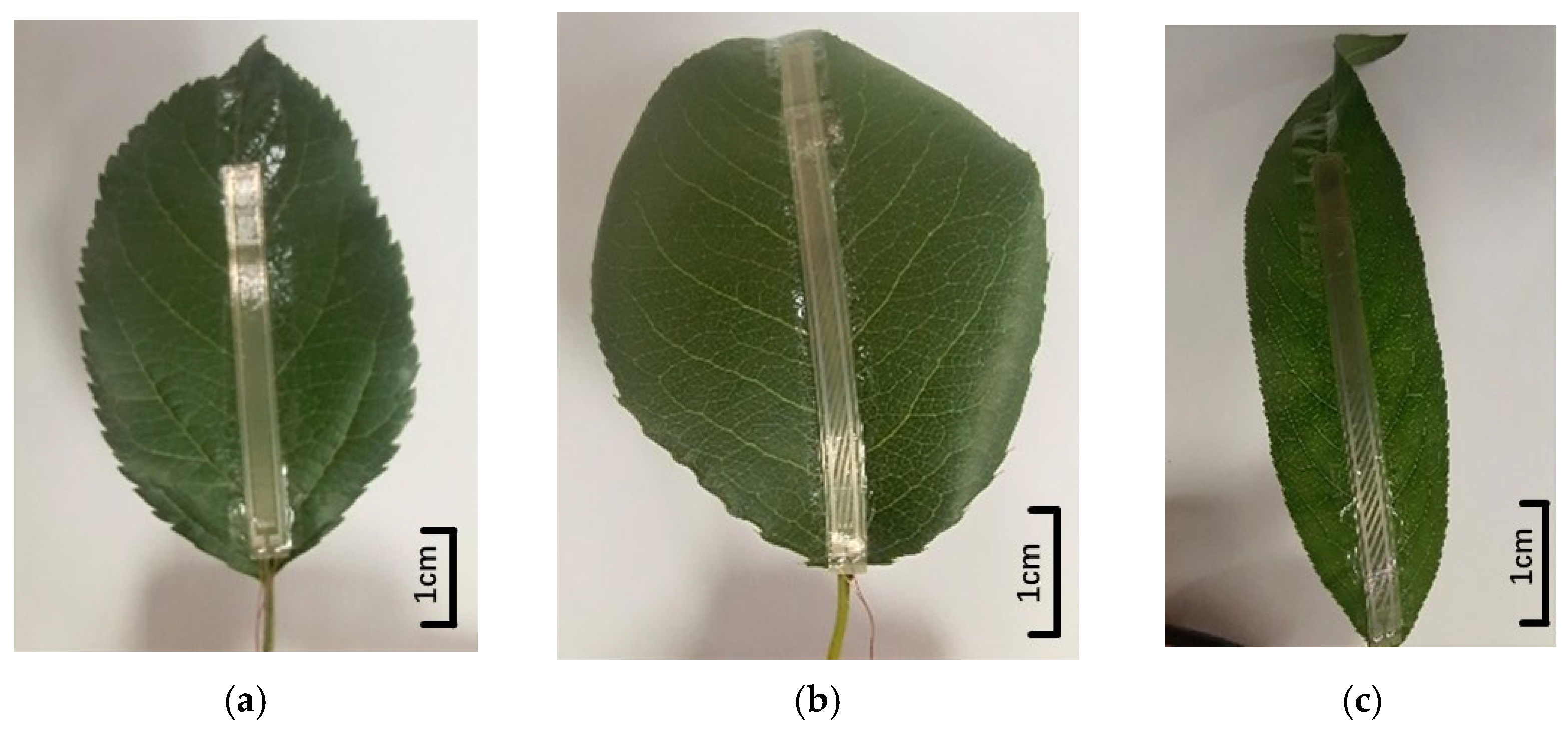
For the resistive strain gauge sensor, adjust the potential regulator to set the initial output voltage of the strain sensor to 2.5 V when in a horizontal position. As illustrated in Figure 2, the strain gauges are affixed to the rear shaft surface of the leaves using medical-grade waterproof ultra-thin flexible AB adhesives (Wuhan Huawei Technology Co., Ltd., Wuhan, China PU waterproof adhesive tape, 10 × 10 cm specification).

2.3. Acquisition of Tree Leaf Movement Data

Three strain gauges were affixed to the three terminal leaves of a branch and positioned within the wind field. The testing protocol is (1) 5 s stationary phase, (2) 25 s of wind exposure upon fan activation, (3) 10 s recovery. Ten wind speed levels were tested on eight branches from peach, pear, and apple trees. High-speed photography was additionally conducted on three branches; however, due to the intensity of supplementary lighting, peach leaves were only captured during six wind speed levels (Table 1). All tests were repeated twice and a static state test after all windy tests was conducted to ensure leaves and branches sustained no irreversible damage during the tests. The test methods and results of outlet air velocity and leaf position air velocity are detailed in Supplementary Materials.

2.4. Strain Gauge Sensor Data Signal Processing and Analysis

A Butterworth filter was employed to apply low-pass filtering with a sampling frequency of 100 Hz and a cutoff frequency of 10 Hz to the electrical signals captured in real time by strain gauge sensors during leaf movement, thereby eliminating redundant high-frequency noise data. The denoised data were segmented based on synchronously acquired fan control signals: (1) data from the 2.5 s windless phase preceding the fan signal initiation; (2) data from the 2.5 s wind phase occurring 5 s after the fan signal initiation. Power spectrum estimation is performed on the filtered leaf vibration signals across these two segments. The average power spectral density and its 95% confidence interval were calculated for both wind and windless conditions.

2.5. Establishment of Multi-Species Joint Identification Model

To determine the universal identification frequency bands, the acquired spectral data was divided into four groups: peach leaves, pear leaves, apple leaves, and a multi-species joint group. Data within each group was segmented into 0.5 Hz intervals across the 0–50 Hz range. Each segment underwent classification training using decision trees (AdaBoost classifier) with Matlab 2022a software. To prevent scene re-replication, branches were randomly allocated to training and testing sets: 8 branches per species (peach, pear, apple) for training, 3 for testing; the joint group used 24 branches for training and 9 for testing. The randomization, training, and testing process was repeated ten times, with averages taken to mitigate random selection errors. Based on the optimal frequency range identified for the joint group, a multi-species joint identification model with a spectral bandwidth of 2 Hz was established. Recall, precision, accuracy, and kappa parameters were subsequently calculated.

2.6. Verification of Continuous Signal

Based on the multi-species joint model established in Section 2.5, continuous prediction is performed on the continuous signal, outputting cumulative predictions of leaf movement. Specifically, the movement of 1–3 leaves yields corresponding prediction outputs of 1–3. To validate the prediction accuracy of the continuous signal, the actual states of leaves from peach, pear, and apple crops were recorded by the high-speed camera.
To accurately identify leaf motion, the difference imaging was calculated between consecutive grey-scale frames, with the stationary state defined as grey (127). LED signals from flashing lights and electrical signals were used for matching, aligning the timestamps of electrical signals collected by strain gauges with video timestamps. Three key time points were captured and calculated. The time Point A was defined as the first single leaf moved. The time Points B and C were defined as the last three leaves and the single leaf moved after fan deactivation. The latency of the joint model was assessed by calculating the time difference between the model output and the high-speed camera movement of the above three time points.

3. Results

3.1. Strain Gauge Sensor Data Signal Processing Analysis

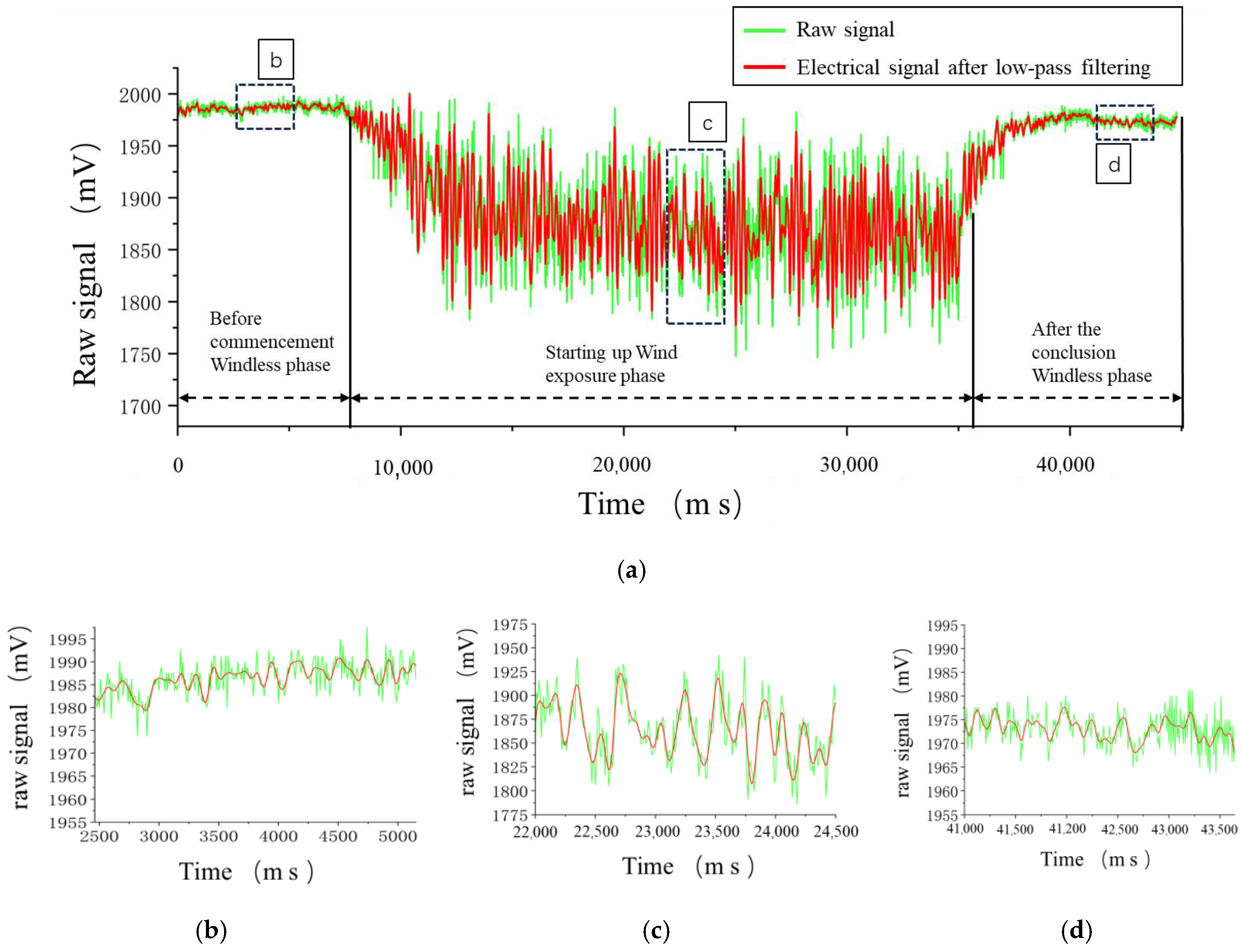
The raw strain signal underwent Bartlett low-pass filtering with a cutoff frequency of 10 Hz, yielding the results shown in Figure 3a. High-frequency noise was effectively suppressed, significantly improving signal smoothness while preserving the primary dynamic characteristics of blade motion. As illustrated in Figure 3b,d, the filtered signal exhibits reduced amplitude fluctuations during windless periods, decreasing from 40 mV pre-filtering to 20 mV. During wind-affected periods (c), the signal amplitude is reduced from 300 mV pre-filtering to 200 mV.
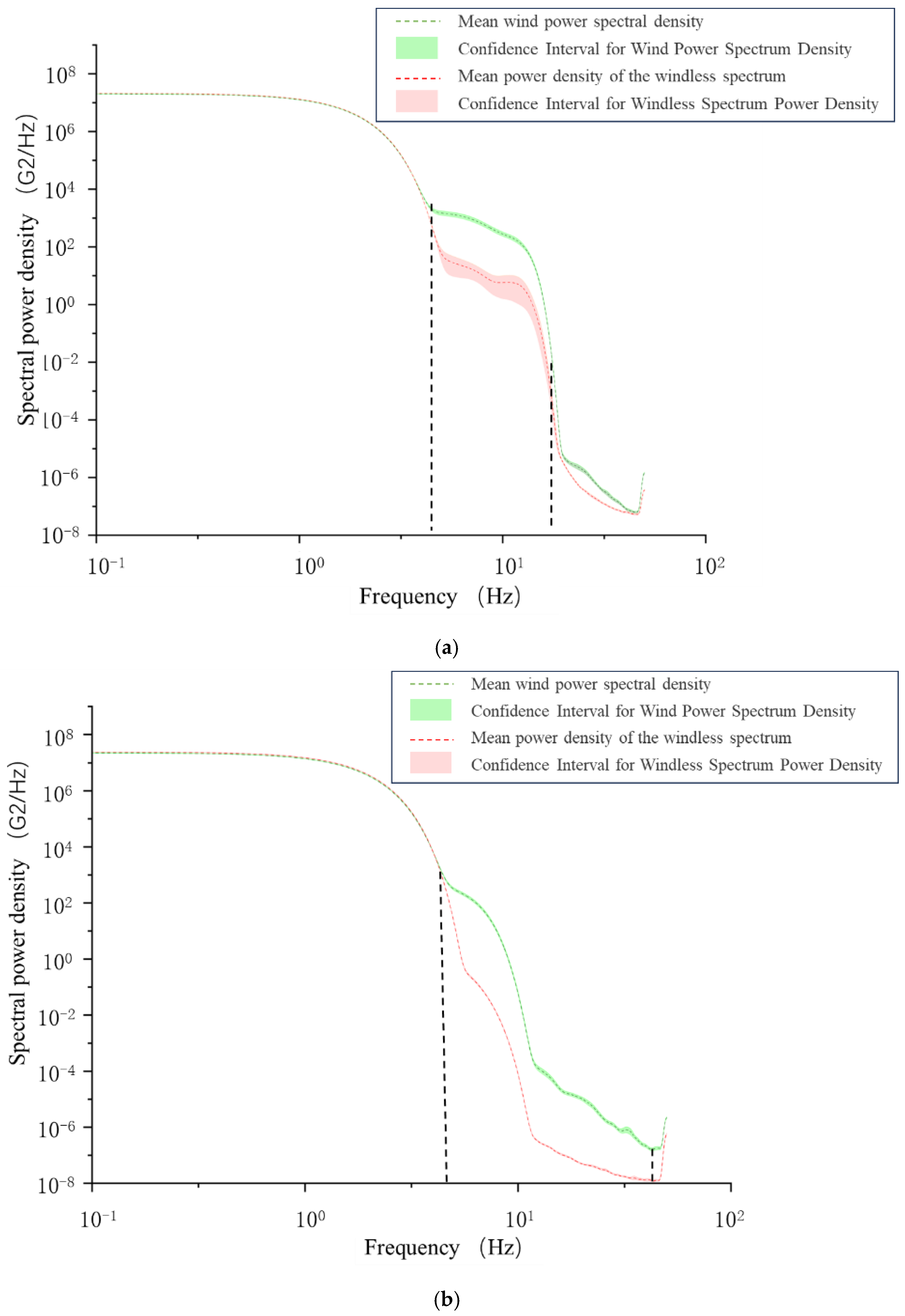
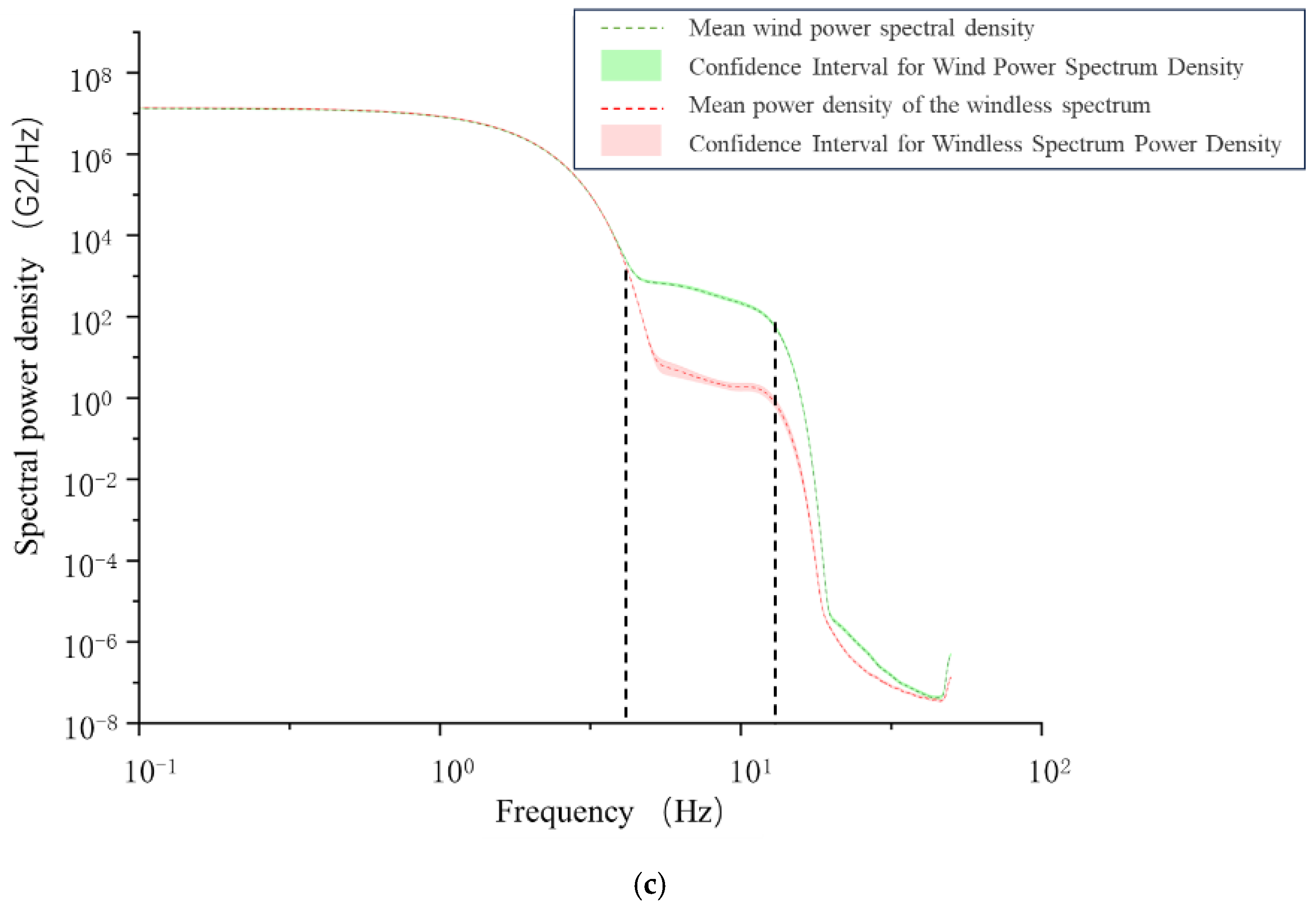
The corresponding power spectral density (PSD) was calculated for the wind-affected and windless phases of three fruit tree leaf types, as shown in Figure 4. The PSD distribution under wind-affected conditions varied among different tree species. The PSD in the wind-affected state was significantly higher than that in the windless state within certain frequency ranges, though these ranges differ by species. Pear leaves exhibited pronounced differences between wind-affected and windless states primarily within 4–20 Hz (Figure 4a), whereas apple and peach leaves showed distinct patterns at 4–40 Hz (Figure 4a) and 4–12 Hz (Figure 4a), respectively. In the low-frequency range near 0–1 Hz, the PSDs of wind-affected and windless conditions were indistinguishable. It indicates that this band primarily reflects system natural frequencies or environmental perturbations rather than wind-induced responses. While the frequency ranges exhibiting differences after wind exposure vary among different tree leaves, they all fall within the 4–40 Hz range. This characteristic provides a reference for the subsequent classification of windy or windless conditions.

3.2. Optimal Classification Frequency Bands for Multi-Species Leaves

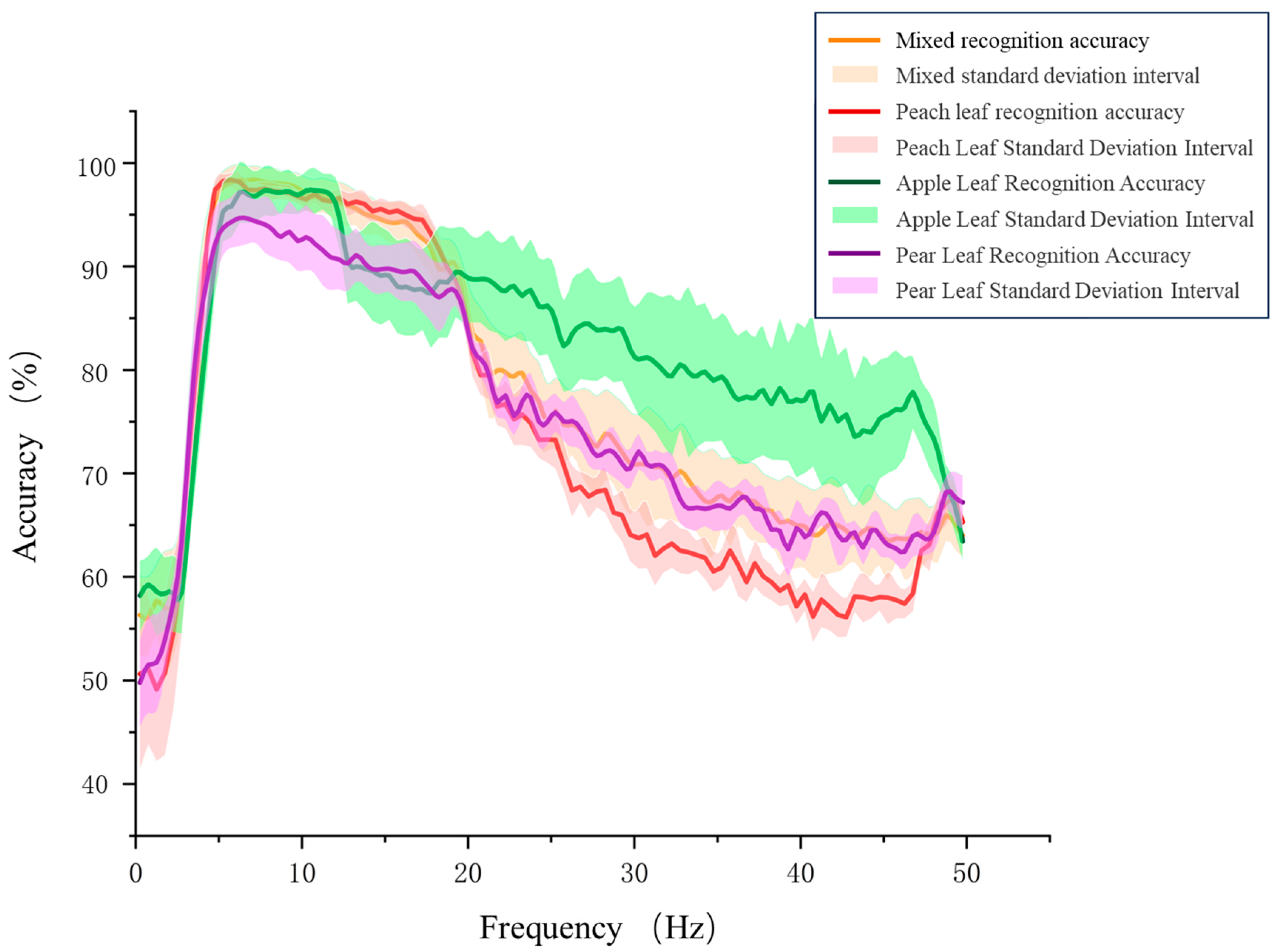
The classification accuracy of the four datasets (peach leaves, pear leaves, apple leaves, and a multi-species joint) exhibited similar trends with frequency variation (Figure 5). At low frequencies (0–2 Hz), accuracy hovered around 50%, approaching random performance. This phenomenon was mirroring the lack of significant variation observed at these frequencies in Figure 4. The accuracy in four datasets rose sharply beyond 2 Hz, peaking between 4 and 6 Hz before gradually declining. The pear leaf group classification accuracy significantly improved within this 4–6 Hz range, reaching a maximum of 94%. The peach and apple leaves group also attained peak accuracies of 98% and 97%, respectively, within this range. Notably, the multi-species joint model achieved 99% detection accuracy in the 4–6 Hz band with the narrowest confidence interval, indicating that this frequency range represents the optimal discriminative band shared by all three fruit tree leaf types, demonstrating excellent cross-species applicability.

3.3. Construction of a Multi-Species Joint Identification Model

As shown in Table 2, the model demonstrates high accuracy in distinguishing windy and calm conditions for all three blade types within the test dataset.

3.4. Temporal Verification of Continuous Signal Prediction Results

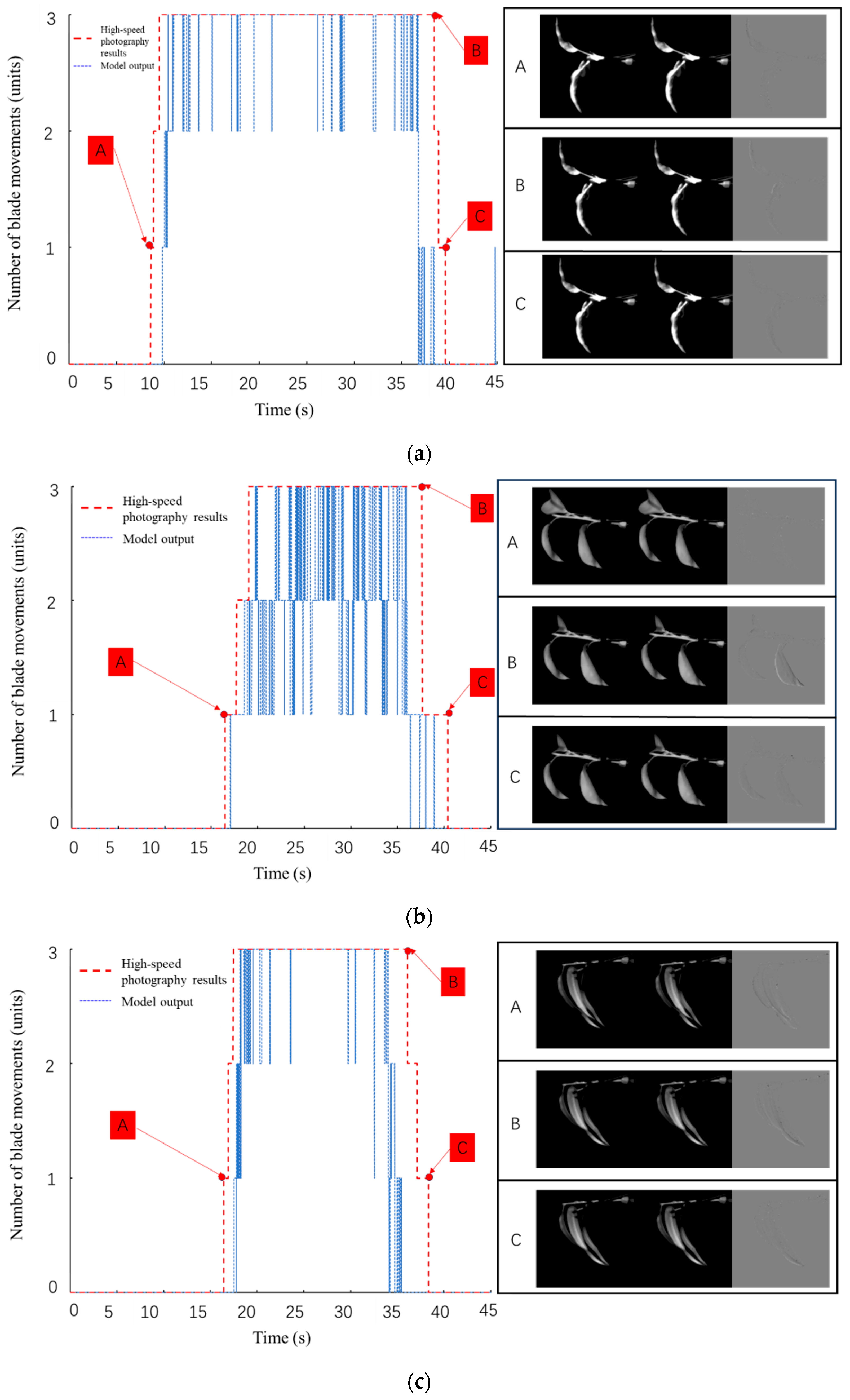
As shown in Figure 6, in test samples from peach, pear, and apple trees, the wind speed at the fan outlet increased from 0 m/s to 12 m/s. High-speed photography captured the transition of leaves from a stationary to a moving state. The multi-species joint model output showed the number of wind-affected moving leaves gradually increasing from 0 to 1, 2, and 3. Upon fan shutdown, the airflow velocity at the outlet decreased from 12 m/s to 0 m/s, causing the leaves to gradually return to a stationary state. The multi-species integrated model correspondingly output a stepwise decrease in the number of moving leaves from 3 to 0.
During the fan start-up phase, the multi-species coupled model detected the first instance of a single leaf transitioning from rest to motion at a point later than the corresponding moment recorded by high-speed photography within the leaf (Point A). Conversely, during the fan shutdown phase, the multi-species coupled model determined the point at which the motion of the corresponding number of leaves ceased to be generally earlier than the moment when the last three leaves and the single leaf transitioned from motion to rest (Points B and C).
During continuous monitoring, systematic temporal discrepancies were observed between the model’s predictions and the actual leaf motion captured by high-speed photography. This asymmetric temporal deviation was observed across various events, including single-leaf motion and synchronized multi-leaf motion, and was consistent across three sample types: peach, pear, and apple trees. The specific cause lies in the model’s use of a 2 s sliding window for frequency-domain analysis, whose output reflects the state over the preceding 2 s. Following fan shutdown, the primary frequency energy of residual leaf vibrations rapidly decays. The model classifies motion as stationary once energy falls below its threshold. Conversely, high-speed photography continues to capture minute displacements through inter-frame differential analysis, causing the model’s output to precede the actual cessation point. Concurrently, the inherent temporal offset introduced by the 2 s window further contributes to this anticipatory phenomenon during the shutdown phase.

3.5. Time of Deviation in Multi-Species Joint Model Prediction Results

As outlined in Section 3.4, a temporal error exists between the model predictions and high-speed camera recordings. Time delays for three key events were calculated based on synchronized timestamps: (1) the time error of the first single-leaf movement (Point A); (2) the time error of the last single-leaf movement (Point B); (3) the time error of the last three leaves’ movement (Point C). Results are presented in Table 3. Within the 6–16 m/s wind speed range, the delay ranges for apple, pear, and peach leaves were 0.735–1.295 s, 0.860–1.191 s, and 1.040–1.795 s, respectively. The average delay range for all three leaf types at different wind speeds during start-up was 1.140 s. During the fan shutdown phase, the model determined the end of motion earlier than the actual cessation time. The delay range for the last single-leaf movement was 0.712–3.272 s, while that for the last three leaves’ movement was 1.924–3.915 s. The average delay at the end of wind exposure for all three leaf types across different wind speeds was 2.184 s. The average time deviation between model predictions and the three actual leaf movements was approximately 1.44 s for apple leaves, 1.70 s for pear leaves, and 2.37 s for peach leaves. Integrating all three time points and multiple wind speed conditions, the average time error for model detection across the three species was 1.84 s.
Peach leaves exhibit a delay of up to 23.905 s at low wind speeds (0–3 m/s). Due to the minimal initiation amplitude of the leaves within the 0–6 m/s range, high-speed photography encounters significant errors when determining key points.

4. Discussion

Compared to conventional wind measurement methods, such as mechanical, hot-wire or ultrasonic anemometers, flexible strain gauge sensors are compact, cost-effective and can be easily affixed to leaf surfaces. They are particularly suited to scenarios where conventional sensors are difficult to deploy, such as within the interiors of dense canopies, and offer unique advantages for environmental sensing within fruit tree canopies. However, existing research predominantly relies on external observation or ex vivo testing. For example, Wu et al. [28] used high-speed photography to track leaf tip displacement for airflow inversion. While these methods are highly accurate, they suffer from field-of-view obstruction, lighting constraints and limitations in offline processing, rendering them impractical for complex orchard environments. Wang et al. [29] employed high-speed photography to track leaf tip displacement for airflow inversion. However, these methods suffer from field-of-view obstruction, lighting constraints and offline processing limitations, making them impractical for complex orchard environments. Other studies have quantified the stiffness and damping characteristics of citrus and lychee leaves through wind tunnel experiments. However, these relied on detached, clamped leaves, neglecting the coupled effects of whole-plant structural dynamics and petiole flexibility [30]. Furthermore, certain studies focus on fluid–structure interaction simulations or biomechanical modelling under idealized geometries. While theoretically valuable, these approaches struggle to reflect the aerodynamic responses of leaves within actual orchard canopies. In contrast, the approach outlined herein achieves in situ determination of the critical prerequisite condition whether a leaf is effectively exposed to wind by directly sensing the local bending deformation of actual leaves in their natural configurations. This provides a methodology for perceiving variations in wind fields generated by wind turbines within fruit tree canopies. More significantly, this solution holds potential for establishing distributed canopy perception networks. Future deployment of multiple strain gauge arrays at varying heights, orientations, and depths within the canopy could enable comprehensive aerodynamic monitoring across all positions within and outside the canopy (e.g., 3–5 leaves in upper, middle, and lower layers). This will enable the collaborative inversion of local airflow penetration intensity, attenuation gradients and spatiotemporal disturbance characteristics. This can provide real-time feedback for wind-assisted spray systems, enabling adaptive, closed-loop control of airflow volume and pesticide dosage and application speed, as well as precise airflow adjustment and parameter optimization for wind-assisted sprayers, such as monitoring the aerodynamic characteristics of real fruit tree canopies using multi-sensor networks, and optimizing the airflow patterns of wind-assisted sprayers through closed-loop systems that integrate aerodynamic monitoring (the sensing end) with wind-powered sprayers (the execution end).
This represents an engineering breakthrough that cannot be achieved through single-point wind speed measurements, visual recognition alone, or numerical simulation.
Nevertheless, this study has several limitations that need to be addressed in future work.
(1) The strain gauge sensors effectively capture bending deformation along the midrib direction but exhibit limited response to complex motion patterns such as out-of-plane leaf oscillation, leaf margin curling, or torsion, potentially omitting certain aerodynamic information. Future developments are expected to feature multi-point, lightweight, and highly conformable integrated monitoring sensors. (2) The experiment employed excised branches. Although the sensors used in this study have been significantly miniaturized compared to other sensors attached to leaves, they may still exert a certain influence on the mechanical properties of the leaves. (3) This study has not yet addressed factors commonly encountered in natural orchards, such as turbulence and leaf ageing throughout the growing season. To ensure experimental reproducibility, a controlled wind source was used to generate a quasi-steady airflow. However, this setup cannot replicate the complex, unsteady, turbulent structures generated by natural winds interacting with spray fans and canopy structures in real orchards, which limits its ecological validity. (4) In indoor experiments, the natural three-dimensional vibration degrees of freedom of branches are suppressed due to the inherent limitations of the apparatus and the constraints imposed by the clamping devices. This leads to differences between the data obtained indoors and the dynamic responses of real orchard canopies. This can introduce bias when extrapolating research findings to field applications [31].
It is noteworthy that current multi-species joint models exhibit a certain degree of temporal error when detecting leaf movement compared to high-speed camera recordings. Whilst this error can be compensated for through time calibration in offline analysis, it may compromise the system’s responsiveness in real-time closed-loop control scenarios. Consequently, subsequent research will focus on shortening the signal analysis window, optimizing the frequency-domain feature extraction process, and exploring lightweight model architectures to further reduce inference latency. Moreover, the application of this methodology should not be confined solely to discerning whether leaves are subjected to wind disturbance.

5. Conclusions

This study presents a method combining flexible strain gauge sensors with frequency region machine learning. This is the first time that strain gauge sensors have been used to monitor the dynamic responses of fruit tree leaves in real time in response to assisted airflow. The results showed that wind-affected leaf movement signals exhibited significant separability within the 4–6 Hz frequency band, which was key for classifying wind exposure. The multi-species joint classification model constructed using this approach achieved highly accurate identification of peach, pear and apple leaves, demonstrating excellent generalization capabilities. Synchronous high-speed photography validation confirmed the model’s reliable capture of the onset and cessation of wind-induced motion states. This method paves the way for the real-time sensing of the two-degree-of-freedom aerodynamic response of fruit tree leaves. It also provides a more solid theoretical basis, methodological reference, and technical guidance for the intelligent regulation and optimization of airflow parameters in orchard wind-assisted spraying operations. Ultimately, this will enhance pesticide deposition efficiency while reducing drift losses and environmental risks.

Supplementary Materials

The following supporting information can be downloaded at https://www.mdpi.com/article/10.3390/agronomy16030279/s1, Testing Method for Air Velocity at Air Outlet and Blade Positions.

Author Contributions

Conceptualization, Y.L., Z.W., J.S. and C.Z.; methodology, Y.L., Z.W., C.G. and X.D.; software, Y.L. and Z.W., validation, Y.L., Z.W. and F.F.; investigation, Y.L., Z.W., C.G. and Y.Z.; writing—original draft preparation, Y.L.; writing—review and editing, Y.L., Z.W., Y.Z., F.F., J.S. and C.Z.; supervision, X.D., J.S. and C.Z.; funding acquisition, C.Z. and C.G. All authors have read and agreed to the published version of the manuscript.

Funding

This research was funded by Project supported by the BAAFS Foundation for Distinguished Scholars (Grant No. JKZX202212), National Natural Science Foundation of China (Grant No. 32301684), and China Agriculture Research System (CARS-30-4-01).

Data Availability Statement

The data presented in this study are available on request from the corresponding author due to privacy restrictions related to participating agricultural sites.

Acknowledgments

We acknowledge the assistance provided by the Intelligent Equipment Technology Research Centre of the Beijing Academy of Agriculture and Forestry Sciences.

Conflicts of Interest

Jian Song was employed by Nongxin Technology (Beijing) Co., Ltd. The remaining authors declare that the research was conducted in the absence of any commercial or financial relationships that could be construed as a potential conflict of interest.

References

  1. Tudi, M.; Ruan, H.D.; Wang, L.; Lyu, J.; Sadler, R.; Connell, D.; Chu, C.; Phung, D.T. Agriculture Development, Pesticide Application and Its Impact on the Environment. Int. J. Environ. Res. Public Health 2021, 18, 1112. [Google Scholar] [CrossRef]
  2. Grella, M.; Gioelli, F.; Marucco, P.; Zwertvaegher, I.; Mozzanini, E.; Mylonas, N.; Nuyttens, D.; Balsari, P. Field Assessment of a Pulse Width Modulation (PWM) Spray System Applying Different Spray Volumes: Duty Cycle and Forward Speed Effects on Vines Spray Coverage. Precis. Agric. 2022, 23, 219–252. [Google Scholar] [CrossRef]
  3. Gu, C.; Sun, J.; Li, S.; Yang, S.; Zou, W.; Zhai, C. Deposition Characteristics of Air-Assisted Sprayer Based on Canopy Volume and Leaf Area of Orchard Trees. Plants 2025, 14, 220. [Google Scholar] [CrossRef]
  4. Xun, L.; Garcia-Ruiz, F.; Fabregas, F.X.; Gil, E. Pesticide Dose Based on Canopy Characteristics in Apple Trees: Reducing Environmental Risk by Reducing the Amount of Pesticide While Maintaining Pest and Disease Control Efficacy. Sci. Total Environ. 2022, 826, 154204. [Google Scholar] [CrossRef]
  5. Liu, X.; Liu, X.; Li, Y.; Yuan, J.; Song, L.; Li, H.; Wu, M. Estimation Model of Canopy Stratification Porosity Based on Morphological Characteristics: A Case Study of Cotton. Biosyst. Eng. 2020, 193, 174–186. [Google Scholar] [CrossRef]
  6. Li, L.; Zhang, R.; Chen, L.; Hewitt, A.J.; He, X.; Ding, C.; Tang, Q.; Liu, B. Toward a Remote Sensing Method Based on Commercial LiDAR Sensors for the Measurement of Spray Drift and Potential Drift Reduction. Sci. Total Environ. 2024, 918, 170819. [Google Scholar] [CrossRef] [PubMed]
  7. Qiu, W.; Guo, H.; Cao, Y.; Li, X.; Wu, J.; Chen, Y.; Yu, H.; Zhang, Z. An Electrical Vortex Air-Assisted Spraying System for Improving Droplet Deposition on Rice. Pest Manag. Sci. 2022, 78, 4037–4047. [Google Scholar] [CrossRef] [PubMed]
  8. Jiang, H.; Xin, D.; Zhang, H. Wind-Tunnel Study of the Aerodynamic Characteristics and Mechanical Response of the Leaves of Betula platyphylla Sukaczev. Biosyst. Eng. 2021, 207, 162–176. [Google Scholar] [CrossRef]
  9. Li, J.; He, M.; Cui, H.; Lin, P.; Chen, Y.; Ling, G.; Huang, G.; Fu, H. Characterizing Droplet Retention in Fruit Tree Canopies for Air-Assisted Spraying. Agriculture 2022, 12, 1093. [Google Scholar] [CrossRef]
  10. Gao, Z.-M.; Hu, W.; Dong, X.-Y.; Zhao, X.-Y.; Wang, S.; Chen, J.; Qiu, B.-J. Motion Behavior of Droplets on Curved Leaf Surfaces Driven by Airflow. Front. Plant Sci. 2024, 15, 1450831. [Google Scholar] [CrossRef]
  11. Song, J.; Wang, Z.; Zhai, C.; Gu, C.; Zheng, K.; Li, X.; Jiang, R.; Xiao, K. Modeling of Droplet Deposition in Air-Assisted Spraying. Agronomy 2025, 15, 1580. [Google Scholar] [CrossRef]
  12. Liao, J.; Luo, X.; Wang, P.; Zhou, Z.; O’Donnell, C.C.; Zang, Y.; Hewitt, A.J. Analysis of the Influence of Different Parameters on Droplet Characteristics and Droplet Size Classification Categories for Air Induction Nozzle. Agronomy 2020, 10, 256. [Google Scholar] [CrossRef]
  13. Li, T.; Qi, P.; Wang, Z.; Xu, S.; Huang, Z.; Han, L.; He, X. Evaluation of the Effects of Airflow Distribution Patterns on Deposit Coverage and Spray Penetration in Multi-Unit Air-Assisted Sprayer. Agronomy 2022, 12, 944. [Google Scholar] [CrossRef]
  14. Fu, S.; Ren, N.; Liu, S.; Shao, M.; Jiang, Y.; Du, Y.; Zhang, H.; Sun, L.; Zhang, W. An Improved Hierarchical Leaf Density Model for Spatio-Temporal Distribution Characteristic Analysis of UAV Downwash Air-Flow in a Fruit Tree Canopy. Agronomy 2025, 15, 1867. [Google Scholar] [CrossRef]
  15. Zhang, C.; Zhou, H.; Fang, S.; Cao, B. Investigation of Airflow Attenuation in Orchard Air-Assisted Spraying Based on Crown Characteristics. Agriculture 2025, 16, 7. [Google Scholar] [CrossRef]
  16. Zhang, C.; Zhou, H.; Xu, L.; Ru, Y.; Ju, H.; Chen, Q. Measurement of Morphological Changes of Pear Leaves in Airflow Based on High-Speed Photography. Front. Plant Sci. 2022, 13, 900427. [Google Scholar] [CrossRef] [PubMed]
  17. Yan, C.; Niu, C.; Ma, S.; Tan, H.; Xu, L. CFD Models as a Tool to Analyze the Deformation Behavior of Grape Leaves under an Air-Assisted Sprayer. Comput. Electron. Agric. 2022, 198, 107112. [Google Scholar] [CrossRef]
  18. Wang, P.; Hanif, A.S.; Yu, S.-H.; Lee, C.-G.; Kang, Y.H.; Lee, D.-H.; Han, X. Development of an Autonomous Drone Spraying Control System Based on the Coefficient of Variation of Spray Distribution. Comput. Electron. Agric. 2024, 227, 109529. [Google Scholar] [CrossRef]
  19. Zhu, M.; Jiang, X.; Hu, Q.; Zheng, H.; Zhou, Q.; Jiang, L. Wind Speed and Direction Measurement Method and System Based on Cylindrical Pitot Tube Array. In Proceedings of the 11th Frontier Academic Forum of Electrical Engineering (FAFEE2024), Chongqing, China, 20–22 June 2024; Yang, Q., Li, J., Eds.; Springer Nature: Singapore, 2025; pp. 863–870. [Google Scholar]
  20. Lundström, H. Investigation of Heat Transfer from Thin Wires in Air and a New Method for Temperature Correction of Hot-Wire Anemometers. Exp. Therm. Fluid Sci. 2021, 128, 110403. [Google Scholar] [CrossRef]
  21. Haiyang, L.; Jiali, C.; Zhanfeng, H.; Zhi, C.; Chuanzhong, X.; Xiaobin, S. Investigation on Near-Surface Wireless Wind Speed Profiler Based on Thermistors. J. Agric. Mach. 2017, 48, 68–77. [Google Scholar] [CrossRef]
  22. Li, X.; Zhu, G.; Gao, W.; Sun, H.; Liu, G.; Wu, Y.; Shi, Y. A Novel Ultrasonic Array Signal Processing Scheme for Wind Measurement. ISA Trans. 2018, 81, 259–269. [Google Scholar] [CrossRef]
  23. Musiu, E.M.; Qi, L.; Wu, Y. Spray Deposition and Distribution on the Targets and Losses to the Ground as Affected by Application Volume Rate, Airflow Rate and Target Position. Crop Prot. 2019, 116, 170–180. [Google Scholar] [CrossRef]
  24. Li, J.; Li, Z.; Ma, Y.; Cui, H.; Yang, Z.; Lu, H. Effects of Leaf Response Velocity on Spray Deposition with an Air-Assisted Orchard Sprayer. Int. J. Agric. Biol. Eng. 2021, 14, 123–132. [Google Scholar] [CrossRef]
  25. Wang, P.; Yu, W.; Ou, M.; Gong, C.; Jia, W. Monitoring of the Pesticide Droplet Deposition with a Novel Capacitance Sensor. Sensors 2019, 19, 537. [Google Scholar] [CrossRef]
  26. Wu, Y.; Qi, L.; Zhang, H.; Musiu, E.M.; Yang, Z.; Wang, P. Design of UAV Downwash Airflow Field Detection System Based on Strain Effect Principle. Sensors 2019, 19, 2630. [Google Scholar] [CrossRef] [PubMed]
  27. Cheng, M.; Zhu, G.; Zhang, F.; Tang, W.; Jianping, S.; Yang, J.; Zhu, L. A Review of Flexible Force Sensors for Human Health Monitoring. J. Adv. Res. 2020, 26, 53–68. [Google Scholar] [CrossRef]
  28. Wu, S.; Liu, J.; Wang, J.; Hao, D.; Wang, R. The Motion of Strawberry Leaves in an Air-Assisted Spray Field and Its Influence on Droplet Deposition. Trans. ASABE 2021, 64, 83–93. [Google Scholar] [CrossRef]
  29. Wang, G.; Dong, X.; Jia, W.; Ou, M.; Yu, P.; Wu, M.; Zhang, Z.; Hu, X.; Huang, Y.; Lu, F. Influence of Wind Speed on the Motion Characteristics of Peach Leaves (Prunus persica). Agriculture 2024, 14, 2307. [Google Scholar] [CrossRef]
  30. Xu, S.; Luo, L.; Jin, Y.; Zhong, Y.; Song, J. Application of Leaf Attitude Sensor Systems in Air-Assisted Spraying Operation in Cowpea and Citrus. Biosyst. Eng. 2025, 257, 104232. [Google Scholar] [CrossRef]
  31. Shi, R.; Sun, H.; Qiu, W.; Lv, X.; Ahmad, F.; Gu, J.; Yu, H.; Zhang, Z. Analysing Airflow Velocity in the Canopy to Improve Droplet Deposition for Air-Assisted Spraying: A Case Study on Pears. Agronomy 2022, 12, 2424. [Google Scholar] [CrossRef]
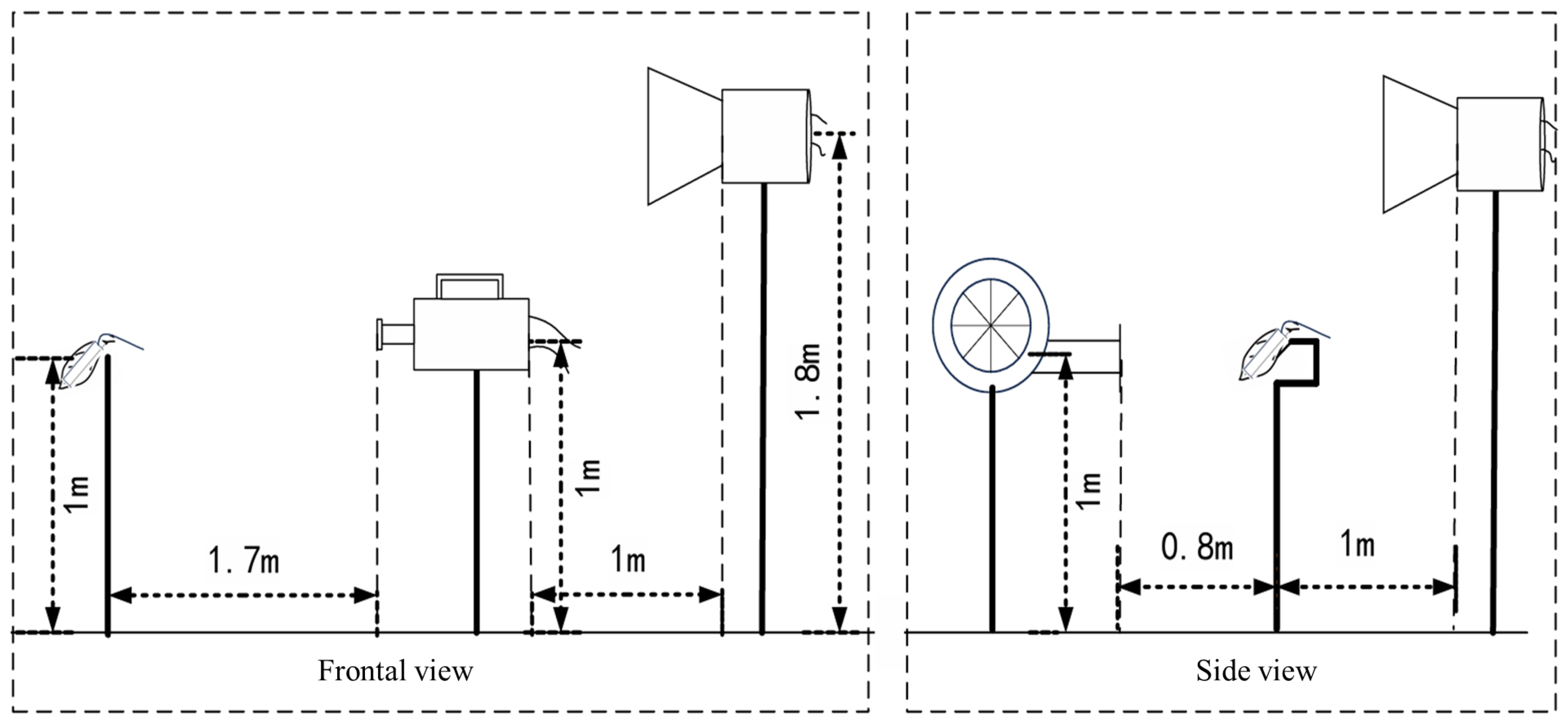
Figure 1. Schematic diagram of indoor test setup. The fan and leaves overlap in the front view perspective. The high-speed camera and leaves overlap in the side view perspective.
Agronomy 16 00279 g001
Figure 2. Strain gauge attachment to leaves. (a) Apple leaf; (b) pear leaf; (c) peach leaf.
Agronomy 16 00279 g002
Figure 3. High-frequency filtered data from continuous acquisition (peach leaf, Air Outlet Velocity: 12 m/s). (a) Fully processed data of leaf wind-induced signals; (b) processed data during the windless phase before fan activation; (c) processed data during the wind-induced phase while the fan is running; (d) processed data during the windless phase after fan deactivation.
Agronomy 16 00279 g003
Figure 4. Power spectral density analysis of wind-affected and windless phase data segments for leaves. (a) Pear tree leaves; (b) apple tree leaves; (c) peach tree leaves.
Agronomy 16 00279 g004aAgronomy 16 00279 g004b
Figure 5. Frequency-specific accuracy of wind source detection in fruit tree leaves.
Agronomy 16 00279 g005
Figure 6. Comparison of the ulti-Species Joint Detection Classification Model with video stream results. (a) Peach tree leaves; (b) pear tree leaves; (c) apple tree leaves. A: Image and difference map of the first single-leaf movement in the video after fan activation; B: corresponding leaf image and difference map from the final two frames showing simultaneous movement of three leaves in the video after fan deactivation; C: corresponding leaf image and difference map from the final two frames showing single-leaf movement in the video after fan deactivation.
Agronomy 16 00279 g006
Table 1. Experimental parameters.
CategoryPeach LeavesPear LeavesApple Leaves
Fan voltage value (V)0, 1.6, 3.4, 4, 5, 6, 7, 8, 9, 100, 1.9, 3.4, 4, 5, 6, 7, 8, 9, 100, 1.5, 3.4, 4, 5, 6, 7, 8, 9, 10
Air Outlet Velocity (m/s)0, 3, 6, 7, 8, 9, 10, 12, 14, 16 0, 3, 6, 7, 8, 9, 10, 12, 14, 160, 3, 6, 7, 8, 9, 10, 12, 14, 16
Strain Gauge Specifications (AA)80AA80AA50AA
Number of readings per strain gauge set (times)21 (0, 1.5, 3.4, 4, 5, 6, 7, 8, 9, 10)21 (0, 1.5, 3.4, 4, 5, 6, 7, 8, 9, 10)21 (0, 1.5, 3.4, 4, 5, 6, 7, 8, 9, 10)
Strain gauge + high-speed photography Number of acquisitions per set (times)12 times (1.6, 3.4, 4, 5, 7, 9)19 times (1.9, 3.4, 4, 5, 6, 7, 8, 9, 10)19 times (1.5, 3.4, 4, 5, 6, 7, 8, 9, 10)
Total number of collections (times)204225225
Total number of single-leaf samplings (times)612675675
Table 2. Model detection classification accuracy results.
CategoryPeach LeavesApple LeavesPear LeavesMIX
Accuracy0.98 ± 0.0020.97 ± 0.0020.94 ± 0.0020.99 ± 0.002
Recall0.99 ± 0.0020.97 ± 0.0020.94 ± 0.0020.99 ± 0.002
Precision0.97 ± 0.0020.97 ± 0.0020.95 ± 0.0020.98 ± 0.002
kappa0.97 ± 0.0020.95 ± 0.0020.88 ± 0.0020.98 ± 0.002
Table 3. Comparison of time errors between multi-species coupled model detection results and high-speed photography records at different wind speeds (Points A, B, and C in the figure correspond to the marked points in Figure 6).
CategoryGroupApple LeavesPear LeavesPeach Leaves
First single-leave movement time deviation. (Point A)0–3 m/s-3.54623.905
3–6 m/s-1.0781.700
6–9 m/s0.7351.1911.040
9–12 m/s1.2950.9301.600
12–15 m/s0.7950.8601.285
15–16 m/s0.8850.9851.795
Last time all three leaves moved simultaneously time deviation. (Point B)0–3 m/s---
3–6 m/s---
6–9 m/s1.9241.9902.142
9–12 m/s2.1252.3662.895
12–15 m/s3.5883.0652.732
15–16 m/s1.9553.4303.915
Last single- leave movement time deviation. (Point C)0–3 m/s---
3–6 m/s---
6–9 m/s1.2181.2102.310
9–12 m/s0.7121.0222.192
12–15 m/s0.9441.5323.272
15–16 m/s1.0991.7753.010
Note: Due to the prolonged activation time of the leaves, it was not possible to accurately calculate the time deviation for the 0–6 m/s tests conducted on the leaves of the three fruit tree species.
Disclaimer/Publisher’s Note: The statements, opinions and data contained in all publications are solely those of the individual author(s) and contributor(s) and not of MDPI and/or the editor(s). MDPI and/or the editor(s) disclaim responsibility for any injury to people or property resulting from any ideas, methods, instructions or products referred to in the content.