Article

Temporal Variation in Insecticide Susceptibility of Field-Derived Drosophila suzukii from UK Soft-Fruit Farms

1
The New Zealand Institute for Bioeconomy Science Limited, Tuhiraki, 19 Ellesmere Junction Road, Lincoln 7608, New Zealand
2
Niab, East Malling, Kent ME19 6BJ, UK
3
School of Life Sciences, Keele University, Keele ST5 5BG, UK
*
Author to whom correspondence should be addressed.
Agronomy 2026, 16(18), 1783; https://doi.org/10.3390/agronomy16181783
Submission received: 29 July 2026 / Revised: 6 September 2026 / Accepted: 9 September 2026 / Published: 11 September 2026
(This article belongs to the Special Issue Pests, Pesticides, Pollinators and Sustainable Farming—2nd Edition)

Abstract

Drosophila suzukii is a globally invasive pest that lays eggs in ripening fruit, causing degradation through larval feeding and significant economic losses. Control of D. suzukii relies on integrated pest management, combining cultural, biological and chemical methods, with insecticide applications serving as a final line of defence. This study investigated whether regular insecticide use in United Kingdom (UK) soft-fruit crops resulted in reduced between- and within-year susceptibility of D. suzukii to three commonly used insecticides. Field-collected D. suzukii were used to establish laboratory strains from summer collections in 2019, 2020 and 2021, and autumn collections in 2020. Strains were reared for 8–10 generations before exposure to a range of concentrations of cyantraniliprole, lambda-cyhalothrin and spinosad in mortality bioassays. No consistent directional increase in LC50 was observed across the three sampling years. However, more than half of the strains established from autumn 2020 collections showed reduced susceptibility to some insecticides compared with strains from the same locations collected four months earlier, with a 1.4–2.1-fold increase in LC50. These results indicate generally stable susceptibility in UK populations while highlighting the value of continued resistance monitoring.

1. Introduction

Spotted wing drosophila, Drosophila suzukii Matsumura, has caused significant global fruit losses over the last two decades, following its expansion from its native range into the United States of America (USA) and Europe [1]. The spread of D. suzukii into new regions initially led to increased insecticide applications in growing systems that had previously managed other pests with biological control [2]. Fortunately, there have since been significant developments in non-chemical approaches to suppress D. suzukii. Most United Kingdom (UK) fruit growers now employ complementary control methods including insect-excluding mesh, crop hygiene, more frequent harvesting, and reducing within-crop humidity, the combination of which has recently been termed agroecological crop protection [3]. Determining whether these integrated approaches can reduce resistance selection and maintain insecticide efficacy is essential for sustainable crop protection and aligns with efforts to reduce dependence on synthetic pesticides. The integration of alternative approaches alleviates reliance on insecticides to some degree; however, very few alternative control methods give such rapid kill of adult D. suzukii and thus protect fruit from egg laying compared with insecticides (see reviews in [4]). Hence, insecticides remain essential within a robust Integrated Pest Management (IPM) strategy for D. suzukii control.
In 2017, the first incidence of spinosad resistance in D. suzukii was detected in commercial Californian organic raspberries [5]. Resistance to spinosad most likely resulted from lack of rotation with other classes of insecticides, as organic growers are limited by a restricted number of effective insecticides [6]. Conventional growers can ensure rotation of products to mitigate resistance [7] and while the broader range of insecticides available to conventional growers initially delayed resistance development, this advantage only afforded them a few additional years before resistance emerged. Resistance to spinosad was detected in two conventionally managed caneberry fields in 2020 [8]. Resistance in conventional crops has not been confined to spinosad, with pyrethroid (zeta-cypermethrin and bifenthrin) resistance confirmed in California after growers reported failures with control in strawberry and caneberry in 2019 [9].
Although there have been reports of changes in wild D. suzukii population susceptibility to several other active ingredients in different locations [10,11], the reports from California are the only confirmed instances of resistance to approved active ingredients used in UK soft-fruit production [12]. In Brazil, the first report of imidacloprid resistance in D. suzukii was published in 2025 [13]. However, the use of neonicotinoids is decreasing globally due to public pressure and increased awareness of environmental risks [14] and these active ingredients are unlikely to be considered viable options for future D. suzukii IPM/agroecological crop protection [15]. Resistance development in wild populations is still a concern. Within laboratory strains, there are several examples of induced resistance and changes in tolerance to other key active ingredients including malathion, cyantraniliprole, lambda-cyhalothrin, and pyrethrum when exposed to sublethal doses or over multiple generations [11,16,17]. Overall, this ability highlights the need for ongoing monitoring of D. suzukii susceptibility to insecticides to enable timely adaptation of management strategies and minimise future crop losses [10].
In this study, we aimed to identify whether UK wild-derived populations of D. suzukii were becoming less susceptible to the insecticides cyantraniliprole, lambda-cyhalothrin and spinosad, both between years and within a single growing season. This data also serves as a baseline for future comparisons, enabling detection of shifts in insecticide susceptibility that could inform resistance management strategies and guide more sustainable use of insecticides in UK soft-fruit production.

2. Materials and Methods

Collection: Drosophila suzukii were collected from two commercial fruit farms and one research station in Kent, UK: referred to as Farm 1 (East Malling research station at the National Institute of Agricultural Botany (NIAB) East Malling), and Farm 2 and 3 (commercially confidential). The farms were separated by a minimum of 7 km.
Waste fruit (5 kg), removed for crop hygiene practices, was collected from each farm in summer (July) 2019, 2020 and 2021 and autumn (November) 2020. Cherries were collected from an insecticide-unsprayed orchard at East Malling for the summer collections and neighbouring (within 500 m) insecticide-unsprayed raspberries in autumn 2020 sampling. As D. suzukii are known to disperse up to 100 m per day [18], the proximity of the two crops justified our assumption that offspring of the summer generation would have migrated to this neighbouring crop in the absence of the cherry crop. Raspberries, treated with insecticides at the grower’s discretion, were collected from Farm 2 and Farm 3. While spray diaries were not released due to confidentiality, both growers confirmed they did apply at least one application of each of the three insecticides screened within each season prior to fruit collection.
The fruit was transferred to Perspex emergence boxes (20 × 10 × 10 cm), lined with absorbent blue paper and sealed with ventilated lids and incubated at 20 °C under a 16:8 light:dark (L:D) cycle for three weeks. The boxes were checked weekly for the emergence of adult Drosophila. Drosophila suzukii were separated from other species and sedated with CO2 (Flystuff 59-121CU Foot Valve Complete System with Ultimate Fly Pad), before transferring into 25 mm × 90 mm glass-culturing vials containing BSCD Drosophila media (1000 mL dH2O, 10 g Fisher agar, 90 g table sugar, 90 g precooked ground maize, 20 g baker’s yeast, 10 g soya flour, 50 g light spray malt, 3 mL propionic acid, 3 g methyl benzoate dissolved in 30 mL of 70% ethanol). Vials were closed with cotton wool plugs. A minimum of 50 males and 50 females were collected from the waste fruit to start the wild-derived population.
Culturing: Drosophila suzukii were maintained at 20 °C under a 16:8 L:D cycle and tipped into new vials each week. Offspring were mixed between vials to prevent genetic bottlenecks. In 2021, the Farm 3 culture died out so was not tested. In each year (2019, 2020, and 2021), field-collected flies were used after they reached 8–10 generations in the laboratory. This was to allow for population expansion to sufficient volumes required for the bioassays. Flies were discarded after they were used for the assays. Every year, fresh field-collected flies were used from each site.
Direct spray bioassay: The methodology followed that of Shaw et al. [17]. In brief, a 9 cm filter paper (Whatman 5) was placed in the base of a 9 cm plastic Petri dish. A cigarette filter (Swan, slim filter tip) soaked in a distilled water and sugar solution (10 g granulated table sugar in 100 mL distilled water) was added to the filter paper as a food source. Three- to seven-day-old D. suzukii from mixed sex populations were anaesthetised with CO2 (as discussed above) before being transferred into Petri dishes. Flies were anaesthetised for less than 5 min while sexing and transferred to Petri dishes. Six male and six female adults were separated into each Petri dish (one replicate), which was then covered with a 4 mm metal mesh to prevent flies escaping but allow liquid spray to enter. Some escapes did occur, resulting in varying numbers of treated flies; however, the minimum assessed equated to an average of >10 flies per replicate and four replicates (Farm 3 2020 autumn). Flies were allowed to recover for a minimum of 10 min before spraying. There were four to six replicates per insecticide per dilution. Formulations of lambda-cyhalothrin (Hallmark Zeon®; a pyrethroid; mode of action group 3, sodium channel modulators), cyantraniliprole (Exirel®; a diamide; group 28, ryanodine receptor modulators) and spinosad (Tracer®, a spinosyn; group 5, nicotinic acetylcholine receptor allosteric modulator (nAChR)) were used to make serial dilutions (Table 1). Dilutions were derived from data in Shaw et al. [17].
The sprayer was calibrated prior to each treatment application, ensuring water volume per hectare was within recommended label rates (Supplementary Table S1). Insecticide treatments were freshly prepared less than 30 min before application. Treatment applications in 2019 and 2020 were undertaken using a Burkhard benchtop computer-controlled sprayer. Following this (due to a mechanical failure in the equipment), treatments were applied using a calibrated spray bottle (3.6 × 4.5 × 10 cm, 15 mL BetterYouTM) (Farm 3 autumn 2020 treated with spinosad and all 2021 bioassays). Calibration was performed gravimetrically by comparing the liquid deposited onto Petri dishes by the handheld sprayer with that delivered by the Burkhard sprayer. The mean deposition was determined from three replicate Petri dishes, and either the spray distance or number of spray actuations was adjusted until equivalent output was achieved. The final calibration consisted of three sprays per Petri dish. To maintain a constant application distance, the spray bottle was secured in a laboratory clamp stand, while a template frame was used to ensure consistent positioning of Petri dishes beneath the sprayer. The water application rate, insecticide dose, and active ingredient concentration were equivalent between application systems. The water volumes applied (L ha−1 equivalent) are provided in the Supplementary Material Table S1. All other processes and equipment remained unchanged.
Treatment applications were made in ascending order of insecticide dilution, starting with zero (distilled water control). The sprayer was purged and rinsed between dilutions. After application, flies were left to recover for 10 min inside the Petri dish and then transferred to a glass vial containing Drosophila media and maintained as above. Numbers of live and dead flies were recorded at 24 h after the treatment. Flies were classed as dead if they were immobile when poked with a fine artist’s paintbrush. Male and female counts were combined for analysis.
Statistical analysis: All analysis was carried out in R v4.1.1 [19].
To calculate LC50 (lethal concentration to kill 50% of treated individuals) values, a two-parameter log-logistic dose–response model was fitted to the binomial (dead/alive) total fly count data using the drm function from the drc package v3.0.1 [20] with the replicate as the experimental unit. Models were initially fitted separately for males and females to assess whether sex-specific differences in insecticide response could be detected. However, the sex-specific models were poorly supported by the data and resulted in unstable model fits and unreliable parameter estimates. Sex was therefore pooled for the analysis, which provided substantially more robust parameter estimates. Missing flies due to escapes from the arena were recorded and subsequently the analysis was done with the observed number of flies. For each insecticide, a separate model was fitted with strain included as a grouping factor via the curveid argument, allowing estimation of strain-specific parameters. To assess whether dose–response curves differed overall between strains, nested models with and without strain-specific parameters were compared using likelihood ratio tests. Where significant differences were detected, pairwise comparisons of model parameters (LC50 and slope) between strains were conducted using the compParm function, with p-values adjusted for multiple comparisons using the Tukey method.

3. Results

3.1. Between-Farm and Year Changes in Drosophila suzukii Insecticide Susceptibility

Log-logistic models were fitted to the dead/alive fly count data for each insecticide; there were clear and significant differences between strains in survival (Figure 1, cyantraniliprole [χ2 = 337.85, df = 20, p < 0.001], lambda-cyhalothrin [χ2 = 555.22, df = 20, p < 0.001], spinosad [χ2 = 547.09, df = 20, p < 0.001]).
Drosophila suzukii LC50 values (g active ingredient (a.i.) ha−1) were calculated for each insecticide, for each farm and year (Table 2). LC50 for Spinosad for Farm 3 2020 summer could not be calculated as mortality did not reach 50% mortality with the highest tested dose. For this reason, these data are not included in pairwise comparisons. There was no evidence of a consistent increase in LC50 over time between years on each farm (Supplementary Table S2); most significant differences in fact revealed an increase in insecticide susceptibility over time.

3.2. Variation in Dose–Response Slopes Between Years

Cyantraniliprole: the Farm 1 D. suzukii strains collected in 2019 and 2020 had a significantly steeper dose–response slope than the strain collected in 2021 (p = 0.04 and p < 0.001, respectively), indicating that flies from 2019 and 2020 responded more uniformly to the doses of the insecticide (Figure 1, Supplementary Table S3). At Farm 2, the 2019 strain had a steeper slope than the 2020 strain (p = 0.03), again suggesting a more heterogeneous response pattern.
Lambda-cyhalothrin: the only significant difference was observed at Farm 2, where the 2019 slope was steeper than the 2020 slope (p = 0.04), suggesting a less consistent response within the later population.
Spinosad: There were no significant interactions between slopes.

3.3. Pairwise Comparisons of Insecticide Susceptibility Within a Fruit-Growing Season

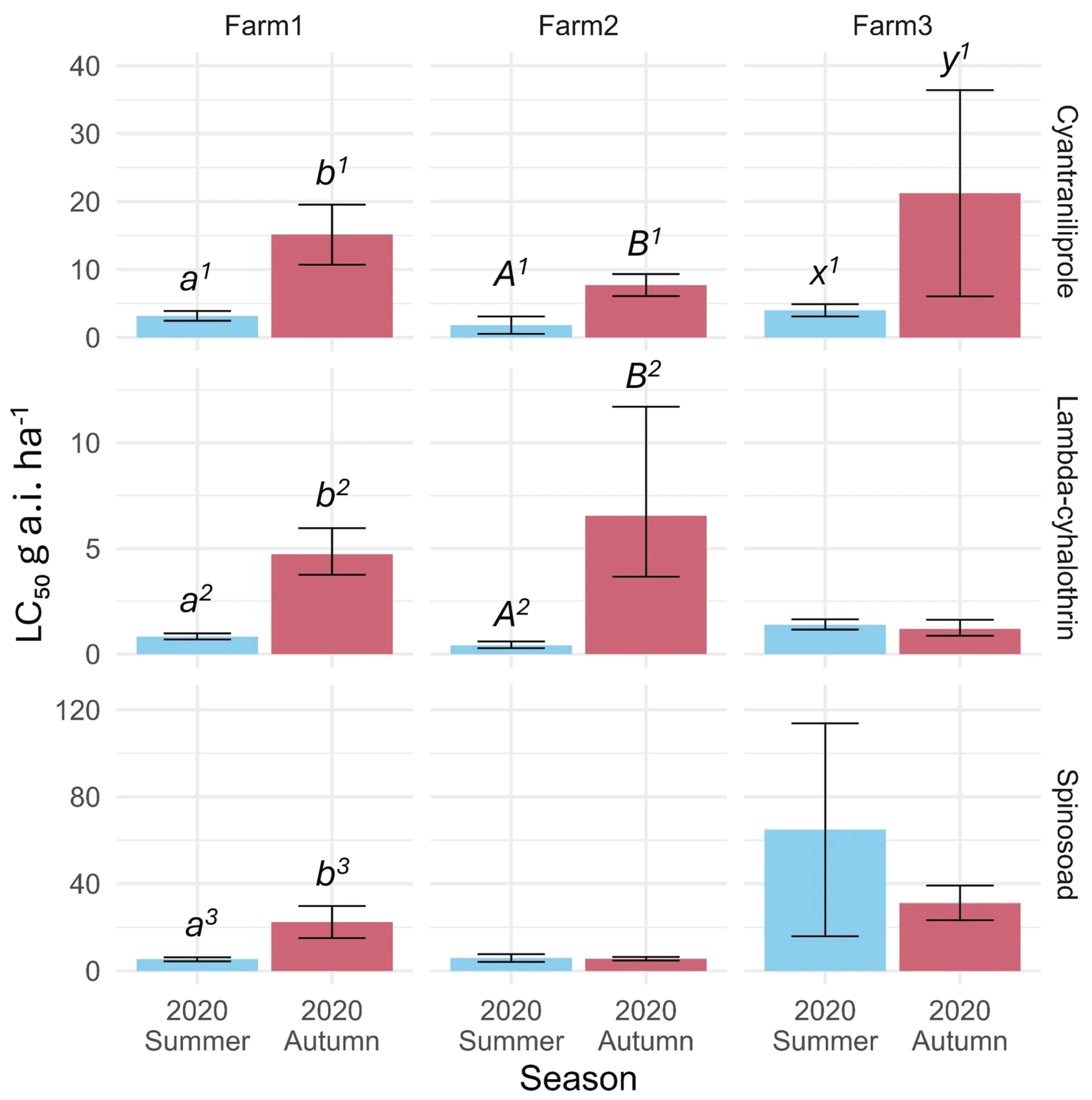
From the susceptibility of D. suzukii collected in 2020, six had significantly higher LC50 values in autumn compared with flies collected from the same area in summer in pairwise comparisons (Supplementary Table S4, Figure 2). The autumn flies collected from Farm 1 had higher LC50 values for cyantraniliprole, lambda-cyhalothrin and spinosad than those collected from a 500 m radius in summer (all p < 0.001) (Figure 3). The autumn-collected flies from Farm 2 had higher LC50 values for cyantraniliprole and lambda-cyhalothrin (p < 0.001) than those collected in summer. Farm 3 had a significantly higher LC50 in autumn compared with summer for cyantraniliprole (p < 0.03).

3.4. Variation in Dose–Response Slopes Between Summer and Autumn Drosophila suzukii Strains

For cyantraniliprole and spinosad, the Farm 2 summer 2020 D. suzukii showed shallower slopes than those collected in autumn 2020 (p < 0.001 for both insecticides), indicating greater variability in susceptibility during the summer (Figure 1, Table 3).
In contrast, cyantraniliprole and lambda-cyhalothrin both had steeper slopes in Farm 3 summer 2020 flies compared with autumn 2020 (both p = 0.01), reflecting a more uniform mortality response in the summer samples.

3.5. Between-Farm Differences in Drosophila suzukii Insecticide Susceptibility

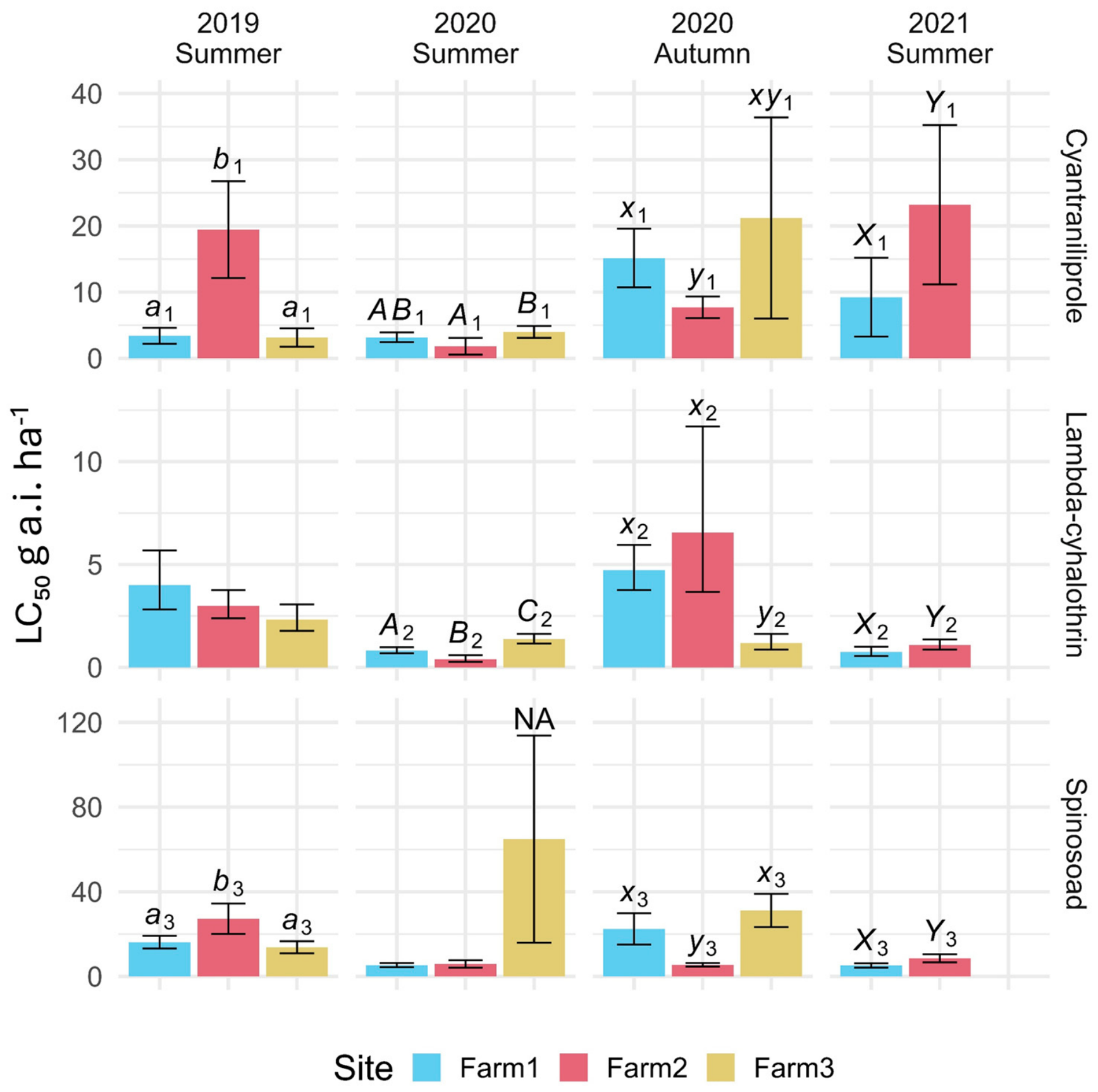
There were significant differences in insecticide susceptibility between D. suzukii strains collected from the two commercial farms and the research station for each of the active ingredients for each of the four time points (Figure 3, Supplementary Table S5). There was no consistent pattern in susceptibility, with no one single farm having more resistant D. suzukii compared with another.

4. Discussion

The aim of this study was to assess whether wild UK D. suzukii populations were becoming less susceptible to the insecticides cyantraniliprole, lambda-cyhalothrin, and spinosad, both within a fruit-growing season and between years. We also examined whether insecticide susceptibility varied between farms. While we found no evidence of resistance over the three-year study, we did detect seasonal fluctuations in susceptibility, with later-season D. suzukii showing significantly higher tolerance to some of the insecticides tested.
In many regions, particularly the US, D. suzukii control has relied primarily on calendar-based insecticide applications due to the pest’s high population densities and the market’s zero-tolerance policy for fruit infestation [21,22]. As a result, resistance has developed rapidly. For example, by 2015, spinetoram LC50 values in treated areas were up 89% from baseline levels established just 3 years earlier [10]. Gress and Zalom [5] found D. suzukii adults from spinosad-treated raspberries required 4.3–7.7 times higher doses than those from untreated crops. Widespread spinosad resistance is now documented in Californian raspberry crops [8]. Similarly, Civolani et al. [11] reported reduced susceptibility to cyantraniliprole and deltamethrin in D. suzukii from conventionally managed Italian cherry orchards.
Given that D. suzukii was first detected in the UK in 2012 [23], resistance development within a similar 10-year timeframe is a valid concern, especially considering the extensive use of insecticides in soft-fruit production [24]. However, the present study found no evidence of resistance at the three UK farms tested (two commercial, one research). Also, although significant differences in insecticide susceptibility were observed between farms in individual years, there was no consistent pattern, suggesting that resistance was not emerging at any one site. At Farm 1, from unsprayed crops, we hypothesised that D. suzukii would be more susceptible than at the Farm 2 and 3 commercial farms, both of which received a minimum of one application for the three products tested within each of the three field seasons. However, LC50 values for Farm 1 were not consistently lower across insecticides, indicating that insecticide exposure alone may not explain variability in susceptibility. At Farms 2 and 3, growers employed a range of alternative approaches to suppress D. suzukii, including insect-proof netting, two-day picking intervals, waste removal, and canopy thinning to reduce humidity and improve light penetration. Although the impact of these practices on insecticide use was not directly assessed, both growers reported applying fewer than the maximum permitted number of applications for the insecticides used (typically two to three applications per year, depending on the active ingredient). This observation is consistent with the possibility that these agroecological practices reduced the need for insecticide inputs.
Consideration of both LC50 values and dose–response slopes provided additional insight into variation in susceptibility among D. suzukii populations. Several populations exhibited elevated LC50 values, particularly for cyantraniliprole and spinosad, indicating reduced susceptibility relative to other collections. However, increases in LC50 were not consistently associated with steeper dose–response slopes. This suggests that higher tolerance was not always uniformly distributed within populations and may reflect varying degrees of heterogeneity in susceptibility among individuals. Overall, the combined LC50 and slope analyses indicate that variable susceptibility occurred in specific farm-year populations but provide limited evidence of a consistent pattern of highly uniform resistance across sites or seasons.
Several factors may explain the absence of resistance in the UK. First, D. suzukii is capable of travelling up to 9 km under favourable conditions [25], allowing for interbreeding between individuals from treated and untreated habitats. This gene flow may dilute resistant alleles before they become fixed in local populations [26]. Second, and more notably, UK and other European growers have adopted complementary, agroecological crop protection strategies including insect-excluding mesh, improving crop hygiene, frequent harvesting, cool chain management of harvested fruit, and reducing canopy humidity [3]. These practices reduce D. suzukii pressure and minimise reliance on chemical control. UK growers have historically prioritised insecticide alternatives for crop protection to avoid disruptive effects on beneficial predators and parasitoids used in IPM for pests like spider mites and thrips [27]. While insecticides remain the most effective tool for rapid adult knockdown and oviposition suppression [4], the UK’s adoption of non-chemical practices may be delaying resistance onset by reducing selection pressure.
Although there was no clear trend toward increased resistance over the three-year study, we observed a seasonal reduction in susceptibility, with later-season D. suzukii showing significantly higher LC50 values. This mirrors findings by Ganjisaffar et al. [9], who noted reduced mortality later in the growing season to zeta-cypermethrin. Our data suggest that repeated insecticide exposure within a single season may reduce D. suzukii susceptibility, although this shift appears to reset by the start of the following season, possibly due to overwintering processes or fitness trade-offs associated with tolerance.
One potential explanation for this within-season shift is the presence of seasonal morphs. Winter morphs, D. suzukii, which enter reproductive diapause and exhibit greater cold tolerance [28,29,30,31], have been shown to be more tolerant of certain insecticides. Seong et al. [32] found winter morphs had a 3.7-fold higher LC50 to spinetoram compared with summer morphs. Importantly, this tolerance was not genetic but induced by environmental cues (i.e., autumnal temperatures), and was linked to the expression of detoxification genes, including cytochrome P450 enzymes, which have also been implicated in insecticide resistance [11].
The role of P450 enzymes in resistance has also been demonstrated beyond seasonal morph studies. For example, in Brazilian D. suzukii populations resistant to imidacloprid, synergist assays with piperonyl butoxide confirmed that cytochrome P450 activity was the primary detoxification pathway conferring resistance [13]. This finding, together with evidence from European and Asian populations, suggests that P450-mediated detoxification is a common mechanism underlying both environmentally induced tolerance and genetically based resistance.
While Seong et al. [32] propose that winter morphs may have enhanced insecticide tolerance due to upregulated detoxification pathways, our study’s laboratory culturing of summer-morph collected wild flies under summer-like conditions for up to 10 generations suggests the elevated tolerance observed toward the end of the season was not a retained winter morph trait. However, in field populations, these traits may contribute to a temporary shift in population susceptibility that is lost as winter morphs die off or revert to summer forms in spring.
One possible factor influencing the lack of long-term resistance is the fitness cost that can be associated with resistance traits. In other Dipteran species, resistant individuals often suffer reduced winter survival [33], which may help explain why resistance has not yet occurred in the UK. Resistance-linked fitness trade-offs [34] could reduce overwinter survival of tolerant individuals, enabling susceptible genotypes to reestablish dominance each spring. Our own previous work showed that some spinosad-exposed females survived and produced viable offspring [17], suggesting no immediate reproductive penalty, but longer-term fitness costs (e.g., overwinter survival or mating success) remain unmeasured.
Finally, population dynamics may also be shaped by landscape-level movement and habitat mixing. Buck et al. [35] highlight that D. suzukii overwintering in semi-natural, unsprayed habitats can later reinvade crop fields, potentially introducing susceptible alleles and slowing the fixation of resistance. In addition, few insecticides are applied during winter months, reducing selection pressure during this critical period. The absence of long-term resistance development despite over a decade of D. suzukii management in the UK suggests that combining chemical and non-chemical tactics may reduce resistance selection pressure. These findings provide support for sustainable pest management programmes that seek to minimise pesticide inputs while maintaining effective crop protection.

5. Conclusions

Here, we showed that there is no directional increase in insecticides LC50 across the three sampling years. However, the risk of resistance will increase if more insecticides are withdrawn from use, limiting growers’ ability to rotate products effectively. Adopting agroecological IPM strategies will be essential in reducing reliance on insecticides and slowing the development of resistance.
Future research should investigate the gene flow between D. suzukii populations inhabiting crop fields and surrounding semi-natural habitats, both within and between seasons. Understanding this movement will clarify how resistance traits might spread or be diluted across landscapes.
The observed within-season decrease in susceptibility highlights how quickly insecticide tolerance can shift under repeated exposure. Ideally, regional monitoring programmes should be established to test D. suzukii susceptibility annually, especially at the end of harvest, when resistance levels may be highest. Early detection of reduced sensitivity will provide a critical window for adapting subsequent management strategies to prevent resistance from becoming entrenched.
Maintaining the efficacy of available insecticides will require proactive D. suzukii resistance monitoring and a commitment to integrating sustainable, long-term control methods.

Supplementary Materials

The following supporting information can be downloaded at https://www.mdpi.com/article/10.3390/agronomy16181783/s1, Table S1. Number of replicates, water volume (L ha−1) and amount of active ingredient (a.i.) formulated product to make 2018 field rate (FR) dose for each of the Drosophila suzukii strain (combination of farm and year) tested. Table S2. Tukey pairwise interactions comparing lethal concentration to kill 50% (LC50) values among strains of Drosophila suzukii collected in summer (July) of each year. Table S3. Pairwise interactions comparing log-logistic model slope parameter among strains of Drosophila suzukii collected in summer (July) of each year. Table S4. Pairwise interactions comparing lethal concentration of 50% (LC50) values between strains of Drosophila suzukii collected in summer (July) and autumn (November) of 2020. Table S5. Pairwise interactions of LC50 values each year for each active ingredient between the three strains collected from each farm and level of significance for the adjusted p values.

Author Contributions

Conceptualisation, B.S. and M.T.F.; Methodology, B.S. and M.T.F.; Formal analysis, G.D.; Investigation, B.S. and T.D.T.; Data curation, T.D.T.; Writing—original draft, B.S.; Writing—review and editing, T.D.T., G.D. and M.T.F.; Supervision, M.T.F.; Funding acquisition, B.S. and M.T.F. All authors have read and agreed to the published version of the manuscript.

Funding

This research was funded by the Agriculture and Horticulture Development Board, grant number SF 145 a.

Data Availability Statement

The original contributions presented in this study are included in the article/Supplementary Material. Further inquiries can be directed to the corresponding author.

Acknowledgments

Thank you to Zoe Clark and David Shaw for their technical assistance, and to the East Malling Trust and host fruit growers for their support. Ngā mihi nui to Duncan Hedderley and Alison Wilson for their support with addressing the reviewers’ comments and guidance on the analysis. Finally, we thank the reviewers for their exceptional feedback on this manuscript. Their thoughtful comments and suggestions significantly improved the quality, clarity, and overall impact of this work.

Conflicts of Interest

The authors declare that the research was conducted in the absence of any commercial or financial relationships that could be construed as a potential conflict of interest.

References

  1. Asplen, M.K.; Anfora, G.; Biondi, A.; Choi, D.-S.; Chu, D.; Daane, K.M.; Gibert, P.; Gutierrez, A.P.; Hoelmer, K.A.; Hutchison, W.D.; et al. Invasion biology of spotted wing Drosophila (Drosophila suzukii): A global perspective and future priorities. J. Pest Sci. 2015, 88, 469–494. [Google Scholar] [CrossRef] [Scilit]
  2. Audsley, N.; Tonina, L.; Mori, N. Integrated management of tree fruit insect pests: Drosophila suzukii (Spotted Wing Drosophila). In Integrated Management of Diseases and Insect Pests of Tree Fruit; Burleigh Dodds Science Publishing: London, UK, 2019; pp. 453–496. [Google Scholar]
  3. Chillo, V.; Cardozo, A.; Martínez, A.S.; Fischbein, D.; Masciocchi, M.; Germano, M. The incidence of cultural practices for managing Drosophila suzukii in raspberry farms: A case study from northwestern Patagonia. Agroecol. Sustain. Food Syst. 2025, 49, 1243–1254. [Google Scholar] [CrossRef] [Scilit]
  4. Lee, J.C.; Rodriguez-Saona, C.R.; Zalom, F.G. Introductory Remarks: Spotlight on Spotted-Wing Drosophila. J. Econ. Entomol. 2022, 115, 919–921. [Google Scholar] [CrossRef] [Scilit] [PubMed]
  5. Gress, B.E.; Zalom, F.G. Identification and risk assessment of spinosad resistance in a California population of Drosophila suzukii. Pest Manag. Sci. 2019, 75, 1270–1276. [Google Scholar] [CrossRef] [Scilit] [PubMed]
  6. Sial, A.A.; Roubos, C.R.; Gautam, B.K.; Fanning, P.D.; Van Timmeren, S.; Spies, J.; Petran, A.; Rogers, M.A.; Liburd, O.E.; Little, B.A. Evaluation of organic insecticides for management of spotted-wing drosophila (Drosophila suzukii) in berry crops. J. Appl. Entomol. 2019, 143, 593–608. [Google Scholar] [CrossRef] [Scilit]
  7. Beers, E.H.; Van Steenwyk, R.A.; Shearer, P.W.; Coates, W.W.; Grant, J.A. Developing Drosophila suzukii management programs for sweet cherry in the western United States. Pest Manag. Sci. 2011, 67, 1386–1395. [Google Scholar] [CrossRef] [Scilit] [PubMed]
  8. Ganjisaffar, F.; Gress, B.E.; Demkovich, M.R.; Nicola, N.L.; Chiu, J.C.; Zalom, F.G. Spatio-temporal Variation of Spinosad Susceptibility in Drosophila suzukii (Diptera: Drosophilidae), a Three-year Study in California’s Monterey Bay Region. J. Econ. Entomol. 2022, 115, 972–980. [Google Scholar] [CrossRef] [Scilit] [PubMed]
  9. Ganjisaffar, F.; Demkovich, M.R.; Chiu, J.C.; Zalom, F.G. Characterization of field-derived Drosophila suzukii (Diptera: Drosophilidae) resistance to pyrethroids in California berry production. J. Econ. Entomol. 2022, 115, 1676–1684. [Google Scholar] [CrossRef] [Scilit] [PubMed]
  10. Van Timmeren, S.; Mota-Sanchez, D.; Wise, J.C.; Isaacs, R. Baseline susceptibility of spotted wing Drosophila (Drosophila suzukii) to four key insecticide classes. Pest Manag. Sci. 2017, 74, 78–87. [Google Scholar] [CrossRef] [Scilit] [PubMed]
  11. Civolani, S.; Vaccari, G.; Caruso, S.; Finetti, L.; Bernacchia, G.; Chicca, M.; Cassanelli, S. Evaluation of insecticide efficacy and insecticide adaptive response in Italian populations of Drosophila suzukii. Bull. Insectol. 2021, 74, 103–114. [Google Scholar]
  12. Isaacs, R.; Van Timmeren, S.; Gress, B.E.; Zalom, F.G.; Ganjisaffar, F.; Hamby, K.A.; Lewis, M.T.; Liburd, O.E.; Sarkar, N.; Rodriguez-Saona, C. Monitoring of spotted-wing drosophila (Diptera: Drosophilidae) resistance status using a RAPID method for assessing insecticide sensitivity across the United States. J. Econ. Entomol. 2022, 115, 1046–1053. [Google Scholar] [CrossRef] [Scilit] [PubMed]
  13. Andreazza, F.; Garcia, F.R.M.; Silva, P.B.D.; Barbosa, L.B.; de Oliveira, J.M.; Araújo, G.N.; Oliveira, E.E. Imidacloprid Resistance Challenges in Brazilian Strains of Drosophila suzukii (Diptera: Drosophilidae). Insects 2025, 16, 494. [Google Scholar] [CrossRef] [Scilit] [PubMed]
  14. Orikpete, O.F.; Kikanme, K.N.; Falade, T.D.; Dennis, N.M.; Ewim, D.R.E.; Fadare, O.O. Neonicotinoid pesticides in African agriculture: What do we know and what should be the focus for future research? Chemosphere 2025, 372, 144057. [Google Scholar] [CrossRef] [Scilit] [PubMed]
  15. Tooker, J.F.; Pearsons, K.A. Newer characters, same story: Neonicotinoid insecticides disrupt food webs through direct and indirect effects. Curr. Opin. Insect Sci. 2021, 46, 50–56. [Google Scholar] [CrossRef] [Scilit] [PubMed]
  16. Disi, J.O.; Sial, A.A. Laboratory selection and assessment of resistance risk in Drosophila suzukii (Diptera: Drosophilidae) to spinosad and malathion. Insects 2021, 12, 794. [Google Scholar] [CrossRef] [Scilit] [PubMed]
  17. Shaw, B.; Brain, P.; Wijnen, H.; Fountain, M.T. Implications of sub-lethal rates of insecticides and daily time of application on Drosophila suzukii lifecycle. Crop Prot. 2019, 121, 182–194. [Google Scholar] [CrossRef] [Scilit]
  18. Vacas, S.; Primo, J.; Manclús, J.J.; Montoya, Á.; Navarro-Llopis, V. Survey on Drosophila suzukii Natural Short-Term Dispersal Capacities Using the Mark-Release-Recapture Technique. Insects 2019, 10, 268. [Google Scholar] [CrossRef] [Scilit] [PubMed]
  19. The R Core Team. R: A Language and Environment for Statistical Computing; R Foundation for Statistical Computing: Vienna, Austria, 2021; Available online: https://www.R-project.org/ (accessed on 22 March 2024).
  20. Ritz, C.; Baty, F.; Streibig, J.C.; Gerhard, D. Dose-response analysis using R. PLoS ONE 2015, 10, e0146021. [Google Scholar] [CrossRef] [Scilit] [PubMed]
  21. Haviland, D.R.; Beers, E.H. Chemical Control Programs for Drosophila suzukii that Comply with International Limitations on Pesticide Residues for Exported Sweet Cherries. J. Integr. Pest Manag. 2012, 3, F1–F6. [Google Scholar] [CrossRef] [Scilit]
  22. Van Timmeren, S.; Isaacs, R. Control of Spotted Wing Drosophila, Drosophila suzukii, by Specific Insecticides and by Conventional and Organic Crop Protection Programs. Crop Prot. 2013, 54, 126–133. [Google Scholar] [CrossRef] [Scilit]
  23. Harris, A.L.; Shaw, B. First Record of Drosophila suzukii Matsumura (Diptera, Drosophilidae) in Great Britain. Dipter. Dig. 2014, 21, 189–192. [Google Scholar]
  24. Shaw, B.; Hemer, S.; Cannon, M.F.; Rogai, F.; Fountain, M.T. Insecticide control of Drosophila suzukii in commercial sweet cherry crops under cladding. Insects 2019, 10, 196. [Google Scholar] [CrossRef] [Scilit] [PubMed]
  25. Tait, G.; Grassi, A.; Pfab, F.; Crava, C.M.; Dalton, D.T.; Magarey, R.; Ometto, L.; Vezzulli, S.; Rossi-Stacconi, M.V.; Gottardello, A. Large-scale spatial dynamics of Drosophila suzukii in Trentino, Italy. J. Pest Sci. 2018, 91, 1213–1224. [Google Scholar] [CrossRef] [Scilit]
  26. Sudo, M.; Takahashi, D.; Andow, D.A.; Suzuki, Y.; Yamanaka, T. Optimal management strategy of insecticide resistance under various insect life histories: Heterogeneous timing of selection and interpatch dispersal. Evol. Appl. 2018, 11, 271–283. [Google Scholar] [CrossRef] [Scilit] [PubMed]
  27. Sampson, C. Sustainable management of the western flower thrips in strawberry crops. Outlooks Pest Manag. 2018, 29, 180–184. [Google Scholar] [CrossRef] [Scilit]
  28. Shearer, P.W.; West, J.D.; Walton, V.M.; Brown, P.H.; Svetec, N.; Chiu, J.C. Seasonal cues induce phenotypic plasticity of Drosophila suzukii to enhance winter survival. BMC Ecol. 2016, 16, 11–29. [Google Scholar] [CrossRef] [Scilit] [PubMed]
  29. Stephens, A.R.; Asplen, M.K.; Hutchison, W.D.; Venette, R.C. Cold hardiness of winter-acclimated Drosophila suzukii (Diptera: Drosophilidae) adults. Environ. Entomol. 2015, 44, 1619–1626. [Google Scholar] [CrossRef] [Scilit] [PubMed]
  30. Stockton, D.; Wallingford, A.; Rendon, D.; Fanning, P.; Green, C.K.; Diepenbrock, L.; Ballman, E.; Walton, V.M.; Isaacs, R.; Leach, H.; et al. Interactions between biotic and abiotic factors affect survival in overwintering Drosophila suzukii (Diptera: Drosophilidae). Environ. Entomol. 2019, 114, 1950–1974. [Google Scholar]
  31. Wallingford, A.K.; Loeb, G.M. Developmental acclimation of Drosophila suzukii (Diptera: Drosophilidae) and its effect on diapause and winter stress tolerance. Environ. Entomol. 2016, 45, 1081–1089. [Google Scholar] [CrossRef] [Scilit] [PubMed]
  32. Seong, K.M.; Sun, W.; Huang, J.; Gut, L.; Kim, Y.H.; Pittendrigh, B.R. Comparative response of two seasonal spotted wing drosophila (Drosophila suzukii) morphs to different classes of insecticides. Entomol. Res. 2022, 52, 504–512. [Google Scholar] [CrossRef] [Scilit]
  33. Chevillon, C.; Bourguet, D.; Rousset, F.; Pasteur, N.; Raymond, M. Pleiotropy of adaptive changes in populations: Comparisons among insecticide resistance genes in Culex pipiens. Genet. Res. 1997, 70, 195–204. [Google Scholar] [CrossRef] [Scilit] [PubMed][Green Version]
  34. Kliot, A.; Ghanim, M. Fitness costs associated with insecticide resistance. Pest Manag. Sci. 2012, 68, 1431–1437. [Google Scholar] [CrossRef] [Scilit] [PubMed]
  35. Buck, N.; Fountain, M.T.; Potts, S.G.; Bishop, J.; Garratt, M.P. The effects of non-crop habitat on spotted wing drosophila (Drosophila suzukii) abundance in fruit systems: A meta-analysis. Agric. For. Entomol. 2022, 25, 66–76. [Google Scholar] [CrossRef] [Scilit]
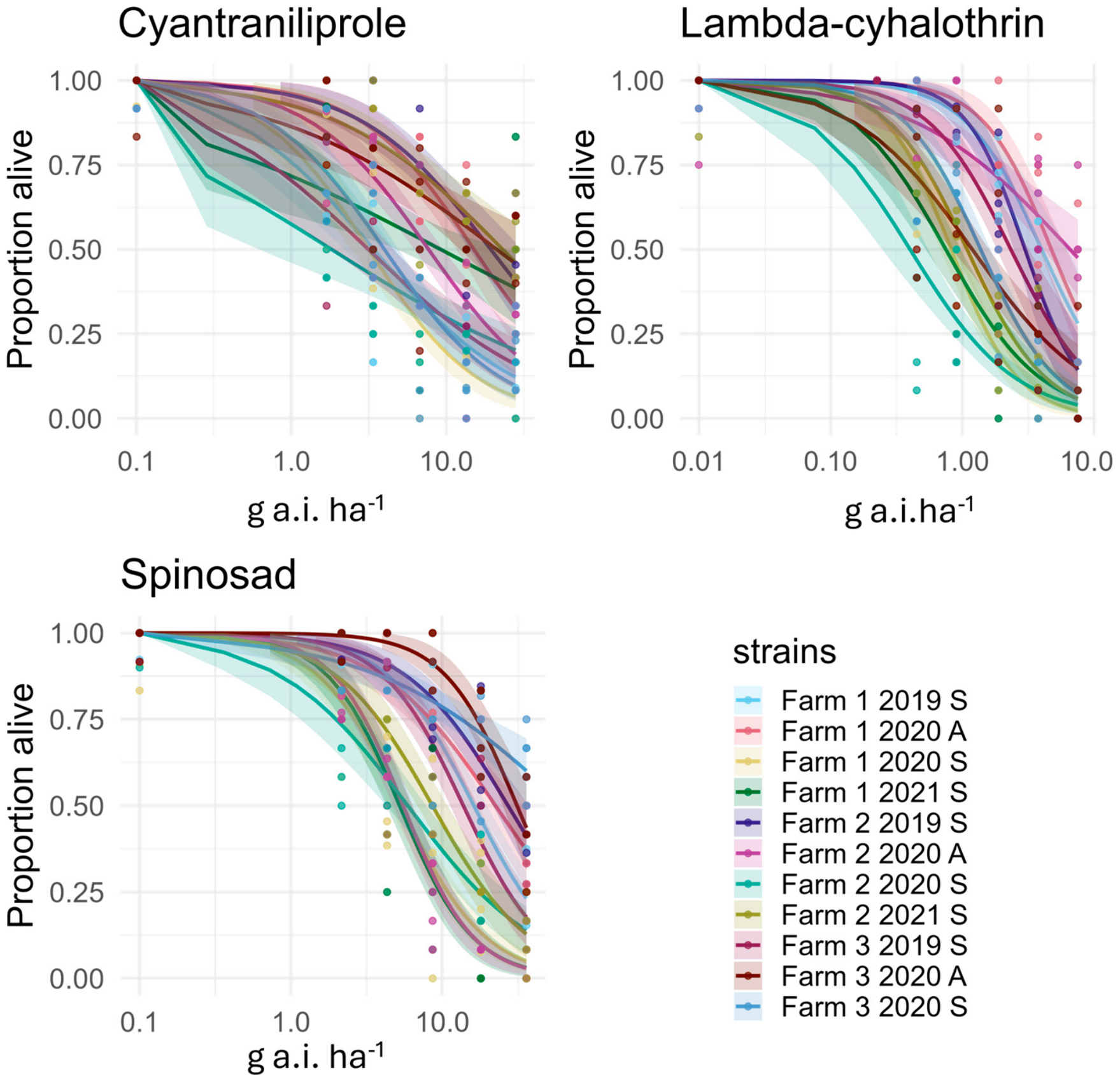
Figure 1. Dose–response relationships for survival of different Drosophila suzukii derived from wild populations from three different farms (Farm 1, Farm 2, Farm 3) following exposure to cyantraniliprole, lambda-cyhalothrin, and spinosad. Number indicates year collected. The inclusion of S and A in the label indicates the strain was collected in summer or autumn, respectively. Points indicate observed proportions of live individuals at each dose and solid lines show strain-specific predicted values from two-parameter log-logistic models fitted to binomial count data. Shaded ribbons represent 95% confidence intervals around the predicted survival curves. Dose is plotted on a log10 scale. Zero-dose values (controls) are plotted at 0.1 (cyantraniliprole and spinosad) and 0.01 (lambda-cyhalothrin) for display on the log10 transformed axis.
Agronomy 16 01783 g001
Figure 2. Lethal concentration to kill 50% (LC50) of the Drosophila suzukii population values, presented as g a.i. ha−1 (± SEM) for (top) cyantraniliprole (Exirel®), (middle) lambda-cyhalothrin (Hallmark®) and (bottom) spinosad (Tracer®). D. suzukii were collected from each farm in summer (July) and autumn (November) of 2020. Tukey-adjusted pairwise comparisons were made between data fromthe same farm and insecticides only. Different letters show significant difference (a–b = Farm 1; A–B = Farm 2; x–y = Farm 3 comparison); Superscript denotes insecticide (1 Cyantraniliprole, 2 Lambda-cyhalothrin, 3 Spinosad). a.i. = active ingredient.
Agronomy 16 01783 g002
Figure 3. Lethal concentration to kill 50% (LC50) of the Drosophila suzukii population values, presented as g a.i. ha−1 (± SEM), exposed to (top) cyantraniliprole (Exirel®), (middle) lambda-cyhalothrin (Hallmark®) and (bottom) spinosad (Tracer®). D. suzukii strains were established from wild-derived flies collected in summer (July) each year. Tukey-adjusted comparisons were made within the same year across the three farms for each insecticide separately. Different letters show significant difference (a–b = 2019; A–C = 2020 Summer; x–y = 2020 Autumn, X–Y = 2021). Subscript denotes insecticide (1 Cyantraniliprole, 2 Lambda-cyhalothrin, 3 Spinosad). Farm 3 2020 summer was not included in the comparison as the data was extrapolated. NA indicates data not inlcded in comparisons as this was extrapolated data. a.i. = active ingredient.
Agronomy 16 01783 g003
Table 1. Details of treatments applied, including active ingredient (a.i.), trade name and parent company, maximum field rate a.i. in g ha−1 and a.i. g ha−1 dilutions of insecticides applied in laboratory bioassays. Note the maximum field rate and g ha−1 of the active ingredient were reflective of the UK 2018 label rates for each of the formulated products.
Active IngredientTrade Name and (Company)Maximum Field Rate
a.i. g ha−1
Dilution Rates Applied within Bioassay a.i. g ha−1
Cyantraniliprole Exirel® (DuPont)112.50, 1.69, 3.38, 6.75, 13.5, 28.13
Lambda-cyhalothrin Hallmark Zeon® (Syngenta)7.50, 0.45, 0.9, 1.88, 3.75, 7.5
SpinosadTracer® (Dow AgroSciences)720, 2.16, 4.32, 8.64, 18, 36
Table 2. Lethal concentration to kill 50% (LC50) of Drosophila suzukii strains exposed to insecticides for each farm in different years and the standard error of the mean (SEM). Strains with ‘Autumn’ in the name were collected in November of that year. All other D. suzukii were collected in summer (July). LC50 is expressed in g a.i. ha−1. Adults are the total number of flies treated per insecticide per year. Upper and Lower are the upper and lower 95% confidence intervals. Note: Farm 3 2021 is not included because the flies died in culture. a.i. = active ingredient. * These data are extrapolated beyond the highest tested dose, as 50% mortality was not reached.
Cyantraniliprole (Exirel®) Lambda-Cyhalothrin (Hallmark®) Spinosad (Tracer®)
StrainAdultsLC50UpperLowerAdultsLC50UpperLowerAdultsLC50UpperLower
g a.i. ha−1g a.i. ha−1g a.i. ha−1
Farm 1 20192803.412.214.622814.002.815.6940516.1913.2119.18
Farm 1 20204283.172.453.894270.820.690.984215.364.436.30
Farm 1 20212989.233.2915.172870.750.561.012885.234.236.23
Farm 2 201928519.4312.1426.732852.992.383.7538127.2220.0234.43
Farm 2 20204181.820.543.104320.400.270.592865.924.197.65
Farm 2 202128723.2011.1835.222881.080.871.362888.616.6810.55
Farm 3 20192863.151.774.522842.331.773.0628413.8110.9416.67
Farm 3 20204313.993.104.884311.371.151.64430* 64.8515.93113.79
Farm 1 2020 Autumn28715.1410.7119.562744.733.765.9628822.4915.1229.86
Farm 2 2020 Autumn4337.716.089.332906.553.6611.714315.534.706.36
Farm 3 2020 Autumn25421.216.0336.392871.190.871.6328831.2023.3239.09
Table 3. Pairwise interactions comparing log-logistic model slope parameter between strains of Drosophila suzukii collected in summer (July) and autumn (November) 2020. * Comparison not made as Farm 3 2020 summer LC50 for spinosad was extrapolated.
ActiveFarmEstimateSEMt Valuep.adj
Cyantraniliprole10.050.240.200.84
2−0.620.18−3.460.00
30.540.212.580.01
Lambda-cyhalothrin10.050.310.170.87
20.360.231.570.12
30.540.222.430.01
Spinosad10.440.251.790.07
2−0.860.25−3.460.00
3−1.110.32−3.44NA *
Disclaimer/Publisher’s Note: The statements, opinions and data contained in all publications are solely those of the individual author(s) and contributor(s) and not of MDPI and/or the editor(s). MDPI and/or the editor(s) disclaim responsibility for any injury to people or property resulting from any ideas, methods, instructions or products referred to in the content.