Article

Bradyrhizobium japonicum S36 and Sinorhizobium fredii S65 Improve Soil Nutrient Status and Promote Soybean Yield Formation in Cereal–Soybean Intercropping Environments

College of Resources, Sichuan Agricultural University, Chengdu 611130, China
*
Authors to whom correspondence should be addressed.
These authors contributed equally to this work.
Agronomy 2026, 16(17), 1731; https://doi.org/10.3390/agronomy16171731 (registering DOI)
Submission received: 16 July 2026 / Revised: 30 August 2026 / Accepted: 2 September 2026 / Published: 5 September 2026
(This article belongs to the Section Agroecology Innovation: Achieving System Resilience)

Abstract

Rhizobial inoculation has the potential to improve soybean N nutrition and productivity in cereal–soybean intercropping systems, yet the performance of different strains across contrasting field environments remains insufficiently understood. In this study, six soybean rhizobial isolates were initially screened under greenhouse sand-culture conditions, and two promising strains, Bradyrhizobium japonicum S36 and Sinorhizobium fredii S65, were subsequently evaluated in maize–soybean and sorghum-soybean field environments. Relative to the uninoculated control, both strains were associated with higher plant N status, greater chemical soil fertility, increased dry-matter accumulation, and higher grain yield. B. japonicum S36 and S. fredii S65 increased grain yield by 23.8% and 18.6%, respectively, in the maize–soybean system and by 49.2% and 40.4%, respectively, in the sorghum-soybean system. S. fredii S65 was more strongly associated with increases in two-seeded pod number and total seed number, whereas B. japonicum S36 showed broader advantages in chemical soil fertility, biomass accumulation, 100-seed weight, grain yield, and grain Ca, Fe, and Mo concentrations. Multivariate analyses further revealed coordinated associations among rhizobial inoculation, chemical soil fertility, plant N status, biomass accumulation, pod formation, and grain yield. Overall, both strains showed promising agronomic potential, with B. japonicum S36 exhibiting a more comprehensive response profile. These findings provide field-based evidence for the development of resource-efficient cereal–soybean intercropping systems and have potential relevance to sustainable food production, improved agricultural resource-use efficiency, and climate-resilient agriculture, corresponding to the United Nations Sustainable Development Goals of Zero Hunger, Responsible Consumption and Production, Climate Action, and Life on Land.

1. Introduction

Soybean (Glycine max (L.) Merr.) is an important food and oil crop and a major source of plant protein and edible oil. Its production is therefore closely associated with food security, dietary quality, and sustainable agricultural development. Global crop production is increasingly challenged by climate warming, extreme weather events, and geopolitical disruptions [1,2], while agricultural intensification has contributed to biodiversity loss, soil degradation, and declining agroecosystem resilience [3,4]. Since 1960, soybean demand in China has increased dramatically, driven largely by the expansion of the feed and industrial-processing sectors, rising by nearly 18-fold, whereas domestic soybean production has increased by only approximately 2.3-fold. Consequently, the gap between domestic supply and demand has continued to widen. Approximately 80% of soybean consumption is used for crushing to produce soybean oil and meal, whereas direct food consumption accounts for only a small proportion. Between 2000 and 2023, the contribution of domestic production to total soybean supply declined sharply from approximately 60% to 15%, while imports increased to more than 80% of total supply and became the principal means of meeting domestic demand. Import sources are highly concentrated in Brazil and the United States. In particular, Brazil’s share increased from approximately 20% to 64% after 2020 and exceeded 75% during periods of intensified China-US trade friction, highlighting the structural dependence of China’s soybean supply on international markets [5,6]. Under these multiple constraints, increasing productivity per unit land area without excessive reliance on synthetic fertilizers has become a major agronomic challenge. Intercropping is a long-established crop-diversification strategy that improves the capture and utilization of light, heat, water, and nutrients through spatial and temporal complementarity [7]. It can also enhance farmland biodiversity, biological pest control, nutrient availability, and soil ecosystem multifunctionality [8,9]. Cereal–soybean systems, including maize–soybean and sorghum-soybean intercropping, are particularly relevant because they integrate efficient aboveground canopy and belowground root resource use with the biological nitrogen-fixation capacity of legumes. Such resource-efficient production systems are closely aligned with the United Nations 2030 Agenda for Sustainable Development, particularly Zero Hunger (SDG 2), Responsible Consumption and Production (SDG 12), Climate Action (SDG 13), and Life on Land (SDG 15).
Rhizobia are the principal microbial symbionts responsible for biological nitrogen fixation in legumes. Following host recognition and root infection, they induce nodule formation and reduce atmospheric N2 to forms of nitrogen that can be utilized by plants [10,11]. Soybeans make a particularly important contribution to agricultural biological nitrogen fixation and have been estimated to account for up to 77% of the total nitrogen fixed by grain legumes worldwide [12]. This symbiotic relationship supports soybean N nutrition, reduces dependence on synthetic N fertilizers, and lowers the economic and environmental costs associated with fertilizer production and application. Rhizobia may also indirectly influence plant growth by modifying root development and rhizosphere nutrient availability. For example, legume roots can release protons and carboxylates under nutrient stress, thereby altering rhizosphere chemistry and the availability of mineral nutrients [13]. Appropriate spatial arrangements in maize–soybean intercropping systems can further improve crop productivity and nutrient acquisition [14]. Nevertheless, agronomic responses to rhizobial inoculation are highly variable. Rhizobial strains differ in host compatibility, nodulation capacity, N2-fixation efficiency, competitive ability, environmental tolerance, and other plant-growth-promoting traits. Their performance is further influenced by soybean genotype, indigenous rhizobial populations, soil pH and fertility, climatic conditions, and crop-management practices. Consequently, a strain that produces numerous nodules under controlled conditions may not necessarily form highly effective nodules or generate a reliable yield response under field conditions. Candidate inoculants should therefore be evaluated through a sequential framework involving controlled screening, field validation, and integrated assessment of nodulation, plant N nutrition, biomass production, and yield formation, rather than being selected on the basis of a single trait.
Belowground interactions add another layer of complexity to intercropping systems. Root spatial distribution, morphological plasticity, and interspecific complementarity can improve resource acquisition [15,16], and enhanced root growth of both maize and soybean has been reported in strip- and relay-intercropping systems [17,18]. In maize-faba bean systems, root interactions and root-derived signaling compounds can increase legume nodulation and N2 fixation [19]. Rhizobial inoculation may therefore interact with ecological processes already operating between component crops. Previous studies have shown that inoculation can enhance symbiotic N2 fixation and reduce apparent N losses in intercropping systems [20], whereas P deficiency can impair early nodule function [21]. These findings indicate that inoculation effects should not be evaluated solely on the basis of plant growth; differences in soil N, P, K, and organic C may also contribute to the final agronomic response. Nevertheless, important knowledge gaps remain. Most rhizobial inoculation studies have focused on sole-cropped soybean or a single soil environment, and comparatively little is known about whether selected strains can provide similar benefits in cereal–soybean systems established under contrasting soil conditions. Soybean yield is jointly determined by pod and seed number, seed weight, dry-matter production, assimilate partitioning, and plant nutritional status. Rhizobial inoculation may modify these traits through soil-mediated pathways, plant-mediated pathways, or a combination of both. In addition, grain mineral composition is an increasingly important quality attribute, yet the responses of Ca, Fe, Zn, and Mo to rhizobial inoculation have received substantially less attention than those of yield and N nutrition. Simultaneous evaluation of these variables is therefore important for distinguishing strains that primarily increase reproductive-unit number from those that provide broader benefits in soil fertility, plant growth, seed filling, and grain mineral nutrition.
Accordingly, six soybean rhizobial isolates were initially screened under greenhouse sand-culture conditions. The two best-performing strains, Bradyrhizobium japonicum S36 and Sinorhizobium fredii S65, were subsequently evaluated under field conditions in maize–soybean and sorghum-soybean intercropping systems established on markedly contrasting soil backgrounds. We hypothesized that B. japonicum S36 and S. fredii S65 would both significantly promote soybean growth and yield formation under the two field environments, but that the magnitude of their growth-promoting effects and the yield-component traits primarily responsible for these responses might differ between environments. Based on this hypothesis, the study addressed two core scientific questions: (1) Can B. japonicum S36 and S. fredii S65 consistently promote soybean growth and yield across two contrasting cereal–soybean intercropping environments while maintaining significant advantages over the uninoculated control? (2) Do the two strains differ in their yield-promoting effects, and, if so, are these differences primarily associated with soil nutrient status, plant N accumulation, yield components, or grain mineral nutrition? By systematically addressing these questions, this study aims to provide a scientific basis for the selection and application of efficient rhizobial inoculants in cereal–soybean intercropping systems and to advance the sustainable use of microbial resources in agricultural production.

2. Materials and Methods

2.1. Plant Materials and Rhizobial Strains

The soybean cultivar was ‘Nanxiadou 25’. Six soybean rhizobial strains (Bradyrhizobium japonicum S36, Sinorhizobium fredii S65, Bradyrhizobium diazoefficiens S46, Bradyrhizobium sp. S138, Bradyrhizobium diazoefficiens S31, and Rhizobium sp. S152), previously isolated from different locations in Sichuan Province, China, were used. Their taxonomic identities and field symbiotic efficiencies had been characterized as described previously [22]. The two selected field strains were B. japonicum S36 and S. fredii S65 (Table 1). The greenhouse experiment included an uninoculated control (CK), whereas B. japonicum S36 and S. fredii S65 were selected for field evaluation. The maize and sorghum cultivars used in the field experiments were ‘Zhongyu 3’ and ‘Langnuo 19’, respectively. Rhizobial cultures were activated in yeast mannitol extract (YME) broth and grown to the logarithmic phase before inoculum preparation [23]. The YME medium contained 10 g mannitol, 0.4 g yeast extract, 0.5 g K2HPO4, 0.2 g MgSO4·7H2O, 2 mL of 1% CaCl2·6H2O, and 2 mL of 1% boric acid per liter; the pH was adjusted to 7.0. The low-nitrogen nutrient solution used in the sand culture contained 0.075 g KCl, 0.136 g K2HPO4, 0.060 g MgSO4, 0.030 g Ca(NO3)2, 0.460 g CaSO4, 0.075 g ferric citrate, and 1 mL of a micronutrient stock solution per liter (final N concentration, 0.005 g L−1), with the pH adjusted to 7.0. The micronutrient stock contained 1.81 g L−1 MnSO4, 0.22 g L−1 ZnSO4, 0.80 g L−1 CuSO4·5H2O, 2.86 g L−1 boric acid, and 0.02 g L−1 ammonium molybdate [24].

2.2. Greenhouse Sand-Culture Screening

The greenhouse screening experiment was conducted from 17 February to 29 March 2025 in a controlled-light growth chamber using a double-vessel sand-culture system, with an uninoculated treatment included as the control. Each culture unit consisted of two 500 mL plastic bottles. The upper compartment contained sterilized sand, whereas the lower compartment contained sterile low-N nutrient solution; the two compartments were connected with gauze to allow capillary supply of the nutrient solution. The assembled culture units and growth substrate were sterilized prior to use. Soybean seeds were surface-sterilized and pregerminated. Seedlings with uniform radicle development were selected and aseptically transplanted at one plant per culture unit following the general sand-culture procedure described by Nitawaki et al. [25]. At transplanting, each seedling received 1 mL of the corresponding rhizobial culture in the logarithmic growth phase, applied directly along the radicle. Fast-growing strains were cultured for 3 d and slow-growing strains for 7 d. All inocula were applied after reaching the logarithmic phase and a viable cell density greater than 1 × 10⁹ CFU mL−1. Plants in the uninoculated control (CK) received 1 mL of sterile culture medium. The low-N nutrient solution contained a final N concentration of 0.005 g L−1, with its composition described in Section 2.1, and was replenished before depletion. The approximate replenishment intervals were once every 15 d during the early growth stage, once per week during the middle growth stage, and once every 2–3 d during the late growth stage, with the amount supplied adjusted according to nutrient-solution depletion. Culture units were arranged in a randomized block design and maintained at 22–25 °C under a 16 h photoperiod with a light intensity of approximately 3000–3500 lx. Plants were harvested on 29 March 2025, 40 d after establishment of the experiment. Each biological replicate consisted of one independently cultured plant, and each treatment comprised three biological replicates. At harvest, leaf chlorophyll status (SPAD value), shoot fresh mass, shoot dry mass, nodule number per plant, nodule fresh mass, and nodule dry mass were determined. SPAD values were measured on fully expanded leaves using a SPAD-502 chlorophyll meter (Konica Minolta, Hachioji, Japan). Shoots and nodules were weighed immediately after harvest, heated at 105 °C for 30 min, and subsequently dried at 75 °C to constant mass. Candidate strains for field evaluation were selected based on an integrated assessment of plant growth and nodulation traits.

2.3. Field Experimental Design

Two field experiments were conducted in 2025 under regionally representative maize–soybean and sorghum-soybean intercropping environments. The maize–soybean experiment was established at the Cangshan Integrated Experimental and Demonstration Base of the Sichuan Academy of Agricultural Sciences, Zhongjiang County, Sichuan Province, China (30°36′ N, 105°01′ E; 321.6 m above sea level). The sorghum-soybean experiment was conducted at the Modern Grain and Oil Agricultural Park in Luxian County, Sichuan Province, China (29°21′ N, 105°41′ E; 293.9 m above sea level). These systems represent locally prevalent cereal–soybean production scenarios in central and southern Sichuan Province. The initial soil conditions differed markedly between the two sites. The Zhongjiang soil was slightly alkaline and classified as alkaline purple soil (Luvic Xerosols), whereas the Luxian soil was acidic and classified as paddy soil (Stagnic Anthrosols) (Table 2). At each site, three soybean inoculation treatments (CK, S. fredii S65, and B. japonicum S36) were arranged in a randomized complete block design with three replicate plots per treatment and 1 m alleys between adjacent plots. Individual plots were regarded as the independent experimental units. Daily meteorological records were obtained from locations near each experimental site (Figure S1). During the Zhongjiang experimental period, from 25 May to 8 November 2025, the mean air temperature was 25.5 °C, with mean daily minimum and maximum temperatures of 21.8 and 29.8 °C, respectively, and cumulative precipitation of 854.0 mm. During the Luxian experimental period, from 2 May to 6 November 2025, the corresponding values were 25.4, 21.8, and 29.6 °C, respectively, with cumulative precipitation of 1418.1 mm. Thus, substantially greater precipitation occurred in the Luxian field environment during the monitored experimental period. Representative photographs of the two intercropping systems are provided in Figure S2.
At the Zhongjiang site, each plot measured 6 m × 5 m (30 m2). The strip arrangement consisted of two maize rows alternating with two soybean rows (2:2), repeated three times within each plot. Maize (cv. ‘Zhongyu 3’) was sown on 25 May 2025 and harvested on 18 September 2025. Maize rows were spaced 40 cm apart, with a hill spacing of 40 cm. Each row contained 12 hills, and two plants were retained per hill, corresponding to a planting density of approximately 48,000 plants ha−1. The distance between adjacent maize and soybean strips was 65 cm. Soybean (cv. ‘Nanxiadou 25’) was sown on 21 June 2025 and harvested on 8 November 2025. Soybean rows were spaced 30 cm apart, with a hill spacing of 40 cm. Four seeds were sown per hill and thinned to two plants per hill on 22 July, resulting in a target planting density of approximately 51,000 plants ha−1. Basal fertilizer was applied on 25 May at 80% of the locally recommended full rate for maize, supplying 80 kg N ha−1, 76 kg P2O5 ha−1, and 84 kg K2O ha−1. Urea was top-dressed on 22 July to provide an additional 80 kg N ha−1.
At the Luxian site, each plot measured 5.6 m × 5 m (28 m2). The strip arrangement consisted of three sorghum rows alternating with three soybean rows (3:3), repeated three times within each plot. Sorghum (cv. ‘Langnuo 19’) was transplanted on 2 May 2025 and harvested on 25 July 2025. Sorghum rows were spaced 40 cm apart, with a hill spacing of 20 cm. Each row contained 26 hills, and two plants were retained per hill, corresponding to a planting density of approximately 112,500 plants ha−1. The distance between adjacent sorghum and soybean strips was 70 cm. Soybean was sown on 20 June 2025 and harvested on 6 November 2025. Soybean rows were spaced 30 cm apart, with a hill spacing of 40 cm. Four seeds were sown per hill and thinned to two plants per hill on 25 July, resulting in a target planting density of approximately 54,000 plants ha−1. On 3 May, sorghum received 70% of the locally recommended full basal fertilizer rate. The basal fertilizer consisted of 40 kg mu−1 of a 15-15-15 N-P2O5-K2O compound fertilizer (Jinhesheng), equivalent to 63 kg ha−1 each of N, P2O5, and K2O. Urea was top-dressed on 20 June to provide an additional 63 kg N ha−1.
No additional fertilizer was applied to soybean at either site. Soybean seeds were coated with the corresponding rhizobial inoculum at a rate of 15 mL kg−1 seed, with a viable cell density greater than 1 × 10⁹ CFU mL−1. After air-drying, the seeds were sown in hills, and an additional 1 mL of the corresponding inoculum was applied to each hill at thinning to improve inoculation success. Field management was identical among inoculation treatments. Weeds were removed manually at regular intervals, and no herbicides were applied. The inoculation procedure was adapted from previous field studies of rhizobial inoculation in grain legumes [26].

2.4. Plant Sampling and Measurements

Soybean plants were sampled at maturity, corresponding to approximately 140 d after sowing at Zhongjiang and 139 d after sowing at Luxian. Three hills were randomly selected from the central rows of each plot, excluding border plants, for determination of biomass, yield components, total N concentration, and grain mineral concentrations. Measurements from the three sampled hills were averaged at the plot level before statistical analysis. Consequently, the three replicate plots per treatment represented the independent experimental units in the field experiments. Plants were separated into roots, stems, leaves, seeds, and pod walls. Samples were heated at 105 °C for 30 min, dried at 75 °C to constant mass, ground, and passed through a 0.25 mm sieve. Total N concentrations in roots, stems, leaves, and seeds were determined using the semi-micro Kjeldahl method [27] and expressed as percentages of dry mass. Nitrogen accumulation in each soybean organ was calculated from the corresponding organ dry matter and total N concentration. Organ dry mass determined from the sampled plants was converted to an area basis according to the field planting density. N accumulation was then calculated as follows:
N a c c u m u l a t i o n ( k g / h a ) = O r g a n d r y m a t t e r ( k g / h a ) × N c o n c e n t r a t i o n ( % ) / 100
where organ dry matter represents the area-based dry mass of roots, stems, leaves, or seeds, and N concentration represents the total N concentration of the corresponding organ on a dry-matter basis. N accumulation in roots, stems, leaves, and seeds was expressed as kg ha−1.
Yield components included the numbers of one-seeded, two-seeded, three-seeded, and empty pods, total seed number, and 100-seed weight. Soybean grain yield was determined by harvesting all plants from one central soybean row in each plot, excluding border plants, and was adjusted to a standard moisture content of 12%. Grain yields of the companion crops were recorded separately at maize and sorghum harvest. Seed Ca, Fe, Zn, and Mo concentrations were determined using an X-ray heavy-metal analyzer (E-max, JP Scientific, Suzhou, Jiangsu, China) and expressed as mg kg−1. The accumulation of each mineral element in soybean grain was calculated on an area basis as grain yield (kg ha−1) × grain mineral concentration (mg kg−1)/106 and expressed as kg ha−1.

2.5. Soil Sampling and Analysis

At soybean maturity, soil samples were collected from the 0–20 cm layer of each plot using a five-point sampling method and combined into one composite sample. Stones and visible plant residues were removed, after which the samples were air-dried, ground, and sieved. Soil pH, total nitrogen (TN), alkali-hydrolyzable nitrogen (AN), available phosphorus (AP), available potassium (AK), and soil organic carbon (SOC) were determined. Soil pH was measured at a soil-to-water ratio of 1:2.5. Available P was extracted with NaHCO3 and quantified colorimetrically using the molybdenum-antimony method. Available K was extracted with NH4OAc and determined by flame photometry. Soil organic C was measured using the external-heating potassium dichromate oxidation method. Total N was determined by the semi-micro Kjeldahl method, whereas AN was measured using the alkaline hydrolysis diffusion method [27].

2.6. Soil Quality Index Calculation

To ensure consistency with the variables measured in this study, the index was interpreted as a chemical soil fertility index rather than as a comprehensive measure of overall soil quality or soil multifunctionality. The plot-level index, hereafter referred to as the chemical-fertility SQI, was calculated from five chemical indicators: total nitrogen (TN), alkali-hydrolyzable nitrogen (AN), available phosphorus (AP), available potassium (AK), and soil organic carbon (SOC). Biological indicators were not included because microbial biomass, enzyme activities, microbial diversity, and other soil biological attributes were not measured in the present experiment. Soil pH was analyzed separately and was not incorporated into the index because its agronomic response is non-monotonic and the two field environments differed markedly in their initial pH values. To preserve the contrast between the two field environments, observations from all field plots were pooled when determining the minimum and maximum values for each indicator. Because higher values of the five selected indicators represented better nutrient status within the observed range, each indicator was transformed using a linear “more-is-better” scoring function:
S i j = ( x i j x j , m i n ) / ( x j , m a x x j , m i n )
where Sij is the standardized score of indicator j for plot i; xij is the observed value; and xj,min and xj,max are the minimum and maximum values, respectively, across all field plots.
Equal weights were assigned because the indicators represented complementary dimensions of chemical fertility and no independent weighting criterion was available:
SQI   =   Σ ( W i × S i )
where Wi is the weight assigned to indicator i and Si is its standardized score.

2.7. Statistical Analysis

Data were organized using Microsoft Excel 2024, and statistical analyses and graphical visualization were performed in R version 4.5.1. Prior to analysis of variance (ANOVA), data normality was assessed using the Shapiro–Wilk test, and homogeneity of variances was evaluated using Levene’s test. When these assumptions were not satisfied, appropriate data transformations were applied, or non-parametric alternatives were used. Greenhouse data were analyzed using one-way ANOVA, whereas field data were analyzed using two-way ANOVA. When significant effects were detected, simple effects were compared using Duncan’s multiple range test at p < 0.05. In the figures, lowercase letters indicate significant differences among inoculation treatments within the same field environment, whereas uppercase letters indicate significant differences between field environments within the same inoculation treatment. Data are presented as means ± standard errors. For the greenhouse experiment, principal component analysis (PCA) was conducted using treatment means calculated from three biological replicates. Six traits were included: SPAD value, shoot fresh mass, shoot dry mass, nodule number, nodule fresh mass, and nodule dry mass. All variables were centered and standardized prior to PCA. The suitability of the dataset for PCA was evaluated using the Kaiser–Meyer–Olkin (KMO) measure and Bartlett’s test of sphericity. Principal components were retained until the cumulative proportion of explained variance first reached 80%, and the corresponding loading matrix is presented in Table S1. The comprehensive score (F Total) was calculated as follows:
F T o t a l = i = 1 k λ i / λ P C i
where k is the number of principal components required for the cumulative explained variance to reach 80%, and λi is the eigenvalue of the ith principal component. Higher F Total values indicate better overall performance.
For the field experiments, PCA was likewise performed on standardized variables describing soil properties, yield, biomass, and grain mineral composition to explore multivariate association patterns. Spearman’s rank correlation coefficients were calculated to examine relationships between soil and plant variables, and the resulting correlations were visualized using a correlation heatmap. Partial least squares path modeling (PLS-PM) was used as an exploratory analytical framework to quantify the major pathways linking rhizobial inoculation with soybean yield formation. The model comprised latent variables and their corresponding observed indicators, and path coefficients were estimated using the partial least squares algorithm. Model goodness-of-fit (GoF) and the statistical significance of path coefficients were evaluated using bootstrap resampling. The analysis was conducted using the R package plspm.

3. Results

3.1. Growth Promotion and Nodulation by Different Strains Under Greenhouse Conditions

Rhizobial strains differed significantly in their effects on soybean growth and nodulation (Table 3). B. japonicum S36 produced the highest SPAD value, shoot fresh mass, and shoot dry mass, reaching 34.93, 12.36 g plant−1, and 3.13 g plant−1, respectively. The corresponding values for S. fredii S65 were 34.43, 11.45 g plant−1, and 3.00 g plant−1, ranking second overall. B. japonicum S36 also produced the highest nodule number, nodule fresh mass, and nodule dry mass, with values of 37.67 nodules plant−1, 0.51 g plant−1, and 0.16 g plant−1, respectively. S. fredii S65 produced 36.33 nodules plant−1, which did not differ significantly from B. japonicum S36, although its nodule fresh and dry masses were significantly lower. B. sp. S138 and B. diazoefficiens S31 showed intermediate responses, whereas B. diazoefficiens S46 and R. sp. S152 generally performed less well. On the basis of SPAD, shoot biomass, and nodulation traits, B. japonicum S36 and S. fredii S65 showed the strongest overall growth-promoting and nodulation performance and were therefore selected for field evaluation.
Principal component analysis further differentiated the overall performance of the treatments (Table 4). B. japonicum S36 had the highest first principal component score (F1 = 2.86) and comprehensive score (F Total = 2.52), followed by S. fredii S65 (F1 = 1.97; F Total = 1.74). The remaining treatments ranked as B. sp. S138 > B. diazoefficiens S31 > B. diazoefficiens S46 > R. sp. S152 > CK, confirming the superior integrated growth and nodulation performance of B. japonicum S36 and S. fredii S65.

3.2. Effects of Rhizobial Inoculation on Soil Physicochemical Properties

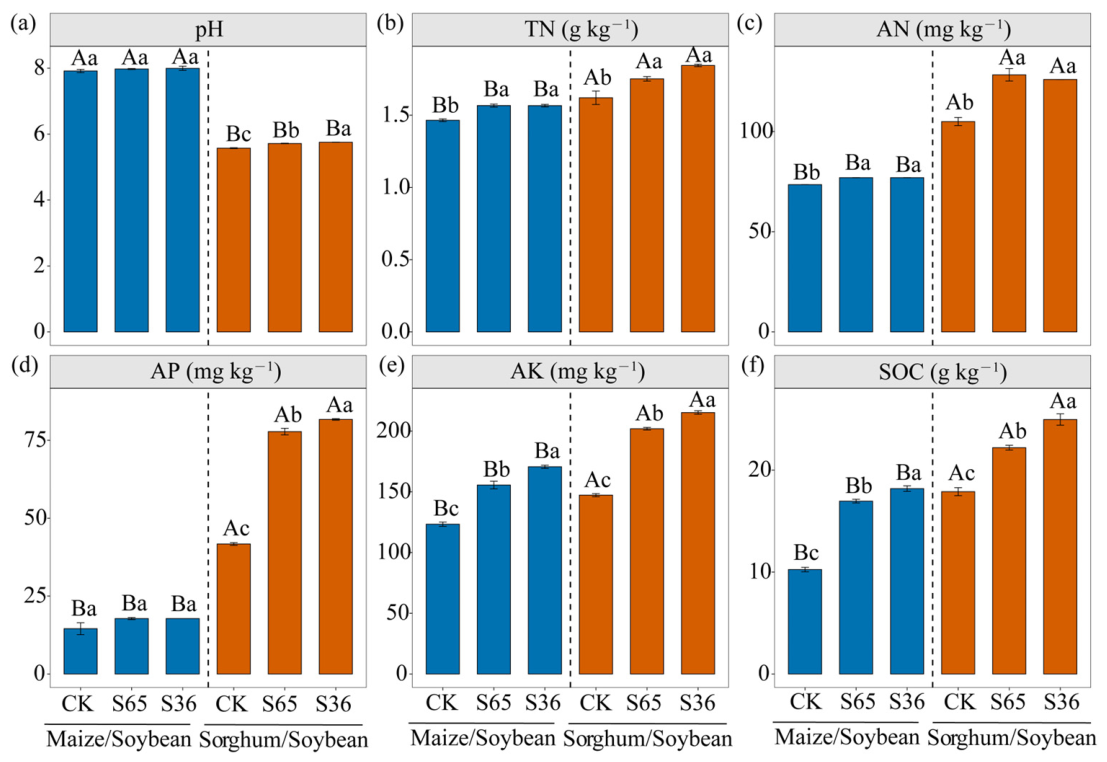
At soybean maturity, soil physicochemical properties differed among inoculation treatments in both field environments. In the maize–soybean environment, soil pH did not differ significantly among treatments (Figure 1a), whereas TN, AN, AK, and SOC were significantly higher under both inoculated treatments than under CK (Figure 1b,c,e,f). AK and SOC were significantly higher under B. japonicum S36 than under S. fredii S65, while TN and AN did not differ significantly between the two strains. Although AP did not differ significantly among treatments, its mean value was higher under both inoculated treatments than under CK (Figure 1d). In the sorghum-soybean environment, most nutrient indicators, except pH, generally followed the order B. japonicum S36 > S. fredii S65 > CK. At soybean maturity, AP, AK, and SOC under B. japonicum S36 were approximately 96%, 46%, and 40% higher than those under CK, respectively (Figure 1d–f). Overall, both inoculated treatments were associated with higher soil nutrient status than CK at soybean maturity across the two contrasting field environments, with B. japonicum S36 showing the greater overall difference.

3.3. Effects of Rhizobial Inoculation on Soybean Yield Components

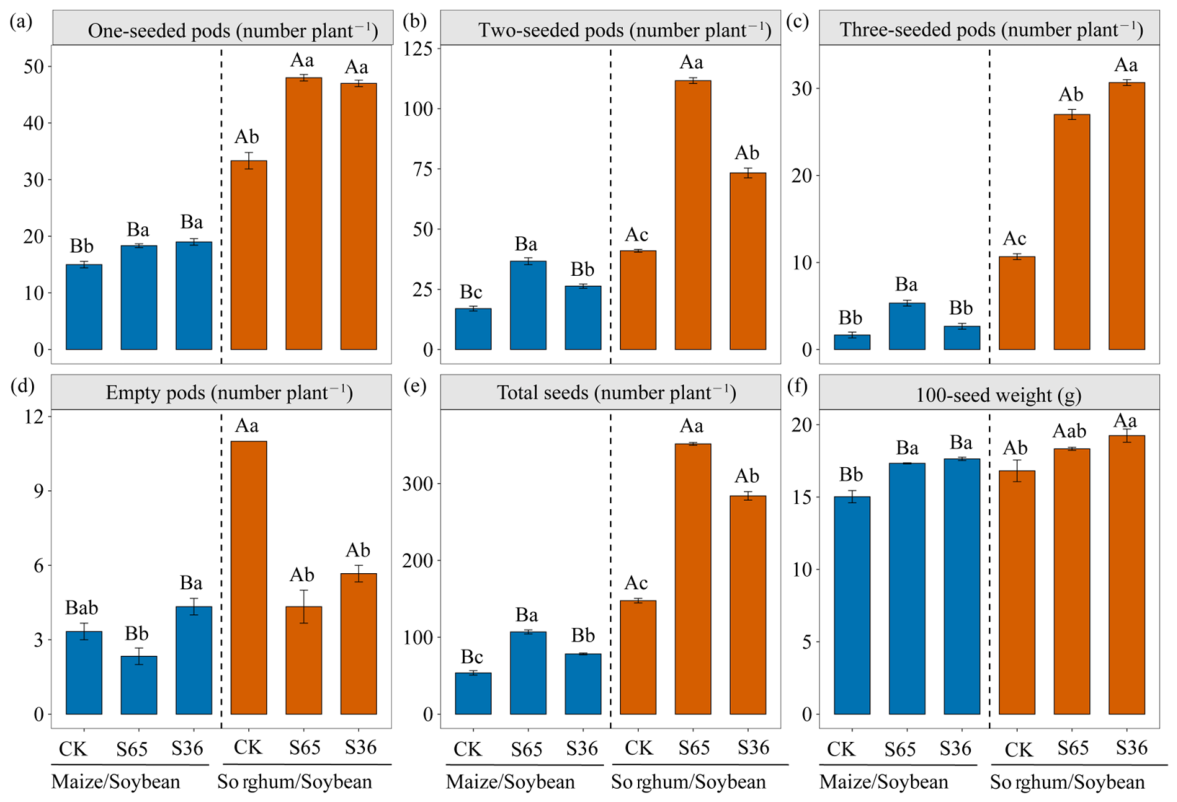
Inoculation with B. japonicum S36 or S. fredii S65 improved soybean pod and seed formation. In the maize–soybean environment, both inoculated treatments produced significantly more one-seeded pods than CK (Figure 2a). The numbers of two-seeded pods and total seeds followed the order S. fredii S65 > B. japonicum S36 > CK (Figure 2b,e). Only S. fredii S65 significantly increased the number of three-seeded pods relative to both CK and B. japonicum S36 (Figure 2c), whereas the number of empty pods varied little among treatments (Figure 2d). Compared with CK, S. fredii S65 and B. japonicum S36 increased total seed number by 99.4% and 46.0%, respectively, and increased 100-seed weight by 15.3% and 17.4%, respectively (Figure 2e,f). In the sorghum-soybean environment, both inoculated treatments significantly increased the number of one-seeded pods (Figure 2a). The numbers of two-seeded pods and total seeds again followed the order S. fredii S65 > B. japonicum S36 > CK (Figure 2b,e), whereas the number of three-seeded pods followed the order B. japonicum S36 > S. fredii S65 > CK (Figure 2c). Compared with CK, S. fredii S65 and B. japonicum S36 reduced the number of empty pods by 60.6% and 48.5%, respectively (Figure 2d), and increased the total seed number by 138.1% and 92.3%, respectively (Figure 2e). The highest 100-seed weight was recorded under B. japonicum S36 (Figure 2f). Thus, S. fredii S65 was distinguished primarily by increases in two-seeded pods and total seed number, whereas B. japonicum S36 was more effective in increasing three-seeded pods and seed weight.

3.4. Effects of Rhizobial Inoculation on Biomass Allocation and Grain Yield

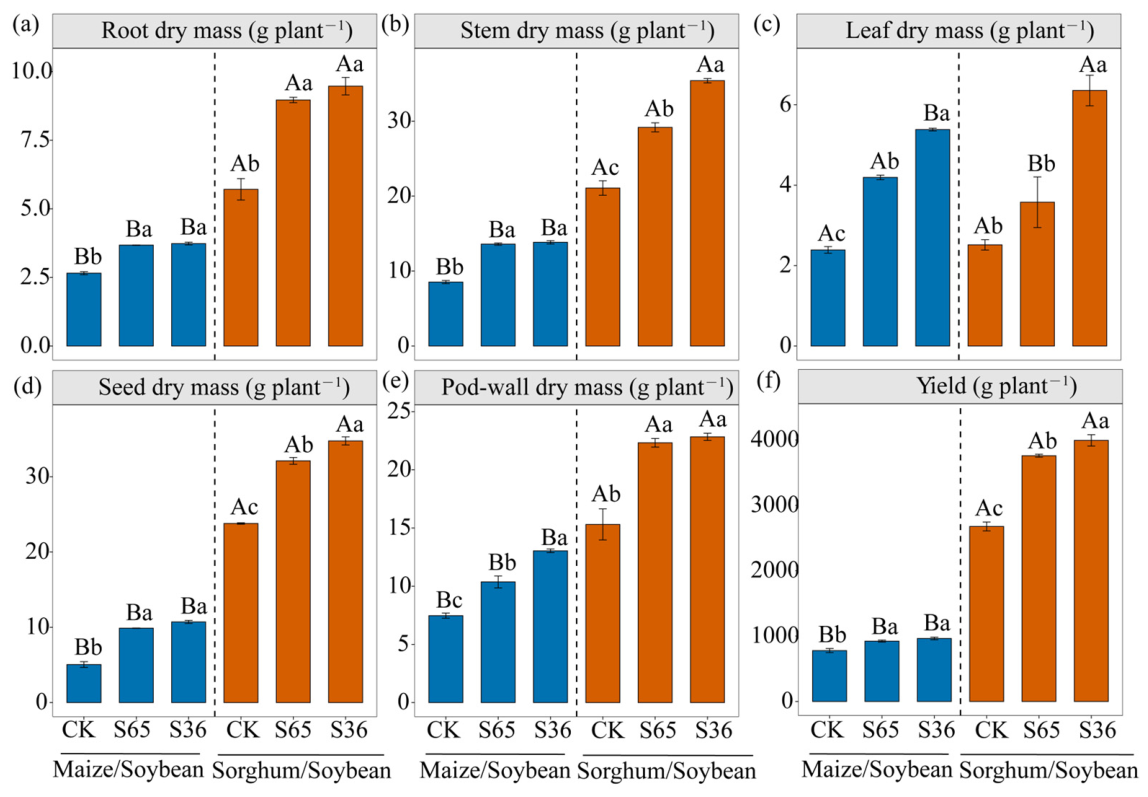
Both rhizobial strains promoted dry-matter accumulation at maturity and increased soybean grain yield. In the maize–soybean environment, root, stem, and seed dry masses were significantly greater under B. japonicum S36 and S. fredii S65 than under CK (Figure 3a,b,d), whereas leaf and pod-wall dry masses were highest under B. japonicum S36 (Figure 3c,e). Compared with CK, B. japonicum S36 and S. fredii S65 increased grain yield by 23.8% and 18.6%, respectively, with no significant difference between the two strains (Figure 3f). In the sorghum-soybean environment, both inoculated treatments significantly increased root, seed, and pod-wall dry masses (Figure 3a,d,e), while stem and leaf dry masses were significantly greater under B. japonicum S36 than under S. fredii S65 (Figure 3b,c). Compared with CK, B. japonicum S36 and S. fredii S65 increased grain yield by 49.2% and 40.4%, respectively, and the yield under B. japonicum S36 was significantly greater than that under S. fredii S65 (Figure 3f). Overall, both strains promoted biomass accumulation and grain production, although B. japonicum S36 showed a stronger advantage in vegetative dry-matter accumulation and final grain yield.
Companion-crop yield also differed among soybean inoculation treatments (Figure S3a,b). In the maize–soybean environment, maize yield was 4540.9 kg ha−1 under CK and increased to 5068.0 and 5294.0 kg ha−1 under S. fredii S65 and B. japonicum S36, respectively. Both inoculated treatments produced significantly higher maize yields than CK, with no significant difference between S. fredii S65 and B. japonicum S36 (Figure S3a). In the sorghum-soybean environment, sorghum yield was 3201.5, 3562.9, and 3943.5 kg ha−1 under CK, S. fredii S65, and B. japonicum S36, respectively, following the order B. japonicum S36 > S. fredii S65 > CK (Figure S3b). Thus, soybean inoculation treatments were also associated with higher companion-crop yields in both field environments.

3.5. Effects of Rhizobial Inoculation on Total N Concentration and N Accumulation in Soybean Organs

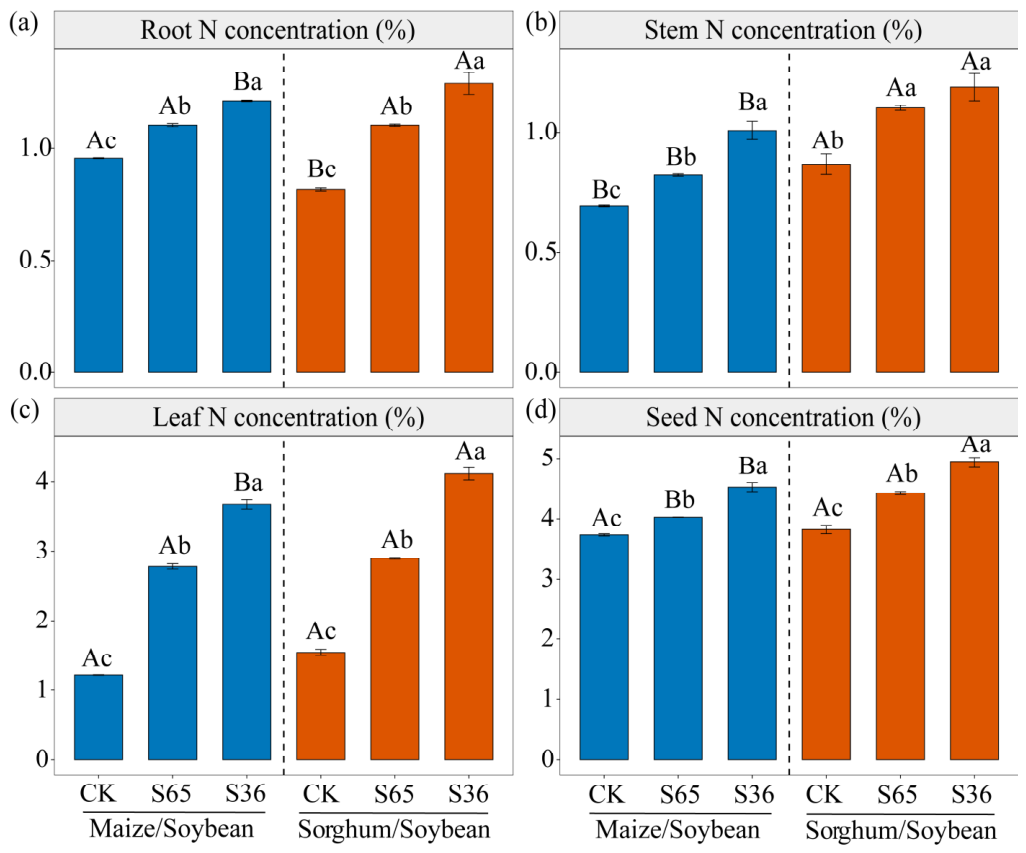
Inoculation with B. japonicum S36 or S. fredii S65 increased total N concentrations in all soybean organs in both field environments, with an overall ranking of B. japonicum S36 > S. fredii S65 > CK. In the maize–soybean environment, total N concentrations in roots, stems, leaves, and seeds differed significantly among the three treatments (Figure 4a–d). Compared with CK, S. fredii S65 and B. japonicum S36 increased root total N concentration by 15.6% and 27.1%, stem total N concentration by 18.4% and 45.6%, leaf total N concentration by 127.8% and 200.9%, and seed total N concentration by 7.9% and 21.2%, respectively. In the sorghum-soybean environment, total N concentrations in roots, leaves, and seeds followed the order B. japonicum S36 > S. fredii S65 > CK (Figure 4a,c,d). Stem total N concentration was significantly higher under both inoculated treatments than under CK but did not differ significantly between B. japonicum S36 and S. fredii S65 (Figure 4b). Compared with CK, S. fredii S65 and B. japonicum S36 increased total N concentrations in roots by 35.2% and 57.9%, in stems by 27.4% and 37.2%, in leaves by 88.2% and 167.4%, and in seeds by 15.6% and 29.1%, respectively. Leaf total N concentration showed the largest proportional response to inoculation, indicating a marked improvement in plant N status.
Rhizobial inoculation also substantially increased N accumulation in soybean organs (Figure S4). In the maize–soybean environment, N accumulation in roots, stems, leaves, and seeds increased progressively from CK to S. fredii S65 and B. japonicum S36, with all three treatments differing significantly. Relative to CK, S. fredii S65 increased N accumulation in roots, stems, leaves, and seeds by approximately 60.1%, 88.8%, 299.7%, and 111.1%, respectively, whereas B. japonicum S36 increased the corresponding values by 78.8%, 136.2%, 577.9%, and 157.1%. A similar but generally stronger response was observed in the sorghum-soybean environment. Compared with CK, S. fredii S65 increased root, stem, leaf, and seed N accumulation by approximately 112.6%, 76.0%, 168.5%, and 56.1%, respectively, while B. japonicum S36 increased these values by 162.5%, 130.2%, 577.6%, and 88.7%, respectively. Across both field environments, B. japonicum S36 consistently produced the greatest N accumulation in all soybean organs, followed by S. fredii S65 and CK. These results indicate that the higher N concentrations observed under rhizobial inoculation were accompanied by greater whole-organ N accumulation, providing additional evidence that B. japonicum S36 and S. fredii S65 improved soybean N acquisition and overall plant N status.

3.6. Effects of Rhizobial Inoculation on Grain Mineral Concentrations and Accumulation

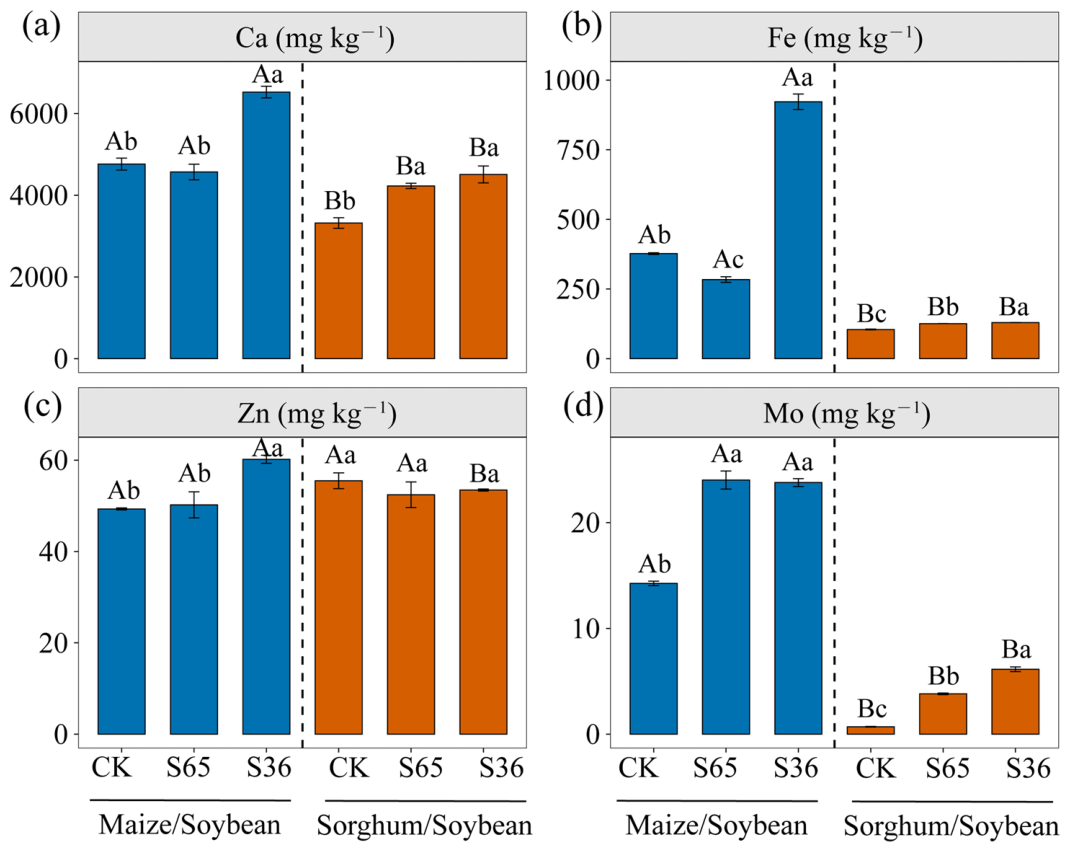
Rhizobial inoculation affected both grain mineral concentrations and mineral accumulation, with the magnitude of the responses varying among elements and cropping systems (Figure 5 and Figure S5). In the maize–soybean system, B. japonicum S36 significantly increased grain Ca and Zn concentrations, while Fe concentration was also highest under B. japonicum S36. Both S. fredii S65 and B. japonicum S36 significantly increased grain Mo concentration, with no significant difference between the two inoculated treatments (Figure 5). The effects of inoculation were more pronounced for mineral accumulation on an area basis (Figure S5). Ca accumulation increased from 1.21 kg ha−1 under CK to 2.26 and 3.50 kg ha−1 under S. fredii S65 and B. japonicum S36, respectively, with significant differences among treatments. Fe accumulation reached 0.495 kg ha−1 under B. japonicum S36, significantly exceeding that under S. fredii S65 and CK. Both S. fredii S65 and B. japonicum S36 significantly enhanced Zn and Mo accumulation, although no significant differences were detected between the two inoculated treatments.
In the sorghum-soybean system, both rhizobial strains significantly increased grain Ca concentration, while Fe and Mo concentrations followed the order B. japonicum S36 > S. fredii S65 > CK. In contrast, grain Zn concentration did not differ significantly among treatments (Figure 5). Nevertheless, Zn accumulation was significantly greater under both S. fredii S65 and B. japonicum S36 than under CK, indicating that rhizobial inoculation enhanced Zn accumulation on an area basis despite the absence of a significant change in grain Zn concentration (Figure S5). In addition, Ca, Fe, and Mo accumulation consistently followed the order B. japonicum S36 > S. fredii S65 > CK, with values under B. japonicum S36 reaching 8.45, 0.243, and 0.0115 kg ha−1, respectively. Overall, rhizobial inoculation not only altered grain mineral concentrations but also substantially enhanced mineral accumulation per unit area. Among the two strains, B. japonicum S36 generally exhibited a stronger promoting effect than S. fredii S65, particularly for Ca, Fe, and Mo accumulation.

3.7. Integrated Effects of Rhizobial Inoculation on Soil Quality, Soybean Growth, and Yield

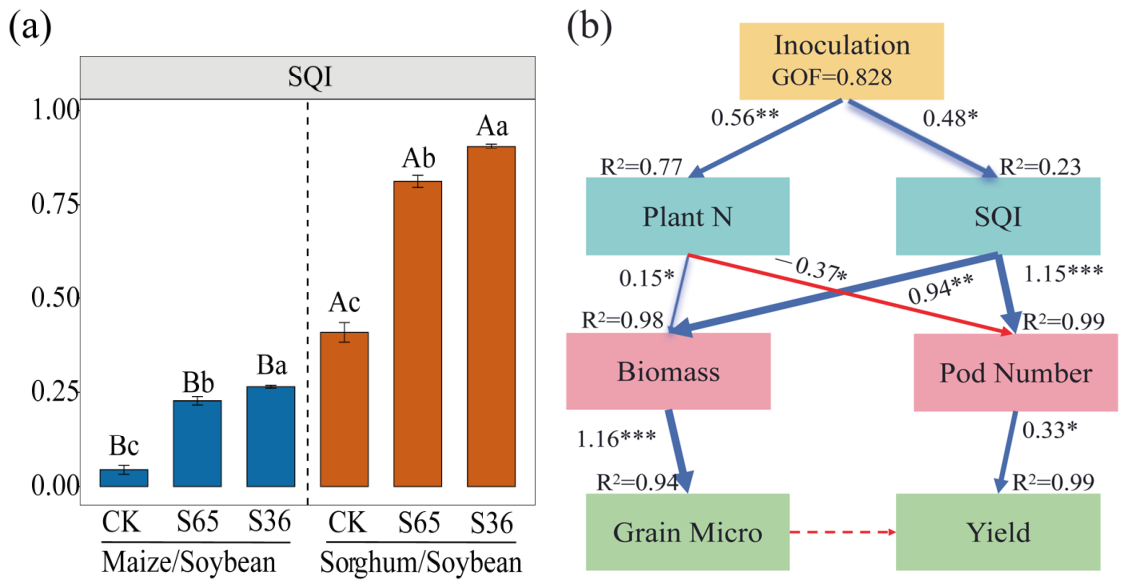
Chemical soil fertility followed the order B. japonicum S36 > S. fredii S65 > CK in both field environments, with significant differences among treatments (Figure 6a). In the maize–soybean system, the SQI values were 0.044, 0.228, and 0.265 under CK, S. fredii S65, and B. japonicum S36, respectively; the corresponding values in the sorghum-soybean system were 0.410, 0.811, and 0.906. Principal component analysis clearly distinguished the two field environments and inoculation treatments based on soil physicochemical properties, grain mineral concentrations, biomass traits, and yield components. Overall, the inoculated treatments were associated with higher chemical soil fertility, greater biomass production, and more favorable yield-related traits, with B. japonicum S36 showing a more pronounced separation from CK than S. fredii S65 (Figure S6a,b).
Spearman’s rank correlation analysis showed that TN, AN, AP, AK, and SOC were positively associated with most biomass traits and yield components, whereas soil pH was generally negatively associated with these traits (Figure S6c). Positive associations between chemical soil fertility indicators and plant total N concentrations were particularly evident for AK and SOC, whereas the relationships between soil properties and grain mineral concentrations exhibited greater element specificity. The partial least-squares path model had a goodness-of-fit (GoF) value of 0.828. Rhizobial inoculation was positively associated with both the composite plant N variable and chemical soil fertility, while chemical soil fertility was positively associated with biomass accumulation and pod formation; pod number was also positively associated with grain yield (Figure 6b and Figure S6d). The decomposition of standardized effects indicated that, within the specified model, chemical soil fertility showed the strongest overall positive association with grain yield, a substantial proportion of which was represented by indirect associations; biomass and pod number were also positively associated with grain yield (Figure S6d). Overall, these analyses revealed coordinated associations among rhizobial inoculation, chemical soil fertility, plant N status, biomass production, pod formation, and grain yield. Given the exploratory nature of the PLS-PM analysis and the limited sample size, the estimated path coefficients should be interpreted as statistical associations within the specified model rather than as evidence of causal or mediating relationships.

4. Discussion

4.1. Selection of Effective Rhizobial Strains and Strain-Specific Responses

The effectiveness of rhizobial inoculation depends on the nodulation capacity, N2-fixation potential, plant-growth-promoting functions, and host compatibility of the inoculated strain. Nodule formation and the allocation of host resources to N2 fixation are jointly regulated by symbiotic signaling, host control, and the fixation potential of the infecting strain [28,29]. Rhizobial strains also differ substantially in both the magnitude and stability of their yield-promoting effects under field conditions [30]. Strain performance should therefore not be judged from nodule number alone, but evaluated together with nodule biomass, leaf SPAD values, and plant dry-matter accumulation. In the present study, B. japonicum S36 generally produced the strongest growth response and the greatest nodule biomass. Although S. fredii S65 formed a similar number of nodules, its nodule fresh and dry masses were lower. Abundant nodulation was therefore not necessarily equivalent to the formation of highly effective nodules and shoot biomass together with SPAD-derived leaf N status provided more direct phenotypic evidence of overall symbiotic performance. In intercropping systems, rhizobial inoculation can reduce N losses and improve N-use efficiency [20], while maize root exudates may promote legume nodulation and N2 fixation through specific signaling compounds [19,31]. These belowground interactions offer an additional explanation for the consistently positive responses to B. japonicum S36 and S. fredii S65 in cereal–soybean intercropping.
The functional differences between B. japonicum S36 and S. fredii S65 may be associated with strain-specific molecular and physiological characteristics underlying their symbiotic and growth-promoting performance. B. japonicum S36 is a slow-growing strain, whereas S. fredii S65 is a fast-growing strain. Their contrasting growth characteristics may influence their establishment, competitiveness, host interactions, and interactions with native soil and root-associated microbiota under field conditions. Previous work has shown pronounced strain-level variation among soybean rhizobia from Sichuan Province in symbiotic compatibility and field efficiency [22]. However, inoculant colonization dynamics, competitive ability, and microbiome responses were not directly measured in the present study; therefore, these mechanisms remain plausible explanations that require further experimental validation. The field performance of an inoculant is jointly determined by strain-host compatibility and local soil and climatic conditions [32,33]. In this study, S. fredii S65 exerted a stronger effect on pod and seed number, whereas B. japonicum S36 produced broader improvements in SPAD, plant biomass, soil quality, and final grain yield. These contrasting patterns suggest that S. fredii S65 may be more closely associated with reproductive-unit formation, whereas the stronger plant N status and biomass accumulation observed under B. japonicum S36 may have contributed to its greater seed filling and final grain yield. Comparative analyses of functional genes, colonization dynamics, and N2-fixation efficiency will be needed to establish the physiological basis of these strain-specific responses.

4.2. Potential Links Between Rhizobial Inoculation and Changes in Chemical Soil Fertility

Despite the marked differences in initial soil pH and nutrient status between the two field sites, inoculation with B. japonicum S36 and S. fredii S65 was consistently associated with higher chemical soil fertility at soybean maturity. This consistency suggests a relatively robust relationship between rhizobial inoculation and improved soil nutrient status across contrasting field environments. In addition to plant-rhizobium symbiosis, inoculation may also be associated with shifts in indigenous soil microbial communities, including microbial taxa involved in N, P, K, and C transformations [34]. In intercropping systems, such microbial changes, together with interspecific facilitation between component crops, may contribute to greater nutrient availability [35]. However, because soil microbial community composition and nutrient-cycling functions were not directly measured in the present study, these processes should be regarded as biologically plausible explanations rather than demonstrated mechanisms.
The higher TN and AN observed under inoculation may be related to symbiotic N2 fixation, rhizosphere N transformations, and root-derived inputs, whereas the increases in AP, AK, and SOC may be associated with changes in root activity, nutrient mobilization, and belowground C inputs. Previous studies have shown that maize–soybean intercropping can simultaneously improve nutrient acquisition, crop productivity, soil physicochemical properties, and soil enzyme activities [36], indicating that rhizosphere processes may be closely linked to the soil nutrient responses observed following inoculation. More broadly, increased crop diversity is often associated with enhanced ecosystem nutrient cycling [37,38,39]. With respect to P acquisition, legumes in cereal-legume intercropping systems can release protons and carboxylates into the rhizosphere, thereby mobilizing otherwise poorly available inorganic and organic P fractions [40,41,42]. This provides a plausible ecological explanation for the increase in AP observed in the present study. Microbial symbioses are also important for efficient nutrient use in intercropping systems [43], while soil P availability can regulate the relative contributions of direct root uptake and mycorrhizal pathways to maize P acquisition [44]. Rhizosphere P supply, root interactions, and mycorrhizal pathways may therefore jointly contribute to P acquisition in these systems. The higher AK, SOC, and overall chemical soil fertility observed under B. japonicum S36 were accompanied by a stronger overall plant growth response. Greater plant biomass is generally associated with increased root activity, root exudation, and residue-derived C inputs, all of which may coincide with rhizosphere conditions that favor nutrient retention and transformation. Previous studies have shown that the positive association between intercropping and soil ecosystem multifunctionality is closely related to increases in available nutrients, although the magnitude of this relationship depends on regional and environmental conditions [9]. Long-term advantages in N acquisition may likewise be associated with resource complementarity and interspecific facilitation [45]. In addition, agricultural K cycling is jointly regulated by plant uptake, nutrient removal at harvest, residue return, and K release from soil minerals [46]. Thus, changes in root activity, biomass production, and belowground inputs under inoculation may be associated with the higher AK observed at soybean maturity.
Root interactions and rhizosphere signaling between cereal and soybean plants may further create conditions favorable for rhizobial performance. Photosynthate supply is essential for C allocation during early nodule formation [47], and improved light conditions under intercropping can enhance soybean root development and P uptake [48]. Improved leaf greenness and grain filling after maize harvest [49], together with coordinated responses of leaf and nodule traits [50], may also be associated with sustained late-season N accumulation and seed development. Previous studies have shown that maize–soybean root interactions are associated with enhanced soybean nodulation [19,51], while maize root exudates can induce rhizobia to produce nodulation signals [52]. The development of belowground facilitation ultimately depends on functional trait matching between component crops and their coordination with symbiotic microorganisms [53]. Accordingly, the similar direction of soil nutrient responses to B. japonicum S36 and S. fredii S65 across the two soil backgrounds may reflect not only intrinsic strain characteristics but also the rhizosphere environment generated by interspecific root interactions. Notably, the overall response was greater under S36, suggesting that the strength of the association between rhizobial inoculation and chemical soil fertility may vary among strains. Future studies integrating rhizosphere microbiome profiling, nutrient transformation measurements, root exudate analysis, and strain colonization dynamics will be required to test these potential links directly.

4.3. Relationships of Rhizobial Inoculation with Soybean Yield Formation and Grain Mineral Nutrition

In both field environments, B. japonicum S36 and S. fredii S65 increased soybean dry-matter accumulation and grain yield, consistent with previous evidence that rhizobial inoculation can improve soybean productivity [54]. In sorghum-soybean intercropping, rhizobial inoculation has also been reported to interact with P and K nutrition in association with improved root development, symbiotic performance, and grain yield [55]. Nevertheless, the two strains showed distinct yield-component response patterns. The advantage of S. fredii S65 was mainly reflected in greater numbers of two-seeded pods and total seeds, whereas B. japonicum S36 was associated with higher leaf and pod-wall biomass, greater 100-seed weight, and higher final grain yield. These contrasting responses suggest that the two strains were associated with different combinations of yield-related traits: S65 was more closely linked to reproductive-unit formation, whereas S36 was associated with greater vegetative growth and seed filling. Within intercropped rhizospheres, increased flavonoid secretion and greater Bradyrhizobium abundance have been associated with enhanced N accumulation in the non-legume crop [56], while root interactions may also be related to N2 fixation and interspecific N transfer [57]. In the present study, total N concentrations in soybean organs generally increased following inoculation, indicating a positive association between inoculation and plant N status. However, these measurements reflect plant N status rather than biological N2 fixation itself and therefore cannot be used to quantify the contribution of symbiotic N2 fixation directly. Such quantification would require direct measurements, such as nitrogenase activity, 15N tracing, or other isotope-based approaches. In the present study, the higher plant N status, biomass accumulation, and 100-seed weight observed under S36 were consistent with its higher grain yield, although the temporal and causal relationships among these variables were not directly tested.
Exploratory partial least-squares path modeling further revealed a series of statistical associations among rhizobial inoculation, plant N status, chemical soil fertility, biomass accumulation, pod number, and grain yield. Within the specified model structure, chemical soil fertility and plant N status were positively associated with biomass- and yield-related variables, while pod number was also positively associated with grain yield. Decomposition of the standardized path coefficients further indicated that chemical soil fertility showed a relatively strong overall positive association with grain yield within the model, with part of this association represented through other model variables. Importantly, because the PLS-PM analysis was exploratory and based on only 18 field plots, these path coefficients should be interpreted solely as statistical associations within the hypothesized model and not as evidence of causal relationships, mediating mechanisms, or causal direction. Accordingly, the model is useful for identifying variables that covary within the proposed framework, but it does not demonstrate that rhizobial inoculation alters yield through any specific causal pathway. Ecological theories of resource complementarity and interspecific facilitation provide a broader context for interpreting these coordinated responses in intercropping systems [53,58]. In addition, interactions between rhizobial strains and crop genotypes can substantially alter plant growth and yield responses [26], highlighting the need to consider strain identity, soybean genotype, soil conditions, and crop management jointly when evaluating inoculants.
In addition to yield responses, the two rhizobial strains were associated with different patterns of grain mineral nutrition. Overall, B. japonicum S36 produced greater increases in grain Ca, Fe, and Mo concentrations than S. fredii S65. Previous studies have shown that different rhizobial isolates can markedly influence water use and mineral nutrition in legume crops [59], and synergistic responses between Bradyrhizobium japonicum inoculation and Mo nutrition have also been reported [60]. Both Fe and Mo are involved in nodule metabolism and enzyme systems associated with biological N2 fixation. The higher Fe and Mo levels observed under S36 may, therefore, be related to its higher plant N status and rhizosphere nutrient environment. However, because elemental uptake kinetics, rhizosphere nutrient mobilization, and N2-fixation efficiency were not directly measured, this interpretation remains biologically plausible rather than experimentally demonstrated. The response of grain Zn to inoculation differed between the two field environments, further indicating that grain mineral concentrations are jointly influenced by soil nutrient availability, root uptake, interactions among elements, and yield dilution. Notably, treatment responses in grain mineral concentrations were not always consistent with those in mineral accumulation per unit land area. For example, in the sorghum-soybean system, grain Zn concentration did not differ significantly among treatments, whereas Zn accumulation per unit area increased significantly following inoculation. This discrepancy indicates that grain concentration alone may not fully capture the effects of inoculation on mineral nutrient output. Therefore, both grain mineral concentration and total mineral accumulation per unit land area should be considered when evaluating the nutritional implications of rhizobial inoculation, thereby distinguishing genuine nutrient enrichment from concentration changes associated with yield dilution.
From a broader agronomic perspective, the national average soybean yield in China was approximately 2032 kg ha−1 in 2025 [61], whereas recent large-scale demonstrations of high-yield soybean production achieved average yields exceeding 4500 kg ha−1 [62]. In the present study, soybean yields in the maize–soybean system remained below the current national average across all treatments, suggesting relatively strong competitive constraints on soybean under this field environment. By contrast, soybean yields in the sorghum-soybean system exceeded the national average, and inoculation with S. fredii S65 and B. japonicum S36 resulted in yields of approximately 3758 and 3995 kg ha−1, respectively. These values were approximately 1.85- and 1.97-fold the national average and approached, although remained below, the >4500 kg ha−1 level reported for recent large-scale high-yield demonstrations. This comparison highlights the agronomic relevance of the responses observed under the sorghum-soybean environment. However, because the two intercropping systems were established at different locations, these differences cannot be attributed solely to companion-crop identity. Instead, strain performance should be interpreted as the combined outcome of intercropping configuration, initial soil conditions, and site-specific environmental factors. Overall, both rhizobial strains showed positive growth and yield responses across contrasting field environments, but their agronomic response patterns were clearly strain-specific. S. fredii S65 was more strongly associated with increases in pod and seed number, whereas B. japonicum S36 showed broader advantages in chemical soil fertility, plant N status, biomass accumulation, 100-seed weight, grain yield, and selected mineral traits. These findings support the potential agronomic value of both strains in cereal–soybean intercropping systems while also indicating that the expression of strain-specific advantages depends on environmental context. Future studies conducted at the same site across contrasting intercropping configurations, combined with reduced-N fertilizer gradients, multi-year replication, 15N tracing, strain-specific molecular markers, and rhizosphere microbiome analysis, will be important for assessing field stability, defining suitable application conditions, and evaluating the potential contribution of these strains to reduced-N and more sustainable crop production.

5. Conclusions

This study systematically screened and evaluated soybean rhizobial isolates for their field performance under two cereal–soybean intercropping environments, identifying B. japonicum S36 and S. fredii S65 as two strains with strong application potential. Both strains consistently promoted soybean growth and grain yield across the contrasting field environments, although their agronomic response patterns differed markedly. The advantages of S. fredii S65 were primarily reflected in enhanced pod and seed formation, whereas B. japonicum S36 produced broader improvements in chemical soil fertility, plant N status, dry-matter accumulation, 100-seed weight, grain yield, and the concentrations of selected mineral nutrients in the grain. Overall, B. japonicum S36 exhibited more stable and comprehensive agronomic benefits across the two intercropping environments, highlighting its potential as a rhizobial inoculant candidate for cereal–soybean intercropping systems, while S. fredii S65 may serve as a complementary candidate with distinct functional advantages. These findings provide field-based evidence for the selection and application of efficient rhizobial strains across different intercropping environments. They further suggest that rhizobial inoculation has the potential to maintain or enhance soybean productivity and grain nutritional quality while reducing dependence on chemical N fertilizer inputs, thereby providing biological support for the development of resource-efficient and environmentally sustainable legume production systems.

Supplementary Materials

The following supporting information can be downloaded at https://www.mdpi.com/article/10.3390/agronomy16171731/s1; Table S1. Factor loadings for the first principal component from PCA based on treatment means in the greenhouse screening. Figure S1. Daily rainfall and air temperature during the field experiments in (a) Zhongjiang maize–soybean and (b) Luxian sorghum–soybean environments. Figure S2. Representative field views of the two cereal–soybean intercropping environments: maize–soybean at Zhongjiang (left) and sorghum–soybean at Luxian (right). Figure S3. Companion-crop grain yield under soybean rhizobial inoculation treatments in the two intercropping environments: (a) maize yield and (b) sorghum yield. Values are means ± standard errors (n = 3). Different lowercase letters indicate significant differences among inoculation treatments within a companion crop (p < 0.05). S36 and S65 represent Bradyrhizobium japonicum and Sinorhizobium fredii, respectively. Figure S4. Effects of rhizobial inoculation on N accumulation in soybean organs under maize–soybean and sorghum–soybean intercropping environments. (a) Root N accumulation; (b) stem N accumulation; (c) leaf N accumulation; and (d) seed N accumulation. Values are means ± SE (n = 3). Different lowercase letters indicate significant differences among inoculation treatments within the same field environment, whereas different uppercase letters indicate significant differences between field environments within the same inoculation treatment (p < 0.05). S36 and S65 represent Bradyrhizobium japonicum and Sinorhizobium fredii, respectively. Figure S5. Effects of rhizobial inoculation on soybean grain mineral accumulation: (a) Ca; (b) Fe; (c) Zn; and (d) Mo. Values are means ± standard errors (n = 3). According to Duncan’s test following two-way ANOVA, different lowercase letters indicate significant differences among inoculation treatments within a field environment, and different uppercase letters indicate significant differences between field environments within an inoculation treatment (p < 0.05). S36 and S65 represent Bradyrhizobium japonicum and Sinorhizobium fredii, respectively. Figure S6. Exploratory multivariate relationships among soil properties, soybean growth, yield formation, plant N status, and grain mineral composition under rhizobial inoculation across two cereal–soybean field environments. (a) Principal component analysis (PCA) of soil properties and grain mineral-element concentrations; (b) PCA of soybean biomass and yield-related traits; (c) Spearman correlation heatmap showing associations of soil properties with soybean biomass traits, yield components, plant total N concentrations, and grain mineral-element concentrations; and (d) direct, indirect, and total effects derived from the exploratory partial least-squares path model (PLS-PM).

Author Contributions

Conceptualization, K.X. and Y.C.; methodology, L.Z., D.Z., X.T., Y.C. and K.X.; validation, L.Z., D.L., L.C., M.X. and Y.L.; formal analysis, L.Z. and D.Z.; investigation, L.Z., D.L., L.C., Y.L. and M.X.; and resources, X.T., Y.C. and K.X.; data curation, L.Z.; writing—original draft preparation, L.Z.; writing—review and editing, D.Z., X.T., Y.C. and K.X.; visualization, L.Z. and D.Z.; supervision, Y.C. and K.X.; project administration, K.X.; funding acquisition, K.X. All authors have read and agreed to the published version of the manuscript.

Funding

This research was funded by the Sichuan Science and Technology Program, grant number 2025YFHZ0115.

Data Availability Statement

The original contributions in this study are included in the article or Supplementary Material. If you have any questions, you can contact the corresponding author(s).

Conflicts of Interest

The authors declare no conflicts of interest.

References

  1. Vogel, E.; Donat, M.G.; Alexander, L.V.; Meinshausen, M.; Ray, D.K.; Karoly, D.; Meinshausen, N.; Frieler, K. The effects of climate extremes on global agricultural yields. Environ. Res. Lett. 2019, 14, 054010. [Google Scholar] [CrossRef] [Scilit]
  2. Zhou, X.Y.; Lu, G.; Xu, Z.C.; Yan, X.Q.; Khu, S.T.; Yang, J.F.; Zhao, J. Influence of Russia-Ukraine war on the global energy and food security. Resour. Conserv. Recycl. 2023, 188, 106657. [Google Scholar] [CrossRef] [Scilit]
  3. Williams, D.R.; Clark, M.; Buchanan, G.M.; Ficetola, G.F.; Rondinini, C.; Tilman, D. Proactive conservation to prevent habitat losses to agricultural expansion. Nat. Sustain. 2021, 4, 314–322. [Google Scholar] [CrossRef] [Scilit]
  4. Xue, R.; Wang, C.; Zhao, L.; Sun, B.R.; Wang, B.L. Agricultural intensification weakens the soil health index and stability of microbial networks. Agric. Ecosyst. Environ. 2022, 339, 108118. [Google Scholar] [CrossRef] [Scilit]
  5. Gale, F.; Valdes, C.; Ash, M. Interdependence of China, United States, and Brazil in Soybean Trade. In Economic Research Service; OCS-19F-01; U.S. Department of Agriculture: Washington, DC, USA, 2019. Available online: https://www.ers.usda.gov/publications/pub-details/?pubid=93389 (accessed on 21 August 2026).
  6. Wang, Y.; Wang, Z.; Yu, P.; Deng, X. Toward sustainable soybean supply and consumption in China under climate change and policy adaptation. Sustain. Prod. Consum. 2026, 64, 235–246. [Google Scholar] [CrossRef] [Scilit]
  7. Yang, H.; Zhang, W.P.; Li, L. Intercropping: Feed more people and build more sustainable agroecosystems. Front. Agric. Sci. Eng. 2021, 8, 373–386. [Google Scholar] [CrossRef] [Scilit]
  8. Alarcón-Segura, V.; Grass, I.; Breustedt, G.; Rohlfs, M.; Tscharntke, T. Strip intercropping of wheat and oilseed rape enhances biodiversity and biological pest control in a conventionally managed farm scenario. J. Appl. Ecol. 2022, 59, 1513–1523. [Google Scholar] [CrossRef] [Scilit]
  9. Ma, H.Y.; Zhou, J.; Ge, J.Y.; Nie, J.W.; Zhao, J.; Xue, Z.Q.; Hu, Y.G.; Yang, Y.D.; Peixoto, L.; Zang, H.D.; et al. Intercropping improves soil ecosystem multifunctionality through enhanced available nutrients but depends on regional factors. Plant Soil 2022, 480, 71–84. [Google Scholar] [CrossRef] [Scilit]
  10. Mulder, L.; Hogg, B.; Bersoult, A.; Cullimore, J.V. Integration of signalling pathways in the establishment of the legume–rhizobia symbiosis. Physiol. Plant. 2005, 123, 207–218. [Google Scholar] [CrossRef] [Scilit]
  11. Lyu, X.C.; Sun, C.Y.; Lin, T.; Wang, X.L.; Li, S.; Zhao, S.H.; Gong, Z.P.; Wei, Z.W.; Yan, C.; Ma, C.M. Systemic regulation of soybean nodulation and nitrogen fixation by nitrogen via isoflavones. Front. Plant Sci. 2022, 13, 968496. [Google Scholar] [CrossRef] [Scilit] [PubMed]
  12. Herridge, D.F.; Peoples, M.B.; Boddey, R.M. Global inputs of biological nitrogen fixation in agricultural systems. Plant Soil 2008, 311, 1–18. [Google Scholar] [CrossRef] [Scilit]
  13. Ohwaki, Y.; Sugahara, K. Active extrusion of protons and exudation of carboxylic acids in response to iron deficiency by roots of chickpea (Cicer arietinum L.). Plant Soil 1997, 189, 49–55. [Google Scholar] [CrossRef] [Scilit]
  14. Raza, M.A.; Khalid, M.H.B.; Zhang, X.; Feng, L.Y.; Khan, I.; Hassan, M.J.; Ahmed, M.; Ansar, M.; Chen, Y.K.; Fan, Y.F.; et al. Effect of planting patterns on yield, nutrient accumulation and distribution in maize and soybean under relay intercropping systems. Sci. Rep. 2019, 9, 4947. [Google Scholar] [CrossRef] [Scilit] [PubMed]
  15. Zhang, Y.; Sun, Z.X.; Su, Z.C.; Du, G.J.; Bai, W.; Wang, Q.; Wang, R.; Nie, J.Y.; Sun, T.; Feng, C.; et al. Root plasticity and interspecific complementarity improve yields and water use efficiency of maize/soybean intercropping in a water-limited condition. Field Crops Res. 2022, 282, 108523. [Google Scholar] [CrossRef] [Scilit]
  16. Raza, M.A.; Din, A.M.U.; Wang, Z.Q.; Gul, H.; Ur Rehman, S.; Bukhari, B.; Haider, I.; Ur Rehman, M.H.; Liang, X.; Luo, S.L.; et al. Spatial differences influence nitrogen uptake, grain yield, and land-use advantage of wheat/soybean relay intercropping systems. Sci. Rep. 2023, 13, 16916. [Google Scholar] [CrossRef] [Scilit] [PubMed]
  17. Gao, Y.; Duan, A.W.; Qiu, X.Q.; Liu, Z.G.; Sun, J.S.; Zhang, J.P.; Wang, H.Z. Distribution of roots and root length density in a maize/soybean strip intercropping system. Agric. Water Manag. 2010, 98, 199–212. [Google Scholar] [CrossRef] [Scilit]
  18. Te, X.; Ud Din, A.M.; Cui, K.S.; Raza, M.A.; Ali, M.F.; Xiao, J.H. Inter-specific root interactions and water use efficiency of maize/soybean relay strip intercropping. Field Crops Res. 2023, 291, 108793. [Google Scholar] [CrossRef] [Scilit]
  19. Li, B.; Li, Y.Y.; Wu, H.M.; Zhang, F.F.; Li, C.J.; Li, X.X.; Lambers, H.; Li, L. Root exudates drive interspecific facilitation by enhancing nodulation and N2 fixation. Proc. Natl. Acad. Sci. USA 2016, 113, 6496–6501. [Google Scholar] [CrossRef] [Scilit] [PubMed]
  20. Mei, P.P.; Wang, P.; Yang, H.; Gui, L.G.; Christie, P.; Li, L. Maize/faba bean intercropping with rhizobial inoculation in a reclaimed desert soil enhances productivity and symbiotic N2 fixation and reduces apparent N losses. Soil Tillage Res. 2021, 213, 105154. [Google Scholar] [CrossRef] [Scilit]
  21. Tang, C.; Hinsinger, P.; Drevon, J.J.; Jaillard, B. Phosphorus deficiency impairs early nodule functioning and enhances proton release in roots of Medicago truncatula L. Ann. Bot. 2001, 88, 131–138. [Google Scholar] [CrossRef] [Scilit]
  22. Chen, Y.X.; Zhou, T.; Penttinen, P.; Zou, L.; Wang, K.; Cui, Y.Q.; Heng, N.N.; Xu, K.W. Symbiotic matching, taxonomic position, and field assessment of symbiotically efficient rhizobia isolated from soybean root nodules in Sichuan, China. Biol. Fertil. Soils 2015, 51, 707–718. [Google Scholar] [CrossRef] [Scilit]
  23. Stajković-Srbinović, O.; De Meyer, S.E.; Kuzmanović, D.; Dinić, Z.; Delić, D.; Willems, A. Soybean seed chemical composition as influenced by Bradyrhizobium inoculation in soils with elevated nickel concentrations. Appl. Soil Ecol. 2020, 153, 103576. [Google Scholar] [CrossRef] [Scilit]
  24. Leite, R.A.; Martins, L.C.; Ferreira, L.V.S.F.; Barbosa, E.S.; Alves, B.J.R.; Zilli, J.E.; Araújo, A.P.; Jesus, E.C. Co-inoculation of Rhizobium and Bradyrhizobium promotes growth and yield of common beans. Appl. Soil Ecol. 2022, 172, 104356. [Google Scholar] [CrossRef] [Scilit]
  25. Nitawaki, Y.; Kitabayashi, H.; Mason, M.L.T.; Yamamoto, A.; Saeki, Y. Effect of salt stress on soybean growth and nodulation under inoculation with soybean rhizobia. Soil Sci. Plant Nutr. 2021, 67, 103–113. [Google Scholar] [CrossRef] [Scilit]
  26. Horácio, E.H.; Gavilanes, F.E.Z.; Feliciano, M.V.; Moraes, J.G.; Zucareli, C.; Andrade, D.S.; Maddela, N.R.; Prasad, R. Exploring the interaction effects between common bean cultivars and rhizobia inoculation on plant growth and yield. J. Agric. Food Res. 2024, 15, 100926. [Google Scholar] [CrossRef] [Scilit]
  27. Bao, S.D. Soil and Agricultural Chemistry Analysis, 3rd ed.; China Agriculture Press: Beijing, China, 2000. [Google Scholar]
  28. Shumilina, J.; Soboleva, A.; Abakumov, E.; Shtark, O.Y.; Zhukov, V.A.; Frolov, A. Signaling in legume–rhizobia symbiosis. Int. J. Mol. Sci. 2023, 24, 17397. [Google Scholar] [CrossRef] [Scilit] [PubMed]
  29. Underwood, T.J.; Poole, P.S. Resource allocation to pea plant nodules impacted by nitrogen fixation potential of infecting rhizobia. ISME J. 2026, 20, wrag097. [Google Scholar] [CrossRef] [Scilit] [PubMed]
  30. Thilakarathna, M.S.; Raizada, M.N. A meta-analysis of the effectiveness of diverse rhizobia inoculants on soybean traits under field conditions. Soil Biol. Biochem. 2017, 105, 177–196. [Google Scholar] [CrossRef] [Scilit]
  31. Hu, H.Y.; Li, H.; Hao, M.M.; Ren, Y.N.; Zhang, M.K.; Liu, R.Y.; Zhang, Y.; Li, G.; Chen, J.S.; Ning, T.Y.; et al. Nitrogen fixation and crop productivity enhancements co-driven by intercrop root exudates and key rhizosphere bacteria. J. Appl. Ecol. 2021, 58, 2243–2255. [Google Scholar] [CrossRef] [Scilit]
  32. García Méndez, S.; Mertens, S.; Temmerman, A.; Van den Eynde, H.; Vermeersch, M.; Vlaminck, L.; Berteloot, O.; Van Dingenen, J.; Clarysse, A.; De Keyser, A.; et al. Fast track to environmentally adapted rhizobia for growing soybean at northern latitudes using citizen science. ISME J. 2026, 20, wraf152. [Google Scholar] [CrossRef] [Scilit] [PubMed]
  33. Yeremko, L.; Czopek, K.; Staniak, M.; Marenych, M.; Hanhur, V. Role of environmental factors in legume–rhizobium symbiosis: A review. Biomolecules 2025, 15, 118. [Google Scholar] [CrossRef] [Scilit] [PubMed]
  34. Liu, Y.; Han, Q.; Zhang, J.M.; Zhang, X.H.; Chen, Y.Q.; Li, M.B.; Hao, Y.F.; Hong, Y.J.; Tang, R.Z.; Ferguson, B.J.; et al. Soybean nodulation shapes the rhizosphere microbiome to increase rapeseed yield. J. Adv. Res. 2025, 75, 95–110. [Google Scholar] [CrossRef] [Scilit] [PubMed]
  35. Mao, J.; Wang, P.; Xiao, C.L.; Wu, J.P.; Zhang, W.P.; He, J.R.; Lambers, H.; Li, L. Rhizobium inoculation improves yield advantages and soil Olsen phosphorus by enhancing interspecific facilitation in intercropping. Plant Soil 2025, 506, 359–373. [Google Scholar] [CrossRef] [Scilit]
  36. Nasar, J.; Ahmad, M.; Gitari, H.; Tang, L.; Chen, Y.; Zhou, X.B. Maize/soybean intercropping increases nutrient uptake, crop yield and modifies soil physio-chemical characteristics and enzymatic activities in the subtropical humid region based in Southwest China. BMC Plant Biol. 2024, 24, 434. [Google Scholar] [CrossRef] [Scilit] [PubMed]
  37. Dybzinski, R.; Fargione, J.E.; Zak, D.R.; Fornara, D.; Tilman, D. Soil fertility increases with plant species diversity in a long-term biodiversity experiment. Oecologia 2008, 158, 85–93. [Google Scholar] [CrossRef] [Scilit] [PubMed]
  38. Furey, G.N.; Tilman, D. Plant biodiversity and the regeneration of soil fertility. Proc. Natl. Acad. Sci. USA 2021, 118, e2111321118. [Google Scholar] [CrossRef] [Scilit] [PubMed]
  39. Zemunik, G.; Turner, B.L.; Lambers, H.; Laliberté, E. Diversity of plant nutrient-acquisition strategies increases during long-term ecosystem development. Nat. Plants 2015, 1, 15050. [Google Scholar] [CrossRef] [Scilit]
  40. Chen, X.; Chen, H.Y.H.; Chang, S.X. Meta-analysis shows that plant mixtures increase soil phosphorus availability and plant productivity in diverse ecosystems. Nat. Ecol. Evol. 2022, 6, 1112–1121. [Google Scholar] [CrossRef] [Scilit] [PubMed]
  41. Li, L.; Li, S.M.; Sun, J.H.; Zhou, L.L.; Bao, X.G.; Zhang, H.G.; Zhang, F.S. Diversity enhances agricultural productivity via rhizosphere phosphorus facilitation on phosphorus-deficient soils. Proc. Natl. Acad. Sci. USA 2007, 104, 11192–11196. [Google Scholar] [CrossRef] [Scilit] [PubMed]
  42. Li, L.; Tilman, D.; Lambers, H.; Zhang, F.S. Plant diversity and overyielding: Insights from belowground facilitation of intercropping in agriculture. New Phytol. 2014, 203, 63–69. [Google Scholar] [CrossRef] [Scilit] [PubMed]
  43. Larimer, A.L.; Clay, K.; Bever, J.D. Synergism and context dependency of interactions between arbuscular mycorrhizal fungi and rhizobia with a prairie legume. Ecology 2014, 95, 1045–1054. [Google Scholar] [CrossRef] [Scilit] [PubMed]
  44. Zhang, L.; Chu, Q.; Zhou, J.; Rengel, Z.; Feng, G. Soil phosphorus availability determines the preference for direct or mycorrhizal phosphorus uptake pathway in maize. Geoderma 2021, 403, 115261. [Google Scholar] [CrossRef] [Scilit]
  45. Xing, Y.; Yu, R.P.; An, R.; Yang, N.; Wu, J.P.; Ma, H.Y.; Zhang, J.D.; Bao, X.G.; Lambers, H.; Li, L. Two pathways drive enhanced nitrogen acquisition via a complementarity effect in long-term intercropping. Field Crops Res. 2023, 293, 108854. [Google Scholar] [CrossRef] [Scilit]
  46. Sardans, J.; Peñuelas, J. Potassium: A neglected nutrient in global change. Glob. Ecol. Biogeogr. 2015, 24, 261–275. [Google Scholar] [CrossRef] [Scilit]
  47. Ito, S.; Ohtake, N.; Sueyoshi, K.; Ohyama, T. Allocation of photosynthetic products in soybean during the early stages of nodule formation. Soil Sci. Plant Nutr. 2006, 52, 438–443. [Google Scholar] [CrossRef] [Scilit]
  48. Zhou, T.; Wang, L.; Yang, H.; Gao, Y.; Liu, W.G.; Yang, W.Y. Ameliorated light conditions increase the P uptake capability of soybean in a relay-strip intercropping system by altering root morphology and physiology in the areas with low solar radiation. Sci. Total Environ. 2019, 688, 1069–1080. [Google Scholar] [CrossRef] [Scilit] [PubMed]
  49. Li, Y.L.; Chen, P.; Fu, Z.; Luo, K.; Lin, P.; Gao, C.; Liu, S.; Pu, T.; Yong, T.W.; Yang, W.Y. Maize–soybean relay cropping increases soybean yield synergistically by extending the post-anthesis leaf stay-green period and accelerating grain filling. Crop J. 2023, 11, 1921–1930. [Google Scholar] [CrossRef] [Scilit]
  50. Chen, P.; Du, Q.; Zheng, B.; Yang, H.; Fu, Z.; Luo, K.; Lin, P.; Li, Y.; Pu, T.; Yong, T.; et al. Coordinated responses of leaf and nodule traits contribute to the accumulation of N in relay intercropped soybean. J. Integr. Agric. 2024, 23, 1910–1928. [Google Scholar] [CrossRef] [Scilit]
  51. Fan, F.L.; Zhang, F.S.; Song, Y.N.; Sun, J.H.; Bao, X.G.; Guo, T.W.; Li, L. Nitrogen fixation of faba bean (Vicia faba L.) interacting with a non-legume in two contrasting intercropping systems. Plant Soil 2006, 283, 275–286. [Google Scholar] [CrossRef] [Scilit]
  52. Lian, B.; Souleimanov, A.; Zhou, X.; Smith, D.L. In vitro induction of lipo-chitooligosaccharide production in Bradyrhizobium japonicum cultures by root extracts from non-leguminous plants. Microbiol. Res. 2002, 157, 157–160. [Google Scholar] [CrossRef] [Scilit] [PubMed]
  53. Yu, R.P.; Lambers, H.; Callaway, R.M.; Wright, A.J.; Li, L. Belowground facilitation and trait matching: Two or three to tango? Trends Plant Sci. 2021, 26, 1227–1235. [Google Scholar] [CrossRef] [Scilit] [PubMed]
  54. Yang, L.; Chen, X.F.; Jin, W.J.; Wang, D.G.; Tian, C.F.; Xu, C.; Kong, L.C.; Huang, Z.P.; Lu, Y.F.; Liu, C.; et al. Rhizobia inoculation enhances soybean productivity through optimization of root and leaf traits in the Huang-Huai-Hai Plain. Food Energy Secur. 2026, 15, e70259. [Google Scholar] [CrossRef] [Scilit]
  55. Ayuba, J.; Opare-Obuobi, K.; Mohammed, A.M.; Yussif Jnr, I. Influence of Rhizobium inoculation on root length, symbiotic performance and grain yield of soybean (Glycine max) intercropped with sorghum (Sorghum bicolor) with P and K nutrition. Afr. J. Agric. Res. 2025, 21, 205–213. [Google Scholar] [CrossRef] [Scilit]
  56. Dong, Q.Q.; Zhao, X.H.; Zhou, D.Y.; Liu, Z.H.; Shi, X.L.; Yuan, Y.; Jia, P.Y.; Liu, Y.Y.; Song, P.H.; Wang, X.G.; et al. Maize and peanut intercropping improves the nitrogen accumulation and yield per plant of maize by promoting the secretion of flavonoids and abundance of Bradyrhizobium in rhizosphere. Front. Plant Sci. 2022, 13, 957336. [Google Scholar] [CrossRef] [Scilit] [PubMed]
  57. Wang, X.Y.; Gao, Y.Z.; Zhang, H.L.; Shao, Z.Q.; Sun, B.R.; Gao, Q. Enhancement of rhizosphere citric acid and decrease of NO3/NH4+ ratio by root interactions facilitate N fixation and transfer. Plant Soil 2020, 447, 169–182. [Google Scholar] [CrossRef] [Scilit]
  58. Loreau, M.; Hector, A. Partitioning selection and complementarity in biodiversity experiments. Nature 2001, 412, 72–76. [Google Scholar] [CrossRef] [Scilit] [PubMed]
  59. Msiza, L.J.; Ngmenzuma, T.Y.; Mohammed, M.; Dakora, F.D. Water-use efficiency and mineral nutrition of diverse legume species nodulated by different native rhizobial isolates: Do rhizobia have a say in the mineral nutrition of their host plants? Plants 2026, 15, 1478. [Google Scholar] [CrossRef] [Scilit] [PubMed]
  60. Jarecki, W. Soybean response to seed inoculation or coating with Bradyrhizobium japonicum and foliar fertilization with molybdenum. Plants 2023, 12, 2431. [Google Scholar] [CrossRef] [Scilit] [PubMed]
  61. National Bureau of Statistics of China. Bulletin on the National Grain Production in 2025. 2025. Available online: https://www.stats.gov.cn/english/PressRelease/202512/t20251215_1962079.html (accessed on 21 August 2026).
  62. Ministry of Agriculture and Rural Affairs of the People’s Republic of China. China Achieves Breakthroughs in Breeding New High-Oil, High-Yield Soybean Varieties. 2025. Available online: https://english.mofcom.gov.cn/Policies/Gazette/art/2024/art_0491e72fec764a5d8432a8e7a2a355cb.html (accessed on 21 August 2026).
Figure 1. Effects of rhizobial inoculation on soil physicochemical properties: (a) pH; (b) total nitrogen (TN); (c) alkali-hydrolyzable nitrogen (AN); (d) available phosphorus (AP); (e) available potassium (AK); and (f) soil organic carbon (SOC). Values are means ± standard errors (n = 3). According to Duncan’s test following two-way ANOVA, different lowercase letters indicate significant differences among inoculation treatments within a field environment, and different uppercase letters indicate significant differences between field environments within an inoculation treatment (p < 0.05). S36 and S65 represent Bradyrhizobium japonicum and Sinorhizobium fredii, respectively.
Agronomy 16 01731 g001
Figure 2. Effects of rhizobial inoculation on soybean yield components: (a) one-seeded pods; (b) two-seeded pods; (c) three-seeded pods; (d) empty pods; (e) total seed number; and (f) 100-seed weight. Values are means ± standard errors (n = 3). According to Duncan’s test following two-way ANOVA, different lowercase letters indicate significant differences among inoculation treatments within a field environment, and different uppercase letters indicate significant differences between field environments within an inoculation treatment (p < 0.05). S36 and S65 represent Bradyrhizobium japonicum and Sinorhizobium fredii, respectively.
Agronomy 16 01731 g002
Figure 3. Effects of rhizobial inoculation on soybean biomass allocation and grain yield: (a) root dry mass; (b) stem dry mass; (c) leaf dry mass; (d) seed dry mass; (e) pod-wall dry mass; and (f) grain yield. Values are means ± standard errors (n = 3). According to Duncan’s test following two-way ANOVA, different lowercase letters indicate significant differences among inoculation treatments within a field environment, and different uppercase letters indicate significant differences between field environments within an inoculation treatment (p < 0.05). S36 and S65 represent Bradyrhizobium japonicum and Sinorhizobium fredii, respectively.
Agronomy 16 01731 g003
Figure 4. Effects of rhizobial inoculation on total N concentration in soybean organs: (a) roots; (b) stems; (c) leaves; and (d) seeds. Total N concentration is expressed as a percentage of dry mass. Values are means ± standard errors (n = 3). According to Duncan’s test following two-way ANOVA, different lowercase letters indicate significant differences among inoculation treatments within a field environment, and different uppercase letters indicate significant differences between field environments within an inoculation treatment (p < 0.05). S36 and S65 represent Bradyrhizobium japonicum and Sinorhizobium fredii, respectively.
Agronomy 16 01731 g004
Figure 5. Effects of rhizobial inoculation on soybean grain mineral concentrations: (a) Ca; (b) Fe; (c) Zn; and (d) Mo. Values are means ± standard errors (n = 3). According to Duncan’s test following two-way ANOVA, different lowercase letters indicate significant differences among inoculation treatments within a field environment, and different uppercase letters indicate significant differences between field environments within an inoculation treatment (p < 0.05). S36 and S65 represent Bradyrhizobium japonicum and Sinorhizobium fredii, respectively.
Agronomy 16 01731 g005
Figure 6. Exploratory relationships among rhizobial inoculation, soil fertility, and soybean yield formation. (a) Chemical-fertility soil quality index (SQI); (b) exploratory partial least-squares path model (PLS-PM). In the PLS-PM, inoculation performance was represented by six greenhouse screening traits (SPAD value, shoot fresh mass, shoot dry mass, nodule number, nodule fresh mass, and nodule dry mass); plant N status by total N concentrations in roots, stems, leaves, and seeds; biomass by dry masses of roots, stems, leaves, seeds, and pod walls; pod formation by total pod number; grain mineral composition by grain Ca, Fe, Zn, and Mo concentrations; and yield by soybean grain yield. According to Duncan’s test following two-way ANOVA, different lowercase letters indicate significant differences among inoculation treatments within a field environment, and different uppercase letters indicate significant differences between field environments within an inoculation treatment (p < 0.05). S36 and S65 represent Bradyrhizobium japonicum and Sinorhizobium fredii, respectively, * p < 0.05, ** p < 0.01, and *** p < 0.001.
Agronomy 16 01731 g006
Table 1. Origin and taxonomic identity of the soybean rhizobial strains used in this study.
StrainIsolation SiteGrowth RateTaxonomic Identity
B. diazoefficiens S31Luxian, Luzhou, SichuanSlow-growingBradyrhizobium diazoefficiens
B. japonicum S36Luxian, Luzhou, SichuanSlow-growingBradyrhizobium japonicum
B. diazoefficiens S46Yanbian, Panzhihua, SichuanSlow-growingBradyrhizobium diazoefficiens
S. fredii S65Jingyang, Deyang, SichuanFast-growingSinorhizobium fredii
B. sp. S138Junlian, Yibin, SichuanSlow-growingBradyrhizobium sp.
R. sp. S152Yanyuan, Liangshan, SichuanFast-growingRhizobium sp.
Table 2. Initial soil physicochemical properties at the two field sites.
Field Environment/SitepHTN
(g kg−1)
AP
(mg kg−1)
AK
(mg kg−1)
AN
(mg kg−1)
SOC
(g kg−1)
Zhongjiang, maize–soybean7.551.71332.63185.9385.108.78
Luxian, sorghum-soybean5.081.74449.61198.2197.9313.50
Table 3. Soybean growth and nodulation traits after inoculation with different rhizobial strains under greenhouse conditions.
TreatmentSPADShoot Fresh Mass
(g Plant−1)
Shoot Dry Mass
(g Plant−1)
Nodules
(No. Plant−1)
Nodule Fresh Mass
(g Plant−1)
Nodule Dry Mass
(g Plant−1)
B. japonicum S3634.93 ± 0.49 a12.36 ± 0.30 a3.13 ± 0.07 a37.67 ± 2.03 a0.51 ± 0.03 a0.16 ± 0.01 a
S. fredii S6534.43 ± 0.09 a11.45 ± 0.11 b3.00 ± 0.04 ab36.33 ± 0.88 a0.40 ± 0.01 b0.14 ± 0.01 b
B. sp. S13830.17 ± 0.19 c10.66 ± 0.16 c2.80 ± 0.05 b25.67 ± 0.88 bc0.36 ± 0.01 c0.13 ± 0.00 c
B. diazoefficiens S3132.03 ± 0.18 b9.84 ± 0.18 d2.17 ± 0.08 d29.67 ± 1.76 b0.36 ± 0.00 c0.11 ± 0.00 d
B. diazoefficiens S4630.03 ± 0.78 c10.20 ± 0.22 cd2.41 ± 0.09 c25.33 ± 1.76 c0.29 ± 0.01 d0.10 ± 0.00 d
R. sp. S15217.43 ± 0.47 d8.69 ± 0.02 e1.63 ± 0.11 e22.67 ± 1.45 c0.25 ± 0.00 d0.08 ± 0.00 e
CK16.40 ± 0.10 d8.75 ± 0.12 e2.00 ± 0.02 d0.00 ± 0.00 d0.00 ± 0.00 e0.00 ± 0.00 f
Values are means ± standard errors (n = 3). Different lowercase letters within a column indicate significant differences among treatments (p < 0.05). CK, uninoculated control; SPAD, relative leaf chlorophyll content.
Table 4. PCA-derived scores and comprehensive ranking of soybean growth and nodulation responses under greenhouse conditions.
StrainF1F TotalRank
B. japonicum S362.862.521
S. fredii S651.971.742
B. sp. S1380.810.723
B. diazoefficiens S310.230.204
B. diazoefficiens S460.030.025
R. sp. S152−2.04−1.806
CK−3.85−3.397
F1, score of the first principal component; F Total, PCA-derived comprehensive score. Higher F Total values indicate better integrated growth and nodulation performance.
Disclaimer/Publisher’s Note: The statements, opinions and data contained in all publications are solely those of the individual author(s) and contributor(s) and not of MDPI and/or the editor(s). MDPI and/or the editor(s) disclaim responsibility for any injury to people or property resulting from any ideas, methods, instructions or products referred to in the content.