Polyphenols in White and Green Shoots of Cultivated Hop (Humulus lupulus L.)



Abstract
1. Introduction
2. Material and Methods
2.1. Location Characteristics
2.2. Plant Material
2.3. Sampling Methods
2.4. Data Processing
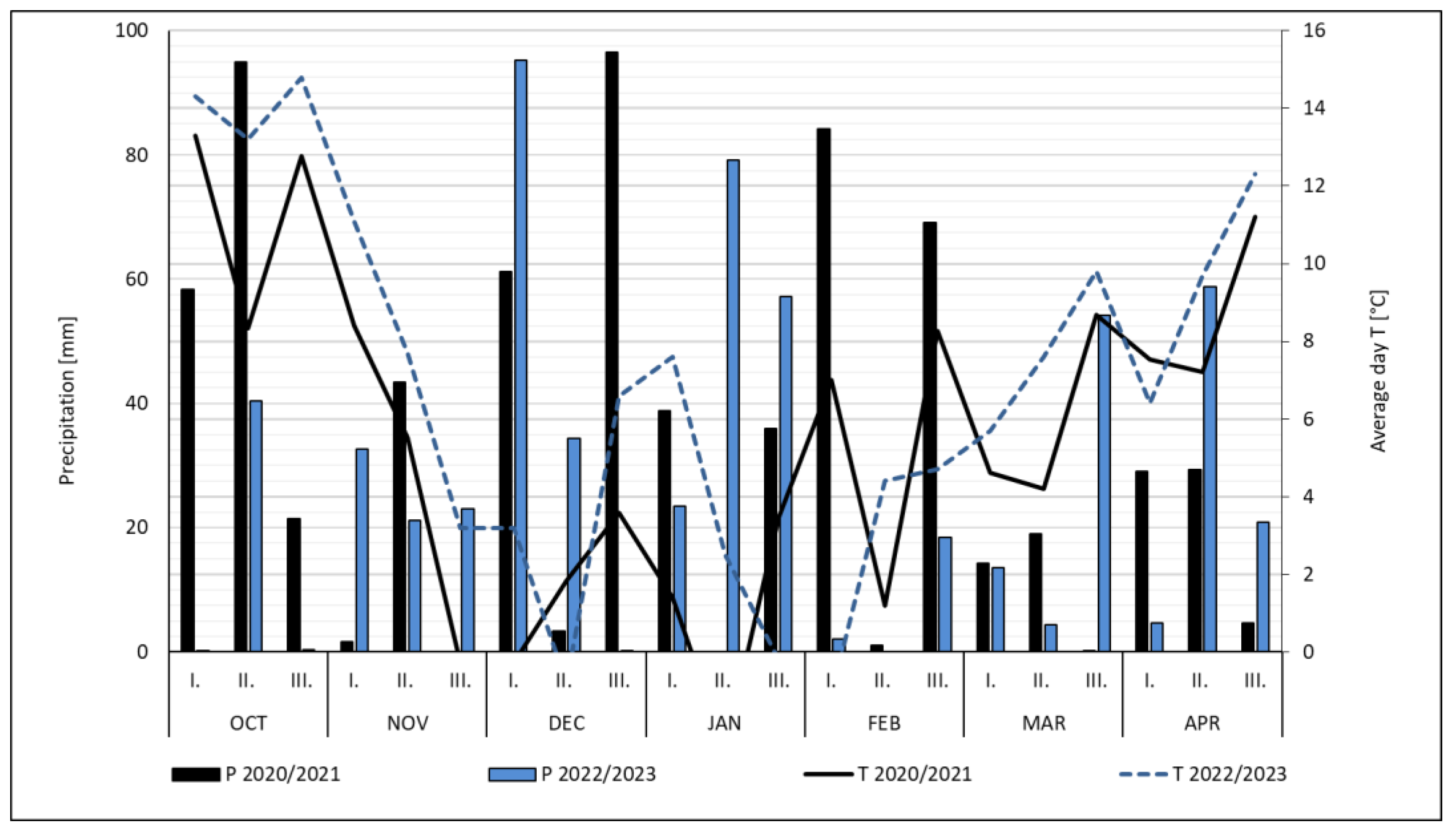
2.5. The Weather Conditions
2.6. Chemical Analyses
3. Results and Discussion
3.1. Total Phenolics in Green Hop Shoots
3.2. Green Hop Shoots Yield
3.3. Polyphenolic Compounds in White and Green Hop Shoots
4. Conclusions
Author Contributions
Funding
Data Availability Statement
Acknowledgments
Conflicts of Interest
References
- Rice-Evans, C.A. Screening of phenolics and flavonoids for antioxidant activity. In Antioxidant Food Supplements in Human Health; Packer, L., Hiramatsu, M., Yoshikawa, T., Eds.; Academic Press: San Diego, CA, USA, 1999; pp. 239–253. [Google Scholar]
- Huang, D.; Ou, B.; Prior, R.L. The chemistry behind antioxidant capacity assays. J. Agric. Food Chem. 2005, 53, 1841–1856. [Google Scholar] [CrossRef] [Scilit] [PubMed]
- Narayana Saibaba, K.V. Next generation biosurfactants and their practical application in the food sector. In Applications of Next Generation Biosurfactants in the Food Sector; Academic Press: Cambridge, MA, USA, 2023; pp. 349–360. [Google Scholar]
- Stevens, J.F.; Miranda, C.L.; Buhler, D.R.; Deinzer, M.L. Chemistry and biology of hop flavonoids. J. Am. Soc. Brew. Chem. 1998, 56, 136–145. [Google Scholar] [CrossRef] [Scilit]
- De Keukeleire, D.; De Cooman, L.; Rong, H. Gross, Plant Polyphenols 2: Chemistry, Biology, Pharmacology, Ecology; Kluwer Academics/Plenum Publishers: New York, NY, USA, 1999; pp. 739–760. [Google Scholar]
- Pichler, C.; Ferk, F.; Al-Serori, H.; Huber, W.; Jäger, W.; Waldherr, M.; Mišik, M.; Kundi, M.; Nersesyan, A.; Herbacek, I.; et al. Xanthohumol Prevents DNA Damage by Dietary Carcinogens: Results of a Human Intervention Trial. Cancer Prev. Res. 2017, 10, 153–160. [Google Scholar] [CrossRef] [Scilit] [PubMed]
- Liu, M.; Hansen, P.; Wang, G.; Qui, L.; Dong, J.; Yin, H. Pharmacological profile of xanthohumol a prenylated flavonoid from hops (H. lupulus). Molecules 2015, 20, 754–779. [Google Scholar] [CrossRef] [Scilit] [PubMed]
- Knez Hrnčič, M.; Španinger, E.; Košir, I.; Knez, Ž.; Bren, U. Hop Compounds: Extraction Techniques, Chemical Analyses, Antioxidative, Antimicrobial, and Anticarcinogenic Effects. Nutrients 2019, 11, 257. [Google Scholar] [CrossRef] [Scilit] [PubMed]
- Proestos, C.; Komaitis, M. Antioxidant Capacity of Hops. In Beer in Health and Disease Prevention; Preedy, V.R., Ed.; Academic Press: Cambridge, MA, USA, 2009; pp. 467–477. [Google Scholar]
- Karabin, M.; Hudcova, T.; Jelinek, L.; Dostalek, P. Biologically Active Compounds from Hops and Prospects for Their Use. Compr. Rev. Food Sci. Food Saf. Inst. Food Technol. 2016, 15, 542–567. [Google Scholar] [CrossRef] [Scilit] [PubMed]
- Liu, Y.; Gu, X.-H.; Tang, J.; Liu, K. Antioxidant activities of hops (Humulus lupulus) and their products. J. Am. Soc. Brew. Chem. 2018, 65, 116–121. [Google Scholar]
- Sgroi, F.; Sciortino, C.; Baviera-Puig, A.; Modica, F. Analyzing consumer trends in functional foods: A cluster analysis approach. J. Agric. Food Res. 2024, 15, 101041. [Google Scholar] [CrossRef] [Scilit]
- Gerhäuser, C. Beer constituents as potential cancer chemopreventive agents. Eur. J. Cancer 2005, 41, 1941–1954. [Google Scholar] [CrossRef] [Scilit] [PubMed]
- Vidmar, M.; Abram, V.; Čeh, B.; Demšar, L.; Poklar, U.N. White Hop Shoot Production in Slovenia: Total Phenolic, Microelement and Pesticide Residue Content in Five Commercial Varieties. Food Technol. Biotechnol. 2019, 57, 525–534. [Google Scholar] [CrossRef] [Scilit]
- Ruggeri, R.; Loreti, P.; Rossini, F. Exploring the potential of hop as a dual-purpose crop in the Mediterranean environment: Shoot and cone yield from nine commercial varieties. Eur. J. Agron. 2018, 93, 11–17. [Google Scholar] [CrossRef] [Scilit]
- Rossini, F.; Virga, G.; Loreti, P.; Provenzano, M.E.; Danieli, P.P.; Ruggeri, R. Beyond Beer: Hop Shoot Production and Nutritional Composition under Mediterranean Climatic Conditions. Agronomy 2020, 10, 1547. [Google Scholar] [CrossRef] [Scilit]
- Maietti, A.; Brighenti, V.; Bonetti, G.; Tedeschi, P.; Prencipe, F.P.; Benvenuti, S. Metabolite profiling of flavonols and in vitro antioxidant activity of young shoots of wild Humulus lupulus L. (hop). J. Pharm. Biomed. Anal. 2017, 142, 28–34. [Google Scholar] [CrossRef] [Scilit] [PubMed]
- Styrian Wave of Flavour Hops; Slovenian Institute of Hop Research and Brewing. 2016. Available online: https://www.ihps.si/en/research-and-development/publications/hop-variety-catalogues/ (accessed on 1 January 2023).
- Statgraphycs Centurion XVI. 2017. Available online: http://www.statgraphics.com/download-statgraphics-centurion-xvi (accessed on 1 January 2023).
- SIST EN ISO 665:2001; Oilseeds—Determination of Moisture and Volatile Matter Content (ISO 665:2000). Slovenian Institute for Standardization (SIST): Ljubljana, Slovenia, 2001.
- Singleton, V.L.; Rossi, J.A. Colorimetry of total phenolics phosphomolybdic-phosphotungistic acid reagent. Am. J. Enol. Vitic. 1965, 16, 144–158. [Google Scholar] [CrossRef] [Scilit]
- Taylor, A.W.; Barofsky, E.; Kennedy, J.A. Hop (Humulus lupulus L.) proanthocyanidins characterized by mass spectrometry, acid catalysis, and gel permeation chromatography. J. Agric. Food Chem. 2003, 51, 4101–4110. [Google Scholar] [CrossRef] [Scilit] [PubMed]
- Abram, V.; Čeh, B.; Vidmar, M.; Hercezi, M.; Lazić, N.; Bucik, V.; Smole Možina, S.; Košir, I.J.; Kač, M.; Demšar, L.; et al. A comparison of antioxidant and antimicrobial activity between hop leaves and hop cones. Ind. Crops Prod. 2015, 64, 124–134. [Google Scholar] [CrossRef] [Scilit]
- Jelinek, L.; Šneberger, M.; Karabin, M.; Dostalek, P. Comparison of Czech hop varieties based on their contents of secondary metabolites. Czech. J. Food Sci. 2010, 28, 309–316. [Google Scholar] [CrossRef] [Scilit]
- Urgeová, E.; Vulganová, K.; Polívka, L. Content of selected secondary metabolites in wild hop. Chem. Pap. 2013, 67, 249–253. [Google Scholar] [CrossRef] [Scilit]
- Muzykiewicz, A.; Nowak, A.; Zielonka-Brzezicka, J.; Florkowska, K.; Duchnik, W.; Klimowicz, A. Comparison of antioxidant activity of extracts of hop leaves harvested in different years. Herba Pol. 2019, 65. [Google Scholar] [CrossRef] [Scilit]
- Urgeova, E.; Polivka, Ľ. Secondary metabolites with antibacterial effects from leaves of different hop varieties during vegetal periods. Nova Biotechnol. 2009, 9, 327–332. [Google Scholar]
- Kralj, D.; Kač, M.; Kralj, S. Some further correlations between aroma scores and GC analyses of hop (Humulus lupulus L.) essential oils. In Zbornik Biotehniške Fakultete Univerze v Ljubljani; University of Ljubljana: Ljubljana, Slovenia, 1995; Volume 65, pp. 33–45. [Google Scholar]
- Green, C.P. Comparison of Tettnanger, Saaz, Hallertau and Fuggle hops grown in the USA, Australia and Europe. J. Inst. Brew. 1997, 103, 239–243. [Google Scholar] [CrossRef] [Scilit]
- Čeh, B.; Kač, M.; Košir, I.J.; Abram, V. Relationships between Xanthohumol and Polyphenol Content in Hop Leaves and Hop Cones with Regard to Water Supply and Variety. Int. J. Mol. Sci. 2007, 8, 989–1000. [Google Scholar] [CrossRef] [Scilit]
- Lyu, J.I.; Ryu, J.; Seo, K.S.; Kang, K.Y.; Park, S.H.; Ha, T.H.; Ahn, J.-W.; Kang, S.Y. Comparative study on phenolic compounds and antioxidant activities of Hop (Humulus lupulus L.) strobile extracts. Plants 2022, 11, 135. [Google Scholar] [CrossRef] [Scilit] [PubMed]
- Murokore, B.J.; Vuzi California, P.; Wacoo, A.P.; Wangalwa, R.; Olusoji Ajayi, C.; Gumisiriza, H.; Nandutu Masawi, A. Effect of Extraction Period on Total Phenolics, Total Flavonoids, and Antioxidant Capacity of Ugandan Camellia sinensis (L) Kuntze, Black Primary Grades and Green Tea. J. Food Qual. 2023, 3504280. [Google Scholar] [CrossRef] [Scilit]
- Shukla, R.; Lodhi, S. Role of Flavonoids in Management of Inflammatory Disorders. In Bioactive Food as Dietary Interventions for Arthritis and Related Inflammatory Diseases, 2nd ed.; Academic Press: Cambridge, MA, USA, 2019; pp. 293–322. [Google Scholar]
- Phenol-Explorer, Version 6.3. Available online: http://phenol-explorer.eu/ (accessed on 1 January 2023).
- Peterson, J.; Beecherb, G.R.; Bhagwatc, S.A.; Dwyera, J.T.; Gebhardtc, S.E.; Haytowitzc, D.B.; Holdenc, J.M. Flavanones in grapefruit, lemons, and limes: A compilation and review of the data from the analytical literature. J. Food Compos. Anal. 2006, 19, S74–S80. [Google Scholar] [CrossRef] [Scilit]
- Afonso, S.; Dias, M.I.; Ferreira, I.C.F.R.; Arrobas, M.; Cunha, M.; Barros, L.; Rodrigues, M.A. The Phenolic Composition of Hops (Humulus lupulus L.) Was Highly Influenced by Cultivar and Year and Little by Soil Liming or Foliar Spray Rich in Nutrients or Algae. Horticulturae 2022, 8, 385. [Google Scholar] [CrossRef] [Scilit]


| Year | Sample Type | No. of Varieties | Replicates | Analyses Performed |
|---|---|---|---|---|
| 2021 | White hop shoots | 3 | 3 * | Identification of individual polyphenolic compounds |
| 2021 | Green hop shoots | 3 | 3 | Total phenolic content; identification of individual polyphenolic compounds |
| 2023 | Green hop shoots | 3 | 3 | Fresh mass; shoot length; moisture content; dry matter yield total phenolic content; identification of individual polyphenolic compounds; |
| Plant Material | Hop Type/Origin | Variety | Total Polyphenols (Range or Value) | Unit/Basis | Method/Matrix (as Reported) | Source |
|---|---|---|---|---|---|---|
| Hop cones | Cultivated | n.a. | 4–14 | % DW | Literature range for dried hop cones | [4,5,22] |
| Hop cones | Cultivated (comparative study across 4 hop-growing regions and 2 years) | Aurora and Hallertauer Magnum | 0.80–1.740.74–1.71 | mg CAE/mL; | Total polyphenols (Analytica-EBC 9.11, modified); Ethanol extracts of cones | [23] |
| Hop cones | Cultivated (Czech Rep.) | Multiple | 2.21–5.05 | mg/g DM | Dried cone material | [24] |
| Hop cones | Cultivated (Slovakia) | K-72 | 4.96 | mg/g DM | Dried cone material | [25] |
| Hop leaves | Cultivated; leaves collected after harvest (plant waste); comparative study across 4 hop-growing regions and 2 years | Aurora and Hallertauer Magnum | 0.10–0.54 0.19–0.41 | mg CAE/mL | Total polyphenols (Analytica-EBC 9.11, modified) | [23] |
| Hop leaves | Wild hop, leaves harvested in May (Poland) | Wild hop | 0.02–6.60 | mg GA/g raw material | Methyl, ethyl and isopropyl alcohol extract; ultrasound-assisted extraction | [26] |
| Hop leaves | Male and female plants of wild hop (Slovakia) | Wild hop | 3.27–6.05 | mg/g DM | Methanol extracts of leaves | [27] |
| Hop shoots (white) * | Cultivated (Slovenia) | Multiple | 0.60–1.80 | mg CAE/g DM; | White (etiolated) shoots, dry mass basis | [14] |
| Hop shoots (green) ** | Cultivated (Slovenia) | Aurora, Celeia, Styrian Wolf | 2.2–3.5 | mg CAE/g DM; | Green shoots removed during training, dry mass basis | This study |
| Hop Variety | Polyphenol Content (mg CAE/g, Dry-Matter Basis) |
|---|---|
| Aurora | 2.22 ± 0.90 a ** |
| Celeia | 2.42 ± 0.98 a |
| Styrian Wolf | 3.47 ± 1.07 b |
| 2021 | 2.95 ± 0.76 a |
| 2023 | 2.45 ± 1.34 a |
| Variety/Genotype | Fresh Biomass (g/Plant; Average) | Fresh Biomass (g/Plant) | Shoot Length (cm) | Moisture (%) |
|---|---|---|---|---|
| Aurora | 23 a * | SD 14; min–max 4–114 | 23.0 a | 81 a |
| Celeia | 51 b | SD 35; min–max 6–183 | 54.5 c | 81 a |
| Styrian Wolf | 67 c | SD 45; min–max 5–211 | 29.1 b | 79 a |
| Variety | Shoot Type | Catechin | Epicatechin | Naringin | Rutin | Quercetin | Xanthohumol | Ferulic Acid | 4-Hydroxybenzoic Acid |
|---|---|---|---|---|---|---|---|---|---|
| Aurora | white | 2.73 ± 0.40 c * | 21.33 ± 0.40 d | 3.03 ± 0.25 c | 0.23 ± 0.06 a | 0.00 ± 0.00 a | 0.00 ± 0.00 a | 0.20 ± 0.00 a | 0.17 ± 0.06 bc |
| Aurora | green | 0.83 ± 0.15 a | 3.33 ± 0.32 a | 0.60 ± 0.10 a | 0.20 ± 0.00 a | 0.07 ± 0.06 ab | 1.73 ± 0.35 c | 0.77 ± 0.06 ab | 0.10 ± 0.00 ab |
| Celeia | white | 1.87 ± 0.12 b | 13.93 ± 2.02 b | 2.13 ± 0.40 b | 0.23 ± 0.06 a | 0.00 ± 0.00 a | 0.00 ± 0.00 a | 0.17 ± 0.06 a | 0.13 ± 0.06 abc |
| Celeia | green | 1.10 ± 0.35 ab | 2.87 ± 0.47 a | 0.67 ± 0.25 a | 0.40 ± 0.10 b | 0.03 ± 0.06 ab | 1.27 ± 0.35 b | 1.13 ± 0.38 b | 0.10 ± 0.00 ab |
| S. Wolf | white | 1.20 ± 0.53 ab | 16.03 ± 1.27 c | 3.73 ± 0.35 d | 0.30 ± 0.00 ab | 0.00 ± 0.00 a | 0.00 ± 0.00 a | 0.17 ± 0.06 a | 0.20 ± 0.00 c |
| S. Wolf | green | 1.70 ± 0.50 b | 3.03 ± 0.23 a | 0.70 ± 0.10 a | 0.40 ± 0.10 b | 0.10 ± 0.00 b | 1.13 ± 0.25 b | 6.33 ± 0.98 c | 0.07 ± 0.06 a |
| ANOVA p | 0.00 | 0.00 | 0.00 | 0.01 | 0.01 | 0.00 | 0.00 | 0.02 |
| Variety | Shoots Type | Catechin | Epicatechin | Naringin | Rutin | Quercetin | Xanthohumol | Ferulic Acid | 4-Hydroxybenzoic Acid | Caffeic Acid | p-Coumaric Acid |
|---|---|---|---|---|---|---|---|---|---|---|---|
| Aurora | green | 0.50 ± 0.33 a * | 0.59 ± 0.32 a | 1.48 ± 0.44 b | 0.41 ± 0.19 a | 0.040 ± 0.000 a | 1.81 ± 0.43 a | 0.10 ± 0.06 a | 0.17 ± 0.02 a | 0.16 ± 0.06 a | 0.083 ± 0.015 a |
| Celeia | green | 1.27 ± 0.21 b | 1.71 ± 0.80 a | 1.48 ± 0.44 b | 0.49 ± 0.27 a | 0.083 ± 0.021 b | 1.02 ± 0.29 a | 0.42 ± 0.20 b | 0.20 ± 0.08 a | 0.26 ± 0.10 a | 0.17 ± 0.06 b |
| S. Wolf | green | 1.64 ± 0.44 b | 0.91 ± 0.23 a | 1.74 ± 0.16 b | 0.47 ± 0.19 a | 0.067 ± 0.006 b | 1.46 ± 0.41 a | 0.84 ± 0.10 c | 0.24 ± 0.03 a | 0.39 ± 0.13 a | 0.37 ± 0.03 c |
| ANOVA p | 0.02 | 0.09 | 0.03 | 0.88 | 0.01 | 0.11 | 0.00 | 0.34 | 0.08 | 0.00 |
| Polyphenol (Compound) | Hop Shoots—White (µg/g d.m.; ≈µg/g Fresh Shoots) * | Hop Shoots—Green (µg/g d.m.; ≈µg/g Fresh Shoots) * | Example Vegetable, Herb, Fruit (Typical Content) mg per 100 g Fresh Weight Unless Otherwise Mentioned ** |
|---|---|---|---|
| (+)-Catechin | 1.93; ≈0.33 | 1.21; ≈0.24 | Green bean, raw: 0.41 |
| (−)-Epicatechin | 17.10; ≈2.91 | 3.08; ≈0.62 | Green bean, raw: 0.69 Blackberry, raw: 11.48 |
| Naringin | 2.97; ≈0.50 | 0.66; ≈0.13 | Rosemary, fresh: 55.1 |
| Rutin (quercetin-3-O-rutinoside) | 0.26; ≈0.044 | 0.33; ≈0.067 | Asparagus, raw: 23.20 Salad (green, raw): 0.04 Green bean, raw: 0.13 |
| Quercetin | 0.00; ≈0.00 | 0.07; ≈0.014 | Onion [Red], raw: 1.31 Black elderberry: 42.0 |
| Ferulic acid | 0.18; ≈0.031 | 2.74; ≈0.553 | Cauliflower, raw: 0.53 |
| 4-Hydroxybenzoic acid | 0.17; ≈0.029 | 0.09; ≈0.018 | American cranberry: 0.42 Carrot, raw: 0.05 Olive [Green], raw: 4.97 |
Disclaimer/Publisher’s Note: The statements, opinions and data contained in all publications are solely those of the individual author(s) and contributor(s) and not of MDPI and/or the editor(s). MDPI and/or the editor(s) disclaim responsibility for any injury to people or property resulting from any ideas, methods, instructions or products referred to in the content. |
© 2026 by the authors. Licensee MDPI, Basel, Switzerland. This article is an open access article distributed under the terms and conditions of the Creative Commons Attribution (CC BY) license.
Share and Cite
Čeh, B.; Karničnik Klančnik, A.; Poklar Ulrih, N. Polyphenols in White and Green Shoots of Cultivated Hop (Humulus lupulus L.). Agronomy 2026, 16, 1685. https://doi.org/10.3390/agronomy16171685
Čeh B, Karničnik Klančnik A, Poklar Ulrih N. Polyphenols in White and Green Shoots of Cultivated Hop (Humulus lupulus L.). Agronomy. 2026; 16(17):1685. https://doi.org/10.3390/agronomy16171685
Chicago/Turabian StyleČeh, Barbara, Ana Karničnik Klančnik, and Nataša Poklar Ulrih. 2026. "Polyphenols in White and Green Shoots of Cultivated Hop (Humulus lupulus L.)" Agronomy 16, no. 17: 1685. https://doi.org/10.3390/agronomy16171685
APA StyleČeh, B., Karničnik Klančnik, A., & Poklar Ulrih, N. (2026). Polyphenols in White and Green Shoots of Cultivated Hop (Humulus lupulus L.). Agronomy, 16(17), 1685. https://doi.org/10.3390/agronomy16171685