1. Introduction
The livestock production sector in Egypt is facing an increasing challenge due to a lack of sufficient energy-rich forages of up to 90% that meet the ruminants’ nutritive requirements, especially in the summer season [
1]. In this regard, there is a pressing need to expand the cultivation of low-cost forage grass species that are known for their high carbohydrate content and energy supply [
2].
Teosinte (
Zea mexicana L.), the ancestor of modern maize (
Zea mays L.), is native to Mexico and Central America [
3]. As a multi-cut forage crop, it offers a distinct advantage over other major summer forage grasses such as fodder maize. In addition, it is well known for its ability to tolerate high temperatures and adverse environmental conditions, producing substantial fresh fodder yields even under stress conditions [
4]. Moreover, its suitability for fresh feeding, hay, and silage production is well documented [
5]. The crop was introduced to Egypt for use as animal feed, either alone or after hybridization with various maize species [
6].
In general, sowing date is among the most important factors affecting the productivity of forage grasses [
7]. Accurately determining the optimum sowing date ensures that the crop is exposed to favorable temperature and day-length conditions throughout its growth and development [
8]. Maize-teosinte hybrids produce high total fresh and dry forage yields, along with higher total digestible nutrients (TDN) values, than single crops [
9]. Using silages of berseem, maize, and teosinte hybrids for summer feeding reduced the amount of concentrated ration required to feed milking buffaloes, thereby lowering feeding costs while improving nutritional and economic efficiency and increasing milk production [
10].
In the research conducted by Bendary [
6], six hybrids of maize crop silage (MS) (
Zea mays L.) and maize teosinte hybrid forage (MTF) (Zea Mexcana Schrad) were planted separately for 2 seasons under practical conditions of farms in the north of Delta Egypt to estimate economic and nutritional benefits of maize-teosinte hybrid silage (MTS) compared with MS in the mixed farming systems (crop/livestock) at the national level. This study also included 3 proposed scenarios (S) to evaluate the effect of the generalization of the MTS package to cover the feed gap as TDN and digestible crude protein (DCP) and the maize grain gap, or reducing maize grain in Egypt. S1: Replacement of maize fodder area (130,236.96 Hectares) by MTS. S2: Replacement of MS area (184,189.74 Hectares) by MTS. S3: Replacement of maize fodder and MS area (314,426.28 Hectares) by MTS. Maize-teosinte hybrid forage produced the highest yield of silage per hectare compared to maize crops with similar fermentation characteristics and high-quality silages. The expected economic revenues of including MTF in the agricultural crop rotation are: a-Egyptian feed gap could be reduced in the case of S1, S2, and S3 by 74, 110, and 178% for TDN and 66.94 and 161% for DCP, respectively, and covering about 15.05% of the maize grain gap. Moreover, S3 could increase the quality of feed resources, which can be used for feeding high-yielding cows by +3.29 and +0.19 million t ha
−1 TDN and DCP, respectively.
Compared with non-ruminant livestock, ruminants exhibit a more efficient feed conversion rate, owing to their digestive system’s capacity to convert fibrous forages into high-quality products for human consumption [
11]. However, ruminal fermentation of forages generates gases, including methane, which contributes to global warming [
12]. Reducing greenhouse gas emissions without compromising animal productivity thus poses a significant challenge [
13]. One practical approach is to manipulate the animal’s diet by selecting forages with high nutritional value, such as those rich in highly digestible protein and carbohydrates [
14]. Maize represents a viable forage source, as it contains both fibrous and non-fibrous carbohydrates, including water-soluble forms and starch [
15] that provide high energy value for animal nutrition [
16]. Incorporating maize silage into feeding strategies can help methane emissions mitigation in ruminants [
17]. The influence of maize type on rumen fermentation characteristics remains unclear, and the effect of harvesting date on the rate and extent of cell wall and starch fermentation in the rumen is not yet fully understood [
18]. Nevertheless, maize composition, including starch and cell wall content, can influence animal performance, such that two maize silages with equivalent energy values may still differ in composition and, consequently, in their effects on animal performance [
19]. Despite the recognized importance of teosinte as a summer forage crop, information regarding the combined effects of sowing date and harvest age on forage productivity, chemical composition, and ruminal fermentation characteristics remains limited, particularly under Egyptian environmental conditions. Most previous studies have focused primarily on agronomic performance, with limited attention paid to how crop management practices relate to in vitro rumen fermentation responses, including methane production and nutrient degradability. Therefore, the current study was conducted to evaluate the forage yield, quality, and in vitro fermentation characteristics of teosinte (
Zea mexicana) under three sowing dates and harvest ages. We hypothesized that later sowing would increase dry matter yield but reduce nutrient digestibility, microbial protein content, and CH
4 production.
2. Materials and Methods
The present in vitro investigation was performed at the Advanced Laboratory of Animal Nutrition (Department of Animal and Fish Production, Faculty of Agriculture, Alexandria University, Alexandria, Egypt). All experimental protocols were conducted in strict accordance with the ethical guidelines approved by the Institutional Animal Care and Use Committee of Alexandria University (protocol ID: Alex. Agri. 082408447).
2.1. Experimental Site and Environment
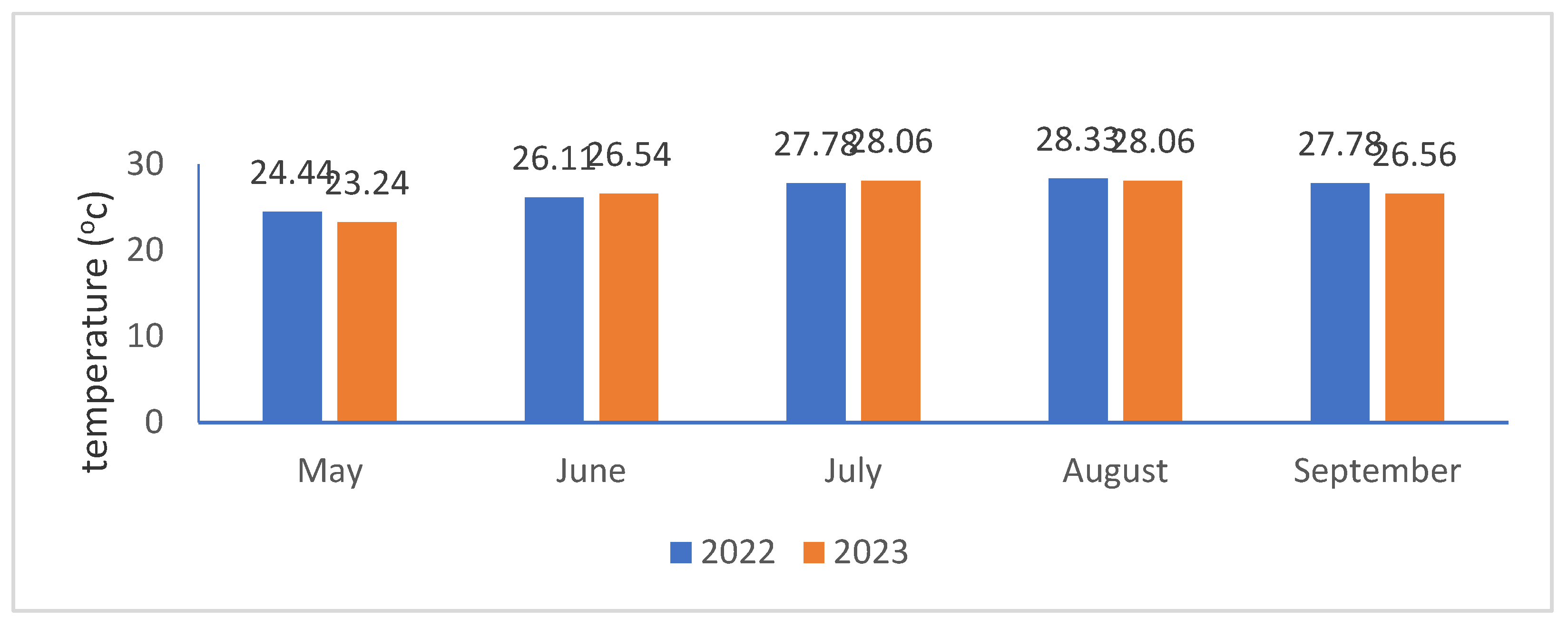
The field experiment was conducted at El-Qalaa, El-Awayed district, Alexandria, Egypt (31.211936° N, 29.987430° E), during the summer growing seasons of 2022 and 2023. The physical and chemical properties of the experimental soil are presented in
Table 1. The site is characterized by a hot, dry, and humid Mediterranean climate. The average monthly temperatures recorded during the two experimental seasons (May to September) are presented in
Figure 1.
2.2. Design, Treatments and Agricultural Practices
A split-plot experimental design was adopted to investigate the yield and quality of teosinte (Zea mexicana L.) harvested as a single cut at three plant ages of 40, 55, and 70 DAS, following sowing on three different dates: 1 May, 20 May, and 10 June. After plowing, leveling, and ridging, the land was divided into experimental plots of equal size, with sowing date assigned to the main plots and harvest age to the subplots. Each plot comprised four ridges (3 m long × 60 cm apart), giving a total plot area of 7.2 m2. Teosinte was drilled on the upper third of one side of the ridge at a seeding rate of 48 kg seeds ha−1. Calcium monophosphate (15.5% P2O5) and potassium sulfate (48% K2O) were applied once before sowing at the recommended rates of 200 and 100 kg ha−1, respectively. Nitrogen was applied as ammonium nitrate (33% N) at a total rate of 144 kg N ha−1, split into two equal doses of 72 kg N ha−1 each, the first applied at sowing and the second at 30 DAS. Surface irrigation was applied at weekly intervals, and hand weeding was carried out as needed.
2.3. Data Collection and Chemical Analyses
During harvest, we manually cut the plants in each plot with a sickle at a stubble height of 5 cm and immediately recorded the fresh forage yield in the field. From each plot, a representative 1-kg subsample was dried in a forced-air oven at 60 °C for 72 h until reaching a constant weight. Dry matter (DM) content was determined according to AOAC [
20] guidelines (Method 934.01) to calculate dry forage yield. Prior to chemical composition analysis, dried samples were milled to pass through a 1-mm sieve.
Proximate analyses were performed according to standard AOAC [
20] procedures, including ash content (Method 942.05), crude protein via the Kjeldahl method (Method 984.13), and ether extract (EE) via Soxhlet extraction (Method 920.39). Organic matter (OM) was determined by subtracting the ash content from the dry matter (DM).
Fiber fractions were analyzed using an ANKOM 200 Fiber Analyzer (ANKOM Technology, Macedon, NY, USA) based on the methodology of Van Soest et al. [
21]. Both neutral detergent fiber (NDF) and acid detergent fiber (ADF) were expressed exclusively of residual ash (
and
). Acid detergent lignin (ADL) was subsequently determined by solubilizing the ADF residue with
[
21]. Finally, hemicellulose, cellulose, and non-fibrous carbohydrates (NFC) were calculated using the following equations: Hemicellulose = NDF − ADF, Cellulose = ADF – ADL, and NFC = 1000 − (CP + CF + NDF + Ash), respectively.
2.4. Quality Assessment (In Vitro Assay)
To evaluate in vitro gas production (GP), we utilized a semi-automated system fitted with a data logger and pressure transducer (Pressure Press Data GN200, São Paulo, Brazil), following the protocol detailed by Bueno [
22]. Rumen inoculum was sourced from fasting adult Egyptian bulls at the Alexandria University Faculty of Agriculture abattoir. Prior to fasting, the donor animals were maintained on an
ad libitum 50:50 basal diet of commercial concentrate and clover hay (
Trifolium alexandrinum L.), with unrestricted access to fresh water.
Immediately after slaughter, rumen contents were collected and transported in pre-warmed () insulated containers to maintain strict anaerobic conditions. In the laboratory, the contents were mixed for 10 s and squeezed through triple-layered cheesecloth and maintained in a water bath (39 °C) under continuous flushing until inoculation.
For each experimental treatment, we prepared six replicate 120-mL serum incubation bottles per inoculum source. Three bottles were designated for evaluating fermentation parameters and protozoal counts, while the remaining three were utilized to determine truly degraded organic matter (TDOM). To account for baseline variations in inoculum activity, we also included blank bottles (containing only buffer and rumen fluid) and internal standards (containing buffer, rumen fluid, and clover hay).
We weighed 0.5 g of each ground experimental diet into the bottles and added 45 mL of an inoculum mixture, consisting of 15 mL of rumen fluid and 30 mL of MB9 buffer solution [
23]. The bottles were immediately sealed using 20-mm butyl septum stoppers (Bellco Glass Inc., Vineland, NJ, USA), manually agitated, and placed in a forced-air oven (FLAC STF-N 52 Lt, Treviglio, Italy) at
for 24 h.
Headspace gas pressure was recorded at 3, 6, 12, and 24 h of incubation, and the bottles were manually shaken after each reading. Gas production (GP) for all bottles was calculated using a predetermined linear regression equation relating pressure to volume: (; R2 = 0.98), where represents the gas volume in mL and represents the measured pressure in psi.
To measure
production, 2 mL gas samples were collected from the incubation bottles at 3, 6, 12, and 24 h using a syringe and stored in Vacutainer tubes. We quantified methane concentrations using an Agilent 7890 gas chromatograph (GC) equipped with a thermal conductivity detector (TCD). The GC featured a three-valve system and 1/8-inch packed columns, utilizing an early backflush technique for C6 components. Chromatographic separation was carried out on a micro-packed column with helium acting as the carrier gas at a constant flow rate of 28.0 mL min
−1. The column and detector temperatures were maintained at 60 °C and 250 °C, respectively. Calibration and linearity were verified against a standard gas curve spanning the expected concentration range of our samples. Total methane production at the end of the incubation period was calculated according to Tavandale [
24]:
After adjusting blank values, we expressed the cumulative GP and CH4 yields as mL g−1 DM and mLg−1 TDOM.
2.5. Rumen Fermentation and Degradability
At 24 h, all incubation bottles were placed in a cold-water bath (4 °C) to halt microbial fermentation. True degradable organic matter (TDOM) was determined following the method of Blümmel [
25], whereby 70 mL of neutral detergent solution (excluding heat-stable α-amylase) was added directly to the bottles, which were then incubated in a forced-air oven (FLAC STF-N 52 Lt, Treviglio, Italy) at 105 °C for 3 h. The remaining residue was filtered through pre-weighed crucibles and washed sequentially with hot water and acetone. The crucibles were then oven-dried at 105 °C for 16 h and ashed at 550 °C for 4 h. After correcting for the corresponding blanks, TDOM was calculated as the difference between the initial incubated organic matter (OM) and the non-degraded residue. The partitioning factor (PF) was calculated as the ratio of TDOM (mg) to gas volume (mL) [
25].
Within 2 to 3 min of sampling, we measured the rumen pH directly in the fermentation bottles using a portable pH meter (GLP 21, CRISON, Barcelona, Spain). For protozoal enumeration, we mixed a 2 mL of rumen fluid sample with 2 mL of a methyl green-formalin-saline solution. These samples were stored at room temperature in glass vials. We then counted and differentiated the protozoa utilizing a Digital Zoom Video microscope (LCD 3D, GiPPON-Japan, Ambala, Haryana) according to the protocol described by Dehority [
26].
The concentrations of individual short-chain fatty acids (SCFAs) were determined via gas chromatography (GC), adapting the protocol of Palmquist and Conrad [
27]. Fermentation samples were first centrifuged at 10,000×
g for 15 min. A 1.6 mL aliquot of the resulting filtrate was then mixed with 0.4 mL of 25% metaphosphoric acid (yielding a 4:1 ratio) and centrifuged at 15,000 rpm for 20 min at [X °C] (K1015 Micro Prime, Centurion Scientific Ltd., Chichester, UK).
The supernatant was analyzed using a TRACE 1300 gas chromatograph (Thermo Fisher Scientific, Inc., Milan, Italy) equipped with an AS3800 autosampler and an HP-FFAP capillary column ( length, o.d., i.d.; J&W Agilent Technologies Inc., Palo Alto, CA, USA). We used hydrogen as the carrier gas at a flow rate of 1.35 mL min−1. The make-up gas fluxes for air, hydrogen, and nitrogen were set at 450, 40, and 35 mL min−1, respectively. A sample was injected in splitless mode with a constant flow of 31.35 mL min−1 (). Both the injector and flame ionization detector (FID) were maintained isothermally at 250 °C. The oven temperature program began at 80 °C (held for 1 min), ramped to 120 °C at 20 °C min−1 (held for 3 min), and finally increased to 205 °C at 10 °C min−1 (held for 2 min), resulting in a total run time of 9 min. The system was calibrated using an external standard mixture of known SCFA concentrations (Sigma Chemie GmbH, Steinheim, Germany).
Additionally, we measured ruminal ammonia-nitrogen () concentrations colorimetrically using an Alpha-1101 spectrophotometer (Labnics Equipment, Fremont, CA, USA).
2.6. Statistical Analyses
The effects of sowing date, age at harvest, and their interaction were tested for significance using an analysis of variance (ANOVA) procedure in a PROC MIXED Model (Version 9.4, SAS Inst., Inc., Cary, NC, USA) with only replicates considered random. Yield and quality data (D) were analyzed according to the following statistical model:
where µ is the overall mean, R
i is the replication (i = 1, 2, 3), SD
j is the sowing date effect (j = 1, 2, 3), (R × SD)
ij is the experimental error “a”, AH
k is the age at harvest effect (k = 1, 2, 3), (SD × AH)
ij is the effect of the interaction between the sowing date and age at harvest, and e
ijk is the experimental error “b”.
Analysis of variance showed that both the ‘Year’ effect and the ‘Year × Treatment’ interaction were non-significant for all yield and quality parameters studied, with treatment rankings remaining fairly consistent across years. Results were reported as a combined analysis over the two experimental years according to [
28]. Data normality was checked and confirmed prior to statistical analysis according to [
29], and the least significant difference (LSD) test was used for comparing treatment means at the 0.05 level of significance.
3. Results
The main effects of sowing date and age at harvest are presented and discussed only when their interaction is non-significant.
3.1. Agronomic Evaluation
The interaction between sowing date and harvest age significantly affected fresh and dry yields (
p < 0.01), as well as DM content (
p < 0.05). Across all three sowing dates, fresh yield increased progressively as harvest was delayed up to 70 DAS (
Table 2). Relative to harvesting at 40 DAS, delaying harvest to 70 DAS increased fresh yield by 34.53, 31.67, and 11.05 t ha
−1 for the 1 May, 20 May, and 10 June sowing dates, respectively. At 40 and 55 DAS, sowing on 10 June produced significantly higher fresh yield than sowing on either 1 May or 20 May. In contrast, at 70 DAS, the influence of sowing date was no longer apparent, with all three sowing dates producing statistically similar fresh yields. Dry yield followed a pattern similar to that of fresh yield in response to sowing date and harvest age (
Table 2). The highest dry yields were recorded at 70 DAS, reaching 7.96 and 6.55 t ha
−1 for the 1 May and 20 May sowings, respectively, representing increases of approximately 438% and 334% over the corresponding dry yields at 40 DAS.
However, when sown on 10 June, dry yield did not differ significantly across the three harvest ages. At early and intermediate harvests (40 and 55 DAS), the crop sown on 10 June produced significantly higher dry yields, whereas at the late harvest (70 DAS), the highest dry yield was achieved by the crop sown on 1 May. As shown in
Table 2, DM content showed little significant variation among the three harvest ages when the crop was sown on 1 May or 10 June, whereas no variation was detected for the 20 May sowing. A more distinct pattern emerged across sowing dates within each harvest age, mirroring the trends observed for dry yield. At early (40 DAS) and intermediate (55 DAS) harvests, the highest DM content was recorded for the 20 May and 10 June sowings, whereas at the late harvest (70 DAS), higher DM accumulation was associated with the 1 May and 20 May sowing dates.
3.2. Chemical Composition
Organic matter content varied significantly only among sowing dates (p < 0.05), while CP content was significantly affected by both sowing date (p < 0.05) and harvest age (p < 0.01). In contrast, neither of the studied factors nor their interaction had a significant effect on crude fat or NFC content (p > 0.05).
The main effects of sowing date and age at harvest presented in
Table 3 revealed that sowing on 1 and 20 May resulted in the production of herbage with the highest significant OM and CP contents compared to sowing on 10 June. The difference between the highest and lowest values for the two parameters reached 9.00 and 21.57 g kg
−1 for OM and CP, respectively. On the other hand, OM content was not significantly affected by harvest age, whereas early-harvested herbage (40 DAS) showed the highest CP content (108.59 g kg
−1), which gradually declined to its lowest level (77.24 g kg
−1) at late harvest (70 DAS). Crude fat and NFC, however, did not vary significantly across either sowing dates or harvest ages, with average values of 20.51 and 144.32 g kg
−1, respectively. Analysis of variance demonstrated a significant main effect of sowing date and age at harvest on NDF, ADF, and ADL contents, while no significant variations were detected for cellulose and hemicellulose. Moreover, the two-way interaction was non-significant for all fiber components. Means of the fiber components shown in
Table 4 revealed that delaying sowing (10 June) as well as delaying harvesting (70 DAS) significantly raised the NDF, ADF, and ADL contents of the forage, negatively affecting its quality. On the other hand, sowing on 1 May and 20 May did not differ significantly with respect to the three fiber fractions. Similarly, harvesting at 40 and 55 DAS showed no significant variation. Overall, average cellulose and hemicellulose contents for teosinte forage reached 233.87 and 350.64 g kg
−1, respectively.
3.3. Quality Assessment (In Vitro Assay)
The in vitro gas production results presented in
Table 5 show a significant increase for sowing on 20 May and 10 June compared to 1 May, while pH levels significantly decreased with sowing on 10 June. Protozoal counts were not significantly affected by sowing date. The in vitro gas production decreased with increasing age at harvest, and the lowest significant in vitro gas production was observed with harvesting at 70 DAS. However, there was a significant increase in pH level with increasing age at harvest, specifically at 40 and 55 DAS. Protozoal counts showed a gradual significant decrease with increasing age at harvest.
As shown in
Table 6, there was a significant decrease in NH
3-N concentration with sowing on May 1 and harvesting at 40 DAS, but NH
3-N concentration was not significantly affected when sowing was done on May 20 and June 10. Additionally, there was a significant decrease in NH
3-N concentration for the teosinte sown on May 1 and harvested at 40, 55, and 70 DAS.
There was a decrease in true organic matter degradability for the teosinte harvested at 70 DAS and sown on May 1, May 20, and June 10. On the other hand, an increase in true organic matter degradability was observed for the teosinte harvested at 40 and 55 DAS and sown on May 1 and June 10.
Sowing on May 1 resulted in the production of teosinte with the lowest significant CH4 production, amounting to 10.82, 10.65, and 10.93 mL g−1 DM when harvested at 40, 55, and 70 DAS. Also, sowing on May 1 resulted in the production of teosinte with the lowest significant CH4 production, which was attributed to truly degraded organic matter amounting to 17.87 and 16.37 mL g−1 TDOM for harvesting at 40 and 55 DAS. Meanwhile, there was a significant increase in PF as an index of microbial protein synthesis, amounting to 4.31 and 4.32 under the same previous conditions.
The means of individual and total short-chain fatty acids (SCFA, mM) as affected by the interaction between the sowing date and age at harvest combined over the two growing seasons are given in
Table 7. The results showed that acetic acid concentration significantly increased when teosinte was sown on May 1 and June 10, by approximately 43.54 and 51.69 mM, respectively, at a harvest age of 40 DAS. There was also a significant increase in acetic acid concentration when teosinte was sown on May 20 and harvested at 55 and 70 DAS, with concentrations of 46.90 and 48.54 Mmol, respectively.
Propionic and butyric acid concentrations significantly increased for teosinte sown on 1 May and 10 June at a harvest age of 55 DAS and for teosinte sown on 20 May at 70 DAS. Valeric and isovaleric acid concentrations significantly increased for teosinte sown on 1 May and 10 June at 55 DAS, and for teosinte sown on 20 May at both 40 and 70 DAS.
Total SCFs concentration significantly increased when teosinte was sown on May 1 and June 10, by approximately 65.32 and 73.46 mM, respectively, at a harvest age of 40 DAS. There was also a significant increase in total SCF concentration when teosinte was sown on May 20 and harvested at 70 DAS, with concentrations of 72.72 mM, and when sown on June 10 at harvest age 55 DAS, amounting to 69.29 mM.
4. Discussion
4.1. Agronomic Evaluation
Results of the present research demonstrate the keyrole of harvest age, interacting with the sowing date, in determining teosinte productivity. However, the direction of the effect was mainly driven by the age of harvest rather than the sowing date, where delayed harvesting resulted in significantly higher fresh and dry teosinte yields among the three sowing dates. Similar findings were reported by [
8,
30,
31]. This effect of harvest age was largely attributable to the longer period the crop remained in the soil, allowing greater opportunity for growth, yield component development, and dry matter accumulation. Craufurd and Bidinger [
32] suggested air and soil temperature as the main factors driving the influence of sowing date on crop germination and growth. Nonetheless, Devkota et al. [
4] reported that altering the sowing date affects a variety of crop growth and development characteristics, including plant height, number of leaves per plant, and number of tillers per hill, which is later reflected in the forage yield of teosinte. In the current study, late sowing (June 10) resulted in higher yields at early harvest (40–55 DAS), but this sowing date effect diminished by late harvest (70 DAS).
Regarding DM content, harvest age had a clear effect within the 1 May and 20 May sowing dates, with late-harvested plants showing significantly higher DM content for the first sowing date and a non-significant increase for the second. In contrast, for the 10 June sowing date, late-harvested crops showed significantly lower DM content compared with early-harvested crops. These results are consistent with those reported by Seadh et al. [
33]. Higher DM content associated with later harvesting was expected, as older plants develop taller stems with more tillers and, consequently, a greater total number of leaves. This results in enhanced photosynthetic activity, which is directly reflected in increased DM synthesis [
31].
On the other hand, the lowest significant DM accumulation in the current study was associated with the combination of late sowing (10 June) and late harvesting (70 DAS). As teosinte grown in Egypt is a short-day, photoperiod-sensitive crop, flowering is expected to progress faster under shorter day lengths [
34]. Consequently, early sowing benefits from extended photoperiods, promoting more efficient assimilate use and resulting in taller, leafier plants [
35] with greater DM accumulation. On the other hand, late sowing, especially when combined with late harvesting, exposes the plant to shorter day lengths, causing DM accumulation to cease as the crop enters the flowering stage.
4.2. In Vitro Quality Assessment
Total gas production is generally associated with greater feed degradability and, in turn, with the chemical composition, especially with the concentration of rapidly fermented carbohydrates [
36]. Forages with a high content of structural carbohydrates, as shown in
Table 3 and
Table 4, promoted low rumen fermentation, resulting in lower total gas production per unit of incubated DM [
37]. When there is an increased availability of fermentable substrate in the rumen (i.e., starch and sugars), growth rates and fermentative activity of the resident microflora increase, leading to increased production of fermentation end-products. As long as the fermentation end-products do not accumulate in the rumen environment (metabolized by other micro-organisms or absorbed), microbial community homeostasis can be maintained.
Sowing the crop on May 1 resulted in the production of teosinte with the lowest (
p < 0.05) methane production when harvested at 40, 55, and 70 DAS. However, during the ruminal fermentation of the forages, they produce gases that, when expelled into the atmosphere, cause the greenhouse effect, thus contributing to global warming [
38]. Among these gases is methane, a gas that is formed from hydrogen and carbon dioxide produced during the fermentation of carbohydrates, which has a higher warming potential than carbon monoxide. Other less important gases are carbon monoxide, which is a precursor of ozone in the atmosphere, and hydrogen sulfide, which serves as an alternate sink for H
2 to reduce CH
4 production. However, the production of all these gases is inevitable; high amounts indicate a loss of nutrients and energy [
39]. Therefore, reducing the production of greenhouse gases without causing an imbalance in the rumen and affecting the productivity of the animals is a challenge.
However, when the acidic end-products accumulate (most notably lactic acid), pH declines rapidly, leading to the development of rumen acidosis. Acidosis has detrimental effects on both the viability and activity of the normal rumen microflora and, consequently, the nutritional efficiency of the animal. Additionally, acute rumen acidosis has been associated with systemic damage, including tissue degeneration, liver abscesses, laminitis, and inflammation [
40,
41]. Due to the welfare and economic consequences of acidosis, strategies for mitigating this condition are of interest.
Although pH values decreased slightly (5.67–5.74), they remained within the range commonly reported for in vitro fermentation studies and were not low enough to indicate subacute ruminal acidosis. The observed reduction in pH most likely reflects the accumulation of fermentation end-products during incubation.
The lowest NH3-N concentrations were recorded when the crop was sown on May 1 and harvested at 40 DAS, although the CP content was higher for the same sowing date and age of harvest, suggesting more efficient incorporation of ammonia into microbial protein synthesis rather than its accumulation in the fermentation medium.
The results of the current study revealed that the TDOM declined (
p < 0.05) with the advanced harvest age, which might be explained by the fiber fractions content. The increasing contents of NDF, ADF, and lignin when harvesting teosinte at 55 and 70 DAS decreased cell wall degradability, which is in agreement with [
42] for cell wall degradability. The DM content at harvest had a statistically significant influence on the fermentation characteristics of the entire plant of the teosinte.
Upon prolonging maturation, Philippeau and Michalet-Doreau [
43] reported a decreased content of rapidly degradable starch and an increased content of slowly degradable starch. At the same time, the rate of degradation as determined with the in situ nylon bag technique markedly decreased, which resulted in a large influence of harvest date on the effective degradability.
In general, the decline in digestibility of vegetative fractions with advancing maturity was associated with the accumulation of cell wall components in leaves and stems, along with the buildup of nonstructural carbohydrates [
44]. Accordingly, it is important to consider the relationship between the optimal maturity stage and each fraction’s contribution to the whole plant, as well as its individual digestibility [
45]. The hypothesis was partially confirmed that increases in teosinte crop productivity come at the expense of nutritive value. Farmers must accordingly tailor sowing and harvesting decisions to their objective, whether maximizing yield per unit area or optimizing nutritional quality.
4.3. Limitations and Future Work
This study has several limitations that should be acknowledged. First, the trial was conducted at a single location over two growing seasons, which may limit the generalizability of the findings across different agroecological zones, soil types, and climatic conditions in Egypt. Multi-location and multi-year trials would help confirm the consistency of the observed sowing date and harvest age effects. Second, the in vitro gas production and rumen fermentation assays, while informative, do not fully replicate the complexity of in vivo digestion; consequently, animal feeding trials are needed to validate the practical implications of the observed differences in digestibility, ruminal microbial fermentation pattern, and methane production on actual livestock performance. Third, the study focused on a fixed set of sowing dates and harvest ages, and future work could explore a wider range of intervals, or interactions with irrigation regimes, fertilization levels, or planting density, to better define the optimal management window for balancing yield and quality. Additionally, economic and land-use trade-off analyses were beyond the scope of this study; incorporating cost-benefit assessments of delayed harvesting versus multiple earlier harvests would provide more actionable guidance for farmers weighing yield against forage quality and methane mitigation goals. Finally, long-term evaluation of teosinte’s role within broader crop rotation and land allocation systems, particularly its competition with conventional summer crops, would help clarify its viability as a sustainable forage option under intensifying land constraints.





 ,
,