1. Introduction
Fruit set represents a critical stage in the sequence of reproductive events required for successful fruit production. In sweet cherry, fruit set depends on effective pollination, which includes the availability of compatible pollen donors, synchronized flowering, favorable environmental conditions during anthesis, and the activity of pollen vectors, followed by successful fertilization. Fertilization requires pollen adhesion to the stigma, germination, and sustained pollen tube growth through the style to reach and fertilize a viable embryo sac. Disruption at any stage of this process may reduce reproductive success. The effective pollination period (EPP) plays a central role in determining fruit set in tree fruit species. The concept of the EPP was introduced by Williams [
1] and is defined as the number of days during which pollination can result in successful fertilization and fruit set. It is calculated as ovule longevity minus the time required for pollen tube growth from pollination to fertilization. The EPP has been studied in numerous fruit species, including apple [
2,
3], pear [
4], plum [
5], peach [
6], sweet cherry [
7], almond [
8], olive [
9], and kiwifruit [
10]. Reported EPP durations vary widely, ranging from two days in apricot [
11] and
Citrus unshiu [
12] to more than ten days in certain olive cultivars [
9]. The duration of the EPP is determined by three main components: stigma receptivity, pollen tube growth rate, and ovule viability [
11]. In apricot [
13], sweet cherry [
14], apple [
1], and kiwifruit [
10], the stigma is receptive at anthesis, although delayed maturation has been reported in certain peach [
15]. Premature stigma degeneration may restrict the EPP in some species [
13,
14]. Pollen germination and pollen tube growth through the pistil are regulated by complex pollen–pistil interactions [
16,
17,
18]. Environmental conditions, particularly temperature during flowering, may influence pollen tube growth dynamics [
17,
19,
20]. In sweet cherry, reported EPP values range from 4–5 days [
21] to 4–13 days [
22], with ovule longevity frequently identified as a limiting factor [
21].
The autochthonous cultivars ‘Gomilička’, ‘Stonska’, and ‘Tugarka’ account for the majority of sweet cherry production in the Mediterranean region of Croatia. Although compatible pollinizers have been identified [
23] and S-allele composition has been characterized [
24], irregular and low yields have been observed in ‘Tugarka’. The reproductive factors underlying this reduced productivity have not yet been clarified.
We hypothesized that differences in fruit set among these cultivars may be associated with variation in the duration and components of the effective pollination period.
Therefore, the objectives of this study were: (i) to determine the EPP under field conditions in three traditional sweet cherry cultivars grown in Mediterranean Croatia, and (ii) to evaluate stigma receptivity, pollen tube growth, and ovule viability to identify the principal factors limiting fruit set.
2. Materials and Methods
2.1. Materials
Ten-year-old trees of traditional grown sweet cherry cultivars ‘Stonska’, ‘Gomilička’, and ‘Tugarka’ grafted on the Prunus mahaleb L. rootstock, were used in this study.
The trees were grown in a commercial orchard located in the Mediterranean region of Croatia, in Kaštela (43°56′ N; 16°37′ E; 57 m.a.s.l.). Orchard management followed standard local cultivation practices for sweet cherry production, including fertilization and plant protection, but without pruning or an irrigation system.
The investigated cultivars belong to different incompatibility groups: ‘Stonska’ belongs to group X with S
6S
9 alleles, ‘Gomilička’ to group IV with S alleles S
2S
3, and ‘Tugarka’ to group XXII with S allele constitution S
3S
12 [
24].
2.2. Methods
The experiment was conducted over two consecutive flowering seasons. The flowering phenophase was monitored using the observational method [
25]. The onset of flowering was defined as the stage when 20% of flowers were open, full bloom as the stage with 90–100% open flowers, and the end of flowering as the stage when more than 90% of petals had fallen.
Air temperature was recorded in the orchard using a meteorological station (La Crosse Technology, Strasburg, France). During the flowering period, mean, maximum, and minimum daily air temperatures were recorded.
The effective pollination period (EPP) was defined as the number of days after anthesis during which pollination results in a measurable final fruit set. It was determined under field conditions, while its components: stigma receptivity, pollen tube growth rate, and ovule viability were evaluated under laboratory conditions using fluorescence microscopy.
2.2.1. Field Experiment
In each season, three trees per cultivar were selected based on uniform age, vigor, canopy size, and orchard management conditions, to reduce within-cultivar variability typical of perennial orchard systems. In the middle part of each tree, branches bearing flowers at the balloon stage were selected one day before anthesis. Flowers were emasculated and immediately enclosed in handmade cotton muslin bags (300 mm × 600 mm) to prevent uncontrolled pollination [
26]. Small, previously opened, and underdeveloped flowers were removed in order to minimize experimental error.
Pollen donors for each cultivar were selected based on previously published data on flowering overlap, pollen germination, and fertilization success [
17,
23] to assess reproductive efficiency in biologically relevant pollination combinations, rather than to compare the effects of different pollen donors. The cultivar ‘Stonska’ was pollinated with ‘Isabella’, ‘Gomilička’ with ‘Garnet’, and ‘Tugarka’ with ‘Van’.
Branches bearing flowers of the pollen donors were collected one day prior to anthesis, at the late balloon stage, and left to dry for 24 h in room conditions (20 ± 2 °C). Prior to pollination, pollen viability was assessed in vitro on a germination medium containing 1% agar and 15% sucrose, following Stösser and Anvari [
27]. The collected pollen was stored in small vials at 4 °C until hand pollination. The effective pollination period (EPP) was defined according to Williams [
28] as the number of days after anthesis during which pollination resulted in a measurable final fruit set. In the present study, the last effective day was defined as the final pollination date that still produced a measurable final fruit set (>0%).
For each cultivar, emasculated flowers were cross-pollinated at anthesis (0 days after anthesis, DAA) and on successive days after anthesis until the end of flowering. Initial fruit set (IFS) was recorded 15 days after the end of flowering, while final fruit set (FFS) was recorded at harvest. Both parameters were calculated as follows:
To identify the factors influencing the EPP, stigmatic receptivity, pollen tube growth, and ovule viability were analyzed.
For the assessment of stigma receptivity and ovule viability, emasculated flowers were hand cross-pollinated at anthesis and at 1–12 DAA. Thirty pistils per pollination date were collected 24 h after pollination and fixed in 10 mL FAA solution (formaldehyde: acetic acid:70% ethanol, 1:1:18) according to Johansen [
29].
To monitor pollen tube growth, emasculated flowers were cross-pollinated at anthesis. Subsequently, 15 flowers per cultivar were collected daily for five consecutive days after pollination and fixed in FAA solution. All samples were stored at 4 °C until further microscopic analysis.
2.2.2. Sample Preparation and Microscopic Analysis
Fixed pistils were rinsed three times in distilled water for 1 h each, then softened in 0.8 M NaOH for 12–24 h according to Martin [
30]. Following softening, samples were rinsed again in distilled water for 2 h and subsequently stained for 12 h with 0.1% aniline blue prepared in phosphate buffer. After staining, pistils were prepared under a stereomicroscope (Carl Zeiss Stemi DV4, Oberkochen, Germany). The stigma and style were excised at the base of the ovary by a transverse cut using a scalpel, and squash preparations were made according to Preil [
31] and Kho i Baër [
32].
The components of EPP were evaluated using fluorescence microscopy (Axioskop 2 Plus, Carl Zeiss, Oberkochen, Germany) equipped with UV excitation filters (FT 425 nm, LP 450 nm). Stigma receptivity was expressed as the percentage of pistils supporting pollen adhesion, germination, and initial pollen tube growth in the upper part of the style [
33]. Ovule viability was assessed at anthesis and at different DAA, and evaluated based on callose deposition [
34], which is considered a reliable cytological marker of embryo sac degeneration in
Prunus species. Pollen tube growth was expressed as the percentage of pistils in which pollen tubes reached the base of the style within five days after pollination (DAP). Reaching the base of the style was considered an indicator of successful pollen tube progression through the pistil.
2.3. Statistical Analysis
Statistical analysis was performed using the SAS GLM procedure (Version 9.4; SAS Institute Inc., Cary, NC, USA). Analysis of variance (ANOVA) was performed separately for each cultivar.
For the effective pollination period, stigma receptivity, and ovule viability, differences between years and days after anthesis within each year were tested. For pollen tube growth rate through the style, differences between years and time after pollination within each year were evaluated. Differences among means were considered statistically significant at p ≤ 0.05 using Tukey–Kramer’s post hoc test. Correlation coefficients (r) were calculated using Pearson correlation analysis.
3. Results
3.1. Flowering Period
The onset and duration of flowering varied among cultivars and between flowering seasons. ‘Stonska’ flowered earliest (9 and 12 March), followed by ‘Gomilička’ (13 and 16 March), whereas ‘Tugarka’ flowered last (3 and 7 April). The flowering durations were 16 and 20 days in ‘Stonska’, 22 days in both seasons in ‘Gomilička’, and 14 days in ‘Tugarka’.
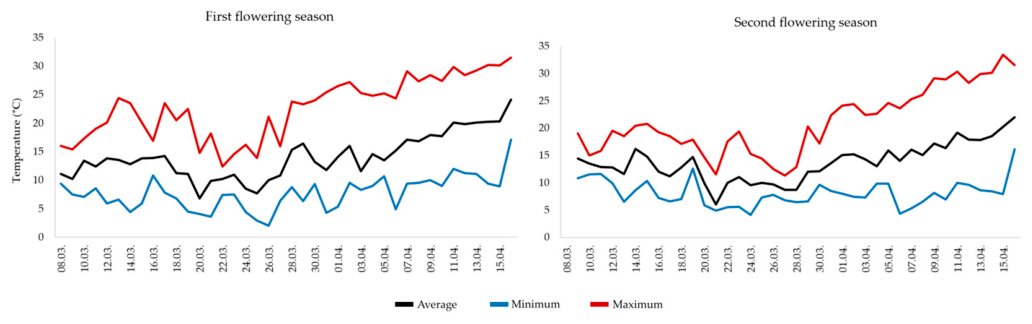
Temperature patterns were similar in both seasons, with moderate conditions in March and warmer temperatures in April.
Figure 1 presents the mean, minimum, and maximum temperatures recorded during the flowering period.
In the first season, the mean temperature in March was 11.8 °C (minimum 2 °C, maximum 25.4 °C), while in April it increased to 17.4 °C (minimum of 4.9 °C, maximum 31.5 °C). In the second season, the mean temperature in March was 11.6 °C (minimum of 4.1 °C, maximum of 22.3 °C), and in April, 16.7 °C (minimum 4.3 °C, maximum 33.4 °C).
3.2. In Vitro Pollen Germination
Significant seasonal differences in in vitro pollen germination were observed for all pollen donors. Pollen germination was 76.8% and 59.9% for ‘Isabella’, 84.5% and 55.8% for ‘Garnet’, and 61.7% and 89.9% for ‘Van’ during the first and second flowering seasons, respectively. ‘Isabella’ and ‘Garnet’ showed significantly higher pollen germination in the first season, whereas ‘Van’ exhibited significantly higher germination in the second season (
Table 1).
3.3. Fruit Set and Effective Pollination Period
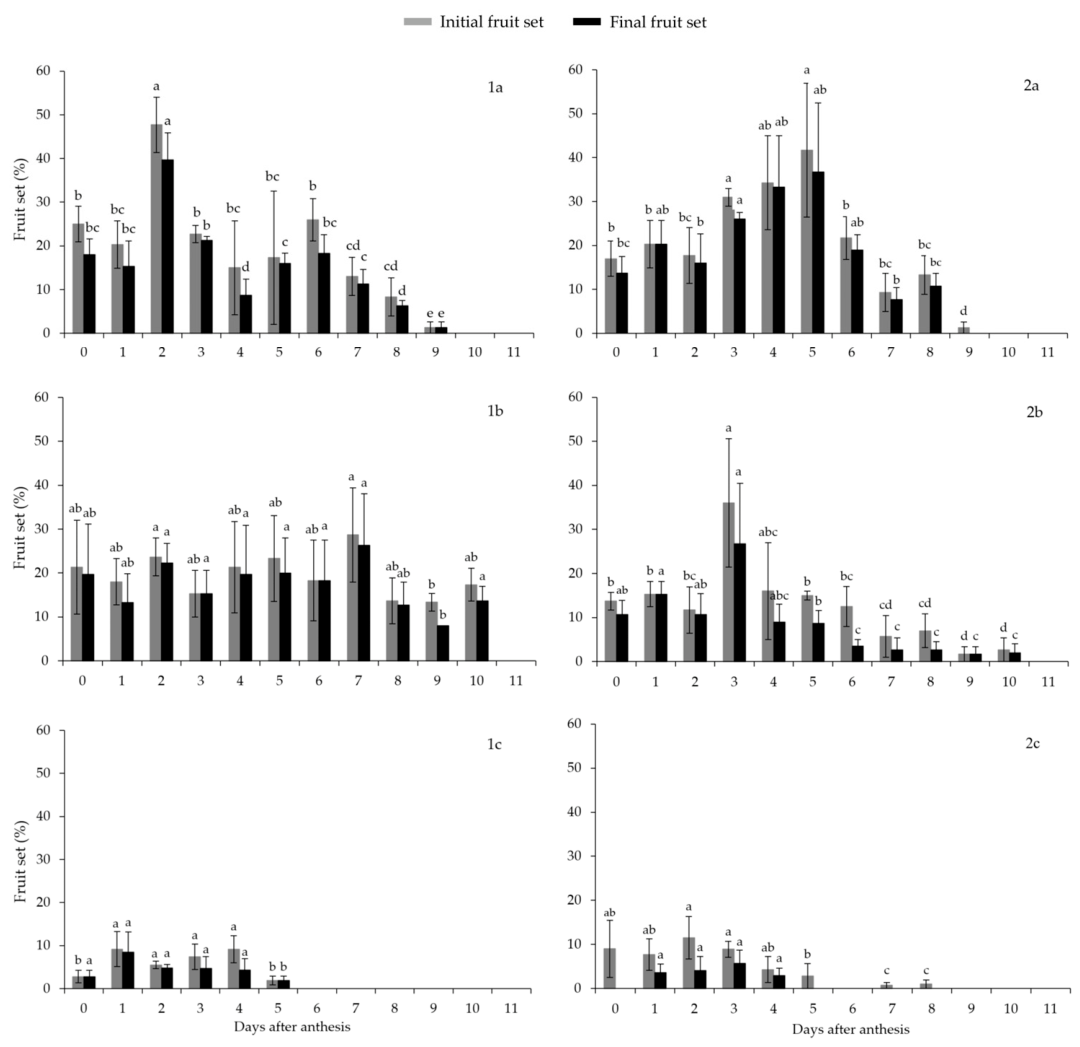
Differences in initial fruit set (IFS) and final fruit set (FFS) among cultivars and pollination times are presented in
Figure 2.
In ‘Stonska’, fruit set was recorded from anthesis until 9 DAA in both seasons. In the first season, the highest IFS and FFS were observed at 2 DAA (47.7% and 39.7%, respectively), followed by a gradual decline to 1.3% at 9 DAA. In the second season, maximum values were observed at 5 DAA, with no significant differences compared with 3 and 4 DAA for IFS and with 1,3,4 and 6 DAA for FFS. In ‘Gomilička’, IFS and FFS were recorded from anthesis until 10 DAA in both seasons. In the first season, the highest values were observed at 7 DAA (28.7% and 26.3%, respectively), although differences among most DAA were not significant. In the second season, the highest IFS was recorded at 3 DAA (36%), which did not differ significantly from 4 DAA (26.7%). No significant differences in FFS were observed between anthesis and 1–4 DAA.
In ‘Tugarka’, FFS remained below 10% in both seasons. In the first season, no significant differences in IFS were observed among pollination dates from 1 to 4 DAA, whereas FFS was recorded from anthesis until 5 DAA, with no significant differences among 0–4 DAA. In the second season, IFS at 2 and 3 DAA was higher than at 5 DAA and later dates, whereas FFS was recorded from 1 to 4 DAA without significant differences among pollination dates.
3.4. Stigma Receptivity and Ovule Viability
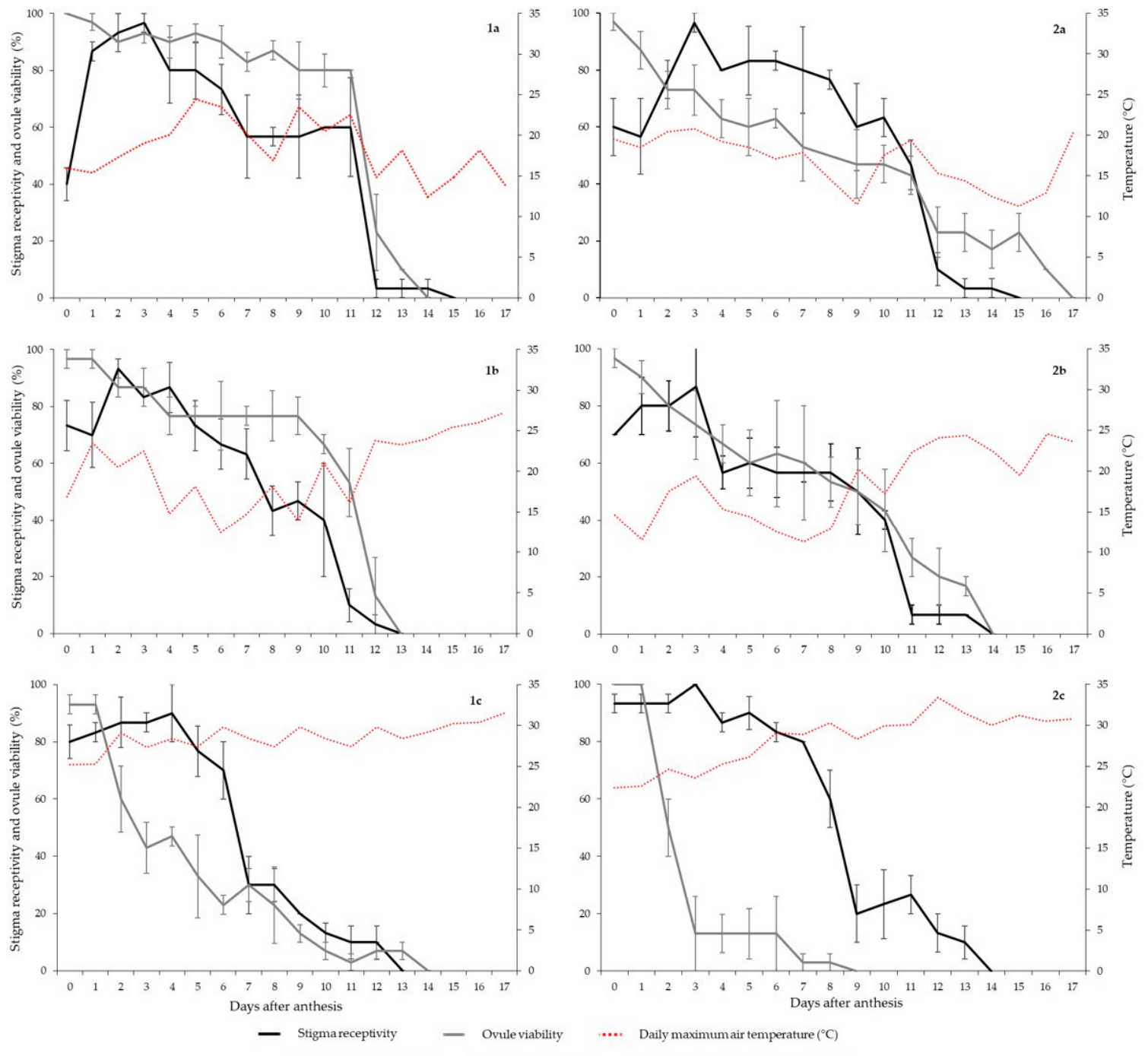
Analysis of variance indicated that flowering season did not significantly affect stigma receptivity, whereas DAA had a significant effect in all cultivars. Both flowering season and DAA significantly influenced ovule viability (
Figure 3).
In ‘Stonska’, stigmas were receptive from anthesis until 14 DAA in both seasons. Maximum receptivity was observed at 3 DAA, with no significant differences compared with adjacent sampling dates. Ovule viability persisted until 13 DAA in the first season and until 16 DAA in the second season, with more than 80% viable ovules until approximately 11 DAA.
In ‘Gomilička’, stigmas were receptive from anthesis until 12 DAA in the first season and until 13 DAA in the second season. Maximum receptivity occurred between 1 and 4 DAA. Ovule viability was maintained until 12–13 DAA, with more pronounced degeneration after 10–11 DAA.
In ‘Tugarka’, stigma receptivity was recorded from anthesis until 12 DAA in both seasons, with maximum values observed at 3–4 DAA. Ovule viability was maintained until 13 DAA in the first season but only until 8 DAA in the second season, with a marked decline observed after 2 DAA.
Pearson’s correlation analysis revealed a significant negative relationship between ovule longevity and the number of days with maximum temperatures exceeding 30 °C (r = −0.852,
p = 0.031) (
Table 2). Negative, although non-significant, correlations were also observed with mean flowering temperature (r = −0.591) and maximum flowering temperature (r = −0.790). These results indicate that high temperature episodes, particularly days with temperatures exceeding 30 °C, were associated with accelerated ovule degeneration and reduced ovule longevity.
Figure 4.
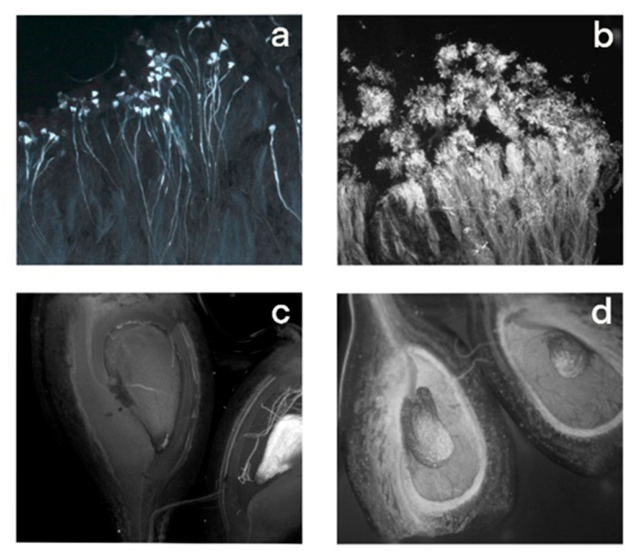
Cytological assessment of stigma receptivity and ovule viability in sweet cherry. (a) Receptive stigma showing turgid stigma papillae and intense fluorescence following aniline blue staining (×100); (b) non-receptive stigma showing collapsed papillae and reduced fluorescence (×100); (c) viable ovule without callose deposition in the nucellus or around the embryo sac (×25); and (d) non-viable ovule showing intense callose deposition in the nucellus and surrounding the embryo sac (×25).
Figure 4.
Cytological assessment of stigma receptivity and ovule viability in sweet cherry. (a) Receptive stigma showing turgid stigma papillae and intense fluorescence following aniline blue staining (×100); (b) non-receptive stigma showing collapsed papillae and reduced fluorescence (×100); (c) viable ovule without callose deposition in the nucellus or around the embryo sac (×25); and (d) non-viable ovule showing intense callose deposition in the nucellus and surrounding the embryo sac (×25).
3.5. Pollen Tube Growth
Pollen tube growth dynamics are presented in
Table 3. Both flowering season and days after pollination (DAP) significantly affected the percentage of pistils with pollen tubes reaching the base of the style.
In ‘Stonska’, pollen tubes reached the base of the style at 1 DAP in both seasons. The proportion of pistils with pollen tubes increased significantly at 3–5 DAP compared with earlier sampling times.
In ‘Gomilička’, pollen tubes reached the base of the style at 1 DAP in the first season, with significantly higher values at 4 DAP and 5 DAP. In the second season, higher values were observed at 3 DAP compared with 1 and 2 DAP, and remained stable thereafter.
In ‘Tugarka’, all pistils with pollen tubes reaching the base of the style were recorded at 2 and 3 DAP in the first and second seasons, respectively.
4. Discussion
This study provides clear evidence that ovule longevity is a critical determinant of the effective pollination period (EPP) under Mediterranean climatic conditions and demonstrates clear genotypic and seasonal variation in EPP, ovule longevity, and fruit set among the investigated sweet cherry cultivars. Although the EPP is considered a genetically determined trait, its functional expression is strongly influenced by environmental conditions during flowering [
11,
20].
‘Stonska’ and ‘Gomilička’ exhibited relatively long EPPs (9 and 11 days, respectively), whereas ‘Tugarka’ had considerably shorter EPP (4–5 days), which was consistently associated with low final fruit set (<10%). These differences coincided with contrasting temperature conditions during flowering. ‘Stonska’ and ‘Gomilička’ flowered earlier and experienced predominantly moderate temperatures, whereas the later flowering ‘Tugarka’ was exposed to higher temperatures, frequently ‘Tugarka’. Whereas these cultivars exceed 25 °C and occasionally 30 °C. Sweet cherry fertilization is generally most successful between 15 and 22 °C, while higher temperatures accelerate flower development, alter pollen tube growth dynamics, and reduce ovule longevity [
35,
36]. Such temperature conditions are becoming increasingly common in Mediterranean production regions as a consequence of climate change and may further increase the temporal mismatch between pollen tube growth and ovule viability.
Neither pollen tube growth appeared to limit fertilization in the present study. All cultivars exhibited receptive stigmas at anthesis and maintained stigma receptivity for several days thereafter. Likewise, pollen tubes reached the base of the style within 2–4 days after pollination in all cultivars, indicating that pollen tube growth through the pistil proceeded normally. Furthermore, the high in vitro pollen germination observed for all compatible pollen donors suggests that pollen quality was not a limiting factor.
Although each cultivar was pollinated with a different compatible pollen donor, the influence of pollen donor genotype on pollen performance cannot be completely excluded. Nevertheless, because pollen tube growth was rapid and comparable among cultivars, the observed differences in reproductive success are more likely to reflect variation in female reproductive processes, particularly ovule longevity, together with the prevailing environmental conditions during flowering. It should also be noted that the arrival of pollen tubes at the base of the style indicates successful pollen tube progression but does not necessarily confirm fertilization, which additionally depends on pollen tube penetration into the ovule and the persistence of a viable embryo sac. In contrast, ovule longevity was evaluated directly in the female tissues and is generally considered to be primarily determined by female genotype and environmental conditions, particularly temperature.
Compared with ‘Stonska’ and ‘Gomilička’, ‘Tugarka’ exhibited rapid ovule degeneration, with a pronounced decline in ovule viability occurring as early as two days after anthesis. Consequently, the temporal overlap between pollen tube arrival and ovule viability was substantially reduced, resulting in a shorter EPP and lower fertilization success. Reduced ovule longevity under elevated temperatures may be associated with increased metabolic activity and accelerated tissue senescence, enhanced respiration, and oxidative stress, all of which may promote earlier degeneration of the embryo sac [
37]. In addition, elevated temperatures may disrupt reproductive development through hormonal imbalance [
38,
39]. The significant negative correlation between ovule longevity and the number of days with temperatures above 30 °C further supports the hypothesis that episodes of extreme heat accelerate ovule degeneration and consequently shorten the effective pollination period.
The differences between initial and final fruit set observed in all cultivars indicate that post-fertilization processes also contribute to fruit loss. However, the relative importance of pre- and post-fertilization factors differed among cultivars. In ‘Stonska’ and ‘Gomilička’, post-fertilization processes likely accounted for a substantial proportion of fruit loss, whereas in ‘Tugarka’, the rapid decline in ovule viability and the resulting short EPP indicate that limitations before fertilization were the primary cause of poor fruit set. Although initial fruit set reflects successful fertilization within the EPP, final fruit set is additionally influenced by assimilate availability, crop load, tree vigor, and environmental stresses [
5,
36]. Therefore, the low productivity of ‘Tugarka’ appears to originate predominantly during the early reproductive phase.
Historically, ‘Tugarka’ has been considered a productive cultivar. Therefore, the low fruit set observed in the present study is unlikely to represent an intrinsic characteristic of the cultivar, but rather a response to the unusually warm flowering conditions recorded during the two study seasons. This finding suggests that recent climatic trends may increasingly constrain the productivity of late-flowering cultivars. Although the present results indicated genotypic differences in the thermal sensitivity of ovule longevity, these responses were also influenced by differences in flowering time and the associated temperature regime. Because ‘Tugarka’ consistently flowered later than the other cultivars, the effects of genotype and flowering time temperature cannot be completely separated. Consequently, the reduced ovule longevity observed in this cultivar most likely reflects an interaction between cultivar-specific characteristics and exposure to elevated temperatures during bloom.
Although this study included only three traditional cultivars, the results suggest that temperature-induced reductions in ovule longevity may represent a broader limitation to sweet cherry production under future climate warming scenarios. Further studies, including a wider range of cultivars and controlled temperature treatments, are needed to distinguish genetic effects from environmental influences and to improve our understanding of reproductive adaptation to increasing spring temperatures.
5. Conclusions
This study demonstrated that ovule longevity is the principal factor determining the effective pollination period (EPP) and fruit set in the investigated sweet cherry cultivars under Mediterranean conditions. Stigma receptivity and pollen tube growth did not limit fertilization, whereas accelerated ovule degeneration, particularly under elevated temperatures during flowering, reduced the temporal overlap between pollen tube arrival and ovule viability, resulting in a shorter EPP and lower fruit set.
The late flowering cultivar ‘Tugarka’ was the most affected, suggesting that exposure to higher temperatures during bloom may substantially reduce reproductive success. Although the observed response likely reflects an interaction between genotype and flowering environment, the results indicate that increasing spring temperatures may pose an increasing risk to the productivity of temperature-sensitive sweet cherry cultivars.
These findings highlight the importance of ovule longevity as a key reproductive trait and emphasize the need to consider flowering time and heat tolerance in breeding programs, cultivar selection, and orchard management strategies aimed at maintaining stable sweet cherry production under future climate warming scenarios.