Article

Deep Placement of Nitrogen Fertilizer Mitigates Methane Emissions from Rice Paddies by Modulating Methanogenic and Methanotrophic Communities in a Rice–Wheat Rotation System


1
Jiangsu Collaborative Innovation Center for Modern Crop Production, Key Laboratory of Crop Physiology and Ecology in Southern China, Nanjing Agricultural University, Nanjing 210095, China
2
Department of Agronomy, School of Life Sciences and Resource Environment, Yichun University, Yichun 336000, China
3
Soil and Fertilizer & Resources and Environment Institute, Jiangxi Academy of Agricultural Sciences, Nanchang 330200, China
*
Author to whom correspondence should be addressed.
Agronomy 2026, 16(14), 1333; https://doi.org/10.3390/agronomy16141333
Submission received: 30 May 2026 / Revised: 4 July 2026 / Accepted: 7 July 2026 / Published: 13 July 2026
(This article belongs to the Special Issue New Pathways Towards Carbon Neutrality in Agricultural Systems)

Abstract

Deep placement of nitrogen fertilizer (DPN) is an effective fertilization strategy for improving nitrogen use efficiency in rice systems, but its effects on methane (CH4) emissions and the associated microbial mechanisms remain insufficiently understood. This study aimed to determine whether DPN mitigates CH4 emissions in a rice–wheat rotation system and to clarify how it regulates methanogenic and methanotrophic communities. A two-year field experiment was conducted in East China with two nitrogen management practices, i.e., conventional surface application and DPN. Compared with surface application, DPN significantly reduced cumulative CH4 emissions by 22.9% in 2023 and 17.0% in 2024, while tending to increase rice grain yield. During the tillering stage, DPN decreased soil dissolved organic carbon by 19.0% and increased NH4+-N and NO3-N concentrations by 35.8% and 44.1%, respectively. These changes were accompanied by a 24.7% reduction in methanogen abundance and a 26.9% decrease in methanogenic activity. Although total methanotroph abundance was not significantly affected, DPN increased methanotrophic activity by 24.6%. Amplicon sequencing further showed that DPN shifted the methanogenic community from acetoclastic taxa toward hydrogenotrophic taxa, as indicated by the decline in Methanosarcina and Methanothrix and the enrichment of Methanobacterium and Methanoregula. In parallel, DPN promoted Type I methanotrophs, especially Methylomonas, while suppressing the Type II methanotroph Methylocystis. These results demonstrate that DPN mitigates CH4 emissions by reducing labile carbon availability, suppressing methanogenic abundance and activity, and enhancing the functional potential of methane oxidation through methanotrophic community restructuring. Overall, this study indicates that DPN mitigates CH4 emissions through coordinated regulation of carbon substrate availability and functional microbial community restructuring, suggesting that DPN is a promising strategy for sustainable rice production and greenhouse gas mitigation.

1. Introduction

Rice (Oryza sativa L.) is one of the world’s most important staple crops, feeding nearly half of the global population and supplying approximately 20% of dietary energy intake [1]. However, flooded rice paddies constitute a major anthropogenic source of methane (CH4), a potent greenhouse gas with a 100-year global warming potential 27 times that of carbon dioxide [2]. Global rice cultivation emits an estimated 24–37 Tg CH4 annually, accounting for approximately 8–11% of global anthropogenic CH4 emissions [2,3,4]. Among major crops, rice is characterized by particularly high area- and yield-scaled greenhouse gas emissions, largely attributable to CH4 emissions under flooded soil conditions [5]. Given the increasing pressure to achieve carbon neutrality, identifying management practices that sustain high rice yields while mitigating CH4 emissions has become a central challenge for sustainable rice production in the 21st century [6,7].
Nitrogen (N) fertilization is essential for achieving high crop productivity and supporting global food security. However, conventional surface broadcasting of N fertilizer is inherently inefficient, leading to substantial reactive N losses through runoff, leaching, and ammonia volatilization, while also contributing to soil acidification and eutrophication [8]. Deep placement of N fertilizer (DPN), which delivers N fertilizer to a soil depth of typically 5–10 cm near the rice root zone at transplanting, has been widely investigated across rice-producing regions worldwide and has been shown to improve N use efficiency and grain yield compared with conventional surface broadcasting [9,10,11,12,13,14,15,16,17,18]. By placing N closer to roots, DPN can improve immediate N uptake and prolong N availability in the rhizosphere [10,11]. This practice has been shown to reduce ammonia volatilization, enhance root N absorption, improve rice yield, and increase N use efficiency [12,13,14,15,16]. Meta-analyses have reported that DPN can increase rice yield by 8.6–32% and N use efficiency by 16.7–34% [17,18].
Beyond its agronomic benefits, DPN also affects CH4 emissions from rice paddies. Net CH4 emissions are determined by the balance between anaerobic CH4 production by methanogenic archaea and aerobic CH4 oxidation by methanotrophic bacteria [19,20]. Most studies, mainly from Asian rice systems, have reported that DPN reduces CH4 emissions relative to surface broadcasting, and recent meta-analyses have estimated a significant 16–25% reduction in CH4 emissions under DPN [18,21]. However, the response may vary across rice production systems; for example, a study from U.S. rice systems reported no significant effect of DPN on CH4 emissions [22]. These findings indicate that although DPN has considerable potential for CH4 mitigation, its effects and underlying mechanisms may depend on site-specific soil, crop, and management conditions. The CH4 mitigation effect of DPN has generally been attributed to changes in soil N distribution, root growth, rhizosphere conditions, and the balance between CH4 production and oxidation [15,22,23,24].
Methanogenic and methanotrophic processes are highly sensitive to soil carbon and nitrogen availability as well as to their spatial distribution [19]. DPN creates localized hotspots of high NH4+-N near the fertilizer band while leaving the surrounding bulk soil relatively nutrient-poor. Such spatial heterogeneity may suppress the decomposition of incorporated crop residues, reduce dissolved organic carbon (DOC) availability, and consequently constrain methanogenic abundance and CH4 production [21,25]. In addition, CH4 production and oxidation are regulated not only by the abundance of methanogens and methanotrophs, but also by their community structure and functional activity [20,26]. However, the responses of methanogenic and methanotrophic communities to DPN in rice paddies remain inadequately understood.
China is the world’s largest rice producer, and its paddy fields are estimated to contribute 5–14 Tg CH4 annually [3]. The average N application rate in China is approximately 178 kg N ha−1, while N use efficiency remains only about 40%—lower than the global average of 50% [27,28]. Rice–wheat rotation systems cover approximately 30 million hectares and represent one of the world’s largest agroecosystems [7]. In these systems, N input during the rice-growing season is particularly high, underscoring the need for more efficient fertilization strategies [29]. Although DPN has been shown to enhance rice growth and reduce CH4 emissions in rice–wheat rotation systems [30,31], its effects on methanogenic and methanotrophic communities in paddy soils remain to be elucidated.
We hypothesized that DPN reduces CH4 emissions from rice paddies by altering soil carbon and nitrogen availability, suppressing CH4 production, enhancing CH4 oxidation, and reshaping methanogenic and methanotrophic communities. Therefore, a two-year field experiment was conducted in a typical rice–wheat rotation system in East China to (i) quantify the effects of DPN on seasonal CH4 emissions and grain yield, and (ii) characterize its effects on the abundance, activity, and community structure of methanogens and methanotrophs. The findings are expected to deepen the understanding of the microbial mechanisms by which DPN mitigates CH4 emissions and provide a scientific basis for developing sustainable fertilization strategies in rice-based agroecosystems.

2. Materials and Methods

2.1. Study Site and Experimental Design

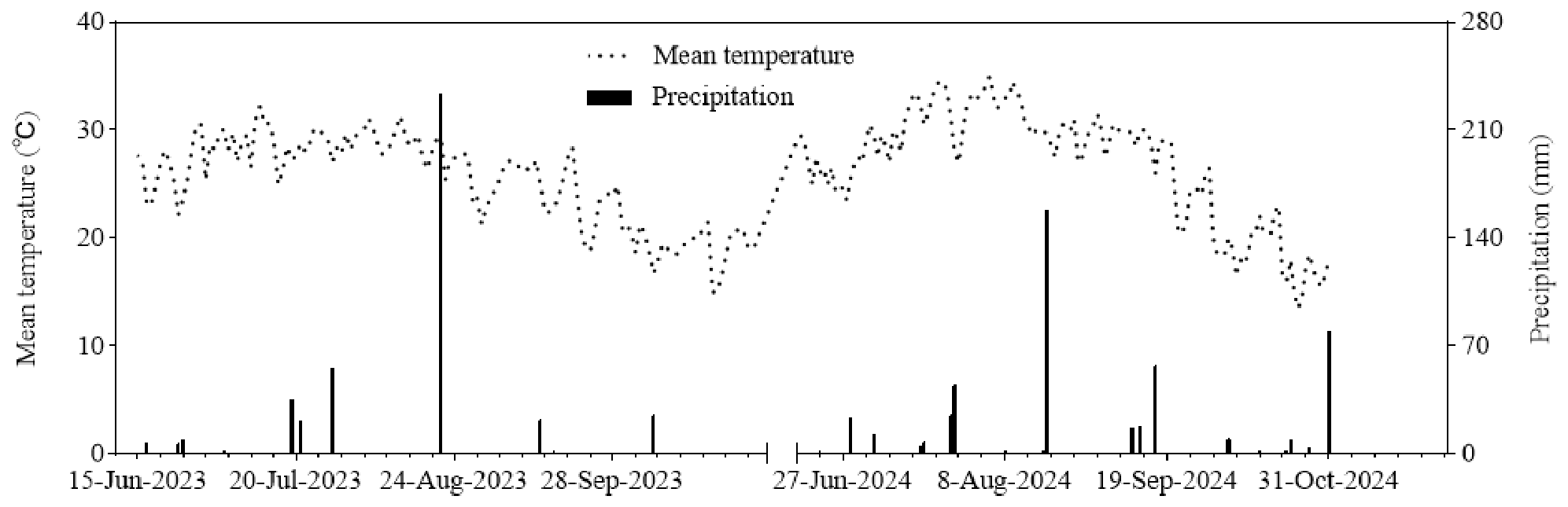
A field experiment was conducted in 2023 and 2024 at the Danyang Experimental Station of Nanjing Agricultural University (31°54′ N, 119°28′ E), Jiangsu Province, China. The site has a mean annual temperature of 16.4 °C and mean annual precipitation of 1056 mm. Daily mean air temperature and precipitation during the rice-growing seasons in 2023 and 2024 are shown in Figure 1. The topsoil (0–20 cm) at the experimental site had the following properties: pH (H2O), 6.18; soil organic matter, 25.45 g kg−1; total N, 1.44 g kg−1; total P, 0.42 g kg−1; and total K, 7.28 g kg−1. According to the Chinese Soil Taxonomy, the soil is classified as a Hydragric Anthrosol derived from lacustrine deposits, with a silty clay loam texture.
The experiment was arranged in a completely randomized design with two N management treatments and three replicates per treatment. The treatments were conventional surface application of N fertilizer (CK) and deep placement of N fertilizer (DPN). For CK, basal N fertilizer was surface-applied and incorporated into the topsoil (0–5 cm) by raking. For DPN, basal N fertilizer was banded 5 cm beside and 5 cm below each transplanting hole. In both treatments, panicle N fertilizer was applied by surface broadcasting. The total N application rate was 240 kg ha−1, of which 70% was applied as basal fertilizer and 30% was top-dressed at panicle initiation. All N fertilizers were applied as granular urea (46% N). Phosphorus and potassium fertilizers were applied as calcium superphosphate (12% P2O5) and potassium chloride (60% K2O), respectively, at rates of 120 kg P2O5 ha−1 and 160 kg K2O ha−1 as basal dressings.
Each plot covered approximately 20 m2 and was separated by ridges lined with plastic film to prevent nutrient leakage. The japonica rice cultivar ‘Wuyunjing 23’ was used. Transplanting was conducted on 25 June in 2023 and 27 June in 2024, and harvest was carried out on 27 October in 2023 and 30 October in 2024. Water management consisted of continuous flooding during the early vegetative stage, followed by intermittent irrigation until physiological maturity. All wheat straw from the preceding wheat crop was fully incorporated into the topsoil (0–15 cm) by rotary tillage approximately two weeks before rice transplanting, with an estimated returned dry matter of 6.5–7.0 t ha−1. All plots received identical pest, disease, and weed management practices throughout the growing seasons to ensure normal rice growth.

2.2. Sampling and Measurements

2.2.1. CH4 Flux Measurements

CH4 fluxes were measured using the static closed chamber method at approximately 7-day intervals throughout the rice-growing season. Before transplanting, a PVC frame (50 cm × 50 cm × 15 cm) was inserted into each plot. During gas sampling, a PVC chamber (50 or 100 cm in height, adjusted according to plant height) was placed on the frame. Gas samples were collected at 0, 10, 20, and 30 min after chamber closure between 08:00 and 11:00 a.m., and analyzed using a gas chromatograph (7890A, Agilent Technologies, Santa Clara, CA, USA) equipped with a flame ionization detector (FID) and an Agilent HP-PLOT Q capillary column (30 m × 0.32 mm × 20 μm). High-purity nitrogen (≥99.999%) was used as the carrier gas at a flow rate of 15 mL min−1. The injector, oven, and detector temperatures were set at 180 °C, 100 °C, and 250 °C, respectively, with the oven temperature held for 1.5 min. Gas samples were injected in split mode at a split ratio of 5:1, with an injection volume of 250 μL. The total run time for each sample was approximately 3 min, and the retention time of CH4 was approximately 1.2 min. CH4 was quantified using an external standard calibration method with a five-point calibration curve including a blank and CH4 standards of 1, 5, 10, and 50 ppmv in N2. The calibration curve showed excellent linearity (R2 > 0.999). The limit of detection (LOD) and limit of quantification (LOQ), defined as signal-to-noise ratios of 3 and 10, respectively, were 0.06 and 0.18 ppmv for CH4.
CH4 fluxes were calculated according to Qian et al. [20]:
F = ρ × 273 ( 273 + T ) × V S × c m × 60
where F is the emission flux of CH4 (mg m−2 h−1), ρ is the density of CH4 under standard atmospheric pressure (g L−1), T is the air temperature inside the chamber (°C), V is the volume of the static chamber (m3), S is the soil surface area enclosed by the chamber (m2), and Δcm is the change rate of gas concentration per minute in the chamber (μL L−1 min−1), calculated by linear regression. Seasonal cumulative CH4 emissions were estimated by linear interpolation.

2.2.2. Plant and Soil Sampling

At maturity, rice plants were harvested from a central 1 m2 area in each plot to determine grain yield, which was adjusted to a standard moisture content of 14.5%. Plant samples were first oven-dried at 105 °C for 30 min and then dried at 75 °C to constant weight for biomass determination. Grain yield was weighed after manual threshing and cleaning.
Before the experiment, initial soil samples were collected from the plow layer using the S-shaped sampling method. After surface litter was removed, a stainless-steel auger was driven vertically to a depth of 0–15 cm. At least 10–15 subsamples were collected from each homogeneous unit and pooled into one composite sample. The pooled soil was thoroughly mixed, cleared of stones and roots, and reduced to approximately 0.5 kg by quartering. In addition, at tillering stage, soil samples were collected adjacent to rice plants when CH4 emissions were high using a 5 cm diameter soil auger. Samples were sieved through a 2 mm mesh to remove roots and stones and then divided into two subsections: one subsection was stored at 4 °C for DOC and ammonium-N (NH4+-N), nitrate-N (NO3-N) analysis within 48 h; a second subsection was stored at −80 °C for methanogens and methanotrophs analyses.
Soil pH was measured by a pH meter (SevenDirect SD20, Mettler-Toledo, Zurich, Switzerland) in a 1:2.5 (w/v) soil-to-water mixture. Soil organic matter was determined by the potassium dichromate oxidation method. Total N was measured with an elemental analyzer, while total P and K were determined by acid digestion with colorimetric and flame-photometric detection, respectively. Soil DOC was extracted with 1 M K2SO4 and measured using a total organic carbon analyzer (multi N/C UV, Analytik Jena AG, Jena, Germany). Soil NH4+-N and NO3-N were extracted with 2 M KCl and determined using a flow injection autoanalyzer (Auto Analyzer 3, Bran+Luebbe, Norderstedt, Germany).
To evaluate methanogenic and methanotrophic functional potential, CH4 production and oxidation potentials were determined using anaerobic and aerobic incubation assays, respectively, following Jiang et al. [32]. For the CH4 production assay, 20 g of fresh soil was placed in a 250 mL flask. The flask was sealed with a rubber stopper fitted with gas flushing ports and flushed with N2 for 6 min to establish anaerobic conditions, followed by incubation in the dark at 26 °C for 72 h. Gas samples were collected at 0, 24, 48, and 72 h. For the CH4 oxidation assay, the flask headspace was flushed for 6 min with an air mixture containing 10,000 ppm CH4 and then incubated in the dark at 26 °C with shaking at 120 rpm. Gas samples were collected at 0, 12, 24, and 36 h. CH4 concentrations were determined using a gas chromatograph (7890A, Agilent Technologies, Santa Clara, CA, USA). CH4 production and oxidation potentials were calculated from the linear regression of CH4 concentration against incubation time.
Total microbial DNA was extracted from 0.25 g of fresh soil using the DNeasy PowerSoil Pro Kit (QIAGEN, Hilden, Germany) according to the manufacturer’s instructions. The abundance of methanogens and methanotrophs was quantified by qPCR targeting the mcrA and pmoA genes, respectively, using primer pairs MLf/MLr and A189f/mb661r [33,34]. Methanogenic and methanotrophic specific activities were calculated by normalizing CH4 production and oxidation potentials to mcrA and pmoA gene copy numbers, respectively.
To assess the diversity and community composition of methanogens and methanotrophs, amplicon sequencing of the mcrA and pmoA genes was performed. To improve the reliability of microbial community analysis, each biological replicate was sequenced and analyzed in duplicate as technical replicates. The same primer pairs used for qPCR were adapted for sequencing by adding unique barcodes to the forward primers. PCR products were separated on 2% agarose gels, extracted, purified using Axygen purification kits (Axygen Biosciences, Union City, CA, USA), and pooled in equimolar amounts. Paired-end sequencing (2 × 250 bp) was performed on an Illumina MiSeq platform (Illumina, San Diego, CA, USA). Raw sequence data were processed using the QIIME2 pipeline. Briefly, reads were demultiplexed, quality filtered, and denoised using DADA2 to generate amplicon sequence variants (ASVs), and chimeric sequences were removed during the denoising step.
To evaluate the response of methanogen and methanotroph communities to DPN, we analyzed community diversity and composition at the genus level. Taxonomic assignment of ASVs was conducted using the FunGene database. Alpha diversity indices, including Chao1, ACE, Shannon, and Simpson, were calculated using the R package vegan.

2.3. Statistical Analysis

One-way analysis of variance (ANOVA) was used to examine the effects of N management on CH4 emissions, plant traits, soil dissolved C and N concentrations, and the abundance and community composition of methanogens and methanotrophs. Differences were considered significant at p < 0.05. All statistical analyses were performed using IBM SPSS Statistics 20.0.

3. Results

3.1. CH4 Emissions

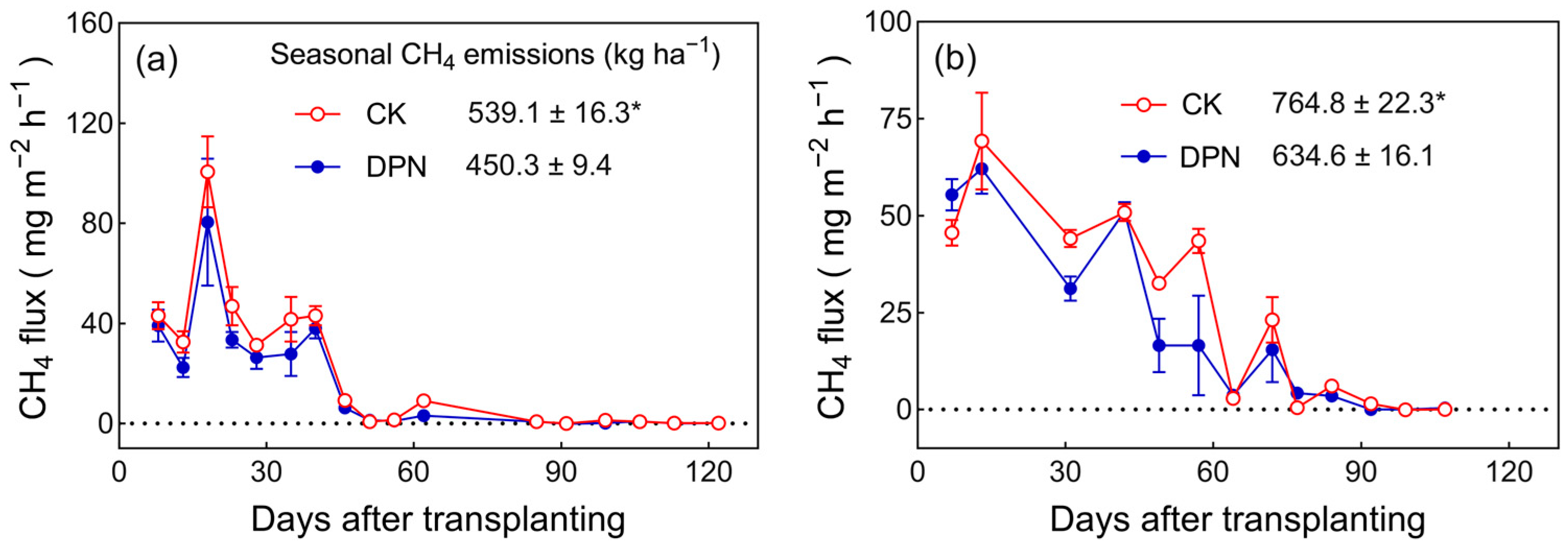
CK and DPN showed similar seasonal patterns of CH4 flux in both years, with the highest emission peak occurring during the early tillering stage (Figure 2). In 2023, a second emission peak was observed at approximately 40 days after transplanting, whereas in 2024, CH4 flux gradually declined after the initial peak, with only minor fluctuations during the later growth stages. Compared with CK, DPN generally reduced CH4 fluxes at most sampling dates throughout the rice-growing season in both years. Seasonal cumulative CH4 emissions were significantly lower under DPN than under CK, with reductions of 22.9% in 2023 and 17.0% in 2024.

3.2. Plant and Soil Properties

DPN tended to increase rice grain yield by 10.4% compared with CK, although the difference was not statistically significant (Table 1). Above-ground biomass was not significantly affected by N placement. In contrast, DPN significantly changed soil C and N availability during the tillering stage. Compared with CK, DPN decreased soil DOC concentration by 19.0%, while increasing soil NH4+-N and NO3-N concentrations by 35.8% and 44.1%, respectively.

3.3. Microbial Abundance and Activity

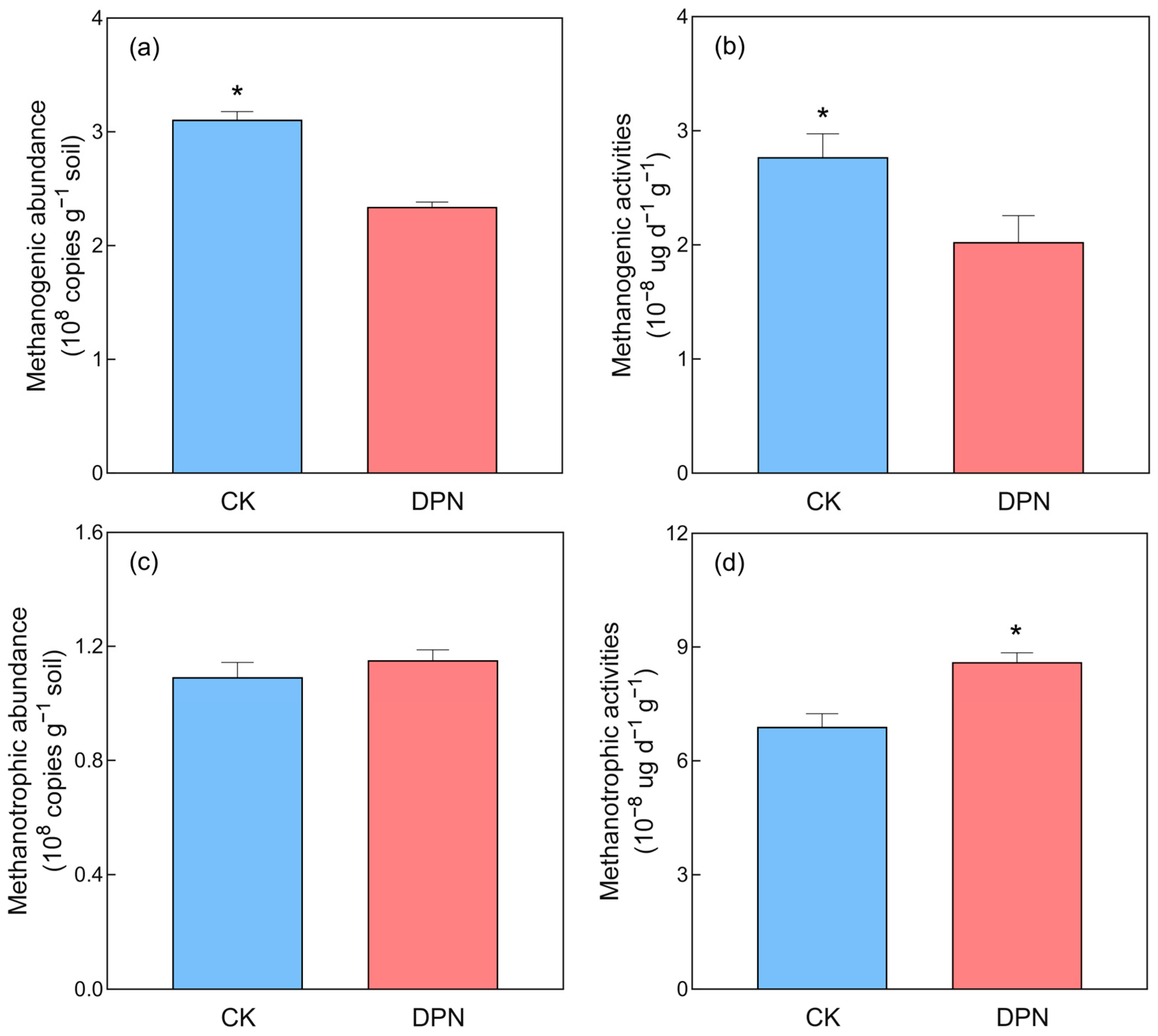
DPN significantly affected methanogenic abundance and activity during the tillering stage (Figure 3). Compared with CK, DPN decreased methanogen abundance by 24.7% and methanogenic activity by 26.9% (Figure 3a,b). DPN did not significantly affect methanotroph abundance, but increased methanotrophic activity by 24.6% (Figure 3c,d). These results indicate that DPN suppressed the functional potential for CH4 production while enhancing the activity of methanotrophs.

3.4. Composition of Methanogenic and Methanotrophic Communities

DPN altered the alpha diversity of methanogenic and methanotrophic communities during the tillering stage (Table 2). For the methanogenic community, DPN significantly enhanced species richness, increasing the Chao1 and ACE indices by 46.5% and 17.9%, respectively, compared with the CK treatment. For the methanotrophic community, DPN management significantly increased the Shannon index by 3.5%, while no significant alterations were observed in the Chao1, ACE, or Simpson indices.
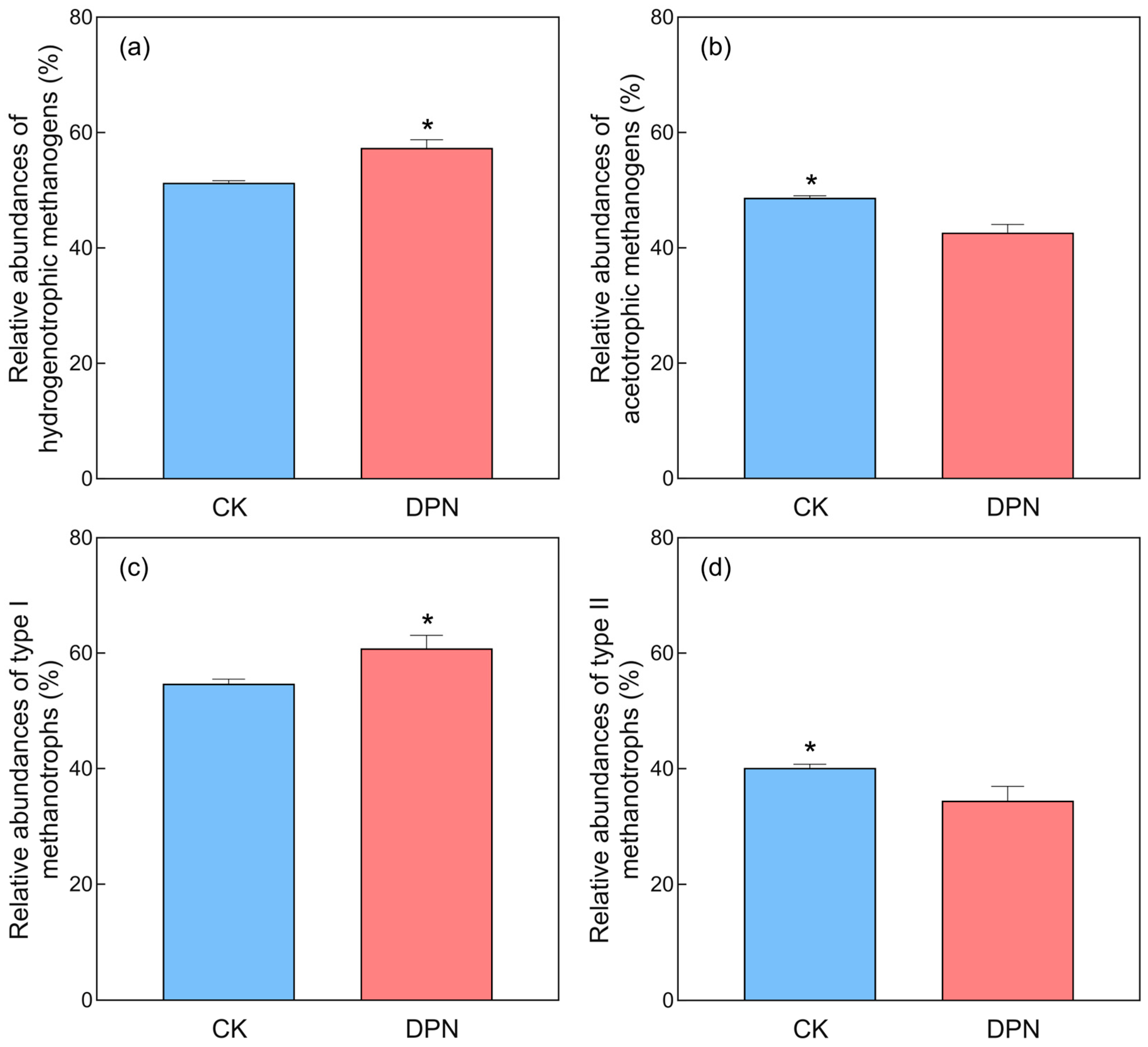
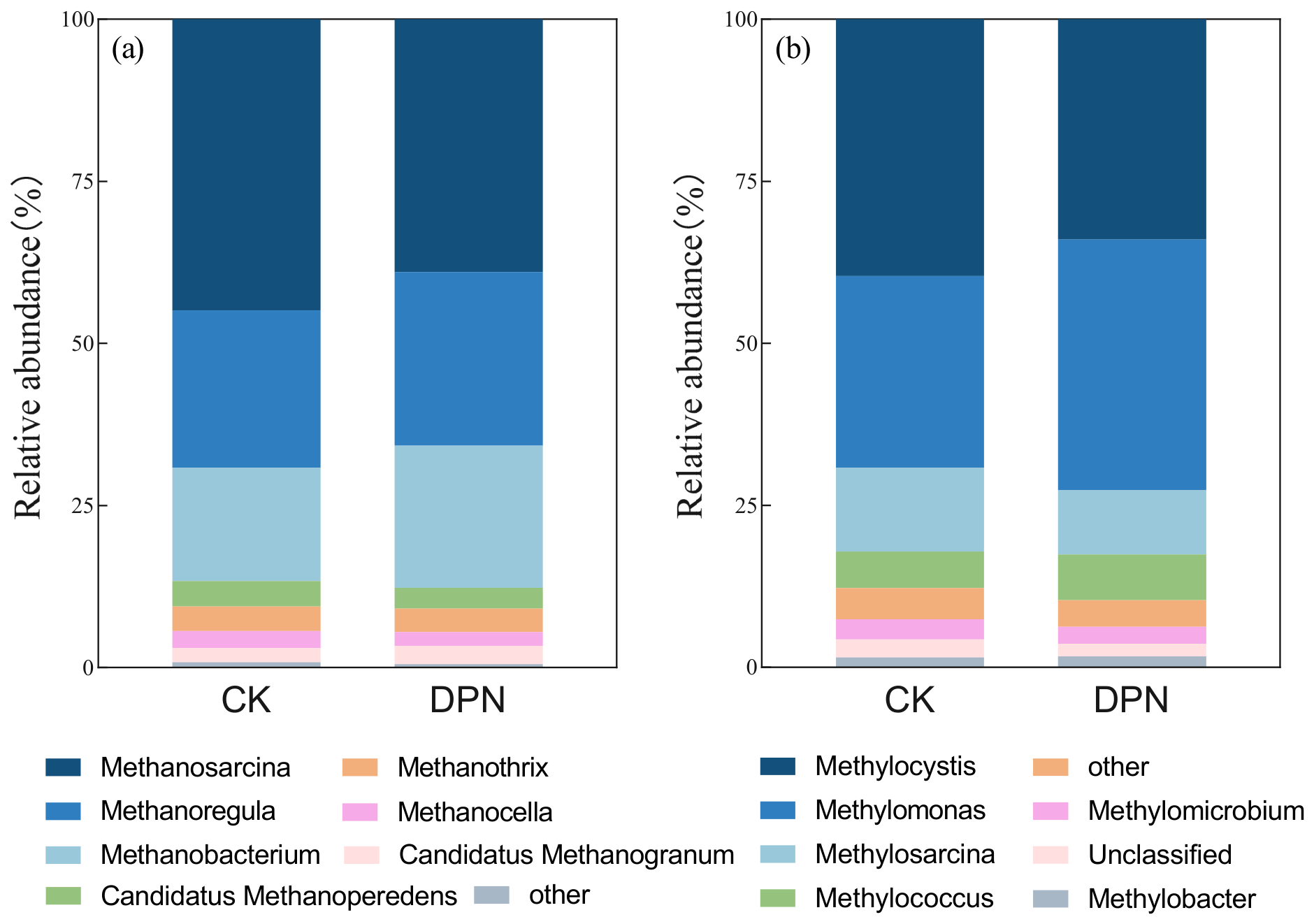
DPN significantly altered the community structure and taxonomic composition of methanogens during the tillering stage (Figure 4a,b and Figure 5a). Compared with CK, DPN significantly shifted the functional pathways of methanogenesis by increasing the relative abundance of hydrogenotrophic methanogens by 11.7% (Figure 4a), while concurrently decreasing that of acetotrophic methanogens by 10.0% (Figure 4b). Taxonomic profiling at the genus level further elucidated these structural shifts within the methanogenic community (Figure 5a). DPN markedly reduced the proportions of the dominant mixotrophic genus Methanosarcina by 13.2% and the obligate acetotrophic genus Methanothrix compared to the CK treatment. This suppression was accompanied by a corresponding expansion in the relative abundances of obligate hydrogenotrophic taxa, specifically Methanoregula and Methanobacterium, with the latter increasing by 26.0%.
DPN also changed methanotrophic community composition (Figure 4c,d and Figure 5b). Specifically, DPN significantly drove the relative abundance of Type I methanotrophs up by 11.2% (Figure 4c), whereas a significant reduction of 20.0% was observed in the relative abundance of Type II methanotrophs (Figure 4d). At the genus level, the DPN-mediated increase in Type I methanotrophs was predominantly driven by the sharp expansion of the genus Methylomonas, which increased by 31.0% and emerged as the absolute dominant taxon under DPN treatment (Figure 5b). In contrast, the relative abundance of the Type II methanotroph Methylocystis was markedly suppressed by DPN, decreasing by 14.1%.

4. Discussion

The field experiment showed that DPN significantly reduced CH4 emissions from rice paddies, consistent with previous studies [24,35]. Net CH4 emissions in paddy soils reflect the dynamic balance between CH4 production and oxidation [19], and the observed mitigation under DPN likely resulted from both weaker CH4 production and stronger CH4 oxidation [15,21,24]. However, several studies have reported neutral or even positive responses of CH4 emissions to DPN [23]. Such inconsistencies likely arise from differences in management practices, including N application rate and fertilizer type, as well as environmental conditions such as soil properties and climate. Notably, recent evidence indicates that the CH4 mitigation effect of DPN becomes stronger as N application rate increases, suggesting that DPN is particularly effective under relatively high N input conditions [21]. Given that this experiment was evaluated at a comparatively high input level of 240 kg N ha−1, the pronounced reduction in CH4 emissions observed here is consistent with this threshold response. This suggests that DPN may suppress CH4 emissions primarily by altering substrate availability and reducing methanogenic activity under high fertilization conditions.
The biogeochemical mechanisms underlying the CH4 mitigation effect of DPN appear to involve coordinated changes in carbon substrate supply, nitrogen availability, and methane-cycling microbial communities. First, reduced carbon substrate availability is a likely driver of the observed decline in CH4 emissions. CH4 is mainly produced through anaerobic decomposition of organic matter by methanogens, with acetate and H2/CO2 serving as key precursors [19]. Soil DOC is therefore a critical regulator of methanogenic growth and activity [36]. In this study, DPN significantly lowered DOC concentrations at the tillering stage, indicating a reduced supply of labile carbon to methanogens during the early period when CH4 emissions are typically initiated. This reduction in DOC may have resulted from decreased root-derived carbon inputs and spatial decoupling of residue decomposition. Compared with surface application, DPN can create a more favorable soil nutrient environment in the root zone, potentially reducing root proliferation in the surface layer and lowering root biomass and root-to-shoot ratio, thereby redirecting more photosynthates and energy to aboveground growth [37]. Although DPN has been reported to stimulate root growth in some systems [38,39,40], rice roots are mainly distributed in the upper soil layer during early growth, when surface N availability may be relatively low under DPN [41,42]. Such localized N limitation may constrain early root development and rhizosphere carbon release. In addition, straw residue decomposition likely contributed to DOC formation in our field, because wheat straw incorporation provides an important carbon source for methanogenesis [43]. Under DPN, N was concentrated in fertilized zones, whereas non-fertilized soil regions may have experienced stronger N limitation, potentially slowing straw decomposition and further reducing DOC availability [25]. Together, these effects likely explain the lower methanogenic abundance and suppressed CH4 production under DPN.
Second, enhanced local nitrogen availability may have promoted CH4 oxidation by stimulating methanotrophic activity. Several studies have shown that DPN reduces CH4 emissions relative to surface broadcasting, which has often been attributed to enhanced CH4 oxidation under conditions of higher NH4+-N availability [24,35]. At the microbial level, elevated N availability can stimulate the growth and activity of methane-oxidizing microorganisms, thereby reducing CH4 emissions [44]. In this study, both NH4+-N and NO3-N concentrations were significantly increased under DPN, which may have created conditions favorable for methane oxidation. In addition, NO3 can serve as a terminal electron acceptor for nitrate-dependent anaerobic methane oxidation, potentially further contributing to CH4 mitigation [45], thereby further alleviating CH4 emissions.
Importantly, the reduction in CH4 emissions under DPN was likely driven by compositional shifts in both methanogenic and methanotrophic communities. For methanogens, DPN likely restricted straw decomposition, thereby limiting the supply of acetate, H2, and CO2 to the methanogenic community [46,47]. This substrate limitation may have disproportionately suppressed the versatile genus Methanosarcina, which can use acetate as an important substrate, and the obligate acetotroph Methanothrix, which strongly depends on acetate availability. In contrast, obligate hydrogenotrophic methanogens such as Methanobacterium and Methanoregula increased under DPN. This enrichment suggests that the altered substrate environment under deep placement may have favored hydrogenotrophic methanogens over acetate-utilizing methanogens [46,48]. As a result, the CH4 production potential of the methanogenic community was likely reduced, consistent with the observed decline in methanogenic activity.
For methanotrophs, DPN induced a distinct taxonomic reorganization, as indicated by increased Shannon diversity. Elevated NH4+-N concentrations resulting from DPN may have selectively inhibited Type II methanotrophs such as Methylocystis, which are known to be sensitive to ammonium inhibition [49]. Simultaneously, the localized nutrient and redox heterogeneity created by deep fertilizer bands may have favored the proliferation of Type I methanotrophs, such as Methylomonas [50]. Since Type I methanotrophs typically exhibit higher CH4 oxidation activity and carbon conversion efficiency than Type II methanotrophs [50,51], this compositional shift likely enhanced the functional capacity of the methanotrophic community to oxidize CH4, as evidenced by the increased CH4 oxidation potential. Taken together, DPN appears to reduce CH4 emissions by simultaneously constraining CH4 production and enhancing CH4 oxidation through shifts in microbial community composition.
Our results showed that DPN reduced CH4 emissions by altering soil C and N availability and regulating CH4 production and oxidation processes. Beyond this microbial mechanism for CH4 mitigation, DPN also offers agronomic benefits by maintaining or increasing rice yield. Previous studies have reported that deep N placement can reduce N input by 10–15% while maintaining or slightly increasing yields relative to conventional surface broadcasting [52,53,54]. This yield stability is likely associated with improved synchronization between N supply and crop demand, as well as reduced N losses, particularly through ammonia volatilization [10]. In addition, DPN has been widely reported to enhance N use efficiency, thereby increasing the proportion of applied N retained and utilized by crops [55,56]. Taken together, these agronomic and environmental advantages suggest that DPN is not only a promising CH4 mitigation practice, but also a viable strategy for improving fertilizer efficiency and supporting sustainable rice production.

5. Conclusions

This study aimed to evaluate the effects of DPN on CH4 emissions, rice yield, and methane-cycling microbial communities in a rice–wheat rotation system. The two-year field experiment showed that DPN significantly reduced cumulative CH4 emissions by 17.0–22.9% compared with conventional surface application, while maintaining or slightly increasing rice grain yield. The reduction in CH4 emissions was associated with coordinated changes in soil carbon and nitrogen availability and methane-cycling microorganisms. DPN decreased soil DOC, thereby limiting substrate availability for methanogenesis. Consistently, DPN reduced methanogenic abundance and methanogenic activity, likely by suppressing acetoclastic methanogens such as Methanosarcina and Methanothrix. At the same time, DPN enhanced potential CH4 oxidation, despite having no significant effect on total methanotroph abundance. This enhancement was linked to a shift in methanotrophic community composition, with an increase in Type I methanotrophs, especially Methylomonas, and a decrease in Type II methanotrophs such as Methylocystis. Overall, these results demonstrate that DPN mitigates CH4 emissions by simultaneously constraining CH4 production and promoting CH4 oxidation through changes in substrate availability and microbial community structure. These findings provide microbial evidence supporting the use of DPN as a practical fertilization strategy for low-emission and sustainable rice production in rice–wheat rotation systems.

Author Contributions

Formal analysis, M.I.H., Z.Y., H.L., T.L., X.L., Y.M. and J.C. (Junze Chen); Data curation, M.I.H., Z.Y., H.L., T.L., X.L., Y.M. and J.C. (Junze Chen); Writing—original draft, M.I.H.; Writing—review & editing, J.C. (Jin Chen), X.Z. and Y.D.; Funding acquisition, Y.D. All authors have read and agreed to the published version of the manuscript.

Funding

This work was supported by the National Natural Science Foundation of China (U24A20402, 32271635), the National Key R & D Program of China (2022YFD2300400), the Fundamental Research Funds for the Central Universities of Nanjing Agricultural University (YDZX2025018), the Jiangsu Carbon Peak Carbon Neutrality Science and Technology Innovation Fund project (BE2022308), the project of Double Thousand Plan in Jiangxi Province of China (jxsq2023102208), and opening project of National Engineering and Technology Research Center for Red Soil Improvement (2025NETRCRSI-4).

Data Availability Statement

Data will be made available upon request.

Conflicts of Interest

The authors declare no conflicts of interest.

References

  1. Yuan, S.; Linquist, B.A.; Wilson, L.T.; Cassman, K.G.; Stuart, A.M.; Pede, V.; Miro, B.; Saito, K.; Agustiani, N.; Aristya, V.E.; et al. Sustainable Intensification for a Larger Global Rice Bowl. Nat. Commun. 2021, 12, 7163. [Google Scholar] [CrossRef] [PubMed]
  2. IPCC. Climate Change 2021: The Physical Science Basis; Cambridge University Press: Cambridge, UK, 2021. [Google Scholar]
  3. Crippa, M.; Guizzardi, D.; Pagani, F.; Schiavina, M.; Melchiorri, M.; Pisoni, E.; Graziosi, F.; Muntean, M.; Maes, J.; Dijkstra, L.; et al. Insights into the Spatial Distribution of Global, National, and Subnational Greenhouse Gas Emissions in the Emissions Database for Global Atmospheric Research (EDGAR v8.0). Earth Syst. Sci. Data 2024, 16, 2811–2830. [Google Scholar] [CrossRef]
  4. FAO. FAOSTAT-Food and Agriculture. Available online: https://www.fao.org/faostat/en/#data/QCL (accessed on 10 December 2025).
  5. Carlson, K.M.; Gerber, J.S.; Mueller, N.D.; Herrero, M.; MacDonald, G.K.; Brauman, K.A.; Havlik, P.; O’Connell, C.S.; Johnson, J.A.; Saatchi, S.; et al. Greenhouse Gas Emissions Intensity of Global Croplands. Nat. Clim. Change 2017, 7, 63–68. [Google Scholar] [CrossRef]
  6. Cai, S.; Zhao, X.; Pittelkow, C.M.; Fan, M.; Zhang, X.; Yan, X. Optimal Nitrogen Rate Strategy for Sustainable Rice Production in China. Nature 2023, 615, 73–79. [Google Scholar] [CrossRef] [PubMed]
  7. Yu, Y.; Feng, Y.; Yu, Y.; Xue, L.; Yang, L.; Zhong, L.; Delgado-Baquerizo, M.; He, S. Closing the Gap between Climate Regulation and Food Security with Nano Iron Oxides. Nat. Sustain. 2024, 7, 758–765. [Google Scholar] [CrossRef]
  8. Zhong, X.; Zhou, X.; Fei, J.; Huang, Y.; Peng, J. Reducing Ammonia Volatilization and Increasing Nitrogen Use Efficiency in Machine-Transplanted Rice with Side-Deep Fertilization in a Double-Cropping Rice System in Southern China. Agric. Ecosyst. Environ. 2021, 306, 107183. [Google Scholar]
  9. Eldridge, S.M.; Pandey, A.; Weatherley, A.; Willett, I.R.; Myint, A.K.; Oo, A.N.; Ngwe, K.; Mang, Z.T.; Singh, U.; Chen, D. Recovery of Nitrogen Fertilizer Can Be Doubled by Urea-Briquette Deep Placement in Rice Paddies. Eur. J. Agron. 2022, 140, 126605. [Google Scholar] [CrossRef]
  10. Xia, L.; Li, X.; Ma, Q.; Lam, S.; Wolf, B.; Kiese, R.; Butterbach-Bahl, K.; Chen, D.; Li, Z.; Yan, X. Simultaneous Quantification of N2, NH3 and N2O Emissions from a Flooded Paddy Field under Different n Fertilization Regimes. Glob. Change Biol. 2020, 26, 2292–2303. [Google Scholar]
  11. Zhu, L.; Sun, H.; Liu, L.; Zhang, K.; Zhang, Y.; Li, A. Optimizing Crop Yields While Minimizing Environmental Impact through Deep Placement of Nitrogen Fertilizer. J. Integr. Agric. 2025, 24, 36–60. [Google Scholar]
  12. Zhan, X.; Adalibieke, W.; Cui, X.; Winiwarter, W.; Reis, S.; Zhang, L.; Bai, Z.; Wang, Q.; Huang, W.; Zhou, F. Improved Estimates of Ammonia Emissions from Global Croplands. Environ. Sci. Technol. 2021, 55, 1329–1338. [Google Scholar] [CrossRef] [PubMed]
  13. Min, J.; Sun, H.; Wang, Y.; Pan, Y.; Kronzucker, H.J.; Zhao, D.; Shi, W. Mechanical Side-Deep Fertilization Mitigates Ammonia Volatilization and Nitrogen Runoff and Increases Profitability in Rice Production Independent of Fertilizer Type and Split Ratio. J. Clean. Prod. 2021, 316, 128370. [Google Scholar] [CrossRef]
  14. Mumtahina, N.; Matsuoka, A.; Yoshinaga, K.; Moriwaki, A.; Uemura, M.; Shimono, H.; Matsunami, M. Deep Placement of Fertilizer Enhances Mineral Uptake through Changes in the Root System Architecture in Rice. Plant Soil 2023, 490, 189–200. [Google Scholar] [CrossRef]
  15. Islam, S.M.M.; Gaihre, Y.K.; Islam, M.D.R.; Ahmed, M.D.N.; Akter, M.; Singh, U.; Sander, B.O. Mitigating Greenhouse Gas Emissions from Irrigated Rice Cultivation through Improved Fertilizer and Water Management. J. Environ. Manag. 2022, 307, 114520. [Google Scholar] [CrossRef] [PubMed]
  16. Linquist, B.A.; Adviento-Borbe, M.A.; Pittelkow, C.M.; van Kessel, C.; van Groenigen, K.J. Fertilizer Management Practices and Greenhouse Gas Emissions from Rice Systems: A Quantitative Review and Analysis. Field Crops Res. 2012, 135, 10–21. [Google Scholar] [CrossRef]
  17. Li, L.; Wu, T.; Li, Y.; Hu, X.; Wang, Z.; Liu, J.; Qin, W.; Ashraf, U. Deep Fertilization Improves Rice Productivity and Reduces Ammonia Emissions from Rice Fields in China: A Meta-Analysis. Field Crops Res. 2022, 289, 108704. [Google Scholar] [CrossRef]
  18. Bhuiyan, M.S.I.; Rahman, A.; Loladze, I.; Das, S.; Kim, P.J. Subsurface Fertilization Boosts Crop Yields and Lowers Greenhouse Gas Emissions: A Global Meta-Analysis. Sci. Total Environ. 2023, 876, 162712. [Google Scholar] [CrossRef] [PubMed]
  19. Conrad, R. Microbial Ecology of Methanogens and Methanotrophs. Adv. Agron. 2020, 96, 1–63. [Google Scholar] [CrossRef]
  20. Qian, H.; Zhu, X.; Huang, S.; Linquist, B.; Kuzyakov, Y.; Wassmann, R.; Minamikawa, K.; Martinez-Eixarch, M.; Yan, X.; Zhou, F.; et al. Greenhouse Gas Emissions and Mitigation in Rice Agriculture. Nat. Rev. Earth Environ. 2023, 4, 716–732. [Google Scholar] [CrossRef]
  21. Zhu, X.; Chen, N.; Li, W.; Tang, J.; Wu, X.; Huang, S.; Ding, Y.; Chen, J.; van Groenigen, K.J.; Jiang, Y. Quantifying the Global Methane Mitigation Potential of Deep Nitrogen Placement in Rice Paddies. Resour. Conserv. Recycl. 2025, 219, 108315. [Google Scholar] [CrossRef]
  22. Adviento-Borbe, M.; Linquist, B. Assessing Fertilizer Placement on CH4 and N2O Emissions in Irrigated Rice Systems. Geoderma 2016, 266, 40–45. [Google Scholar]
  23. Chatterjee, D.; Mohanty, S.; Guru, P.K.; Swain, C.K.; Tripathi, R.; Shahid, M.; Kumar, U.; Kumar, A.; Bhattacharyya, P.; Gautam, P.; et al. Comparative Assessment of Urea Briquette Applicators on Greenhouse Gas Emission, Nitrogen Loss and Soil Enzymatic Activities in Tropical Lowland Rice. Agric. Ecosyst. Environ. 2018, 252, 178–190. [Google Scholar] [CrossRef]
  24. Fan, D.; Liu, T.; Sheng, F.; Li, S.; Cao, C.; Li, C. Nitrogen Deep Placement Mitigates Methane Emissions by Regulating Methanogens and Methanotrophs in No-Tillage Paddy Fields. Biol. Fertil. Soils 2020, 56, 711–727. [Google Scholar] [CrossRef]
  25. Qian, H.; Yuan, Z.; Zhu, X.; Huang, Y.; Li, M.; Li, J.; Ren, Y.; Feng, J.; Huang, S.; Dong, W.; et al. Large Potential for CH4 Mitigation and Yield Improvement in China’s Paddies through Locally Optimized N Management. Glob. Change Biol. 2026, 32, e70801. [Google Scholar] [CrossRef] [PubMed]
  26. Sultana, N.; Zhao, J.; Zheng, Y.; Cai, Y.; Faheem, M.; Peng, X.; Wang, W.; Jia, Z. Stable Isotope Probing of Active Methane Oxidizers in Rice Field Soils from Cold Regions. Biol. Fertil. Soils 2019, 55, 243–250. [Google Scholar] [CrossRef]
  27. Ludemann, C.I.; Gruere, A.; Heffer, P.; Dobermann, A. Global Data on Fertilizer Use by Crop and by Country. Sci. Data 2022, 9, 501. [Google Scholar] [CrossRef] [PubMed]
  28. Xu, J.; Ren, C.; Zhang, X.; Wang, C.; Wang, S.; Ma, B.; He, Y.; Hu, L.; Liu, X.; Zhang, F.; et al. Soil Health Contributes to Variations in Crop Production and Nitrogen Use Efficiency. Nat. Food 2025, 6, 597–609. [Google Scholar] [CrossRef] [PubMed]
  29. Adalibieke, W.; Cui, X.; Cai, H.; You, L.; Zhou, F. Global Crop-Specific Nitrogen Fertilization Dataset in 1961–2020. Sci. Data 2023, 10, 617. [Google Scholar] [CrossRef] [PubMed]
  30. Gao, S.; Qian, H.; Li, W.; Wang, Y.; Zhang, J.; Tao, W.; Sun, J.; Ding, Y.; Liu, Z.; Jiang, Y. Efficient Fertilization Pattern for Rice Production within the Rice-Wheat Systems. Field Crops Res. 2025, 328, 109925. [Google Scholar] [CrossRef]
  31. Li, W.; Ahmad, S.; Liu, D.; Gao, S.; Wang, Y.; Tao, W.; Chen, L.; Liu, Z.; Jiang, Y.; Li, G. Subsurface Banding of Blended Controlled-Release Urea Can Optimize Rice Yields While Minimizing Yield-Scaled Greenhouse Gas Emissions. Crop J. 2023, 11, 914–921. [Google Scholar] [CrossRef]
  32. Jiang, Y.; Tian, Y.; Sun, Y.; Zhang, Y.; Hang, X.; Deng, A.; Zhang, J.; Zhang, W. Effect of Rice Panicle Size on Paddy Field CH4 Emissions. Biol. Fertil. Soils 2016, 52, 389–399. [Google Scholar] [CrossRef]
  33. Luton, P.E.; Wayne, J.M.; Sharp, R.J.; Riley, P.W. The mcrA Gene as an Alternative to 16S rRNA in the Phylogenetic Analysis of Methanogen Populations in Landfill. Microbiology 2002, 148, 3521–3530. [Google Scholar] [CrossRef] [PubMed]
  34. McDonald, I.R.; Bodrossy, L.; Chen, Y.; Murrell, J.C. Molecular Ecology Techniques for the Study of Aerobic Methanotrophs. Appl. Environ. Microbiol. 2008, 74, 1305–1315. [Google Scholar] [CrossRef] [PubMed]
  35. Islam, S.M.M.; Gaihre, Y.K.; Islam, M.N.; Jahan, A.; Sarkar, M.A.R.; Singh, U.; Islam, A.; Al Mahmud, A.; Akter, M.; Islam, M.R. Effects of Integrated Nutrient Management and Urea Deep Placement on Rice Yield, Nitrogen Use Efficiency, Farm Profits and Greenhouse Gas Emissions in Saline Soils of Bangladesh. Sci. Total Environ. 2024, 909, 168660. [Google Scholar] [CrossRef] [PubMed]
  36. Wang, Z.; Lindau, C.; Delaune, R.D.; Patrick, W.H. Methane Emission and Entrapment in Flooded Rice Soils as Affected by Soil Properties. Biol. Fertil. Soils 1993, 16, 163–168. [Google Scholar] [CrossRef]
  37. Hou, K.; Liu, P.; Xiao, R.; Jiang, G.; Zhou, C.; Zhou, P.; Liu, X.; Zhang, Y.; Yang, L.; Rong, X. Side-Depth Fertilization Modified Rice Growth Strategy to Enhance Grain Yield by Optimizing Soil Nutrient Conditions. Agric. Environ. Sustain. 2026, 1, 100018. [Google Scholar] [CrossRef]
  38. Datta, A.; Santra, S.C.; Adhya, T.K. Environmental and Economic Opportunities of Applications of Different Types and Application Methods of Chemical Fertilizer in Rice Paddy. Nutr. Cycl. Agroecosyst. 2017, 107, 413–431. [Google Scholar] [CrossRef]
  39. Chen, Y.; Fan, P.; Li, L.; Tian, H.; Ashraf, U.; Mo, Z.; Duan, M.; Wu, Q.; Zhang, Z.; Tang, X.; et al. Straw Incorporation Coupled with Deep Placement of Nitrogen Fertilizer Improved Grain Yield and Nitrogen Use Efficiency in Direct-Seeded Rice. J. Soil Sci. Plant Nutr. 2020, 20, 2338–2347. [Google Scholar] [CrossRef]
  40. Zhao, Y.; Xiong, X.; Wu, C. Effects of Deep Placement of Fertilizer on Periphytic Biofilm Development and Nitrogen Cycling in Paddy Systems. Pedosphere 2021, 31, 125–133. [Google Scholar] [CrossRef]
  41. Wang, Y.; Gao, S.; Sun, J.; He, B.; He, W.; Tao, W.; Tang, X.; Geng, Z.; Wu, Z.; Li, W.; et al. One-Time Application of Controlled-Release Blended Fertilizer Increases Rice Yield and Nitrogen Utilization by Optimizing Root Morphological Trait Distribution and Nitrogen Uptake. Crop J. 2025, 13, 1234–1245. [Google Scholar] [CrossRef]
  42. Yao, Z.; Zheng, X.; Zhang, Y.; Liu, C.; Wang, R.; Lin, S.; Zuo, Q.; Butterbach-Bahl, K. Urea Deep Placement Reduces Yield-Scaled Greenhouse Gas (CH4 and N2O) and NO Emissions from a Ground Cover Rice Production System. Sci. Rep. 2017, 7, 11415. [Google Scholar] [CrossRef] [PubMed]
  43. Lu, Y.; Wassmann, R.; Neue, H.U.; Huang, C.; Bueno, C.S. Methanogenic Responses to Exogenous Substrates in Anaerobic Rice Soils. Soil Biol. Biochem. 2020, 32, 1683–1690. [Google Scholar] [CrossRef]
  44. Schimel, D.; Melillo, J.; Tian, H.; McGuire, A.D.; Kicklighter, D.; Kittel, T.; Rosenbloom, N.; Running, S.; Thornton, P.; Ojima, D.; et al. Contribution of Increasing CO2 and Climate to Carbon Storage by Ecosystems in the United States. Science 2000, 287, 2004–2006. [Google Scholar] [CrossRef] [PubMed]
  45. Luo, D.; Meng, X.; Zheng, N.; Li, Y.; Yao, H.; Chapman, S.J. The Anaerobic Oxidation of Methane in Paddy Soil by Ferric Iron and Nitrate, and the Microbial Communities Involved. Sci. Total Environ. 2021, 788, 147773. [Google Scholar] [CrossRef] [PubMed]
  46. Liu, J.; Zang, H.; Xu, H.; Zhang, K.; Jiang, Y.; Hu, Y.; Zeng, Z. Methane Emission and Soil Microbial Communities in Early Rice Paddy as Influenced by Urea-N Fertilization. Plant Soil 2019, 445, 85–100. [Google Scholar] [CrossRef]
  47. Pereira-Mora, L.; Guerrero, L.D.; Erijman, L.; Fernández-Scavino, A. Tartrate Fermentation with H2 Production by a New Member of Sporomusaceae Enriched from Rice Paddy Soil. Appl. Environ. Microbiol. 2024, 90, e02351-23. [Google Scholar] [CrossRef] [PubMed]
  48. Chen, N.; Zhu, X.; Liu, K.; Chen, J.; Huang, S.; Ding, Y.; Qian, H.; Zhang, X.; Jiang, Y. The Differences in Effects of Short-Term and Long-Term N Fertilization on CH4 Emissions from Rice Paddies. Agric. Ecosyst. Environ. 2026, 399, 110148. [Google Scholar] [CrossRef]
  49. Mohanty, S.R.; Bodelier, P.L.E.; Floris, V.; Conrad, R. Differential Effects of Nitrogenous Fertilizers on Methane-Consuming Microbes in Rice Field and Forest Soils. Appl. Environ. Microbiol. 2006, 72, 1346–1354. [Google Scholar] [CrossRef] [PubMed]
  50. Zheng, S.; Deng, S.; Ma, C.; Xia, Y.; Qiao, H.; Zhao, J.; Gao, W.; Tu, Q.; Zhang, Y.; Rui, Y.; et al. Type I Methanotrophs Dominated Methane Oxidation and Assimilation in Rice Paddy Fields by the Consequence of Niche Differentiation. Biol. Fertil. Soils 2024, 60, 153–165. [Google Scholar] [CrossRef]
  51. Shrestha, M.; Abraham, W.R.; Shrestha, P.M.; Noll, M.; Conrad, R. Activity and Composition of Methanotrophic Bacterial Communities in Planted Rice Soil Studied by Flux Measurements, Analyses of pmoA Gene and Stable Isotope Probing of Phospholipid Fatty Acids. Environ. Microbiol. 2008, 10, 400–412. [Google Scholar] [PubMed]
  52. Chen, Z.; Wang, Q.; Ma, J.; Zhao, J.; Huai, Y.; Ma, J.; Ye, J.; Yu, Q.; Zou, P.; Sun, W.; et al. Combing Mechanical Side-Deep Fertilization and Controlled-Release Nitrogen Fertilizer to Increase Nitrogen Use Efficiency by Reducing Ammonia Volatilization in a Double Rice Cropping System. Front. Environ. Sci. 2022, 10, 1006606. [Google Scholar] [CrossRef]
  53. Wang, Y.; Li, Y.; Xie, Y.; Yang, X.; He, Z.; Tian, H.; Duan, M.; Tang, X.; Pan, S. Effects of Nitrogen Fertilizer Rate under Deep Placement on Grain Yield and Nitrogen Use Efficiency in Mechanical Pot-Seedling Transplanting Rice. J. Plant Growth Regul. 2023, 42, 3100–3110. [Google Scholar] [CrossRef]
  54. Zhu, W.-B.; Zeng, K.; Tian, Y.-H.; Yin, B. Coupling Side-Deep Fertilization with Azolla to Reduce Ammonia Volatilization While Achieving a Higher Net Economic Benefits in Rice Cropping System. Agric. Ecosyst. Environ. 2022, 333, 107976. [Google Scholar] [CrossRef]
  55. Baral, B.R.; Pande, K.R.; Gaihre, Y.K.; Baral, K.R.; Sah, S.K.; Thapa, Y.B.; Singh, U. Real-Time Nitrogen Management Using Decision Support-Tools Increases Nitrogen Use Efficiency of Rice. Nutr. Cycl. Agroecosyst. 2021, 119, 355–368. [Google Scholar] [CrossRef]
  56. Linquist, B.A.; Hill, J.E.; Mutters, R.G.; Greer, C.A.; Hartley, C.; Ruark, M.D.; van Kessel, C. Assessing the Necessity of Surface-Applied Preplant Nitrogen Fertilizer in Rice Systems. Agron. J. 2009, 101, 906–915. [Google Scholar] [CrossRef]
Figure 1. Daily mean air temperature and precipitation during the rice-growing seasons in 2023 and 2024.
Agronomy 16 01333 g001
Figure 2. Effect of DPN on CH4 flux dynamics and seasonal CH4 emissions in 2023 (a) and 2024 (b). CK, conventional surface application of N fertilizer; DPN, deep placement of N fertilizer. Error bars indicate standard errors (n = 3). * indicates significant differences between treatments at p < 0.05.
Agronomy 16 01333 g002
Figure 3. Effect of DPN on the abundance and activity of soil methanogens (a,b) and methanotrophs (c,d) during the tillering stage in 2024. CK, conventional surface application of N fertilizer; DPN, deep placement of N fertilizer. Error bars indicate standard errors (n = 3). * indicates significant differences between treatments at p < 0.05.
Agronomy 16 01333 g003
Figure 4. Effect of DPN on the classification of methanogenic (a,b) and methanotrophic (c,d) communities during the tillering stage in 2024. CK, conventional surface application of N fertilizer; DPN, deep placement of N fertilizer. Error bars indicate standard errors (n = 3). * indicates significant differences between treatments at p < 0.05.
Agronomy 16 01333 g004
Figure 5. Effect of DPN on the composition of methanogenic (a) and methanotrophic (b) communities at the genus level during the tillering stage in 2024. CK, conventional surface application of N fertilizer; DPN, deep placement of N fertilizer.
Agronomy 16 01333 g005
Table 1. Effect of DPN on plant biomass, soil properties during the tillering stage, and grain yield in 2024.
CKDPN
Yield (t ha−1)7.25 ± 0.198.00 ± 0.19
Above-ground biomass (t ha−1)0.84 ± 0.020.88 ± 0.03
DOC (mg kg−1)42.93 ± 0.54 34.75 ± 0.46 *
NH4+-N (mg kg−1)20.50 ± 0.8527.85 ± 1.06 *
NO3-N (mg kg−1)2.26 ± 0.143.25 ± 0.23 *
Notes. CK, conventional surface application of N fertilizer; DPN, deep placement of N fertilizer. Values are mean ± SE. * indicates significant differences between treatments at p < 0.05.
Table 2. Effect of DPN on diversity indices of methanogens and methanotrophs during the tillering stage in 2024.
Chao1ACEShannonSimpson
MethanogensCK3332 ± 78.02209 ± 515.79 ± 0.050.99 ± 0.0004
DPN4882 ± 75.2 *2604 ± 8.7 *5.85 ± 0.060.99 ± 0.0004
MethanotrophsCK2946 ± 54.62024 ± 12.35.54 ± 0.040.98 ± 0.001
DPN2888 ± 30.02052 ± 12.35.73 ± 0.008 *0.99 ± 0.001
Notes. CK, conventional surface application of N fertilizer; DPN, deep placement of N fertilizer. Values are mean ± SE. * indicates significant differences between treatments at p < 0.05.
Disclaimer/Publisher’s Note: The statements, opinions and data contained in all publications are solely those of the individual author(s) and contributor(s) and not of MDPI and/or the editor(s). MDPI and/or the editor(s) disclaim responsibility for any injury to people or property resulting from any ideas, methods, instructions or products referred to in the content.