Review

cis-Regulatory Elements in Crops: From Natural Variation to Precision Engineering
Department of Science and Bio-Technology, Università Campus Bio-Medico di Roma, Via Alvaro del Portillo 21, 00128 Rome, Italy
*
Author to whom correspondence should be addressed.
Agronomy 2026, 16(13), 1282; https://doi.org/10.3390/agronomy16131282
Submission received: 8 May 2026 / Revised: 27 June 2026 / Accepted: 1 July 2026 / Published: 3 July 2026

Abstract

A deeper understanding of the molecular mechanisms shaping plant development is relevant for enhancing agricultural productivity. Among these mechanisms, the regulation of gene expression plays a central role in determining phenotypes and plasticity. This specificity is largely mediated by transcription factors (TFs) that bind cis-regulatory elements (CREs), short DNA sequences dispersed within intergenic regions. Despite their key roles, CRE function remains incompletely understood. However, growing evidence indicates that variation in CREs has contributed to crop domestication, adaptation, and trait diversification. This review highlights the role of CRE variation in shaping agronomic traits, discusses current approaches for CRE identification with a focus on multi-omics strategies, and examines recent genome-editing technologies for CRE manipulation and their potential applications in crop improvement.

1. Introduction

Crop productivity relies on genetic traits optimized through breeding to sustain yield stability across diverse environments. However, the escalating frequency of extreme and unpredictable climatic events disrupts developmental coordination and physiological homeostasis, leading to substantial yield penalties and posing a serious threat to global food security. At the molecular level, the capacity of plants to adapt and respond to a constantly changing environment depends on tightly regulated transcriptional circuits that define gene expression programs. These programs are both spatially and temporally regulated, allowing different cell types and tissues to shape responses according to the nature and duration of environmental cues. This control of gene expression is critical for agronomic traits, as it enables plants to balance growth, resource allocation, and stress resilience, ultimately affecting crop productivity and performance.
The specificity of the genic response is accomplished by proteins called transcription factors (TFs), which bind unique DNA sequences, known as cis-regulatory elements (CREs) [1,2]. CRE activity depends on the abundance and binding of the TFs, but also on the chromatin architecture and organization. Nucleosomes, consisting of approximately 147 base pairs of DNA wrapped around a histone core, represent the fundamental units of chromatin. This histone core is an octameric complex formed by two copies of each histone, H2A, H2B, H3, and H4. Beyond their structural role, nucleosomes also have an important regulatory function for gene expression since their position affects the binding of the transcription factors. Active CREs are typically embedded within regions of open chromatin that permit TF recruitment. Although some TFs, defined as pioneer TFs, possess the capacity to bind nucleosome DNA and remodel chromatin [3,4,5,6,7], TFs tend to preferentially bind nucleosome-depleted regions [8]. This hierarchical regulatory framework safeguards against ectopic transcription and ensures precise spatiotemporal control of gene expression. Importantly, chromatin accessibility is highly context-dependent, varying across tissues, developmental stages, and environmental conditions, thereby enabling transcriptional plasticity in response to both transient and sustained stimuli. In plant genomes, accessible chromatin regions corresponding to CREs are predominantly located outside coding sequences, frequently upstream of transcription start sites (TSSs) [9,10,11]. Notably, their genomic distribution is strongly influenced by genome size and organization. Comparative analyses across plant species reveal that in the compact genome of Arabidopsis thaliana (119 Mb), the majority of accessible regions are situated within 2 kb of TSSs. In contrast, species with large and repeat-rich genomes, such as Hordeum vulgare (4800 Mb), exhibit a substantial proportion (~50%) of accessible chromatin regions located more than 2 kb from annotated TSSs [12], reflecting increased intergenic space and regulatory dispersion.
Depending on their genomic localization, CREs can be functionally classified into core promoters and enhancers [13]. Core promoters are among the best characterized regulatory elements; they encompass the TSS and serve as platforms for the assembly of the transcriptional machinery, including RNA polymerase II and the general transcription factors [14].
In contrast, enhancers can be located at considerable genomic distances from the TSS, within long intergenic regions both upstream and downstream of their target genes, as well as within intronic or exonic regions of the gene body. Enhancers are bound by sequence-specific transcription factors and regulate gene expression through the formation of chromatin loops that bring them into physical proximity with target promoters, thereby facilitating transcriptional activation. Because of their dispersed and variable genomic distribution, the identification of enhancers remains challenging. Nevertheless, several pieces of evidence indicate that enhancers play a critical role in controlling both the specificity and the frequency of transcriptional bursting [15].
Beyond the fundamental questions concerning the molecular function of CREs, a deeper understanding of their regulatory architecture holds significant potential for crop improvement. As central mediators of genotype-to-phenotype relationships, CREs have important implications for population genetics, evolutionary biology, and crop breeding. Sequence variation within CREs can alter gene expression patterns, thereby contributing to standing genetic variation, local adaptation, and quantitative trait diversity. From an evolutionary perspective, regulatory variation represents an important substrate for natural and artificial selection, driving domestication, adaptive divergence, and morphological diversification through changes in gene expression rather than protein function [16,17]. This feature is particularly relevant for crop improvement, as regulatory variants can fine-tune gene expression while minimizing the pleiotropic effects often associated with coding-sequence mutations, thereby expanding the allelic variation available for precision breeding.
Although substantial progress has been made in characterizing the structure and function of CREs, the field remains rapidly evolving and far from being fully explored. Expanding our knowledge of regulatory variation is therefore essential to fully exploit its potential for crop improvement and precision breeding.
In this context, this review aims to highlight the importance of CREs in agriculture by discussing known regulatory variations underlying key agronomic traits. Furthermore, we examine the latest genome-wide technologies for CRE identification and the emerging genome-editing approaches that enable their functional validation and targeted manipulation.

2. CRE Variations Integrate Productivity and Environmental Adaptation in Crops

2.1. Genetic Control of Agronomic Traits

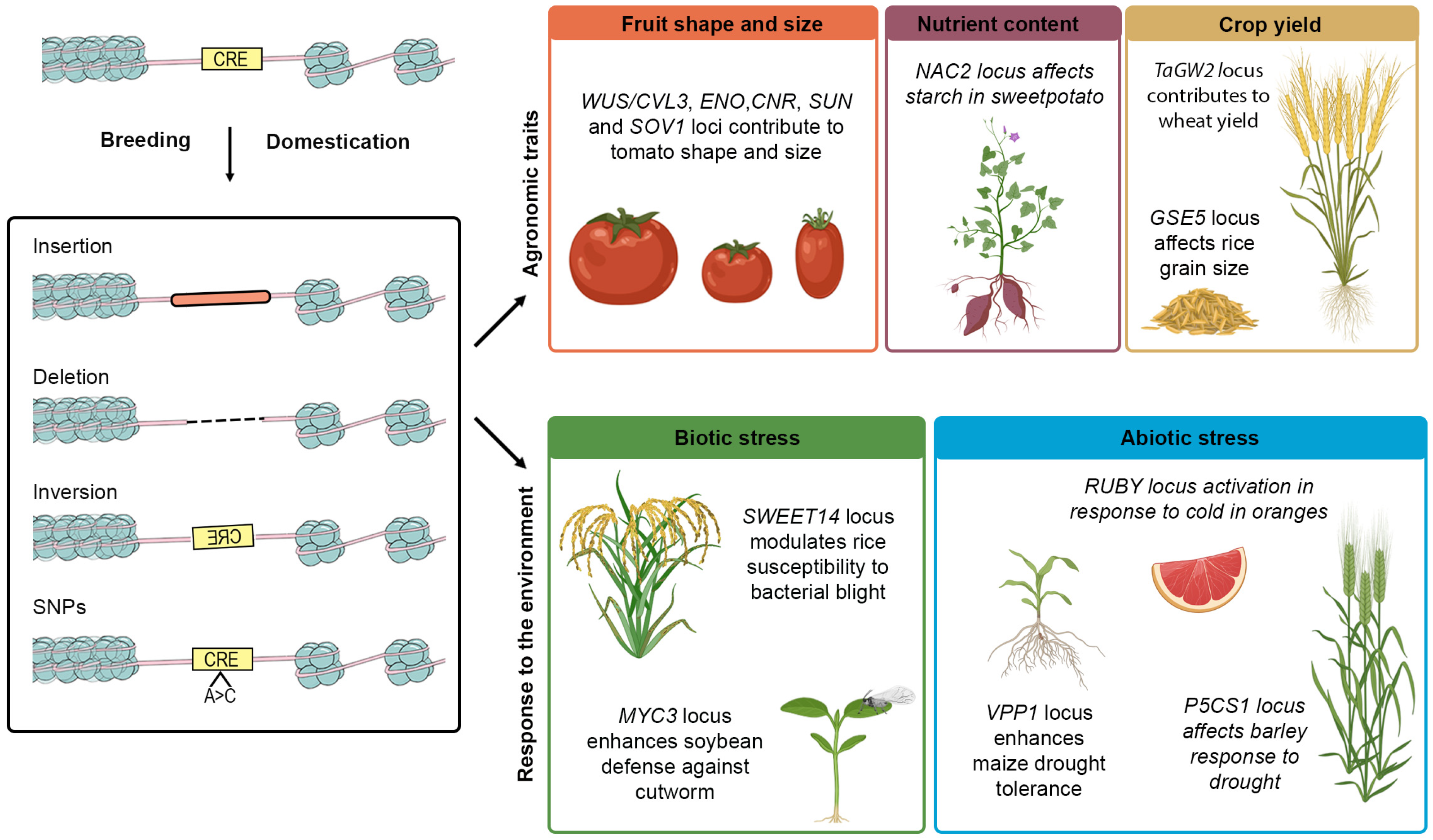
Crop yield represents one of the most complex agronomic traits, resulting from the integration of multiple developmental and physiological processes, including grain size, grain number, plant architecture, and resource allocation efficiency [18]. These components are typically controlled by numerous loci each with small to moderate effects, and their expression is strongly influenced by environmental conditions, making yield a highly polygenic and context-dependent trait [19]. Many quantitative differences are not associated with variations in the coding sequences, but are instead associated with changes in gene expression levels, spatial patterns or developmental timing, often mediated by variation in CREs [13,19]. For example, in maize, almost 40% of phenotypic variation in agronomic traits is attributed to regulatory elements located in intergenic regions [20]. In contrast, in rice, most causative variants are located within coding sequences, whereas promoter regions represent the primary source of mutations among intergenic regions [21]. These variants include Single-Nucleotide Polymorphisms (SNPs), small deletions or insertions (Indels) and structural variants. Among these, SNPs account for approximately 38% of all causative variants identified in the rice genome [21]. The following sections highlight representative functionally validated cases associated with domestication and crop improvement (Table 1, Figure 1). Notably, most of the cases discussed involve promoter SNPs. However, this apparent enrichment may reflect methodological biases in variant discovery and functional validation rather than the true distribution of regulatory variants, highlighting the need for more systematic analyses across species.

2.1.1. Role of CRE Variants in Starch Content and Nutritional Traits

Recent studies have highlighted the importance of natural variation in cis-regulatory regions in controlling yield-related traits in root and tuber crops (Figure 1). For instance, natural allelic variation in the promoter of the NAC transcription factor gene IbNAC22 has been shown to regulate starch accumulation in sweet potatoes [27]. In particular, the presence of specific promoter polymorphisms, including single-nucleotide substitutions and a 13-bp insertion–deletion, resulted in higher transcriptional activity of IbNAC22 in high-starch varieties [27]. This enhanced expression was closely associated with increased starch content and improved yield-related traits in storage roots. Functional analyses demonstrated that overexpression of IbNAC22 significantly increased fresh yield, starch content and amylose proportion, whereas gene knockdown produced the opposite effects, confirming the regulatory role of this locus in controlling starch biosynthesis and productivity [27].

2.1.2. Role of CRE Variants in Determining Fruit Size and Shape in Tomato

Domestication and breeding have shaped tomato fruit morphology, leading to the extensive diversity observed today in cultivated tomato plants. This diversity is largely associated with genetic variation at four major loci: locule number (lc), fasciata (fas), SUN and OVATE [36].
lc and fas are major QTLs contributing to the increase in locule number and fruit size in domesticated tomato, as the result of over proliferation of stem cells in the meristem. lc is a gain-of-function allele associated with two SNPs within a repressor element downstream of tomato WUSCHEL (SlWUS), a plant homeobox gene that promotes cell proliferation [37]. The fas allele is instead associated with an inversion of the promoter of tomato CLAVATA (SlCLV3) [36,37]. Genetic variations at these loci altered the regulatory balance within the WUS–CLV3 feedback loop [24], a conserved mechanism controlling stem cell maintenance in the shoot apical meristem [38]. Both lc and fas mutations lead to an expansion of the SlWUS expression domain during early floral development, resulting in sustained transcriptional activity in carpel primordia and the formation of multilocular, larger fruits [24]. Transcriptomic profiling further revealed that these mutations influence the expression of genes involved in meristem development, cellular organization and metabolic processes, providing mechanistic insight into how regulatory variation can reshape developmental programs and contribute to phenotypic diversification during domestication [24].
While lc and fas are associated with locule number and fruit size, mutations affecting SUN and OVATE loci determine the longitudinal growth of tomato fruits. A 31-kb deletion upstream of the tomato OVATE Family Protein 20 (SlOFP20) gene results in reduced transcriptional activity, which releases repression of the OVATE signaling pathway and promotes longitudinal cell division, ultimately leading to fruit elongation [31]. In another case, a transposition event involving a copia-like retrotransposon relocated the SUN gene to a genomic region downstream of an enhancer-like promoter associated with the DEFENSIN-LIKE PROTEIN 1 (DEFL1) gene. This rearrangement caused ectopic overexpression of SUN in developing fruits and stimulated longitudinal cell expansion, producing elongated fruit phenotypes [34].
How genetic diversity shapes tomato fruit morphology remains an active and productive area of research, continually leading to the identification of new regulators. For instance, nucleotide polymorphisms in the promoter of the CELL NUMBER REGULATOR (CNR) gene modify its transcriptional activity during fruit development and have been associated with the enlarged fruit size observed in cultivated tomato varieties [22]. Similarly, an 85 bp deletion in the promoter of EXCESSIVE NUMBER OF FLORAL ORGANS (ENO) in domesticated tomatoes, relative to wild accessions, reduces gene expression and leads to an increased number of locules, thereby contributing to fruit enlargement [30].
Overall, these studies highlight how variation in CREs plays a central role in shaping tomato fruit morphology during domestication and diversification (Figure 1), by modulating gene expression and organ development.

2.1.3. Role of CRE Variants in Cereals Yield

Grain weight, number, and shape are key agronomic traits in cereals and have been the focus of extensive breeding programs. Over the years, breeding has generated a great genetic reservoir that has been used to identify genetic variants associated with grain phenotypes.
One of the earliest molecular examples linking genetic variation to yield components is represented by the GW5 QTLs in rice, which is widely used by rice breeders as a yield-associated marker. The GW5 locus includes the GSE5 gene, which encodes the rice calmodulin protein OsCaM1-1 [23]. Deletions in the promoter region of GSE5, which arose during rice domestication, modulate its expression and result in differences in grain morphology, producing either longer or rounder grains depending on expression levels. Similarly, Sun et al. identified miR530 as a key regulator of rice yield by modulating grain size and panicle architecture [39]. Analysis of genetic variation across 3024 rice varieties revealed that the miR530 promoter has been subject to artificial selection during breeding, thereby contributing to the extensive grain diversity observed among contemporary rice subpopulations and cultivated varieties [39].
In wheat, SNPs in the promoter of TaGW2 have been linked to variation in grain weight and size, overall affecting final yield [25,26]. TaGW2 encodes a RING-finger E3 ubiquitin ligase that functions in the ubiquitin–proteasome pathway, targeting factors involved in cell proliferation [40]. Notably, TaGW2 is homologous to GW2 in rice and maize, where both its molecular and biological functions are conserved [41,42]. Moreover, TaGW2 has also been linked to responses to both abiotic and biotic stresses, suggesting a role for this factor in balancing the trade-off between stress resilience and yield, one of the major challenges facing modern agriculture [43,44,45].
These findings illustrate how natural variation in promoter regions can modulate gene expression and contribute to quantitative differences in agronomic performance (Figure 1), providing valuable targets for marker-assisted selection and genome editing strategies aimed at improving crop yield and quality.

2.2. Regulatory Mechanisms Underlying Adaptive Plasticity

Plants continuously adjust their growth and development in response to environmental fluctuations, a phenomenon referred to as adaptive plasticity [46]. This capacity relies on the dynamic regulation of gene expression mediated by transcription factors and CREs, which integrate environmental and developmental signals to coordinate plant responses to changing conditions [47]. Variation within regulatory regions can modify transcriptional responses to stress conditions such as drought, temperature extremes or pathogen attack, thereby enhancing plant tolerance and resilience. Increasing evidence indicates that regulatory mutations affecting promoter or enhancer sequences represent a key mechanism enabling crops to adapt to diverse environments and maintain productivity under stress.

2.2.1. Biotic Stresses

A well-characterized example of regulatory variation conferring resistance to biotic stress involves susceptibility (S) genes targeted by transcription activator-like (TAL) effectors from plant pathogenic Xanthomonas species [48] (Figure 1). TAL effectors act as transcription factors that bind specific nucleotide sequences in host promoters to activate S-gene expression and facilitate pathogen infection [32,48]. Exploiting this mechanism, natural polymorphisms in TAL effector binding sites can disrupt pathogen-induced gene activation and confer resistance. For instance, screening of rice germplasm identified a naturally occurring allele of the susceptibility gene OsSWEET14 carrying an 18-bp deletion overlapping TAL effector binding elements in the promoter region. This deletion prevents transcriptional activation of the gene by multiple Xanthomonas oryzae pv. oryzae strains and confers resistance to bacterial blight, illustrating how targeted changes in cis-regulatory sequences can generate durable disease resistance [32].
Adaptive responses to biotic stress can also be mediated by regulatory networks controlling defense signaling pathways. In soybean, the transcription factor GmMYC3 was identified as a key regulator of resistance to herbivory through the activation of downstream defense-related genes, including protease inhibitors that impair insect digestion and development. Sequence variations in the GmMYC3 promoter cause differences in its transcription, affecting plant resistance to the common cutworm without significant penalties in yield or seed quality, highlighting the potential of regulatory variation to balance stress resistance and productivity [29] (Figure 1).

2.2.2. Abiotic Stress

Regulatory variation also plays an important role in plant responses to abiotic stress (Figure 1). In barley, allele mining of the pyrroline-5-carboxylate synthase gene P5CS1 revealed extensive polymorphism within the promoter region, including variation across multiple cis-regulatory elements associated with abscisic acid-dependent and independent stress pathways. These promoter variants were associated with quantitative differences in gene expression, proline accumulation, and drought tolerance. Introgression of a high-expression allele into cultivated backgrounds improved physiological performance and reduced yield loss under drought conditions [28]. Similarly, genome-wide association studies in maize identified natural variation in the promoter of the gene encoding for the vacuolar H+-pyrophosphatase ZmVPP1, where a 366-bp insertion containing MYB-binding cis-elements confers drought-inducible gene expression. Transgenic plants with enhanced ZmVPP1 expression exhibit improved root development and drought tolerance, demonstrating the functional significance of regulatory variation in stress adaptation [33].
Transposable elements represent an additional source of regulatory innovation contributing to adaptive plasticity [49]. In fact, their insertion near genes can introduce novel promoter or enhancer sequences that alter gene expression patterns [49]. A classic example is found in blood oranges, where the insertion of a Copia-like retrotransposon upstream of the RUBY transcription factor gene enables temperature-dependent activation of anthocyanin biosynthesis under cold conditions, leading to the characteristic red pigmentation of the fruit [35]. Such regulatory rearrangements illustrate how mobile genetic elements can generate environmentally responsive phenotypes without altering coding sequences and contribute to adaptive plasticity in plants.

3. Techniques for the Identification of Plant CRE

As described in the previous paragraph, genome-wide association studies have enabled the identification of genetic variants within regulatory sequences, leading to the discovery of key regulatory networks. However, to fully exploit the potential of CREs for crop improvement, a comprehensive prediction and characterization of CREs involved in specific agronomic traits and adaptive responses is essential. This has long been challenging, as CREs are typically short DNA sequences dispersed within large intergenic regions, making their identification difficult.
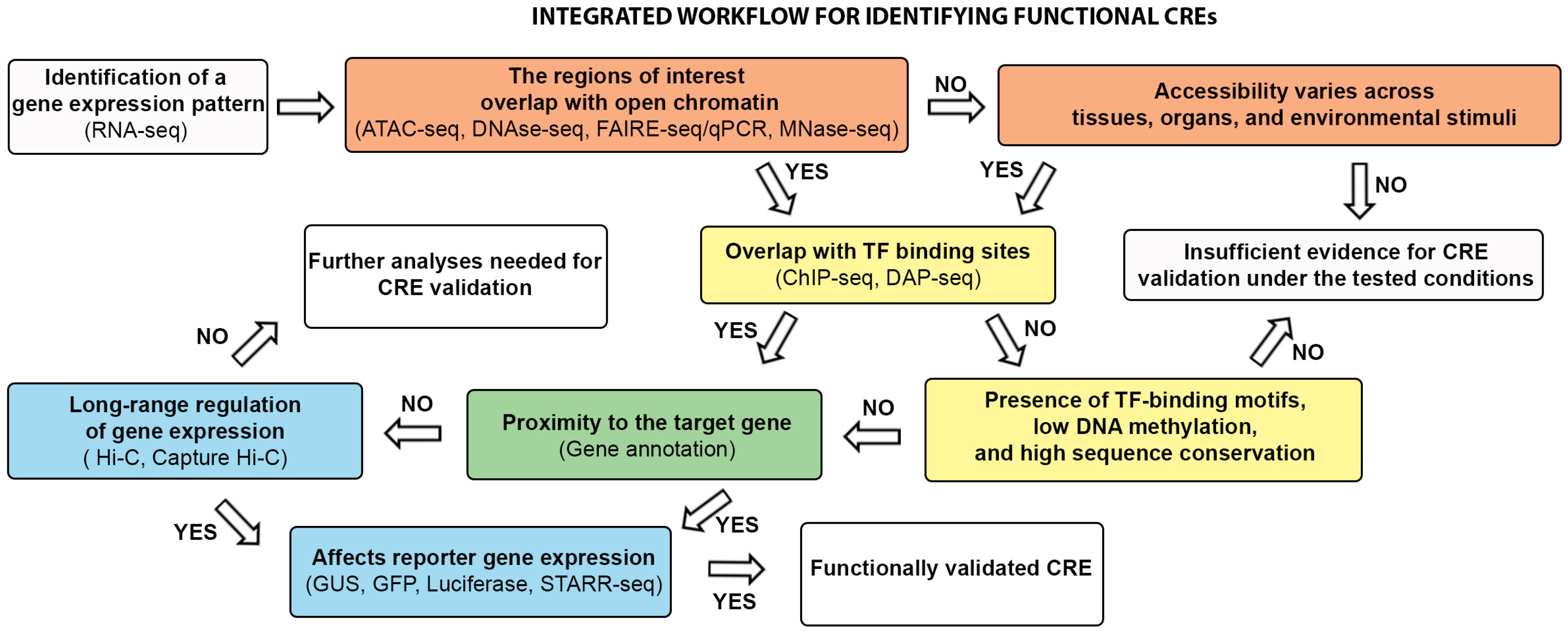
In recent years, the advent of genome-wide technologies for profiling chromatin features has markedly improved our ability to predict and annotate CREs, enabling the generation of increasingly comprehensive regulatory atlases across diverse plant species. Importantly, no single dataset is sufficient to fully define CRE activity; rather, an integrative approach combining chromatin accessibility, three-dimensional genome organization, transcription factor binding profiles, DNA sequence features, and gene expression dynamics is required (Figure 2).
In this section, we review the most recent techniques for the prediction of CREs in plant science.

3.1. Chromatin Accessibility as Hallmark of CREs

One of the characteristics of active CREs is an accessible chromatin conformation given by the lack of nucleosomes. Hence, CREs can be mapped at a genome-wide level using techniques that exploit the ability of DNA-cleaving enzymes (DNAse, MNase, Tn5) to preferentially access nucleosome-depleted regions, coupled with high-throughput sequencing.
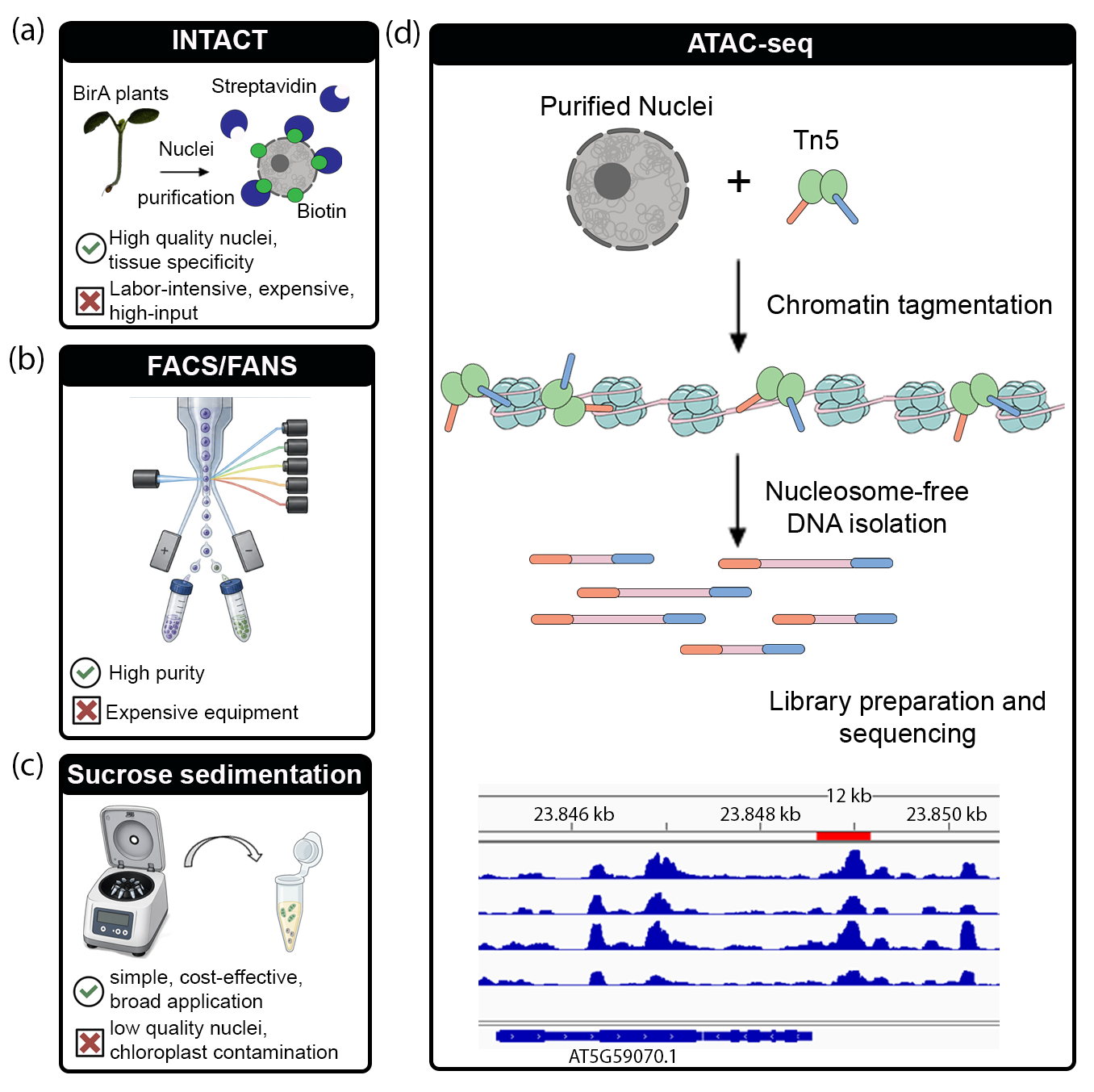
One of the methods that is becoming increasingly popular is ATAC-seq (Assay for Transposase-Accessible Chromatin using sequencing), a high-throughput technique developed to assess chromatin accessibility at high resolution [50]. The method relies on a modified Tn5 transposase pre-loaded with sequencing adapters. When incubated with purified nuclei, the transposase preferentially inserts these adapters into regions of open chromatin while simultaneously fragmenting the DNA. This process generates a sequencing-ready library enriched for accessible genomic regions (Figure 2). Given the minimal processing steps, ATAC-seq is considered a rapid and robust method for profiling chromatin accessibility with high resolution.
In addition to short fragments corresponding to nucleosome-free regions, mono-, di-, and tri-nucleosome-sized fragments can also be observed. Typically, 50 M reads in the sequencing are used for mapping nucleosome conformation, but with 200 M reads it is also possible to profile TFs binding sites [50,51].
A critical limiting step is the preparation of clean and intact nuclei. This is particularly challenging in plant tissues, especially those rich in chloroplasts. The chloroplast genome lacks nucleosomes and, hence, is highly accessible, sequestering most of the Tn5 and resulting in an under-tagmentation of nuclear DNA. To overcome this issue, several protocols have been developed to improve nuclei purification for plant ATAC-seq experiments. One approach is INTACT (Isolation of Nuclei Tagged in specific Cell Types), a streptavidin-based purification system in which nuclei are biotinylated and subsequently isolated using streptavidin-conjugated beads (Figure 3a). This is achieved by expressing the BirA gene and peptide biotinylated by BirA fused to a protein of the nuclear envelope. Using tissue-specific promoters is possible to purify nuclei from specific cells by obtaining tissue-specific data [52]. This method yields high-quality nuclei that are well suited for Tn5-mediated tagmentation, also because gentle lysis buffers are used during tissue lysis, helping to preserve nuclear integrity. However, the protocol is labor-intensive, requires expensive reagents, and several milligrams of starting tissue are needed. Moreover, the generation of transgenic lines represents a significant limitation in many crop species, as transformation protocols are often inefficient or not fully established. In addition, in species with long life cycles, the time required to produce stable transgenic lines can represent a real limiting factor. To avoid the need of transgenic line production, alternative approaches such as fluorescence-activated nuclei sorting (FANS/FACS) [9] (Figure 3b) or nuclei purification by sucrose gradient sedimentation (Figure 3c) have also been successfully applied to ATAC-seq [51]. However, both methods present advantages and limitations.
Sucrose gradient sedimentation is relatively simple, cost-effective, and applicable to virtually all plant species. Nevertheless, the procedure may compromise nuclear integrity and does not always ensure complete removal of chloroplast contamination. As a result, sequencing libraries may exhibit higher background levels due to chloroplast DNA, a problem that can be partially overcome by increasing sequencing depth.
In contrast, fluorescence-activated nuclei sorting generally yields highly pure and intact nuclei, making it particularly well suited for ATAC-seq applications. However, this approach requires access to expensive instrumentation and trained personnel, which may limit its accessibility. Although most ATAC-seq protocols are performed using around 50,000 cells, the method can be efficiently scaled down to as few as 500 nuclei and further adapted for single-cell applications. Single-cell ATAC-seq (scATAC-seq) has become a powerful tool for investigating chromatin accessibility, which plays a central role in defining cell identity by regulating the transcriptional programs that drive cellular differentiation and function [53].
As an alternative to the enzyme-based technique, there is the FAIRE-seq, where tissue is fixed by formaldehyde to preserve the nucleosome-DNA linking [54,55]. The formaldehyde can be used on both frozen and fresh tissue. After fixation, the purified chromatin is sonicated to obtain fragments in a range of 200–700 bp and purified by phenol–chloroform or columns. By this step, only the nucleosome-free DNA will be purified, while the one bound by protein is lost during purification. Then, the DNA can be used for library preparation and subsequently sequence. Alternatively, the abundance of nucleosome-free DNA can be assessed by qPCR by using gene-specific primers and test genomic loci of interest [10].
Although this method is generally considered less suitable for sequencing-based experiments than enzyme-based approaches, it should still be taken into consideration. It is relatively easy to implement, cost-effective, and adaptable to a wide range of plant materials, by optimizing the fixation and sonication steps. Hence, when designing a chromatin accessibility experiment, multiple factors must be carefully considered to select the most appropriate method.
Once sequencing data have been generated, accessible chromatin regions can be mapped across the genome and associated with nearby genes. However, chromatin accessibility alone is generally insufficient to define a functional CRE. To identify regulatory elements associated with specific transcriptional programs, chromatin accessibility profiles are often integrated with RNA-seq data, allowing the identification of accessible regions associated with genes displaying coordinated expression patterns. Furthermore, differential accessibility analyses performed across developmental stages, tissues, or environmental conditions can reveal dynamically regulated CREs whose accessibility correlates with changes in gene expression. Candidate CREs can then be further prioritized through the integration of additional layers of information, that are going to be discussed in the following paragraphs.

3.2. Integrating TFs Binding Profiling and DNA Features for CRE Prediction

While chromatin accessibility profiling provides a powerful approach for identifying candidate CREs, additional evidence is required for determining functional CREs. One of the most informative sources of evidence is the characterization of TF binding sites, as CREs exert their regulatory activity through the recruitment of specific TFs. Indeed, accessible chromatin regions frequently overlap with TF binding sites, and the integration of chromatin accessibility data with TF occupancy profiles can substantially improve CRE annotation and functional prediction.
In contrast to chromatin accessibility, TF binding is often highly dynamic and transient, which makes its characterization more challenging. The most widely used technique to study TF binding is chromatin immunoprecipitation followed by sequencing (ChIP-seq). In ChIP-seq, the transcription factor of interest is immunoprecipitated by using a specific antibody, and the DNA bound by it is then sequenced. In plants, however, high-quality antibodies with low backgrounds are often unavailable [56]. In such cases, transgenic lines expressing the TF fused to an epitope tag can be used. Nevertheless, as mentioned earlier, the generation of transgenic lines in crops can be challenging; therefore, DNA affinity purification sequencing (DAP-seq) represents a valuable alternative [57].
In DAP-seq, the TF of interest is produced in vitro as a tagged protein and incubated with fragmented genomic DNA extracted from the species of interest. TF–DNA complexes are then isolated via affinity purification, and the bound DNA is sequenced to determine the TF binding profile. Although DAP-seq is an in vitro technique, it provides robust and reproducible data and is readily applicable across a wide range of plant species.
However, in both approaches, the analysis is typically limited to one or a small subset of TFs. Therefore, selecting candidate TFs requires preliminary analysis. First, gene expression profiling under relevant conditions or in specific tissues can be used to identify genes with informative expression patterns. Subsequently, co-expressed or co-regulated gene sets can be analyzed to identify enriched TF binding motifs. Finally, TFs associated with significantly enriched motifs can be used for experimental validation using ChIP-seq or DAP-seq.
Many web-based tools are available to scan genes for transcription factor binding sites and to characterize transcriptional regulatory networks. Among these, PlantRegMap [57,58,59] represents one of the most comprehensive resources. It integrates a wide range of algorithms and enables the analysis of datasets from multiple agronomically relevant plant species through a user-friendly interface, making it accessible even to researchers without extensive bioinformatics expertise. One of the tools provided by PlantRegMap is FunTFBS [59], which focuses on identifying transcription factor binding sites with potential regulatory functions. This approach predicts functional binding sites based on the relationship between motif occurrence frequency and sequence conservation scores across different plant species. Conservation is assessed using the PhyloP conservation score [60,61], which measures evolutionary conservation at the nucleotide level across multiple species. This approach relies on the assumption that functional regulatory sequences, particularly in intergenic regions, tend to be more conserved than the surrounding non-functional sequences [62].
However, aligning intergenic regions across distantly related plant species is challenging due to extensive structural variation and rapid sequence divergence during evolution. This limitation has been recently addressed by a novel algorithm called Conservatory, which enabled the identification of over two million conserved non-coding sequences across approximately 300 million years of plant diversification [63]. These deeply conserved non-coding sequences likely represent core regulatory elements essential for gene expression programs during plant development, while surrounding less conserved regions contribute to regulatory flexibility and evolutionary innovation. Nevertheless, not all functional TF binding sites are evolutionarily conserved, and motif-based predictions may therefore include false positives, highlighting the importance of validation using complementary experimental approaches.
Another important layer of information for CRE identification is DNA methylation. In plants, active regulatory regions are often associated with reduced DNA methylation levels, whereas highly methylated regions generally display lower chromatin accessibility and reduced transcription factor occupancy. Consequently, DNA methylation profiling, traditionally performed through whole-genome bisulfite sequencing, can be integrated with chromatin accessibility and transcription factor binding data to identify active CREs [64].
Recent advances in long-read sequencing technologies, based on Oxford Nanopore, enable direct detection of DNA methylation without chemical conversion. For example, Simultaneous Accessibility and DNA Methylation Sequencing (SAM-seq) was recently applied to Arabidopsis and maize, allowing the concurrent profiling of chromatin accessibility and DNA methylation status across the genome [65]. Such integrated approaches provide a more comprehensive view of the regulatory landscape and improve the identification and annotation of functional CREs.
Therefore, the combined analysis of chromatin accessibility, transcription factor occupancy, DNA methylation, sequence conservation, and chromatin interaction data provides a robust framework for the identification and functional characterization of plant CREs.

3.3. Assays for Functional Activity of CREs

Once candidate CREs have been identified, their regulatory activity must be experimentally validated. One of the most widely used approaches relies on reporter gene assays, in which candidate regulatory sequences are cloned upstream of a reporter gene such as GFP, GUS, or luciferase. The choice of reporter depends on the biological question being addressed: GFP and GUS reporters are particularly useful for characterizing tissue- and cell-specific expression patterns, whereas luciferase-based systems enable rapid and quantitative measurements of transcriptional activity.
An interesting technique, for testing the activity of multiple enhancers is called Self-Transcribing Active Regulatory Region Sequencing (STARR-seq), which is a massively parallel enhancer reporter assay that allows large libraries of candidate CREs to be screened simultaneously [66,67]. In this approach, genomic fragments, that can be potentially selected from accessible chromatin regions, are incorporated into reporter constructs containing a minimal promoter. The activity of the enhancer candidates can be quantified through high-throughput sequencing of reporter transcripts. This strategy makes it possible to assess the regulatory activity of multiple candidate CREs in a single experiment. However, despite its potential in the identification of functional enhancers, STARR-seq has some limitations. Enhancer activity is often dependent on its native genomic context and position relative to target genes. Because candidate sequences are tested outside their endogenous chromosomal environment, the assay may not fully recapitulate their physiological activity.
Another major challenge in CRE biology is the identification of the target genes regulated by distal regulatory elements, which may be located several kilobases away from their target promoters; therefore, genomic proximity alone is often insufficient to assign CRE–gene relationships. Hence, chromosome conformation capture-based methods, including Hi-C and related techniques such as Capture Hi-C, can be used to identify physical interactions between distal CREs and target promoters through chromatin looping [68,69]. The integration of functional reporter assays with chromatin interaction data provides a powerful framework for validating CRE activity and establishing causal links between regulatory elements and gene expression.

3.4. Computational Prediction of CREs Based on Deep Learning Models

Although experimental approaches remain indispensable for the identification and validation of CREs, deep learning models are increasingly being used to predict the regulatory potential of DNA sequences. For instance, DeepSEA [70] and AlphaGenome [71] are trained on large-scale genomic datasets, including chromatin accessibility, histone modification, and transcription factor binding profiles. These models can predict the consequences of sequence variants on gene expression and prioritize candidate CREs for further experimental investigation. While their applications have so far been largely focused on human genomes, their translation to crop species could facilitate the identification of CREs associated with agronomic traits of interest.

4. Genome Editing of cis-Regulatory Elements for Crop Enhancement

The integration of multiple genome-wide approaches can generate an extensive atlas of predicted CREs in the plant of interest. However, genetic validation remains essential to fully elucidate the functional relationships between CREs, agronomic traits, and adaptive features. This validation can be pursued through two main strategies. One is classical forward genetic screening, which can be performed in plants by random mutagenesis or by comparing varieties originating from different breeding programs; the other is precise genome editing. While earlier techniques, such as TALEN, could be used for this purpose, here we discuss the CRISPR-based methods which are the most powerful tools for the precise, versatile, and efficient editing of regulatory regions. Recent reviews provide an exhaustive description of this method for editing engineering in crops [72,73,74,75], hence here we only summarize those relevant for the CREs and the transcriptional control of agronomic traits.
The classical CRISPR-based mutagenesis approach uses a Cas9 nuclease, which produces DNA double strand break (DSB) in the DNA sequence complementary to a gRNA, which is designed to target the desired site to mutagenize, with the only limitation of the presence of the protospacer-adjacent motif (PAM). The DSB is then repaired by the Non-Homologous End Joining (NHEJ) endogenous mechanism, which is error-prone, and hence it produces Indels in the targeted sequence. Hence, this can be used to produce mutations inside the CRE of interest, which, for example, could disrupt the binding site of a TF, and hence change the expression output of a gene. In recent years, the CRISPR-based genome editing toolbox has expanded considerably, with the development of Cas variants recognizing different PAM sequences, thus broadening the range of targetable genomic loci. Larger deletions of regulatory regions can be achieved by using two or more gRNAs targeting sequences flanking the CRE. CRISPR systems based on Cas12 are particularly useful in this context, as they can generate deletions of approximately 5–30 bp and allow the use of compact guide RNA arrays, facilitating multiplex genome editing. Indeed, by employing multiple sgRNAs, several CREs can be targeted simultaneously, enabling the coordinated modulation of genes with redundant functions or similar expression patterns [76,77].
The work from Lippman’s group provides a beautiful example of how CRISPR-based approaches can be used to engineer regulatory regions and modulate quantitative agronomic traits in tomato plants. They targeted the regulatory regions of SlCLV3 and SlWUS, the two genes, already mentioned as key determinants of fruit size in domesticated tomato. Mutations generated either randomly or through targeted editing of conserved cis-regulatory sequences in these loci produced allelic variants affecting fruit locule number [78,79]. Beyond its clear applications in crop improvement, these works also reveal the additive, synergistic, and redundant interactions among CREs, highlighting the complex regulatory architecture of intergenic regions. Similarly, Hu et al. successfully generated fruits with altered shapes in Capsella rubella, a Brassicaceae species with a characteristic heart-shaped fruit that is widely used as a model for studying organ development. In this case, CRISPR–Cas9 was used to target the promoter of SHOOT MERISTEMLESS (STM), which encodes a transcription factor involved in meristem determination, generating multiple alleles that produced a range of fruit morphologies and STM expression patterns [80].
However, one of the primary goals of modern breeding is to improve cereal yield, as cereals constitute the main staple food worldwide. As described earlier, numerous genetic variants associated with grain yield have been selected during domestication and breeding. In principle, this makes these loci attractive targets for genome editing to further enhance yield. However, this approach is not straightforward, because these loci often exhibit pleiotropic effects, leading to significant trade-offs between growth and other important traits, such as nutritional content, biomass and defense mechanisms. Moreover, in rice, the three traits that contribute to final yield, tillers number, number of grains per panicle and grain size are inversely related. Hence, Song and co-authors proposed to edit the regulatory region of IDEAL PLANT ARCHITECTURE (IPA1), encoding a SQUAMOSA promoter binding protein-like (SPL) transcription factor OsSPL14, a master regulator of rice development with pleiotropic effect [81]. The deletion of 54 bp by a CRISPR/Cas9 approach in the promoter of IPA1 increases both tiller number and panicle weight, increasing the final yield [81]. This study illustrates how targeting regulatory regions rather than coding sequences can fine-tune gene expression to reduce pleiotropy and trade-off effects, offering a valuable strategy for plant breeding.
Another important aspect of crops is the nutritional content of seeds, which can also be enhanced through genome editing. Wang and colleagues deleted the binding sites for the transcriptional repressors WRKY and RAV1 in the NF-YC4 promoter. This resulted in increased NF-YC4 expression, leading to enhanced protein content in both rice and soybean [82]. This work not only highlights the critical role of NF-YC4 in determining seed quality and quantity but also underscores the importance of WRKY and RAV1 transcription factors, which are involved in multiple developmental processes and in balancing plant responses to environmental stresses [83,84,85,86].
Even though all these approaches lead to very promising results, a major limitation is that the indels generated are stochastic and heterogeneous, requiring the screening of multiple independent lines to identify mutations that effectively alter gene expression. Hence, to overcome these problems, different tools have been developed for precise genome editing. For example, base editors can be used to generate nucleotide substitutions without DSB. This is obtained by fusing an inactivated version of the Cas9 to a DNA deaminase, driving C to T transition (cytosine base editors) or A to G transition (adenine base editor). Many base editors’ systems have been studied in plants for various base substitutions; however, the main challenges remain the off-targets problem and the sequence-context dependence [87,88].
Despite these limitations, base editing represents a powerful approach for the study and manipulation of CREs. Indeed, TF binding is highly sequence-specific; therefore, minimal but precise changes within DNA motifs can significantly alter CRE activity. For example, this concept could be applied to PHYTOCHROME-INTERACTING FACTORs (PIFs), a well-characterized family of transcription factors for which extensive studies on DNA motif recognition have been conducted. PIFs are particularly interesting because they integrate multiple environmental signals into specific physiological responses, including seed germination, cell elongation, flowering, and senescence. Owing to their conserved presence across plant species and their central regulatory role, PIFs represent a valuable target for crop improvement, especially in the context of enhancing plant responses to environmental cues [89,90]. PIFs belong to the bHLH family and recognize G-box, PBE-box, and E-box motifs with different affinities. The G-box core sequence consists of six nucleotides (5′-CACGTG-3′), which is preferentially recognized by Arabidopsis PIF4, PIF5, and PIF7. Substitutions of the central CG dinucleotide strongly affect PIF binding, with variants such as the E-box (e.g., CAAGTG) displaying lower binding affinity [91,92]. Therefore, targeted modifications of PIF-binding motifs in specific genes could be exploited to modulate plant responses to environmental conditions, highlighting the potential of base editing for the rational engineering of CREs in crop improvement.
Other CRISPR-based strategies include knock-in approaches, which enable the insertion of specific sequences at defined genomic loci. Using these methods, novel CREs can be introduced into promoters to enhance gene expression. Although their efficiency is still relatively low, particularly in dicot species, these approaches are highly promising due to their specificity and potential applicability in crop improvement. As an alternative approach, prime editing has recently emerged as a powerful tool for the precise engineering of CREs in both monocots and dicots. Prime editing uses a prime-editing guide RNA (pegRNA) to direct a Cas9 nickase fused to a reverse transcriptase to the DNA target. The pegRNA functions as both a guide and a template to generate up to 12-nucleotide substitutions, insertions, or deletions in the desired DNA sequence. This system was used to edit heat-shock elements in the promoters of cell-wall-invertase genes, for enhancing carbon partitioning to rice grain and tomato fruit, without losing crop quality [93,94]. Importantly, the CRISPR toolbox extends far beyond the generation of targeted mutations. Technologies such as CRISPR-mediated transcriptional regulation, achieved by fusing a catalytically inactive Cas9 to transcriptional activators or repressors, or epigenetic modifications, offer the possibility to fine-tune gene expression without altering the underlying DNA sequence.
Thus, CRISPR-based editing of CREs provides a wide range of opportunities for precise crop improvement; however, a thorough understanding of transcription factor binding sites and CRE organization is required to fully exploit these approaches for crop genetic enhancement.

5. Discussion

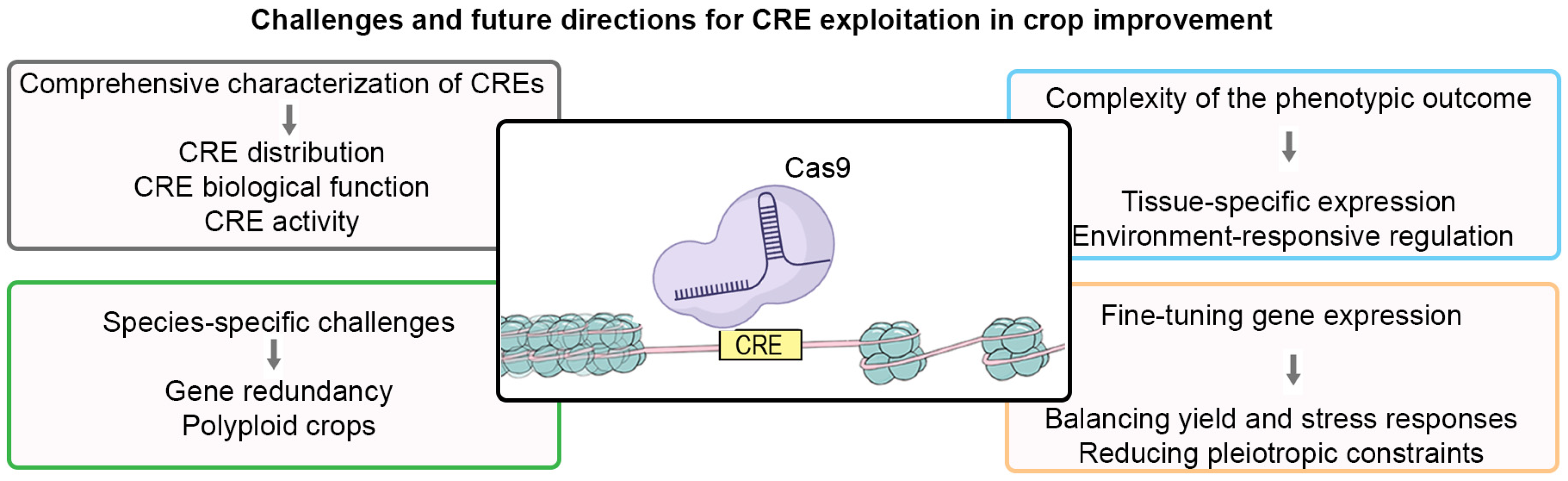
Over the centuries, traditional breeding programs have been used to select crop varieties with desirable agronomic traits, ranging from improved nutritional content to enhanced yield. More recently, precision breeding and transgenic approaches have emerged as powerful alternatives to accelerate this process. In this context, targeting CREs, rather than coding sequence by the CRIPSR-Cas9, offers the advantage of fine-tuning gene expression without altering protein function, thereby enabling subtle and precise modulation of plant traits (Figure 4).
However, fully exploiting CREs for crop improvement remains a major challenge and requires a comprehensive understanding of their distribution, function, and regulatory activity. Mutations in regulatory regions do not always produce predictable genotype-to-phenotype outcomes, and a linear relationship between CRE variation and gene expression is often lacking. Moreover, the same cis-regulatory variant can elicit distinct responses depending on the tissue type, developmental stage, or environmental conditions, making its effects difficult to predict and generalize.
Addressing this complexity requires integrative experimental frameworks that combine genome-wide mapping of regulatory elements with rigorous functional validation. Such efforts demand long-term research programs involving the integration of multiple omics technologies, including genomics, transcriptomics, epigenomics, and chromatin accessibility analyses. These approaches are not only costly and technically demanding but also require highly specialized expertise spanning several disciplines, including molecular biology, genetics, bioinformatics, and computational biology. Consequently, despite the enormous potential of CRE-based crop engineering, translating regulatory knowledge into predictable breeding outcomes remains a significant bottleneck.
Moreover, the achievement of this goal necessitates comparative analyses across plant species, as CRE function and regulatory organization can be highly species-specific. A major constraint is represented by polyploid crop species, such as wheat, where gene redundancy and homologous interactions can buffer the phenotypic effects of individual mutations. In such genomes, multiple gene copies often share partially overlapping regulatory networks, complicating the establishment of direct genotype–phenotype relationships [95]. Future research should therefore focus on dissecting regulatory interactions among homologous genes and identifying CREs with consistent effects across different genetic backgrounds, which will be essential for their reliable deployment in breeding programs targeting complex traits.
Another major challenge is to fine-tune gene responses to stress while maintaining or improving yield, as the activity of regulatory sequences is highly context-dependent and influenced by environmental conditions. This is particularly relevant in the context of climate change and the increasing frequency of environmental stressors that threaten crop productivity, further emphasizing the importance of genotype-by-environment interactions in shaping agronomic performance. Targeting CREs represents a promising strategy to modulate gene expression in a precise and context-dependent manner; however, further efforts are needed to fully characterize the effects of environmental stressors on yield-related loci.
Together, the successful exploitation of CREs will depend on our ability to integrate regulatory genomics with predictive and environmental-aware breeding strategies.

6. Conclusions

CREs have emerged as central determinants of phenotypic diversity and agronomic performance in crop species. Accumulating evidence indicates that variation in regulatory regions plays a fundamental role in shaping quantitative traits such as yield components, plant architecture, and stress tolerance by modulating gene expression rather than altering protein function. This regulatory flexibility enables gradual phenotypic adjustments that can be maintained during selection and exploited in breeding programs. Consequently, CRE variation represents a key molecular mechanism linking crop productivity to environmental adaptation. Advances in genomics and functional biology have substantially improved our ability to identify and characterize CREs across diverse plant genomes. Integrative multi-omics approaches combining chromatin accessibility profiling, transcription factor binding analysis, three-dimensional chromatin organization, and transcriptomic data are progressively enabling the construction of high-resolution regulatory maps. These datasets provide an essential framework for understanding how gene regulatory networks respond to developmental and environmental signals and for identifying regulatory targets associated with desirable agronomic traits.

Author Contributions

Conceptualization, writing—original draft preparation, writing—review and editing, funding acquisition: A.B.; writing—review and editing, writing—original draft preparation: B.P., M.M. and S.C.; writing—original draft preparation, writing—review and editing, funding acquisition: L.D.G. All authors have read and agreed to the published version of the manuscript.

Funding

This research was funded by Italian Ministry of University and Research (MUR) under the “Young Researchers MSCA 2024” program, grant number MSCA2024_83, “Prediction and characterization of salt responsive cis-Regulatory Elements (SaltCRE)”.

Data Availability Statement

No new data were created or analyzed in this study.

Acknowledgments

Images were created in Adobe Photoshop 2021 (version 22.1.1; Adobe Inc., San Jose, CA, USA). We are thankful to Christian Fankhauser and Riccardo Lorrai for the fruitful discussion during the preparation of the manuscript.

Conflicts of Interest

The authors declare no conflicts of interest.

Abbreviations

The following abbreviations are used in this manuscript:
CREcis-regulatory elements
TFTranscription factor
ChIP-seqChromatin immunoprecipitation sequencing
DAP-seqDNA Affinity Purification Sequencing
ATAC-seqAssay for Transposase-Accessible Chromatin using Sequencing
INTACTIsolation of Nuclei Tagged in Specific Cell Types
CRISPRClustered Regularly Interspaced Short Palindromic Repeats
PIFPhytochrome Interactin Protein
bHLHBasic helix–loop–helix
IPA1Ideal Plant Architecture 1
SPLSquamosa-Promoter-Binding Protein-Like
STMShoot Meristemless
FACS/FANSFluorescence-Activated Nuclei Sorting
CLV3Clavata3
WUSWuschel
PAMProtospacer-Adjacent Motif
DSBDouble Strand Break
NHEJNon-Homologous End Joining
FAIRE-seqFormaldehyde-Assisted Isolation of Regulatory Elements sequencing
qPCRQuantitative Polymerase Chain Reaction
MNase-seqMicrococcal Nuclease Sequencing
DNase-seqDNase I hypersensitive sites sequencing
QTLsQuantitative Trait Locus
LcLocule Number
FasFasciata
SlOFP20OVATE family protein 20
CNRCell Number Regulator
ENOEXCESSIVE NUMBER OF FLORAL ORGANS ENO
DEFL1DEFENSIN-LIKE PROTEIN 1
GW5Grain Weight 5
GW2Grain Weight 2
TAL-effectortranscription activator-like
P5CS1Pyrroline-5-Carboxylate Synthase
Vpp1Vacuolar H+-Pyrophosphatase
TSSTranscription Starting Site
STARR-seqSelf-Transcribing Active Regulatory Region Sequencing
GFPGreen Fluorescent Protein
SAM-seqSimultaneous Accessibility and DNA Methylation Sequencing
pegRNAprime-editing guide RNA
SNPsSingle-Nucleotide Polymorphisms

References

  1. Schmitz, R.J.; Grotewold, E.; Stam, M. Cis-Regulatory Sequences in Plants: Their Importance, Discovery, and Future Challenges. Plant Cell 2022, 34, 718–741. [Google Scholar] [CrossRef] [PubMed]
  2. Klemm, S.L.; Shipony, Z.; Greenleaf, W.J. Chromatin Accessibility and the Regulatory Epigenome. Nat. Rev. Genet. 2019, 20, 207–220. [Google Scholar] [CrossRef] [PubMed]
  3. Tao, Z.; Shen, L.; Gu, X.; Wang, Y.; Yu, H.; He, Y. Embryonic Epigenetic Reprogramming by a Pioneer Transcription Factor in Plants. Nature 2017, 551, 124–128. [Google Scholar] [CrossRef] [PubMed]
  4. Jin, R.; Klasfeld, S.; Zhu, Y.; Fernandez Garcia, M.; Xiao, J.; Han, S.-K.; Konkol, A.; Wagner, D. LEAFY Is a Pioneer Transcription Factor and Licenses Cell Reprogramming to Floral Fate. Nat. Commun. 2021, 12, 626. [Google Scholar] [CrossRef] [PubMed]
  5. Lai, X.; Blanc-Mathieu, R.; Grand Vuillemin, L.; Huang, Y.; Stigliani, A.; Lucas, J.; Thévenon, E.; Loue-Manifel, J.; Turchi, L.; Daher, H.; et al. The LEAFY Floral Regulator Displays Pioneer Transcription Factor Properties. Mol. Plant 2021, 14, 829–837. [Google Scholar] [CrossRef] [PubMed]
  6. Xu, X.; Neumann, M.; Carew, F.; Chen, P.; Braeuning, C.; Zubieta, C.; Muino, J.M.; Smaczniak, C.; Kaufmann, K. AP1 Is a Pioneer Transcription Factor That Programmes Cell Fate through MADS-Domain Protein Tetramerisation. Genome Biol. 2025, 26, 418. [Google Scholar] [CrossRef] [PubMed]
  7. Yamaguchi, N. LEAFY, a Pioneer Transcription Factor in Plants: A Mini-Review. Front Plant Sci. 2021, 12, 701406. [Google Scholar] [CrossRef] [PubMed]
  8. Shukla, V.; Axelsson, E.; Hisanaga, T.; Haseloff, J.; Berger, F.; Romani, F. Chromatin State Architecture Governs Transcription Factor Accessibility across Plant Genomes. PLoS Genet. 2026, 22, e1012015. [Google Scholar] [CrossRef] [PubMed]
  9. Lu, Z.; Hofmeister, B.T.; Vollmers, C.; DuBois, R.M.; Schmitz, R.J. Combining ATAC-Seq with Nuclei Sorting for Discovery of Cis-Regulatory Regions in Plant Genomes. Nucleic Acids Res. 2017, 45, e41. [Google Scholar] [CrossRef] [PubMed]
  10. Paulišić, S.; Boccaccini, A.; Dreos, R.; Ambrosini, G.; Guex, N.; Benstein, R.M.; Schmid, M.; Fankhauser, C. Transcriptional Dynamics and Chromatin Accessibility in the Regulation of Shade-Responsive Genes in Arabidopsis. Genome Biol. 2025, 26, 422. [Google Scholar] [CrossRef] [PubMed]
  11. Maher, K.A.; Bajic, M.; Kajala, K.; Reynoso, M.; Pauluzzi, G.; West, D.A.; Zumstein, K.; Woodhouse, M.; Bubb, K.; Dorrity, M.W.; et al. Profiling of Accessible Chromatin Regions across Multiple Plant Species and Cell Types Reveals Common Gene Regulatory Principles and New Control Modules. Plant Cell 2018, 30, 15–36. [Google Scholar] [CrossRef] [PubMed]
  12. Lu, Z.; Marand, A.P.; Ricci, W.A.; Ethridge, C.L.; Zhang, X.; Schmitz, R.J. The Prevalence, Evolution and Chromatin Signatures of Plant Regulatory Elements. Nat. Plants 2019, 5, 1250–1259. [Google Scholar] [CrossRef] [PubMed]
  13. Marand, A.P.; Eveland, A.L.; Kaufmann, K.; Springer, N.M. Cis -Regulatory Elements in Plant Development, Adaptation, and Evolution. Annu. Rev. Plant Biol. 2023, 74, 111–137. [Google Scholar] [CrossRef] [PubMed]
  14. Butler, J.E.F.; Kadonaga, J.T. The RNA Polymerase II Core Promoter: A Key Component in the Regulation of Gene Expression. Genes Dev. 2002, 16, 2583–2592. [Google Scholar] [CrossRef] [PubMed]
  15. Lee, H.; Kang, D.H.; Seo, P.J. Enhancer Elements in Plants: Genomic Context and Biological Functions. J. Plant Biol. 2025, 68, 93–105. [Google Scholar] [CrossRef]
  16. Wittkopp, P.J.; Kalay, G. Cis-Regulatory Elements: Molecular Mechanisms and Evolutionary Processes Underlying Divergence. Nat. Rev. Genet. 2011. [Google Scholar] [CrossRef] [PubMed]
  17. de Bruijn, S.; Angenent, G.C.; Kaufmann, K. Plant ‘Evo-Devo’ Goes Genomic: From Candidate Genes to Regulatory Networks. Trends Plant Sci. 2012, 17, 441–447. [Google Scholar] [CrossRef] [PubMed]
  18. Gasparis, S.; Miłoszewski, M.M. Genetic Basis of Grain Size and Weight in Rice, Wheat, and Barley. Int. J. Mol. Sci. 2023, 24, 16921. [Google Scholar] [CrossRef] [PubMed]
  19. Li, T.; Zeng, W.; Zhu, F.; Lü, P. Cis-Regulatory Elements: Systematic Identification and Horticultural Applications. aBIOTECH 2025, 6, 510–527. [Google Scholar] [CrossRef] [PubMed]
  20. Rodgers-Melnick, E.; Vera, D.L.; Bass, H.W.; Buckler, E.S. Open Chromatin Reveals the Functional Maize Genome. Proc. Natl. Acad. Sci. USA 2016, 113, E3177–E3184. [Google Scholar] [CrossRef] [PubMed]
  21. Wei, X.; Qiu, J.; Yong, K.; Fan, J.; Zhang, Q.; Hua, H.; Liu, J.; Wang, Q.; Olsen, K.M.; Han, B. A Quantitative Genomics Map of Rice Provides Genetic Insights and Guides Breeding. Nat. Genet. 2021, 53, 243–253. [Google Scholar] [CrossRef] [PubMed]
  22. Beauchet, A.; Gévaudant, F.; Gonzalez, N.; Chevalier, C. In Search of the Still Unknown Function of FW2.2/CELL NUMBER REGULATOR, a Major Regulator of Fruit Size in Tomato. J. Exp. Bot. 2021, 72, 5300–5311. [Google Scholar] [CrossRef] [PubMed]
  23. Duan, P.; Xu, J.; Zeng, D.; Zhang, B.; Geng, M.; Zhang, G.; Huang, K.; Huang, L.; Xu, R.; Ge, S.; et al. Natural Variation in the Promoter of GSE5 Contributes to Grain Size Diversity in Rice. Mol. Plant 2017, 10, 685–694. [Google Scholar] [CrossRef] [PubMed]
  24. Chu, Y.-H.; Jang, J.-C.; Huang, Z.; van der Knaap, E. Tomato Locule Number and Fruit Size Controlled by Natural Alleles of Lc and Fas. Plant Direct 2019, 3, e00142. [Google Scholar] [CrossRef] [PubMed]
  25. Jaiswal, V.; Gahlaut, V.; Mathur, S.; Agarwal, P.; Khandelwal, M.K.; Khurana, J.P.; Tyagi, A.K.; Balyan, H.S.; Gupta, P.K. Identification of Novel SNP in Promoter Sequence of TaGW2-6A Associated with Grain Weight and Other Agronomic Traits in Wheat (Triticum aestivum L.). PLoS ONE 2015, 10, e0129400. [Google Scholar] [CrossRef] [PubMed]
  26. Su, Z.; Hao, C.; Wang, L.; Dong, Y.; Zhang, X. Identification and Development of a Functional Marker of TaGW2 Associated with Grain Weight in Bread Wheat (Triticum aestivum L.). Theor. Appl. Genet 2011, 122, 211–223. [Google Scholar] [CrossRef] [PubMed]
  27. Fan, Y.; Xue, L.; Shang, M.; Gao, S.; Zhao, N.; Zhai, H.; He, S.; Zhang, H.; Liu, Q. Natural Allelic Variation of NAC Transcription Factor 22 Regulates Starch Biosynthesis and Properties in Sweetpotato. J. Integr. Plant Biol. 2025, 67, 1879–1894. [Google Scholar] [CrossRef] [PubMed]
  28. Shrestha, A.; Fendel, A.; Nguyen, T.H.; Adebabay, A.; Kullik, A.S.; Benndorf, J.; Leon, J.; Naz, A.A. Natural Diversity Uncovers P5CS1 Regulation and Its Role in Drought Stress Tolerance and Yield Sustainability in Barley. Plant Cell Environ. 2022, 45, 3523–3536. [Google Scholar] [CrossRef] [PubMed]
  29. Li, X.; Hu, D.; Yang, Z.; Cai, L.; Zhang, M.; Liu, H.; Guo, D.; Dong, S.; Yang, C.; Huang, F.; et al. A Natural Variant of an MYC2 Gene in Soybean Contributes to Resistance against the Common Cutworm. Proc. Natl. Acad. Sci. USA 2025, 122, e2424956122. [Google Scholar] [CrossRef] [PubMed]
  30. Yuste-Lisbona, F.J.; Fernández-Lozano, A.; Pineda, B.; Bretones, S.; Ortíz-Atienza, A.; García-Sogo, B.; Müller, N.A.; Angosto, T.; Capel, J.; Moreno, V.; et al. ENO Regulates Tomato Fruit Size through the Floral Meristem Development Network. Proc. Natl. Acad. Sci. USA 2020, 117, 8187–8195. [Google Scholar] [CrossRef] [PubMed]
  31. Wu, S.; Zhang, B.; Keyhaninejad, N.; Rodríguez, G.R.; Kim, H.J.; Chakrabarti, M.; Illa-Berenguer, E.; Taitano, N.K.; Gonzalo, M.J.; Díaz, A.; et al. A Common Genetic Mechanism Underlies Morphological Diversity in Fruits and Other Plant Organs. Nat. Commun. 2018, 9, 4734. [Google Scholar] [CrossRef] [PubMed]
  32. Hutin, M.; Sabot, F.; Ghesquière, A.; Koebnik, R.; Szurek, B. A Knowledge-Based Molecular Screen Uncovers a Broad-Spectrum OsSWEET14 Resistance Allele to Bacterial Blight from Wild Rice. Plant J. 2015, 84, 694–703. [Google Scholar] [CrossRef] [PubMed]
  33. Wang, X.; Wang, H.; Liu, S.; Ferjani, A.; Li, J.; Yan, J.; Yang, X.; Qin, F. Genetic Variation in ZmVPP1 Contributes to Drought Tolerance in Maize Seedlings. Nat. Genet. 2016, 48, 1233–1241. [Google Scholar] [CrossRef] [PubMed]
  34. Xiao, H.; Radovich, C.; Welty, N.; Hsu, J.; Li, D.; Meulia, T.; van der Knaap, E. Integration of Tomato Reproductive Developmental Landmarks and Expression Profiles, and the Effect of SUN on Fruit Shape. BMC Plant Biol. 2009, 9, 49. [Google Scholar] [CrossRef] [PubMed]
  35. Butelli, E.; Licciardello, C.; Zhang, Y.; Liu, J.; Mackay, S.; Bailey, P.; Reforgiato-Recupero, G.; Martin, C. Retrotransposons Control Fruit-Specific, Cold-Dependent Accumulation of Anthocyanins in Blood Oranges. Plant Cell 2012, 24, 1242–1255. [Google Scholar] [CrossRef] [PubMed]
  36. Rodríguez, G.R.; Muños, S.; Anderson, C.; Sim, S.-C.; Michel, A.; Causse, M.; Gardener, B.B.M.; Francis, D.; van der Knaap, E. Distribution of SUN, OVATE, LC, and FAS in the Tomato Germplasm and the Relationship to Fruit Shape Diversity. Plant Physiol. 2011, 156, 275–285. [Google Scholar] [CrossRef] [PubMed]
  37. Muños, S.; Ranc, N.; Botton, E.; Bérard, A.; Rolland, S.; Duffé, P.; Carretero, Y.; Le Paslier, M.-C.; Delalande, C.; Bouzayen, M.; et al. Increase in Tomato Locule Number Is Controlled by Two Single-Nucleotide Polymorphisms Located near WUSCHEL. Plant Physiol. 2011, 156, 2244–2254. [Google Scholar] [CrossRef] [PubMed]
  38. Somssich, M.; Je, B.I.; Simon, R.; Jackson, D. CLAVATA-WUSCHEL Signaling in the Shoot Meristem. Development 2016, 143, 3238–3248. [Google Scholar] [CrossRef] [PubMed]
  39. Sun, W.; Xu, X.H.; Li, Y.; Xie, L.; He, Y.; Li, W.; Lu, X.; Sun, H.; Xie, X. OsmiR530 Acts Downstream of OsPIL15 to Regulate Grain Yield in Rice. New Phytol. 2020, 226, 823–837. [Google Scholar] [CrossRef] [PubMed]
  40. Jian, C.; Pan, Y.; Liu, S.; Guo, M.; Huang, Y.; Cao, L.; Zhang, W.; Yan, L.; Zhang, X.; Hou, J.; et al. The TaGW2-TaSPL14 Module Regulates the Trade-off between Tiller Number and Grain Weight in Wheat. J. Integr. Plant Biol. 2024, 66, 1953–1965. [Google Scholar] [CrossRef] [PubMed]
  41. Li, Q.; Li, L.; Yang, X.; Warburton, M.L.; Bai, G.; Dai, J.; Li, J.; Yan, J. Relationship, Evolutionary Fate and Function of Two Maize Co-Orthologs of Rice GW2associated with Kernel Size and Weight. BMC Plant Biol. 2010, 10, 143. [Google Scholar] [CrossRef] [PubMed]
  42. Song, X.-J.; Huang, W.; Shi, M.; Zhu, M.-Z.; Lin, H.-X. A QTL for Rice Grain Width and Weight Encodes a Previously Unknown RING-Type E3 Ubiquitin Ligase. Nat. Genet 2007, 39, 623–630. [Google Scholar] [CrossRef] [PubMed]
  43. Li, S.; Zhang, P.; Wang, X.; Qin, Z.; Kang, Z.; Mao, H. Multifaceted Roles of TaGW2 in Wheat Growth–Defense Trade-Offs. Plant Commun. 2025, 6, 101573. [Google Scholar] [CrossRef] [PubMed]
  44. Li, S.; Zhang, Y.; Liu, Y.; Zhang, P.; Wang, X.; Chen, B.; Ding, L.; Nie, Y.; Li, F.; Ma, Z.; et al. The E3 Ligase TaGW2 Mediates Transcription Factor TaARR12 Degradation to Promote Drought Resistance in Wheat. Plant Cell 2024, 36, 605–625. [Google Scholar] [CrossRef] [PubMed]
  45. Li, S.; Zhang, P.; Wang, X.; Feng, W.; Zhu, H.; Qin, Z.; Chen, B.; Wang, C.; Nie, X.; Kang, Z.; et al. TaGW2-TaVOZ1 Module Regulates Wheat Salt Tolerance via Both E3 Ligase-Dependent and -Independent Pathways. Sci. Adv. 2025, 11, eadw3985. [Google Scholar] [CrossRef] [PubMed]
  46. Nicotra, A.B.; Atkin, O.K.; Bonser, S.P.; Davidson, A.M.; Finnegan, E.J.; Mathesius, U.; Poot, P.; Purugganan, M.D.; Richards, C.L.; Valladares, F.; et al. Plant Phenotypic Plasticity in a Changing Climate. Trends Plant Sci. 2010, 15, 684–692. [Google Scholar] [CrossRef] [PubMed]
  47. Kumar, V.; Srivastava, A.K.; AbdElgawad, H. Transcriptional and Post-Transcriptional Regulation of Plant Growth, Development, and Stress Responses. J. Plant Growth Regul. 2025, 44, 1317–1322. [Google Scholar] [CrossRef]
  48. Boch, J.; Bonas, U. Xanthomonas AvrBs3 Family-Type III Effectors: Discovery and Function. Annu Rev. Phytopathol. 2010, 48, 419–436. [Google Scholar] [CrossRef] [PubMed]
  49. Lisch, D. How Important Are Transposons for Plant Evolution? Nat. Rev. Genet. 2013, 14, 49–61. [Google Scholar] [CrossRef] [PubMed]
  50. Buenrostro, J.D.; Wu, B.; Chang, H.Y.; Greenleaf, W.J. ATAC-Seq: A Method for Assaying Chromatin Accessibility Genome-Wide. Curr. Protoc. Mol. Biol. 2015, 109, 21.29.1–21.29.9. [Google Scholar] [CrossRef] [PubMed]
  51. Bajic, M.; Maher, K.A.; Deal, R.B. Identification of Open Chromatin Regions in Plant Genomes Using ATAC-Seq. Methods Mol. Biol. 2018, 1675, 183–201. [Google Scholar] [CrossRef] [PubMed]
  52. Deal, R.B.; Henikoff, S. The INTACT Method for Cell Type–Specific Gene Expression and Chromatin Profiling in Arabidopsis Thaliana. Nat. Protoc. 2011, 6, 56–68. [Google Scholar] [CrossRef] [PubMed]
  53. Lu, C.; Wei, Y.; Abbas, M.; Agula, H.; Wang, E.; Meng, Z.; Zhang, R. Application of Single-Cell Assay for Transposase-Accessible Chromatin with High Throughput Sequencing in Plant Science: Advances, Technical Challenges, and Prospects. Int. J. Mol. Sci. 2024, 25, 1479. [Google Scholar] [CrossRef] [PubMed]
  54. Simon, J.M.; Giresi, P.G.; Davis, I.J.; Lieb, J.D. Using Formaldehyde-Assisted Isolation of Regulatory Elements (FAIRE) to Isolate Active Regulatory DNA. Nat. Protoc. 2012, 7, 256–267. [Google Scholar] [CrossRef] [PubMed]
  55. Baum, S.; Reimer-Michalski, E.-M.; Jaskiewicz, M.R.; Conrath, U. Formaldehyde-Assisted Isolation of Regulatory DNA Elements from Arabidopsis Leaves. Nat. Protoc. 2020, 15, 713–733. [Google Scholar] [CrossRef] [PubMed]
  56. Kaufmann, K.; Muiño, J.M.; Østerås, M.; Farinelli, L.; Krajewski, P.; Angenent, G.C. Chromatin Immunoprecipitation (ChIP) of Plant Transcription Factors Followed by Sequencing (ChIP-SEQ) or Hybridization to Whole Genome Arrays (ChIP-CHIP). Nat. Protoc. 2010, 5, 457–472. [Google Scholar] [CrossRef] [PubMed]
  57. Jin, J.; He, K.; Tang, X.; Li, Z.; Lv, L.; Zhao, Y.; Luo, J.; Gao, G. An Arabidopsis Transcriptional Regulatory Map Reveals Distinct Functional and Evolutionary Features of Novel Transcription Factors. Mol. Biol. Evol. 2015, 32, 1767–1773. [Google Scholar] [CrossRef] [PubMed]
  58. Jin, J.; Tian, F.; Yang, D.-C.; Meng, Y.-Q.; Kong, L.; Luo, J.; Gao, G. PlantTFDB 4.0: Toward a Central Hub for Transcription Factors and Regulatory Interactions in Plants. Nucleic Acids Res. 2017, 45, D1040–D1045. [Google Scholar] [CrossRef] [PubMed]
  59. Tian, F.; Yang, D.-C.; Meng, Y.-Q.; Jin, J.; Gao, G. PlantRegMap: Charting Functional Regulatory Maps in Plants. Nucleic Acids Res. 2020, 48, D1104–D1113. [Google Scholar] [CrossRef] [PubMed]
  60. Siepel, A.; Bejerano, G.; Pedersen, J.S.; Hinrichs, A.S.; Hou, M.; Rosenbloom, K.; Clawson, H.; Spieth, J.; Hillier, L.W.; Richards, S.; et al. Evolutionarily Conserved Elements in Vertebrate, Insect, Worm, and Yeast Genomes. Genome Res. 2005, 15, 1034–1050. [Google Scholar] [CrossRef] [PubMed]
  61. Kuderna, L.F.K.; Ulirsch, J.C.; Rashid, S.; Ameen, M.; Sundaram, L.; Hickey, G.; Cox, A.J.; Gao, H.; Kumar, A.; Aguet, F.; et al. Identification of Constrained Sequence Elements across 239 Primate Genomes. Nature 2024, 625, 735–742. [Google Scholar] [CrossRef] [PubMed]
  62. Haudry, A.; Platts, A.E.; Vello, E.; Hoen, D.R.; Leclercq, M.; Williamson, R.J.; Forczek, E.; Joly-Lopez, Z.; Steffen, J.G.; Hazzouri, K.M.; et al. An Atlas of over 90,000 Conserved Noncoding Sequences Provides Insight into Crucifer Regulatory Regions. Nat. Genet. 2013, 45, 891–898. [Google Scholar] [CrossRef] [PubMed]
  63. Amundson, K.R.; Hendelman, A.; Ciren, D.; Yang, H.; de Neve, A.E.; Tal, S.; Sulema, A.; Jackson, D.; Bartlett, M.E.; Lippman, Z.B.; et al. A Deep-Time Landscape of Plant Cis-Regulatory Sequence Evolution. Science 2026, 392, eadt8983. [Google Scholar] [CrossRef] [PubMed]
  64. Niederhuth, C.E.; Schmitz, R.J. Putting DNA Methylation in Context: From Genomes to Gene Expression in Plants. Biochim Biophys. Acta Gene Regul. Mech. 2017, 1860, 149–156. [Google Scholar] [CrossRef] [PubMed]
  65. Leduque, B.; Edera, A.; Vitte, C.; Quadrana, L. Simultaneous Profiling of Chromatin Accessibility and DNA Methylation in Complete Plant Genomes Using Long-Read Sequencing. Nucleic Acids Res. 2024, 52, 6285–6297. [Google Scholar] [CrossRef] [PubMed]
  66. Zhang, L.; Yung, W.-S.; Huang, M. STARR-Seq for High-Throughput Identification of Plant Enhancers. Trends Plant Sci. 2022, 27, 1296–1297. [Google Scholar] [CrossRef] [PubMed]
  67. Jores, T.; Tonnies, J.; Dorrity, M.W.; Cuperus, J.T.; Fields, S.; Queitsch, C. Identification of Plant Enhancers and Their Constituent Elements by STARR-Seq in Tobacco Leaves. Plant Cell 2020, 32, 2120–2131. [Google Scholar] [CrossRef] [PubMed]
  68. Ricci, W.A.; Lu, Z.; Ji, L.; Marand, A.P.; Ethridge, C.L.; Murphy, N.G.; Noshay, J.M.; Galli, M.; Mejía-Guerra, M.K.; Colomé-Tatché, M.; et al. Widespread Long-Range Cis-Regulatory Elements in the Maize Genome. Nat. Plants 2019, 5, 1237–1249. [Google Scholar] [CrossRef] [PubMed]
  69. Wang, D.; Xiao, S.; Shu, J.; Luo, L.; Yang, M.; Calonje, M.; He, H.; Song, B.; Zhou, Y. Promoter Capture Hi-C Identifies Promoter-Related Loops and Fountain Structures in Arabidopsis. Genome Biol. 2024, 25, 324. [Google Scholar] [CrossRef] [PubMed]
  70. Zhou, J.; Troyanskaya, O.G. Predicting Effects of Noncoding Variants with Deep Learning–Based Sequence Model. Nat. Methods 2015, 12, 931–934. [Google Scholar] [CrossRef] [PubMed]
  71. Avsec, Ž.; Latysheva, N.; Cheng, J.; Novati, G.; Taylor, K.R.; Ward, T.; Bycroft, C.; Nicolaisen, L.; Arvaniti, E.; Pan, J.; et al. Advancing Regulatory Variant Effect Prediction with AlphaGenome. Nature 2026, 649, 1206–1218. [Google Scholar] [CrossRef] [PubMed]
  72. Tuncel, A.; Pan, C.; Clem, J.S.; Liu, D.; Qi, Y. CRISPR–Cas Applications in Agriculture and Plant Research. Nat. Rev. Mol. Cell Biol. 2025, 26, 419–441. [Google Scholar] [CrossRef] [PubMed]
  73. Saeed, S.; Usman, B.; Shim, S.-H.; Khan, S.U.; Nizamuddin, S.; Saeed, S.; Shoaib, Y.; Jeon, J.-S.; Jung, K.-H. CRISPR/Cas-Mediated Editing of Cis-Regulatory Elements for Crop Improvement. Plant Sci. 2022, 324, 111435. [Google Scholar] [CrossRef] [PubMed]
  74. Dong, H. Application of Genome Editing Techniques to Regulate Gene Expression in Crops. BMC Plant Biol. 2024, 24, 100. [Google Scholar] [CrossRef] [PubMed]
  75. Brock, N.; Kaur, N.; Halford, N.G. Advances in Genome Editing in Plants within an Evolving Regulatory Landscape, with a Focus on Its Application in Wheat Breeding. J. Plant Biochem Biotechnol. 2025, 34, 599–614. [Google Scholar] [CrossRef] [PubMed]
  76. Lin, W.; Wu, H.; Kuang, H.; Feng, X.; Bai, M.; He, F.; Liang, R.; Zeng, Y.; Li, M.; Kong, F.; et al. Developing a Robust Multiplex CRISPR/Cas12i3-5M System for Trait Stacking in Soybean. J. Integr. Plant Biol. 2026. [Google Scholar] [CrossRef] [PubMed]
  77. Bandyopadhyay, A.; Kancharla, N.; Javalkote, V.S.; Dasgupta, S.; Brutnell, T.P. CRISPR-Cas12a (Cpf1): A Versatile Tool in the Plant Genome Editing Tool Box for Agricultural Advancement. Front. Plant Sci. 2020, 11, 584151. [Google Scholar] [CrossRef] [PubMed]
  78. Rodríguez-Leal, D.; Lemmon, Z.H.; Man, J.; Bartlett, M.E.; Lippman, Z.B. Engineering Quantitative Trait Variation for Crop Improvement by Genome Editing. Cell 2017, 171, 470–480.E8. [Google Scholar] [CrossRef] [PubMed]
  79. Wang, X.; Aguirre, L.; Rodríguez-Leal, D.; Hendelman, A.; Benoit, M.; Lippman, Z.B. Dissecting Cis-Regulatory Control of Quantitative Trait Variation in a Plant Stem Cell Circuit. Nat. Plants 2021, 7, 419–427. [Google Scholar] [CrossRef] [PubMed]
  80. Hu, Z.-C.; Majda, M.; Sun, H.-R.; Zhang, Y.; Ding, Y.-N.; Yuan, Q.; Su, T.-B.; Lü, T.-F.; Gao, F.; Xu, G.-X.; et al. Evolution of a SHOOTMERISTEMLESS Transcription Factor Binding Site Promotes Fruit Shape Determination. Nat. Plants 2025, 11, 23–35. [Google Scholar] [CrossRef] [PubMed]
  81. Song, X.; Meng, X.; Guo, H.; Cheng, Q.; Jing, Y.; Chen, M.; Liu, G.; Wang, B.; Wang, Y.; Li, J.; et al. Targeting a Gene Regulatory Element Enhances Rice Grain Yield by Decoupling Panicle Number and Size. Nat. Biotechnol. 2022, 40, 1403–1411. [Google Scholar] [CrossRef] [PubMed]
  82. Wang, L.; O’Conner, S.; Tanvir, R.; Zheng, W.; Cothron, S.; Towery, K.; Bi, H.; Ellison, E.E.; Yang, B.; Voytas, D.F.; et al. CRISPR/Cas9-Based Editing of NF-YC4 Promoters Yields High-Protein Rice and Soybean. New Phytol. 2025, 245, 2103–2116. [Google Scholar] [CrossRef] [PubMed]
  83. Huang, Y.; Feng, C.-Z.; Ye, Q.; Wu, W.-H.; Chen, Y.-F. Arabidopsis WRKY6 Transcription Factor Acts as a Positive Regulator of Abscisic Acid Signaling during Seed Germination and Early Seedling Development. PLoS Genet 2016, 12, e1005833. [Google Scholar] [CrossRef] [PubMed]
  84. Wang, H.; Chen, W.; Xu, Z.; Chen, M.; Yu, D. Functions of WRKYs in Plant Growth and Development. Trends Plant Sci. 2023, 28, 630–645. [Google Scholar] [CrossRef] [PubMed]
  85. Feng, C.-Z.; Chen, Y.; Wang, C.; Kong, Y.-H.; Wu, W.-H.; Chen, Y.-F. Arabidopsis RAV1 Transcription Factor, Phosphorylated by SnRK2 Kinases, Regulates the Expression of ABI3, ABI4, and ABI5 during Seed Germination and Early Seedling Development. Plant J. 2014, 80, 654–668. [Google Scholar] [CrossRef] [PubMed]
  86. Shin, H.-Y.; Nam, K.H. RAV1 Negatively Regulates Seed Development by Directly Repressing MINI3 and IKU2 in Arabidopsis. Mol. Cells 2018, 41, 1072–1080. [Google Scholar] [CrossRef] [PubMed]
  87. Anzalone, A.V.; Koblan, L.W.; Liu, D.R. Genome Editing with CRISPR–Cas Nucleases, Base Editors, Transposases and Prime Editors. Nat. Biotechnol. 2020, 38, 824–844. [Google Scholar] [CrossRef] [PubMed]
  88. Guzmán-Benito, I.; Achkar, N.P.; Bologna, N.G.; Ursache, R. CRISPR/Cas-Mediated in Planta Gene Targeting: Current Advances and Challenges. J. Exp. Bot. 2023, 74, 3806–3820. [Google Scholar] [CrossRef] [PubMed]
  89. Yuan, J.; Wang, R.; Ju, X.; Lin, F. Phytochrome-Interacting Factors (PIFs): Integrating Phytohormone Signals at the Nexus of Development and Stress Adaptation. J. Plant Physiol. 2026, 319, 154738. [Google Scholar] [CrossRef] [PubMed]
  90. Cordeiro, A.M.; Andrade, L.; Monteiro, C.C.; Leitão, G.; Wigge, P.A.; Saibo, N.J.M. PHYTOCHROME-INTERACTING FACTORS: A Promising Tool to Improve Crop Productivity. J. Exp. Bot. 2022, 73, 3881–3897. [Google Scholar] [CrossRef] [PubMed]
  91. Hornitschek, P.; Kohnen, M.V.; Lorrain, S.; Rougemont, J.; Ljung, K.; López-Vidriero, I.; Franco-Zorrilla, J.M.; Solano, R.; Trevisan, M.; Pradervand, S.; et al. Phytochrome Interacting Factors 4 and 5 Control Seedling Growth in Changing Light Conditions by Directly Controlling Auxin Signaling. Plant J. 2012, 71, 699–711. [Google Scholar] [CrossRef] [PubMed]
  92. Galvāo, V.C.; Fiorucci, A.-S.; Trevisan, M.; Franco-Zorilla, J.M.; Goyal, A.; Schmid-Siegert, E.; Solano, R.; Fankhauser, C. PIF Transcription Factors Link a Neighbor Threat Cue to Accelerated Reproduction in Arabidopsis. Nat. Commun. 2019, 10, 4005. [Google Scholar] [CrossRef] [PubMed]
  93. Molla, K.A.; Sretenovic, S.; Bansal, K.C.; Qi, Y. Precise Plant Genome Editing Using Base Editors and Prime Editors. Nat. Plants 2021, 7, 1166–1187. [Google Scholar] [CrossRef] [PubMed]
  94. Lou, H.; Li, S.; Shi, Z.; Zou, Y.; Zhang, Y.; Huang, X.; Yang, D.; Yang, Y.; Li, Z.; Xu, C. Engineering Source-Sink Relations by Prime Editing Confers Heat-Stress Resilience in Tomato and Rice. Cell 2025, 188, 530–549.e20. [Google Scholar] [CrossRef] [PubMed]
  95. Krasileva, K.V.; Vasquez-Gross, H.A.; Howell, T.; Bailey, P.; Paraiso, F.; Clissold, L.; Simmonds, J.; Ramirez-Gonzalez, R.H.; Wang, X.; Borrill, P.; et al. Uncovering Hidden Variation in Polyploid Wheat. Proc. Natl. Acad. Sci. USA 2017, 114, E913–E921. [Google Scholar] [CrossRef] [PubMed]
Figure 1. Role of CREs in genetic diversity of modern crop. Breeding and domestication have shaped genetic variation in CREs, contributing to the diversification of modern crops. These variations include sequence deletions, inversions, insertions, and single-nucleotide polymorphisms (SNPs), which have influenced key agronomic traits in many species. The figure highlights the main examples discussed in the text, including loci affecting tomato fruit size and shape, starch content in sweet potato, and grain yield in rice and wheat. CRE variations also impact traits related to environmental responses, such as rice susceptibility to bacterial blight, soybean defense against cutworm, drought tolerance in maize and barley, and cold-induced anthocyanin accumulation in oranges.
Agronomy 16 01282 g001
Figure 2. Integrated workflow for identifying functional CREs.
Agronomy 16 01282 g002
Figure 3. ATAC-seq for the identification of nucleosome-free DNA regions. ATAC-seq requires high-quality purified nuclei, which can be isolated using different approaches: (a) INTACT, based on biotin–streptavidin-mediated purification of nuclei and requiring transgenic lines expressing BirA; (b) fluorescence-activated nuclei sorting (FACS/FANS), which separates nuclei based on fluorescence and size; and (c) sucrose gradient sedimentation. For each technique, green check marks indicate advantages, whereas red crosses highlight limitations. (d) Schematic representation of the ATAC-seq workflow, showing the main steps of the procedure starting from purified nuclei.
Agronomy 16 01282 g003
Figure 4. Challenges and future directions for CRE exploitation in crop improvement. Genome editing of CREs offers a promising strategy for molecular breeding and crop improvement. However, its effective application requires a comprehensive understanding of CRE distribution and function, as well as species-specific features such as gene redundancy and polyploidy. In addition, phenotypic outcomes are context-dependent, being influenced by tissue-specific activity and environmental conditions. Despite these challenges, CRE manipulation allows fine-tuning of gene expression, potentially balancing yield–stress trade-offs and reducing pleiotropic effects.
Agronomy 16 01282 g004
Table 1. CRE variants affecting agronomic traits in crop species. Variants are grouped according to the underlying mutational class (SNPs, InDels, retrotransposon insertions, and inversions); ↑ indicates increased gene expression relative to the alternative allele; ↓ indicates reduced gene expression relative to the alternative allele.
Mutation TypeLocusEffect on
Gene Expression
PhenotypeReference
SNPCNR (FW2.2)Increased tomato fruit size[22]
GSE5Variation in rice grain size[23]
WUSMultilocularity and larger tomato fruits[24]
INDELTaGW2Variation in thousand-kernel weight in wheat[25,26]
IbNAC22Increased starch content and yield in sweet potato[27]
P5CS1Improved stress tolerance in barley[28]
GmMYC3Increased resistance in soybean[29]
ENOIncreased locule number and fruit size of tomato[30]
SlOFP20 (sov1)Tomato fruit elongation[31]
OsSWEET14Disease resistance in rice[32]
RETROTRANSPOSON INSERTIONSZmVPP1Enhanced drought tolerance in maize[33]
SUNElongated tomato fruit morphology[34]
RUBYRed pigmentation in citrus[35]
INVERSIONCLV3Multilocularity and larger tomato fruits[24]
Disclaimer/Publisher’s Note: The statements, opinions and data contained in all publications are solely those of the individual author(s) and contributor(s) and not of MDPI and/or the editor(s). MDPI and/or the editor(s) disclaim responsibility for any injury to people or property resulting from any ideas, methods, instructions or products referred to in the content.