Article

BnPUB12 Enhances Drought Tolerance by Improving Water Retention and ROS Scavenging in Brassica napus


1
Oil Crops Research Institute, Chinese Academy of Agricultural Sciences/Key Laboratory for Biological Sciences and Genetic Improvement of Oil Crops, Ministry of Agriculture and Rural Affairs, Wuhan 430062, China
2
Graduate School of Chinese Academy of Agricultural Sciences, Beijing 100081, China
*
Authors to whom correspondence should be addressed.
These authors contributed equally to this work.
Agronomy 2026, 16(13), 1261; https://doi.org/10.3390/agronomy16131261
Submission received: 28 May 2026 / Revised: 27 June 2026 / Accepted: 28 June 2026 / Published: 30 June 2026

Abstract

Drought stress severely limits the growth, yield, and seed quality of rapeseed. Plant U-box (PUB) proteins are a class of E3 ubiquitin ligases involved in abiotic stress responses, but the function of BnPUBs in B. napus drought tolerance remains largely unknown. We obtained bnpub12 knockout mutants by CRISPR/Cas9 technology, and constructed BnPUB12 overexpression lines. This study investigated the role of BnPUB12 in drought resistance through phenotypic, physiological, and biochemical analyses. Under drought stress, bnpub12 mutants exhibited a significantly lower survival rate during germination, whereas overexpression lines showed a higher survival rate. During the seedling stage, bnpub12 mutants displayed lower relative water content, a lower water holding capacity, and a faster water loss rate; conversely, overexpression lines showed higher relative water content, an enhanced water holding capacity, and a slower water loss rate. DAB and NBT staining revealed less reactive oxygen species accumulation in overexpression lines but stronger staining in mutants. Physiological measurements further indicated that BnPUB12 overexpression increased SOD and POD activities and proline content, while decreasing MDA content; the opposite trends were observed in mutants. Overall, these results demonstrated that BnPUB12 positively regulates drought tolerance in B. napus during both the germination and seedling stages.

1. Introduction

Droughts are one of the primary abiotic stresses limiting global crop production. As an important cultivated type of rapeseed, Brassica napus has weak adaptability to drought stress and is highly susceptible to droughts, which seriously affects its growth, development, and yield [1,2]. With global warming, seasonal droughts have become increasingly frequent in rapeseed-growing regions, leading to significant yield losses and threatening the stability and security of rapeseed production [3]. Cultivating stress-resistant rapeseed varieties can not only improve the yield and quality of rapeseed, but also make full use of land resources and expand the planting area. Therefore, it is of great significance to carry out research on the stress resistance mechanism of rapeseed and cultivate new varieties with a high yield and stable yield to cope with rapeseed drought stress.
To adapt to environmental changes, plants have evolved various physiological and biochemical defense mechanisms in response to adverse conditions such as drought stress [4,5]. Under drought stress, plant cells accumulate various soluble osmolytes, including proline, betaine, and soluble sugars, to maintain intracellular osmotic potential and water balance. In addition, antioxidant defense enzyme systems in plants, such as superoxide dismutase (SOD) and peroxidase (POD), are activated to scavenge drought-induced reactive oxygen species, thereby protecting plant cells from oxidative damage [6].
Additionally, researchers utilized various molecular techniques to achieve rapid improvement in drought resistance [7,8,9,10]. Numerous experiments have shown that timely degradation of key regulatory proteins can maintain homeostasis of intracellular proteins. The intracellular protein degradation processes primarily include the ubiquitin–proteasome system (UPS) and autophagy [11]. The UPS-mediated protein degradation pathway is widely present in eukaryotes, and its specificity in recognizing target substrates is determined by E3 ubiquitin ligases [12].
The Plant U-box (PUB) family comprises a class of E3 ubiquitin ligases [13]. A common feature of the PUB protein family is the presence of a conserved U-box domain, approximately 70 amino acid residues [14]. This domain adopts a βββαβ fold, and the zinc-binding site in its three-dimensional structure is replaced by a network of hydrogen bonds, which are critical for structural stability and E3 ligase activity [15]. The hydrophobic core of the U-box domain, together with the hydrogen-bond network, maintains its spatial conformation, while surface-exposed residues are responsible for binding to the E2 ubiquitin ligase and mediating ubiquitination. In addition, PUB proteins contain more ARM repeats at the C-terminus; this region forms a superhelical structure composed of tandem repeats of approximately 40 amino acids and is responsible for recognizing and binding to substrate proteins [16,17]. PUB genes play an important role in plant growth and development, not only regulating root, stem, and leaf growth, but also regulating plant resistance to adverse environments [18]. For example, AtPUB19 negatively regulates ABA signaling, and its overexpression leads to reduced ABA sensitivity and increased drought sensitivity [19], while AtPUB22/AtPUB23 regulates 26S proteasome activity through direct ubiquitination of RPN6, participating in drought response [20]. OsPUB67 overexpression enhances reactive oxygen species clearance and stomatal closure, thereby improving drought tolerance [21]; OsPUB12 ubiquitinates OsRLCK176 and degrades it via the proteasome system, negatively regulating rice immune response [6]. PbrPUB18 and TaPUB4 also exert positive effects by enhancing drought tolerance and ABA sensitivity in transgenic plants [22,23]; PePUBs in bamboo, SiPUB in sesame, and CsPUB in tea tree all show upregulated expression under drought stress [24,25,26]. These studies have shown that PUB genes are widely involved in plant growth and abiotic stress processes. However, the related function of the PUB gene in the drought stress of B. napus remains unelucidated.
Through bioinformatics analysis of BnPUB family expression profiles under different abiotic stresses, we nominated BnPUB12, a key gene potentially regulating drought stress in rapeseed. We constructed overexpression vectors to obtain transgenic plants and generated bnpub12 mutants using CRISPR/Cas9. Phenotypic, physiological, and biochemical assessments of these overexpression and mutant lines demonstrated that BnPUB12 positively regulates drought stress resistance during both the germination and seedling stages in B. napus. This study elucidates the function of BnPUB12 in drought stress, aiming to apply it to the genetic improvement of resistance in oil crops and provide resources for the breeding of high-yielding and multi-resistant varieties.

2. Materials and Methods

2.1. Plant Materials

Both the bnpub12 mutant materials and the BnPUB12 overexpression lines used in this study were independently generated by our research group in the B. napus cultivar ZS11 background using CRISPR/Cas9 technology and Agrobacterium-mediated genetic transformation [27], respectively. The wild-type control was the untransformed ZS11, which is maintained in our laboratory. And transgenic plants were transplanted into the growth chambers with a light cycle regulation of 16 h of light and 8 h of darkness. During flowering, bags were applied for pollination, and silique were harvested upon maturity. The obtained seeds were used for phenotypic identification, determination of physiological and biochemical indicators, and functional identification.

2.2. Bioinformatics Analysis of the BnPUB12

To further clarify the evolutionary relationship of BnPUB12, a BlastP comparison was performed using the NCBI website, and a homologous sequence of BnPUB12 was obtained. The phylogenetic tree was constructed using the neighbor-joining method in MEGA 7.0 software [28]. Additionally, the expression levels of BnPUB12 genes at different times, in different tissues, and under different stress treatments such as drought were downloaded from the BNIR website (https://yanglab.hzau.edu.cn/) [29], and circular heatmaps were drawn online using the Rstudio (2023.06.2 Build 561) and Chiplot website (https://www.chiplot.online/). Additionally, the protein was analyzed using the UniProt database (https://www.uniprot.org/) [30]; its spatial structure was resolved with PyMOL 2.6 [31], and molecular docking was performed using AutoDockTools 1.5.7 to identify its protein binding sites [32,33].

2.3. Cloning of BnPUB12 and Construction of Overexpression Vectors

The sequence information of the BnPUB12 was obtained from the BNIR database. The BnPUB12 contains two homologous copies, BnPUB12.A04 and BnPUB12.C04. Primers were designed using Primer 6.0. Fragments of the BnPUB12 gene were cloned using ZS11 cDNA as a template. PCR reactions were performed using DNA Polymerase from NOVAZEN. The reaction system (50 µL) included: 10 µL of 2 × Phanta Max Master Mix, 2 µL of Primer-F/R (10 µmol/L), 2 µL of template cDNA, and ddH2O, added to make up the 50 µL. The reaction program included: 5 min of pre-denaturation at 95 °C; 30 s of denaturation at 95 °C, 2 min of annealing at 60 °C, and 60 s of extension at 72 °C, for 33 cycles; then 5 min of extension at 72 °C, stored at 4 °C. The pBI121 vector was digested with SbfI and SacI for double enzyme digestion, and the results were verified by gel electrophoresis. The amplified products were recovered and ligated to the enzyme-digested pBI121 vector. The ligation products were transformed into E. coli DH5α competent cells, and single colonies were selected for PCR identification. Positive clones were selected for sequencing verification.

2.4. Construction of CRISPR/Cas9 Gene-Editing Vector and Generation of Bnpub12 Knockout Mutants

The CRISPR/Cas9 gene-editing vector was constructed using the pHSE401 binary vector system [34]. Through comprehensive screening using the online tools CRISPR-P (http://crispr.hzau.edu.cn/CRISPR2/) (accessed on 15 June 2026), sgRNA1(5′-GACCTTCTATCTCTTTACGA-3′) and sgRNA2 (5′-CTTGACATGCTTAGTACCAG-3′) were selected to simultaneously target both homologous copies of BnPUB12 (BnPUB12.A04 and BnPUB12.C04); both sgRNAs are located in the third exon of the gene. After BsaI digestion, the PCR products were ligated into the pHSE401 vector, transformed into E. coli DH5α-competent cells, and positive clones were identified via colony PCR, followed by sequencing to confirm the correct sequence. The verified recombinant plasmid was then introduced into Agrobacterium tumefaciens strain GV3101-competent cells by heat shock for subsequent Agrobacterium-mediated genetic transformation of rapeseed.
The editing vector was introduced into the rapeseed cultivar ZS11 via Agrobacterium-mediated genetic transformation, generating T0 transgenic plants. To obtain homozygous knockout mutants, we performed genotyping on T1 generation plants. Genomic fragments containing the sgRNA target sites were amplified by PCR and subjected to sequencing. The resulting sequences were analyzed to determine specific mutation types. Plants carrying loss-of-function mutations in both BnPUB12.A04 and BnPUB12.C04 copies were selected for self-pollination, and T2 progeny were genotyped by sequencing. This yielded two independent homozygous double-mutant lines, as well as the single-mutant lines KO-5 and KO-17.

2.5. Germination Period Drought Treatment

To determine the optimal PEG-6000 concentration for drought simulation at the germination stage, wild-type rapeseed seeds were treated with a gradient of PEG-6000 (0%, 5%, 10%, 15%, 16%, 17%, 18%, 19%, 20%, 25%, and 30%) for 5 days. Germination was progressively inhibited with the increasing concentration, and 18% PEG-6000 resulted in a semi-lethal phenotype for the tested materials (Figure S1). Therefore, 18% PEG-6000 was selected for subsequent treatments of the materials. The required concentration was calculated in advance, and PEG-6000 was weighed accordingly [35]. The prepared PEG-6000 solution was completely dissolved in a 50 °C water bath. Then, 8 mL of the solution was added to a petri dish containing filter paper. Uniformly sized seeds were placed neatly on the filter paper, and the dish was sealed and placed in a light incubator under 25 °C with a 16 h light/8 h dark cycle. After 5 days of treatment, germination rates and other indicators were recorded.

2.6. Drought Treatment During the Seedling Stage

A certain amount of bnpub12 mutant materials, BnPUB12 overexpression materials, and wild-type plants were planted in an artificial greenhouse. Drought stress treatments were carried out at the third leaf stage of the rapeseed plants for 7–10 days. (Depending on the type of material, the specific processing time set will vary.) [36]. When obvious phenotypes were observed, photos were taken for record and relevant indicators were measured [37]. After re-watering for 3 days, observations and records were made again [38].

2.7. Physiological Index Measurement

The leaf water holding capacity and relative water content were determined. The water loss rate of the leaves at different time points (0 h, 0.5 h, 1 h, 2 h, 3 h, 4 h, 5 h, 6 h, 12 h, 18 h, 24 h) was quantitatively measured using the leaf detached weighing method. In addition, some of the physiological indicators in this study were measured using commercial kits, including the activities of Superoxide Dismutase (SOD) and Peroxidase (POD), as well as the contents of Malondialdehyde (MDA) and Proline (Pro). The experimental measurements follow the instructions in the manual [39]. Furthermore, DAB (3,3′-Diaminobenzidine) solution was used to stain the plant leaves to visualize the accumulation of hydrogen peroxide (H2O2), and an NBT (Nitro Blue Tetrazolium) solution was used to stain the leaves to localize the distribution of superoxide anions [40].

2.8. Investigation of Agronomic Traits of Experimental Materials

The overexpression plants of BnPUB12 and knockout mutant materials were planted in an artificial greenhouse. The planting method was as follows: a certain number of sterilized seeds were taken for germination and cultured for 5 days. Seedlings with uniform growth were selected and transplanted into the artificial greenhouse, cultivated at 25 °C under 16 h light/8 h dark conditions. The seedling conditions were regularly observed, with watering, fertilization, and pest control applied appropriately. During flowering, bagging and pollination were performed promptly, and siliques were harvested as soon as they matured. To observe differences in agronomic traits among different materials, plant architecture and yield-related traits were investigated during rapeseed maturity, including plant height, branch height, the number of branches, the number of siliques per plant, and silique length. The collected data were analyzed and organized using Excel. Using ZS11 as the control, differences in various agronomic traits between the mutant and overexpression materials were compared, significance analysis was performed using GraphPad Prism 10.0 software, and bar graphs were generated.

3. Results

3.1. BnPUB12 Is Induced by Drought Stress and Highly Expressed in Leaves

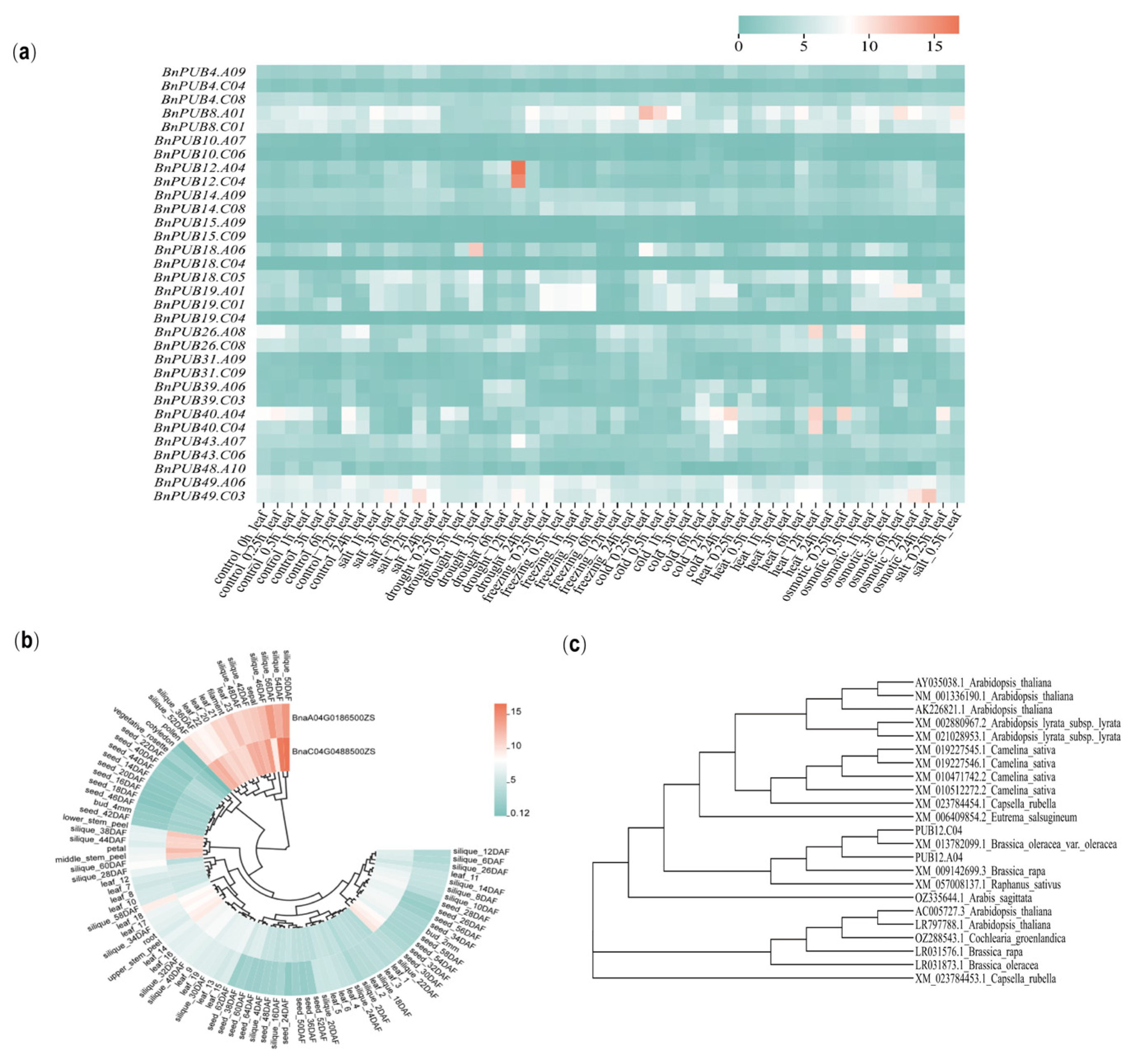
In this study, we further analyzed the two-copy homologous genes among the BnPUB genes identified in the ZS11 genome, and used the BnIR database to generate temporal expression heatmaps of this gene family under different stress treatments [29]. The results showed that BnPUB12.A04 and BnPUB12.C04 exhibited the highest expression levels in leaves after 12 h of drought treatment (Figure 1a). Furthermore, BnPUB12.A04 and BnPUB12.C04 have higher expression levels in the leaves (Figure 1b). Additionally, phylogenetic analysis reveals that the BnPUB12 is highly conserved in B. rapa and B. oleracea: BnPUB12.A04 forms a sister group with the corresponding sequence from B. rapa, while BnPUB12.C04 clusters as a sister group with its homolog from B. oleracea (Figure 1c). This phylogenetic tree is consistent with the evolutionary trajectory of rapeseed. It is speculated that BnPUB12 may be involved in drought stress.

3.2. BnPUB12 Is a U-Box/ARM-Containing Protein

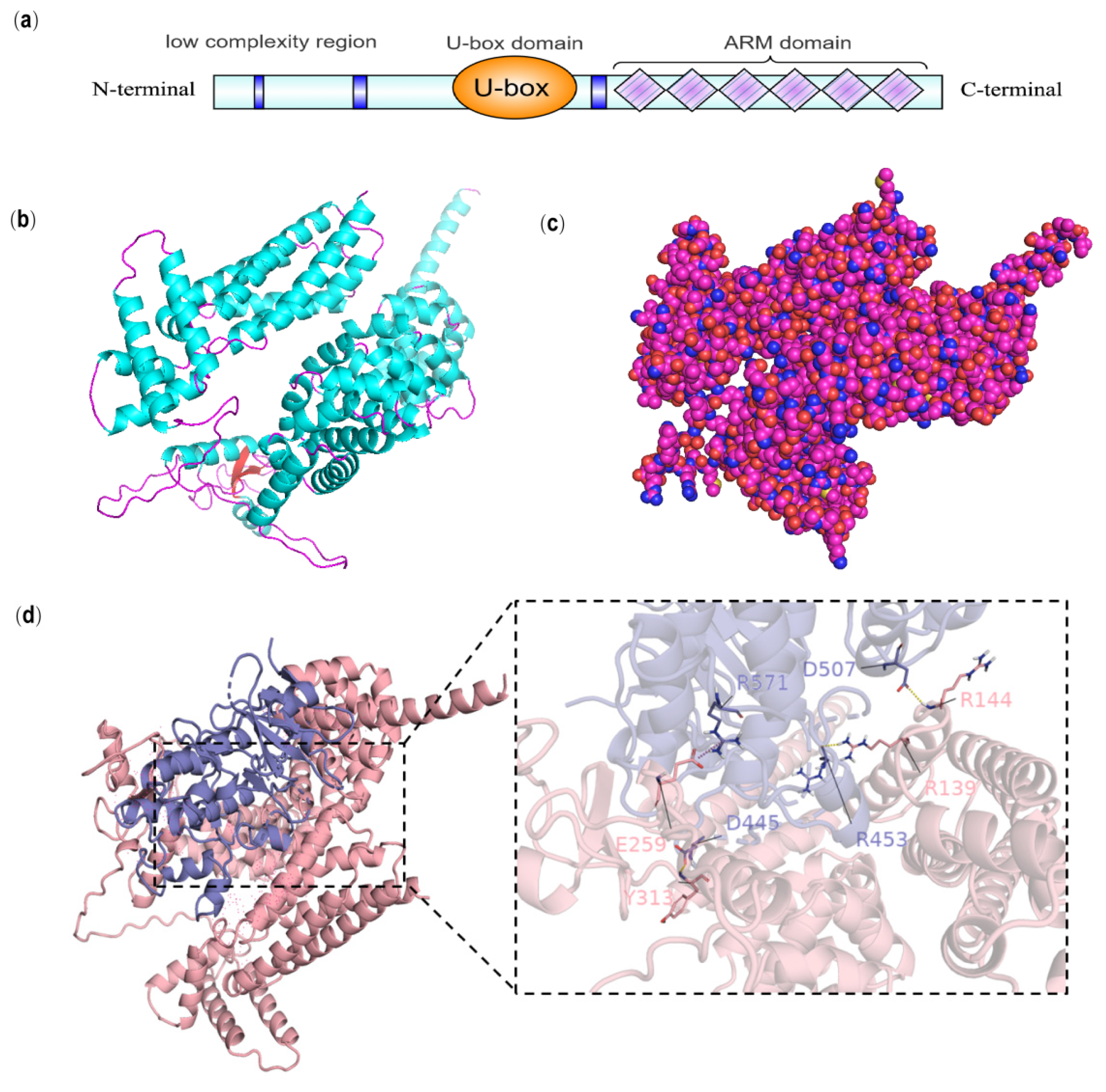
The BnPUB12 protein consists of 653 amino acid residues, with a predicted molecular weight of 72.1 kDa and an isoelectric point of 5.91. Domain prediction analysis indicates that this protein contains both a conserved U-box domain and an ARM repeat region (Figure 2a): the ARM repeat region is located at the C-terminus, forming a superhelical structure responsible for recognizing and binding to substrates; the U-box domain stabilizes its spatial conformation through intramolecular salt bridge bonds (Figure 2b,c). Previous studies have shown that PUB proteins containing both U-box and ARM domains participate in immune and stress responses by regulating the stability of target proteins [41]. Furthermore, studies have shown that there is a protein–protein interaction between AtPUB12 and AtBAK1 in Arabidopsis [3]. Based on this, we performed molecular docking simulations between the B. napus homologs BnPUB12 and BnBAK1, which revealed that the BnPUB12 protein forms salt bridges with BAK1 via its residues E259 (carboxylate oxygen of the side chain with the R571 guanidino group) and R144 (guanidino group with D507 carboxylate oxygen). And it forms a hydrogen bond through Y313 (phenolic hydroxyl with D445 carboxylate oxygen) and a water-mediated hydrogen bond through R139 (guanidino N-H with R453 guanidino N-H via one water molecule) (Figure 2d). The molecular docking results suggest that BnPUB12 and BnBAK1 may have protein interactions, but this speculation still needs to be further confirmed by experiments.

3.3. Generation of bnpub12 Mutants and BnPUB12 Overexpression Lines

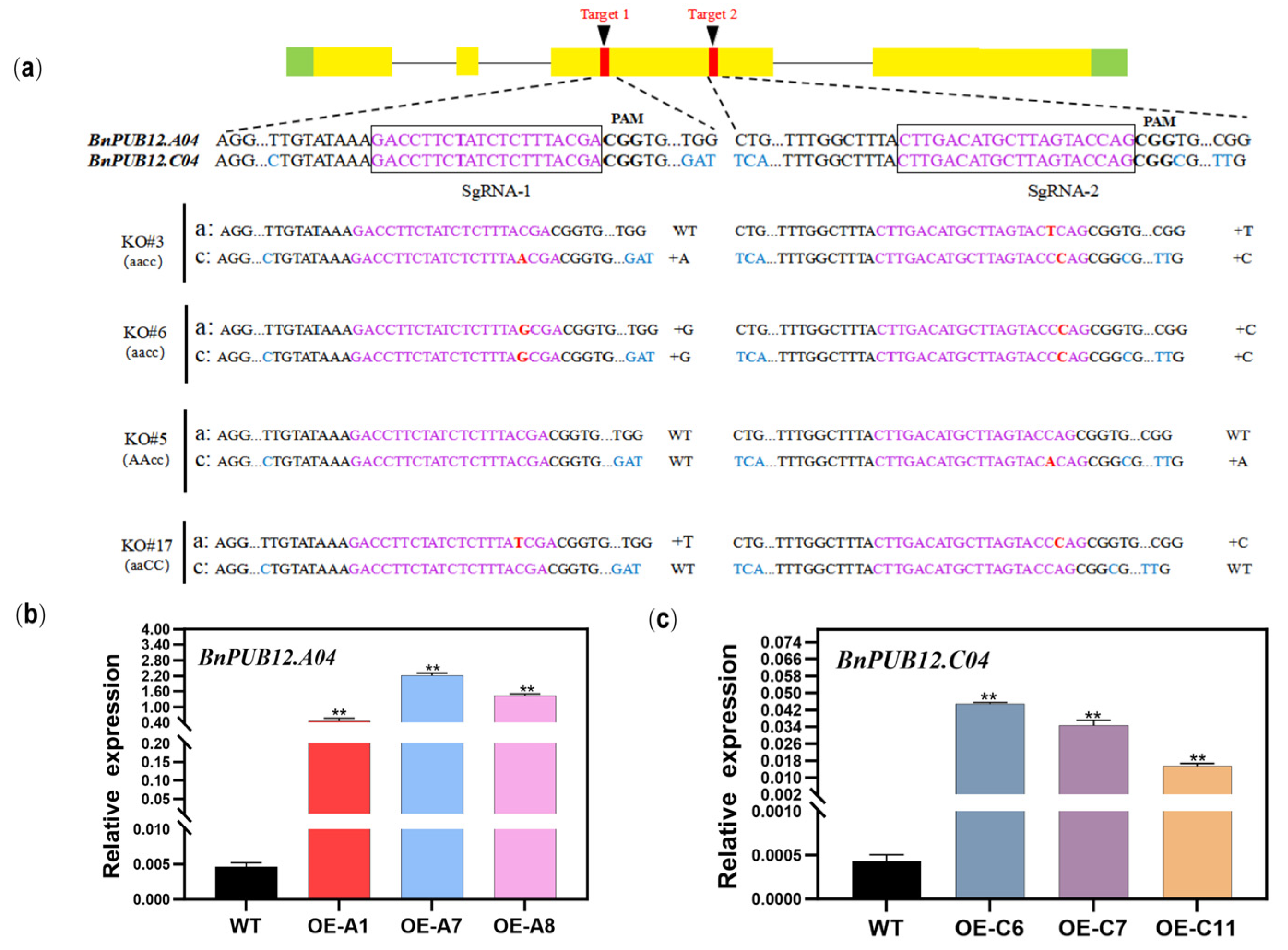
To explore the function of BnPUB12 in regulating drought stress resistance in B. napus, this study utilized a mutant library of the BnPUB gene family previously generated by our research group using CRISPR/Cas9 technology. Following homozygosity screening and analysis, we obtained the mutant lines of BnPUB12.A04 and BnPUB12.C04, the double mutants KO-3 and KO-6, the BnPUB12.C04 single mutant KO-5, and the BnPUB12.A04 single mutant KO-17 (Figure 3a). Concurrently, BnPUB12 overexpression vector was constructed, and the genetic transformation of BnPUB12.A04 and BnPUB12.C04 into rape was successfully completed. Through positive identification and quantitative real-time PCR (qRT-PCR) analysis, three lines with higher expression levels of BnPUB12.A04 (OE-A1, OE-A7 and OE-A8) and three lines with higher expression levels of BnPUB12.C04 (OE-C6, OE-C7 and OE-C11) were successfully obtained as overexpression lines (Figure 3b,c).

3.4. BnPUB12 Positively Regulates Drought Resistance at the Germination Stage

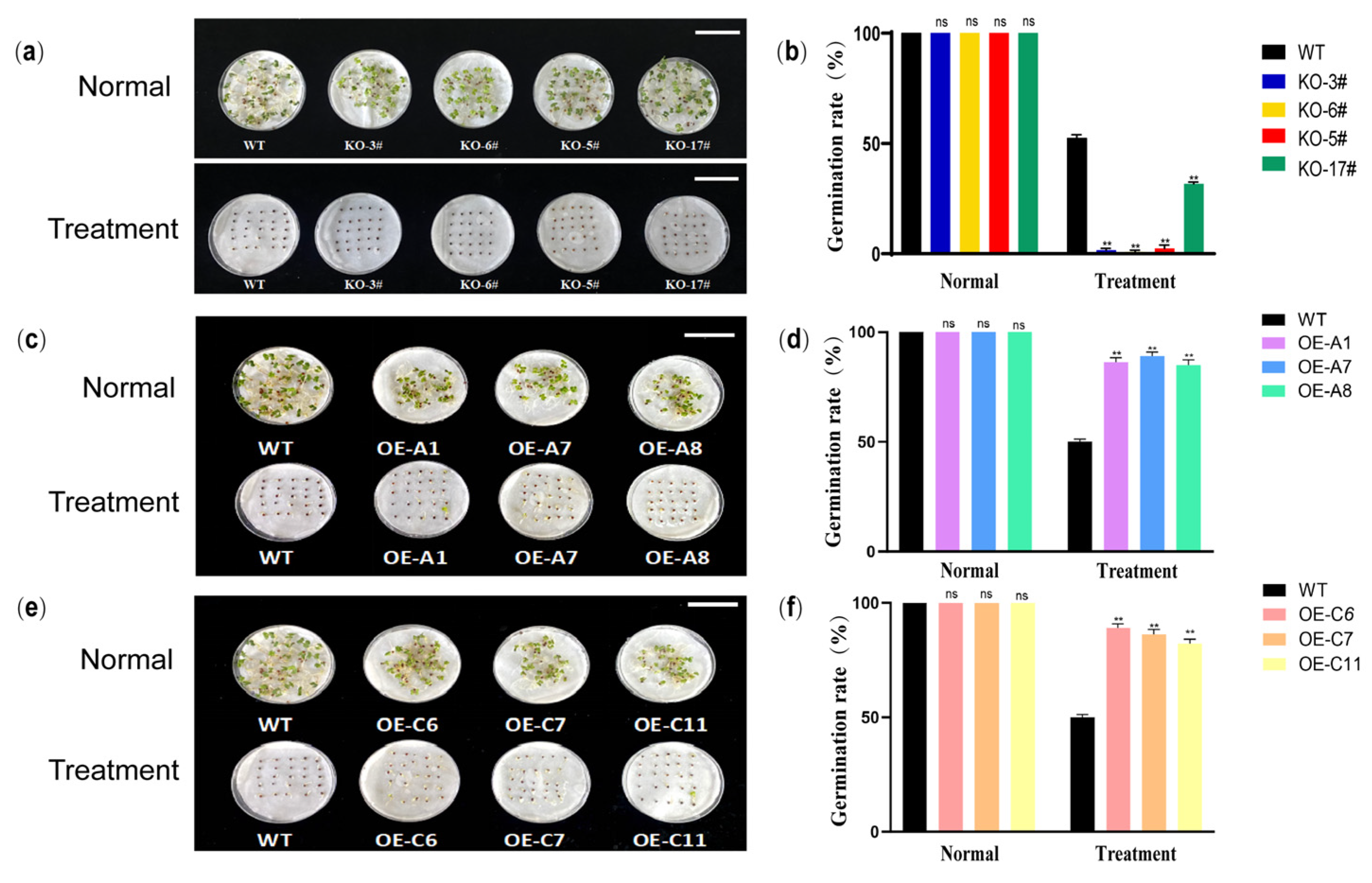
Using ZS11 as the control, to simulate drought conditions using an 18% PEG-6000, the KO-3, KO-6, KO-5, and KO-17 mutant materials underwent drought treatment during the germination stage, and their germination rates were recorded after 5 days of treatment (Figure 4a). The results showed that compared with the wild type, the BnPUB12.A04 single mutant KO-17 exhibited partial germination, with a survival rate of 31.67%. The BnPUB12.C04 single mutant KO-5 showed almost no germination and a germination rate of 2.5%. The double mutants KO-3 and KO-6 of BnPUB12.A04 and BnPUB12.C04 exhibited a complete inability to germinate, with survival rates ranging from 0 to 1.6% (Figure 4b). This result suggested that BnPUB12 may have a positive role in drought resistance in rapeseed. Among them, the phenotype of the BnPUB12.A04 single mutant showed no significant difference from the wild type, while the phenotype of the BnPUB12.C04 single mutant was similar to that of the double mutant, indicating that BnPUB12.C04 is more important in the regulation of drought stress in rapeseed.
The BnPUB12 overexpression lines were also subjected to drought stress at the germination stage using 18% PEG-6000 (Figure 4c,e). Among them, the average germination rate of BnPUB12.A04 and BnPUB12.C04 overexpression materials were 86.75% and 85.85%, respectively, which were significantly higher than the WT (Figure 4d,f), indicating the drought resistance of the overexpression materials of BnPUB12 significantly increased. These results together further supported that the overexpression of BnPUB12 can enhance the drought resistance of rapeseed.

3.5. BnPUB12 Positively Regulates Drought Resistance at the Seedling Stage

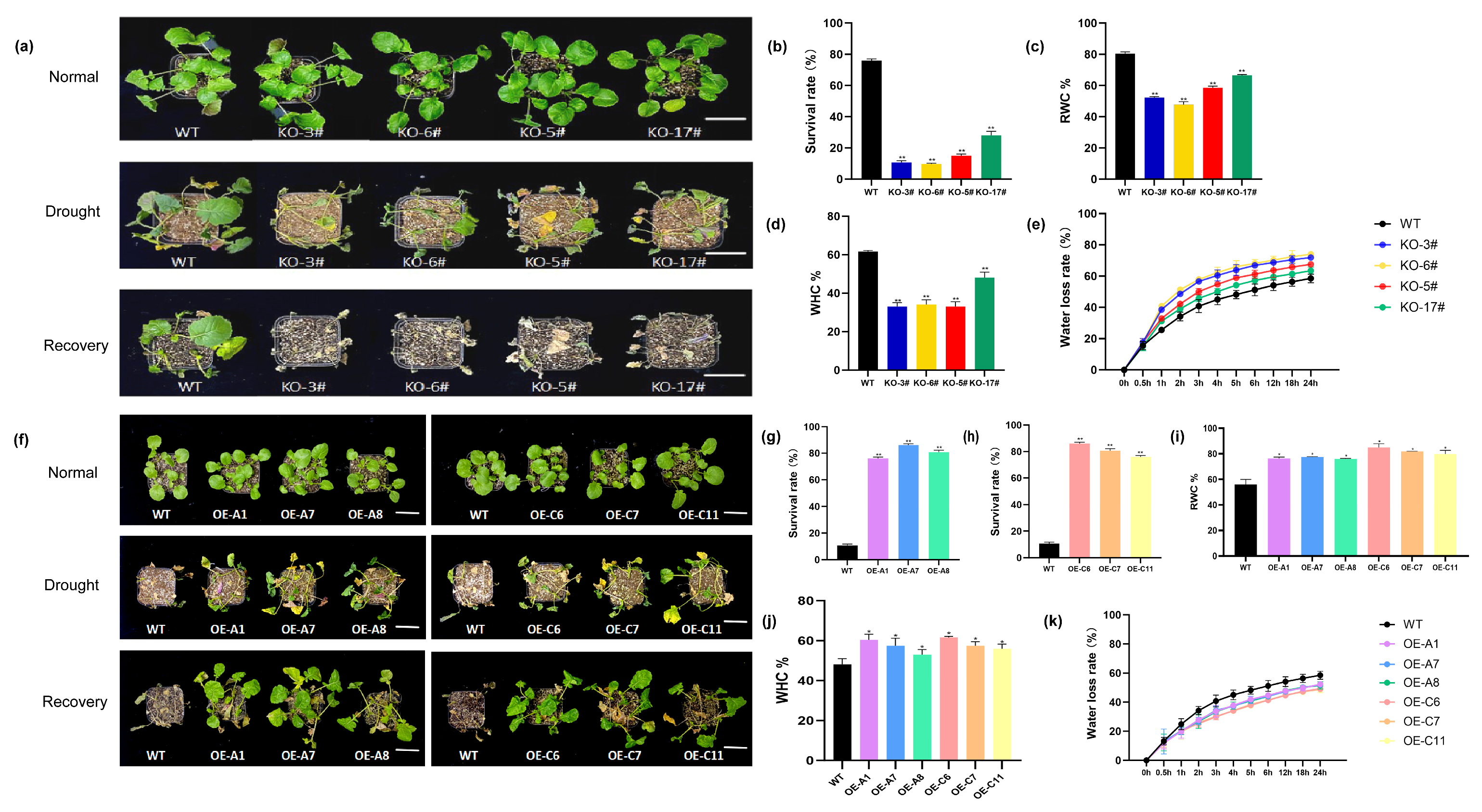
The bnpub12 mutant seedlings that had been growing in pots for three weeks were subjected to drought stress treatment at the three to four leaf stage. After 7 days of treatment, the bnpub12 mutants exhibited obvious wilting, wrinkling, curling, and chlorosis of the leaves (Figure 5a). The population phenotypes of the bnpub12 mutants and the wild type under drought stress are shown in Figure S2. After rehydration for 3 days, the wild type could still grow normally, with a survival rate of 76%, while most of the bnpub12 plants suffered irreversible cell damage due to long-term water shortage, and their leaves became curled and wrinkled. After recovery, they could not grow normally. The survival rates of KO-3, KO-6, KO-5, and KO-17 were 10.6%, 9.6%, 15%, and 28%, respectively (Figure 5b). The results showed that the survival rate and drought resistance of bnpub12 were significantly lower than those of the wild type.
Furthermore, relative water content was measured separately, while leaf water holding capacity and water loss rate at different time points were quantitatively determined using the leaf detached weighing method. Under normal conditions, there was no significant difference in relative water content between the WT and bnpub12 lines. After drought stress, the relative water content of the WT decreased by about 10 percentage points, whereas that of KO-3, KO-6, KO-5, and KO-17 decreased by 20–30%, becoming significantly lower than the WT. Among them, KO-17 showed a relatively smaller decrease compared to the other bnpub12 lines (Figure 5c). Leaf water holding capacity followed a similar pattern. The water holding rate of the WT was 61.7%, which is significantly higher than the average of 37% observed in the bnpub12 lines (Figure 5d). Water loss rate was monitored over time. During the 0-3 h period, the water loss rates increased rapidly in all bnpub12 mutants; from 3 to 24 h, the increase gradually slowed but remained linear. At 24 h, the final water loss rate of the WT stabilized at approximately 60%, while for all the bnpub12 lines it was significantly higher. KO-3 and KO-6 exhibited the highest water loss rates, followed by KO-5 and KO-17, with the WT showing the lowest (Figure 5e). Together, these results indicate that the knockout of BnPUB12 significantly reduces plant water holding capacity and water retention ability under drought stress.
To further verify the function of BnPUB12 in drought responses, BnPUB12 overexpression lines were subjected to drought stress at the seedling stage after three weeks of cultivation in pots. After 11 days of treatment, most plants showed obvious drought phenotypes (Figure S3). Subsequently, following rehydration for 3 days, compared with the WT, the BnPUB12 overexpression lines exhibited leaf yellowing but maintained greener leaves and grew normally, whereas the WT failed to recover and most could not continue growing (Figure 5f). The average survival rate of the BnPUB12.A04 and BnPUB12.C04 lines were 80.89% and 81%, respectively, while for the WT it was only 10.67% (Figure 5g,h). The results showed that the leaf relative water content of all the overexpression lines was also significantly higher than that of the WT (Figure 5i). In addition, the water holding capacity, and water loss rate at different time intervals were measured in the BnPUB12 overexpression lines OE-A1, OE-A7, OE-A8, OE-C6, OE-C7, OE-C11, and the WT. The results showed that the water holding capacity of all the BnPUB12 overexpression lines was significantly higher than that of the WT (Figure 5j). For most plants, the water loss rate increased over time during the 0-24 h period, and the water loss rate of the WT was significantly faster than those of the overexpression lines, which exhibited a slower rate of water loss (Figure 5k), indicating that overexpression of BnPUB12 enhances plant water retention ability. These results showed that BnPUB12 overexpression lines exhibited significantly enhanced drought resistance, and acts as a positive regulator involved in the drought resistance process.
It should be noted that the drought treatment duration differed between the two experiments: the bnpub12 mutant experiment was subjected to 7 days of treatment, while the overexpression experiment was subjected to 11 days of treatment. The longer treatment in the BnPUB12 overexpression experiment was necessary because the overexpression lines exhibited stronger overall drought tolerance, requiring extended stress duration to observe visible phenotypic differences. Both experiments used the appearance of obvious wilting in wild-type plants as the endpoint criterion for treatment termination and rehydration. The different treatment durations do not affect the internal validity of each experiment but provide a reasonable explanation for the differences in wild-type survival rates observed between the two independent experiments.

3.6. BnPUB12 Regulates Drought Resistance by Affecting ROS Homeostasis

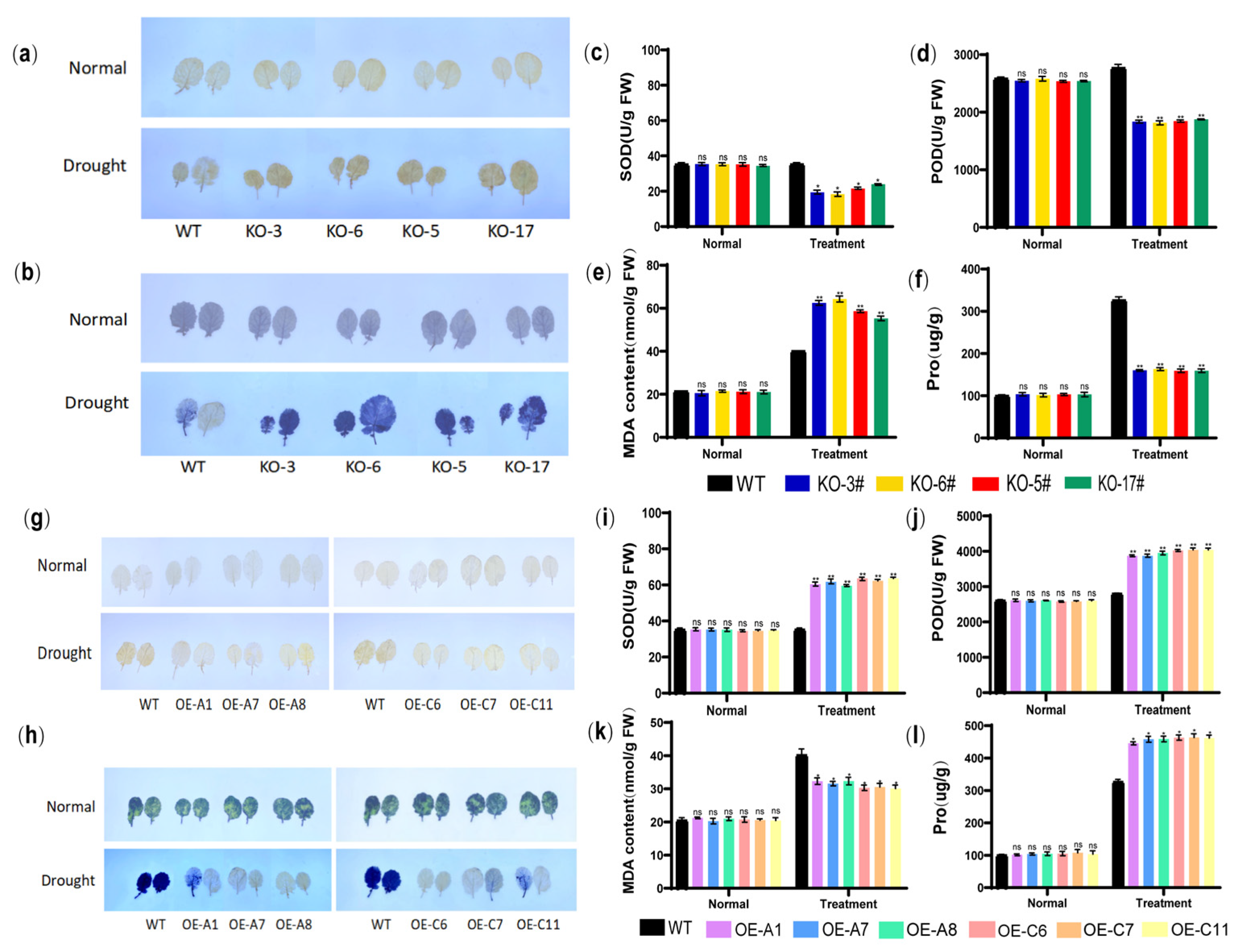
Under normal conditions, there was no significant difference in DAB staining of leaves between the WT and bnpub12 lines, with almost no brown spots observed. After drought stress, DAB staining revealed that the stained area and color intensity of the bnpub12 lines were higher than those of the WT (Figure 6a). NBT staining (Figure 6b) showed that under normal conditions, no significant staining was observed in either the WT or bnpub12 lines; after drought stress, the bnpub12 lines exhibited stronger staining intensity than the WT. These results indicated that bnpub12 mutants accumulated more H2O2 and O2 under drought conditions. Physiological index measurements also showed that under normal conditions, there were no significant differences in SOD and POD activities, or in MDA and Pro contents between the bnpub12 mutants and the WT. After drought stress, however, the SOD and POD activities and Pro content in the bnpub12 mutants were significantly lower than those in the WT, while the MDA content was significantly higher (Figure 6c–f). This indicated that BnPUB12 can regulate the activity of antioxidant enzymes such as SOD, and POD to participate in the maintenance of ROS homeostasis under drought stress.
In addition, DAB and NBT solutions were prepared to determine BnPUB12 overexpression lines under normal conditions and after drought stress. The activities of SOD and POD, as well as the contents of MDA and Pro, were also measured in the BnPUB12 overexpression lines and the WT. Under normal conditions, there was no significant difference in DAB or NBT staining between the BnPUB12 overexpression lines and the WT, with minimal staining observed in both (Figure 6g). After drought stress, the overexpression lines exhibited significantly lighter DAB and NBT staining, with a lower staining intensity and less extensive stained areas compared to the WT (Figure 6h). Physiological measurements showed that under normal conditions, there were no significant differences in SOD activity, POD activity, MDA content, and Pro content between the overexpression lines and WT. After drought stress, the overexpression lines showed significantly lower MDA content, and significantly higher SOD and POD activities and Pro content compared to the WT (Figure 6i–l). These results indicate that BnPUB12 positively regulates drought tolerance in rapeseed, likely by reducing ROS accumulation or modulating ROS homeostasis.

3.7. BnPUB12 Had No Significant Effect on Yield-Related Traits

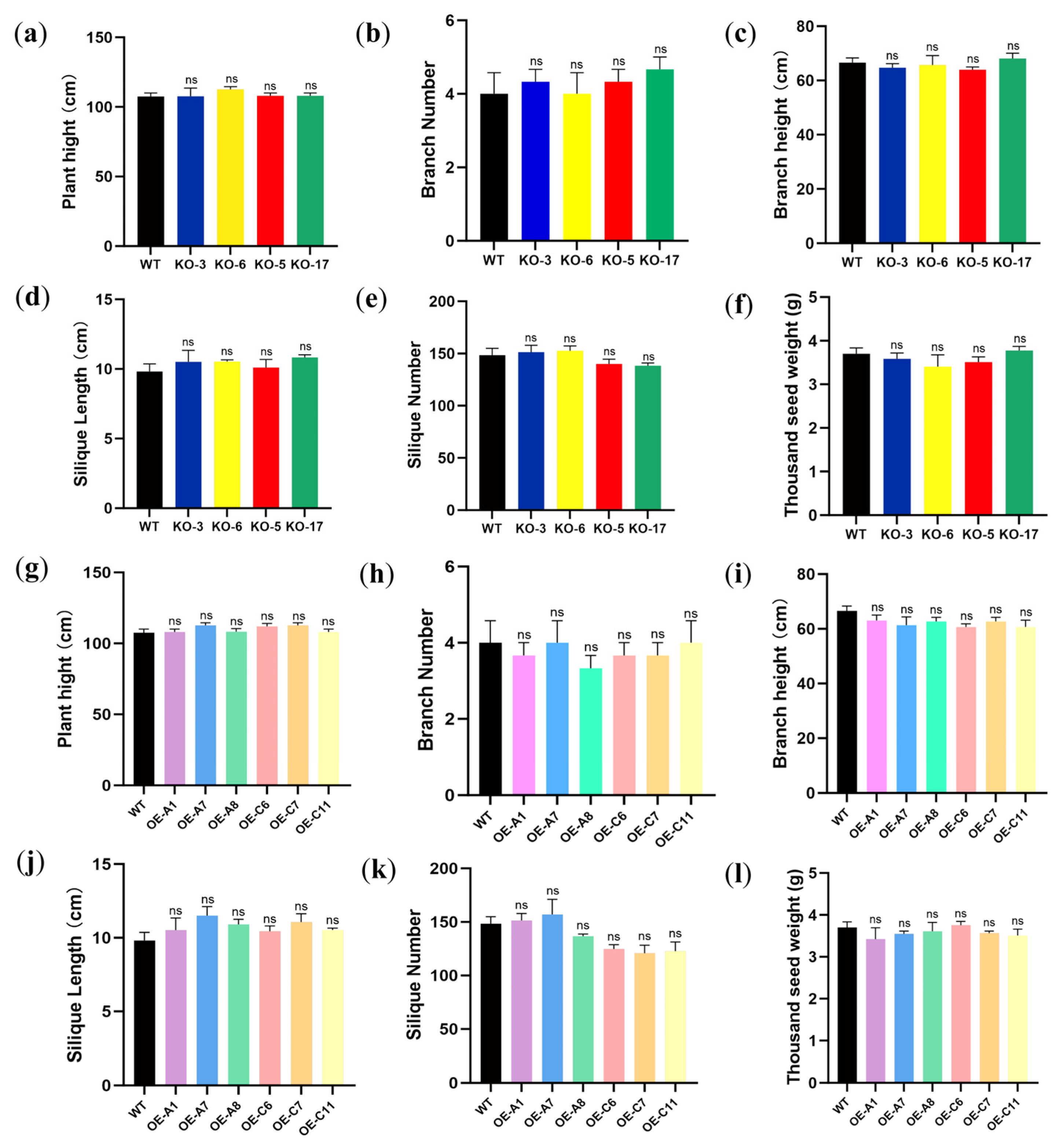
To further investigate the differences in agronomic traits among the bnpub12 mutants, BnPUB12 overexpression lines, and wild-type plants, yield-related traits were evaluated at the maturity stage. No significant differences were observed between the bnpub12 mutants and WT in plant height, branch number, branch height, silique length, silique number per plant, or thousand-seed weight, indicating that the knockout of BnPUB12 has minimal effects on agronomic traits (Figure 7a–f).
Similarly, the BnPUB12 overexpression lines (OE-A1, OE-A7, OE-A8, OE-C6, OE-C7, and OE-C11) exhibited no significant differences from the WT in plant height, silique length, silique number per plant, branch number, branch height, or thousand-seed weight. (Figure 7g–l).

4. Discussion

4.1. BnPUB12 Can Enhance the Drought Resistance of B. napus

Plant drought resistance depends on a dual defense mechanism of reducing water loss and alleviating oxidative damage [42]. This study found that the BnPUB12-OE lines showed a significantly higher relative leaf water content and a slower water loss rate under drought stress, whereas the bnpub12-KO mutant showed the opposite effects. Knocking out BnPUB12 significantly weakened the plant’s water retention ability and drought tolerance, while its overexpression significantly enhanced the plant’s drought resistance, indicating that BnPUB12 positively regulates drought tolerance in rapeseed. As a U-box E3 ubiquitin ligase, BnPUB12 may participate in the ABA signaling pathway or regulate target proteins related to stomatal movement through ubiquitination modification, thereby more effectively maintaining tissue water potential under stress.
The positive regulatory role of PUB12 family members in drought responses appears to be conserved across different plant species. In Arabidopsis, AtPUB12 and AtPUB13 positively regulate ABA signaling by ubiquitinating and degrading the negative regulator ABI1, and the pub12 pub13 double mutant shows impaired stomatal closure and enhanced drought sensitivity [41]. Other PUB genes also participate in drought responses with divergent regulatory directions. AtPUB46 and AtPUB48 act as positive regulators [43]. In rice, OsPUB67 positively regulates drought tolerance by enhancing ROS scavenging and promoting stomatal closure [21], whereas OsPUB15 reduces ROS levels and cell death [44]. Moreover, MaPUB79 silencing reduces drought tolerance [45]; RcPUB4 modulates ABA signaling by targeting RcPYL4/9 [46]; StPUB51 overexpression enhances drought tolerance [47]; and in wheat, TaPUB1 improves antioxidant capacity [48]. Thus, PUB family E3 ubiquitin ligases are widely involved in drought responses across species, with individual members exhibiting either positive or negative regulatory functions depending on their specific substrates.
Notably, ABA signaling has been reported to induce the expression of antioxidant enzyme genes in various plant species [49]. For instance, in maize, ABA-induced H2O2 production activates MAPK, which in turn induces the expression and activities of antioxidant enzymes such as catalase, ascorbate peroxidase, glutathione reductase, and superoxide dismutase [50]. Based on these findings and the established role of ABA in both stomatal regulation and antioxidant defense, we speculate that BnPUB12 may act through the ABA signaling network to simultaneously enhance water retention and promote antioxidant capacity, thereby more effectively scavenging drought-induced ROS and mitigating membrane lipid peroxidation damage. Future studies examining stomatal aperture, ABA-responsive gene expression, and identification of the ubiquitination targets of BnPUB12 in overexpression and mutant lines will be necessary to test this hypothesis.

4.2. BnPUB12 Enhances Stress Tolerance by Alleviating Oxidative Damage

Drought stress often accompanies the accumulation of ROS, leading to oxidative damage such as membrane lipid peroxidation [51]. Under simulated drought stress, drought-tolerant rapeseed lines typically exhibit higher antioxidant enzyme activity and lower MDA content. In this study, the DAB and NBT staining results visually demonstrate that BnPUB12-OE can significantly reduce the accumulation of H2O2 and O2 under drought conditions. At the same time, the physiological index measurements also showed that the overexpressing lines have higher SOD, and POD antioxidant enzyme activities, as well as lower MDA content. This indicates that BnPUB12 may enhance stress tolerance. It achieves this by strengthening the antioxidant system and alleviating the membrane lipid peroxidation damage caused by the burst of active oxygen, thereby protecting the integrity of the cellular membrane structure and function.
The involvement of PUB family E3 ubiquitin ligases in stress responses through the regulation of ROS homeostasis has been well documented in other plant species. OsPUB15 encodes a cytoplasm-localized U-box protein; its T-DNA knockout mutants exhibit significantly higher levels of H2O2 and oxidized proteins than wild-type plants, while OsPUB15 overexpression plants grow better than wild-type plants under high-salt stress, indicating that OsPUB15 is a regulatory factor that reduces ROS stress and cell death [44]. Overexpression of OsPUB67 enhances drought tolerance in rice by increasing the ROS scavenging capacity [21]. StPUB51 overexpression exhibits significantly enhanced SOD, POD, and CAT activities, with concomitantly reduced MDA content under drought stress [47]. And CsPUB21 overexpression significantly enhances drought and salt tolerance in transgenic Arabidopsis, with increased SOD, POD, and CAT activities and decreased relative electrolyte leakage and MDA content [26]. GmPUB21 is significantly induced by drought, salt, and ABA treatments and functions as a negative regulator; GmPUB21 overexpression leads to reduced tolerance to drought and salt stress, accompanied by increased ROS accumulation [52]. In addition, the functions of AtPUB46 and AtPUB48 in drought stress are closely related to their regulation of the balance between ROS production and scavenging [43]. TaPUB1 positively modulates plant drought stress resistance by improving antioxidant capacity [48]. These studies indicate that PUB family E3 ubiquitin ligases regulate the balance between ROS production and scavenging by modulating antioxidant enzyme activities, representing an important mechanism by which plants defend against abiotic stresses such as drought. And the BnPUB12 overexpression lines exhibited significantly increased SOD and POD activities and decreased MDA content under drought stress, while the mutants showed the opposite trends. These findings are consistent with the functional patterns of other PUB family members in ROS regulation and further support the general principle that PUB E3 ubiquitin ligases enhance plant stress tolerance through the modulation of ROS homeostasis.

4.3. BnPUB12 Expression Characteristics at Multiple Developmental Stages of Rapeseed

This study showed that BnPUB12 can be expressed normally in several stages of growth, including the germination and seedling stages. This study preliminarily explored the function of BnPUB12 under drought stress, and the results showed that the gene had a consistent regulation effect on drought resistance in the germination and seedling stages. However, whether BnPUB12 can also function in other developmental stages such as flowering remains to be further identified. As a key regulatory factor of rapeseed drought stress tolerance, BnPUB12 provides a new perspective for deeply analyzing the molecular mechanisms of rapeseed when coping with multiple stresses. In the future, field experiments can be combined to comprehensively evaluate yield components as core indicators. Breeding techniques can be utilized to apply the beneficial mutations of BnPUBs genes to practical agricultural production, enhancing rapeseed’s stress resistance and contributing to sustainable agriculture.

5. Conclusions

In this study, we demonstrate that the U-box E3 ubiquitin ligase BnPUB12 gene positively regulates drought resistance in B. napus. Through a comparative evaluation of bnpub12 knockout mutants and BnPUB12 overexpression lines, we observed that BnPUB12 overexpression significantly enhanced the survival rate, leaf relative water content, water holding capacity, and antioxidant enzyme activities (SOD, POD), while reducing the water loss rate and MDA content under drought stress. Conversely, bnpub12 mutants showed reduced drought tolerance. The specific targets and regulatory networks of BnPUB12 remain to be elucidated through future studies, including protein interaction assays, transcriptomic, or metabolomic analyses. Overall, this study elucidated that BnPUB12 positively regulates drought tolerance in B. napus during both the germination and seedling stages. The research results provide a theoretical basis and genetic resources for the creation of resistant rapeseed germplasm and the breeding of new varieties.

Supplementary Materials

The following supporting information can be downloaded at https://www.mdpi.com/article/10.3390/agronomy16131261/s1: Figure S1: Effect of different PEG-6000 concentrations on seed germination of rapeseed (B. napus); Figure S2: Phenotype of bnpub12 mutants and wild type under drought stress at the seedling stage; Figure S3: Phenotype of BnPUB12 overexpression lines and wild type during drought stress at the seedling stage.

Author Contributions

T.L., D.M., H.C., and Q.H. designed and conducted this study. R.Z., P.Y., and M.S. performed most of the experiments. R.Z. wrote the manuscript. Y.W., W.W., H.W., J.L., and C.L. provided the materials and performed some experiments. T.L. and D.M. revised the manuscript. All authors have read and agreed to the published version of the manuscript.

Funding

This work was financially supported by the Hubei Provincial Natural Science Foundation of China (2025AFB032), the Central Public-Interest Scientific Institution Basal Research Fund (No. 1610172025001), and Agricultural Science and Technology Innovation Project of Chinese Academy of Agricultural Sciences (CAAS-ASTIP-2013-OCRI).

Data Availability Statement

The original contributions presented in this study are included in the article/Supplementary Material. Further inquiries can be directed to the corresponding author(s).

Acknowledgments

The authors acknowledge the use of DeepSeek (DeepSeek, Hangzhou, China) for language polishing, including grammar and clarity improvement of the manuscript (DeepSeek-V4, online version).

Conflicts of Interest

The authors declare no conflicts of interest.

Abbreviations

The following abbreviations are used in this manuscript:
PUBPlant U-box
SODsuperoxide dismutase
PODperoxidase
UPSubiquitin-proteasome system

References

  1. Cai, D.F.; Zhang, S.F.; He, J.P.; Zhu, J.C.; Wang, J.P.; Wen, Y.C.; Cao, J.H.; Zhao, L.; Wang, D.G. Drought Resistance Identification in Brassica napus. Chin. Agric. Sci. Bull. 2017, 33, 7–12. [Google Scholar] [CrossRef]
  2. Tang, Y.M.; Zhao, C.P.; Gao, S.Q.; Tian, L.P.; Shan, F.H.; Wu, J.X. Advances in Genes Related to Plant Drought Tolerance. J. Triticeae Crops 2009, 29, 1–8. [Google Scholar] [CrossRef]
  3. Yang, C.J.; Zhang, X.K.; Zou, C.S.; Cheng, Y.; Zheng, P.Y. Effects of PEG-6000 Simulated Drought Stress on Germination and Seedling Growth of Different Brassica napus Varieties. Chin. J. Oil Crop Sci. 2007, 29, 425–430. [Google Scholar]
  4. Lu, D.; Lin, W.; Gao, X.; Wu, S.; Cheng, C.; Avila, J.; Heese, A.; Devarenne, T.P.; He, P.; Shan, L. Direct Ubiquitination of Pattern Recognition Receptor FLS2 Attenuates Plant Innate Immunity. Science 2011, 332, 1439–1442. [Google Scholar] [CrossRef] [PubMed]
  5. Levitt, J. Response of Plants to Environmental Stresses; Academic Press: New York, NY, USA, 1980. [Google Scholar]
  6. Mou, B.; Zhao, G.; Wang, J.; Wang, S.; He, F.; Ning, Y.; Li, D.; Zheng, X.; Cui, F.; Xue, F.; et al. The OsCPK17-OsPUB12-OsRLCK176 Module Regulates Immune Homeostasis in Rice. Plant Cell 2024, 36, 987–1006. [Google Scholar] [CrossRef] [PubMed]
  7. Huang, Q.; Zhao, Y.G.; Huang, X.W.; Zhu, Z.H.; Liu, Y.Q.; Ma, H.Q.; Cheng, Y.; Zou, X.L.; Xu, J.S.; Zhang, X.K.; et al. QTL Analysis of Drought-Related Traits at Bolting Stage in Brassica napus. Agric. Res. Arid Areas 2017, 35, 88–94. [Google Scholar]
  8. Luo, L.; Zheng, Y.; Gao, Z.; Chen, Q.; Kong, X.; Yang, Y. Grafting Improves Drought Stress Memory by Increasing the P5CS1 Gene Expression in Brassica rapa. Plant Soil 2020, 452, 61–72. [Google Scholar] [CrossRef]
  9. Jin, S.; Wang, Y.; Song, Y.; Fan, S.; Luo, N.; Gan, Q.; Fan, Y.; Guo, Y.; Ni, Y. Dual Regulation of Cuticle and Cell Wall Biosynthesis by BnaC9.MYB46 Confers Drought Tolerance in Brassica napus. Plant Biotechnol. J. 2025, 23, 5335–5350. [Google Scholar] [CrossRef] [PubMed]
  10. Liu, N.; Sun, X.; Yang, Y.; Liu, H.; Liu, J.; Liu, J.; Zheng, M.; Hua, W. Heterologous Expression of the Di19 Gene from the B Subgenome in Brassica napus Enhances Plant Resistance to Multiple Abiotic and Biotic Stressors. Plant Commun. 2026, 7, 101590. [Google Scholar] [CrossRef] [PubMed]
  11. Wang, S.; Li, H.Y. Research Progress on Plant E3 Ubiquitin Ligase and Abiotic Stress. Chin. Agric. Sci. Bull. 2020, 36, 47–53. [Google Scholar]
  12. Hu, J.; Luo, M.D.; Zhou, X.M.; Wang, Z.Y.; Yan, L.; Hong, D.F.; Yang, G.S.; Zhang, X.H. RING-Type E3 Ligase BnaJUL1 Ubiquitinates and Degrades BnaTBCC1 to Regulate Drought Tolerance in Brassica napus L. Plant Cell Environ. 2024, 47, 1023–1040. [Google Scholar] [CrossRef] [PubMed]
  13. Yee, D.; Goring, D.R. The Diversity of Plant U-Box E3 Ubiquitin Ligases: From Upstream Activators to Downstream Target Substrates. J. Exp. Bot. 2009, 60, 1109–1121. [Google Scholar] [CrossRef] [PubMed]
  14. Andersen, P.; Kragelund, B.B.; Olsen, A.N.; Larsen, F.H.; Chua, N.H.; Poulsen, F.M.; Skriver, K. Structure and Biochemical Function of a Prototypical Arabidopsis U-Box Domain. J. Biol. Chem. 2004, 279, 40053–40061. [Google Scholar] [CrossRef] [PubMed]
  15. Ohi, M.D.; Vander Kooi, C.W.; Rosenberg, J.A.; Chazin, W.J.; Gould, K.L. Structural Insights into the U-Box, a Domain Associated with Multi-Ubiquitination. Nat. Struct. Biol. 2003, 10, 250–255. [Google Scholar] [CrossRef] [PubMed]
  16. Wang, J.; Huo, K.; Ma, L.; Tang, L.; Li, D.; Huang, X.; Yuan, Y.; Li, C.; Wang, W.; Guan, Y.; et al. Toward an Understanding of the Molecular Mechanism of Plant U-Box Proteins. Sci. China Life Sci. 2009, 52, 433–441. [Google Scholar]
  17. Trujillo, M.; Shirasu, K. Ubiquitination in Plant Immunity. Curr. Opin. Plant Biol. 2010, 13, 402–408. [Google Scholar] [CrossRef] [PubMed]
  18. Bin, L.H.; Song, M.; Mu, J.X.; Huang, S.H.; An, R.; Chen, N.N.; Xie, C.G.; Zhu, Y.T.; Guan, Z.B.; Zhang, Y.F. Comprehensive Analysis of U-box E3 Ubiquitin Ligases Gene Family Revealed BnPUB18 and BnPUB19 Negatively Regulated Drought Tolerance in Brassica napus. Ind. Crops Prod. 2023, 200, 116875. [Google Scholar] [CrossRef]
  19. Liu, Y.C.; Wu, Y.R.; Huang, X.H.; Sun, J.; Xie, Q. AtPUB19, a U-Box E3 Ubiquitin Ligase, Negatively Regulates Abscisic Acid and Drought Responses in Arabidopsis thaliana. Mol. Plant 2011, 4, 938–946. [Google Scholar] [CrossRef] [PubMed]
  20. Cho, S.K.; Ryu, M.Y.; Song, C.; Kwak, J.M.; Kim, W.T. Arabidopsis PUB22 and PUB23 Are Homologous U-Box E3 Ubiquitin Ligases That Play Combinatory Roles in Response to Drought Stress. Plant Cell 2008, 20, 1899–1914. [Google Scholar] [CrossRef] [PubMed]
  21. Qin, Q.; Wang, Y.; Huang, L.; Du, F.; Zhao, X.; Li, Z.; Wang, W.; Fu, B. A U-Box E3 Ubiquitin Ligase OsPUB67 Is Positively Involved in Drought Tolerance in Rice. Plant Mol. Biol. 2020, 102, 89–107. [Google Scholar] [CrossRef] [PubMed]
  22. Wang, C.M.; Song, B.B.; Dai, Y.Q.; Zhang, S.L.; Huang, X.S. Genome-Wide Identification and Functional Analysis of U-Box E3 Ubiquitin Ligases Gene Family Related to Drought Stress Response in Chinese White Pear (Pyrus bretschneideri). BMC Plant Biol. 2021, 21, 235. [Google Scholar] [CrossRef] [PubMed]
  23. Kim, J.H.; Kim, M.S.; Seo, Y.W. Overexpression of a Plant U-Box Gene TaPUB4 Confers Drought Stress Tolerance in Arabidopsis thaliana. Plant Physiol. Biochem. 2023, 196, 596–607. [Google Scholar] [CrossRef] [PubMed]
  24. Zhou, J.; Hu, Y.P.; Li, J.J.; Yu, Z.; Guo, Q. Genome-Wide Identification and Expression Analysis of the Plant U-Box Protein Gene Family in Phyllostachys edulis. Front. Genet. 2021, 12, 710113. [Google Scholar] [CrossRef] [PubMed]
  25. Cao, H.C.; Tian, Q.Z.; Ju, M.; Duan, Y.; Li, G.; Ma, Q.; Zhang, H.; Zhang, X.; Miao, H. Genome-Wide Analysis of the U-Box E3 Ubiquitin Ligase Family Role in Drought Tolerance in Sesame (Sesamum indicum L.). Front. Plant Sci. 2023, 14, 1261238. [Google Scholar] [CrossRef] [PubMed]
  26. Liao, H.Z.; Liao, W.J.; Zou, D.X.; Zhang, R.Q.; Ma, J.L. Identification and Expression Analysis of PUB Genes in Tea Plant Exposed to Anthracnose Pathogen and Drought Stresses. Plant Signal. Behav. 2021, 16, 1976547. [Google Scholar] [CrossRef] [PubMed]
  27. Cheng, H.; Hao, M.; Ding, B.; Mei, D.; Wang, W.; Wang, H.; Zhou, R.; Liu, J.; Li, C.; Hu, Q. Base Editing with High Efficiency in Allotetraploid Oilseed Rape by A3A-PBE System. Plant Biotechnol. J. 2021, 19, 87–97. [Google Scholar] [CrossRef] [PubMed]
  28. Kumar, S.; Stecher, G.; Tamura, K. MEGA7: Molecular Evolutionary Genetics Analysis Version 7.0 for Bigger Datasets. Mol. Biol. Evol. 2016, 33, 1870–1874. [Google Scholar] [CrossRef] [PubMed]
  29. Yang, Z.Q.; Wang, S.B.; Wei, L.L.; Liu, D.; Jia, Y.; Luo, C.; Lin, Y.; Liang, C.; Hu, Y.; Dai, C.; et al. BnIR: A Multi-Omics Database with Various Tools for Brassica napus Research and Breeding. Mol. Plant 2023, 16, 775–789. [Google Scholar] [CrossRef] [PubMed]
  30. The UniProt Consortium. UniProt: The Universal Protein Knowledgebase in 2025. Nucleic Acids Res. 2025, 53, D609–D617. [Google Scholar] [CrossRef] [PubMed]
  31. PyMOL, Version 2.5; Schrödinger, LLC: New York, NY, USA, 2021. Available online: http://www.pymol.org/pymol (accessed on 20 May 2026).
  32. Eberhardt, J.; Santos-Martins, D.; Tillack, A.F.; Forli, S. AutoDock Vina 1.2.0: New Docking Methods, Expanded Force Field, and Python Bindings. J. Chem. Inf. Model. 2021, 61, 3891–3898. [Google Scholar] [CrossRef] [PubMed]
  33. Trott, O.; Olson, A.J. AutoDock Vina: Improving the Speed and Accuracy of Docking with a New Scoring Function, Efficient Optimization, and Multithreading. J. Comput. Chem. 2010, 31, 455–461. [Google Scholar] [CrossRef] [PubMed]
  34. Xing, H.L.; Dong, L.; Wang, Z.P.; Zhang, H.Y.; Han, C.Y.; Liu, B.; Wang, X.C.; Chen, Q.J. A CRISPR/Cas9 toolkit for multiplex genome editing in plants. BMC Plant Biol. 2014, 14, 327. [Google Scholar] [CrossRef] [PubMed]
  35. Zhang, T.Y.; Li, H.Y.; Zhao, F.X.; He, Y.; Liu, Z.; Liu, H.; Liu, X. Genome-Wide Association Analysis of Drought Tolerance at Germination Stage in Brassica napus under PEG Simulated Drought. J. Plant Genet. Resour. 2024, 25, 1–14. [Google Scholar]
  36. Chen, J.; Xie, X.Y.; Zhang, X.D.; Zhang, B. Identification of Drought Resistance at Seedling Stage and Screening of Comprehensive Drought Resistance Indicators in Brassica napus. Chin. J. Oil Crop Sci. 2019, 41, 713–722. [Google Scholar]
  37. Xie, X.Y.; Zhang, X.; Zhang, B. Evaluation of Drought Resistance at Seedling Stage and Analysis of Changes in Drought-Related Indicators in Rapeseed (Brassica napus L.). Sci. Agric. Sin. 2013, 46, 476–485. [Google Scholar]
  38. Huang, Q.; Zhao, Y.G.; Xu, J.S.; Zeng, L.; Lv, Y.; Cheng, Y.; Zhang, X.K.; Lu, G.Y. Identification of Drought Resistance at Seedling Stage and Evaluation of Drought Resistance Indicators in Rapeseed. Agric. Res. Arid Areas 2021, 39, 9–17. [Google Scholar]
  39. Wang, D.J.; Gui, Y.J.; Yang, C.L.; Zhang, H.; Li, H. Drought Resistance and Identification Methods and Indicators of Rapeseed II. Study on Identification Indicators of Drought Resistance at Bud Stage of Rapeseed. Acta Agric. Boreali-Occident. Sin. 2012, 21, 84–91. [Google Scholar]
  40. Kumar, D.; Yusuf, M.A.; Singh, P.; Sardar, M.; Sarin, N.B. Histochemical Detection of Superoxide and H2O2 Accumulation in Brassica juncea Seedlings. Bio-Protocol 2014, 4, e1108. [Google Scholar] [CrossRef]
  41. Kong, L.Y.; Cheng, J.K.; Zhu, Y.J.; Ding, Y.; Meng, J.; Chen, Z.; Xie, Q.; Guo, Y.; Li, J.; Yang, S.; et al. Degradation of the ABA Co-receptor ABI1 by PUB12/13 U-Box E3 Ligases. Nat. Commun. 2015, 6, 8630. [Google Scholar] [CrossRef] [PubMed]
  42. Shen, S.Y.; Wu, Y.X.; Zheng, Y.S.; Zhang, J. Review on Drought Response in Plants from Phenotype to Molecular. Curr. Biotechnol. 2017, 7, 169–176. [Google Scholar]
  43. Adler, G.; Konrad, Z.; Zamir, L.; Mishra, A.K.; Raveh, D.; Bar-Zvi, D. The Arabidopsis paralogs, PUB46 and PUB48, encoding U-box E3 ubiquitin ligases, are essential for plant response to drought stress. BMC Plant Biol. 2017, 17, 8. [Google Scholar] [CrossRef] [PubMed]
  44. Park, J.J.; Yi, J.Y.; Yoon, J.M.; Cho, L.H.; Ping, J.; Jeong, H.J.; Cho, S.K.; Kim, W.T.; An, G. OsPUB15, an E3 ubiquitin ligase, functions to reduce cellular oxidative stress during seedling establishment. Plant J. 2011, 65, 194–205. [Google Scholar] [CrossRef] [PubMed]
  45. Wei, Y.; Zhang, F.; Wang, C.; Ma, M.; Yang, Y.; Yuan, Y.; Dou, T.; Zhang, S.; Huang, X. Genome-wide identification and functional analysis of U-box E3 ubiquitin ligases gene family related to drought stress response in Musa acuminata. BMC Plant Biol. 2025, 25, 1592. [Google Scholar] [CrossRef] [PubMed]
  46. Sun, J.J.; Zhang, J.K.; Liu, H.C.; Wang, Y.C. Genome-wide identification and functional characterization of drought-responsive U-box E3 ubiquitin ligase genes in Rosa chinensis. Int. J. Biol. Macromol. 2026, 367, 152598. [Google Scholar] [CrossRef] [PubMed]
  47. Wei, M.; Ghimire, S.; Rijal, A.; Wang, K.T.; Zhang, H.H.; Si, H.J.; Tang, X. Ubiquitin Ligase U-Box51 Positively Regulates Drought Stress in Potato (Solanum tuberosum L.). Int. J. Mol. Sci. 2024, 25, 12961. [Google Scholar] [CrossRef] [PubMed]
  48. Zhang, G.Q.; Zhang, M.; Zhao, Z.X.; Ren, Y.Q.; Li, Q.X.; Wang, W. Wheat TaPUB1 modulates plant drought stress resistance by improving antioxidant capability. Sci. Rep. 2017, 7, 7549. [Google Scholar] [CrossRef] [PubMed]
  49. Jiang, M.Y.; Zhang, J.H. Abscisic Acid and Antioxidant Defense in Plant Cells. Acta Bot. Sin. 2004, 46, 1–9. [Google Scholar]
  50. Zhang, A.; Jiang, M.; Zhang, J.; Tan, M.; Hu, X. Mitogen-Activated Protein Kinase Is Involved in Abscisic Acid-Induced Antioxidant Defense and Acts Downstream of Reactive Oxygen Species Production in Leaves of Maize Plants. Plant Physiol. 2006, 141, 475–487. [Google Scholar] [CrossRef] [PubMed]
  51. Zhang, J.; Lai, M.; Chen, J. Research Progress of Transcriptomics in Plant Response to Drought Stress. Mod. Agric. Sci. Technol. 2023, 12, 14–22. [Google Scholar]
  52. Yang, Y.; Karthikeyan, A.; Yin, J.; Jin, T.; Ren, R.; Fang, F.; Cai, H.; Liu, M.; Wang, D.; Li, K.; et al. The E3 Ligase GmPUB21 Negatively Regulates Drought and Salinity Stress Response in Soybean. Int. J. Mol. Sci. 2022, 23, 6893. [Google Scholar] [CrossRef] [PubMed]
Figure 1. Analysis of the evolutionary tree of BnPUB12 and temporal expression analysis: (a) Heatmap of temporal expression of BnPUBs in different adversities. (b) Heatmap of temporal expression of BnPUB12 in different tissues. (c) Phylogenetic tree of BnPUB12.
Agronomy 16 01261 g001
Figure 2. Structural characteristics of PUB protein: (a) The PUB protein containing only a U-box domain and having a tandem, repeated ARM domain. (b) Predicted secondary structure of BnPUB12; the helix is blue and the β-sheet is red. (c) Surface view of the predicted structure of BnPUB12. (d) Molecular docking analysis, the structure prediction was generated using AlphaFold 2.0.
Agronomy 16 01261 g002
Figure 3. Identification of bnpub12 mutant lines and determination of BnPUB12 overexpression levels: (a) T1 generation bnpub12 sequencing result graph and editing types of mutant plants; (b) relative expression levels of BnPUB12.A04; Data are shown as mean ± SD (n = 3, biologically independent experiments). Error bars represent SD. Asterisks indicate statistically significant differences compared with the wild-type control (t-test: ** p < 0.01). (c) relative expression levels of BnPUB12.C04. The Y-axes in panels (b,c) use independent linear scales with different data ranges.
Agronomy 16 01261 g003
Figure 4. Germination rate of bnpub12 mutants and BnPUB12 overexpression plants under drought stress at the germination stage: (a) Phenotypes of bnpub12 mutants under 18% PEG-6000 treatment; the scale on the picture is 5 cm. (b) Germination rate of bnpub12 mutants under 18% PEG-6000 treatment. (c) Phenotypes of BnPUB12.A04 overexpression material under 18% PEG-6000 treatment. (d) Germination rate of BnPUB12.A04 overexpression material under 18% PEG-6000 treatment. (e) Phenotypes of BnPUB12.C04 overexpression material under 18% PEG-6000 treatment. (f) Germination rate of BnPUB12.C04 overexpression material under 18% PEG-6000 treatment. Data are shown as mean ± SD (n = 3, biologically independent experiments). Error bars represent SD. Asterisks indicate statistically significant differences compared with the wild-type control (t-test: ** p < 0.01); ns denotes no significant difference.
Agronomy 16 01261 g004
Figure 5. Phenotypic and index measurements of bnpub12 and BnPUB12 overexpression plants under drought stress at the seedling stage: (a) Phenotypic comparison of bnpub12 under drought stress after 7 days of treatment. (b) Survival rate of bnpub12 under drought stress after 7 days of treatment. (c) Determination of relative water content between bnpub12 lines. (d) Determination of water holding capacity of bnpub12. (e) Determination of water loss rate of bnpub12. (f) Phenotypic comparison of BnPUB12 overexpression lines under drought stress after 11 days of treatment. (g) Survival rate of BnPUB12.A04 lines under drought stress after 11 days of treatment. (h) Survival rate of BnPUB12.C04 lines under drought stress after 11 days of treatment. (i) Measurement of relative water content between BnPUB12 overexpression plants. (j) Measurement of water holding capacity between BnPUB12 overexpression plants. (k) Measurement of leaf water loss rate between BnPUB12 overexpression plants. Some lines overlap due to similar values. Data are shown as mean ± SD (n = 3, biologically independent experiments). Error bars represent SD. Asterisks indicate statistically significant differences compared with the wild-type control (t-test: * p < 0.05, ** p < 0.01).
Agronomy 16 01261 g005
Figure 6. Determination of physiological indicators of bnpub12 and BnPUB12 overexpression plants under drought stress: (a) Image of bnpub12 leaves after DAB staining. (b) Image of bnpub12 leaves after NBT staining. (c) SOD content. (d) POD content. (e) MDA content. (f) Pro content. (g) Image of BnPUB12 overexpression leaves stained with DAB. (h) Image of BnPUB12 overexpression leaves stained with NBT. (i) SOD content. (j) POD content. (k) MDA content. (l) Pro content. Data are shown as mean ± SD (n = 3, biologically independent experiments). Error bars represent SD. Asterisks indicate statistically significant differences compared with the wild-type control (t-test: * p < 0.05, ** p < 0.01); ns denotes no significant difference.
Agronomy 16 01261 g006
Figure 7. Comprehensive evaluation of agronomic traits of the bnpub12 mutant material and BnPUB12 overexpression plants: (a) Plant height of bnpub12 mutants. (b) Branch number of bnpub12 mutants. (c) Branch height of bnpub12 mutants. (d) Silique length of bnpub12 mutants. (e) Silique number of bnpub12 mutants. (f) Thousand seed weight of bnpub12 mutants. (g) Plant height of BnPUB12 overexpression lines. (h) Branch number of BnPUB12 overexpression lines. (i) Branch height of BnPUB12 overexpression lines. (j) Silique length of BnPUB12 overexpression lines. (k) Silique number of BnPUB12 overexpression lines. (l) Thousand seed weight of BnPUB12 overexpression lines. Data are shown as mean ± SD (n = 3, biologically independent experiments). Error bars represent SD. The significance levels are as follows: ns indicates no significant difference.
Agronomy 16 01261 g007
Disclaimer/Publisher’s Note: The statements, opinions and data contained in all publications are solely those of the individual author(s) and contributor(s) and not of MDPI and/or the editor(s). MDPI and/or the editor(s) disclaim responsibility for any injury to people or property resulting from any ideas, methods, instructions or products referred to in the content.