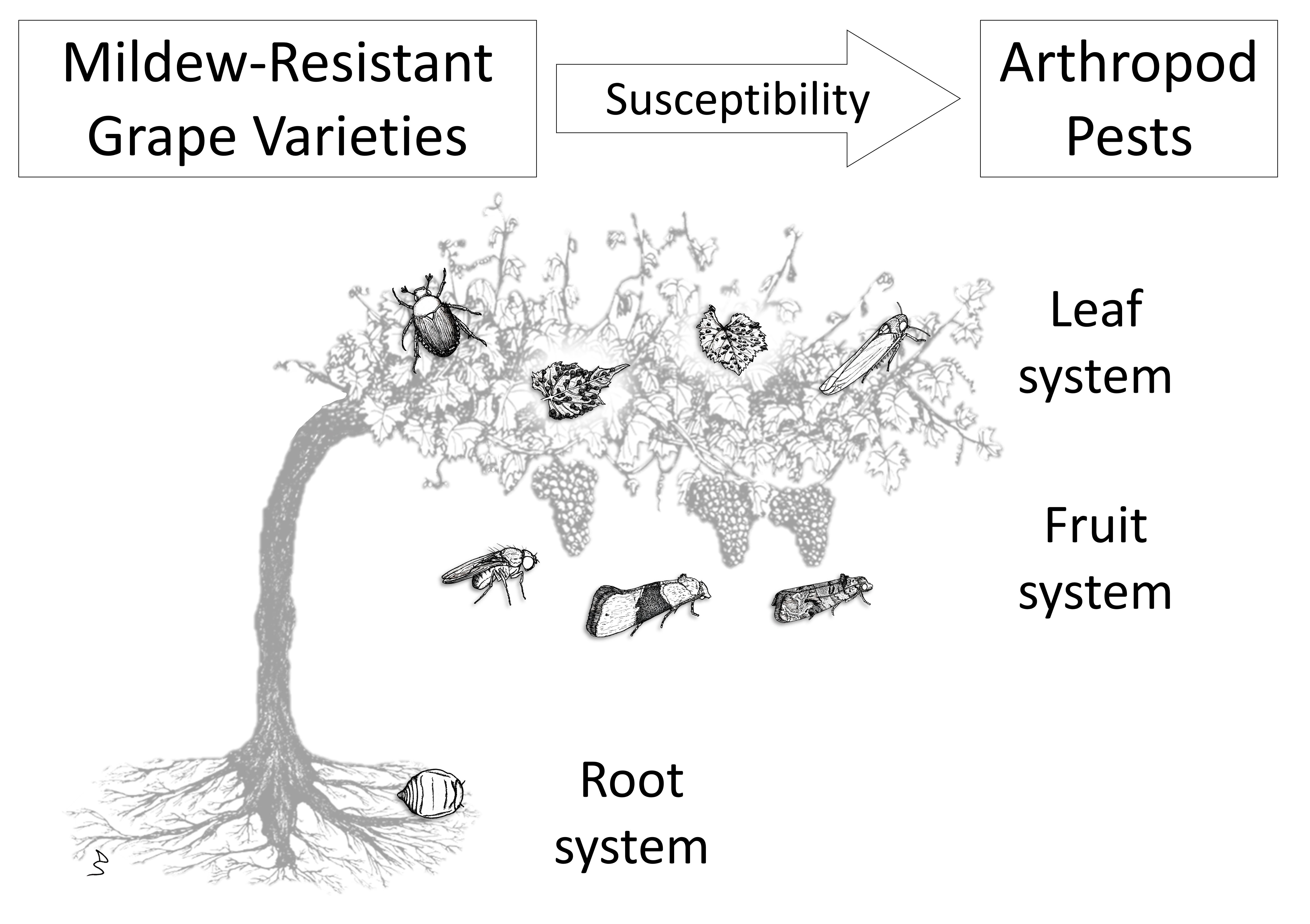
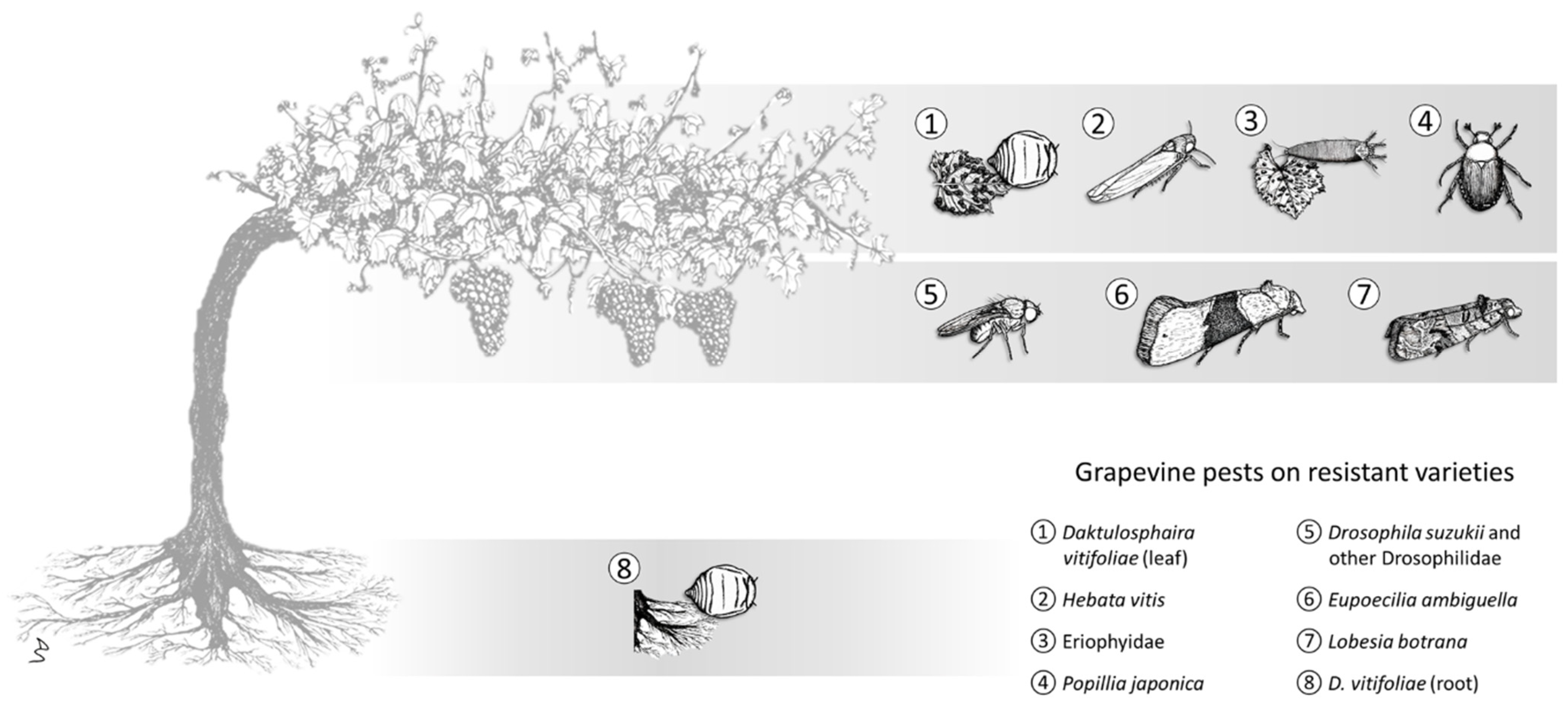
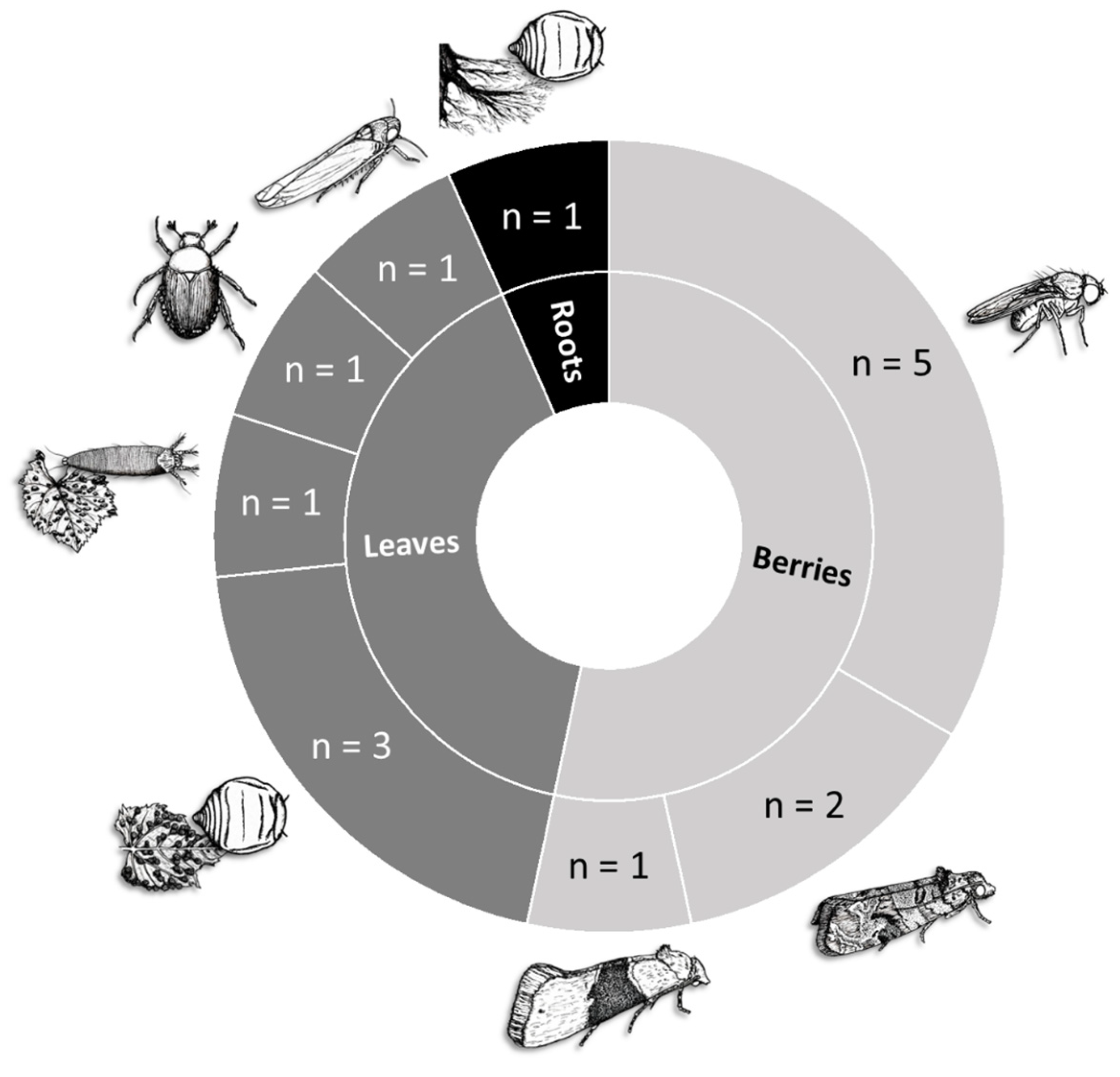
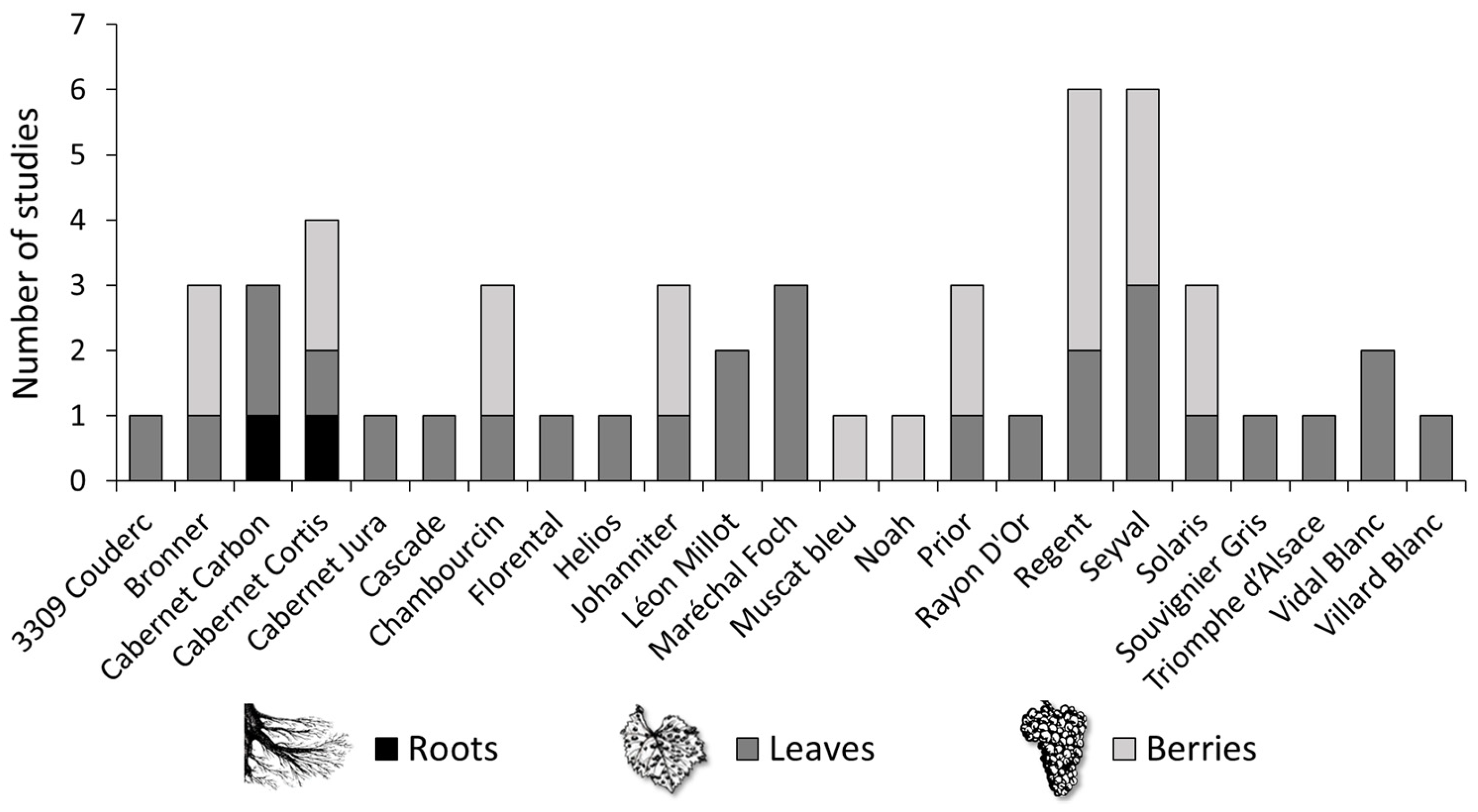
Susceptibility to Arthropod Pests of Mildew-Resistant Grape Varieties: What Do We Know and Where Are We Going?
 , , ,
, , ,
Abstract
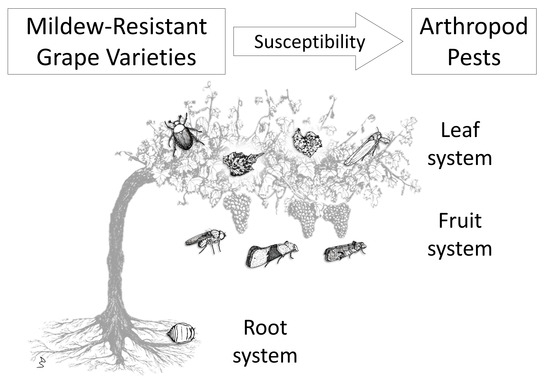
1. Grapevine and Biotic Stresses
2. Methodology
Literature Research
3. Where Do We Come from? Grape Varieties Resistant to Mildews
4. What Are We? Grape Varieties and Interaction with Pests
5. Where Are We Going? Arthropod Pest Susceptibility of Mildew-Resistant Grape Varieties
6. Mildew-Resistant Grape Varieties and Susceptibility to Arthropod Pests—Where Should We Go?
- Systematic pest screening of HPR varieties across phenological stages and at different field scales (laboratory and multi-site field trials). This baseline screening represents the most immediate, highest-impact prerequisite needed to map current vulnerabilities;
- Evaluation of parental lines and rootstocks to assess heritability and root-based vs. scion-based arthropod pest susceptibility through morphological, phenological and biochemical traits. This represents a crucial mechanistic parallel to baseline screening, establishing whether observed field traits are predictably heritable;
- Monitoring for pest adaptation to new mildew-resistant varieties, including potential shifts in host range or feeding/oviposition behavior. Importantly, this long-term tracking depends directly on the baselines established in items 1 and 2, shifting the focus from immediate mapping to future ecosystem resilience;
- Socioeconomic and regulatory analyses to foster adoption while maintaining wine quality and consumer confidence. While less biological, this final step represents the ultimate practical bottleneck governing whether these multi-resistant varieties can achieve widespread commercial deployment.
Author Contributions
Funding
Data Availability Statement
Conflicts of Interest
Appendix A

| Plant Part | Pest | Varieties | Susceptibility * | Parameter | Notes | Reference(s) |
|---|---|---|---|---|---|---|
| Berries | Drosophila suzukii | IRAC 1999 | A | Oviposition holes in berries | Laboratory | [151,152] |
| Bronner | AB | |||||
| Cabernet Cortis | AB | |||||
| Seyval blanc | AB | |||||
| VB 91 26 04 | ABC | |||||
| VB 32-7 | ABCD | |||||
| Johanniter | BCD | |||||
| Solaris | BCD | |||||
| Blauburgunder | CDE | |||||
| Prior | DE | |||||
| Chambourcin | E | |||||
| Drosophila suzukii | Acolon | Very high | Infestation severity of berries | Field | [108] | |
| Regent | High to very high | |||||
| Pinot Noir | High | |||||
| Müller-Thurgau | Very low | |||||
| Pinot Blanc | Very low | |||||
| (other 34 varieties with no statistical analysis) | (variable) | |||||
| Drosophila suzukii | Acolon | High | Adult location preference | Laboratory, dual-choice assays | [108] | |
| Regent | High | |||||
| Pinot Noir | Low to high | |||||
| Müller-Thurgau | Low | |||||
| Pinot Blanc | Low | |||||
| Drosophila suzukii | Regent | High | Oviposition preference | Laboratory, dual-choice assays | [108] | |
| Acolon | Low to high | |||||
| Pinot Blanc | Low to high | |||||
| Müller-Thurgau | Low | |||||
| Pinot Noir | Low | |||||
| Drosophila suzukii | Acolon | A | Insect infestation | Field (samples studied in laboratory) | [152] | |
| Cabernet Dorsa | A | |||||
| Cornalin | A | |||||
| Divico | A | |||||
| Dornfelder | A | |||||
| Dunkelfelder | A | |||||
| Galotta | A | |||||
| Garanoir | A | |||||
| Humagne rouge | A | |||||
| Mara | A | |||||
| Regent | A | |||||
| Syrah | A | |||||
| Chasselas | B | |||||
| Cornalin | B | |||||
| Dakapo | B | |||||
| Diolinoir | B | |||||
| Gamaret | B | |||||
| Gamay | B | |||||
| Merlot | B | |||||
| Müller-Thurgau | B | |||||
| Muscat bleu | B | |||||
| Pinot Noir | B | |||||
| Drosophila suzukii and other Drosophilidae | Concord | A | Infestations of berries (adult emergence) | Field (samples studied in laboratory) | [153] | |
| Pinot gris | A | |||||
| Chardonnay | AB | |||||
| Marquette | AB | |||||
| Marquis | AB | |||||
| Niagara | AB | |||||
| Pinot Noir | AB | |||||
| Seyval blanc | AB | |||||
| Vanessa | AB | |||||
| Zweilgelt | AB | |||||
| Cabernet Franc | B | |||||
| Mars | B | |||||
| Merlot | B | |||||
| Noiret | B | |||||
| Regent | B | |||||
| Traminette | B | |||||
| Eupoecilia ambiguella | Regent | A | Oviposition preference | Laboratory, dual-choice experiment; influence of wax layer on berry | [109] | |
| Pinot Noir | A | |||||
| Müller-Thurgau | AB | |||||
| Riesling | B | |||||
| Lobesia botrana | Regent | A | Oviposition preference | Laboratory, dual-choice experiment; influence of wax layer on berry | [109] | |
| Pinot Noir | A | |||||
| Müller-Thurgau | AB | |||||
| Riesling | B | |||||
| Lobesia botrana | Chardonnay | A | Infestation (number of pupae per cluster) | Field | [154] | |
| Merlot | A | |||||
| Noah | AB | |||||
| Pinot | AB | |||||
| Chasselas | B | |||||
| Riesling | B | |||||
| Leaves | Daktulosphaira vitifoliae | Léon Millot | High (11 out of 11) | Infestation, leaf galls (and no. of sub-plots with leaf galls) | Field | [147] |
| Maréchal Foch | High (15 out of 19) | |||||
| Baco Noir | Medium to high (2 out of 3) | |||||
| Charmont | Medium to high (1 out of 1) | |||||
| Clinton | Medium to high (1 out of 1) | |||||
| Divico | Medium to high (1 out of 1) | |||||
| York Madeira | Medium to high (1 out of 1) | |||||
| Cabernet Jura | Medium to high (1 out of 1) | |||||
| Chasselas | Medium to high (1 out of 2) | |||||
| Chardonnay Blanc | Medium to high (2 out of 2) | |||||
| Seyval | Medium to high (2 out of 2) | |||||
| Triomphe d’Alsace | Medium to high (2 out of 2) | |||||
| VB 32-7 | Medium to high (2 out of 2) | |||||
| Pinot Noir | No galls (0 out of 1) | |||||
| Cabernet Carbon | No galls (0 out of 1) | |||||
| Regent | No galls (0 out of 2) | |||||
| Daktulosphaira vitifoliae | Seyval | High (80.0%; 162) | Infestation (and % of leaves infested; no. of galls per leaf) | Field. Fluctuations in years | [69] | |
| Aurora | High (75.2%; 182) | |||||
| Rayon D’Or | High (43.2%; 155) | |||||
| Cascade | High (78.8%; 82) | |||||
| Villard Blanc | High (77.2%; 64) | |||||
| Chancellor | High (40.4%; 209) | |||||
| Delaware | Medium (27.2%; 140) | |||||
| Vignoles | Medium (28.4%; 98) | |||||
| Léon Millot | Medium (26.4%; 106) | |||||
| Vidal 256 [=Vidal Blanc] | Medium (34.8%; 68) | |||||
| Baco Noir | Medium (16.4%; 102) | |||||
| Chelois | Medium (27.6%; 82) | |||||
| Dutchess | Medium (13.2%; 94) | |||||
| Niagara | Medium (4.0%; 72) | |||||
| J. Riesling | Medium (9.2%; 34) | |||||
| Florental | Medium (8.0%; 20) | |||||
| Catawba | Medium (2.0%; 31) | |||||
| Maréchal Foch | Medium (8.8%; 16) | |||||
| Cabernet Sauvignon | Medium (9.2%; 11) | |||||
| Chardonnay | Medium (9.2%; 3) | |||||
| Steuben | Medium (1.2%; 2) | |||||
| DeChaunac | No galls (0%; 0) | |||||
| Gamay | No galls (0%; 0) | |||||
| Daktulosphaira vitifoliae | Cabernet Cortis | High | ‘Resistance’ [other details not specified] (score 1 to 10) | Field | [155] | |
| Bronner | High | |||||
| Johanniter | High | |||||
| Helios | Low to medium | |||||
| Cabernet Carbon | Low | |||||
| Prior | Low | |||||
| Regent | Low | |||||
| Solaris | Low | |||||
| Souvignier Gris | Low | |||||
| Eriophyidae | Cabernet Cortis | High | ‘Resistance’ (leaf galls; score 1 to 10) | Field | [155] | |
| Souvignier Gris | High | |||||
| Cabernet Carbon | Medium | |||||
| Regent | Medium | |||||
| Bronner | Medium | |||||
| Prior | Low | |||||
| Solaris | Low | |||||
| Helios | Low | |||||
| Johanniter | Low | |||||
| Hebata vitis | Regent | High | ‘Resistance’ (score 1 to 10) | Field | [155] | |
| Prior | Medium | |||||
| Bronner | Low | |||||
| Cabernet Carbon | Low | |||||
| Cabernet Cortis | Low | |||||
| Souvignier Gris | Low | |||||
| Solaris | Low | |||||
| Helios | Low | |||||
| Johanniter | Low | |||||
| Popillia japonica | Vidal Blanc | A | Incidence (% of damaged leaves) | Semi-field (cage experiment) | [113] | |
| Seyval | AB | |||||
| Rougeon | ABC | |||||
| St. Croix | ABC | |||||
| St. Vincent | ABC | |||||
| Vignoles | ABC | |||||
| Lemberger | ABC | |||||
| Chambourcin | ABC | |||||
| Glenora | ABC | |||||
| DeChaunac | ABC | |||||
| Maréchal Foch (Marshal Foch) | ABC | |||||
| Himrod | ABC | |||||
| Chardonel | ABC | |||||
| Delaware (Pr) | ABC | |||||
| Cayuga White | ABC | |||||
| Chardonnay (Pr) | ABC | |||||
| Chancellor | ABC | |||||
| Frantenac | ABC | |||||
| Lacrosse | ABC | |||||
| Cabernet Sauvignon (Pr) | BC | |||||
| Cabernet Franc | BC | |||||
| Vanessa | BC | |||||
| Jupiter | BC | |||||
| Reliance | BCD | |||||
| Catawba (At) | BCD | |||||
| Concord Seedless | BCD | |||||
| Concord | BCD | |||||
| Edelweiss | BCD | |||||
| 3309 Couderc | BCD | |||||
| Einset | BCD | |||||
| Marquis | CD | |||||
| Mars | D | |||||
| Roots | Daktulosphaira vitifoliae | Cabernet Cortis | High (mean mortality 17%) | Mortality rate | Laboratory, material from different field origin. Different phylloxera lineages and populations were used | [156] |
| Cabernet Carbon | High (mean mortality 17%) | |||||
| Cabernet Dorse We750 | High (mean mortality 17%) | |||||
| Cabernet Mitos We650 | High (mean mortality 17%) | |||||
| 125AA—Gm1 | Medium (mean mortality 15%) | |||||
| 125AA—Gm3 | Medium (mean mortality 15%) | |||||
| 125AA—Gm5 | Medium (mean mortality 15%) |
References
- Peterson, R.K.D.; Higley, L.G. Biotic Stress and Yield Loss; CRC Press LLC: Boca Raton, FL, USA, 2001; 276p. [Google Scholar]
- Flynn, P. Biotic vs. Abiotic—Distinguishing Disease Problems. Available online: https://yardandgarden.extension.iastate.edu/how-to/biotic-vs-abiotic-distinguishing-disease-problems (accessed on 15 December 2025).
- Oerke, E.-C. Crop losses to pests. J. Agric. Sci. 2005, 144, 31–43. [Google Scholar] [CrossRef] [Scilit]
- Oerke, E.-C.; Dehne, H.W. Safeguarding production—Losses in major crops and the role of crop protection. Crop Prot. 2004, 23, 275–285. [Google Scholar] [CrossRef] [Scilit]
- Metcalf, R.L.; Luckmann, W.H. Introduction to Insect Pest Management, 3rd ed.; Wiley-Interscience: John Wiley and Sons, Inc.: New York, NY, USA, 1994; 672p. [Google Scholar]
- Dent, D. Insect Pest Management, 2nd ed.; CABI: Wallingford, UK, 2000; 410p. [Google Scholar]
- Bony, S.; Gillet, C.; Bouchez, A.; Margoum, C.; Devaux, A. Genotoxic pressure of vineyard pesticides in fish: Field and mesocosm surveys. Aquat. Toxicol. 2008, 89, 197–203. [Google Scholar] [CrossRef] [Scilit] [PubMed]
- Fantke, P.; Friedrich, R.; Jolliet, O. Health impact and damage cost assessment of pesticides in Europe. Environ. Int. 2012, 49, 9–17. [Google Scholar] [CrossRef] [Scilit] [PubMed]
- Töpfer, R.; Hausmann, L.; Harst, M.; Maul, E.; Zyprian, E.; Eibach, R. New horizons for grapevine breeding. In Methods in Temperate Fruit Breeding; Flachowsky, H., Hanke, M.V., Eds.; Global Science Books; Springer: Dordrecht, The Netherlands, 2011; pp. 79–100. [Google Scholar] [CrossRef] [Scilit]
- Kellow, A.V.; Sedgley, M.; Van Heeswijck, R. Interaction between Vitis vinifera and grape phylloxera: Changes in root tissue during nodosity formation. Ann. Bot. 2004, 93, 581–590. [Google Scholar] [CrossRef] [Scilit] [PubMed]
- Berlinger, M.J. Plant resistance to insects. In Encyclopedia of Entomology, 2nd ed.; Capinera, J.L., Ed.; Springer: Dordrecht, The Netherlands, 2008; pp. 2930–2935. [Google Scholar]
- Lamichhane, J.R.; Dachbrodt-Saaydeh, S.; Kudsk, P.; Messéan, A. Toward a reduced reliance on conventional pesticides in European agriculture. Plant Dis. 2015, 100, 10–24. [Google Scholar] [CrossRef] [Scilit] [PubMed]
- Stenberg, J.A. A conceptual framework for Integrated Pest Management. Trends Plant Sci. 2017, 22, 759–769. [Google Scholar] [CrossRef] [Scilit] [PubMed]
- Reisch, B.I.; Owens, C.L.; Cousins, P.S. Grape. In Fruit Breeding; Badenes, M.L., Byrne, D.H., Eds.; Springer Science & Business Media: Dordrecht, The Netherlands, 2012; Volume 8, pp. 225–262. [Google Scholar]
- OIV (International Organization of Vine and Wine). OIV Statistical Report on World Vitiviniculture—2018 World Vitiviniculture Situation. Available online: http://www.oiv.int/public/medias/6371/oiv-statistical-report-on-world-vitiviniculture-2018.pdf (accessed on 11 January 2025).
- OIV (International Organization of Vine and Wine). State of the World Wine and Wine Sector in 2022. Available online: https://www.oiv.int/sites/default/files/documents/OIV_State_of_the_world_Vine_and_Wine_sector_in_2022_2.pdf (accessed on 11 January 2025).
- Pertot, I.; Caffi, T.; Rossi, V.; Mugnai, L.; Hoffmann, C.; Grando, M.S.; Gary, C.; Lafond, D.; Duso, C.; Thiery, D. A critical review of plant protection tools for reducing pesticide use on grapevine and new perspectives for the implementation of IPM in viticulture. Crop Prot. 2017, 97, 70–84. [Google Scholar] [CrossRef] [Scilit]
- Pedneault, K.; Provost, C. Fungus resistant grape varieties as a suitable alternative for organic wine production: Benefits, limits, and challenges. Sci. Hortic. 2016, 208, 57–77. [Google Scholar] [CrossRef] [Scilit]
- Trapp, O.; Avia, K.; Borrelli, C.; Eibach, R.; Merdinoglu, D.; Töpfer, R. More sustainability in Europe’s vineyards—Using resistant grapevine varieties to reduce the input of pesticides. Plants People Planet 2025, 7, 1621–1628. [Google Scholar] [CrossRef] [Scilit]
- Erb, M.; Reymond, P. Molecular interactions between plants and insect herbivores. Annu. Rev. Plant Biol. 2019, 70, 527–557. [Google Scholar] [CrossRef] [Scilit] [PubMed]
- Rahman, F.U.; Khan, I.A.; Aslam, A.; Liu, R.; Sun, L.; Wu, Y.; Aslam, M.M.; Khan, A.U.; Li, P.; Jiang, J.; et al. Transcriptome analysis reveals pathogenesis-related gene 1 pathway against salicylic acid treatment in grapevine (Vitis vinifera L). Front. Genet. 2022, 13, 1033288. [Google Scholar] [CrossRef] [Scilit] [PubMed]
- Feussner, I.; Wasternack, C. The lipoxygenase pathway. Annu. Rev. Plant Biol. 2002, 53, 275–297. [Google Scholar] [CrossRef] [Scilit] [PubMed]
- Yan, L.; Zhai, Q.; Wei, J.; Li, S.; Wang, B.; Huang, T.; Du, M.; Sun, J.; Kang, L.; Li, C.-B.; et al. Role of tomato lipoxygenase D in wound-induced jasmonate biosynthesis and plant immunity to insect herbivores. PLoS Genet. 2013, 9, e1003964. [Google Scholar] [CrossRef] [Scilit] [PubMed]
- Singh, P.; Arif, Y.; Miszczuk, E.; Bajguz, A.; Hayat, S. Specific roles of lipoxygenases in development and responses to stress in plants. Plants 2022, 11, 979. [Google Scholar] [CrossRef] [Scilit] [PubMed]
- Li, B.; Chen, D.; Fan, Z.; Lu, G.; Li, P.; Sun, L.; Li, G. Genome-wide identification and analysis of the jasmonic acid biosynthetic and signaling gene families in grapevine and the functional verification of VvLOX9 in resistance to cold. Plant Physiol. Biochem. 2026, 234, 111350. [Google Scholar] [CrossRef] [Scilit] [PubMed]
- Ali, M.; Shi, L.; Khan, M.A.; Ali, A.; Hu, S.; Shen, J. Auxin biodynamics and its integral role in enhancing plant resilience to environmental cues. Physiol. Plant. 2025, 177, e70165. [Google Scholar] [CrossRef] [Scilit] [PubMed]
- Tonğa, A.; Ali, J. Jasmonate-mediated plant responses to sap-sucking herbivores: A comprehensive review with emerging implications. In Insect-Plant Interactions; Ali, J., Tonğa, A., Shakeel, A., Chen, R., Eds.; Apple Academic Press: New York, NY, USA, 2026; pp. 59–104. [Google Scholar]
- Pieterse, C.M.J.; Van der Does, D.; Zamioudis, C.; Leon-Reyes, A.; Van Wees, S.C.M. Hormonal modulation of plant immunity. Annu. Rev. Cell Dev. Biol. 2012, 28, 489–521. [Google Scholar] [CrossRef] [Scilit] [PubMed]
- Thaler, J.S.; Humphrey, P.T.; Whiteman, N.K. Evolution of jasmonate and salicylate signal crosstalk. Trends Plant Sci. 2012, 17, 260–270. [Google Scholar] [CrossRef] [Scilit] [PubMed]
- Erb, M.; Meldau, S.; Howe, G.A. Role of phytohormones in insect-specific plant reactions. New Phytol. 2012, 194, 703–716. [Google Scholar] [CrossRef] [Scilit] [PubMed]
- Robert-Seilaniantz, A.; Grant, M.; Jones, J.D.G. Hormone crosstalk in plant disease and defense: More than just jasmonate–salicylate antagonism. Annu. Rev. Phytopathol. 2011, 49, 317–343. [Google Scholar] [CrossRef] [Scilit] [PubMed]
- Salotti, I.; Bove, F.; Ji, T.; Rossi, V. Information on disease resistance patterns of grape varieties may improve disease management. Front. Plant Sci. 2022, 13, 1017658. [Google Scholar] [CrossRef] [Scilit] [PubMed]
- Miller, G.T.; Spoolmen, S. Sustaining the Earth, 11th ed.; Cengage Learning: Stamford, CT, USA, 2014; 384p. [Google Scholar]
- Lund, K. Western United States grapevine breeding. In Grapevine Breeding Programs for the Wine Industry; Reynolds, A., Ed.; Elsevier Ltd.: Cambridge, UK, 2015; pp. 359–378. [Google Scholar]
- Zhang, X.; Starner, K.; Spurlock, F. Analysis of chlorpyrifos agricultural use in regions of frequent surface water detections in California, USA. Bull. Environ. Contam. Toxicol. 2012, 89, 978–984. [Google Scholar] [CrossRef] [Scilit] [PubMed]
- McMurtry, J.A.; Huffaker, C.B.; van de Vrie, M.I. Tetranychid enemies: Their biological characters and the impact of spray practices. Hilgardia 1970, 40, 331–390. [Google Scholar] [CrossRef] [Scilit]
- Granett, J.; Walker, M.A.; Kocsis, L.; Omer, A.D. Biology and management of grape phylloxera. Annu. Rev. Entomol. 2001, 46, 387–412. [Google Scholar] [CrossRef] [Scilit] [PubMed]
- Duso, C.; Pozzebon, A.; Kreiter, S.; Tixier, M.S.; Candolfi, M.P. Management of phytophagous mites in European vineyards. In Arthropod Management in Vineyards: Pests, Approaches, and Future Directions; Bostanian, N.J., Vincent, C., Isaacs, R., Eds.; Springer: Dordrecht, The Netherlands, 2012; pp. 191–217. [Google Scholar] [CrossRef] [Scilit]
- Civolani, S.; Boselli, M.; Butturini, A.; Chicca, M.; Fano, E.A.; Cassanelli, S. Assessment of insecticide resistance of Lobesia botrana (Lepidoptera: Tortricidae) in Emilia-Romagna region. J. Econ. Entomol. 2014, 107, 1245–1249. [Google Scholar] [CrossRef] [Scilit] [PubMed]
- Andreason, S.A.; Prabhaker, N.; Castle, S.J.; Ganjisaffar, F.; Haviland, D.R.; Stone-Smith, B.; Perring, T.M. Reduced susceptibility of Homalodisca vitripennis (Hemiptera: Cicadellidae) to commonly applied insecticides. J. Econ. Entomol. 2018, 111, 2340–2348. [Google Scholar] [CrossRef] [Scilit] [PubMed]
- Pasquini, S.; Haxaire-Lutun, M.O.; Rison, J.-L.; Flier, W.G.; Teixeira, L.A. Susceptibility of Lobesia botrana (Lepidoptera: Tortricidae) to chlorantraniliprole in the Emilia Romagna region of Northeast Italy. J. Econ. Entomol. 2018, 111, 369–374. [Google Scholar] [CrossRef] [Scilit] [PubMed]
- Pennington, T.; Reiff, J.M.; Theiss, K.; Entling, M.H.; Hoffmann, C. Reduced fungicide applications improve insect pest control in grapevine. BioControl 2018, 63, 687–695. [Google Scholar] [CrossRef] [Scilit]
- Reiff, J.M.; Sudarsan, K.; Hoffmann, C.; Entling, M.H. Arthropods on grapes benefit more from fungicide reduction than from organic farming. Pest Manag. Sci. 2023, 79, 3271–3279. [Google Scholar] [CrossRef] [Scilit] [PubMed]
- Blaise, C.; Mazzia, C.; Bischoff, A.; Dutoit, T. Vegetation increases abundances of ground and canopy arthropods in Mediterranean vineyards. Sci. Rep. 2022, 12, 3680. [Google Scholar] [CrossRef] [Scilit] [PubMed]
- Pavan, F.; Cargnus, E.; Zandigiacomo, P. Vineyard design, cultural practices and physical methods for controlling grapevine pests and disease vectors in Europe: A review. Insects 2026, 17, 113. [Google Scholar] [CrossRef] [Scilit] [PubMed]
- Röckel, F. Vitis International Variety Catalogue. Available online: www.vivc.de (accessed on 15 December 2025).
- Reynolds, A. Grapevine Breeding Programs for the Wine Industry; Elsevier Ltd.: Cambridge, UK, 2015; 439p. [Google Scholar]
- Herzog, K.; Kicherer, A.; Malagol, N.; Trapp, O.; Töpfer, R. High-throughput phenotyping in grapevine breeding research: Technologies and applications. OENO One 2025, 59, 8458. [Google Scholar] [CrossRef] [Scilit]
- Pacifico, D.; Gaiotti, F.; Giusti, M.; Tomasi, D. Performance of interspecific grapevine varieties in north-east Italy. Agric. Sci. 2013, 4, 91–101. [Google Scholar] [CrossRef]
- Stokstad, E. Vive la resistant vines! Science 2018, 362, 146. [Google Scholar] [CrossRef] [Scilit] [PubMed]
- Testolin, R.; Peterlunger, E.; Collovini, S.; Castellarin, S. Technical Booklets VCR, The Disease-Resistant Varieties, 3rd ed.; Vivai Cooperativi Rauscedo: Rauscedo, Italy, 2018; 32p, Available online: https://www.infowine.com/wp-content/uploads/2000/01/17582-VCR-Quaderno-tecnico-18-III-Ed-It-Uk-Affiancate.pdf (accessed on 15 December 2025).
- Pozzebon, A.; Tirello, P.; Moret, R.; Pederiva, M.; Duso, C. A fundamental step in IPM on grapevine: Evaluating the side effects of pesticides on predatory mites. Insects 2015, 6, 847–857. [Google Scholar] [CrossRef] [Scilit] [PubMed]
- Di Gaspero, G.; Foria, S. Molecular grapevine breeding techniques. In Grapevine Breeding Programs for the Wine Industry; Reynolds, A., Ed.; Elsevier Ltd.: Cambridge, UK, 2015; pp. 23–37. [Google Scholar]
- Oliveira, M.J.R.A.; Roriz, M.; Vasconcelos, M.V.; Bertaccini, A.; Carvalho, S.M.P. Conventional and novel approaches for managing “flavescence dorée” in grapevine: Knowledge gaps and future prospects. Plant Pathol. 2019, 68, 3–17. [Google Scholar] [CrossRef] [Scilit]
- Di Gaspero, G.; Copetti, D.; Coleman, C.; Castellarin, S.D.; Eibach, R.; Kozma, P.; Lacombe, T.; Gambetta, G.; Zvyagin, A.; Cindrić, P.; et al. Selective sweep at the Rpv3 locus during grapevine breeding for downy mildew resistance. Theor. Appl. Genet. 2012, 124, 277–286. [Google Scholar] [CrossRef] [Scilit] [PubMed]
- Venuti, S.; Copetti, D.; Foria, S.; Falginella, L.; Hoffmann, S.; Bellin, D.; Cindric, P.; Kozma, P.; Scalabrin, S.; Morgante, M.; et al. Historical introgression of the downy mildew resistance gene Rpv12 from the Asian species Vitis amurensis into grapevine varieties. PLoS ONE 2013, 8, e61228. [Google Scholar] [CrossRef] [Scilit] [PubMed]
- Smith, C.M.; Clement, S.L. Molecular bases of plant resistance to arthropods. Annu. Rev. Entomol. 2012, 57, 309–328. [Google Scholar] [CrossRef] [Scilit] [PubMed]
- Sharma, H.C.; Ortiz, R. Host plant resistance to insects: An eco-friendly approach for pest management and environment conservation. J. Environ. Biol. 2002, 23, 111–135. [Google Scholar] [PubMed]
- Smith, C.M. Plant Resistance to Arthropods—Molecular and Conventional Approaches; Springer: Dordrecht, The Netherlands, 2005; 423p. [Google Scholar]
- Sandhu, S.; Kang, M.S. Advances in breeding for resistance to insects. In Breeding Insect Resistant Crops for Sustainable Agriculture; Ramesh, A., Surinder, S., Eds.; Springer Nature: Singapore, 2017; pp. 67–99. [Google Scholar]
- Dicke, M.; Sabelis, M.W. How plants obtain predatory mites as bodyguards. Neth. J. Zool. 1988, 38, 148–165. [Google Scholar]
- Aljbory, Z.; Chen, M.-S. Indirect plant defense against insect herbivores: A review. Insect Sci. 2018, 25, 2–23. [Google Scholar] [CrossRef] [Scilit] [PubMed]
- Thaler, J.S.; Stout, M.J.; Karban, R.; Duffey, S.S. Jasmonate-mediated induced plant resistance affects a community of herbivores. Ecol. Entomol. 2001, 26, 312–324. [Google Scholar] [CrossRef] [Scilit]
- Gatehouse, J.A. Plant resistance towards insect herbivores: A dynamic interaction. New Phytol. 2002, 156, 145–169. [Google Scholar] [CrossRef] [Scilit] [PubMed]
- Heil, M. Indirect defence via tritrophic interactions. New Phytol. 2008, 178, 41–61. [Google Scholar] [CrossRef] [Scilit] [PubMed]
- Mithöfer, A.; Boland, W. Plant defense against herbivores: Chemical aspects. Annu. Rev. Plant Biol. 2012, 63, 431–450. [Google Scholar] [CrossRef] [Scilit] [PubMed]
- Ollat, N.; Bordenave, L.; Tandonnet, J.P.; Boursiquot, J.M.; Marguerit, E. Grapevine rootstocks: Origins and perspectives. Acta Hortic. 2016, 1136, 11–22. [Google Scholar] [CrossRef] [Scilit]
- Tello, J.; Mammerler, R.; Čajić, M.; Forneck, A. Major outbreaks in the nineteenth century shaped grape phylloxera contemporary genetic structure in Europe. Sci. Rep. 2019, 9, 17540. [Google Scholar] [CrossRef] [Scilit] [PubMed]
- Jubb, G.L., Jr. Grape phylloxera: Incidence of foliage damage to wine grapes in Pennsylvania. J. Econ. Entomol. 1976, 69, 763–766. [Google Scholar] [CrossRef] [Scilit]
- Granett, J.; Bisabri-Ershadi, B.; Carey, J. Life tables of phylloxera on resistant and susceptible grape rootstocks. Entomol. Exp. Appl. 1983, 34, 13–19. [Google Scholar] [CrossRef] [Scilit]
- Hawthorne, D.J.; Via, S. Variation in performance on two grape cultivars within and among populations of grape phylloxera from wild and cultivated habitats. Entomol. Exp. Appl. 1994, 70, 63–76. [Google Scholar] [CrossRef] [Scilit]
- English-Loeb, G.; Karban, R.; Walker, M.A. Genotypic variation in constitutive and induced resistance in grapes against spider mite (Acari: Tetranychidae) herbivores. Environ. Entomol. 1998, 27, 297–304. [Google Scholar] [CrossRef] [Scilit] [PubMed]
- Omer, A.D.; Granett, J.; Kocsis, L.; Downie, D.A. Preference and performance responses of California grape phylloxera to different Vitis rootstocks. J. Appl. Entomol. 1999, 123, 341–346. [Google Scholar] [CrossRef] [Scilit]
- Forneck, A.; Walker, M.A.; Blaich, R. Ecological and genetic aspects of grape phylloxera Daktulosphaira vitifoliae (Hemiptera: Phylloxeridae) performance on rootstock hosts. Bull. Entomol. Res. 2001, 91, 445–451. [Google Scholar] [CrossRef] [Scilit] [PubMed]
- Forneck, A.; Walker, M.A.; Blaich, R.; Yvon, M.; Leclant, F. Interaction of phylloxera (Daktulosphaira vitifoliae Fitch) with grape (Vitis spp.) in simple isolation chamber. Am. J. Enol. Vitic. 2001, 52, 28–34. [Google Scholar] [CrossRef] [Scilit]
- Du, Y.P.; Zhai, H.; Sun, Q.H.; Wang, Z.S. Susceptibility of Chinese grapes to grape phylloxera. Vitis 2009, 48, 57–58. [Google Scholar]
- Vidart, M.V.; Mujica, M.V.; Bao, L.; Duarte, F.; Bentancourt, C.M.; Franco, J.; Scatoni, I.B. Life history and assessment of grapevine phylloxera leaf galling incidence on Vitis species in Uruguay. SpringerPlus 2013, 2, 181. [Google Scholar] [CrossRef] [Scilit] [PubMed]
- Powell, K.S.; Korosi, G.A. ‘Taking the strain’—Selecting the right rootstock to protect against endemic phylloxera strains. Acta Hortic. 2014, 1045, 99–108. [Google Scholar] [CrossRef] [Scilit]
- Yin, L.; Clark, M.D.; Burkness, E.C.; Hutchison, W.D. Grape phylloxera (Hemiptera: Phylloxeridae), on cold-hardy hybrid wine grapes (Vitis spp.): A review of pest biology, damage, and management practices. J. Integr. Pest Manag. 2019, 10, 16. [Google Scholar] [CrossRef] [Scilit]
- Walker, G.E.; Stirling, G.R. Plant-parasitic nematodes in Australian viticulture: Key pests, current management practices and opportunities for future improvements. Australas. Plant Pathol. 2008, 37, 268–278. [Google Scholar] [CrossRef] [Scilit]
- Ferris, H.; Zheng, L.; Walker, M.A. Resistance of grape rootstocks to plant-parasitic nematodes. J. Nematol. 2012, 44, 377–386. [Google Scholar] [PubMed]
- Shi, W.; He, W.; Zhang, Z.; Sun, J.; Zhu, C.; Liu, Z.; Xu, Y.; Zhao, B. Study on the Resistance of ‘Cabernet Sauvignon’ Grapevine with Different Rootstocks to Colomerus vitis. Sustainability 2022, 14, 15193. [Google Scholar] [CrossRef] [Scilit]
- Boudon-Padieu, E. Jaunisses à phytoplasmes de la vigne. C. R. Acad. Agric. Fr. 1996, 82, 5–20. [Google Scholar]
- Rashed, A.; Daugherty, M.P.; Almeida, R.P.P. Grapevine genotype susceptibility to Xylella fastidiosa does not predict vector transmission success. Environ. Entomol. 2011, 40, 1192–1199. [Google Scholar] [CrossRef] [Scilit] [PubMed]
- Pavan, F.; Mori, N.; Bressan, S.; Mutton, P. Control strategies for grapevine phytoplasma diseases: Factors influencing the profitability of replacing symptomatic plants. Phytopathol. Mediterr. 2012, 51, 11–22. [Google Scholar]
- Bertazzon, N.; Bagnaresi, P.; Forte, V.; Mazzucotelli, E.; Filippin, L.; Guerra, D.; Zechini, A.; Cattivelli, L.; Angelini, E. Grapevine comparative early transcriptomic profiling suggests that Flavescence dorée phytoplasma represses plant responses induced by vector feeding in susceptible varieties. BMC Genom. 2019, 20, 526. [Google Scholar] [CrossRef] [Scilit] [PubMed]
- Ripamonti, M.; Maron, F.; Cornara, D.; Marzachì, C.; Fereres, A.; Bosco, D. Leafhopper feeding behaviour on three grapevine cultivars with different susceptibilities to Flavescence dorée. J. Insect Physiol. 2022, 137, 104366. [Google Scholar] [CrossRef] [Scilit] [PubMed]
- Bene, A.; Vergine, M.; Pedrelli, A.; De Bellis, L.; Luvisi, A. Flavescence dorée and grapevine susceptibility: From host–pathogen interaction to cultivar categorization. Pathogens 2025, 14, 939. [Google Scholar] [CrossRef] [Scilit] [PubMed]
- Timm, A.E.; Reineke, A. First insights into grapevine transcriptional responses as a result of vine mealybug Planococcus ficus feeding. Arthropod-Plant Interact. 2014, 8, 495–505. [Google Scholar] [CrossRef] [Scilit]
- Smith, H.M.; Clarke, C.W.; Smith, B.P.; Carmody, B.M.; Thomas, M.R.; Clingeleffer, P.R.; Powell, K.S. Genetic identification of SNP markers linked to a new grape phylloxera resistant locus in Vitis cinerea for marker-assisted selection. BMC Plant Biol. 2018, 18, 360. [Google Scholar] [CrossRef] [Scilit] [PubMed]
- Smith, H.M.; Smith, B.P.; Morales, N.B.; Moskwa, S.; Clingeleffer, P.R.; Thomas, M.R. SNP markers tightly linked to root knot nematode resistance in grapevine (Vitis cinerea) identified by a genotyping-by-sequencing approach followed by Sequenom MassARRAY validation. PLoS ONE 2018, 13, e0193121. [Google Scholar] [CrossRef] [Scilit] [PubMed]
- Du, Y.-P.; Jiang, E.-S.; Wang, F.-P.; Zhang, S.-Z.; Zhai, H. Gene expression profiling of rootstock ‘140Ru’ and Vitis vinifera L. cv. ‘Crimson Seedless’ grape roots infected with grape phylloxera. Plant Growth Regul. 2014, 73, 1–8. [Google Scholar] [CrossRef] [Scilit]
- Forneck, A.; Lawo, N.C.; Schoedl-Hummel, K.; Liebner, F.; Zweckmayr, T.; Griesser, M. Not just sweet: Phylloxerated roots indicate complex plant response mechanisms. Acta Hortic. 2016, 1136, 239–243. [Google Scholar] [CrossRef] [Scilit]
- Wang, F.-P.; Zhao, P.-P.; Zhang, L.; Zhai, H.; Du, Y.-P. Functional characterization of WRKY46 in grape and its putative role in the interaction between grape and phylloxera (Daktulosphaira vitifoliae). Hortic. Res. 2019, 6, 102. [Google Scholar] [CrossRef] [Scilit] [PubMed]
- de Lillo, E.; Pozzebon, A.; Valenzano, D.; Duso, C. An intimate relationship between eriophyoid mites and their host plants—A review. Front. Plant Sci. 2018, 9, 1786. [Google Scholar] [CrossRef] [Scilit] [PubMed]
- Javadi Khederi, S.; Khanjani, M.; Gholami, M.; Bruno, G.L. Study of defense-related gene expression in grapevine infested by Colomerus vitis (Acari: Eriophyidae). Exp. Appl. Acarol. 2018, 75, 25–40. [Google Scholar] [CrossRef] [Scilit] [PubMed]
- Fermaud, M. Cultivar susceptibility of grape berry clusters to larvae of Lobesia botrana (Lepidoptera: Tortricidae). J. Econ. Entomol. 1998, 91, 974–980. [Google Scholar] [CrossRef] [Scilit]
- Baldacchino, F.; Moleas, T. Suscettibilità di alcune cultivar di vite a Lobesia botrana (Denis et Shciffmüller) (Lepidoptera: Tortricidae). Atti Giornate Fitopatol. 2000, 1, 441–444. [Google Scholar]
- Snjezana, H. Susceptibility of some grapevine cultivars in area of vineyards of Podgorica on the attack of European grape berry moth—Lobesia botrana Den. et Schiff. (Lepidoptera, Tortricidae). Acta Hortic. 2004, 652, 355–358. [Google Scholar] [CrossRef] [Scilit]
- Pavan, F.; Sacilotto, G.; Girolami, V. Damage evolution, larval sampling and treatment period for grape moths. In Proceedings of the Meeting EC Experts’ Group “Integrated Pest Control in Viticulture”, Portoferraio, Italy, 26–28 September 1985; A.A. Balkema: Rotterdam, The Netherlands, 1987; pp. 39–49. [Google Scholar]
- Pavan, F.; Stefanelli, G.; Villani, A.; Cargnus, E. Influence of grapevine cultivar on the second generations of Lobesia botrana and Eupoecilia ambiguella. Insects 2018, 9, 8. [Google Scholar] [CrossRef] [Scilit] [PubMed]
- Pavan, F.; Stefanelli, G.; Cargnus, E.; Villani, A. Assessing the influence of inflorescence traits on the susceptibility of grape to vine moths. J. Appl. Entomol. 2009, 133, 394–401. [Google Scholar] [CrossRef] [Scilit]
- Linder, C.; Martin, C.; Laboisse, S.; Chatelain, P.G.; Kehrli, P. Susceptibility of various grape cultivars to Drosophila suzukii and other vinegar flies. IOBC-WPRS Bull. 2014, 105, 219–224. [Google Scholar]
- Ioriatti, C.; Walton, V.; Dalton, D.; Anfora, G.; Grassi, A.; Maistri, S.; Mazzoni, V. Drosophila suzukii (Diptera: Drosophilidae) and its potential impact to wine grapes during harvest in two cool climate wine grape production regions. J. Econ. Entomol. 2015, 108, 1148–1155. [Google Scholar] [CrossRef] [Scilit] [PubMed]
- Baser, N.; Broutou, O.; Verrastro, V.; Porcelli, F.; Ioriatti, C.; Anfora, G.; Mazzoni, V.; Rossi Stacconi, M.V. Susceptibility of table grape varieties grown in south-eastern Italy to Drosophila suzukii. J. Appl. Entomol. 2018, 142, 465–472. [Google Scholar] [CrossRef] [Scilit]
- Entling, W.; Anslinger, S.; Jarausch, B.; Michl, G.; Hoffmann, C. Berry skin resistance explains oviposition preferences of Drosophila suzukii at the level of grape cultivars and single berries. J. Pest Sci. 2019, 92, 477–484. [Google Scholar] [CrossRef] [Scilit]
- Tonina, L.; Giomi, F.; Sancassani, M.; Ajelli, M.; Mori, N.; Giongo, L. Texture features explain the susceptibility of grapevine cultivars to Drosophila suzukii (Diptera: Drosophilidae) infestation in ripening and drying grapes. Sci. Rep. 2020, 10, 10245. [Google Scholar] [CrossRef] [Scilit] [PubMed]
- Weißinger, L.; Samuel, N.; Breuer, M.; Müller, C. Effects of variety and grape berry condition of Vitis vinifera on preference behavior and performance of Drosophila suzukii. Insects 2019, 10, 432. [Google Scholar] [CrossRef] [Scilit] [PubMed]
- Rid, M.; Markheiser, A.; Hoffmann, C.; Gross, J. Waxy bloom on grape berry surface is one important factor for oviposition of European grapevine moths. J. Pest Sci. 2018, 91, 1225–1239. [Google Scholar] [CrossRef] [Scilit]
- Pavan, F.; Picotti, P. Influence of grapevine cultivars on the leafhopper Empoasca vitis and its egg parasitoids. BioControl 2009, 54, 55–63. [Google Scholar] [CrossRef] [Scilit]
- Schmidt, R.A. Leaf structures affect predatory mites (Acari: Phytoseiidae) and biological control: A review. Exp. Appl. Acarol. 2014, 62, 1–17. [Google Scholar] [CrossRef] [Scilit] [PubMed]
- Martinson, T.E.; Dennehy, T.J. Varietal preferences of Erythroneura leafhoppers (Homoptera: Cicadellidae) feeding on grapes in New York. Environ. Entomol. 1995, 24, 550–558. [Google Scholar] [CrossRef] [Scilit]
- Gu, S.; Pomper, K.W. Grape cultivar feeding preference of adult Japanese beetles. HortScience 2008, 43, 196–199. [Google Scholar] [CrossRef] [Scilit]
- Sharon, R.; Zahavi, T.; Soroker, V.; Harari, A.R. The effect of grape vine cultivars on Lobesia botrana (Lepidoptera: Tortricidae) population levels. J. Pest Sci. 2009, 82, 187–193. [Google Scholar] [CrossRef] [Scilit]
- Leskey, T.C.; Hamilton, G.C.; Nielsen, A.L.; Polk, D.F.; Rodriguez-Saona, C.; Bergh, J.C.; Herbert, D.A.; Kuhar, T.P.; Pfeiffer, D.; Dively, G.P.; et al. Pest status of the brown marmorated stink bug, Halyomorpha halys in the USA. Outlooks Pest Manag. 2012, 23, 218–226. [Google Scholar] [CrossRef] [Scilit]
- Fornasiero, D.; Pavan, F.; Pozzebon, A.; Picotti, P.; Duso, C. Relative infestation level and sensitivity of grapevine cultivars to the leafhopper Empoasca vitis (Hemiptera: Cicadellidae). J. Econ. Entomol. 2015, 109, 416–425. [Google Scholar] [CrossRef] [Scilit] [PubMed]
- Scaccini, D.; Fornasiero, D.; Tirello, P.; Vincenzi, S.; Cecchetto, M.; Allgjata, I.; Duso, C.; Pozzebon, A. Seasonal dynamics and damage of Halyomorpha halys in Italian vineyards. Insects 2024, 15, 378. [Google Scholar] [CrossRef] [Scilit] [PubMed]
- Tasin, M.; Bäckman, A.-C.; Coracini, M.; Casado, D.; Ioriatti, C.; Witzgall, P. Synergism and redundancy in a plant volatile blend attracting grapevine moth females. Phytochemistry 2007, 68, 203–209. [Google Scholar] [CrossRef] [Scilit] [PubMed]
- Schmidt-Büsser, D.; von Arx, M.; Connétable, S.; Guerin, P.M. Identification of host-plant chemical stimuli for the European grape berry moth Eupoecilia ambiguella. Physiol. Entomol. 2011, 36, 101–110. [Google Scholar] [CrossRef] [Scilit]
- von Arx, M.; Schmidt-Büsser, D.; Guerin, P.M. Host plant volatiles induce oriented flight behaviour in male European grapevine moths, Lobesia botrana. J. Insect Physiol. 2011, 57, 1323–1331. [Google Scholar] [CrossRef] [Scilit] [PubMed]
- Markheiser, A.; Rid, M.; Biancu, S.; Gross, J.; Hoffmann, C. Physical factors influencing the oviposition behaviour of European grapevine moths Lobesia botrana and Eupoecilia ambiguella. J. Appl. Entomol. 2018, 142, 201–210. [Google Scholar] [CrossRef] [Scilit]
- Markheiser, A.; Rid, M.; Biancu, S.; Gross, J.; Hoffmann, C. Tracking short-range attraction and oviposition of European grapevine moths affected by volatile organic compounds in a four-chamber olfactometer. Insects 2020, 11, 45. [Google Scholar] [CrossRef] [Scilit] [PubMed]
- Rid, M.; Markheiser, A.; Stein, S.; Hoffmann, C.; Gross, J. Volatiles of several grapevine cultivars emitted at different phenological stages linked to discriminatory ability of grapevine moths. J. Plant Dis. Prot. 2019, 126, 115–127. [Google Scholar] [CrossRef] [Scilit]
- Minuz, R.L.; Mancini, V.; Ruschioni, S.; Mozzon, M.; Foligni, R.; Isidoro, N.; Romanazzi, G.; Riolo, P. Volatiles emitted by resistance inducer-treated grapevines affect Hyalesthes obsoletus behavioural responses. Bull. Insectol. 2020, 73, 117–123. [Google Scholar]
- Maher, N.; Thiery, D.; Städler, E. Oviposition by Lobesia botrana is stimulated by sugars detected by contact chemoreceptors. Physiol. Entomol. 2006, 31, 14–22. [Google Scholar] [CrossRef] [Scilit]
- Moreau, J.; Rahme, J.; Benrey, B.; Thiery, D. Larval host plant origin modifies the adult oviposition preference of the female European grapevine moth Lobesia botrana. Naturwissenschaften 2008, 95, 317–324. [Google Scholar] [CrossRef] [Scilit] [PubMed]
- Rizvi, S.Z.M.; Raman, A. Effect of leaf chemistry of Vitis vinifera L. on the performance and development of Epiphyas postvittana (Lepidoptera: Tortricidae). Aust. J. Grape Wine Res. 2017, 23, 95–102. [Google Scholar] [CrossRef] [Scilit]
- Rezazadeh, A.; Sampson, B.J.; Stafne, E.T.; Marshall-Shaw, D.; Stringer, S.J.; Hummer, K. Susceptibility of bunch grape and muscadine cultivars to berry splitting and spotted-wing Drosophila oviposition. Am. J. Enol. Vitic. 2018, 69, 258–265. [Google Scholar] [CrossRef] [Scilit]
- Corrêa, S.C.; Wille, C.L.; Hoffer, H.; Carissimi Boff, M.I.; Franco, C.R. Oviposition preference and biology of fruit flies (Diptera: Tephritidae) on grape vine genotypes. Rev. Caatinga 2018, 31, 850–859. [Google Scholar] [CrossRef] [Scilit]
- Vogelweith, F.; Thiéry, D.; Quaglietti, B.; Moret, Y.; Moreau, J. Host plant variation plastically impacts different traits of the immune system of a phytophagous insect. Funct. Ecol. 2011, 25, 1241–1247. [Google Scholar] [CrossRef] [Scilit]
- Thiéry, D.; Louâpre, P.; Muneret, L.; Rusch, A.; Sentenac, G.; Vogelweith, F.; Iltis, C.; Moreau, J. Biological protection against grape berry moths. A review. Agron. Sustain. Dev. 2018, 38, 15. [Google Scholar] [CrossRef] [Scilit]
- Calas, D.; Thiéry, D.; Marion-Poll, F. 20-hydroxyecdysone deters oviposition and larval feeding in the European grapevine moth, Lobesia botrana. J. Chem. Ecol. 2006, 32, 2443–2454. [Google Scholar] [CrossRef] [Scilit] [PubMed]
- Moreau, J.; Arruego, X.; Benrey, B.; Thiéry, D. Differences in nutritional quality of parts of Vitis vinifera berries affect fitness of the European grapevine moth. Entomol. Exp. Appl. 2006, 119, 93–99. [Google Scholar] [CrossRef] [Scilit]
- Javadi Khederi, S.; Khanjani, M.; Gholami, M.; de Lillo, E. Sources of resistance to the erineum strain of Colomerus vitis (Acari: Eriophyidae) in grapevine cultivars. Syst. Appl. Acarol. 2018, 23, 405–425. [Google Scholar] [CrossRef] [Scilit]
- Hammons, D.L.; Kurtural, S.K.; Potter, D.A. Phenological resistance of grapes to the green June beetle, an obligate fruit-eating scarab. Ann. Appl. Biol. 2010, 156, 271–279. [Google Scholar] [CrossRef] [Scilit]
- Gabel, B.; Roehrich, R. Sensitivity of grapevine phenological stages to larvae of European grapevine moth, Lobesia botrana Den. et Schiff. (Lep., Tortricidae). J. Appl. Entomol. 1995, 119, 127–130. [Google Scholar] [CrossRef] [Scilit]
- Caffarra, A.; Rinaldi, M.; Eccel, E.; Rossi, V.; Pertot, I. Modelling the impact of climate change on the interaction between grapevine and its pests and pathogens: European grapevine moth and powdery mildew. Agric. Ecosyst. Environ. 2012, 148, 89–101. [Google Scholar] [CrossRef] [Scilit]
- Gennuso, E.; Ragusa, E.; Tsolakis, H. Evaluation of infestation by Lobesia botrana (Dennis et Schiffermüller) (Lepidoptera, Tortricidae) and its relation to territorial differences and cultivar susceptibility. IOBC-WPRS Bull. 2013, 85, 203–210. [Google Scholar]
- Gómez, M.; Paranhos, B.A.J.; Silva, J.G.; de Lima, M.A.C.; Silva, M.A.; Macedo, A.T.; Virginio, J.F.; Walder, J.M.M. Oviposition preference of Ceratitis capitata (Diptera: Tephritidae) at different times after pruning ‘Italia’ table grapes grown in Brazil. J. Insect Sci. 2019, 19, 16. [Google Scholar] [CrossRef] [Scilit] [PubMed]
- Jediyi, H.; Naamani, K.; Ait Elkoch, A.; Lemjiber, N. Changes in grapes composition during ripening of five Vitis vinifera L varieties as related to Tephritidae and Drosophilidae infestations. Physiol. Mol. Biol. Plants 2019, 25, 1407–1418. [Google Scholar] [CrossRef] [Scilit] [PubMed]
- Marchesini, E.; Dalla Montà, L. Nel Veneto quattro generazioni di tignoletta della vite. L’Informatore Agrar. 2004, 60, 75–78. [Google Scholar]
- Varner, M.; Mattedi, L. Le tignole nella Piana Rotaliana. L’Informatore Agrar. 2004, 60, 63–69. [Google Scholar]
- Bernard, M.B.; Horne, P.A.; Hoffmann, A.A. Eriophyoid mite damage in Vitis vinifera (grapevine) in Australia: Calepitrimerus vitis and Colomerus vitis (Acari: Eriophyidae) as the common cause of the widespread ‘Restricted Spring Growth’ syndrome. Exp. Appl. Acarol. 2005, 35, 83–109. [Google Scholar] [CrossRef] [Scilit] [PubMed]
- Bauerle, T.L.; Eissenstat, D.M.; Granett, J.; Gardner, D.M.; Smart, D.R. Consequences of insect herbivory on grape fine root systems with different growth rates. Plant Cell Environ. 2007, 30, 786–795. [Google Scholar] [CrossRef] [Scilit] [PubMed]
- Botton, M.; Dalla Colleta, V. Evaluation of the resistance of Vitis rotundifolia cultivars to brazilian ground pearl (Hemiptera: Margarodidae) in southern Brazil. Acta Sci. Agron. 2010, 32, 213–216. [Google Scholar] [CrossRef] [Scilit]
- Moreau, J.; Desouhant, E.; Louâpre, P.; Goubault, M.; Rajon, E.; Jarrige, A.; Menu, F.; Thiéry, D. How host plant and fluctuating environment affect insects reproductive strategies? Adv. Bot. Res. 2017, 81, 259–287. [Google Scholar] [CrossRef] [Scilit]
- Fahrentrapp, J.; Müller, L.; Schumacher, P. Is there need for leaf-galling grape phylloxera control? Presence and distribution of Daktulosphaira vitifoliae in Swiss vineyards. Int. J. Pest Manag. 2015, 61, 340–345. [Google Scholar] [CrossRef] [Scilit]
- Forneck, A.; Mammerler, R.; Tello, J.; Breuer, M.; Müller, J.; Fahrentrapp, J. First European leaf-feeding grape phylloxera (Daktulosphaira vitifoliae Fitch) survey in Swiss and German commercial vineyards. Eur. J. Plant Pathol. 2019, 154, 1029–1039. [Google Scholar] [CrossRef] [Scilit]
- Gelmetti, A.; Bottura, M. Flavescenza dorata—Un preoccupante aumento. Terra Trent. 2013, 58, 50–52. [Google Scholar]
- Portaccio, L.; Paissoni, M.A.; Giacosa, S.; Passera, A.; Barbieri, C.; Maghradze, D.; Rolle, L.; Gerbi, V.; Failla, O.; Bianco, P.A.; et al. Performance of Georgian grapevine varieties in a vineyard infected by Flavescence dorée phytoplasma in Piedmont, northwestern Italy. Agriculture 2025, 15, 1988. [Google Scholar] [CrossRef] [Scilit]
- Cahenzli, F.; Daniel, C. Susceptibility of Different Grape Varieties to Drosophila suzukii Oviposition; Report Bericht FiBL; Forschungsinstitut für Biologischen Landbau: Frick, Switzerland, 2016. [Google Scholar]
- Kehrli, P.; Cahenzli, F.; Daniel, C.; Linder, C. Drosophila suzukii: Importantes différences dans la sensibilité des cépages de vigne. Rev. Suisse Vitic. Arboric. Hortic. 2017, 49, 234–240. [Google Scholar]
- Van Timmeren, S.; Isaacs, R. Drosophila suzukii in Michigan vineyards, and the first report of Zaprionus indianus from this region. J. Appl. Entomol. 2014, 138, 519–527. [Google Scholar] [CrossRef] [Scilit]
- Thiéry, D.; Monceau, K.; Moreau, J. Different emergence phenology of European grapevine moth (Lobesia botrana, Lepidoptera: Tortricidae) on six varieties of grapes. Bull. Entomol. Res. 2014, 104, 277–287. [Google Scholar] [CrossRef] [Scilit] [PubMed]
- Gelmetti, A.; Roman, T.; Bottura, M.; Stefanini, M.; Pedò, S.; Mattè, B.; Mattedi, F.; Nicolini, G. Performance agronomiche di viti resistenti: Primi risultati di un progetto poliennale. Vite Vino 2019, 2, 54–61. [Google Scholar]
- Draxler, F.; Fleischhacker, A.; Spangl, C.; Waberer, A.; Griesser, M.; Forneck, A. Host performance of Austrian grape phylloxera (Daktulosphaira vitifoliae Fitch) clonal lineages: First results. Acta Hortic. 2007, 816, 85–90. [Google Scholar] [CrossRef] [Scilit]
- Vezzulli, S.; Gramaje, D.; Tello, J.; Gambino, G.; Bettinelli, P.; Pirrello, C.; Schwandner, A.; Barba, P.; Angelini, E.; Anfora, G.; et al. Genomic designing for biotic stress resistant grapevine. In Genomic Designing for Biotic Stress Resistant Fruit Crops; Kole, C., Ed.; Springer: Cham, Switzerland, 2022; pp. 87–256. [Google Scholar] [CrossRef] [Scilit]
- Jensen, L.B.M.; Lowery, D.T.; DeLury, N.C. Grape leaf rust mite, Calepitrimerus vitis (Acari: Eriophyidae), a new pest of grapes in British Columbia. J. Entomol. Soc. Br. Columbia 2017, 114, 3–14. [Google Scholar]
- Galet, P. Les Maladies et les Parasites de la Vigne; Imprimerie du «Paysan du Midi»: Montpellier, France, 1982; Volume II, pp. 883–1876. [Google Scholar]
- Granett, J.; Timper, P.; Lider, L.A. Grape phylloxera (Daktulosphaira vitifoliae) (Homoptera: Phylloxeridae) biotypes in California. J. Econ. Entomol. 1985, 78, 1463–1467. [Google Scholar] [CrossRef] [Scilit]
- Granett, J.; De Benedictis, J.; Wolpert, J.; Weber, E.; Goheen, A. Deadly insect pest poses increased risk to north coast vineyards. Calif. Agric. 1991, 45, 30–32. [Google Scholar] [CrossRef] [Scilit]
- Du, Y.P.; Wang, Z.S.; Sun, Q.H.; Zhai, H.; Wang, Z.Y. Evaluation on grape phylloxera resistance in several grape varieties and rootstocks. Acta Entomol. Sci. 2008, 51, 33–39. [Google Scholar]
- Andreazza, F.; Baronio, C.A.; Botton, M.; Valgas, R.A.; Ritschel, P.S.; Maia, J.D.G.; Nava, D.E. Suscetibilidade de bagas de genótipos de videira pela infestação por Drosophila suzukii (Diptera: Drosophilidae). Pesqui. Agropecu. Bras. 2016, 51, 599–606. [Google Scholar] [CrossRef] [Scilit]
- Ruiz-García, L.; Gago, P.; Martínez-Mora, C.; Santiago, J.L.; Fernádez-López, D.J.; Martínez, M.d.C.; Boso, S. Evaluation and pre-selection of new grapevine genotypes resistant to downy and powdery mildew, obtained by cross-breeding programs in Spain. Front. Plant Sci. 2021, 12, 674510. [Google Scholar] [CrossRef] [Scilit] [PubMed]
- Scariolo, F.; Gabelli, G.; Magon, G.; Palumbo, F.; Pirrello, C.; Farinati, S.; Curioni, A.; Devillars, A.; Lucchin, M.; Barcaccia, G.; et al. The transcriptional landscape of berry skin in red and white PIWI (“Pilzwiderstandsfähig”) grapevines possessing QTLs for partial resistance to downy and powdery mildews. Plants 2024, 13, 2574. [Google Scholar] [CrossRef] [Scilit] [PubMed]
- Montaigne, E.; Coelho, A.; Khefifi, L. Economic issues and perspectives on innovation in new resistant grapevine varieties in France. Wine Econ. Policy 2016, 5, 73–77. [Google Scholar] [CrossRef] [Scilit]
- Moreau, J.; Richard, A.; Benrey, B.; Thiéry, D. Host plant cultivar of the grapevine moth Lobesia botrana affects the life history traits of an egg parasitoid. Biol. Control 2009, 50, 117–122. [Google Scholar] [CrossRef] [Scilit]
- Moreau, J.; Villemant, C.; Benrey, B.; Thiéry, D. Species diversity of larval parasitoids of the European grapevine moth (Lobesia botrana, Lepidoptera: Tortricidae): The influence of region and cultivar. Biol. Control 2010, 54, 300–306. [Google Scholar] [CrossRef] [Scilit]
- Xuéreb, A.; Thiéry, D. Does natural larval parasitism of Lobesia botrana (Lepidoptera: Tortricidae) vary between years, generation, density of the host and vine cultivar? Bull. Entomol. Res. 2006, 96, 105–110. [Google Scholar] [CrossRef] [Scilit] [PubMed]
- Tacoli, F.; Cargnus, E.; Zandigiacomo, P.; Pavan, F. Side effects of sulfur dust on the European grapevine moth Lobesia botrana and the predatory mite Kampimodromus aberrans in vineyards. Insects 2020, 11, 825. [Google Scholar] [CrossRef] [Scilit] [PubMed]
- Reiff, J.M.; Ehringer, M.; Hoffmann, C.; Entling, M.H. Fungicide reduction favors the control of phytophagous mites under both organic and conventional viticulture. Agric. Ecosyst. Environ. 2021, 305, 107172. [Google Scholar] [CrossRef] [Scilit]
- Mele, A.; Ceccato, E.; Simoni, F.; Tirello, P.; Scaccini, D.; Duso, C.; Pozzebon, A. Lethal and sub-lethal effects of fungicides and plant strengtheners on Trissolcus japonicus and Trissolcus mitsukurii, egg parasitoids of Halyomorpha halys. Ecotox. Environ. Safe. 2025, 304, 119088. [Google Scholar] [CrossRef] [Scilit] [PubMed]
- Daniel, C.; Haeseli, A.; Weibel, F. The Side Effects of Lime Sulphur on Predaceous Arthropods, i.e., Typhlodromus pyri, and Other Leaf Occupying Arthropods; FiBL Forschungsinstitut für Biologischen Landbau: Frick, Switzerland, 2001; Volume 11, pp. 1–8. [Google Scholar]
- Duso, C.; Castagnoli, M.; Simoni, S.; Angeli, G. The impact of eriophyoids on crops: Recent issues on Aculus schlechtendali, Calepitrimerus vitis and Aculops lycopersici. Exp. Appl. Acarol. 2010, 51, 151–168. [Google Scholar] [CrossRef] [Scilit] [PubMed]
- Zappalà, L.; Siscaro, G.; Biondi, A.; Mollá, O.; González-Cabrera, J.; Urbaneja, A. Efficacy of sulphur on Tuta absoluta and its side effects on the predator Nesidiocoris tenuis. J. Appl. Entomol. 2012, 136, 401–409. [Google Scholar]
- Katsoulas, N.; Løes, A.K.; Andrivon, D.; Cirvilleri, G.; de Cara, M.; Kir, A.; Knebl, L.; Malińska, K.; Oudshoorn, F.; Willer, H.; et al. Current use of copper, mineral oils and sulphur for plant protection in organic horticultural crops across 10 European countries. Org. Agric. 2020, 10, 159–171. [Google Scholar] [CrossRef] [Scilit]
- Pérez-Guerrero, S.; Molina, J.M.; Montiel, C.; Redondo-Villa, A.; Avivar-Lozano, L. Laboratory evaluation of effects of powdered sulphur on the oviposition, fruit detection and behaviour of Drosophila suzukii (Diptera: Drosophilidae) on strawberry. Eur. J. Entomol. 2020, 117, 210–215. [Google Scholar] [CrossRef] [Scilit]
- Scaccini, D.; Fornasiero, D.; Lombardo, V.; Galli, G.; Mirandola, E.; Pozzebon, A. Application of sulfur-based products reduces Halyomorpha halys infestation and damage in pome fruit orchards. Pest Manag. Sci. 2024, 80, 6251–6261. [Google Scholar] [CrossRef] [Scilit] [PubMed]
- Scaccini, D.; Mirandola, E.; Sirapu, S.; Simoni, F.; Fornasiero, D.; Duso, C.; Pozzebon, A. Wettable sulphur application for Halyomorpha halys (Stål) (Hemiptera: Pentatomidae) management: Laboratory and semi-field experiments. Pest Manag. Sci. 2024, 80, 3620–3627. [Google Scholar] [CrossRef] [Scilit] [PubMed]
- Bavaresco, L.; Squeri, C. Outlook on disease resistant grapevine varieties. BIO Web Conf. 2022, 44, 06001. [Google Scholar] [CrossRef] [Scilit]


| Resistant Variety | Color of Berry Skin | Pedigree as Given by Breeder/Bibliography | Pedigree Confirmed by Markers |
|---|---|---|---|
| 3309 Couderc | Noir | Vitis riparia (Riparia Tomenteux) × Vitis rupestris (Rupestris Martin) | |
| Bronner | Blanc | Merzling × Geisenheim 64934 | |
| Cabernet Carbon | Noir | Cabernet Sauvignon × Bronner | |
| Cabernet Cortis | Noir | Cabernet Sauvignon × Solaris | |
| Cabernet Jura | Noir | Medina × Kaberne Severnyi | Medina × Kaberne Severnyi |
| Cascade | Noir | Seibel 7042 × Seibel 5409 | [Parent 1 and parent 2 were not confirmed] |
| Chambourcin | Noir | Seyve Villard 12-417 [=Joannes Seyve 11369] × Seibel 7053 | Joannes Seyve 11369 × Plantet |
| Florental | Noir | Seibel 8365 × Gamay N | |
| Helios | Blanc | Merzling × Freiburg 986-60 | |
| Johanniter | Blanc | Riesling Weiss [=Renano] × Freiburg 589-54 | |
| Léon Millot | Noir | Millardet et Grasset 101 O.P. × ? | Millardet et Grasset 101 O.P. × Goldriesling |
| Maréchal Foch | Noir | Millardet et Grasset 101 O.P. × ? | Millardet et Grasset 101 O.P. × Goldriesling |
| Muscat bleu | Noir | Garnier 15-6 × Seyve Villard 20-347 | |
| Noah | Blanc | Taylor O.P. | Taylor × ? |
| Prior | Noir | Freiburg 4-61 × Freiburg 236-75 | |
| Rayon D’Or | Blanc | Seibel 405 × Seibel 2007 [=Aramon du Gard] | Seibel 405 × Seibel 867 |
| Regent | Noir | Diana × Chambourcin | |
| Seyval | Blanc | Seibel 5656 × Seibel 4986 | Seibel 5656 × Rayon D’Or [=Seibel 4986] |
| ‘’ | Noir | Seibel 5656 × Seibel 4986 | Seibel 5656 × Seibel 4986 |
| Solaris | Blanc | Merzling × Geisenheim 6493 | |
| Souvignier Gris | Rose | Cabernet Sauvignon × Bronner | Seyval × Zaehringer |
| Triomphe d’Alsace | Noir | Millardet et Grasset 101 O.P. × Knipperle | Millardet et Grasset 101 O.P. × Knipperle |
| Vidal Blanc | Blanc | St. Emilion [=Ugni Blanc] × Seibel 4986 | Ugni Blanc × Rayon D’Or |
| Villard Blanc | Blanc | Seibel 6468 × Seibel 6905 |
Disclaimer/Publisher’s Note: The statements, opinions and data contained in all publications are solely those of the individual author(s) and contributor(s) and not of MDPI and/or the editor(s). MDPI and/or the editor(s) disclaim responsibility for any injury to people or property resulting from any ideas, methods, instructions or products referred to in the content. |
© 2026 by the authors. Licensee MDPI, Basel, Switzerland. This article is an open access article distributed under the terms and conditions of the Creative Commons Attribution (CC BY) license.
Share and Cite
Scaccini, D.; Prazaru, S.C.; Pavan, F.; Pozzebon, A.; Peterlunger, E.; Duso, C. Susceptibility to Arthropod Pests of Mildew-Resistant Grape Varieties: What Do We Know and Where Are We Going? Agronomy 2026, 16, 1258. https://doi.org/10.3390/agronomy16131258
Scaccini D, Prazaru SC, Pavan F, Pozzebon A, Peterlunger E, Duso C. Susceptibility to Arthropod Pests of Mildew-Resistant Grape Varieties: What Do We Know and Where Are We Going? Agronomy. 2026; 16(13):1258. https://doi.org/10.3390/agronomy16131258
Chicago/Turabian StyleScaccini, Davide, Stefan Cristian Prazaru, Francesco Pavan, Alberto Pozzebon, Enrico Peterlunger, and Carlo Duso. 2026. "Susceptibility to Arthropod Pests of Mildew-Resistant Grape Varieties: What Do We Know and Where Are We Going?" Agronomy 16, no. 13: 1258. https://doi.org/10.3390/agronomy16131258
APA StyleScaccini, D., Prazaru, S. C., Pavan, F., Pozzebon, A., Peterlunger, E., & Duso, C. (2026). Susceptibility to Arthropod Pests of Mildew-Resistant Grape Varieties: What Do We Know and Where Are We Going? Agronomy, 16(13), 1258. https://doi.org/10.3390/agronomy16131258