Article

Aromatic Plant Residues from Essential Oil Steam Distillation as a Potential Source of Antioxidants


by
Giuseppe Squillaci
1,†,
Virginia Carbone
2,†,
Carmen Di Pipi
3,
Francesco La Cara
3 and
Alessandra Morana
3,*
1
Institute of Biochemistry and Cell Biology, National Research Council of Italy (CNR), Via Pietro Castellino 111, 80131 Naples, Italy
2
Institute of Food Sciences, National Research Council of Italy (CNR), Via Roma 64, 83100 Avellino, Italy
3
Research Institute on Terrestrial Ecosystems, National Research Council of Italy (CNR), Via Pietro Castellino 111, 80131 Naples, Italy
*
Author to whom correspondence should be addressed.
These authors contributed equally to this work.
Agronomy 2026, 16(13), 1240; https://doi.org/10.3390/agronomy16131240
Submission received: 5 May 2026 / Revised: 22 June 2026 / Accepted: 24 June 2026 / Published: 26 June 2026

Abstract

Steam distillation residues (SDRs) of aromatic plants were utilized to produce antioxidant extracts using hydroalcoholic solvents with increasing percentages of ethanol (0, 50, 75 and 100% v/v). The phenolic composition and antioxidant power were measured and compared to the corresponding fresh aromatic plants (FAPs). The largest amount of polyphenols, ranging from 14.15 (lemon balm FAP) and 19.61 (lavender SDR) mg gallic acid equivalents/g dry matter (DM), was found in 0% ethanol (pure water) extracts. The phenolic content of lavender and spearmint SDR extracts was higher than that of the corresponding FAP extracts, while the opposite was observed with lemon balm. Rosmarinic acid was the most abundant hydroxycinnamic acid detected, ranging from 608.65 µg/g DM in lemon balm 50% ethanol FAP extract to 697.47 µg/g DM in spearmint 50% ethanol SDR extract. The lavender and spearmint SDR extracts exhibited higher antioxidant power than the FAP extracts, while the extracts from fresh lemon balm were more antioxidant than the SDR. The lavender 50% ethanol SDR extract showed the highest scavenging activity (67.16%) and ferric reducing power (16.60 mg ascorbic acid equivalents/g DM). These results prove that spent aromatic residues can be utilized to produce antioxidant blends for various industrial applications.

1. Introduction

Essential oils (EOs) are liquid blends of natural, volatile, aromatic organic compounds produced in different parts of plants, such as flowers, seeds, roots, fruits, leaves, and wood [1]. They have a wide range of applications, including use in foods as preserving agents due to their antimicrobial properties [2]. Additionally, their unique and pleasant scents make them popular in cosmetics and in the fragrance industry [3]. They are also commonly used in aromatherapy [4].
The growing interest in the health benefits of natural compounds has led to an increase in the cultivation of medicinal and aromatic plants. While the world cultivated area slightly decreased from 2020 to 2024, with 1,512,028 ha and 1,474,358 ha, respectively, the production increased from 3,171,040.83 tons (2020) to 3,312,623.04 tons (2024) [5]. In 2025, the European aromatic and medicinal plant market was estimated to be worth USD 5313.2 Million and is expected to reach USD 9355.7 Million by 2034 [6]. Europe accounted for 28.72% of the global market, with Bulgaria representing the leading producer country (20.2%), followed by Spain (19.4%), Turkey (10.0%), and Italy (8.4%) [7]. Specifically, in terms of EO production, Europe contributes 25% of the global production, with Italy strongly specialized in the production of lavender, mint, thyme, bergamot, basil, oregano, coriander, and chamomile EOs [8].
Aromatic plants, which are sources of the most used EOs, are not restricted to a single species but are distributed among all plant classes. Among members of the Lamiaceae family, lavender (Lavandula spp.) is one of the most commercially valuable aromatic plants, which has a wide range of applications in perfumery, air fresheners, cosmetics and aromatherapy. In addition, lavender EO exhibits antimicrobial properties against food-borne bacteria, human pathogens, and plant pathogenic fungi. The components of lavender EO also possess antioxidant, anti-inflammatory, and relaxing properties [9].
Mint (Mentha spp.) and lemon balm (Melissa officinalis L.), both belonging to the Lamiaceae family, are also well-known aromatic plants with valuable EOs. Mint EO has therapeutic effects on the kidney, gastrointestinal, and respiratory systems due to its antioxidant, anti-inflammatory, and antimicrobial activities [10]. It is also used in the food industry as a natural preservative and flavouring for chewing gum, and in cosmetics as an ingredient in toothpaste [11,12]. Mint is native to Europe, and in Italy, Piedmont is the main region where it is cultivated [13,14].
Lemon balm EO has a variety of applications, including antispasmodic, antioxidant, neuroprotective, and anxiolytic properties. Due to its effects on the central nervous system, this EO is often recommended for the treatment of anxiety [15]. It also has antimicrobial activity, showing effects toward Gram-positive and Gram-negative bacteria. This property makes it suitable for use as a food preservative [16]. Lemon balm is an aromatic plant native to Turkey, but it is currently cultivated throughout Europe, particularly in France, Italy, Germany, and Bulgaria [17].
EO production involves extracting aromatic plants using conventional or innovative techniques. Conventional methods include steam distillation, cold pressing, and organic solvent extraction, while supercritical fluid, ultrasound-assisted, and solvent-free microwave extractions are among the innovative techniques. Steam distillation, which is one of the oldest methods used to produce EOs, involves heating the entire plant in water and collecting the resulting EO by condensation through a cooling system. This method is simple and cost-effective, making it the preferred choice as it does not require additional time-consuming purification steps [18]. However, the yield of EO is low, typically ranging from 0.8 to 1.3% of the fresh plant, resulting in a large volume of waste that must be disposed of each year [19,20]. Despite being considered waste, these spent plants still contain valuable compounds with various biological activities, such as polyphenols. They are secondary metabolites known for their antioxidant properties, thus preventing human diseases related to oxidative stress. Polyphenols also possess antimicrobial, anti-inflammatory, and anticancer properties [21], making them highly valuable molecules useful in various industries [22].
The present paper focuses on the valorisation of aromatic plant residues that are accumulated after the production of EO through steam distillation (steam distillation residues, SDR). This aligns with the principles of the circular economy, where waste is considered a potential resource, and with Sustainable Development Goal 12 (responsible consumption and production) of Agenda 2030, which aims to reduce waste through reduction, recycling and reuse within 2030. Our specific aim was to investigate the potential use of several steam distillation residues (SDRs) to produce antioxidant blends that can be used as preservatives in food and cosmetics. We selected lavender (Lavandula angustifolia Mill. cv. Maillette), spearmint (Mentha spicata L.), and lemon balm (Melissa officinalis L.) spent residues as sources of antioxidant compounds. The type and amount of the phenolic compounds along with the antioxidant power of the extracts were estimated and compared with the composition and properties of the extracts obtained from the corresponding fresh aromatic plants (FAPs).

2. Materials and Methods

2.1. Chemicals

Chemicals for the estimation of total phenols (Folin–Ciocalteu, Na2CO3, gallic acid), total flavonoids (AlCl3·H2O, NaNO2, NaOH, catechin), total ortho-diphenols (Na2MoO4, HCl, caffeic acid), antioxidant assays (2,2-diphenyl-1-picrylhydrazyl-DPPH, 2,4,6-tripyridyl-S-triazine-TPTZ, FeCl3·6H2O, ascorbic acid, butylated hydroxytoluene-BHT), and HPLC standards were purchased from Sigma-Aldrich Co. (Milan, Italy). Absolute ethanol for extraction processes, and HPLC-grade acetonitrile, were from Merck (Darmstadt, Germany). Glacial acetic acid was obtained from Carlo Erba (Rodano, Milan, Italy). Ultrapure water (18.2 mΩ) was prepared by Millipore Milli-Q purification system (Millipore Corp., Bedford, MA, USA).

2.2. Aromatic Plants and Extraction Process

The following spent residues from EO steam distillation process were kindly provided by “Biolea Italia” (Gesualdo, Italy): lavender (Lavandula angustifolia Mill. cv. Maillette), spearmint (Mentha spicata L.), and lemon balm (Melissa officinalis L.). FAPs were also supplied for comparison. FAPs and SDRs were dried in an oven at 50 °C until constant weight was reached. The dry material was ground, suspended in the extraction solvent (5% w/v), and left to macerate at 25 °C for 24 h. Hydroalcoholic solutions with different ethanol percentages (0, 50, 75 and 100% v/v) were used as the extraction solvent. The final suspension was centrifuged in an Eppendorf 5810R centrifuge at 4000 rpm for 20 min at 4 °C (Eppendorf, Hamburg, Germany) and the cleared supernatant (FAP and SDR extract) was recovered. It was aliquoted in 2 mL Eppendorf tubes and stored at −20 °C until analysis.

2.3. Extracts Characterization

2.3.1. Total Phenolic Content

The total phenolic content (TPC) in the lavender, spearmint and lemon balm FAP and SDR extracts was assessed by the Folin–Ciocalteu method [23]. A volume of extract between 5 and 50 μL was diluted up to 150 μL with deionized water and mixed with 750 μL of Folin–Ciocalteu solution diluted in deionized water (1:10 v/v). Then, 600 μL of 7.5% (w/v) Na2CO3 was added and the reaction mixture was incubated for 2 h in the dark at room temperature. The absorbance was recorded at 765 nm against a blank made of the same reagents and 150 μL of deionized water (spectrophotometer Genesys 180, Thermo-Scientific, Rodano, Italy). The TPC was calculated by a calibration curve prepared with several quantities of gallic acid (reference compound) ranging from 1.5 to 10 μg. The results were expressed as mg gallic acid equivalents (GAE)/g dry matter (DM).

2.3.2. Total Flavonoid Content

The total flavonoid content (TFC) in the lavender, spearmint and lemon balm FAP and SDR extracts was measured following the method of Barreira et al. (2008) with some modifications [24]. Two hundred and fifty μL of extract was mixed with 75 μL of 5% (w/v) NaNO2 and 1.25 mL of deionized water. After 5 min, 150 μL of 16% (w/v) AlCl3∙6H2O was added, and after an additional minute the reaction mixture was completed by adding 500 μL of 1 M NaOH and 275 μL of deionized water. After vigorous mixing, the absorbance was measured at 510 nm against a blank made of the same reagents and 250 μL of deionized water. The TFC was determined by a calibration curve prepared with increasing quantities of catechin (reference compound) ranging from 5 to 75 μg. The results were expressed as mg catechin equivalents (CE)/g DM.

2.3.3. Total ortho-Diphenolic Content

The total ortho-diphenolic content (TDC) in the lavender, spearmint and lemon balm FAP and SDR extracts was estimated as described by Arnow (1937) [25]. A volume of extract between 20 and 50 μL was diluted up to 400 μL with deionized water and mixed with the following reagents added in sequence: 0.5 M HCl (400 μL), 1.45 M NaNO2 and 0.4 M Na2MoO4 (400 μL), 1 M NaOH (400 μL). The absorbance of the developed colour was instantaneously read at 500 nm against a blank prepared with the same reagents and 400 μL of deionized water. The TDC was determined by a calibration curve prepared with different quantities of caffeic acid (reference compound) ranging from 5 to 50 μg. The results were expressed as mg caffeic acid equivalents (CAE)/g DM.

2.3.4. Analyses of Phenolic Compounds by Ultra-High-Performance Liquid Chromatography–Electrospray Ionization Linear Ion Trap Mass Spectrometry (UHPLC-ESI-LIT/MSn) and Ultra-High-Performance Liquid Chromatography–Diode Array Detector (UHPLC-DAD)

Identification of phenolic compounds in the lavender, spearmint and lemon balm FAP and SDR extracts was carried out by ultra-high-performance liquid chromatography (UHPLC)–linear ion trap mass spectrometry on an LTQ XL ion-trap mass spectrometer coupled with a UHPLC Ultimate 3000 RS chromatographic system equipped with a Diode Array Detector and Xcalibur® system manager data acquisition software v4.5 (Thermo Fisher Scientific, Waltham, MA, USA). Individual compounds were separated on Luna C18(2) column (250 × 4.6 mm, 5.0 μm) equipped with a SecurityGuard™ pre-column containing a C18 cartridge (Phenomenex, Torrance, CA, USA), at a flow rate of 500 μL/min; solvent A was 0.2% acetic acid, and solvent B was 0.1% acetic acid in acetonitrile and water (50:50 v/v). After a 5 min hold at 5% solvent B, elution was performed according to the following conditions: from 5% (B) to 55% (B) in 55 min, from 55% (B) to 95% (B) in 10 min, isocratic elution (95% B) for 10 min, and from 95% (B) to 100% (B) in 5 min. The column effluent was split into two using a “T junction” placed after the chromatographic column and analyzed “on-line” both by UV-Vis and heated electrospray ionization mass spectrometry (HESI/MS); 80% of the effluent was sent to the Diode Array Detector (wavelength range 200–800 nm) while 20% of the effluent was analyzed by HESI/MS. Mass spectra were recorded from m/z 120 to 2000 in negative ionization mode. The capillary voltage was set at −27 V, the spray voltage was at 4 kV, and the tube lens offset was at −87 V. The heater temperature was set at 200 °C and the capillary temperature was 275 °C. Data were acquired in MS and MSn scanning mode.

2.3.5. Semi-Quantitative Analyses by Reversed-Phase High-Performance Liquid Chromatography–Diode Array Detector (RP-HPLC-DAD)

The phenolic compounds in the lavender, spearmint and lemon balm FAP and SDR extracts were quantified by RP-HPLC-DAD on an HPLC chromatographer (Agilent 1260 Infinity II, Agilent Technologies Italia, Cernusco sul Naviglio, Milan, Italy) equipped with a quaternary pump and a Diode Array Detector (DAD). The HPLC separation column and the elution programme are described in Section 2.3.4, while solvent A was 0.5% acetic acid, and solvent B was 0.1% acetic acid in acetonitrile and water (50:50 v/v). Elution was performed at a flow rate of 700 μL/min. The extracts were filtered through a Phenex syringe filter, pore-size 0.2 µm (Phenomenex, Castel Maggiore, Bologna, Italy), and 20 μL was loaded onto the column. Peaks were detected at 280 nm. The identified phenolic compounds for which a commercial standard was not available were quantified by means of the calibration curve of the most similar available standards. Results were expressed as μg equivalent/g DM.

2.4. Antioxidant Activity

2.4.1. DPPH Scavenging Activity

The ability of the lavender, spearmint and lemon balm FAP and SDR extracts to counteract free radicals (radical scavenging activity, RSA) was measured using the 2,2-diphenyl-1-picrylhydrazyl (DPPH•) reagent according to Squillaci et al. (2021) [26]. Briefly, an appropriate volume of extract containing 5 µg GAE was diluted with deionized water up to 150 µL. This solution was mixed with 1.35 mL of 60 µM DPPH in methanol. The RSA was recorded after 30 min following the decrease in the purple colour at 517 nm against a control sample containing 150 µL of deionized water. The scavenging activity was calculated according to the following formula
R S A % = A b s o r b a n c e c o n t r o l A b s o r b a n c e e x t r a c t A b s o r b a n c e c o n t r o l × 100
and compared to the RSA of 5 μg GAE of BHT used as the reference antioxidant.

2.4.2. Ferric Reducing Antioxidant Power (FRAP) Assay

The FRAP assay was performed as described by Fernández-Agulló et al. (2014) [27]. The following solutions were mixed in the ratio 10:1:1 (A:B:C—FRAP solution) at the time of use: (A) 300 mM sodium acetate buffer, pH 3.6, (B) 10 mM TPTZ in 40 mM HCl, and (C) 20 mM FeCl3·6H2O. An appropriate volume of lavender, spearmint and lemon balm FAP or SDR extracts, containing 5 µg GAE, was diluted up to 50 µL with deionized water and added to 1.5 mL of FRAP solution. The absorbance of the reaction mixture was measured at 593 nm after 4 min of assay, and FRAP values were calculated through a calibration curve prepared with amounts of ascorbic acid ranging from 0.5 to 6.0 μg and compared to the FRAP value of 5 μg GAE of BHT used as the reference antioxidant. The results were expressed as mg of ascorbic acid equivalents (AAE)/g DM.

2.5. Statistical Analysis

All analytical assays in the extracts were performed in triplicate and expressed as the mean standard deviation (SD) calculated by Microsoft Excel. Experimental data were analyzed using GraphPad Prism (version 5). Significant differences were determined by one-way analysis of variance (ANOVA) completed by Bonferroni post-tests. Mean values were considered significantly different at p ≤ 0.05.

3. Results and Discussion

3.1. Fresh Aromatic Plants and Aromatic Residues Extraction

FAP and SDR were dried to constant weight to remove the water content before the extraction process. The weight loss of the SDR was greater than the FAP samples as the former absorbed water during the EO production process. The moisture contents were 18.1%, 19.0%, and 17.2% for the SDR of lavender, spearmint and lemon balm, respectively. The corresponding FAP had a moisture content of 8.1%, 10.2%, and 10.0%. The dried and ground samples were subjected to maceration for 24 h in different hydroalcoholic solutions, with ethanol serving as the organic solvent. To determine the most effective maceration solvent for producing an extract with a high yield of phenolic compounds, we tested various concentrations of ethanol, including 0%, 50%, 75%, and 100%.
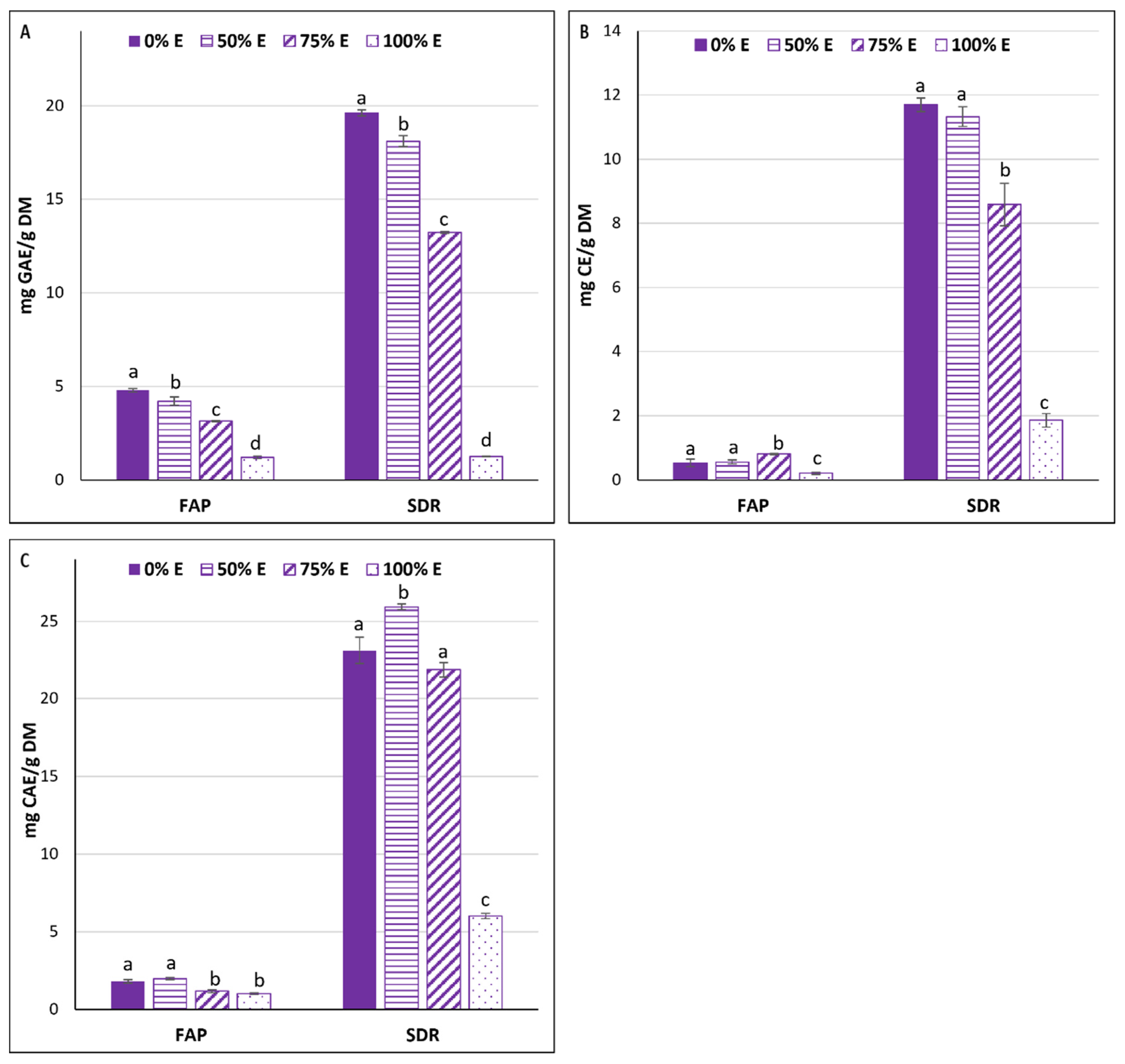
Under our experimental conditions, 0% ethanol (pure water) produced the SDR extracts with the highest quantity of phenolic compounds. Their amounts were 19.61 ± 0.16, 10.68 ± 0.25, and 7.11 ± 0.11 mg GAE/g DM for lavender, spearmint, and lemon balm, respectively. In the FAP samples, the highest TPC was found in 0% ethanol for lavender and lemon balm (4.79 ± 0.10 and 14.15 ± 0.11 mg GAE/g DM, respectively), while 50% ethanol was the most effective solvent for spearmint (5.40 ± 0.22 mg GAE/g DM) (Figure 1A, Figure 2A, and Figure 3A).
The extraction process used in this study was chosen based on the criteria of cost-effectiveness, low environmental impact, and scalability. In order to maintain the principle of the eco-sustainability, we opted to use water and ethanol, which is a Generally-Recognized-As-Safe organic solvent, as maceration liquids. Among the conventional extraction techniques, maceration is considered one of the most suitable methods for extracting bioactive molecules due to its use of low temperatures, resulting in energy savings compared to other conventional techniques like heat reflux extraction [28]. Additionally, compared to unconventional techniques that are now widespread, such as microwave-assisted extraction and ultrasound-assisted extraction, maceration does not require specialized equipment, making it a feasible option for small EO distilleries looking to utilize their waste.

3.2. Extracts Characterization

The total phenol (TPC), flavonoid (TFC), and ortho-diphenol (TDC) contents were measured and compared between FAP and SDR from the same aromatic plant. Flavonoids and ortho-diphenols were specifically chosen for measurement for the following reasons: flavonoids possess several biological properties, including their ability to scavenge radical species [29], while ortho-diphenols are a type of polyphenol known for their strong antioxidant power, due to the presence of the catechol group on the aromatic ring. This group is able to stabilize the phenoxyl free radicals by forming intramolecular bonds between the radical oxygen and the hydroxyl group [30].

3.2.1. Lavender

The TPC in the lavender extracts varied from 1.21 ± 0.07 to 4.79 ± 0.10 mg GAE/g DM for FAP, and from 1.25 ± 0.02 to 19.61 ± 0.16 mg GAE/g DM for SDR (Figure 1A). The TFC in the FAP extracts ranged from 0.21 ± 0.03 to 0.81 ± 0.03 mg CE/g DM, while the SDR extracts showed a wider range of values, from 1.86 ± 0.21 to 11.70 ± 0.21 mg CE/g DM (Figure 1B). The TDC also varied, with values from 1.00 ± 0.06 to 1.98 ± 0.06 mg CAE/g DM in the FAP extracts and from 6.02 ± 0.17 to 25.93 ± 0.19 mg CAE/g DM in the SDR extracts (Figure 1C).
The results indicate that the TPC decreased as the percentage of ethanol increased in the maceration solvent for both FAP and SDR extracts. The highest TPC was measured in the 0% ethanol extracts. Analysis of variance showed that the TPC was significantly influenced by the maceration solvent (p < 0.0001). This trend was also observed for the TFC in the SDR, with the 0% ethanol extract providing the highest amount of flavonoids. However, in the FAP extracts, the maximum TFC was measured in 75% ethanol, while 50% ethanol was the richest extract in terms of TDC for both FAP and SDR samples. The values of the phenolic families analyzed decreased in both plant matrices when the extractions were performed in 100% ethanol. This trend was more pronounced in the SDR extracts, which showed highly significant differences (p < 0.0001). Interestingly, the SDR extracts had higher levels of polyphenols, flavonoids, and ortho-diphenols compared to the FAP extracts. The TPC of the distillation residues was four times higher than that of the fresh plant, except for 100% ethanol. The ratio of flavonoid content between SDR and FAP (SDR/FAP ratio) increased from 8.86 to 22.08 times from 100% ethanol to 0% ethanol. The opposite trend was observed for the TDC from 0% ethanol to 75% ethanol. The values of the SDR/FAP ratio are shown in Table S1.
Previously published data on this subject showed varying yields in terms of polyphenols and flavonoids. This diversity makes it difficult to compare results from different research groups. This could be due to various factors, including differences in soil and climate conditions during plant growth, variations in harvest times, and differences in the extraction process parameters, such as the type of solvent used, temperature, extraction time, and biomass/solvent ratio.
Truzzi et al. (2022) measured the highest polyphenol yield in L. angustifolia SDR following maceration in 50% ethanol [31]. The TPC was close to that reported in this study (19.22 ± 4.16 and 18.10 ± 0.29 mg GAE/g DM, respectively), but the TFC was seven times lower, with 1.56 ± 0.21 mg quercetin equivalents (QE)/g DM [31]. According to Slavov et al. (2020), the phenolic content of L. angustifolia ranged from 10.75 ± 0.91 to 14.63 ± 0.91 mg GAE/g DM, and the TFC was 3.72 ± 0.11 mg/g DM after incubation of the SDR extracts in 70% ethanol for 1 h at 60 °C, followed by maceration for 24 h at room temperature [32]. A comparison was reported between extracts obtained from the fresh plant and the residues after steam distillation for L. dentata. The maceration process was carried out incubating 5% (w/v) biomass in 100% ethanol at room temperature for 48 h, resulting in a TPC of 14.33 ± 0.15 and 28.59 ± 0.17 mg GAE/g DM for the fresh plant and the residues, respectively [20]. While a direct comparison with the results of the present study was not possible, as the two lavender plants belong to different species, it is interesting to note that even in L. dentata, the SDR extract provided a higher quantity of bioactive molecules than the fresh plant.

3.2.2. Spearmint

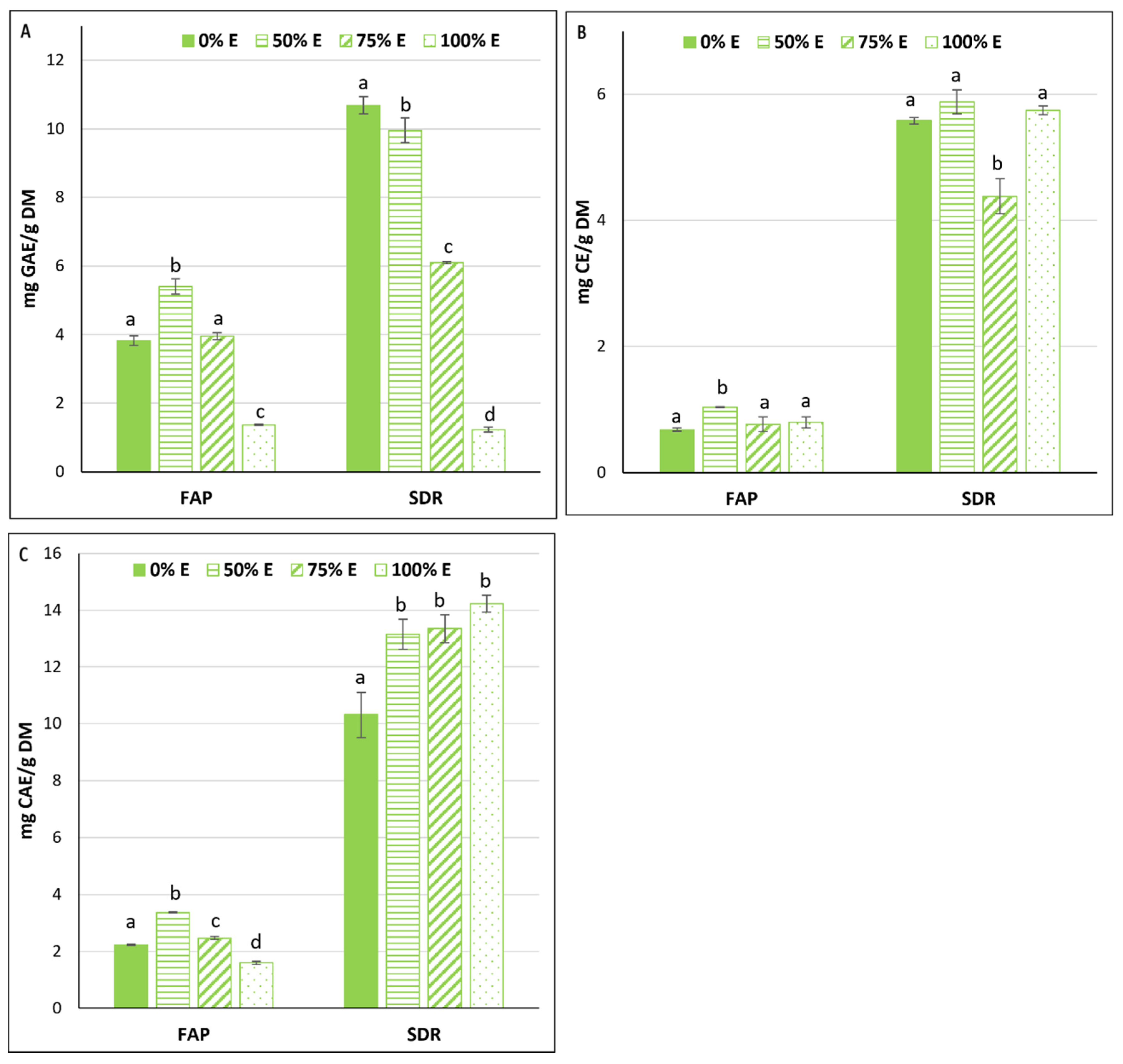
The TPC in the spearmint extracts varied from 1.37 ± 0.02 to 5.40 ± 0.22 mg GAE/g DM for FAP, and from 1.23 ± 0.07 to 10.68 ± 0.25 mg GAE/g DM for SDR (Figure 2A). The flavonoids ranged from 0.77 ± 0.12 to 1.04 ± 0.01 mg CE/g DM for FAP, and from 4.38 ± 0.28 to 5.88 ± 0.19 mg CE/g DM for SDR samples (Figure 2B). The TDC comprised between 1.60 ± 0.02 and 3.38 ± 0.02 mg CAE/g DM in FAP, and between 10.31 ± 0.78 and 14.23 ± 0.30 mg CAE/g DM in SDR extracts (Figure 2C).
The highest TPC was measured in the 0% ethanol SDR extract. The phenolic content of extracts from the same type of biomass was significantly different (p < 0.0001), except for 0% ethanol and 50% ethanol FAP extracts, which showed no statistically significant differences (p > 0.05). No substantial differences in flavonoids or ortho-diphenols were observed when varying the percentage of ethanol in the maceration solvent for both matrices examined.
Spearmint SDR extracts contained higher quantities of polyphenols, flavonoids and ortho-diphenols than the FAP extracts. The only exception was the 100% ethanol extract, which showed no difference in the TPC between the two plant matrices examined. The highest SDR/FAP ratios for polyphenols and flavonoids were measured in the 0% ethanol extract, with 2.79 and 8.20, respectively. The greatest ortho-diphenols value was observed in the 100% ethanol extract (SDR/FAP ratio = 8.89) (Table S1).
While the 100% ethanol extracts provided the lowest polyphenol yields under our operating conditions, Saha et al. (2022) reported opposite results for M. arvensis fresh plant and distillation residues [33]. In this study, the biomasses were subjected to Soxhlet extraction in several polar solvents, both pure and containing a percentage of water. The extracts prepared with pure water contained the lowest quantity of polyphenols with 13 and 7.9 mg GAE/g for the fresh plant and distillation residues, respectively. Furthermore, the fresh plant extracts contained more bioactive compounds than the distillation residues, which contradicts our findings. Berktas and Cam (2021) analyzed the phenolic and flavonoid content of extracts prepared from different peppermint leaf (M. piperita) distillation residues [34]. The spent distillation residues were extracted using a Soxhlet apparatus with ethanol as the solvent, and the extracts contained an average of 2.30 mg GAE/g DM of polyphenols and 2.27 mg CE/g DM of flavonoids [34]. A deep comparison of the above data with that in the present study would be of little use, as the mint species analyzed and the extraction techniques used were different. Furthermore, different outcomes may indicate a different composition in terms of polyphenol species. Nevertheless, the published results demonstrate the growing interest among many scientific groups in the potential use of these currently under-exploited residues.

3.2.3. Lemon Balm

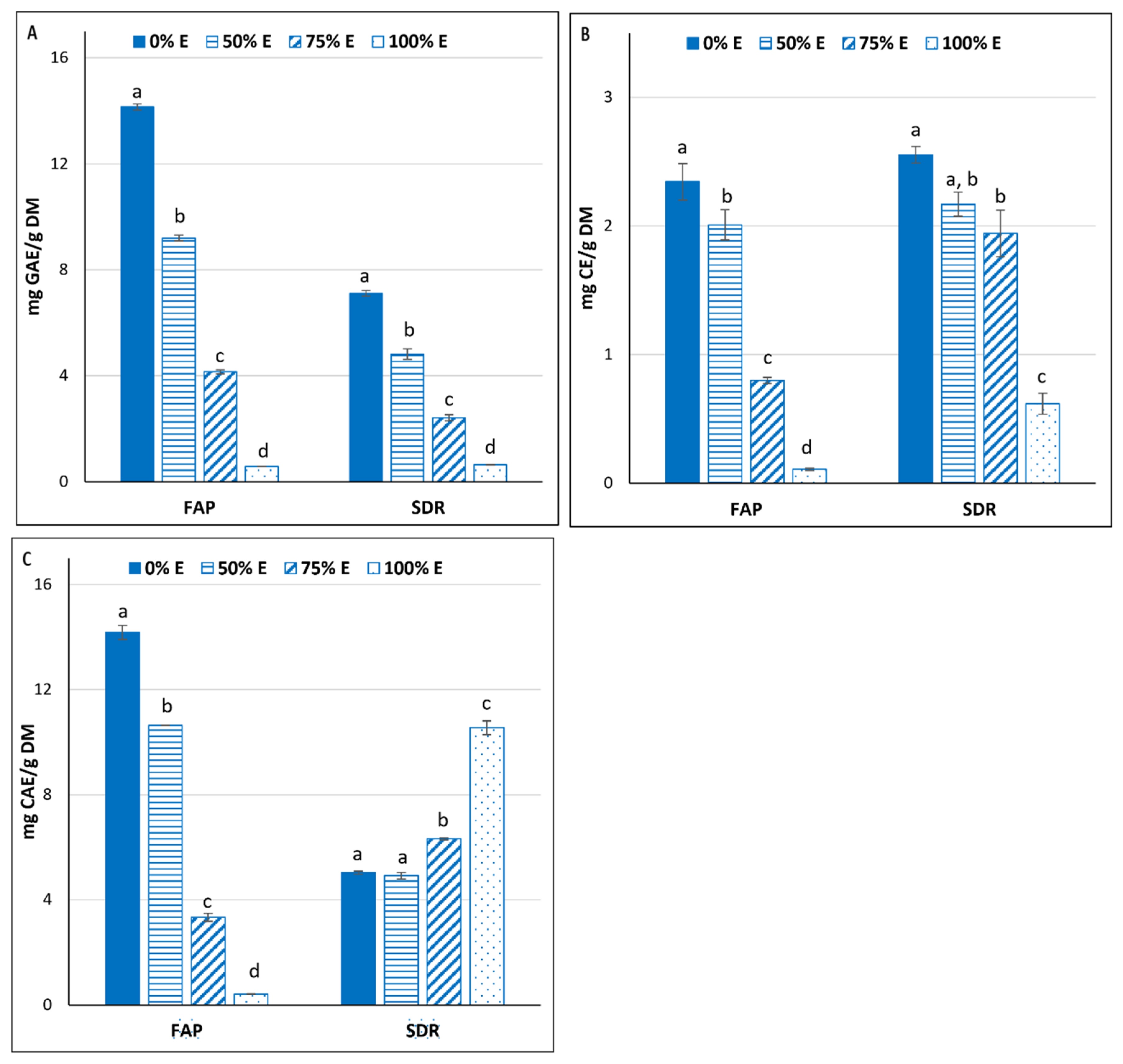
The TPC in the lemon balm extracts varied from 0.58 ± 0.00 to 14.15 ± 0.11 mg GAE/g DM in FAP, and from 0.64 ± 0.02 to 7.11 ± 0.11 mg GAE/g DM in SDR, showing statistically significant differences (p < 0.0001) (Figure 3A). The TFC was higher in the SDR extracts than in the FAP ones with values ranging from 0.62 ± 0.08 to 2.55 ± 0.06 mg CE/g DM in the residues, and from 0.11 ± 0.01 to 2.34 ± 0.14 mg CE/g DM in the fresh plant (Figure 3B). The content of phenolic compounds, flavonoids, and ortho-diphenols decreased as the percentage of water in the maceration solvent decreased, except for ortho-diphenols in the SDR extracts. In these samples, the TDC increased with increasing ethanol content, reaching a maximum value of 10.56 ± 0.26 mg CAE/g DM in 100% ethanol (Figure 3C). These results confirm that the type of solvent used in the maceration process affected the quantity of molecules extracted, with statistically significant differences observed in most cases (p < 0.001).
Unlike lavender and spearmint, the TPC of lemon balm extracts was higher in FAP than in SDR, with an SDR/FAP ratio of 1 or less. An increase in the ortho-diphenol SDR/FAP ratio was observed from 0% ethanol to 100% ethanol, and a similar, albeit less pronounced, trend was observed for flavonoids (Table S1).
Stini et al. (2024) prepared a polyphenol-rich aqueous extract from M. officinalis distillation residues using a fixed-bed semi-batch extractor [35]. The solvents used to produce polyphenol-rich formulations with high antioxidant power were acetone and water. Water was highly effective, producing an extract containing 111 ± 8 mg GAE/g DM, compared to acetone extract, which contained 2.3 ± 0.2 mg GAE/g DM [35]. This confirms our results, which showed that water was the most effective extraction solvent. However, it was not possible to confirm our data for fresh M. officinalis, since the authors did not explore this type of matrix.
Another interesting study examined the antibacterial and antifungal properties of a 70% ethanol SDR extract for use as a bread preservative. This study reported total phenol and flavonoid contents of 12.74 ± 0.36 mg GAE/g DM and 5.96 ± 0.18 mg QE/g DM, respectively [36].
These values were higher than those obtained in our study with 75% ethanol, but the extraction processes were different. Although this study lacks a comparison with the fresh plant, it demonstrates the growing interest in utilizing distillation residues, which are currently under-exploited, for general applications.
The overall results suggest that the extracts obtained from the aromatic residues of lavender and spearmint contained a higher quantity of bioactive molecules than the fresh plants. It is probable that the distillation process altered the structure of the biomass, making it more accessible for the subsequent phenolic extraction. Conversely, the results of lemon balm indicated that the distillation process made extraction of phenolic compounds from the plant more difficult or depleted them. Steam distillation can be considered a pretreatment that, in some cases, weakens the plant matrix and facilitates the penetration of the extraction solvent into the biomass. This is similar to the pretreatments required for lignocellulosic biomasses to promote enzymatic degradation of cellulose and hemicelluloses into fermentable sugars for the production of second-generation biofuels [37].

3.3. Identification and Semi-Quantitative Analyses of Phenolic Compounds

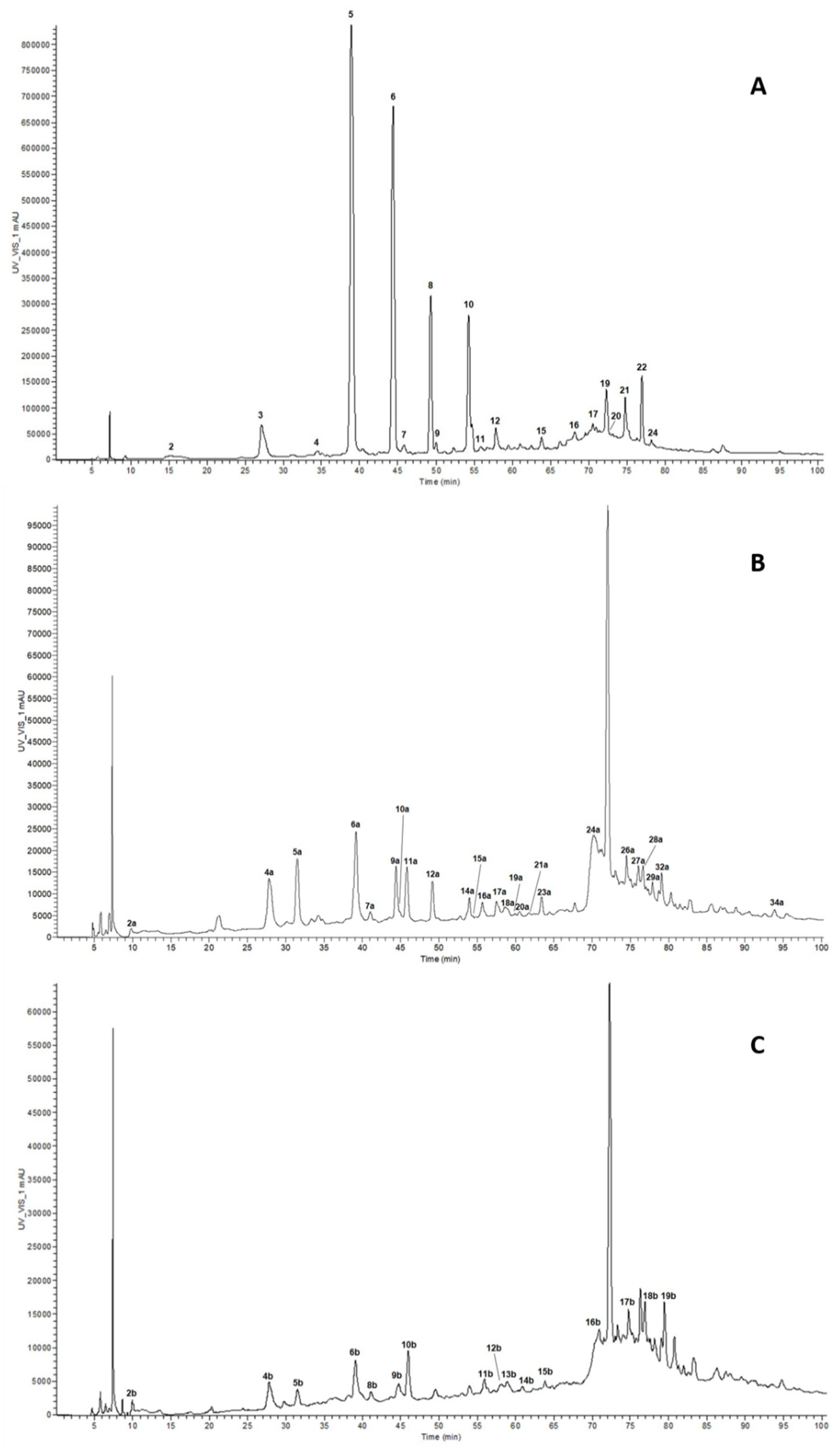
The separation, identification and quantification of phenolic compounds in the lavender, spearmint and lemon balm FAP and SDR extracts were carried out by UHPLC-ESI-LIT/MSn, UHPLC–DAD and HPLC-DAD analyses. As an example, a UHPLC-DAD chromatogram of phenolic compounds present in 50% ethanol SDR extracts of lavender, spearmint and lemon balm is shown in Figure 4A–C. The performed analyses led us to tentatively identify a total of 27, 37, and 20 compounds in lavender, spearmint and lemon balm, respectively, based on their pseudomolecular [M-H] ions, together with the interpretation of their collision-induced dissociation (CID) fragments. When authentic standards were available, identification was conducted by comparing retention times and MSn fragmentation spectra with those of standards.

3.3.1. Lavander

The various families of phenolic compounds detected in lavender were consistent with those reported by several previous studies. These included flavonoids such as luteolin (peak 21) and apigenin (peak 24), as well as hydroxycinnamic acids such as coumaric (peaks 11, 13 and 16) and ferulic (peak 14) [38]. Table 1 and Table 2 show the list of compounds identified in the FAP and SDR extracts, along with their quantification. Figure 4A shows the UHPLC-DAD chromatogram recorded at 280 nm of the phenolic compounds detected in the 50% ethanol SDR extract. The number of compounds identified in the FAP extracts decreased from 18 to 9 as the percentage of ethanol in the extraction solvent increased. This trend was not observed in the SDR extracts, and except for the 0% ethanol extract, the number of identified compounds was higher than that of the corresponding FAP extracts.
As expected, the qualitative and quantitative phenolic composition differed. Some molecules were only present in one extract. For example, isoferulic acid (peak 18) was identified in the 0% ethanol FAP extract. Yunnaneic acid F, luteolin hexuronide 1, and 6-(3-(1-carboxy-2-(3,4-dihydroxyphenyl) ethoxy)-3-oxoprop-1-en-1-yl)-3-(3,4-dihydroxy phenyl)-8-hydroxy-7-oxobicyclo [2.2.2] oct-5-ene-2-carboxylic acid (all co-eluted in peak 19) were detected in the 50% ethanol SDR extract. Other distinctive phenolic compounds were present in the FAP extracts, including m-coumaric acid (peak 13), ferulic acid (peak 14) and 3-hydroxy-3′,4′,5′-trimethoxyflavone (peak 23). Rosmarinic acid (peak 17), which is chemically known as the ester of caffeic acid and 3,4-dihydroxyphenyl lactic acid and is described as one of the main hydroxycinnamic acids of the Lavandula genus, was found in high amounts in the 0% ethanol FAP extracts and all the SDR samples. This confirms its abundance in this genus [38].
Interestingly, danshensu (peak 3) and salvianolic acid A (peak 22) were only identified in the SDR extracts (Table 1 and Table 2). This acid belongs to a group of compounds known as salvianolic acids, which are mainly present in Salvia miltiorrhiza (Danshen). Over 10 different salvianolic acids have been identified, with salvianolic acid A consisting of one molecule of danshensu (3,4-dihydroxyphenyl lactic acid or salvianic acid A) and two molecules of caffeic acid [39]. Several salvianolic acids have been reported in some Lavandula species. For example, salvianolic acid B has been found in the flowers and aerial parts of L. pedunculata and L. stoechas, respectively, while salvianolic acids C and G have been detected in the aerial parts of L. coronopifolia [38]. Salvianolic acid A has been identified in aqueous and hydromethanolic extracts of L. stoechas [40], and Truzzi et al. (2025) have reported on the phenolic composition of SDR extracts from L. angustifolia prepared by sonication in either 70% ethanol or natural deep eutectic solvents (NADESs) [41]. While danshensu was detected in the extracts, thus confirming our results, salvianolic acid A was absent [41]. To the best of our knowledge, this is the first time that the presence of salvianolic acid A in L. angustifolia has been described.

3.3.2. Spearmint

Analysis of the FAP and SDR spearmint extracts revealed the presence of numerous polyphenols typical of the Mentha genus, although they were differently distributed across the various samples. The identified compounds, along with their quantification, are shown in Table 3 and Table 4. The UHPLC–DAD chromatogram of the phenolic compounds detected in the 50% ethanol SDR extract, recorded at 280 nm, is shown in Figure 4B. As the percentage of water in the extraction solvent decreased, no decrease in the number of molecules identified in the spearmint FAP extracts was observed, while the number of compounds identified in the SDR extracts was always lower than in the corresponding fresh plant extracts.
The following hydroxycinnamic acids were only identified in the SDR extracts: ferulic acid hexoside isomer 1 (peak 9a), caffeic acid (peak 11a), coumaric acid hexoside isomer 2 (peak 12a), ferulic acid hexoside isomer 2 (peak 14a) and dihydro-p-coumaric acid (peak 23a). In contrast, hydroxycinnamic acids were detected in both FAP and SDR samples of lavender extracts. These findings suggest that the presence of certain molecules in an extract depends not only on the chemical properties and polarity of the extraction solvent, but also on the type of plant. Indeed, extracting hydroxycinnamic acids from spearmint required weakening of the plant matrix, achieved through steam distillation.
The SDR extracts were characterized by other phenolic compounds, including danshensu (peak 4a), rosmarinic acid hexoside (peak 20a), rosmarinic acid (peak 24a), and luteolin hexuronide 2 (peak 28a). Their presence was consistent with the results of Kapp et al. (2020), who identified them in extracts obtained from M. spicata residues after EO production [42]. Rosmarinic acid (peak 24a) was the most abundant hydroxycinnamic acid detected in our SDR extracts. Janicsák et al. (1999) identified it in fresh M. spicata leaves after sonication extraction with 60% methanol, and Wang et al. (2004) identified it after sonication extraction with 30% ethanol [43,44]. The absence of rosmarinic acid in the FAP extracts in the present study may be due to the different extraction method employed. Medioresinol (peak 8a) and hesperidin (peak 22a) were only detected in the 50% ethanol FAP extract; eriocitrin (peak 13a) was detected in both the 50% and 75% ethanol FAP extracts, and the flavonoids naringenin (peak 30a), chrysoeriol (peak 31a), and thymonin (peak 33a) were detected in all the FAP extracts. Thymonin was the most abundant flavonoid in the 50%, 75% and 100% ethanol FAP extracts.

3.3.3. Lemon Balm

The polyphenols detected in the FAP and SDR lemon balm extracts were almost identical. The only differences were the presence of coumaric acid hexoside isomer 1 (peak 7b) in the FAP extracts and the presence of dihydro-p-coumaric acid (peak 15b) and eriodictyol (peak 19b) in the SDR extracts. All other identified compounds were present in the extracts of both plant matrices. A full list of all the detected compounds is provided in Table 5, along with their quantification in Table 6. Figure 4C shows the UHPLC–DAD chromatogram recorded at 280 nm of the phenolic compounds present in the 50% ethanol SDR extract.
As the percentage of ethanol in the maceration solvent increased, the number of compounds detected in the FAP extracts decreased from 18 to 7, a trend also observed in lavender FAP extracts. The number of compounds identified in 0%, 50% and 75% ethanol SDR extracts was 16, 17 and 16, respectively. Unexpectedly, only two compounds were detected in 100% ethanol SDR extract: vicenin-2 (peak 9b) and rosmarinic acid (peak 16b).
The latter was identified in all the extracts from both the FAP and the SDR, and its presence in distillation solid waste was described by other authors. Vasileva et al. (2018) attested that rosmarinic acid was the most abundant phenolic compound in lemon balm waste extract prepared by sonication with 70% ethanol, with a concentration of 4.40 ± 0.39 mg/g DM [36].
Many of the compounds present in our extracts were consistent with the results of a previous analysis by Truzzi et al. (2025), in which danshensu, coumaric acid hexoside isomer 1, quercetin hexoside, rosmarinic acid hexoside and rosmarinic acid were identified in an extract obtained from lemon balm distillation solid residues by sonication in 70% ethanol [41]. Rosmarinic acid was also the most abundant phenolic compound in this case.

3.4. Antioxidant Activity

The mechanism of action of antioxidant compounds can be classified as SET (single electron transfer), whereby the antioxidant transfers one electron to the acceptor, or HAT (hydrogen atom transfer), and the antioxidant donates a hydrogen ion to the acceptor. In both cases, the result is the inactivation of the radical species and the prevention of the propagation of the radical chain reaction [45].
The antioxidant power of an extract depends on the blend of bioactive compounds contained within its phytochemical complex, which can act through different mechanisms. Consequently, an extract may show poor antioxidant activity when tested using one method but significant using a different method.
Figure 4. UHPLC–DAD chromatograms recorded at 280 nm of compounds present in 50% ethanol SDR extracts of lavender (A), spearmint (B), and lemon balm (C). For chromatographic conditions, see Section 2.3.4. For peak assignments, see Table 1, Table 3 and Table 5.
Agronomy 16 01240 g004
Two assays were therefore used to investigate the antioxidant activity of the FAP and SDR extracts: the radical scavenging activity (RSA), which is based on the SET or HAT reaction mechanism, and the Ferric Reducing Antioxidant Power (FRAP), which is based on the SET mechanism [46].
The former is one of the most widely used tests for determining the antioxidant power of natural compounds. Due to its high reproducibility and ease of execution, this assay has been recognized by the Association of Official Agricultural Chemists as the official method for estimating antioxidant activity in foods and drinks [47]. It utilizes the DPPH reagent, a stable free radical that changes from an intense purple colour to a pale yellow upon reduction.
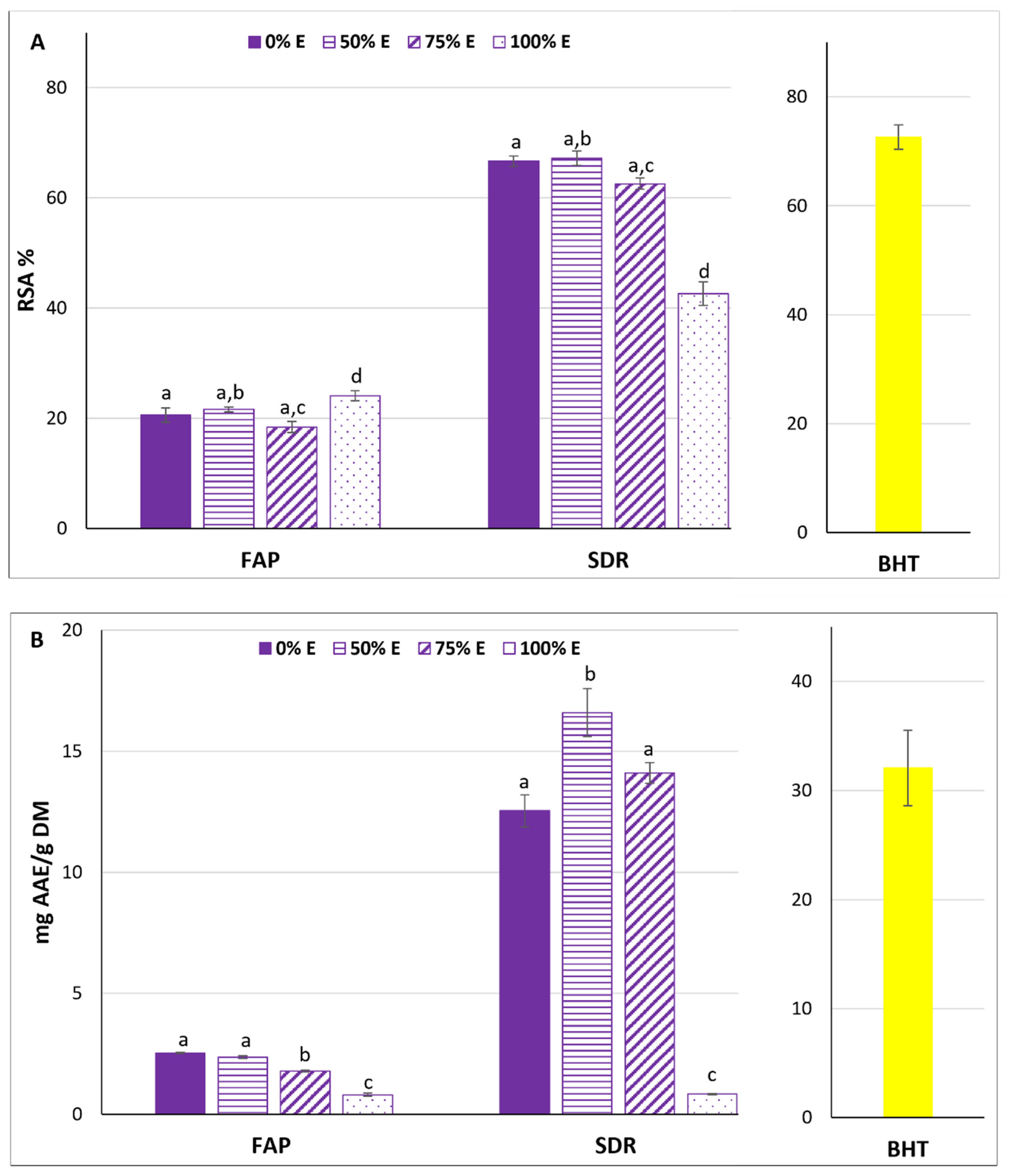
As depicted in Figure 5A, the lavender extracts demonstrated the ability to scavenge this free radical. Notably, the SDR samples exhibited higher antioxidant activity than the corresponding FAP extracts, which is consistent with our data showing that the SDR extracts had a higher TPC (Figure 1A). Specifically, the RSA% of the extracts derived from the spent plant was 1.8–3.4 times greater than that of the extracts from the fresh plant. The strongest and weakest antioxidant powers were observed in the 50% ethanol SDR extract (67.17 ± 1.30%) and the 75% ethanol FAP extract (18.41 ± 0.55%), respectively. Among the SDR samples, only 100% ethanol extract differed significantly from the others (p < 0.0001) (Figure 5A).
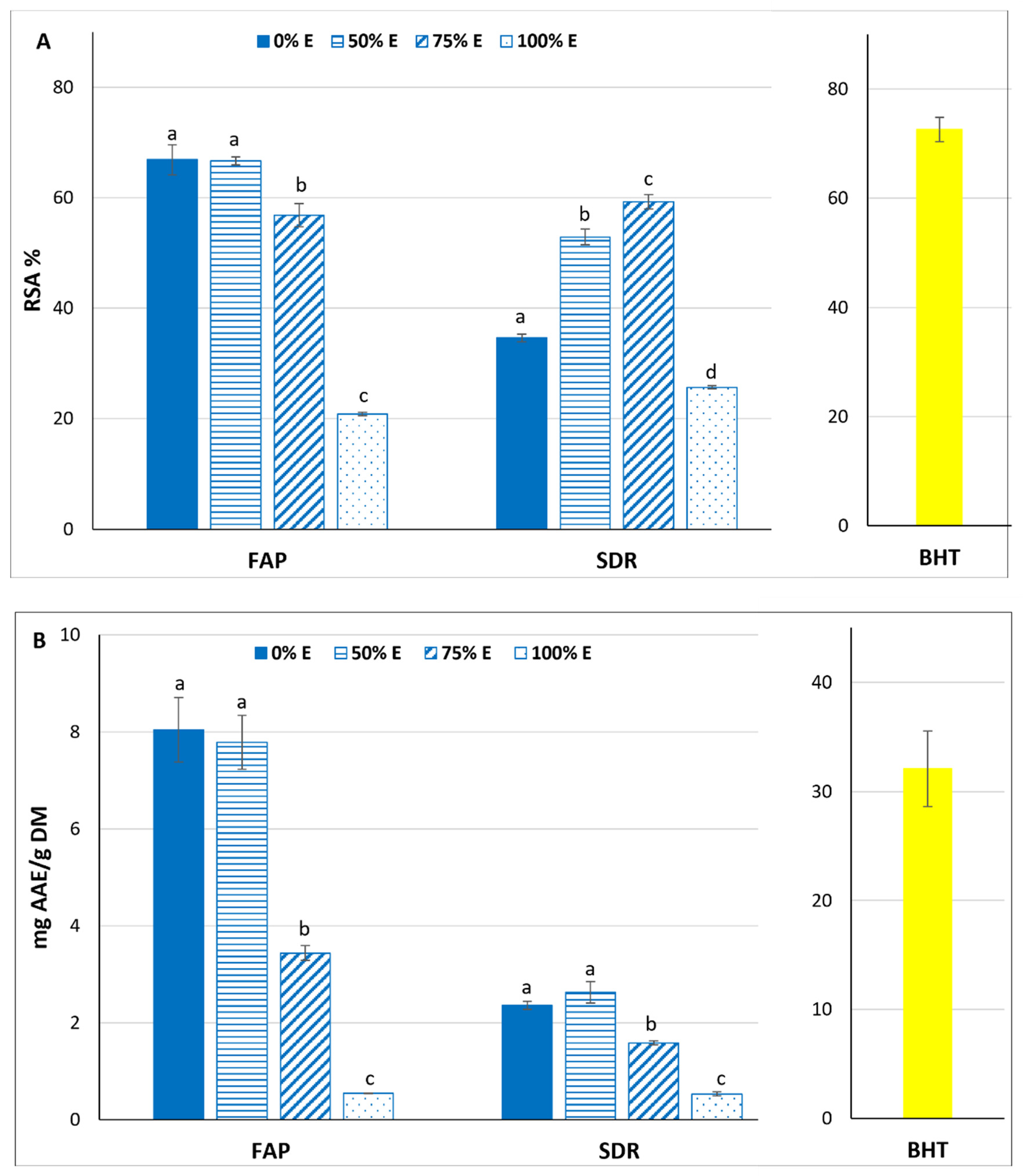
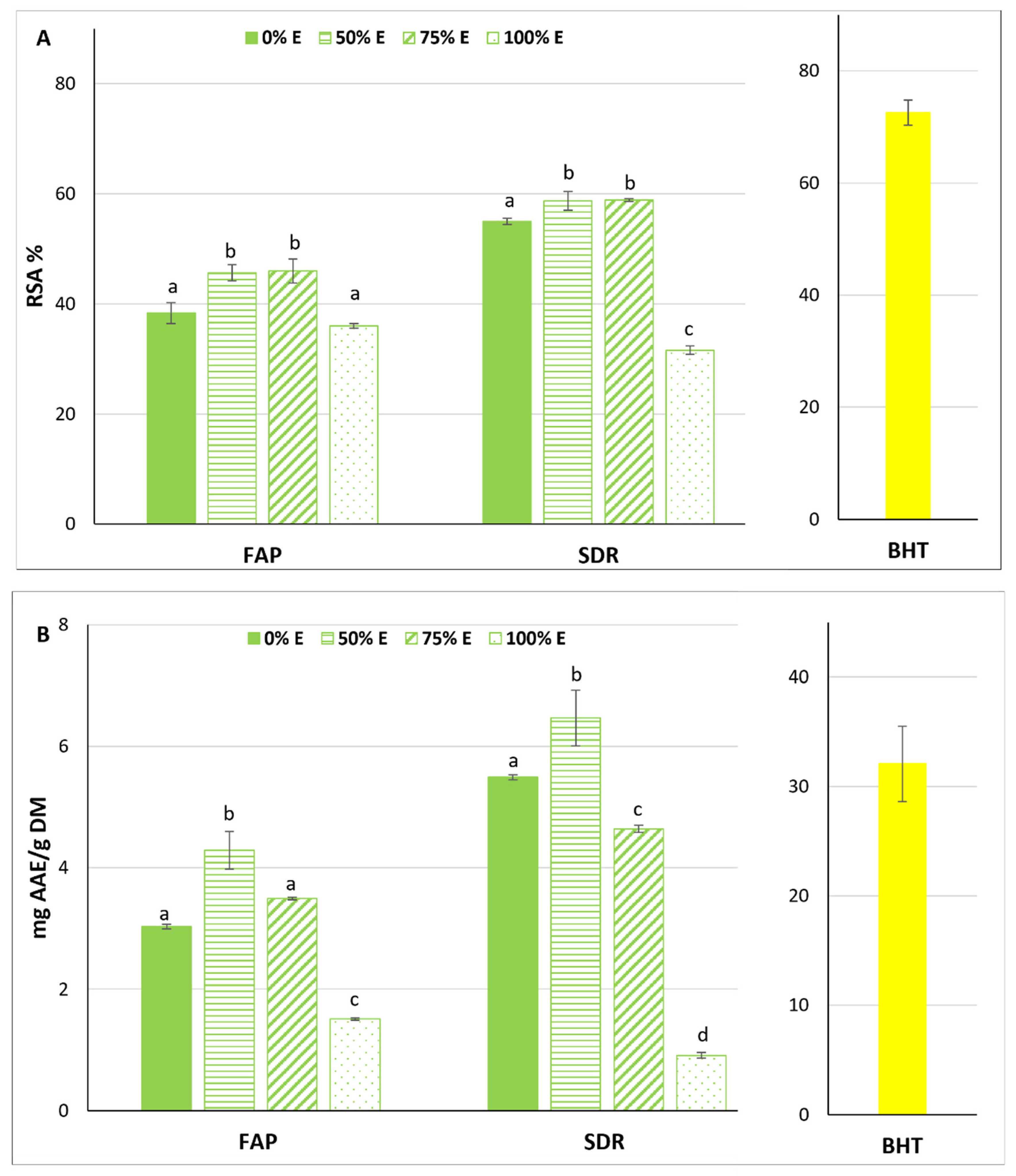
As with lavender, the antioxidant activity of the spearmint distillation residue extracts was higher than that of the fresh plant, except for the extract prepared with 100% ethanol. However, the RSA% of the SDR samples was only 1.3 times higher than that of the FAP samples. The SDR extracts prepared with the 50% and 75% ethanol displayed the highest antioxidant power (58.71 ± 1.71% and 58.85 ± 0.27%, respectively) with no statistically significant differences (p > 0.05). These were followed by the extracts prepared with 0% ethanol (54.97 ± 0.59%) and 100% ethanol (31.58 ± 0.79%), which showed high statistically significant differences (p < 0.0001) (Figure 6A).
In contrast to the previous results, the FAP extracts from lemon balm exhibited stronger antioxidant properties than the SDR extracts (Figure 7A). RSA% decreased as the ethanol content of the extraction solvent increased, ranging from 66.86 ± 2.74% in 0% ethanol to 20.84 ± 0.29% in 100% ethanol. Conversely, the scavenging activity measured in the SDR extracts increased with increasing ethanol percentage, reaching an RSA value of 59.23 ± 1.30% in the 75% ethanol extract.
As with the FAP extracts, the 100% ethanol SDR extract exhibited the weakest antioxidant activity at 25.65 ± 0.28% (p < 0.0001). Excluding the 0% ethanol extracts, with FAP value 1.9 times higher than the SDR value, no substantial differences were observed in the radical scavenging activity of the two types of plant matrix (Figure 7A).
BHT, one of the most commonly used synthetic antioxidants, was selected for comparison with the scavenging activity of the extracts. Interestingly, the radical scavenging activity of 0% ethanol and 50% ethanol lemon balm FAP extracts, and 0% ethanol and 50% ethanol lavender SDR extracts, were comparable to that of BHT.
The FRAP assay measures antioxidant power based on a molecule’s ability to reduce Fe3+ to Fe2+. The extracts examined here produced a positive response when tested with this method, proving the ability of the phytochemical complexes to react with ferric ions. The trend was like that observed in the radical scavenging assay. Specifically, the SDR extracts of lavender and spearmint exhibited stronger ferric reducing power than the FAP samples, whereas the extracts from fresh lemon balm were more active than those from the spent plants.
For lavender, the FRAP values of the SDR extracts ranged from 0.83 ± 0.03 mg AAE/g DM in 100% ethanol to 16.60 ± 0.98 mg AAE/g DM in 50% ethanol (Figure 5B). By contrast, the FRAP values of the FAP extracts were much lower, ranging from 0.80 ± 0.07 to 2.53 ± 0.03 mg AAE/g DM. Notably, there was a significant difference in the antioxidant response between the SDR and FAP samples, with the FRAP value of the 75% ethanol SDR extract being 7.9 times higher than the corresponding FAP extract.
Figure 6B shows the FRAP results obtained from fresh and spent spearmint extracts. The 50% ethanol SDR extract exhibited the strongest ferric reducing activity with a value of 6.47 ± 0.46 mg AAE/g DM. This was followed by the extracts prepared using 0% ethanol, 75% ethanol, and 100% ethanol. These differences were found to be statistically significant with p < 0.0001. Among the FAP extracts, the highest value was observed in the 50% ethanol, while the lowest value was observed in the 100% ethanol (4.29 ± 0.31 and 1.51 ± 0.02 mg AAE/g DM, respectively). Unlike lavender, however, the ferric reducing power of the spent spearmint extracts was only slightly higher than that of the fresh plant extracts.
The ferric reducing power results for the lemon balm extracts contradicted those observed for lavender and spearmint. The FAP extracts exhibited higher ferric reducing power than the SDR extracts, except for the 100% ethanol, which showed comparable antioxidant activity in both types of extract (Figure 7B). Specifically, the ferric reducing activity of the extracts obtained from the fresh plant was 1.03 to 3.4 times higher than that of the residues. The FRAP values ranged from 0.54 ± 0.00 to 8.05 ± 0.67 mg AAE/g DM for the FAP samples, and from 0.53 ± 0.04 to 2.62 ± 0.22 mg AAE/g DM for the SDR samples (Figure 7B).
Unlike the radical scavenging activity, the ferric reducing power of the extracts was lower than that of BHT. The only noteworthy extract was the 50% ethanol lavender SDR, which had a value equal to half that of BHT.
The harmful effects of oxidative processes on biological systems, foods, cosmetics, and pharmaceutical products are well recognized. Antioxidant compounds neutralize free radicals, minimizing the damage caused to biological systems and extending the shelf life of food and cosmetic products by slowing their deterioration. Synthetic antioxidants such as butylated hydroxytoluene (BHT) and butylated hydroxyanisole (BHA) are widely used because they can be produced to a high degree of purity at a low cost and are effective in small doses. However, they have some disadvantages, such as poor water solubility, and above all, they can be toxic to the human body as they accumulate in adipose tissue and inhibit several enzymes [48,49]. Due to these concerns, the search for safer antioxidants has focused on bioactive compounds extracted from natural sources for many years.
While numerous studies have been carried out on the antioxidant properties of EOs from aromatic plants, a smaller number of studies are available on hydroalcoholic extracts from these plants. Additionally, there are fewer comparisons between extracts from fresh plants and residues obtained after EO extraction.
Our results regarding the antioxidant properties of Lavandula angustifolia Mill. extracts are consistent with those published by Marovska et al. (2023), who reported that SDR extracts have greater antioxidant power than the fresh plant [50].
However, in this study the antioxidant activity of the SDR extracts, as measured by DPPH and FRAP assays, was only 1.3–1.5 times higher than that of the fresh plant extract. In contrast, the SDR lavender extracts in our study showed higher antioxidant activity than FAP, as reported above.
Sasha et al. (2022) observed that the radical scavenging activity of extracts from Mentha arvensis fresh plant was higher than that of the distillation waste [33]. However, our data were not in agreement with this study, as the scavenging activity of the SDR extracts from spearmint was higher than that of the fresh plant extracts.
Furthermore, Saha et al. measured the lowest antioxidant activity in the aqueous extracts, in opposition with our findings. A recent study involving ultrasound-assisted extraction of several aromatic plants in 50% ethanol reports that lemon balm extract exhibited higher radical scavenging activity and ferric reducing power than spearmint [51]. However, the extracts in our study, which were prepared using a maceration process, showed the opposite trend.
All the above findings suggest that the polyphenolic content responsible for antioxidant activity is not only influenced by the type of plant, but also by additional factors such as industrial processing and extraction methods.
This encourages further study on the antioxidant properties of natural extracts, since the results of previous investigations can only be used for comparison purposes and cannot be used to predict the outcome.

4. Conclusions

In this study, we compared the polyphenolic composition and antioxidant power of extracts from aromatic plant residues, remaining after the distillation process used to produce EOs, with those from fresh plants. Our objectives were to determine if the distillation process makes plants more available for subsequent extraction of bioactive compounds, and to assess the potential for using the spent residues, produced in large quantities, as a source of natural antioxidants.
We focused on three plants: lavender, spearmint, and lemon balm. Our findings revealed that the extracts from lavender and spearmint residues contained a higher quantity of bioactive molecules compared to the fresh plants. A similar trend was observed for antioxidant activity, with the extracts from lavender and spearmint residues exhibiting higher antioxidant activity than the respective fresh plants. However, the lemon balm residues provided extracts with fewer antioxidant compounds and lower antioxidant power compared to the fresh plant.
These findings demonstrate that residues from the distillation of aromatic plants still contain valuable compounds. Among the plants examined, lavender provided a residue that was very rich in polyphenols and had radical scavenging activity comparable to the synthetic antioxidant BHT, followed by spearmint residue. This suggests that these wastes can be conveniently used to produce natural antioxidants, which could serve as a safer alternative to synthetic antioxidants in the food and cosmetic industries. This is particularly beneficial for consumers who are increasingly aware of the lower toxicity of natural antioxidants and are increasingly inclined to prefer natural preparations for health benefits. Additionally, the maceration process used in this study is both cost-effective and does not require the use of sophisticated equipment, making it easily applicable to large quantities of biomass. Therefore, it is a valuable method for utilizing under-exploited residues.

Supplementary Materials

The following supporting information can be downloaded at https://www.mdpi.com/article/10.3390/agronomy16131240/s1: Table S1: SDR/FAP bioactive compounds ratio.

Author Contributions

Conceptualization, A.M., G.S. and V.C.; methodology, G.S. and V.C.; validation, A.M. and V.C.; formal analysis, G.S. investigation, V.C., G.S. and C.D.P.; writing—original draft preparation, A.M., V.C. and F.L.C.; writing—review and editing, A.M. and V.C.; supervision, A.M.; project administration, A.M. and G.S.; funding acquisition, V.C. and F.L.C. All authors have read and agreed to the published version of the manuscript.

Funding

This research was funded by a Research Grant from GAL IRPINIA CONSORZIO (PROGRAMMA DI SVILUPPO RURALE PER LA CAMPANIA 2014–2020 Misura 19—Sviluppo Locale di tipo partecipativo—Leader 16.1.1 Sostegno per costituzione e funzionamento dei GO del PEI in materia di produttività e sostenibilità dell’agricoltura—Azione 2) Project “Irpinia Essenziale”. Part of this study was conducted using facilities provided by PON R&I 2014–2020 PIR01_00017 CNRbiomics Project.

Data Availability Statement

The data presented in this study are available on request.

Acknowledgments

The authors are grateful to Raffaele Forgione from “Biolea Italia” (Gesualdo, AV, Italy) for providing the fresh plants and the spent plant residues.

Conflicts of Interest

The authors declare no conflicts of interest.

Abbreviations

The following abbreviations are used in this manuscript:
AAEascorbic acid equivalents
BHTbutylated hydroxytoluene
CAEcaffeic acid equivalents
CEcatechin Equivalents
CIDcollision-induced dissociation
DMdry matter
DPPH2,2-diphenyl-1-picrylhydrazyl
EOessential oils
FAPfresh aromatic plant
FRAPferric reducing antioxidant power
GAEgallic acid equivalents
HAThydrogen atom transfer
QEquercetin equivalents
RP-HPLC-DADReversed-Phase High Performance Liquid Chromatography-Diode Array Detector
RSAradical scavenging activity
SDRsteam distillation residue
SETsingle electron transfer
TDCtotal ortho-diphenolic content
TFCtotal flavonoid content
TPCtotal phenolic content
TPTZ2,4,6-tripyridyl-S-triazine
UHPLC-DADultra-high-performance liquid chromatography–diode array detector
UHPLC-ESI-LIT/MSnultra-high-performance liquid chromatography–electrospray ionization-linear ion trap mass spectrometry

References

  1. Tongnuanchan, P.; Benjakul, S. Essential oils: Extraction, bioactivities, and their uses for food preservation. J. Food Sci. 2014, 79, R1231–R1249. [Google Scholar] [CrossRef] [PubMed]
  2. Pandey, A.K.; Kumar, P.; Singh, P.; Tripathi, N.N.; Bajpai, V.K. Essential Oils: Sources of Antimicrobials and Food Preservatives. Front. Microbiol. 2017, 7, 2161. [Google Scholar] [CrossRef] [PubMed]
  3. Sharmeen, J.B.; Mahomoodally, F.M.; Zengin, G.; Maggi, F. Essential Oils as Natural Sources of Fragrance Compounds for Cosmetics and Cosmeceuticals. Molecules 2021, 26, 666. [Google Scholar] [CrossRef] [PubMed]
  4. Mandal, U.; Panda, M.; Mahalik, G. Traditional Uses of Essential Oils in Aromatherapy. In Aromatherapy and Its Benefits; Bhadra, P., Parida, S., Eds.; Renu Publishers: New Delhi, India, 2021; pp. 57–69. [Google Scholar]
  5. FAOSTAT. Food and Agriculture Organization of the United States. Available online: http://www.fao.org/faostat/en/#data (accessed on 24 April 2026).
  6. Deep Market Insights. Available online: https://deepmarketinsights.com/vista/insights/medicinal-and-aromatic-plants-market/europe (accessed on 27 April 2026).
  7. Spina, D.; Barbieri, C.; Carbone, R.; Hamam, M.; D’Amico, M.; Di Vita, G. Market Trends of Medicinal and Aromatic Plants in Italy: Future Scenarios Based on the Delphi Method. Agronomy 2023, 13, 1703. [Google Scholar] [CrossRef]
  8. Tagliazucchi, G.; Martinelli, E.; Endrighi, E. Coltivazione della Lavanda nell’Appennino Emiliano-Romagnolo: Metodologia e Primi Risultati di un’Indagine Esplorativa; Working Paper, Demb Working Paper Series; Department of Economy Marco Biagi—University of Modena and Reggio Emilia: Modena, Italy, 2021; pp. 3–4. [Google Scholar] [CrossRef]
  9. Wells, R.; Truong, F.; Adal, A.M.; Sarker, L.S.; Mahmoud, S.S. Lavandula Essential Oils: A Current Review of Applications in Medicinal, Food, and Cosmetic Industries of Lavender. Nat. Prod. Commun. 2018, 13, 1403–1417. [Google Scholar] [CrossRef]
  10. Zhao, H.; Ren, S.; Yang, H.; Tang, S.; Guo, C.; Liu, M.; Tao, Q.; Ming, T.; Xu, H. Peppermint essential oil: Its phytochemistry, biological activity, pharmacological effect and application. Biomed. Pharmacother. 2022, 154, 113559. [Google Scholar] [CrossRef]
  11. Maurya, A.; Prasad, J.; Das, S.; Dwivedy, A.K. Essential Oils and Their Application in Food Safety. Front. Sustain. Food Syst. 2021, 5, 653420. [Google Scholar] [CrossRef]
  12. Hudz, N.; Kobylinska, L.; Pokajewicz, K.; Horcinová Sedlácková, V.; Fedin, R.; Voloshyn, M.; Myskiv, I.; Brindza, J.; Wieczorek, P.P.; Lipok, J. Mentha piperita: Essential Oil and Extracts, Their Biological Activities, and Perspectives on the Development of New Medicinal and Cosmetic Products. Molecules 2023, 28, 7444. [Google Scholar] [CrossRef]
  13. Gupta, S.; Kumar, A.; Gupta, A.K.; Jnanesha, A.C.; Talha, M.; Srivastava, A.; Lal, R.K. Industrial mint crop revolution, new opportunities, and novel cultivation ambitions: A review. Ecol. Genet. Genom. 2023, 27, 100174. [Google Scholar] [CrossRef]
  14. Barbieri, C.; Manzone, M. Mentha piperita: Energy and Economic Aspects. Med. Aromat. Plants 2016, 6, 305. [Google Scholar] [CrossRef]
  15. Pirbalouti, A.G.; Nekoei, M.; Rahimmalek, M.; Malekpoor, F. Chemical composition and yield of essential oil from lemon balm (Melissa officinalis L.) under foliar applications of jasmonic and salicylic acids. Biocatal. Agric. Biotechnol. 2019, 19, 101144. [Google Scholar] [CrossRef]
  16. Carvalho, F.; Duarte, A.P.; Ferreira, S. Antimicrobial activity of Melissa officinalis and its potential use in food preservation. Food Biosci. 2021, 44, 101437. [Google Scholar] [CrossRef]
  17. Bağdat, R.B.; Coşge, B. The essential oil of lemon balm (Melissa officinalis L.), its components and using fields. Anadolu J. Agric. Sci. 2006, 21, 116–121. [Google Scholar]
  18. Crescente, G.; Bouymajane, A.; Cascone, G.; Squillaci, G.; Morana, A.; Moccia, S. Essential Oils: An Overview of Extraction Methods and Food Applications. Curr. Nutrac. 2023, 4, e010623217533. [Google Scholar] [CrossRef]
  19. Slavov, A.M.; Karneva, K.B.; Vasileva, I.N.; Denev, P.N.; Denkova, R.S.; Shikov, V.T.; Manolova, M.N.; Lazarova, Y.L.; Ivanova, V.N. Valorization of lavender waste—Obtaining and characteristics of polyphenol rich extracts. Food Sci. Appl. Biotechnol. 2018, 1, 11–18. [Google Scholar] [CrossRef]
  20. El Hassouni, A.; El Bachiri, A.; Belbachir, C. Lavandula dentata Solid Residue from Essential Oil Industry. J. Essent. Oil-Bear. Plants 2019, 22, 1601–1613. [Google Scholar] [CrossRef]
  21. Rathod, N.B.; Elabed, N.; Punia, S.; Ozogul, F.; Kim, S.; Rocha, J.M. Recent Developments in Polyphenol Applications on Human Health: A Review with Current Knowledge. Plants 2023, 12, 1217. [Google Scholar] [CrossRef] [PubMed]
  22. Albuquerque, B.R.; Heleno, S.A.; Oliveira, M.B.P.P.; Barros, L.; Ferreira, I.C.F.R. Phenolic compounds: Current industrial applications, limitations and future challenges. Food Funct. 2021, 12, 14–29. [Google Scholar] [CrossRef] [PubMed]
  23. Singleton, V.L.; Rossi, J.A.J. Colorimetry of Total Phenolics with Phosphomolybdic-Phosphotungstic Acid Reagents. Am. J. Enol. Vitic. 1965, 16, 144–158. [Google Scholar] [CrossRef]
  24. Barreira, J.C.M.; Ferreira, I.C.F.R.; Oliveira, M.B.P.P.; Pereira, J.A. Antioxidant Activities of the Extracts from Chestnut Flower, Leaf, Skins and Fruit. Food Chem. 2008, 107, 1106–1113. [Google Scholar] [CrossRef]
  25. Arnow, L.E. Colorimetric determination of the components of 3,4-dihydroxyphenylalanine-tyrosine mixtures. J. Biol. Chem. 1937, 118, 531–537. [Google Scholar] [CrossRef]
  26. Squillaci, G.; Zannella, C.; Carbone, V.; Minasi, P.; Folliero, V.; Stelitano, D.; La Cara, F.; Galdiero, M.; Franci, G.; Morana, A. Grape Canes from Typical Cultivars of Campania (Southern Italy) as a Source of High-Value Bioactive Compounds: Phenolic Profile, Antioxidant and Antimicrobial Activities. Molecules 2021, 26, 2746. [Google Scholar] [CrossRef] [PubMed]
  27. Fernández-Agulló, A.; Freire, M.S.; Antorrena, G.; Pereira, J.A.; Gonzàlez-Alvarez, J. Effect of the extraction technique and operational conditions on the recovery of bioactive compounds from chestnut (Castanea sativa) bur and shell. Sep. Sci. Technol. 2014, 49, 267–277. [Google Scholar] [CrossRef]
  28. Cacique, A.P.; Barbosa, E.S.; de Pinho, G.P.; Silvério, F.O. Maceration extraction conditions for determining the phenolic compounds and the antioxidant activity of Catharanthus roseus (L.) G. Don. Cienc. Agrotec. 2020, 44, e017420. [Google Scholar] [CrossRef]
  29. Dias, M.C.; Pinto, D.C.G.A.; Silva, A.M.S. Plant Flavonoids: Chemical Characteristics and Biological Activity. Molecules 2021, 26, 5377. [Google Scholar] [CrossRef] [PubMed]
  30. Lucarini, M.; Pedulli, G.F.; Guerra, M. A critical evaluation of the factors determining the effect of intramolecular hydrogen bonding on the O-H bond dissociation enthalpy of catechol and of flavonoid antioxidants. Chem. Eur. J. 2004, 10, 933–939. [Google Scholar] [CrossRef] [PubMed]
  31. Truzzi, E.; Chaouch, M.A.; Rossi, G.; Tagliazucchi, L.; Bertelli, D.; Benvenuti, S. Characterization and Valorization of the Agricultural Waste Obtained from Lavandula Steam Distillation for Its Reuse in the Food and Pharmaceutical Fields. Molecules 2022, 27, 1613. [Google Scholar] [CrossRef] [PubMed]
  32. Slavov, A.; Vasileva, I.; Denev, P.; Dinkova, R.; Teneva, D.; Ognyanov, M.; Georgiev, Y. Polyphenol-rich extracts from essential oil industry wastes. Bulg. Chem. Commun. 2020, 52, 78–83. [Google Scholar]
  33. Saha, A.; Basak, B.B.; Banerjee, A. In-vitro antioxidant evaluation and production of biochar from distillation waste biomass of Mentha arvensis. J. Appl. Res. Med. Aromat. Plants 2022, 31, 100428. [Google Scholar] [CrossRef]
  34. Berktas, S.; Cam, M. Peppermint leaves hydrodistillation by-products: Bioactive properties and incorporation into ice cream formulations. J. Food Sci. Technol. 2021, 58, 4282–4293. [Google Scholar] [CrossRef] [PubMed]
  35. Stini, E.; Tsimogiannis, D.; Oreopoulou, V. The Valorisation of Melissa officinalis Distillation By-Products for the Production of Polyphenol-Rich Formulations. Molecules 2024, 29, 377. [Google Scholar] [CrossRef] [PubMed]
  36. Vasileva, I.; Denkova, R.; Chochkov, R.; Teneva, D.; Denkova, Z.; Dessev, T.; Denev, P.; Slavov, A. Effect of lavender (Lavandula angustifolia) and melissa (Melissa officinalis) waste on quality and shelf life of bread. Food Chem. 2018, 253, 13–21. [Google Scholar] [CrossRef] [PubMed]
  37. Baksi, S.; Saha, D.; Saha, S.; Sarkar, U.; Basu, D.; Kuniyal, J.C. Pre-treatment of lignocellulosic biomass: Review of various physico-chemical and biological methods influencing the extent of biomass depolymerization. Int. J. Environ. Sci. Technol. 2023, 20, 13895–13922. [Google Scholar] [CrossRef]
  38. Dobros, N.; Zawada, N.D.; Paradowska, K. Phytochemical Profiling, Antioxidant and Anti-Inflammatory Activity of Plants Belonging to the Lavandula Genus. Molecules 2023, 28, 256. [Google Scholar] [CrossRef] [PubMed]
  39. Ma, L.; Tang, L.; Yi, Q. Salvianolic Acids: Potential Source of Natural Drugs for the Treatment of Fibrosis Disease and Cancer. Front. Pharmacol. 2019, 10, 97. [Google Scholar] [CrossRef] [PubMed]
  40. Domingues, J.; Delgado, F.; Gonçalves, J.C.; Zuzarte, M.; Duarte, A.P. Mediterranean Lavenders from Section Stoechas: An Undervalued Source of Secondary Metabolites with Pharmacological Potential. Metabolites 2023, 13, 337. [Google Scholar] [CrossRef] [PubMed]
  41. Truzzi, E.; Bertelli, D.; Catellani, B.; Jazi, D.D.; Benvenuti, S. Recovery of Bioactive Compounds from the Biomass of Aromatic Plants After Distillation Using NADES: A Sustainable Alternative Extraction Method. Molecules 2025, 30, 1120. [Google Scholar] [CrossRef] [PubMed]
  42. Kapp, K.; Püssa, T.; Orav, A.; Roasto, M.; Raal, A.; Vuorela, P.; Vuorela, H.; Tammela, P. Chemical Composition and Antibacterial Effect of Mentha spp. Grown in Estonia. Nat. Prod. Commun. 2020, 15, 1–14. [Google Scholar] [CrossRef]
  43. Janicsák, G.; Máthé, I.; Miklóssy-Vári, V.; Blunden, G. Comparative studies of the rosmarinic and caffeic acid contents of Lamiaceae species. Biochem. Syst. Ecol. 1999, 27, 733–738. [Google Scholar] [CrossRef]
  44. Wang, H.; Provan, G.J.; Helliwell, K. Determination of rosmarinic acid and caffeic acid in aromatic herbs by HPLC. Food Chem. 2004, 87, 307–311. [Google Scholar] [CrossRef]
  45. Siddeeg, A.; AlKehayez, N.M.; Abu-Hiamed, H.A.; Al-Sanea, E.A.; AL-Farga, A.M. Mode of action and determination of antioxidant activity in the dietary sources: An overview. Saudi J. Biol. Sci. 2021, 28, 1633–1644. [Google Scholar] [CrossRef] [PubMed]
  46. Santos-Sánchez, N.F.; Salas-Coronado, R.; Villanueva-Cañongo, C.; Hernández-Carlos, B. Antioxidant Compounds and Their Antioxidant Mechanism in Antioxidants; IntechOpen: London, UK, 2019. [Google Scholar]
  47. Plank, D.W.; Szpylka, J.; Sapirstein, H.; Woollard, D.; Zapf, C.M.; Lee, V.; Chen, C.-Y.O.; Liu, R.H.; Tsao, R.; Düsterloh, A.; et al. Determination of Antioxidant Activity in Foods and Beverages by Reaction with 2,2-Diphenyl-1-Picrylhydrazyl (DPPH): Collaborative Study First Action 2012.04. J. AOAC Int. 2012, 95, 1562–1569. [Google Scholar] [CrossRef] [PubMed]
  48. Gulcin, I. Antioxidants: A comprehensive review. Arch. Toxicol. 2025, 99, 1893–1997. [Google Scholar] [CrossRef] [PubMed]
  49. Gulcin, I.; Alwasel, S.H. DPPH Radical Scavenging Assay. Processes 2023, 11, 2248. [Google Scholar] [CrossRef]
  50. Marovska, G.I.; Hambarliyska, I.P.; Petkova, N.T.; Ivanov, I.G.; Vasileva, I.N.; Slavov, A.M. Chemical Composition and Antioxidant Activity of Ethanol Extracts Obtained from Lavender (Lavandula angustifolia Mill.). Philipp. J. Sci. 2023, 152, 861–870. [Google Scholar] [CrossRef]
  51. Bouloumpasi, E.; Hatzikamari, M.; Christaki, S.; Lazari-Dou, A.; Chatzopoulou, P.; Biliaderis, C.G.; Irakli, M. Assessment of Antioxidant and Antibacterial Potential of Phenolic Extracts from Post-Distillation Solid Residues of Oregano, Rosemary, Sage, Lemon Balm, and Spearmint. Processes 2024, 12, 140. [Google Scholar] [CrossRef]
Figure 1. TPC, Total Phenolic Content (A), TFC, Total Flavonoid Content (B), and TDC, Total ortho-Diphenolic Content (C) from Lavandula angustifolia Mill. cv. Maillette extracts. FAP, Fresh Aromatic Plant; SDR, Steam Distillation Residues. GAE, Gallic Acid Equivalents; CE, Catechin Equivalents; CAE, Caffeic Acid Equivalents; DM, Dry Matter; E, Ethanol. All determinations were performed in triplicate, and results were expressed as mean ± SD. Bars with different letters denote significant statistical differences at p < 0.0001 within each type of plant biomass.
Agronomy 16 01240 g001
Figure 2. TPC, Total Phenolic Content (A), TFC, Total Flavonoid Content (B), and TDC, Total ortho-Diphenolic Content (C) from Mentha spicata L. extracts. FAP, Fresh Aromatic Plant; SDR, Steam Distillation Residues. GAE, Gallic Acid Equivalents; CE, Catechin Equivalents; CAE, Caffeic Acid Equivalents; DM, Dry Matter; E, Ethanol. All determinations were performed in triplicate, and results were expressed as mean ± SD. Bars with different letters denote significant statistical differences at p < 0.0001 within each type of plant biomass.
Agronomy 16 01240 g002
Figure 3. TPC, Total Phenolic Content (A), TFC, Total Flavonoid Content (B), and TDC, Total ortho-Diphenolic Content (C) from Melissa officinalis L. extracts. FAP, Fresh Aromatic Plant; SDR, Steam Distillation Residues. GAE, Gallic Acid Equivalents; CE, Catechin Equivalents; CAE, Caffeic Acid Equivalents; DM, Dry Matter; E, Ethanol. All determinations were performed in triplicate, and results were expressed as mean ± SD. Bars with different letters denote significant statistical differences at p < 0.0001 within each type of plant biomass.
Agronomy 16 01240 g003
Figure 5. Radical scavenging activity (RSA%) (A) and Ferric Reducing Antioxidant Power (B) of Lavandula angustifolia Mill. cv. Maillette extracts. FAP, Fresh Aromatic Plant; SDR, Steam Distillation Residues; BHT, butylated hydroxytoluene; AAE, Ascorbic Acid Equivalents; DM, Dry Matter; E, Ethanol. All determinations were performed in triplicate, and results were expressed as mean ± SD. Bars with different letters denote significant statistical differences at p < 0.0001 within each type of plant biomass.
Agronomy 16 01240 g005
Figure 6. Radical scavenging activity (RSA%) (A) and Ferric Reducing Antioxidant Power (B) of Mentha spicata L. extracts. FAP, Fresh Aromatic Plant; SDR, Steam Distillation Residues; BHT, butylated hydroxytoluene; AAE, Ascorbic Acid Equivalents; DM, Dry Matter; E, Ethanol. All determinations were performed in triplicate, and results were expressed as mean ± SD. Bars with different letters denote significant statistical differences at p < 0.0001 within each type of plant biomass.
Agronomy 16 01240 g006
Figure 7. Radical scavenging activity (RSA%) (A) and Ferric Reducing Antioxidant Power (B) of Melissa officinalis L. extracts. FAP, Fresh Aromatic Plant; SDR, Steam Distillation Residues; BHT, butylated hydroxytoluene; AAE, Ascorbic Acid Equivalents; DM, Dry Matter; E, Ethanol. All determinations were performed in triplicate, and results were expressed as mean ± SD. Bars with different letters denote significant statistical differences at p < 0.0001 within each type of plant biomass.
Agronomy 16 01240 g007
Table 1. List of major compounds tentatively identified by UHPLC- ESI-LIT/MSn in lavender (Lavandula angustifolia Mill. cv. Maillette) extracts from FAP and SDR. Specific quasi-molecular ions and fragment ions are reported for each compound.
PeakRT[M-H]
m/z
MSn Ions
m/z
Tentative AssignmentFAPSDR
0%
E
50%
E
75% E100% E0%
E
50% E75% E100% E
113.55191MS2 [191]: 173,111Quinic acid+-------
215.21175MS2 [175]: 157, 115Ascorbic acid----++++
327.15197MS2 [197]: 179, 153, 135Danshensu (3-(3,4-Dihydroxyphenyl) lactic acid)----++++
435.11487MS2 [487]: 389, 221, 179, 163
MS3 [163]: 119
Coumaric acid di-hexose+++--+-
539.60325MS2 [325]: 163, 119Coumaric acid hexoside isomer 1++++++++
644.91355MS2 [355]: 193, 149Ferulic acid hexoside isomer 1++++++++
745.80179MS2 [179]: 135Caffeic acid-+--++-+
849.74325MS2 [325]: 265, 205, 163, 119Coumaric acid hexoside isomer 2++++++++
950.47357MS2 [357]: 195
MS3 [195]: 177, 151
Sweroside+++-++++
1054.67355MS2 [355]: 193, 149Ferulic acid hexoside isomer 2++++++++
1156.28163MS2 [163]: 119p-Coumaric acid+++-++++
1257.83447MS2 [447]: 285
MS3 [285]: 241, 217, 199, 175, 151, 107
Luteolin hexoside-+--++++
463MS2 [463]: 301
MS3 [301]: 273, 257, 193, 179, 151, 107
Quercetin hexoside-+--++++
1358.30163MS2 [163]: 119m-Coumaric acid+-+-----
1459.27193MS2 [193]: 178, 149, 134Ferulic acid+-+-----
1564.04165MS2 [165]: 147, 121
MS3 [147]: 119
MS3 [121]: 106
Dihydro-p-coumaric acid++++++++
1668.50163MS2 [163]: 119o-Coumaric acid++++++++
1770.79359MS2 [359]: 223, 179,161Rosmarinic acid+---++++
1871.15193MS2 [193]: 149Isoferulic acid+-------
1972.31597MS2 [597]: 579, 553, 509, 491, 355, 329, 311, 267, 197, 179Yunnaneic acid F-----+--
539MS2 [539]: 495, 359, 315, 297, 279, 271, 197, 179, 1616-(3-(1-carboxy-2-(3,4-
dihydroxyphenyl) ethoxy)-
3-oxoprop-1-en-1-yl)-3-
(3,4-dihydroxyphenyl)-8-
hydroxy-7-oxobicyclo
[2.2.2] oct-5-ene-2-
carboxylic acid
-----+--
461MS2 [461]: 285Luteolin hexuronide 1-----+--
2072.58489MS2 [489]: 471, 327, 311, 391, 309, 291, 229, 211, 171
MS3 [327]: 309, 291, 229, 211, 171
3-Hydroxy-3′,4′,5′-
Trimethoxyflavone hexoside
++++-+--
2174.94285MS2 [285]: 241, 217, 199, 175, 151, 107Luteolin+++-++++
2276.95493MS2 [327]: 313, 295Salvianolic acid A----++++
2377.13327MS2 [327]: 309, 291, 229, 211, 1713-Hydroxy-3′,4′,5′-
trimethoxyflavone
++++----
2478.35269MS2 [269]: 225, 151, 149Apigenin++++-+++
Number of compounds detected in the individual extracts181615916221617
RT = Retention Time; FAP = Fresh Aromatic Plant; SDR = Steam Distillation Residues; E = Ethanol; + = detected; - = not detected.
Table 2. Quantification of main phenolic compounds identified in lavender (Lavandula angustifolia Mill. cv. Maillette) extracts from FAP and SDR.
Identified Compound
(µg Equivalent/g DM)
FAPSDR
0% E50% E75% E100% E0% E50% E75% E100% E
c Danshensu (3-(3,4-Dihydroxyphenyl)
lactic acid)
n.d.n.d.n.d.n.d.428.09 ± 5.89294.95 ± 4.00228.45 ± 1.203.43 ± 0.11
a Coumaric acid di-hexose17.64 ± 4.0617.94 ± 9.1815.16 ± 0.36n.d.n.d.n.m.n.d.n.d.
a Coumaric acid
hexoside isomer 1
1141.96 ± 250.601368.77 ± 71.751128.41 ± 13.22131.15 ± 4.572347.51 ± 34.072564.61 ± 43.452327.01 ± 5.93148.01 ± 0.03
b Ferulic acid
hexoside isomer 1
1505.33 ± 366.271712.59 ± 88.111342.82 ± 41.57170.60 ± 15.853497.47 ± 51.963829.02 ± 25.603600.67 ± 54.5777.83 ± 6.11
c Caffeic acidn.d.19.57 ± 2.25n.d.n.d.16.37 ± 2.1615.68 ± 10.65n.d.n.m.
a Coumaric acid
hexoside isomer 2
931.38 ± 216.641127.16 ± 54.96974.94 ± 11.4690.08 ± 3.35617.95 ± 7.20681.19 ± 12.11654.54 ± 2.9537.00 ± 0.07
b Ferulic acid
hexoside isomer 2
1393.95 ± 329.321772.73 ± 88.021555.82 ± 18.44148.27 ± 9.061057.01 ± 6.541243.87 ± 33.191184.39 ± 2.9573.08 ± 0.61
ap-Coumaric acid50.53 ± 11.5663.88 ± 1.1045.43 ± 0.14n.d.78.96 ± 1.6394.89 ±1.1184.20 ± 1.99n.m.
g Luteolin hexoside
g Quercetin hexoside
n.d.42.41 ± 2.83 *n.d.n.d.172.58 ± 7.56 *466.66 ± 6.63 *443.99 ± 1.10 *15.98 ± 2.71 *
am-Coumaric acid26.56 ± 6.30n.d.n.m.n.d.n.d.n.d.n.d.n.d.
b Ferulic acid30.30 ± 7.71n.d.n.m.n.d.n.d.n.d.n.d.n.d.
a Dihydro-p-Coumaric acid59.22 ± 13.1463.41 ± 4.0848.11 ± 0.0320.22 ± 0.4510.54 ± 3.2980.94 ± 1.4861.54 ± 5.617.21 ± 0.12
do-Coumaric acid140.95 ± 31.5294.88 ± 3.8283.78 ± 3.6030.09 ± 1.1016.12 ± 2.7278.54 ± 6.1338.09 ± 15.97n.m.
e Rosmarinic acid201.24 ± 43.72n.d.n.d.n.d.294.43 ± 7.61628.76 ± 70.51646.58 ± 13.69236.80 ± 3.67
b Isoferulic acid71.01 ± 16.37n.d.n.d.n.d.n.d.n.d.n.d.n.d.
Yunnaneic acid F
6-(3-(1-carboxy-2-(3,4-
dihydroxyphenyl) ethoxy)-
3-oxoprop-1-en-1-yl)-3-
(3,4-dihydroxyphenyl)-8-
hydroxy-7-oxobicyclo
[2.2.2] oct-5-ene-2-
carboxylic acid
Luteolin hexuronide 1
n.d.
n.d.
n.d.
n.d.
n.d.
n.d.
n.d.
n.d.
n.d.
n.d.
n.d.
n.d.
n.d.
n.d.
n.d.
n.m.
n.m.
n.m.
n.d.
n.d.
n.d.
n.d.
n.d.
n.d.
f 3-Hydroxy-3′,4′,5′-
Trimethoxyflavone hexoside
13,070.12 ±
3015.01
22,174.02 ±
387.85
23,194.35 ±
268.34
15,884.89 ±
985.30
n.d.n.m.n.d.n.d.
g Luteolin7.71 ± 1.1831.92 ± 0.2528.83 ± 0.43n.d.38.16 ± 7.59697.75 ± 15.16769.62 ± 27.97155.28 ± 10.19
e Salvianolic acid An.d.n.d.n.d.n.d.279.92 ± 17.52849.51 ± 100.30872.10 ± 86.47305.71 ±3.38
g 3-Hydroxy-3′,4′,5′-
trimethoxyflavone
1155.18 ± 279.332784.46 ± 51.632912.27 ± 55.081972.58 ± 116.29n.d.n.d.n.d.n.d.
g Apigenin18.03 ± 4.47302.34 ± 9.74287.35 ± 6.78161.79 ± 10.32n.d.86.26 ± 3.01119.88 ± 17.5547.29 ± 1.96
n.m. = not measurable; n.d. = not detected; a = compounds quantified using p-coumaric acid as reference; b = compounds quantified using ferulic acid as reference; c = compounds quantified using caffeic acid as reference; d = compounds quantified using o-coumaric acid as reference; e = compounds quantified using rosmarinic acid as reference; f = compound quantified using rutin (quercetin-3-O-rutinoside) as reference; g = compounds quantified using quercetin as reference; FAP = Fresh Aromatic Plant; SDR = Steam Distillation Residues; E = Ethanol. * co-elution of quercetin hexoside and luteolin hexoside.
Table 3. List of major compounds tentatively identified by UHPLC-ESI-LIT/MSn in spearmint (Mentha spicata L.) extracts from FAP and SDR. Specific quasi-molecular ions and fragment ions are reported for each compound.
PeakRT[M-H]
m/z
MSn Ions
m/z
Tentative AssignmentFAPSDR
0%
E
50%
E
75% E100% E0%
E
50% E75% E100% E
1a9.19149MS2 [149]: 131, 119, 103, 87, 73, 59Tartaric acid----+---
2a9.27133MS2 [133]: 115, 89, 87, 73Malic acid-+---+--
3a13.30191MS2 [191]: 173, 111Quinic acid++--+---
4a27.91197MS2 [197]: 179, 153, 135Danshensu (3-(3,4-Dihydroxyphenyl) lactic acid)----+++-
5a31.45153MS2 [153]: 109Protocatechuic acid++++++++
6a39.34325MS2 [325]: 163, 119Coumaric acid hexoside isomer 1-++-+++-
7a41.11595MS2 [595]: 577, 505, 475, 415, 385, 355
MS3 [475]: 457, 385, 355
MS3 [385]: 367, 355, 341, 325, 313, 278, 265, 239, 197
5,7,4′-Trihydroxyflavanone 6,8-di-C-glucoside+++-++--
8a44.27387MS2 [387]: 369, 207, 163Medioresinol-+------
9a44.41355MS2 [355]: 193, 149Ferulic acid hexoside isomer 1-----+++
10a44.62593MS2 [593]: 575, 503, 473, 455, 383, 353
MS3 [473]: 383, 353
MS3 [383]: 365, 355, 337, 311
Apigenin 6,8-di-C-glucoside (Vicenin-2)+++-++++
11a45.66179MS2 [179]: 135Caffeic acid----++++
12a49.16325MS2 [325]: 265, 205, 163, 119Coumaric acid hexoside isomer 2-----++-
13a53.98595MS2 [595]: 433, 287
MS3 [433]: 403, 373
MS3 [287]: 269, 151, 135
Eriodictyol 7-O-rutinoside (Eriocitrin)-++-----
14a54.00355MS2 [355]: 193, 149Ferulic acid hexoside isomer 2-----+++
15a54.95593MS2 [593]: 285
MS3 [285]: 241, 217, 199, 175, 151, 107
Luteolin-O-rutinoside++++-+-
16a55.77163MS2 [163]: 119p-Coumaric acid+++-+++-
17a57.44447MS2 [447]: 285
MS3 [285]: 241, 217, 199, 175, 151, 107
Luteolin hexoside-++--+++
18a59.89579MS2 [579]: 417, 271
MS3 [271]: 177, 165, 151
Naringenin-7-rutinoside (Narirutin)-++--++
19a60.15577MS2 [577]: 269
MS3 [269]: 225, 151
Apigenin-7-O-rutinoside-++--+--
20a60.53521MS2 [521]: 503, 359, 341, 323Rosmarinic acid hexoside-----+++
21a61.99607MS2 [607]: 299, 284Diosmetin-7-O-rutinoside (Diosmin)-+++-+++
22a62.74609MS2 [609]: 301
MS3 [301]: 286, 283, 257, 242, 199, 151, 125
Hesperidin-+------
23a63.00165MS2 [165]: 147, 121
MS3 [147]: 119
MS3 [121]: 106
Dihydro-p-Coumaric acid----+++-
24a70.23359MS2 [359]: 223, 179,161Rosmarinic acid-----+++
25a72.26653MS2 [653]: 491, 329Tricin di-O-glucoside++++----
305MS2 [305]: 225, 97Tuberonic acid sulphate++++----
489MS2 [489]: 471, 327, 311, 391, 309, 291, 229, 211, 171
MS3 [327]: 309, 291, 229, 211, 171
3-Hydroxy-3′,4′,5′-
Trimethoxyflavone hexoside
++++----
26a74.70285MS2 [285]: 241, 217, 199, 175, 151, 107Luteolin++++++--
27a75.68305MS2 [305]: 225, 97Tuberonic acid sulphate++++++++
28a76.66461MS2 [461]: 285Luteolin hexuronide 2-----+++
29a77.95329MS2 [329]: 311, 293, 229, 211
MS3 [311]: 293, 211, 185
MS3 [293]: 275, 249, 203, 185, 163
MS3 [229]: 211, 209, 155, 125
Tricin++++-+++
269MS2 [269]: 225, 151, 149Apigenin++++-+++
30a78.32271MS2 [271]: 177, 151, 119, 107, 93Naringenin++++----
31a78.86299MS2 [299]: 284
MS3 [284]: 256
Chrysoeriol++++----
32a79.46301MS2 [301]: 286, 283, 257, 242, 199, 125Hesperetin++++-+--
287MS2 [287]: 269Eriodictyol+++++++-
33a82.09359MS2 [359]: 344, 329
MS3 [344]: 329
Thymonin ++++----
34a94.50283MS2 [283]: 268
MS3 [268]: 240
Acacetin++++-+-+
Number of compounds detected in the individual extracts1928241613272014
RT = Retention Time; FAP = Fresh Aromatic Plant; SDR = Steam Distillation Residues; E = Ethanol; + = detected; - = not detected.
Table 4. Quantification of main phenolic compounds identified in spearmint (Mentha spicata L.) extracts from FAP and SDR.
Identified Compound
(µg Equivalent/g DM)
FAPSDR
0% E50% E75% E100% E0% E50% E75% E100% E
a Danshensu (3-(3,4-Dihydroxyphenyl) lactic acid)n.d.n.d.n.d.n.d.174.28 ± 5.2426.75 ± 0.0818.00 ± 2.82n.d.
b Protocatechuic acid287.04 ± 3.50429.95 ± 3.25360.01 ± 7.7514.19 ± 5.50403.10 ± 16.62255.58 ± 0.22258.41 ± 2.2718.21 ± 1.39
c Coumaric acid hexoside isomer 1n.d.11.38 ± 0.038.28 ± 0.23n.d.12.36 ± 1.1844.53 ± 0.0931.63 ± 0.97n.d.
d 5,7,4′-Trihydroxyflavanone 6,8-di-C-glucoside49.77 ± 0.2630.58 ± 0.6029.29 ± 1.16n.d.172.29 ± 0.23n.m.n.d.n.d.
d Apigenin 6,8-di-C-glucoside (Vicenin-2)18.59 ± 0.1955.17 ± 1.1351.20 ± 1.15n.d.n.m.230.30 ± 1.13 *172.78 ± 1.62 *7.99 ± 3.74 *
a Caffeic acidn.d.n.d.n.d.n.d.n.m.5.38 ± 0.062.90 ± 0.280.44 ± 0.07
c Coumaric acid
hexoside 2
n.d.n.d.n.d.n.d.n.d.15.50 ± 0.0214.69 ± 0.55n.d.
d Eriodictyol 7-O-rutinoside (Eriocitrin)n.d.24.68 ± 2.1110.10 ± 0.55n.d.n.d.n.d.n.d.n.d.
e Ferulic acid
hexoside isomer 2
n.d.n.d.n.d.n.d.n.d.23.67 ± 0.2719.24 ± 1.97n.m.
d Luteolin-O-rutinoside17.14 ± 0.04172.33 ± 0.56136.58 ± 4.34n.m.n.d.n.m.n.d.n.d.
cp-Coumaric acid10.13 ± 0.882.99 ± 0.272.77 ± 0.37n.d.5.28 ± 1.878.53 ± 0.054.89 ± 0.48n.d.
d Luteolin hexosiden.d.15.58 ± 0.3019.17 ± 2.93n.d.n.d.25.83 ± 3.3116.31 ± 0.43n.m.
d Naringenin-7-rutinoside (Narirutin)n.d.93.91 ± 1.7561.61 ± 6.63n.d.n.d.11.92 ± 0.164.66 ± 0.56n.d.
d Apigenin-7-O-rutinosiden.d.52.81 ± 0.4342.63 ± 3.60n.d.n.d.n.m.n.d.n.d.
f Rosmarinic acid hexosiden.d.n.d.n.d.n.d.n.d.7.75 ± 0.8012.85 ± 1.39n.m.
d Diosmetin-7-O-rutinoside (Diosmin)n.d.146.94 ± 14.23185.42 ± 18.5428.95 ± 1.09n.d.11.05 ± 0.084.36 ± 1.08n.m.
d Hesperidinn.d.260.28 ± 4.09n.d.n.d.n.d.n.d.n.d.n.d.
c Dihydro-p-Coumaric acidn.d.n.d.n.d.n.d.7.68 ± 0.094.12 ± 0.055.98 ± 0.16n.d.
f Rosmarinic acidn.d.n.d.n.d.n.d.n.d.697.47 ± 13.06461.37 ± 15.41171.25 ± 0.03
Tricin di-O-glucosiden.m.n.m.n.m.n.m.n.d.n.d.n.d.n.d.
Tuberonic acid sulphaten.m.n.m.n.m.n.m.n.d.n.d.n.d.n.d.
3-Hydroxy-3′,4′,5′-
Trimethoxyflavone hexoside
n.m.n.m.n.m.n.m.n.d.n.d.n.d.n.d.
d Luteolin10.76 ± 0.6390.73 ± 19.1592.03 ± 21.1712.87 ± 1.588.91 ± 0.3710.01 ± 0.29n.d.n.d.
d Luteolin hexuronide 2n.d.n.d.n.d.n.d.n.d.34.10 ± 1.9219.38 ± 2.46n.m.
d Tricin
d Apigenin
18.40 ± 0.40 **219.63 ± 4.08 **273.20 ± 26.16 **259.68 ± 7.16 **n.d.56.46 ± 0.55 **47.63 ± 0.86 **25.65 ± 0.45 **
d Naringenin16.62 ± 0.33143.11 ± 0.32112.20 ± 34.05n.m.n.d.n.d.n.d.n.d.
d Chrysoerioln.m.107.00 ± 1.93139.69 ± 3.3623.94 ± 0.74n.d.n.d.n.d.n.d.
d Hesperetin23.64 ± 0.46 ***144.55 ± 2.00 ***153.61 ± 3.14 ***22.78 ± 0.70 ***n.d.16.36 ± 0.21n.d.n.d.
d Eriodictyol6.11 ± 0.8437.43 ± 0.1417.12 ± 0.63n.d.
d Thymoninn.m.345.25 ± 5.46354.86 ± 13.44299.02 ± 7.36n.d.n.d.n.d.n.d.
d Acacetinn.m.126.00 ± 0.88147.01 ± 9.73104.67 ± 2.04n.d.8.93 ± 0.83n.d.n.m.
n.m. = not measurable; n.d. = not detected; a = compounds quantified using caffeic acid as reference; b = compounds quantified using protocatechuic acid as reference; c = compounds quantified using p-coumaric acid as reference; d = compounds quantified using quercetin as reference; e = compounds quantified using ferulic acid as reference; f = compounds quantified using rosmarinic acid as reference. FAP = Fresh Aromatic Plant; SDR = Steam Distillation Residues; E = Ethanol. * co-eluted with ferulic acid hexoside isomer 1. ** co-elution of tricin and apigenin. *** co-elution of hesperetin and eriodictyol.
Table 5. List of tentative major compounds identified by UHPLC- ESI-LIT/MSn in lemon balm (Melissa officinalis L.) extracts from FAP and SDR. Specific quasi-molecular ions and fragment ions are reported for each compound.
PeakRT[M-H]
m/z
MSn Ions
m/z
Tentative AssignmentFAPSDR
0%
E
50%
E
75% E100% E0%
E
50% E75% E100% E
1b9.19149MS2 [149]: 131, 119, 103, 87, 73, 59Tartaric acid+-------
2b9.93133MS2 [133]: 115, 89, 87, 73Malic acid+----+--
3b13.70191MS2 [191]: 173, 111Quinic acid++++----
4b28.06197MS2 [197]: 179, 153, 135Danshensu (3-(3,4-Dihydroxyphenyl) lactic acid)++--+++-
5b31.60153MS2 [153]: 109Protocatechuic acid+++++++-
6b39.12137MS2 [137]: 93p-Hydroxybenzoic acid+++++++-
7b39.81325MS2 [325]: 163, 119Coumaric acid hexoside isomer 1++++----
8b41.25595MS2 [595]: 577, 505, 475, 415, 385, 355
MS3 [475]: 457, 385, 355
MS3 [385]: 367, 355, 341, 325, 313, 278, 265, 239, 197
5,7,4′-Trihydroxyflavanone 6,8-di-C-glucoside+---+++-
9b44.81593MS2 [593]: 575, 503, 473, 455, 383, 353
MS3 [473]: 383, 353
MS3 [383]: 365, 355, 337, 311
Apigenin 6,8-di-C-glucoside (Vicenin-2)++++++++
10b46.04179MS2 [179]: 135Caffeic acid+++++++-
11b56.00163MS2 [163]: 119p-Coumaric acid+++-+++-
12b57.12463MS2 [463]: 301
MS3 [301]: 273, 257, 193, 179, 151, 107
Quercetin hexoside+++-+++-
447MS2 [447]: 285
MS3 [285]: 241, 217, 199, 175, 151, 107
Luteolin hexoside+++-+++-
13b59.38623MS2 [623]: 461, 447, 285Luteolin-7-O-glucoside 3′-O-glucuronide+++-+++-
14b60.95521MS2 [521]: 503, 359, 341, 323Rosmarinic acid hexoside+++-+++-
15b63.85165MS2 [165]: 147, 121
MS3 [147]: 119
MS3 [121]: 106
Dihydro-p-Coumaric acid----+++-
16b70.65359MS2 [359]: 223, 179,161Rosmarinic acid++++++++
17b74.72285MS2 [285]: 241, 217, 199, 175, 151, 107Luteolin+++-+++-
18b76.61461MS2 [461]: 285Luteolin hexuronide 2+++-+++-
19b79.44287MS2 [287]: 269Eriodictyol----+++-
Number of compounds detected in the individual extracts18151471617162
RT = Retention Time; FAP = Fresh Aromatic Plant; SDR = Steam Distillation Residues; E = Ethanol; + = detected; - = not detected.
Table 6. Quantification of main phenolic compounds identified in lemon balm (Melissa officinalis L.) extracts from FAP and SDR.
Identified Compound
(µg Equivalent/g DM)
FAPSDR
0% E50% E75% E100% E0% E50% E75% E100% E
a Danshensu (3-(3,4-Dihydroxyphenyl) lactic acid)4.57 ± 0.17n.m.n.d.n.d.4.80 ± 0.197.95 ± 0.191.05 ± 0.03n.d.
b Protocatechuic acid77.43 ± 1.2467.58 ± 3.5357.91 ± 3.551.51 ± 0.0451.54 ± 1.5128.36 ± 1.9611.05 ± 0.15n.d.
cp-Hydroxybenzoic acid34.56 ± 0.4121.03 ± 1.5014.31 ± 0.61n.m.11.62 ± 0.1711.20 ± 0.265.26 ± 0.65n.d.
d Coumaric acid
hexoside 1
17.86 ± 0.329.24 ± 0.693.93 ± 0.06n.m.n.d.n.d.n.d.n.d.
e 5,7,4′-Trihydroxyflavanone 6,8-di-C-glucoside19.88 ± 2.89n.d.n.d.n.d.63.56 ± 0.41n.m.n.m.n.d.
e Apigenin 6,8-di-C-glucoside (Vicenin-2)13.05 ± 3.0397.30 ± 0.02103.92 ± 13.033.67 ± 0.10n.m.7.25 ± 0.496.11 ± 0.941.08 ± 0.02
a Caffeic acid13.05 ± 0.1720.33 ± 0.7816.51 ± 0.662.43 ± 0.18n.m.36.32 ± 0.7113.98 ± 0.71n.d.
dp-Coumaric acid15.73 ± 0.075.55 ± 0.554.58 ± 0.31n.d.1.49 ± 0.083.67 ± 0.343.22 ± 0.01n.d.
e Quercetin hexoside
e Luteolin hexoside
22.90 ± 0.28 *45.25 ± 5.74 *34.87 ± 0.37 *n.d.n.m.n.m.n.m.n.d.
e Luteolin-7-O-glucoside 3′-O-glucuronide41.49 ± 0.4813.42 ± 1.1711.91 ± 0.38n.d.n.m.n.m.n.m.n.d.
f Rosmarinic acid hexosiden.m.n.m.n.m.n.d.n.m.n.m.n.m.n.d.
d Dihydro-p-Coumaric acidn.d.n.d.n.d.n.d.3.01 ± 0.14n.m.n.m.n.d.
f Rosmarinic acid182.37 ± 0.16608.65 ± 120.89436.33 ± 5.8090.62 ± 2.3416.03 ± 10.50161.12 ± 0.7990.92 ± 0.53158.88 ± 1.17
e Luteolin11.18 ± 2.04n.m.n.m.n.d.6.32 ± 0.44n.m.n.m.n.d.
e Luteolin-glucuroniden.m.n.m.n.m.n.d.6.60 ± 0.4161.42 ± 0.0014.48 ± 0.10n.d.
e Eriodictyoln.d.n.d.n.d.n.d.12.17 ± 0.9332.19 ± 37.1017.19 ± 0.05n.d.
n.m. = not measurable; n.d. = not detected; a = compounds quantified using caffeic acid as reference; b = compounds quantified using protocatechuic acid as reference; c = compounds quantified using p-hydroxybenzoic acid as reference; d = compounds quantified using p-coumaric acid as reference; e = compounds quantified using quercetin as reference; f = compounds quantified using rosmarinic acid as reference; FAP = Fresh Aromatic Plant; SDR = Steam Distillation Residues; E = Ethanol. * co-elution of quercetin hexoside and luteolin hexoside.
Disclaimer/Publisher’s Note: The statements, opinions and data contained in all publications are solely those of the individual author(s) and contributor(s) and not of MDPI and/or the editor(s). MDPI and/or the editor(s) disclaim responsibility for any injury to people or property resulting from any ideas, methods, instructions or products referred to in the content.