Article

Comparing Crop Areas, GHG Emissions and Protein Production from Different Land Use Systems in Canada from 1990 to 2023

by
James A. Dyer
1,* and
Raymond L. Desjardins
2
1
Independent Researcher, 122 Hexam Street, Cambridge, ON N3H 3Z9, Canada
2
Science and Technology Branch, Agriculture and Agri-Food Canada, 960 Carling Avenue, Ottawa, ON K1A 0C6, Canada
*
Author to whom correspondence should be addressed.
Agronomy 2026, 16(13), 1235; https://doi.org/10.3390/agronomy16131235 (registering DOI)
Submission received: 15 May 2026 / Revised: 17 June 2026 / Accepted: 22 June 2026 / Published: 25 June 2026
(This article belongs to the Section Farming Sustainability)

Abstract

This paper presents industry-specific time series for GHG emissions, land use, and complete protein production in Canada from 1990 to 2023. This analysis relies on an updated version of the Unified Livestock Industry and Crop Emissions Estimation System (ULICEES). Whereas ULICEES was developed to compare Canada’s livestock industries based on 2001 and 2006 Agricultural Census data, ULICEES-T relies mainly on national agricultural Greenhouse Gas (GHG) emissions reported by Environment and Climate Change Canada (ECCC) to compare all Canadian agronomic land uses within the farm gate. The national CH4 and N2O emissions from all livestock are re-aggregated into livestock-specific crop complexes. Fossil CO2 emissions are simulated using the Farm Fieldwork and Fossil Fuel Energy and Emissions (F4E2) model. Between 2005 and 2020, crop areas that supported livestock decreased from 14 to 10 Mha, whereas in Western Canada, the areas growing non-livestock feed crops increased from 20 to 25 Mha. Over the same 15-year interval, GHG emissions from crop areas not supporting livestock increased from 18 to 27 MtCO2e, while GHG emissions from livestock decreased from 51 MtCO2e in 2005 to 42 MtCO2e in 2020, a drop of 18%. Meanwhile, protein from all Canadian livestock decreased by only 12% over that interval. Reducing N2O emissions associated with N fertilizer and reduced beef consumption are the two best options for achieving a lower agricultural carbon footprint in Canada.

1. Introduction

As much as 15% of global warming has been attributed to agriculture, with most of that impact coming from livestock [1], especially beef [2,3]. Given the predicted increase in the human population [4,5], the global food production capacity and the ability to both expand and diversify this capacity must be protected [6,7]. As well as providing an adequate quantity of high-quality food to Canadians and the world, Canadian agriculture must minimize its carbon footprint [8].
The carbon footprint of Canadian agriculture is large and complex [9]. Greenhouse Gas (GHG) emissions from Canadian agriculture rose by 34% between 1990 and 2020 [10]. It is not enough to understand the types and sources of GHG emissions at the sector level if this understanding does not extend to farm management [11]. Such understanding starts with each industry’s contribution to these sources. The immense consumption of feed grains [12,13] diverts land that could produce food for humans [14,15]. Hence, the share that these industries require of Canada’s agricultural land base must be quantified. Livestock production must respect planetary boundaries [16,17,18] while still meeting the demand for complete protein [19]. Planetary boundary overreach is greater when the livestock type with the highest environmental impact becomes the biggest land user. Because predicting the biggest overreach contributor in the future can depend on the history of each industry as much as on its current status, historical timelines of these impacts are an important policy tool. The same criteria for facilitating comparison also apply to agronomic crops.
The goals of this analysis are to (a) use the current knowledge about the carbon footprint of Canadian agriculture to build a robust model that highlights the differences among the sector’s contributing industries (particularly livestock) and (b) use the model to study the history of the sector’s combined carbon footprint and identify the policy options that this inter-industry focus may reveal. The need for animal-equivalent (complete) protein in the human diet is the most important reason for livestock agriculture [19]. Hence, an edible complete protein supply was the basis of inter-livestock industry comparisons.

Background

Considerable progress has already been made in quantifying Canadian agriculture GHG emissions at an industrial level. The GHG emission budgets for meat-producing livestock industries have been analyzed in Canada [19,20,21,22,23] for the census years from 1981 to 2006. The GHG emission budgets of these protein sources were also compared with GHG emissions from pulse production [24]. Dyer et al. [25] compared the findings from the individual GHG emission assessments for the Canadian beef, dairy, pork, and poultry industries. That analysis demonstrated that, because protein is the only common denominator for eggs, milk, and carcass products [19], the most food-relevant carbon footprint indicator for comparing livestock industries was the GHG-protein ratio. Other researchers have also used this indicator [11,15,26,27]. Both Dyer and Desjardins [19] and Nijdam et al. [27] found that GHG emission rates for beef were roughly four to six times higher than for pork or chicken.
Desjardins et al. [28] presented an integrated GHG budget for 2015 that included the sources for all three GHGs from Canadian agriculture. But Desjardins et al. [28] stopped short of linking the GHG emissions to specific agricultural industries. This analysis estimated the agriculture-related CH4 and N2O emissions budget in Canada as 63 MtCO2e. Desjardins et al. [28] added another 21 MtCO2 to the 2015 Canadian agricultural GHG budget to account for fossil energy use on farm, making the total GHG budget for the sector 84 MtCO2e.
Qualman [14] presented a sector-wide time series graph of Canadian agricultural GHG emissions from 1990 to 2020. His analysis showed an emissions total for the sector of 78 MtCO2e in 2015, 6 MtCO2e less than Desjardins et al. [28]. He highlighted the very rapid rise in GHG emissions from the steep increase in nitrogen fertilizer use. Canada’s commitment to reduce fertilizer-related GHG emissions by 30% below 2020 levels by 2030 [29] adds urgency to the need for inter-ag industry carbon footprint comparisons.
Canada’s most recent annual submissions to the United Nations Framework Convention on Climate Change (UNFCCC) dedicate a chapter to CH4 and N2O emissions from Canadian agriculture, which covered the years from 1990 to 2023 [10,30]. The 2022 report by Environment and Climate Change Canada (ECCC) [10] gives the 2015 combined agricultural emissions of CH4 and N2O as 46 MtCO2e, 17 Mt less than reported by Desjardins et al. [28]. However, an earlier submission to UNFCCC [31] reported the 2015 GHG budget for agricultural CH4 and N2O emissions as 51 MtCO2e—only 13 Mt below the 2015 GHG budget reported by Desjardins et al. [28] for the two GHGs.
The change between the 2019 and 2022 reports, which widened the difference with the N2O emissions reported by Desjardins et al. [28] from 7 to 12 MtCO2e, was in the N2O emission estimate. The N2O difference was the result of revised Canadian methodology for estimating N2O emissions from agricultural soils [32], which was not available when the work by Desjardins et al. [28] was published. Even though the 2019 report [31] agreed more closely with Desjardins et al. [28], the more recent N2O emission estimates [10] represent Canada’s officially reported emission budgets for these two GHGs.
The Unified Livestock Industry and Crop Emissions Estimation System (ULICEES) was developed to assess trade-offs between environmental sustainability and changes in food production on Canadian agricultural land and to compare the carbon footprints of different Canadian livestock industries [33]. ULICEES compiled the livestock-specific GHG emission calculations from dairy, beef, pork, poultry, and lamb into a single spreadsheet model. This unification allowed the terms, boundary conditions, and calculations common to those livestock-specific studies to be applied as uniformly as possible across all livestock types. The original ULICEES is now in need of updating, in both the period in which it was applied and in parts of its methodology.

2. Materials and Methods

ULICEES-T is a revised version of the original ULICEES [33], which was redesigned to track the historical timelines of GHG emissions from Canadian agriculture on a yearly time step basis. To distinguish this model as a timeline (T) version of the original ULICEES, “T” was appended to “ULICEES”, the original model name. ULICEES-T relies on interpolation to incorporate more recent studies into ag industry carbon footprints, rather than reworking all the original ULICEES calculations. This approach has led to several simplifications of the original ULICEES, primarily in the CH4 and N2O calculations. Because of the required input data that were only collected during census years, or on a once-only basis, or are no longer collected, the original ULICEES was limited to 2001 [33]. To apply ULICEES-T to the development of multi-decade time series of annual livestock carbon footprints, ULICEES-T must be able to function with more limited input data than the original ULICEES. ULICEES-T calculations include the most important sources of the three main farm-related GHGs, CH4, N2O, and fossil CO2, based on global warming potentials of 25, 298, and 1, respectively [33]. The historical time series of interest in ULICEES-T is 1990 to 2023.
Table 1 compares the two models. The similarities illustrate that ULICEES-T has retained important functions from ULICEES. The most important computations the two models share are farm energy calculations and the complexes of feed crop areas that support each livestock type. Like ULICEES, the scope of ULICEES-T is within the farm gate, and the spatial scale is provincial. ULICEES, which was created 14 years earlier, was the precursor of ULICEES-T. The biggest improvement in ULICEES-T was the ability to generate annual output and create 34-year timelines. ULICEES was created from first principles GHG emission calculations [34] using 2001 agricultural census records [33] and was updated using 2006 agricultural census records [23]. But the major changes in the way Statistics Canada sampled Canadian agriculture data in the 2011 agricultural census [35] proved to be a barrier to further updates to ULICEES. The continuing annual output from ULICEES-T was made possible by the agricultural N2O and CH4 emissions data reported by ECCC [10] (discussed below).
Soil organic carbon (SOC) was not included in ULICEES-T because, unlike GHG emissions, SOC is a fixed-capacity carbon sink rather than a continuous flux. The rate of SOC accumulation eventually falls to zero as the soil becomes saturated with sequestered atmospheric carbon [36,37]. When a steady carbon sequestration rate was credited to beef [17], however, the carbon footprint of the Canadian pork industry was still found to be significantly lower than the simulated carbon footprint of the Canadian beef industry.

2.1. Livestock Crop Complex Calculations

At the core of the original ULICEES model was the calculation of crop complex areas for each of the five largest livestock industries in Canada, including beef, dairy, pork, poultry, and sheep, based on their diet [38] and yields of the crops in that diet. The Livestock Crop Complex (LCC) area calculation [39] for each crop (c) in the diet of each livestock type (ls) requires the yield (Y) and the consumption rate (R) of each feed crop, and the population (P) of the livestock type consuming those crops. The total Canadian LCC area was calculated using Equation (1) as follows.
LCC = ∑ls Pls × ∑c Rls,c/Yc
Whereas ULICEES disaggregated P to all age–gender categories within each livestock type, in ULICEES-T, P only differentiates among livestock types. As illustrated by Equation (1), the LCC is the sum of five livestock-based land use systems, including the Beef Crop Complex (BCC), Dairy Crop Complex (DCC), Pork Crop Complex (PCC), Avian (poultry) Crop Complex (ACC), and the Sheep Crop Complex (SCC). Since the geographic scale of ULICEES is provincial, ULICEES-T computations are also provincial.

2.2. Non-LCC Crop Areas

ULICEES-T generated crop-specific carbon footprints for all agronomic crops based on their areas, yields, and required inputs, regardless of whether they supported the livestock industry. With this additional application, ULICEES-T recognized three broad land use groups. In addition to the LCC, ULICEES-T includes the land that supports the agronomic crops grown for human consumption or industrial use (including pulses), rather than just feed grains. Dyer et al. [39] defined this crop group as Food Grains and Oilseeds (FGO). The Non-Livestock Residual (NLR) areas defined by Dyer et al. [40] was the third land use group in ULICEES-T. The NLR includes the land base growing crops that could be in the LCC but are instead diverted to industrial uses, such as malting or biofuel feedstock [39,40], or are exported. Since classification in these crop groups depends on whether a crop could have been included in a livestock crop complex (subject to Equation (1)), no crop can be listed in both the FGO and the NLR groups. This mutual exclusion prevents double-counting of crop areas. The interactions among these crop area statistics [41] and the LCC areas derived from Equation (1) give ULICEES-T the ability to define the carbon footprints for all of Canada’s major agronomic land uses.

2.3. Integration Pathways from GHG Sources to Land Uses

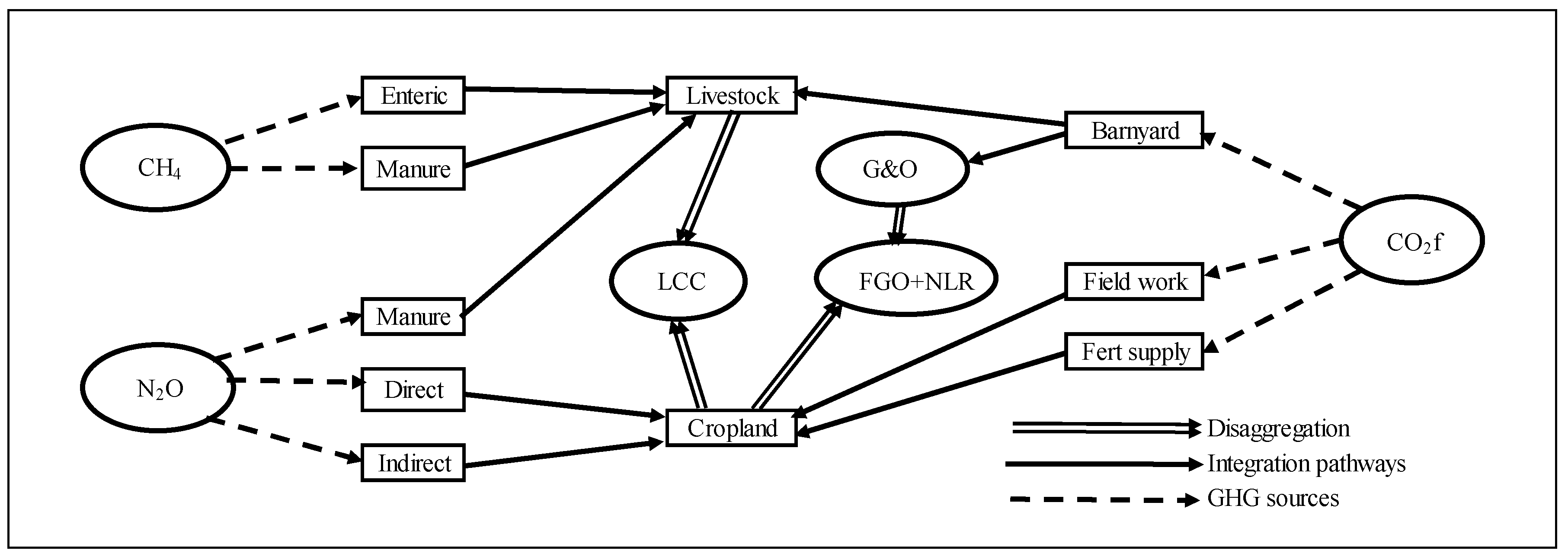
The GHG emission calculations in ULICEES-T are for the set of terms presented by Desjardins et al. [28]. Figure 1 shows the three GHG emissions (circles) and the sources for each GHG (joined by dashed-line arrows). The integration pathway, either directly to agronomic crop areas or through the livestock area calculations used by ULICEES-T to quantify these emissions, is also shown in Figure 1. This flowchart shows the sources for the three agricultural GHGs in boxes (moving towards the centre). The integration pathways are identified by the solid line arrows joining the emissions sources with the livestock- and cropland-related data sets (also in boxes). After integration, the GHG emission estimates from the two pathways are disaggregated (double line arrows) to the land uses defined by ULICEES-T. The inner (double line) arrows pointed at the central inner circles represent the calculation of both the crop areas and their GHG emission budgets.

2.4. LCC Input Data

Because the original ULICEES had access to agricultural census records, it could use all age–gender category populations and their respective live weights to disaggregate national totals to provinces and livestock types in one step [42]. ULICEES could, therefore, apply Equation (1) to all age–gender categories. With its reliance on the more limited annual survey data, ULICEES-T had to use the available age–gender category populations as proxy data for the whole population. But by sacrificing its sensitivity to the age–gender differences within livestock types, ULICEES-T can apply Equation (1) to all years in the 1990 to 2023 time series.
While using these proxy data eliminates some statistical noise, this simplification does not account for animals moving from dairy to beef farms or across borders [20]. Furthermore, disaggregation to livestock types had to already be provided or done as a separate step. Interpolation from breeding females to other age–gender categories can be done in each farm animal population [43]. However, since breeding females are the only source of variance in this analysis, generating the missing age–gender categories offers no statistical advantage. In the case of pork, the age of slaughter is quite variable [44], which adds spurious variability to population estimates.
The available proxy populations for the beef, dairy, pork, poultry, and sheep industries were, respectively, beef cows, dairy cows, sows, total poultry (laying hens, broilers, and turkeys), and rams and ewes. These data were made available by the Science and Technology Branch of AAFC (D. Worth, personal communication, 19 January 2026). In cases where the required inputs for SCC calculations were not available, they were interpolated from the BCC by factoring the BCC by the sheep-to-beef population ratio. From the national emission totals of each term (X), which are available annually from ECCC, provincial (prov) disaggregation could be done for each year in one step. This integrated calculation was done using Equation (2) as follows.
Xprov,ls,year = XCanada,ls,year × Pprov,ls,year/PCanada,ls,year

2.5. 1990 to 2023 Timeline Inputs

Being the first ECCC report to UNFCCC after the revised N2O methodology, the 2022 ECCC report [10] provided the baseline set of national N2O emissions used in this analysis. The years for which the 2022 report [10] provided CH4 and N2O emission estimates were 1990, 2000, 2005, and 2014 to 2020. The 2025 ECCC report [32] provided N2O and CH4 emissions estimates from 2021 to 2023, which were not provided in the 2022 report. The sum of all data for each N2O and CH4 term from the last three years in the 2022 report (2018, 2019, and 2020) was divided by the sum of all data from the 2025 report for the same three years and terms. This resulted in a single conversion factor for each GHG term reported by ECCC [10]. This set of factors was applied to the respective GHG terms from 2021 to 2023 from the 2025 ECCC report [32] to index them into the 2022 ECCC report [10] for 2021, 2022, and 2023.
The GHG emission estimates for 2013 in the 2019 ECCC report [31] were almost identical to the same terms given for 2014 in that report. Hence, it was assumed that 2013 could be added to the 2022 ECCC report simply by assigning the respective 2014 estimates to 2013 in the 2022 ECCC report. The 2022 ECCC report left data gaps for GHG emissions for the 1991–1999, 2001–2004, and 2006–2012 periods. The 1991 to 1999 data gap was interpolated from 1990 to 2000, the 2001 to 2004 data gap was interpolated from 2000 to 2005, and the 2006 to 2012 data gap was interpolated from 2005 to 2012. This interpolation process was repeated for each GHG emission term.

2.6. CH4 and N2O Emissions

The total CH4 emissions reported by Desjardins et al. [28] for 2015 were 33 MtCO2e, whereas ECCC [10] reported 27 MtCO2e for 2015, which were 83% of the CH4 emissions from Desjardins et al. [28]. The same two CH4 emission sources, enteric fermentation and manure storage, were recognized by Desjardins et al. [28] and ECCC [10]. However, as the more recent source, the ECCC [10] CH4 estimates were adopted for this analysis.
The N2O budget defined by Desjardins et al. [28] includes only three emission sources: Direct, Indirect, and Manure (Figure 1, left side). ECCC [10] provided a more detailed description of agricultural N2O sources. This detail, along with the multi-year estimates for both CH4 and N2O, provides the required inputs for the carbon footprint time series generated by ULICEES-T. Three national total GHG emissions that followed the livestock integration pathway in ULICEES-T (Figure 1, moving from left to centre) were disaggregated to beef, dairy, pork, and poultry by ECCC [10]. These sources, including enteric CH4 emissions, CH4 emissions from manure storage, and N2O emissions from manure storage, were disaggregated to provinces using Equation (2).
The N2O emission terms, which ECCC [10] did not link to livestock types, were provided as annual, Canada-wide estimates. These included (1) synthetic nitrogen fertilizers, (2) organic nitrogen fertilizers (manure), (3) crop residue decomposition, (4) mineralization of soil organic carbon, (5) manure voided onto pasture, range, and paddock, (6) indirect N2O, and (7) reduction in N2O emissions by conservation tillage. Because ULICEES-T is a dryland, agronomic, and livestock model, two components of the N2O budget from ECCC (2022), cultivation of organic soils and irrigation, are not included in ULICEES-T.
The quantification of N2O emissions from synthetic fertilizers (#1) followed the cropland integration pathway, using the procedure described by Dyer et al. [45], which required the product of each crop’s required N application rate and the annual area in that crop for each province. Another four N2O emission terms from ECCC [10], which followed the cropland integration pathway, were coupled with the synthetic fertilizer calculations. These four terms—crop residue (#3), soil carbon mineralization (#4), indirect N2O sources (#6), and reduction in N2O emissions due to conservation tillage (#7)—were indexed to synthetic fertilizer N2O (#1). These four terms were combined into one integrated annual Canadian (int) weight of N2O, which was disaggregated into province- and crop-specific values. This disaggregation was done in Equation (3) by multiplying each value by its crop–province share of the integrated Canadian total annual synthetic N fertilizer (Nfert) as follows.
N2Oint,c,year,prov = ∑c N2Oint,year,Canada × Nfert, c,year,prov/∑c Nfert,c, year,Canada
The annual, Canada-wide N2O emissions from manure fertilizer (#2) and manure voided onto pasture (#5) [10], like the N2O emissions from manure storage, followed the livestock integration pathway (Figure 1). But unlike the N2O emissions from manure storage, before they could be disaggregated to provincial N2O-based GHG emissions, they had to be disaggregated to livestock types.
Manure voided onto pasture (#5) was easily dealt with because, along with this emission source being relatively small, only cattle spend significant time on pasture. So an index based on the number of breeding cows in national beef and dairy populations determined the respective #5 quantities. Although not an N2O source, calculations of fossil CO2 emission (CO2f) from the diesel fuel used to spread manure were linked with the calculations of N2O emissions from manure put on pastures by spreading (#2). This linkage was workable because the two terms share the same indexing procedure. Both terms were disaggregated on the basis of 2001 census population data that provided all age–gender categories from which manure quantities for 2001 could be derived.
Hofmann and Beaulieu [46] gave the weights of voided manure for 18 age–gender livestock categories representing 2001. These categories were interpolated by inspection to 11 age–gender livestock population categories surveyed during agricultural census years. These weights were then multiplied by their respective 2001 agriculture census population data to generate manure totals for 2001. These 11 census-compatible manure categories (which were not available in the annual survey data) include beef cows, steers, calves, dairy cows, heifers, sows, feeder hogs, laying hens, broilers, turkeys, and sheep and lambs, which had to be aggregated into the five livestock input categories used as proxy population data in this analysis.
The agriculture census made no distinction as to whether calves and heifers were beef or dairy offspring. Therefore, beef cows, steers, and the cow-based beef share of calves and heifers were combined into the beef manure group. Because only 40% of Canadian beef manure is spread [47], this group was factored down by 0.4. Dairy cows and the cow-based dairy share of calves and heifers were combined into the dairy manure group. To account for the limited pasture time of milking cows and heifers, they were factored by 0.8. Sows and feeder hogs were combined into the pork group. The feeder category was assumed to include the grower and finishing category, and the much lighter nursing and weaner category. Consequently, feeder hogs were factored up by 50% to include the weaners. Laying hens, broilers, and turkeys were grouped as poultry, and the sheep group was assigned to the sheep and lambs manure group.
The conversion of the spread manure N2O emissions extracted from the time series data from ECCC [10] for 2001 was disaggregated to livestock types by applying the ratios of the adjusted weight of manure from each livestock type to the total adjusted weight of manure. The factor for converting manure weights to CO2f was the product of the volume of diesel fuel required to spread a ton of manure [48], the conversion of diesel fuel from volume to energy [49], and the diesel energy to CO2f emissions ratio [50]. The resulting combined conversion factor was 0.89 kgCO2f/t manure.
Each of the GHG emission totals linked to livestock type (represented generically as X) was disaggregated by year and province in two steps. The first step was to index national totals from 2001 to the year using the respective year population totals. The second step was to index the year total to each province using the respective livestock provincial and year population distribution. The disaggregation process was summarized as one calculation in Equation (4) as follows.
Xls,prov,year = Xls,Canada,2001 × Pls,prov,year/Pls,Canada,2001

2.7. Fossil Energy and CO2f Emissions

The CO2f calculations in ULICEES-T are separated into three categories, depending on both fuel type and integration pathway (Figure 1, from right to centre). The first category includes “Field work”, whose CO2f emissions were calculated by the Farm Fieldwork and Fossil Fuel Energy and Emissions (F4E2) simulation model [51]. The field operation calculations [39] relied on three tillage-related sets of CO2f/ha output from the original F4E2 model. These three sets of emission intensity estimates for field operations also took crop differences, such as row vs. continuous seeding, small grains vs. corn, or annual grains vs. perennial forage, into account [47]. The CO2f/ha rates were applied directly to crop areas and followed the cropland pathway to the land use systems (at the centre of Figure 1).
The second category includes a set of “Barnyard” operations that followed the livestock integration pathway. The original energy use terms in this category, including heating fuel, farm electricity use, and farm-owned transport powered by gasoline [52], were derived from the 1996 Farm Energy Use Survey (FEUS) [53]. Changes in CO2f emissions due to changes in the composition of heating fuel and the share of electricity generation that was by coal vs. non-fossil energy, as quantified by Dyer et al. [52], gave ULICEES-T some year-to-year sensitivity to these two barnyard energy terms. Farm transport did not show much change over time [52].
Since manure spreading is more driven by the weight of manure to be spread than the area on which it is spread [45], spreading manure was grouped with the barnyard category. Since the energy consumption for farm machinery supply is off-farm, farm machinery supply was also grouped with the barnyard category, even though it was derived from the F4E2 model [54]. All of the barnyard CO2f terms related to livestock were disaggregated to provinces and years using Equation (4).
Figure 1 shows a separate integration pathway from the barnyard operations to the Grains and Oilseeds (G&O) area. The FEUS gave national energy quantities for G&O as a separate energy use category from the livestock types. However, the FEUS did not disaggregate this energy term to crop types. Hence, each G&O energy type (et) value for each non-feed crop (c) was disaggregated to the FGO and NLR crop areas (A) based on each crop’s share of the national FGO+NLR area total for 1996. These national crop-specific energy use totals (F) for 1996, expressed as MtCO2f, were applied to other years and all provinces using Equation (5) as follows.
Fet,c,prov,year = Fet,c,Canada,1996 × Ac,prov,year/Ac,Canada,1996
The third category, nitrogen fertilizer manufacture, was integrated over crop areas (Figure 1). Being an external input derived from natural gas rather than burning diesel fuel justified treating “Fert supply” as a separate farm energy category. This integration process is done in combination with the synthetic fertilizer N2O calculations, which are driven by fertilizer sales data [45]. The CO2f conversion of nitrogen fertilizer, expressed as weight of N, was 4.05 tCO2f/tN [47]. The rapid increase in nitrogen fertilizer sales since 1990 made the Fert supply energy use and chemical fertilizer N2O emissions the largest terms in their respective GHG emission budgets.

2.8. Protein

Including protein in crop and livestock carbon footprint comparisons meant adding year-to-year tracking of complete protein production to ULICEES-T. The protein sources were the five livestock industries in Canada, and the Canadian legume crops capable of producing harvestable complete protein fit for human consumption. The GHG–protein ratio indicators (GHG/protein) for beef, milk, pork, chicken and eggs [19], and sheep [23] facilitated this additional dimension. However, these emission intensities were only provided for one source year (sy), which was either 2001 or 2006 (depending on the commodity) [19]. The GHG emissions generated by ULICEES-T for the same source years and livestock types as each available GHG–protein ratio (GPR) were divided by those ratios to give national protein quantities. Year- and livestock commodity-specific protein quantities were calculated using Equation (6) as follows.
Proteinls,sy = GHGls,sy/GPRls,sy
Since the inputs to ULICEES-T do not allow a distinction between GHG emissions from eggs or chicken (broilers), GHG emissions from 2001 for these two poultry products from Vergé et al. [22] were used to partition GHG emissions for poultry from this analysis to these two protein sources. For each livestock type, these protein quantities were then indexed to other years and to provinces to create a 1990–2023 time series using population data in the same way that population data was used to disaggregate the GHG emission sources. This disaggregation was achieved by multiplying the year-specific annual protein quantities by the ratio of each annual and provincial livestock population over the national population during the source year for each livestock type, using a modification of Equation (7) as follows.
Proteinls,prov,year = Proteinls,sy × Pls,prov,year/Pls,Canada,sy
Creating a time series of the plant-based complete proteins involved only one step. The available published protein data consisted of protein weights as per cent of Dry Matter (DM) of each of the six legume crops [24], including soybeans, dry peas, lentils, chick peas, white beans, and coloured beans. The last four are considered edible pulses. These protein quantities only required multiplication by their annual and provincial crop production statistics [41] to generate a 1990–2023 time series of crop-specific protein quantities.

3. Results

3.1. Model Verification

ULICEES-T depends mostly on a few recent GHG emissions reports instead of new measurements or first-principles calculations. Hence, verification was limited to making sure that ULICEES-T either mimics the Canadian agricultural GHG emissions reported previously or that sound reasons exist for any differences. Because 2006 is the latest year for which ULICEES could be run and the closest census year to 2005, the peak year of the Canadian beef industry, 2006 was a particularly important year for verification of ULICEES-T against ULICEES.
Table 2 compares ULICEES-T with GHG budget simulations for ag commodity groupings by Dyer et al. [39] for five census years in the ULICEES-T time series. For all agriculture (Lines 1 and 2), for all livestock (Lines 3 and 4), and for the ruminant group of livestock (Lines 5 and 6), the differences are small enough to be explained by the change in N2O emissions implemented by ECCC [10]. In most cases, ULICEES-T underestimates Dyer et al. [39]. But for the ruminant group (Lines 5 and 6), ULICEES-T equals or exceeds Dyer et al. [39] in 2006 and 2011. In the non-ruminant commodity group (Lines 7 and 8), the underestimation by ULICEES-T is larger for all years.
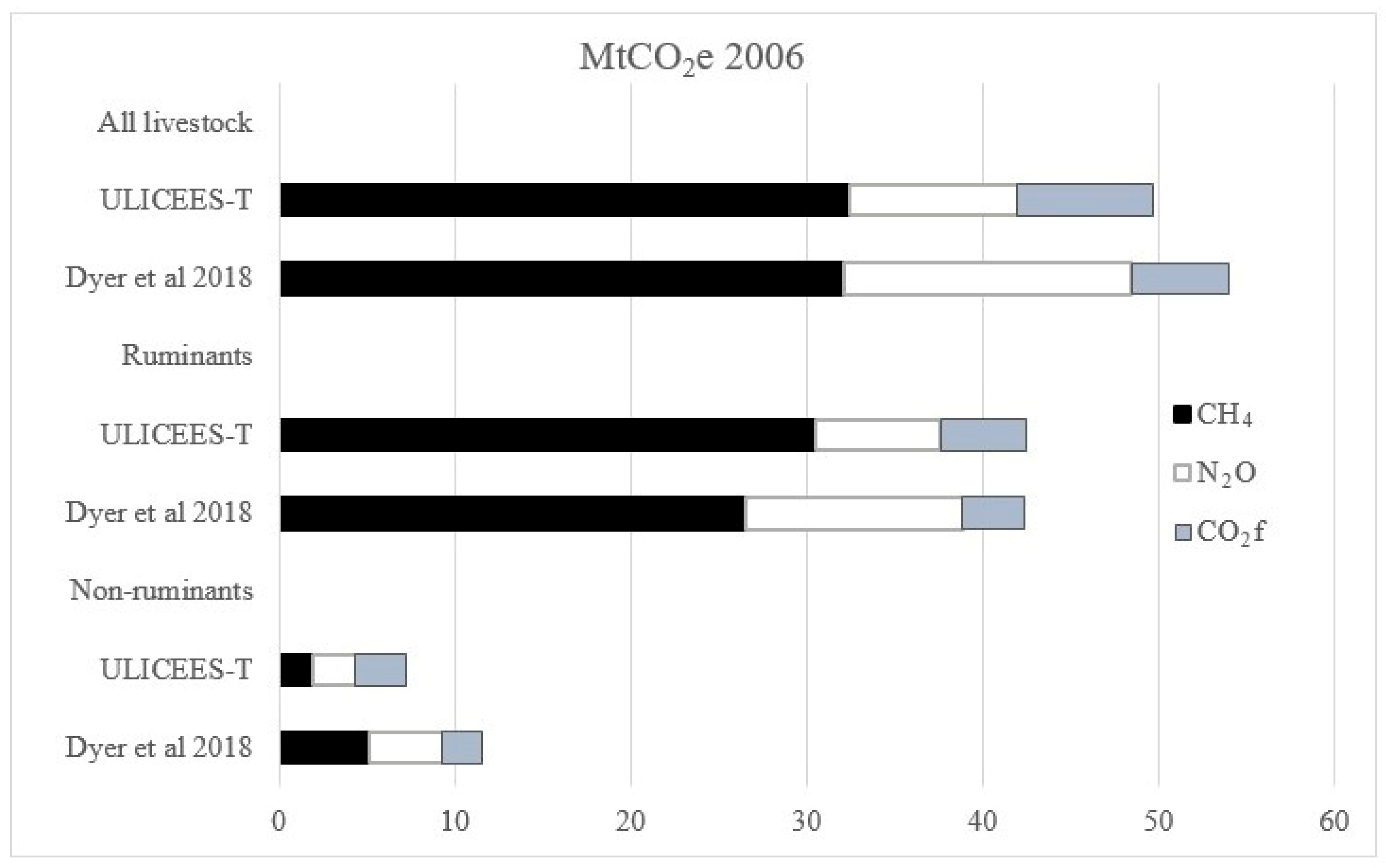
Figure 2 compares ULICEES-T with GHG budget simulations by Dyer et al. [39] for the three GHGs, CH4, N2O, and CO2f. This comparison was restricted to 2006 for just livestock and used the same two commodity groupings used by Dyer et al. [39]. Ruminants include beef and dairy cattle and sheep, and non-ruminants include pigs and all poultry.
As expected from the dominance of the beef industry in the Canadian Prairies, Ruminants account for over 80% of Canada’s livestock-related GHG emissions, and ULICEES-T shows that ruminants account for 95% of CH4 emissions from Canadian agriculture. In 2006, CH4 emissions reported by ULICCES-T for ruminants exceeded the CH4 emissions reported by Dyer et al. [39]. For all livestock, however, CH4 emission estimates from the two models are very close, whereas CH4 emissions reported by ULICCES-T for non-ruminants were exceeded by Dyer et al. [39]. Moreover, CH4 emissions play their biggest role in the ruminant GHG budget. Thus, the higher CH4 emissions, along with the biggest CH4 difference, between the two models explain why the 2006 cross-over in Table 2 occurred for ruminants but not for all livestock. For non-ruminants, the total GHG differences between the two models were too big for CH4 differences to have any cross-over effect in Table 2.
As expected, from the revised ECCC methodology [32], there were consistently fewer N2O emissions shown by ULICEES-T than by Dyer et al. [39] in both ruminants and non-ruminants, as well as in the all livestock GHG budget. ULICEES-T showed higher CO2f emissions than did Dyer et al. [39] in both livestock groups, which reflects improvements in the farm energy sub-model used in ULICEES-T compared to Dyer et al. [39]. This left the small amount of CH4 attributed to non-ruminants by the ECCC [12] as the main reason for the big difference in non-ruminants for the two models. This difference may reflect a reduction in estimated CH4 emissions from manure storage by the ECCC.
Based on the revised N2O methodology [10], ULICEES-T shows all of the N2O in Figure 2 to be about a third below the N2O values from Dyer et al. [39]. The CO2f values from ULICEES-T slightly exceed the Dyer et al. [39] estimate of CO2f. This difference was slightly larger in the non-ruminants. This difference is explainable by the allocation of the energy term for nitrogen fertilizer supply between LCC and non-LCC (FGO+NLR) land. For non-ruminants, the underestimation of Dyer et al. [39] by ULICEES-T is consistent with Table 2.
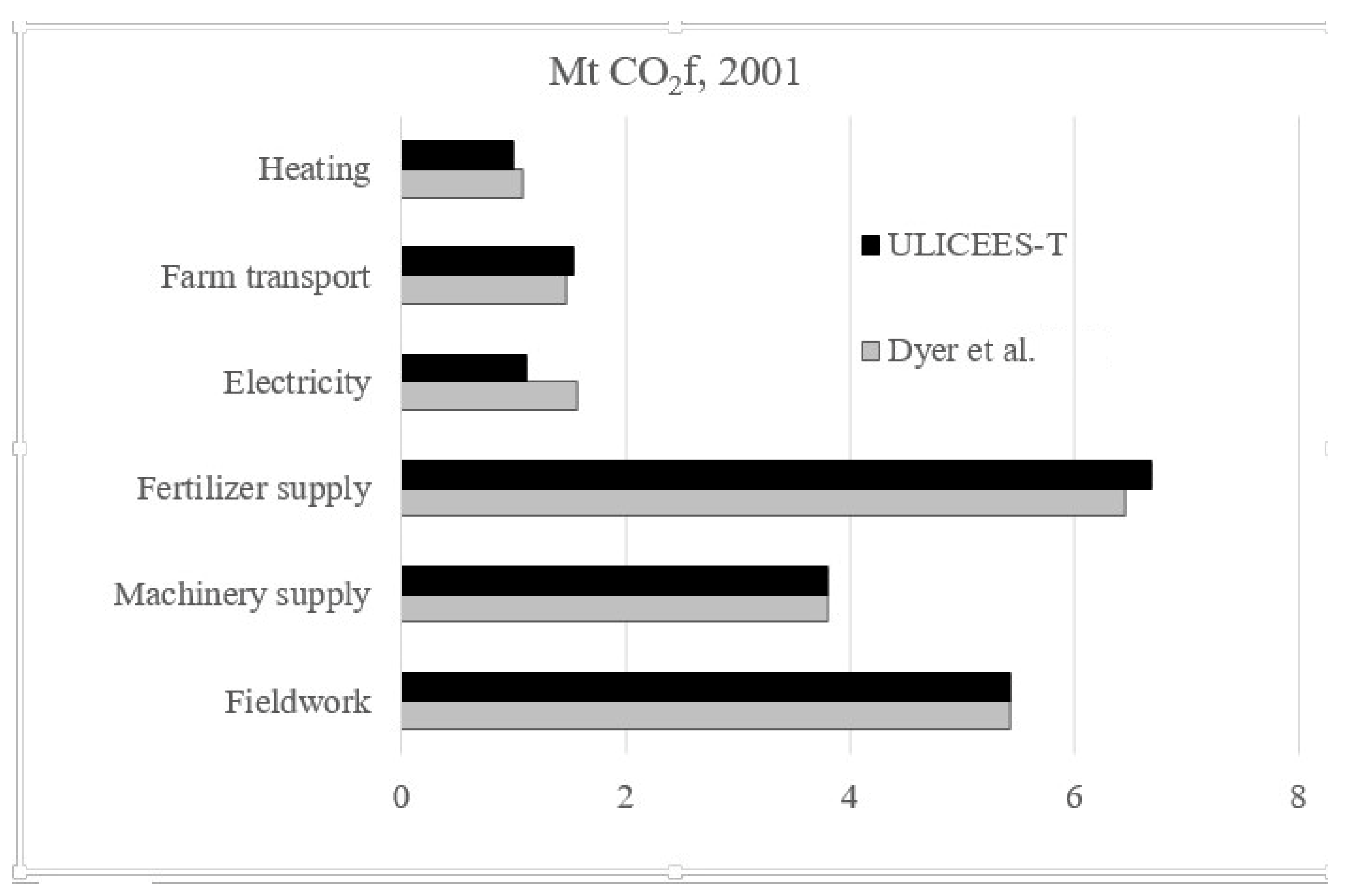
Because of the complexity of the fossil CO2 emissions budget in ULICEES-T, which was not derived from ECCC [10], a comparison of this component of ULICEES-T with the farm energy budget from Dyer et al. [42] is shown in Figure 3. The comparison of the 2001 fossil CO2 emission budgets in Figure 3 shows that the Dyer et al. [42] and ULICEES-T estimates are mostly within 4% of each other, except for two terms. Dyer et al. [42] exceed ULICEES-T in heating fuel use by 8%. Being such a small energy quantity, an 8% difference for heating has minimal impact on the CO2f budget.
For electrical energy generation, Dyer et al. [42] exceeded ULICEES-T by 29%. ULICEES-T uses a three-fuel mix to generate electricity, whereas Dyer et al. [42] assumed that all fossil fuel power generation was by coal. With natural gas and heating oil having lower CO2 emission intensities than coal [47,50], the three-fuel mix produced less CO2f per unit of electrical energy generated than would coal. Thus, the higher emission intensity for coal accounts for this difference. But since electricity is also a very small contributor to the farm energy budget, its impact on the CO2f budget is also minimal. The energy estimates to manufacture nitrogen fertilizer (fertilizer supply) are quite close. Using the fertilizer use index from Dyer et al. [45] instead of recommended application rates [55], as was done by Dyer et al. [42], appears to be the right choice for ULICEES-T.

3.2. Summary of Results from Two Sample Years

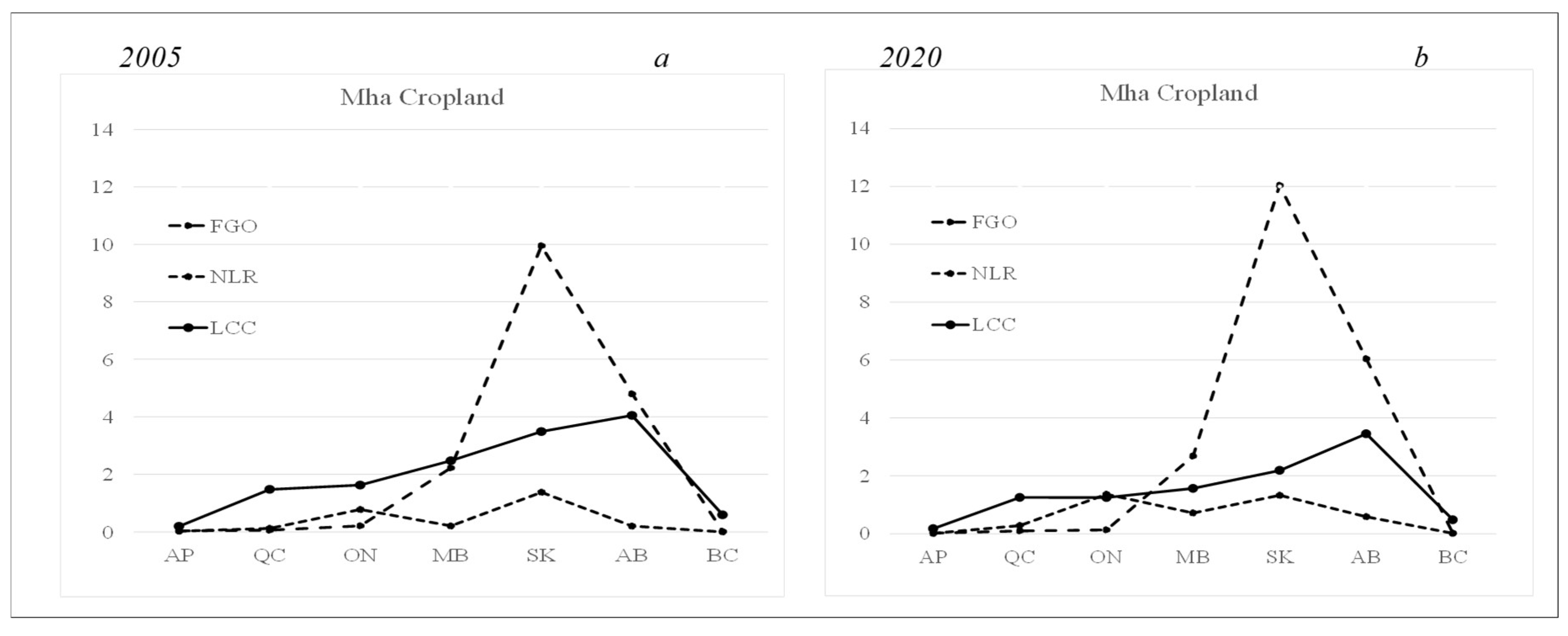
Figure 4 presents the areas in each land use system by province for two contrasting years, 2005 and 2020, the peak years for beef and N fertilizer use in Canada. Meaningful differences in land use between Eastern and Western Canada can be observed in Figure 4. The Saskatchewan FGO was the dominant land user in Canada with a 20% increase over the fifteen years. There was appreciable land in the LCC in all but the two coastal provinces, but the LCC declined in the other five provinces between 2005 (Figure 4a) and 2020 (Figure 4b). The NLR actually increased slightly over those five provinces. In Western Canada between 2005 and 2020, the field crop areas not supporting livestock increased from 19 Mha to 23 Mha, whereas crop areas that supported livestock decreased from 14 Mha to 10 Mha.
Table 3 provides an east–west area breakdown of the five livestock industries in the LCC for the two sample years, 2005 and 2020. Most of the 2 Mha increase in the FGO and the small NLR increase in Figure 4 come from the BCC, which lost 2.3 Mha, and to a lesser extent from the PCC. But both the BCC and PCC dropped about 40% to 50% over the 15-year interval. Although by not as much, the sheep area use also declined over this period. The Eastern Canadian dairy industry declined slightly in the east, while the poultry area use increased modestly in both regions.

3.3. Regional GHG Emission Differences

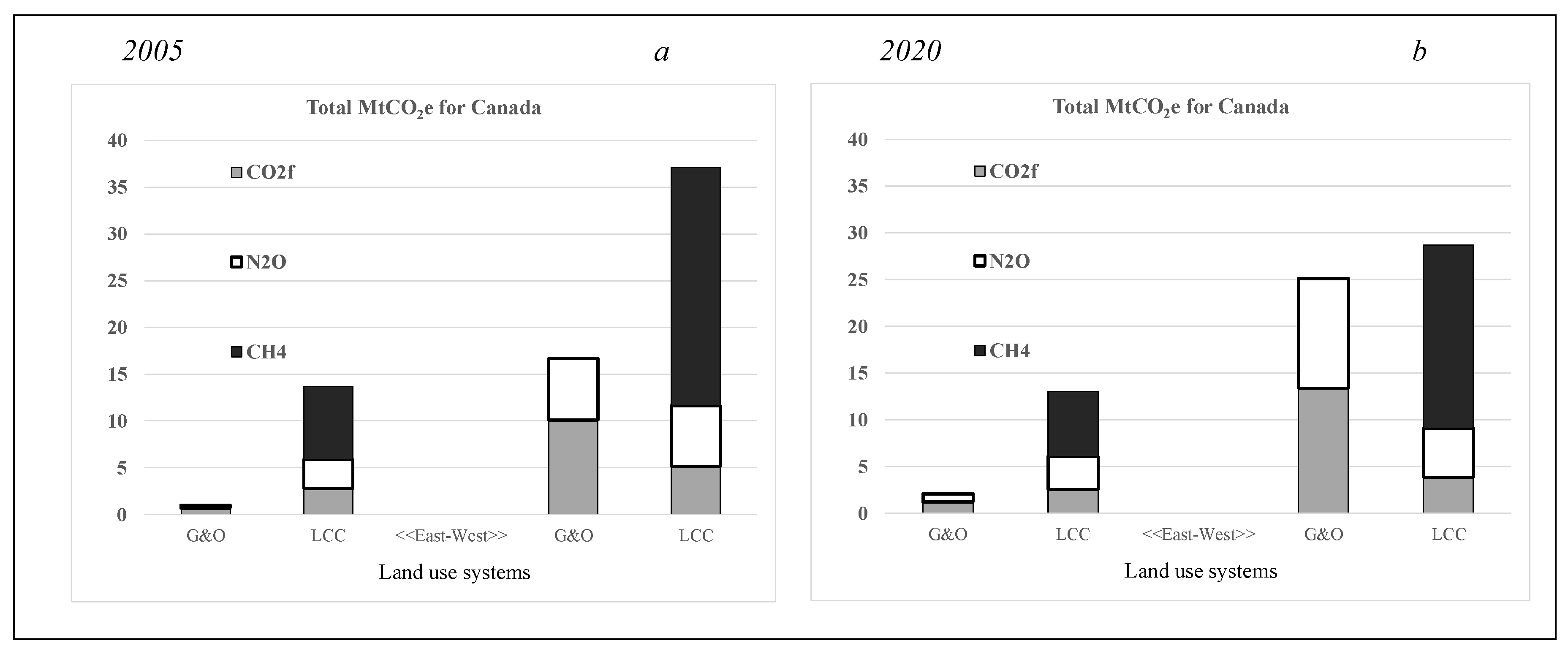
Figure 5 displays the differences among the three GHGs for the two broadest land use groups: Grains and Oilseeds (G&O) and the Livestock Crop Complex (LCC). The pair of bar charts in Figure 5 shows the total GHG emissions and the emissions from each GHG. As defined above, G&O combines the two land classes, FGO and NLR, and the LCC includes the five livestock-specific crop complexes: BCC, DCC, PCC, ACC, and SCC.
The biggest change in Figure 5 was in the west, with the LCC declining from 37 MtCO2e to 29 MtCO2e and the G&O increasing from 17 to 25 MtCO2e. In the east, the very small GHG emissions from the G&O doubled, while the eastern LCC declined slightly from 14 to 13 MtCO2e. Whereas CH4 emissions dominate the LCC emissions, there is no CH4 in the GHG emissions from G&O. In Figure 5a, CO2f emissions by G&O slightly exceeded N2Oemissions, whereas in Figure 5b, N2O and CO2f emissions by G&O were equal. The increase in N2O emissions from G&O in the west significantly increased the GHG budget for western G&O.
Table 4 presents the regional GHG emission budgets from all seven land use systems in ULICEES-T for 2020 and highlights the east–west differences in Canada’s agricultural industries. It illustrates that beef production and export-quality grains, mainly spring wheat and canola, are predominantly Prairie-based industries, whereas the dairy and poultry industries are predominantly eastern Canadian. Western Canada is a much bigger GHG emission source than Eastern Canada, and beef, particularly Western beef, emits much more GHG than the other livestock industries. Table 4 illustrates just how minor the sheep industry is compared to the other livestock industries. Three-quarters of the dairy and poultry GHG emissions are both from the east. The pork industry emissions were split about evenly, east and west. Dairy is the main GHG emission source in the east. The NLR plays a surprisingly strong role in Canada’s 2020 GHG emissions budget, particularly in the east.

3.4. Time Series Analysis

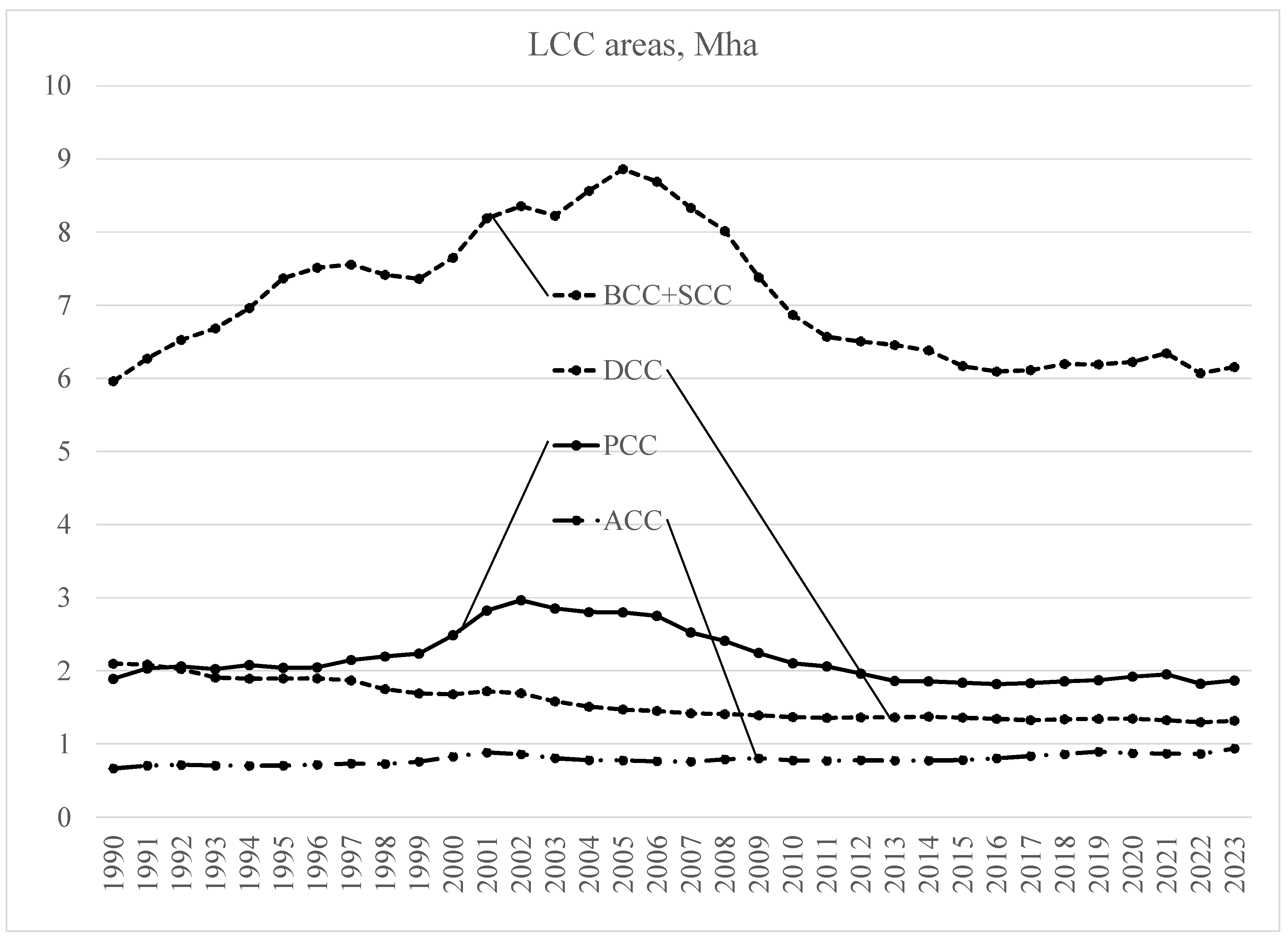
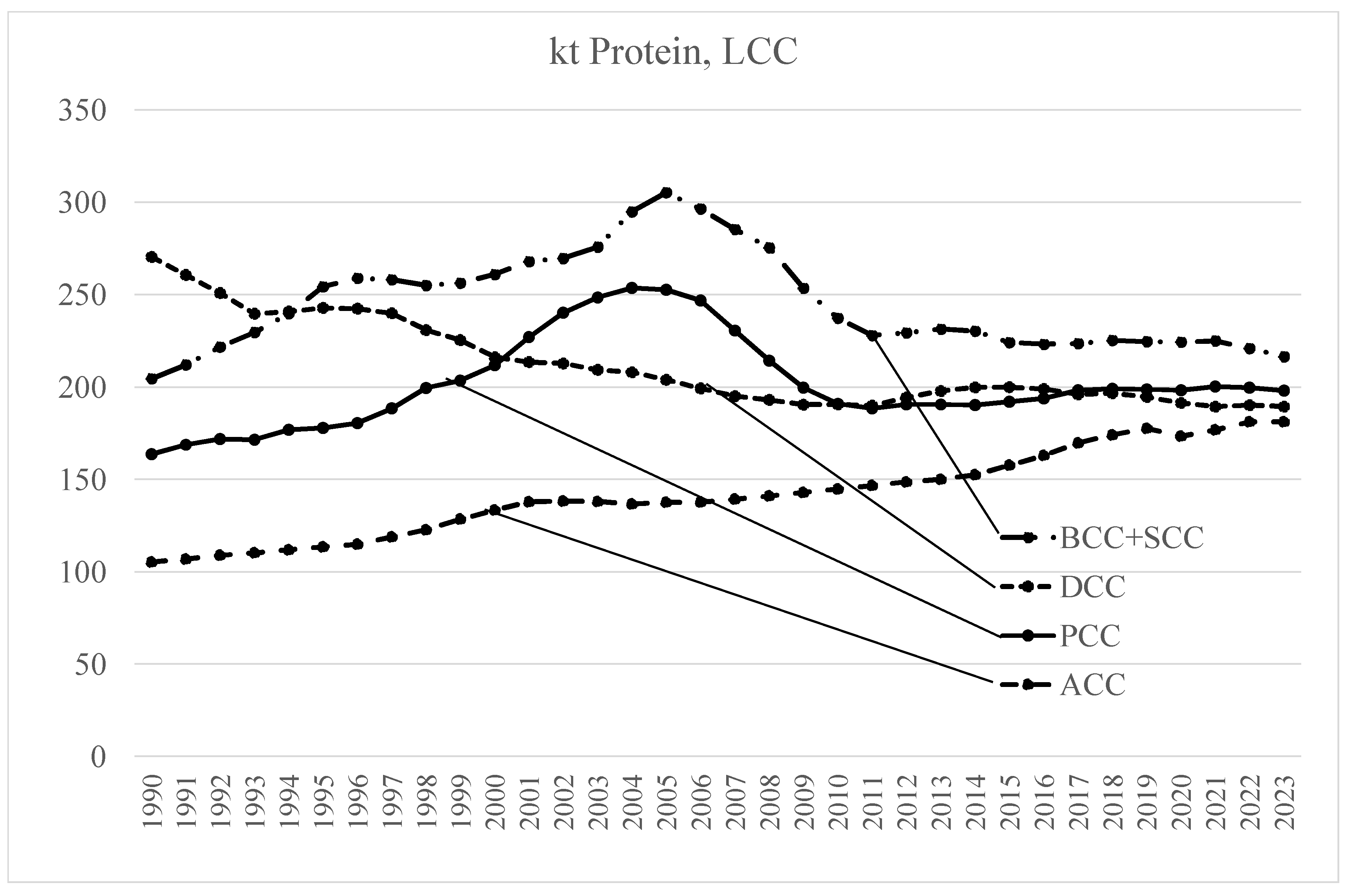
The three main outputs from ULICEES-T, crop area, GHG, and complete protein, are presented as time series from 1990 to 2023 (Figure 6, Figure 7, Figure 8 and Figure 9). Since the sheep industry is very small compared to the beef industry, and because they are both ruminant meat animals, the BCC and SCC are presented as one timeline in all four time series figures.
Figure 6 presents timelines of the areas that support livestock in Canada. Although the Western Canadian beef industry also relies on rangeland [56], this land resource is not included in the BCC [20]. Since rangeland is not cultivated, it receives no commercial fertilizer or farm machinery traffic. Therefore, no N2O or CO2f emissions can be attributed to this land resource. While breeding cows spend much of their lives grazing rangeland, the amount of rangeland they graze does not determine how much enteric methane they will emit. Instead, the determinants are live weight, diet, and life span.
The FGO areas are input statistics, whereas the NLR areas are residuals from livestock feed crop area statistics and the LCC areas. Therefore, the FGO and NLR areas were not presented as timelines. Because ULICEES-T uses breeding females as proxies for total livestock populations for four of the five livestock populations, their respective land uses (LCC areas generated by Equation (1)) facilitate more meaningful inter-industry comparison than the population data available for this analysis.
The combined beef–sheep crop (BCC+SCC) complex areas were two to three times as much as the combined areas for the other three livestock crop complexes. There was a sharp peak just under 9 Mha in the area required by the Canadian beef industry in 2005. Over the whole period, the BCC+SCC industry never went below 6 Mha. The next highest land user was the pork industry (PCC), which, except for 2002, stayed below 3 Mha. Land use by the dairy industry (DCC) declined slightly from 2 Mha. Land use for poultry production stayed below 1 Mha.
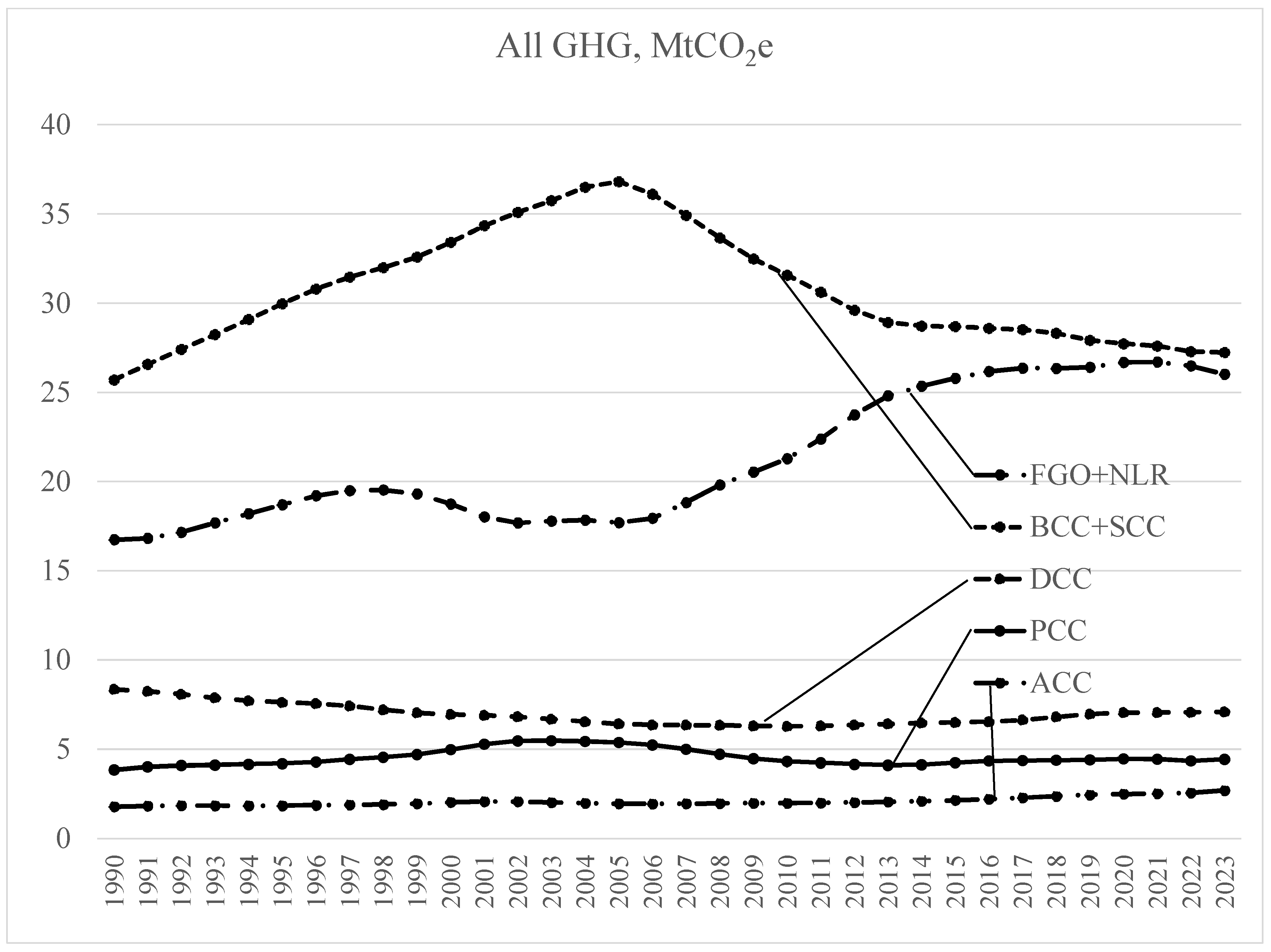
Figure 7 presents the GHG emission budgets for the livestock industries and for the combined FGO and NLR industries. The BCC+SCC emissions peaked at 37 MtCO2e in 2005, before dropping to 27 MtCO2e by 2023. After 2006, the GHG emissions from the FGO+NLR increased from 18 to 26 MtCO2e in 2020. Hence, as shown in Table 4, the FGO+NLR and BCC+SCC emission timelines nearly converged at about 27 MtCO2e in 2021. GHG emissions from all livestock decreased from 51 MtCO2e in 2005 to 42 MtCO2e in 2020, a drop of 18%. The DCC, PCC, and ACC emissions are all well below 10 MtCO2e. Throughout the period, the DCC slightly exceeded the PCC, which slightly exceeded the ACC. The PCC only exceeded 5 MtCO2e between 2001 and 2006.
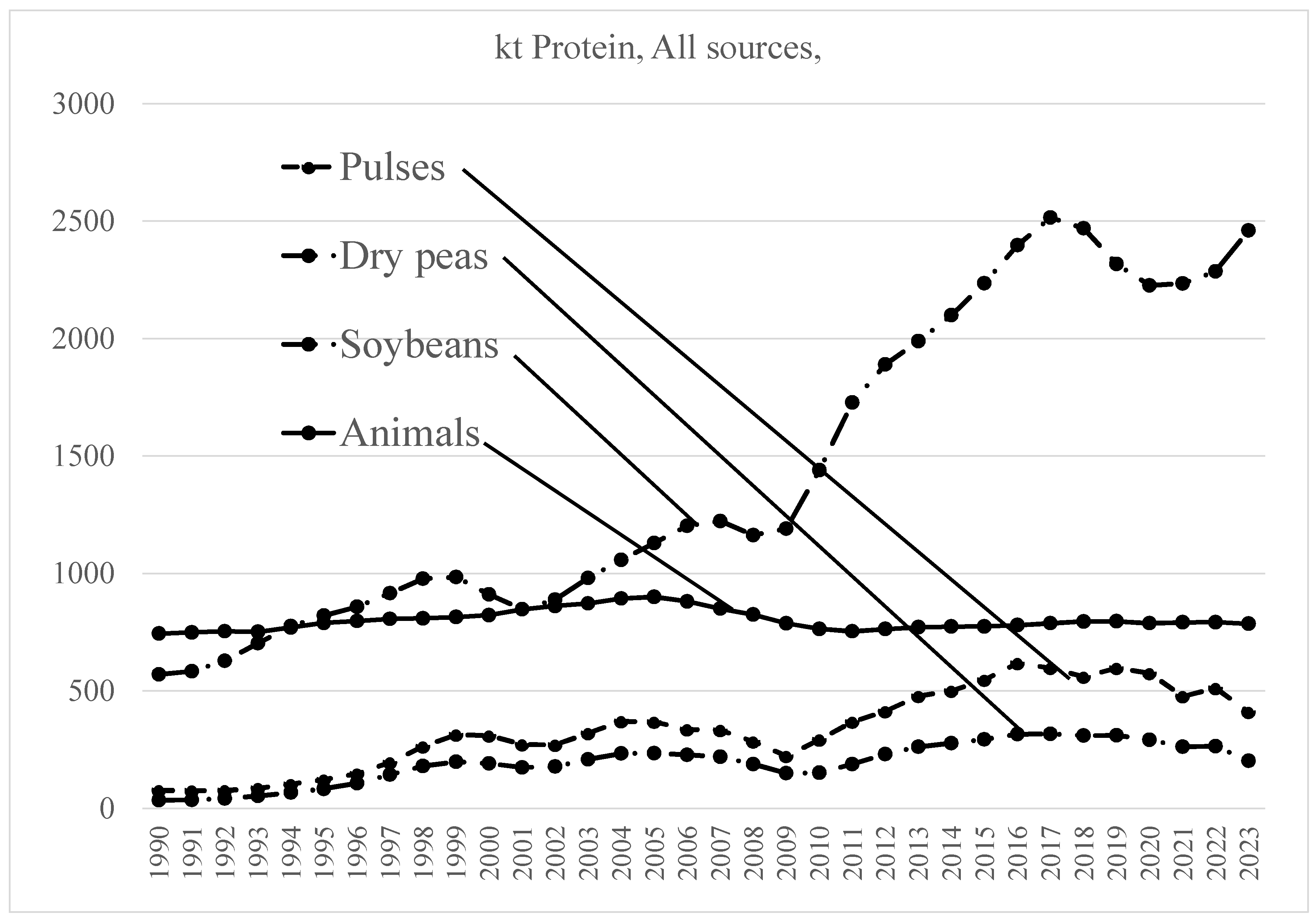
Figure 8 shows the 1990 to 2023 production of complete protein from all sources in Canadian agriculture. For Figure 8, livestock protein sources are combined as one timeline. The protein content of dry peas is much closer to that of edible pulses than to soybeans, but like soybeans, it is mainly used as livestock feed in Canada. Figure 8, however, shows dry peas to be a very small protein source. Protein production by both soybeans and pulses increased steadily over the period, but the soybean production increase, 500 to 2500 kt of protein, was very steep, particularly between 2009 and 2017. The timeline for protein by all livestock remained flat at about 800 kt. Together, livestock and pulses produced 1.4 Mt of protein in 2020.
Figure 9 shows the 1990 to 2023 production of complete protein from just Canadian livestock. After the mid-1990s, the BCC+SCC timeline shows the highest rate of protein production, peaking at 300 kt in 2006. But the BCC+SCC protein timeline is closely followed by PCC protein production, peaking at 250 kt in 2005. The close tracking by the PCC timeline of the BCC+SCC timeline is in stark contrast to the big differences between the pork and the beef–sheep timelines in land use (Figure 6) and GHG emissions (Figure 7). Protein from the DCC declined steadily from 270 kt to 190 kt over the period. Protein from the ACC increased from 100 kt to 180 kt over the period. Total animal protein from all livestock decreased from 899 kt to 787 kt between 2005 and 2020. But in contrast to the 18% drop in GHG emissions from the LCC (Figure 7), the 2005–2020 drop in animal protein production was only 12%.

4. Discussion

Table 2 and Figure 2 and Figure 3 indicate that, for the purpose defined by the goals of this paper, ULICEES-T is a reasonable and acceptably accurate model. In addition, CH4 and N2O emission estimates from ULICEES-T reflect Canada’s submission to the UNFCCC [10]. Compliance with Canada’s report to UNFCCC notwithstanding, the deficit in CH4 emissions attributed to non-ruminants reported by ULICEES-T compared to Dyer et al. [39] may warrant further study. However, the conclusion that pork has a lower carbon footprint than beef [17] is not affected by this decrease, since the results shown in Figure 2 only widen the difference between the beef and carbon footprints.
Figure 6, Figure 7, Figure 8 and Figure 9 demonstrate that important differences among Canada’s agricultural industries are visible on a national scale and, in many cases, persist over several decades. However, two data sources essential to ULICEES-T, farm energy use and livestock feed requirements, need to be updated. While Table 2 and Table 3 and Figure 4 and Figure 5 demonstrate the regional sensitivity of ULICEES-T, space did not allow any inter-provincial or east–west timeline graphs to be presented. ULICEES-T depends on several simplifying assumptions that may introduce uncertainty in Figure 6, Figure 7, Figure 8 and Figure 9. Since there was no statistically valid basis to assess uncertainty, caution is recommended in using this output in applications other than relative comparisons.
Figure 6 indicates that beef production is the biggest land user of Canada’s livestock industries by a wide margin, even though Figure 6 does not include the use of rangeland for grazing cattle. This dominant use of Canadian farmland by beef is partly because the hay in their diets requires more area to produce the same nutrient energy as feed grains [57]. Growing feed for beef cattle in 2020 required 6.2 Mha, compared to 4.2 Mha required by the other three livestock industries. In 2020, these other industries provided 72% of the animal protein in Canada (Figure 9). Much of this LCC land could be, or might eventually have to be, reseeded to grains to feed human populations. Over the whole period, the beef industry was also a bigger source of GHG emissions than the other four livestock industries combined (Figure 7). Given the higher GHG emissions and greater land use associated with beef, if land needed to be diverted away from the LCC for essential food crops, then diverting it from the BCC would have the lowest impact on Canadian animal protein production.
As suggested previously [17], fecundity is at the heart of the environmental efficiency of non-ruminants compared to ruminants. Whereas beef cows produce about one calf a year, sows are outnumbered by the pigs destined for market by ten to one [43]. And since the pigs destined for market only live for five to six months [58], the effective reproduction rate is about 20 pigs per year.
The steep increase in the non-livestock GHG emissions (FGO+NLR) in Figure 7 was a direct result of the rapid increase in commercial nitrogen fertilizer applications after 2006. The application rates of nitrogen fertilizer for commercial crops increased much faster than for feed crops [45]. Since ULICEES-T classified the two main commercial crops, spring wheat and canola, in the FGO group, Figure 7 validates the call by the Government of Canada [29] to reduce fertilizer-related N2O emissions. However, while the protein production lost by giving up land in the BCC can be made up by the PCC and ACC, giving up FGO land would mean giving up export potential.
The most noticeable feature of Figure 8 was the rapid increase in the protein from soybeans. The protein production from the pulses was also surprisingly high, since edible pulses are a small commodity in Canada. But the protein from dry peas was smaller than that of the edible pulses. While both soybeans and dry peas produce complete protein that could be eaten by humans, in Canada, most of this protein is fed to livestock, a consumption pattern that is unlikely to change in the near future. Globally, only 7% of soy goes towards human food [12]. Nevertheless, the potential for Soybeans to alleviate global dietary protein deficiencies in many parts of the world at a low GHG emissions cost [24] should not be overlooked as a foreign aid policy tool.
But given the small share of the population in Canada that is vegetarian [4,58], the protein production patterns shown in Figure 9 are more relevant to the protein sources that most Canadians actually consume. The most important takeaway from Figure 9 is that, particularly after about 2012, the protein production from the four animal sources was very close. This is in contrast to the big differences in land use and GHG emissions between the BCC+SCC and the other land uses shown by Figure 6 and Figure 7. While much about the beef industry is more beneficial to biodiversity than the other livestock industries, none of these land uses has the same restorative benefit for biodiversity as rewilding [17,35].

5. Conclusions

ULICEES-T highlighted the differences among the sector’s contributing industries and graphically described the GHG emission budgets of these industries over time on an industry-by-industry basis. Only by tracking GHG budgets, land use, and protein production can the balance between respect for planetary boundaries [16,17,18] and humanity’s need for complete protein [19] be achieved. Such respect recognizes that some ag industries emit more GHG than others and that trade-offs among these industries may be needed. The ability of ULICEES-T to disaggregate GHG emission sources by industry was the result of separating the components of the N2O and CO2f emission terms by their integration pathways (Figure 1). This disaggregation relied on generating crop complex areas from livestock populations (Equation (1)).
Timelines of integral environmental terms should be used more often in reporting the carbon footprint of Canadian agriculture (not just intensity indicators). Whereas ECCC separated livestock-related emissions by animal type, these timelines are most useful when they highlight industry differences. A complete disaggregation of Canada’s agricultural GHG emissions budget to the contributing industries required the crop complex area and the additional GHG emission calculations described in this paper.
Figure 6 and Figure 7 invite consideration of whether Canada’s beef population should be kept at its current level or returned, if market conditions allow, to the peak population in 2005. If, as suggested by previous Canadian analyses [17,19], consumer demand for animal protein is better met by either pork or poultry than by beef, then the decline in beef production since 2005 should be accepted as a reduction in Canada’s agricultural carbon footprint, or at least a return to the 1990 level. In which case, governments should not intervene to return beef production to its 2005 level. Instead, any growth in the supply of animal quality protein sources should come from the two non-ruminant industries.
The steep rise in the GHG emissions from the FGO+NLR timeline (Figure 7) draws attention to the increasing N2O emissions from nitrogen fertilizer use in Canada [14,29]. Mitigating these emissions will be a challenge without sacrificing some production of high-value export crops. Unlike protein sources, land use for spring wheat and canola cannot be reallocated to other commodities without imposing unsustainable economic loss to the farmers. Therefore, increased research into reducing N2O and/or CO2e emissions from nitrogen fertilizer and improving nitrogen fertilizer application rate efficiency is needed.
Protein production, either presented as part of an intensity indicator or as a stand-alone timeline, is the most important performance measure of livestock productivity. The need to track protein has been made more pressing by the rise of animal-equivalent protein alternatives, such as lab-grown meat and plant-based meat substitutes. Figure 8 illustrates the potential of diverting even a portion of the soybeans currently grown for animal feed to the human diet. Although this analysis does not consider the processing costs of converting soybean meal to palatable human foods such as tofu, the soybean timeline in Figure 8 and its low carbon footprint [24] invite further exploration of soy protein in the human diet.
The GHG–protein ratio is sometimes not as effective at highlighting environmental change over time as showing the two ratio components as separate timelines. The GHG emission quantities (Table 4 and Figure 7), for example, suggest that if all consumers of Canadian beef (both export and domestic) in 2020 had switched to Canadian pork, Canada’s agricultural carbon footprint could theoretically be reduced by over 20 MtCO2e. While there are compelling arguments for not totally eliminating the Canadian beef industry [19,35], even a fraction of that 20 MtCO2e would have a big impact on Canada’s agricultural carbon footprint. As demonstrated by both Dyer and Desjardins [17] and Figure 6, land use was an essential element of these comparisons.
Canadian agricultural planners need to recognize that Canada may be called upon to provide more frequent food aid assistance and should manage agricultural land resources accordingly. At the same time, Canada must accept that our agricultural industries are significant contributors to our national carbon footprint. Therefore, monitoring industry-specific land use in conjunction with GHG emissions is essential. The two most pressing carbon footprint challenges are the over-consumption of beef and the apparent over-application of nitrogen fertilizer, particularly for commercial crops.
Both Darbandi and Saghaian [2] and Dyer and Desjardins [17] have advocated engaging public media to educate consumers of the GHG mitigation potential of eating less beef. The comparison of the national sector-wide GHG–protein ratio with the livestock-specific GHG–protein ratios from Dyer and Desjardins [19], along with a comparison of Figure 7 and Figure 9, strengthens the argument for launching such a media campaign. This proposed green marketing campaign must address SOC in two ways: firstly, that soil carbon sequestration has a saturation point and that stored carbon can be lost [36,37]; secondly, even when beef production is credited with increased SOC under perennial forage, the carbon footprint for pork is still much lower than for beef [17]. Linking these findings to the next Canada Food Guide would be a good start to educating consumers that not all meat (or red meat) imposes the same environmental burden.

Author Contributions

Conceptualization, J.A.D. and R.L.D.; methodology, J.A.D.; formal analysis, J.A.D.; resources, R.L.D.; writing—original draft preparation, J.A.D.; writing—review and editing, R.L.D.; funding acquisition, R.L.D. All authors have read and agreed to the published version of the manuscript.

Funding

The research that led to this paper was funded by the Sustainability Metrics Project, Contract No. 01E86 2018–2019, Agriculture and Agri-Food Canada, Government of Canada.

Data Availability Statement

The original contributions presented in this study are included in the article. Further inquiries can be directed to the corresponding author.

Acknowledgments

The authors acknowledge the Science and Technology Branch, AAFC, for their ongoing support and encouragement for this work and the Sustainability Metrics project for the financial support of this publication. The authors also acknowledge the assistance of Devon E. Worth, Science and Technology Branch of AAFC, in accessing the historical livestock population statistics used in this analysis.

Conflicts of Interest

The authors declare no conflicts of interest.

References

  1. Persson, U.M.; Johansson, D.J.A.; Cederberg, C.; Hedenus, F.; Bryngelsson, D. Climate metrics and the carbon footprint of livestock products: Where’s the beef? Environ. Res. Lett. 2015, 10, 034005. (accessed on 14 June 2026). [Google Scholar] [CrossRef]
  2. Darbandi, E.; Saghaian, S. Beef consumption reduction and climate change mitigation. Int. J. Food Agric. Econ. 2018, 6, 49–61. [Google Scholar] [CrossRef]
  3. Smil, V. Nitrogen and Food Production: Proteins for Human Diets, AMBIO. J. Hum. Environ. 2002, 31, 126–131. Available online: https://vaclavsmil.com/wp-content/uploads/2024/10/smil-article-2002-nitrogen-and-food-production.pdf (accessed on 13 May 2026).
  4. Kaplan, D.L.; McClements, D.J. Hybrid alternative protein-based foods: Designing a healthier and more sustainable food supply. Front Sci. 2025, 3, 1599300. [Google Scholar] [CrossRef]
  5. UNDPI. World Population Projected to Reach 9.8 Billion in 2050, and 11.2 Billion in 2100; United Nations Department of Public Information (UNDPI): New York, NY, USA, 2021; Available online: https://www.un.org/en/desa/world-population-projected-reach-98-billion-2050-and-112-billion-2100 (accessed on 13 May 2026).
  6. Nardone, A.; Ronchi, B.; Lacetera, N.; Ranieri, M.S.; Bernabucci, U. Effects of climate changes on animal production and sustainability of livestock systems. Livest. Sci. 2010, 130, 57–69. (accessed on 13 May 2026). [Google Scholar] [CrossRef]
  7. Willard, B. Colouring outside the lines: Symbolic legitimacy for Americans. In Meatsplaining: The Animal Industry and the Rhetoric of Denial; Hannan, J., Ed.; Sydney University Press: Sydney, Australia, 2020; pp. 135–161, Chapter 5; Available online: https://news.uwinnipeg.ca/new-book-by-dr-jason-hannan-is-a-critical-analysis-of-meat-industry/ (accessed on 13 May 2026).
  8. Poore, J.; Nemecek, T. Reducing food’s environmental impacts through producers and consumer. Science 2018, 360, 987–992. [Google Scholar] [CrossRef] [PubMed]
  9. AAFC. Overview of Canada’s Agriculture and Agri-Food Sector; Agriculture and Agri-Food Canada (AAFC): Ottawa, ON, Canada, 2025. Available online: https://agriculture.canada.ca/en/sector/overview (accessed on 13 May 2026).
  10. ECCC. Agriculture. In National Inventory Report 1990–2020: Greenhouse Gas Sources and Sinks in Canada; Canada’s Submission to the UNFCCC; Chapter 5, Cat. No.: En81-4E-PDF, EC21275.02; Environment and Climate Change Canada (ECCC): Gatineau, QC, Canada, 2022. Available online: https://publications.gc.ca/collections/collection_2022/eccc/En81-4-1-2020-eng.pdf (accessed on 13 May 2026).
  11. De Vries, M.; de Boer, I.J.M. Comparing environmental impacts for livestock products: A review of life cycle assessments. Livest. Sci. 2010, 128, 1–11. [Google Scholar] [CrossRef]
  12. Ritchie, H. If the World Adopted a plant-Based Diet, We Would Reduce Global Agricultural Land Use from 4 to 1 Billion Hectares. Our World in Data. 2021. Available online: https://ourworldindata.org/land-use-diets (accessed on 13 May 2026).
  13. Searchinger, T.D.; Wirsenius, S.; Beringer, T.; Dumas, P. Assessing the efficiency of changes in land use for mitigating climate change. Nature 2018, 564, 249–253. (accessed on 13 May 2026). [Google Scholar] [CrossRef] [PubMed]
  14. Qualman, D. Nitrogen Fertilizer: Critical Nutrient, Key Farm Input, and Major Environmental Problem: A Discussion Paper in Collaboration with the National Farmers Union. 2022. Available online: https://www.nfu.ca/wp-content/uploads/2022/08/nitrogen-fertilizer-report-nfu-2022-en.pdf (accessed on 13 May 2026).
  15. Shepon, A.; Eshel, G.; Noor, E.; Milo, R. Energy and Protein Feed-to-Food Conversion Efficiencies in the US and Potential Food Security Gains from Dietary Changes. Environ. Res. Lett. 2016, 11, 105002. [Google Scholar] [CrossRef]
  16. Campbell, B.M.; Beare, D.J.; Bennett, E.M.; Hall-Spencer, J.M.; Ingram, J.S.I.; Jaramillo, F.; Ortiz, R.; Ramankutty, N.; Sayer, J.A.; Shindell, D. Agriculture production as a major driver of the Earth system exceeding planetary boundaries. Ecol. Soc. 2017, 22, 8. (accessed on 13 May 2026). [Google Scholar] [CrossRef]
  17. Dyer, J.A.; Desjardins, R.L. The role of Pigs in the Carbon Footprint of Red Meat in Canada. J. Environ. Earth Sci. 2025, 7, 11–26. [Google Scholar] [CrossRef]
  18. Li, A.M.L. Planetary health diets: Sustainable nutrition transition for obesity epidemic and eco-environmental sustainability in the Anthropocene. Acad. Nutr. Diet. 2025, 2, 1–15. [Google Scholar] [CrossRef]
  19. Dyer, J.A.; Desjardins, R.L. The GHG Protein Ratio: An indicator whose time has come. Highlights Sustain. 2022, 1, 105–112. [Google Scholar] [CrossRef]
  20. Vergé, X.P.C.; Dyer, J.A.; Desjardins, R.L.; Worth, D. Greenhouse gas emissions from the Canadian beef industry. Agric. Syst. 2008, 98, 126–134. [Google Scholar] [CrossRef]
  21. Vergé, X.P.C.; Dyer, J.A.; Desjardins, R.L.; Worth, D. Greenhouse gas emissions from the Canadian pork industry. Livest. Sci. 2009, 121, 92–101. [Google Scholar] [CrossRef]
  22. Vergé, X.P.C.; Dyer, J.A.; Desjardins, R.L.; Worth, D. Long Term trends in greenhouse gas emissions from the Canadian poultry industry. J. Appl. Poult. Res. 2009, 18, 210–222. [Google Scholar] [CrossRef]
  23. Dyer, J.A.; Vergé, X.P.C.; Desjardins, R.L.; Worth, D.E. A comparison of the greenhouse gas emissions from the sheep industry with beef production in Canada. Sustain. Agric. Res. 2014, 3, 65–75. [Google Scholar] [CrossRef]
  24. Dyer, J.A.; Vergé, X.P.C. The Role of Canadian Agriculture in Meeting Increased Global Protein Demand with Low Carbon Emitting Production. Agronomy 2015, 5, 569–586. [Google Scholar] [CrossRef]
  25. Dyer, J.A.; Vergé, X.P.C.; Desjardins, R.L.; Worth, D.E. The protein-based GHG emission intensity for livestock products in Canada. J. Sustain. Agric. 2010, 34, 618–629. [Google Scholar] [CrossRef]
  26. González, A.D.; Frostell, B.; Carlsson-Kanyama, A. Protein efficiency per unit energy and per unit greenhouse gas emissions: Potential contribution of diet choices to climate change mitigation. Food Policy 2011, 36, 562–570. [Google Scholar] [CrossRef]
  27. Nijdam, D.; Rood, T.; Westhoek, H. The price of protein: Review of land use and carbon footprints from life cycle assessments of animal food products and their substitutes. Food Policy 2012, 37, 760–770. [Google Scholar] [CrossRef]
  28. Desjardins, R.L.; Worth, D.E.; Dyer, J.A.; Vergé, X.P.C.; McConkey, B.G. The Carbon Footprints of Agricultural Products in Canada. In Carbon Footprints; Environmental Footprints and Eco-design of Products and Processes; Mathu, S.S., Ed.; Springer: Singapore, 2020. [Google Scholar] [CrossRef]
  29. Government of Canada. Discussion Document: Reducing Emissions Arising from the Application of Fertilizer in Canada’s Agriculture Sector. 2022. Available online: https://agriculture.canada.ca/en/department/transparency/public-opinion-research-consultations/share-ideas-fertilizer-emissions-reduction-target/discussion (accessed on 13 May 2026).
  30. ECCC. Agriculture. In National Inventory Report 1990–2023: Greenhouse Gas Sources and Sinks in Canada; Canada’s Submission to the UNFCCC; Chapter 5, Cat. No.: En81-4/4E-PDF, EC24186; Environment and Climate Change Canada (ECCC): Gatineau, QC, Canada, 2025. Available online: https://publications.gc.ca/collections/collection_2025/eccc/En81-4-2023-1-eng.pdf (accessed on 13 May 2026).
  31. ECCC. National Inventory Report 1990–2019: Greenhouse Gas Sources and Sinks in Canada; Canada’s Submission to the UNFCCC; Cat. No.: En81-4/E-PDF, EC8369; Environment and Climate Change Canada (ECCC): Gatineau, QC, Canada, 2019. Available online: https://publications.gc.ca/collections/collection_2021/eccc/En81-4-1-2019-eng.pdf (accessed on 13 May 2026).
  32. Liang, C.; MacDonald, D.; Thiagarajan, A.; Flemming, C.; Cerkowniak, D.; Desjardins, R. Developing a country specific method for estimating nitrous oxide emissions from agricultural soils in Canada. Nutr. Cycl. Agroecosyst. 2020, 117, 145–167. [Google Scholar] [CrossRef]
  33. Vergé, X.P.C.; Dyer, J.A.; Worth, D.E.; Smith, W.N.; Desjardins, R.L.; McConkey, B.G. A greenhouse gas and soil carbon model for estimating the carbon footprint of livestock production in Canada. Animals 2012, 2, 437–454. [Google Scholar] [CrossRef] [PubMed]
  34. IPCC. Climate Change 2001: The Scientific Basis; Houghton, J.T., Ding, Y., Griggs, D.J., Noguer, M., van der Linden, P.J., Dai, X., Maskell, K., Johnson, C.A., Eds.; Contribution of Working Group I to the Third Assessment Report of the Intergovernmental Panel on Climate Change; Cambridge University Press: Cambridge, UK; New York, NY, USA, 2001; 881p, Available online: https://www.ipcc.ch/site/assets/uploads/2018/03/WGI_TAR_full_report.pdf (accessed on 12 June 2026).
  35. Liu, W.; Verret, F. The 2011 National Household Survey public use microdata file methodology: How to balance the requirement for more information and the requirement for low risk of disclosure in the microdata. In Symposium 2014: Beyond Traditional Survey Taking: Adapting to a Changing World; Statistics Canada International Symposium Series; Government of Canada: Ottawa, ON, Canada, 2014. Available online: https://www150.statcan.gc.ca/n1/en/catalogue/11-522-X201300014285 (accessed on 7 June 2026).
  36. Beauchemin, K.A.; Kebreab, E.; Cain, M.; VandeHaar, M.J. The Path to Net-Zero in Dairy Production: Are Pronounced Decreases in Enteric Methane Achievable? Annu. Rev. Anim. Biosci. 2025, 13, 325–341. [Google Scholar] [CrossRef] [PubMed]
  37. Foley, J. Regenerative Grazing Is Overhyped as a Climate Solution. We Should Do It Anyway. Project Drawdown. 2024. Available online: https://drawdown.org/insights/regenerative-grazing-is-overhyped-as-a-climate-solution-we-should-do-it-anyway (accessed on 13 May 2026).
  38. Statistics Canada. Livestock Feed Requirements Study, 1999–2001; Statistics Canada Cat. No 23-501-XIE; Statistics Canada: Ottawa, ON, Canada, 2003. Available online: https://www150.statcan.gc.ca/n1/daily-quotidien/030113/dq030113a-eng.htm (accessed on 13 May 2026).
  39. Dyer, J.A.; Vergé, X.P.C.; Desjardins, R.L.; Worth, D.E. District Scale GHG Emission Indicators for Canadian Field Crop and Livestock Production. Agronomy 2018, 8, 190. [Google Scholar] [CrossRef]
  40. Dyer, J.A.; Vergé, X.P.C.; Kulshreshtha, S.N.; Desjardins, R.L.; McConkey, B.G. Areas and greenhouse gas emissions from feed crops not used in Canadian livestock production in 2001. J. Sustain. Agric. 2011, 35, 780–803. [Google Scholar] [CrossRef]
  41. AAFC. Annual Crop Inventory; Government of Canada; Agriculture and Agri-Food Canada (AAFC); Science and Technology Branch: Ottawa, ON, Canada, 2022.
  42. Dyer, J.A.; Desjardins, R.L.; McConkey, B.G.; Kulshreshtha, S.; Vergé, X.P.C. Integration of farm fossil fuel use with local scale assessments of biofuel feedstock production in Canada. In Biofuel Economy, Environment and Sustainability; Fang, Z., Ed.; InTech Open Access Publisher: Rijeka, Croatia, 2013; pp. 97–122, Chapter 4. [Google Scholar] [CrossRef]
  43. AAFC. Livestock in Canada from 2018 to 2025. Agriculture and Agri-Food Canada (AAFC). Data Source: Statistics Canada. 2025. Available online: https://agriculture.canada.ca/en/sector/animal-industry/canadian-dairy-information-centre/publications/statistics-canadas-animal-genetics/livestock-Canada (accessed on 13 May 2026).
  44. BCSPCA. FarmSense, E-Newsletter. The British Columbia Society for the Prevention of Cruelty to Animals (BCSPCA). 2026. Available online: https://spca.bc.ca/programs-services/farm-animal-programs/farm-animal-production/pigs/ (accessed on 13 May 2026).
  45. Dyer, J.A.; Pearson, A.; Desjardins, R.L. Interpolation of Nitrogen Fertilizer Use in Canada from Fertilizer Use Surveys. Agronomy 2024, 14, 1700. [Google Scholar] [CrossRef]
  46. Hofmann, N.; Beaulieu, M.S. A Geographical Profile of Manure Production in Canada, 2001; Catalogue no. 21-601-MIE—No. 2001, 077; Agriculture Division, Statistics Canada: Ottawa, ON, Canada, 2006.
  47. Dyer, J.A.; Desjardins, R.L.; McConkey, B.G. The Fossil Energy Use and CO2 Emissions Budget for Canadian Agriculture. In Sustainable Energy Solutions in Agriculture; Bundschuh, J., Ed.; Sustainable Energy Developments Series; Taylor & Francis: Abingdon, UK; CRC Press: Boca Raton, FL, USA, 2014; pp. 77–96, Chapter 4. [Google Scholar]
  48. Hickman, B. (Ed.) Energy Use. In National Indicators Report: Environmental and Socioeconomic Indicators for Measuring Outcomes of On-Farm Agricultural Production in the United States, 3rd ed.; Section 2, (Methodology); Field to Market: The Alliance for Sustainable Agriculture: Washington, DC, USA, 2016; Available online: https://fieldtomarket.org/media/2016/12/Field-to-Market_2016-National-Indicators-Report.pdf (accessed on 13 May 2026).
  49. Faizal, M.; Hamzah, M.H.; Navaretsnasinggam, A. Review of Fuels for Internal Combustion Engines in the Aspect of Economy, Performance, Environment and Sustainability. Published Online. 2009. Available online: https://www.researchgate.net/publication/263874565 (accessed on 13 May 2026).
  50. Neitzert, F.; Olsen, K.; Collas, P. Canada’s Greenhouse Gas Inventory—1997-Emissions and Removals with Trends. Air Pollution Prevention Directorate; Environment Canada: Ottawa, ON, Canada, 1999.
  51. Dyer, J.A.; Desjardins, R.L. Simulated farm fieldwork, energy consumption and related greenhouse gas emissions in Canada. Biosyst. Eng. 2003, 85, 503–513. [Google Scholar] [CrossRef]
  52. Dyer, J.A.; Vergé, X.P.C.; Desjardins, R.L.; Worth, D.E. The fossil energy and CO2 emissions budget for the barnyard operations of livestock farms in Canada. Sustain. Agric. Res. 2017, 6, 152–166. [Google Scholar] [CrossRef]
  53. Tremblay, V. The 1997 Farm Energy Use Survey—Statistical Results; Contract Report Prepared for The Office of Energy Use Efficiency; Natural Resources Canada: Ottawa, ON, Canada; The Farm Financial Programs Branch, Agriculture and Agri-Food Canada: Ottawa, ON, Canada, 2000.
  54. Dyer, J.A.; Desjardins, R.L. Carbon dioxide emissions associated with the manufacturing of tractors and farm machinery in Canada. Biosyst. Eng. 2006, 93, 107–118. [Google Scholar] [CrossRef]
  55. Yang, J.Y.; De Jong, R.; Drury, C.F.; Huffman, E.; Kirkwood, V.; Yang, X.M. Development of a Canadian agricultural nitrogen budget model (CANB v2.0): Simulation of the nitrogen indicators and integrated modelling for policy scenarios. Can. J. Soil Sci. 2006, 87, 153–165. [Google Scholar]
  56. Bailey, A.W.; McCartney, D.; Schellenberg, M.P. Management of Canadian Prairie Rangeland. AAFC No 10144. Cat. No. A52-178/2010E-PDF. 2010. Available online: https://publications.gc.ca/collections/collection_2012/agr/A52-178-2012-eng.pdf (accessed on 12 June 2026).
  57. Wand, C. Coping with Hay Shortages in Beef Cow Wintering Rations. OMAFRA. 2020. Available online: www.ontario.ca/page/coping-hay-shortages-beef-cow-wintering-rations (accessed on 13 May 2026).
  58. Blair, N. Veganism and Vegetarianism Statistics in Canada. Updated: January 3, 2025, Canadian Statistics. 2025; Available online: https://madeinca.ca/veganism-and-vegetarianism-statistics-canada/ (accessed on 13 May 2026).
Figure 1. Flowchart linking GHGs to their emission sources (dashed lines) and the integration pathways (solid lines) of these sources to either the livestock or cropland data sets, which then partition GHG emissions to a typology of Canadian land use systems, where LCC = set of Livestock type Crop Complexes, FGO = land in Food Grains (including edible pulses) and Oilseeds, NLR = Non-Livestock Residual land, G&O = land in Grains and Oilseeds (including pulses), and “Fert” = Fertilizer.
Agronomy 16 01235 g001
Figure 2. Comparing GHG emissions from Canadian livestock from ULICEES-T and Dyer et al. [39] for 2006.
Agronomy 16 01235 g002
Figure 3. Comparison of ULICEES-T estimates of fossil CO2 emissions from Canadian agriculture with Dyer et al. [42] for 2001.
Agronomy 16 01235 g003
Figure 4. Comparison of the 2005 (a) and 2020 (b) crop areas for seven Canadian provinces (Atlantic Provinces treated as one province (AP)) and three land uses: Food Grains and Oilseeds (FGO), Non-Livestock Residual (NLR), and the Livestock Crop Complex (LCC).
Agronomy 16 01235 g004
Figure 5. Comparison of the 2005 (a) and 2020 (b) GHG emission budgets for Eastern and Western Canada and two general land uses: Grains and Oilseeds (G&O) and the Livestock Crop Complex (LCC).
Agronomy 16 01235 g005
Figure 6. The 1990 to 2023 timelines of the crop areas that support the four dominant livestock industries in Canada as defined by their crop complexes, including the combined Beef and Sheep Crop Complex (BCC+SCC), Dairy Crop Complex (DCC), Pork Crop Complex (PCC), and the Poultry Crop Complex (ACC).
Agronomy 16 01235 g006
Figure 7. The 1990 to 2023 timelines of GHG emissions from the combined FGO and NLR and the four dominant livestock industries in Canada as defined by their crop complexes, including the combined Beef and Sheep Crop Complex (BCC+SCC), Dairy Crop Complex (DCC), Pork Crop Complex (PCC), and the Poultry Crop Complex (ACC).
Agronomy 16 01235 g007
Figure 8. The 1990 to 2023 timelines of complete protein derived from legumes and livestock in Canada, with soybeans shown as a separate timeline from the other legumes (identified as pulses) and livestock shown as one protein source.
Agronomy 16 01235 g008
Figure 9. The 1990 to 2023 timelines of complete protein derived from Canada’s four major livestock industries, including the combined Beef and Sheep industry (BCC+SCC) and the Dairy (DCC), Pork (PCC), and Poultry (ACC) industries.
Agronomy 16 01235 g009
Table 1. A summary of the similarities and differences between ULICEES-T and ULICEES.
ULICEES-TULICEES
SIMILARITIES  
ScopeWithin farm gateWithin farm gate
Spatial scaleProvinceProvince
GHG emissionsCH4, N2O, and CO2fCH4, N2O, and CO2f
Livestock feedCrop complex calculationsCrop complex calculations
Fossil CO2 calculationF4E2 1, FEUS 2, and N fertilizerF4E2, FEUS, and N fertilizer
DIFFERENCES  
Creation year20252011
Coverage period1990 to 20232001 and 2006
N2O and CH4 calculationsNational ECCC 3 reportsFrom livestock GHG budgets
INPUT DIFFERENCES  
N fertilizerFertilizer use surveysFertilizer sales records
Land useAll agronomic cropsLivestock feed crops
LivestockBreeding females orAll age–gender categories
 population total 
1, F4E2 = Farm Fieldwork and Energy Emissions model. 2, FEUS = 1996 Farm Energy Use Survey. 3, ECCC = Environment and Climate Change Canada.
Table 2. Comparison of agricultural GHG emissions in Canada from ULICEES-T and Dyer et al. [39] for census years from 1991 to 2011.
19911996200120062011
 Mt CO2e
 All agriculture
Dyer et al., [39]66.374.075.877.975.8
ULICEES-T57.263.666.467.065.1
 All livestock
Dyer et al., [39]45.750.554.254.045.3
ULICEES-T40.544.348.649.442.9
 Ruminants
Dyer et al., [39]36.440.842.142.435.3
ULICEES-T34.838.441.342.436.8
 Non-ruminants
Dyer et al., [39]9.39.612.111.410.0
ULICEES-T5.96.17.47.26.3
Table 3. Crop complex areas that supported each of the five livestock industries in Eastern and Western Canada, including beef, dairy, pork, poultry, and sheep, in 2005 and 2020.
LivestockBeefDairyPorkPoultrySheep
Complexes 1BCCDCCPCCACCSCC
   Mha   
 2005    
East0.700.941.040.570.05
West8.000.531.760.210.11
 2020    
East0.440.840.710.640.04
West5.650.511.210.230.09
1, BCC = Beef Crop Complex, DCC = Dairy Crop Complex, PCC = Pork Crop Complex, ACC = Poultry Crop Complex, SCC = Sheep Crop Complex.
Table 4. GHG emissions from the seven Canadian land use systems 1 defined in ULICEES-T for Eastern and Western Canada for 2020.
FGONLRBCCDCCPCCACCSCC
    MtCO2e   
East0.41.63.45.32.21.80.2
West23.71.424.01.72.20.70.2
Canada24.13.027.47.14.52.50.4
1, Land use system names are as defined for Table 4 and Figure 4.
Disclaimer/Publisher’s Note: The statements, opinions and data contained in all publications are solely those of the individual author(s) and contributor(s) and not of MDPI and/or the editor(s). MDPI and/or the editor(s) disclaim responsibility for any injury to people or property resulting from any ideas, methods, instructions or products referred to in the content.