


Abstract
Background: Lychee fruits are sweet and juicy, yet mitochondrial genomic data for this species remains scarce, limiting in-depth studies of its genetic and evolutionary characteristics. To address this gap, in this study, the abortive-seeded cultivar ‘Xianjinfeng’ (XJF) and the large-seeded cultivar ‘Xinqiumili’ (XQML) were selected for analysis. Using third-generation sequencing technology, we sequenced, assembled, and annotated their mitochondrial genomes, and compared their structural characteristics and evolutionary relationships. Results: Assembly revealed mitochondrial genome sizes of 579,270 bp for XJF and 579,261 bp for XQML, both with 45.41% GC content. The mitogenomes contain 396 repetitive sequences, including 47 tandem repeats and 165 dispersed repeats, with SSR loci primarily 10–14 bp in length. Each genome encoded 62 genes, comprising 22 tRNAs, 3 rRNAs, and 35 protein-coding genes. Further analysis revealed 15 homologous sequences originating from chloroplasts in both mitochondrial genomes, totaling 12,194 bp (2.11% of the mitochondrial genome). These included 9 tRNA genes, 4 rRNA genes, and partial protein-coding sequences. Additionally, 184 simple sequence repeats (SSRs) were identified in both cultivars, whereas 564 and 563 potential RNA editing sites were predicted by computational tools in XJF and XQML, respectively, indicating subtle genetic differences between the cultivars. This study also analyzed codon usage preferences, nucleotide diversity, and chloroplast-to-mitochondria gene transfer events. Collinearity and comparative genomics results indicate that lychee is closely related to Nephelium lappaceum L. and Xanthoceras sorbifolium Bunge within the Sapindaceae family. Conclusions: In this study, two high-quality lychee mitochondrial genomes were successfully assembled and annotated, enriching the mitochondrial genome resources of Sapindaceae plants and laying a foundation for future lychee phylogenetic and evolutionary studies of closely related species.
1. Introduction
Lychee (Litchi chinensis Sonn.) is a perennial fruit tree in the Sapindaceae family [1]. It is a significant tropical and subtropical fruit tree and is widely cherished for its bright red, sweet, and juicy fruit. The palatable flavor and high sugar content of its fruit [2,3] confer substantial economic and horticultural value to this tree. Lychee pulp is rich in various bioactive compounds, including polysaccharides, polyphenols, and gamma-aminobutyric acid (GABA). These components have been reported to exhibit antioxidant, antiobesity, hepatoprotective, and immunomodulatory effects [4].
The genome serves as the foundation for any omics analysis. The lychee genome of the Guangdong cultivated cultivar Feizixiao was decoded in 2020, significantly advancing the application of other lychee omics studies [5]. Since the discovery of the genetic material within mitochondria [6], researchers subsequently identified all the substances required for replication, transcription, and protein translation within mitochondria, including DNA polymerase, RNA polymerase, transfer RNA, and ribosomal RNA. These findings collectively demonstrated that mitochondria possess a relatively independent genetic transcription system [7].
Mitochondria are ubiquitous, semiautonomous, powerhouse organelles of eukaryotic cells. Their genomes play pivotal roles in plant evolution, cellular metabolism, and species adaptation. Mitochondrial genomes synthesize adenosine triphosphate (ATP) through the tricarboxylic acid cycle and oxidative phosphorylation, providing energy for cellular life activities [8]. Mitochondria play critical roles in cellular differentiation, programmed cell death, growth, development, and male sterility [9]. Plant mitochondrial genomes exhibit high structural diversity (e.g., circular, linear, or multichromosomal forms) and contain variable repeat contents, largely driven by recombination and inter-organellar DNA transfer [10,11,12,13,14,15,16,17,18]. However, despite the economic importance of lychee (Litchi chinensis), no complete mitochondrial genome has been reported for the cultivars XJF and XQML, and its structural features, repeat dynamics, RNA editing patterns, and chloroplast-to-mitochondria gene transfer remain uncharacterized [19]. Given the high sequence and structural variability of plant mitochondrial genomes and their rich phylogenetic information, they demonstrate significant potential for applications in species identification, phylogenetic reconstruction, and evolutionary studies [20]. Mitochondrial and chloroplast genomes are frequently used as models for phylogenetic reconstruction, studying DNA transfer from chloroplasts to mitochondria, understanding population differentiation, and assessing hybridization in angiosperms because of their nonrecombining and maternal inheritance [21,22]. Arabidopsis thaliana was the first higher plant whose mtDNA was sequenced [23]. However, despite the prominence of lychee in horticultural and breeding research, studies on its mitochondrial genome remain relatively underdeveloped. As of June 2026, public databases contain only two complete mitochondrial genomes of lychee (PP932631.1 and PQ789853.1), and those represent different cultivars. The lack of mitogenome data for the widely cultivated XJF and XQML varieties limits evolutionary and genetic studies of this genus.
In recent years, the advancement of high-throughput sequencing technologies, particularly the widespread application of third-generation sequencing platforms, has enabled the de novo assembly and annotation of plant mitochondrial genomes. To date, mitochondrial genomes from several woody plants, including Punica granatum [24], Abies alba Mill [25], Crataegus spp. [26], and Diospyros kaki [27], have been successfully sequenced, providing valuable resources for comparative genomics research. However, systematic investigations into the structural features, gene composition, RNA editing, codon usage preferences, and organelle-to-organelle gene transfer of the lychee mitochondrial genome remain largely unexplored.
In this study, we sequenced and assembled the complete mitochondrial genomes of two lychee cultivars, ‘Xianjinfeng’ (XJF, abortive-seeded) and ‘Xinqiumili’ (XQML, large-seeded). Our specific aims were: (1) to characterize their genome structure, repeat composition, RNA editing profiles, and chloroplast-derived sequences; and (2) to compare the two genomes for intraspecific variation (SNPs/indels) that might be associated with seed size. By placing these mitogenomes in a phylogenetic context using all available Sapindaceae data, we also aimed to confirm the evolutionary position of lychee within the family. This study provides the first complete mitogenomes for these cultivars and enriches the genetic resources for Sapindaceae.
2. Materials and Methods
2.1. Plant Samples and Mitochondrial Genome Sequencing
Two 10-year-old lychee cultivars, ‘Xianjinfeng’ (XJF) and ‘Xinqiumili’ (XQML) were cultivated at the experimental orchard of Guangxi Academy of Agricultural Sciences, Nanning, Guangxi, China (22.84° N, 108.32° E), under standardized horticultural management. The ‘XJF’ cultivar was jointly developed by the Institute of Fruit Tree Research, Guangdong Academy of Agricultural Sciences and Zengcheng Agricultural Technology Extension Center, and subsequently introduced to Nanning, Guangxi by the Guangxi Academy of Agricultural Sciences. The ‘XQML’ cultivar was developed by the Chinese Academy of Tropical Agricultural Sciences and introduced to Nanning, Guangxi by the Guangxi Academy of Agricultural Sciences. Young, healthy, fresh leaves were harvested from both cultivars, rapidly frozen in liquid nitrogen, and stored at −80 °C until mitochondrial genome sequencing. Mitochondrial DNA extraction, library preparation, and sequencing were performed by Nanjing Genepioneer Biotechnologies (Nanjing, China) using their standard PacBio HiFi pipeline for plant mitochondrial genomes. Briefly, mitochondria were enriched by differential centrifugation, mtDNA was extracted using a CTAB-based method, and SMRTbell libraries (insert size 15–20 kb) were prepared. Sequencing was performed on the PacBio Sequel II platform in HiFi sequencing mode. Raw reads were filtered for quality (≥Q20) and length (≥500 bp).
2.2. Mitochondrial Genome Assembly and Annotation
The mitogenome was assembled using a seed-and-extend strategy with minimap2 (v2.1) [28] against plant mitochondrial core genes, followed by iterative recruitment of reads (overlap > 1 kb, identity > 70%). Recruited reads were corrected with canu and then assembled with Unicycler (v0.4.8) using Illumina reads for polishing. Complex branched structures were manually resolved based on read mapping. The final contig was polished with NextPolish (v1.4.0) [29] for two iterations. After assembly, all original reads were re-mapped to the mitogenome. All MTPT regions showed uniform coverage (depth ~400×), confirming they are genuine mitochondrial integrations rather than contamination. Junction PCR across MTPT-flanking boundaries further validated these integrations.
Using BLAST (https://blast.ncbi.nlm.nih.gov/Blast.cgi, accessed on 12 June 2025), coding proteins and rRNA were annotated by alignment with a reference database of published plant mitochondrial sequences from NCBI (E-value ≤ 1 × 10⁻⁵, identity ≥ 50%, coverage ≥ 40%), followed by manual refinement. tRNAs were annotated using tRNAscan-SE [30] (http://lowelab.ucsc.edu/tRNAscan-SE/, accessed on 12 June 2025). ORFs were annotated using NCBI ORFfinder (http://www.ncbi.nlm.nih.gov/gorf/gorf.html, accessed on 12 June 2025) with a minimum length of 100 amino acids. RNA editing sites were initially predicted using PmtREP (http://112.86.217.82:9919/#/tool/alltool/detail/336, accessed on 13 June 2025) with default parameters (probability threshold ≥ 0.8). Genome maps were generated with OGDRAW [31]. The final annotation results were obtained after reviewing and manually correcting the initial outputs.
2.3. Codon Usage and Repeat Sequence Analysis
Simple sequence repeats (SSR) were identified using misa software (v1.0, parameters: 1-10 2-5 3-4 4-3 5-3 6-3) [32]. Tandem repeats were identified using trf software (trf409.linux64; parameters: 2 7 7 80 10 50 2000 -f -d -m) [33]. Dispersed repeats were identified using blastn (v2.10.1, parameters: -word_size 7, evalue 1 × 10⁻⁵, with redundancy removal and tandem repeat exclusion). Visualization was performed using Circos (v0.69-5) [34]. All parameters were used as provided by the software defaults or as described in their respective manuals; no custom optimization was applied.
2.4. Phylogenetic Tree Construction and Collinearity Analysis
Phylogenetic trees were constructed using the concatenated coding sequences of 31 conserved mitochondrial protein-coding genes from 14 species (two lychee cultivars and 13 other taxa; see Supplementary Table S4). Multiple sequence alignment was performed with MAFFT software (v7.427, -auto mode). The aligned sequences were concatenated end-to-end. The sequences were trimmed using trimAl (v1.4.rev15) (parameter: -gt 0.7) [35]. Model prediction was performed using jmodeltest-2.1.10 software [36], confirming the GTR model. RAxML v8.2.10 software [37] was subsequently used with the GTRGAMMA model and bootstrap = 1000 to construct the maximum likelihood phylogenetic tree. Collinearity analysis was performed using the nucmer (4.0.0beta2) [38] software, with the-maxmatch parameter to align the assembled sequence with other sequences. Gossypium hirsutum was used as the outgroup. The full list of taxa and accession numbers is provided in Supplementary Table S4.
2.5. Sequence Divergence, Ka/Ks Ratio, and Phylogenetic Analysis
First, homologous gene pairs were extracted and then aligned using MAFFT v7.427 (https://mafft.cbrc.jp/alignment/software/, accessed on 13 June 2025). After alignment, the Ka and Ks values for each gene pair were calculated using KaKs_Calculator v2.0 [39] and the MLWL method. Finally, the Ka/Ks values for each gene pair were summarized, and box plots were generated.
2.6. Chloroplast and Mitochondrial Homologous Sequence Analysis
BLAST software was used to identify homologous sequences between the chloroplast and mitochondrial genomes, with E-value set to 1 × 10⁻⁵. The results were visualized using Circos v0.69-5 [34]. BLAST with an E value of 1 × 10⁻⁵ was used to align the amino acid sequences of the chloroplast genome against those of the plant mitochondrial genome, clearly demonstrating which chloroplast-encoded sequences were transferred to the mitochondrial genome.
3. Results
3.1. Structural Organization and Characteristics of the Mitochondrial Genome
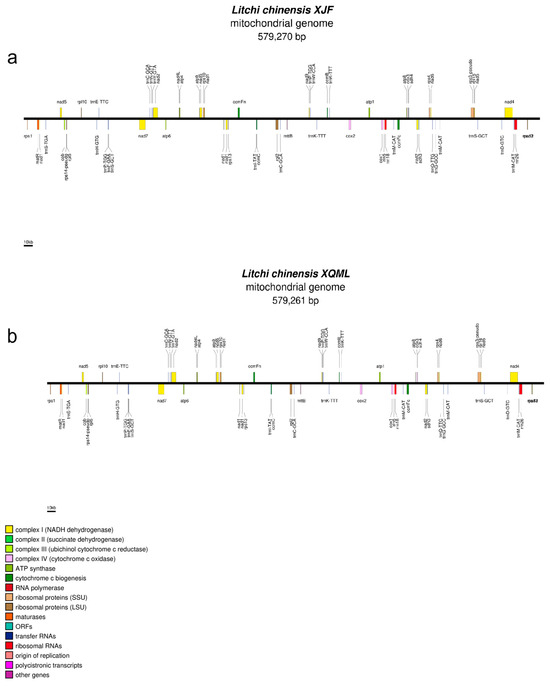
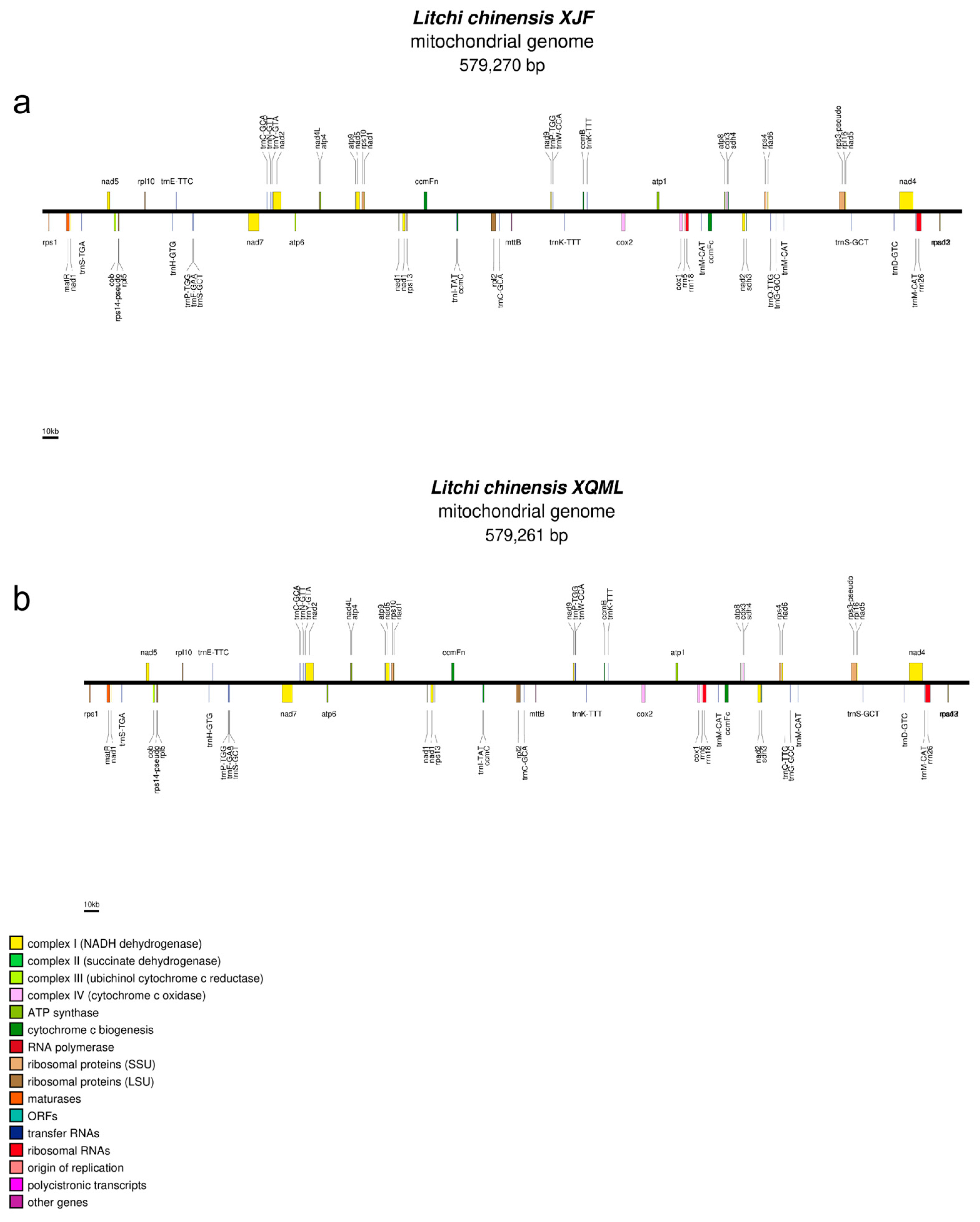
In this study, the mitochondrial genomes of the major lychee cultivars ‘XJF’ and ‘XQML’ were sequenced, assembled, and annotated. The PacBio HiFi sequencing generated 780,661 reads (15.7 Gb) for XJF and 1,594,737 reads (31.3 Gb) for XQML, with mean read lengths of 20,131 bp and 19,641 bp, respectively (Table S1). Through third-generation sequencing data assembly, the lychee mitochondrial genomes were successfully assembled into a single linear contig for subsequent analysis (Figure 1). The assembly graph revealed a branched structure (Supplementary Figure S1); a linear contig was extracted for downstream analysis. Coverage was uniform across the contig (Supplementary Figure S2).
Figure 1.
Assembled linear representations of the two lychee mitochondrial genomes; (a) mitochondrial genome of XJF; (b) mitochondrial genome of XQML; forward-encoding genes are positioned above the line, while reverse-encoding genes are located below the line.
The total lengths of the two mitochondrial genomes were 579,270 bp and 579,261 bp, respectively, with a GC content of 45.41% (Table 1). The sequencing depth was approximately 27,000× for XJF and 54,000× for XQML (calculated as total bases in Table S1 divided by genome size in Table 1), indicating high coverage that supports assembly completeness and quality. The relevant sequences have been submitted to GenBank.
Table 1.
Table of Assembly Results Summary.
A total of 62 genes were annotated, including 35 protein-coding genes, 22 tRNA genes, and 3 rRNA genes (rrn5, rrn18, and rrn26). The protein-coding genes were classified into the following 10 functional categories: ATP synthase genes (atp1, atp4, atp6, atp8, and atp9), NADH dehydrogenase genes (nad1–nad9), cytochrome c synthesis-related genes (ccmB, ccmC, ccmFC, and ccmFN), cytochrome c oxidase genes (cox1, cox2, and cox3), a mature enzyme-encoding gene (matR), a membrane transporter gene (mttB), and a pantothenol-cytochrome c reductase gene (cob). The variable genes included four large-subunit ribosomal protein genes (rpl10, rpl16, rpl2, and rpl5), five small-subunit ribosomal protein genes (rps1, rps10, rps12, rps4, and rps13), and two succinate dehydrogenase genes (sdh3 and sdh4) (Table 2). We further assessed genome completeness by checking for mitochondrial core genes that are often missing or pseudogenized in angiosperms. As expected, sdh1, sdh2, rps11, and rps19 are absent from the mitogenome, while all other core genes (including sdh3, sdh4, and the majority of rpl/rps genes) are present and intact. No pseudogenization was observed. This pattern is typical for woody angiosperms and supports the completeness of the assembled genome.
Table 2.
Genes identified in the two lychee mitochondrial genomes.
3.2. Identification of RNA Editing Sites in Protein-Coding Regions of Mitochondrial Genes
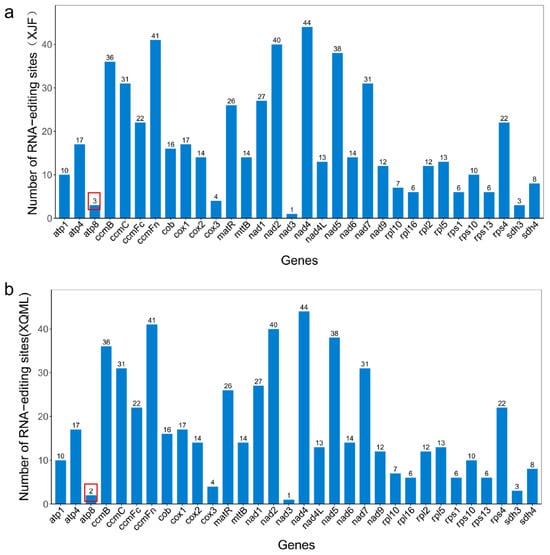
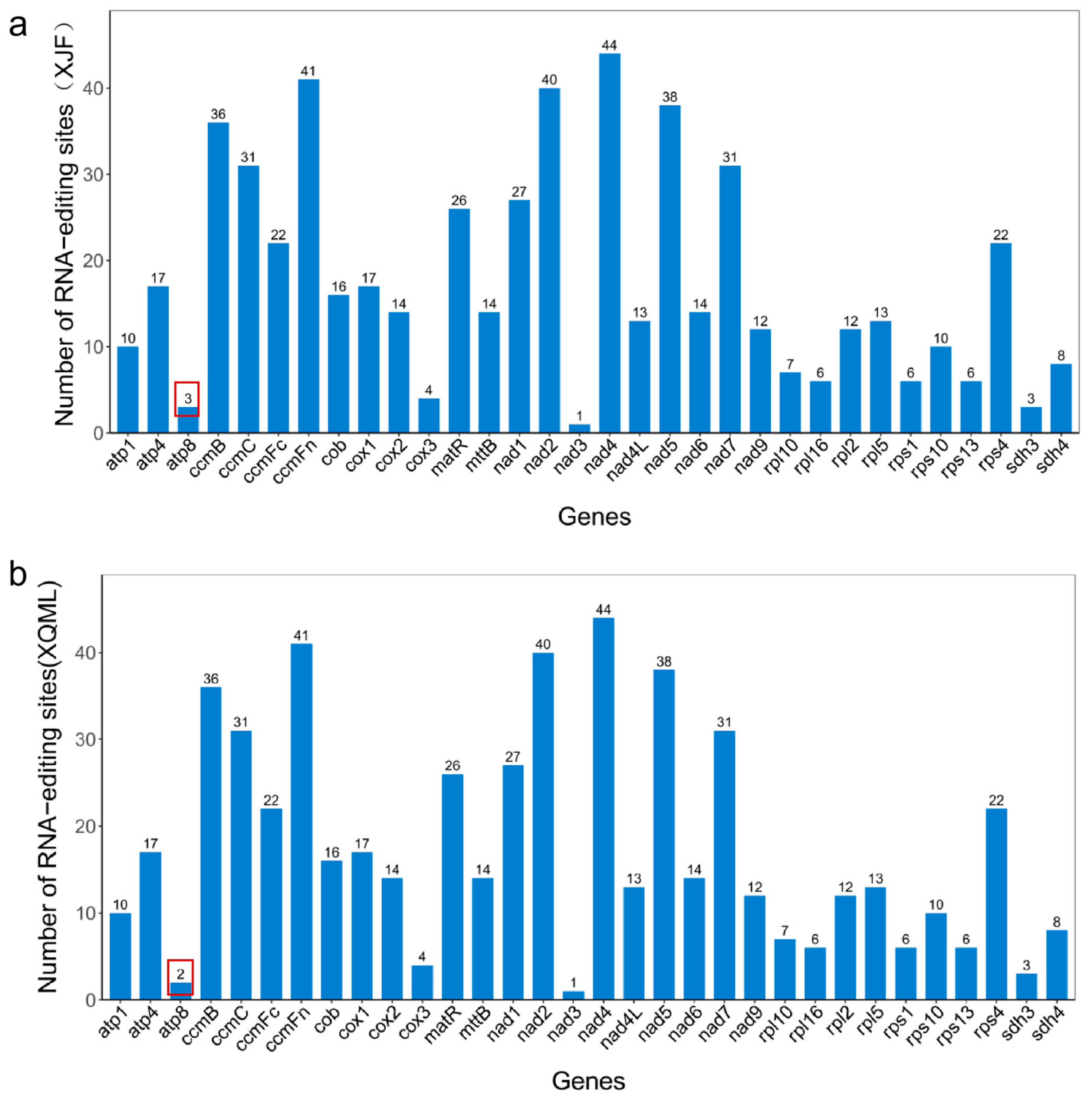
Using PmtREP, we predicted 564 and 563 potential C-to-U RNA editing sites in the 32 protein-coding genes of XJF and XQML, respectively. The distribution of predicted editing sites varied substantially among genes: nad4 contained the highest number (44 sites), followed by ccmFn (41 sites), while nad3 had only one predicted site (Figure 2). This pattern suggests that genes involved in respiratory complex I (nad4) may require more frequent editing to maintain function. All predicted edits are C-to-U conversions, which is the canonical type in angiosperm mitochondria. No RNA-seq data were available for validation, so these predictions should be considered as candidates for future experimental confirmation.
Figure 2.
Predicted RNA editing sites in the two lychee mitochondrial genomes. (a) XJF; (b) XQML. The y-axis shows the number of predicted C-to-U editing sites per gene. Only genes with at least one predicted site are shown. Editing sites were predicted using PmtREP.
3.3. Codon Preference and Analysis of Repeat Structures in the Mitochondrial Genomes of Two Lychee Species
Among the two lychee cultivars, leucine (Leu), serine (Ser), and arginine (Arg) were the most frequent amino acids, whereas tryptophan (Trp) and methionine (Met) appeared least frequently.
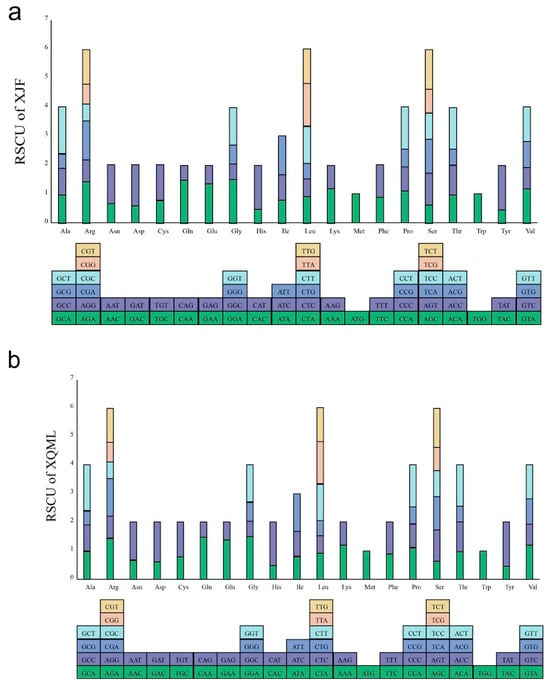
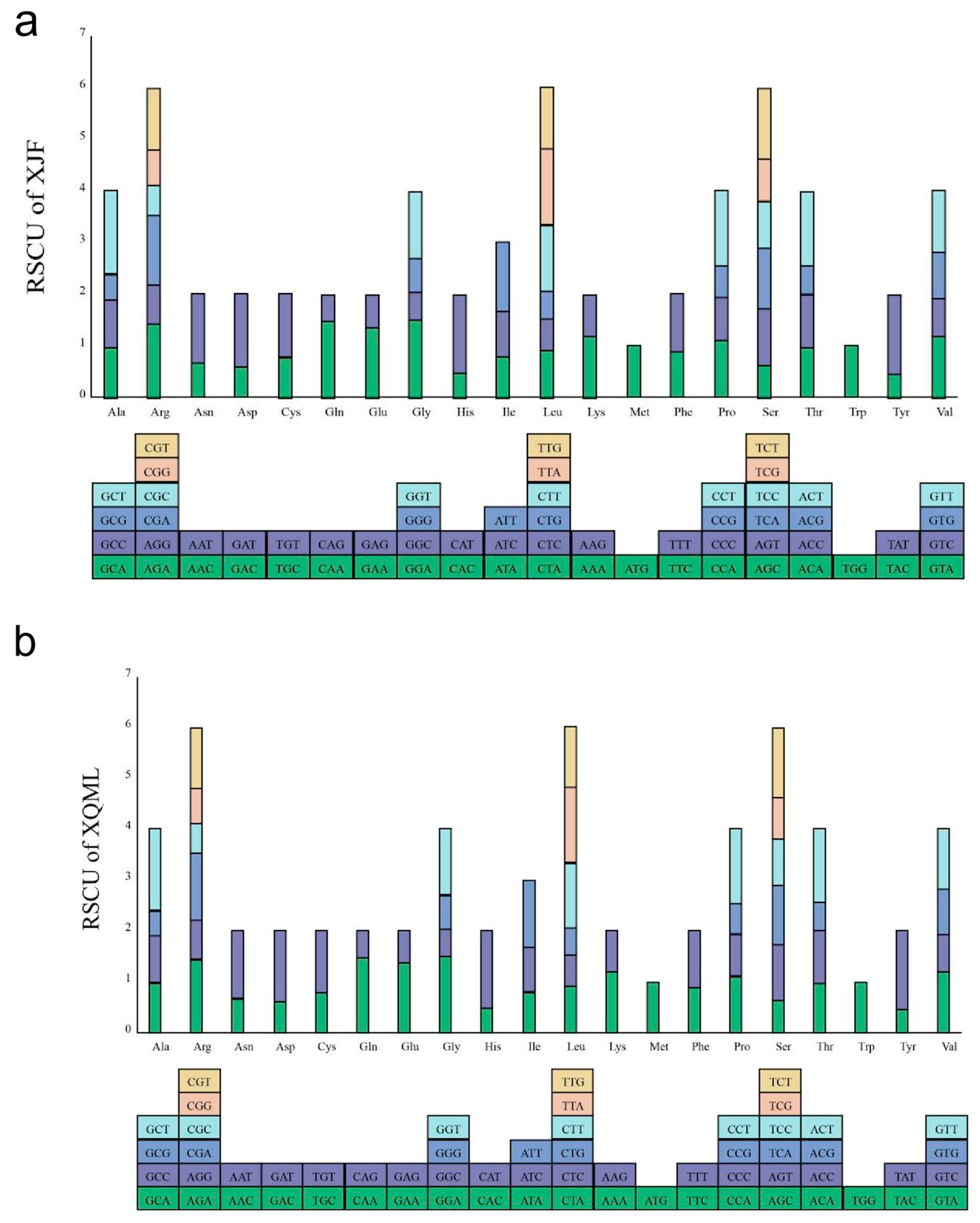
Relative Synonymous Codon Usage (RSCU) analysis revealed that 4989–5072 codons (58.12–59.87% of total codons) in the XJF and XQML mitochondrial genomes exhibited RSCU values greater than 1, indicating stronger usage preferences for these codons relative to their synonymous counterparts. Most codons ending in A or U had RSCU values greater than 1, suggesting that their usage frequency exceeded random expectations. Conversely, codons ending in C or G generally had RSCU values less than 1, indicating a significant preference for A/U-terminated codons in the lychee mitochondrial genome (Figure 3). This A/U bias is common in plant mitochondrial genomes and is thought to reflect the higher availability of tRNAs with A/U-rich anticodons or mutational pressure. The RSCU patterns were nearly identical between the two cultivars, suggesting conserved translational constraints.
Figure 3.
Relative synonymous codon usage (RSCU) in the two lychee mitochondrial genomes. (a) XJF; (b) XQML. Bars above the line (RSCU > 1) indicate codons that are used more frequently than expected; bars below the line (RSCU < 1) indicate less frequent usage. Codons ending in A or U generally show RSCU > 1, indicating a strong A/U bias.
Multiple types of repetitive sequences, including forward, palindromic, reverse, and complementary repeats, were identified in each lychee mitochondrial genome. Overall, 396 repetitive sequences were identified, comprising 47 tandem repeats and 165 dispersed repeats (Table 3). The identified repeats were predominantly located in intergenic regions. SSR lengths ranged from 10 to 20 bp, with the vast majority concentrated between 10 and 14 bp (78.3–81.6%). The 12 bp repeat unit was the most common in both cultivars, and 46 pairs of homologous SSRs with ≥90% similarity were identified, spanning lengths from 10 to 16 bp (Supplementary Figure S3).
Table 3.
Repetitive Sequences in Two Lychee Genomes.
3.4. Phylogenetic Tree Construction and Collinearity Analysis
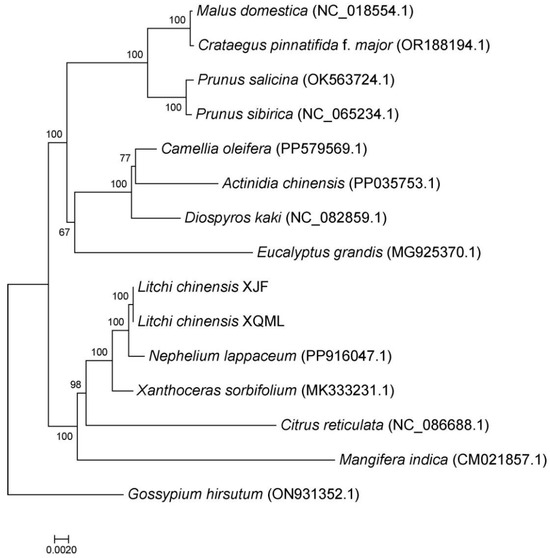
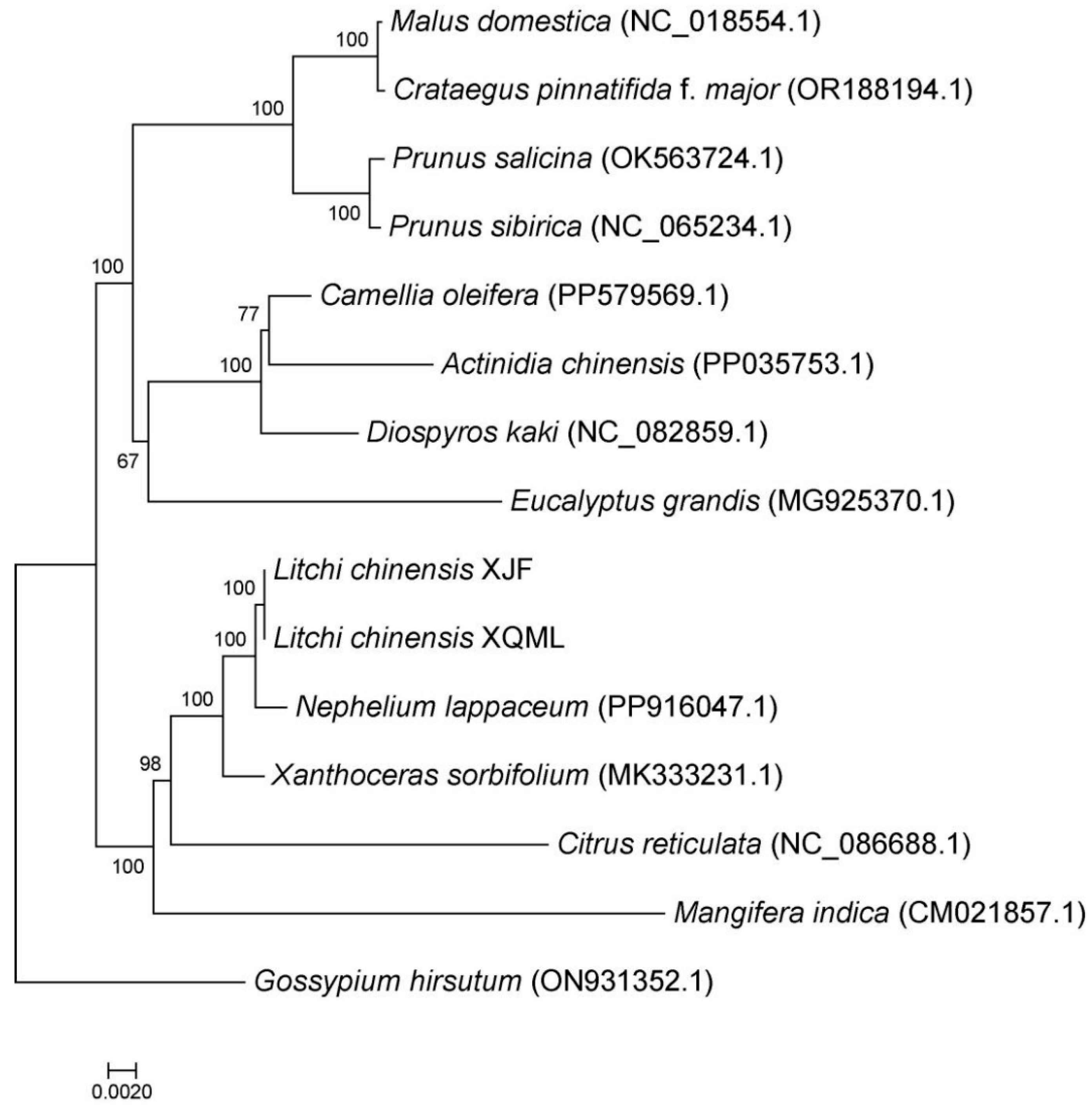
A phylogenetic tree constructed on the basis of 31 conserved mitochondrial protein-coding genes (PCGs) indicated that lychee is closely related to rambutan (Figure 4). Collinearity analysis further supported the presence of numerous homologous blocks between the two species (Figure S4). Litchi is relatively close to rambutan and Xanthoceras sorbifolium, indicating that conserved mitochondrial protein-coding genes are useful for inferring phylogenetic relationships among closely related species. The phylogenetic tree confirmed that lychee is sister to rambutan (Nephelium lappaceum) with strong bootstrap support (100%), consistent with traditional taxonomy.
Figure 4.
Mitochondrial Evolutionary Analysis. Evolutionary branch length, also known as genetic variation or evolutionary distance, represents the degree of branch variation; the shorter branch length represents a smaller difference and closer evolutionary distance. Distance scale: unit length of numerical differences between organisms or sequences, equivalent to the scale of the evolutionary tree. Bootstrap value is marked at the node position and used to evaluate the credibility of the branch.
3.5. Ka/Ks Analysis
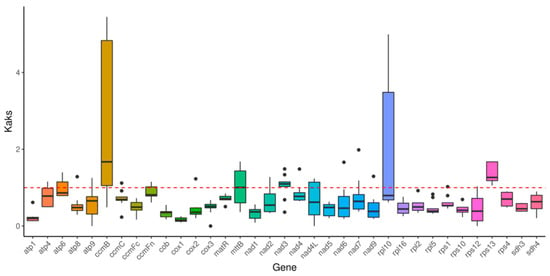
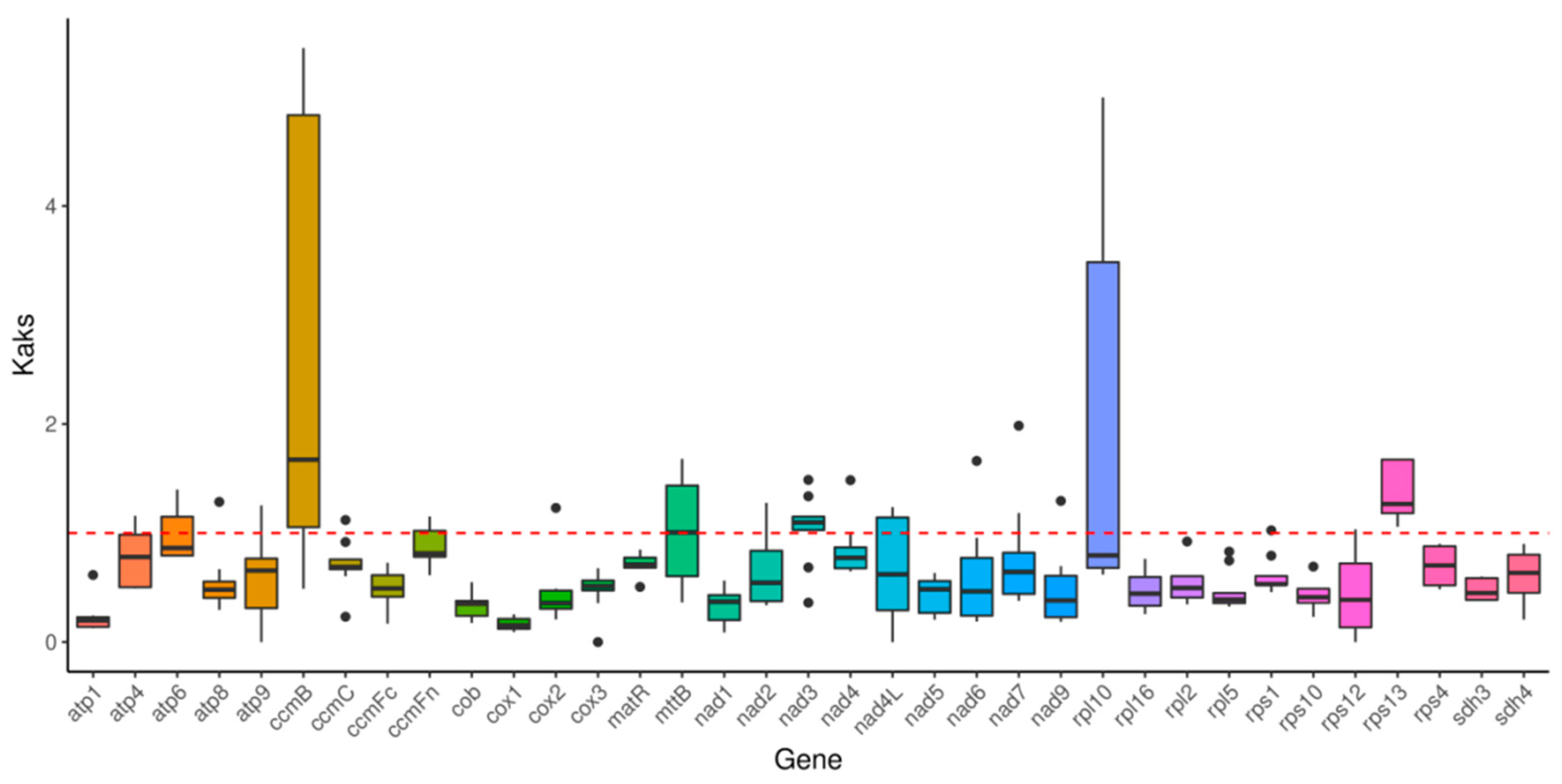
Amino acid changes caused by base mutations are termed nonsynonymous mutations, whereas those causing no change are synonymous mutations. Nonsynonymous mutations are typically subject to natural selection. The ratio of the nonsynonymous mutation rate (Ka) to the synonymous mutation rate (Ks) indicates the type of selection pressure. Among the 35 protein-coding genes, most exhibited Ka/Ks ratios < 1, indicating purifying selection. Four genes (ccmB, rpl10, mttB, and rps13) showed Ka/Ks ratios slightly above 1 (Figure 5), suggesting they may be under relaxed selective constraint. However, given the low evolutionary rate of plant mitochondrial genomes and the lack of statistical testing, these values should be interpreted with caution.
Figure 5.
KaKs Box Plot Analysis Across Species. The horizontal axis represents gene names, and the vertical axis represents Ka/Ks values. In the box plot, the upper and lower endpoints of the vertical line within the rectangle represent the upper and lower boundaries of the data, respectively. The thick line inside the rectangle represents the median, the upper and lower edges represent the upper and lower quartiles, respectively, and the dots beyond the upper and lower boundaries of the data represent outliers. The red dashed line indicates Ka/Ks = 1, the threshold for distinguishing positive (>1) from purifying (<1) selection.
3.6. Migration of Chloroplast DNA in the Mitochondrial Genome
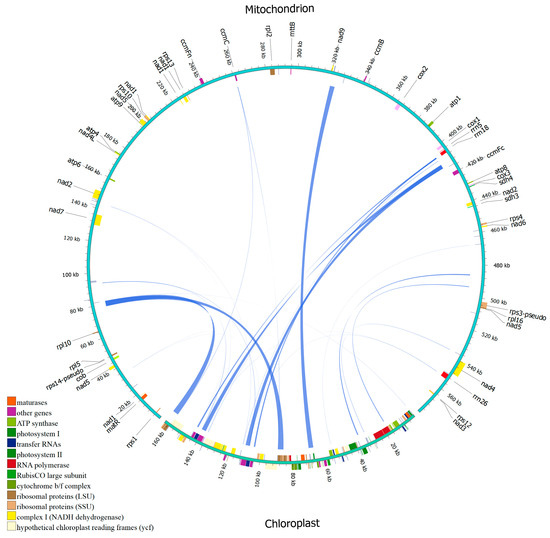
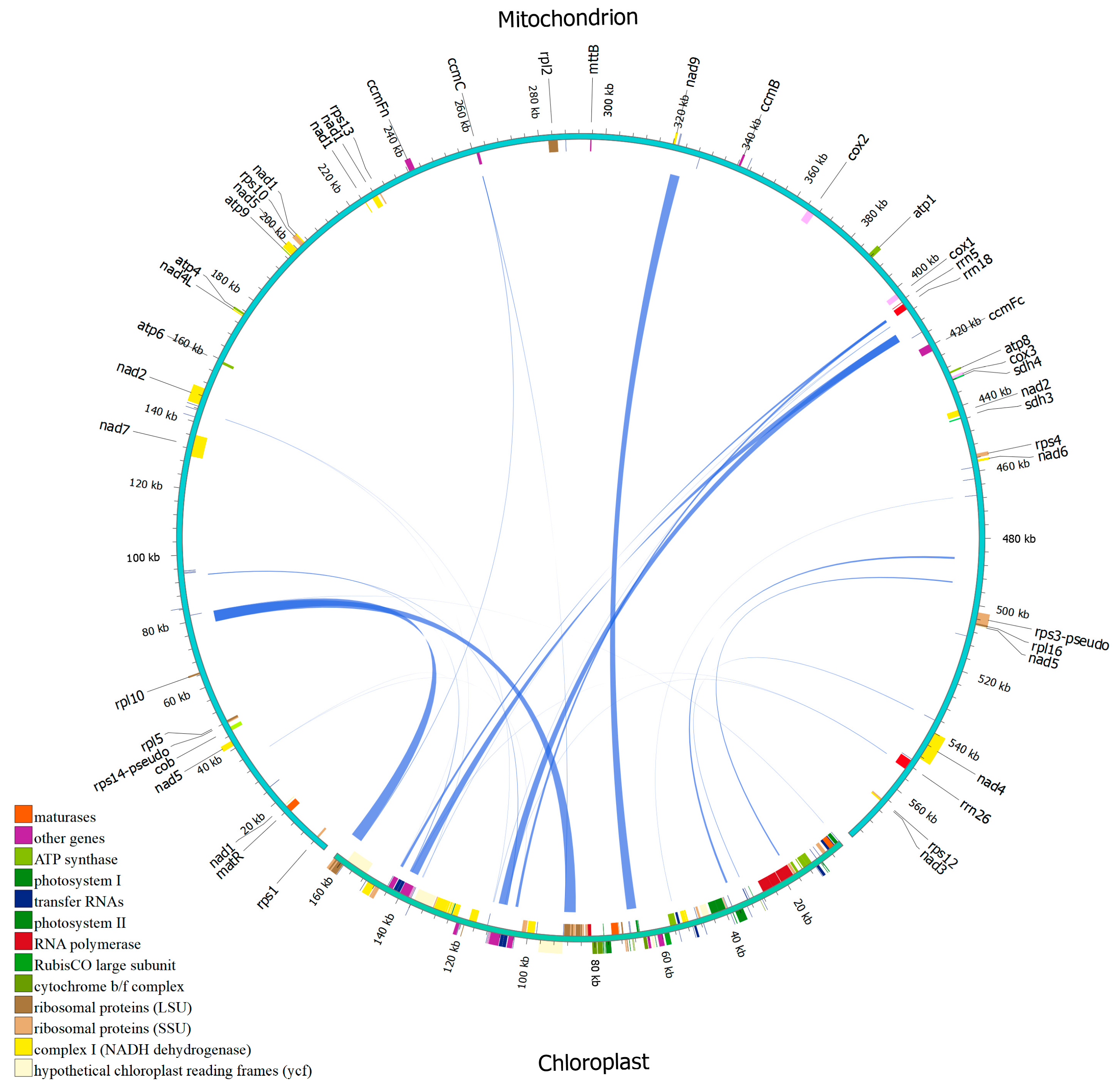
Among the two lychee cultivars, 15 homologous segments of chloroplast origin were identified, totaling 12,194 bp in length and accounting for 2.11% of the mitochondrial genome. These segments included 9 tRNA genes, 4 rRNA genes, and partial protein-coding sequences. Among the 15 MTPT fragments, all plastid protein-coding sequences are pseudogenes, whereas six tRNA genes (trnP-TGG, trnW-CCA, trnD-GTC, trnN-GTT, trnH-GTG, trnM-CAT) are intact and functional. One truncated tRNA (trnA-UGC) is a pseudogene. Table S2 summarizes the length and proportion of chloroplast-derived sequences in the mitochondrial genomes of the two cultivars. This finding indicates frequent gene transfer between chloroplasts and mitochondria (Figure 6 and Table S3).
Figure 6.
Homologous fragments between the chloroplast and mitochondrial genomes of lychee. Red lines indicate MTPT regions. Genes are colored by functional complex. The inner track shows GC content. Note that most protein-coding MTPTs are pseudogenes, while several tRNAs are intact and functional (see Table 2).
3.7. Large Repeats with Recombination Potential
To identify sequences that could mediate alternative genome conformations, we searched for dispersed repeats with alignment length > 500 bp. A total of four such repeat pairs were found (Supplementary Table S5). The longest pair (1771 bp, 100% identity) is an inverted repeat located at positions 374,854–376,624 and 48,595–50,365. Another 907 bp direct repeat (100% identity) maps to positions 282,446–283,352 and 14,107–15,013. These large, high-identity repeats are typical sites for homologous recombination in plant mitochondrial genomes [8]. Their presence, together with the branched assembly graph (Supplementary Figure S1) and uniform read coverage across branches (Supplementary Figure S2), suggests that the lychee mitogenome may exist as a mixture of isoforms generated by repeat-mediated recombination.
3.8. Comparative Genomic Variation Between XJF and XQML
Despite the very high sequence identity between the two lychee mitochondrial genomes, a detailed alignment identified 1 indel and 0 single nucleotide polymorphisms (SNPs) (Table S6). The indel is located in intergenic regions; none affect protein-coding genes, tRNAs, or rRNAs. The 9 bp difference in total genome length (579,270 bp for XJF vs. 579,261 bp for XQML) is fully explained by these indels. No nonsynonymous substitutions, frameshifts, or any other coding-sequence variants were detected. Therefore, the two cultivars are identical at the protein sequence level for all mitochondrial-encoded genes.
4. Discussion
In summary, the lychee mitochondrial genome exhibits several distinctive features: (1) a branched structure that was linearized for analysis; (2) an unusually high retention of functional chloroplast-derived tRNAs; and (3) extremely low intraspecific sequence divergence (0 SNP, 1 indel). These characteristics distinguish lychee from most other angiosperms for which mitogenomes have been reported.
4.1. Structure and Characteristics of the Lychee Mitochondrial Genome
The diversity of plant mitochondrial genome structures is among their most distinctive features. In this study, the mitochondrial genomes of XJF and XQML were assembled into linear contigs. The linear contig is an analytical simplification of a branched graph, alternative conformations (e.g., subgenomic circles) may exist and require further experimental validation. This assembled linear contig differs from the circular assemblies reported for hawthorn, although plant mitogenomes can adopt multiple conformations [26], the multilinear structure of the pomegranate “Taishan Hong [24]” and the typical circular structure of the persimmon “Taishu [27]”. Within the Sapindaceae family, the Chinese Cornus also exhibits a linear arrangement, whereas no such arrangement has been reported for longan, suggesting that the linear structure may be a derived characteristic of this family.
Notably, the mitochondrial genome of Aquilegia amurensis has a hybrid configuration of one circular chromosome + two linear chromosomes (total length 538.7 kb) [40], whereas Fagopyrum dibotrys has a more complex structure comprising seven circular chromosomes (total length 370 kb) [41]. These findings indicate that medium-sized (370–580 kb) mitochondrial genomes exhibit significant structural plasticity in angiosperms and that the presence of linear segments is not unique to lychee. Compared with the genomes of conifers, the lychee genome is smaller but has a more compact repetitive sequence structure: the Abies alba mitochondrial genome spans 1.43 Mbp across 11 scaffolds, with repetitive elements constituting 0.168% of its sequence [25]. It contains nine giant repeats exceeding 10 kb, directly driving genome expansion and multiconformation transitions. The lychee mitogenome contains a high density (396 repeat units) of repetitive sequences but lacks such megamatches. This explains its relatively simple structure while maintaining high genetic variability potential. Compared with other Sapindaceae mitogenomes (e.g., Xanthoceras sorbifolium: 42 PCGs, 24 tRNAs, 4 rRNAs; Koelreuteria paniculata: 32 PCGs, 22 tRNAs, 4 rRNAs), the lychee gene set (35 PCGs, 22 tRNAs, 3 rRNAs) is broadly similar, with minor differences in ribosomal protein gene content likely reflecting differential gene transfer to the nucleus. No evidence of lineage-specific gene gain was observed. These comparisons underscore the structural plasticity of plant mitogenomes and indicate that the linearized assembly in lychee is a plausible representation, although other conformations may coexist.
The identification of several long (>500 bp), nearly identical repeats (Supplementary Table S5) provides a mechanistic basis for the observed branched graph; such repeats are known to drive reversible recombination events that generate multiple conformational isoforms in plant mitochondria.
4.2. Codon Preferences and Repetitive Sequence Analysis
Codon usage preferences are influenced by natural selection and other factors. In both lychee cultivars, leucine (Leu), serine (Ser), and arginine (Arg) are high-frequency amino acids, whereas tryptophan (Trp) and methionine (Met) are less frequent. This pattern resembles the amino acid usage characteristics of hawthorn, reflecting the shared protein synthesis requirements among closely related genera and species. RSCU analysis revealed that 58.12–59.87% of codons in both cultivars presented RSCU values exceeding 1, predominantly ending in A/U. Conversely, C/G-terminated codons frequently fell below 1, aligning with preferences observed in pomegranate and persimmon. This may stem from greater tRNA availability for A/U-terminated codons, facilitating efficient protein synthesis. With respect to repetitive sequences, the two cultivars share 396 repeats (47 tandem and 165 scattered). SSRs predominantly cluster within 10–14 bp (78.3–81.6%), with 12 bp repeats being the most common, comprising 46 pairs of highly similar homologous SSRs. This differs markedly from that in hawthorn (222–447 repeats, 65–112 SSRs) and pomegranate (188 pairs of scattered repeats, 141 SSRs), likely because of variations in repeat sequence generation and amplification rates. The 46 pairs of homologous SSRs identified in this study may serve as useful molecular markers for future genetic diversity and cultivar identification studies in lychee. Additionally, the preferential location of repeats in intergenic regions suggests a potential role in genome structural reorganization without directly affecting coding sequences.
4.3. Characteristics of RNA Editing Sites
RNA editing is a crucial post-transcriptional modification in plant mitochondria. Among the 32 protein-coding genes in the two lychee cultivars, 564 and 563 C-to-U editing sites were identified, which is consistent with the editing patterns observed in hawthorn, pomegranate, and persimmon. This finding indicates that C-to-U editing represents a conserved key mechanism. There were significant differences in gene editing site counts: nad4 (44 sites) had the greatest number, followed by ccmFn (41 sites), while nad3 (1 site) had the lowest. This pattern resembles the high number of nad4 editing sites in pomegranate, likely because the involvement of nad4 in energy metabolism requires more editing to ensure function, whereas nad3 sequences are more conserved. Among editing types, hydrophilic → hydrophobic substitutions were most prevalent (44.15–44.23%), followed by hydrophobic → hydrophobic substitutions (35.52–35.64%), mirroring the distribution pattern observed in pomegranate. This distribution may alter protein conformation and interactions, facilitating environmental adaptation. A limitation of our RNA editing analysis is that it relies solely on computational prediction (PmtREP) without experimental validation. Prediction-based methods are known to have false-positive rates, especially for low-frequency editing events. Therefore, the editing sites reported here should be considered as preliminary candidates. Future studies using RNA-seq or RT-PCR with Sanger sequencing are needed to confirm the genuine editing sites in lychee mitochondrial genes.
The ratio of nonsynonymous (Ka) to synonymous (Ks) substitution rates is commonly used to infer selective pressure on protein-coding genes. In this study, most mitochondrial genes showed Ka/Ks < 1, indicating that they are under purifying selection, consistent with the generally slow evolutionary rate of plant mitochondrial genomes. Four genes (ccmB, rpl10, mttB, and rps13) exhibited Ka/Ks values slightly above 1. While such values could suggest positive selection, we interpret them with caution for two reasons. First, pairwise Ka/Ks estimates are sensitive to statistical noise when substitution rates are low, as is typical for plant mitochondrial genes. Second, rigorous detection of positive selection requires codon-based likelihood models (e.g., branch-site tests in PAML) and larger taxon sampling, which were beyond the scope of this study. Therefore, the elevated Ka/Ks ratios reported here should be considered as preliminary observations.
4.4. Gene Transfer Between Chloroplasts and Mitochondria
In the lychee mitogenome, a total of 15 MTPT fragments were identified. Notably, six of the transferred tRNA genes (trnP-TGG, trnW-CCA, trnD-GTC, trnN-GTT, trnH-GTG, trnM-CAT) remain intact and are predicted to be functional, while all transferred protein-coding sequences have become pseudogenes. This functional dichotomy within the same transferred fragments is a distinct feature of the lychee mitogenome. The retention of intact, chloroplast-derived tRNAs is relatively uncommon; in many other angiosperms, such tRNAs are rapidly pseudogenized after transfer. We speculate that these six tRNAs may have been co-opted to support mitochondrial translation, potentially compensating for missing or inefficient native mitochondrial tRNAs. In contrast, the pseudogenized protein-coding fragments serve as evolutionary relics of inter-organellar DNA transfer and may have contributed to genomic fluidity without conferring a direct functional advantage. Although most of the transferred protein-coding sequences have become pseudogenes, six chloroplast-derived tRNA genes in the lychee mitochondrial genome remain intact and fully functional (Table 2). Such a high proportion of functional tRNA retention is relatively rare in plants.
The functional MTPT-derived tRNAs in lychee (six intact tRNAs) are notable because most transferred plastid sequences in angiosperms become pseudogenes shortly after integration. Whether these tRNAs are actively transcribed and used in mitochondrial translation remains to be verified by RNA-seq or Northern blot. If functional, they could enhance translation efficiency of mitochondrial genes that rely on codons corresponding to these tRNAs. This possibility warrants further investigation.
4.5. Phylogenetic and Collinearity Analysis
A phylogenetic tree constructed on the basis of 31 PCGs revealed that lychee is most closely related to rambutan, which is consistent with the phylogenetic clustering logic observed in hawthorn and pomegranate. These findings indicate that conserved mitochondrial PCGs reliably reflect evolutionary relationships among species. The limited phylogenetic resolution between the two cultivated lychee cultivars stems from differences in a single 9 bp indel and one predicted RNA editing site difference. Collinearity analysis revealed extensive homologous blocks shared between Litchi chinensis, Nephelium lappaceum, and Xanthoceras sorbifolium, indicating that conserved genomic regions potentially harbor core functional genes. Similar collinearity patterns observed among closely related species such as hawthorn and pomegranate, along with minor gene rearrangements, reflect independent evolutionary trajectories following speciation. These findings provide a foundation for lychee systematics and origin/divergence studies while advancing the understanding of mitochondrial evolutionary patterns in fruit trees. While our mitogenome-based phylogeny robustly supports the placement of lychee within Sapindaceae, future studies integrating plastid and nuclear genomes will be needed to fully resolve the family’s evolutionary backbone.
4.6. Intraspecific Mitochondrial Variation and Phenotypic Implications
The comparison between XJF and XQML revealed only one intergenic indel and no SNPs, indicating that the mitochondrial genome of lychee is extremely conserved even between cultivars that differ in seed size. The absence of any coding-sequence variation implies that the observed difference in seed size is not attributable to mitochondrial protein-coding genes. This is consistent with the generally low mutation rate and strong purifying selection of plant mitochondrial genomes. To explore whether rare mitochondrial variants might contribute to such phenotypic traits, a population-scale study including many more lychee cultivars and quantitative genetic analyses would be necessary. Our study provides a baseline for such future work.
5. Conclusions
In this study, the mitochondrial genomes of the lychee cultivars XJF and XQML were successfully assembled and annotated using third-generation sequencing technology, providing critical foundational data for genetic and evolutionary research in the genus Litchi. The mitochondrial genomes of XJF and XQML were assembled as linear contigs measuring 579,270 bp and 579,261 bp, respectively, with identical GC content (45.41%). A total of 62 genes were annotated, comprising 35 protein-coding genes, 22 tRNA genes, and 3 rRNA genes (rrn5, rrn18, and rrn26). The protein-coding genes included core functional categories such as ATP synthase and NADH dehydrogenase, similar to the core gene composition of fruit tree mitochondrial genomes, including hawthorn (Crataegus spp.), pomegranate (Punica granatum), and persimmon (Diospyros kaki). It also exhibits species-specific gene distribution patterns, such as variations in the number of specific tRNA genes. These findings suggest that while the lychee mitochondrial genome maintains fundamental physiological functions, it has developed unique genetic characteristics adapted to its own growth and development. A total of 396 repetitive sequences (47 tandem repeats and 165 scattered repeats) and numerous SSR loci were identified. Among these, 46 pairs of highly similar homologous SSRs provide abundant candidate loci for genetic diversity analysis and molecular marker development in lychee. Predicted RNA editing sites were exclusively C-to-U substitutions, totaling 563–564 instances primarily distributed in genes such as nad4 and ccmFn. Hydrophilic → hydrophobic edits accounted for the greatest proportion. These results suggest that RNA editing may play a role in optimizing mitochondrial gene function in lychee, but experimental validation (e.g., by RNA-seq) is needed to confirm the functional impact of the predicted editing sites. Both lychee cultivars presented 15 chloroplast-derived homologous fragments in their mitochondrial genomes (total length of 12,194 bp, accounting for 2.11% of the mitochondrial genome), including 9 tRNA genes, 4 rRNA genes, and partial protein-coding sequences. These findings confirm frequent gene transfer between lychee chloroplasts and mitochondria, providing direct evidence for understanding the evolution of lychee organelle genomes. Phylogenetic and colinearity analyses based on 31 conserved mitochondrial protein-coding genes revealed a close relationship between lychee and Nephelium lappaceum. Colinearity analysis further confirmed extensive homologous blocks between the two species, clarifying the evolutionary position of lychee within the plant taxonomic system. In summary, this study elucidates the structural features, genetic element patterns, and evolutionary relationships of the lychee mitochondrial genome. It not only enriches the plant mitochondrial genome database but also provides crucial theoretical support and data references for germplasm resource conservation, genetic breeding, and systematic classification studies of Litchi species. The key novelties include the first complete mitogenomes of lychee cultivars, the unusual retention of six functional chloroplast-derived tRNAs, and extreme intraspecific sequence conservation (0 SNP, 1 indel). These findings advance our understanding of organellar genome evolution in Sapindaceae and provide a basis for cultivar identification using mitochondrial markers.
Supplementary Materials
The following supporting information can be downloaded at: https://www.mdpi.com/article/10.3390/agronomy16131229/s1.
Author Contributions
Conceptualization, investigation and writing, J.Y.; data collection and writing, N.X., R.W., Y.H. and D.L.; investigation and review, H.Q., C.F., A.W., methodology, editing and writing, J.Y., X.Q. and H.L. All authors have read and agreed to the published version of the manuscript.
Funding
This research was funded by Science and Technology Development Fund of Guangxi Academy of Agricultural Sciences (Grant No. GuiNongKe 2025YP001), Guangxi Science and Technology Major Program-Breeding and Demonstration Application of New Litchi Varieties in Guangxi (Grant No. Gui Ke AA23023007), China Agriculture Research System of MOF and MARA (Grant No. CARS-32-02).
Institutional Review Board Statement
Not applicable.
Informed Consent Statement
Not applicable.
Data Availability Statement
The mt genomes of XJF (GenBank accession: PX659691) and XQML (GenBank accession: PX659692) were assembled with the assembly software and have been submitted to NCBI (https://www.ncbi.nlm.nih.gov/). A 6-month confidentiality period was requested upon submission, rendering the data temporarily unavailable to the public.
Acknowledgments
The authors acknowledge the use of DeepSeek-V3 for language improvement during manuscript preparation. All AI-suggested changes were reviewed and verified by the authors, who assume full responsibility for the final content.
Conflicts of Interest
The authors declare no conflicts of interest.
References
- Menzel, C. The Lychee Crop in Asia and the Pacific; FAO Regional Office for Asia and the Pacific: Bangkok, Thailand, 2002. [Google Scholar]
- Chen, X.; Gao, H.; Chen, Z.; Li, T.; Jiang, Y. Metabolic variations in the pulp of four litchi cultivars during pulp breakdown. Food Res. Int. 2021, 140, 110080. [Google Scholar] [CrossRef] [Scilit]
- Yao, P.; Gao, Y.; Simalgandara, J.; Farag, M.A.; Chen, W.; Yao, D.; Delmas, D.; Chen, Z.; Liu, K.; Hu, H. (Litchi (Litchi chinensis Sonn.): A comprehensive review of phytochemistry, medicinal properties, and product development. Food Funct. 2021, 12, 9527–9548. [Google Scholar] [CrossRef] [Scilit] [PubMed]
- Reichel, M.; Carle, R.; Sruamsiri, P.; Neidhart, S. Changes in Flavonoids and Nonphenolic Pigments during On-Tree Maturation and Postharvest Pericarp Browning of Litchi (Litchi chinensis Sonn.) As Shown by HPLC-MSn. J. Agric. Food Chem. 2011, 59, 3924–3939. [Google Scholar] [CrossRef] [Scilit] [PubMed]
- Hu, G.; Feng, J.; Xiang, X.; Wang, J.; Salojarvi, J.; Liu, C.; Wu, Z.; Zhang, J.; Liang, X.; Jiang, Z.; et al. Two divergent haplotypes from a highly heterozygous lychee genome suggest independent domestication events for early and late-maturing cultivars. Nat. Genet. 2022, 54, 73–83. [Google Scholar] [CrossRef] [Scilit] [PubMed]
- Nass, M.M.; Nass, S. Intramitochondrial fibers with dna characteristics. I. Fixation and electron staining reactions. J. Cell Biol. 1963, 19, 593–611. [Google Scholar] [CrossRef] [Scilit] [PubMed]
- Chen, X.J.; Butow, R.A. The organization and inheritance of the mitochondrial genome. Nat. Rev. Genet. 2005, 6, 815–825. [Google Scholar] [CrossRef] [Scilit] [PubMed]
- Gualberto, J.M.; Mileshina, D.; Wallet, C.; Niazi, A.K.; Weber-Lotfi, F.; Dietrich, A. The plant mitochondrial genome: Dynamics and maintenance. Biochimie 2014, 100, 107–120. [Google Scholar] [CrossRef] [Scilit] [PubMed]
- Aken, O.V.; Breusegem, F.V. Licensed to Kill: Mitochondria, Chloroplasts, and Cell Death. Trends Plant Sci. 2015, 20, 754–766. [Google Scholar] [CrossRef] [Scilit] [PubMed]
- Kozik, A.; Rowan, B.A.; Lavelle, D.; Berke, L.; Schranz, M.E.; Michelmore, R.W.; Christensen, A.C. The alternative reality of plant mitochondrial DNA: One ring does not rule them all. PLoS Genet. 2019, 15, e1008373. [Google Scholar] [CrossRef] [Scilit] [PubMed]
- Skippington, E.; Barkman, T.J.; Rice, D.W.; Palmer, J.D. Miniaturized mitogenome of the parasitic plant Viscum scurruloideum is extremely divergent and dynamic and has lost all nad genes. Proc. Natl. Acad. Sci. USA 2015, 112, E3515–E3524. [Google Scholar] [CrossRef] [Scilit] [PubMed]
- Sloan, D.B.; Alverson, A.J.; Chuckalovcak, J.P.; Wu, M.; McCauley, D.E.; Palmer, J.D.; Taylor, D.R. Rapid evolution of enormous, multichromosomal genomes in flowering plant mitochondria with exceptionally high mutation rates. PLoS Biol. 2012, 10, e1001241. [Google Scholar] [CrossRef] [Scilit] [PubMed]
- Wolfe, K.H.; Li, W.H.; Sharp, P.M. Rates of nucleotide substitution vary greatly among plant mitochondrial, chloroplast, and nuclear DNAs. Proc. Natl. Acad. Sci. USA 1987, 84, 9054–9058. [Google Scholar] [CrossRef] [Scilit] [PubMed]
- Palmer, J.D.; Herbon, L.A. Plant mitochondrial-dna evolves rapidly in structure, but slowly in sequence. J. Mol. Evol. 1989, 28, 87–97. [Google Scholar] [CrossRef] [Scilit]
- Mower, J.P.; Sloan, D.B.; Alverson, A.J. Plant Mitochondrial Genome Diversity: The Genomics Revolution; Springer: Vienna, Austria, 2012. [Google Scholar]
- Cole, L.W.; Wenhu, G.; Mower, J.P.; Palmer, J.D. High and Variable Rates of Repeat-Mediated Mitochondrial Genome Rearrangement in a Genus of Plants. Mol. Biol. Evol. 2018, 11, 2773–2785. [Google Scholar] [CrossRef] [Scilit]
- Davila, J.I.; Arrieta-Montiel, M.P.; Wamboldt, Y.; Cao, J.; Hagmann, J.; Shedge, V.; Xu, Y.Z.; Weigel, D.; Mackenzie, S.A. Double-strand break repair processes drive evolution of the mitochondrial genome in Arabidopsis. BMC Biol. 2011, 9, 64. [Google Scholar] [CrossRef] [Scilit] [PubMed]
- Cusimano, N.; Wicke, S. Massive intracellular gene transfer during plastid genome reduction in nongreen Orobanchaceae. New Phytol. 2016, 210, 680–693. [Google Scholar] [CrossRef] [Scilit] [PubMed]
- Mower, J.P.; Palmer, J.D. Patterns of partial RNA editing in mitochondrial genes of Beta vulgaris. Mol. Genet. Genom. 2006, 276, 285–293. [Google Scholar] [CrossRef] [Scilit]
- Zubaer, A.; Wai, A.; Hausner, G. The mitochondrial genome of Endoconidiophora resinifera is intron rich. Sci. Rep. 2018, 8, 17591. [Google Scholar] [CrossRef] [Scilit] [PubMed]
- Jin, L.Y.; Ram, U.Y.; Seong, K.Y.M.C. Characterization and comparative analysis of the complete organelle genomes of three red macroalgae species (Neoporphyra dentata, Neoporphyra seriata, and Neopyropia yezoensis) and development of molecular makers for their identification. Genes Genom. 2024, 46, 355–365. [Google Scholar]
- Liu, H.; Zhao, W.; Hua, W.; Liu, J. A large-scale population based organelle pan-genomes construction and phylogeny analysis reveal the genetic diversity and the evolutionary origins of chloroplast and mitochondrion in Brassica napus L. BMC Genom. 2022, 23, 339. [Google Scholar]
- Unseld, M.; Marienfeld, J.R.; Brandt, P.; Brennicke, A. The mitochondrial genome of Arabidopsis thaliana contains 57 genes in 366,924 nucleotides. Nat. Genet. 1997, 15, 57–61. [Google Scholar] [CrossRef] [Scilit] [PubMed]
- Feng, L.; Wang, Z.; Wang, C.; Yang, X.; An, M.; Yin, Y. Multichromosomal mitochondrial genome of Punica granatum: Comparative evolutionary analysis and gene transformation from chloroplast genomes. BMC Plant Biol. 2023, 23, 512. [Google Scholar] [CrossRef] [Scilit] [PubMed]
- Kersten, B.; Rellstab, C.; Schroeder, H.; Brodbeck, S.; Fladung, M.; Krutovsky, K.V.; Gugerli, F. The mitochondrial genome sequence of Abies alba Mill. reveals a high structural and combinatorial variation. BMC Genom. 2022, 23, 715–776. [Google Scholar] [CrossRef] [Scilit] [PubMed]
- Zhang, X.; Li, P.; Wang, J.; Fu, D.; Zhao, B.; Dong, W.; Liu, Y. Comparative genomic and phylogenetic analyses of mitochondrial genomes of hawthorn (Crataegus spp.) in Northeast China. Int. J. Biol. Macromol. 2024, 272, 132795. [Google Scholar] [CrossRef] [Scilit] [PubMed]
- Yang, Y.; Duan, C. Mitochondrial genome features and systematic evolution of diospyros kaki thunb ‘Taishuu’. BMC Genom. 2024, 25, 285. [Google Scholar] [CrossRef] [Scilit]
- Li, H. Minimap2: Pairwise alignment for nucleotide sequences. Bioinformatics 2018, 34, 3094–3100. [Google Scholar] [CrossRef] [Scilit] [PubMed]
- Hu, J.; Fan, J.; Sun, Z.; Liu, S. NextPolish: A fast and efficient genome polishing tool for long-read assembly. Bioinformatics 2020, 36, 2253–2255. [Google Scholar] [CrossRef] [Scilit] [PubMed]
- Lowe, T.M.; Eddy, S.R. tRNAscan-SE: A program for improved detection of transfer RNA genes in genomic sequence. Nucleic Acids Res. 2019, 25, 955–964. [Google Scholar]
- Greiner, S.; Lehwark, P.; Bock, R. OrganellarGenomeDRAW (OGDRAW) version 1.3.1: Expanded toolkit for the graphical visualization of organellar genomes. Nucleic Acids Res. 2019, 47, W59–W64. [Google Scholar] [CrossRef] [Scilit] [PubMed]
- Thiel, T.; Michalek, W.; Varshney, R.K.; Graner, A. Exploiting EST databases for the development and characterization of gene-derived SSR-markers in barley (Hordeum vulgare L.). Theor. Appl. Genet. 2003, 106, 411–422. [Google Scholar] [CrossRef] [Scilit] [PubMed]
- Benson, G. Tandem repeats finder: A program to analyze DNA sequences. Nucleic Acids Res. 1999, 27, 573–580. [Google Scholar] [CrossRef] [Scilit] [PubMed]
- Krzywinski, M.; Schein, J.; Birol, İ.; Connors, J.; Gascoyne, R.; Horsman, D.; Jones, S.J.; Marra, M.A. Circos: An information aesthetic for comparative genomics. Genome Res. 2009, 19, 1639–1645. [Google Scholar] [CrossRef] [Scilit] [PubMed]
- Capella-Gutiérrez, S.; Silla-Martínez, J.M.; Gabaldón, T. trimAl: A tool for automated alignment trimming in large-scale phylogenetic analyses. Bioinformatics 2009, 25, 1972–1973. [Google Scholar] [CrossRef] [Scilit] [PubMed]
- Posada, D. jModelTest: Phylogenetic model averaging. Mol. Biol. Evol. 2008, 25, 1253–1256. [Google Scholar] [CrossRef] [Scilit] [PubMed]
- Stamatakis, A. RAxML version 8: A tool for phylogenetic analysis and post-analysis of large phylogenies. Bioinformatics 2014, 30, 1312–1313. [Google Scholar] [CrossRef] [Scilit] [PubMed]
- Marçais, G.; Delcher, A.L.; Phillippy, A.M.; Coston, R.; Salzberg, S.L.; Zimin, A. MUMmer4: A fast and versatile genome alignment system. PLoS Comput. Biol. 2018, 14, e1005944. [Google Scholar] [CrossRef] [Scilit] [PubMed]
- Zhang, Z.; Li, J.; Zhao, X.Q.; Wang, J.; Wong, G.K.S.; Yu, J. KaKs_Calculator: Calculating Ka and Ks through model selection and model averaging. Genom. Proteom. Bioinform. 2006, 4, 259–263. [Google Scholar] [CrossRef] [Scilit] [PubMed]
- Xu, L.; Wang, J.; Zhang, T.; Xiao, H.; Wang, H. Characterizing complete mitochondrial genome of Aquilegia amurensis and its evolutionary implications. BMC Plant Biol. 2024, 24, 142. [Google Scholar] [CrossRef] [Scilit] [PubMed]
- Feng, G.; Jiao, Y.; Wang, Y.; He, D.; Liu, Q.; Linchen, R.; Gao, Y.; Wang, J.; Wang, X.; Huang, T.; et al. Complete mitochondrial genome assembly and comparative analysis of Fagopyrum dibotrys (Golden Buckwheat). BMC Plant Biol. 2025, 25, 985. [Google Scholar] [CrossRef] [Scilit] [PubMed]

Disclaimer/Publisher’s Note: The statements, opinions and data contained in all publications are solely those of the individual author(s) and contributor(s) and not of MDPI and/or the editor(s). MDPI and/or the editor(s) disclaim responsibility for any injury to people or property resulting from any ideas, methods, instructions or products referred to in the content. |
© 2026 by the authors. Licensee MDPI, Basel, Switzerland. This article is an open access article distributed under the terms and conditions of the Creative Commons Attribution (CC BY) license.