Article

Estimation of Winter Wheat Aboveground Biomass Across Multiple Growth Stages Using UAV Multispectral and RGB Imagery: Feature Selection and Fusion Approaches

1
College of Agronomy, Anhui Science and Technology University, Chuzhou 233100, China
2
Anhui Engineering Research Center of Smart Crop Planting and Processing Technology, Chuzhou 233100, China
*
Authors to whom correspondence should be addressed.
Agronomy 2026, 16(12), 1167; https://doi.org/10.3390/agronomy16121167 (registering DOI)
Submission received: 6 May 2026 / Revised: 1 June 2026 / Accepted: 12 June 2026 / Published: 15 June 2026
(This article belongs to the Topic Digital Agriculture, Smart Farming and Crop Monitoring)

Abstract

Accurate estimation of winter wheat aboveground biomass (AGB) is essential for crop growth monitoring and precision agricultural management. To reduce the effects of canopy structural complexity and spectral saturation on AGB estimation, this study evaluated winter wheat grown under different compost substitution ratios and planting densities. Based on unmanned aerial vehicle (UAV) multispectral and RGB imagery acquired over two growing seasons at four key growth stages, spectral vegetation indices, colour vegetation indices, and canopy structural features were extracted and integrated. Recursive feature elimination, Elastic Net, and support vector regression were used to construct stage-specific AGB estimation models. The optimal feature strategy varied among growth stages, indicating that AGB estimation requires stage-specific feature selection rather than a single fixed feature combination. The proposed framework achieved validation R2 values of 0.872, 0.898, 0.867, and 0.895 at the jointing, booting, flowering, and grain-filling stages, respectively, and the corresponding RRMSE values were 12.5%, 12.1%, 14.3%, and 12.0%, respectively. Additional comparisons with PLSR, RF, and XGBoost based on the stage-specific optimal feature sets further confirmed the competitive performance of SVR under the present small-sample and multi-source feature conditions. Model improvement was more evident at the flowering and grain-filling stages. At these stages, the integration of selected spectral, colour, and structural features better represented canopy closure, spike-layer formation, and late-season biomass variation. Under the treatment combining 20% compost substitution with a planting density of 4.5 million plants ha−1, winter wheat maintained relatively high AGB levels across growth stages. The novelty of this study lies in demonstrating that the effectiveness of multi-source UAV feature fusion for winter wheat AGB estimation is growth-stage dependent and is enhanced when coupled with feature selection. These findings provide a methodological reference for multi-temporal AGB monitoring and precision cultivation management under similar field conditions.

1. Introduction

Wheat (Triticum aestivum L.) is one of the most important food crops worldwide, contributing approximately 20% of global dietary calorie and protein intake and playing a fundamental role in food security [1]. Aboveground biomass (AGB) directly reflects crop dry matter accumulation and is a core indicator for evaluating canopy growth status and production potential [2,3]. In winter wheat, AGB accumulation is closely associated with tiller development, leaf area expansion, radiation interception, photosynthetic assimilation, and the subsequent formation of stems and spikes [4,5,6]. Continuous quantitative characterisation of AGB at key growth stages is therefore of great significance for optimising field management and achieving precision agriculture [7]. Agronomic practices, particularly planting density and fertiliser management, can substantially alter canopy architecture by regulating plant population structure, leaf distribution, light interception, and nutrient supply, thereby affecting both biomass accumulation and canopy optical signals [8,9]. However, as crop development progresses, canopy structure undergoes systematic changes, and AGB accumulation exhibits distinct stage-specific and nonlinear characteristics [10]. In particular, with canopy closure and spike emergence, spectral saturation becomes increasingly pronounced, and the relationship between AGB and spectral responses becomes more complex [11], thereby limiting the stability and accuracy of conventional remote sensing methods for multi-growth-stage AGB estimation. Multispectral and visible-light imagery acquired by unmanned aerial vehicle (UAV) platforms offers significant advantages in spatial detail representation and temporal data acquisition, and has become an important technical approach for dynamic monitoring of crop AGB across multiple growth stages [12,13,14].
To address the problem that spectral features are increasingly constrained by canopy closure and spectral saturation during later growth stages, recent studies have begun to introduce canopy structural information to compensate for spectral limitations and improve the accuracy of multi-growth-stage AGB estimation [15]. Structural information can describe canopy status from a dimension distinct from spectral responses, thereby enhancing model sensitivity to biomass variation under high vegetation coverage. For wheat, changes in canopy coverage, gap distribution, shadow proportion, and spike-layer development can modify the proportion of vegetation, soil background, and shaded pixels in UAV imagery, which directly affects both multispectral reflectance and RGB colour responses [16,17]. Li et al. [18] jointly estimated winter wheat AGB using UAV multispectral imagery and oblique photogrammetric point-cloud data, demonstrating that the introduction of structural information could effectively overcome the limitations of conventional estimation methods. Wang et al. [19] constructed multi-growth-stage feature sets based on consumer-grade multispectral UAV data, and their results indicated that incorporating multi-source information helped alleviate the decline in accuracy caused by vegetation index saturation. However, simply increasing the number of spectral, colour, and structural variables does not necessarily improve model performance, because redundant and weakly relevant variables may reduce model stability and increase overfitting risk, especially under limited sample conditions [20,21]. Therefore, feature selection is required to retain informative variables and to ensure that multi-source fusion reflects complementary canopy information rather than simple variable stacking.
Previous studies have shown that the quality of feature combinations and the rationality of selection strategies have a decisive influence on model estimation performance. Guo et al. [22] found in winter wheat LAI and yield modelling that appropriately constructed multi-type vegetation index feature sets exhibited strong nonlinear fitting ability across different machine learning algorithms, indicating that feature diversity is an important prerequisite for improving model representation capacity. Liu et al. [23] systematically evaluated grey-level co-occurrence matrix (GLCM) texture feature parameters and found that appropriate feature parameter configuration had a significant effect on the accuracy of multi-growth-stage rice AGB estimation. Azizabadi et al. [24] further confirmed that recursive feature elimination (RFE) combined with random forest achieved optimal prediction accuracy after feature screening, highlighting the indispensability of feature selection strategies. Although these studies have advanced UAV-based biomass or growth monitoring [25,26,27], most have focused on either single-source features, single feature-selection strategies, or individual growth stages [28,29]. Less attention has been paid to whether the contribution of spectral, colour, and canopy structural features changes with winter wheat development, and whether different feature selection mechanisms can improve the stage-specific fusion of heterogeneous UAV features. Existing studies have mainly focused on the application of single-type features and single feature selection strategies, while insufficient attention has been paid to the systematic fusion of heterogeneous multi-source features, including spectral, colour, and structural information, as well as the potential of collaborative screening using different feature selection algorithms. This knowledge gap is particularly important for winter wheat, because the dominant canopy information changes from leaf-driven spectral responses during vegetative growth to mixed responses associated with canopy closure, spike emergence, shadow distribution, and late-season biomass accumulation. How to improve the accuracy and stability of AGB estimation at key growth stages of winter wheat through the synergistic optimisation of feature selection and multi-source feature fusion remains to be further investigated.
Accordingly, based on multi-temporal UAV multispectral and RGB imagery, this study addressed the dynamic monitoring requirements of AGB across four key growth stages of winter wheat. A multi-source feature system incorporating spectral, colour, and canopy structural information was constructed, and dual feature selection strategies, namely RFE and EN, were embedded into a multi-source feature fusion framework. Support vector regression (SVR) was then used to develop AGB estimation models for multiple growth stages. Compared with previous UAV-based biomass estimation studies, the main contribution of this study is not simply the use of multi-source features or machine learning, but the evaluation of how feature selection and spectral–colour–structural fusion interact with growth-stage-dependent changes in winter wheat canopy development. The specific objectives were as follows: (1) to quantitatively analyse the dynamic variation patterns of AGB at key growth stages of winter wheat under different organic fertiliser substitution ratios and planting density management conditions, thereby providing an agronomic basis for subsequent multi-growth-stage remote sensing modelling; (2) to systematically integrate canopy structural features, including fractional vegetation cover (FVC), canopy gap fraction (Gap), and shadow proportion (Shadow), with multispectral and colour vegetation indices, thereby compensating for the limitations in information representation caused by increasing spectral saturation as growth progresses from the structural dimension; and (3) to embed the dual feature selection strategies of RFE and EN into the multi-source feature fusion framework, and to investigate the synergistic effects of the two feature selection algorithms and multi-source feature fusion on improving the accuracy and stability of AGB estimation models across multiple growth stages of winter wheat. We hypothesised that: (i) the relative contribution of spectral, colour, and canopy structural features to AGB estimation varies among growth stages because of changes in canopy architecture and spectral saturation; (ii) feature selection can reduce redundant information and improve model robustness under multi-source UAV feature fusion; and (iii) the improvement obtained from feature fusion depends on growth-stage-specific feature complementarity rather than on increasing the number of input variables alone.

2. Materials and Methods

2.1. Experimental Design

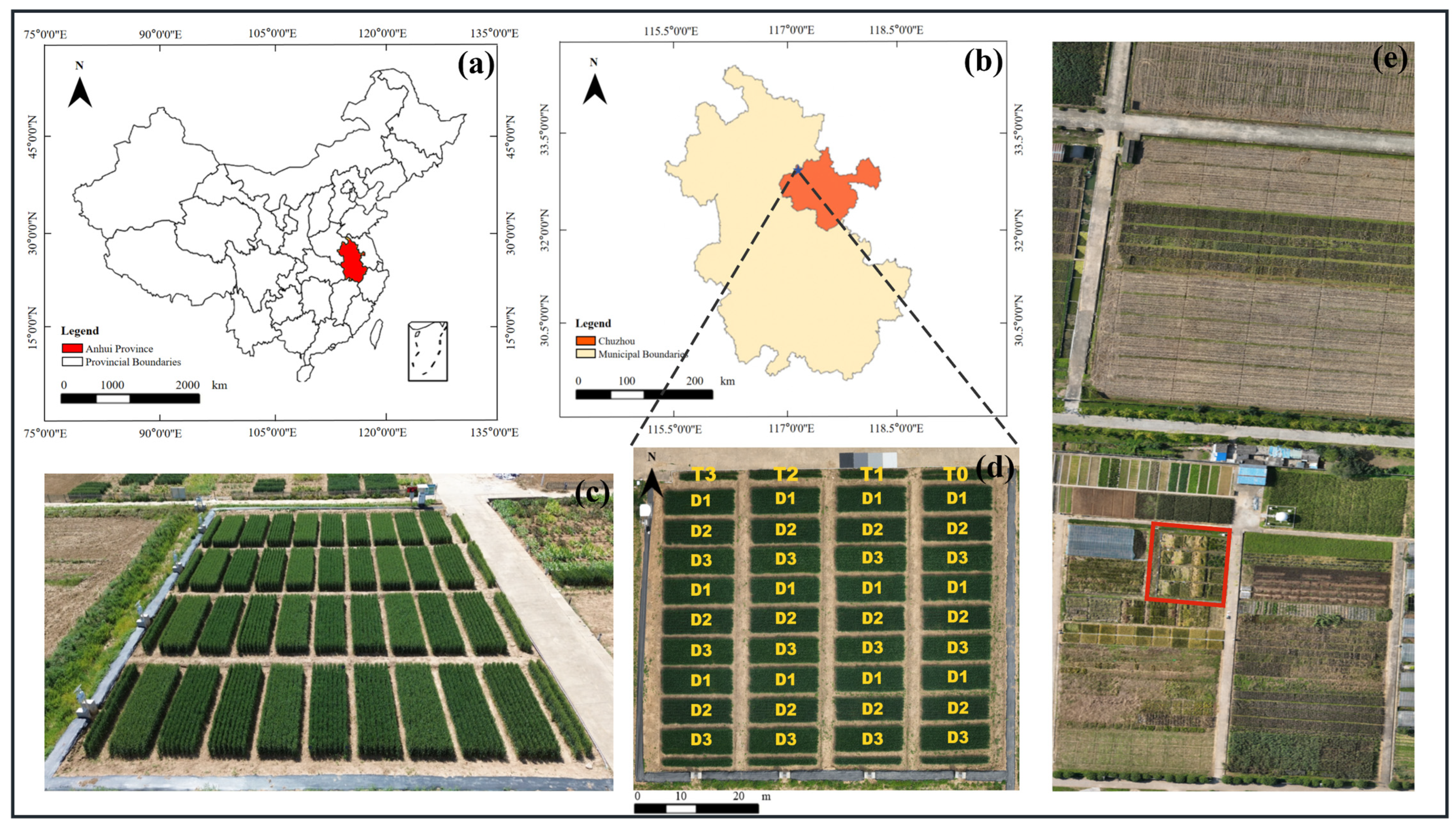
The experiment was conducted using a split-plot design, with compost substitution ratios for chemical fertiliser as the main-plot factor: 0 (T0), 10% (T1), 20% (T2), and 30% (T3), and planting density as the subplot factor: 1.5 million plants ha−1 (D1), 3.0 million plants ha−1 (D2), and 4.5 million plants ha−1 (D3). A total of 12 treatments were established, with three replicates for each treatment. Nitrogen fertiliser was applied in split applications, with topdressing conducted at the jointing stage. The fertiliser application rates for different treatments are shown in Table 1. The compound fertiliser, urea, calcium superphosphate, potassium sulfate, and compost used in the experiment were obtained from local agricultural suppliers in Fengyang, Anhui Province, China. The compost was produced from straw and cattle manure, with N, P2O5, K2O, and organic matter contents of 1.5%, 0.6%, 1.1%, and 47.8%, respectively, and a pH of 6.67. The tested cultivar was Huaimai 43. Each plot covered an area of 14 m2 (7 m × 2 m), with a row spacing of 25 cm. Seeds were manually sown in furrows on 17 November 2022 and 27 November 2023, and harvested on 26 May 2023 and 7 June 2024, respectively. No artificial irrigation was applied during the experimental period, and all other field management practices were consistent with local production practices.

2.2. Overview of the Experimental Site

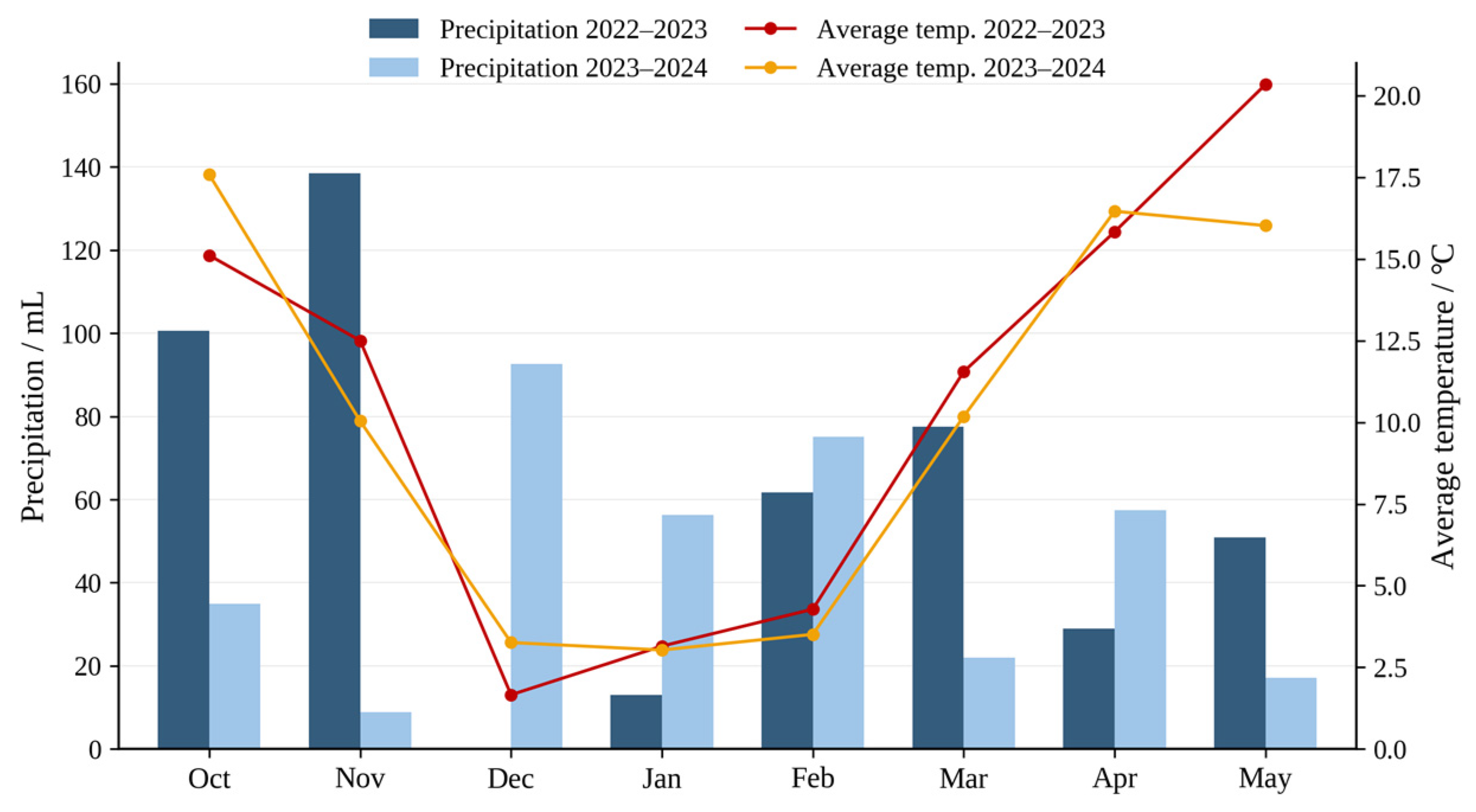
The field layout of the experimental site is presented in Figure 1. Meteorological information during the wheat-growing period was described using monthly mean temperature and precipitation data from the two experimental seasons, namely 2022–2023 and 2023–2024, as illustrated in Figure 2. The experimental field was characterised by clay loam soil and had been planted with rice in the preceding season. Soil samples were collected from the 0–20 cm topsoil layer, and the corresponding nutrient properties are summarised in Table 2. Soil nutrient measurements were conducted following the method described by Rogers [30].

2.3. UAV Data Collection and Preprocessing

Canopy imagery was collected using a DJI Mavic 3 Multispectral (M3M; SZ DJI Technology Co., Ltd., Shenzhen, China) UAV, which integrates an RGB camera and four-band multispectral imaging sensors. The multispectral bands included green (560 ± 16 nm), red (650 ± 16 nm), red edge (730 ± 16 nm), and near-infrared (NIR, 860 ± 26 nm). Image acquisition was carried out at four key winter wheat growth stages, namely jointing, booting, flowering, and grain filling. For the 2022–2023 growing season, UAV images were collected on 13 March, 15 April, 23 April, and 11 May; for the 2023–2024 season, the corresponding acquisition dates were 20 March, 19 April, 28 April, and 17 May. All flights were performed under cloud-free conditions between 10:00 and 14:00 to minimise variation in illumination. The UAV was flown at an altitude of 60 m above ground level (AGL) with a flight speed of 3.5 m s−1. Forward and side overlaps were set to 80% and 90%, respectively, resulting in orthomosaic images with a ground sampling distance (GSD) of approximately 2.77 cm pixel−1. Flight missions were planned and automatically implemented using DJI GS Pro software (v2.0.17, DJI, Shenzhen, China) [31]. Before image acquisition, reflectance calibration panels with known reflectance values were placed in the field to support radiometric correction.
The collected multispectral images were processed in Pix4Dmapper (v4.4.12, Pix4D SA, Prilly, Switzerland), including aerial triangulation, geometric correction, radiometric calibration, and orthomosaic generation. The resulting orthomosaics were then imported into ArcGIS 10.8 (Esri, Redlands, CA, USA) and clipped to the boundary of the experimental area. Regions of interest (ROIs) were manually delineated for each plot, and the average reflectance of all valid pixels within each ROI was extracted to represent the plot-level spectral response [32]. Field measurements of wheat AGB were conducted at the same growth stages as the UAV flights and were used as reference observations for subsequent model calibration and validation.

2.4. Wheat AGB Data Collection

At different growth stages in each experimental plot, a 1 m × 1 m quadrat was established at least 60 cm away from the plot boundary, and 30 uniformly growing wheat plants were selected for sampling. After collection, the roots were removed and the samples were rinsed thoroughly. The plant samples were first oven-dried at 105 °C for 30 min to terminate physiological activity, and then dried at a constant temperature of 80 °C until a constant weight was reached. Based on the total number of tillers per unit area and the sampling area, the sample dry weight was scaled and finally converted into AGB per unit area (t ha−1).

2.5. Feature Extraction from UAV Multispectral and RGB Imagery

2.5.1. Extraction of Multispectral and Colour Vegetation Index Features

In this study, vegetation indices (VIs) were used as the primary spectral features to characterise the canopy growth status and physiological properties of winter wheat. VIs enhance vegetation-related spectral responses by integrating reflectance information from multiple bands, thereby improving the ability of remote sensing features to describe changes in crop status [33]. Two types of VIs were constructed from UAV multispectral and RGB imagery: spectral vegetation indices (SVIs) based on multispectral reflectance and colour vegetation indices (CVIs) based on RGB information. SVIs mainly reflect crop physiological status by exploiting spectral differences among the Red, Red Edge, and Near-Infrared bands, whereas CVIs characterise canopy colour features through combinations of normalised visible-light components. These two types of indices complement each other in describing canopy characteristics from different spectral dimensions [34,35]. In total, 17 SVIs and 10 CVIs, comprising 27 VIs, were selected as spectral feature inputs in this study. Their calculation formulas and corresponding references are listed in Table 3.

2.5.2. Extraction of Canopy Structure Features

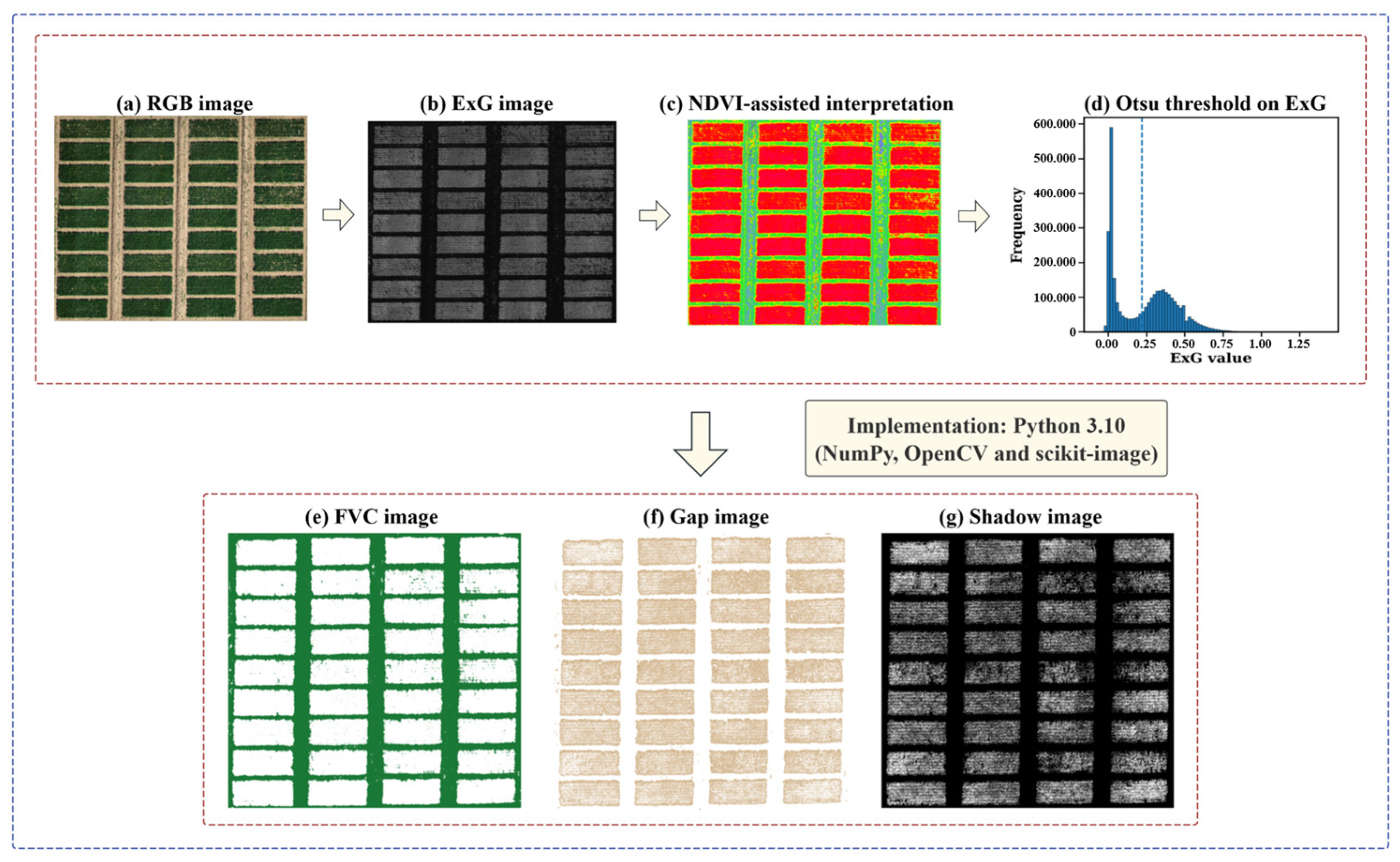
Canopy structural features can reflect canopy surface morphology and spatial arrangement independently of brightness variations, and therefore serve as an important complement to spectral features [62]. In this study, three structural parameters, namely fractional vegetation cover (FVC), canopy gap fraction (Gap), and shadow proportion (Shadow), were extracted from UAV RGB and multispectral imagery to characterise the horizontal structural features of the winter wheat canopy [63,64]. During pixel classification, the discriminative information from ExG and NDVI was integrated to enhance the separability between vegetation and background, thereby effectively reducing misclassification caused by bare soil, shadow, and mixed pixels [65]. The specific procedure was as follows: first, ExG was calculated from RGB imagery to enhance the vegetation signal, and NDVI was combined to assist in distinguishing vegetation, bare soil, and shadow pixels. Subsequently, Otsu adaptive threshold segmentation was used to complete pixel classification [66], and vegetation, gap, and shadow regions were extracted separately (Figure 3a–c). This workflow was implemented in Python 3.10 using NumPy, OpenCV, and scikit-image, ensuring automation and reproducibility of the processing procedure. Across 288 plot samples from four growth stages over two years, a total of 864 structural feature data points were extracted, providing structural-dimensional support for subsequent multi-source feature selection. The three structural parameters were defined as the proportion of pixels belonging to each corresponding category relative to the total number of pixels within the Region of Interest (ROI), and their calculation formulas are as follows:
FVC   =   N Veg N Total
Gap = N Gap N Total
Shadow = N Shadow N Total
where NVeg, NGap, and NShadow denote the numbers of pixels classified as vegetation, canopy gaps, and shadows within the ROI, respectively, after ExG- and NDVI-assisted discrimination combined with Otsu adaptive threshold segmentation. NTotal represents the total number of valid pixels involved in classification within the ROI. Since each valid pixel was assigned to only one of the three categories, the three structural parameters satisfy the conservation constraint: FVC + Gap + Shadow = 1.

2.6. Feature Optimisation Framework for Winter Wheat AGB Estimation

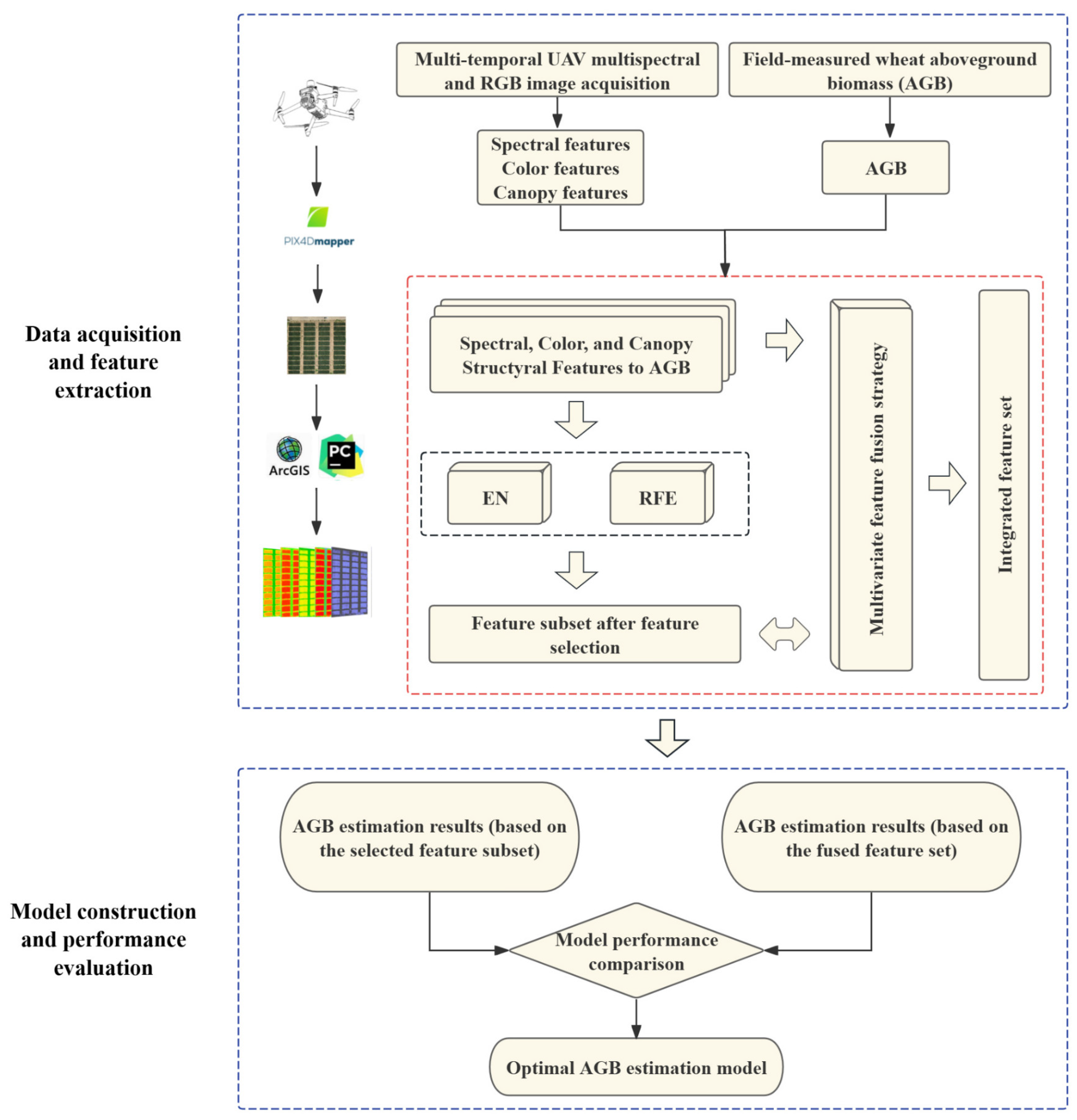
In this study, a multi-source feature optimisation framework consisting of feature selection, feature fusion, and model evaluation was constructed (Figure 4). For SV, CV, and SF feature sets, RFE and EN were applied separately to identify key variables with high contributions to AGB variation. On this basis, multi-type feature subsets were integrated through a hierarchical feature fusion strategy to construct multi-source feature inputs. Using the feature sets before and after selection, as well as different fused feature combinations, SVR-based AGB prediction models were established, and their estimation performance was systematically compared.

2.6.1. Multi-Source Feature Optimisation and Selection Based on RFE and EN

To select key variables with high contributions to winter wheat AGB from multi-source image features, this study constructed a Feature Selection System using RFE and EN. RFE is a model-driven feature selection method that uses random forest (RF) as the base learner to recursively evaluate feature importance [67]. First, the model was trained based on the complete feature set, and the Gini importance of each feature was calculated. Subsequently, the variable with the lowest importance was removed in each iteration, and the model was refitted using the remaining feature set. The optimal feature subset was determined according to the minimum root mean square error (RMSE) obtained from five-fold cross-validation, until no further significant improvement in model performance was observed [68].
EN is an embedded feature selection method [69] that achieves shrinkage and selection of feature coefficients by simultaneously introducing L1 (LASSO) and L2 (Ridge) regularisation constraints during model training. Compared with single regularisation methods, EN can maintain model sparsity while effectively alleviating the instability of variable selection under highly correlated feature conditions, making it well suited to high-dimensional and multicollinear scenarios. L1 regularisation encourages some coefficients to shrink to zero to achieve variable selection, whereas L2 regularisation imposes overall constraints on correlated features to improve estimation stability. Both the regularisation mixing parameter α and the penalty strength λ were determined using five-fold cross-validation. After model training, features with absolute regression coefficients greater than 0 were retained as the selected features [70,71].
In this study, SV, CV, and SF denote the feature sets derived from SVIs, CVIs, and canopy structural features, respectively. Feature sets selected by RFE and EN were denoted using the prefixes “R-” and “E-”, respectively. For example, the CV feature set selected by EN was denoted as E-CV.

2.6.2. Feature Fusion Strategy Based on Hierarchical Progression and Cross-Strategy Combinations

Feature fusion involves integrating different types of remote sensing features to construct unified model inputs [72,73]. To systematically analyse the modelling effects of different feature combinations, this study developed a four-level progressive fusion framework. The first level was based on single-source original features and their selected subsets, aiming to analyse the independent contributions of different feature types and selection methods. The second level introduced canopy parameters on this basis to enhance the representation of canopy spatial status. The third level further integrated spectral and colour variables and combined them with canopy parameters to form multi-source inputs, thereby strengthening the complementary effects among different types of information. The fourth level conducted cross-type combinations based on category-specific feature selection and further incorporated canopy parameters to explore the synergistic potential of multi-source variables under different selection mechanisms. Through the above four-level progressive comparison, the effects of different fusion depths and combinations of selection strategies on AGB estimation performance at different growth stages of winter wheat were systematically revealed.

2.7. Model Establishment and Evaluation

In this study, SVR was used to construct winter wheat AGB prediction models based on Python 3.10. SVR originates from support vector machine theory and maps samples into a high-dimensional feature space through kernel functions. By controlling model complexity while reducing structural risk, SVR enables effective fitting of nonlinear relationships [74]. For SVR, input standardisation, kernel selection, and hyperparameter optimisation were performed using grid search combined with five-fold cross-validation; the detailed parameter settings and search ranges are provided in Table S1. For each growth stage, data from the 2022–2023 growing season (n = 36) were used as the calibration set, whereas data from the 2023–2024 growing season (n = 36) were used as an independent validation set. All feature selection procedures were conducted using only the calibration set, whereas the validation set was not involved in variable screening and was used only for independent model evaluation. Stage-specific models were developed separately to avoid phenological heterogeneity caused by pooling samples with different AGB distributions, canopy structures, and UAV-derived spectral responses. To assess the competitiveness of SVR, partial least squares regression (PLSR), random forest (RF), and extreme gradient boosting (XGBoost) were additionally used as comparison algorithms based on the optimal feature combination identified at each growth stage. The comparison models were constructed using the same calibration and validation datasets, and their performance was evaluated using the same metrics. Model accuracy was evaluated using three metrics: coefficient of determination (R2), RMSE, and relative root mean square error (RRMSE) [75]. The calculation formulas are as follows:
R 2 = 1 i = 1 n ( y i y ^ i ) 2 i = 1 n ( y i y ¯ ) 2
R M S E = 1 n i = 1 n ( y i y ^ i ) 2
R R M S E = R M S E y ¯ × 100 %
where y i denotes the observed value of the target variable for sample i , y ^ i denotes the corresponding predicted value, y ¯ denotes the mean observed value, and n denotes the sample size.

3. Results

3.1. Growth-Stage Differences and Treatment Responses of the Winter Wheat AGB Dataset

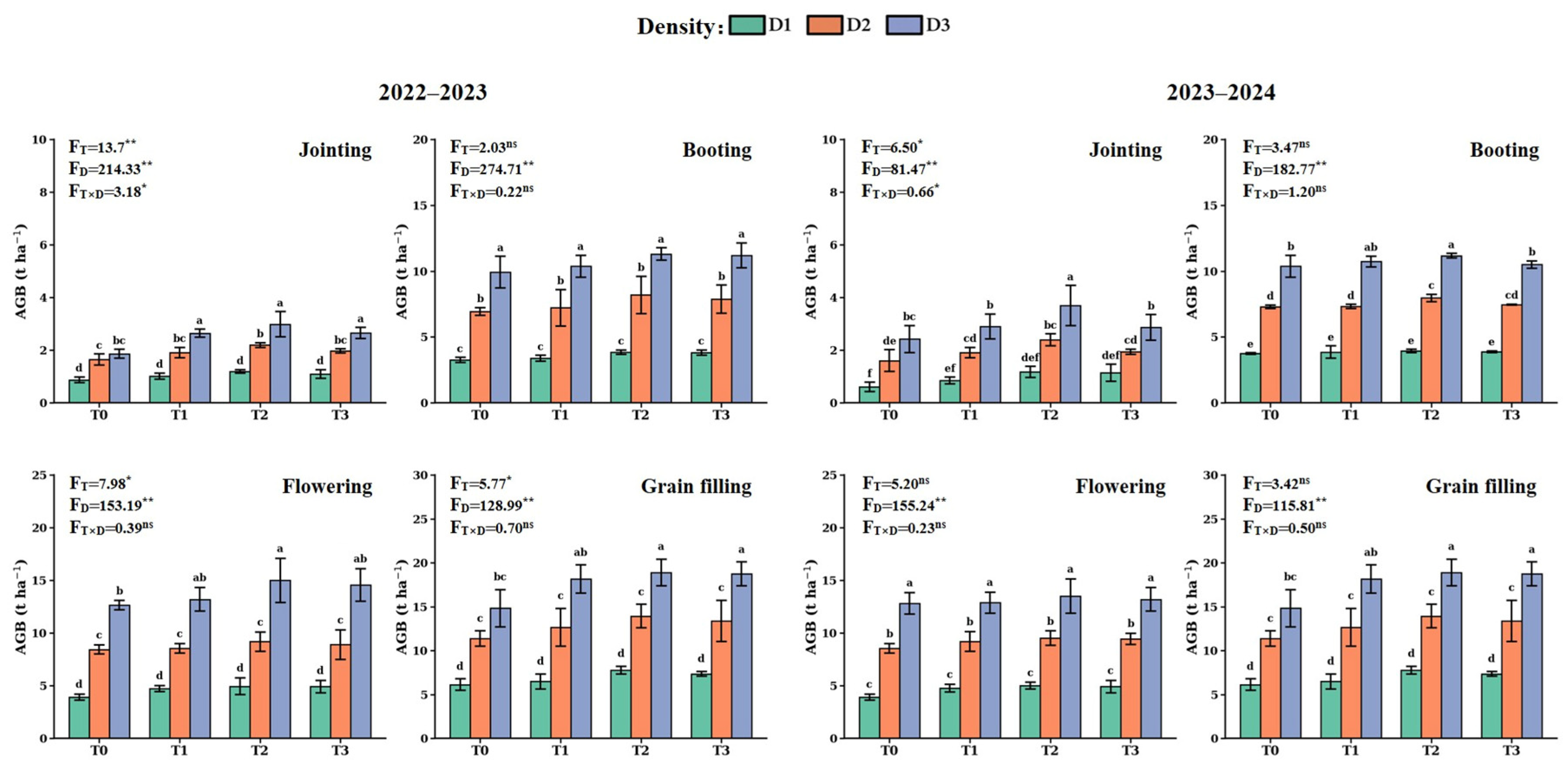
Winter wheat AGB exhibited clear growth-stage-dependent variation in both growing seasons (Table 4, Figure 5). AGB increased continuously from the jointing to grain-filling stage, with the mean values rising from 1.83 to 13.63 t ha−1 in the calibration set and from 1.95 to 12.93 t ha−1 in the validation set. This indicates that the data distributions of the two years were generally consistent, showing good temporal continuity and interannual comparability. The most rapid increase occurred from jointing to booting, whereas AGB accumulation slowed from booting to flowering and increased again during grain filling, indicating sustained dry matter accumulation during the middle and late growth stages. Meanwhile, differences in AGB among treatments gradually increased as growth progressed. Under the same planting density, AGB generally showed an initial increase followed by a decrease with increasing compost substitution ratio, with the T2 treatment maintaining relatively high levels at most growth stages. Under the same compost substitution ratio, AGB increased with increasing planting density, generally following the order D3 > D2 > D1. These results reflect the temporal accumulation pattern and stage-specific characteristics of winter wheat AGB, and provide a measured data basis for constructing remote sensing estimation models of AGB at the jointing, booting, flowering, and grain-filling stages.

3.2. Screening Results of SV, CV, and Combined Features Sensitive to Winter Wheat AGB at Different Growth Stages

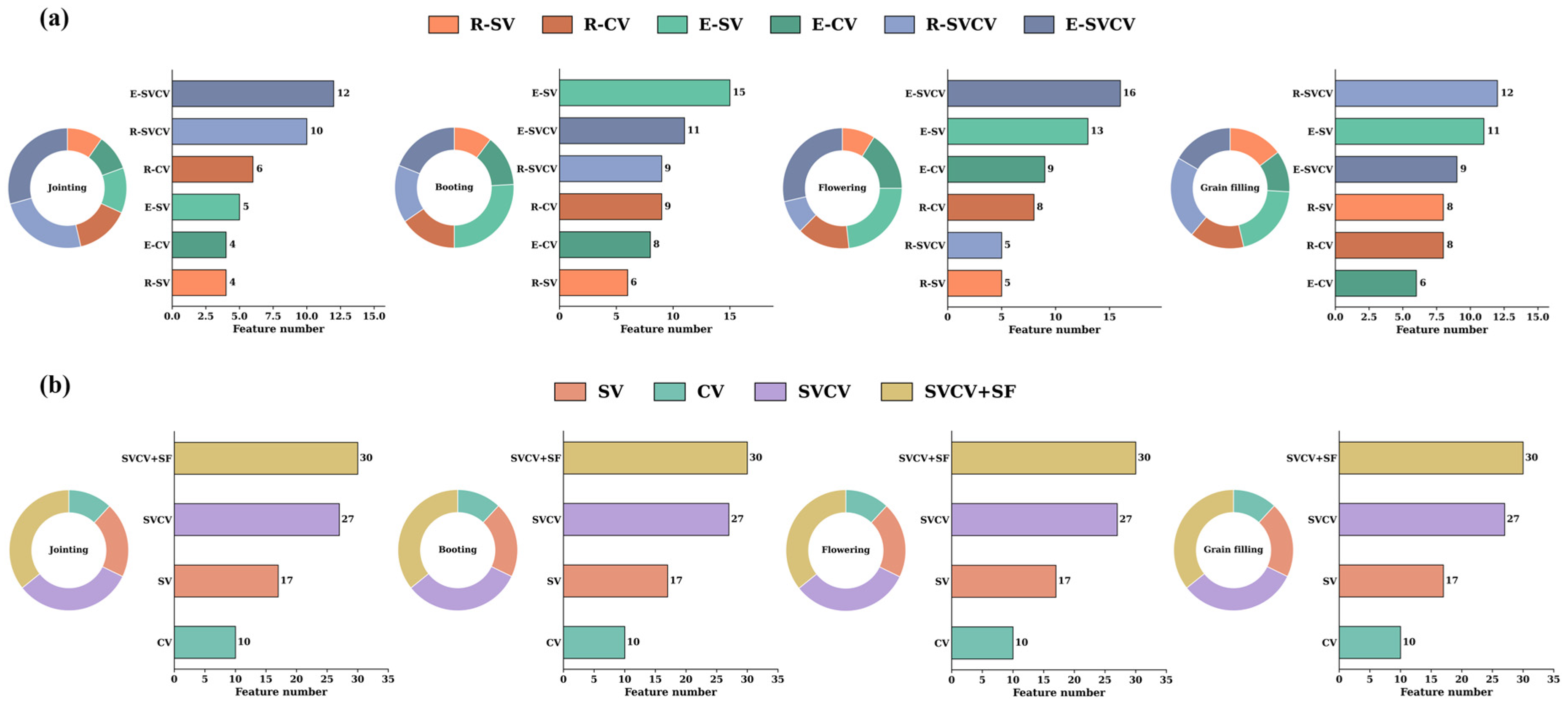
To identify sensitive variables closely associated with changes in winter wheat AGB at the jointing, booting, flowering, and grain-filling stages, RFE and EN were used to screen SV, CV, and their fused feature combinations. Figure 6a shows the differences in the number of retained variables after RFE and EN screening for each feature set at different growth stages, while Figure 6b presents the variable scales of the original SV, CV, and fused feature sets. The detailed screening results are shown in Table 5. Overall, the number of retained variables differed markedly among growth stages, and the screening results obtained by RFE and EN were not consistent across different feature sets. Combined feature sets generally retained more variables than single-source feature sets, but feature selection substantially reduced the original feature space and retained variables more closely related to AGB variation. The dominant selected feature set also varied by growth stage, with E-SVCV showing stronger retention at the jointing and flowering stages, E-SV at the booting stage, and R-SVCV at the grain-filling stage.
In terms of the composition of selected variables, the sensitive features showed clear stage-specific differences. At the jointing stage, the selected variables were mainly related to red-edge, near-infrared, and canopy colour responses, whereas variables associated with chlorophyll status and red-edge sensitivity were more frequently retained from booting onwards. During flowering and grain filling, colour indices were increasingly incorporated into the selected subsets, indicating that visible phenotypic changes associated with spike emergence, canopy colour variation, and late-season senescence became more relevant for AGB characterisation. From the perspective of common features across growth stages, REGDVI, MTCI, GRVI, and REOSAVI among SVIs were repeatedly retained at multiple growth stages, indicating their relatively stable associations with winter wheat AGB. Among CVIs, ExR, ExGR, and NGRDI were frequently selected, suggesting that visible-light colour features provided complementary information on canopy status across growth stages.

3.3. Comparison of Winter Wheat AGB Estimation Models Under Different Feature Optimisation Levels

3.3.1. Effects of Single-Source Feature Selection Strategies on Winter Wheat AGB Estimation Models at Different Growth Stages

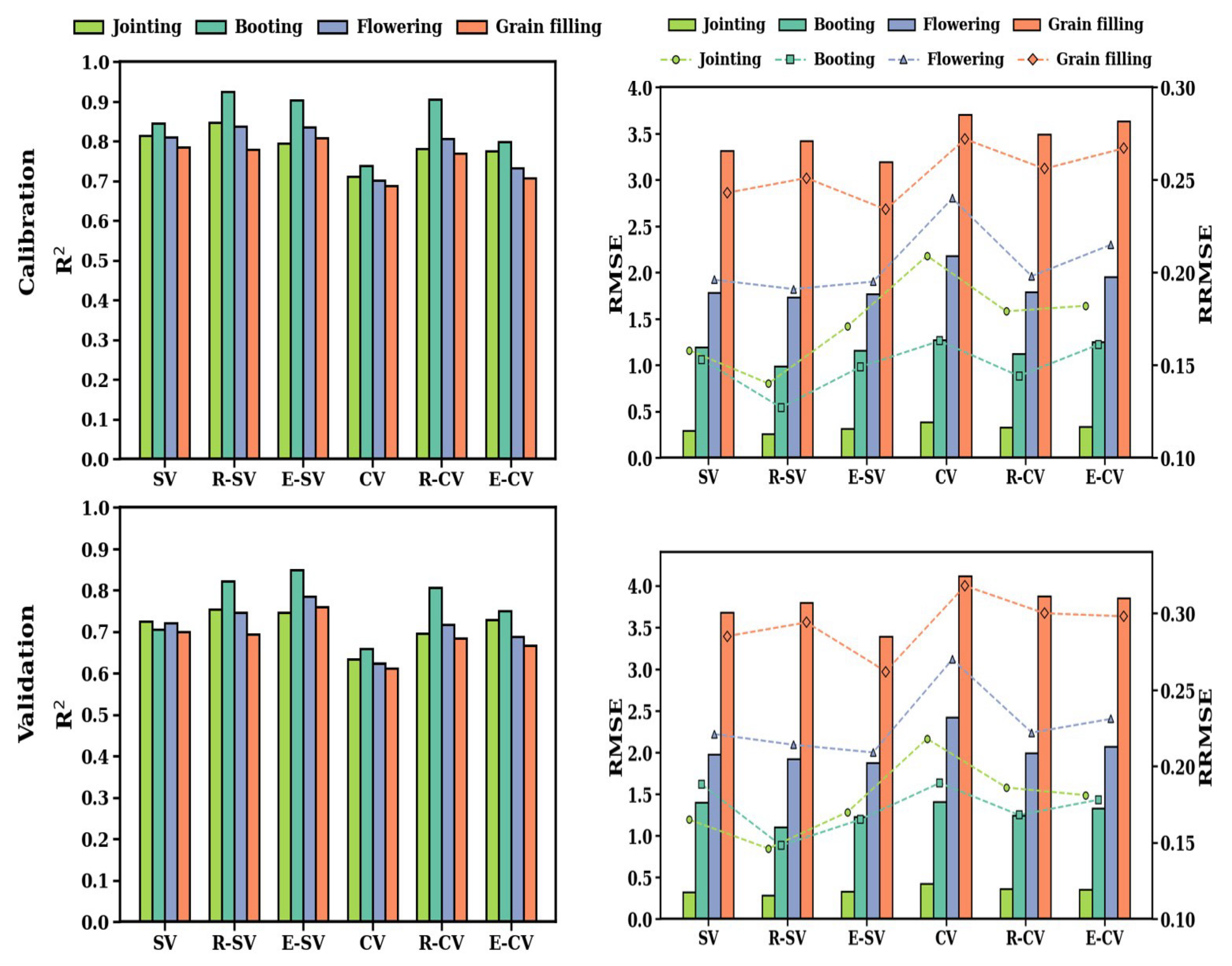
To clarify the effects of RFE and EN selection strategies on the modelling performance of single-source SV and CV feature sets, winter wheat AGB estimation models were constructed at the jointing, booting, flowering, and grain-filling stages using the original SV, R-SV, E-SV, original CV, R-CV, and E-CV as inputs. A total of 24 SVR models were established, and the estimation performance of original and selected feature sets was compared across different growth stages (Figure 7).
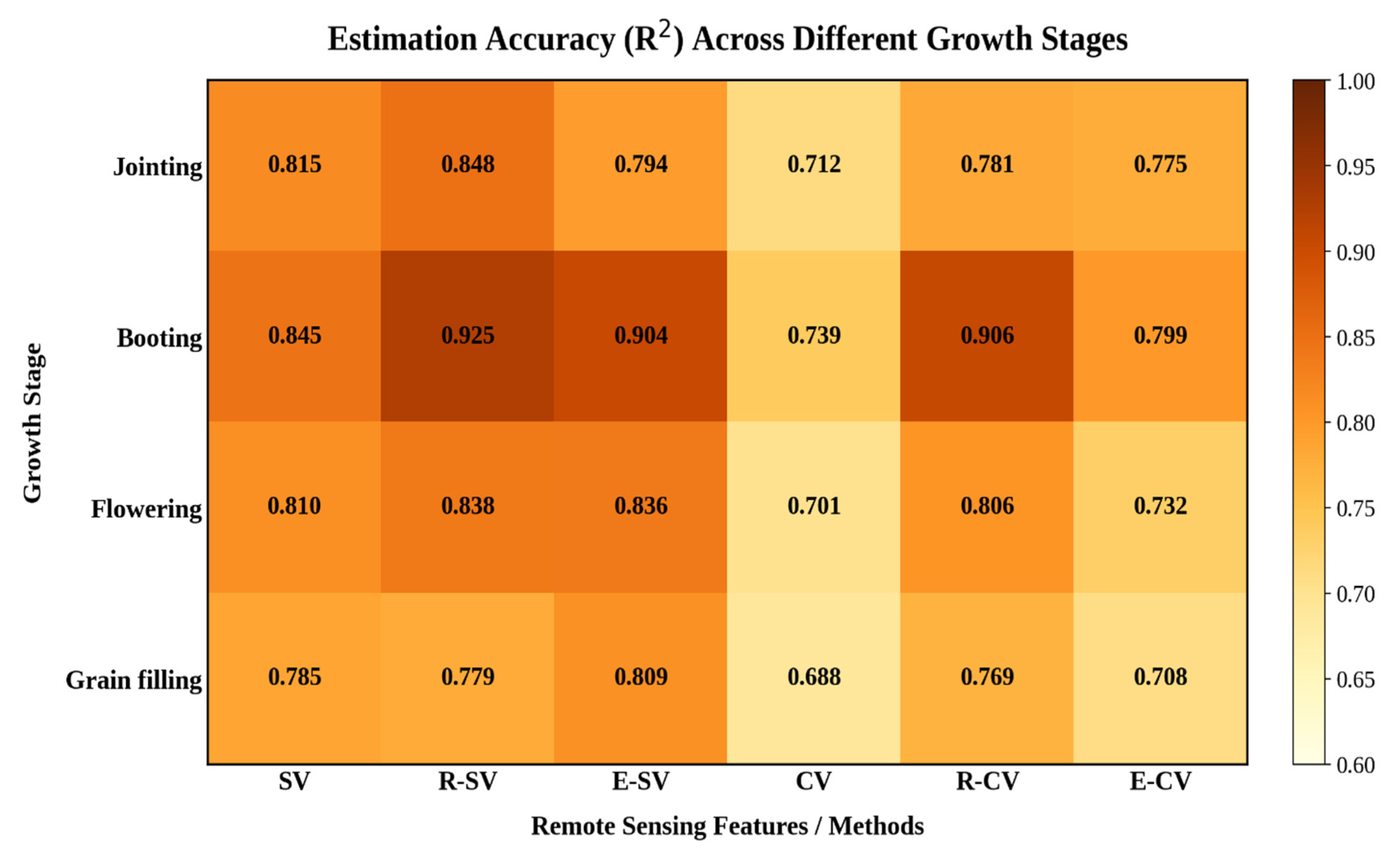
Models based on selected features generally outperformed those based on original feature sets at most growth stages, although the magnitude of improvement varied with growth stage and feature type. In the calibration set, R-SV performed better during the early growth stages, whereas E-SV showed stronger performance at later stages. The validation results showed a similar stage-dependent pattern: R-SV was most effective at the jointing stage, achieving a validation R2 of 0.755, while E-SV became the best-performing single-source feature set from booting to grain filling, with validation R2 values ranging from 0.760 to 0.850. CV-based models generally showed lower accuracy than SV-based models, and the original CV model at the grain-filling stage achieved a validation R2 of only 0.612. These results indicate that the effects of feature selection showed clear stage-specific differences: RFE was more suitable for early-stage SV selection, whereas EN showed stronger adaptability from booting onwards.

3.3.2. Effects of Introducing SF on AGB Estimation by Single-Source Selected Models

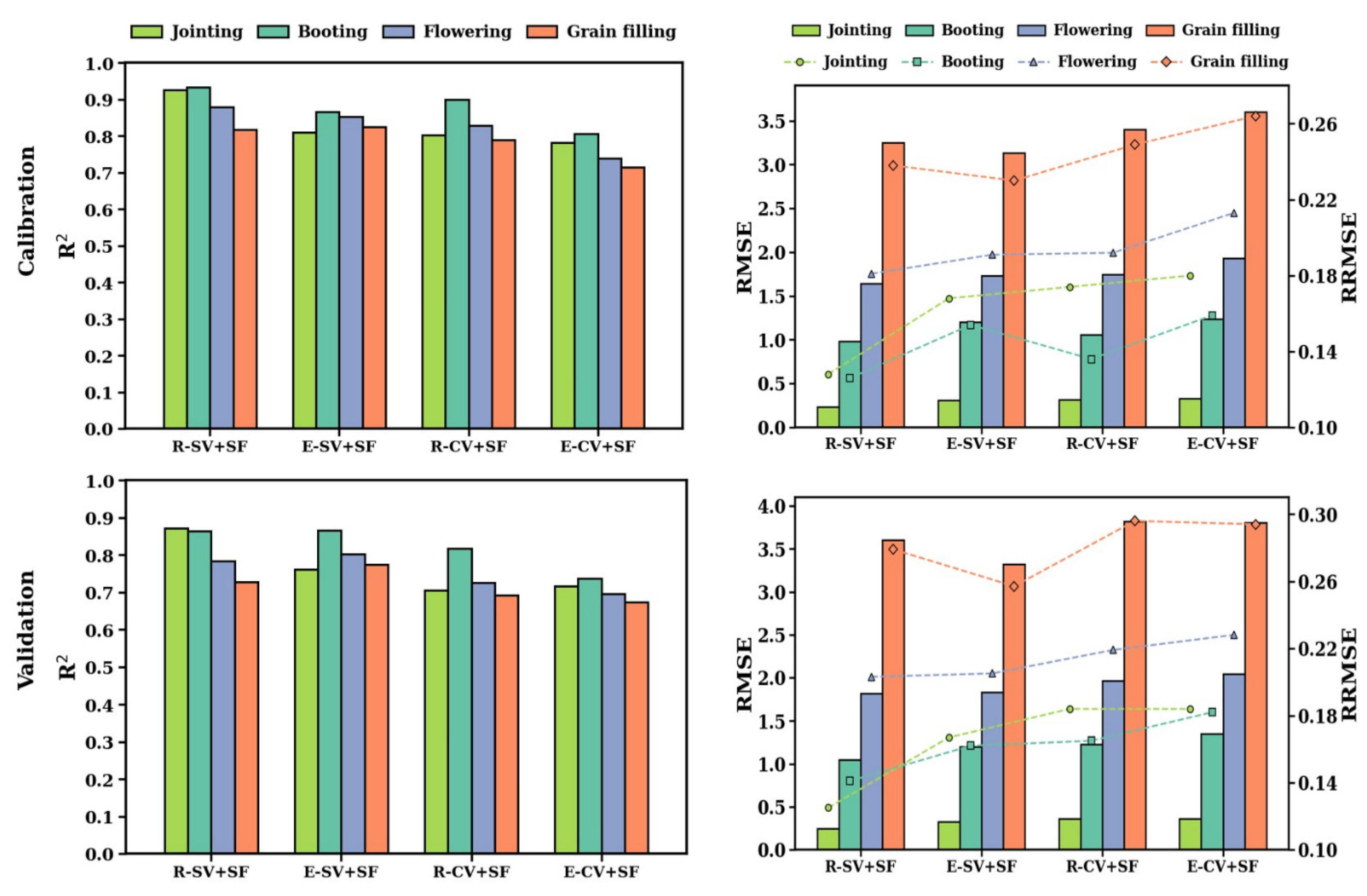
Based on the single-source feature selection results, SF was further combined with selected SV and CV features to evaluate its complementary role in winter wheat AGB estimation. A total of 16 SVR models were constructed for the Jointing, Booting, Flowering, and Grain-Filling stages, and their performance was compared with the corresponding single-source selected models to analyse changes in model accuracy after the introduction of structural features (Figure 8).
After introducing SF, the accuracy of the optimal model at each growth stage improved compared with the corresponding optimal selected model in Section 3.3.1, although the optimal feature combinations still differed among growth stages. The R-SV + SF model performed best at the jointing stage, whereas E-SV + SF showed stronger performance from booting to grain filling. In the validation set, the introduction of SF increased the upper performance level of single-source selected models, with the best validation R2 reaching 0.872 at the jointing stage and remaining above 0.775 at the later stages. The SV + SF combinations generally outperformed the CV + SF combinations across the four growth stages. These results indicate that, after introducing SF, the optimal models still showed clear stage-specific differences, while structure-extended models based on SV maintained higher accuracy across all growth stages.

3.3.3. Synergistic Effects of SV–CV Fusion and SF Extension on Winter Wheat AGB Estimation Models

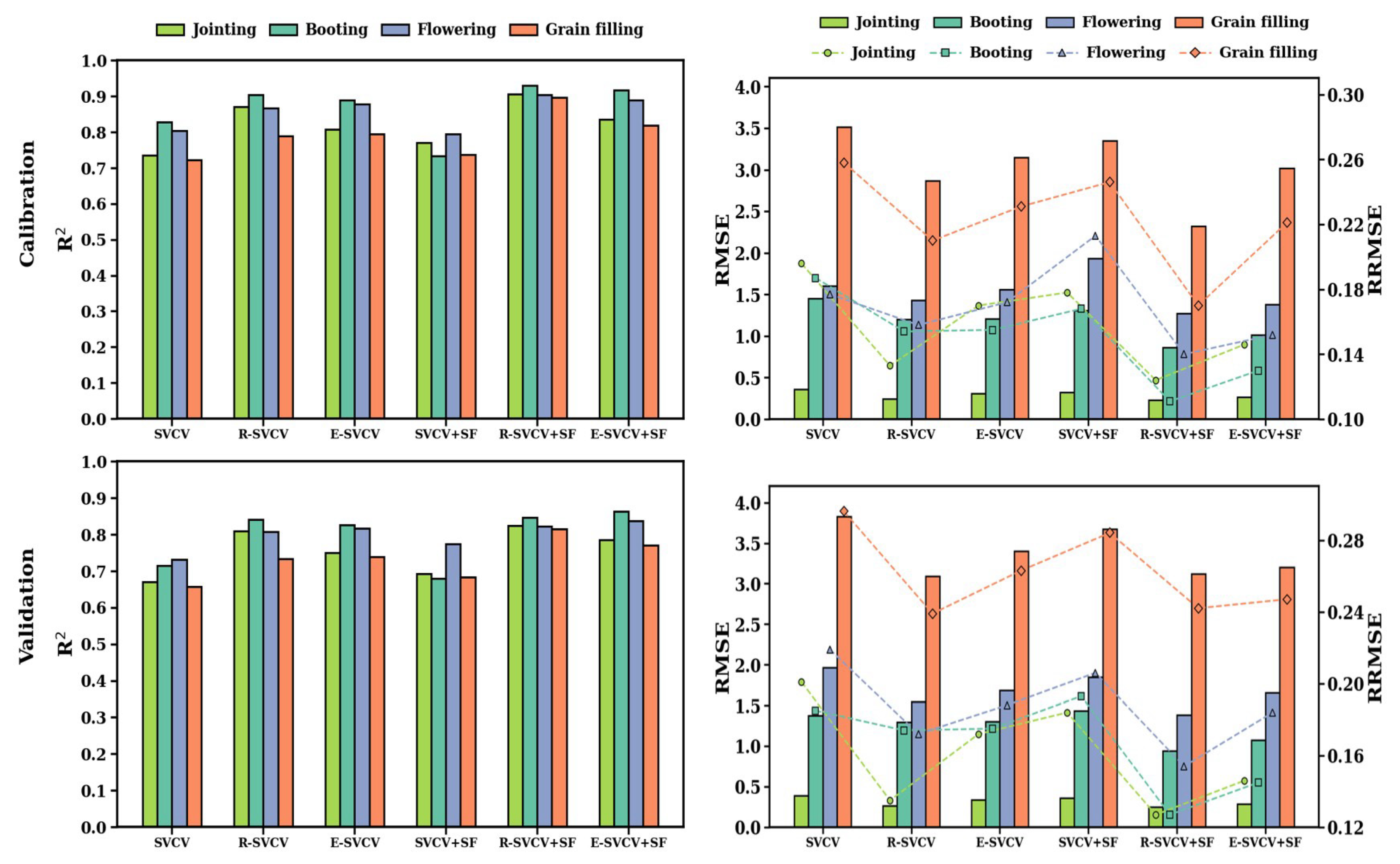
To compare the modelling effects of SV–CV fusion and its further extension with SF, SVCV, R-SVCV, E-SVCV, and their SF-extended combinations were used as inputs to construct winter wheat AGB estimation models at the four growth stages. A total of 24 SVR models were established, and model performance before and after fusion, as well as under different selection strategies, was compared to reveal the synergistic effects of spectral, colour, and structural information on AGB estimation (Figure 9).
Compared with the corresponding SVCV models without SF, the optimal models based on SF-extended combinations showed further improvements in accuracy at all growth stages; however, the optimal selection strategy still exhibited clear stage-specific differences. In the calibration set, R-SVCV + SF showed consistently strong performance, whereas the validation results indicated stage-specific differences in the optimal selection strategy. R-SVCV + SF performed better at the jointing and grain-filling stages, with validation R2 values of 0.825 and 0.815, respectively, while E-SVCV + SF was more effective at the booting and flowering stages, achieving validation R2 values of 0.863 and 0.837, respectively. At this optimisation level, the optimal models had shifted from simple SV–CV fusion to three-source feature combinations incorporating SF, and the optimal selection strategy still varied across growth stages.

3.3.4. Effects of Cross-Strategy Deep Fusion on AGB Estimation Models at Different Growth Stages of Winter Wheat

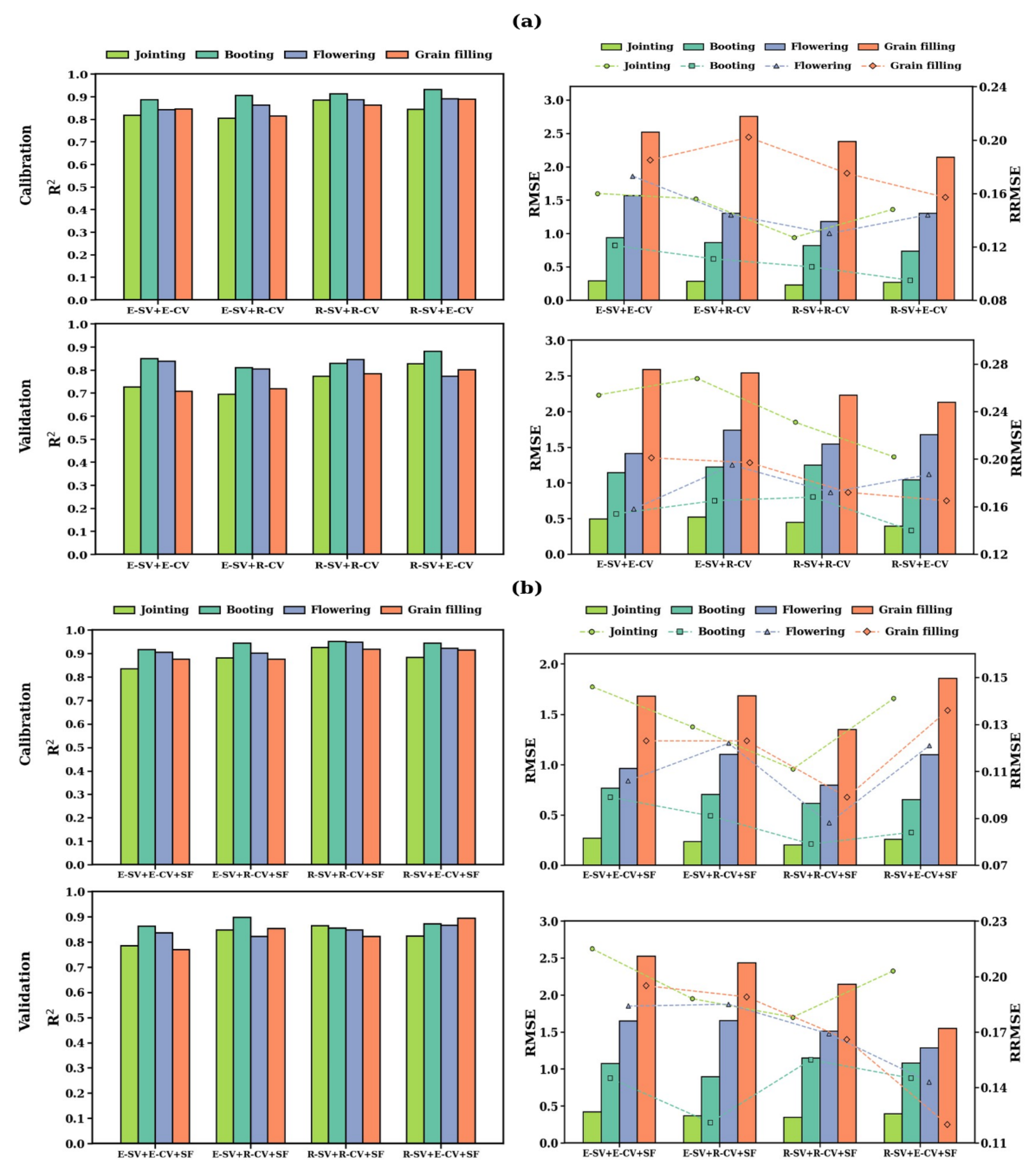
Based on the above analyses of single-source feature selection, SF extension, and SV–CV fusion, this section further explored the complementary potential among different feature selection strategies. SV and CV were cross-combined using different selection methods and further integrated with SF to construct eight types of cross-strategy deep-fusion feature sets. A total of 32 SVR models were established across the four growth stages to compare the performance gains of cross-strategy deep fusion relative to the previous optimisation level and to analyse their stage-specific differences (Figure 10).
Cross-strategy deep fusion further improved model performance and produced clearer growth-stage differentiation in the validation set. R-SV + R-CV + SF was more suitable at the jointing stage, E-SV + R-CV + SF performed best at the booting stage, and R-SV + E-CV + SF became the optimal combination at both the flowering and grain-filling stages. Compared with the SV–CV fusion and SF-extended models (SVCV + SF), the optimal models after cross-strategy deep fusion further improved estimation accuracy at most growth stages, with more pronounced gains at the flowering and grain-filling stages. At the flowering stage, the R2 of the optimal model increased from 0.837 to 0.867, while RMSE decreased from 1.653 to 1.285. At the grain-filling stage, R2 increased from 0.815 to 0.895, and RMSE decreased from 3.123 to 1.552. The optimal models after cross-strategy deep fusion were not consistent across growth stages, with more complex feature combinations observed at the flowering and grain-filling stages.

3.3.5. Comprehensive Comparison of the Optimal AGB Estimation Models for the Four Growth Stages of Winter Wheat Under Different Optimisation Levels

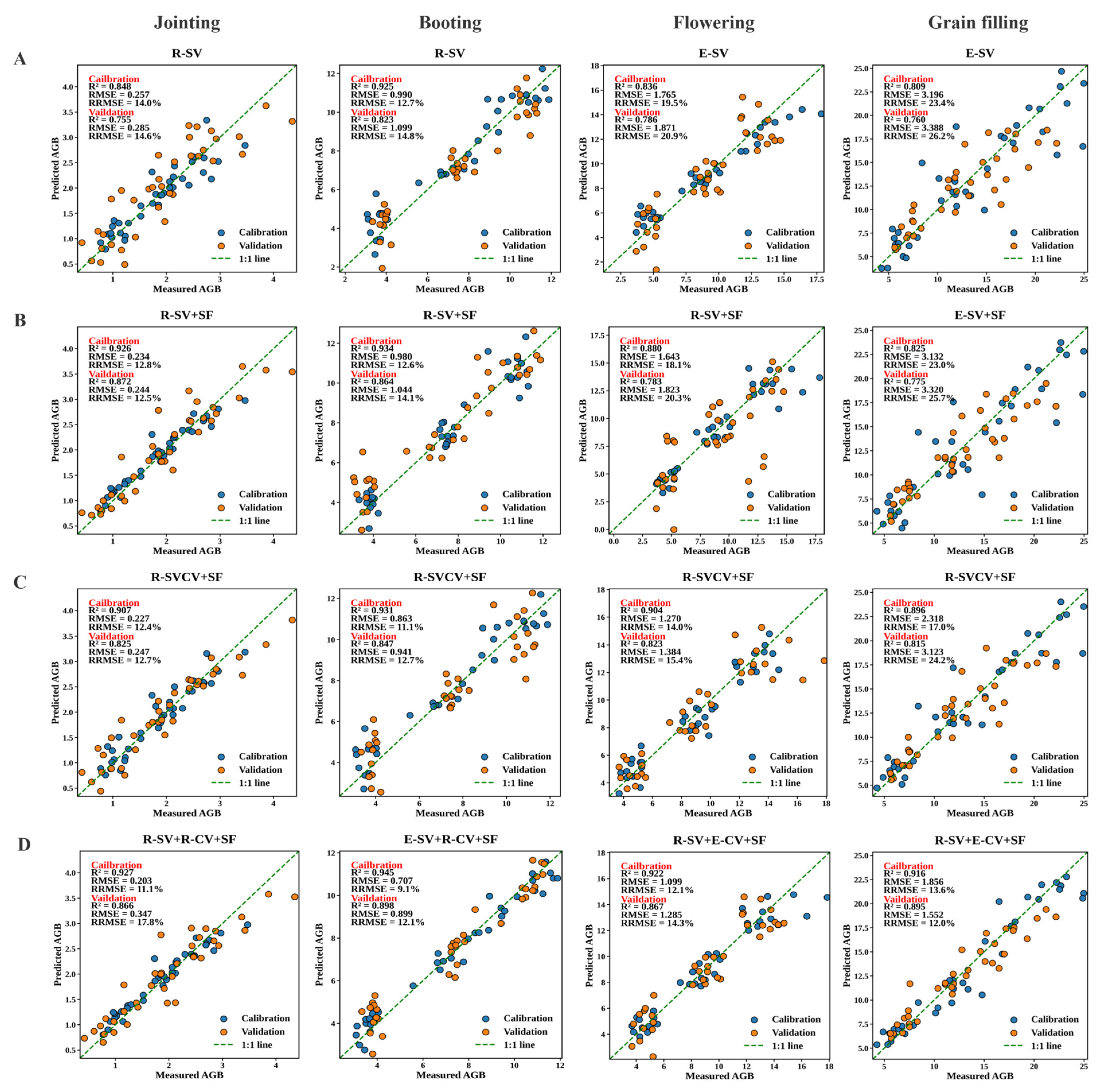
Based on the above feature selection and fusion strategies, the optimal models at each growth stage were further extracted for horizontal integration and comparison (Figure 11). The optimal feature combinations differed clearly among growth stages. The jointing stage was best represented by R-SV + SF, whereas the booting stage shifted to E-SV + R-CV + SF. At the flowering and grain-filling stages, R-SV + E-CV + SF achieved the best performance, indicating that cross-strategy fusion became more important as canopy complexity increased. Overall, the stage-specific optimal models achieved high validation accuracy, with R2 values ranging from 0.867 to 0.898 and RRMSE values ranging from 12.0% to 14.3%.
The variation in the optimal models across growth stages indicates that there was no universally optimal feature combination for winter wheat AGB estimation. The optimal strategy gradually shifted from selected spectral features combined with SF at the early growth stage to cross-strategy fusion of selected spectral, colour, and structural features during the middle and late growth stages. This pattern indicates that the contribution of different feature types and selection methods was strongly growth-stage dependent. Overall, winter wheat AGB estimation at different growth stages showed significant stage-specific adaptability, and the formation of optimal models at each stage depended on the synergistic optimisation of multi-source features.
To further evaluate whether the model performance of the stage-specific optimal feature combinations depended on the exclusive use of the SVR algorithm, supplementary algorithm comparisons were conducted using PLSR, RF, and XGBoost (Table 6). Across the four growth stages, SVR achieved the highest validation accuracy among all tested algorithms. Compared with PLSR, RF, and XGBoost, SVR exhibited more stable predictive performance at both early and late growth stages, particularly at the Grain-filling stage, where its validation R2 was markedly higher than those of PLSR, RF, and XGBoost. These results indicate that SVR showed strong model competitiveness under the present small-sample and multi-source feature conditions, and further confirm that the improvement in AGB estimation performance was mainly associated with growth stage-adaptive feature selection and multi-source feature fusion.

4. Discussion

4.1. Temporal Accumulation Characteristics of Winter Wheat AGB and Growth-Stage Differences in Its Remote Sensing Response

Winter wheat AGB showed a continuous accumulation trend from the jointing to booting, flowering, and grain-filling stages, and was jointly regulated by planting density and compost substitution level. Higher planting density promoted AGB accumulation by increasing canopy leaf area and light interception capacity, thereby enhancing radiation capture and dry matter accumulation. Compost substitution mainly affected canopy growth by improving the soil environment and regulating nutrient release. The results of this study showed that the effect of compost substitution on AGB followed an initial promotion followed by inhibition, with the 20% substitution treatment maintaining a relatively high biomass level. This is generally consistent with previous studies, which reported that appropriate organic material input can improve soil physicochemical properties, enhance nutrient supply, and increase crop productivity, whereas its positive effect may weaken when the nutrient release pattern is not synchronised with crop demand [76,77]. Overall, cultivation practices shaped the temporal accumulation differences in AGB, and these stage-specific changes further affected the response patterns of remote sensing variables to AGB.
From the perspective of remote sensing response mechanisms, the sensitivity of winter wheat AGB to different feature types showed clear growth-stage differences. From the jointing to booting stages, winter wheat was still dominated by vegetative growth, with rapid leaf area expansion and an incompletely closed canopy. Therefore, NIR, red-edge bands, and related VIs maintained high sensitivity to canopy growth status and dry matter accumulation [78,79]. The results of this study showed that selected SV performed better at the jointing and booting stages, indicating that AGB estimation during the early growth stages mainly depended on spectral information for characterising canopy growth status. After entering the flowering and grain-filling stages, spike emergence, leaf-layer thickening, and increased canopy closure significantly enhanced spatial heterogeneity and spectral mixing within the canopy, gradually reducing the ability of single spectral variables to characterise AGB differences [13,80]. Previous studies have indicated that the combined use of multispectral VIs and RGB-based CV can partly alleviate spectral saturation and background interference during the later growth stages, thereby improving model robustness [81]. However, SV and CV mainly reflect canopy spectral and apparent colour differences, while their ability to describe spatial configuration and canopy closure remains limited. Therefore, structural information is still required in the middle and late growth stages to enhance the response capacity to AGB variation. In this study, FVC, Gap, and Shadow were extracted to characterise canopy coverage, gap distribution, and shadow status, respectively.
During the flowering and grain-filling stages, the contribution of FVC, Gap, and Shadow became more evident because the canopy signal gradually shifted from a leaf-dominated spectral response to a mixed response affected by leaves, stems, spikes, senescence, background exposure, and within-canopy shading [82,83]. FVC reflects canopy closure and the remaining green vegetation fraction, and is therefore closely related to light interception and biomass accumulation [84]. Gap represents canopy discontinuity and background exposure, which becomes more relevant when leaf senescence, uneven population structure, or partial canopy opening increases spatial heterogeneity. Shadow reflects shaded components caused by overlapping leaves and spikes, and can indicate canopy density and illumination heterogeneity under complex canopy conditions [85]. These variables therefore provide complementary structural information when spectral and colour features are affected by saturation, background interference, and canopy heterogeneity [86,87]. Consistent with previous studies showing that structural, texture, or height-related features can improve the characterisation of complex crop canopies [88,89], AGB estimation at the flowering and grain-filling stages in this study relied more strongly on the synergistic supplementation of colour and structural information. These results indicate that there is no fixed information-dominant pattern for the remote sensing characterisation of winter wheat AGB. Instead, the dominant information gradually shifts from spectral features in the early stages to multi-source feature synergy as growth progresses. The optimal feature combinations differed among growth stages, indicating that feature selection methods, fusion levels, and the contribution strength of SF all have clear stage-specific adaptability. This also provides a physiological and remote sensing response basis for the subsequent analysis of the adaptability of different feature selection strategies and fusion levels.

4.2. Stage-Specific Effects of Feature Selection Strategies on Winter Wheat AGB Estimation Performance

Feature selection is an important step affecting the performance of machine learning models, as it reduces variable redundancy, weakens noise interference, and improves the efficiency of models in representing target information [26,90]. In crop phenotypic remote sensing estimation, appropriate feature selection generally contributes to improved model accuracy [24,91]. In this study, RFE and EN were used to screen SV and CV, respectively, and the differences in AGB estimation accuracy at the four growth stages of winter wheat under different strategies were compared (Figure 12). The results showed that the selected variable subsets outperformed the original variable sets at most growth stages, but the magnitude of improvement varied markedly among growth stages and feature types. For SV, R-SV performed better at the Jointing, Booting, and Flowering stages, whereas E-SV performed better at the grain-filling stage, indicating that the optimal selection strategy for spectral features changed with growth progression and that no single method was consistently dominant. In contrast, CV was more sensitive to the selection strategy, with R-CV outperforming E-CV and the original CV at all four growth stages, indicating that colour features could more effectively improve AGB estimation after feature selection. Notably, the original SV outperformed the original CV at all four growth stages, suggesting that spectral features had stronger basic representational ability for winter wheat AGB. However, the greater improvement observed after CV selection further indicates that colour variables may contain more redundant and unstable information, and therefore depend more strongly on feature selection.
These stage-specific differences may be related to the mechanisms of different selection methods and the ways in which canopy information is represented. Li et al. [92] used RFE, Boruta, and PCC to select yield-related features of winter wheat and constructed SVM models based on the selected features. Their results showed that different selection methods led to differences in model accuracy, with RFE combined with SVM achieving relatively high prediction accuracy. Xu et al. [93] used SPA and CARS for feature optimisation and combined LASSO and RIDGE regression to select features related to rice leaf nitrogen content, finding that the optimised variable combinations effectively improved model performance. These studies indicate that feature selection has an important influence on model performance, but its gains are usually jointly constrained by the target trait, variable structure, and data context. RFE iteratively removes low-contribution variables and continuously reconstructs the model, making it more favourable for identifying key variables from redundant features. EN achieves variable shrinkage and collinearity control through L1 and L2 regularisation, making it more suitable for handling highly correlated high-dimensional data. Combined with the results of this study, from the Jointing to Flowering stages, the response of spectral variables to AGB variation was relatively clear, allowing RFE to more easily identify feature combinations with high contributions. At the grain-filling stage, however, the relationships among variables became more complex due to canopy closure, spike-layer formation, and enhanced spectral saturation, and the constraints imposed by EN on redundant information and collinearity may have been more beneficial for maintaining model stability [94,95]. For CV, the original variables were more susceptible to illumination conditions, background interference, and apparent colour differences; therefore, the performance improvement brought by selection was more pronounced, and RFE showed good applicability across all four growth stages. These results indicate that feature selection for winter wheat AGB estimation has significant stage- and type-dependent characteristics. A single algorithm should not be regarded as universally optimal; instead, selection strategies with stronger stage-specific adaptability should be chosen according to canopy status, variable correlation structure, and feature response differences at different growth stages.

4.3. Effects of Multi-Source Feature Fusion and Selection Synergy on the Accuracy of Winter Wheat AGB Estimation

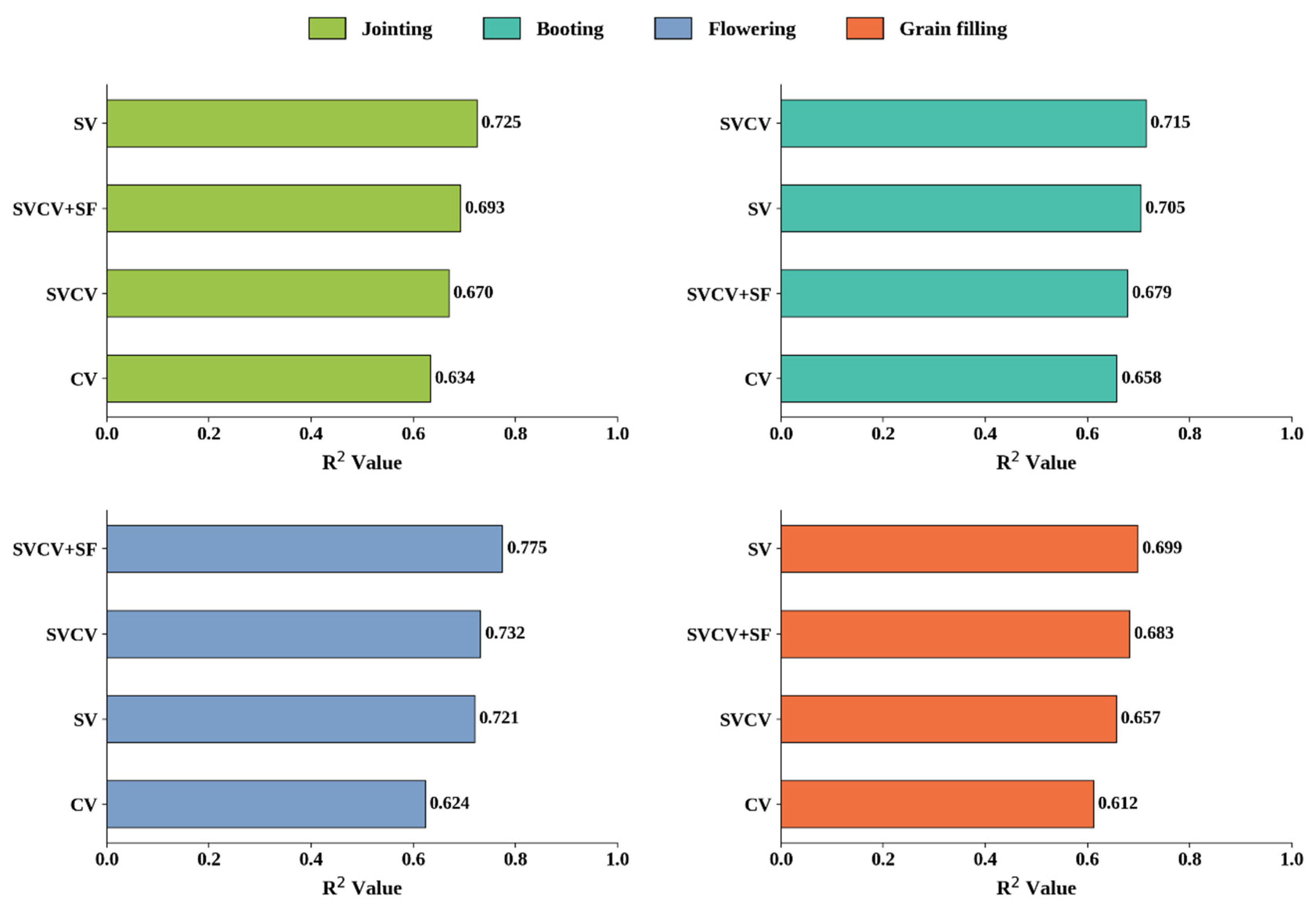
Single SV was gradually constrained by canopy closure, spike emergence, and enhanced shadow effects during the middle and late growth stages of winter wheat; therefore, multi-source feature fusion provides an important approach for improving AGB estimation accuracy. However, the gains from fusion did not occur synchronously across all growth stages, nor were they simply determined by an increase in variable number. As shown in Figure 13, SV performed best at the jointing stage, with a validation R2 of 0.725, higher than those of SVCV + SF (0.693) and SVCV (0.670). At the booting stage, SVCV showed a slight advantage, with an R2 of 0.715, only marginally higher than that of SV (0.705). At the flowering stage, SVCV + SF showed the most pronounced advantage, with an R2 of 0.775, markedly higher than those of SVCV (0.732) and SV (0.721). At the grain-filling stage, the highest value was still obtained by SV, with an R2 of 0.699, higher than those of SVCV + SF (0.683) and SVCV (0.657). These results indicate that the gains from multi-source fusion mainly depend on the complementarity among different information sources rather than variable stacking itself. Without effective selection and constraints, feature expansion may even weaken model performance due to the accumulation of redundant information [24,96]. Marzougui et al. [97] also found that the introduction of texture information did not lead to significant improvement in all scenarios during field pea yield estimation. Fei et al. [28] further reported that selected variable combinations achieved higher prediction accuracy than complete feature sets. These findings suggest that the key to improving model performance lies not in increasing the number of variables, but in achieving effective fusion of multi-source information through selection constraints.
Further comparison of the optimal models under different feature optimisation levels showed that the synergistic advantage of feature selection and multi-source fusion had clear stage-specific adaptability (Figure 11). At the jointing stage, the optimal model was R-SV + SF, with validation R2, RMSE, and RRMSE values of 0.872, 0.244, and 12.5%, respectively. At the booting stage, the optimal model was E-SV + R-CV + SF, with corresponding values of 0.898, 0.899, and 12.1%, respectively. At the flowering and grain-filling stages, the optimal model was R-SV + E-CV + SF. The R2, RMSE, and RRMSE values were 0.867, 1.285, and 14.3% at the flowering stage, and further reached 0.895, 1.552, and 12.0% at the grain-filling stage, respectively. These results indicate that no universal optimal feature combination existed across different growth stages of winter wheat, and that the gains brought by synergistic optimisation were more prominent during the middle and late growth stages. This may be because, as canopy spatial heterogeneity increased during the flowering and grain-filling stages, the ability of single SV to characterise AGB differences gradually weakened. CV could supplement visible phenotypic information such as leaf colour changes, spike emergence, and local chlorosis, while FVC, Gap, and Shadow in SF could provide additional information on canopy spatial status from the perspectives of coverage, porosity, and shadow distribution, thereby enhancing the characterisation of AGB variation under complex canopy conditions.
Zou et al. [89] reported that, after integrating spectral features, texture features, and plant height information for winter wheat LAI estimation, the R2 of the RF model increased from 0.74 to 0.85 and RMSE decreased from 0.99 to 0.78, while the R2 of the SVM model increased from 0.69 to 0.83 and RMSE decreased from 1.09 to 0.81. Yang et al. [98] introduced fused spectral and texture parameters for rice LAI estimation and achieved a maximum R2 increase of 0.166 and a maximum RMSE decrease of 0.147. These results indicate that the synergy between multi-source feature fusion and selection significantly promotes the estimation of crop phenotypic parameters, but the pattern of improvement varies markedly among growth stages. Therefore, feature optimisation for winter wheat AGB estimation should follow the principle of stage-specific adaptability.

4.4. Limitations and Future Perspectives

Four compost substitution treatments were applied, including chemical fertiliser only, 10% compost substitution, 20% compost substitution, and 30% compost substitution, in combination with three planting density levels of 1.5, 3.0, and 4.5 million plants ha−1, which generated clear differences in canopy development and AGB accumulation. However, the current experiment was conducted at a single site and with one winter wheat cultivar; therefore, the obtained models should be interpreted as stage-specific models under the present experimental conditions rather than universal models applicable to all regions and cultivars. In addition, FVC, Gap, and Shadow effectively described horizontal structural characteristics such as canopy coverage, gap distribution, and shadow variation, but they did not fully characterise three-dimensional canopy architecture. Future studies will further expand the experimental scale by including more winter wheat cultivars, different environmental regions, and contrasting cropping systems, such as rice–wheat and wheat–maize rotations. Advanced structural parameters, including canopy height models, canopy volume metrics, and UAV point-cloud features, will also be incorporated to further improve the robustness, transferability, and methodological completeness of UAV-based winter wheat AGB estimation.

5. Conclusions

This study demonstrated that there was no universally optimal feature combination for winter wheat AGB estimation across growth stages, and that the synergistic optimisation of feature selection and multi-source feature fusion was essential for improving model performance. The two-year field experiment showed that the treatment combining 20% compost substitution with a planting density of 4.5 million plants ha−1 maintained relatively high AGB levels, indicating the importance of integrating agronomic variability into UAV-based biomass monitoring. The optimal feature strategy varied with growth stage: selected spectral features combined with canopy structural features were more effective at the jointing stage, whereas cross-strategy fusion of selected spectral, colour, and structural features became more advantageous from booting to grain filling. Across the four growth stages, the stage-specific optimal models achieved validation R2 values of 0.867–0.898 and RRMSE values of 12.0–14.3%, indicating stable estimation performance. Overall, spectral features showed stronger representational capacity during the early growth stages, colour features provided complementary visible phenotypic information, and the contribution of canopy structural features became more pronounced during the middle and late growth stages. These findings highlight the importance of growth-stage-specific feature selection and multi-source fusion for UAV-based winter wheat AGB estimation and provide a methodological reference for multi-temporal biomass monitoring under similar field conditions.

6. Patents

A patent resulting from this work has been granted in the Republic of South Africa (Patent No. 2024/07428). The patent, titled “Method for Estimating Wheat Yield Based on Multispectral Images Acquired by UAV”, was filed by Anhui Science and Technology University and granted on 30 April 2025. The invention provides a non-destructive, high-precision approach for estimating wheat yield by integrating UAV-acquired multispectral imagery with machine learning algorithms, offering practical support for precision agricultural management.

Supplementary Materials

The following supporting information can be downloaded at: https://www.mdpi.com/article/10.3390/agronomy16121167/s1, Table S1: Parameter settings and search ranges for SVR model optimisation.

Author Contributions

Conceptualization, Z.Y., L.R. and Q.S.; Methodology, Z.Y. and L.Z.; Software, Z.Y. and K.L.; Validation, C.S. and W.H.; Formal Analysis, Z.Y. and C.S.; Investigation, Z.Y., L.Z., C.S., K.L. and W.H.; Resources, L.R. and Q.S.; Data Curation, Z.Y. and L.Z.; Writing—Original Draft Preparation, Z.Y.; Writing—Review and Editing, L.Z., L.R. and Q.S.; Visualization, Z.Y. and K.L.; Supervision, L.R. and Q.S.; Project Administration, L.R. and Q.S.; Funding Acquisition, Z.Y., L.R. and Q.S. All authors have read and agreed to the published version of the manuscript.

Funding

This work was supported by the Key Discipline Construction Fund for Crop Science of Anhui Science and Technology University, grant number XK-XJGF001; the New Era Education Quality Project (Graduate Education) of Anhui Provincial Department of Education, grant number 2025Xyjsxscx002; the Anhui Provincial Key Research and Development Project, grant number 2023n06020012; and the Talent Introduction Project of Anhui Science and Technology University, grant number NXYJ202501.

Data Availability Statement

The datasets generated and analysed during the current study are available from the corresponding authors upon reasonable request, as they will be used in subsequent related studies.

Conflicts of Interest

The authors declare no conflicts of interest.

References

  1. Shewry, P.R.; Hey, S.J. The contribution of wheat to human diet and health. Food Energy Secur. 2015, 4, 178–202. [Google Scholar] [CrossRef]
  2. Bastos, L.M.; Carciochi, W.; Lollato, R.P.; Jaenisch, B.R.; Rezende, C.R.; Schwalbert, R.; Prasad, P.V.V.; Zhang, G.; Fritz, A.K.; Foster, C.; et al. Winter wheat yield response to plant density as a function of yield environment and tillering potential: A review and field studies. Front. Plant Sci. 2020, 11, 54. [Google Scholar] [CrossRef]
  3. Geng, L.; Che, T.; Ma, M.; Tan, J.; Wang, H. Corn biomass estimation by integrating remote sensing and long-term observation data based on machine learning techniques. Remote Sens. 2021, 13, 2352. [Google Scholar] [CrossRef]
  4. Xie, Q.; Mayes, S.; Sparkes, D.L. Preanthesis biomass accumulation of plant and plant organs defines yield components in wheat. Eur. J. Agron. 2016, 81, 15–26. [Google Scholar] [CrossRef]
  5. Tao, Z.Q.; Wang, D.M.; Ma, S.K.; Yang, Y.S.; Zhao, G.C.; Chang, X.H. Light interception and radiation use efficiency response to tridimensional uniform sowing in winter wheat. J. Integr. Agric. 2018, 17, 566–578. [Google Scholar] [CrossRef]
  6. Parry, M.A.J.; Reynolds, M.; Salvucci, M.E.; Raines, C.; Andralojc, P.J.; Zhu, X.G.; Price, G.D.; Condon, A.G.; Furbank, R.T. Raising yield potential of wheat. II. Increasing photosynthetic capacity and efficiency. J. Exp. Bot. 2011, 62, 453–467. [Google Scholar] [CrossRef] [PubMed]
  7. Han, S.; Zhao, Y.; Cheng, J.; Zhao, F.; Yang, H.; Feng, H.; Li, Z.; Ma, X.; Zhao, C.; Yang, G. Monitoring Key Wheat Growth Variables by Integrating Phenology and UAV Multispectral Imagery Data into Random Forest Model. Remote Sens. 2022, 14, 3723. [Google Scholar] [CrossRef]
  8. Zhang, F.; Zhang, D.; Li, L.; Zhang, Z.; Liang, X.; Wen, Q.; Chen, G.; Wu, Q.; Zhai, Y. Effect of planting density on canopy structure, microenvironment, and yields of uniformly sown winter wheat. Agronomy 2023, 13, 870. [Google Scholar] [CrossRef]
  9. Serrano, L.; Filella, I.; Peñuelas, J. Remote sensing of biomass and yield of winter wheat under different nitrogen supplies. Crop Sci. 2000, 40, 723–731. [Google Scholar] [CrossRef]
  10. Lyu, X.; Zhang, H.; Chen, Z.; Jiao, Y.; Du, W.; Zhang, X.; Luo, J.; Zhang, E. Winter wheat aboveground-biomass estimation and its dynamic variation during coal mining—Assessing by unmanned aerial vehicle-based remote sensing. Agronomy 2024, 14, 1330. [Google Scholar] [CrossRef]
  11. Shi, Z.; Mao, T.; Ma, L.; Pan, H.; Liu, J.; Wang, D.; Yang, L.; Zhai, Y. Effects of delayed application of nitrogen fertilizer on yield, canopy structure, and microenvironment of winter wheat with different planting densities. Agronomy 2025, 15, 502. [Google Scholar] [CrossRef]
  12. Omia, E.; Bae, H.; Park, E.; Kim, M.S.; Baek, I.; Kabenge, I.; Cho, B.K. Remote sensing in field crop monitoring: A comprehensive review of sensor systems, data analyses and recent advances. Remote Sens. 2023, 15, 354. [Google Scholar] [CrossRef]
  13. García-Martínez, H.; Pla, M.; Lloveras, J.; Villegas, D. Winter wheat plant density determination: Robust predictions across varied agronomic conditions using multiscale RGB imaging. Smart Agric. Technol. 2025, 11, 100921. [Google Scholar] [CrossRef]
  14. Han, L.; Yang, G.; Yang, H.; Xu, B.; Li, Z.; Yang, X. Modeling maize above-ground biomass based on machine learning approaches using UAV remote-sensing data. Plant Methods 2019, 15, 10. [Google Scholar] [CrossRef]
  15. Guo, Y.; He, J.; Zhang, H.; Shi, Z.; Wei, P.; Jing, Y.; Yang, X.; Zhang, Y.; Wang, L.; Zheng, G. Improvement of winter wheat aboveground biomass estimation using digital surface model information extracted from unmanned-aerial-vehicle-based multispectral images. Agriculture 2024, 14, 378. [Google Scholar] [CrossRef]
  16. Almeida-Ñauñay, A.F.; Tarquis, A.M.; López-Herrera, J.; Pérez-Martín, E.; Pancorbo, J.L.; Raya-Sereno, M.D.; Quemada, M. Optimization of soil background removal to improve the prediction of wheat traits with UAV imagery. Comput. Electron. Agric. 2023, 205, 107559. [Google Scholar] [CrossRef]
  17. Li, H.; Zhao, C.; Yang, G.; Feng, H. Variations in crop variables within wheat canopies and responses of canopy spectral characteristics and derived vegetation indices to different vertical leaf layers and spikes. Remote Sens. Environ. 2015, 169, 358–374. [Google Scholar] [CrossRef]
  18. Li, Y.; Li, C.; Cheng, Q.; Chen, L.; Li, Z.; Zhai, W.; Mao, B.; Chen, Z. Precision estimation of winter wheat crop height and above-ground biomass using unmanned aerial vehicle imagery and oblique photography point cloud data. Front. Plant Sci. 2024, 15, 1437350. [Google Scholar] [CrossRef]
  19. Wang, F.; Yang, M.; Ma, L.; Zhang, T.; Qin, W.; Li, W.; Zhang, Y.; Sun, Z.; Wang, Z.; Li, F.; et al. Estimation of above-ground biomass of winter wheat based on consumer-grade multi-spectral UAV. Remote Sens. 2022, 14, 1251. [Google Scholar] [CrossRef]
  20. Li, H.; Huang, C.; Zhang, Y.; Li, S.; Liu, Y.; Yang, K.; Lu, J. Estimating maize leaf area index using multi-source features derived from UAV multispectral imagery and machine learning models. Plants 2025, 14, 3534. [Google Scholar] [CrossRef]
  21. Atzberger, C.; Darvishzadeh, R. Optical remote sensing of crop biophysical and biochemical parameters: An overview of advances in sensor technologies and machine learning algorithms for precision agriculture. Comput. Electron. Agric. 2024, 218, 108730. [Google Scholar] [CrossRef]
  22. Guo, J.; Zeng, X.; Ma, Q.; Yuan, Y.; Zhang, N.; Lin, Z.; Yin, P.; Yang, H.; Liu, X.; Zhang, F. UAV-based yield prediction based on LAI estimation in winter wheat (Triticum aestivum L.) under different nitrogen fertilizer types and rates. Plants 2025, 14, 1986. [Google Scholar] [CrossRef]
  23. Liu, J.; Zhu, Y.; Song, L.; Su, X.; Li, J.; Zheng, J.; Zhu, X.; Ren, L.; Wang, W.; Li, X. Optimizing window size and directional parameters of GLCM texture features for estimating rice AGB based on UAV multispectral imagery. Front. Plant Sci. 2023, 14, 1284235. [Google Scholar] [CrossRef]
  24. Azizabadi, E.C.; El-Shetehy, M.; Cheng, X.; Youssef, A.; Badreldin, N. In-season potato nitrogen prediction using multispectral drone data and machine learning. Remote Sens. 2025, 17, 1860. [Google Scholar] [CrossRef]
  25. Derraz, R.; Muharam, F.M.; Nurulhuda, K.; Jaafar, N.A.; Yap, N.K. Ensemble and single algorithm models to handle multicollinearity of UAV vegetation indices for predicting rice biomass. Comput. Electron. Agric. 2023, 205, 107621. [Google Scholar] [CrossRef]
  26. Shao, G.; Han, W.; Zhang, H.; Wang, Y.; Zhang, L.; Niu, Y. Estimation of transpiration coefficient and aboveground biomass in maize using time-series UAV multispectral imagery. Crop J. 2022, 10, 1376–1385. [Google Scholar] [CrossRef]
  27. Yang, H.; Hu, Y.; Zheng, Z.; Qiao, Y.; Zhang, K.; Guo, T. Estimation of potato chlorophyll content from UAV multispectral images with stacking ensemble algorithm. Agronomy 2022, 12, 2318. [Google Scholar] [CrossRef]
  28. Fei, S.; Li, L.; Han, Z.; Chen, Z.; Xiao, Y. Combining novel feature selection strategy and hyperspectral vegetation indices to predict crop yield. Plant Methods 2022, 18, 119. [Google Scholar] [CrossRef]
  29. Rasel, S.M.; Chang, H.; Ralph, T.J.; Saintilan, N.; Diti, I.J. Application of feature selection methods and machine learning algorithms for saltmarsh biomass estimation using Worldview-2 imagery. Geocarto Int. 2021, 36, 1075–1099. [Google Scholar] [CrossRef]
  30. Rogers, C.W.; Dari, B.; Schroeder, K.L. Comparison of soil-test extractants for potassium, calcium, magnesium, sulfur, and micronutrients in Idaho soils. Agrosyst. Geosci. Environ. 2019, 2, 190067. [Google Scholar] [CrossRef]
  31. Zheng, H.; Ji, W.; Wang, W.; Lu, J.; Li, D.; Guo, C.; Yao, X.; Tian, Y.; Cao, W.; Zhu, Y.; et al. Transferability of models for predicting rice grain yield from unmanned aerial vehicle (UAV) multispectral imagery across years, cultivars and sensors. Drones 2022, 6, 423. [Google Scholar] [CrossRef]
  32. Bai, D.; Li, D.; Zhao, C.; Wang, Z.; Shao, M.; Guo, B. Estimation of soybean yield parameters under lodging conditions using rgb information from unmanned aerial vehicles. Front. Plant Sci. 2022, 13, 1012293. [Google Scholar] [CrossRef]
  33. Kang, Y.; Meng, Q.; Liu, M.; Zou, Y.; Wang, X. Crop classification based on red edge features analysis of GF-6 WFV data. Sensors 2021, 21, 4328. [Google Scholar] [CrossRef] [PubMed]
  34. Zhang, Y.; Ta, N.; Guo, S.; Chen, Q.; Zhao, L.; Li, F.; Chang, Q. Combining spectral and textural information from UAV RGB images for leaf area index monitoring in kiwifruit orchard. Remote Sens. 2022, 14, 1063. [Google Scholar] [CrossRef]
  35. Xue, J.; Su, B. Significant remote sensing vegetation indices: A review of developments and applications. J. Sens. 2017, 2017, 1353691. [Google Scholar] [CrossRef]
  36. Boiarskii, B.; Hasegawa, H. Comparison of NDVI and NDRE indices to detect differences in vegetation and chlorophyll content. J. Mech. Contin. Math. Sci. 2019, 4, 20–29. [Google Scholar] [CrossRef]
  37. Candiago, S.; Remondino, F.; De Giglio, M.; Dubbini, M.; Gattelli, M. Evaluating multispectral images and vegetation indices for precision farming applications from UAV images. Remote Sens. 2015, 7, 4026–4047. [Google Scholar] [CrossRef]
  38. Ahmad, I.S.; Reid, J.F. Evaluation of colour representations for maize images. J. Agric. Eng. Res. 1996, 63, 185–195. [Google Scholar] [CrossRef]
  39. Gitelson, A.A.; Gritz, Y.; Merzlyak, M.N. Relationships between leaf chlorophyll content and spectral reflectance and algorithms for non-destructive chlorophyll assessment in higher plant leaves. J. Plant Physiol. 2003, 160, 271–282. [Google Scholar] [CrossRef]
  40. Broge, N.H.; Mortensen, J.V. Deriving green crop area index and canopy chlorophyll density of winter wheat from spectral reflectance data. Remote Sens. Environ. 2002, 81, 45–57. [Google Scholar] [CrossRef]
  41. Gitelson, A.A.; Merzlyak, M.N.; Lichtenthaler, H.K. Quantitative estimation of chlorophyll-a using reflectance spectra: Experiments with autumn chestnut and maple leaves. J. Photochem. Photobiol. B Biol. 1994, 22, 247–252. [Google Scholar] [CrossRef]
  42. Feng, H.; Tao, H.; Li, Z.; Yang, G.; Zhao, C. Comparison of UAV RGB imagery and hyperspectral remote-sensing data for monitoring winter wheat growth. Remote Sens. 2022, 14, 4158. [Google Scholar] [CrossRef]
  43. Haboudane, D.; Miller, J.R.; Tremblay, N.; Zarco-Tejada, P.J.; Dextraze, L. Hyperspectral vegetation indices and novel algorithms for predicting green LAI of crop canopies: Modeling and validation in the context of precision agriculture. Remote Sens. Environ. 2004, 90, 337–352. [Google Scholar] [CrossRef]
  44. Haboudane, D.; Miller, J.R.; Pattey, E.; Zarco-Tejada, P.J.; Strachan, I.B. Integrated narrow-band vegetation indices for prediction of crop chlorophyll content for application to precision agriculture. Remote Sens. Environ. 2002, 81, 416–426. [Google Scholar] [CrossRef]
  45. Hatfield, J.L.; Prueger, J.H. Value of using different vegetative indices to quantify agricultural crop characteristics at different growth stages under varying management practices. Remote Sens. 2010, 2, 562–578. [Google Scholar] [CrossRef]
  46. Gitelson, A.A.; Gritz, Y.; Merzlyak, M.N. Estimating corn leaf chlorophyll concentration from leaf and canopy reflectance. Remote Sens. Environ. 2000, 74, 229–239. [Google Scholar] [CrossRef]
  47. Hansen, P.M.; Schjoerring, J.K. Reflectance measurement of canopy biomass and nitrogen status in wheat crops using normalized difference vegetation indices and partial least squares regression. Remote Sens. Environ. 2003, 86, 542–553. [Google Scholar] [CrossRef]
  48. Cao, Q.; Miao, Y.; Feng, G.; Gao, X.; Li, F.; Liu, B.; Yue, S.; Cheng, S.; Ustin, S.L.; Khosla, R. Active canopy sensing of winter wheat nitrogen status: An evaluation of two sensor systems. Comput. Electron. Agric. 2015, 112, 54–67. [Google Scholar] [CrossRef]
  49. Cao, Q.; Miao, Y.; Wang, H.; Huang, S.; Cheng, S.; Khosla, R.; Jiang, R. Non-destructive estimation of rice plant nitrogen status with Crop Circle multispectral active canopy sensor. Field Crops Res. 2013, 154, 133–144. [Google Scholar] [CrossRef]
  50. Cheng, Q.; Ding, F.; Xu, H.; Guo, S.; Li, Z.; Chen, Z. Quantifying corn LAI using machine learning and UAV multispectral imaging. Precis. Agric. 2024, 25, 1777–1799. [Google Scholar] [CrossRef]
  51. Datt, B.; McVicar, T.R.; Van Niel, T.G.; Jupp, D.L.; Pearlman, J.S. Preprocessing EO-1 Hyperion hyperspectral data to support the application of agricultural indexes. IEEE Trans. Geosci. Remote Sens. 2003, 41, 1246–1259. [Google Scholar] [CrossRef]
  52. Chen, A.; Orlov-Levin, V.; Meron, M. Applying high-resolution visible-channel aerial imaging of crop canopy to precision irrigation management. Agric. Water Manag. 2019, 216, 196–205. [Google Scholar] [CrossRef]
  53. Meyer, G.E.; Neto, J.C. Verification of color vegetation indices for automated crop imaging applications. Comput. Electron. Agric. 2008, 63, 282–293. [Google Scholar] [CrossRef]
  54. Kang, Y.; Wang, Y.; Fan, Y.; Wu, H.; Zhang, Y.; Yuan, B.; Li, H.; Wang, S.; Li, Z. Wheat yield estimation based on unmanned aerial vehicle multispectral images and texture feature indices. Agriculture 2024, 14, 167. [Google Scholar] [CrossRef]
  55. Kerkech, M.; Hafiane, A.; Canals, R. Deep learning approach with colorimetric spaces and vegetation indices for vine diseases detection in UAV images. Comput. Electron. Agric. 2018, 155, 237–243. [Google Scholar] [CrossRef]
  56. Gitelson, A.A.; Kaufman, Y.J.; Stark, R.; Rundquist, D. Novel algorithms for remote estimation of vegetation fraction. Remote Sens. Environ. 2002, 80, 76–87. [Google Scholar] [CrossRef]
  57. Louhaichi, M.; Borman, M.M.; Johnson, D.E. Spatially Located Platform and Aerial Photography for Documentation of Grazing Impacts on Wheat. Geocarto Int. 2001, 16, 65–70. [Google Scholar] [CrossRef]
  58. Hunt, E.R., Jr.; Doraiswamy, P.C.; McMurtrey, J.E.; Daughtry, C.S.T.; Perry, E.M.; Akhmedov, B. A visible band index for remote sensing leaf chlorophyll content at the canopy scale. Int. J. Appl. Earth Obs. Geoinf. 2013, 21, 103–112. [Google Scholar] [CrossRef]
  59. Hunt, E.R., Jr.; Daughtry, C.S.T.; Eitel, J.U.H.; Long, D.S. Remote sensing leaf chlorophyll content using a visible band index. Agron. J. 2011, 103, 1090–1099. [Google Scholar] [CrossRef]
  60. Gamon, J.A.; Surfus, J.S. Assessing leaf pigment content and activity with a reflectometer. New Phytol. 1999, 143, 105–117. [Google Scholar] [CrossRef]
  61. Wang, X.; Wang, M.; Wang, S.; Wu, Y. Extraction of vegetation information from visible unmanned aerial vehicle images. Trans. Chin. Soc. Agric. Eng. 2015, 31, 152–159. [Google Scholar] [CrossRef]
  62. Yin, C.; Wang, Z.; Lv, X.; Qin, S.; Ma, L.; Zhang, Z.; Tang, Q. Reducing soil and leaf shadow interference in UAV imagery for cotton nitrogen monitoring. Front. Plant Sci. 2024, 15, 1380306. [Google Scholar] [CrossRef]
  63. Chen, X.; Sun, Y.; Qin, X.; Cai, J.; Cai, M.; Hou, X.; Yang, K.; Zhang, H. Assessing the potential of UAV for large-scale fractional vegetation cover mapping with satellite data and machine learning. Remote Sens. 2024, 16, 3587. [Google Scholar] [CrossRef]
  64. Peña, J.M.; Torres-Sánchez, J.; Serrano-Pérez, A.; de Castro, A.I.; López-Granados, F. An automatic object-based method for optimal thresholding in UAV images: Application for vegetation detection in herbaceous crops. Comput. Electron. Agric. 2015, 114, 43–52. [Google Scholar] [CrossRef]
  65. Otsu, N. A threshold selection method from gray-level histograms. IEEE Trans. Syst. Man Cybern. 1979, 9, 62–66. [Google Scholar] [CrossRef]
  66. Kuhn, M. Building predictive models in R using the caret package. J. Stat. Softw. 2008, 28, 1–26. [Google Scholar] [CrossRef]
  67. Guyon, I.; Weston, J.; Barnhill, S.; Vapnik, V. Gene selection for cancer classification using support vector machines. Mach. Learn. 2002, 46, 389–422. [Google Scholar] [CrossRef]
  68. Friedman, J.H.; Hastie, T.; Tibshirani, R. Regularization paths for generalized linear models via coordinate descent. J. Stat. Softw. 2010, 33, 1–22. [Google Scholar] [CrossRef]
  69. Fei, S.; Hassan, M.A.; Ma, Y.; Shu, M.; Cheng, Q.; Li, Z.; Chen, Z.; Xiao, Y. Entropy weight ensemble framework for yield prediction of winter wheat under different water stress treatments using unmanned aerial vehicle-based multispectral and thermal data. Front. Plant Sci. 2021, 12, 730181. [Google Scholar] [CrossRef]
  70. Zhang, Y.; Chang, Q.; Chen, Y.; Liu, Y.; Jiang, D.; Zhang, Z. Hyperspectral estimation of chlorophyll content in apple tree leaf based on feature band selection and the CatBoost model. Agronomy 2023, 13, 2075. [Google Scholar] [CrossRef]
  71. Lu, J.; Eitel, J.U.; Engels, M.; Zhu, J.; Ma, Y.; Liao, F. Improving Unmanned Aerial Vehicle (UAV) remote sensing of rice plant potassium accumulation by fusing spectral and textural information. Int. J. Appl. Earth Obs. Geoinf. 2021, 104, 102592. [Google Scholar] [CrossRef]
  72. Liu, J.; Zhu, Y.; Tao, X.; Chen, X.; Li, X. Rapid prediction of winter wheat yield and nitrogen use efficiency using consumer-grade unmanned aerial vehicles multispectral imagery. Front. Plant Sci. 2022, 13, 1032170. [Google Scholar] [CrossRef]
  73. Smola, A.J.; Schölkopf, B. A tutorial on support vector regression. Stat. Comput. 2004, 14, 199–222. [Google Scholar] [CrossRef]
  74. Sun, C.; Zhang, W.; Zhao, G.; Wu, Q.; Liang, W.; Ren, N.; Cao, H.; Zou, L. Mapping rapeseed (Brassica napus L.) aboveground biomass in different periods using optical and phenotypic metrics derived from UAV hyperspectral and RGB imagery. Front. Plant Sci. 2024, 15, 1504119. [Google Scholar] [CrossRef]
  75. Zhang, J.; Zhang, Z.; Neng, F.; Xiong, S.; Wei, Y.; Cao, R.; Wei, Q.; Ma, X.; Wang, X. Canopy light distribution effects on light use efficiency in wheat and its mechanism. Front. Ecol. Evol. 2022, 10, 1023117. [Google Scholar] [CrossRef]
  76. Ho, T.T.K.; Tra, V.T.; Nguyen, P.T.; Le, T.H.; Vo, T.D.H.; Nguyen, N.K.Q.; Thai, V.N.; Tran, C.S.; Bui, X.T. Compost to improve sustainable soil cultivation and crop productivity. Case Stud. Chem. Environ. Eng. 2022, 6, 100211. [Google Scholar] [CrossRef]
  77. Geisseler, D.; Harmon, M.; Smith, R.F.; Brennan, E.B. Predicting soil nitrogen dynamics after incorporating cereal cover crop residues. Nutr. Cycl. Agroecosyst. 2026, 132, 1. [Google Scholar] [CrossRef]
  78. Rosso, P.; Nendel, C.; Gilardi, N.; Udroiu, C.; Chlebowski, F. Processing of remote sensing information to retrieve leaf area index in barley: A comparison of methods. Precis. Agric. 2022, 23, 1449–1472. [Google Scholar] [CrossRef]
  79. Wang, W.; Zheng, H.; Wu, Y.; Yao, X.; Zhu, Y.; Cao, W. An assessment of background removal approaches for improved estimation of rice leaf nitrogen concentration with unmanned aerial vehicle multispectral imagery at various observation times. Field Crop. Res. 2022, 283, 108543. [Google Scholar] [CrossRef]
  80. Xue, L.; Su, B.; Li, J. Winter wheat biomass estimation based on spectral indices, band depth analysis and partial least squares regression using hyperspectral measurements. Comput. Electron. Agric. 2014, 100, 51–59. [Google Scholar] [CrossRef]
  81. Li, Y.; Zhao, B.; Wang, J.; Li, Y.; Yuan, Y. Winter wheat yield estimation based on multi-temporal and multi-sensor remote sensing data fusion. Agriculture 2023, 13, 2190. [Google Scholar] [CrossRef]
  82. Thorp, K.R.; Wang, G.; Bronson, K.F.; Badaruddin, M.; Mon, J. Hyperspectral data mining to identify relevant canopy spectral features for estimating durum wheat growth, nitrogen status, and grain yield. Comput. Electron. Agric. 2017, 136, 1–12. [Google Scholar] [CrossRef]
  83. Prudnikova, E.; Savin, I.; Vindeker, G.; Grubina, P.; Shishkonakova, E.; Sharychev, D. Influence of soil background on spectral reflectance of winter wheat crop canopy. Remote Sens. 2019, 11, 1932. [Google Scholar] [CrossRef]
  84. Zhang, D.; Mansaray, L.R.; Jin, H.; Sun, H.; Kuang, Z.; Huang, J. A universal estimation model of fractional vegetation cover for different crops based on time series digital photographs. Comput. Electron. Agric. 2018, 151, 93–103. [Google Scholar] [CrossRef]
  85. Sadeghi-Tehran, P.; Virlet, N.; Hawkesford, M.J. A neural network method for classification of sunlit and shaded components of wheat canopies in the field using high-resolution hyperspectral imagery. Remote Sens. 2021, 13, 898. [Google Scholar] [CrossRef]
  86. Mutanga, O.; Masenyama, A.; Sibanda, M. Spectral saturation in the remote sensing of high-density vegetation traits: A systematic review of progress, challenges, and prospects. ISPRS J. Photogramm. Remote Sens. 2023, 198, 297–309. [Google Scholar] [CrossRef]
  87. Fan, Y.; Feng, H.; Chen, R.; Liu, Y.; Meng, Y.; Fan, J.; Bian, M.; Ma, Y.; Yang, G.; Zhao, C. Decoupling canopy structure effects from vegetation indices for robust assessment of potato plant nitrogen content across growth stages. Artif. Intell. Agric. 2026; in press. [CrossRef]
  88. Ma, H.; Liu, Y.; Jiang, S.; Zhao, Y.; Yang, C.; An, X.; Zhang, K.; Cui, H. Winter wheat canopy height estimation based on the fusion of LiDAR and multispectral data. Agronomy 2025, 15, 1094. [Google Scholar] [CrossRef]
  89. Zou, M.; Liu, Y.; Fu, M.; Li, C.; Zhou, Z.; Meng, H.; Xing, E.; Ren, Y. Combining spectral and texture feature of UAV image with plant height to improve LAI estimation of winter wheat at jointing stage. Front. Plant Sci. 2023, 14, 1272049. [Google Scholar] [CrossRef]
  90. Iniyan, S.; Jebakumar, R. Mutual information feature selection (MIFS) based crop yield prediction on corn and soybean crops using multilayer stacked ensemble regression (MSER). Wirel. Pers. Commun. 2022, 126, 1935–1964. [Google Scholar] [CrossRef]
  91. Wu, Y.; Wu, P.; Wu, Y.; Yang, H.; Wang, B. Remote sensing crop recognition by coupling phenological features and off-center Bayesian deep learning. Remote Sens. 2023, 15, 674. [Google Scholar] [CrossRef]
  92. Li, Z.; Chen, Z.; Cheng, Q.; Duan, F.; Sui, R.; Huang, X.; Xu, H. UAV-based hyperspectral and ensemble machine learning for predicting yield in winter wheat. Agronomy 2022, 12, 202. [Google Scholar] [CrossRef]
  93. Xu, S.; Xu, X.; Blacker, C.; Gaulton, R.; Zhu, Q.; Yang, M.; Yang, G.; Zhang, J.; Yang, Y.; Yang, M.; et al. Estimation of leaf nitrogen content in rice using vegetation indices and feature variable optimization with information fusion of multiple-sensor images from UAV. Remote Sens. 2023, 15, 854. [Google Scholar] [CrossRef]
  94. Darst, B.F.; Malecki, K.C.; Engelman, C.D. Using recursive feature elimination in random forest to account for correlated variables in high dimensional data. BMC Genet. 2018, 19, 65. [Google Scholar] [CrossRef]
  95. Zou, H.; Hastie, T. Regularization and variable selection via the elastic net. J. R. Stat. Soc. Ser. B Stat. Methodol. 2005, 67, 301–320. [Google Scholar] [CrossRef]
  96. Li, B.; Xu, X.; Zhang, L.; Han, J.; Bian, C.; Li, G. Above-ground biomass estimation and yield prediction in potato by using UAV-based RGB and hyperspectral imaging. ISPRS J. Photogramm. Remote Sens. 2020, 162, 161–172. [Google Scholar] [CrossRef]
  97. Marzougui, A.; McGee, R.J.; Van Vleet, S.; Sankaran, S. Remote sensing for field pea yield estimation: A study of multi-scale data fusion approaches in phenomics. Front. Plant Sci. 2023, 14, 1111575. [Google Scholar] [CrossRef]
  98. Yang, K.; Gong, Y.; Fang, S.; Duan, B.; Yuan, N.; Peng, Y.; Wu, X.; Zhu, R. Combining spectral and texture features of UAV images for the remote estimation of rice LAI throughout the entire growing season. Remote Sens. 2021, 13, 3001. [Google Scholar] [CrossRef]
Figure 1. Location and overview of the study area. (a) Geographical location of Anhui Province within China; (b) Location of Fengyang County in Chuzhou City; (c) Field experimental site; (d) layout and plot numbering of the experiment; (e) surrounding environment of the experimental site. In panel (d), the coloured boxes indicate the experimental treatment layout, with T0, T1, T2, and T3 representing 0, 10%, 20%, and 30% compost substitution ratios for chemical fertiliser, respectively, and D1, D2, and D3 representing planting densities of 1.5, 3.0, and 4.5 million plants ha−1, respectively. The red box in panel (e) marks the precise location of the study area.
Agronomy 16 01167 g001
Figure 2. Meteorological conditions during the whole growth periods of winter wheat across the 2022–2024 growing seasons.
Agronomy 16 01167 g002
Figure 3. Example workflow for extraction of FVC, Gap and Shadow from UAV imagery. (a) RGB image; (b) ExG image derived from RGB to enhance vegetation signal; (c) NDVI-assisted interpretation for distinguishing vegetation, bare soil, and shadow; (d) Pixel classification results; (e) Fractional vegetation cover (FVC); (f) Canopy gap fraction (Gap); (g) Shadow proportion (Shadow). The blue dashed line in panel (d) indicates the Otsu threshold determined from the ExG histogram.
Agronomy 16 01167 g003
Figure 4. Flowchart of the feature selection and data fusion strategies employed in this study.
Agronomy 16 01167 g004
Figure 5. Variations in wheat AGB under different treatments. T, D, and T × D represent the effects of compost substitution ratio, planting density, and their interaction, respectively, based on analysis of variance. *, **, and ns indicate significance at p < 0.05, p < 0.01, and non-significance, respectively. Different lowercase letters above the bars indicate significant differences among planting density treatments within the same compost substitution treatment at p < 0.05.
Agronomy 16 01167 g005
Figure 6. Variable numbers of different feature sets across growth stages. (a) Number of variables retained after RFE and EN screening for different SV, CV and SVCV feature sets at each growth stage. (b) Numbers of variables in the original SV, CV, SVCV and SVCV + SF feature sets.
Agronomy 16 01167 g006
Figure 7. Comparison of SVR models for winter wheat AGB estimation based on feature selection strategies.
Agronomy 16 01167 g007
Figure 8. Comparison of SVR models for winter wheat AGB estimation after introducing canopy structural features.
Agronomy 16 01167 g008
Figure 9. Comparison of SVR models for winter wheat AGB estimation based on spectral–colour fusion and structural extension.
Agronomy 16 01167 g009
Figure 10. Comparison of SVR model performance for winter wheat AGB estimation under cross-strategy feature fusion and structural feature enhancement. (a) SVR model performance using cross-strategy combinations of spectral and colour features; (b) performance of the corresponding optimal models after introducing canopy structural features.
Agronomy 16 01167 g010
Figure 11. Scatter plots of observed vs. predicted wheat AGB for the optimal estimation models. (A) stage-specific optimal models based on feature selection strategies; (B) stage-specific optimal models after introducing canopy structural features (SF); (C) stage-specific optimal models based on spectral–colour fusion and structural extension; (D) stage-specific optimal models based on cross-strategy deep fusion.
Agronomy 16 01167 g011
Figure 12. Validation accuracy (R2) of AGB estimation models based on various feature selection algorithms at different growth stages.
Agronomy 16 01167 g012
Figure 13. Construction schemes of AGB estimation models using SV, CV, and SF datasets. SV denotes the initial spectral features, CV denotes the initial colour features, and SF denotes the canopy structural features. SV + CV represents the feature set formed by the fusion of spectral and colour features, while SV + CV + SF represents the feature set obtained by further incorporating canopy structural features.
Agronomy 16 01167 g013
Table 1. Fertiliser application rates under different treatments (kg ha−1).
TreatmentBasal ApplicationTopdressing
Compound
Fertiliser
UreaCalcium SuperphosphatePotassium SulfateOrganic FertiliserUrea
T06003002501200196
T15402702501203000196
T24802402501206000196
T34202102501209000196
The nutrient contents of the fertilisers were as follows: the compound fertiliser contained 15-15-15 of N-P2O5-K2O, urea contained 46% N, single superphosphate contained 12% P2O5, and potassium sulfate contained 52% K2O.
Table 2. Soil nutrient contents in the 0–20 cm topsoil layer during the 2022–2024 growing seasons.
YearOrganic Matter (g kg−1)Available Nitrogen (mg kg−1)Available Phosphorus (mg kg−1)Available Potassium (mg kg−1)
2022–202320.71110.7425.25115.34
2023–202419.65106.8727.45117.65
Table 3. Calculation formulas for vegetation indices.
ComponentVariableEquationReferences
Spectral VIsNDVI ( NIR Red ) / ( NIR + Red ) [36]
GNDVI ( NIR Green ) / ( NIR + Green ) [37]
NDRE ( NIR R E ) / ( NIR + RE ) [38]
CI NIR / RE 1 [39]
OSAVI 1.16 ( NIR Red ) / ( NIR + Red + 0.16 ) [40]
RVI NIR / Red [41]
SR Red Edge NIR / RE [42]
MSR NIR / Red 1 / ( NIR / Red + 1 ) [43]
RTVI core 100 × ( NIR RE ) 10 × ( NIR Green ) [44]
TCARI 3 × [ ( RE Red ) 0.2 × ( RE Green ) × ( RE R ) ] [45]
SAVI 1.5 × ( NIR Red ) / ( NIR + Red + 0.5 ) [46]
MCARI [ ( RE Red ) 0.2 × ( RE Green ) ] × ( RE R ) [47]
REGDVI RE G r e e n [48]
REOSAVI 1.16 × ( NIR RE ) / ( NIR + RE + 0.16 ) [49]
MTCI ( NIR RE ) / ( RE Red ) [50]
NLI ( NIR 2 Red ) / ( NIR 2 + Red ) [51]
GRVI ( Green R e d ) / ( Green + R e d ) [52]
Colour VIsExG 2 G R B [53]
ExR 1.4 R G [54]
ExGR 2 G R B ( 1.4 R G ) [55]
VARI G R / G + R B [56]
NGRDI G R / G + R [57]
GLI 2 G R B / 2 G + R + B [58]
TGI G 0.39 R 0.61 B [59]
MGRVI G 2 R 2 / G 2 + R 2 [57]
RGRI R / G [60]
RGBVI ( G 2 B × R ) / ( G 2 + B × R ) [61]
Here, B, G, R, RE, and NIR refer to the blue, green, red, red-edge, and near-infrared reflectance bands, respectively.
Table 4. Summary statistics of AGB in the calibration and validation datasets at different growth stages (t ha−1).
StageDatasetNMinMeanMaxSD
JointingCalibration360.771.833.470.63
Validation360.421.954.350.88
BootingCalibration363.087.7811.882.84
Validation363.337.4311.242.63
FloweringCalibration363.699.0717.853.54
Validation363.698.9614.723.25
Grain fillingCalibration364.2613.6324.965.98
Validation365.6112.9322.194.71
Table 5. Selected features from different feature combinations across growth stages using RFE and EN algorithms.
StageFeature SetNSelected Feature
JointingR-SV4LCI, SR Red Edge, TCARI, REGDVI
R-CV6ExG, ExR, ExGR, GLI, TGI, RGBVI
E-SV5GNDVI, TCARI, MCARI, INT, MTCI
E-CV4ExR, ExGR, NGRDI, RGBVI
R-SVCV10NDVI, NDRE, OSAVI, RTVIcore, REOSAVI, MTCI, GRVI, ExGR, NGRDI, MGRVI
E-SVCV12NDRE, OSAVI, RVI, MSR, RTVIcore, SAVI, ExG, ExGR, VARI, NGRDI, MGRVI, RGRI
BootingR-SV6GNDVI, TCARI, MCARI, INT, MTCI, GRVI
R-CV9ExG, ExR, ExGR, VARI, NGRDI, GLI, TGI, MGRVI, RGBVI
E-SV15NDVI, GNDVI, NDRE, LCI, OSAVI, RVI, SRRedEdge, TCARI, SAVI, MCARI, INT, REOSAVI, MTCI, NLI, GRVI
E-CV8ExR, ExGR, VARI, NGRDI, GLI, MGRVI, RGRI, RGBVI
R-SVCV9GNDVI, CI, RVI, MCARI, INT, REOSAVI, MTCI, GRVI, ExR
E-SVCV11GNDVI, CI, OSAVI, RVI, SRRedEdge, SAVI, MTCI, NLI, GVI, MGRVI, RGBVI
FloweringR-SV5GNDVI, REOSAVI, MTCI, GRVI, REGDVI
R-CV8ExG, ExR, ExGR, VARI, NGRDI, GLI, TGI, MGRVI
E-SV13GNDVI, NDRE, CI, OSAVI, SRRedEdge, TCARI, SAVI, MCARI, INT, REOSAVI, MTCI, NLI, GRVI
E-CV9ExG, ExR, ExGR, VARI, NGRDI, GLI, TGI, RGRI, RGBVI
R-SVCV5MCARI, NLI, ExR, GLI, RGRI
E-SVCV16GNDVI, TCARI, MCARI, INT, MTCI, NLI, GRVI, ExR, ExGR, VARI, NGRDI, GLI, TGI, MGRVI, RGRI, RGBVI
Grain fillingR-SV8GNDVI, REOSAVI, MTCI, GRVI, REGDVI
R-CV8ExG, ExR, ExGR, VARI, NGRDI, GLI, TGI, RGRI
E-SV11CI, RVI, SRRedEdge, MSR, TCARI, SAVI, MCARI, REGDVI, REOSAVI, MTCI, GRVI
E-CV6ExR, ExGR, VARI, NGRDI, MGRVI, RGRI
R-SVCV12NDVI, GNDVI, NDRE, CI, OSAVI, RVI, SRRedEdge, SAVI, MCARI, REGDVI, MTCI, MGRVI
E-SVCV9NDVI, NDRE, CI, RVI, SRRedEdge, NLI, GRVI, TGI, MGRVI
Table 6. Calibration and validation performance of different algorithms based on the stage-specific optimal feature combinations.
Growth StageFeature SetAlgorithmCalibrationValidation
R2RMSERRMSE (%)R2RMSERRMSE (%)
JointingR-SV + SFPLSR0.7620.33718.30.6780.53927.5
RF0.8530.36418.60.7180.36720.0
XGBoost0.8290.32216.40.6790.35119.1
SVR0.9260.23412.80.8720.24412.5
BootingE-SV + R-CV + SFPLSR0.8870.80411.00.8501.09014.7
RF0.8611.13715.40.6871.69323.3
XGBoost0.8681.11315.10.7471.54721.3
SVR0.9450.7079.10.8980.89912.1
FloweringR-SV + E-CV + SFPLSR0.8841.19913.30.7831.83920.2
RF0.7611.77419.80.7571.99721.9
XGBoost0.8011.63318.10.7412.03722.4
SVR0.9221.09912.10.8671.28514.3
Grain fillingR-SV + E-CV + SFPLSR0.8162.76020.60.6942.65821.3
RF0.7153.44925.80.5483.15525.3
XGBoost0.7173.43425.70.5383.14625.2
SVR0.9161.85613.60.8951.55212.0
Disclaimer/Publisher’s Note: The statements, opinions and data contained in all publications are solely those of the individual author(s) and contributor(s) and not of MDPI and/or the editor(s). MDPI and/or the editor(s) disclaim responsibility for any injury to people or property resulting from any ideas, methods, instructions or products referred to in the content.