Article

Narrow Row Spacing Improves Yield of Delayed-Sown Winter Wheat by Enhancing Pre-Winter Tiller Quality

1
College of Agronomy, Hebei Agricultural University, Baoding 071001, China
2
Key Laboratory of North China Water-Saving Agriculture, Ministry of Agriculture and Rural Affairs, Baoding 071001, China
3
State Key Laboratory of North China Crop Improvement and Regulation, Baoding 071001, China
4
College of Plant Protection, Hebei Agricultural University, Baoding 071001, China
5
College of Mining Engineering, North China University of Science and Technology, Tangshan 063009, China
6
Wheat Research Center, Shijiazhuang Academy of Agriculture and Forestry Sciences, Shijiazhuang 050041, China
7
Institute of Crop Science, Chinese Academy of Agricultural Sciences, Beijing 100081, China
8
State Key Laboratory of Crop Gene Resources and Breeding, Beijing 100081, China
9
School of Landscape and Ecological Engineering, Hebei University of Engineering, Handan 056038, China
*
Authors to whom correspondence should be addressed.
These authors contributed equally to this work.
Agronomy 2026, 16(12), 1166; https://doi.org/10.3390/agronomy16121166 (registering DOI)
Submission received: 3 May 2026 / Revised: 1 June 2026 / Accepted: 8 June 2026 / Published: 15 June 2026

Abstract

Delayed sowing frequently occurs in the North China Plain (NCP), restricting pre-winter population establishment and reducing grain yield. To determine whether narrow row spacing can alleviate yield loss under delayed sowing by improving the pre-winter stem and tiller basis, a randomized block experiment with two row spacings and four sowing-date regimes with adjusted planting density was conducted from 2021 to 2024. Yield components, pre-winter stem and tiller number and quality, and anatomical and physiological traits of the main-stem base and tiller nodes were measured. The results showed that 7.5 cm narrow row spacing (R2) increased tiller occurrence and improved hormonal balance and non-structural carbohydrate accumulation in the main-stem base and tiller nodes, and was associated with enhanced anatomical structural integrity and pre-winter stem and tiller quality. R2 increased final spike number, grain number per spike, thousand-grain weight, and grain yield by an average of 2.8%, 8.6%, 3.9%, and 10.7%, respectively, with the greatest yield increase under moderately delayed sowing (S2, 17.7%), and structural equation modeling (SEM) supported this possible yield-increasing pathway (χ2/df = 1.38, GFI = 0.90).These results provide a theoretical basis and technical reference for stabilizing and increasing yield in delayed-sown winter wheat in the NCP.

1. Introduction

Wheat (Triticum aestivum L.) is one of the most important food crops in modern agriculture and serves as a staple food for more than one-third of the global population [1,2]. The North China Plain (NCP) is a major winter wheat production region in China, producing about two-thirds of the national wheat output and playing an important role in ensuring regional food security [3,4]. However, under the winter wheat–summer maize double-cropping system in this region, wheat sowing date is often affected by the harvest time of the preceding maize crop, autumn rainfall, soil moisture, and the scheduling of field machinery operations [5,6]. Therefore, timely sowing cannot always be achieved. In recent years, delayed or extremely delayed sowing has become a common challenge in winter wheat production in this region [7]. Delayed sowing shortens the pre-winter vegetative growth period, reduces the available light and thermal resources for winter wheat, and thereby affects tiller occurrence, pre-winter population establishment, and dry matter accumulation [8]. Previous studies have shown that grain yield decreases by about 1% for each 1-day delay in winter wheat sowing [9]. This has become an important constraint on further improving winter wheat yield in the NCP.
To offset the adverse effects of delayed sowing, previous studies have examined several compensatory strategies. Shah et al. found that increasing the seeding rate could fully offset the yield loss caused by a 1-week delay in winter wheat sowing and could partially offset the yield reduction caused by a 2-week delay. However, when sowing was delayed by more than 2 weeks, increasing the seeding rate alone was no longer sufficient to overcome the adverse effects of delayed sowing [9]. Studies on extremely delayed sowing further showed that a high seeding rate combined with suitable cultivars and water management could still maintain yield to some extent by improving later-stage processes, such as harvest index, thousand-grain weight, post-anthesis dry matter accumulation, and deep soil water use [10]. Other studies have reported that a moderate increase in nitrogen input can partially compensate for the yield loss caused by delayed sowing in winter wheat [11]. Recent studies have further integrated sowing date, plant density, and nitrogen rate, suggesting that optimizing plant density and nitrogen rate can improve post-anthesis photosynthesis and nitrogen assimilation and alleviate yield loss under delayed sowing [8]. However, these compensatory strategies mainly focus on maintaining plant population size after sowing and improving dry matter production in spring or after anthesis to reduce final yield loss, while the effect of pre-winter stem and tiller quality on yield has often been overlooked.
In fact, wheat yield formation depends not only on the number of stems and tillers, but also on whether they can maintain strong growth vigor and develop into productive spikes [12,13]. Previous studies have shown that tiller occurrence and survival in wheat are jointly affected by genetic factors, nutrient supply, and hormonal regulation [14]. The main stem and early-formed lower-position tillers usually have greater spike-forming ability and higher single-spike yield potential, whereas late-formed, higher-position weak tillers are more likely to degenerate because of their disadvantage in resource competition [15,16]. It is generally considered that stems and tillers reaching a certain leaf age before winter have stronger growth vigor and greater capacity for dry matter accumulation [17]. Therefore, the number of stems and tillers with ≥3 leaves and stem and tiller biomass can be used as important indicators for evaluating pre-winter stem and tiller quality. In addition, the main stem develops from the plumule, and its basal region consists of a series of nodes and shortened internodes [18]. This region is important for tiller occurrence, root formation, and vascular connection [19]. Tillers arise from axillary buds at the basal nodes of the main stem and subsequently elongate, root, establish vascular connections, and transport assimilates through the tiller-node region [20,21,22]. Therefore, the morphophysiological status of the main stem base and tiller nodes directly affects assimilate allocation, stem and tiller growth, and final yield formation [23]. However, how cultivation practices can strengthen the morphophysiological basis of the main stem base and tiller nodes and thereby improve pre-winter stem and tiller quality remains poorly understood.
Optimizing the spatial arrangement of plant populations, especially through narrow row spacing, may provide a new compensatory strategy for delayed-sown wheat. Unlike simply increasing the seeding rate, narrow row spacing improves the spatial uniformity of plants at the same population density by reducing row spacing and increasing the spacing between plants within rows. This can alleviate intra-row competition and improve canopy light use and dry matter accumulation efficiency [24,25]. Previous studies have shown that, in winter wheat production in northern China, moderately reducing row spacing can increase grain yield without reducing grain number per spike or grain weight [26,27]. Studies on the interaction between row spacing and sowing date have also shown that delayed sowing significantly reduces wheat grain yield and tiller number, and that combinations of cultivation factors such as sowing date, seeding rate, and row spacing jointly affect final yield formation [28,29,30]. Further studies have found that 7.5 cm narrow row spacing combined with uniform plant spacing can significantly increase pre-winter tiller number and biomass, alter the hormonal status of tiller nodes, and ultimately increase spike number per unit area and grain weight [24]. This indicates that the effect of spatial optimization is not limited to increasing spike number. In addition, row-spacing arrangement can also affect root spatial distribution, soil nitrogen availability, canopy light interception, and radiation use efficiency [31,32]. These processes are closely related to pre-winter establishment and subsequent yield formation. Therefore, it is necessary to systematically analyze the continuous mechanism by which narrow row spacing improves stem and tiller quality and grain yield in delayed-sown winter wheat under a gradient of sowing dates, based on the morphophysiological basis of the main stem base and tiller nodes.
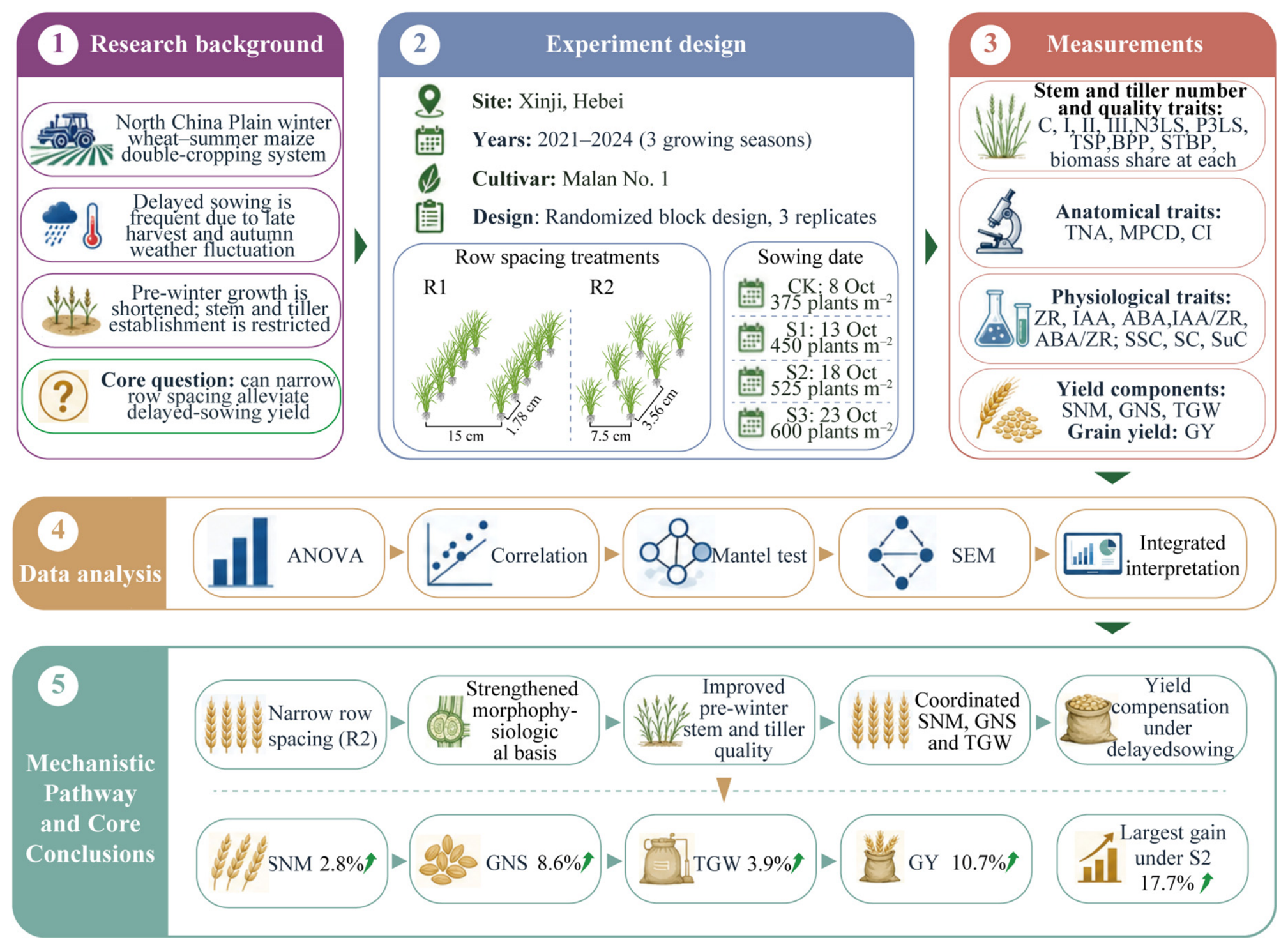
Based on these considerations, a field experiment with two row-spacing treatments across four sowing dates was conducted over three consecutive growing seasons to systematically evaluate the effects of narrow row spacing on the morphophysiological basis of the main stem base and tiller nodes before winter in delayed-sown winter wheat. The technical route of this study is shown in Figure 1. The main objectives were to: (i) determine the effects of narrow row spacing on grain yield and its components in winter wheat under different sowing dates; (ii) clarify the effects of narrow row spacing on the anatomical structure and physiological traits of the main-stem base and tiller nodes before winter; reveal the internal mechanism by which it improves pre-winter stem and tiller quality; and identify the possible pathway affecting yield formation. This study will help clarify the biological mechanism by which narrow row spacing alleviates yield loss under delayed sowing from the perspective of pre-winter stem and tiller quality formation, and will provide a theoretical basis and technical reference for optimizing population spatial arrangement and achieving stable and high yield in delayed-sown winter wheat in the NCP.

2. Materials and Methods

2.1. Experimental Site

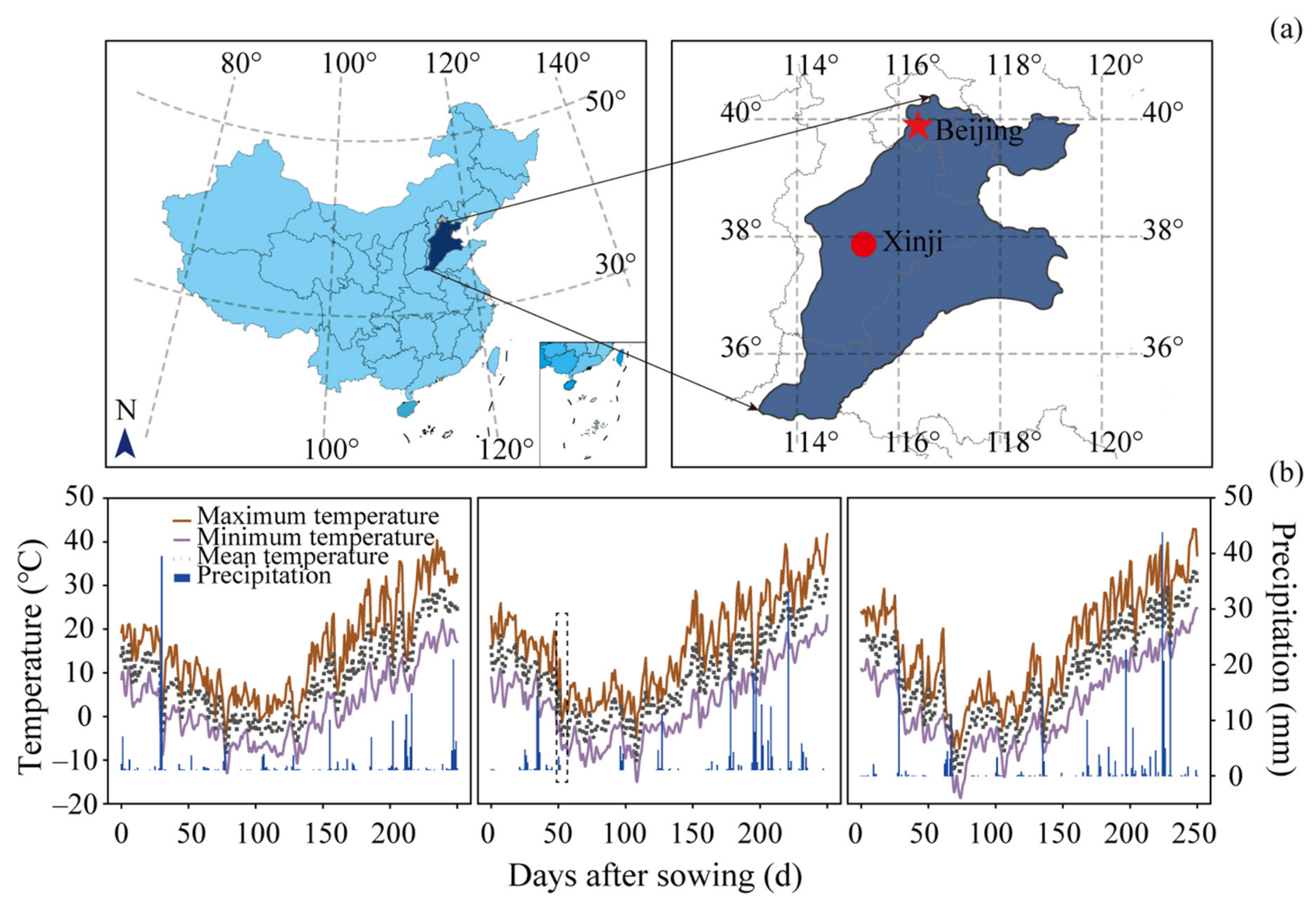
The experiment was conducted during three consecutive winter wheat growing seasons from 2021 to 2024 at the Malan Experimental Station in Xinji, Hebei Province, China (37°59′ N, 115°12′ E; Figure 2a). The experimental site has a warm temperate, semi-humid continental monsoon climate, with a mean annual temperature of 12.3 °C, mean annual precipitation of 488.0 mm, an altitude of 37 m, a frost-free period of 188 d, and mean annual sunshine duration of 2571 h. It is a typical winter wheat–summer maize double-cropping area in the NCP. The experimental field had cinnamon loam soil, and the previous crop was summer maize. Straw returning had been practiced in this field for many years. Before the experiment, the basic soil nutrient status in the 0–20 cm topsoil layer was measured, and the results are shown in Table 1. Daily temperature and precipitation data during the experimental period were obtained from the China Meteorological Data Service Center (http://data.cma.cn/, accessed on 10 February 2026), and their changes are shown in Figure 2b.

2.2. Experimental Design and Field Management

Malan 1, a winter wheat cultivar widely grown in the North China Plain (NCP), was used in this study. The experiment was arranged in a two-factor randomized complete block design with three replicates. The first factor was row spacing, including two levels: 15 cm (R1, conventional row spacing) and 7.5 cm (R2, narrow row spacing). The second factor was sowing-date regime with adjusted planting density, including four levels: 8 October at 375 plants m−2 (CK), October 13 at 450 plants m−2 (S1), 18 October at 525 plants m−2 (S2), and 23 October at 600 plants m−2 (S3). Each treatment was arranged in three replicate plots, with each plot measuring 80 m2.
Under the local winter wheat–summer maize double-cropping system, winter wheat is usually sown from early to mid-October. Based on recommendations from the local agricultural extension department, 8 October was used as the empirically suitable sowing date, and the other sowing dates were set at 5-day intervals, with planting density adjusted simultaneously, to cover different sowing-date scenarios encountered in actual production. Within each sowing date, the two row-spacing treatments had the same seeding rate to ensure consistent planting density. Therefore, the row-spacing effect was mainly interpreted through comparisons between R1 and R2 within the same sowing-date regime with adjusted planting density.
During each growing season, 240 kg N ha−1 was applied over the whole growth period, based on a yield target of 1.1 times the local mean yield over the previous five years (>650 kg ha−1) [33]. Half of the N fertilizer was applied as basal fertilizer at sowing, and the remaining half was topdressed at the jointing stage. Phosphorus and potassium fertilizers were applied once as basal fertilizers at rates of 120 kg P2O5 ha−1 and 120 kg K2O ha−1, respectively. The same fertilizer rates were applied to all treatments. Irrigation was applied at the jointing and anthesis stages, with the irrigation amount calculated to raise the soil water content to 90% of field capacity in the 0–80 cm soil layer [34]. Other field management practices followed local standard practices for high-yield wheat production.

2.3. Sampling and Measurement

2.3.1. Tiller Labeling and Investigation of Tiller Occurrence

From the emergence of the first tiller, 20 spatially dispersed 1-m double-row fixed labeling points with similar growth were selected in each plot, and the main stem and tillers at different tillering positions of plants within these labeling points were continuously labeled with colored cable ties. C represented the main stem, and I, II, and III represented the primary tillers arising from the axils of the first, second, and third leaves on the main stem, respectively, from bottom to top. The remaining tillers were not labeled. At the overwintering stage, 20 labeled wheat plants were sampled from each plot, and the number of tillers at each tillering position was recorded. The number of stems and tillers with ≥3 leaves per plant (N3LS) and the total number of stems and tillers per plant (TSP) were also determined. The percentage of stems and tillers with ≥3 leaves (P3LS) was calculated as follows:
P 3 LS = N 3 LS TSP × 100 %

2.3.2. Stem and Tiller Biomass

At the overwintering stage, 20 representative labeled plants with uniform growth were selected from each plot. The stems and leaves of the main stem and tillers at each tillering position were separated. The separated samples were heated at 105 °C for 30 min to deactivate enzymes and then oven-dried at 80 °C to a constant weight. The biomass at each stem or tiller position was calculated as the total dry weight of the corresponding stem and leaves. The biomass proportion of each stem or tiller position was calculated as the percentage of the biomass at that position relative to the total biomass per plant (BPP). Stem and tiller biomass per plant (STBP) was calculated as the total dry matter weight of the stems of all stems and tillers per plant.

2.3.3. Anatomical Structure of the Main-Stem Base and Tiller Nodes

At the overwintering stage, three labeled plants were selected from each plot, and the main-stem base and tiller nodes were collected for anatomical observation. Paraffin sections were prepared with reference to previous paraffin-section methods for observing wheat tillering nodes [35], and stained with hematoxylin and eosin (HE) following a standard histological staining procedure [36].
The procedure was as follows. First, the sections were baked at 70 °C for 5 min. They were then dewaxed in xylene I and xylene II for 10 min each, followed by treatment in absolute ethanol I and absolute ethanol II for 5 min each to remove residual xylene. The sections were then hydrated through an ethanol gradient by immersion in 95%, 85%, and 75% ethanol for 5 min each, and finally transferred to distilled water before staining. For staining, the sections were first stained with hematoxylin for 10 min, rinsed with tap water for 2 min, differentiated in 1% acid alcohol for 2 s, and then blued under running tap water for 15 min. After a quick rinse with distilled water, the sections were counterstained with eosin for 10 min. After staining, the sections were differentiated in 80% ethanol as needed according to staining intensity, dehydrated in 85% and 95% ethanol for 5 min each, and then dehydrated in two changes of absolute ethanol for 10 min each. The sections were subsequently cleared in xylene I and xylene II for 10 min each. The section thickness was 8 μm. For mounting, neutral balsam was applied to each section, and the section was sealed with a coverslip.
Finally, the sections were observed and photographed using an Olympus BX53 microscope equipped with a DP71 digital camera for the analysis of the total area of the main-stem base and tiller nodes (TNA), mean parenchyma cell diameter (MPCD), and cell integrity (CI). The determination of CI was performed with reference to the method for quantifying cell integrity based on the proportion of intact cells in the total number of cells observed in microscopic images [37]. Parenchyma cells with clear cell-wall boundaries, normal staining, and no obvious collapse or rupture were classified as intact cells. In addition, in this study, data for TNA, MPCD, and CI from different formed stem and tiller positions within the same treatment were pooled to characterize the overall anatomical status of the basal node region of plants under that treatment. This approach also avoided inconsistencies in stem and tiller positions caused by the absence of higher-position tillers under delayed sowing or by their failure to reach the occurrence criterion of more than 50% of plants in the field.

2.3.4. Physiological Traits of the Main-Stem Base and Tiller Nodes

  • Endogenous Hormone Contents
At the tillering and overwintering stages, three groups of 30 representative plants with uniform growth were selected from each plot. Tissues from the main-stem base and the tiller nodes of all formed tillers were collected. For each group, the main-stem base and tiller-node tissues were pooled as one biological sample. The samples were immediately frozen in liquid nitrogen and stored at −80 °C until analysis. The extraction and determination of zeatin riboside (ZR), indole-3-acetic acid (IAA), and abscisic acid (ABA) in the main-stem base and tiller nodes were performed with reference to the methods of Yang et al. [38] and Su et al. [39], with some modifications.
The detailed procedure was as follows. Frozen samples from the main-stem base and tiller nodes (0.50 g) were ground thoroughly into powder in liquid nitrogen. Then, 5 mL of precooled extraction solution, consisting of methanol, water, and formic acid at a ratio of 15:4:1 (v/v/v), was added. After mixing, the samples were extracted in the dark at 4 °C for 12 h. After extraction, the samples were centrifuged at 12,000 rpm for 15 min at 4 °C, and the supernatant was collected. The residue was re-extracted with 2 mL of the same extraction solution and centrifuged under the same conditions. The two supernatants were combined. The combined extract was purified using a C18 solid-phase extraction cartridge. The purified extract was then evaporated to near dryness under nitrogen at 35 °C, redissolved in 1.0 mL of 50% methanol, fully vortexed, and filtered through a 0.22 μm organic-phase membrane filter. The filtrate was used for UPLC–MS/MS analysis.
Hormone contents were determined using ultra-performance liquid chromatography–tandem mass spectrometry (UPLC–MS/MS). The chromatographic system was equipped with a C18 reversed-phase column (Waters ACQUITY UPLC BEH C18, 2.1 mm × 100 mm, 1.7 μm). Mobile phase A was 0.1% formic acid in water, and mobile phase B was acetonitrile. The gradient elution program was as follows: 0–1 min, 10% B; 1–5 min, 10–35% B; 5–8 min, 35–70% B; 8–9 min, 70–90% B; 9–10 min, 90% B; 10–10.5 min, 90–10% B; and 10.5–12 min, 10% B for column equilibration. The flow rate was 0.30 mL min−1, the column temperature was 35 °C, and the injection volume was 5 μL.
Mass spectrometry was performed using an electrospray ionization source (ESI). IAA and ABA were detected in negative ion mode, whereas ZR was detected in positive ion mode. Qualitative analysis was conducted based on the retention times and ion pairs of the corresponding standards, and quantitative analysis was performed using the external standard method. Standard curves were established using ZR, IAA, and ABA standards at a series of concentrations, and hormone contents in the samples were calculated based on peak areas. The results were expressed on a fresh weight basis as ng g−1 FW.
2.
Soluble Sugar, Sucrose, and Starch Contents
At the tillering and overwintering stages, three groups of 30 representative plants with uniform growth were selected from each plot. Tissues from the main-stem base and the tiller nodes of all formed tillers were collected. For each group, the main-stem base and tiller-node tissues were pooled as one biological sample. The samples were first heated at 105 °C for 30 min and then oven-dried at 80 °C to a constant weight. The dried samples were ground, passed through a 100-mesh sieve, sealed, and stored until analysis.
The detailed procedure was as follows. A dried sample from the main-stem base and tiller nodes (0.10 g) was weighed into a 10 mL centrifuge tube, and 5 mL of 80% ethanol was added. The sample was extracted in a water bath at 80 °C for 30 min, with intermittent shaking during extraction. After extraction, the sample was centrifuged at 4000 rpm for 10 min, and the supernatant was collected. The residue was extracted twice more with 5 mL of 80% ethanol each time. The three supernatants were combined and brought to a final volume of 25 mL. This solution was used as the extract for soluble sugar and sucrose determination.
Soluble sugar content (SSC) was determined using the anthrone–sulfuric acid colorimetric method. An appropriate volume of extract was transferred into a test tube and diluted with distilled water to a fixed volume. Anthrone reagent and concentrated sulfuric acid were then added. The mixture was heated in a boiling water bath for 10 min and cooled to room temperature, and the absorbance was measured at 620 nm. A standard curve was prepared using glucose standard solution, and soluble sugar content was calculated based on the absorbance of the sample. The results were expressed as mg g−1 DW.
Sucrose content (SuC) was determined using the resorcinol colorimetric method. An appropriate volume of ethanol extract was transferred into a test tube, followed by the addition of resorcinol reagent and hydrochloric acid solution. After mixing, the solution was incubated in a thermostatic water bath. After cooling to room temperature, the absorbance was measured at 480 nm. A standard curve was prepared using sucrose standard solution, and sucrose content was calculated based on the absorbance of the sample. The results were expressed as mg g−1 DW.
The residue after soluble sugar extraction was used for starch content (SC) determination. Distilled water was added to the centrifuged residue, and the mixture was gelatinized in a boiling water bath for 15 min. After cooling, 2 mL of 9.2 mol L−1 perchloric acid was added, and the sample was fully shaken and extracted for 15 min. Distilled water was then added for dilution, followed by centrifugation, and the supernatant was collected. The residue was extracted once again with 4.6 mol L−1 perchloric acid. The two extracts were combined and brought to a fixed volume with distilled water to obtain the starch extract. Starch content was also determined using the anthrone–sulfuric acid colorimetric method, and the results were expressed as mg g−1 DW.

2.3.5. Grain Yield and Yield Components

At wheat maturity, three representative 1 m2 quadrats were selected from each plot to determine spike number (SNM). Thirty spikes were randomly sampled from each quadrat and threshed, and the number of grains per spike was counted. The arithmetic mean was recorded as grain number per spike (GNS). The remaining spikes in each quadrat were then cut and threshed, and the total grain number of all spikes in each quadrat was determined using an automatic seed counting analysis system (SC-G, Wanshen, China). This value was recorded as grain number per square meter (GN). A 50 m2 area in each plot, including the three quadrats described above, was harvested using a Zurn 150 plot wheat harvester (Zürn Harvesting GmbH & Co. KG, Schöntal, Germany). The total grain weight, including both the harvested grain and the grain collected from the quadrats, was adjusted to a standard moisture content of 13% and expressed as final grain yield (GY). Three 1000-grain subsamples were taken from the harvested grain of each plot and weighed, and their mean value was recorded as thousand-grain weight (TGW).

2.3.6. Association Analysis of Key Traits and Path Analysis of Yield Formation

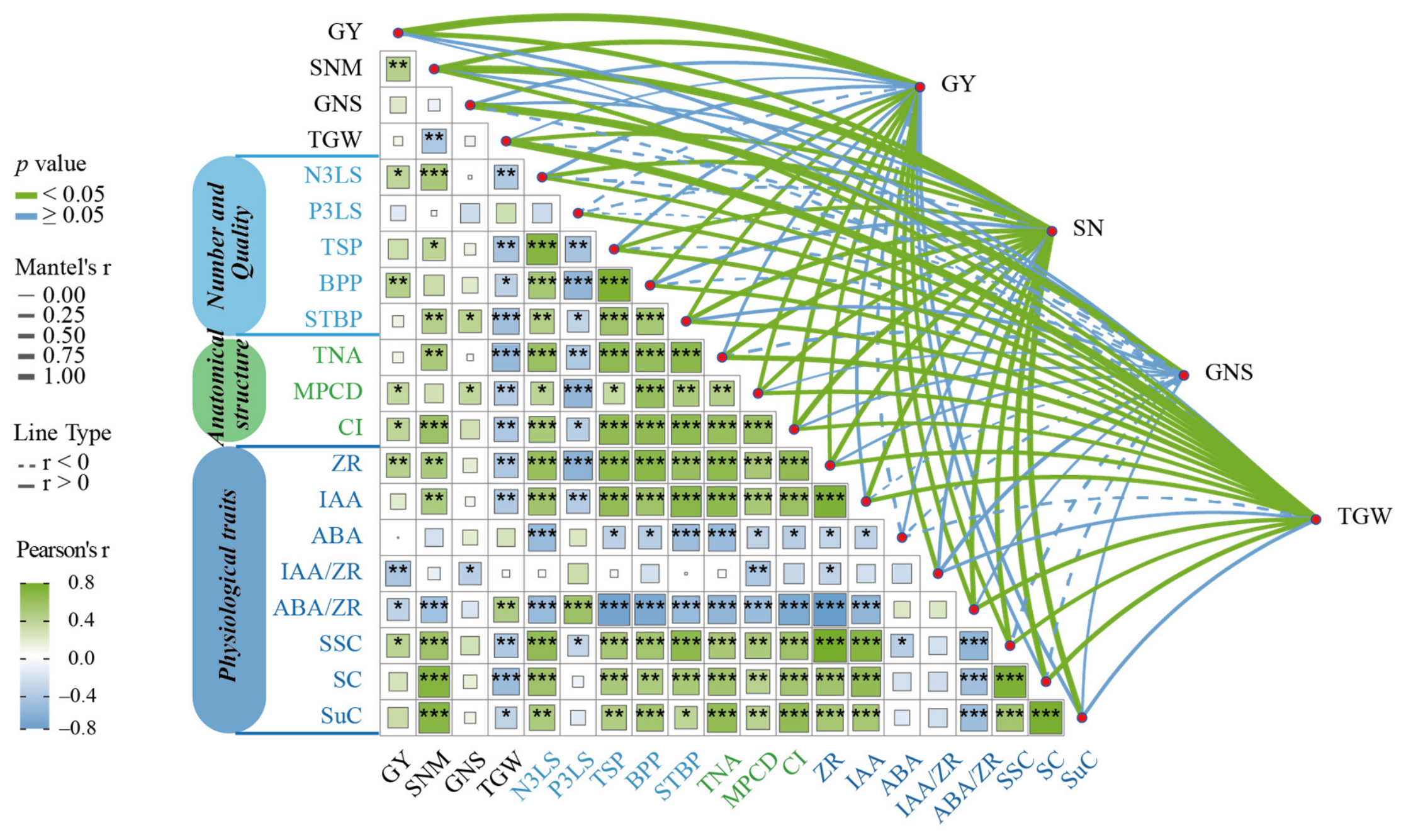
Pearson correlation analysis was performed among GY, yield components, and traits related to stem and tiller number and quality, anatomical structure, and physiological status at the overwintering stage. The significance of correlation coefficients was tested at p < 0.05. To further quantify the overall associations between different types of overwintering-stage traits and grain yield and its components, all variables were standardized using z-scores before analysis. Euclidean distance matrices were then constructed, and Mantel tests were used to evaluate the overall correlations between different trait modules and GY, SNM, GNS, and TGW, with no fewer than 999 permutations.
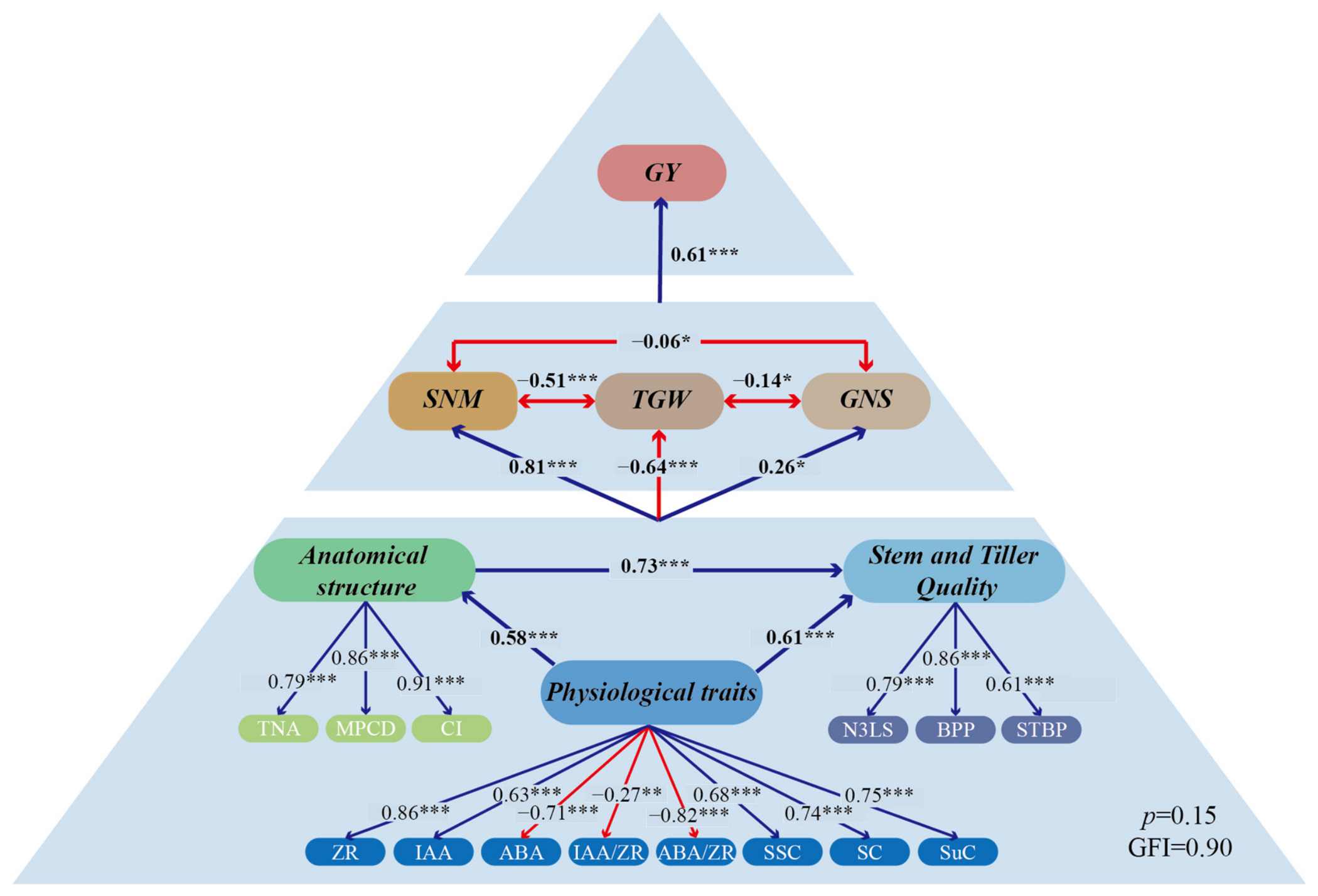
Based on the results of correlation and Mantel analyses, and considering the biological logic by which narrow row spacing regulates yield formation in winter wheat under different sowing dates, an SEM was constructed to identify the main pathways through which the morphophysiological basis of the main-stem base and tiller nodes affects yield formation. The SEM was constructed using all data from the three experimental seasons (n = 72). In model construction, the candidate traits were grouped into physiological traits, anatomical structure, stem and tiller quality, and yield components, with GY used as the final response variable. Specifically, the physiological traits construct included ZR, IAA, ABA, IAA/ZR, ABA/ZR, SSC, SC, and SuC; the anatomical structure construct included TNA, MPCD, and CI; and the stem and tiller quality construct included N3LS, BPP, and STBP. The yield–component variables included SNM, GNS, and TGW. In the model, the relationships between latent constructs and their observed indicators were represented by standardized indicator loadings, whereas the relationships among latent constructs, yield components, and GY were represented by standardized path coefficients. Model fit was evaluated using χ2/df, the χ2 test, GFI, CFI, and RMSEA. Non-significant paths in the initial model were removed according to the criterion of p ≥ 0.05, while maintaining biological interpretability and the overall model fit.

2.4. Statistical Analysis

Routine statistical analyses were performed using SPSS 26.0 (SPSS Inc., Chicago, IL, USA). Three-way analysis of variance (ANOVA) was used to test the effects of year (Y), sowing date (S), row spacing (R), and their interactions. Before ANOVA, the basic model assumptions were checked as follows: residual normality was evaluated using Q–Q plots and the Shapiro–Wilk test, homogeneity of variance was assessed using Levene’s test and residual-versus-fitted plots, and residual independence was checked based on the randomized block design and residual diagnostic plots. For datasets that met the assumptions of ANOVA, treatment means were compared using the LSD test at p < 0.05 when the F-test was significant. It should be noted that mean comparisons were conducted within each growing season, using the eight S × R treatment combinations as the comparison units.
Robustness analyses were performed to evaluate the effects of interannual environmental variation on GY and its components. First, a mixed-effects model was used for sensitivity analysis, in which S, R, and their interaction were treated as fixed effects, whereas Y, block nested within year, and year-related treatment interactions were treated as random effects. The model was specified as follows:
Trait ~ S × R + ( 1 | Y ) + ( 1 | Y : Block ) + ( 1 | Y : S ) + ( 1 | Y : R ) + ( 1 | Y : S : R )
Marginal R2 and conditional R2 were calculated to evaluate the proportion of variance explained by the fixed effects alone and by both fixed and random effects, respectively. Second, variance partitioning was performed for GY and its components to quantify the relative contributions of Y, S, R, S × R, year-related interactions, and residual variation to the total variation. Finally, correlations of GY and its components among different growing seasons were calculated to evaluate the consistency of treatment response patterns across years.
Correlation analysis, Mantel tests, structural equation modeling (SEM), and robustness analyses were performed in R (version 4.6.0; R Foundation for Statistical Computing, Vienna, Austria). Pearson correlation analysis and correlations among growing seasons were performed using the stats package in base R. Mantel tests were performed using the vegan package (version 2.7-5), SEM was performed using the lavaan package (version 0.6-21), mixed-effects models were fitted using the lme4 package (version 2.0-1), and marginal R2 and conditional R2 were calculated using the performance package (version 0.17.0). Figures and tables were prepared and arranged using Origin 2022 (OriginLab, Northampton, MA, USA) and Adobe Illustrator 2022 (Adobe Inc., San Jose, CA, USA).

3. Results

3.1. Effects of Narrow Row Spacing on Grain Yield and Yield Components of Winter Wheat Under Different Sowing Dates

GY and its related traits were significantly affected by Y, S, and R, and the S × R interaction was significant or highly significant for all traits (Table 2). Specifically, the mean GY in the 2022–2023 growing season was 12.8% lower than that in the other two seasons, which was mainly related to freezing damage before winter in that year (Figure 2b). After averaging across three growing seasons and two row-spacing treatments, compared with CK, S1 and S2 decreased SNM but significantly increased GNS and TGW, resulting in increases in GY by 3.8% and 4.0%, respectively. In contrast, S3 significantly decreased GN. Although TGW increased by 11.1%, GY still decreased by 12.6%. After averaging across three growing seasons and four sowing-date regimes, compared with R1, R2 generally increased SNM, GNS, GN, TGW, and GY, with mean increases of 2.8%, 8.6%, 11.6%, 3.9%, and 10.7%, respectively. The yield-increasing effect of R2 was most evident under S2, with a mean increase in GY of 17.7%.
The mixed-model sensitivity analysis showed that interannual environmental variation and block effects affected the absolute values of GY and its related traits, especially SNM and GY. The marginal R2 values for SNM and GY were 0.342 and 0.488, respectively, whereas their conditional R2 values increased to 0.993 and 0.976, respectively (Table A1). Variance partitioning further showed that Y had a large effect on SNM and GY, explaining 53.16% and 34.28% of the total variation, respectively. However, S, R, and the S × R interaction together still explained 45.50% and 58.50% of the variation in SNM and GY, respectively, and the contribution of Y to the other traits was lower than the combined contribution of S, R, and S × R (Table A2). In addition, GY and its related traits showed high correlations among different growing seasons. The R2 values for SNM and GY reached 0.945–0.959 and 0.710–0.894, respectively (Table A3). These results indicate that freezing damage in 2022–2023 mainly reduced the absolute levels of SNM and GY, but did not change the relative response patterns among treatments.

3.2. Effects of Narrow Row Spacing on Pre-Winter Stem and Tiller Composition in Winter Wheat Under Different Sowing Dates

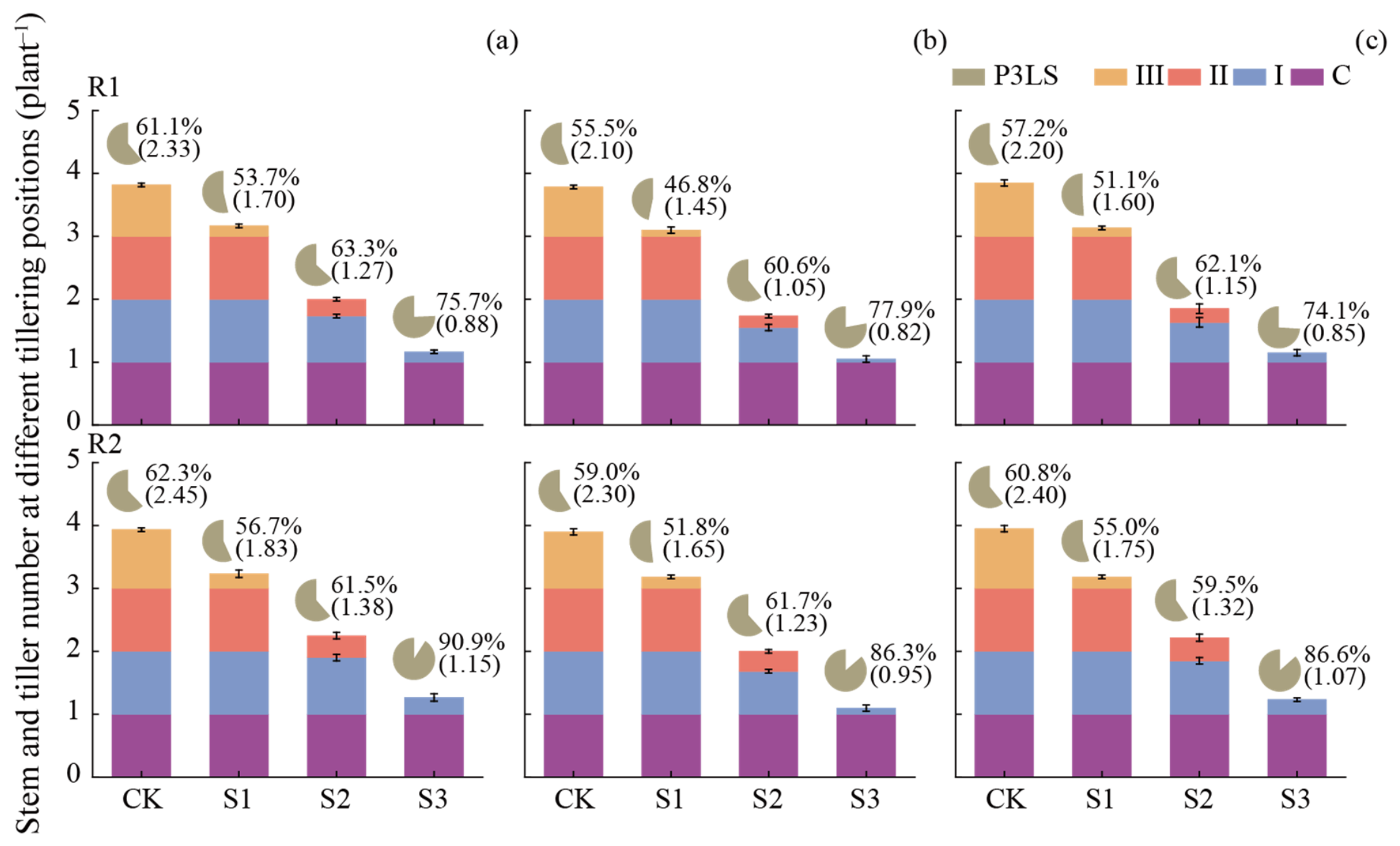
Pre-winter TSP and its components were significantly affected by Y, S, and R. Except for N3LS, the S × R interaction was significant or highly significant for all traits (Table A4). With delayed sowing, higher-position tillers decreased, indicating that pre-winter tiller occurrence and the formation of high-quality stems and tillers were clearly inhibited (Figure 3). Compared with CK, S1 decreased TSP and N3LS by 18.3% and 27.6%, respectively, and significantly reduced the number of III tillers. When sowing was delayed to S3, only a small number of I tillers were formed, and TSP and N3LS decreased by 70.0% and 58.5%, respectively. Compared with R1, R2 significantly increased the occurrence of the highest-position tillers under different sowing dates. Meanwhile, N3LS, P3LS, and TSP increased by 12.0%, 7.2%, and 5.5%, respectively, and the increases in pre-winter stem and tiller traits were greatest under S2 and S3.

3.3. Effects of Narrow Row Spacing on Stem and Tiller Biomass Accumulation and Allocation in Winter Wheat Under Different Sowing Dates

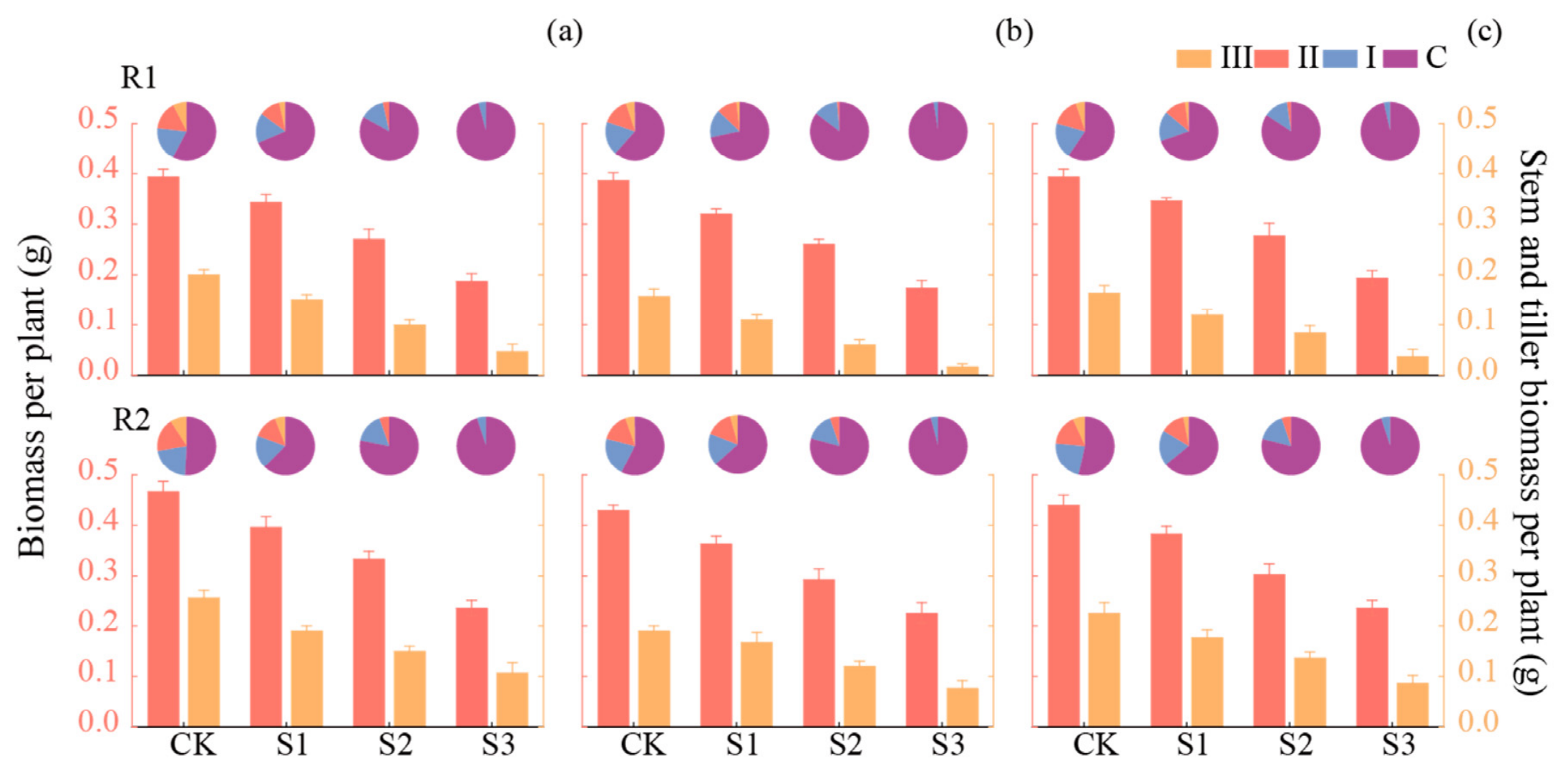
Pre-winter BPP, STBP, and the biomass proportions of different stems and tillers differed markedly among sowing dates and row spacings (Table A5). With delayed sowing, BPP and STBP continued to decrease, and biomass allocation gradually shifted toward the main stem (Figure 4). Compared with CK, S1 decreased BPP and STBP by 14.3% and 23.3%, respectively, and reduced the biomass proportion of III tillers by 46.1%. The decreases were further enlarged under S2 and S3, indicating a marked reduction in the biomass contribution of tillers. In addition, R2 significantly increased BPP and STBP, with mean increases of 16.1% and 52.8% compared with R1, respectively. Meanwhile, R2 decreased the biomass proportion of C by 6.2% and increased the biomass proportions of tillers at different tillering positions. The increases in STBP under R2 were greatest under S2 and S3, reaching 70.8% and 154.5%, respectively.

3.4. Effects of Narrow Row Spacing on the Anatomical Structure of the Main-Stem Base and Tiller Nodes in Winter Wheat Under Different Sowing Dates

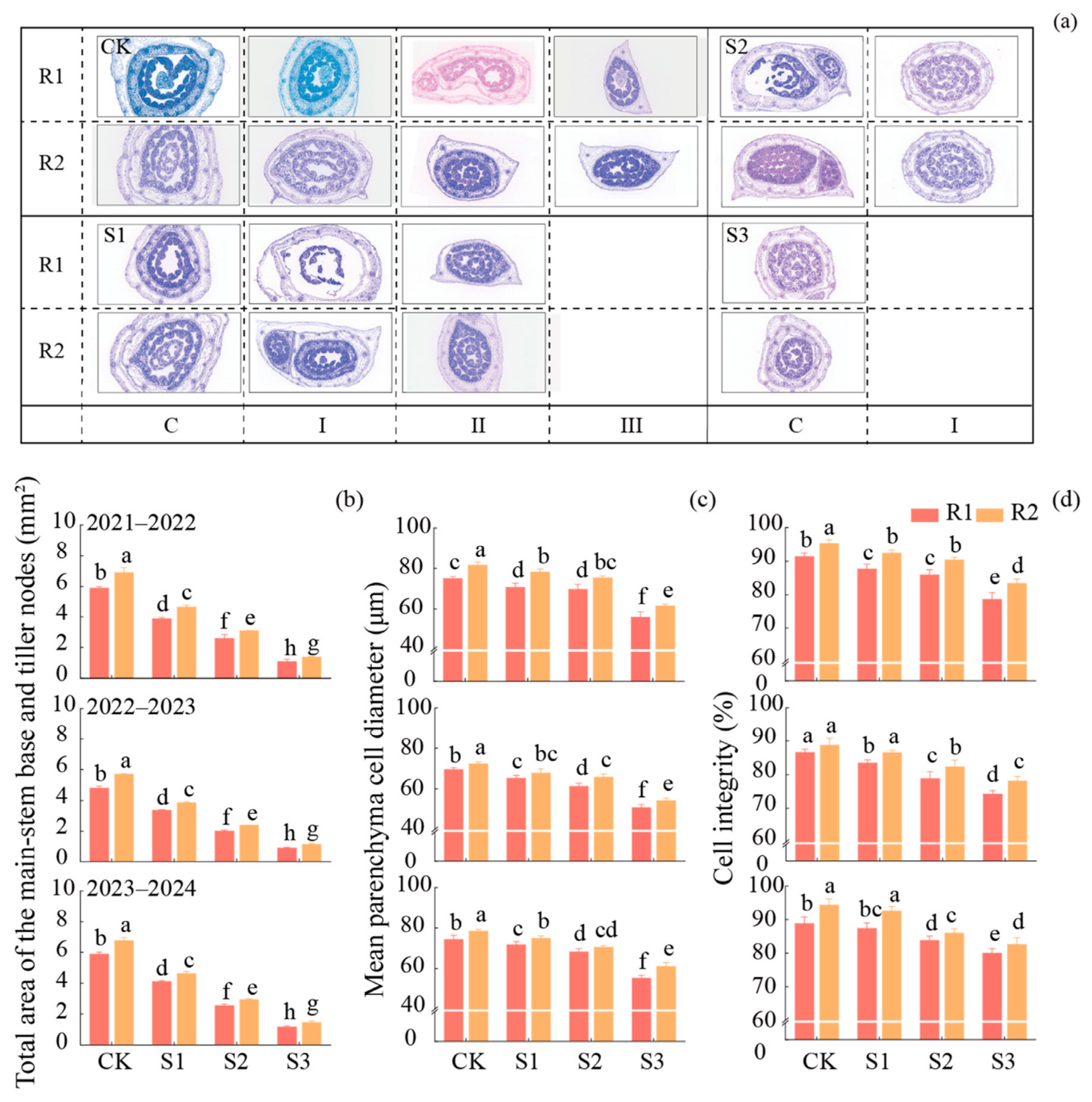
Further analysis of the anatomical characteristics of the main-stem base and tiller nodes showed that, at the same sowing date and tiller position, R2 generally had clearer vascular bundle outlines and more regular vascular bundle arrangement than R1. The xylem and phloem were better differentiated, the parenchyma was more compact, the intercellular spaces were relatively smaller, and no obvious cell damage was observed, indicating better cell integrity under R2 (Figure 5a). To highlight differences in stem and tiller quality rather than stem and tiller number among treatments, data from different stem and tiller positions were pooled for presentation (Figure 5b–d). Compared with CK, S1 decreased TNA, MPCD, and CI by 31.9%, 5.0%, and 2.8%, respectively, and the decreases were further enlarged under S2 and S3. In addition, compared with R1, R2 significantly increased TNA, MPCD, and CI by 17.4%, 6.8%, and 4.5%, respectively. The compensatory effect of R2 was more evident for TNA and MPCD under S3, with increases of 26.8% and 9.2%, respectively.

3.5. Effects of Narrow Row Spacing on the Physiological Status of the Main-Stem Base and Tiller Nodes Under Different Sowing Dates

3.5.1. Endogenous Hormone Contents in the Main-Stem Base and Tiller Nodes

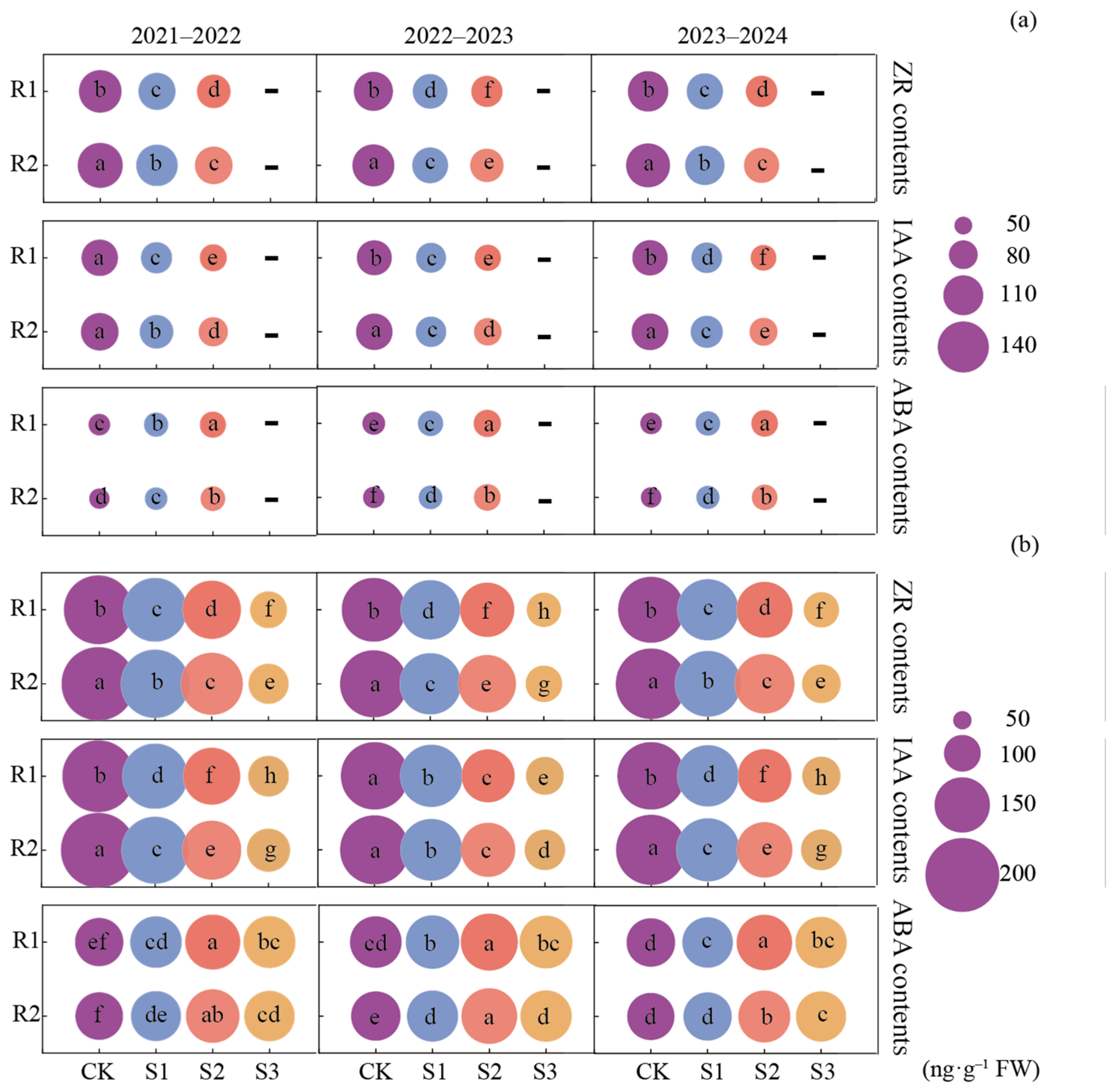
With delayed sowing, ZR and IAA contents in the main-stem base and tiller nodes gradually decreased at the tillering stage, whereas ABA content increased (Figure 6a). Compared with CK, S1 decreased ZR and IAA contents by 11.1% and 13.6%, respectively, and increased ABA content by 11.8%. Under S2, the decreases in ZR and IAA contents and the increase in ABA content were further enlarged. In addition, compared with R1, R2 significantly increased ZR and IAA contents by 8.2% and 5.2%, respectively, and decreased ABA content by 5.3% at the tillering stage. A similar trend was also observed at the overwintering stage (Figure 6b). Overall, the effect of R2 on maintaining growth-promoting hormone contents was more evident under S2 and S3. At the tillering stage, ZR and IAA contents under S2 increased by 10.1% and 7.5%, respectively; at the overwintering stage, ZR and IAA contents under S3 increased by 8.2% and 6.4%, respectively.

3.5.2. Endogenous Hormone Ratios in the Main-Stem Base and Tiller Nodes

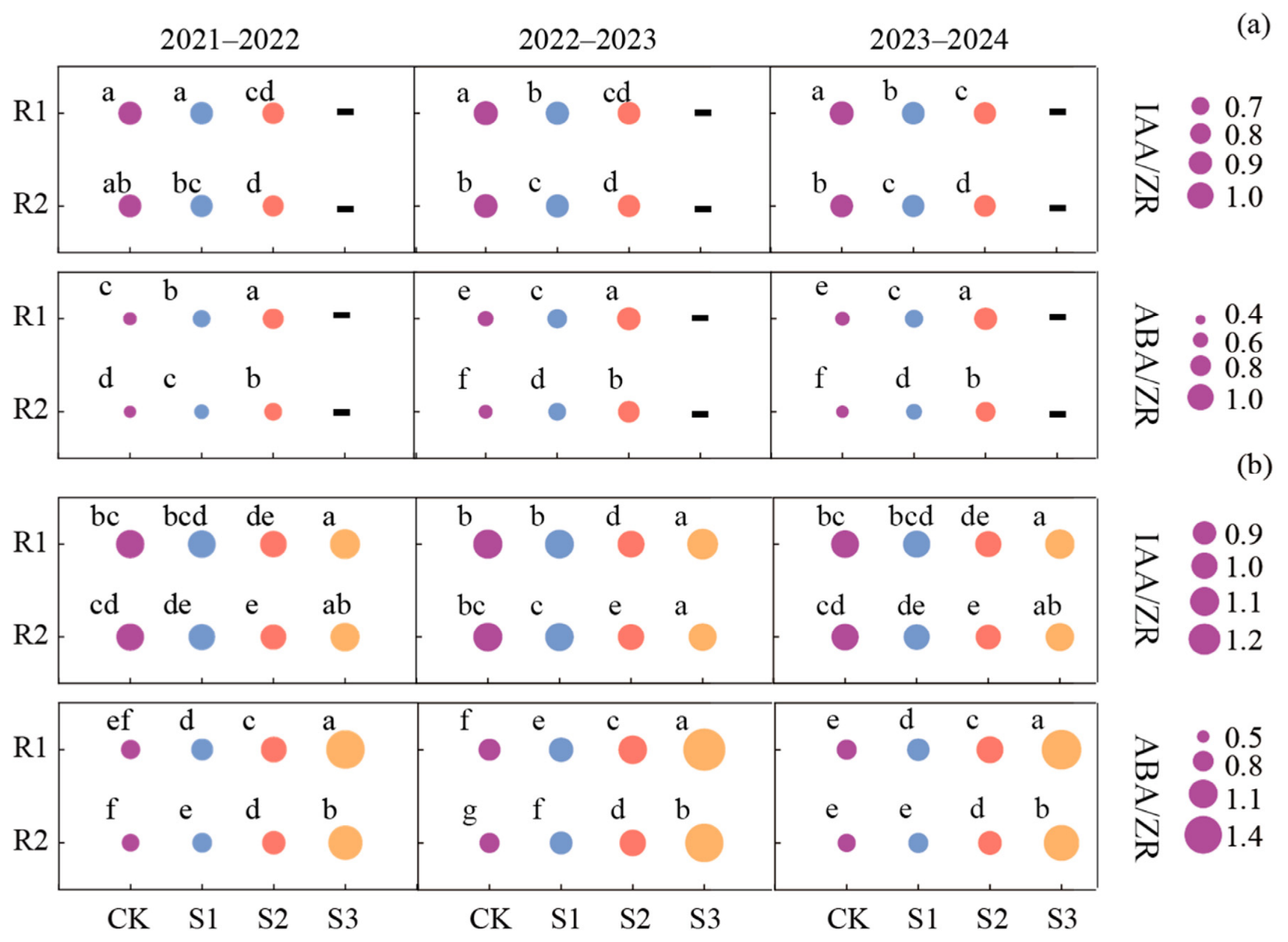
With delayed sowing, IAA/ZR gradually decreased at the tillering stage, whereas ABA/ZR increased significantly (Figure 7a). Compared with CK, S1 and S2 decreased IAA/ZR by 3.1% and 6.2%, respectively, but increased ABA/ZR by 26.6% and 53.8%, respectively. In addition, compared with R1, R2 significantly decreased IAA/ZR and ABA/ZR by 2.6% and 12.6%, respectively, at the tillering stage. A similar trend was also observed at the overwintering stage (Figure 7b). Overall, the effect of R2 on reducing the relative dominance of ABA was more evident. ABA/ZR decreased by 12.4% under S2 at the tillering stage and by 10.2% under S3 at the overwintering stage.

3.5.3. Non-Structural Carbohydrates in the Main-Stem Base and Tiller Nodes

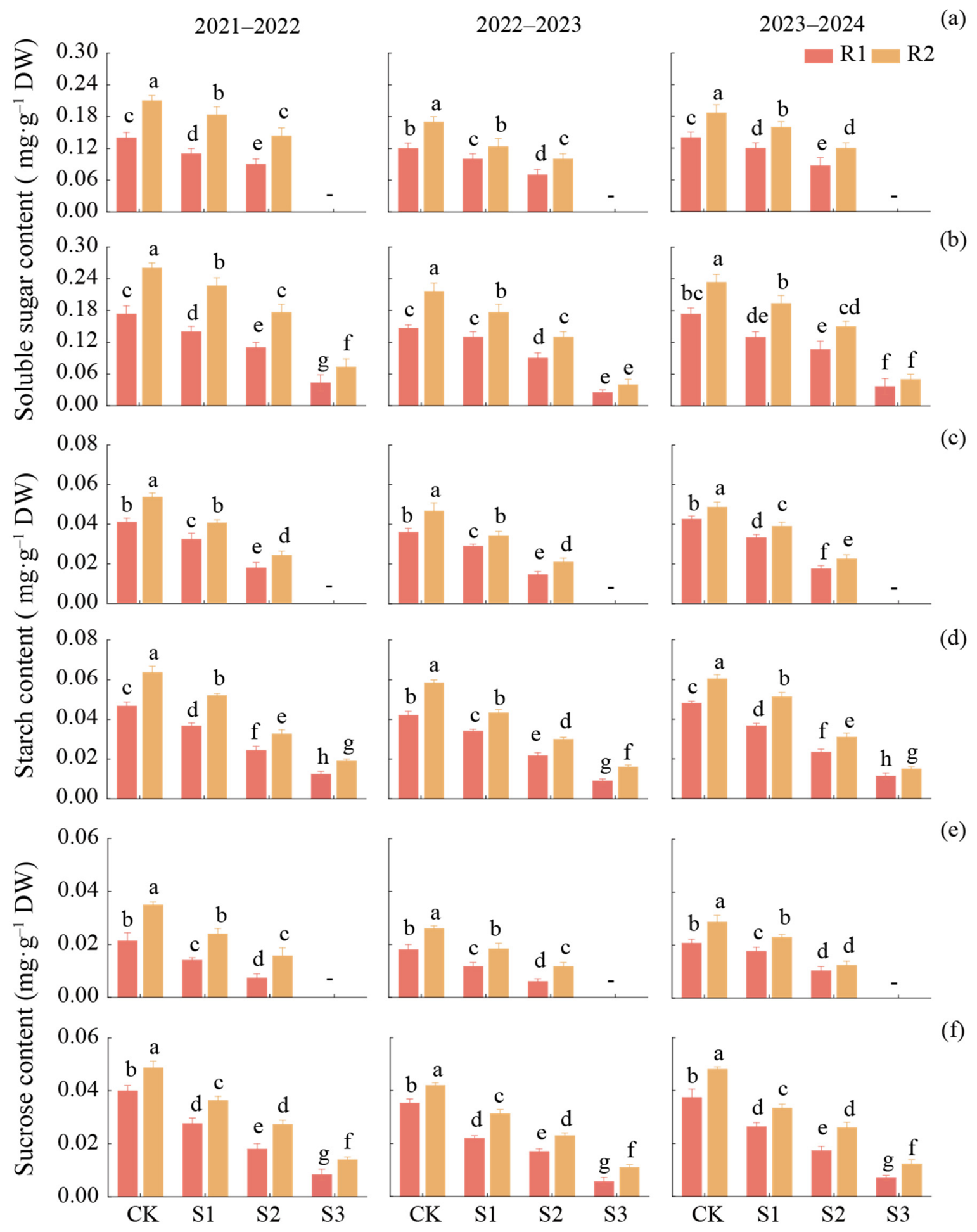
At the tillering stage, compared with CK, S1 decreased SSC, SC, and SuC by 18.6%, 23.0%, and 27.3%, respectively, while the decreases were further enlarged under S2 (Figure 8a,c,e). The same trend was observed at the overwintering stage, with NSC levels under delayed sowing being lower than those under CK. Among the delayed-sowing treatments, S3 showed the greatest decreases in SSC, SC, and SuC, by 77.5%, 74.3%, and 76.9%, respectively (Figure 8b,d,f). Compared with R1, R2 significantly increased NSC levels in the main-stem base and tiller nodes at both the tillering and overwintering stages, and this positive effect was greater under S2 and S3.

3.6. Associations Between the Morphophysiological Basis of the Main-Stem Base and Tiller Nodes and Yield Formation

3.6.1. Correlations and Overall Coupling Relationships Among Key Traits at the Overwintering Stage

Correlation analysis showed that GY was significantly positively correlated with SNM (r = 0.44 **), whereas SNM was significantly negatively correlated with TGW (r = −0.44 **) (Figure 9). Among the stem and tiller number and quality traits, N3LS was significantly positively correlated with both GY (r = 0.38 *) and SNM (r = 0.51 ***), and was also significantly positively correlated with TSP, BPP, and STBP. BPP was significantly positively correlated with GY (r = 0.44 **), whereas STBP was significantly positively correlated with SNM (r = 0.45 **) and GNS (r = 0.39 *). In contrast, P3LS was mostly negatively correlated with TSP, BPP, and STBP, suggesting that it mainly reflects proportional changes and cannot be used alone as a core indicator for evaluating pre-winter stem and tiller quality.
Anatomical traits showed strong positive correlations with N3LS, TSP, BPP, and STBP, indicating that they are important structural bases for the formation of pre-winter stem and tiller number and quality. Physiological traits further revealed the regulatory basis of this relationship. ZR, IAA, SSC, SC, and SuC were mostly significantly positively correlated with stem and tiller number and quality traits and anatomical traits, whereas ABA/ZR was significantly negatively correlated with most of these traits. The Mantel test showed that stem and tiller number and quality, anatomical traits, and physiological traits were generally associated with GY and its components, with denser associations observed with yield components. These results indicate that key pre-winter traits mainly affected final grain yield indirectly by regulating the coordination among yield components.

3.6.2. Path Analysis of the Possible Association Between the Morphophysiological Basis of the Main-Stem Base and Tiller Nodes and Yield Formation

The SEM showed an acceptable overall fit (χ2/df = 1.38, p = 0.15, GFI = 0.90, CFI = 0.95, RMSEA = 0.07). In the model, the standardized indicator loadings of all observed variables were significant, indicating that the selected indicators could effectively represent their corresponding latent constructs (Figure 10). Within the framework of the biological hypothesis, the SEM supported an overall association pathway of physiological traits–anatomical structure–stem and tiller quality–yield components–GY. The physiological traits and anatomical structure of the main-stem base and tiller nodes were positively associated with stem and tiller quality. Stem and tiller quality was further positively associated with SNM and GNS. Meanwhile, SNM was significantly negatively correlated with TGW, indicating a compensatory relationship between spike number and grain weight. Overall, the SEM results suggest that the yield increase under narrow row spacing may be associated with improved physiological status and anatomical structure of the main-stem base and tiller nodes, enhanced pre-winter stem and tiller quality, and further optimization of the trade-off relationships among SNM, GNS, and TGW.

4. Discussion

4.1. Narrow Row Spacing Improved Grain Yield by Enhancing Source Availability and Optimizing Yield–Component Relationships

First, it should be noted that CK was set as the empirically suitable sowing date according to local production practices, but it does not necessarily represent the optimum sowing date for each growing season. In fact, owing to interannual temperature fluctuations, the suitable sowing date for winter wheat may vary among years [40]. Therefore, we infer that the higher yield sometimes observed under S1 within R1 probably indicates that S1 was closer to the optimum sowing date in that year, whereas CK may have experienced a certain yield reduction due to early sowing. However, another possibility, which may be more consistent with the experimental setting, is that the planting density in CK was below the optimum level. In this case, the yield increase under S1 within R1 was mainly attributable to the positive effect of the increased planting density outweighing the negative effect of delayed sowing. However, the further increase in planting density under S2 led to excessive competition under R1, so that the increased density could no longer compensate for the additional sowing delay. In contrast, R2 partly alleviated this competition, allowing the increased planting density under S2 to translate into improved grain yield. This inference is consistent with previous findings that narrow row spacing can generally improve canopy light conditions, reduce competition, and thereby increase source availability and final grain yield [41].
In this context, R2 should be considered a cultivation practice that improves yield formation by reshaping source–sink relationships [42]. Furthermore, yield improvement can be achieved through different contributions of individual yield components, and trade-offs exist among these components [43]. Hussain et al. found that narrow row spacing increased yield mainly by increasing the number of productive tillers, whereas GNS and TGW were higher under wider row spacing [44]. In contrast, under delayed sowing with increased planting density, R2 in the present study did not show the common trade-off between increased SNM and reduced GNS and TGW. Instead, R2 simultaneously improved the three yield components within the same sowing date. This coordinated improvement may have resulted from the combined effects of narrow row spacing and moderately delayed sowing coupled with increased planting density. On the one hand, R2 altered the spatial distribution of the population and provided a more stable basis for SNM formation by increasing tiller number [24]; on the other hand, moderately delayed sowing itself may improve the potential for GNS formation by increasing grain number in upper spikelets and at distal grain positions within spikelets [45], and TGW may also be enhanced by improved post-anthesis source supply capacity or greater source availability per grain [46,47]. In addition, the increase in GN under R2 further indicated that narrow row spacing not only improved SNM formation, but also favored the simultaneous optimization of grain-number potential and TGW formation.
However, the regulation of yield–component relationships by narrow row spacing has a clear boundary. Studies on sowing date and seeding rate have shown that both excessive vegetative growth and excessive reduction in vegetative organs can lead to an imbalance among the three yield components and ultimately reduce grain yield [48]. In the present study, although S3 under R2 still showed coordinated improvement in the three yield components compared with R1, this improvement could not offset the decreases in SNM and GNS relative to CK, ultimately resulting in decreases in GN and grain yield. Previous studies have shown that improvement in GNS depends on floret survival and the competitive capacity of spikes for assimilates, and these processes still require sufficient early population establishment and assimilate supply [49]; if the early foundation is too weak, both GNS formation and SNM maintenance will be restricted. Therefore, narrow row spacing cannot compensate for yield loss caused by delayed sowing without limit. Its key role is to expand the effective compensation range of yield components under moderately delayed sowing with increased planting density, thereby allowing the complementary relationships among SNM, GNS, and TGW to be more fully converted into actual yield gains.

4.2. Improvement in Pre-Winter Stem and Tiller Number and Quality Was the Direct Basis for Yield Increase Under Narrow Row Spacing

Tiller occurrence in winter wheat has a clear temporal sequence. After tillering begins at the three-leaf stage, lower-position tillers occur first, whereas later-formed and higher-position tillers develop when temperature continues to decline and are more sensitive to environmental conditions [50]. Delayed sowing postpones the time at which wheat reaches the three-leaf stage, and the interval before overwintering is shortened. As a result, lower-position tillers cannot form in time, leading to insufficient pre-winter tiller number [51]. Therefore, the effect of delayed sowing on spike number formation is often manifested as restricted pre-winter population establishment. In the present study, R2 significantly increased the occurrence of higher-position tillers under delayed sowing with increased planting density and increased TSP, effectively alleviating the shortage of pre-winter stems and tillers, which is consistent with previous studies [24]. However, compensation in stem and tiller number is not equivalent to compensation in productivity. Previous studies have shown that water management, plastic film mulching, and hormone regulation can increase pre-winter stem and tiller number [52,53,54], but their yield-increasing effects often depend on whether they improve the proportion of productive tillers, tiller productivity, and dry matter accumulation per stem. Studies on high-yielding and high-nitrogen-use-efficiency cultivars further indicated that high yield formation depends on higher pre-winter stem and tiller quality [12]. Therefore, the compensatory effect of narrow row spacing on pre-winter stem and tiller establishment under delayed sowing should not focus only on numerical compensation; rather, it is necessary to determine whether the newly formed stems and tillers have stronger growth vigor and later productivity.
Stem and tiller growth is regulated by carbon and nitrogen allocation and the structure of the basal node region [13]. The main stem and superior tillers generally receive sufficient assimilate supply and therefore have stronger growth vigor and yield-forming capacity [55]. Consistent with this understanding, R2 significantly increased N3LS, BPP, and STBP in the present study, indicating that the stems and tillers increased by narrow row spacing were high-quality stems and tillers with a higher leaf age and a stronger stem dry matter basis. Correlation analysis also supported this conclusion, as N3LS was significantly positively correlated with GY and SNM. Other studies have suggested that if newly formed tillers cannot maintain high spike-bearing capacity and single-spike productivity, the advantage of increased tillering may be offset by a decrease in TGW [56]. In the present study, R2 increased stem and tiller number without causing decreases in GNS and TGW; instead, it simultaneously increased SNM, GNS, TGW, and GY under all sowing dates. In particular, under S2, R2 significantly increased I tillers, II tillers, and N3LS, increased STBP by 70.8%, and ultimately increased GY by 17.7%. These results indicate that narrow row spacing promoted the effective conversion of newly formed stems and tillers into yield gains by simultaneously improving stem and tiller number and quality.

4.3. Strengthening the Morphophysiological Basis of the Main-Stem Base and Tiller Nodes Explained the Improvement in Pre-Winter Stem and Tiller Quality

The main-stem base and tiller nodes are basal node regions connecting the main stem, tillers, and roots. Their physiological status and structural integrity affect vascular connection [13], assimilate transport [55], hormonal signal transduction [57,58], and stem and tiller growth. Under delayed sowing, pre-winter light and thermal resources are reduced; therefore, whether the main-stem base and tiller nodes can maintain sufficient carbon supply and an appropriate hormonal balance is a key factor determining stem and tiller quality [52]. Yang et al. reported that low nitrogen reduced leaf SPAD, net photosynthetic rate, and sucrose content in tiller buds, thereby inhibiting tiller bud elongation, whereas cytokinin supplementation promoted sucrose allocation to tiller nodes and tiller buds and restored tiller bud growth [59]. In the present study, delayed sowing markedly decreased SSC, SC, and SuC contents in the main-stem base and tiller nodes and also reduced ZR and IAA contents. In contrast, R2 increased these indicators at both the tillering and overwintering stages and decreased ABA/ZR. These results indicate that narrow row spacing may enhance the physiological activity of the basal node region by improving carbon supply, maintaining a growth-promoting hormonal status, and alleviating the relative dominance of ABA in the main-stem base and tiller nodes, thereby providing an upstream regulatory basis for improving pre-winter stem and tiller quality.
The improvement in physiological status was also reflected in the strengthening of the anatomical structure of the main-stem base and tiller nodes. Tiller occurrence in wheat is usually accompanied by nodal root formation. Nodal roots mostly appear at the lower nodes of the plant and are related to tiller development [18,19]; therefore, the basal node region is an important structural basis for stem and tiller establishment and root–tiller connection. Vascular bundles in the basal node region are channels connecting source and sink organs, and their development directly affects the efficiency of photosynthate transport and assimilate allocation capacity [13,60]. In the present study, R2 increased TNA, MPCD, and CI and made the vascular bundle outlines clearer and their arrangement more regular, indicating that narrow row spacing was beneficial for improving the structural integrity and potential assimilate transport capacity of the main-stem base and tiller nodes. This is consistent with previous views that the structure of the main-stem base and tiller nodes affects carbon and nitrogen allocation between the main stem and tillers, thereby influencing tiller development and final yield [61]. Therefore, the improvement in the anatomical structure of the main-stem base and tiller nodes under R2 was an important structural link through which it promoted pre-winter stem and tiller quality.
In addition, Kosová et al. found in their study on cold acclimation in winter and spring wheat that ABA often accumulates rapidly at the early stage of low-temperature exposure, whereas the levels of growth-promoting hormones such as cytokinins and auxins decrease, causing plants to shift from vegetative growth to cold acclimation [62]. Hassan et al. also suggested that low-temperature adaptation in wheat is often accompanied by changes in signaling molecules such as ABA and soluble sugars [63]. In the present study, ABA and ABA/ZR increased markedly with delayed sowing. Under S3, ABA/ZR at the overwintering stage was 94.7% higher than that under CK, accompanied by decreases in higher-position tillers, N3LS, and TSP. This indicates that the increased relative dominance of ABA under delayed sowing may, on the one hand, reflect the demand for low-temperature adaptation and, on the other hand, aggravate the inhibitory hormonal environment in the basal node region. In contrast, R2 decreased ABA/ZR by 12.6% and 9.7% at the tillering and overwintering stages, respectively, and simultaneously improved anatomical structure and stem and tiller quality indicators. Therefore, narrow row spacing may improve pre-winter stem and tiller quality by improving the physiological status of the main-stem base and tiller nodes, thereby promoting the strengthening of anatomical structure.

4.4. Agronomic Significance, Research Limitations, and Future Perspectives

From an agronomic perspective, this study does not deny the importance of maintaining stem and tiller number by increasing planting density, or improving the yield of delayed-sown wheat through later compensatory measures such as spring population regulation and post-anthesis assimilate production. However, this study further showed that the simultaneous improvement of pre-winter stem and tiller quality is also a key basis for obtaining yield gains in delayed-sown wheat. Narrow row spacing improved pre-winter stem and tiller number and quality under different sowing dates, indicating that it is an effective cultivation compensation measure for addressing delayed sowing in the winter wheat–summer maize annual cropping system in the NCP. In addition, R2 combined with moderately delayed sowing (S2) better coordinated the three yield components and increased yield. Against the background of climate warming, this combination may provide a practically adaptive management strategy for increasing winter wheat yield in the NCP.
The limitations of this study should be noted.
First, the density factor was not independently set in this experiment; therefore, the effects of sowing date and planting density cannot be completely separated. In other words, the delayed-sowing treatments mentioned above were actually delayed sowing with increased planting density, which is highly consistent with the actual production scenario.
Second, because of the limitation of a single location and a single variety, the recommendation of R2 is mainly applicable to conditions similar to those of the experimental site, the Malan 1 variety, and the NCP production system.
Third, because the sample size within each year was limited and the robustness analysis showed that year did not change the relative response trends of sowing-date and row-spacing treatments, formal season-level measurement invariance testing was not performed in this study. Nevertheless, the SEM constructed using the full dataset was still sufficient to identify the overall association pathway.
Fourth, pooling the anatomical structure data from the main-stem base and all tiller nodes and using mixed samples for hormone and NSC determination can reflect the overall microscopic and physiological status of the basal node region, but cannot distinguish the differential contributions of the main-stem base, lower-position tiller nodes, and higher-position tiller nodes.
Finally, although this study showed that pre-winter stem and tiller quality was closely related to SNM, GNS, and TGW, it has not further clarified how the pre-winter basis is gradually transmitted through spring population transformation, spike development, flowering and grain setting, and grain filling to affect final yield formation.
Future studies can further deepen this work in the following aspects. First, different types of experimental materials can be further expanded, and correlation networks and path models under different sowing dates or row spacings can be established over longer time series and across more ecological regions. Second, the main-stem base, lower-position tiller nodes, and higher-position tiller nodes can be sampled separately to compare single-stem differences in hormonal balance, NSC accumulation, anatomical structure, and assimilate transport capacity among different stem and tiller types. Finally, 13C tracing and multi-omics analysis can be combined to further clarify the continuous mechanisms by which the main-stem base and different tiller nodes affect carbon allocation, hormonal signaling, and subsequent GNS and TGW formation.

5. Conclusions

This study focused on the key process of pre-winter stem and tiller quality formation in delayed-sown winter wheat and supported a possible pathway of morphophysiological basis of the main-stem base and tiller nodes–pre-winter stem and tiller quality–coordination of yield components–yield improvement. The results showed that narrow row spacing increased stem and tiller number while strengthening the structural integrity, hormonal balance, and carbohydrate supply of the main-stem base and tiller nodes. These changes promoted the establishment of high-quality pre-winter stems and tillers and further converted this pre-winter advantage into coordinated improvements in SNM, GNS, and TGW. Based on these findings, under conditions similar to those of this experiment, 7.5 cm narrow row spacing can be used as an effective cultivation measure to improve pre-winter stem and tiller quality and stabilize grain yield in delayed-sown winter wheat production, especially showing greater yield-increasing potential under moderately delayed sowing (S2). Future studies are needed at more locations and with more genotypes before broader recommendations can be made.

Author Contributions

Conceptualization, B.Y. and L.W.; methodology, C.S.; formal analysis, X.L., J.G. and B.Z.; investigation, B.Y., X.L., J.G. and B.Z.; writing—original draft preparation, C.S.; writing—review and editing, B.Y. and X.L.; supervision, W.Z.; project administration, C.S. and W.Z.; funding acquisition, W.Z. All authors have read and agreed to the published version of the manuscript.

Funding

This work was supported by the National Key R&D Program of China (2023YFD2301502).

Data Availability Statement

The original contributions presented in this study are included in the article. Further inquiries can be directed to the corresponding authors.

Acknowledgments

The authors thank all contributors involved in this study.

Conflicts of Interest

The authors declare no conflicts of interest.

Abbreviations

The following abbreviations are used in this manuscript:
NCPNorth China Plain
SEMStructural Equation Modeling
GYGrain Yield
SNMSpike Number
GNSGrain Number per Spike
GNGrain Number per Square Meter
TGWThousand-Grain Weight
N3LSNumber of Stems and Tillers with ≥3 Leaves
P3LSPercentage of Stems and Tillers with ≥3 Leaves
TSPTotal Stems and Tillers per Plant
BPPBiomass per Plant
STBPStem and Tiller Biomass per Plant
TNATotal Area of the Main-Stem Base and Tiller Nodes
MPCDMean Parenchyma Cell Diameter
CICell Integrity
ZRZeatin Riboside
IAAIndole-3-Acetic Acid
ABAAbscisic Acid
SSCSoluble Sugar Content
SCStarch Content
SuCSucrose Content

Appendix A

Table A1. Mixed-model sensitivity analysis for grain yield and yield components.
TraitFixed EffectsRandom EffectsMarginal R2Conditional R2
SNMS, R, S × RY, Y: Block, Y:S, Y:R, Y:S:R0.3420.993
GNSS, R, S × RY, Y: Block, Y:S, Y:R, Y:S:R0.7710.967
GNS, R, S × RY, Y: Block, Y:S, Y:R, Y:S:R0.5650.992
TGWS, R, S × RY, Y: Block, Y:S, Y:R, Y:S:R0.8730.961
GYS, R, S × RY, Y: Block, Y:S, Y:R, Y:S:R0.4880.976
Y: Block represents the block effect nested within year; and Y:S, Y:R, and Y:S:R represent the random interactions of year with sowing-date regime, row spacing, and their interaction, respectively. Marginal R2 represents the proportion of variance explained by the fixed effects alone, whereas conditional R2 represents the proportion of variance explained by both fixed and random effects.
Table A2. Variance partitioning of grain yield and yield components.
TraitYear (%)S (%)R (%)S × R (%)Year-Related Interactions (%)Residual (%)
SNM53.1644.141.130.230.650.67
GNS6.3145.4332.584.598.013.08
GN31.5248.3114.872.532.050.72
TGW5.4372.4717.390.501.542.67
GY34.2835.7319.743.035.281.94
Values in the table represent the proportion of total variation explained by each source of variation. Year-related interactions include Year × S, Year × R, and Year × S × R. Residual represents unexplained residual variation.
Table A3. Correlation analysis of grain yield and yield components among different growing seasons.
Trait2021–2022 vs. 2022–20232021–2022 vs. 2023–20242022–2023 vs. 2023–2024
SNM0.9450.9500.959
GNS0.8700.8120.882
GN0.9340.9190.955
TGW0.8780.8770.946
GY0.8940.7100.848
Values in the table are coefficients of determination for correlations of treatment replicate observations between different growing seasons (n = 24).
Table A4. Mean comparison and ANOVA results for the effects of different treatments on the number and composition of stems and tillers per plant at the overwintering stage.
YearRow SpacingSowing DateStem and Tiller Number at
Different Tillering Positions
(Plant−1)
N3LSP3LSTSP
CIIIIII(Plant−1)(%)(Plant−1)
2021–2022R1CKaaabbcdb
S1aaaddec
S2accfce
S3aehbg
R2CKaaaaacda
S1aaaccdec
S2abbecdd
S3adgaf
2022–2023R1CKaaabbdeb
S1aaaddfd
S2accfcf
S3adhbg
R2CKaaaaacda
S1aaaccec
S2abbece
S3adgag
2023–2024R1CKaaabbcdeb
S1aaaddec
S2accfce
S3aegbf
R2CKaaaaacda
S1aaaccdec
S2abbecdd
S3adfaf
ANOVAY***ns*********
S******************
R******************
Y × S***ns*nsns***
Y × Rnsnsnsnsnsns
S × R*********ns******
Y × S × Rnsnsnsnsnsns
Different lowercase letters within a column indicate significant differences among treatments within the same year at p < 0.05 (n = 3). * indicates significance at the level of 0.05, ** indicates significance at the level of 0.01, *** indicates significance at the level of 0.001, ns indicates not significant at the level of 0.05. C, main stem; I, II, and III, tillers at the first, second, and third tillering positions, respectively; P3LS, percentage of stems with ≥3 leaves; TSP, total stems per plant. “—” indicates that no tillers occurred at that tillering position or that all treatments had identical observed values with no variation.
Table A5. Mean comparison and ANOVA results for the effects of different treatments on stem and tiller biomass and its proportion at the overwintering stage.
YearRow SpacingSowing DateBPP (g)STBP (g)Proportion of Biomass in Different Stems and Tillers (%)
CIIIIII
2021–2022R1CKbbfbbab
S1ccdccc
S2ddbdd
S3feae
R2CKaagaaa
S1bbebbcbc
S2ccccd
S3edae
2022–2023R1CKbbfbaab
S1dcddbc
S2fdbede
S3heag
R2CKaagaaa
S1cbecab
S2eccdc
S3gdaf
2023–2024R1CKbbfbaab
S1ccdcbbc
S2edbdd
S3geae
R2CKaagaaa
S1bbebbbc
S2dcccc
S3fdae
ANOVAY************ns**
S******************
R****************
Y × Snsnsnsnsnsns
Y × Rnsnsnsnsnsns
S × Rnsns***ns***ns
Y × S × Rnsnsnsnsnsns
Different lowercase letters within a column indicate significant differences among treatments within the same year at p < 0.05 (n = 3). * indicates significance at the level of 0.05, ** indicates significance at the level of 0.01, *** indicates significance at the level of 0.001, ns indicates not significant at the level of 0.05. C, main stem; I, II, and III, tillers at the first, second, and third tillering positions, respectively; BPP, biomass per plant; STBP, stem and tiller biomass per plant; “—” indicates that no tillers occurred at that tillering position.

References

  1. Dong, C.H.; Zhang, L.C.; Zhang, Q.; Yang, Y.X.; Li, D.P.; Xie, Z.C.; Cui, G.Q.; Chen, Y.Y.; Wu, L.F.; Li, Z.; et al. Tiller Number1 encodes an ankyrin repeat protein that controls tillering in bread wheat. Nat. Commun. 2023, 14, 836. [Google Scholar] [CrossRef]
  2. Bentley, A.R.; Donovan, J.; Sonder, K.; Baudron, F.; Lewis, J.M.; Voss, R.; Rutsaert, P.; Poole, N.; Kamoun, S.; Saunders, D.G.O.; et al. Near- to long-term measures to stabilize global wheat supplies and food security. Nat. Food 2022, 3, 483–486. [Google Scholar] [CrossRef]
  3. Zhou, W.M.; Ata-Ul-Karim, S.T.; Kato, Y.; Liu, H.Y.; Wang, K.C. Exploring the climate signal in the variation of winter wheat quality records in the North China Plain. Agric. For. Meteorol. 2025, 369, 110567. [Google Scholar] [CrossRef]
  4. Lu, C.H.; Fan, L. Winter wheat yield potentials and yield gaps in the North China Plain. Field Crops Res. 2013, 143, 98–105. [Google Scholar] [CrossRef]
  5. Wang, S.; Niu, Y.X.; Shang, L.; Li, Z.Y.; Lin, X.; Wang, D. Supplemental irrigation at the jointing stage of late sown winter wheat for increased production and water use efficiency. Field Crops Res. 2023, 302, 109069. [Google Scholar] [CrossRef]
  6. Bastos, L.M.; Carciochi, W.; Lollato, R.P.; Jaenisch, B.R.; Rezende, C.R.; Schwalbert, R.; Vara Prasad, P.V.; Zhang, G.R.; Fritz, A.K.; Foster, C.; et al. Winter wheat yield response to plant density as a function of yield environment and tillering potential: A review and field studies. Front. Plant Sci. 2020, 11, 54. [Google Scholar] [CrossRef]
  7. Feng, X.J.; Huai, Y.B.; Kang, S.Q.; Yang, L.; Li, Y.H.; Feng, J.R.; Zhang, Z.; Maw, M.J.W.; Cui, Z.L.; Ning, P. Reproductive resilience of growth and nitrogen uptake underpins yield improvement in winter wheat with forced delay of sowing. Sci. Total Environ. 2024, 949, 175108. [Google Scholar] [CrossRef]
  8. Tian, Z.W.; Yin, Y.Y.; Li, B.W.; Zhong, K.T.; Liu, X.X.; Jiang, D.; Cao, W.X.; Dai, T.B. Optimizing planting density and nitrogen application to mitigate yield loss and improve grain quality of late-sown wheat under rice-wheat rotation. J. Integr. Agric. 2025, 24, 2558–2574. [Google Scholar] [CrossRef]
  9. Shah, F.; Coulter, J.A.; Ye, C.; Wu, W. Yield penalty due to delayed sowing of winter wheat and the mitigatory role of increased seeding rate. Eur. J. Agron. 2020, 119, 126120. [Google Scholar] [CrossRef]
  10. Wang, B.; Zhang, Y.H.; Hao, B.Z.; Xu, X.X.; Zhao, Z.G.; Wang, Z.M.; Xue, Q.W. Grain yield and water use efficiency in extremely-late sown winter wheat cultivars under two irrigation regimes in the North China Plain. PLoS ONE 2016, 11, e0153695. [Google Scholar] [CrossRef]
  11. Fu, Z.P.; Zhang, K.; Zhang, J.Y.; Zhang, Y.; Cao, Q.; Tian, Y.C.; Zhu, Y.; Cao, W.X.; Liu, X.J. Optimizing nitrogen application and sowing date can improve environmental sustainability and economic benefit in wheat–rice rotation. Agric. Syst. 2023, 204, 103536. [Google Scholar] [CrossRef]
  12. Ding, Y.G.; Zhang, X.B.; Ma, Q.; Li, F.J.; Tao, R.R.; Zhu, M.; Li, C.Y.; Zhu, X.K.; Guo, W.S.; Ding, J.F. Tiller fertility is critical for improving grain yield, photosynthesis, and nitrogen efficiency in wheat. J. Integr. Agric. 2023, 22, 2054–2066. [Google Scholar] [CrossRef]
  13. Feng, X.J.; Yang, L.; Kang, S.Q.; Huai, Y.B.; Gan, Y.W.; Song, S.H.; Li, Y.H.; Ning, P. Tiller growth and mortality in winter wheat as affected by carbon and nitrogen partitioning via stem internode structure. Field Crops Res. 2025, 330, 109970. [Google Scholar] [CrossRef]
  14. Sigalas, P.P.; Bennett, T.; Buchner, P.; Thomas, S.G.; Jamois, F.; Arkoun, M.; Yvin, J.C.; Bennett, M.J.; Hawkesford, M.J. At the crossroads: Strigolactones mediate changes in cytokinin synthesis and signalling in response to nitrogen limitation. Plant J. 2024, 120, 139–158. [Google Scholar] [CrossRef] [PubMed]
  15. Tilley, M.S.; Heiniger, R.W.; Crozier, C.R. Tiller initiation and its effects on yield and yield components in winter wheat. Agron. J. 2019, 111, 1323–1332. [Google Scholar] [CrossRef]
  16. Bicego, B.; Savin, R.; Slafer, G.A. Tillering and floret development dynamics in wheat cultivars of contrasting spike fertility plasticity. Field Crops Res. 2024, 318, 109602. [Google Scholar] [CrossRef]
  17. Zhang, W.J.; Zhu, S.L.; Han, D.W.; Yang, T.L.; Jiang, Y.H.; Wang, J.C.; Wu, F.; Yao, Z.S.; Sun, C.M.; Liu, T. Classification of pre-winter wheat seedling conditions based on UAV images and local optimized features (LOFs). J. Integr. Agric. 2025, 24, 1–23. [Google Scholar] [CrossRef]
  18. Kirby, E.J.M. Botany of the wheat plant. In Bread Wheat Improvement and Production; Curtis, B.C., Rajaram, S., Gómez Macpherson, H., Eds.; Plant Production and Protection Series 30; Food and Agriculture Organization of the United Nations: Rome, Italy, 2002; pp. 1–18. [Google Scholar]
  19. Klepper, B.; Belford, R.K.; Rickman, R.W. Root and shoot development in winter wheat. Agron. J. 1984, 76, 117–122. [Google Scholar] [CrossRef]
  20. Williams, R.F.; Sharman, B.C.; Langer, R.H.M. Growth and development of the wheat tiller. I. Growth and form of the tiller bud. Aust. J. Bot. 1975, 23, 715–743. [Google Scholar] [CrossRef]
  21. Patrick, J.W. Vascular system of the stem of the wheat plant. I. Mature state. Aust. J. Bot. 1972, 20, 49–63. [Google Scholar] [CrossRef]
  22. Patrick, J.W. Vascular system of the stem of the wheat plant. II. Development. Aust. J. Bot. 1972, 20, 65–78. [Google Scholar] [CrossRef]
  23. Kebrom, T.H.; Chandler, P.M.; Swain, S.M.; King, R.W.; Richards, R.A.; Spielmeyer, W. Inhibition of tiller bud outgrowth in the tin mutant of wheat is associated with precocious internode development. Plant Physiol. 2012, 160, 308–318. [Google Scholar] [CrossRef] [PubMed]
  24. Liu, P.; Yin, B.Z.; Liu, X.J.; Gu, L.M.; Guo, J.K.; Yang, M.M.; Zhen, W.C. Optimizing plant spatial competition can change phytohormone content and promote tillering, thereby improving wheat yield. Front. Plant Sci. 2023, 14, 1147711. [Google Scholar] [CrossRef]
  25. Fei, L.W.; Xiao, L.H.; Zhang, Y.; Dong, Y.J.; Liu, R.Q.; Zhong, C.; He, M.R.; Dai, X.L. Wide-precision planting improves winter wheat yield, nitrogen use efficiency and water productivity in China: A meta-analysis. Agric. Water Manag. 2025, 313, 109869. [Google Scholar] [CrossRef]
  26. Li, Q.Q.; Chen, Y.H.; Liu, M.Y.; Zhou, X.B.; Yu, S.L.; Dong, B.D. Effects of irrigation and planting patterns on radiation use efficiency and yield of winter wheat in North China. Agric. Water Manag. 2008, 95, 469–476. [Google Scholar] [CrossRef]
  27. Zhai, Y.L.; Wu, Q.Z.; Chen, G.D.; Zhang, H.L.; Yin, X.G.; Chen, F. Broadcasting winter wheat can increase grain yield without reducing the kernels per spike and the kernel weight. Sustainability 2018, 10, 4858. [Google Scholar] [CrossRef]
  28. Photiades, I.; Hadjichristodoulou, A. Sowing date, sowing depth, seed rate and row spacing of wheat and barley under dryland conditions. Field Crops Res. 1984, 9, 151–162. [Google Scholar] [CrossRef]
  29. Aula, L.; Easterly, A.C.; Creech, C.F. Winter wheat seeding decisions for improved grain yield and yield components. Agronomy 2022, 12, 3061. [Google Scholar] [CrossRef]
  30. Peake, A.S.; Bell, K.L.; Fischer, R.A.; Gardner, M.; Das, B.T.; Poole, N.; Mumford, M. Cultivar × management interaction to reduce lodging and improve grain yield of irrigated spring wheat: Optimising plant growth regulator use, N application timing, row spacing and sowing date. Front. Plant Sci. 2020, 11, 401. [Google Scholar] [CrossRef]
  31. Zheng, F.N.; Qin, J.Y.; Hua, Y.F.; Chu, J.P.; Dai, X.L.; He, M.R. Nitrogen uptake of winter wheat from different soil depths under a modified sowing pattern. Plant Soil 2023, 487, 533–546. [Google Scholar] [CrossRef]
  32. Tao, Z.Q.; Wang, D.M.; Ma, S.K.; Yang, Y.S.; Zhao, G.C.; Chang, X.H. Light interception and radiation use efficiency response to tridimensional uniform sowing in winter wheat. J. Integr. Agric. 2018, 17, 566–578. [Google Scholar] [CrossRef]
  33. Ren, K.Y.; Xu, M.G.; Li, R.; Zheng, L.; Wang, H.Y.; Liu, S.G.; Zhang, W.J.; Duan, Y.H.; Lu, C.A. Achieving high yield and nitrogen agronomic efficiency by coupling wheat varieties with soil fertility. Sci. Total Environ. 2023, 881, 163531. [Google Scholar] [CrossRef] [PubMed]
  34. Liu, X.J.; Yin, B.Z.; Hu, Z.H.; Bao, X.Y.; Wang, Y.D.; Zhen, W.C. Physiological response of flag leaf and yield formation of winter wheat under different spring restrictive irrigation regimes in the Haihe Plain, China. J. Integr. Agric. 2021, 20, 2343–2359. [Google Scholar] [CrossRef]
  35. Li, S.; Wang, S.Y.; Ye, W.J.; Yao, Y.X.; Sun, F.L.; Zhang, C.; Liu, S.D.; Xi, Y.J. Effect of mowing on wheat growth at seeding stage. Int. J. Mol. Sci. 2023, 24, 15353. [Google Scholar] [CrossRef]
  36. Feldman, A.T.; Wolfe, D. Tissue processing and hematoxylin and eosin staining. In Histopathology: Methods and Protocols; Day, C.E., Ed.; Springer: New York, NY, USA, 2014; pp. 31–43. [Google Scholar]
  37. Gonzalez, M.E.; Jernstedt, J.A.; Slaughter, D.C.; Barrett, D.M. Microscopic quantification of cell integrity in raw and processed onion parenchyma cells. J. Food Sci. 2010, 75, E402–E408. [Google Scholar] [CrossRef]
  38. Yang, R.C.; Yang, T.; Zhang, H.J.; Qi, Y.; Xing, Y.X.; Zhang, N.; Li, R.; Weeda, S.; Ren, S.X.; Ouyang, B.; et al. Hormone profiling and transcription analysis reveal a major role of ABA in tomato salt tolerance. Plant Physiol. Biochem. 2014, 77, 23–34. [Google Scholar] [CrossRef]
  39. Su, Q.Z.; Lai, Z.X.; Ye, L.J.; Wu, S.C. Determination of endogenous hormones in test-tube plantlets of different acacia species by HPLC. Chin. Agric. Sci. Bull. 2010, 26, 216–221. [Google Scholar]
  40. Wen, P.F.; Wei, Q.R.; Zheng, L.; Rui, Z.X.; Niu, M.J.; Gao, C.K.; Guan, X.K.; Wang, T.C.; Xiong, S.P. Adaptability of wheat to future climate change: Effects of sowing date and sowing rate on wheat yield in three wheat production regions in the North China Plain. Sci. Total Environ. 2023, 901, 165906. [Google Scholar] [CrossRef] [PubMed]
  41. Ma, J.Y.; Yin, B.Z.; Liu, X.J.; Liu, P.Z.; Shang, C.; Guo, J.K.; Zhou, B.Y.; Zhen, W.C. Uniform narrow-row planting boosts wheat yield by optimizing light distribution and enhancing penultimate-leaf contribution to canopy photosynthesis. Field Crops Res. 2026, 342, 110466. [Google Scholar] [CrossRef]
  42. Rosati, A.; Benincasa, P. Revisiting source versus sink limitations of wheat yield during grain filling. Agron. J. 2023, 115, 3197–3205. [Google Scholar] [CrossRef]
  43. Benincasa, P.; Reale, L.; Cerri, M.; Tedeschini, E.; Tosti, G.; Falcinelli, B.; Rosati, A. Nitrogen fertilization levels and timing affect the plasticity of yield components in bread wheat (Triticum aestivum L.). Field Crops Res. 2022, 289, 108734. [Google Scholar] [CrossRef]
  44. Hussain, M.; Mehmood, Z.; Khan, M.B.; Farooq, S.; Lee, D.J.; Farooq, M. Narrow row spacing ensures higher productivity of low tillering wheat cultivars. Int. J. Agric. Biol. 2012, 14, 413–418. [Google Scholar]
  45. Chu, J.P.; Guo, X.H.; Zheng, F.N.; Zhang, X.; Dai, X.L.; He, M.R. Effect of delayed sowing on grain number, grain weight, and protein concentration of wheat grains at specific positions within spikes. J. Integr. Agric. 2023, 22, 2359–2369. [Google Scholar] [CrossRef]
  46. Du, X.B.; Xi, M.; Wei, Z.; Chen, X.F.; Wu, W.G.; Kong, L.C. Raised bed planting promotes grain number per spike in wheat grown after rice by improving spike differentiation and enhancing photosynthetic capacity. J. Integr. Agric. 2023, 22, 1631–1644. [Google Scholar] [CrossRef]
  47. Benincasa, P.; Reale, L.; Tedeschini, E.; Ferri, V.; Cerri, M.; Ghitarrini, S.; Falcinelli, B.; Frenguelli, G.; Ferranti, F.; Ayano, B.E. The relationship between grain and ovary size in wheat: An analysis of contrasting grain weight cultivars under different growing conditions. Field Crops Res. 2017, 210, 175–182. [Google Scholar] [CrossRef]
  48. Ma, S.C.; Wang, T.C.; Guan, X.K.; Zhang, X. Effect of sowing time and seeding rate on yield components and water use efficiency of winter wheat by regulating the growth redundancy and physiological traits of root and shoot. Field Crops Res. 2018, 221, 166–174. [Google Scholar] [CrossRef]
  49. Fischer, T.; González, F.G.; Miralles, D.J. Breeding for increased grains/m2 in wheat crops through targeting critical period duration: A review. Field Crops Res. 2024, 316, 109497. [Google Scholar] [CrossRef]
  50. Baker, C.K.; Gallagher, J.N. The development of winter wheat in the field. 1. Relation between apical development and plant morphology within and between seasons. J. Agric. Sci. 1983, 101, 327–335. [Google Scholar] [CrossRef]
  51. Zhao, K.; Huang, L.; Feng, W.Y.; Shao, M.M.; Wang, F.Y.; Chen, G.J.; Zhang, Y.D.; Yang, B.Z.; Sun, L.M.; Yan, L.; et al. Effects of different sowing dates and seeding rates on the growth and yield of winter wheat. Chin. Agric. Sci. Bull. 2023, 39, 1–7. [Google Scholar] [CrossRef]
  52. Wu, L.H.; Quan, H.; Wu, L.N.; Zhang, X.; Feng, H.; Ding, D.Y.; Siddique, K.H.M. Responses of winter wheat yield and water productivity to sowing time and plastic mulching in the Loess Plateau. Agric. Water Manag. 2023, 289, 108572. [Google Scholar] [CrossRef]
  53. Yang, H.K.; Xiao, Y.; Zhang, X.; Huang, X.L.; Fan, G.Q. Maize straw mulching with uniconazole application increases the tillering capacity and grain yield of dryland winter wheat (Triticum aestivum L.). Field Crops Res. 2022, 284, 108573. [Google Scholar] [CrossRef]
  54. Cai, T.; Xu, H.C.; Peng, D.L.; Yin, Y.P.; Yang, W.B.; Ni, Y.L.; Chen, X.G.; Xu, C.L.; Yang, D.Q.; Cui, Z.Y.; et al. Exogenous hormonal application improves grain yield of wheat by optimizing tiller productivity. Field Crops Res. 2014, 155, 172–183. [Google Scholar] [CrossRef]
  55. Yang, H.K.; Xiao, Y.; He, P.; Ai, D.L.; Zou, Q.S.; Hu, J.; Liu, Q.; Huang, X.L.; Zheng, T.; Fan, G.Q. Straw mulch-based no-tillage improves tillering capability of dryland wheat by reducing asymmetric competition between main stem and tillers. Crop J. 2022, 10, 864–878. [Google Scholar] [CrossRef]
  56. Xie, Q.; Mayes, S.; Sparkes, D.L. Optimizing tiller production and survival for grain yield improvement in a bread wheat × spelt mapping population. Ann. Bot. 2016, 117, 51–66. [Google Scholar] [CrossRef]
  57. Zheng, Y.; Lou, M.Y.; Jiao, N.Y. Transcriptomic insights into phosphorus-mediated wheat tillering: Auxin-cytokinin crosstalk coordinates phenylpropanoid and glycerophospholipid metabolism. Environ. Exp. Bot. 2025, 237, 106199. [Google Scholar] [CrossRef]
  58. Lei, K.Q.; Tan, Q.W.; Zhu, L.Q.; Xu, L.B.; Yang, S.K.; Hu, J.L.; Gao, L.J.; Hou, P.; Shao, Y.H.; Jiang, D.; et al. Low red/far-red ratio can induce cytokinin degradation resulting in the inhibition of tillering in wheat (Triticum aestivum L.). Front. Plant Sci. 2022, 13, 971003. [Google Scholar] [CrossRef]
  59. Yang, D.Q.; Luo, Y.L.; Kong, X.; Huang, C.; Wang, Z.L. Interactions between exogenous cytokinin and nitrogen application regulate tiller bud growth via sucrose and nitrogen allocation in winter wheat. J. Plant Growth Regul. 2021, 40, 329–341. [Google Scholar] [CrossRef]
  60. Niu, Y.N.; Chen, T.X.; Zhao, C.C.; Guo, C.; Zhou, M.X. Identification of QTL for stem traits in wheat (Triticum aestivum L.). Front. Plant Sci. 2022, 13, 962253. [Google Scholar] [CrossRef]
  61. Yang, H.; Li, Y.P.; Qiao, Y.Z.; Sun, H.Y.; Liu, W.W.; Qiao, W.J.; Li, W.Q.; Liu, M.Y.; Dong, B.D. Low light stress promotes new tiller regeneration by changing source-sink relationship and activating expression of expansin genes in wheat. Plant Cell Environ. 2023, 46, 1562–1581. [Google Scholar] [CrossRef]
  62. Kosová, K.; Prášil, I.T.; Vítámvás, P.; Dobrev, P.; Motyka, V.; Floková, K.; Novák, O.; Turečková, V.; Rolčik, J.; Pešek, B.; et al. Complex phytohormone responses during the cold acclimation of two wheat cultivars differing in cold tolerance, winter Samanta and spring Sandra. J. Plant Physiol. 2012, 169, 567–576. [Google Scholar] [CrossRef]
  63. Hassan, M.A.; Chen, X.; Farooq, M.; Muhammad, N.; Zhang, Y.; Xu, H.; Ke, Y.Y.; Bruno, A.K.; Zhang, L.L.; Li, J.C. Cold stress in wheat: Plant acclimation responses and management strategies. Front. Plant Sci. 2021, 12, 676884. [Google Scholar] [CrossRef] [PubMed]
Figure 1. Workflow of this study.
Agronomy 16 01166 g001
Figure 2. Location of the experimental site (a), and changes in temperature and precipitation during the 2021–2024 growing seasons (b). The black dashed box indicates the temperature changes during the frost-damage event in that year.
Agronomy 16 01166 g002
Figure 3. Effects of different treatments on the number and composition of stems and tillers per plant at the overwintering stage. Panels (a), (b), and (c) represent the 2021–2022, 2022–2023, and 2023–2024 growing seasons, respectively. Pie charts show the P3LS under each treatment, and the values in parentheses indicate the N3LS.
Agronomy 16 01166 g003
Figure 4. Biomass and biomass proportion of stems and tillers under different treatments at the overwintering stage. Panels (a), (b), and (c) represent the 2021–2022, 2022–2023, and 2023–2024 growing seasons, respectively. Pie charts show the biomass proportion of each stem or tiller position.
Agronomy 16 01166 g004
Figure 5. Differences in anatomical characteristics of the main-stem base and tiller nodes at the overwintering stage under different treatments. (a) Cross-sectional images of the main-stem base and tiller nodes under different treatments in the 2023–2024 growing season. All images were taken at the same magnification, and the presented images indicate that the corresponding tillers occurred in more than 50% of plants in the field. (b), (c), and (d) show differences in TNA, MPCD, and CI, respectively, under different treatments. Data are the means across different stem and tiller positions. Different lowercase letters indicate significant differences among row spacing × sowing date treatment combinations within the same growing season at p < 0.05.
Agronomy 16 01166 g005
Figure 6. Differences in hormone contents in the main-stem base and tiller nodes under different treatments. Panels (a) and (b) show hormone contents at the tillering and overwintering stages, respectively. “—” indicates that the treatment entered the overwintering stage before reaching the tillering stage. Different lowercase letters indicate significant differences among row spacing × sowing date treatment combinations within the same growing season at p < 0.05.
Agronomy 16 01166 g006
Figure 7. Differences in hormone content ratios in the main-stem base and tiller nodes under different treatments. Panels (a) and (b) show hormone content ratios at the tillering and overwintering stages, respectively. “—” indicates that the treatment entered the overwintering stage before reaching the tillering stage. Different lowercase letters indicate significant differences among row spacing × sowing date treatment combinations within the same growing season at p < 0.05.
Agronomy 16 01166 g007
Figure 8. Differences in non-structural carbohydrates in the main-stem base and tiller nodes under different treatments. Panels (a), (c), and (e) show differences in soluble sugar, starch, and sucrose contents at the tillering stage, respectively. Panels (b), (d), and (f) show differences in soluble sugar, starch, and sucrose contents at the overwintering stage, respectively. “—” indicates that the treatment entered the overwintering stage before reaching the tillering stage. Different lowercase letters indicate significant differences among row spacing × sowing date treatment combinations within the same growing season at p < 0.05.
Agronomy 16 01166 g008
Figure 9. Pearson correlation matrix among traits at the overwintering stage and Mantel coupling with grain yield and its components (n = 72). Significance is indicated as p < 0.05 (*), p < 0.01 (**), and p < 0.001 (***).
Agronomy 16 01166 g009
Figure 10. Main pathway through which the morphophysiological basis of the main-stem base and tiller nodes affected yield formation at the overwintering stage (n = 72). Arrows from latent constructs to observed variables represent standardized indicator loadings, whereas arrows among latent constructs, yield components, and GY represent standardized path coefficients. Blue and red arrows indicate positive and negative relationships, respectively. Significance is indicated as p < 0.05 (*), p < 0.01 (**), and p < 0.001 (***).
Agronomy 16 01166 g010
Table 1. Soil physicochemical properties at the 0–20 cm depth before the experiment.
Soil Depth
(cm)
pHSoil Organic Matter
(g kg−1)
Total N
(g kg−1)
Alkali-Hydrolysable N
(mg kg−1)
Available P
(mg kg−1)
Exchangeable K
(mg kg−1)
0–106.76 ± 0.1220.76 ± 0.451.08 ± 0.0598.67 ± 0.2430.63 ± 1.12120.37 ± 3.17
10–207.13 ± 0.2318.69 ± 0.620.86 ± 0.0386.73 ± 0.5525.43 ± 0.98113.28 ± 4.11
Table 2. Yield and yield components of different treatments across three growing seasons.
YearRow
Spacing
Sowing DateSNM (m−2)GNSGN (103 m−2)TGW (g)GY (t ha−1)
2021–2022R1CK732.7 a ± 3.233.5 f ± 0.524.1 c ± 0.240.7 g ± 0.410.1 c ± 0.2
S1679.7 c ± 8.534.2 e ± 0.223.1 d ± 0.142.7 e ± 0.410.0 c ± 0.2
S2622.7 e ± 4.735.1 d ± 0.422.1 e ± 0.243.6 d ± 0.49.6 d ± 0.1
S3587.7 f ± 9.931.9 g ± 0.719.8 f ± 0.545.8 b ± 0.38.7 e ± 0.3
R2CK743.7 a ± 3.136.4 c ± 0.527.1 a ± 0.241.9 f ± 0.510.9 b ± 0.2
S1695.7 b ± 3.138.7 b ± 0.426.9 a ± 0.244.8 c ± 0.311.6 a ± 0.1
S2653.3 d ± 10.040.0 a ± 0.526.3 b ± 0.346.0 b ± 0.711.6 a ± 0.3
S3595.7 f ± 6.533.3 f ± 0.920.0 f ± 0.546.9 a ± 0.69.3 d ± 0.2
2022–2023R1CK591.0 b ± 2.634.1 f ± 0.520.3 b ± 0.442.3 f ± 0.68.6 de ± 0.2
S1557.0 d ± 7.535.2 e ± 0.419.4 c ± 0.344.2 e ± 0.38.8 d ± 0.2
S2498.0 f ± 15.036.8 c ± 0.818.4 d ± 0.545.1 d ± 0.48.4 e ± 0.1
S3436.8 h ± 4.333.1 f ± 0.314.5 f ± 0.246.2 c ± 0.36.8 g ± 0.0
R2CK607.7 a ± 5.136.4 cd ± 0.922.2 a ± 0.443.6 e ± 0.59.2 c ± 0.1
S1569.0 c ± 4.639.5 b ± 0.822.4 a ± 0.345.2 d ± 0.69.7 b ± 0.1
S2530.0 e ± 9.643.1 a ± 0.822.6 a ± 0.147.1 b ± 0.210.2 a ± 0.2
S3458.5 g ± 3.335.5 de ± 0.716.5 e ± 0.348.1 a ± 0.27.9 f ± 0.1
2023–2024R1CK686.0 a ± 14.833.6 de ± 0.522.9 b ± 0.641.3 e ± 0.49.4 de ± 0.4
S1660.0 b ± 12.035.2 c ± 0.323.2 b ± 0.243.2 d ± 0.310.0 bc ± 0.1
S2610.0 d ± 7.535.8 bc ± 0.321.9 c ± 0.344.9 c ± 0.39.7 cd ± 0.1
S3568.5 e ± 3.133.2 e ± 0.619.0 e ± 0.545.4 c ± 0.38.7 f ± 0.2
R2CK701.0 a ± 7.535.4 c ± 0.524.7 a ± 0.142.6 d ± 0.49.8 bc ± 0.1
S1667.0 b ± 12.136.4 b ± 0.424.8 a ± 0.145.0 c ± 0.410.1 b ± 0.2
S2637.0 c ± 6.238.4 a ± 0.624.5 a ± 0.246.7 b ± 0.410.8 a ± 0.2
S3573.0 e ± 1.534.2 d ± 0.319.6 d ± 0.147.9 a ± 0.39.3 e ± 0.1
ANOVAY***************
S***************
R***************
Y × S*********ns***
Y × Rns******ns***
S × R************
Y × S × Rns********
Different lowercase letters within a column indicate significant differences among treatments within the same year at p < 0.05 (n = 3). * indicates significance at the level of 0.05, ** indicates significance at the level of 0.01, *** indicates significance at the level of 0.001, ns indicates not significant at the level of 0.05.
Disclaimer/Publisher’s Note: The statements, opinions and data contained in all publications are solely those of the individual author(s) and contributor(s) and not of MDPI and/or the editor(s). MDPI and/or the editor(s) disclaim responsibility for any injury to people or property resulting from any ideas, methods, instructions or products referred to in the content.