Article

Screening Potential Atrazine Leaching Using an Analytical Model Under Contrasting Hydroclimatic Conditions


by
Carlos Faúndez-Urbina
1,
Francisca Pantoja
2,
Marco Garrido-Salinas
3,
Manuel Camacho-Umaña
4,
Andrés Aracena
5,
Marco Campos
6,
Guoqing Zhao
7,
Nikola Rakonjac
8 and
Sebastián Elgueta
9,*
1
Facultad de Ingeniería, Departamento de Ingeniería Hidráulica y Ambiental, Pontificia Universidad Católica de Chile, Avenida Vicuña Mackenna 4860, Macul, Santiago 7810000, Chile
2
Facultad de Ingeniería y Ciencias, Universidad Adolfo Ibáñez, Diagonal Las Torres 2640, Peñalolén 7941169, Chile
3
Departamento de Agronomía, Facultad de Ciencias, Universidad de La Serena, Avenida La Paz 1108, Ovalle 1842646, Chile
4
Escuela de Agronomía y Centro de Investigaciones Agronómicas, Universidad de Costa Rica, San Pedro 11501-2060, Costa Rica
5
Instituto de Ciencias Naturales, Facultad de Medicina Veterinaria y Agronomía, Universidad de Las Américas, Sede Santiago, Campus La Florida, Avenida Walker Martínez 1360, La Florida, Santiago 8240000, Chile
6
Laboratorio Interdisciplinario de Microbiología Aplicada (LIMA), Departamento de Procesos Diagnósticos y Evaluación, Facultad de Ciencias de la Salud, Universidad Católica de Temuco, Manuel Montt 056, Temuco 4780000, Chile
7
School of Management, Swansea University, Swansea SA2 8PP, UK
8
Soil Physics and Land Management Group, Wageningen University, 6708PB Wageningen, The Netherlands
9
Escuela de Nutrición y Dietética, Facultad de Ciencias de la Rehabilitación y Calidad de Vida, Universidad San Sebastián, Providencia 7500000, Chile
*
Author to whom correspondence should be addressed.
Agronomy 2026, 16(12), 1152; https://doi.org/10.3390/agronomy16121152
Submission received: 18 April 2026 / Revised: 2 June 2026 / Accepted: 10 June 2026 / Published: 12 June 2026
(This article belongs to the Section Farming Sustainability)

Abstract

This study adapted and applied a spatially distributed analytical model to estimate the annual representative leached fraction and the annual potential leached mass of atrazine in the Cauquenes catchment in Chile under contrasting Mediterranean hydroclimatic conditions. The model was based on van der Zee and Boesten and Rakonjac et al. and was modified to account for the strong seasonality of precipitation and evapotranspiration by using representative daily hydrological conditions derived from monthly averages. Spatially distributed soil, climate, land-cover, and atrazine application data were integrated at the pixel scale, including locally corrected soil organic carbon, hydraulic properties, precipitation, evapotranspiration, leaf area index, and annual atrazine dose. The model was applied to two contrasting years, 2018 and 2023, and outputs were aggregated at the pixel, land-cover, hotspot, and catchment scales. The results showed a marked hydroclimatic control on potential atrazine leaching. In the drier year, 2018, both the annual representative leached fraction and the annual potential leached mass were generally very low across the catchment, whereas in the wetter year, 2023, moderate-to-high leaching values became much more spatially extensive, and hotspot areas expanded substantially. At the catchment scale, potential leached mass increased from 0.088 kg in 2018 to 179.784 kg in 2023, while the percentage of applied mass potentially leached increased from 5.50 × 10⁻⁵% to 0.112%. Land-cover classes influenced the results both through the spatial allocation of atrazine application and through LAI-dependent partitioning of evapotranspiration. Global sensitivity analysis using the Morris method identified KOC and DT50 as the dominant controls on annual potential leached mass, and spatial uncertainty propagation was performed. Overall, the proposed framework provides a potential annual screening estimate and may serve as a preliminary screening tool to prioritize areas for targeted monitoring and future model benchmarking in Chile.

1. Introduction

Water availability depends on both water quantity and quality and remains a major global concern [1,2]. Water quality refers to the physicochemical characteristics of water in relation to its intended use, such as drinking, irrigation, or ecosystem support [3]. Since the Green Revolution, intensive agricultural systems have relied heavily on pesticide use, contributing to water-quality degradation [4]. Pesticides are routinely applied to crops, forest plantations, and weeds, and some of these compounds inevitably reach the soil surface. Because many pesticides and their transformation products are water-soluble, they can dissolve in infiltrating water and be transported through the soil profile, posing a risk to subsurface and surface waters [5]. At the global scale, Tang et al. [6] estimated that 7.2% of pesticide inputs leach below the root zone, highlighting the importance of this process for water availability and environmental protection.
Pesticides include insecticides, fungicides, and herbicides [7], and their occurrence in soil, water, and air has been widely documented together with adverse effects on non-target organisms, including humans [8]. Among these compounds, herbicides are of particular concern for water resources, and atrazine is one of the most widely used herbicides in Chile [9]. Therefore, atrazine can be used as a model compound to identify spatial patterns of potential vulnerability to downward transfer below the root zone. In this context, pesticide risk assessment evaluates the potential for health and ecological effects of pesticide use [10]. A key component of this process is the environmental exposure assessment of pesticides (EEAP), which quantifies pesticide occurrence in environmental compartments such as soil, water, and air to estimate risks to non-target organisms [11]. Such assessments are routinely incorporated into regulatory frameworks in the United States and the European Union [12,13]. By contrast, Chile and many countries in the Global South still lack a formal regulatory framework for EEAP, highlighting the need for methodological advances in this field [6,14].
EEAP can be conducted through field monitoring using soil and water samples for pesticide analysis [15,16,17]. However, monitoring is costly, difficult to sustain over time, and usually limited to small spatial scales. Hydrological transport models provide an alternative because they can represent varying environmental boundary conditions and pesticide-specific behavior [18] and incorporate monitoring data to verify and refine the model [19]. In this study, hydrological transport models are broadly understood as simulation tools that represent water flow and pesticide transport from the point to the catchment scale [20]. Their relevance is particularly evident in countries such as Chile, where around 500 active ingredients and nearly 1492 pesticide formulations were available in 2025 [21], making nationwide monitoring impractical.
A wide range of hydrological transport models is available for EEAP, including empirical, semi-empirical, analytical, and numerical approaches [22,23,24,25]. Among them, physically based numerical models such as MACRO, SWAP-PEARL, and HYDRUS are widely used and often regarded as benchmark tools for assessing pesticide leaching [26,27,28,29,30,31,32]. These models can also be extended spatially using GIS and scripting tools; examples include GeoPEARL and HYDRUS-GIS, which enable regional-scale assessments [33,34]. This is a strong alternative for conducting catchment- or national-scale EEAP. However, physically based, spatially distributed hydrological transport models also present practical limitations.
First, their numerical solutions are commonly obtained using finite-difference or finite-element methods to solve the governing equations for water flow and pesticide transport [35]. Inherently, such numerical solutions may introduce errors that can be comparable to, or even exceed, measured pesticide mass-balance terms [36,37]. Second, model runs may become numerically unstable and fail to converge, requiring manual intervention that is difficult to sustain at catchment or national scales [38]. Analytical solutions provide an attractive alternative because they are computationally efficient and unaffected by numerical discretization schemes [39]. In particular, the analytical framework proposed by Rakonjac et al. [40] offers a promising basis for assessing pesticide leaching. However, that framework was developed for conditions with a relatively uniform annual rainfall distribution and was not formulated for Mediterranean environments, where precipitation is highly seasonal and interannual variability is high. In addition, its application to a spatially distributed catchment-scale implementation under local Chilean conditions required further methodological adaptation and an explicit evaluation of sensitivity and uncertainty to model inputs.
Therefore, the aim of this study was to adapt and apply a spatially distributed analytical model based on van der Zee and Boesten [41] and Rakonjac et al. [40] to estimate the potential leached fraction and potential leached mass of atrazine in the Cauquenes catchment, Chile, under local soil, land-cover, and hydroclimatic conditions. Specifically, the study sought to: (i) parameterize the model using locally adjusted soil, climatic, and land-cover data; (ii) estimate the spatial distribution of atrazine leaching across the catchment under two contrasting hydroclimatic conditions represented by the years 2018 and 2023; and (iii) identify the main environmental controls associated with its potential leaching through global sensitivity and uncertainty analysis.

2. Materials and Methods

2.1. Study Site

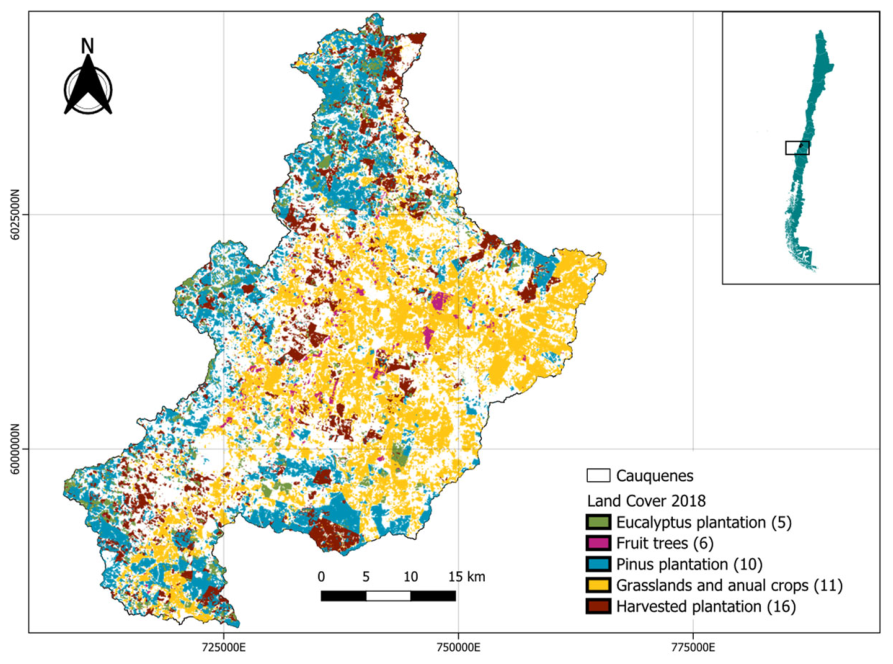
The study was carried out in the Cauquenes river basin (1619 km2), between 35°41′ and 36°17′ South latitude, in the Maule and Ñuble regions, in the central-southern zone of Chile (Figure 1).
The climate is Mediterranean, with a mean annual precipitation of 934 mm, concentrated mainly between April and October, see Gimeno et al. [42] for more details. Land cover is dominated by forests (31.1%), primarily exotic plantations and shrublands (36.5%), and agricultural crops (27%). There are more than 20 soil classes in the catchment, with the predominant taxonomic orders being Alfisols, Inceptisols, and Vertisols [43,44]. These soils are mostly sandy loam in textural class [45].

2.2. Analytical Model

The analytical model of Rakonjac et al. [40] was adapted in this study to estimate atrazine leaching under Mediterranean climatic conditions in central Chile. The main modifications introduced here were: (i) the use of representative daily hydrological conditions derived from monthly averages to account for the strong seasonality of precipitation and evapotranspiration; (ii) the full implementation of the model in an R script v4.4.0 at the pixel scale using spatially distributed soil, climatic, and land-cover data; and (iii) the comparison of model outputs under two contrasting precipitation years, 2018 and 2023. The following equations describe the leached fraction, pore-water velocity, evapotranspiration partitioning, and annual aggregation.

2.2.1. Leaching Fraction Through Soil Layers

The leached fraction through each soil layer i (Fi, [-]) is described following van der Zee & Boesten [41] as follows:
F i = exp μ i R i L i v i
where μ (d−1) is the first-order transformation rate in the soil, R (-) is the retardation factor, L (cm) is the thickness of the soil layer i, and v (cm d−1) is the pore water velocity. The μ i (d−1) was scaled according to the organic carbon content at each soil layer i as
μ i = μ 1 f o c , i f o c , 1
μ 1 = l n ( 2 ) D T 50
where the subscript 1 denotes the surface soil layer, f o c (g g−1) is the fraction of organic carbon at soil layer i and surface layer 1, DT50 (d) is the half-life in the soil. Ri is defined as follows:
R i = 1 + ρ i f o c , i K o c , i θ i
where ρ (g cm−3) is the dry bulk density of the soil, θ (cm3 cm−3) is the volumetric water content, K o c (mL g−1) is the linear adsorption coefficient normalized by organic carbon.

2.2.2. Pore Water Velocity

The leached fraction requires computation of pore water velocity (v, cm d−1), calculated as
v i = q i θ i
where q i (cm d−1) is the vertical flux density for layer i. The vertical flux density is computed for the first soil layer (qtop) and for the underlying layers down to the target depth (qbot) as
q t o p = p p E p
q b o t = p p E T 0
where pp (cm d−1) is precipitation; Ep (cm d−1) is evaporation; and E T 0 (cm d−1) is reference evapotranspiration. This simplification assumes that evaporation primarily affects the uppermost soil layer, whereas the deeper layers are influenced by the overall evapotranspiration demand.
A simplified partition of ET0 into transpiration- and evaporation-related components was implemented based on the dual-coefficient evapotranspiration concept [46] and the Beer–Lambert law of extinction of light [47] as follows:
f c = 1 exp k L A I
T p = E T 0 f c
E p = E T 0 T p
where f c (-) is the cover fraction, k (-) is an empirical constant set as 0.5 [48], and LAI (cm2 cm−2) is leaf area index. Volumetric water content at each soil layer θ i was estimated under a quasi-steady-state assumption, neglecting antecedent soil moisture effects. Under this assumption, θ i was estimated independently of each layer using van Genuchten [49] and Mualem [50] as follows:
K h = K s S e l 1 1 S e 1 m m 2
S e = 1 + α h n m
m = 1 1 n
where K(h) and Ks (cm d−1) are the unsaturated and saturated hydraulic conductivity of the soil, Se (-) is the effective saturation, l (-) is an empirical pore-connectivity parameter commonly set as 0.5, α (cm−1), and n (-) are empirical shape parameters of van Genuchten [49] and h (cm) is the pressure head. For each soil layer i, pressure head (hi) was obtained by solving K(hi) = qi. The estimated hi is transformed into θ for each layer i using
θ = θ r + θ s θ r 1 + α h n m
where θ r and θ s (cm3 cm−3) are the residual and saturated volumetric water content. When qi > Ks, the θ i was set to θ s and m = 1 − 1/n.

2.2.3. Leached Amount per Pixel

The cumulative leached fraction above a target soil depth was adapted from Rakonjac et al. [40]. Because the original formulation was developed for a quasi-even annual rainfall distribution typical of the Netherlands, a modified monthly aggregation was used here to better represent the marked seasonality of Mediterranean climates. For each month j , the representative leached fraction F t o t a l , j was computed using mean daily hydrological conditions for that month (i.e., monthly precipitation and evapotranspiration were expressed as average daily rates). These daily month-specific leached fractions were then weighted by positive deep percolation q b o t + to derive a representative long-term leaching fraction.
F t o t a l , j = i = 1 n L F i , j
where F i , j is the leached fraction per pixel through soil layer i and for month j calculated from the mean daily flux conditions representative of that month, and nL is the number of soil layers until the target depth.
q b o t , j + = max q b o t , j , 0
where q b o t , j is the representative mean daily flux density assigned to the lower soil layers for month j. Finally, the representative leached mass per pixel (MP, mg pixel−1) was calculated by multiplying the weighted fraction by the atrazine load applied to each pixel as follows:
F t o t a l r a i n = j = 1 m F t o t a l , j q b o t , j + j = 1 m q b o t , j +
M p = F t o t a l r a i n D H A P 10 2
where m is the number of months, D H (kg ha−1) is the pesticide application, A p (m2 pixel−1) is the pixel area, and 10 2 is the corresponding unit-conversion factor from kg ha−1 to mg m−2. Overall, this framework provides a simplified analytical estimate of pesticide leaching by combining layer-specific degradation and retardation, quasi-steady vertical fluxes, and hydraulic-state estimates derived from van Genuchten–Mualem relationships, followed by seasonal weighting based on positive deep percolation. Therefore, this framework represents an improvement over the original formulation by Rakonjac et al. [40].

2.2.4. Catchment Scale and Land-Cover Indicators

The total annual potential leached pesticide mass over the catchment was computed by aggregating Mp per year (y) as follows:
M y t o t = p = 1 N M p , y
where M y t o t (mg or g) is the total annual potentially leached mass in year y, N is the total number of pixels, M p , y (mg pixel−1) is the potential leached mass in pixel p during year y. The percentage of applied mass potentially leached over the catchment was computed as follows:
P y = 100 p = 1 N M p , y p = 1 N M a p , p , y
where P y (%) is the percentage of applied mass potentially leached in the year y, and M a p , p , y (mg pixel−1) is the pesticide mass applied in the pixel p during the year y. The hotspot areas for selected intervals of annual potential leached mass (mg pixel−1) were computed as follows:
A τ 1 , τ 2 , y = A p i x p = 1 N I τ 1 < M p , y τ 2
where A τ 1 , τ 2 , y (km2) is the hotspot area in the interval τ 1 , τ 2 for year y, Apix (km2 pixel−1) is the pixel area, I (⋅) is an indicator function equal to 1 if the condition is fulfilled and 0 otherwise, τ 1 and τ 2 (mg pixel−1) are the threshold values of annual potential leached mass. The percentage of applied mass potentially leached for each land cover (LC) in the year y ( P C L C , y ) is computed as follows:
P L C , y = 100 p L C M p , y p L C M a p , p , y
where the sums are restricted to the pixels belonging to the corresponding land cover.

2.2.5. Data Source

Fraction of Soil Organic Carbon, Sorption, and Degradation Parameters
The soil organic carbon was initially obtained from the SoilGrids dataset [51] at a spatial resolution of 250 m. SoilGrids values, reported in dg kg−1, were converted to organic carbon fraction (foc) by dividing by 10,000. SoilGrids values are standardized at six depth intervals (Table 1).
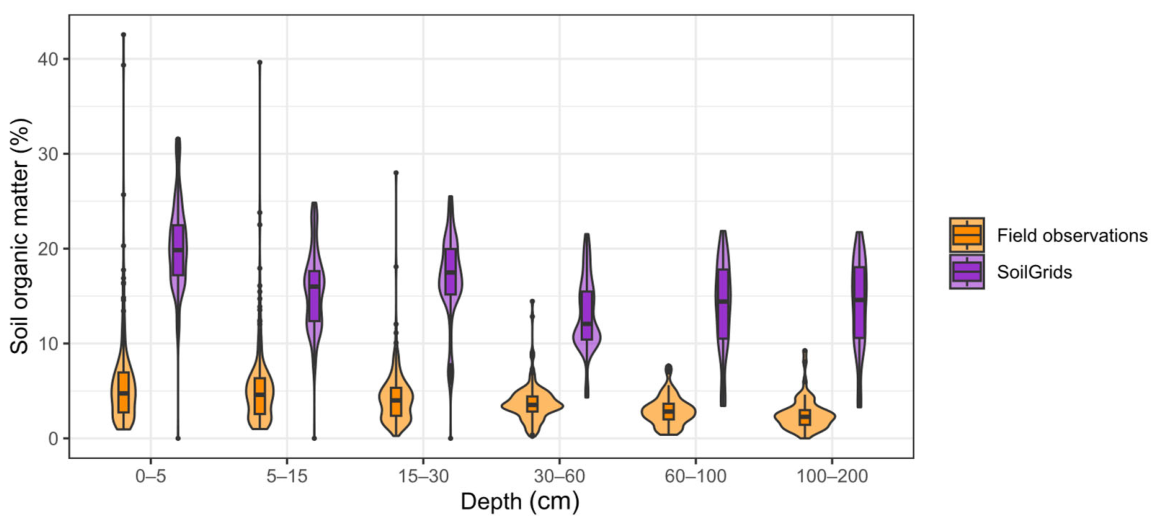
To better represent local conditions in the Cauquenes catchment, SoilGrids values were adjusted using 894 previously collected observations of soil organic matter (%OM) (see Seguel et al. [52] for details). The comparison between SoilGrids estimates and field observations revealed systematic overestimation across all depth intervals (Figure 2).
Therefore, a depth-specific multiplicative correction factor (Table 1) was computed from the comparison between SoilGrids and field observations and subsequently applied to the SoilGrids raster at each depth. Field %OM values were converted to foc following Edwards et al. [53] by dividing %OM by 172.4.
The DT50 (Equation (3)) and KOC (Equation (4)) used for the leaching fraction equation (Equation (1)) were set to 29 days and 100 mL g−1, based on the PPDB dataset [54]. Reported ranges in PPDB for atrazine were 6–108 days for DT50 and 89–513 mL g−1 for KOC.
Bulk Density and Soil Hydraulic Properties
The bulk density (bd, g cm−3) and the soil hydraulic properties θ r , θ s , α , n , and Ks (Equations (11)–(14)) were obtained at each depth interval (Table 1) from CLsoilMaps at a spatial resolution of 100 m. These parameters were used to estimate the soil hydraulic state and pore water velocity required by the analytical model. Although soil properties were compiled for all six depth intervals, the cumulative leached fraction was aggregated down to a target depth of 1 m.
Meteorological Forcing and Evapotranspiration Partitioning
Precipitation data (Equations (6) and (7)) were obtained from the CR2MET dataset (v2.5 best) [55], which provides gridded daily meteorological variables over continental Chile at a spatial resolution of 0.05° ( ~ 5 km). Two contrasting years, based on annual precipitation, were selected to run the model. In 2018 and 2023, the average annual precipitation was 65.069 and 96.844 cm, respectively. It is worth noting that from 19 August 2023 to 22 August 2023, an extreme event was recorded in the catchment, with a cumulative precipitation of 38.7 cm.
Daily reference evapotranspiration (ET0) was also obtained from the CR2MET dataset, where it is estimated from temperature using the Hargreaves-Samani formula. For evaporation partitioning (Equations (9) and (10)), the LAI was estimated from Sentinel-2 data processed in the Science Toolbox Exploitation Platform (SNAP) [56] at a 10 m spatial resolution, using the SNAP biophysical processor, which is based on a neural network approach. LAI values were extracted and averaged for each land-cover class (e.g., forest, agricultural field, bare soil), and the resulting time series were interpolated to match the temporal resolution of the climatic variables. Land cover data were obtained from CLDynamicLandCover at 30 m spatial resolution for Central Chile [57].
Atrazine Application Dose
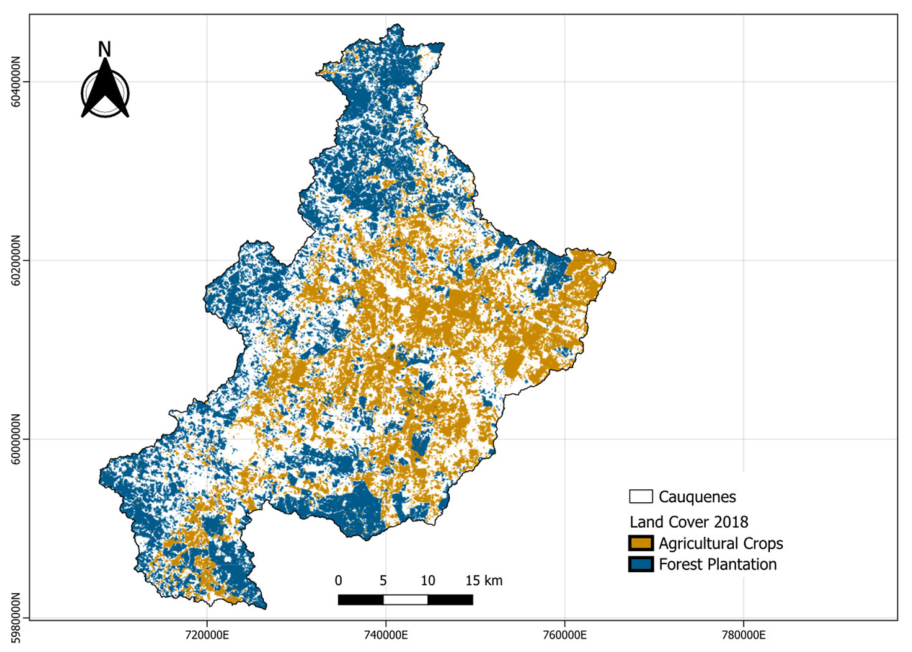
The recommended application rates for atrazine were obtained from the product label provided by ANASAC Chile S.A (Label: Atrazina WG, 90% active ingredient). For agricultural and forest plantations, a single annual application is recommended, with timing varying depending on the weeds to be controlled. Based on this information, an average annual dose of 1.305 kg ha−1 of active ingredients was set for agricultural fields, and 2.025 kg ha−1 for forest plantations. Then, the spatial dose of atrazine was determined using CLDynamicLandCover (Figure 3).
In this study, the timing of atrazine application within the year was therefore not explicitly simulated. Instead, the annual application assigned to each pixel was combined with a representative annual leaching fraction derived from monthly hydrological conditions. Therefore, the resulting leached mass should be interpreted as a potential annual leaching estimate for each year’s hydroclimatic conditions, rather than as the outcome of an application on a specific date.
Spatial Data Processing and Target Depth
All raster inputs were projected to a common coordinate reference system, resampled to a common spatial resolution of 100 m, aligned to the same spatial grid, and clipped to the Cauquenes catchment prior to model implementation. Continuous variables (e.g., precipitation, ET0, and soil organic carbon) were resampled using bilinear interpolation, whereas categorical variables such as land cover were resampled using nearest-neighbor assignment. After harmonization, the relevant variables were extracted at the pixel scale and combined into a single spatial framework. The target depth considered for the cumulative leaching calculations was 1 m.
Spatial Implementation and Aggregation
The analytical model was applied at the pixel scale for the years 2018 and 2023, selected as contrasting precipitation years. Monthly precipitation and evapotranspiration data were first converted to representative mean daily rates (cm d−1) by dividing each monthly value by the number of days in that month. These daily rates were then used as the hydrological inputs for the monthly calculations. For each pixel and month j within each year, the leached fraction through each soil layer i ( F i , j ) was calculated using the corresponding soil, climatic, and land-cover inputs. For each month, the cumulative leached fraction above the target depth ( F total , j ) was obtained as the product of the layer-specific fractions across the soil profile. Monthly cumulative leached fractions were then weighted by the positive deep percolation flux ( q b o t , j + ) to derive an annual representative leached fraction for each pixel. Months with negative deep percolation were assigned a weight of 0 in the annual aggregation. The annual leached mass per pixel was subsequently calculated by multiplying this weighted fraction by the atrazine mass assigned to that pixel (Equation (18)). Finally, pixel-scale estimates were aggregated for the entire catchment and by land-cover class to compare spatial patterns of potential atrazine leaching between 2018 and 2023.
The indicators defined in Equations (19)–(22) were computed after the annual potential leached mass had been estimated for each pixel and year. First, pixel-scale values of M p , y were summed over the entire catchment to obtain the total annual potential leached mass. Second, the percentage of applied mass potentially leached at the catchment scale ( P y ) was calculated as the ratio between total annual potential leached mass and total annual applied mass. Third, hotspot areas were quantified by summing the area of pixels whose annual potential leached mass fell within predefined intervals. Finally, land-cover-specific percentages of applied mass potentially leached ( P L C , y ) were computed by restricting the aggregation to pixels belonging to each treated land-cover class. These indicators were used to compare the spatial and catchment-scale magnitude of potential atrazine leaching between 2018 and 2023.
Global Sensitivity Analysis
The Morris Elementary Effect Screening Method [58] was performed to identify influential parameters on the leached atrazine mass output. This procedure was previously applied by Faúndez-Urbina et al. [59] and Faúndez Urbina et al. [60] in the context of HYDRUS modeling. Therefore, only the main parameterization will be mentioned here. Morris’s elementary effect parameters are the number of trajectories (r = 100), the number of model parameters and variables (k = 41), the number of levels (p = 6), and the grid jump ( ω = 3) [61]. The sensitivity indices obtained from Morris’s method are the modified overall effect ( μ * ) introduced by Campolongo et al. [62] and the interaction between parameters ( σ ). Those statistics yield a ranking of factor importance but not their magnitudes, because Morris’s method is qualitative [63].
The parameters selected for sensitivity analysis were the soil hydraulic parameters ( θ r , θ s , α , n, and Ks) the bd and the foc for five depth intervals (until 100 cm). Additionally, it included the doses (average between agricultural and forestry applications), DT50, KOC, pp, ET, and LAI. Baseline values for all parameters and variables were defined as spatial averages over the study area. The minimum and maximum values were computed by applying a fixed 30% variation over the baseline values (See Table S1 in the Supplemental Materials). Morris’s sample generator and sensitivity index computation ( μ * and σ ) were performed using the R package “Sensitivity” [61]. Parameter importance was evaluated using the procedures described by Lammoglia et al. [64]. They defined highly influential parameters if μ * > 0.5 μ m a x * where μ m a x * is the maximum μ * of all the parameters/variables analyzed.
Monte Carlo Uncertainty Analysis
To evaluate the uncertainty associated with the pesticide-specific parameters identified as influential by the Morris screening analysis, a spatial Monte Carlo uncertainty analysis was performed using Rscript. The DT50 and KOC were selected because they were identified as dominant controls on the annual potential leached mass. Parameter values were sampled using Latin Hypercube Sampling (LHS), which ensures efficient coverage of the parameter space while reducing clustering relative to simple random sampling. The sampling ranges were mentioned in Section Fraction of Soil Organic Carbon, Sorption, and Degradation Parameters.
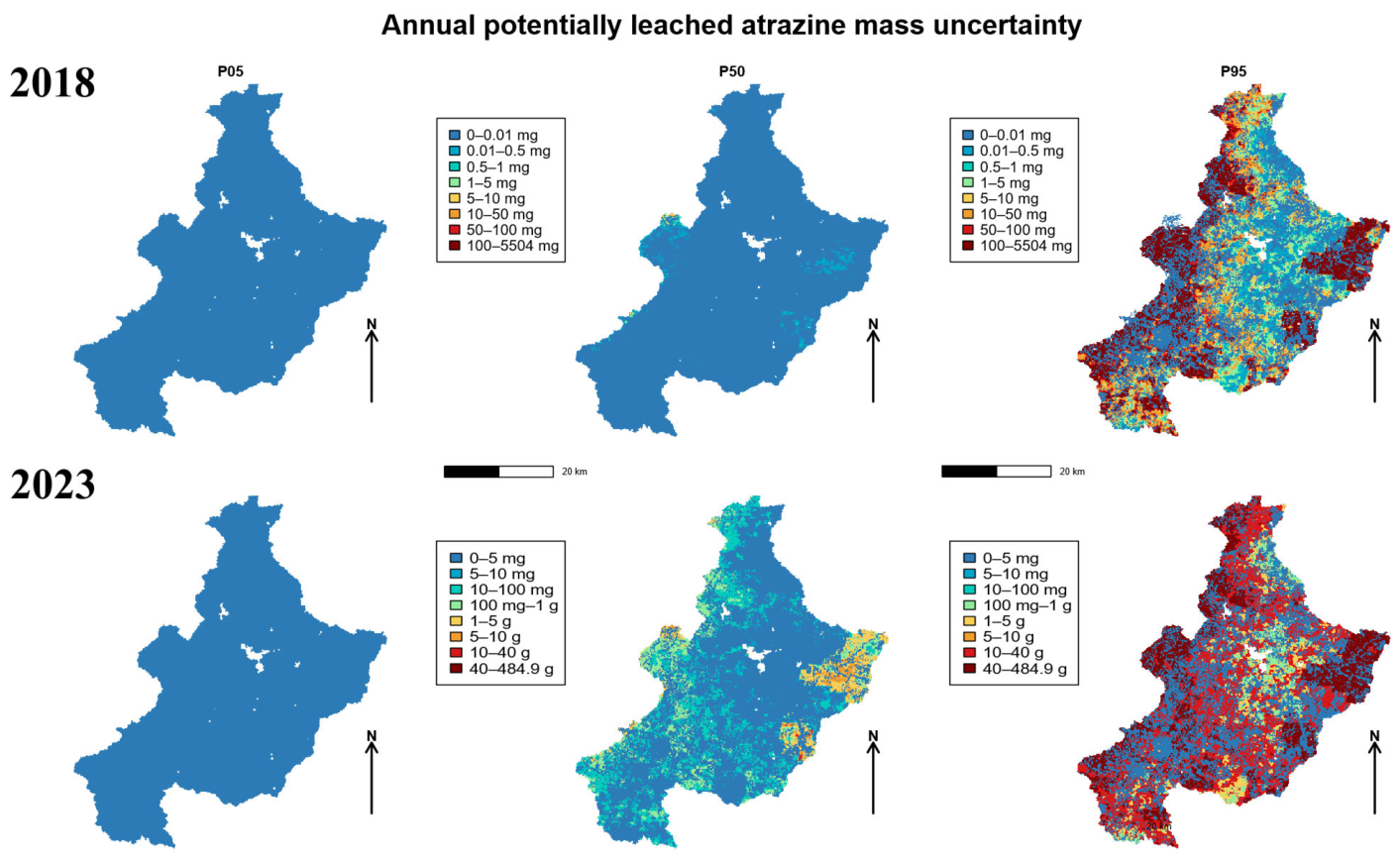
For each realization, the complete spatial analytical model was executed, and the annual potential leached mass was calculated at the pixel and catchment scales for both 2018 and 2023. A total of 3000 realizations were performed. Uncertainty was summarized using the 5th percentile (P05), median (P50), and 95th percentile (P95) of catchment-scale annual potential leached mass. In addition, pixel-wise uncertainty maps were generated from the spatial distribution of the Monte Carlo realizations.
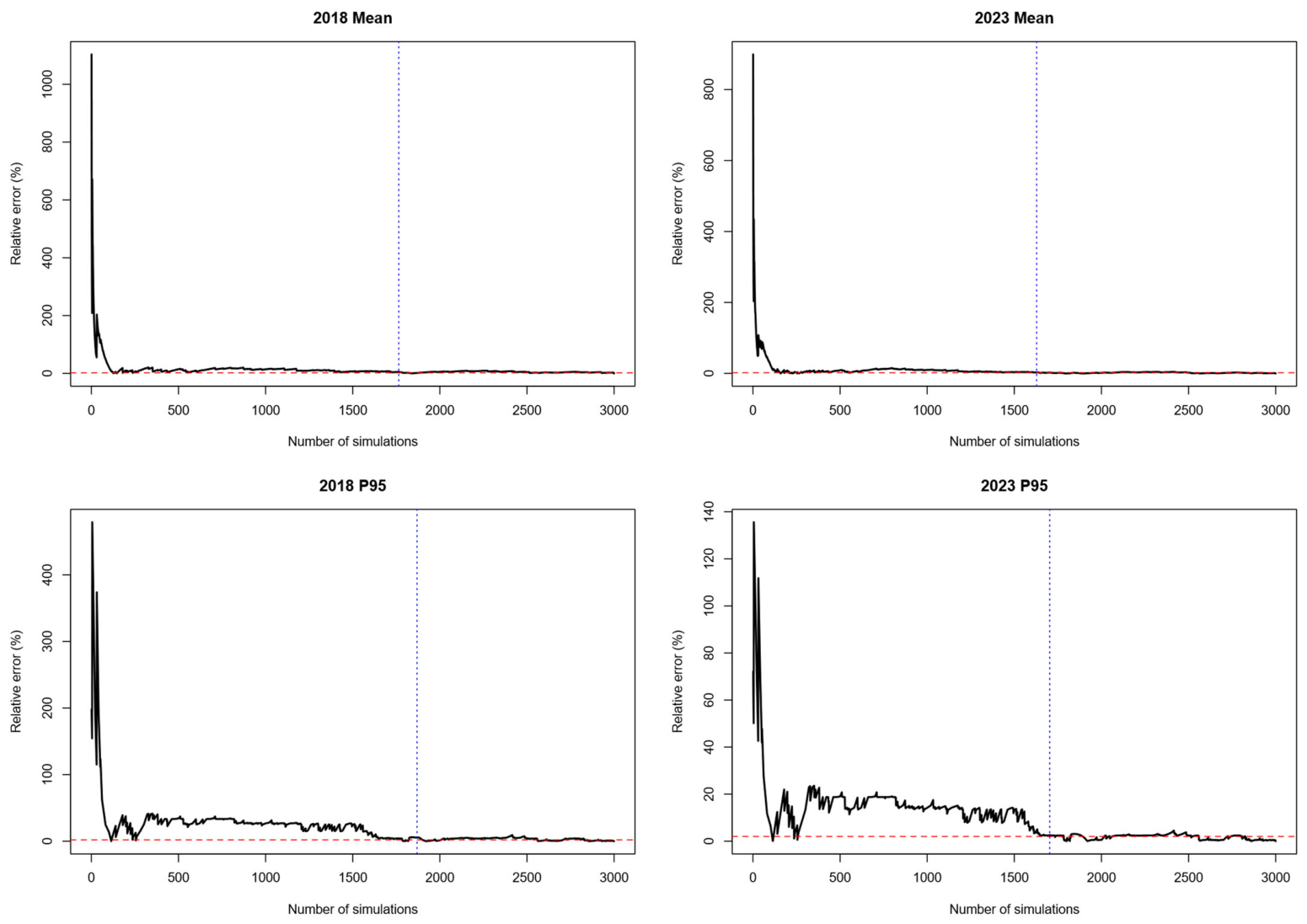
Convergence of the Monte Carlo ensemble was evaluated using cumulative estimates of the mean and the 95th percentile of annual leached mass. A moving window of 100 realizations was used, and convergence was considered acceptable when the average relative error within the window was below 2% for the mean and the 95th percentile.

3. Results and Discussion

3.1. Spatial Distribution of the Annual Representative Leached Fraction of Atrazine

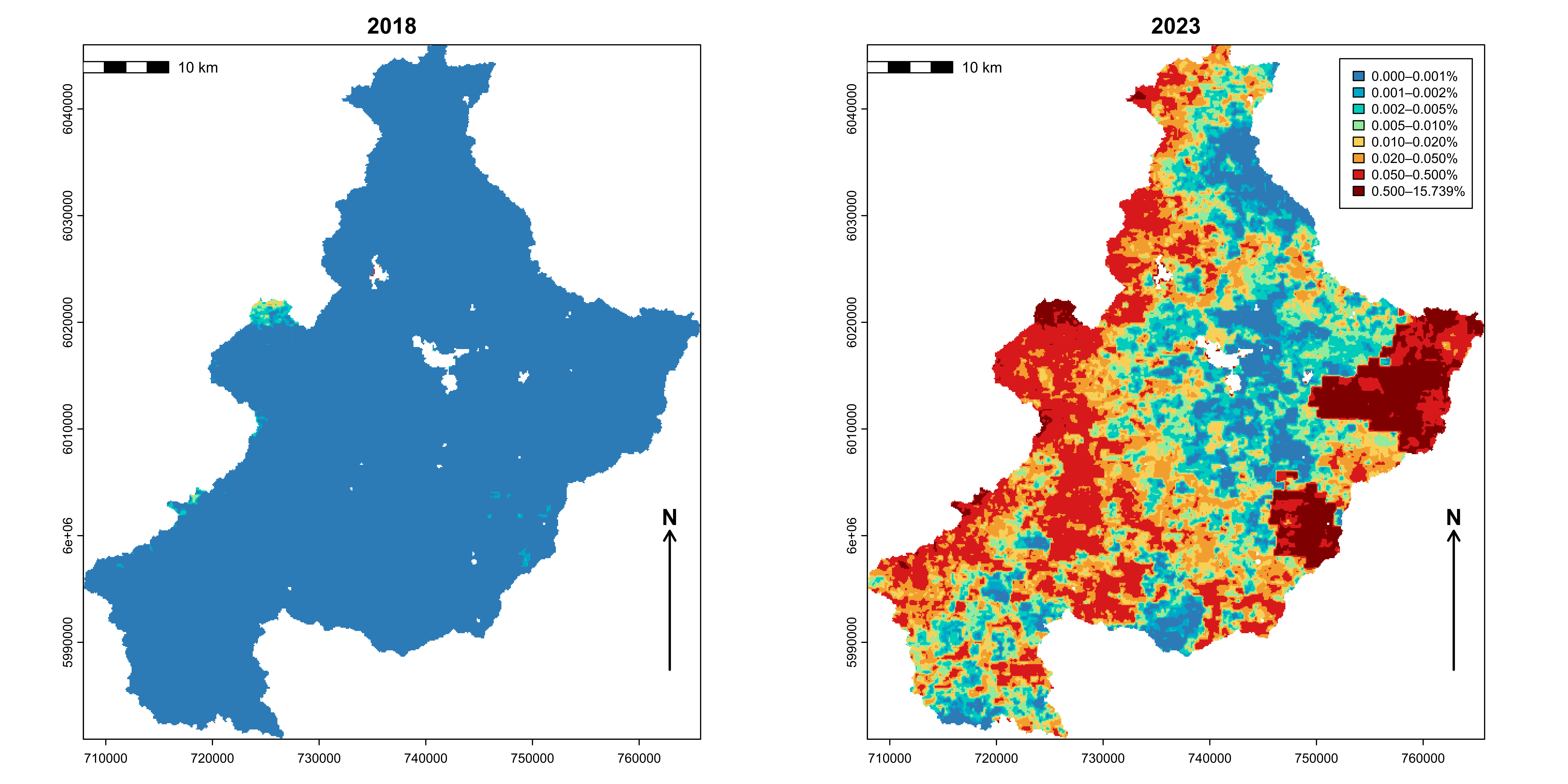
The spatial distribution of the annual representative leached fraction of atrazine showed a marked contrast between 2018 and 2023 (Figure 4).
The annual representative leached fraction of atrazine ( F t o t a l , % ) showed a strong spatial contrast between 2018 and 2023. In 2018, most of the catchment exhibited very low values, with only a few localized hotspots. In contrast, the 2023 map showed a much broader spatial extent of moderate-to-high values, indicating that a substantially larger proportion of the catchment became vulnerable to downward transport of atrazine under wetter hydroclimatic conditions. This pattern is consistent with the structure of the analytical framework, in which annual leaching potential arises from interactions among downward water fluxes, soil hydraulic behavior, degradation, and retardation.
More broadly, precipitation regime is widely recognized as a control on pesticide leaching, especially when leaching risk is evaluated over contrasting years or under changing climatic conditions [65]. From a mechanistic perspective, the stronger response observed in 2023 is plausible because wetter conditions favor positive deep percolation, thereby increasing pore water velocity, which directly affects leaching through the soil profile. Reviews and modeling studies have consistently shown that changes in precipitation regimes, seasonal water balances, and climate-related hydrological variability can substantially alter pesticide transport into deeper soil layers and groundwater. In Mediterranean environments, where rainfall is strongly seasonal and interannual variability is high, this sensitivity is especially relevant [66].
Finally, the comparison between 2018 and 2023 clearly indicates that interannual hydroclimatic variability controls the spatial pattern of potential atrazine leaching. This interpretation is also consistent with regulatory and screening-oriented pesticide modeling, where leaching assessments are commonly used to compare relative vulnerability across scenarios rather than to reproduce a single application event exactly, as in Rakonjac et al. [40] for veterinary-use antibiotics. The extreme precipitation event documented in August 2023 likely contributed to the observed wetter annual signal; however, the current framework does not explicitly model storm-scale transport pulses.

3.2. Spatial Distribution of the Annual Potential Leached Mass of Atrazine

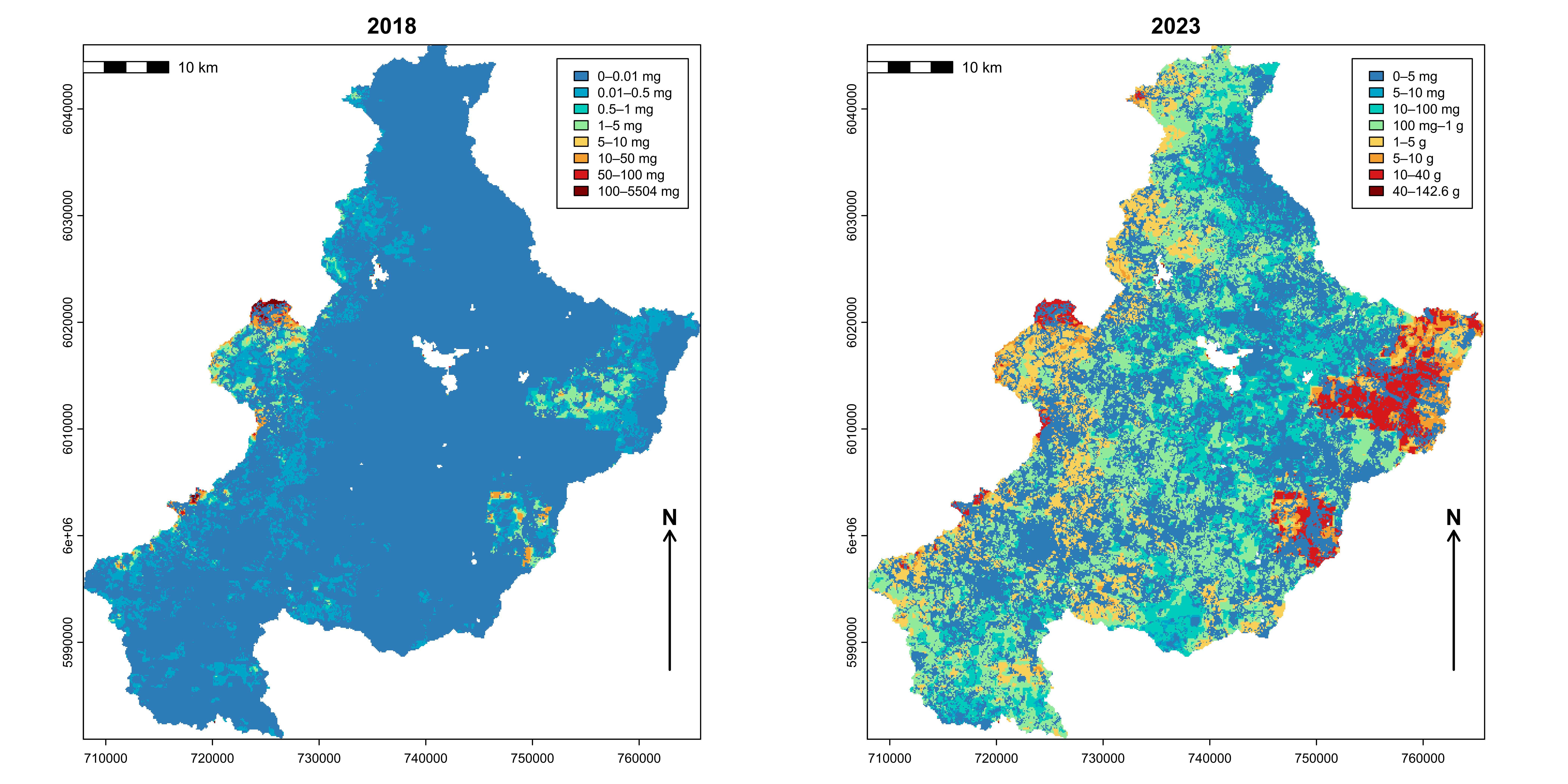
The spatial distribution of annual potential leached mass broadly followed the pattern of F t o t a l , but also reflected the spatial allocation of atrazine application (Figure 5). In 2018, the estimated leached mass was generally low across the catchment, whereas in 2023, high values became much more extensive and clustered in treated areas (Figure 5). This difference is expected because the leached mass integrates both the hydrological-pedological potential for transport and the spatial distribution of pesticide inputs across land cover. Therefore, the mass maps provide a more management-oriented representation of risk than F t o t a l alone, since they identify where favorable transport conditions overlap with actual atrazine use. This distinction is important when interpreting the maps. The leached fraction (Figure 4) primarily reflects the intrinsic potential for a portion of the applied compound to move downward, whereas the mass output (Figure 5) also reflects the magnitude of the annual pesticide load.
In the pesticide-fate literature, risk to groundwater is commonly understood to arise from the joint control of pesticide physicochemical properties, soil properties, hydrological forcing, and the pattern of agricultural use [67]. Reviews and monitoring studies also show that atrazine remains one of the most frequently associated with groundwater occurrences because its persistence and mobility can combine with agricultural loading to produce widespread contamination signals [68]. For this reason, the annual potential leached mass should not be interpreted only as a hydrological outcome. Instead, it should be viewed as the spatial expression of the overlap between pesticide loading and downward transport conditions. In practice, this makes the mass maps especially useful for identifying hotspots where management, monitoring, or mitigation efforts could be prioritized. Similar screening logic has been proposed in broader groundwater leaching assessments, where preliminary spatial evaluations are considered valuable for targeting monitoring programs and refining risk assessment [69,70]. Given the lack of regulation in the Global South [6] and the absence of pesticide screening by hydrological transport models in Chile, the results in Figure 5 are valuable.

3.3. Variability Among Land-Cover Classes

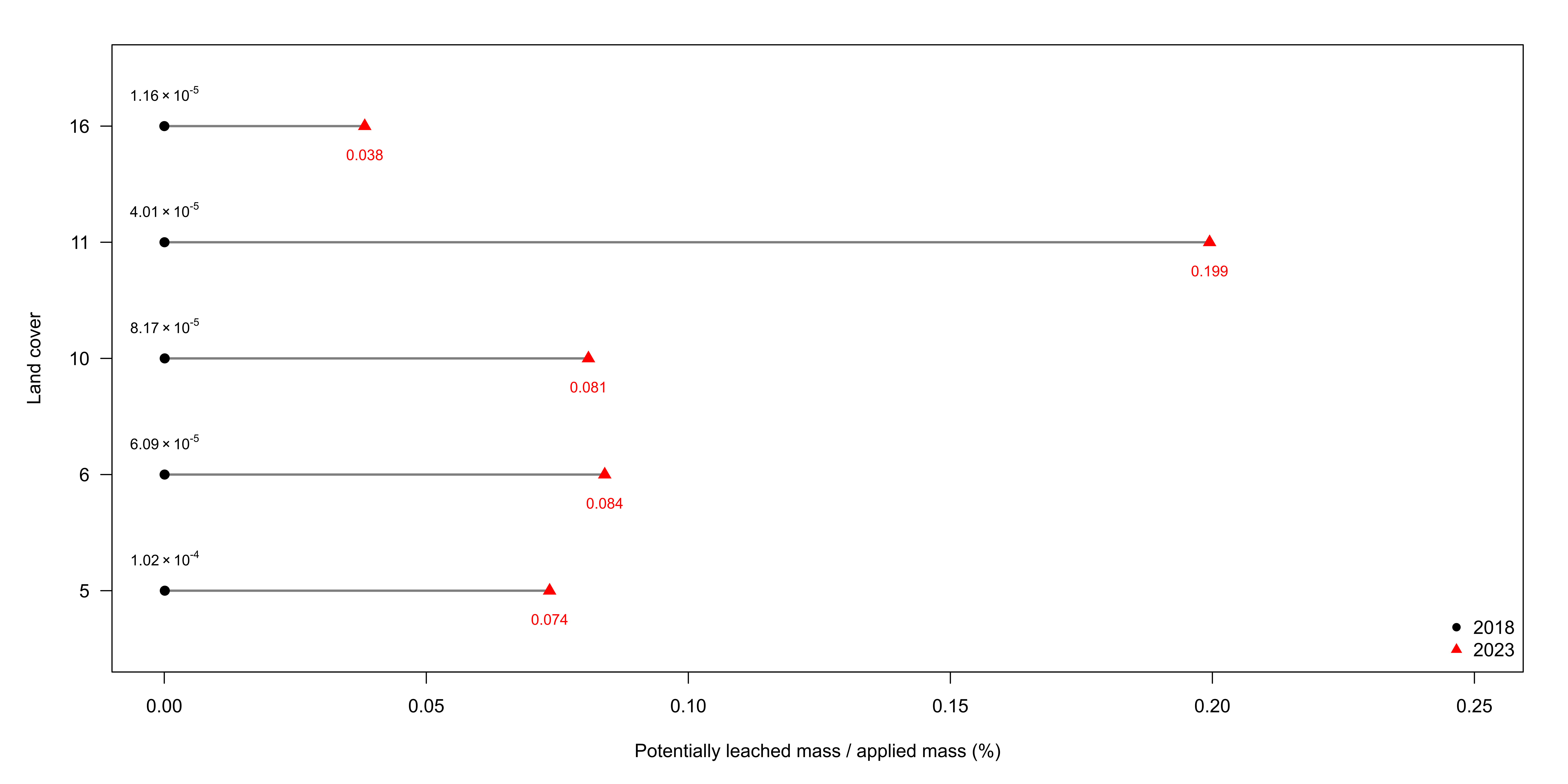
Land-cover classes played a dual role in the spatial pattern of annual potential atrazine leaching (Figure 6). First, they controlled where atrazine was applied, since in the present implementation, pesticide inputs were restricted to agricultural and forest-related land-cover classes, whereas the remaining classes received zero direct input. Second, land cover indirectly affected the water balance through LAI-dependent partitioning of evapotranspiration between evaporation and transpiration, thereby modifying the downward water flux available for leaching (Equations (8)–(10)). This combination of pesticide loading and hydrological partitioning is consistent with the broader pesticide-leaching literature, where vegetation cover, evapotranspiration regime, and management timing are recognized as controls on pesticide transfer below the root zone [71,72,73].
The land-cover summary of Figure 6 indicates that the contribution of each class to annual potential leached mass cannot be interpreted exclusively from application rate or hydrological conditions in isolation. Instead, the largest contributions emerged where both factors coincided in space. This result is consistent with previous regional and distributed pesticide assessments, which show that leaching risk arises from the combined influence of climate forcing, soil properties, and land use, rather than from a single controlling factor [36]. In Mediterranean environments, where rainfall is concentrated within a relatively short season and shows large intra- and interannual variability, this interaction may be amplified because the timing and magnitude of downward flow can vary substantially between years [74,75].
The metric in Figure 6 and Table 2 shows that land-cover classes differed in both leach efficiency and their total contribution to the annual potential leached mass. In 2018, all treated classes exhibited extremely low values of potentially leached mass relative to applied mass, whereas in 2023, this ratio increased markedly across all classes. The highest leaching efficiency in 2023 was observed for land-cover class 11, followed by classes 6, 10, 5, and 16, indicating that wetter hydroclimatic conditions enhanced downward transfer of atrazine across the treated area. However, Table 2 also shows that the total contribution depended not only on leaching efficiency but also on the treated area and the applied mass. Thus, class 11 combined the largest treated extent with the highest leaching efficiency, making it the dominant contributor to the total potential leached mass, whereas other classes were important either because of their broader treated area or because they exhibited comparatively high leaching efficiency per unit of applied mass.

3.4. Catchment-Scale Comparison Between 2018 and 2023

At the catchment scale, the comparison between 2018 and 2023 revealed a strong sensitivity of annual potential atrazine leaching to interannual hydroclimatic variability (Table 3).
The wetter year consistently produced larger representative leached fractions and much higher annual potential leached masses than the drier year, supporting the interpretation that Mediterranean hydroclimatic variability can strongly modulate pesticide transfer below the root zone. This broader interpretation is consistent with recent reviews emphasizing that pesticide pollution and groundwater vulnerability are shaped by climate variability, increasing precipitation extremes, and changing recharge conditions [76,77].
This contrast is also reflected in the aggregate ratio of annual potential leached mass to annual applied mass. At the pixel scale, this metric is numerically equivalent to F t o t a l × 100 , but at the catchment scale, it is more appropriately computed as the ratio between total annual potential leached mass and total annual applied mass, thereby avoiding dependence on the spatial distribution of pixel values alone (Equation (20)). Reporting this aggregated percentage facilitates comparison between years and provides a direct management-oriented indicator of how much of the applied atrazine load is potentially transferred below 1 m depth under each hydroclimatic condition. In this sense, the table comparing 2018 and 2023 provides a concise summary of the marked expansion in both leaching intensity and areal extent during the wetter year.
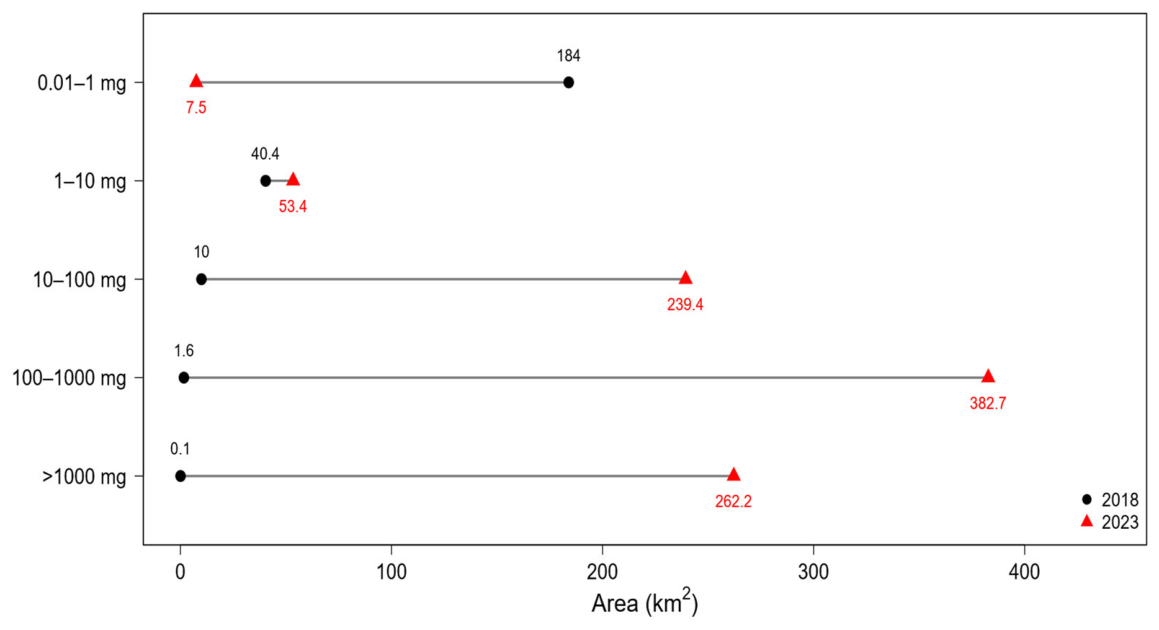
The hotspot analysis (Figure 7) further refines this comparison by quantifying the area that fell within selected ranges of annual potential leached mass. Rather than relying solely on total mass, this approach shows how the areal distribution of leaching intensity shifted between 2018 and 2023, with 2023 displaying substantially larger areas in moderate-to-high leaching classes (e.g., 100–1000 mg of atrazine leached). This result is particularly relevant for screening purposes, because a broader increase in the area affected by moderate-to-high potential leaching may represent a greater management concern than a change limited to a few isolated maxima. Similar logic has been used in distributed pesticide-leaching assessments, where spatial screening tools are applied to identify vulnerable zones for groundwater protection and to prioritize monitoring and mitigation efforts [69,78].

3.5. Global Sensitivity Analysis

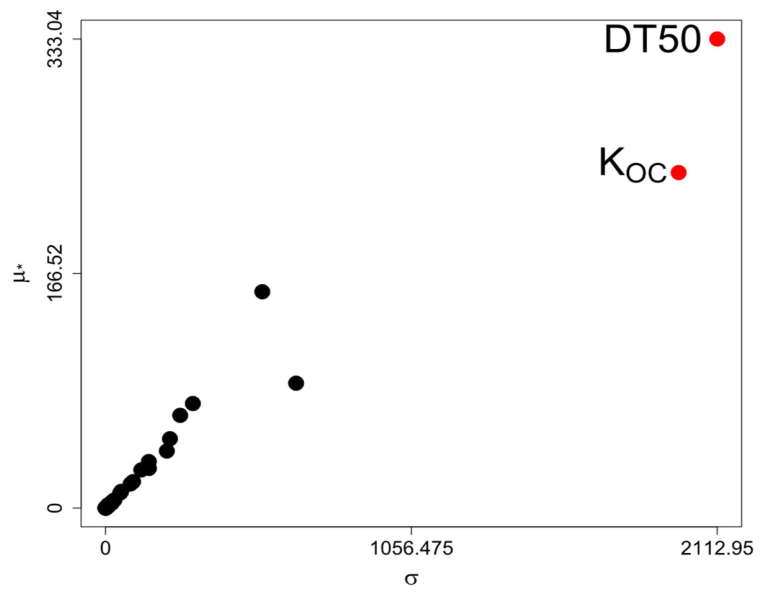
The Morris global sensitivity analysis identified K O C and DT50 as the most influential parameters controlling annual potential leached mass (Figure 8).
This result is fully consistent with the pesticide-leaching literature, where sorption and degradation are repeatedly reported as dominant controls on downward transport [10]. In a comparative sensitivity analysis of four pesticide leaching models, Dubus et al. [79] found that predictions of pesticide loss were particularly sensitive to parameters governing chemical sorption and degradation. Additionally, Dubus et al. [80] emphasized that uncertainty in these parameters strongly propagates into model predictions. More recent work continues to support this interpretation; Ullucci et al. [81] argued that groundwater leaching assessments rely on input data with high intrinsic variability and explicitly noted the sensitivity of leaching simulations to sorption parameters. Broader reviews of pesticide behavior likewise identify K O C and DT50 as the key physicochemical factors controlling mobility and leaching potential [82]. Taken together, these studies strongly support the fact that K O C and DT50 emerged here as the leading controls on annual potential leached mass.
Morris’ results are also consistent with the chemical behavior of atrazine reported elsewhere. Atrazine is widely described as a non-persistent (in the field) and moderately mobile herbicide [54], and its occurrence in soils, groundwater, and drinking-water-related compartments has been repeatedly documented [68,83,84,85]. Because sorption limits mobility while degradation limits persistence, it is not surprising that the model is most sensitive to the parameters that directly govern those two processes. For Chile, where no regulation exists for environmental exposure assessment of pesticides [14], these findings are relevant because stakeholders can prioritize field campaigns for obtaining both K O C and DT50 at the soil surface and foc over depth to obtain better results with this or related models.

3.6. Monte Carlo Uncertainty Analysis

At the catchment scale, the resulting uncertainty distributions were strongly right-skewed for hydroclimatic conditions (Table 4).
In 2018, the median annual potentially leached mass (P50) was 0.009 kg, while the 95th percentile was 34.55 kg. For 2023, the median increased to 34.2 kg, and the 95th percentile reached 3798.17 kg. In both years, the lower tail of the distribution approached negligible leaching values, with P05 values close to zero. The deterministic simulations presented in the main analysis (Table 3) yielded leached masses exceeding the ensemble median, reflecting the relatively low KOC value adopted from the PPDB reference dataset. Nevertheless, these estimates remained well within the uncertainty envelope generated by the Monte Carlo ensemble.
The pronounced asymmetry of the uncertainty distributions indicates that only a relatively small fraction of plausible parameter combinations generated substantially larger leaching estimates than the median response. Consequently, arithmetic means were strongly influenced by extreme realizations. This behavior reflects the nonlinear nature of pesticide transport processes, in which degradation and sorption interact multiplicatively in the analytical formulation of the leaching fraction.
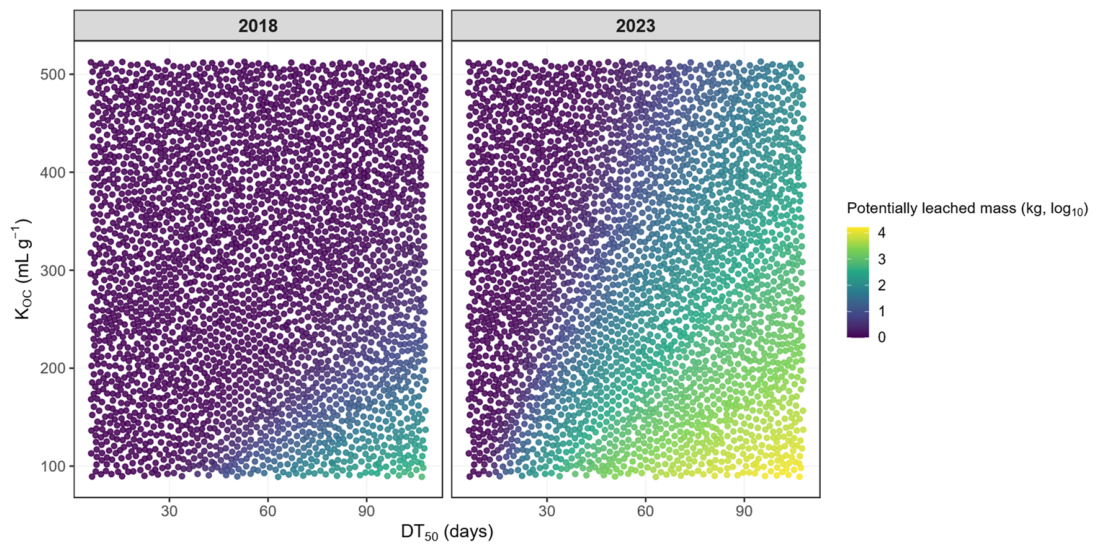
The influence of DT50 and KOC on annual potentially leached mass is illustrated in Figure 9. Leaching increased systematically by increasing DT50 and decreasing KOC under both hydroclimatic conditions. The largest annual masses were consistently associated with combinations of high persistence (DT50 > 90 d) and weak sorption (KOC < 150 mL g−1), whereas low leaching estimates occurred when rapid degradation and strong sorption acted simultaneously. This behavior is consistent with previous pesticide-leaching studies showing that degradation and sorption parameters are among the dominant sources of sensitivity and uncertainty in pesticide fate models [79,80].
These patterns are fully consistent with the governing equations of the analytical model. Increasing DT50 reduces the first-order degradation rate constant, thereby decreasing pesticide attenuation during downward transport. Conversely, increasing KOC increases retardation and residence time within the soil matrix, thereby reducing the fraction of the pesticide that reaches deeper layers. The Monte Carlo analysis, therefore, corroborates the Morris screening results, confirming that degradation and sorption processes dominate the propagation of uncertainty in the model [81,82].
The comparison between 2018 and 2023 (Figure 10) demonstrates the interaction between hydroclimatic forcing and parameter uncertainty. Although identical DT50 and KOC ranges were considered equal between the two years, uncertainty increased substantially under the wetter conditions of 2023. This finding suggests that climatic conditions that generate larger percolation fluxes also increase the sensitivity of predicted leaching to pesticide properties [65,66,71,72].
Convergence of the Monte Carlo ensemble was evaluated using cumulative estimates of the mean and the 95th percentile of annual potentially leached mass (Figure 11). Using a moving-window criterion and a relative error threshold of 2%, convergence was achieved within the 3000-realization ensemble for both years and metrics. Furthermore, comparisons with preliminary ensembles indicated only minor changes in percentile estimates as the number of realizations increased, suggesting that the adopted sample size adequately characterized the uncertainty distribution. Therefore, the reported uncertainty ranges can be considered representative of the parameter space explored in this study.
The deterministic catchment-scale leached percentages estimated in this study (Table 3) ranged from 5.50 × 10⁻⁵% in 2018 to 0.112% in 2023. These values are low, but they are not inconsistent with previously reported atrazine losses when interpreted specifically as potential vertical transfer below 1 m rather than total pesticide loss. For example, an atrazine vulnerability assessment in Michigan estimated an average fraction reaching the water table of 0.039%, with values ranging from 0 to 3.6% [86]. Other field studies reported atrazine losses of 0.6% at a soil depth of 80 cm [87]. Higher values have also been reported under tilled systems, up to 6.16% of the applied atrazine recovered in leachate [88]. Therefore, the deterministic values estimated here fall within the lower portion of published ranges, whereas the Monte Carlo P95 estimate for 2023 (2.38% leaching) indicates that substantially larger leaching fractions are possible under combinations of high DT50 and low KOC. This comparison supports the interpretation of the model as a screening tool for identifying soils and areas more prone to leaching (Table 4), rather than as a complete pesticide mass-balance model.

3.7. Assumptions, Uncertainties, and Limitations

The present results should be interpreted with the simplifying assumptions of the analytical approach in mind. First, the model assumes quasi-steady-state flow conditions and uses monthly daily average hydrological conditions, so short-term event dynamics and antecedent soil moisture effects are not explicitly represented. This is important because precipitation patterns and antecedent wetness can influence pesticide leaching, particularly where preferential flow or transient water fluxes become relevant [65].
Second, the model does not simulate the exact timing of atrazine application within the year. Instead, annual doses are combined with an annual representative leaching fraction. Therefore, the resulting mass should be interpreted as a potential annual leaching estimate, not as the outcome of a specific application date or a single storm event. This interpretation aligns with screening-oriented approaches used in pesticide leaching assessment, in which simplified spatial tools are applied to evaluate relative vulnerability to leaching across regions [69].
Third, caution is needed when interpreting the leaching estimates of this approach at a depth of 1 m [86,87,88]. In European groundwater guidance, 1 m below the soil surface is commonly used as a comparative screening depth, but it is explicitly stated that this depth does not represent groundwater itself. Regulatory evaluation is more commonly framed in terms of predicted groundwater concentrations, with 0.1 µg L 1 widely used as the standard benchmark for a single pesticide or relevant metabolite in groundwater-related assessments [89,90,91]. Accordingly, the values reported here at a depth of 1 m should be interpreted primarily as a comparative indicator of transfer below the root zone, rather than as a direct exceedance of a legal groundwater concentration limit. Therefore, the use in Chile will initially be for comparison among catchments using different pesticides to prioritize areas with greater leaching vulnerability. Therefore, the present framework should be interpreted as an initial screening tool for assessing pesticide exposure in Chile rather than a fully validated predictive model. Its main purpose is to identify priority areas for future field measurements of atrazine concentrations. Such monitoring data will be necessary to support model benchmarking, improve local parameterization, and develop more complex predictive models under Chilean soil and hydroclimatic conditions.
Fourth, Surface runoff losses were not explicitly simulated in the present framework. Therefore, the model does not represent a complete atrazine mass balance in runoff. The reported values should be interpreted as potential vertical leaching estimates below 1 m, conditional on the annual applied mass and the assumptions of the analytical framework. Future developments should explore analytical or semi-analytical runoff-partitioning approaches that account for surface transport while maintaining the computational efficiency required for spatial screening applications.
Finally, the present model simulates only the parent compound atrazine and does not explicitly represent transformation products. This is relevant because atrazine metabolites, particularly deethylatrazine/desethylatrazine (DEA) and deisopropylatrazine (DIA), can be considered in groundwater monitoring and regulatory exposure assessments. Therefore, the values reported here should be interpreted as potential leaching estimates for parent atrazine only, not as total atrazine-residue leaching. Future developments should incorporate parent–daughter transformation pathways, as implemented in more detailed pesticide fate models such as SWAP–PEARL [27,28,30] and MACRO [26], when metabolite-specific formation, degradation, and sorption parameters are available.

4. Conclusions

A spatially distributed analytical model was adapted to estimate the annual representative leached fraction and annual potential leached mass of atrazine at depths below 1 m in the Cauquenes catchment under Mediterranean hydroclimatic conditions. The comparison between 2018 and 2023 showed that interannual hydroclimatic variability exerted a strong control on potential atrazine leaching below the root zone, with the wetter year producing substantially larger representative leached fractions, greater potential leached mass, and a broader spatial extent of leaching-prone conditions.
Land cover influenced the results both through the spatial allocation of atrazine application and through LAI-dependent partitioning of evapotranspiration, which modified the downward water flux available for leaching. As a result, the highest annual potential leached masses occurred where treated land-cover classes coincided with favorable transport conditions. At the catchment scale, the hotspot analysis showed that the wetter year was associated not only with higher total potential leached mass but also with a larger area affected by moderate-to-high leaching classes.
The Morris sensitivity analysis identified K O C and DT50 as the dominant controls on annual potential leached mass, highlighting the importance of sorption and degradation for future data collection and model refinement. Overall, the proposed framework provides a computationally efficient screening tool for comparing spatial leaching patterns across years and land-cover classes under data-limited conditions, and it can be expanded to additional pesticide formulations and territories.
The resulting uncertainty distributions were strongly right-skewed, with the highest leaching estimates occurring under combinations of high persistence and weak sorption. Although uncertainty increased substantially during the wetter hydroclimatic conditions of 2023, the contrast between dry and wet years remained consistent throughout the Monte Carlo ensemble. These results indicate that hydroclimatic variability exerts a dominant influence on annual atrazine leaching potential and that the principal conclusions of the deterministic simulations are robust to plausible uncertainty in pesticide properties.

Supplementary Materials

The following supporting information can be downloaded at https://www.mdpi.com/article/10.3390/agronomy16121152/s1, Table S1: Global sensitivity analysis parameters and doses.

Author Contributions

Conceptualization, C.F.-U., N.R. and S.E.; methodology, C.F.-U. and F.P.; software, C.F.-U. and F.P.; validation, C.F.-U., S.E. and N.R.; formal analysis, C.F.-U.; investigation, C.F.-U., S.E. and N.R.; resources, C.F.-U. and F.P.; data curation, C.F.-U. and F.P.; writing—original draft preparation, All authors; writing—review and editing, All authors; visualization, C.F.-U. and M.G.-S.; supervision, C.F.-U.; project administration, C.F.-U.; funding acquisition, S.E. All authors have read and agreed to the published version of the manuscript.

Funding

This research was funded by ANID, Chile, FONDECYT de Iniciación 11230533 and ANID, FONDECYT REGULAR 1230872.

Data Availability Statement

The dataset is available from the corresponding author upon request by email.

Conflicts of Interest

The authors declare no conflicts of interest.

Abbreviations

The following abbreviations are used in this manuscript:
AbbreviationDefinition
bdBulk density
DT50Degradation half-life
EEAPEnvironmental Exposure Assessment of Pesticides
ET0Reference evapotranspiration
focFraction of organic carbon
KOCOrganic-carbon-normalized sorption coefficient
LAILeaf area index
LHSLatin Hypercube Sampling
OMOrganic matter
P055th percentile
P5050th percentile/median
P9595th percentile
PPDBPesticide Properties Database

References

  1. US Geological Survey. Understanding Water Availability. 2025. Available online: https://www.usgs.gov/mission-areas/water-resources/science/understanding-water-availability (accessed on 11 June 2025).
  2. Mekonnen, M.M.; Hoekstra, A.Y. Sustainability: Four billion people facing severe water scarcity. Sci. Adv. 2016, 2, e1500323. [Google Scholar] [CrossRef]
  3. Watson, D.; Arrowsmith, C.; Goudey, R. Water availability: A regional water quality problem. Int. J. River Basin Manag. 2003, 1, 321–330. [Google Scholar] [CrossRef]
  4. Kaczyński, P.; Łozowicka, B.; Perkowski, M.; Zoń, W.; Hrynko, I.; Rutkowska, E.; Skibko, Z. Impact of broad-spectrum pesticides used in the agricultural and forestry sector on the pesticide profile in wild boar, roe deer and deer and risk assessment for venison consumers. Sci. Total Environ. 2021, 784, 147215. [Google Scholar] [CrossRef]
  5. Mateo-Sagasta, J.; Zadeh, S.M.; Turral, H. (Eds.) More People, More Food, Worse Water? A Global Review of Water Pollution from Agriculture; FAO: Rome, Italy, 2018. [Google Scholar]
  6. Tang, F.H.M.; Wyckhuys, K.A.G.; Li, Z.; Maggi, F.; Silva, V. Transboundary impacts of pesticide use in food production. Nat. Rev. Earth Environ. 2025, 6, 383–400. [Google Scholar] [CrossRef]
  7. Aktar, W.; Sengupta, D.; Chowdhury, A. Impact of pesticides use in agriculture: Their benefits and hazards. Interdiscip. Toxicol. 2009, 2, 1–12. [Google Scholar] [CrossRef]
  8. Kaur, R.; Choudhary, D.; Bali, S.; Bandral, S.S.; Singh, V.; Ahmad, M.A.; Rani, N.; Singh, T.G.; Chandrasekaran, B. Pesticides: An alarming detrimental to health and environment. Sci. Total Environ. 2024, 915, 170113. [Google Scholar] [CrossRef]
  9. Elgueta, S.; Santos, C.; Lima, N.; Diez, M.C. Immobilization of the white-rot fungus Anthracophyllum discolor to degrade the herbicide atrazine. AMB Express 2016, 6, 104. [Google Scholar] [CrossRef] [PubMed]
  10. Faúndez Urbina, C.A.; van den Berg, F.; van Dam, J.C.; Tang, D.W.S.; Ritsema, C.J. Parameter sensitivity of SWAP–PEARL models for pesticide leaching in macroporous soils. Vadose Zone J. 2020, 19, e20075. [Google Scholar] [CrossRef]
  11. Sánchez-Bayo, F.; Baskaran, S.; Kennedy, I.R. Ecological relative risk (EcoRR): Another approach for risk assessment of pesticides in agriculture. Agric. Ecosyst. Environ. 2002, 91, 37–57. [Google Scholar] [CrossRef]
  12. USEPA. Pesticides. USEPA. Available online: https://www.epa.gov/pesticides2020; (accessed on 2 June 2026).
  13. European Food Safety Authority. Pesticide Evaluations: Regulations and Guidance. 18 January 2022. Available online: https://www.efsa.europa.eu/en/applications/pesticides/regulationsandguidance (accessed on 12 June 2025).
  14. Coria, J.; Elgueta, S. Towards safer use of pesticides in Chile. Environ. Sci. Pollut. Res. 2022, 29, 22785–22797. [Google Scholar] [CrossRef]
  15. Chow, R.; Scheidegger, R.; Doppler, T.; Dietzel, A.; Fenicia, F.; Stamm, C. A review of long-term pesticide monitoring studies to assess surface water quality trends. Water Res. X 2020, 9, 100064. [Google Scholar] [CrossRef] [PubMed]
  16. Habran, S.; Philippart, C.; Van Bol, V.; D’Andrimont, R.; Breulet, H. Quantifying residents’ exposure to agricultural pesticides using new geospatial approaches. Heliyon 2024, 10, e40050. [Google Scholar] [CrossRef]
  17. Tesi, G.O.; Okpara, K.E.; Tesi, J.N.; Agbozu, I.E.; Techato, K. Assessment of organophosphate pesticides in soils and vegetables from agricultural areas of Delta Central District, Nigeria. Sci. Rep. 2025, 15, 8267. [Google Scholar] [CrossRef]
  18. Centanni, M.; Ricci, G.F.; De Girolamo, A.M.; Gentile, F. Modeling pesticides and ecotoxicological risk assessment in an intermittent river using SWAT. Sci. Rep. 2024, 14, 6389. [Google Scholar] [CrossRef]
  19. Scorza Júnior, R.P.; Boesten, J.J.T.I. Simulation of pesticide leaching in a cracking clay soil with the PEARL model. Pest Manag. Sci. 2005, 61, 432–448. [Google Scholar] [CrossRef] [PubMed]
  20. Villamizar, M.L.; Brown, C.D. A modelling framework to simulate river flow and pesticide loss via preferential flow at the catchment scale. CATENA 2017, 149, 120–130. [Google Scholar] [CrossRef]
  21. SAG. Listado de Plaguicidas Autorizados, Prohibidos, Restringidos y Cancelados. Etiquetas y HDS. 2025. Available online: https://www.sag.gob.cl/ambitos-de-accion/listado-de-plaguicidas-autorizados-prohibidos-restringidos-y-cancelados-etiquetas-y-hds (accessed on 17 June 2025).
  22. Mosquera-Vivas, C.S.; Celis-Ossa, R.E.; González-Murillo, C.A.; Obregón-Neira, N.; Martínez-Cordón, M.J.; Guerrero-Dallos, J.A.; García-Santos, G. Empirical model to assess leaching of pesticides in soil under a steady-state flow and tropical conditions. Int. J. Environ. Sci. Technol. 2024, 21, 1301–1320. [Google Scholar] [CrossRef]
  23. Rathjens, H.; Kiesel, J.; Winchell, M.; Arnold, J.; Sur, R. Technical note: Extending the SWAT model to transport chemicals through tile and groundwater flow. Hydrol. Earth Syst. Sci. 2023, 27, 159–167. [Google Scholar] [CrossRef]
  24. Beltman, W.H.J.; Boesten, J.J.T.I.; van der Zee, S.E.A.T.M. Analytical modelling of pesticide transport from the soil surface to a drinking water well. J. Hydrol. 1995, 169, 209–228. [Google Scholar] [CrossRef]
  25. Skaggs, T.H.; Jarvis, N.J.; Pontedeiro, E.M.; van Genuchten, M.T.; Cotta, R.M. Analytical advection–dispersion model for transport and plant uptake of contaminants in the root zone. Vadose Zone J. 2007, 6, 890–898. [Google Scholar] [CrossRef]
  26. Jarvis, N.; Larsbo, M. MACRO (v5.2): Model use, calibration, and validation. Trans. ASABE 2012, 55, 1413. [Google Scholar] [CrossRef]
  27. Van den Berg, F.; Tiktak, A.; Boesten, J.J.; Van der Linden, A.M. PEARL Model for Pesticide Behaviour and Emissions in Soil-Plant Systems. Statutory Research Tasks Unit for Nature & the Environment. 2016. Available online: http://edepot.wur.nl/377664 (accessed on 2 June 2026).
  28. Heinen, M.; Mulder, M.; van Dam, J.; Bartholomeus, R.; de Jong van Lier, Q.; de Wit, J.; de Wit, A.; Hack-ten Broeke, M. SWAP 50 years: Advances in modelling soil-water-atmosphere-plant interactions. Agric. Water Manag. 2024, 298, 108883. [Google Scholar] [CrossRef]
  29. Šimůnek, J.; van Genuchten, M.T.; Šejna, M. Recent developments and applications of the HYDRUS computer software packages. Vadose Zone J. 2016, 15, vzj2016-04. [Google Scholar] [CrossRef]
  30. Tiktak, A.; Hendriks, R.F.A.; Boesten, J.J.T.I. Simulation of movement of pesticides towards drains with a preferential flow version of PEARL. Pest Manag. Sci. 2012, 68, 290–302. [Google Scholar] [CrossRef]
  31. Arora, B.; Mohanty, B.P.; McGuire, J.T.C.W. Uncertainty in dual permeability model parameters for structured soils. Water Resour. Res. 2012, 48, W01524. [Google Scholar] [CrossRef] [PubMed]
  32. Varvaris, I.; Pittaki-Chrysodonta, Z.; Duus Børgesen, C.; Iversen, B.V. Parameterization of two-dimensional approaches in HYDRUS-2D: Part 1. Simulating water flow dynamics at the field scale. Soil Sci. Soc. Am. J. 2021, 85, 1578–1599. [Google Scholar] [CrossRef]
  33. Heuvelink, G.B.M.; Burgers, S.L.G.E.; Tiktak, A.; Van Den Berg, F. Uncertainty and stochastic sensitivity analysis of the GeoPEARL pesticide leaching model. Geoderma 2010, 155, 186–192. [Google Scholar] [CrossRef]
  34. Anlauf, R.; Schaefer, J.; Kajitvichyanukul, P. Coupling HYDRUS-1D with ArcGIS to estimate pesticide accumulation and leaching risk on a regional basis. J. Environ. Manag. 2018, 217, 980–990. [Google Scholar] [CrossRef]
  35. Celia, M.A.; Bouloutas, E.T.; Zarba, R.L. A general mass-conservative numerical solution for the unsaturated flow equation. Water Resour. Res. 1990, 26, 1483–1496. [Google Scholar] [CrossRef]
  36. Alvarez-Zaldívar, P.; Payraudeau, S.; Meite, F.; Masbou, J.; Imfeld, G. Pesticide degradation and export losses at the catchment scale: Insights from compound-specific isotope analysis (CSIA). Water Res. 2018, 139, 198–207. [Google Scholar] [CrossRef]
  37. Gatel, L.; Lauvernet, C.; Carluer, N.; Weill, S.; Paniconi, C. Sobol global sensitivity analysis of a coupled surface/subsurface water flow and reactive solute transfer model on a real hillslope. Water 2020, 12, 121. [Google Scholar] [CrossRef]
  38. Faúndez Urbina, C.A.; van Dam, J.; Tang, D.; Gooren, H.; Ritsema, C. Estimating macropore parameters for HYDRUS using a meta-model. Eur. J. Soil Sci. 2021, 72, 2006–2019. [Google Scholar] [CrossRef]
  39. Cihan, A.; Tyner, J.S. 2-D radial analytical solutions for solute transport in a dual-porosity medium. Water Resour. Res. 2011, 47, W04507. [Google Scholar] [CrossRef]
  40. Rakonjac, N.; van der Zee, S.E.A.T.M.; Wipfler, L.; Roex, E.; Urbina, C.A.F.; Borgers, L.H.; Ritsema, C.J. An analytical framework on the leaching potential of veterinary pharmaceuticals: A case study for the Netherlands. Sci. Total Environ. 2023, 859, 160310. [Google Scholar] [CrossRef]
  41. van der Zee, S.E.A.T.M.; Boesten, J.J.T.I. Effects of soil heterogeneity on pesticide leaching to groundwater. Water Resour. Res. 1991, 27, 3051–3063. [Google Scholar] [CrossRef]
  42. Gimeno, F.; Zambrano-Bigiarini, M.; Alvarez-Garreton, C.; Galleguillos, M. Hydropedological clustering: Improving the representation of low streamflows in a semi-distributed hydrological model. J. Hydrol. 2026, 667, 134787. [Google Scholar] [CrossRef]
  43. CIREN. Estudio agrológico VII Región. Erosión de suelos. In Descripciones de Suelos, Materiales y Símbolos; CIREN: Santiago, Chile, 1997. [Google Scholar]
  44. CIREN. Estudio agrológico VIII Región. In Descripciones de Suelos, Materiales y Símbolos; CIREN: Santiago, Chile, 1999. [Google Scholar]
  45. Soto, L.; Galleguillos, M.; Seguel, O.; Sotomayor, B.; Lara, A. Assessment of soil physical properties’ statuses under different land covers within a landscape dominated by exotic industrial tree plantations in south-central Chile. J. Soil Water Conserv. 2019, 74, 12–23. [Google Scholar] [CrossRef]
  46. Allen, R.; Pereira, L.; Raes, D.; Smith, M. FAO Irrigation and drainage paper No. 56. Rome: Food and Agriculture Organization of the United Nations. Rome 1998, 56, 26–40. [Google Scholar]
  47. Alessandri, A.; Catalano, F.; De Felice, M.; Van Den Hurk, B.; Doblas Reyes, F.; Boussetta, S.; Balsamo, G.; Miller, P.A. Multi-scale enhancement of climate prediction over land by increasing the model sensitivity to vegetation variability in EC-Earth. Clim. Dyn. 2017, 49, 1215–1237. [Google Scholar] [CrossRef]
  48. Wang, Y.; Hu, J.; Li, R.; Song, B.; Hailemariam, M. Remote sensing of daily evapotranspiration and gross primary productivity of four forest ecosystems in East Asia using satellite multi-channel passive microwave measurements. Agric. For. Meteorol. 2023, 339, 109595. [Google Scholar] [CrossRef]
  49. van Genuchten, M.T. A closed-form equation for predicting the hydraulic conductivity of unsaturated soils. Sci. Soc. Am. J. 1980, 44, 892–898. [Google Scholar] [CrossRef]
  50. Mualem, Y. A new model for predicting the hydraulic conductivity of unsaturated porous media. Water Resour. Res. 1976, 12, 513–522. [Google Scholar] [CrossRef]
  51. Poggio, L.; de Sousa, L.M.; Batjes, N.H.; Heuvelink, G.B.M.; Kempen, B.; Ribeiro, E.; Rossiter, D. SoilGrids 2.0: Producing soil information for the globe with quantified spatial uncertainty. SOIL 2021, 7, 217–240. [Google Scholar] [CrossRef]
  52. Seguel, O.; Galleguillos, M.; Dinamarca, D.; Pfeiffer, M.; Pérez-Quezada, J.; Zambrano-Bigiarini, M.; Zamorano, C.; Fustos, I.; Casanova, G. ChSPD Chilean Soil Profile Database V2; Zenodo: Geneva, Switzerland, 2024. [Google Scholar] [CrossRef]
  53. Edwards, J.H.; Wood, C.W.; Thurlow, D.L.; Ruf, M.E. Tillage and crop rotation effects on fertility status of a Hapludult soil. Soil Sci. Soc. Am. J. 1992, 56, 1577–1582. [Google Scholar] [CrossRef]
  54. Lewis, K.; Tzilivakis, J.; Green, A.; Warner, D. Pesticide Properties DataBase (PPDB). Dataset/Database. University of Hertfordshire. 2006. Available online: https://sitem.herts.ac.uk/aeru/ppdb/en/atoz.htm (accessed on 2 June 2026).
  55. Boisier, J.P. CR2MET: A High-Resolution Precipitation and Temperature Dataset for the Period 1960–2021 in Continental Chile; Zenodo: Geneva, Switzerland, 2023. [Google Scholar] [CrossRef]
  56. European Space Agency. SNAP: ESA Sentinel Application Platform (Versión 12.0.0) [Software]. 2025. Available online: https://step.esa.int/main/toolboxes/snap/ (accessed on 2 June 2026).
  57. Galleguillos, M.; Ceballos-Comisso, A.; Gimeno, F.; Zambrano-Bigiarini, M. CLDynamicLandCover; Zenodo: Geneva, Switzerland, 2024. [Google Scholar] [CrossRef]
  58. Morris, M.D. Factorial sampling plans for preliminary computational experiments. Technometrics 1991, 33, 161–174. [Google Scholar] [CrossRef]
  59. Faúndez Urbina, C.A.; Cristian, K.F.; Marco, G.S.; Mauricio, G.; Humberto, A.; de Miranda Jarbas, H.; Oscar, S.S. Testing the model efficiency of HYDRUS 2D/3D under desert conditions for water content and pore electrical conductivity: A case study in an olive orchard. J. Soil Sci. Plant Nutr. 2022, 22, 1859–1872. [Google Scholar] [CrossRef]
  60. Faúndez Urbina, C.A.; Alanís, D.C.; Ramírez, E.; Seguel, O.; Fustos, I.J.; Donoso, P.D.; de Miranda, J.H.; Rakonjac, N.; Palma, S.E.; Galleguillos, M. Estimating soil water content in a thorny forest ecosystem by time-lapse electrical resistivity tomography (ERT) and HYDRUS 2D/3D simulations. Hydrol. Process. 2023, 37, e15002. [Google Scholar] [CrossRef]
  61. Iooss, B.; Veiga, S.; Janon, A.; Janon, A.; Pujol, G.; Broto, B.; Boumhaout, K.; Delage, T.; Amri, R.; Fruth, J.; et al. Sensitivity: Global Sensitivity Analysis of Model Outputs. R Package Version 1.27.0. 2021. Available online: https://cran.r-project.org/package=sensitivity (accessed on 2 June 2026).
  62. Campolongo, F.; Cariboni, J.; Saltelli, A. An effective screening design for sensitivity analysis of large models. Environ. Model. Softw. 2007, 22, 1509–1518. [Google Scholar] [CrossRef]
  63. Song, X.; Zhang, J.; Zhan, C.; Xuan, Y.; Ye, M.; Xu, C. Global sensitivity analysis in hydrological modeling: Review of concepts, methods, theoretical framework, and applications. J. Hydrol. 2015, 523, 739–757. [Google Scholar] [CrossRef]
  64. Lammoglia, S.K.; Makowski, D.; Moeys, J.; Justes, E.; Barriuso, E.; Mamy, L. Sensitivity analysis of the STICS-MACRO model to identify cropping practices reducing pesticides losses. Sci. Total Environ. 2017, 580, 117–129. [Google Scholar] [CrossRef]
  65. Lewan, E.; Kreuger, J.; Jarvis, N. Implications of precipitation patterns and antecedent soil water content for leaching of pesticides from arable land. Agric. Water Manag. 2009, 96, 1633–1640. [Google Scholar] [CrossRef]
  66. Bloomfield, J.P.; Williams, R.J.; Gooddy, D.C.; Cape, J.N.; Guha, P. Impacts of climate change on the fate and behaviour of pesticides in surface and groundwater—A UK perspective. Sci. Total Environ. 2006, 369, 163–177. [Google Scholar] [CrossRef]
  67. Papadopoulou-Mourkidou, E.; Karpouzas, D.G.; Patsias, J.; Kotopoulou, A.; Milothridou, A.; Kintzikoglou, K.; Vlachou, P. The potential of pesticides to contaminate the groundwater resources of the Axios river basin in Macedonia, Northern Greece. Part I. Monitoring study in the north part of the basin. Sci. Total Environ. 2004, 321, 127–146. [Google Scholar] [CrossRef]
  68. Qu, M.; Liu, G.; Zhao, J.; Li, H.; Liu, W.; Yan, Y.; Feng, X.; Zhu, D. Fate of atrazine and its relationship with environmental factors in distinctly different lake sediments associated with hydrophytes. Environ. Pollut. 2020, 256, 113371. [Google Scholar] [CrossRef] [PubMed]
  69. Ki, S.J.; Ray, C. A GIS-assisted regional screening tool to evaluate the leaching potential of volatile and non-volatile pesticides. J. Hydrol. 2015, 522, 163–173. [Google Scholar] [CrossRef]
  70. Machiwal, D.; Jha, M.K.; Singh, V.P.; Mohan, C. Assessment and mapping of groundwater vulnerability to pollution: Current status and challenges. Earth-Sci. Rev. 2018, 185, 901–927. [Google Scholar] [CrossRef]
  71. Lammoglia, S.-K.; Brun, F.; Quemar, T.; Moeys, J.; Barriuso, E.; Gabrielle, B.; Mamy, L. Modelling pesticides leaching in cropping systems: Effect of uncertainties in climate, agricultural practices, soil and pesticide properties. Environ. Model. Softw. 2018, 109, 342–352. [Google Scholar] [CrossRef]
  72. Mamy, L.; Marín-Benito, J.M.; Alletto, L.; Justes, E.; Ubertosi, M.; Munier-Jolain, N.; Nicolardot, B.; Bonnet, C.; Moeys, J.; Larsbo, M.; et al. Measurement and modelling of water flows and pesticide leaching under low input cropping systems. Sci. Total Environ. 2024, 957, 177607. [Google Scholar] [CrossRef]
  73. Ortega, P.; Sánchez, E.; Gil, E.; Matamoros, V. Use of cover crops in vineyards to prevent groundwater pollution by copper and organic fungicides. Soil Column studies. Chemosphere 2022, 303, 134975. [Google Scholar] [CrossRef]
  74. McGrath, G.; Hinz, C.; Sivapalan, M. Assessing the impact of regional rainfall variability on rapid pesticide leaching potential. J. Contam. Hydrol. 2010, 113, 56–65. [Google Scholar] [CrossRef]
  75. Pérez-Lucas, G.; Navarro, G.; Navarro, S. Adapting agriculture and pesticide use in Mediterranean regions under climate change scenarios: A comprehensive review. Eur. J. Agron. 2024, 161, 127337. [Google Scholar] [CrossRef]
  76. Acharya, L.K.; Paramaguru, P.K.; Tripathi, K.; Bhoi, T.K.; Seth, P.; Birah, A. Pesticide contamination in groundwater: Processes, risks, and mitigation strategies. Discov. Agric. 2025, 3, 152. [Google Scholar] [CrossRef]
  77. Dao, P.U.; Heuzard, A.G.; Le, T.X.H.; Zhao, J.; Yin, R.; Shang, C.; Fan, C. The impacts of climate change on groundwater quality: A review. Sci. Total Environ. 2024, 912, 169241. [Google Scholar] [CrossRef]
  78. (PPR); Hernandez-Jerez, A.; Adriaanse, P.; Aldrich, A.; Berny, P.; Coja, T.; Duquesne, S.; Focks, A.; Marinovich, M.; Millet, M.; et al. Statement of the Scientific Panel on Plant Protection Products and their Residues (PPR Panel) on the design and conduct of groundwater monitoring studies supporting groundwater exposure assessments of pesticides. EFSA J. 2023, 21, e07990. [Google Scholar] [CrossRef]
  79. Dubus, I.G.; Brown, C.D.; Beulke, S. Sensitivity analyses for four pesticide leaching models. Pest Manag. Sci. 2003, 59, 962–982. [Google Scholar] [CrossRef] [PubMed]
  80. Dubus, I.G.; Brown, C.D.; Beulke, S. Sources of uncertainty in pesticide fate modelling. Sci. Total Environ. 2003, 317, 53–72. [Google Scholar] [CrossRef]
  81. Ullucci, S.; Menaballi, L.; Di Giorgi, S.; Luini, M.; Riva, C.; Schlitt, C.; Clementi, E.; Azimonti, G. Pesticides groundwater modelling relies on input data characterised by a high intrinsic variability: Is the resulting risk for groundwater credible? Sci. Total Environ. 2022, 839, 156314. [Google Scholar] [CrossRef]
  82. Tudi, M.; Daniel Ruan, H.; Wang, L.; Lyu, J.; Sadler, R.; Connell, D.; Chu, C.; Phung, D.T. Agriculture development, pesticide application and its impact on the environment. Int. J. Environ. Res. Public Health 2021, 18, 1112. [Google Scholar] [CrossRef]
  83. De Caroli Vizioli, B.; Silva da Silva, G.; Ferreira de Medeiros, J.; Montagner, C.C. Atrazine and its degradation products in drinking water source and supply: Risk assessment for environmental and human health in Campinas, Brazil. Chemosphere 2023, 336, 139289. [Google Scholar] [CrossRef]
  84. Montiel-León, J.M.; Vo Duy, S.; Munoz, G.; Bouchard, M.F.; Amyot, M.; Sauvé, S. Quality survey and spatiotemporal variations of atrazine and desethylatrazine in drinking water in Quebec, Canada. Sci. Total Environ. 2019, 671, 578–585. [Google Scholar] [CrossRef]
  85. Vonberg, D.; Vanderborght, J.; Cremer, N.; Pütz, T.; Herbst, M.; Vereecken, H. 20 years of long-term atrazine monitoring in a shallow aquifer in western Germany. Water Res. 2014, 50, 294–306. [Google Scholar] [CrossRef] [PubMed]
  86. Holtschlag, D.J.; Luukkonen, C.; Survey, U.S.G. Vulnerability of ground water to atrazine leaching in Kent County, Michigan. In Water-Resources Investigations Report; U.S. Geological Survey: Lansing, MI, USA, 1997. [Google Scholar] [CrossRef]
  87. Tasli, S.; Patty, L.; Boetti, H.; Ravanel, P.; Vachaud, G.; Scharff, C.; Favre-Bonvin, J.; Kaouadji, M.; Tissut, M. Persistence and leaching of atrazine in corn culture in the experimental site of La Côte Saint André (Isère, France). Arch. Environ. Contam. Toxicol. 1996, 30, 203–212. [Google Scholar] [CrossRef]
  88. Hall, J.K.; Mumma, R.O.; Watts, D.W. Leaching and runoff losses of herbicides in a tilled and untilled field. Agric. Ecosyst. Environ. 1991, 37, 303–314. [Google Scholar] [CrossRef]
  89. FOCUS. FOCUS groundwater scenarios in the EU review of active substances. In Report of the FOCUS Groundwater Scenarios Workgroup (Sanco/321/2000 rev.2); European Soil Data Centre: Ispra, Italy, 2000. [Google Scholar]
  90. FOCUS. FOCUS surface water scenarios in the EU evaluation process under 91/414/EEC. In Report of the FOCUS Surface Water Scenarios Workgroup (SANCO/4802/2001-rev2); European Soil Data Centre: Ispra, Italy, 2001. [Google Scholar]
  91. European Commission. Assessing potential for movement of active substances and their metabolites to ground water in the EU. In The Final Report of the Ground Water Work Group of FOCUS Forum for the Co-Ordination of Pesticide Fate Models and Their Use (Sanco/13144/2010); European Soil Data Centre: Ispra, Italy, 2014. [Google Scholar]
Figure 1. Location of the Cauquenes catchment in south-central Chile and its main physiographic features, including land cover and the spatial extent of the study area.
Agronomy 16 01152 g001
Figure 2. Comparison between field observations and SoilGrids estimates of soil organic matter (%OM) across the six depths i.
Agronomy 16 01152 g002
Figure 3. Spatial distribution of annual atrazine application dose assigned according to treated land-cover classes in the Cauquenes catchment.
Agronomy 16 01152 g003
Figure 4. Spatial distribution of the annual representative leached fraction of atrazine ( F t o t a l , %) at 1 m depth for the contrasting hydroclimatic years 2018 and 2023.
Agronomy 16 01152 g004
Figure 5. Spatial distribution of annual potential leached atrazine mass (mg or g pixel−1) at 1 m depth for the contrasting hydroclimatic years 2018 and 2023.
Agronomy 16 01152 g005
Figure 6. Percentage of applied atrazine mass potentially leached (%) by treated land-cover class for 2018 and 2023. Land cover classes are Pinus and Eucalyptus (5), Fruit crops (6), Pinus radiata plantation (10), Grassland, pastures and annual crops (11), and harvested plantations (16).
Agronomy 16 01152 g006
Figure 7. Hotspot area (km2) within selected ranges of annual potential leached atrazine mass for 2018 and 2023. Class intervals were selected to facilitate comparison of increasing levels of potential leaching intensity across years.
Agronomy 16 01152 g007
Figure 8. Morris global sensitivity analysis of the annual potential leached atrazine mass, showing the modified overall effect ( μ ) and interaction or nonlinearity ( σ ) for the evaluated parameters and variables.
Agronomy 16 01152 g008
Figure 9. Monte Carlo realizations showing the influence of DT50 and KOC on annual potential leached mass under contrasting hydroclimatic conditions.
Agronomy 16 01152 g009
Figure 10. Spatial distributions of P05, P50, and P95 annual potentially leached mass derived from Monte Carlo simulations for 2018 and 2023.
Agronomy 16 01152 g010
Figure 11. Convergence analysis of cumulative means and P95 estimates of annual potentially leached mass obtained from the Monte Carlo ensemble. The red dashed line indicates the 2% relative error threshold adopted as the convergence criterion. The blue dashed line indicates the number of simulations at which the convergence criterion was first satisfied based on the moving-window analysis.
Agronomy 16 01152 g011
Table 1. Depth intervals used for soil organic matter (%OM) records and the multiplicative correction factor applied to SoilGrids values.
Depth (cm)%OM RecordsCorrection Factor
0–52040.2890
5–152040.2064
15–302040.2506
30–601570.2938
60–100700.3486
100–200550.2362
Table 2. Land-cover-specific summary of treated area, applied atrazine mass, annual potential leached mass, and leaching indicators for 2018 and 2023. Land cover classes are Pinus and Eucalyptus (5), Fruit crops (6), Pinus radiata plantation (10), Grassland, pastures and annual crops (11), and harvested plantations (16).
Land CoverYear
56101116
N° pixel7706166626,82541,77015,7012018
Treated Area km278172714221582018
Mass applied kg15,747219454,81655,00732,0842018
Leached mass kg0.0160.0010.0450.0220.0042018
Leached%1.02 × 10−46.09 × 10−58.17 × 10−54.01 × 10−51.16 × 10−52018
Median Ftotal%3.59 × 10−84.45 × 10−104.68 × 10−81.24 × 10−96.22 × 10−102018
N° pixel7706166626,82541,77015,7012023
Treated Area Km278172714221582023
Mass applied kg15,747219454,81655,00732,0842023
Leached mass kg11.5791.84444.368109.72112.2732023
Leached%0.0740.0840.0810.1990.0382023
Median Ftotal%0.0240.0110.0250.0150.0072023
Table 3. Catchment-scale summary of annual potential atrazine leaching indicators for 2018 and 2023. Where p90 and p99 are the 90th and 99th percentiles. Leached percentage (%) signifies the ratio of the total potential leached mass annually to the total applied mass annually at the catchment scale. The mean Ftotal (%) indicates the arithmetic mean of the pixel-level Ftotal values over the entire modeled domain.
Year
20182023
N° pixel160,471160,471
Area (km2)1619.3441619.344
Treated area (km2)945.222945.222
Applied mass (kg)159,848.345159,848.345
Leached mass (kg)0.088179.784
Leached %5.50 × 10−50.112
Mean Ftotal%6.44 × 10−50.121
Median Ftotal%5.52 × 10−90.018
p90 Ftotal%1.56 × 10−50.284
p99 Ftotal%7.68 × 10−41.565
Table 4. Uncertainty ranges of catchment-scale annual potentially leached atrazine mass obtained from 3000 Latin Hypercube Monte Carlo realizations.
Yearp05_kgp50_kgp95_kg
20187.65 × 10−139.26 × 10−334.55
20234.18 × 10−534.263798.17
Disclaimer/Publisher’s Note: The statements, opinions and data contained in all publications are solely those of the individual author(s) and contributor(s) and not of MDPI and/or the editor(s). MDPI and/or the editor(s) disclaim responsibility for any injury to people or property resulting from any ideas, methods, instructions or products referred to in the content.