1. Introduction
Precision agriculture is increasingly structured around networked sensing, IoT-based data transfer, and digital decision support [
1,
2,
3]. Fixed wireless sensor network (WSN) stations provide valuable temporal continuity, but their spatial reach is limited when within-field variability must be resolved or when measurements have to be collected close to the crop canopy. These limitations are particularly relevant for sustainable crop management, where targeted observations can support lower input use, improved resource efficiency, and climate-aware decision-making in line with SDG 12 and SDG 13 [
4].
Agricultural robots are therefore being studied not only as locomotion systems but also as integrated platforms for sensing, perception, localization, communication and selective field operations [
5,
6]. In practical deployment, usefulness is determined not solely by mobility; it also depends on how well sensor outputs, operator supervision, and communication workflows can be linked to agronomic decision-making.
Agricultural robots are increasingly studied as functional platforms spanning crop and soil management tasks, data collection, and navigation/communication rather than merely as mobile chassis [
5,
6,
7,
8]. Naim et al. [
7] systematically analyzed how open-field robots operationalize agroecological principles at the field level and identified three operational groups directly relevant to mobile platform design: crop and soil management tasks, data collection, and navigation and communication. Their review also emphasizes that lightweight robot designs can reduce soil compaction, that non-chemical selective weeding can support soil health and biodiversity, and that advanced sensing and RTK-GNSS-based localization can support data-driven precision within agroecological management [
7].
Alongside functional capability, the economic and operational feasibility of robot deployment must be treated cautiously under real field conditions. Spykman et al. [
8] compared human labor time for an autonomous crop robot (AgBot) and conventional tractors across soil cultivation, seeding, and hoeing operations in a biodiversity-oriented strip-cropping field lab. Their results show that current commercial robots may not yet reduce human labor requirements in small-scale systems because logistics, supervised autonomous time, and incident resolution remain substantial components of total time expenditure. These findings place practical constraints on where compact mobile sensing nodes, such as the platform presented here, can contribute incremental value before full autonomous-navigation maturity is demonstrated. In practical deployment, therefore, usefulness is determined not solely by mobility but also by localization accuracy, wireless communication, operator supervision, sensor calibration, and the ability to link sensor outputs to agronomic decisions [
6,
9].
Recent crop-monitoring studies have demonstrated the value of multi-source digital observation. Robot-assisted RGB and 3D imaging has been applied to tomato yield estimation [
10]. Together with the broader literature, this example shows that stationary, aerial, and proximal observations are complementary. However, low-cost modular platforms that combine wireless sensing, remote supervision, and crop-proximal observation within a single mobile research node remain less frequently documented.
Existing ground platforms already cover several parts of this design space. EarthSense TerraSentia [
11] focuses on under-canopy phenotyping, RGB imaging, 3D data streams and automated trait extraction, whereas commercial systems such as Naïo OZ [
12] emphasize autonomous tool carrying, RTK guidance, long working time, and mechanical weeding. Open or research-oriented platforms such as AgriCruiser [
13], TerraSentia-based corn stand-counting systems [
14] and PATHoBot [
15] further illustrate that chassis size, sensing payload, localization, communication, and validation scope vary substantially across agricultural robot designs (
Table 1).
Recent perception research further shifts agricultural robotics from task-specific convolutional models toward foundation models, vision–language models (VLMs), and zero-shot workflows that can generalize with less crop-specific annotation. AgriVLN [
16] frames agricultural robot navigation as a vision-and-language task in which a model interprets natural-language instructions and RGB observations to generate low-level actions; this differs from the present platform, which is prepared for supervised waypoint-oriented operation and RTK-capable localization rather than semantic language-guided navigation. VLM-based zero-shot weed detection from UAV imagery illustrates the complementary perception direction: open-vocabulary models can localize and reason about weeds without task-specific training data [
17]. Related VLM-based smart-agriculture frameworks, including lightweight federated-learning approaches, further indicate that VLM-assisted monitoring may become deployable in distributed agricultural sensing systems [
18]. The modular RGB layer, Python 3.7-based edge computing, and wireless data pipeline of the present platform could therefore provide a low-cost hardware base for future VLM-assisted crop-monitoring experiments, while such perception functions are not validated in the current study.
Compared with these systems, the contribution of the present platform is deliberately narrower. It is not proposed as a commercial weeding robot or as a complete autonomous phenotyping product, but as a compact, low-cost, reconfigurable greenhouse and row-crop research node that combines environmental sensing, RGB and LiDAR-ready perception, RTK-capable localization, secure 5G-VPN telemetry, and local edge logging in a reproducible small form factor.
In this study, a compact agricultural robot platform was developed as a greenhouse environmental-sensing, telemetry, and remote-supervision research node for precision agriculture and future crop-monitoring applications. The study focuses on subsystem integration, including controller hierarchy, communication architecture, environmental sensing, imaging, local data logging, and supervisory access. The present validation is deliberately limited to greenhouse sensing-layer performance; quantitative autonomous-navigation benchmarking, long-duration 5G/VPN testing, LiDAR processing, and crop-specific phenotyping validation are treated as future work rather than completed outcomes.
2. Materials and Methods
2.1. Design Objectives and Platform Concept
The system was conceived as a research tool for precision horticulture and crop monitoring. The primary design objectives were compact size for greenhouse and row-crop operation, low-cost construction from widely available components, modular expansion for sensing and intervention tasks, local and remote supervisory control, and compatibility with high-accuracy positioning. The low-cost claim is used here in a relative sense. The target was a sub-commercial, research-scale prototype assembled from commodity components, not a mechanically equivalent alternative to commercial agricultural robots. To make this boundary explicit, an indicative bill of materials is provided in
Table 2. To satisfy these requirements, the XiaoR Geek TH Robot Car Kit was selected as the mechanical basis and was subsequently extended with computing, localization, communication, sensing, and actuator modules [
4,
5,
6].
2.2. Mechanical and Electronic Configuration
A compact tracked chassis with a manipulator arm was used as the physical carrier. The principal hardware elements included the mobile platform, electric drive, 12 V power system, Raspberry Pi microcomputer, Cube Orange autopilot, GNSS-RTK rover, communication units, and sensor interfaces. The central computing role was assigned to the Raspberry Pi, through which sensor polling, data logging, command handling, and coordination with the movement subsystem were performed. High-level routines were implemented in Python so that rapid reconfiguration could be retained when new sensors or task modules were added. The present version records system-level current draw but does not yet include a dedicated multi-channel power monitor for separating drive, computing, communication, and sensor loads.
2.3. Computing, Localization, and Control Architecture
A hierarchical control architecture was adopted in which position-related data were handled by the Cube Orange autopilot, while data acquisition, operator commands, and mission logic were supervised by the Raspberry Pi. This architecture is consistent with prior proximal agricultural field-robot sensing platforms [
19], open-source embedded robotics/autopilot frameworks used for mobile platforms [
20], and multi-sensor ground-mapping platforms [
21]. The present paper’s primary objective is sensing-layer integration and greenhouse environmental validation, not autonomous-navigation performance. The RTK-capable localization and motion-control hardware were configured and functionally checked to support supervised sensing runs, but the greenhouse experiment did not include a controlled repeated-positioning test, path-tracking trial, obstacle-avoidance benchmark, or independent RTK ground-truth logging. During the 70-sample greenhouse sessions, the robot traversed the 250 m
2 experimental floor under operator supervision without collision or mechanical interruption; this is qualitative evidence of indoor traversability, not a navigation benchmark. Future validation should separately report: (i) repeated return-to-target radial error from multiple starting poses; (ii) waypoint-following cross-track and heading error logged at 1 Hz against RTK ground truth; and (iii) controlled-clutter obstacle-avoidance detection rate, collision-free pass rate, and mission-interruption frequency.
2.4. Communication Architecture and Remote Supervision
Wired LAN and short-range wireless interfaces (Wi-Fi and Bluetooth) were available, but field deployment was designed around a 5G-connected communication workflow. In this configuration, data exchange and remote access were supported through a 5G hub and a VPN-secured connection. MAVLink messages were used for telemetry exchange, and MAVProxy could be employed when telemetry forwarding to multiple observers was required. Operational supervision was provided through QGroundControl, which displayed telemetry and localization data on a map, and through a terminal-based command interface by which movement, sensing, and actuator functions could be triggered. Quantitative networking metrics such as round-trip time, packet loss, bandwidth use, VPN overhead, and disconnection frequency were not logged in the present experiment; a future communication-validation protocol should combine ping, Iperf-style link testing with MAVLink packet-loss monitoring under strong, marginal, and interrupted 5G coverage.
2.5. Sensor and Imaging Layer
The environmental sensing core included a BME280 device (Bosch Sensortec GmbH, Reutlingen, Germany) for temperature, humidity, and pressure measurement; a BH1750 sensor (ROHM Semiconductor (ROHM Co., Ltd.), Kyoto, Japan) for ambient light intensity; and an MLX90614 (Melexis, Ypres, Belgium) infrared thermometer for non-contact surface temperature observation. Sensor values were acquired through dedicated interfaces and were stored through custom Python routines, which allowed local file-based logging and wireless data transfer. An RGB camera was integrated for crop-observation tasks such as foliage assessment and ripe tomato detection. In addition, LiDAR hardware was installed as an expandable sensing component for future distance-aware navigation, obstacle detection, canopy-structure assessment and arm positioning. LiDAR data were not processed in the present validation because no calibrated range-target experiment, point-cloud registration workflow, or sensor-fusion pipeline was executed; this limitation is now stated explicitly.
2.6. Platform Positioning Within Future Digital-Agriculture Monitoring Workflows
The platform was framed as a mobile complement to stationary monitoring infrastructures. Fixed IoT and wireless sensor network installations provide high temporal continuity at single points, whereas UAV-based surveys provide rapid overhead coverage. The present robot was intended to contribute crop-proximal observations, local microclimate sensing, and future intervention readiness at the row or canopy scale. In this sense, the system was designed to operate as a moving data-acquisition node within broader digital-agriculture workflows.
2.7. Sensor Selection and Measurement Rationale
The installed sensor suite was selected to support multimodal crop monitoring rather than a single-task phenotyping application. Environmental, radiometric, thermal, visual, and range-ready inputs were combined so that the platform could serve as a flexible mobile node in future WSN- and IoT-based monitoring workflows.
2.7.1. Environmental and Microclimatic Parameters
Microclimate data are required for interpreting crop condition, irrigation demand, and greenhouse-management decisions. The BME280 and BH1750 sensors provide low-power measurements of air temperature, relative humidity, barometric pressure, and ambient light intensity. These variables can support the calculation of vapor pressure deficit and provide context for plant growth and stress monitoring.
2.7.2. Non-Contact Surface Monitoring
Canopy or soil surface temperature may differ from ambient air temperature and can provide an early indication of water stress or altered transpiration. The MLX90614 infrared thermometer was therefore integrated to support non-contact thermal observations without physically disturbing the crop surface.
2.7.3. Visual and Spatial Perception
RGB imaging was included to support foliage assessment, color-based segmentation, and ripe-fruit observation workflows. The relationship between this sensing layer and crop monitoring is supported by earlier robot-based tomato experiments from the same research line, where RGB images, machine-learning segmentation, LiDAR-assisted distance information, and 3D scanning were used for tomato detection and yield estimation [
10]. LiDAR was installed here as an expandable perception layer for future distance-aware navigation, canopy-structure assessment, and robotic-arm positioning, but LiDAR outputs were not processed in the current greenhouse sensing-layer validation.
In the preceding tomato-monitoring study, the robot-based workflow included 453 robot-acquired RGB images and reported an F1 score of 59.3%, a robot-camera yield-estimation R
2 of 0.907 and a fruit-count R
2 of 0.806 [
10]. These values are cited here only as application context and are not treated as validation data for the present 5G/RTK greenhouse environmental-sensing prototype.
2.8. Greenhouse Comparative Sensing Layer Methodology
The validation of the mobile platform’s sensing layer was conducted through comparative tests in a greenhouse environment across three measurement sessions. The greenhouse had a total area of 250 m2 and the reference sensor was positioned at its center. To establish an operational baseline, the data acquired by the robot’s integrated sensor suite were cross-referenced with measurements from a fixed-position Libelium Smart Agriculture Pro reference station equipped with calibrated sensors for air temperature, relative humidity, and barometric pressure. A total of 70 synchronized samples per variable were available across the three sessions. The robot was placed in close proximity to the reference node, but the two sensors were not mounted back-to-back or at an identical sampling point, and the exact horizontal and vertical separation was not recorded in the original log sheet. Consequently, this experiment should be interpreted as a co-sited greenhouse operational benchmark that includes sensor error, local microclimatic gradients, differences in shielding, and possible height effects, rather than as a strict laboratory calibration.
Descriptive statistics were retained to characterize the measurement ranges, and linear regression was retained only to evaluate whether the mobile node tracked temporal trends observed by the reference station. Paired t-tests were used to identify mean offsets. Method-comparison interpretation was then added using mean paired bias and Bland–Altman limits of agreement (LoA). Because only summary statistics from the original synchronized dataset were available at revision time, the LoA values were reconstructed from the reported paired t-statistics and mean differences. To evaluate the absolute agreement and reliability between the sensors, the Intraclass Correlation Coefficient (ICC
{3,1}; two-way mixed-effects, absolute agreement model for single measurements) was calculated with a 95% confidence interval (CI) [
22,
23,
24,
25].
3. Results
3.1. Integrated Platform Architecture
The assembled robot combined mobility, edge computing, RTK-ready localization, wireless supervision, environmental sensing, imaging, and operator interaction in a single compact device. The main subsystems and their functions within the crop-monitoring concept are summarized in
Table 3.
3.2. Physical and Operational Characteristics
The robot remained sufficiently compact for movement in controlled horticultural spaces while preserving volume for sensing and actuation hardware. The measured physical and operational characteristics are listed in
Table 4. The physical and electrical specifications of the mobile node are structured for research-scale greenhouse monitoring. The robot has a 20 cm ground clearance. This height allows smooth movement over uneven soil surfaces and prevents damage to the integrated soil probe. The total mass is 6.4 kg including the battery, which minimizes soil compaction during navigation. The maximum velocity is limited to 10 cm/s. This low speed is optimized for stable environmental sensor data collection rather than rapid transport tasks.
The present energy analysis is therefore a boundary estimate rather than a complete subsystem-level power model. It was added to make the endurance claim transparent and to define the measurement protocol needed for long-duration open-field deployment. System-level power data and its operational implications are summarized in
Table 5.
The robot draws approximately 500 mA (6 W) in the idle state. This value represents the baseline standby load of the onboard electronics. During locomotion, the current draw peaks up to 3500 mA (42 W). The drive system dominates these short-term peaks, and steering maneuvers on uneven terrain will likely increase this demand. Under typical operating conditions, the battery provides around 4 h of runtime. This endurance is sufficient for standard greenhouse scouting missions. However, precise per-subsystem current measurements for the computing unit, 5G transceiver, sensors, and drive motors are currently missing. A rigorous endurance model will require a dedicated multi-channel power monitor in future hardware iterations.
3.3. Wireless Sensing and Telemetry Workflow
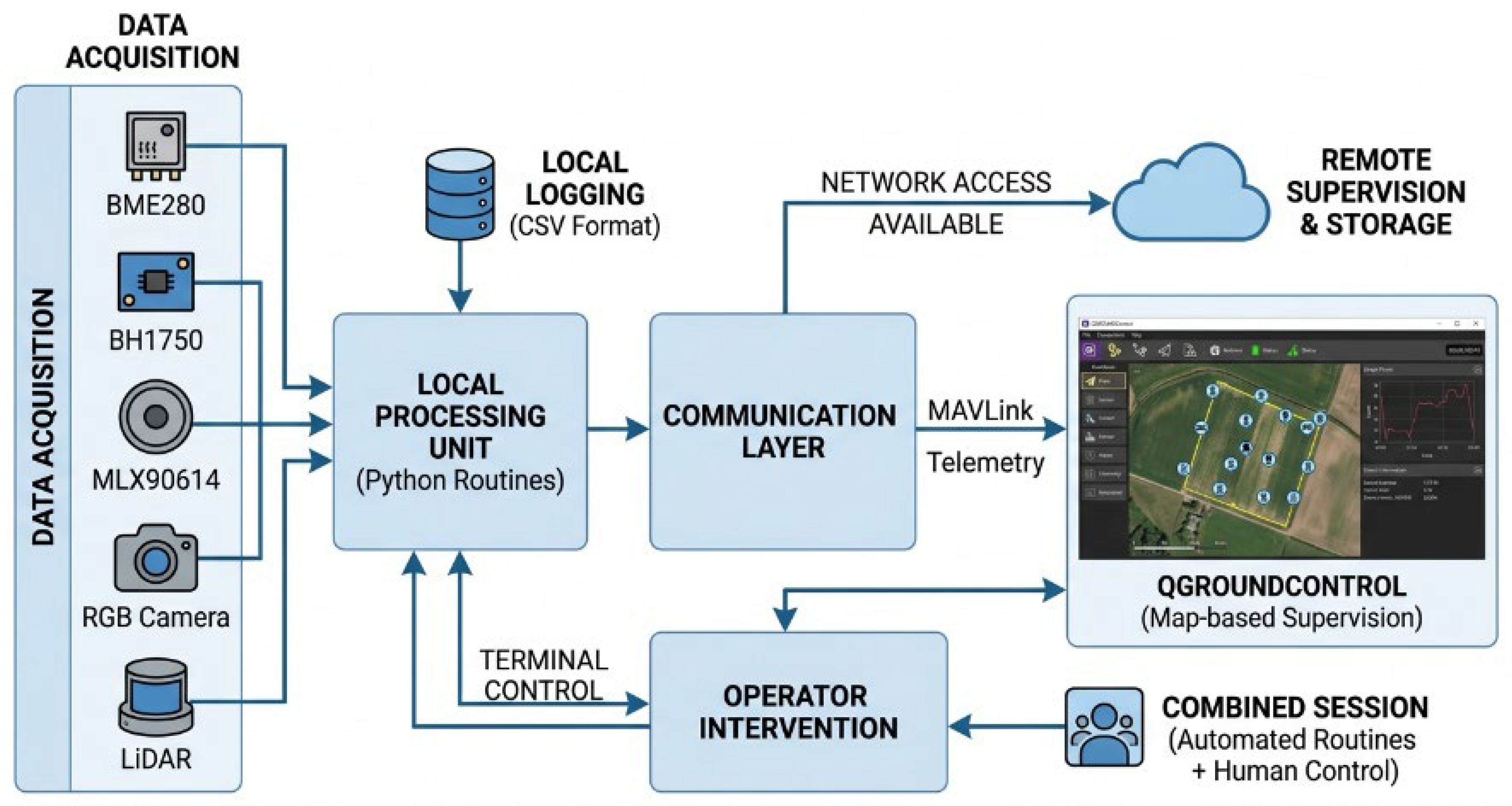
A coupled sensing, logging, and remote-supervision workflow was established. Sensor values were collected through Python routines, stored locally in CSV format, and could be transmitted through the communication layer when network access was available. At the same time, telemetry data could be relayed through MAVLink to QGroundControl for map-based supervision. Because terminal control was retained in parallel with telemetry visualization, automated routines and operator intervention could be combined within the same session. The communication architecture was verified functionally, but quantitative 5G/VPN performance metrics such as RTT, packet loss, and bandwidth were not recorded and are therefore not claimed as validated outcomes (
Figure 1).
3.4. Sensor Suite and Representative Monitoring Roles
The installed sensor set covered both environmental and visual observation tasks. The individual devices and their intended crop-monitoring roles are summarized in
Table 6. Environmental measurements were aimed at microclimate characterization, while the RGB unit was positioned for foliage inspection and ripe-fruit observation. LiDAR was retained as an expandable sensing layer for future phenotyping or distance-aware functions.
3.5. Deployment Orientation
From an application perspective, the assembled system was positioned between fixed sensor stations and specialized agricultural robots. The compact chassis, local logging capability, RTK-ready localization, and wireless supervision together allowed the platform to be framed as a research-scale mobile node for greenhouse scouting, row-level crop observation, and future exploratory monitoring campaigns. However, the present study validates the greenhouse sensing layer only; it does not validate open-field terrain traversal, autonomous waypoint tracking, obstacle avoidance, or long-distance 5G reliability.
3.6. Comparative Greenhouse Sensing-Layer Analysis
During the greenhouse experimental phases, the mobile platform’s onboard sensors provided continuous environmental data from the designated measurement area. To evaluate the operational reliability and trend-tracking behavior of the robot’s sensing layer, the acquired variables were cross-referenced with data from the fixed-position Libelium Smart Agriculture Pro reference station installed on-site. The results should not be interpreted as strict sensor-interchangeability evidence because the sampling locations were close but not fully co-located.
The analysis focused on the core microclimatic parameters, including air temperature, relative humidity, and barometric pressure. The raw data captured by the mobile unit (robot data) were compared against the reference station data. The dataset was subjected to descriptive statistical analysis to assess the distribution, stability, and potential offsets of the mobile sensors.
3.6.1. Regression Analysis of Pressure Sensor Performance
The goodness-of-fit of the regression model is considered exceptional based on the R
2 = 0.992 value, which indicates that the mobile platform’s sensor accounts for 99.2% of the variance recorded by the reference station. The precision of the measurement is further supported by the low RMSE of 0.024 hPa, which remains well within the technical noise margin of the sensor (
Table 7).
The results of the ANOVA test (F = 8826,
p < 0.001) confirm the statistical significance of the model. This result verifies that the linear relationship between the data collected by the robot and the reference values is robust and is not the result of a random correlation (
Table 8).
Analysis of the coefficients reveals an unstandardized B-value of 1.016 (t = 93.94,
p < 0.001), which demonstrates near 1:1 proportional trend tracking between the mobile sensor and the reference station within the narrow pressure range measured. The previously reported intercept of −16.03 hPa should not be interpreted directly as a physical altitude difference. When pressure varies over a very small range and the slope is close to unity, the intercept of an unconstrained regression can become numerically unstable and physically misleading. The paired mean pressure difference in
Table 9 was small after rounding (approximately −0.1 hPa), but strict interpretation requires a future co-located pressure calibration with documented sensor heights.
3.6.2. Regression Analysis of Temperature Sensor Performance
The linear regression model for air temperature shows a strong correlation (R
2 = 0.756), indicating that the mobile platform’s sensor captured a large part of the temperature trend observed at the reference station. However, the RMSE of 2.537 °C is too large for the sensor to be treated as a stand-alone high-accuracy thermometer in precision irrigation or crop-stress decision thresholds. This value may reflect the BME280 sensor’s absolute accuracy tolerance, local heat plumes, shielding differences, sensor height, and the non-co-located deployment geometry. The result supports exploratory trend monitoring but indicates that local calibration and improved radiation shielding are required before agronomic decision use (
Table 10).
The ANOVA results (F = 211.2,
p < 0.001) confirm that the relationship between the measured and reference temperature is highly significant. The substantial difference between the regression sum of squares (1360) and the residual sum of squares (437.8) demonstrates that the model captures the primary thermal trends of the environment effectively (
Table 11).
The analysis of the coefficients yields an unstandardized B-value of 1.067 (t = 14.53,
p < 0.001), suggesting that the mobile sensor is slightly more sensitive to temperature fluctuations than the reference station. The intercept of −1.492 is not statistically significant (
p = 0.510), indicating that there is no substantial constant bias (offset) between the two systems. The near-unity slope (1.067) indicates proportional trend tracking within the tested greenhouse dataset. However, the RMSE and agreement analysis show that local calibration and improved radiation shielding are required before the sensor output can be used for threshold-based agronomic decisions (
Table 12).
3.6.3. Regression Analysis of Relative Humidity Sensor Performance
The regression analysis for relative humidity confirms a strong linear relationship between the mobile platform and the reference station, as evidenced by the R = 0.904 and R
2 = 0.817 values. These results indicate that the robot’s sensor tracked the broader humidity dynamics of the greenhouse. Nevertheless, the RMSE of 5.024% and the low-range discrepancy in
Table 13 mean that this channel should be considered moderate-accuracy trend information rather than a calibrated reference measurement. Relative humidity is highly sensitive to vertical position, air mixing, shielding and proximity to plant foliage; these factors naturally differed between the mobile node and the fixed station (
Table 13).
The ANOVA results (F = 303.6,
p < 0.001) further validate the model’s significance. The high F-statistic confirms that the observed correlation is statistically robust. The distribution of the sum of squares where the regression component (7664) significantly outweighs the residuals (1716) demonstrates that the BME280 sensor effectively tracks the broader microclimatic trends despite the inherent turbulence and localized humidity gradients present in the canopy level (
Table 14).
The coefficient analysis shows an unstandardized B-value of 0.954 (t = 17.42,
p < 0.001), which is close to the ideal 1.0 unit slope and indicates strong proportional tracking. The intercept of −0.806 is statistically non-significant (
p = 0.781), suggesting no large constant offset under the tested conditions. These metrics support the use of the integrated sensing suite for relative greenhouse microclimate trend monitoring, but they do not demonstrate absolute humidity accuracy for stand-alone irrigation-control or stress-threshold decisions (
Table 15).
3.6.4. Diagnostic Analysis of Regression Residuals
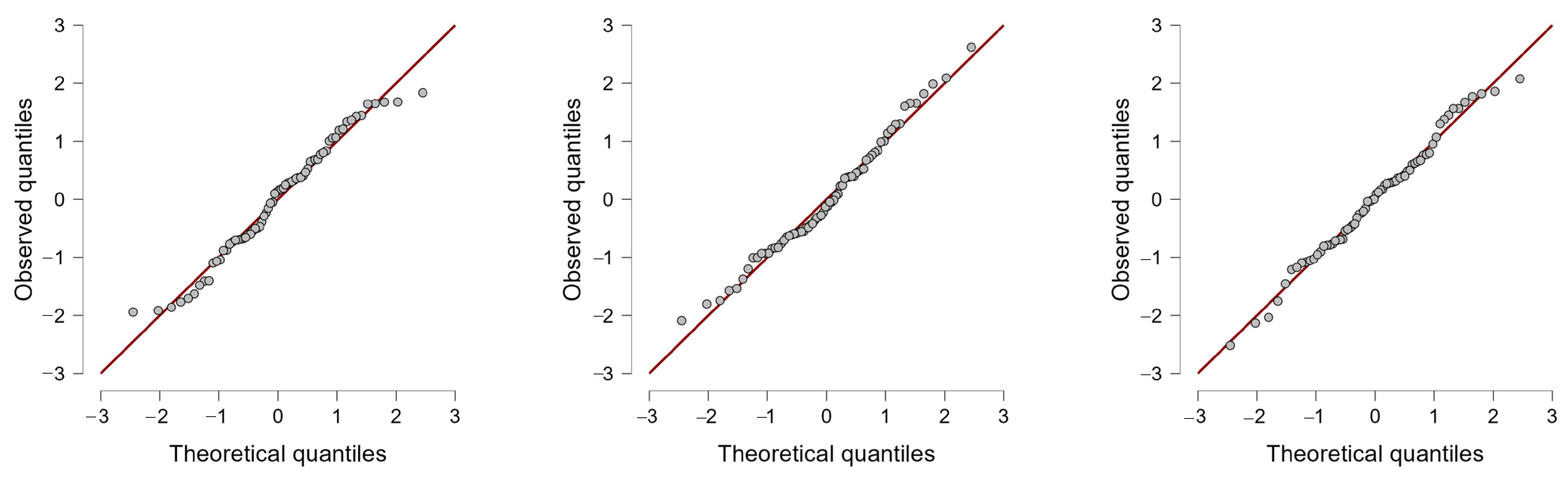
Q-Q (Quantile–Quantile) plots of the regression residuals were analyzed for all three primary environmental variables (
Figure 2). The diagnostic plots suggest that the residual distributions were broadly compatible with linear trend modeling over the tested range. However, this diagnostic supports regression assumptions only; it does not establish absolute agreement between sensors. Agreement and interchangeability must instead be interpreted using paired bias, limits of agreement, and application-specific error tolerances.
3.6.5. Comparative Analysis and Reliability Assessment
To identify potential systematic differences between the mobile platform and the reference station, a paired samples t-test was conducted. The results for air temperature showed no statistically significant mean difference (t69 = −1.833,
p = 0.071), but the effect size and limits of agreement remain agronomically important. The tests for relative humidity and barometric pressure yielded significant
p-values (
p < 0.001), indicating consistent mean offsets under the tested greenhouse deployment. In environmental monitoring, such deviations can arise from differing sensor altitudes, shielding, response time, and microclimatic gradients between the mobile unit and the reference station. Therefore, the
p-values are reported as bias indicators rather than as a complete accuracy assessment (
Table 16).
Because R
2 quantifies shared variation rather than absolute agreement, the interpretation emphasizes paired bias and limits of agreement. Based on the reported paired
t-tests and the mean values in
Table 16, Bland–Altman statistics with ICC analysis (ICC
{3,1}) are summarized in
Table 17.
The ICC{3,1} results reveal a clear hierarchy of agreement across the three measured variables. Barometric pressure demonstrated the strongest agreement among the three variables under the tested greenhouse conditions (ICC = 0.996; 95% CI: 0.994–0.997). However, strict interchangeability should only be claimed after a co-located calibration with documented sensor height and raw synchronized pair analysis. The negligible systematic bias of approximately −0.10 hPa is likely attributable to rounding in the reconstructed dataset.
Relative humidity showed good agreement (ICC = 0.903; 95% CI: 0.848–0.938), marginally exceeding the 0.90 threshold commonly used to define excellent reliability. However, the wide limits of agreement (−6.63 to +13.01%) and the positive mean bias of +3.19% indicate that absolute humidity readings from the robot sensor should be interpreted with caution, particularly at low humidity values where sensor floor effects are most pronounced. The spatial separation between the robot and the reference node, combined with differences in sensor shielding, likely contributed to this variability.
Air temperature yielded the weakest agreement among the three variables (ICC = 0.852; 95% CI: 0.772–0.905), falling within the moderate range. The systematic underestimation of −0.55 °C and the broad limits of agreement (−5.47 to +4.37 °C) suggest that while the mobile sensor tracks diurnal and seasonal temperature trends reliably, it is not suitable for applications requiring absolute temperature accuracy such as precise irrigation scheduling or frost detection thresholds without prior field calibration and adequate radiation shielding.
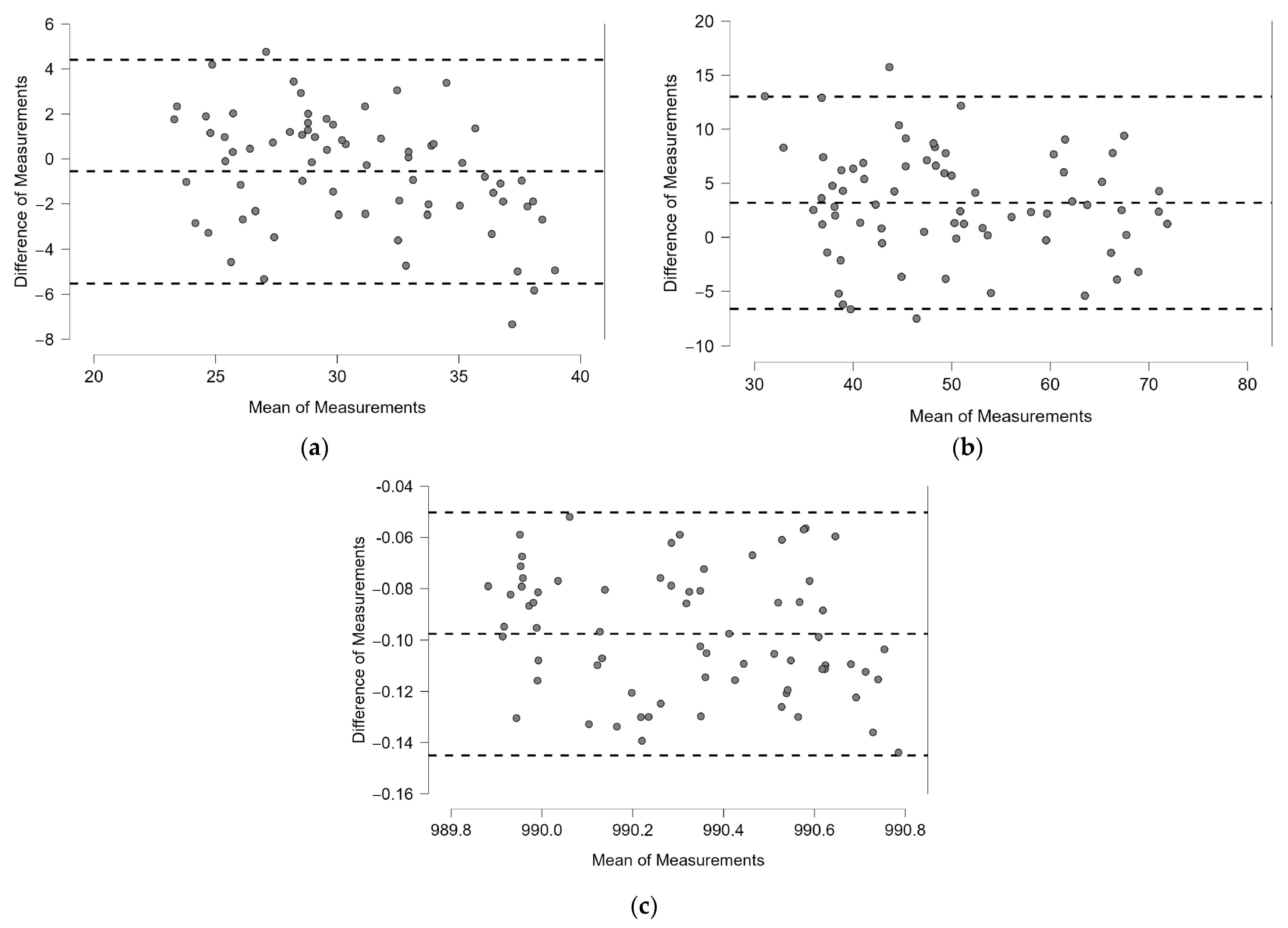
The air temperature plot (
Figure 3a) shows a clear proportional bias. The robot overestimates temperature at 25 °C but underestimates it above 35 °C. This means the measurement error changes linearly with the actual greenhouse temperature.
The relative humidity plot (
Figure 3b) shows an approximately homoscedastic pattern. The error variance appears broadly similar between 30% and 75%. However, there is a large positive outlier near 43% humidity. Here, the robot measured 15% higher than the station.
The barometric pressure plot (
Figure 3c) shows the strongest agreement among the measured variables. The systematic offset is significant (
p < 0.001) but very small (bias = −0.10 hPa). The errors fluctuate within a narrow 0.05 hPa range. This constant bias is agronomically negligible.
For agronomic decision support, the effect of temperature and humidity error was also estimated for vapor pressure deficit (VPD) using the standard saturation-vapor-pressure relationship used in FAO-56 style evapotranspiration calculations [
26]. At the reference mean conditions (T = 30.95 °C, RH = 48.39%), the calculated VPD is approximately 2.31 kPa. Local first-order error propagation gives sensitivities of approximately 0.132 kPa °C
−1 for temperature and 0.0448 kPa per 1% RH. Combining the observed RMSE values (2.537 °C and 5.024% RH) gives an approximate VPD uncertainty of 0.40 kPa. This uncertainty is large enough to affect irrigation or stress decisions when narrow VPD bands are used; therefore, the current sensor layer should be used for exploratory monitoring unless crop- and site-specific calibration reduces the error.
4. Discussion
The developed system should be interpreted primarily as an integration and greenhouse sensing-layer study. In contrast to fixed IoT and wireless sensor network installations, which provide strong temporal continuity at single locations, the present robot was configured to move sensors toward locations where additional spatial detail is required. This mobile-node concept is particularly relevant when measurements must be linked to crop rows, canopy zones, or anomalies identified from other data streams. The demonstrated compact footprint of 35 × 25 cm and the approximately 4 h runtime confirmed practical usability within confined greenhouse environments; however, outdoor open-field operation under uneven terrain, direct radiation, dust, rain, variable canopy contact, and variable 5G coverage has not yet been validated.
These navigation limitations also define the deployment claims. The platform should be interpreted as a supervised mobile sensing node whose autonomy-ready components are installed but not yet validated through a controlled navigation benchmark. The absence of repeated-positioning, cross-track-error, and obstacle-avoidance trials means that no claim is made for autonomous scouting performance, even though the supervised greenhouse sensing runs were completed without collision. Future open-field deployment should therefore be preceded by a navigation campaign that separates localization accuracy, controller error, terrain effects, obstacle detection, and communication reliability.
A complementary role can also be identified with respect to aerial, image-based, and foundation-model-based monitoring. Aerial image-based monitoring can reveal spatial intervention zones from above, while robot-assisted RGB and point-cloud workflows can provide crop-specific phenotyping or yield-related information at close range [
10]. Recent agricultural robotics studies further indicate a shift toward semantic and multimodal reasoning, including vision–language navigation, open-vocabulary perception, and VLM-assisted object detection or monitoring [
16,
17,
18]. The present platform was not optimized for a single specialized phenotyping or VLM task; instead, modularity, wireless supervision, and subsystem interoperability were prioritized. In that regard, the architecture may serve as a bridge between stationary sensing, aerial mapping, proximal crop observation, and future intelligent perception pipelines [
10,
27].
The statistical validation supports a more cautious assessment of the platform’s sensing layer. While environmental monitoring from a mobile base can be affected by dynamic noise, the comparative analysis with a calibrated reference station showed that the integrated sensors tracked the main microclimatic trends. The very strong pressure trend fit (R2 = 0.992) and the strong correlations for temperature (R2 = 0.756) and relative humidity (R2 = 0.817) should be interpreted as trend-tracking evidence only. Absolute agreement assessed via ICC{3,1} confirmed this result. Barometric pressure achieved near-perfect agreement (ICC = 0.996; 95% CI: 0.994–0.997), relative humidity showed good agreement (ICC = 0.903; 95% CI: 0.848–0.938), and air temperature reached moderate agreement (ICC = 0.852; 95% CI: 0.772–0.905). The Bland–Altman limits of agreement and VPD error propagation show that the temperature and humidity errors are not negligible for precision-agriculture decisions based on narrow thresholds. Thus, the current sensing layer is most appropriate for relative microclimate mapping, exploratory greenhouse scouting, and educational/research deployment unless local calibration and improved sensor shielding are added.
Taken together, these results position the integrated sensing layer as suitable for greenhouse microclimate characterization tasks where relative trends and spatial gradients are of primary interest. The observed RMSE values are not sufficient to claim general high-precision agronomic decision readiness, particularly for VPD-sensitive irrigation management. Acceptable use cases at the present stage include detecting relative hot/humid zones, supporting scouting routes, logging synchronized environmental context for images, and testing wireless data workflows. Direct irrigation control, stress-threshold decisions, and crop-model forcing should be attempted only after co-located calibration, radiation-shield evaluation and longer-duration stability tests.
A further strength lies in the use of accessible and widely available components. Lower entry barriers have often been emphasized in agricultural robotics, especially where field experimentation, subsystem replacement, and rapid prototyping are required [
5,
6]. The added benchmark and bill-of-materials tables clarify that the platform is lower in cost and payload than commercial tool-carrying robots, but also less mature in navigation, perception, and endurance validation. From a sustainability perspective, a reusable mobile monitoring node can contribute to more targeted data acquisition and better-informed input management, which is consistent with SDG-oriented digital agriculture [
4]. At the same time, human oversight remains a practical necessity in agricultural environments [
9]. The combination of terminal-based control, map-based telemetry, and RTK-ready localization allowed supervised autonomy to be retained without the need for a dedicated custom application [
9,
19,
21].
The observed sensor offsets and agreement limitations are addressable sources of error, but the magnitude of improvement must be demonstrated rather than assumed. The systematic temperature bias of −0.55 °C and the humidity offset of +3.19% indicate that co-located field calibration against a traceable reference, radiation shielding, and two-point or regression-based correction should be evaluated in a dedicated recalibration dataset. These steps are expected to reduce systematic bias and narrow the Bland–Altman limits of agreement; however, no claim of excellent agreement should be made for air temperature or relative humidity until recalibrated paired measurements demonstrate it. Calibration and shielding should therefore be treated as prerequisites for threshold-based agronomic decisions rather than as a redesign of the sensing layer itself.
The limitations of the present manuscript should nevertheless be stated clearly. The comparative benchmark was greenhouse-only, used 70 synchronized samples per variable, and was affected by non-co-located sensor placement. The exact session durations and sensor separation distances were not preserved in the original experimental log, so representativeness and spatial-gradient effects cannot be fully reconstructed. Long-term stability assessment, independent laboratory-level calibration, quantitative navigation-controller testing, obstacle-avoidance validation, LiDAR processing, subsystem-level power logging, and 5G/VPN communication metrics were not carried out. Regarding navigation capability, it is important to reiterate that the present system was not tested as an autonomous navigation platform. The deferral of navigation metrics is not a limitation of the hardware architecture (the installed Cube Orange, RTK-GNSS rover, and IMU are capable of supporting waypoint-following and heading-aware control) but reflects the deliberate scope boundary of this sensing-layer study. The platform should therefore be viewed as a greenhouse-tested research base for sensing-layer integration rather than as a fully validated agronomic product. Future work should integrate the system into multi-source monitoring studies in which stationary sensor nodes, UAV observations, proximal ground sensing, RTK path tracking, 5G reliability, LiDAR/RGB fusion, and crop phenotyping are evaluated jointly [
10,
27].
5. Conclusions
A compact, low-cost, modular agricultural robot platform was developed as a greenhouse environmental-sensing, telemetry, and remote-supervision research node for precision agriculture and future crop-monitoring applications. Open-source mobility hardware was combined with Raspberry Pi-based edge computing, Cube Orange control, RTK-capable localization, secure remote communication, environmental sensing, RGB imaging, and LiDAR-ready expansion. The evidence supports greenhouse sensing-layer validation and supervised research deployment, but not complete autonomous navigation, open-field LiDAR processing, or crop-phenotyping validation.
The resulting system can complement fixed monitoring stations by bringing sensors toward the crop and by enabling supervised, spatially explicit observation in controlled greenhouse environments and future open-field campaigns. Its principal value lies in the documented integration of communication, sensing, operator-access, and logging layers within a single research unit, not in a complete validation of autonomous navigation or crop-phenotyping performance.
The benchmarking results confirm that accessible digital sensors can track broad environmental trends, but temperature and humidity errors remain important for precision-agriculture indicators such as VPD. Under the tested mean conditions, observed temperature and humidity RMSE values corresponded to an approximate propagated VPD uncertainty of 0.40 kPa. Periodic recalibration, improved shielding, back-to-back sensor comparison, and raw-data Bland–Altman analysis are therefore necessary before the platform can be used for high-precision irrigation or stress-threshold decisions.
Even in its current form, however, the platform provides a reproducible and accessible basis for future work on sustainable digital agriculture, proximal phenotyping, monitoring-guided intervention, and multimodal crop-sensing experiments that combine microclimate measurements with RGB and LiDAR information.




 and
and